News: Editorial: A big beautiful mess strikes rising graduate and professional students (pg. 5)
The Case Western Reserve
Observer
Friday, August 29, 2025 Volume LVII, Issue 2 Est. 1969
NEWS
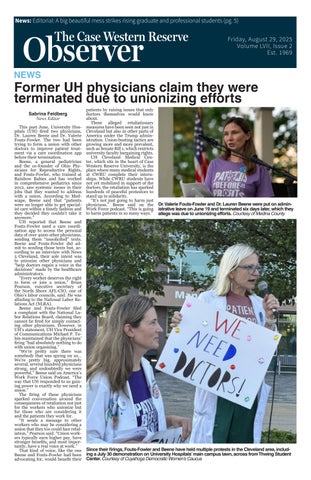
Former UH physicians claim they were terminated due to unionizing efforts Sabrina Feldberg News Editor This past June, University Hospitals (UH) fired two physicians, Dr. Lauren Beene and Dr. Valerie Fouts-Fowler. The two had been trying to form a union with other doctors to improve patient treatment via a care coordination app before their termination. Beene, a general pediatrician and the co-founder of Ohio Physicians for Reproductive Rights, and Fouts-Fowler, who trained at Rainbow Babies and has worked in comprehensive pediatrics since 2012, saw systemic issues in their jobs that they wanted to address with a union. According to Medscape, Beene said that “patients were no longer able to get specialist care within a timely fashion and they decided they couldn’t take it anymore.” UH reported that Beene and Fouts-Fowler used a care coordination app to access the personal data of over 4000 other physicians, sending them “unsolicited” texts. Beene and Fouts-Fowler did admit to sending those texts but, according to an interview with News 5 Cleveland, their sole intent was to unionize other physicians and “help doctors regain a voice in the decisions” made by the healthcare administrators. “Every worker deserves the right to form or join a union,” Brian Pearson, executive secretary of the North Shore AFL-CIO, one of Ohio’s labor councils, said. He was alluding to the National Labor Relations Act (NLRA). Beene and Fouts-Fowler filed a complaint with the National Labor Relations Board, claiming they cannot be fired for simply contacting other physicians. However, in UH’s statement, UH Vice President of Communications Michael P. Tobin maintained that the physicians’ firing “had absolutely nothing to do with union organizing.” “We’re pretty sure there was somebody that was spying on us… We’re pretty big, approximately several, several hundred physicians strong, and undoubtedly we were powerful,” Beene said on America’s Work Force Union Podcast. “The way that UH responded to us gaining power is exactly why we need a union.” The firing of these physicians sparked conversation around the consequences of retaliation not just for the workers who unionize but for those who are considering it and the patients they work for. “It sends a message to other workers who may be considering a union that they too could face retaliation,” Pearson said. “Union workers typically earn higher pay, have stronger benefits, and most importantly, have a real voice at work.” That kind of voice, like the one Beene and Fouts-Fowler had been advocating for, would benefit their
patients by raising issues that only doctors themselves would know about. These alleged retaliationary measures have been seen not just in Cleveland but also in other parts of America under the Trump administration. Union-busting tactics are growing more and more prevalent, such as Senate Bill 1, which restricts university faculty bargaining rights. UH Cleveland Medical Center, which sits in the heart of Case Western Reserve University, is the place where many medical students at CWRU complete their internships. While CWRU students have not yet mobilized in support of the doctors, the retaliation has sparked hundreds of peaceful protestors to stand up in solidarity. “It’s not just going to harm just physicians,” Beene said on the Work Force podcast. “This is going to harm patients in so many ways.”
Dr. Valerie Fouts-Fowler and Dr. Lauren Beene were put on administrative leave on June 19 and terminated six days later, which they allege was due to unionizing efforts. Courtesy of Medina County
Since their firings, Fouts-Fowler and Beene have held multiple protests in the Cleveland area, including a July 30 demonstration on University Hospitals’ main campus lawn, across from Thwing Student Center. Courtesy of Cuyahoga Democratic Women’s Caucus
Life
The Case Western Reserve Observer Friday, August 29, 2025 observer.case.edu Volume LVII, Issue 2
“Please Don't Destroy: LIVE” breaks out of the digital sphere Penelope Cloonan
Life Editor
Please Don't Destroy (Ben Marshall, Martin Herlihy, John Higgins), a YouTube comedy group turned mainstays of SNL digital media, are just coming off of their fourth season at Saturday Night Live (SNL). The group joined the show in Season 47 to fill the role of the former digital comedy group that was endocytosed (as in, absorbed) by SNL, The Lonely Island (Andy Samberg, Jorma Taccone, Akiva Schaffer). When the well-loved The Lonely Island left the show in 2012, there was a definite hole in SNL's digital presence. They put YouTube on the map with their first digital skit “Lazy Sunday” in 2005; so, in a very real way, we have The Lonely Island to thank for a lot of modern pop culture. Though it did take some time to find their replacement, Please Don't Destroy is a fitting successor. The Lonely Island left big shoes to fill, and while Please Don't Destroy may not be as impactful as The Lonely Island was, this new group has been consistently good. This past week, “Please Don’t Destroy: LIVE,” part of the group’s 2025 summer tour, stopped in Cleveland for three nights, each with two shows. I was in attendance at the late show on Friday, Aug 22. The opener for their tour was Emily Wilson, a relatively-unknown solo stand-up comic. Her set was both musical and flashy, mainly consisting of songs meant to rile-up a more woke audience. A stand out song included pointing out the irony of her love for her conservative family
while making fun of her emotionally intelligent husband, who must be kind of gay. What she lacked in well-crafted jokes, she made up for in enthusiasm. While not my favorite, this off-color, mildly unsettling style of comedy did set-up the Please Don’t Destroy set fairly well. At the start of the Please Don’t Destroy set, it was revealed that Wilson’s kind of gay husband was John Higgins. This compliments the group in another major way: nepotism. Please Don’t Destroy is one of the internet’s favorite nepo baby groups. John Higgins is the son of Steve Higgins, former writer and producer on SNL and current TV personality on “The Tonight Show Starring Jimmy Fallon.” Martin Herlihy is the son of Tim Herlihy, long time collaborator of Adam Sandler. Ben Marshall has no industry ties and grounds the group in a very real way. While these comedians are good and I do enjoy their content, the industry ties should not be dismissed. This tour is pitched as their own personal workshop. Since they do almost entirely digital sketches for SNL during the show’s production, they are “trying some things” for their live shows. Sketches ranged from sincere to downright odd. They opened the main set on a heartfelt note with “Moving Out,” a sketch about three guys moving out of their shared apartment. They process the anxiety of entering the real world all while trying and comedically failing to express their sadness in the moment. The jokes are simple, but there is real depth to that sketch. As the trio met and began to collaborate at New York University, there likely is something real in this
sketch. It’s an endearing start that helps the audience get comfortable with Please Don’t Destroy. The rest of Please Don’t Destroy’s set consists of slightly awkward but ultimately enjoyable sketches. A major quirk of the group, both online and live, is their tendency to slip into sketches based more on shock value than well-structured jokes. The sketch “Nerf Adult” showcases a normal man (Marshall) shopping for a Nerf gun for his nephew. In the Nerf aisle, he encounters a supervillain-esque adult man (Herlihy) who is obsessed with Nerf guns. They talk and Marshall’s character is appropriately cautious. Herlihy delivers a perfect parody of an equally sinister and comedic creepy man in the toy section. At the close of the sketch the normal shopper meets one more man in the Nerf aisle, with the punchline being that this one is a pedophile, while the other was just really into Nerf guns. There was another sketch called “Southern” about a man who messes up a job interview because he keeps mocking the interviewer’s Southern accent. Watching someone embarrass themselves and do a bad southern accent is funny; simple as that. In their strangest move, there was an unnamed—to my knowledge— sketch about a tampon serving as a diaper for a penis and how stupid that would be. It was stupid, but it also got a lot of laughs. The reception was likely helped by the fact Marshall was ill and they did the opening to that sketch seven times, with multiple water breaks. Please Don’t Destroy has an immature style of comedy, but sometimes it’s nice to laugh at a group of idiotic almost-30-year-olds.
If nothing else, Please Don't Destroy attempts to do their research. They made reference to local Cleveland institutions and people such as Happy Dog and the current mayor, Justin Bibb. The trio claimed to “not want to pander,” seemingly poking fun at comedians who claim to deeply care for every city they perform in. None of the Please Don’t Destroy members are from the area. Marshall is from Georgia, Herlihy is from Connecticut and Higgins is from New Jersey. While this local knowledge is never genuine, it is fun to see. It was especially interesting as an out-of-state student who did not understand any of the Ohio or Cleveland references. It was a good bit that eventually devolved into Higgins doing an impression of Bane from “The Dark Knight” trilogy, as none of them knew what Justin Bibb sounded like. As established, I did not either, so this was a wonderful touch. So, while Please Don't Destroy is deeply awkward, they are at least self-aware and able to poke fun at themselves. They do pretend to be above their audiences, which makes it easier for us to laugh both with and at them. Please Don’t Destroy has not quite achieved megastardom, despite being on SNL, so while their shows sell out, the ticket pricing is reasonable. Including online fees, tickets ran me about $35, which is standard for the Grog Shop. For B-list comics, Please Don’t Destroy delivers a B-list set with an A-list attitude. They put on a solid show; it’s a good night out. However, watching their sketches on the SNL YouTube channel is both free and more enjoyable. I recommend watching them in their element first.
“Takashi Murakami: Stepping on the Tail of a Rainbow” is a masterpiece Aambar Agarwal
Staff Writer
This summer, the Cleveland Museum of Art (CMA) transformed into a fantastical world of vibrant color. Its newest exhibition, “Takashi Murakami: Stepping on the Tail of a Rainbow,” is a testament to the Japanese artist Takashi Murakami’s talent for combining history and culture with whimsical escapism. Upon entering the CMA, visitors are met in the atrium with Murakami’s recreation of the Yumedono, or Hall of Dreams. Part of Hōryū-ji, a Buddhist temple in Japan, the Yumedono was built where Prince Shōtoku once lived in the late 500s and early 600s. The octagonal hall takes its name from a legend in which a golden Buddha appeared to the prince in a dream. It houses the Kuse Kannon, a statue shaped in the likeness of the prince and believed to have the power to save people from suffering. The grand structure sets the theme of the exhibition: healing. Inside the re-created Yumedono, four intricate paintings are illuminated on the walls. This quartet is titled “The Four Symbols of Kyoto.” Considered the cultural capital of Japan, Kyoto is home to numerous historical land-
marks. By interweaving Chinese cosmology with the city’s geography and architecture, Murakami reinterpreted the appearance of the guardians of the four cardinal directions. The Black Tortoise of the North evokes Kyoto’s mountains and is populated by arhats—followers of Buddhism who have attained Nirvana. The White Tiger of the West portrays the roads of Kyoto and the Blue Dragon of the East embodies the rivers. My personal favorite, the Vermillion Bird of the South, represents their marshlands and is bathed in bright flames. Murakami’s artwork continues downstairs in the exhibition halls, where large statues of the kawaii duo, Kaikai and Kiki, greet guests with wide grins. They set the mood for the first room, which opens with the evolution of Murakami’s most recognizable character, Mr. DOB. A parody of Mickey Mouse, his name is a spin on the word “dobojite,” meaning “why?” in Japanese slang. Wide-eyed and sharp-toothed, Mr. DOB was created to highlight the superficiality and futility of consumer culture. Following Mr. DOB are walls of iconic, colorful, smiling flowers: Murakami’s Flowers. A kaleidoscope of joy, hundreds of these lively flowers form murals, paintings and sculptures
Takashi Murakami's talent for combining history, cultural, and whimsical escapism is on full display at the Cleveland Museum of Art for all to see until Sept. 7. Courtesy of Creative Commons in the exhibition. Often coupled with skull motifs, the pieces embody the ephemeral nature of life, happiness and innocence, as well as the cycle of life and death. They symbolize the effects of World War II, the 2011 Tōhoku earthquake and tsunami and the COVID-19 pandemic on Japan. The exhibition culminates in the 32-feet-wide “100 Arhats” and 82-feetwide “In the Land of the Dead, Stepping on the Tail of a Rainbow.” Drawing on traditional Japanese culture, historical events and Murakami’s distinctive
style, the paintings encapsulate the exhibition’s theme of healing after tragedy. The 100 arhats, each with their own personalities, set against a backdrop of hundreds of skulls evoke a feeling of hope, as do the Buddhist and Daoist figures intervening in a landscape of cascading, rainbow waves. “Takashi Murakami: Stepping on the Tail of a Rainbow” is a captivating, invigorating and truly once-in-alifetime experience. Grab a ticket and stop by the CMA—the exhibition ends on Sept. 7.
Life 3
observer.case.edu
“F1” takes you on a wild ride Petros Samuel Contributing Writer “F1” (2025), directed by Joseph Kosinski (Top Gun: Maverick, Tron), is one of the most anticipated sports films of the decade. With the documentary series “Drive to Survive” reaching global popularity as Netflix’s top-ranked show, Formula 1 racing (F1) has gained massive support in recent years, and the hype for this movie has only added fuel to the fire. Starring Brad Pitt as veteran driver Sonny Hayes and Damson Idris as rising rookie Joshua Pearce, the film dives into the glamorous yet brutal world of Formula 1 racing. Kosinski, known for his adrenaline-heavy visuals, collaborated directly with Formula 1 to capture authentic race weekends using modified Formula 2 cars, official tracks and professional drivers. Anticipation skyrocketed even further thanks to the backing of seven-time world champion Lewis Hamilton, who not only co-produced the film but also helped gather motorsport fanbases and channel their energy into this project. With the legacy of great racing films like “Ford v Ferrari” creating a pre-existing market, “F1” arrives at the pinnacle of motorsport storytelling. For Case Western Reserve University students, where a Formula 1 fandom is steadily growing, the film resonates deeply. Much like racing, student life demands balancing grueling schedules, competitive environments and high-stakes ambitions. In this way, F1 (both the sport and the movie) is a spectacle of speed and also a meditation on students’ work lives. The plot of the film follows Sonny Hayes, a once-great driver who left Formula 1 after a devastating crash. Years later, he is coaxed back into the sport, not as a competitor for glory, but as a mentor to rookie Joshua Pearce, a talented but reckless young driver for the fictional APXGP team. Together,
"F1" is an exhilirating joyride that provides for numerous lessons about competitiveness, individuality, and endurance. Courtesy of Apple TV + Press Pass Hayes and Pearce navigate not only the brutal realities of the F1 circuit— dangerous tracks, team politics and immense pressure—but also their own personal arcs of failure, ambition and redemption. While the plot carries familiar beats from classic sports dramas, the execution feels fresh thanks to its real-world racing integration and focus on intergenerational dynamics. Watching “F1” is less like passively observing a film and more like being strapped into the cockpit of a racecar. This is why passionate fans frequently buy simulators to attempt to capture the feeling. The camera frequently drops into the driver’s perspective, rattling against tarmac, turbocharged engines roaring so loudly that the theater seats seem to tremble. The cinematography creates a realistic experience, using the same cameras used on F1 television to give fans more entertainment and bring new fans to the sport. Kosinski uses various filming angles
to manifest speed as both beauty and terror. Many scenes uncover brutal crashes in which the APXGP drivers use their failures as fuel to ground themselves and succeed in the future. The sweeping Monaco harbor looks breathtaking, as well as the cars zooming by in the Temple of Speed: Monza, Italy. The performances of the actors add more texture to the film: Brad Pitt brings a weary gravitas, while Idris radiates energy and hunger. As a viewer, the sensory overload mirrors what students often feel juggling coursework and looming career stakes—moments where exhilaration and exhaustion blur together. Kosinski’s use of formal techniques makes “F1” stand apart from earlier racing films like “Rush” or “Ford v Ferrari.” The decision to film on actual Formula One circuits using modified race cars equipped with 6K cameras lends the film a visceral authenticity. Hamilton made sure to equip Kosin-
ski with the necessary tools to provide the most detailed modern Formula 1 movie. From matching the RPMs of the Formula 2 car accelerating to align with the engine of a real Formula 1 car and modifying the body kit, these factors help mask the shortcomings of the stand-in cars and make the movie feel more true to life. The editing is sharp but not disorienting, allowing viewers to feel the rhythms of a race— slow buildups of tension punctuated by heart-stopping bursts of chaos. Thematically, the film reflects on generational mentorship. Hayes embodies the inevitability of aging and decline, while Pearce symbolizes unbridled potential. Even in the sport today, F1 has many teams that manifest this dynamic. With teams like Aston Martin, Ferrari, Haas and Kick Sauber, the same dynamic from the movie between Pearce and Hayes is present. For university audiences, this dynamic echoes the relationship between seasoned professors, research mentors or upperclassmen and young undergraduates who are eager to prove themselves and be the best they can in a smaller competitive environment. Moreover, the film touches on issues of class and access: while F1 is often critiqued as a sport for the ultrawealthy, “F1” the movie positions racing as a metaphor for broader questions of privilege, perseverance and risk-taking. Ultimately, “F1” succeeds not only as a high-octane thrill ride but also as a character-driven drama about legacy and ambition. For CWRU students, it is more than a sports movie: it is a reminder that progress requires both speed and endurance, mentorship and individuality. Whether you’re pulling an all-nighter in KSL or chasing research breakthroughs in a lab, “F1” captures the tension between burning out and breaking through. While the narrative at times leans on familiar sports-movie clichés, the breathtaking visuals and thematic resonance make it a unique film worth experiencing.
Playlist of the week: Midwest emo to welcome you back to Ohio Margaret Ozar Contributing Writer Hopefully summer was restful, restorative and at least a little fun for everyone reading this. If Ohio isn’t home, I want to be the first to welcome you back to this lovely state. Full of cornfields, gas stations, passive-aggressive billboards, mournful guitar riffs, whiny men singing about women far out of their league… wait, hang on. Are we talking about Midwest emo? You betcha! While we can’t easily pin down where Midwest emo comes from—from the posthardcore punk scene or the slightly confusing world of math rock–– we can all agree that nothing captures the feeling of longing better than this subgenre. So, whether you are yearning for some place, someone or something, I hope this playlist only intensifies your emotions. “Scott Pilgrim vs. My GPA” Mom Jeans. While this band was formed in California, which is decidedly not the Midwest, the sound is so central to the Midwest emo subgenre that I had to include it. With vaguely romantic undertones that are never fully realized, listening to this song captures the feeling of wishing a situation was different without knowing how
to change it. The repetitive guitar chords, along with the repetition of the lyric “I’m happy here,” conveys a feeling of being frozen in place, which can be applicable to a range of different scenarios–whether you are stuck in small-town purgatory or on an assignment you can’t bring yourself to start.
“Never Meant” - American Football Despite being the oldest song on this playlist, “Never Meant” is sympathetic to the modern situationship. The band, formed in Urbana, Illinois, uses clever writing to explore multiple meanings of the title phrase. American Football provides a soundtrack to realizing that it was never meant to be, or maybe just that you never meant what you were saying. In either case, the doubtful mourning captured in this song is a perfect example of Midwest emo sensibilities. “Twin Size Mattress” - The Front Bottoms With over 230 million streams, this song is the most well-known on the playlist. I can only imagine all 230 million of us who have listened to this song—perhaps on repeat—know the feeling of caring about someone so deeply it hurts, even when they can’t see it. The combination of guitar and
drums on this track complements the lead singer's powerfully raw vocals to add to the depth of this song. The rest of the album is excellent as well, and I recommend “Skeleton” if you want a slightly more uplifting track.
“Tears Over Beers” - Modern Baseball This is my favorite song on the playlist, not just for the fast-paced guitar and charming ad-libs, but for the sweet and earnest lyrics as well. While it’s a pretty short track—which is characteristic of punk and postpunk genres—the story spans several beers. I mean years. From the selfdeprecating beginning to the mature ending, this song comments on how realizing your worth isn’t easy and may take several cycles with the same “meatheads.” “Edward 40hands” - Mom Jeans. We interrupt our regularly scheduled pining for a more upbeat song from “Best Buds,” Mom Jeans.’ 2016 debut album. This song has the signature nasal tone familiar to emo genres and subgenres, but the content of the lyrics is happily romantic, comparing a lover to cigarette smoke that you can’t get rid of and maybe don’t want to. The fun, demo-like tone of the song adds to the unfiltered (pun intended) feeling of not
being able to get enough of someone. “Mary” - Alex G The contrast of simple melodies and complex lyrics on this track is Alex G at his haunting best. Mary, who is an objectified ideal at the beginning of the song, later tells the singer, “I am real and you are not,” which is a powerful lyrical choice. This rings especially true for the women in most alternative subcultures, who are consistently reduced to sexualized concepts, such as the ever-interesting but seldom-respected Manic Pixie Dream Girl. Mary reminding the singer that she is real and exists beyond his fantasy of her makes the song that much more enjoyable for me. The entire album “Trick” showcases his musical and artistic ability quite well, with other favorites being “Sarah” and “Animals.” Some more to soothe your sighing soul: “Dad Rock” - TRSH “Death Cup” - Mom Jeans. “Re-Do” - Modern Baseball “Bottom” - McCafferty “Ohio Is for Lovers” - Hawthorne Heights For all my purists out there, I know this isn’t real Midwest emo, but it is emo from the Midwest. Plus, my heart really is in Ohio.
4 Life
Friday, August 29, 2025
“KPop Demon Hunters": A beautiful production that falls with its writing Darcy Chew
Executive Editor Content warning: Major spoilers ahead. On June 20, Netflix released their highly anticipated animated movie “KPop Demon Hunters.” In just over a month, the movie soon became Netflix’s highest viewed animated movie on the platform and many of its original songs topped multiple streaming charts around the world, a testament to its success and the popularity of K-pop. The movie follows Rumi, Mira and Zoey—members of fictional K-pop girl group Huntr/x—as they moonlight as demon hunters hoping to seal the Demon Realm with the power of their fans. In an effort to prevent the sealing, the demon Jinu convinces Gwi-Ma to let him and four other demons make up a boy group to oppose the popular stars. The movie’s artistry—from the animation to the voice acting to the singing and creation of songs—was all incredible. It’s clear that a lot of love and effort was put into the movie. However, despite its vibrant characters and captivating songs, the story itself felt underwhelming. The movie’s biggest flaw lies within its pacing and plot. As a 100-minute movie, it was rather short. There was not enough time
to explore the characters’ backgrounds and really connect with them. This was incredibly noticeable after a major character’s sudden death. His death didn’t pull any heartstrings, it was just shockingly hilarious due to its abrupt yet predictable nature. The redemption it was supposed to bring didn’t feel meaningful. As a jerk who didn’t own up to his past, honestly, the only thing that he had going for him was that he was hot and awkwardly goofy in a semi-endearing way. I think this issue stems from the movie trying to overextend itself to cater to a larger audience. Its advertised audience is clearly kids, which is seen through the simplistic dialogue, action-packed scenes and childish humor. Yet it clearly also wants to pander towards older K-pop fans with its message about idol culture, as well as the marketed enemies-to-lovers, romantic-comedy feel. The movie could have had a much tighter storyline if it had only focused on one target audience rather than multiple. By trying to accommodate everyone, the audience is left with cringey conversations and forced romantic plotlines that are completely unnecessary to the overarching storyline of self-acceptance. It seemed that the male main character served only as a tool for Rumi’s journey of self-discovery, which was emphasized by her
single tear after his sacrifice before she went back to singing. Due to its rushed story, the movie also left many unanswered questions. Personally, my biggest one was how is it possible to have a half-demon when the demons in this movie are tied to shame and self-hate? If half-demons exist, then it undermines what it means to live as and become a demon when someone could simply be born a demon. As someone who loosely follows the K-pop industry, it’s easy to see the influence and many overt messages regarding the K-pop industry. From fan wars to idol culture and idol personas, the overarching message of the movie reminds viewers how idols are “humans” too. Overall, the movie portrayed a much needed message about idolization and the K-pop industry, but the execution and subsequent reaction seemed to counter this very message. The movie took a really interesting approach with the Saja Boys by making them caricatures of stereotypical idol personas. In the movie, they get practically no lines and what little personality they showed was tied to their persona. There was no background from where they came from or why they followed Jinu’s plans, reducing them to cannon fodder and comedic relief.
The commentary on idol personas is important to acknowledge in the K-Pop industry, but this message seemed to fall apart with the movie’s fixation on “Abby,” one of the Saja Boys known for his abs. Over the course of the movie, many different characters—including the members of Huntr/x—were seen gushing over his abs. While I wouldn’t call it sexualization, it is definitely along the lines of objectification, which is a real issue in the K-Pop industry today. By having the main characters also participate in it, it toned down the seriousness of the problem and made it seem like a quirky, fun thing to do. Another interesting thing to point out is how the reaction from K-pop fans seem to counter the movie’s message. The movie’s entire commentary was on the idea that idols are still “human,” yet many viewers took to the internet to fawn over the rest of the Saja Boys besides Jinu. It was quite ironic seeing K-pop fans compare their favorite idols to those characters, not fully grasping the idea that they are just personas. I want to be clear that I don’t hate the movie. I actually did enjoy watching it with friends. Its success is a very important message for the movie and animation industry about original stories and it is a fun watch, just as long as you don’t look too deeply into the characters and story.
"KPop Demon Hunters" may prove itself to be unfocused in both theming and storyline, but at least it is enjoyable. Courtesy of Creative Commons
Join The Observer! Get more info at our interest meeting: August 30, 2025 | 1:30 PM | Thwing 201 ft. bundtinis from Nothing Bundt Cakes
Opinion
The Case Western Reserve Observer Friday, August 29, 2025 observer.case.edu Volume LVII, Issue 2
EDITORIAL
A big beautiful mess strikes rising graduate and professional students Editorial Board Under the Trump administration, universities are overshadowed by a dark cloud of constrained funding and an unstable future for higher education. It seems that the power of education has threatened the current administration, as logic and intelligence are clearly difficult qualities for the executive branch to grasp. The abolishment of the Direct PLUS Loan program under the ratification of the One Big Beautiful Bill Act (OBBB) will shut out lower and middle-class students from American graduate programs, solidifying education as a luxury only for the wealthy and privileged. The program funds the attendance of graduate and professional students seeking higher education with a fixed interest rate for the entirety of the loan’s lifespan, and the amount available for borrowing is the cost of attendance without other financial assistance included. The removal of the Grad PLUS loan program ultimately pushes borrowers toward the private loan network, which is a selective process that is less willing to overlook financial instabilities. Private loans typically have high, unfixed interest rates that are valued as much as 26%, depending on the co-signer’s or borrower’s credit score. This enactment is particularly detrimental to lower-income families. This abolishment is a “big beautiful” setback in the American education system, harming the future generations of the nation. Trump’s attack on the education system was not unintentional. Knowledge is a powerful tool that unites us. Knowledge keeps us informed. Knowledge shapes changemakers. Don’t fret, though; the government pocketed $307 billion from this change. These funds could potentially be used to deploy more national troops to protect America from Americans. Students pursuing a professional graduate degree, such as medicine, dentistry or law, will be capped at a
Lucas Yang/The Observer borrowable limit of up to $50,000 annually. Most Master’s degrees and PhD programs are subject to a loan limit of up to $20,500 annually. Under the previous law, federal loans were permitted for the cost of attendance as defined by the educational institution. Now, such loan limits exist under the OBBB. You’d think it cannot get worse. However, the loans are also restricted by a maximum value that can be borrowed across one’s academic career. This decision has put immense pressure on institutions—forcing them into a stalemate. Many are uncertain of how to mend the huge Trump-sized hole. Some institutions, including Case Western Reserve University, have given in to the pressures of conforming to the administration’s demands to salvage their federal funding by eliminating their Office for Diversity, Equity and Inclusive (DEI) Engagement. For centuries now, humanity has
embraced wisdom and innovation. There will be none left if the majority of its prospective students are unable to attend higher educational institutions. It is unheard of for education to be threatened in such a way. We are trekking through unfamiliar territory under the current jurisdiction of America. So, what now? CWRU has a substantial pre-professional population. The drastic political decision is one that cannot go unnoticed, as it affects so many. Though the future is unpredictable, changes are bound to happen, good and bad. Pre-professional students may find comfort in the security blanket of external scholarship facilitated by professional recommendations and eloquent essays. In the long term, such scholarships will become increasingly competitive as demand increases. Who is more deserving of such scholarships will be analyzed and the review process may have to
change requirements to cater towards low-income students. Scholarships from educational institutions are possible, too. Donors have made it possible for students to be unburdened financially. One of the more famous examples would be the Albert Einstein College of Medicine, thanks to Dr. Ruth L. Gottesman’s $1 billion donation. Or closer to home, there is the Cleveland Clinic Lerner College of Medicine, which is tuition-free for accepted students. Again, though, these options are cutthroat and are not long-term solutions to nationwide calamity. Despite the turmoil we live in today, it is important not to lose hope, not to lose passion and not to lose sight of who you are meant to become. The radioactive fallout of the OBBB’s passing is something we are meant to overcome, beginning with political activism and awareness. Knowledge is what connects us, and
Great power comes with great responsibility Catherine Choi
Staff Writer
As children, many of us wished to be adults sooner so that we could do whatever we wanted without parents telling us no. It felt like adults had more options and were able to have more control over their own lives. Some people that were brought up in adverse family settings are often counting the days until eighteen so they can protect themselves from their household. On the contrary, many adults wish that they can go back to the time when they were still children under the protection and support of their parents and other responsible adults. Also, a significant number of rising eighteen year olds struggle due to the rough transition from a protected minor to a stressed adult.
Being an adult is more than being a certain age or of certain physique, though. The primary meaning of being an adult is that everything you say and do holds legal power. As minors, we are subject to fewer and shorter consequences that typically stem from actions such as being disliked by their peers, low grades or disobedience. But adults deal with more severe consequences that may tarnish their permanent record, lead to fines or even incarceration. As one turns eighteen, they are able to enter into binding contracts, marry without written consent from their parents, sue or be sued by their own names, be tried as adults and consent to all types of medical treatment and make other major decisions that impact their own lives. Rather than having parents or teachers assist teenagers in deci-
sion-making or helping them get out of erroneous decisions, many eighteen year olds are responsible for understanding complex situations and the graveness of their actions. For instance, if one signs a contract as a minor and realizes that the terms are unfair, they can easily void the contract due to the legal protection. But, as an adult, we are responsible for carefully reading what we’re signing and getting ourselves out of unfair situations on our own by taking appropriate steps. Being an adult also means having to take care of everything that happens around us. As minors, parents are responsible for fulfilling our needs mentally and physically. For this reason, the newfound responsibilities thrown at us in adulthood may come as a shock. Also, adult actions have long-lasting and grav-
er impacts. For example, in the case a student conducts academic dishonesty, high school punishments are likely to be minimal and have less of a chance of impacting the student’s records in college or job applications. However, in college, academic dishonesty can lead to the loss of scholarships, course failure, request to leave the major/department, getting expelled or even facing legal charges for copyright infringement. The impact can spill into job searching and applying for higher education, and careers are essential to navigating life. As minors, we followed the lifestyle and mindsets our parents provided for us. However, as adults, it is up to us to reestablish the discipline in a clean slate that accommodates their needs. For example, it is up to us to upkeep our academic studies—not our parents or professors—and to
6 Opinion
Friday, August 29, 2025
Great responsibility from page 6 deal with the consequences such as course failure, loss of merit based scholarships or academic probation. Healthwise, we cannot simply rely on our parents to prepare/refill prescriptions, reserve doctor’s appointments, nurse us during times that we are sick or prepare meals for us. As adults, we are allowed to provide informed consent, designate power of attorney, have a living will and make all decisions for our health. It is up to us to read the papers that we are signing, arrang-
ing appointments, treatment and follow up schedules, following and refilling prescriptions, payments and filing claims to the insurance company. We are also responsible for preparing healthy and nutritious meals, regular exercise and voluntarily making necessary lifestyle changes. Overall, though, being an adult means that we are taking our own initiative. There is no one to provide clear guidance, and it is up to us to figure out who we are.
The Case Western Reserve Observer Established in 1969 by the undergraduate students of Case Western Reserve University
Darcy Chew Executive Editor & Publisher PRINT Hannah Johnson Director of Print Alyssa Wang News Editor Sabrina Feldberg News Editor Penelope Cloonan Life Editor Aleksandra Majewski Opinion Editor Ellie Palaian Sports Editor Siya Motwani Copy Editor Mariana Parilli-Castillo Copy Editor Abhishek Nambiar Copy Editor Rithika Karthikeyan Copy Editor DESIGN Anjali Bhuthpur Director of Design Lucas Yang Director of Design Shareen Chahal Layout Designer Sahar Kapasi Layout Designer Nithya Pandari Layout Designer Elizabeth McHugh Layout Designer Jana Ashour Graphic Designer Anna Trusova Graphic Designer DIGITAL MEDIA Auden Koetters Director of Digital Media Moses Fleischman Web Editor Matthew Stall Video Editor Phillip Kornberg Photo Editor Tyler Sun Photo Editor Esha Bagora Social Media Editor BUSINESS Tyler Vu Director of Business Operations
Lucas Yang/The Observer
Correction: In last week’s issue, a story about Case Western Reserve University’s partnership with FloSports incorrectly stated that the university developed its own streaming platforms and apps to share content. The university had previously partnered with BoxCast and MediaVision to provide webcasts for the CWRU community.y.
The Observer is the weekly undergraduate student newspaper of Case Western Reserve University. Established in 1969, The Observer reports news affecting students and provides an editorial forum for the university community. Unsigned editorials are typically written by the opinion editor but reflect the majority opinion of the senior editorial staff. Opinion columns are the views of their writers and not necessarily of The Observer staff. For advertising information, contact The Observer via e-mail at observer@case. edu. LETTERS TO THE EDITOR should be e-mailed to observer@case.edu or submitted on our website at observer.case.edu. Letters can be mailed to Thwing Center 11111 Euclid Avenue, Suite 01, Cleveland, Ohio 44106. For policy and guidelines related to the submission of Letters to the Editor, refer to observer.case.edu/submit-a-letter. The Observer is a proud member of CWRU’s University Media Board. Follow The Observer on Facebook, Twitter, TikTok and Instagram @cwruobserver.
Opinion 7
observer.case.edu
The power of small acts Umair Vaseemuddin
Contributing Writer
Two years later, I still remember the gratefulness that lit up a mother’s eyes as I handed her a plate of food at the Ronald McDonald House. This simple plate of food meant so much to both of us. For her, it meant relief from knowing she did not have to spend money on dinner, could sleep with a full stomach and get the rest she needed to care for her seriously ill child who was sleeping in a hospital bed next door. For me, her smile motivated me to never stop caring for others. My dedication to battling food insecurity began when I was a young teenager. Whether standing under a dim light late at night with sticky hands after making seventy-five peanut butter and jelly sandwiches, or loading boxes of canned food into a car trunk for a local foodcharity, I am filled with euphoria at the thought of brightening someone else’s day. In thosemoments, I’m reminded of the word namaste: “The light in me sees the light in you.” Whenever I donate a meal to someone in need, I see the light in them and the humanity in each person, no matter their situation. Unfortunately, 13.5% of Americans, approximately 47 million people, reportedbeing food insecure in 2023. Food insecurity is especially prevalent in Cuyahoga County, where around 161,700 individuals suffer from it. Despite these stag-
gering numbers, the situation is worsening. The reconciliation bill recently passed by Congress proposes slashing $186 billion from the Supplemental Nutrition Assistance Program (SNAP), and cutting $911 billion from Medicaid. These reductions would severely limit states’ ability to fund essential food assistance programs. In Ohio, for example, Medicaid provides critical support for low-income individuals and families, including coverage for nutritional counseling and programs that indirectly support food access. Cuts to Medicaid and SNAP would further strain local food banks and community organizations already operating at their limit in the state, especially in vulnerable communities like Cleveland, where access to affordable and nutritious food is already scarce. These proposed cuts threaten to worsen the crisis. In the face of growing food insecurity, it is more important than ever for communities tounite in support of organizations that advocate for vital nutrition and health programs. We can make a difference by volunteering at local food banks or donating to charities like The Greater Cleveland Food Bank and the Ohio Association of Foodbanks. Volunteering builds a strongersense of community, where people look out for one another instead of struggling alone—and supports larger efforts to address the root
Anna Trusova/The Observer causes of food insecurity. These community organizations often collaborate with policymakers and advocates, so every hour spentvolunteering not only shows support for the cause, but also becomes part of a larger movement for change. The point is not to solve food insecurity on your own. It is to show up, to care, and to remember to see the light in others, whether those who suffer from food insecurity or thosewho face different challenges in their lives. What our world needs
most is not division, but compassion and unity. The gratitude I received at the Ronald McDonald House helped me realize that even the smallest actions can have a lasting impact. Every act of kindness is appreciated—oftenmore deeply than we realize—and creates ripples far beyond our view. In helping other lives,we end up brightening our own in ways unimaginable. Together, we can create a world where no one has to suffer from hunger.
One kitten, one lesson Afshan Ara
Staff Writer
When I returned home this past summer, a cat and her kitten caught my eye from across the street. The two were confident of their surroundings as the mother sat like royalty on my neighbor’s front lawn. Both were strays, of course, and stayed at this neighbor’s lawn for the food and water they received in dinner bowls. In Houston, stray cats are a common
sight across the city, yet their livelihood is often overlooked and even ignored. The problem is so dreadful that shelters are not always the best option. The life of a stray cat is full of uncertainty and danger. They are subject to wandering the streets for food, hiding under cars for shelter and getting stuck in between fences. I personally believe the handling of stray cats is essential not only for the well-being of animals, but also for the development of a caring and understanding neighborhood. Many people
Jana Ashour/The Observer
may see them as part of the neighborhood scenery, but they raise important concerns about public health, community responsibility and animal welfare. I first noticed the kitten in May, upon my return from school and tried to approach her and her mother. Naturally, I was met with hostile hissing and glares of irritability. The mother was not keen on my offering of food, while her daughter closely inspected it. She took a few bites, then ran back to her mother to hide behind the bushes again. I had done my research and made sure to buy wet food that was healthy and appetizing. Human contact was not something they were used to or even were anticipating. I would always leave the food and walk away, so they could complete their meal without fear. Over the next month, I began sitting with the kitten while she ate. Slowly but surely, she began to trust me. After two months, she let me pet her. She was obviously motivated by food and knew she could get her next meal from me if she stayed near my garage during meal time. I also knew it was time to get her professional medical help. I borrowed a trap from my next-door neighbor and trapped her so I could take her to get spayed and vaccinated. Trapping her was not the complicated step in the process, but making sure the vet was available was. Due to a recent flood in the state, the first shelter I took her to could not spay her because they had taken in dogs that were stranded from the flood and did not have the appropriate resources to spay strays. I scrambled to find another clinic that had a trap-neuter-return program (TNR), and was
lucky enough to find one that could book an appointment within the next week. TNR has been proven to be an effective and humane form of stray cat population control. Future stray litters are successfully avoided, and I did not want this kitten to suffer her mother’s fate of being distrustful of humans and worried about her next meals. Taking care of stray populations, commonly referred to as colonies, has benefits for humans in the community as well. Larger populations can easily spread fleas and ticks that affect not only house pets, but also humans. Although not common, they can also spread other notorious diseases, like rabies, through parasites they may carry. Additionally, strays disrupt local populations of native birds and smaller wildlife by constantly preying on them and contributing to the degradation of ecosystems. Shelters often struggle to do this work alone in cities where stray populations run rampant. Individual responsibility plays a big role in curbing the stress and resources shelters use for house animals. Fostering cats, donating supplies or TNR makes a big difference in the community. I used to think that only TNR experts could participate in mitigating the issue, but I realized doing research and careful planning were key to making it a reality. Currently, my mother continues to feed her and watch over her as we look for potential adopters. I was lucky that I was able to help this kitten over the summer, as I know it is not possible for everyone, but it gave me a sense of purpose in my community.
Sports
The Case Western Reserve Observer Friday, August 29, 2025 observer.case.edu Volume LVII, Issue 2
CWRU cross country builds on 2024 success, looks ahead to nationals Ellie Palaian
Sports Editor Coming off of dominating 2024 seasons, finishing top 10 in all in-season meets and 6th in the UAA championships, the Case Western Reserve University men’s and women’s cross country teams are both back and ready to win a national championship. “Our team culture feels strong, we have a really good dynamic going on between classes, the freshmen are bonding with each other, and I think we’re going to be able to accomplish some really great things this season,” second-year Ciara Ledford said. In the 2024 season, the women had their best showing in the AllOhio Invitational placing third of
thirteen Division III teams that competed, coming in ahead of Franciscan University of Steubenville and Otterbein University. Ledford, although just coming back from an injury, has high hopes for the season and wants to see herself and her teammates succeed. “I hope that my teammates and I are all able to get stronger and faster together, and not only to crush workouts and races, but also to grow closer and be able to rely on each other,” Ledford said. “Personally, I’m coming back from injury, so I’d just like to be able to run again, but I’m excited to see what everyone accomplishes and to support them through the season.” The women will graduate seven seniors this spring, including fourthyear co-captains Lauren Iagnemma and Julia Hluck, but also welcomed
The cross country teams aim to qualify for Nationals as they attempt to build on their successes during the 2024 season. Courtesy of CWRU Athletics
eight freshmen to the roster this season. Ledford believes the combination of veteran leadership, an energized freshman class and the addition of Assistant Coach Jacob Wahlenmaier sets the team up for a strong year. “The women’s team has some really strong seniors running this season, some very promising sophomores, and some freshmen coming in from strong high school seasons,” Ledford said. “We also have some new coaches, who I think will be able to help spread attention among athletes so everyone is able to train and perform at their very best.” Like the women, the men delivered a standout performance at last year’s All-Ohio Invitational, finishing first among 14 Division III teams and outperforming programs such as Ohio Northern University, Kenyon College and College of Wooster. Both squads will return to the meet on Sept. 19. Second-year Donovan Crowley is eager to build on last season’s momentum and has high expectations for the year ahead. “Last season, there was typically a long string of runners before a pack of Case guys crossed the finish line to solidify our place at meets,” Crowley said. “This year, we hope to have a larger pack that sticks together more toward the front of races to place better at UAA, Regionals, and hopefully, Nationals.” Men’s co-captain and third-year Jacob Slater enters this season with confidence and high expectations for the team. “Going into this season I feel good and confident in my guys,” Slater said. “We got a solid group of returners and a beast of a freshmen class.
Our pack is going to be tight and I think any guy could be in our top seven week to week, which for me is exciting because it means every day our guys are battling for spots.” Slater believes the team can build on last year’s progress, learn from past setbacks and push for a national championship berth. “Last season we had a kind of a mentality reset in the middle of the year that got us back on the right track and moving toward a nationals spot,” Slater said. “We ended up coming up short by a few spots, but I think because of that the guys are hungry and ready to commit from the jump this year, but commitment is going to be the key.” Ledford points to team chemistry as the defining strength of both squads. She says it’s what makes running for CWRU so rewarding, and what drives her desire to see the team succeed. “We’re a coed team, which makes for an interesting but stronger and more enjoyable dynamic. It’s a tough sport, and one where your individual achievements are largely due to your own actions and not your teammates’, but everyone has to go through the same workouts and run the same races, and at the end of the day we all just want to see each other succeed,” Ledford said. “Cross-country is an individual sport if you don’t have a strong team, but when you have a team like the one at Case, it’s as much a team sport as any other.” The cross country season for both the men and women will officially kick off this Friday Aug. 29, at the Bill Sudek Invitational hosted at the University Farm.
Volleyball aims to keep momentum Upcoming Games going after strong 2024 season Abhishek Nambiar
Staff Writer
Following a strong showing in the 2024 season, the Case Western Reserve University volleyball team looks to keep the momentum going into the 2025 season. CWRU finished the 2024 season with a 24-8 overall record, advancing all the way to the NCAA tournament for the second consecutive season before falling five sets to the University of Dubuque in the first round. In UAA play, the Spartans finished with a 5-2 record, giving them a second-place tie with Washington University in St. Louis. Both teams finished behind Emory University (7-0). Going into her final season, fourth-year middle blocker and team captain Amanda Ngo noted her wide range of feelings given this will be her final season as a Spartan. “I’d say it’s definitely a mix of emotions,” Ngo said. “Excitement with a little bit of bittersweet reflection. It’s crazy to think this is my last season when it feels like just yesterday I was a lanky 17-year-old stepping into the gym for the first time. But more than anything, I’m really excited to see what this group can accomplish
together. I feel grateful for all the amazing people I’ve met here, and I’m going into this season with a lot of appreciation.” With this mix of gratitude and determination setting the tone, the Spartans now shift their sights to the challenges ahead. The team’s schedule for this season offers no shortage of tests, with CWRU set to face numerous competitive teams who will be sure to give the squad no easy way of making it back to the NCAA tournament. This slate of highly-ranked opponents includes ClaremontMudd-Scripps, who finished last season with a 22-7 record, Marietta College, who finished 24-2 overall and 9-0 in conference play, and familiar UAA rivals like Emory University and WashU. Adding to the challenge will be the loss of nine players who graduated last year. Filling these roles are six first-years who will all be making their collegiate debuts this season: outside hitter Elena Stone, setter Kaitlyn Harris, middle blocker Kate Williams, defensive specialist Thea Beran, right side hitter Olivia Myers and middle blocker Isabel Haytayan. Nonetheless, Ngo took note of positive changes to the team’s dynamic with the presence of these new players.
“This team feels different in the best way,” Ngo stated. “The positivity is off the charts, and the effort I see from these women every day is contagious, it keeps everyone bought in. We’ve also been really intentional with our mindset this year, focusing on our theme: ‘ALL IN, ALL US.’ There’s a strong sense that we’ve got each other’s backs, and that’s everything we need to build on.” On the coaching side of things, the entire coaching staff from the 2024 season will be returning for the 2025 season; Among this returning staff is Head Coach Karen Farrell who notably achieved her 500th career win last season with a CWRU victory over Earlham College. New to the coaching staff this year will be graduate student Hayden Caldwell who previously served as a coaching assistant for the team. “I’m [really] looking forward to seeing how far this group can go,” Ngo said. “There’s something special about us, and I think people will see that this season.” The Spartans’ season will kick off on Friday, Aug. 29 at 2:30 p.m. against Whittier College as part of the Pacific Coast Classic Tournament in Claremont, California. The match will be streamed live on FloSports.
Cross Country
Bill Sudek Invitational (8/29)
Men’s Soccer CWRU at Franciscan (8/29) CWRU at Juniata (8/31)
Women’s Soccer CWRU vs Franciscan (8/29, 7:30 p.m., DiSanto Field) CWRU vs Allegheny (8/31, 1p.m., DiSanto Field) CWRU at John Carroll (9/3)
Volleyball Pacific Coast Classic: CWRU vs. Whittier (8/29) CWRU vs. Claremont-MuddScripps (8/29) CWRU vs. Chapman (8/30) CWRU vs. La Verne (8/30) CWRU at Mount Union (9/3)