Life: UPB’s Back to School Bash: carnival games, music, etc. (pg. 3)
The Case Western Reserve
Observer
Friday, September 4, 2026 Volume LVIII, Issue 3 Est. 1969
NEWS
Max Miller refuses to leave congressional race amid abuse allegations
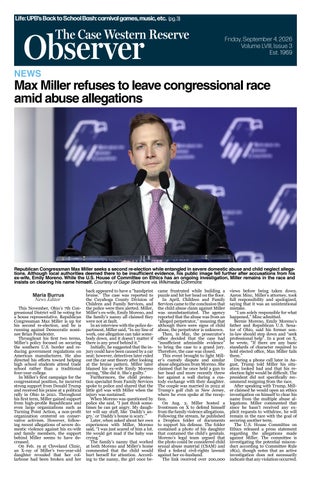
Republican Congressman Max Miller seeks a second re-election while entangled in severe domestic abuse and child neglect allegations. Although local authorities deemed there to be insufficient evidence, his public image fell further after accusations from his ex-wife, Emily Moreno. While the U.S. House of Committee on Ethics has an ongoing investigation, Miller remains in the race and insists on clearing his name himself. Courtesy of Gage Skidmore via. Wikimedia Commons
Maria Burrus News Editor This November, Ohio’s 7th Congressional District will be voting for a house representative. Republican Congressman Max Miller is up for his second re-election, and he is running against Democratic nominee Brian Poindexter. Throughout his first two terms, Miller’s policy focused on securing the southern U.S. border and reducing government regulations on American manufactures. He also directed his efforts toward helping high school students attend trade school rather than a traditional four-year college. In Miller’s first campaign for the congressional position, he incurred strong support from Donald Trump and received his praise at a political rally in Ohio in 2021. Throughout his first term, Miller gained support from high-profile Republicans and even large organizations such as Turning Point Action, a non-profit organization centered on conservative activism. However, following recent allegations of severe domestic violence against his ex-wife and family members, the support behind Miller seems to have decreased. On Feb. 19 at Cleveland Clinic, an X-ray of Miller’s two-year-old daughter revealed that her collarbone had been broken and her
back appeared to have a “handprint bruise.” The case was reported to the Cuyahoga County Division of Children and Family Services, and the police were then alerted. Miller, Miller’s ex-wife, Emily Moreno, and the family’s nanny all claimed they were not at fault. In an interview with the police department, Miller said, “In my line of work, one allegation can take somebody down, and it doesn’t matter if there is any proof behind it.” Initially, he suggested that the injury could have been caused by a car seat; however, detectives later ruled out the car seat theory after looking at the bruise pattern. Miller later blamed his ex-wife Emily Moreno saying, “She did it. She’s guilty.” Furthermore, the child protection specialist from Family Services spoke to police and shared that the little girl was with Miller when the injury was sustained. When Moreno was questioned by police she said, “I just think sometimes he can get angry. My daughter will say stuff, like ‘Daddy’s angry,’ or ‘Daddy’s house is scary.’” Later, when asked about her own experiences with Miller, Moreno said, “I was just scared of him a lot. He would get mad if the baby was crying.” The family’s nanny that worked at both Moreno and Miller’s home commented that the child would hurt herself for attention. According to the nanny, the girl once be-
came frustrated while building a puzzle and hit her head on the floor. In April, Children and Family Services came to the conclusion that the child abuse claim against Miller was unsubstantiated. The agency reported that the abuse was from an “alleged perpetrator,” meaning that although there were signs of child abuse, the perpetrator is unknown. Then, in May, the prosecutor’s office decided that the case had “insufficient admissible evidence” to bring the case to a grand jury. Therefore, the case was closed. This event brought to light Miller’s custody dispute and similar abuse allegations from Moreno. She claimed that he once held a gun to her head and more recently threw her against a wall during a custody exchange with their daughter. The couple was married in 2022 at Trump’s golf club in New Jersey, where he even spoke at the reception. On Aug. 2, Miller hosted a livestream on X to defend himself from the family violence allegations. Following the stream, he published a Dropbox folder of documents to support his defense. The folder contained a photo of his daughter that contained the child’s genitals. Moreno’s legal team argued that the photo could be considered child sexual abuse material (CSAM) and filed a federal civil-rights lawsuit against her ex-husband. The link received over 200,000
views before being taken down. Aaron Minc, Miller’s attorney, took full responsibility and apologized, saying that it was an unintentional mistake. “I am solely responsible for what happened,” Minc admitted. Bernie Moreno, Emily Moreno’s father and Republican U.S. Senator of Ohio, said his former sonin-law should step down and “seek professional help”. In a post on X, he wrote, “If there are any basic standards of character required to hold elected office, Max Miller fails them.” During a phone call later in August, Trump told Miller his situation looked bad and that his reelection fight would be difficult. The president did not specifically recommend resigning from the race. After speaking with Trump, Miller claimed he would open an ethics investigation on himself to clear his name from the multiple abuse allegations. Miller commented that since he hasn’t received any explicit requests to withdraw, he will remain in the race with the goal of securing another term. The U.S. House Committee on Ethics released a press statement regarding the allegations made against Miller. The committee is investigating the potential misconduct according to Committee Rule 18(a), though notes that an active investigation does not necessarily indicate that any violation occurred.
News
The Case Western Reserve Observer Friday, September 4, 2026 observer.case.edu Volume LVIII, Issue 3
Cleveland Clinic reaches a settlement in gender-affirming care lawsuit
News -inBrief In a Big Win, Google Avoids a Breakup of Its Ad Tech Business By David McCabe and Tripp Mickle From The New York Times
Trump Administration Begins Blitz to Find Elusive Voter Fraud Ahead of Midterms By Nick Corasaniti and Hamed Aleaziz From The New York Times
DOJ urges judge to rule for OpenAI, Microsoft in N.Y. Times lawsuit By Miriam Waldvogel From The Washington Post
Trump asks Supreme Court to allow military to discharge transgender troops By Julian Mark From The Washington Post
The Cleveland Clinic has reached an agreement with the U.S. Department of Justice and State of Ohio after violating the Ohio’s Saving Adolescents from Experimentation (SAFE) Act, which has received polarizing responses. While governement officials believe this will prevent children from making regrettable medical decisions, the LGBTQIA+ thinks this is a step in the wrong direction for gender identity rights. Courtesy of Cards84664 via Wikimedia Commons
Ethan Park
Staff Writer
After a year-long legal battle, the U.S. Department of Justice and the State of Ohio have reached a settlement with the Cleveland Clinic. In the lawsuit, the federal government found that Cleveland Clinic knowingly used inaccurate diagnosis codes to falsify public insurance coverage. While originally the codes were disguised as routine coverage for youth, they were instead used to provide gender-affirming care for minors which is against Ohio House Bill 68. Despite the bill banning puberty blockers and similar medication, it does not block such drugs from being used for other endocrine disorders that require urgent treatment. This is the same loophole that was attempted by Cleveland Clinic. Proponents of the bill say that such treatments offered to children before adulthood could lead to permanent effects on physical, mental and emotional health. Ohio’s Saving Adolescents from Experimentation (SAFE) Act aims to protect adolescents from experimentation while they are still developing. Processes under the Act include gender change surgeries and psychological gender-reaffirming treatments. The Act was passed in 2023 after a strenuous process involving a veto from Gov. Mike DeWine (R). However, the Ohio
Legislature subsequently overrode the veto in January 2024, and the bill took effect in April later that year. The Cleveland Clinic coverup was allegedly going on from 2020 all the way to the summer of 2026. Cleveland Clinic reportedly used generic and nonspecific terms such as “unspecified endocrine disorders” to be intentionally vague, allowing providers to prescribe puberty blockers and cross-sex hormone therapies for minors. Initially, the Cleveland Clinic denied all allegations, saying that the codes and vagueness were part of an unintentional system mistake rather than an obfuscation of evidence. However, the case eventually reached the Department of Justice, where a settlement was reached by the U.S. Attorney’s Office of the Northern District of Ohio after a year. The terms stated that $308,000 will be paid to federal and state-level governments as a settlement sum, resolving the allegations for falsifying insurance billing records. Additionally, Cleveland Clinic must ban such treatments on minors for a minimum of two decades (brought down from the initial verdict of a permanent ban on such treatments). The agreement also pledges 2 million dollars to patients who desire restorative care services for changes made by gender-reaffirming treatments.
“The Department of Justice is steadfastly committed to protecting America’s children,” stated Associate Attorney General Stanley Woodward, when asked about his reaction to the settlement agreement. However, not all Ohio residents are happy about the change. Most notably, the LGBTQIA+ Community Center of Greater Cleveland has expressed their deep disappointment in the decision, stating that they will continue to support youth as they explore their identities. The DOJ has made several moves in this policy area, and the Cleveland Clinic lawsuit is not the first. Earlier in the year, the DOJ took on Texas Children’s Hospital for similar claims involving gender-reaffirming care for minors. Similarly, the hospital agreed to pay a fine of 10 million dollars to settle, and they also dedicated a clinic for retransitioning minors. These clinics break new ground and may serve as a unique precedent for pediatric care in the future. “I am grateful that institutions like Cleveland Clinic and Texas Children’s have decided to be part of the solution, not part of the problem,” said Brett Shumate, Assistant Attorney General for the Civil Division. She went on to say that their work is not over, and that these two hospitals are but the first in a long line of healthcare institutions that will be investigated over time.
New York City Temporarily Bans AI in Classrooms Through Middle School By Joseph De Avila From Wall Street Journal
House Votes to Censure GOP Lawmaker Over Sexual-Harassment Allegations By Maya Davis From Wall Street Journal
See inside Travis Kelce and Taylor Swift’s $5.35M Cleveland mansion By Joey Morona From Cleveland News
University Hospitals set to open new $39 million Seidman Cancer Center in Lake County By Tracy Carloss From News 5 Cleveland
Ohio launches pediatric cancer care navigation program By Morgan Trau From News 5 Cleveland
Declined EBT cards and lost sales: CWRU students trace the impact of SNAP cuts By Celia Hack From Signal Cleveland
Postal Service Is Building Ballot Screening System Despite Ongoing Court Fight By Eileen Sullivan From The New York Times
Life
The Case Western Reserve Observer Friday, September 4, 2026 observer.case.edu Volume LVIII, Issue 3
UPB’s Back to School Bash: carnival games, music, etc. Riya Kulkarni Life Editor After the syllabus shock that came with the first week of classes, students convened in East Bell Commons on Aug. 29 for five hours of carnival-themed fun, followed by a performance from indie pop-rock band Beach Weather. For some, the University Program Board’s (UPB) Back to School Bash was a chance to spend time with friends after a summer of being apart. For others, it was a chance to get free food. No matter the priority, most students found something they enjoyed among the stations spread across the field. Beyond the activities, stamp cards handed out when checking in gave trying as many things as possible the spirit of competition. “They just had a little card and they did little stamps for each one and some activities….I really liked how they set it up,” said second-year Beatrice Jarvis. Collecting your card began the race to get as many points as possible at the booths and games. Collect 100 points or more, and you could enter a raffle for a variety of prizes. This was the goal for second-year student Veronica Kuo, who had her sights set on one main prize. “I mostly went [to the event] for the air fryer, which I wasn't able to get, but that's okay. It's the experience,” said Kuo. Raffle prize-winners were announced to the crowd mere minutes before the longawaited performance, and screams of victory arose from the winners in the waiting sea of people. Yet, it was the spread of food that seemed to be the true prize—not just because an entree and a dessert earned 20 points each. Tents and food trucks lined one side of the field, with a diverse set of food choices such as burritos, ramen, shaved ice and Indian and Thai cuisine. Students sat in clusters on the open grass enjoying their meals, singing along to the music from the DJ. While some of the remixes were questionable at best—like “Closer” by The Chainsmokers mixed with “Macarena,” which did succeed at getting students to dance—spirits were high. The four main rides, each valued at ten points, were placed on the other side of the field. “I really liked the obstacle course, so I raced a couple of friends,” said
Asher Cronin, a third-year student. The obstacle course in question was the perfect source of childhood nostalgia as players tried to weave through the inflatable barriers as fast as possible. Then, there was the sumo-wrestling ring, where challengers were
gry Hippos,” and across the field sat a mechanical bull. “I loved sitting on the bull, which I sat for like 14 seconds. But, we don't talk about that,” said second-year Aatisha Pradhan. Many contenders stepped forward to face the bull, but it was unclear how many succeeded.
Beach Weather, best known for "Sex, Drugs, Etc." recently performed at the Back to School Bash. They closed out this spirited night with this song as students gear up for the forthcoming school year. Neela Komanduri/The Observer provided with duplicitously heavy inflatable sumo wrestling suits, after which they would attempt to pin down their opponent. Control was a myth and the suit controlled you, especially if your arms were not big enough to stick out of the puffy sleeves. To the left of the sumo wrestlers was a human version of the childhood game “Hungry Hun-
The photo booth was just as popular, and a line formed from groups of people practicing poses as they waited their turn. “Me and my roommate are trying to get some pictures for our little pinboard in our room,” said first-year Riya Ray. Further up the line, students picked up plastic gold chains, shiny hats, giant playing cards and a variety of different
paper props on sticks. The photo booth was not the only place to spend time with people. The Back to School Bash provided the perfect opportunity for people to get together, whether it was to reconvene with old friends or form bonds with new ones. Finally finishing UPB bootcamp, second-year Kavana Lokesh was excited to be part of the events themselves. “I'm enjoying meeting all the freshmen and meeting new people,” said Lokesh from her station at one of the food tents. Whether these friends were new or old, it was clear that many of these activities were much more fun with others. “We had a bunch of fun games that we could do with our group, which was awesome. I definitely enjoyed the tie dye the most. I made a bandana and a scrunchie,” said second-year Alicia Mathew. Mathew’s group held up their creations proudly, from the tie-dye to their caricatures to pennants they designed themselves. While activities were still wrapping up, anticipation was in the air as the crowd grew around the stage where the DJ was playing. The stage lights focused and the concert began. Beach Weather turned the air electric, elevating their studio performance by driving the bass straight into the listeners’ chests. The weight of the rhythm carried the energy of the crowd up, creating an infectious sort of energy—intensified by the lights flashing different colors—that had everyone dancing in the audience. Phone flashlights in the once-dark crowd went in the air during “Trouble With This Bed” swaying to the rhythm for some time. This was immediately followed by an impromptu interlude, where meme sounds were played to the audience to test the mini synthesizer once it was reconnected with the system. “A few moments later,” chirped the synthesizer, followed by laughter from the audience and from the band. The night ended on “Sex, Drugs, Etc.” originally from their 2016 album “Chit Chat” before it was made TikTok famous—a lively part of the set with plenty of accompaniment from the audience. This lively energy carried through the night as students departed, a fitting end to the evening filled with fun, friends and plenty of food.
Step aside ‘Barbenheimer,’ it’s ‘Spidergrande’ season Helen Cai Layout Designer The general public has been craving another “Barbenheimer,” an internet sensation over two concurrent theater releases, “Barbie” (2023) and “Oppenheimer” (2023). What two pieces of media just happened to release around the same time, bringing groundbreaking success to those involved? Despite overlapping casts and back-to-back press tours, “Spidyssey”—the combination of “Spi-
der-Man: Brand New Day” (2026) and “The Odyssey” (2026)—is not the mix that would appeal to everyone, even if it did not intend to only reach a niche audience. Fear not, for a new mix is here. “Spidergrande” brings together “Spider-Man: Brand New Day” and Ariana Grande’s eighth studio album “petal,” both of which were released on July 31. “Spider-Man: Brand New Day” has been successful in theaters—earning around 2.3 billion worldwide as of Aug. 30, causing Sony to instantly jump at the opportunity of producing an-
other Spider-Man movie with Tom Holland. Box office success has made it the third-highest grossing film of all time, after “Avengers: Endgame” (2019) and “Avatar” (2009). This film has greatly transcended leaps and bounds for Spider-Man himself, as Tom Holland is now the third highest grossing actor after Zoe Saldaña and Scarlett Johansson, pushing Chris Pratt to fourth. Arguably, the appearance of Sadie Sink as Jean Gray in “SpiderMan: Brand New Day” has sparked people’s interest in the X-Men and
the surrounding casting rumors. The biggest reveals seem to be Inde Navarrette as Rogue and Kit Connor as Scott Summers. While X-Men is by no means an underground film series (being part of the Marvel Cinematic Universe), the casting was definitively spotlighted by the release and booming popularity of “Spider-Man: Brand New Day.”
Continue reading on page 4
Sports Weekly Scores
A new chapter begins for Spartans volleyball Ellie Palaian Director of Print
Cross Country at Bill Sudeck Invitational (9/1) Men
W 22-33
Women
W 24-34
Men’s Soccer vs Ohio Wesleyan (9/1)
W 6-1
Women’s Soccer vs John Carroll (9/1)
W 2-1
Volleyball vs Mount Union (9/1)
The Case Western Reserve Observer Friday, September 4, 2026 observer.case.edu Volume LVIII, Issue 3
L 1-3
After finishing the 2025 season with a 17-14 record and a 4-3 mark in conference play, the Case Western Reserve University volleyball team is back on the court, preparing to build on last season’s foundation and make its mark in 2026. The Spartans officially opened their season on Sept. 1 against Mount Union, losing 1-3, but gaining valuable experience as they begin to establish their identity and build momentum for the season ahead. Although the Spartans graduated four influential seniors, they enter the new season confident in their returning talent and the depth of their roster. With new players stepping into larger roles, the squad is embracing the challenge of replacing key contributors while believing it has the pieces necessary to compete at a high level. “It is no secret that we graduated some very strong players,” fourthyear co-captain and outside hitter Katie Yanni said. “However, I think we have built a good foundation of ball control and also of interpersonal relationships. We can build off of this to give us a strong start with love and trust.” Above all else, the Spartans rely on the strong, close-knit team culture they have cultivated over the years. While individual skill and talent can make a difference, CWRU knows its greatest strength lies in its ability to work together. United by their trust in one another and commitment to the team, the Spartans believe they can accomplish anything when they play as one. “The team is looking vastly different this year,” fourth-year cocaptain and outside hitter Emily Goodpaster said. “We lost a few core players and are going to be running a fresh lineup. With that said, though, we did a fantastic job of building an incredible team culture and chemistry last year, so to see that carry over into this new
The Case Western Reserve University volleyball team has kicked off its 2026 season focusing on building a strong foundation after the loss of influential seniors from the team. Though the team enters the season with many underclassmen, senior Katie Yanni and Emily Goodpaster remains confident in the group’s talent and competitive drive. Courtesy of CWRU Athletics season has been really special. Our younger players are stepping into larger roles with confidence, while our returners are helping to preserve the standards and values that define our program.” With the departure of last season’s senior class, the Spartans welcome a wave of new talent to the roster. With seven first-years and 12 underclassmen overall, CWRU enters the season with a young but talented squad. While a young roster may be viewed as a disadvantage, Goodpaster remains confident in her team, particularly in the younger players stepping into new roles this season. “Our new players carry a lot of confidence, and I have no doubts that they will perform in competition just as they have been in preseason,” Goodpaster said. “Their competitiveness has brought renewed energy to the team and, because of that, I expect that we will positively compete with each other to grow the team’s potential as a whole. Even though we are a young, underclassmen-heavy team now, I think we will carry ourselves like a veteran team, and we feel
ready to go.” As the 2026 season gets underway, Yanni hopes to make the most of her final season as a Spartan, embracing every moment and leaving a lasting impact on the program. “As a senior, I am mainly hoping to have a fun season with my team,” Yanni said. “I have been lucky to be a part of a process that has strengthened and improved the team culture. I am hoping to continue to strengthen our bonds, which in turn can lead us to game success.” Goodpaster shares those same sentiments, looking forward to spending her final season alongside her teammates and seeing what they can accomplish together. “I am super excited going into this season,” Goodpaster said. “The biggest reason is seeing how much our team has already grown throughout preseason. We connected so quickly, both on and off the court, and it’s exciting to see that chemistry translate into how we play. I think we will have a strong start and accomplish a lot this season.”
Sports 11
observer.case.edu
Upcoming Different paths, same goals for CWRU men’s and women’s cross Games country Abhishek Nambiar Sports Editor The 2026 season is now in full swing for the Case Western Reserve University men’s and women’s cross country teams. The two teams find themselves in very different situations, but the goals for both teams remain constant: to bring out the best in each other and show what they are capable of. The men’s team is fortunate to have many returning members, including a number of key upperclassmen from last year’s team. Among them are third-year Donovan Crowley and fourth-year and team co-captain Jacob Slater, both of whom qualified for the NCAA championship last year. Second-year runner Jay Woodhouse notes how Crowley and Slater’s performances are inspiring to the rest of the team. “It’s very motivating and it’s good inspiration,” Woodhouse said. “Just having two guys that have been there… and shown that they can compete at that level, it gives you someone to really chase and look up to and know that’s where you need to be if [we] want to be making nationals and if we want to be succeeding in nationals.” That motivation drives the force behind some of the team’s main goals. Among them are a high finish in the UAA rankings and securing a top 25 finish at the national championship. Securing such positions will require navigating a gruel season, though one that is notably shorter than in prior years. Still, one of the challenges lying ahead for the team is to stay healthy throughout the season—a challenge that the team faced head-on last year with numerous injuries that prevented members of the team from reaching their true potential. Though staying healthy will remain a challenge for the Spartans this year,
Woodhouse is confident in his team’s abilities. “It’s nice to not have to try to fully rebuild, but instead [have it] figured out with the guys that we have,” Woodhouse said. “It’s kind of just keeping doing what we were doing last year, getting a little fitter, working a little harder, and things should fall into place from there.” With a solid foundation already established, the men are confident as they set their sights on further postseason success. “We’re going to be a lot better than people think we’re going to be,” Woodhouse said. Conversely, the women’s team finds itself in a rebuilding phase. After graduating six seniors this past year, the Spartans welcome two first-years to a squad consisting of seven secondyears, three third-years and a single fourth-year. Given the circumstances, third-year and co-captain runner Ceci Postma acknowledged that the priority this season will be more so on a rebuild compared to aiming for high rankings. “I think this year I don’t see our team qualifying for nationals or anything crazy like that… but it is a really great opportunity for growth. And those younger girls are super talented,” Postma said. Among the underclassmen on the team is second-year Francesa Taracila, who qualified for the NCAA championship last year alongside the aforementioned Crowley and Slater. Postma notes Taracila’s performance as one of the biggest surprises from last season, and an example of something she hopes continues into this season: being surprised by her teammates. “I think [second-year] Reed Smith has really good potential to be a front runner,” Postma said. “I think Katie [Straub] and Josslyn [Wade], our two freshmen, are really quick and they could do some crazy things… I’m just
excited to be surprised and see who pops up to the front of our team because I really think it could be anyone leading our team this year.” Adapting to a new roster dynamic requires overcoming the challenge of a smaller meet schedule, which makes it harder to simulate the pressure of high-stakes races later in the season. To overcome this, the squad is focused on staying healthy throughout the season and fostering a tight-knit culture to help bring underclassmen closer into the group. These actions are ones that Postma believes will be crucial to setting up the team for success in later years as the underclassmen gain more experience and step into roles such as hers. “I think we support each other really well, and we’re really good friends,” Postma said. “And the people that are current sophomores came in easily and adjusted great to our team, and so just pulling those two new girls into our little tight-knit family is a big goal.” Opportunities to work towards these goals during meets will be less frequent this season due to a shorter schedule, but the team still has a handful of events to look forward to. Among them is the Paul Short Run, an event that no current member of the team has previously participated in. Postma took note of how several other UAA teams will be at the meet, giving the Spartans a chance to see how they rank compared to those teams before heading into the UAA conference meet. Before then, the goal remains the same: foster a tight-knit culture while continuing to show everyone what they are capable of. Both teams will get their next chance to make progress towards their goals with their next two events: the Alumni Race at the University Farm on Saturday, Sept. 12 and the All-Ohio Challenge in Cedarville, Ohio on Friday, Sept. 18.
Cross Country
Alumni Race
9/12
Football at Rochester
9/4
Men’s Soccer vs Juniata
9/5 Disanto Field, 4 pm
at Wooster
9/6
at Oberlin
9/9
Women’s Soccer vs Pacific Lutheran 9/4 Disanto Field, 3 pm vs Capital
9/6 Senior Day
vs Baldwin Wallace
9/9
Women’s Tennis Allegheny Invite
9/6
Volleyball 2026 Great Lakes Cross Over vs Kenyon
9/4
vs Heidelberg
9/5
vs Hanover
9/5
vs Baldwin Wallace 9/8 Hosburgh Gymnasium, 7 pm
The 2026 season is officially underway for the Case Western Reserve University’s cross country teams, with both teams driven to push themselves to their full potential. The men’s team is backed by strong leadership and have their sights set on a return to the NCAAs, while the women’s team aims to rebuild their previous close-knit team structure. Courtesy of Tim Phillis/CWRU Athletics
12 Advertisement
Friday, September 4, 2026
Opinion
The Case Western Reserve Observer Friday, September 4, 2026 observer.case.edu Volume LVIII, Issue 3
EDITORIAL
Education outside ‘9 to 5’: remembering Dolly Parton Penelope Cloonan Executive Editor
Like many others, I have spent the past week mourning the loss of Dolly Parton. While Parton was most famous for her sparkly country music career, she was so much more than that. Her performance of sickly sweet southern femininity was as much a part of her celebrity as the music itself. Everything about her persona was perfectly constructed to play into gender roles. Within this immaculate performance, Parton found the space
to leverage the caring stereotype of a southern woman and use it to take action. Under pounds of glitter, tassels and makeup, Parton was a Tennessean and activist. In 2016, when devastating wildfires swept through east Tennessee, Parton donated $1,000 monthly to affected families. During the COVID-19 pandemic, Parton donated $1 million for vaccine research efforts at Vanderbilt University. In 2022, Parton donated another $1 million to Vanderbilt University to support pediatric infectious disease research.
The Case Western Reserve Observer Established in 1969 by the undergraduate students of Case Western Reserve University
Penelope Cloonan Executive Editor & Publisher PRINT Aleksandra Majewski Director of Print Ellie Palaian Director of Print Maria Burrus News Editor Alyssa Wang News Editor Riya Kulkarni Life Editor Lily Zhang Opinion Editor Abhishek Nambiar Sports Editor Abby Shazivari Copy Editor Kashvi Madhwani Copy Editor We’ve all been there, trying to Copy Editor Olivia Wen study or finish that last assignOviya Gowder Copy Editor ment when all we want to do is … anything else. Maybe we’re overwhelmed with the work we have DESIGN to Ng Director of Design do, or maybe we feel the Kiera pressures of perfectionism and don’t to Director of Design Janawant Ashour start. We push ourselvesHelen to “lock Cai Layout Designer in,” but call it quits too often, feelAditiup Ghosh ing guilty each time we pick our Layout Designer Reva Kolhe phones to doomscroll again and Layout Designer Graphic Designer again. Doing anything butTalia the Jun work we have piled up always seems to Kristina Guo Graphic Designer feel better than actually Annagetting Trusova Graphic Designer things done, but the sinking feeling in our stomach knowing we’ve DIGITAL wasted time is much worse. Can we MEDIA Moses Fleischman really consider these pauses to be Director of Digital Media Stall Video Editor “breaks” if we feel worseMatthew after taking them? Aditi Darodkar Video Editor Assitant We may trap ourselvesObafami in a cycle Tidjani Web Editor of counterproductivity and double PhillipaKornberg Photo Editor the time it takes to complete task. Neelanjana Komanduri Photo Editor In this “popcorn brain” mindset, we Rebekha work and get little done, thenRepp stopSocial Media Manager working and think about weSocial Media Editor Eshahow Bagora could be working. By the time Ben Kangwe Social Media Editor resume our work, we feel ashamed, not refreshed, and we stay up late BUSINESS in attempts to catch up. Anya Lin Director A break is not shameful, notof Business Operations Riya Dixit Adas and when it has the potential to act a Partnership Manager tool that makes productivity much Divya Kurma Accounts Manager more efficient. We just need to know how to use is them. The Observer the weekly undergraduate student newspaper of Case Just as anReserve athleteUniversity. wouldn’tEstablished do Western in 1969, The Observer reports 150news consecutive bicep curls while an editorial forum for the university affecting students and provides strength training at the gym, are as typically written by the opinion editor community. Unsigned editorials students wethe must take opinion meaningful but reflect majority of the senior editorial staff. Opinion columns breaks in views reasonable One are the of theirintervals. writers and not necessarily of The Observer staff. For advertising information, contact via e-mail at observer@case.edu. LETTERS TO THE EDITOR should be e-mailed to observer@case.edu or submitted on our website at observer.case.edu. Letters can be mailed to Thwing Center 11111 Euclid Avenue, Suite 01, Cleveland, Ohio 44106. For policy and guidelines related to the submission of Letters to the Editor, refer to observer.case.edu/submit-a-letter. The Observer is a proud member of CWRU’s University Media Board. Follow The Observer on Facebook, Twitter, TikTok and Instagram @cwruobserver.
Of all her philanthropic efforts, Parton was most dedicated to supporting education. In 1989, Parton granted a $500 scholarship to every graduating high school senior from her home county, Sevier County, Tennessee who wished to attend Hiwassee College. From the year 2000, Parton has given a $15,000 scholarship to seniors graduating from each of the Sevier County high schools each year. Parton never forgot where she came from. Parton’s crown jewel is Dolly Parton’s Imagination Library. The Imagination Library began in 1995, sending a book to children in Sevier County every month. By 2025, the program had sent more than 300 million books to children internationally. Parton recognized a need in her community, and she sought to fill it. The impact of The Imagination Library is felt all over the world, including right here in Ohio. “The Imagination Library is an incredible program that not only encourages families to read with their children, but also to connect them to a bunch of other affordable activities. One of those was my study that encouraged the use of music for emotional registration and maintenance for kids. This was free for all participants and provided a book and digital handbook at the end,” said third-year Ava Lipinski. Parton’s mission to uplift the youth of her home county has grown immensely over the years. What started with gifting books to children and families became a coordinated effort to bring a love of reading to the world. In remembering Parton, it is important to hold on to that love of reading. The name Dolly Parton will always be synonymous with “9 to 5” and “Jolene,” but that is not all she was. Listen to her music, love her legacy and most importantly, educate yourself. As university students, we have a point of privilege. We are an educated group. We research, study for courses, commit ourselves to career-building extracurriculars and try to truly learn. Do not let your education end there. If you want to ad-
here most closely to Parton’s original mission, I encourage you to stay in school and keep reading. Read truly anything. If you’re tired from a long week of classes and need an easy read, turn to a cheesy romantic comedy or sweet comingof-age novel. When you need a break from your coursework but still want to scratch that itch to learn something new, pick up a science fiction book or delve into a new niche with nonfiction. When all else fails and you want to read something of human interest, read a memoir, maybe even “Dolly: My Life and Other Unfinished Business.” It does not matter what you read; an 800 page tome or a short and sweet 150 page novella can hold the same weight. If you love visuals and want an extra push to fall into a story, pick up that graphic novel. Even if you only have time for a walk with an audiobook, you can still give it the same amount of attention as a physical book and glean just as much. Engage with a new world, think critically about the stories you consume and have fun. That is real reading, and that is all I ask. Above all else, read for yourself. I have heard it said that Parton was the best of America. She had grit, cared for her neighbors and worked to make the world a better place. In an age of billionaire celebrity musicians, Parton put her money where her mouth was and made a difference. Her family asks that in lieu of flowers, donations be made to The Imagination Library. I ask that you continue her efforts to support literacy in any way you can, even if that starts and ends with you challenging yourself with a book.
Anna Trusova/The Observer
8
Opinion
Friday, September 4, 2026
The lack of food nutrition on campus Editorial Board When asked about their favorite parts of Case Western Reserve University, students may reference clubs, friends or places around campus. However, it may be rare to find a student who lists CWRU’s dining options among the highlights of their college experience. The dining at CWRU, particularly the taste of the food, has always been a subject of discourse. Equally as important, and perhaps less discussed, is the nutritional value of the options available on campus. Specifically, the lack of whole fruits, vegetables and grains. Think of the majority of food establishments on campus and their lack of produce. Save for the two main dining halls, Leutner and Fribley Commons, fresh foods are rarely incorporated into the options offered across campus. Sure, Subway may have the option to add a few slices of cucumber and a sprinkling of spinach. That being said, other meal plan options, particularly late-night options such as the Jolly Scholar, The Den, Fribley Late Night or Carlton’s Hot Honey, host an array of carbohydrate-heavy foods like burgers and pizzas. For college students studying past the 8:30 p.m. closing time of both dining halls, evening food choices are limited to options that are energy-draining. The options are arguably even worse for those with dietary restrictions, such as vegetarians. Even during the daytime when everything is open, almost all of the food is targeted toward those who follow a traditionally Western diet. Add in the unclear or misleading food labels to cross contamination with gloves, and one can see why much of the CWRU
dining hall experience may be difficult for those with restrictions. Take the Fribley dining hall, for example, although there is always a vegetarian option (often tofu) for the Chipotlestyle and stir-fry section, the main rotating hot plate station’s only vegetarian option is a side vegetable, with no main protein alternative. During
tion of bread and cheese, whether it be mozzarella sticks, cheese pizza or grilled cheese. In reality, the food served should be nourishing as much as it is filling. When considering the accessibility to healthy food at CWRU, it is important to note that Cleveland is a food desert. This means that its
Talia Jun/The Observer breakfast time, the only vegetarian option from the main hot plate are either french toast or pancakes. The quicker or late-night options are not much better. Most of the vegetarian options turn out to be some varia-
residents live in low-income areas and have a lack of access to fresh produce. According to the Cuyahoga County Planning Commission, more than 59% of Cleveland residents live in food deserts. Though the state
of Cleveland’s food insecurity may serve as a reason for CWRU’s lack of healthy food options, it is still not an excuse. Students pay a large sum of money to attend CWRU and, by doing so, invest into CWRU. CWRU should return this investment by providing more nutritious options that support students’ energy, mood and immune health. Still, progress is being made, both at the campus level and the city level. On campus, CWRU’s catering through the Bon Appétit Management Company focuses on getting fresh produce locally. Bon Appétit’s policies require at least 20% of the purchases be compliant with the Farm To Fork program. The program requires that items be grown within 150 miles of where they are served, thus limiting the amount of processed and packaged foods. CWRU also has its own University Farm where fresh produce is grown and served for on-campus dining or sold at pop-up farm stands. At the city and state level, House Bill 543, also known as the Food Desert Elimination Grant Program, has been passed by the Cleveland City Council and is currently before the house committee. Oftentimes, stocking fresh produce is a business risk for smaller establishments, leading to a lack of access for residents. The bill aims to mitigate food deserts by directly providing small store owners with fresh produce. That being said, there is still much to improve. Implementing more produce into CWRU dining benefits everyone, not just those with dietary restrictions. It facilitates healthier lifestyles for everyone while also supporting local farms. So, as your parents probably told you growing up: “Eat your vegetables!”
It is that deep…dish pizza Keona Koh Contributing Writer With a new semester comes a lot of changes. New friends, new classes, new extracurriculars and, of course, new eats. As college students, food is both a physical and emotional lifeline. From the countless mac and cheese and instant noodle cups while cramming for exams to the heartwarming dinner get-togethers after long days of studying, working and re-
Kristina Guo/The Observer
searching, our meals hold us together in even the most desperate times. So naturally, when campus dining upgrades their menus, it can feel like a shining beacon of light waving in front of us. I, for one, know my friends and I have been excited about the upcoming crepes and gelato in Tomlinson Hall since the news was sent out. But apart from fancy new foods and extended dining hall hours, other changes have quietly snuck onto campus with no announcement. Now that the excitement about the various updates has started to die down, I’ve been hearing more and more about things not worth celebrating. People mourn o l d
menus a n d systems, q u i c k meal swipes at Dunkin and efficient Med23 lines. Coffee and donuts are no longer readily
available for those running to early morning lectures or looking for a quick bite between classes and are now requiring a mobile order placement in advance. Single serving pastas and sandwiches have replaced the straightforward easy-to-customize Mediterranean rice bowls, creating a crowd of students standing idly by waiting for their order on one end and pressuring workers on a time crunch on the other. Though there is much to appreciate about the food at Case Western Reserve University, it evidently has not been perfect. Of course, this is my own perspective of things. There may be others who are delighted with these changes and happy to say goodbye to the old ways. People new to the school may not find anything wrong with how our dining options operate at all. And don’t get me wrong—I was quite fond of the old Med23 bowls, but I do also enjoy the pesto pasta they’re serving now. In actuality, my issue isn’t that the food itself has been downgraded. My frustration comes from the lack of communication about all of the changes It almost feels as though the crepes and gelato reveal was meant as a distraction from the less positive updates to the food in Tinkham Veale University Center. I don’t know the reasoning behind not mentioning everything when announcing dining updates, but I, and probably many others, would have appreciated more transparency in the matter. To be fair, I’m probably not the first to complain about things being
different, and I’m definitely not going to be the last. I’m sure there are things I love about food at CWRU that a former student may have hated when they were first implemented. As the student body shifts, so do schoolwide eating preferences and, consequently, the meals served around campus. At the end of the day, people are going to have opinions. Yet, the world will continue to spin (or the school will continue to run, in this case). Nothing is permanent, especially not food. Well, if it isn’t actually that deep, why even bring this up in the first place? Maybe it’s that I’m blinded by nostalgia. There’s no logical reason for me to have such a strong attachment to Med23 rice bowls, except that they became a staple in my first year of college. Essentially, in terms of the life I began when I started at CWRU, I grew up with those rice bowls. It sounds silly to be so passionate about school food, but I think it isn’t too different from being upset at the retirement of a musical artist you listened to as a kid or the shutdown of your childhood amusement park. I admit that my “conflict” with CWRU dining is entirely one-sided and completely avoidable on a good day. I also acknowledge that I have the power to resolve it. I see two solutions: I somehow take control of food options myself, or I try to adjust to the new system as best as I can. One of these is much more easily attainable, if I can just keep an open mind … and an open stomach.
Opinion 9
observer.case.edu
Where does fairness begin and inclusion end? Ellie Palaian Director of Print In early August, former National Basketball Association (NBA) players Enes Kanter and Royce White declared themselves eligible for the 2027 Women’s National Basketball Association (WNBA) Draft, claiming that they identify as women and should therefore be allowed to play in the league. Kanter and White, who both played in the NBA as men, appear to be deliberately “ragebaiting” the WNBA and challenging the league’s ongoing debate over transgender athletes. The issue has divided athletes and fans alike, with some WNBA players expressing support for allowing transgender athletes to compete and others arguing against it. Kanter and White are targeting those who support inclusion, posing a provocative question: If athletes should be allowed to compete based on their gender identity, then why shouldn’t they be allowed to play if they identify as women? Kanter and White are relying on the fact that the WNBA’s collective bargaining agreement states only that players must be women. Because they claim to be women, they argue that the league has no grounds to prevent them from participating. While their motion is plainly ridiculous and appears to be a publicity stunt intended to mock the WNBA, it has nonetheless brought a controversial issue into the spotlight: Should transgender athletes be allowed to compete in the sports divisions that align with their gender identity? Recent comments on the issue from Indiana Fever guard Sophie Cunningham sparked debate among athletes and fans worldwide. In an interview with ESPN, Cunningham said s h e
Jana Ashour/The Observer
does n o t believe transgender athletes should be allowed to compete in women’s sports. “I want to protect young girls in a locker room, or young girls in sport who shouldn’t have to go against biological men,” Cunningham said. Her comments quickly ignited debate throughout the WNBA community. While some fans voiced their support for Cunningham’s position, others criticized her stance, booing her during games and expressing their opposition across social media. The debate over transgender athletes is not simply a question of identity—it is also a question of physiology. Transgender women who undergo genderaffirming hormone therapy typically experience significant reductions in testosterone, as well as decreases in lean muscle mass and, in some studies, strength. However, research suggests that hormone therapy does not necessarily erase all of the physical differences established during male puberty. Differences in height, bone structure, muscle mass and strength can persist even after testosterone suppression. One review of existing research found that transgender women lost approximately 5% of their lean muscle mass after 12 months of hormone therapy, while the baseline difference in muscle mass between males and females can be substantially larger. Hormone therapy can therefore narrow the physical gap between transgender women and female athletes without necessarily eliminating it. Some characteristics developed during male puberty, such as skeletal size and greater
muscle mass, may persist after testosterone levels are reduced. In a sport like basketball, where height, strength, explosiveness and physicality are critical, this raises a legitimate question about whether testosterone suppression alone is enough to create a level playing field. While this is an important and increasingly controversial debate, it is worth considering how many athletes are actually affected by these policies. Transgender athletes make up a tiny fraction of all collegiate athletes in the United States. In 2024, NCAA President Charlie Baker testified that he was aware of fewer than 10 transgender athletes competing among approximately 510,000 NCAA athletes nationwide. However, that number does not necessarily represent the total number of transgender people who participate in sports. Transgender athletes may be less likely to compete at the collegiate level because of the growing number of restrictions s u r roundi n g transgender participation in sports. A 2025 estimate from the Williams Institute found that approximately 2.8 million Americans ages 13 and older identify as transgender, including about 2.1 million adults and 724,000 youth. While there is no reliable data showing how many of those individuals are athletes, it is reasonable to conclude that the fewer than 10 transgender NCAA
a t h letes Baker cited represent only a fraction of transgender people who participate in organized sports. The debate itself is a sensitive and complicated one. Everyone should have the opportunity to participate in sports regardless of their gender identity, but the question becomes more complicated when competition and fairness enter the conversation. Competition exists at every level of sport, and as athletes advance to higher levels, the importance of maintaining a fair and competitive playing field becomes increasingly significant. The inclusion of transgender athletes introduces a relatively new challenge to that playing field— one that sports organizations, scientists and governing bodies are still working to understand. There is no simple answer that satisfies everyone, and until there is greater consensus about how to balance inclusion with competitive fairness, the debate over transgender participation in sports is likely to continue. As for Kanter and White, their publicity stunt was ultimately shut down, with both reportedly deemed ineligible for the 2027 WNBA Draft. The biggest problem with their argument is not simply that they identify as women, but the apparent intent behind their declarations. While the stunt was certainly disruptive, it also brought a complicated and long-running issue back to the dinner table: Where should sports draw the line between inclusion and competitive fairness? It is a question that has no easy answer and is unlikely to disappear anytime soon.
Life 4
observer.case.edu
from page 3 it’s ‘Spidergrande’ season “petal,” on the other hand, is Grande’s seventh No. 1 Billboard album. The leading single for this album, “hate that i made you love me,” was noted as her tenth song to become No. 1 on Billboard. The week in which “petal” was released also happened to be her best week this decade with 295,000 equivalent album units. Grande also sold 96,000 vinyl copies— the most in a single week of her entire career. On Spotify, the album earned 62 million streams in its first 24 hours, marking her second-biggest debut on the app and just falling short of “thank u, next.” Both works live to tell the tale of being overrated in the spotlight of their rising popularity, perhaps making this an even bigger reason that Spidergrande is the new
Barbenheimer of 2026. “Barbie” was criticized for being a movie that discussed what could be called Feminism 101, while “Oppenheimer” was dissected for its length and niche subject matter. “Spider-Man: Brand New Day” is also facing some backlash, with criticism of MJ (Zendaya) and Ned Leeds (Jacob Batalon) being simple side characters with little to no depth. Despite many individuals giving scathing remarks about Grande’s “petal” and comparing it to her past style— defined by her belting voice and high notes—its success seems to tell a different story. Despite underlying criticism, Spidergrande has undeniably made its breakthrough in both the movie and music industries from the day of its twin debut.
With the anticipation surrounding "Spider-Man: Brand New Day, fans had mixed reactions when the film released. While many claimed the directors sidelined the supporting cast, the film did well, propelling Tom Holland into the limelight. Courtesy of IMDB
What to do this labor-free week(end): planeless edition
Anya Lin Director of Buisness Ride to the Cleveland Airshow with CWRU Cycling Date: Sept. 5 Price: Free! While I said this wouldn’t be about the Cleveland Air Show, this doesn’t count, right? On the morning of the first day of the air show, Case Western Reserve University’s cycling club is hosting a leisurely group ride through neighborhood roads to the Burke Lakefront Airport where the air show is held. Please note, however, that this event is BYOB (bring your own bikes and helmets), and air show tickets are not included. “Porco Rosso” Date: Sept. 4 Price: $4+ I promise this is the last plane-related event. On campus, the CWRU Film Society is hosting showings of Studio Ghibli’s “Porco Rosso,” an animated drama of an Italian pilot in the 1930s, who also happens to be a pig. There are three showing times throughout the evening, with the last one at 11 p.m. Tickets are $4 at the door or $5 when booking with CampusGroups, and they accept CaseCash.
Happy end to the second week of school, for Labor Day weekend is finally here. This weekend is always a very exciting time for the greater Cleveland community, largely due to the annual Cleveland National Air Show drawing in crowds of over 100,000 people to watch all sorts of planes, pyrotechnics and airborne acrobatics. Alas, air shows may not be for everybody, so here are some other fun weekend suggestions that don’t involve craning your neck for six hours. Great Geauga County Fair Dates: Sept. 3-7 Price: $11.50
Cleveland Oktoberfest Date: Sept. 4-7, Sept. 11-12 Price: $20+
The 204th annual Great Geauga County Fair is here. This fair, established in 1823, is one of the oldest running county fairs in the U.S., and it showcases the most exemplary agricultural specimens in events such as the chicken flying contest, the round bale contest, various livestock and produce contests and more. With multiple contests events and over 300 vendors and concessionaires, the ticket priced at a mere $11.50 can propel you through more than one fulfilling day of fun.
Recently ranked as the best Oktoberfest in the nation, Cleveland Oktoberfest promises to be a weekend of hectic fun. This annual event features over 20 food vendors, a robust art and craft market, a host of shows and plenty of beer, so be sure to have plenty of time to check every stall out. Most importantly, stay till the last hour strikes to watch the musical show that emerges from the Cleveland Glockenspiel, one of the largest of its kind.
Cleveland Guardians vs Detroit Tigers Date: Sept. 5 Price: $15+
Somos Más: Hispanic Art History Tours Dates: Sept. 5-26 Price: Free!
If you’re a Cleveland Guardians fan, this may be the baseball game to go to. Current analytics suggest that Cleveland will more than likely defeat the Tigers for the third time in a row, making the occasion a great excuse to celebrate. If there’s any day t o party, it might as well be the first day of a long weekend.
For a portion of Hispanic Heritage Month, the Cleveland Museum of Art is offering free docent-guided tours of exhibits featuring Hispanic artists. Meet the tour group at the information desk on Saturdays at 3 p.m. to hear the stories, traditions and experiences that inspired the striking art featured in the museum today.
4th Annual Hingetown Jazz Festival Date: Sept. 6 Price: Free! This free local jazz festival returns for its fourth year, spotlighting award-winning artists from the Greater Cleveland area. In addition to a selection of jazz, listen out for R&B, fusion and more unique styles h o n e d by each artist. Performances will be located across three scenic stages in the chic walkable Hingetown enclave, and local businesses will be participating with limited-time specials, so be sure to swing by and check them out. Frostville Museum Farmers’ Market Date: Sept. 5 Price: Free! Located at the historic Frostville Museum, this weekly summer and autumn farmers’ market features a wide variety of handmade crafts, snacks and, of course, fresh produce. They pride themselves on their regionality, with every item sold sourced from or made within 75 miles of the market. For those who are interested, but not willing to stand outside in the increasingly chilly fall weather, their weekly indoor market begins on Nov. 7.
Fun
The Case Western Reserve Observer Friday, September 4, 2026 observer.case.edu Volume LVIII, Issue 3
MATCH THE DIRECTORS!
2 3 4 5 6 7
My first language is Polish.
Kiera Ng Director of Design
I can juggle!
Anya Lin Director of Business
I love fun themed socks!
Moses Fleischman Director of Digital Media
My favorite hangout spot is Barnes and Noble.
Ellie Palaian Director of Print
I've dyed my hair every color of the rainbow.
Aleksandra Majewski Director of Print
I have two fake teeth.
Penelope Cloonan Executive Editor
I have a 6-year Duolingo streak!
1 2 3 4 5 6 7 1) Aleksandra Majewski, Director of Print’s first language is polish. 2) Anya Lin, Director of Business has a six-year Duolingo streak. 3) Ellie Palaian, Director of Print can juggle. 4) Jana Ashour, Director of Design’s favorite hangout spot is Barnes & Noble. 5) Moses Fleischman, Director of Digital Media has two fake teeth. 6) Kiera Ng, Director of Design loves fun socks. 7) Penelope Cloonan, Executive Editor has dyed her hair every color of the rainbow.
1
Jana Ashour Director of Design
6 Fun
Friday, September 4, 2026
Connections
Food Facts: you can take the dining hall display produce Anonymous
Hungry Observer Yes, it is exactly as the title says. The decorative produce on the counters of Leutner, Fribley, and Carlton are free to take. Need some more fruit to boost your room’s vitamin suite intake? Go ahead and throw six apples into your backpack. Really want to make Hainanese chicken rice to use up the 1.5 Costco rotisserie chickens that have been sitting in your freezer for two months? Seize the opportunity to take a few roots of ginger and a green onion. Here are Anonymous Hungry Observer’s top tips for maximizing your meal plan grocery haul:
1 2 3 4 5
Know which dining halls have seizable produce. Only the traditional dining halls, Leutner Commons, Fribley Commons and Carlton Commons consistently have produce. You would be hard-pressed to find anything more than free water or ketchup packets at any other meal swipe locations. Please don’t make this rookie mistake. Learn the vegetables and the timing at which they appear. The dining halls will almost always have apples, oranges and occasionally bananas (which tend to be taken the fastest). Based on my observations, the fruit seems to be switched out every few days, and the vegetables about every week. Keep this in mind to stay updated on the freshest produce finds.
Take care to pick out the least moldy vegetables. As explained above, produce may be sitting at room temperature for multiple days before you find them. When making your selection, take the time to check for any mold or rotting portions, as mold in the minifridge is not fun to deal with. Capitalize on limited-time finds. Sometimes you may find such specialties as nappa cabbage, fresh peaches or leeks. These limited-time options rarely come by, especially for free, so always watch out for them before they rotate out. Never fear embarrassment. It may at first seem shameful to cut the Fribley Commons omelette line for three Russet potatoes, but side-eyes from strangers should never affect your plans to make crispy potato wedges. Know in your heart that you are making the right choice.
Heed my foolproof advice, and you could both significantly reduce your grocery bill and increase your variety of one-wok common room kitchen meals. The only limit to your greed is your fridge space.
Weird dreams and hidden tunnels Riya Kulkarni
Life Editor
It was the second week of school, and you were way too tired. You squint at the screen in front of you, a feeble attempt at trying to understand what the professor was saying. “Maybe I shouldn’t have tried to complete that problem set in one night,” you think to yourself. Part of you knows that this is a futile thought. You would probably do it all over again, especially with the five Canvas assignment notifications that just entered your inbox. Who needs sleep? The information on the slideshow had stopped making sense. The terms had grown in length to the point that they were just random clusters of letters. It almost seemed like the mitochondria on the screen was dancing—a relatively blobby thing that scrunched and bounced on the Powerpoint slide. You rub your eyes, then try to focus again. No, that mitochondria was dancing. “This is it, I’m going crazy,” you say to the now-sentient organelle. You look around you to see if anyone else noticed the change, only to realize everyone around you had frozen. Even the professor had stopped moving, one finger still pointing behind him. That made no sense, for you could still hear the lecture going. No one’s lips moved. You stand and slowly make your way to the front of the lecture hall, following the sound of the voice. “No way,” you say to the frozen room, “It’s the mitochondria.” The mitochondria seemed to not respond to your deduction, rambling at the still class. You take this as your opportunity to walk to the podium. The mitochondria was fully out of the projector screen at this point, still pixelated but now floating in the air. You reach out to touch it, and your hand reaches something solid—it was a handle tucked into the folds of the inner mitochondrial membrane. “What’s the worst that could happen?” you tell the handle. The handle gives no response. You pull the handle, and the floor goes out from under you, a trapdoor of sorts. Legs losing purchase, you begin your quick descent into darkness. Except, the descent refuses to stop. It was not very quick at all. How rude. After what feels like an eternity, you land on speckled white linoleum, which bounces once underneath you to catch your fall. You glance at the aging walls and gray stairs. Of course this was the tunnel that led to the infinite stairs in Millis Hall. Looking up, you see a floor sign in the distance so, resigned to a cardio-filled fate, you begin to climb. Five flights of stairs later, you realize you may need a new plan. The floor sign and the door to freedom was just as far away as when you began your ascent. You suppose that the only way to go must really be down. So, collecting your burning legs, you go downstairs instead. You realize that this proves to be much more productive than going up, and the walls around you actually begin to move. You hope that you would find something other than another flight of stairs—perhaps, even a door. Countless flights later, you see it, far in the distance. The door emanates a faint warm light. You are nearly free. You run faster now, taking no time to look around you, laser-focused on the door, the one thing that could potentially get you out of this mess. The door stays still, growing larger as you get closer and closer. The stairs stopped, and so do you, out of breath and face flushed from all of the running. You open the door and step outside, letting the door close behind you. Well, you definitely got somewhere, but that somewhere just happens to be a platform facing the middle of nowhere. Below you is just … nothing, save for the platform that you stand on. You look behind you, attempting to open the door you just went through. It’s locked, but moving the handle seemed to do something. You freeze as the platform begins to shake, faster and faster until the floor once again opens underneath you and you fall into the void. You jolt awake to find the now-human professor taking questions. “I must have fallen asleep,” you say to no one in particular, gathering your things. When did the add/drop period end again?