Opinion: ‘Editorial: Making the most out of an ever-increasing tuition (pg. 7)
The Case Western Reserve
Observer
Friday, August 21, 2026 Volume LVIII, Issue 1 Est. 1969
NEWS
New VISA rules bring Changes for CWRU’s international students
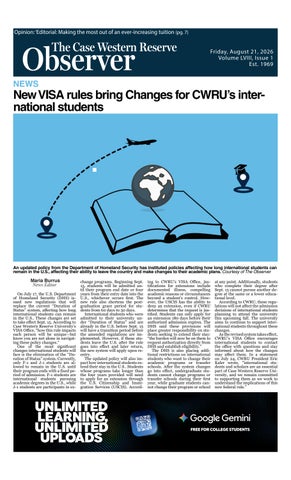
An updated policy from the Department of Homeland Security has instituted policies affecting how long international students can remain in the U.S., affecting their ability to leave the country and make changes to their academic plans. Courtesy of The Observer
Maria Burrus News Editor On July 17, the U.S. Department of Homeland Security (DHS) issued new regulations that will replace the current “Duration of Status” system, affecting how long international students can remain in the U.S.. These changes are set to take effect Sept. 15. According to Case Western Reserve University’s VISA Office, “how this rule impacts each person will be unique—but know you are not alone in navigating these policy changes.” One of the most significant changes international students will face is the elimination of the “Duration of Status” system. Currently, only F-1 and J-1 students are allowed to remain in the U.S. until their program ends with a fixed period of admission. F-1 students are international students pursuing academic degrees in the U.S., while J-1 students are participants in ex-
change programs. Beginning Sept. 15, students will be admitted until their program end date or four years from their entry date into the U.S., whichever occurs first. The new rule also shortens the postgraduation grace period for students from 60 days to 30 days. International students who were admitted to their university under “Duration of Status” and are already in the U.S. before Sept. 15 will have a transition period before the amended regulations are implemented. However, if these students leave the U.S. after the rule goes into effect and later return, the new system will apply upon reentry. The updated policy will also impact how international students extend their stay in the U.S.. Students whose programs take longer than the four years provided will need to apply for an extension through the U.S. Citizenship and Immigration Services (USCIS). Accord-
ing to CWRU’s VISA Office, justifications for extensions include documented illness, compelling academic reasons or circumstances beyond a student’s control. However, the USCIS has the ability to deny an extension, even if CWRU determines that the request is justified. Students can only apply for an extension 180 days before their authorized admission expires. The DHS said these provisions will place greater responsibility on students seeking to extend their stay: “the burden will now be on them to request authorization directly from DHS and establish eligibility.” The DHS is also placing additional restrictions on international students who want to change their academic programs or transfer schools. After the system changes go into effect, undergraduate students cannot change programs or transfer schools during their first year, while graduate students cannot change their program or school
at any point. Additionally, students who complete their degree after Sept. 15 cannot pursue another degree at the same or a lower educational level. According to CWRU, these regulations will not affect the admission decisions of international students planning to attend the university this upcoming fall. The university aims to continue to support international students throughout these changes. As the revised system takes effect, CWRU’s VISA Office encourages international students to contact the office with questions and stay informed about how the changes may affect them. In a statement on July 24, CWRU President Eric Kaler wrote, “international students and scholars are an essential part of Case Western Reserve University, and we remain committed to supporting them as we work to understand the implications of this new federal rule.”
News
The Case Western Reserve Observer Friday, August 21, 2026 observer.case.edu Volume LVIII, Issue 1
NEO-SMART engine wins $160 million manufacturing grant
News -inBrief U.S. debt hits $40 trillion as America’s borrowing binge continues By Alan Rappeport From The New York Times
More of Trump’s chosen candidates fall in G.O.P. primaries By Jess Bidgood From The New York Times
The U.S. National Science Foundation (NSF) supports science and engineering initiatives by giving research grants. This grant brings prestige to CWRU and bolsters its reputation as a research institution. Courtesy of Case Western Reserve University
Olivia Wen Copy Editor In July, the Northeast Ohio Strengthening Manufacturing for American Resilience through Technology (NEO-SMART) Engine, led by Case Western Reserve University, received a National Science Foundation (NSF) investment of up to $160 million over the course of the next decade. This includes $15 million over the first two years, with a continued investment toward the $160 million if its intended milestones are reached and its goals appear viable. As one of the 12 engines onboarded in the second cohort this past summer, NEO-SMART is intended to bolster domestic manufacturing production in Northeast Ohio. These cities include Akron, Canton, Cleveland and Youngstown. NEO-SMART is made up of more than seventy partners from different sectors, including industry, with major companies such as Goodyear Tire & Rubber and NVIDIA, and higher education such as Cleveland State University, Cuyahoga Community College and Kent State University. NEO-SMART’s CEO and Principal Investigator Nick Barendt, in particular, has deep roots with CWRU as a proud alum and the assistant vice president for research. At the
same time, Michael Oakes, CWRU’s executive vice president for research and economic development, helps lead NEO-SMART as one of their governing board members. In an interview with the University of Akron, CWRU’s president, Eric Kaler expressed his thoughts on
portunity. Together, we will advance the region’s growth and prosperity.” Other sectors include philanthropy, non-profit organizations and economic development hubs. NEO-SMART’s main focus is to drive innovation in AI-enabled manufacturing across a wide range
Trump administration moves to open millions of national-forest acres to logging By Alyssa Lukpat From Wall Street Journal
Minnesota suit alleges Texas Governor refuses to extradite ICE Officer By Mariah Timms From Wall Street Journal
Ties to data centers could cost Ohio Sen. Jon Husted his seat, memo warns By Theodoric Meyer From The Washington Post
Trump picks Dr. Heidi Overton, a top White House aide, to lead the Food and Drug Administration By Ali Swenson and Matthew Perrone From AP News
Courtesy of National Science Foundation via WikimediaCommons the funding, saying, “we are tremendously grateful for the extraordinary support and advocacy we received from federal, state and local elected officials that led to this funding op-
of materials, such as polymers, chemicals, coatings and metals. Alongside this, they’ll create pathways for training workers for manufacturing careers. According to their statistics, 8,000 manufacturing jobs go unfilled in Northeast Ohio each year due to a “lack of alignment,” but NEO-SMART hopes to assist workers in receiving more training and allowing educational resources to be optimized to what the industry needs. Lastly, the project turns these research projects into marketable products. NEO-SMART is part of the bigger picture of the NSF’s Innovation Engines, reducing the country’s reliance on imported goods and services and bringing back manufacturing, while also strengthening the economy of these regions. As stated by Brian Stone, the chief of staff who currently performs the duties of the NSF director, “these new NSF Engines will be transformational for America’s innovation infrastructure, helping secure our national competitiveness in technologies and future industries that will be critical to our economic and national security for decades to come.”
Ohio bill would protect parents who give kids more independence; with limits for child safety By Jennifer Jorden From Fox 8 Cleveland
Cavs trade Max Strus in 3 team deal with Nuggets and Clippers By Brian Koster From Cleveland 19 News
Ohio Gov. DeWine urges next governor to continue his literacy efforts By Morgan Trau From News 5 Cleveland
Harvard agrees to $53 million settlement in body part theft scandal By Alena Cerro From The New York Times
8 takeaways and surprises from Florida, Wyoming and Alaska primaries By Teo Armus, Matthew Choi and Praveena Somasundaram From The Washington Post
Life
The Case Western Reserve Observer Friday, August 22, 2026 observer.case.edu Volume LVIII, Issue 1
Enter garlic: an unconventional pathway to getting fresh food into Ohioan homes Riya Kulkarni Copy Editor Garlic, the well-loved staple of every kitchen, graces countertops all over the world. For the North Union Farmers Market (NUFM), the pantry staple funds food access to community members all over northeast Ohio. NUFM’s annual Cleveland Garlic Festival, taking place this year on Aug. 29 and 30 at the historic Shaker Square, serves as the organization’s biggest fundraiser of the year with plenty of garlic-themed foods for people of all ages—garlic bread, garlic steak and even garlic ice cream (thanks to campus favorite Mitchell’s ice cream). Beyond the fun, this festival sponsors work to bring local fresh produce to the community weekly across eight (soon to be nine) locations. Approximately 1.3 million Ohioans living in 67 Ohio counties struggle with food access, as these counties all have at least one food desert. This means that access to fresh and nutritious food is made even more difficult. Simply having a source of fresh produce that is accessible to the community is important. For the people of downtown Cleveland, Heinen’s grocery store was this resource for 11 years. "It was a really big deal for Cleveland," Director of Market Operations Kawai Bitto remarked. "It meant that there was a grocery store in the heart of downtown." However, on July 31, Heinen’s closed and a lifeline was stripped from the local community. NUFM has now partnered with the City of Cleveland to build back this lifeline, creating the ninth farmers market, which will have a six-week pilot beginning Sep. 1. “We're not there every day of the week, but we do provide a weekly opportunity for people who need access to that most,” said Bitto. Bitto joined the organization as a volunteer in 2018, serving a variety of roles over the past eight years. She now oversees all established farmers markets, connecting vendors and
making sure markets run smoothly. So continues the work to connect the community to local farmers and businesses, with each one individually verified by NUFM’s team of volunteers. “We've asked for their seed orders or, if it's meat, we've gone and seen their cattle, or their chickens or their turkeys, and we have certified that what they are bringing to market is coming from their farm,” explained Bitto. This same process applies to small businesses and artists, creating an incubator for local entrepreneurs. Bitto emphasized that the organization makes sure to “[onboard] consciously, and that takes more time than it would to just kind of get someone's phone number and say, ‘Sure, just come and visit, come and set up your tent.’ …But we feel that it's important.” This is what makes NUFM a certified produceronly market. One of these vendors is Silver Maple Farm, which has been growing garlic for 15 years. This will be the farm’s third year as a vendor for NUFM. Doug Pohly of Silver Maple Farm expressed his excitement to return, and explained that “there is an equal focus on the vetted vendor group" and that his farm takes "great pride in being considered among that group.” It is these relationships built with vendors that helps sustain all eight current farmers markets, and many vendors attend more than one farmers market throughout the week. Beyond location, food accessibility also means providing the community with means to buy and sell produce. NUFM works to keep stall prices low and participates in nutrition assistance programs to make the produce more affordable. Farmers markets accept benefits from SNAP and EBT programs, and match up to $25 of SNAP dollars spent to be used for fresh produce. They also provide access to those supported by the Women, Infants and Children (WIC) Farmers Market Nutrition Program, as well as dedicated food access programs for local seniors and families. To provide these benefits in sup-
The 16th annual Cleveland Garlic Festival will take place on Aug. 29 and 30, with plenty of garlic themed crafts and food. As the biggest fundraiser of the year for the North Union Farmers Market, proceeds go to providing food access to the community through various programs. Courtesy of Emanuel Wallace via Cleveland Scene
Courtesy of Emanuel Wallace via Cleveland Scene port of the local community and fund operations, NUFM hosts its 16th annual Cleveland Garlic Festival, a two day affair of live music, chef cookouts and—of course—plenty of garlic. It takes place every year at the ever-historical Shaker Square, NUFM’s flagship location, hosting 8,000-12,000 people and a variety of vendors over the weekend. As a universally acclaimed staple (and a universally recognized ingredient, not just from its strong aroma), garlic is the perfect whimsical food. The festival is advertised as “the stinkiest weekend of the year.” “We do a lot of advertising with breath mints …I think it drives well. People really enjoy it. It's kind of a weird one, and we…lean into it,” said Bitto. Garlic festivals are nothing new, but the community's love for garlic and its success of growth in the area allows for the chance to shine light on local garlic farms and any garlic-themed creations. Everything sold has been created locally, and everything sold ties into garlic in some sort of way. This will be Silver Maple Farm’s third year participating in the Cleveland Garlic Festival. Pohly remarked that “the Garlic Festival provides us a targeted, enthusiastic, informed group of prospective customers. It allows us to meet a whole lot of people, in a short period of time, from the greater Cleveland area, who really enjoy all things garlic. The value in this to Silver Maple goes well beyond a sale we may make.”
NUFM’s work would not be possible without its volunteers, especially with an event like the Garlic Festival. Volunteer Coordinator and Case Western Reserve University student Richelle Wong described their importance. “We have them checking people in, running the beer stations, ice cream, chef demos and the Mighty Locavore kids crafts table. The event wouldn't run the same without them so I really appreciate all of our volunteers spending their precious weekend time helping us out here at the festival,” said Wong. Anyone can join the team of volunteers, and the organization is always open to more helping hands. More than anything else, the theme of the Garlic festival and the organization as a whole is local impact. People from the neighborhood come back year after year to participate in the festivities. For Bitto, it’s this community that matters most: “We have a picture of this gentleman and his grandkids, and they're wearing garlic hats, and I think it's from like eight years ago. But they come every year, so every year we just update the picture…to see them now, they're teenagers, and it's so sweet to just see that tradition in real time.” Shaker Square is a little under three miles away from campus, perfect to escape to by bus route. Leave those textbooks behind, grab some breath mints and take a break before the semester gets busy to enjoy the garlic-centered festivities, bringing fresh food to local tables.
Riya Kulkarni/The Observer
Fun
The Case Western Reserve Observer Friday, August 21, 2026 observer.case.edu Volume LVIII, Issue 1
Weekly Horoscope Which first-year building are you?
Aries
Taurus
Gemini
Cancer
Smith House
Norton House
Sherman House
Storrs House
Leo
Virgo
Libra
Scorpio
Tyler House
Cutter House
Hitchcock House
Raymond House
Sagittarius
Capricorn
Aquarius
Pisces
Cutler House
Taplin House
Clarke Tower
Pierce House
TOP 10 THINGS TO
DISCOVER DURING DISCOVER WEEK Koala Contributing Writer
The shuttles operate on their own schedule. You cannot tell the shuttles what to do, they tell you what to do. Leutner Commons food will not taste good once your parents leave. Meal swipes are best used outside of the dining halls.
The Rockefeller Building, Strosacker Auditorium and A.W. Smith Building are connected by the backrooms. They also provide for a quick escape from the large lecture classes.
You will find that the entire campus is under construction. Know that all of your shortcuts are gone.
Our campus is not huge, but it is long. However, you can make it from Northside to Southside in 20 minutes if you try hard enough. You will collect at least 50 different Instagram accounts that you will never look at again, save for the stories on your feed. Clubs give out stuffed animals, as well as other types of merchandise. Go on a collection spree and don’t forget to pass Go.
The puddles at the intersection of Euclid contain infinite water … avoid at all costs.
On Fridays, you can pick up an issue of The Observer at the black wire University Media Board stands.
Discover what #10 is yourself!
Fun 5
observer.case.edu
The late-night quest for sustenance The Ghost of the UMB Office Original Observer
It was a dark and stormy production night—dark because the sun had long set, stormy because of the one flickering light in the University Media Board office that almost seemed haunted. The fourth of four editorial board members had bid her goodbyes, leaving three weary pairs of eyes staring at their computers, praying to leave before sunrise. It was then that one of these weary souls migrated from the depths of the Thwing Student Center basement in search of food. A second joined in solidarity, and one could almost smell the aroma of the Uber Eats wafting into the building. A walk turned into a run, followed by a frantic guessing game of which door was not hindered by construction (two exits had already failed the pair, and the car with nourishment could leave at any second). Out of breath, the pair approached the one running car on the side of Euclid Avenue, a suspicious sight if the stakes were not so high. The bringer of food stepped out of the car—patiently waiting, of course, and not ready to drive into the now-dark horizon at any moment—and the two celebrated, for the sustenance had finally been received. If you give a college student a pizza, they will want some water to go with it. The student of solidarity knew that she had not had water since morning, so she brought her water bottle with her, at the very least to hit any people who dared stand in their way. It was 11 p.m. after all. So, with a great mistrust of the water fountain in the basement, the pair ventured upwards. They attempted to enter the doors to the right on the first floor, where they found locked doors. Determined, they ran up the stairs, only to find … another set of locked doors. Desperate, they peered through the window. There was a man in the distance, sitting comfortably on the chair at the end of the hall. He looked up to see the two girls staring back at him, holding the water bottle with a plea in their eyes. He gave a look of skepticism, identifying the two as the people from the basement—an interesting species. UMB members must crawl out of their den from time to time. They ask for a way to the water and he cautiously lets one in. The other stays by the door, watching as the first descends the dark stairs. She hopes they will meet again, on the other side. The water was retrieved with haste. The filter was in pristine condition, but the fountain too had fallen asleep, refusing to dispense water beyond a certain point. The student drank deeply, finally having acquired the water that she technically should have consumed sooner. The pair escaped back to the UMB office, and were let in by the one soul left in the room. Out of breath, with flushed faces, they recount their escapades. The stakes were high but they had finally made it, spirits shaken but otherwise intact. They then realized that the Thwing Center elevator could have transported them to the all-capable water fountain, and their efforts were not necessary.
Five stages of grief Cheez-It Cat You look at the calendar and suddenly it's August. That can’t be possible, it was May last week. Convinced that the calendar on the wall, your phone and really every single place is wrong, you carry out your day manifesting oblivion.
Anger
Denial
Time doesn’t go away, and that stupid clock continues to tick. Time passes and it shouldn’t. You curse your old self who signed up for those extra three credits, then the professor for sending out the syllabus (though you probably need it). You wouldn’t need a syllabus if school wasn’t starting
Maybe you have longer than you think! A few days? But that’s so many hours! You get to see your friends again, and spend time in the city of Cleveland. Classes? Who needs to worry about classes?
Depression
Bargaining
You need to worry about classes. Too much worry, too many classes. You’re reduced to a lump in your bed, a blanket burrito despite the heat. Maybe if you stay in there long enough the problem sets won’t find you.
With (somewhat) gathered resolve, you grab your backpack and dust off that energy drink. Maybe this is the year you won’t need that. Surely you’re older and wiser and better at time management. Procrastination? Who’s she?
Acceptance
Opinion
The Case Western Reserve Observer Friday, August 21, 2026 observer.case.edu Volume LVIII, Issue 1
Editor’s Note: A time of change Penelope Cloonan Executive Editor Penny for your thoughts: can anyone accurately predict how college will turn out? Everyone comes in with some semblance of a plan. Try not to get stuck dorming in whichever dorm Reddit told you was the worst. Definitely go to your 8 a.m. classes. Join as many extracurriculars as possible. For some of us, even though we swear we will stay focused on more career-oriented student organizations, all roads lead back to the University Media Board office. I joined The Observer as a staff writer my first year and wrote my way through my grueling STEM coursework. I stuck to the life section mainly as a way to make sure I had a life outside of my dorm. As an out-ofstate student, I knew nothing and nobody in Cleveland. Through my time at The Observer, all of that changed.
I got my hands dirty at the Cleveland Museum of Art’s Chalk Festival, took friends to find every movie theater within 40 minutes of campus and caught as much student theater as I could. After a year of writing, falling in love with campus and telling student stories, I then became life editor. As cheesy as it sounds, being life editor made me appreciate student life that much more. As a studentrun newspaper, we highlight news on our campus, by our campus. That is the true strength of student journalism. We occupy a unique position. As student journalists, we are able to cover the stories of our peers, right at the heart of the action, without the pressure to perform for external validation. We have the freedom and ultimate responsibility to show the truth of our time at Case Western Reserve University. In the spirit of our characteristic honesty, this year we seek to in-
crease public programming. We are supported by countless freelancers, working on both visual and written pieces. As part of our commitment to supporting the skillbuilding of our community, this year we will be running a series of open workshops. Our first workshop will be Sept. 26 in collaboration with Discussions, the undergraduate journal, and will cover all things interviewing. If you want to learn what questions to ask, how to structure a story from an interview or even just where to begin, this is the workshop for you. Even outside the news space, learning how to get to know somebody in a professional context is an essential networking skill. Look out for more information on our Instagram. We also recognize that people increasingly get their news from online sources. In order to better serve our readership, we hope to broaden our digital presence. Expect an expanded video catalog, including long form
explainers and day-to-day coverage of all things CWRU. We hope to meet our peers where they are, and right now, that is the online space. In a continuation from last year, we will continue to push out our weekly newsletter. While we can’t deliver a print issue to your dorm, we can pop into your inboxes with your weekly dose of campus life. If you are interested in getting involved with The Observer in any capacity, please reach out to observer@ case.edu and we can discuss a role that is right for you, whether it be photographing local events, managing advertising or of course, covering topics of interest for the CWRU student body. It is an honor to be your next executive editor and I hope you will continue reading on as the year goes on. In an ever-changing news media environment, we hope you will find structure picking up an issue every Friday.
Reality TV is overhated Eesha Reddy Contributing Writer This summer has seen many successful media releases with movies such as “Obsession,” “The Odyssey” and musical albums including “Petal” by Ariana Grande and “Do That Again” by Malcolm Todd. The response to these new releases have been mostly positive, but amidst these changes in the popular culture landscape, one thing has remained constant: “Love Island.” “Love Island” is a reality TV show that airs every summer to nearly 7.9 million viewers. Despite its popularity, “Love Island,” like many of its other reality TV show counterparts, has always received mixed feedback from various audiences. While many view “Love Island” as an entertaining escape from reality, the show’s inherent nature, along with its strong ties with Generation Z internet culture, make it a subject of disdain for others. A conversation that reminded me of the general critique for reality TV was when I was speaking to my intern cohort. With the FIFA World Cup in full swing, the games consumed most of our lunch conversations. Despite having not been following along, I attempted to contribute to the conversation, playfully adding: “Did you see the game last night?” Almost immediately, one of my co-interns pointed out that I hadn’t seen the game, even questioning, “What? Would you rather talk about ‘Love Island’?” I was reminded of how “Love Island,” and reality TV as a whole,
Courtesy of ogwen via WikimediaCommons can be viewed in a negative light as well. These shows are viewed negatively because they can come across as shallow or staged, and many of the instances portrayed in these types of shows are often overexaggerated and may not seem genuine or relatable to our lives. But, I still believe that the hatred for reality TV may be unwarranted. For one, reality TV may provide interesting commentary. Although the scenarios presented to the contestants in these shows are staged, the subsequent conversations and actions among them are fairly unfiltered. Because of this, viewers are allowed a glimpse into social phenomena, such as power dynamics and hierarchies. For instance, I find it interesting how people group together in high-stress situa-
tions and how power dynamics are established, crossing boundaries of socio-political background and gender. When I look back at my lunch conversation, I felt undertones of sexism, as women are 3% more likely to watch dating reality TV than men. This phenomenon occurs everywhere, from the workplace to higher education, and this attitude toward “Love Island” is one such example. The superficial nature of reality TV also makes it susceptible to scrutiny. People may look down upon reality TV because it’s “silly” or inconsequential. However, it is undoubtedly entertaining. In an age of false intellectualism, it’s easy to forget that we can consume media as an escape. “Love Island”
may be unsophisticated, but it is fun, and senseless hatred towards a piece of media because of its apparent lack of depth is unfair. Depth isn’t always conveyed to us, rather, it is up to the viewer to perceive it. With that being said, consuming a piece of media will most likely seem trivial regardless of what it is; you will most likely turn off your TV not having changed the world in any way. I think back to my conversation with my co-interns and how they ascribe greater value to the World Cup over “Love Island.” But to a certain extent, watching sports is similar to watching reality TV: both are scripted and partially staged. Shouting at a TV to people who cannot hear you is frivolous, regardless of if you’re watching “Love Island” or the World Cup.
Opinion 7
observer.case.edu
EDITORIAL
Making the most out of an ever-increasing tuition Editorial Board With fall in the air and a breezy summer coming to a close, the Case Western Reserve University campus refills with students. The start of each school year brings about excitement, apprehension and everything in between. However, the start of this school year also entails an increase in tuition. For the 2025-2026 year, total tuition and fees for an incoming first year amounted to $73,986. For the academic year of 2026-2027, it amounts to $76,260. This is more than a $2,000 increase in tuition. When looking at this fairly gargantuan number, it’s easy to start wondering what we are getting out of this. For reference, the average salary in the United States is $64,220. CWRU is a school that sits in an interesting spot—not just geographically. It’s private and has good research and opportunities, but, frankly, it doesn’t make most “Top 20 Colleges” lists.
The issue, though, is that CWRU is status hungry, and this detracts from its ability to cater towards its students. Just think back to class registration, where many students were left without core classes for their major, career track or even graduation requirements. This not only left students scrambling to even have enough credits to be considered fulltime, but it also overworked the professors, with some having to cover multiple sections spanning over 400 students each. Or, consider CWRU housing, which was stretched so thin spots often left for graduate students, such as the Triangle apartments, were filled by incoming freshmen. Meanwhile, AI avatar kiosks are getting installed in the business building and a brand new research building is being constructed, all to further CWRU’s point as a school of innovation, technology and groundbreaking science. And, while these claims are true, it sometimes seems forgotten that a school is only as
The Case Western Reserve Observer Established in 1969 by the undergraduate students of Case Western Reserve University
Penelope Cloonan Executive Editor & Publisher PRINT Aleksandra Majewski Director of Print Ellie Palaian Director of Print Maria Burrus News Editor Alyssa Wang News Editor Riya Kulkarni Life Editor Lily Zhang Opinion Editor Abhishek Nambiar Sports Editor Abby Shazivari We’ve all been there, trying to Copy Editor Kashvi Madhwani Copy Editor study or finish that last assignOlivia Wen Copy Editor ment when all we want to do is … anything else. Maybe we’re overOviya Gowder Copy Editor whelmed with the work we have to do, or maybe we feel the pressures of perfectionism and don’t want DESIGN to Kiera Director of Design start. We push ourselves to Ng “lock Jana Ashour in,” but call it quits too often, feel-Director of Design ing guilty each time we pick our Helenup Cai Layout Designer phones to doomscroll Aditi again and Ghosh Layout Designer again. Doing anything but the work Reva KolhetoLayout Designer we have piled up always seems Talia Jun Graphic Designer feel better than actually getting Kristina things done, but the sinking Guo feel-Graphic Designer ing in our stomach knowing we’ve Anna Trusova Graphic Designer wasted time is much worse. Can we really consider these pausesDIGITAL to be MEDIA “breaks” if we feel worse after takMoses Fleischman Director of Digital Media ing them? Matthew Stall Video Editor We may trap ourselves in a cycle Aditiand Darodkar Video Editor Assitant of counterproductivity double the time it takes to complete a task. Obafami Tidjani Web Editor In this “popcorn brain” Phillip mindset, we Photo Editor Kornberg work and get little done, then stop Photo Editor working and think Neelanjana about howKomanduri we Rebekha Repp Social Media Manager could be working. By the time we Bagora Social Media Editor resume our work, we Esha feel ashamed, not refreshed, and we Ben stayKang up late Social Media Editor in attempts to catch up. A break is not shameful, BUSINESS not when it has the potential to act as a Anya Lin Director tool that makes productivity muchof Business Operations Riya Dixit Ad more efficient. We just needand toPartnership Manager Divya Kurma Accounts Manager know how to use them. Just as an athlete wouldn’t do Observer is the weekly student newspaper of Case 150 The consecutive bicep curls undergraduate while Western Reserve Established in 1969, The Observer reports strength training atUniversity. the gym, as news affecting and provides an editorial forum for the university students we muststudents take meaningful community. Unsigned editorials are typically written by the opinion editor breaks in reasonable intervals. One but reflect the majority opinion of the senior editorial staff. Opinion columns are the views of their writers and not necessarily of The Observer staff. For advertising information, contact via e-mail at observer@case.edu. LETTERS TO THE EDITOR should be e-mailed to observer@case.edu or submitted on our website at observer.case.edu. Letters can be mailed to Thwing Center 11111 Euclid Avenue, Suite 01, Cleveland, Ohio 44106. For policy and guidelines related to the submission of Letters to the Editor, refer to observer.case.edu/submit-a-letter. The Observer is a proud member of CWRU’s University Media Board. Follow The Observer on Facebook, Twitter, TikTok and Instagram @cwruobserver.
Reva Kolhe/The Observer good as the students that come out of it. To create successful students, investment should be going into students rather than flashy technology. No matter what the CWRU administration does, it will always be from the outside in. It is the students that get to live and change the campus from the inside out. We, as college students, are at the forefront of shaping not only our own lives, but the campus we inhabit. Thus, it is important that we invest in our time here. Whether it is talking to professors during office hours, joining a school club or volunteering, there are many ways we can make our time on campus more enriching. Furthermore, CWRU’s connection to various institutions within Cleveland, such as Cleveland Clinic or a WedWish MedWorks, contains many points of discovery. Classes and academics are important, but they shouldn’t be the entire experience. That is to say, a person who only goes to class pays
the same amount of tuition as another person who does research, is in a club and volunteers, so we might as well get our money’s worth. This isn’t to say that we should try and do anything and everything and overwork ourselves. It is good to be involved in a few substantial things. This creates a beneficially mutual process; we get to grow from our experiences, and, through our involvement, create a greater impact for those around us. Going into a new school year, whether it be your first or last, we can both acknowledge the cost of higher education, but also appreciate the privilege and opportunity. CWRU, but more largely, college, provides a very special time where things such as discourse, debate and discovery are not only allowed, but championed. It is one of the few periods of time in our lives where mistakes are expected, creating a unique place for growth unlike any other. We should make use of it.
‘Fully staffed’ shouldn’t be the finish line Ellie Palaian Director of Print During the required annual compliance meeting for Case Western Reserve University’s fall sports, Associate Athletic Director Pat Kennedy announced that CWRU has a “fully staffed” athletic training department for the 2026-27 academic year. Instead of applause, the announcement was met with a collective sigh of relief from athletes. As a CWRU women’s soccer player, the collective feeling among my teammates was simple: “about time.” Many of them have gone through most, if not all, of their collegiate careers without the level of support from the athletic training department that they should have received. To be clear, this is not the fault of the athletic trainers. They are fully trained, equipped and consistently do what they can to help athletes whenever and wherever they are needed. The problem is that they have been asked to do too much with too few resources. With the number of athletes under their care, the trainers are simply overworked and overwhelmed. At this point, at least within my team, it is accepted that this is simply what Division III athletes receive. We are told, implicitly or explicitly, that these are the resources available to us and that we should be grateful for them. But that should not be the standard. Yes, we are not Division I athletes with NIL deals and professional aspirations. But we are still students. We are still athletes. We compete for our university, dedicate countless hours to our sports and are expected to perform at a high level while representing CWRU. Providing student-athletes with
adequate medical and athletic training resources should not be an option or a luxury. It should be a necessity. The lack of athletic trainers at CWRU has been a topic of conversation for years. Last season, the university initially had four athletic trainers on staff. However, former CWRU athletic trainer Jason Nutter was relieved of his duties midway through the school year following a complaint from a female student-athlete, which ultimately led to the discovery of a felony criminal history. Despite the announcement that the athletic department was “fully staffed,” five athletic trainers for 19 varsity programs leave little room for additional coverage. At that staffing level, CWRU’s athletic training department averages nearly four teams per trainer, raising questions about whether the department has enough staff to provide consistent coverage across all of its programs. Furthermore, while the department announced having five athletic trainers, one position remains unfilled as fall athletes return to campus. While hiring more athletic trainers is a positive step for CWRU, it is also long overdue. I have seen firsthand how the athletic department has responded to student-athlete concerns in the past. At times, it appeared that complaints were addressed as quickly as possible, rather than with a more thorough process, which ultimately contributed to an improper hire. It is the hope of myself and many other CWRU athletes that the athletic department took the time to conduct its due diligence during the hiring process for these two new trainers. With more athletic trainers now serving CWRU’s 19 varsity programs, studentathletes hope this marks a meaningful step toward providing the level of care and support they deserve.
Sports
The Case Western Reserve Observer Friday, August 21, 2026 observer.case.edu Volume LVIII, Issue 1
From comebacks to championships: Summer 2026 in sports Abhishek Nambiar Sports Editor To say this past summer was an eventful one in the world of sports would be an understatement. Amidst the usual run of annual regular seasons and playoffs, there were also numerous records set and careers defined. Across multiple sports, the summer provided no shortage of unforgettable moments.
NBA
Courtesy of Unknown Author via WikimediaCommons
In June, the New York Knicks defeated the San Antonio Spurs 4-1 in the NBA Finals. Led by point guard Jalen Brunson, the Knicks overcame numerous point deficits throughout the series to claim their first NBA championship since 1973. The most notable of these deficits came during Game 4, a contest that saw the Spurs build up a 29-point lead by the third quarter before the Knicks rallied to a 107-106 victory. Brunson saved his best for last, scoring a franchise-record 45 points as New York won 94-90 to clinch the title and earn Brunson the Finals MVP honor. The offseason brought another blockbuster development when famed power forward LeBron James announced that he would leave the Los Angeles Lakers on June 30. Amidst a flurry of rumors regarding which team he would join, he announced on July 24 that he would ultimately be joining the Philadelphia 76ers on a two-year, $8 million contract. The move gives the 41-year-old James another opportunity to chase a championship as he joins a talented Sixers roster featuring the likes of center Joel Embiid and small forward/shooting guard Jaylen Brown.
MLB The 2026 MLB season has been eventful to say the least. The biggest trade move of the season came near the Aug. 3 trade deadline as the Los Angeles Dodgers acquired two-time American League Cy Young Award winner Tarik Skubal from the Detroit Tigers. The deal gave a boost to an already stacked roster on the Dodgers as they pursue a third consecutive World Series title. The Dodgers weren’t the only contenders making major moves, however: the Boston Red Sox acquired three-time All-Star catcher Adley Rutschman from the Baltimore Orioles, the Philadelphia Phillies added three-time batting champion Luis Arraez and the San Diego Padres brought in former Cy Young winner Robbie Ray. Earlier in the summer, veteran pitcher Justin Verlander announced that the 2026 season would be his last. The 43-year-old three-time Cy Young winner and two-time World Series champion is finishing his career with the team that originally drafted him: the Tigers. Conversely, rookie St. Louis Cardinals outfielder Joshua Báez made history as he hit three home runs in his MLB debut against the Chicago Cubs on Aug. 15, becoming the first player in major-league history to accomplish the feat. The 23-year-old drove in five runs as the Cardinals won 8-4 at Wrigley Field.
Courtesy of Major League Baseball via WikimediaCommons
FIFA World Cup From June 11 to July 19, the 2026 FIFA World Cup took place in 16 cities across the United States, Canada and Mexico. The first World Cup to feature 48 teams, the expanded tournament produced weeks of entertaining matches and a number of controversial moments. At the conclusion of these five weeks, Spain emerged as the champion. La Roja defeated Argentina 1-0 in extra time in the final, securing their country’s second World Cup title. Spain’s title was particularly impressive from a defensive standpoint: the squad conceded only one goal across the eight matches they played, that goal coming from Belgium during the quarterfinals. Rodri was named the tournament’s Golden Ball winner after anchoring Spain’s midfield throughout the competition, while goalkeeper Unai Simón earned the Golden Glove after keeping seven clean sheets in eight matches. As for other accolades, the Golden Boot went to France’s Kylian Mbappe; he scored 10 goals across eight matches to secure the award, becoming the first player to win multiple World Cup Golden Boots after winning the award in the 2022 tournament.
Courtesy of Bryan Berlin via WikimediaCommons
Tennis Tennis had some of its biggest moments of the summer at this year’s running of Wimbledon, one of the four Grand Slam events in the sport. On the men’s side, Italy’s Jannik Sinner successfully defended his Wimbledon title as he defeated Germany’s Alexander Zverev in four sets, making him only the 10th player in the Open Era of tennis to win back-to-back Wimbledon championships. The victory was especially impressive following a disappointing performance at the French Open in May, where Sinner exited the tournament after a shocking second-round loss. More unexpected results were seen on the women’s side, as Czech ninth seed Linda Nosková captured her first Grand Slam title by defeating fellow Czech Karolína Muchová in a three-set final. Nosková and Muchová’s appearances in the final made the Czech Republic the sixth country in the Open Era to have two countrywomen contest a major singles final.
Courtesy of Daniel Cooper and Hameltion via WikimediaCommons