
Class of
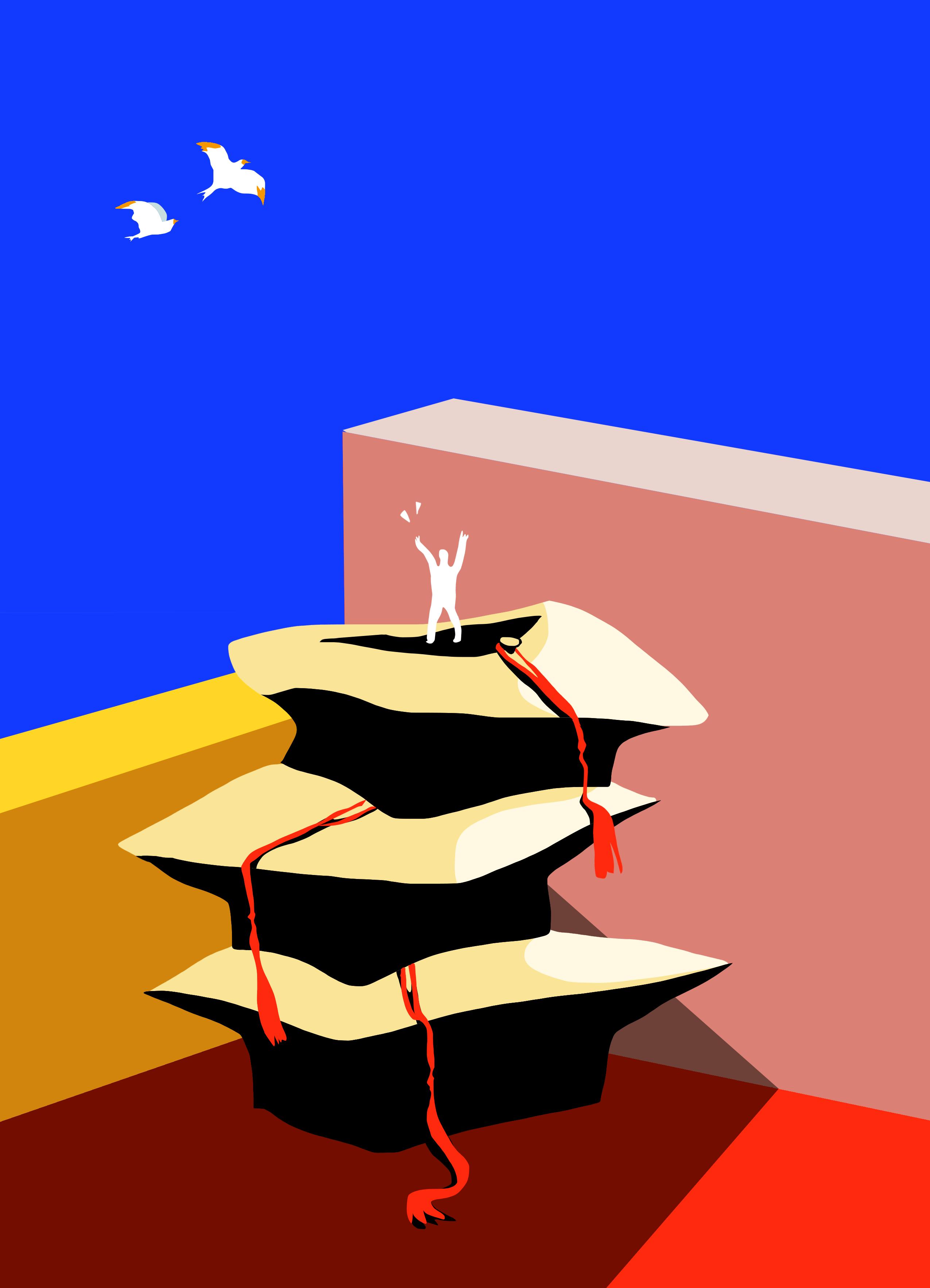

Lucas Yang/The Observer
Alyssa Wang News Editor
At Case Western Reserve University, a new initiative was created to highlight employee voices during its milestone year. Titled “200 Days, 200 Conversations,” the program aims to gather meaningful feedback from faculty and staff during the university’s bicentennial celebration.
The idea for the initiative emerged shortly after Jason Steckel transitioned into the role of Director of Employee Engagement this January. According to the university, his presence highlighted the importance of directly connecting with employees across campus.
“As he considered how to best engage faculty and staff, he presented the idea of holding one-on-one conversations,” said Robert Solomon, vice president for the Office for Campus Enrichment and Engagement. “It’s being
launched now to help inform how we can enrich the employee experience.”
The initiative also ties closely to the university’s 200-year anniversary. While the number of conversations reflects the bicentennial milestone, Solomon emphasizes that the connection goes beyond symbolism.
“Our bicentennial is an opportunity to recognize the generations of students, faculty, staff, alumni and friends who have shaped our past while charting an ambitious course for the future,” he said. “The questions employees are being asked seek to both recognize the good work we have been doing and dream of ways to create an even better future here at CWRU.”
One of CWRU’s main priorities has been employee engagement. According to Solomon, President Eric Kaler once asked, “what makes Case Western Reserve an engaging–or not engaging–place to work, and in what ways can we help more employees become fully engaged in the university
as a whole?” which then led to the creation of the office for Campus Enrichment and Engagement and the director of employee engagement role.
When introduced, this initiative was described as a listening tour. Rather than simply collecting feedback, the conversations are structured to foster open dialogue to create a more authentic understanding of employee perspectives.
“Meaningful listening involves listening to learn,” Solomon said. “In the context of ‘200 Days, 200 Conversations,’ this involves asking thoughtprovoking, open-ended questions and providing employees space to share their thoughts, feelings, ideas and aspirations.”
Through these discussions, the university hopes to gather insights that reflect both strengths and areas for growth.
“First and foremost, we hope the insights provide an honest reflection of the employee experience, so we can
Maria Burrus Staff Writer
After weeks of negotiations, Cleveland City Council passed a $2.3 billion budget on March 23. The plan was approved in an 11-3 vote in support of Mayor Justin Bibb’s administration. Bibb, the city’s first millennial mayor and a Case Western Reserve University alum, has been known for modernizing the government and advancing urban policy to redevelop Cleveland’s historically underserved neighborhoods.
Since becoming mayor in 2022, Bibb has worked on renovating city services. For example, his Southeast Side Promise addresses the divestment problem happening in Southeast Cleveland by revitalizing the area. Additionally, the Raising Investment in Safety for Everyone (RISE) initiative is using data to assess policing in the city to cut violent crime rates down. In office, he launched a $100 million affordable-housing fund to help the unhoused population.
This year, Cleveland had greater
financial flexibility after ending 2025 with a $91 million budget surplus. Budget proposals from officials focused on where to add programs and invest rather than finding ways to cut costs.
The general fund makes up about $920 million of the annual budget and is used to pay for core services. Public safety remains the top priority as it takes up the largest share of the general fund. In practice, this means that the department will have more staffing and localized funding.
Also, the city is focusing on improving infrastructure by adding $8 million for street resurfacing budget. Another important part of the fund goes towards housing. This year, the focus will be on addressing abandoned properties, legal aid programs to help residents avoid eviction and reducing property deterioration. This correlates with Bibb’s goals to focus on restoring undersupported neighborhoods because these initiatives will aid in lowering crime rates and preventing economic decline. Parks and recreation areas are also seeing an increased budget that will be directed at hiring more
learn what is working well, what needs improvement and what ideas employees have for making their experience here at CWRU even better,” Solomon said.
In March, randomly selected faculty and staff received invitations to participate, with selections made in collaboration with Institutional Research to ensure a representative sample across all of CWRU’s schools, university general divisions and departments. Each oneon-one session follows a consistent format and typically lasts between 30 and 45 minutes. Responses gathered during the conversations will be managed by the Office of Campus Enrichment and Engagement, which is responsible for collecting, organizing and analyzing the data.
As CWRU marks 200 years, the “200 Days, 200 Conversations” initiative reflects a broader effort to look inward by using employee voices to strengthen the overall campus experience.
billion budget
staff, specifically youth employment programs.
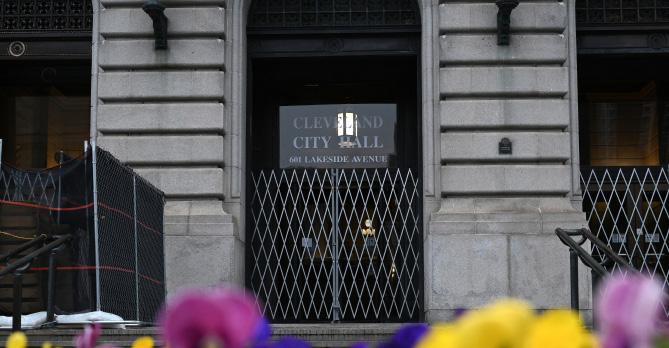
The major disagreements that arose during the budget proposal were with regard to gunshot detection technology, city hall renovations and what the city’s priorities should be. The three votes opposing the approved budget largely reflected disagreement over
whether it should prioritize immediate public safety needs or long-term investments.
Cleveland’s new 2026 budget reflects the financial strength of the city. Instead of cutting back services, the local government’s goals are to expand safety, infrastructure and neighborhood stability.
Alyssa Wang News Editor
Case Western Reserve University is introducing a new course this coming fall, combining counseling and communication skills together in a way students haven’t seen before. PSCL 390: Counseling and Communication, officially titled “Beyond the Disorders: Trauma-Informed Counseling and Communication Strategies,” aims to prepare students to better support individuals facing communication challenges.
“The mission of the Department of Psychological Sciences includes ‘bridging scientific research with clinical practice, preparing students through experiential learning, and promoting understanding of human behavior, brain function, and communication,’” Guanyu Wei, the creator of the course,
said. “This course is at the intersection of human behavior, communication and experiential learning, tying together principles of both communication sciences and psychology.”
Wei, a PhD student in the Communication Science program in the Department of Psychological Sciences, designed this one-credit elective over the course of a year under the supervision of Dr. Angela Ciccia, with additional support from Dr. Anastasia Dimitropoulos and Dr. Helen Long. Not only did Wei create the course, Wei will also be teaching the class in the fall. He was inspired to create the course after seeing how common stress and anxiety are for clients with communication challenges and their family members.
“With the use of counseling while working on people’s communication skills, the frustration resulting from communication breakdowns can potentially be lowered,” Wei said. “To bet-
ter prepare students to be competent practitioners or simply to get a better understanding of counseling strategies and communication disorders, PSCL 390 was created. Students will be able to have more time to process the information and try the strategies in class.”
The course builds directly on Wei’s research, which focuses on the counseling aspects of speech-language pathology. According to Wei, research has shown that a family member’s knowledge and confidence level are highly related to their own quality of life and the client’s quality of life. “The course is inspired by the implementation of such research evidence and translational research,” Wei said.
Students will also learn a wide range of practical skills, including semantic- and phonological-based cueing, effective communication strategies, family-centered counseling and trauma-informed approaches. The course
introduces topics such as goal setting, shared decision-making, psychoeducation and grounding strategies used in trauma therapy.Then, students will be encouraged to actively participate and reflect on the material. Activities such as role-play, case analysis and creating resource packets allow students to practice real-world applications rather than only studying theory.
“The entire class will be guided by trauma-informed approaches,” Wei said. “[Moreover], communication disorders are diverse, and each has its own unique characteristics. In this class, students will get a basic understanding of different types of disorders and strategies to help these clients.”
Though the course officially launches for the first time in the fall, student interest is expected to be high. Wei will observe its success over the next semester and then explore the possibilities of expanding the class.
Riya Kulkarni Copy Editor
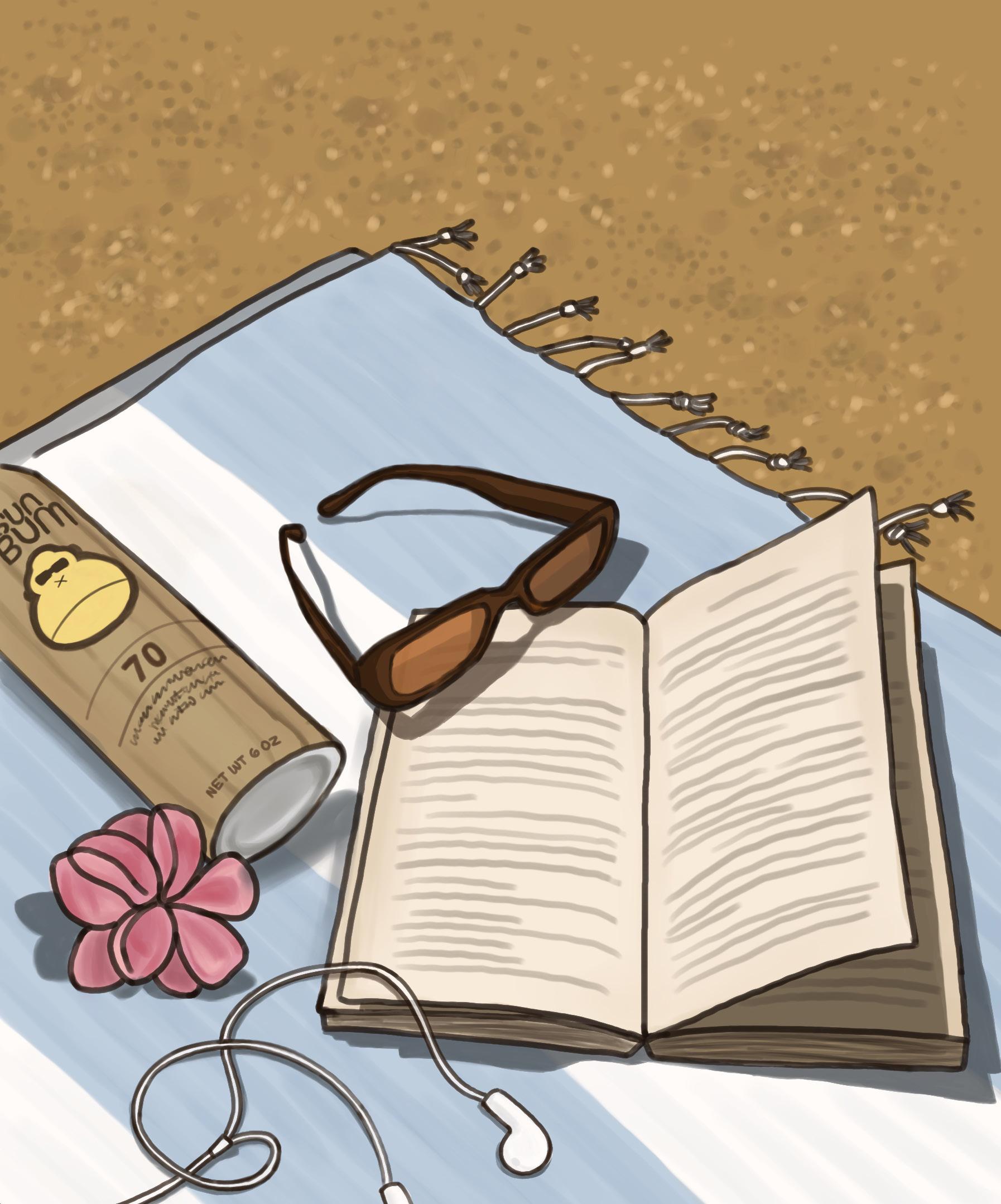
This summer, put down your textbooks, and immediately pick up another book for leisure. Here’s our compiled list of summer reading recommendations, straight from the Editorial Board!
1. Mystery
• "One of Us is Lying" by Karen M. McManus
• "The Reappearance of Rachel Price" by Holly Jackson
• "Ace of Spades" by Faridah Àbíké-Íyímídé
2. Romance
• "Book Lovers" by Emily Henry
• "D'Vaughn and Kris Plan a Wedding" by Chencia C. Higgins
• "Laura Dean Keeps Breaking Up with Me" by Mariko Tamaki, Rosemary Valero-O'Connell (graphic novel)
3. Fantasy
• "The Midnight Library" by Matt Haig
• "Masters of Death" by Olivie Blake
• "The Full Moon Coffee Shop" by Mai Mochizuki
4. Science Fiction
• "The Martian" by Andy Weir
• "This Is How You Lose the Time War" by Amal El-Mohtar and Max Gladstone
• "On a Sunbeam" by Tillie Walden
5. Contemporary Fiction
• "Just Between Us" by Adeline Kon (graphic novel)
• "Eleanor Oliphant is Perfectly Fine" by Gail Honeyman
• "The Hate U Give" by Angie Thomas
6. Literary Fiction
• "Is This a Cry for Help?" by Emily Austin
• "Little Fires Everywhere" by Celeste Ng
• "Martyr!" by Kaveh Akbar
7. Historical Fiction
• "A Thousand Splendid Suns" by Khaled Hosseini
• "Stone Butch Blues" by Leslie Feinberg
• "Last Night at the Telegraph Club" by Malinda Lo
8. Memoir
• "Maybe You Should Talk to Someone" by Lori Gottlieb
• "Crying in H Mart" by Michelle Zauner
• "Persepolis" by Marjane Satrapi (graphic novel)
It’s difficult to juggle three jobs at once: a comedian, a caregiver and a 40-restaurant tycoon owner. Yet somehow, Atsuko Okatsuka makes it seem easy, even if that means listening to Tchaikovsky’s “Swan Lake” nonstop,
helping her grandmother bathe (in unconventional ways) and admitting to her husband that she spent at least $130 on gem bundles for her many restaurants. On Friday, April 17, Case Western Reserve University invited

Okatsuka to Severance Hall for its annual Spring Comedian event. Since her breakout stand-up act on HBO, “The Intruder” (2022), Okatsuka has taken over stages on tours and “For You” pages on TikTok through her 2023 #DropChallenge. Here are some of The Observer Editorial Board’s thoughts on Friday’s performance: Kiera Ng, Layout Designer: 3.98/5
This was my first experience watching a comedian live, and I have to admit, it was quite enjoyable. Despite our constant “factory resets” after each joke silencing the room again, her opener, Jared Goldstein, successfully warmed the crowd up with his remarks about his experience as an openly gay comedian and—the crowd’s favorite topic of the night—“Heated Rivalry.” Okatsuka entered the stage in her classic fashion—iconic bowl cut paired with Jamaican dancehall moves. Throughout her set, she crafted familial and cultural anecdotes that brought to life the unique Asian American experience in a nation that lacks its representation in media. (Especially since we’re in Ohio, it was nice to see Asian representation defying stereotypes on stage.) Her jokes were awfully relatable to our generation, from being addicted to mindless restaurant tycoon games to TikTok trends. Even when her jokes were running out of steam, her stage presence and exaggerated movements kept the crowd engaged. Her jokes and stage presence paired perfectly: learning kendo from Jeffrey Wheeler to bathing with her grandmother (enough said on that one). Okatsuka ended her set by getting to know the crowd better, poking fun at the fact that both pre-med and medical students can’t practice yet and at the endless subcategories of the engineering field. Okatsuka brought
the perfect balance of jokes, dance and cultural experience to the diverse CWRU crowd.
Abhishek Nambiar, Copy Editor: 3.5/5
I’ve never watched a comedian live before, so going into this show I didn’t really know what to expect. The main thing I was hoping for was some good laughs, and Goldstein and Okatsuka certainly delivered. Beginning with Goldstein’s set, I think he did a great job at setting the tone for the rest of the night. Many of his jokes got a good chuckle out of me—shoutout especially to his remarks on “Heated Rivalry.” As for Okatsuka herself, I can safely say that I also got a good time out of her set. Now, I will admit, I don’t think her style of comedy was quite for me—a lot of the jokes she made were ones that I was able to appreciate, but didn’t always laugh at. I also couldn’t help but feel as though some of her jokes and running gags dragged on a bit too long, to the point that I was ready for her to move on to the next story. That being said, the stories themselves were all really interesting to hear about, and I enjoyed Okatsuka’s attempts to infuse humor into each narrative. Her last story in particular, one about reuniting with her long-lost brother, was the strongest one in my opinion; I was especially captivated and amused as she delivered a series of great jokes that got many good laughs out of me. Overall, though not every joke may have landed for me, Okatsuka’s strength in storytelling and standout laugh out loud moments made my first live comedy experience a memorable and enjoyable one.
Anya Lin, Analytics Manager: 5.67/5 I want to take a break from Okatsuka for a second (lovingly), and put the spotlight on Friday’s warmup comedian, Jared Goldstein. I admit this was the first live comedy show I’ve ever attended, but Goldstein’s terrific opening instantly took the first (never mind only)
place in my heart. His first joke was among the most iconic. Despite facing a new crowd of students that was not quite ready to laugh, Goldstein dove in with a joke about Trader Joe’s lesbians right off the bat. Bold move, but it worked perfectly. All his subsequent jokes kept the crowd rolling with their vaguely crass undertones, whether he was
raving about “Heated Rivalry,” contemplating the surprising acceptability of Asian fetishes (particularly for “Heated Rivalry”s Hudson Williams) or presenting socially acceptable alternatives to crop-dusting. Goldstein’s role there was just to lightly warm up the crowd before Okatsuka came out, but I was honestly a little worried I wouldn’t have
any more laughs left in the tank after giggling the whole way through his brief, but fantastic, 20-minute stand-up set. Although I actually didn’t learn his name until approximately 15 hours post-show, despite him saying it multiple times, (Jeremy Steinberg? Jeffrey Goldman?), Goldstein’s on-point set ensured I wouldn’t forget it again.
Penelope Cloonan Life Editor
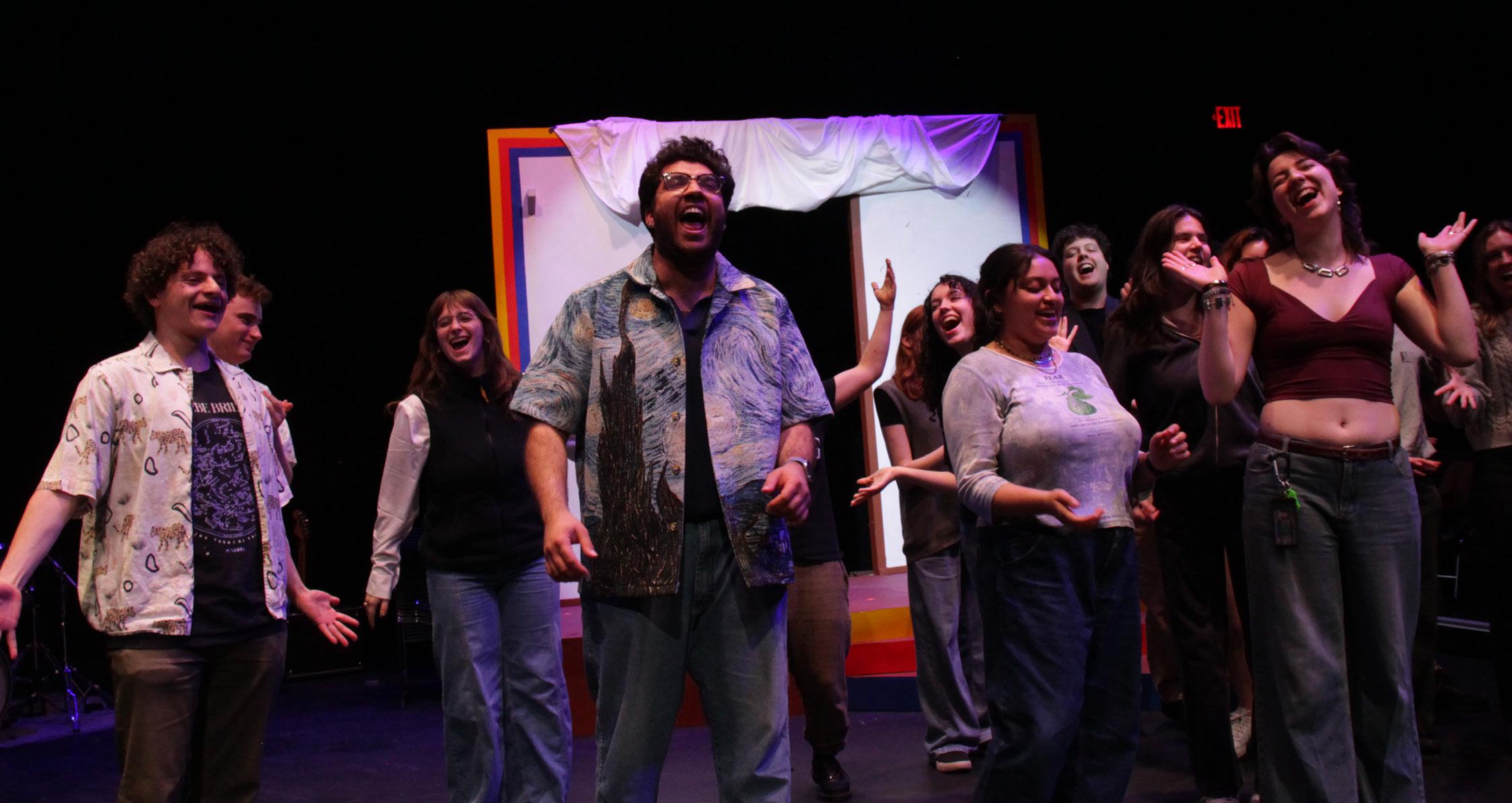
After six shows on campus, “PTG Live!” VI is essentially an established Case Western Reserve University institution. On April 3, The Players’ Theater Group (PTG) took over the Walter and Jean Kalberer Black Box Theatre once more for what is technically their last run of “PTG Live!,” at least in name. Complete with a charmingly hilarious monologue by Professor Hayley Jannielli and 12 sketches written, directed and performed by CWRU’s own undergraduate actors, it is safe to say that it was bigger and better than ever.
As is typical, the faculty monologue was followed by a cold open. This semester it was “Heartbreak Karaoke” a sketch that is superficially about a wailing man attempting to sing karaoke, and more seriously a heartwarming tale about finding self-worth after heartbreak. Oh so many heartbreaks. Producer Raaghuv Vazirani serenades his past lovers—and their partners, who are oddly supportive—with hits like “Kiss from a Rose” by Seal and “Careless Whisper” by George Michael, all in the hopes to win them back. It’s a cute sketch that accomplishes what the producers need to do: get everyone on stage and warm the audience up.
What follows is an ambitious 11-sketch run featuring what PTG does best, commenting on student is-
sues. As Vazirani puts it, “It's written by us, for us.” While this means the show regularly comments on campuswide social issues, it also means that the jokes read young. “Archive of Our College Days” by Producer Charlie Klineman follows a young girl (Johanna Perry) who is caught reading Harry Potter fan fiction on Archive of Our Own (AO3). Their mother (Tess Lozar) starts reading the fan fiction aloud to their father (Logan Corrales) and hilarity, as well as embarrassment, en-
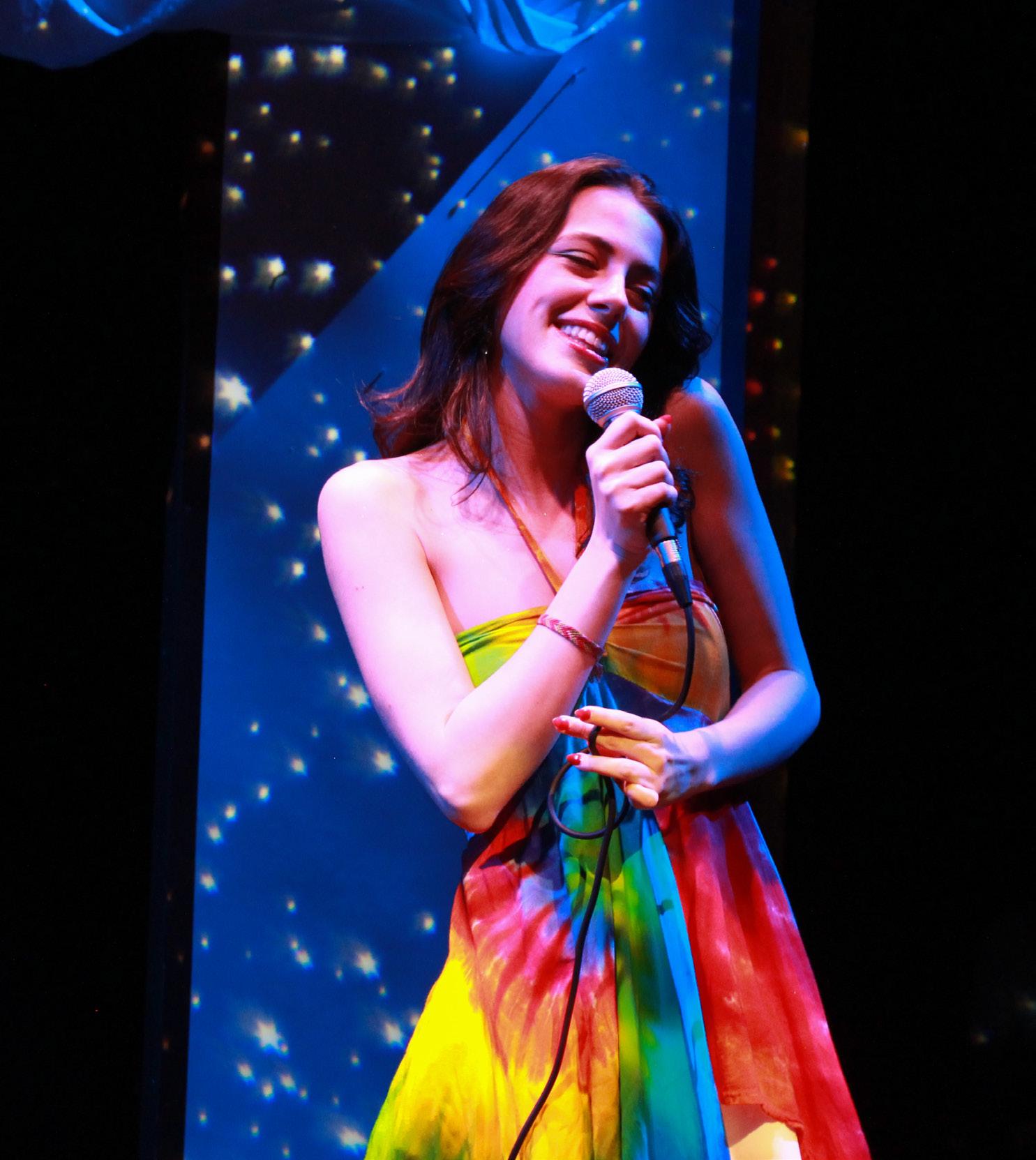
sues. “The original draft [was] quoted directly from [the source fan fiction],” said Klineman, “As it turns out, it made the writers room, we all agreed that it was far too much.” They instead decided to get more buzzwords in there, like "tongues battling for dominance,” to really satirize the genre. The comedic twist of the sketch is that the Mother wrote the fanfiction all along, leaving their daughter horrified. Overall, the sketch is a cute take on modern fan culture.
“Rho Rho Kappa” is as quintessentially PTG as it is experimental. With more members and a longer timeline, the group was able to pull off a newer format, a pure one-character monologue. However, it still pokes fun at frat culture and misogyny—relevant social issues. Vazirani plays a frat guy lecturing his brothers, now the audience, on being “respectful, responsible and kind.” The crowd really got into it, whooping in support and joining the frat for the space of the three minute monologue. It was a heartwarming good time.
This semester, again due to increased interest, PTG was able to include a runner: “Rebrand,” “Rerebrand” and, of course, “Re-re-rebrand.” Since the beginning of the year, all anyone on campus can talk about is the CWRU rebrand, the shift from blue to different blue and the many, many signs. In a series of quick, punchy sketches, Tanya Clemens, Shakhi Andrews and Ave Tallarida say what we’ve all been thinking, the rebrand is a little ridiculous.
Winding down the night, the penultimate sketch leaned on more standard comedic conventions. “The second to last sketch tends to be the sketch that we think is the most sort of classic sketch comedy,” said Klineman. In turn, “The Menu” addressed what seems to be on every young person’s mind right now: brain rot. Vazirani and McKenzie Taylor play Ben and Sarah, a couple eating out at a new restaurant. The twist? The menu is more for dopamine than food as a bar-
rage of references hit the stage at once. From subway surfers to people yelling brain rot buzz words, it was a lot. The sketch either really worked or really didn’t, but for the most part, you can either laugh at the brain rot or laugh at people who laugh at the brain rot. In contrast to the second to last sketch, the closer, “Donating to a Bad Cause” by Ky Tan, is fairly experimental from a form perspective. A man (Ben Creiner) walks by a fundraising table, manned by another man (Jack Exline), “for cancer,” and naturally assumes it is for cancer treatment. He donates and is horrified to find that it was a donation to support cancer itself. The sketch snowballs as he donates to increasingly worse causes and is mocked by passersby. It’s weird, shocking and sticks with you past final bows. Exactly what you want from a closing sketch. As Klineman puts it, “We can tie things up with a sketch that has the potential to be weird and different.”
On the note of taking different paths, “PTG Live!” as a production is splitting off into a new club, Etch-aSketch. “We don’t need another roman numeral,” said Klineman. As a new USG club, the organization will have the opportunity to do so much more. More writers meetings, more workshops and more programming. The “PTG Live!” you know and love is not going anywhere, it will only be renamed. Future programming could include anything from shorter live performances to pre-tapes at their shows and digital content, all with a focus on the writing process.
“If you're somebody that loves theater and doesn't know where to start, if you're somebody that loves comedy and wants to get involved with something, if you're somebody who doesn't necessarily know your time commitments yet, but wants to get involved in something that gives you the chance to get out in front of people, make somebody laugh and have a huge reward to a super small risk,” said Vazirani, “Come join a sketch.”
Penelope Cloonan Life Editor
A figure dressed in a tan suit scrawled with storybook quotes saunters onto a dark stage. The student pit orchestra gives them a thumbs up, and Claire Carducci, our narrator, takes their cue to begin. After all, this story is not about them.
The Narrator opens their book and begins their story as all good storytellers do: “Once upon a time…”
Away from the far-off kingdom, in our own Eldred Theater, worked a first-time stage manager, an intrepid director, a mischievous narrator, two Prop Siblings and, of course, a cow as white as milk—Milky White. Footlighters set out to put on
baker (Austin Kennedy) and his wife (Natalia Stojkovic) to be barren, the couple are thrust into the land of stories to write their own supposed happy ending. They must find “the cow as white as milk, the cape as red as blood, the hair as yellow as corn, the slipper as pure as gold,” to be blessed with a child. Along the path, they meet Cinderella (Shareen Chahal), Little Red Riding Hood (Maya Sumagin), Rapunzel (Evie Oehlers) and Jack (Henry Senra), each on their way to follow their own wishes.
Director Cora Donoghue had one true wish. “I wanted a really good Milky White,” she said about the cow. It is a running joke around theater spaces that one of the weirdest aspects of “Into the Woods” to nail is Milky White. Sondheim is notorious for hav-
shorthand for saying a production of “Into the Woods” was low-budget or otherwise low-effort. It is a hard task to pull off, but when a production can get it right, it lends real legitimacy to their story. Only dedicated artists would aim to perfect the cow. No one is expecting a real cow to walk across the stage, but a good Milky White should feel magical. Footlighter’s puppet, articulate and played as a real character, feels straight out of a story book. The final Milky White was heavily inspired by the 2022 Broadway run’s puppet. White papiermâché ribs strung together on wire make the puppet fluid, while doubling to give the cow her emaciated look. The plastic rodeo cow head is poseable and reacts with the puppeteer, but the tail hangs limp, keeping her sad.
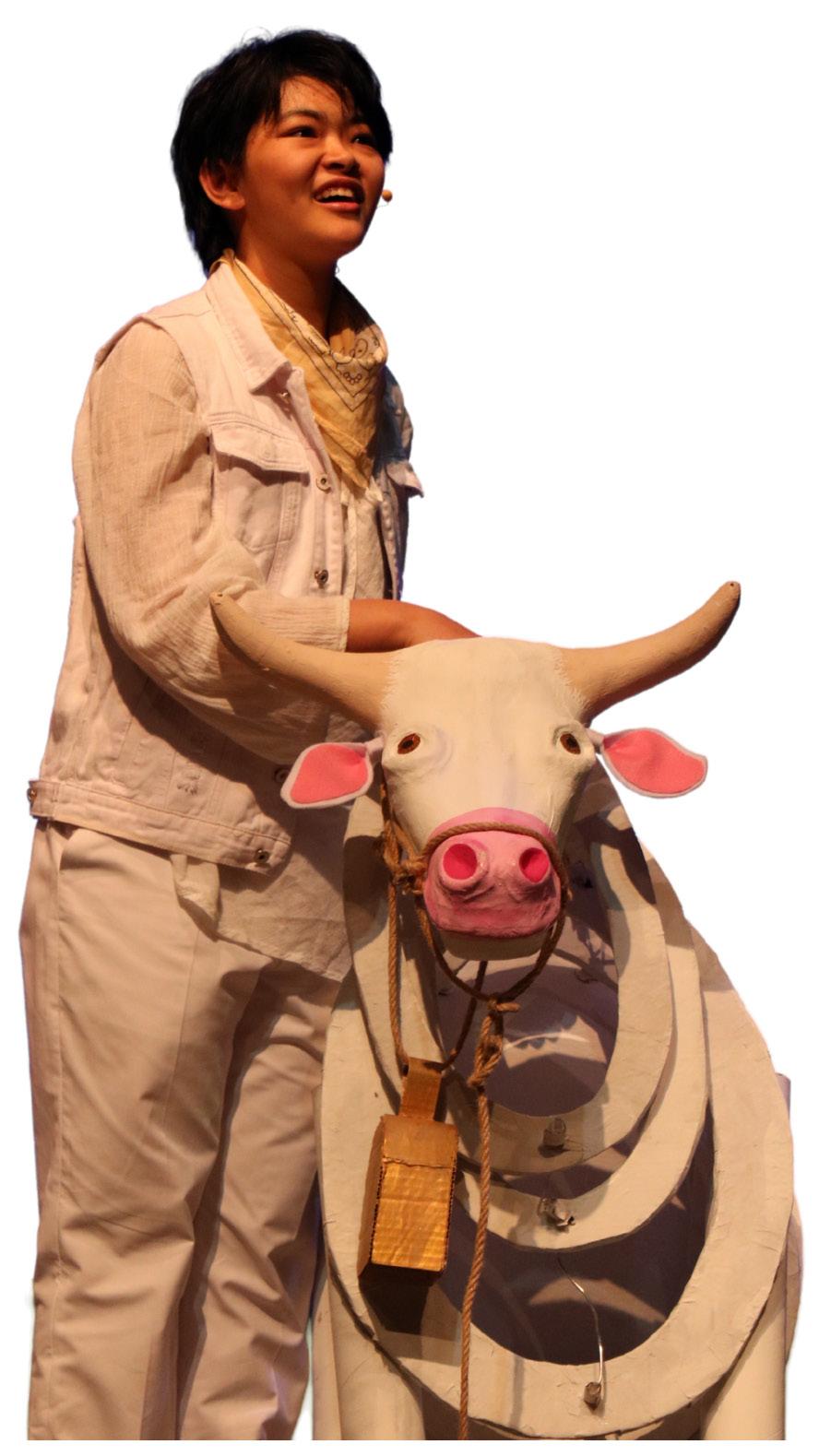
Cora Donoghue got her wish: “Everything still turned out very magical how I had hoped it would with the limited resources that we have as a stu-
Echoing Donoghue’s desire to have a good cow, Prop Master Phoenix Hammond saw the now defunct tumblr account @lowbudgetmilkywhites and said their goal was “…don’t end up on that.” Prop Masters Hammond and Kennedy Wolf, aka the second-year “Prop Siblings,” have worked on every Footlighters’ show together, amounting to four shows. For nine hours every week, the pair worked on props for the show, with about 50% of their time going to the one Milky White prop. Wolf graciously gave up the calculations to ensure the parts actually fit to Hammond, and the pair worked together to cut, glue and papier-mâché to no end.
Though the Prop Siblings toiled away in their workshop in the Eldred basement, the puppet was not ready until a week before the show. Still, rehearsals must go on. Hammond would give notes on how to imagine the cow, while Su did his best spatial approxi-
Once the Baker and his wife retrieve their four colorful items, the witch instructs them to feed them to the cow. Which is, admittedly, difficult to do without a prop cow. Of the situation, Su said, “On stage, people kept getting confused and tried to feed her from the wrong end.” He would tell his fellow cast members, “No, she's here. She's facing here. You can't do that.”
This too was straightened out, due in large part to being able to sparingly rehearse with the cow.
A week before the show, Connor Su met the Milky White puppet he would bring to life on stage. “I was ecstatic,” Su said, and who wouldn’t be when meeting the prodigal cow? However, with a real (fake) cow in his hands, new doubts rolled in.
“Am I gonna have to change everything completely? Is it gonna be good at all? Is it gonna end up being terrible and I'll have to scrap it?” thought Su, “But it ended up being really, really great.” Milky White was here in all her bright white, emaciated, weaklegged glory.
She then immediately broke. Heavy prop cow in hand, Hammond made the treacherous walk from Eldred Hall to Haydn Hall through a windstorm. Milky White suffered a devastating loss along the way. “We were able to get Milky White for one rehearsal, and then whenever they were bringing Milky White over, the butt of the cow flew off in the wind,” Stage Manager Peyton Scheeler said. She describes the rest of the scene with the intensity of a thriller. Panicked cast members, heartbroken crew and, of course, a crumbling cow. “Milky White could not leave the building,” Scheeler deadpanned. Footlighters takes this cow extremely seriously.
The cow breaking did, however, have one benefit. Milky White had a weight problem. I’ll let the narrator narrate the scene, “There was one rehearsal where poor Connor had to hold her with no legs, and his little arms were shaking.” For those uninitiated, the opening for “Into the Woods” is almost 14 minutes long. That is 14 minutes of Su holding up a cow with little to no support. Milky White was in need of improvement. However, you can’t make an omelette without breaking a few eggs, and you certainly can’t make a working prop cow without losing a few body parts. By opening night, Milky White was back with new and improved legs.
A good puppeteer does not feel like a separate character, they feel like an extension of their role. Su disappears into it. Keeping with Donoghue’s quest to have a solid Milky White, he dedicated a lot of time to the cow. Carducci recalled her notes as follows. “Connor, can you react as Milky White to these things? You are the cow,” Donoghue said. This general guidance over direct instruction led to such beautiful moments as Su dancing through the song “It Takes Two.” “He just was on stage and was bored and started bopping along.” Carducci said, “And then Cora was like, Yes, I love that. That's so funny. Please keep doing that.”
These improvisational bits are funny, but more importantly, they feel natural. When Jack has to sell Milky White, she may not be able to fully comprehend the stakes, but she does understand something. Su mirrors the prop cow’s morose head tilt, showing mock concern. In a further sad moment, when Milky White passes, Su simply walks off stage, and the audience sits with the harrowing loss. Milky White is more than just a quippy character. “You're here to help tell the story,” said Su. “You can't do that if you're treating this role as a throwaway gag.” Every papier-mâché bone of Milky White is full of intention.
As the show went on, Milky White became quite unstable. “She was very accordion-like,” Wolf said. By the end of the show’s run, she was held together by zip ties and a prayer, literally. “The props people were fixing the puppet really frantically,” Carducci said, “and a bunch of us were standing at the puppet, and we had our hands on it.” Though the efficacy of the crowd prayer is dubious at best, the zip ties were absolutely essential. By Hammond’s estimate, Milky White was “roughly 50% zip ties.” To be blunt, the fate of Milky White was brutal. “Hammer,” Wolf said, with a sinister grin. I’ll let Donoghue elaborate, “[The cast] destroyed Milky White as soon as the last show was over, because this thing has caused us so much pain.” The End.
Cows and heroes abound in a recent show presented by the Footlighters.
Ashley Rolsinski/The Observer

Auden Koetters Director of Digital Media
You spend four years counting down the hours, minutes and seconds until you can escape.
Not in a dramatic way, no chalkboard tally marks or existential dread. In quiet, habitual subtraction. One less midterm season. One fewer winter storm. One more class crossed off a stellic. You build your life around the idea of leaving: bigger things, better things, next things.
You get good at detaching in advance. You skip a few events because you honestly just don’t want to go. You don’t learn the names of underclassmen in your clubs because you won’t be here long enough for it to matter. You walk past places that meant something once, telling yourself you’ve already outgrown them.
And then, in the last week, something shifted.
It’s not dramatic. It’s small at first. A conversation after class that lingers longer than it should. A laugh that feels too familiar. You notice how the light hits the church on the quad you’ve walked past a hundred times and, for the first time, it feels specific…like it belongs to you.
You realize you know the rhythm of this campus. The exact timing of doors that stick. Which coffee tastes better at 8 a.m. versus 2 p.m. The shortcut across University Hospitals.
The people no longer need explanations.
You start seeing everything as if it’s already gone.
The library isn’t just where you studied; it’s where you became someone who could. The late nights weren’t just stress and sleep deprivation; they were proof that you cared enough to try. Even the things you complained about—the meetings, the chaos, the endless cycle of doing and redoing—they were structure. They were community. They were yours.
And all of a sudden, leaving doesn’t feel like winning. It feels like losing something you didn’t realize you were still holding onto.
You look at your friends and realize there was no moment you decided they mattered this much. It just… happened. Slowly, then all at once. And now they exist in a future that doesn’t include this version of you, or this version of them.
You start wishing for more time, but not in a vague way. Specifically. You want one more ordinary Tuesday. One more night that doesn’t feel like “the last.” One more conversation where you don’t measure your words against the fact that they’re almost final.
Worst case scenario isn’t failing out or not knowing what’s next.
It’s realizing, too late, that you built a life here while pretending you were just passing through.
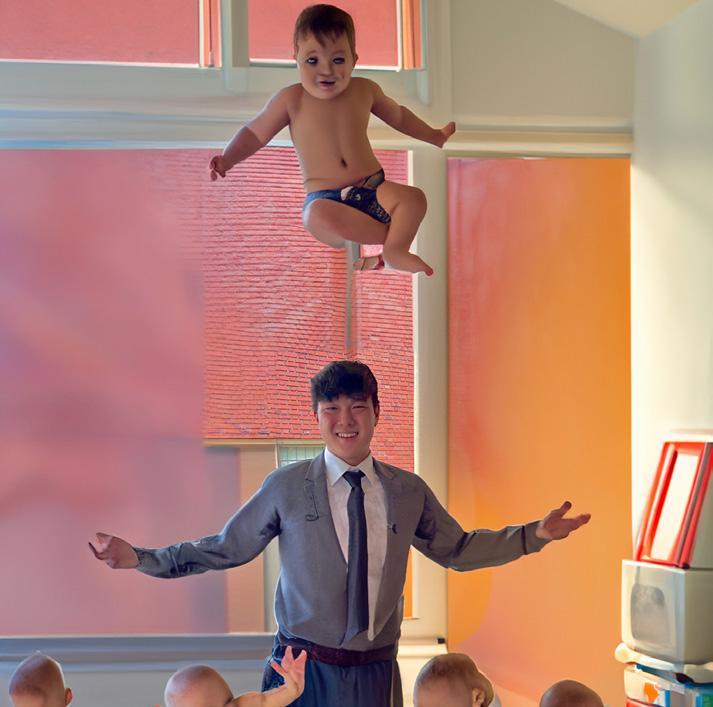
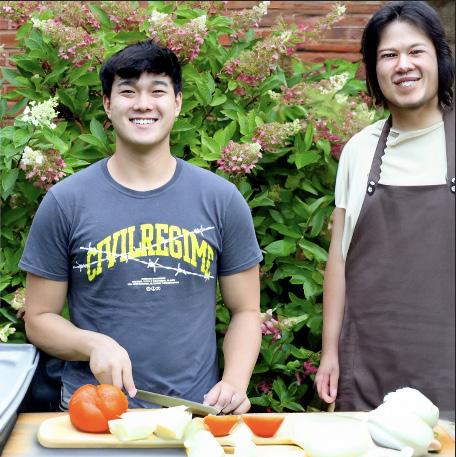
Top 10 things we’ve stopped ourselves from saying over the last four years
10. The Athenian is actually not funny.
9. Leutner is actually not that bad (the breakfast is kinda good).
8. UMB is more rigged than USG.
7. The football team is absurdly overfunded and has way too many people to lose that much.
6. People who repost every CWRU statistic are reaching and annoying.
5. Some professors are out to get you.
4. Members of the class of 2028 and before who lived in Mistletoe deserve compensation for living in an asbestos ridden dorm their freshman year when now they literally have like complementary fridges in every room what the heck.
3. USG should be abolished.
2. CWRU administration should focus on the student experience instead of rebranding, and stop admitting so many people. Oh my goodness our campus is not large enough for this many people you actually can’t find a seat in KSL half the time.
1. CWRU really isn’t that bad.
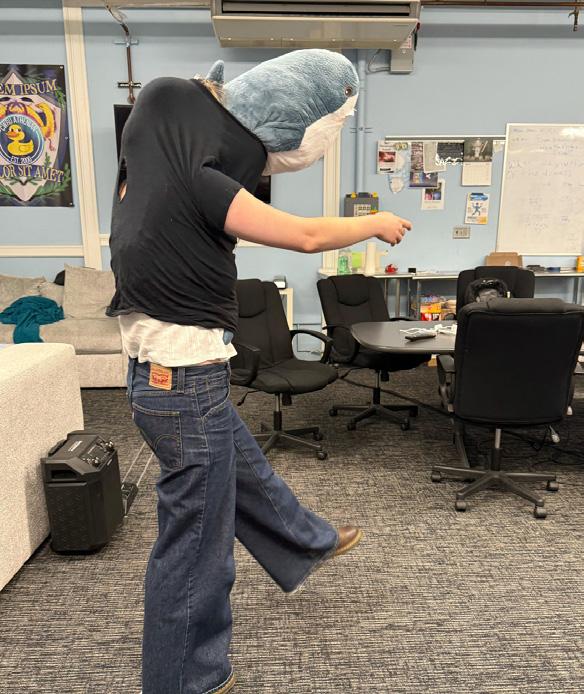
Goodbye Adios Au revior
Adieu Arrivederci
Addio
Adeus Tschuss Dag Bai Bai
Hei Hei Ha Det Totsiens Bayi
Sagol Agur Ahoj Aloha
Addi Xayr Auden's ahahahas
Lily Zhang Copy Editor
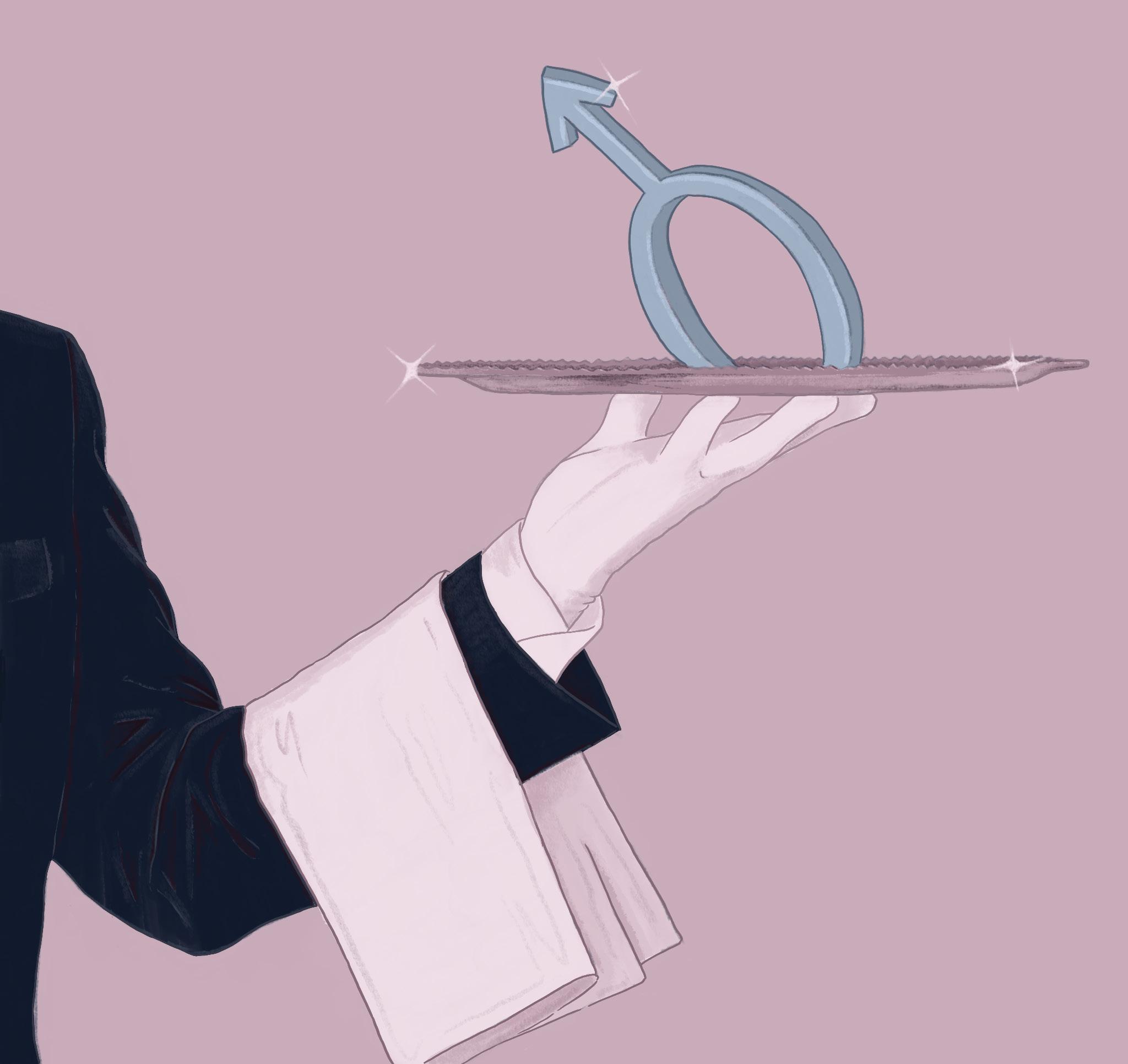
As a student at Case Western Reserve University, I’ve heard neurotic students too many times comparing their majors. They ask themselves and each other: What’s the hardest major? And, too many times, I hear the nursing major get called “easy” whilst other majors such as engineering are deemed hard. Granted, I’m a chemistry major, so I can’t speak for either major from personal experience. However, it would be remiss to ignore the correlation between the talk down of majors and their affiliation with women. Furthermore, this correlation doesn’t just exist for nursing— it exists for the liberal arts and the fine arts. As of 2022, around 12% of the nursing field was composed of men, with women making up the bulk majority. As of 2022, 67% of the bachelors degrees obtained in
liberal arts were by women.
A historic example of prestigious jobs and their reliance on gender would be computer science. Nowadays, computer science is seen as an extremely advanced, cutting-edge field. Computer science is also presently male-dominated, almost notoriously so, the major is only made up of about 21% women and highranking positions in tech are occupied by only 15% women. However, this wasn’t always the case. In fact, before the Cold War computing was seen as a tedious and lower-end job dominated by women. During the Cold War, when men were drafted, women had to further fill in empty computing seats and hold down the profession. However, computer science quickly became masculinized, and when men returned home, women were quickly kicked out and computer science became the maledominated field we see today.
Medicine is also a good example. I think most would agree that med-
icine has been and, still is, a prestigious profession. However, I think most would also agree that there are tiers within medicine. Surgery, for instance, is incredibly maledominated, and it’s not by chance. It’s also considered one of the most prestigious medical specialities.
It’s interesting to note that the prestige of the job fluctuates depending on who occupies the field rather than based on inherent value. Of course, the prestige of a job is connected to its salary and the connections it offers, but how we delegate prestige to certain things is completely arbitrary. College students who may have never set foot on a hospital floor a day in their lives deem nursing not as hard, perhaps only because it’s a job mainly worked by women. The things we societally accept as difficult, such as science and math, might only be that way because they are subconsciously masculine.
This phenomena of feminization
produces an interesting and detrimental cycle. If a person grows up only seeing themselves represented in certain roles, then it’s more likely that they will also take up that role in the future. Of course, this isn’t to say that women shouldn’t go into the fields that they want to go in. It’s more so a plea for you to think about what shapes those goals in the first place and how being a woman in a patriarchal society inherently shapes interests and goals. Furthermore, like most patriarchal values, this phenomenon doesn’t just negatively affect women. Manual labor and blue collar jobs, such as construction work, are male-dominated, yet also underappreciated and not considered prestigious.
Like most issues deeply rooted in centuries of sexist ideals and behaviors, there’s no easy solution to this issue of underappreciation. However, small changes in mindset and in the way we talk may be a good start.
To Case Western Reserve University’s incoming Class of 2030: Give our community a chance. Before you know it, it’s likely that you will be wrapped up in your textbooks and adjusting to your life on campus from one school to another. The trend for the student body is to employ a sense of apathy toward ongoing political, educational or
student issues. However, the Class of 2030 is in a position to break that cycle. It may take some time before you are fully integrated into the CWRU and greater Cleveland community. But as you begin to spend more time here, you will find a unique community that you can call a home away from home or the people that you can call your family. This doesn’t happen overnight. It takes time, but it can also happen in
Established in 1969 by the undergraduate students of Case Western Reserve University
Darcy Chew Executive Editor & Publisher
Hannah Johnson Director of Print
Sabrina Feldberg News Editor
Alyssa Wang News Editor
Penelope Cloonan Life Editor
Aleksandra Majewski Opinion Editor
Ellie Palaian Sports Editor
Michelle Bai Copy Editor
Wendy Chen Copy Editor
Riya Kulkarni Copy Editor
We’ve all been there, trying to study or finish that last assignment when all we want to do is … anything else. Maybe we’re overwhelmed with the work we have to do, or maybe we feel the pressures of perfectionism and don’t want to start. We push ourselves to “lock in,” but call it quits too often, feeling guilty each time we pick up our phones to doomscroll again and again. Doing anything but the work we have piled up always seems to feel better than actually getting things done, but the sinking feeling in our stomach knowing we’ve wasted time is much worse. Can we really consider these pauses to be “breaks” if we feel worse after taking them?
Kashvi Madhwani Copy Editor
Abhishek Nambiar Copy Editor
Mariana Parilli-Castillo Copy Editor
Lily Zhang Copy Editor
DESIGN
Anjali Bhuthpur Director of Design
Lucas Yang Director of Design
Shareen Chahal Layout Designer
Sahar Kapasi Layout Designer
Reva Kolhe Layout Designer
Kiera Ng Layout Designer
Nithya Pandari Layout Designer
Jana Ashour Graphic Designer
Kristina Guo Graphic Designer
Anna Trusova Graphic Designer
We may trap ourselves in a cycle of counterproductivity and double the time it takes to complete a task. In this “popcorn brain” mindset, we work and get little done, then stop working and think about how we could be working. By the time we resume our work, we feel ashamed, not refreshed, and we stay up late in attempts to catch up.
DIGITAL MEDIA
Auden Koetters Director of Digital Media
Moses Fleischman Web Editor
Ayan Sheikh Video Editor
Matthew Stall Video Editor
Obafami Tidjani Web Editor
Phillip Kornberg Photo Editor
Tyler Sun Photo Editor
A break is not shameful, not when it has the potential to act as a tool that makes productivity much more efficient. We just need to know how to use them.
Esha Bagora Social Media Editor
Benjamin Kang Social Media Editor
Timothy Le Social Media Editor
Rhea Soni Social Media Editor
Just as an athlete wouldn’t do 150 consecutive bicep curls while strength training at the gym, as students we must take meaningful breaks in reasonable intervals. One popular example of this is the Pomodoro method, where 5 minute breaks follow 25 minutes of work (10 minutes of break to 50 minutes of work is also a popular option). By time-boxing our productivity and knowing we will be rewarded, we remain more focused when we
BUSINESS
Tyler Vu Director of Business Operations
Riya Dixit Ad Manager
Divya Kurma Business Manager
Anya Lin Analytics Manager
The Observer is the weekly undergraduate student newspaper of Case Western Reserve University. Established in 1969, The Observer reports news affecting students and provides an editorial forum for the university community. Unsigned editorials are typically written by the opinion editor but reflect the majority opinion of the senior editorial staff. Opinion columns are the views of their writers and not necessarily of The Observer staff. For advertising information, contact via e-mail at observer@case.edu. LETTERS TO THE EDITOR should be e-mailed to observer@case.edu or submitted on our website at observer.case.edu. Letters can be mailed to Thwing Center 11111 Euclid Avenue, Suite 01, Cleveland, Ohio 44106. For policy and guidelines related to the submission of Letters to the Editor, refer to observer.case.edu/submit-a-letter.
The Observer is a proud member of CWRU’s University Media Board. Follow The Observer on Facebook, Twitter, TikTok and Instagram @cwruobserver.
the most unexpected of ways. Our advice to you, Class of 2030, is to be patient and to show up. Show up for yourself, for your peers, for strangers and for professors. Selfishness is a lonely thing. You may not even realize that the events, clubs, practices or groups you attend could be the reason someone else is showing up, too. Every incoming freshman is bound to experience, to some extent, similar feelings of uncertainty, doubt or loneliness.
You have two primary choices: remind yourself of those feelings and dwell on them, or get out there and unapologetically be yourself. If you choose to do the latter, you are setting yourself up for success. It is easy to get caught up in the heat of exams and ever-approaching burnout. It’s not as easy to stay true to yourself through it all.
One way you can get out into the community is by exploring. The greater Cleveland area has many hidden gems and places to explore beyond campus. Don’t overlook the benefits of the RTA seasonal pass, SafeRide and the shuttle services— the Greenlink to The Quad isn’t the only route available. If your excuse to skip out on exploration is academic commitments, you can combine the two activities into one: coffee shops. Edda Coffee Roasters is located in Ohio City, which is right across the street from West Side Market, the oldest operating market space in the city of Cleveland. Phoenix Coffee shops are sprinkled throughout Cleveland and are an-
other place to go if you are in for a busy day of studying or accomplishing homework tasks. Blue Sky Brews is a welcoming space for all, tucked into a corner on Murray Hill Road. If you are looking to make new connections, Rising Star Coffee Roasters is the perfect place for that, as everyone shares tables with one another. But those are just a few recommendations of many, each of which share their spaces with other equally as interesting places that are worth exploring.
Community involvement means showing up for others, time after time, meeting after meeting. It is possible to float through your college experience and be completely content with your time here. But it is most rewarding to actively take part in a group to build something from scratch. Take, for example, The Observer. If you need proof of the importance of community, flip to the senior farewell pieces in this issue.
What makes one’s commitment to an organization especially worth it is the people you share it with. The quiet moments working adamantly against the strong outbursts of silliness are likely the memories you will remember most fondly when you are an upperclassman looking back on your time here at CWRU. Advocacy for ourselves and others is also important to shaping our time here. Joining The Observer is a great way to do so; all are welcome to write and share their opinions.

Darcy Chew Executive Editor
There’s a familiar story at The Observer: coming onto campus as a first-year, never anticipating that you would join the student newspaper on a whim and finding the best family you never realized you were missing. Of course, as the Executive Editor, I follow the same archetype as those before me.
As a pre-med biomedical engineering freshman, I told myself I was only going to write for The Observer. I would never join the Editorial Board because I would be busy building my medical school resume with “pre-med stuff.” Yet, here I am as the executive editor.
The decision that inevitably led me to run for executive editor resulted from the love I gained from the hours toiling in the University Media Board office, as well as from interacting with people on campus. Being a part of the student newspaper meant I was intrinsically intertwined with campus life—I had the opportunity to interview student-athletes, members of the undergraduate student government, university administration and even random people I would accost in Thwing or Tinkham Veale University Center. The longer I spent on The Observer, the more I understood the importance of journalism. It isn’t just about catchy headlines and sensationalism, but community and sharing the stories. We now live in a time where journalism is heavily scrutinized; the new era of technology has greatly impacted the industry and will only continue to do so with the rise of AI. Yet that is why journalism is so important. People tell stories.
Throughout my time as an Editorial Board member, I have had my fair share of experiences, ranging from going to my first Observer bonding at Big Bounce America (and accidentally getting locked in the car) to doing coverage of the 2024 Gaza Solidarity Encampment (while taking a computational physics final that I did not get a passing grade on … ) to meeting with Vice President of Student Affairs Travis Apgar and getting accused of unethically recording the conversation with a speaker (it was a water bottle). Eighty-four articles later, I’m proud of what I have accomplished. It’s taken a lot of time (and energy) out of me, but each week I find myself in the UMB office with a smile.
There is a reason that we all choose to come back every week, even after those 12-hour production nights. The Observer is a home, and you cannot have a home without the people who make it a family.
Those who first welcomed me to The Observer were former Executive Editor Shivangi Nanda and former Director of Print Elie Aoun. Helming The Observer for two years, a truly astounding feat, these two are some of the most incredible people I’ve met. Despite epically failing the practice copy editor article (I failed to notice a missing period at the end of a paragraph), Shivangi and Elie stuck by me. Shivangi’s warm personality made me feel instantly at ease in the new environment. Now as executive editor, I am in awe of her leadership skills and how she managed to hold the Editorial Board together for two years. While Elie initially carried a stern attitude that made approaching him with questions as a copy editor a bit frightening, he warmed up over
the last year, and I had the privilege of learning that he is one of the most passionate people on the paper. His meticulous care for all things commas and AP Style will always be memorable.
Another person who holds my utmost admiration for their love for The Observer is former News Editor Extraordinaire Helen Treseler. Throughout my first year on the editorial board, anytime laughter rang through the office, the source was always Helen. But it wasn’t until covering the Gaza Solidarity Encampment Protest that I finally got to befriend her. There is a phrase in Chinese that goes beyond best friend, zhī ji, which means friends who understand each other on a spiritual level. I think it perfectly captures our relationship. Our love for reporting connected us; between the two of us, we were always a call away from reporting the latest protest. Anytime anything newsworthy occurred, she would be the first person I would go to, and she would indulge in my wildest journalism endeavors. Together with now-Director of Print and then-Opinion Editor Hannah Johnson, our late-night walks back to North Residential Village are some of my fondest memories. We would talk about everything and anything, although most of the time it was about current articles in progress and future article ideas. The Observer was clearly on our minds every waking moment.
I think The Observer attracts some of the coolest people on campus. Although former News Editor Vani Subramony was only with The Observer for a semester, her passion for journalism was felt through every article. But most of all, she inspired me to be a better journalist.
This year, we had an unusually high turnover. Last year, nine editorial board members graduated. However, I never had any concerns about The Observer. I had the directors by my side. Hannah is always a voice of reason during the long, delirious nights. She keeps me on track, no matter how intriguing the side conversations are around me. Her steady presence is a comfort as I know she will always be there.
My favorite part of being the executive editor is watching The Observer’s growth, whether as the organization itself or as its people. One of those people I’ve seen tremendous growth from is our Director of Business Operations, Tyler Vu. Despite always threatening to quit, I know Tyler will always deliver on time. Building the business team from the ground up is something nobody else could have done.
Director of Design Anjali Bhuthpur, my Safe Ride companion and sports page partner, is the ball of sunshine in our pessimistic group of directors. She is the mediator, bringing infectious joy to our director’s meetings and production nights. Her compassion and ability to draw the attention of those around her makes one feel instantly at home.
Director of Design Lucas Yang has to be the most talented person I know. Beyond his eye-catching graphics, did you know he also has a wide repertoire of writing? As the night begins to draw on, he is always willing to help edit the most difficult pieces—sometimes those which require significant rewriting, as well as writing the best satire you’ve ever laid your eyes on. The fact that he has not written much for The Observer is a bit of a shame,
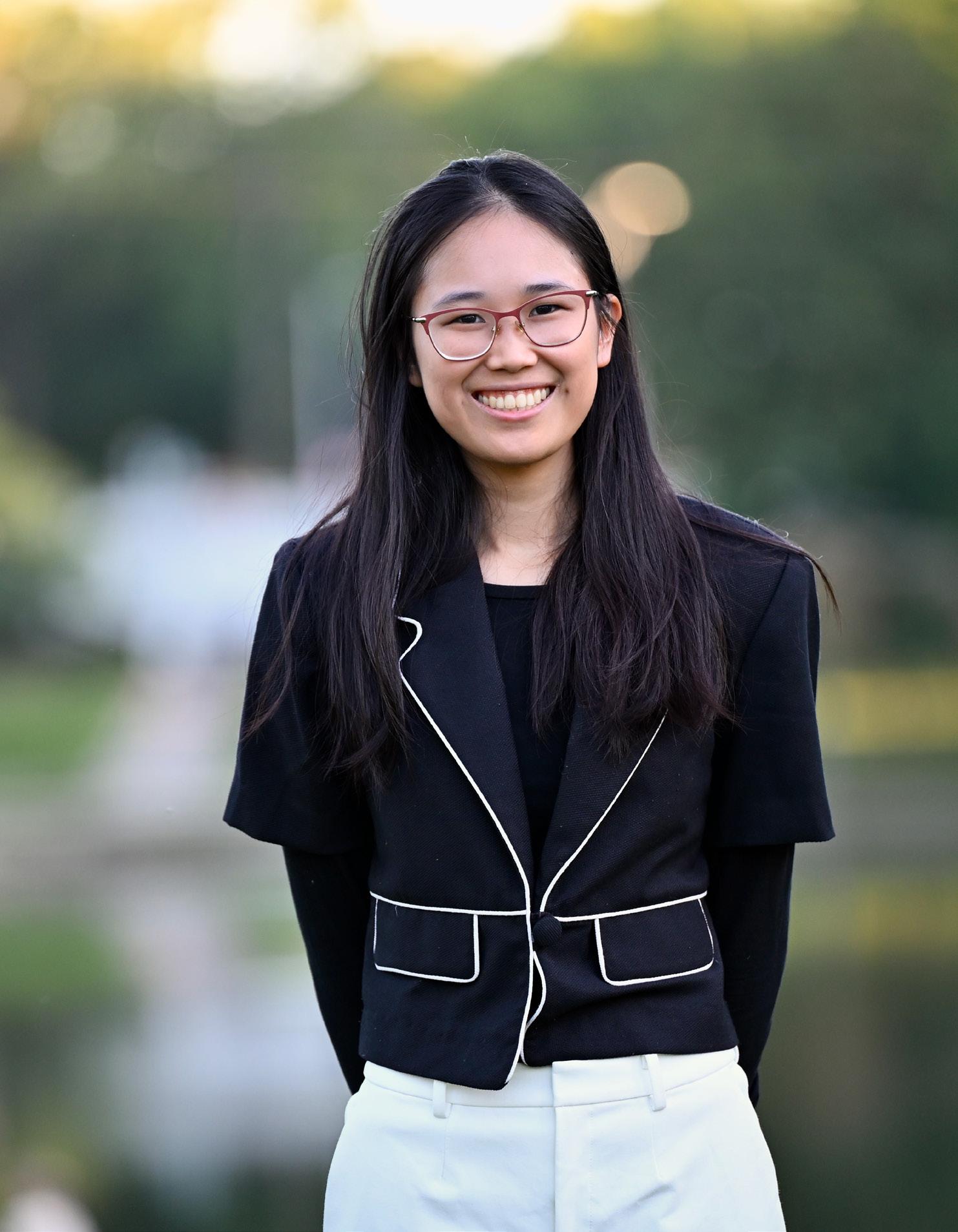
but I know his mastery of crafting stories will lead to innumerable achievements as a lawyer.
It seems so unfair to say that Auden Koetter’s title is just director of digital media, because she is so much more than that. She has single-handedly turned our paper into what it is today. I still remember going to the Spring 2024 ACP Conference in La Jolla with Auden. After a couple of days of attending seminars about elevating newspaper designs, she immediately put it into practice. It is without a doubt that her works as former director of design are some of the best designs The Observer has ever produced. From the eclipse front page to the award-winning Civil Unrest, she has truly mastered the craft. Now as director of digital media, she has revitalized the team and created a brotherhood unique to The Observer.
I could not be happier with the group of underclassmen that brought life to UMBO. There is never a moment without laughter in the office, whether it’s from the random conversations at the digital media team couch, from the inside jokes told at the mixed business and design team table and design bay, or from the personal stories at the print table. Growing the editorial board to 40+ people definitely has its challenges, but I would not have it any other way. Section Editors Alyssa Wang, Penelope “Penny” Cloonan, Aleksandra Majewski and Ellie Palaian all stepped up to the task, making the large transition from writer to section editor. Their passion for their respective sections and willingness to go the extra mile for their articles is something I am incredibly grateful for. Copy Editors Siya Motwani, Riya Kulkarni, Abhishek Nambiar, Wendy Chen, Mariana Parilli-Castillo, Michelle Bai, Kashvi Madhwani and Lily Zhang are all bril-
liant, and actually make the solo process of editing a fun community effort. Web Editors Moses Fleischman and Obafemi Tidjani have admirable patience as they wait for me to finish my blurbs each week. Photo Editors Tyler Sun and Phillip Kornberg are some of the funniest people I’ve met. While not always the most glorious position, as it involves scouring the internet for royalty-free images, each week they take the most impressive and creative photos. Anya Lin, Ben Kang, Kristina Guo and Kiera Ng all arrived at the Editorial Board without the Directors knowing they are the best of friends. Their little quartet tucked in the corner of the UMB office brings a smile to my face as the energy never dies down, even as midnight approaches. I’m so grateful to have been your executive editor and I look forward to seeing what you guys will do next.
I also want to thank former Sports Editor Puneet Bansal for her patience with all the questions I asked as a copy editor, learning new sports terminology from various positions to gameplay. Her coaching led to my position as sports editor, and, during my yearlong tenure, I could not be more grateful to Ellie and Abhishek. They helped me build the sports section up and put up with my weekly section meetings. I’m so proud of what they have made the sports section and what they will continue to do with it.
As we turn the page to the next volume with The Observer, I am incredibly excited to follow along as the newspaper grows in Penny’s hands. It is bittersweet to say farewell to the organization that defined my college experience. While I will miss the feeling of walking into the UMB office ready for a night of adventure, I know the memories and friends will continue to be with me as I embark on the next journey.
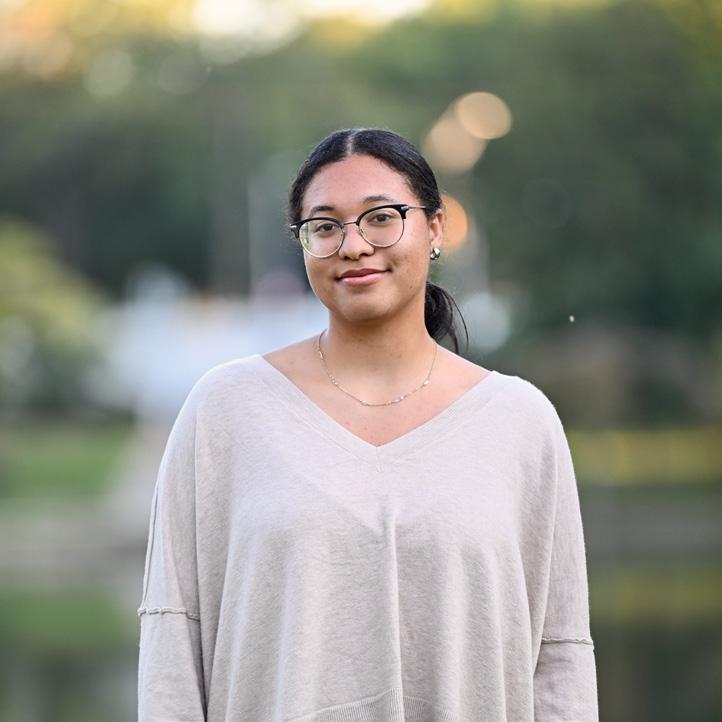
Okay, the title is clickbait. It actually kind of did the opposite.
When I joined The Observer as a writer my first year, I was looking for an extracurricular activity— something that complemented my interest in writing (the biology major wasn’t doing it for me) and got me more involved in campus life. I decided the opinion section of the newspaper would be the best fit, as it was pitched to me as: “You can just write whatever you want.” And, truly, that’s all I needed to hear.
Writing my first article was a solitary task, completed with the help of a latte, more sugar than espresso, a Wade Commons armchair and a dream. And it was fun! Who would have thought that researching and writing something you actually care about could be a peaceful reprieve from the monotony of required study? However, at the back of my mind, I couldn’t help but wonder where everyone else who contributed to the paper was. What would it be like to do more than just write?
That’s when I met Rebecca Warber, a copy editor for The Observer, in one of my classes. Between discussions of Shakespeare, we exchanged updates on our story ideas and hyped up each other’s articles. It was Rebecca who ended up telling me what being on the Editorial Board was like, and, eventually, I found myself drawn to the prospect of joining. The following year, I applied.
Although I arrived at my copy editor interview with my usual brand of awkwardness, it turns out I was worried for no reason. Shivangi Nanda, the former executive editor, told me that she felt like she already knew me because she’d read my articles. At the time, and even still today, I remember thinking that was one of the best compliments I’d ever received— to feel represented by something I’d written when so often it was difficult to say what I was feeling out loud. She called Director of Print Elie Aoun out to talk to me before assuring me with a smile that I’d hear back soon.
I have to say that I had major imposter syndrome when I first started, missing small things—em-dashes, date format, the dreaded Oxford comma—none of it was clicking. However, with Elie’s guidance and multiple tagged Google Docs comments, I began to feel more capable. Things were looking up.
The experience made me realize how powerful student journalism can be. Every week, as basic human rights were being challenged daily, I read and edited an increasing number of articles on serious topics. From protests to policy changes, I learned the importance of uplifting our community’s voices and ensuring everyone is heard. A large part of these realizations is owed to Darcy Chew—fellow copy editor, then sports editor, now executive editor—and Helen Treseler, then news editor.
There are not enough words to describe how committed these two were (and still are) to The Observer. Helen provided an endless treasure trove of ideas for the paper and immediately made sure all the new arrivals felt welcome. She kept us laughing all production night and easily brightened the mood every week without fail. Darcy, one of the only other second-years, also immediately made me feel more at home on the board. She was empathetic, motivated and somehow had a way of making people excited to work. This past summer, Darcy put in so much effort to get the club off the ground again, recruiting people, restructuring teams and submitting for awards. After staying late into the
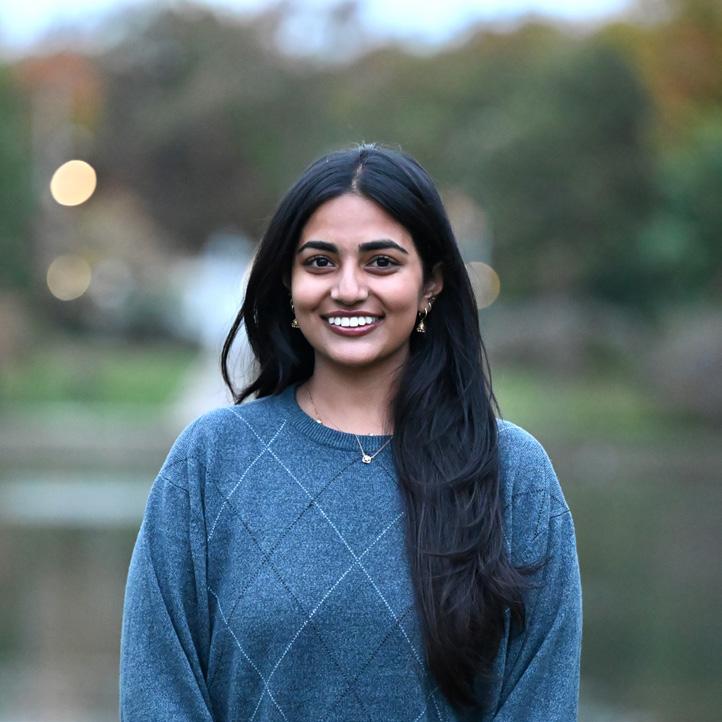
Nithya Pandari Layout Designer
Before I started senior year, joining The Observer was nowhere in the plan. My schedule was already full, graduation was getting closer and I thought I had already found the spaces that would define my time at Case Western Reserve University. Then, over the summer, one of my best friends, Anjali, director of design, reached out to tell me they were looking for new layout designers. I said yes with almost no thought behind it, mostly because it
night, I always knew I had Helen and Darcy to walk me home—and brainstorm ideas for next week’s issue while doing so.
When I eventually applied to be the opinion editor, convinced after a bonding event, I took the reins from Beau Bilinovich, who walked me through the steps and sent me all of his resources before I even formally landed the role. It is thanks to Beau’s patience and amazing model of what it takes to be a great opinion editor (even amidst his late editorials) that I feel I was able to do well in the role.
While this thousand-word essay may seem like overkill to anyone who hasn’t been part of their school’s newspaper, I have to say that it’s hard to explain how much it can consume your life. Wednesday may be casually referred to as “production night” to friends, but for those inside the club, it’s a weekly-run, well-oiled machine—and the work doesn’t stop once you leave the office. As a copy editor, you have to make sure all the information you publish is factual. As a section editor, you have to edit, reach out to writers, write an article every week and keep up to date on current events (which can be incredibly depressing). As a director, you have to guide a team of editors. I have learned so much about the world just from being in this club. There are so many people I probably would never have met if not for this club. And, you know what, it makes me a little sad that some people will graduate college without ever having an experience like this.
So I want to say thank you to all my fellow directors. I could not have asked for a more perfect team to spend roughly 15 hours a week with. Directors of Design Lucas Yang and Anjali Bhuthpur, I am constantly in awe of you both. I can always count on Lucas to think deeply about any question and give a really wellthought-out, hilarious response. He puts his 100% into everything he does, and never fails to surprise me. Anjali, I love singing and dancing around the UMB office with you when it starts to get into the delirious, wee hours of the night. You are one of the most high-energy, wel-
coming people I have ever met and you always get me out of my shell. Auden Koetters, our amazing Director of Digital Media, I am always impressed by how much you manage to fit into your schedule. Thank you for all the planning and coordinating you have done throughout the years. Your tireless commitment has kept us going strong. Tyler Vu, the man, the myth, the director of business operations, thank you for filling our production nights with crazy antics. In addition to your jokes, though, you always offer great advice and never hesitate to lend a helping hand. I’m grateful you were always willing to take the drink-spilling journey to retrieve our weekly rations. I also want to extend a special thanks to former fellow copy editor Sahar Kapasi, who, in my heart, is a director. It has been a joy to have your calm energy, silly comments, and interesting travel stories in the office.
Thank you all for trauma-bonding with me. We have been through some of each other’s highest highs and lowest lows together, and I have loved (nearly) every second of it.
Finally, I want to give a huge “thank you” to the amazing print team that we have had this past year. Shoutout to the section editors— the ones who have had to deal with complaints, miscommunication and unplanned article additions, Aleksandra, Alyssa, Penny, Ellie and Sabrina—and to the world’s most dedicated group of copy editors, Riya, Lily, Abhishek, Mariana, Siya, Wendy, Michelle and Kashvi. You all truly keep this paper running. This year, by far, has been the most fun and, in large part, that was due to you all. I have enjoyed talking about books, laughing about alternative Super Bowl performances and hiding from stuffed animals with you all. Thanks for making my last weeks at CWRU so much brighter.
I can’t wait to see what The Observer goes on to do, and I know I can rest assured with the knowledge that we’re leaving the paper in great hands. For now, though, I’m closing the laptop on this part of my life.
Until we meet again!
Hannah
sounded random enough to be interesting. Every now and then, life gives you an opportunity that makes no sense on paper (pun intended) but feels worth trying anyway.
Most weeks, I worked on the Life section, with the occasional news or sports page mixed in. At first, layout seemed simple enough: place the articles, adjust the photos, make everything fit, fix what looks wrong, repeat. But there was an art to it that I had not noticed before— it was about creating flow, balance and making a page look like something people would actually want to read. It was about caring about details that most people would never consciously notice, while knowing those details were exactly what made everything work.
A huge part of that growth came from Lucas, the other director of design, whose creativity constantly raised the standard of what I thought was possible. When I first started, my pages were rigid and safe. I focused on structure and getting everything where it needed to go. Over time, after seeing the kind of ideas Lucas and Anjali brought to every issue, I started thinking differently. I became more willing
to experiment, take risks and ask how a page could stand out instead of simply working. Thank you both for pushing creativity in a way that made the rest of us better too.
What I did not expect was how quickly the people would matter more than the pages. There is something strangely special about being in a room full of tired, talented people all trying to make something good before the night ends. Stress became delusion. Delusion became laughter. Small conversations between edits became the kind of moments that stay with you longer than the finished product ever could.
My co-layout designers were the kind of team that made every week easier. No one hesitated to step in when someone’s schedule got hectic, when someone needed to leave early or when an extra page needed to be covered. There was always someone willing to help, and that kind of generosity is rarer than people think.
I especially want to shout out Sahar, another one of my best friends and my personal favorite layout designer. At the beginning of the year, I looked forward to every Wednes-
day because it guaranteed time with Sahar and Anjali. Somewhere along the way, that list of names kept growing and growing. What started as showing up for two people became showing up for an entire room.
That might be what I will remember the most. Not just the pages we finished or the deadlines we met, but the way a random Wednesday commitment slowly became one of the most consistent and joyful parts of my week. In the middle of a senior year that often felt like it was moving too fast, The Observer became a place where time slowed down enough to finally enjoy it.
College teaches you plenty inside classrooms, but some of the best lessons arrive quietly and unannounced. Sometimes the most meaningful communities are the ones you find late. Sometimes the things you almost said no to become the memories you revisit most often. Sometimes, the final chapter surprises you with something you did not know was missing.
So no, joining The Observer was never part of the plan. But some of the best things that happened to me here never were.
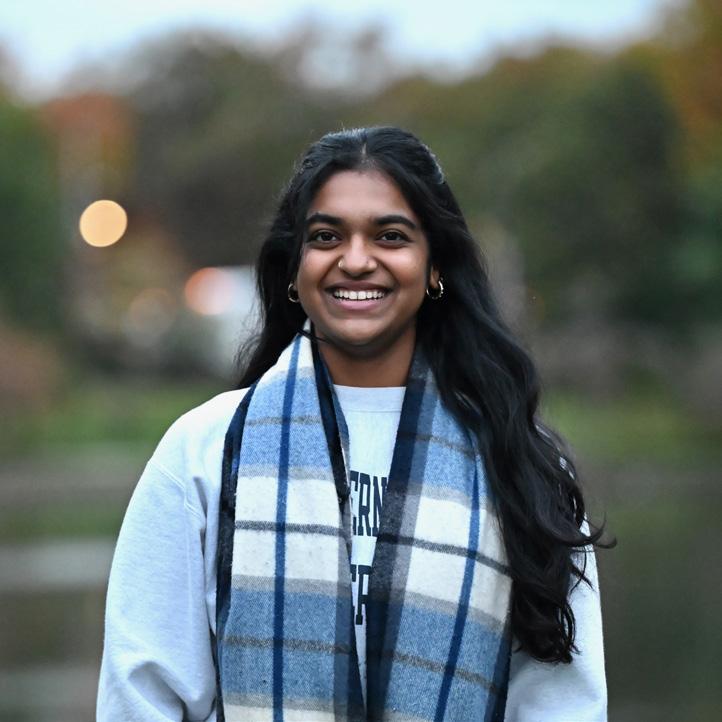
Anjali Bhuthpur Director of Design
Before I ever set foot in the UMB office, I had never worked on a newspaper in any capacity. Honestly, I had no idea what I was getting into. I joined The Observer because Auden Koetters, then-director of design, asked a group of us if anyone wanted to try layout. I just wanted something creative to do, so I said yes. Looking back now, that “yes” was undoubtedly one of the best and most pivotal decisions I made during my time at Case Western Reserve University. It was the moment my college experience truly began.
My first few weeks were spent tucked away in what I generously call the “design nook.” That tiny corner of the Thwing basement is where I first opened InDesign and realized, with a sinking feeling, that I had absolutely no clue what I was doing. But with Auden’s guidance (and an incredible amount of patience) I started to learn. Slowly, but surely, I fell into the rhythm of layout, figuring out the tiny, invisible details that make a newspaper come together. It was in that nook where I first met Tyler Vu. Tasked with creating a banner for the paper and generating graphics, he quickly became someone I looked forward to seeing every week (even though he told me to shut up back then just as much as he does now).
By my second year, I had really found my place, especially within the sports section. That section became my primary creative outlet; it was a space where I could experi-
ment with bold visuals and actually feel like I was shaping something people would engage with. I pushed myself to learn Photoshop and Canva to build new designs, always encouraged by Auden to see how far we could stretch the aesthetic of the paper. Around this time, thanks to Shivangi Nanda, our executive editor at the time, we all started to attend bonding events. We finally got to know each other outside the fluorescent lights of the UMB office, and that was when the “team” started becoming a “family.”
This was also when my friendship with Lucas Yang started to blossom. He had joined the team as a graphic designer and was producing work each week that pushed the limits of what I thought was possible for a student publication. At the end of my second year, when conversations started about the next director of design, I knew I wanted to step up. But I also knew I couldn’t do it alone. I turned to Lucas and that partnership changed everything for me.
From the start, I knew working with Lucas would be something special. He came from a technical graphic design background while I had focused on the structural flow of layout, and that contrast just made sense. It meant we could split the work in a way that played to our individual strengths, but it also meant we could push each other to try things that felt risky. Where I thought in grids and margins, he brought in a level of creativity that lived beyond the page. Together, we were able to experiment, take risks and turn chaotic ideas into something far better than either of us could have produced in isolation.
I truly believe our rag-tag group of six is one of the closest groups of directors that The Observer or any club on campus has ever had. We didn’t just work together, we imbued our friendship into the very fabric of the paper. I would be remiss not to personally acknowledge the fantastic directors I’ve had the privilege of working alongside this year.
Our executive editor, Darcy Chew, is one of the hardest working people I know. We met my first
year, back when she was a copy editor and I was just starting in layout. Somehow, we always ended up in the same SafeRide heading down from the UMB office. That’s really where our friendship started. The next year, when she became sports editor, I found my niche working on Upcoming Games and Scores. Every time I had some wild layout idea, Darcy was right there, willing to adjust the article on the fly to make it work. That collaboration carried all the way through this year, with us trying to make crazy layouts for every section of the paper and I’m so grateful for it. This year, she has led The Observer in a way that fosters connection among our members.
Auden Koetters, none of this would have happened without you. You’re the reason I joined The Observer in the first place. I still don’t understand how you manage to do everything you do. From teaching me InDesign from scratch to writing the funniest Fun page articles we’d all stay up way too late reading, you’ve been such a constant source of energy and support. You made me believe I could actually do this job. Now, as director of digital media, you still show up wherever you’re needed. Your dedication is unreal, and I know you’re going to do incredible things.
Tyler Vu, you were one of the first people I met, and somehow also one of the most chaotic (in the best way). As director of business operations, you basically started from nothing and built something that actually works. He somehow found ads everywhere and made sure we could keep running. Despite calling me an “idiot sandwich” every chance that he gets, Tyler brings unity to our team. Without him, The Observer would not function (literally, since he brings us food every week).
Hannah Johnson, our director of print, was absolutely made for her role. She always rolled with whatever chaos I brought into the room, including the random songs I’d start singing and somehow made me feel seen through all of it. She is the first one to start a little dance with me at 2 a.m., when I am delirious and finishing a page, and
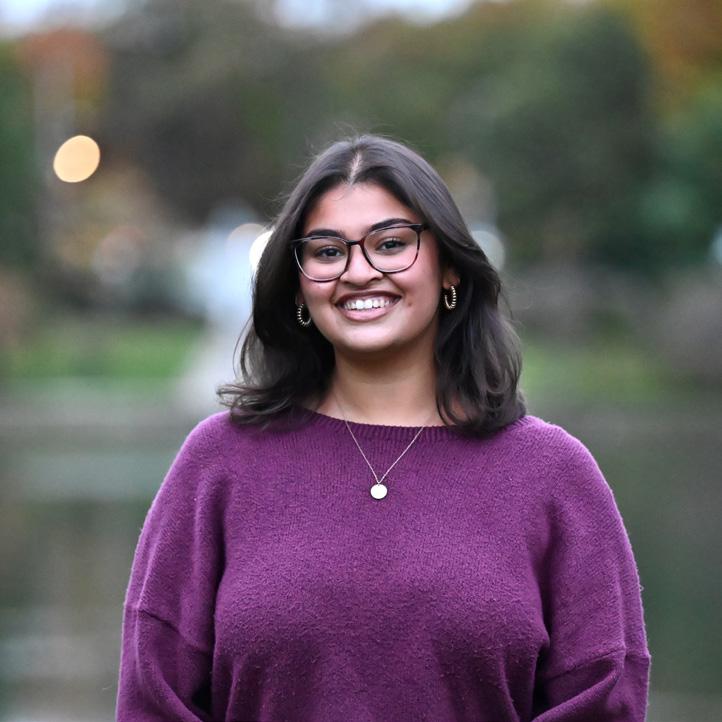
Sahar Kapasi Layout Designer
I joined The Observer almost without meaning to. I was a spring admit, walking around the student activities fair with current Director of Digital Media Auden Koetters into our first few days at Case Western Reserve University, and I remember seeing the table and thinking it looked interesting. Then, I walked right past it. It wasn’t until a year later that
I ended up joining when I met the former Executive Editor Shivangi Nanda in class. She had a way of recruiting where saying no somehow wasn’t really an option, and, before I knew it, I had agreed to come to production night. She needed copy editors and I figured I’d try it out without thinking too much of it. That turned into a lot of fun and one of the best ways to meet people I never would have crossed paths with otherwise. I loved being forced to keep up with what was happening on and around campus, and by the end I became an AP style whiz. I remember sitting around the big table in the UMB office with my fellow copy editors at the time, current Executive Editor Darcy Chew and Director of Print Hannah Johnson, poring over every comma and capital letter, fact-checking every name and title. I remember we even caught a completely plagiarized essay in a writing contest we were hosting. Growth really does come in many forms—I am now, for better or worse, that person who will correct your grammar. For my first two years I was a
copy editor, and in my senior year I decided I wanted to try something new. I moved to the design team and started as a layout designer, with my best shot at a graphic or two along the way. In a week that could otherwise blur by, production night became a guaranteed few hours of creating something, and I loved that The Observer gave me that outlet. I loved watching pages come together and seeing designs go from a blank mess of text boxes to something we were proud of. Opinion became my unofficial section, and, every week, I looked forward to seeing the most beautiful graphics from the design team, while also being a menace about last-minute orientation changes. Graphic Designer Anna Trusova has heard that particular ask far too many times (sorry!). Getting to work under Co-Directors of Design, Lucas Yang and Anjali Bhuthpur—a power duo if there ever was one—has been such a privilege. Lucas, with that obscene amount of talent, and Anjali with that natural magic eye for design. I got lucky, working under some of
also the most dedicated writer and leader. She is not just amazing at what she does, she makes the entire process smoother and better for everyone around her.
Most of all, I need to thank Lucas Yang. Lucas and I met when he joined the design team as a graphic designer and he has never failed to blow me away. He makes art that genuinely transports me into the article that I am going to read. Willing to iterate on designs until he deems them perfect, Lucas has produced some of the most intricate images and designs. I know I threw some absolutely insane ideas your way, and I’m sorry for that, but you always came back with something even better than I imagined. Leading our team has been one of the highlights of my time here.
And to the entire design team— Sahar, Nithya, Shareen, Kiera, Reva, Anna, Jana, Kristina and I can’t forget Lizzy—this paper is what it is because of you. Week after week, you took ideas (sometimes very chaotic ones) and turned them into something real. Your work is the reason we were able to put out a paper we’re proud of every single week. I’m so grateful I got to lead and, more importantly, work alongside all of you. And an honorary shoutout to Tyler Sun and Phillip Kornberg for always helping us track down photos, because without you our pages would have been very empty.
The Observer became so much more than just something I did in college. It became a place where I grew, where I learned and where I found people who made all the long nights worth it. I’ll never forget the 3 a.m. brainrot, the sugar crashes, the leftover snacks and the sound of Tyler yelling nonsense across the room. In the middle of that beautiful chaos, I found a family that I will cherish forever.
Now, sitting here trying not to cry while writing these final words, I just want to say thank you. I found so much of myself in the basement of Thwing, and that’s because of all of you. I didn’t plan to join The Observer that day Auden asked for help. But I know now, with total certainty, that it was exactly where I was meant to be.
my favorite people, who also happen to be incredible bosses. Nithya joining this past year made production nights even better, as we got lost in layouts together. I’m going to miss working alongside her and my fellow layout designers Reva, Kiera, Shareen and Lizzy, and the truly gifted graphic designers Jana, Anna and Kristina. I’ll miss getting Anjali to fix my page numbers for what probably felt like the millionth time, and even Director of Business Tyler Vu periodically hovering over my shoulder to inform me, unprompted, that my half-finished page looks bad. What am I supposed to do on Wednesday nights now?
The Observer has been a kind of constant over these past years at CWRU. I’m so grateful for the people, the free dinners, the late nights and everything in between. When I think back to the girl who walked past that table at the Activities Fair, I’m so glad she found her way back.
See you next Wednesday, Observer.
Thanks for everything.
Snehal Choudhury Staff Writer
I knew that I would have to write this farewell someday and even started planning what I would say in true writerly fashion. But now that I actually have to write it, it’s made graduating even more real and that is an uncomfortable reality to grapple with.
However, I recognize that all good things must eventually come to an end, and I have thoroughly enjoyed my time writing for The Observer during my undergraduate career.
I joined The Observer during the fall semester of my freshman year as a fun activity to do in my ever-decreasing free time. While I had no formal experience writing for a newspaper, I had always gravitated towards writing and found I had a knack for words. More importantly, writing was an important safety blanket for me growing up.
As someone with Autism Spectrum Disorder (ASD), I had challenges with social interaction and had a hard time making friends as I couldn’t comprehend or navigate social dynamics easily. It was hard to read other people’s body language and nonverbal cues, interpret their jokes and sarcasm and understand how to do the same. At times, I was bullied or excluded for being different. I also had difficulties with unscripted, spontaneous conversation and took longer to process the world around me, so I often got overstimulated from figuring out what to say next, especially since there were no “do-overs.” I felt I had to
act a certain way just to fit in with everyone else, which was exhausting. There was a frustrating disconnect between my brain and my mouth. I had many thoughts and intense emotions that I desperately wanted to express out loud.
In contrast, the writing medium was a blank, minimally-stimulating canvas that never talked back or gave me a hard time, making all of my social difficulties blissfully nonexistent and irrelevant in those moments. The canvas was patient and gave me ample time to think about what I wanted to say and gave me permission to unapologetically express myself without outside judgment. Writing energized me. Even today, while I am far more articulate, I still feel more comfortable expressing my most complex and profound thoughts and feelings through writing.
I initially bounced between the news and opinion sections. While I enjoyed writing a news article, writing opinion articles was so much more liberating and empowering. It was a refreshing change of pace to set the tone for my writing rather than being dictated by current events. So, I switched to the opinion section full-time.
The Observer was critical in building up my low self-esteem. In addition to the social challenges I faced, I employed a “researcher’s mentality” when learning class material, which was very different from my peers. I took more time to grasp concepts and required extra clarification because I paid greater attention to detail and had to do a deeper dive on everything. This was especially true in my English classes, where I made
Mariana Parilli-Castillo Copy Editor
It is hard to quantify my time at Case Western Reserve University. And yet, now that I’m on the precipice of leaving this campus behind and going forward into the world (and into the upcoming global economic depression), I find myself making lists of all that I have achieved. Doing the math, I have had eight mental health crises, three catastrophic friendship breakups, zero actual breakups, one and a half broken computers, 30 late papers, six Bs, five undeserved As, 250 job application rejections, seven different club leadership roles (though only three of those amounted to actual work), one grade-2 ankle sprain, one 10hour surgery, one litre of blood loss, 250,000 minutes listened to on my Spotify and a gained appreciation for the late-1990s British rock band Oasis. I have left my name in four editions of Discus-
complex and out-of-the-box arguments that weren’t always wellunderstood or appreciated. I had a hard time completing structured literary assignments because I had to be someone I wasn’t. As a result, I thought there was something wrong with me.
I am eternally grateful to The Observer for giving me a widereaching platform and a safe space to develop my own writing voice. With time, The Observer helped me embrace my out-ofthe-box, analytical “deep-dive” research style when writing topics—marked by heavy background reading on topics and citing many sources (thanks, fact-checkers!)— with elements of vulnerability and personability. Interestingly, for many of my articles, I often ended up learning basic human psychology and sociology concepts. It just goes to show how successfully navigating the world and its many complexities boils down to understanding people at their core.
I always chose topics that were personally relevant and tried to take a different perspective to make people think twice, especially those that were highly discussed. Because these topics related to certain struggles I had at the time, writing these articles were therapeutic and helped me move forward. Most of all, there was always an underpinning of hope and optimism in my articles to boost everyone’s moods in such a negative world. When I sent in drafts for editing and publication, no one radically changed my nuanced arguments or fundamental voice, which was inherently validating. Getting these articles published did wonders for my confi -
sions, 29 issues of The Observer, and, if they ever decide to print anything following the age of the dinosaurs, one edition of Case Reserve Review. In four years, I have gained lifelong friendships; the assurance that I have left my mark, however, delible in the lives of those I’ve trained and helped inspire with my constant reminders to be ruder, stronger and more demanding from the world around them; and a caffeine addiction. I have lost a million other things, among these, the ability to wake up with my alarms and the light in my eyes, though now I’m not even sure if these things matter anymore. The world, as a whole, has lost so much at the hands of the cruel and the unjust, in ways that will forever weigh my heart and will taint my remembrance of these years forever. These past four years have been some of the best of my life, and I will cherish them forever, but more things have happened to me and the world at large than I have ever lived through in my entire life.
I find myself returning to these lists in part because I am so bad at saying goodbye. I don’t know what I’ll do once I do my last trip to bug one of my professors at their offices. I know that I have bugged every single one of them for their emails, and I have standing appointments to discuss or monthly readings with at least one of them. And yet, deep in my heart, I know it will not be the same as when I step into one of the dusty Guilford offices with the perpetually dirty-looking carpets and see their patient faces
dence.
Over the years, I pushed myself to write about even more challenging topics that required increasing levels of maturity, vulnerability, research and nuance, furthering my deep love for writing. In my junior year, I wrote about how the mental health care system could serve its users better. This forced me to contend with my own unprocessed experiences navigating the system so my opinion could still be informed and logical without getting clouded by emotion. With great difficulty, I eventually wrote something decent. Conquering these topics and being able to wrap my arms around them made me feel like I could do anything.
The most rewarding part of my job was seeing how people responded to my articles. It was amazing to see people resonate with my words and value my perspective. I distinctly remember one person sending me an email stating they really enjoyed my solar eclipse psyche article and it was one of the best things they’d read all year. I developed a small group of followers who always looked forward to what I wrote and supported me.
All of these positive aspects of writing for The Observer made me slowly gain back my self-confidence corrupted by a system that tries to homogenize their students, something I’ll need in abundance as I start my PhD at the University of Delaware in the fall. I am sad to conclude my time with The Observer, but I take comfort in knowing that this has prepared me well to tackle the next exciting chapter of my life.
as they’re waiting to hear the latest ridiculous update on my life.
I don’t know what I’ll do once I enter the UMB room for the last time. I know that I have spent my fair share of copy-editing meetings, all-nighters and general hangouts on that grey sofa, but how am I supposed to live with the knowledge that soon there will be a day when I sit on it last? I have written so many bad papers on that thing that it should at least be awarded half my diploma, and yet it will stay there until somebody inevitably breaks it, and I will never see it again, as time will move on without me there to see it.
I don’t know what I’ll do when I say goodbye to my quasi-mentees for the very last time, with no knowledge whether they’ll even remember me by the time summer ends and they get back to their academic lives. I know that I had never expected anyone to find me anywhere near a role model or mentor when I first came to CWRU, and even now, I find myself looking around the room to see what adult I can follow, only to realize I am the oldest one there. I also know that the people I have taught and guided are partly the reason why I have not grown so jaded with the world, as they, in part, remind me that there are those after me who will keep up the good work long after I am gone. I don’t know what I’ll do as I see the world slowly fall apart around me, with the senseless hope in my heart that, even still, there must be a future to look forward to.
I don’t know how I’ll sleep on
the night of May 16, hours before going to fetch my diploma, with the ultimate knowledge that, for all intents and purposes, that will be the last time I sleep in the same dorm room as my roommate. It all returns to the fact that I simply do not want to say goodbye. I think in part I am writing this so you, every single one of you who have touched my life in the past four years, don’t begrudge me for not saying goodbye directly, for simply telling you that my phone is always open, my Discord checked bi-weekly and that I will never begrudge a stupid message because it will remind me that the past four years really did happen, that I will be able to look back on these past four years and know that not all was lost the moment I leave the cracked and badly-upkept grounds of the North Residential Village. In the spring semester of my freshman year, a professor (who is now my Capstone advisor) asked me whether I was one of the English majors who were graduating that year. I did my part at looking sufficiently mock-offended at the time, but even then, I had felt a sort of bone-weariness that has only further dug into me during my time in university. In truth, I would be lying if I were to say that I haven’t felt a bit like a perpetual senior since then. It’s only now that it’s hitting me what being a senior actually means. And so, for once in my life, I will be brief as I give my vaguely patronizing and wholly pretentious advice to all of you who are reading my farewell: don’t look back in anger, at least not today.
Tyler Vu Director of Business Operations
I never really thought I’d be part of this for that long. I applied to The Observer before I had even unpacked a single box in my freshman dorm. I didn’t really know what I wanted to get out of it. I just knew that I was coming to a school built around science and engineering, and I wanted to do something that existed outside of that. Turns out, it would see me through more changes that I could have predicted.
My initial interview was with former Executive Editor Shreyas Banerjee and Director of Print Sara Khorshidi in 2022. The interview itself was pretty bad. I lost connection five different times. I joined from three different devices. It took a full 30 minutes before we could even start. Sara ended up pulling me toward a graphic design position because of my background in art, so I went for that. I figured physical art would translate well to digital. That just ended up being wrong. I was pretty bad.
What followed was a first and second year I can only describe as a blackout. I have no real memory of it. All I can tell you is that we got
pizzaBOGO almost every week and I would draw graphics and leave. I didn’t really think I had a passion for it, and I think somewhere underneath that I knew something was off.
By my third year, I had finally accepted that something needed to change. One of our current Directors of Design, Lucas Yang, had just joined and was amazing at graphic design. On the other hand, I had reached a point where I was going to explode if I had to open Procreate one more time and draw another banner. With the help of my good friend Auden Koetters (second longest standing Editorial Board member, not that I’m keeping track), Director of Design at the time, I finally made the switch to layout design. I wanted to find something I could actually care about– and it turned out that thing was less about putting words or art on a page and more about making the page itself work. The Observer was still there. Just in a different form.
It was also around this time that Executive Editor Shivangi Nanda started pushing harder for bonding within the Editorial Board, and I’m grateful she did. Before that, I think most of us floated through production nights without fully landing anywhere. Shivangi had this way of making everyone feel like they were supposed to be there, like the paper was genuinely theirs.
I also have to note that the current Directors are one of the tightest groups I’ve seen in any organization at this school, and I think a lot of that traces back to what Shivangi built—and maybe also to the fact that everyone here chose this on top of everything else CWRU already asks of you. That, and being together for more than 15 hours a week.
Then came my fourth year and the title of Director of Business Op-
erations, which sounds impressive until you hear what the department looked like when I inherited it. Everything had to be rebuilt from scratch: the media kit, the advertising relationships, the whole infrastructure of how the operation was supposed to run. It was, without question, the hardest thing I did at CWRU.
The thing I’ll actually carry with me, the thing no job title or rebuilt media kit can account for, are the memories built at 2 a.m., when everyone stopped functioning like normal human beings and became something else entirely. Darcy and Hannah would be heroically trying to finish copy editing while the rest of us made that as difficult as possible. Darcy is one of the most passionate people I’ve ever met—whenever my schedule got too packed this year, she was right there to step in without making it a thing, somehow on top of everything despite having more on her plate than anyone. I first met Hannah when she was trying to be gracious about a pizza graphic I drew for her article about CWRU’s meal plan. It wasn’t a great pizza. The rest of the Executive Board was already joking about it and she was the only one being kind. She’s come a long way from tolerating my art—so has her career at The Observer, from Opinions Editor to a genuinely great Director of Print. Opinions is a section where you’re going to hear some rough takes from the readership, and she handled all of it.
Lucas, meanwhile, would spend production nights quietly hating every graphic he made, then produce something that looked like frontpage work he’d spent a week on. He is without question the best graphic designer I’ve ever met, and I do want to formally apologize for how many times we asked him to draw
Lucas Yang Director of Design
I don’t know what to say. Is there any possible combination of words that could sum up my feelings about The Observer that hasn’t already been said by older and wiser? Samuel Beckett learned to write in French because the enormity of James Joyce constantly loomed over any Englishlanguage craft; Joyce had already solved the problem of English. How the hell am I going to solve the problem of The Observer?
That’s really what being a director at this paper is about: solving problems. Write a new front page story because the scheduled one is completely unfinished. Facebook message the subject of your expose because the writer forgot to reach out for comment. Make sense of the Cuyahoga County
Clerk of Courts website—which looks like it hasn’t been updated since 2009—so the paper doesn’t get sued. Your printing company refuses to deliver. Make a timeline of the Epstein emails. Draw a full colored graphic in 20 minutes.
And, of course, we can’t forget the minutiae of final editing: change the width of lines from 0.75 to 0.5; manually remove the white background of an incredible illustration without ruining it; deconstruct and reconstruct a rectangular crossword puzzle to fit into a tiny square; delete the spaces around backslashes; squabble about 13-point versus 12-point bylines; deciding, once and for all, how we’re going to format television seasons. Is it season 1, Season 1, season one or Season One? Who knows? Who cares? We’re probably going to forget by next issue. Do it all in the wee hours before your Thursday morning film class, where attendance is mandatory and participation is militant.
Why would anyone do this? Moreover, why would anyone do this to themselves, willfully signing up and losing a sweet gig?
Like many Editorial Board members before me, I joined on a whim. Someone sent an entry level position opening in the Discord of a club I was barely in, and I thought, what the hell, sure. I spent hours writing a terrible cover letter. I updated my portfolio and polished my sparse resume. I got the interview call and prepped
something completely insane. Anjali would break into song mid-sentence, mid-layout, all while wrestling with our perpetually glitching InDesign fonts and somehow every week she found a workaround. We were both Layout Designers together under Auden, and I think that shared trench is a big part of why we all got so close. Auden has been with The Observer almost as long as I have and has been a thorn in my side for just about as long. The two of us ran around like toddlers bothering the Editorial Board on zero sleep, finding stuffed animals in the office and throwing them on the Fun page just so we could finally leave for the night. It was rough. It was also, genuinely, some of the best time I have spent with any group of people in my life.
I came to The Observer not really knowing what I was looking for. I left knowing something I don’t think I could have figured out anywhere else: I’m at my best when I’m learning something new, when the role doesn’t quite fit yet and I have to figure it out on the fly. I was bad at graphic design. I was figuring out layout. I was rebuilding a department from scratch. Every single time, something was wrong or broken or on fire and, every single time, I had to think fast and work it out. Turns out that’s not a bug in how I operate. It’s just who I am. Four years and three positions later, I think that’s the most useful thing The Observer ever gave me. It’s seen me through every change I’ve gone through in college.
One final thing because I can’t move on until it’s been said: I do not, and have never, endorsed the fun pages released with me as the face of USG. I was not consulted. I was not warned. I simply showed up one day and there I was. That is on the record now.
disproportionally hard, trying to figure out how I could spin elementary school swim instruction into relevant experience for graphic design.
What I didn’t expect, however, was to have a 10-minute chat with one of the warmest people I have ever met. Shivangi Nanda, former executive editor, told me she liked my art and that her biggest concern was people staying through production night long enough to actually talk to each other. Reader, I don’t know how else to express how much my expectations were wrong. The days before, I was obnoxiously speculating to my friends if there were going to be multiple rounds of interviews to pass.
This is where my story diverges. Unlike most of my predecessors, my early years at The Observer were extremely low-stress, highenergy and straight up fun. Every Wednesday, I got to come in, thumb through the zany opinions my peers desired deeply to share and create my own equally zany illustration to match. Whether that was a piss yellow front cover split by a page-spanning apartment building, or Eric Kaler leaving students in automobile dust, or a hot pink femmebot scrolling TikTok or a photorealistic diagram of the “Spitball” sculpture covered in graffiti, I could do anything and everything I wanted, show it to some of my favorite people in the world and figure out how to make
it even better. No rules, no expectations, just play.
That’s what got me through college. Through two major changes, one broken leg, one new pet, the entire LSAT, tens of job interviews and countless, countless emotional ringers, The Observer has always been there. No matter what anxiety, exam or tournament was terrorizing my brain, I knew I could walk into the UMB Office at 5:30 p.m., pull out my dying MacBook and get my closest friends to help me focus on some great fucking art. That’s why, every night (and sometimes early morning), without fail, I would leave that building with a hundred percent exhaustion and a thousand percent contentment.
This is why I became a director. If I could provide that same experience to even just one other student, I knew I would leave CWRU with zero regrets. Every 3 a.m. redesign of the Fun section, every inane debate about hyphens, every emergency edit that demanded I run to the UMB office after class the next day, was just a drop in the immense ocean of debt I owed to the people in this organization.
Because that’s what’s truly important about The Observer—the people in it and everything I feel towards them.
Continue reading on page 16
From “The Little Prince,” Antoine de Saint-Exupéry:
“It is the time you have wasted for your rose that makes your rose so important.”
For me, that rose has always been The Observer.
At first, I read that line as something simple and almost comforting. That the things we care about are meaningful because we choose to care about them. Over time, I understood it differently. The “wasted time” it speaks of isn’t really wasted at all. It’s the quiet, repetitive, sometimes frustrating work that slowly, almost imperceptibly, turns something to yours.
Anyone who knows me knows I tend to overthink things, so it should come as no surprise that I’ve been mentally drafting this farewell since I first laid out the farewell pages three years ago. And yet, when it finally came time to write this, I found myself at a loss.
It wasn’t until I looked down at my necklace, the Little Prince standing atop asteroid B-612, that I remembered where this all began. “The Little Prince” was the story that made me fall in love with stories. When I first read it, I was drawn to the obvious: a boy travelling between planets. When I got older, however, I stopped focusing on where he was going and started paying attention to what he was leaving behind and what he chose to hold onto. This realization led me to The Observer during my very first week at Case Western Reserve University.
Since then, I’ve helped publish 91 issues of The Observer: 10 as a layout editor, 54 as director of design and 27 as director of digital media (along with my more unofficial role as the creator of the fun page). I’ve spent more nights than I can count in the UMB office, sometimes arriving at 5 p.m. on Wednesday and leaving at 8 a.m. the next morning. I never minded the late nights, though, because those were the hours that made it matter—that made it mine.
Somewhere in those hours, I understood another line: “What is essential is invisible to the eye.”
In my sentimental senior year reflections, I’ve often thought of all the ways The Observer has changed over the years, but writing this farewell forced me to consider something else: the ways The Observer has changed me. It taught me that stories aren’t just words on a page. They’re illustrations, photos and comics. They’re Top 10 Lists and Worst Case Scenarios. More than anything, it taught me that people are stories, too. That is a lesson I will carry with me far beyond The Observer. Because people, like stories, don’t arrive whole. They come in fragments and it is our responsibility to piece them together.
That’s why the part I find hardest to put into words isn’t my work on The Observer, it’s the people. In the final scene of “The Little Prince,” the fox explains that while everyone has the same stars, the stars are not the same for everyone. This is how The Observer will always exist to me.
It isn’t the pages published or the issues sent out each week. It’s the people who filled those pages I’ll remember most. Sometimes I think I’ve gotten to live two lives. One is a world of stories where I have flown on asteroid B-612, tamed a rose and befriended a fox. It’s a beautiful life, but my second is far superior.
My second life is populated by characters slightly less eccentric, but real, made of flesh and bone, who are my greatest source of inspiration. Every member of all the Editorial Boards I’ve worked with has shaped these moments into what they are. While I wish I could thank each of you individually, it would take far more pages than we could ever afford to print. So please know this: I am endlessly grateful to have been a part of this with all of you.
Clay Preusch and Joce Ortiz, you were two of the first people to make The Observer feel like home—San Diego changed everything. Tarun Sepuri and Shifra Narasimhan brought me into The Observer and gave me the greatest gift of my college experience. Shareen Chahal and Elizabeth McHugh, you are my design family, and I’m so grateful for every moment we spent InDesigning together. Helen Treseler, I will never forget our three-week argument over your misspelled name that you actually typed wrong yourself. You are chaos and peace and all once, bringing both laughter and comfort wherever you go.
Esha Bagora, Benjamin Kang, Timothy Le and Rhea Soni, overseeing The Observer Instagram is no small task. I am grateful for their consistent creativity and willingness to take ownership of something so visible and important.
Obafami Tidjani came in expecting to write code and ended up having to learn SNO, which is not for the faint of heart. From his first typo-ridden newsletter to now where I don’t even have to check them anymore, he’s become a confident and capable web editor. Ayan Sheikh jumped into CWRU with unrivalled energy and enthusiasm. He threw himself into so many clubs and activities and even created his own coffee review series (which I will be continuing to take inspiration from next year).
I genuinely don’t know where the digital media team would be without Tyler Sun and Matthew Stall. Tyler has a reliability and eye for moments that has shaped every issue we’ve produced. Matthew’s creativity and viral videos put The Observer on the map. Together, they pushed me to be a better director of digital media every day.
Moses Fleischman is the person I never have to worry about, the one who is always on top of everything, often more so than I am. I can think of no one more capable of stepping into the role of director of digital media, and have no doubt he will succeed in ways I never could. Not just because of his actual understanding of video editing and SNO that far surpasses mine, but because of his kindness, humility and patience.
Now, to the person who has probably already stopped reading to yell at me for forgetting him, Phillip Kornberg. Half of what comes out of Phillip’s mouth is probably the dumbest thing I’ve ever heard, but when I look beyond those things, Phillip is someone who is kind, thoughtful, genuinely curious and, yes, I’ll say it, incredibly smart. His energy, humor and presence made every room feel lighter (which he would never say about me), and I wish we had more time working together.
Hannah Johnson is one of the most quietly powerful people I know. Focused, thoughtful and effortlessly funny, she makes everything feel easier and more fun just by being there. She has a way of moving through the world that is gentle but unmistakable. Every time she puts her headphones in and gets to work, it’s impossible not to admire her.
Darcy Chew taught me what true commitment looks like. Whether it be during her time as a copy editor, sports editor or as our executive editor, the level of care she has for The Observer and for the student body is unrivaled. Watching her work tirelessly to advocate for others, stay informed and fight for what matters has been one of the most impressive parts of my time here. She knows what she cares about and she pursues it fully, and there is something truly special about that.
To be honest, I was scared to give up being director of design after two years. I had worked really hard, and part of me didn’t want to let go. But I think getting to watch Anjali Bhuthpur and Lucas Yang take over the design team has been one of my greatest joys on The Observer. I am so incredibly proud of the work they have done, and it has meant so much to me to watch them grow from their first days on the design team to their last as its leaders.
Anjali went from someone pasting articles on the sports page to someone spending hours carefully cutting athletes out of photos and wrapping text around them, then teaching someone else how to do the same. She is endlessly positive, kind and compassionate in a way that pushes me to be a better person. She has always been strong, steady and true to herself, and that is what I admire most. She has taught me far more about who to be than I could have ever taught her about InDesign.
Lucas Yang is everything to me. I always knew Lucas was an incredible artist, anyone with eyes can see that. But what people don’t see, what I was lucky enough to experience every single day, is the person to whom I owe everything on The Observer. He understood my brain in a way that no one else ever has. The ideas that lived in my head—the ones that felt too big, too chaotic, too unrealistic—he never once dismissed them. He met them with curiosity, albeit maybe a sarcastic joke, but then somehow turned them into something real. Working with Lucas never felt like work. It felt like building something together, a reflection of both of us that will forever live on in the pages of The Observer. We had an unspoken rhythm. I didn’t have to explain everything and he didn’t have to ask. He just knew. And for someone like me who is shy, self-conscious and slightly neurotic, that kind of understanding is rare. When everything felt too big, he had a way of making it all feel quiet. It’s probably the only reason I was able to lay out a page in the first place. I am still in awe of him. Every drawing, design and detail he poured himself deeply into have been kept, literally, in a scrap book because I couldn’t care to let those moments go. Not just because they’re beautiful (which they are) but because they represent something bigger: the time we spent creating side by side. Lucas sat beside me through all of it, and no words exist in the human language to explain what that has meant to me. I know I’ll never fully get what I’m trying to say right, but I hope this is close enough.
What I do know is this. There is no version of my time at The Observer that exists without him at the center of it, and there is no version of me that hasn’t been shaped by him.
Tyler Vu, Tyrannosaurus Vu, Tymungus. The first time Tyler and I met, almost four years ago, I was so scared to go up to him that it took me three whole weeks to work up the courage to go ask him a simple question. Unbeknownst to me at the time, asking Tyler to return my roommate’s purple sparkly shot glass would turn into one of my most meaningful friendships of my college experience. Despite what many (and I mean many) may think, Tyler is truly one of the most caring and compassionate people I know. No matter what has
changed in my life during college, one thing has always been certain: I have Tyler in my corner to celebrate my successes and to poke fun at my failures. Tyler has a rare ability to chase any and every opportunity. Watching him grow from a semi-productive graphic designer to a layout designer who helped win the design award at the UMB Correspondents’ Dinner, to the best director of business operations I’ve had the privilege of working with, and getting to be a part of his journey has meant more to me than I can put into words.
Elie Aoun and Shivangi Nanda were my two pillars; without them, I could not stand. I am proud to have been a part of the 3 a.m. Trio. They are my ultimate inspiration, the people from whom I inherited my love for The Observer.
The first year of friendship with Elie was rocky. I actually had a true and genuine disdain for him and, at times, contemplated quitting The Observer. But I’m so glad I stayed. The qualities which first unnerved me became the ones I admire most. His stubborn persistence and sharp wit pushed me to think harder, work better and become a stronger version of myself. Somewhere along the way he became one of my closest friends. Our midnight screaming matches, equal parts debate and reluctant mediation from Shivangi, are moments I will treasure forever. Beneath it all was a level of honesty and understanding that is rare, and I am so much better because of it.
Shivangi was the first person who made me feel like there was nothing I couldn’t do and no version of myself I couldn’t grow into. I never said it out loud, but I was terrified to become a director as a sophomore. Shivangi never let me feel that fear, though. Instead, she led in a way that made everyone around her feel like they belonged. Her ability to uplift others was constant and unwavering. As executive editor, she made an Observer where people felt seen, capable and trusted, often before they felt that way about themselves. The person I became here is, in so many ways, a reflection of what I learned from her.
Together, Shivangi and Elie filled The Observer with love and fun and laughter and a sense of belonging that is easy to overlook but impossible to replace. In the two years they were teaching me to be myself, I’m not sure they ever realized the person I most wanted to be was them. Thank you both. You are my guideposts for everything.
From the Little Prince, I learned that stars don’t change, only the way we see them.
Everyone reads newspapers. Not everyone sees them the same way.
To most, they are pages to be folded, recycled and forgotten. To me, they will always be something else entirely. They will be the nights that turned into mornings without noticing, the quiet hum of the UMB office when everyone else had gone home, the feeling of not wanting to leave when I finally could.
They are all of you.
Not just the work we did, but the moments in between—things that didn’t seem important at the time, but somehow became everything.
I think that’s the hardest part of leaving: not that this is ending, but that something so constant and familiar will now only exist in memory.
Maybe that’s what makes it matter. Because just like the stars, these moments don’t disappear when we walk away from them. They just become something we carry instead.
I don’t know if I’ll ever be able to fully explain what The Observer has meant to me (shocking after writing this much, I know). But I know I don’t have to. Because, like the stars, it will always mean something different to me than it will to anyone else, and that’s what makes it mine.
It’s honestly insulting that I’ve barely mentioned any of my costaffers until this point. There’s Shivangi, Elie Aoun and Clay Preusch, who tolerated every stupid first draft I showed them and lent me countless hours and thoughtful feedback until each hare-brained idea became polished chrome. Lizzy McHugh, Bowen Zhang and every other past design team member, who’d share a meal, an ear and a laugh with me before we dove into our respective labors. Then, there’s everyone on my current team— Anna, Jana, Kristina, Shareen, Kiera, Reva, Nithya and Sahar—who never, ever fail to impress me by
how much they raise the bar, week by week. Each of you have the rare combination of resilience, creativity and boldness that makes great design possible. I would say the sky is your limit, but even that feels narrow, so instead: I hope at every crossroads next year, you choose to go big.
Finally, there’s my directors. I would be an utter wreck, each week, both in and out of this organization, without all of you. Hannah Johnson, who has the sharpest, quietest wit, is always able to see what I can’t and kindly mock me for it (deservedly). Tyler Vu, my day one, ride-or-die co-artist, who wears his
heart on his sleeve; he’s as cutting as he is earnest and probably the toughest person I know. I wouldn’t trade those panicked food pickup car rides for anything else. Darcy Chew, who was dealt one of the worst hands in Observer history, and, through endless patience and iron determination, spun straw into gold. Anjali Bhuthpur, my wondertwin, so good-naturedly radiant that you sometimes have to look away from her brilliance, is the solid rock I lean on, over and over again. And of course, Auden Koetters. I think you know how I feel, but I cannot help but be a broken record. The reason my time here has been any
fragment of what it is, is because of your inhuman ability to bring light, levity and attentive guidance to each of our myriad problems. The reason I’ve made any art worth a damn is because of you and your ceaseless encouragement, keen eye and unyielding honesty. The reason I stand as a director now is because I learned it all from you. You, and everyone who is and ever has been on this board, have made this ridiculous campus my true home. What bright things the future holds for The Observer, I cannot say, but I know that—that will always be true. Okay. I think that’s enough attempts to capture it. Signing off.
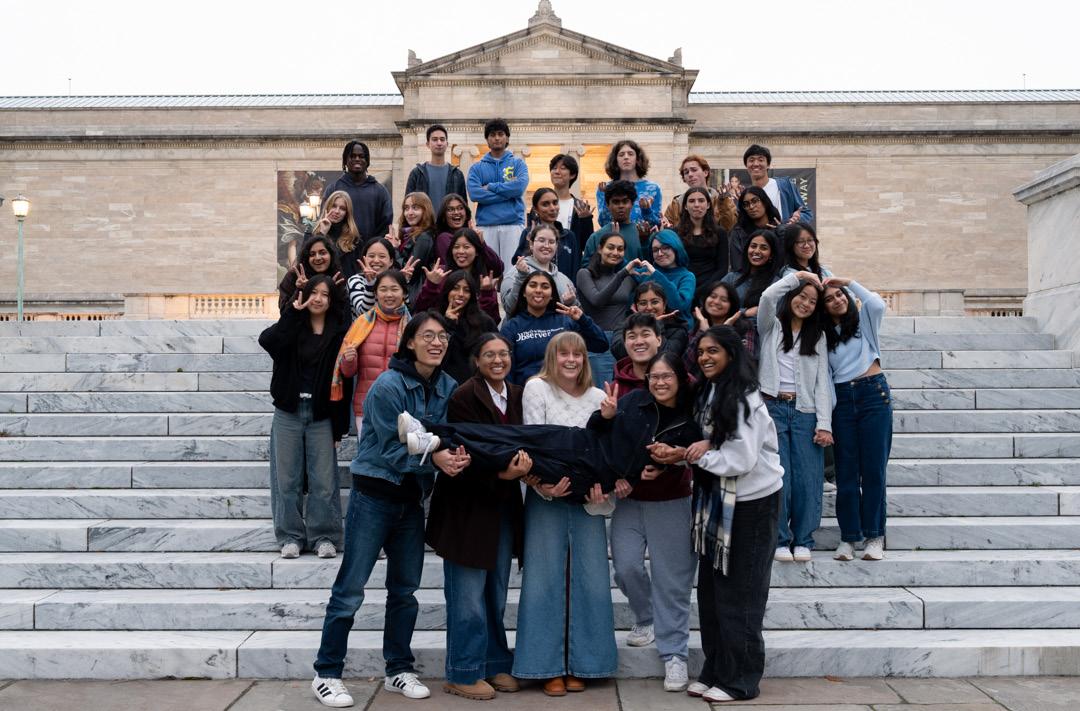
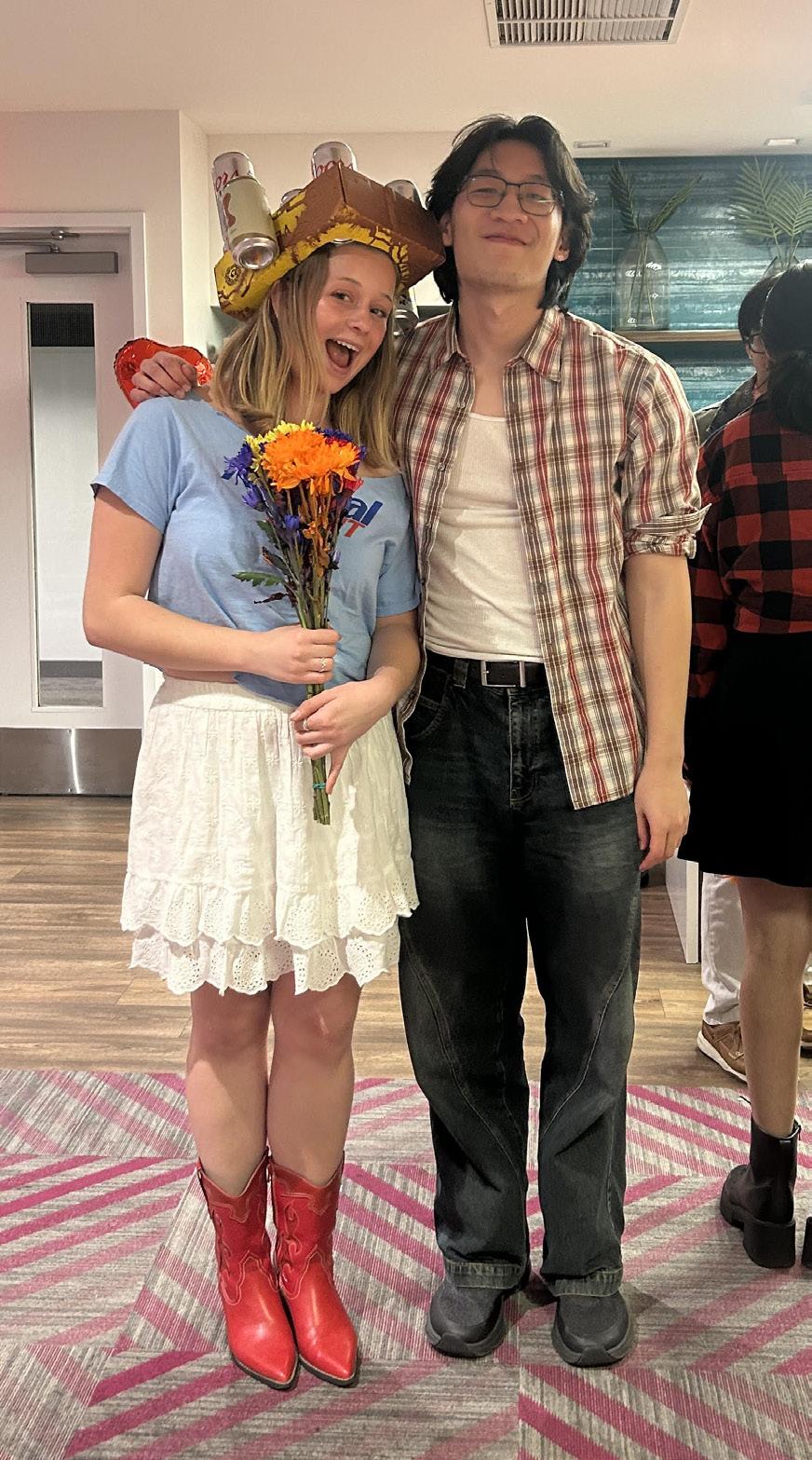
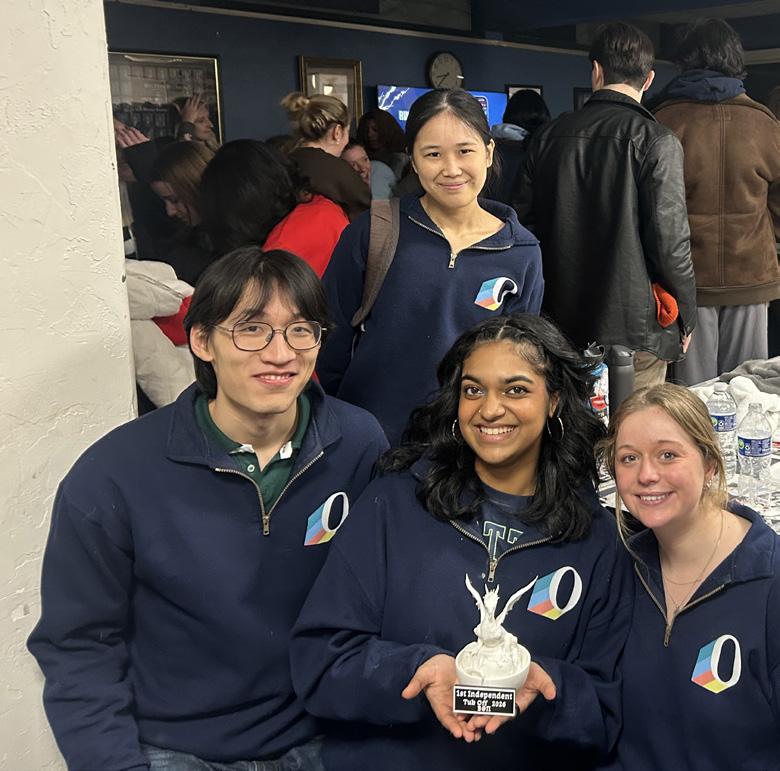
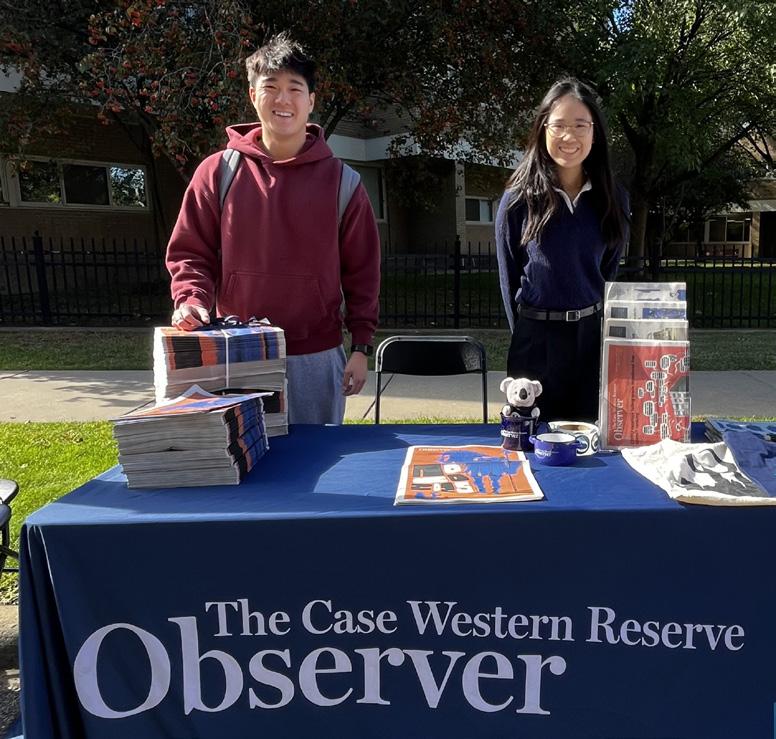
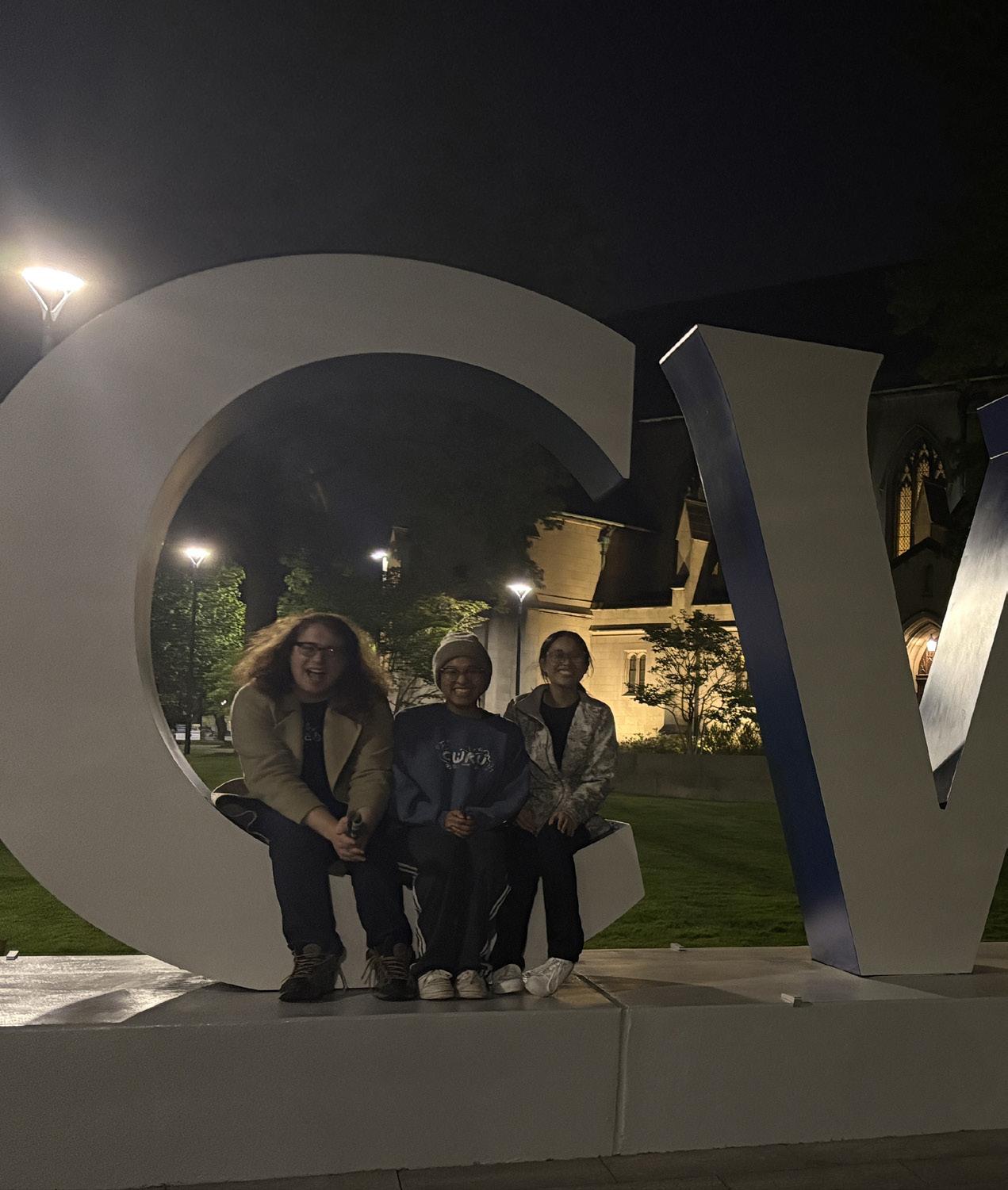
Ellie Palaian Sports Editor
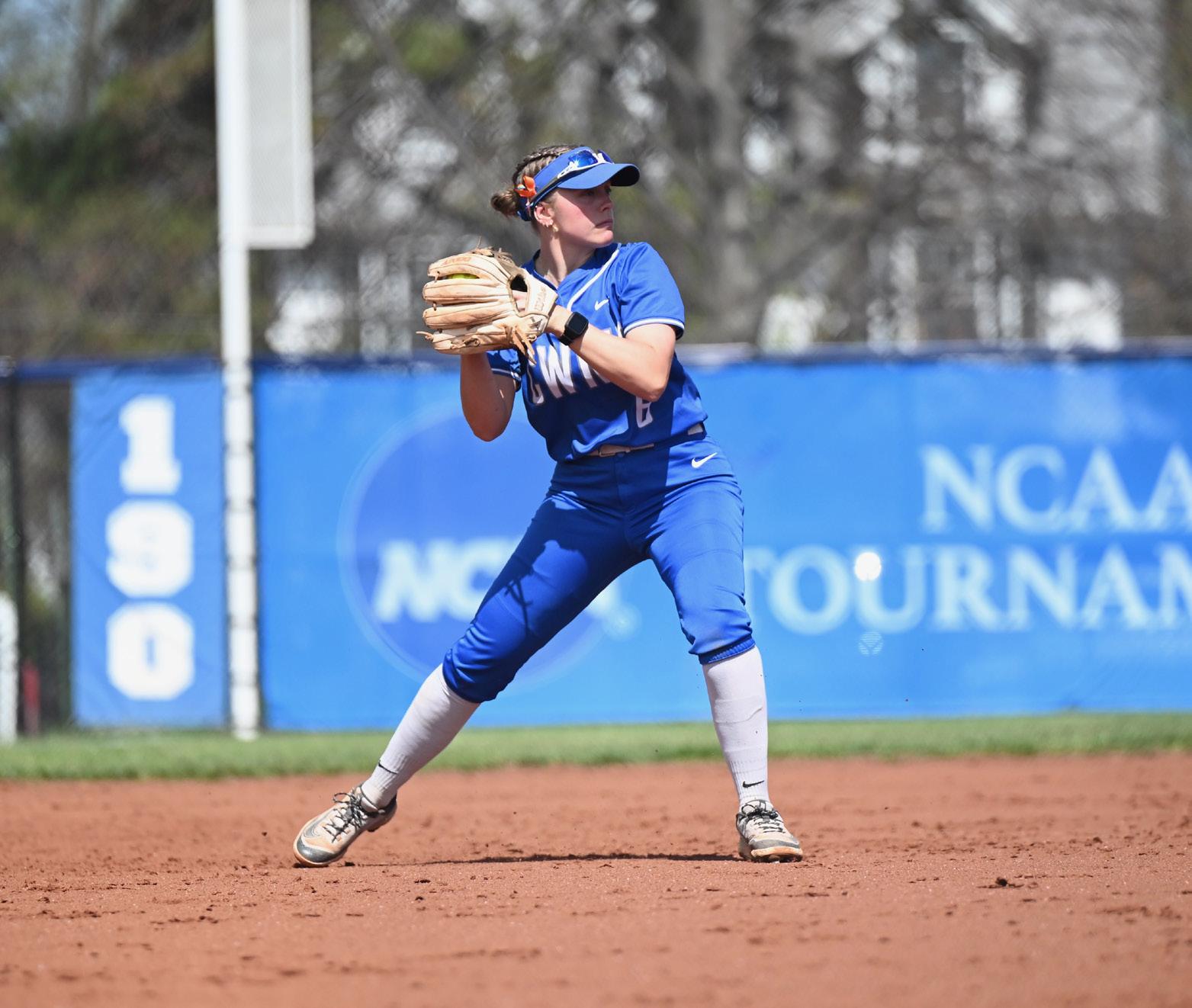
The CWRU women’s softball teams has made waves during their time here and will undoubetdly continue doing so in the future. Phillip Kornberg/The Observer
Fourth-year infielder Elizabeth Berry has been playing softball for as long as she can remember. Inspired by her mother’s path in the sport, Berry knew she wanted to continue her career at the collegiate level. Although the COVID-19 pandemic made the recruiting process especially challenging, she remained persistent and committed, ultimately finding her home at CWRU — a decision she is still grateful for today.
“I sent probably hundreds of emails to college coaches: before tournaments to share my schedule, during tournaments to send updates, and even after tournaments to give final updates before I would do it all over again the following week,” Berry said. “As soon as I stepped on campus and got to hang out with the team, I knew [CWRU] was home. The team made me feel welcomed, like I belonged. As if I was already their teammate, and I wasn’t even going to Case yet. In the end, that is why I picked Case: the people.”
Over the course of her career, Berry has built an impressive career as a consistent and impactful presence at third base for CWRU. A two-time All-Region and All-UAA selection, she has combined strong offensive production with reliable defense, highlighted by a program-record-tying five-hit game in 2024. Berry has started nearly every game across her career, hitting above .300 each season while contributing timely extra-base hits, stolen bases, and multi-hit performances. In 2025, she earned All-Tournament honors at both the NCAA Cleveland Regional and NFCA Leadoff Classic, finishing the season with a .317 average and a career-best 10 doubles. Known for her steady glove and disciplined approach at the plate, Berry has also earned multiple UAA All-Academic honors, showcasing her excellence both on the field and in the classroom.
“I wouldn’t be where I am today without my teammates, coaches, and my parents,” Berry said. “They’ve been there for me every step of the way. They’ve challenged me, supported me, and pushed me to grow and improve in ways that I couldn’t have done on my own. Being a part of a competitive and supportive environment has made such a huge difference: always pushing me to be the best player, teammate, and person that I can be.”
Off the field, Berry is actively involved in campus life. She is a member of CWRU’s chapter of Theta Tau, the professional engineering fraternity, and Alpha Chi Omega sorority, where she has served on the executive board for the past two years. In addition, she works as a Peer Advisor for the Case School of Engineering.
“As a Peer Advisor, my job is to work with students when they come into the office with questions, ranging from anything about classes to co-ops and internships,” Berry said. “My experience as a Peer Advisor has also been tremendously rewarding; I’ve enjoyed guiding students while building meaningful relationships with my coworkers. These connections have created a supportive network that has truly enriched my senior year.”
Berry will graduate in May with a degree in Materials Science and Engineering, concentrating in structural materials. She initially entered CWRU intending to pursue a double major in Mechanical and Aerospace Engineering, but ultimately shifted her path after discovering her academic interests and seeking advice from teammates.
“After taking Physics 121 and 122, I started to realize it just wasn’t the right fit for me,” Berry said. “That was tough, because for so long, that had been the plan, and I felt pretty lost trying to figure out what to do next. One of my teammates was a peer advisor at the time, so I went to her to talk through my concerns. From that point on, [Materials Science and Engineering] just clicked, it felt like the right path for me.”
Following graduation, Berry will begin working full-time in mid-July at Precision Castparts Corporation. While she is excited for what lies ahead, she is also saddened to see this chapter of her life come to a close.
“Being a senior is something that I have looked forward to for so long, but now that it is here, I’ve realized how quickly it has all gone by,” Berry said. “I am proud that I have made it to this point, but at the same time, it is hard knowing that this chapter of my life is coming to an end. Softball has been such a big part of my life. I grew up playing it, experienced all of the highs and lows possible that come with it, and met so many amazing people along the way, so yes, the idea of leaving softball behind is emotional. But it’s more about the people, the little moments, and the memories I made with them along the way that I know I will miss the most.”
Fourth-year pitcher Devanghi Misra has quietly developed into a dependable presence in the circle for CWRU, bringing consistency and control to the pitching staff across her four-year career. The senior right-hander from Aldie, Virginia, has steadily expanded her role each season, highlighted by a breakout junior campaign in 2025 when she posted a 2.27 ERA and earned her first collegiate win while not allowing a run in the majority of her appearances.
Misra has shown continued growth in 2026, setting career highs with six innings pitched in multiple outings and an eightstrikeout performance against Denison, signaling increased confidence and command. Across her career, she has combined efficient innings with strong composure, limiting mistakes and contributing reliable relief and spot starts when called upon.
Off the field, Misra, a Political Science and Finance major, has also earned UAA All-Academic honors, reflecting her discipline in the classroom. Whether stepping into high-pressure situations or providing steady innings, she has become a trusted and resilient contributor for the Spartans.
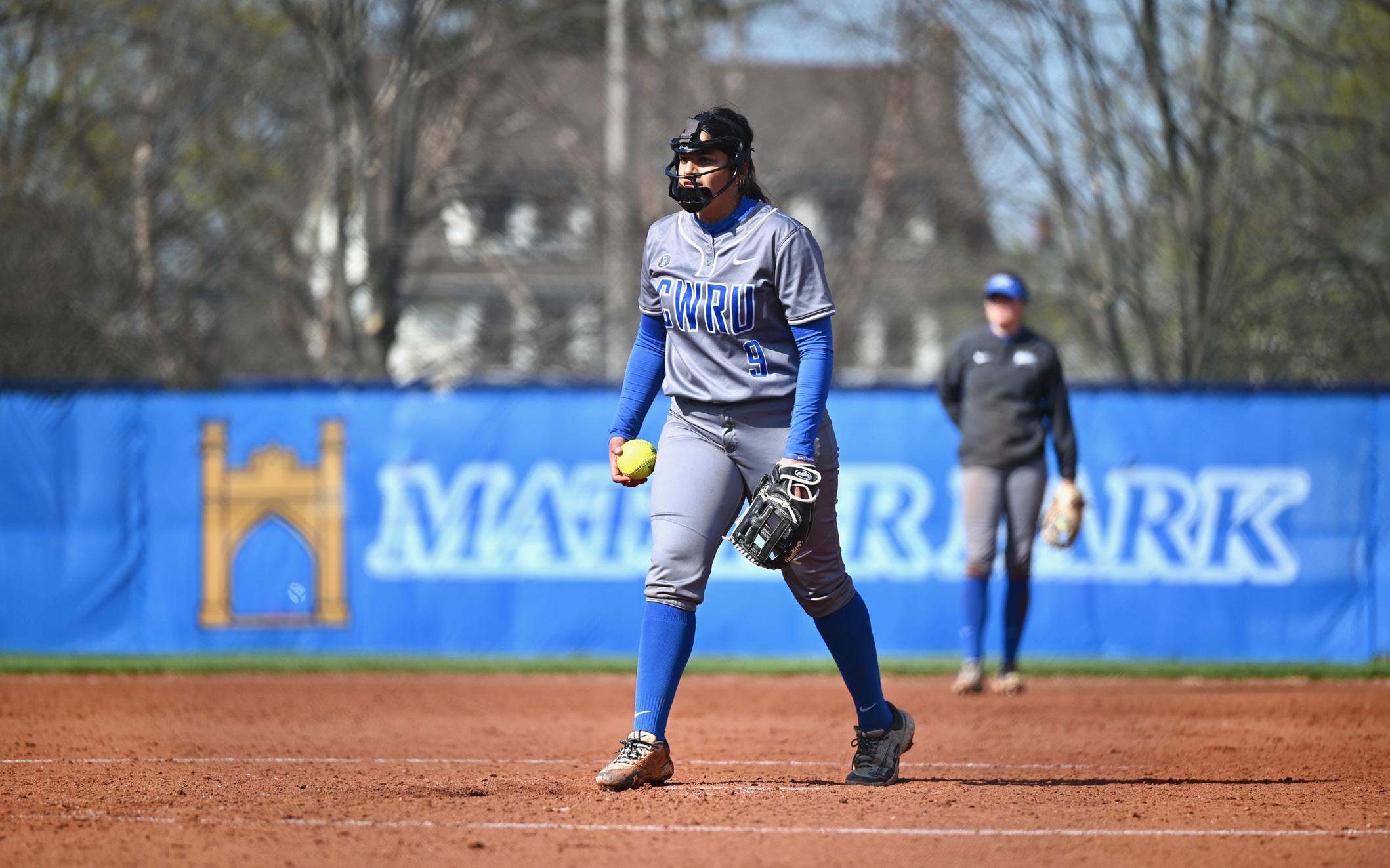
Fourth-year outfielder Tara Fritscher began playing teeball at just five years old and started travel softball at the age of 11.
Like Berry, Fritscher’s path to CWRU was significantly impacted by the COVID-19 pandemic. Despite a limited recruiting experience, she was drawn to the university’s strong academics and wide range of opportunities—ultimately deciding it was an opportunity she couldn’t pass up.
“My main draw to Case was the high academics along with playing for a competitive DIII team,” Fritscher said. “I loved the ThinkBox when I came, the free, quick access to the art museum, the Cleveland Orchestra, basically the easy access to the arts that I didn’t have at home. I also wanted a smaller school that still felt new and like I had a lot to experience, but not so much that I was overwhelmed or couldn’t get to know my professors.”
Over her four years at CWRU, Fritscher has provided valuable depth and versatility for CWRU, contributing in key moments across multiple seasons. Appearing in over 50 games, she has made an impact with her speed on the bases and on base percentage, seen by a high percentage during her early seasons. In 2025, she played in 22 games, scoring nine runs and earning her first collegiate start, while continuing to be a reliable presence off the bench. A multi-time UAA All-Academic honoree, Fritscher has balanced her role on the field with consistent success in the classroom.
Fritscher will graduate in May with a degree in Biomedical Engineering (BME), with a focus in computing and data analytics. She first discovered her interest in BME as a child after watching the movie Dolphin Tale.
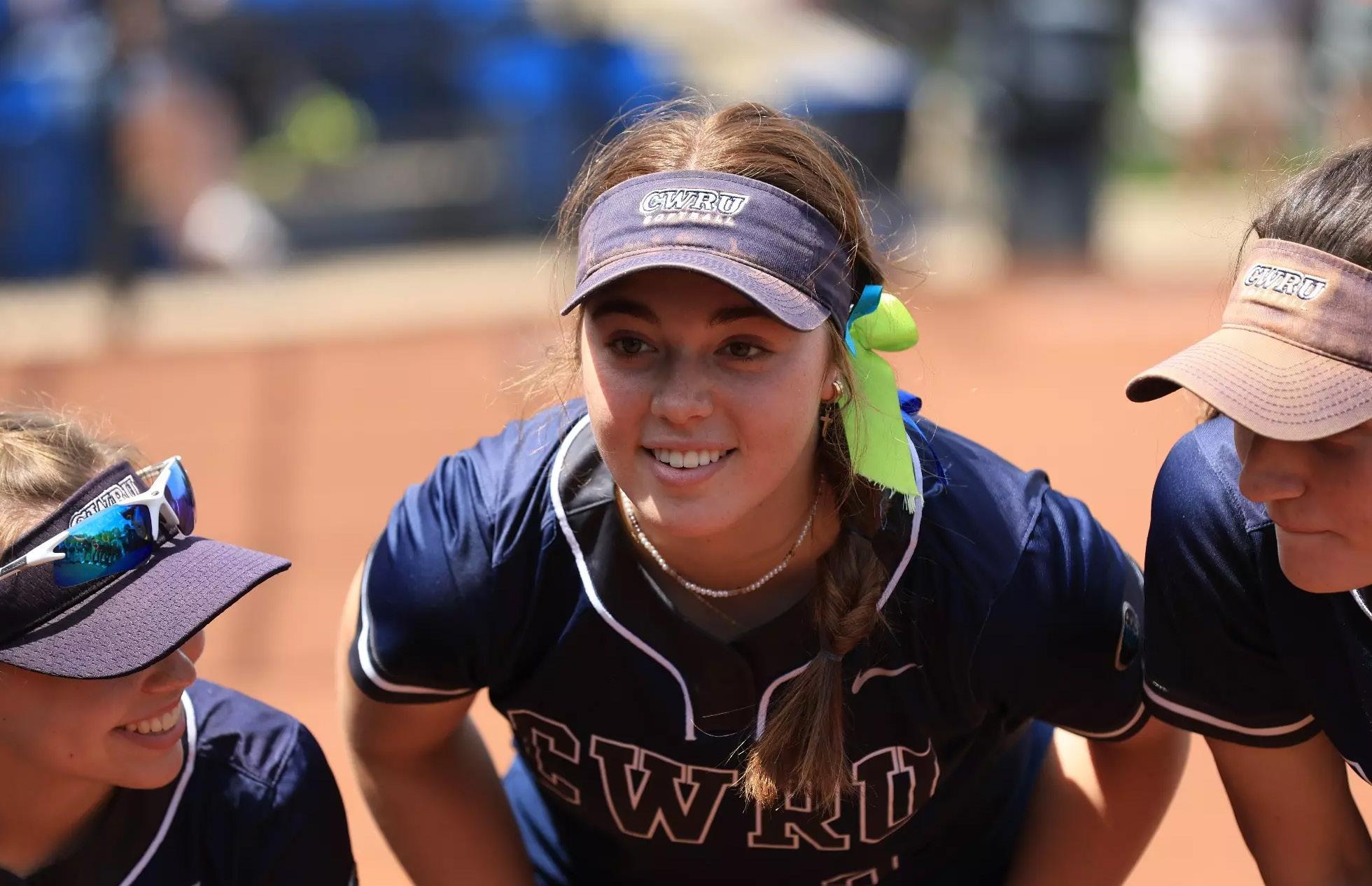
“I loved the process of the scientists building a prosthetic,” Fritscher said. “However, once I got to school I discovered a love for programming and switched my track in BME to be computing-focused.”
Outside of athletics, Fritscher is actively involved across campus. She is a member of Theta Tau, where she has served as Recruitment Chair for the past two and a half years. She is also a member of Alpha Eta Mu Beta, CWRU’s biomedical engineering honor society and serves as a leader for the university’s Big Brothers Big Sisters (BBBS) program.
“BBBS is a nonprofit organization that pairs at-risk youth “Little” with an adult “Big” who acts as a positive influence and empowerment for the child,” Fritscher said. “CWRU’s branch organizes events for the Bigs and Littles to attend together and interact with Case students, since many CWRU students aren’t old enough to be bigs themselves.”
After graduation, Fritscher plans to return home to Chicago to begin working for Publicis Sapient, a digital consulting company. She is grateful for her time at CWRU, especially her class and the close bond they share.
“We’ve been through probably every possible up and down together,” Fritscher said. “We actually started with 6 girls in our class, but now it’s just us 3, and I think that’s made us stronger than ever this year because–not to be cliche–we’ve seen the power of sticking together. With so many underclassmen, and such big shoes to fill from the amazing seniors we had in the past, it’s been a year filled with bonding over how to be the best team leaders we can.”
Olivia Wen Sports Writer
The fall sports teams set a high bar for the year, with the Spartans proving themselves to be among some of the most elite teams in DIII sports. Following a dominant regular season that saw them finish 11th nationwide with a 14-2-4 record, the women’s soccer team was selected as one of the hosts of the first and second rounds of the NCAA tournament. Though the team’s tournament run ended in a heartbreaking 1-1 penalty shootout loss to Swarthmore College, the offense was stellar all season, tallying 63 goals total to mark the second-most in program history.
Likewise, the men’s and women’s cross country teams sent three of their most elite runners to the NCAA championship in Spartanburg, South Carolina: third-year Jacob Slater, second-year Donovan Crowley and first-year Francesca Taracila. All three earned spots in the NCAA championship field based on strong performances at the earlier NCAA Great Lakes Regional Championship, extending a streak of Spartan appearances at the national level to 22 consecutive years. In addition, Slater and Crowley’s dual qualification marked the first such instance for CWRU men’s cross country since 1994. Meanwhile, the volleyball team concluded their season with a 1714 record and a fifth-place finish in the UAA. The last of those 17 wins came in the fifth-place match of the UAA championship, which saw CWRU defeat Emory University in a major upset and claim the program’s first victory over the Eagles in more than 30 years, dating back to 1992.
This past season has been full of accomplishments and records for CWRU athletics programs.
Phillip Kornberg/The Observer
Similar success was seen in the winter sports programs. On the basketball court, graduate student guard Ethan Edwards delivered one of the greatest performances in the history of UAA basketball, scoring a program and conference record 54 points during a game against the University of Rochester on Feb. 22. For his performance during this game, Edwards was named DIII Men’s National Player of the Week by the United States Basketball Writers’ Association, marking the first time this honor has been awarded to a CWRU men’s basketball player.
First-year Gianna Phipps, a member of the women’s track and field team, has been breaking records left and right the entire season. Among her achievements, she set a record time in the 400-meter dash at the UAA Indoor Track &
Field Championships on March 1 and edged out the previous record in the 60-meter dash, set in 2016, at the Spartan Icebreaker on Jan. 17. These two records barely scratch the surface of what Phipps has accomplished this season. At the Spark Adams Invitational on April 18, Phipps broke a 41-year school record in the 100-meter dash. She also broke the school record for the 200-meter dash at the Bob Kahn Invitational on March 28—breaking a record set in 2011—before breaking her own record during the Spartans’ next two events. Wrestling also reached historic heights this past season. Fourthyear Art Martinez placed sixth in the 133-pound weight bracket at the NCAA championship, marking the highest placement by any Spartan wrestler at the national level since Isaac Dukes placed third in his category in 2011. This year’s
effort also marked the first appearance of CWRU wrestlers at the national championship in 14 years, an effort largely driven by consistent performances from Martinez and his teammates. Martinez himself would finish the season with a 3810 record, concluding a Spartan career in which he achieved 104 wins, the second-most in CWRU wrestling history.
The momentum continues into the spring season. The men’s tennis team has been on a roll this season, finishing their regular season with a 24-7 record ahead of the UAA championship from April 23-25 and the NCAA championship in May. Highlights of the season include a deep run in the ITA DIII championship that saw the Spartans defeat then No. 1-ranked Denison University in the third-place match, and an upset victory over then No. 5-ranked Carnegie Mellon University in the final match of the regular season.
Meanwhile, the outdoor track and field season was bolstered by a big accomplishment: for the first time in 20 years, CWRU was selected to host the UAA Outdoor Track and Field Championships. Welcoming the best athletes in the conference to Cleveland is a massive logistical and athletic milestone for the university, giving the Spartans a chance to showcase their toplevel DIII talent right in their own backyard.
Between established upperclassmen cementing their legacies and first-year athletes bursting onto the scene, the 2025-2026 season has perfectly exemplified what the athletics programs of CWRU are capable of. This recap only scratches the surface of what has been accomplished this season, and even more major accomplishments are expected next year.
Dear Lauren,
I just want to start by telling you to take a deep breath. I know all of this change is a lot for you—Case feels a lot bigger than high school—but I promise you that it’s a good thing, even if it may not feel like it yet. Juggling all the aspects of academics, athletics and just life all by yourself seems really daunting. But you aren’t actually by yourself at all. You have incredible teammates and friends who are going to support you as you take on the challenge that is college.
Now, I won’t disagree that starting off the school year and season with a rolled ankle is pretty rough. Cross country was supposed to be the place where you could let off steam, and now you can’t even run. But, all those hours in the training room and in the cardio room have a positive side; slowing down and taking time to meet the other people there is going to give you such a strong foundation for the next couple of years. Also, starting out injured means there’s only one way to go—and that’s up. Things, both in and out of athletics, are going to get better from here. Of course, this won’t be the only injury you sustain in these four years (sorry to break the news), but each one will remind you why you do what you do—why you put in the miles and how much it means to be able to have a body that can let you do that. Being able to run is an amazing gift that fills you with a joy that you still feel to this day.
And, of course, the team. You know that teammate who you thought was making fun of you during the first week of school? They are not only going to become your roommate, but also one of your best friends. The upperclassmen are going to be a source of support and wisdom as you start on this journey, and soon you will get to have the chance to do that for the incoming classes. From making snow angels during practice to singing karaoke on the buses, this team is going to be a bright spot when things get stressful. With their creative whiteboard poll questions and stories that bring the “Accident Counter” back down to zero, there’s never a dull moment with them around. Academically, it might seem hard at times to be a humanities student in what feels like a sea of engineers. But don’t lose the love you have for that creative side of you. It pushes you out of your comfort zone, finding joy in improv and eventually leading you to do work with a company whose mission is to help other people through the medium of play. Your classes will broaden your perspective and allow you to see life in a new and different way. Embrace the challenges they present to you, and you will get so much out of them.
But more than anything, I implore you to go be yourself—whoever you think that is. She is going to change, and that is okay. This is the opportunity to try new things and figure out what you like and don’t like. And when you find the things you love, pursue them. When you find the people you love, cherish them. They are the beautiful things and people that make life worth living and make this experience the best it can be.
Okay, one more deep breath. You are a monster!
Lauren
Abhishek
Nambiar Copy Editor
Late April marks one of the most important events in the National Football League (NFL) offseason: the annual draft. This year is no exception. From April 23-25, teams will be selecting new faces for their rosters out of a fresh slate of college athletes ready for the next stage of their careers. Though the draft will have already started by the time this article is published, here is a quick roundup of some things to expect across these three days.
Day one is exclusively firstround picks. The first-overall pick goes to the Las Vegas Raiders on account of them having the worst record in the 2025 season, and they are widely expected to draft Indiana University quarterback and Heisman Trophy winner, Fernando Mendoza. Things are less certain after that, however, especially given how this year’s draft class is on the weaker side when it comes to quarterbacks. While quarterback-needy teams like the Arizona Cardinals and New York Jets may still explore the position during this round, expect more focus on the non-quarterback talents. Among them are running back Jeremiyah Love from the University of Notre Dame, offensive tackle Francis Mauigoa of the University of Miami, edge rusher David Bailey out of Texas Tech University and numerous players from the Ohio State University; among that list is linebacker Sonny Styles, wide receiver Carnell Tate and safety Caleb Downs. Expect all of the aforementioned players to be drafted within the first ten to 15 picks.
Day two, the day of second and third-round picks, is wwhen the draft truly begins to take shape. Predicting which players will be drafted during these rounds is certainly harder, but what is a little clearer is how some teams may plan
to approach these rounds based on their biggest needs depending on the results of day one. Teams such as the Buffalo Bills and New York Giants can be expected to focus more on the offense, looking to add more firepower to their respective fronts. Meanwhile, the Miami Dolphins—who hold several picks in the third round via trade deals with various teams—can be expected to be especially active during this time, targeting both offensive stars and defensive reinforcements as they enter a rebuilding phase.
Day three, covering rounds four through seven, is probably the most overlooked day of the draft. While picks during these rounds rarely generate any buzz, they are often still important for teams looking to build complete rosters. Expect
big moves during this time from the Denver Broncos; all but one of their picks in this year’s draft will be happening on Saturday, giving them multiple opportunities to address various holes in their roster. This mentality will be shared by other teams throughout this time, especially those who also hold numerous late-round picks such as the Baltimore Ravens and Kansas City Chiefs.
Overall, while this year’s draft may lack an elite quarterback roster that prior years may have had, it remains a key opportunity for teams to address needs and prepare for the next season. For each of the NFL’s 32 teams, success will depend not just on the flashy firstround pick but on how effectively they navigate all three days.
Track and Field vs UAA Outdoor Championships 4/25-26, DiSanto Field, 9 a.m.
Men’s Tennis
2026 UAA Men’sTennis Championship vs Brandeis 4/23 vs Championship/Consolation Final 4/24 vs Championship/ 3rd- / 5th/ 7thPlace Matches 4/25
Women’s Tennis
UAA Championship vs Emory 4/24 vs WashU/Rochester 4/25 vs Place Match 4/26
Baseball
CWRU vs WashU 4/24
Nobby’s Ballpark, 3 p.m. CWRU vs WashU 4/25 Doubleheader, Nobby’s Ballpark, 12/3 p.m. CWRU vs WashU 4/26 Nobby’s Ballpark, 11 a.m.
Softball vs Brandeis 4/24 Mather Park, 3 p.m. vs Brandeis 4/25, Doubleheader, Senior Day, Mather Park, 12/2p.m.
Track and Field at