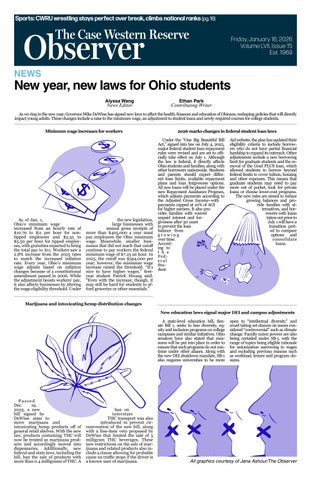
Sports: CWRU wrestling stays perfect over break, climbs national ranks (pg. 16)
The Case Western Reserve
Observer
Friday, January 16, 2026 Volume LVII, Issue 15 Est. 1969
NEWS
New year, new laws for Ohio students Alyssa Wang
News Editor
Ethan Park
Contributing Writer
As we ring in the new year, Governor Mike DeWine has signed new laws to affect the health, finances and education of Ohioans, reshaping policies that will directly impact young adults. These changes include a raise to the minimum wage, an adjustment to student loans and newly-required courses for college students. Minimum wage increases for workers
As of Jan. 1, Ohio’s minimum wage increased from an hourly rate of $10.70 to $11 per hour for nontipped employees and $5.35 to $5.50 per hour for tipped employees, with gratuities expected to bring the total pay to $11. Workers saw a 2.8% increase from the 2025 rates to match the increased inflation rate. Every year, Ohio’s minimum wage adjusts based on inflation changes because of a constitutional amendment passed in 2006. While the adjustment boosts workers’ pay, it also affects businesses by altering the wage eligibility threshold. Under
the new legislation, large businesses with annual gross receipts of more than $405,000 a year must pay employees the Ohio minimum wage. Meanwhile, smaller businesses that did not reach that cutoff continue to pay workers the federal minimum wage of $7.25 an hour. In 2025, the cutoff was $394,000 per year; however, the minimum wage increase raised the threshold. “It’s nice to have higher wages,” firstyear student Patrick Hwang said. “Even with the increase, though, it may still be hard for students to afford groceries or other essentials.”
2026 marks changes in federal student loan laws Under the “One Big Beautiful Bill Act,” signed into law on July 4, 2025, major federal student loan repayment rules were revised and are set to officially take effect on July 1. Although the law is federal, it directly affects Ohio students and families, along with other borrowers nationwide. Students and parents should expect different loan limits, available repayment plans and loan forgiveness options. All new loans will be placed under the new Repayment Assistance Program, which adjusts payments according to the Adjusted Gross Income–with payments capped at 10% of AGI for higher earners. It also provides families with waived unpaid interest and forgiveness after 30 years to prevent the loan balance from growing over time. According to t h e Federal Student
Aid website, the plan has updated their eligibility criteria to include borrowers who do not have partial financial hardship to expand its outreach. Other adjustments include a new borrowing limit for graduate students and the removal of the Grad PLUS loan, which allowed students to borrow beyond federal limits to cover tuition, housing and other expenses. This means that graduate students may need to pay more out of pocket, look for private loans or choose lower-cost programs. The new rules are aimed to reduce growing balances and provide families with alternatives, and borrowers with loans taken out prior to July 1 will have a transition period to compare options and consolidate loans.
Marijuana and intoxicating hemp distribution changes New education laws signal major DEI and campus adjustments A state-level education bill, Senate Bill 1, seeks to ban diversity, equity and inclusion programs on college campuses and similar initiatives. Ohio senators have also stated that measures will be put into place in order to ensure that such programs do not continue under other aliases. Along with the new DEI shutdown mandate, SB-1 also requires universities to be more
Passed Dec. 19, 2025, a new bill signed by DeWine aims to move marijuana and intoxicating hemp products off of general retail shelves. With the new law, products containing THC will now be treated as marijuana products and accordingly moved into dispensaries. Additionally, new federal and state laws, including the bill, ban the sale of products with more than 0.4 milligrams of THC. A
ban on interstate THC transport was also introduced to prevent circumvention of the new bill, along with a line-item veto proposed by DeWine that limited the sale of 5 milligram THC beverages. These new restrictions on the sale of marijuana and related products also include a clause allowing for probable cause on traffic stops if the driver is a known user of marijuana.
open to “intellectual diversity” and avoid taking set stances on issues considered “controversial” such as climate change. Faculty union powers are also being curtailed under SB-1, with the range of topics being eligible rationale for unionization narrowing to wages and excluding previous reasons such as workload, tenure and program closures.
All graphics courtesy of Jana Ashour/The Observer
News
The Case Western Reserve Observer Friday, January 16, 2026 observer.case.edu Volume LVII, Issue 15
CWRU moves towards AI literacy with new applied AI minor Olivia Wen Staff Writer The Case Western Reserve University School of Engineering recently approved an applied artificial intelligence minor. It centers the hands-on applications of AI tools and methods compared to the current AI minor, which instead focuses on developing AI platforms. “AI isn’t one single thing, and learning about AI shouldn’t have one single structure,” said a joint statement by Vice Provost for Innovation Jeffrey Capadona, Computer and Data Sciences Department Chair Vipin Chaudhary and Associate Provost for Curriculum Peter Shulman. The statement distinguishes the applied AI minor, meant for students “from any disciplinary background,” from the traditional AI minor, which targets students in “STEM-focused fields.” “Our goal with the Applied AI minor is to ensure that our students who are interested in applying AI to their chosen field have the understanding and skills to be impactful, without needing to learn the more technical skills a traditional computer scientist, data scientist or AI scientist would learn,” the statement said. As such, the requirements were designed with the broader campus community in mind, including those without prior computer science experience. The new minor will include The Digital Revolution: Computer and Data Science For All (CSDS 101), Artificial Intelligence for All Disciplines (CSDS 102), one course dis-
An applied artificial intelligence minor was recently approved by the CWRU School of Engineering with the goal of educating students on hands-on applications, rather than the development of AI tools and methods. Courtesy of Tyler Sun/The Observer cussing the impact of AI on social, ethical and policy issues as well as two electives in applying AI to a subject relevant to the specific student. AI will also be incorporated into courses beyond computer science, including RLGN 250: Responsible AI: Cultivating a Just and Sustainable Socio-technical Future through Data
Citizenship and PHIL 393: Ethics of Artificial Intelligence and Emerging Technology. Students interested in long-term interdisciplinary work can also pursue the new Humanity and Technology major, consisting of core courses, a STEM minor equivalent, a humanities minor equivalent and a capstone integrating the two fields of
study with applied technology. “AI is already reshaping research, business and the job market, and whether those changes are positive or negative for society will depend on the choices of an informed citizenry,” Shulman said. “We are making sure that all CWRU students can make those informed choices.”
COLLEGE STUDENTS
SAVE 10%!* Show your valid student ID at checkout and enjoy 10% off grocery and café purchases!* *Exclusions apply
@FaiRfaXmkT fAirFaxMarKet.cOm
2190 e. 105th St.
Cleveland, OH 44106
News 3
observer.case.edu
Alyssa Wang
News-in-Brief CAMPUS
Sabrina Feldberg
News Editor
NATIONAL
Gary Broadbent becomes president of the CWRU Alumni Association Board Gary Broadbent has taken the helm of the CWRU Alumni Association Board of Directors after immediate president Chris Partis. Broadbent graduated from the CWRU School of Law in 2008 and the School of Management in 2010. After he graduated, he joined the Law Alumni Board in 2010 and stayed connected with CWRU’s alumni events by serving on the
News Editor
recognition committee to help select alumni awards for homecoming. Later, he went on to serve on the central Alumni Association board for three years. “Alumni represent a crosssection of the university’s experience and institutional memory, and our passionate community wants to help mark this milestone,” Broadbent said to CWRU Newsroom.
Courtesy of Denacipriano via Wikimedia Commons
COMMUNITY
ICE shooting of Renee Good sparks investigations on both sides Following the recent shooting of 37-year-old Renee Nicole Good in Minneapolis by an Immigration and Customs Enforcement (ICE) agent, investigators on behalf of Good’s family have begun to seek further information on the crime. Last Wednesday, Ms. Good and her partner were dropping their child off at school when they saw the ICE agents and stopped “to observe, with the intention of supporting and helping their neighbors.” The conservation resulted in an ICE agent fatally shooting Ms. Good in her car. Afterwards, the Trump administration responded in defense of the ICE agents, describing the shooting as an act of self-defense. “That was a vicious situation that took place,” President Trump said, main-
taining claims that federal officials have made that Ms. Good intended to “run down” the agent. The administration has begun efforts to investigate Good and those surrounding her, including her widow. As a result of moves to investigate Ms. Good’s widow, six federal prosecutors in Minnesota have resigned. Several protestors have sprung up in defense of Ms. Good. Romanucci & Blandin, the law firm representing Ms. Good’s family in their investigation of the shooting, defended the family of George Floyd in 2020 in Minneapolis. According to the firm, the family wants “to honor her life with progress toward a kinder and more civil America. They do not want her used as a political pawn, but rather as an agent of peace for all.”
Courtesy of Chad Davis via Wikimedia Commons
INTERNATIONAL
Cleveland City Council is creating a Bureau of Community Crisis Response
The Trump administration decides to pause immigrant visas to 75 countries
Cleveland City Council is creating the new Bureau within the Division of Emergency Medical Service. This project is under the proposed amendments to Tanisha’s Law, created in November 2024. Tanisha’s Law was named for Tanisha Anderson, who died in police custody during a mental crisis in 2014, and was created by Michael Anderson, Tanisha’s uncle and Case Western Reserve University School of Law students. As part of Tanisha’s Law, The Bureau of Community Crisis Response would send unarmed civilians to mental health 911 calls
On Wednesday, in another effort to limit the welcoming of immigrants to the United States, the Trump administration stated its intentions to halt immigrant visa processing from 75 countries across its borders, starting in effect on Jan. 21. Addressing the issue, the State Department posted that the visas would be taken from “countries whose migrants take welfare from the American people at unacceptable rates.” It continued that “the freeze will remain active until the U.S. can ensure that new immigrants will not extract wealth from the American people.” The administration confirmed that Somalia, Eritrea, Iran and Haiti would be on their list, among dozens of other countries. Tommy Pigott, the Prin-
rather than the police. An unarmed crisis response team would respond to those calls, and the Bureau of Community Crisis Response would collect data on these teams and implement change if needed. The original proposal would have created a Department of Community Crisis Response, but the city council preferred the bureau structure to keep crisis response under one overarching public safety department. The proposal will also create a new Deputy Commissioner of Community Crisis Response to put the program together.
Courtesy of Stu Spivack via Wikimedia Commons
cipal Deputy Spokesperson at the State Department, stated that “the State Department will use its longstanding authority to deem ineligible potential immigrants who would become a public charge on the United States and exploit the generosity of the American people.” As the administration continues to deem immigrants as a threat to Americans, it targets those who rely on public assistance such as food vouchers, or the “public charge” that Pigott was referring to. The freeze will not, according to federal officials, affect those who are entering the country for tourist, business or medical treatmentrelated reasons, conveniently for the 2026 World Cup, which will be cohosted in the United States.
Courtesy of Horizon206 via Wikimedia Commons
Life
The Case Western Reserve Observer Friday, January 16, 2026 observer.case.edu Volume LVII, Issue 15
'Marty Supreme' volleys between athletics, art and ego Lucas Yang Director of Design This past winter break, I was avoiding graduate school applications, as one does, by looking through ridiculous spats on X-formerly-Twitter-dotcom, when I saw something that made my blood run cold. “Art and athletics don't mix . Sorry .It's icky .” user @Maria_Mouskos said, to the tune of nearly 4 million views. “Oh no,” I thought, “The general public has finally decided to (not unreasonably) oust figure skating from the Winter Olympics.” Fortunately for me, the target of ire was not, in fact, the greatest artistic medium ever conceived by man, but white boy rapper and current Kylie Jenner beau, Timothee Chalamet. It soon became clear that, in a sort of persona-building marketing ploy, Chalamet was using ungainly sports analysis terminology to both metatextually reference the gamification of art (think of the obsessive Oscars prediction games, or the concept of Kalshi) and promoting his latest film (pingpong epic “Marty Supreme”). “I want to be one of the greats. I’m inspired by the greats. I’m inspired by the greats here tonight,” he said in an acceptance speech last year at the SAG Awards, alluding to the GOAT (Greatest Of All Time) debates popularized by sports fandom and loosely credited to boxer Mohammad Ali. User @kishswim, in a tweet with over 80 thousand likes, succinctly called it “athlete mentality.” My interest was piqued, and I hate gambling with a passion on principle. I therefore resolved to see “Marty Supreme.” Directed by Josh Safdie (his first film since professionally splitting with brother Benny Safdie in 2024), “Marty Supreme” is a 150-minute thrill ride loosely based on the life of American table tennis star Marty Reisman. Smart-mouthed shoe salesman and table tennis prodigy Marty Mauser (Timothee Chalamet) attempts to win glory and wealth through the sport’s World Championship, only to be felled by a cartoonishly austere Japanese rival, Koto Endo (Koto Kawaguchi). Refusing to accept his defeat, Marty tears through everyone in his life to get back to Worlds—his beleaguered mother Rebecca (Fran Drescher), his very pregnant childhood friend and mistress Rachel (Odessa A’Zion), washed up film star Kay (Gwyneth Paltrow), Kay’s vampirically wealthy benefactor husband Milton (Kevin O’Leary), scam partner Wally (Tyler, the Creator), the star-studded cast goes on—leaving a trail of death, property damage and neon orange balls in his wake. The plot, if it exists, is haphazard mania, driven more by a series of coincidental and mundane catastrophes than clear narrative development. Police chase! Ceiling collapse! Dognapping! Gas fire! Jewelry theft! Kevin O’Leary spanking Timothee Chalamet with a custom ping pong paddle! All of it is held together only by Chalamet— no, Marty—no, Chalamet attempting to talk, talk, talk himself out of the fire and into the echelons of sporting greatness. Just give me one chance, he says. One match, one tournament, one championship is all he needs. So back to our guiding question: do art and athletics mix? On some level, this hubbub is absolutely ridiculous. The question isn't whether sport belongs in art, it's whether sport is just
art. Sport, at its core, is about entertainers, a congregation of individuals so single-mindedly devoted to glory and distinction and self-realization that they sacrifice everything else— family, friendship, money, romance, morality and, most of all, their own bodies. Think of the praise we heap on athletes who break themselves for victory: gymnast Kerri Strug, for example, became an American hero by destroying her ankle doing a vault to secure a gold medal that was already mathematically won (this story, coincidentally, is also about to become cinema). But that moment, that irrational, sacrificial, against-the-odds success transcended any silly notions of objective fact or utilitarian logic—narrative needs not concern itself with reality. That's why this movie works. In complete opposition to the kitschy, feel-good Hollywood-about-Hollywood movies like “La La Land” or even this year's ultimately droll “Hamnet,” “Marty Supreme” eschews any facade of nobility or social good in favor of laying bare the antisocial, self-destructive nature of art. Sport (which is, in
many ways, self-imposed harm) is the perfect subject for a reflexive film; a purely irrational pursuit that draws out humanity's nastiest, most selfish impulses in pursuit of an almost divine catharsis. It's humiliation, it's exploitation, it's ruthlessly mining the people around you—including, most of all, yourself—for everything they have, just in hopes of maybe, maybe producing the one pièce de résistance that makes everything worth it. Nothing is sacred. Every cylinder is firing: the breakneck, cortisol-spiking edit driving both Marty and the viewer towards that one singular grail, the grotesque close-ups of body parts and functions serving as a constant reminder of our shackling to base human instinct, the genuinely thrilling cinematic recreations of just straight table tennis. Like its narrative, these formal elements are sublimated within a pretty conventional sports movie structure (‘have to win the big game!’) that plays its cards exactly right. The climactic triumph hits like a first high, a kind of movie magic only possible before you knew what genre conventions were.
Each actor, too, is a perfect blend of self-conscious celebrity persona and archetypal character. On the topic of the classical Hollywood movie star, James Baldwin, in “The Devil Finds Work,” said it best: “No one, for example, will ever really know whether Katherine Hepburn or Bette Davis or Humphry Bogart or Spencer Tracy or Clark Gable—or John Wayne—can, or could, really act, or not, nor does anyone care: acting is not what they are required to do...One does not go to see them act: one goes to watch them be.” That's exactly what happens here, from Gwyneth Paltrow's effortlessly glamorous take on the tragic, aging starlet, to Odessa A'zion's turn as the duplicitous mistress unsure how to produce her own misery (she figures it out, for the worse). I don't have any particular love for Timothee Chalamet nor any opinions on previous alleged awards season snubs, but his performance here is undeniable. This shrimpy, pimply, motormouthed kid unable to envision a future without extraordinary fame, this is what I go to watch him be.
Courtesy of A24
Life 5
observer.case.edu
'Heated Rivalry': lamplighters, love and legitimacy Penelope Cloonan Life Editor As a lover of the contemporary romance genre and loyal watcher of Bookstagram, it seems nigh impossible to get away from that gay hockey show. Since its announcement in late 2025 and rapid pick up across various international streamers, “Heated Rivalry” has overtaken the romance zeitgeist. “Heated Rivalry” is a Canadian Crave Original series that adapts two out of six of Rachel Reid’s “Game Changer” books. The central conceit of the show is very simple: two rival hockey players—Shane Hollander (Hudson Williams) and Ilya Rozanov (Connor Storrie)—form a secret sexual relationship that eventually turns romantic. It is easy to dismiss this show as nothing more than an overly raunchy show full of romantic slop and nothing to say, but that is far from the case. “Heated Rivalry” is not a show that fights its genres; it embraces them. It is unapologetically romantic, messy and retains an edge through consistent use of sex scenes. This is one of the main reasons that “Heated Rivalry” has garnered so much press; the show truly earns its TV-MA rating. In reality, the show is no more graphic than Netflix’s “Bridgerton,” and certainly not more than any supposedly edgy fantasy show like “Game of Thrones.” The change in circumstance here is really only that the show centers gay men. Our cultural tolerances have shifted more towards conservatism, and while heternormative shows such as “Bridgerton” (for the most part), can slip through, a boldly queer show cannot. It is a spectacle that is poked fun at and relegated to a market of purely women and gay men. “Heated Rivalry” is not expected to have that mass market appeal, yet it rapidly exploded due to the genuine. This unexpected popularity can be credited to the fact at all stages of production, great care was put into this silly little gay hockey show. Often, romance stories tend to be simplistic or even formulaic, with any depth coming from a real, human emotional weight. As such, the romances coming out of the restrictive Hollywood Machine have been noticeably inhuman and depressing. “Heated Rivalry” stands out as a show from a smaller streamer, Canada’s publicly funded company Crave. The show’s creator, Jacob Tierney, had originally pitched to a few larger streaming giants, but parted ways when they gave notes against the raunchiness of the show. Actor François Arnaud credits the show’s brilliance to the agency afforded to the creators by Crave, and that truly is because it is a smaller platform. This passion project, funded by Canadian’s public, for Canadians and by Canadians could not be made anywhere else. While the United States is defunding and dissolving the Corporation for Public Broadcasting, Canada’s public media has made one of the most popular shows of the season. However, with less oversight comes less money and backing. “Heated Rivalry,” with a final run time of roughly five hours, was shot in about 37 days with only two cameras. Any lesser filmmaker would have settled for simplistic shots, but not Tierney. They use open sets liberally and cut minimally, which creates a feeling of intimacy, keeping the audience with their beloved characters as much as possible. The finale, “The Cottage,” has a particularly complicated oner that mirrors how lovers Shane and Ilya cau-
Courtesy of Heute.at tiously navigate the unfamiliar space between them. The cinematographers also made the interesting choice to use anamorphic lenses in production. This gave them a 2.4:1 aspect ratio and signature, dreamy warped lighting. It is an unconventional choice, but one that shows great attention to how cinematography shapes the mood and can further intimacy. Short cuts like using lighting tricks to avoid fitting excessive extras into their shots only manages to add to the intimacy. Thoughtful choices like these make “Heated Rivalry” not feel like a rushed job, especially considering how short the filming was. If nothing else, the show is beautifully, economically shot and supported by earnest performances. Most of the cast is fairly green, with the most famous of the bunch being François Arnaud, who is mainly a TV actor. The two stars Connor Storrie and Hudson Williams are fresh faces. Storrie’s biggest claim to fame is his role as the true Joker in the disaster that was “Joker: Folie à Deux” (2024). Williams only has a few lesser known TV credits. Storrie is lauded for his accent work and Williams’ for his skill in portraying an emotionally complex, repressed character, with both offering very grounded performances all while putting their bodies on the line. Since airing, they are internet darlings, taking full advantage of the show’s popularity and signing with one of Hollywood’s biggest agencies, Creative Artists
Agency. Keeping with the anti-Hollywood Machine nature of this show, the show does not rely on stunt casting, but on talent. “Heated Rivalry” is by no means the deepest show to exist, but there is more to it than steamy scenes and the occasional reference to hockey. “Heated Rivalry” tackles homophobia in hyper masculine spaces. It is admittedly a little optimistic about the outcomes, but Tierney and Reid give the issue the gravity it deserves. The National Hockey League (NHL) is one of the most homophobic professional sports associations in the United States. There was a pride tape and jersey ban in 2023, and while it has since been reversed, many teams operate under the same thinking. Hockey itself is also a hyper-masculine and deeply aggressive sport, which can be a breeding ground for homophobia. As such, bans have been replaced by opt outs. Ideological opt outs are generally due to religious beliefs or, in a not at all shocking similarity to the show, Russian players’ political concerns. Since airing, the NHL did attempt to embrace the show, which is really funny, as they are the villain of author Rachel Reid’s six (soon to be seven) book series. There has never been an openly queer, active NHL player that we know of. This is the only American sport like this, even football, one of the more masculine sports, has had an out player.
For fans of “Heated Rivalry” hoping to watch some real hockey, without feeling a sense of betrayal towards the queer community, check out the Edmonton Oilers or—if you must root for an American team—the Seattle Kraken. The PWHL and women’s hockey have the opposite culture. Back in the 2000s, the women’s hockey captains for team USA and Canada fell in love and got married. While Cleveland does not have a PWHL team of their own, I must shout out my home team of the New York Sirens. Enjoy some guilt free hockey and support women’s sports. There is a reason that “Heated Rivalry” got so popular so quickly, there is a lot to say about the show. The soundtrack was extremely catchy and it is at most 10% about hockey. “Heated Rivalry” does not pass the Bechdel test, but the show’s creators certainly treat their female side characters with more respect than some other writers in the queer sports romance genre. That is all to say, of all the hockey romance books that could have been adapted into film, I’m glad this one was first. It is funny to joke about how it’s just that one show with an impossible plot and a lot of sexual content. However reducing the show does it a great disservice. “Heated Rivalry” is a beautifully shot masterpiece of public media fueled by artistic freedom that tackles real social issues. There is something worth watching there.
6
Life
Friday, January 16, 2026
'Zootopia 2': A surprisingly solid sequel Abhishek Nambiar Copy Editor Content warning: spoilers ahead
Major
“Zootopia 2” is the latest film from Walt Disney Animation Studios, a studio whose recent output I have not really cared much for. While I enjoyed the 2021 release “Encanto,” as of writing this article I have not been bothered to watch any of the three movies they released afterwards: “Strange World,” “Wish” and “Moana 2.” Judging by reviews and what I’ve heard from friends, it seems safe to say that I’m not missing out on much. With all of this in mind, I wasn’t really sure what to expect from “Zootopia 2” given Disney’s mixed track record for this past decade. It is safe to say I was decently surprised by this movie and enjoyed it quite a bit. The movie follows Judy Hopps (Ginnifer Goodwin) and Nick Wilde (Jason Bateman) as they pursue reptile Gary De'Snake (Ke Huy Quan) across the vast city of Zootopia while uncovering a conspiracy about the city’s founding and trying to clear their names after being framed. The adventure is a fun, frenetic one that allows for many of the same enjoyable antics that I liked in the first movie. Speaking of that first movie—it’s been a while since I last watched it, but I do remember liking it for the most part. I enjoyed Judy and Nick’s natural chemistry, and I liked the movie’s efforts to make Zootopia seem like a fully-realized city truly built to meet the needs of a diverse range of animals. My only real gripe is that it felt very heavy-handed in its message
about predators versus prey, trying to make a connection between the theme and the real world in a way that felt somewhat questionable at times, and wasn’t free of numerous kid’s movie cliches. Not that the sequel isn’t also heavy-handed in its themes, but the original was doing this for a premise that I felt didn’t translate as well to real-world circumstances. This is what I think really differentiates “Zootopia 2” from its predecessor—while it’s still heavy with its themes and the message it wants to convey (which is understandable given its younger target audience), it does this with morals and lessons that feel more easily translatable to the real world. Focusing on the historical exploitation and marginalization of reptiles within Zootopia’s society allows the film to explore ideas of systemic injustice, historical erasure and scapegoating without collapsing under the weight of trying to represent every form of prejudice at once. As a result, the social commentary in the sequel feels more coherent and far less heavy-handed. This change in approach also benefits the film’s characters. Judy and Nick’s partnership—one of the strongest aspects of the original— remains the emotional backbone of the film, and it’s one that is tested in ways that feel organic rather than forced for the sake of moving the story along. Judy’s unwavering belief in doing what is “right,” even when it puts her in danger, clashes naturally with Nick’s more cautious, survival-oriented mindset. This ideological divide drives much of the film’s conflict, and the falling-out that they have feels like a natural result of the fundamental differences
between the two. One of the greatest strengths of this movie comes from this approach. Judy and Nick don’t regress into exaggerated versions of themselves, nor does the film reset their development from the first movie. Their growth feels like the natural evolution of their characters, as though the events of the original film genuinely mattered. This can especially be seen in their chemistry and the natural conflict that arises between them. While I really enjoyed how the film handled its main duo, I was less enthusiastic about some of the side characters. The main gripe I have in this regard is with Gary De’Snake, voiced by Ke Huy Quan. The marketing for this movie positions Gary as a central character, and while that is certainly true to an extent, he feels underused in the story, not having as much screen time as one would expect. While Quan brings a lot of charm and warmth to the role, I also felt as though his character was somewhat one-dimensional. Much of his dialogue amounts to “I have to help my family,” which becomes repetitive. While I did buy his bond with Judy, it still felt somewhat underdeveloped due to his absence for much of the film. Their relationship still produced some great scenes, such as when Gary called Judy his “best warm-blooded-friend”—a very nuanced line that drives home the isolation and persecution reptiles faced in the world of Zootopia—but such scenes still felt undermined by how underutilized Gary was in the story. Ironically, several side characters with much less narrative importance ended up leaving stronger
impressions. A scene-stealing beaver podcaster (Fortune Feimster) provides both comic relief and surprisingly sharp commentary, while Pawbert Lynxley (Andy Samberg) adds a chaotic energy that the film uses sparingly and effectively. These characters are fun and memorable—especially with how Pawbert turns out to be the best Disney twist villain in a good while—but their prominence further highlights how underutilized Gary feels by comparison. That said, this movie largely avoids one of the most common pitfalls of animated sequels: excessive nostalgia. Familiar faces from the first movie like Flash the Sloth, Gazelle and Chief Bogo return, but their appearances feel purposeful rather than obligatory. Also benefiting the movie is a pretty sharp sense of humor; not all the jokes land, but I was still amused by many of them. Notable references are to be found throughout the film as well, ranging from a great “Ratatouille” reference to a solid jab at the Disney live-action remakes. Overall, in the context of Walt Disney Animation Studios’ recent output, “Zootopia 2” stands out to me as a genuinely good movie. Admittedly, I may not be the best judge here given I haven’t checked out their most recent work aside from this film. Even so, while I don’t think this movie is the kind of masterpiece that will usher in a new era for the studio, it does show that this studio is still capable of making thoughtful, engaging movies that can be enjoyed by all. For a studio that many would agree has struggled to regain its footing throughout the 2020s, that alone feels like a small but meaningful victory.
Courtesy of Heute.at
Life 7
observer.case.edu
'Stranger Things' season five: closing the gates Riya Kulkarni Copy Editor Content warning: spoilers ahead
Major
At long last, a journey of almost a decade has come to an end (for now). Those who grew up with the show watched their favorite little nuggets—that is to say characters—grow up too. “Stranger Things” season five was released with some level of pomp, with episodes split between three release dates and the finale premiering in theaters and TV screens on New Year’s Eve. This phenomenon is now over, leaving fans with a mixture of reactions. Season five begins about a year and a half after the conclusion of season four. The audience dives right into the action. Hopper (David Harbour) conducts “crawls” in The Upside Down, searching for Vecna (Jamie Campbell Bower). It is during one of these crawls that a demogorgon attacks the military occupying Hawkins then takes young Holly Wheeler (Nell Fisher). We eventually learn that Holly’s imaginary friend named Mr. Whatsit is Vecna, who holds Holly captive in his memories. Max (Sadie Sink), who also has been imprisoned in “Camazotz” since she entered her coma, finds Holly, and they plot their escape. Will (Noah Schnapp) realizes that Vecna plans to continue taking kids, so the group tries to rescue them. Demogorgons manage to take the kids, but Will controls the demogorgons through the hive mind to save his friends. Dustin (Gaten Matarazzo) discovers that the Upside Down is a bridge connecting Hawkins and another world called the Abyss. Vecna planned to use the kids as vessels to bring these worlds together. Through one of their crawls, Eleven (Millie Bobby Brown) and Hopper find Eleven’s lab “sister” Kali (Linnea Berthelsen). Kali explains to Eleven that the government restarted the project which gave them powers, which is why the military is after them. At the end of the season, the group of misfits manages to destroy the Mind Flayer and Vecna, triggering a bomb in the Upside Down. Eleven sacrifices herself, dying when the bomb detonates. The main issue that arose from this season was timing. Potentially meaningful scenes took place at the wrong times, were drawn out or even cut too short. The Duffer Brothers presented a much larger story than was feasible to tell, which resulted in too many individually-amazing plot lines and story arcs packed into one season. Run time was long regardless, but not long enough to appropriately tell the story. Despite how long and complex the season’s plot was, many were still left wanting more. Meaningful character development was instead packed into long monologues in the middle of moments of action, leaving viewers confused. Will’s acceptance of his sexuality, with the help of Robin (Maya Hawke), was anticipated and well-supported throughout the season, only for him to come out to a room of people ready for battle, some of whom he had just met. A poignant moment anticipated by so many could have been much more meaningful at a different point of the story. The “unproposal” of Jonathan (Charlie Heaton) and Nancy (Natalia Dyer) was confusing rather than meaningful. In a moment when we
feared for their lives, a fitting heart to heart turned into their relationship ending. In the chaos, many questioned whether they were broken up or were merely contemplating death. The existence of a wormhole, with the Upside Down acting as a bridge, not a separate realm, was also frustrating. Once again it works well with the plot, however it seemed like the world we were familiar with abruptly expanded. In setting up the final “biggest and baddest” boss, important time was taken away from a season that was supposed to be a conclusion. The ending also left some ques-
tions, many of them intentional. The uncertainty of Eleven’s survival is fun to theorize upon, despite the setup being somewhat clumsy. We get to know Vickie (Amybeth McNulty) much more this season, only to have her conclusion be a passing comment from Robin in the final scenes. We don’t learn what happened to her and Max after they were found by the military during the finale. At some point, the mystery just becomes oversight. Overall, though, longtime fans will be satisfied with how things came to an end. To some extent, the season was nostalgic, and we were able to
see all the characters we love in one last battle together, complete with witty banter and the dialogue that we love. Even newer characters with less time in previous seasons, such as Kali, were integrated into this conclusion. Many of these characters met an ending straight out of one of Mike’s Dungeons and Dragons campaigns— peace and happiness. With a run time of around ten hours, there is plenty of action to enjoy for those desiring a dose of Hawkins. With spin-offs on the horizon, this won’t be the last we will see of this world anytime soon!
Courtesy of Netflix
Fun
The Case Western Reserve Observer Friday, January 16, 2026 observer.case.edu Volume LVII, Issue 15
Back to School Word Search
CANVAS ICEBREAKERS PENCIL PEN ANXIETY
FRIENDS SYLLABUS CLASSES COURSE ASSIGNMENT
Top 10 Celebrities That Look Like Minions 1. Danny DeVito 2. Mike Wazowski (2nd "Monsters Inc" movie) 3. Michael Myers 4. Michael Jackson (as a child) 5. Dwayne Johnson 6. Vanessa Hudgens 7. Steve Carell 8. Miranda Cosgrove 9. Ansel Elgort 10. Dove Cameron
IPAD COMPUTER UTECH ZOO MEW
DEPRESSION HOMEWORK ADDDROP ADVISOR BADWIFI
Auden's ahahahas
Fun 9
observer.case.edu
sexanddating 2026 Zodiac Dating Predictions Aphrodite
Greek Goddess of Love 2003: Goat Romance is strong this year, but it’s not without complications. You’re likely to attract someone charming and emotionally intuitive—possibly through work, classes or mutual friends—but the intensity may build faster than you expect. Emotional closeness comes easily, which is beautiful, but it also raises the stakes quickly. If you’re not careful, you could slide into “are we basically married?” territory before fully asking whether that’s what you want. This year rewards vulnerability, but only if you don’t lose yourself in comfort of being chosen. 2004: Monkey Monkey energy is magnetic this year, and people notice. Dating feels fun, lively and full of banter—but there’s temptation to keep things light even when someone wants more. Singles may attract partners looking for stability while still craving freedom themselves, which can create mixed signals. For couples, harmony is possible, but only if you resist stirring drama out of boredom. You thrive on excitement; just don’t mistake chaos for chemistry.
I hate 'Marty Supreme' Tyler Vu
Director of Business You are on your way back from the movie theater with some of your friends after watching a pretty subpar movie. It wasn’t the worst movie you’ve ever seen, but also it was just not the best. You can actually read more about this movie on page four of our paper. In your car, you and your friends are talking about how you all felt about the movie while laughing. You’re all pretty split on your feelings about the movie. Suddenly, you’re at the intersection getting ready to make a left turn when your friends
scream “Sonic!” They all want to go to Sonic. So, instead of going home like you originally planned, you are now on your way north to Sonic. You move the car back into the right lane to continue going straight forward. At the next intersection you see a green light so you continue forward. Suddenly in the lane perpendicular to yours, you see a car shoot past the red light and you begin to hit your brakes. The car hits the side of your car and completely totals it. You open your eyes and the introduction of You Only Live Once by The Strokes starts playing over the SOS alerts. Some idiot hit your car. That is my life. This is "Marty Supreme"’s fault.
2005: Rooster This is a high attraction year for Roosters, but it comes with tension between ambition and intimacy. You’re desirable, driven and visibly going places, which draws people in, but work and personal goals may leave partners feeling sidelined. Singles may juggle multiple romantic options or feel torn between love and independence. In relationships, neglect can quietly turn into resentment if emotional needs go unspoken. Passion is there, but it needs time and attention to survive. 2006: Dog Love runs deep this year, sometimes uncomfortably so. Emotional bonds form quickly, and relationships may feel serious before you’re ready to label them. Commitment energy is strong, but so is the fear of being hurt. You may test partners, consciously or not, to see who stays. The challenge is learning to trust without controlling the outcome. Romance flourishes when you allow closeness without demanding guarantees. 2007: Pig Pig romance is tender but emotionally charged. Singles are likely to meet someone through friends, especially during the spring or summer, but insecurity can complicate things early on. You may overanalyze texts, tone or timing, turning potential sparks into unnecessary stress. In relationships, loyalty matters deeply—but jealousy or fear of abandonment can create friction. The lesson this year is that intimacy grows through honest communication not emotional guesswork. 2008: Rat The first half of the year favors flirtation over follow-through. Early romances may feel exciting but inconsistent—chemistry without clarity and sparks without structure. You might find yourself caught in an almost-relationship that never quite lands. From late summer into fall, the energy shirts toward depth and intention. If you’ve learned from earlier misfires, a meaningful connection can be energy, but only if you stop chasing validation and start choosing reciprocity. 2009: Ox Confidence makes you attractive this year, but it can also make you emotionally guarded. Career success and self-assurance draw potential partners in, yet you may struggle to open up to someone who gets close. There’s fertile ground for love, but only if you allow softness alongside strength. This isn’t a year for surface-level romance, it demands shared values and emotional honesty. Refuse to settle, but don’t wall yourself off either.
And now, a limerick The Observer has this place That is left to be seen as white space We must admit Our cartoonist quit And we really don't want it to waste. Please email submissions to observer@case.edu
The worst blimp I've ever seen. Courtesy of A24
Word Search Answers
Opinion
The Case Western Reserve Observer Friday, January 16, 2026 observer.case.edu Volume LVII, Issue 15
Why the new nutritional guidelines won’t improve American health Anya Lin Analytics Manager Last week, the Department of Health and Human Services released new Dietary Guidelines for Americans, designed to provide nutritional recommendations and guide regulations in programs such as the National School Lunch Program and the Special Supplemental Nutrition Program for Women, Infants, and Children (WIC). These guidelines are released every five years, and, ever since the introduction of the MyPlate nutrition guide in 2011, have remained generally consistent. The new guidelines follow this trend with a few major deviations. Some of these changes are strange, deviating from other expert advice, and have insufficiently-studied scientific bases. For example, the new guidelines have greatly increased, up to doubled, the daily recommended amount of protein, from 0.8 grams of protein per kilogram of body weight to 1.2-1.6 grams per kilogram. Meanwhile, expert bodies, such as Mayo Clinic and Harvard Medical School, have not changed their recommendations from 0.8 grams per kilogram. It is estimated that most Americans already consume this much protein, if not more, every day. The reason for this higher recommendation is left unexplained. While protein is needed to build and maintain muscle and tissue, consuming too much protein without an appropriate amount of exercise can lead to the excess being converted into fat. Nowhere in the document is this critical link to exercise mentioned, and considering that most Americans do not get the recom-
mended amount of exercise either, this could lead to many people consuming far more calories of protein than they actually need. Despite having explicitly stated goals of fighting chronic disease, particularly heart disease and obesity, and “ending the war on protein” (was there ever a war on protein in the first place?), it seems these unclear recommendations may result in quite the opposite. Additionally, some of these statements are completely contradictory. The stated recommended limit for saturated fat consumption is for it to not exceed 10% of daily calories, which aligns with expert recommendations. However, other parts of the document highlight the consumption of animal protein (especially red meat), full-fat dairy products over reduced-fat and the use of butter and beef tallow as “healthy fats,” with no scientific literature referenced to support the claims. These all have much higher amounts of saturated fats than other protein, dairy and fat alternatives. Butter and beef tallow, especially, are almost pure saturated fat. It seems rather difficult to expect Americans to limit their saturated fat consumption when the rest of the document suggests they should do otherwise. While some of these individual recommendations are troubling, the biggest problem with the new guidelines is the distrust it builds between the government, health institutions and American citizens. In fact, the American Heart Association has already released a statement questioning the scientific basis of the full-fat dairy and red meat protein guidelines, citing studied links between saturated fat and increased risk of cardiovascular disease.
The lack of scientific detail in the report doesn’t help. Guidelines from previous years have been published as policy reports, with named authors, references and specific suggestions for different conditions and circumstances. The new guidelines, however, are far more brief, lacking in detail, with the total document being less than 10% the length of the 2020 edition. This change seems to be an attempt to make the guidelines
more readable by the general public, but it hurts both health professionals and the public it is trying to help. People who need specific information are not able to see suggestions that fit their needs, and health professionals who need to read more in detail and fact-check have more trouble doing so. Ultimately, if these inconsistencies pit health professionals against the government, who should Americans believe?
Kristina Guo/The Observer
Opinion 11
observer.case.edu
Homegrown neo-colonialism: The American occupation of Venezuela, the object, with no words from Venezuela, the people Mariana Parilli-Castillo Copy Editor On the night of Jan. 3, in the wee hours of the hazy days between New Year’s Day and the Epiphany, Trump’s government went and forced a coup on Venezuela. The operation, at least as Trump kept repeating it the day afterwards, was bloodless, and no American fatalities occurred. According to Venezuelan Interior Minister Diosdado Cabello, around 100 Venezuelans died. There were no mentions of these possible casualties in Trump’s communication, except to bombastically and effusively state that the military operation wherein President Nicolás Maduro and his wife, Cilia Flores, were effectively kidnapped, extrajudicially arrested and summarily sent to New York to await judgment for trumped-up charges regarding narcoterrorism, is that it “was one of the most stunning, effective, and powerful displays of American military might and competence in American history. And if you think about it, we’ve done some other good ones, like the attack on Soleimani, the attack on al-Baghdadi and the obliteration and decimation of the Iran [sic] nuclear sites just recently in an operation known as Midnight Hammer, all perfectly executed and done.” Shortly afterwards, Trump states that it will be him who will be running Venezuela. It will not surprise the reader, or even anyone who has known me for just five minutes, that the notion of Trump running not just one, but both of my countries of nationality, seems as hopeful to me as looking at species extinction numbers since the 1800s. I did not like Maduro, by any means: he was a chauvinistic, irresponsible leader who couldn’t consolidate power to save his life following his takeover from Hugo Chavez after the latter died in 2013. He was the subject of mockery and disgust for many of my early political formulations, and, to an extent, how he presented himself deserved both my ire and my bitterness. Following Chavez’s death, Maduro kept repeating that the former president had come to him as a bird and approved of his appointment as de facto president by tweeting him a pretty song in a Latin American Catholic version of the Mandate of Heaven. He continuously repressed oppositional forces from both the left and the right, disregarding and then replacing or exiling the members of various governmental structures of Venezuela, such as the National Assembly and the Supreme Court. His political tirades, which in the days following his kidnapping have gone viral, were sometimes rather politically illuminating (not that he would ever put those brief moments of brilliance into practice), but often devolved into misogyny, homophobia and paternalistic classism. He brutally repressed student protests against his election in 2014 to the extent that more than 5,000 were injured and 43 were killed. He is, simply put, the reason why my family had to leave the country, as universities were no longer operational for extended periods of time in the Venezuelan capital, and thus my sister (the first of us to go) came to the U.S. to study. I have no love for Maduro, and yet I still have enough of a moral center to say that I do not want this for him. I wanted to have a Venezuela where, perhaps, fair elections or grassroots revolutions oc-
cur, and someone else can take charge. I did not want a Venezuela that has been effectively occupied and colonized by the United States. Truth is, Trump does not care for Venezuelans. In fact, he speaks about them in his very first press conference following the infiltration of Caracas, demonstrating that he thinks of them as little more than political tools. When it comes to his presentation of Venezuelans, he just couldn’t help himself from switching blindly between bragging about how he was doing Venezuelans a favor and consistently presenting Venezuelans in the U.S. as asylum-seeking vermin who will rape and pillage all in sight. The Venezuelan diaspora, most
to sound like Trump is not going to siphon all the wealth of Venezuela’s soil and sell it to the highest bidder, leaving the people of Venezuela in a similarly precarious position, he continued by saying that, “it goes also to the United States of America in the form of reimbursement for the damages caused us by that country.” More than even his frequent ideological cudgels of the tenuous reigns of violence of the relatively fictional Tren de Aragua and Cartel de los Soles, Trump kept mentioning how, in the running of the new Venezuelan territory, he was consulting, primarily, the CEOs of oil companies. In the press conference, Trump stated, “[The United States will] run
Trump identified a “vast criminal network responsible for trafficking colossal amounts of deadly and illicit drugs into the United States” as the target of Venezuelan operation. Courtesy of the White House of whom have celebrated the forced ousting of Maduro and many of whom have defended Trump’s xenophobic statements and actions as the anti-immigration sentiment has risen, believe that the man cares about them and thus has liberated the Venezuelan land from violent repression for a sheer love of democracy. The fact is, Trump has liberated Venezuela for the sheer love of money, specifically oil money. When asked about what, exactly, the United States running Venezuela signifies, Trump stated that “We’re gonna have a presence in Venezuela as it pertains to oil … we’re gonna be taking out a tremendous amount of wealth out of the ground, and that wealth is going to the people of Venezuela and people from outside of Venezuela that used to be in Venezuela.” Of course, before it starts
it properly, we’ll run it professionally. We’ll have the greatest oil companies in the world going and invest billions and billions of dollars, and take out money, use that money in Venezuela, and the biggest beneficiary are gonna be the people of Venezuela, and also, I can’t stress this strongly enough, the people that got thrown out of Venezuela that are now in the United States.” The exploitation of Venezuelan soil is not a feature; it is the entire purpose of Trump’s coup d’etat. Trump’s selection of leadership within Venezuelan soil is, similarly, proof of his priorities. Delcy Rodríguez, the interim president of Venezuela, whom Trump personally endorsed in that very first press conference, had been vice-president since 2018, elected during one of the many elections that Maduro won with the presence of elec-
toral irregularities. In the eyes of the oppositional forces against Maduro, her governmental presence is as illegitimate as Maduro’s presidency. While I do not like Maria Corina Machado— the primary leader of the opposition and one of the most meaningless winners of the Nobel Peace Prize, as she won it by achieving less than nothing while repeatedly conceding and pandering to the Trump presidency—a clean break from the Maduro presidency would have seen her, or someone from her camp, installed as interim president. Instead, Trump presented Rodríguez as the only option, not even talking to Machado until Jan. 15. This is, most likely, because Rodríguez is only slightly less excited to suck dry the Venezuelan soil for the profit of foreign corporations than the United States. She does not say this to the Venezuelan public, maintaining the anti-imperialist rhetoric and support for Maduro, all the while amiably calling Trump to strategize how to best sell her country down the river. Everyone who was previously in control in Maduro’s government, sans Maduro himself, is still in power and everything is expected to run exactly as it had before, with the only brief exception being that now Venezuela’s economy will not be subject to one hyper-corrupt, selfish, inefficient government, but two. If Trump truly cared about Venezuela outside of its oil, he would perhaps hold a new set of elections, but why would he risk a self-made puppet government just waiting to be exploited? Add to it an additional military presence from the U.S. government, as the War Powers Resolution, attempting to prevent Trump from mobilizing military forces within Venezuela, was summarily blocked on Wednesday night, and the country is a powder keg just awaiting further destabilization in the form of infighting and corporate buy-ins. Venezuela is just one of multiple territories that Trump has shown interest in colonizing, as seen by the increased pressure on the Danish government to give up Iceland and the brand-new military presence and evacuation of nationals in Iran, but it is the first one, and the fact that Trump has given up the game already, where the pretence of justice and democracy fell a few hours after the capture of Nicolás Maduro, is indicative of how the United States will manage the countries it feels entitled to from now on. All profitable land belongs to the U.S. All those who are in the way will be quickly taken care of. All those who live in those lands are insignificant in the wake of American interests. There is little hope in being Venezuelan: nothing happens, and yet everything does. For most of my life, I’ve long believed that nothing will ever get better when it comes to my home country. And yet, there has never been a time when I have felt such paralyzing fear as I do right now. Delcy Rodríguez does not care for Venezuelans; she only cares for consolidating power for herself and her cronies. Maria Corina Machado does not care for Venezuelans; she only cares for her endless addiction to losing and her Cold Warera policies. But if there is a person who has demonstrated, time and time again, that he believes Venezuelans are subhuman and, if anything, they are only on the way to the exploitation of Venezuelan oil and his xenophobic immigration policies, it is Donald Trump, and he is now the one who is in control of the future of Venezuela.
12 Opinion
Friday, January 16, 2026
EDITORIAL
A New Year’s resolution: political awareness Editorial Board What’s your New Year’s resolution? We are accustomed to traditions of self-improvement to welcome in the New Year, though sticking to new habits and routines is the hard part. Think backwards and ask yourself: Did you fulfill your New Year’s resolutions from last year? If not, now you have another chance. What distinguishes this new year from the last, however, is the exponential growth of generative artificial intelligence (AI) and its encroachment on social media, a major channel for information regarding topics that range from political disputes to favorite celebrities. Social media is such a diverse network of communication and human connection that it would be a waste to let its value be hindered by indistinguishable deepfakes. Misinformed content adapted from AI creates a dangerous game of Telephone played by those who do not do their proper research online. So, a New Year’s resolution that we ask you to consider is this: greater political awareness, especially in the face of AI-generated misinformation. We live in a time where social media has become an acceptable outlet for information circulation. Granted, the use of this outlet comes with the price of fact-checking, but this is increasingly diffi-
However, the issue further develops when we finally recognize that AI poses a threat due to overreliance in addition to misinformation. There is an apparent trend of people with access to media turning towards AI chatbots, like ChatGPT, to ask their pressing questions. Though search engines, like Google, remain primary sources of information, AI’s growing popularity for convenience is becoming harder to ignore. This convenience could threaten journalism if we choose to put all our faith in ChatGPT. Even so, more than 2,000 undisclosed AI-generated news and information websites have been uncovered, according to NewsGuard. Such websites have little to no human supervision, publishing articles or journals completely generated by AI, which creates holes for misinformation to burrow in. Under human regulation, professional fact-checkers and content moderators prevent the spread of misinformation and fabrication. An audit of the 10 most prominent generative AI tools was conducted by NewsGuard this year, which detected that AI tools fail one in three times. To put this into perspective, the rate has nearly doubled since 2024. Heightened dependence on AI-generated content for information creates a higher demand for increased responsiveness, which consequently has made it more possible for the
The Case Western Reserve Observer Established in 1969 by the undergraduate students of Case Western Reserve University
Darcy Chew Executive Editor & Publisher PRINT Hannah Johnson Director of Print Sabrina Feldberg News Editor Alyssa Wang News Editor Penelope Cloonan Life Editor Aleksandra Majewski Opinion Editor Ellie Palaian Sports Editor Michelle Bai Copy Editor Riya Kulkarni Copy Editor Abhishek Nambiar Copy Editor Mariana Parilli-Castillo Copy Editor We’ve all been there, trying to study or finish that lastLilyassignZhang Copy Editor ment when all we want to do is … anything else. Maybe we’re overwhelmed with the work we have DESIGN to Bhuthpur Director of Design do, or maybe we feelAnjali the pressures Lucaswant Yangto Director of Design of perfectionism and don’t start. We push ourselves to Chahal “lock Layout Designer Shareen in,” but call it quits too often, feel- Layout Designer Sahar Kapasi ing guilty each time we pick up our Kolhe phones to doomscroll Reva again andLayout Designer Elizabeth McHugh again. Doing anything but the work Layout Designer Ng to Layout Designer we have piled up alwaysKiera seems feel better than actually getting Layout Designer Nithya Pandari things done, but the Jana sinking feel-Graphic Designer Ashour ing in our stomach knowing we’ve Kristina Guo wasted time is much worse. Can weGraphic Designer Sophie Shimeall really consider these pauses to be Graphic Designer Anna Trusova “breaks” if we feel worse after tak-Graphic Designer ing them? We may trap ourselves in aDIGITAL cycle MEDIA of counterproductivity and double Auden Koetters Director of Digital Media the time it takes to complete a task. Fleischman Web Editor In this “popcorn brain”Moses mindset, we work and get little done,Ayan thenSheikh stop Video Editor Matthew Stall Video Editor working and think about how we could be working. By the time we Obafami Tidjani Web Editor resume our work, we feel ashamed, Phillip Kornberg Photo Editor not refreshed, and we stay up late in attempts to catch up. Tyler Sun Photo Editor Esha Bagora Social Media Editor A break is not shameful, not Benjamin Kang when it has the potential to act as aSocial Media Editor tool that makes productivity Timothymuch Le Social Media Editor more efficient. We just to Media Editor Rheaneed Soni Social know how to use them. Daleydo Sports Broadcaster Just as an athlete Ethan wouldn’t 150 consecutive bicep curls while strength training at the gym,BUSINESS as Director of Business Operations students we must Tyler take Vu meaningful breaks in reasonable intervals. OneAd Manager Riya Dixit popular example of this is Kurma the Po-Business Manager Divya modoro method, where 5 minute Anya Analytics Manager breaks follow 25 minutes ofLin work Ria Trivedi Marketing (10 minutes of break to 50 minutes& Distribution Manager of work is also a popular option). Observer isour the weekly undergraduate student newspaper of Case By The time-boxing productivity Western Reserve University. Established in 1969, TheYang/The Observer reports and knowing we will be rewarded, Lucas Observer news affecting students and provides an editorial forum for the university we remain more focused when we community. Unsigned editorials are typically written by the opinion editor but reflect the majority opinion of the senior editorial staff. Opinion columns are the views of their writers and not necessarily of The Observer staff. For advertising information, contact via e-mail at observer@case.edu. LETTERS TO THE EDITOR should be e-mailed to observer@case.edu or submitted on our website at observer.case.edu. Letters can be mailed to Thwing Center 11111 Euclid Avenue, Suite 01, Cleveland, Ohio 44106. For policy and guidelines related to the submission of Letters to the Editor, refer to observer.case.edu/submit-a-letter. The Observer is a proud member of CWRU’s University Media Board. Follow The Observer on Facebook, Twitter, TikTok and Instagram @cwruobserver.
Anna Trusova/The Observer cult with the rising popularity and advancement of AI-generated material. Thus it is our moral obligation to maintain awareness of AIdriven misinformation, especially during a time of strained political relationships and authority. News outlets are readily available to us all with a few taps on our phones, so why not reach for an article from The New York Times instead of tuning into a content creator’s 10-part series on TikTok?
spread of misinformation. AI feeds on its own content, creating a vicious cycle of propaganda. Ironic, isn’t it? A 2024 study researching the extent of trust and reliance on AI revealed that consumers tend to overly depend on AI guidance for financially risky decisions and follow advice that goes against their best interests in spite of readily available contextual information online. What kind of future are we
hurdling toward if we entrust AI chatbots with our reality? Allowing AI tools to influence our decisionmaking threatens our personal autonomy when all it can be is a line of code. We, as consumers, are not fully aware of the decision-making process of AI itself, but rather visualize an input and output system, nothing else. Although it is arguable that our own minds are black boxes, as well, the difference is that a human can, at least, ver-
balize their thought process. Being an informed individual is crucial to day-to-day decision making and the cultivation of one’s own beliefs. We are unique beings, and it would be unwise to fall victim to AI overreliance and commit to generalized propaganda filtered from a network of real and false information. Be your own individual. Each one of us is capable of conducting our own research from credible, known sources.
Sports
The Case Western Reserve Observer Friday, January 16, 2026 observer.case.edu Volume LVII, Issue 15
Senior Spotlight: Celebrating CWRU women’s cross country class of 2026 Ellie Palaian
Sports Editor After concluding the 2025 season in November, the Case Western Reserve University women’s cross country team honored its six graduating seniors. Over the past four years, this class has brought leadership, perseverance and character to CWRU’s storied cross country program, leaving it stronger than they found it and positioned for continued success.
Arianna Holbrook For fourth-year Arianna Holbrook, the last four years with CWRU have been defined by growth, commitment and a deep sense of belonging. What began as an unconventional introduction to the program evolved into a career marked by steady improvement, competitive confidence and an unwavering dedication to her teammates. Her senior season reflected the consistency she had built over time. Competing in five races, she was the Spartans’ third finisher in every meet and opened the year with a third-place finish at the Sudeck Invitational. She delivered strong performances at both the UAA Championship and NCAA Great Lakes Regional Championship. She ended the year ranked 658th among 4,584 Division III runners in the XCRI. Her path to CWRU was anything but traditional. During a campus visit in spring 2022, a chance encounter at DiSanto Field led to an impromptu phone call with Head Coach Kathy Nortz Yohann, and ultimately to a commitment fueled by both a full merit scholarship and the opportunity to continue running at the collegiate level. “I definitely came into Case a bit unsure if I planned to stay all four years, but joining the team completely changed that,” Holbrook said. “I found my family here. Being part of this program taught me to love the sport on an entirely different level.” Over time, her relationship with the sport evolved beyond personal goals. “I quickly fell in love with the thrill of competing, with pushing myself farther than I ever believed I could, and with discovering what happens when you truly commit to working hard towards your passion,” Holbrook said. “I learned what it feels like to run not only for myself, but for my teammates, to want to make them proud as much as I wanted to make myself proud.” Pursuing a biochemistry degree with a cancer biology concentration while following a pre-med track, Holbrook was forced to balance varsity athletics with a demanding academic path. Outside of cross country, she immersed herself in research and service, including laboratory research at CWRU, a research fellowship at the University of Chicago, volunteer work at UH Rainbow Babies & Children’s Hospital and leadership roles advocating for student-athlete wellbeing through CWRU Association for Student Athletes (CASA) and the CWRU chapter of The Hidden Opponent. As she reflects on growing alongside her fellow fourth-years, she emphasizes the shared experience that bonded the class together. “It’s hard to imagine not waking up at 5:30 [a.m.] every morning for practice with my best friends, not being part of that competitive adrenaline, and not having running be such a defining part of my daily life,” Holbrook said. “I think I’ll grow nostalgic for the practices, the races, and happy, funny moments with the team, but I’m grateful for the lessons and memories that will stay with me.” After graduation, she plans to pursue a master’s degree in precision health at the University of Chicago while working part-time as an EMT, with medical school on the horizon. She also hopes to continue running competitively through a run club as she begins the next chapter of her journey.
Lauren Iagnemma Since arriving on campus as a first-year, fourth-year co-captain and distance runner, Lauren Iagnemma, has steadily built one of the most decorated careers in CWRU women’s cross country history. Her final season as a Spartan was marked by consistency and leadership. She competed in three races during the 2025 season, opening the year as the second overall finisher at the Sudeck Invitational. She posted a season-best 8K time of 23:24.2 at the NCAA Great Lakes Regional Championship, placing 54th overall and sixth among Spartan runners, and capped the season ranked 992nd out of 4,584 Division III runners in the Cross Country Ratings Index (XCRI). She also earned UAA Fall All-Academic honors, adding to an already impressive resume. Her second-year and third-year seasons firmly established her as one of the top runners in Division III. She earned AllAmerica honors in back-to-back years, placing 36th at the 2024 NCAA Division III Championship and an outstanding 18th at the 2023 national meet, the third-highest finish ever by a Spartan. In 2023, she recorded a career-best 6K time of 20:43.9 at the NCAA Great Lakes Regional, finishing second overall and earning her first All-Region honor. That performance also earned her UAA Athlete of the Week, making her the first Spartan women’s runner to receive the honor since 2015. Despite her impressive career, for Iagnemma, success has always been about more than times and placements. “If I were to boil it down to one word I think it would be ‘gritty’,” Iagnemma said. “Through the years I’ve dealt with injuries, managing personal expectations, and coming to terms with the reality that progress isn’t linear. And yet, as with all D3 athletes, I’m in this sport because I love it. I keep running, keep training, because it is something that I value, because my teammates are incredible people and this team and program are something I want to give to.” Off the course, she has balanced varsity athletics with a demanding academic load as a double major in psychology and Spanish. She credits organization and creativity with helping her manage it all. “I’ve managed to balance it all by making time to do creative things, and also trying to stay super duper organized,” Iagnemma said. “I have a paper calendar that I live by where I write everything down.” One of those creative outlets has been her involvement with IMPROVment, CWRU’s improv comedy troupe, where she serves as vice president. Since auditioning as a first-year, she has practiced and performed with the group weekly, calling the experience both therapeutic and grounding amid the demands of college athletics. Serving as a team captain has been one of the most meaningful parts of her career. She has embraced the role as an opportunity to uplift her teammates and help shape the team culture. “I try to tell my girls as much as possible how proud I am of them, but more importantly, how proud they should be of themselves,” Iagnemma said. “Watching this team pour their heart into miles and miles of training is really something special to behold, and I am grateful for the opportunity to help influence and
lead them.” As she reflects on four years with the program, she points to the shared experience of growing alongside her fellow fourth-years as one of the most rewarding aspects of her time at CWRU. “We’ve all had such different times in the program, dealing with different injuries, different ups and downs in the sport, but at the end of the day, we have gone through it all together and formed friendships that mean we are there for each other through all of the difficulties of the program, and there to celebrate all of the good as well,” Iagnemma said. With graduation approaching, she admits the transition away from collegiate cross country is bittersweet. After graduation, she plans to take a gap year before pursuing graduate school. “I feel like I spent a lot of college telling myself I had time left, and now I can’t believe that it’s almost over,” Iagnemma said. “I’m so glad I got the chance to be competitive with this school and to run with my teammates, but I’m also excited for the next chapter of running in my life and to see what it’s like and where it takes me.”
14 Sports
Friday, January 16, 2026
Julia Hluck For fourth-year co-captain Julia Hluck, the cross country journey at CWRU has been defined not by a single moment, but by steady growth, resilience and a deep commitment to both her team and her academic goals. From navigating the transition to college athletics as a first-year to becoming a trusted leader within the program, her four years with the Spartans have been marked by perseverance and purpose. During her senior season, she competed in one race before an injury cut her year short, placing 56th at the Pre-National Meet and ninth among Spartan runners with a time of 24:38.5. She finished the year ranked 1,133rd among 4,584 Division III runners in the XCRI and earned UAA Fall All-Academic honors. Her third year marked a breakthrough, as she competed in six races and finished among the team’s top five in all but one. She recorded her fastest 6K of the season at the Ohio Wesleyan Invitational, placing 17th overall and second among CWRU runners, and served as the team’s fourth finisher at both the UAA Championship and NCAA Great Lakes Regional. During her second-year, Hluck competed in seven races, scoring for the Spartans at the Mike Woods Invitational and running a career-best 6K time of 23:02.1 at the NCAA Great Lakes Regional, earning UAA All-Academic honors once again. “I started running seriously in high school,” Hluck said. “I just loved it so much that I wanted to see if I could continue it in college.” Her path to CWRU was unconventional. She did not go through the traditional recruiting process or communicate with the coaching staff prior to applying. Instead, after being admitted, she reached out to explore whether competing was an option, and she found a home within the program. Balancing the demands of varsity athletics as a biochemistry major, along with minors in chemistry and communication for health professionals, has been no small feat. She credits careful time management, selfcare and discipline for helping her succeed. “It is definitely challenging at times, especially the 6 [a.m.] practices and weekend meets,” Hluck said. “I have learned to maximize my time to get my work done and try my best to get to bed early and maintain self-care to be the best student and athlete I can be.” Outside of cross country, she has been heavily involved in research, joining a lab at the end of her second year. What began as a major requirement quickly became a passion, offering hands-on experience that aligns closely with her long-term goals in medicine. “I am very passionate about cancer biology, which is my concentration, and learning how diseases happen, as I hope to be a doctor one day,” Hluck said. “I have been able to gain a ton of experience, and I hope to carry those skills with me in my future.” Serving as a team captain during her senior season allowed her to give back to the program that supported her through her own early struggles. “I remember being a freshman and how much the captains helped me feel welcome and normal for struggling with the adjustment,” Hluck said. “So I wanted to be that role model for the incoming freshman.” While her final season was cut short due to injury, she embraced a new role from the sidelines, supporting her teammates and celebrating their successes. As she prepares to graduate, she plans to take a few gap years, work in a Cleveland-area hospital and eventually apply to medical school. Reflecting on her time with the program, she is most grateful for the relationships formed along the way. “It has been an amazing experience, I have found some of my best friends here and I hope to carry those friendships with me for the rest of my life,” Hluck said. “It is crazy to think it has already been four years, but I am glad to have grown with these people.” The class of 2026 Joining Iagnemma, Hluck and Holbrook in graduation are fellow fourth-years Medha Patria, Ayla Grabenbauer and Anna Avila. This group has helped define the culture of CWRU cross country, leading by example while fostering strong bonds and development throughout the program. Although the Spartans wrapped up their cross country season in November, Iagnemma, Hluck, Holbrook and Grabenbauer will continue competing for one more season with CWRU Track and Field.
Graphic courtesy of Anjali Bhuthpur/The Observer, all photos courtesy of CWRU Athletics
Sports 15
observer.case.edu
Men’s and women’s basketball continue play with games over winter break
Weekly Scores Wrestling at Chocolate Duals (12/20)
W 3-0
at 2026 UAA Challenge (1/3) W 3-0 at 2026 Claude Sharer Duals (1/10)
W 2-0
Men’s Basketball at La Roche (1/7)
W 97-78
at Carnegie Mellon (1/10)
L 69-87
Women’s Basketball vs. Geneva College (1/3)
W 75-65
at Carnegie Mellon (1/10) W 63-48
Upcoming Games Track and Field at Spartan Icebreaker
1/17
Wrestling at Tom Jarman Spartan Mat Classic
1/17
vs Washington and Jefferson 1/23, 7 p.m. Horsburgh Gymnasium
Men’s Basketball vs UChicago
1/16, 5:30 p.m. Horsburgh Gymnasium
vs WashU
1/18, 1 p.m. Horsburgh Gymnasium
at Emory
1/23
Women’s Basketball vs UChicago
1/16, 7:30 p.m. Horsburgh Gymnasium
vs WashU
1/18, 11 a.m. Horsburgh Gymnasium
at Emory
1/23
Swim and Dive at SUNY-Geneseo
1/17
at Kenyon
1/23
Abhishek Nambiar
Copy Editor
Over winter break, the Case Western Reserve University men’s and women’s basketball teams continued playing through their schedule of games for the 2025-26 season. The men played a trio of games stretching from the end of December to this past Saturday, Jan. 10, while the women played four games over the same period of time. Men’s basketball Fourth-year guard and co-captain Anand Dharmarajan scored a careerhigh 30 points as he led CWRU to a 9780 triumph over Kalamazoo College at Horsburgh Gymnasium on Dec. 30. It was a near-perfect night from long range for Dharmarajan, who nailed seven three-pointers, accounting for much of the Spartans’s offensive firepower. Graduate student guard Ethan Edwards also contributed to the offense with a season-high 15 points, displaying the depth of the Spartan backcourt. Fourth-year forward Andrew Fox added a dozen points while first-year forward Alex Vincent made his presence felt with nine rebounds and a careerbest five blocks. CWRU set the tone early during the game, holding a continuous lead over Kalamazoo through the entirety of the first half which culminated in a 50-35 advantage at halftime. This domination continued into the second half as the Spartans never let their lead over the Hornets fall to below 10 points, reaching as high as 23 points with under 13 minutes left in the period. The Spartan domination continued into the next week as CWRU emerged triumphant over La Roche University 97-78 in a road game in Pittsburgh on Jan. 7. Edwards was nothing short of sensational in this game, pouring in a program-record nine three-pointers en route to a career-high 38 points scored during the match. Third-year forward Logan Brown also chipped into the Spartan offense with a career-high of 14 points, leading the team with eight rebounds and four assists. First-year guard Shyam Patel also made an impact off the bench with 11 points and six boards to his name. This contest was a decidedly closer one for CWRU as both teams went back-and-forth for the lead during the first half. By halftime, the Spartans had taken an eight-point lead over the Redhawks; This lead was cut down to six within the first 30 seconds of the second half, but that would prove to be the closest La Roche would come to taking back the lead as CWRU’s momentum failed to halt during the period, culminating in a three-pointer by first-year forward Nitish Sankaranthi with 1:08 left in the period that put the Spartans ahead by 19 to conclude the contest. The men’s team’s streak would come to a conclusion on Jan. 10, however, as the squad fell 69-87 to Carnegie Mellon University in their UAA opening match. The loss snapped a five-game winning streak for the Spartans, putting their record for the season at 8-4 overall. The Tartans set the tone early with a 9-0 run, forcing the Spartans into a deficit that they were unable to respond to until Vincent made a layup four minutes into the contest. CWRU kept up a hard fight throughout the period but was unable to make any significant dent in CMU’s lead—one that reached as high as 16 points upon the first half’s
Phillip Kornberg/The Observer conclusion. The Spartans kept up a valiant effort during the second half, with Edwards scoring several shots in quick succession to put the Tartans’s lead at just nine points. CMU’s balanced attack and efficient shooting proved decisive, however, the Tartans rallied to an 18-point lead as the buzzer went off. At no point during the match did CMU fail to give up its lead over CWRU. As the Spartans continue UAA competition, they face a demanding schedule but aim to bounce back from the CMU contest during their first home conference weekend of the season. CWRU welcomes No. 4-ranked University of Chicago on Friday, Jan. 16, before hosting No. 8-ranked Washington University in St. Louis on Sunday, Jan. 18, at Horsburgh Gymnasium. Women’s basketball The winter break slate for the women’s basketball team began with the Baldwin Wallace Holiday Classic in Berea, Ohio. The first of CWRU’s two matches played in this tournament saw the squad achieve a 68-55 victory over Oberlin College on Dec. 29. This contest saw third-year guard Mya Hartjes score a career-high 25 points, hitting seven three-pointers on the way to her highest scoring game as a Spartan. Fourth-year guard/forward and cocaptain Emily Plachta added 16 points of her own, while third-year forward Biz Watson also chipped in six points. The game was notably close during the first quarter as both the Spartans and the Yeowomen went back-andforth on possession and shots. With the start of the second quarter, however, came an offensive surge by CWRU that Oberlin was only able to keep up with for so long; after the Yeowomen tied the score at 27 each with less than four minutes to go, the Spartans responded quickly and took on a lead that Oberlin never overcame. After Hartjes connected on a three-pointer with 7:58 left in the game to push CWRU’s lead to 21, Oberlin would never come closer than 13 points to the Spartans before the game concluded. The Spartans were unable to carry that momentum into their next matchup, the final game of the Holiday Classic, as CWRU fell 52-76 to host Baldwin Wallace University. CWRU struck first and held an early 11-0 lead before Baldwin Wallace responded with a decisive run to put themselves on top at the end of the first quarter. The two teams went back-and-forth for the lead over the next period, but by halftime the Yellow Jackets took a lead that would not be given up for the remainder of
the match in spite of a valiant effort from the Spartans. By the match’s end, Hartjes and Plachta had led the Spartans with 16 points apiece. Meanwhile, third-year forward Maura Schorr finished the contest with six points, six rebounds and five steals—the latter stat matching her career best. The Spartans turned things around in their next outing, a home matchup against Geneva College on Jan. 3, which also marked their final non-UAA contest of the season. CWRU achieved a 7565 victory over Geneva in this contest, led by a career-high 25 points scored by Plachta. Hartjes also continued her strong scoring stretch with 18 points and eight rebounds during this game. The Golden Tornadoes were the first to score, building up an 8-0 advantage over the Spartans within the first two minutes. CWRU was quick to respond, however, gradually eating away at Geneva’s advantage before taking the lead via a three-pointer from Plachta. After this point the two teams kept up the fight as the margin remained narrow, though the Spartans continuously maintained a lead during this time. By the time the fourth quarter rolled around, CWRU started pulling further away from Geneva, extending their lead to as high as 12 points before closing out the 10-point win. Concluding the winter break slate for the women’s squad was their UAA opener—like the men, against CMU in Pittsburgh. The Spartans ultimately emerged victorious at the game’s end with the score at 63-48. Hartjes led all scorers with 21 points, continuing her breakout stretch, while Plachta recorded a double-double with 14 points and 12 rebounds. Third-year guard Jordyn Call scored 10 second-half points, while Schorr added eight points and 10 rebounds. This contest proved to be a more decisive one for CWRU as the squad maintained a lead over Carnegie Mellon for the entirety of the contest. The Spartans were also sharp on the defensive end, holding the Tartans to a mere 10.5% shooting rate from three-point range and never letting their lead fall below double-digits from the second quarter onwards, at one point reaching a lead as high as 20 points on their way to the 15-point lead at the game’s end and a victory to kick off the UAA slate for the season. Coming up next for the women’s team is a pair of home games at Horsburgh Gymnasium: The first is against No. 15-ranked UChicago on Jan. 16, followed by a game against No. 14-ranked WashU on Jan. 18.
16 Sports
Friday, January 16, 2026
Seven feet too far for college athletics Adam Joseph
Contributing Writer As much as I would like to reenroll into my high school’s freshman sports teams and wreak havoc amongst the fourteen year olds, there is something in my consciousness that tells me that isn’t exactly fair. But what if the NCAA disagreed with my consciousness and told me to go for it? James Nnaji is a 7-foot 21 year old Nigerian basketball player who started playing EuroLeague ball in 2019. He played well enough to garner the attention of NBA scouts, and in 2023 he was drafted 31st overall by the Detroit Pistons. He’s also now a center for Baylor University. In short, he is a professional playing collegiately. There has been a lot of hate directed at Nnaji ever since this decision; he was booed extensively during his Baylor debut. But I don’t think that the boos should be directed at Nnaji; the problem is with the NCAA’s eligibility system. The NCAA allows this because Nnaji never actually played an NBA game, was never previously enrolled in college and he is starting within a five year window of what would have been his high school graduation. But it is clear that the rules are broken. With this logic, if Victor Wembenyama didn’t want to play for the San Antonio Spurs after getting drafted, he could have taken his talents to Duke University if he so desired. This NCAA rule has been exploited before. Nastja Claessens is a current Kansas State University player that was drafted by the WNBA 30th overall in 2024. Back on the men’s side, there has been an influx of twentytwo year old European pros—Thijs De Ridder, Ilias Kamardine and Luka Bogavac are all genuine impact players for March Madness-bound teams. The NCAA has a firm rule that once
Courtesy of Sandro Halank via Wikimedia Commons you play in the NBA, college hoops is over. But in a game where maturity is everything, you can’t let a twenty-one year old semi-pro EuroLeague in here and say that he is a first-year alongside everybody else. Think about some of the first-years you know here at Case Western Reserve University. And then think about 7-foot James Nnaji. There’s a difference there. This NCAA eligibility rule has also been exploited in my own sport of choice, cross country. A good representative of the dysfunction of the NCAA’s eligibility is Solomon Kipchoge. Kipchoge is a twenty-nine year old second-year whose half marathon time would place him second all time on the American list. Kipchoge is not
just a one-off example. This past year, 38 of the top 50 finishers at the NCAA championships were foreign talent. Being out-of-country in cross country is usually associated with older age, and you can usually tell just by looking at them. The one non-foreigner dominated team that put up a fight, Brigham Young University, sends most of their kids on two year missions, meaning that they are twenty by the time they are first-years. What happened to the kids? College’s first priority was intended to be academics, preparing people for the next fifty years of their life instead of just focusing on their four years at school. This shift with name, image and likeness (NIL) money and over-
seas recruiting is ruining kids’ lives. The standard to go DI for sports has increased, while it seems DIII has become the DI of the past. For these overaged student-athletes, they are prioritizing the wrong things. Many athletes are raised on the mindset of “ball is life,” but there comes a point where you have to start preparing for a life outside of your sport. The odds of going pro out of college are already obnoxiously low; the odds of making money from the sport are even lower. As of late, more and more schools are acting like professional teams. We are glorifying this system of athletestudents, even though that mindset won’t fly out of college. Stories like this make me appreciate what we have going on here at CWRU as a student-athlete. With the influence of NIL money and the transfer portal, DI athletics has seemingly changed forever. DIII athletics, on the other hand, has seemed to stay in the perfect medium. As an athlete here, I feel like we are treated how we should be: students that want to keep playing a sport we love. For most of the time, sports isn’t the number one priority. If you have a game and a test on the same day, you better believe you’ll be taking that test on the bus. This system simultaneously prioritizes the primary purpose of college— academics—while providing ample opportunities for athletes to pursue their passions. That’s how it should be. Luckily, Nnaji only had five points, and it appears that there won’t be too much of a shift that happens in the NCAA because of his presence. However, Nnaji might be the first of many professional athletes to pursue collegiate hoops, and who knows what the future holds for NCAA athletics. To preserve the dignity of the sport and the school system, the NCAA must step up and tighten up their eligibility rules to prevent this from getting out of hand.
CWRU wrestling stays perfect over break, climbs national ranks Ellie Palaian
Sports Editor While Case Western Reserve University students were resting and enjoying winter break, the CWRU wrestling team was busy on the mats, dominating competition and earning eight dual victories during the break. The Spartans opened their stretch of competition at the Chocolate Duals at Messiah University in Grantham, Pennsylvania, finishing a perfect 3-0 with wins over No. 22-ranked Ithaca College (30-17), No. 19-ranked Messiah (23-20) and No. 11-ranked Arcadia University (31-16). CWRU posted a combined 19-10 individual record, led by undefeated performances from fourthyears Art Martinez, Thomas Wagner and Aidan Gassel, third-year Mathew Gummere and first-year Hunter Keane. CWRU began the tournament with a strong victory over Ithaca, using bonuspoint wins from Martinez and Wagner along with a pin from fourth-year Marty Landes to pull away. In a tightly contested matchup against Messiah, the Spartans erased multiple deficits before Gassel sealed the upset with a match-winning pin at 197 pounds. The day concluded with a dominant win over Arcadia, highlighted by Martinez’s major decision over the top-ranked Division III wrestler at 133 pounds. Technical falls and a pin from the middle and upper weights helped secure an
insurmountable lead. To open the new year, the Spartans traveled to Manhattan, New York, to compete in the 2026 UAA Challenge at New York University, again finishing 3-0 with wins over Centenary University (31-9), Gettysburg College (25-17) and Johns Hopkins University (27-16). Martinez, Wagner, Gassel and Keane all went undefeated on the day. CWRU controlled the Centenary dual behind a technical fall from Martinez, a pin from Keane and winning six of the final seven bouts. Against Gettysburg, the Spartans jumped out to a 16-4 lead, and technical falls from Gassel and a shutout major decision from Gummere sealed the victory. The Spartans closed the event with a 27-16 win over Johns Hopkins, highlighted by technical falls from Martinez and Keane and major decisions from second-year Chase Crutchley and Gassel. To kick off the start of the semester, the Spartans hosted the 2026 Claude Sharer Duals, continuing their momentum with dominant wins over Manchester University (33-10) and the University of Mount Union (37–12). Martinez, Wagner, Landes, second-year Robert Minden and first-year Alexander Goldman all went 2-0 at the meet. Against Manchester, the Spartans won five consecutive bouts to seize control early. Martinez earned a technical fall over a regionally ranked opponent, Keane added a major decision and Min-
Courtesy of CWRU Athletics den followed with a quick pin. Wagner and Landes each recorded technical falls, while Gummere and Goldman added major decisions to secure the win. CWRU carried that momentum into the Mount Union dual, opening with a pin from fourth-year E.J. Alizio built a 25-0 lead with wins from Martinez, Minden and a pin by Wagner. Landes and Crutchley added decisions before Goldman closed the scoring with a pin as the Spartans cruised to victory. Individually, Martinez earned his 126th career victory to move into a tie
for fourth place in program history, while Keane improved to a team-best 23-5 record. Wagner also recorded his fourth pin of the season as the Spartans continued their strong dual-meet campaign. Looking ahead, the Spartans will compete in the Tom Jarman Spartan Mat Classic on Saturday, Jan. 17, and are approaching the UAA Championships on Feb. 14. Following their impressive winter break performance, the Spartans are currently ranked 21st in the nation.