The Council for World Mission is a worldwide partnership of Christian churches. The 36 members are committed to sharing their resources of money, people, skills and insights globally to carry out God’s mission locally. CWM was created in 1977 and incorporates the London Missionary Society (1795), the Commonwealth Missionary Society (1836) and the (English) Presbyterian Board of Missions (1847).
INSiGHT is published quarterly by Council for World Mission Ltd 114 Lavender Street, #12-01, CT Hub 2 Singapore 338729
T: (65) 6887 3400
F: (65) 6235 7760
E: council@cwmission.org
W: www.cwmission.org
INSiGHT Editorial Committee
Rev. Dr Young-cheol Cheon, CWM MS-Communications (Editor) Prof. Lilian Cheelo Siwila, University of KwaZulu-Natal
Rev. Dr Alesana Pala’amo, Malua Theological College Mr Andy Jackson, United Reformed Church
Rev. Dr Graham McGeoch, CWM MS- Discipleship and Dialogue
Scan QR code for online version
Company Limited by Guarantee Registered in Singapore Unique Entity Number 201206146Z
Missional resistance within a global wilderness of uncertainty
Rev. Dr Roderick R. Hewitt
Faith, hope and love: Discerning missio Dei in a catastrophic world
Rev. Dr Jooseop Keum
Spirit of mission in time of catastrophe
Rev. Dr Kenneth R. Ross
Mission from the margins: Mary’s radical theology
Prof. Simone Sinn
Mission from the margins: Call for radical discipleship that disrupts systems of power and stands in solidarity with the crucified - Afrothoughts
Rev. Dr Lesmore Gibson Ezekiel
The church without borders: Transformative ecumenism in mission
Rev. Dr Andar Parlindungan
a
and
Dr Seungbum Kim
The Lake Kivu statement on mission: Witnessing to radical hope in catastrophic times
CWM news
Member church news
CWM TV
Editorial
This year marks two significant changes for INSiGHT. First, the journal will now focus primarily on mission-related issues. Beginning in 2026, INSiGHT will prioritise mission-focused reflections and theological engagement, while still including a concise news update section.
Second, the publication schedule will change from bimonthly to quarterly. With this shift, INSiGHT is now presented as CWM’s missional journal, offering deeper reflection on the theological and practical dimensions of mission in today’s world.
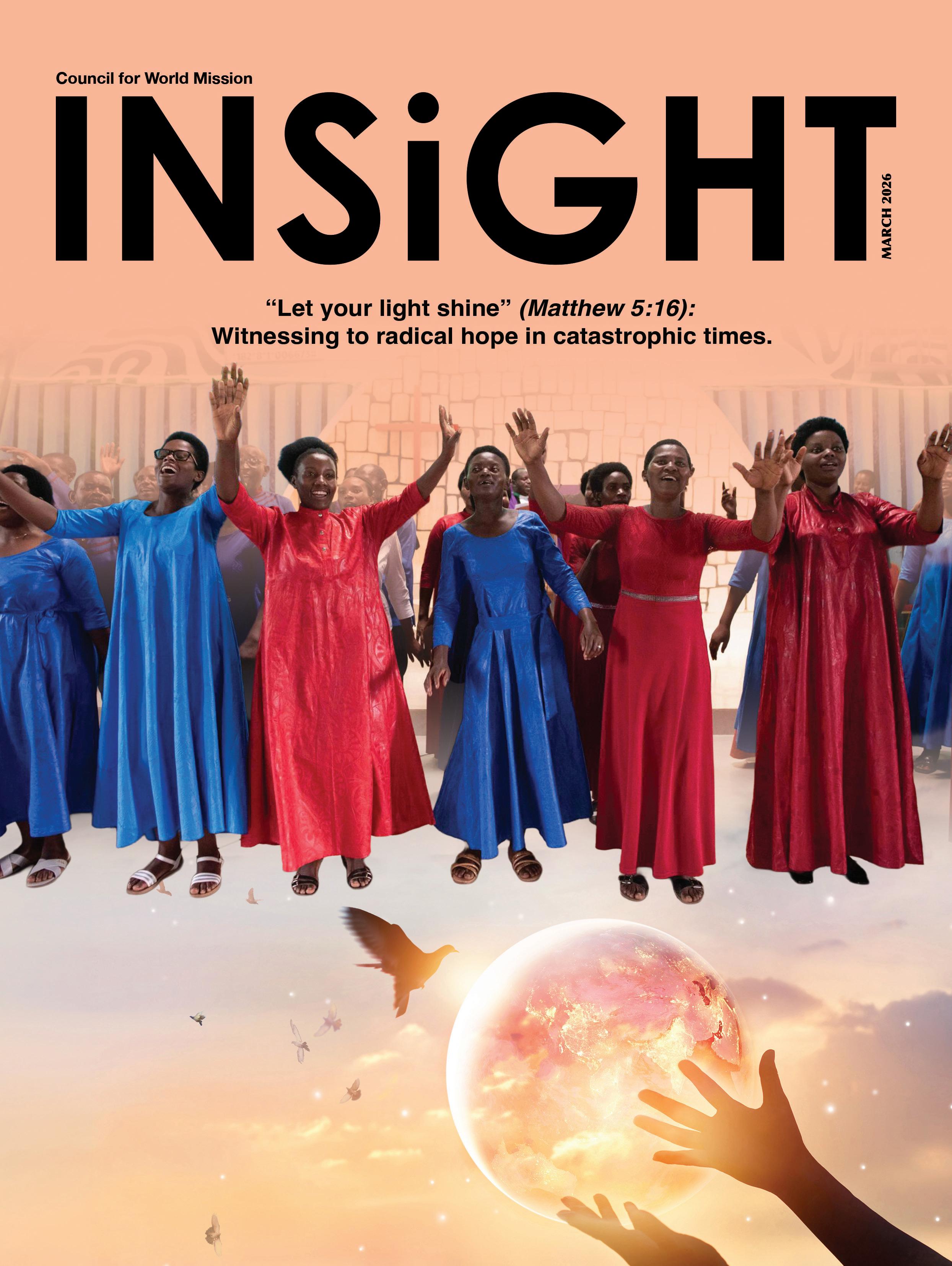
The theme of this issue is “Let Your Light Shine (Matthew 5:16): Witnessing to Radical Hope in Catastrophic Times.” This was also the theme of the Global Mission Consultation, jointly organised by the Council for World Mission (CWM), Community of Churches in Mission (CEVAA), and United Evangelical Mission (UEM), in Rwanda in November 2025.
The articles in this issue of INSiGHT were originally presented during the consultation and reflect diverse theological perspectives on the theme.
In “Missional resistance within a global wilderness of uncertainty,” Rev. Dr Roderick R. Hewitt, president of the International University of the Caribbean, reflects from the context of Jamaica, which recently endured the devastating impact of Hurricane Melissa. He argues that contemporary missional perspectives must be shaped within a global landscape marked by uncertainty, grief, destruction, and death—a destabilising environment in which the church is called to bear witness with compassion and hope.
In “Faith, hope and love: Discerning missio Dei in a catastrophic world,” Rev. Dr Jooseop Keum, CWM general secretary, notes that moments of crisis can tempt communities toward selfpreservation. Yet the gospel leads in a different direction. The disciples were not called to hide behind locked doors; rather, they were sent into the world to participate in God’s mission, following the example of Jesus.
In “Spirit of mission in a time of catastrophe,” Rev. Dr Kenneth R. Ross, professor of Theology and dean of Postgraduate Studies at Zomba Theological College in Malawi, describes contemporary catastrophe as complex and multilayered, formed by numerous destructive forces that interlock to create what he calls a “hydraheaded monster.” In such a context, the need for ecumenical mission has never been greater.
In “Mission from the margins: Mary’s radical theology,” Prof. Simone Sinn of the University of Münster challenges traditional portrayals of Mary as merely humble and modest. Instead, Luke’s Gospel reveals Mary as a prophetic theologian whose witness announces God’s transformative work—overturning established structures and reimagining social and spiritual realities.
In “Mission from the margins: A call for radical discipleship that disrupts systems of power and stands in solidarity with the crucified – Afro thoughts,” Rev. Dr Lesmore Gibson Ezekiel of the All Africa Conference of Churches (AACC) calls for deep self-examination in light of Jesus’ teaching that believers are called to be light in a world where darkness is often preferred.
In “The church without borders: Transformative ecumenism in mission,” Rev. Dr Andar Parlindungan, general secretary of the United Evangelical Mission, explores the interconnectedness of transformation, ecumenism, and mission. Rather than abstract theological ideas debated in committees or academic circles, he focuses on how ordinary church members experience ecumenism and mission in the daily life of the church.
Finally, “Toward a reparative and decolonial missiology from Asia–Africa,” Rev. Dr Seungbum Kim, assistant professor at Union Theological Seminary in the Philippines and Partner in Mission with CWM, offers case-rooted reflections from Asia and Africa.
Together, these reflections invite us to bear witness to radical hope in catastrophic times, and to participate in building life-flourishing communities.
Missional resistance within a global wilderness of uncertainty
Rev. Dr Roderick R. Hewitt
Introduction: Living with catastrophic uncertainty
The theme of this Global Mission Consultation invites us to witness to radical hope in catastrophic times. In addition, my duty is to critique the Partnership in Mission model that has shaped the missional journey of the ecumenical mission organisations sponsoring this consultation, and to suggest alternative options that may be more effective. My reflections are shaped by my Caribbean context of Jamaica, which has recently endured a devastating onslaught from Hurricane Mellisa. We know from experience what it means to be living in catastrophic times with lives lost, homes destroyed or severely damaged, communities uprooted, and livelihoods shattered. Within the wider Caribbean region, there is imperial impunity on display as U.S. forces amass eight Navy warships, a special operations vessel, a nuclear-powered attack submarine, and the aircraft carrier USS Gerald R. Ford, along with three more warships and over 4,000 additional troops. For what purpose would such an imperial force be positioned within a region that proclaims itself as a zone of peace? The pretence of gathering such forces to combat the drug trade conceals the deeper reality of power struggles between global imperial forces seeking to reorder national allegiances. Venezuela is now in the headlines, but this is a domino game that also involves targeting other nations, such as Bolivia, Colombia, Nicaragua, and Cuba, as part of the strategic plan. Small Caribbean islands become pawns in this East/ West power play, as our fishermen and their livelihoods suffer collateral damage. So far, 76 nationals have been killed without impunity. Let
us not forget the ongoing wars in Sudan, Ukraine, and other nations where thousands of people are dying. We must also mention the current “peace/ no peace” in Lebanon, Gaza, and the wider Palestine, where Israel operates with impunity, bombing and killing at will. It is to this global landscape of lawlessness—creating what can be described as a wilderness of uncertainty—that this presentation seeks to respond.
Bearing witness within a destabilising environment
My missional perspectives are therefore shaped by this global landscape of uncertainty, grief, destruction, and death—a destabilising environment in which we are called to bear witness, marked by compassion and hope. I am confident that the urgency that motivated the mission organisations to gather for this consultation reflects a shared passion. We are connected through a colonial history with a legacy of both blessings and shame. The precursor of the CWM, the London Missionary Society (LMS), declared in 1795 that its mission was to “Spread the Glorious Gospel”. That spread was carried out in partnership within the broader European colonial project of civilising colonised peoples into the European worldview, through the spreading of the glorious gospel, serving as a strategic element of that partnership. The Western-led missionary endeavours and colonial exploits were inextricably intertwined. Despite, and in spite of, the strategic, missional, and ecclesial errors in establishing the church, some of which had costly consequences, such as loss of life, land theft, and economic underdevelopment, the local church developed deep roots and became enculturated into the lifeways of the peoples. What was meant to control a people became a liberative force that empowered the people in their quest for selfactualisation.
The journey from a colonial relationship to a post-colonial partnership model I have been involved with the CWM since 1984, initially as a mssion partner, then as an executive
staff member, at another time as a moderator, and again as a Partner in Mission (PIM). Over the years, I have observed from all perspectives the development of its PIM model, including its policymaking and programme implementation. This model evolved as a postcolonial response to the Western rectangular table mission model that operated during the colonial era, in which European churches exercised veto power over the ministry and mission development of churches in the Global South under their European state’s colonial authority. The missional concept of partnership was used as early as 1928 at the International Mission Council’s (IMC) meeting in Jerusalem and again at the 1947 IMC Whitby conference, where the concepts of “partnership in obedience” and “partnership in mission” were employed. However, it was the World Council of Churches (WCC) conference on “Guidelines for the Ecumenical Sharing of Resources” in El Escorial, Spain, in 1987, that had the most significant impact on the CWM understanding and practice of PIM.
Critiquing the PIM model
In 2009, I participated in a project with scholars from the Global South, including Steve deGruchy, Isabel Phiri, Sarojini Nadar, and Des VanderWater, which explored PIM during the postcolonial era and aimed to identify priorities for the mission agenda.1 CWM, CEVAA, and UEM are three tangible global missional models that, for over 40 years, have demonstrated the shift from mission as power dynamics exercised by the powerful over the powerless to mission as partnership—mutual challenge and mutual equipping. The missional shift was also based on global data indicating that Christianity’s population centre had shifted from the Global North to the Global South.
Each mission organisation has progressed at different rates, serving communities in diverse sociopolitical and economic contexts that ultimately influence the content of the mission agenda. Nevertheless, despite their varied mission contexts, they remain committed to this
PIM model, which is informed by postcolonial hermeneutics and by tensions and contestations between power and partnership.
An insider’s perspectives
I speak as an insider from the CWM family of churches to clarify that the PIM concept was intentionally developed as an anticolonial and postcolonial framework for establishing new missional relationships. In this paradigm, the content and strategy of the colonial mission, designed initially from the West for the rest of the world, were redefined as “from everywhere to everywhere.2 The first ten years of leading this PIM showed that CWM still maintained its strategic leadership from Europe, even though the majority of the then 28 member churches were from the Global South. However, they were not confident in appointing a general secretary from outside Europe. Furthermore, British churches contributed the majority of CWM’s financial resources, and British financial managers oversaw the funds. The shift towards appointing a general secretary from the Global South began in 1985 with the appointment of Dr Christopher Duraisingh, followed by Dr Preman Niles in 1991. The PIM model was developed through learning-by-doing programmes such as Training in Mission (TIM), Leadership Development, Education in Mission, Equipping Local Congregations in Mission, and The Community of Women and Men in Mission, among others. These programmes expose church members to PIM perspectives and practices. The traditional method of demonstrating the PIM model involved sharing personnel. During the colonial era, LMS missionaries represented the organisation. The formation of CWM led to the new representatives, called “Mission Partners,” no longer being “colonial missionaries.” This was followed over the years by a decline in mission personnel from the Global North and an increase from the Global South. Their presence sent a strong signal of the new PIM personnel model to member churches.
Financial challenges to the PIM model
In addition, the composition of the executive staff at the London Office began to mirror greater global diversity. In 1993, CWM received significant resources from the sale of land in Hong Kong, amounting to about 95 million pounds, which was called “Gift of Grace”. This financial empowerment of CWM posed the greatest challenge to the PIM model at multiple levels.
1. In the PIM model, all member churches were expected to give and be open to receive. However, with the Gift of Grace, it compelled churches like the United Reformed Church, the most significant financial contributor to the CWM budget, to reconsider their missional role, as less funding would be given to CWM and more allocated to local and bilateral mission engagement.
2. The challenge for churches from the Global South that had sacrificed from their limited budgets to contribute financially to world mission was whether they would maintain their commitment even when the CWM became economically self-sufficient.
3. The strategy of CWM to empower the member churches’ mission agenda includes programmes such as: Mission Education Schools, Network on Theological Education (NOTE), Self-Support Fund, Mission Programme Support Fund (MPSF), Face to Face, Clergy Exchange Programme and Global Youth Convention.
4. Although these programmes helped strengthen the churches’ financial and mission initiatives, they also mis-educate the churches and other ecumenical bodies, such as the World Council of Churches and the World Communion of Reformed Churches, by leading them to see CWM more as a funding agency and less as a PIM organisation.
5. On a more positive note, by the year 2000, most of the CWM PIM personnel were from the Global South, which marked a strategic milestone for CWM as a Global South organisation.
A shift in leadership from the Global North to the Global South
This shift was further reinforced in 2003 when CWM appointed all of its key officers, including the moderator, general secretary, and finance secretary, from the Global South. This period, lasting until 2009, saw additional structural, management, and programme changes. The key PIM agenda item was resourcing the member churches for mission action. Additionally, this period also saw CWM paying attention to shifts in mission theology. From the seminal text in 1977, “Sharing in One World Mission,” other key texts include The Handbook of CWM (1984), revised in 1991; “Perceiving Frontiers, Crossing Boundaries” (1995); and “World Mission Today” (1999). All of these early texts reinforced a holistic understanding and practice of mission that the missional calling of the church is to be “Partners in God’s Mission,” which involves: “i) Being a sign of hope, ii) having a holistic understanding of mission, iii) having Christ’s way as the model of mission, and iv) forming wider partnerships for mission.” Another core development of this CWM PIM understanding and practice is the centrality of the local church, not the mission agency, as the principal bearer and practitioner of mission. Since mission is the main task of the local church, CWM’s role is that of a facilitator and equipper, encourager and supporter of the church’s mission in proclaiming the good news, working with people on the margins, sending partners in mission to serve wherever they are needed, investing in women and youth and participating in ecumenical engagement.
New shoes or stocking feet
The first 30 years of CWM living out the PIM model from 1997 to 2007 showed a shift from a colonial “classic European sending agency” to a postcolonial partnership of churches of equal standing. The underlying PIM perspectives were mainly shaped by CWM’s engagement with the ecumenical movement. These perspectives were expressed primarily by male academic scholars who were not all deeply connected with the life
of local churches. Jan van Butselaar, a Dutch missiologist, asked in 1987 whether the CWM understanding and practice over the past decade demonstrated “new shoes or stocking feet”. He questioned whether the new CWM structure had brought about any fundamental changes in the prevailing power relations between the former constituent churches and the former associate churches.
How authentic is CWM in brokering new power relations?
At its core, Jan van Butselaar questioned whether CWM was authentic in brokering new power relations among the former constituent churches. At a 1995 consultation on PIM held in Huddersfield, UK, I shared that many member churches boarded the CWM bus without a clear understanding of where it was going. There was a noticeable gap between what the member churches agreed to as the CWM theology of mission and what they utilise within their congregations as the functional theology of mission. Therefore, there exists an inherent contradiction between what CWM, the mission organisation, accepts as its understanding and practice of PIM and those of its member churches.
CWM:
A postcolonial Southern-led mission organisation
The radical shift in CWM’s leadership, with all the general secretaries appointed since 1984 representing churches from the Global South, the move of its central offices from London to Singapore, greater regionalisation of CWM, and increased membership of churches from the Global South, have sent a clear message that CWM is no longer solely a European mission organisation but can best be classified as a postcolonial Southern-led mission organisation. This became most evident from 2011, with the fast-tracking of various programmes and the deployment of regional mission staff to facilitate them. This was in response to the member churches’ request for greater regional mission corporation and action at a time when regional ecumenical action was declining.
Weakening of the global ecumenical movement
There has been a significant weakening of the global ecumenical movement, especially since the global financial meltdown in 2008, and many nongovernmental organisations have lost some of their investments. Organisations such as the WCC, WCRC, and other regional and national bodies experienced a significant downturn in their financial viability. CWM withstood the economic storm and was better able to take up the slack in facilitating ecumenical mission action.
The
shift from a colonial to a postcolonial consciousness
This shift from a colonial to a postcolonial consciousness has propelled CWM through leaders influenced by decolonial pedagogy. Although both terms critique and oppose Western colonisation and imperialism, they differ in scope, focus, and geographical origin. Postcolonial theory was developed by scholars from South Asia, South Africa, and the Middle East who concentrated on the persistence of colonial power structures and discourses in the post-independence period. They examine issues related to hybridity, mimicry, and the subaltern.
Decolonial theory
The decolonial theory proposed by scholars from Latin America presents a broader, more radical perspective, asserting that colonialism persists. They argue that, at the core of coloniality, is the necessity to disconnect from and dismantle the logic that renders Western knowledge universal. Decoloniality honours and values non-Western knowledge systems, where people “drink from their own wells.” It is within this framework that the contemporary CWM PIM finds its place. The missional vision, as celebrated at the last CWM Durban Assembly, is choreographed as “rising to life and breaking out from Babylon.” This movement necessitates:
“a radical shift in prophetic understanding and mission engagement. In an era of egotistic, mechanistic, and technocratic dehumanisation and ecological degradation, CWM envisions
creating alliances and engaging churches and people’s movements to rediscover human identity in the image of God. This vision affirms the embrace of Spiritualities, the reshaping of Economies, the restoration of Ecology, and the renewal of the Global space into Life-Flourishing communities.3
The Onesimus Project (TOP) offers a prophetic, missional response.
The consistency of living out the CWM PIM model over the past 48 years lies in its commitment to a systematic review of its life and work every six years. This capacity for self-critique and willingness to adjust the missional course make CWM adaptable, enabling it to change leaders, locations, and programmes as necessary. The post-COVID-19 pandemic saw CWM adopt The Onesimus Project (TOP) as its prophetic, missional response to reimagining mission.
Framing mission as reparative justice— restoring right relationships distorted by empire
Framed within the biblical narrative of the discourse surrounding the enslaved Onesimus, Philemon, and Paul, the project identified systemic dehumanisation inherited through colonisation and slavery, which the modern missionary movement benefited from, as a crucial area for the urgent missional response of repentance, restoration, and reimagining. TOP aims to redefine the meaning of mission, shifting from a benevolence agenda driven by the powerful and the powerless to framing mission as reparative justice—restoring right relationships distorted by empire, racism, and economic domination. TOP has therefore pushed the CWM-PIM model from within the walls of the church to the risky engagement with the world. And this is a sign that the time is right to reimagine the PIM model.
The missional call of Jubilee
In 2027, CWM will turn 50 years old, and the missional call of Jubilee that TOP bears witness to indicates that the PIM model, as CWM’s operational missional framework, is overdue for
a thorough review to assess its effectiveness in equipping the churches during this catastrophic era. What is urgently required is an alternative vision to the current political and economic culture of violence and death that has engulfed our world. The existing mode of operation remains rooted in a conservative mindset that hesitates to challenge the status quo. As the Jubilee celebration approaches, it should serve as a period of deep reflection for its leaders to evaluate what is necessary to strengthen the PIM model. The theme of this consultation calls for radical hope in catastrophic times. This implies that the PIM model must be fused with radical hope to counter the forces that deny life. This suggests a decolonial rupture is required in the PIM model.
Notes
1. Van der Water, D. Ed. 2010.Postcolonial Mission, Sopher Press
Rev. Dr Roderick R. Hewitt currently serves as president of the International University of the Caribbean in Kingston, Jamaica. He is a graduate of the United Theological College and The University of the West Indies (BA (Hons), Kings College University of London (MPhil & PhD). He has also served as the academic leader for Theology and Ethics and also for Research and Higher Degrees in the School of Religion Philosophy and Classics, University of Kwa Zulu Natal, South Africa and was a visiting fellow at New College, University of Edinburgh (2018/2019). He is professor in Systematic Theology and lectures in African Theologies in the Diaspora, Ecumenical Theology, and Missiology.
Faith, hope and love: Discerning missio Dei in a catastrophic world
Rev. Dr Jooseop Keum
I would like to title my speech “Faith, Hope, and Love: Discerning missio Dei in a Catastrophic World.” The theme calls for a deep reflection on the nature of knowledge, power, the forces shaping our world, and God’s mission in bringing about justice, peace and renewal. Therefore, I would like to begin my presentation by asking an important question raised by Professor Kenneth Ross during the CWM Assembly in 2024: “What kind of day is it today?” I am sorry to describe today as a day of catastrophe while celebrating the first missiology consultation organised by our three sister organisations in the post-colonial world mission, CEVAA, UEM and CWM.
The CWM Assembly, held last year in South Africa, spoke of “socio-political catastrophe and environmental emergency.” In his 2024 Gifford Lectures in Edinburgh, Cornel West raises a missiological question: “How do we emerge from the bleakness of our catastrophic time?”
According to John 20, following the crucifixion of Jesus, we are told that “the doors of the house where the disciples had met were locked for fear of the Jews” (John 20:19). In today’s world, disciples of Jesus can find many reasons to be afraid. Division, fundamentalism, violence and discrimination are all on the increase everywhere in the world. In our sociopolitical cultures, the darker side of human nature is overwhelming and without any shame. Greed for power, money, violence and claims of jealousy are competing to search for victims.
We could easily be tempted to lock the doors and concern ourselves with self-preservation. The
gospel, however, leads in a different direction. Jesus stood among them, saying, “Peace be with you. As the Father has sent me, so I send you” (John 20:21). Hiding behind locked doors was not their calling. Instead, they were sent on a mission modelled after the mission of Jesus. Finally, he breathed on them and said, “Receive the Holy Spirit” (John 20:22). The Holy Spirit is the spring of transforming wisdom, knowledge and power.
Indeed, mission occurs when the disciples encounter and engage with the world. How can we witness God’s love in ways that our knowledge in Christian mission nurtures, protects and enhances life, while confronting and transforming the denial of God’s gift of life?
The power that governs our world today
The world is deeply wounded. It’s catastrophic. Despite occasional glimmers of hope, the world mission had to reckon with the death-dealing forces of “necropolitics” that prevail in the current world order and inflict untold suffering on the defenceless and the vulnerable. We are gathered at a time when the world faces profound challenges that demand theological and prophetic responses:
1. In the economy, the WTO system, which has been one of the main vehicles of neoliberal globalisation, is dysfunctional. Although China is calling for the protection of the WTO structure, the West is strengthening its exclusive nationalistic economy to protect its market. The US has survived the economic crisis caused by the COVID-19 pandemic by sucking in money from the world with a high-interest rate policy. The current US tariff war is an act of robbing other countries and the wallets of the poor to finance the US government’s deficit and making the far-right rich richer.
2. Since empires cannot resolve their conflicts through multilateral negotiations and treaties, we are entering an era of war where the strong prey on the weak. Consequently, arms race
and trade, military industry and mercenary export are increasing and becoming the fastest growing industrial sector. The conflicts started in Ukraine have been moving towards the east, Israel-Hamas, Israel-Iran, IndiaPakistan, Thailand-Cambodia, and who’s next? Taiwan or the Korean Peninsula? If the scandal of war reached Northeast Asia, the world’s powder keg, the scale would be different. Perhaps the Third World War, even with nuclear weapons.
3. The technology empires: The Magnificent 7 are the seven world’s most prominent and influential tech companies-Apple, Microsoft, Amazon, Alphabet, Meta, Nvidia, and Tesla. These seven American companies, known for leading the industries like AI, cloud computing, electric vehicles, and social media, dominate approximately 30% of the total value of the global stock market. These technology empires are dictating the global economy and politics. They are developing as mega-empires by transcending the limits of the neo-liberal scope of empires through technological advancement. Techno-feudalism is emerging as a modern socio-economic system in which powerful technology companies control digital platforms, data, and infrastructure, much like feudal lords once controlled land.
4. The power of cryptocurrency is advancing in various directions, especially with Donald Trump returning as president of the United States. Concepts of digital economics are becoming increasingly commonplace among children, and activities such as stock investment, digital speculation, and cyber trading are now routine for teenagers. The financial structure of cryptocurrency and digital money poses a threat to traditional financial markets, rendering monetary transactions a game detached from the real economy. The drive to create and accumulate wealth, allowing people to live luxurious lives without traditional labour, has become a life goal for many. Unlimited opportunities for
travel, fine dining, and shopping for luxury goods are now called “economic freedom,” with some even daring to label it “salvation.” Does Ora et labora, or “pray and labour,” still hold value within Christian spirituality?
5. The alienation of labour due to AI and robots is progressing rapidly. Humans will not be the main agents of labour soon, but will live a passive economic life with minimal welfare funds due to the wealth created by AI and robots. For instance, the Volkswagen factory in Germany is closing, and approximately 30,000 workers are losing their jobs. There is a rumour that AI-generated robots will replace them, and the factory will reopen as an electronic car manufacturing company with a new brand. The Hyundai Electric car factory in Singapore has no single worker in terms of production lines. In this AI-dominated world, unemployable individuals who are not worth being, “surplus humanity.” It is an economic necropolitics!
6. The rise of far-right politics and dysfunctional democracies globally has eroded public trust in the rule of law in governance. From voter suppression and corruption to the consolidation of authoritarian regimes, democracy itself faces existential threats, calling us to respond with prophetic courage and advocacy.
7. A dangerous marriage between faith in money and ultra-rightwing politics within the church makes the Christian faith idolatrous. The imperialistic church’s power of money becomes toxic even in the ecumenical movement. Attempts to re-establish cultural authority and institutional influence through the pursuit of power are not authentic expressions of God’s self-emptying and selfsacrificing love in Christ. Without any shame, they often shake hands with heretical groups and pseudo-Christian movements for political power.
8. The climate crisis, driven by global inequality, disproportionately impacts the global south, particularly where communities
face escalating droughts, floods, and food insecurity. This is not merely a challenge of ecology but a theological call to justice, as creation groans under the weight of exploitation and neglect.
Who are humans?
In the context of the Korean Netflix drama “Squid Game,” which revolves around money and fate, we see a disturbing comparison of vastly different aspects of life, leading to the disappearance of humans amid unlimited greed and competition. People are treated as mere resources and tools, stripped of their personality and dignity. There is a growing concern that as we enter an era of advanced technology, humanity, already diminished, may fade even further.
So, where can we find humanity in ourselves? Our true humanity can only be discovered through a relationship with the Creator and creation in community, rather than through our abilities, technology, or perceived “usefulness” alone. Humans are not simply resources or instruments of (hu)manpower; we are unique beings created in the image of God. The foundation of human dignity and intrinsic value lies not only in our skills or talents but in the divine image inherent within each person. We ought to affirm these unique aims and values of Christian mission.
In that sense, there is no such thing as a “surplus human” with no productive ability. No human being in this world is useless, and there is no need to prove or become a useful being or to become superior with the help of machines. This is because even the most insignificant person in an economist’s eye has the noble image of God within him or her. In that sense, the mission of restoring humanity in the age of AI lies in making our churches a true humanising community. In the age of AI, where humanity is increasingly being lost, Christian mission has the responsibility to tell who humans are.
It is a time to face the apocalypse with an eschatological faith. How can we spread the news
that the power of God’s love is far superior to that of the necropolitics of the empire, the power of life over death? Unusually, fundamentalists have used terms like catastrophe, apocalypse, and eschaton to describe the final war of Armageddon. The end of the world was a precondition for fulfilling the prophecy of the final judgement. There is nothing to do to save the world in this sadistic theology.
However, Jürgen Moltmann articulated eschatology as a way to find hope from the coming Reign of God, from the eschaton to the present. More recently, Catherine Keller, in her book Facing Apocalypse: Climate, Democracy, and Other Last Chances (Orbis, 2021), reminds us that the aim of John’s Apocalypse is to reveal the last chances. John put the dangerous hope of new creation, new earth and new heavens only in the last chapters of the book of Revelation.
An Asian missiologist, Kosuke Koyama, introduced the Asian point of view of history as a circular view, whereas the Western view is linear, and he brought a convergence of the two with the concept of a spiral view. Koyama stressed the theme of ‘cross’ in the end instead of the final judgment. At the end of the day, we all have to stand under the cross and have a crucified mind. He regarded this ironic cross as the fundamental factor for every Christian to seek. The future means a present that is not yet. The mission is to live the future in the present. Living out the values of the coming Kingdom of God at present is the way of living in a spiral movement of history.
Are there any last chances to save the world? As they are human-made catastrophes, perhaps we can radically change our total mode of being and way of life. Koyama, who had experienced the catastrophe of the Hiroshima and Nagasaki Nuclear Bombings, which killed approximately 140,000 civilians, warned: “The unique and awesome truth about human history is that it can become creative or destructive, healing or damaging because at its basis there is a mysterious freedom of human confidence and
faith of the heart which can make both God and idol. This is the risk that the creator God took” (Mountain Fuji and Mountain Sinai, 1984). For this coram Deo, or the presence of God, spirituality and discipleship are the two key entrances towards mission in catastrophic times.
Faith at the margins
The Incarnation of God took place among marginalised people, challenging the expectations of those in power. The birth of Jesus was a disruptive revelation—God chose the margins to inaugurate the Kingdom. This affirms that the true understanding of the good news of Jesus requires engaging with the marginalised, not merely discussing mission in academic boardrooms.
The concept of “mission from the margins,” as presented in WCC mission statement Together Towards Life (2013), offers a transformative approach to discipleship. Authentic discipleship demands presence among the oppressed rather than alignment with power structures. While Christianity has long been tied to institutional influence, true mission follows the path of kenosis—self-emptying love modelled by Jesus.
Empowered by the Holy Spirit, our mission does not depend on wealth or institutional resources but on faith, the joy of the gospel, and a passion for justice (Acts 3:6). To renew our discipleship, we must embrace transformation within ourselves and actively participate in God’s mission. In a world rife with injustice, hatred, and suffering, this discipleship is costly-it requires living out the theology of the cross, dedicating our energy, and even risking our comfortable lives for the promised transformation of God’s Kingdom.
Hope as an agent of transformation
We believe that the gospel has the power to transform the world: personality, value, class, system, and society. Therefore, we are not ashamed of the gospel because it is the power of God that brings salvation to everyone who believes. (Romans 1:16) The gospel of the Kingdom of God challenges the world that
nurtures hopelessness. As the servants of God, we have a mission to share the Good News with all humanity and creation that are longing for hope. Celebrating life in today’s world means bringing an eschatological hope to the horizon of history.
Duncan Forrester insists, “Hope is resistance to a hopeless situation. Hope keeps open the horizon of the future and motivates action.” Indeed, the gospel is all about the hope of life, and it is good news to the poor and all who suffer. Therefore, our mission as disciples is proclaiming the hope of “God’s kingdom is coming, and already among us” through our quality of the community of Christian universities as a foretaste of the Reign of God! In the midst of agonies, despair, and cries of life, it is our mission as transforming disciples to seek alternative knowledges and values, ways of life, and communities to reveal the Kingdom by the power of the Holy Spirit.
Love to defeat culture of hatred
In the context of the rise of pandemic, racism, and fascism, one of the key goals of the mission should be to reflect deeply on how we understand and give expression to the power of God’s love to defeat the culture of exclusivist politics, stigma, and fear. Are we presenting God’s love selectively, only for those who fit within our frameworks of comfort and privilege? Are we unwilling to risk losing the benefits and power that structurally embedded injustice bestows upon us? If so, are we not limiting the power of God’s love by seeking to witness in ways that are safe and comfortable? Are we not limiting it to purely personal realms, granted to or accessed on certain terms and conditions? Moreover, are we not limiting it as one that numbs and soothes rather than as one that heals and transforms? “There is no fear in love” (1 John 4:18). It is time to question the integrity of the Christian mission: Are we true disciples of the gospel? The depth of our discipleship will ultimately determine whether we rise to life in the catastrophic challenge of these times.
When we enter the realm of love, we enter the realm of new possibilities. Love distinguished the path that Jesus chose, a love that depends not on the attractiveness of the one who is loved but entirely on the grace and power of the one who loves. It is the love which took Jesus out, at infinite cost to himself, to all those who were excluded, those who were on the margins of society, the poor, the sick, the outcast. It was a quality of love which was deeply disturbing to the powers that be, upsetting their carefully constructed assumptions that loving was something to be done within very well-defined limits.
True love is not passive; it is a revolutionary force that overturns injustice and demands radical inclusion. It is the love that called Jesus to the margins, that touched the untouchables, and that defied the authorities of empire and temple alike. To embody this love means to dismantle the systems that exclude, to amplify the voices of the silenced, and to stand in solidarity with the oppressed. If our expressions of God’s love do not shake the foundations of power and injustice, then we must ask ourselves: Have we truly understood the mission of Christ? To be disciples in today’s world is to proclaim and live out a love that does not conform to the status quo but actively reshapes it, breathing life into a world longing for transformation.
Concluding remarks
Missio Dei is a call to rise to life! It is a transformative response to the life-denying forces that pervade our world. Rooted in the mission of God, this vision seeks to dismantle oppressive structures and cultivate life-affirming communities. As a global Christian family of mission, we - CEVAA, UEM, and CWM - must critically engage with power, empowering ourselves and our communities while challenging systems perpetuating inequality and exploitation.
True power lies not in domination but in pursuing “Truth and Freedom” to transform the world. Transformation cannot be achieved in isolation
but requires partnership, mutuality, commitment to life, justice, and peace. The threats facing our planet demand collective action, urging the world mission to reimagine our mission beyond individual institutional confines and cultivate a spirit of ubuntu, a deep interconnectedness that fosters shared liberation.
It seems history is moving backwards in the dark ages of our times. However, Martin Luther King Jr appeals to us, “Let us not wallow in the valley of despair, I say to you today, my friends. So even though we face the difficulties of today and tomorrow, I still have a dream.” As one family of God’s mission, we are transforming companions in our journey toward building life-flourishing communities.
Jesus, The Ivy (By Do Jong-hwan)
At times when we feel that it is a wall, just a wall, then without a word ivy goes climbing up the wall. At times when we say that it is a wall of despair with no drop of water, where not one seed can survive, unhurrying, the ivy advances. Hand in hand, several together, it climbs on, a span’s breadth at least. Until the despair is all covered in green it grasps the despair and will not let go. At times when we lower our heads, saying that the wall cannot be climbed, one ivy leaf at the head of thousands of ivy leaves finally climbs the wall.
Rev. Dr Jooseop Keum currently serves as the general secretary of the Council for World Mission (CWM). He is also a distinguished professor of World Christianity at the Yonsei University in South Korea and a professor extraordinarius at the University of South Africa (UNISA). Dr Keum was awarded honorary doctorates by the University of South Africa, the University of Sibiu and the Reformed University of Debrecen for his distinguished services to the church, society, and academia.
Spirit of mission in time of catastrophe
Rev. Dr Kenneth R. Ross
Facing catastrophe
Catastrophe is an extreme word. Yet it is not too extreme to be the best word to describe the situation in which we find ourselves. Especially if we position ourselves with those on the receiving end of the violence, exclusion, and desolation that mark today’s world. Whatever our particular context, we are struggling to make sense of the many-sided catastrophe that is unfolding around us. The former chief book critic of The New York Times Michiko Kakutani finds that, “It’s difficult to convey just how strange life in the third decade of the third millennium has become. It often feels like a preposterous mash-up of political satire, disaster movie, reality show, and horror film tropes all at once.”1 The fact that it is a “mash-up” is part of the problem. The catastrophe is complex since it is formed by numerous destructive forces that interlock with one another to create a hydraheaded monster. This is one reason why there has never been greater need for mission to be ecumenical. It needs to take account of the whole picture, it needs the perspectives of people everywhere, especially the most vulnerable and marginalised, and it needs to be able to resist ideological captivity to sectional interests. This paper will therefore seek to take account of some principal components of our catastrophe before proposing a new expression of ecumenical mission as a source of hope in these deeply troubled times.
The earth at stake
The first point must be that, like never before, the earth itself is in jeopardy. On any objective assessment, the earth’s atmosphere is changing in ways that are hostile to the natural environment and the human community. As Pope Francis observed, “the world in which we live is collapsing and may be nearing the breaking point.”2 Such is
the scale and urgency of the environmental crisis that it calls for decisive and united action on the part of the human community. Such action, however, is conspicuous by its absence. No wonder UN Secretary General António Guterres warned that, “At a time when we should be accelerating action, there is backtracking. At a time when we should be filling gaps, those gaps are growing. Meanwhile, the human rights of climate activists are being trampled. The most vulnerable are suffering the most. Current policies are taking the world to a 2.8 degree [Celsius] temperature rise by the end of the century. That spells catastrophe.”3 Instead of accelerating the action, we have been accelerating the backtracking.
In its first 100 days in office, the Trump administration in the USA took more than 140 actions to roll back environmental protection and increase the use of fossil fuels. As Naomi Klein observed, “[Trump] signed executive orders to ease restrictions on their extraction and export, filled his cabinet with oil industry supporters, gutted federal agencies on the forefront of the climate crisis, and cancelled life-saving environmental justice projects.”4 Banks and corporations have responded by swiftly dropping their earlier stated commitment to renewables and reverting to massive investment in the fossil fuel industries.5 Meanwhile, in 2024 the planet topped the 1.5C temperature-rise for the first time, with an estimated 70% chance that the average temperature rise over the next five years will be above this. It is forecasted that a 2C global temperature rise by 2050 would see a 25% collapse in the global economy and 2 billion people dead.6 On a rapidly heating planet, climate scientist Bill McGuire suggests that our current approach is like “playing Russian roulette with all six barrels loaded.”7
Humanity at stake
Lack of convincing action in relation to the climate crisis raises serious questions about what is going on in the human community. Instead of uniting to fight together for the future of our planet,
we have opted to prioritise a militarisation that prepares us to fight each other. In particular, it prepares the world’s powerful nations to unleash unprecedented firepower on those perceived to be a threat or a challenge to their interests. This has been played out in the events we have witnessed in Gaza over the past two years. In response to a Hamas attack in Israel which killed more than a 1,000 people, Israel took military action against Gaza which the United Nations has described as a genocide.8 Figures released by the Palestinian Ministry of Health on 7 October this year show that 67,173 people have been killed during the war in Gaza, of whom 20,179 were children.9 For those who were directly targeted in Gaza the episode has been devastating beyond description and even survivors will carry the scars for the rest of their lives. Without in any way minimizing their uniquely horrific experience, it is also necessary to recognise that many others have been affected, and issues have been raised that we all have to face. As Pankaj Mishra has observed, “No disaster compares to Gaza – nothing has left us with such an intolerable weight of grief, perplexity and bad conscience.”10 Wherever we are, the events that have occurred over the past two years will continue to haunt us.
Humanity itself is at stake when it becomes acceptable for one powerful group to dehumanize and destroy another. The failure is compounded by the use of artificial intelligence in military operations. In Gaza and other killing fields, socalled killer robots can target people on the basis of a set of data points, interpreted by an algorithm. Once autonomous weapons systems have been programmed, they take on a life of their own. Human agency and human responsibility become much less direct. Yet such technology is not neutral. It is an instrument of the powerful, used to eliminate those perceived to be a threat to their interests. Control of technology also empowers elites to impose their narrative. We do well to heed the warning of Achille Mbembe: “Formatting as many minds as possible, shaping people’s desires, recrafting their symbolic world, blurring the distinction between reality and fiction,
and, eventually, colonizing their unconscious have become key operations in the dissemination of micro-fascism in the interstices of the real.”11 We find ourselves in the world of Shakespeare’s three witches in Macbeth where, “fair is foul and foul is fair.”12
In this context, how do we understand our human identity? How do we understand our human vocation? How do we understand our human community? Kim Yong Bok anticipated such questions: “Theologically speaking, when the greed of the global economic regime serves only Mammon, when the hubris of power becomes demonic, when the global military hegemony of empire turns omnicidal, when human knowledge transgresses all limits to overturn Divine wisdom, and when the powers-that-be emerge with absolute truth claims, humanity faces a serious crisis.”13 This crisis is now upon us. Gaza presents us with a failure of humanity.
Economy at stake
When we ask why the earth is imperilled and humanity in danger, it is necessary to consider the way in which the economy is running. The prevailing neoliberal system, with its privileging of economic growth and unrestrained market forces, operates to reward the powerful and deprive the vulnerable. The system is skewed in favour of the 1% of super-wealthy while the remaining 99% lose out.14 George Monbiot and Peter Hutchison note that, “Since the beginning of the Covid-19 pandemic, the world’s ten richest men have doubled their wealth, while an additional 163 million people have been pushed below the poverty line.”15 This has not happened by accident or as a result of some unexplained misfortune. The problem is a systemic one. As a Guardian editorial observed earlier this year: “Developing countries struggle to break out of a trading and financial system skewed against them because the global north’s economic growth still depends on extracting their resources and labour.”16 Privileged elites prosper, with the price being paid by the poor and by the environment.
As a result, many people today are facing ever more bleak prospects. Their living standards are declining, their employment (if they have it) is less secure, their access to healthcare and education is reducing, their land is depleting, housing is becoming unaffordable, public services are deteriorating. The building blocks of a decent, dignified and fulfilling life are all crumbling. There are islands of prosperity that are well protected from these negative trends but, for most people, vulnerability and marginalization are increasing. The economic growth that is the holy grail of the neoliberal system does not provide a liveable life for the great majority who face ever greater deprivation and distress.
Politics at stake
Given the scale and intensity of the challenges with which we are faced, there is urgent need for political vision, political unity and political action. Unfortunately, just at the time when vibrant democracy and mobilization of reforming movements are desperately needed, politics everywhere is in crisis. The political sphere, like every other sphere, is dominated by economic forces. Such is the power of those at the helm of large corporations that few politicians can resist their financial muscle. We are living through what William Davies has described as “the disenchantment of politics by economics.”17
At the national level, loss of political vitality is seen in shrinking membership of political parties and widespread disaffection from the political process. Increasingly, the business of governing is left to a self-serving political class with very limited democratic participation by the population at large.18 Electorates have become volatile with short attention spans and a weakness for simplistic, scapegoating and authoritarian politics.
Peace at stake
A world defined by great power imperialism is inevitably proving to be a violent world. As European Commission President Ursula van Leyden warned in her State of the Union address
in September 2025, we have now entered “a world of imperial ambitions and imperial wars.”19 Meanwhile, in late 2024, NATO SecretaryGeneral Mark Rutte warned western Europeans that, “What is happening in Ukraine could happen here, too. We are not at war. But we are certainly not at peace, either.”20 Meanwhile, people in many places are already experiencing the full force of imperial violence. Again, the events of the last two years in Gaza are instructive.
Powerful countries have responded to this new age of militarism and warfare by increasing their defence budgets. Such a move is beneficial for the arms trade which forms a central plank of their economies but for the poor and vulnerable it means being on the receiving end of yet more imperial violence. The United Kingdom, for example, decided to cut international aid in order to increase defence spending, signalling that it intended to work by threats and violence rather than solidarity and commitment to justice.21 Even Richard Dannatt, the former head of the British Army, pointed out what a mistake this is: “… slashing aid further to fund defence spending is not just shortsighted – it is dangerously counterproductive. Weak states become breeding grounds for terrorism, organised crime and mass migration crises.”22
These interlocking crises constitute the catastrophe that we now face. How can we imagine Christian mission in such a context? This paper offers six suggestions.
Humble and kenotic
We are living in a militarised world, where great powers are arming themselves with frightening weaponry and unleashing violence on an unprecedented scale. Even the world of faith is invaded as the powerful look to religion to legitimize their self-assertion and religious leaders are beguiled by worldly power. Mission has too often been undertaken on a domination model, understanding the Lordship of Christ triumphalistically, seeking a theocratic role for the
church and adopting an intolerant and exclusive attitude towards others. The church too often made itself comfortable with colonial violence and exploitation. We forgot that Jesus did not come to dominate but, rather, to serve and to give his life. He was the “person for others,” remarkable for his humility. It is therefore as servants, humbly walking the way of Jesus, that we bear faithful witness to the crucified and risen Lord. Not through domination but, on the contrary, by entering into solidarity with the poor, the weak and the despised, we discover the meaning of mission.
Imaginative and transformative
Kwame Bediako observed that, “…no Christian history anywhere ever ceases to be a missionary history, in which Christians never cease to be called to apply the mind of Christ to the realities, questions and dilemmas of that time.”23 Such a calling involves both imagination and transformation. To invoke the mind of Christ is an act of imagination in which we take account of our situation in such a way as to imagine what it would look like if we were to take the way of Christ.
It was David Bosch who taught us the double meaning of “transforming mission.”24 On the one hand, mission itself needs to be constantly in a state of transformation while, on the other hand, it thus becomes a force for transformation in the world around us.
Spiritual and discerning
When it comes to understanding mission in this century, one of the most significant moves to be made was Together towards Life’s framing of mission as a matter of the Holy Spirit.25 This pneumatological turn taken by TTL means that we, “constantly affirm God’s dynamic involvement, through the Holy Spirit, in the whole created world.”26
This pneumatological understanding of mission is both humbling and ecumenical. It is humbling
because it tells us very clearly that we are not in control. It is ecumenical because it reminds us that the Spirit is present and active in all the earth, among people and contexts everywhere.
Dialogical and collaborative
In his very first speech after being elected, Pope Leo said, “We have to look together how to be a missionary Church, building bridges, dialogue, always open to receiving with open arms for everyone … open to all, to all who need our charity, our presence, dialogue, love.”27 It is notable that “missionary” was one of his first words. He took it as a starting point that the church has a missionary role to play. But what kind of mission? Here too he picked his words, talking about openness, bridges and dialogue.
The imperative today is not only to find ways to be together across historic dividing lines but also ways to act together. Hence the need for ecumenical mission.
Prophetic and reconciling
The calling of the church in our contemporary context is a prophetic one. There is no room for complacency. We are in a state of emergency. It is incumbent on the church to articulate a critique of death-dealing systems while fostering flourishing communities that witness to life and hope.
It must be embraced because the church has a calling not only to prophecy but also to reconciliation. If our prophetic ministry causes dismay and disagreement among our fellow Christians, we need to remember our calling to reconciliation. The church can be the crucible in which conflicting and contending outlooks encounter one another and engage in the struggle to work through differences towards unity. It can also become the engine of reconciliation between humanity and the earth. It is difficult to be the outspoken prophet and the unifying pastor at the same time, but this is what mission must do if it is to meet the crisis of today.
Ecumenical to the maximum
We are living in a world that is fragmented, divided and endangered, a world that is privileging the powerful and crushing the lowly. If ever there was a time for the church to recover the ecumenical character of mission, it must be now. If the earth is to survive the climate crisis it is going to require united action like we have never seen before. If the architecture of the global economy is to be rebuilt so as to make for justice and inclusion, it is going to require people everywhere to come together in a great movement of reformation. If militarisation and violence are to be met by a counter movement for justice and peace, we will need to rally together across all confessional and religious boundaries.
Such questions might help us to discern the meaning of mission for our time. Meanwhile I leave you with the proposal that mission today needs to be humble and kenotic, imaginative and transformative, spiritual and discerning, dialogical and collaborative, prophetic and reconciling, and ecumenical to the maximum. Taken together might these create the sumud that allow us to be part of the mission of God in our time? Might these offer light in the darkness?
Notes
1. Michiko Kakutani, The Great Wave: The Era of Radical Disruption and the Rise of the Outsider, New York: Crown, 2024, 23-24.
2. Pope Francis, Laudate Deum: Apostolic Exhortation to All People of Good Will on the Climate Crisis, Rome: Vatican, 2023, https://www.vatican.va/ content/francesco/en/apost_exhortations/documents/20231004-laudate-deum.html, accessed 15 March 2024.
3. Antonio Guterrez cit. Dana R. Fisher, Saving Ourselves: From Climate Shock to Climate Action, New York: Columbia University Press, 2024, 119.
4. Naomi Klein, “Wealth and power shape the climate emergency – the most important tool we have to defend ourselves is the facts,” The Guardian, 12 September 2025.
5. Ibid.
6. Bill McGuire, “Our world is hurtling into climate
disaster and what do politicians give us? Oilfields and new runways,” The Guardian, 30 September 2025.
7. Ibid.
8. United Nations Human Rights Council, Sixtieth session, “Legal analysis of the conduct of Israel in Gaza pursuant to the Convention on the Prevention and Punishment of the Crime of Genocide,” Conference room paper of the Independent International Commission of Inquiry on the Occupied Palestinian Territory, including East Jerusalem, and Israel, 16 September 2025.
9. Nidal al-Mughrabi and Emma Farge, “Explainer: How Many Palestinians has Israel’s Gaza Offensive Killed?” Reuters, 7 October 2025, https://www.reuters.com/world/middle-east/ how-many-palestinians-has-israels-gaza-offensive-killed-2025-10-07/ accessed 4 November 2025.
10. Pankaj Mishra, The World After Gaza, London: Fern Press, 2025, 8.
11. Achille Mbembe, Necropolitics, Durham and London: Duke University Press, 2019, 113-14.
12. William Shakespeare, Complete Works, The Arden Shakespeare, London: Bloomsbury, 2021, 895.
13. Kim Yong Bock, “Towards a Theology of Life for Justice and Peace in Asia,” in Hope Antone, Wati Longchar, Hyunju Bae, Huang Po Ho and Dietrich Werner (eds), Asian Handbook for Theological Education and Ecumenism, Oxford: Regnum, 2013, 226-238, at 228.
14. See An Economy for the 99%, Oxfam Briefing Paper, London: Oxfam, 2017.
15. George Monbiot and Peter Hutchison, The Invisible Doctrine: The Secret History of Neoliberalism (& How It Came to Control Your Life), London: Allen Lane, 2024, 45.
16. “The Guardian view on the development paradox: the rich benefit more than the poor,” Editorial, The Guardian, 20 January 2025.
17. William Davies, cit. George Monbiot and Peter Hutchison, The Invisible Doctrine, 51.
18. See Peter Mair, Ruling the Void: The Hollowing of Western Democracy, London: Verso, 2013.
19. “2025 State of the Union Address by President von der Leyden,” Strasbourg: European Commission, 10 September 2025.
20. Maia Davies, “Nato must switch to a wartime mindset, warns secretary general,” The Guardian, 11 December 2024.
21. Halima Begum, “Starmer’s cuts are a huge mistake – foreign aid is an investment, not an expense,” The Guardian, 26 February 2025.
22. Richard Dannatt, “I ran Britain’s army. I know
what it needs. Don’t cut aid to fund defence,” The Guardian, 27 February 2025.
23. Kwame Bediako, “The Emergence of World Christianity and the Remaking of Theology,” Journal of African Christian Thought 12/2 (2009), 50-55, at 51.
24. David Bosch, Transforming Mission: Paradigm Shifts in Theology of Mission, Maryknoll NY: Orbis, 1991.
25. Together towards Life, especially §12-35.
26. Ibid, §18.
27. “‘Peace be with you all,’ Pope Leo XIV says in first speech,” BBC News, 8 May 2025, https://www. bbc.co.uk/news/articles/czr8gy68ne8o accessed 9 May 2025.
Rev. Dr Kenneth R. Ross is a Presbyterian pastor from Scotland who has lived and taught in Malawi for many years. Currently he serves as professor of Theology and dean of Postgraduate Studies at Zomba Theological University. As a partner in mission with the Council for World Mission he is currently working on the preparation of an online PhD programme in transformative mission.
Earlier he served as general secretary of the Church of Scotland Board of World Mission, hon. secretary of Jubilee Scotland and chair of the Scotland Malawi Partnership.
Mission from the margins: Mary’s radical theology
Prof. Simone Sinn
Luke 1:
44 “For as soon as I heard the sound of your greeting, the child in my womb leaped for joy.
45 And blessed is she who believed that there would be a fulfilment of what was spoken to her by the Lord.” 46 And Mary said,”My soul magnifies the Lord, 47 and my spirit rejoices in God my Savior,
48 for he has looked with favor on the lowliness of his servant. Surely, from now on all generations will call me blessed;
49 for the Mighty One has done great things for me, and holy is his name.
50 His mercy is for those who fear him from generation to generation.
51 He has shown strength with his arm; he has scattered the proud in the thoughts of their hearts.
52 He has brought down the powerful from their thrones, and lifted up the lowly;
53 He has filled the hungry with good things, and sent the rich away empty.
54 He has helped his servant Israel, in remembrance of his mercy,
55 according to the promise he made to our ancestors, to Abraham and to his descendants forever.”
56 And Mary remained with her about three months and then returned to her home.
The solidarity of two pregnant women
In its first chapter, Luke’s Gospel narrates the story of solidarity of two pregnant women. Both pregnancies are unusual, one might even say they are indecent. Luke tells us quite straightforwardly that Elisabeth is actually too old to get pregnant, and Mary is still very young. Either way, these pregnancies are not normal, and these two women are in precarious and vulnerable situations.
When the angel told Mary that she would be pregnant, the angel also mentioned to Mary that her cousin Elisabeth was pregnant (Luke 1:36). This is valuable information and Mary runs to Elisabeth (Luke 1:40) to seek solidarity and to stay with her for three months.
The conversation between Elisabeth and Mary recorded in Luke’s Gospel is in my view one of the most important texts in the Gospels. The “Magnificat”, provides a powerful theological lens to interpret the Christ event. Mary is so to say the first theologian who proclaims the gospel even before Jesus’ birth.
While tradition often portrays Mary as humble and modest and as a caring mother, this text reveals her to be, in the best sense of the word, a prophetic theologian, as she proclaims highly dramatic events in her hymn of praise. She bears witness to God initiating profound transformation: everyone is set in motion—the devout and the proud, the lowly and the high, the hungry and the rich. Positions and structures are turned upside down, both internally and externally. Luke 1:5053 poignantly articulates this transformation.
It is fascinating to see that in the history of Christianity, Mary has become for some the icon of humility, and for others “the holy, audacious Joan of Arc” (Kurt Marti), practically the epitome of a revolutionary. To this day, Mary can evoke lively responses across traditions and contexts.
I want to celebrate Mary as a radical theologian. I believe that radical discipleship requires radical theology. Such theology starts not up in the sky but in “lowliness,” in the messiness of precarious, vulnerable lives.
In the concept of “mission from the margins” the spacial image focuses on marginality as site of both struggle and revelation. In the Magnificat, Mary uses the spacial image of “lowliness.” The Greek word clearly indicates that this spacial image has strong connotations. It is a positionality
that one endures, a low position into which one has been placed or forced. It has connotations of humiliation and of being insignificant, one could almost say of being a non-person. It is the opposite of a dignitary or a person of high standing.
Therefore, the important point is not only what Mary proclaims, but also that she, a person in the positionality of lowliness, is the one who proclaims it. Mary not only speaks the message, but embodies it. God revealed Godself to her and entrusted to her God’s coming into this world. This fills Mary with profound joy.
When Mary arrives at Elisabeth’s house, Elisabeth’s baby leaps in her womb (Luke 1:41). Even before its birth, the child in Mary’s womb evokes strong reactions. It is as if John, in Elisabeth’s womb, is already pointing to Christ. Elisabeth herself is filled with the Holy Spirit. She is the first to acknowledge Mary’s child as “Lord” (v. 43) and to describe Mary’s experience as a faith experience (v. 45).
The encounter between Mary and Elisabeth, as Luke presents it, is essentially an intense theological conversation. Rather than taking place on an academic campus or in a house of worship, it occurs in an ordinary house, or rather, on the threshold of the front door. As soon as Mary arrives and greets Elisabeth, something profound is set in motion. Mary and Elisabeth are the first to sense that God’s transformational power will be revealed in Mary’s child.
In Mary’s exuberant hymn, God is the center. In all but one of the verses, God is the subject. This song of praise is a theological manifesto par excellence. It is remarkable that Mary not only says who God is and how God acts, but also how she herself came to recognize this. The text thus offers not only a doctrine of God in a nutshell, but also an epistemology. In the Magnificat, we not only learn about God’s transformational mercy, but witness Mary’s encounter with it.
46 And Mary said, “My soul magnifies the Lord, 47 and my spirit rejoices in God my Savior, 48a for he has looked with favor on the lowliness of his servant.
Mary is deeply moved by how God has encountered her. This is an overwhelming feeling, and a theological epiphany. The parameters in her mind and heart that had previously determined her interpretation of life are turned upside down and transformed. This experience is significant not only for her personally, but for all subsequent generations:
48b Surely, from now on, all generations will call me blessed.
49 for the Mighty One has done great things for me, and holy is his name.
50 His mercy is for those who fear him from generation to generation.
These sentences affirm three central attributes of God: God’s power, God’s holiness, and God’s mercy. Through her experience of God, Mary comes to understand God’s essential characteristics. Experiencing God’s power in this way truly empowers Mary.
Knowledge and overflowing joy—these are the two most important effects of the Holy Spirit. God’s turning toward those in the depths is diametrically opposed to the human tendency to orient ourselves toward the high-standing and powerful and to constantly look upwards. It is in the realm of lowliness that God’s action and God’s revelation takes place. It is God’s creative power that is at work here.
Transforming three fields of hegemony: knowledge systems, politics, and economics
Mary’s hymn of praise describes how God intervenes in this world, by encountering people in their respective situations and transforming their lives in concrete ways.
Martin Luther identifies six works of God depicted
in verses 50 to 53, which he sees as two opposing works in three spheres of society:
• The first sphere is that of religion, wisdom, ideology and culture, in short the “knowledge systems” that tell us how to interpret reality (vv. 50f.),
• The second sphere is that of political power (v. 52), and
• The third sphere is that of the economy (v. 53).
In each of these spheres, God acts in two ways:
50 His mercy is for those who fear him from generation to generation.
51 He has shown strength with his arm; he has scattered the proud in the thoughts of their hearts.
52 He has brought down the powerful from their thrones, and lifted up the lowly;
53 he has filled the hungry with good things, and sent the rich away empty.
The phrase “he has shown might with his arm” (Luke 1:51) refers to God’s effective intervention in history. God intervenes in all three spheres: knowledge, power, and wealth:
• Against the arrogant wisdom of the learned, he establishes mercy;
• against those in power, he defends the rights of the weak; and
• against the rich, he establishes justice for the hungry.
God’s intervention does not mean the destruction of his adversaries, but rather concrete rectification and reparation:
• dispersal for the learned who have seized control of the world through their order;
• a return to the ground for those who sat on the throne, and
• empty hands for those who could not grab enough.
Mary’s hymn of praise makes one thing clear: God wants people to live with dignity, and for their bodies and souls to flourish. At its core is the concern for the downtrodden.
Radical theology must dismantle and counter
these exploitative dynamics, demonstrating the consequences for people and the planet as a whole when a particular logic from one area is elevated to the status of the overall logic, thereby becoming an ideology and leading to systemic destruction.
God’s faithfulness to God’s promise as anchor for radical hope and radical discipleship
By contrast, the conviction that God is faithful to God’s promise seems outdated. Yet this is precisely what Mary proclaims in her hymn of praise. She proclaims that the way in which God, in God’s mercy, comes into this world corresponds to God’s promise to Abraham:
54 He has helped his servant Israel, in remembrance of his mercy, 55 according to the promise he made to our ancestors, to Abraham and to his descendants forever.
By recalling this promise, Mary connects her experience with that of Abraham and his descendants. This provides a great eschatological horizon for all creation.
God touches both the lowly and the mighty, radically transforming their positionality and their agency. This is the reason for radical hope, and this is the reason for radical discipleship.
What task follows for Christians, for communities, churches and organisations from these theological insights? Let us ask where we personally and institutionally experience privilege and power, and further inquire how we use that privilege and power. Who benefits from it? In what ways? What does the agency of those in lowliness, those at the margins look like? How can solidarity with the crucified transform unjust and exploitative structures? The yardstick of any action by Christians is whether it corresponds to the gospel, whether it puts the downtrodden and marginalized at the center. In my context, this means, for example, focusing on the agency of
refugees, victims and survivors of gender-based violence, people who have experienced racialised discrimination, and those living in poverty.
Rev. Henrik Grape, the WCC’s senior advisor for care for creation, sustainability, and climate justice, challenged what he called false solutions. “A just transition cannot be built on new zones of sacrifice. Indigenous peoples are not merely participants - they are guardians of the ecosystems that sustain us all. Their traditional knowledge and territorial rights must be at the centre. True transformation is socio-ecological and civilizational. It defends the rights of peoples and of nature.”1
In October 2025, young people from across different churches, cultures and contexts gathered at the Global Ecumenical Theological Institute in Wadi El Natrun, Egypt. They said in their message:
“The Church participates in the life of Christ when we embrace an embodied Christian theology. This is the Solidarity of the Shaken, where unity arises through shared vulnerability and compassion. As such, we cannot neglect Jesus’ Passion for it embodies God’s solidarity with suffering humanity. If the Eucharist signifies the broken body of Christ, then our communion as Christ’s body is called to share in that same suffering, sent into the world as wounded healers.” (para 4.2)
“Theology that only intrigues the mind while neglecting wounded bodies is complicit in injustice; we need a kenotic Church that empties itself in service, presence, and concrete solidarity. We therefore call for Healing Solidarity Circles, community-based theological gatherings where refugees, women, people with disabilities, youth, and grassroots leaders contribute to theological reflection. Our hope is not abstract optimism, but a call to embody the abundant life Christ promises (Jn 10:10), even amid disorder and uncertainty. Unity takes shape in acts of solidarity, shared lament, and collaborative service.” (para 4.3)2
I want us not only to speak about the church in a broad sense, but to uplift again Mary, here in the words of a poet:
… and Maria stepped out of the paintings and climbed down from her altars and she became the girl Courage the holy, cheeky Joan of Arc […] a rebel against male power and hierarchy […] and she was little Thérèse but Rosa Luxemburg too and she was and she is multifaceted, polyphonic the subversive hope of her song. (Kurt Marti)
The WCC’s Sixth World Conference on Faith and Order in October 2025 focused in their message on faith, mission and unity:
“We share faith in God – Father, Son, and the Holy Spirit – which brings us together across time and traditions. Trinitarian faith is not merely a heritage to be preserved, but living water to be offered through both word and deed. We are called not only to believe, but to walk by faith (2 Cor 5:7): to live lives of hope, love, and transformation for the healing and reconciliation of the nations and of God’s good creation.
Mission is rooted in the very identity of the Church, whose task is to proclaim the gospel. The faith of the Nicene Creed is not focused on itself, but reminds us that the Church exists to be sent into the world. For the churches in some contexts, mission has been entangled with histories of enslavement, colonialism, and power. Therefore, in our time, mission must be marked by repentance and a reorientation toward decolonisation and justice, reconciliation and unity.
Unity is more than agreement: it is communion. Rooted in baptism, expressed in shared prayer, unity begins to be visible when we live together, moving towards mutual sharing of the Eucharist and recognition of each other’s ministries. Unity
also begins to be visible when we live together in ways that embody faith, hope, and love: not in isolation, but in solidarity with those who are marginalized by gender, race, poverty, disability, or ecological devastation. The Nicene Creed, ancient yet ever new, reminds us that we share a gift and call to full, visible unity: a unity that Faith and Order works to make visible in the life of the Church through seeking deeper understanding and agreed doctrine.”3
For theologians, taking Mary as a lead means, above all, reading the Nicene Creed through the lens of the Magnificat and placing the theme of “marginality” and “lowliness” at the center of theological discourse. But what does it mean that lowliness becomes the place of encountering and knowing God? What theological discourses arise when someone like Mary sings a prophetic hymn of praise to God’s transformative power on the threshold instead of at a synod meeting chaired by the emperor?
Radical discipleship must engage with the three spheres of society: religion/ knowledge systems, politics, and economics.
• It is quite clear that many of our knowledge systems are broken. What role does theology have in this era? How can lived theology and the theology of everyday life be strengthened? How theological discernment be fostered among everyone? What role should theology play in academia at a time when academic research is heavily under attack and being undermined? What would interdisciplinary solidarity that advocates critical research and teaching look like?
• In the political sphere, we are witnessing the rise of authoritarian, chauvinist and ethno-nationalist politics, as well as a global alliance of heteronormative patriarchal rule. What role should churches and religious communities play? How can we advocate for participatory, democratic procedures that take intersectionality seriously? How can we engage with the divisive moral debates
within and between churches, and address the harm caused to individuals who do not adhere to certain moral views?
• The multiple exploitative systems culminate in a multifaceted ecological urgency that threatens people and planet existentially. There is an urgent need to connect and be in touch with the Earth, and to develop spiritual practices that include all of our senses, our bodies, our minds, in order to reconnect and reimagine just relationships to God and all of God’s creation. We must rethink theology from an ecological perspective. The call to metanoia is strong and clear; the longing for healing runs deep; and the promise of communion is our eschatological horizon. “So if anyone is in Christ, there is a new creation: everything old has passed away; see, everything has become new.” (2 Cor 5:17).
Mission from the margins: Call for radical discipleship that disrupts systems of power and stands in solidarity with the crucified - Afrothoughts
2. A Message from The World Council of Churches’ Fourth Global Ecumenical Theological Institute (GETI) 2025’ to the Sixth World Conference on Faith and Order at Wadi El Natrun, Egypt 15 September - 29 October 2025, https://oikoumene org/sites/default/files/2025-10/GETI%20FINAL.pdf
3. Deepening Unity, Journeying in Love, Restoring Hope: Ecumenical Affirmation of the World Council of Churches Sixth World Conference on Faith and Order, taking place 24-28 October 2025 in Wadi El Natrun, Egypt, October 2025, https://oikoumene.org/resources/documents/ deepening-unity-journeying-in-love-restoringhope-ecumenical-affirmation
Prof. Simone Sinn is a professor of Religious Studies and Intercultural Theology at the Faculty of Protestant Theology at the University of Münster. Her research focuses on the role of religious actors and religious narratives in public space, and the impact of interreligious and intercultural cooperation, with a particular research interest in religious plurality in Indonesia. She is an ordained pastor of the Evangelical Church in Germany.
Introduction
It is providential that this unique gathering of people of living faith and undying commitment to the mission of “fullness of life” for all of creation are here to reason, discern and act together during this consultation. And the theme for the consultation “Witnessing to Radical Hope in Catastrophic Times” is rooted in the admonition of the crucified Christ of the thief(ves) that comes to “steal, kill and destroy”. This admonition makes it clear that the thief(ves) is personified in systems, structures, logic and ideologies that cause and sustain the catastrophic existential realities we are experiencing today. We are gathered here for a mission consultation where we are expected to radically but in transformational ways deliberate on matters of life rooted in our life-affirming aspirations of a just, peaceful, and reconciled world, that human-induced catastrophes are avoided or extremely minimised with less casualties because of human fallenness. As we seek to be witnesses of this audacious hope empowered by the holy spirit, it is a necessary task to do a self-examination in the light of Jesus’ message of us being a light in a world that darkness is preferred over light, because actions of the light are antithetical to the toxic framework of necropolitics of this contemporary age. In so doing, this brings to mind the pneumatological conversation of the enabling power of the Triune
Rev. Dr Lesmore Gibson Ezekiel
God through the third person of the Trinity as we participate in the missio Dei (Mission of God) that illuminate our acts that make hope a present reality.
The Spirit as an enabler
The holy spirit remains our enabler as we confront death-dealing forces and systems of our time. David Bosch, in his famous seminal text titled Transforming Mission, eloquently argues that, “the Spirit of God, who, with wondrous providence, directs the course of time and renews the faith of the earth, assists at this development.”1 It is not the dramatic show of the impartation of the holy spirit, but the very presence of the holy spirit working in us. As people of living faith, we at baptism, we received the means of grace through the application of water and pronouncement of the word that we are empowered to go shine the light of the ongoing redemptive actions of God of life because in baptism we obtain such an inexpressible treasure described as divine, blessed, fruitful, and gracious for our regeneration as witnesses of the radical hope by a compelling faith in Jesus Christ.2 Faith is an essential part of our being as radical disciples involved in discipleship that transforms. Klaus Nurnberger affirmed that, “Faith itself is a creation of the Spirit of God acting through the Word of God.”3 Therefore, to be radical disciples of Christ, we are to listen and follow the pulse of the holy spirit by seeking to understand the “will of God” in all our actions. This is elucidated in a compelling way in the text of Ross and others that, “…but it is also inspired by openness to the adventure of discerning the action of the Spirit of God who constantly takes us by surprise. Far from promoting an exclusive, intolerant, or bigoted approach to others, this missionary orientation forms people who are open, curious, and eager to make common cause in resisting the forces that make for death and embracing those that make for life.”4 Our actions should be anchored on the “Good News” of the gospel unto salvation, which is not only apocalyptic or eschatological, but incarnational that challenges and transforms
unjust systems, oppressive structures, toxic ideologies and inhumane logics.
Mission from the margins
The mere mention of “mission from the margins” evokes the consciousness that there are some categories of people that have been forced to exist at the margins or fringes of the society by political and economic systems that survive on creating needless divisions or social binaries in line power acquisition. Together Towards Life (TTL) eloquently describes “mission from the margins” that states, “Mission from the margins seeks to counteract injustices in life, church and mission. It seeks to be an alternative missional movement against the perception that mission can only be done by the powerful to the powerless, by the rich to the poor, or by the privileged to the marginalized. Such approaches can contribute to oppressor and marginalization.”5 With this understanding and realization, it becomes imperative to oblige to the timely call for radical discipleship that obviously disrupts systems of power and stands in solidarity with the crucified, muted, dispossessed, undermined, and violently excluded and marginalised. How do we respond to the call and name such life-denying systems?
Disciples for radical discipleship
I will from the outset affirm that “disciples” are “witnesses” of the gospel message that transforms life. What is most interesting about being a disciple is being a witness illuminating divine power that emboldens a person or persons to radically challenge messages that are countercultural to values to affirm life in its fullness. Walter Bruggermann said that, “the God who calls is the God of discipleship, the one who calls people to follow, to obey, to participate in [God’s] passion and mission.”6 A disciple is first and foremost called, empowered and sent by God of life for unending discipleship that should be marked by radical transformation. You can name many more toxic values and cultures that are diametrically opposed to the values that define witnessing to and being disciples of Jesus
Christ, him crucified. This understanding enables the disciples to recognize that, “Discipleship is an invitation both to a relationship and to a vocation. A relationship that is humble, vulnerable and mutual, and finds itself growing in following Christ, in Christ’s own ways, and in finding God at work in situations of strife and struggle, and in empowering people to resist and transform structures and cultures in the name of the Triune God. It is, therefore, a vocation of collaborating with God for the transformation of the world.”7 This is our missional call to radical discipleship that demonstrates life-giving solidarity with the crucified as disciples of God of life.
Radical discipleship of the good news
What is this good news that you and I are expected to bear witness to as disciples? What does it mean to crucified, vulnerable, dispossessed, brutalized, alienated, and abused today? The Lukan text of the prophetic missional manifesto of Jesus Christ extracted from the Book of Prophet Isaiah 61:12, Luke 4:18-19 that states, “The Spirit of the Lord is upon me, because he has anointed me to bring good news to the poor. He has sent me to proclaim that captives will be released, that the blind will see, that the oppressed will be set free, and proclaim the year of the Lord’s favour.” What is good news to the poor, especially when we know that poverty is a structural sin? Albert Nolan asserts that, “…poverty is a structural problem. The poverty that we have in the world today is not accidental. It has been created; it has been one almost wants to say, manufactured, by particular policies and systems. Poverty is thus a political problem, a matter of injustice and oppression.”8 Nolan clearly rejects the notion that being poor or living in poverty is divinely and morally acceptable. Otherwise, God wouldn’t have blessed the earth and other planetary systems with sufficient resources to meet our needs not our greed. To be authentic witnesses of the good news is to be courageous to challenge systems and structures that perpetuate and sustains poverty, particularly the capitalist economic ideologies and hegemonic idolatry. But above all
else, preach, evangelize and make disciples that will act justly, be compassionate and be humble in their walk with God and service to all creation.
Radical discipleship for justice, peace and hope
Our world today is characterized by injustices and hopelessness. Traverse through both mainstream media and social media platforms you are flooded with reports and bad news of barefaced injustice, inequalities, inequities, discrimination, statelessness, exclusion and depressing state of despair among all generations across the world.
We no longer hear of rumours of wars, but wars and all forms of violent conflicts and brutality are the order of the day. We know of the ongoing civil war in Sudan, militia brutal attacks in Eastern Congo, insurrections in South Sudan, Anglophone Cameroon, Ethiopia Central African Republic, violent extremists’ horrific activities in the Sahel region, northern Nigeria and Somalia, xenophobic attacks in some countries, statelessness of the Rohingya people and other nameless groups, heinous genocidal attacks on Gaza, atrocious afront on Ukraine, police brutality, the rise of right-wings in Europe and Trumpism toxicity. We hear and witness incidences of gross violation of freedom of religion and beliefs, trampling of the rights of religious and ethnic minorities, poisonous casteism, denigration of the subalterns within our society, blatant impunities perpetrated by those in government, hate speeches in the public sphere, outright phobia for the stranger (migrants), rampant cases of femicides and sexual and gender-based violence, and the obvious shrinking of civic space in many countries around the world. How can peace and hope be sustained in such chaotic world?
We do remember vividly as inscribed in the scripture that “truth and mercy” shall meet together, “justice and peace” shall kiss each other (Psalm 85:10). It behoves of you and I to work for peace that is anchored on justice. No wonder Dietrich Bonhoeffer said, “We can be
Christians today in only two ways, through Prayer and in doing Justice among human beings.” Praying and working for justice will undoubtedly nurture radical hope that is not just apocalyptic or eschatological aspiration as Luther described it9, but transformational. It is not a hope that makes you comfortable with suffering and injustice, but a hope that compels us to take action against systems that cause suffering and sustain injustice.10 It is like what James Childs in the book “The Promise of the Lutheran Ethics” posited that, “nonetheless this hope impels to reach out for these possibilities, even in the face of realistic assessments and setbacks.”11 In keeping radical hope active and alive is not an easy task because of resistance and sophistication of the life-denying systems and structures. Remember, hope never disappoints (Romans 5:5).
Radical discipleship for creation care
It is reported that “By 2030, it is estimated that up to 118 million extremely poor people (people living on less than US$2 per day) will be exposed to drought, floods, and extreme heat in Africa in particular, if adequate response measures are not put in place.”12 Similarly, the AU report also revealed that, “Climate change is a global threat with severe, cross-sectoral, long-term and in some cases irreversible impacts. World and Africa in particular is witnessing increased weather and climate variability, which leads to disasters and disruption of economic, ecological and social systems.”13 These realities present daunting challenges for climate adaptation and resilience, because the conditions of the poor in particular are worsening by the day. As people of faith, we are obligated to care for the vulnerable.
Radical discipleship for transformative and ethical leadership that transforms
Let me begin with some quotes that have continued to inspire me in my task as a teamlead: “We need leaders not in love with money, but in love with justice. Not in love with publicity but in love with humanity” (Dr. Martin Luther King Jr). Similarly, “Leadership is not about a
title or a designation. It’s about impact, influence and inspiration. Impact involves getting results, influence is about spreading the passion you have for your work, and you have to inspire the team or group.” (Robin S. Sharma). Leadership, in essence, is about making a difference. It’s about leaving a legacy, not just for oneself but for the greater good of all. Whether we’re leading a team, an organization, or a movement, we should remember that true leadership is defined not by power but by impact.
Transformative leadership is a style of leadership driven by the desire to engage and impact the spiritual, emotional, social and material dimensions of the lives of individuals, organizations, and the society as whole. Therefore, transformative leaders employ a style that best suits the situation being faced. They do not approach every situation in the same way. Transformative leaders inspire others to excel, give others individual considerations, stimulate people to think in new ways, and build on the strengths of others. Ethical leadership is defined as leadership demonstrating and promoting normatively appropriate conduct through personal actions and interpersonal relations. Ethical leadership is a style of leadership that is guided by respect for ethical beliefs and values and for the dignity and rights of others. It is thus related to concepts such as trust, honesty, consideration, charisma, and fairness. Ethical leadership is rooted in authentic love for those being led. A good leader recognizes that without love for the led, it is no longer leadership, but rulership or dictatorship foisted on the people.
Great leaders envision the future and imagine possibilities with predictable stepping stones toward achieving the aspired transformation of the society, where no one is excluded and oppressed. Leaders with commitment to radical discipleship inspire others to aspire for transformation to avoid being expired by death-dealing forces. Therefore, as disciples of Christ, our leadership style must be ethically grounded and marked with
tangible transformation of systems and structures that empowers and sustains the hitherto crucified people.
Conclusion
As disciples of Christ, we must be restless and relentless in confronting ideologies, systems, structures, and actions that suffocate lives of others. We must transcend the binaries of the “otherness” and embrace the Ubuntu notion of the commonality of our humanity and kinship with God’s creation. The Ubuntu ideology is grounded in the framework of communality and relationality that recognizes our beingness as people created by God regardless of our colour, nationality, ethnicity, and gender. Disciples of Christ don’t discriminate, malign, destroy, conspire and undermine any, but contribute to the mission of Jesus Christ in John 10:10b that says, “…I have come that you may have life and have it abundantly, but recognizing that, “the thief comes to steal, kill, and destroy…” (John 10:10a) and the thieves are everywhere, whose intentions are to steal, kill, and destroy. The thieves must be named and shamed publicly, as we constantly pray and take actions towards the realization of the “will of God” as we often recite it in the Lord’s Prayer.
Let me end with a compelling quote from Dietrich Bonhoeffer that says, “Your YES to God requires your NO to all injustice, to all evil, to all oppression and violation of the weak and poor.”
and Evangelism in Changing Landscape, (Geneva: WCC Publications, 2013), 15.
Chilcote, P. & Warner, L., (eds), The Study of Evangelism: Exploring a Missional Practice of the Church, (Grand Rapids, MI: Eerdmans, 2008), 222.
Nolan, Albert, Hope in an Age of Despair, (Maryknoll, New York: Orbis Books, 2009), 112.
Keum, Jooseop & Jukku Risto (eds), The Arusha Conference Report of the Conference on World Mission and Evangelism, (Geneva: WCC Publications, 2019), 9.
Helmer, Christine, The Global Luther: A Theologian for Modern Times, (Minneapolis: Fortress, 2009), 115.
Ike, Obiora, Faith and Action Rooted in Christ: Reflections on Spirituality, Justice, and Ethical Living, (Geneva: Globethics.net, 2021), 34.
Bloomquist, Karen L. & Stumme, John R. The Promise of Lutheran Ethics, (Minneapolis: Fortress Press, 1998), 155.
Theological Perspectives on Diakonia in the 21st Century (Geneva: WCC Publications, 2021)
Shepherd, A. et al., The Geography of Poverty, Disasters and Climate Extremes in 2030 (. Josefa Sacko – AUC 2021.
References
Bosch, David J. Transforming Mission: Paradigm Shifts in theology of Mission, (Maryknoll, New York: Orbis Books, 2009), 392.
Kolb, Robert & Wengert, Timothy J. Book of Concord: The Confessions of the Evangelical Lutheran Church, (Minneapolis: Fortress Press, 2000), 461.
Nurnberger, Klaus Martin Luther’s Message for Us Today, (Pietermaritzburg: Cluster Publications, 2005), 46. Behera M., (et al) Hope in Times of Crisis: Reimagining Ecumenical Mission, (Eugene, Oregon: Cascade Books, 2025), 63-4.
Keum, Jooseop (ed), Together Towards Life: Mission
Notes
1. Bosch, David J. Transforming Mission: Paradigm Shifts in theology of Mission, (Maryknoll, New York: Orbis Books, 2009), 392.
2. Kolb, Robert & Wengert, Timothy J. Book of Concord: The Confessions of the Evangelical Lutheran Church, (Minneapolis: Fortress Press, 2000), 461.
3. Nurnberger, Klaus Martin Luther’s Message for Us Today, (Pietermaritzburg: Cluster Publications, 2005), 46.
4. Behera M., (et al) Hope in Times of Crisis: Reimagining Ecumenical Mission, (Eugene, Oregon: Cascade Books, 2025), 63-4.
5. Keum, Jooseop (ed), Together Towards Life: Mission and Evangelism in Changing Landscape, (Geneva: WCC Publications, 2013), 15.
6. Chilcote, P. & Warner, L., (eds), The Study of Evangelism: Exploring a Missional Practice of the Church, (Grand Rapids, MI: Eerdmans, 2008), 222.
7. Keum, Jooseop & Jukku Risto (eds), The Arusha Conference Report of the Conference on World Mission and Evangelism, (Geneva: WCC Publications, 2019), 9.
8. Ibid, 39.
9. Helmer, Christine, The Global Luther: A Theologian for Modern Times, (Minneapolis: Fortress, 2009), 115.
10. Ike, Obiora, Faith and Action Rooted in Christ: Reflections on Spirituality, Justice, and Ethical Living, (Geneva: Globethics.net, 2021), 34.
11. Bloomquist, Karen L. & Stumme, John R. The Promise of Lutheran Ethics, (Minneapolis: Fortress Press, 1998), 155.
12. Shepherd, A. et al., The Geography of Poverty, Disasters and Climate Extremes in 2030 (.
13. Josefa Sacko – AUC 2021.
Rev. Dr Lesmore Gibson Ezekiel currently serves as the director of Peace, Ecclesial Leadership, Development, Interfaith, and Theology at the All Africa Conference of Churches (AACC) with its head office in Nairobi, Kenya. He is an ordained minister of the Lutheran Church of Christ in Nigeria (LCCN). He holds NCE in Agricultural Science, Bachelor of Arts (BA) in CRS, Bachelor of Theology Honors (BTh Hon), Master of Theology (MTh), Master of Advanced Studies (MAS) in Ecumenism, and a Doctor of Philosophy (PhD) in Ministerial Studies with emphasis Ecumenical Theology and Missiology.
The church without borders: Transformative ecumenism in mission
Rev. Dr Andar Parlindungan
Introduction
Before speaking directly about transformation, ecumenism, and mission, it is important to clarify how these three words belong together. In what follows, I am not talking about abstract concepts to be debated in synods, committees, or academic literature. I am speaking about the life of the church—about how deeply ordinary church members actually live and experience ecumenism and mission in their daily church life. When I say “ecumenism” and “mission,” I am speaking about the concrete reality of the global church: its life, its witness, its complicity, and its calling in the world. My concern is that, in many places—whether in Europe, Africa, or Asia—our church life is drifting further and further away from an ecumenical and missional understanding. Instead of becoming more open, connected, and outward-looking, our churches often become more individualistic, more ego-centered, and more monocultural.
The ecumenical and missionary movement was once a movement across borders—across continents, cultures, and denominations. Ironically, many of the churches that exist today were born from this border-crossing movement. And yet now, rather than becoming churches without borders, we often prefer our own theological, denominational and ecclesiological ghettos, which we ourselves have constructed and fortified.
From the perspective of my daily experience in UEM, I would like to reflect on this situation through a biblical and theological lens, and explore what it
might mean to become “a church without borders” through transformative ecumenism in mission.
1. “Be transformed by the renewing of your mind” (Romans 12:2)
Paul writes:
“Do not be conformed to this world, but be transformed by the renewing of your minds, so that you may discern what is the will of God— what is good and acceptable and perfect.”
Here Paul describes two opposing patterns:
• “This present age” – the fallen, distorted structures of the world;
• “The will of God” – the reality of God’s kingdom breaking into history.
The church is called not to be conformed to the spirit of this age, but to become a community of transformation. This transformation is not just about external behavior, religious rituals, or church activities. Paul speaks about a renewal of the mind: a deep change in how we think, what we value, and how we judge what is right and wrong.
A transformed church is one whose life and decisions are constantly tested in the light of God’s will. In a complex world full of compromise, the church is called to let the word of God shape its discernment in every area of life: economics, politics, ecology, culture, and relationships.
To be “non-conformist” in this biblical sense means resisting powerful currents in our world. Among these, I want to highlight three: egocentrism, materialism, and exclusivism.
2. Resisting egocentrism, materialism, and exclusivism
Egocentrism is a way of life centered on oneself—our own comfort, safety, and interests, whether those of individuals, congregations, or nations.
In such a world, the church is called to be a prophetic voice. A truly ecumenical church cannot remain silent or simply adjust itself to these injustices. It must expose and challenge them in the light of the gospel.
Materialism evaluates success and meaning in terms of possessions, wealth, and social status. This mentality easily infiltrates the church and can even be baptized as “theology of success.”
A transformed church does not glorify luxury. It stands with workers, with the poor, with those at the bottom of global supply chains. It raises ethical questions about how wealth is produced and distributed.
Exclusivism builds walls between “us” and “them,” accepting only those who are like us and rejecting or marginalizing the different. An ecumenical church cannot be content with such exclusion. It must give a voice to the voiceless, advocate for just participation, and create spaces of solidarity across national and class boundaries. That is part of what it means to live out the inclusive love of God.
So when Paul calls us to be transformed by the renewing of our minds, he is not simply offering private spiritual advice. He is calling the church to become a community that discerns the will of God in a world shaped by egocentrism, materialism, and exclusivism—and then acts accordingly.
3. Churches in the Global South: Still too inward-looking
If we look honestly at many churches in Africa and Asia, especially those that are already large and established, we often see a strong inward orientation. Much energy is spent on strengthening internal structures: worship services, doctrinal teaching, church buildings, internal welfare. None of this is wrong in itself; indeed, these can be important dimensions of church life.
But when ministry stops at the church door, the church loses its centrifugal calling—to move outward. The New Testament vision of mission,
as we see in Acts 1:8 and Matthew 28:19–20, is not about a comfortable spiritual club. It is about a community constantly being sent out.
There are also real fears that hinder mission:
• In contexts of religious pluralism, many churches are very cautious, sometimes to the point of passivity. They fear social tension, misinterpretation, or conflict.
• Some avoid public engagement altogether in order to remain “safe.”
Often, our theological understanding of mission is too narrow and too abstract—focused mainly on doctrine but detached from the concrete realities of poverty, environmental destruction, and discrimination. Mission then becomes something we talk about, not something we embody in everyday life.
Yet there are also signs of hope. In many places, churches are opening clinics and schools in remote areas, engaging in anti-corruption campaigns, advocating for the rights of indigenous peoples, and building creation-care movements. Young Christians are forming interfaith communities around justice and solidarity. These are seeds of a more outward-looking, centrifugal church.
To become truly missional churches, especially in the Global South, we need to move from an inward focus on our own growth towards a prophetic presence in society.
Every member must be empowered to see themselves as sent—at school, at work, in the market, and in the digital world.
4. “As the Father has sent me, so I send you” (John 20:21)
In John 20:21, the risen Christ says to his disciples, “Peace be with you. As the Father has sent me, so I send you.”
This short sentence is loaded with missionary meaning.
First, mission is Trinitarian. The Father is the one who sends; the Son is the one who is sent; and in the very next verse, Jesus breathes the Holy Spirit on the disciples. Mission is not primarily a human project or a church strategy. It is the church’s participation in the mission of God (Missio Dei), which precedes and surpasses us.
Second, Jesus himself is the pattern of our sending. He comes not in worldly power but in humility and service. He does not dominate; he gives his life. He proclaims the kingdom of God with words and deeds—preaching, yes, but also healing, feeding, and liberating.
Therefore, the church, too, is sent not to spread ideology or defend its own reputation, but to bring peace, justice, and healing. We are sent to speak truth, even when it is inconvenient, and to embody God’s compassion in very practical ways.
In today’s world, especially in plural societies like in Asia, this means that mission is not about winning debates or conquering others; it is about bearing witness to Christ through humble service, dialogue, and reconciled relationships. Every follower of Christ shares in this sending; mission is not the private task of “mission professionals” but the identity of the entire church.
5. Decolonizing mission: Healing a troubled legacy
We cannot talk about ecumenism and mission today without confronting the dark chapters of missionary history. In many places, Christian mission walked hand in hand with colonial expansion. Cross and sword, gospel and empire, often arrived together.
Local peoples were labeled “primitive” or “uncivilized.” They were to be “saved” not only spiritually but culturally—by being remolded according to Western patterns. Education and health care brought real benefits; yet very often, they were wrapped in an ideology of Western superiority. Local cultures and religions were
seen as enemies rather than as contexts into which the Word could be incarnated.
As a result, in many parts of Africa and Asia, Christianity is still perceived by many as the religion of the colonizer. Mission became associated with domination rather than liberation. Decolonizing mission does not mean rejecting the gospel. It means liberating the gospel from its colonial packaging. It is a conscious, critical process of:
• Naming and repenting of past and present forms of domination;
• Valuing local cultures, languages, and spiritualities as places where Christ can be encountered;
• Allowing churches in the Global South to speak with their own voice, instead of simply echoing Western theology.
The Missio Dei reminds us that mission does not belong to the West. God’s mission is global and inter-cultural. The body of Christ is truly worldwide, with many faces and many voices. When we decolonize mission, we are not weakening the church; we are purifying its witness so that Christ—not Western civilization—stands at the center.
6. Decolonizing mission: Abuse of power, colonial legacies and misuse of money in the churches of the Global North Decolonizing mission means that churches become more responsible and confessing communities, openly acknowledging their sins in the past—especially during the eras of colonialism, persecution, and their silence in the face of political and economic injustice in the churches of the Global North. It requires a clear recognition that Northern, predominantly white churches must be de-centered and no longer treated as normative for Christian faith, theology, or practice. Instead, European and other white-majority churches are called to take an active stand against white supremacy and
to work concretely for racial justice, rather than merely lamenting the absence of meaningful relationships with people of color.
Furthermore, decolonizing mission also requires confronting the destructive impact of misleading theologies that have taken root across Africa, Asia, and even within Europe. These include the rise of the Prosperity Gospel, the spread of selfproclaimed prophets who manipulate vulnerable people, and theological narratives that interpret natural disasters, sickness, or poverty as signs of personal sin or divine punishment. Such teachings do not liberate God’s people—they exploit their fear, deepen their suffering, and distort the image of a loving and just God.
These harmful theologies did not emerge in isolation; many are directly tied to colonial patterns of domination, global religious marketing, and imported Western frameworks that elevate success, wealth, and power as signs of divine blessing. In Germany and other parts of Europe today, financial power in the church is sometimes used to create new forms of colonialism, dominance, and paternalistic control— determining which global projects survive, whose voices matter, and which theologies are validated. Money becomes a mechanism not for service, humility, or partnership, but for shaping the church worldwide according to Northern priorities.
To confront these patterns, both North and South must repent. The Global South must resist theologies that enslave God’s people through fear, manipulation, or false promises of wealth. The Global North must reject the temptation to use its financial resources as tools of influence and control, rather than instruments of justice and reconciliation. Only then can money and theology alike be purified to serve the mission of God, not the interests of human empires.
7. The ecological crisis as a spiritual and colonial crisis
The ecological crisis we are facing today is not simply an environmental issue. It is, at its deepest level, a spiritual revelation — a mirror in which humanity is forced to confront itself. Our burning forests, poisoned rivers, disappearing species, and collapsing climates expose more than carbon emissions and rising temperatures. They reveal the very sickness of our soul.
The ecological crisis is also a crisis of the church. Churches in Europe blessed industrial expansion, remained silent during the acceleration of global extraction, and enjoyed the benefits of colonial wealth while Indigenous lands were robbed and their people displaced. Even today, many churches hesitate to confront powerful structures of environmental injustice, fearing political conflict more than moral failure.
True decolonization calls us to reject these distortions. The gospel must break free from the idols of wealth, domination, and fear. Churches must rediscover a theology that honors the dignity of all peoples and the sacredness of creation. We must learn again that the mission of God is not about power, influence, or control. It is about liberation, justice, reconciliation, and the flourishing of all life.
If we fail to act — spiritually, theologically, and ecologically — the consequences will be irreversible. The world is not only burning because of carbon; it is burning because of pride, indifference, and the spiritual blindness of the church.
And yet, the gospel calls us to hope — not a passive hope, but a courageous one. A hope that repents, that restores, that transforms. A hope that dares to imagine a church without borders, a creation healed, and a humanity reconciled. But we will only reach that future if we confront the truth today: that ecological healing requires decolonizing mission, that decolonizing mission
requires repentance, and that repentance requires the courage to dismantle the very systems that once benefited us.
8. Why is it so hard to be ecumenical and missional?
There are many factors that make it difficult for churches to live ecumenically and missionally. We often operate with a maintenance mentality. Our primary concern is to preserve what we already have: our members, our buildings, our traditions, our internal programs. Caring for our own community is not wrong, but when it becomes our only focus, mission is pushed to the margins. We also enjoy institutional and financial comfort. Established churches with stable finances can become risk-averse. Outreach to others is seen as too costly or not directly “beneficial.” Evangelism and social engagement become occasional projects rather than a way of life.
Fear plays a big role as well—fear of rejection, of conflict, of being misunderstood in plural societies, fear of being accused of “doing politics” if we speak out for justice. Yet the gospel has always involved risk. Jesus himself was rejected. We are not called to be popular; we are called to be faithful.
If we truly want to be transformed as Paul urges in Romans 12:2, we must repent of these habits of comfort and fear. The church was never meant to be a fortress of safety, but a movement of people following Jesus on the way of the cross—for the life of the world.
9. From “gathering” to “scattering”: A centrifugal mission culture
In many churches, our imagination of church life is dominated by “gathering”: we meet in a building, follow a liturgy, enjoy fellowship, and then go home. Gathering is important. We need worship, community, and teaching. But if church life ends there, we have misunderstood our calling.
Biblical mission pushes us from gathering to
scattering. In the book of Acts, persecution scattered the believers—and as they were scattered, they proclaimed the good news wherever they went. The church did not grow because everyone came to one central place; it grew because ordinary believers lived as witnesses in many places.
To cultivate a centrifugal mission culture today means seeing every member as a sent one: as Christ’s ambassador in their family, workplace, neighborhood, and digital networks. The church becomes less a “magnet” that tries to pull people into its building, and more a “launch pad” that sends people into the world with the gospel of peace.
Used wisely, technology supports a church without borders—a church that gathers for worship, but then scatters into both physical and digital spaces as a living witness.
10. “We are the fruit of their mission” – A call to become a church without borders As churches in the Global South, we must not forget a simple historical truth: we exist, humanly speaking, because others crossed borders to bring us the gospel. Churches in Europe and North America left their comfort zones, traveled across oceans, and shared the good news of Jesus Christ in our lands. Our faith, our congregations, and our church institutions are, in many ways, the fruit of that outward movement.
The late Bishop Josua Kibira from Tanzania, the first African Lutheran bishop and a significant voice in the World Council of Churches, once said:
“There is no church so rich that it does not need others. And there is no church so poor that it has nothing to give.”
These words cut through both pride and inferiority. They remind wealthy churches that they still need the gifts of others, and they assure poorer
churches that they, too, have something precious to offer—prayer, people, money, solidarity, experience, and faith.
The same is true for us. No church is too small or too weak to participate in God’s mission. In UEM, in churches across Africa and Asia, we are all invited to step out of our comfort zones, to live more open, more generous, more outward-facing lives as communities of Christ.
May our churches not be content to shine only for themselves. May we, renewed in mind and heart, become truly ecumenical and missional communities—
a church that reaches out to the world, a church that brings justice and peace, a church sent by Christ, until peoples from every nation can see and experience the light of Christ´s love.
Rev. Dr Andar Parlindungan has been general secretary and chairman of the Board of the United Evangelical Mission (UEM) since 1 March 2024. As general secretary of UEM, he strives to promote UEM´s goals of justice, peace, and the integrity of creation among UEM members and beyond. He started his studies of theology at Batak Protestant Christian Theological Seminary, Pematangsiantar (Indonesia) and continued with M.Th studies in the USA. In 2013, he obtained his doctoral degree magna cum laude from Hamburg University in Germany.
Toward a reparative and decolonial missiology from Asia–Africa
Rev. Dr Seungbum Kim
1. Introduction: Mission under catastrophic conditions
The present global conjuncture—marked by climate disruption, financialization, militarization, and resurgent authoritarianisms—reveals the deep asymmetries of vulnerability sedimented through centuries of colonial-capital entanglements. Those who have contributed least to greenhouse gas emissions now bear the heaviest burdens of displacement, disease, and ecological loss. The crisis is not merely environmental or economic; it is spiritual and civilizational, exposing the broken covenant between humanity and creation.
Within this terrain, Christian mission can no longer be imagined as expansion, rescue, or benevolent outreach. Mission must instead become reparative—the Spirit’s work of mending ruptured relationships: between human beings and God, among peoples estranged by empire, and between communities and the lands and waters that sustain them. To speak of reparative mission is to confess that grace takes material form in practices that redistribute risk, power, and resources, undoing the hierarchies that empire sanctifies. 1
This reorientation is not merely strategic or programmatic; it is theological. It rests on the conviction that the crucified-and-risen Christ is encountered precisely among those rendered disposable by the world’s dominant systems, that the Spirit animates their struggles for life, and that the church is called not to chaplain empire but to embody a public sacrament of justice. In catastrophic times, mission thus becomes the conversion of ecclesial life itself—its economies,
liturgies, and partnerships—toward repair and the flourishing of all creation.2
2. Literature review: Liberationist currents and ecumenical resources
Black theology of liberation (BTL).
From James H. Cone’s insistence that divine revelation is disclosed in the Black struggle for freedom to Vuyani S. Vellem’s call to “un-think the West,3” BTL exposes how theological reason becomes captive to imperial epistemologies.
BTL exposes the captivity of theology to imperial epistemologies, insisting that genuine revelation is disclosed through the lived struggles of oppressed communities.4 Building on this legacy, Vellem rearticulates BTL within post-apartheid and decolonial horizons, asserting that liberation requires an epistemic-spiritual conversion, not mere inclusion.5 As he writes, “It is indisputable that Black Theology of Liberation (BTL) intentionally un-thinks the West.6” This process of “un-thinking” opens theological space for African spirituality, ancestral wisdom, and grassroots praxis to become legitimate loci of revelation and critique.
Minjung theology (MT).
Korean Minjung theologians such as Ahn ByungMu and Suh Nam-Dong locate theological truth among the Minjung (민중, the oppressed masses), interpreting Jesus’ praxis as solidarity with those crushed by the conjoined operations of imperial power, class hierarchy, and cultural domination.7 The Minjung are not passive victims but historical agents through whom God’s saving activity unfolds. Their experience of Han (한, deep collective suffering) and its transformation into Jeong (정, compassionate solidarity) reveal the relational and historical depth of salvation.8 MT’s hermeneutics of the people—its emphasis on memory, agency, and communal discernment— resonates with BTL’s centering of lived struggle as a theological locus. Together, they insist that theology is done with and from the people, not merely about them.9
Theology of struggle (TS) (Philippines). Emerging amid resistance to dictatorship, militarization, and neoliberal restructuring, the Theology of Struggle articulates a Filipino people’s theology rooted in praxis. Figures such as Mary John Mananzan, Eleazar Fernandez, and Edicio de la Torre interpret mission as the church’s participation in the long struggle for justice, dignity, and nation-building from below.10 TS reframes salvation as social transformation, sustained by historical memory and communal spirituality. In this sense, it extends the liberative impulses of BTL and MT into Southeast Asian contexts where imperialism and poverty intertwine with ecological devastation. The church’s credibility lies not in doctrinal precision but in its companionship in struggle, its willingness to risk comfort for the sake of the poor and the planet.11
Ecumenical and transformative frames.
The World Council of Churches’ Together Towards Life (2013) and CWM’s Economy of Life process crystallize a missional reorientation: mission is from the margins, led by the Spirit who animates movements for justice and ecological renewal. Mission’s goal is the Economy of Life, not the economy of death sustained by extractive capitalism.12 Within this horizon, transformative ecumenism emerges as a praxis-oriented spirituality that moves beyond institutional unity toward solidarity with communities of struggle. It calls the global church to conversion—restructuring governance, budgets, and partnerships around reparative justice and ecological interdependence. When read in convergence, BTL, MT, TS, and these ecumenical frameworks yield a missiology that is pneumatological, public, and reparative: a transformative ecumenism that envisions the church as a living organism of healing, resisting empire while nurturing the flourishing of all creation.13
3. Methodological note: Liberationist hermeneutics of suspicion and hope
The methodological approach adopted in this
study is threefold, reflecting a liberationist hermeneutic of suspicion and hope that resists empire’s logic while anticipating the Spirit’s renewal of life.14
1. Social analysis (Suspicion).
This first moment entails mapping the intersecting structures of harm—extractivism, debt, racial patriarchy, militarized surveillance, and ecological degradation—that produce zones of disposability. Yet such analysis refuses abstraction. It begins from place, attending to how these forces materialize in particular geographies, bodies, and communities. Here, “suspicion” functions not as cynicism but as theological discernment: unveiling the idolatries of profit, progress, and security that masquerade as divine order.15
2. Doctrinal retrieval (Hope).
The second moment rereads core Christian doctrines—Trinity, Spirit, eschatology, and sacrament—against the backdrop of destructive structures. By interpreting the faith through the lived experiences of the oppressed, this study seeks to discern practices congruent with the God of life. For instance, the doctrine of the Trinity becomes a grammar of relationality, mutuality, and reciprocity rather than hierarchy; pneumatology reveals the Spirit as the breath animating creation’s resilience and the energy sustaining movements for justice; and eschatology becomes a summons to radical hope in the midst of catastrophe, grounding resistance in God’s promised future.16
3. Liturgical-practical reformation (Praxis).
The third moment translates discernment into concrete ecclesial patterns: governance, budgeting, asset stewardship, pedagogy, and partnership. These are to be adopted, monitored, and revised in accountable dialogue with communities most harmed by empire’s operations. The aim is a participatory process of repair—an embodiment of what transformative ecumenism envisions as the reformation of church life in alignment with the Economy of Life 17
This method presupposes that theological knowledge is dialogical, contested, and embodied. Following Vuyani S. Vellem, epistemic humility demands the centering of African, Indigenous, and people’s spiritualities not as “contextual color” appended to Western frameworks but as normative sites of revelation and theological reasoning.18 The task of missiology, therefore, is neither synthesis nor accommodation, but a sustained decolonial discernment—un-thinking empire’s epistemes so that new patterns of life, worship, and solidarity may emerge.
4.
Theological framework
4.1 Mission from the margins Mission begins where the Spirit animates survival and resistance. Together Towards Life names this as “mission from the margins,” a reorientation that transforms the church’s posture from provider to companion 19 The margins are not peripheral but the Spirit’s primary locus of revelation and initiative. Practically, this vision demands marginled governance: councils of elders, women, youth, Indigenous Peoples, workers, fishers, farmers, and disability advocates who possess genuine agenda-setting and veto authority. Such structures render the church accountable to the crucified peoples of history. The criterion is accountability, not visibility; participation, not representation. Mission from the margins thus reconstitutes power as shared discernment and mutual care rather than as hierarchical control.
4.2 Radical discipleship as eschatological praxis
Eschatological hope is not optimism but disciplined participation in the powers of the age to come. Radical discipleship, as articulated in the Arusha Call to Discipleship (2018), embodies this hope through practices that interrupt empire’s chronopolitics—the time of endless extraction, debt, and fatigue. Sabbath and Jubilee become paradigms of temporal resistance, breaking cycles of overwork and land exhaustion while prefiguring God’s economy of rest and renewal. Catechesis, therefore, must train congregations
in public discipleship: nonviolent action, civic advocacy, and community-based research.20 Worship and justice are not separate callings but mutually interpretive movements of the same Spirit. To follow Christ eschatologically is to live as if the new creation has already begun—an act of hope in the midst of catastrophe.
4.3 Climate justice as theological core
Creation’s groaning (Rom 8:22) is first a justice claim, not an ecological metaphor. A climatefirst mission places reparations, restoration, and redistribution at the theological core. This includes loss-and-damage reparations through community-managed adaptation funds; land and water defense under Indigenous leadership; and asset repentance—divesting from fossil fuels and predatory finance while reinvesting in community solar, agroecology, and care economies. These are not optional “add-ons” to traditional mission but its ordinary form in the age of climate emergency. Where the poor are first and worst hit, discipleship must be materially expressed as ecological repair and solidarity. In such acts, the church becomes a sacrament of the Creator’s justice.21
4.4 Decolonial partnership: Equality-inpractice
Partnerships framed through “sending and receiving” perpetuate colonial asymmetries even under progressive rhetoric. Following Vellem’s call to un-think the West, decolonial partnership begins with epistemic reciprocity: communities retain custodianship over their data, stories, and theological insights; research and publications are co-authored; and Free, Prior, and Informed Consent (FPIC) becomes standard ecclesial ethics.22 It extends to co-governance, ensuring local majorities on steering committees and decisive control over budget lines. Finally, it demands fair economies—living-wage standards, long-horizon core support, and shared advocacy risk. The measure of partnership is not how much the West supports but whether the work can stand without Western validation. Decolonial partnership is thus equality enacted as method.23
4.5 Transformative ecumenism and the economy of life
Transformative ecumenism names the public reordering of ecclesial life toward justice and sustainability. It measures fidelity not by interchurch harmony but by accompaniment that protects life. This praxis-oriented ecumenism calls churches to publish Economy-of-Life scorecards—tracking commitments to living wages, debt justice, and just energy transitions— and to ritualize repair through liturgical actions: blessings of seeds and waters, laments for earth’s wounds, and testimonies of survival. Such acts make worship a school of political economy.24
The New International Financial and Economic Architecture (NIFEA) reframes ecclesial economics as public discipleship: debt justice as neighbor love, living wages as the dignity of labor, and a just energy transition as ecological conversion.25 Churches are summoned to align their budgets, balance sheets, and advocacy with the Economy of Life rather than the extractive logic of growth. In that relearning, truth becomes incarnate in restored rivers, rematriated lands, redistributed care, and repaired relationships— NIFEA’s summons to reorder budgets, debts, and energy systems for life, not death.
5. Praxis of repair: Patterns, not projects
If the preceding theological pivots reimagine mission’s purpose, this section specifies its form Repair cannot be accomplished through shortterm projects or isolated initiatives; it must take root as patterned life—an economy of grace embodied in time, relationship, and material resources. Mission becomes credible only when its calendars, ledgers, and liturgies witness to the Economy of Life.
5.1 Rule of time (Sabbath–Sabbatical–Jubilee)
Re-patterning communal life begins with time itself. Sabbath, sabbatical, and Jubilee articulate a rhythm of divine breath that resists the suffocating tempo of extraction. A Rule of Time integrates:
• Weekly rest as sacred refusal of endless productivity;
• Seasonal cadences of ecological repentance, justice-fast, and communal recommitment— especially during Creation tide, Lent, and Pentecost; and
• Seven-year jubilee cycles encompassing debt relief, land rest, and stipends for care workers and unpaid laborers. In such a rhythm, eschatology becomes calendrical and budgetary, not merely rhetorical.
The church’s timekeeping itself becomes a site of discipleship, interrupting empire’s chronos with God’s kairos
5.2 Accountability as relationship
In a reparative missiology, accountability is covenantal, not bureaucratic. It is measured not by compliance metrics but by restored relationships. This demands replacing audit logics with covenantal repair, expressed through:
• Relational reports authored by people’s councils, testifying to what was healed or worsened in each partnership;
• A Ledger of Repair tracking “who pays, who profits, who decides, who heals” to expose hidden flows of power; and
• Public confession-and-repair processes whenever harm is identified, specifying timelines, budgets, and oversight mechanisms.
Accountability thus becomes a liturgical practice of truth-telling and reparation—a form of communal discernment that binds repentance to redistribution.
6. Asia–Africa vignettes (Illustrative)
The following vignettes illustrate how churches and communities in Asia and Africa embody mission as repair—not through replicable projects but through adaptable patterns of life. Each represents a form of transformative ecumenism, where congregations discern the Spirit’s movement in struggles for land, livelihood, and life. Their theological integrity lies in marginled governance and measurable reparative outcomes.
6.1 Land and water defense (Philippines / Southern Africa)
Across both regions, land and water emerge as theological frontiers of justice. In the Philippines, parishes located near mining concessions and agribusiness monocultures have convened sanctuary spaces where farmers, fisherfolk, and Indigenous communities gather for protection, worship, and planning. In South Africa, congregations aligned with land movements such as Abahlali baseMjondolo(AbM)26 and rural cooperatives support campaigns for tenure security and water justice.27
6.2 Urban survival and care economies
In rapidly financialized cities such as Manila, Durban, and Johannesburg, churches are responding to growing precarity with mutual-care infrastructures. Congregations host neighborhood kitchens, mutual-aid health funds, and livingwage compacts that weave solidarity across class and faith lines. These initiatives reimagine urban mission as public discipleship, where Eucharistic fellowship extends into collective food and health security.
6.3 Peace, displacement, and public theology
Amid militarization, red-tagging, and shrinking civic space, many congregations in both Asia and Africa are rediscovering peace witness as core to missional vocation. Churches organize nonviolent protection teams, offer trauma-aware chaplaincy in evacuation sites, and build interfaith humanitarian corridors that safeguard civilians’ movement across contested zones. These forms of public theology refuse the normalization of violence and demand demilitarized, rightsrespecting governance.28
7. Objections and limits
A frequent objection is that a reparative or decolonial missiology politicizes the gospel, turning spiritual vocation into social activism. Yet the gospel is already public and political in its very grammar of incarnation. The crucified one was executed under imperial authority; resurrection
is God’s verdict against death-dealing orders. To proclaim Christ crucified and risen is therefore to expose and resist systems that crucify still. The issue is not whether the gospel is political, but whether the church’s politics align with the God of life or with the idols of empire.
Liberating mission, therefore, proceeds not through sweeping declarations but through the slow, sacramental conversion of the church’s material life: its calendars, covenants, and ledgers. The challenge is not lack of theology but the courage to practice what we already confess.
8. Conclusion: Un-thinking, re-pairing, and shining
“Let your light shine” in catastrophic times demands more than uplift; it requires the conversion of the church’s economy—of time, money, land, and data—toward reparative love. To shine is to spend ourselves for the mending of people and places, to repurpose institutional power for the protection of the vulnerable, and to turn every asset into a sacrament of neighborcare. In this sense, mission is no longer expansion but re-pair: the re-joining of what extractive modernity has torn apart—human bodies and land, worship and work, knowledge and wisdom, proclamation and policy.
Following Vellem, such conversion constitutes a spiritual-epistemic un-thinking of empire: a refusal of the colonial gaze and its habits of control; a clearing of space where African, Asian, and Indigenous wisdoms can instruct the whole church. Un-thinking is not void but vigil—a watchfulness before the God who speaks through the cries of the poor and the groans of creation It is a relearning of the world through stories told at the dulang, 29 the well, the shoreline, and the picket line. In that relearning, truth turns tactile felt in restored rivers, rematriated lands, redistributed care, and repaired relationships.
Mission as repair must be verified not in aspiration but in material change. Doxology becomes policy
as churches convert their economies—of time, money, land, and data—toward healing. Here, truth is embodied in restored rivers, rematriated lands, redistributed care, and repaired relationships— NIFEA’s summons to reorder budgets, debts, and energy systems for life rather than death marks the material heart of liberating mission. In this conversion of the church’s economic life, light becomes visible as communities are transfigured toward justice, sustainability, and the flourishing of all creation.
Doxology, then, is our end. The God who “makes all things new” (Rev. 21:5) calls congregations to become parables of that future now. Our metrics: Sabbath kept, debts released, soil healed, neighbors sheltered. Our posture: contemplative courage—prayer breathing through policy, Eucharist funding reparations, preaching opening space for refusal and imagination. Such a church does not chase relevance or scale influence; it mends the world alongside communities already bearing seeds of new creation. In that stubborn repair, light becomes hope—the first glints of God’s coming day.
4. James H. Cone, Black Theology and Black Power (New York: Seabury Press, 1969), 38-39.
5. Cone, Black Theology and Black Power, 27–50; Vellem, “Un-Thinking the West,” a4737.; Vuyani S. Vellem, “Life-giving Assets of Black Theology of Liberation,” Journal of Theology for Southern Africa 148 (2014): 30–45.
6. Vellem, “Un-Thinking the West,” a4737.
7. Byung-mu Ahn, “Jesus and the Minjung in the Gospel of Mark,” in Minjung Theology: People as the Subjects of History, ed. Commission on Theological Concerns of the Christian Conference of Asia (Maryknoll, NY: Orbis, 1983), 138–52.
8. Ahn, “Jesus and the Minjung,” 140.; Suh NamDong, “Toward a Theology of Han,” in Minjung Theology, 65–88; Park Soon-Kyung, “The Historical Experience of Han and the Christian Task,” Korean Journal of Theology 29 (1981): 45–56.
9. Ahn Byung-Mu, 138–152; James H. Cone, A Black Theology of Liberation (Philadelphia: Lippincott, 1970), 16–30; Suh Nam-Dong, “Historical Experience and Faith,” in Minjung Theology, 152–171; Allan A. Boesak, Black and Reformed: Apartheid, Liberation, and the Calvinist Tradition (Maryknoll, NY: Orbis Books, 1984), 101–120.
Notes
1. Willie James Jennings, The Christian Imagination: Theology and the Origins of Race (New Haven: Yale University Press, 2010), 289–296; Vuyani S. Vellem, “Un-Thinking the West: The Spirit of Doing Black Theology of Liberation in Decolonial Times,” HTS Teologiese Studies 73, no. 3 (2017): a4737.; Eleazar S. Fernández, Reimagining the Human: Theological Anthropology in Response to Systemic Evil (St. Louis: Chalice Press, 2004), 91–102; World Council of Churches, Together Towards Life: Mission and Evangelism in Changing Landscapes (Geneva: WCC Publications, 2013), §§30–40; Allan A. Boesak, Dare We Speak of Hope? Searching for a Language of Life (Grand Rapids: Eerdmans, 2014), 112–121.
2. For a pneumatological, mission-from-the-margins frame, see World Council of Churches, Together Towards Life: Mission and Evangelism in Changing Landscapes (Geneva: WCC, 2013).
3. James H. Cone, The Cross and the Lynching Tree (Maryknoll, NY: Orbis, 2011), esp. chs. 1–2.
10. Mary John Mananzan, Philippine Women in Religion and Society (Quezon City: Institute of Women’s Studies, 1988); Eleazar S. Fernández, Toward a Theology of Struggle (Maryknoll, NY: Orbis Books, 1994); Edicio De la Torre, “A Theology of Struggle,” in Currents in Philippine Theology, Kalinangan Book Series II (Quezon City, Philippines: Institute of Religion and Culture, 1992), 61–68; Karl Gaspar, The Masses Are Messiah (Quezon City: Institute of Spirituality in Asia, 2010); World Council of Churches, Together Towards Life (Geneva: WCC Publications, 2013).
11. For representative lines in the Theology of Struggle, see Virginia Fabella and Sergio Torres, eds., Irruption of the Third World: Challenge to Theology (Maryknoll, NY: Orbis, 1983).
12. WCC, Together Towards Life, §§37–43 (mission from the margins) and §§90–110 (Economy of Life).
13. WCC, Together Towards Life, §§30–40; WCC, The Arusha Call to Discipleship (Geneva: WCC, 2018); Paulo Ueti et al., eds., Mission from the Margins: Theologies in Global Christianity (Oxford: Regnum Books, 2022); Allan A. Boesak and Curtiss Paul DeYoung, Radical Reconciliation: Beyond Political Pietism and Christian Quietism (Maryknoll, NY:
Orbis Books, 2012); Vellem, “Life-giving Assets,” 30.
14. Paul Ricoeur, Freud and Philosophy: An Essay on Interpretation, trans. Denis Savage (New Haven: Yale University Press, 1970), 32–36; Gustavo Gutiérrez, A Theology of Liberation: History, Politics, and Salvation, rev. ed. (Maryknoll, NY: Orbis Books, 1988), 8–12
15. Gutiérrez, A Theology of Liberation, 8–12; James H. Cone, God of the Oppressed (Maryknoll, NY: Orbis Books, 1975), 19–39; Allan A. Boesak, Black and Reformed: Apartheid, Liberation, and the Calvinist Tradition (Maryknoll, NY: Orbis Books, 1984), 101–120; Vellem, “Un-thinking the West”, a4737; Eleazar S. Fernández, Reimagining the Human: Theological Anthropology in Response to Systemic Evil(St. Louis: Chalice Press, 2004), 75–102; Walter Brueggemann, The Prophetic Imagination (Minneapolis: Fortress Press, 1978), 1–20.
16. Jürgen Moltmann, The Trinity and the Kingdom (San Francisco: Harper & Row, 1981), 191–225; Leonardo Boff, Holy Trinity, Perfect Community (Maryknoll, NY: Orbis Books, 1988), 3–35; Gutiérrez, A Theology of Liberation, 85–104; Cone, God of the Oppressed, 19–39; WCC, Together Towards Life, §§30–40.
17. WCC, Together Towards Life, §§30–40; WCC, The Arusha Call to Discipleship, pars. 1–6.
18. As Vellem argues in “Un-Thinking the West” (2017), liberation demands cognitive-spiritual practices that break from Western epistemic captivity and recover African spiritualities as legitimate theological sources.
21. On climate justice as a theological core, see TTL §§19–24; see also Eleazar S. Fernandez, Reimagining the Human: Theological Anthropology in Response to Systemic Evil (St. Louis: Chalice, 2004), chs. 6–7.
22. Linda Tuhiwai Smith, Decolonizing Methodologies: Research and Indigenous Peoples, 3rd ed. (London: Zed Books, 2021), 1–20, 108–122; United Nations, Declaration on the Rights of Indigenous Peoples (2007), arts. 10–12, 18–19, 25, 29.
23. The partnership criteria (epistemic reciprocity, co-governance, fair economies) synthesize Vellem’s decolonial critique with liberationist praxis; cf. TTL §§93–99.
24. WCC, Together Towards Life, §§30–40, 93–99; WCC, pars. 1–6; Allan A. Boesak and Curtiss Paul DeYoung, Radical Reconciliation: Beyond Political Pietism and Christian Quietism (Maryknoll, NY: Orbis Books, 2012), 112–128.
25. WCC, WCRC, LWF, and CWM, “São Paulo Statement: International Financial Transformation for the Economy of Life” (2012); WCRC, “NIFEA Panel Calls for Radical Economic and Ecological Transformation,” news release, April 15, 2025, https://wcrc.eu/nifea-panel-calls-for-radicaleconomic-and-ecological-transformation/ (accessed September 30, 2025).
26. Abahlali baseMjondolo (AbM) is a grassroots urban poor movement founded in 2005 in Durban, South Africa, composed primarily of shack dwellers advocating for housing rights, secure land tenure, and protection from forced evictions and state violence. Through its participatory ethic of “living politics,” AbM emphasizes community-based decision-making, nonviolent organizing, and the political agency of marginalized urban residents.
27. Richard Pithouse, “An Urban Commons? Notes from South Africa,” Community Development Journal 49, supplement 1 (January 2014): i31–i43; Gerard Gill, “Knowledge Practices in Abahlali baseMjondolo,” Interface: A Journal for and about Social Movements 6, no. 1 (May 2014): 211–229.
28. José Mario Francisco, “Public Theology and the Philippine Church’s Response to Violence,” Asia Journal of Theology 34, no. 2 (2020): 183–202; Elias Bongmba, “Christian Theology and the Challenge of Violence in Africa,” Religion & Theology 18 (2011): 91–113; Stefanie Fenton, “Spiritual Care and Trauma Healing in Conflict-Affected Communities,” Practical Theology 10, no. 3 (2017): 267–283.
29. A dulang is a low, floor-height dining table in the Philippines—usually made of local hardwood—used for shared meals that embody Filipino hospitality, equality, and communal life. Comparable to the Korean bapsang, it gathers people at one level and reinforces intimacy and togetherness through floor dining.
Rev. Dr Seungbum Kim serves as an assistant professor at Union Theological Seminary, Philippines. He is a Partner in Mission (PIM) with the Council for World Mission (CWM). He earned his Master of Theology (MTh) and Doctor of Philosophy (PhD) from the University of Pretoria, specialising in Christian ethics, dogmatics, and liberation theology.
The Lake Kivu statement on mission: Witnessing to radical hope in catastrophic times
In the beginning, the universe blossomed from the heart of original blessing; God the Creator who called creation into being, weaving cosmos and earth in threads of harmony and radiant beauty.
Each creature, star, and even grain of sand was declared “very good” by God, forming a tapestry where all existence pulsed in sacred unity. The world shimmered in perfection, and all things dwelling in joyful oneing.
Yet, humanity, entrusted with this luminous gift, wandered from the path. In yielding to shadowed desires and the restless urge for domination, humanity fell into sin, fracturing harmony and unleashing storms of conflict, violence, and estrangement.
The original blessing was veiled, and the world trembled under wounded hearts and broken trust. Creation, once whole, now groaned, laboured in pain and bore the scars of humanity’s fall, echoing with the lament of loss and longing for restoration.
The Triune God has heard this cry, sending the Son and pouring out the Spirit into the life of the world. Through the power of the Holy Spirit we are called to a kenotic, diaconal, and reparative participation in the mission of God for justice, peace, and the flourishing of creation.
This calling inspired our three mission networks, the Council for World Mission (CWM), United Evangelical Mission (UEM), and Community of Churches in Mission (Cevaa), to gather at Lake Kivu from 26 to 30 November 2025. Participants came from 36 countries across the globe. Generously hosted by the Eglise Presbytérienne
au Rwanda, we marvelled at Rwanda’s “thousand hills and thousand smiles.” Like the disciples in the Gospels, we longed to hear the voice of our Lord Jesus on the lakeshore, seeking to discern the leading of God’s Spirit amidst liminality and uncertainty. In humility, faith and solidarity we offer this statement.
We lament the many-sided and interconnected catastrophe that faces us in today’s world, marked by
• ecological emergency on a heating planet, with zones being sacrificed and unjust burdens on the Global South.
• economic domination of neoliberal systems and techno-feudal empires that commodify life, deepen inequality, and render communities disposable.
• necropolitics deciding who may live and who must die, creating deathworlds that crucify people through racism, coloniality, and violence.
• militarization driven by imperial ambition, subverting multilateral norms and normalizing violence.
• AI-driven alienation of labour, surveillance, and platform monopolies that reshape identities and public life without accountability.
• Complicity of church and mission through idolatrous alliances with money-power and ultra-right politics.
We affirm that “mission begins in the heart of the triune God and the love which binds together the Holy Trinity overflows to all humanity and creation” (Together towards Life §2). Core elements of our vision of mission include:
• Mission is the action of God in the life of the world; our witness is humble, self- emptying service that resists domination and disrupts life denying systems.
• The Holy Spirit is the chief actor in mission; we discern the Spirit wherever life is affirmed in liberation, healing, reconciliation, and ecological restoration.
• Mission from the margins is our guiding light;
centres must be converted by the margins, where Christ is encountered among the crucified of history.
• Mission means unity in communion for justice beyond institutional maintenance toward collaborative action with churches and movements for life.
• Mission means reparation, repenting of colonial complicity, redefining partnerships beyond donor-recipient logics, and practicing restorative justice.
• Mission means planetary solidarity, embracing Indigenous wisdom, ecological repentance, and socio-ecological transformation.
• Mission means hope, expressed in everyday practices that unite communities and catalyze change.
We imagine mission finding expression through
• deepening spirituality as a radical discipleship that creates hope in face of catastrophe.
• fostering kenotic witness that embodies the great reversal announced by Mary in the Magnificat; promoting leadership of women and youth, demonstrating creativity and sustaining networks of hope.
• reimagining partnership as deep solidarity, mutual companionship, and reparative practice.
• integrating eco-justice into worship, resisting economies of death and advocating for just transitions.
• engaging in nonviolent prophetic action for the defence of human rights and the demilitarization of global relations.
• celebrating craftivism and digital eco-praxis as forms of mission; fostering intergenerational understanding and collaboration.
• encouraging churches to decentre power, practice reparation, and form disciples for justice and ecological care.
• influencing governments to commit to climate justice, defend human dignity and demilitarize; campaigning for the reform of international economic architecture, strengthening multilateralism; calling
powerful institutions to account, including multinational corporations and techno-feudal empires.
We commit, as representatives of UEM, CEVAA, and CWM, to:
• continue the collaborative journey we have begun, discerning together the meaning of God’s mission in our catastrophic times.
• explore opportunities for partnership in the formation of transformative leaders, equipping them to serve the mission of God in the years ahead.
• work together to empower local congregations, enabling them to cultivate radical discipleship tailored to their unique contexts.
Through these ongoing efforts and partnerships, we seek to embody our shared calling and contribute to the transformation of the world in alignment with God’s purpose. “Let your light shine” is a radical commissioning: be visible in truth, justice, and mercy. On Rwanda’s soil of grief and reconciliation, we confess our failures, receive forgiveness, and rise as wounded healers. By God’s grace, we will shine as sacrament not spectacle until the crucified and risen Christ is seen in our humble service, courageous solidarity, and reparative love.
CWM New Year staff
communion: A call to be wreathed in God’s unquenchable fire
Staff from all three Council for World Mission (CWM) offices in Singapore, London, and Johannesburg, along with the Pacific liaison staff in Fiji, gathered in person and online on 5 January, the first working day of the year, for a staff devotional and communion service to mark the beginning of 2026.
Eco-theology school in South Africa empowers graduates to build community
Twenty-one participants from the Council for World Mission’s (CWM) member churches and partner organisations graduated from the 2025 cohort of the School of Intersectional Ecotheology and Ecojustice Witness (SIEEW) in Johannesburg, South Africa, on 13 December 2025.
CWM Singapore office receives new CNI leadership
The Council for World Mission (CWM) Singapore office hosted a four-member delegation from the Church of North India (CNI) on 16 January. The visit followed the election and installation of the Most Rev. Dr Paritosh Canning as the 16th moderator of the CNI. He was accompanied by Rev. Dr D. J. Ajith Kumar, general secretary of the CNI Synod; Subrata Gorai, treasurer of the Synod; and Raghab Naik, a member of the executive committee.
CWM explores faith and finance at conference on theology and public life in Indonesia
The National Conference on Theology and Public Life in the Indonesian Context 2026, organised by three leading interdenominational theological institutions in Indonesia – the Jakarta Theological Seminary, Bethel Theological Seminary Indonesia, and Amanat Agung Theological Seminary – facilitated an academic and practical dialogue on the relevance of Christian theology to contemporary public life in Indonesia.
Young women leaders gather for gender justice programme in Bengaluru
Nineteen young women from member churches of the Council for World Mission (CWM) gathered at Visthar Academy in Bengaluru, India, from 4 to 28 February for a month-long course on Gender, Diversity, and Transformative Leadership. Participants were selected from diverse social and cultural contexts, reflecting the programme’s emphasis on intersectionality and lived experience.
Workshop in UK brings Palestinian womanist liberation theology to spiritual forefront
Ten women gathered in London, United Kingdom, from 6 to 9 February for a Life-Flourishing Spiritualities Workshop. The threeday workshop formed part of CWM’s growing commitment to support Palestinians through humanitarian aid and active involvement in its programmes, reflected in the participation of Palestinian theologians.
The Council for World Mission (CWM) Board of Directors convened for its first meeting of 2026 from 2324 February in a hybrid format. CWM Moderator Dr Natalie Lin opened the meeting with a reflection on the contrasting realities of today’s world, where many communities face disaster and famine while others live in abundance. She also spoke of the suffering caused by spiritual emptiness when people feel unloved, uncared for, and without meaning, expressing the hope that all may recognise God’s love and purpose for their lives.
CWM statement on USA and Israeli strikes on Iran: A call for peace, sovereignty, and the sanctity of life
The Council for World Mission (CWM) expresses grave concern and unequivocally condemns the joint military strikes carried out by the United States and Israel on Iranian territory in February 2026. These actions represent a serious escalation in an already fragile region and risk further destabilisation. Unilateral military interventions undertaken without transparent multilateral mandate and without clear compliance with international law are illegal and unlawful.
Young women rise: CWM transformative leadership course inspires new wave of faith leaders
Nineteen young women ages 21-35 from member churches of the Council for World Mission (CWM) across four regions — Africa, the Caribbean, South Asia, and the Pacific — gathered for a Gender, Diversity, and Transformative Leadership course to explore feminist theology and leadership.
Global consultation in Tahiti reflects on faith, self-determination, and decolonisation
The Council for World Mission (CWM), in partnership with the Ma’ohi Protestant Church (EPM), convened a Global Consultation on Self-Determination and Decolonisation from 1-5 March in Papeete, Tahiti, Ma’ohi Nui (French Polynesia).
URC Northstowe Church Network launches joint land lease bid with local Muslim community
In a move towards fostering deeper interfaith collaboration and inclusivity, the Northstowe Church Network, part of the United Reformed Church (URC) Eastern Synod, has submitted a joint bid with the Northstowe Muslim community to South Cambridgeshire District Council for the lease of the first designated Faith and Community Land site in Northstowe.
United Congregational Church of Southern
Africa
expresses grave alarm over situation in Venezuela
The United Congregational Church of Southern Africa, in a statement released on 4 January, expressed grave alarm and moral conviction in response to the capture of President Nicolás Maduro of Venezuela and the unilateral assumption of control over Venezuela by the United States under President Donald Trump.
UCCSA calls for moral discernment, restraint after US military action in Nigeria
In response to missile strikes against ISIS-linked targets by the United States in northwest Nigeria on Christmas Day 2025, the United Congregational Church of Southern Africa (UCCSA) issued a statement urging restraint, diplomatic engagements, and a sustained community peace-building effort in the region.
PCT-run Changhua Christian Hospital featured in London’s “Healing Spaces” exhibition
Changhua Christian Hospital (CCH), a medical institution founded in 1896 by Presbyterian missionaries in Taiwan, has been featured as a positive case study in the Healing Spaces exhibition at the Florence Nightingale Museum in London. The exhibition opened on 18 November last year and is scheduled to run until 31 December 2026.
UPCSA welcomes new intern for 2026
The Uniting Presbyterian Church in Southern Africa (UPCSA) is pleased to introduce Mandisa Nomafanelo Mbatha as an intern for 2026. Mbatha began her internship on 2 March and will serve until the end of the year.
CSI programme equips church leaders for inclusive ministry in Karnataka
The Church of South India (CSI), in collaboration with the CSI Karnataka Central Diocese, conducted a Training of Trainers programme for the Karnataka region on the theme “Empowered to Serve: Call to Embrace” from 15 to 16 January at Visranthi Nilayam, Bengaluru.
Rev. Dr Minwoo Oh, Mission Secretary - Mission Programme & Partnership, East Asia Region