Where Your Children Come First
www.kidsfirstpedsraeford.com Kids First Pediatrics of Raeford and Fayetteville has created a professional and caring medical environment for infants, children, adolescents and their families. We provide complete pediatric and adolescent care.
Pediatric Services We Provide
Check Ups, Sick Child Visits & More in Raeford and Fayetteville
Jose Buenaseda, MD, FAAP Leamor Buenaseda, MD, FAAP Sreelekha Sashidhar, MD, FAAP Christine Arnold, CPNP-PC Melanie Pitts, DNP, NP-C Beverly de La Rosa, CPNP-PC Danielle Trigg, CPNP-PC Rachelle Olson, FNPC Ashley Monroe, PA-C Sarah Lewis, PA-C Marlena Syvertsen, CPNP-PC Brooke Phelps, PA-C
• Well Child Visits
• Autism Spectrum Disorder
• Urinalysis
• Sick Child Visits
• Vaccines & Immunizations
• Strep and Mono Screen
• Vaccine & Immunization Schedule
• ADHD Testing & Treatment
• Vision and Hearing Tests
• 2026-2207 Guide to the Flu
• Asthma Symptoms & Treatment
• School, Sports, & Camp Physicals
• Breastfeeding Support
4005 Fayetteville Road Raeford, NC 28376 Mon. to Fri., 8 a.m. to 5 p.m.
2035 Valleygate Dr., Ste. 101 Fayetteville, NC 28304 Mon. to Fri., 8 a.m. to 5 p.m.
6415 Brookstone Lane, Ste. 101 Fayetteville, NC 28314 Mon. to Fri., 8 a.m. to 5 p.m.
2694 NC 24-87 Cameron, NC 28326 Mon. to Fri., 8 a.m. to 5 p.m.
910.848.KIDS (5437)
910.677.0007
910.306.KIDS (5437)
910.500.KIDS (5437)
Brookstone office only 8 a.m. – 12 p.m. Saturdays for sick/urgent appointments, established patients only.
DOWNTOWN
FAYETTEVILLE
SEPTEMBER
25TH AND 26TH
DOWNTOWN FAYETTEVILLE | WWW. THEARTSCOUNCIL.COM
SEPT EMB ER 2026 Publisher Kyle Villemain
MURAL ART BY PATSY CRAWFORD PHOTO BY TONY WOOTEN
Help Keep Local News Rooted Here.
Editor-in-Chief Matt Hennie Director of Operation & Sales Talmadge Rogers Operations Coordinator Caitlin Malson Distribution Jennifer Baker Wayne Robinson
Photographers Tony Wooten Matthew Wonderly Sabreena Czarnecki James Throssel Contributing Writers Claire Mullen Diane Parfitt Abe Kenmore Sarah Munsch Teri Saylor Tim White Claudia Zamora Caitlin Malson Graphic Designer Ellie Bruno
Sales Team Leader Dawn Denham
Supporting the News Foundation of Greater Fayetteville directly funds local news at CityView.
For advertising inquiries please contact dawn@theassemblync.com.
PUBLISHED IN PARTNERSHIP WITH
faynews.org TheAssemblyNC.com CityView is published 12 times annually by CityView Media, LLC. Mailing Address: 2919 Breezewood Ave., Ste 300, Fayetteville, NC 28303 Phone: 910.423.6500 | Fax: 910.423.0096 Postage paid at Fayetteville, NC
A 501(C)(3) COMMITTED TO LOCAL NEWS COVERAGE
CONTACT US talk@cityviewnc.com
cityiewnc.com
No part of this magazine may be reproduced without written permission from CityView Media, LLC. Publication of an advertisement in CityView does not constitute an endorsement of the product or service by CityView or CityView Media, LLC.
/cityviewnc
@cityviewnc
@cityviewnc
S E P TE M B E R 2 02 6
TABLE OF
CONTENTS
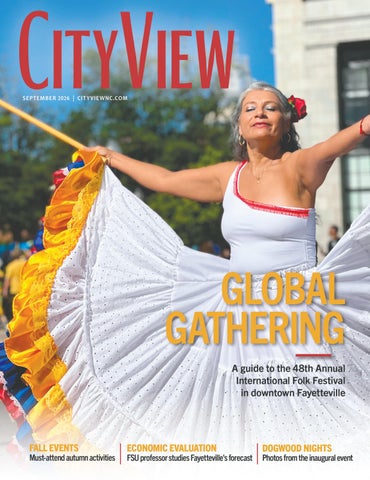
A colorful display during the International Folk Festival in downtown Fayetteville in 2022. Photo by Sabreena Czarnecki
F E ATURES
COLUM NS
10
A Cultural Mosaic
4
Editor’s Take | Matt Hennie
A guide to the 48th Annual International Folk Festival in downtown Fayetteville.
6
The View From Here | Tim White
8
Family Matters | Claire Mullen
32
Oye, ¿Cómo Va? | Claudia Zamora
34
Good Reads | Diane Parfitt
36
The To-Do List Your go-to spot for local events
40
Seen @ the Scene Photos from Dogwood Nights
16
History Buffs
20
Taking Stock
24
Fall Means Festivals in Fayetteville
From civilians to soldiers, and every history buff in between, two museums on Fort Bragg offer the chance to immerse yourself in history.
Fayetteville State University professor Jeremy Jackson is giving Fayetterville its clearest economic picture yet.
As temperatures cool, fall events make it an ideal time to venture outdoors for festivals and fun across Cumberland County.
ON TH E COVE R Thousands of people flocked to downtown Fayetteville for the International Folk Festival in 2022. Photo by Sabrina Czarnecki
E D ITO R ’ S TA K E
Turkey Leg Time BY MAT T HENNIE
I grew up in Savannah, where festivals and street parties are a way of life. Tourism is the lifeblood of the historic city, and it knows how to throw a big outdoor event. From the quirky Beach Bum Parade on Tybee Island to the more mainstream Jazz Festival and Scottish Games in Savannah, a fun outdoor event is never too far away on the calendar for this coastal city. But the city’s signature event, without doubt, is St. Patrick's Day. The massive celebration and parade through downtown is one of the largest in the U.S. and turns downtown into a days-long party. With two military bases there, the soldiers—like they do in Fayetteville—help amp up any big event. My experiences with St. Patrick’s Day started as a kid going with my parents to see the parade. I remember the long walks from wherever my dad could find a free parking space on the side of the road to our favorite viewing spot downtown. As I got older, I would sit on the curb waiting for my sister, who took part in the parade with her high school marching band. When my time came, I was also part of the high school marching band. Every year, we all had to fend off women who would run into the street and plant kisses on our cheeks leaving behind lipstick stains as we performed. Nevermind the constant offers of free beer. Not to be outdone by my older sibling, I was also drum major for three years, which is a far more fun—and easy—way to experience marching in the parade. After high school, I would return to Savannah for St. Patrick’s Day, old enough to navigate the crush of people that turned River Street into an outdoor party after the parade. And as an adult, I’d visit with friends and learned that there’s something special about consuming a lukewarm beer and a massive turkey leg while walking through a crowd of tens of thousands of people. I really am a sucker for a festival turkey leg cooked on an open grill. All those memories came flooding back as I worked on the September issue of CityView magazine. We took an outdoor event approach to the arts and culture theme, focusing our cover story on the 48th International Folk Festival. 4 | SEPTEMBER 2026
First started in 1978, the folk festival looks quite different today. But its celebration of the diverse cultures that call Cumberland County home is still a must-see, and we offer a guide to the late September event. A companion piece provides details on several outdoor festivals and parties in the coming weeks, from the recurring 4th Friday from the Cool Spring Downtown District to Dogwood Nights from the Fayetteville Dogwood Festival and First Friday on Main in Spring Lake. There’s also the second Heritage & Harvest Bourbon event at Cape Fear Botanical Garden. Over the years, my tastes have changed from beer out of a keg to bourbon, so that event piques my interest. If learning history inside with air conditioning is more your speed, this issue also includes a look at two museums on Fort Bragg—the JFK Special Warfare Museum and 82nd Airborne Division War Memorial Museum. Our columnists this month explore cultural traditions during Hispanic Heritage Month, the dream of establishing downtown as the cultural core of Fayetteville, books examining the building blocks of civilizations, and the importance of family dinners. This issue also includes a sponsored feature from Fayetteville State University focusing on the work of Jeremy Jackson. Each quarter, the professor and economist distills a mountain of data into a look at the status of the region’s economy and where it’s headed. The magazine closes with photos from the inaugural Dogwood Nights. Thanks for reading!
Matt Hennie is CityView’s editorin-chief. He can be reached at mhennie@cityviewnc.com.
Thousands of people headed downtown for live music, vendors, food, a car show, and fun during the 44th Annual Fayetteville Dogwood Festival in April. Photo by Tony Wooten
CITYVIEWNC.COM | 5
TH E V I E W F R O M H E R E
The Downtown Dream BY TIM WHITE | PHOTOGR APHY BY JAMES THROSSEL
The Arts Council of Fayetteville | Cumberland County opened the doors of ArtsXL for a community open house on February 5. Supporters of the multi-use facility on Burgess Street in downtown hope it creates a hub for creatives and nonprofits.
If you don’t live in Fayetteville, chances are you don’t see the city as a cultural hot spot. That was my own first impression when I arrived in town 27 years ago. Hay Street was more rubble than art and there was no central arts-and-culture destination here. The good stuff— which I found pretty quickly—was scattered about, looking like it was dropped at random across the landscape with no plan or forethought. But oh, there was some good stuff in those scatterings. There was the Cape Fear Regional Theatre, a cultural beacon at the top of Haymount Hill, the home of extraordinary drama, comedy, and music. Not far away was the Museum of the Cape Fear, The Little Engine That Could of local history. The Arts Council, a downtown renaissance pioneer, offered gallery shows and, more important, one of the great catalysts of downtown’s redevelopment: 4th Friday. And hidden away in a residential neighborhood off Bragg Boulevard was the Fayetteville Museum of Art, a gem that was perfectly located to be ignored. Along the way, both of the city’s universities became cultural resources of their own, the Cape Fear Botanical 6 | SEPTEMBER 2026
Garden grew into a stunning venue for festivals and performances, the city built the gorgeous Festival Park downtown, and the Crown Complex moved beyond sports to present a broad array of music and other entertainment. There was a lot of arts and entertainment to love in this city. But it was still scattered, with little rhyme or reason. The smartest change that happened in Fayetteville’s cultural growth was the city’s decision to create a downtown arts and entertainment district—a central destination for residents and visitors to go and enjoy good food and good times. The transition was almost magical, with excellent restaurants, splendid little bookstores, small galleries, and boutiques sprouting throughout the downtown district, while residential construction made it an excellent place to live. It was a stunning transformation, much of it happening in just a decade or so. The job isn’t done. The Fayetteville Museum of Art shut down 16 years ago and nothing has really replaced it. It’s a big hole in the city’s cultural landscape, despite efforts by the universities and small galleries to fill the gap.
And more worrisome, the county’s decision to abandon its exciting plan for a downtown performing-arts venue has left a continuing crater in the downtown arts and entertainment district. County commissioners probably chose the wisest financial course when they decided to walk away from the downtown project and put money instead into the resurrection of the decrepit Crown Theatre. I get the moneyball considerations. I get the need for county politicians to appear frugal and good stewards of the taxpayers’ money. That makes sense—at least for politicians who want to win the next election. But it still was a terrible decision that in the long run will hurt downtown—where, it should be noted, the county is a major property owner—and won’t help put Fayetteville on the map of cultural destinations in North Carolina. In truth, it was a revisiting of a terrible decision made decades ago by predecessors of the current commissioners when they decided to locate the Crown Coliseum out on U.S. 301, near the airport, instead of downtown, where it belonged. By the time the coliseum was built, 301’s glory days had long faded. Before I-95 was built, it was a major northsouth route running through the city. But once I-95 took the bulk of that traffic, 301 faded fast, upscale businesses disappeared, and urban blight took over. That hasn’t changed. What we have now is an unsightly drive from the city out to the Crown property—a drive that many people will
avoid if they can when they’re headed to a Crown event. And they definitely won’t be stopping downtown to visit the restaurants and shops before or after shows out there. They’ll just head home, just like I did whenever I went to shows or games. If the Crown Complex were located in a pleasant, safe, walkable downtown, it’s a good bet I would have strolled from the event to a restaurant for a snack and maybe a drink before or after the show. And I would have had a lot of company. A downtown performing arts center would have a multiplier effect downtown, drawing customers to many of the other businesses there. Out on 301? Get me outta there! I hope the city gets serious about building a convention or performing arts center of its own downtown. It may be the only way it gets done. And I hope even more that the plans will also include a substantial art museum. I have long believed downtown is the cultural core of Fayetteville and that it can be developed further to create a prosperous synergy that lifts our economy and our spirits. A lot of people share that dream. Let’s not let it die.
Tim White is the former editorial page editor of The Fayetteville Observer.
CITYVIEWNC.COM | 7
FA M I LY M AT TE R S
Family-Style BY CL AIRE MULLEN
Growing up, I never knew there was a term to describe the exact way the six of us ate dinner—or “supper,” if we’re being Southern-technical—seven nights a week, regardless of how long my parents’ work days had been, how many extracurricular activities or how much homework the four of us kids had after school. Sitting down as a family to eat a home-cooked meal around our big kitchen table was an expectation—not optional, and not a novelty. It was as much a part of our daily routine as brushing our teeth, getting dressed for the day, and leaving for our respective schools and offices. Suppertime was sacred to my parents, and their children had rules to follow out of respect for the sanctity of the only time during our busy days all six of us were together in the same place without interruption. The kids were expected to take turns setting the table and were taught from a young age how to do this task properly—putting out placemats, folding the napkins into neat triangles, and arranging the dessert and dinner forks in their correct places neatly to the left of the Blue Willow china plate…the fork and spoon to the right. If it was your turn to set the table, it was also your responsibility to ice the glasses and place them in the corner of the place mat where they belonged. There were no hats at the table. No electronics. No eating until all the food had been passed, served, and most importantly, blessed. No excusing yourself from the table until the last, slowest diner finally announced they were done. This was, without fail, always our dad, and we kids, now all in 8 | SEPTEMBER 2026
our 30s and 40s, still agree to this day that we spent years wondering if he cut his food into the tiniest pieces and chewed in methodical slow motion just to torture the four of us.
We were six people who each knew that no matter what, we would be able to come together once a day to share a nourishing meal and be together as one family. If you were lucky enough to have eaten a meal prepared by my mother, you know the food that was served at our carefully-set table was worthy of the ceremony and reverence. On any given night, our wooden farm table was completely covered with bowls and platters of whatever delicious homemade cuisine she had chosen for that evening. It could have been a big plate of chicken, fried to absolute perfection, flanked by a bowl of
mashed potatoes slathered in melted butter, made-from-scratch biscuits with homemade peach jam, and green beans seasoned so well that even the most green-averse child could have been tricked into eating them. The next night it might have been a fresh fruit salad with every fruit you could imagine, glazed with a sprinkling of sugar and lemon juice, blueberry muffins, and the pièce de résistance, homemade meatball stroganoff, a dish so popular in our family that my mom had to ration the meatballs exactly evenly between her four kids. There were bubbling casseroles, pot roasts with tiny carrots, giant bowls of chicken ‘n’ dumplings, pasta dishes with sauces my mom created without a recipe, homemade yeast rolls, and dishes of whatever vegetables were in season that always paired perfectly with our entree. And, without fail, there was always a big, ceramic, bluestriped pitcher of fresh sweet tea and a little glass bowl of sliced lemon on the table. Dessert was not reserved for special occasions. Several nights a week, our big supper would be followed by a sweet treat. Maybe apple dumplings with homemade hard sauce. Strawberry pie with fresh whipped cream. Fresh-from-the-oven chocolate chip cookies or homemade chocolate ice cream in the summer. The adults would make an after-dinner pot of coffee, and, on occasion, my mom would pour us kids our very own “coffee”—equal parts sugar and milk with a splash of black coffee. And while we ate, my family talked. Our conversation topics ranged from the happenings of our days, to silly
Photo by Getty Images via Unsplash +
things, serious things, religion, current events, and family matters. We were six people who each knew that no matter what, we would be able to come together once a day to share a nourishing meal and be together as one family. These suppertime traditions and memories were so special to me that when my husband and I got married and started a family of our own, I told him that no matter how hectic our days became, it was vitally important to me to carry on these uninterrupted, family-style suppers around our kitchen table. For a while, we did really well. I tried my best to recreate my favorite childhood meals, taught our two children how to set the table, and upheld the regulations of my childhood dinners—no hats, no screens, blessing before eating, and no one is excused until everyone is done. And then came the TV trays. Four folding mini-tables with their very own storage stand, tucked in a corner of our living room. We’d ordered the set from Amazon as a short-term solution to relocated dining during a kitchen renovation. Several weeks ago, as I carried pre-plated meals from the
kitchen to the living room, distributed each of them onto a TV tray, and tucked an unfolded paper napkin under plates, and plopped a fork and knife on top of them, it occurred to me that I couldn’t remember the last time we’d eaten supper at our kitchen table. Our renovation had been complete for months, and we were still eating plopped on our sectional sofa in front of the television. My family assembled at their respective trays, and my son asked if we could watch professional soccer highlights. My daughter countered with, “No! We have to watch America’s Got Talent! That’s our new tradition.” So much for the no screens at the table rule. So much for conversation. I decided then and there that supper was moving back to the kitchen. And so, the next day, my daughter just happened to have several friends over for a sleepover. When I insisted that the kids put their electronics away and come to the kitchen table for supper, my tween protested, “But Mom, we’re just eating takeout!” She and her friends made their way to the kitchen, where I’d dumped tortilla chips from their greasy paper bag
into a fine china bowl, poured salsa into individual ceramic ramekins and queso from its styrofoam cup into a tiny pitcher for serving, and moved their tacos and quesadillas from their aluminium containers onto our nice dinner plates. Again, my daughter, a little perplexed, surveyed the spread and said, “Mom, you didn’t have to do all this. We could have just eaten out of the containers.” One of her sweet friends, unaware of our months-long dinnertime America’s Got Talent binge, spoke up and said, “You’re lucky your family eats together at the table like this. A lot of people don’t these days.” And then, that same friend offered to bless our food. Food that we enjoyed while we laughed and we talked. Family-style.
Claire Mullen can be reached at clairejlmullen@gmail.com.
CITYVIEWNC.COM | 9
CU LT U R E
A Cultural Mosaic A GUIDE TO THE 4 8TH ANNUAL INTERNATIONAL FOLK FESTIVAL IN DOWNTOWN FAYET TE VILLE . STORY BY SAR AH MUNSCH I PHOTOGRPAHY BY MAT THEW WONDERLY
F
From traditional dances to global cuisine, the 48th Annual International Folk Festival, presented by the Arts Council of Fayetteville | Cumberland County, returns on September 25–26, promising a celebration of the diverse cultures that call Cumberland County home. Many of the groups represented in the festival were drawn to Fayetteville due to the presence of Fort Bragg, the largest military base in the world by population, which supports a total of over 260,000 people. A Return to Local Roots In 1978, when the International Folk Festival (IFF) was founded, it looked vastly different to what we know it as today. In its early years, the festival featured more countries, but had less attendees. It began featuring 45 countries with around 10,000 attendees, and this year it is expected to feature about 25 countries and attendance projected at 75,000 people. John Malzone, a co-founder of the festival and longtime civic leader, has a theory on why the number of countries represented has shrunk to almost half in the last 48 years.
10 | SEPTEMBER 2026
“Some of the communities have assimilated into the American culture and they’ve lost some of those [traditions]” Malzone said. “That is a job, to keep up those heritages, the recipes, the dances, the music, you have to have somebody who understands them, and who is willing to teach them, and then you have to have parents who make their kids listen.” While the festival has evolved significantly since its founding, this year’s event focuses on creating a more genuine, community-driven experience. The organizers are focusing primarily on highlighting local performers, artists, and groups from Cumberland County, a shift from the previous several years when the festival highlighted out-oftown groups as the main event. This strategic shift aims to deepen the event’s community connection by showcasing the diverse talents already thriving locally. Malzone expressed enthusiasm when learning that the Arts Council plans on revising the acts to feature local cultural groups. “Good, that’s good,” Malzone said. “One of the problems with anything is when you try to be something that you're not, you kinda lose the flavor, so I'm glad to hear that.”
The International Folk Festival filled the streets in downtown Fayetteville in 2017.
CITYVIEWNC.COM | 11
12 | SEPTEMBER 2026
CITYVIEWNC.COM | 13
Friday, September 25 Sarah Busman, the Arts Council’s vice president, urged attendees to spend time at the festival on both days to ensure they experience the full range of what the festival offers. The festivities begin Friday at 6 p.m. It kicks off with performances from El Centro Hispano. Downtown businesses are staying open until 9 p.m. when the festival shuts down for the evening. “Coming on Saturday is awesome, and there's so many amazing things, but if you don't come on Friday and see Friday also, you're missing half the festival and it's really exciting and different, and you're missing what
14 | AUGUST 2026
downtown Fayetteville really has to offer,” Busman said. Saturday, September 26 The festivities continue Saturday at 8 a.m. with the Friends of Civil Affairs “Around the World Run” starting at Cape Fear Botanical Garden. This run can be completed as a 5k or 10k. Registration is required. At 10 a.m. the Parade of Nations begins on Hay Street. The parade features floats, dancers, bands, and more and is such a sight to see. Different groups often carry flags or banners of the country and culture they are representing and some groups may even hand out items
pertaining to their culture. Festival Park is open from 12–7 p.m. and includes the art market, international cafe, and stage performances.. Both days of the festival are free to attend. Engage and Learn Adika Iqbal, co-founder of the Azerbaijan Friendship Organization, is excited about the opportunity to perform at the festival on Saturday and increase awareness about her culture. “It’s a very fast paced dance we do,” Iqbal said. “I think once you see it in person, you will love it, so I am
encouraging everyone to come and watch us. Sometimes we would invite folks to come and join us to dance and it is the joy that gives us seeing other people performing our dance.” Iqbal wants to let attendees know that it’s OK to be curious and ask questions when they don’t know where Azerbaijan is, or about the culture. “I would love [attendees] to approach, ask us questions. We never feel offended if they don’t know where Azerbaijan is,” Iqbal said. “We love to tell about our country, tell about our culture, or anything that they have questions. Please stop by, say ‘hi’, and ask questions and we would love to answer any of their
questions and share our culture.” Layout of the Festival On one side of Festival Park, you will find the international cafe, where local non-profits make food that is traditional to their family, community, and culture. Vendors and the art market will be located in the park’s field. “For our art market, we are asking for only homemade items, which kind of makes IFF unique,” Busman said. There will also be a children’s area between the field and Ray Avenue. The kids area will include arts and crafts, bounce houses, and performances.
“You can kind of walk down the international cafe, walk over the bridge. Catch some good music or dancing there,” Busman said. “So that's a great opportunity to, you know, take your food, go for a little walk around, go shopping, it’s a great place to find gifts for the holidays or for yourself.”
ABOUT THE AUTHOR Sarah Munsch is a freelance writer for CityView. She was born and raised in southeast Texas and moved to Cumberland County in November 2024.
CITYVIEWNC.COM | 15
H I S TO RY
History Buffs FROM CIVILIANS TO SOLDIERS , AND E VERY HISTORY BUFF IN BET WEEN , T WO MUSEUMS ON FORT BR AGG OFFER THE CHANCE TO IMMERSE YOURSELF IN HISTORY. STORY BY ABR AHAM KENMORE
A visitor looks at the hundreds of vivid photos that make up the "Soldiers: The Global War on Terrorism" exhibit at the Airborne & Special Operations Museum in Fayetteville. (The appearance of U.S. Department of War (DoW) visual information does not imply or constitute DoW endorsement.) Photo courtesy of Airborne & Special Operations Museum
I
If you’ve ever wanted to learn more about some of the military units that call Fort Bragg home, perhaps it’s time to visit the two museums on post. Both the JFK Special Warfare Museum and the 82nd Airborne Division War Memorial Museum are free and open to the public in addition to serving as training resources for troops. JFK Special Warfare Museum Address: 3004 Ardennes St. Hours: 11 a.m. to 4 p.m. Monday through Friday
This museum is dedicated to the three branches of Special Operations—Army Civil Affairs, Special Forces, and Psychological Operations. The entrance is guarded by Barney, a now-taxidermied sun bear who resided on Fort Bragg after coming home with special forces soldiers during the Vietnam War. The gallery presents a roughly chronological series of 16 | SEPTEMBER 2026
exhibits including the Spanish-American War, the civilian Office of Strategic Services—a World War II-era spiritual precursor to Special Operations, and a captured Taliban flag that was flying over the former U.S. embassy in Afghanistan and a psy-op leaflet bomb. Museum director Roxanne Merritt has been with the museum since 1981, when it was housed in a 500-square-foot space. She has helped it grow into its current 8,900-squarefoot location. Last year the museum saw over 27,000 visitors, and Merritt estimates about 70% are soldiers visiting as part of training or veterans. But the information is arranged in a way that anyone—soldier, civilian, military history buff, family members of veterans—can follow along. “We do like to make it to where it’s more of an intimate setting, so that [families] feel comfortable,” Merritt said. “We get a lot of people who would never talk about their service, but then might see this uniform … they might start talking about that, ‘I remember when I wore that uniform.’”
Soldiers from the U.S. Army Reserve Command, Fort Bragg, look at the D-Day exhibit at the Airborne & Special Operations Museum in Fayetteville, January 11, 2013. The noncommissioned officers were given a guided tour of the museum by a World War II veteran as part of the USARC monthly NCO professional development program. (The appearance of U.S. Department of War (DoW) visual information does not imply or constitute DoW endorsement.) Photo by Timothy Hale
17 | SEPTEMBER 2026
A visitor at the Airborne and Special Operations Museum looks at an exhibit honoring Pfc. Roland Bragg, who was assigned to the 17th Airborne Division, under XVIII Airborne Corps, and fought as a paratrooper in the Battle of the Bulge during WWII. (The appearance of U.S. Department of War (DoW) visual information does not imply or constitute DoW endorsement.) U.S. Army photo by Pfc. Richard Morgan
82nd Airborne Division War Memorial Museum Address: 5108 Ardennes St. Hours: 10 a.m. to 4 p.m. Tuesday through Saturday If you want to learn the history of the division that’s nearly synonymous with Fort Bragg, the 82nd Airborne Division War Memorial Museum is the place to visit. The main museum holds artifacts and displays from the division’s major deployments along with profiles of particular service members or others associated with the unit. That includes Vivian Goodwin, who suggested the “All American” nickname that the division still bears. The artifacts are wide-ranging, with uniforms and captured enemy weapons alongside personal momentos: a colored pencil sketch of a service member rendered on parachute nylon and a World War I era ribbon worn by a drafted service member. Outside are memorials to soldiers who died stretching back to 1917. There is also an airpark with the planes airborne troops leapt from, including the 1940s C46F Commando and the C130E Hercules that is still used today. The 82nd Airborne museum consists of 14,000 square feet across a main building and an annex. Its primary purpose is training, but as museum Director John Aarsen told CityView last year, “I have to make my training interesting enough that (a) soldier is willing to bring his wife and children here on Saturday to see it.”
18 | SEPTEMBER 2026
The museum keeps up with the actions of the division, adding new exhibits regularly. “We have literally put an exhibit together here 10 days after the division returned from an operation, a full blown special exhibit,” Aarsen told CityView at the time— and the displays can help service members explain their deployment to family members. Recently the museum has also added a new video theater with a film about the division that plays at the top of the hour, Aarsen said in an email to CityView in June. The museum sees about 46,000 visitors annually and hosts regular events throughout the year, including change-of-command ceremonies, Easter egg hunts, and visits from Santa. Civilians can request assistance from the museum for historical research but it is a courtesy service and may not be available. Planning a Visit If you do not have a Department of Defense ID, you can still visit Fort Bragg. US citizens with a Real ID can register online to request a pass. It’s recommended to apply more than 24 hours in advance of your visit; passes cannot be issued more than 30 days before the visit. You will receive a text letting you know if a pass is and can then enter through any gate as long as they have their Real ID ready to scan. Keep in
mind that the All American Gate is closed, though the Visitor Control Center remains open. If you don’t register ahead or do not have a Real ID, you can always visit the Visitor Control Center outside the All American Gate. You still need to present ID, such as a passport, to gain access. There is a brief security vetting process and then visitors will typically receive a six-month pass. The Visitor Center hours are 5 a.m. to 9 p.m. daily. If you are not a U.S. citizen, you cannot access Fort Bragg without being sponsored by someone who has an authorized Department of Defense ID.
ABOUT THE AUTHOR Abraham Kenmore is a freelance journalist and producer in the Triangle. He reports on politics and policy across the South. He can be reached at abekenmore@gmail.com.
DON’T WATER THE LAWN WHEN IT’S Save With The WaterSense Rain Sensor RAINING. Program ®
Jeremy Jackson, the Lloyd V. Hackley Chair for the Study of Capitalism and Free Enterprise at Fayetteville State University’s Broadwell College of Business and Economics.
ECO N O M Y
Taking Stock Fayetteville State University professor Jeremy Jackson is giving Fayetteville its clearest economic picture yet.
T
BY TERI SAYLOR I PHOTOGR APHY COURTESY OF FAYET TE VILLE STATE UNIVERSIT Y
To understand Fayetteville's economic well-being, start with Jeremy Jackson. Every quarter, the Fayetteville State University (FSU) economist distills a mountain of data into a clear picture of where the region's economy stands and where it's headed. Jackson is the Lloyd V. Hackley Chair for the Study of Capitalism and Free Enterprise at FSU’s Broadwell College of Business and Economics, and he is using his platform to
20 | SEPTEMBER 2026
report on local, state, and national economic trends. Using the Federal Reserve Economic Data—an online database covering employment, inflation, Gross Domestic Product, interest rates, and banking—Jackson compiles quarterly reports focusing on the Fayetteville Metropolitan Statistical Area and the broader Sandhills region. The reports focus on leading indicators such as wages, labor force participation,
unemployment rates and housing price indices. Jackson’s Economic Outlook Quarterly Report for Q2 2026, published in June, provides a forward-facing view grounded in historic data and robust economic methodologies. The report adds context for decision-makers navigating future uncertainties and fills a void in the marketplace for local economic information, he says.
S P O N S O R ED C O N T EN T
FSU professor Jeremy Jackson discusses regional economic trends and public-private partnerships during a community panel.
Jackson, who joined FSU’s faculty in 2024, developed his North Carolina forecast model to predict economic trends and to forge a connection to the community. “My goal is to provide analytical, data-driven methods for reporting on what's happening in the local economy,” he says. Before joining FSU, Jackson held a similar position at North Dakota State University where he first started developing quarterly economic reports. He also authored Prairie Prosperity: An Economic Guide for the State of North Dakota. His work in North Dakota highlighted the state's structural economic drivers, fiscal vulnerabilities, and crisis impacts, including the state’s “boom-andbust” economy brought on by the state’s reliance on its agricultural sector and energy reserves during the oil boom of the early 2000s.
S P O N S O R ED C O N T EN T
Jackson’s arrival at FSU represented a homecoming of sorts. A native of Fayetteville, he was born at Fort Bragg where his dad was stationed. He also forged ties to North Carolina as a visiting research scholar at Wake Forest University in 2018 and 2019. Drawn to FSU because of shared goals, interests, and experience, Jackson seized the opportunity to hold the endowed professorship that came with a measure of prestige and a budget that enables him to pursue special projects like his quarterly reports. The reports aim to inform the public and provide business leaders and policy makers with a tool to help them plan for Fayetteville’s future. They focus on key economic indicators such as wage growth, labor force participation, unemployment, and the housing price index.
The 2026 Q2 report depicts a positive outlook for both North Carolina and the Fayetteville metropolitan area. Statewide, salaries appear poised for growth, he says. He predicts a brief downturn in gross state product but expects it to grow by 2027. Jackson reports that the Fayetteville housing index is forecast to remain near its current level, and the local unemployment rate is expected to continue its downward trend, indicating a strengthening local jobs market. Forecasting has long been a mainstay in the field of economics, Jackson says. “It conveys much-needed information about the world we live in,” he says. “Forecasting also shows trends in economic variables that can be useful for public and private decision-makers.”
CITYVIEWNC.COM | 21
But, Jackson warns, economic forecasting is not an exact science. “Models use historical data and past trends, and unexpected changes in economic conditions, public policy or other factors may disrupt accuracy,” he says. “In addition, models don’t incorporate the inherent uncertainty and complexity surrounding. the modern economic system.” Nevertheless, Jackson says that the North Carolina economy continues to perform well. He plans to expand his reports to include some of the state’s metropolitan areas, including Raleigh and Charlotte. Some regions of the state are experiencing an economic development boom, and overall population is on the rise. In January, using U.S. Census Bureau estimates, the Governor’s Office reported that North Carolina has become the third fastest growing state in the nation, swelling to 11.2 million. According to the N.C. Association of County Commissioners, Cumberland County’s 2025 population is 337,972, representing nearly 3% growth since 2015. But statistics fluctuate when taking Fort Bragg into consideration. “It’s great for Fayetteville and the state that people are moving here,” he says. “But when we consider what's happening on the base, that kind of flow in and out of Fort Bragg does have a lot to do with the way Fayetteville’s tides shift as reflected in the housing market, and the demand at local businesses.” This summer has been good to FSU, which recently announced a $6.5 million commitment from Anonymous Trust, a community funder that focuses on elevating under-resourced communities in eastern North Carolina. It’s the largest gift in FSU's history and comes during a time of unprecedented summer enrollment of 4,827, according to the announcement. 22 | SEPTEMBER 2026
My goal is to provide analytical, datadriven methods for reporting on what's happening in the local economy. - Jeremy Jackson
The gift covers tuition, housing, and meals for students enrolled in the University's 30-60-90 Free Summer School Program. And the state’s new budget bill includes a recurring $2 million annual state allocation for the initiative. The university also announced that FSU’s Broadwell College of Business and Economics earned national recognition from The Princeton Review’s 2027 Top 50 Online MBA Programs, ranking FSU’s online MBA 20th in the nation. All this bodes well for the economy, and local business owners are among those reaping the greatest rewards.
S P O N S O R ED C O N T EN T
FSU professor Jeremy Jackson builds his North Carolina forecast models using data drawn from the Federal Reserve Economic Data, an online database covering employment, inflation, Gross Domestic Product, interest rates, and banking.
“Many of my students are looking at careers as entrepreneurs and they know they will need start-up funding,” he says. “Having these reports that say the economy here is doing well and can support their endeavors can help them get loans and attract investors.” Local government officials and economic developers can also point to the reports to support their initiatives and attract business and industry, and FSU is raising the bar on workforce development. “Higher education plays a key role in ensuring we're building the workforce that employers are going to need in the future,” he
S P O N S O R ED C O N T EN T
says. “North Carolina is blessed with one of the best systems of state universities in the country and some of the highest-tier private institutions as well.” Jackson has taken a public service approach to his work, which includes research with co-authors on how free markets and economic freedom interact with social capital, trust, and regulation. “We typically measure those through what we call indices of economic freedom,” he says. “My research has looked at the relationship between economic freedom and happiness.” His studies also explore how
regulatory burdens and market exchanges dynamically affect social trust. “I've looked at the relationship between economic freedom and social capital, where social capital is one of the most enduring things that contributes to measures of happiness, the ties that bind us together, and the communities we live in,” he says.
ABOUT THE AUTHOR Teri Saylor is a freelance writer based in Raleigh.
CITYVIEWNC.COM | 23
CU LT U R E
Fall Means Festivals in Fayetteville As temperatures cool, fall events make it an ideal time to venture outdoors for festivals and fun across Cumberland County. STORY BY ABR AHAM KENMORE I PHOTOGR APHY BY MAT THEW WONDERLY
24 | SEPTEMBER 2026
Dogwood Nights, a new outdoor street party from the Fayetteville Dogwood Festival, kicked off with a back to school theme on August 8, 2026.
W
Whether you’re interested in classic cars, local authors, good whiskey, or live music, there’s a festival for you in Fayetteville this fall. 4th Friday Cool Spring Downtown District October 23, 6–10 p.m.
For Fayetteville residents, 4th Friday will be a familiar event. But this October, the event includes its first fall festival. The festival will include the band Evan Blackerby & The Bandwagon as well as the School of Rock student band from Capitol Encore Academy, a book crawl featuring authors from across North Carolina, a local brewery beer garden, and the Fayetteville debut of Paperhand Puppets.
It should be quite the crowd— even during this year’s hot summer, crowds for the 4th Friday in June and July ranged from 7,000 to 9,000 people, according to Ashanti Bennett, Cool Spring’s chief executive officer and president. Although the district always has an event in October, the new fall festival replaces Cool Spring’s prior involvement in the Zombie Walk. “You don’t lose any of your Halloween fun, though, because we’re still doing our expanded Halloween event the following week,” Bennett said. That event on October 31 will include a trick or treat from 4–6 p.m. as well as an all-ages costume contest and pop-ups from local bars and restaurants. Note that Cool Spring is skipping its 4th Friday event in September
to avoid a conflict with the International Folk Festival. Dogwood Nights Fayetteville Dogwood Festival September 12, 6–9 p.m. October 10, 6–9 p.m. November 14, 6–9 p.m. Dogwood Nights isn’t the first event from the Fayetteville Dogwood Festival outside of its spring event. The festival has also organized the Fayetteville After 5 concert series, but the new festival series this fall aims to be more accessible for everyone. “It was just time for us to find something that fit what our community needed now and not what fit, you know, a few years ago,” said executive director Kaylynn Suarez, the festival’s executive director.
CITYVIEWNC.COM | 25
Dogwood Nights, a new outdoor street party from the Fayetteville Dogwood Festival, kicked off with a back to school theme on August 8, 2026.
26 | SEPTEMBER 2026
CITYVIEWNC.COM | 27
Dogwood Nights, a new outdoor street party from the Fayetteville Dogwood Festival, kicked off with a back to school theme on August 8, 2026.
Each of the events is intended to draw in a different audience. In August, the theme was focused on back to school ahead of the August 24 return of students in Cumberland County Schools. In September, the theme is “Around the World” in preparation for the International Folk Festival two weeks later. October brings Oktoberfest for the adults and November will feature a classic car show and a doo-wop band aimed at senior citizens. The new event series is already shaping up to be a success. Suarez said she would have been happy with 200 people at the August kickoff. “There were a couple thousand people overall in attendance, and that made us feel … like we’re doing the right thing,” she said. Heritage & Harvest Bourbon Showcase 2026 Cape Fear Botanical Garden October 3, 1–5 p.m. This year brings the second Heritage & Harvest Bourbon event at Cape Fear Botanical Garden. It features five distilleries from across North Carolina, including Buffalo City Distillery, BHAWK, Southern Grace Distillery, Olde Raleigh Distillery and End of Days Distillery.
28 | SEPTEMBER 2026
Alongside the whiskey will be demonstrations of blacksmithing, woodworking, quilting and other heritage crafts, as well as information on the distilling process, the agricultural inputs that go into bourbon and even the history of tobacco in North Carolina. “I’m always amazed at the people who I run into who say … ‘I’ve lived here all my life and I’ve never been out to the garden,’” said Sheila Hanrick, the garden’s director of marketing, programs and visitor experience. “I think people need to realize what they have at their back door, and this is one way to get people to come.” General admission tickets this year will run $25 ($15 for members), admission with five samples is $40 ($30 for members), and a VIP admission with eight samples and a take home glass is $80 ($60 for members). First Friday on Main Spring Lake September 4, 6–9 p.m. October 2, 6–9 p.m. November 6, 6–9 p.m. Started as a way to rebuild community and revitalize downtown, Spring Lake’s First Friday is now in its fourth
STAY CONNECTED CityView Magazine is Fayetteville and Cumberland County’s premier lifestyle and local news magazine. Choose between our two convenient and affordable subscription options.
PRINT & DIGITAL
DIGITAL ONLY
$12 PER YEAR
FREE!
Cumberland County Public Library
AMERICA 250
WALKING TOUR & REVOLUTIONARY WAR TALK
Walking Tour Sept. 18, 10 a.m.
Revolutionary War Talk Sept. 18, 3:30 p.m. Headquarters Library, 300 Maiden Lane
Registration is required by calling 910-483-7727, ext. 1365, or online at cumberlandcountync.gov/library.
ADULT LITERACY & EDUCATION
season. Each coming month has its own theme—September is “Community Connections,” complete with a local talent showcase; October will celebrate Hispanic Heritage Month and November will be “Salute to Service” ahead of Veterans Day. “We really just want our community to get as involved as possible, we want to make accessibility as easy as possible," Mayor Kia Anthony said. “It’s a really, really really good time and we always have a blast.”
ABOUT THE AUTHOR Abraham Kenmore is a freelance journalist and producer in the Triangle. He reports on politics and policy across the South. He can be reached at abekenmore@gmail.com.
YOUR NEXT STEP STARTS HERE. Build the skills you need for school, work, and everyday life.
GED & ASVAB PREP
ESL
CAREER READINESS
FINANCIAL LITERACY
COMPUTER SKILLS
STUDENTS & TUTORS DESIRED.
Learn more at fayurbmin.org
QR CODE
Treat Yourself to a New Ride With Our Great Rates¹ You could get on the road with: decisions in seconds, in most cases preapproved loans good for up to 90 days military discounts available²
Navy Federal is federally insured by NCUA.
Apply Today! Scan the QR code, use our mobile app³ or visit navyfederal.org/auto
¹Credit and collateral subject to approval. ²Direct deposit is required. This military special may expire at any time. Applicants must contact Navy Federal by phone or visit a branch to receive the discount. Active Duty rate discounts (which are also available for retired military members) can be applied, subject to certain restrictions. ³Message and data rates may apply. Visit navyfederal.org for more information. © 2025 Navy Federal NFCU 14497 (5-25)
* Buffalo City Dissllery * BHAWK * Southern Grace Dissllery * Olde Raleigh Dissllery * End of Days Dissllery * Cumberland County Beekeepers Associaaon * The Quilter’s Guild * Blacksmith demonstraaons and MORE! Join us Saturday, October 03 for the Second Annual Heritage and Harvest Bourbon Showcase 1 pm - 5 pm. Enjoy tassngs from disslleries, seasonal foods, live music, handcraaing demonstraaons, and more. For more informaaon visit capefearbg.org. Cape Fear Botanical Garden 536 N. Eastern Blvd. - Fayeeeville, NC 28301 capefearbg.org - 910-486-0221 - call or text
Follow us on:
OY E , ¿CÓ M O VA?
When Music Reminds Us Who We Are BY CL AUDIA Z AMOR A
September has a unique way of inviting us to look backward and forward at the same time. As communities across the country celebrate Hispanic Heritage Month, we are reminded not only of where we come from, but also of the stories we continue to create every day. Cultural heritage does not live solely in history books, official proclamations, or annual celebrations. It lives in the traditions we preserve, the meals we share around the table, the memories passed from one generation to the next and, perhaps most powerfully, in music. Some songs are simply heard. Others seem to carry pieces of our lives within them. A familiar melody can awaken memories we thought had faded long ago. A family gathering. A childhood street. The voice of someone we love. A moment suspended in time, waiting patiently to be remembered. Jimmy Román understands this deeply. Originally from Puerto Rico and a longtime resident of Fayetteville, Román has emerged as a distinctive voice in tropical Latin music. An independent singer-songwriter, he blends the soulful traditions of salsa, bachata, and merengue with the contemporary sounds shaping today’s global Latin movement. His artistry stands at the intersection of tradition and innovation, honoring the rhythms that shaped him while embracing the possibilities of a new generation. Yet for Román, music has always been about much more than entertainment. “Music has been with me my entire life,” he shares. “It’s a way of remembering who I am and where I come from. Even when you’re far from your homeland, your roots never leave you. There are songs that can instantly take you back to moments that shaped your life. You hear a melody and suddenly you remember your family, the smell of a meal prepared at home, or the joy of a celebration from years ago. Music has this incredible ability to keep those memories alive.” That connection to memory and identity runs through every aspect of his work.
32 | SEPTEMBER 2026
When the music begins, many of the barriers we carry simply disappear. For a little while, everyone speaks the same language. - Jimmy Román
On June 11, Román released Acaricio, an album that marks an important milestone in his artistic journey. More than a collection of songs, the project reflects years of experiences, emotions, and personal growth. Through its melodies and lyrics, Acaricio explores themes of love, longing, connection, and resilience—feelings that resonate across cultures and generations. “Acaricio is a very personal project for me,” Román explains. “Every song carries a story. Some come from experiences I’ve lived, others from conversations, people I’ve met, or moments that left an impression on me. When I write, I try to do it honestly. My hope is that listeners find something of themselves in the music. Maybe a memory, an emotion, or a piece of their own story.” Speaking with Román quickly reveals his relationship with music is deeply rooted in human connection. Over the years, he witnessed how a single song can transform an entire room. He witnessed it at community festivals, family celebrations, cultural events, and local performances where people of different ages, backgrounds, and experiences suddenly found themselves sharing the same energy. When he describes those moments, there is still a sense of wonder in his voice. “The most beautiful part doesn’t happen on the stage,” he says with a smile. “It happens among the people. I’ve seen
Photo by Daniel Lloyd Blunk-Fernández via Unsplash
individuals arrive carrying stress, worries, and the weight of everyday life. Then, a few songs later, they’re laughing, dancing, and connecting with people around them. I’ve seen young people discover the music their grandparents loved. I’ve watched complete strangers become friends in the space of a single evening. When the music begins, many of the barriers we carry simply disappear. For a little while, everyone speaks the same language.” Perhaps that ability to create connection explains why music plays such an important role in the immigrant experience. For those who have left behind a country, a city, or a chapter of their lives, certain songs become a portable form of home. They travel with us when everything else changes. They comfort us during moments of nostalgia. They remind us who we are when we find ourselves living between different worlds. Román understands that experience both personally and through the stories he encounters within the Latino community. “I’ve seen people moved to tears by a song that reminded them of their family,” he reflects. “It’s incredibly powerful. Music reaches places where words sometimes cannot. It helps us feel close to the people we love, even when they’re far away. It reminds us that we’re part of something larger than ourselves.” In a world that often moves too fast, art continues to offer something essential: the opportunity to pause, feel, and reconnect. That is why spaces like ArtsXL in downtown Fayetteville represent such an important contribution to our community. By opening their doors to local artists, creators, and emerging voices, they help strengthen a cultural ecosystem where stories can be shared, celebrated, and preserved. They recognize that art is not a luxury. It is a human necessity
that helps us understand one another and build stronger communities. Román sees that same purpose in every performance he gives. “I don’t think of music as something I do only for myself,” he says. “I think of it as something meant to be shared. When someone tells me a song reminded them of their family, helped them through a difficult moment, or simply made them smile, that’s when everything makes sense. That’s where the real connection happens.” As we celebrate Hispanic Heritage Month, stories like Román’s remind us that culture is never static and never confined to the past. It evolves with every generation, adapts through every experience, and continues to find new ways to express itself without losing its essence. It reveals itself in a song passed from one generation to the next, in an artist who transforms memories into melodies, and in a community that finds reasons to gather, dance, and celebrate its shared story. And it lives in people like Jimmy Román, whose music was born in Puerto Rico, flourishes in Fayetteville, and continues to build bridges between memories, emotions, and generations. Some songs accompany a moment, and others stay with us for a lifetime. They remind us where we come from, who we are, and why our stories deserve to be remembered and shared. And perhaps that is the greatest gift music can offer, not simply entertainment, but the feeling of belonging. Claudia Zamora is an Argentinian author, mental health and wellness coach, and passionate community advocate. Since 2011, she has made Fayetteville her home, uplifting the Hispanic community. CITYVIEWNC.COM | 33
GO O D R E A D S
Art—The Language of Culture BY DIANE PARFIT T
1
2
3
4
5
6
Culture is the name for what people are interested in, their thoughts, their models, the books they read, and the speeches they hear. - Walter Lippmann
34 | SEPTEMBER 2026
Art and culture—we all know what they are, but do we really understand how they are related? In college, some of my friends were taking Art History courses, but I didn’t have enough time for that with all the science classes I took. Also, like a lot of young adults, I thought art history must be a bore. Little did I know I would end up owning a bookstore/art gallery. Now, I love reading about the intertwining of art and culture. Culture has been described as an outline of how people in a particular group live, while art is a means of expressing the details of life within that outline. Art gives a society a way of communicating their culture, its history, beliefs, hopes, and goals. When we see art from various societies, we know right away where it is from. That is one reason we travel and bring home art and artifacts reflecting those cultures. Here are some books that will make those journeys even more fun and interesting: 1. What is Art? by Leo Tolstoy Many people know that Tolstoy wrote War and Peace and Anna Karenina, but did you know he wrote numerous essays, too? After years of research, Tolstoy penned this collection of essays critiquing his contemporaries’ works to help answer the question, What is Art? He concluded that art should be a force for good and the improvement of humanity. This is a great book for all lovers of art and even artists themselves.
2. Your Brain on Art: How the Arts Transform Us by Susan Magsamen and Ivy Ross When I worked as a nurse in a hospital, I saw how art and music therapy helped patients recover from illness. My daughter was an art therapist and worked for several years with children with developmental delays, helping them gain the confidence and skills to function better in their world. In this amazing book, authors Magsamen and Ross present results of research that show how engaging in an art project reduces stress hormone levels, even if you don’t have any art skills. They show that completing at least one art project a month may even extend your life expectancy. Art, music, and dancing are all forms of entertainment, but they also contribute to our wellbeing. 3. All the Beauty in the World: The Metropolitan Museum of Art and Me by Patrick Bringley Many of us have visited the Metropolitan Museum of Art in New York City or other fantastic art museums. However, most have not had the opportunity to go behind the scenes at one of these great repositories. When Brinkley is faced with a family crisis, he quits his glamourous but stressful position at The New Yorker and takes a job as a gallery guard at The Met. This becomes his home away from home, and as he helps protect the enormous collection of treasures in the museum, he finds the inner peace he needs. In this book, you take this journey with him and go behind the scenes in one of the most famous museums in the world. 4. The Power of Art: A Human History of Art: From Babylon to New York City by Caroline Campbell This book treats us to stories of mankind’s artistic endeavors over thousands of years. We learn about art from around the world—beginning with ancient Babylon—all the way to the present. We experience the value of art to our culture and to each of us. Art history is not boring when we learn how the artists came to create the many wonders we now enjoy. Through this journey, Caroline Campbell shows us how art can teach us about the history of different civilizations and its amazing impact on each of us. 5. Culture: The Story of Us, From Cave Art to K-Pop by Martin Puchner Author Puchner invites us to experience the convergence of art and culture. Through the ages, civilizations have attempted to leave a part of themselves for future generations. They used art, theater, architecture, and literature. This extended from Egypt and Greece, across the many continents, and even to the Moon. Puchner takes us on a memorable journey through the pivotal moments in world history to help us understand the meaning and purpose of our existence.
Photo by Geordanna Cordero via Unsplash
6. The Masterpiece: A Novel by Fiona Davis A captivating piece of historical fiction is an excellent way to learn history. This novel, centered at Grand Central Terminal in New York City, is a great example of that. We think of Grand Central Terminal as a train station, but it is so much more—it is a crown jewel and a masterpiece of design. In this story, Clara Darden sees it as the beginning of her future. Darden is a teacher at the Grand Central School of Art in 1928, at a time when women, particularly “women artists,” are looked down upon. We hope for Darden to succeed, but the Great Depression stands in her way. Fast forward to 1974, when newly divorced Virginia Clay obtains a job in the information booth at Grand Central Terminal to support herself and her daughter. The terminal has been in decline, and there is a lawsuit that may result in its demolition. While working there, Clay comes upon an abandoned art school in the terminal—Darden’s old school! While looking around, Clay discovers an enigmatic watercolor. She sets out to discover the artist and in the process, is drawn into the battle to save the terminal. Along the way, she solves the mystery of Clara Darden, who turns out to be a famed artist lost to history in 1931.
Diane Parfitt owns City Center Gallery & Books in downtown Fayetteville. She can be reached at citycentergallerybooks@gmail.com.
CITYVIEWNC.COM | 35
S E P TE M B E R 2 02 6
THE TO-DO LIST Here are just some of the things happening in and around Fayetteville this month. Scan the code with your phone for more events, additional information, and to post your event on our website. Events are subject to change. Check before attending.
September 1 America's 250th Scavenger Hunt Bordeaux Community Library 3711 Village Drive cumberland.librarycalendar.com
September 3 Paddy's Comedy Club Chris Cope and Don Garrett Paddy's Irish Public House 2606 Raeford Road paddysirishpub.com
September 3 Lafayette Lecture Presents: Transitioning Special Operators to the Civilian Workforce Lafayette Hall Fayetteville Technical Community College 2201 Hull Road faytechcc.edu
September 4 First Friday on Main Main Street, Spring Lake townofspringlake.com
September 4 Little Mania Wrestling Hope Mills Shrine Club 4461 Cameron Road eventbrite.com
September 4, 11, 18, 25 Pink Floyd’s Dark Side of the Moon Fayetteville State University Planetarium 1200 Murchison Road uncfsu.edu
September 4-13 Cumberland County Fair Crown Complex 1960 Coliseum Drive crowncomplexnc.com
Flags fill the Field of Honor at the Airborne and Special Operations Museum on September 11, 2023. Photo by Tony Wooten
36 | SEPTEMBER 2026
September 4-October 25
September 11
September 16
Celebration of Sapphire: Mail Art from Around the World The Arts Council of Fayetteville | Cumberland County 301 Hay St. theartscouncil.com
9/11 Remembrance Ceremony U.S. Army Airborne and Special Operations Museum 100 Bragg Boulevard asomf.org
Free Haircuts by FTCC’s Barber Students Continuing Education Building Fayetteville Technical Community College 220 Hull Road faytechcc.edu
September 5 Mercantile Market The Hive of Hope Mills 3414 Bullard St. thehiveofhopemills.com
September 5 Fear State Paddy's Irish Public House 2606 Raeford Road paddysirishpub.com
September 7 Paddy's Comedy Club Josh Sneed and Ashley Preston Paddy's Irish Public House 2606 Raeford Road paddysirishpub.com
September 9 8th Annual Valor Public Safety Awards Greater Fayetteville Chamber Manna Church 5117 Cliffdale Road faybiz.com
September 10 9/11 Remembrance Tony Rand Student Center Fayetteville Technical Community College 2220 Hull Road faytechcc.edu
September 10-27 Bright Star Cape Fear Regional Theatre 1707 Owen Drive cfrt.org
September 11 3rd Annual 9-11 Run to Remember 82nd Airborne Division Association Carver’s Creek State Park–Sandhills Access 995 McCloskey Road runsignup.com
September 11-27 25th Annual Putnam County Spelling Bee Gilbert Theater 116 Green St. gilberttheater.com
September 17 Chamber Coffee Club Greater Fayetteville Chamber Highland Country Club 1105 Highland Country Club Drive faybiz.com
September 17 Micro Wrestling Group Therapy Pub & Playground 1906 Skibo Road microwrestling.com
September 12
September 17
Dogwood Nights: Around the World Street Dance 222 Hay St. thedogwoodfestival.com
Bluegrass & BBQ FTCC Foundation fundraiser The Carolina Barn 7765 McCormick Bridge Road faytechcc.edu
September 12 Pull Up Poet: Lost Voices Edition Cameo Art House Theater 225 Hay St. cameoarthouse.com
September 12 Scroggins Band Paddy's Irish Public House 2606 Raeford Road paddysirishpub.com
September 12-13 Fayetteville Greek Festival Saints Constantine and Helen Greek Orthodox Church 614 Oakridge Ave. distinctlyfayettevillenc.com
September 18 The American Revolution and Fayetteville Walking Tour Headquarters Library 300 Maiden Lane cumberland.librarycalendar.com
September 18 Rock’n On The River: Heart Breaker with Krossroadz Deep Creek Grill 1122 Person St. distinctlyfayettevillenc.com
September 19 N.C. Taco Festival Golfview Greenway Walking Trail 3644 Golfview Road tacofestivalnc.com
CITYVIEWNC.COM | 37
September 19
September 25
September 26
Combat Veterans Motorcycle Association N.C. Chapter 15 20th Anniversary Paradise Acres 1965 John McMillan Road 20th.cvmanc.com
Military Affairs Council Leadership Breakfast Greater Fayetteville Chamber Crown Complex 1960 Coliseum Drive crowncomplexnc.com
Fall Market Iron Mike Conference Center 2658 Rock Merritt Ave., Fort Bragg bragg.armymwr.com
September 25
Oktoberfest Iron Mike Conference Center 2658 Rock Merritt Ave., Fort Bragg bragg.armymwr.com
September 19 Benoit Gauthier conducts “Beethoven 8” Fayetteville Symphony Orchestra Huff Concert Hall Methodist University 5400 Ramsey St. methodist.edu
September 19 Neon Night Run Fort Bragg Fairgrounds Howell Street & Bragg Boulevard, Fort Bragg bragg.armymwr.com
September 23 J. Cole: The Fall-Off Tour Crown Coliseum 1960 Coliseum Drive crowncomplexnc.com
The Cumberland County Fair brought competition, fun, and entertainment to the Crown Complex in 2023. Photo by Tony Wooten
38 | SEPTEMBER 2026
4th Friday Cool Spring Downtown District 222 Hay St. visitdowntownfayetteville.com
September 25-26 48th Annual International Folk Festival Festival Park 335 Ray Ave. wearethearts.com
September 25-27 N.C. Home Expo Crown Expo Center 1960 Coliseum Drive crowncomplexnc.com
September 26 Around the World Run Friends of Civil Affairs Cape Fear Botanical Garden 536 N. Eastern Blvd. runsignup.com
September 26
September 26-27 Ryder Club Championship Ryder Golf Course 5625 Normandy Drive, Fort Bragg bragg.armymwr.com
September 27 Port City Quartet Jesus First Church 7467 Camden Road bandsintown.com
September 29 Fayetteville Symphonic Band Concert Huff Concert Hall Methodist University 5400 Ramsey St. methodist.edu
Quality & Compassionate Dental Care
in the Heart of
Haymount
Dr. Kim Pryzgoda & Dr. Yvonne Humphreys provide dental care for the entire family, including: Tooth-colored fillings Same-day CEREC crowns Whitening & Cosmetic Treatment Clear Orthodontic Aligners Bridges Implant Restorations Dentures & Partials Sealants Snoring & Sleep Apnea Appliances Regular & Deep Cleanings Extractions Root Canals
(910) 826-8900 653 Hay Street, Fayetteville, NC 28301 kimpryzgodadds.com
Schedule your appointment today!
SEEN @ THE SCENE Dogwood Nights The Fayetteville Dogwood Festival launched a new outdoor event series on August 8, filling Hay Street in downtown with vendors, live music and dancing, first responders, food, and school supplies for children. Dogwood Nights takes place on the second Saturday in September, October, and November. Photography by Matthew Wonderly Want CityView at your event for Seen @ the Scene? Email us talk@cityviewnc.com.
40 | SEPTEMBER 2026
CITYVIEWNC.COM | 41
Back to school,
we’ve got you covered.
From fevers and rashes to strep throat and flu, ailments can pop up at any time. When they do, we’re right here for you (and your kids).
SameDay Medical 6201 Raeford Road, Fayetteville 7 days a week 8 a.m. – 8 p.m.
Online appointment scheduling available.
Pediatric After Hours 556 Sandhurst Drive, Fayetteville Mon., Thurs. and Fri. from 5:30 – 8:30 p.m. Weekends from 10 a.m. – 4 p.m. (910) 920-2458
Health Pavilion North ExpressCare 6387 Ramsey Street, Fayetteville
capefearvalley.com
7 days a week 9 a.m. – 7 p.m.