BLACK WOMEN HOMESTEADERS RECLAIM THE SOIL
NEW MARKET IN HISTORIC HAYMOUNT DISTRICT
CREATIVE IMPACT COHORT FOR ARTISTS
BLACK WOMEN HOMESTEADERS RECLAIM THE SOIL
NEW MARKET IN HISTORIC HAYMOUNT DISTRICT
CREATIVE IMPACT COHORT FOR ARTISTS

www.kidsfirstpedsraeford.com
• Well Child Visits
• Sick Child Visits
• Vaccine & Immunization Schedule
• 2026-2207 Guide to the Flu
• School, Sports, & Camp Physicals
• Autism Spectrum Disorder
• Vaccines & Immunizations
• ADHD Testing & Treatment
• Asthma Symptoms & Treatment
• Breastfeeding Support
• Urinalysis
• Strep and Mono Screen
• Vision and Hearing Tests
Jose Buenaseda, MD, FAAP
Leamor Buenaseda, MD, FAAP
Sreelekha Sashidhar, MD, FAAP
Christine Arnold, CPNP-PC
Melanie Pitts, DNP, NP-C
Beverly de La Rosa, CPNP-PC
Danielle Trigg, CPNP-PC
Rachelle Olson, FNPC
Ashley Monroe, PA-C
Sarah Lewis, PA-C
Marlena Syvertsen, CPNP-PC
Brooke Phelps, PA-C




Call us to schedule a personal tour of this home which is located at 1910 Thomas Wood Drive, Fayetteville, NC, in the Westhaven Subdivision within the Jack Britt High School district. This fabulous house features 8-foot tall doors, two-story ceilings, a 10-foot kitchen island with quartz countertops, fireplace surround and hearth unlike anything you’ve ever seen before. Call David Evans at (910) 978-8086 to schedule your tour today.



MAY 2026
Publisher Kyle Villemain
Editor-in-Chief Matt Hennie
Magazine Editor Valeria Cloës
Contributing Editor Katie Kosma
Director of Operation & Sales Talmadge Rogers
Operations Coordinator Caitlin Malson
Social Media Manager Grace McFadden
Sales Team Leader Dawn Denham
Photographers
James Throssel
Tony Wooten
Contributing
Writers
Amber Little
Mathias Marchington
Claire Mullen
Diane Parfitt
Tim White
Dasia Williams
Claudia Zamora
Graphic Designer
Annette Winter
Distribution
Jennifer Baker
Wayne Robinson


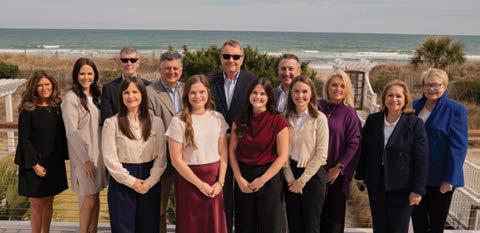
L – R: Tiffany Barlow, Financial Advisor; Aleasha Conroy, Financial Advisor; Craig Collie, Wealth Management Associate; Christina Taylor, Director of Business Strategy; Louis Burney, Financial Advisor; Kayla Hagan, Client Service Associate; David Price, Financial Advisor; Lauren Deering, Client Service Associate; Nathan Smith, Financial Advisor; Kelly Renegar, Senior Client Service Associate; Denise O’Dell, Financial Advisor; Patty Collie, Financial Advisor; Linda Goff, Financial Advisor
Our Mission Statement:
“Guiding clients as they navigate all aspects of their financial lives to achieve their unique goals.” advisor.morganstanley.com/cardinal-point-east-group
Morgan Stanley is proud to congratulate Cardinal Point East Group on being named to the Forbes’ Best-In-State Wealth Management Teams list.
This is the third year in a row and is a testament to their experience, focus, and dedication to their clients’ financial future.
WILMINGTON, NC 1111 Military Cutoff Road 910-509-1102

FAYETTEVILLE, NC 1990 Fordham Drive, Suite 200 910-481-8592
CHAPEL HILL, NC 6340 Quadrangle Drive, Suite 300 910-481-8573

Source: Forbes.com (2024-2026) Forbes Best-In-State Wealth Management Teams ranking awarded in 2024-2026. Each ranking was based on an evaluation process conducted by SHOOK Research LLC (the research company) in partnership with Forbes (the publisher). This evaluation process concluded in March of the previous year the award was issued, having commenced in March of the year before that. Neither Morgan Stanley Smith Barney LLC nor its Financial Advisors or Private Wealth Advisors paid a fee to SHOOK Research LLC, for placement on its rankings. This ranking is based on in-person and telephone due diligence meetings to evaluate each Financial Advisor qualitatively, a major component of a ranking algorithm that includes client retention, industry experience, review of compliance records, firm nominations, and quantitative criteria, including assets under management and revenue generated for their firms. Investment performance is not a criterion. Rankings are based on the opinions of SHOOK Research LLC and may not be representative of any one client’s experience; investors must carefully choose the right Financial Advisor or team for their own situation and perform their own due diligence. These rankings are not indicative of the Financial Advisor’s future performance. Morgan Stanley Smith Barney LLC is not affiliated with SHOOK Research LLC or Forbes. For more information, see www.SHOOKresearch.com.
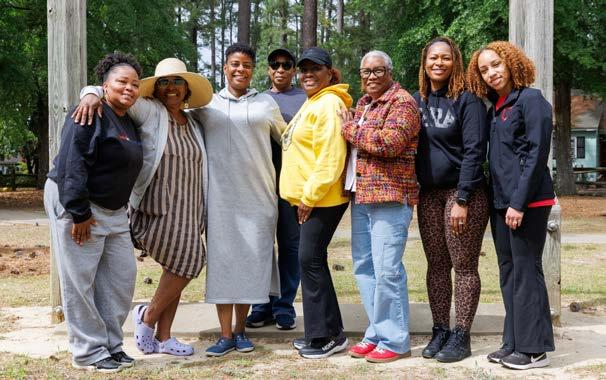
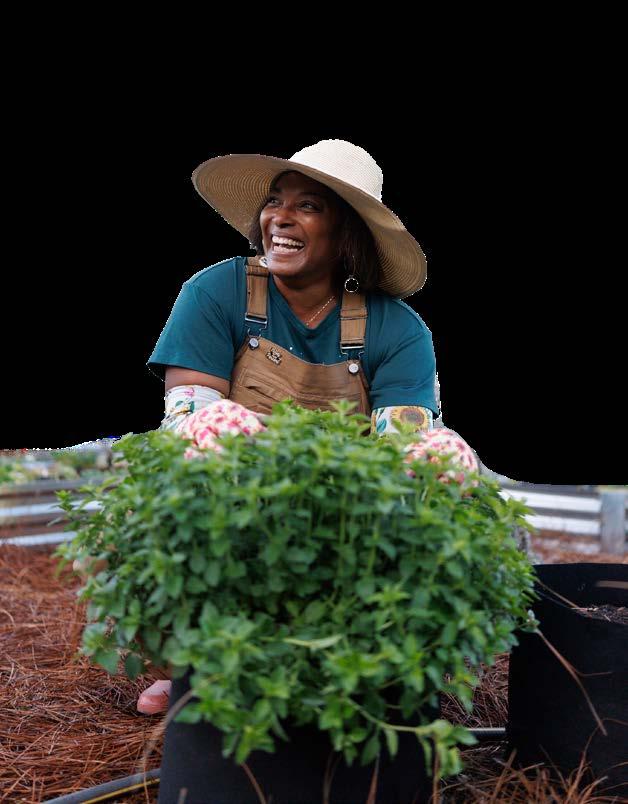
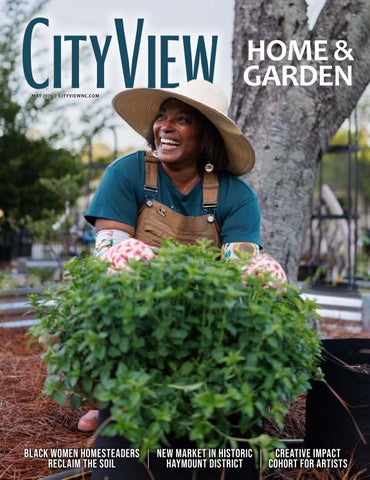
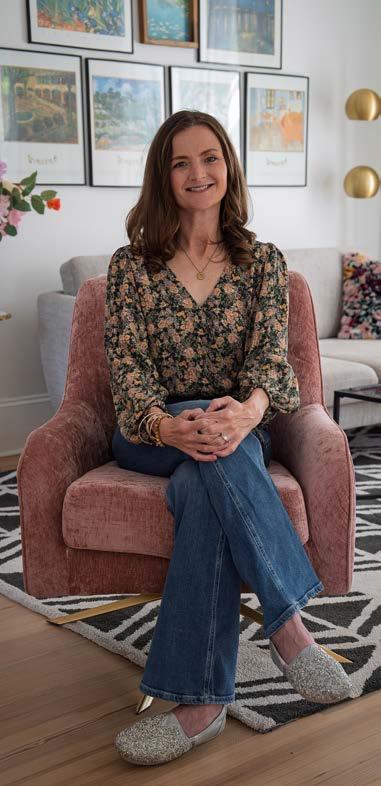
On the cover: Angela A. Tatum is the founder of Momma’s Village, a nonprofit organization in downtown Fayetteville focused on providing maternal care and advocacy to Black mothers and infants. She also started the Fayetteville Black Women Homesteaders Circle. Photo by Tony Wooten
Local nonprofit founder Angela A. Tatum has ushered in a new era of Black women homesteaders in Fayetteville.
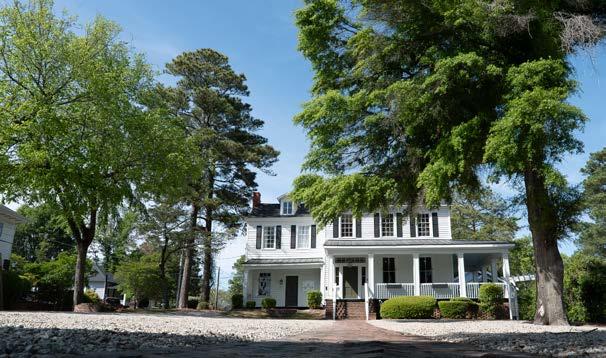
A military family-owned business is set to open a market in mid-May, selling candles, plants, home goods, and more inside a historic Haymount home.
Education and confidence-building were core to the creation of The Arts Council of Fayetteville/Cumberland County’s Creative Impact Cohort (CIC) program.




BY VALERIA CLOËS
CityView ’s May magazine explores Fayetteville’s homes and gardens as community spaces that foster connection, healing and nourishment.
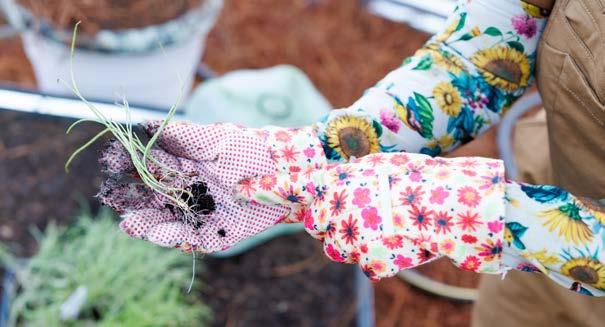
Local nonprofit founder Angela A. Tatum has developed her green thumb through education and trial and error since 2017, reclaiming growing food from what was once forced labor for Black Americans. Nine years later, she has grown her Haymount home garden and sunroom into an oasis of fresh, seasonal produce and healing herbs. She has reached 60% self-sustainability. Her efforts have expanded beyond her fence; Noticing an interest for a space for Black women homesteaders in Fayetteville, Tatum created a Facebook group in February 2024. That quickly expanded beyond its digital confines, and now 10–20 people meet in person every month.
Also, a new, family-run market is coming to Haymount. Operated by the Benander family in a historic home, The Market will have a soft opening in mid-May, selling candles, plants, and more. They hope to open a microcreamery, the Haymount Parlour, later this year.
In an Arts Council of Fayetteville | Cumberland County-
sponsored piece, Arts Council staff and an artist talk about its Creative Impact Cohort program.
Our columnists reflect on their connections to homes and gardens. The first outlines ways to grow as a community. The next remembers Mother’s Day and the moment she realized her daughter entered the phase of being embarrassed by her. Our bilingual columnist highlights a fitness instructor. The last recommends six books that prompt readers to appreciate the beauty around them.
Our To-Do List is full of great events for you to enjoy throughout May. Plus, this month’s Seen @ the Scene brings you to our sixth annual “Ladies’ Night Out” on April 9 at The Carolina Barn.
Thank you for reading!

Magazine Editor
For comments, questions, feedback, or to submit story ideas, email vcloes@cityviewnc.com.





Opening this summer in a new, state-of-theart, $65-million building, we are preparing compassionate, skilled physicians committed to improving health outcomes across our state and beyond.

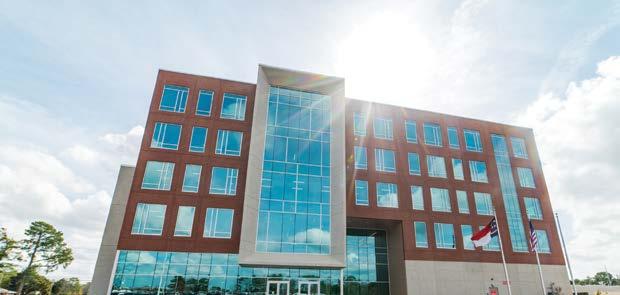
Learn about our application process, how to join our expert team, and much more at methodist.edu/medicine • Fayetteville, N.C.
BY TIM WHITE
My father had a green thumb. More than that, he had a green spirit. He loved his plants; they loved him. He knew every one by their Latin and English names, nestled them into the right spaces, prepared their perfect foods, and tended them with gentle care. Our house and yard were filled with thriving specimens of greens and flowers.
Unfortunately, Dad’s green genes weren’t passed along to me. I inherited my mom’s plant savvy—she could kill a plastic ivy. Last year, I even botched the tomato crop, the one agricultural thing I usually do well.
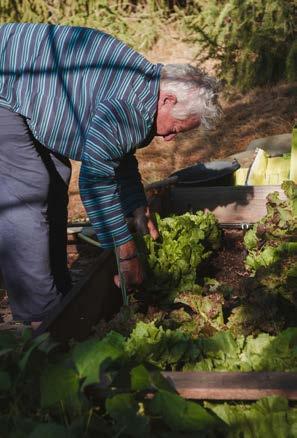
You can and should be raising a garden, even if you share my mortician’s talent for greenery. Because we all can grow a lot more than veggies and flowers. We can grow community. That’s even more rewarding than a perfect tomato in July.
I see that as the best gardening I’ve ever done, the best crops I’ve raised: I got to bring people together for conversations about the Fayetteville area, and its problems, goals, and challenges.
For most of the 20 years I served as The Fayetteville Observer ’s editorial page editor, we had a Community Advisory Board, a group of local folks who had lots of thoughts and ideas about their town and were happy to share them. I chose the members carefully and had a group of a dozen or so people who brought vastly differing perspectives to the conversation. I deliberately planted this garden of ideas among people who wouldn’t— couldn’t—ever agree on things. The group included liberals, conservatives, and middle-of-the-roaders. They only had to accept one central concept: to listen carefully and disagree respectfully.
We saw a few disputes turn angry over the years, but it was rare. Mostly, the members had wide-ranging discussions that sometimes even changed their minds. They shared many of their conclusions and suggestions in columns we published in the paper and posted online. Most got good feedback. Sometimes, they even got policy changes by the city or county.
It saddened me when the Observer ’s current corporate owners decided to quit publishing editorials, or even having much in the way of opinion pages. Every community needs a forum where residents can debate issues and seek solutions. But, of course, the newspaper isn’t the only place where that can happen.
When I lived in the city, I used to joke that Harris Teeter on Raeford Road was my conference room. Almost every time I went in to pick up what I needed for lunch or dinner, I ran into people who wanted to talk about things related to their city and how well, or poorly, it was doing. Those were great conversations that often found their way into one of my columns or an Observer editorial. It’s one way ideas can become action in a community.
But you don’t need me to do that. You can do it yourself. You can convene your own focus groups. You can take what you know to city and county officials and ask for action. You can be part of the oversight that every place needs from its citizenry. All you’ve got to do is ask questions and listen carefully to the answers.
This is a particularly good year to do that. It’s an election year, and we’ll have lots of political choices to make. That’s important, and it needs more rational
thought and analysis than it typically gets. But there’s an even bigger reason for those discussions, and it’s local: Our leaders—especially the county commissioners—are doing important things, making big plans and pressing to make Greater Fayetteville … a lot greater. A big cheer here especially for Kirk deViere, chair of the county commissioners, for pushing a plan that will extend municipal water throughout the county, starting with the areas where the groundwater is poisoned with “forever chemicals” emitted by the Chemours plant on the Cumberland-Bladen county line. The board also wants to build a new children’s museum and an aquatic center, create economic-development corridors around the airport and Crown Complex, and make this town a national model for military-related community development.
At the same time, the city and the Greater Fayetteville Chamber of Commerce are also embracing ambitious development plans. A toast to all of them.
But also, fair warning: Back in my editor days, I had a shelf behind my desk, stacked high with city and county development plans that never came together. Sometimes, my desk was the place where good ideas went to die.
But if everyone decides to adopt a kind of municipal gardening, getting involved, going to meetings, asking questions (especially tough ones), and really listening to the answers, maybe this is just the right time for the community to leap forward.
Like my dad’s gardens, if it gets the right kind of attention and care, it just might thrive.


BY CLAIRE MULLEN
As Mother’s Day approaches, I’d like to offer my reflections on a new era of motherhood into which I have recently entered. While I don’t think there’s an official name for this chapter, I’m fairly certain that “I’m a mom to a middle schooler and am therefore suddenly the most embarrassing human on planet Earth” would be a darn good fit.
For the past 12 years of our lives together, I have known nothing but pure adoration and a constant desire to be in my presence from my daughter. Nothing but my oldest child begging me to chaperone every school field trip, attend all her class parties, come to lunch to sit with her and her friends, and snuggle her until she fell asleep every night. A child who happily held my hand in public, needed not one but two hugs at morning drop-off—no matter who was watching—and excitedly shouted “Hey, Mommy!” across the busy parking lot at afternoon pick-up.
Needless to say, it hit me like a ton of bricks when my girl entered sixth grade and I, her own mother who carried her within my body for nine long months, became an overnight pariah. I will never forget the moment that I realized the dynamic had shifted.
As I walked out of the school building one morning, not long after the start of the school year, one of my daughter’s sweet friends caught me on the sidewalk, gave me a hug, and asked, “Mrs. Claire, can you come to chapel with us today?”
Weekly chapel at my children’s school is a longstanding tradition where parents are invited to attend worship with their kids, alongside their classmates and teachers. My daughter and younger son had always looked forward to with great anticipation, especially on days when I could join them.
I promised that friend that I would try my best to get out of a meeting early and make it back on time for chapel. I told her not to tell my daughter, so she would be extra surprised that I was able to make it after all.
As my meeting wrapped up right on time, I couldn’t wait to get back to the school to surprise my daughter and make
good on my promise to her friend. As I’d always done in the past, I signed in, got my visitor’s badge, and made my way to the worship center to wait for my daughter’s class to arrive.
When the sixth graders filed in, I first spotted her friend, who ran up and exclaimed, “Yay! You made it!”
I waited to find my daughter, who I was just sure would greet me with the same gleeful excitement. Instead, when my eyes met hers, the look on her face was more one of horror than happiness.
I knew right away that her wide eyes meant that I should proceed with caution. Our customary hug suddenly seemed like a bad idea.
My middle schooler met me with an awkward little halfwave and whispered through her teeth, “Mom! Why didn’t you tell me you were coming? No one else’s mom is here today! I already told some people I would sit with them … Sorry, is that okay?”
Even though my heart broke into a million pieces in that moment, I tried to play it cool, “Sure, yeah! No problem! I really came for your friend, anyway. She invited me.”
Later that afternoon, after I picked her up from volleyball practice, I could tell that my daughter had been feeling a little guilty all day.
On the ride home, she said, “Mom, I’m really sorry I acted weird when you came to chapel. I don’t mind if you come, I just didn’t know you were, and I was worried you would, like, sing really loud or dance to the songs or say something embarrassing in front of the boys in my class.”
While my feelings were more than a little bruised, I remembered being a sixth grader humiliated by my mom’s brakes on her old van that would squeal when she pulled up to the pick-up line. I used to be mortified when she would show up to eat with me in the school cafeteria with my toddler brother in tow, who insisted on bringing a toy doctor’s kit and performed “check-ups” on the popular boys in my grade. And I was horrified when she was the first to volunteer as the guest reader for my class, and would show up decked out in an outfit that went along
with the theme of whatever book she had chosen.
I took that opportunity to ask my daughter if there was anything else I did that embarrassed her. I wasn’t expecting a no-hesitation laundry list.
“Yes!” she said. “When you cheer louder than anyone else at my games, and I can hear you over all the other parents; when you say ‘what’s up pookie?’ to my friends; when you wear those really baggy jeans that are made for, like, teenagers; when you pack, like, only really super healthy stuff in my lunch; when you try to help me carry my bags into school; and when you fix my hair or wipe my face in the parking lot at school in front of everyone!”
“OK. Noted,” was my reply. “I won’t come to chapel unannounced anymore, but just let me know if you ever feel like you’d like me to. But I’m 100% still yelling really loud at your games. That’s nonnegotiable.”
“OK, Mom,” she said. “I love you. Thank you for coming today.”
I’ve spent the rest of the school year trying to give my middleschooler a little more space. Being there for her when she wants me to be, and backing off when it’s clear that she’s doing just fine on her own. Letting her struggle to carry four bags into school if that’s what she’s intent on doing. Quietly whispering that she has toothpaste on her cheek instead of licking my finger and wiping it off in front of everyone. Throwing a Lunchable and a pack of fruit snacks in her lunchbox here and there and calling it a day, since healthy lunches seem to have suddenly become offensive beyond what one can even bear.
And what I’ve found is that giving her that little bit of space that she didn’t really know how to ask for makes the moments when she just wants her mama even sweeter.
when I was really little?”
I really wanted to scoop her up, smother her in hugs and kisses and say, “My little pookie, there is literally nothing more in this world that I would rather do than come outside and do sidewalk chalk with you right this very instant.”
But I remembered the whole “giving her space” thing and replied simply with, “Yeah, sure, babe. That would be great. Thanks for inviting me.”
On this Mother’s Day, whatever parenting era you are “momming” through, just remember that at the end of the day, the things that tend to embarrass your kiddos are really mostly just big, bold, sometimes loud, usually “super healthy” expressions of your love for them. They will understand it one day, when they are 40 years old with kids of their own, and realize that their mom drove an old van with squeal-y brakes because her paycheck went to
her four kids' school tuition instead of a shiny new Mercedes.
They will realize that instead of surprising you in the middle school cafeteria, she could have picked your little brother up from preschool, put him down for a nap, and gotten some rest of her own.
And they will realize that the lady standing in the doorway of your classroom in a Cat in the Hat costume, book in hand, is the person who loves you more than anyone. Happy Mother’s Day, pookies.

Claire Mullen can be reached at clairejlmullen@gmail.com.

On a recent pretty spring afternoon, my daughter found me folding laundry in my bedroom and asked, “Hey Mom, if you’re not too busy, can you come outside with me and do sidewalk chalk like we did
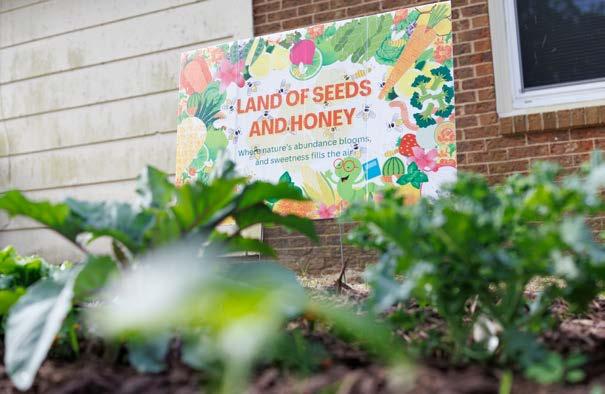
Member of the Fayetteville Black Women Homesteaders
Circle Katie Burrus embraced the name of "Land of Seeds and Honey" for her homestead.
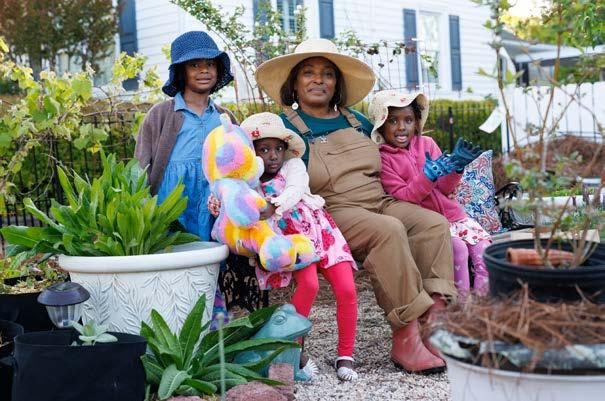
Local nonprofit founder Angela A. Tatum has ushered in a new era of Black women homesteaders in Fayetteville.
BY AMBER LITTLE | PHOTOGRAPHY BY TONY WOOTEN
AA ride along any road outside of the city limits is filled with acres and acres of farms, producing everything from corn and soybeans to tobacco and hemp, each field marked with a state sign designating its purpose and use.
These farms are a smaller part of a bigger system that fuels the nation. That system, unfortunately, has impacted the quality of the food, diminishing the farm-to-table lifestyle that once fed families and contributing to the rise of food deserts.
Food deserts are urban and rural areas where
community members lack access to nutritious foods. While there may be plenty of chain restaurants and corporate box chains, access to freshly grown fruits and vegetables is limited, if not nonexistent.
For Black Americans, this number increases, with Feeding America reporting 22% of Black Americans experienced food insecurity in 2023. When it comes to children, the statistics are even more startling, with 1 in 4 Black children experiencing food insecurity in 2023.
Angela A. Tatum—founder of Momma’s Village, a
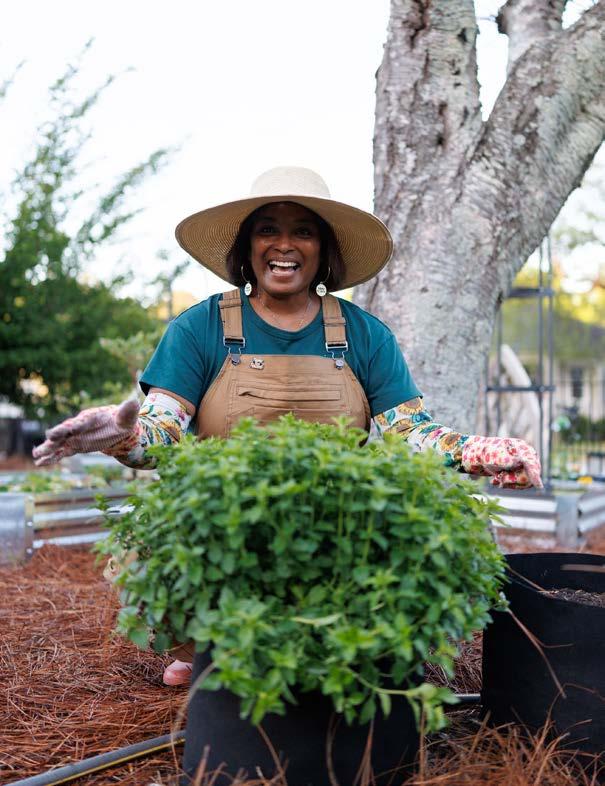
Angela A. Tatum started the Fayetteville Black Women Homesteaders Circle in 2024. The group’s monthly meetings are attended by around 10–20 people.
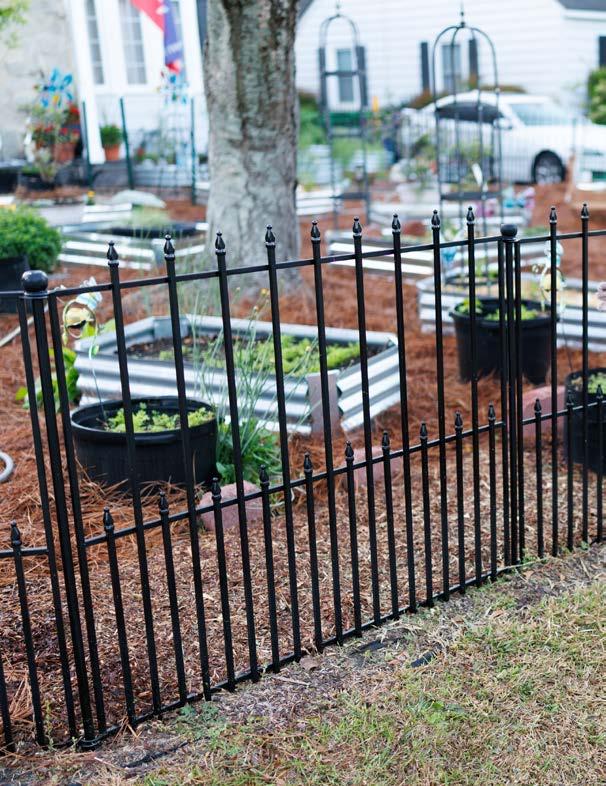
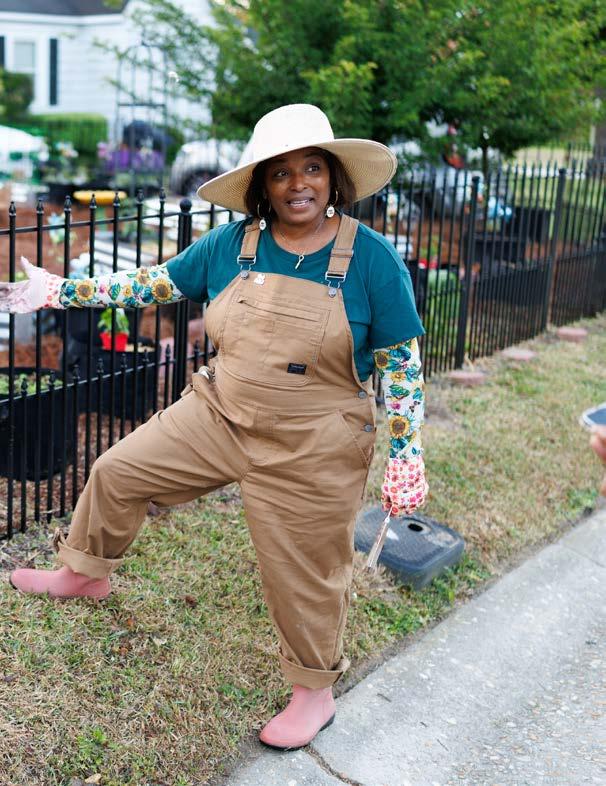
Despite never claiming to have a green thumb, Tatum has achieved remarkable success at her Haymount home, starting in 2017 with Lowe’s buckets and eventually reaching 60% selfsustainability, producing most of the food and goods her family needs to thrive.
nonprofit organization in downtown Fayetteville focused on providing maternal care and advocacy to Black mothers and infants—and her group, the Fayetteville Black Women Homesteaders Circle, are hoping to change that one homestead or garden at a time.
Farming has been a significant part of life for Black Americans, especially those raised in the South and the Midwest. In 1920, there were almost 1 million Black farmers in America, a stark contrast to the 45,508 reported in 2019 by The Guardian
Tatum, who was born and raised in Fayetteville, spent her summers helping tend to and work her family's 98-acre east Texas farm. Her time there ingrained decades of knowledge, experience, and a passion for self-sustainability. The call to homestead was much deeper than simply growing food for her family; for Tatum, it was ancestral.
“It’s part of our ancestral history to know how to grow,” Tatum said. “It’s changing a trajectory from when it was forced and negative, and bringing it back, because it’s calming. It brings natural health. It gives you movement. It lowers your cortisol—cortisol is the stress hormone that leads to a lot of the morbidity and mortality rates that we have. It gives you power, where you may feel powerless. It
brings you joy and connectedness.”
Despite never claiming to have a green thumb, she has achieved remarkable success at her Haymount home, starting in 2017 with Lowe’s buckets and eventually reaching 60% self-sustainability, producing most of the food and goods her family needs to thrive. Every inch of her yard and sunroom is utilized in some way and serves a purpose for the family and the homestead.
Over the past nine years, she has dedicated significant time to curating her garden, every plant serving a purpose: to fill or to heal. She not only feeds her family but also grows a variety of healing and restorative herbs that she utilizes with her doula clients. From healing the womb to lactation promotion, there is an herb tucked somewhere to remedy and repair.
The process saw a lot of trial and error, but most importantly, Tatum cultivated knowledge on improving soil, the proper planting seasons, companion planting instead of pesticides, garden graphing to utilize space, and four-season harvesting for a constant food supply.
Her homestead isn’t just efficient and productive, but beautiful too. Tatum utilizes wrought iron structures and galvanized raised beds along with cloth grow bags,
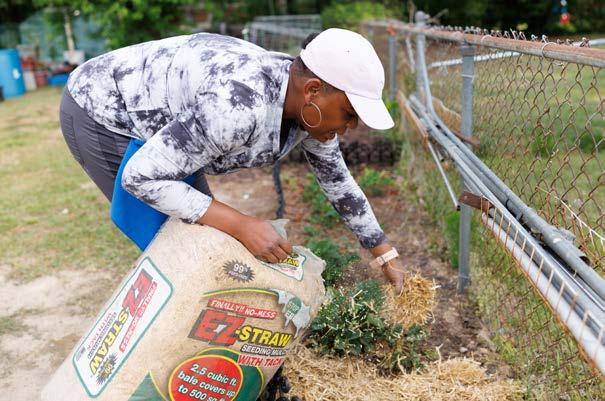
creating a space that’s as lovely as it is delicious. Some of her neighbors have even changed their walking routes to include her yard, the highest compliment for a gardener.
While she grows the traditional garden produce, like collards and lettuce, she has recently added corn and amaranth. Her goal in the future is to reach 75% self sufficiency and add honey bees and chickens to the homestead. A goal worth achieving, as maintaining the garden has become a family affair with every member involved in some way, including her 10 grandchildren, with another on the way in the summer. Building a selfsustaining homestead has bolstered her family’s health and wealth while tightening their connection to the land and each other.
Her passion is definitely contagious and infectious, as she has helped other gardeners and homesteaders begin their journey. The evolution of that has been the Fayetteville Black Women Homesteaders Circle, a group started in February 2024 in the spaces of a Facebook group, that has flowed over into the real world and created a community of novice and experienced farmers, gardeners, and homesteaders.
“The reason why I started a group was twofold,” Tatum
said. “Whenever I start groups in the community, Black homesteading, Black homeschoolers, Momma’s Village, it’s personal ‘cause I want to create a village to get knowledge and wealth. But then it’s also for others, because I figure if I don’t have this, then they don’t either.”
The group, which meets monthly, trades seeds, provides insider tips and tricks for pests and best growing practices, and most importantly, offers support. The meetings take place on the first Sunday of every month, and are attended by around 10–20 members.
Member Katie Burrus has been with the group for only a year, but has already found friendship, community, and a network of people with whom she can barter her homemade goods and fresh produce. Born and raised in Fayetteville, Burrus got the gardening bug like many others in the country during the pandemic. Starting with a gardening pot and working her way up to raised beds, Burrus was driven by a desire to not just survive but thrive during times of resource scarcity.
Each season, she learned something new, honing her skills and learning the land and the plants she was growing. Much like Tatum, Burrus has worked her way from a hobby garden to about 65% self-sustainability with
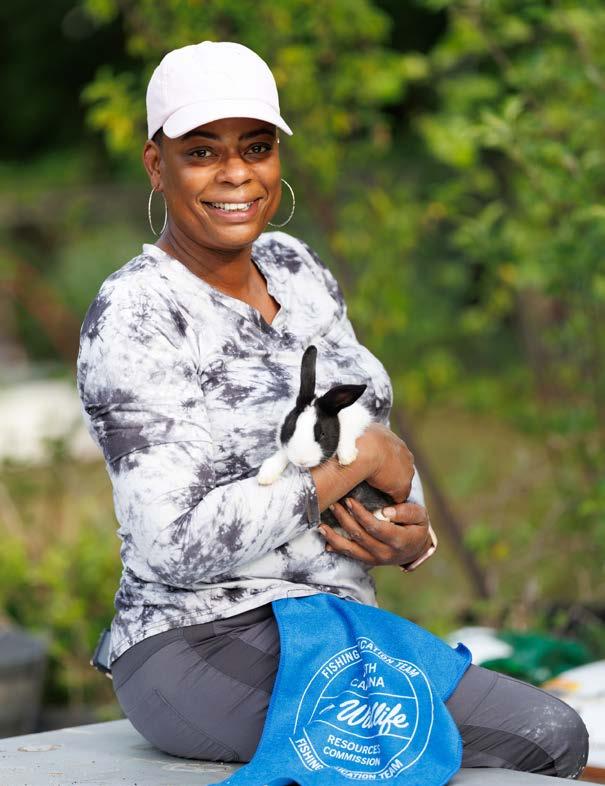
Burrus recently added rabbits to her homestead, which will serve a dual purpose—meat and manure for the garden. She holds her rabbit Jack, a future sire for a sustained supply of meat.
her homestead. She recently added rabbits, which will serve a dual purpose, for meat and manure for the garden. Turnips, mustard greens, sweet potatoes, rutabagas, radishes, and so much more are grown on Burrus’s homestead. But she also produces her own jam and wine from a neighbor's mulberry tree. In exchange for upkeep of the tree, she gets all the mulberries she can handle, keeping her pantry full and her glass full.
Like any good homesteader, Burrus is dedicated to learning her craft, recently attending a winemaking class in Pittsburgh and joining the Fayetteville Black Women Homesteaders Circle. Her homesteading goal is to be as close to 100% self-sustainability as possible within two years. With hydroponic systems already in place, beekeeping experience, and a new venture into herbs, Burrus is preparing her homestead for its next phase.
Both women had different journeys to homesteading, but their common goal now is to educate the community on healthy eating and cultivating their own food.
When asked what people should know about starting a garden or starting a homestead, Burrus explained, “I want people to know that they can do this and know where it’s coming from. You know what you’re putting in the soil. It’s not sprayed with anything. You know how to make sure that you and your family can eat, and that’s the goal.”
Now that spring has finally arrived in North Carolina,
it is time for anyone thinking about starting a garden to begin. There are plenty of resources in Cumberland County through the N.C Cooperative ExtensionCumberland County Center, Cape Fear Botanical Garden, Fayetteville Technical Community College, and other smaller groups and co-ops, including Fayetteville Black Women Homesteaders Circle.
Tatum and Burrus are proof that with some determination and willingness to learn, gardening and homesteading are possible for anyone. They are also beacons of hope: Black Americans are finding their way back to farming and self-sustainability.
Amber Little is a freelance writer who has called Fayetteville home for 13 years. Deeply connected to the community, they specialize in sharing the stories that shape our city. When not writing, Amber can be found exploring local trails and businesses.


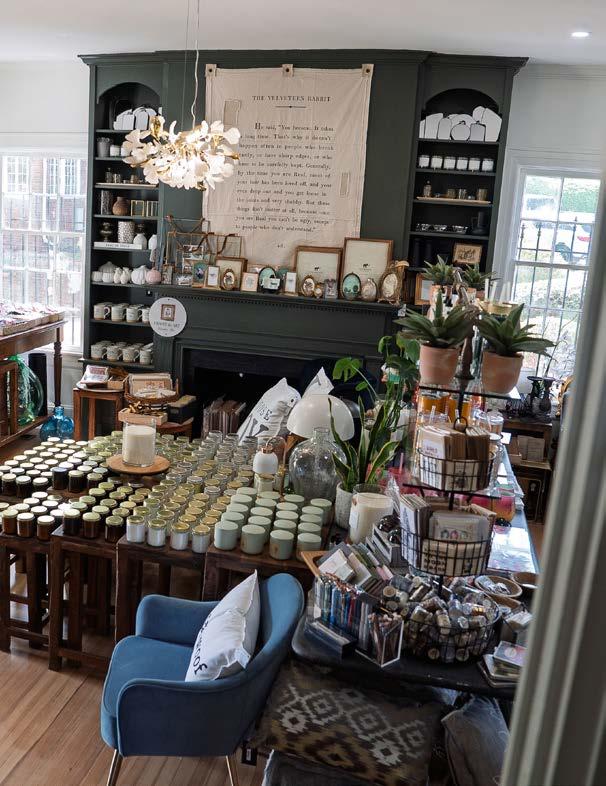
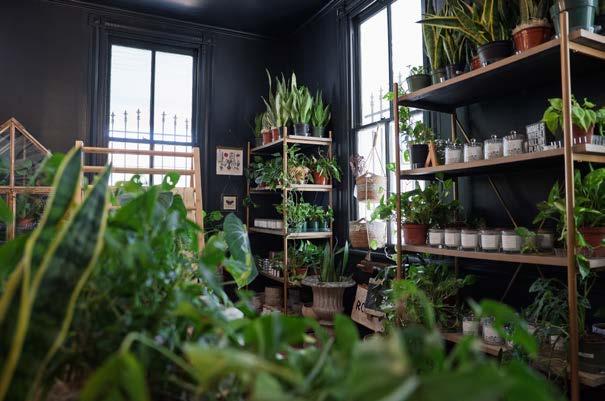
A military family-owned business is set to open a market in mid-May, selling candles, plants, home goods, and more inside a historic Haymount home.
BY DASIA WILLIAMS | PHOTOGRAPHY BY JAMES THROSSEL
AAt 13 years old, Elise Benander had an idea—one that started not in a storefront, but at home.
At the time, she was being homeschooled, with more flexibility in her schedule and, as she put it, “a lot more time on my hands.” While her older sister, Annika Benander, had already found her outlet in theater—now studying acting and arts administration at Elon University—Elise gravitated toward the kitchen, baking and experimenting with recipes in between lessons.
People started to notice.
“They told me they would buy them from me,” Elise said. “And I kind of just thought, maybe I should try selling them.”
When she brought the idea to her mom, Casey Benander didn’t immediately say yes. Instead, she gave her a challenge—one that would turn the idea into something real.
“I told her, if you can establish yourself as a licensed bakery, you can sell at the farmers market,” Casey said, laughing. “I also thought it would be a great homeschool project—and honestly, I didn’t think she would actually do it.” But Elise did.
Rather than stopping at the basics, she went all in—researching requirements, working through certifications, and building what would eventually become her small business, EB Sweets.
Now a senior at Terry Sanford High School, Elise creates everything from custom cupcakes and cake pops to cookies, bars, cakes, tarts, and sweet breads—most notably her cinnamon rolls, which have become a favorite among customers. Her baking also evolved into allergy-friendly offerings, something that quickly resonated with families looking for healthier, more accommodating options.
What began as a homeschool project turned into something much bigger. It also sparked something unexpected.
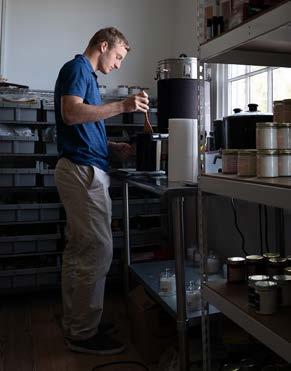
“I thought, ‘What am I going to do while I’m down there every weekend?’” Casey said. The answer came in candles.
What started as a weekend farmers market idea has since grown into a multi-faceted family business, Haymount Homes, with a new brick-and-mortar concept— The Market—set to open in mid-May inside a restored historic Haymount home.
Behind that growth is a family constantly in motion, building the business piece by piece.
On any given day, the Benander home feels less like a quiet house and more like a place in motion—boxes carried up narrow staircases, candle wicks cut one by one, and
conversations about “what’s next” happening somewhere between school drop-offs and late-night cleanups.
For CJ Benander, a freshman at Terry Sanford High School, that motion often means stepping in wherever he’s needed—hauling furniture, stacking materials, cutting candle wicks, or driving across counties to pick up pieces for the family’s growing business.
In a family where everyone seemed to have their own lane—Annika with theater, Elise with baking—CJ said he began to look for his.
Recently, that’s taken shape in the form of a budding sports card business, something he sees as aligning with the buying, selling, and business-minded side of what his family is building.
Even Oliver, the youngest, a sixth grader at Max Abbott Middle School, has found his place—balancing sports, theater, and pitching in with whatever needs to get done.
Together, their efforts form the backbone of what has become more than just a business idea.
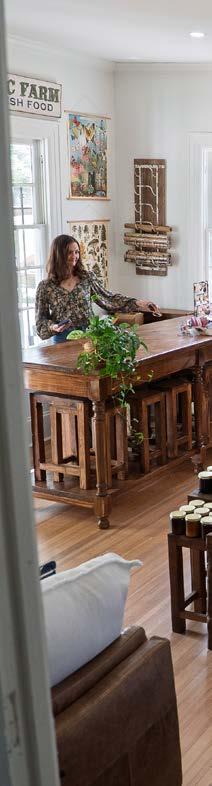
That “something” is The Market—a new brick-andmortar space set to open inside a restored historic Haymount home (not the home where they live), where
candles, home goods, plants, and eventually small-batch desserts will come together under one roof.
But for the Benanders, The Market isn’t just a business. It’s what happens when a family—shaped by the unpredictability of military life— decides to build something meant to last.
Carl Benander, a Special Forces Army officer, has spent years navigating deployments, training, and the demands of military service.
“I am working that full time, obviously, and have been deployed multiple times,” he said.
That kind of life often comes with constant movement—but for the Benanders, Fayetteville became something different.
“We anticipated a life of moving around more than what we realized,” Casey said. “But as we started seeing that stability, we felt like we needed to bloom where we were planted.”
While the military brought them to Fayetteville, it was the decision to stay that shaped everything that followed.
“We wouldn’t have been here if it weren’t for that,” Casey said. “But once we realized we were staying, we wanted to invest in the community— to really become part of Fayetteville.”
Before The Market, the Benanders were already restoring homes in Haymount, drawn to the character of older properties and determined to keep them from being lost.
“We both grew up in older homes in the Midwest,” Casey said. “As flawed as they were, we appreciated their character—and we loved the character they brought to Haymount.”
Watching similar homes in Fayetteville face demolition didn’t sit right.
“It was kind of heartbreaking to see them torn down,” she said. “We thought, what if we tried to save some?”
That idea became their rental and renovation business, grounded in a simple philosophy: create spaces they themselves would want to live in.

That same mindset ultimately led them to one of their most ambitious projects yet—the Taylor-Utley House, a historic Haymount home built in 1848.
The property was originally owned by James Andrew Jackson Bradford. Merchant William Taylor purchased a portion of the land from Bradford in 1847 and built a home there. It was purchased 11 years later by Joseph Utley. Historical records indicate that Utley owned enslaved people.
The Benanders said they were not aware of specific details about the home’s early ownership prior to beginning the project, but were not surprised given its age.
“Our business has long sought to bring new life and energy into neglected spaces by repurposing them rather than ‘restoring’ them to what they once were,” Casey said. “While we honor the architectural history in our renovations and preservation; we don't intend to idealize their history or bring them back to what they were exactly.
Instead of building something new, they chose to repurpose what was already there. Now, the home is being transformed into something more than a storefront—an experience rooted in place.
“Our goal with the Taylor-Utley home was to create a welcoming space for our entire community,” Casey said. “With that said, this new knowledge has us exploring ways that we can pay tribute to and acknowledge the difficult history of those that were forced to serve. Their service is likely responsible for the home standing today and giving us the privilege to move it into a new era.”
Now, that philosophy is taking shape inside the Taylor-Utley House itself.
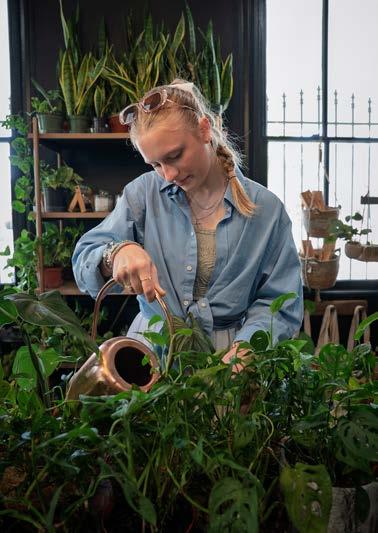
When The Market opens, visitors will find more than just products. Phase one will include candles, home fragrances, house plants, art, vintage finds, and a rotating mix of new and used furniture and décor—
an ever-changing selection designed to make each visit feel different.
“It should feel really happy,” Casey said. “Even if it’s just 20 minutes out of your day.”
For the Benanders, building a business has meant embracing uncertainty.
“The only thing you know in the military is something will change,” Casey said.
That unpredictability has shaped how they approach everything—from parenting to entrepreneurship.
“You can’t control any of that,” she said. “So you have to be willing to pivot.”
Instead of waiting for the “right” time, they built anyway.
“We didn’t have a business plan,” Casey said. “We didn’t know what we were doing. We just knew it would be a good thing—and we did it.”
The second phase of The Market will introduce the Haymount Parlour—a microcreamery and bakery designed as a “vintage dessert destination” inside the home.
Featuring healthy ingredients, small-batch desserts, and ice cream sourced from pastured Wisconsin dairy, the concept is rooted in both quality and experience.
“We want people to have a moment in time with their friends and family,” Casey said. “Rock on the porch, sit back, relax, and enjoy their time.”
From rotating flavors to the possibility of porch-side watercolor painting, the goal is simple.
“It’s just a place to take a beat and be happy,” she said.
Even before opening, the business has built a loyal customer base.
“Casey Benander’s candles and oils are truly something special,” said Maggie Carson, a longtime customer. “Shopping with Casey is always a joy, and you can truly feel the care, creativity, and heart she puts into everything she makes.”
Carson said the products resonate across generations and praised their balance of quality and safety.





“It’s rare to find candles that feel both safe and luxurious,” she said.
The Market is aiming for a soft opening of its retail space the weekend of May 16, with the Haymount Parlour expected to follow later in 2026.
But for the Benanders, success isn’t just about business—it’s about impact.
“Do we feel like it’s contributed to the community in the way we hoped?” Carl said. “That’s the harder thing to measure—but I think we’ll know it when we see it.”
For Casey, the goal is simpler.
“I just want people to be happy,” she said. “I want people to love where they live.”
Inside a Haymount home, that vision is already taking shape—built not just from ideas, but from a family choosing to create something lasting, together.

BY MATHIAS MARCHINGTON
WWhen an artist applies for a grant—and if they’re awarded it—they generally receive funding from whatever supporting organization they’ve applied to, and are left to their own devices to fulfill a goal they laid out in their application. The artist is expected to know the ins-andouts of the application process; to know what makes a compelling cover letter and strong application; how to best appropriate the funds they’re given; how to properly promote and market their work; network effectively; and plan for future, bigger projects to come.
But what makes a good cover letter? What is the best way to use funds if and when an artist does receive them? How
does one adequately promote their work once completed? How does an artist even apply for a grant?
These questions point to a gap in many artists’ professional development, a gap that kills hundreds of burgeoning careers and stops a slew of potentially great artists from ever taking the step to fund their work with a grant.
When artist Lauren Falls was looking for a grant to help fund her work, the weight of all of those questions fell solely on her. Questions she was, at least, somewhat familiar with.
“I’ve helped friends who are artists with their grants,” she says, “I just never took the plunge.”
Like many artists, Falls had always known about grant opportunities, “but I was unsure if I qualified,” she says. A killer gap in professional development kept the plentycapable artist that Falls already was from taking the leap.
Lucky for Falls, a solution was in town.
Education and confidence-building were core to the creation of The Arts Council of Fayetteville/Cumberland County’s Creative Impact Cohort (CIC) program. Staff realized that without something new, promising careers like Falls’ might have stalled, or ended altogether.
“A lot of our Arts Council staff are artists, so we’re in regular conversation with local artists through our programs and grant work,” says Kashia Knight, Arts Education Manager at The Arts Council—one of two staff that run the Creative Impact Cohort (CIC) program. “Over time, we kept hearing the same need: to fill a gap in professional development support for our talented community. The [CIC] was created to meet those needs.”
The CIC program is part of a concerted effort by The Arts Council. Through programs like CIC, and spaces like their freshly opened ArtsXL space, their mission is to enrich the community by elevating the arts, bolstering cultural tourism to Fayetteville, and enabling artists to create more opportunities for themselves and their fellows.
artists might have a chance to pursue their dreams, and find a little more time to bring their ideas to reality.
“The interactions have been uplifting for sure,” says Knight. “… It’s always great to see cohort members offering aid to one another.” The artists, she says, have built community quickly: “They now have accountability partners among themselves, which has helped them stay motivated, encouraged, and moving forward together.”
For Falls, the results of that community have already been tangible.
“I was in the process of producing a solo art show,” Falls says, who first read about the CIC in a newsletter from The Arts Council, and wondered if it might be exactly the thing she needed to help produce her art show. “I realized that I should at least try to apply,” she says. So apply she did.
Not long after submitting her application, she was accepted, and received her very first individual artist grant.
Falls was thrilled: “Plus it was a huge financial relief,” she added, enabling her to fund the supplies she needed for her show.
Falls was lucky to already know a few of her peers in the cohort, but got to learn more about each of their projects, how they got to where they were, and what they’ve learned along the way.
Education and confidence-building were core to the creation of The Arts Council of Fayetteville/Cumberland County’s Creative Impact Cohort (CIC) program.
“The arts community is a major economic driver in Cumberland County,” says Michael Houck, Director of Grants and Allocations at The Arts Council, who also works with Knight in running the CIC. “And we want to see it strengthened beyond organizational capacity building,” they say. Houck refers to the CIC as an “evolution” of the standard grant model, “designed to develop business skills among our individual artists working in Cumberland County,” but one that also allows for “more risk in awarding emerging artists who have amazing, brilliant artistic visions but lack experience getting to the finish line.”
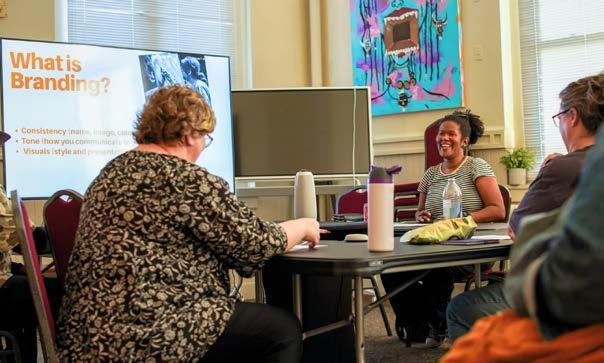
The hope is that by pairing funding with structured professional development, artists will leave the cohort “more confident than when they came in,” Knight says, but also more connected. “It’s a cohort model, so artists move through the experience together over several months, meeting in person for learning, support, and accountability.”
Because it’s difficult enough finding time and energy for one’s craft as an artist these days, let alone for learning and honing skills on the business side of things. Just as the late German artist Martin Kippenberger said: “A good artist has less time than ideas.” With nothing to say for actually securing funds to bring those ideas to life. But with the support of other artists, and professionals on the receiving end of grant applications, otherwise starving
Each session focuses on a different topic or tool to help the cohort’s professional development, and the small, tight-knit nature of the group allows for conversations about what excites each of them, and dialogue on what blockers they face.
After just a few months in the cohort, during which Falls says The Arts Council’s staff were “extremely helpful and supportive,” the date of her art show rolled around. Either as testament to the CIC’s efficacy, or to their ability to bring in artists who will benefit the most from their teachings and community, Falls describes the show as everything The Arts Council’s staff might have hoped for.
“I wanted not only to showcase my work but also exhibit creatives within our community and allow them creative freedom to showcase their talents,” she says, naming a few of the folks that stood out as highlights, including a talented cellist who performed at the reception. The show was “a dream that I was able to make come true,” she says—interactive, engaging, and full of friends and colleagues from all stages of her life.
When asked about what success looks like for a member of the cohort, Knight described something familiar: “I want emerging and established artists to continue building real relationships and finish with a wider personal artist directory, people they can call, collaborate with, and cross-promote with.”
Enjoy these classes while making the
•
•
•
•
• Gentle
• Line
• Pickleball
•
•
•
•





A further goal of CIC is to create future career pathways for individual artists by building and improving their skill sets that are relevant to the Cumberland County workforce. Additionally, they hope that the elevated capacity of these artists will have a lasting, positive impact on Cumberland County’s arts and cultural tourism landscape.
That’s exactly what was on display in Falls’ recent art show. She’s a model for the program’s tenets, it seems— even before completion.
Of course, she has more concrete goals for the remainder of the program beyond the art itself, like “learning about taxes and LLCs.” Maybe a little less exciting than the promise of fostering artistic community, but as any artist who’s turned their craft into their livelihood might tell you: practical knowledge is what keeps an artist from starving, when passion and ability are sometimes just not enough.
The Arts Council of Fayetteville | Cumberland County connects our communities, embraces diversity, promotes individual creativity, fosters lifelong learning, and advances tourism and economic development through the arts.
As the primary steward of public and private funding for arts, cultural and history activities in the Cape Fear Region, the Arts Council, and the agencies it supports are known for the core values of excellence, accountability, transparency, collaboration, and innovation.
Learn more about The Arts Council of Fayetteville | Cumberland County at theartscouncil.com.
Mathias Marchington is the head of membership at The Assembly Mathias previously worked in a variety of sales and revenue roles at INDY Week, a member of The Assembly Network. He is also an illustrator and writer.
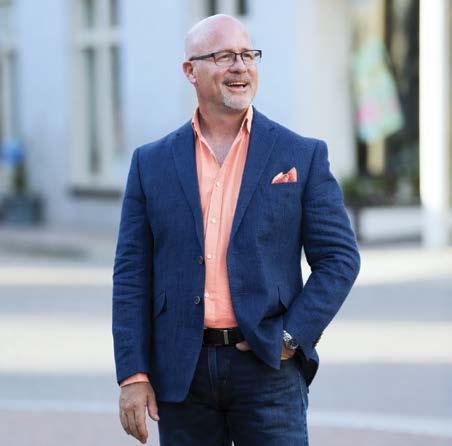
Five Star Entertainment owner Mark Pezzella has built a reputation across the community for transforming events into unforgettable experiences. A military veteran originally from Virginia Beach, Virginia, Mark chose to call Fayetteville home after completing his service in the Army—and has been elevating celebrations ever since.
As the driving force behind Five Star Entertainment, Inc., one of the region’s most recognized and successful entertainment companies, Mark is deeply committed to giving back. His passion for supporting non-profit organizations shines through in the care and creativity he brings to planning and coordinating their events.
For more than 30 years, Five Star Entertainment has earned national recognition by staying ahead of trends, delivering reliable service, and consistently exceeding client expectations. Whether it’s an intimate gathering or a large-scale production, their all-in-one services—ranging from professional DJs and dynamic lighting to photo booths, dance floors, and full event coordination—ensure every detail is handled with excellence.
Connect with Five Star Entertainment today and turn your vision into an extraordinary, unforgettable event.
(910) 323-2409 | 2556 Mt Haven Lake Drive, Fayetteville, NC | www.FSENC.com
BY CLAUDIA ZAMORA OYE,
There is a moment, almost imperceptible, when the day stops pushing, and something within begins, gently, to reorganize. It does not happen outside; it happens in the body, in that intimate territory where everything is stored, what was lived, what was spoken, what remained unspoken, what we carried for hours, and what still lingers without form. And then, without announcement, the breath softens, thoughts lose their urgency, and what once felt scattered slowly begins to find its place.
In Fayetteville, that moment has found a new home, more intimate, more intentional: Polaris Wellness Hub. A space that I founded in 2025, where movement is no longer just exercise, but an experience of integrated well-being. Through music, presence, and connection, bodies awaken, and something deeper begins to settle within. What once might have been perceived as a Zumba class has evolved into a more conscious practice: toning, strength, regulation, and a reconnection with the body as home.
South Africa, her daughter was born, and with her, a new understanding of home emerged. She chose to name her Pretoria as a gesture of memory, roots, and meaning, an acknowledgment that even in the most challenging places, seeds are planted that will one day bloom. Because sometimes home is not something we find in a place, but something that reveals itself in what remains, even in the midst of change.
Today, as a military spouse, mother, and facilitator of toning classes, Andrea continues to move through transitions and new beginnings. Yet something within her has settled with clarity: home does not depend on external stability, but on the ability to return to oneself, again and again, with presence.
In that journey, the body has become a fundamental guide. It does not simply carry us from one place to another; it holds stories, processes emotions, and sustains what the mind cannot always organize. But it also needs
To move the body, in this sense, is to return to oneself.
To allow what has been held inside to find expression. To give the nervous system an opportunity to reorganize.
Fitness instructor Andrea Jeffcoat embodies this transition between the external and the internal with quiet authenticity. Born in El Salvador, she arrived in the United States in 2004 carrying both the determination and the uncertainty that accompany those who dare to begin again. Her path was anything but linear; instead, it led her across geographies, cultures, and experiences that profoundly reshaped the way she inhabits the world. Before settling in Fayetteville in 2020, her journey took her through states such as Georgia and Tennessee, as well as to Africa, where she lived in Botswana. Each place left its imprint: challenges, lessons, and a quiet expansion that is not always visible, but that shapes both character and perspective.
Like many migrant stories, her path has been marked by moments of rupture and reconstruction. In Pretoria,
release, it needs movement, it needs pathways through which what has been accumulated can transform.
In a community where so many people live under constant pressure, balancing responsibilities, cultural transitions, and daily demands, movement is no longer superficial. It becomes a deep necessity for regulation. To move the body, in this sense, is to return to oneself. To allow what has been held inside to find expression. To give the nervous system an opportunity to reorganize. And when that movement happens in community, something more unfolds. Its impact expands. It becomes shared. It becomes human.
In the spaces Andrea creates at Polaris, people do not simply exercise; they reconnect. They recognize themselves in one another. They allow themselves, even if only for a moment, to release the invisible weight they
often carry in silence.
Because there is something profoundly healing in sharing rhythm, in feeling accompanied, in remembering, without the need for words, that we are not alone.
To speak of well-being in our community requires us to look beyond what is visible. It is not only about access or information, but about creating real spaces where people can feel supported, where the body has a rightful place, and where emotional regulation becomes a lived experience.
May also invites us to pause and reflect on another dimension of care. Mother’s Day carries a complex emotional weight; not all stories are lived from the same place. For some, it is celebration. For others, it is memory, absence, or even pain. And yet, there is something that runs through all of these experiences: the act of holding, of caring, of being present, of giving, even when there is not always space left for oneself.
And on a personal note, May brings with it a quiet, intimate moment of reflection: my birthday. Not as a date to count years, but as an opportunity to acknowledge the path traveled, to honor what has been lived, and to ask myself, with the same honesty I offer here: How am I holding myself? How am I inhabiting my own life?
Perhaps that is why this month can also become a more intimate invitation to include ourselves within that
care. To ask how we sustain ourselves while sustaining others. To consider the place we give ourselves in the midst of all that we offer.
In a city like Fayetteville, where so many stories, paths, and ways of life converge, community well-being is not built through grand statements, but through the everyday, through the spaces we inhabit, the connections we nurture, and the choices we make, day after day, to care for our physical, emotional, and human health.
And in the midst of all of this, the question returns, simple yet deeply revealing: How are you, really?
Because sometimes home is not a place we return to, but a state we learn to access. And that return, intimate and necessary, often begins with something that seems simple, yet is profoundly transformative: to move, to breathe, and to gently allow ourselves to feel at home within who we are.

Claudia Zamora is an Argentinian author, mental health and wellness coach, and passionate community advocate. Since 2011, she has made Fayetteville her home, uplifting the Hispanic community.



BY DIANE PARFITT
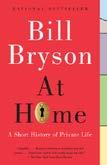

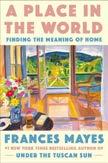
Books about homes and gardens are especially enjoyable to read because they can feel safe and comfortable to us. Often the home and garden are characters in the book. Even when they are not, they enhance our enjoyment of the settings, surroundings, and the characters. Whether explored through novels or visually striking coffee table books, homes, and gardens encourage us to appreciate the settings that surround us and the role they play in enhancing everyday life. These books invite readers to slow down, imagine possibilities, and rediscover the simple pleasure of beauty in everyday surroundings.
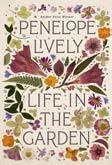
1. Life in the Garden by Penelope Lively
Now in her 93rd year, Lively muses , “To garden is to elide past, present, and future; it is a defiance of time.”
Penelope Lively takes up her key themes of time and memory, and her exploration of art, literature, and gardening in this philosophical and poetic memoir. From the courtyards of her childhood home in Cairo to a family cottage in Somerset, to her own gardens in Oxford and London, Lively takes us on a tour from Eden to Sissinghurst and into her own backyard, traversing the lives of writers like Virginia Woolf and Philip Larkin while imparting her own sly and spare wisdom.
At
“Houses aren’t refuges from history. They are where history ends up.”
Well-known author Bill Bryson shares his story of the Victorian parsonage in England where he lives with his family. While creating a home out of this old house, he realized he knew nothing of its history, so he went about studying each room. As he went from room to room, he saw that he could write a history of the world from inside his comfortable home. The kitchen tells so much about nutrition, the difficulties of cooking, and even the spice trade; the bathroom provides the opportunity to learn about hygiene in older times; and the bedroom is the place to learn about sleep, sex, and death. He is able to show how a home is the basis for the evolution of private life. With Bryson’s talent for humor and beautiful prose, he shows us how those things happening out in the world can end up in our home. Just look at how we depend on the television to learn about the news of the world.

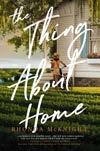
3. The Thing About Home by Rhonda McKnight
“Home is not a place—it's a feeling.”
When former model and current social media influencer Casey Black faces the embarrassment of a damaging viral video—and the shame of being left at the altar at her renewal marriage ceremony—she knows she needs to escape. Leaving New York City to return to her home in South Carolina and her family, she hopes this will bring her the comfort she needs. When she arrives at the picture-perfect farm with its history, culture, and Southern charm, however, she wonders if it is enough to bring her peace? Will her family be able to help her learn more about her past that her controlling mom never shared? Will reading her great-grandmother’s journals help or hurt? If so, perhaps secrets finally revealed can bring the healing that nothing else can!
4. The Kew Gardens Girls by Posy Lovell
“Can the women of Kew keep the gardens alive in the midst of war?”
During World War I, while the men were off to war, three women volunteered to help as gardeners at Kew, the Royal Botanic Gardens. Based on true events, this historical novel humanizes the story of the women who were in the midst of the suffrage movement and the turbulent social changes affecting them. Each has their own secret, but each wants to do their part for their country. The gardens seem to be a haven for them, but not everyone wants the women there or for women to change from the traditional roles expected of them.
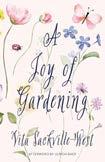
5. A Joy of Gardening by Vita SackvilleWest
“You cannot expect your soil and your plants to go on giving you of their best if you are not prepared to give something back in return. This is as true of gardens as of human relationships.”
The author of numerous collections of poetry and 13 novels, Vita Sackville-West was also an enormously successful gardener. She designed gardens in England and wrote a popular column in the London newspaper The Observer. In this collection of essays, she offers practical advice as well as lovely suggestions for beautiful gardens. In the end the garden can bring so much joy to the gardener.
“Where you are is who you are.”
Known for her travels, author Frances Mayes explores the enduring search for home and belonging. Drawing on her experiences in Italy, the American South, France, and Mexico, A Place in the World reflects on how houses, objects, and relationships shape identity. The book examines the lasting influence of each place she has lived and the balance between movement and rootedness that defines the idea of home.

Diane Parfitt owns City Center Gallery & Books in downtown Fayetteville. She can be reached at citycentergallerybooks@gmail.com.

Custom
Custom





Here are just some of the things happening in and around Fayetteville this month. Scan the code with your phone for more events, additional information, and to post your event on our website. Events are subject to change. Check before attending.
May 15–31
Rent
Gilbert Theater 116 Green St. gilberttheater.com
May 15
Rock'n On The River: Shoot to Thrill with Reflections
Deep Creek Grill 1122 Person St. distinctlyfayettevillenc.com
May 8
Fayetteville Woodpeckers vs. Wilson Warbirds: Star Wars
Segra Stadium
460 Hay St. milb.com
May 8
Turpentine Chat
Lake Rim Park 2214 Tar Kiln Drive fayettevillenc.gov
May 8
Fayetteville Liberty vs. Raleigh Firebirds
Crown Arena
Crown Complex
1960 Coliseum Drive crowncomplexnc.com
COMING IN JUNE
Advertise your business in our annual guide that locals, newcomers, and visitors alike will pick up and enjoy. Email dawn@ theassemblync.com.
May 8
The Zero-Waste Gardener
Composting Seminar
Cape Fear Botanical Garden
536 N. Eastern Blvd. capefearbg.org
May 9
Seasonal Art Series: Mother’s Day
Cape Fear Botanical Garden 536 N. Eastern Blvd. capefearbg.org
May 9
Mother's Day Weekend Garden
Party High Tea Social
Anchor Allie’s
1204 Bragg Blvd eventbrite.com
May 10
Fayetteville Woodpeckers vs. Wilson Warbirds: Mother’s Day
Segra Stadium
460 Hay St. milb.com
May 12
Up, Up and Away
Lake Rim Park 2214 Tar Kiln Drive fayettevillenc.gov
May 13
A Garden Gathering
Cape Fear Botanical Garden 536 N. Eastern Blvd. capefearbg.org
May 15
Night Hike and S’mores or Banana Boats!
J. Bayard Clark Park & Nature Center 631 Sherman Drive fayettevillenc.gov
May 15
Fayetteville Liberty vs. Kissimmee Lambs
Crown Arena
Crown Complex
1960 Coliseum Drive crowncomplexnc.com
May 15
Kids Night Out: Starlight Celebration
Cape Fear Botanical Garden 536 N. Eastern Blvd. capefearbg.org
May 16
USA 250
Cumberland Choral Arts
Huff Concert Hall
Methodist University
5400 Ramsey St. cumberlandchoralarts.org
May 18
Story Time: Botanical
Lake Rim Park 2214 Tar Kiln Drive fayettevillenc.gov








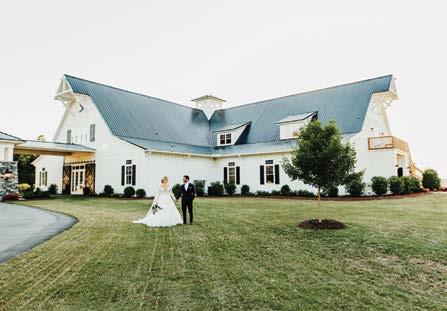

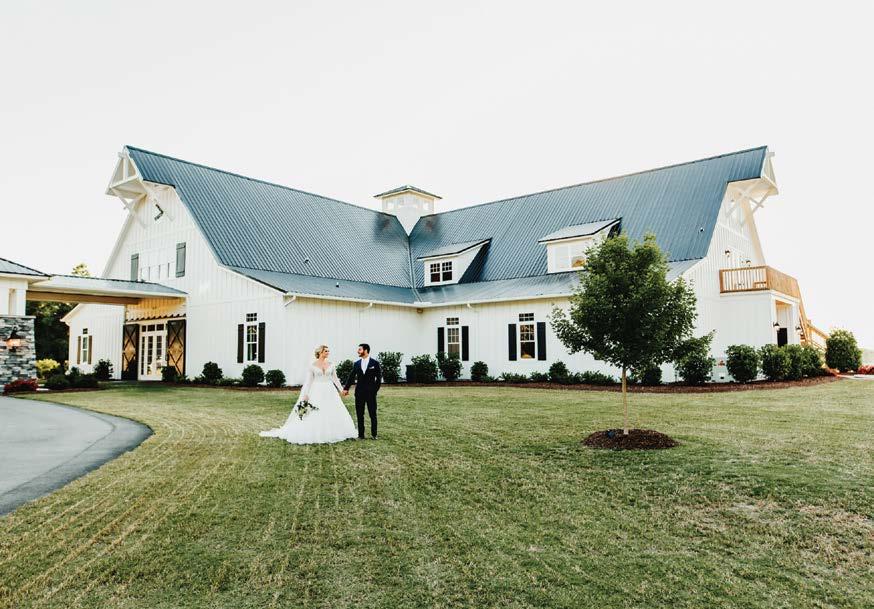
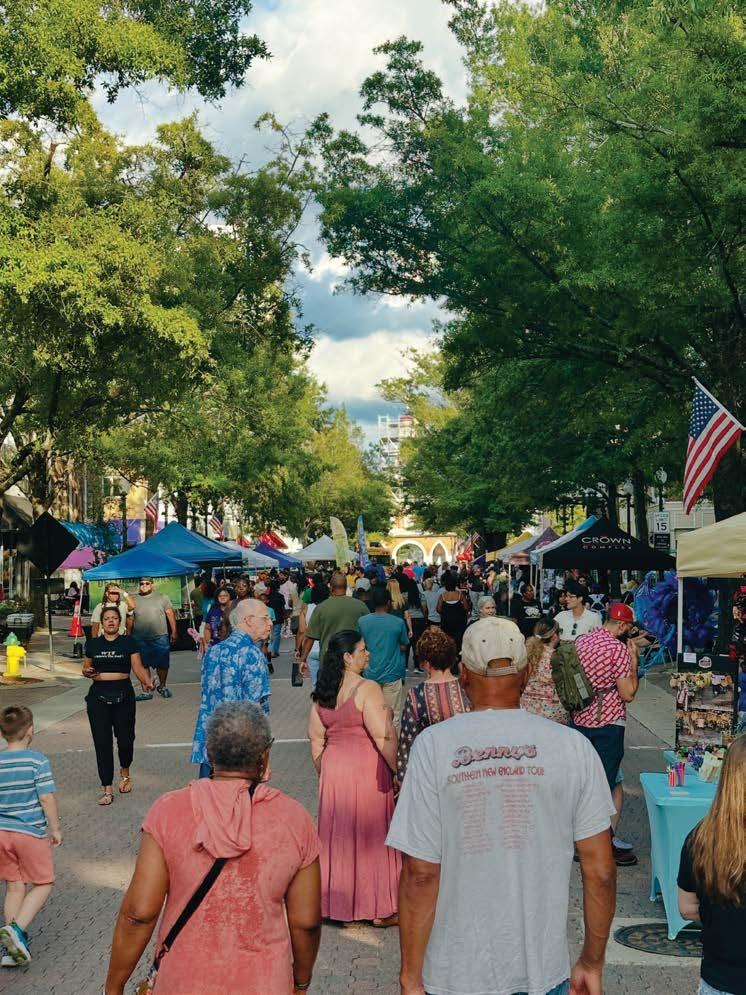
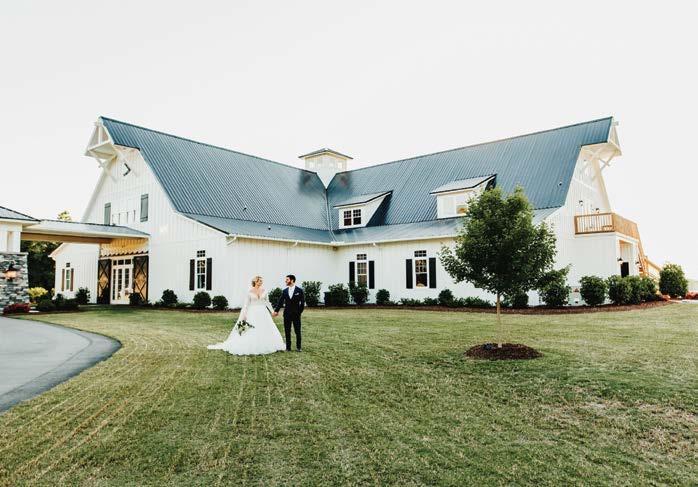
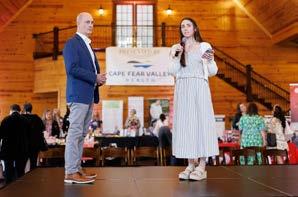

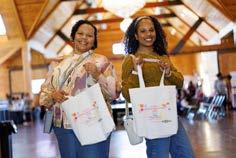
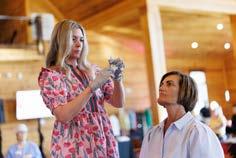
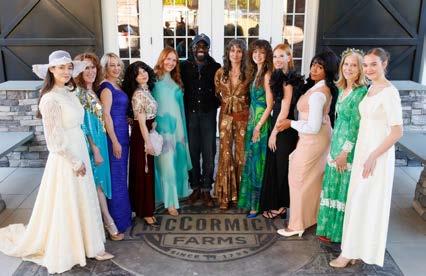
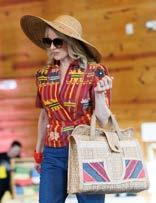
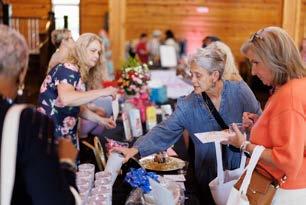
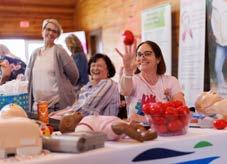
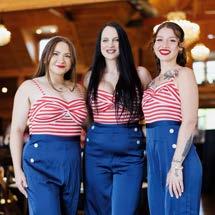
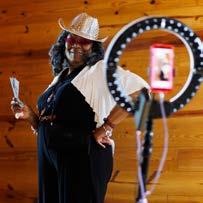
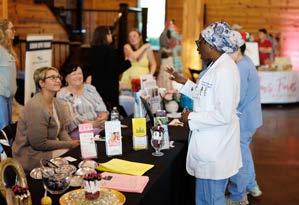
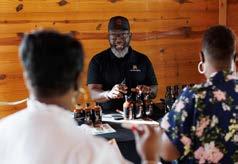
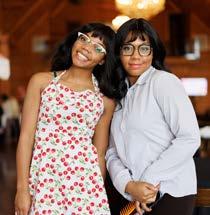
The sixth annual “Ladies’ Night Out” unfolded with food, fashion, music, and shopping during an evening raising funds to support local journalism in Fayetteville.
Funds raised at the event benefited CityView and the News Foundation of Greater Fayetteville, which is a nonprofit that financially supports CityView. Cape Fear Valley Health was the event’s presenting sponsor. Five Star Entertainment, Westdale Vintage, Yellow Crayons, KidsFirst Pediatrics, Skin Specialists of Fayetteville, and Systel also sponsored the event.
Attendees browsed more than two-dozen vendors, enjoyed a fashion show from Westdale Vintage, watched demonstrations by Cape Fear Valley Health, won prizes in a raffle, and danced the night away. Photography by Tony Wooten
Want CityView at your event for Seen @ the Scene? Email us at talk@cityviewnc.com.





For Candace, deciding to move forward with knee replacement wasn’t something she took lightly. Living with knee pain had become part of her daily life, but so had the frustration of not being able to move the way she wanted to.
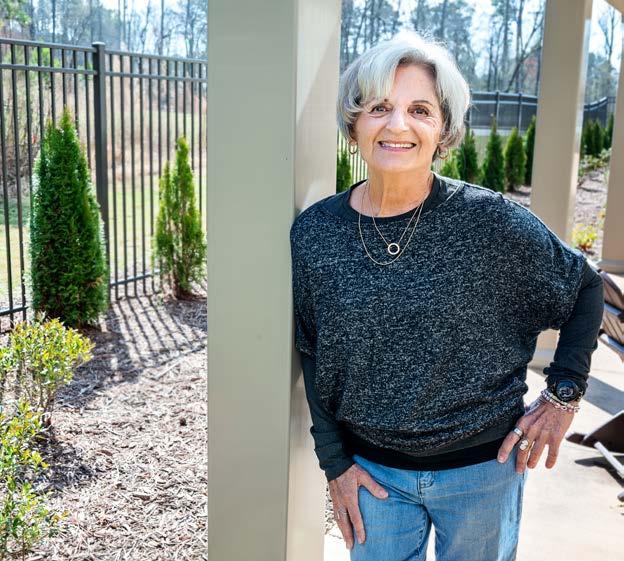
“You’ll thank yourself over and over for making this decision— because you get your life back,” said Candace.
With the right care and support, that decision became a turning point. After her knee replacement, Candace is back to doing the things she loves, moving with ease and no longer held back by pain.
“Six months later, I’m back to my normal life. I’m walking, moving, doing everything I love.”
A team you can trust, focused on getting you back to your best.
Learn more about our services and find a location near you at capefearvalley.com/ortho