For advertising inquiries please contact dawn@theassemblync.com
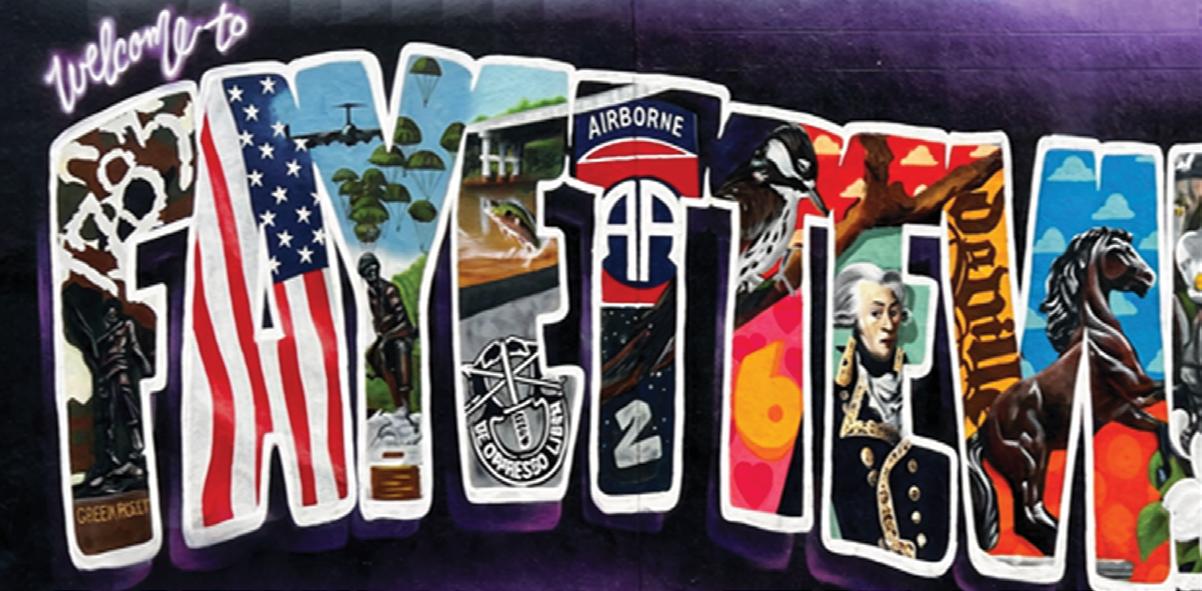
MURAL ART BY ANDALUZ THE ARTIST
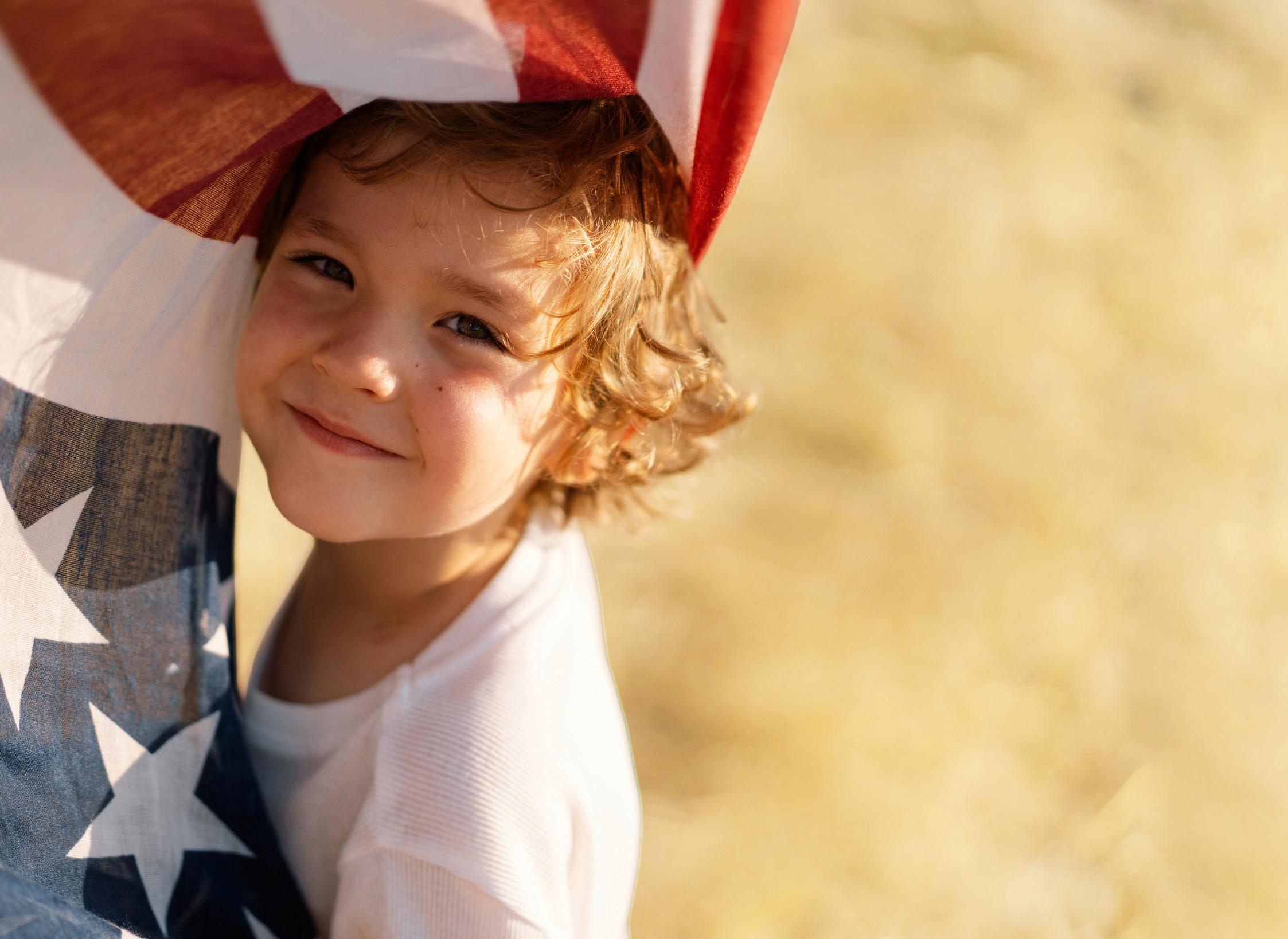
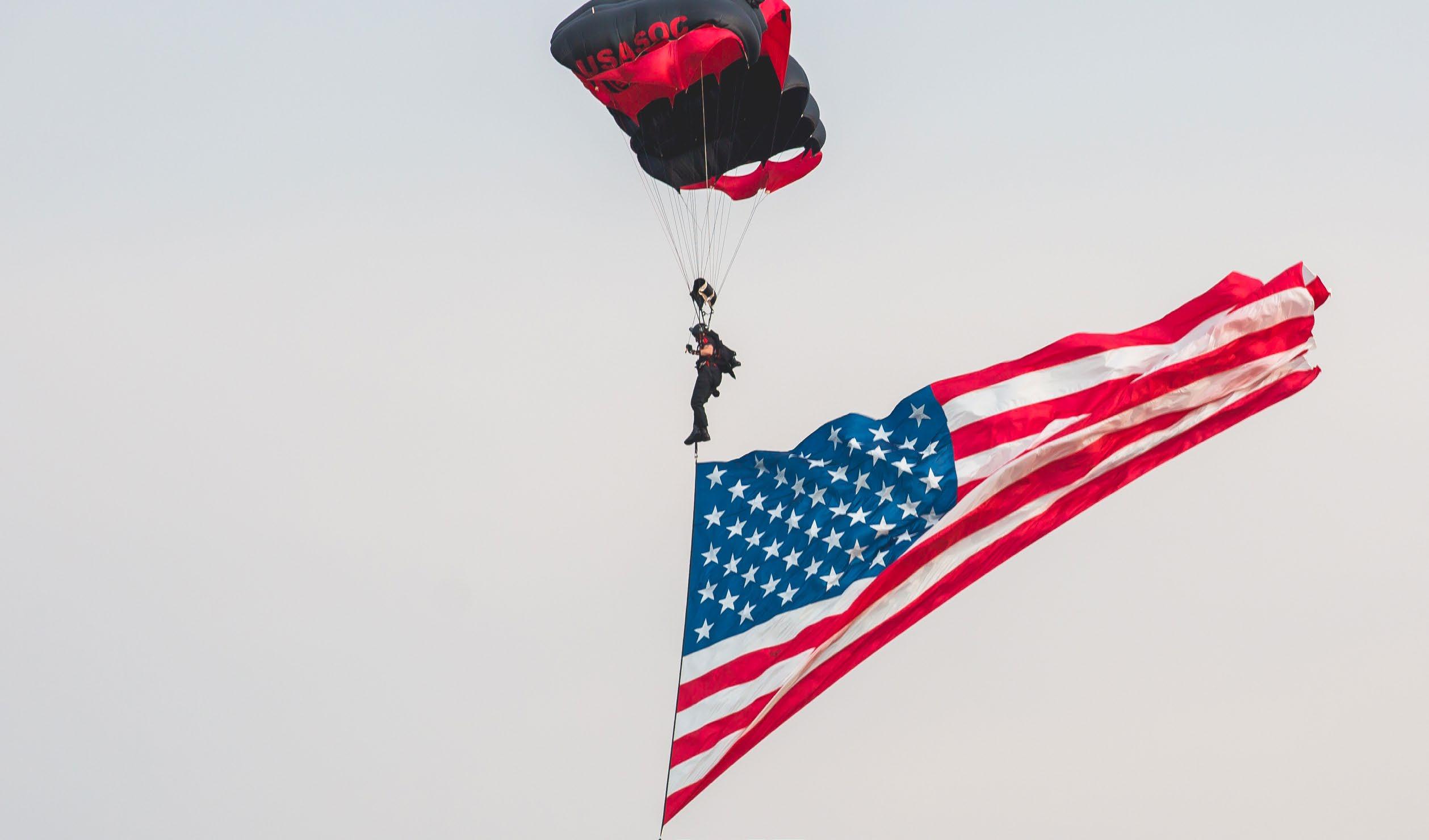
A soldier parachutes with an American flag during Fourth of July celebrations at Fort Bragg in 2016. Photo by Matthew Wonderly
From Aviation to Transportation
How Army veteran Tauheed "Ty" Wood built a Fayetteville to Raleigh-Durham International Airport transportation business.
Art for All
Local artists shine in Fayetteville's Public Works Community Art Exhibition.
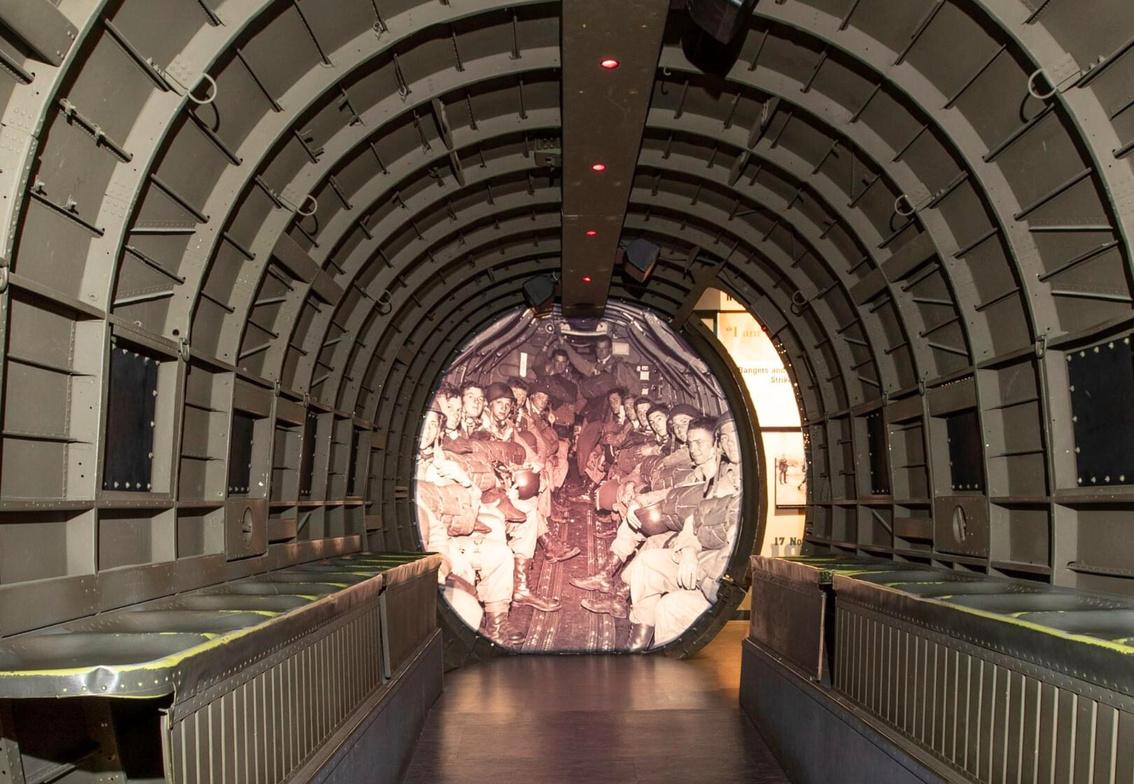
22 New Exhibits Landing at ASOM
Despite a rough road, the U.S. Army Airborne & Special Operations Museum is poised for major renovations at last, with the first part of the two-phase project expected to conclude at the end of 2027.
Preparing for the Next Move
A one-day workshop gives military spouses the tools—and confidence—to rebuild careers repeatedly interrupted by the constant churn of military life.
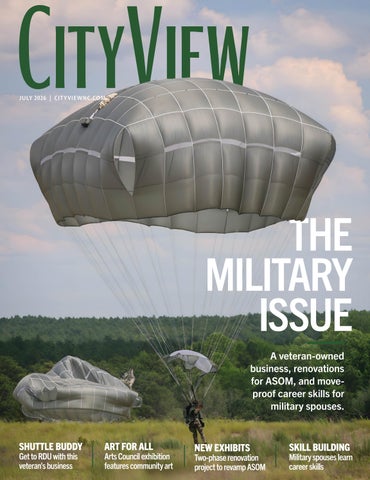
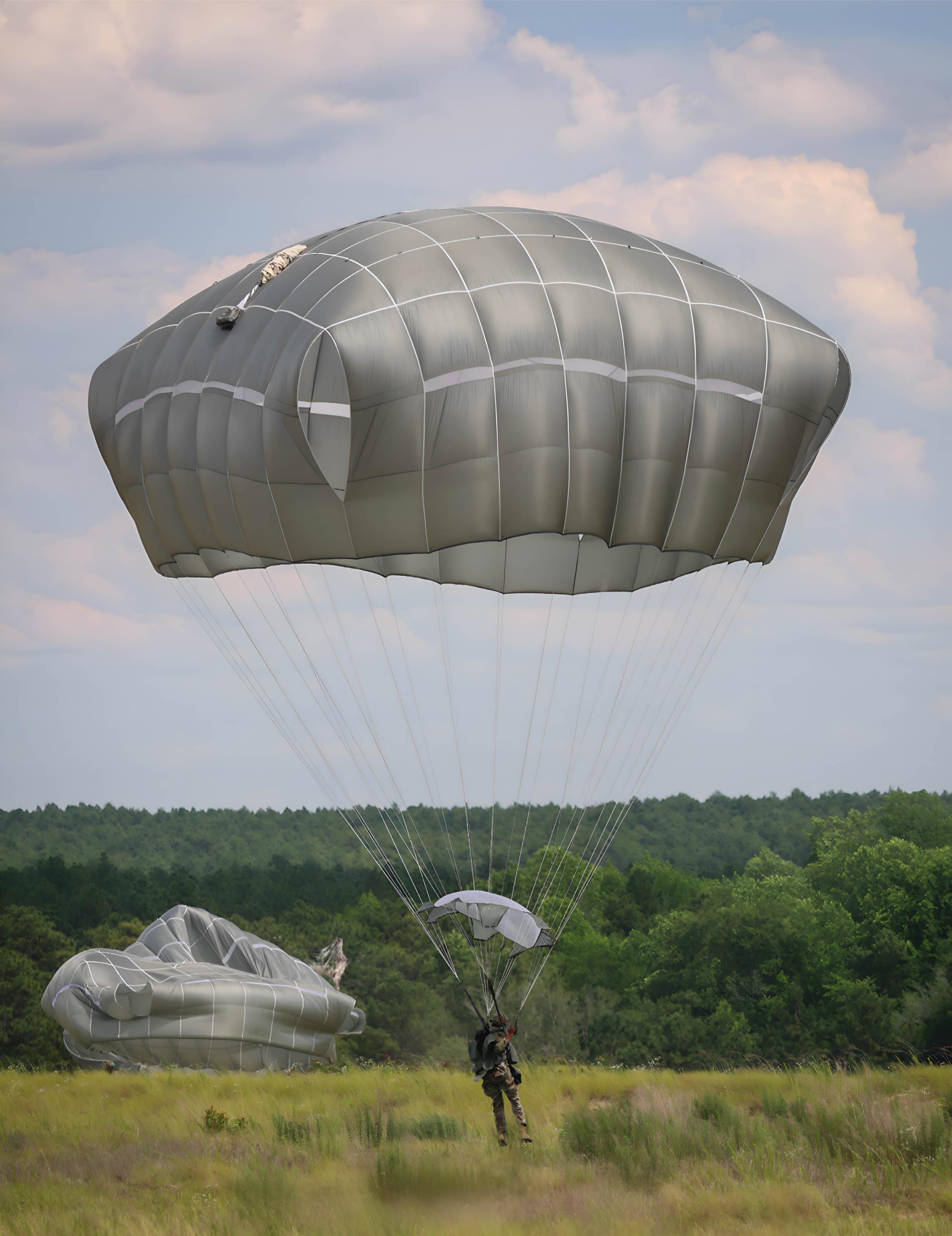
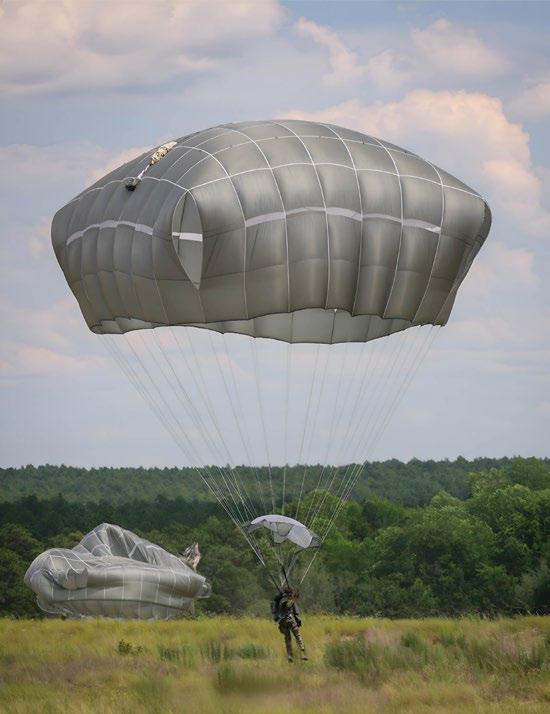
A U.S. Army paratrooper with the 82nd Airborne Division prepares to land onto Holland Drop Zone at Fort Bragg on June 9, 2025. U.S. Army photo by Sgt. Nirak Garcia Navarro. The appearance of U.S. Department of War (DoW) visual information does not imply or constitute DoW endorsement.
Honoring the Military
BY VALERIA CLOËS
CityView’s July magazine shines a light on a Fayetteville military service member’s business, previews the anticipated renovations for the U.S. Army Airborne & Special Operations Museum (ASOM), and highlights an organization helping military spouses build military move-proof careers.
A local U.S. Army veteran went from flying in the sky to starting a land-based transportation business. Tauheed “Ty” Wood, who completed two deployments to Afghanistan during his 14 years of service, saw a need for a more affordable way to travel to and from Raleigh-Durham International Airport and Fayetteville. What started in 2024 as a business with only one shuttle bus has grown to have 11 vehicles, a full office staff, and 10 drivers.
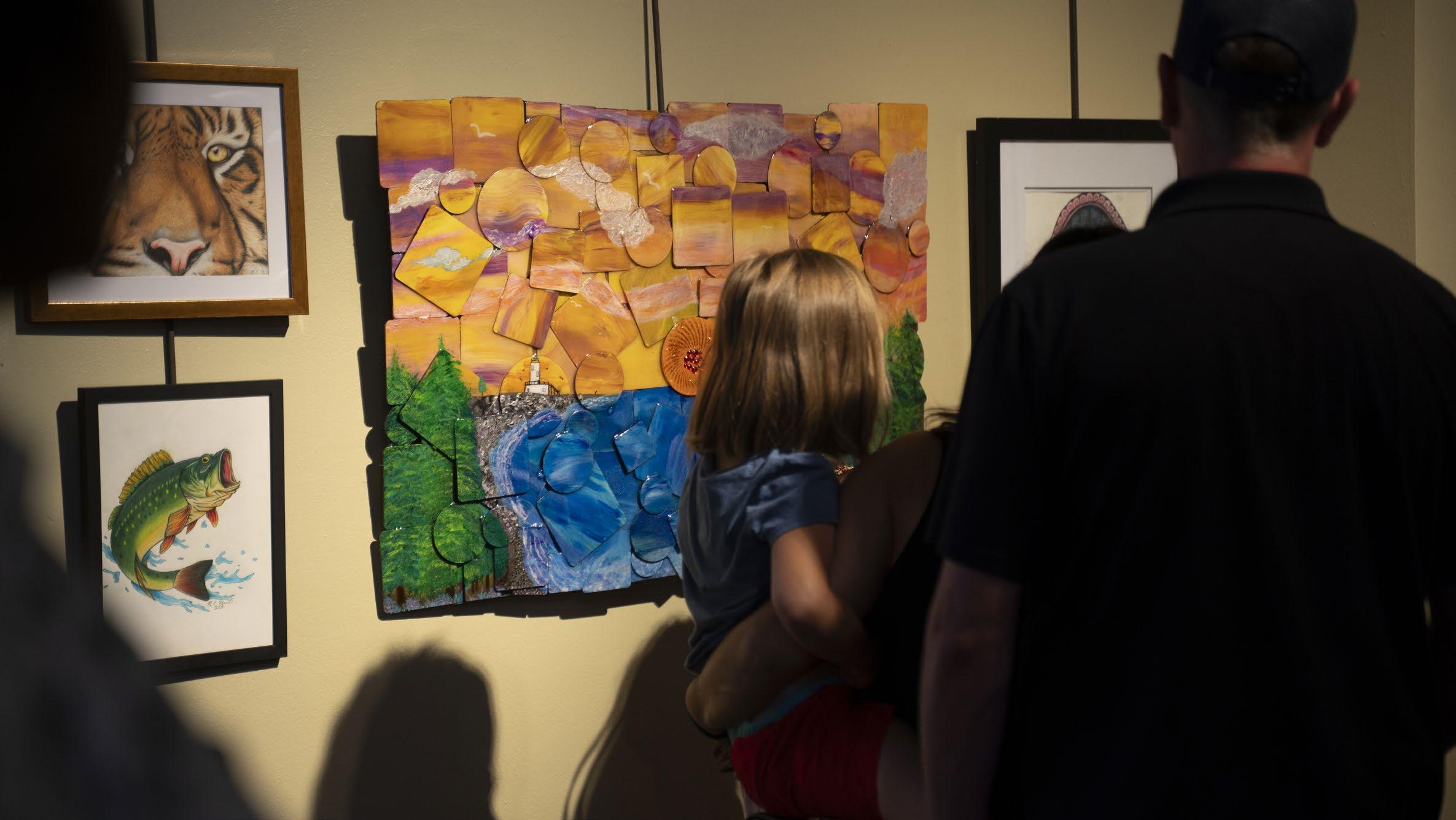
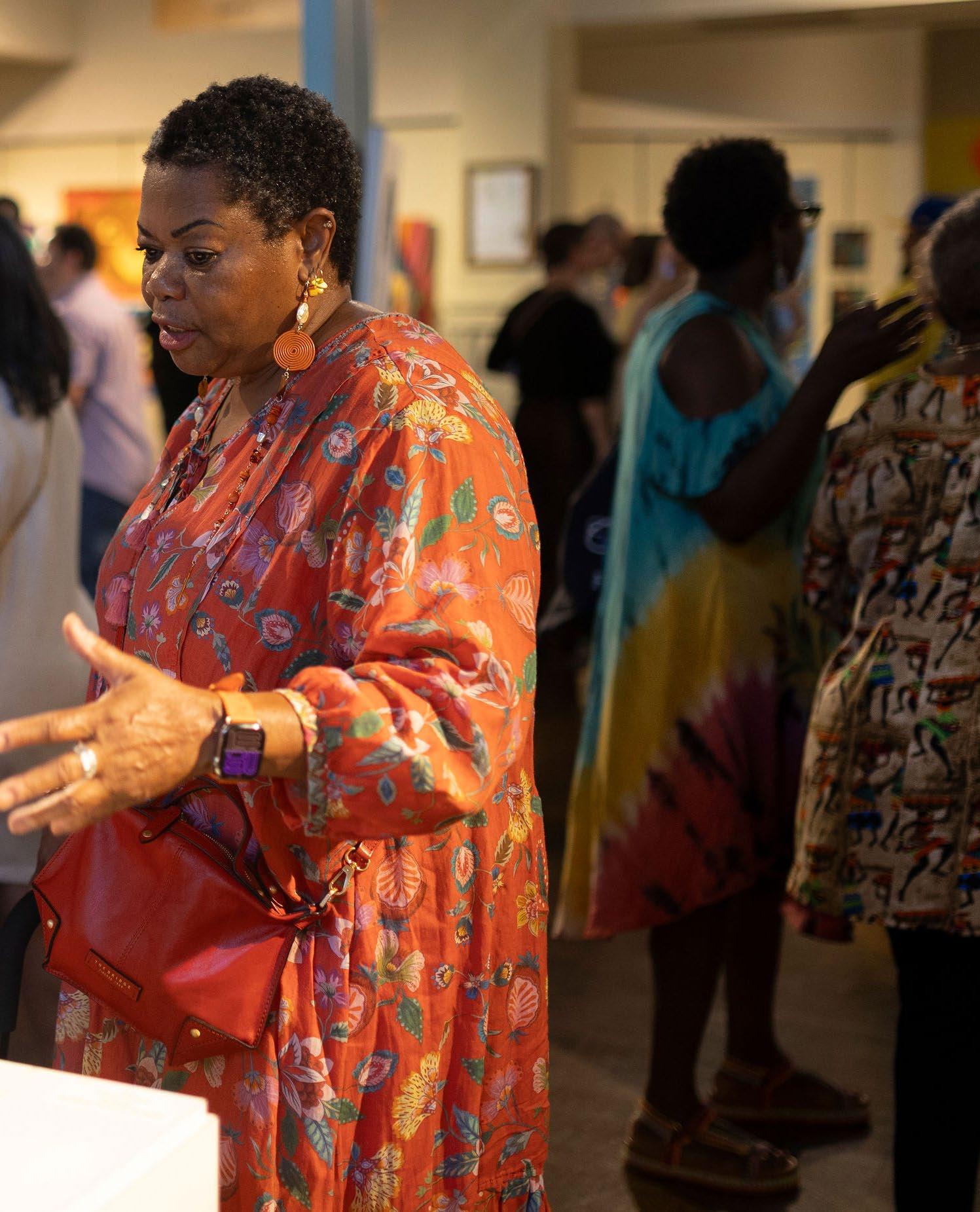
Council of Fayetteville | Cumberland County, the Council highlights its Public Works Community Art Exhibition, which is an open call for community members to submit their art to be displayed.
The ASOM has been on a winding road since the COVID-19 pandemic. It has endured a car crash in 2023 that damaged the museum’s theater, saw the closure of a simulator attraction because of aging technology, and its nonprofit foundation has undergone funding problems. But ASOM now has a two-phase renovation project, the first phase of which is expected to be completed by the end of 2027. The renovations will include a new permanent exhibit, artifacts, and highlight lesser-known stories of the airborne and special operations. Plus, the ASOM Foundation is getting a new executive director after former director Renee Lane’s retirement.
In a piece sponsored by The Arts
Around 30 military spouses attended a one-day workshop in March on Fort Bragg to learn professional development skills in building careers that can withstand the frequent moves required from military service. A couple of military spouses and the event host, Hiring Our Heroes, spoke with CityView to share their experiences and goals.
This month’s columnists write about the importance of our military community. The first analyzes the economic contributions of Fort Bragg to our area. The next reminisces on the summertime chores she’s given her children. Our bilingual columnist highlights the challenges service members face. The last recommends
six books to read on the history of the United States in preparation for its 250th birthday on July 4.
The To-Do List this month is filled with Independence Day events, theater shows, outdoor activities, baseball games, and more.
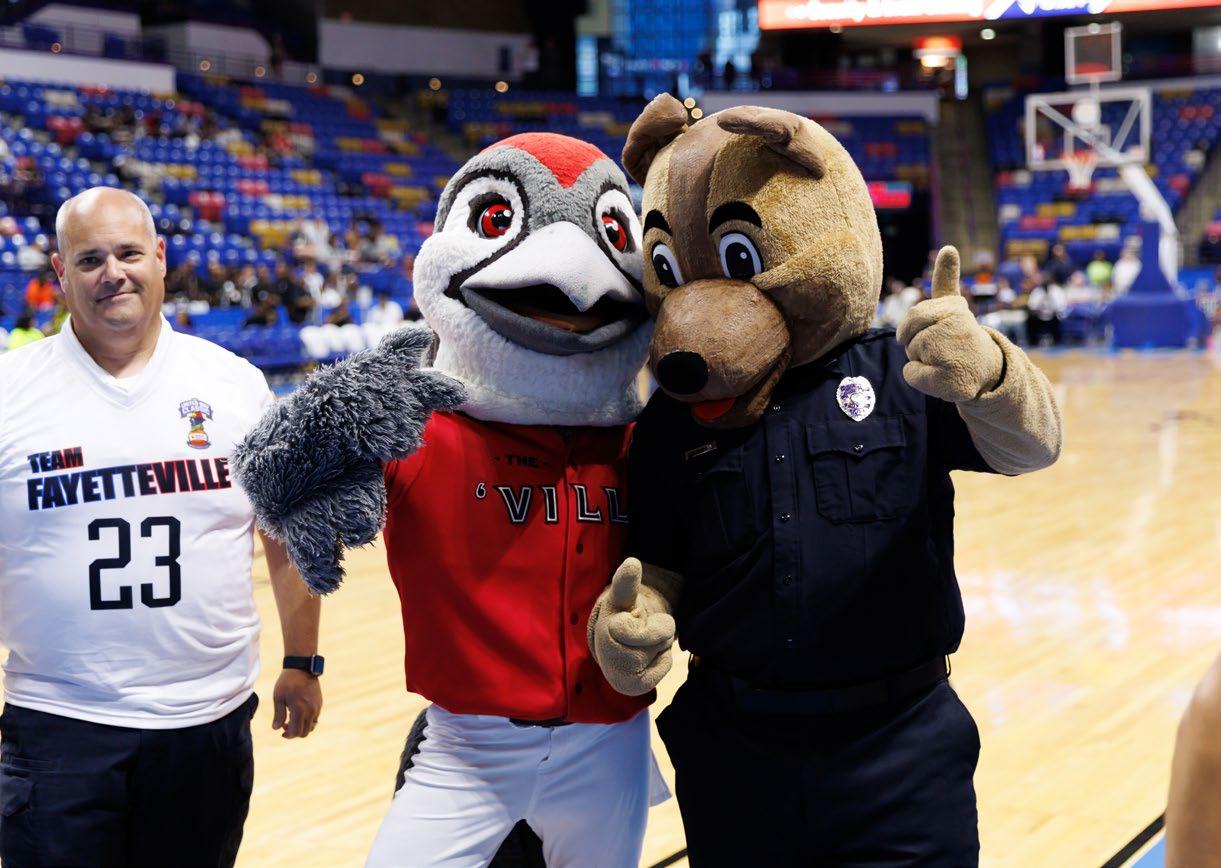
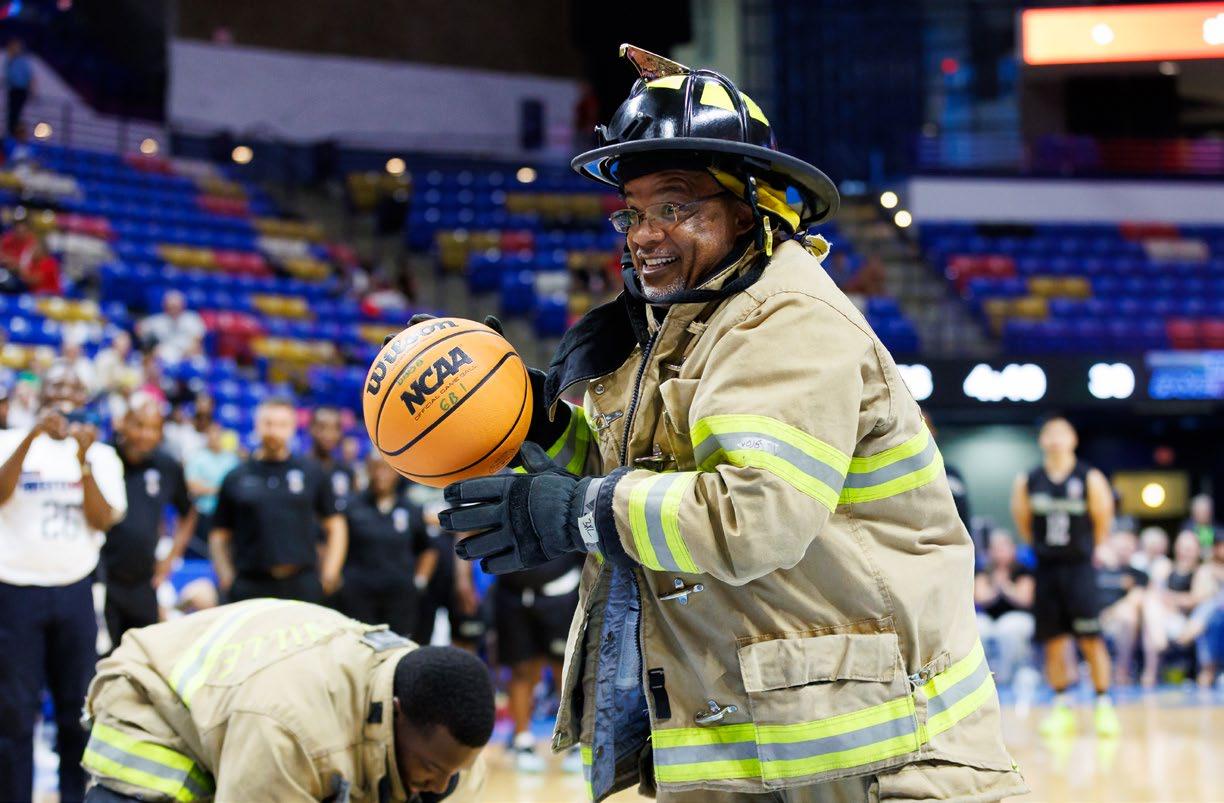
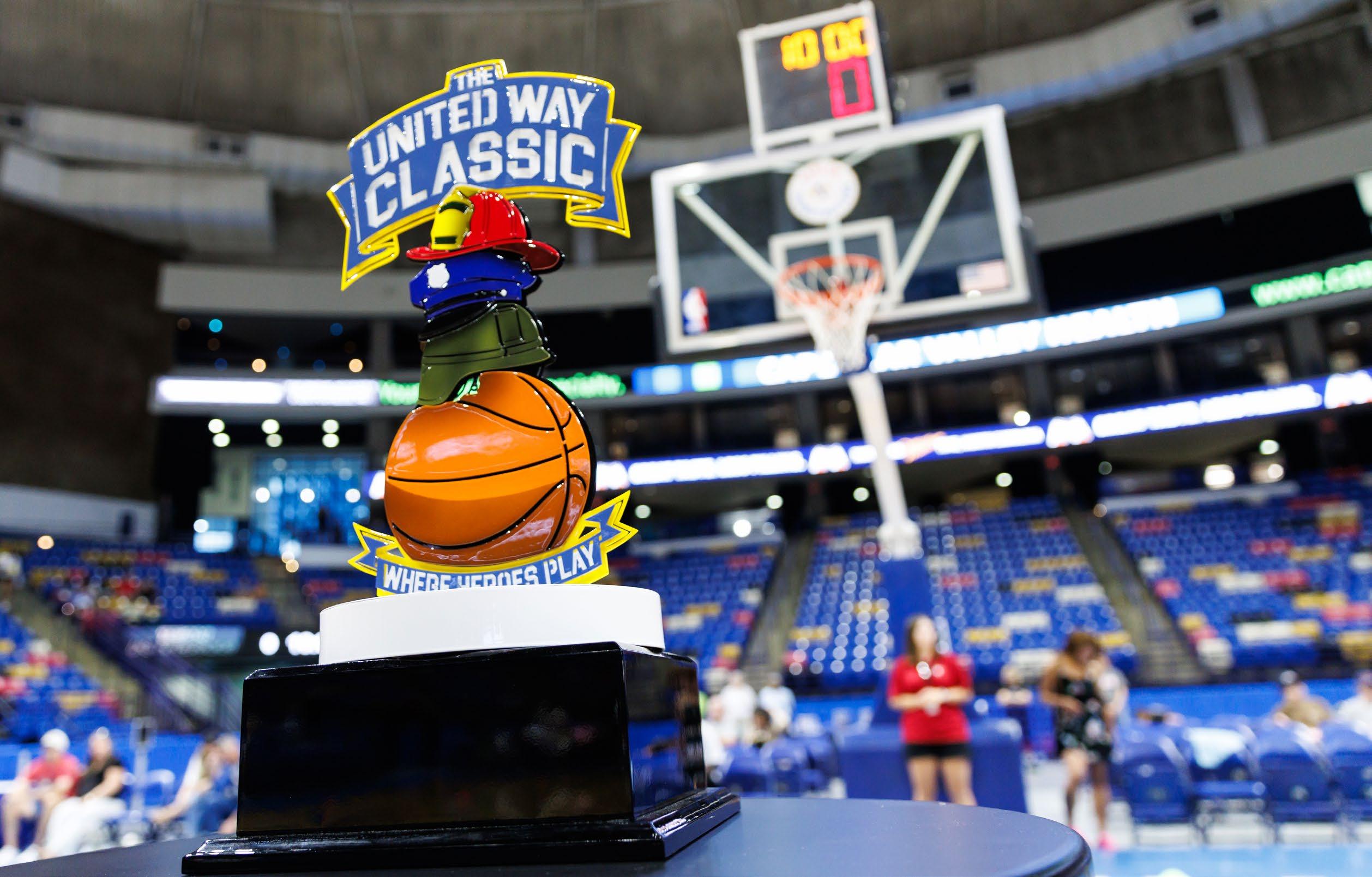
Were you at the United Way Classic basketball game? We may have spotted you at the June 12 event at the Crown Coliseum for our monthly Seen @ the Scene.
Thank you for reading!
Valeria Cloës Magazine Editor
For comments, questions, feedback, or to submit story ideas, email vcloes@cityviewnc.com.
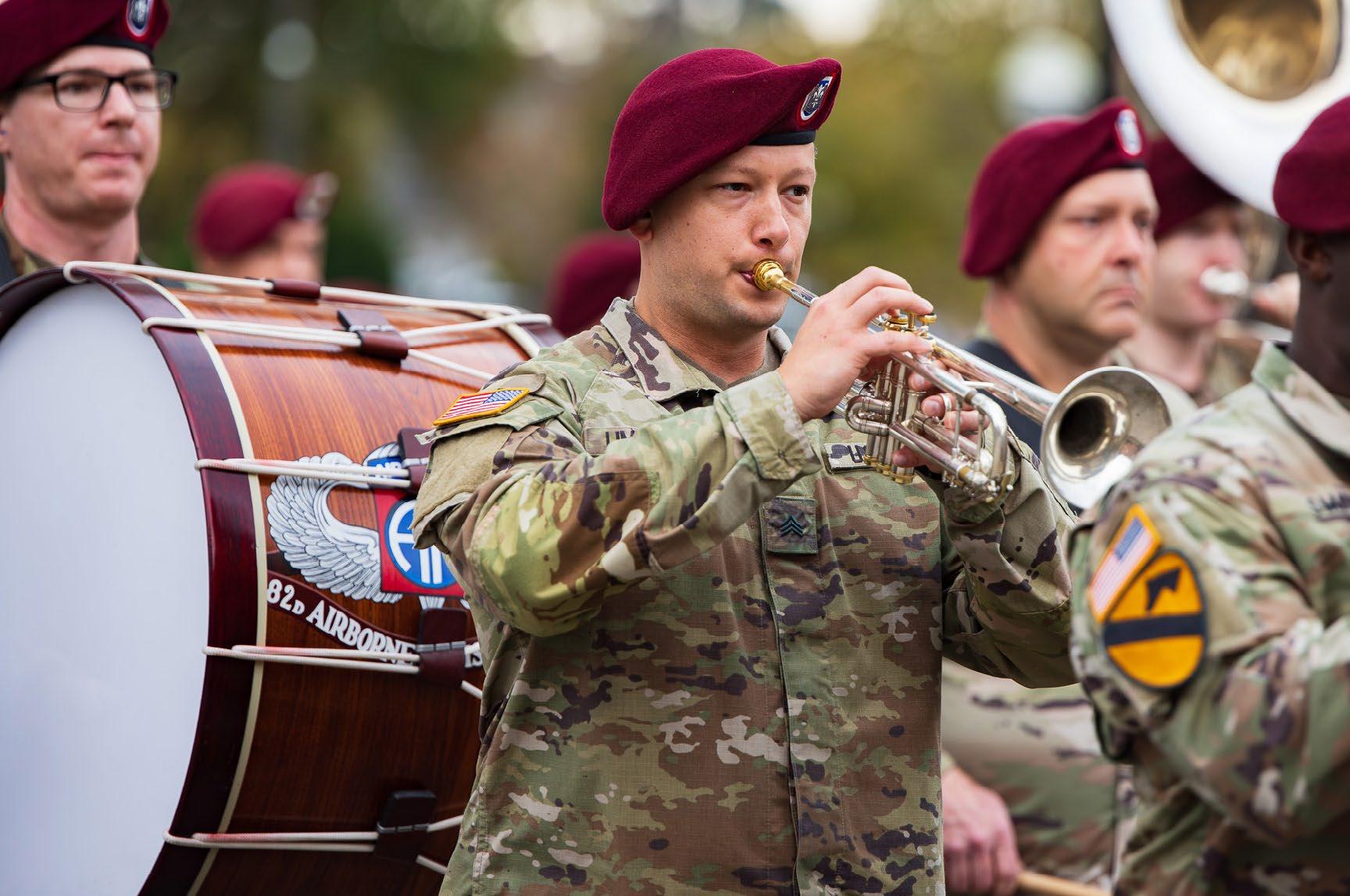
Members of the 82nd Airborne Division Band perform during the 28th Annual Veterans Day Parade on November 2, 2024. Photo by Oriana Evans
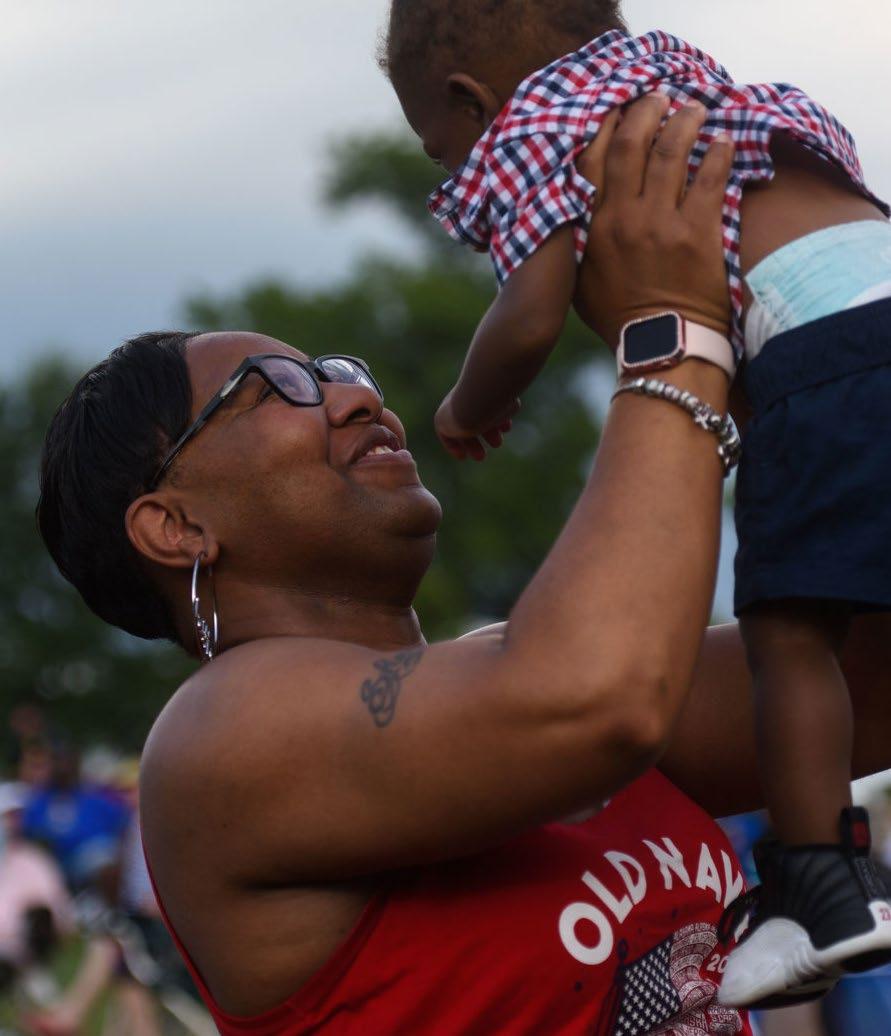
Denise McMillan lifts up 1-year-old Jasia Grant while spending time with friends at Festival Park during the Independence Day celebrations in Fayetteville on July 4, 2022.
Photo by Melissa Sue Gerrits
Saluting Fort Bragg
BY TIM WHITE | PHOTOGRAPHY BY MELISSA SUE GERRITS
In Fayetteville, everyone is in the Army.
We may not all wear the uniform. We may not have a rank or military occupational specialty. And we may not be required to salute superior officers. But around here, we’re Army nonetheless. Because in one way or another, every one of us is touched by the Army every day. Every one of us supports the Army and its soldiers with whatever we do, from business owners all the way to the kids who flip burgers.
The Army, and to a lesser extent other service branches, is the main driver of almost everything that happens here. There is no bigger, or more powerful, force in our town— driving the economy, entertainment, the service industries, education,
health care, and more. Nothing else comes close.
It’s impossible to imagine what Fayetteville and Cumberland County would be without Fort Bragg. I’ve heard more than a few leaders over the years suggest that we’d likely be just another dusty crossroads, a far-smaller city serving the mostly agricultural industry scattered about the region, a hub of regional commerce in an area that had little distinguishing it from any of the other cities dotting the inland southeastern corner of the state.
We missed the boat back in 1789, when the state’s founding fathers ratified the U.S. Constitution here, but then decided Raleigh would make a better state capital. It could have been quite the downhill slide from there,
were it not for the Army building an artillery training ground here for World War I, naming it Camp Bragg. And now look at us—the hometown of what is often referred to today as “Pentagon South.”
Early in May, the Army held its annual “State of Fort Bragg” presentation that detailed some impressive statistics about what has long been the country’s most important military post. The numbers include:
• 48,775 military personnel
• 80,110 military family members
• 17,505 civilians and military contractors
• 97,105 retirees and families supported
• $10.7 billion economic impact in North Carolina annually (nearly $30 million a day)
• Largest American military installation in total supported population ( more than 265,000)
• Third-largest Army installation (by acreage) east of the Mississippi
• Taken by itself, it would be the fifth-largest city in North Carolina.
Fort Bragg is home to the Army’s new Western Hemisphere Command, the XVIII Airborne Corps, the Army Special Operations Command, the Joint Special Operations Command, Army Reserve Command, and the 82nd Airborne Division, along with many smaller units.
That’s the elephant in our room— every room. And for the most part, it’s a great elephant to have. Yes, we do live and die, rise and fall, with
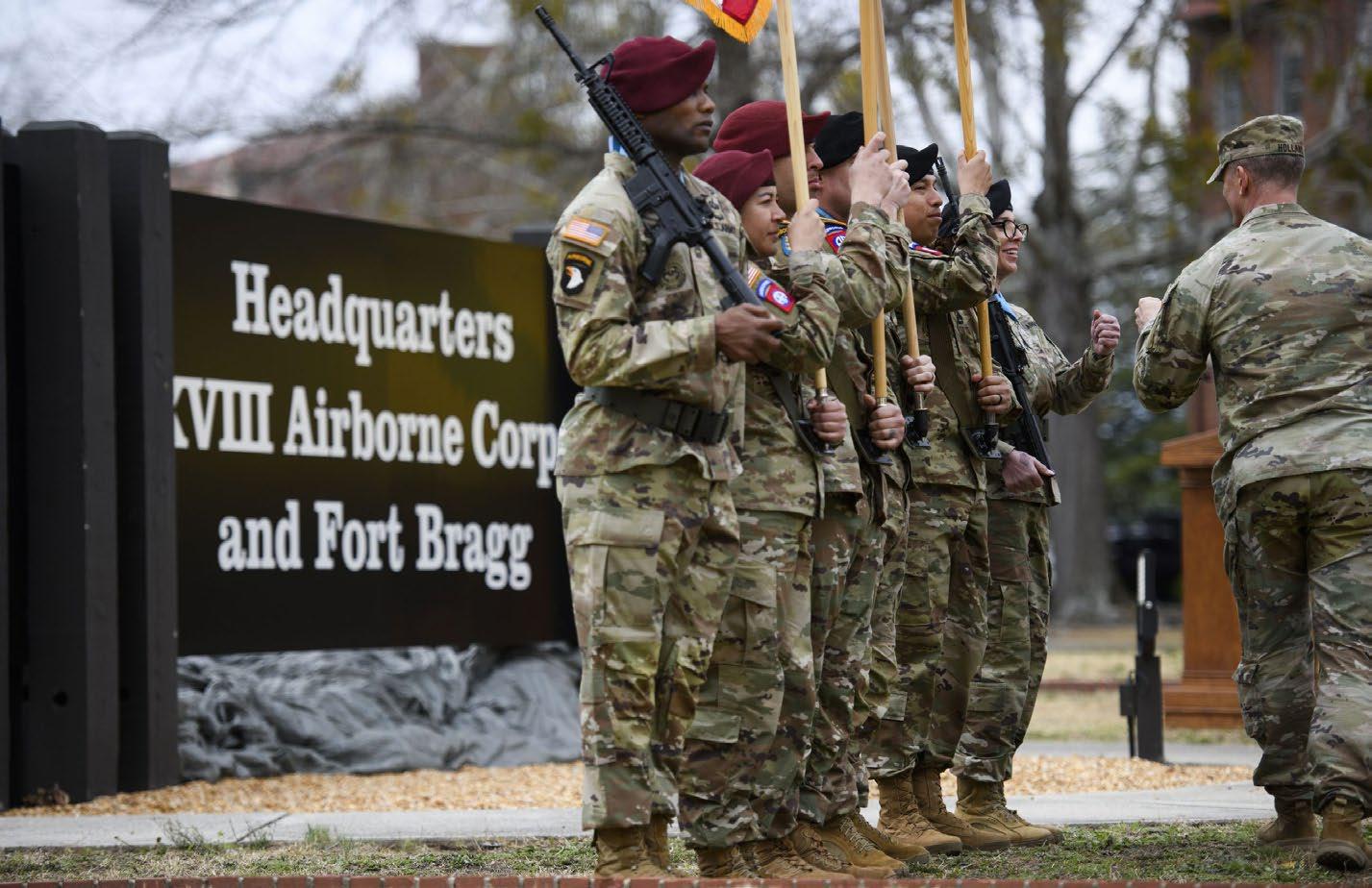
Members of the color guard are greeted after performing duties at a ceremony renaming Fort Liberty to Fort Bragg on March 7, 2025. Photo by Melissa Sue Gerrits
every year’s Defense Department budget. We do hold our breath—and do some intense lobbying, official and informal—each time the Pentagon announces a major reorganization.
But over the long haul, the post has been like a great growth stock our grandparents bought, steadily appreciating in value and importance as the years passed.
It’s easy to wonder, though, what the post—and thus Fayetteville—will look like in another 20, 50, or 100 years. What will war look like in the future? Will we still need to train soldiers to jump out of airplanes? Will we even need soldiers, or at least as many as we have now? Will robotics take the place of humans on the battlefield? We can look at how drone warfare in Ukraine has already changed the face of war, and wonder what even the next five or ten years of innovation will bring. It’s fair to ponder what advanced technology will mean for Fort Bragg’s future.
But over my years in Fayetteville, I saw a hint of how the region will cope with changes in the military. More than a hint, really. More like a well-written plan. Because I’ve never seen a place more united in a mission to keep its biggest economic engine thriving. I’ve even seen Yellow-Dog Democrats and bright-red MAGA Republicans working well together on anything involving the post. It’s an amazing thing to see in a country so politically divided. When it comes to Fort Bragg, there is no political warfare around here; everyone’s on the same team.
Meanwhile, I’ve also listened as some of our elected leaders and the economic developers they’ve hired have talked about diversifying Cumberland County’s economy, making us less dependent on the federal budget. I’ve always supported that idea, but I’ve also taken it with a grain or two of salt. Other than a few call centers and warehouse-distribution centers, not much has happened. And my best guess is that not much will happen in the future, either.
For better or worse—and mostly it’s better—Fort Bragg is the core of our economy, now and far into the future. And that’s OK. We can all salute that.
Tim White is the former editorial page editor of The Fayetteville Observer.
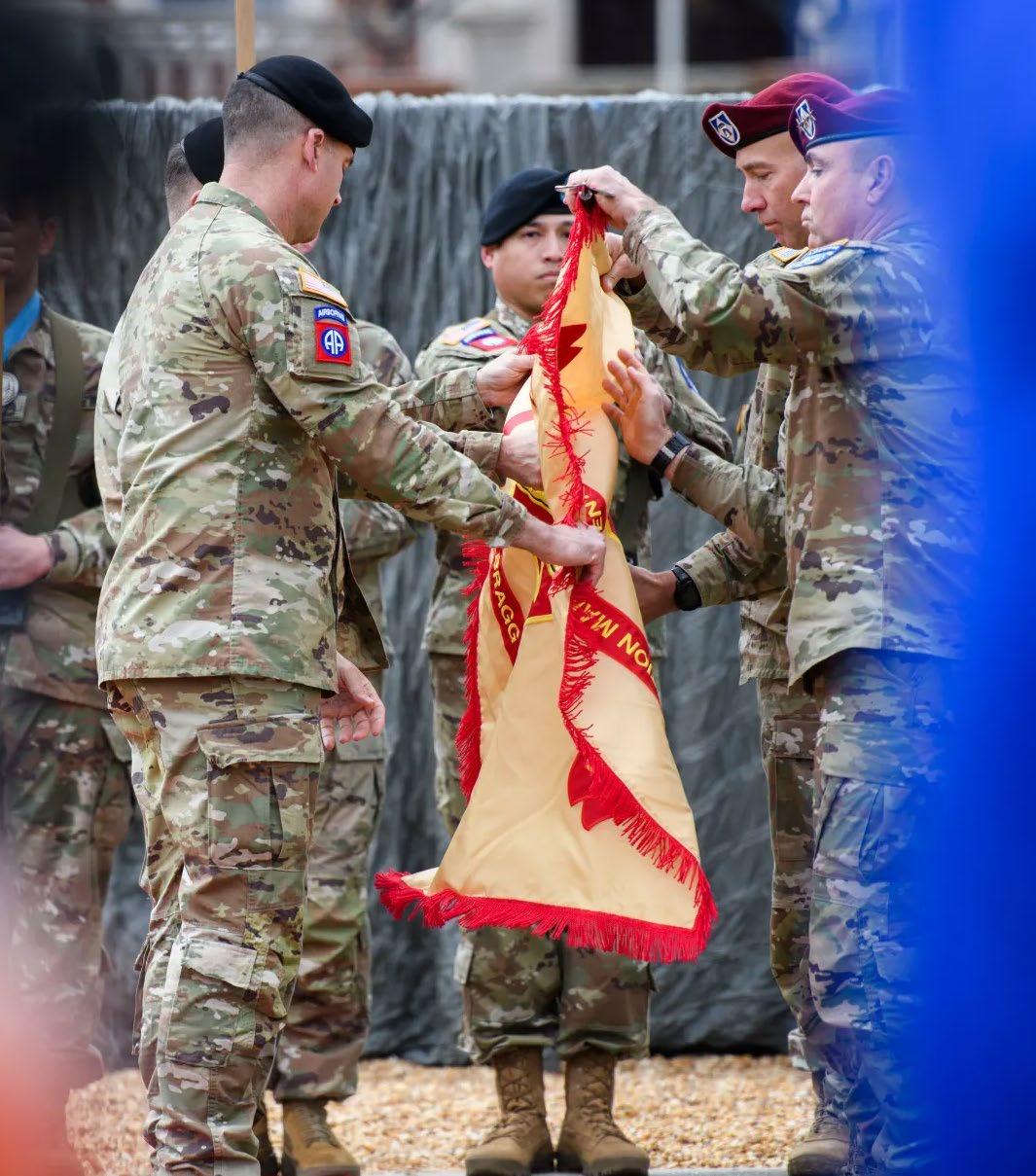
Soldiers uncase the colors denoting Fort Bragg during a redesignation ceremony changing the name of Fort Liberty to its previous name Fort Bragg on March 7, 2025.
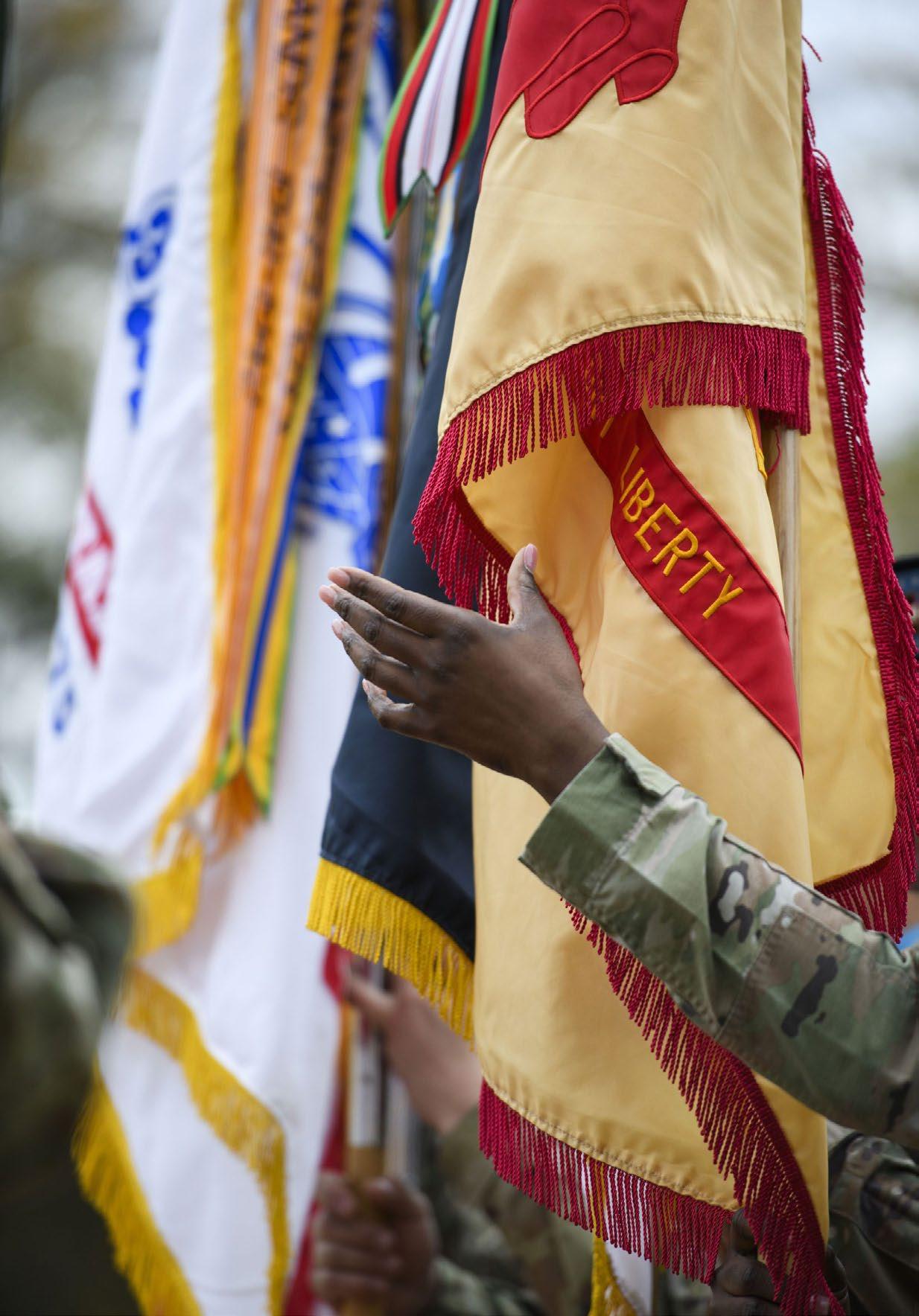
Colors denoting Fort Liberty are unfurled before a ceremony to redesignate the post to Fort Bragg on March 7, 2025 .
The Summertime Sheriff
BY CLAIRE MULLEN
After several well-earned, summer break kick-off weeks of sleeping in, more screen time than they are typically allowed, unlimited popsicles, and nary a responsibility, my two children, ages 9 and 12, awoke one morning to the horror of three color-coded documents taped to the living room wall. The first two were customized chore charts for each of them, followed by a third page: a bulleted list of summertime rules and regulations.
What can I say? I can only be the sheriff of a lawless frontier for so long.
Their rosters of daily chores were perfectly reasonable assignments: making their beds (with “neatly” added and underlined in parentheses); taking turns walking our puppy; tidying their rooms and bathrooms (“shoving everything under your bed or in your closet is not tidying”); at least 30 minutes of reading (“no, 30 minutes of watching the movie version of the book does not count”); 30 minutes of practicing the sport of your choosing; washing dishes; folding towels; taking out the garbage; and working together once a week to deep clean the playroom (“no, you cannot pay your sibling $10 to do it all”).
But by the looks on their faces, you would have thought I’d demanded that they pluck the hairs out of their heads one by one with dull tweezers.
The funny thing is, these are things my husband and I generally expect of them anyway, but maybe it was just seeing the chores scrawled in my chicken scratch in itemized fashion that made it seem as though I’d written out, not a list of chores, but the steps to their slow and excruciating demise.
And then came the list of family rules and regulations that I mistakenly thought might stir a little enthusiasm if each rule was written in a different summery-colored magic marker. But my tween daughter and fourth-grade son remained unimpressed.
I may have even sensed a slight air of annoyance and urge to whine. Perhaps they just felt oppressed by the very first item on the list, “No whining about or acting
annoyed by these rules.” A list followed: No YouTube. At all. No begging to watch YouTube. No sneaking Mom and Dad’s phones to watch YouTube. No uttering the words “YouTube.” No thinking about YouTube. No sneaking sweets or sodas without permission (a rule implemented only after I discovered a certain someone’s secret hiding spot for empty candy wrappers, and an empty Diet Coke can stacked neatly in the fridge behind the other five full cans from my emergency reserve). No fighting with your sibling (I think the enthusiasm might have finally kicked in on this one because they both actually let out a little chuckle!). Be generally helpful with Rowdy (Rowdy is our puppy, and they knew better than to balk at this one because rule No. 1 on the “Rules and Regulations of Getting a New Puppy” list was “be generally helpful”). No food or drinks upstairs in your bedrooms (inspired by my discovery of a longforgotten, long-expired fast food milkshake in my son’s bedroom trash can). And another few highly oppressive directives thrown in for good measure.
When my children finished surveying their commandments, my 9-year-old had but one question, “Mom?! After all this, when are we even going to have time for any fun?”
I’m happy to report that since the sheriff laid down the law, all chores continue to be completed and rules and regulations continue to be followed, for the most part. Summer reading completion is well underway. We’ve only had one little YouTube slip-up, but only because my son “really, really needed to see this funny video my friend told me about what it feels like to eat a Dorito the wrong way.”
I don’t think a snack or a soda has been snuck, although a pessimist might say that I just haven’t yet discovered the new hiding spot. Rowdy has enjoyed his daily walks with two kids who actually have the energy to keep up with him, and I have enjoyed my daily breaks from dog doodie duty. Beds have been made, with “neatly” remaining relative. Rooms have been tidied, although I need to remember to check under beds.
I’m happy to report that since the sheriff laid down the law, all chores continue to be completed and rules and regulations continue to be followed, for the most part.
And as for that whole “no arguing with your sibling thing,” it was probably a pie-in-the-sky goal to begin with anyway. I mean, when there are two of you, and one of you is near collapse from walking the dog in 95 degree heat, the other is exhausted from 30 minutes of mandatory backyard soccer practice, and you both reach the freezer simultaneously (after asking Mom’s permission, of course) to discover that there is only one popsicle remaining, what else is there to do other than engage in a good, ol’ fashioned familial fracas?
So I think it’s safe to say, generally speaking, we are killin’ it. Even if it has only been two days since I laid down the law.
Feel free to check in with my kids in August to see if they managed to squeeze in even an ounce of fun between all their endless toiling and law abiding under the subjugation of the summertime sheriff.
PHOTO BY VITALY GARIEV ON UNSPLASH
Claire Mullen can be reached at clairejlmullen@gmail.com.
From Aviation to Transportation
How Army veteran Tauheed “Ty” Wood built a Fayetteville to Raleigh-Durham International Airport transportation business.
BY SARAH MUNSCH | PHOTOGRAPHY BY TONY WOOTEN
IIf you don’t want to pay airport parking prices and want affordable, safe, and reliable transportation between Fayetteville and Raleigh-Durham International Airport (RDU), Shuttle Buddy is the solution for you.
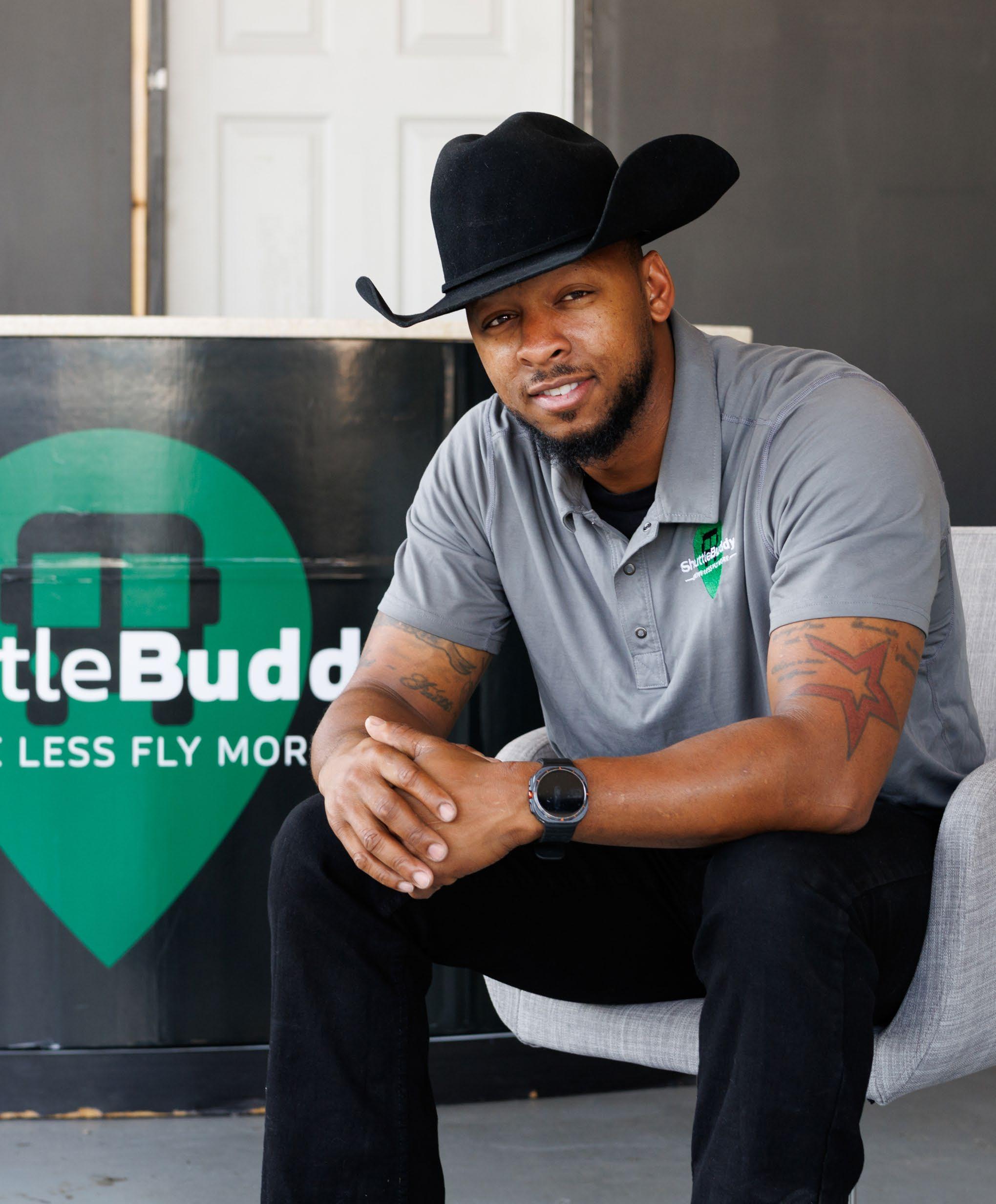
Owned and operated by U.S. Army veteran Tauheed “Ty” Wood, Shuttle Buddy has been in operation for nearly two years. Wood took the skills he learned in the Army and used them to build Shuttle Buddy from the ground up.
He also received inspiration from his grandfather, Reginald E. Wood Sr., who spent 28 years as a sergeant major in the Army. Wood said that his grandfather, who passed away in December, was his biggest support system.
“Everything I touched, everything that I ever put my mind to, he was always so surprised,” Wood said. “Every time he turned around, I’m overcoming, I’m conquering something new.”
Army Career
Wood joined the Army in March 2009 at the age of 19. He spent the first five years of his military career as a signal operations support specialist before attending flight school and earning his wings as a UH-60 Black Hawk pilot and Army warrant officer.
After one year serving as a Black Hawk pilot, he completed a highly competitive selection and interview
process, and his chain of command selected him to transition to the AH-64 Apache attack helicopter community.
During his military career, Wood completed two deployments to Afghanistan. His first deployment was from 2011 to 2012 during which he served as an enlisted soldier. His second deployment took place in 2021 during the final stages of U.S. military operations in Afghanistan.
As a member of the 1st Attack Battalion, 82nd Combat Aviation Brigade, Wood and his unit played a critical role in the closure of Bagram Airfield, 25 miles north of Kabul, Afghanistan, in July 2021 when it was handed back over to the Afghan National Security and Defense Force. The unit later supported evacuation operations at Hamid Karzai International Airport in Kabul in August 2021 during the withdrawal of U.S. forces from Afghanistan.
For his actions during these operations, Wood was awarded the Air Medal with a “V” device for Valor, an honor recognizing acts of heroism during combat operations.
After 14 years of service to the nation, he concluded his military career in May 2023 and was honorably discharged as a chief warrant officer three.
The Beginning of Shuttle Buddy
One day, when Wood and his son were at RDU, they
U.S. Army veteran Tauheed “Ty”Wood is the owner and operator of Shuttle Buddy, a Fayettevillebased transportation service taking customers to and from Raleigh-Durham International Airport.
It's a huge blessing to be able to say that we are understaffed and overbooked at the moment. I am eternally grateful for the support of the community.
-
Tauheed “Ty” Wood, Shuttle Buddy owner
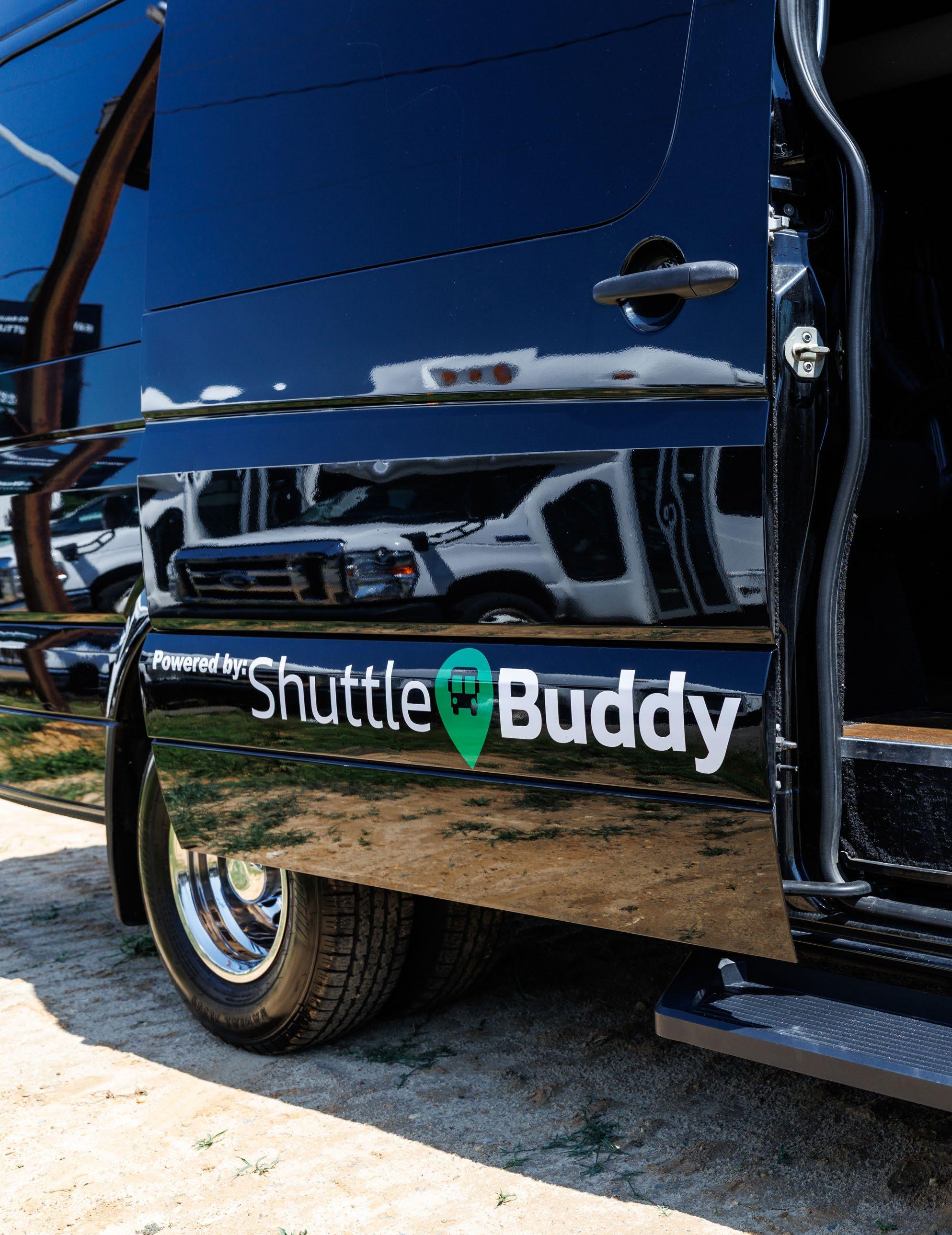
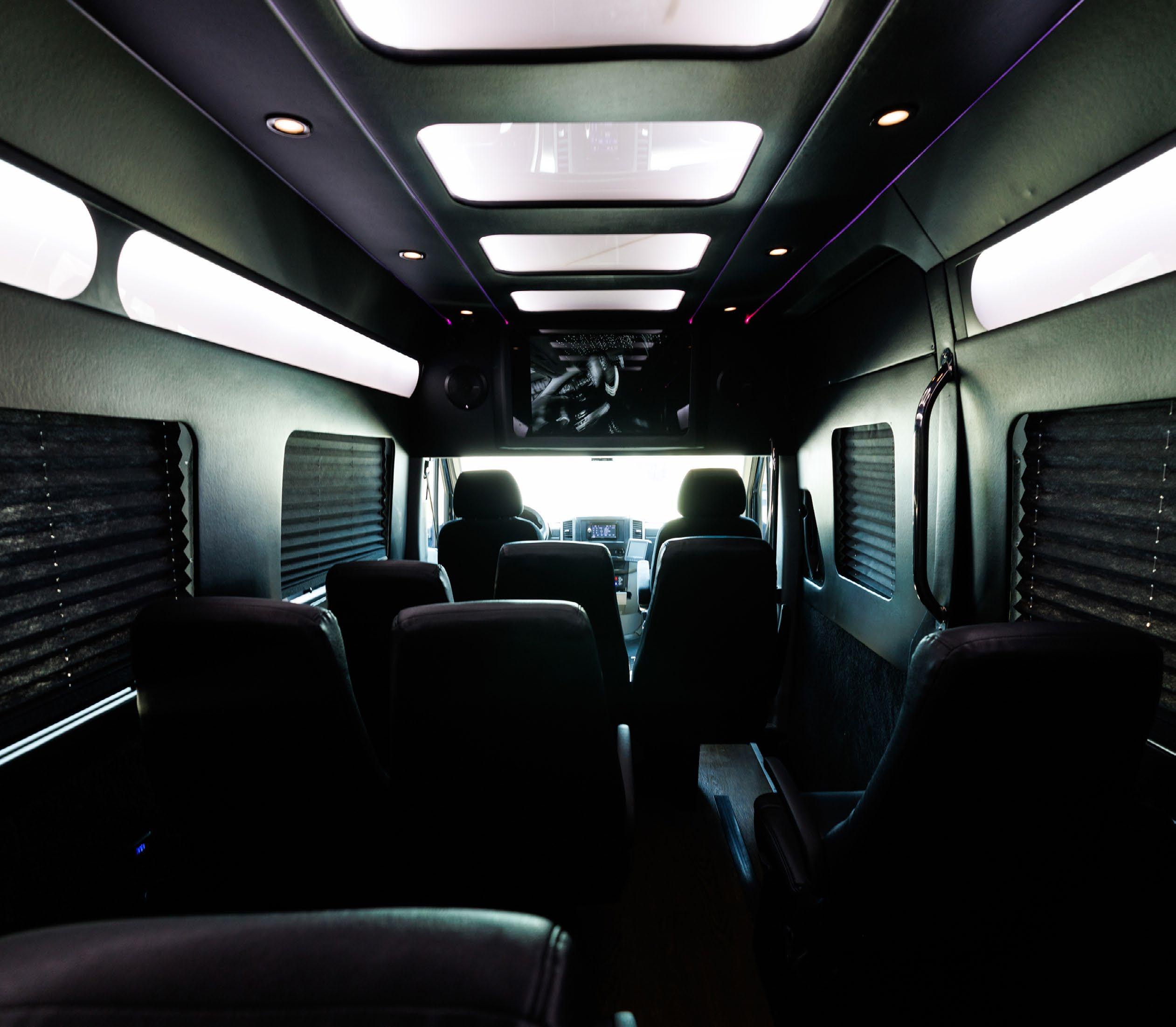
Shuttle Buddy has 11 vehicles, including buses, transit vans, Mercedes Sprinter vans, a large international bus, and fuel trucks.
decided to park in Premiere parking, which offers hourly or daily ground-level, covered parking close to the terminals. Upon returning from their trip, not only were they tired and didn’t want to drive home, but they also had a $250 parking bill.
“‘There must be a better way,’” Wood recalled thinking. When Wood got home, he locked himself in his house for three days and began planning. He thought about new transportation infrastructure possibilities and started laying the groundwork for Shuttle Buddy. He considered the business structure and how to make it accessible and reliable for potential customers.
“After those three days, I came out of my cocoon and I had a company,” Wood said. “I took my military training, the way we used to mission plan in the Army, and I just
put my head down, and went into my mission planning self, and went to work.”
The First Year
During the first year of business, Wood focused on building a reputation in the community. He made connections with different organizations, including the Morale, Welfare, and Recreation (MWR) office on Fort Bragg, Fayetteville State University, and the Fayetteville Liberty basketball team. He also spoke with Fayetteville City Councilmember and Mayor Pro Tem Derrick Thompson, who directed him to the Chamber of Commerce.
Shuttle Buddy started in 2024 with a single bus. Quickly,
The company plans to expand to 16 vehicles by late August, as well as expand its staff later in 2026.
Shuttle Buddy is approaching its two-year anniversary on July 28.
Unlike standard ride-share services, Shuttle Buddy doesn’t pick up customers from their residences; instead, rides departing from Fayetteville leave from the office location at 5419 Raeford Road.
Wood realized he needed another to accommodate the demand. After buying the second bus, the first one’s engine failed, and Wood and his son rebuilt the engine themselves.
Rhonda Quador, a community education director at Psychiatric Medical Care, took her first trip with Shuttle Buddy in August 2024 after she was stranded at the airport when the ride she planned fell through at the last minute. Since then, she has been utilizing Shuttle Buddy every time she travels for work, up to three times a month.
“If I’m going to RDU, I will never use a rideshare service or even personally drive,” Quador said. “It makes my job so much easier. I can not say enough great things about Shuttle Buddy.”
Current Expansions
Shuttle Buddy has come a long way since the beginning and it is approaching its two-year anniversary on July 28. It now has 11 vehicles, including buses, transit vans, Mercedes Sprinter vans, a large international bus, and fuel trucks. There are plans to expand to 16 vehicles by late August.
The staff will also be expanded later this year. At first, Wood did nearly all of the booking, driving, and mechanic work himself. He now has a full office staff, including his mother and son, and 10 drivers who work under him. He is planning on doubling the number of drivers employed by Shuttle Buddy by September.
“There were tough times when we were pulling
change out of the cupholders to fuel the vehicles,” Wood said. “It’s a huge blessing to be able to say that we are understaffed and overbooked at the moment. I am eternally grateful for the support of the community.”
Cost and Booking Information
Unlike standard ride-share services, Shuttle Buddy doesn’t pick up customers from their residences; instead, rides departing from Fayetteville leave from the office location at 5419 Raeford Road.
Shuttle Buddy allows one carryon and one checked bag. Any extra bags require a $10 fee. Shuttle Buddy allows pets to ride for a $25 fee. Service animals ride for free. The standard adult rate for a one-way ride is $60, the military and student rate is $49.50, and the rate for children ages 3 through 14 is $30.
“I’m saving my company 40% by booking with Shuttle Buddy,” Quador said. “I love that I can sleep, listen to a podcast, or watch TV on the way to the airport. And when I return, I don’t have to worry about having a dead car battery or if I lost my credit card and can’t get out of the garage. I think of this as almost like an insurance policy in making sure my trip is good.”
BY JULY 31, 2026
For customers planning on booking with Shuttle Buddy, there are three ways to plan your ride. The easiest and most recommended way is to visit goshuttlebuddy.com and navigate to the “Buy Tickets” tab. The other ways to book are by calling 910-9363784 or visiting the office during business hours at 5419 Raeford Road in Fayetteville. For more information, email info@goshuttlebuddy.com.
ABOUT THE AUTHOR
Sarah Munsch is a freelance writer for CityView. She was born and raised in southeast Texas and moved to Cumberland County in November 2024.
ARTS COUNCIL
Art for All
Local artists shine in Fayetteville’s Public Works Community Art Exhibition
BY TERI SAYLOR
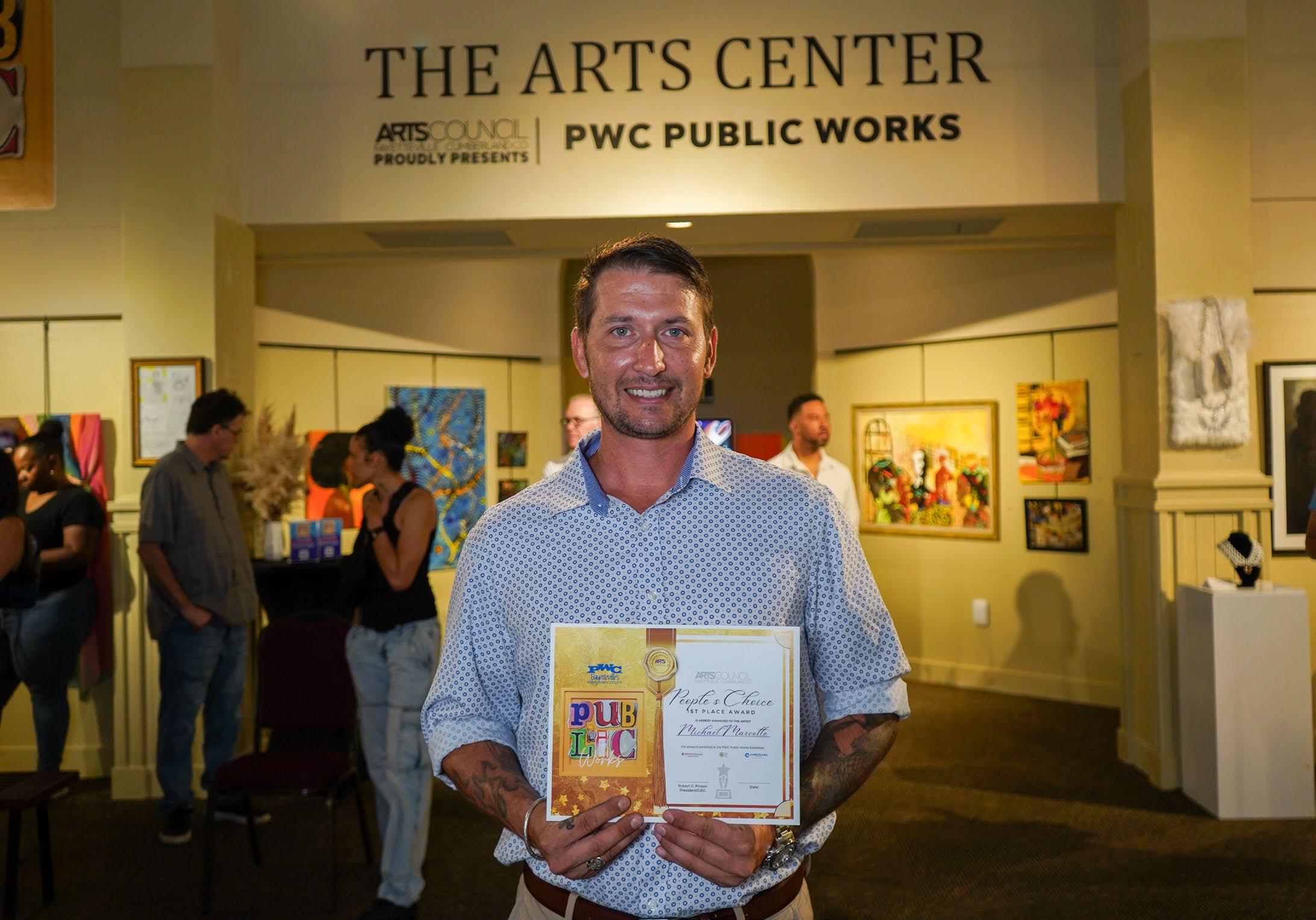
MMichael Marcotte never dreamed he’d win a first-place award in an art show. After all, he hadn’t drawn or painted anything in over 20 years. But when knee surgery sidelined him a few years ago, he picked up some colored pencils and started drawing.
His fiancée, Tiffany Skimmiehorn, believed in his talent even when he was unsure, and last year she entered his lifelike drawing of a tiger in the 2025 Public Works Community Art Exhibition at the Arts Council of
Fayetteville | Cumberland County.
His drawing, titled "Welcome to the Jungle," earned the show’s People’s Choice Award.
For Marcotte, art is a family affair. He inherited his talent from his mother, an oil painter who lives in Michigan. He’s serving in the U.S. Army and reckons he’ll be retiring in a few years. Right now, he has no plans to pursue a second career in art, preferring to keep it as an enjoyable hobby.
This year, he’s convinced other members of his family to enter the Art Exhibition, a long-running marquee event in Fayetteville. It’s sponsored by the Fayetteville Public Works Commission in collaboration with the Arts Council of Fayetteville | Cumberland County.
His entry this year is a pencil-drawn portrait of a bald eagle with piercing eyes, so lifelike it is hard to distinguish it from a photograph.
Marcotte, who enjoys drawing
Michael Marcotte with his People's Choice Award at the Public Works Community Art Exhibition. Courtesy of Arts Council Fayetteville
images from nature, is fascinated by the kaleidoscope of colors in the irises of eyes.
“If you ever get a good view of an eye up close, you’ll see many colors, and I love bringing them out,” he says. “Because how often do you really look that closely at somebody’s eyes?”.
Marcotte embodies the spirit of the Community Art Exhibition, says Bob Pinson, the retiring Arts Council CEO.
“The exhibition is an open call for people in our community to display their art at the Arts Council, and we exhibit everyone’s work,” Pinson says.
Any artist, amateur or professional, can submit up to two pieces of art in any medium. The Arts Council charges entry fees ranging from $15 to $20.
The public is invited to vote for their favorite pieces of art in a variety of categories including amateur artist, new artist, semi-professional artist, professional artist and youth artist. The top awards go to the overall “People’s Choice” winners.
The show opened with a reception on May 29 and runs through July 5.
Awards will be presented during a special celebration on June 18 at Art After Hours. The event gets underway at 6 p.m. with a special performance by the 82nd Airborne Division Jazz Band.
This year, the Arts Council has received about 125 pieces.
For Pinson, the exhibition’s true value lies in the sense of community it brings to Fayetteville.
“It’s an opportunity for our area artists to express themselves and to have their artwork expressed to the public,” he says. ”We hope it will start conversations, and through those conversations we as a community will continue to grow stronger.”
Pinson recalls a local mom entering her three-year-old son’s refrigerator art into a past exhibition.
“She had it framed at one of the best framing shops in town,” he says. “And then she had placed titles on both pieces, listed her son’s name as the artist, and indicated that the work was not for sale by listing it as ‘NFS –Priceless.’”
One day, the mother and son were at the Arts Council touring the gallery. Pinson remembers the little boy’s excitement when he recognized his art hanging on a wall.
“It obviously thrilled him, but his mother was also thrilled that she was able to do this for her son by connecting him and his refrigerator art with the other artists in the show,” Pinson says. “That really resonates with what community art is all about and how it impacts people.”
Raul R. Rubiera and Saundra SmithRubiera are professional artists in Fayetteville who exhibit across the country. They participate regularly in the Public Works Community Art Exhibition and still get a thrill from displaying their art in the annual show.
This year, they plan to enjoy the exhibition as visitors.
Rubiera is a photographer and a 3-D sculptor, and Smith-Rubiera is a printmaker.
“Art is such an important part of the community, and it lets everyone,
Courtesy of Arts Council Fayetteville
young and old, professional or hobbyists, participate,” says Rubiera. “It’s fun to have your work seen and have it appreciated.”
The show brings together a medley of styles, and that’s what makes it important, he adds.
Rubiera recalls a Spanish saying: "De gustos y colores no han escrito los autores," which means everyone has different preferences and enjoys their own personal taste in art, with no need to explain.
“Somebody may look at a piece and like it, and somebody else may look at the same piece and not like it, and that’s okay,” he says.
The beauty of a community art event like this is to showcase the wide variety of talent in the Fayetteville area, says Smith-Rubiera.
“Everybody comes together – the little kids, the grandmothers, the young people, and they're seeing what everyone is creating,” she says. “It’s a good way for them to learn and to be inspired by the work of many artists.”
Fayetteville Public Works Commission, the local utility provider for Fayetteville and much of Cumberland County, has sponsored the Community Arts Show for 21 years to demonstrate its commitment to the overall quality of life in the community, says Tyler Patton, Chief Communications & Community Relations Officer for the PWC.
“PWC sponsors this exhibition because we believe strong communities are built through more than infrastructure alone,” Patton says. “Supporting the arts aligns with our commitment to community enrichment and engagement.”
Patton views community art as a universal language that connects people from all walks of life.
“Every year, the exhibition features artists with different experiences, perspectives, skill levels, and backgrounds, yet they all come together through creativity and self-expression,” he says. “That diversity is what makes the show so special. It reflects the richness of our community and reinforces the idea
that art is for everyone.”
About a week before the 2026 Public Works Community Art Exhibition was scheduled to open, Collyn Strother was navigating a sea of art and beginning his process of curating and designing the show. He estimates that 50-to-75 artists participated this year and the artworks are trending larger than usual.
“My job is to use these pieces of art to tell a story about our community,” he says. “My goal is to make sure visitors feel a togetherness, where the art is not just scattered about, but flows, whether that comes from color or theme or shape or form.”
Strother, an artist and photographer, is the exhibit
coordinator for the Arts Council, the curator of the city’s Gallery 13, and the owner of Croo Designs.
He’s impressed with the youth artists in the Fayetteville community, particularly two 10-year-olds who have submitted self-portraits in this year’s exhibit.
“Their work is amazing,” Strother says, acknowledging that the future of art in Fayetteville is in good hands.
“I can’t recall a time when I’ve curated a show that included youth and it was not super-impressive,” he says. “At the same time, we have adult artists doing some really amazing work, and this exhibition simply brings out the best in Fayetteville.”
Marcotte views his art as a way of expressing his emotions and
showcasing what is important to him. He drew his award-winning tiger portrait last year for his son Tyg, whose nicknames are “Tiger” and “Tigger.”
“What’s awesome about art is its way of speaking to people, and my award last year means the tiger I drew spoke to a lot of people,” he says. “That makes me happy because the drawing was special to me.”
In addition to demonstrating local artistic talent, the Community Art Exhibition will draw locals and visitors alike to Fayetteville’s downtown.
“Not only is Fayetteville a great place to check out some really great artwork, but visiting our art scene is also a way to immerse yourself into
everything our downtown has to offer,” Strother says.
Patton points to the many ways the county’s dynamic arts scene adds to the quality of life for the entire region.
“Arts programs and exhibitions contribute to economic vitality, tourism, and education,” he says. “Communities that embrace the arts often create stronger connections among residents and foster a greater sense of pride and identity.”
Marcotte, who is excited about this year’s Exhibition, says his participation has been life-changing for his whole family.
“It's definitely had an impact on my life, and I believe you can spread inspiration by sharing work that means something to you,” he says.
PUBLIC WORKS COMMUNITY ART EXHIBITION
Main Gallery of the Arts Council of Fayetteville | Cumberland County, 301 Hay Street, Fayetteville
RUNS THROUGH JULY 5
ART AFTER HOURS AND AWARDS PRESENTATION JUNE 18, FROM 6 TO 8 P.M. WITH A SPECIAL PERFORMANCE BY THE 82ND AIRBORNE JAZZ BAND
INFORMATION AND GALLERY HOURS: HTTPS://WWW. THEARTSCOUNCIL.COM/
FOR REGULAR UPDATES FOLLOW ON FACEBOOK (@ ARTSCOUNCILFAY ) OR INSTAGRAM (@ ARTSCOUNCILFAY )
ABOUT THE AUTHOR
Teri Saylor is a freelance writer based in Raleigh.
Courtesy of Arts Council Fayetteville
New Exhibits Landing at ASOM
Despite a rough road, the U.S. Army Airborne & Special Operations Museum is poised for major renovations at last, with the first part of the two-phased project expected to conclude by the end of 2027.
BY ABRAHAM KENMORE
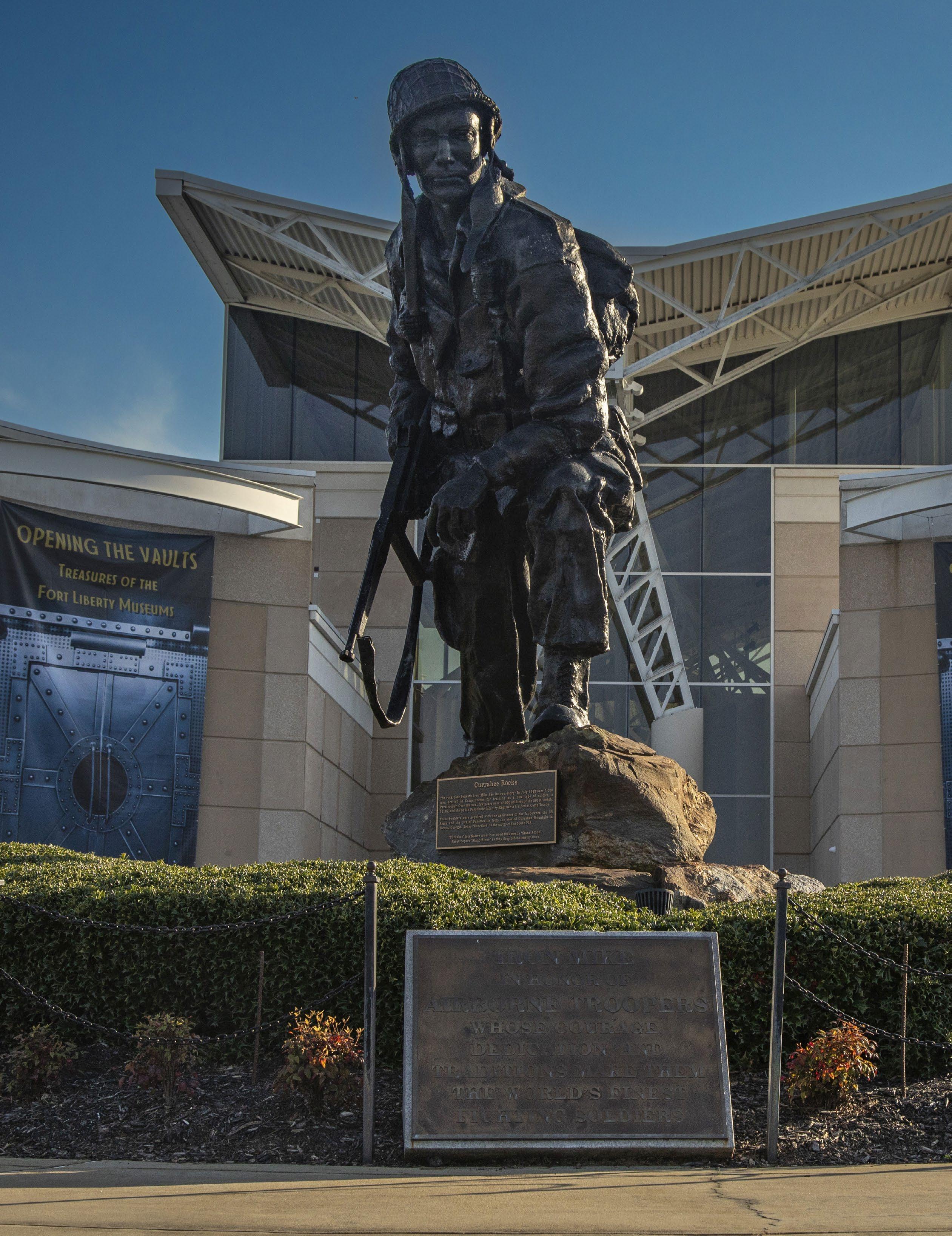
LLater this year, workers should start to demolish many of the permanent exhibits at the U.S. Army Airborne & Special Operations Museum (ASOM)—the first part of a two-phase project to totally revamp one of the U.S. Army’s most public-facing museums and one of Fayetteville’s top tourist destinations.
The goal is “making a clean slate in that whole World War II, early airborne area,” said James Bartlinski, the museum director. “There’s going to be new weaves and turns and nicks and nooks and crannies to incorporate, actually, a bigger story.”
The more than $8 million project has been “years in the making,” Bartlinski said, beginning in 2018 or 2019—and the timeline is still being hammered out. But the money to do the work isn’t coming from the Army. The funding has been raised by the museum’s independent nonprofit foundation, the Airborne & Special Operations Museum Foundation (ASOMF).
“We had, unfortunately, outgrown the ability to tell the complete story of Special Ops within our building,” said Lynne Greene, president of the ASOM Foundation board, in an email—and in raising the funds, there were a number of “hiccups” along the way.
The COVID-19 pandemic shuttered the museum in
2020. In 2023, a vehicle caused significant damage to the museum’s 244-seat theater, damage that still has not been fully repaired. Later that year, the museum’s simulator closed due to aging technology. The museum is currently getting a new roof, work unrelated to the capital campaign or renovation of the exhibits.
Through all of these challenges the ASOM Foundation was led by Executive Director Renee Lane. But she won’t be with the ASOM Foundation when construction finally begins—she officially retired on May 22.
“The capital campaign took on a renewed effort under Renee Lane's leadership,” Greene said. “There seemed to be insurmountable odds and hurdle after hurdle that she was forced to navigate through … Her hard work and dedication is paramount to the strong position of the ASOMF today.”
A Two-Phased Project
Bartlinski spoke with CityView on May 29, the same day that the museum received the final plans for the new permanent exhibit. Those designs were shaped by a series of questions from staff.
“What stories are we missing that need to be told, or
An exhibit in the temporary installation of "Opening the Vaults: Treasures of the Fort Liberty Museum" at the Airborne and Special Operations
The appearance of U.S. Department of War (DoW) visual information does not imply or constitute DoW endorsement.
Museum in Fayetteville in 2024. U.S. Army
Photo by Sgt. Natalie Pantalos
The Bragg family is in the area to attend the Fort Bragg redesignation ceremony, which honors the personal courage and selfless service of all those who have trained to fight and win the nation’s wars, including Pfc. Roland Bragg, and is in keeping with the esteemed and storied history of the installation. U.S. Army photo by Pfc. Richard Morgan
The appearance of U.S. Department of War (DoW) visual information does not imply or constitute DoW endorsement.
The U.S. Army Airborne & Special Operations Museum gives visitors a chance to experience an important part of Fayetteville’s story and connection to Fort Bragg in a very personal and engaging way.
- Michelle Williams, president and CEO of the Fayetteville Area Convention & Visitors Bureau
is there new information … that we could add?” Bartlinski recalled. “What new artifacts have been brought into the museum since the museum opened in 2000 that will help us tell a story? Because one thing we don’t want to do is be a textbook on a wall without any artifacts to back it up.”
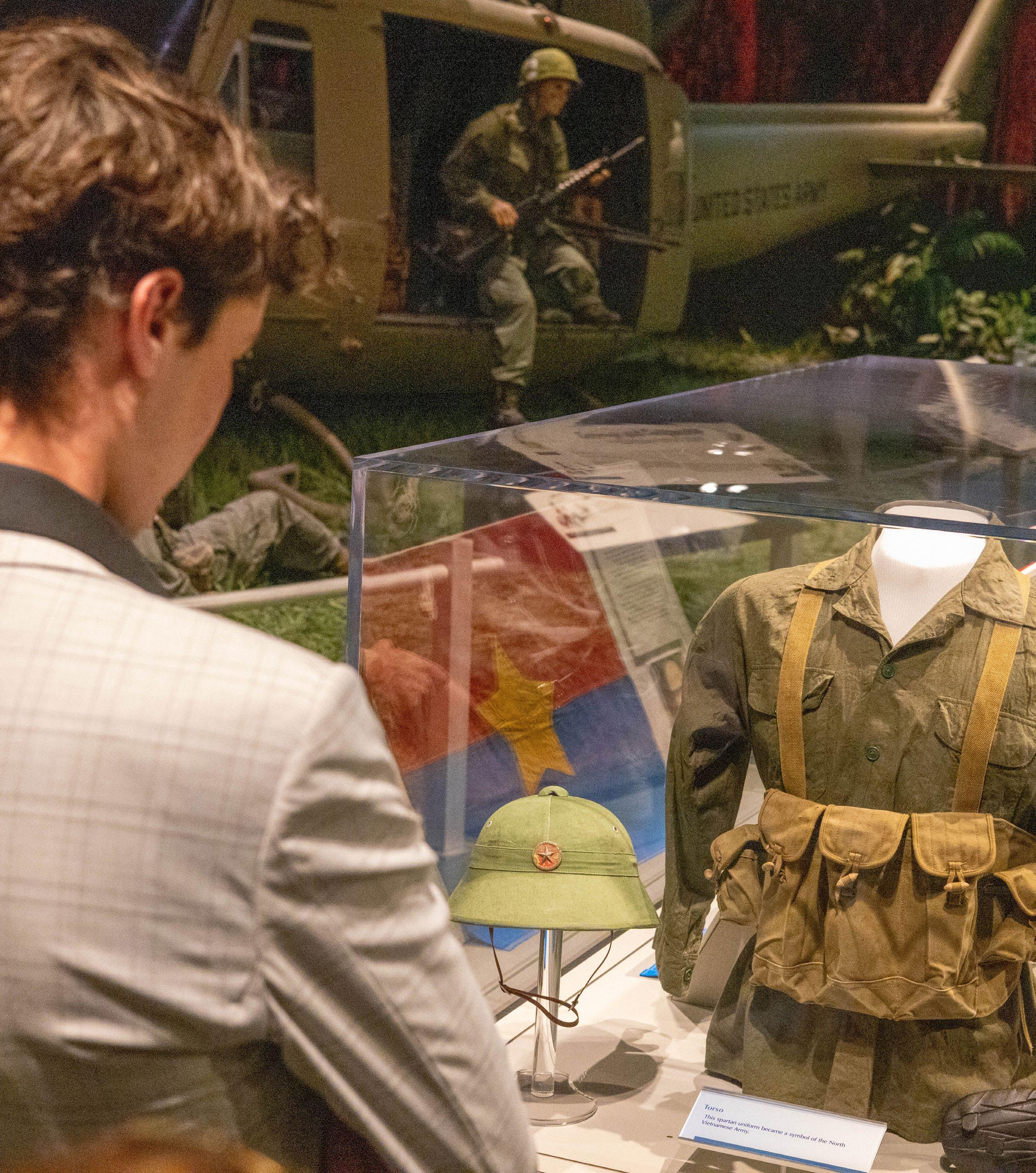
Among these new artifacts are: an M29 Weasel tracked vehicle used in early special forces operations in Italy during World War II; the first American flag flown over the Los Baños prison camp after Airborne troops helped liberate the camp from Japanese soldiers in the Philippines; and Jungle Joe, a stuffed carrier pigeon who carried messages for the special operations precursor, the Office of Strategic Services (OSS).
These artifacts and more will help the museum expand the story it tells about the history of Airborne and Special Operations troops—not just the Battle of the Bulge but also lesser-known events and figures such as Virginia Hall, an OSS operative who worked behind enemy lines.
The second phase of the museum renovation would update the exhibits from the end of World War II to the current era. To keep at least some of the museum open through the renovations and to give time to raise funds, Bartlinski said that would begin once the first phase finishes, hopefully by the end of next year.
July 6, July 27, and Aug. 17
July 10 & July 24
The permanent exhibit currently begins in 1940 and walks visitors up to the present day. Turning one corner, a World War II-era C-47A plane dominates the ceiling with a mannequin paratrooper poised to leap to the museum floor. Turning another corner, visitors can see the twisted remains of the rotor of Super 61, one of the Black Hawk helicopters downed in Mogadishu in 1993. Livesize dioramas portray scenes from Vietnam, Panama, and Afghanistan.
The museum brings in about 115,000–120,000 visitors a year— slightly below the pre-COVID-19 annual attendance of around 140,000, according to Bartlinski.
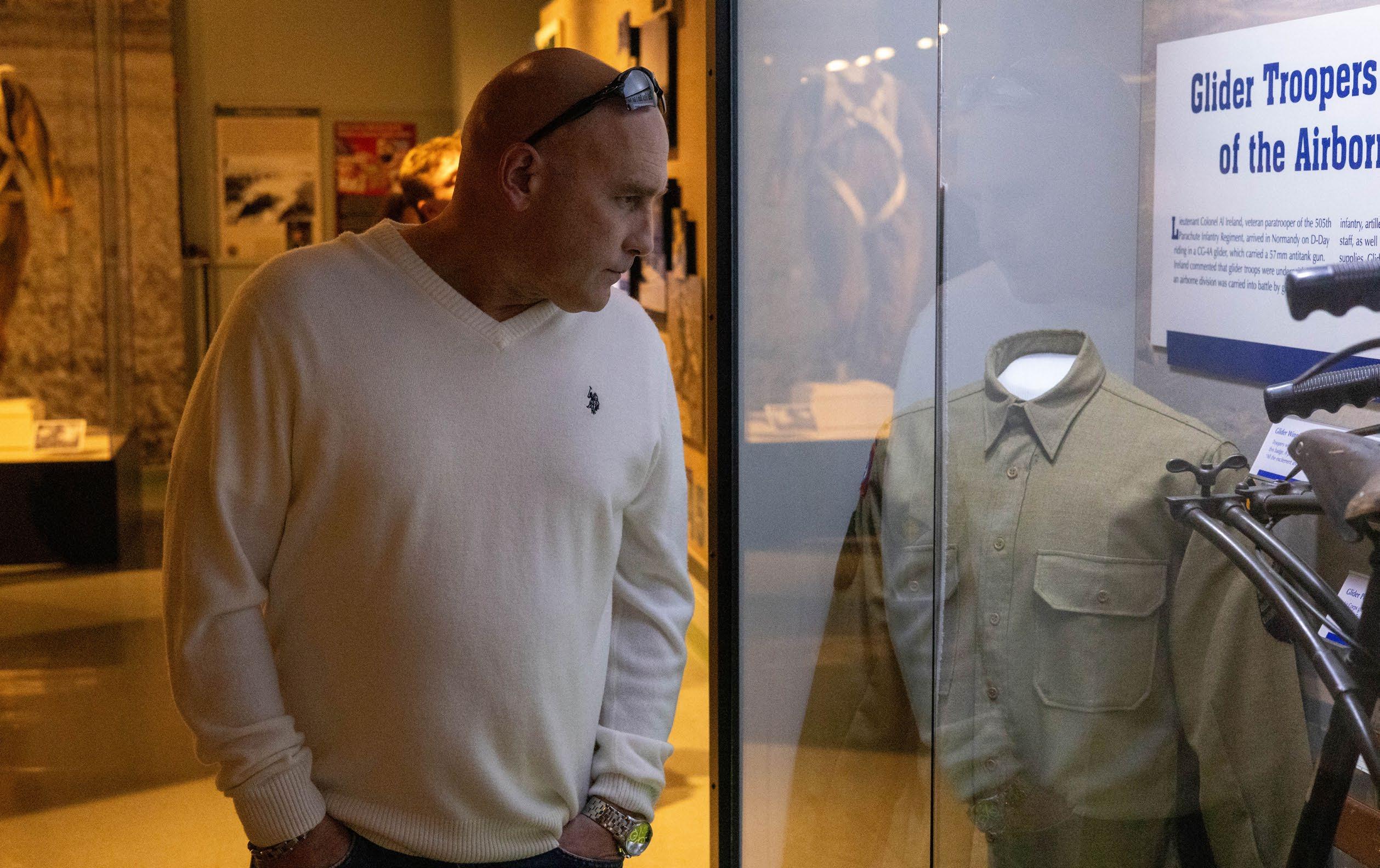
A visitor at the Airborne and Special Operations Museum looks at an exhibit honoring Pfc. Roland Bragg, who was assigned to the 17th Airborne Division, under XVIII Airborne Corps, and fought as a paratrooper in the Battle of the Bulge during WWII and was awarded the Silver Star and Purple Heart for valor and bravery in combat. U.S. Army photo by Pfc. Richard Morgan
The appearance of U.S. Department of War (DoW) visual information does not imply or constitute DoW endorsement.
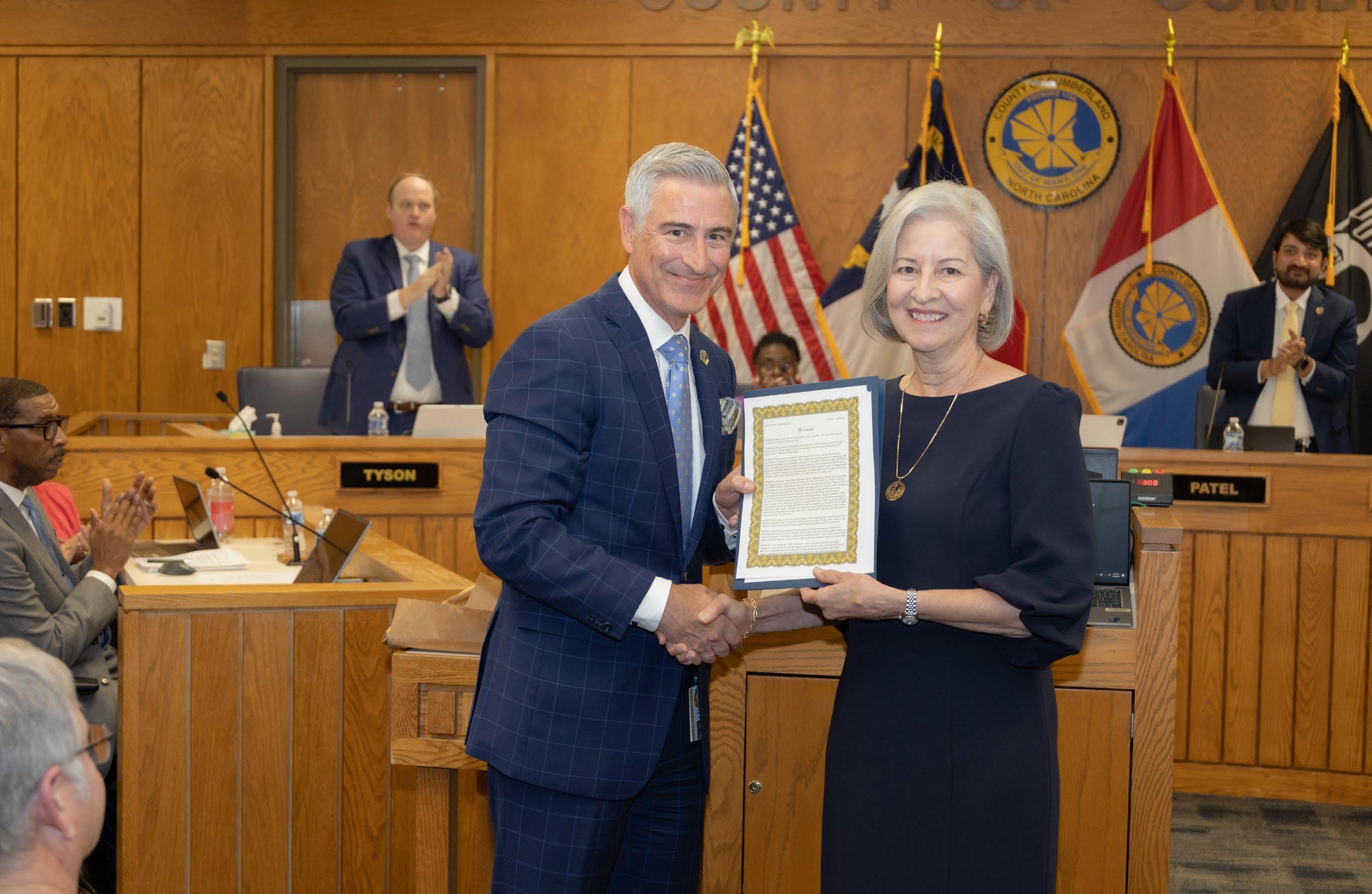
Kirk deViere, chair of the Cumberland County Board of Commissioners, honors Renee Lane, the outgoing executive director of the Airborne & Special Operations Museum Foundation, on Monday, May 18, 2026.
Photo by Cumberland County
“It’s slowly coming back,” he said. And when the new gallery opens, he hopes “we’re going to see those numbers jump again.”
A Unique Regulatory Space
Another new pull for visitors may be the revamped virtual reality experience, which should be opening soon to replace the simulator that failed in 2023. But that project is under the purview of the ASOM Foundation, not the museum directly.
“We took that opportunity (of the failed simulator) to redesign that space, remove the simulator seating and recently poured an unbelievable amount of new concrete to make way for an exciting new ‘Airborne’ simulation through virtual reality,” Greene, the ASOM Foundation president, said.
These parallel projects can exist because, like other military museums, ASOM exists in a unique regulatory space.
The museum staff and operations fall under the Army Museum Enterprise. Building maintenance is the obligation of Fort Bragg, even though the museum is the first Army museum built outside of an Army installation. And the ASOM Foundation is a separate nonprofit entity that operates the gift shop, collects donations, raises funds, and provides money for everything from printed exhibit panels to major renovations.
“When you’re inside this building and five feet out, you’re on Fort Bragg,” said Bartlinski. “Five feet out, that’s the city of Fayetteville property that our foundation leases from the city. So you can imagine how confusing that gets.”
As one example of the complications involved in any large project at an Army museum, the Army paid for the final design, but the ASOM Foundation will be in charge of hiring contractors to do the work. In order to receive the final design, the ASOM Foundation will have to file a formal Freedom of Information Request, Bartlinski said.
The official Army museum staff is also quite small. Besides Bartlinski, the Army pays for two curators and a collections manager, making the ASOM Foundation’s full-time staff essential for operating other aspects of the museum. And the ASOM Foundation has more flexibility, including in managing the museum website and social media.
It’s a symbiotic relationship, one that Bartlinski said outgoing director Renee Lane was adept at managing.
“We had a great relationship, we bounced ideas of all off each other all the time,” Bartlinski said. “I mean, you have to work as a team.”
Lane declined to speak with CityView for this story prior to her retirement. Greene confirmed that a new director has been hired and will begin starting July 1. Greene said the new hire does not want to be named yet, but “does have extensive fundraising background and has worked
with several other large non-profit organizations.”
ASOM in the Community
Like all Army museums, the primary goal of ASOM is to train the troops.
Not all airborne and special operations missions are successful or uncontroversial. The purpose of the museum is not to “sugarcoat” history, Bartlinski said—even failures and controversies are learning opportunities. He pointed to a past museum exhibit and professional development events for soldiers on the disastrous military operation during the Iranian hostage crisis, Operation Eagle Claw.
“We’re unbiased, and all historians, museums should be unbiased,” he said.
But the museum also serves more mundane purposes. Bartlinski said that about every week ASOM hosts some ceremony—a promotion, re-enlistment, or retirement—in addition to soldiers visiting for training once or twice a month. The museum also gets 10 to 20 requests a year from civilians looking for assistance with research.
ASOM brings visitors into downtown Fayetteville as well, according to Michelle Williams, president and CEO of the Fayetteville Area Convention & Visitors Bureau, as well as to the surrounding shops and restaurants.
“The U.S. Army Airborne & Special Operations Museum gives visitors a chance to experience an important part of Fayetteville’s story and connection to Fort Bragg in a very personal and engaging way,” Williams said in a statement. “Between the immersive exhibits, artifacts and life-size dioramas that chronicles over 80 years of U.S. Army Airborne and Special Operations history, it appeals to a wide range of visitors—from veterans and military families to history enthusiasts and people visiting the area for the first time.”
And the museum plays an important role in the community.
For the last four years, the museum has worked with students from Jack Britt High School and now also Massey Hill Classical High School to curate an exhibit in the museum’s temporary gallery. Half a dozen teens are selected each year and spend the school year learning how to create the exhibit, from picking artifacts to writing labels and text panels.
“Each year it improves, and I think one of the reasons is that we get legacy kids,” Bartlinski said, “and those legacy kids act as mentors in the school with those kids, and it just gets better."
ABOUT THE AUTHOR
Abraham Kenmore is a freelance journalist and producer in the Triangle. He reports on politics and policy across the South. He can be reached at abekenmore@gmail.com.
Preparing for the Next Move
A one‑day workshop gives military spouses the tools—and confidence—to rebuild careers repeatedly interrupted by the constant churn of military life.
STORY AND PHOTOGRAPHY
BY
RACHEL HEIMANN MERCADER
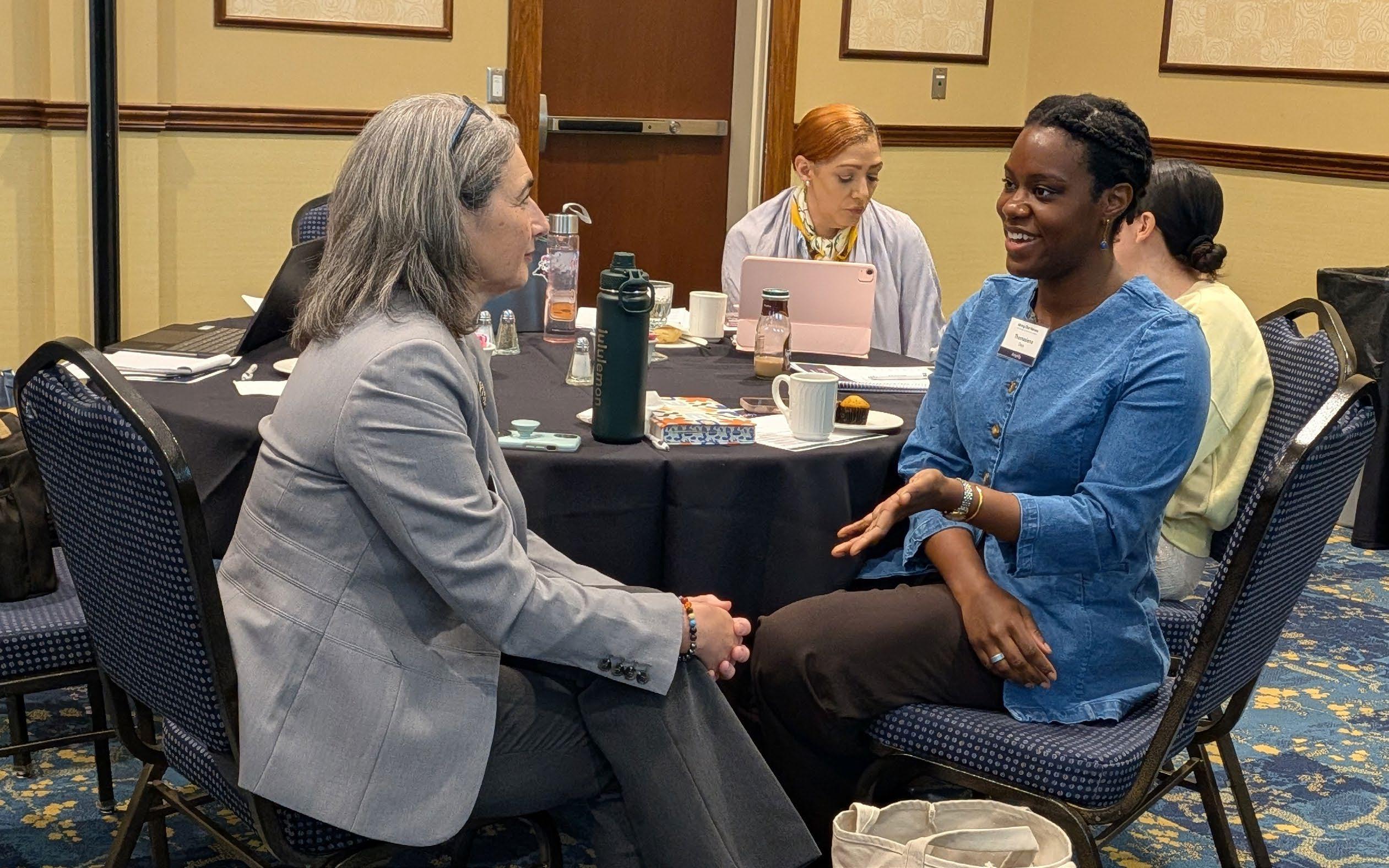
Military spouses network with one another during a Hiring Our Heroes professional development event at Fort Bragg on Wednesday, March 18, 2026.
SSince she was a teen, Rebekah Witter dreamed of becoming a commercial airline pilot. But she put her career on hold when she and her husband, who serves in the Army, found out they were having a baby.
“I was like, I gotta stay home, especially with my spouse being military,” said Witter, now 22. “Someone needs to be there to be stable with my son while his father is gone.”
Witter didn’t mind becoming a stay-at-home mom. But she felt like she was disappearing.
Now Witter is grounded in a routine at Fort Bragg— juggling a 1-year - old and college classes while trying to hold on to the identity she built long before she became an Army spouse. She worries that an upcoming move to Alaska will erase the progress she’s made.
“I’m more than just Sergeant Witter’s wife. I’m more than just Roy’s mom,” she told CityView. “I’m Rebekah. I have my own dreams and aspirations.”
On Wednesday, she joined about 30 other military spouses trying to build careers sturdy enough to survive the next set of orders, and the ones after that. They packed a classroom at Fort Bragg for a professional development event hosted by Hiring Our Heroes, a program that connects military families with “military-ready” employers.
23% unemployment rate for military spouses
28.5% of soldiers consider the impact of military life on their spouse’s career a reason to leave the service
About half of military families cite spouse employment as
top concern
‘A National Security Issue’
Military spouses have an unemployment rate of about 23%, leaving many families dependent on a single paycheck.
Roughly half of military families cite spouse employment as a top concern, and an Army survey found that 28.5% of soldiers consider the impact of military life on their spouse’s career a reason to leave the service.
Hiring Our Heroes aims to teach spouses how to build portable careers, navigate automated hiring systems, and translate their skills into strong resumes. The organization hopes to keep spouses’ ambitions alive while strengthening both long-term military retention and the broader workforce that relies on it.
Melissa Sanderson, senior director of military spouse programs at Hiring Our Heroes, said none of this is new—but the consequences are growing.
The organization launched in 2011 to help veterans and transitioning service members find work. But its leaders quickly realized the military’s employment crisis extended beyond soldiers.
“Military spouses are one of the most overlooked talent pools in America,” Sanderson said. “Even the most highly skilled spouses struggle to maintain stable careers … because every PCS (Permanent Change of Station) means starting over.”
Military spouses are forced to start over “every two to three years with every move,” Sanderson said— turning what might look like a workforce problem into what she calls “a national security issue.”
“Financial stability directly affects service member readiness, morale, and whether they choose to stay in the military,” she said. “Everybody needs a dual income in 2026. When spouses can’t build sustainable careers, the entire force feels it.”
Two Sisters, One Unpredictable Future
Wednesday’s event at the Iron Mike Conference Center was part of Amplify, Hiring Our Heroes’ signature program for military spouses. It’s a one-day crash course that includes one-on-one coaching and small-group workshops. Participants rotate through sessions on networking, professional branding, résumé building, interview prep, and negotiation.
They took part in an IBM SkillsBuild demo, posed for professional headshots, and engaged in mock interviews to test their pitches in front of real employers.
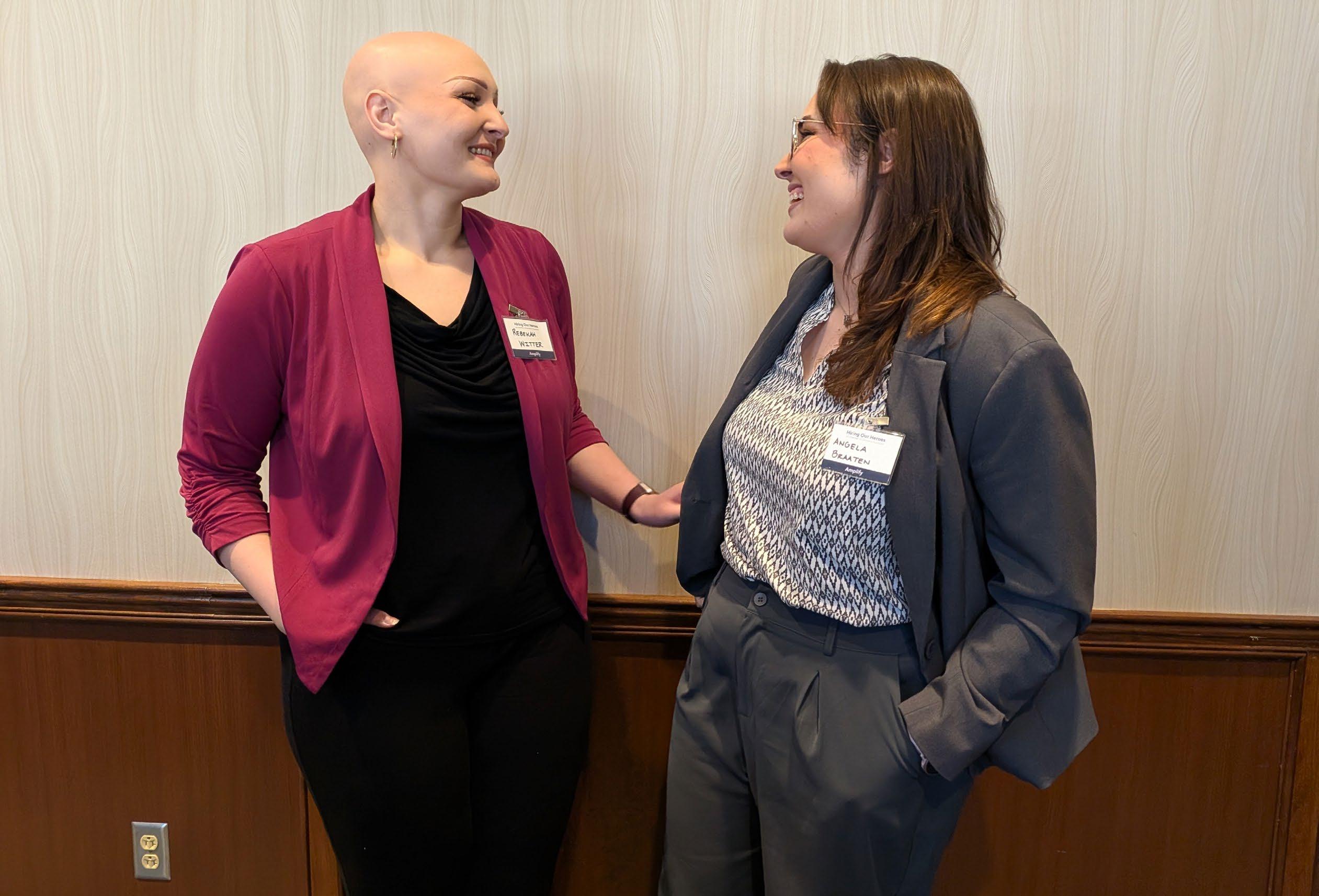
For Witter and her 24-year-old sister, Angela Braaten, the abstract problems Sanderson described are already shaping every decision they make. They grew up just outside Fort Bragg—their father was stationed there for more than a decade—and both still lived in the area when they met and married their husbands in 2024. Now they’re trying to build careers that can survive the constant churn of military life.
You find ways to be flexible, but also to stay together, You never know what the future is going to be, but you do know you’ll be moving.
Angela Braaten
to government and civilian positions within an hour of the base, but all of her applications went nowhere.
“I swung my bat many times, and many times I ran into ‘you don’t have experience,’ or ‘this isn’t the resume we’re looking for,’” Braaten said.
‘You Find Ways to Be Flexible’
Eventually, Braaten pivoted to real estate, earning her license in 2025. She figures she can carry the job state to state, even if it means retaking licensing exams with every move. Her husband’s hoped‑for commission in the Air Force could move them again within a year or two, so she plans to pursue an online law degree to keep her long‑term goals alive.
that transition. As much as I love being a mother–I love my baby, I would never trade that–but it is so important to maintain this aspect of ‘this is what I was meant to do. This is what keeps me happy.’”
Both sisters said Wednesday’s workshop offered something they rarely get: clarity.
By midday they had already started to rethink how they present themselves on paper.
Witter realized her resume had been formatted incorrectly for years. Braaten learned how to tailor applications to beat automated screening systems that had shut her out.
When Witter chose to stay home with her son, she switched to studying engineering in hopes of finding more stability as her family moves.
She’s a full‑time student at Sandhills Community College, but she knows she will have to restart her job search in Alaska by early next year Braaten’s path looks different but carries the same instability. She earned a degree in criminal justice in 2024 and hoped to work in law enforcement. But soon after graduation, she realized she didn’t want the lifestyle that inevitably comes with that career. She applied
“You find ways to be flexible, but also to stay together,” she said. “You never know what the future is going to be, but you do know you’ll be moving.”
For both sisters, the drive to build a career isn’t just about income—it’s about identity.
“It’s incredibly important to me,” Witter said. “It keeps your individualism.”
The transition from soaring through the skies to staying home with a newborn was jarring. “It was really hard going from flying airplanes every single day to cleaning toilets and changing diapers,” Witter said. “I felt like I lost a sense of myself in
CityView Magazine is Fayetteville and Cumberland County’s premier lifestyle and local news magazine. Choose between our two convenient and affordable subscription options.
And in a room full of spouses—all trying to build careers that can withstand the military’s constant reshuffling—they said they finally felt optimistic, and less alone.
ABOUT THE AUTHOR
Rachel Heimann Mercader is CityView's government reporter, covering the City of Fayetteville. She has reported in Memphis, the Bay Area (California), Naples (Florida), and Chicago, covering a wide range of stories that center community impact and institutional oversight.
on Wednesday, March 18, 2026.
a Hiring Our Heroes career workshop for military spouses at Fort
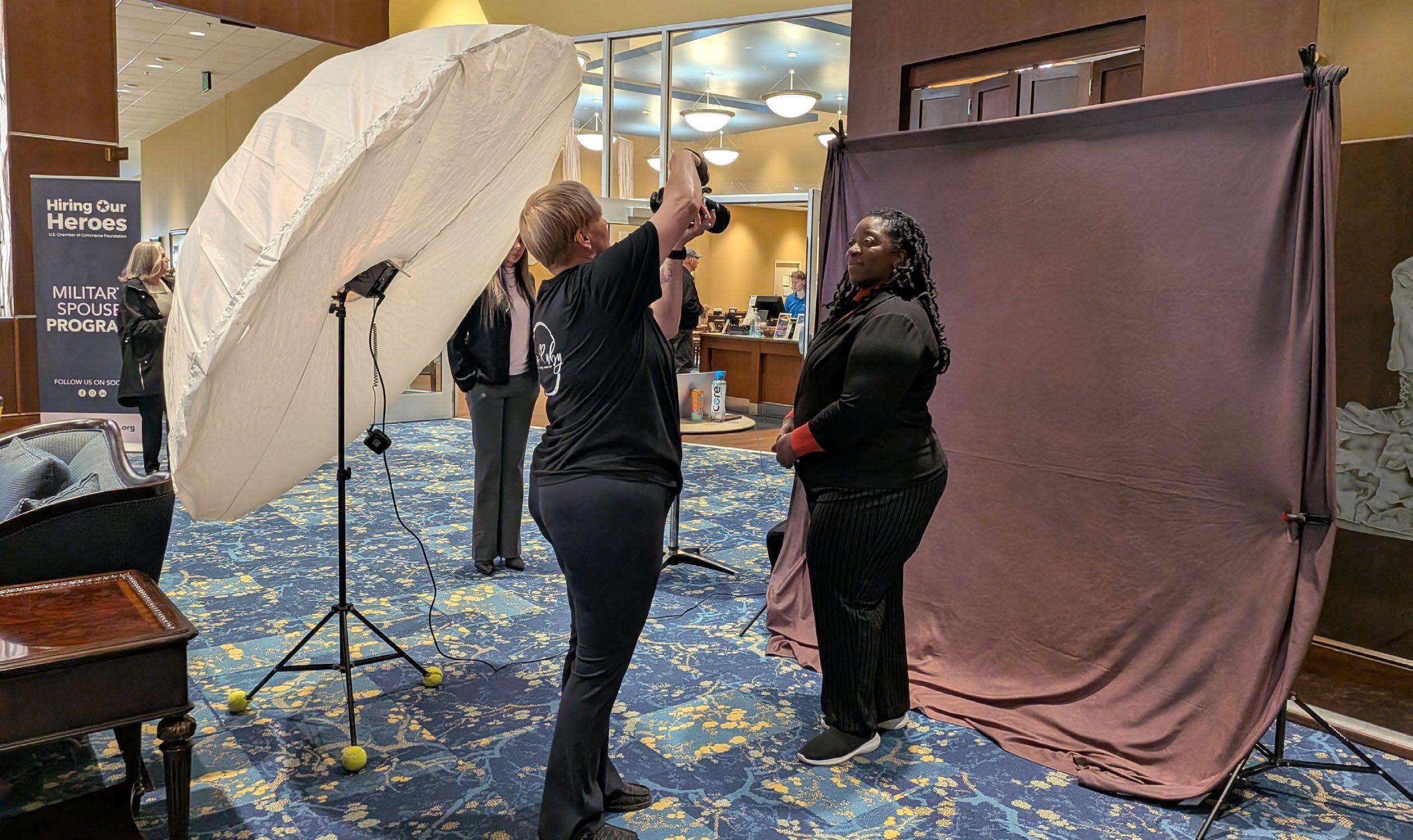
a professional
for a military spouse during a Hiring Our Heroes workshop at Fort Bragg on Wednesday, March 18, 2026.
Rebekah Witter, left, and her sister Angela Braaten attend
Bragg
Photographer Tara Ruby captures
headshot
OYE, ¿CÓMO VA?
The Lost Art of Human Recovery
BY CLAUDIA ZAMORA
There are places where military life feels distant, almost ceremonial. A uniform crossing an airport terminal. A flag waving during a holiday parade. Something respected and admired, yet far removed from everyday life.
Fayetteville is not one of those places.
Here, military life moves quietly through the pulse of the city. It sits beside us in coffee shops, stands in line at grocery stores, waits outside schools during afternoon pickup, and crosses through airports before sunrise carrying far more emotional weight than luggage.
In a community deeply shaped by Fort Bragg, service
is not an abstract idea. It is part of the emotional atmosphere we all breathe every day.
And perhaps because it feels so familiar, we sometimes forget what it truly means for a human body to live for years without ever fully lowering its guard.
A state of alert does not simply disappear once someone returns home. The body does not operate like a switch that can instantly turn itself off. After years of holding tension, anticipating danger, reacting quickly, sleeping lightly, and remaining constantly prepared to respond, the nervous system slowly begins to accept that intensity as its new normal.
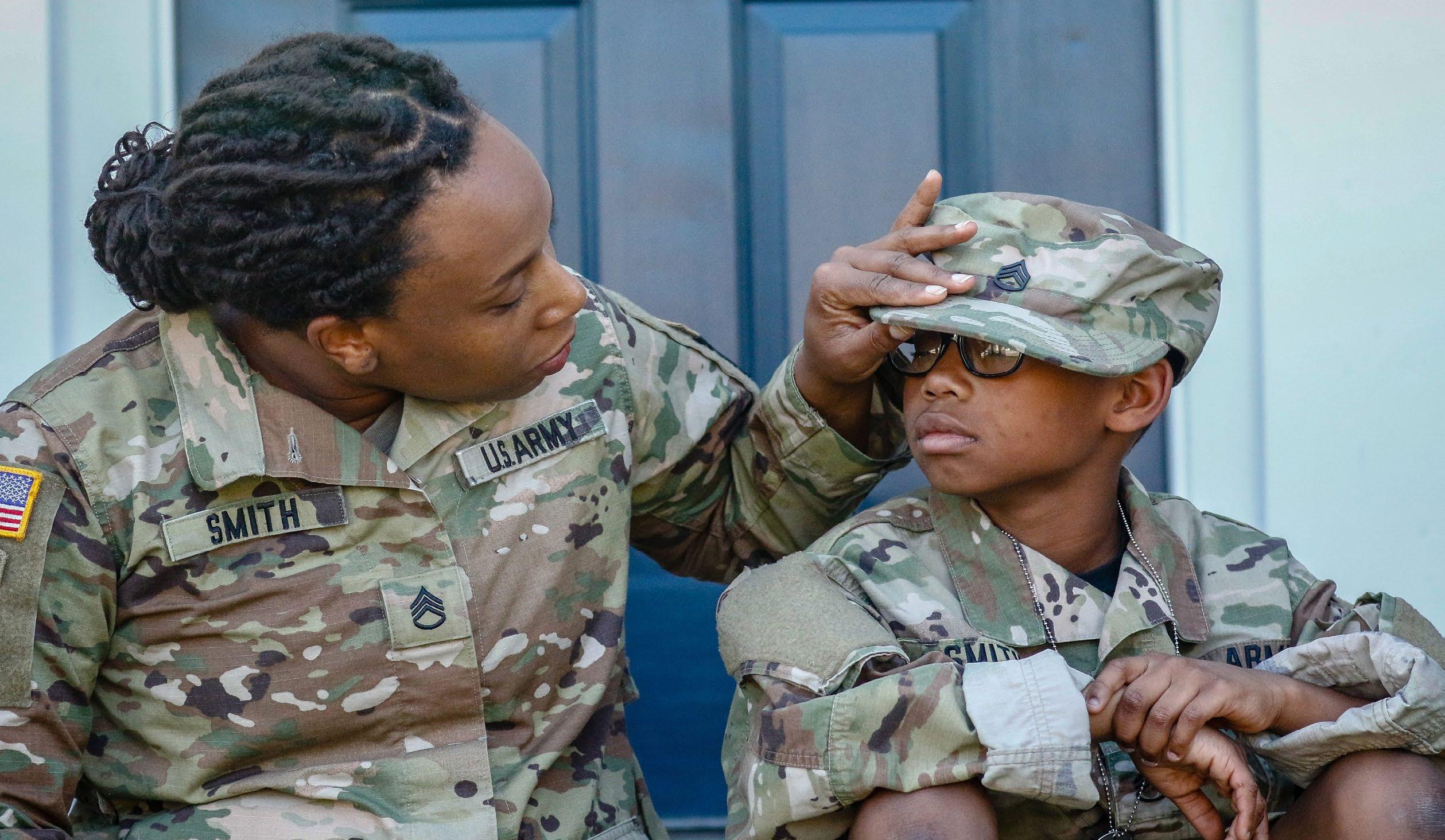
In 2019, then-Staff Sgt. Courtney Smith, a public affairs non-commissioned officer with the 22nd Mobile Public Affairs Detachment, Headquarters and Headquarters Battalion, XVIII Airborne Corps, plays with her son Ayden Clax, on Fort Bragg.
Photo by Sgt. Hubert Delany III / DVIDS. The appearance of U.S. Department of Defense (DoD) visual information does not imply or constitute DoD endorsement.
And that leaves silent marks. The body adapts to shallow breathing, shoulders remain tense even during moments of calm, and rest no longer feels entirely safe. Some people wake up several times during the night without fully understanding why. Others live with constant exhaustion, only to discover that when they finally have the opportunity to stop, they no longer know how to relax. As though something inside them is still waiting for the next impact.
Most of the time, none of this is visible from the outside. Life continues. People work, drive, smile, shop for groceries, attend school meetings, care for their families, and fulfill responsibilities. Yet internally, the body continues operating at a frequency of vigilance that is difficult to explain in words, like an engine that never completely shuts down.
And the truth is, the human body was never designed to remain under that level of tension indefinitely.
Over time, hypervigilance stops feeling like a temporary condition and begins blending into identity itself. Many people no longer remember what genuine calm feels like. Silence becomes uncomfortable. Stillness creates anxiety. Even happiness can feel difficult to sustain when the organism has spent too long preparing to survive instead of simply living.
I believe this is one of the most misunderstood aspects of human recovery. We often speak about healing as though it’s purely a mental decision, something achievable through enough willpower or positive thinking. Yet the body operates under different rules. It stores memory through tension, shallow breathing, fragmented sleep, and a deep exhaustion that even rest cannot fully relieve.
And yet, something hopeful is happening. Universities and research centers, including programs connected to the University of North Carolina at Chapel Hill, are increasingly exploring how nervous system regulation, somatic awareness, mindfulness, nature exposure, and human connection directly influence veteran wellbeing. What was once considered secondary or complementary is now being understood through neuroscience and trauma research with far greater depth.
The body, it seems, does not heal through effort alone. It also requires safety, rhythm, presence, and connection. Sometimes recovery does not arrive through dramatic clinical breakthroughs, but through much simpler moments: sitting beside a lake at sunset, walking through trees without headphones, fishing before sunrise, working with bare hands in the soil, or listening to birds instead of notifications. Sometimes relief comes simply from sharing space with people around whom the body no longer feels obligated to defend itself.
None of these experiences erases difficult memories or removes the invisible marks many people carry. But they do remind the body of something essential: Life can still contain calm, beauty, connection, and moments where
breathing deeply becomes possible again.
And that matters far more than we often realize.
In communities like ours, people quickly learn how to endure. Military families know how to adapt, reorganize, and continue functioning even under pressure and uncertainty. There is enormous dignity in that resilience. But endurance and recovery are not the same thing. One allows a person to survive. The other allows a person to feel fully alive again.
Sometimes I think modern life has made this distinction even harder to recognize, not only for veterans, but for everyone. We live overstimulated, emotionally fragmented, permanently connected, and yet increasingly disconnected from ourselves. Many people no longer remember what true rest feels like. The nervous system rarely experiences silence anymore. Even moments intended for recovery become filled with noise, screens, urgency, and invisible tension.
Perhaps this is why conversations about wellness need to become more human and less performative. Not another passing trend or empty slogan, but a return to the basic conditions human beings have always needed in order to feel emotionally grounded: community, movement, nature, honest conversation, emotional safety, purpose, calm, and belonging.
Especially here in Fayetteville, where sacrifice is woven into so many family stories, perhaps it is also time to speak about recovery. Not only about honoring service, but about recognizing the humanity that continues to exist behind the uniform.
Because after years of carrying responsibility, pressure, uncertainty, and emotional armor, many people are not searching for inspiration. They are searching for exhalation.
And perhaps true strength is not measured only by how much a person can endure, but also by the ability to feel again, reconnect with oneself, and discover that life still exists beyond a permanent state of survival.
To all veterans, and to the families who silently carry the emotional weight of service alongside them, this column offers something simple yet deeply sincere: recognition. Not only for the visible sacrifices, but also for the internal battles, the exhaustion rarely spoken aloud, and the remarkable ability to keep moving forward even when both body and soul long for rest.
May there be more spaces where strength no longer needs to be constantly proven, and where recovering calm, connection, and inner peace no longer feels like a luxury, but like something profoundly human.
Claudia Zamora is an Argentinian author, mental health and wellness coach, and passionate community advocate. Since 2011, she has made Fayetteville, North Carolina, her home, uplifting the Hispanic community.
Life, Liberty AND THE PURSUIT OF HAPPINESS THROUGH BOOKS
BY DIANE PARFITT
We owe it to ourselves and our descendants to do everything we can to learn more about our nation's history so we can build on all the positive things done before us...
The America 250 celebration officially began in 2024 and will culminate on July 4, 2026, marking 250 years since the Declaration of Independence. Celebrations have occurred—and will continue for some time—throughout the United States with reenactments, history tours, parades, and other events by individual communities. As we approach July 4, it is a good time to refresh our understanding of America’s past. Anyone can celebrate by reading about our nation’s founding ideals and the history that connects us to the present. It can help us renew an appreciation of the values that shaped the United States and that we can build on today. Most importantly, it can remind us how everyday people working together can make a difference.
1.
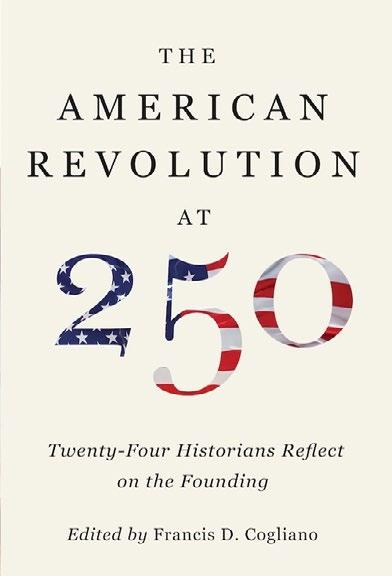
The American Revolution at 250: Twenty-Four Historians Reflect on the Founding edited by Francis D. Cogliano
This collection of essays by 24 leading historians reminds us of the importance of the American Revolution. The writers debate topics such as democracy, race, and citizenship, and their relevance to our nation’s 250th anniversary. What are the issues addressed in America’s founding that still impact us today? How do some of the same problems still plague us? Are we trying to solve them by following the original words of the Constitution or the ideals set forth by our Founding Fathers in that document?
2.
The Greatest Sentence Ever Written by Walter Isaacson
I was immediately drawn to this book, written by one of our country’s leading writers, because of its intriguing title. I obviously had to find out what the sentence was. Author Walter Isaacson goes deep into the writing of one of the most powerful sentences ever written (spoiler alert!): “We hold these truths to be self-evident, that all men are created equal, that they are endowed by their Creator with certain unalienable
Rights, that among these are Life, Liberty, and the pursuit of Happiness.” In this short—and I mean really short—book, we learn that it was originally written, “Life, Liberty, and the pursuit of Property.” Doesn’t that give you something to think about? It begs the question: What prompted Jefferson, Adams, and Franklin to change this word as they were crafting the Declaration of Independence?
3. We the People: A History of the U.S. Constitution by Jill Lepore
Winner of the Pulitzer Prize for History in 2026, this study of the Constitution is a great follow-up to author Jill Lepore’s landmark history of the United States, These Truths. In this new history of the Constitution, Lepore writes that “One of the Constitution’s founding purposes was to prevent change…” and “Another was to allow for change without violence.” How can we reconcile that contradiction? Since our nation’s founding, there have been thousands of amendments put forth. But only 27 have been ratified, and the Constitution has not been significantly amended since 1971. Lepore suggests that the framers did not intend the Constitution to be stagnant— they thought that future generations might need to modify it through an orderly and democratic process. Congressman Jamie Raskin writes that Lepore has put forth a way to view the Constitution that will in fact result in “a more perfect union.”
4. African Founders: How Enslaved People Expanded American Ideals by David
Hackett Fischer
In David Hackett Fischer’s book, we are introduced to the ways enslaved people contributed to the growing culture of the United States. Coming from different areas of Africa, they interacted with European colonists, creating varying regional cultures in the United States colonies. The African people brought diverse skills with them that helped develop and shape our country. Just one example is their expertise in growing rice, which became a huge part of South Carolina’s economy. Through decades of research, some of it in Africa, Fischer, a Pulitzer Prize-winning historian, helps us understand the many contributions to our country by enslaved Africans.
5. Ladies of Liberty: The Women Who Shaped Our Nation by Cokie Roberts
Much of America’s history deals with the men who helped found our country. Thanks to author and journalist Cokie Roberts, we learn about the women who also helped shape our nation. Drawing on private journals, personal correspondence, and other primary sources, she focuses on the amazing accomplishments of these women. “Almost
every quotation here is written by a woman, to a woman, or about a woman.” Some of the women we know about already, like Abigail Adams and Dolley Madison. Many others may be new to readers. These women were the heroines, social reformers, and visionaries who helped build our nation.
6. This Land is Your Land: A Road Trip Through U.S. History by Beverly Gage
Once you begin to have a greater understanding of the founding of our country, you are going to want to go see it! Author Beverly Gage takes you along with her on her “ultimate road trip in the American past.” She shares with us the museums and historic sites, from the birth of our nation in Philadelphia to the California dream. Through this guided tour, you not only read about it, but you can use it as a map when you get behind the wheel yourself to experience the many amazing sites of American history.
As we celebrate America 250 in 2026, we owe it to ourselves and our descendants to do everything we can to learn more about our nation’s history so we can build on all the positive things done before us and learn what worked and what didn’t. Together, we can use that foundation to try to create a more perfect union.
Diane Parfitt owns City Center Gallery & Books in downtown Fayetteville. She can be reached at citycentergallerybooks@gmail.com.
PHOTO BY TIM MOSSHOLDER ON UNSPLASH
THE TO-DO LIST
Here are just some of the things happening in and around Fayetteville this month. Scan the code with your phone for more events, additional information, and to post your event on our website. Events are subject to change. Check before attending.
July 2
Sip & Stroll Tasting: Thistlemeadow Winery
Cape Fear Botanical Garden 536 N. Eastern Blvd. capefearbg.org
July 2
Summer Morning Bike Hike
J. Bayard Clark Park & Nature Center 631 Sherman Drive fayettevillenc.gov
July 2
The Great Hope Mills BBQ Throwdown
Hope Mills Municipal Park 5766 Rockfish Road, Hope Mills distinctlyfayettevillenc.com
J. Bayard Clark Park & Nature Center 631 Sherman Drive fayettevillenc.gov
July 28
Fayetteville Woodpeckers vs. Hill City Howlers: Tail Waggin’ Tuesday
Segra Stadium
460 Hay St. milb.com
July 30
Fayetteville Woodpeckers vs. Hill City Howlers: First Responders Appreciation Night
Segra Stadium
460 Hay St. milb.com
July 30
Chiller Summer Movie: Jaws
West Regional Library
7469 Century Circle cumberland.librarycalendar.com
July 30-31
Introductory Fishing for Adults
John E. Pechmann Fishing Center 7489 Raeford Road license.gooutdoorsnorthcarolina.com
SEEN @ THE SCENE
United Way Classic
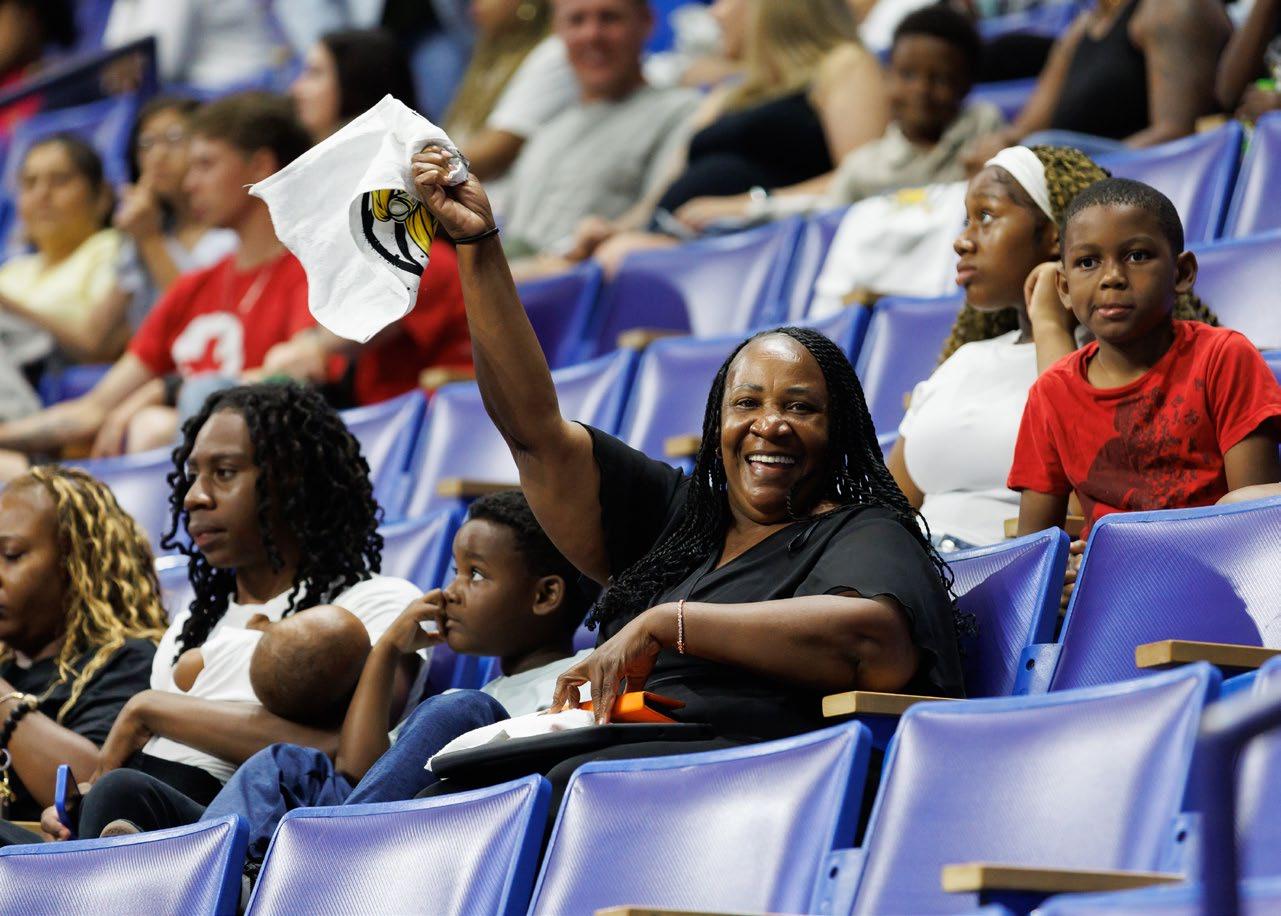
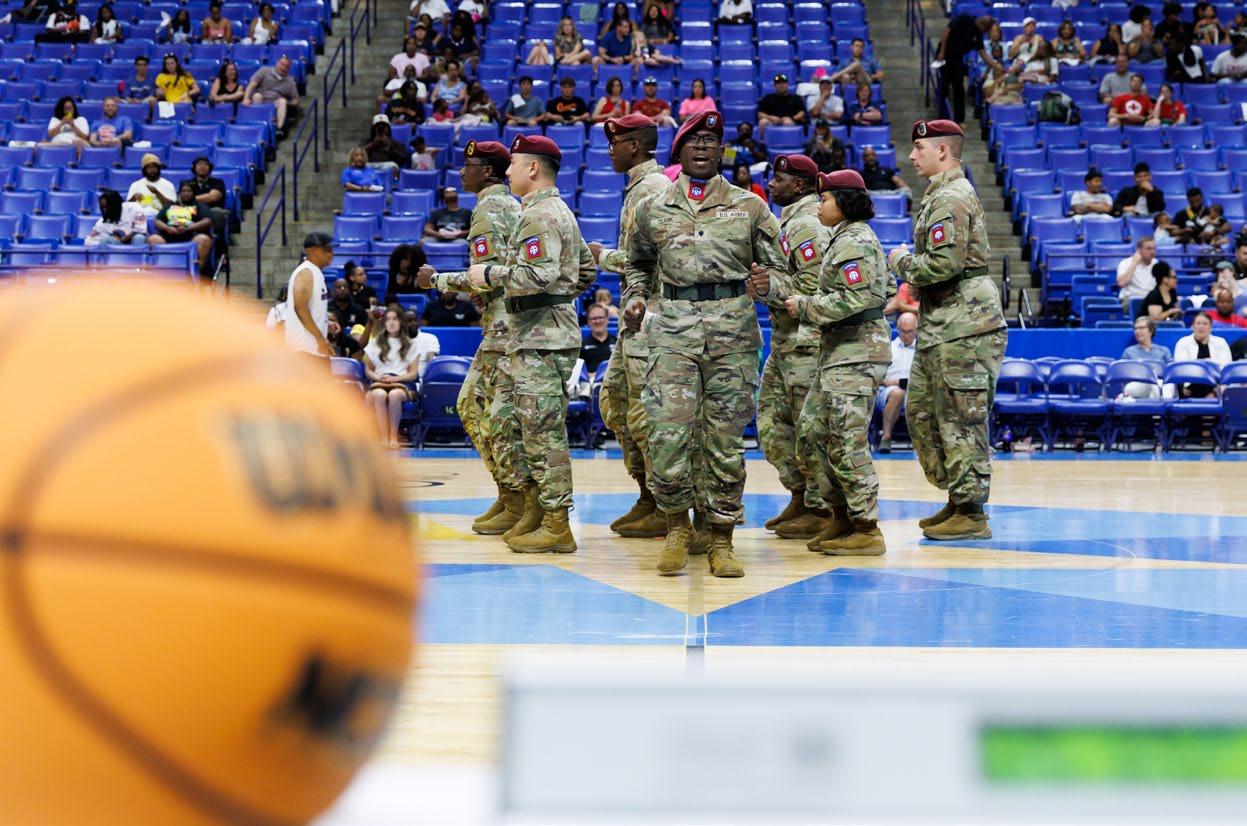
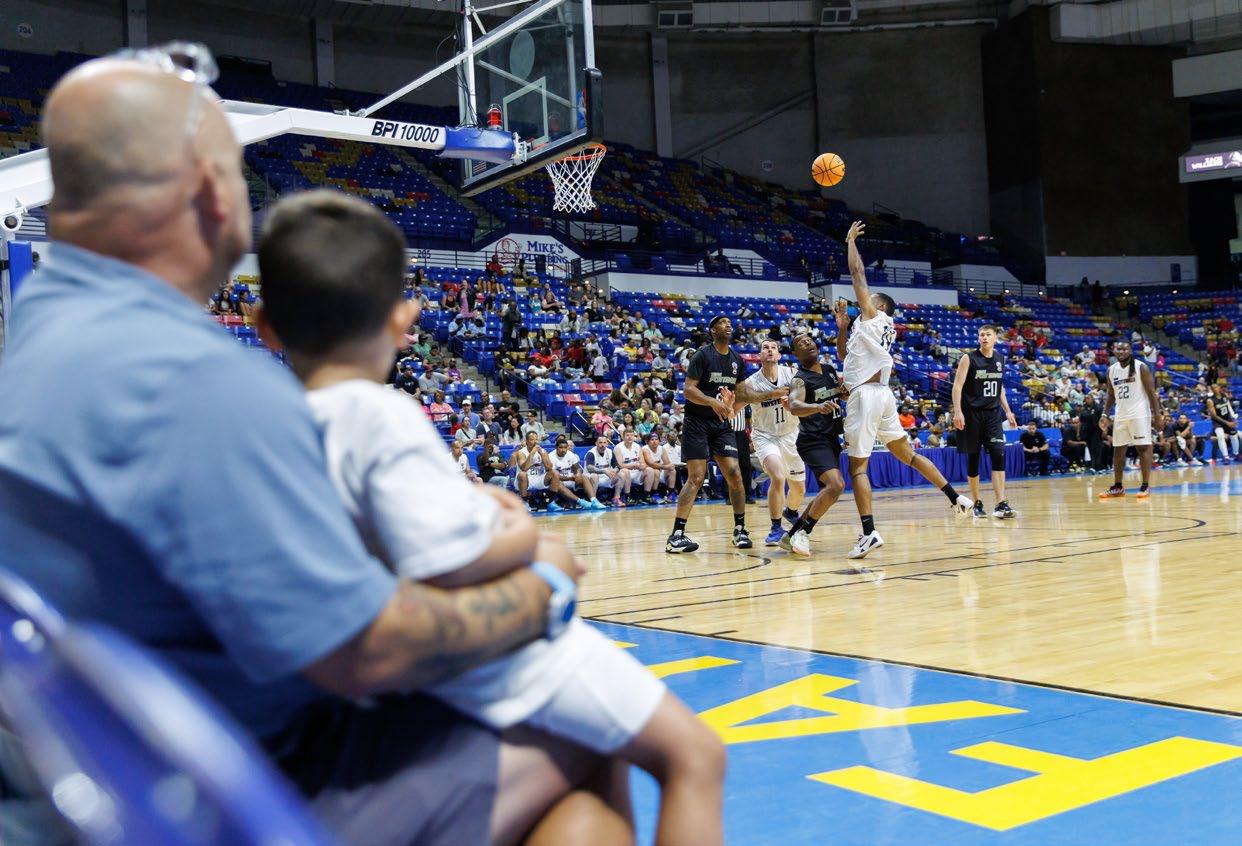
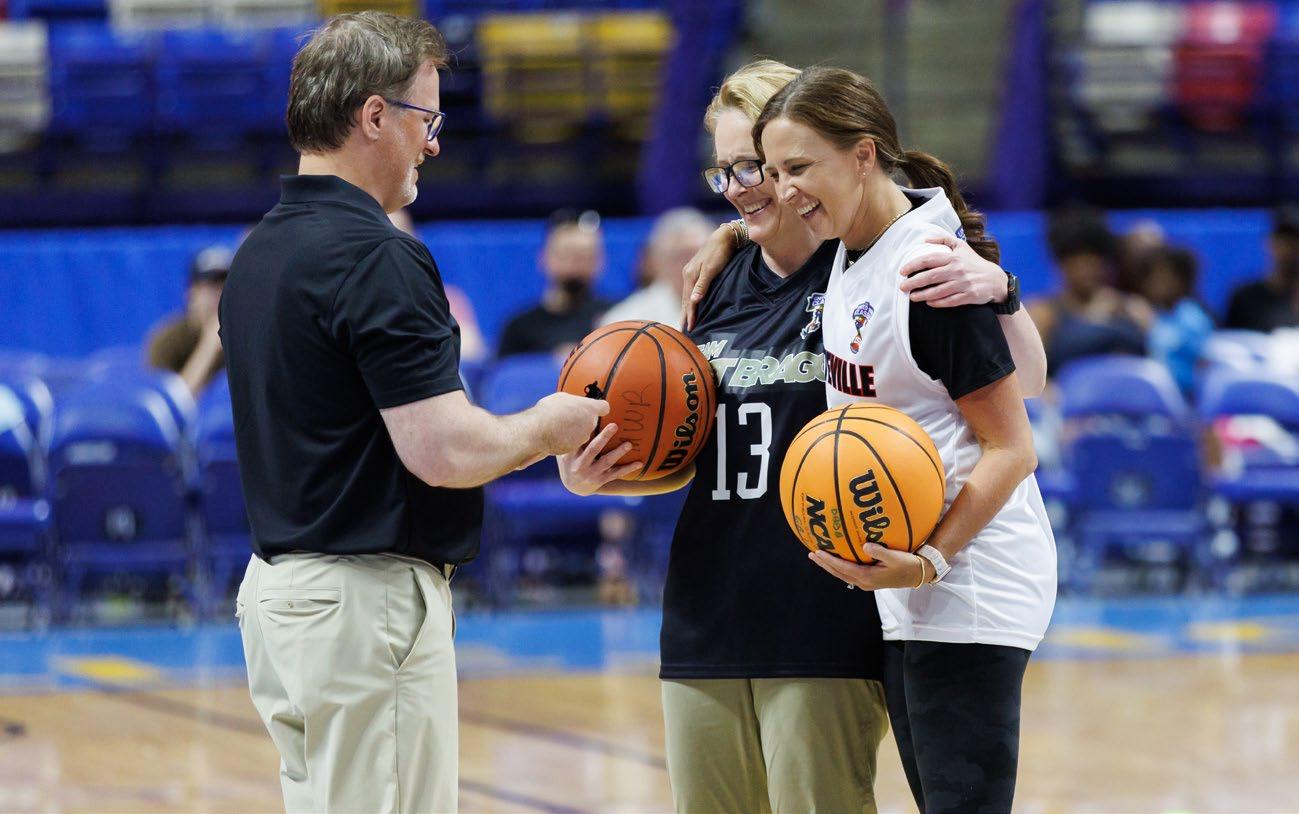
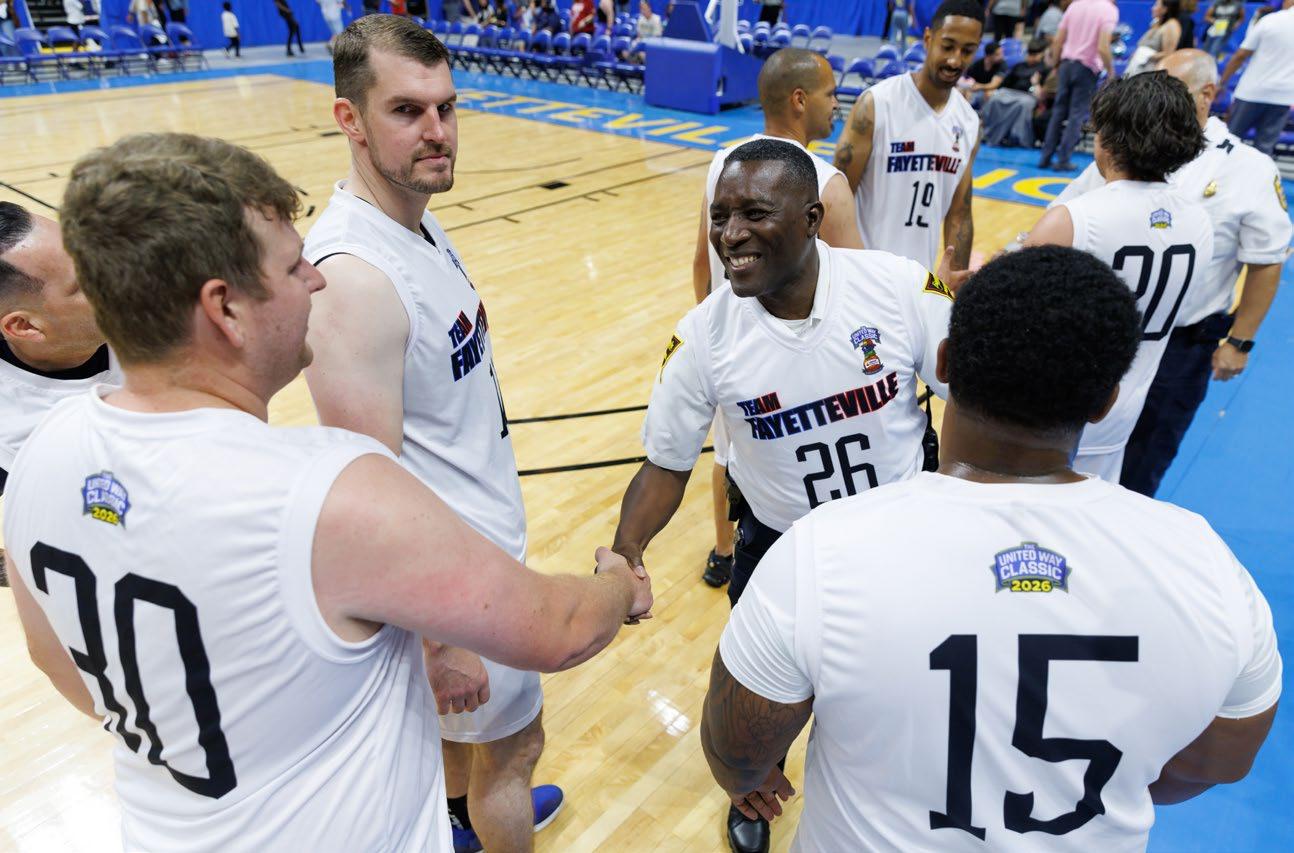
A crowd of more than 1,200 people watched Team Fort Bragg defeat the roster of first responders on Team Fayetteville 90-63 during the inaugural United Way Classic on June 12 at the Crown Coliseum. The event raised nearly $25,000 for local charities, and the Dolly Parton Imagination Library and the Cumberland County Literacy Council distributed more than 150 books to children.
Photography by Tony Wooten
Want CityView at your event for Seen @ the Scene? Email us talk@cityviewnc.com.
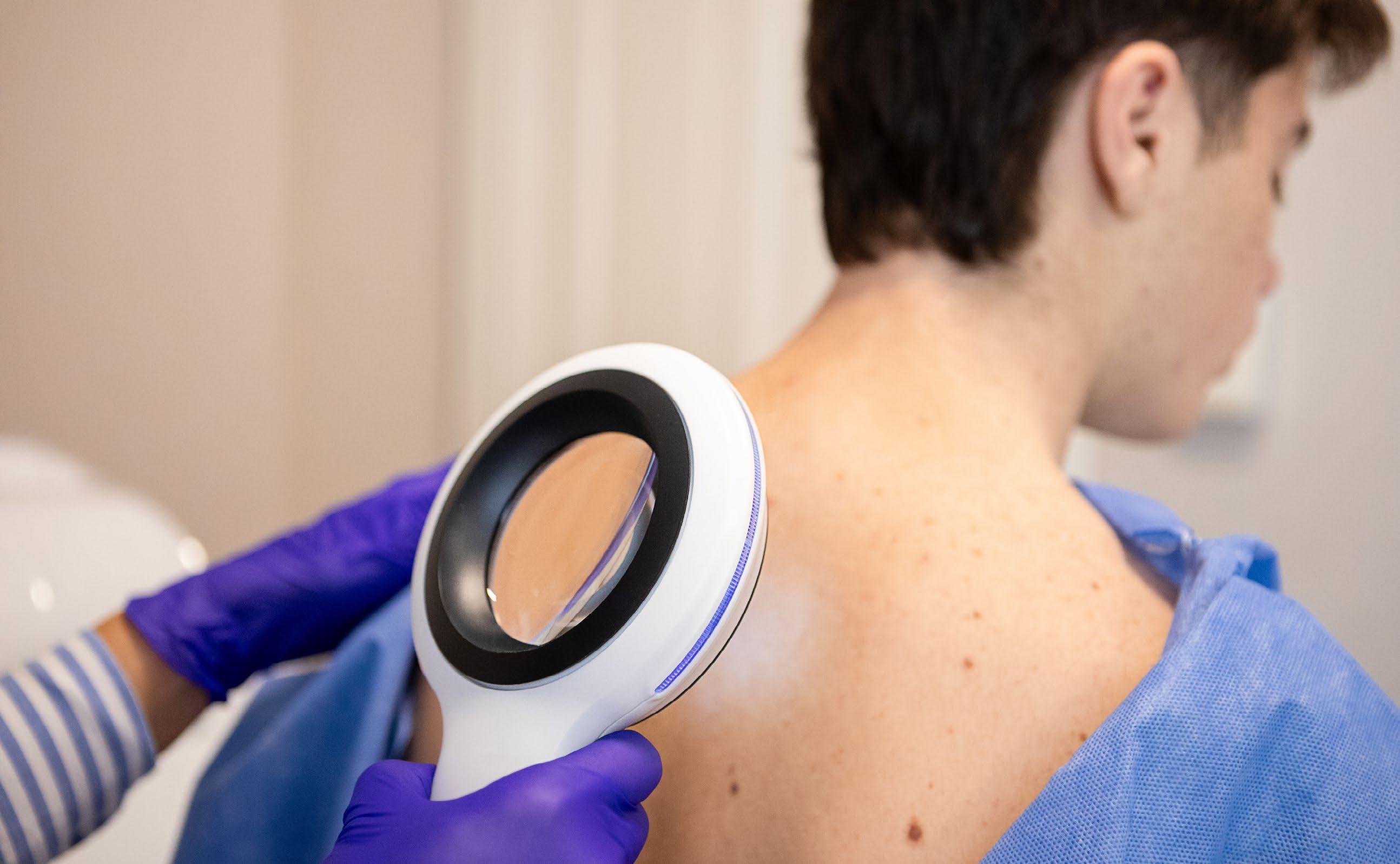
Healthy Skin Starts Here!
Cape Fear Valley Health is bringing expert dermatology care closer to home with the opening of our new dermatology clinic.
Whether you need a routine skin check, treatment for a skin condition, cosmetic dermatology services, or advanced skin cancer care, our experienced team is here to help you.