SUSTAINABILITY
–
CHARGING
–
ENVIRONMENT
E
–
ENERGY
ROAD TRANSPORT
ISSUE 26
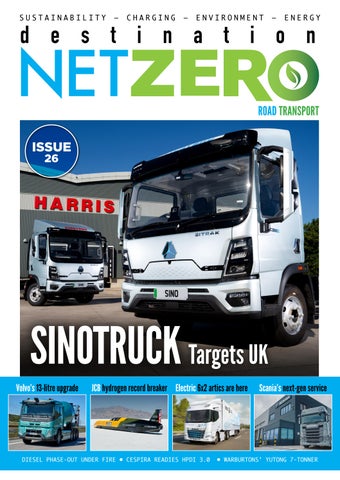
SINOTRUCK Targets UK Volvo’s 13-litre upgrade
JCB hydrogen record breaker Electric 6x2 artics are here
DIESEL PHASE-OUT UNDER FIRE • CESPIRA READIES HPDI 3.0
Scania’s next-gen service
• WARBURTONS’ YUTONG 7-TONNER
Welcome to issue 26 of Destination Net Zero
Are We at a Crossroads? The UK truck market could be approaching one of its most interesting crossroads in decades. For years, it has been dominated by familiar manufacturers, established dealer networks and brands with generations of customer loyalty behind them. But that comfortable order is about to be challenged. SINOTRUK is preparing to enter the market with an increasingly comprehensive range, while Yutong is bringing its 7.5-tonne electric truck offering to UK operators. They won’t be the last. More manufacturers, particularly from China, are looking
towards Europe and the UK – and they are arriving with serious products priced to sell. The question is whether the traditional rules still apply. Does a manufacturer entering Britain really need a huge nationwide dealer network, hundreds of technicians and decades of history behind it? Or can mobile servicing, strategic parts hubs, digital diagnostics and carefully selected partners provide operators with the support they actually need? Ultimately, price may prove the great disruptor. Transport is an industry operating on
E
notoriously tight margins. If a new truck delivers the required reliability, range and support while costing considerably less, brand loyalty will inevitably be tested. The UK truck market is mature, conservative and notoriously difficult to penetrate. But perhaps we really are at a crossroads. And this time, price could decide which road we take.
Ian Jones
ROAD TRANSPORT
SCAN ME
VISIT: www.destinationnetzeromagazine.co.uk issue 26 | destination net zero 3
Contents E INFORMATION
EDITORIAL Publisher: Matthew Eisenegger Editor at large: Ian Jones Managing Editor: Andy Stewart Designer: Harold Francis Callahan
5 –8, 10 & 12 NEWS 5 Tory pledge to scrap diesel phase-out date 6 Electric HGVs match diesel on wholesale deliveries 7 Warburtons fields its first Yutong 7.5-tonner 8 EV sector urges gov to hold firm on ZEV mandate 10 SuperPanther steps up Euro ambitions
16 – 19 BUILDING FOR THE NEXT GENERATION We take a look inside Scania’s future-ready Stockton Service Centre
Editorial Address: Commercial Vehicle Media & Publishing Ltd, 4th Floor 19 Capesthorne Drive, Eaves Green, Chorley, Lancashire. PR7 3QQ Telephone: 01257 231521 Email: matthew@cvdriver.com ADVERTISING Advertising Sales: David Johns Telephone: 01388 517906 Mobile: 07590 547343 Email: sales@cvdriver.com
20 – 25 SINOTRUCK SETS SIGHTS ON UK Chinese giant targets UK zero-emission market with Harris Group deal
DESIGN Art Editor: Harold Francis Callahan Telephone: 01257 231521 Email: design@cvdriver.com
26 – 31 THE NEW REVOLUTION
CONTRIBUTORS Trinity Francis Ian Jones Andy Stewart Jack Sunderland PUBLISHED BY Commercial Vehicle Media & Publishing Ltd, 4th Floor, 19 Capesthorne Drive, Eaves Green, Chorley, Lancashire. PR7 3QQ Telephone: 01257 231521
Volvo reinvents the 13-litre engine for the next era of trucking
32 – 37 THE NEED FOR SPEED JCB’s Hydromax breaks the land speed record to become the world’s fastest vehicle powered by a hydrogen combustion engine
NOTE The publisher makes every effort to ensure the magazine’s contents are correct. All material published in Destination Net Zero magazine is copyright and unauthorised reproduction is forbidden. The Editors and Publisher of this magazine give no warranties, guarantees or assurances and make no representations regarding any goods or services advertised in this edition. Destination Net Zero magazine is published under a licence from Commercial Vehicle Media & Publishing Ltd. All rights in the licensed material belong to Matthew Eisenegger or Commercial Vehicle Media and Publishing Ltd and may not be reproduced whether in whole or in part, without their prior written consent. Destination Net Zero Magazine is a registered trademark. © 2026
If you are not going to keep this magazine for future reference please pass it on or recycle it.
4 destination net zero | issue 26
38 - 43 THE FINAL FRONTIER Electric tractor units have been around for years in 4x2 configuration, but now 6x2s are appearing in some manufacturer’s line-ups. With UK operators traditionally preferring three-axle artics, will these new batterypowered options tempt more to switch away from diesel?
E
ROAD TRANSPORT
SCAN ME
VISIT: www.destinationnetzeromagazine.co.uk
Latest news and updates Everything you need to know from the last two months
CONSERVATIVES PLEDGE TO SCRAP DIESEL HGV PHASE-OUT DATES The Conservative Party has pledged to scrap the Government’s 2035 and 2040 phase-out dates for new non-zero-emission HGVs, arguing freight decarbonisation should follow a technology-neutral, multifuel approach. Announced on August 20, the policy would repeal plans to end sales of new non-zero-emission HGVs up to 26 tonnes by 2035 and all new non-zero-emission HGVs by 2040. The Conservatives have also ruled out introducing manufacturer mandates or requirements forcing fleets to buy or lease increasing numbers of zero-emission trucks. Instead, the party says operators should be free to choose technologies appropriate to their operations, including batteryelectric vehicles, biomethane, hydrotreated vegetable oil (HVO) and future low-carbon alternatives. The announcement comes as the Government considers how the transition to zero-emission HGVs should be regulated. The Conservatives argue mandatory purchasing requirements could increase costs for an industry already facing tight margins and rising employment, energy and operating costs. The party cited a 2025 Logistics UK survey
in which 79.3% of respondents said an HGV mandate would have major negative consequences for their businesses and could potentially lead to closure. Cost and infrastructure remain significant barriers to zero-emission truck adoption. Battery-electric HGVs can currently cost considerably more than comparable diesel vehicles, while operators must also consider charging infrastructure, vehicle range, payload and utilisation. The Conservatives said they would cancel £877 million of planned expenditure on the Zero Emission Van Grant and Zero Emission Truck Grant. Support for depot charging infrastructure would remain, although funding would be reviewed with an emphasis on removing barriers to alternative-fuel vehicle operation rather than subsidising vehicle purchases. The policy follows the party’s wider opposition to mandatory zero-emission vehicle targets and its argument that businesses, rather than government, should determine which technologies are best suited to their operations. Richard Holden MP, Shadow Secretary of State for Transport, said the objective of reducing freight emissions should remain, but warned against policies that
significantly increase transport costs. “Britain’s hauliers keep our shelves stocked and our economy moving. Just as drivers should be able to choose the car that works for them, businesses should be able to choose the truck that works for them,” he said. “The Conservatives will repeal Labour’s arbitrary phase-out dates, scrap unnecessary vehicle subsidies and back a multi-fuel future for British haulage. We will trust businesses, not Whitehall, to decide what works best for them.” The announcement potentially reopens the debate over the route to decarbonising UK road freight, particularly in long-distance and high-payload applications where battery-electric technology can present greater operational challenges. While battery-electric trucks are increasingly entering fleet operations, biomethane and HVO are also being used by operators seeking to reduce emissions from existing or conventionally powered fleets. The Conservative proposal would therefore move away from fixed technology-driven deadlines towards a broader multi-fuel strategy, while retaining the overall objective of reducing emissions from UK freight transport. issue 26 | destination net zero 5
Latest news and updates Everything you need to know from the last two months
Electric HGVs Match Diesel on Wholesale Deliveries, Trial Finds Electric HGVs can match – and in some cases outperform – diesel trucks on local and regional wholesale deliveries, according to a real-world trial involving the Scottish Wholesale Association (SWA), Renault Trucks and Vertellus. The study found up to 95% of short and regional journeys operated by participating wholesalers could potentially be completed using battery-electric HGVs. United Wholesale (Scotland) and Creed Foodservice trialled 18-tonne Renault Trucks E-Tech D electric trucks through the Vertellus EV Discovery Programme, using them on normal multi-drop food and drink delivery routes across several seasons. The vehicles consistently matched or exceeded diesel performance on local operations, while using an average of just 36% of their available battery capacity. Significant cost and environmental benefits were also recorded. CO2 savings exceeded 50kg per 100km, potentially reducing emissions by 10 to 13 tonnes per vehicle annually. Depot charging also proved cheaper than diesel. United Wholesale reported savings of around £10-£20 per 100km, while Creed calculated potential annual savings of £6,630 per vehicle, based on February 2026 energy prices. However, charging infrastructure remains a barrier, particularly outside Scotland’s central belt, alongside the need for greater operator confidence in route planning and fleet integration. Renault Trucks described urban and regional distribution as a “real sweet spot” for electric HGVs. The findings suggest that for predictable, depot-based distribution work, electric trucks are increasingly becoming a practical and financially viable alternative to diesel.
6 destination net zero | issue 26
Electric vans could unlock truck charging investment Electric van fleets could provide the missing commercial link needed to accelerate investment in charging infrastructure for battery-electric HGVs, according to Voltempo. The UK charging specialist says existing demand from electric LCVs could generate revenue from truck-ready charging infrastructure while eHGV numbers remain relatively low. Through its DepotCharge system, operators can make spare depot charging capacity available to registered third-party van fleets, while retaining control over access. Some 20,132 battery-electric LCVs were registered during the first seven months
of 2026, representing a 26.2% year-on-year increase. Voltempo believes tapping into this growing market could improve charger utilisation and help make investment in high-capacity infrastructure commercially viable ahead of widespread electric truck adoption. CEO Simon Smith said electric vans could help “break the cycle” between infrastructure investment and vehicle uptake. The comments follow Carbon Tracker analysis suggesting battery-electric heavy trucks could reach total-cost-of-ownership (TCO) parity with diesel in Europe around 2030, potentially triggering significantly faster adoption.
MAHLE Powertrain and the University of Nottingham are moving ammonia combustion closer to commercial deployment following five years of collaborative research The programme is targeting heavy-duty applications where full electrification may prove difficult, including marine, freight rail, stationary power generation and off-highway machinery. Researchers have demonstrated stable combustion using pure ammonia in spark-ignition engines, addressing key challenges including slow combustion, NOx emissions and unburned ammonia escaping through the exhaust. Hydrogen co-fuelling, ammonia cracking and advanced aftertreatment have been combined to reduce NOx and ammonia slip to extremely low levels. Development is now moving beyond laboratory-scale single-cylinder testing to larger-capacity engines designed to demonstrate real-world performance and durability. The work will be supported by the University of Nottingham’s new Hybrid Propulsion Systems Laboratory, bringing engine testing, hydrogen technology, electrification and hybrid powertrain development together. The partners say the facility will help accelerate technology readiness while reducing development risks for manufacturers considering future ammonia-powered propulsion systems.
Warburtons fields its first Yutong TE7 electric truck Warburtons has taken delivery of its first Yutong TE7 electric truck as part of plans to electrify its 170-strong 7.5-tonne fleet. The vehicle is the first of seven TE7s ordered from Pelican Electric Trucks and will operate from Warburtons’ Wakefield depot, delivering bakery products to stores across Yorkshire. A second vehicle is expected to enter service shortly. The order follows a successful trial of the TE7 earlier this year and expands Warburtons’ battery-electric fleet, which has been operating since 2021. The bakery also operates a significant fleet of CNG tractor
units as part of its wider programme to reduce transport emissions. Warburtons has specified the TE7 with the larger 132kWh battery, providing a claimed range of up to 180 miles on a single charge. Steven Gray, Head of Transport at Warburtons, said: “We are delighted to see the first of our Yutong TE7 trucks arrive and to begin putting it to work. We have worked closely with the team at Pelican throughout the trial process, and the vehicle has demonstrated electric can be a practical solution for our operational requirements.” The truck has been bodied in the UK by PPS
Commercial in Bury, with Hilton Docker of Littleborough working with PPS on a full aerodynamic package designed to improve efficiency and maximize range. Designed for urban and regional distribution, the 7.5-tonne Yutong TE7 is available with 100kWh or 132kWh battery options. David Watts, Pelican Electric Truck Sales Manager, said: “It’s fantastic to see the first TE7 delivered to Warburtons following the successful trial earlier this year. The 7.5-tonne sector is ideally suited to electrification, particularly for the urban and regional delivery work these vehicles undertake.”
issue 26 | destination net zero 7
Latest news and updates Everything you need to know from the last two months
EV sector urges Government to hold firm on ZEV mandate Electric vehicle and charging industry leaders have urged the Government to maintain its Zero Emission Vehicle (ZEV) mandate following the publication of a new consultation on the policy. The consultation follows speculation over potential changes to the 2030 battery-electric vehicle target and greater flexibility for plug-in hybrids. While the SMMT and trade unions have warned the existing mandate could put automotive jobs at risk, charging industry body ChargeUK argues slowing the transition could also threaten investment and employment. It estimates wider transport electrification could support 334,000 jobs and generate £385 billion for the UK economy.
New YouGov polling commissioned by ChargeUK found 37% of respondents wanted the EV transition slowed, falling to 21% among people who voted Labour in the 2024 General Election. Battery-electric vehicles accounted for 27% of new car registrations in July, a 49% year-on-year increase and the second consecutive month in which BEV registrations were above the ZEV mandate trajectory. Delvin Lane, CEO of InstaVolt, warned policy uncertainty could affect investment in charging infrastructure. “Ultra-rapid charging investment doesn’t happen on the back of uncertainty,” he said. “Softening the mandate at this stage risks spooking exactly the private capital that’s been building the infrastructure this transition depends on.”
Toby Poston, Chief Executive of the BVRLA, said its members had invested more than £36 billion in 750,000 electric vehicles and described the consultation as an opportunity to identify where further support was required. Gurjeet Grewal, CEO of Octopus Electric Vehicles, argued the mandate was providing manufacturers and motorists with confidence, while Ginny Buckley, CEO of Electrifying.com, said consistent policy was now essential for both consumers and the charging sector. The consultation comes as the Government considers how to balance its decarbonisation targets with concerns from vehicle manufacturers over the pace and cost of the transition.
London ULEZ linked to improved lung growth in children Gasrec gets green light for major Warrington Bio-LNG station Gasrec has secured planning permission for a new high-capacity biomethane refuelling station in Warrington, strengthening its growing UK network for gas-powered HGVs. Located at Omega Business Park near the M6 and M62, the facility will be Gasrec’s first large-scale, public-access Bio-LNG station in the North West. Construction is expected to begin within three months, with the site eventually capable of refuelling up to 1,000 trucks every day. Gasrec currently operates 18 refuelling stations and aims to have UK infrastructure capable of serving around 6,000 trucks daily during 2027. Chief Commercial Officer James Westcott said the Warrington development represented another step towards creating a national backbone of open-access biomethane stations. Gasrec says switching from diesel to Bio-LNG can reduce CO2 emissions by up to 80%. The company is also developing an Avonmouth facility for 2027 and aims to build sufficient UK capacity to refuel 15,000 gas trucks daily by 2030.
8 destination net zero | issue 26
Improved air quality following the introduction of London’s Ultra Low Emission Zone has been linked to significantly improved lung development in children. The five-year Children’s Health in London and Luton study tracked more than 3,400 children aged six to nine across 84 primary schools, comparing London with Luton, which had no Clean Air Zone. Researchers found nitrogen dioxide exposure among London children fell more than twice as much as in Luton following the introduction of ULEZ. Lung function growth, measured by the amount of air children could forcibly exhale in one second, increased by an additional 10ml per year in London. By the end of the study, London children’s average lung function had caught up with their counterparts in Luton. The proportion of London children with clinically impaired lung function also fell from 14% to 9%. Researchers said the findings provide important evidence that reducing traffic-related air pollution through Clean Air Zones can deliver measurable improvements in children’s health.
Accelerating the Fleet and Net Zero Transition: EVCharge Live UK 2026 Heads to the NEC The road to decarbonising the UK’s transport network is accelerating, and the definitive hub for this transition is returning this autumn. EVCharge Live UK 2026 will open its doors on 22-24 September 2026 at The NEC Birmingham to address the most critical infrastructure, deployment, and grid challenges facing the electric vehicle ecosystem today. Crucially, the event is co-located with Solar & Storage Live UK 2026, creating the nation’s largest combined marketplace for clean energy, commercial battery storage, and EV deployment. This strategic co-location offers a unique advantage: it bridges the gap between vehicle electrification and the power grid, giving attendees unprecedented, direct access to the entire energy supply chain under one roof. Who is the Event For? The exhibition floor and conference theatres have been curated for a crosssection of industry leaders, asset owners, and decision-makers, including: • Charge Point Operators (CPOs) and network specialists shaping charging infrastructure. • Fleet Managers and Operations Directors tasked with large-scale depot rollout and fleet decarbonisation. • Local Authorities and Regional Planners implementing public charging strategies. • Asset Owners and Property Developers looking to source cutting-edge hardware and software.
Why Attend? With over a hundred innovative products and services showcased, EVCharge Live UK is the ultimate sourcing hub for cutting-edge technology. Beyond the exhibition floor, a powerful lineup of 150 expert speakers will lead a world-class conference agenda. Sessions will tackle the sector’s most pressing hurdles head-on, delivering actionable insights on overcoming grid bottlenecks, navigating government policy, optimising fleet transit, and securing commercial deployment opportunities. Innovation is at the heart of the 2026 event. Attendees can explore a dedicated Start-Up Zone featuring disruptive technologies from emerging innovators, engage in strategic industry Roundtables, and experience live interactive features like the Vehicle Display Zone. Combined with extensive networking activities, the event provides the ideal environment to develop vital skills, acquire specialised knowledge, and build the partnerships required to drive business growth. The industry is moving forward at an unprecedented pace. Whether you are looking to electrify your fleet, accelerate your charge point rollout, overcome grid constraints, source hardware, or connect with the major players moving the sector forward, EVCharge Live UK 2026 is an unmissable fixture on the green energy calendar.
Find out more: www.terrapinn.com/EVCLive-UK/DestinationNetZero issue 26 | destination net zero 9
Latest news and updates Everything you need to know from the last two months
SuperPanther steps up Euro ambitions Chinese electric truck-maker starts series production of its eTopas 600 heavy-duty battery-electric vehicle in Austria SuperPanther production is taking place at Steyr Automotive’s Austrian manufacturing facility, where the first customer vehicles rolled off the line on July 27. The move takes SuperPanther beyond European trials and vehicle validation and into full commercial operations. Initial trucks have been supplied to customers including DHL Freight, Gress Speditions, Temmel and LONTEX Group, with vehicles
10 destination net zero | issue 26
due to enter service in Germany, the Netherlands, Austria, Poland and the Czech Republic. SuperPanther says establishing European production is about considerably more than simply increasing vehicle volumes. Rather than shipping finished trucks directly from China, the manufacturer has partnered with Steyr Automotive for final assembly, commissioning and quality assurance.
The arrangement gives SuperPanther access to established European manufacturing expertise while providing a local industrial base from which it can develop its presence in the increasingly competitive zero-emission heavy truck market. Chao Liu, founder and CEO of SuperPanther, said the company wants to position itself as a European industrial partner, rather than simply another Chinese vehicle importer.
“Europe doesn’t need another imported truck. It needs another industrial partner,” he said. “By combining our technology platform with European manufacturing, validation and service capabilities, we are building a European product together with Europe.” Steyr Automotive chairman Siegfried Wolf has also emphasised the importance of quality control, with every truck leaving the Austrian facility required to meet standards agreed between the two companies before being released into customer service. Targeting long-distance transport At the centre of SuperPanther’s European push is the eTopas 600, developed to tackle some of the more demanding applications traditionally undertaken by diesel-powered heavy trucks. SuperPanther claims a range of around 600km under European operating conditions, potentially putting the truck within reach of regional and longer-distance distribution work where daily mileages can make electrification more challenging. The manufacturer quotes average energy consumption of approximately 0.94kWh/km. Charging capability will be equally important for operators looking to maximise vehicle utilisation. The eTopas 600 supports dual CCS2 fast charging, with SuperPanther claiming the battery can be replenished from 20% to 80% in less than 38 minutes when suitable charging infrastructure is available. That combination of range and charging performance is intended to reduce one of
the principal barriers facing battery-electric trucks: the amount of productive time lost while vehicles are charging. For fleet operators, however, vehicle capability is only part of the equation. Access to suitable high-power charging infrastructure, electricity supply at depots, payload, whole-life costs and residual values will all influence the speed at which batteryelectric trucks can replace diesel on heavierduty operations. Chinese manufacturers look to Europe SuperPanther’s decision to establish production in Austria also reflects the changing approach being taken by Chinese commercial vehicle manufacturers towards Europe. Chinese manufacturers have become increasingly visible across the European electric van, bus and truck markets, bringing considerable experience in battery technology, electric drivetrains and large-scale EV manufacturing. However, competing successfully in the European heavy truck market requires more than supplying the vehicle itself. Operators expect extensive parts availability, technical support, servicing and strong aftersales networks, particularly when vehicles are working in time-critical transport operations. Local assembly through Steyr Automotive therefore gives SuperPanther a European manufacturing footprint while it develops the wider infrastructure required to support customers. It could also help differentiate the
business from manufacturers relying primarily on imported finished vehicles. From field trials to commercial operation The arrival of the first production trucks with European customers will provide an important real-world test of the eTopas 600. Vehicles operating across five countries will encounter different duty cycles, charging networks, climates and operating environments, providing SuperPanther with valuable operational data as it looks to expand further. The involvement of established transport and logistics businesses among the first customers should also provide an indication of how the truck performs when incorporated into everyday fleet operations, rather than controlled demonstrations and trials. SuperPanther says its attention will now turn towards increasing commercial deployments, developing its European aftersales capabilities and entering additional markets. The European electric heavy truck sector is becoming increasingly crowded, with established manufacturers investing heavily in battery-electric models while new entrants look to challenge the traditional order. SuperPanther’s Austrian production strategy suggests it intends to be more than a shortterm entrant. The challenge now will be demonstrating the eTopas 600 can deliver the reliability, operating economics and support demanded by European hauliers as the transition away from diesel gathers pace.
issue 26 | destination net zero 11
Latest news and updates Everything you need to know from the last two months
Pressure Makes Perfect
Cespira raises the bar for low-carbon diesel technology with next-generation HPDI 3.0 Cespira will use IAA Transportation 2026 in Hannover to unveil the latest evolution of its High Pressure Direct Injection (HPDI) fuel system – a technology designed to help truck manufacturers cut carbon emissions while retaining the performance and operating characteristics of conventional diesel engines. For heavy-duty, long-haul transport where payload, range and utilisation remain the biggest barriers to electrification, HPDI has steadily emerged as one of the most practical low-carbon solutions available. Rather than replacing the diesel engine, it enables existing compression-ignition platforms to operate on gaseous fuels such as LNG and renewable bioLNG while preserving the torque, efficiency and drivability operators expect from a dieselpowered truck. The new HPDI 3.0 system represents the latest generation of the technology and arrives with improvements in fuel pressure management, injection precision and overall system reliability. Cespira says the redesign also reduces operating costs while further improving the already significant CO2 savings achieved by previous HPDI systems. Feels like diesel Unlike conventional spark-ignited gas engines, HPDI retains diesel combustion characteristics through compression ignition. The result is diesel-equivalent performance, particularly in demanding long-haul applications where high torque at low engine speeds, fuel economy and durability remain essential. Perhaps more importantly, HPDI 3.0 has been engineered as a common fuel platform
12 destination net zero | issue 26
rather than a single-fuel solution. While today’s applications focus on LNG and bioLNG, the architecture has been designed to support future renewable fuels including hydrogen, methanol and ethanol, allowing manufacturers to develop multiple engine variants from the same underlying technology. For OEMs, that offers a significant commercial advantage by extending the life of existing diesel engine platforms while reducing future development costs. For operators, it provides a pathway towards lower emissions without sacrificing vehicle capability or fundamentally changing fleet operations. The environmental credentials are equally compelling. When operating on renewable bioLNG alongside HVO pilot fuel sourced from renewable feedstocks, Cespira says HPDI 3.0 can deliver up to a 100% reduction in CO2 emissions compared with conventional diesel on a lifecycle basis. Already in operation The technology is far from experimental. More than 10,000 HPDI-equipped LNG trucks are already operating across more than 30 countries, collectively covering over 3.3 billion kilometres. That real-world experience has provided the foundation for the thirdgeneration system. Production of HPDI 3.0 is scheduled to begin in the fourth quarter of 2026 following its adoption by Volvo Trucks for its new 13-litre gas engine platform. Customer vehicles equipped with the new fuel system are expected to enter service during the first half of 2027.
Cespira supplies the complete HPDI package, including onboard fuel storage, pressure management systems and the high-pressure injection equipment, allowing manufacturers to integrate the technology into existing heavy-duty powertrains. An easier solution Carlos Gonzalez, Chief Executive Officer of Cespira, believes the road transport industry needs solutions that reduce emissions without waiting for entirely new vehicle architectures. “HPDI gives the heavy-duty industry a way to reduce emissions today without redesigning the vehicle, the engine platform or the operating model,” he said. “For OEMs, it creates a fuel system platform that delivers value with LNG and bioLNG today, while supporting future renewable fuels such as hydrogen, methanol and ethanol. For fleets, it means lower emissions and lower operating costs without compromising the performance, range, payload or reliability their businesses depend on.” As manufacturers continue to pursue multiple decarbonisation pathways, HPDI 3.0 underlines that the internal combustion engine still has a significant role to play. Rather than representing an alternative to electrification, Cespira positions the technology as a complementary solution for sectors where batteries remain challenging, offering a pragmatic route towards lower-carbon long-distance freight while preserving the productivity on which the haulage industry depends.
Durite Launches Live AI Fleet Platform Durite Live AI, Durite’s next-generation AI-powered fleet management platform, developed to give operators complete real-time visibility and intelligent control across their fleets. Designed to improve visibility, compliance and overall road safety, the platform combines live vehicle tracking, AI-enabled video telematics, driver behaviour analysis and predictive fleet insights within one connected ecosystem. Durite Live AI has been developed to support a wide range of industries and vehicle applications, including haulage and logistics, van and utility fleets, recovery vehicles, and construction and material handling operations. The platform also integrates seamlessly with Durite’s expanding portfolio of AI-enabled safety and monitoring technologies, helping operators build a fully connected fleet safety solution tailored to their operational requirements. At the heart of the system is a suite of advanced AI-powered capabilities focused on proactive risk prevention, driver protection and operational optimisation. Durite Sales Director John Nobbs explains: “AI-powered Risk Detection continuously analyses driver behaviour and surrounding road conditions through AI-enabled cameras, identifying fatigue, distraction, mobile phone usage, tailgating, lane departure and harsh manoeuvres in real time.
“The system is also designed to recognise escalating risk patterns and issue immediate alerts, helping to prevent incidents before they occur.” An integrated 24/7 AI Assistant provides users with instant step-by-step support for configuring geofences, setting alert parameters, diagnosing devices and generating reports. This reduces training requirements and helps operators maximise system performance quickly and efficiently. In addition, personalised Driver Coaching, known as Trip Binding, links trip-level data such as harsh braking, acceleration, idling and fatigue events directly to individual drivers, enabling tailored coaching programmes that support continuous improvements in safety, fuel efficiency and driving standards. Real-time Driver Monitoring and Feedback also provides immediate in-cab alerts when unsafe behaviour is detected, allowing drivers to self-correct instantly and helping drivers stay safe, including by identifying signs of fatigue. Meanwhile, in the event of an incident, First Notice of Loss (FNOL) generates a comprehensive digital evidence package including video footage, GPS positioning, sensor data, driver identification and a complete event timeline. Durite says this helps accelerate insurance claims processing, minimise fraud risk and reduce vehicle downtime.
issue 26 | destination net zero 13
Asset Finance – your next option for funding Asset finance is, for many firms, a form of funding they have used for many years. Yet still, for others, it’s not something they know much about. In this article Close Brothers Asset Finance takes a closer look at the different products and understand why it could be the perfect option when considering your next purchase. In short, asset finance is an alternative form of funding used by businesses to obtain the equipment they need to grow or access much-needed cash. Asset finance makes the otherwise unaffordable affordable because it gives businesses access to the equipment they need without incurring the cash flow disadvantage of an outright purchase. Agreements can also be customised to the business’s needs, with flexibility on both the term and repayment schedule. There are various products that come under the broad umbrella of asset finance with one of the key ones being Refinancing, which is a proven way to make your assets work for you and release cash back into the business.
How Refinance works Refinancing uses the value of assets you already own to help your business. With Sale and HP Back – a type of refinancing – you sell your equipment to us, and we lend you the money you need to invest in your business. You pay us back in line with what the equipment earns for you. Once you’re done paying us back, you own the equipment again. This works whether you own the equipment outright or are already financing it with someone else. Who is Refinancing for? Refinancing is for anyone looking to unlock the value of their existing assets to support their business. Whether you own equipment outright or are financing it elsewhere, refinancing can provide a quick way to access funds for things like new equipment, improving cash flow, or other business needs. It’s a flexible option suitable for businesses of all sizes, including sole traders.
Benefits of Refinance • Get more cash easily - Asset refinancing is a quick and simple way to get extra money for your business needs. You get to keep using the asset you put up as security. • Pay over a longer time - We can take over your current financing deal with another company and extend the time you have to pay. The costs are fixed, so there won’t be any surprises while you’re repaying the loan. • Choose what’s best for you - Use the cash injection for your business or buy other things you need. It’s more flexible than some other financing options. • Decide quickly - Getting cash from your assets helps you make faster decisions when dealing with business contracts. Use the money for hiring people, buying new things, or expanding your workspace.
For more information, please visit: closeassetfinance.co.uk/asset-finance 14 destination net zero | issue 26
What is asset finance? In simple terms, asset finance gives businesses the ability to acquire the equipment, vehicles, and machinery they need without paying the full amount upfront. We understand the industries we work with, and we provide a range of finance options designed to suit your needs.
Contact us today closeassetfinance.co.uk Lending is subject to status and eligibility Close Brothers Asset Finance is a trading style of Close Brothers Limited. Close Brothers Limited is registered in England and Wales (Company Number 00195626) and its registered office is 10 Crown Place, London, EC2A 4FT.
Building for the Next Generation We take a look inside Scania’s future-ready Stockton Service Centre The commercial vehicle industry is entering a period of unprecedented change. Diesel will remain the backbone of long-haul transport for years to come, but alongside it are growing numbers of gas-powered trucks and the first wave of battery-electric vehicles. For manufacturers, developing the vehicles is only half the challenge. Building a service network capable of maintaining them all is arguably the bigger task. Scania believes the answer lies in investment, and nowhere is that more evident than at its new Stockton-on-Tees branch. Replacing the company’s Darlington operation after more than four decades of service, the new facility represents far more than a change of address. Situated in the heart of Teesside’s industrial landscape, where heavy trucks serve the region’s ports, steelworks, chemical plants and energy industries around the clock, Stockton has been designed as one of the most advanced service centres in Scania’s UK network. The previous Darlington site had served customers well for over 40 years but was operating close to capacity. The new Stockton branch, built from the ground up, is three times larger, providing the space and facilities needed not only for today’s fleet, but also for tomorrow’s. Varied support Initially employing 34 people, with plans to increase that to around 40, the workshop has been designed to support every powertrain Scania currently offers. Whether customers operate
“Scania’s ambition is that every one of its 80-plus UK workshops will ultimately be capable of servicing electric trucks.” 16 destination net zero | issue 26
diesel, gas or battery-electric vehicles, the aim is the same: minimise downtime while providing technicians with the tools and environment needed to work efficiently and safely. What immediately sets Stockton apart is it has been engineered around the industry’s future, rather than adapted to it. A dedicated gas vehicle service bay has been incorporated from day one, complete with the specialist ventilation, gas detection and safety systems required to maintain compressed and liquefied gas-powered trucks safely. As more operators turn to biomethane as a lower-carbon alternative to diesel, facilities such as these are becoming an increasingly important part of Scania’s aftersales infrastructure.
Battery electric vehicles have received equal attention. Reinforced workshop floors have been installed to accommodate the additional weight of electric trucks, while overhead cranes enable technicians to remove and refit major battery components safely. Outside, a dedicated truck charger supports vehicle servicing, while multiple three-phase electrical connections throughout the workshop allow mobile charging equipment to be used wherever required. Importantly, the site’s electrical infrastructure has been future-proofed, with sufficient grid capacity already in place to accommodate additional high-powered truck chargers as electric fleets expand. Safety first Unsurprisingly, safety has been a major consideration. High-voltage vehicles demand procedures that differ significantly from conventional trucks, and Stockton has been equipped with the latest EV safety systems, including lock-out and tag-out equipment that ensures vehicles can be electrically isolated before technicians begin work. cont.
issue 26 | destination net zero 17
Yet the new building is only one part of Scania’s strategy. Stockton is the latest addition to a wider programme of investment across the Scania Great Britain dealer network, following similar developments at Eurocentral, Falkirk and Bury St Edmunds, with further sites already in the pipeline alongside the company’s franchise partners. Behind these investments lies a clear objective: ensuring Scania’s nationwide service network evolves at the same pace as its products. Although battery-electric truck numbers remain relatively modest today, Scania already has dedicated BEV service
capability across every UK region, strategically positioned close to major operators that have begun introducing electric vehicles into their fleets. Over time, however, the ambition is far greater. Every one of Scania’s 80-plus UK workshops will ultimately be capable of servicing electric trucks. Three-tier network Recognising not every workshop requires the same level of capability, Scania is developing a structured three-tier network.
“Behind these investments lies a clear objective: ensuringScania’s nationwide service network evolves at the same pace as its products.” 18 destination net zero | issue 26
Category C workshops will provide routine servicing and maintenance, with the entire workforce trained in EV awareness, safe working practices and health and safety procedures around high-voltage vehicles. Category B workshops will go a step further, employing technicians qualified to work directly on high-voltage electrical systems and undertake more specialised repairs. At the top of the structure sit Category A workshops. These facilities will house Scania’s most highly trained EV technicians, capable of dismantling battery packs,
diagnosing faults at cell level and carrying out battery module repairs that previously may have required complete unit replacement. Supporting this rollout is an equally comprehensive training programme. Five levels of technical accreditation ensure staff develop the skills required as electric vehicles become a larger proportion of the vehicle parc. The first two levels concentrate on awareness and safe working practices for everyone in the retail network, while the higher levels provide increasingly specialist technical expertise for technicians working directly on high-voltage systems and battery diagnostics. For operators, the significance of Stockton extends well beyond a new workshop. It demonstrates Scania’s investment is not simply about expanding capacity – it is about ensuring customers can adopt new technologies with confidence, knowing the service network is evolving alongside the vehicles themselves. As the industry gradually transitions towards lowercarbon transport, the trucks may be changing, but one principle remains constant: uptime is everything. Facilities like Stockton are designed to ensure that, whatever powers tomorrow’s fleets, the support infrastructure is already in place to keep them moving. end
issue 26 | destination net zero 19
SINOTRUCK Sets Sights on UK Chinese giant targets UK zero-emission truck market with Harris Group deal
“Harris Group will become the exclusive importer and distributor for SINOTRUK in the UK and Ireland,” 20 destination net zero | issue 26
Chinese truck giant SINOTRUK is set to enter the UK and Irish markets through a long-term distribution agreement with Harris Group, bringing a new range of battery-electric trucks to operators as the industry accelerates its transition towards net zero. The partnership will initially see Euro 6 and fully electric SITRAK 7.5-tonne trucks arrive from March 2027, before the range expands into heavier distribution vehicles, multi-axle rigids and tractor units. Under the agreement, Harris Group will become the exclusive importer and distributor for SINOTRUK in the UK and Ireland, establishing a new Harris SINOTRUK operation to support the brand. While the deal marks Harris Group’s expansion from light commercial vehicles into the medium and heavy truck sectors, its arrival could prove particularly significant for the zero-emission market. Greater manufacturer competition and a wider choice of battery-electric vehicles will be essential if operators are to make the transition away from diesel at scale. Staggered roll-out Customer deliveries will begin with the SITRAK 7.5-tonner, available with both Euro 6 diesel and fully electric powertrains. This will be followed by 4x2 middleweight distribution models, an 8x4 rigid and ultimately a 4x2 tractor unit. cont.
issue 26 | destination net zero 21
The strategy reflects the reality facing fleets on the road to net zero. Electrification will not happen across every operation at the same speed, with payload, range, charging infrastructure and duty cycle all influencing when individual vehicles can make the switch. By offering diesel alongside battery-electric models, Harris SINOTRUK intends to give operators the ability to begin decarbonising suitable routes while retaining conventional powertrains where operational requirements or charging infrastructure do not yet make electrification practical.
A nationwide dealer and aftersales network is now being developed ahead of launch, with Harris Group investing in technical training, parts availability and support infrastructure. That support will be particularly important as electric trucks move beyond early adopters and into mainstream fleet operations, where vehicle uptime and access to trained technicians will be critical. The arrival of another major manufacturer in the electric truck sector should also increase competition at a time when purchase price, residual values, charging infrastructure and whole-life costs remain central to the business case for decarbonisation.
“A nationwide dealer and aftersales network is now being developed ahead of launch.” 22 destination net zero | issue 26
Split duties The agreement creates a clearer division between Harris Group’s commercial vehicle brands. MAXUS will concentrate predominantly on the light commercial vehicle market, led by its DELIVER van range, while SINOTRUK will become the group’s dedicated truck marque. As part of the restructuring, the MAXUS eDELIVER 75 will be withdrawn from the UK market. Brian Patterson, CEO of Harris Group, described the agreement as a significant milestone and said the ambition extended beyond simply introducing another truck brand. “We are building a long-term truck business with a nationwide dealer network, strong parts availability,
technical expertise and comprehensive aftersales support from the outset,” he said. “SINOTRUK brings enormous manufacturing scale, engineering capability and global experience. Combined with Harris Group’s knowledge of the UK and Ireland commercial vehicle markets, we believe it has the potential to become a significant long-term player in both markets.” Chief Operating Officer Bill Laidlaw said the decision to establish SINOTRUK as a separate truck marque, rather than extending MAXUS into heavier vehicles, would provide greater clarity for operators and create a platform for future growth. cont.
issue 26 | destination net zero 23
Heavy hitters Founded in 1956, SINOTRUK has developed into China’s largest heavy truck manufacturer and has been the country’s leading heavy truck exporter for 21 consecutive years. The manufacturer sold around 305,000 heavy trucks during 2025, including more than 150,000 vehicles exported to over 150 countries and regions. For Harris Group, the agreement also forms part of an ambitious expansion programme, with the company targeting annual revenues of €1 billion by 2030. For the UK’s journey towards net-zero road transport, however, the significance goes beyond the arrival of another truck badge. More manufacturers, more electric models and greater competition will be needed to make zero-emission trucks commercially viable for a much broader range of operators. SINOTRUK’s entry adds another heavyweight to that transition. end
• Harris Group COO, Bill Laidlaw
24 destination net zero | issue 26
The New Revolution Volvo reinvents the 13-Litre engine for the next era of trucking. Words: Jack Sunderland Images: Volvo Trucks
With IAA Transportation in Hanover fast approaching, manufacturers are preparing to unveil the technologies that will shape the next generation of commercial vehicles. Among the first to show its hand is Volvo Trucks, which has recently revealed a comprehensive overhaul of both its combustion engine range and its electric truck line-up. The Swedish manufacturer’s latest developments make one thing abundantly clear: while electrification continues to advance, the internal combustion engine remains central to long-haul transport for many years to come. Rather than viewing diesel, gas, hydrogen and battery-electric as competing technologies, Volvo is investing across every powertrain, ensuring operators have the flexibility to choose the solution that best fits their operation. At the heart of Volvo’s announcement is an all-new 13-litre engine platform, entering production in January 2027. Replacing the long-serving D13 and the outgoing 10.8-litre D11, the new engine family has been designed around a common architecture capable of supporting diesel today and hydrogen combustion in the future. The timing is significant. Euro 7 emissions legislation begins arriving from 2028, while operators continue to demand lower fuel consumption and reduced CO2 emissions without compromising reliability or performance. A new foundation Volvo says the new D13 and G13 engines are its most fuel-efficient combustion engines to date,
surpassing even the highly regarded D13 Turbo Compound engine introduced under the I-Save programme in 2019. But rather than relying on one breakthrough, Volvo has achieved its claimed efficiency gains through a series of engineering refinements. A completely redesigned cast-iron cylinder block and cylinder head provide greater strength while reducing weight. The stronger construction allows higher combustion pressures and compression ratios, improving both thermal efficiency and overall performance. Dual-wave innovation The company’s patented wave piston technology has also evolved. Previously introduced with the turbo-compound engine, the latest design incorporates dual-wave piston bowls that improve combustion efficiency, delivering increased power and torque while reducing fuel consumption and emissions. The G13 gas engine also benefits from wave piston technology for the first time. A new variable-geometry turbocharger replaces the previous design, offering improved efficiency across a wider operating range. Ball-bearing technology and revised turbine geometry allow the system to respond more effectively under varying loads, while also supporting a significantly more powerful engine brake. Braking performance now reaches 470kW at 2300rpm – 40kW more than the previous turbo-compound engine and around 130kW higher than the earlier eSCR-powered D13. Better fuel economy Volvo quotes fuel savings of up to 4% compared with the previous non-turbo compound D13 engine. As always, those figures depend on specification and operating
“Volvo quotes fuel savings of up to 4% compared with the previous non-turbo compound D13 engine.”
26 destination net zero | issue 26
co op Vo G Th im Po pr 42 38 by Ev di op re re
onditions. The comparison is based on a 500hp tractor perating at 35 tonnes GCW and making full use of olvo’s predictive driving technologies, including I-See GPS cruise control and I-Roll Eco Roll. he equivalent G13 gas engine is expected to deliver mprovements in a similar range. ower outputs now extend to a new flagship 560hp roducing 2900Nm of torque, while 500hp, 460hp and 20hp variants continue. The FM range also gains a new 80hp option, replacing applications previously served y the D11. very diesel version is approved for HVO renewable iesel, while the 500hp and 460hp engines can also perate on B100 biodiesel, reflecting growing interest in enewable liquid fuels as operators seek practical carbon eduction strategies.
Safety still leads
Among all the performance improvements, one of the most significant advances is almost invisible. Volvo has introduced a new side-collision protection system across its updated electric range. In the event of a side impact above 30kmh, the system automatically disconnects the vehicle’s high-voltage electrical system while simultaneously applying the brakes. The technology is designed not only to protect those inside the vehicle, but also emergency responders and recovery personnel attending the scene – an often overlooked, but increasingly important aspect of electric vehicle safety.
Gas options Volvo continues to back LNG as a viable transition fuel, particularly where fleets require substantial carbon savings without moving immediately to battery-electric operation. Unlike Scania and Iveco, which use spark-ignition gas engines, Volvo’s G13 employs High Pressure Direct Injection (HPDI), using a small quantity of diesel as an ignition source while the engine itself operates much like a conventional diesel. The result is a driving experience that closely mirrors diesel performance, while maintaining the efficiency advantages of compression ignition. Torque has increased by as much as 300Nm across the G13 range, while power outputs remain at 420hp, 460hp and 500hp. Volvo also claims that when the engine operates on BioLNG with HVO as its ignition fuel, lifecycle CO2 emissions can be reduced by up to 100 per cent on a well-to-wheel basis. cont.
issue 26 | destination net zero 27
“FH Electric, FM Electric and FMX Electric now offer operating ranges of up to 470km.” 28 destination net zero | issue 26
Perhaps more importantly, the G13 architecture forms the basis of Volvo’s future hydrogen combustion engine programme. Prototype vehicles are already undergoing road testing, with commercial introduction planned before the end of the decade. Smarter I-Shift Supporting the new engines is an updated generation of Volvo’s I-Shift transmission. The gearbox has been strengthened to cope with the 560hp engine’s 2900Nm output, while delivering faster gear changes and improved efficiency. New features include an integrated gearbox oil level sensor displayed within the vehicle’s pre-trip checks, and a revised retarder optimised for faster rear-axle ratios. Volvo has also refined its innovative I-Roll engine stop/start system. During Eco Roll operation, a newly introduced clutch disconnects the power steering pump when it is not required, reducing parasitic losses and extracting further efficiency gains. Electric advances Volvo’s battery-electric range has also received a substantial update. The FH Electric, FM Electric and FMX Electric now offer operating ranges of up to 470km while supporting 350kW charging, reducing charging times from 20 to 80 per cent to approximately 65 minutes. Regenerative braking efficiency has also improved by around 10%. cont.
issue 26 | destination net zero 29
A significant addition is a new electric Power Take-Off system that allows body equipment to operate while the vehicle is moving. By splitting duties between the truck’s twin electric motors, applications such as tippers can discharge while travelling slowly, while an additional transmission-mounted PTO enables equipment such as concrete mixers to operate even during charging. At the centre of the updated electric drivetrain sits a newly developed eight-speed gearbox designed specifically for battery-electric vehicles. Featuring powershift technology, it provides smooth acceleration and uninterrupted torque delivery while offering familiar Economy, Standard and Performance driving modes across five power ratings ranging from 300kW to 540kW. The biggest headline, however, belongs to the new FH Aero Electric Extended Range. With a claimed range of up to 700km, it becomes Volvo’s longest-range battery-electric truck to date and comfortably exceeds the 600km benchmark many operators have viewed as the threshold for viable long-distance transport.
The truck supports both 700kW Megawatt Charging System (MCS) charging and conventional 350kW CCS charging. Using MCS, Volvo says charging from 20% to 80% takes around 50 minutes. Enter the e-axle Achieving that range required a significant redesign beneath the chassis. The FH Aero Extended Range is the first Volvo electric truck to adopt an e-axle. Rather than using a centrally mounted motor, the integrated drive axle combines twin electric motors with a six-speed transmission. More importantly, relocating the drivetrain frees valuable chassis space for additional batteries. Volvo has taken advantage by introducing new L-shaped battery packs providing 725kWh of usable energy. Up to eight battery packs can be installed to achieve the headline 700km range. The e-axle itself is available in 420kW and 460kW outputs and is fitted to a 6x2 tractor equipped with a 4.5-tonne
“The FH Aero Extended Range is the first Volvo electric truck to adopt an e-axle.” 30 destination net zero | issue 26
tag axle. Besides maximising payload, the additional axle improves weight distribution, helping overcome overcome one of the key challenges facing high-capacity batteryelectric tractors. No single solution Volvo’s latest product offensive demonstrates the future of heavy transport will not be defined by a single powertrain. Diesel continues to evolve. Gas offers an increasingly compelling route to rapid carbon reduction. Hydrogen combustion is moving steadily towards production. Batteryelectric technology is extending its reach into ever longerdistance applications. Rather than betting everything on one technology, Volvo Trucks is building a portfolio that allows operators to choose the right solution for each operation. As the industry heads towards IAA Transportation, that breadth of investment may prove to be one of the manufacturer’s greatest strengths.
• All-new diesel engine
end
• Volvo e-axle
On the road Driving Volvo’s latest electric models confirms just how refined heavy-duty battery-electric trucks have become. Whether behind the wheel of the FM Electric or the larger FH Aero Electric, acceleration remains effortless regardless of load. The new transmission delivers smooth, uninterrupted power while one-pedal driving continues to provide impressive levels of vehicle control on secondary roads. On faster routes, Volvo’s Pilot Assist further reduces driver workload, reinforcing the impression these are trucks designed not only for efficiency, but also for everyday usability.
issue 26 | destination net zero 31
The Need for Speed JCB’s Hydromax breaks the land speed record to become the world’s fastest vehicle powered by a hydrogen combustion engine. Words: Trinity Francis Images: JCB JCB usually exists in the plant world where its machines are a common feature on construction sites, in quarries and on farms. But the company’s chairman, Lord Bamford, is never content with colouring inside the lines. Both from a technical standpoint and an exercise in imagination, Lord Bamford pushes JCB to go beyond what is expected. “As a young boy in the 1950s, I remember reading The Eagle and Boys’ Own and being inspired by the daring deeds of the great world-record breakers,” he said. “People such as Sir Malcolm Campbell and Donald Campbell, Sir Henry Segrave, George Eyston and, of course, Sir Stirling Moss. These were people who pushed machines – and themselves – beyond what everybody thought possible. They captured the imagination of a generation.”
• Right: Lord Bamford takes the wheel
32 destination net zero | issue 26
This inspiration has been a guiding force for JCB in its pursuit of numerous world records over the years. Firstly, in 2006, the company built Dieselmax, the world’s fastest diesel-powered car which set a land speed record at 350.092mph. Eight years later, a V8 version of its iconic backhoe got up to 72.59mph to claim its position as the world’s fastest digger. Another world record was set in 2019 when Guy Martin drove the JCB Fastrac Two tractor to a peak speed of 153.771mph. cont.
“Both from a technical standpoint and an exercise in imagination, Lord Bamford pushes JCB to go beyond what is expected.” issue 26 | destination net zero 33
Pushing boundaries In February last year, Lord Bamford decided it was time to work towards another ambitious feat. Exactly 20 years after Dieselmax broke the diesel land speed record on the Bonneville Salt Flats in Utah, he tasked his team to return to the salt with a streamliner powered by hydrogen combustion. JCB’s engineering team, supported by Ricardo, Xtrac and Prodrive, spent 18 months designing, testing and iterating Hydromax. Two hydrogen engines were laid down as close as possible to the outer edges of the vehicle. Extensive aerodynamic development allowed for a completely closed nose and aeronautical testing facilities were used to make sure the tyres could withstand speeds over 350mph. Every minute component and system was tested, independently assessed and tested again to ensure Hydromax was as safe as humanly possible. To set an FIA world land speed record, the governing body of motorsport wants to see two runs in opposite directions and allows a pit stop in between of up to an hour. On each run, the vehicle’s speed is measured over a set mile – in this case from mile 5.5 to 6.5. The final record is set based on an average across both runs. Very few humans have travelled on land at more than 350mph, so the faster you want to go, the smaller the pool of drivers is to choose from. But from the very start of the project, there was no question that former RAF Wing Commander, Andy Green OBE, would be the person in Hydromax’s cockpit. Green holds the outright world land speed record at 763.035mph in Thrust SSC, during which he became the only person to break the sound barrier on land. He also has a long history with JCB, having driven Dieselmax to its record-breaking finish. Record breaker Out on the salt flats this August, a week after hitting 368.347mph to set a Southern California Timing Association class record, Hydromax lined up at the start of the 10-mile track. JCB hadn’t officially confirmed a target speed, but everyone was quietly speculating it would be in excess of 400mph. cont.
• Hydrogen ICE was closely monitored
34 destination net zero | issue 26
• Hydrogen combustion engine powers JCB’s latest special build
“Every minute component and system was tested, independently assessed and tested again to ensure Hydromax was as safe as humanly possible.” issue 26 | destination net zero 35
On the first run, the FIA confirmed an average speed of 400.623mph. Green admitted he didn’t mean to cut it that close to 400mph, so on the second run, a result of 412.135mph took Hydromax comfortably above 400mph to set the hydrogen combustion engine world land speed record at 406.320mph. Speaking after the record was confirmed, Lord Bamford thanked the entire Hydromax team and said: “Andy, you are a true British hero, and we are enormously proud to have you as part of this extraordinary story.” Best of British As much as Hydromax fulfilled personal achievements for all involved, it was an opportunity for JCB to showcase British engineering on a global stage and reassert its commitment to the hydrogen engine. Lord Bamford concluded: “The great recordbreakers I read about as a boy inspired generations because they showed us there was always another frontier to cross. Today, JCB Hydromax has crossed another one. And I very much hope that somewhere there is a young boy or girl looking at what this team has achieved and thinking: ‘One day, I want to do something like that.’ Because that is how engineering moves forward. That is how records are broken. And that is how history is made.” end
• World record was set on the Bonneville Salt Flats in Utah
36 destination net zero | issue 26
• Hydromax showcases British engineering expertise
• JCB Hydromax team in all its glory
“This was an opportunity for JCB to showcase British engineering on a global stage”
issue 26 | destination net zero 37
The Final Frontier Electric tractor units have been around for years in 4x2 configuration, but now 6x2s are appearing in some manufacturer’s line-ups. With UK operators traditionally preferring three-axle artics, will these new battery-powered options tempt more to switch away from diesel? Until recently, UK operators looking to try an electric 6x2 tractor unit have been out of luck. It’s a somewhat familiar story – with British road transport dependent on European truck manufacturers, there’s often a wait for three-axle diesel options that better suit our domestic market. It’s even been known for right-hand drive models to be missing entirely from product launches. It’s a similar case with electric artics. For example, Iveco doesn’t yet offer an electric tractor unit in the UK, even though its battery-powered S-eWay is available as a 4x2 on the Continent. It was launched back in 2023 and saw a range upgrade to 600 km (373 miles) last year. It is “coming soon to the UK in RHD,” promises Tyler Heatley, Brand Communications Manager, Iveco UK. However, the reasons for the 6x2’s general delay might make a bit more sense. The switch to battery-powered drivetrains has required truck-makers to invest huge sums into R&D – and with mainland Europe the biggest potential market, 4x2s were the first to roll off the production lines as they are the more favoured spec. But running alongside this are practical reasons, such as available chassis space for mounting batteries. Two axles provide decent positioning options; but with three axles, there’s not much room left for power packs. Recently though, 6x2 electric artics have started to become available in the UK. At the time of writing, three manufacturers are offering this configuration: Volvo, DAF and Renault Trucks. Well, technically there are four – MAN opened its book for 6x2 artics at the end of last year and have a dozen or so on order at the moment, though this was something of a soft launch (more on this later).
“Volvo currently has 25 electric 6x2 tractor units at work with hauliers across a variety of operations.” 38 destination net zero | issue 26
Volvo’s e-axle upgrade Although it launched electric 6x2s last year, Volvo has just updated its electric trucks with boosted operating range. Revealed in April, the new FH Aero Electric can achieve a maximum of 700 km on a single charge, thanks to a compact e-axle that incorporates two electric motors and a six-speed gearbox into the rear axle. This frees up interior chassis space for additional battery packs, thus increasing range.
“We offer FH Aero, FH and FM as 6x2 tag-axle tractor units in the UK,” says Martin Tomlinson, Head of Media & Product Marketing at Volvo Trucks UK & Ireland. “All cabs are the same as the diesel variants – so Globetrotter XL for the FH; and Globetrotter, Sleeper Cab and Day Cab for the FM. They are available with anything from 2-8 battery packs, giving a maximum range of 700 km (435 miles) for the FH, or up to 470 km (292 miles) on our versatile range of FM and FMX. “Our new powershift gearbox is based on I-Shift and we offer a six-speed version on the long-distance range, and eight-speed on the versatile range,” he adds. “Using the two motors, maximum power is 460 kW (623 bhp) on the long-distance trucks, or 540 kW (731 bhp) on the 470 km models.” Volvo’s new range-extended 6x2 artics are obviously targeting long-haul and intercity operators, while the lighter-weight models will better fit regional distribution and construction sectors. “We currently have 25 electric 6x2 tractor units at work with hauliers across a variety of operations, including brewery distribution, milk collection and construction,” says Tomlinson. “Volvo has been offering 6x2 electric tractor units [without an e-axle] since 2022, although they were not widely sold because of the length required for battery installation.” However, with the new driveline freeing up space inside the chassis sidemembers, this is no longer a problem. FH Aero Electric can be spec’d up to 44 tonnes’ GCW. Unladen weight for the truck with e-axle and eight battery packs is 12,990 kg, or 11,630 kg for the six-battery e-axle option. It can use the new MCS (Megawatt Charging System) standard, which Volvo reckons can charge eight batteries from 20% to 80% in around 50 minutes. cont.
issue 26 | destination net zero 39
Renault revisions Renault Trucks has also recently introduced two additions to its electric artic range for the UK and European markets: E-Tech T780 6x2 and E-Tech T585 6x2, both equipped with Sleeper cabs. Maximum quoted ranges are 600 km (373 miles) for the T780, and 460 km (286 miles) for the T585 – both based on a 32-tonne GCW. Wheelbases are 4100 mm and 3600 mm respectively. Renault’s two new 6x2 tractors are also built around an integrated e-axle. “Electric motors and transmission are positioned at the rear axle, enabling battery capacity to be distributed efficiently along the chassis,” explains Aaron Davison, Sales Engineer, Electric Mobility at Renault Trucks UK & Ireland. “Battery capacities stand at 585 kWh for the T585 and 780 kWh for the T780. Both use NCA battery systems covered by an eight-year or onemillion-kilometre guarantee. “To get the most out of stops, both models are compatible with charging stations equipped with the ultra-fast MCS, up to 720 kW. These stations can provide up to 350 km (217 miles) of range in a 45-minute driver’s rest break. They can also be charged using the standard CCS, up to 350 kW,” he adds. E-Tech T780 is focused on range, while E-Tech T585 majors on payload. Meanwhile, E-Tech T540 4x2 remains dedicated to regional distribution. Consequently, Davison expects the T585 to see the strongest uptake in the UK for the 6x2 models. “It offers a stated 23-tonne payload alongside up to 460 km of range and provides 80% of the payload capacity of a comparable 6x2 Renault Trucks diesel,” he argues. “Based on the offering in the market today, we believe this is simply the most productive BEV in the industry in the UK.” Renault Trucks is taking advance orders across the UK and Europe for E-Tech T780 and T585, with production scheduled to start at the end of 2026.
• Renault Trucks E-Tech 6x 40 destination net zero | issue 26
New DAFs At the end of January, DAF Trucks unveiled two new three-axle electric tractor variants in the form of an FTG 6x2 midlift and FTN 6x2 rear-steer, which will be offered across UK and European markets. They are primarily targeting sectors that operate at, or near to, 44 tonnes’ GCW with their current diesel fleet. Production will begin mid-year, with DAF expecting the first vehicles to be on the road during the third quarter. “We have a modular approach,” says Phil Moon, DAF’s UK Marketing Manager. “For the FTN 6x2 rear-steer tractors we could see
either three, four or five batteries of 105 kWh installed. With the maximum five batteries, we’d expect to see a range of up to 500 km (300 miles), but this is obviously very operationally dependant. “For the FTG 6x2 midlift, we offer three battery packs and a range of around 300 km (180 miles). We’d expect the FTG to be chosen for specific short daily journeys, or shuttle operations. “DAF uses existing components for its range extension and, because the New Generation DAF is homologated to the latest Masses & Dimensions regulations for elongated cabs, combinations aren’t limited by overall length – which effectively enables us to offer the FTN and FTG electric versions,” Moon continues. “The steered rearmost axle of the FTN ensures the combination meets the turning circle requirements and practical manoeuvrability.” While the new 6x2 option is a welcome addition, Moon reckons most UK hauliers will still ultimately prefer an electric 4x2 artic. “We expect most operators will work with the FT 4x2 tractor configuration if they can, with the three-axle tractor variants offering specific appeal to maximum-weight operations,” he explains. “Of course, if weight regulations are amended to allow up to, say, 46 or 48 tonnes on six-axle combinations, then we would expect more uptake.” Derogation duty Moon makes an interesting point. The UK government has increased GVW allowances of some BEV weight categories to help offset the payload impact of carrying heavy electric motors, e-axles and battery packs. For example, the 18-tonne bracket has been increased to 20 tonnes for zero-emission HGVs, and 40-tonne bracket has been upped to 42 tonnes – so 4x2 tractor units working in this category enjoy a payload boost. However, there is currently no such derogation in the UK at 44 tonnes – which means operators looking to take a 6x2 tractor unit for maximum-weight work will have to carefully assess carrying capacity. cont.
“DAF Trucks unveiled two new three-axle electric tractor variants in the form of an FTG 6x2 midlift and FTN 6x2 rear-steer.” issue 26 | destination net zero 41
Manufacturers and industry bodies including the SMMT and RHA are pushing for ministers to raise the GVW limit of electric trucks in this band from 44 tonnes to 46 tonnes, and axle weight limits on the drive axle from 10.5 tonnes to 12.5 tonnes. This should enable them to carry equivalent loads to diesel vehicles. In its recently published Payload Loss Survey Report, the RHA argued operators can lose up to 11.8% of payload capacity when running certain electric tractor units, which naturally weakens the appeal of switching to a batterypowered fleet. This lack of incentive from the government is no doubt partially to blame for the muted call for 6x2 artics from domestic operators. MAN’s soft launch Ashlea Awbery, Product & EV Strategy Manager at MAN Truck & Bus UK, says 6x2 eTGX tractor units are coming to the UK and they can be fitted with either five or six battery packs. “We have five 6x2s with six battery packs currently on order,” he tells us. “Six battery packs is our largest capacity at the moment – we’re looking at larger battery capacities on those models in the future, because a higher base train weight requires higher energy usage.” While other manufacturers have launched electric 6x2 artics with some fanfare, MAN has instead chosen to quietly add them to its offering when it became clear some customers had the best use cases for this configuration. “If a customer rings and says: ‘I want to buy an electric truck,’ we don’t just open the order book and go: ‘Right, how many do you want?’,” says Awbery. “What we try and do is talk to the customer so we can make sure the vehicle actually does what they want it to do – so making sure it’s got the right range, making sure they’ve got charging infrastructure, and most importantly making sure the vehicle fits the use case the customer is asking for. “As a result, we did a very soft launch for the 6x2, mainly because we didn’t see a huge amount of demand from customers. We could take orders for 6x2 tractor units from November/ December last year, so we’ve had them for a little while.”
MAN’s 6x2 eTGX tractor unit with 3750 mm wheelbase forms part of the truck-maker’s Individual range. “Our core standard production is 4x2s, 6x2 rigids, and then other options including a 6x4 rigid and also an 8x4 Tridem rigid,” Awbery explains. “We normally quote a range of somewhere between 400-450 km (249-280 miles) for a vehicle with six battery packs. We try not to fall into the trap of giving people definitive ranges, because things like outside air temperature and terrain are a big factor in what the real ranges will be.” He says MAN is adding its voice to calls for an increased permitted maximum weight for electric HGVs. “Diesel 6x2 tractors weigh about 8.5 tonnes on average. Our electric 6x2 tractor with five battery packs is 11.2 tonnes. With six battery packs, it would be about 12 tonnes. We’re hoping we can get 24 tonnes of payload – and if we can add on another two tonnes’ allowance, that’s going to get us to 26 tonnes. This isn’t quite the 28 tonnes we see in diesel, but it’s very, very close and certainly much closer than we are today. “As always, we’re waiting for DfT to make a decision,” he says. “As a manufacturer, we are making sure the 6x2 tractors we do sell are equipped so that if the legislation changes, the vehicles are not at their maximum gross train weight and can be increased up to 46 tonnes.” end
“MAN is adding its voice to calls for an increased permitted maximum weight for electric HGVs.” 42 destination net zero | issue 26
The long & the short of it Mercedes-Benz has never been afraid to push the boundaries of HGV development, so it’s perhaps surprising it is not yet among those offering an electric 6x2 artic. eActros 600 is Merc’s latest 4x2 electric tractor, offering around 500 km (311 miles) of range on a single charge. “However, this is proven to go to up to 700 km (435 miles),” says James Venables, Head of Future Sustainability at Daimler Truck UK. “Alongside it, eActros 400 provides a more payload-focused option for regional distribution, delivering up to 480 km (298 miles) range.” So, why no 6x2 artic option? “Mercedes-Benz Trucks are effectively focusing their latest long-haul tractor units on the most energy-efficient and commercially viable configuration first,
with more complex axle options likely to follow as battery energy density and packaging flexibility improve,” explains Venables. “The TCO for an operator is optimised by using e-trucks on lighter weight operations, so the 4x2 currently suits most short- to medium-term needs. While a 6x2 electric tractor is technically possible, it is quite a different proposition from an ICE tractor in terms of dimensions, typically featuring a 4000 mm wheelbase to accommodate the battery packs and a tag axle. This leads to a very large cab and a long tractor/ trailer configuration. With this set-up, operator and driver acceptance could be more challenging, which is another significant reason for the current focus on 4x2 electric tractors.”
issue 26 | destination net zero 43
Electric Utility Vehicles From Bradshaw EV
Goupil G4
Compact, versatile electric utility vehicle for fleets committed to Net Zero goals
100% ELECTRIC ZERO EMISSIONS
bradshawev.com/brands/Goupil
enquiries@bradshawev.com
01780 782 621
HVO100 Sustainability starts with a sustainable fuel
HVO100, your 100% renewable diesel fuel 100% CO2 reduction*
From renewable sources
A reduction in CO2 emissions of at least 60 % and up to 90 % compared to a standard diesel fuel. Depending on the origin of the raw materials used during production and measured on a well-to-wheel cycle.
*
Replaces your regular fuel
Volvo FH Aero Electric with extended range
Up to 700 km* on one charge
Introducing the Volvo FH Aero Electric with extended range, built to take electric transport further than ever before. With up to 700 km* on a single charge, faster MCS charging, and the capability to handle demanding loads, it’s now possible for 24/7 or two-shift operations to go electric. *The estimated maximum range is derived from the results of internal simulations as well as real driving tests. The actual range may deviate from the estimated range as a result of numerous factors, including topography, weather conditions, speed, preconditioning, auxiliary equipment, individual vehicle configuration, vehicle load and driving style.
For more information visit volvotrucks.co.uk
Volvo Trucks. Driving Progress