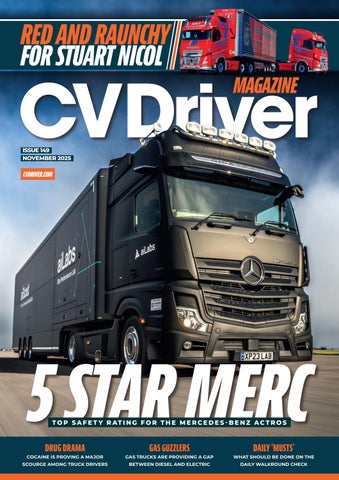
CV Driver Magazine Issue 149 November 2025

Page 1


• Family business, Est 1967 • Purpose built state-of-the-art site • Long serving and loyal workforce • 8 minutes to wash a truck • All types of trucks washed

Attending Kelsall Steam Rally 21st & 22nd June

Truckfest North West 13th & 14th September

MANAGEMENT

Publisher: Matthew Eisenegger

CONTRIBUTORS

John Charles Steve Banner

Editorial Address: Commercial

Vehicle Media & Publishing Ltd, 4th Floor 19 Capesthorne Drive, Eaves Green, Chorley, Lancashire. PR7 3QQ

Management

Publisher:

Contributors

Telephone: 01257 231521

Email: matthew@cvdriver.com

ADVERTISING

Advertising Sales: David Johns Mobile: 07590 547343

Editorial Address: Commercial Vehicle Media & Publishing Ltd,

INSIDE THIS NEW ISSUE

TECH SHORTAGE

Fresh warning as the UK faces a shortfall in the number of technicians who can work on electric trucks

HUBS AHEAD

Work is starting on a new network of super hubs that will provide charging facilities for electric trucks

5 STAR MERCS

The new Mercedes-Benz Actros has been awarded five stars in the latest Euro NCAP safety tests

DAILY 'MUST'

Advice for drivers and managers about exactly what should be done on the daily walkround checks

Email: sales@cvdriver.com

4th Floor 19 Capesthorne

Drive, Eaves Green, Chorley, Lancashire. PR7 3QQ

EDITORIAL

Telephone: 01257 231521

Email: matthew@cvdriver.com

Editor: John Threadgold

Art Editor: Leo Gehlcken

Advertising

GAS GUZZLERS

ON THEIR OWN

Telephone: 01257 231521

Advertising Sales: David Johns

Telephone: 01388 517906

How gas-powered trucks are helping to plug the gap between diesel and electric powered lorries

Tests are already under way in Europe to prepare for a world where trucks will drive themselves

Email: design@cvdriver.com

Mobile: 07590 547343

Email: sales@cvdriver.com

NOTE

Editorial

Editor: Trevor Gehlcken

Art Editor: Leo Gehlcken

Telephone: 01257 231521

Email: design@cvdriver.com

The publisher makes every effort to ensure the magazines contents are correct. All material published in CV Driver Magazine is copyright and unauthorised reproduction if forbidden. The Editors and publisher of this magazine give no warranties, guarantees or assurances and make no representations regarding any goods or services advertised in this edition.

Printing

MRC Print Consultancy Ltd 33 Uttoxeter Road, Longton, Stoke-on-Trent, Staffordshire ST3 1NY

Tel: 07764 951927

CV Driver Magazine is published under a licence from Commercial Vehicle Media & Publishing Ltd. All rights in the licensed material belong to Matthew Eisenegger or Commercial Vehicle Media and Publishing Ltd and may not be reproduced whether in whole or in part, without their prior written consent. CV Driver Magazine is a registered trademark.

If you are not going to keep this magazine for future reference please pass it on or recycle it.

RED AND RAUNCHY

Meet the dazzling new Volvo trucks that are making a splash after entering the Scottish fleet of Stuart Nicol

DRUG DRAMA

Cocaine use has become a major new scourge which needs to be addressed by Britain's transport firms

ACTROS IS A FIVE STAR PERFORMER

THE LATEST EURO NCAP COMMERCIAL TRUCK RATINGS HAVE AWARDED THE MERCEDES-BENZ ACTROS (4X2 TRACTOR UNIT) AND ACTROS (6X2 RIGID) THE HIGHEST 5-STAR RATING, REFLECTING MERCEDES-BENZ TRUCKS’ COMMITMENT TO ROAD SAFETY AND ADVANCED DRIVER ASSISTANCE TECHNOLOGY.

In addition, all Actros variants, including the Actros L ProCabin, received the new Euro NCAP City Safe accreditation, recognising the trucks’ technology and design features that help prevent accidents in urban environments.

Mercedes-Benz Trucks’ advanced safety systems are at the heart of these achievements. Features such as Active Assist 3, Active Brake Assist 6 Plus, Active Sideguard Assist 2, Front Guard Assist, and Attention Assist 2 enhance driver awareness, support safe driving, and help prevent collisions.

Heiko Selzam, managing director of Daimler Truck UK, said: “Our goal is simple: safer roads for everyone. These 5-star Euro NCAP results demonstrate that MercedesBenz Trucks offers some of the safest vehicles on the road today, while our City Safe accreditation highlights our ongoing commitment to protecting drivers and other road users in urban environments. The EuroNCAP tests highlight that safety isn’t just about crash performance but also preventing accidents happening and that’s good news for drivers and fleet managers.” ■

OUR GOAL IS SIMPLE. SAFER ROADS FOR EVERYONE

Above: Mercedes-Benz Actros is a star performer in the latest Euro NCAP tests

DAF EXPANDS RANGE WITH FACTORY-BUILT

10x4 CHASSIS

DAF TRUCKS IS EXPANDING ITS PRODUCT RANGE WITH A NEW 10X4 CHASSIS DESIGNED FOR HEAVY-DUTY APPLICATIONS, PARTICULARLY IN CONSTRUCTION

To support a high payload (technical GVW of up to 52 tonnes) and excellent manoeuvrability, this new five-axle ‘FAF’ configuration features a rear tridem consisting of a dual-driven tandem and a lifting, steered trailing axle.

DAF already offers a wide range of 4x2, 6x2, 6x4, 8x2 and 8x4 chassis. The addition further enhances the range. The new 10x4 FAF chassis is now available to order through DAF’s network of over 1,100 official dealers. A right-handdrive model for UK customers will be available in 2026.

The five-axle chassis is equipped with two leaf-spring 8- or 9-tonne front axles and a 34-tonne tridem with

air suspension. The tridem consists of a dual-driven tandem (available with either single or hub reduction) and a hydraulically steered, lifting trailing axle. This configuration combines high payload capacity with outstanding manoeuvrability.

The FAF chassis is offered with drivetrains featuring the PACCAR MX-11 and MX-13 engines and the automated TraXon transmission. Power outputs range from 300hp (220 kW) to 530hp (390 kW). The new five-axle truck is available with both XD and XF cabs. ◼

Below: DAF's range is being extended with the new chassis aimed at fleets in the construction industry

SMMT CALLS FOR SUPPORT FOR EV TECHNICIANS

THE SOCIETY OF MOTOR MANUFACTURERS AND TRADERS (SMMT) IS CALLING ON THE GOVERNMENT TO HELP WORKSHOPS CONTINUE INVESTING IN THE SKILLS AND EQUIPMENT TO SUPPORT THE SERVICING AND REPAIR OF ELECTRIC VEHICLES

A new SMMT study has found that four in five (81.2%) automotive aftermarket workshops are ready to service electric vehicles.

The automotive trade body said workshops have invested in training, talent and tooling to keep Britain’s safer, greener vehicles on the move and also found that a further 83.3% of those with these capabilities expect this spend to increase over the next year.

In addition, 77.6% of respondents are equipped to service and maintain advanced driver assistance systems (ADAS) systems, with 83.5% expecting to increase spending on ADAS training and equipment over the next 12 months.

But the SMMT has warned that sustaining such investment will be critical if the swift pace of EV rollout is to be maintained.

And its ‘Aftermarket Report, Jobs, Growth, Mobility – What the Aftermarket Needs To Deliver’ calls for government support to help workshops continue investing in the skills and equipment.

The research was greeted by the Institute of the Motor Industry (IMI), which has

long been spotlighting how the number of EV technicians will fall short of requirements by 2035 – when all new cars and vans sold in the UK will be required to be fully zeroemission.

Nick Connor, CEO of the IMI, said: “IMI data shows there has been a steady uptick in EV skills over the last few years. Latest data shows about 28% of the UK technician workforce holds an EV qualification. However, projections suggest that demand will outpace supply by over 25,000 technicians by 2035.”

The IMI has previously predicted a shortfall of 30,000 EV-qualified technicians by the time the ICE ban comes into force in 2035.

Mike Hawes, SMMT chief executive, said: “The UK aftermarket is embracing the future of automotive technology and investing in the skills and equipment needed to maintain the very latest vehicles to help deliver safe, sustainable mobility for all. With a rapid influx of smarter, zero emission vehicles reaching the road, however, helping businesses invest will be crucial if more drivers are to make the switch." ◼

LIFE’S A GAS FOR BAXTERS HAULAGE

Leicestershire-based Baxters Haulage has taken a significant step towards reducing its carbon footprint by switching out two diesel trucks for a pair of new Volvo FM gas- powered 6x2 tractor units.

The trucks join a 24/7 operation collecting recyclable and waste materials from across the Midlands, with one truck specifically dedicated to a contract working with North Warwickshire Borough Council.

James Baxter, managing

director, Baxters Haulage, said: “We’ve been running a biomethane-powered Volvo FM since 2019, and it’s proved to be a reliable part of the fleet. That experience is what gave us the confidence to bring these new tractor units into the business.”

The FMs are fuelled by bioLNG (liquified natural gas) and benefit from Volvo’s approach to gas engine technology, using small amounts of diesel to initiate ignition of the airfuel mixture. This enables the engine to deliver the same 460hp and 2,300Nm of torque as a standard 460hp diesel truck, with matching driveability, reliability and

service intervals. Volvo’s gas powertrain also provides engine braking just like a regular diesel tractor unit – without needing a separate retarder.

The trucks each feature a 12-speed I-Shift transmission –which delivers perfectly-timed gear changes in a fraction of a second – plus I-See predictive cruise control, allowing the driver to tackle hills and gradients in a higher gear, saving fuel.

Baxters Haulage has opted for Volvo’s Camera Monitoring System (CMS) to further boost efficiency by replacing exterior mirrors. The CMS also increases the driver’s field of view and, when driving with a trailer, deploys auto-panning functionality to follow the rear of the trailer as it turns. ◼

Left: Baxters' new trucks

NEW MEGAWATT ELECTRIC TRUCK CHARGING HUBS FOR UK MOTORWAY NETWORK

BP PULSE AND MOTO ARE SET TO INSTALL NEW MEGAWATT CHARGING TECHNOLOGY FOR ELECTRIC TRUCKS ACROSS THE UK MOTORWAY NETWORK

The rollout will begin with three motorway service areas: Lymm, Toddington North and Toddington South.

Six bays with megawatt charging system (MCS) chargers will be installed at each site, with the first planned to go live in 2026. The chargers, compatible with both CCS and MCS standards, are designed to accommodate a wide range of electric trucks.

Jo Hayward, vice-president, BP mobility and convenience retail, said: “We’re committed to helping fleet operators transition to EV trucks and that means delivering the infrastructure they need.

“Our partnership with Moto is a perfect fit. The team shares our focus on making electric truck charging as convenient as possible for our customers and providing them with a brilliant experience.

“Together, we’re making it easier for fleet managers to keep their electric trucks moving with less downtime, lower emissions and a clear path to an electric future.”

The project will focus on the UK’s primary motorway corridors, supporting BP’s aim to build a publicly accessible network of multi-energy truck hubs across the TransEuropean Transport Network (TEN-T) routes.

BP launched its first European e-truck corridor launched across six sites, spanning a 600km stretch of the RhineAlpine corridor, in January 2023.

Moto plans to install up to 300 charging bays for electric HGVs at 23 strategic locations by 2030. CEO, Ken McMeikan, said: “I am really excited about our plans with bp to provide electric charging stations for heavy goods vehicles.

“At Moto, we’re committed to leading the way in enabling the UK’s electric mobility. By partnering with BP Pulse, we are delivering the infrastructure and innovation electric fleets need, making our vision for long-haul electrification more practical and accessible.”

The collaboration between Moto and BP Pulse also complements BP’s acquisition of one of Europe’s largest truck stops in Ashford, Kent, where plans are underway to

Above: A network of electric truck charging hubs is planned for the motorway network

introduce EV charging for HGVs.

Nigel Head, vice-president for European E-Truck at BP Pulse, said: “This is a natural next step in our ambition to support fleets as they transition to electric trucks.

“We’ve proven in Germany that this model works, and now we’re applying that same expertise to the UK. ◼

CRASHES INVOLVING DEER ARE ON THE RISE COMPETITION

Crashes involving deer have increased by a third (34%) since 2021, according to figures from AA Accident Assist. It has found that 1,419 deer were hit by AA members last year, compared to 1,054 in 2021. There has been a steady annual rise in deer strikes, with 1,197 deer collisions in 2022 and 1,304 in 2023, while so far this year there have been more than 1,000 deer strikes up to the end of August.

The annual rutting season,

which runs between September and November, has also seen increases. Over the same 2021 to 2024 period, AA Accident Assist reports a 41% rise in single vehicle deer collisions (195 in 2021 compared to 276 in 2024).

With the number of collisions involving deer on the rise, AA Accident Assist is advising drivers to be wary of deer when driving, particularly on rural roads. Previous research has shown that around half of drivers

ignore deer warning signs.

Tim Rankin, managing director of AA Accident Assist, said: “As well as the emotional stress, hitting a deer is a costly experience. Even a low-speed collision can result in hundreds of pounds worth of damage to a vehicle. It’s also a timely reminder that warning signs are there for a reason. Deer and other wild animals are unpredictable, so drivers should be wary of coming across them, especially on rural roads. ◼

October Spot the difference winner:

Adam Brindley - Huddersfield

PALL-EX TAKES MAJOR STEP TOWARDS NET ZERO

PALL-EX LOGISTICS, PART OF THE PALL-EX GROUP, ONE OF THE UK’S BEST-KNOWN PALLETISED FREIGHT DISTRIBUTION NETWORKS, HAS INTRODUCED ITS FIRST FULLY ELECTRIC DAF XB

ELECTRIC 190 INTO ITS NATIONAL FLEET, SIGNALLING ITS COMMITMENT TO SUSTAINABLE TRANSPORT AND DECARBONISATION

The zero-emissions, 19-tonne 4x2 rigid joins a fleet that already comprises of approximately 100 DAF trucks, making DAF the mainstay for Pall-Ex Logistics.

Leased through PACCAR Financial on an initial 12-month arrangement, the DAF XB Electric will be assessed on daily collection and delivery work in the Dorset area.

The move marks Pall-Ex Logistics’ first steps into fleet electrification, with the company keen to scrutinise the DAF XB Electric under real-world conditions before wider adoption. Early results have exceeded expectation, with the truck easily handling twice-daily delivery routes of around 55 miles each and often exceeding 110 miles per day on a single charge.

The DAF XB Electric is equipped with a 190kW PACCAR EX-M2 eMotor, supported by a 282kWh ‘H-pack’ battery benefitting from cobalt and nickel-free Lithium Ferro Phosphate cells for enhanced durability and sustainability. Overnight, 100% charging is completed at Pall-Ex Logistics’ Christchurch depot, with rapid charging technology allowing a 2080% top-up in approximately 60-minutes.

Drivers have been especially positive. Feedback includes an extremely quiet drive and smooth operation, with initial concerns surrounding the new technology quickly dispelled.

Range and charging concerns have also been addressed through route optimisation, close monitoring of operational data and strengthening belief in the vehicle’s viability.

Pall-Ex Logistics managing director, Paul Pegg said: “We’re decarbonising our fleet across all the Pall-Ex Logistics locations and we’re thrilled with the DAF XB Electric straight out of the box. The realworld results so far are very encouraging, with our drivers noting its ease-of-use and performance characteristics. By trialling the XB Electric on live operations, we’re able to get practical insight into its capabilities as we look to make responsible and sustainable choices for both our business and for our customers. The invaluable support of Adams Morey has been key to making this a reality.” ◼

DAF has provided Pall-Ex with its first electric truck

GAS – STOP-GAP ON THE ROAD TO NET ZERO

WITH THE UK’S 2040 END-OF-SALE OF NEW, NON-ZERO

EMISSION HGVS ON THE HORIZON, THE COMMERCIAL VEHICLE

SECTOR IS PLANNING AHEAD FOR A FUTURE OF BATTERY

ELECTRIC AND HYDROGEN TRUCKS

With decarbonisation an increasingly important feature of the strategic plans for truck companies, gas power is still relevant as a useful transitional fuel to cut emissions while businesses consider when they can invest in battery electric (BEV) or hydrogen alternatives.

BEV and hydrogen trucks will inevitably be a major part of the UK’s road transport system with Scania, one of the most committed OEMs to low emissions fuels, expecting half of its global truck sales to be BEV by 2030. At the same time, it remains committed to giving fleet operators that

want to cut emissions the option of gas power given not all are able to make the full switch – for example, due to a shortage of HGV-suitable public infrastructure, a lack of upfront capital investment, or even the know-how to transition their depot.

Last year, for example, Scania debuted the world’s first 6×2 CNG gas truck without a Hendrickson axle, opening up the option of gas power to even more fleet configurations.

“The long average life of heavy-duty vehicles will require diesel and gas variants to be actively replaced – typically by HVO, biodiesel, and biomethane – if

Above: Biomethane is made from renewable plant sources

we are to reach global targets,” a Scania spokesperson said.

No silver bullet

“There is no silver bullet solution to decarbonisation. That’s why we offer every viable fuel and power option on the market for operators to choose from to reduce their emissions.”

One of the biggest barriers to gas adoption has historically been infrastructure, but that is solved by companies such as CNG Fuels and Gasrec, which have taken a different long-term view.

Philip Fjeld, CEO of CNG Fuels, believes there is no point in delaying. “The average customer that we have got is on a trajectory where they need to be net zero by 2035,” he

Westcott agrees that gas is already delivering results today, not in years to come.

“Biomethane HGVs can deliver meaningful carbon and cost savings,” he said. “Many of these trucks operate at high mileages and heavy weights – conditions under which emissions reductions are particularly significant.”

Gasrec is investing in major capacity expansions, including a new station at Hams Hall, expected to support 1,000 trucks per day, with further stations in the pipeline that will offer a combined 2,000-truck capacity by 2026 – and infrastructure to support up to 10,000 gas trucks by 2030.

Despite the optimism in the heavy

THERE IS NO SILVER BULLET SOLUTION TO DECARBONISATION. THAT’S WHY WE OFFER EVERY VIABLE FUEL AND POWER OPTION

said. “Some are further out in time, some are more aggressive, some want to be 100% by 2030 – but you can’t just continue to wait.”

The company, which operates 16 publicaccess gas stations across the UK, has seen massive growth which CNG Fuels says is reflected in the number of gas-powered trucks in operation in the UK, exceeding 2,000 today compared with seven in 2016. The company expects around 4,500 gaspowered HGVs on UK roads by next year.

Gasrec chief commercial officer James

transport sector, however, not everyone in the CV sector is planning a future with gas. Stagecoach, for example, one of the UK’s largest bus operators, is already releasing its gas-powered buses.

Phased out

“Our current gas-powered vehicles are in the process of being phased out,” a Stagecoach spokesperson said. “We purchased circa 40 gas buses in 2014 and currently have 19 in use. There is no current intention to procure more.

“They have served us well, were reliable in the main, and well received by our customers, drivers and engineers. We operated a mixture of Euro 5 and Euro 6 models, and a few have gone off to another operator for further use.”

The move reflects broader adoption of BEV and hydrogen buses, supported by government funding initiatives such as the Zero Emission Bus Regional Areas (ZEBRA) scheme. For inner-city routes and smaller vehicles with predictable range needs, BEVs and fuel cells are becoming more viable. However, given the importance of delivering net zero, transitional technologies such as gas can play a vital role in decarbonising fleets as they prepare for investments to fully move away from fossil fuels in line with government targets. ■

Above: The number of gas-powered trucks in operation in the UK exceeds 2,000
Below:: Biomethane HGVs can deliver meaningful carbon and cost savings

VOLVO TRUCK DEAL FOR RECYCLING FIRM DURACELL PLANS EV CHARGING NETWORK

DOVER-BASED EAST KENT RECYCLING HAS TAKEN DELIVERY OF 23 NEW TRUCKS SUPPLIED BY VOLVO. THE COMPLETE ORDER LEVERAGES THE MANUFACTURER’S BROAD PRODUCT RANGE, INCLUDING MULTIPLE FL, FE AND FMX TRUCKS, TO SERVICE DIFFERENT ROLES IN THE CUSTOMER’S BUSY OPERATION

The firm has acquired 10 FL 4x2 and eight FE 4x2 skiploaders, four FMX 8x4 hookloaders and one FMX 6x2 tractor unit. Operating from East Kent Recycling’s main depot, their arrival means that Volvo now accounts for 25 of the customer’s 26-strong commercial vehicle fleet.

The customer’s new FLs and FEs are each powered by a DK8 engine, producing 280hp and 350hp respectively. The FEs are also paired with a 12-speed I-Shift transmission, enabling seamless gear changes in a fraction of a second and smooth acceleration.

The FMXs also benefit from an I-Shift transmission, with the tractor unit paired with a 540hp engine while the hookloaders – all featuring Hiab Multilift bodywork – are split evenly between 420hp and 460hp D13K configurations.

The rigids will work on the customer’s construction and demolition operations, while the tractor unit will be used to transport waste from sites to East Kent Recycling’s plants in Faversham and Tilmanstone. ■

Above: Volvo has clinched a big truck deal with East Kent Recycling

DURACELL IS PLANNING TO SPEND £200 MILLION OPENING A NEW NATIONWIDE ULTRA-FAST EV CHARGING NETWORK

The new Duracell E-Charge hubs will offer ultra-fast charging of up to 1,000kW. Each location will be designed for maximum uptime and driver convenience, with transparent pricing and multiple payment options including contactless, in-app and plug-and-go.

The first six sites are expected to go live in the coming weeks, with a rapid rollout planned for 2026 and beyond. The network will prioritise strategic high-traffic locations including motorways, retail destinations, hospitality venues and urban gateways.

Day-to-day operations will be managed by Elektra Charge, a newly-formed charge point operator (CPO), under a new licence. The sites themselves will be developed and funded by The EV Network (EVN).

Javier Hernandez Reta, chief marketing officer at Duracell,

said: “Duracell has always been a trusted companion in people’s lives, delivering long-lasting performance, uncompromising safety and a commitment to sustainability. Today, electric vehicle drivers can travel even further, confidently and sustainably, with Duracell E-Charge leading the way.”

Reza Shaybani, CEO of The EV Network, commented: “The need in the UK for faster, more reliable charging to keep pace with EV adoption is clear. Duracell E-Charge is a direct response to that challenge. The EV Network has already delivered some of the UK’s biggest charging hubs, and now we’re bringing that expertise to one of the world’s most recognised brands.” ■

Below: Duracell is planning to set up a network of EV charging hubs

KUMHO’S MULTI-PERFORMERS

• Outstanding mileage

• Even wear

• Excellent all-season performance

RED AND RAUNCHY!

Lanarkshire-based Stuart Nicol Transport has continued its long-standing relationship with Volvo Trucks by placing an order for four new FH Aero tractor units featuring an array of specifications. By leveraging the breadth of range offered by Volvo, the customer has tailored its axle configurations, power outputs, cab sizes and interior specifications to suit particular use cases and driver preferences.

The order includes three Globetrotter XL cabs and one top-of-the-range Globetrotter XXL cab; turbo compound technology; full air suspension and lightweight pusher, twin tag and tag axles.

The first truck to arrive – a Volvo FH Aero 460 Globetrotter XL 6x2 tractor unit featuring I- Save tech – is already hard at work and is expected to clock up to 300,000 km annually operating up to seven days a week.

Owner, Stuart Nicol, said: “When the FH Aero launched, we didn’t hesitate – and we’re very glad we didn’t! The fuel performance out of the box has been mightily impressive, with our first FH Aero already yielding one mile-per-gallon more than the vehicle it replaced. To think that as the trucks bed in we could see even better results is very promising.

“We have a long and healthy relationship with Volvo, and it’s one that we really value. The reliability of its trucks, combined with its product

innovation, gives us the confidence to keep building on that partnership.”

Stuart Nicol’s Volvo FH Aeros will each be powered by Euro-6 compliant D13 Step E engines. In addition to the turbo compound 460hp model, the business has also opted for one 540hp and two 500hp standard powertrains. All four specifications feature a 12-speed I-Shift automated gearbox, which enables seamless gear changes in a fraction of a second and smooth acceleration.

Comfort has been maximised across the board, with the company’s first FH Aero setting the standard for the remaining order thanks to a Drive+ package. This sees the truck’s cab fitted with leather upholstery, dual armrests on both the driver and passenger seats, and adjustable steering wheel with neck tilt plus fully electronic air conditioning with carbon filter and sun, mist air quality sensors.

Additional efficiency gains are unlocked on the initial tractor unit via Volvo’s Camera Monitoring System (CMS). Replacing traditional exterior mirrors, the CMS increases the driver’s field of view and, when driving with a trailer, deploys auto-panning functionality to follow the rear of the trailer as it turns. The technology also performs strongly in rainy and dark conditions, direct sunlight and even when driving in tunnels. ◼

STUART NICOL’S NEW VOLVO IS A REAL HEAD TURNER

ACTROS GAINS FIVE STAR NCAP RATING EFS GLOBAL TRIALS DAF ELECTRIC TRUCK

THE MERCEDES-BENZ ACTROS HAS ACHIEVED A MAXIMUM FIVE-STAR RATING IN ITS SECOND EURO NCAP TEST. THE ACTROS MODEL JOINS THE VOLVO FM AND FH AERO MODELS IN HOLDING A FIVE-STAR RATING

During Euro NCAP’s testing of HGVs, 10 trucks were assessed and eight were awarded a CitySafe rating. The designation is applied to HGVs that are equipped to tackle the challenges and hazards of driving in urban environments. Because of their size and weight, HGV crashes are the most severe on European roads. Although trucks account for less than 3% of vehicles on Europe’s roads, they are involved in 15% of accident fatalities.

The results for the Actros came after the company declined to take part in Euro NCAP’s inaugural test of heavy goods vehicles (HGVs) in 2024.

For 2025 testing, it submitted three Actros models of differing cab heights. With improvements made to the safety equipment fitted and system performance, the latest and lowest cab Actros was awarded five stars by Euro NCAP, an increase from its previous three-star rating.

Two other models in the Actros range, the Actros F and the Actros L ProCabin, with taller cabs, were awarded four stars due to inferior driver vision.

However, all three were awarded the CitySafe label, which Euro NCAP said is message to fleet buyers and operators that the Actros range can be a safe choice for city operations when specified with the correct safety options. ◼

EFS GLOBAL HAS BEGUN TRIALLING ITS FIRST EMISSIONS-FREE DAF XB ELECTRIC 190KW 4X2 RIGID

The vehicle will undergo extensive evaluation in dayto-day local pallet operations as EFS Global explores the role of electric trucks in its future fleet strategy, with a clear commitment to wider adoption as the technology proves its operational and environmental benefits.

Initial concerns around range have been addressed through driver training and careful route planning, with the vehicle integrating seamlessly into daily collection and delivery operations. The 19-tonne XB Electric is comfortably handling up to 150 miles per day.

The company already runs more than 400 DAF vehicles, making the new XB Electric a natural fit as the company embarks on its transition to zero-emissions transport.

The new XB Electric is powered by a 190kW PACCAR

EX-M2 eMotor in combination with a 282kWh ‘H-pack’ battery arrangement featuring cobalt- and nickel-free Lithium Ferro Phosphate technology.

Overnight charging at EFS Global’s Burnley depot provides a straightforward ‘plug and play’ solution, while rapid charging capability allows for a 20-80% top-up in around an hour.

Mark Jones, managing director at EFS Global, said: “This DAF XB Electric is not a token gesture – it’s a fully operational vehicle that is already proving itself in the field. It reflects our ISO 14001 environmental accreditation and underlines our ambition to make responsible choices that also make good business sense. With the outstanding support of Lancashire DAF, I’m confident this is the first of many electric DAFs to come.” ◼

CHECK DAILY. STAY LEGAL AND SAFE

TEDIOUS THEY MAY SEEM TO BE AT BUSY TIMES, BUT DAILY WALKROUND CHECKS ARE ESSENTIAL – AND A LEGAL REQUIREMENT TOO

Some truckers find that daily walkaround checks of their vehicles at the start of each day are a chore – but they are not only essential for safety but a legal requirement too.

Whether operating a heavy goods vehicle (HGV) or a public service vehicle (PSV), the Traffic Commissioners office says a walkaround check is essential to ensure vehicles are safe, roadworthy and fit for purpose before they take to the road.

Additional checks may also be required during the day depending on the vehicle’s use. For example, further inspections may be necessary if the vehicle has been used off-road, is older, or has a history of defects.

The Traffic Commissioners say a properly conducted walkaround check helps to prevent avoidable accidents and injuries,

avoids roadside prohibitions issued by the Driver and Vehicle Standard Agency (DVSA) or the police and minimises downtime and protects the public.

Incidentally, these checks count as working time and drivers must be given adequate time to complete them properly.

According to DVSA guidance, key areas for trucks include:

• Lights and indicators: ensure all lamps are clean, functional and display the correct colour and intensity. Check for any cracked lenses

• Tyres: check tread depth, pressure and for damage or embedded objects. Check wheel nuts for torque and security

• Brakes: listen for air leaks, ensure couplings are free from debris and visually inspect brake lines and connections for

Above: Inspect the vehicle’s bodywork for any loose panels, damage, or sharp edges

damage. If safe, test the foot and parking brakes for effective operation

• Steering: check for any excessive play, and signs of wear, damage, or leaks

• Wipers and washers: confirm they are functioning correctly, providing clear visibility across the entire windscreen.

Check fluid levels for the washer reservoir

• Mirrors and glass: ensure all mirrors are clean, correctly adjusted, undamaged and provide an unobstructed view. Check all glass areas for cracks or chips that could impair vision or shatter. Make sure no clutter in the cabin affects the view

• Bodywork and load security: inspect the vehicle’s bodywork for any loose panels, damage, or sharp edges. Crucially, ensure the load is securely stowed, distributed correctly and properly sheeted or covered if necessary. Check any tail-lifts or ramps for correct operation and security

• Fluid levels: where accessible, check engine oil, coolant, power steering fluid and brake fluid levels

• Vehicle documentation: confirm the validity and presence of necessary documentation such as the insurance certificate and, where applicable, the driver’s tachograph card.

Reporting defects

Identifying defects is the first step. Drivers must report them clearly and promptly in writing. Whether using paper forms or digital systems, reports must be legible and accurate. Operators are responsible for:

• Ensuring defects are repaired promptly by qualified personnel

• Preventing vehicles with safety-critical defects from being used

• Maintaining a complete audit trail from defect identification to repair and re-check.

Responsibilities of operators

Drivers are responsible for carrying out the checks, but operators and transport managers are ultimately accountable for getting them fixed. Their responsibilities include:

• Training: provide initial and ongoing training on how to perform walkaround checks report defects. Remedial training and discipling drivers when things go wrong

• Systems: implement robust systems for defect reporting, maintenance scheduling, and record-keeping

• Monitoring & Auditing: conduct spot checks, review reports and audit maintenance systems. Is your maintenance provider picking up defects your driver should have spotted?

• Providing the tools: equip drivers with necessary tools, such as torches and suitable paper defect checklist or user-friendly digital devices to facilitate accurate reporting.

Failure to carry out daily checks can result in:

• Roadside prohibitions: vehicle prevented from further movement until the defect is rectified, leading to operational delays and potential fines

• Fines and penalties: financial penalties can be imposed on both drivers and operators for non-compliance

• OCRS impact: a poor Operator Compliance Risk Score (OCRS) can lead to increased DVSA scrutiny

• Regulatory action by a Traffic Commissioner: operator – regulatory action may be taken such as licence curtailment, suspension, or revocation; transport manager – risk losing good repute or professional competence, which could permanently impact their ability to act as a TM for any operator

• Driver: drivers face potential vocational licence action, including suspension or revocation, jeopardising their career

• Accidents and fatalities: defects, however minor, can contribute to serious accidents, leading to injuries and fatalities.

Support tools

Digital walkaround check apps can improve accuracy, streamline reporting and integrate with maintenance systems. However, they are support tools, not replacements for a physical inspection. The responsibility remains with the driver to conduct a thorough check. ■

CHECKS COUNT AS WORKING TIME AND DRIVERS MUST BE GIVEN ADEQUATE TIME TO COMPLETE THEM PROPERLY
Below:

Check tyre tread depths, pressure and for damage or embedded objects

CONQUER WINTER ROADS WITH CONFIDENCE

DISCOVER HANKOOK’S SMARTCONTROL COMMERCIAL TYRE SERIES

Hankook offers a comprehensive range of winter tyres for commercial vehicles

With winter fast approaching and unpredictable driving conditions on the horizon, premium tyre manufacturer Hankook offers a comprehensive range of winter tyres for commercial vehicles. Featuring advanced steering, drive axle and trailer treads, the SmartControl series delivers exceptional grip, stability and performance- ensuring fleets stay safe, efficient, and unstoppable, even in the harshest ice and snow conditions. The core winter lineup includes:

• SmartControl AW02+

• SmartControl DW07

• SmartControl TW01

The SmartControl AW02+ is Hankook’s all-position winter specialist for trucks, buses and coaches, specifically engineered to perform in severe weather conditions. Like all treads in the SmartControl range, the tyre demonstrates its high winter performance with both the Three Peak Mountain Snowflake (3PMSF) symbol and the Mud and Snow (M+S) markingguaranteeing enhanced traction and stability on changing road surfaces.

The SmartControl DW07, successor to DW06, is engineered for outstanding snow

performance and maximum safety on winter roads. Its exceptionally wide tread on the drive axle increases the tyre-toroad contact area, delivering enhanced grip, handling, and mileage by up to 13%. Additionally, the tread design features five main drainage grooves, reducing the risk of hydroplaning and ensuring greater control in wet conditions.

The SmartControl TW01 trailer tyre features a durable 5-rib tread design engineered to deliver exceptional braking performance on wet, snowy and ice-covered roads. Its inner three ribs, equipped with advanced Multi-3D sipes, enhance grip and stability, while the tread blocks ensure even wear, extended mileage and improved fuel efficiency- making it a reliable choice for winter driving.

Huge difference

For fleets, changing to winter tyres can make a huge difference in safety, performance and long-term cost savings, especially in the UK and Europe, where winter driving conditions can be unpredictable. In the UK, there are no legal requirements to fit winter tyres. However, it is recommended to switch to winter

tyres when temperatures consistently drop below seven degrees Celsius and to equip all wheel positions with winter tyres, as mixing applications can reduce stability and traction.

DRIVERS AND FLEETS MUST BE EQUIPPED TO FACE THE TOUGHEST OF WINTRY CONDITIONS

Paul Emery, sales director at Hankook Tyre UK said: “As winter approaches, drivers and fleets must be equipped to face the toughest of wintry conditions in order to avoid expensive downtimes and arrive safely at their destination. Hankook‘s SmartControl, a comprehensive winter solution, offers optimal snow traction and safety, while also providing high mileage and top braking performance.” ■

For more information visit: hankooktire.com

Outstanding mileage performance without compromising fuel efficiency for long & regional haul use

Hankook Tyre UK Ltd
Hankook House, Parsons Road, Daventry, Northamptonshire, NN11 8RA
Smart Flex AL51 Smart Flex DL51

DRIVERLESS TRUCKS: FUTURE COMES A STEP NEARER

Aroad network populated by driverless vehicles transporting goods and passengers both on short and long distances offers significant potential with cost savings, increased safety and greater efficiency – an attractive proposition for the transport sector.

implementing services that meet the needs of the British public, providing competitive advantages for British businesses.

SELF-DRIVING VEHICLES CAN IMPROVE TRANSPORT FOR MILLIONS OF PEOPLE –PROVIDING GREATER CHOICE AND FLEXIBILITY TO GET

It is a future that moved a significant step closer with government launching the first in a series of consultations to implement the Automated Vehicles Act 2024. There was a major additional announcement for passenger transport, meanwhile, with transport secretary Heidi Alexander confirming that UK government will fasttrack self-driving commercial pilot projects for taxi- and bus-like services on England’s roads to spring 2026.

The government’s plans to implement a regulatory framework that will enable organisations to pilot commercial selfdriving services from next year will encourage technology developers and their partners to begin designing and

Indeed, it means that next year, firms will be able to pilot small scale ‘taxi- and bus-like’ services without a safety driver for the first time – which could be available to members of the public to book via an app. Wider rollout potentially will come when the full Automated Vehicles Act becomes law from the second half of 2027.

Alexander said: “Self-driving vehicles can improve transport for millions of people –providing greater choice and flexibility to get around more easily. They could add new public transport options in rural areas to boost connectivity for local communities, and improve mobility, accessibility and independence for those unable to drive.”

According to SMMT, self-driving vehicles including cars, vans, trucks, buses and taxis have the potential to deliver significant benefits to British society and the economy, delivering annual economic

Above: The trialling of self-driving vehicles is already a reality in the UK thanks to cutting-edge domestic innovation

benefits as high as £66 billion and an estimated additional 342,000 jobs by 2040.

The technology could also potentially save 3,900 lives and avert 60,000 serious collisions over the next 15 years, while offering a wider array of accessible mobility solutions to disabled and older people.

Revolution ahead

Mike Hawes, SMMT chief executive, said: “Britain’s self-driving vehicle revolution moves one step closer, with the announcements putting the country on track to reap the road safety and socioeconomic benefits this technology can deliver.

“Pilot rollout of commercial self-driving services from next year will widen public access to mobility, while the consultation will ensure the technology is deployed in a safe and responsible way. These latest measures will help Britain remain a world leader in the development and introduction of self-driving vehicles, a manifest application of AI at its finest.”

These transformational services, which are already available in some other countries, will widen the public’s access to mobility solutions. This positive move positions the UK as a hot bed for cuttingedge mobility technology, elevating our position on the world stage as a destination of choice for automotive and AI investment.

Self-driving trials have already been taking place in the UK – and as far back as January 2015, with British companies Wayve and Oxa spearheading significant breakthroughs in the technology.

More recent projects, however, have included Scotland’s automated bus pilot project CAVForth, which trialled a real-world passenger transport service at AV Level 4 – meaning they had a trained safety driver onboard, but the driver didn’t touch the controls while the vehicle was in autonomous mode.

The project involved a fleet of five fully automated full-sized buses operating a scheduled passenger service across the Forth Road

Bridge, carrying up to 10,000 passengers per week. The 14-mile route runs from the Ferrytoll Park and Ride in Fife, across the Forth Road Bridge Public Transport Corridor, to Edinburgh Park.

Varied route

The route took in a range of infrastructure, from pedestrianised bus and train stations, mixed single carriageway roads, 50mph motorway and dedicated bus lanes. The autonomous buses negotiate traffic lightcontrolled and normal roundabouts while integrating with live traffic.

Oxa and EV manufacturer Bradshaw EV, meanwhile, announced a partnership in May to deliver electric automated vehicles to businesses that need on-site transportation.

Bradshaw EV’s T800 eight-tonne tow tractor and the Club Car Carryall 500 utility vehicle will both be used for off-highway light logistics applications, providing automated towing capabilities for moving goods and components efficiently around airports, large manufacturing sites, distribution centres, campuses and a wide range of other environments.

Automated shuttle buses are also taking to the road at locations such as the National Exhibition Centre in Birmingham and Harwell Science and Innovation Campus in Oxford, while Belfast Harbour is now testing its new ‘Harlander’ automated shuttle bus in the city’s Titanic Quarter.

When launched, the Harlander, which uses an electric vehicle provided by manufacturer eVersum, will be the first self-driving passenger service in Northern Ireland, carrying up to nine members of the public at one time, and with a safety operator on board.

The vehicle will initially only be on the roads for testing and to enable the route to be mapped by Harlander’s systems in a project expected to take three weeks, with the service opening to the public at the end of May. It will run on a 15 to 20-minute loop, connecting Titanic Halt railway station with Queen’s Island on a route with six bus stops.

So, it seems the trialling of self-driving vehicles is already a reality in the UK thanks to cutting-edge domestic innovation – and the government announcement will only accelerate safe and successful commercial rollout on our roads. The transport sector and indeed the public must be ready for change, therefore, that could see automated vehicles become the norm rather than the exception. ■

• Article originally published in the Society of Motor Manufacturers and Traders’ Transport Newsbrief

Below: Self-driving trucks have the potential to deliver significant benefits to British society and the economy

Proactively detect risky and distracted driving behaviours

For 2021, Vision UK is offering safety equipment meeting the requirements of DVS, FORS and CLOCS schemes, to provide a higher level of driver assistance than is required by the guidlines

For 2023, Vision UK is offering safety equipment meeting the requirements of DVS, FORS and CLOCS schemes, to provide a higher level of assistance than is required by the guidelines 2025

For 2020, Vision UK is offering safety equipment meeting the requirements of DVS, FORS and CLOCS schemes, to provide a higher level of driver assistance than is required by the guidelines

l Blind Sport Vision System for Construction Logistic Operators

l Vision and Recording System for Construction Logistic Operators

l High Resolution WDR Cameras

l Compliance systems (LDVS-70 SD or HD)

l CLOCS-70 system (system updated for 2020 with HD cameras

TAILGATING THE MOST ANNOYING DRIVING BEHAVIOUR

MORE THAN A QUARTER (27%) OF DRIVERS SAY THAT TAILGATING IS THE MOST IRRITATING BEHAVIOUR CARRIED OUT BY OTHER DRIVERS, ACCORDING TO A SURVEY BY THE AA

The poll of 12,014 drivers found that a fifth (19%) of drivers are hacked off by middle lane hoggers, while one in six (16%) get annoyed at drivers picking up and using a mobile phone when they are behind the wheel.

This most recent survey shows that the menace of tailgating remains the biggest bugbear when out on the road, with previous studies carried out by AA Accident Assist in 2023 highlighting driver frustration. Similarly, more than half (55%) of drivers said that tailgating has been getting worse in recent years.

motoring offences. Drivers found to be driving in this way could be charged with ‘driving without due care and attention’, or even ‘dangerous driving’ depending on how serious officers deem the actions at the time.

Similarly, most cases are not caught and processed via cameras, but through officers catching people in the act. The AA is calling for 1,000 more specialist traffic officers to help police the roads and help make streets safer.

Jack Cousens, head of roads policy at The AA, said; “Experienced far too often, being tailgated remains the behaviour that drivers hate the most.

“It’s little wonder – feeling pressured from the vehicle behind, worrying about if they

will stop in time if you need to slam the brakes in an emergency, and headlights glaring into mirrors all create a stressful experience.

“Drivers need to leave sufficient space from the car in front to stop needless crashes. The harsh reality is that every driver feels the pain of crashes caused by tailgating with increased insurance premiums.

“As well as being more mindful when driving, we need more cops in cars to help stop dangerous and anti-social driving behaviours before the spiral into more serious incidents.” ■

Below: Drivers say that tailgating has been getting worse in recent years

The survey also highlights dangerous behaviour such as not wearing a seatbelt, speeding and undertaking. Drivers also get irked by drivers being distracted with things in their car such as a mobile phone docked in a cradle and playing with the car’s infotainment system.

Penalties

Unlike speeding, tailgating and middle lane hogging are not recognised as specific

SCOURGE OF COCAINE REACHES EPIDEMIC PROPORTIONS

NEW GUIDANCE ADDRESSES OPERATIONAL CONCERNS REGARDING WORKPLACE CHALLENGES LINKED TO DRUG AND ALCOHOL TESTING

Cocaine now accounts for 44% of positive workplace drug tests compared to just 19% for cannabis, according to 2024 data, marking a significant shift in substance abuse patterns that transport companies must address. D.tec International has released implementation guidance to help operators respond to this evolving threat while managing operational demands.

The urgency is reinforced by the most recent Operation Limit campaign data showing 42% of roadside drug tests returned positive results, with drug-related arrests running three times higher than alcohol-related arrests. These figures highlight why transport operators can no longer rely on induction-only testing approaches.

However, the primary barrier preventing comprehensive testing remains operational disruption. Fleet managers managing tight delivery schedules across multiple sites worry about extended driver standdowns and workflow interruption. The new guidance addresses these concerns with practical strategies that integrate testing into shift changes and scheduled breaks rather than requiring dedicated facilities.

Better testing

Robust testing technology can fundamentally change the implementation equation. Results can come back in 3-5 minutes using non-invasive saliva and sweat samples, with collection taking under 60 seconds. This speed means companies can conduct testing without pulling resources from core business functions. The financial stakes make these operational solutions critical. Without drug and alcohol testing, companies can face unlimited fines under Health and Safety legislation, with corporate manslaughter

legal costs potentially exceeding £1.8 million. “The question isn’t whether to test, but how to do it without stopping operations,” said a D.tec International spokesperson.

Beyond legal risks, the guidance reveals that comprehensive testing is becoming a competitive differentiatora. One multisite operator discovered their proactive approach impressed external ISO 45001 auditors and helped win contracts against larger competitors. Premium clients now demand detailed testing protocols during tender processes.

Complex landscape

The guidance also tackles the complex legal landscape HR directors must navigate. This includes balancing employer duty of care with employee privacy rights, managing union consultation requirements and maintaining compliance across England, Scotland, Wales and Northern Ireland’s varying regulations.

Current workplace statistics make the

case for action urgent. Alcohol misuse causes 17 million lost working days annually and 70% of substance abusers work full-time. Most concerning for operations: 22% of employees admit making mistakes at work due to hangovers, a risk that induction-only testing cannot address.

To manage these challenges without operational chaos, the guidance recommends phased implementation.

Starting with random and for-cause testing allows companies to build internal competency before expanding to comprehensive programmes. This gradual approach reduces risk while ensuring thorough preparation.

“Success depends on viewing testing as operational excellence, not compliance burden,” the spokesperson added.

“Companies that integrate testing properly enhance rather than hinder their capabilities.” ■

Below: Cocaine use at work is becoming a major problem

CHARGE POINT OPERATOR CALLS FOR ACTION OVER THEFTS SAS TECH SERVICES GOES GREEN WITH ELECTRIC eACTROS

THE RISE IN THE USE OF ELECTRIC VEHICLES HAS LED TO A RISE IN CABLE THEFT AND CRIMINAL DAMAGE AT CHARGE POINTS TOO

The first-of-its-kind investigation, which collected data from police forces nationwide, revealed 200-plus cases of theft and vandalism against EV chargers across the UK, costing millions of pounds.

Charge point operator Allego cautioned that these figures are likely just the tip of the iceberg, with many incidents going unreported and 40% of surveyed police forces either

WITH THE GOVERNMENT TARGETING 300,000 PUBLIC CHARGE POINTS BY 2030,

WE NEED TO NIP THIS TREND IN THE BUD

unable to provide data or saying they do not hold relevant records.

Experts warn that as the EV network continues to expand at pace, so too does the opportunity for criminal activity, and that preventative action must be taken before the issue escalates.

Paz Sharma, managing director of Allego UK, has joined growing calls for EV chargers to be recognised as critical infrastructure and for harsher penalties for those caught targeting these sites.

He is also advocating for the introduction of a new crosscollaborative ‘EV taskforce’ which brings together government, industry, law enforcement, the industry body ChargeUK and political groups such as the Electric Vehicle All Party Parliamentary Group to explore ways to better protect charge points.

Sharma said: “Action needs to be taken to bring EV criminals to book. It’s not about the £25 scrap metal value or even the cost of replacing damaged chargers which runs into thousands of pounds – it’s about giving the nation the best chance of securing its clean transport future.

“Unfortunately, we believe this to be a much more serious problem than the figures indicate, as our FOI investigation flagged that a number of police forces were not in a position to provide information on such incidents.

Based on what we hear from the industry and the prevalence of unreported cases, I wouldn’t be surprised if as many as one in 20 charging sites are being targeted.

“With the Government targeting 300,000 public charge points by 2030, we need to nip this trend in the bud and show those targeting chargers that they will face the full force of the law.” ■

SAS TECH SERVICES HAS MARKED ITS 25-YEAR COMMITMENT TO MERCEDES-BENZ TRUCKS WITH A BOLD STEP INTO THE FUTURE OF SUSTAINABLE LOGISTICS – THE ARRIVAL OF ITS FIRST ALLELECTRIC MERCEDES-BENZ EACTROS 600

The Northampton-based managed service provider, which specialises in collecting end-of-life IT equipment for recycling, will run the eActros 600 on weekly round trips between the UK and Holland.

It is expected to cover 80,000 miles a year in total.

Pulling a state-of-the-art double-decker trailer, the new truck will collect used technology from across Europe before distributing it to recycling centres in the UK.

For a business built around recycling, adopting zeroemission vehicles was a natural next step. “We’ve already had great experiences with our Mercedes-Benz eSprinter, so

the move to an electric HGV was the logical progression,” said Lee Spendlove, managing director.

With a real-world range of over 500km, the truck will typically only need one charge on its journeys to Holland.

Convenient access to charging infrastructure en route makes electric long-haul a practical solution for SAS Tech Services and its customers.

Alongside the eActros 600, SAS Tech Services has also added a new Actros L ProCabin 1853LS Gigaspace 4x2. Covering more than 100,000 miles annually, it will serve recycling centres across England, Wales and Scotland. ■

BORN AND BUILT AROUND YOU.

WE ARE THE ONE STOP SHOP FOR COMMERCIAL VEHICLES. OUR FAMILY OWNED BUSINESS HAS BEEN IN OPERATION FOR OVER 100 YEARS AND WE PRIDE OURSELVES ON PROVIDING A FIRST-CLASS SERVICE TO EVERY CUSTOMER WE SERVE.

Turn static files into dynamic content formats.

Create a flipbook
CV Driver Magazine Issue 149 November 2025 by CVMP - Issuu