Mailing address: 31855 Date Palm Drive, No. 3-263 Cathedral City, CA 92234 (760) 904-4208 www.cvindependent.com
Editor/Publisher
Jimmy Boegle
staff writer
Kevin Fitzgerald
coveR and feature design
Maria Ratinova
Contributors
Haleemon Anderson, Melissa Daniels, Charles Drabkin, Katie Finn, Bill Frost, Bonnie Gilgallon, Bob Grimm, Terry Huber, Valerie-Jean (VJ) Hume, Clay Jones, Matt Jones, Matt King, Keith Knight, Cat Makino, Maggie Miles, Brett Newton, Greg Niemann, Jeffrey Norman, Dan Perkins, Theresa Sama, Jen Sorensen, Robert Victor, Eleanor Whitney
The Coachella Valley Independent print edition is published every month. All content is 2026 and may not be published or reprinted in any form without the written permission of the publisher. The Independent is available free of charge throughout the Coachella Valley, limited to one copy per reader. Additional copies may be purchased for $5 by calling (760) 904-4208. The Independent may be distributed only by the Independent’s authorized distributors.
The Independent is a proud member and/ or supporter of the Association of Alternative Newsmedia, the California Newspaper Publishers Association, CalMatters, DAP Health, the Local Independent Online News Publishers, the Desert Business Association, and the LGBTQ Community Center of the Desert.
A NOTE FROM THE EDITOR
AI has been one of the hottest topics at every news-publishing conference I’ve attended in recent years.
How should we use it? Should we use it at all? How should we deal with the fact that most of these large language models use/used our content, without our permission? Will AI eventually cost us our jobs or our publications?
Additionally, the use (or, rather, misuse) of AI by some news outlets has led to some big problems. Here are some recent headlines:
• “Reporters at McClatchy Withhold Bylines in Dispute Over A.I. Content.” As reported by The New York Times: “McClatchy, the newspaper chain behind publications including The Sacramento Bee, The Miami Herald and The Idaho Statesman, has started to use a new artificial intelligence tool that can summarize traditional articles and spit out different versions for different audiences. Its reporters aren’t happy about it. Journalists in many of the company’s newsrooms are now withholding their bylines from articles created by the new tool, meaning that those articles will run with a generic credit rather than a reporter’s name, as is customary.”
• “Sports Illustrated Just Deleted Every Article by One of Its Writers After Accusation of AI Plagiarism.” As reported by Futurism: “Sports Illustrated deleted an author—and his entire archive of articles—from its website following allegations of AI plagiarism. … The sports news site Sportico published an article featuring an original analysis of parlay bets made via the prediction market Kalshi. Two days later, on May 15, Sports Illustrated published an article — titled ‘Who is really winning on Kalshi parlays according to the data’—that regurgitated the same figures, without ever attributing the analysis to Sportico, as would be the normal and ethical thing to do.”
Yikes. To be clear, I don’t think writers/reporters should use AI to write or construct their articles. That said, AI can be very helpful to journalists; for example, many of us use AI interview-transcription services, while some use AI to summarize public meetings.
Therefore, the Independent has finally developed an AI policy, and we’re requiring all of our employees and contributors to agree to its terms. We used the AI policy by The Beacon (thebeaconnews.org), a Kansas City-based news outlet, as our inspiration, with their permission. Here’s our AI policy:
The Coachella Valley Independent is dedicated to being the valley’s source of independent news, arts coverage, commentary and culture. We, like many news publications, are continuing to explore how we use the fast-evolving tools of our trade—including artificial intelligence (AI) and large language models. Our goal is to use these technologies to improve efficiency while upholding our editorial integrity.
How we may use AI:
• Transcribing interviews using tools like Otter.ai. Transcriptions are always reviewed by a human for accuracy.
• Transcribing and summarizing public meetings. Transcriptions are always reviewed by a human for accuracy.
• Checking spelling and grammar.
• To brainstorm story angles, possible sources, potential questions and possible headlines— always with oversight and review by reporters and editors.
How we do NOT use AI:
• AI does not write our stories. Every story is researched, written and edited by human journalists. In rare cases where a portion of a story is crafted by AI (such as a public meeting summary), it will be disclosed.
• We do not use AI for fact-checking or editorial judgment. Our reporters and editors are responsible for verification and for all conclusions.
• We do not use AI-generated photographs or illustrations. All visuals used in our reporting are created by human photographers, illustrators or designers.
We are committed to using AI thoughtfully and responsibly. Any uses of AI will be to enhance productivity, and never to replace writing and reporting—while always maintaining the highest standards of accuracy, transparency and editorial independence.
The Independent Is a National Award Finalist! AAN Publishers (the Association of Alternative Newsmedia) announced the 2026 AAN Awards finalists—and I am proud to announce the Independent is a finalist in two categories:
• The Indy Digest is a finalist in the Political Column category.
• “Satisfying Settlement: After Two-Plus Years of Stress and Expense, Lake Tamarisk Residents Reach an Agreement With Intersect Power Regarding the Easley Solar Project,” by Kevin Fitzgerald, is a finalist in the Housing reporting category.
Placements will be announced on July 9 at the 2026 annual AAN conference—which is taking place right here in Palm Springs!
Welcome to the June 2026 print edition of the Coachella Valley Independent. As always, thanks for reading.
—Jimmy Boegle, jboegle@cvindependent.com
HIKING WITH T
BY THERESA SAMA
When desert trails become unbearable due to the high heat of summer, head just 25 to 30 minutes west of Palm Springs for a step back in time.
Tucked along the western edge of the Coachella Valley, just north of Interstate 10 in Banning, the Gilman Historic Ranch and Wagon Museum offers a hiking/touring experience unlike any other in the area. While many local hikes feature dramatic peaks or sweeping desert vistas, the Gilman Ranch Trail offers a blend of scenic foothill hiking and living history—while providing a refreshing escape from the intense desert heat; Banning is often at least 10 degrees cooler than the Coachella Valley.
The Gilman Ranch Trail is not just a hike—it is a journey through time, tracing the footsteps
of Native Americans, pioneers and stagecoach travelers who traversed the San Gorgonio Pass on the Bradshaw Trail. The 180-mile overland stage route, established in the 1800s, linked Southern California to Arizona’s gold fields.
The Gilman Ranch Trail is a moderate and short hike (just less than 2 miles out and back) with an elevation gain of about 426 feet. It typically takes around one to two hours to complete, but don’t be in a hurry; it offers a fascinating look into 19th-century frontier life. I experienced this firsthand while attending a group hike with the Blue Zones Project Banning, a community program focused on improving health and well being (www.bluezonesprojectbanning.com).
As you tour the grounds listening to the beautiful sounds of a variety of songbirds, you’ll stroll by a peaceful year-round spring in a shaded canyon near the trailhead. The water source attracts a variety of wildlife. Just before the creek, you’ll notice an old gold-panning area; panning is still a thing today, often offered during events and when “Gilman Ranch Hands” (volunteers) are available.
The property is rich with artifacts from another era. You’ll find grinding stones used by Native Americans, a blacksmith shop, a tack room, olive-curing sheds, and a variety of vintage tools and equipment dating back to
the late 1800s and early 1900s. Nearby are the protected ruins of the José Pope Adobe, the first permanent structure in the San Gorgonio Pass. Built as a bunkhouse for cattlemen, it later became the home, store and stage stop of James Marshall Gilman after he purchased the property in 1869. Gilman eventually built a larger ranch house, which burned in 1977; a rebuilt version now stands on the property. The diversity of trees includes oak, cottonwood, palms and even an incense cedar—you’ll find the latter behind the museum, in the native plant garden. Our volunteer hiking guide, Susan Savolainen—who is also the Ranch Hands membership coordinator, among other duties—pointed out a 100-year-old fig tree on the hill near the house. It’s the most beautiful and picture-perfect tree I’ve ever seen. If you’re standing in front of the old ranch house, look to the right of the house, and you’ll see it. Bring a snack or lunch with you to take a break and enjoy the picnic area. It includes many nice picnic tables (recently painted by Susan and her husband), all shaded by olive trees planted by the Gilmans more than 100 years ago. Barbecue grills are also available for public use, and you’ll find a variety of fruit and nut trees located in the orchard near the picnic area. (More shade!) The property has wide open green spaces to enjoy as well. It’s fun for
Catch a breath of cooler air at the Gilman Historic Ranch and Wagon Museum in Banning
the whole family, including dogs on leash. Volunteers play a major role in keeping this historic site thriving. The aforementioned Gilman Ranch Hands, a nonprofit volunteer group, supports preservation, events and educational programs. If you’re interested in getting involved, learn more at www.facebook. com/gilmanranchhands.
If you want to hike early in the morning or late in the evenings when the ranch is closed, you can park at Wilson and 16th Street, and enter from the dirt service road, according to AllTrails. The trail begins near the ranch grounds on the other side of the creek. Look for a bench on the right with two bushes; the trail starts there. The path climbs steadily— occasionally steeply—through low desert vegetation and scrub. There’s a series of benches along the hillside for rest and scenic stops. The trail tops off at 2,950 feet; you’ll enjoy sweeping views of the Banning Bench, an elevated plateau known for its cooler climate and vistas of the San Jacinto Mountains. The trail continues briefly before reaching a fence marking the turnaround point.
You may see cattle and horses from nearby ranches. We saw cattle grazing in the distance—and we saw a section of missing fence as well, so the livestock could possibly roam into the hiking area. At times, it’s difficult to differentiate the trail from the open field.
Even though it’s a little cooler in Banning, you’ll want to start the day early in the sum-
mer months. I suggest doing the hike before visiting the rest of the ranch and museum, because it is a good idea to be off the trail by noon; there’s not much shade along the hillside, and no shade at all once you reach the top of the hill.
Be sure to bring plenty of water, snacks, sunscreen and a hat. Wear proper hiking shoes, and watch your step—snakes are around! We saw a huge gopher snake near the museum. Hiking poles are recommended for the short but steep hillside climb.
The Gilman Ranch is truly a gem worth discovering, whether you’re looking for a short hike, a family outing or a chance just to step into the past. I know I’ll be back soon!
Gilman Historic Ranch and Wagon Museum, home of the largest public collection of wagons, buggies and stagecoaches in the Inland Empire, is operated by the Riverside County Regional Park and Open-Space District. It is located at 1901 Wilson St., in Banning, just north of Interstate 10—take the Eighth Street exit north, and turn left onto Wilson Street. Within a half mile, you’ll see the yellow ranch house on the hillside. The ranch and museum are open Tuesday through Saturday, from 9 a.m. to 4 p.m., with house tours typically offered on Saturdays for a small additional fee. Admission is currently $6 per adult, and $3 per child under 12 years of age. Learn more at rivcoparks.org/ historic-sites-nature-centers/ gilman-historic-ranch-and-wagon-museum.
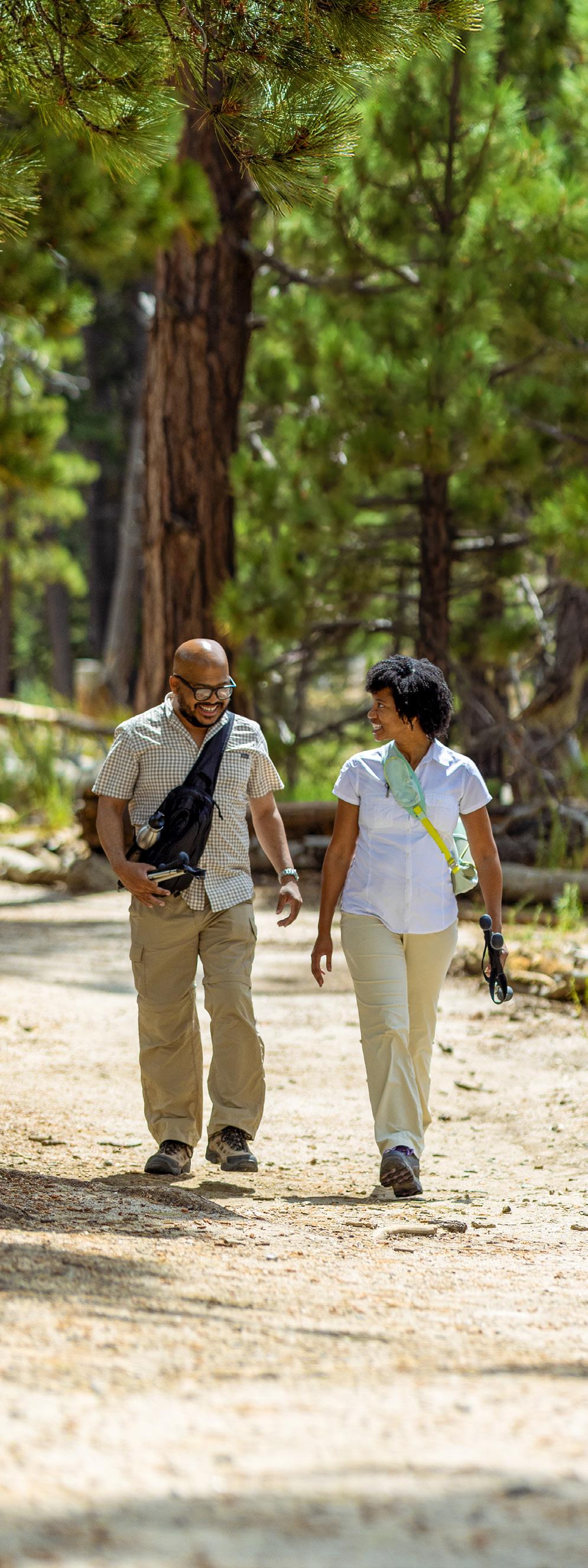
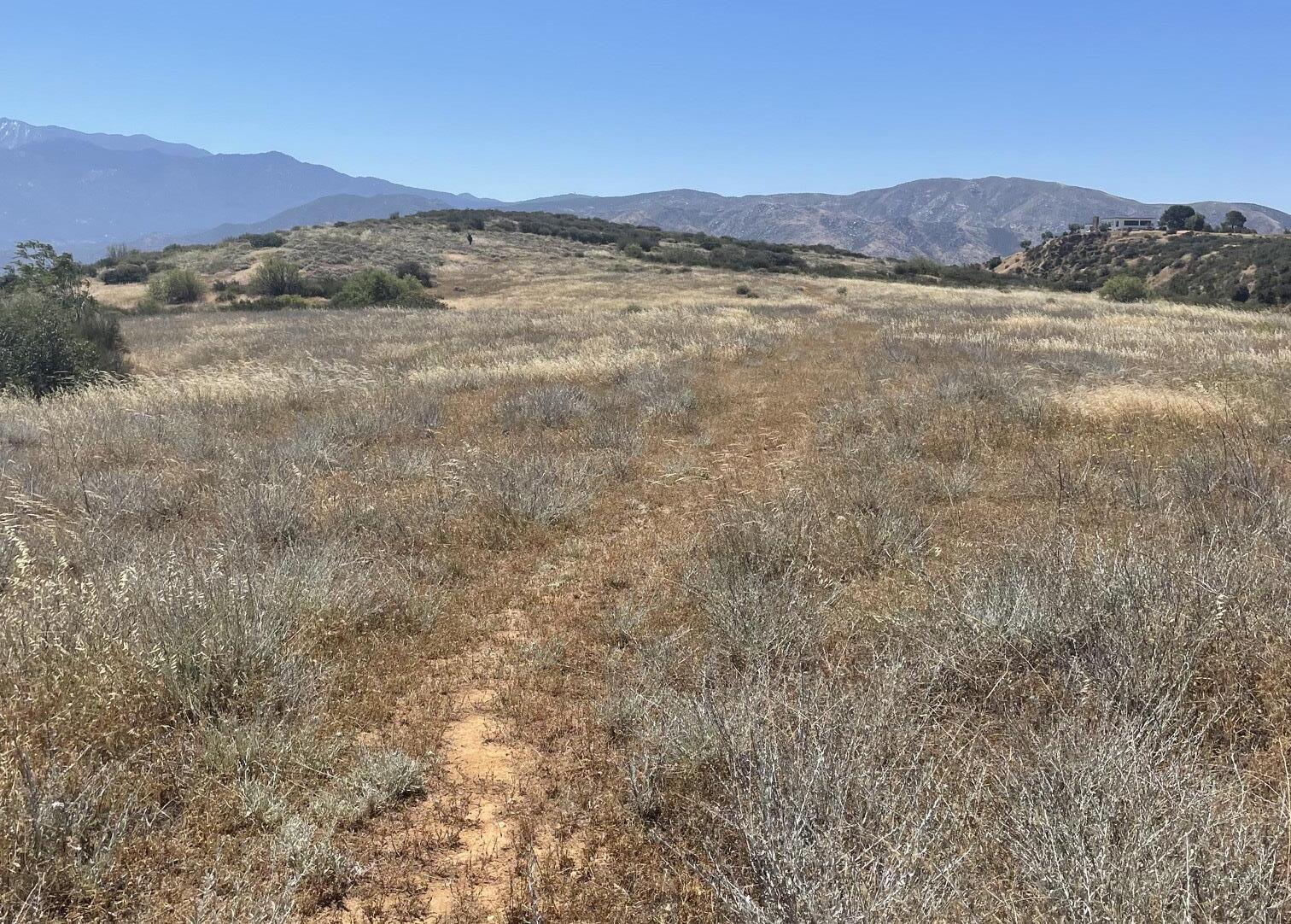
At the top of Gilman Ranch Trail, the trail opens to the Banning Bench looking into the San Gorgonio Pass. Theresa Sama
KNOW YOUR NEIGHBORS
BY BONNIE GILGALLON
Every Sunday from Jan. 1 through Easter for the last five years, Sam Torres and a few volunteers have manned a pop-up café to feed the homeless at Miles Avenue Park in Indio. It’s one of several ways in which Torres gives back to his community.
But let’s start at the beginning.
He was born in Los Angeles, and Torres’ family later moved to Perris, which is where he finished high school. He began his political career in 1991, when he was elected to the Perris City Council. Local citizens urged him to run after he gave an impassioned speech at a council meeting, accusing the council of exerting too much control over a local Latino businessmen’s association.
“Once I got on the council, I realized how much of the job I really didn’t know,” Torres said.
“Luckily, I have a good brain and good common sense, which got me through. I had a strong construction background, but had to learn about how to handle funding, from the city. I became known for insisting on honesty when it came to new development fees, etcetera.”
Torres and his wife, Susan, were not blessed with biological children of their own, so they chose to adopt. Their first child, Jessica, was adopted through a private counseling center affiliated with a local church.
“We had to get certified through the county for them to place the child in our home,” Torres said. “They saw that we met the criteria, and were good parents—so that’s how we came to adopt the next four kids. With the second, our son Sam, the county came knocking on our
door, saying they had a 4-day-old. They wanted to basically give us ‘first right of refusal.’ We saw the baby the next day, and said, “Yes!”
Their third child, Noah, was born to a drug-addicted mother, but is now doing fine. Daughters Nia and Kaylee completed the family. Torres said they all get along well—fighting just like biological brothers and sisters, but defending each other as well.
Torres is a second-generation plumber. His father went from working as a laborer in the fields of Bakersfield into the plumbing business.
“He got his license in the early ’70s, and my brothers and I ended up working for him,” Torres said “We built a very successful plumbing company.”
Torres, who moved to the Coachella Valley in 2008, is mostly retired now, but he helped his sons launch their own company. “We do a lot of service work, remodeling and reconstruction,” he said.
Torres has been battling prostate cancer for a while.
“The first time we did radiation therapy, and everything was good for about four years,” he said. “Then cancer cells re-appeared, and we went to hormone therapy, which brought the numbers back down for about three years. In hindsight, I wish I’d just had the prostate removed instead of doing radiation.”
Treatment continues; Torres said things are stable for the moment.
Sam Torres has served on the Indio City Council and on the Indio Planning Commission. While on the City Council in 2012, he made headlines when he proposed a tax on Coachella tickets—prompting Goldenvoice to move the festival out of city. Torres later rescinded the proposal.
While on the Planning Commission in 2019, Torres became involved in a big controversy. An ugly dispute arose between him and one of Indio’s largest developers, the Chandi Group. Nachhattar Chandi and his wife accused Torres of harassment and of making disparaging remarks about them. They claimed Torres was biased and could not be fair when voting on
Meet Indio resident Sam Torres, a spiritually driven businessman, community activist, father and cancer survivor
decisions involving their projects.
Torres had raised questions about a conditional-use permit sought by the Chandi Group for a place of worship. Torres claimed there had been instances in the past when conditions the city placed on Chandi projects had not been met.
“I said, ‘No, you can’t do that, because in the past, you’ve shown yourself not to be responsible,’” Torres said. “Man, he was pissed off, and I really don’t blame him. The City Council said, ‘We can’t treat this guy this way,’ and he was going to sue me. But I knew I was not wrong. I just wanted to go on record.”
Ultimately, the matter was dropped.
Torres and his team of volunteers began their weekly pop-up café in Indio in 2021.
“We call it the Sunday Service, because it’s on a Sunday, and we provide service,” he said. “All the people in the park and the families who wander in, we treat them as our guests. For the homeless, there’s nothing so luxurious as to actually sit at a table to eat a meal.”
The Sunday Service is a way for Torres to channel his grief over losing his father—who passed away due to COVID—and other loved ones in recent years.
“Every time life punches you in the heart with that kind of pain, you just respond to it with love,” he said.
Torres can trace his Native American heritage back to the Yaqui tribe on his grandmother’s side. He does not recall the name of the tribe on his grandfather’s side, though he said he knows it was from a mountainous region of Mexico.
“My spirituality was born in the Catholic church, because that’s what we all were,” he said. “You take from it what you can. The stories of the gospels made an impression on me. But then the politicization and corruption of religion—the Jerry Falwells of the world— turned me away from it.”
His early exposure to scripture gave Torres what he calls “a naïve sense of responsibility, like Mr. Smith Goes to Washington.” It motivated him to push for things like additional funding for schools, in both Perris and Indio.
When asked if he has a code he lives by, Torres told me what he tells his kids: “Love thy neighbor as thyself. It’s impossible to love God, who you cannot see, and hate your neighbor, who you can see.”
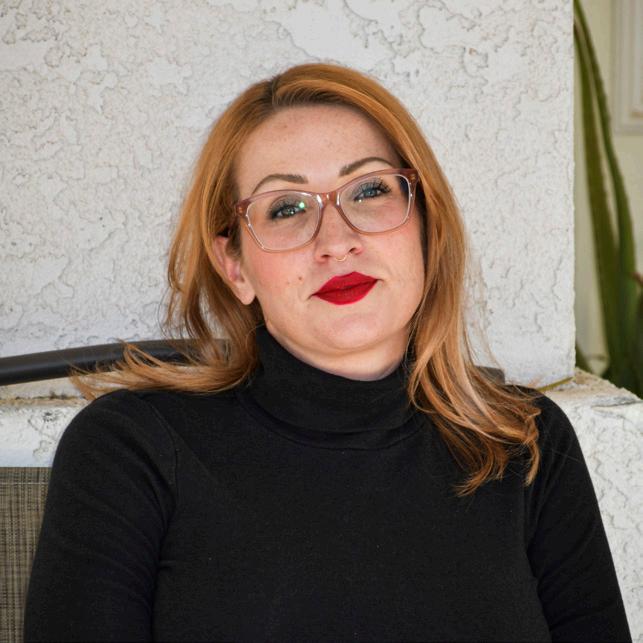
Bonnie Gilgallon has written theater reviews for the Independent since 2013. She hosts a digital interview show, The Desert Scene, which can be heard on www.thedesertscene.com and viewed on Mutual Broadcasting’s YouTube channel. Learn more at bonnie-g.com.
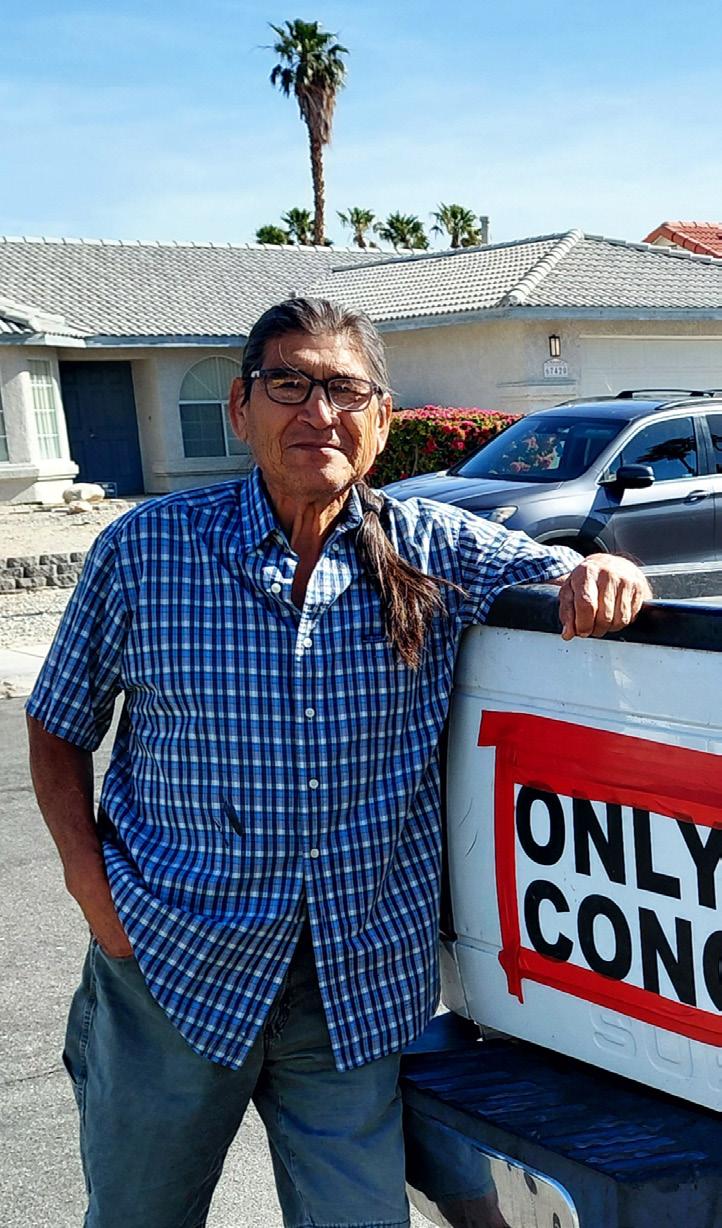
Sam Torres. Eric Frankson
SAVING THE SEA
by Kevin Fitzgerald
Senate Bill 583, passed by the California Legislature and signed into law by Gov. Gavin Newsom in 2024, created the Salton Sea Conservancy (SSC), the first state conservancy created in the last 15 years. On April 10, the governor announced the inaugural appointees to the conservancy board.
The April 10 press release from the governor’s office said the SSC will “take on a critical role to solidify the state’s efforts to protect residents’ health, sustain the operation and maintenance of large-scale habitat restoration, and increase public access. For too long, communities around the Salton Sea have carried the burden of environmental challenges and neglect. Today, California is changing that by launching the Salton Sea Conservancy to advance cleaner air, protect public health, restore critical ecosystems, and ensure the work we’ve started creates lasting opportunities for Salton Sea communities.”
The initial 22 conservancy board members—15 voting members, and seven ex-officio members—include state and regional agency, department and non-governmental organization representatives, including two local longtime advocates for long-term solutions: Castulo Estrada, a member of the Coachella Valley Water District Board of Directors and a 12-year member of the Salton Sea Authority; and Silvia Paz, founder and executive director of Alianza Coachella Valley. The Independent spoke with both of them about the role the SSC will play.
“The conservancy, believe it or not, was actually an idea that was formulated within the Salton Sea Authority (SSA),” CVWD’s Estrada recalled.
The SSA was created in 1993 as a joint powers authority including Riverside and Imperial counties, the Coachella Valley Water District, the Imperial Irrigation District and the Torres Martinez Desert Cahuilla Indians. It is “responsible for working in consultation and cooperation with the state of California to oversee the comprehensive restoration of the Salton Sea … (and) to assert a leadership role to ensure local priorities are recognized.”
“As we’ve been working at the (SSA) to address issues with the state and the feds and the community, we’ve been able to gather over $400 million through state appropriations, through the budget process,” Estrada said, “So over the last 10 years, we’ve been able to put together some money to help address the issues at the sea, and the 10-year plan (which sets goals through 2028) has been developed.”
Paz said the creation of the SSC will help the state remain focused on the Salton Sea as Gov.
Newsom’s time in office comes to an end.
“This governance structure is critical, particularly given where we are with the 10-year plan and then this coming change in (California’s) administration,” Paz said. “… It hasn’t always been easy to get funding for this region, and particularly for the Salton Sea. This last administration (under Gov. Newsom), I think, really dialed it up and had been putting in a lot more resources than we have seen in a long time. Obviously, when there are changes in the administration, there’s always a question about whether what happened with the previous administration is going to continue, and with what momentum. At least for me, this Salton Sea Conservancy ensures that there is going to be continuity.”
Several important projects have been undertaken as part of the aforementioned 10-year plan—all intended to reclaim lost habitat, vital to both birds and sea creatures, or increase the water level. Estrada noted that various agencies and organizations have had a hand in these projects, all of which have been funded by one-time state appropriations.
“We identified a problem, which is: When we implement these projects, who is going to be responsible for the operation and maintenance of these projects to ensure that these assets and these investments can be carried into the future, long-term?” Estrada said. “So, at the authority, we thought, ‘What are we going to do to account for the funding that’s necessary to operate and maintain these projects that are being built?’ That’s how we came to the idea of a conservancy.
“There are a number of conservancies in California that operate projects; they own land, and they have certain powers. But the interesting thing is that … they’re actually a line item within the state budget process, and there’s an ability to ensure that these conservancies receive a budget appropriation for the purposes of operating and maintaining the responsibilities of that conservancy.”
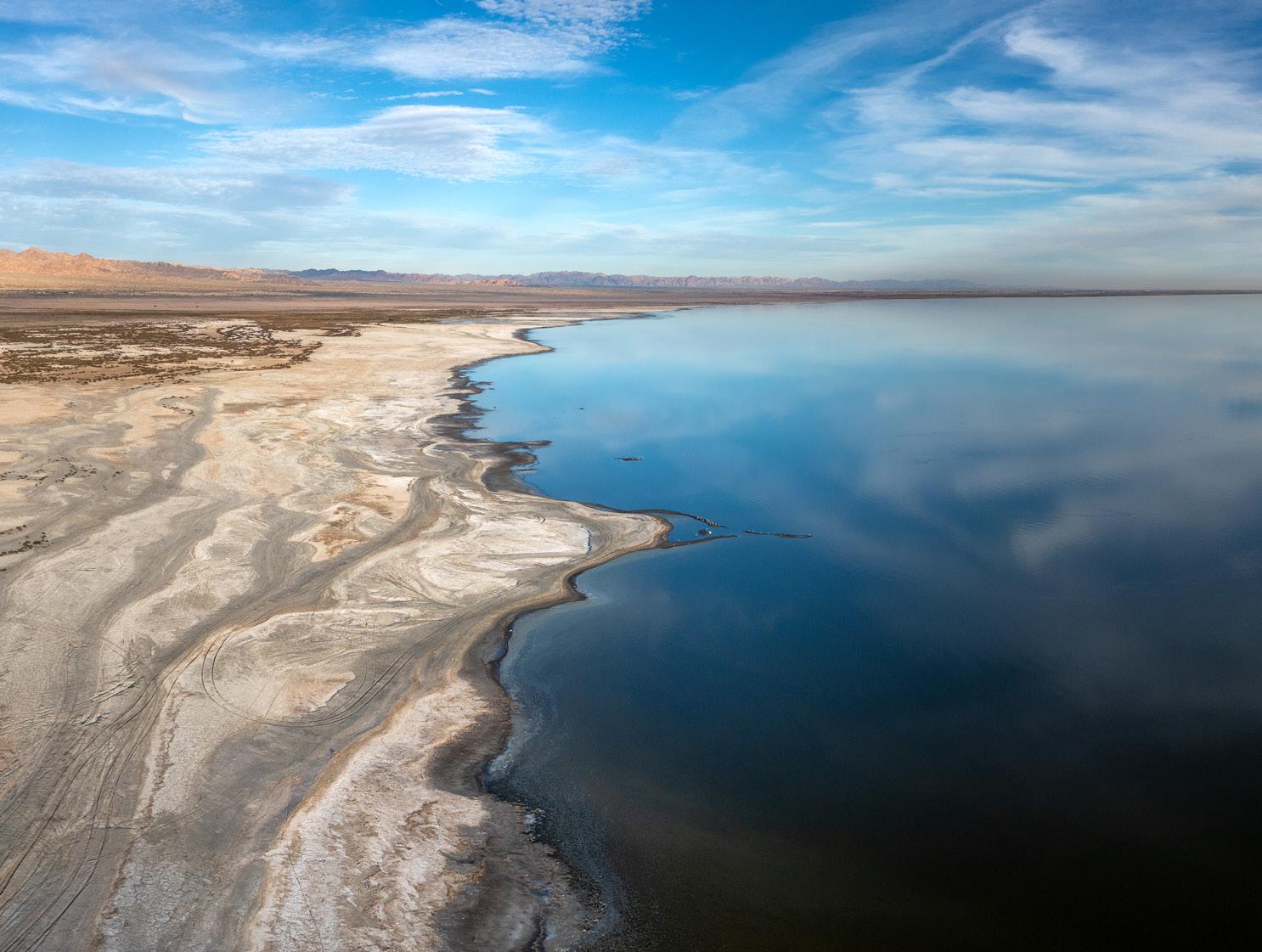
In other words, the SSC will be the entity controlling the state funding, provided annually, to operate and maintain any projects at the Salton Sea intended to restore critical wildlife habitats, and reclaim portions of the exposed lake bed—which, when left unexposed, allows toxic dust particles to get into the air.
The Salton Sea is the focus of the first new state conservancy in 15 years
Additionally, Paz said she sees opportunities for the SSC to improve collaboration among the governments, nonprofits and agencies surrounding the Salton Sea.
“The challenges that our region faces, you see particularly in the Salton Sea, because it’s divided across two different jurisdictions … Imperial County and Riverside County,” Paz said. “… I think that the Salton Sea Conservancy—by bringing to the table both counties, as it should, to address an issue that expands and affects these two counties—is a really good opportunity to start redefining ourselves as this broader region, and seeing how we can collaborate across county lines.”
The SSC board had its first meeting on May 14. Before the meeting, Estrada explained how the conservancy would get going on its work.
“Right now, it’s a matter of starting to decipher what it is that the conservancy wants to focus on first, understanding what projects are being completed, and (what is ahead in) the 10-year plan,” Estrada said. “… (We need) to make sure that we, as a conservancy, are ready to operate and maintain those projects. … Maybe there’s a component there for doing more public outreach. That’s something that we’ve struggled with a little bit at the (SSA). I think the conservancy can help a lot with the engagement and the updates on what’s going on with the sea.”
Paz said she’s feeling optimistic about the progress being made regarding the Salton Sea.
“I know that a lot of times, it seems slow to many people, (particularly) when you’re living in close proximity to the lake, and you see how rapidly more and more of the playa is being exposed,” Paz said. “I see that every time I’m in the community of North Shore, (where) you get a very good view into the lake, and you see more playa being exposed. It can feel like there’s a lack of progress, but the projects that we have are, I believe, just at the beginning. We have the species habitat restoration project that’s going to be completed in different phases. I was there when we opened the waters for one of the ponds. Just being able to see that, one, gives perspective into how long projects like this take, and two, shows the need and the benefit for the SSC to ensure that there are ongoing operations, maintenance and continuity for future projects around the lake.”
Estrada said the conservancy will be a huge help—“if we do it right.”
“It should make us stronger as a region,” he said. “It should give us more tools in the toolbox for purposes of doing different things that need to be done at the sea. … I hope that it’s not something that becomes a tug-of-war between agencies, or that there’s confusion. I certainly would not want that to happen. I want it to be positive.”
The creation of the Salton Sea Conservancy means funding for projects will now have a line item in every year’s state budget.
DISTILLING THE DETAILS:
JUNE 2026
By Matthew Adler
How Some Local Agencies are Raising the Standard on Public Outreach
As scrutiny around water quality grows, agencies across the Coachella Valley are recognizing that communication and transparency matter just as much as testing
Most people do not think about their drinking water until something makes headlines. With increasing attention focused on water quality, emerging contaminants, and evolving regulations throughout California, many residents are beginning to ask more questions about what is in their water and how that information is communicated.
Every year, water providers are required by the U.S. Environmental Protection Agency and the State Water Resources Control Board to publish Water Quality Reports, outlining where drinking water comes from, which contaminants are tested for, and whether the water meets state and federal standards. While water providers are not required to distribute the reports, they must notify customers of their availability.
For many agencies across California, simply publishing the bare minimum is no longer acceptable.
Historically, these reports were viewed largely as compliance documents: dense tables filled with scientific language that was difficult for the average person to understand. And for many people, that was enough reason not to read them at all.
But now, in an era where consumers are more conscious than ever about what goes into their bodies, transparency matters. And so does attention.
Residents are more informed now than they were even a few years ago, thanks in part to short-form social media and the rise of artificial intelligence. But misinformation is rampant, and technical water terms can easily be misconstrued without the proper context.
This shift has prompted local water agencies to reconsider how they communicate with customers.
Rather than simply distributing what is required by the state, water providers across the Coachella Valley now see these reports as an opportunity to explain complicated information in a way that residents can actually understand. That can mean explaining where local water comes from. It can mean helping customers understand why certain contaminants are monitored at extremely small levels. It can also mean providing plainlanguage explanations about treatment, groundwater protection, conservation efforts, and ongoing testing programs. These efforts come at a time when contaminants such as Chromium-6 are receiving growing local attention.
What is Chromium-6?
Chromium-6, also known as hexavalent chromium, is a naturally occurring element found in groundwater throughout parts of California, including the Coachella Valley. Water agencies across the region are preparing for stricter state regulations that will require additional treatment and infrastructure investments in the coming years.
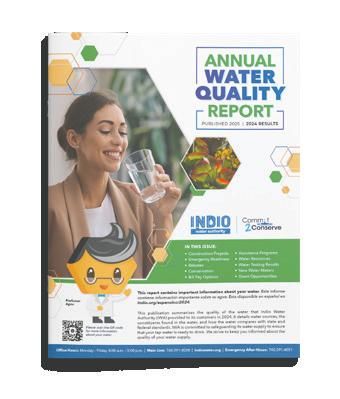
While many agencies have expanded their communication efforts in recent years, Indio Water Authority and Mission Springs Water District have become standout examples of how strong customer outreach and welldesigned Water Quality Reports can work together to create more accessible and community-focused resources. Indio Water Authority, which serves more than 26,000 residential and commercial connections throughout Indio’s 38-square-mile service area, has focused on presenting complex water quality information in an easyto-digest format, featuring colorful graphics and simplified explanations that allow residents to more easily navigate the report.
Beyond water testing results, the reports highlight communityfocused resources like conservation tips, payment assistance programs, and rebate opportunities that help customers better understand their water service and the importance of responsible water use.
“Customers deserve clear, reliable information about where their water comes from, how it is tested, and what local agencies are doing to protect public health,” said Indio Water Authority Director of Water Utility and Maintenance Miguel Peña. “Our goal is to make those reports useful and approachable, and ultimately drive more engagement with our customers.”
For agencies like these, the challenge is not to oversimplify the science, but to ensure that the information coming from the source is clear and accessible.
These reports often contain information about dozens of regulated substances, measurement standards, acronyms, and testing thresholds. Without context, the information can feel overwhelming even when the water meets all state and federal safety requirements.
Serving approximately 40,000 customer connections throughout a 135-square-mile service area around Desert Hot Springs, Mission Springs Water District has emphasized presentation and readability for many years. The district, which has served the region for more than 70 years, produces reports that feel more approachable and magazine-like in their design. Each report serves as an annual snapshot of the district, highlighting infrastructure investments, operational achievements, community engagement efforts, and long-range planning priorities.
“As regulations continue to evolve and public awareness around drinking water quality grows, transparency is more important than ever,” said Mission Springs Water District
General Manager Brian Macy. “Water Quality Reports are important educational tools that help customers better understand their water supply, the testing process, and the ongoing work required to maintain safe and reliable service.”
Trust plays a major role in public infrastructure. Residents want confidence not only that their water is being tested, but that the information surrounding it is understandable, accessible, and transparent.
Water Quality Reports may never become casual reading. But in a digital age filled with misinformation and public skepticism, building trust in local tap water matters more than ever.
Explore Your Local Water Agency
Residents interested in learning more about local water quality, conservation programs, infrastructure projects, or customer resources can visit their local water provider online.
Coachella Valley Water District CVWD.org
Coachella Water Authority Coachella.org
Desert Water Agency DWA.org
Indio Water Authority Indio.org
Mission Springs Water District MSWD.org
Myoma Dunes Water Company MyomaWater.com
INVESTMENT AND INFRASTRUCTURE
In April 2019, a nonprofit called the Caritas Corporation—dedicated to acquiring, renovating and managing low-income communities, primarily in California and Oregon—purchased the dilapidated Shady Lane Mobile Home Park near Thermal for $225,000. Their goal with Shady Lane—as it is with all of the low-income communities they own and by Kevin Fitzgerald
operate—was to remodel the exterior spaces; repair the electrical, water and sewage infrastructure; and replace the living units to transform the park into a clean and comfortable home for its more than 140 residents.
After seven years of fundraising and construction, on April 21, a ribbon-cutting ceremony celebrated the basic completion of the community overhaul. The event marked the successful return of 32 families who had lived in the “before” version of the park, along with the relocation of eight families from the nearby Oasis Mobile Home Park, into 40 new-andimproved mobile homes in what is now called Shady Lane Estates.
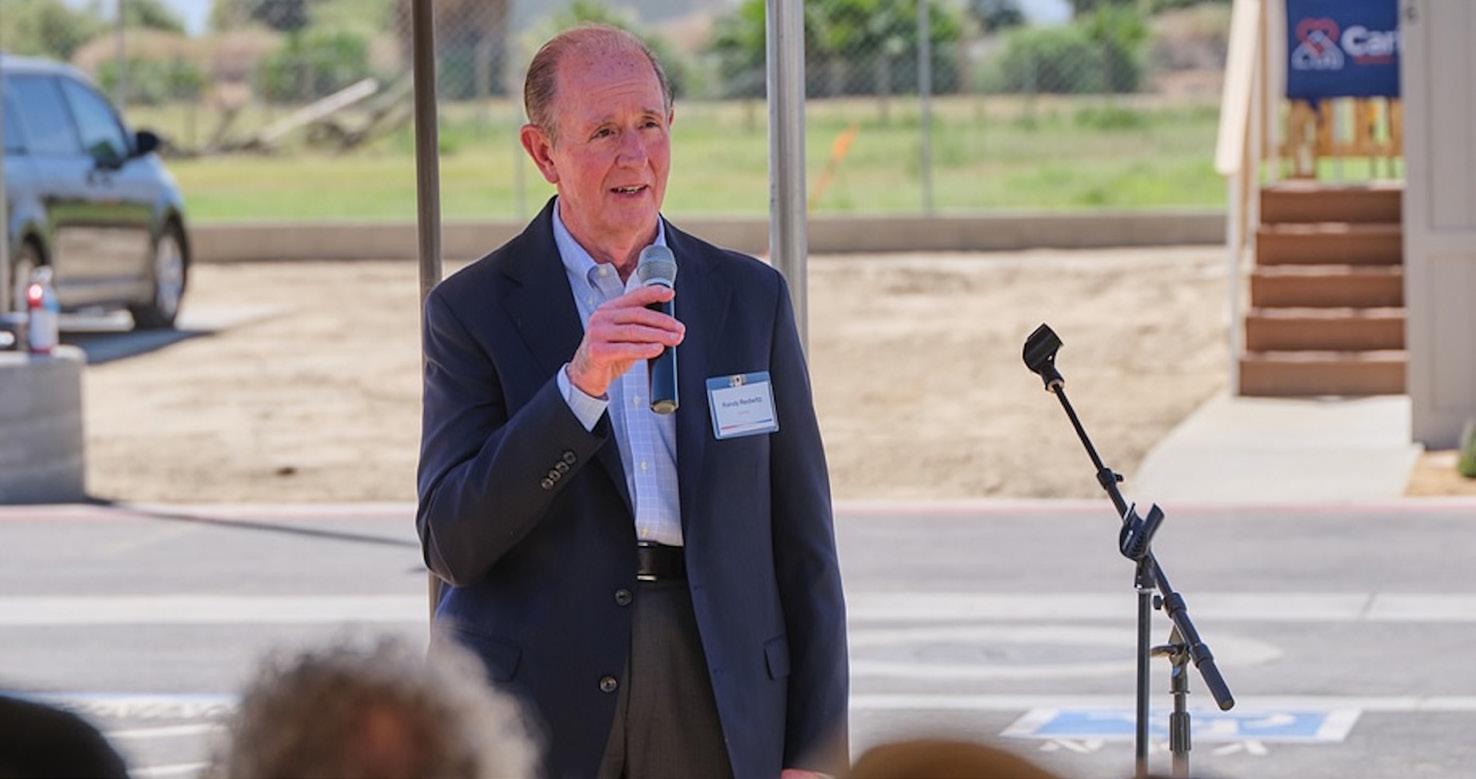
“When I was presented with the proposal, I bought it on the spot,” said Caritas CEO Randy Redwitz during a recent interview. “To be honest, I bought it because of the (low) price, but also because I wanted to do something dramatic there to help these residents.”
By all accounts, what his team at Caritas— with help from the California Department of Housing and Community Development, Riverside County, the Coachella Valley Water District (CVWD), the city of Coachella and other entities—accomplished at Shady Lane is impressive.
More than 100 residents living at Shady Lane had to be relocated, at Caritas’ expense, for about a year, beginning in mid-2025. When they returned, they were welcomed back to one of 40 new manufactured homes (with two-, three- and four-bedroom options), with water and sewage lines newly connected to the CVWD’s expanding eastern Coachella Valley system. Residents had the opportunity to select the colors of their interior finishes, including flooring, countertops, backsplashes and cabinet. Caritas also donated a new bed and mattress to every resident, at a total cost of roughly $75,000.
Improvements made to the grounds of the mobile home park include new landscaping and pavement, and a children’s “tot-lot,” all in a garden-like setting. Caritas has promised that residents will soon be able to enjoy a new 1,500-square-foot clubhouse with a meeting room, office, restrooms and laundry room.
“We had a little bit of redesign on that,” Redwitz said, “but it’s going to be in a modular format, and we have the design pretty well done now. We’ll start implementing that,
getting it manufactured and brought on site within very short order.”
But before all this life-altering work could be done, Redwitz and his team had to apply for state and Riverside County grants and loans to fund the numerous changes.
“We were very, very fortunate to get grant funding for all of that renovation,” Redwitz said. “That took a lot of work, (and) we were the only ones that got the funding. … It paid off in in spades.”
The initial major loan, for $3 million, was secured through the California Housing and Community Development Department in 2021. It wasn’t until last year that the rest of the $12 million needed to renovate Shady Lane was obtained.
Caritas was formed in 1996 to buy and operate low-income mobile home parks. According to its website, it currently owns or manages 31 communities—27 in California, and four in Oregon.
“(Caritas’) express purpose was to buy or to operate in affordable-housing communities,”
Redwitz said. “It singularly picked mobile home communities as its means to affordable housing. … What we have typically done is we buy the communities through tax-exempt bond financing, and we have a Standard and Poor’s rating on those bonds of an A-minus. So, we have a really strong bond rating, and we use that to finance the acquisition of the communities, or in certain circumstances, the refinance of communities that we’ve owned for a long period of time. All the dollars involved are poured into the communities.”
Redwitz said Caritas never sells its properties, and usually acquires one or two a year; three are currently under negotiation for purchase, he added.
“Shady Lane was a bit of a unique property,” he said “… We typically always go in and do a lot of maintenance, (and) fix up to the communities that we buy. Shady Lane was taken to the extreme in regards to repairs and replacements, so we’re very proud of Shady Lane. In all of our years of work, it’s probably our single biggest achievement—and the most dramatic achievement, for sure.”
Riverside County District 4 Supervisor V. Manuel Perez spoke at the April 21 ribbon-cutting. The county provided grant funding for
With government help, Caritas Corporation transforms the Shady Lane mobile home park into a clean, comfortable community
the renovation, as well as administrative and bureaucratic support.
“Caritas, it’s called in English,” Perez said. “If you want to say it in Spanish, ‘caritas’ (means) faces. These are the faces (of this community’s residents) that we’re working with, that we’re supporting, self-helping and empowering. … We’re not done yet. … This is only one project. Go down the street, not too far, (and) you’re going to see dilapidated housing as well. There’s a lot to be done.”
Coachella Mayor Frank Figueroa talked at the ceremony about the city’s efforts to get funding to extend the CVWD lines down Avenue 54, and then down into Shady Lane.
“This is a project that was a long time coming, and incorporated a lot of different agencies. … This park was in bad, bad condition. Residents were not getting the services they needed,” Figueroa said. “… It’s the end of this project, but there’s more to come. There are more projects. This opens up the avenue, because now that the infrastructure is here, we can move on and continue to grow and improve communities.”
While both Perez and Figueroa mentioned the need for renovations and infrastructure at other eastern Coachella Valley mobile-home parks, Redwitz said there’s only so much Caritas can do.
“Sometimes cities come to us and say, ‘Can you help us with a particular property?’” said Redwitz. “The problem is that the city understands the problem, but they don’t control the property. So, I have to respond and say, ‘Yes, I’d buy that property and do what you want to do with it, but I can’t control whether there’s a willing seller. And if there isn’t, I can’t really help.’
“We’ve talked a little bit to the property
owners next door to Shady Lane, which (provides) a rather dramatic contrast, showing the before and after. … If they’re willing to sell, I’d certainly be up to the challenge of taking on that community, knowing what we did with Shady Lane. But that’s their call and their prerogative, not mine to force. I’d be willing to look at any project, anywhere, at any time.”
Redwitz said all of Caritas’ properties are rent-controlled—either government imposed, or self-imposed. Redwitz estimated the average monthly rent for the pad on which a Caritas resident’s double-wide motor home sits is $500.
“Turnover is very rare,” Redwitz said. “Generally, the turnover occurs by the selling of the mobile home, so the current resident stays in that mobile home until it sells, and then when it sells, there’s a new occupant.”
Caritas Chief Operations Officer Tracy Bejotte said at the ceremony that the Coachella Valley badly needs more affordable housing.
“The average two-bedroom apartment in this county is almost … $2,300 (per month),” Bejotte said. “The average mobile home space rent in Coachella Valley is between $800 and $1,000. The residents at Shady Lane pay about $375. We’re proud to be able to provide this housing.”
As the ribbon-cutting ceremony neared its end, a few Shady Lane residents thanked the assembled crowd.
Speaking in Spanish with an English translator at his side, resident Juan Beltran told the gathering: “We’re very grateful for everything that has happened. It was hard before, but whatever is now, it’s like a dream. We’re grateful to everyone who made this possible, and truly we’re very grateful for these people that are truly helping others.”
Caritas CEO Randy Redwitz speaks at the April 21 ribbon-cutting ceremony. StylePhotography by Alex Tapia
THE END OF AMP?
by MATT KING
Abeloved local music-education program is pausing operations.
The Academy of Musical Performance (AMP) has been giving kids the “school of rock” treatment for more than a decade. Students from elementary through high school learned music skills, got placed into bands, learned cover songs and performed them live. The program
launched the careers of many desert musicians, birthed more than a few bands, and offered great opportunities for young creatives to perform at a number of Coachella Valley venues.
On May 14, AMP announced on social media: “After deep reflection, the Board of Directors has made the difficult decision to temporarily pause program operations.”
“A number of things happened,” AMP co-founder Kate Spates told the Independent.
In recent months, the AMP board lost a few crucial members.
“Abie Perkins, who is amazing and has been with the program since the very beginning, he’s a very busy working musician,” Spates said. “He never really wanted the title of executive director; he liked music director, and his schedule works well with running the Oasis on Miles … a performance space where we could do open mics, and we actually did some recruiting there.
“Michele Penn, who has been on our board since pretty much the beginning and was the executive administrator, her husband fell very ill, and she couldn’t do all the things she needed to do, and she ended up resigning—and then he passed away. When you have this great organization, but its leadership is all busy doing other stuff, it always suffers. I’ve seen that happen in other great organizations, and it’s just a timing thing.”
The original plan was for AMP to take the summer off and try to regroup—but then AMP received news from the city of Indio concerning the future of its office and the Oasis on Miles.
“We got this notice that they had a bookstore that wanted to come in, and we were like, ‘This is the sign,’” Spates said. “We’ve been in that space for, I think, seven years, and it’s always been a month-to-month (lease), which is fine, but that’s not very secure.”
Spates said the remaining AMP leadership is so strapped for time that even cleaning out the spaces has been difficult.
“‘We already have a skeleton crew, and now we’re going to need to go through there and figure out what we’re going to do with this stuff. Do we put it in storage? Do we get a new space? All of us were just looking at each other like, ‘I don’t have time. This is such a great organization, but my business is booming.’”
Spates pointed to her own schedule as an example.
“I have a full-time job now. I work at (Acrisure) Arena, running the One Valley Foundation, and honestly, I don’t want to be on any boards, because I am in a position where I’m giving money to organizations, and I don’t want any conflict of interest of any sort. I pretty much said that I was going to need to step back a while ago, and nobody just could step up.”
Spates said AMP never found a true successor to former executive director Will Sturgeon, who departed in 2021.
“After Will left, I realized how special Will was; like, it took three people to do the job that Will did,” Spates said.
The future of the program is uncertain, but Spates said she is hopeful that AMP can return in some capacity.
“It’s going to take a little something special to start it back up, but I’m talking with people I know … and there could be some possible fit with some other organizations,” Spates said. “All we want is for kids to have this kind of outlet, whether they get that in school or in some other form.”
Perkins explained why he made the decision to walk away from AMP.
“It just became apparent to me that it was going to be difficult to continue to run the program for various reasons, with people stepping down from the board,” he said. “Everything was kind of put upon my shoulders, with trying to run a music program and also run a music venue. I figured it’d be in everybody’s best interest if I just stepped aside, and I was hoping that maybe they might be able to find a replacement—but I truly see that was also a challenge as well.”
Perkins said he was particularly proud of how he grew AMP beyond a traditional “school of rock” program.
“I just focused on that word ‘performance,’” he said. “When I took over, my thought process was, ‘Why does it need to be just focused on rock when there are so many other different genres out there?’ I opened it up to kids who are into musicals and kids who are into jazz … and it gave us a lot more kids as far as attendance.”
Perkins remained in charge of the Oasis on Miles after leaving AMP—but the city of Indio is requiring that both spaces be vacated. While
The Academy of Musical Performance is pausing operations—and the Oasis on Miles is closing its doors for good
Spates said the city has been “great,” Perkins expressed disappointment.
“I think the thing that went down with Little Street Music Hall was kind of like the writing on the wall,” Perkins said. “It’s hurtful and disappointing all at the same time, because our venue was a lot more focused on the kids to have a place to come and express themselves and everything. Adults could come through as well, and it was more community-based, but we didn’t sell alcohol or anything like that. We had our open mic on Friday nights, and we had special things, so I was under the impression that’s kind of what the city was looking for, more of a community-based venue. … The city and the board wanted the Oasis on Miles to show some value, to show some foot traffic, and that’s where it got really difficult, because we’re not really a business.”
Perkins said that both he and other members of the former AMP family want to continue helping youth and the arts.
“The last two years, as a director, I wrote the curriculum for what we were calling the RE-AMP, so I still have tons and tons of curricula that are just sitting in a folder on a computer, and I would love to see that realized,” he said. “A bunch of family members, a bunch of local musicians, former instructors, coaches and directors are pretty much open. My hope and prayer and plan is to come up with something. It would be just a program where kids can still learn their craft and learn how to be musicians
or artists and entertainers and performers.”
Perkins said he hopes the closure of the AMP and Oasis spaces remind people of the importance of supporting the arts.
“If people are interested in keeping music alive, they should support local musicians, and they should support the local music venues,” he said. “Just show love to people. There are venues and places out here in the valley, and everybody has their opinions about all these different places. I want nothing but for everybody to succeed. It would be a cool thing to see a valley-wide collective, where it influences the entire valley as a whole—and we’re talking high desert, low desert and everything in-between. I think that’s when we could really reach and affect the most kids as possible.”
Meanwhile, Spates said she’s “hoping for a miracle.” She noted that the program got a fast start in 2015 thanks to financial support from Goldenvoice, which funded the program during its first three years.
“Going forward after that, it was tough to try to keep (the program) free, because it was free for the first three years, and we tried to fundraise, so that we could at least offer scholarships to people who couldn’t afford it—but it’s hard out there,” Spates said.
“If there was somebody who believed in the organization and the direction and saw the need and was ready to write a big check, we could find somebody to really truly be that executive director.”
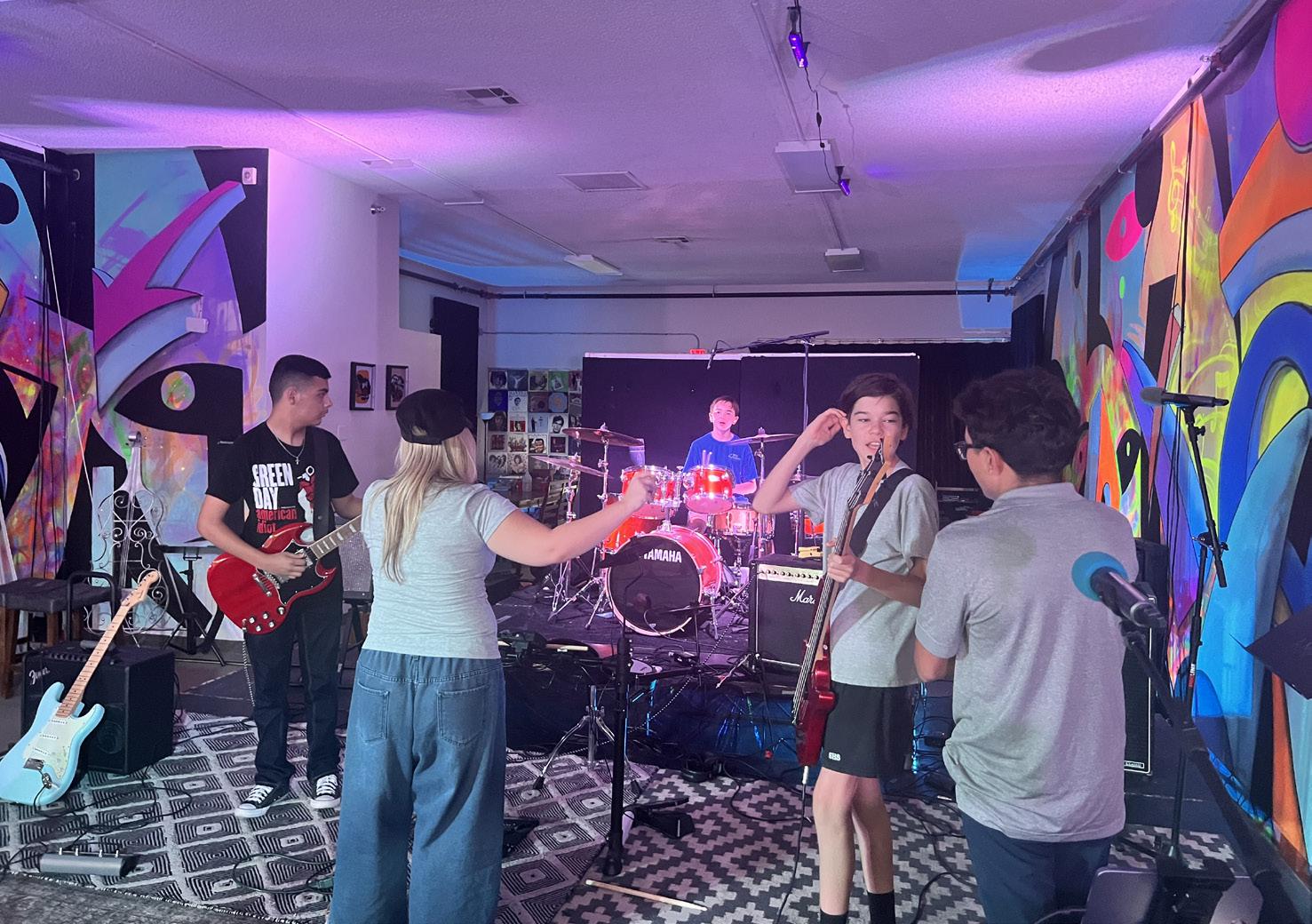
AMP students rehearse at the Oasis on Miles.
26DOHC10413_CVI_PrintAd9.89x9.66_DueMay18.indd
CV HISTORY
FForty miles from Palm Springs, Oak Glen offers four seasons and 150 years of apple orchards
orty miles from Palm Springs is a mile-high scenic glen that offers an inviting four seasons. Oak Glen, in the high country above Beaumont, offers more than 300,000 visitors each year opportunities to pick their own apples, and much more. A five-mile loop of apple orchards and pastoral scenery, Oak Glen also offers shops, restaurants, bakeries, cider mills, livby greg niemann
ing-history sites, wedding venues and more.
In April, the annual Apple Blossom Festival takes place over two weekends, offering live music, orchard walks and a variety of other events. The summer is busy with numerous shows, exhibits and family activities. The apple harvest season draws visitors from August through November.
The first settlers in this glen on the south-facing slopes of the San Bernardino Mountains were the Cahuilla and Serrano Indigenous tribes. The natural forests, bubbling streams, unique climate and elevation made the area attractive for hunting small game, gathering large black acorns, and harvesting seed grains and fruits.
The first outsider to settle in Oak Glen was Enoch Kidder Parrish, from Jefferson County, N.Y., in the 1860s. He planted the area’s first acre of apple trees in 1876 and established what is now called the Parrish Pioneer Ranch. The current Parrish Ranch store was the original packing shed and is said to be the oldest wooden stick structure in San Bernardino County.
In 1877, shortly after Parrish’s apples were planted, another settler, Joseph E. Wilshire, arrived with his family and acquired 3,000 acres of land. He planted not only apples, but cherry and pear orchards.
Wilshire also built the first Oak Glen School House—unique in that it was built on skids and
was pulled around the glen to locations where the children were. In 1927, Joseph Wilshire’s son, C.J. “Blackie” Wilshire, had a stone schoolhouse built on the ranch, which is still there.
A rancher who owned several orange orchards in nearby Redlands, Isaac Ford, moved to Oak Glen in 1898, bought 100 acres and subsequently founded the popular SnowLine Orchard.
A few years later, the vast Los Rios Rancho got its start when brothers Howard Rivers and Ernest Rivers bought 320 acres from the Wilshires. Between 1906 and 1909, they planted apples, becoming Southern California’s largest apple-producing and shipping operation. Although the Oak Glen orchards primarily grew apples for export, the area became popular in the 1940s when several farms began to sell apples, apple pies, apple butter and apple cider.
Riley’s Farm got its start a century after the first apples were planted in Oak Glen. In 1978, Dennis Riley, his wife and three sons left city living and bought 12 acres from the Wilshires. They built a log home and initially tended an orchard of several hundred heirloom apples.
Dennis Riley is credited with the open-to-thepublic “U pick” concept that appealed to tourists immediately.
More of the extended Riley family became involved by 1987, when family patriarch Ray
Ellis Riley, Dennis’ father—who had brought his Church of Jesus Christ of Latter-day Saints (Mormon) family from Utah to California—bought the 200 acres adjoining his son’s orchard from the Wilshire family.
Riley’s Farm has expanded through the years and has continued to offer tourist attractions. It is currently situated on 760 acres and is now home to the Joe E. Wilshire Packing Shed, as well as orchards. About 55 acres is dedicated to public events: the U-pick orchards, hayrides, dinners, agricultural information and living history interpretations of the American Revolution and other national events. Visitors will often encounter busloads of school children re-creating battles between the Redcoats and the Colonists. Ray’s son Jim Riley is the current manager, and other family members have roles there.
Many of the apple orchards of Oak Glen produce more than 20 varieties of apples; Riley’s grows more than 30. The Vasquez and King David varieties are grown exclusively in the area. Some heirloom apple varieties grown there are not commercially available and can be found exclusively in Oak Glen.
The largest apple tourist destination is the 14-acre Oak Tree Village. In addition to gift and curio shops, a candy kitchen and a large restaurant, there’s a leather shop and an animal park offering pony rides, a “feed the animals” attraction and other entertainment.
The Oak Glen Preserve
A new dimension was added to Oak Glen in 1996 when The Wildlands Conservancy opened the 909-acre Oak Glen Preserve on the Los Rios Rancho. Los Rios had become Southern California’s largest historical apple ranch
by then—and part of it was slated for residential subdivision.
Saved by the Conservancy, the Oak Glen Preserve now leases farmland within the preserve to apple growers, alongside a continually growing nature attraction. There are two duckponds, two year-round streams, a botanic garden, a Children’s Outdoor Discovery Center and several hiking trails. It’s a fascinating place with easy-to-explore natural sections reached by wide, broad pathways. The Conifers of California section features a trail through giant sequoia trees, California redwoods, and various pines, spruces and oaks.
The largest oak tree of its type in North America, the Champion Oak, is in a creek bed on the mountainside above the preserve. The massive oak is estimated to be 1,500 years old.
Admission to the preserve is free. Along with nature lovers, hikers and locals wanting to escape the heat of the desert, there are often groups of schoolchildren. Each year, almost 37,000 children visit the preserve and its Discovery Center.
Oak Glen is a wonderful day trip from the Coachella Valley, especially during the scorching summer months, when the area offers cooler temperatures—and a bit later in the year, when you can wander the orchards and pick your own apples!
Sources for this article include The Wildlands Conservancy (wildlandsconservancy.org/preserves/ oakglen); “The Story of Riley’s Farm” by Jim Riley (rileysfarm.com); the Oak Glen Apple Growers Association (www.oakglen.net); the county of San Bernardino; and Afoot & Afield: Inland Empire by David and Jennifer Money Harris (Wilderness Press, 2009).
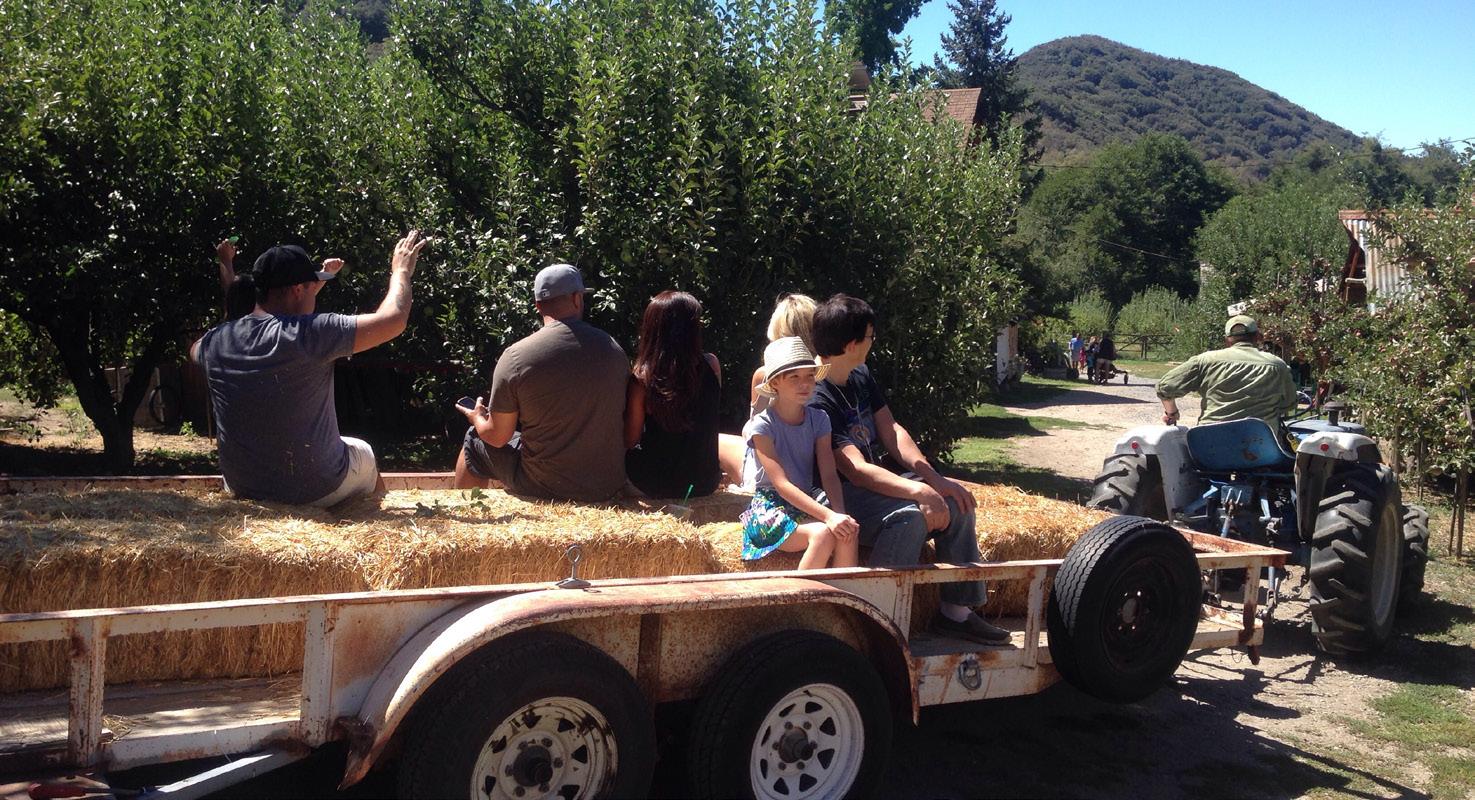
An Oak Glen hayride. Greg Niemann
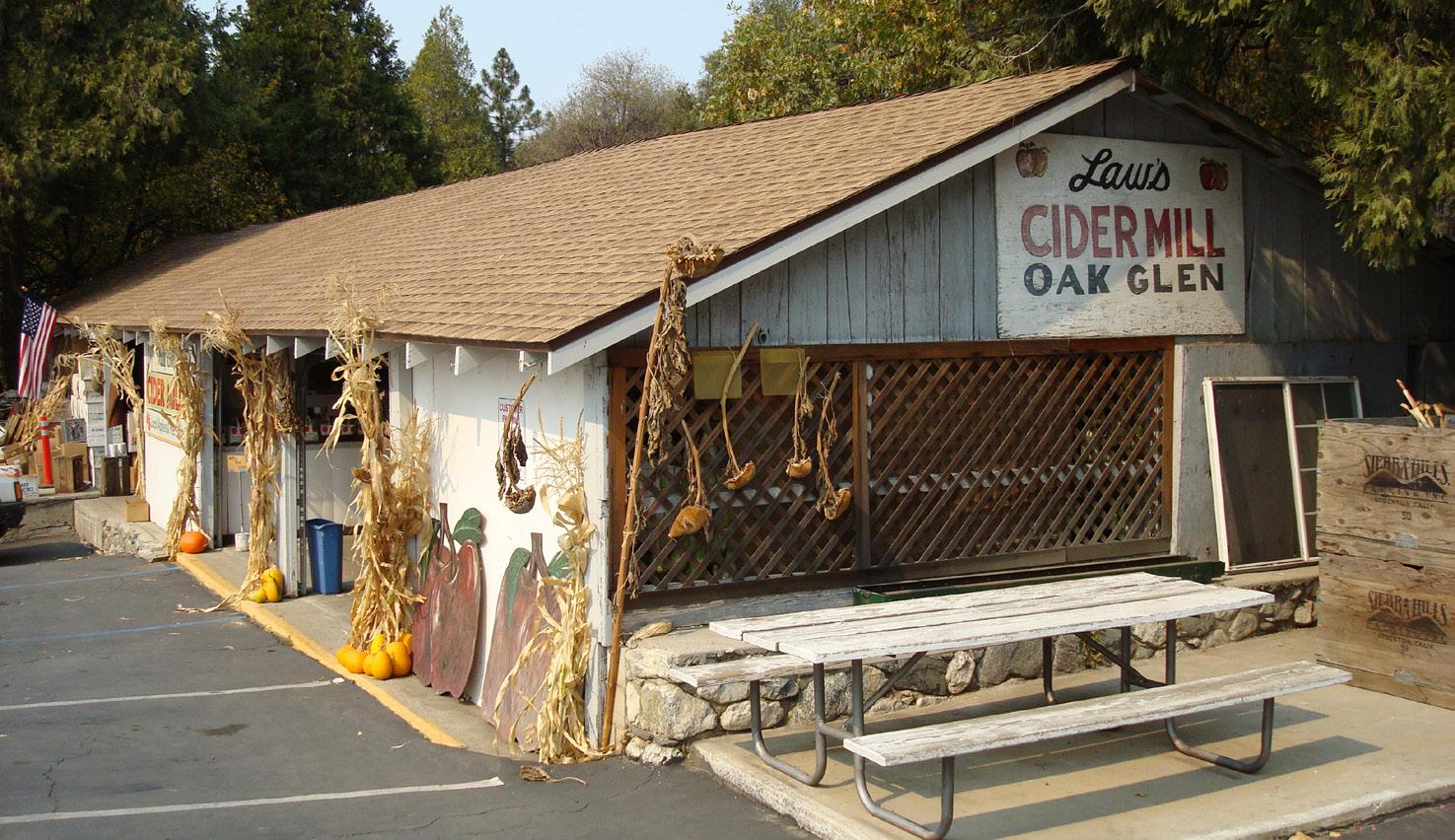
Law’s Cider Mill in Oak Glen. Greg Niemann
JUNE ASTRONOMY
By Robert Victor
June opens with an impressive evening-twilight lineup of three planets—all outshining June’s brightest stars, and all gathered within one constellation, Gemini, the Twins. Look between the west and west-northwest; the best viewing may occur about one hour after sunset. On June 1, the lineup spans 23°. Venus is its brightest member, with second-brightest Jupiter, within 8° to its upper left, and Mercury, within 16° to Venus’ lower right. Gemini’s namesake “Twin” stars—Pollux, with dimmer Castor 4.5° to its right—appear to the upper right of Jupiter and above Venus.
The most spectacular event this month is the conjunction of the two brightest planets, Venus and Jupiter, 1.6° apart on the evening of Tuesday, June 9. That evening, Mercury appears 13° to
the pair’s lower right. The planets are moving east against background stars—Venus by nearly 1.2° daily; and Jupiter by 0.2° daily. Venus-Jupiter appear within 5° for 10 evenings, June 4-13, easily fitting within the field of view of binoculars.
Also note the patterns the planets form with stars, especially Pollux and Castor. On May 30, Venus was below the Twins, forming an isosceles triangle, 10° from each. On June 7, Venus passes 4.7° to the lower left of Pollux, while Jupiter stands only 2.3° to the left of Venus.
On June 10, a line from Castor to Pollux—4.5° apart and extended 6° to the left— points directly to Venus, which is accompanied by Jupiter 2° below. Mercury entered Gemini on June 1, and from then through June 10, the three evening planets remain within the boundaries of Gemini. But on June 11, Venus crosses into Cancer, where the Beehive Cluster resides. Venus will graze the northern edge of the cluster on June 19. Jupiter crosses into Cancer on June 21—on the same date that summer begins at 1:25 a.m. PDT. Also that day, the moon reaches first quarter phase, half-full and 90 degrees east of the sun, which means that the moon marks approximately where the sun will appear in Virgo, at the beginning of autumn. On June 28, Venus passes from Cancer into Leo. Mercury remains to the lower right of the two brilliant planets throughout its evening apparition. During June’s first week, it outshines June’s brightest stars, all of zero magnitude: golden-orange Arcturus, high in the southern sky; blue-white Vega, well up in the east-northeast; and yellowish Capella, low in the northwest. Mercury attains its highest altitude during June’s second week, and fades to magnitude +0.3 by week’s end.
On June 10, Mercury, below the Twin stars Pollux and Castor, forms an isosceles triangle with them, 11° from each. Mercury is within 7 degrees to the lower left of Pollux (magnitude +1.1) June 15-21, and closest, at magnitude +0.7 and 6.5 degrees away, on June 18. On June 24, Jupiter lies on a straight line extended left from Castor through Pollux,
while Mercury approaches within 3 3/4° to the lower right of Jupiter. But Mercury has faded to magnitude +1.4, making it quite a difficult target low in bright twilight. Use binoculars!
The moon has some noteworthy gatherings. Let’s start in the morning sky, where the waning moon can be followed through June 13 or 14; a good time for viewing might be 1 to 1 1/4 hours before sunrise. On June 8, the moon reaches last quarter phase, half-full and 90° west of the sun. Note the two first-magnitude “stars” (actually planets) in the eastern sky, to the lower left of the moon. The higher one, in the east-southeast 24° from the moon, is Saturn. A telescope will show its rings, now tipped nearly 9° from edgewise. The other one, reddish Mars, is low in the east-northeast to east, 32° to the lower left.
In following days, watch the waning crescent moon slide down the line of morning planets, passing a few degrees above them: within 6° to Saturn’s upper left on June 10, and within 6° above Mars on June 12. On June 13, try to observe from a place with an unobstructed view toward the east-northeast, so you can observe the 4 percent old crescent moon rising 12° to the lower left of Mars.
Spotting the moon on the morning of June 14 will be very challenging. If you want to try, you’ll need a very unobstructed view about 30°32° north of east; very clear skies; and optical aid. You’ll have no choice but to look during bright twilight, 30 to 35 minutes before sunrise.
In the evenings, the young moon in twilight on June 15 will be quite easy to see, even for the unaided eye, given good sky conditions and an unobstructed view toward the horizon about 30° north of west. Starting from Venus, go 6.3° to the lower right to Jupiter, and next, go 7.5° to the lower right of Jupiter to find Mercury. From Mercury, go about 11° to the lower right to the illuminated lower edge of the lunar crescent. The entire span of four solar system bodies, from Venus to the lunar crescent, is 24°.
On the evenings following June 15, for better views, shift into the darker skies of one to 1 1/4 hours after sunset. On June 16, from
Planets and
Bright Stars in Evening Mid-Twilight
In this month’s
For June, 2026
evening skies, planets are the ‘real’ stars
This sky chart is drawn for latitude 34 degrees north, but may be used in southern U.S. and northern Mexico.
Evening mid-twilight occurs when the Sun is 9° below the horizon. June 1: 46 minutes after sunset. 15: 47 " " " 30: 46 " " "
Venus (at the upper left) to Mercury (at the lower right), the span of four solar system bodies is only 14°: Jupiter 7.2° is to lower right of Venus; a 6 percent crescent moon is 3.5° to the lower right of Jupiter; and Mercury is 4.2° to the lower right of the lunar crescent.
On June 17, start with the 13 percent crescent moon in the west. Find Venus, Jupiter and Mercury within 4°, 12° and 18° to moon’s lower right, respectively. Earlier in the day, the moon occults, or covers Venus. The event will be visible well up in the eastern sky in the daytime, with binoculars or a telescope. From Palm Springs, Venus disappears behind the invisible leading dark edge of the moon at 11:43 a.m. and reappears along the moon’s sunlit edge at 12:47 p.m.
On the morning of June 29, as the summer triangle of Vega, Deneb and Altair floats high in the west, a long line of three solar system bodies is on fine display: the full moon, low in the southwest; Saturn, well up in the
east-southeast to southeast; and Mars, low in the east-northeast to east. Aldebaran, red-orange eye of Taurus, the Bull, is 11° to the lower left of Mars.
Many of the sky events described above are illustrated on the Abrams Planetarium Sky Calendar. Subscription info and a free printable sample are available at abramsplanetarium.natsci.msu.edu/sky-calendar/index.aspx.
The Astronomical Society of the Desert will host a star party on Saturday, June 13, at Sawmill Trailhead, a site in the Santa Rosa Mountains at elevation 4,000 feet; and Saturday, June 20, at the Santa Rosa and San Jacinto Mountains National Monument Visitor Center. For more information, visit astrorx.org.
Robert Victor was a staff astronomer at Abrams Planetarium at Michigan State University. He is now retired and enjoys promoting sky watching to folks of all ages in and around Palm Springs and East Lansing, Mich.
Stereographic Projection Map by Robert D. Miller
Spica Arcturus
Antares
Vega
Altair
Deneb
June's evening sky chart.
ROBERT D. MILLER
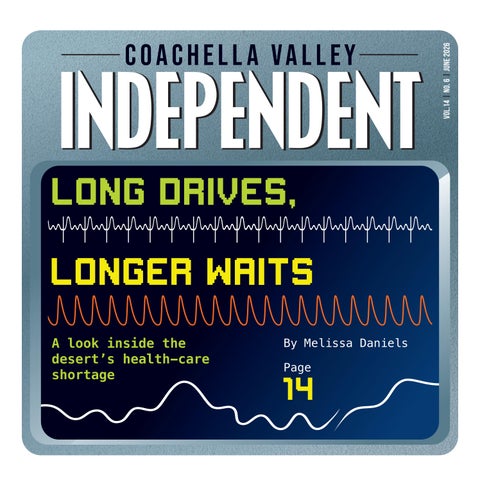
LONG DRIVES, LONGER WAITS
A look inside the desert’s health-care shortage
By Melissa Daniels
Heather Rogers’ oldest child had a stomachache on his 13th birthday. He went to school and came home with the same complaint. When he started vomiting, she took him to the local emergency room—where an MRI showed appendicitis.
The Yucca Valley family was sent to Loma Linda University Medical Center to get treatment, an 80-minute, $1,500 ambulance ride. Another child whose appendix had already burst needed to be treated first, meaning Rogers and her child had to wait.
“We didn’t have a choice, because they couldn’t let him out of care, but he had to get to the hospital somehow,” she said. “But it was scary, because we didn’t get care promptly. We had to wait in the hospital. We had to wait on the ride. We had to wait at Loma Linda.”
Our region suffers from a health-care workforce shortage. Such shortages are becoming a nationwide problem—but here, they’re particularly troublesome.
The Inland Empire—defined here as all of Riverside and San Bernardino counties— is a 27,000-square-mile region of diverse landscapes that is home to 4.7 million people, but not enough doctors to care for them. The California Health Care Foundation’s latest
regional report shows the Inland Empire has just 229 physicians per 100,000 residents, compared to the statewide figure of 358 physicians. And it has just 42 primary-care physicians per 100,000 residents, compared to the recommended 60 to 80—among the worst ratios in the state.
For patients, the day-to-day reality of physician shortages means more than having to drive a long way during emergencies. Accessing health care can become something like a second job: spending hours on the phone to find available providers who take the right insurance, making regular trips to coastal counties to bring sick kids to specialists, and waiting weeks or even months for appointments.
Rogers, a single mom of three, works in telehealth and has private insurance, yet she said she needs to head to Victorville or the Coachella Valley to find an ear, nose and throat doctor for one of her children. For her own care, she uses virtual appointments for medication refills and therapy—but she currently doesn’t have a primary care provider. She had been getting care at an allfemale practice in the Morongo Basin, where she felt comfortable and heard. But it closed
several years ago, and she hasn’t been able to find the right fit since.
“Going through all of that process just to get a letter in the mail that says, ‘We’re closing,’ is so defeating,” she said. “There are not a lot of good options. You feel like you finally found a solution to your issue, and then it’s just the carpet ripped out from underneath you.”
Why the Shortage Is Hitting the IE Hard
Kathryn Phillips, associate director of improving access for the California Health Care Foundation (CHCF), said the California physician shortage starts with the state not graduating enough physicians who stay in the state.
At the same time, the “silver tsunami” of retirees is hitting health care. About 20.4% of the state’s physicians and surgeons are expected to retire within the next five years, according to a January 2026 report from the state’s Department of Health Care Access and Information.
“The fewer physicians there are left in the community, the more each one of them has to do,” Phillips said. “And that means the wait
times get longer; they get more overburdened; and they’re having to take on or address other things.”
Shortages may get even worse due to recent health-insurance changes at the federal level.
In California, up to 2 million people could lose their Medi-Cal coverage due to changes enacted at the federal level by the so-called “One Big Beautiful Bill” in July 2025, according to state estimates. Fewer insured patients means fewer billings for hospitals, who may end up caring for uninsured patients without reimbursement. More recently, more than $1 billion in federal funds to support Medi-Cal's in-home care program were put on hold after the federal government raised fraud concerns—a move that some health experts say could threaten future services.
In some cases, hospitals hit by funding shortages end up dismantling certain practices and specialties. One area that’s often affected is maternal medicine, Phillips said.
“If you can’t have an anesthesiologist, you can’t do C-sections. If you can’t do C-sections,
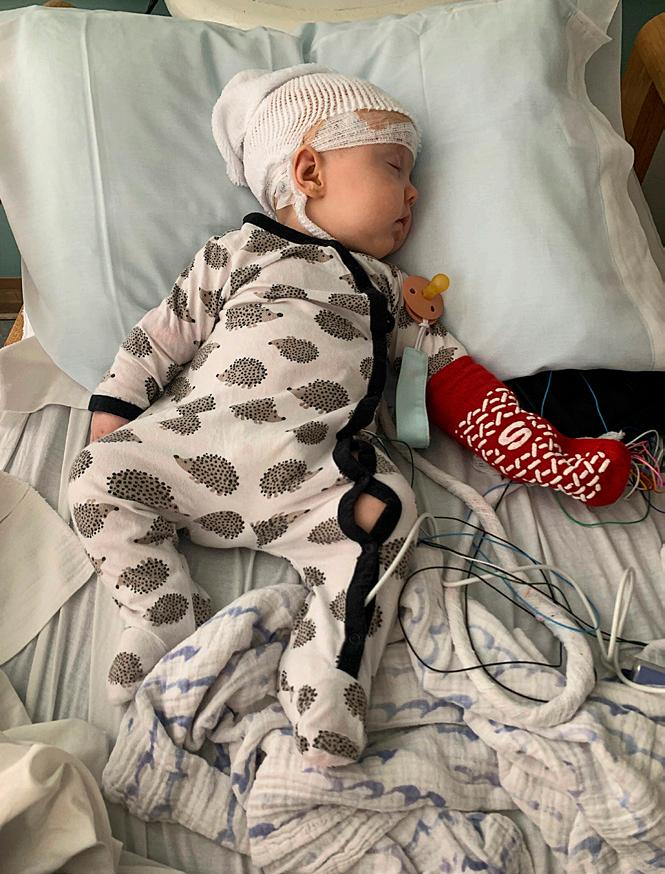
In July 2019, Jessica Bookland’s 3-month-old daughter, Meara, was admitted to the hospital and needed an EEG because of seizure-like symptoms caused by severe reflux. Photo courtesy of Jessica Bookland
Melissa Daniels reported this story while participating in the USC Annenberg Center for Health Journalism’s 2026 California Health Equity Fellowship.
When Medical Care Is Far Away
Tahmineh Safaie, a Joshua Tree resident, had a high-risk pregnancy with her son in 2024. She has a chronic heart condition and wound up being referred to multiple maternal-health doctors and cardiologists in the Coachella Valley and Loma Linda. By the last two months of her pregnancy, she was making weekly visits for monitoring—driving more than an hour each way.
“By the end of my pregnancy, I had to drive once a week to Loma Linda, and once a week to the low desert, which was about an hour and a half drive from my place,” Safaie said. Safaie currently has Kaiser Permanente health insurance, and said her family’s doctors are all in the low desert. “We drive down for everything,” she said.
She said she feels fortunate to have insurance and transportation, knowing that some people can’t make the drive. The 2024 Community Vital Signs report from San Bernardino County shows that about 48.5% of respondents said they rely on other people, transportation services, or public transportation to get to a medical appointment.
Bernardino County. The academic medical center, which is affiliated with the Seventhday Adventist Church, has the most beds in the region at 1,001, according to CHCF. Beyond the trauma center in Loma Linda, it has the region’s only stand-alone pediatric hospital, an acute care hospital in Murrieta, and a behavior medicine and surgical center in Redlands.
In 2025, Loma Linda University Faculty Medical Group (LLUFMG) saw just more than 720,000 ambulatory patients—those who come to a hospital, clinic or office but don’t require a hospital stay. That’s up from just more than 616,000 visits in 2024, according to the hospital.
Dr. Laren Tan, chief operating officer at LLUFMG, said San Bernardino County is among the biggest physician deserts in the state. In turn, many Loma Linda patients are coming from the high desert, low desert or mountains.
“When we look at our distribution map, we know that many are traveling long distances just to receive care,” he said.
you can’t manage complex deliveries. And the pretty soon, you don’t have a labor and delivery unit at all,” Phillips said.
In the Inland Empire, Blythe’s Palo Verde Hospital closed maternity services in 2023. Hemet Global Medical Center shuttered its 12-bed labor and delivery unit in January 2025, and Corona Regional Medical Center discontinued maternity service this year. Beyond the broader statewide shortage, inland and rural regions have specific challenges with recruiting and retaining providers, Phillips said. The Inland Empire is vast and spread out, spanning everything from bustling cities to tightly packed subdivisions, from mountain towns to unincorporated desert communities.
The Coachella Valley and Morongo Basin can struggle with recruitment, because the high temperatures and rural lifestyles of desert communities aren’t a fit for everyone. The salaries offered in places like Palm Springs and Joshua Tree are typically lower than those offered in San Diego or Los Angeles. The end result: Many desert residents need to head south or west for treatments.
Jessica Bookland, a mom of two in Palm Desert, spent months driving down to Rady Children’s Hospital in San Diego after her infant daughter, Meara, developed seizurelike symptoms when the family was on a trip to Coronado. It took months to get the
diagnosis after seeing neurologists, genetics and gastroenterologists—and each time, they had to drive down to Rady.
“I decided to try to see, ‘Well, who can I see locally?’ And there was no one. There were none of those things,” she said.
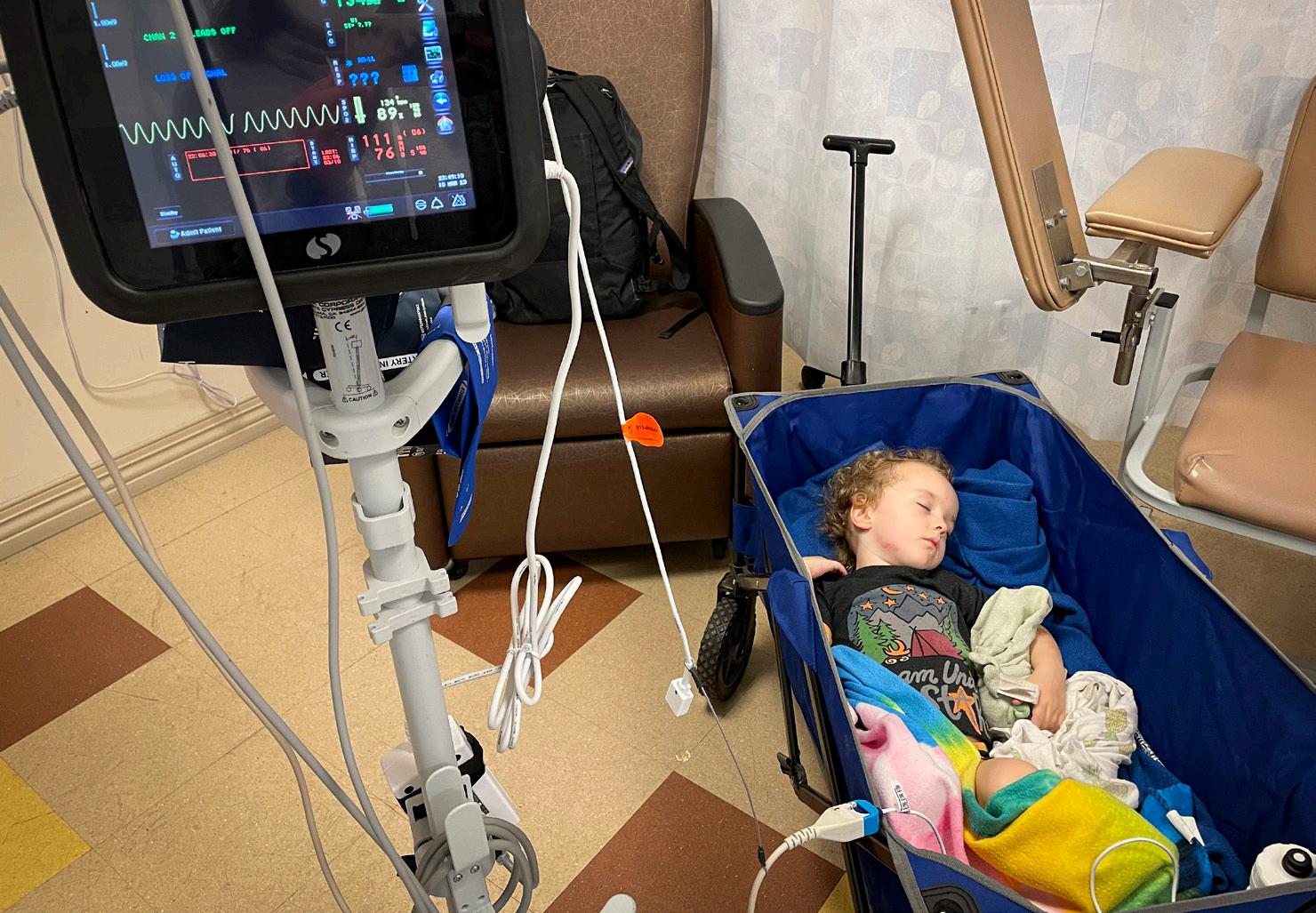
Meara, now 7, developed asthma during the COVID-19 pandemic. This led to frequent nail-biting nights in the emergency room, which became so common that Bookland knew to bring a beach wagon along for Meara to nap in while waiting. The earliest Bookland was able to lock down an appointment with a specialist was at the Children’s Hospital of Orange County—with a four-month wait time.
Bookland still takes Meara to CHOC in Orange for visits every six months or so, about a two-hour drive. If major tests aren’t required, she can opt for a CHOC satellite office in Corona—“only” a 90-minute drive, if they manage to avoid rush hour on Interstate 10. She’s increasingly requesting telehealth for visits that don’t require in-person examinations, and Bookland also pays extra for a membership program called Eisenhower Primary Care 365 that allows rapid access to Meara’s pediatrician’s office in case of an emergent issue.
“To be able to send out that message and avoid going to the ER potentially for medical care is really big for us,” she said.
But this puts pressure on larger systems, like Loma Linda University Health in San
Continued on next page
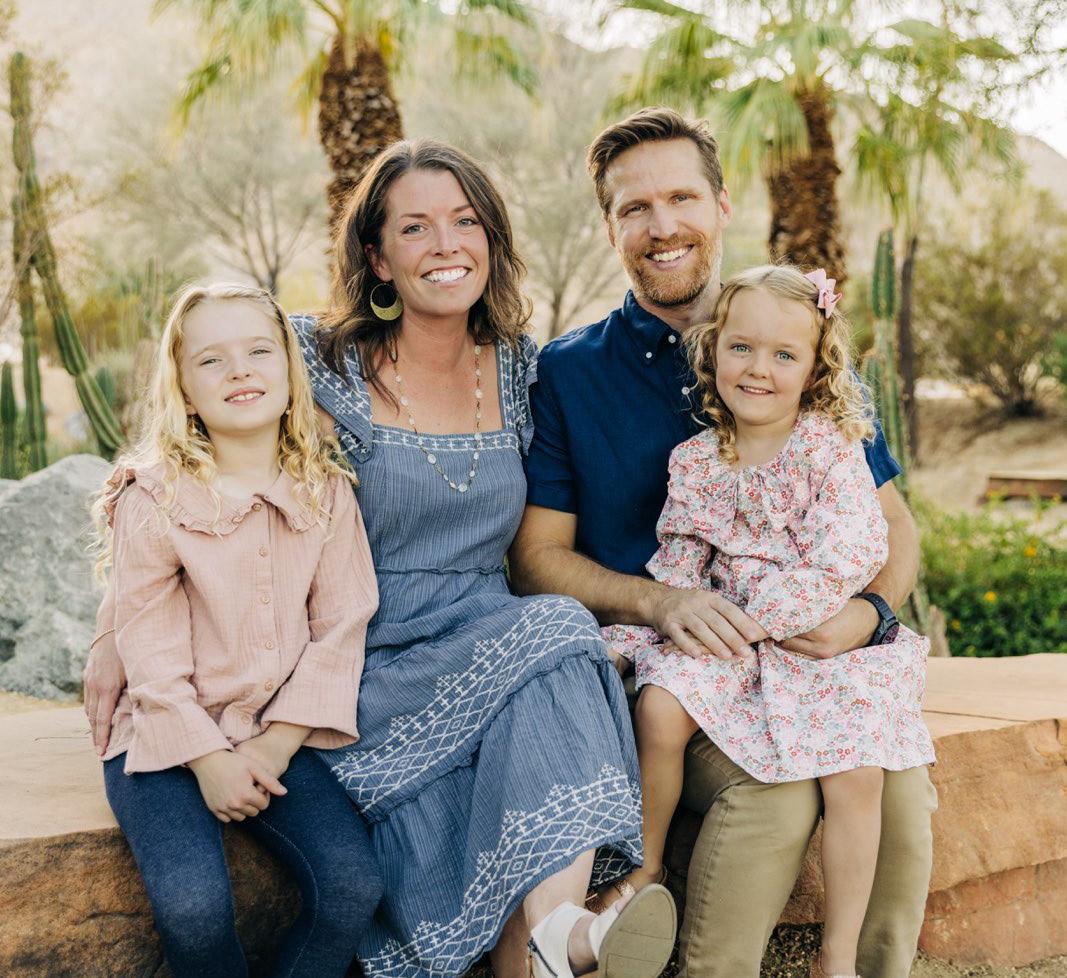
Jessica Bookland lives in Palm Desert with her husband and two daughters. They have to drive more than an hour for pediatric care— even with health insurance. Photo courtesy of Jessica Bookland
Jessica Bookland’s daughter Meara continued to get sick as a toddler, causing frequent visits to the Eisenhower Medical Center emergency room; the family would bring a wagon to give Meara a place to rest. Photo courtesy of Jessica Bookland
But in the short-term, regions need to become their own cheerleaders. Phillips said rural parts of Alaska and Oregon have been able to attract medical talent by selling the benefits of outdoor recreation and lower costs of living. Beyond that, some rural health systems have had success in offering incentives like tuition reimbursement, housing support or even small business loans for spouses, Phillips said.
Advocating Through a Fragmented System
Photo by Natalie Raymond
New Efforts to Grow the Workforce
While it can take years to meaningfully reverse physician shortages, some institutions are trying to turn the numbers around.
Innercare, a federally qualified health center with clinics across Riverside and Imperial counties, including Coachella and Mecca, has plans to become a teaching facility. The Desert Healthcare District and Foundation recently contributed nearly $3 million toward these efforts to create a residency program that can help bring practitioners into the area.
Phillips, from the California Health Care Foundation, said “growing your own” doctors and providers is one of the best ways for communities to increase their health care workforce—essentially training young people from the community, who plan to stay, in health-care jobs. She points to the opening of the UC Riverside School of Medicine, which started graduating doctors in 2017. It can now graduate about 90 students a year, and last year announced plans to build its own teaching hospital.
“Building out that footprint for education and training is one of the most effective things places can do to make sure it has a robust physician workforce,” she said. “But again, it’s going to take years to figure that out and get that off the ground and then get students in the pipeline.”
“Not many new medical graduates are going to like living in a rural area, particularly if they grew up in places like New York,” Phillips said. “But there are some—and how do you find them and how do you sell your community? How do you make them feel welcomed and how do you build that retention?”
Tan, from Loma Linda, said the system leans on the benefits of outdoor recreation and lower costs of living to attract new recruits. As a faith-based institution, Tan said, the organization looks for residents and fellows who resonate with the culture and tries to recruit them to permanent positions as early as possible. The system currently has around 1,300 clinicians in the practice group.
But competing on salary can be a dealbreaker. Tan said a large portion of the patients at Loma Linda have government insurance, meaning the system is operating on a tight budget as reimbursement rates change under state and federal laws.
“We can’t afford to also pay the high rates of Orange County and some of these other areas because of our payer mix,” he said. “Medicare and Medicaid continue to cut back on payments, and we’re trying to figure out how to make it work while still serving the community. That’s the reality of operating in a region like ours.”
Until major systemic changes are made, desert residents will be left juggling the health-care needs, insurance and distance. Georgia Tyerman, a longtime Yucca Valley resident, has regularly taken her 29-year-old son, Steven, across Southern California for health care since he was a toddler. “You have no choice but to look outside of the region and make it a day-long affair,” she said.
When he was 4 years old, Steven was diagnosed with Lennox-Gastaut syndrome, which causes frequent seizures and is linked to intellectual and cognitive disabilities. Despite having brain surgeries, medication changes and life-threatening seizures, Steven is a “a happy guy,” Tyerman said, who loves watching movies like Monsters, Inc. and Finding Nemo. While he is verbal, only the people closest to him can usually understand him.
Tyerman used to bring Steven to see pediatric neology and cardiology specialists at the UCLA Health system, a trek they would make more fun with tourist stops and interesting meals. But he aged out of that practice, and they now go to Loma Linda for cardiology and neurology appointments. As an adult, Steven has had longer wait times and fewer provider options. In early May, she went to make an appointment with Loma Linda to get Steven’s vagus nerve stimulator examined. The earliest appointment she could book was July 27.
7.4 patient care psychiatrists per 100,000 residents, compared to 12.7 statewide Continued from Page 15
The federal government may also end up playing a role. The Centers for Medicare and Medicaid Services has a $50 billion initiative for states’ rural health care. A December 2025 report shows California requested $1 billion for a plan to support clinics, birthing centers and other providers in rural communities, along with recruitment and retention plans.
The growing needs of the area mean that expansion is necessary, even if it’s difficult to balance. In 2024, Loma Linda University Children’s Health broke ground on a new Specialty Clinics building that consolidates pediatrics specialists into one location, aiming to make care delivery convenient.
“We are trying to expand to where we can, but it has to be thoughtful and strategic, because there is a cost to all the expansions,” Tan said. “We already have such a great need, even here in Loma Linda itself. If you’re trying to serve the need in your own backyard, how do you then suddenly find resources to expand?”
Tyerman said navigating the fragmented health system has taught her to stay persistent—and keep pushing. Last year, Steven’s health insurance plan assigned him to a local primary care doctor who wasn’t a good fit; Tyerman left the visit in tears. After unsuccessful calls to the insurer, she eventually found a new Yucca Valley provider through the plan’s online portal.
This new doctor, she said, took his time, listened to Steven and treated him with respect.
“Go to where you’re happy, where you feel like they’re paying attention and answering your questions,” she said. “You’re your only advocate for your child—don’t just settle for care.”
physicians per 100,000 residents, compared to 358 statewide 42 primary care physicians per 100,000 residents, compared to the recommended 60 to 80 About
Source: California Health Care Foundation
Heather Rogers, a single mom of three who lives in Yucca Valley, said she needs to head to Victorville or the Coachella Valley to find an ear, nose and throat doctor for one of her children.
ARTS & CULTURE
A LOT OF ARTS
By Matt King
The city of Palm Springs is kicking off a brand-new arts and culture festival—and has big goals for it.
The first XOXO Palm Springs is a collection of more than 60 events, over 12 days, that celebrate the diverse arts and culture scene in the Coachella Valley. Local music venues, theater stages, museums, art galleries and even event organizers like Modernism Week and Greater Palm Springs Pride will host a variety of arts events from Thursday, June 11, through Monday, June 22.
During a recent interview, Palm Springs City Councilmember Jeffrey Bernstein explained how the event stemmed from discussions among the area’s arts and culture organizations.
“Palm Springs has always had this rich arts and culture history, since the tribal era,” Bernstein said. “We have an incredible amount of arts and culture opportunities in our city, especially for a city our size: For a city of less than 50,000, we probably have eight museums, but four major ones, and we have eight film festivals, five theater companies, over 70 live music venues, over 100 galleries and studios, two big choral groups, two symphonies, dance companies, and Pride, and Modernism Week. We more than outweigh most cities our size, so the roundtable came together, and then after a while, it’s like, ‘How can we further position Palm Springs really as a true arts and culture destination, and really highlight that arts and culture … as an industry in itself?’”
The goal of XOXO Palm Springs is to give a platform to as many local arts organizations as possible.
“We have groups of people who know about Modernism and the (Palm Springs International) Film Festival and Pride, but they don’t always overlap,” Bernstein said. “People have started to come to Palm Springs and go to the Plaza Theatre, and maybe the museum, and then see a drag show and enjoy a number of different arts and cultures. It was the arts and cultural community that came up and said, ‘We want to do a citywide arts and culture festival or celebration,’ and they looked at models like Spoleto Festival or Edinburgh Festival Fringe and South by Southwest, which merge a lot of different forms of the arts.”
Even though XOXO be during the toasty-weather month of June, the city hopes for a good turnout.
“Originally, I thought that October was a great time, and the arts and cultural organizations all decided that June really made sense,” Bernstein said. “We had a half-day retreat that had our economic development person; the (Palm Springs Chamber of Commerce); the Convention Center; the heads of the film festival, Modernism Week, (the Palm Springs)
Air Museum, (the Palm Springs) Art Museum, Desert X (and the Palm Springs) Cultural Center; the editor of Palm Springs Life; the Public Arts Commission; and the Plaza Theatre, and they all thought June was the best opportunity for a number of different reasons. You already have some signature events in June, like Juneteenth events; you’ve got Short Fest; and … it is pride month. October was a little bit too close to everybody getting ready for their busy season, so they all said, ‘We can do something in June, and we can build it.’”
XOXO Palm Springs is taking inspiration from Modernism Week and other multi-day, multi-venue fests.
“(Modernism Week) doesn’t produce most of their events, but they market them and package them all,” Bernstein said. “You look at models like Edinburgh Festival Fringe, and they start to use every available space in the city, so our group looked at it and said, ‘Well, the schools are empty a lot in June, and the Convention Center has high vacancies,’ so down the line, you could see those being activated.”
While many of the events on the calendar were planned independently from XOXO Palm Springs, a few new events were pulled together because of the fest.
“For instance, Modernism Week is going to be doing tours during this period, and they never really do tours in June,” Bernstein said. “At the Cultural Center, the American Documentary and Animation Film Festival will be having a showcase night, and they’re normally in March. … This is really open to anyone. I just heard from Eight4Nine Restaurant, and they’re going to be adding an art show during it. We have a network of galleries and studios, and they’re going to do a U-Haul art show, and we’re looking at trying to plan a showcase in the Plaza Theatre of some of the LGBT organizations like the Desert Winds Freedom Band and Palm Springs Gay Men’s Chorus.”
Bernstein said it was important that bigname arts organizations are part of XOXO.
“This would be the first time that we’ve had Pride, the Film Festival and Modernism Week doing something within one period,” he said.
The first XOXO Palm Springs festival is designed to show off the city’s rich cultural offerings
Thanks to XOXO Palm Springs, people can realize how vibrant our local arts and culture scene truly is, Bernstein said.
“I think the arts are key to the Palm Springs brand, and we should really be doubling down on that,” Bernstein said. “In the past, people haven’t always recognized how rich our arts and culture scene is, and they’ve often looked to big cities—but we have as much, or more, as many cities. … You can come now any time of year, and in a week, you could do a different arts and culture event every day. I think that attracts new businesses here, and it attracts new people to live here. I moved from New York City, and one of the questions was, ‘What’s the arts and culture scene?’ I think now I would say it’s as vibrant as anywhere.”
A five-year plan for XOXO Palm Springs is in place; Bernstein said he and his collaborators hope it can grow into a landmark festival.
“This is just being put on by the arts and culture organizations, and with more funding and sponsorships, there can be a more active
team working on it organizing and promoting,” he said. “I think there’s room for a lot more offerings out there. The Plaza Theatre, I think we’ll have three or four nights, but there’s no reason in a few years they couldn’t have things all 11 nights. Part of it is bringing in other outside groups and different things or new exhibitions, so the five-year plan really is to be like a Modernism Week or an Edinburgh Festival, where there’s a lot going on.
“The second thing is with XOXO, the PS/ NExT Summit and then Short Fest, with art and a lot of technology involved, you start to get closer to our own version of a South by Southwest. … It could be, eventually, not just these 11 days; it could be the month of June, like Edinburgh does a whole month. That’s a long-term goal.”
XOXO Palm Springs will take place Thursday, June 11, through Monday, June 22. For a full list of events, visit visitpalmsprings.com/ xoxo-palm-springs.
The Bent theater company is reviving The Lincoln Debate on Thursday and Friday, June 18 and 19, as part of XOXO Palm Springs.
ARTS & CULTURE
LAUGHING WHILE SINGING
By Matt KinG
Humor and music combine during a new event series in Palm Springs!
Comedian Rhapsody is a monthly gathering of world-class comedians and musicians, taking place at Spirit Animal. Host Avery Pearson—a comedian, actor and musician with credits ranging from Saturday Night Live to Netflix to the Comedy Store—invites his talented friends to join him at the grand piano and create some musical comedy. Catch the next edition of Avery Pearson’s Comedian Rhapsody, this time with special guest
Josh Wolf, on Saturday, June 13.
During a recent Zoom chat with Pearson, he said the idea for Comedian Rhapsody stemmed from joke-song sessions.
“When I was a kid, I used to hang out with my buddies, and we would just stand in circles in parks and make up dumb songs together,” Pearson said. “We would just go around and around, and whoever had the funniest line won, so I just love comedy songs. As I got older and became a comedian, I just decided, ‘Well, I’ve got all these incredible friends who are world-class comedians; let’s see if they can do it, too’—and it turned out they could.”
The run-down of the show is quite simple: “The comic comes on; they do a set; and then I interview them; and then we sing an original comedy song,” Pearson said. “I’ve been doing it like that in L.A. for the better part of 10 years, and I’ve toured it in New York and at a bunch of festivals.”
Now that Comedian Rhapsody is in the desert, Pearson can live out his dreams of becoming “the next Frank Sinatra.”
“My parents have a place in Palm Desert, and I was always like, ‘I just want to have a Frank Sinatra moment, and have a place in Palm Springs where people can come watch a fun comedy music show,’” he said. “It’s easier to book something in Palm Springs than in L.A., because people are like, ‘Oh, cool, Palm Springs—sounds good!’”
Thanks to a connection with Adam Levy, who runs Spirit Animal, the show found a perfect home. At the venue, the show is presented in the round—meaning the performers are in the middle of the audience, instead of being on a stage.
“Normally, I do the show, and it’s kind of presentational where I’m onstage, and it’s me and a piano, and then the guest comes on,” Pearson said. “(Levy) is so fun that, when I walked in, in the lobby, they had this huge white piano at Hotel Zoso, and so we took it and put it in the middle of the room. Now it’s totally experiential in-the-round theater. I’m really getting everything I ever wanted.” If you attend Comedian Rhapsody, you may end up being in the show!
“I’ll make up songs about the audience, and I’ll involve them in songs that I write, and then have them sing the choruses, interview them, and call back different moments throughout the show,” Pearson said. “It’s like if your best friend was a world-class musical comedian, and you hung out in his living room, and he brought over his friends. That’s the vibe that I want to create, and so that’s what I do.”
Pearson admitted that the world of musical comedy is a bit niche. He explained how he got his start.
“I got a job as a door guy at the Hollywood Improv, and they had a piano onstage, and I just started playing before the shows,” Pearson said. “Different comedians would start bringing me up and riff with me, or do their set while I’m underscoring it, and it was just, like, a very natural progression.”
As joke songs grew in popularity, Pearson saw a way to make a career in both art worlds.
“Later on, when The Book of Mormon came out, or Avenue Q, I’m just like, ‘Oh, my God, this is a real thing,’” he said. “There was also that great community when it was Garfunkel and Oates, and Tenacious D and Weird Al—all these great comedy-rock bands. Just being able to sing and laugh at the same time was super-novel to me. You’re just rocking out to the most ridiculous thing ever, and singing. I was like, ‘OK, how can I apply that to my life?’”
He began by writing humorous takes on serious issues in his life.
“I came up as an actor, and you’re always telling someone else’s story,” Pearson said. “I was a really insecure kid, and didn’t have a lot of friends until I found the arts and stuff, so I said, ‘Screw it; I’m going to write songs about my insecurity.’ I thought I was overweight as a kid, so I made fun of that in different ways. I always thought I was cooler than I was … so I wrote the song about comparing my life to wanting to be a Porsche, but I’m actually more of a Hyundai. … I got prediabetes, and I wrote a song called ‘Diabetes,’ and that helped me get through that. The best songs are the ones where someone in the audience just goes, ‘Oh yeah, yes to that.’”
Pearson recalled his first-ever Comedian
Avery Pearson melds music and comedy during his monthly Comedian Rhapsody shows at Spirit Animal
guest: Tiffany Haddish.
“She calls herself ‘The Last Black Unicorn,’” he said. “She has this mole, and kids made fun of it when she was a kid, and they called her a unicorn, and said that she was ugly. That’s what they picked on, so she decided that she was going to become ‘The Last Black Unicorn’ and use it as a superpower. That gives you chills, right? We wrote this origin story song called ‘The Last Black Unicorn,’ and it was incredible when we did it. She’s so talented, and when we actually did it, she improvised the whole thing, and it just came out perfectly. We recorded it, and it’s actually at the end of her book, The Last Black Unicorn. If you go to the end of the audio book, the song is playing.”
Pearson is excited for Comedian Rhapsody to be a part of the Coachella Valley comedy scene.
“There are communities coming out and supporting the festivals there, and coming out and supporting Adam’s venue. I think everyone loves comedy, and everyone wants to experience really good comedy, so I think (the Coachella Valley) absolutely has all the tools, and it actually is a blossoming thing,” he said. “I’ve done shows in Joshua Tree, and I’ve done the casinos … and there are absolutely a ton of
places. It’s an awesome spot where there are really strong comedians who are really hilarious and telling personal stories, and very relatable. It’s a great scene. I really love coming out to it, and whenever I come visit my parents in Palm Desert, I try to go out and do a set at one of the various spots.”
Of course, the local comedy scene needs audience support.
“You will see people who are starting and are on their way to get to a bigger platform in Palm Springs,” Pearson said. “Someone’s gonna pop, and they will do well—so go out and support local comedians, and you’ll be like, ‘Oh my god, I saw that guy back in 2026,’ or, ‘I saw her back in 2025 when she was opening for this guy.’ … You guys support your local team, so you absolutely support local comedy.”
Avery Pearson’s Comedian Rhapsody, with special guest Josh Wolf, will take place at 7 p.m., Saturday, June 13, at Spirit Animal, at 150 S. Indian Canyon Drive, in Palm Springs. Tickets start at $49.87, and include two drinks. For tickets and more information, visit www.spiritanimalclub. com. Learn more about Avery Pearson at instagram.com/averypearsonkeys.
Rhapsody
Avery Pearson.
Docs? Got ‘em.
International dramas? Yep. Late-night weird stuff? Oh yeah. You like movies? You’ll love shorts. Whatever you’re into, there’s something for you at Shortfest.
Seven days, 300+ short films and filmmakers from around the world.
June 23–29 | Festival Theaters | psfilmfest.org
OTHERWORLDLY IMAGES
Rubine Red showcases Marcus Doyle’s long-exposure photographs of the desert at night
by Cat Makino
At night, the desert brings a sense of calm. There is a stillness—yet you can feel the world turning. That’s how photographer Marcus Doyle describes the nocturnal desert landscape. Doyle’s Convergence exhibition is on view at Rubine Red Gallery in Palm Springs through Thursday, June 4.
“I’ve seen a lot of desert photography, but when I look at Doyle’s, I see quality and craftsmanship, without AI or filters,” said Jason Howard, owner of Rubine Red Gallery. “It’s (like) 2001: A Space Odyssey otherworldly—cool scenes from an alien set. His photographs are not just unusual and interesting, but exciting and different. We’re proud to show his art.”
Doyle uses no filters, and none of the work is computer-manipulated. He uses a long-exposure, low-light technique and does little or no editing to produce large photographic prints. He uses artificial light to transform the landscape into something surreal.
He has produced several books, including Night Vision: Intimacies of an Unblinking Eye, and The Accidental Tourist, a selection of images taken during his time in the U.S. Doyle’s show at Rubine Red spans his 30-year career.
He captures the unique shapes of the rocks at Joshua Tree and other desert landscapes like nobody else.
“At night, you see these massive boulders that have been there for thousands of years,” Doyle said. “They look like they were intentionally placed there or (are) about to roll off. But during the day, they look flat; you don’t notice it the same way.”
The Light and Space movement burst onto the California art scene during the late 1960s and early 1970s. It was a collaboration of art and technology to create immersive, kinetic light experiences, defined by experiments in laser scanning, diffraction and photography, often aimed at transforming viewer perceptions. Viewers will notice that influence in Doyle’s work. His motivation for these images stems from growing up in the 1980s and watching science-fiction movies and television shows.
“My favorite show was Star Trek with William Shatner, especially when they went to
the other planets, which reminded me of the Mojave Desert,” Doyle said. “It left a huge impact on me.”
He started working at night because of the brutal desert heat. “At night, it was like a sauna; its warm rocks were very welcoming.”
Doyle was born and raised in the Highlands of Scotland. Doyle’s career began in the mid1990s, working out of a small commercial darkroom in North London, U.K., printing work for some of the world’s most renowned photographers, including Richard Avedon. After buying a large-format view camera, he began traveling throughout Europe and the United States, making landscape photographs. It was his travels throughout the U.S. that opened things up for him. He said Americans welcomed him with open arms, whereas Europeans were sometimes more suspicious.
“I found my themes while living my best life, photographing whatever I wanted, and I still have some of these photographs to this day,” he said. “It was almost too easy in the U.S. You hop in your car and can drive everywhere. If you need gas, there’s a station; if you’re hungry, there’s a diner. It’s a landscape photographer’s dream.”
He moved to California with his wife in 2004.
“My wife, a photographer, had an uncle, a retired NASA rocket scientist, whom we often visited in Encino, Calif.,” he said. “We loved it there, moved to L.A., and never looked back.”
They later moved to Palm Springs.
“It was during COVID, Doyle said. “We sat around, went out to the Mojave Desert to take pictures—and that began our love of the desert. At night, filming alone with no one in sight, I felt like an alien, either arriving or leaving.”
Convergence, an exhibit of photography by Marcus Doyle, is on display through Thursday, June 4, at Rubine Red Gallery, at 668 N. Palm Canyon Drive, No. 102, in Palm Springs. The gallery is open 10 a.m. to 5 p.m., Monday, Tuesday and Thursday; 10 a.m. to 6 p.m., Friday and Saturday; and 10 a.m. to 2 p.m., Sunday. Learn more at www.rubineredgallery.com.
“Arc” by Marcus Doyle.
CAESAR CERVISIA
By brett newton
At the risk of oversharing, I’ve been a bit depressed lately—and one of the side effects has been weight gain. Very recently, I’ve found a foothold that should allow me to try to climb out of this hole, but there is much work to do. Since a huge part of weight loss involves diet, an obvious move is to curtail my alcohol consumption.
But what if I still want beer?
That’s right: We are going to take another look at non-alcoholic beers. I’m fortunate that this is the best time to be a teetotaling beer lover, because so many breweries today are either completely dedicated to N/A beers, or making N/A options in addition to their regular beers. (If you want a
primer on how N/A beers are made, you’ll find my most recent column on N/A beers, from three years ago, helpful.)
With no further ado, let’s get to drinking. Let’s begin with the craft option. The selection in shops locally is quite good (certainly better than the regular beer section nowadays), and I chose to go with a variety pack from Best Day Brewing. Located in Sausalito, Best Day is a strictly non-alcoholic operation. As with many N/A producers, the marketing is all toward outdoorsy, active people. Yeah, yeah, sure, but how’s the beer?
The Electro-Lime Mexican lager is a fun place to kick this off, as I wouldn’t naturally be drawn toward a beer like this. (I like my beers to be beer-flavored, generally.) This is a Mexican-style pale lager with sea salt, lime and Motueka hops, and I was expecting an overbearing lime experience, so you can imagine my surprise when I could still very much smell
beer in my glass. This was crisp and refreshing, with a really well-balanced flavor from all of the ingredients.
Next up was their kölsch-style lager; it had a slight doughy flavor with a nice bitter backbone and a slight citrus note as well. I could actually see myself having this at a backyard barbecue or a pool party.
Now for the hoppy beers. The hazy IPA had an aroma and taste of malted grain and peaches, as well as a slight citrus tang. It was pretty refreshing—and light for a hazy, too. Finally, the West Coast IPA had a similar aroma and flavor of grain, but with tangerine and grapefruit instead of peach. It was delightfully spritzy as well. Overall, Best Day impressed me greatly with these offerings, and I’ll be happy to reach for them from time to time throughout my weight-loss journey.
For the remaining N/A beers to try, I decided to go as mainstream as possible. For one
Our beer scribe wants to lose weight, so he decided to try some more N/A beers; he liked what he found
thing, I was curious, and for another, I figured these would be the most easily purchased at a wide variety of locations if you, too, have an inkling to go N/A.
Sapporo Premium Non-Alcoholic is the N/A version of their famous Japanese lager. I haven’t had a regular Sapporo for many a year, and what I found was a beer with a floral, fruity (almost plum-like) nose and flavor, alongside a slight bitterness and a dry finish. I found myself quite impressed, and I was left wondering if regular Sapporo is this good, and I just don’t remember.
Bitburger 0.0% is the popular German brewer’s N/A offering of their pilsner. I also bought a regular version so I could do a little comparing—while also having something for a guest at my house. The verdict? They’re pretty similar. In fact, I think I enjoyed the N/A version a little more. It’s your standard German pilsner with herbal notes, and the only difference between the two was a slightly skunky note in the non-alcoholic one, and a slightly sulfuric note in the alcoholic. (The difference could be accounted for by the fact that the former was a bottle, and the latter was canned.) Not the best beer, but not the worst I’ve had, to be sure.
Heineken 0.0 was the final beer of the bunch—and a logical end point, because if
Heineken can’t figure out a good N/A version of their extremely popular lager, I would be very shocked. What I found was golden beer with a nice head (that didn’t last long), the smell of cereal (think corn flakes) and hay, and a slight sweetness in the flavor—all of which was ultimately well-balanced by hops and dryness. There was no sign of the skunkiness which Heineken was well-known for in the past, despite the green bottle in which it came. If you tried non-alcoholic beers in the moderately distant past, you know how disappointing they were. They usually didn’t resemble their normal beers in any way (other than perhaps mouthfeel) and left many sober people with a desire to not even try to simulate the beer experience. But today, things are different. In fact, the N/A beers seemed fresher overall (perhaps due to the current popularity of N/A beer). The code seems to have been cracked across the board—and there is simply no need to settle for an inferior drink anymore. I shall see you down the road—a few pounds lighter, hopefully, with a happier liver.
Brett Newton is a certified cicerone (like a sommelier for beer) and homebrewer who has mostly lived in the Coachella Valley since 1988. He can be reached at caesarcervisia@gmail.com.
Some of the sampled N/A beers. Brett Newton
VINE SOCIAL
By Katie finn
Over the past few weeks, I’ve been busy helping wine lovers here in the valley plan wine-country itineraries and offering recommendations on where they should spend their precious vacation time—and, perhaps more importantly, their money.
Because if you haven’t priced a Napa Valley tasting lately, you’ll need to grab the smelling salts and the “good” credit card.
Once upon a time, wine tasting was a charming little afternoon activity. You wandered into a tasting room, sampled a few wines, maybe chatted with the owner’s golden retriever, and bought
a few bottles to take home—because that was simply what one did.
Tasting rooms were never intended to be the primary profit center. They were the introduction, and the tasting fee was less about generating revenue and more about starting a conversation. The real goal was to build a relationship and, ideally, turn a curious visitor into a long-term customer. Wineries hoped guests would purchase wine, join the mailing list or, better yet, sign up for the wine club and begin receiving shipments for years to come.
Then something changed. People began treating wine tastings like Costco on a Saturday afternoon—show up, sample everything, buy nothing, and move on. Some people were simply looking for a scenic place to catch a buzz. They tasted through five wines, took selfies, asked if the crackers were gluten-free, bought nothing, and left.
Wineries, understandably, took notice—and responded by turning the tasting room into an exclusive, invitation-only house party with a much steeper cover charge.
In essence, the tasting fee became a filter designed to weed out the “looky-loos” and offset the real cost of hospitality. And to justify the higher prices, wineries dramatically elevated what they offered.
Today’s tastings may include private seated appointments, vineyard tours, architecturally stunning estates, chef-prepared bites, and hospitality teams trained to deliver an experience that feels more like a boutique hotel than a retail transaction.
According to Silicon Valley Bank’s wine-industry reports, the average Napa Valley tasting fee is now around $75 for a standard experience, with reserve tastings frequently exceeding $100 per person. Sonoma tends to be more moderate, and Paso Robles remains one of California’s best values.
To be fair, Napa has never been the place one visits to hunt for bargains. This is a region where cabernet sauvignon can cost more than a car payment, and where hospitality has become an art form.
That said, even the most devoted wine lover
eventually begins doing some mental arithmetic. Two tasting fees in Napa can easily total $150 or more for a couple. Add a hotel, dinner, transportation and a few bottles of wine, and a “quick weekend getaway” can start to rival the cost of an overseas vacation.
Not surprisingly, many travelers are becoming more selective. The good news is that exceptional wine experiences are still available at very reasonable prices—and in many cases, some of the most memorable trips happen outside the marquee destinations.
Sonoma County continues to offer worldclass wines in a more relaxed and approachable atmosphere. Anderson Valley and Mendocino provide stunning scenery, exceptional pinot noir and sparkling wine, and a refreshingly unhurried pace. The Red Hills Lake County AVA is among California’s best-kept secrets, with volcanic soils and remarkable value. San Luis Obispo County and Monterey showcase some of the Central Coast’s most exciting wines and coolest summer temperatures.
Even Napa itself still offers plenty of worthwhile tastings at more approachable prices— you simply need to know where to look.
This is where you let the local tourism boards do the homework for you. Their sole purpose is to provide resources that help travelers create itineraries and explore regions according to their own tastes and budgets. Whether you prefer grand Napa estates, laidback Sonoma producers, Rhône-style blends in Paso Robles, or cool-climate pinot noir on the Central Coast, these guides are an excellent place to start.
Visit Napa Valley: Tastings Under $50 (www.visitnapavalley.com/tastings-under-50): A curated list from Napa’s official tourism organization proving that value still exists, even in America’s most famous wine region. Sonoma.com: Free and Affordable Wine Tastings (www.sonoma.com/blog/free-winetasting-sonoma-county): An outstanding guide to Sonoma County wineries offering complimentary and budget-friendly tasting experiences.
PasoRoblesWineries.net: Budget Wine
The cost of wine-tastings has gone way up—but you can still find wonderful experiences at affordable prices
Tasting in Paso Robles (pasorobleswineries. net/budget-wine-tasting-in-paso-robles-yourcomplete-guide-to-affordable-wine-country):
A practical and comprehensive resource for finding excellent Paso Robles wineries with complimentary or modest tasting fees.
Anderson Valley Winegrowers Association (avwines.com): Explore cool-climate pinot noir and sparkling wine in one of California’s most beautiful and underrated regions.
Santa Maria Valley: Free and Affordable Wine Tastings (santamariavalley.com/blog/ free-and-affordable-wine-tasting-in-santa-barbara-county): A fantastic guide to tastings and experiences across Santa Barbara County and the Central Coast.
For some travelers, an elevated experience is worth every penny. For others, the escalating
costs have inspired a search for regions where the welcome is just as warm; the wines are equally compelling; and the tasting fees leave enough room in the budget for dinner and a few bottles to bring home.
So as the desert heat settles in and your summer escape begins to take shape, don’t let sticker shock keep you from exploring wine country. With a little planning, you can still discover spectacular wines, breathtaking scenery and genuine hospitality—without feeling like you needed to refinance your home just to taste cabernet sauvignon.
Katie Finn is a certified sommelier and certified specialist of wine with two decades in the wine industry. She can be reached at katiefinnwine@ gmail.com.
FOOD & DRINK INDY ENDORSEMENT
We enjoy pizza from a returning old favorite, and a bagel sandwich from a much-hyped chain
By Jimmy Boegle
WHAT “Dan’s All Season” pizza
WHERE Papa Dan’s Pizza and Pasta, 73011 Country Club Drive, Suite F, Palm Desert HOW MUCH $25.95 for small, as shown CONTACT 760-568-3267; papadanspalmdesert.com
WHY It’s one of the valley’s better pizzas. Opening a restaurant is hard. Re-opening a restaurant may be even harder.
In the early morning hours of April 14, 2024, a woman broke into a business in the Plaza de Monterey shopping center, and started a fire. The blaze completely destroyed the building, which housed multiple businesses—including Papa Dan’s Pizza and Pasta, a Palm Desert institution since 1984.
Owner Ira Mosley decided to reopen Papa Dan’s in an existing building on the other side of Plaza de Monterey, and expressed optimism about re-opening relatively soon.
We checked in with Mosley in September 2024, and he said he hoped to be serving customers again by Thanksgiving. That didn’t happen. In May 2025, we reported that Mosley was hoping to open by the end of the summer. That didn’t happen, either. Then an announcement on the Papa Dan’s Facebook page expressed hope for a fall 2025 opening. Nope.
Finally, on March 16, Papa Dan’s reopened … one month before H&H Bagels opened in the brand-new building where Papa Dan’s once stood.
After being closed for 23 months and settling into a new space, any restaurant is going to need to work out some kinks—and such has been the case at Papa Dan’s, as you know if you’ve perused any of the review websites. On a recent visit with my colleague Kevin, I ordered the “Dan’s All Season” pizza, with sausage, pepperoni, salami, tomato, red onions, mushrooms, Parmesan and both Buffalo and regular mozzarella. You’ll note this pizza doesn’t include bell peppers, because I am not a fan—but the pizza I received was covered with them.
I told our server; after an apology and a bit of a wait, the proper pizza arrived—and it was one of the best I’ve had in the Coachella Valley. Ignore the impatient idiots on Yelp. Go support Papa Dan’s.
WHAT Southwest turkey sandwich on an asiago bagel WHERE H&H Bagels, 73131 Country Club Drive, No. C10, Palm Desert HOW MUCH $14.90
CONTACT www.hhbagels.com
WHY It’s tasty!
Bagel fans across the Coachella Valley rejoiced on April 16, when New York-based H&H Bagels opened their doors on the other side of Plaza de Monterey.
H&H first opened in 1972, and thanks to franchising, stores have been popping up around the country in recent years. H&H taps into the myth that New York City water is somehow special, resulting in pizza crusts, bagels and other baked goods that can’t be duplicated anywhere else. According to the H&H site, the bagel dough for all of the locations is kettle-boiled in NYC, then shipped to stores around the country to be fresh-baked. Clever!
Given all the hype, I decided to check out the new Palm Desert location … and there was a line out the door. I didn’t want an H&H bagel that bad, so I did a few things and returned a bit later, when the line was not out the door, just to the door. I ordered an everything bagel with plain cream cheese ($4.80) for the hubby, and the Southwest turkey sandwich on an asiago bagel for me.
Were the bagels good? Yes! Were they any better, in my humble opinion, than the similarly boiled-then-baked offerings at Townie Bagels, the reigning Best of Coachella Valley readers’ pick? No! (Townie also has a larger selection, fwiw.) But they were quite good! I will definitely get the Southwest turkey sandwich again. It was packed with turkey, bacon, avocado, pepperjack cheese and a “spicy Southwest sauce” that nicely tied all the ingredients together—and the asiago bagel that cradled all of those ingredients was excellent. We don’t have a lot of great options for bagels in the Coachella Valley—so hooray for the arrival of H&H Bagels!
Only in theaters on June 12!
Restaurant NEWS BITES
By charles drabkin
JUNE IS FILLED WITH EVENTS FOR FOODIES
The Omni Rancho Las Palmas, at 41000 Bob Hope Drive, in Rancho Mirage, has brought back the Tiki Social, a tiki-inspired cocktail bar in collaboration with Jeff “Beachbum” Berry, tiki historian, author and owner of Latitude 29 in New Orleans. Through Labor Day, you can enjoy curated tropical cocktails designed to capture the spirit of paradise. I loved the “Coconutty Islander,” which tasted almost healthy. For more information, visit omnihotels.com/hotels/ palm-springs-rancho-las-palmas/dining/tiki-social.
Each June, Palm Springs residents get the opportunity to honor firefighters—while eating delicious fried fish! The 93rd Annual Palm Springs Firefighters Fish Fry returns to Ruth Hardy Park, at 700 Tamarisk Road, at 6 p.m., Saturday, June 6. Expect rainbow trout, hot dogs, burgers, coleslaw and watermelon, all for the low price of $15. Adult beverages and homemade desserts are also available for purchase. For more information, visit palmspringsca.gov.
Equality Wine Fest returns to the Hyatt Palm Springs, at 285 N. Palm Canyon Drive, at 1 p.m., Saturday, June 13, bringing together some of the world’s finest LGBTQ+, BIPOC and women-owned wineries. Enjoy more than 100 wines, food samples, live entertainment, a silent auction and more. Presale tickets start at $105.54. For more information and tickets, visit equalitywinefest.com.
At 2 p.m., Sunday, June 28, head to the Classic Club, at 75200 Classic Club Blvd., in Palm Desert, for the third annual Classic Club Spirits and Wine Festival. This celebration showcases the Coachella Valley’s cocktail heritage through tastings and entertainment. General admission tickets are $65.87 in advance, with VIP tickets also available. Get them and learn more via Eventbrite.
IN BRIEF
Coach, the luxury bag retailer, has opened The Coach Coffee Shop at the Desert Hills Premium Outlets in Cabazon, at 48650 Seminole Road. This is the first location in California, though Coach operates several other shops across the country. You’ll find coffee, matcha and an intriguing little cake shaped like a coach purse. Buy it so you can play “Is It Cake?” at home. Learn more at coach.com/content/coach-coffee-shop.
In other coffee news, San Fernando Coffee Company has opened inside the Vallarta Market, at 42425 Jackson St., in Indio. View the full menu at sanfernandocoffeeco.com.
Farmer Boys, the popular fast-casual breakfast and burger chain, has opened a restaurant across from the Agua Caliente Cathedral City, at 68895 E. Palm Canyon Drive; www.farmerboys.com.
Last month, we reported that the folks behind Hunny’s Palm Springs were opening a sister restaurant, Nashville Country Kitchen and Bar. Now they tell me they will be closing Hunny’s in early June; meanwhile, Nashville, at 262 S. Palm Canyon Drive, opened over Memorial Day weekend. Learn more at www.instagram.com/nashvillespalmspring.
Breakfast Republic is opening a second location in the Coachella Valley at 333 S. Palm Canyon Drive, in the Palm Springs space formerly occupied by Impala. This San Diego-based chain with more than a dozen locations serves breakfast and brunch standards often with a twist; think churro pancakes or shrimp and crab benedict. Learn more at breakfastrepublic.com.
Chef Brandon Avila has taken over the restaurant at Oscar’s Palm Springs, at 125 E. Tahquitz Canyon Way, No. 108. The restaurant, dubbed Avila at Oscar’s, focuses on a steakhouse vibe with a smokehouse overlay. Get more details at www.instagram.com/avilasmokehouse.
F10 Creative, the restaurant group behind Cheeky’s, Birba and Mr. Lyons, among others, has announced Bird, with the address listed on the website (birdf10.com) as 211 E. Palm Canyon Drive, Suite C, in Palm Springs—although the site also includes a map with an entirely different location. The announcement was light on details, so keep an eye on that website or instagram. com/bird.f10.
The Capital Grille, the fine-dining chain with two locations in California, appears to be building out the old Roy’s Restaurant at 71959 Highway 111, in Rancho Mirage. Keep your eyes on this space for updates.
A new “rolled ice cream” shop has opened at 45127 Towne St., in Indio: Mz. Freeze. Using fresh, natural ingredients, they roll each batch to order and focus on bold flavors and unique ice cream experiences. Learn more at mzfreeze.com.
Over the Rainbow Desserts is closing after a 16-year run at 1775 E. Palm Canyon Drive, in Palm Springs. They have announced their last day of business as May 30. Farewell to my favorite chocolate, peanut butter and caramel cupcake; you will be missed. Good luck to everyone! I am looking forward to Roman Blas’ next adventure.
Call us today to schedule a complimentary consultation and get acquainted with an independent, Fee-Only financial planning & investment management firm located here in the Coachella Valley.
Allow us to show you the benefits that result from a financial plan tailored to helping you achieve your goals.
Re-Love the Pre-Loved™ We
believe in second chances.
MUSIC
REMEMBERING SKYLAR
By JIMMY BOEGLE
On March 11, a car crash took the life of Skylar Berry.
“We so loved her, because she stood for the things that were right,” said Billy Gargan, who’d known Berry since high school. “She was your No. 1 fan. She always believed in everything that you did. … She was such a loving person and soul.”
On Saturday, June 6, Berry’s fans, friends and loved ones will pay tribute to the life and art of
Berry—the vocalist in progressive grindcore band Layer:0—with an all-day festival called Skyfest. Local and Inland Empire bands Space in Sound, Day of Peace, Arph, Call Me the Boxer, Gxllium, He Films the Clouds, Bronca, Violuminescence and Doppelgagers will join Layer:0 to raise funds for two organizations representing causes near and dear to Berry’s heart: St. John’s Community Health Transgender Health Program, and ICE Out of California. The event will take place from 1 to 6 p.m. at Music House Indio (82777 Miles Ave.), before moving to the Oasis on Miles (82713 Miles Ave.) from 6 to 10 p.m.
Gargan is a member of the band Space and Sound, and runs Kickass Booking with his friend and bandmate, Kyle Helm. Gargan and Helm joined forces with other local show promoters including Hot Stuff Booking; Noisepile; The Lab; Dunes Booking (operated by the Independent’s Matt King); Violuminescence’s Moon Wahal and Bri Maloney; and Berry’s partner— also named Skylar—to put together Skyfest.
“This is the first time that we’re seeing everyone really come together and work together toward one magnum opus show,” Gargan said. “This is such a beautiful thing, because this is something Skylar’s always wanted, and it’s happening. It’s unfortunate that it had to come at the expense of her life, but it’s great to see that everyone is playing a part. The whole community is really contributing, whether it’s promoting, making merch, working the event or playing the event.”
Gargan said Berry’s sudden and tragic death brought the music community together.
“(Her death) was definitely a moment where we realized we’re all human beings, and we’re not going to live forever,” Gargan said. “At the end of the day, we need to appreciate what we have, and use our platforms to support each other and recognize that we’re all going for one goal at the end of the day. We all love music. We all want to put our music out there and just be artists. I think the loss of her just really brought people together, because it made people realize that life is very fragile, and there’s no time for animosity or weirdness. There’s strength in numbers, and it’s best if we start working together to keep alive what we have
going in our music scene.”
Berry and her bandmate, Zach Rivizzigno, earned numerous fans in Layer:0. Berry participated in the Independent’s “The Lucky 13” feature in 2024, shortly after the release of EP The Dead Are Not Silent, which Matt King described as a “seven-track, nine-minute epic.”
“Berry’s vocal performance is intense and filled with chaotic screaming, yet the lyrics are filled with poetic techniques dealing with themes of resistance,” King wrote.
When asked what band or artist changed her life, Berry mentioned SeeYouSpaceCowboy, a San Diego-based hardcore band that focused
The
music community unites to pay tribute to the late Skylar Berry, vocalist for grindcore band Layer:0
on themes including LGBTQ+ representation. The band included Connie Sgarbossa, who, like Berry, is transgender.
“Seeing them live with Zach was legitimately life-changing for me,” Berry said. “I thought I’d have to give up on a lot of my dreams and goals after coming to terms with my identity, but seeing Connie (Sgarbossa) and the guys live, I was like, ‘Oh wait, what am I thinking? I’m allowed to do this!’”
The highlight of Skyfest will be the return of Layer:0 to the stage. Gargan said a variety of people will join Rivizzigno during the performance.
“There will be a rotation of drummers, as well as all of her friends taking the mic,” Gargan said. “We’re labeling it the ‘Layer:0 Supergroup,’ because it’s really her friends honoring her and recognizing that the dead are not silent—which is also the name of Layer:0’s first EP. The dead are not silent, and her voice
will live on forever. It’s going to be absolute chaos, and it’s going to be the most beautiful thing in the world.”
Gargan said the organizers hope to make Skyfest an annual event—and Berry’s friends plan to keep speaking up regarding the causes for which she fought.
“Silence is a detriment to what we’re trying to do,” Gargan said. “It’s important to speak up for trans rights and immigrants’ rights, and just stand up for what’s right. Skylar did that. She was one of the most outspoken people I know. She was always very positive despite living in fear many days of her life, just because of who she was.”
Skyfest will take place from 1 to 6 p.m., Saturday, June 6, at Music House Indio, at 82777 Miles Ave., in Indio, before moving to the Oasis on Miles, 82713 Miles Ave., from 6 to 10 p.m. There will be a suggested donation of $10 at the door.
Skylar Berry. KEN LARMON
MUSIC
FROM PUNK TO FOLK
By matt king
One of punk rock’s most iconic voices has made the leap into the folk-music world. X—a band with a fast-and-loud legacy of punk-rock anthems that began with “Nausea,” “Johny Hit and Run Paulene” and the chord-burning banger “Los Angeles” in 1980—has called it a career, but vocalist/bassist John Doe hasn’t. Doe traded the bass for acoustic guitar and began the John Doe Folk Trio a few years ago. Fables in a Foreign Land, the 2022 release, show -
cases Doe and his trio’s country capabilities (“The Cowboy and the Hot Air Balloon”) and Americana aura (“Destroying Angels”) along with the haunting, heart-wrenching hit “Never Coming Back.”
The John Doe Folk Trio—featuring Doe, bassist Kevin Smith and drummer Conrad Choucroun—are set to open for Bob Dylan at Acrisure Arena on Saturday, June 20. During a recent phone interview, Doe said it blew his mind when he learned he’d be opening for Bob Dylan.
“If I would have known when I was 16, I would have been insufferable up until now,” Doe said. “I would say, ‘Yeah, man, I’m going to open for Bob Dylan. What are you going to do?’”
Doe said that when he and Bob Dylan first crossed paths, they talked about fishing, not music.
“That was probably the best thing I could have done, rather than say, ‘You influenced me and changed my life, and you’re a great lyricist, etcetera,’” he said. “Nobody wants to be fawned over, unless you’re a real idiot.”
Nearly 20 dates on this Dylan tour feature the John Doe Folk Trio.
“I figured it would just be a few shows,” Doe said. “I opened for Bob one time at the Palladium in Los Angeles (in 2009), and that was pretty fun. This will be even more, because I get to have my trio.”
Country legend Lucinda Williams is also on every show with Dylan and Doe.
“Lucinda is an old friend, and that is more than the icing on the cake; that’s a lot of the cake and the icing,” Doe said. “I love Lucinda, and it’s mutual, so that’s a real treat.”
Whether it’s a headline show at small clubs, or warming up Dylan-heads in arenas, Doe said he and his band provide the same musical experience.
“You’ve got to be your most real self,” he said. “You’ve got to be the realest you can be, even in a big place, because if you’re not, then you’re fronting, or you’re lying, or you’re pretending, and magically, an audience can figure that out—unless you’re really, really good at it, and you have a lot of production and things like that.”
Doe said the real difficulty in opening up a
stacked bill is fitting 40 years of songs into a short set time.
“I’ve got way more than eight songs,” Doe said. “I’m figuring out, ‘Well, should I play a folk song, because Bob Dylan started in the folk world?’ Basically, we’re going to just draw from the record we put out, and of course some X songs, and then some songs that we’ve been recording, which I’ll keep as a surprise, because I don’t think people will expect me to sing songs like that.”
The John Doe Folk Trio’s upcoming album will feature “mostly covers.”
“We’ve done some recording, and David Garza is the producer,” Doe said. “David is a good friend, and he’s worked with Fiona Apple for several years. He kind of co-produced that last record of hers, Fetch the Bolt Cutters, and the most recent couple of Iron & Wine records. David is incredibly adventurous, a terrific instrumentalist and a great producer. He pushes me into different areas, and he’s convinced me to try a Sade song. That’ll be cool if I could pull that off.”
Fables in a Foreign Land was outlined in the press as being set in the 19th century. Doe told Rad/Atl: “All of these songs take place in the 1890s. There’s a lot of sleeping on the ground, a lot of being hungry, a lot of isolation.” Doe said the upcoming release will not be concept-based, but rooted in emotion.
“They all choke me up at some point or another if I listen to them—not my version necessarily, but the original version,” he said. “There’s ones that I’ve either sung off and on for a while, or there’s some that I’ve always wanted to sing. The songs are deep, and a part of my history.”
Does covering these moving tunes help alleviate the emotions Doe attached to these songs? “No, they amplify them, and that’s a good thing.”
As Doe has performed these covers live, he’s seen audiences have similar emotional responses, he said.
“A couple of kind of tough-looking dudes have said, ‘Man, you played that song, and I cried,’ and I said to them, ‘That means you’re a real man,’” he said. “‘That means that you’re in touch with your emotions, and you’re not
John Doe is opening for Lucinda Williams and Bob Dylan at Acrisure Arena
afraid to let loose.’”
Doe’s upcoming Palm Desert show marks a return to desert after an April solo set at the Joshua Tree Retreat Center.
“I’ve played at Pappy and Harriet’s several times, and a friend of mine said, ‘Why don’t you try this Retreat Center?’” Doe said. “I had driven past it a dozen times. It’s right between Yucca Valley and Joshua Tree, and it’s like, ‘Oh, that’s that odd place,’ not knowing that it was built just after World War II. It’s so cool, and
there were 430-some people that showed up. I was like, ‘What the hell, man.’ It was amazing, and really, really beautiful. I think people wanted to see the new place and just me and my lonesome guitar. It was great.”
The John Doe Folk Trio will perform at 7 p.m., Saturday, June 20, at Acrisure Arena, 75702 Varner Road, in Palm Desert, with Lucinda Williams and Bob Dylan. Tickets start at $77.10. For tickets and more information, visit acrisurearena.com.
John Doe. Todd V. Wolfson
MUSIC
UNCONVENTIONAL TUNES
By matt king
In a peaceful and remote mountain town, expressive artists will gather for a day of avant-garde jams.
The Idyllwild Experimental Music Fest will return for a third year on Saturday, June 27.
Hosted at Audiowild Studios, the event is an all-day showcase of musicians offering boundary-breaking live sets filled with unconventional tunes. This year’s lineup features synthesiz-
er-structure-slashing from Spotlight Floodlight, computer-coded chords from LeggLake, atmospheric ambience from Invisible Dog, and much more.
During a recent interview with festival organizer Pete Majors, he discussed his background in experimental music.
“I’ve played experimental music and was very much a part of that underground scene in Los Angeles for well over 20 years when I lived there,” Majors said. “After moving to Idyllwild, there was a real disconnect for a while from the music scene. (I was) not necessarily physically that far away, but it just seemed a little bit isolated in the sense of what actually happens up here, musically and artistically.”
Majors wanted to host a small show that focused on noise music, a subgenre of experimental music that builds songs out of harsh static, feedback or other “unwanted” noise.
“The idea was that I wanted to do something up here that was almost a selfish thing,” Majors said. “… After meeting Brian (Parnell, owner of Audiowild Studios)—who is such a cool guy and just a well-rounded musical person—the venue seemed right for something like this. After being a little bit disillusioned from having a band after I moved up here, putting out a record, and having that kind of fall apart, I was looking to do something. I started inviting people to do this thing up here, and I was kind of blown away how many people just said yes.”
For the first two years, Majors used personal connections to build the lineup.
“I would actually say that I was friends with every artist who performed,” Majors said. “Most of it was drawing from the L.A. scene. … Everyone was just excited to come up here. For a lot of people coming up here, they’re like, ‘It’s magic up here.’ It’s very inspiring in that way. It’s not cheap to stay the night up here or to drive here, but a lot of people who do this kind of music … they’re not doing it for monetary reasons. I think having a lot of friends the first couple of years helped cement it. Now I do have a little bit of a following for it, which is kind of fun.”
The Idyllwild Experimental Music Fest offers a stark contrast to most musical offerings in Idyllwild.
“There is a good music scene up here, kind
of a tight scene that all revolves around the same venues, a lot of which are restaurants,” Majors said. “You play Middle Ridge Winery, or you play Cafe Aroma, or Taryn’s Place, and it’s the same acts playing all these places all the time—and they’re good. A lot of it is more conventional, straightforward rock, or strippeddown singer/songwriter stuff that makes it easier to perform at these various venues for a lot of tourists and things like that.”
Majors said he hopes the event exposes people to new styles of music.
“I do like the idea that I’m doing something that is very unique and different for this town musically,” he said. “A lot of people don’t even understand what experimental music is, which I can totally get, because it is such a broad kind of genre when you’re thinking of involving ambient to noise to free jazz. It’ll be interesting to see how it goes this year, for sure.”
Not everyone will be a fan of the boundary-breaking ways in which experimental musicians shout, scream and showcase sounds— but Majors invites the trepidation, while adding that it’s different to experience the music live than it is to listen to a recording.
“It’s so much more visceral to watch something happen,” he said. “… Everything’s a little bit different. There might be something that really is off-putting for you. It could be power electronics (a subgenre focusing on abrasive screeching sounds) that punches you in the face, but then the next thing is something that blows your mind, and you’re like, ‘Wow, I don’t even know what I call this, but I like it.’”
Majors discussed some of the most unique sets from last year’s fest.
“A friend of mine, Samur Khouja, who goes under the name Conscious Summary, performed a full quadraphonic set, and was setting up the speakers all around the room to trigger the way he wanted them to be,” Majors said. “It was very immersive and amazing. That was such a concept that I think people weren’t really expecting. Also, Oort Smog … is a drum and sax duo, kind of like prog free jazz. I think that really grabbed everyone last year. That came out of nowhere, where everyone was like, ‘Wow, that guy is processing saxophone through pedals and just locking in with the
The Idyllwild Experimental Music Fest features artists who aren’t afraid to break musical boundaries
drummer.’”
This year’s lineup features legends in the experimental-music space.
“I’m really excited that John Wiese is performing,” Majors said. “He’s a powerhouse of noise, and has been playing for probably about 30 years at this point. I’ve known John for a long time. I was really excited that he accepted the invitation to play, because he actually now is in Cleveland. I wouldn’t even know what he’s going to do. It’s going to be in the noise realm, and electronic, but just knowing his body of work, I’m really excited to see what he pulls out for the fest.
“Trigger Object from Portland has just been getting more notoriety over the years, to the point where I didn’t know her, and then I got turned on to her work. We have all these mutual friends, so it started to be this weird connection right away. She does a really disjointed noisy electronic thing.”
Majors said the music is difficult to accurately describe.
“A lot of performers don’t do the same thing
every time,” he said. “If you heard a recording from them, an album from them, you’re not necessarily going to get that regurgitated in a live set. Every time, it’s going to be a little bit unique.”
Majors said the main idea behind the Idyllwild Experimental Music Fest is that “music is for everyone.”
“The business of music to me, for the 25 years I worked in music retail, kind of corrupts things,” Majors said. “The idea that anyone can make music, and that art is for everyone, is what this fest is about. Everyone can do it; everyone can enjoy it. Let’s just support the arts outside of this giant industry that mostly just exploits the arts.”
The Idyllwild Experimental Music Fest will take place at 3 p.m., Saturday, June 27, at Audiowild Studios, 54240 Ridgeview Drive, in Idyllwild-Pine Cove. Tickets are $20 online, and $25 at the door. For tickets and more information, visit www. instagram.com/idyllwildexperimentalmusicfest or audiowild.studio.
Pete Majors with Hater of Man at the first IEMF.
MUSIC
HEAVY IN THE HEART
By Matt King
Anew hardcore music project has emerged, adding jumpy, energetic beats and lively vocals to an aggressive and brutal sound.
Day of Peace is the latest product from local drummer extraordinaire Sean McCune, who has wowed audiences with his hip-hop skills in AEIOU, and his intense mania behind the drum kit for Killfloor, Destroy Nothing, Analog Lab and other projects. With all of those projects in the
rear-view mirror, McCune has debuted a new sound that mixes styles from all of his previous works, while handling all of the songwriting, performing and producing himself.
Way Down, the debut EP from Day of Peace, was released on May 15. While the songs obviously bang, the mosh-pit moments are mixed with bouncy breakdowns. McCune’s rap flows and melodic vocal tones add an element of fun to the hard-hitting sound.
This first release is all McCune, but the Day of Peace live band is rounded out by Kai Evans, Andrew Cole, Holden Warzecha and Sebastian Waggoner. Day of Peace will perform at Skyfest on Saturday, June 6, at Music House Indio. (Full disclosure: I am co-producing Skyfest.)
“This is a style of hardcore that I’ve always wanted to pursue, something that was kind of fun while still being heavy,” McCune said during a recent FaceTime interview. “That was the main goal that I had in mind when I approached Kai, is I wanted to write something that was fun and also heavy and meaningful. I was lucky enough to find some people who were willing to play the music I was writing. It differs from the other bands I’ve been in, because it’s not as heavy, but it’s still hardcore. It has some older influence on it, and it’s heavy in the heart.”
In true hardcore music fashion, the lyrics dive into deep emotions. Notable passages include, “Can’t breathe with the curse weighing down on my life / Makes my heart break a thousand times” on “Chokehold,” and “I can’t sleep, the world reflecting inside me / Can’t let it tear me apart piece by piece” on “Reflection.”
“I wasn’t necessarily going for a theme so much as I was just trying to write about how I felt in the moment, or how I felt from a period of time in my life,” McCune said. “I wanted to write about my personal struggles and how they made me feel. There is one song on there that kind of has a little bit of a straight-edge vibe, called ‘Me First,’ (about) taking responsibility for yourself and choosing a better path in life. I was basically just trying to write through tough times that I’ve been having, and trying to relay those messages of anger, grief and just general sadness in how I see the world, and how it affects me personally.”
Day of Peace has offered McCune a welcome opportunity to work through his emotions.
“Writing these songs has been very helpful, and I haven’t really felt that way before about music,” he said.
McCune is used to putting songs through a number of revisions—but this was not the case with Way Down
“Anybody who’s worked with me musically knows not to fall in love with the sound or with an idea that I have, because I’m bound to change it, and the more I listen to it, the more I want to work on it, and the more I want to perfect it,” McCune said. “With these songs, I didn’t have any of those feelings, and I was ready to just put them out. … I feel really satisfied with them. Everybody else in the band digs it, and that’s all I can really ask for, especially since I didn’t have all the members. I had to write the music, and I felt like I was casting a line. I was like, ‘Here’s all these songs I wrote; do you like them? Would you want to play them?’ Our next project will probably be a lot more collaborative, but as of this one right now, I wrote everything.”
Although McCune performed all of the
Sean McCune
puts down the sticks and pics up the mic for Day of Peace, his new hardcore project
drum, bass and guitar parts on the EP, he only handles vocals in the live setting.
“I’ve always wanted to do something like this, and that’s kind of why I made the band in the first place,” McCune said. “I wanted to do vocals, and these guys just freed me up to do it. They’re all so solid. They’re just holding it down for me, and I don’t feel worried at all that we’re not going to sound good. I’m just free to let go and act really crazy on the mic. It’s been very cathartic.”
The Day of Peace features others who are also taking on new musical roles. While Sebastian Waggoner (of Built to Break) remains on guitar, local photographer Kai Evans will be playing bass for the first time live. Andrew Cole jumps from being the frontman of I Lay in Static to the guitar, and Holden Warzecha is performing for the first time outside of his school band.
Warzecha said he’s enjoyed watching McCune “act like a fool, running around, doing his vocals.”
“These are really fun parts,” Warzecha said. “He has given me some breathing room, but the actual grooves are pretty creative for hardcore stuff. There’s a lot of kick displacement, and the snare and the kick play together a lot of time during two step parts and stuff like that. Those are things you kind of don’t hear, and it’s really fun to play.”
Evans said playing in the band is “an interesting change” for him.
“I’ve been at shows and I’m like, ‘Oh, I’m not holding the camera this time; I have to go do that thing,’” Evans said. “It’s definitely something I’ve always wanted to do, and … this one feels right. These songs are fun; I’m having fun doing it; and I’m learning a bunch of new stuff. That one singular show with Palkia (the first iteration of Day of Peace) was the first time I played bass standing up. This is definitely fun.”
Said Warzecha: “This is my first band. I play in school, but this is my first hardcore band. This is my first time behind the kit in this setting, and it’s a blast. I can’t wait to start throwing my sticks at people in between songs and shit.”
Cole said he’s excited to be in the band, because the “music is amazing.”
“If I wasn’t playing in the band, I’d be the biggest fan, and I’d be at every show,” Cole said. “To be able to play in the band is really amazing. It’s a shift from my previous band as a frontman, to now on guitar. It’s honestly more fun in a way, because I’m hidden, and I get to do whatever I want instead of having to be the face of the whole band. Now they all get to have their eyes on this handsome man over here, Sean.”
Day of Peace will perform at Skyfest on Saturday, June 6, at Music House Indio, at 82777 Miles Ave. There is a suggested donation of $10 at the door. For more information on Day of Peace, visit instagram.com/ilovedayofpeace.
MUSIC
LET US GO ON THIS WAY
By Matt King
The Beach Boys, with original member Mike Love, keep touring and playing the hits. Al Jardine, the other living original member, tours with The Pet Sounds Band to celebrate some of the more underappreciated works by the iconic band.
On Saturday, June 6, Al Jardine and The Pet Sounds Band will arrive at the Plaza Theatre and turn back the clock to the ’60s and ’70s for an evening of both hits and deep cuts. Expect “Cali-
fornia Girls,” “Surfin’ U.S.A.,” “I Get Around” and Jardine-led classics like “Help Me Rhonda,” along with some Pet Sounds material to celebrate the record’s 60th anniversary. The band will also do a full-album playthrough of The Beach Boys Love You, the 1977 album that didn’t sell well but became a cult hit, with Brian Wilson—the Beach Boys’ primary songwriter and producer—saying it was “my favorite album we ever did.”
“We’re going to have a great show,” said Al Jardine during a recent interview. “We have a lot of material to cover. … We’ll be doing a couple of extra songs from Pet Sounds, but not the whole thing right now. We’re still rehearsing the whole album, but our primary focus is on
The Beach Boys Love You, which we do in its entirety. I think you’ll enjoy that a lot.”
The show will also feature an even deeper cut—a B-side that will be particularly relevant in Palm Springs.
“We do an outtake from the box set, one of Brian’s pre-eminent compositions,” Jardine said. “It was written for Frank Sinatra, as a matter of fact. We’re going to close the whole show with that last song after the encore. It’s called ‘Still I Dream of It.’ It’s just beautiful, and unfortunately, Frank turned it down. He probably never heard it, because a lot of times, your agents will not play stuff for you. They’ll have their own opinion about something—and I’m sure Frank would have had a No. 1 hit with this song, because it’s so perfect for him, for his style.”
Al Jardine and The Pet Sounds Band’s tribute to The Beach Boys Love You has been exciting audiences and impressing both fans and critics.
“It’s really remarkable,” Jardine said. “My musical director had to convince me, as a matter of fact. I suggested that we do it, because it’s kind of timely. We might be a year ahead of ourselves, actually. … It’s the 50th anniversary, maybe not of the release, but of the recording, and people are going nuts.”
The members of The Pet Sounds Band were handpicked by Brian Wilson before he passed away, and have proven themselves to be the perfect torchbearers of the musical legacy.
“I’m very proud of the band,” Jardine said. “… They respect the work that goes into doing
what I would call a reimagined Beach Boys Love You, with better equipment, more great singers and an original Beach Boy to pull it off.”
Fans looking for more of the hits can check out the other touring Beach Boys band.
“They can do all the hits, but we have to offer something extraordinary, because we’re not the Beach Boys,” Jardine said. “I invented this title, The Pet Sounds Band, because I thought it would reflect what we are to the audiences, and what we play, what we perform, without stepping on the Beach Boys, because that’s Mike’s band. We have to be creative and still play the hits; we’re not cheating the audience in that regard. They’re going to get all those same things and even more, because you can’t do a set without ‘California Girls’ or ‘Good Vibrations’ or ‘Fun, Fun, Fun.’”
One of the members of The Pet Sounds Band is Matt Jardine, Al’s son, who delivers some classic Brian Wilson-style vocal performances.
“Brian and I, when we were touring together in the last 20 or so years, relied on Matt a lot, because those falsettos don’t come easy when you’re in your late 70s and 80s,” Al Jardine said. “Brian’s voice had changed—all our voices do—and Matt has that young, lively sound that Brian used to have in the early ’60s. We got lucky.”
Matt wasn’t a nepotism hire—he had to get through auditions with Carl Wilson.
“Carl was the band leader at the time,” Jardine said. “I said, ‘Carl, I think he’s ready.’ He put it off for a while, but then finally, Matt rose to the occasion, and he’s been with us ever since.”
The Beach Boys’ music will always honor the great work of Brian Wilson, who passed in June 2025.
“We’re celebrating his music every time we go out there,” Jardine said. “We have a few of our own things, and each one of us writes songs, but no one can come close to Brian.”
Jardine reiterated that the music is the star of the show.
“Each one of the members onstage is paying tribute to Brian, and Carl, for that matter,” Jardine said. “I tell these little stories in between numbers about who sang what and when, and then Darian (Sahanaja), my musical director, does a great job doing Carl Wilson’s parts. He’s
Al Jardine and The Pet Sounds Band perform the Beach Boys’ big hits—and deep cuts, too
really got it down, and the other members of the band all share in doing the leads from The Beach Boys Love You. It’s perfect. We’ve got a good balance, teamwork-wise, to pull these things off, because it’s not easy, but we have the right personalities. We’ve been working with this band for the last 25 years, so they’ve got their chops.”
Could future playthroughs of other underrated Beach Boys’ albums be possible?
“Oh yeah, if we live that long, geez,” Jardine said with a laugh. “There are so many projects that we could go to next, like All Summer Long … We’ll see how it goes.”
While the Beach Boys’ legendary harmonies can be hard to replicate, Jardine said The Pet Sounds Band sounds “just like the recordings.”
“When you hear the band, you won’t believe it,” he said. “… It’s really amazing to have these kinds of vocalists. These instrumentalists also happen to be very fine vocalists, and that’s a rarity.”
Al Jardine and The Pet Sounds Band will perform at 7 p.m., Saturday, June 6, at the Plaza Theatre, at 128 S. Palm Canyon Drive, in Palm Springs. Tickets start at $81.50. For tickets and more information, visit www. palmspringsplazatheatre.com.
The Venue REPORT
June 2026
By matt king
Happy June! As temps increase, some venues slow down, but there are still plenty of opportunities to indulge in entertainment Here’s what the desert has to offer this month.
Acrisure Arena is hosting two very different shows. At 7:30 p.m., Wednesday, June 17, the “Queen of Latin Music” Shakira will bring hip-shaking action and genre-blending pop to Palm Desert. Tickets start at $196.40. At 7 p.m., Saturday, June 20, folk-music legend Bob Dylan will pull from his Nobel Prize-winning discography to share unique renditions of his hits and deep cuts. Lucinda Williams and The John Doe Folk Trio (read our story on Page 28) are set to open. Tickets start at $77.10. Acrisure Arena, 75702 Varner Road, Palm Desert; 888-6958778; www.acrisurearena.com.
Fantasy Springs features moving music and amusing comedy. At 8 p.m., Friday, June 12, Latin pop legend Edith Márquez and her emotional ballads may require some tissues! Tickets start at $52.50. At 8 p.m., Saturday, June 20, ventriloquist, impressionist, standup comedian and singer Terry Fator, with his group of hilariously harmonious puppets, will showcase both jokes and jams. Tickets start at $52.50. Fantasy Springs Resort Casino, 84245 Indio Springs Parkway, Indio; 760-342-5000; www.fantasyspringsresort.com.
At the Plaza Theatre, catch music, movies and marvelous theater! At 7 p.m., Monday, June 1, the Marilyn 100 film celebration wraps with a screening of The Misfits, featuring Monroe’s final performance. Tickets are $20. At 7:30 p.m., Friday, June 5, two disparate music worlds—prog rock and yacht rock— combine in the discography of Ambrosia. Experience both technical and tranquil tunes! Tickets start at $57.35. Check out a modern edition of a classic drama at what’s being called the Desert Shakespeare Festival, as A Midsummer Night’s Dream will grace the Plaza stage at 2 and 8 p.m., Saturday, June 13
Bob Dylan
Al Jardine. Steven “Stevo” Rood
Tickets start at $38.25. At 3 p.m., Sunday, June 14, soprano star and local theater favorite Michelle Fiore and friends will enchant crowd. Tickets start at $25. At 3 p.m., Sunday, June 21, see a screening of a Broadway classic, 42nd Street, recorded in 2018 in London. Tickets are $20. Plaza Theatre, 128 S. Palm Canyon Drive, Palm Springs; 760-593-5818; www.palmspringsplazatheatre.com.
The McCallum is hosting two performances before the venue’s summer break. At 1 and 7 p.m., Saturday, June 13, the McCallum Theatre Jazz Experience will offer blissful instrumentals and powerhouse vocals! Local talent will take the stage for the Community Jazz Jam at 1 p.m., and David Benoit, with Courtney Fortune and the Pacific Jazz Orchestra Quartet, will grace the stage at 7 p.m. Tickets are $15 for the 1 p.m. show, while tickets for the 7 p.m. show start at $25. Combo tickets start at $30. McCallum Theatre, 73000 Fred Waring Drive, Palm Desert; 760-340-2787; www.mccallumtheatre.com.
Morongo is offering two headliner concerts. At 9 p.m., Friday, June 5, experience the Sinaloa sounds of Banda Carnaval, a group with deep roots in the regional Mexican genre. Tickets start at $47. At 9 p.m., Friday, June 19, hip-hop heavyweight E-40, known for a couple of 2000s and 2010s hits that have gained popularity in the TikTok generation, will head to Cabazon. Tickets as of this writing
Spotlight 29 has a concert and plenty of comedy. At 8 p.m., Saturday, June 27, corrido singer/songwriter Gerardo Coronel “El Jerry” will perform majestic regional Mexican music. Tickets start at $38.80. Honest Goodness Comedy Fridays welcome hilarity from DoKnow (June 5), Don Hefty (June 12), Forrest Shaw (June 19), and Edwin San Juan (June 26). Shows are at 8 p.m. (with a 10 p.m. show added on June 5). Tickets start at $17.85 to $23.17, and you must be 18+ to attend. Spotlight 29 Casino, 46200 Harrison Place, Coachella; 760775-5566; www.spotlight29.com.
Agua Caliente Rancho Mirage has two events on the June calendar. At 8 p.m., Saturday, June 6, extraordinary comic Jerry Seinfeld brings his Seinfeld charm and observational humor to the desert. Tickets start at $137. At 7 p.m., Sunday, June 21, vocal king Rod Stewart will take the stage. Tickets start at $235.52. Agua Caliente Resort Casino Spa Rancho Mirage, 32250 Bob Hope Drive, Rancho Mirage; 888-9991995; www.aguacalientecasinos.com.
Agua Caliente Palm Springs is rockin’ with the residency events! Desert Blues Revival Wednesdays feature creosote country from locals Kimberly Cofer and the Tumbleweeds (June 3), up-tempo blues from Juke Joint
Preachers (June 10), Latin funk grooves from Funk Monks (June 17) and power-trio rock from The Alvarez Band (June 24). Shows are at 7 p.m., and tickets start at $17.85. Carousel Thursdays showcase organic music from the Carey Frank Organ Trio (June 4), a tribute to fiery flugelhorn star Chuck Mangione from Tom Marino (June 11), a double dose of soulful swagger from Mimi and Kierra Brie (June 18) and vibey vibraphone excitement from Sasha Berliner (June 25). Shows are at 7 p.m., and tickets start at $17.85. For comedy, check out a special Juneteenth show from Ralph Porter at 7 p.m., Friday, June 19, or laughs from Sarper Güven at 7 p.m., Friday, June 26. Tickets start from $23.17 to $39.19. Want some variety? Go see Hush Hush: A Variety Show of the Highest Class and Caliber, starring Bobbi DeCarlo, at 7 p.m., Friday, June 12. Tickets start at $22.11. Tickets for all shows are available at eventspalmsprings. com. Agua Caliente Casino Palm Springs, 401 E. Amado Road, Palm Springs; 888-999-1995; www.aguacalientecasinos.com. Pappy and Harriet’s is poppin’ in June. Here are a few highlights. At 7 p.m., Friday, June 5, psychedelic surf-rock act Allah-Las will bring dreamy beachy vibes to the desert. Tickets start at $42.74. At 9 p.m., Thursday, June 11, revel in gospel, soul and raw R&B-infused rompers from Sir Woman. Tickets are $31.86.
At 9 p.m., Wednesday, June 17, country songwriter Chayce Beckham will hone in on Pioneertown’s cowboy vibe. Tickets are $35.49. At 9:30 p.m., Friday, June 26, stoner/ doom metal group Monolord will crush eardrums and destroy decibel limits! Tickets are $37.56. At 9:30 p.m., Saturday, June 27, the serene Yucca Valley vibes will become even calmer thanks to the ambient indie charm of Gia Margaret. Tickets are $31.86. Pappy and Harriet’s Pioneertown Palace, 53688 Pioneertown Road, Pioneertown; 760-228-2222; www. pappyandharriets.com.
Oscar’s has some notable acts on a busy calendar. At 7 p.m., Saturday, June 6, drag performer and ABC actress Candis Cayne will perform. Tickets start at $44.95. At 7 p.m., Saturday, June 13, laugh the night away with Nadya Ginsburg and her musical comedy show Feral Fatale, featuring drag and hilarity. Tickets start at $44.95. At 7 p.m., Monday, June 15, ’80s star Tiffany (who sang “I Think We’re Alone Now”) will celebrate the release of her new cookbook with stories and songs. Tickets start at $44.95. At 6 p.m., Saturday, June 27, actress, singer and Lucie Arnaz’s daughter Kate Luckinbill will perform. Tickets are $14.95. Some Oscar’s shows include a food/drink minimum. Oscar’s Palm Springs, 125 E. Tahquitz Canyon Way, Palm Springs; 760325-1188; oscarspalmsprings.com.
Community Is Our Priority.
For 13 years, the Independent has been telling the Coachella Valley’s stories. Our mission is to inform readers like you—and to help you build stronger connections with your community. To continue doing so, we need reader support!
Please consider becoming a sustaining Supporter of the Independent, or make a one-time donation, by visiting CVIndependent.com/support-our-publication, or by sending us a check using the coupon to the right.
You can support the Independent directly (non-tax-deductible)—and now can make a tax-deductible donation via our fiscal sponsor, the Alternative Newsweekly Foundation (ANF). Via ANF, we can accept cash, grants and donations from donor-advised funds. We can even accept stock or crypto! Questions? Email jboegle@ cvindependent.com, or call 760-904-4208.
Thank you for supporting the Independent!
NAME
ADDRESS
PHONE AND/OR EMAIL
AMOUNT OF CHECK
Want your donation to be tax-deductible? Make your check out to the Alternative Newsweekly Foundation. Don’t need a tax deduction? Make your check out to the Coachella Valley Independent. Please mail to:
Coachella Valley Independent 31855 Date Palm Drive #3-263 Cathedral City, CA 92234
MUSIC
LUCKY 13 the
Two music legends—one local, the other an international superstar—answer our set
of queries
by matt king
NAME David Catching
MORE INFO Musician/producer David Catching has done a lot for our desert. Catching co-founded Rancho de la Luna, a recording studio that has produced works by famous locals Kyuss and Queens of the Stone Age, as well as other music giants including Arctic Monkeys and Iggy Pop. After more than 30 years, the studio is still running, where Catching and his dog, Chunk, host both world-class acts and up-and-coming locals. Catching has also showcased his guitar wizardry in bands like earthlings?, Eagles of Death Metal, Queens of the Stone Age and Gnarltones. The desert legend is turning 65, and he’s celebrating with another birthday show on Saturday, June 6, at Pappy and Harriet’s. For tickets and more information, visit pappyandharriets.com.
What was the first concert you attended? Chicago at the Mid-South Coliseum in Memphis, Tenn., Aug. 17, 1970.
What was the first album you owned?
Tommy, The Who. I’m not sure why that was the first album I bought. I guess I thought the cover was cool. I did love “I Can See for Miles” (from The Who Sell Out), and still do.
What bands are you listening to right now?
Always Bowie and Prince, Paris Texas, Peaches, Courtney Barnett, all my favorite old albums from the ’70/’80s, and mostly all the cool bands I’ve been working with at the studio: Empty Seat, Jaded Ravins, Evan Gackstatter, earthlings?, The Ettes, Ecca Vandal and Jehnny Beth.
What artist, genre or musical trend does everyone love, but you don’t get? Rap country is pretty confusing to me.
What musical act, current or defunct, would you most like to see perform live?
Jimi Hendrix and the Band of Gypsys.
What’s your favorite musical guilty pleasure?
Music is pleasure. Nothing guilty about it.
What’s your favorite music venue?
Pappy and Harriet’s Pioneertown Palace. I always have the greatest time playing there, inside or outside.
What’s the one song lyric you can’t get out of your head?
“What the world needs now is love, sweet love.”
What band or artist changed your life?
Alex Chilton. When my band Red Sharks played one of our first shows, we opened for the Panther Burns. Alex was the guitarist, and he played a hollow-body Silvertone guitar through a Black Panel Fender Super Reverb on 10, and was making the craziest noises. My best friend, Randy Chertow, introduced me to Alex, and we became friends. He had just released Like Flies on Sherbert, one of my favorite albums because of its great songs, great weird production, and sense of fun and abandon. I was already a huge fan of Big Star and The Box Tops. Soon afterward, another band I played with, The Modifiers, played our first show in New Orleans, and Alex had recently moved there. During our show, Alex joined us for a few songs, and later, we stayed at his house. I picked up one of his guitars, and it was an open G tuning, and he taught me some licks in open G tuning and slide guitar. I always loved his songwriting as well as his singing.
You have one question to ask one musician. What’s the question, and who are you asking?
Brian Eno: Would you like to collaborate on an album?
What song would you like played at your funeral? Funeral? I’m gonna live forever.
Figurative gun to your head, what is your favorite album of all time?
Probably Eno: Here Come the Warm Jets. It’s an album I’ve listened to 1 million times and always hear things I missed the other 999,999 times I’ve listened to it.
What song should everyone listen to right now?
This question is almost impossible to answer with one song. There are so many perfect songs for so many different reasons. Songs heal your sadness, loneliness, despair, explain to you injustices, help you activate your happiness, love and sexuality, increase your creativity and make you shake your ass. Take your pick: “Slide,” Missy Elliott; “School’s Out,” Alice Cooper; “Breaking Glass,” David Bowie; “52 Girls,” The B-52s; “He Stopped Loving Her Today,” George Jones; “96 Tears,” ? and the Mysterians; “More Bounce to the Ounce,” Zapp; “Nasty Dogs and Funky Kings,” ZZ Top; “Bo Mambo,” Yma Sumac; “A Love Supreme,” John Coltrane; “Beautiful World,” Devo; “The Agfers of Kodack,” Wire; “Tomorrow Never Knows,” The Beatles; “Nightime,” Big Star; “Blue Eyes Crying in the Rain,” Willie Nelson; “Killing Yourself to Live,” Black Sabbath; “Dark Was the Night, Cold Was the Ground,” Blind Willie Johnson; “Halleluwah,” Can; “Garbage Man,” The Cramps; “New Rose,” The Damned; “SOS,” Wool.
NAME Gene Simmons
MORE INFO Gene Simmons changed rock ’n’ roll. With KISS, Simmons, aka “The Demon,” used makeup, fire-breathing stunts and arenarock anthems to revolutionize the music industry. Not only was KISS dominating airwaves and sales; the band had tons of merchandise, from lunchboxes to action figures to coffins! KISS brought their long-running live show to an end recently, and now Gene Simmons is touring with his solo band. The Gene Simmons Band is set to perform at 8 p.m., Saturday, June 13, at Fantasy Springs. For tickets or more information, visit www. fantasyspringsresort.com.
What was the first concert you attended? It wouldn’t even be qualified as a concert. I went to Hard Day’s Night as a kid in a movie theater, and I went alone, because I was piqued … Of course, I loved the music right away, but in those days, with just photos, other than Ed Sullivan, you didn’t see the Beatles. I remember sitting there, and it was unlike any concert or live experience I’d ever had as a 13- or 14-yearold kid. The entire audience was shrieking crazy, as if the Beatles were live onstage. You could barely hear the movie, because they were just screeching, standing up, and running up and down the aisles. It was insane.
What was the first album you owned?
Chubby Checker. I was thrown into “The Twist,” the dance craze. Chubby Checker made it famous, although he didn’t record the original one. The original version of “The Twist” was
recorded by Hank Ballard and the Midnighters, and Chubby Checker covered that record, and it became a hit. It became a thing for me, because Wednesday evenings, right after school, we stayed in the gym, and there were dance routines to keep the kids occupied and stuff until their parents got off work. I won the twist contest with a girl named Shirley.
What bands are you listening to right now? (Angine de Poitrine.) It’s tough to remember the name, but it kind of sounds like a bastardized or space-age French name. They come out in masks. I thought it’s the most refreshing new band. Yes, it’s gimmicky; they all come out in very bizarre headgear, and they tape-record live. There’s a drummer and a guitar player who sometimes plays bass, and they lay down the bass track or the drum track, and then play it again like they’re overdubbing their own song live, and they move very strangely, and the audience copies their stuff. Dave Grohl was hit the same way. It was like, “What is this?” I don’t know whether it’s going to stick or not, whether it’s novelty or not, but it struck me.
What artist, genre or musical trend does everyone love, but you don’t get? Rap. I’ve gone to see opera more than once, and I’ve seen rap, and people are going nuts there, and I just look around, going, “I don’t get it.” That doesn’t speak to me. Likewise, Grateful Dead. There are deadheads and stuff, and I sit there, and I think it’s the snore of the century. continued on next page
CVINDEPENDENT.COM/SUPPORTERS
LUCKY 13 the
What musical act, current or defunct, would you most like to see perform live?
The Beatles. I actually met a very bright producer or director, younger than I am, and we were talking about what a landmark it was. Here was a band that wrote their own songs, arranged them and sang them. It wasn’t like the Temptations weren’t great, but you’ve got five guys in the front doing steps who don’t play musical instruments and don’t write their own songs. It bears noting, no matter how iconic Elvis was, that he never wrote a song; he was a performer, not a creative writer or producer. The Beatles were all that, and this guy actually said, “Yeah, I don’t get it.” I said, “What?”
What’s your favorite musical guilty pleasure?
I’m a huge fan of the songwriting ability of people, and I’ll name you the bands that the cool kids would say, “Ah, that’s awful,” but they don’t understand how songs are written. So, Bob Gaudio, the guy who wrote almost all the Four Seasons songs—just undeniable. Barry Gibb, who was a friend of mine for a long time; all those Bee Gees songs were just devastatingly well-written. I’m not even mentioning Lennon/ McCartney; that’s obvious.
What’s your favorite music venue?
Do you want the romantic answer or the true answer? You’re in a band, and you play your favorite gig, and you’re being paid $100. You play a gig that’s your worst; you hate it; it’s in the middle of nowhere, but they’re paying you a million dollars a minute. What’s your favorite? You fucking whore capitalist pig. The real answer is that we love our art, but we really appreciate it when somebody pays more for it. Nobody talks about that, and if you loved it so much, why don’t you do it for free? Every band, every hippie band or capitalist band, they all want to make a living, and some just want to make more and more money, but everybody needs to make money on their art. Otherwise, they disappear.
What’s the one song lyric you can’t get out of your head?
It’s less that and more about the stunning kickin-the-balls genius of the Beatles, and I’ll explain to you why there’s such a thing as a perfect song. “Satisfaction,” “Sunshine of Your Love” or “Smoke on the Water” take a long time to get to the chorus because the riff is great. McCartney walks in, says, “I just wrote a song. It’s called ‘Yesterday.’ How does it go? Yesterday.” The title of the song is the first word. There’s no introduction; there’s nothing. It’s unbelievable. The perfect song is “Yesterday,” because the last word is the title of the song, and it’s the first word. You can’t name another band that can do that over and over and over again.
What band or artist changed your life?
By far, Beatles. It’s become so ingrained, but I’ve also heard from Tom Morello and Dave Grohl, a lot of guys who went on to form their own huge bands, and so many fans—and they’re delusional, of course—who say, “No, KISS was our Beatles,” because they were too young to understand when the Beatles first came out. They never witnessed Beatlemania. The Beatles songs are just undeniable. That’s why everybody and their mother-in-law covered it. “Yesterday” has been covered by over a thousand different artists around the world, from Frank Sinatra to Aretha Franklin to everybody. It’s simply undeniable. No one in history has ever done that, and you’re just talking about one song.
You have one question to ask one musician. What’s the question, and who are you asking?
There’s no question in my mind that Lennon broke up the Beatles by bringing Yoko into the studio and bringing the bed in there, and she’s there torturing the rest of the guys. But I know what happened, because I’m a huge Lennon and McCartney fan for different reasons. Lennon was the lead singer, and Paul and George were together on another mic, and then shortly, within the first two years, Paul started writing these hits by himself. … Lennon saw that the girls were screaming for Paul, and I think that was the beginning of it. He didn’t appreciate, from me in the peanut gallery, what the Beatles were. I would ask Lennon: Why didn’t you realize what you had?
What song would you like played at your funeral?
I guess “Rock and Roll All Nite.” I don’t want anybody being sad for me. My God, I’m the luckiest thing that ever existed on two legs. I’d rather people have a party and celebrate life instead of mourn the death.
Figurative gun to your head, what is your favorite album of all time?
Sgt. Pepper’s Lonely Hearts Club Band. It’s the first concept record I ever remember, and the biggest band in the world pretending they’re a different band. That came from McCartney, and by that time, you could tell Lennon was in the background.
What song should everyone listen to right now?
Strangely, Charlie Chaplin, perhaps the greatest comic who ever exists, people don’t know he also wrote music. He co-wrote a song called “Smile,” and that is also a perfect song. It goes like this: “Smile, though your heart is aching,” and it ends with, “When you just smile.” Not only are “Yesterday” and “Smile” brother and sister songs; it’s the idea of the pregnant pause. You have the title “Yesterday,” then there’s a pause: “… all my troubles.”
OPINION COMICS & JONESIN’ CROSSWORD
“My Ames Is True”—where it’s at. By Matt Jones
34. Game before a final
35. Soundproofing square
39. Shouts of inspiration
40. Deli loaves
41. Grind
42. Oscar-winning Telugulanguage film
63. Pig pen
64. Actresses Meg and Jeri
Down
1. Rajasthan wrap
2. Refuse
Opposite of fore, at sea
Senate hearing channel
“Rice-___, the San Francisco treat”
Short story?
Airy courtyards
Broadcast signal
Very resonant
Aussie verb ender
Habit that’s best broken 22. Occupy a tent
23. Name of multiple British earls (one of which changed his name slightly and wrote the first Gothic novel) 28. Question’s opposite (abbr.) 29. “___ gratia artis” (MGM motto) 30. Sat ___ (GPS system) 31. Part of G&T
Threesome
43. 2006 World Series winners, on scoreboards
44. Mad Men protagonist Draper
45. Electronic identifier embedded in sound files to protect copyright
51. ___ wat (national dish of Ethiopia)
52. Fashion designer Cassini
53. Shortest English sentence with a subject and verb
55. Between 0 and 90 degrees
57. Series of Nintendo microgames featuring a squiggly-mustached villain
59. Breads for gyros
60. That thing, in Spanish
61. Consumed
62. Meeting on the sly
3. Event involving big bucks?
4. Corn opener?
5. Actor Ribisi of Avatar: Fire and Ash
6. Ancient counters
7. Hawaii ___ (CBS police drama)
8. Boot end
9. Conspiratorial groups
10. Put your foot down
11. Person arguing in favor
12. Goal
13. No vote
18. They may be about you
22. Christmas song
24. Fridge invasions
25. Banshee’s sounds
26. Gold fabric
27. Immorality
31. Sentry’s job
32. Choreographer Tharp
34. Hot spot?
35. Singer Bareilles
36. “No ___ Traffic” (street sign)
37. “In a day ___” (the really high lyric of “Take on Me”)
Find the answers in the “About” section at CVIndependent.com!
Bring your family and friends to the Agua Caliente Cultural Museum for summer 2026 activities. Learn, create, and explore during select hands-on Sundays from June to July.
RSVP TODAY!
COLOR & DESIGN
SUNDAY, JUNE 14 • 11 A.M. - 3 P.M.
Complete coloring sheets designed by illustrator Chantey Reidhammer (Agua Caliente) and meet the artist.
MEET AN ARCHAEOLOGIST
SUNDAY, JUNE 28 • 11 A.M. - 3 P.M.
Learn about the tools and work of Agua Caliente archaeologists with the Tribal Historic Preservation Office, who work to protect culturally important places.
BACK-TO-SCHOOL PRINTMAKING
SUNDAY, JULY 19 • 11 A.M. - 3 P.M.
Get back-to-school ready with printmaking projects. Bring your own notebooks and folders (or use our provided supplies) to decorate with different plant and animal designs.
RSVP for Summer Sundays to programs@accmuseum.org. Space is limited. Free same-day Museum admission with RSVP (admission not guaranteed).