Mailing address: 31855 Date Palm Drive, No. 3-263 Cathedral City, CA 92234 (760) 904-4208 www.cvindependent.com
Editor/Publisher
Jimmy Boegle
staff writer
Kevin Fitzgerald
coveR and feature design
Maria Ratinova
Contributors
Haleemon Anderson, Melissa Daniels, Charles Drabkin, Katie Finn, Bill Frost, Bonnie Gilgallon, Bob Grimm, Terry Huber, Valerie-Jean (VJ) Hume, Clay Jones, Matt Jones, Matt King, Keith Knight, Cat Makino, Maggie Miles, Brett Newton, Greg Niemann, Jeffrey Norman, Dan Perkins, Theresa Sama, Jen Sorensen, Robert Victor, Eleanor Whitney
The Coachella Valley Independent print edition is published every month. All content is 2026 and may not be published or reprinted in any form without the written permission of the publisher. The Independent is available free of charge throughout the Coachella Valley, limited to one copy per reader. Additional copies may be purchased for $5 by calling (760) 904-4208. The Independent may be distributed only by the Independent’s authorized distributors.
The Independent is a proud member and/ or supporter of the Association of Alternative Newsmedia, the California Newspaper Publishers Association, CalMatters, DAP Health, the Local Independent Online News Publishers, the Desert Business Association, and the LGBTQ Community Center of the Desert.
A NOTE FROM THE EDITOR
The Desert Sun recently ran one of the more incredible opinion pieces I’ve read in a while. And when I say incredible, I don’t mean that in a good way.
The author of the piece is Toper Taylor, the mayor of Indian Wells. The topic is data centers, and how wonderful and amazing they are. But Mr. Taylor isn’t writing about data centers in his own city, or data centers in general.
Instead, he’s weighing in … no, he’s delivering a condescending lecture on how the city of Coachella needs to “wake up” and accept the presence of a massive data canter there. Here are the first four paragraphs of the lecture:
Wake up, Coachella.
You have a weak tax base. You do not have a significant hotel corridor. No major retail. No large employer. You don’t even own the festival that bears your name: Coachella. Indio owns that festival and the millions of dollars that come annually with ticket fees and festival cost reimbursements.
The Stronghold Power proposal would span more than 400 acres and include six data center buildings, making it one of the largest developments of its kind in California. The project could generate tens of millions in new revenue for the city—that’s transformational.
This breathtaking project would bring jobs, infrastructure improvements, and affordable housing opportunities to the region. Coachella could gain critical energy independence. The land being used is fallowed agricultural farmland, which is one of the least harmful conversion scenarios imaginable.
Yes, he really called a data center project “breathtaking.”
He then goes on to say, about water concerns: “Give me a break. Hyperscale facilities increasingly use air cooling or closed-loop systems.” Other than pointing out that agriculture uses a lot of water, too, that’s all he has to say about data centers and water.
I was wondering about Mr. Taylor’s qualifications to lecture the leaders of another city on the wonders of data centers, so I went to the city of Indian Wells website to read his bio. It describes him as “a successful entrepreneur, strategist, curiositist, Emmy award winning producer, Doctor of Policy, Planning and Development, expert of intention and subtle energetic sciences, and a recently elected city councilman.”
I looked up the word “curiositist” in my Funk and Wagnall’s, and it wasn’t in there, so I googled the word. Turns out Google doesn’t really have much about it, either. In fact, that aforementioned bio is the No. 2 search result. But there was nothing in that bio indicating expertise on data centers.
The Conversation recently published a piece on the topic of data centers, and it was written by folks—three people from George Mason University— who actually do have expertise on data centers. The headline: “5 ways data centers endanger their local communities and the country as a whole.” They write: “We study science communication, climate science and public health, so we wanted to understand how data centers … affect the people who live near them and the broader public. We found that the data centers that already exist affect nearby residents and the nation as a whole in five main areas: air quality, water quality, noise levels, land use and energy costs.”
About water specifically, they write: “Data centers require vast quantities of water to cool their servers. Globally, they are projected to consume between 4.2 billion and 6.6 billion cubic meters of water annually by 2027. In the United States, data centers already rank among the top 10 industrial water users.”
Turns out the experts have a different view on the topic than the curiositist.
Data centers are a complex, difficult topic. Mr. Taylor is correct when he writes: “California desperately needs data centers to support AI infrastructure. Coachella rejecting this data center doesn’t eliminate this strategic, essential demand; rather it moves the tax revenue, jobs, and energy load to another California city—or worse, Nevada or Arizona, where it generates zero benefit for California and the Coachella Valley.”
But his attitude and sense of entitlement are appalling. In this piece, we have the mayor of an affluent, 87 percent white city telling—in a manner oozing with condescension—the leaders and residents of a less-affluent 97 percent Hispanic city that they should accept a data center, because it will bring much-needed revenue to their city … a city he feels the need to demean. And he does all of this while dismissing residents’ very real, confirmed-by-experts concerns with a glib: “Give me a break.”
If data centers are so breathtaking and transformational, Mr. Taylor should try to find a way to welcome one to Indian Wells—and he should leave the residents of Coachella alone to decide their own fate.
Welcome to the July 2026 print edition of the Coachella Valley Independent. As always, thanks for reading.
—Jimmy Boegle jboegle@cvindependent.com
HIKING WITH T
Lake Perris—it’s more than a lake!
BY THERESA SAMA
Located between Riverside and the San Jacinto Valley (Hemet/San Jacinto), about 50 miles from the Coachella Valley, the Lake Perris State Recreation Area is an 8,800-acre park that offers camping, picnicking, boating, fishing, swimming, horseback riding (with a horse camp), rock climbing, paved bicycling/walking paths, birding and, of course, trails. To get there, take Interstate 10 west to Highway 60 west, and exit at Moreno Beach Drive. Turn left (south) on Moreno Beach Drive and follow the signs (or your GPS) to Lake Perris State Recreation Area, at 17801 Lake Perris Drive, in Perris.
The area is quite popular and can become crowded, especially during weekends and holidays, so
it’s best to go early to beat the heat and the crowd. Summer hours are 6 a.m. to 10 p.m. daily (through Nov. 2), and winter hours are 7 a.m. to 8 p.m. daily (Nov. 3 through March 9). Vehicle day-use passes are $10 on weekdays, and $20 on holidays and weekends from Memorial Day weekend through Labor Day. Annual passes can be purchased at the California State Park Passes website. There’s no fee if you enter on foot or by bicycle, and prices are subject to change without notice or during peak demand.
My introduction to the Lake Perris area was in the spring of 2021. I was there to camp—
but as soon as I noticed the trails surrounding the lake, I had to check them out. I learned during that short stay that Lake Perris is a great place to camp, hike, picnic and just hang out, and I’ve been back numerous times. Here are the three most popular trails around and near the lake. (Be sure to pick up a trail map on your way into the park!)
• Lake Perris Loop Trail is a gentle, mostly flat mix of dirt and paved paths that circles the entire lake. It’s mostly used by bicyclists and walkers. This trail has some shaded rest stops along the eastern side of the park, according
Just 50 miles from the Coachella Valley, Lake Perris State Recreation Area offers much more than just a lake!
to AllTrails. It is an easy and peaceful trail to walk, hike or bike, and you can make it as short as you’d like by doing an out-and-back versus the entire loop, which is 9 miles, with only about 400 feet in elevation gain. I believe AllTrails has it listed as “moderate” because of the length of the loop.
• Terri Peak Loop Trail is a moderate-to-strenuous hike that’s basically a “boulder wonderland.” You will pass many unique rock formations along the short, steep climb and reach 2,569 feet, the highest point in the park accessible by trail. After reaching the peak, you will be rewarded with 360-degree views of the lake and surrounding mountains. This trail is 4.8 miles with an elevation gain of 987 feet and typically takes about 2 1/2 to 3 hours to complete, according to AllTrails.
• The Lake Perris Northside Loop is a moderate 7.8 mile hike with more than 1,160 feet in elevation gain; it takes around 3 1/2 to 4 hours to complete, as stated on AllTrails. While the trail offers picturesque views of the lake, it has steep hills that can be slippery and challenging. It has a five-star trail rating on AllTrails, and although it is listed as moderate, this trail can be quite a challenge. In fact, it is part of the SoCal Spartan Trifecta event scheduled for Jan. 23 and 24, 2027. If you’re a trail runner, and you’re interested in the event, you may want to start training now.
In the center of Lake Perris is Alessandro Island. I would call it a hidden gem—but you can’t miss it. It’s a natural, rocky, undeveloped area that’s only accessible by boat, paddle board or kayak. If you’re looking for solitude, it offers a tranquil escape! It has restroom facilities, shaded picnic tables and grills for day use, and there is a short walking path around the island.
Lake Perris State Recreation Area sits on land with deep Native American history. It is home of the Ya’i Heki’ (pronounced ya-hee eh-key) Regional Indian Museum dedicated to
highlighting and preserving the history, culture and traditions of the Native American tribes of the Inland Empire. “Ya’i Heki’” translates to “Home of the Wind” in the language of the Cahuilla people, one of the Indigenous groups whose heritage is displayed in the museum. The museum is open on Fridays from 10 a.m. to 2 p.m.; and Saturdays and Sundays from 10 a.m. to 4 p.m.
If you’re feeling adventurous, you can find Indigenous artifacts at Lake Perris if you know where to look. There are petroglyphs on boulders along the hillside behind the museum, and in the Bernasconi area—but look closely, because they are easy to miss.
If you’re feeling adventurous, on the southeastern side of the lake, you can hike to the historical Pictograph Rock from Bernasconi Hills trails. It’s three miles out-and-back, but the catch is getting to it: It’s only accessible via the Bernasconi Road entrance from Ramona Expressway. This is probably the most peaceful and most scenic part of the park.
Dogs on leash are welcome in the park, but are not allowed in the water, at beach areas, at Allesandro Island or on any unpaved trails. For park rules, hiking safety tips and more detailed information, visit the Lake Perris State Recreation Area website.
As always, be safe and respectful of the heritage and any wildlife you may encounter. Tall trees shade the picnic and camping areas, and that helps cool things down during the hot summer months—but there is little to no shade on the trails, and temps can approach or surpass 100 degrees in July and August. Bring plenty of water (a minimum of one quart per two hours), snacks, sunscreen, insect repellent and a hat. Dress accordingly for the activities you plan to do. Bring a buddy and a map, and always tell someone where you’re going. Stay in the middle of the trail, and watch your step— snakes are out and about.
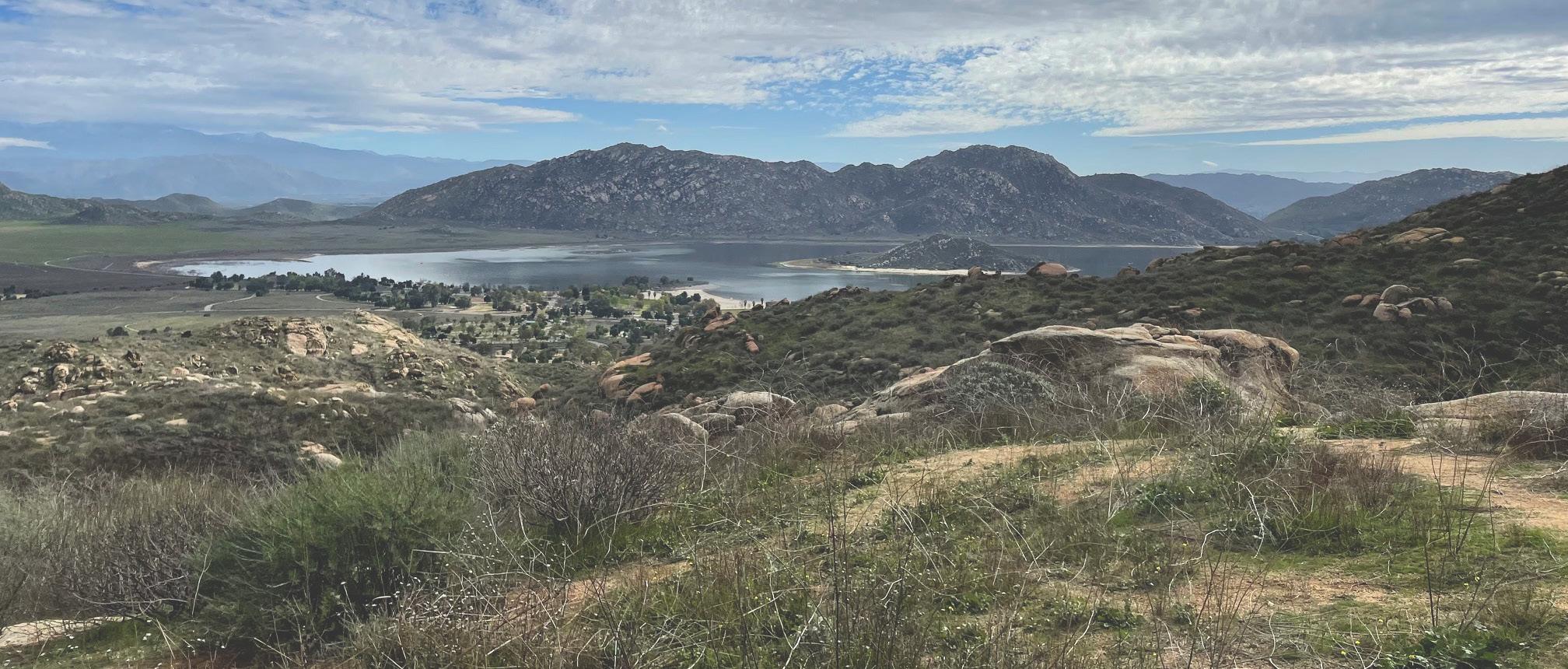
The lake as seen from the hills above the Terri Peak Loop Trail. Theresa Sama
OPINION
OPINION KNOW YOUR NEIGHBORS
BY BONNIE GILGALLON
Though she describes herself as somewhat shy, Lorie Loftis is easy to spot in a crowded room. She’s the attractive blonde dynamo who always seems to be smiling.
She was born in Beaverton, Ore., to a family with various local businesses; Beaverton Foods was the biggest, and she eventually joined the business.
Since Loftis’ aunt lived in the Coachella Valley, her mother, animal advocate Lindi Biggi, decided to look for a condo here after retiring, so she could visit during the winter months. Biggi had already started collecting birds—so instead of a condo, she found a two-acre estate.
“She went back to Oregon and told her husband, Geno, that she’d found the perfect spot for them, which would accommodate her birds,” Loftis said. “They came down here and really never left.”
Loftis started coming to the valley herself, while still keeping tabs on the businesses in Oregon.
In 2008, the family was devastated when Loftis’ teenage daughter was killed in a car crash.
“There was a lot of grief that needed to be channeled into something else,” Loftis said. “My mom had been volunteering with Animal Samaritans, helping to organize fundraisers. It’s a terrific organization, but mom did not have any say in what they did with the money raised, so she founded Loving All Animals.”
For a few years, Loftis came down during the busy season to help her mom with events; in 2011, she moved here full-time.
“I joined Janet McAfee, and we called ourselves the ‘Rescue Rangers,’” Loftis said. “Some people were afraid to take dogs and cats to local shelters because of the sometimes-less-than-ideal conditions there. We
had a limousine and would take the dogs to nicer neighborhoods and homes. We also did tours to educate people—to show them what a public versus nonprofit shelter looks like, what the Palm Springs ‘no kill’ shelter looks like, etc. The goal was to make people understand the whole ecosystem of animal rescue, and to make rescuing animals sexy.”
Loftis was very involved when Biggi opened Venus de Fido, a luxury spa for both pets and their owners. Unfortunately, the business was not financially successful.
“I think in the right place and time, it would have been super-successful,” Loftis said. “I knew all of these local businesses that we were hoping to have under one roof. But unfortunately, it took about four years for us to build the project, so some of the excitement dwindled a bit, and I had to let them go and pursue their businesses elsewhere. We ended up running most of it. It turned out that many of the pet owners we knew already had aestheticians and spas on site at their gated communities, etc., and they didn’t want beauty treatments at the same place their dogs got groomed.”
When COVID-19 hit, Loftis and Biggi decided the project was too much of a battle.
Loftis is now the co-owner of the Shadow Mountain Golf Course. Designed by Gene Sarazen, it was the first golf course in Palm Desert, founded in 1958.
“It had live music every night, and was the gathering spot at the time,” Loftis said. “Many stars like Bing Crosby hung out there, but they didn’t want too many other people to know about it. It’s always been a private club, but it had fallen into disrepair, and there were rumors it was going to be sold to make way for low-income housing. Mom was a member there and didn’t want to see that happen, so she and I took it over five years ago. We wanted to keep that sense of community, which we need in south Palm Desert.”
Loftis, who does have some hospitality experience, was concerned her mother might have bitten off more than she could chew.
“She’s a very passionate woman, and some-
Meet Lorie Loftis, an entrepreneur and music-lover who transformed grief into a passion for helping
times that passion can override common sense when it comes to business,” Loftis said.
Using the old A.J.’s on the Green in Cathedral City as a model, Loftis thought about creating a popular live music spot in the bar at Shadow Mountain.
“None of the houses around the golf course pay an HOA fee, which is a huge part of the business plan for a golf course to be able to carry itself, so there was a need for a second income stream to be able to serve the community,” Loftis said. “The music helps fill that need. Only about 37 percent of the community actually golfs, but there are lots of other things to do. You can bring your kids, your grandma; you can hang out in the beautiful pavilion, play cornhole or bocce ball, or watch sports on the big screen, etc. There are poker nights and trivia nights, and it’s also a great place to hold fundraisers for Loving All Animals. I’m not just selling golf; I’m selling the experience.”
Loftis is planning to offer VIP community memberships, which will help to pay the musicians who hold a jazz jam in Shadow Mountain’s Birdy Bar each Wednesday. Those VIP members will get a say in what kinds of programs are offered in the future. Loftis also plans to hire golf pros next year.
Loving All Animals is still going strong, and is continuing its mission of controlling the
animals
animal population by spaying and neutering dogs and cats.
“My mom just purchased the old VCA vet clinic on Jefferson (Street) and Highway 111, so Loving All Animals will be taking it over. They will offer free or low-cost spay and neutering services, which will really help the community, especially seniors. It’s gotten to the point where you need to be wealthy to own a pet, and that’s just a sin.”
A lifelong music lover, Loftis is herself an amateur singer.
“I sing, but I’m humble about it,” she said. “With all the great talent around here, I don’t shove myself into the spotlight. But if I had a little bit more time, I would probably sing more. I also love to travel. My son’s still in Oregon with his kids. … I’d love to spend more time with them.”
What’s the code Loftis lives by?
“The Golden Rule—period,” she said. “But also: Let the past be in the past. And anything can be solved with a little bit of love.”
Bonnie Gilgallon has written theater reviews for the Independent since 2013. She hosts a digital interview show, The Desert Scene, which can be heard on www.thedesertscene.com and viewed on Mutual Broadcasting’s YouTube channel. Learn more at bonnie-g.com.
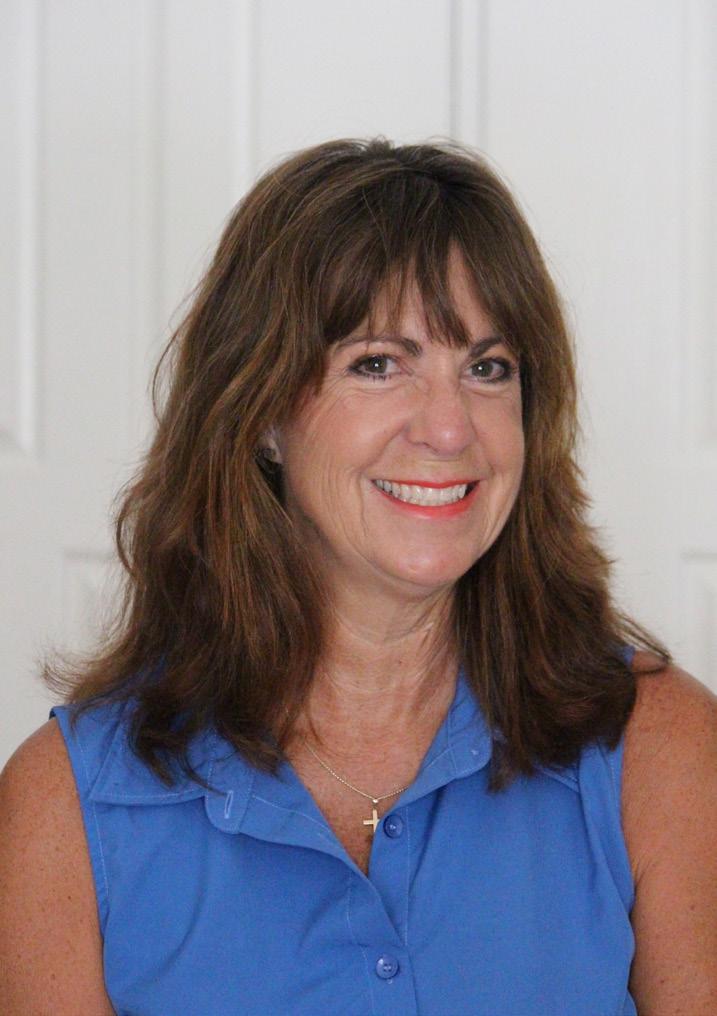
Lorie Loftis.
BIG CASH FOR PREMIUM CARE?
by Kevin Fitzgerald
Registered nurse Kristine Kassner is suing Eisenhower Medical Center, her former employer, for wrongful termination.
The complaint names individuals Wendy Edwards, vice president of the 24/7 Recognition care unit, and Connie Head, director of 24/7 Recognition care, and accuses EMC of
wrongful termination and 10 other labor-related violations, including failure to pay overtime, failure to provide meal periods, and retaliation in violation of the California Fair Employment and Housing Act.
The suit was filed on her behalf by attorney Jeff Rager, of the El Segundo-based law firm Rager and Yoon, on Jan. 8. Rager also represented Dr. Richard Loftus, the former assistant program director of the Internal Medicine Residency Program at Eisenhower Medical Center, in a successful suit against EMC regarding executives’ resistance to his COVID-19 safety recommendations.
During a recent interview with Kassner and Rager, Kassner explained what motivated her to take legal action.
“I was questioning the things that were happening when leadership changed (in the 24/7 Recognition unit),“ Kassner said. “I kept questioning and thinking: If you talk about it, if you explain it, if you expose it, then they will do the right thing, and change as things come to light. Unfortunately, that did not happen, and then I was wrongfully terminated. So, I contacted Mr. Rager to assist me.”
Rager explained the lawsuit’s goals.
“From a legal perspective, what we’re looking to do is expose the issues that need to be remedied,” Rager said. “Also, we’re looking for justice, and justice takes many different forms, one of which is public scrutiny, and the second of which is compensation for the derailing of (Kassner’s) career.”
Kassner, who was employed at EMC from September 2015 to September 2025, makes a variety of claims in the lawsuit. One claim: She and other 24/7 nurses were required to help with a new, for-profit concierge home healthcare service being launched internally.
“They were using the (nonprofit entity’s) 24/7 staff to set it up … to do policies, to do everything,” she said. “So, they were utilizing their (nonprofit) staff and their resources for this for-profit business. And when this first was mentioned, I questioned … the legality of it, and also let them know that I did not want to participate in this nonprofit working at the for-profit (arrangement).”
However, the most interesting claim, as far as the public is concerned, concerns how EMC’s 24/7 Recognition unit assists big-mon-
ey donors.
The Eisenhower Health Foundation (EHF) website describes the 24/7 Recognition unit, where Kassner worked for the last seven years of her employment with EMC, this way: “For those making gifts totaling $300,000 or more, this unique program is Eisenhower’s way of saying ‘thank you.’ 24/7 members are proudly recognized in the hospital’s main lobby.” On ensuing web pages, EHF says: “24/7 Recognition members enjoy access to a dedicated nursing team offering a streamlined, rapid-response experience. Your 24/7 nurse is focused on delivering the best possible outcome.” And: “Our 24/7 nursing staff is available by phone around the clock, seven days a week, to answer questions and assist with your health care needs. With access to the Renker Pavilion for any overnight stays, assistance with finding a physician, scheduling appointments, hospital admission, emergency department response, transfers to Eisenhower and medical records management.”
Kassner claims 24/7 Recognition personnel delivered to these donors much more than the website says.
“This is the selling point: You have 24/7 services,” Kassner said. “… You will get preferential treatment for appointments. You’ll get into see specialists (whose) practice may be closed to the general public. You will have … access to your own special lab, so when you walk into the labs, you will not be waiting in line. You will head right back and be immediately served. In the emergency room, it’s the same thing.”
The lawsuit claims: “The team works (for donors) to get preferential treatment at the expense of the rest of the patients. More specifically, these donors were brought immediately into the emergency department and given beds while other members of the general public would wait, at times, for 10-12 hours to be seen. They were moved to the front of the line for emergent medical care based upon their donations, not acuity. Further, the donors would get preferential appointments which could be accommodated by bumping an existing appointment or creating appointments in already busy calendars. Staff would also meet donors in the parking lot for drive through drop off of lab specimens.”
Kassner elaborated in the interview with the Independent: “Back in the day, the departments
A wrongful-termination lawsuit against Eisenhower Medical Center questions the preferential treatment received by donors
would cancel appointments of normal patients to accommodate the needs of a priority donor,” Kassner said. “If a 24/7 member said, ‘I want my MRI done on Friday at 10’clock,’ and that appointment slot was already taken, then the imaging department would call up and cancel that patient, and put one of our 24/7 members (in that time slot). That practice has ceased, so now they just cannot dictate what day they want their appointment. But still, we used to kindly persuade the scheduling department to get our patients in earlier … during a timeframe, if (patients) were going to be leaving for the season. If the schedulers did not accommodate our request, it would be escalated up to the director of the department to make sure that it happened. Also, (EMC) would leave certain slots open in case there’s an emergency in the community. But they would be known to give those appointments to 24/7 members, especially ambassadors. Ambassadors are members that have donated more than $1 million, and they get treatment that’s 24/7 treatment … on steroids.”
The EHF website says about ambassadors: “To be included among the Eisenhower Ambassadors is truly a mark of distinction. They are the very embodiment of the You+Eisenhower ethos, extending beyond financial support to provide credibility, connections and the conviction to manifest our beliefs and aspirations.” As for “How It Works,” the site says, “Eisenhower Ambassador is the highest level of donor recognition, acknowledging our most dedicated supporters. Members of this prestigious group have not only made donations at or above the $1 million level, they have wielded their influence to bring in millions more in Eisenhower’s pursuit of medical excellence. Donors at this level are recognized in the main lobby of the hospital.”
Kassner said that during her tenure with EMC’s 24/7 Recognition team, they used a workaround strategy to get 24/7 patients into concierge medical practices within the EMC organizational structure. Any participating concierge doctor must stop accepting new patients when a pre-determined maximum patient cap is reached, to guarantee all patients paying the annual surcharge could receive the promised benefits.
“Regardless (of whether) you were a 24/7 member, if you called up and said, ‘I’d like to be part of your service,’ (the concierge doctor who’d reached their cap) would say, ‘I’m sorry, but we’re full.’ But, if on behalf of a 24/7 member, (a staff member would) call up and say, ‘This is for a 24/7 member, or an ambassador, or they did this; can you put them into your
service?’ ‘Oh, yes, we can,’ they would say. That was another (benefit) of being part of 24/7, even though you still had to pay for your concierge. The general public might not be able to get to that doctor, but a 24/7 patient could.”
Over the last seven or eight years, according to Kassner, the number of patients who donated $300,000 or more, and were enrolled in the 24/7 Recognition program as a result, has increased from roughly 1,000 to 3,000. All of these VIP patients expect preferential medical treatment and special attention.
“Here’s where it crosses the legal and ethical lines,” said Rager. “You can provide superior service. You can provide amenities such as coming to get you out of your car. You can provide trinkets, and you can provide all the administrative-type services that don’t cross the line to preferential clinical care that trumps the regular triage process that everyone else is entitled to as a (normal) part of the general public being serviced by EMC. So, that’s where it gets into something that is not allowed—if and when you’re crossing that clinical line. … that’s where it gets to more than just VIP service.”
The Independent reached out to Eisenhower Health for comment, and received this response: “Eisenhower Health does not comment on pending litigation. We intend to vigorously defend against the claims made in the lawsuit, and look forward to presenting the facts through the appropriate legal process.”
Registered nurse Kristine Kassner is the plaintiff in a wrongful termination lawsuit against Eisenhower Medical Center. Kevin Fitzgerald
‘GROW OUR OWN’
by MELISSA DANIELS
To address the Coachella Valley’s doctor and nursing shortages, local health-care institutions are looking at ways to get more locals trained and educated in the field.
The Desert Healthcare District and Foundation in late May approved a new five-year strategic plan. The plan offers a framework for the funding decisions, partnerships and projects DHCD
takes on—and the first of four pillars is workforce development, which includes recruiting and retaining more health-care workers.
“I think it’s important for us to make sure that we really do grow our own, and one of the ways that we’re going to be able to attract that workforce is by making it easier for them to go to school,” said DHCD board president Kimberly Barraza in an interview with the Independent.
A DHCD market analysis from March 2023 identified a shortage of 236 physicians, primarily in internal medicine, pediatrics, obstetrics and gynecology. That includes a shortage of 70 pediatricians, based on the region’s population—a shortage that forces some families to leave the area for care.
But in recent years, local organizations have launched new efforts to train health-care workers. The desert and the broader Inland Empire as a whole are experiencing one of the state’s worst health-care worker shortages— which means it’s very good news that College of the Desert this year graduated a record 91 registered nurses, more than doubling previous class sizes.
That growth didn’t happen organically; it was bolstered by a $2.9 million commitment from OneFuture Coachella Valley’s Healthcare Workforce Leadership Roundtable, which includes the Desert Care Network, Eisenhower Health,
the Inland Empire Health Plan and the Desert Healthcare District and Foundation. The funds supported expanded laboratory space, and additional staff and faculty for the nursing programs, as well as scholarships, housing, transportation and food assistance for students. The Coachella Valley needs approximately 350 new nurses annually to fill the needs of the area, per the roundtable’s estimates.
The Desert Healthcare District board in late 2024 approved a two-year grant of $374,900 to specifically support the enrollment of 35 nursing students through scholarships and holistic services.
Barraza said investing in such services can lead to an immediate impact, as many students are living in the valley and do their training at facilities including Desert Regional and Eisenhower medical centers.
“For us, what’s really important is that we’re investing in the community, and seeing that return on investment so quickly,” Barraza said.
Separately, DHCD has been supporting scholarships for locals who want to get into health care. Last year, the board approved a two-year $839,500 grant for OneFuture’s Black and African American Healthcare Scholarship Initiative. It also approved $86,250 to go toward scholarships awarded through the Dr. Carreón Foundation, which it has supported
One of the Desert Healthcare District’s new priorities: developing a health care workforce
going back to 2017.
The DHCD’s new strategic plan was launched in the midst of a leadership shakeup. CEO Chris Christensen was fired after expressing concerns about board conduct and leadership—at the very meeting where the board passed the strategic plan. Chief Program Officer Donna Craig, who has been with the distinct for 21 years, is serving as the interim CEO during the search for a permanent CEO. Other institutions are working on the local health-care workforce shortage. California has received about $233 million in federal funds to support the California Rural Health Transformation program. Part of the plan is to fund pipeline and pathway programs, and to expand clinical placement and supervision sites so more doctors and health care workers can train
Community Is Our Priority.
For 13 years, the Independent has been telling the Coachella Valley’s stories. Our mission is to inform readers like you—and to help you build stronger connections with your community. To continue doing so, we need reader support!
Please consider becoming a sustaining Supporter of the Independent, or make a one-time donation, by visiting CVIndependent.com/support-our-publication, or by sending us a check.
You can support the Independent directly (nontax-deductible)—or you can make a tax-deductible donation via our fiscal sponsor, the Alternative Newsweekly Foundation (ANF). Via ANF, we can accept cash, grants and donations from donor-advised funds. We can even accept stock or crypto!
Questions? Email jboegle@cvindependent.com, or call 760-904-4208.
Want your donation to be taxdeductible? Make your check out to the Alternative Newsweekly Foundation. Don’t need a tax deduction? Make your check out to the Coachella Valley Independent.
Please mail checks to:
Coachella Valley Independent 31855 Date Palm Drive #3-263 Cathedral City, CA 92234
in rural and underserved areas.
Kathryn Phillips, an associate director on the California Health Care Foundation’s Improving Access team, said local organizations are often the most influential organizations in recruiting locals into the health care workforce—but having local training programs is key.
“We know from decades of research that where you train is where you stay,” she said.
But this pattern can work against rural areas that don’t have educational opportunities.
“Most physicians stay within 60 miles of where they’re completing their residency training,” Phillips said. “So while we have a good track record as a state of keeping folks we educate and train within California, we keep them in the city centers.”
This where-you-train-is-where-you-stay philosophy is fueling growth at the UC Riverside School of Medicine, which graduated its first class of about 40 in 2017. This year, around half the graduating class of 78 doctors is staying in the Inland Empire for residency training.
UCR Health’s expansion plan includes a 21-acre site in Riverside meant to complement the school’s growth—an attempt to not only address the region’s growing health-care needs, but also give medical students more opportunities to train and stay local.
“This initiative will strengthen our ability to meet the health-care needs of the Inland Empire by expanding access to primary and specialty care, while also creating opportunities to train more students and support the growth of medical school enrollment,” said UCR Vice Chancellor and Dean Deborah Deas in a press release.
Melissa Daniels reported this story while participating in the USC Annenberg Center for Health Journalism’s 2026 California Health Equity Fellowship.
College of the Desert this year graduated a record 91 registered nurses, more than doubling previous class sizes. College of the Desert YouTube
PICKLEBALL PROS
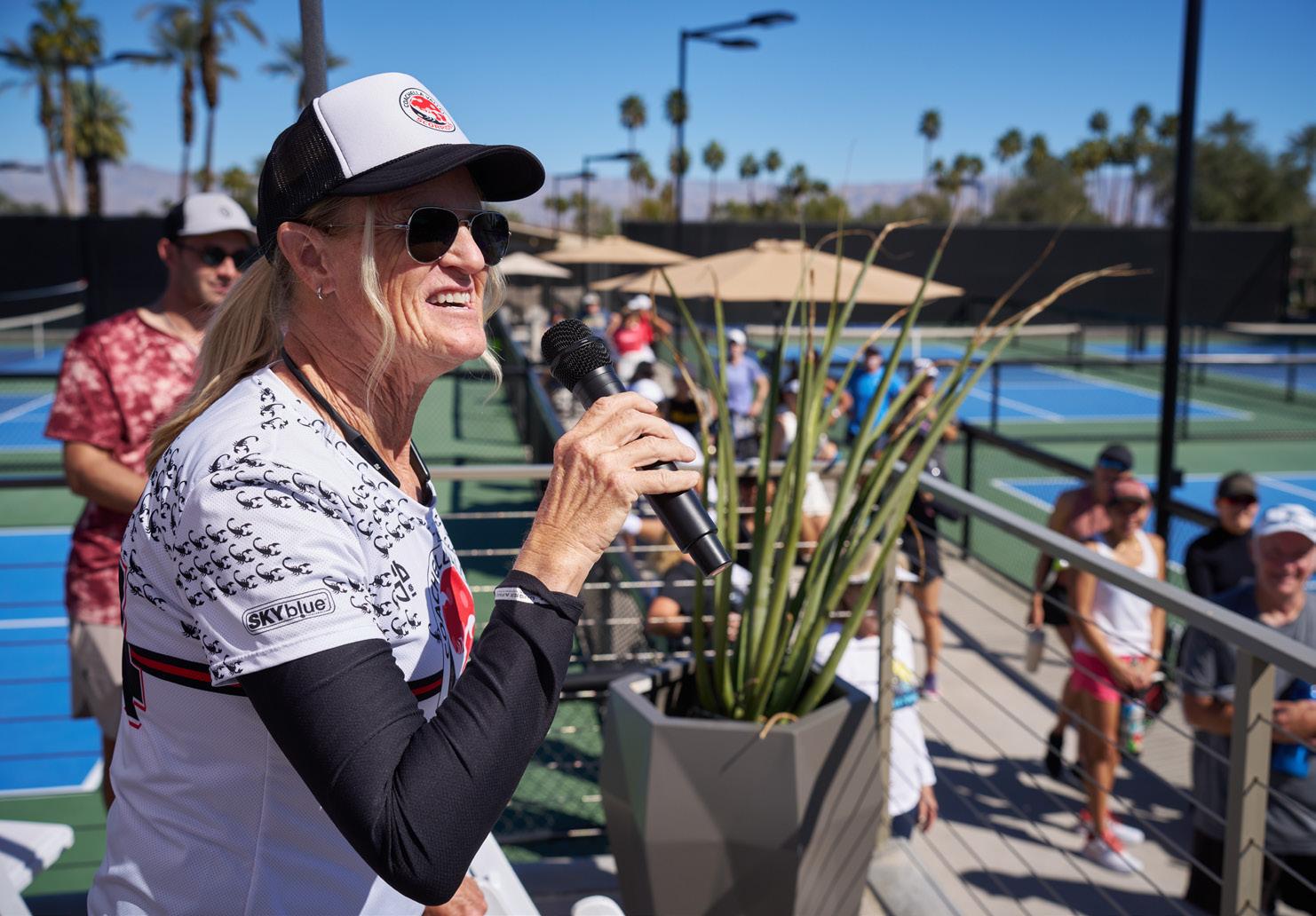
Did you know the Coachella Valley has a championship professional pickleball team? Champions Series Pickleball (nplpickleball.com), a professional league formerly known as the National Pickleball League, welcomed their first California team, the 50-and-older Coachella Valley Scorpions, in 2024. The Scorpions, thanks to a partnership with actor Vince by MATT KING
Vaughn, drafted locals onto a competitive team—a team that won the league championship in 2025.
The Coachella Valley Scorpions (scorpionspickleball.com) will make their 2026 debut in an exhibition match against the LA Xtreme at 5:30 p.m., Thursday, July 9, at Agua Caliente Rancho Mirage.
During a recent phone interview with Kim Jagd—co-owner, general manager, managing partner and player with the Scorpions—she explained how she fell in love with pickleball.
“I was out and about on a hike, going to The Cross over by Cahuilla Park, and I heard this crazy noise coming from the two tennis courts that are right there,” Jagd said. “I had to go see what was going on, because I was a tennis player in my youth, and I had never even heard of pickleball before. I saw these people playing on this little court, and just kind of fell into the sport. I was closely approaching the age of 50, and thought, ‘God, this is a really cool thing. They play it in the senior games in Utah, and the Palm Desert Senior Games, so maybe this could be something else I can do with all my sports background and all the time that I had since retiring.’”
Jagd—a national volleyball champion in 1984, and an associate head volleyball coach from 1992 to 2010 at UCLA—linked up with other desert residents to learn more.
“I got grouped into a bunch of really great tennis pros here in the valley,” Jagd said. “One was Morgan Evans, who is a kind of an OG in the pickleball sport now; and Marcin Rozpedski; he is running a tennis training academy here in the valley. Then (I met) a guy that had been playing pickleball a little longer than me, Scott Burr, who is also on the team right now. We just took on learning this crazy game. … Then we started traveling to tournaments.”
After participating in the senior pro leagues and winning a number of tournaments, Jagd said, she and others noticed that senior leagues were beginning to “take a back seat” at pickleball events. They began searching for something new.
“Several senior pros and myself got together and said, ‘We’ve got to do something about this; we’ve got to find our own niche, our own place to play,’ and several of these friends went off and started what was called the National
Pickleball League, and that was Rick Witsken and Beth Bellamy, two of the top pros at that time,” Jagd said. “They came up with this idea to start a team league, which was starting to take shape as even more fun in pickleball than just regular tournaments. … Team pickleball is just really different. It’s more like my background, playing volleyball with 12 other girls.”
Jagd decided to enter the new league’s player draft.
“I got drafted by a team out of Indianapolis called the Indy Drivers, and that that first year of the league, the Drivers were actually able to win the championship—and I was even more passionate about team pickleball. I just thought it was just the greatest thing,” she said.
The Coachella Valley Scorpions were the seventh team in Champions Series Pickleball, joining the league in 2024.
“We had an injury-plagued season and ended up finishing fifth in the league out of 12 teams. We were pretty proud of that fifth, considering how beat up we were,” Jagd said. “We really wanted to retool and put together a great team in 2025, and put even more work into the recruiting and the drafting and finding great local Southern California talent and Coachella Valley talent. We put together a great squad— and we were able to win the league, which was absolutely stunning, in our second year.”
The Scorpions will kick off their third year at their July 9 exhibition with a trophy presentation, a celebrity match, and the debut of new sub-leagues.
“The league has now expanded to include sub-leagues for 40-year-olds, and 60 and over, so I now have a 40-year-old team, a 50-year-old team, and I have a 60-year-old team, all under the umbrella of the Scorpions—so we have the opportunity to win three championships in 2026,” Jagd said.
Agua Caliente Rancho Mirage is, as of now, the only place to see the Coachella Valley Scorpions play at home. Jagd said the lack of an indoor pickleball court in the desert keeps the team from hosting events.
“I’m doing my best to do as many small events as we can here in the desert to bring attention to the Scorpions, but we cannot host an event for our league,” she said. “It’s the top of my mission board to help see a nice-sized indoor facility come to the desert, that would
The Coachella Valley Scorpions kick off their 2026 season with an exhibition match at Agua Caliente Rancho Mirage
not only be a home of the Scorpions, but it would be a place to play, have events, be a community asset—after school programs, all kinds of things.”
Agua Caliente, which also sponsors the Scorpions, transforms The Show concert venue into a temporary pickleball court.
“They bought a temporary court; it’s called a PickleRoll,” Jagd said. “Pickleball is very hard to play on anything but a proper surface, so what they’ve done is they’ve used their concert hall … and they take all the chairs out of the orchestra, and they put down this PickleRoll court for us. Last year, we had over 400 people come to a media day event and exhibitions.”
Despite the lack of a home court, Jagd and the Scorpions continue to promote pickleball in the desert, including a program at Desert Horizons Country Club.
“We started the pickleball program here, probably 11 years ago, on one paddle tennis court, and now with our country club remodel, we have 11 permanent courts, individually fenced, with LED lights,” she said. “It’s absolutely a stunning investment by the club, to put $3 million in over at our courts—and we’ve become known as quite a pickleball program now. They’re super-supportive of the Scorpions and my involvement with the pro team, and they’re very willing to share the courts with me and let me bring events in.”
Champions Series Pickleball is on the rise, welcoming four new teams to the league this
year: the Detroit Disrupters, Los Angeles Xtreme, Phoenix Firebirds, and Las Vegas Headliners.
“I had no competition for the talent in Southern California, so I could pick who I wanted— and now all of a sudden, there’s a team in L.A., and there’s a team in Vegas, and there’s a team in Phoenix,” Jagd said. “My territory got a lot smaller, and they don’t know the talent as well as I do yet, but they will. … I had to work a lot harder this year, and maybe I didn’t get as much of the top talent, but I was also able to find talent, from my years of experience of recruiting, that I know that I can develop.”
Jagd and the Coachella Valley Scorpions hope the desert can become a hotspot for pickleball.
“It could be this community asset for the kids who live here full-time to get out of the heat and train at a sport that is so fun,” she said. “We’ve got great coaches in this valley, so it can be the next hotspot for training young pickleball pros. Anna Leigh Waters made $2 million last year in professional pickleball, so the money is there now. We’ve got to hit the grassroots. Naples, Fla., is a hot spot; Austin is a hot spot, so why can’t the Coachella Valley be that West Coast location?”
The Coachella Valley Scorpions play the LA Xtreme in an exhibition match at 5:30 p.m., Thursday, July 9, at Agua Caliente Rancho Mirage, at 32250 Bob Hope Drive. Tickets start at $40.75. For tickets, visit aguacalientecasinos.com.
Kim Jagd at a Coachella Valley Scorpions combine at Desert Horizons Country Club. Photo courtesy of the Coachella Valley Scorpions
STEPPING DOWN
by MAggie miles
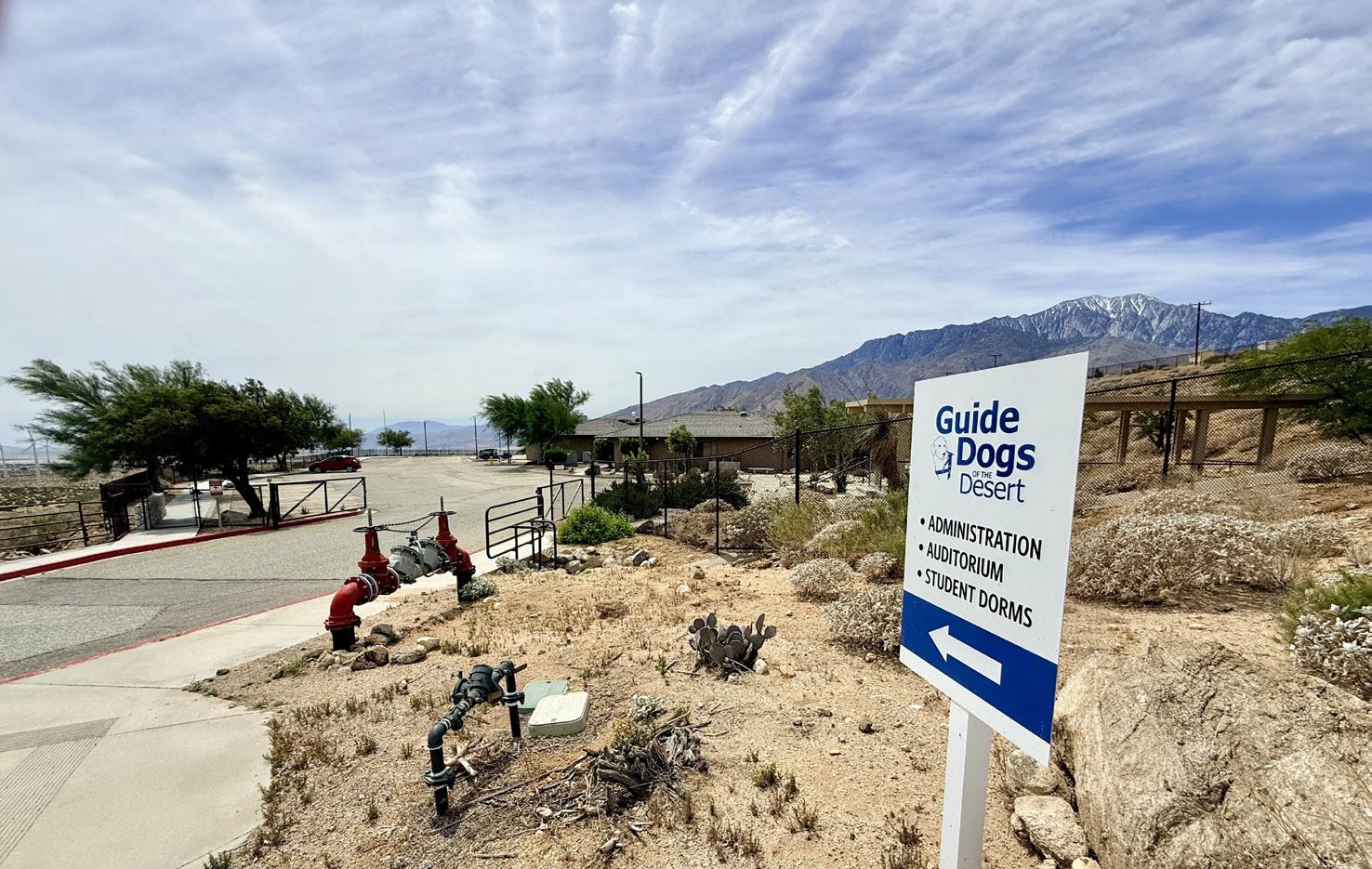
The chairman of Guide Dogs of the Desert’s board of directors has resigned, and the organization has restructured its leadership, The Palm Springs Post and Coachella Valley Independent have learned, weeks after a joint investigation revealed safety, management and financial concerns at the Whitewater nonprofit.
Richard Clapp confirmed that he was stepping down as chairman on June 30, to be replaced by current vice chair Guido Portante. The organization has also elevated executive director Robert Maher to chief executive officer and hired Rosa Verduzco as chief operations officer.
Clapp did not cite the investigation as the reason for his resignation, instead stating that his desire to step down began two years ago when he was diagnosed with prostate cancer.
“I’ve been way too busy. I’m supposed to retire. I’m supposed to be traveling, so I’m looking for ways to make my life simpler,” he said. “I’d originally planned on retiring from Guide Dogs in January, but stayed on until now … so it’s just time to do fewer good things, and do some fun things.”
Regarding the leadership restructuring, Clapp said the goal was to bring the organization’s structure more in line with other nonprofits in the valley.
“There are very, very few that run with the head person being called an executive director; they’re mostly president or CEO or something, and we decided on CEO,” he said.
When asked about the reasoning for adding the new COO role, Clapp said the organization
had been debating how to best restructure.
“You reach a point where you take a look around at an organization, and you realize that with everything going on in society and the changes and everything, you just need to take a look at how it’s organized and how it’s run,” he said.
“There have been some personnel switches and changes, and it just made sense to let Rob focus more on what his expertise is about— fundraising, and rearranging things lets him do what he does best, and be able to monitor everything that goes well.”
Maher did not respond to the Post and Independent’s request for comment.
The announcements follow a six-month investigation published by the Post and the Independent online on April 23, and in the Independent’s May print edition. citing safety complaints, leadership concerns and financial warning signs at the organization. The investigation was prompted after an Aug. 16, 2025, rape and murder attempt against a female employee by an intruder at the organization’s Whitewater campus. The assailant was sentenced on March 19 to 25 years to life in prison.
During the investigation, the Post and Inde pendent spoke with more than 15 current and
Guide Dogs of the Desert board chair Richard Clapp is resigning; executive director Robert Maher elevated to CEO
former employees and volunteers and reviewed internal documents, emails and court records. Those materials revealed that employees had raised concerns over campus security, including gaps leading up to the attack.
Among them was a broken lock on a door to the building where the attack occurred, which was allegedly left unfixed despite requests from multiple employees; employees also expressed concerns about leadership’s response following the attack. (There is no indication in court records that the attack was directly linked to the issues raised by staff.) The documents also showed concerns over management and workplace practices and a pattern of concerns over financial mismanagement.
At the time, Clapp and Maher declined to answer specific questions about internal complaints, saying they could not speak publicly on personnel matters, but broadly disputed claims described by current and former employees, internal communications and documents.
“There is nothing to say to you, because those are all private matters, and they don’t
have anything to do with you, the public, or anyone else,” Maher said in an interview ahead of the April 23 publication of the investigation.
“My response is that these are all in-house staff relations, and of course, by law, I’m not allowed to speak on them.”
The investigation also included a lawsuit filed by former human resources director and community engagement director Caryn Gates, alleging 15 causes of action, including whistleblower retaliation, discrimination, harassment and failure to implement required workplace violence prevention measures.
The suit followed what she said were attempts to work with leadership on multiple concerns brought to her by staff, including concerns leading up to and following the attack, and a discrimination claim from a blind employee.
In a statement, Gates wrote, “I can confirm that my lawsuit against Guide Dogs of the Desert has been resolved. I’m not able to discuss the terms of the resolution.” She is no longer employed by the organization.
Guide Dogs of the Desert board chairman Richard Clapp is resigning effective June 30, due to health concerns and a desire to retire, he said. Mark Talkington
CV HISTORY
RHow the little city of Rancho Mirage became the ‘Playground of the Presidents’
The upscale town has long been associated with celebrities and world leaders, and has accordingly been nicknamed the “Playground of the Presidents.” Every president from Harry Truby greg niemann
ancho Mirage only has a population of about 17,000—but it has made a big impact on the world stage.
man to Barack Obama visited Rancho Mirage, several numerous times. Important summits with world leaders were held in the city by presidents George H.W. Bush and Obama. President Gerald Ford lived in Rancho Mirage from when he left the White House in 1977— he and his wife built a home at the Thunderbird Country Club—until his death in 2006.
Some have also called Rancho Mirage the “Golf Capital of the World,” as the city has hosted golf tournaments including the Davis Cup, the Ryder Cup and the Desert Classic. Today, the city is home to 17 courses.
Like much of the rest of the Coachella Valley, Rancho Mirage was historically occupied by the Agua Caliente Band of Cahuilla Indians. In 1862, entrepreneur William Bradshaw developed an overland stage route following Indigenous trails through the valley, mostly along what is now Highway 111, to gold fields in Arizona. Then in 1876, the railroad came through the valley.
In 1912, Everett Knox DaVall bought a half-section of land from the Southern Pacific Railroad and planted 250 date palms at what he called Wonder Palms Ranch. In 1924, investors R.P. “Bert” Davie and E.E. McIntyre began buying 80-acre parcels to resell. The next year, William Everett established Eleven Mile Ranch at the end of Magnesia Falls Cove (where Magnesia Springs Canyon begins).
In 1932, Leslie and Helen Clancy built the first ranch at Rio del Sol Estates, giving birth to today’s Clancy Lane neighborhood. Two years later, Pasadena businessman and entrepreneur Louis McLaughlin “Mac” Blankenhorn bought land around Magnesia Falls Cove and began selling lots and homes. As one story goes, the name “Rancho Mirage” was suggested by his wife, Ruth. She said it looked like a “mirage,” and he added ‘Rancho” for sales appeal. Another story attributes the name to one of Blankenhorn’s sales managers, Lawrence Macomber, who supposedly combined the Spanish “Rancho” with “Mirage.” Another version credits one of the salesmen, John Talbert, who named many of the streets. Regardless, the name evolved from Blankenhorn’s team.
In 1937, Macomber and Don Cameron began offering “close to Palm Springs” lots. They were able to attract actor Frank Morgan
(The Wizard of Oz), who built one of the original Rancho Mirage homes on Sahara Road. He was the first of many Hollywood celebrities who have enjoyed Rancho Mirage living. In 1945, A. Ronald Button, a Hollywood attorney with a number of celebrity clients including Hedy Lamarr and Thelma Todd, purchased almost 2,000 acres of the land around Magnesia Falls for residential development.
In 1946, Los Angeles architect Henry L. Gogerty bought 320 acres and established an airstrip in Rancho Mirage, and later launched the Desert Air Hotel and Airpark. The airstrip eventually yielded to progress; the Omni Rancho Las Palmas Resort and Spa occupies much of its land.
Thunderbird Country Club
It was golf, and expressly the Thunderbird Country Club, that gave many celebrities a haven in the desert.
Thunderbird started when Palm Springs promoter and eventual mayor Frank Bogert bought a section of land from Raymond Cree (a Palm Springs superintendent of schools and an investor) for $34,000 in 1946 and developed the Thunderbird Dude Ranch. The only golf course in the Coachella Valley at the time was the nine-hole O’Donnell Golf Course in Palm Springs. Amateur golfer Johnny Dawson and Bogert figured the dude ranch would be an excellent locale for an 18-hole course. With others, they were able to attract enough investors, including Bob Hope, Randolph Scott, Phil Harris, Desi Arnaz and Ralph Kiner, to build the desert’s first 18-hole golf course.
Thunderbird Country Club opened on Jan. 9, 1951, and immediately became one of the nation’s premiere golf courses. Bogert became club manager, and Dawson was club president. Early buyers included tire-company president Leonard Firestone and Hollywood couples Phil Harris and Alice Faye, and Desis Arnaz and Lucille Ball.
Interesting Thunderbird tidbits: The Ford Motor Company liked the Thunderbird logo so much that in 1954, they named their new sports car after it. The electric golf cart was supposedly invented for members of Thunderbird Country Club.
Like many country clubs at the time, Thunderbird did not allow Jewish members. This
led A-listers including Jack Benny, Danny Kaye, George Burns and the Marx Brothers to found the nearby Tamarisk Country Club in 1952, where the second 18-hole golf course in the desert was established; reigning Masters and U.S. Open champion Ben Hogan was head pro. In 1954, Frank Sinatra bought a William F. Cody-designed house on the Tamarisk Country Club’s 17th fairway.
Sunnylands
Entrepreneur/philanthropist Ambassador
Walter Annenberg and his wife, Leonore, built a 200-acre estate in Rancho Mirage, called Sunnylands, which they began using in 1966.
Designed by A. Quincy Jones, Sunnylands features a main residence, three cottages, a nine-hole private golf course, 11 lakes, a tennis court, conference center and much more. For more than 40 years, the Annenbergs hosted dignitaries, royalty and most of the U.S. presidents since Dwight D. Eisenhower.
Today, the Sunnylands Center and Gardens is open to the public during much of the year.
Eisenhower Medical Center
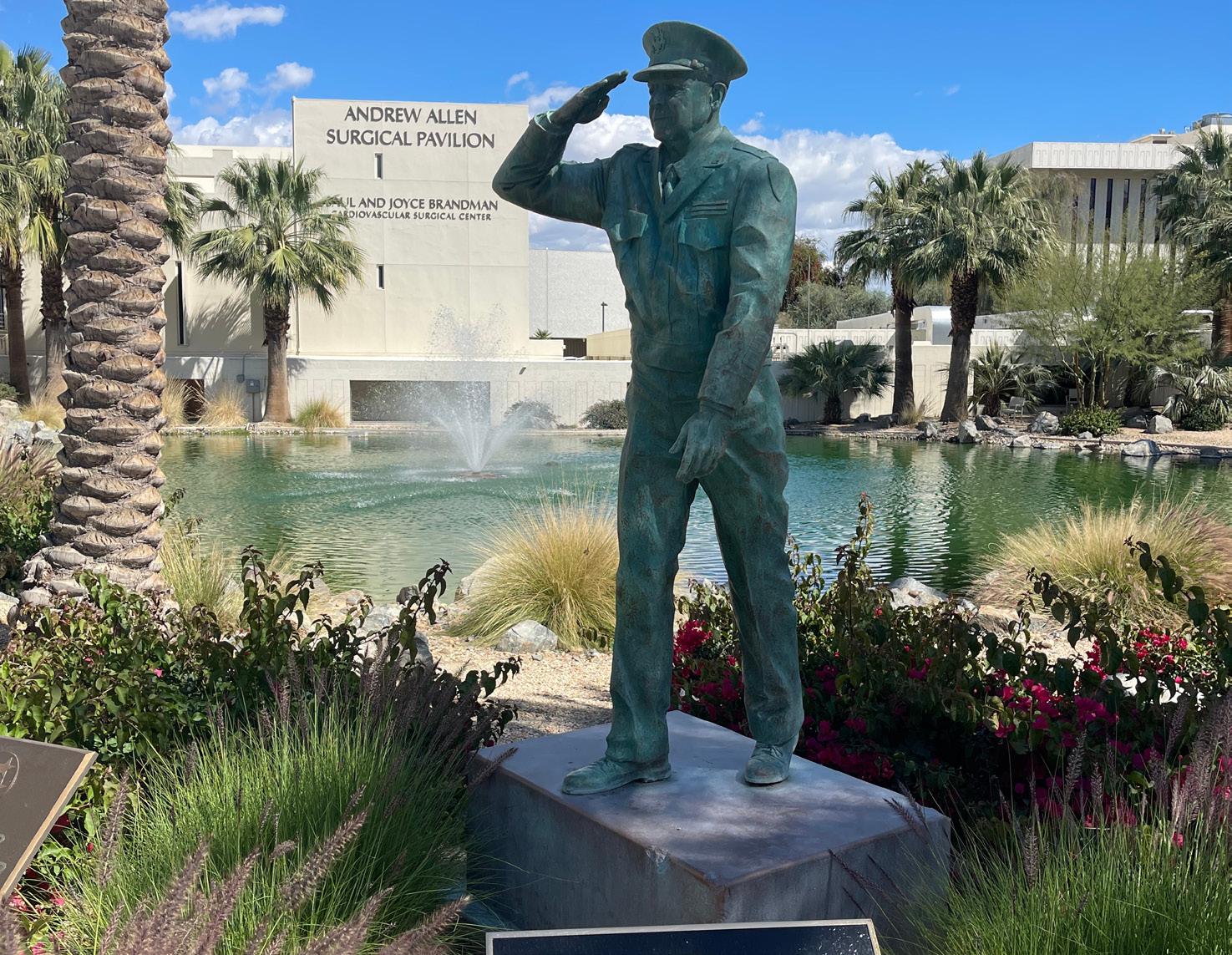
The desert’s largest hospital is the nonprofit Eisenhower Medical Center. Named for President Dwight D. Eisenhower, the hospital got its roots in the mid-1960s when Bob and Dolores
Hope donated the original 80 acres of land and also helped raise funds for the hospital’s construction.
The 1969 groundbreaking ceremony was attended by President Richard Nixon, Gov. Ronald Reagan, and entertainers Bob Hope, Frank Sinatra, Bing Crosby, Gene Autry and Lucille Ball. The facility opened in 1971. Constantly expanding, Eisenhower Health is now a 437-bed hospital with 93 outpatient clinics.
In 1982, Betty Ford and her next-door neighbor Leonard Firestone co-founded the Betty Ford Center at Eisenhower Medical Center.
Incorporation and the future
The city of Rancho Mirage was incorporated on Aug. 3, 1973.
Today, the city continues to grow. Adding to Rancho Mirage’s luster, the Disney corporation has developed its first residential community there. Called Cotino, its 618 acres combines residential living with parks and a man-made lagoon. The first residents arrived in 2025.
Sources for this article include “A Look Back in Time” by city of Rancho Mirage, 1993; Sunnylands Center and Gardens, www.sunnylands.org; and “Beyond the ‘country club city’ and ‘playground of presidents’: Rancho Mirage is turning 50” by Tom Coulter, The Desert Sun, Aug. 11, 2023.
Named for President Dwight D. Eisenhower, Eisenhower Medical Center has its roots in the mid-1960s when Bob and Dolores Hope donated the original 80 acres of land. Greg Niemann
Moments that Live on in the Coachella Valley
By Jennifer Barnakian-Poland
During a recent visit to the cemetery, a young boy stepped out of a car covered in congratulatory messages. Dressed in a bright blue graduation cap and gown, he made his way across the grounds toward a loved one’s gravesite. On a day dedicated to celebrating his own accomplishment, he chose to share that milestone with someone who could not be there in person.
It was a simple act, but a powerful reminder that some of life’s meaningful moments are shared not only with those beside us, but also with those we carry with us in memory.
These are the experiences that unfold every day at the Coachella Valley Public Cemetery District. Located near the Empire Polo Club, where crowds gather to celebrate life at full volume, the cemetery offers a quieter place for reflection and remembrance. Here, memories are honored, stories are preserved, and generations remain connected.
“For a century, families have entrusted us with preserving the memories of their loved ones,” said Joshua Bonner, General Manager of the Coachella Valley Public Cemetery District. “What makes this place special is seeing those connections continue from generation to generation.
Whether someone is visiting a family member, a close friend, or simply seeking a quiet moment of reflection, providing a place to maintain those bonds remains just as meaningful today as it was 100 years ago.”
For nearly 100 years, families have come to the Coachella Valley Public Cemetery District for that very reason. Often viewed solely as a place of mourning, the District has become a place of connection for our community. Thousands of visitors pass through its gates to honor a loved one on a birthday or anniversary. Others stop by after a wedding, a new job, the birth of a child, or, in this case, a graduation ceremony, carrying stories they feel compelled to share.
Recently, Father’s Day offered another opportunity for visitors to spend a peaceful morning at the cemetery. For many families, the day is filled with gatherings, backyard barbecues, and cherished traditions at home. For others, it is much quieter. Some bring a folding chair to a gravesite and enjoy a cup of coffee beneath a shaded tree while reflecting on a favorite memory.
These acts of connection are just some of the many ways our visitors honor and celebrate loved ones throughout the year. Memorial Day ceremonies pay tribute to those who served our nation, while Día de los Muertos brings families together through rich traditions centered on honoring those who came before them. Those stories are reflected throughout the grounds, where historic headstones stand alongside newer memorials, representing generations of Coachella Valley families whose lives and legacies continue to be remembered.
Long before the Coachella Valley became known around the world for festivals and tourism, the cemetery was home to those who established roots and helped build our communities. Their impact can still be seen today, not only in the names etched in stone but in the family members and friends who continue to visit, remember, and celebrate their lives with them.
As the Coachella Valley Public Cemetery District approaches its centennial anniversary, its purpose remains as meaningful as ever. It is a place where past and present meet, where traditions endure, and where stories and memories continue to be passed from one generation to the next.
Sponsored by CVPCD | JULY 2026
Annual Events
• Memorial Day, last Monday in May
• Dia de los Muertos, November 1st and 2nd
• Veterans Day, November 11th
Please note: District offices will be closed on specific holidays, but the cemetery grounds are open 365 days a year. For more information about these events, visit cvpcd.org/events
Board of Trustees
Regular Board meetings are open to the public and are generally held at 8:00 a.m. on the second Friday of each month at the Executive Office, 44801 Village Court, Suite 104, Palm Desert, California 92260.
Ernesto Rosales Board Chair
Judy Vossler Vice-Chair
Marcos Coronel, Jr., DPA Trustee
Bruce Underwood, Dr. P.H., C.N.S. Trustee
JULY ASTRONOMY
By Robert Victor
July highlights include: The “evening star” Venus is near a bright star on several evenings. Mars is beautiful in the predawn star fields of Taurus. There are lunar escorts at both dusk and dawn! In the evenings this summer, Venus dominates, gradually brightening all season, even as it sinks lower into twilight—and it is becoming a good target for low-power telescopic viewing. On July 1, the planet’s gibbous disk appears 69 percent illuminated and 16” (arcseconds) across. By July 31, the planet’s disk is 56 percent full and has grown to 21”.
On July 1, in deepening twilight about one hour after sunset, Venus shines at magnitude -4.1, low in the western sky. Jupiter, of magnitude -1.8, is 21° to the lower right of Venus as the month begins, and will slip out of naked-eye view after a few more days.
As the sky darkens on July 1, look for Regulus, heart of Leo, the Lion, within 9° to the upper left of Venus. On July 9, Venus passes just 1° north (to the upper right) of Regulus, and for five days before and after (July 4-14), Regulus appears within 6° of Venus, in the same field of view of binoculars.
The brightest stars visible at dusk in July are of zero-magnitude: golden-orange Arcturus, high in south-southwest to west-southwest, and blue-white Vega, high in the east-northeast. Additional bright stars, of first magnitude, are Altair and Deneb, to the lower right and lower left of Vega, completing the Summer Triangle with it; the red supergiant star Antares, in the south-southeast to south, marking the heart of Scorpius, the Scorpion; and Spica, the spike of grain in the hand of Virgo, about 33° below Arcturus.
The Summer Triangle—well named—is visible during all of July’s nighttime hours: in the east at dusk, nearly overhead in the middle of night, and in the west at dawn. Arcturus and Spica can be found by extending the curve of the Big Dipper’s handle: “Follow the arc to Arcturus, and drive a spike to Spica.”
The moon on July 2 rises as evening twilight ends and spoils Milky Way viewing. By July 4, the waning gibbous moon rises late enough to allow excellent views of the Milky Way star clouds. Fine Milky Way viewing in dark, moonless skies continues through July 14, or through July 20 if you wait until after moonset.
The new moon occurs on July 14 at 2:44 a.m. Using binoculars, it’s possible to spot a very thin, 1 percent young crescent moon on the evening of the same date, July 14. Look very low in the west-northwest about 25 minutes after sunset, within 34° to the lower right of Venus and 1.5° to Jupiter’s right.
On the following nights, the moon will set later, in a darker sky, and you can look for it a full hour after sunset. On July 15, find the 4 percent crescent 20° to the lower right of Venus, and 13° to the lower right of Regulus. On the 16th, the 10 percent crescent is 7° to the lower right of Venus, and just 2° to the right of Regu-
lus. On the 17th, the 18 percent crescent is 7° to the left of Venus. Continuing east through the belt of zodiac constellations, by July 20, the 42 percent fat crescent passes 3° to the lower left of Spica. Four days later, on the 24th, the 83 percent gibbous moon passes 3°-4° to the lower left of red Antares. On July 28, the moon is just short of full and rises just before sunset. On the 29th, the moon has passed full and rises just after sunset.
In July’s morning sky, the brightest stars are Vega, in then west-northwest, and yellowish Capella, in the northeast. Other bright objects are Altair and Deneb, completing the Summer Triangle with Vega; Fomalhaut, mouth of the Southern Fish in the southern sky; and Aldebaran, eye of Taurus, low in the east.
The easy naked-eye planets are yellowish Saturn, of magnitude +0.8 to +0.6, and well up in the southeast, and reddish Mars, of magnitude +1.3, low in the east. On July 1, Mars appears within 5° to the lower right of the Pleiades, and within 10° above similarly colored Aldebaran. Throughout July, Mars shifts east against the Taurus backdrop by 0.7° daily. Uranus appears as a 5.7-magnitude “star” visible in binoculars within 2° of Mars during July’s first week. They’re closest, with Uranus within 11 arcminutes (less than 0.2°) above Mars, on July 4.
The waning gibbous moon, just more than half-full in the morning sky and nearing last-quarter phase, passes Saturn on July 7. This month, Saturn’s rings open to 9° from edgewise before the Earth’s orbital motion temporarily carries us a bit back toward the ring plane.
The waning crescent moon, 13 percent full, will form an unusual south-to-north alignment with two red objects in the predawn on July 11: Mars, 4.7° to the south (lower right) of the lunar crescent, and Aldebaran, 5.4° to the south of Mars. The line is 10° long, oriented at nearly a right angle to the plane of the zodiac.
The next two mornings, Mars passes closest to Aldebaran, at a distance of 5.3°. Meanwhile, the moon moves on to become a 6 percent crescent on July 12, nearly 15° to the lower left of Mars and close to 1.7-magnitude Elnath, tip of
Planets and Bright Stars in Evening Mid-Twilight For July, 2026
This month, the nights are short—but they’re full of heavenly visual treats
This sky chart is drawn for latitude 34 degrees north, but may be used in southern U.S. and northern Mexico.
the Bull’s northern horn.
mid-twilight occurs when the Sun is 9
below the horizon. July 1: 46 minutes after sunset.
The 1 percent crescent moon, 29° to the lower left of Mars on July 13, rises closer to sunrise and requires observation around mid-twilight 45 minutes before sunrise near Palm Springs. If you spot the old moon on the morning of July 13, a sighting would occur within 22 hours before the new moon of July 14. That would be a nice accomplishment! The sighting of the young crescent at dusk on July 14, as described in the account of evening events, would be even more challenging. If you see the opposing crescents on consecutive days, you will be in rare company.
By the date of the full moon on July 29, the moon returns to the southwest morning sky. Before then, a well-known constellation up nearly all night in December will start to appear in the east at dawn. Robert Frost described the scene well, in the opening lines of his poem, “The Star Splitter”: You know Orion always comes up sideways.
Throwing a leg up over our fence of mountains ... Look for red Betelgeuse and blue Rigel, with Orion’s vertical three-star belt between. Farther to the left, watch for the sideways rising of the Twins, Castor above Pollux.
Many of the sky events described above are illustrated on the Abrams Planetarium Sky Calendar. Subscription info and a free printable sample are available at abramsplanetarium. natsci.msu.edu/sky-calendar/index.aspx.
The Astronomical Society of the Desert will host a star party on Saturday, July 11, at Sawmill Trailhead, a site in the Santa Rosa Mountains at elevation 4,000 feet; and Saturday, July 18, at the Santa Rosa and San Jacinto Mountains National Monument Visitor Center. For more information, visit astrorx.org.
Robert Victor was a staff astronomer at Abrams Planetarium at Michigan State University. He is now retired and enjoys promoting sky watching to folks of all ages.
Stereographic Projection
Miller
THE LOCAL STATE OF SOLAR THE LOCAL STATE OF SOLAR
By Kevin Fitzgerald
After Renova’s bankruptcy, what can current and future solar-power customers expect?
To the surprise and consternation of many homeowners, Renova Solar filed for bankruptcy on March 20, 2026. Vincent Battaglia, the founder and founder CEO of the longtime local solar provider, cited the August 2024 bankruptcy of SunPower, one of its major investors and residential solar-lease providers, as the primary reason.
“SunPower was a company that I supported for 15 years,” said Battaglia during a recent interview. “They invested in Renova in 2021’22, and they were our partner—and then they went bankrupt in (August) of ’24. We knew in June; they were signaling they were not going to be able to pay us. We were using their money for leases and financing, and they weren’t able to pay us anymore.”
That led directly to the shuttering of Renova earlier this year. Customers who had SunPower lease agreements through Renova were told their maintenance agreements would be serviced by SunStrong Management, which acquired their accounts during the SunPower asset-dissolution process. Customers who bought their systems outright, or had other lease arrangements, had to find another solar-maintenance provider.
Hot Purple Energy (HPE), another wellknown local solar panel and battery installer, added a good number of those customers. Despite that new business for HPE, CEO and founder Nate Otto believes Renova’s bankruptcy hurt solar-system sales in the area, at least temporarily.
“People thought that Renova was such a large and solid company, and if (bankruptcy) could happen to them, it could happen to anybody,” Otto said during a recent interview. “I would argue that they were too big of a company for their own good, quite honestly. This is just my gut (reaction); I have no information about this. But I am a contractor, and I was brought up with contractors. … It isn’t a hard model to figure out, but a lot of the solar companies—and I believe Renova might have fallen (into this category)—didn’t see themselves as a home-improvement company, or even a contractor. They saw themselves more as a tech company, and they sort of had this dot-com mentality.”
Battaglia now has a new company, Mycrogrid. Battaglia actually formed Mycrogrid in 2014 as a holding company, but its launch as a solar installation and maintenance provider—focuses on decentralized, micro-solar systems—just happened, on June 1. While Renova had several hundred employees, the new company is much smaller.
“At the moment, we have 19” former Renova employees, said Battaglia. “We’re just starting off, and by August, we should be back
Hot Purple Energy founder and CEO Nate Otto: “The industry has certainly been impacted by the 30% tax credit going away— and that was on the heels of the CPUC ruling a year and a half prior, regarding how the net metering works. NEM 3.0 was the coffin, and the tax credit was some nails. That really hurt.” Photo courtesy of Hot Purple Energy
up to 50 people. So the company is already growing back, and it will be heavier again.”
Battaglia said local opportunities for solarindustry employees today are limited.
“(Former Renova employees) all want to come back. There is no place for them to go,” Battaglia said. “A company that turned into an air conditioning company that doesn’t do solar anymore can’t hire them. Nate Otto (of HPE), who’s a wonderful human being, just doesn’t have any more capacity to take people. So, not a week goes by where our current leadership team doesn’t hear from someone saying, ‘I’m ready; when can you take me back?’
“I’m not going to run so fast that we trip. It needs to be a steady growth. … Priority one for me is to bring back the staff that was here at Renova, because they were very loyal, and they worked their tails off for years and years. … By mid-2027, we should be fully staffed (with) 30 people occupying the building, and 70 out in the field.”
Over at HPE, Otto confirmed that some former Renova Solar workers had joined his team, but that large-scale hiring was not in his company’s immediate future.
“We certainly try to pick up anybody good when we get an opportunity,” Otto said. “We’re at a good size. We’re the company that isn’t trying to grow to great lengths. We have picked up a few of their employees, and it’s a shame that they lost their jobs. But we didn’t really need that many.”
An Industry in Flux
To say that the solar-power industry is in the midst of change would be an understatement. The technology for residential and small commercial solar power microgrid solutions has reached a critical proof-of-concept stage that is starting to enable some homeowners to “cut the cord” with public utilities—which have arguably never been more unpopular, due to rising costs, aging infrastructure and liability for deadly wildfires.
Meanwhile, recent changes in state and federal policies have reduced incentives for residents to invest in traditional solar. For all these reasons, Battaglia is focusing on microgrid systems, which could independently service a home or business.
“A microgrid is a combination of solar and batteries, coupled together in a non-export mode, so that none of the energy generated by the solar leaves the home,” Battaglia said. “It stays in the battery, or it powers the home. … There is no relationship between the home’s microgrid and the utility, (except) that the utility is used as backup.”
Battaglia said he’s a fan of the power grid— but that for some customers, it could become obsolete.
“Some 130 years ago … we didn’t have battery storage at that time. We didn’t have technology that could do all the things that a centralized grid would do,” he said. “So, (the utilities) got us through. It created economies. It was the most efficient way for us to generate electricity, and then to deliver it, so that the national economy could grow. But now the inflection is toward technology that will allow us to individualize that same exact premise, but on a decentralized model. Now, every home can generate, control and
maintain its own electrical use, and it doesn’t require having to make the larger (public) grid more efficient. That’s what (Renova) was doing when I was adding solar for years—I was helping the grid out.”
The traditional rooftop-solar model has faced challenges as a result of recent state and federal decisions. In 2022, the California Public Utilities Commission decided to end the “Net Energy Metering 2.0” rules governing compensation to individual solar producers who were utilizing the public grid to store excess energy produced. The new NEM 3.0, or Net Billing Tariff (NBT) rules, cut the price paid by the utilities for customer-generated power by approximately 75%-80%. After years of lawsuits, a California Appeals Court upheld the new NBT standards in March; on June 10, the California Supreme Court declined to hear an appeal.
On the federal level: Last year, the Trump administration’s “One Big Beautiful Bill Act” ended the 30% federal tax credit for home solar installation costs which had been established by 2022 Inflation Reduction Act; that credit had originally been slated to continue through 2034. Some tax credits for solar-installation loans are still available for commercial entities, and new loan opportunities are available for homeowners—but those will likely be phased out at some point.
Otto said people in the solar industry knew these subsidies and credits wouldn’t last forever—but losing them still hurt.
“The industry has certainly been impacted by the 30% tax credit going away—and that was on the heels of the CPUC ruling a year and a half prior, regarding how the net metering works,” he said. “NEM 3.0 was the coffin, and the tax credit was some nails. That really hurt. Instead of basically getting credit for a kilowatt that you send back to the grid (under NEM 2.0), you get like a quarter of a credit when you take electricity back from the grid, if you need it. So, that reduced the value of any excess solar that your system produces by 75%.”
didn’t pay for themselves over time, so almost all excess rooftop solar was sent back during the day to the grid when Californians need it least,” Prosper wrote. “… The NBT reduces costs and (greenhouse gas) emissions, while keeping solar affordable. The NBT incentivizes customers to install solar paired with storage to enhance grid reliability and reduce greenhouse gas emissions. Lawrence Berkeley National Lab found that storage attachment (installs paired with storage) rates under NBT have risen to roughly 60%. This is a huge leap up from the 10% attachment rates observed under the NEM tariffs—though notably still well below the 90% attachment rates observed in Hawaii, which shifted to NBT many years ago. … Since November 2023, residential storage installs have averaged roughly 5,000 systems per month, more than double the monthly pace over the preceding three years. … Battery storage allows customers to store solar energy during the day and export it during peak electricity demand hours in the evening, reducing reliance on polluting natural gas power plants, and thus greenhouse gas emissions.”
Different Views of the Future
Battaglia and his fellow Mycrogrid investors think their business model—individual solar systems not attached to the grid—represents the future of the industry.
“People can maximize their savings by putting the battery behind the meter, with none of the solar being exported onto the grid, and using that grid (only) as backup,” he said. “The utility can’t do anything about it. They can’t dive into your home and say, ‘No, no, if you build that microgrid in there, it’s a generator, and we have the right to access it.’ They can’t say, ‘We’re not going to provide electricity to that home.’ They can only say that if you don’t pay your bill—so pay your bill.”
Battaglia sees a future where some solar customers aren’t connected to the grid at all.
batteries—and the batteries certainly help the grid out as well. When you pair the batteries with the solar, it really does make it a distributed grid, and now you have the excess power for the end of the day, when the grid seems to need it more, or at least they need the relief more. So, I see the future with solar and batteries.
“We certainly have people who pretty much are their own utility,” Otto continued. “They’re providing enough power, and they’re storing enough power for most days. But you still need to be tied into the grid, so that when you have a bunch of clouds or extreme heat you’re not expecting, you could still draw from the grid. But we’re certainly doing more off-grid projects completely, where they are not tying to the utility at all. Maybe it’s new construction in outlying areas where you know the grid might be a halfmile away, and they don’t want to pay for the infrastructure to bring it to them. … We’re also seeing people get really, really close to not needing the grid at all, although they’re still connected.”
The construction of more AI data centers and large-scale warehouses means there be a significantly increased need for electricity. Battaglia said microgrids can help power companies meet this demand.
Terrie Prosper is the director of strategic communications for the External Affairs Division of the CPUC. In a recent email exchange with the Independent, Prosper defended the Net Billing Tariff (NBT).
“Overly high NEM 2.0 compensation in midday hours meant batteries
“If you have solar-only—solar and a battery—or nothing on your home, you’re paying $25 a month to remain connected to the grid,” Battaglia said. “That’s today. At the end of this year, it’ll be $70 per month, because (the utilities) are claiming to the Public Utilities Commission and the governor that they need that money to upkeep the grid. So, when that fixed cost gets to be $300, why would anyone want to remain connected to the grid? That is what Mycrogrid is preparing for.”
In contrast, HPE’s Otto sees a future for residential solar that hues much closer to the CPUC vision.
“If there’s a good net-metering agreement, I think that works really good for the end user,” Otto said. “But with the current state of net metering, I believe that you need the
“My discussion with the governor’s office has been, ‘Guys, let’s not make this painful.’ I’m helping the utility,” Battaglia said. “Because if I take the load from homes off of the grid, which (equals) 35% of all of the electrons that are on Southern California Edison’s grid, and we take those folks to microgrids, imagine all of the additional capacity (the utilities) have for commercial centers, data centers, all of that. We don’t have to build any more industrial-scale infrastructure, no more transmission, no more generation—because we are building behind-the-meter infrastructure that will support homes and keep them safe, and allow them to (personally) monitor their home’s electrical loads.
“… It’s death, taxes and increasing electric bills—in life, those are the three inescapable realities,” Battaglia continued. “So why do we just act like the utilities are going to cooperate? They’re not going to. … I empathize with their situation. They have thousands and thousands of miles of transmission (lines), and it’s all old and aging out. It’s older than it was intended to be, and now they need to do the upkeep. So, who are they going to turn to? The ratepayers.”
Battaglia ended with a prediction: “By 2028, 50% of people who move into new homes will not be calling the utility to get a meter number assigned to them. They will be building microgrids—and that will sustain the entire home’s load.”
Mycrogrid founder and CEO Vincent Bataglia: “People can maximize their savings by putting the battery behind the meter, with none of the solar being exported onto the grid, and using that grid (only) as backup. The utility can’t do anything about it.”
Photo by Kevin Fitzgerald
ARTS & CULTURE
PRODUCTION PROS
By Matt King
Made Line Productions has been one of the top local places to go for production help and content creation in recent years. The company has documented local brands, restaurants, events and festivals with top-notch video and audio, giving them professional, viral-friendly content. Beyond the 760, Made Line has crafted social media content for Peso Pluma, Adidas, Major League Soccer and more. Made Line has now moved into a new location at The River in Rancho Mirage. Called The River
Studios x Made Line Studios, the space will be a full-fledged production studio open to creatives looking to take photos, film a music video, record a podcast and/or much more.
The brains behind Made Line are Ricardo Valdez and YouTuber/events organizer Angel Chavez.
“(Valdez) was trying to work with businesses, because he used to work for Grubhub on the technical side,” Chavez said during a recent interview. “He used to help small-business owners and restaurants—and he realized that none of them have social media.”
Chavez, known for his high-quality media work for local artists, and Valdez decided to partner up.
“I always get people hitting me up, because I do video as a service for small businesses and coverage of events,” Chavez said. “… It kind of started as just a media company, from covering small businesses and photo shoots to covering big festivals”
They started collaborating on Chavez’ YouTube channel, and quickly built a name for Made Line thanks to a collaboration with the city of Indio.
“We helped them build their online presence for a few months,” Chavez said. “We did some other videos in 2023, and then we also did the Indio Food Truck Park’s social media, and helped the small businesses as well.”
During Coachella season, Chavez’s channel provides tips, tricks, advice and lineup breakdowns. Chavez used their Indio studio, on Golf Center Parkway, as a home for the channel, which boasts more than 21,000 subscribers and 17.6 million views.
“When I partnered up with (Valdez), I was already doing my own YouTube channel, and already had my podcast, and then we started doing the media for Desert Underground (Chavez’s event series) together,” Chavez said. “I used that studio to record podcasts, do creative work that’s more music-related, work with artists and things like that.”
Now, Made Line is moving to The River.
“We did a few videos for The River as a client, and we were talking to management, and we noticed The River itself has a lot of empty
units,” Chavez said. “There are not enough businesses there opening up, and some businesses struggle … There’s not a lot of foot traffic like it used to be back in the day … and since our lease was coming up in Indio, we ended up partnering with The River to help them with social media, help all the businesses that are in The River, and have a spot where people could walk in if they want to take photos, or they want to come make content, or even just network with other content creators.”
The studio is meant to be one-stop shop for content creation.
“Our space is open to photographers, creators, and business owners who want to make content, or if you need professional photo shoots, or you want to start a podcast,” Chavez said. “People have always wanted to start podcasts, but you need to have audio; then you have video; then you have to know how to edit and do distribution, so it’s a lot of work. … We are creating that space to make it easier for them.”
Chavez said he hopes Made Line can help turn local creatives into stars.
“When you’re working on big productions, there are so many people involved,” he said. “There are hundreds or thousands of people involved. And a lot of times, when you work with smaller artists, or people who are just starting out, everyone wants to do it by themselves. … For smaller artists, people just don’t work together enough. The more people you work with, the better the product is going to be, no matter what it is. If you’re working on an album, on a music video, on a short film, the more people you get involved with, you can create something better.”
Made Line Studios is also offering a crucial asset in 2026—professional, social-media ready content.
“Everybody’s on their phone from the morning to the night, so you want to be where people are, and you want to be part of the culture,” Chavez said. “Promote yourself; post about your business; and don’t worry about likes or comments or shares. Be present; engage with accounts; and just keep showing up every day. … You never know who’s actually going to see
A new hub for creatives needing help with content creation has opened in Rancho Mirage
something that you posted, and they might book you for something, or hire you, or you’re going to be in their subconscious, because they saw you talk about a certain topic, or they saw your video about something.”
Chavez has witnessed firsthand the power of social media.
“We’ve seen our restaurants post a high-quality piece of content that goes viral. … One video could literally change your whole life—and for music, too,” Chavez said. “If you just keep posting consistently and strategize, you’ll grow, and you’ll reach a bigger level. You’re one random post away from blowing up instantly, so the goal should be to create a system to post consistently, just keep showing up little by little, and always be present.”
Chavez said the team’s financial strategy has a “creator’s approach.”
“We compared our rates to what other studios are charging, but we definitely have a creator’s approach to this, not a business
approach,” he said. “We’re going to be shooting our own content, and I’m going to be doing music videos and some live streams from there. I know the value of just being online and creating pieces of content with people, so I think for creators, that’s a must.”
Made Line hopes to help raise the standards of local content creation.
“I still feel like the Coachella Valley’s super-behind when it comes to social media, especially compared to L.A. and the way that people are creating content over there,” Chavez said. “We have a lack of spaces here in the valley, and a lack of people collaborating here in the valley, so hopefully this encourages more people, as well as business owners and businesses, to post more content.”
The River Studios x Made Line Studios is located at 71800 Highway 111, A107, in Rancho Mirage. For more information, visit www. theriverstudiosxml.com.
One of the production spaces at The River Studios x Made Line Studios.
ARTS & CULTURE
INTIMATE EVENTS
By CAT MAKINO
Cabaret is one of the most intimate art forms. The best artists create a sense of connection with the audience, breaking down walls through song, dance and storytelling—and every Tuesday and Thursday through July (except for the week before the Fourth of July), top cabaret performers are taking the stage at the CVRep Playhouse in Cathedral City.
“You can go to Wikipedia or Google and learn all about these artists, but you won’t know the things you’ll learn by attending the cabaret,” said Adam Karsten, Coachella Valley Repertory’s
executive artistic director. “They share their most intimate moments of their lives and careers by talking directly to the audience.”
But no one does it better than Robert Yacko, performing on Tuesday, July 7, as part of the Summer Cabaret Series. The versatile actor, dancer, director, musician and singer made his Broadway debut in Fiddler on the Roof, directed by Jerome Robbins, and has since starred in the Los Angeles premiere of Stephen Sondheim’s Sunday in the Park With George, and the West Coast premieres of Legacy of Light and Romance, Romance.
During a recent interview, Yacko said the desert audience is one of his favorites.
“The theater community is so rich,” he said. “They know theater; they know their history and are a very well-educated theater audience. They are the best, and the main joy of coming down there.”
Yacko’s inspiration to sing came from his Irish-American grandfather.
“He was a former Navy man with a shock of white hair, who chain-smoked unfiltered cigarettes and had a big anchor tattoo on his left forearm—a manly-man who loved to sing with a beautiful Irish voice that mesmerized us,” Yacko said. “We would go on (my grandfather’s) boat, and after dinner, he would play the piano by ear, sing to his kids, and get lost in the music. The combination of those things inspired me. He wasn’t doing it to entertain us; he loved to sing all of his favorite Irish songs, getting lost in the poetry and music. I do it for the love of it. It’s the way the Irish express their emotions.”
Yacko was born in Philadelphia. He and his seven siblings were raised by their Irish-American mother and Hungarian-American father in a rough suburb of Montgomery County.
“It’s the kind of place where if you’re out alone at night, you’d better know how to take care of yourself,” he said. “Later, when I moved to Manhattan, it was a piece of cake after living there.”
At first, he tried to dismiss where he grew up, but later realized it gave him strength.
“I tapped into it,” he said. “It was still part of me and helped me visit those dark places when
I was onstage.”
In high school, while performing in South Pacific—his first musical—he had an epiphany, he said.
“Something happened during the applause,” Yacko said. “I was the tall kid standing in the back of the stage when I literally heard a word in the back of my head that said, ‘Home.’ I didn’t even know where it came from, but knew this is what I wanted to do.”
He went to Temple University, and then The Juilliard School. His career took off from there—but it wasn’t always easy.
“You have to have faith in your own value and evolve,” he said. “You might have success as a leading man, and then you’ll grow out of it—and you must be willing to change, and be honest with yourself about who you are now.
… My training and a teacher who recognized something in me—saying that I was a character and a leading actor, versatile—opened my eyes that I could work forever. (I could) step out of being a leading man and take on a challenge of playing some not-pleasant and even ugly people … like playing George (in Sunday in the Park With George), who was not always kind. We are all flawed and must be willing to go there.”
That role was a life-changer as well as a career-changer. So, too, was playing Perchik in the Broadway revival of Fiddler on the Roof
After three tours over a period of four years, followed by regional productions for 10 years, Yacko realized he was too old to keep playing the character—so he stopped.
“I evolved, which helped me find new paths,” he said. “It’s not easy. There are doubts, but you have to believe in your own gifts and find new ways to create, which is what led me to cabaret. The more you can do it, the easier it will be to navigate and trust that you can get through the ‘I don’t know if I’m good enough anymore’ (phase). We all go through it.”
In 1993, he was playing the lead in Maury Yeston’s Phantom—which led to another key life moment.
”A rope broke when I was swinging, and I fell about 16 feet to a hard stage floor,” Yacko
A chat with Robert Yacko, performing as part of CVRep’s Summer Cabaret Series
said. “Afterward, I struggled, thinking, ‘Maybe I can’t do this anymore. Maybe I should go into healing work.’”
Then he had another epiphany. Yacko was reading a book called Coyote Medicine: Lessons From Native American Healing, where he found a quote about healing ceremonies that used music and storytelling.
He went right back to performing.
“We use songs and music to move people to get out of their stuck lives, to feel again,”
he said. “… I hope I can help people feel more human.”
Robert Yacko will perform at 7 p.m., Tuesday, July 7, at the CVRep Playhouse, at 68510 Palm Canyon Drive, in Cathedral City, as part of the Summer Cabaret Series. Tickets area $65. Other shows take place on Tuesdays and Thursdays (with the exception of June 30 and July 2) through July 30. For tickets and more information, visit www. cvrep.org.
Robert Yacko.
FILM & TV
MARVELOUS MOVIES
By Matt King
Alocal creative is inviting the desert to discuss the magic of film.
Founded by artist Venus Martinez, the Filmland Cinema Club offers screenings of artsy movies that you may have never heard of—and invites of deep conversations to unpack these cinematic gems. It’s a simple combination of a projector, a speaker and the community.
The next edition of the Filmland Cinema Club will take place on Friday, July 3, with a screening of John Waters’ Female Trouble at Damaged Goods Punk Shop.
During a recent phone interview with Martinez, she said she started the club to honor her best friend and bandmate James Montenegro, who was killed in January 2025.
“Due to the amount of grief of losing a best friend, music has been kind of overwhelming for me right now,” Martinez said. “James and I have played music together since 2012, and we were most known for Venus and the Traps and Celluloid Humanoid, but other than that, we also bonded over a love of John Waters, David Lynch, Jean-Luc Godard and a bunch of cinema in general.”
Martinez and Montenegro were absorbing cinema before they started crafting songs and winning local music awards.
“I remember some of the earliest memories with our friendship. James and I would watch films at the Palme d’Or, back when the Palm Desert mall was kind of popping, and in between classes, we’d cruise the Criterion section at Barnes & Noble, and then we’d dig for gold at Record Alley,” she said. “When we first got our set of wheels, we started to book it to L.A., and just started watching movies at the New Beverly or any theater around there. Years back, he had his own cinema club that we ran out of the Indio Arts Center in Old Town Indio for a couple years, and that was kind of fun.”
Martinez is trying to heal by passing along the tradition of building a community through film—and “showing people some cool movies.”
“There’s a lot of great film out there,” she said. “There are so many film bros who are only telling me to watch The Godfather and Star Trek and Star Wars. They’re great movies and all, but cinema is so vast that there are a lot of art pieces that I think would shake up people’s paradigms and lead them in a whole different direction.”
The club’s first events both featured two movies united by a common theme.
“The first one I did was Lisa Frankenstein and Poor Things, and the whole theme was artificial life, with Frankenstein being one of the first fiction (pieces) that talked about artificial life,” Martinez said. “I want to do something that’s currently going on right now. The second one,
we showed Tank Girl and Daisies, which are a little bit more feminist in a couple aspects, but we also showed how movie and politics, fascism versus nihilism, came into play.”
The upcoming event will eschew the double-feature format and focus on one masterful film from John Waters. There will even be a best-dressed contest—so show up as your favorite John Waters character for a chance to win a prize!
“Female Trouble is a tale of being a fame monster, and the trials and tribulations of (working) to achieve that,” Martinez said. “This character, Dawn Davenport, will stop at nothing to become famous, and I thought, ‘What better venue to show that at than Damaged Goods?’ … I always found John Waters to be a punk icon in general, and he’s also a great lover of films.”
After each screening, Martinez leads a conversation with the audience, and helps them unpack the messaging behind the art.
“I will talk about the film beforehand, a little bit about the director, when it was made, and then at the end, I invite people to ask questions,” she said. “I ask a couple of simple questions like, ‘What was their favorite part?’ Then I’ll kind of intersect and be like, ‘What do you think of the theme of Fame Monster? Would you stop at anything for fame? What are your limitations?’
“I think film is one of those mediums that is interpreted in many different ways, especially if you watch (a movie) more than once. … When I rewatch some of these films with a group of people, I’ll find them bringing up different questions or things that I’m like, “Oh, I didn’t even notice that,’ or, ‘I didn’t even take it that way.’ I start getting people to talk. There’s literally so much film out there, and there’s some really, really cool stuff that people have never seen.”
Martinez hopes that by avoiding mainstream films, and by including some movies not available via streaming services, Filmland Cinema Club will attract people to enjoy movies in a unique way.
“Part of the reason I collect film is because streaming sites take things down,” she said. “We’ve seen the battles between buying dif-
The Filmland Cinema Club screens and discusses excellent but under-the-radar classics—for free
production companies, and who’s going to get which company, and then they take off entire film catalogs and series that you can’t find anymore. You really have to find a physical copy.”
Martinez hopes the Filmland Cinema Club will foster an appreciation for movies across the valley.
“It’s really cool to see people’s reaction to cinema,” Martinez said. “… Hopefully in the future, we can get more of a cinema club going, and get people to meet up in different areas. Right now, I’m just doing this because I want to do it. It’s a free event. I want to show movies and get people to think a little differently, and maybe encourage them to go out and see weird movies with their people and their friends.”
Martinez is happy to be providing free screenings during these times of hostility and rising costs.
“Some people don’t have a living room and a couch, and they’re probably living with multiple relatives or roommates, and they might not have that space to have people to come over and watch a movie and inquire,” Martinez said. “I go to L.A. a lot to watch weird movies,
and some of these movies will pack houses, and there’s a big cinema community out there. I’m just trying to save some people some gas money and (let them) see some of these movies here locally, and for free.”
Right now, Martinez is putting on a Filmland Cinema Club event every other month or so.
“I’m working fulltime myself, so I try to see whatever opportunities I can get,” she said.
“If there’s anybody willing to let me set up my projector and little amp to show a movie at their place, it’d be great—or even in the future, if any of these cinema techs would let me host one of these nights at their theaters, that would be a dream. I’m just doing this because people need free shit to go to, and life’s expensive out here, and there’s more to life than just profit. Hopefully that builds a different mindset with the community.”
Filmland Cinema Club will hold a screening of Female Trouble at 8:30 p.m., Friday, July 3, at Damaged Goods Punk Shop, at 73540 Highway 111, Suite No. 2, in Palm Desert. The event is free. Learn more and watch for future events at instagram.com/filmlandcinemaclub.
ferent
Divine stars in Female Trouble
CAESAR CERVISIA
By brett newton
We are all the targets of nostalgia-based marketing.
This year alone, there is a Mortal Kombat movie, as well as He-Man and Street Fighter films—whose roots are all firmly planted in my youth. I’d be lying if I said I didn’t feel the pull of nostalgia for the 1990s, a time before social media and widespread cellphones. MTV still aired music videos … the Super Nintendo and the Sega Genesis consoles … I could go on and on.
I’ve also been thinking about how beer was back then, and how much of it still exists to experience 30 years later. So I decided to go to a place I don’t go often—BevMo! in La Quinta—and bought some beers I would have reached for back then, in order to satisfy my nostalgic curiosity.
Last month, during a look at some non-alcoholic beers, I tried Sapporo NA. I was impressed and was left wondering if the “real thing” was as good. The simple answer is yes. In fact, I liked it even more. Poured into my glass from a stylish and extremely sturdy 22-ounce can, it had the same crispness, floral hops note and hint of sweetness as the non-alcoholic version. But it seemed a little drier than its N/A counterpart and reminded me a lot of a German pilsner with its noticeable, but not overbearing, bitter finish. It turns out that Sapporo is very good—and now I find myself wanting to try the Black and Reserve versions I saw alongside this one.
Pacifico Mexican lager is a beer that, unlike Sapporo, was a staple of my late teens and early 20s. My taste in beer by that point had moved beyond the American mass-produced lagers, and I deeply disliked Corona, with its clear bottles and skunky flavor. Pacifico, however, never need-
ed a lime and didn’t cost very much, so I always appreciated it. I don’t remember having a one for a couple of decades, so I was long overdue. Lo and behold, it tastes exactly the way I remember it. It, too, is a lot like a German pilsner (from which the Mexican lager originated, although Mexicans were brewing beer before that), with a moderate bitter backbone balanced by a slight sweetness from the corn. To commemorate the occasion, I drank it out of the can as I would have then (except it would have been a bottle). I was worried this wouldn’t be the same—and I was very glad my worries were for naught. I went from two German-like beers to an actual German beer. Erdinger Dunkel Weißbier was probably one of the first dunkelweizens, or dark wheat ales, I ever tried. I don’t remember the last time I had any Erdinger, and after I poured the dark brown beer with a creamy head into my glass and tried it, I realized what
Our scribe visits some old beer friends— and remembers what he’s been missing
a fool I’d been for eschewing it. I got some fruity, plum-like notes, with nuttiness, a hint of chocolate and a nice, dry finish. I will be looking to return to the beers from Erdinger again soon.
Lindemans Brewery in Belgium has been a source of beautifully crafted lambics widely available since I began my beer journey long ago. They are known for their fruited beers, and I’ve often given one over the years to people who say they hate beer—exploding their minds wide open.
This time, I went with the Cassis (black currant), which I also haven’t tried in many years. Slightly funky with a vinous character, this one is jammy and slightly sweet, but well-balanced by the tartness and carbonation. It’s packed with currant flavor; there is even a touch of oak. What makes this all work: The lovely beer underneath supports the flavor explosion. Do yourself a favor, and pair this with something as simple as a quality vanilla ice cream (or even make a beer float out of it). Lindemans is outstanding and well worth trying in all of its varieties.
I could not be serious about the theme of this column if I hadn’t also included Sierra Nevada Pale Ale. This grandfather of craft beer was a simultaneous shock and delight to my palate when it first crossed my lips, and I have checked in with it many times in the intervening years. Truth be told, if they still
brewed and bottled what used to be sold as their stout and porter, I would have gone for those instead, because I adored those full-flavored, bold dark ales. But alas, the classic pale ale would have to do.
You may not believe me when I tell you that it is still what I remember, with grapefruit, pine, a biscuity malt base, and a stiff bitterness to finish. It might not be as cool to reach for anymore—but who cares about cool when you’re a classic?
In the mid ’90s, the Vons supermarket in La Quinta was a sort of gold mine for beer. I would grab a couple of bottles containing beers from all over the world and be transported— everything from German, English, Belgian, Scottish, Welsh and Japanese brews, along with the emerging American “microbrews.” I tried everything here, and much more, thanks to that beer selection. There was a magic to what I found there, and while some beers have disappeared, I’m heartened by the fact that at least some of them still exist, and that their quality has remained high.
The craft-beer aisles at liquor stores are shrinking—but at least I can still visit with my old friends.
Brett Newton is a certified cicerone (like a sommelier for beer) and homebrewer who has mostly lived in the Coachella Valley since 1988. He can be reached at caesarcervisia@gmail.com.
Some of Brett’s old friends. Brett Newton
VINE SOCIAL
By Katie finn
There are evenings that remind you why wine is not just about what’s in the glass.
I was recently invited to my dear friend Nikki’s home in Rancho Mirage’s Thunderbird Heights, and if there were ever an Olympic sport for hosting, she’d take gold without breaking a sweat. Nikki divides her time between Rancho Mirage and Fredericksburg, Texas—and she’s fallen hard for the Texas wine scene.
Knowing my love for wine discovery—and perhaps my tendency to chase obscure grape varieties like some people chase vintage handbags—she was eager to introduce me to a few of her favorites.
The setting could not have been more perfect: a relatively cool desert evening (a miracle in itself), a table filled with beautiful food by New Leaf Catering, close friends and sweeping panoramic views of the valley as the sun disappeared behind the mountains. But the real star of the show? The wines.
And yes—I’m just as surprised as you are.
When most people think of American wine regions, Texas doesn’t exactly leap to the front of the line. California, Oregon and Washington, sure. But Texas? After this tasting, I’m here to tell you: Maybe we’ve all been sleeping on Texas.
Most of the wines we tasted came from the Texas High Plains, an AVA established in 1993 and centered around the Llano Estacado plateau near Lubbock. It’s enormous, covering more than 8 million acres and producing the vast majority of Texas wine grapes.
That fact alone surprised me. But when you dig into the geography, it starts making sense.
The vineyards here sit between 3,000 and 4,000 feet in elevation, where warm sunny days are followed by dramatically cooler nights. That diurnal shift helps grapes ripen fully while preserving acidity—the holy grail for balance. Add in sandy loam soils, low humidity, constant wind and minimal rainfall, and you have a growing environment that naturally limits disease pressure and forces vines to work harder.
If that all sounds familiar, it should. These conditions are remarkably similar to parts of Spain, southern France and Italy—places where many of these grapes originated. Texas, it turns out, may not be ideal for pinot noir or delicate chardonnay, but robust Mediterranean varieties? That’s a different story.
We started the evening with Pedernales Cellars “Kyla” sparkling semillon, and it was a strong opening act. Pedernales Cellars, located just outside Fredericksburg, has become one of Texas’ benchmark producers, known for Rhône and Spanish varietals, and a commitment to sustainability.
Their sparkling semillon was an inspired place to begin. Semillon is originally from Bordeaux, where it’s most famous as the backbone of white Bordeaux blends and the noble sweet
wines of Sauternes. But Semillon is a fascinating grape, because it’s adaptable—capable of richness but also freshness when picked earlier. The warm days help it develop texture and ripe fruit, while those cool high plains nights keep it from going flat.
In the glass, the “Kyla” showed lemon curd, white peach, green apple skin and a touch of brioche, with bright acidity and a crisp citrus finish. Think Spanish Cava energy, but with a Texas accent.
Next up was the Bending Branch picpoul blanc—and this wine was a standout.
Bending Branch, based in Comfort, Texas, has built a reputation for experimentation and precision, especially with Mediterranean varieties. Their picpoul was one of the clearest examples of why Texas growers are smart to look toward southern Europe for inspiration. Picpoul blanc—often called the “lip stinger” in the Languedoc region of southern France—is naturally high in acid, even in warm weather, which makes it incredibly valuable in hot regions like Texas, where some white grapes can lose their freshness quickly.
This white was electric, with lime zest, underripe pineapple, crushed oyster shell, and a salty mineral note that made it wildly food-friendly. It had energy. It had life. It made me want oysters immediately.
Then came the wildcard: Kalasi Cellars Re d’Italia Narra Vineyards red. Kalasi Cellars, based in Fredericksburg, leans heavily into Italian varietals and Old World sensibility, which I appreciated immediately.
The blend itself is made from three powerhouse Italian grapes—sangiovese, sagrantino and teroldego—each bringing something entirely different to the table. Sangiovese, Tuscany’s most famous grape and the backbone of Chianti and brunello, contributes bright acidity, red cherry fruit and structure. Sagrantino, from Umbria, is one of Italy’s most tannic and deeply concentrated grapes, known for dark fruit, spice and age-worthy muscle. Teroldego, native to Trentino in northern Italy, adds color, richness and a wild earthy quality, often showing black plum and violet notes.
Our resident sommelier was recently introduced to Texas wines—and she’s a fan
Together, they create something layered and powerful: dried cherry, roasted plum, leather, dried herbs, cracked pepper and a dusty earthiness. What I loved most was how each grape seemed to soften and sharpen the others at the same time—the acidity of sangiovese lifting the density of sagrantino, the dark fruit of teroldego rounding out the edges. It was bold, savory and beautifully balanced—the kind of wine that makes you slow down and pay attention.
That’s the thread I kept noticing: Texas seems to excel when it stops trying to emulate California and instead embraces grapes built for sun and stress.
Then we circled back to Pedernales for their mourvèdre, and this may have been my favorite red of the night.
Mourvèdre originated in Spain, where it’s called monastrell, though many wine lovers know it through southern France, particularly Bandol, where it thrives in hot, dry, coastal conditions. It loves heat. It actually needs heat. That’s why Texas makes this grape feel right at home.
Mourvèdre is late-ripening and can struggle in cooler climates, but in Texas, it has the long growing season it needs to fully mature. The result? Deep concentration without green edges. This bottle showed blackberry, cracked pepper, violets, smoked meat and warm earth, with a richness that felt substantial but not heavy. That’s not easy to pull off.
And finally, we ended with the heavyweight: Bending Branch tannat.
Tannat is originally from Madiran in southwest France, though many drinkers now associate it with Uruguay, where it has become the national grape. Much like mourvèdre, tannat thrives in heat. It’s thick-skinned, naturally high in tannin, and built for intensity. In a place like
Texas—dry, sunny and warm—it develops powerful fruit while maintaining structure.
Bending Branch has essentially made tannat their signature, and after tasting it, I understand why. This was dense and brooding in all the right ways: black plum, cassis, dark chocolate, espresso and tobacco leaf, with tannins that were firm but polished. It’s the kind of wine that begs for a big ol’ steak. Or patience. Or possibly both.
What struck me most about these wines wasn’t that they were just “good for Texas.” They were simply good wines—distinctive, thoughtful and full of personality.
For a region still earning its place in the broader wine conversation, Texas seems to be figuring out something important: Grow what belongs there, not what’s trendy or whatever the current cash crop du jour is. They are growing what makes sense, and right now, that seems to be Mediterranean and southern European varieties—grapes that understand heat, drought and resilience.
If you’re thinking about visiting, from what I hear, the best time to explore Texas wine country is spring (March through May) or fall (September through November), when temperatures are manageable, and vineyards are buzzing with activity. Fredericksburg, at the center of it all, offers dozens of tasting rooms, charming inns and enough barbecue to make you rethink every brisket you’ve ever had.
I haven’t been to Texas wine country … yet. But you can bet that this wine region has officially moved onto my short list.
Katie Finn is a certified sommelier and certified specialist of wine with two decades in the wine industry. She can be reached at katiefinnwine@ gmail.com.
Some of Katie’s new friends. Katie Finn
FOOD & DRINK INDY ENDORSEMENT
This month’s menu: a classic Greek soup, and an elevated American classic
By Jimmy Boegle
WHAT Avgolemono soup
WHERE Mykonos, 71800 Highway 111, Suite A122, Rancho Mirage
HOW MUCH $7.99 separately; included with $17.99 lunch special (as shown) CONTACT 442-282-5105; mykonosgreekfood.com
WHY The tartness.
Some people dislike food that’s similar in temperature to the weather: They don’t like hot soup in the summer, and they avoid ice cream when it’s chilly.
I am not one of those people— and I am glad, because if I had been a no-soupin-the-summer person, I wouldn’t have discovered the avgolemono (lemon chicken) soup during my recent lunch visit to Mykonos, a Greek/Mediterranean restaurant that opened in April at The River in Rancho Mirage.
I met colleagues V.J., Bonnie and Terry for a catch-up, and I ordered one of Mykonos’ lunch specials: a sandwich (falafel, gyro, chicken gyro or meatballs in a pita, or a gyro burger), a soup or a salad, and a soft drink, all for $17.99. (In 2026, that’s a great deal!) I selected the gyro and the aforementioned avgolemono soup. (Lentil is the other soup option.)
The sandwich, with pre-formed gyro, was good—next time, I’ll ask for extra tzatziki sauce—as was the accompanying small Greek salad. The soup, however, was excellent. It was quite tart thanks to the lemon, with the chicken broth adding salt and umami. Orzo contributed a nice texture. Happy thoughts of the soup kept popping into my head for several days afterward—a sign that a dish is endorsement-worthy indeed.
Beyond the sandwiches, Mykonos offers the items you’d expect at a Greek/Mediterranean joint, along with some unique dishes, such as the shrimp and cheese claypot “hot meze”— shrimp baked with tomatoes, green peppers, butter, garlic, parsley and cheese ($18.99). I’m also intrigued by the Mykonos grilled branzino ($26.99).
While The River is struggling, there are some great restaurants there, and I was happy to see that Mykonos had a nice weekday lunch crowd—in June, even!
WHAT Pigs in a blanket
WHERE Beaton’s at Bar Cecil, 1555 S. Palm Canyon Drive, Suite H-104, Palm Springs HOW MUCH $18
CONTACT Beatonsatbarcecil.com
WHY It’s an elevated classic.
During summer in the Coachella Valley, it’s easy to get reservations at most restaurants, even on weekends (if they’re open, that is).
Restaurant NEWS BITES
YOUR ANNUAL SUMMER REMINDERS
By charles drabkin
It’s time for my annual reminder that many local restaurants reduce their hours or take breaks during the summer months. Please check websites or call before heading out—especially if it’s early in the week.
Another annual reminder: Families with school-age children who qualify for free and reduced-price meals through CalFresh, CalWORKS or Medicare, as well as children attending Head Start, experiencing homelessness, living in foster care or considered runaways, are enrolled in the SUN Bucks program, which provides $120 per eligible child to help families buy food during the three months of summer. Getting SUN Bucks does not affect a family’s immigration status, and children who get SUN Bucks can still participate in other food-assistance programs. To learn more, visit cdss.ca.gov/sun-bucks.
SECOND LOCATIONS
Mi Cultura, the popular Colombian-Peruvian restaurant in Palm Desert, is opening a sister restaurant: Mi Cultura Indio, at 45238 Oasis St., in Indio. I remember a Colombian friend telling me it was the best Colombian food he’d had outside of Bogotá. Keep an eye on miculturacuisine.com for updates.
Indio’s KimKey Shrimp and Seafood Boil has opened a second location at 34272 Date Palm Drive, in Cathedral City. You choose your seafood, flavor profile, spice level and add-ons (potatoes, corn, ramen, etc.), and they bring it to you to enjoy. Learn more at www.instagram.com/kimkey_shrimp.
There are a few exceptions—first and foremost Bar Cecil, where’s it’s nigh impossible to get a table between 6 and 8 p.m., even during the valley’s hottest and slowest periods. Thankfully, Bar Cecil’s Gabriel Woo and co. expanded and opened Beaton’s next door— where it’s easier, but not necessarily easy, to get a table. Unlike Bar Cecil, Beaton’s is not a full-fledged restaurant; instead, the “chic lounge … inspired by the classic cocktail lounges of Paris” offers a limited food menu—12 items, to be exact, almost all sharables. (After 9 p.m., a burger, lobster roll and steak with fries are also available.)
We met a group of friends there one recent evening for drinks and appetizers. I’ve never been in a Paris cocktail lounge, so I can’t attest to the accuracy of the description, but I did enjoy the upscale, art-forward vibe. The service and cocktails were all stellar, too.
We ordered two food items to share: the deviled eggs ($19) and the pigs in a blanket ($18). The eggs (with Bar Cecil aioli and mustard seed, according to the menu) were just OK—but the pigs in a blanket were a big hit. If you’re an American of a certain age, you probably think of Oscar Mayer weenies and Pillsbury crescent-roll rough when you hear the words “pigs in a blanket,” but those words do not apply at Beaton’s. Here, the “pigs” are Waygu beef cocktail franks, and the “blanket” is puff pastry, accompanied by mustard. These higher-end ingredients definitely elevated the humble classic a notch or two.
Waygu beef cocktail franks are a thing … who knew?
Fish lovers, rejoice! Guamúchil, the popular sushi and seafood restaurant in Coachella, is opening a second location in the former IHOP space at 471 S. Indian Canyon Drive, in Palm Springs. The food on their Instagram looks pretty amazing; check it out at instagram.com/mariscosguamuchil.
IN BRIEF
The Pink Cabana, at 44985 Province Way, in Indian Wells, has launched a series of special dinners from June 30 through July 21: Tagine Tuesdays, featuring slow-cooked Moroccan food. Each week, a special three-course menu will feature a different protein with accompaniments, all for $65 per person, with a curated optional wine pairing for $20 more. See the complete menus and make reservations at sandshotelandspa.com/dining-bar.
A new gastro pub has opened at the Renaissance Esmeralda Resort and Spa, at 44400 Indian Wells Lane, in Indian Wells. Seven Olive features brick-oven pizza, as well as pub classics highlighting California products. Learn more at sevenolive.com.
Tacos La Fogata has opened at 84400 Indio Blvd., in Indio, offering an assortment of meats available in tacos, burritos and quesadillas. Get details at tacoslafogata.com.
The Brunch Club is coming to 72047 Dinah Shore Drive, in Rancho Mirage. I assume they are serving breakfast and lunch, but a message left via social media for clarification had not been returned as of this writing. Follow www.instagram.com/thebrunchclub.rm for updates.
The folks behind Heyday Burger are preparing to open a new restaurant called Charly’s Neighborhood, at 2455 N. Palm Canyon Drive, in Palm Springs. For now, they’re not saying much; there’s speculation the concept could include pizza, but nothing has been confirmed. For the latest updates, follow instagram.com/charlys_neighborhood.
Alice B., at the Living Out community, at 1122 E. Tahquitz Canyon Way, in Palm Springs—the restaurant from chefs Susan Feniger and Mary Sue Milliken—has earned a Michelin Guide mention, bringing the local number of included restaurants to nine! Learn more at www.aliceb.com.
Spencer’s, the classic Palm Springs restaurant at 701 W. Baristo Road, has been sold to Nachhattar Singh Chandi, founder and CEO of the Chandi Group USA, which, among other things, owns many fastfood franchises in the Coachella Valley. Chandi is also a major contributor to President Donald Trump, a fact that does not sit well with some (now former) Spencer’s customers; www.spencersrestaurant.com.
New at 127 E. Amado Road, in Palm Springs: Palm Asia Mart sells to-go sushi made to order, as well as chips, sodas, ramen and other prepackaged foods. Learn more at instagram.com/palmasiamart.
Palm Springs staple Billy Reed’s is in escrow as of this writing. The Desert Sun reports that the new owners, Josh Jennings and Michael Levey, are longtime fans of the restaurant, at 1800 N. Palm Canyon Drive, and don’t plan major changes, although I can’t imagine they won’t put their own stamp on the place; billyreedsps.com.
South of the Border, at 11719 Palm Drive, in Desert Hot Springs, is under new ownership, and people are saying positive things online; find the restaurant’s Facebook page to learn more.
Super Taco, at 67778 E Palm Canyon Drive, in Cathedral City, seems to have closed.
In other Cathedral City taco news: My current favorite, Elvira’s Taqueria, at 69115 Ramon Road, Suite F, is expanding into the space next door! I am particularly obsessed with their birria, be it in taco, torta or ramen form; elvirastaqueria.com.
Have restaurant news? Reach out: foodnews@cvindependent.com.
MUSIC
ELECTRIC EVENT
By MATT KING
The new Synth Circle offers synthesizer players and curious key-pushers a chance to gather for noise and knob-twisting on the last Friday of every month.
Various synthesizers are set up, and guests are able to explore the instrument, interact with others—and jam.
After starting a Synth Circle event at The Artlands Collective’s gallery in downtown Redlands,
Artlands executive director Daniel Gohman, in collaboration with the hosting duo of Brian Perez and Commodore Ruiz, decided to bring the series to the desert. The next two Synth Circles will take place at 2:30 p.m., Friday, June 26 and July 31, at The Place neighborhood marketplace in Indio.
During a recent Zoom interview, the trio expressed their excitement about hosting the Synth Circle series in Indio.
“We wanted to reach out to the community in the desert about what we were doing out here in Redlands,” Perez said. “It’s kind of like an electronic drum circle deal, and then as that grew, Indio was interested.”
The first Synth Circle in Indio exceeded the
team’s expectations.
“The first event that we did over at The Place was kind of big,” Ruiz said. “It was bigger than we usually get (in Redlands). We do Synth Circle here (at the Artlands gallery) on second Thursdays in Redlands, and it’s usually more chill. We’re just hanging out with a couple of friends who usually come by—but there were 30 to 40 people (in Indio).”
Added Perez: “We were pretty surprised. It was just a test run to see how things would go, and it went really well.”
Music and community combine at Synth Circle. “Basically, we’re trying to find a community out there that’s interested in electronic music and synthesizers,” Perez said. “There’s the social thing, but the goal is to make music together.”
This new series is the latest in a growing number of pop-up events and collaborations in the Coachella Valley involving Artland.
“Ciara Taylor, who’s kind of our project lead in the Coachella Valley, and lives out there, she set up the connection with The Place and also with Las Palmas Brewing, where we do a Community Craft event,” Gohman said. “… We’re trying to set up more creative events around the desert, and this was an opportunity to expand what we’re doing.”
The Place proved to be a perfect location thanks to their Teenage Engineering booth. (Teenage Engineering is a synthesizer manufacturer.)
“One of the reasons why it’s a good fit was because they were there,” Gohman said. “The Place was like, ‘We have this synth vendor, so we’d love to take this event and then use some of their gear within the event.’”
At the Synth Circle, attendees can experiment with available synths, or bring their own instrument and join in the jam.
“Usually, (organizers) set up a table with gear, and it’s open to anybody to use, but then there’s extra table space for people to just come and set their own,” Gohman said. “They just keep joining in throughout the event, and it gets bigger as the event goes on.”
While the hosts encourage open-ended musical creation, hosts Perez and Ruiz have been testing out guided exercises, such as “only play the black keys.”
The monthly Synth Circle is a place for both veteran musicians and those curious about the instrument
“We have been trying to do more structure,” Ruiz said. “We’ll do some warm-ups with people so they can just understand what the instruments are in front of them. We were talking about maybe getting more musicians involved in this community, so we can actually build a whole jam.”
Added Perez: “We’re learning more about what we can improve. We’re learning how to instruct, and say, ‘OK, we’ll go with what he’s doing or what she’s doing,’ and we’ll build on that. For now, it’s kind of just an experimentation.”
During a tough time for music-centered businesses in downtown Indio, the organizers home Synth Circle at The Place can help fill a need.
“We just want more connection with other communities,” Perez said. “I’m learning more about what’s out in the desert, and there’s so much to offer out there. I think that’s pretty cool. I didn’t know there was a huge synth community out there.”
Added Ruiz: “It’s literally to get people out of
the house, too. … It gives a reason to take your synth away from your home to go and express musically with others.”
Places where people can perform are few and far between. Place where people can meet and create music together, without the pressure of a performance, are nearly nonexistent.
“I feel like there’s a big community, but there are not many other places where people are meeting,” Gohman said.
Whether you’re a synth star or a newbie wanting to learn more about the intricate instrument, you’re welcome at Synth Circle.
“There are no expectations here,” Perez said. “We’re just having fun with the goal of trying to create something that goes together. It could be chaotic at times—but that’s kind of fun, too.”
Synth Circle takes place at 2:30 p.m., on the last Friday of every month, at The Place, at 45145 Oasis St., in Indio. The event is free. For more information, visit www.instagram.com/artlandscv.
The Synth Circle in Indio takes place on the last Friday of every month.
MUSIC
LEAVING FOR NASHVILLE
By Matt King
After fixing countless guitars and achieving viral fame in the process, Jayce Levi and his “World Famous” Repairland are leaving Indio—and the Coachella Valley.
Since 2021, Levi had been building a presence in the community. Pulling from his experience as a prominent MySpace musician, a Radio Disney songwriter and a longtime luthier, he helped “World Famous” Repairland become a hotspot for quick fixes, huge restorations, music
advice and more, first in Palm Springs, and then Indio. Along the way, Levi posted his repairs on Instagram—and thanks to his masterful work and charming commentary, the Repairland Instagram and TikTok accounts have amassed more than 50 million views.
On Friday, June 5, Levi announced on Instagram that Repairland would be closing locally at the end of June—because Levi is taking his skills and his shop to Nashville.
“There are a number of factors that led me to close the shop, but I’d say the biggest one is just opportunity for me elsewhere,” Levi said during a recent interview.
As Repairland’s online presence has exploded, a majority of his business is coming from out of town.
“My business has just grown so much since I came to the desert,” Levi said. “I went from having 500 followers to getting millions of views and all these things, and in the desert, most of my business comes from being online. As much as I love the local community and the local bands, the majority of my customers are coming from out of town or out of state, sometimes even from Mexico and other countries.
Meanwhile, Levi said local business has declined, due to the struggling state of the desert’s music scene.
“There’s no one here really making a full living off of just music,” he said. “It breaks my heart, honestly, because there are a lot of people here who are so talented and so good, but there’s not an infrastructure here that helps them make a living. There are some guys who might make OK money playing restaurants and stuff, or like me playing at the Red Barn, or busking, or whatever, but as far as venues who are willing to invest in themselves and invest in the community, it’s just not there yet—and that’s hard for me.”
Levi said he needs to provide for his growing family—“I’ve got another baby coming in,” he added—and moving the shop to Nashville will place Levi in the center of a healthy music scene.
“Here, we wait until the festivals and things, and that is a big boost in business, when in Nashville, there are more guitars there every single day than there are here during Coachella or Stagecoach,” Levi said. “For a guy who just
fixes guitars and wants to just fix guitars, it seems like that would be a better option for me.”
Levi poured a lot of effort and energy into building up the local music world. He hosted a musical-instrument-drive concert, recorded desert acts in his Sunny Sounds Recording Studio and was set to be a co-owner of The Desert Rat, a music venue/coffee shop that eventually became The Dune Room, owned by Ron Mesh.
“I’ve tried my best to try to shape it and try to help push people in the right direction, but I’ve run into a lot of roadblocks over the last five or six years,” he said.
Levi intended The Desert Rat to be his answer to the struggling scene, but a messy fallout ensued. Levi claims that Mesh used a lease technicality to seize control of the venue, that the city of Indio enabled the takeover, and that many Dune Room concepts are copied from his original plans for the venue. (Of course, Mesh has a different version of what happened.)
“I try not to let it drag me down, and I try to mind my own business and do my own thing, but I do care about this community, and I care about the people here so much, so it’s hard for me to draw a blind eye to a lot of things that I see that are clearly wrong,” Levi said. “But if other people don’t want to say they’re wrong as well, and they just want to sit back and watch, there’s not much I can do.”
Levi said he’s remained positive by doing what he can to help the community.
“What I charge here for the services I do, the prices pretty much everywhere else in the country are more than double,” Levi said. “I set my prices like that because I wanted to cater to students and people getting back into it, people with PTSD, people who aren’t necessarily musicians but they are community members who love guitar—and that’s why my shop stays busy through the summer when everybody else shuts down.”
However, Levi said he had to accept that this business model wasn’t best for his growing family. He also said a lack of support from the city of Indio played a role in his decision.
“There came a point where I had to make the decision of, ‘Does my love for the community outweigh all these negative things?’” he said. “All the harassment my business has gone
‘World Famous’ Repairland’s Jayce Levi moved to Indio because the ‘energy was shifting’; now he feels differently
through, all the lack of support from the city, all these different things—eventually, I had to come to a decision that I don’t think I can make this work mentally anymore. … There’s never been a city employee in my business since I opened. City employees have never attended any of my events in the city. There has been a big lack of support from the city.”
In March 2024, Levi told the Independent that he was excited to be moving his shop to Indio, saying, “I really feel the energy is shifting to Indio.”
“You had Little Street on the corner doing some community events, and other businesses trying to do pop-ups, markets and more community-minded events,” Levi said. “Even when it came to concerts and stuff, it was like, ‘Hey, there’s community here; there’s art stuff involved; it’s a lot of stuff going on.’”
Since then, Little Street Music Hall closed down; Music House Indio stopped hosting frequent shows; and both the Academy of Musical Performance and the Oasis on Miles are leaving downtown.
“There are so many teenagers here who are left with literally nothing to do and nowhere
to go, and they kind of had it before when we had Music House going and Little Street and all those things,” Levi said. “Then you start to take those away, or you let people who aren’t a part of the scene come in and try to dictate what the scene should be for no apparent reason. … A lot of these self-interested kinds of people are putting businesses in here where they open the businesses when they want; they do the things they want and have no input from the community; and then they wonder why their businesses are empty.”
Levi said he hopes the Music City will be more welcoming to his ideas than the City of Festivals.
“If I want to exist in a place like Nashville, I know that I’m going to have to work my ass off,” he said. “I don’t see where I’ll be able to not put my best foot forward there, because it’s so much more competitive. ... I poured so much of myself into the community here that it did really affect my business. It’s my own fault, but I always thought, ‘Oh, if I just put all this time into the community, and I do this, the rewards are gonna be there.’ And it actually got way worse.”
Jayce Levi.
MUSIC
TRASH AND BURN
By Matt King
An ’80s rocker—who is almost 80 years old—is keeping a punk rock legacy alive.
Before The Black Keys and The White Stripes made fuzzed-filled rock jams radio-friendly, the band Dead Moon was combining loud, abrasive guitars with angsty, vocal screams to craft punk-rock anthems. Raucous chant-filled gems like “Walking on My Grave,” “Diamonds in the Rough” and eponymous rager “Dead Moon Night” became hymns for the underground scene.
While the band didn’t achieve mainstream success, it inspired acts like Nirvana, Pearl Jam and others.
In 2026, Toody Cole—the bassist, vocalist and co-founder of Dead Moon—is the only living member. (Drummer Andrew Loomis passed away in 2016, and Toody’s husband and bandmate, Fred Cole, passed in 2017.) Cole, now 77, is currently on tour, performing Dead Moon classics and punk picks from her various projects. You can catch Toody Cole and her band on Saturday, July 11, at Pappy and Harriet’s.
“I’ve been to Pappy and Harriet several times,” Cole said during a recent phone interview. She performed at the iconic venue with Pierced Arrows (Fred and Toody Cole’s postDead Moon band) and as an acoustic duo with Fred. “I’m real familiar with it. There are a bunch of ex-Portland and Seattle people who have bought houses in Yucca Valley, and Jay Martin (from Portland) just started a record shop there in town (Up on the Sun Records).”
Cole has found that the love for Dead Moon’s 30-plus-year-old material is stronger than ever.
“We just came back from doing a festival in Sweden, then four shows in Finland, where I haven’t been since Fred and I were there with the duo over 10 years ago, and everybody there was just like, ‘It’s so nostalgic,’” Cole said. “A lot of the people who come (to the recent shows) either were there back in the day themselves, or their parents or brothers and sisters were, but everyone’s really still familiar with all the songs—singing along, getting teary-eyed, remembering being younger, and it does the same for me performing them. The songs Fred wrote are honestly very amazing and pretty timeless, so they hold their own, even though most of them are 35 to 40 years old.”
Cole said the mix of original Dead Moon fans and younger generations is not a new phenomenon.
“That’s kind of always been the way of things, even back in the ’90s,” Cole said. “People were bringing their kids to our shows, especially in Europe. I’m not surprised, truthfully, now that there’s a lot of stuff that you can download and make mixtapes—or whatever the equivalent is now on Spotify—and all that kind of stuff. The music’s out there, and it’s
getting downloaded, and kids are listening to it. It’s just great seeing a wide range of different ages in the audience—a lot more younger, honestly, than older. It’s very encouraging.”
Dead Moon has been discovered by a lot of younger fans in the last 15 years through Skate 3, a skateboarding videogame featuring a packed soundtrack of underground rock.
“We played a festival in Boise, and there were a bunch of kids there who had heard—they call it ‘I’m Not Ready,’ but it’s actually called ‘Diamonds in the Rough’—and it happens to be on a skateboard video game,” Cole said. “The songs have been used by a lot of extreme athletes … for over the last 20 plus years.”
During Cole’s solo shows, she handles the bass and vocals, and even sings the songs originally sung by her late husband. It’s a process she describes as “really complicated.”
“A lot of the (songs) are just songs I always wanted to cover, or songs I already was singing lead vocals on when we recorded them, so those ones were easy, but we’re slowly adding a few more—doing ‘Diamonds in the Rough’ and ‘Going South,’ which were added recently,” Cole said. “I’m working right now on ‘Kicked Out, Kicked In,’ ‘Kids Are Kids’ and ‘I Hate the Blues,’ and I’m hoping I can get ‘Don’t Burn the Fires’ down, but that one’s really been a bear. I’m trying to add a few more that I’ve always wanted to cover, and just working on the ones until I can get it down … to the point where I’m happy with it. The ones that have just proven to be too difficult to do or to handle, I’ve let go, but there are a lot of them I wish I could just pull out of the hat—but it’s not that easy.”
Cole still sounds good—equivalent to her original vocal takes, in fact—and she also nails the raw, snarling vocal delivery of her partner.
“My voice sounds very similar, believe it or not, to Fred’s,” she said. “Singing songs the way he was singing them, I’m able to do that, so I can’t imagine anybody else covering it truthfully and having it sound like Dead Moon.”
Her recent tours came about by happenstance.
“Mississippi Records, (a record store in Portland that is) reissuing all the Dead Moon LPs, had a 20th anniversary party for the store, and had asked me to put something together,” Cole said. “I did it with a couple of local guys—not
Dead Moon’s Toody Cole
is back on the road—and she’s coming to Pappy and Harriet’s
the guys I’m playing with right now—figuring it was just going to be that one-off. Social media being what it is, we did the show, and everybody posted this and videotaped that, and whatever, and it was like the word was out: ‘Oh, Toody, now that you’re back playing again ...’ I’m like, ‘What? Who said I was back playing?’ It just kind of snowballed from that and took on a life of its own. We’re playing quite a bit this year.”
At age 77, Cole still performs a killer stage show—so catch her live while you can!
“I don’t know what I’m going to want to do next year, but I’m happy to fill all the dates that we’ve got going on this year, and go back to Europe a couple of times,” Cole said. “It’s been as much for me personally, to go back and revisit a lot of places that I miss. We went back to Australia and New Zealand at the beginning of this year. For me, it’s been having a chance to … reconnect with the new audiences and people who have been lifelong friends. I have
no idea what’s going to happen next year.”
There’s a lot of irony in being an old punk, but what better way to sum up life than a lyric from “Diamonds in the Rough”: “I’m not ready to let go.”
“It’s the same in your head,” Cole said. “You look at yourself in the mirror and go, ‘Holy fuck, what happened?’ Above and beyond that, I got the mind of an 18-year-old, maybe further back than that. I enjoy the challenge at this particular point, and as long as I enjoy doing it, I feel like I can do it well. There comes a point in everybody’s life when you just aren’t able to do what you used to be able to do, so I’m getting closer to that.
Toody Cole and her band is set to perform at 9:30 p.m., Saturday, July 11, at Pappy and Harriet’s, at 53688 Pioneertown Road, in Pioneertown. Tickets are $27.72. For tickets and more information, visit pappyandharriets.com.
Toody Cole.
MUSIC
HARD AND HEAVY
By Matt King
The sounds of the Sunset Strip are coming to the Coachella Valley!
L.A. Guns have been cementing a hard and heavy legacy for more than four decades.
Tapping into glam, blues and hair metal, the band offers shredding solos, sleazy style and vicious vocals. Hits like “Electric Gypsy” highlight high-energy, explosive rock, while “The Ballad of Jayne” showcases a solid, somber power-ballad vibe, trading tenacity for tenderness. Vocalist
Phil Lewis and guitarist Tracii Guns remain from the band’s ’80s lineup.
You can catch L.A. Guns, performing with fellow ’80s rocker Tom Keifer (of Cinderella), on Thursday, July 2, at Agua Caliente Rancho Mirage.
While the pairing of L.A. Guns and Tom Keifer is a killer one-two punch for roarin’ audiences, it’s also full-circle moment for Lewis.
“Cinderella was the soundtrack to my Hollywood initiation,” Lewis said during a recent phone interview. “I came over from London in 1986, and Cinderella’s “Night Songs” and that album were just played over and over again on all the rock radio stations—back when we had rock radio stations, and when we had stations that actually would play some new music instead of music from dead people. I was like, ‘I love this album; I love this guy’s voice,’ and a lot of our second and third albums are heavily influenced by Tom’s writing.
“Every now and then, back in the day, we’d go and see Cinderella play, and we were big, big fans. Cut to several years later, and here we are, on tour with him. It’s a dream, and I still watch him playing with exactly the same enthusiasm as I did in my 20s, and he hasn’t dropped a beat. He’s absolutely amazing—and it turns out that he’s a fabulous guy. He and his band, we’re all like some best friends now, because we’ve done so many shows and so many tours together.”
L.A. Guns and Cinderella were a welcome departure for music fans during a decade dominated by pop.
“Coming from London at that particular time, the mid to late ’80s, with all the shitty music that was over there like Duran Duran and the Spandau Ballet, it was so incredibly refreshing to find ’80s rock bands, and not Deep Purple and Black Sabbath and the Led Zeppelin, because that was all ’70s,” Lewis said. “Tom is the ’80s equivalent of those ’70s mega bands, if you know what I mean.”
Keifer’s vocal badassery on Cinderella’s jams mirror the skills of Lewis with L.A. Guns.
“There’s something really unique about his voice,” Lewis said. “I do hundreds of covers a year, tributes and whatnot, and I can do the Robin Zander (Cheap Trick) stuff easy enough,
even the Brian Johnson (AC/DC) stuff, but there’s something very extraordinary about Tom’s voice, and it’s so great to hear him warming up down the hall prior to him hitting the stage. He just nails it, and it’s like a beast, the sound that emanates from his body. It’s more than a voice; it’s a vibe, and it blows me away.”
L.A. Guns are not existing today as a mere legacy act; in fact, the band has become rather prolific regarding new music.
“We have released five new original albums without a single cover in the last eight years, and it’s a feat that we’re incredibly proud of,” he said. “We enjoy the process, the writing process, and the art of recording and songwriting, and so far, every one of those albums has pleased us enormously. We’re really, really happy with the outcome.”
L.A. Guns continues to provide an excellent live show. Their latest live album, Live From the Guild Theatre, showcases a particularly electric show from their 2025 tour.
“The band is sounding so good, so tight, and here’s the thing: It’s a real live album,” Lewis said. “We didn’t go in the studio with post production, and I didn’t do any vocal overdubs; Tracii didn’t go in and fix any solos. It is what it is, and it sounds good, because it was well-re-
L.A.
Guns join Cinderella’s Tom Keifer for a roaring show at The Show
corded—but it will sound exactly the same if you held up your phone and recorded one of our shows. What you see is what you get, and we’re also incredibly proud of that.”
The live album and their current live show both celebrate multiple eras of the band.
“There are songs, we call them nuggets, like ‘Sex Action,’ ‘Electric Gypsy’ and ‘The Ballad of Jayne,’ that absolutely should be sounding good live, because we’ve been playing them for so long, but it’s really good when we look at new stuff like the ‘Cannonball’ song that we open with,” Lewis said. “It’s actually, in my opinion, better than the album version, because when you play something countless times, it does get better, whereas when we recorded it, we’d never really played it live—so it’s taken on a new dimension. It’s much stronger, and it blends in really well with the nuggets.”
This year marks four decades since Lewis moved to Hollywood from England.
“I can’t believe it,” he said. “That’s a lifetime, isn’t it? A lot of people don’t live that long, and here we are, still doing it, and still having a great time—and most importantly, all getting on really well. The road is bumpy, but the camaraderie and the strength of the unit is remarkable, and I think that really makes for a good live show.”
L.A. Guns and Cinderella’s Tom Keifer will perform at 7:30 p.m., Thursday, July 2, at Agua Caliente Rancho Mirage, at 32250 Bob Hope Drive. Tickets start at $50.23. For tickets and more information, visit www.aguacalientecasinos.com.
The Venue REPORT
JuLY 2026
By matt king
Happy July! Yeah, it’s really hot, and while some venues are closed for the summer, or scaling back, there are still plenty of entertainment offerings! Here’s what the desert has to offer this month.
At Acrisure Arena, it’s time to dance! From Friday, July 31, through Sunday, Aug. 2, the movin’ and groovin’ Dancing With the Stars Con heads to town. Catch the TV show’s alumni as they dance, lead live panels, meet and greet attendees, and more! All tickets are three-day tickets, and start at $244.25. Acrisure Arena, 75702 Varner Road, Palm Desert; 888695-8778; www.acrisurearena.com.
The Plaza Theatre is rather theatrical this month! At 7 p.m., Thursday, July 9, and Friday, July 10, youth from the Palm Springs Unified School District will take the stage for Forbidden Broadway, a musicaltheater parody poking fun at the songs and styles of the beloved art form. Tickets start at $36.50. At 3 p.m., Saturday, July 11, get your pipes ready for a special sing-along screening of Grease. Tickets are $20. At 7 p.m., Thursday, July 16, and Friday, July 17, PSUSD students will take the stage again, this time for a production of Footloose. Tickets start at $36.50. At 3 p.m., Sunday, July 19, catch a screening of Titanic the Musical; it’s song-filled voyage! Tickets are $20. At 7:30 p.m., Sunday, July 26, tip your hat to one of the greatest rock acts of all time during One Night of Queen, a tribute to Queen by Gary Mullen and the Works. Tickets start at $37.65. At 8 p.m., Tuesday, July 28, RuPaul’s Drag Race alum Bosco presents The Marvelous Miss Gender, a drag-filled musical comedy. Tickets start at $60.80. Plaza Theatre, 128 S. Palm Canyon Drive, Palm Springs; 760-593-5818; www.palmspringsplazatheatre.com.
Morongo features three headliner concerts in July. At 9 p.m., Friday, July 10, regional Mexican and corridos stars Dareyes De La Sierra will bring the jams to Cabazon. Tickets
Dareyes De La Sierra
L.A. Guns. Joe Schaeffer
start at $107.33. At 9 p.m., Friday, July 17, famous all-male revue Australia’s Thunder from Down Under will host a sweaty, stripping-filled show. Tickets start at $59.75. At 9 p.m., Saturday, July 18, grab your cowboy hats and go see country act Midland perform their twangy hits. Tickets start at $211.07. Morongo Casino Resort Spa, 49500 Seminole Drive, Cabazon; 800-252-4499; www. morongocasinoresort.com.
Spotlight 29 is also hosting three headliner events. At 8 p.m., Saturday, July 18, vocal heavyweight Ezequiel Peña is showcasing sounds straight from Sinaloa. Tickets start at $43.85. At 6 p.m., Sunday, July 19, take a trip back in time with the Happy Together Tour, featuring performances from ’60s and ’70s acts The Association, The Troggs, former Chicago lead singer Jason Scheff, Gary Puckett, The Fortunes, Ron Dante (of the Archies and the Turtles), The Vogues and The Cowsills. Tickets start at $43.95. At 8 p.m., Saturday, July 25, enjoy a tribute to the Latin music legacy of Juan Gabriel, from Carlos Daniels. Tickets start at $28.50. Honest Goodness Comedy Fridays feature Los Digits (July 3), Carlos Escobar (July 10), Luz Pazos (July 17), Teacher’s Gone Bad (July 24) and Jessica Rosas (July 31). Tickets start at $17.32 to $17.85, and you must be 18+ to attend. Spotlight 29 Casino, 46200 Harrison Place, Coachella; 760-775-5566; www. spotlight29.com.
Agua Caliente Rancho Mirage is keeping busy in July! At 8 p.m., Friday, July 3, get your funk and Motown fix with The Commodores. Tickets start at $55.20. Comic Jo Koy hosts two entertaining evenings, at 8 p.m., Friday, July 10, and Saturday, July 11
The Venue REPORT
Tickets start at $107.75. At 8 p.m., Saturday, July 18, actor, comedian and Saturday Night Live alum David Spade brings his signature sarcasm and wit to the desert. Tickets start at $71.60. At 8 p.m., Tuesday, July 21, iconic rock act Goo Goo Dolls will fire through their list of hits. Tickets start at $55.70. At 8 p.m., Friday, July 24, let the hilarity ensue with comic/actor Bill Burr. Tickets start at $140.75. At 8 p.m., Friday, July 31, country artist Jake Owen will perform a set of his chart-topping, boot-scootin’ jams. Tickets start at $60.55.
Agua Caliente Resort Casino Spa Rancho Mirage, 32250 Bob Hope Drive, Rancho Mirage; 888-999-1995; www.aguacalientecasinos.com.
Residencies keep rockin’ at Agua Caliente Palm Springs. Desert Blues Revival Wednesdays showcase bluesy-jazz funk from Len Rainey and the Midnight Players (July 1), fiery blues fusion from Zavala Sol (July 8), vintage sounds from Bodhi Corbett (July 15), a tribute to Van Morrison from Wild Night (July 22) and local rock jams from Desert Crows (July 29). Shows are at 7 p.m., and tickets start at $17.85 to $19.98. Carousel Thursdays feature vocalist/drummer extraordinaire Dave Tull (July 2), vintage jazz from Velvet Noir (July 9), swingin’ sounds from Elijah Rock (July 16), top-notch trumpet from Brian Swartz (July 23) and romantic tunes from Chloe Perrier and the French Heart Jazz (July 30). Shows are at 7 p.m., and tickets start at $19.98. For comedy on Fridays, check out Darren Carter and Jay Davis (July 3), Justin Rivera (July 17) and Jesus Sepulveda (July 24). Tickets start at $17.85 to $20.52. Tickets for all shows are available at eventspalmsprings.com. Agua
Caliente Casino Palm Springs, 401 E. Amado Road, Palm Springs; 888-999-1995; www. aguacalientecasinos.com.
Here are a few highlights from a busy month at Pappy and Harriet’s. At 9 p.m., Tuesday, July 7, cosmic country star of the Mojave Pearl Charles will share her psychedelic-folk jams. Carson McHone is set to open. Tickets are $27.72. At 9 p.m., Wednesday, July 15, experimental music act Beats Antique will combine a shifting sound with acrobatics, belly-dancing and other artistic adventures. Tickets are $36.53. At 9 p.m., Thursday, July 16, fiery riffs and psychobilly action from Reverend Horton Heat will ignite the Pioneertown Palace. Tickets are $42.74. At 9:30 p.m., Friday, July
17, modern glam-rock explosion Starcrawler brings intense, electric energy to the intimate stage. Tickets are $27.72. At 7 p.m., Friday, July 31, catch post-rock pioneers Tortoise as they showcase their hybrid sound—featuring vibraphones and marimbas! Tickets start at $38.60. Pappy and Harriet’s Pioneertown Palace, 53688 Pioneertown Road, Pioneertown; 760-228-2222; www.pappyandharriets.com. Oscar’s is hosting one non-residency event. At 7 p.m., Friday, July 3, vocalist Amy Armstrong presents her latest cabaret experience, Heaven, Hell and Back Again Remaining tickets are $44.95, and include a food/drink minimum. Oscar’s Palm Springs, 125 E. Tahquitz Canyon Way, Palm Springs; 760325-1188; oscarspalmsprings.com.
Beats Antique
MUSIC
LUCKY 13 the
Get to better know two high-flying (one literally!) high desert-based musicians
by matt king
NAME Aydra J Swan, aka ÆYDRA
MORE INFO Performing artist ÆYDRA has been elevating her status in the local music scene … literally. Thanks to a knack for electronic earworms, catchy pop productions and a stunning live show complete with aerial acrobatics, Aydra J Swan, the artist behind ÆYDRA, has become adored across the desert. Melodic synths, pitch-perfect vocals and dance-y beats combine across her discography, giving glimpses of Lady Gaga and Madonna, as well as more psychedelic artists like Tame Impala and Melody’s Echo Chamber. If the music wasn’t enough, her eye-catching stage show often features sparkly outfits, energetic performances and spinning, high-flying action on rings and ropes (while she’s still singing!). For more information, visit instagram.com/iamaeydra.
What was the first concert you attended?
It was Paula Abdul. I’ll never forget my mom coming into my room while I was doing my hair
at 9 years old and surprising me with the news that we were to see her show at the Cow Palace.
What was the first album you owned?
I always remember having Joni Mitchell on CD, Court and Spark, from an early age. Tori Amos, Under the Pink; and Everybody Else Is Doing It, So Why Can’t We?, The Cranberries.
What bands are you listening to right now?
Not as many bands as artists and vocal EDM producers like Lane 8, Forester, and Elderbrook. Freya Ridings has a cool new album. I love Le Youth. Also, I recently discovered Mojave Grey.
What artist, genre or musical trend does everyone love, but you don’t get?
One thousand percent country. Sorry, Stagecoach-ers!
What musical act, current or defunct, would you most like to see perform live?
I’m pretty obsessed with The Weeknd, honestly, or, of course, Lady Gaga. I’d love to see some classics like Steve Winwood or Tears for Fears or Pat Benatar.
What’s your favorite musical guilty pleasure?
Pop music: Taylor, P!nk, and definitely KPop Demon Hunters’ “Golden.”
What’s your favorite music venue?
Hard one, but being a Joshua Tree local, I’m going to have to go with The Palms in Wonder Valley. I just had a show out there, and the
sound, stage and vibes are just everything, plus you can’t beat the food and bev prices
What’s the one song lyric you can’t get out of your head? Honestly, Kylie Minogue, “Can’t Get You Out of My Head,” lol.
What band or artist changed your life? It has to be Evanescence. When she broke out, it changed the entire way I perceived music, writing and women in music.
You have one question to ask one musician. What’s the question, and who are you asking?
Maynard James Keenan: How do you balance music and winemaking full-time?
What song would you like played at your funeral?
I’m thinking “Radio” by Lana Del Rey on Born to Die.
Figurative gun to your head, what is your favorite album of all time?
I’m gonna go with Tragic Kingdom, No Doubt.
What song should everyone listen to right now?
My new single, “Predictable.”
NAME Jules Shapiro
GROUP FireBug
MORE INFO One of the desert’s most trippy bands just released a live album! FireBug is an experimental music duo based in Joshua Tree offering a tantalizing blend of psychedelia, desert rock, blues, classic rock and more, all unified by haunting and belting vocals. Juliette Tworsey and Jules Shapiro have had the band for more than two decades, but a move to the desert caused a sonic shift, as the spacey melodies of the Mojave crept their way into the band’s music. After a landmark show at Pappy and Harriet’s last year, the band released a live album of their performance, called Dust and Echoes, on June 5. Learn more at www. instagram.com/firebugmusic. Jules Shapiro, FireBug’s guitarist and co-founder, is the latest to take The Lucky 13.
What was the first concert you attended? Soundgarden.
What was the first album you owned?
Led Zeppelin II.
What bands are you listening to right now?
Late ’60s/early ’70s psych rock à la Cream, Pink Floyd, Jethro Tull, Deep Purple and Led Zeppelin. Also Soundgarden, Radiohead, Florence and the Machine, King Gizzard and the Wizard Lizard, and Desert Sessions.
What artist, genre or musical trend does everyone love, but you don’t get? Metalcore.
What musical act, current or defunct, would you most like to see perform live? Led Zeppelin.
What’s your favorite musical guilty pleasure?
Too many to list. Definitely not just one artist.
What’s your favorite music venue?
Pappy and Harriet’s.
What’s the one song lyric you can’t get out of your head? “Feelin’ Alright?” (by Joe Cocker).
What band or artist changed your life?
Black Sabbath. My older cousin Josh was a huge fan. He built guitars and had Sabbath posters all over his shop. They were so different, with heavy themes, heavy riffs, etc. I found my new religion, ha!
You have one question to ask one musician. What’s the question, and who are you asking? I would ask Leon Russell how he managed to be such a cool cat and massive talent. What happened at the crossroads?
What song would you like played at your funeral? “Black Hole Sun” (by Soundgarden). Ha!
Figurative gun to your head, what is your favorite album of all time? Houses of the Holy, Led Zeppelin.
What song should everyone listen to right now? “Time Marches On” (by Tracy Lawrence).
OPINION COMICS & JONESIN’ CROSSWORD
“Congratulations!”— there are a few in the grid.
By Matt Jones
Across 1. Toughen 7. Band with the 2007 album Oracular Spectacular 11. Full-bore, on a musical score 14. For each one 15. Blues guitarist Robert 16. Louis XIV, par exemple