GIVE! Where to donate your food-focused dollars
STIR! A simple solution for your at-home cocktail
MELT! When all else fails, there’s always Hot Cheese SUMMER 2020
Taste is everything.
What’s cookin’? MARKET UPDATE
WHEN TO EXPECT BUZZY BIZ DAIRY CENTRAL (HINT: SOON!)
12 RIDGES VINEYARD OPENS FROM ON HIGH
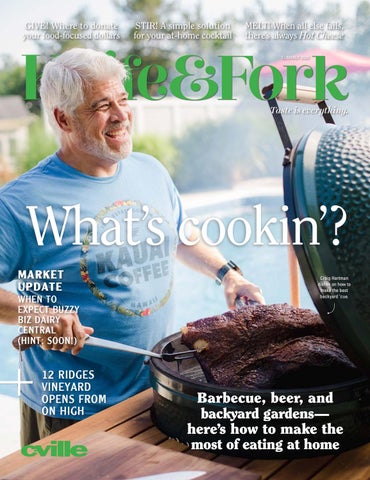
Craig Hartman dishes on how to make the best backyard ‘cue.
Barbecue, beer, and backyard gardens— here’s how to make the most of eating at home
STEVE & DEBBIE MILLER Two different recoveries in the same year
LifeWorks Rehab is more
We provide patients with exceptional recovery experiences you will not find at home or anywhere else.
dedicated than ever to the
✔ Customized treatment, therapies, & recovery tools
care and safety of our patients
✔ 24-hour care from a professional team
like Steve & Debbie Miller,
✔ 7-day-a-week therapy & more time in supervised therapy*
who completed two major
✔ Comprehensive disinfecting with world-class technology
recoveries in the same year.
✔ State-of-the-art gyms & equipment
✔ Virtual visitation assistance Visit mylifeworksrehab.com/smartchoice for more. *compared to at-home recovery
The award-winning LifeWorks Rehab program is available exclusively at these local centers:
1540 Founders Place | Charlottesville, VA 22902
505 West Rio Rd | Charlottesville, VA 22901
(434) 260-8211
(434) 202-5133
www.AlbemarleHealthRehab.com
www.CharlottesvilleRehab.com
Everyone Deserves
a Slice of the Pie Free Kindness with Every Order!
Supporting the organizations that support our community Special Olympics • JABA • Blue Ridge Area Food Bank • Salvation Army • Music Resource Center • Toy Lift • Goodwill Industries • Thomas Jefferson Food Bank • SARA • Make A Wish Foundation • St. Jude Children’s Research Hosiptal • Habitat for Humanity • Ronald McDonald House • Mosby Foundation • Shelter for Help in Emergency • ARC of the Piedmont • Albemarle Fire & Rescue • Virginia Wounded Warrior Program • Caring for Creatures • SPCA • SOCA • Wildlife Center of Virginia Dogs Deserve Better-Blue Ridge
Best Winery Restaurants in America “.. the best wines of their vineyards, excellent cuisine, and idyllic settings.”
(540) 832 - 7848
4 Knife&Fork Summer
bbvwine.com
If your group or organization is interested in fundraising with Domino’s, please contact your local store and ask to speak with a manager.
TA B L E O F C O N T E N T S The Dish 07 Good eats
Former Charlottesville food scene fixture Polina Chesnakova shares her latest project: Hot Cheese!
10 Staying power Following COVID, what changes from our local food scene will stick around?
3,300 ft. The altitude at which the area’s newest winery, 12 Ridges Vineyard, planted its vines. PAGE 14
12 Give good
Put your money where your mouth is, with these local food-related nonprofits.
JOHN ROBINSON
At home
As the local restaurant scene comes back to life (and we come out of our to-go cocktail stupor), we’re making the most of eating at home, with the help of BBQ Exchange’s Craig Hartman, Crescent Simples’ spirit supplements, four inspiring local backyard gardens, and then some. PAGE 20
13 Food memory
Belle’s John Shanesy shares his favorite bite ever.
THE LAST BITE We’re cool customers at Madison’s The Freeze. PAGE 30
14 New views
Virginia wine’s latest addition, 12 Ridges, takes the high road (literally!).
17 To market
Charlottesville’s forthcoming food hall aims to be a hub for eats and community.
308 E. Main St. Charlottesville, VA 22902 (434) 817-2749 n c-ville.com c-ville.com/knife-fork
COVER: Photo by Amy and Jackson Smith. COMMENTS? Email us at editor@c-ville.com.
KNIFE & FORK, a supplement to C-VILLE Weekly, is distributed in Charlottesville, Albemarle County and the Shenandoah Valley. No part of this publication may be reproduced without the written permission of the publisher. Knife & Fork Editor Caite Hamilton. Copy Editor Susan Sorensen. Creative Director Bill LeSueur. Graphic Designers Tracy Federico, Max March, Lorena Perez. Account Executives Lisa C. Hurdle, Gabby Kirk, Theressa Leak, Chris Till, Beth Wood. Production Coordinator Faith Gibson. Publisher Aimee Atteberry. Chief Financial Officer Debbie Miller. Marketing Manager Anna Harrison. A/R Specialist Nanci Winter. Circulation Manager Billy Dempsey. ©2020 C-VILLE Weekly.
Summer Knife&Fork 5
TEAM Realtors TEAM Realtors TEAM Realtors
2nd Quarter
May 2020 nd
2 Quarter
NOMINATE ME
TEAM Realtors
434-981-8730
Candice@buyandsellcville.com www.BuyandSellCville.com Candice van der Linde, Realtor @Candice_Realtor
Buy an Nomin
Candice van der Linde, Realtor
@Candice_Realtor
CANDICE VAN DER LINDE CHARLOTTESVILLE, VA
CHARLOTTESVILLE, VA County and the Greater Charlottesville Area?? What’s Going on in Albemarle Let’s get down to the details!
What’s on in Albemarle Even Going with the COVID-19 Pandemic this year; the Real Estate Market is going County and the Greater strong! Charlottesville Area?? st 1 Quarter stacks up against 2019 in Single Family Detached Homes 450,000 Let’s get down to the details! 400,000 as economists predicted. 350,000 450,000 Listing is LOW. 12.4% less400,000 available inventory than Even with theInventory COVID-19 300,000 250,000 last this year year; the Real 350,000 Pandemic 200,000 300,000 Median Sale Price isstrong! up 11.8% Estate Market is going 150,000 250,000 1,151 -12.40% 100,000 2.4% 200,000 Home Sale Price vs Listing Price is within 1,008 77 50,000 150,000 1st Quarter stacksofup against 1,151 -12.40% The Months Supply is ONLY 3.2 Months 100,0000 2019Buyers in Single Family Detached 1,008 for 77 50,000 are ready to buy; IF the property is-50,000 PricedNewright Listings Days on the 0 Market Homes as economists predicted. the Location and Condition. 2020 1,008 77 -50,000 2019
New Listings 1,151
IF You are ready for-12.40% a change; Listing Inventory is LOW. % Change 2020 1,008 Call the Buy and Sell Cville Team! 2019 1,151 12.4% less available inventory % Change -12.40% than last year
Days on the 79 Market -2.50% 77 79
$389,808.00 $411,028.00 $389,808.00 $411,028.00
-2.50% 79
-2.50%
5.40%
% Change
5.40% 3.2
79
2020
-2.50% 2020
Average Sale Price $411,028.00 Average Sale $389,808.00 Price 5.40% $411,028.00 2019 % Change $389,808.00 5.40% 2019 % Change
Median Sale Price is up 11.8% Home Sale Price vs Listing Price is within 2.4% The Months of Supply is ONLY 3.2 Months Buyers are ready to buy; IF the property is Priced right for the Location and Condition. Anna Antigua
Buyer Agent w 1st Anna Antigua Dominion Realty Buyer Agent w 1st Hablamos Español Dominion Realty Hablamos Español
3.2 Months of Inventory 3.2 Months of 4 Inventory -20% 3.2 4 -20%
4
-20%
4
2020 -20% 2020
2019 2019
% Change
Passion People SE Rea Charlotte wait to & Share A
The Dish TRENDS, TASTEMAKERS, AND FOODS WE LOVE
SUPPLIED PHOTO
Serendipit-cheese Hot Cheese promises over 50 “gooey, oozy, melty recipes,” including this one for Cajun cheesey waffle fries.
Former local food scene standout Polina Chesnakova pens her first cookbook By Shea Gibbs
Summer Knife&Fork 7
serving up beer, wine, a decadent pairing menu, and unbeatable views of the blue ridge.
find us online at MountIdaReserve.com or stop by any day of the week5600 moonlight drive, 22903.
Coming to visit? Take the opportunity to tour the 5,000 rolling acres of Mount Ida Reserve. Our three event venues (including the new beachfront venue, Water’s Edge) each offer a unique taste of the picturesque Virginia landscape and exemplary architecture, designed specifically with weddings and large group events in mind. And when you fall in love and want to stay, homes and estate parcels are available on select portions of the reserve - with parcels starting at just $100,000. Find out more at MountIdaReserve.com, or give us a call at 434-286-4282.
8 Knife&Fork Summer
C
The Dish
Knife & Fork: Most folks in the Charlottesville food community know you as a baker. What’s up with a book on cheese? Polina Chesnakova: It all started when I graduated from UVA and started working at Feast!. That was my first intro to the world of artisan cheese. It was 2014, and they carried this magazine called Culture. When I moved back home, with all my injuries, I couldn’t take on a cooking job. Culture was hiring an intern for the fall. It was through the internship that an editor at Chronicle Books found my work. They said, ‘Would you want to write a book on hot cheese?’ My dream has always been to write a cookbook and become a cookbook author. But hot cheese was not necessarily part of that. K&F: At that point, you’d already started your blog Chesnok, correct? PC: I started the blog even before working for Culture. I knew my journey was into the food world when I graduated, and I kind of knew I had something special with my Russian-Georgian heritage. That’s where my love of food and being in the kitchen started. I started the blog to share that food and heritage, and after the accident, it became my outlet. K&F: So the book came to you? PC: Yeah. The next step was coming up with 50 to 55 recipes, not having tested any of them. That was one of the hardest parts—that and bringing them all to life. My khachapuri—Georgian cheesy bread—of course that was going to be in the book. I did a Philly cheesesteak with a Korean bulgogi marinade, and that is one of my favorites. We did a Midwest hot dish. I also had a lot of influence from France and Italy and Switzerland.
PHOTOS: SUPPLIED
harlottesville lost a rising food industry star when Polina Chesnakova moved away in 2017. The accomplished baker, chef, and blogger suffered a devastating car accident while driving to work at Greenwood Gourmet Grocery in December 2016. She lost most of the functionality in her left hand in the crash and moved back to her childhood home to recover. Charlottesville’s loss, though, may have been the wider food world’s gain. Chesnakova transitioned from cook to full-time writer after her accident, and she’s recently published her first cookbook, Hot Cheese. Knife & Fork spoke by phone with Chesnakova about her tome, time in C’ville, and next steps.
collaborate with and connect with? That’s how one’s following grows. The more you put out, the more you get back. That’s why I did this cookbook. It might not be the greatest work I will ever accomplish, but it is getting me there. I think everyone has their own path. K&F: What do you miss most about the C’ville food scene? PC: It’s a small town, and that makes it easy to get together. For its size, there’s so much happening on the food scene, as well as music, culture, arts. Every night there was something happening. You can call up four or five different friends and have a wonderful night. You lose that in a big city. Looking back, most of my friends were in the food industry, where you have an eclectic mix of people. It makes the potlucks pretty interesting. K&F: What’s next for you? PC: So, my first book ended up being on hot cheese. But I’m not stopping there. I’m working on a second book and getting back to my roots of baking with Piece of Cake.
K&F: How does a first time cookbook author compete with all the established writers? PC: I draw upon my community to support me—who do I know to Polina Chesnakova
K&F: Any last messages for C’ville foodies? PC: I miss everyone. It’s just a really special community that is living and supportive. I knew that before the accident, but afterward the outpouring of support was just overwhelming. That’s something I will always carry in my heart.
Polina Chesnakova’s Cajun Cheesy Waffle Fries “When I was in college in Virginia, there was a divey, windowless bar called St. Maarten,” says Chesnakova. “The drink specials were wacky (think ‘Dr. Jones Love Juice’) and the interior decor was wanting, to say the least. However, they had these Cajun cheesy waffle fries that kept me, and all of my friends, coming back again and again.” INGREDIENTS One 22 oz. bag frozen waffle-cut fries 2 tsp. Cajun seasoning, plus more for seasoning 6 oz. sharp Colby Jack cheese, coarsely grated 1/4 cup crumbled crisped bacon (optional) Minced fresh chives, for garnish (optional) Ranch dressing, for serving INSTRUCTIONS Preheat the oven to 450°F. Line a large baking sheet with aluminum foil. Arrange the frozen fries in a single layer on the prepared baking sheet. Bake for 20 to 25 minutes, flipping them over halfway through, or until the fries are lightly browned and crisped all the way through. Remove from the oven and toss with the Cajun seasoning to evenly coat. Sprinkle with the cheese and, if you want, bacon. Sprinkle with more Cajun seasoning, if desired. Bake for another three to five minutes, until the cheese has melted. Top with chives, if desired, and serve immediately with ranch dressing for dipping. Reprinted from Hot Cheese by Polina Chesnakova with permission by Chronicle Books, 2020.
Summer Knife&Fork 9
The Dish
Same as it never was
Post-COVID, our adapting restaurant scene may keep some of its new operations By C. Simon Davidson
10 Knife&Fork Summer
JOHN ROBINSON
R
estaurants have never seen anything like it. “The pandemic has turned our world upside down,” says Melissa Close-Hart, chef at Junction. “Everyone has had to adapt very quickly to survive.” As restaurants adopt new measures on the fly, chefs like Close-Hart expect that some of the measures might stick around. Certainly not all will—the drive-thru at Bodo’s, for one, is destined to become a piece of history, a relic of an unusual time. But other short-term survival methods have been so successful that they could remain long after the virus subsides, silver linings inadvertently left behind by the fog of COVID-19. The biggest is takeout. Begun out of sheer necessity, local takeout has taken off from places like Ivy Inn, Lampo, and Oakhart Social, giving diners the chance to enjoy meals at home from restaurants that never offered it before. It’s not just the fact that takeout is available that’s new, but also what’s being offered. Ivy Inn ditched its fine dining menu for themed casual fare like family night chicken Parmesan and Greek night souvlaki and baklava. Will takeout offerings like this stick around? In many cases yes. As the pandemic subsides, if on-premises dining is slow to return, some restaurants plan to use takeout programs to offset lost business. Ivy Inn will continue takeout even when on-premise dining resumes, says co-owner Angelo Vangelopoulos. “Carry-out is here to stay.”
[Some] short-term survival methods have been so successful that they could remain long after the virus subsides, silver linings inadvertently left behind by the fog of COVID-19.
Lampo, meanwhile, has been so busy that it is opening a second location just for takeout. Once conditions allow, its original space will return to on-premises dining, with the new spot serving takeout only. Even how people order from restaurants has changed. While technologies already existed for easy one-click ordering, concerns about minimizing contact between guests and staff nudged restaurants to embrace them. “Creating an online ordering service for our café had been on
English Inn of Charlottesville
the to-do list,” says Pearl Island Café’s Sober Pierre. “The pandemic made it a must.” As a result, takeout has never been easier—just point, click, and pull up to the curb. And it’s not just diners who have benefited. Within weeks of its launch, Pearl Island’s online system accounted for more than 85 percent of orders, which Pierre says has allowed staff to focus on tasks other than answering phones and working the cash register. Pierre sees no reason to turn back. • 106 Rooms • Huge Heated Indoor Pool And there is the loosening of alcohol 2000 Morton Dr •then Charlottesville, VA 22903 •Exercise Room • Luxury Suitesas w/Kitchen restrictions, one of the biggest wild cards the 434.971.9900 • Free Cable & Wireless Internet industry moves forward. After• Local a March order 800.786.5400 (Toll Free) Calls – HBO – ESPN • Complimentary Full Hot Breakfast Buffet www.englishinncharlottesville.com by Governor Ralph Northam allowed restaurants to offer delivery and takeout of beer and wine, in April he expanded it to permit li-
Stick around No matter what happens as the restaurant scene comes back to life, these culinary innovations from our favorite places were a boon for business (and bellies). Chimm started a CSA-style bulk delivery and offered virtual cooking classes to create the restaurant’s best dishes at home. Roots Natural Kitchen rebuilt its app to give local neighborhoods the opportunity to set up a weekly delivery. Petit Pois chef Brian Helleberg began offering farm boxes to customers to maintain his standing orders with local farmers.
For Pearl Island Café’s Sober Pierre, the pandemic made an online ordering system—something he’d had on the restaurant’s to-do list for a while—”a must.”
quor-based cocktails as well. Alcohol is such a high-margin piece of restaurant revenues that Close-Hart calls these measures a lifeline. “If the industry continues to depend on takeout and delivery to help make ends meet,” she says, “the need for alcohol delivery will be important.” In their current form, the relaxed alcohol restrictions are temporary, and to make them permanent would require legislative action, says Northam’s Chief of Staff, Clark Mercer. In other states that have relaxed alcohol restrictions, legislators are introducing bills to extend the changes beyond the pandemic. Should the General Assembly do the same? Close-Hart says yes. “If we want to create the dining-out experience in a take-home format,” Close-Hart says, “wine and drinks help to accomplish that.” Call your representative.
• • • • • • •
106 Rooms Huge Heated Indoor Pool Exercise Room Luxury Suites w/Kitchen Free Cable & Wireless Internet Local Calls – HBO – ESPN Complimentary Full Hot Breakfast Buffet
2000 Morton Dr • Charlottesville, VA 22903
434.971.9900 800.786.5400 (Toll Free)
2000 Mortonwww.englishinncharlottesville.com Dr • Charlottesville, VA 22903 • 106 Rooms • Huge Heated Indoor Pool
434.971.9900 800.786.5400 (Toll Free)
www.englishinncharlottesville.com
•Exercise Room • Luxury Suites w/Kitchen • Free Cable & Wireless Internet • Local Calls – HBO – ESPN • Complimentary Full Hot Breakfast Buffet
ABERDEEN BARN Virginia’s finest steakhouse since 1965. Roast Prime Rib • Charcoal Broiled Ribeye • The Porterhouse • Broiled Lobster Tail • Maryland Style Crab Cakes
2018 Holiday Drive 434.296.4630 | www.aberdeenbarn.com Summer Knife&Fork 11
The Dish
Good food
These local nonprofits help feed Charlottesville
Blue Ridge Area Food Bank Since its establishment in Staunton in 1981, the Blue Ridge Area Food Bank has grown to serve 25 counties and eight cities throughout the region via distribution centers in Charlottesville, Lynchburg, Winchester, and Verona. brafb.org
Cultivate Charlottesville
JOHN ROBINSON
Three local food justice organizations—Charlottesville Food Justice Network, City Schoolyard Garden, and Urban Agriculture Collective of Charlottesville—recently merged to form Cultivate Charlottesville. From teaching kids to grow, tend to, and eat from community gardens, to working with policymakers and community leaders to advocate for food justice, this organization’s reach is both broad and deep. cultivatecharlottesville.org
The Haven Jane Colony Mills, executive director of Loaves & Fishes Food Pantry, has been busier than ever over the past several months.
Charlottesville’s pretty boastful when it comes to local food (we’ve dedicated an entire magazine to it, after all). An abundance of restaurants serve a variety of delicious cuisines, and a plethora of local farms grow hearty, healthy foods to distribute to said restaurants and to customers via farmers’ markets. But about one in six city residents do not have regular, reliable access to fresh and healthful groceries, for a variety of reasons. And as unemployment rates rise due to the COVID-19 pandemic, so will rates of food insecurity. Here are a few food-related nonprofits, both longstanding and new, helping to fight food insecurity (and other food justice issues) in the city and surrounding areas.—Erin O’Hare
Charlottesville Community Cares #50for50 A collaborative effort from Sin Barreras and Congregate Charlottesville, this program’s
12 Knife&Fork Summer
#50for50 food campaign raised more than $280,000 in donations and grants in order to distribute grocery gift cards to immigrant families in the community who are facing food insecurity. congregatecville.com
This low-barrier day shelter provides a hot breakfast to the unhoused members of our community 365 days a year. thehaven.org
Loaves & Fishes Food Pantry The largest distribution partner of the BRAFB, Loaves & Fishes helps low-income households stretch their food budgets by providing free groceries once a month. cvilleloaves.org
Local Food Hub This organization partners with area farmers and other nonprofits to increase local access to food through programs like Fresh Farmacy, a fresh fruit and vegetable “prescription” program that addresses both food access and public health in the community. localfoodhub.org
PB & J Fund The PB&J Fund provides culinary and nutritional education to children and their families through cooking classes and other activities. These programs focus on increasing access to affordable and healthful foods for those who might not otherwise have it. pbandjfund.org
JOHN ROBINSON
Belle’s John Shanesy (right) says a 2016 meal he had with his brother Scott was “exquisite and thoughtful in every way.”
Food with friends
“B
urrata and brassicas on April 21, 2016, at Blue Hill at Stone Barns is a memorable moment that surpasses all other dinner table experiences. The dinner was a masterclass in service, attention to detail, and culinary masterminds focused on an incredible goal. “My brother, Scott, and I took the Metro North up to Tarytown and hopped into a cab with the nicest driver who had eaten at the restaurant and assured us we were in for a treat. “The dishes were exquisite and thoughtful in every way. At one point, after maybe 12 to 15 dishes, we were asked to follow the captain to a new table outdoors on a patio with an open-flame grill. At this
grill they were drying and grilling vegetables over the embers of coals they make from the bones of the farm animals. These vegetables were served lightly dressed with a ball of housemade burrata. “My brother and I had dreamt of doing a restaurant together one day, and at this point in our lives we were really training hard and focusing on making that a goal. This dinner somewhat solidified that goal and reminded me of how lucky I am to be so close to my own brother and the fact that we share that dream together.”—John Shanesy, Belle chef, as told to Caite Hamilton 407 Monticello Rd. No phone.
Summer Knife&Fork 13
The Dish
High time
The start of something new for Virginia winemaking By Paul Ting
A
t the end of May, following the phase one reopening announcement for Virginia businesses, 12 Ridges Vineyard started welcoming visitors back to its tasting room which overlooks, wait for it...12 acres of vineyards. Like many wineries, 12 Ridges, formerly Skylark Farm and, until now, best known as a Christmas tree farm, features incredible views, outdoor seating, and availability for weddings and events. What gives this winery distinction is that the vines are planted at approximately 3,300 feet, making it the highest altitude vineyard site in the state of Virginia. At higher altitudes, cooler temperatures allow grapes to express themselves differently, with generally less sugar and more acid, producing wines lower in alcohol and brighter and livelier in taste. And there are other benefits to high altitude winemaking (like more direct and concentrated sunlight, larger differences between daytime and nighttime temperatures, and slopes
14 Knife&Fork Summer
allowing cool air and water to drain), but there are also a few challenges. Some sites are on the edge of being too cold for vines to grow. And steep slopes can make farming difficult, requiring manual labor and increasing costs. Still, it may be worth the risk. Joy Ting (this writer’s wife), research enologist and coordinator of the Winemakers Research Exchange, explains, “Virginia is a big state and we are still a wine region that is exploring as we evolve and mature. Are we planting in the right places? Are we ignoring areas that don’t fit preconceived notions and missing out on quality wine?” Jake Busching, who has grown grapes in Virginia for over 20 years, was responsible for planting 12 Ridges. He’s also the consultant at Stone Mountain Vineyards, where he was hired to replant its vineyards in 2017. Stone Mountain sits at an elevation of 1,750 feet and was initially planted in the mid-1990s with French varieties, the fashion at the time. Some of these did well, but others struggled in the cooler climate. So Busching worked with Stone Mountain owners Jim and Deanna Gephart to put in pinot noir and pinot gris, varieties known to thrive in cooler conditions. Busching says, “I’ve been steadfast about not putting red grapes (cabernet sauvignon, cabernet franc, merlot) above that. But at that elevation, as Ankida Ridge has proven, you can do pinot noir...and chardonnay is beautiful.” Also at 1,750 feet, Ankida Ridge has earned a reputation for perhaps the best pinot noir in Virginia. Owners Christine and Dennis Vrooman, who first planted in 2008, recognized their site
“It’s my goal to become the premier cool climate vineyard in the state.” Craig Colberg would be well-suited to pinot noir and chardonnay. 12 Ridges owner Craig Colberg draws inspiration from them, “I’ve tasted pinot noir from Ankida. It’s excellent. I aspire to pinot like theirs.” For 12 Ridges, Busching worked with Colberg to develop a vision of what would be possible at his extremely high site. Busching focused on cold-hardy varieties like chardonnay, pinot gris, riesling, and pinot noir, and he says he planted intentionally for sparkling wine. Most agree sparkling wine has great potential for Virginia, and Busching sees it as a unique opportunity for 12 Ridges. “Sparkling wine could be a game changer because it’s a largely untapped market with high consumer demand,” he says. “12 Ridges has the potential to be the best sparkling wine in Virginia.” Among those on Colberg’s team are winemaker Ben Jordan, whose labels include Early Mountain Vineyards, Lightwell Survey, and his family’s Midland Construction. In addition, Tim Jordan, who grows grapes on the Jordan family farm, will be the vineyard manager going forward. Jordan says he embraces the challenge of learning about growing at 12 Ridges. “What remains to be seen is whether they are too high and too exposed to winter cold...What ripens and when it ripens will be fun to find out.”
OPEN TO THE PUBLIC Everything forTHE the professional OPEN TO PUBLIC
cook to thefor gourmet home cook Everything the professional cook to the gourmet home cook to caterers, churches, c-stores... to caterers, churches, c-stores... something for everyone! something for everyone!
COURTESY OF 12 RIDGES VINEYARD
Busching similarly notes the unique challenge of the site, requiring cold-weather vineyard management in winter but hot-weather management in summer. For example, soil is mounded up around the vines in winter to protect them, a process that is reversed in summer, when rainfall and humidity require disease prevention and, despite the shorter growing season, there is still vigorous growth from the fertile soil that requires careful pruning. Colberg seems well-informed about both the risks and rewards. “It’s my goal to become the premier cool climate vineyard in the state,” he says. I think there is a demand for something that is still high-quality, but a different experience on the palate.” Meanwhile, Christine Vrooman at Ankida Ridge is advocating for a new American Viticultural Area to recognize higher altitude vineyards in Virginia. If she succeeds, this would be the first new AVA approved in Virginia since 2012. Vrooman is modeling her plan after the Mendocino Range AVA in California, which has boundaries defined by elevation. It includes only vineyards higher than 1,200 feet and therefore currently holds the distinction as the only non-contiguous AVA. The AVA Vrooman is proposing would be the second. As the Virginia wine industry matures, there are risks and unknowns, but there is also vision for the future and a desire for the new and unique. Here’s hoping that the combination of high altitudes, better winegrowing techniques, and a willingness to take risks results in another exciting chapter for Virginia wine.
The high altitude plantings at 12 Ridges Vineyard put the new winery in an excellent position for crafting what could be Virginia’s best sparkling wine.
15% OFF
all in-stock smallwares through the end of February. Must present coupon.
4200 sq.ft. showroom 4200 sq.ft. showroom 9am - 5pm Tues.-Fri. Mon - Fri 9-5, Sat 9-1
540-943-9543 540.943.9543
1221 West Main Street 1221 W Main Street Waynesboro Va. 22980 Waynesboro, VA 22980
turner pavilion, south liberty street turner pavilion, south liberty street
www.harrisonburgfarmersmarket.com
www.harrisonburgfarmersmarket.com 228 South Liberty Street • Harrisonburg, VA 22801
OPEN YEAR ROUND
Check the Website for Hours and Online Ordering Options EBT & credit/debit cards welcome!
EBT & credit/debit cards welcome!
Summer Knife&Fork 15
paid for by c'ville lovers
100%
of Keevil & Keevil’s profits are now going to #FeedVirginia. Our free meal program produces hundreds of meals every day using ingredients sourced directly from local farmers and delivers them for free to some of the most vulnerable members of our community.
Whenever you support Keevil & Keevil—whether its ordering one of our weekly delivery meals or booking us for your next catered event— all of the profits go toward supporting greater accessibility to fresh, locally grown ingredients for everyone in our community
Want to help? There’s two ways you can help:
1. Visit our website to make a tax deductible donation (www.sogooditskeevil.com) 2. Place a delivery order with us
Order K&K Delivery Curbside Pick-Up: Wednesday-Friday from 3pm - 5pm
Delivery:
Tuesdays and Fridays from 1pm - 3pm
keevilkitchen@gmail.com • www.sogooditskeevil.com (434)-989-7648 • 703 Hinton Avenue • Charlottesville, VA 22902
If you know of any organizations or communities that could use some free meals, reach out to us at keevilkitchen@gmail.com
The Dish
‘The hub of all hubs’
New food scene addition Dairy Market coming this fall By Caite Hamilton
STEPHEN BARLING
T
he folks behind Dairy Market, the much-anticipated food hall in the former Monticello Dairy building, want to make one thing clear: A food hall is not the same thing as a food court. “The modern food hall is about the celebration of food itself,” says Jodi Mills, director of marketing and public relations at Stony Point Development Group. “The food court was an amenity to the mall; it wasn’t [about] the food itself, but a convenience for the consumer who was at the mall shopping.” The upcoming food hall, Mills says, will be a real destination for good eats in Charlottesville, with vendors like Starr Hill Brewery, Chimm Street, Take It Away, and Eleva Coffee having already committed. And there’s more to come, which Mills says they’ll announce over the summer prior to an autumn soft open. As for the transformation of the building— which we’ve been keeping an eye on since the project broke ground in August of 2018— there are plenty of nods to its history. Black and white subway tiles harken back to the original Monticello Dairy ice cream parlor; windows throughout the building have been restored or refurbished; Old Virginia bricks were removed from the original space and scrubbed to look like new. Outside, a dairy cow mural on the side of the building pays tribute to the cow statue that once stood at the front of the building. And speaking of outside, Mills says the project includes more than 7,000 square feet of patio space, with catenary lighting, tables, chairs, music, and outdoor activities and events. “Anticipate that it will be the hub of all hubs,” she says.
Summer Knife&Fork 17
Bon matin.
B a k e r y · B r e a k fa s t · L u n c h · B r u n c h
now with two charlottesville Locations. MarieBette café & Baker y, 700 Rose Hill Drive Petite MarieBette, 105 East Water Street mariebette.com
Experience Virginia’s Wine Country
A small, family owned vineyard and winery producing world class wines from estate grown French vinifera. 540.456.8844 • www.pollakvineyards.com • 330 Newtown Road, Greenwood VA
18 Knife&Fork Summer
HOME
COOKIN’
Charlottesville’s food scene is as perfect a perk to living here as you can get, but when everything went to hell in a bread basket this spring, we were all forced to rethink our approach to eating local.This issue, we’re continuing the trend, with a peek into four of our neighbors’ backyard gardens (we’re green with envy!), a few tips on barbecuing from Gordonsville’s Craig Hartman, and help with making a great cocktail at home from a new local simple syrup company. Like you, we’re anxiously awaiting the moment we can safely return to our favorite haunts, but in the meantime, we’re eating out of house and home.
20 Knife&Fork Summer
HOME COOKIN’
Bringing home the bacon Chef Craig Hartman offers tips for making restaurant-quality barbecue at home
C
raig Hartman, chef-owner of BBQ Exchange in Gordonsville, had his great ’cue revelation not in Texas, nor North Carolina, nor Memphis, Tennessee. Nope. He was in Mexico. At a hotel in Cancun, Hartman threw down in an “Iron Chef ”-style competition against contestants from all over the world. Featured ingredients were announced, and chefs grabbed their goods and headed to outdoor cook stations—giant grills set up next to a wood-burning bonfire, with shovels for moving coals. The competition launched Hartman’s lifelong devotion to fire. “It was a revelation,” he says. “We are always thinking about managing our coals. If I’m cooking just for my wife and I, it might not be a big deal. But if I have more people, it lets me manage the heat. If you have to dump charcoal on top, you have a problem.” Here, Hartman hammers home his hot tips for making great smoked meat in the backyard.
If you want true artisan barbecue, forget the gas, hybrid smokers, pellets, or chips. Hartman is talking live fire, fed only with wood and natural lump charcoal. BBQ Exchange sticks to green hickory for smoking—its acidity and flavor profile are uniquely Virginian, Hartman says—but wood choice is personal. “Some people would rather have cherry or apple or white oak,” he says. “Briquettes are great for grilling, but they create a soft ash, and the heat goes away.” Even when cooking at home, Hartman starts his fires in a barrel next to his grill. The wood is ready to transfer to the smoker when “all the bark is burned, the whole log is charred, and you no longer see that yellow fire.” Look for smaller, smoldering, orange flames, Hartman says, then shovel the wood into the cooker, put your meat on the grill-top, and set your dampers to maintain your target heat. “Fire is alive,” Hartman says. “If I have a really hot fire on a really big cooker, and I’m adding a lot of wood, I can shut the doors and kill it, but it will find every space and crawl up the sides, gasping CONTINUED ON PAGE 22
AMY AND JACKSON SMITH
Fire
BBQ Exchange’s Craig Hartman serves up tips for making great smoked meat in your own backyard.
Summer Knife&Fork 21
Brews for ’cues Chef Craig Hartman isn’t gonna tell you what to drink. “Beer is like barbecue,” he says. “Everyone has their favorites.” So what’re his go-to brews? He likes lighter beers to offset sumptuous (fine, “caloric”) cuts of ’cue. We don’t want to put words in his mouth, but here are five (mostly) local bevvies Hartman would likely recommend if he weren’t too damn polite to play favorites.
DEVILS BACKBONE VIENNA LAGER “I would stay away from the darker beers,” Hartman says. “I like something more lager-ish.” Devils Backbone describes its version as “smooth, medium-bodied, and semi-sweet, while not too heavy or bitter.”
BLUE MOUNTAIN ROCKFISH WHEAT Hartman recommends fruity, citrusy beers—like the Rockfish Wheat from Blue Mountain—with rich, smoky barbecue. AMY AND JACKSON SMITH
CONTINUED FROM PAGE 21
for air. At the end of the day, you’re controlling your smoke, fire, quality of meat, and spices.”
Meat
Too many people disrespect barbecue, according to Hartman. They don’t expect to pay much for it in restaurants, or they buy their hunks of meat in a big box store and call it a day. “But if you really want to step your game up, you have to be willing to spend the money,” he says. “Home chefs that do barbecue are passionate. My suggestion is buy the best product you can.” Hartman suggests JM Stock Provisions and Reid Super-Save Market for a solid selection around Charlottesville. Or, go directly to a local farm that offers online ordering. “When you’re dealing straight with a farm, they might not be certified organic, but they will go above and beyond what any commercial organization would do,” Hartman says. “Their husbandry of the animals is fantastic.” Going straight to a farm also lets you experiment with different heritage animal breeds, Hartman says. Each one has a different tenderness profile, so you’ll want to tailor your technique to the breed.
22 Knife&Fork Summer
Technique
BBQ Exchange aims to cook most cuts at 225-250 degrees until they reach an internal temperature of 180-185, a finished temp about 15 degrees below what most books and websites recommend. Remember though: When you’re using live fire, holding 225-250 degrees in the cooker can be a battle. “We fight with our cookers. When you’re doing real artisan barbecue, you can’t set a temperature and walk away,” Hartman says. “There are days when we struggle to get the cookers up to 250. Others, we struggle to get them below 250. If you are barbecuing, you have to know your elements.” What should you do to your meat while it’s cooking? Pretty much nothing, according to Hartman. While a lot of ’cue gurus mop their meat with apple cider, vinegar, etc., it doesn’t really do anything for moisture. The mop is actually a cleaning technique only required when you’re burning raw wood, Hartman says. “I don’t mop my meat at the BBQ Exchange,” he says. “We just use clean wood and clean smoke. If you are putting clean wood in, keeping the temps right, and you have good meat, it’s going to be moist.”—Shea Gibbs
SOUTH STREET HOGWALLER KÖLSCH The downtown brewery’s “light, quaffable crispyboi” is balanced by Czech Saaz hops. “I’m not a big fan of hops,” Hartman says, “but a hoppy beer in the lighter style would go good.”
CHAMPION BREWING TRUE LOVE Hartman recommends squeezing a lime into lighter beers, like this clean and refreshing lager.
MILLER LITE “I can gain weight just by looking at food, but I do use a lot of bacon,” Hartman says. “You gotta pick your battles.” A classic Miller Lite cuts through the fat.—S.G.
HOME COOKIN’
Simple syrups for complicated times
Locally owned Crescent Simples brings the flavor of fresh fruits and herbs to cocktails, cooking, and more
JOHN ROBINSON
A
fter months stuck indoors, under pressure, you’re likely craving something new, different, and profoundly alcoholic. Crescent Simples meets that need with simple syrups to enliven at-home libations. Co-founders Megan Thomas and Bill Miller’s passion for simple syrups—sugar-water reductions infused with fresh fruits and herbs—began when they helped a fellow New Orleans bartender scale up her strawberry basil gin sour recipe for a cocktail contest. Rather than muddle each drink by hand, Thomas and Miller devised a syrup that lent their friend’s concoction the same flavor and freshness. After a back injury sidelined Thomas, she and Miller relocated to Charlottesville to make syrups for a living. “I wanted a syrup that tasted like I had muddled fresh fruit and herbs into my cocktail,” she says. “But without the work.” Three months of R&D later, they launched their first lineup (including their signature strawberry basil) at the Charlottesville City Market. Each 10-gallon batch of Crescent Simples syrup combines a uniquely paired fresh fruit and herb or spice with water and 60 pounds of raw sugar. Simmering breaks down the fresh ingredients, then the flavors sit and infuse. After several rounds of filtering out solids, the remainder’s all but boiled to stay fresh and shelf-stable in the 150 various-sized bottles each batch yields. Even teetotalers can enjoy Crescent Simples. Thomas uses them in baking, while Miller’s turned their blueberry lavender flavor into a killer pork marinade. Their offerings change with the seasons: For summer, they’re tinkering with lemon chamomile and peach hibiscus, while trying to crack a still-elusive watermelon syrup. Unsurprisingly, Thomas says “business exploded” under lockdown. “People are drinking at home and teaching themselves new skills, like bartending,” she says. “We have always said that our company’s mission is to make home bartending more accessible, and this is the perfect time for that.”—Nathan Alderman
Crescent Simples’ Summer Pimms Cup
“These are famous in New Orleans but lesser known in Virginia,” says Megan Thomas. “Pimms can be found at ABC stores, but Bill and I both like to make it our own by adding gin.” Here’s their go-to recipe. INGREDIENTS
INSTRUCTIONS
1 1/4 oz. Pimms liqueur 3/4 oz. gin 1/2 oz. lemon juice 1/2 oz. Crescent Simples’ Strawberry Basil Simple Syrup 4-5 cucumber slices
Muddle the cucumber slices with the lemon juice and simple syrup. Add the Pimms and gin, add ice, and top with ginger ale or soda water. Toss into an empty mixing tin and back into your glass to combine.
Summer Knife&Fork 23
HOME COOKIN’
Backyard warriors G
rocery shopping has become a fraught experience. Restaurant dining is not as carefree as before. This is a very strange year to be an eater, and lots of folks have responded by going back to the basics—soil, seeds, and their own two hands. Here are four local gardens and the humans who tend them.
Stocking up
Irène Mathieu is new to her house—she and her partner just moved into their place in the 10th and Page neighborhood last fall—and fairly new to gardening, too. But, she says, it’s in her blood: “My dad is a huge gardener.” So were her grandfather and great-grandfather. Although Mathieu avoided the garden as a kid, she’s come around. “Maybe it’s something inherent that’s now waking up.” A pediatrician and a published poet, Mathieu put together three raised beds from kits, good for growing annual crops along the south side of her house, and planted berry bushes nearby: blueberry, blackberry, raspberry. Her tomatoes, herbs, salad and cooking greens, zucchini, and cucumbers are off to a good start. “For me, what to plant depends mostly on things that I eat a lot, and that are hard to replicate in terms of freshness from a grocery store,” she says—tomatoes for salad, say, or fresh herbs crushed for tea. “To me, creating a garden is about having a relationship with the land, which is something I only recently realized I miss,” she says. “This year, because of the pandemic, there’s a lot of existential concern that many of us have. But if you put a seed in the ground, things will grow. Nature’s still functioning.”
Give and grow
Richard and Mary Morris have been practicing what they call “foodsteading” for 11 years on their property in Keene. “We were trying to build a lifestyle centered around small-scale food production,” Richard explains. That included livestock for eating and sharing. “We wound up giving away pork shoulders for Christmas to neighbors,” he remembers. These days, besides tending a flock of laying hens, the couple keeps bees and grows vegetables and herbs in raised beds. They’ve built their op-
24 Knife&Fork Summer
eration by hand, relying on their own strength to carry water, dig post-holes, and plant fruit trees. “We’re older and so it was a way to stay in physical viability,” says Richard, “but it’s also very rewarding.” Gardening is a way for both Richard and Mary to connect with their roots and with family traditions of donating food. “When I was growing up in Phoenix my mother always had a garden in the backyard, and people who were short on money would come to our house. My mom would let them go out and take whatever they want,” remembers Richard, who’s now growing potatoes to donate to the Urban Agriculture Collective, where he’s program director. “Black homeownership is not where it should be,” he adds, pointing out that renters are less likely to be able to grow food for themselves. “We are fortunate that we have land where we can garden.”
Urban homesteading
“My garden brings me back home to my growing up,” says Jodie Plaisance. “I’m from Cajun country, and I was snapping peas with my mawmaw and making jelly and picking figs, growing up.” It’s a long way from Louisiana to Belmont, but over the last five years Plaisance, who owns Abrakadabra Hair Studio, has recreated some of that childhood immersion in growing and cooking food in the big backyard she shares with her wife and 11-year-old daughter. Besides fruit trees, berry bushes, and grapevines, she’s got four raised beds on a gravel pad that burst with strawberries, onions, garlic, carrots, radishes, ginger, nettle, tomatillos, kale, parsnips… “What don’t I have?” she laughs. “Shishito peppers, those are my favorite. I’ll sauté those the way Citizen Burger does, then put balsamic glaze on top.” A big mint patch keeps her in tea, and A-frame trellises support peas and beans. “I was always having problems with my tomatoes getting sick,” she remembers, before a Fifth
PHOTOS: JOHN ROBINSON
Local gardeners get back to the land
Irène Mathieu says creating a garden is about “having a relationship with the land.” Liz Nyberg revived a longneglected garden, and is especially proud of this year’s strawberry crop. Mary and Richard Morris have been “foodsteading” for 11 years on their Keene property. In addition to fruit trees, berry bushes, and grapevines, Jodie Plaisance’s Belmont garden has four raised beds filled with a wide variety of fruits and veggies.
Season employee recommended growing them in large felt pots away from other crops. “That has given me gorgeous huge tomatoes,” she says. She’s full of plans to expand her urban homestead, but the benefits are already in full swing. “It keeps my ancestors with me,” she says.
Garden revival
Five years ago, when Liz Nyberg and her husband got married, they moved into a rental house with a garden—a long-neglected one. Though she’d never really gardened, she hankered for fresh cukes and tomatoes. And, she says, “I like seeing things grow.” So she started cleaning out the overgrown beds (“There was definitely poison ivy in there”) and improving the soil. “Man, you can’t even stick your finger in the ground without hitting a worm now,” she says. And just like the soil, her gardening skills have improved through the years. “I’m getting better at starting things from seed, or planning out how many things I should start,” she says. “I built a cold frame with my husband. There’s not a lot of natural light in the house, so that gave me more space for starting seeds.” This year, she’s had a good crop of strawberries. When her onions, shallots, and garlic are ready to harvest, she’ll use that space for peppers. She keeps her boss in beets. “I really like picking flowers and bringing arrangements for the office,” she says. “I work at a homeless shelter, so it’s just nice to have something fresh and inviting in the space for staff and clients alike.” —Erika Howsare
Dig in
Tips for veggie-garden novices Starting a garden for the first time is both simple and daunting. Plants have only a few basic needs: good soil, water, and sun. But, for newbies, it can seem like there are a thousand ways to go wrong. If you’re a beginner, here are a few tips to help break it down. SELECT YOUR SITE
The ideal site is well away from trees (which compete for water and nutrients), well-drained, and well-lit. Think small at first. If you really can’t put plants in the ground, think about containers.
PREPARE THE GROUND
First remove the sod with a mattock. Then, loosen the soil with a spade fork. Finally, mix in about three inches of compost. For a small garden, you can buy compost in bags. Horse manure works well too, and stables are usually happy to give it away.
CHOOSE YOUR CROPS
It feels good to succeed in a garden, so start with things that are relatively foolproof, like green beans, basil, and mint. The next tier of crops would include stuff like salad and cooking greens, tomatoes, peppers, and summer and winter squash.
TIMING
July is too late to start most veggie crops from seed. (Greens, tomatoes, and peppers get planted indoors in early March.) What you can do now is buy most crops as starts, at a garden center or direct from a farmer. And it’s not too late—in fact, it’s the perfect time—to direct-seed heat-loving crops like beans, squash, corn, and okra.
PLANT CAREFULLY
Find the healthiest plant starts you can and put them in the ground when the soil is moist, but not wet and clumpy. Loosen the soil all around where you’re making a hole for your baby plant, and dig deep enough that when you place the plant in the hole, the potting soil will sit slightly below ground level.
KEEP AN EYE ON WATER AND WEEDS
The plants won’t need much from you except a regular check-in, preferably once a day. Keep soil moist and pull out the bigger weeds.
FERTILIZE
That compost you added will feed your plants all season, but you can also boost their growth with organic fertilizers.
Summer Knife&Fork 25
Food web
HOME COOKIN’
Local farms find new ways to connect with customers
ZACK WAJSGRAS
W
hile most area farms work out how to distribute their bounties, one farm located in the heart of Charlottesville worries it won’t have enough food for its consumers’ needs. The Urban Agriculture Collective of Charlottesville offers city residents the opportunity to collaboratively grow and harvest organic produce that is then distributed at no cost to public and subsidized housing communities, “people who might not otherwise have access to fresh produce,” says Richard Morris, farm and foodroots program director at UACC. During the 2019 season, UACC’s three gardens, located at the Friendship Court, South First Street, and Sixth Street housing developments, had a combined 25,000 square feet of vegetable-bed space. But with the Friendship Court and South First Street spots slated for redevelopment, UACC was only able to plant at Sixth Street—4,400 square feet of bed space—for the 2020 season. “We’re down, but not out,” says Morris. With less than one-fifth of its previous planting area to work with, he says they’ve employed some
During the 2019 season, the UACC’s three gardens had a combined 25,000 square feet of vegetable-bed space.
intensive growing techniques, such as eliminating tilling (resulting in higher-quality soil) and planting closer together in deeper beds. As unemployment rates soar, Morris expects that those members of our community who are already food insecure (about 17 percent of the city’s population) will have greater demand for produce…and that more of our neighbors will become food insecure in the coming months. He hopes that other, larger farms and distributors with excess produce might donate it to the UACC’s new Harvest a Bushel for the Community program. Overall, farmers say they want this moment to help the community understand the reliability, and thus the importance, of local food. It’s part of their mission, after all, to feed their neighbors. “The COVID pandemic has exposed the weaknesses of our national food system, while highlighting the strategic wisdom in, and resilience of, local food networks,” Morris says. “I’m hoping this wake-up call will kickstart more support for urban agriculture, and local food for all.”—Erin O’Hare
Summer treat
The secret to Whiskey Jar’s perfect tomato sammy
W
hat makes the perfect tomato sandwich? We think The Whiskey Jar serves one of the best in town, so we went straight to the source. “I and my entire staff wait all year long for the tomatoes to come back,” says owner Will Richey. “It is heresy to use an out-of-season tomato, and simply stupid. It is the one item on the menu that is most talked about and craved by all. And I have to say there really is something wonderful about it.” Here’s what he says about crafting a totally craveable tomato sammy from your home garden. “The three most important parts I think are undebatable: First is the perfect tomato. The tomato must be perfectly ripened and fresh, preferably an heirloom variety, of which I believe the Cherokee Purple to be the most flavorful and the best for the perfect tomato sandwich.
26 Knife&Fork Summer
“One wants a firm-fleshed tomato with good texture, not too watery and not too seedy. They must be sliced fresh to order and never refrigerated. “Secondly, and equally undeniable as the perfect tomato, is the seasoning. It must be salted evenly. A little black pepper is optional. “Third on the list of undeniable truths of the perfect tomato sandwich is Duke’s mayonnaise. This must be applied to the bread thickly and evenly to the edges. “The debate revolves around the bread. It must be white bread for certain, but we use a really good, locally made country white bread from Goodwin Creek Farm and we griddle the bread lightly in butter to give it some crunch and texture. Perhaps not ideally classic, but we think it makes for the perfect tomato sandwich.”—Caite Hamilton
HOME COOKIN’
Cedars of change Wedding photographer Eric Kelley finds a new sideline building garden boxes
ERIC KELLEY
E
ric Kelley was best known for photographing weddings—until COVID-19 hit. While he waits to get back behind the camera, he’s gone from snapping pristine images to getting his hands dirty, building and selling locally sourced cedar garden boxes for people who want to cultivate their green thumbs. “Since early March,” Kelley says, “I have had 11 events either cancel all together, move to dates that I am unavailable for, or reschedule to 2021.” Wondering how to fill his spare time, he took a cue from a 2019 assignment with his wife’s cousin, author Nicole Burke, taking photographs for her book, The Kitchen Garden Revival. Burke’s how-to book for growing your own herbs and vegetables involved raised wooden garden boxes. On a recent visit with Kelley, she suggested he make his mother-inlaw a couple for Mother’s Day. “Having grown up with a father that did home renovations, and having renovated 19 Elliewood Avenue [Grit Coffee’s location near The Corner], I had building skills and also have the tools I need to make these boxes,” Kelley says. Virginia’s Eastern redcedar—a hardy native plant that’s actually part of the juniper family— yields beautiful, rot-resistant wood whose fragrant oils help repel insects. Kelley gets his wood from Culpeper’s Whole Heart Farms, and now that he’s streamlined his process, he can hammer together a box in 45 minutes or less. As of the end of May, he’d built and delivered some 55 boxes to local customers, alongside a burgeoning business selling herb and vegetable starters to grow inside them. “The best part of all of this,” Kelley says, “is creating a space for people to enjoy.” And he has no plans to stop, even when COVID-19 finally does. “When I am back photographing weddings, I will still be doing this.”—Nathan Alderman
Summer Knife&Fork 27
Art Classes
Art Classes
There’s no place like
home.
with Lee Alter
with Lee Alter @McGuffey
LEVEL UP
A tiered city garden with many chapters
FARM USE
Waterstreet revamps a riverfront property
MAD FOR MOD A train car house and a porch for three seasons
Inside. Outside. Home. SUMMER 2020
The great outdoors
A look back at 15 of our favorite pools, porches, and garden spots
Adults:Looking 1/6-3/2forward mon 6-9to you10-1 in September. Wedseeing 1/8-3/4 Children: tues 1/7-3/3 3:30-5:30 Online classes available NOW! Thurs 1/9-3/5 3:30-5:30 or sat 2-4pm 1/11-3/7 call 760-9658 Call 434-760-9658
Central Virginia’s No. 1 home magazine has never looked finer. ABODE has given readers an inside look at the region’s most interesting homes for nearly a decade. From landscape to interior design, floor to ceiling, blueprint to fixture, each month our writers team up with the area’s top architects and designers to give you an insider’s view of the local homes you’ve always wanted to see inside.
Inside. Outside. Home.
www.leealterartist.com
BREADWORKS BAKERY & DELI
Great food - great mission since 1994
BreadWorks is a division of WorkSource Enterprises which has provided job training, employment and support services for persons with disabilities since 1967.
923 Preston Avenue | Charlottesville, VA | 434-296-4663 Monday-Friday 7:30 AM - 6 PM | Saturday 8:30 AM - 2:30 PM www.breadworks.org
28 Knife&Fork Winter
Rob & Melanie Lewis
Catering services for weddings, cocktail parties, picnics, dinner parties & any event you can think of
434-987-4647 rillcrossfarm@gmail.com www.rillcrossfarm.com
The Last Bite
Tastee treat
If you’re not having ice cream after (nearly) every meal, you’re not doing summer right. Our recommendation: Madison’s The Freeze, the classic ’50s throwback joint with footlongs, fish sandwiches, and—obviously—all things frosty, from hot fudge sundaes to an old-fashioned cone. Watch out for brain freeze.
JOHN ROBINSON
30 Knife&Fork Summer
A ROOM WITH A VIEW The Legendary Mill Room
The Mill Room Restaurant is a highlight of Boar’s Head Resort and the go-to destination in Charlottesville. Our chefs infuse old-world cuisine with modern techniques, sophisticated plating and beautifully choreographed service. Reserve your table: www.BoarsHeadResort/Dining or (434) 972-2230
Owned and operated by the UVA Foundation
In coordination with Covid-19 regulations, please call ahead to check the availability of our restaurants, activites and amenities.
AWARD-WINNING WINE MADE IN LOUISA COUNTY? THE SECRET IS OUT!BREAK! TAKE A “CHILL” COOPER VINEYARDS. VISIT VISIT FIFTY-THIRD WINERY AND VINEYARD...
O
ur winery offers an extensive Listproceeds of premium Virginia wines purchased A portion of the from all bottles for an extraordinary We are January to the by tasting visitorsexperience. at the Winery willopen be donated through April. Friday through Monday, 11am-5pm: May (Food throughBank) Louisa County Resource Council
December, 7 days a week, 11am-5pm. Complimentary musicSeptember. Saturday each month June through
and Sunday afternoons. Come see for yourself and visit us in rural
open 11amCheck to 5pm Louisa County, an easyWe driveare from Richmond. our seven websitedays for a week with plenty of outside seating areas, Please directions and details, www.coopervineyards.com.
visit our website, www.53rdwinery.com for our
Voted one of Virginia's favorite tasting roomsprocedures five years in awhile row! Covid-19 safety and operating
restrictions are in place. Stay safe!
FIFTY-THIRD WINERY & VINEYARD
13372 Shannon Hill Road I Louisa, VA 23093 I 540-894-5474 www.53rdwinery.com I @ Ii