IGCSE and O Level Literature in English_Executive Preview_digital
Literature in English for Cambridge IGCSETM and O Level
Dear Teacher,
Welcome to the new edition of our Cambridge IGCSE™ and O Level Literature in English series. It provides full support for this course for first teach from 2026, and for the syllabuses for examination from 2028. This series has been designed to suit your teaching needs. This preview will help you understand how the coursebook, workbook and digital teacher’s resource work together to best meet the needs of your classroom, timetable and students.
This Executive Preview contains sample content from the series, including:
• a guide explaining how to use the series
• a guide explaining how to use each resource
In developing this new edition, we carried out global research with Cambridge IGCSE and O Level Literature in English teachers – through interviews, school visits and work on the Cambridge Panel, our online teacher research community. Teachers just like you have helped our experienced authors shape these new resources, ensuring that they meet the real teaching needs of the Cambridge IGCSE and O Level Literature in English classroom.
The coursebook has been updated for full syllabus coverage and has a range of activities and features to promote active learning, assessment for learning and student reflection. Set Text activities feature in every unit and contains skills-based activities that can be used independently alongside set texts. The coursebook also includes further reading suggestions, such as other poems, plays or prose, which can help to encourage a love of reading. The coursebook has been specifically written to support English as an additional language learners with key subject words, glossary definitions in context and accessible language throughout.
The workbook works alongside the coursebook and provides an opportunity for students to practise and consolidate their learning. The workbook includes sample answers at a range of levels, so that students can assess and reflect on what makes a successful answer.
Core to the series is the teacher’s resource with digital access. It will help you support your students and confidently teach Cambridge IGCSE and O Level Literature in English, whether you are new to teaching the subject or more experienced. For each chapter there are lesson ideas and activities, common misconceptions to look out for, language support and worksheets. The teacher’s resource also includes answers to the coursebook and workbook.
Please take five minutes to find out how our resources will support you and your students. To view the full series, you can visit our website or speak to your local consultant.
You can find their contact details here: cambridge.org/education/find-your-sales-consultant
Best wishes,
Julia Fusi Commissioning Editor Cambridge University Press and Assessment
This suite of resources supports students and teachers following the Cambridge IGCSE™, IGCSE (9–1) and O Level Literature in English syllabuses (0475 / 0992 / 2010). All the components in the series are designed to work together and help students develop the necessary knowledge and skills for this subject.
This Coursebook is designed for students to use in class with guidance from the teacher or to be read as part of individual study. It is divided into six parts, which focus on the three genres of poetry, prose and drama, as well as writing skills and approaching assessment. Its purpose is to help students develop the skills necessary for a course in literature through a range of engaging activities and interesting text extracts. Reflection and Self-assessment features encourage students to think about their own learning, while Practice questions help to consolidate learning.
A digital version of the Coursebook is included with the print version and is available separately.
The write-in Workbook is skills-focused and consolidates the learning in the Coursebook, providing opportunities for more focused practice. It follows a scaffolded approach to skills development, and can be used flexibly, as an additional resource to support learning in the classroom or at home for individual work. The Workbook fully reflects the structure of the Coursebook, making it easy to navigate.
A digital version of the Workbook is included with the print version.
The Digital Teacher’s Resource is packed full of useful teaching notes and lesson ideas, with suggestions for differentiation to support and challenge students, ideas for assessment and homework. It offers guidance for all topics of the syllabus to help teachers plan and deliver the Coursebook units in the most effective, active way. Additional worksheets and text extract sheets are also available, to help teachers save time and enrich their practice. All answers to the Coursebook and Workbook activities are available on Cambridge GO.
Literature in English for Cambridge IGCSETM and O Level
COURSEBOOK
Russell Carey & Trish Miller
Third edition with Digital access
How to use this book
LEARNING INTENTIONS
Each unit begins with a set of learning intentions to explain what you will learn in the unit.
GETTING STARTED
A short starter activity explores what knowledge you already have before starting the unit. This activity will introduce you to the concepts covered in this unit.
1 Activities help you to become better readers of texts. They encourage you to reflect not only on the content of what you are reading, but also on the important role of the writer. Exploring the deliberate choices writers make in their writing will help you to sharpen your skills of analysis and increase your enjoyment of the texts you study.
2 Look out for activities with the set text icon next to them. These are activities that you can apply to any of your set texts, to practie answering questions on them.
SET TEXT ACTIVITY
Every unit contains skills-based activities that you can use independently alongside your set texts.
Practice questions
Throughout each unit you'll find examples of practice questions written by the authors, alongside the number of marks available for a full answer. You'll practise your skills in planning answers and developing a personal response, which will provide preparation for responding to the type of task required by the syllabus.
SAMPLE ANSWER
Sample answers to practice questions encourage you to evaluate answers at different levels, enabling you to apply those evaluation skills to your own work, and understand how you can answer questions successfully. These sample answers have been written by the authors.
KEY TERMS
Key vocabulary is highlighted in the text when it is first introduced. An accompanying definition tells you the meanings of these words and phrases. You will also find definitions of these words in the glossary at the back of the book.
TIP
These are helpful reminders or notes that give advice on the skills you’ll need for this course. You will find them most often near activities, where they will be directly relevant to the task.
REFLECTION
Reflection activities enable you to look back on your work and encourage you to think about your learning. You will reflect on and assess the process that you used to arrive at your answers. It is also an opportunity to think about how confident you feel and where you might need some more practice.
FURTHER READING
Further reading features suggest other poems, plays and prose texts you might like to read for your own enjoyment or interest. You can do this when you find time during your literature course, or even come back to them after you have finished. Many students find the study of literature at this level is just the beginning of a lifelong interest in reading.
CHECK YOUR PROGRESS
Check your progress boxes appear at the end of each unit and provide a quick reminder of important key points that have just been covered. Use this to reflect on your learning before moving on to the self-assessment checklist.
SELF-ASSESSMENT
Self-assessment gives you the opportunity to consider the skills you have practised and assess how confident you feel going forward. You can rate your confidence level from 1 (low) to 5 (high). If you want to revisit the section where they are covered, the table will direct you to the relevant point. It is a good idea to return to these tables again and see how your confidence has grown.
Unit 8
Responding to characterisation
LEARNING INTENTIONS
By the end of this unit, you will be able to:
• study what characters say and do – and what other characters say about them
• explore how writers use direct speech and description to present their characters
• recognise the difference between ‘character’ and ‘characterisation’.
Introduction
GETTING STARTED
You will be familiar with characters from your favourite films or television series.
Choose one character and think about the way they are presented on screen. The writer, director and actor will each contribute something to the presentation of the character.
List three things that make your chosen character particularly striking. You might consider:
• what they look like
• the kind of things they do and say
• what other characters think about them.
You already know what prose fiction looks like from all the novels and stories you have read. These show how prose fiction writers use setting, events, description and dialogue to move the plot forward. As you study how writers present characters, you will find it helpful to consider:
• what characters look like
• the role the characters play in the story
• what they think and feel
• what they say
• how aspects of identity (like gender and class) influence the characters
• what other characters say about them
• any contrasts or conflicts with other characters.
These are all aspects of characterisation – that is, ways in which writers presenttheir characters. In Unit 11, you will also look at the role of the narrator in revealing character.
8.1 Responding to what characters say and do
From All the Light We Cannot See by Anthony Doerr
Anthony Doerr (born 1973) is an American author who won the Pulitzer Prize for Fiction for his novel, All the Light We Cannot See (2014), which is set in France during the Second World War. One of the main characters is
KEY TERMS
plot: the storyline of the text
characterisation: the ways in which writers present their characters
narrator: the person telling the story
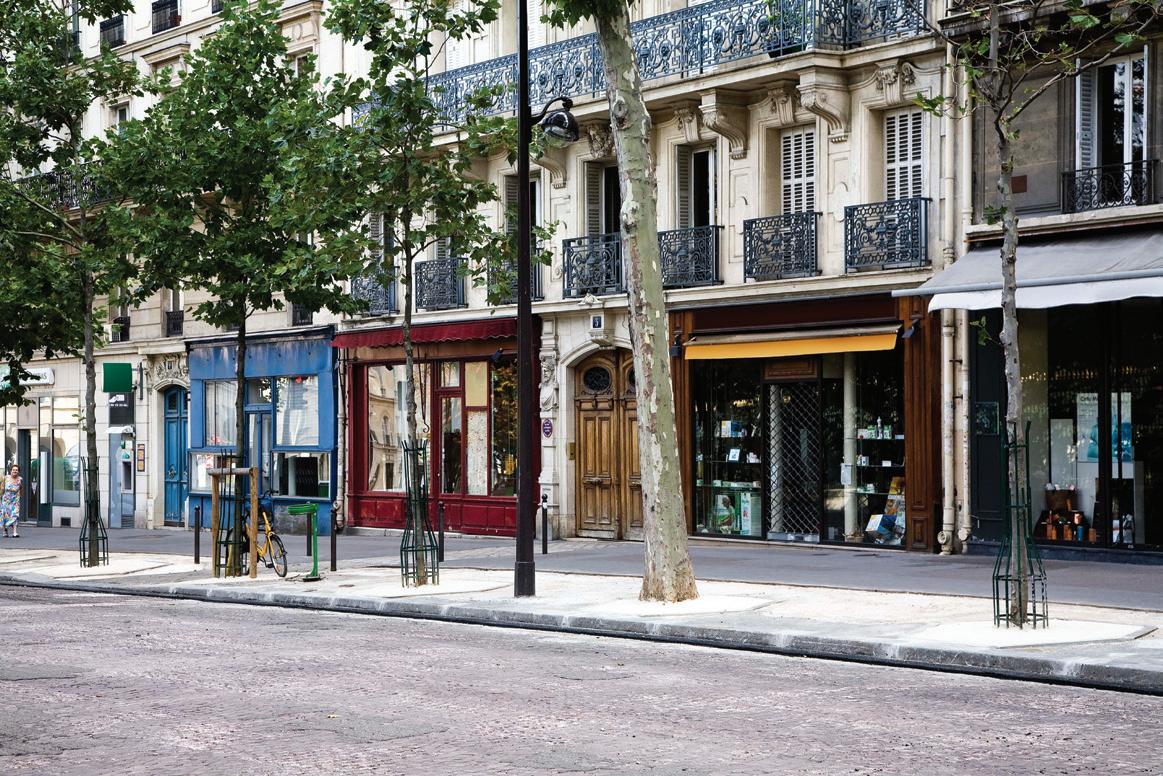
A street scene in Paris
8Responding to characterisation
Marie-Laure, a young French girl who lives in Paris with her father, who is the locksmith at the National Museum of Natural History. She has been blind since the age of six. Her father tries to help Marie-Laure deal with her disability by using to the full her other senses, her intelligence and curiosity. One of the ways he does this is by giving her a puzzle box for birthdays with a small surprise hidden inside. He knows, however, that she will have harder problems in life, so he painstakingly builds a scale model of their entire neighbourhood to enable her to find her way around outside without help.
All the Light We Cannot See
Usually Marie-Laure can solve the wooden puzzle boxes her father creates for her birthdays. Often they are shaped like houses and contain some hidden trinket1. Opening them involves a cunning series of steps: find a seam with your fingernails, slide the bottom to the right, detach a side rail, remove a hidden key from inside the rail, unlock the top, and discover a bracelet inside.
For her seventh birthday, a tiny wooden chalet stands in the center of the kitchen table where the sugar bowl ought to be. She slides a hidden drawer out of the base, finds a hidden compartment beneath the drawer, takes out a wooden key, and slots the key inside the chimney. Inside waits a square of Swiss chocolate.
‘Four minutes,’ says her father, laughing. ‘I’ll have to work harder next year.’
For a long time, though, unlike his puzzle boxes, his model of their neighbourhood makes little sense to her. It is not like the real world. The miniature intersection of rue de Mirbel and rue Monge, for example, just a block from their apartment, is nothing like the real intersection. The real one presents an amphitheatre of noise and fragrance: in the fall it smells of traffic and castor oil, bread from the bakery, camphor from Avent’s pharmacy, delphiniums and sweet peas and roses from the flower stand. On winter days it swims with the odor of roasting chestnuts; on summer evenings it becomes slow and drowsy, full of sleepy conversations and the scraping of heavy iron chairs.
But her father’s model of the same intersection smells only of dried glue and sawdust. Its streets are empty, its pavements static; to her fingers, it serves as little more than a tiny and insufficient facsimile2. He persists in asking Marie-Laure to run her fingers over it, to recognize different houses, the angles of streets. And one cold Tuesday in December, when Marie-Laure has been blind for over a year, her father walks her up rue Cuvier to the edge of the Jardin des Plantes.
‘Here, ma chérie, is the path we take every morning. Through the cedars up ahead is the Grand Gallery.’
‘I know, Papa.’
He picks her up and spins her around three times. ‘Now,’ he says, ‘you’re going to take us home.’
Her mouth drops open.
‘I want you to think of the model, Marie.’
‘But I can’t possibly!’
‘I’m one step behind you. I won’t let anything happen. You have your cane. You know where you are.’
‘I do not!’
‘You do.’
Exasperation. She cannot even say if the gardens are ahead or behind.
‘Calm yourself, Marie. One centimeter at a time.’
‘It’s far, Papa. Six blocks, at least.’
‘Six blocks is exactly right. Use logic. Which way should we go first?’
The world pivots and rumbles. Crows shout, brakes hiss, someone to her left bangs something metal with what might be a hammer. She shuffles forward until the tip of her cane floats in space. The edge of a curb? A pond, a staircase, a cliff? She turns ninety degrees. Three steps forward. Now her cane finds the base of a wall. ‘Papa?’
‘I’m here.’
Six paces seven paces eight. A roar of noise—an exterminator3 just leaving a house, pump bellowing— overtakes them. Twelve paces farther on, the bell tied around the handle of a shop door rings, and two women come out, jostling her as they pass.
Marie-Laure drops her cane; she begins to cry.
Her father lifts her, holds her to his narrow chest.
‘It’s so big,’ she whispers.
‘You can do this, Marie.’ She cannot.
Look back at the introduction and the bullet points that help you to think about how writers present characters. You can now apply them to this extract.
Work on your own for the following activities.
1 Look at lines 1–9. Consider what Marie-Laure and her father do, and what her father says.Write two sentences saying what you learn about their characters from these lines.
2 Look at lines 10–21. These lines are about what Marie-Laure thinks and feels when using her senses to the full.
In your own words, in one paragraph, describe the contrast between Marie-Laure’s feelings about her real-life experience and those for her father’s model of the area.
3 The dialoguebetween father and daughter – what they say – tells you a great deal about the two characters.
GLOSSARY
1trinket: a small object of little value
2 facsimile: an exact copy
3exterminator: a noisy machine
Copy and complete Table 8.1 by commenting on what each quotation tells you about each character.
Quotation: what Papa says Comment
‘Now . . . you’re going to take us home.’ (line 24)
‘I’m one step behind you. I won’t let anything happen.’ (line 28)
‘Calm yourself, Marie. One centimeter at a time.’ (line 32)
‘Six blocks is exactly right. Use logic. Which way should we go first?’ (line 34)
Quotation: what Marie-Laure says Comment
‘But I can’t possibly!’(line 27)
‘It’s far, Papa.’ (line 33)
Table 8.1: Quotation and comment table for All the Light We Cannot See
SET TEXT ACTIVITY 1
Find a passage in your set text where there is dialogue between two of the characters.
Using a similar table, choose important dialogue spoken by each character and, for each quotation, comment on what it tells you about the character.
4 Look at the final part of the extract from line 35.
There is some dialogue in this part of the extract, but it is mainly about what Marie-Laure does and what she is thinking and feeling. It considers:
• the things she hears and feels around her
• the questions she asks
• the relationship with her father.
Write two paragraphs in response to this practice question: How does Doerr vividly convey Marie-Laure’s experience at this moment in the novel? Support your ideas with details from the text. [25]
Remember to:
• use quotations to support your comments
• consider the language and devices Doerr uses to help you imagine her experience, particularly onomatopoeia
• look at the impact of the short sentences in the final five lines. The story is continued in the Workbook, with more activities. You will learn whether Marie-Laure manages to succeed, as her father hopes.
FURTHER READING
Helen Keller (born 1880 in the USA) was both blind and deaf almost from birth. Her inspiring and moving short autobiography The Story of My Life was published in 1903. Molly Burke (born 1994 in Canada) lost most of her sight at the age of 14. She is a YouTube personality and speaks powerfully about her experiences in the audiobook It’s Not What It Looks Like (published 2019).
SAMPLE
8.2 Exploring the ways in which characters are presented From A Stranger from Lagos
by Cyprian Ekwensi
Born in Nigeria, Cyprian Ekwensi (1921–2007) wrote novels and short stories about his country and its people. The following extract from his short story A Stranger from Lagos (1966) is set in Onitsha, a city and river port in south-eastern Nigeria. The extract provides a compelling and powerful portrait of life as experienced by the main character Lilian and captures her paranoia about being watched – and judged. This extract portrays a woman not comfortable in the community in which she lives; it is taken from the beginning of the story, and the reader is thrown into the middle of the action.
She saw the way he looked at her when she was dancing and knew. Only a stranger would look like that at the Umu-ogbo dance, and only a man who had fallen would linger on her movements that way. Yet it embarrassed her when, sitting with the elderly women in the bright hot afternoon, she looked up from her sewing and saw him, asking questions. Though she knew he had seen her, he did not once look in her direction. He looked so transparently silly and pitiable.
KEY TERM
short story: a type of story that is shorter than a novel. It generally concentrates on a single event and has a small number of main characters.
A street scene in the town of Onitsha, the setting for A Stranger from Lagos
A Stranger from Lagos
8Responding to characterisation
She wondered what to do. Should she go to his help there – while her mother and her fiancé’s mother were present? He seemed to be holding his own, telling fables, something about having missed his way, having recently crossed the Niger1 . . . She would go to his aid. Suddenly she caught the hard look on his unsmiling face, a look full of the agony of desire.
Her legs felt too heavy to stir. Too many eyes. In Onitsha2 Town there were eyes on the walls. In the compound, eyes. In the streets, eyes. Such a small town, and so small-town-minded. You went down Market Street, new or old, and came back into Market Street, new or old, through a number of parallel feeder streets. Of course, Lilian had lived here since she was born and she knew her way to her lover’s house without being seen even by day, and with her mother happily thinking she had gone to market. But once they saw her, once they saw a girl they knew and respected speaking with a glamorous-looking stranger like this one, or in a hotel, or standing in the streets and talking to a man in broad daylight, or daring to hold hands or to linger too long with a handshake, the eyes would roll and the tongues would wag and the girl’s best course of action would be to leave the town or immediately be branded3
By the time Lilian looked up from her machine, he was gone. Her mother was coming back to the veranda.
‘What did he say he wanted?’
‘Do I know?’ Her mother shrugged and made a face. ‘These young men from Lagos4, who understands the language they speak?’
Lilian knew he had come for her but his courage had failed him. ‘Did he say his name, or where he lives?’
‘He called a name. He is not of a family I know.’
Unlike her mother, Lilian cared little for ‘families she knew’. She judged young men by what her instincts told her, and this time they told her she had made a conquest, full of strange enchantment. She put the scissors through the wax print and shaped it into a skirt that ended well above her knees. Her mother’s eyes followed her with resentment. She called such tight clothes ‘mad people’s clothes’.
On her way down Market Street, Lilian wiggled in the new dress. Her hair had been newly done, and the loop earrings were large enough to play hula-hoop. Someone stopped just behind her. She looked round. Eyes. From the windows of the hotels, bookshops, sign painters, mechanics’ workshops, eyes focused enquiringly on her and the stranger with such intentness that she felt like something projected on a 3-D screen for all Onitsha to view. This was sensation.
He was tall and good-looking and did not show any embarrassment at being made the spectacle of Market Street. Of course, he did not know the town. He would scandalize her, and leave her to it. That was the way of strangers. They left you to the gossips.
GLOSSARY
1Niger: the principal river of western Africa
2Onitsha: a city and river port on the eastern part of the Niger in southeastern Nigeria
3branded: given a bad reputation
4Lagos: a densely populated port city in Nigeria
‘I saw you in the compound – is that where you live?’
‘Yes. Please, I am in a hurry. Who are you?’
‘A stranger from Lagos. If you had time, I would tell you about my mission.’
‘Now?’ She wrinkled her nose.
‘I only stopped because I saw you. It is some days now since I came to your compound. I have wanted to see you.’
‘What for?’ she asked unnecessarily. He did not answer.
‘You’re from Lagos?’ Lilian said.
‘Yes.’
The eyes from the hotels, bookshops, mechanical workshops, danced. A woman passer-by stopped and greeted Lilian by name. Lilian seemed to remember the face, and yet she could not place it. Her mind was focused on the stranger. ‘How is your baby?’ asked the passer-by.
‘How is your mother?’ Lilian mumbled something . . .
‘You’re from Lagos,’ Lilian said. ‘Here in Onitsha we do not stop and talk in the streets.’
1 Read the extract carefully, paying close attention to the way the narrative develops. Rearrange the following events in the order they occur in the extract. This activity will help you to consider the way in which the writer organises the plot, which will be useful for Activity 2.
a Lilian walks along Market Street.
b Lilian works at her machine.
c Lilian puts on her new dress and large earrings.
d The stranger meets Lilian at the dance.
e The stranger asks Lilian whether she lives in the compound.
2 Look at the first two sentences of the extract. What do they suggest about how the plot may develop? Write your answer in a short paragraph.
3 Look at lines 1–13. On a copy of the extract, highlight words and phrases that tell us about Lilian’s thoughts and feelings. Then annotate the highlighted phrases to show how the details build up an impression of Lilian’s character.
For example: ‘He looked so transparently silly and pitiable.’ – this shows her views about the stranger who pretended that he had not seen her.
8Responding to characterisation
For Activities 4–6, work in pairs.
4 Look at lines 14–27. Discuss how the following quotations help to create a picture of Onitsha and the people who live there. Comment on the effects created by the writer’s use of language.
a ‘In Onitsha Town there were eyes on the walls.’
b ‘Such a small town, and so small-town-minded.’
c ‘. . . talking to a man in broad daylight . . .’
d ‘. . . the eyes would roll and the tongues would wag and the girl’s best course of action would be to leave the town or immediately be branded.’
5 Look at lines 14–45. How do Lilian’s values differ from:
a the values ofher mother
b the values of the townsfolk?
Highlight on your copy of the extract the brief quotations you would use to answer this question. Then, with your partner, write two paragraphs in which you comment on the effects created by the key words in your quotations.
6 Read again lines 44–48. Look at the length of each of the five sentences. Someone stopped just behind her. She looked round. Eyes. From the windows of the hotels, bookshops, sign painters, mechanics’ workshops, eyes focused enquiringly on her and the stranger with such intentness that she felt like something projected on a 3-D screen for all Onitsha to view. This was sensation.
a Discuss how the length of each of these sentences contributes to the impact of the story. Consider each sentence in turn.
b Now combine the first three sentences into one longer one and compare it with the original. Which version has the greater impact for you and why?
8.3 Exploring the portrayal of a relationship
From A Suitable Boy by Vikram Seth
The final extract in this unit comes from A Suitable Boy (1993), a novel by the Indian writer Vikram Seth (born 1952).
As you read the extract, you will see a powerful portrayal of a mother and her daughter, and the relationship between them. These two characters might share the traits of people you know in real life. A prose fiction writer such as Seth will exploit such common traits to bring his characters memorably to life.
TIP
Lilian’s values contrast with those of her mother and of the other townsfolk of Onitsha. Stories often revolve around contrasts between characters or between a character and the community they belong to. Such contrasts or differences can often be useful starting points for the close study of prose (and drama) texts.
The extract is from the beginning of the novel and begins with the mother addressing the daughter in words intended to show her authority:
‘You too will marry a boy I choose,’ said Mrs Rupa Mehra firmly to her younger daughter.
Tanya Maniktala plays the character Lata Mehra in the 2020 BBC adaptation of the novel A Suitable Boy
Here, there are two ways in which this single sentence depicts the mother’s determined character:
• the tone of voice in which she says the words in direct speech: ‘You too will marry a boy I choose’
• the use of the adverb ‘firmly’ to convey the way she speaks to her daughter.
As you read the extract, you will see conflict in the way the two characters view marriage.
KEY TERM
direct speech: the words spoken by the characters. It is usually indicated by the presence of inverted commas, or speech marks, around the words the characters speak A Suitable Boy
‘You too will marry a boy I choose,’ said Mrs Rupa Mehra firmly to her younger daughter.
Lata avoided the maternal imperative by looking around the great lamp-lit garden of Prem Nivas. The wedding-guests were gathered on the lawn. ‘Hmm,’ she said. This annoyed her mother further.
‘I know what your hmms mean, young lady, and I can tell you I will not stand for hmms in this matter. I do know what is best. I am doing it all for you. Do you think it is easy for me, trying to arrange things for all four of my children without His help?’ Her nose began to redden at the thought of her husband, who would, she felt certain, be partaking of their present joy from somewhere benevolently above. Mrs Rupa Mehra believed, of course, in reincarnation1, but at moments of exceptional sentiment, she imagined that the late Raghubir Mehra still inhabited the form in which she had known him when he was alive: the robust, cheerful form of his early forties before overwork had brought about his heart attack at the height of the Second World War. Eight years ago, eight years, thought Mrs Rupa Mehra miserably.
‘Now, now, Ma, you can’t cry on Savita’s wedding day,’ said Lata, putting her arm gently but not very concernedly around her mother’s shoulder.
‘If He had been here, I could have worn the tissue-patola sari2 I wore for my own wedding,’ sighed Mrs Rupa Mehra. ‘But it is too rich for a widow to wear.’
‘Ma!’ said Lata, a little exasperated at the emotional capital3 her mother insisted on making out of every possible circumstance. ‘People are looking at you. They want to congratulate you, and they’ll think it very odd if they see you crying in this way.’
Several guests were indeed doing namasté4 to Mrs Rupa Mehra and smiling at her; the cream of Brahmpur society, she was pleased to note.
‘Let them see me!’ said Mrs Rupa Mehra defiantly, dabbing at her eyes hastily with a handkerchief perfumed with 4711 eau-de-Cologne. ‘They will only think it is because of my happiness at Savita’s wedding. Everything I do is for you, and no one appreciates me. I have chosen such a good boy for Savita, and all everyone does is complain.’ 5
GLOSSARY
1reincarnation: being born again in another body or form
2sari: garment of long cloth wrapped round the waist and passed over the shoulder and head
3capital: advantage
4doing namasté: greeting with respect
8Responding to characterisation
Lata reflected that of the four brothers and sisters, the only one who hadn’t complained of the match had been the sweet-tempered, fair-complexioned, beautiful Savita herself.
‘He is a little thin, Ma,’ said Lata a bit thoughtlessly. This was putting it mildly. Pran Kapoor, soon to be her brother-in-law, was lank, dark, gangly, and asthmatic.
‘Thin? What is thin? Everyone is trying to become thin these days. Even I have had to fast the whole day and it is not good for my diabetes. And if Savita is not complaining, everyone should be happy with him. Arun and Varun are always complaining: why didn’t they choose a boy for their sister then? Pran is a good, decent, cultured khatri5 boy.’
There was no denying that Pran, at thirty, was a good boy, a decent boy, and belonged to the right caste6. And, indeed, Lata did like Pran. Oddly enough, she knew him better than her sister did – or, at least, had seen him for longer than her sister had. Lata was studying English at Brahmpur University, and Pran Kapoor was a popular lecturer there. Lata had attended his class on the Elizabethans, while Savita, the bride, had met him for only an hour, and that too in her mother’s company.
‘And Savita will fatten him up,’ added Mrs Rupa Mehra. ‘Why are you trying to annoy me when I am so happy? And Pran and Savita will be happy, you will see. They will be happy,’ she continued emphatically. ‘Thank you, thank you,’ she now beamed at those who were coming up to greet her. ‘It is so wonderful – the boy of my dreams, and such a good family. The Minister Sahib has been very kind to us. And Savita is so happy. Please eat something, please eat: they have made such delicious gulabjamuns7, but owing to my diabetes I cannot eat them even after the ceremonies. I am not even allowed gajak8, which is so difficult to resist in winter. But please eat, please eat.
I must go in to check what is happening: the time that the pandits9 have given is coming up, and there is no sign of either bride or groom!’ She looked at Lata, frowning. Her younger daughter was going to prove more difficult than her elder, she decided.
‘Don’t forget what I told you,’ she said in an admonitory10 voice.
1 Look at lines 1–2. How effective do you find this sentence as an opening to the novel? How does it grab your attention?
Write your answer in no more than two sentences, giving a reason for your view.
2 Some of the language used is quite formal.
a Look at the following phrases and, in your own words, write down the meanings of the phrases as they are used in the extract. Use a dictionary if you need to.
• Line 3: ‘avoided the maternal imperative’ (referring to Lata)
• Lines 12–13: ‘at moments of exceptional sentiment’ (referring to the mother)
• Lines 14–15: ‘robust, cheerful form’ (referring to the deceased father)
b What do you think is the effect of using formal language?
GLOSSARY
5khatri: Punjabi, from a north Indian community
6caste: social class
7gulabjamuns: a popular Indian dessert
8gajak: a dry sweet made from sesame seeds
9pandits: scholars skilled in Hindu religion
10admonitory: warning
3
Working in pairs, look at lines 1–34.
Discuss your first impressions of the mother, Mrs Rupa Mehra. Record your ideas in a mind map. You should include:
• your views
• brief quotations that support your views.
‘said Mrs Rupa Mehra firmly’ – shows she doesn’t like to be contradicted
Impressions of the mother
4 With your partner, work your way through the extract, exploring how the novelist portrays Lata. Use a quotation and comment table like Table 8.2 to record your answers. Refer closely to the writer’s use of language.
You should consider:
• what the character Lata says in direct speech
• other information the narrator gives about Lata.
Quotation
‘putting her arm gently, but not very concernedly around her mother’s shoulder’
Comment
This action gives a false idea to anyone looking that Lata is genuinely comforting her mother. The words ‘not very concernedly’ show the truth about Lata’s attitude towards her mother.
Table 8.2: Quotation and comment table for A Suitable Boy
5 In small groups, use your answers to the previous activities to discuss the following practice question:
How does Seth amusingly portray the relationship between Lata and her mother? Support your ideas with details from the text. [25]
SAMPLE
You might consider:
• the way Lata behaves with her mother
• the way the mother speaks to her daughter
• their different attitudes towards marriage.
SAMPLE ANSWER
Look at the following example responses (a, b and c) to the way Lata behaves with her mother. Match the response to the teacher comments (1, 2 and 3) which follow.
SAMPLE
Responses:
a Lata really annoys her mother by not agreeing with her views on marriage. I think that the daughter ought to show more respect to her mother.
b When Mrs Mehra says, ‘You will marry a boy I choose’, Lata replies with ‘Hmm.’ This is funny and shows us a lot about the relationship between the mother and daughter.
c The writer portrays Mrs Mehra as very alert to the daughter’s brief response of ‘Hmm’. This utterance is a noise rather than an actual word and is very dismissive of her mother’s concerns. It has the effect of antagonising her mother, who pointedly addresses her daughter as ‘young lady’.
Teacher comments:
1 This is a mixture of quotations and opinions. However, the points could be developed further and linked to the quotations used.
2 The first part of this response shows a basic understanding of character, but then goes on to express a general view that is not relevant to the question. There is no support from the text.
3 This response makes valid comments about the way Lata behaves with her mother, with appropriate support from the text and some response to the use of language.
SET TEXT ACTIVITY 2
The extract from the opening of the novel A Suitable Boy contains lots of direct speech. Select an extract (of about a page long) from your set prose text where there is also direct speech.
a In small groups, work together to produce a script for a radio play, covering the extract you choose. This will help you to look closely at ways in which the writer of your set prose text uses language and structure. Your focus should be on emphasising the words spoken and the tone of voice suitable for the different characters.
b Next, practise reading the lines of your script exactly as you think the characters would say them.
c Finally, record your script; the recording can be used later when you are revising this set text.
REFLECTION
What benefits are there to acting out key moments from a novel? Does it help you to consider closely the language the writer gives to a particular character? Does it help you to consider the writer’s choices about structure and the way they organise the details? Are there any other extracts you could act out in texts you are studying?
CHECK YOUR PROGRESS
As you study characters in prose fiction, consider the following questions. Your answers to these questions will help you to acquire detailed knowledge of the characters you study. The questions encourage you to appreciate the various ways in which prose writers present characters.
SAMPLE
Five main aspects of a character
• What does a particular character look like?
• What does the character do?
• What does the character say and think?
• What do other characters say and think about the character?
• How does the character develop as the text progresses?
Features of characterisation to explore
• What does the character add to the plot?
• How big a role does the character play in the novel or short story?
• How does the writer describe the character’s appearance?
• How does the writer describe the character’s personal qualities?
• Are there deliberate contrasts or conflicts with other characters?
• Is the character at odds with the society in which they live?
• In what ways does the writer convey a distinctive voice for the character?
Active learning strategies
Try one or more of the following strategies to improve your appreciation of characters and the ways in which they are presented in stories:
• Highlight and annotate key words.
• List your impressions of characters.
• Use ‘quotation and comment’ tables.
• Write summaries.
• Draw mind maps.
• Record key lines spoken by different characters.
SET TEXT ACTIVITY 3
For the prose text you are studying, you could use examples of the active learning strategies for major characters. To get you started:
a Choose one character from your set prose text and draw a mind map that shows their interactions with other characters in the text.
b Choose another character and use a quotation and comment table to list and comment on key quotations for the character.
8Responding to characterisation
SELF-ASSESSMENT
Reflect on the skills below and indicate your confidence level between 1 and 5 (with 1 meaning ‘not at all confident’ and 5 meaning ‘very confident’). If needed, revisit the section listed in the ‘Look again’ column. Come back to this list later in your course. Do you feel your confidence has grown?
Now I can . . . Confidence
study what characters say and do – and what other characters say about them
8.1, 8.2, 8.3 explore how writers use direct speech and description to present their characters recognise the difference between ‘character’ and ‘characterisation’.
SAMPLE
Literature in English for Cambridge IGCSETM
and O Level
WORKBOOK
Third edition with Digital access
Russell Carey & Trish Miller
How to use this book
How to use this book
Throughout this book, you will notice different features that will help your learning. These are explained below.
Activities
These help you to practise skills that are important for studying Cambridge IGCSE and O Level Literature in English. They encourage you to reflect not only on the content of what you are reading, but also on the important role of the writer. Exploring the deliberate choices writers make in their writing will help you to improve your skills of analysis and increase your enjoyment of the texts you study.
1 Look out for activities with the set-text icon next to them. These are activities that you can apply to any of your set texts, to practise answering questions on.
SET TEXT ACTIVITY
These are skills-based activities that you can use independently alongside your set texts.
Practice questions: Throughout each unit you’ll find examples of practice questions written by the authors, alongside the number of marks available for a full answer. You’ll practise your skills in planning answers and developing a personal response, which will provide preparation for responding to the type of task required by the syllabus.
SAMPLE ANSWER
Sample answers at a range of levels provide you with the opportunity to assess and reflect on what makes a successful answer. You can use these to help you to evaluate your own work and understand the success criteria. These sample answers have been written by the authors.
KEY TERMS
Key vocabulary is highlighted in the text when it is first introduced. An accompanying definition tells you the meanings of these words and phrases. You will also find definitions of these words in the Glossary at the end of the book.
b Her treatment of Jane:
5 Look at the words you have highlighted in colour 2 and also relevant information in the previous questions. Write a paragraph about how Brontë creates sympathy for Jane in this opening section of the novel. Think about the voice of the extract as well as the words and phrases you have identified. Remember to use short quotations in your answer.
3.2 Responding to how writers present characters
From All the Light We Cannot See by
Anthony Doerr
In Unit 8.1 of the Coursebook, the extract from this novel described how the blind seven-year-old girl, Marie-Laure, struggled to find her way home through the streets of Paris by using the model of the area made by her father. This extract follows on from the account of her first attempt at the seemingly impossible task.
All the Light We Cannot See
GLOSSARY
1 hydrant: water pipe in the street
2 runnel: gutter
3 spars: rails
Tuesday after Tuesday she fails. She leads her father on six-block detours that leave her angry and frustrated and farther from home than when they started. But in the winter of her eighth year, to Marie-Laure’s surprise, she begins to get it right. She runs her fingers over the model in their kitchen, counting miniature benches, trees, lampposts, doorways. Every day some new detail emerges—each storm drain, park bench, and hydrant1 in the model has its counterpart in the real world.
Marie-Laure brings her father closer to home before making a mistake. Four blocks three blocks two. And one snowy Tuesday in March, when he walks her to yet another new spot, very close to the banks of the Seine, spins her around three times, and says, ‘Take us home,’ she realizes that, for the first time since they began this exercise, dread has not come trundling up from her gut.
Instead she squats on her heels on the sidewalk.
The faintly metallic smell of the falling snow surrounds her. Calm yourself. Listen.
3Responding to prose
Cars splash along streets, and snowmelt drums through runnels2; she can hear snowflakes tick and patter through the trees. She can smell the cedars in the Jardin des Plantes a quarter mile away. Here the Metro hurtles beneath the sidewalk: that’s the Quai Saint-Bernard. Here the sky opens up, and she hears the clacking of branches: that’s the narrow stripe of gardens behind the Gallery of Paleontology. This, she realizes, must be the corner of the quay and rue Cuvier.
Six blocks, forty buildings, ten tiny trees in a square. This street intersects this street intersects this street. One centimeter at a time.
Her father stirs the keys in his pockets. Ahead loom the tall, grand houses that flank the gardens, reflecting sound.
She says, ‘We go left.’
They start up the length of the rue Cuvier. A trio of airborne ducks threads toward them, flapping their wings in synchrony, making for the Seine, and as the birds rush overhead, she imagines she can feel the light settling over their wings, striking each individual feather.
Left on rue Geoffroy Saint-Hilaire. Right on rue Daubenton. Three storm drains four storm drains five. Approaching on the left will be the open ironwork fence of the Jardin des Plantes, its thin spars3 like the bars of a great birdcage.
Across from her now: the bakery, the butcher, the delicatessen.
‘Safe to cross, Papa?’
‘It is.’
Right. Then straight. They walk up their street now, she is sure of it. One step behind her, her father tilts his head up and gives the sky a huge smile. Marie-Laure knows this even though her back is to him, even though he says nothing, even though she is blind—Papa’s thick hair is wet from the snow and standing in a dozen of angles off his head, and his scarf is draped asymmetrically over his shoulders, and he’s beaming up at the falling snow.
They are halfway up rue des Patriarches. They are outside their building. Marie-Laure finds the trunk of the chestnut tree that grows past her fourth-floor window, its bark beneath her fingers.
Old friend.
In another half second her father’s hands are in her armpits, swinging her up, and Marie-Laure smiles, and he laughs a pure, contagious laugh, one she will try to remember all her life, father and daughter turning in circles on the sidewalk in front of their apartment house, laughing together while snow sifts through the branches above.
The Coursebook activities used a checklist of bullets outlined at the start of Unit 8 to consider how Doerr presents the characters of Marie-Laure and her father. You looked at what they say, what they do and how they think and feel. Here are similar activities for this extract, which explores characterisation.
1 In the first two paragraphs, look at what Marie-Laure does and how she feels. Choose four quotations that show how she gradually succeeds and her changing feelings.
Quotation 1:
Quotation 2:
Quotation 3:
Quotation 4:
2 In line 11, Marie-Laure says to herself that she must ‘Listen’. She realises that her sense of hearing is the most important way of finding her way home.
List all the instances of onomatopoeia you can find in lines 12–16 and say what effect these create in the extract.
KEY TERM
characterisation: the ways in which writers present their characters
SAMPLE
3 Marie-Laure also uses another method of working out where she is. Look at lines 17–27. What do you notice about her thoughts in these lines?
4 Look at line 29 to the end of the extract. These focus on both Papa and Marie-Laure, what they say, what they do and their appearance. How does Doerr show their delight at this moment in the novel? Find four quotations which support this.
Quotation 1:
Quotation 2:
Quotation 3:
Quotation 4:
5 Looking at the extracts in both the Coursebook and Workbook, write a plan to answer the following practice question:
How does Doerr movingly portray the relationship between Marie-Laure and Papa? Support your ideas with details from the text. [25] Make sure your points are supported by quotations from the text.
3 Responding to prose
SAMPLE
3 Responding to prose
SET TEXT ACTIVITY 1
Both Jane Eyre and Marie-Laure are characters that have been presented in a sympathetic way. Think about the characters in your set text. Choose one that the writer makes you feel sympathy for. Use a mind map to set out examples of this characterisation, each supported by a quotation.
3.3 Responding to theme
From The Pieces of Silver by Karl Sealy
This extract immediately follows the extract from the same story in Unit 9.2 of the Coursebook. There, you read about the humiliation of Clement Dovecot by the acting Headmaster. In the extract below, the scene shifts from school to the home of the Dovecot family. The theme of poverty is important in the extract. It is clear why Clement was not able to provide a donation for the retiring headmaster.
The Pieces of Silver
It was dusk, and the Dovecots were taking their one substantial meal of the day.
KEY TERM theme: the main idea or ideas in a text, such as power, identity and heroism
No one could think, looking at their home, that threepenny pieces, or even halfpennies, were to be had there for the asking.
The house was a poor, wretched coop of a room, through the black, water-stained shingles1 of which you could count a dozen blue glimpses of the sky. The walls of the shack were papered with old newspapers and magazines, discoloured with age and stained and spotted from roof to floor, torn in a score of places, to reveal the rotting, worm-eaten boards beneath. The small room was divided by a threadbare cotton screen depicting seagulls soaring up from a sea of faded blue. In the midst of this drab poverty the free, soaring seagulls, and the once gay pictures of the magazine pages were an unkind comment.
The Dovecots were a family of four: Dave and his wife Maud, Clement and his older sister Evelina.
Clement sat on the sanded floor of the poor sitting-room, his plate of rice between his legs; Evelina lolled over the one battered, depreciated mahogany table, picking at the coarse food with an adolescent discontent; Dave Dovecot, a grizzled, gangling2 labourer, held his plate in his left hand, while with his right he plied his mouth from a peeling metal spoon; at the propped-open window of the room sat Mrs Dovecot, a long thread of a woman whose bones want3 had picked like an eagle. Her plate was resting on her lap, and she scraped and pecked and foraged her food like a scratching hen, while she took stock of the passers-by.
When Clement had finished, he took up his empty plate and, getting to his feet, went and stowed it away in the dark box of a kitchen. Returning, he slumped down beside his mother’s chair and rested his head against her bony thigh.
After a time he said:
‘Ma, could I have the threepence I’s been asking for Mr Megahey?’
‘Hmn. Wa’ threepence boy? Why in de name of de Lord must poor starving people got to find threepences for Jim Megahey what’s got his belly sitting so pretty wi’ fat?’ parried4 Mrs Dovecot, though she knew well enough.
‘I’s told you and told you and told you, Ma. He’s resigning and we’ve all got to take threepence to give him,’ explained Clement patiently once more.
3Responding to prose
‘Hmn. Threepence is a lot o’ money for us poor folk. Hmn. Go ax your father. See what he says.’ Clement got to his feet reluctantly and moved slowly over to where his father was sitting, for he knew from experience that, in parting with money, his father was a far harder nut to crack than his mother.
Dave Dovecot utilised the approach of his son by extending his empty plate. Clement took the plate to the kitchen. Then he turned once more to tackle his father.
‘Can I have a threepence, Papa?’ he shouted in his father’s ear, for the old man was pretty nigh5 stone deaf.
‘Eh-eh! What’s that about a fence, Clement?’
This time Clement put his mouth completely into his father’s ear and shouted until his dark face grew darker.
‘Eh-eh! Don’t shout at me,’ was all he got for his pains. ‘Don’t you deafen me. What’s that the young varmint6 says, Maud?’
Mrs Dovecot came over, and got him to understand after two or three attempts.
‘Three pence, Maudie,’ he cackled, ‘three pence! Did yo’ hear that, Maud? Did yo’ ever hear the like? I’ll bet you ain’t never did. Three pence! The lad’ll have money what I’s got to sweat blood for, just to gi to thet Megahey what’s got his bread so well buttered off ’pon both sides not to mention the middle. Three pence! Ha ha! . . . oh Maudie . . .’ And he broke down once more in helpless laughter. Clement went out and sat under the breadfruit tree that grew before the door, resting his back against the trunk.
Evelina came to him there when the dusk was thick and sat beside him.
There was a close bond of understanding and companionship between these two. Clement leaned against her so that he could feel the warmth of her arms, warm as the still warm ground beneath him. Biting his nails he told her of his morning’s shame.
1 Look again at lines 1–10. List five facts about the Dovecots’ home. Fact 1: Fact 2: Fact 3: Fact 4: Fact 5:
GLOSSARY
1 shingles: roof tiles
2 gangling: tall, thin
3 want: poverty
4 parried: replied
5 nigh: almost
6 varmint: badly behaved person
2 ‘In the midst of this drab poverty the free, soaring seagulls, and the once gay pictures of the magazine pages were an unkind comment.’
Explain why the narrator says the magazine pictures were ‘an unkind comment’.
3 Look at the descriptions Sealy gives of the Dovecot family’s poverty. Identify the type of imagery (simile, metaphor, personification) in the phrases in Table 3.1. Then comment on the effects of each use of imagery. In the ‘Type of imagery’ column, use each of the terms ‘simile’, ‘metaphor’ and ‘personification’ once only.
Phrase
‘a long thread of a woman whose bones want had picked like an eagle.’ (line 16)
‘she scraped and pecked and foraged her food like a scratching hen’ (lines 17–18)
Type of imagery
Effect
‘the dark box of a kitchen’ (line 20)
Table 3.1: Imagery and its effects in The Pieces of Silver
4 Write down the impressions of the four characters the writer creates for you in this extract. Use bulleted points.
Clement Dovecot
Dave Dovecot, the father
3 Responding to prose
SAMPLE
Maud Dovecot, the mother
Evelina Dovecot, Clement’s sister
Record your initial impressions of characters in your prose set text using the same as in Activity 4. Character 1
2
Literature in English for Cambridge IGCSETM and O Level
DIGITAL TEACHER’S RESOURCE
CAMBRIDGE IGCSETM AND O LEVEL LITERATURE IN ENGLISH: TEACHER’S RESOURCE
How to use this Teacher’s Resource
This digital Teacher’s Resource contains both general guidance and teaching notes that help you to deliver the content in our Cambridge IGCSE™ and O Level Literature in English series. Some of the material is provided as downloadable files, available on Cambridge GO. (For more information about how to access and use your digital resource, please see inside the front cover.) See the Contents page for details of all the material available to you, both in this book and through Cambridge GO.
There are teaching notes for each unit of the Coursebook. All the units contain the following features to help you deliver the topic.
At the start of each unit, a topic knowledge box provides a quick overview of what you need to know to prepare to teach the content of the unit.
TOPIC KNOWLEDGE
The teaching plan summarises the sub-units covered, including the number of learning hours recommended, an outline of the learning content, and the Cambridge resources that can be used to help you to teach the unit. Sub-unitApproximate number of learning hours
The language support feature contains information to help you identify and present specific terminology from the unit, and vocabulary that students may encounter. It includes advice on challenges that students might face regarding terminology.
LANGUAGE SUPPORT
There are often common misconceptions associated with particular parts of literature. These are identified in a table along with suggestions for eliciting evidence of these misconceptions in your class and advice for how to overcome them.
CAMBRIDGE IGCSETM AND O LEVEL LITERATURE IN ENGLISH: TEACHER’S RESOURCE
The learning plan table includes the assessment objectives, learning intentions and success criteria for the unit. You may wish to use these in your lesson planning.
LEARNING PLAN
SAMPLE
Every unit has a selection of starter ideas, main teaching ideas and plenary ideas. You can pick out individual ideas and mix and match them depending on the needs of your class. The activities include suggestions for how they can be differentiated or used for assessment. Homework ideas are also provided.
Links to set texts show you the ways in which the activities for the unit can be used to help support the study of your set texts.
LINKS TO SET TEXTS
The Teacher’s Resource includes downloadable resources, which are provided as both PDF and Word files so that you can edit them as you choose.
• Worksheets: These provide skills support and can be particularly helpful for students with English as an Additional Language. Look out for the set text activity icon on worksheets. These worksheets can be used with your set texts.
• Teacher support sheets: These provide support for creating long-term teaching plans, example lesson plans as well as photocopiable templates to use for your own teaching.
• Photocopiable extracts: All the poems and extracts from the plays and prose texts used in the Coursebook are available to print out and use for your students to annotate and practise the key skills required for analysing texts.
You will also find answers to the Coursebook and Workbook questions at the end of this resource. These sample answers are written by our authors.
Introduction
About the authors
How to use this series
How to use this Teacher’s Resource
About the assessment
Syllabus correlation grid
Teaching notes
Part 1: Introduction
Unit 1 How to get the most from this Coursebook
Unit 2 Approaching your course
Part 2: Building your skills: poetry
Unit 3 Introducing poetry
Unit 4 Reading for meaning
Unit 5 Exploring language and structure
Unit 6 Developing an informed personal response to poetry
Part 3: Building your skills: prose
Unit 7 Introducing prose
Unit 8 Responding to characterisation
Unit 9 Responding to themes
Unit 10 Responding to setting and mood
Unit 11 Responding to narrative viewpoint
Unit 12 Responding to a short story
Part 4: Building your skills: drama
Unit 13 Introducing drama
Unit 14 Responding to characters and themes
Unit 15 Responding to structure and language
Unit 16 Developing an informed personal response to drama
CAMBRIDGE
Part 5: Writing skills
Unit 17 Critical writing
Part 6: Approaching assessment
Unit 18 Approaching set texts
Unit 19 Unseen poems and prose
Unit 20 Preparing for coursework
Digital resources
The following items are available on Cambridge GO. For more information on how to access and use your digital resource, please see inside front cover.
Approaches to Teaching and Learning
Teacher support sheets
Worksheets
Worksheet answers
Text extracts
Coursebook answers
Workbook answers
Acknowledgements
IGCSETM AND O LEVEL LITERATURE IN ENGLISH: TEACHER’S RESOURCE 2
SAMPLE
CAMBRIDGE
CAMBRIDGE IGCSETM AND O LEVEL LITERATURE IN ENGLISH:
TEACHER’S RESOURCE
Introduction
SAMPLE
Welcome to the new edition of the Cambridge IGCSE™ and O Level Literature in English series.
This exciting new edition has been designed by talking to teachers all over the world. The series will support you with the updated syllabus, solve your biggest classroom challenges and engage your students. We have worked hard to understand your needs and challenges, and then carefully designed and tested the best ways of meeting them.
As a result of this research, we have made some changes to the series. The series uses the most successful teaching pedagogies, including active learning and metacognition. For this new series, we have included relevant pedagogical features in the Coursebook, such as ‘Check your progress’ to encourage self-assessment and reflection. Activities throughout the Coursebook help students to become better readers of texts, by encouraging them to reflect not only on the content of what they are reading, but also on the important role of the writer, as well as ‘Further reading’ opportunities to encourage a lifelong love of reading.
The Workbook includes additional engaging exercises to consolidate your students’ learning, as well as sample answers at a range of levels to provide students with the opportunity to assess and reflect on what makes a successful answer.
This Teacher’s Resource has been carefully designed to make it easier for you to plan and teach your course, and it gives you full guidance on how to integrate teaching ideas into your classroom. You can get to know your students better with frequent and effective formative assessment opportunities and guidance. Teaching ideas include clear learning objectives and success criteria. Ensure that all students can progress in your course with clear, consistent differentiation in the form of advice about supporting students’ different needs.
All our resources are written for teachers and students who use English as a second or additional language. Finally, we hope this resource will inspire you, support you and save you much-needed time. We want to make sure we continue to meet your teaching needs, so please do get in touch if you have any questions or comments.
Julia Fusi
Commissioning Editor – Cambridge University Press & Assessment
8 Responding to characterisation
TOPIC KNOWLEDGE
When preparing to teach this unit, you should be familiar with:
• what techniques writers use to develop characterisation
• the differences between what characters sometimes say and how they feel
• how and why writers use a particular narrative voice
• how to offer a personal response, using evidence, to a question.
Teaching plan
Sub-unitApproximate number of learning hours
8.1 Responding to what characters say and do
8.2 Exploring the ways in which characters are presented
2
• How dialogue helps readers understand characters
2
• Using annotations to show an understanding of character
Coursebook
Activities 1–4
Set text activity 1
Workbook
Unit 3.2, Activities 1–5, Set text activity 1
Teacher’s Resource
Starter ideas 1–2
Main teaching idea 1
Worksheet 8.1
Coursebook
Activities 1–6
Workbook
Unit 3.2, Activities 1–5
Teacher’s Resource
Starter idea 2
Main teaching ideas 1–2
Plenary idea 1
Worksheet 8.2
8.3 Exploring the portrayal of a relationship 3
SAMPLE
• Identifying how writers present characters and their relationships with others
• Writing a response to a practice question that explores wider themes
LANGUAGE SUPPORT
• Before reading All the Light We Cannot See, show students a video of 1940s Paris. This will help them to visualise the detailed description of the city that appears in the extract. It may also help to pre-teach unusual vocabulary, such as ‘trinket’, ‘facsimile’, ‘exasperation’, ‘static’ and ‘intersection’.
• In A Stranger from Lagos, you could pre-teach the following words: ‘linger’,
Common misconceptions
Misconception
Students may sometimes read characters too literally and not appreciate that what they do and say tells us more about them than we initially may realise.
How to elicit
Coursebook
Activities 1–5
Sample answer
Set text activities 2–3
Teacher’s Resource
Starter idea 2
Main teaching idea 1
Plenary idea 2
‘glamorous’, ‘branded’, ‘conquest’, ‘wiggle’ and ‘wax print’. Students may misunderstand the contextual meaning of ‘conquest’ in this extract, since it’s related to a romantic involvement rather than a victory.
• In A Suitable Boy, the glossary includes several non-English words. You could suggest that students keep a vocabulary book to help them learn new words for all new texts.
How to overcome
Ask students to read the opening lines of the extract from A Suitable Boy (ending with ‘His help?’). After reading these lines, ask:
• Why does Lata avoid looking at her mother?
• How would you describe the mother’s reaction to Lata’s ‘Hmm’?
Write ‘The mother is talking to her daughter’ on the board. Ask students if this is a good summary of these lines. Elicit that the writer is revealing more about each character through this conversation. Invite students to come to the board and modify your sentence (or add new sentences). These additions should focus on what we learn about the mother and daughter.
CAMBRIDGE IGCSETM
Misconception
Students may not understand the difference between ‘character’ and ‘characterisation’.
How to elicit
Show students the following extract from All the Light We Cannot See:
He picks her up and spins her around three times.
‘Now,’ he says, ‘you’re going to take us home.’
Her mouth drops open.
‘I want you to think of the model, Marie.’
‘But I can’t possibly!’
‘I’m one step behind you. I won’t let anything happen. You have your cane. You know where you are.’
Ask students to find one example where they feel we learn something about either character (characterisation) from what they say.
LEARNING PLAN
Assessment
AO2
Understand the meanings of literary texts and their contexts, and explore texts beyond surface meanings to show deeper awareness of ideas and attitudes
AO3
Analyse ways in which writers use language, structure and form to create meanings and achieve effects
AO3
Analyse ways in which writers use language, structure and form to create meanings and achieve effects
• Study what characters say and do – and what other characters say about them
How to overcome
On the board, write two columns, one with the heading ‘Character: Marie-Laure’ and the other ‘Characterisation’. Before going further, explain that character refers to a fictional person in the text, whereas characterisation is the techniques the writer uses to allow readers to understand more about them.
Give students five minutes to consider the differences and then think what they would write in the ‘Characterisation’ column. This exercise may be repeated for Marie-Laure’s father, too.
SAMPLE
• Students will be able to appreciate how a writer uses a range of characterisation techniques
• Explore how writers use direct speech and description to present their characters
• Students will be able to explain how direct speech and description further aid characterisation
CONTINUED
SAMPLE
AO3
Analyse ways in which writers use language, structure and form to create meanings and achieve effects
AO4
Communicate a sensitive and informed personal response to literary texts
Starter
ideas
• Recognise the difference between ‘character’ and ‘characterisation’
• Students will be able to define ‘character’ and explain some techniques used by writers in relation to ‘characterisation’
1 Character or characterisation? (20 minutes)
Resources: Cut-up cards (one set per group)
Description and purpose: This activity helps students discuss fictional characters they may know. The tasks here will help students understand how writers use characterisation effectively to develop an emotional response from the reader.
Cut up the following phrases onto postcard-sized cards. Tell students that some cards describe a character, while others refer to characterisation. In pairs, students should place the cards in two groups, based on these categories. In this list, the first six examples are mostly to do with character, whereas the remainder are to do with characterisation. Be sure to mix the cards well before handing them out:
• Sherlock Holmes – the character’s name
• The young woman who works in the bakery
• The story’s main character is an orphan named Oliver.
• The villain in the story is a mayor.
• Harry Potter’s best friend is Ron.
• The narrator is an old man looking back on his youth.
• She slammed the door and muttered under her breath.
• ‘I don’t trust anyone,’ he said, narrowing his eyes.
• Other villagers avoided him and whispered behind his back.
• She always arrives early and keeps her workspace tidy.
• He is a man worn down by time and regret.
• She never speaks in full sentences and is constantly looking at her watch. What to do next: Once students have completed this task, go through the cards as a class. Give students a chance to justify their choices, where applicable.
2 Agree or disagree? (15 minutes)
Resources: Whiteboard or projector
Description and purpose: The aim of this activity is to engage students with the extracts and begin to explore characters’ views. It also gives them an opportunity to understand their own opinions and experiences and how these relate to the texts.
Display the following on the board (spaced out as much as possible): ‘Strongly agree – Agree – Disagree –Strongly disagree’. After reading each extract in this unit, write this statement underneath: ‘Parents always know what’s best for their children’. Give students five minutes to discuss this statement in pairs, then ask them to stand near the ‘agree/disagree’ phrase they believe the most.
What to do next: Ask students to justify their choices, using evidence from the texts and then from their own contexts.
SAMPLE
Main teaching ideas
1 Monologues (75 minutes)
Learning outcome: To understand the way a character feels and expresses themselves; to mimic a character’s voice and tone of speech
Resources: Coursebook, Unit 8
Description and purpose: Students will be asked to write a monologue based on one of the characters from the extracts used in this unit. This is a useful exercise, as it allows students a chance to write creatively and to understand how writers use characterisation.
Start by explaining that a monologue is a speech given by a character, usually in a dramatic text. For this exercise, students will choose one of the main characters in one of the texts used in this unit. Alternatively, this could be expanded to cover any of the set texts students have studied. Explain that the aim of this activity is for students to relate to the character and understand both their feelings and how the writer portrays the character at a point of their choice in the narrative. Establish that the writer may not agree with the character; they are merely representing them to elicit an emotional response from the reader.
Ensure that students begin by planning their answer. Students should use the headings ‘What I think and feel’ and ‘How I speak’ in two columns. They then brainstorm ideas for each column. Once planning is completed, allow students time to write their monologue (around 200–300 words). If time allows, students should share their monologue with a partner and explain their choices.
2 Quotations and comments (60 minutes)
Learning outcome: To find useful quotations and then explain how writers use these to develop characterisation
Resources: Worksheet 8.2
Description and purpose: Explain that, when reading prose, it is important to be able to describe a character’s feelings, motivation and emotions. To do this, students need to be able to identify quotations and explain the effect on the reader.
Using Worksheet 8.2, students focus on a prose set text they have studied. Ask them to individually choose a character and then find a quotation that helps the reader understand this character more fully. Stress that the explanation should be longer than the chosen quotation. Go through the example in the worksheet to highlight that students need to do more than paraphrase the quotation; they should engage with it, highlighting any techniques used and what effect they have.
Plenary ideas
1 Pick a phrase (15 minutes)
Resources: Coursebook, Unit 8
Description and purpose: Ask students to choose one line of dialogue from the extracts in this unit or from one of the set texts they have studied. Ask students to imagine they are the writer and explain why they wrote this line and what it tells us about a character (or characters). Elicit that it is important to understand the writer’s intentions – not only the character’s – in order to appreciate literature. After five minutes, ask students to read out their chosen line and say, in the writer’s voice, why they wrote it. If time is limited, this can be done in pairs.
2 Roll the dice (15 minutes)
Resources: Dice (electronic or real)
Description and purpose: Students roll a die to decide which question they will answer relating to this unit. This will help reinforce their understanding of characterisation and wider themes. Students can be arranged in groups of six, if needed. Below are some suggested questions:
SAMPLE
• Choose one adjective to describe a character.
• Which character do you feel you could be friends with? Why?
• Who’s the most interesting character you have read about? Why?
• Who’s the most misunderstood character? Explain.
• What’s the difference between ‘character’ and ‘characterisation’?
• Think of a question you would like to ask one character.
LINKS TO SET TEXTS
This unit links to many of the set texts. Encourage students to think carefully about what characters do as well as how they are presented to the reader. Students should become used to reflecting on what they have read and identify specific authorial choices that develop characterisation.
The set text activities in this unit include:
• Coursebook, Unit 8, Set text activities 1–3
• Coursebook, Unit 8.3, Activity 4
• Workbook, Unit 3, Set text activity 1
• Worksheets 8.1–8.2
Assessment ideas: Ask students to write a response where they pretend to be one of the writers of their set texts. They should choose one character and discuss:
• how they, as the writer, reveal information about the character
• factual information about the character
• any conflict the character has, especially with other characters
• any internal conflict they have
• what techniques they use to establish characterisation.
Give students the question, ‘How does (writer’s name) present (name of a character) in this text?’
Allow students time to think of how they would answer this question and plan out their key points.
(Giving a heading to each paragraph can help ensure students focus on each point at a time.) Students should also annotate the text or extract and highlight which examples will best help them answer the question.
Differentiation
• Supporting your students: Sentence starters can help students become comfortable with writing personal responses to questions. For this unit, you could give some of the following sentence starters to students:
• The writer presents the character as . . .
• This dialogue suggests that . . .
• The use of (technique) helps the reader to understand . . .
• (character’s name) is shown to be . . . because she . . .
• This tells us that the character is . . .
• From this part of the text, we learn that . . .
Making a ‘gingerbread person’ can help students understand characters more. Students can draw a gingerbread person shape in their books, then name it after one of the characters they are studying. They can label external elements that others know about, as well as internal elements that only the character (and reader) are aware of. For example, in A Suitable Boy, Lata does not directly disagree with her mother’s ideas (external); however, the narrative reveals that she is very much opposed to them (internal). Students can also add quotations or evidence as they develop their understanding of their chosen character.
SAMPLE
• Challenging your students:
• The extracts in this unit cover different cultures. Select one of these texts and ask students to consider how these cultural differences are presented through the characters. Students can also consider whether there are similarities or differences to their own culture.
• Students could act out one of the extracts in this unit. Students should identify the key dialogue or make up their own, in the style of the characters, where needed. They could then discuss their choices.
• The relationships between the parent and child in All the Light We Cannot See and A Suitable Boy are vastly different. Students could list all the differences they can find and consider how the writers portray these different relationships.
• Writers often use ‘foil characters’ to allow readers to better understand a main character. In A Stranger from Lagos, Lilian’s mother is a foil character. Students could research ‘foil characters’ and then explain how the writer uses the mother to help us understand more about Lilian’s character.
Homework
Ask students to complete Worksheet 8.1 – they will draw a mind map answering questions about the contribution of a character from their prose set text to the story as a whole. Give students a character and tell them to write a diary entry in the voice of the character. The response should be focused on a particular extract, situation or conflict.
Worksheets
Worksheet 8.1: students draw a mind map answering questions about the contribution of a character from their prose set text to the story as a whole.
Worksheet 8.2: students record their personal impressions of main characters from their prose set text as they read through it.