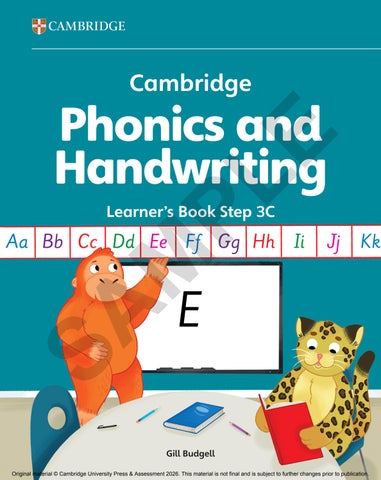
Cambridge Phonics and Handwriting Learner's Book Step 3C

Page 1


Cambridge

Phonics and Handwriting

Gill Budgell

Note to parents/carers and practitioners

This Learner’s Book provides activities to support Units 21–30 of Cambridge Phonics and Handwriting Step 3.The Teaching Resource provides full coverage of the Cambridge Phonics and Handwriting Framework and guidance on how the Learner’s Book activities develop the framework statements.

Activities can be used as school or at home. Children will need support from an adult. Additional guidance about activities can be found in the For practitioners boxes.

When children learn to read using phonics, they start by learning the sounds that letters make. For example, the letter t makes a sound like the start of the word ‘tap’. We say /t/ (a short sound), not ‘tee’ (the letter name).

Using the letter sounds helps children read by putting sounds together to make words. It also helps them spell by breaking words into sounds. When you help your child at home, try to use the sounds, not the letter names. You can find videos and tips to help you say the sounds at our parent support site: www.cambridgeinternational.org/early-years/parent-support/

Hi, my name is Rafi.
Hi, my name is Gemi.
Scan to visit Cambridge Early Years parent support site

Find, circle and write.

For practitioners

Ask

Activity 2

write and circle.

For practitioners

Ask the child to read the tricky words in the chart. Challenge them to notice what is the same in all these words (they all feature the long ee sound /iː/). They write the word and then circle the letter that is representing that sound (e or y).

Activity 3

Read and circle.

Goat’s New Raincoat

‘You look good in that raincoat,’ said Toad.

‘Thank you, it is my new raincoat’, said Goat.

‘It even has a good hood for a wet day,’ said Toad.

‘Hang it up there on the peg because we will eat now.’

‘I will keep my coat on,’ said Goat, ‘It feels so good.’

‘Sit down. I have cooked carrots in butter for you, Goat,’ said Toad.

As Toad put the food down for Goat, he tripped on the mat and dropped the food!

‘Oh, no. The butter is on your new raincoat!’

Goat looked sad.

Toad jumped to get some soap to clean the coat.

And the soap did get the butter off the coat.

‘Thank you, Toad! I am glad you fixed it for me.’

For practitioners

Ask the child to read the text and identify the oa words plus the new challenge word: raincoat. The verbs ending in -ed have the sound /t/: cooked, tripped, dropped, jumped, fixed. They then circle those words.

Activity 4

Read and write using the joined letters. had a new .
‘Does it go on the ?’ said Toad.
‘No. It on the river or sea,’ said Goat.

For practitioners

Ask the child to read each sentence and complete it by writing the correct word from the top of the page, joining the oa using the correct join formation. Remind children of the join formation phrase: At the end of writing the first letter, go straight across and then back to begin the second letter.

Activity 1

Read, circle and write.

We Shouted At The End Of The Year

We chatted about the end of the year.

We needed a good plan for the end of the year because the end of the year was near.

Let’s have an end of year party!

We shouted it with words very loud and clear. Did you hear us?

ear words

For practitioners

ed /-id/ words

Ask the child to read the decodable text. Ask them to circle the ear words (year, near, clear) in one colour; and the ed /id/ verbs (shouted, chatted, needed) in another colour. They write the words in each balloon.

Activity 2

Read, circle and write.

Read the tricky words and circle the tricky bit

Write the word Read the tricky words and circle the tricky bit

Write the word any again all about after are

We have not got any balloons.

We have not got any food or drinks.

We have not got any songs to sing.

For practitioners

Ask the child to read the tricky words in the chart. Challenge them to notice that they all begin with letter a, but the sound represented is different: the a in any is /e/; the a in after and the ar in are is /ɑː/; the a in about and again is /ə/; the a in all is /ɔː/. The child circles the tricky letter a’s; They can also circle the tricky er /ə/ at the end after. They then write the words. They read the sentences and circle the word any

Turn static files into dynamic content formats.

Create a flipbook
Issuu converts static files into: digital portfolios, online yearbooks, online catalogs, digital photo albums and more. Sign up and create your flipbook.