HAMPTONS EDITION VOL. VIII
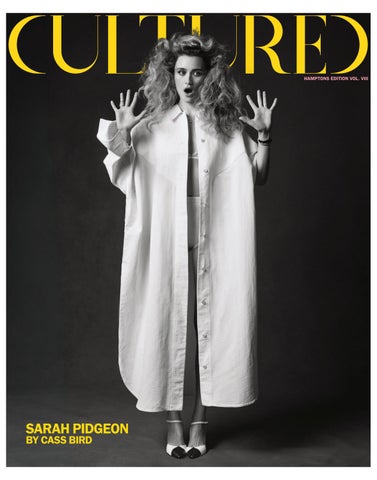
SARAH PIDGEON BY CASS BIRD
“I“ Iwork fragme work in in laye l a yers rs of of color col or aand nd fra g m e nnts t s ofof light ies that slate intoj ejewelr wel ry.y.” ligh—har t—ha rmon m onies t ha t tran tra nsl a te into ” – N —SSYYBBIILL YYU UR RM MA AN
MERCER COLLECTION
EAST HAMPTON 75 MAIN STREET 631.604.6025
TODDSNYDER.COM
Geometry of Life [Chapter 1]. A movie shot at Palazzo Molteni, Milan. moltenigroup.com / shop.molteni.it
ORAL REPRESENTATIONS CANNOT BE RELIED UPON AS CORRECTLY STATING REPRESENTATIONS OF THE DEVELOPER. FOR CORRECT REPRESENTATIONS, MAKE REFERENCE TO THIS BROCHURE AND TO THE DOCUMENTS REQUIRED BY SECTION 718.503, FLORIDA STATUTES, TO BE FURNISHED BY A DEVELOPER TO A BUYER OR LESSEE. NEW YORK RESIDENTS: THE COMPLETE OFFERING TERMS ARE FOUND IN A CPS-12 APPLICATION AVAILABLE FROM THE OFFEROR. FILE NO FILE NO. CP23-0060. WARNING: THE CALIFORNIA DEPARTMENT OF REAL ESTATE HAS NOT INSPECTED, EXAMINED, OR QUALIFIED THIS OFFERING. THIS CONDOMINIUM HAS ALSO BEEN REGISTERED WITH THE MASSACHUSETTS BOARD OF REGISTRATION OF REAL ESTATE BROKERS AND SALESPERSONS F-1284-01-01.
RIVAGE BAL HARBOUR CONDOMINIUM is developed by Carlton Terrace Owner LLC (“Developer” or “Offeror”). This offering is made only by the Developer’s Prospectus for the Condominium. Consult the Developer’s Prospectus for the proposed budget, terms, conditions, specifications, fees, and Unit dimensions. Sketches, renderings, or photographs depicting use of space, design, furnishings, lifestyle, amenities, food services, club services, rental services, hosting services, finishes, materials, fixtures, appliances, cabinetry, soffits, lighting, countertops, floor plans, or art are proposed only, and the Developer reserves the right to modify or withdraw the same in its sole discretion. No specific view is guaranteed. No specific use of space is guaranteed. Pursuant to license agreements, Developer has a right to use the trade names, marks, and logos of: (1) The Related Group; and (2) Two Roads Development, each of which is a licensor. This is not intended to be an offer to sell, or solicitation of an offer to buy, condominium units to residents of any jurisdiction were prohibited by law. 2026 © Carlton Terrace Owner LLC, with all rights reserved.
A Beachfront Paradise in Miami’s Most Coveted Address
This limited collection of light-filled homes in the sky, designed by the visionaries
Skidmore, Owings & Merrill (SOM), Rottet Studio, and Landscape Architecture by Enea Garden Design, is an unrivaled oceanfront opportunity in exclusive Bal Harbour.
NOW UNDER CONSTRUCTION
THREE- TO SIX-BEDROOM RESIDENCES PRICED FROM $13 MILLION RIVAGEBALHARBOUR.COM | 786.572.3441
SCHEDULE A PRIVATE PREVIEW AT OUR SALES LOUNGE IN BAL HARBOUR SHOPS ADJACENT TO MAKOTO
Letter From The Editor 38 40 42 44 46 Sarah Pidgeon photographed by Cass Bird wearing a dress by Fforme with shorts, heels, Coco Crush necklace and bracelet, and Première Ribbon watch by Chanel.
AFTER A ROCKY WINTER and spring, summer in the Hamptons can’t come soon enough, and we’re overjoyed to be spending our !fth year out East. What started as a simple idea—a limitededition broadsheet illustrating the latest East End happenings—has become an annual tradition for the magazine, complete with fresh chatter, brainstorms with friends new and old, and a cultural calendar ripe for dissection. This year, our two Hamptons editions are more packed than ever. Love Story’s Sarah Pidgeon covers the June issue (you’ll want to keep an eye out for who’s splashed across the July edition, too) in an expansive conversation with Past Lives and Materialists !lmmaker Celine Song that details the explosive and at times confusing experience of fronting the rare watercooler fodder. We also head into the studio of Navajo artist Emmi Whitehorse and take a house
34
tour with the notoriously private collectors Glenn and Amanda Fuhrman. CULTURED’s contributing architecture editor, Karen Wong, walks us through a selection of tiny cottages with big personalities, and we get a sneak peek at a few newly revived landmarks, including Sagaponack’s Old Stove Pub, Sag Harbor Cinema, and the Hedges Inn. All this, of course, comes alongside our annual guide to where to see and be seen all summer long. What truly can’t be missed, however, is the chance to reunite with all the creative types, fair-weather travelers, and larger-than-life locals who make the East End such storied ground, and who, year after year, !ll our pages to the brim. They leave us with little doubt that CULTURED will be boarding the jitney for another !ve years, and many more thereafter.
— SARAH HARRELSON
CULTURED HAMPTONS JUNE / JULY 2026
48 50 52 52
THE ART DIET From Dia Bridgehampton to Duck Creek, this is your sign to schedule a day of show hopping on the East End this summer. STUDIO FREQUENCIES: EMMI WHITEHORSE The Diné artist, on view at the Parrish Art Museum, let CULTURED into her Santa Fe studio. WHERE TO EAT, SHOP, AND PLAY ON THE EAST END THIS JUNE From East Hampton to Montauk, here are the mustadds to your summer itinerary. THE NO-SUIT SUITES The Hedges Inn has everything from floating bathtubs to gargantuan sharks decorating its newly remodeled interiors. THE CYCLE OF LIFE Cult jeweler and painter Suzannah Wainhouse traded the chaos of the city for the life of an agrarian artist out East. She’s not looking back. THE NEW OLD STOVE PUB Get ready, old guard: Max Chodorow, of Jean’s in Manhattan, is giving the Sagaponack watering hole a facelift. SAG HARBOR PARADISO At Steven Spielberg’s preferred movie theater out East, Mark Lubell is shaping a space where a communal experience is more than just a tagline. GALERIE SARDINE’S ADIEU The gallery has traded its Amagansett farmhouse for a Tribeca landing pad, but not without one last summer hurrah out East. SEE YOU AT THE FAIRS From Abstract Expressionist homages to a million-dollar Statue of Liberty, the Hamptons Fine Art Fair and Jewelry Show are bringing head-turning fare out East.
54 55 55 56 58 64 70 74
A FIRE ISLAND TIME CAPSULE A visual chronicle of the last century of life on Fire Island exposes an intimate lineage of sunburned bacchanalia and queer mythmaking.
ARTISTS LIVE HERE The Hamptons Black Arts Council is setting its sights on permanent digs for its artists’ residency in Sag Harbor.
A NOMAD COMES TO TOWN The roving art and design fair is trading European villas for a legendary cultural petri dish on the East End with its stateside debut.
CHLORINE MINIMALISM Tina Zhang shares a closet edit that will transport you poolside in the blink of an eye.
CHEMISTRY READ Sarah Pidgeon and Celine Song spent a whirlwind 16 hours together in downtown Manhattan. They reunited for the actor’s CULTURED cover story. ON FUHRMAN TIME A new coffee-table book featuring Amanda and Glenn Fuhrman’s museum-worthy collection marks a new chapter for the notoriously private couple. SPATIAL AWARENESS: CALL OF THE COTTAGE Our contributing architecture editor dissects a handful of homes that epitomize cozy comfort out East. FROM MARFA TO SAGAPONACK At home, Fairfax Dorn has mounted a hanging of her collection that rivals the shows she puts on at Ballroom Marfa.
VOL VIII
The Art Diet:
“SUMMER OF 69” BY MARYAM EISLER
MARYAM EISLER, GLAM AND GOSS WITH A SMOKEY GLOSS, 2000. PHOTOGRAPHY COURTESY OF THE ARTIST.
Where: Harper’s, East Hampton When: Through July 1 Why It’s Worth a Look: London-based photographer Eisler shot “Summer of 69” on a Polaroid SX-70, similar to a camera her father gave her in childhood, paired with digital images captured out East over the last five years.
“(THERE’S GONNA BE A ) SHOWDOWN” BY MATTHEW SATZ
10 Must-See Shows in the Hamptons This Summer FROM DIA B RID GE HAMP TO N TO DU C K C RE E K , T HI S I S YO U R S IGN TO SC HE DU LE A DAY OF S H OW H OPPING ON T HE E A S T E N D T HI S SU MME R . BY EVE EISMANN
38
CULTURED HAMPTONS JUNE / JULY 2026
The resulting body of work is a love letter to long, languid summer days in the Hamptons, the kind of popsicle- and pool-!oatie-filled moments that populate a Beach Boys song. Know Before You Go: The series on view here has also found a second life in book form, with a publication released by Struktur.
“EVERYTHING AND NOTHING” BY BRENT RICHARDSON
BRENT RICHARDSON, ARRIVAL, 2025. PHOTOGRAPHY COURTESY OF THE ARTIST.
Where: Arts Center at Duck Creek, Springs MATTHEW SATZ, #14, 2026. PHOTOGRAPHY COURTESY OF THE ARTIST AND POLLOCK-KRASNER HOUSE.
When: June 27–Aug. 2
Where: Pollock-Krasner House, Springs When: Through July 19 Why It’s Worth a Look: The venue is a big part of the draw—and inspiration—for this exhibition. Satz, who has been based in the East End since 1995, has made new work in response to the storied site, alongside a number of signature works. Know Before You Go: Jackson Pollock’s in!uence on the Brooklyn-born artist is clear: Both artists engage paint’s physicality and velocity. But while Pollock’s works revolved around a radial splatter, Satz engages more deeply with a slow vertical movement.
Why It’s Worth a Look: Richardson’s monochromatic drawings and oil paintings pull from an unlikely constellation of references, including custom car culture, B movies, Jasper Johns, surf music, psychedelic comics, and early Mondrian. His work is surreal, in!uenced by the atmosphere of Montauk, where the artist lives and surfs. Know Before You Go: After moving to Manhattan in the ’80s, working for Robert Rauschenberg and Tibor Kalman, designing an AC/DC album cover, and collaborating with Diane Keaton, Richardson stepped away from his practice, reemerging onto the scene in a 2023 group show at the Ranch in Montauk.
VOL VIII
“THIS LAND: CONSIDERING THE AMERICAN LANDSCAPE”
“BETTY PARSONS / CARLA ACCARDI”
Where: The Church, Sag Harbor
Where: Peter Marino Art Foundation, Southampton
When: Through Sept. 6
When: Through Oct. 3
Why It’s Worth a Look: The Church handed two curators a single, openended question—what is the American landscape?—and let them build from there. Donna De Salvo, a curator at Dia, and Seph Rodney, a writer and independent curator, have assembled a sharp critique of American geographies from the Hudson River Valley to Los Angeles’s urban sprawl to the slowly eroding shores of Miami Beach.
Why It’s Worth a Look: Parsons—best known as the gallerist who launched the careers of Jackson Pollock, Robert Rauschenberg, and Barnett Newman— was also a committed painter in her own right. The Italian Arte Povera painter Carla Accardi, who helped revolutionize abstraction in postwar Europe, serves as Parsons’s visual counterpart in this show.
Know Before You Go: De Salvo comes to the Church hot off a Steve McQueen commission, Bass, at Dia Beacon, while Rodney mounted SFMOMA’s largest exhibition to date in 2024, a show focused on the relationship between artists and athletes.
“WINDOWS”
“DRIFT” BY SANFORD BIGGERS
Know Before You Go: The Foundation has one of the most enviable show lineups in the East End this summer, including other exhibitions by Y. Z. Kami, Robert Nava, and Tiffany Silver. SANFORD BIGGERS, UNSUI (CLOUD FOREST), 2025. PHOTOGRAPHY COURTESY OF THE ARTIST AND BROWN UNIVERSITY.
“THE STORY OF AMERICA 1776–2026” Where: Southampton Arts Center When: Through July 18 Why It’s Worth a Look: This show traces 250 years of American presidential campaign history through artifacts from the Wright Family Collection. It’s an archive of the historic (the original !ag !own at George Washington’s inauguration), the kitsch (Eisenhower-branded corn !akes), and the downright weird (Nixon paper dress, anyone?).
Where: Parrish Art Museum, Water Mill When: Through Sept. 13 Why It’s Worth a Look: The show highlights Biggers’s expansive practice through the motif of a cloud. Cloudlike sculptures drift through the gallery space while quilt works from Biggers’s “Codex” series take on puffy, cumulus forms. “Drift” will also
feature a site-specific sand installation that draws inspiration from Buddhist mandalas. Know Before You Go: This is the artist’s first major solo exhibition on the East End and part of the Parrish’s yearlong exhibition series examining American values on the nation’s semiquincentennial.
“FORGOTTEN WORDS I NEVER GOT TO SAY” BY ARCMANORO NILES
Know Before You Go: Even amid the goofy hijinks of campaign trails, the exhibition is a reminder that democracy is an ongoing project: It contextualizes these presidential artifacts beside major social movements, including women’s suffrage, civil rights, labor rights, and more.
HENRY GLAVIN, ESCAPE SHADOW, 2026. PHOTOGRAPHY COURTESY OF THE ARTIST.
Where: Halsey McKay Gallery, East Hampton
“ECHOES OF ORIGIN: THE HUMAN THREAD” Where: Southampton African American Museum
When: Through July 13 When: Through July 5 Why It’s Worth a Look: Halsey McKay’s summer group show unites 36 artists across generations and sensibilities, from Jane Freilicher and Geoffrey Hendricks to Hope Gangloff, Cynthia Daignault, and Henry Glavin. Know Before You Go: As one might expect from the name, the gallery’s show is focused on the concept of windows, openings, apertures, and fenestrae, both physical and metaphorical. And don’t miss out—the gallery is also running a Steven Cox solo exhibition concurrently.
VOL VIII
Why It’s Worth a Look: Organized in collaboration with Artgal.Online, this group show brings four Zimbabwean artists— Keith Zenda, Barry Lungu, Tonderai Mujuru, and William Mujuru—to the East End for an exhibition threading together themes of heritage, identity, and human connection. Know Before You Go: Artgal.Online, founded by Dennis Ruf, has been building a platform to connect Zimbabwean artists with international audiences.
ARMANORO NILES, THE CLASSROOM, 2017. PHOTOGRAPHY COURTESY OF THE ARTIST AND GUILD HALL.
Where: Guild Hall, East Hampton
figures—pushing up against conventions of traditional portraiture.
When: Through July 19 Why It’s Worth a Look: This show spans a full decade of Niles’s output, beginning with his Guild Hall residency in 2016. Sherbert hues of raspberry, tangerine, and turquoise simmer beneath the Washington, DC-born artist’s singular
Know Before You Go: In his depictions of everyday Black life, Niles also often sneaks in creatures that he dubs “seekers”: imps and stick figures inspired by ancient Egyptian sculpture, representing his characters’ basest impulses.
CULTUREDMAG.COM
39
STUDIO FREQUENCIES: EMMI WHITEHORSE THE DINÉ ARTIST, WHOSE DIPT YCH RESEEDING CHACO IS ON VIEW AT THE PARRISH ART MUSEUM THIS SUMMER, LET CULTURED INTO HER SANTA FE STUDIO TO SEE WHERE HER ESOTERIC ABSTRACTIONS ARE BORN. BY KARLY QUADROS
On June 4, Whitehorse unveiled a new diptych titled Reseeding Chaco, 2026, at the Parrish Art Museum as part of its FRESH PAINT exhibition series. The painting’s burnished caramel surface echoes the New Mexico high desert, where the artist lives and works to this day. Mollusks, stars, brackets, ferns, arcs, and other, more oblique symbols form a sui generis lexicon of markmaking: layers of sediment and time fossilized on the canvas. Before her show at the Parrish, we caught up with Whitehorse in her Santa Fe studio to see how she creates her arcane landscapes. What’s the first thing you do when you enter your studio? Open the shades to let the light flow in, turn on music, and boil hot water to make myself a cup of green tea. What’s on your studio playlist? Alex Cortiz Radio, AES Dana Radio, Kruder & Dorfmeister Radio, all day long, every day.
What’s in your studio fridge? Bottles of champagne and Icelandic water. One bag of mini Babybel cheese. Mini cans of Pellegrino, pink grapefruit sparkling water, and Fever-Tree tonic. Two packages of chocolate stroopwafels. If you could have a studio visit with one artist, dead or alive, who would it be? Maybe Mark Rothko. What’s the weirdest tool or instrument you can’t live without? A champagne-bottle clamp. Who’s the first person you show something to? My studio photographer is the first to see finished pieces because I’m working on the paintings right up until the minute the photographer arrives! What’s the biggest studio mishap you’ve experienced? When things go “sideways” with the mounting of large finished paper sheets, you end up with huge long wrinkles that can’t be fixed! I end up having to destroy a perfectly good, finished work.
On a scale of hoarder to Marie Kondo, where do you fall? I’m happy to say close to Marie Kondo. I know where everything I have is! Is there a studio rule you live by? I make sure to be in the studio painting every day I’m in Santa Fe, so I don’t have any guilt while traveling out of town. When was the last time you felt jealous of another artist? I’m only jealous when I hear an artist talking eloquently about their own artwork because it’s so hard for me to talk about mine.
Tell us about the best studio visit you’ve ever had. My meeting with 2024 Venice Biennial curator, Adriano Pedrosa! What made it so great was that I didn’t know who he was at the time. Any rituals to prepare for a studio visit? Sweep the floor and clean the studio sink, so it doesn’t look like I “butchered a cow.” What’s the best piece of advice you’ve ever received from another artist? Pay your taxes!
There are a lot of costs that come with being an artist. Where do you splurge and where do you save? I always splurge on rolls of printmaking paper and travel to museum shows to see what other artists are up to. I save on turpentine and cheap paintbrushes. Have you ever destroyed a work to make something new? I prefer to use the term “recycle.” Sometimes I cut up old lithographs and collage the pieces onto current works. Emmi Whitehorse, Reseeding Chaco, 2026. PHOTOGRAPHY BY ADDISON DOTY, COURTESY OF THE ARTIST AND GARTH GREENAN GALLERY.
40
CULTURED HAMPTONS JUNE / JULY 2026
VOL VIII
PHOTOGRAPHY BY WENDY MCEAHERN, COURTESY OF THE ARTIST AND GARTH GREENAN GALLERY.
For over four decades, Emmi Whitehorse has turned her gaze to the American Southwest through largescale, abstracted paintings. Rooted in the Diné concept of Hózhó— a harmonious and sustainable balance between nature, people, and beauty in the cosmic order—the artist’s mixedmedia works present an alternative worldview to colonial extractivism. As a co-founder of the Indigenous art collective the Grey Canyon Group in the late ’70s, Whitehorse helped expand conceptions of Indigenous art beyond traditional craft and into the realms of abstraction and modernity.
SOHO UPPER EAST SIDE EAST HAMPTON BELMONT PARK VILLAGE
BY SOPHIA SHYER After Memorial Day, there’s only one mandate out East: “see and be seen.” The best way to do this, of course, is to flock to one of the countless openings or pop-ups that give the season its rhythm. This year,
you can find everything from Balineseinflected meals to floating wellness retreats along the South Fork. From East Hampton to Montauk, here are the must-adds to your summer itinerary.
C’EST MONTAUK AT BAGATELLE
500 W LAKE DR, MONTAUK
Bagatelle Montauk brings a taste of SaintTropez out East. The Mediterranean menu is vibrant, complete with a raw bar, tableside tartares, and crisp champagne for long aperitif hours that slip into the night. The 200-seat dining room pairs sun-bleached wood and breezy linens with an unbeatable view right on the shimmering water. And on weekends, Bagatelle plays host to a party that stretches all day long, signature brunch and world-class DJs included.
PAMPER YOURSELF AT MONTAUK YACHT CLUB
32 STAR ISLAND RD, MONTAUK
CHANEL’S EPHEMERAL DREAM
17 NEWTOWN LN, EAST HAMPTON
Chanel is decamping to East Hampton for the summer. The maison has transformed a white brick storefront on Newtown Lane into a Parisian postcard, stocked with ready-to-wear, leather goods, shoes, accessories, watches, and fine jewelry across two floors. On the main level,
guests are immersed in the world of Coco Beach 2026; think raffia flap bags, beach-inspired jewelry, bright stripes, and airy dresses. Upstairs, the mood shifts to showcase the brand’s Spring/ Summer collection alongside the house’s fine jewelry and watch collections.
In partnership with the roving art fair Nomad, which will have its first U.S. edition in the Hamptons this June 25–28, Giorgio Armani will mount an exhibition platform devoted to refined craftsmanship. Curated by Abby Bangser, the presentation will feature works from floral artist Ariel Dearie and basketweaver Jonathan Kline. Both artists drew from the architecture and natural surroundings of the Watermill Center, where this summer’s iteration of Nomad will take place.
UNVEILING GIORGIO ARMANI
THE WATERMILL CENTER, 39 WATER MILL TOWD ROAD, WATER MILL
42
CULTURED HAMPTONS JUNE / JULY 2026
Montauk Yacht Club is making a case for never leaving the resort. Nestled on Lake Montauk, guests will discover an expanded summer program at the spa with a floating wellness cabana, Jamie O’Brien surf lessons, and a new program for families and younger guests, the Salty Club. On top of that, the club has the Hamptons’ largest marina, with waterfront rooms, three pools, a private beach, racquet sports, paddleboard and e-bike tours—and, of course, the new Alba Spiaggia restaurant. The itinerary writes itself.
FAMILY STYLE AT BABE’S
51 DIVISION ST, SAG HARBOR
KEEPING CLOSE QUARTERS
281 COUNTY RD 39A, SOUTHAMPTON
A taste of Parisian mischief can go a long way in Southampton. Opening inside Capri Southampton this summer, the team behind Maison Close will reimagine its SoHo restaurant for the East End lifestyle. Expect shared plates, perfectly mixed cocktails, and its signature cabaret show. Chef Geoffrey Lechantoux brings Michelin-trained precision to a menu rooted in French classics, like linguine à la truffe and belle sole meunière. It’ll be the perfect location for fresh oysters, velvety wine, seaside glamour, and eyecatching entertainment.
GET NOURISHED AT THE ROUNDTREE
273 MAIN ST, AMAGANSETT
Sag Harbor is getting a new spin on the classic American diner. There’s coffee always in hand, newspapers on the counter, and BLTs dripping with the ripest tomatoes. The narrow, 14-seat train car-inspired space has also adopted an old-school look, with checkered floors and a chrome bar, but the ethos is modern and sustainable: Babe’s sources from farms, bakeries, and seafood suppliers unique to Sag Harbor. And when the kids go to bed, the lights dim and jazz fades in.
The Hamptons tend to stay classic, but the new restaurant from the boutique Roundtree hotel in Amagansett infuses the region with a Balinese influence. Under chef Dewa Wijaya, Nourish serves up everything from crispy sushi bites to lobster rolls and sweet corn soup. Catch Takuma Watanabe (a veteran of the World’s 50 Best Bars list) slinging seasonal cocktails and house-made kombucha, all sourced and foraged locally.
VOL VIII
CLOCKWISE FROM TOP LEFT: PHOTOGRAPHY COURTESY OF CHANEL, MONTAUK YACHT CLUB, BAGATELLE MONTAUK, MAISON CLOSE, ROUNDTREE, BABE’S, AND GIORGIO ARMANI, FEATURING ARIEL DEARIE’S CANDLE HOLDER NO.1, 2025, PHOTOGRAPHED BY MICHAEL BIONDO.
Where to Eat, Shop, and Play on the East End This June
THE NOSUIT SUITES
T HE HE D GE S INN HA S E VE RY T HING FROM FLOAT ING BAT H T U B S TO G ARG AN T UAN S HARKS DEC OR AT ING IT S NE WLY RE MO DE LE D IN T E RIOR S . BY ANDREW ZUCKER
Photography by Glen Allsop, all courtesy of the Hedges Inn.
DAVID NETTO was ready to pitch the Hedges Inn’s new owner, Sarah Wetenhall, on his vision for the iconic East Hampton hotel’s redesign. But he needed one assurance from the proprietor: no suits. “I would get these wonderful calls about hotels, and I wanted to do them,” he tells me. “But the minute that ended up in front of the suits, they would say, ‘Well, what other commercial projects has he done before?’” He could point to a starry list of residential clients: Jerry and Jessica Seinfeld, Lauren Santo Domingo, Breck Eisner. But Netto had zero hotels to his name. So he asked the hotelier for a promise. “You can’t let me fall in love with this project and then take it away to a boardroom full of people that are not going to want to hire me,” Netto told her. Wetenhall had a simple response: “It’s just me. I’m the decider.” Ultimately, Wetenhall decided on Netto, closing the property for renovations in mid-September. after operating it for one
44
summer. “We knew we needed, basically, East Hampton’s son,” she said, referring to the salt-and-pepper-bearded decorator, “someone who was born and bred and knew and loved this place.” It was a successful formula for Wetenhall in Palm Beach. Almost a decade earlier, she and her husband, Andrew, bought the barrier island’s Colony Hotel and tapped Celerie Kemble, a descendant of Palm Beach royalty, to fix up the pink and green jewel box. Netto couldn’t claim First Family of East Hampton status, but he did visit Hedges Inn as a kid who summered in the moneyed enclave. Before blue checkmarks frequented the hotel, it was the home of John D. Hedges and his wife in the 19th century. Wetenhall directed Netto to tap into its legacy as a personal residence, working with him to dream up a character for the 12-room hotel. “We want it to feel like the house of, let’s just say, maybe one of East Hampton’s grande dames,” she tells me. “The woman behind this place has a very eclectic and well-traveled and mature sense of style and design.”
CULTURED HAMPTONS JUNE / JULY 2026
The designer took the brief and ran with it, studying some of the buzziest venues in New York and London, including the Polo Bar and 5 Hertford Street, and their chic, lived-in aesthetic. Netto lifted the London members’ club’s open seating culture for his lobby design, which includes a game table with backgammon by the entrance. “The most elegant and civilized, 18th-century thing about 5 Hertford Street is you just perch anywhere,” he says. He also called out its proprietor Robin Birley’s personal touch, noting that the Brit “entirely curated every object chosen by hand, down to the postcards that are framed in the bathrooms.” Some of the Hedges’s elements—like a weather vane and rowing oar on its walls—feel like they’ve been there since John D. Hedges’s days. But Netto plucked them from antique shows, adding to the fenced-in, white-clapboard property’s Yankee feel. “Let’s do an English country house–level of wit and joyful color and sort of cosmopolitan take on a little wooden house in East Hampton,” says Netto of his recipe.
The new Hedges comes amid a wave of recent high-end hotel openings in the Hamptons, including Hotel Corduroy in Montauk and Faraway Sag Harbor. “I’m very much against the push toward new, new, new,” says Netto. “That’s not why anybody would call me. I’m in love with history.” He’s made an exception for some contemporary elements, including the bathrooms’ terrazzo !oors. But the hotel is riddled with lively, Old World !air, like a painting of the largest shark ever identified, which he snagged at the Decorative Fair in London, and a !oating bathtub in its third-!oor studio suite. One of his favorite spaces is a coat-closetsized library on the main !oor with a fireplace, bookshelves, and windows. With the Colony Hotel’s Swifty’s restaurant making the trek north, Netto said guests can enjoy drinks, including a Manhattan featuring socialite Julie Macklowe’s rye brand, while lounging on the library’s inviting chairs. “You can sort of slouch around and use body language and seduce somebody,” he says. “I think the Hedges is going to get a lot of people laid.”
VOL VIII
VOL VIII
CULTUREDMAG.COM
45
Photography (top left) by Greg Kessler and (right and below) Glen Allsop.
THE CYCLE OF LIFE A DECADE AGO, C U LT JE WE LE R AND PAIN T E R SUZ ANNAH WAINHO U SE T R ADE D T HE C H AO S OF T HE C IT Y FOR T HE LIFE O F AN AGR ARIAN AR T I S T O U T E A S T. SHE’S N OT LO O KIN G BAC K . BY MINA STONE
Back in the early 2000s, Suzannah Wainhouse was a part of New York’s coolest fashion tribe. Her jewelry line was thriving, carried by then-flagship department stores like Barneys New York. Once referred to by T magazine as a “modern mystic,” Wainhouse developed a cult following with a menagerie of women about town that included designer Maryam Nassir Zadeh, actor Jemima Kirke, and musician Cat Power. Then, in 2017, she sold all her jewelry-making equipment, packed up her family, and left Williamsburg for the Hamptons. Wainhouse wanted a change and to reconnect with the earth, something she missed from a childhood spent growing up in rural Vermont. She yearned for space and freedom for her daughter to play outside. In her second act, she’s reinvented herself as a farmer, managing more than 200 acres of potatoes, small grains, heirloom tomatoes, and seasonal vegetables at Marilee’s Farmstand and Sagaponack Farm Distillery. By night, she’s a painter with a home studio teeming with canvases. This summer, her two passions collide as designer Sean McNanney, of renegade cashmere studio Saved, presents a limited-edition collaboration with Wainhouse as part of his pop-up through
Labor Day at Il Buco dal Mare, where he is showcasing a selection of her paintings and crafting blankets out of the compositions. For now, under the glittering Hamptons sun, Wainhouse will be “squeezing out every drop of the day” in her artmaking, farming, and motherhood.
Suzannah Wainhouse, Mute Swan, 2024.
Tell me about your previous life in New York. I started designing jewelry in 2009. My collection very quickly got picked up by Barneys, and then many, many doors opened, and it exploded. I had a studio
in Chinatown. I was on Grand and Eldridge and a part of a very vibrant community. Maryam Nassir Zadeh was across the street. My friend Lindsey Thornburg was down the street. There was incredible energy, and it was a beautiful time. I had a little corner in my studio where I started painting. Whenever I had any spare time, I would go over there and work on them. It became something I did more and more, and I started to have some shows and exhibit my work.
“What farming has taught me, which is something that I desperately needed to learn, was patience.” When did you move? I closed down my business in 2017. Barneys was about to close. The market felt super saturated. I had achieved many of my goals with regards to the jewelry line, and I was much more interested in transitioning from three-dimensional work into painting. I felt like making jewelry had become superficial. I sold all my equipment. It was really hard to do that. I had all these beautiful vintage anvils and hammers. I knew I wanted to farm. I wanted to learn how to grow vegetables. I wanted to get back to a more hands-on existence. Being from Vermont, I grew up in a very rural area. My mom had a huge vegetable garden, and self-sustainability was a huge part of my childhood. I wanted to be connected to the cycle of life. I checked out multiple different farms out East, and everyone I talked to told me to find Marilee Foster. She said, “Yeah, you can work here, no problem,” and that’s what led me to Sagaponack. The rest is history. I manage the farm, the wholesale vegetables, and the production of the wholesale business. Can you tell me what farming as a practice in trust means to you? What farming has taught me, which is something that I desperately needed to learn, is patience. You’ve got to get the plants in the ground. You’ve got to put the seeds deep enough. You’ve got to water them properly. You’ve got to make sure they have all of the elements. And then you wait.
Suzannah Wainhouse, all pictured works Untitled, 2024–25.
46
CULTURED HAMPTONS JUNE / JULY 2026
Farming isn’t something that can be expressed, manipulated, or interpreted. It is absolute. It is counter to my art practice, which is about revisiting something over and over again until an image emerges that I can recognize.
Suzannah Wainhouse with her piece Protecting the Invisible, 2025. All photography by Tria Giovan and courtesy of the artist.
What do you feel it is about the Hamptons that inspires artmaking? There’s a history here: the connection between New York artists coming out East and making work influenced by this terroir and beautiful, maritime climate. What’s most captivating to me is the light. And there’s something about the way that time passes where I’m squeezing out every drop of the day. There’s an openness here that feels infinite.
“There’s something about the way that time passes where I’m squeezing out every drop of the day. There’s an openness here that feels infinite.” What would you say your work is about today? Small battles. The success and the failure. The paintings are a series of tombstones. In each painting, we consider the pendulum, swinging from paradise to hellfire. These transitions are human, provocative, and personal. It is exploring the liminal space that can only be felt. I am holding them up equally, the ability to hold two things at once. Can you tell me your favorite thing about the Hamptons? At the beginning of September, everything completely changes, and it gets very quiet. There’s almost this heartbreak and longing for summer. But you’re moving into something much deeper and much greater. You feel like you own the place. The roads are empty. The beaches are empty, and everything returns to you.
VOL VIII
THE NEW OLD STOVE PUB
GE T RE ADY, OLD GUARD: MA X C HO DOROW, OF JE AN ’S IN MANHAT TAN , I S G IVING T HE SAG AP ON AC K WAT E RING HOLE A FAC E LIF T. BY ALEXANDRA BUTLER
Photography by Ellen Von Unwerth and courtesy of Max Chodorow.
IN 1969, a Greek family, the Johnides, opened the Old Stove Pub in an 1820 farmhouse in Sagaponack. Their motto— “when you’re fed up with the chic, come to the Greek”—has tickled clientele since JFK Jr. and Billy Joel were regulars. Yet it was also beloved by locals, who typically stay close to home during the summer chaos and venture out in the off-season. As one lifelong resident put it: “The Hamptons is a string of distinct towns, each with its own flavor, shaped by decades of change and a 100-day seasonal economy. There are different groups of people that form this interdependent ecosystem, with categories that overlap: old and new, second homeowner and local.” For a restaurant to feel authentic, it must serve them all. Enter Max Chodorow, who is taking over the storied steakhouse. The restaurateur’s first spot, Jean’s, opened in 2023 in Manhattan with partner Ashwin Deshmukh. It’s become synonymous with a new era of downtown New York nightlife, and some East Enders fear the same will come to Sagaponack.
48
Yet Chodorow is a quick draw on several points. The son of Jeffrey Chodorow—who bought the Old Stove Pub from former owner Thomas Makos for $4.5 million and is the man behind China Grill, the Asia de Cuba restaurants, and more—he’s been coming to the Hamptons his whole life and knows what wrong looks like: focusing on the stretch between Memorial and Labor Day or firing local staff. He speaks wistfully of venues ripped to shreds in the wrong hands. He surfaced from his Pennsylvania farm, purchased by his grandfather in the 1970s, for our interview. Since Chodorow took over, the farm has grown 35 acres of food production, with pigs leading what one imagines to be a glorious life in the woods until they become house-made prosciutto. The farm supplies 95 percent of Jean’s produce. At the Old Stove Pub, Chodorow plans to channel the dock-to-table movement to keep locally caught fish local. “The whole Montauk tourist destination just isn’t really what we’re going for. We want to connect with true Hamptonites.”
CULTURED HAMPTONS JUNE / JULY 2026
Chodorow is adamant about how he’ll steward the restaurant. The neon sign must stay, although the name might not. The old pine floors will be refinished, not replaced. “If we wanted to delete history, we should have bought another property.” The famous horse out front may get a tasteful facelift by an undisclosed artist collaborator. “This is something no one knows yet: we may turn the horse into a zebra!” They may even pay homage to the restaurant’s Greek era: “Will we have to have a saganaki? I guess we probably might.” A buzzy vibe hovers, but Chodorow is keeping mum about his plans ahead of the restaurant’s opening next year. “We do have a lot of wonderful chef friends with amazing concepts in the city who have reached out to do dinners, sort of takeovers of the property,” he teases. Lifelong Hamptonite James Cruickshank, a friend of Chodorow’s, shared his fantasies for collaborations. “I would love to see Max partner with Richie Ludlow of Ludlow Farms, or Richie King of King’s Farm.” Cruickshank
had thoughts on wine as well: “I would love to see it drawn from Wölffer and Channing Daughters, which are right in his backyard.” Chodorow is far from the first to give a beloved watering hole a facelift and nods to Riad Nasr and Lee Hanson, the Frenchette owners who revamped old-school French bistro Le Veau d’Or back in 2024, as a duo who did it right. “They highlighted the qualities that were great, cleaned up the things that were less than great, and preserved the atmosphere and history. That’s all we intend to do.” “Off the record” is an oft-mentioned phrase when asking Hamptonites their opinions, maybe because, as one lifelong resident put it, “The Hamptons are the land of ‘no.’” In other words, people are protective and wary of what comes next. In this everchanging place where one sometimes has to swallow what they didn’t order (see: the new Madewell store in Sag Harbor), Chodorow is leading with yes—as in, I also love this place and want to prove it.
VOL VIII
fernandowongold.com
fea r nad n d ow w oo nng g o lod l. cdo. mc o m ff e e rr n nan n5d6 1o ow 5 1o5 n0 g 2 1o3l d . c o m 561 515 0213 5 56 61 1 5 51 15 5 0 02 21 13 3
SAG HARBOR PARADISO
AT STEVEN SPIELBERG’S PREFERRED MOVIE THEATER OUT EAST, MARK LUBELL IS SHAPING A SPACE WHERE A COMMUNAL EXPERIENCE IS MORE THAN JUST A TAGLINE. BY GIULIANA BRIDA
PHOTOGRAPH BY ANA GAMBUTO, COURTESY OF SAG HARBOR CINEMA
A dim cinema is one of the few remaining spaces where complete strangers tacitly agree to feel something together: communal tears, unforced laughter, sharp inhales before a plot twist. Mark Lubell, Sag Harbor Cinema’s new executive director, believes these shared human moments in a movie theater are just as important as the film itself. Before joining the beloved Hamptons institution, Lubell spent his own childhood summers in nearby Noyack, where he remembers long hot days at Sandy Hollow Day Camp, working as a horse groom at Topping Riding Club, and brushing elbows with the likes of Calvin Klein and George Soros. As an adult, he grew fond of Murf’s Backstreet Tavern, where yacht owners split pints with the crews that run them—on a sweltering summer day, everyone is welcome. Lubell built his career supporting fine art photography, most recently as the executive director of the International Center of Photography (ICP). But he still felt the call of the East End. After debuting the ICP’s lightfilled new campus on Ludlow Street in 2020, he felt it was time for a new chapter.
50
Now, at Sag Harbor Cinema, he’s working to cultivate a space similar to Murf’s, where people can put aside their differences over a bag of popcorn in a cool, dark room. Tell me about your journey to Sag Harbor. I was born and raised in New York, but my parents had a house in Noyack. It was the best of both worlds. My wife is from Georgia, and I told her, “In order to survive the city, it’s always great if you can get out, even if just for a day.” We bought this house in Sag Harbor 14 years ago. It was walking distance from Murf’s, so it was perfect. Then, the pandemic happened, and we, like so many, came out here permanently. Our kids really loved it, and it became harder and harder to come back. I’ll always be a New Yorker, but I do think there’s a special community out here. How did you get involved with Sag Harbor Cinema? I used to work at a dot-com company just a few blocks away from the World Trade Center. In the city, when something terrible happens, everyone comes together. After 9/11, a group of us created an exhibition of photographs on Prince Street for charity
CULTURED HAMPTONS JUNE / JULY 2026
that became a kind of unofficial memorial site. We had 2,000 people a day lined up. We had a website that got something like two billion hits in the first few months. We even did a bestselling book. It really shaped me and my profession because I was so moved by how everyone connected over that exhibition. From there, I worked at Magnum Photos, which at the time was the Rolls-Royce of photojournalism. But the world was changing—anyone can take an image now. So I revamped their whole business model. Later, I became the executive director of the ICP. We raised close to $90 million to open this new building on the Lower East Side. We opened in January 2020 and closed seven weeks later. We pivoted quickly, but by then my family was pretty ingrained in Sag Harbor. Then I got a call to see if I was interested in the Sag Harbor Cinema. What role do you think film fills in Sag Harbor’s artistic community today? A cinema is one of these places where you will laugh and cry in the dark with strangers. When the film is over, you’ve shared an experience together. You had
a very human moment. And I felt like that’s a bigger idea than just the cinema. We have fewer and fewer moments when we’re spontaneously coming together with people of different political affiliations, different economic statuses. A cinema is one of those places. And when the film is over and you walk out, I feel that you have a little more compassion for your fellow human beings. What can we expect this summer? Our incredible creative director, Giulia D’Agnolo Vallan, is working on this film noir summer series, in which she has some great films like Blue Velvet and The Great Gatsby. I’ve been told that Spielberg has said that the theater has the best quality in terms of sound and projection for an independent theater. Also, the Green Room, the bar in the back, has two terraces with one of the best sunsets in Sag Harbor. Lastly, what are the movies that shaped you? Cinema Paradiso. A Room with a View. There are so many great movies, but for me, the big message is that we go into these spaces and have shared experiences with each other.
VOL VIII
GALERIE SARDINE’S ADIEU BY DALYA BENOR
Galerie Sardine has called an 18thcentury farmhouse in Amagansett home since its early days in 2024. The art gallery also doubles as a residence for art director Valentina Akerman, her husband, artist Joe Bradley, their four children, and their dogs, evoking an “Alice in Wonderland” feeling, Akerman suggests.
Akerman admits she was hesitant to make the move to a brick-and-mortar space in the city. “I liked this idea of an itinerant, site-specific gallery that would stage beautiful presentations that were one-off, that would live in people’s memories as a poetic moment,” she says. “And I love the sense of time and space that the house provided, where people were not in a rush and wanted to converse and learn.” But the leap has paid off so far, showing that the gallery can export its unbuttoned-up, intimate feel anywhere.
Her and Bradley’s eclectically exuberant programming in the quickly beloved space has come to fit that brief too, showing the likes of Sophie von Heller-
Rest assured, Akerman says, Galerie Sardine will continue to have a seasonal presence out East, even if it means venturing beyond the white wooden
SEE YOU AT THE FAIRS
GALERIE SARDINE FOUNDER VALENTINA AKERMAN.
house with its long pebble driveway. For now, expect a show pairing Lagos-based painter Tonia Nneji with Loewe Craft Prize finalist Jane YangD’Haene, as well as a textile installation from Kritika Manchanda and Rafael Prieto, for its final season on Main Street in Amagansett.
FROM ABSTRACT EXPRESSIONIST HOMAGES TO A MILLION - DOLL AR STATUE OF LIBERT Y, THE HAMPTONS FINE ART FAIR AND JEWELRY SHOW ARE BRINGING HEAD -TURNING FARE OUT EAST THIS JULY. BY GIULIANA BRIDA
ARTWORK BY (LEFT) ANTONIO GALVAN AND (RIGHT) STEVE TOBIN AT THE 2025 HAMPTONS FINE ART FAIR.
Returning for its 20th season from July 9–12, the Hamptons Fine Art Fair is expected to bring more than 10,000 art aficionados to one Southampton address this summer. The sprawling fair will be toasting America’s semiquincentennial amid works by hundreds of artists, ranging from 20th-century masters to global contemporary voices.
52
Before one hits the booths or the sculpture garden, the drama begins at the entrance: a 10-foot model of the Statue of Liberty valued at $1 million is on display. It’s the last available proof from the original plaster of Fédéric Auguste Bartholdi’s New York Harbor masterpiece. In honor of the U.S.’s big 250, red, white, and blue will be an unsurprising
CULTURED HAMPTONS JUNE / JULY 2026
constant throughout the fair’s latest edition. That patriotism comes with a wink via “The British Are Coming… Again,” a curated selection of leading U.K. galleries. Elsewhere, “Trailblazers of Hamptons Abstraction” pays homage to the Abstract Expressionist visionaries of the ’50s to ’70s, and the East End as their creative catalyst.
After the fair, festivities continue with the second edition of the Hamptons Jewelry Show from July 23–26. The showcase, open to all fair attendees, brings together East End–minded stylings, select timepieces, and a roster of jewelers from Greece to Japan. Want to get excited? Last year’s inaugural edition saw over $500 million in jewelry on view. This year, you’ll just have to come out to see.
VOL VIII
PHOTOGRAPHY (TOP) BY WESTON WELLS, COURTESY OF GALERIE SARDINE, AND (BOTTOM) COURTESY OF THE HAMPTONS FINE ART FAIR.
THE GALLERY HAS TRADED ITS 18TH CENTURY AMAGANSET T FARMHOUSE FOR A GL ASS -AND - CONCRETE TRIBECA L ANDING PAD, BUT NOT WITHOUT ONE L AST SUMMER HURRAH OUT EAST.
mann, Nate Lowman, and Ida Ekblad. Then, in April, Akerman announced Galerie Sardine’s move to a permanent space in Tribeca. Although the opening heralds a new era for the gallerist, it’s also bittersweet; this summer in the Amagansett farmhouse will likely be the gallery’s last.
On view
Alan Ruiz: De sol a sol
Through May 31, 2027
Dan Flavin: nine sculptures in fluorescent light Permanent installation
Dia Bridgehampton The Dan Flavin Art Institute 23 Corwith Avenue Bridgehampton, New York
diaart.org
A FIRE ISLAND TIME CAPSULE A VISUAL CHRONICLE OF THE LAST CENTURY OF LIFE ON FIRE ISLAND EXPOSES AN INTIMATE LINEAGE OF SUNBURNED BACCHANALIA AND QUEER MYTHMAKING.
For nearly a century, Fire Island has existed as both refuge and fever dream—an improbable strip of land where queer art, desire, and community continually reshape one another. Fire Island Art: 100 Years, edited by Fire Island Pines Historical Society president John Dempsey, lifts the veil on the slender isle’s outsized role in queer artmaking from the 1930s to the present.
and those long-overlooked. Richard Avedon, Paul Cadmus, David Hockney, Peter Hujar, Robert Mapplethorpe, and Andy Warhol appear alongside lesser-known artists whose work also evolved in quiet proximity to the dunes. Archival material and newly unearthed pieces expand the narrative, reframing Fire Island as a cornerstone of queer modernism.
Moving decade by decade, the book shifts its focus fluidly between canonical figures
Contemporary artistic voices—TM Davy, Nicole Eisenman, K8 Hardy, Lyle Ashton
BY SAM FALB
Harris, Doron Langberg, and Salman Toor, among them—carry readers into the island’s present-day effervescence, fueled in no small part by nonprofit arts groups like BOFFO and the Fire Island Artist Residency. Meanwhile, essays, interviews, and primary texts (from Frank O’Hara, Wolfgang Tillmans, and others) introduce a chorus of perspectives generations to come will be grateful to find gathered in one place.
Fred Melton, Bernard Perlin and Wilbur “Billy” Pippin on Fire Island, 1948. Photography courtesy of the Estate of Fred Melton.
Paul Cadmus, The Shower, 1943. Photography by Ron Cowie and courtesy of Oyster Farm Productions.
Stephen Truax, Ilan’s Pool (Ladder), 2023. Photography courtesy of the artist.
TM Davy, 635, 2019. Photography courtesy of the artist.
Paul Himmel, The Bar in Duffy’s Hotel, late 1940s. Photography courtesy of the Cherry Grove Archives Collection. PaJaMa, Fidelma Cadmus, Fire Island, 1937. Photography courtesy of Gitterman Gallery.
Mark Beard, Two Men on a Beach, n.d. Photography © Mark Beard [Bruce Sargeant (1898–1938)] and courtesy of CLAMP.
Wolfgang Tillmans, Deer Hirsch, 1995. Photography courtesy of the artist, Galerie Buchholz, Maureen Paley, and David Zwirner.
54
CULTURED HAMPTONS JUNE / JULY 2026
Two Women Getting Sun, 1951. Photography courtesy of the Cherry Grove Archives Collection.
Meryl Meisler, Grace Jones Mask Created from Richard Bernstein Portrait, The Ice Palace, Cherry Grove, Fire Island, NY, Labor Day, 1977. Photography courtesy of the artist and CLAMP.
VOL VIII
THE HAMPTONS BL ACK ARTS COUNCIL IS SET TING ITS SIGHTS ON PERMANENT DIGS FOR AN ARTISTS’ RESIDENCY IN SAG HARBOR. BY GIULIANA BRIDA
Nestled in what is now Sag Harbor is Eastville: one of the oldest free Black settlements in the United States, dating back to the early 19th century. Over the decades, collective acknowledgment of this heritage has faded, but the Hamptons Black Arts Council (HBAC) is working to change that.
This Juneteenth, HBAC is pursuing its most ambitious project yet: purchasing a home to host a permanent artists’ residency for creatives of color in Sag Harbor. The group will raise funds for the project through a three-day retreat and benefit luncheon honoring Anthony Akin-
A NOMAD COMES TO TOWN
Founded by Storm Ascher in 2023, HBAC was born from the young curator’s desire to rekindle a sense of Black cultural belonging on Long Island. In the years since, it has steadily grown its initiatives, curating roving shows through Ascher’s Superposition Gallery and installing historic markers across the area. Juneteenth weekend will mark the opening of “IT IS WRITTEN in the sand,” HBAC’s annual group exhibition, hosted at the Eastville Heritage House Museum this year. It’s a kickoff to the museum’s new contemporary art collection, curated by HBAC and inaugurated with work by artists including Akinbola, whose practice often transforms durag fabric into monumental pieces exploring identity and the intimacy of belonging. Visitors
HAMPTONS BLACK ARTS COUNCIL FOUNDER STORM ASCHER.
will also be treated to a private tour of Guild Hall’s “Arcmanoro Niles: Forgotten Words I Never Got to Say” and a private viewing of dancer Lloyd Knight’s performance, The Drama. With roots running far beyond this year’s summer calendar, HBAC’s programming serves as a reminder that the stories it platforms are not new additions to the East End. They have always been there.
important. Robert Wilson created something there that transcends the notion of a traditional institution. It is simultaneously an experimental laboratory, a residency, a sculpture garden, and a place of encounter between disciplines and cultures. That spirit aligns very naturally with Nomad.
WITH ITS STATESIDE DEBUT, THE ROVING ART AND DESIGN FAIR IS TRADING EUROPEAN VILL AS FOR A LEGENDARY CULTURAL PETRI DISH ON THE EAST END THIS SUMMER. Bob Wilson (above) and his loft (left) photographed by Dominique Nabokov in 1998.
BY LUCIA PONTI across the Atlantic for the first time. The fair lands in the Hamptons at the legendary Watermill Center from June 25–28 with a plethora of gallery presentations, performances, and rare collecting opportunities. Ahead of its U.S. debut, we sat down with co-founder and director Nicolas Bellavance-Lecompte to learn more.
Since 2017, Nomad has redefined what an art fair can be, trading convention centers for castle courtyards, island villas, and alpine retreats. The first edition of the traveling showcase for collectible design, contemporary art, and jewelry took place inside Karl Lagerfeld’s former clifftop residence, Villa La Vigie, in Monaco. Since then, it’s jetted off to St. Moritz, Venice, Capri, and more. This summer, it flies
VOL VIII
What about the Hamptons, in particular, made it the place to host Nomad’s first U.S. edition? The Hamptons have a very particular cultural mythology. Beyond the lifestyle image often associated with the region, there is a long history of artistic experimentation, patronage, architecture, landscape, and retreat. It has historically attracted artists, writers, architects, musicians, and collectors seeking space, light, and freedom. For us, the Watermill Center was especially
Can you share a few highlights from the fair this year? Several exhibitors are creating highly site-specific environments that respond directly to the spaces and gardens. Another important aspect is the cross-disciplinary nature of the program. Alongside collectible design, we are integrating conversations, performances, private visits, culinary moments, and collaborations with artists and cultural institutions connected to the East End. One special project— featuring photographs by Dominique Nabokov and the Robert Wilson Estate & Trust collection of chairs, curated by French architect Sophie Dries— is certainly an exclusive and unique presentation, showcasing photographs of interiors from Robert Wilson’s Manhattan loft, unpublished portraits, and rare design works.
What is your own personal relationship to the Hamptons? Who are some of your favorite artists associated with the area? Personally, I have always been drawn to the quieter and more intellectual side of the East End. The legacy of figures such as Robert Wilson, Willem de Kooning, Lee Krasner, Jackson Pollock, and John Chamberlain created an atmosphere where radical experimentation could happen away from the pressure of the city. I am also very interested in the relationship between landscape and artistic production in the Hamptons. There is a specific light, openness, and rhythm there that has influenced generations of artists and architects. What I appreciate most is that beneath the social visibility of the Hamptons, there remains a deeply rooted creative community and a culture of patronage that continues to evolve.
CULTUREDMAG.COM
55
PHOTOGRAPHY (TOP) COURTESY OF BFA AND (BELOW) NOMAD.
ARTISTS LIVE HERE
bola, hosted at the Watermill Center. The Nigerian-American artist will be installing new work on the grounds and sitting for a talk about his evolving practice.
MARKET REPORT
THE HAMPTONS EDIT:
CHLORINE MINIMALISM As summer reaches its fever pitch, few things feel sweeter than the season’s first plunge into a cold pool. While the thermostat climbs, we find ourselves returning to David Hockney’s poolside paintings. Their clean lines and palettes of saturated blues and sun-washed yellows evoke a dreamy escapism of leisurely afternoons that slip into twilight alfresco dinners. Fresh poplin shirts and fluid wrap skirts echo this contrast between crispness and ease, preparing us for the inevitable splash.
SAINT LAURENT BY ANTHONY VACCARELLO SATIN TOP
BY TINA ZHANG
Saint Laurent’s satin lace top recalls the hues of mid-century pool houses and sun-faded interiors. All photography courtesy of the brands.
PUCCI SWIMSUIT A poolside essential, Pucci’s signature swirling motif captures the kinetic motion of a swan dive.
HERMÈS BEACH TOWEL Hermès reimagines the classic beach towel with a geometric border that channels the raw framing of Hockney’s poolside series.
THOM BROWNE CHAMPAGNE COUPES A set of crystal coupes from Thom Browne and Baccarat lend a sense of occasion to long afternoons spent lounging.
56
SAINT LAURENT BY ANTHONY VACCARELLO LEATHER SKIRT An elegant interpretation of 1960s glamour, this skirt channels the prismatic light that reflects off a sunny deck and onto the ceiling.
CULTURED HAMPTONS JUNE / JULY 2026
FERRAGAMO GANCINI WATCH Hockney famously spent two weeks perfecting his depiction of a two-second splash. Ferragamo’s twisted watch reminds us that in high summer, time becomes an illusion.
LEMAIRE NECKLACE BAG A beaded necklace bags lends a touch of irreverence to the polished restraint of the coastal uniform.
VOL VIII
TOTEME EMBOSSED LEATHER CLUTCH
Toteme’s three-fold clutch adds structure and texture, anchoring any look.
LEMAIRE SKIRT Lemaire knows the art of an effortless drape. This wrap skirt captures the quiet fluidity of a late summer afternoon.
LOEWE PAULA’S IBIZA JERSEY MAXI Capturing the essence of Hockney’s dreamy summer palette, this Loewe maxi dress evokes the languid ease of an afternoon spent by the water.
LORO PIANA GIOIA SHOPPER Even when we stray, Loro Piana reminds us that we’re never too far from la piscina.
SAINT LAURENT BY ANTHONY VACCARELLO SUNGLASSES A pool day staple, these amber shades offer the ultimate view.
HERMÈS BANGLE LORO PIANA SILK TWILL SCARF
The Maison’s braided bangle channels clean contours and winking glamour.
Flit from the pool to lunch in elegance with Loro Piana’s silk tie band, to be worn loosely at the neck, on the wrist, or through the hair.
TOM FORD DRESS HERMÈS VASE This color-blocked vase nods to the layered blues and shifting depths of a swimming pool.
57
Channel the aquatic blues of a 1960s summer hideaway in this Tom Ford evening dress where cascading sleeves mirror the tension of the water’s surface.
CULTURED HAMPTONS JUNE / JULY 2026
MANOLO BLAHNIK JADARON HEELS These Manolo mules embody the art of high summer transition dressing, moving seamlessly from a hot pool deck to seaside restaurant.
VOL VIII
Sarah Pidgeon wears the Plume de Chanel ring and earrings, Coco Crush necklace, and Coco single earring by Chanel. Glasses are the stylist’s own.
PH OTO GR APH Y BY CA S S B IRD C RE AT IV E DIREC T ION AN D S T Y LIN G BY S T U DIO& 60
CULTURED HAMPTONS JUNE / JULY 2026
VOL VIII
CHEMISTRY READ AF T E R Y E AR S O RB IT IN G E AC H OT HE R OFF - B ROADWAY, SAR AH PIDGEON AND C E LINE SO N G S PE N T A WHIRLWIN D 16 H O U R S TO GE T HE R IN DOWN TOWN MANHAT TAN . T HE Y REU NIT E D FOR T HE AC TOR’S C ULT URE D C OVE R S TORY.
Making a movie is a little like being in a relationship. Forget the time commitment (although being together for 14-hour days over months is nothing to sneeze at). A good actor needs to be vulnerable, and a good director should communicate clearly about their needs. Both submit themselves to the embarrassing ordeal of being seen, accepting that their fate is intertwined with another. Sarah Pidgeon has become fluent in this artform. As a fixture of New York’s theater world, most notably in her Tonynominated turn in the Fleetwood Macinspired Stereophonic, and as Carolyn Bessette-Kennedy on TV’s Love Story, she’s spent countless hours taking audiences deeper into the lives of pop culture figures we know and love. As the 29-year-old starlet earns greater recognition, the offers have been stacking up. But how does one pick the right suitor? They date, of course. That’s how Pidgeon found herself in the orbit of acclaimed writer-director Celine Song—although their “first date” was not a carbonara dinner, but a Balenciaga campaign shot over a whirlwind 16 hours in downtown Manhattan. The resulting 60-second shorts, collectively titled “A New York Minute,” complete with Brechtian fourthwall-breaking flourishes, were Pidgeon’s first foray into the world of high-fashion campaigns. It was also her first time collaborating with the mind behind Past Lives and Materialists, though it may not be the duo’s last. This May, the filmmaker and actor called each other up from across the Pacific Ocean, from New York to Brisbane, where Pidgeon is currently filming the dramedy Honeymoon with Harry. For their second “date,” they talked off-Broadway theater, ephemeral performances, and what’s next once the industry knows your name. Sarah Pidgeon: I’ve always been a fan of yours. I remember watching Past Lives
VOL VIII
and crying, aching, and just feeling so moved by it. In Stereophonic, right before I went out on stage, I would ask our stage manager who the “fancies” were, so I would know who was in the audience. I remember when you were there. I was so excited, and then finding out that we were going to do this shoot together— it’s like I got to be in a three-minute-long Song movie. What a wild 16 hours. You obviously have these great standalone feature films, but then you also do commercial work. What brings you to it? Celine Song: As a working actor, you’re able to hop from one project to another. But being a filmmaker, and especially the one who writes, I have a pretty long gestation period between projects. That’s what’s amazing about something that’s short-form: You get to date. It’s an opportunity to be on set and to meet new people. Then you might get attached to a 35- or 40-day film shoot, even longer sometimes. You’re together for prep and post. That’s when you marry. Pidgeon: I’m finally in this new space where I potentially get scripts earlier. In so many projects that I’ve worked on— not that I’ve worked on much—like The Wilds or Tiny Beautiful Things, I found out I was cast, and days later, I was getting on a plane to go to set. Having done something like Stereophonic with so much time in rehearsal to prep, when I got back on set after doing that show, it was a bit of a shock. I learn and uncover so much when I’m not thinking about it. It’s easier for my imagination to run wild, to relieve myself of the sense of disbelief when I’m in a theater, even if it’s an empty room with wooden floors and no natural sunlight, than it is when I’m rehearsing for a film or a TV show because the camera’s not there. Song: I never want to waste a good performance in rehearsal for a film or TV thing. Theater acting is about consistency.
It is important in rehearsal that you nail it, because on night 30, you have to do it again. When it comes to film, it doesn’t matter; if the camera isn’t rolling, you don’t have it. Pidgeon: I think about how much I know the character once I’m done with the project. You’re trying on all these different things and then by the end of shooting, out of order, of course, you’re like, “Oh my God, that’s who this person is.” Sometimes I walk away from things thinking, I would love to be able to shoot an entire movie, watch it, and then go back and shoot it again. Song: I wonder if the discovery is what’s exciting about a film performance, too. I like the idea of all of us agreeing that the scene will never happen again. We wrap a scene, and we move on. We’re like, “It’s dead to us.” Pidgeon: Do you find yourself thinking of your close collaborators when you’re deciding on the next project? Song: I don’t know if it’s quite like that, but there will be moments. When it comes to actors, I think yes, although it’s less that I want it to be that person and more about which actor is having a “moment.” Pidgeon: I could never be a casting director. I remember when I started, my agent would tell me, “Just make fans.” I wasn’t booking anything. They would say, “Oh, they love you. They’re such a fan of yours.” I just kept thinking, When are these fans going to give me a job? Song: What do you want to do next? I would love to know what kind of project, what kind of character, excites you. You and I come from a similar background of Off-Broadway theater. At that time, we were all just so desperate to work. Pidgeon: I’ve been struggling with that a lot. I’ve been at this professionally since I was 21. I turn 30 this year.
“Sometimes I walk away from things thinking, I would love to be able to shoot an entire movie, watch it, then go back and shoot it again.” —SARAH PIDGEON
For nine years, I’ve been auditioning with representation, and I want to say that more than half of the time I’ve been doing that, I wasn’t employed. Other people sometimes need to see you, in a way, to see what you yourself know you are capable of. So, really, I want to work with filmmakers on really great scripts. Song: If it’s a bad script, it’s not gonna be a good movie. Because I’m a writer first, I’m always baffled that people don’t know that. If the script’s not there yet, you shouldn’t shoot it. Pidgeon: Sometimes I read stuff, and I know, I just need to say that because I know how it should sound. And then there are also scripts where I think, That would be a really cool physical transformation, or, I would have to pick up a new skill set. Changing myself physically—that’s really exciting. Right now, I’ve played a lot of women who are pushed to the end of their rope, which I love, but I’d like to see myself differently. I’ll know I’m in the right place when I talk to a director and feel like they’re speaking a language that I’ve never heard anyone else speak except myself.
CULTUREDMAG.COM
61
Sarah wears a shirt, sweater, Ruban crawling earrings, Coco Crush earrings, and a Première Gourmette Chain Watch by Chanel. Jeans are the stylist’s own.
62
CULTURED HAMPTONS JUNE / JULY 2026
VOL VIII
Sarah wears a vintage T-shirt from Sorbara’s, shorts by Aubero, Plume de Chanel earrings, and a Coco Crush necklace by Chanel. Sneakers are the stylist’s own.
“I’ll know I’m in the right place when I talk to a director and feel like they’re speaking a language that I’ve never heard anyone else speak except myself.” —SARAH PIDGEON
VOL VIII
CULTUREDMAG.COM
63
Left: Sarah wears a full look by Chanel. Right: Sarah wears a shirt by Fforme with shorts; Plume de Chanel earrings; Coco Crush bracelet, necklace, and earrings; Bouton de Camélia ring; and Première Ribbon watch by Chanel. Bra is the stylist’s own.
“When I started out, my agent would tell me, ‘Make fans.’ I wasn’t booking anything. They would say, ‘Oh, they love you. They’re such a fan of yours.’ I just kept thinking, When are these fans going to give me a job? ” —SARAH PIDGEON
64
CULTURED HAMPTONS JUNE / JULY 2026
VOL VIII
Makeup by Romy Soleimani Hair by Panos Papandrianos Lighting Direction by Clay Howard-Smith Project Management by Chloe Kerins Digital Tech by Anthony Miller Styling Assistance by Mike Snavely, Halle Klum, and Delaney Kim Makeup Assistance by Jackie Piccola Hair Assistance by Harley Beman Lighting Assistance by Rufus Barkley Runner: Angelo Capacyachi
65
CULTURED HAMPTONS JUNE / JULY 2026
VOL VIII
ON FUHRMAN TIME AM AN DA AN D GLE NN FU HRM AN ARE T WO OF T HE B IGGE S T N AME S IN AME RI CAN PAT RONAGE . A NE W C O FFE E -TAB LE BOOK FE AT U RIN G T HE IR M U SEU M - WOR T H Y C OLLEC T ION MARKS T HE B EGINNIN G O F A NE W C H AP T E R FOR T HE N OTORIO U S LY PRIVAT E C O U PLE . BY JACOBA URIST PHOTOGRAPHY BY JESSICA DALENE
Roy Lichtenstein, House III, 1997.
ON AN OVERCAST afternoon in Sagaponack, the famously down-to-earth investor and philanthropist Glenn Fuhrman is contemplating the impending loss of his privacy. As the founder of the FLAG Art Foundation, a board member at MoMA, and president of trustees at the American branch of the Tate, he and his wife, Amanda, a former lawyer, are a study in 21st-century patronage. They’ve donated monumental sculptures to their alma mater, the University of Pennsylvania, including an edition of Simone Leigh’s Brick House (commissioned for New York’s inaugural High Line plinth, the first edition of which resides on the couple’s Hamptons property). After a decade and a half of marriage, their passions extend far beyond the art world: They sponsor a free Wi-Fi network covering 95 blocks in Harlem, as well as the annual FLAG Award for New
66
York’s public school teachers. But through it all, they’ve kept the personal private. There is no denying, however, that the recent publication of a more-than-300page volume by Phaidon, Collecting Contemporaries: The Fuhrman Collection, opens the book on their lives. For the first time, the couple’s homes are on view— including an intimate encounter with the tenderly curated Hamptons artworks they share with their three young children. Their artist roster is a who’s who of the last 25 years, rating a private museum or a sculpture park: Jeff Koons, Derrick Adams, Cecily Brown, Jim Hodges, and on and on it goes. A massive white enamel Ugo Rondinone tree grounds the inner courtyard of their Sagaponack abode. Sam Gilliam works on paper flank an expansive, skylit basement corridor.
CULTURED HAMPTONS JUNE / JULY 2026
A site-specific Andy Goldsworthy snakes across the entryway, so every car must drive over it. “One of the things that appealed to us about this property from the very beginning was that there is a big opportunity for outdoor sculpture,” says Fuhrman, even if they didn’t have any such work at the time. The couple subsequently discovered that their area has a 20-foot height limit for outdoor artwork. Luckily, their silvery, leafless Roxy Paine met the zoning requirements, as did an Elmgreen & Dragset lifeguard. Unfortunately, a giant Roy Lichtenstein piece did not and now resides as a long-term loan in front of the Parrish Art Museum. Fuhrman’s collecting journey began at 25, during his early days at Goldman Sachs,
“This is probably the peak collection right now and the moment to document it.” —GLENN FUHRMAN when he cold-called the photographer Arnold Newman and asked for a studio visit. “I’m over 60 now, and I’ve been collecting for almost 40 years,” explains Fuhrman, who fell for art history in his first semester as a Penn undergrad. Why share it now? “I recently had the realization that I’ve not yet sold
VOL VIII
Glenn and Amanda Fuhrman in their Hamptons home with (on the wall) Derek Fordjour’s Progenitor, 2022, and (on white table) Roy Lichtenstein’s Maquette for Three Brushstrokes, 1984 (fabricated 2005).
67
CULTURED HAMPTONS JUNE / JULY 2026
VOL VIII
Amoako Boafo, Sunflower Field, 2022.
68
CULTURED HAMPTONS JUNE / JULY 2026
VOL VIII
Simone Leigh, Brick House, 2019.
Carol Bove, A Mechanical Solution to a Spiritual Problem, 2016.
VOL VIII
CULTUREDMAG.COM
69
Andy Goldsworthy, Long Island Road Line, 2024.
70
CULTURED HAMPTONS JUNE / JULY 2026
VOL VIII
“I’m still uncomfortable about attention. It’s definitely easier to be private.”
(Left) Jammie Holmes, Golden Hours of Lorem ipsum dolor sit amet, a Man, 2022;adipiscing (right) Peter consectetur elit.Doig, Lion in the Road (Sailors) , 2019. Suspendisse maximus suscipit odioamet erat viverra pellentesque.
—GLENN FUHRMAN
anything. But as I get older, it’s more likely that some things will now start to get sold or given away to museums,” he answers. “This is probably the peak collection right now and the moment to document it.” Ensconced in his lush orange-walled study, under a pantsless Anna Weyant sexpot, Fuhrman’s feeling introspective. “I’m aware that there are a lot of collectors for whom their book is their Sotheby’s or Christie’s catalogue when their children sell their art after they’ve passed away,” Fuhrman tells me. “We had this unsolicited inquiry from Phaidon, saying, ‘We would love to do a book about your collection.’ I’m still uncomfortable about it. It’s definitely easier to be private.”
71
Over the years, first marriage, then parenthood, shifted his aesthetic proclivities. “My own taste has matured as I have matured,” he says. “As a couple, some of that maturing happens together.” For example, “When I was younger and single, I had an inclination to buy more nude women than I did later… of course, once you have children and young girls, it just also changes your perspective on how all of that works.” While Amanda has never vetoed a purchase, he explains with a laugh, she might demur with, “This is a good one for your office.” More than any other guiding principle, close-knit artist relationships anchor the
CULTURED HAMPTONS JUNE / JULY 2026
Fuhrmans’ philosophy. “The book is called Collecting Contemporaries because I really was collecting my contemporaries, going to galleries every Saturday or whenever I had free time, collecting artists that were making work at that time,” he says. One of those enduring friendships is currently on display at the Parrish through July 19 in “Ellsworth Kelly: Eight Decades,” the first in a curatorial collaboration between the museum and the FLAG Art Foundation; the two will mount a trio of shows annually across adjoining gallery spaces, through 2030. “Amanda and I started this really nice cadence of going up to Ellsworth and his husband Jack Shear’s home every
summer,” recalls Fuhrman. The pair would drive from the Hamptons to the Hudson Valley, where Shear cooked them lunch. “We would sit in a beautiful little dining room and have a bottle of wine,” Fuhrman continues. “Then, we would go from the house to the studio, and look at what was on the wall. It was something we looked forward to every year.” He describes how, in the early days of their marriage, “Amanda and I were just having a good time with different artists.” The new book is as much an exquisite love letter to contemporary art as to their partnership and the legacy that, one day, they’ll inevitably leave behind.
VOL VIII
ON T HE E A S T E N D, T IN Y CAN B E MIGH T Y. O U R C ON T RIB U T IN G ARC HIT EC T U RE E DITO R DI S SEC T S A H AN DFU L OF H OME S T H AT E PITOMIZ E C OZ Y C O MFO R T. BY KAREN WONG
The most famous celluloid cottage in the Hamptons is the lavish beachfront property where romance sparks between two age-appropriate characters played by Diane Keaton and Jack Nicholson in 2003’s Something’s Gotta Give. To call a home on Billionaire’s Lane a cottage is a bit of a stretch, given the word’s humble beginnings. Flash back to medieval times, when peasant farmers, “cotters,” lived in simple, small homes. At the turn of the 19th century, when the Long Island Rail Road expanded eastward, beach and fishing shacks became popular among middle-class families and a bohemian set of artists and writers. In the 1940s, an African American schoolteacher from Brooklyn, Maude Terry, convinced a developer to sell 20 subpar acres in Sag Harbor to middle-class Black families, which, along with two other subdivisions, became known as SANS, a trio of communities that stood as a clarion call of progress during the Jim Crow era. Maude’s sister, Amaza Lee Meredith, an artist, educator, and one of the first Black female architects licensed in the U.S., built the Terry Cottage for her sister, and the family vacationed there for decades. South of Sag Harbor, in East Hampton, modernist
72
architects began making their mark with low-cost, experimental homes. One of the most memorable examples was the 1946 Quonset House designed by Pierre Chareau for the Abstract Expressionist painter Robert Motherwell. The oddball corrugatedmetal structure provided a column-free studio space beloved by historians, which, unfortunately, was razed in 1985. For the issue, our Contributing Architecture Editor spotlights an eclectic collection of tiny East End cottages with quirky histories and outsized influence. ANDREW GELLER: Double Diamond House, Westhampton Beach (1959) and Antler House, East Hampton (1968) Andrew Geller’s storied legacy is founded on his inventive and modest Hampton Beach cabins built with inexpensive materials like plywood and cedar. These two houses embody the architect’s unpretentious and whimsical style, and in both cases were saved from demolition and restored. The Double Diamond House’s shape is commonly referred to as a pair of kites whose 45-degree pivot creates a central living space braced by bunk bedrooms and two bathrooms, with a snug footprint of 600
CULTURED HAMPTONS JUNE / JULY 2026
square feet. The Antler defies expectations by locating two bedrooms on the ground floor, a living area on the second floor that extends to a deck, and, above, a treetop loft with forest views. Geller referred to this series of homes as “summer-use playhouses” for working professionals. COCOON9: Modular Cottage, Hamptons (2015) In 2015, serial entrepreneur Christopher Burch embarked on a new startup, Cocoon9, to produce affordable, prefabricated, modular homes that doubled as a pool house, writing studio, or guest cottage. The company eventually delivered three versions: Cocoon Cabin and Cocoon Studio (both 480 square feet) and Cocoon Lite 20 (160 square feet) with variable finishes, foldaway walls, and floors that hid storage, shelves, and Murphy beds. The prototype was erected and displayed longterm on the grounds of the Mecox Gardens furniture store in Water Mill. Unfortunately, Cocoon9 is no longer active. TOSHIKO MORI: North Fork Beach House (2016) In 2007, Phoebe and Nicolas de Croisset bought a 1920s fisherman’s cottage, which
was subsequently destroyed by Hurricane Sandy. In the aftermath, they tapped Toshiko Mori to design a 1,200-squarefoot, two-bedroom home built above the regulation flood height to withstand rising tides and flooding. The entire form is clad in shingles, emphasizing its sculptural qualities, and each façade has a slightly different profile with varied angles and steep roof inclines, preserving the beach views for nearby homeowners. SILVER SANDS MOTEL AND BEACH BUNGALOWS, Greenport (1957, 2023) Founded in 1957, Silver Sands Motel and Beach Bungalows was recently refurbished, and the compound features a myriad of cottages, including two bungalows, that dot the 1,400-foot stretch of private beachfront retreat along Pipes Cove. The original owners hired a Fifth Avenue interior design firm with a fashionforward attitude to craft their beachside rooms. The current owner, Alexander Perros, commissioned Leroy Street Studio to rejuvenate the motel and bungalows, bringing the midcentury vibe into the 2020s. The property also leverages an all-electric ethos (no fossil fuels), resulting in a smaller carbon footprint.
VOL VIII
© The Estate of Andrew Geller, courtesy of Mainspring Archive and the Paul Rudolph Institute for Modern Architecture.
SPATIAL AWARENESS: CALL OF THE COTTAGE
Andrew Geller’s Double Diamond House in Westhampton Beach, built in 1959.
73
CULTURED HAMPTONS JUNE / JULY 2026
VOL VIII
ABOVE: PHOTOGRAPHY BY RENATE PONSOLD AND COURTESY OF THE DEDALUS FOUNDATION ARCHIVES. BELOW: PHOTOGRAPHY BY JOHN MUSNICKI AND COURTESY OF THE MOTEL.
VOL VIII
CULTURED HAMPTONS JUNE / JULY 2026
74
© MICHAEL VAHRENWALD/ESTO.
Clockwise from top left: Robert Motherwell’s house in East Hampton designed by Pierre Chareau, built in 1947. Toshiko Mori’s North Fork beach house, built in 2016. Silver Sands Motel and Beach bungalows, built in 1957.
VOL VIII
CULTUREDMAG.COM
75
FROM MARFA TO SAGAPONACK WIT HIN T HE P O LYC HRO ME ROOM S OF HE R C OA S TAL E SCAPE , FAIRFA X DORN HA S MO U N T E D A H ANGIN G O F HE R C O LLEC T ION T H AT RIVAL S T HE SH OWS S HE PU T S ON AT BALLROOM MARFA . BY SAM FALB PHOTOGRAPHY BY JESSICA DALENE
FAIRFAX DORN UNDERSTANDS SOMETHING many novice collectors overlook: The impact of art changes depending on where it’s allowed to live. The interior designer and co-founder of Ballroom Marfa has made a calling out of championing artists, especially those whose work awakens when placed in unexpected environments—whether that’s in the vast stillness of the Chihuahuan desert or, in the case of her Sagaponack retreat, the East End’s hyper-saturated greens and signature light. There, pieces by Rashid Johnson, Richard Tuttle, Marina Perez Simão, Elizabeth Neel, and Raymond Pettibon live amongst the eclectic interiors, a far cry from a white cube’s sterile surfaces. “Architecture and furniture dictate the framework for the space,” Dorn tells CULTURED of the design hierarchy she swears by. “I always trust the right painting or sculpture will follow.” Below, Dorn reflects on Ballroom Marfa more than two decades in, collecting for feeling rather than investment, and the emerging talents that have caught her eye. Where does the story of your personal collection begin? After opening Ballroom Marfa in 2003, I attended the second [edition] of the newly established Art Basel Miami Beach. I had never experienced an art fair or been to Miami, for that matter. Alexander Gray was working with Virginia Lebermann and me on helping to get Ballroom Marfa started. I stumbled upon Amy Sillman’s “Letters from Texas” at the Sikkema Jenkins & Co. booth. I had never heard of Sillman or any of the artists represented in the booth, but my focus narrowed in on a set of four canvases that told a story through form, color, and gesture. I distinctly recall having to check my bank balance and asking myself if this was wise with the nonprofit salary I was earning. I took the leap, and ever since then, I have found great joy in discovering artists and collecting. How did your upbringing in Texas shape your eye and taste in art? I grew up looking at Nancy Graves, Dorothy Hood, Michael Tracy, Pierre Soulages, Marsden Hartley, Kikuo Saito, Mary Cassatt, and [Richard] Diebenkorn, along with [Frederic] Remington, [Georgia] O’Keeffe, and [Edgar] Degas bronzes. My grandmother, Nancy Negley, an artist and supporter of artists, constantly exposed us to art when we traveled.
76
I vividly remember my mother and father, Lisa and John Dorn, hosting a party in celebration of Robert Rauschenberg’s exhibition at the Art Museum of South Texas in Corpus Christi. Rauschenberg [a Port Arthur, Texas, native] gave me and my siblings a signed postcard of one of his “Combines” works. I remember being so intrigued by the exhibition; it opened my mind to the possibilities of what art can be.
“Art and design are most harmonious when neither overpowers the other.” Which work in your home tends to provoke the strongest reaction from visitors? I get strong reactions from a few works: Robert Nava’s work, a self-described shark making an announcement, or Julian Schnabel’s all-encompassing rose garden plate painting. Has your Sagaponack home changed the way you think about living with art? Having a home surrounded by nature means more light, and the Sagaponack home also has more wall space, where the work of William Monk, Solange Pessoa, Rita Ackermann, Charline von Heyl, Adam Pendleton, and Rebecca Manson can really show off. Ballroom Marfa champions ambitious work and experimental projects. How do you know when it’s the right moment to step in to support an artist? Ballroom Marfa initiates projects that feel relevant to our time, be it music, film, performance, or art. We strive to work within an artist’s vision, never providing a framework. We work with artists whose work is either unknown or known but is changed when considered in an alternative context, in this case, the West Texas landscape. A good example is Haroon Mirza, whose first solo show I saw in 2012 at the New Museum. I was so taken with the work that I called Haroon and asked what he was excited about creating. The result was the commissioning of Stone Circle.
CULTURED HAMPTONS JUNE / JULY 2026
On wall, left to right: Solange Pessoa, “Serie Botanica,” 2017-2018; Marina Perez Simão, Untitled, 2022. Max Lamb chair and coffee table.
“Rauschenberg gave me and my siblings a signed postcard of one of his ‘Combines’ works. It opened my mind to the possibilities of what art can be.” Are there younger artists working today who particularly excite you right now? There are so many very young, talented artists that I’m inspired by. I love work by Ali Dipp, Sophia Loeb, Alejandro Piñeiro Bello, and Fernanda Galvão.
What’s a piece of collecting advice that you wish more people understood? I never collect with the motivation or calculation of investment. I’m motivated by a feeling, or by the light, or by a message that emanates from a work.
VOL VIII
Fairfax Dorn with Robert Nava’s Announcement Shark, 2021. On table: Joel Gaitan, Madonna y Cipote, 2022.
VOL VIII
CULTUREDMAG.COM
77
Left to right: Rebecca Manson, Market Haul, 2020 and Jibade-Khalil Huffman, Untitled (The Sea), 2019.
78
CULTURED HAMPTONS JUNE / JULY 2026
VOL VIII
Left to right: William Monk, Flame, 2016; Acaye Kerunen, Acaye, 2021; Loie Hollowell, Red Hole, 2019.
On front wall: Kenneth Dam, Alfred Solo 1 and Alfred Solo 2. On wall in hallway: Rosy Keyser, Untitled, 2016.
VOL VIII
CULTUREDMAG.COM
79
Left to right: Rosana Paulino, “Sem título, Jatobá series,” 2019; Rita Ackermann, Vertical Water Lily Blues I and Vertical Water Lily Blues II, 2018; Alejandro Piñeiro Bello, Virginal, 2022; Solange Pessoa, Ão - Ão, 2017.
Left to right: Star Montana, Rafa and Maria, 2017; James Evans, Prada Marfa, 2020.
80
CULTURED HAMPTONS JUNE / JULY 2026
VOL VIII
On wall: Lynda Benglis, Silly, Silver Pink, 2015. Hanging: Fred Wilson, Othello’s Light, 2005.
VOL VIII
CULTUREDMAG.COM
81
Angelbert Metoyer
26 Ardsley Rd. Wainscott, NY 11975 USA
231 Main St, Amagansett www.ilbuco.com @ilbucoalmare