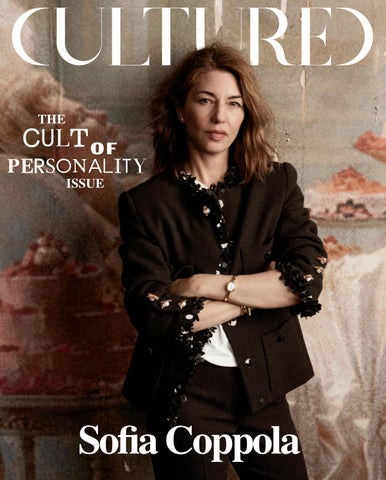
Sofia Coppola
BAL HARBOUR SHOPS, 9700 COLLINS AVENUE MIAMI
TEYANA TAYLOR — PARIS, 07.2026 PHOTOGRAPHED BY DAVID SIMS WWW.MAISON-ALAIA.COM
“ I work in l aye rs of col o r and fragm e nts of l igh t — h a r mo ni es th at trans l ate i nto je wel r y. ” – SYBIL YURMAN
MERCER COLLECTION WOMEN
ARMORY COLLECTION MEN
RAQUEL ZIMMERMANN PHOTOGRAPHED BY DAVID SIMS FALL 2026 COLLECTION
DESIGNED FOR DISTINCTION
2026 2026 Range Range Rover Rover Autobiography Autobiography with with optional optional features. features. © © 2026 2026 Jaguar Jaguar Land Land Rover Rover North North America, America, LLC LLC
GREGORY CREWDSON, Untitled, 1998-2002 Digital pigment print, 48 × 60in © Gregory Crewdson
LOEWE
Alaïa · Audemars Piguet · Balenciaga · Bottega Veneta · Brunello Cucinelli · Cartier · Celine · Chanel · Dior · Eleventy Fendi · Graff · Gucci · Guerlain · Hermès · Jacques Marie Mage · Jessica McCormack · Khaite · Loewe · Louis Vuitton Maison Margiela · Patek Philippe · Prada · Roger Vivier · Saint Laurent · Tiffany & Co. · Van Cleef & Arpels
ORANGE COUNTY, CALIFORNIA
230 BOUTIQUES ∙ 30 RESTAURANTS
SOUTHCOASTPLAZA.COM
TABLE OF CONTENTS
Gemma Chan photographed by The Masons in London wearing a T-shirt by Gucci and Grain de Café necklace by Cartier.
84 A Way In 112 Say Less 86 Soft Sell 114 Love Bomb 91 The Omnivore’s 116 Lydia Mathis Is Cultural Calendar CULTURED’s First 102 Why Are Celebrities Young Writers Prize So Boring Now? Winner 106 Loewe’s Meow 118 No Country for 108 When Collectors Care Literary Men 110 Made for Walking The Cult of Personality Issue
58
TIARÉ
COBRA
TABLE OF CONTENTS
Graham Campbell photographed on the set of The Shards by Christian Coppola.
128 Is It an Age-Quake 146 Sofia Coppola Was if No One Looks Like Told No One Cared They’re... Aging? About a Woman’s 132 An Afterlife of Their POV. Then She Made Own a Whole Career 136 Theater Kid Out of It. 138 In Bed With 158 Troye Sivan’s horsegiirL Pendulum Swing 140 Beyond the Veil The Cult of Personality Issue
64
TABLE OF CONTENTS
Troye Sivan photographed by Jacob Bixenman in Los Angeles wearing a hat, belt, and pants by Prada.
166 Gemma Chan, Box Office Queen, Goes Indie 172 Mika Abdalla Is Turning Heads 182 Beautiful, Bored, and Bloody 194 Beyond the Banana 200 Indie Squeeze 206 The Detonator The Cult of Personality Issue
212 All the Way Up 222 Fuck Around and Find Out 226 Born of a Diamond 234 The 2026 Young Photographers 250 Breakup Landscapes 256 The Painter and the Pop Star 66
* The alchemy of senses
LETTER FROM THE EDITOR In the fall of 1945, Jackson Pollock and Lee Krasner moved from Manhattan to the Hamptons in search of a much-needed creative reset. Eleven years later, after Pollock died in a drunk-driving crash, Krasner worked hard to rebuild his reputation as the singular genius we take him for today. In our current era of social media scrutiny, it’s a lot harder for artists to control public perception. But what Krasner—who is, alongside Pollock, the subject of a major fall retrospective at the Metropolitan Museum of Art, previewed in these pages—understood about the culture was that it revolves around cults of personality. That idea—the cult of personality—is the focus of CULTURED’s fall issue. We examine the actors, musicians, filmmakers, and artists who have captured our culture’s most precious resource: our attention. They share charisma, a distinct point of view, and a deeply invested fan base. We find many of these magnetic figures, including our four cover stars, in moments of transition, wrestling with how the public sees them. Musician Troye Sivan opens up to artist Sam McKinniss (who also painted his portrait for the limited-edition cover) about how his fourth album complicates the one-dimensional image of him as a pop icon. Actor Gemma Chan speaks with Crazy Rich Asians director Jon M. Chu about making the jump from blockbusters to scrappy indies. Mika Abdalla, the young star of the buzzy Prime Video drama Off Campus, describes the feverish experience of accruing a dedicated fandom practically overnight.
Troye Sivan photographed by Jacob Bixenman in Los Angeles wearing a shirt by Reynaldo Rivera. To get Sivan’s look, try V.I.P. Glow 3-in-1 moisturizer and Lovebalm lip balm. Both, Rabanne.
Troye Sivan
Sofia Coppola photographed by Craig McDean in New York wearing a jacket and trousers by Chanel Haute Couture, T-shirt by Slvrlake, Cartier diamond studs, and a Baignoire mini model watch by Cartier. Bracelets on right wrist are the filmmaker’s own throughout, including a Cartier Love bracelet. To get Coppola’s look, try Inimitable Mascara in Noir Brun, Les Beiges Healthy Glow Sun-Kissed Powder in Light Coral, and Rouge Coco Flash Hydrating Vibrant Shine Lip Colour in Boy. All, Chanel Beauty.
Sofia Coppola
And in an illuminating conversation, filmmaker Sofia Coppola and artist Lisa Yuskavage discuss how they stuck to their guns at a time when their respective industries weren’t particularly interested in what they had to say. That, of course, has changed since. They are now at the top of their fields—thanks to sheer force of will and, yes, their cults of personality.
SARAH HARRELSON FOUNDER & EDITOR-IN-CHIEF Cult of Personality
Gemma Chan
Mika Abdalla
Gemma Chan photographed by The Masons in London wearing a suit by Zegna with a shirt and tie by Ami Paris. To get Chan’s look, try Le Shadow Stick in Twinkly Rose, True Match tinted balm in Pêche Éclat, and Paradise Blurfiller lip contour in Nude Espresso. All, L’Oréal Paris.
Mika Abdalla photographed by Elizabeth Miranda in Toronto wearing a full look by Coach. To get Abdalla’s look, try Perversion Volumizing Mascara, Face Bond Blush Suede in Fleshed Out, All Nighter Ghosting Spray, and Lip Toy pH Staining Lip Oil in Pop Off. All, Urban Decay.
68
CONTRIBUTORS Jia Tolentino Craig McDean 2026 Young Writers Juror Photographer, Sofia Coppola
Was Told No One Cared About a Woman’s POV. Then She Made a Whole Career Out of It.
Leah Abrams Writer, Mika Abdalla: Turning Heads
Did you have a high school yearbook superlative? What would it be today? “Most likely to eat a large pizza in one sitting” was genuinely my high school superlative. Today I’m trying not to be the most of anything. What turns you on and off in other people? I know this is not a popular position, but it rubs me the wrong way when people are too outwardly confident. If you don’t have some healthy doubt about your abilities, I’ll assume you haven’t thought about it hard enough! At the very least, fake it.
What’s the most “you” thing you’ve done recently? I took a 1,500-mile motorbike trip along the West Coast, starting in Los Angeles and ending in San Francisco. What’s something about you that people only discover after knowing you for a long time? My British sense of humor. When and where do you feel most like yourself? In the studio creating.
Sam McKinniss Limited-Edition Cover Artist and Writer, Troye Sivan’s Pendulum Swing
What’s a personality trait you wish you had? A better attitude. When and where do you feel most like yourself? 5 p.m., Connecticut. What turns you on? What turns you off? On: savvy, refinement, cunning, and sex appeal. Off: false confidence, patriotism, delusion, and vulgarity.
“I use Caps Lock to type every capital letter. Perverse and upsetting, but I am far too old to change!” —Jia Tolentino The Cult of Personality Issue
74
Clockwise from top left: Photography by Elena Mudd, courtesy of Craig McDean, by Dan Allegretto, and by Hero Bean Stevenson.
What’s the most “you” thing you’ve done recently? Baking an Eevee cake with my 5-year-old daughter on the same evening that I went to Zero Chill. What’s something about you that people only discover after knowing you for a long time? I use Caps Lock to type every capital letter. Perverse and upsetting, but I am far too old to change! When and where do you feel most like yourself? On my own, in a city I’ve never been to, with a few precious hours to do whatever I want.
CONTRIBUTORS Robin Givhan Writer, Is It an Age-Quake if No
One Looks Like They’re… Aging?
What’s something about you that people only discover after knowing you for a long time? When I get exasperated, I have a terrible temper. What’s your astrological sign? I am a Virgo. Order, calm, and tidiness bring me great joy. In my opinion, if things were run by Virgos, all would be right with the world.
Hanif Abdurraqib 2026 Young Writers Juror When and where do you feel most like yourself? Anytime I get to be home in Columbus, Ohio. What’s something people get wrong about you? People tend to think I am more serious than I actually am. Are you a big birthday person? I tend to keep to myself, but I do go on a long run in the morning.
What’s something about you that people only discover after knowing you for a long time? I looooove pillow talk. What’s your astrological sign? Taurus, and it’s spot on! When and where do you feel most like yourself? Foraging for those elusive morel mushrooms!
The Cult of Personality Issue
“In my opinion, if things were run by Virgos, all would be right with the world.” —Robin Givhan 76
Clockwise from top left: Photography by Kevin J. Miyazaki, courtesy of Hanif Abdurraqib, and courtesy of Sergiy Barchuk.
Sergiy Barchuk
Photographer, Born of a Diamond
MADISON AVENUE GREENWICH SOUTHAMPTON CHICAGO TORONTO PALM BEACH BAL HARBOUR SHOPS WYNN LAS VEGAS MONTECITO BEVERLY HILLS SOUTH COAST PLAZA
CONTRIBUTORS Paula Mejía Jeremy Liebman Writer, The Detonator Photographer, No Country for Literary Men
Daniel Gaines Stylist, Troye Sivan’s Pendulum Swing
What’s your astrological sign? How do you feel about it? I’m a Leo, but on the cusp of Virgo. I feel good about it, but I guess it’s more of a question for the people around me. When and where do you feel most like yourself? In water—ocean, pool, shower, bath. What turns you on? What turns you off? On: being super knowledgeable about something I don’t know anything about. Off: being rude to waiters.
What’s the most “you” thing you’ve done recently? I avoided answering this questionnaire for three weeks. Whose public persona do you feel the strongest kinship with? Larry David. What would you do if you won the lottery? Buy more lottery tickets.
Aidan Cullen Photographer, The Detonator
Did you have a high school yearbook superlative? What would it be today? I did actually have a superlative in high school: “Most tardy.” I was late to first period every single day. Today, it might be something like: “Most likely to wear the most hats in a day.” What turns you on? What turns you off? Ambition. It goes both ways. It really attracts me to people; it also really turns me off when people aren’t ambitious or passionate about anything they love. It doesn’t have to be a work thing, either. Whose public persona do you feel the strongest kinship with? McLovin.
“I feel most like myself when I’m nursing a bone-dry vodka martini at Jones Hollywood.” —Paula Mejía The Cult of Personality Issue
80
Clockwise from top left: Photography courtesy of Paula Mejía, Jeremy Liebman, Aidan Cullen, and Daniel Gaines.
What’s something people get wrong about you? I’m often told that I seem intimidating. I’m just a tall woman. When and where do you feel most like yourself? Nursing a bone-dry vodka martini at Jones Hollywood. What would you do if you won the lottery? Tell no one. Secretly buy Stahl House and keep it open to the public.
AN INSTRUMENT “ART WITHOUT ARTIFICE” S E R I E S . . . . . . . FA IR C R O F T
TM
K I T C H E N C O L L E C T IO N
I T E M . . . . . . . . . B R I D G E K I T C H E N FA U C E T W I T H SI D E S P R AY E R F I N I S H . . . . . . . B R IL L I A N C E® S TA IN L E S S
Founder & Editor-in-Chief SARAH G. HARRELSON Creative Direction & Design ERIN KNUTSON
Executive Editor MARA VEITCH
Senior Editor ELLA MARTIN-GACHOT
Director of Brand IAN MALONE
Editorial Associate Editor, SOPHIE LEE, Assistant Managing Editor, KARLY QUADROS Assistant Editor, SAM FALB, Junior Video Editor, PALOMA BAYGUAL Copy Editors EVELINE CHAO, MEGAN HULLANDER Editorial Interns ISABELLA BERNSTEIN, MILA DIAZ, NICK DIMITRIADES, LUCIA PONTI, MOKSHAA SHIVLANI, SOPHIA SHYER, OLIVIA SILVA The Critics’ Table Chief Art Critic & Editor, JOHANNA FATEMAN Editors-at-Large Editor-at-Large, JULIA HALPERIN, Arts Editor-at-Large, SOPHIA COHEN Fashion Directors-at-Large ALEXANDRA CRONAN, KATE FOLEY, Style Editor-at-Large, JASON BOLDEN Design Designer, PAUL BILLE, Social Media Director, KRISTIN CORPUZ, Junior Designer, AHIMSA LLAMADO Design Interns ASHLYNNE GRAHAM, LAYLA HUSSEIN, NIO KWAN, NINA SHAKES, SATOKA SHIBASAKI Columnists & Contributors Cultural Columnist, JAMIESON WEBSTER, Art Market Writer, RALPH DeLUCA, Architecture Editor, KAREN WONG Food Editor, MINA STONE, Literary Editor, EMMELINE CLEIN, New York Arts Editor, JACOBA URIST Travel Columnist, ROBERT GOFF, European Contributor, GEORGINA COHEN Beauty Editor, EMILY DOUGHERTY, Art Columnist, SARAH CASCONE, Breakfast Columnist, JOSH DUBOFF Theater Columnist, MATTHEW GASDA Publishing Senior Vice President, Chief Revenue Officer, CARL KIESEL Vice President, Fashion, MICHAEL RIGGIO Vice President, Sales, LORI WARRINER, Director of Marketing, SARA ZELKIND Marketing & Production Manager, HAILEY POWERS Sales Consultant, Home & Travel, PRIYA NAT, Prepress/Print Production, SHAPCO PRINTING INC. Strategy Public Relations, ETHAN ELKINS, DADA GOLDBERG Strategic Consultant, CAROL SMITH Advertising advertising@culturedmag.com ISSN 2638-7611 Contains 10% post consumer waste
Subscriptions hailey@culturedmag.com
Emma McIntyre
David Zwirner
AWAY IN To mark the release of CULTURED Editor-inChief Sarah Harrelson’s new book, The Cultured Collector, one of her longtime supporters— the inveterate athlete and art collector Venus Williams—outlines the context, and the importance, of the project.
Sarah has always been a true advocate for emerging artists and for voices that don’t always get the spotlight. Through CULTURED, she’s created a space for new perspectives to be seen, heard, and has elevated artists at pivotal moments in their journeys. Her vision is shaping what the future of collecting can be—more inclusive, more reflective of the world we live in. I’ve admired Sarah’s commitment to uplifting new voices and making room for them in the art world. I’m naturally drawn to stories that don’t sit front and center, and that’s why CULTURED has been such an important platform for so many. From the beginning, it has made the art world feel more open and more welcoming. Being on the cover myself, it was a personal honor and deeply meaningful experience for me to even be a small part of the magazine’s journey. When I first started collecting, I didn’t have a traditional background in the art world, of course. My parents chose tennis for me, something I’ll always be grateful for, but I chose my love for art and design. I was simply curious, drawn to artists who told honest, The Cult of Personality Issue
personal stories, and gave shape to emotion. There was no roadmap for me; it was all about what I fell in love with, and connection. Connection with the work. Connection with the people behind it. That’s why CULTURED has always stood out: it has made the art world feel more accessible, creating space for different kinds of collectors, and different kinds of stories. My love for art has always been rooted in that desire to connect and feel. It started with visiting galleries, reading, listening to artists describe their process, and realizing how much power and wisdom lives within their work. That’s what drew me in, and it’s what continues to inspire me today. Sarah and CULTURED have built something extraordinary—a space that not only documents culture but helps shape it. And in doing so, they’ve reminded us that art is not just about what we see on the walls; it’s about the voices we choose to hear, the emotions it stirs, the stories we choose to honor, and the future we choose to imagine together. 84
Photography courtesy of Phaidon.
By Venus Williams
SOFT SELL No outside investors, no splashy campaigns, no compromises. Iris von Arnim, the familyowned artisanal knitwear label, is turning 50 on its own terms. After a serious car accident left a young German woman hospitalized for months, she found herself with nothing but a pair of knitting needles to keep her occupied. In 1976, she opened her first store. In the decades since, her name—Iris von Arnim— would become synonymous with the contemporary cashmere movement and stake out a niche for fine sweaters as luxury goods. To mark her label’s half-century anniversary, CULTURED sat down with Iris (who dialed in, cigarette in hand, from her Berlin office) and her son, Valentin, to discuss the next 50 years of the family-owned cashmere mainstay.
Iris von Arnim started almost by accident. Can you walk us through that story? Valentin von Arnim: Iris is from a family of refugees who came to Hanover in 1947. When she was 16, she was orphaned. When she started the brand, she was a single mother. She found her passion through a literal accident. It was in the hospital where she started knitting, and someone nearby thought it was the most beautiful sweater in the world. Iris von Arnim: I had the idea of working with home knitters in Hamburg. I opened a small store with very little money, and everything spread by word of mouth. I never studied fashion or business. What has stayed the same, and what has changed?
always the drive—almost the need—to be perfect. Iris always wanted to create the best sweater. Iris: Knitwear used to be a very niche market. Today, every luxury brand— Dior, Hermès, Gucci, Prada—has a significant knitwear offering. What do you hope the next 50 years look like? Valentin: Our sweaters are passed from mother to daughter, and people say, “I bought this 30 years ago and still wear it.” If that continues, we’ve done everything right. Iris: I love traditional craftsmanship. There are still young people who knit while watching a movie. There is always a need to do something with your hands, and that value will persist.
Valentin: At the heart of what we do, it’s always been knitwear and cashmere. That DNA has never changed. There is
The Cult of Personality Issue
86
Photography courtesy of Iris von Arnim.
By Sam Falb
SEE YOU AT THE GUGGE HEIM For the bold, the inspired, the curious—like you. Become a member.
New York
Maia Cruz Palileo
The World Tangled in You September 10 - October 24, 2026
Tala Madani Control X
September 18 - October 24, 2026
Keith Sonnier
Inside Light, 1968–1970 September 18 - October 24, 2026
davidkordanskygallery.com
© 2026 Estate of Keith Sonnier / Artists Rights Society (ARS), New York.
Los Angeles
S ’ E R O V I N M THE O CULTURAL CALENDAR Planning a movie night? Looking for your next subway read? Breathlessly following the Luigi trial and celebrity pregnancies? We’ve got you covered. CULTURED’s fall calendar has the news, releases, and events that will be the talk of every subway platform, bar line, and water-cooler gathering. 91
The Fall in Full
SEPTEMBER
The Omnivore’s Cultural Calendar
1 2 3 4 5 6 7 8 9 10 11 12 13 14 15 16 17 18 19 20 21 22 23 24 25 26 27 28 29 30
1 2 3 4 5 6
SEPT 8
YORK is back. His NEW Luigi Mangione R TRIAL commences after STATE MURDElay and almost two years a three-month de shot UnitedHealthcare CEO after he allegedly. Is Mangione a cold-hearted Brian Thompsonll icon of the politically killer? An unwe matter how you view it, dispossessed? No fining trial of the Gen Z era. this will be the de
SEPT 8
ur and queer provocate Mykki Blanco, sic savant, comes back after an mu d un a master’s in undergro ’s spent completing academic hiatus FE PARADISO is the musician Switzerland. CA ur years. Artsy kids rejoice— first album in fo de this record for you. Blanco says he ma
7 8 9 10 11 12 13
ill, d Tannah Jordan playwright, an t, s n li ia d a nove n a rite C our favoheads to the in export, grounds of Berlt cruising semi-surrealis in a newHE LIVING book, T that manifests st REALMthe ghosts of pa grief as fter the splash lovers. APrince Faggot t his play -Broadway las made offnnahill gives us year, Ta preposterously er another ploration of que fresh exships. relation
SEPT 11–12
SEPT 10
Knitwear and textile aficionado Henry Zankov levels up, making his DEBUT AS ARTISTIC DIRECTOR of Diane von Furstenberg on the first day of New York Fashion Week. It’s less of a hard launch than a triumphant return—the designer worked under former DVF Chief Creative Officer Jonathan Saunders in the 2010s.
Hamburg- and based artist KarLagosAshadu unveils imah video exhibitio two in the Windy Cins ty; “MACHINE BO at the Art Inst YS” itu of Chicago an te “TENDEREDd Renaissance So” at the The double-bar ciety. presentations unreled themes of labo pack the identity, and par, African that underpin Atriarchy evolving interroshadu’s of the filmmak gation relationship. er-subject
14 15 16 17 18 19 20 SEPT 1
7 Alan Cu host par mming, actor tu non-cele excellence, and rned reality TV are hittinbs you’re about a smattering of THE TR g Peacock as th to know really an all-civAITORS: NEWe first season of well Joes were ilian cast. Twe BLOOD takes SEPT 16 60,000 h plucked from nty-two averag on e a opefuls. Could ha pool of over ve been After leaving his mark you! on the LA Phil, Gustavo Dudamel is taking on Lincoln Center. The star conductor makes landfall at the New York Philharmonic with Prokofiev’s SYMPHONY NO. 5 to open the season. The Venezuelan maestro promises a much-needed infusion of energy into the institution—one loyal audiences are hungry for.
21 22 23 24 25 26 27 5
SEPT 1
ebodies, ving hom o -l rn ymour, e a tt T Pa Hillary ind — e ic jo re is y masterm the kook ollina Strada, nd is C d in he bra AB h T be . c ti s e m LL going dog a HOME CO e h in T s . a D le E re AYER ed WITH Ln will be unveil o ti in c e w ll o o c shion sh ving with a far’s New York li u o m y a T room.
28 29 30 The Cult of Personality Issue
92
Top to bottom: Photography by Angelina Katsanis / POOL / AFP via Getty Images; by Get Mut and courtesy of Mykki Blanco; by Hunter Abrams and courtesy of Diane von Furstenberg; courtesy of Macmillan Publishers; courtesy of Collina Strada; Karimah Ashadu, MUSCLE (Film Still), 2025, © Karimah Ashadu, courtesy of the artist, Camden Art Centre, Fondazione In Between Art Film, Sadie Coles HQ, and the Renaissance Society at the University of Chicago; courtesy of NBC; by Scott Dudelson/Getty Images for Coachella.
SEPT 4
David Lynch, Untitled (Nudes and Smoke), c. 1994 © The David Lynch Family Estate
David Lynch LA
pacegallery.com
Los Angeles
SEPTEMBER
The Omnivore’s Cultural Calendar
1 2 3 4 5 6 7 8 9 10 11 12 13 14 15 16 17 18 19 20 21 22 23 24 25 26 27 28 29 30
1 2 3 4 5 6
SEPT 22
Entertainment powerbroker Ari Emanuel gets reflective in ROLL THE CALLS, a memoir charting his dizzying rise at the helm of Endeavor and his transformation into a full-on media mogul. (Emanuel’s time in Hollywood is the stuff of legend— literally. His exploits inspired the character Ari Gold on Entourage.)
Taryn Simon was awarded a Guggenheim Fellowship in 2001. Now, she’s taking the Guggenheim New York. “FATHER COUNTRY DO I LOVE YOU,” her expansive solo show at the museum, on view through next March, will offer a new lens on a practice that excavates everything from contraband at JFK to what really goes on at Playboy Enterprises. A new selection of Simon’s famously in-depth research paraphernalia, sculptures, and films will take over the entire Frank Lloyd Wrightdesigned spiral with an interactive installation.
7 8 9 10 11 12 13 SEPT 24
is Arthur Jafathe on a tear. In ’s last year, he oMA curated a M ted show, exhibiichard alongside Renice, Prince in V d a and snagge Art prestigious d. Now Basel awar the he’s gettingtment. survey trea NY,” “I AM TO the largest al institution to exhibition video date of the ce artist’s at on d blistering anploraexultant ex ckness tions of Bla is the in America,um’s New Muse first solo e showing sincg last its reopenin spring.
SEPT 19
Talking Heads frontman and all-around visionary David Byrne gives us a good old stadium show. The musician (and Olivia Rodrigo coconspirator)’s trippy-dippy WHO IS THE SKY? tour wraps up at Forest Hills in New York. The nearly year-long global road show celebrates the 74-year-old’s first album in seven years.
14 15 16 17 18 19 20
SEPT 22
Power couple Geor and Mellody Hobs ge Lucas 11-acre museum on open an in Los Angeles’s Exposition Park. Th MUSEUM OF NA e LUCAS will house memorabRRATIVE ART art, and film archiv ilia, blue-chip 40,000-piece colle es galore. Lucas’s pile of $30 comic ction started as a Wars and Indiana books in the Star dorm room and ha Jones filmmaker’s fair number of Ro s culminated in a ckwells.
21 22 23 24 25 26 27
28 29 30 SEPT 29
Hernan Diaz, mo Trust, does it againdern man of letters and author of orphan take over a . His third novel, PLY, sees an already won a Pulitzfuturistic black market. Diaz has er. How much more do you need? convincing
The Cult of Personality Issue
SEPT 25–27 Looking for the monograph of your dreams? With the 2026 NY ART BOOK FAIR at MoMA PS1, Printed Matter and the Queens museum are teaming up to give New York’s Luddites something to write home about. Both institutions ushered in their 50th years in 2026. This edition of the NYABF hints at what’s next. SEPT 25
Halloween costumes. Scream This is your chance to get ahead on oy (aka Jason Isaacs), queen Maika Monroe, the elder Malf n have collabed on what and Sanctuary director Zachary Wigo ng thriller: an adaptation of promises to be a conversation-sparki N PSYCHO. (The film Virginia Feito’s horror novel VICTORIAes.) There’s enough blood deal was inked before the book hit shelvs creepy clawfoot tubs. in the trailer alone to fill one of the film’
94
Top to bottom: Taryn Simon, One little room on fire (Detail Shot), 2026, © 2026 Taryn Simon; Photography by Shervin Lainez and courtesy of David Byrne; courtesy of Knopf; Weegee, The Foreman Of The Devils Was Peeved... because the assistant devils were not in costume, 1945, courtesy of the artist and New Museum; © 2024 Lucas Museum of Narrative Art; courtesy of Bleecker Street; courtesy of Riverhead Books.
SEPT 18
Two exhibitions open through January 3, 2027 Getty Center
From top: En su propia cárcel / In Her Own Prison (detail), 1950, Lola Álvarez Bravo. Gelatin silver print. Getty Museum, Gift of Daniel Greenberg and Susan Steinhauser. © Center for Creative Photography, The University of Arizona Foundation | Lotería de Muertos (detail), 1983, printed 1993, Ricardo Valverde. Hand-colored gelatin silver print. Getty Museum. © Esperanza Valverde and Christopher Jude Valverde. Text and design © 2026 J. Paul Getty Trust
FREE ADMISSION Plan your visit
OCTOBER OCT 1
works at the crossroads Bahamian-born artist Anina Major cultural histories. In her of ceramics and the transcription of , “THE SACRED Pérez Art Museum Miami exhibition into palm-leaf-like MANGROVE,” she hand-weaves clay postcard visions of the plaits. It’s a rebuttal, in stoneware, ofred solid enough to outlast Bahamas—labor and ancestry rende tourist brochures.
19 20 21 22 23 24 25 26 27 28 29 30 31
The Omnivore’s Cultural Calendar
1 2 3 4 OCT 3–4
, and Taylor Derriann Pharr, Simonette Quamina ence at the resid in ts artis s year’ this Simmons are first cohort to Studio Museum in Harlem, and the ly renovated and present work in the institution’s fresh125th Street. “A much-discussed new home on West res their recent SUSTAINED BECOMING” featu making, output, spanning painting, collage, print a. drawing, sculpture, and mixed medi
OCT 6
12 13 14 15 16 17 18
the Electronic-pop diva Slayyyter, aka is ready “WORST GIRL IN AMERICA,” r-songto make New York shriek. The singe on writer has taken her sleaze revival act center the road and is finally landing in the klyn of it all, hitting Terminal 5 and Broo ly. Paramount on Oct. 3 and 4, respective
5 6 7 8 9 10 11 OCT 2
The man, the myth, the director Alejandro G. Iñárritu claps back after 2022’s divisive Bardo. DIGGER, a pitch-black comedy with serious Oscar buzz, stars Tom Cruise (with a beer belly and thick Southern accent), Sandra Hüller, Jesse Plemons, and Riz Ahmed. This is Iñárritu’s first English-language film since The Revenant—a logical choice since it’s about a CEO on the verge of triggering an imminent apocalypse.
a Barbar her winner g Pulitzer lver is releasin . It Kingso vel, PARTITAme 11th no Livia, a oneti by a follows rodigy shaken lover piano p all from an olded her phone c after she buri reams decades onservatory d he music cr of farm life. Tuthor in favo Copperhead a t Demon ppalachian grilus trades Aalachian grit p n for App —proof she ca of Chopin tearjerker out wring a ly anything. absolute
12 13 14 15 16 17 18 OCT 9
Screenwriter and director Aaron Sorkin is back with Mikey Madison, Jeremy Strong, and Jeremy Allen White in tow for THE SOCIAL RECKONING. With 2010’s The Social Network, Sorkin penned the definitive take on the dawn of our social media era. Now, he takes on Facebook’s heavy hand in the misinformation age. The original film’s Zuckerberg (Jesse Eisenberg) declined the role on principle, so this time it’s Strong who’s stepping into the tech oligarch’s Nikes.
19 20 21 22 23 24 25 26 27 28 29 30 31 THIS OCTOBER
Writer Oliver Misraje returns to New Theater Hollywood’s “CALIFORNIA GOTHIC.” The cult bus tour ’s ghostly y edition now also features Rubstars, McCollister and more guest joining together to eulogize the dead California Dream. Here, the “celebrity homes” bit gets swapped for a memorializing of the movie industry itself— er somehow both funnier and sadd than it sounds.
THIS OCTOBER
Hauser & Wirth takes on Silicon Valley. The megagallery is heading to the Bay Area, OPENING AN OUTPOST in Palo Alto—an undertaking hitherto only attempted (and failed) by Pace. Art history majors, ready your CVs: The new location, housed in a renovated post office, is just a short walk from the Stanford campus.
The Cult of Personality Issue
96
Top to bottom: Anina Major, Water Tower, 2024, photography by Andrew White, courtesy of the artist and Tern Gallery; by LailaAnnMarie Stevens and courtesy of the Studio Museum in Harlem; courtesy of Warner Bros. Pictures; by Anna Downs and courtesy of Slayyyter; courtesy of HarperCollins Publishers; courtesy of New Theater Hollywood; courtesy of Sony Pictures; by Jon McNeal Photography and courtesy of Hauser & Wirth.
OCT 1
1 2 3 4
5 6 7 8 9 10 11
OCTOBER
1 2 3 4
5 6 7 8 9 10 11 12 13 14 15 16 17 18 19 20 21 22 23 24 25 26 27 28 29 30 31
The Omnivore’s Cultural Calendar ellini Freak (this time, no geeks) Linda Card may know and director Brad Kane (who you el for the as the voice of Aladdin) give us a prequVoorhees ages. Friday the 13th’s infamous Jason ent in gets the long-awaited origin story treatmE. An Peacock’s TV slasher, CRYSTAL LAK adds to the old-school summer camp backdrop nostalgia factor.
1 2 3 4 OCT 11
Roy Lichtenstein, forever a legend, gets his laurels. A MAJOR RETROSPECTIVE at the Whitney, curated by artist Alex Da Corte and the museum’s Meg Onli, Nakai Falcón, and David Crane, comes on the heels of a blockbuster Pop art group show at the Guggenheim. The late New Yorker reaches out from beyond the grave to offer an evertimely critique of mass culture in the era of A.I. slop.
5 6 7 8 9 10 11
OCT 14–27
BAM curator and artist-in-residence Helga Davis brings heavyweight thinkers like Claudia Rankine and Jack Halberstam to the Downtown Brooklyn institution for “UNWORLDING, NYC,” a new series of public dialogues between artists and writers considering collapse “as a generative condition.”
12 13 14 15 16 17 18 OCT 19
librettist Royce Vavrek Composer Missy Mazzoli and opera stage. LINCOLN elite an to gem ary liter a g brin its world premiere at the IN THE BARDO is making continues to try its hand at ch whi ra, Ope n olita rop Met rge Saunders’s Booker Prizemodernizing its program. Geo e sees a fictional Abraham nam e sam the of el nov ning win Willie. Lincoln stalking his dead son,
OCT 18
their Julia Louis-Dreyfus, everyone and aster, mother’s favorite comedian and podc is takes New York. The legendary actor Robin making her Broadway debut in Jonat the Baitz’s OTHER DESERT CITIES list Hudson Theatre. A Pulitzer Prize–fina script, a cast also featuring Ed Harris ly and Allison Janney, and nonstop fami drama—what’s not to love?
19 20 21 22 23 24 25 OCT 20
The one and only Ina Garten, to America’s fairy godmother, is back save your next dinner party. Her first cookbook in four years, SIMPLY INA, features 85 new recipes. Things change, but a home-cooked meal—especially one with bountiful, whole-fat ingredients—never goes out of style.
THIS OCTOBER
st Six of the Association of Tennis’s biggeer, names (Alcaraz, Djokovic, Fritz, Sinn dh for Tsitsipas, and Zverev) land in Riya ming Netflix’s SIX KINGS SLAM. The streaof this giant is broadcasting the third editionlatest glitzy exhibition tournament in the try. boon for the Saudi entertainment indus d; It’s tennis as spectacle first, sport secon $1.5 appearance fees are reportedly set at million, with a $6 million winner’s pot.
26 27 28 29 30 31 The Cult of Personality Issue
98
Top to bottom: Photography courtesy of NBC; Roy Lichtenstein, Crying Girl, 1963, © Estate of Roy Lichtenstein/DACS 2026; by Christopher Anderson and courtesy of Julia Louis-Dreyfus; by Adam Rigg and courtesy of the Metropolitan Opera; courtesy of Clarkson Potter; by Jeremy Liebman; by Dylan Buell/ Getty Images.
OCT 15
OCTOBER
1 2 3 4
5 6 7 8 9 10 11 12 13 14 15 16 17 18 19 20 21 22 23 24 25 26 27 28 29 30 31
The Omnivore’s Cultural Calendar art, and the on, Josh H boys are ns ru B n le st Ja York’s be rest of Newvictory lap, with the a r fo ck ME OF ba ICKS GA p FIRST KNSON, now a blue-chihe A T E s. S ar E ye H T ed ter 53 long occasion aftop? The Knicks-themwill cherry on trance at 34th Street u’re subway en e for photo ops if yo still be ther out for tickets. not shelling
1 2 3 4 THIS FALL
If you don’t already know Onl and controversy magnet Bon yFans creator certainly about to. Blue is setnie Blue, you’re BIRTH TO HER FIRST CHto GIVE unknown—sometime this fall. ILD—father pregnancy comes on the heel The porn star ’s publicity event she hosted lasts of an infamous which she got... intimate... withsummer, at more than 400 men.
5 6 7 8 9 10 11 12 13 14 15 16 17 18 OCT 23
OCT 21
and Oscar host emeritus, Billy Crystal, frog-throated funnyman one-man show, 860, ical raph biog goes deep. His new auto the 2025 Palisades fire with details the loss of his family home inrial Theatre. Crystal won Impe the at a limited 14-week run t growing up on Long a Tony for his 2005 one-man play abou Island. Could 860 land him another?
Alexander Skarsgård and Olivia Colman star in a monster romance of sorts. Adapted from a short story by Ursula Wills-Jones, WICKER sees Colman as an ostracized small-town woman who orders a wicker husband for herself. Enter Skarsgård. Keep an eye out for his press tour looks.
19 20 21 22 23 24 25 OCT 27
tainment Jonathan Van Meter, longtime enter n in CITIZEN journo, goes deep on Kim Kardashia from Paris KIM. His biography traces her path celebrity Hilton sidekick to architect of a new biographies of economy. Unlike other unauthorizedreds of hours of the star, this tome is built upon hundinner circle. interviews with Kardashian and her
OCT 30
Apple TV’s prestige-thri been quietly building th Zazie Beetz ller bench on streaming.e best entry into th , and Stephen Graham Liev Schreiber, Lars Kepler’e genre, NOCTURNE. star in its latest follows an exs bestselling “Joona LinAdapted from Pennsylvania -soldier-turned-detectivna” novels, it e town is upen ded by a seriwhose quiet al killer.
26 27 28 29 30 31 OCT 30
e live shows Machine Girl, the breakcore duo whos s, is staging have a reputation for controlled chao SET at a one-night-only HALLOWEEN-EVE hoWarrior tour. Pioneer Works, fresh off their Psyc electronic They’ve called their genre “fucked-upthe perfect punk;” Devil’s Night in Red Hook is venue for just that.
The Cult of Personality Issue
100
Top to bottom: Photography by Dylan Buell/Getty Images; by Michael M. Santiago/Getty Images; courtesy of Black Bear; courtesy of 860; courtesy of Apple TV; courtesy of Viking; by Jeff Gentner/Getty Images.
TOBER
THIS OC
wealth mission
Let’s talk vision
investments legacy Every so often you reach a moment that demands an important conversation. When it arrives, Glenmede is ready with sophisticated wealth and investment management solutions delivered with the personalized service you deserve. glenmede.com
Why Are Celebrities So Boring Now?
Bobby Finger and Lindsey Weber, the fame-crazed hosts of the cult podcast Who? Weekly, chart the rise of the celebrity pod—Hollywood’s ultimate moneymaker and allurekiller of the moment. By Bobby Finger and Lindsey Weber The Cult of Personality Issue
102
After over a decade of hosting a podcast about celebrities, the two of us have witnessed the industry’s evolution from a medium where any normie with a mic could develop a dedicated listenership to one almost completely dominated by celebrity voices. Now, thanks to the rise of “video podcasts”—a term we still believe is an oxymoron—it’s dominated by their actual faces, too.
reverberated across the celebrity media ecosystem— making celebrities seem more accessible and more available to criticism, but overall, less famous.
Celebrity journalism as we’ve known it for the past 75 years has irrevocably changed. As media brands falter and career entertainment reporters find themselves—and their jobs—in a more precarious position than ever, they’re In the following excerpt being replaced by celebrities from our forthcoming book themselves. And all it took I Want to Be Famous: When was a microphone. Everybody and Nobody Is When we started Who? Weekly in 2016, the biggest stars podcasting were Anna Faris, Marc Maron, and a Celebrity, we explore the Shaquille O’Neal. (Before you name others, well, do you consider Adam Carolla a celebrity? If so, then origins of the “celebrity yes, he was podcasting then too!) This is to say that back then, the podcasting ecosystem wasn’t awash in podcast,” from a niche celebrity to the extent that it is today. It barely had the genre populated largely by ability to turn someone into a celebrity, let alone attract an already-famous person to the microphone. In 2016, Whos to one now attracting Forbes noted a “rise” of celebrity podcasting, listing notables from “Steve Austin to real housewife Heather some of our biggest Thems. Dubrow to Maria Shriver.” One could hardly call that a boom, but it was certainly prescient. It’s now harder to name the influencers, actors, singers, reality-TV An obsession with being stars, and retired politicians who don’t have podcasts than those who do. perceived as authentic on mic (and on camera) has 103
The Death of the Hardball Interview
The celeb-on-celeb interview goes back long before Variety launched “Actors on Actors.” Interview magazine’s been publishing conversations between celebrities for years. Who needs a professional journalist when you could just read Kristen Stewart fielding questions from Justin Bieber, or Cindy Sherman in a tête-à-tête with Grace Jones? Maron and Faris had quite a lot to do with ushering other celebs to podcast. When Faris launched Unqualified, the premise was that she was doling out “not-great relationship advice from completely unqualified Hollywood types.” Not a bad idea! But unsurprisingly, listeners wanted less advice and more behind-the-scenes celeb banter, and the show slowly pulled away from its original premise and toward a chat show between Faris and a famous guest, which included everyone from Tony Hawk to Lena Dunham to her now-ex-husband, Chris Pratt—who was at that point way less famous than Faris herself. No matter the quality of jokes Faris was making, listeners remained way more engaged with small, revealing details about her personal life. Their relationship with the actor went from fandom to parasocial: “I’m in love with you Anna!” an Apple review reads. “Not creepy at all, but really thank you, every morning my dog and I enjoy your voice. And your shoes.” The beauty of a podcast was that it gave even the most untouchable stars the ability to at least attempt to appear relatable. And the Whos—who were already quite, uh, touchable?—could turn that existing relatability into a type of deeper, albeit one-sided, emotional connection with the consistency of regular missives. While Faris’s pre-pod stardom pushed listeners to tune into her show, the success of Marc Maron’s WTF undoubtedly brought him more celebrity as a podcaster than he’d had as a comedian. Once a niche comedian’s comedian, Maron went on to book high-profile acting roles on shows like Louie, GLOW, and even star in his own Curb Your Enthusiasm–style, semi-autobiographical comedy, Maron, which ran for four seasons on IFC. In so doing, he became the first “celebrity” to parlay his podcast into broader fame by altering what people thought podcasting was capable of. Just six years later, sitting president Barack Obama took a seat in Maron’s recording-studio garage. In 2021, Obama would eventually host a series of conversations with Bruce Springsteen as part of his own Spotify deal. By then, it was just a thing that celebrities did—even if (or especially when?) they were former presidents. Marc Maron once told The Guardian: “I’m not a journalist, I don’t write down questions. So, you know, go fuck yourself, I’m having a conversation, following The Cult of Personality Issue
my own instincts about what’s interesting to me.” Is he the most notable celebrity podcaster decrying any sort of journalistic tutelage—or, more important, responsibility? That title might be best suited to another comedian, Joe Rogan, who launched his podcast, the wildly popular and even more wildly controversial Joe Rogan Experience, in 2009: the same year Maron launched WTF. Though both Faris’s and Maron’s podcasts are no longer airing, they formed the blueprint for other celebs who’d always fancied themselves capable enough to play journalist. Or clever enough to know that something other celebrities might want out of an interview is a fellow famous person to agree to their hard limits. We call those types of questions softballs. Why might a celebrity launch a podcast now? Dax Shepard, another actor perhaps better-known as a podcaster, launched Armchair Expert in 2018. His wife, the more famous actor Kristen Bell, was his first guest. Notably, the show offers its guests the option to cut parts of the interview after it has been recorded. (“Interviewees frequently take them up on this,” wrote The New York Times in 2019.) Perhaps this is Shepard’s gesture toward a fellow famous person—attempting to cultivate a safe space where a celeb wouldn’t feel as if they might be set up to fail. Or so that no one “of note” would have the opportunity to get mad at him? The podcast would soon become more lucrative than Shepard’s acting career: The Wall Street Journal reported that in July 2024—seven years after his last attempt at leading a studio comedy, 2017’s CHiPS, flopped at the box office—Shepard signed an $80 million podcasting deal with Amazon’s Wondery platform. While most celeb hosts aren’t signing $80 million deals, they’re likely making solid payouts from ad reads. Nothing to scoff at, but relatively small compared to other types of more traditional Hollywood projects. Brands tend to get a much better deal buying an ad read from a celebrity podcaster on their show than offering them a more traditional brand partnership. Celebrities also start their own podcasts as a way to keep themselves in the conversation—if no one’s talking about them, maybe they should just talk about themselves? Actors Jason Bateman, Sean Hayes, and Will Arnett started the podcast SmartLess together in 2020, reportedly out of mid-pandemic boredom. And when the pandemic came to a close, the podcast had become such a success—the most lucrative of their careers, in fact—that despite having actual acting work, they kept recording it. But it’s not always merely about the money. Reality stars are known to launch podcasts after their seasons 104
It’s harder to name the influencers, actors, singers, reality-TV stars, and retired politicians who don’t have podcasts than those who do. air as a way of telling their sides of the story without the intervention of television editors. “Scandoval” was a cheating scandal in 2023 that unfolded on the reality show Vanderpump Rules and unexpectedly broke out beyond the show, giving its stars fifteen minutes of fame that they each turned into various opportunities: sponsorships, hosting gigs, and . . . so many podcasts. While so many stars dream of themselves in the Johnny Carson late-night seat, it may be more lucrative (although certainly less glamorous) to pursue a podcast route instead. Take former late night host Conan O’Brien—who launched Conan O’Brien Needs a Friend in 2018, while his TBS talk show, Conan, was still on the air. It took convincing: “Someone said, ‘You should do a podcast.’ And I was sarcastic, like, ‘Oh, really? Because I’ve been on television for, at that point, 25 years. So a podcast is what I should do, you think? That’s good thinking,’” he told Adweek. Unsurprisingly, O’Brien’s has become one of the biggest podcasts out there. The proliferation of celebrity podcasting, which goes hand-in-hand with the decline of access to celebrities for traditional journalism, meant that these podcasts would become an abundant source of gossip for the remaining tabloids. They started tuning in and picking out the juiciest moments, where a celeb might slip up and reveal something relatively compelling. So many “exclusives” are pulled from audio these days that we’ve started a segment dedicated to them on our podcast (meta!) called “Podcast Mouth.” Here’s where actor Dean Cain claims his Lois & Clark costar Teri Hatcher could be “difficult to work with” (on the Inside of You podcast) or where actor Sarah Paulson told the hosts of SmartLess that an actor named Tricia Hawkins once gave her six pages of notes on a theater performance she did in 2013: “It was really outrageous. Trish Hawkins, I have not forgotten it, and I hope to see you never.” Calling out Hawkins on SmartLess was funny in context, but once pulled from the podcast episode it produced such damning headlines as “Sarah Paulson Eviscerates Actress Who Critiqued Her with 6 Pages of Notes,” 105
“Sarah Paulson Trounces Actor for ‘Outrageous’ 6-Page Email of Notes on Her Performance,” and “‘I hope to see you never’: Sarah Paulson Shades Actor Who Criticised Her Performance.” Perhaps that’s the price you pay for the platform to really show off your personality, something celebs are always craving more of—forever walking that tightrope between over- and under-exposed. This used to divide the Whos and Thems for us: those seeking more attention were the Whos, while the Thems remained simply too famous to engage. They didn’t need to! Now there are more forces at play, both Whos and Thems are seeing podcasting as not only a personality play but the opportunity to better carve out a personality brand—lucrative to bigger synergistic opportunities with actual brands, but also with their own community of fandom. Now membership platforms like OnlyFans, Patreon, and Substack make it so anyone with an audience can go directly to them for financial support. Quite like how celebs once took their “exclusive” content away from the tabloids and placed it directly onto Instagram, generating followers and peppering in sponcon, the podcast is yet another piece of content for a celeb to offer up for sale. Now that bright lights and foundation makeup have been added back to the equation, it’s not likely we’re getting any more revealing long-form conversations like those that once aired on Marc Maron’s WTF. What’s to be gained? Why make things purposefully uncomfortable for their guests in the name of truth? There exists no one less curious, less willing to ask the burning questions that make an interview potent than... someone who is also famous. Excerpted from I WANT TO BE FAMOUS: When Everybody and Nobody is a Celebrity by Bobby Finger and Lindsey Weber. Copyright © 2026 by Robert Finger and Lindsey Weber. Published in the United States by Crown, an imprint of the Crown Publishing Group, a division of Penguin Random House LLC. The Death of the Hardball Interview
LOEWE’S MEOW
Whether it’s a pig sporting a holographic backpack or a shark swallowing down a gingham rocket, Cosima von Bonin’s sculptures prove that growing your CV doesn’t require growing up. That insistent playfulness made the German artist the perfect muse for Jack McCollough and Lazaro Hernandez’s second collection as the creative directors of Loewe. Von Bonin’s signature plush creatures punctuated the runway in Paris this past March and trickled into the line’s charms and The Cult of Personality Issue
Photography courtesy of Loewe.
The house’s latest, a collaboration with artist Cosima von Bonin, underscores its trademark playfulness with a series of accessories you’ll want to adopt. Our favorite? The Whisker bag.
accessories. The cheekiest of them all? The Whisker bag. Its floppy zipper and long tassels mimic ears and whiskers, injecting a dose of cute into the glazed calfskin construction, while a plaid inspired by Von Bonin covers the slouched body in the brand’s signature leather intarsia technique, trailing up into a structured top and strap. The best thing about this pet? It’s hypoallergenic, travels for free, and lives forever. 106
EXPERIENCE ART LIKE A VIP Screenings with up and coming filmmakers Free passes to art fairs Surprises in the mail
Invitations to our parties
First access to special projects like podcasts and pop-ups Studio visit opportunities
DETAILS ON CULTUREDMAG.COM SUBSCRIBE
When Collectors Care With a landmark new grant for artists living with cancer, the Rema Hort Mann Fund is showing up where the American healthcare system has faltered. By Sam Falb
Tell us how your collecting journey began. Everything changed when I met Jack Tilton in the early 1990s. He took my husband and me around as new collectors. We bought a Joan Mitchell, and the first contemporary work that really felt like the beginning of our collection was a sculpture by Paolo Icaro. We still have it on view today, and we always say it “started the monster.” I’m especially attached to Nicole Eisenman. In the early ’90s, whenever she needed money, she’d call and say, “Susan, come do a studio visit.” Every time I went, I ended up buying something. We were fortunate enough to acquire two of her early paintings. We also have an early Fred Tomaselli. What’s so meaningful is that these artists have remained our friends over the years. The Cult of Personality Issue
You’ve just launched a grant for artists in the New York Metropolitan area living with cancer, yet it feels especially timely given our current landscape for healthcare and art funding. Artists living with cancer are facing not only a devastating diagnosis, but also the reality of trying to sustain a creative practice while managing treatment and expenses. If we can ease even a small part of that burden, it’s worth doing. Especially now, with the end of some Affordable Care Act subsidies. It’s just disgusting. It makes the need for this kind of support even more urgent. The cancer grant started because Rema introduced us to a woman she met at cancer care who had brain cancer, a young woman. Her parents lived in the Northwest. Her boyfriend had just left her, and she basically said she was going to stop all treatment. She wanted one last good summer. She said, “I can’t do this by myself.” As the fund looks to the future, what are you most excited about? [My husband] Michael and I are getting older, and we’ve realized that if we want the foundation to continue, we have to let the next generation take the lead. We’re stepping back a little, but trust me, we’re still very involved. We’ve brought in wonderful new leadership, and it’s exciting to see fresh ideas take shape. The foundation has been around for 30 years, and it’s healthy for it to evolve. That’s how we make sure it’ll be here for the next 30.
108
Photography by Xavier Scott and courtesy of the artist.
Jacolby Satterwhite, a pioneer of queer art in the 21st century, has battled cancer since the age of 12. His story has made waves in the art world, a stark reminder of the challenges of creating while sick. In recognition of his indelible impact, this October the Rema Hort Mann Fund will award Satterwhite the inaugural Artists Living with Cancer grant, to be presented at the nonprofit’s 30th anniversary gala. Prolific patron Susan Hort and her family cofounded the organization in 1995 after her daughter Rema, as devoted a champion of emerging voices as her parents, died from stomach cancer. In the years since, the family has awarded over $9 million to support artists and cancer patients, all before unveiling this $10,000, unrestricted grant. To mark the occasion, Susan Hort sat down with CULTURED to reflect on where the fund is headed next.
PRECISELY POWERFUL. DELIBERATELY GENTLE.
111SKIN.COM
@111SKIN
CULT FAVORITE
Made for Walking
When it comes to shoes, it’s hard to reinvent the wheel without tipping too far into spectacle. The Shark Pinch boot is the rare exception. Givenchy debuted the first generation of the Shark boot as part of the house’s Haute Couture Fall/ Winter 2008 collection, and by 2012 it could be found on runways and city streets in suede, snakeskin, and metallics. Instantly recognizable for the dramatic sheath that creates a sculptural disruption to any look, it’s the distinctive crescent-shaped shark tooth detail— sleek and modern—that earned the silhouette its The Cult of Personality Issue
name. Today, fashion icons like Ariana Grande, Anya Taylor-Joy, and Teyana Taylor don the Shark Pinch as part of larger-than-life, devil-may-care looks. Reimagined for Fall 2026, the Shark Pinch has been renamed by Creative Director Sarah Burton, who also added her signature “Pinch” hardware—seen on handbags and accessories since her first season at the house—along with six boot variations for Fall/Winter 2026. Wherever you are this fashion month, expect to catch a glimpse of these iconic silhouettes weaving through the crowd. 110
Photography by Sam Hellmann and courtesy of Givenchy.
The Givenchy Shark Pinch boot, known for its sculptural sheath and glinting metal hardware, lures bold fashion girls to their fate.
CULT CLASSIC
SAY LESS
Flash lives today; substance lasts forever. That’s the thinking behind Miu Miu’s Rendez-Vous bag. Defined by its oversized flap closure and slouchy body, the design emanates unfussy ease. Its craftsmanship comes through by way of elegant stitching along the handle and touches of immaculately polished brass hardware. A debossed Miu Miu signature at the apex of the closure completes the look. The Rendez-Vous made its debut on the runway for Fall/Winter 2026, carried by models sporting highlights The Cult of Personality Issue
Photography courtesy of Miu Miu.
Miu Miu’s new handbag, the Rendez-Vous, is a testament to the daily rewards of minimalism.
of the house’s new tailoring—monochromatic, belted suits and fitted jackets. The looks paired easily with a handbag that prizes exactitude. The Rendez-Vous is intended for the everyday, available in a choose-yourown-adventure array of nappa leather or shearling, a larger or more compact size, and even an adapted backpack style. Each is ready to be worn in—and worn every way possible.
112
Available for pre-order now at www.culturedmag.com
CULT CLASSIC
Photography courtesy of FoundRae.
LOVE BOMB
FoundRae has turned discovering your love language into a treasure hunt. The jeweler’s True Love collection memorializes that quest for eternity.
In just over a decade, FoundRae has made friends (and fans) of everyone from Jennifer Lawrence to Shawn Mendes. As Beth Hutchens, the cult jewelry line’s founder, has overseen its expansion from a SoHo flagship to eight doorways and counting, she’s also recommitted to FoundRae’s mission of spreading love, one wearable memento at a time. That abundance mentality reaches its apex in the brand’s True Love collection, a suite of 18-karat gold “love tokens” that can be personalized to immortalize your devotion to your partner, kids, pets—the possibilities are endless. (Might we suggest bringing back the The Cult of Personality Issue
early-aughts tradition of the friendship necklace, but adultified?) In an age of noncommittal ties, Hutchens challenges the brand’s devotees to go against the grain and invest in their hearts. Whatever the love language, wearing FoundRae will leave you with a story to tell. 114
After poring over galleys, the jurors agree: This 29-year-old Georgia-born author masterfully stretches the bounds of an oft-maligned literary form. The Cult of Personality Issue
116
Photography by Andrew Thomas Lee.
Lydia Mathis Is CULTURED’s First Young Writers Prize Winner
“My characters want something, and they want that thing so badly.” “I wouldn’t be an author without the short story form,” says Lydia Mathis, the winner of CULTURED’s inaugural Young Writers Prize in collaboration with Montblanc. “I discovered I could write these little crazy stories that didn’t lose steam. The compression was both freeing and relieving.” The Atlanta-based author of the short story collection Desperate Bodies, out this month from Roxane Gay’s imprint, was a member of the magazine’s first class of Young Writers, published in this summer’s Indulgence issue. From that list of 10 talents, all 30 and under, a jury of six literary figures pored over galleys, finally selecting Mathis to receive a $10,000 unrestricted grant on behalf of the magazine and the luxury maison, whose writing instruments have inspired generations of writers. The jury, made up of author and New Yorker writer Jia Tolentino, novelist and journalist Christopher Bollen, The Drift co-founder and editor Kiara Barrow, author and New Yorker writer Hanif Abdurraqib, author and CULTURED Literary Editor Emmeline Clein, and Montblanc Director of Writing Culture & Brand Strategy Alexa Schilz, was given the chance to delve deeper into Mathis’s writing practice for this issue. Ahead of the publication of her literary debut, each asked her a single question.
How are you balancing your writing life with the parts of you that crave and require other things to be a full person? —Hanif Abdurraqib Absolutely horribly. I’ve never been good at keeping a daily writing routine. Mostly, I just go about my life until the guilt and anxiety from not writing build to intolerable levels—then I get back to it. The short story form is perpetually undervalued. What specific pleasures does it provide for you as a writer? —Jia Tolentino Many of the rejections I got were based on the book being a short story collection. But I wouldn’t be an author without the short story form. When I finally took my first creative writing class and started writing them, it was fun. I have always been a bit afraid of more long-form writing, but I discovered I could write these little crazy stories that didn’t 117
lose steam. The compression was both freeing and relieving. What tends to be the ignition switch for a short story? —Christopher Bollen When I first started writing, I would try to think of the most exciting, attention-grabbing first line and write from that. (My story “House Party” starts with “The room smelled like hot ass.”) The word “desperate” seems to take on multiple valences throughout the book. What does the word mean to your characters? —Emmeline Clein Desperate, to me, means want. My characters want something, and they want that thing so badly. Many of them believe that if they could have whatever that thing is, their lives would be better. They’d have friends, they’d have respect, they’d have someone who cared about them unconditionally, and so on. It tears at them, their want, and they are willing to do anything to get it. What was it like to gather these stories together in a collection? —Kiara Barrow My [New York University] senior thesis was this collection. Luckily for me, the theme appeared naturally because I’ve always had some preoccupations with the body and its goings-on. For the title, I was trying to decide between “distorted” and “desperate.” My classmates helped me decide on Desperate Bodies. If you could write a letter to your younger self, what would you say? —Alexa Schilz You are a writer. Stop saying you’re just a reader. Stop saying someone has to be the customer. You wrote songs on the playground in elementary school, singing them to yourself while people laughed at you. You uploaded poems to Yahoo Answers—when it still existed—just to share the words filling up your Notes app with someone. You are a writer. Get over it. In Collaboration with Montblanc
No Country for Literary Men
Much has been said about the socalled male literacy crisis. We tracked down a publisher, an agent, an author, an editor, and a literary gadfly to find out what men really want. By Sophie Lee Photography by Jeremy Liebman Shortly after Luigi Mangione was arrested in 2024 following the fatal shooting of UnitedHealthcare CEO Brian Thompson, his Goodreads became a perverse topic of discussion—a portal into the mind of one disgruntled young man and a cipher for the ruminations of many. There were the self-help books, like Grit: The Power of Passion and Perseverance or A Hard Kick in the Nuts: What I’ve Learned from a Lifetime of Terrible Decisions, and many TED Talk–adjacent titles (think: Freakonomics and Sapiens). Fiction entries were, for the most part, limited to YA and dystopian classics (1984, Brave New World, Do Androids Dream of Electric Sheep?). “I don’t want to say that that reading The Cult of Personality Issue
list is a stand-in for most young men’s reading lists,” Simon & Schuster publisher Sean Manning told me in June, “but there’s a lot of overlap.” It wasn’t too long ago that the stereotype of a well-read man leaned more bespectacled brooder than optimization-obsessed biohacker. I’m sure you can conjure an image of a “lit bro”—that performative 2010s dude with a floor-bound mattress surrounded by doorstop tomes by male novelists, who waxed poetic about them in his MFA workshop. On the 30th anniversary of the genre’s holy grail, David Foster Wallace’s Infinite Jest, does a man willing to trawl through 1,088 pages for a vibe still exist? 118
Sean Manning’s collection of manly Simon & Schuster publications.
Numbers suggest the widely reported “male literacy crisis,” which posits that men are now reading far less than their female counterparts, is more akin to a “conundrum” than a full-blown crisis. Seventy-one percent of men have read a book in the last year, compared to an only slightly higher Seventy-one percent of women. What’s more troubling is the scope of what men are reading: history, crime, self-help (who can blame them?). The most recent NEA survey found that, over the course of a year, a paltry quarter of men picked up a book of fiction, that mind-expanding genre that teaches us how to empathize with others or imagine new futures. 119
The literary world is puzzling over what the next generation of men wants from a book: Is it adrenaline, direction, new pickup lines? (Callum Turner’s storied icebreaker for Dua Lipa, uttered over copies of Hernan Diaz’s Trust—“So, we’re on the same page…”—comes to mind.) As we become both more atomized and self-interested by the second, predicting a bestseller that will speak to a constellation of male identities is practically the setup to a dad joke. In 2026, how many men does it take to get a man to pick up a book? We surveyed a publisher, an agent, an author, an editor, and a literary scenester to find out.
Do You Even Lit, Bro?
Manning’s personal typewriter, which he uses with bespoke letterhead.
“When you’re trying to appeal to younger men, I don’t think nuance is necessarily the way to go.” —Sean Manning The Cult of Personality Issue
120
Sean Manning President and Publisher, Simon & Schuster What do men want to read right now? I wish I could say I’ve found what they’re looking for—I’d be doing more of it. We’ve seen a great uptick in backlist. We did a repackaging of Hunter S. Thompson; Johnny Knoxville wrote a foreword. What appeals to young men, having once been one myself, is danger. Reading is a very dangerous act. Books get banned. Music, movies, television— not necessarily. When you’re trying to appeal to younger men, I don’t think nuance is necessarily the way to go. You have to be a bit bold and provocative. How do we get men to read more?
What’s interesting to me is this whole looksmaxxing conversation. Then what about “brainmaxxing”? Can this convince people [to read]? I wish there were a way to do it that wasn’t so corny. There’s a famous John Waters quote, “If you go home with somebody and they don’t have books, don’t fuck ’em.” If the objective these days is to optimize and to find a partner, there are few better ways than to be more empathetic, more curious, more imaginative, or a better listener. How do you feel about the term “lit bro”?
One of the books that David Foster Wallace had on one of his college syllabi was Where Are the Children?, Mary Higgins Clark’s classic thriller novel. You can shit on people for reading Hunter S. Thompson, David Foster Wallace, or Bukowski, but they have to start somewhere. Hopefully, they will be so enthralled and intoxicated that they find their way to books by other people, not just men. You really want that to become an addictive experience, however you get there. 121
Do You Even Lit, Bro?
Matt Starr Author; Creative Strategy and Events, Substack; Co-Founder, Dream Baby Press What’s your favorite moment from a Dream Baby Press event?
My book launch at Church Street Boxing. I think of my events as like WWE and vaudeville. It opened with a 20-person marching band. We ended with a Drake impersonator. The real Drake, a day later, reposted one of my friend’s videos. Every hip hop culture site on the Internet was like, “Why is Drake talking about a poetry book launch?” It feels like I’m getting to explore the city through poetry and literature. We just hosted the PEN America Literary Gala after-party in the Museum of Natural History. They asked me to read my Natural History Museum poem, which is about getting fingered in the Museum of Natural History under the whale. They wanted me to do that. Do men actually read less than women? I don’t even have to look at the statistics. Objectively, women are just smarter. Men are stupid. I’m a soldier on the ground, trying to get people to show up to a writing club to write. If they’re writing, they’re probably going to read more. How do you feel about the term “lit bro”?
I went to a Big Ten school. I hate bro culture. I’ve never been part of it. I’ve been asked once about performative reading, and this is how I feel: We’re canines; we can sniff out performance. Everything Dream Baby does is very sincere. I really want to make the world more romantic. There’s not a lot of sensuality left. The Cult of Personality Issue
122
Ben Brooks Associate Editor, FSG What are men reading these days?
There was a period of time when it seemed like every man in Brooklyn was reading Murakami. There’s a trend toward reading books that are perceived as challenging. I know “lit bros” who love Ulysses and also love The Da Vinci Code. It can’t all be hard. Unless you’re a total masochist, the point is to have a good time. What should men read more of?
Things that fill their heart with joy instead of with rage. How important is representation in getting men to read?
One of my formative reading experiences as a young person was reading The Joy Luck Club by Amy Tan. I am not a Chinese-American woman. I did go through a phase in 2020 where I was only reading Black authors. I read Luster by Raven Leilani, Memorial by Bryan Washington, Real Life by Brandon Taylor. I felt very fed by that as well. If you need to be affirmed or seen because you’re not getting that in the real world, literature can be incredibly powerful. But there’s no reason why people shouldn’t be reading outside of their identifiers. That’s something I would add to the list of what men should be reading: more things from people who are not like them. One book every man should read?
Assembly by Natasha Brown. It contains these big philosophical, ethical questions about living and dying and politics and race. If I had a box [of copies], I would pass them out.
123
Do You Even Lit, Bro?
Rob Franklin Author of Great Black Hope Is the male literacy crisis real?
Most of the people I encounter who say, almost with a sense of pride, that they don’t really read fiction tend to be straight guys. Pretty much every gay man that I’m in contact with is a regular reader of fiction. How do you feel about the term “lit bro”?
I envision a Dimes Square-y, skater-y meme of a performative straight dude reading All About Love at a bar to get cuties to come talk to him. As a writer, I love to see anybody reading. I don’t self-identify as a “lit bro,” but there are many more toxic things a guy can do than performatively reading feminist theory at Clandestino… The lit-broiest thing I’ve done in recent memory is bench press while listening to Famesick in my earbuds. What should men be reading more of?
We could all be reading more poetry. I imagine there are probably men who only read big history books that have a self-evident, capital-I importance to them in terms of consuming information. Part of it is a capitalist impulse to always be optimizing. Your go-to performative reading spot?
Fort Greene Park. On the Bittersweet and Café Paulette side, everyone has their paperbacks out. What book lets you know someone is a real reader?
The indie press. I was at the house of this guy I’ve been going on dates with the other day, and he had a McNally Editions title. I was like, “I see your game.” Also, niche literary journal totes—you’ve got The Drift tote, the n+1 tote, and so on.
The Cult of Personality Issue
124
“I don’t self-identify as a ‘lit bro,’ but there are many more toxic things a guy can do than performatively reading feminist theory at Clandestino…” —Rob Franklin
Franklin’s collection of books, including his poetry recommendations for the male reader.
125
Do You Even Lit, Bro?
Ethan Bassoff Literary Agent, WME Does the male literacy crisis exist?
People are reading a lot. Look at the prevalence of the newsletter industry. But the idea of a generalinterest reader doesn’t exist anymore. It’s more about: What are people obsessed with? Where are these people congregating online? A lot of people are looking for escapist stuff. A lot of people are looking for validation right now, and writers and thinkers who are able to put readers’ experiences into words. Your male literary idol?
When I was in college, and just after, it was probably Haruki Murakami. How do you feel about the term “lit bro”?
I don’t think it helps for people to feel that they’re being pushed out of a community. You’re not going to encourage men to read if you speak to them that way. A Gen Z guy is growing up in a completely different media ecosystem than the one I grew up in. I can only imagine how that affects the brain: the dopamine hit of a podcast or a YouTube video or an Instagram post is far more appealing than sitting down and having a long-form experience. Your guilty pleasure read?
I don’t believe in guilty pleasures. I know big, serious intellectuals who love to read what might be called the trashiest of books. We could help our industry by being a little bit less critical and judgmental about these things.
The Cult of Personality Issue
126
“A Gen Z guy is growing up in a completely different media ecosystem than the one I grew up in. I can only imagine how that affects the brain.” —Ethan Bassoff
Bassoff’s Patagonia backpack, which provides optimal support for toting manuscripts. Photography Assistance by Layton Davis
127
Do You Even Lit, Bro?
Is It an AgeQuake if No One Looks Like They’re... Aging? The Cult of Personality Issue
128
Fashion has had an awakening, rewarding the older woman with starring roles in some of its most important moments—provided she doesn’t stray too far from its enduring ideal. By Robin Givhan
129
A Wrinkle in Time
cultural rules. A few delicate strands of gray in one’s hair are acceptable. (See: Cavalli.) A thick, perfectly coiffed silver mane is okay, too. (See: Carmen Dell’Orefice and Maye Musk.) Fine smile lines at the corners of the eyes or around the mouth are lovely and grounding—but no furrowed brows or deep wrinkles. Skin should be taut. Arms need to be sculpted. Hips must be narrow. The belly should be flat.
I’ve been enthralled by the way designer Matthieu Blazy has energized Chanel with lightness and fizz over the last couple of seasons, and it was especially delightful to see Stephanie Cavalli on his runway in March. The model, who already has three decades of experience under her belt, has been particularly busy in recent seasons, working for brands such as Tibi and Proenza Schouler, but seeing her on the Chanel runway, with her face free of makeup and her dark wedge of a bob streaked with gray, was a sight to behold. (Even if the 51-year-old’s Chanel ensemble, a ribbed knit skirt and zip-front top, didn’t bowl me over.)
So while Blazy, God bless him, was discovering a muse in Cavalli—who also opened his Spring/Summer 2026 Haute Couture show—out in the eviscerating wilds of the Internet, commenters were simultaneously trolling women who didn’t measure up to the fashion industry’s standards.
Fashion has typically treated older women—those discerning aficionados over 50 who will soon control 75 percent of discretionary spending—as invisible. Worse still, when it comes to the runway, anything over 30 counts as old, an ageist truth that still stuns me. There have always been diehards like Phoebe Philo, Rachel Comey, Batsheva Hay, and Maria Cornejo who’ve highlighted more mature women. But the presentations in February and March were especially good for this demographic. Bottega Veneta, Louis Vuitton, Tom Ford, and Balenciaga all cast older models. In fact, according to the fashion search engine Tagwalk, which ranks fashion labels by most viewed shows, each of the “top” brands included at least one older model in their lineup. Momentum has been building toward this age-quake for more than a decade. Back in 2013, fashion editor and stylist Carine Roitfeld, then 58, appeared with her daughter in a Givenchy campaign. In 2015, Joan Didion, 80, starred in an advertisement for Celine when it was helmed by Philo and still possessed its accent aigu. Clad in black and wearing face-swallowing sunglasses, the diminutive, silver-haired author exuded glamorous indifference. That same year, Joni Mitchell, 71, headlined a Saint Laurent campaign and a cast of older models, including Christie Brinkley and Pat Cleveland, appeared in advertising for Barneys New York. And in 2024, 70 percent of the top brands, including Balmain, Vetements, and Miu Miu, cast older women, like actors Kristin Scott Thomas and Marcia Cross, to walk their runways. While I applaud fashion’s arrival at this pinnacle of age acceptance, there are caveats. (As with any cultural shift, there’s inevitably a but.) Each of the women cast to walk these runways adheres to certain prescribed The Cult of Personality Issue
On Instagram, 69-year-old actor and former model Rachel Ward was criticized for having the temerity to post a video of herself with a full head of messy gray hair, many deep wrinkles, and skin that appeared not to have been tucked, filled, or otherwise tightened. “What the hell happened to her?” one troll demanded. “She has aged really really bad.” Another screeched: “She looks ravaged.” Actually, Ward, who lives on a farm in Australia, looked quite content. And, I would argue, she looked beautiful. But she did not look like the older women who have been marching down the runways as emblematic of “a certain age.” “I think I was a catalyst for a conversation that I think people have been challenged by,” Ward told Australia’s ABC News. “Women weren’t allowed to have a wrinkle, weren’t allowed to go gray. Why do we feel that we’ve got to pretend that we’re still 40 when we’re 68?” In other words, why are older models expected to look more or less like all other models? When fashion widens its aperture, it might delight the eye and satisfy one’s sense of fairness, but warm, fuzzy feelings are not the same as a tangible shift in the status quo, which would require the upending of our culture’s definition of female beauty. What exactly does it mean to age “gracefully”? At the moment, it implies doing so without any sign of cosmetic intervention while also looking as though you’re not really aging very much at all. While sorting through my emotions about the subject, a timely research paper published in the journal Proceedings of the National Academy of Sciences appeared in my inbox. Louis Boucherie and his research team looked at data on nearly 800,000 models across runways, editorials, and advertisements from 2000–24. They noted body size, race, hair color, and eye color, quantifying what so many fashion observers understand anecdotally: Even though diversity has increased, the look of the average model hasn’t 130
Previous spread: Stephanie Cavalli walking for Chanel FW26, courtesy of Chanel; Kristen McMenamy walking for Miu Miu FW26, courtesy of Miu Miu; Elisabetta Dessy walking for Tibi SS24, courtesy of Tibi; Liya Kebede walking for Bottega Veneta FW26, courtesy of Bottega Veneta.
During the Fall/Winter 2026 season in Paris, New York, and Milan, I was intrigued to see how many older women were walking the runways. I also felt somewhat cautious. Like many fashion observers, I’ve seen the industry embrace diversity in race, gender expression, and body size in the past, only to reject it a few seasons later for seemingly no reason other than boredom. But I am a committed optimist.
What exactly does it mean to age “gracefully”? At the moment, it implies doing so without any sign of cosmetic intervention while also looking as though you’re not really aging very much at all. changed. Wondering how often gray hair popped up as a significant characteristic? It didn’t. Older women—or, more precisely, women who unabashedly look older—do not fit easily into the aspirational stories that the fashion industry tells. The business of selling designer clothes is based on fantasies, on the belief that by slipping into an oversized Chanel shirt and flipping up its collar you become a more dazzling version of yourself. But these stories are not invented in a vacuum; they’re informed by politics, history, and the myriad ways we’ve been socialized. Embedded in the narrative of that perfect shirt is the understanding that by wearing it you’re in pursuit of a more youthful, desirable you. How dare you not be? When I consider the relationship fashion has with older women, the ease with which it is willing to discount them, I remember Dell Warner, a freelance TV reporter I met when I was fresh out of journalism school and working for my hometown newspaper, the Detroit Free Press. Warner was 66 years old, and she was due to have cosmetic surgery. This was the 1990s, when facelifts and nose jobs were common but not yet subjects that people gabbed about publicly. I asked if I could chronicle her experience. I didn’t want to judge Warner; I wanted to understand her. She allowed me to stand over the shoulder of her surgeon for hours and witness her facelift and liposuction. The procedures were at once extremely precise and remarkably blunt. But what I most remember is why Warner decided to have surgery at all. She was slim, with a full head of silver hair, a furrowed 131
brow, smile lines and worry lines, too. She was also ambitious, accomplished, and incredibly lively. But that wasn’t how she thought others saw her. “I see myself as invisible,” she told me. Aging is a very different experience for many of the women who came after Warner’s generation. We have more choices and much more autonomy. Warner dealt with the expectation that she would be a mother by her early 20s. For a time, she lacked the legal right to apply for a credit card in her own name. She might’ve been turned away from a restaurant simply for wearing pants. Today, designers speak seriously about empowering women through sleek tailoring. Advertising campaigns suggest that a $5,000 leather tote is a perfect repository for a woman’s reclaimed power. Women choose to go under the knife to celebrate themselves. Choosing assimilation rather than having it thrust upon us, these trends suggest, could be the same as liberation from it. Fashion has had an awakening, rewarding the older woman with starring roles in some of its most important moments—provided she doesn’t stray too far from its enduring ideal. The industry’s standard-bearer remains a thin, white woman—often one so young that she likely could not afford the clothes she’s modeling and is still coming into her power even as she’s asked to project it on the runway. Fashion loves its version of an older woman. I do, too. But the industry has a long way to go before it fully accepts aging as something natural and beautiful. A Wrinkle in Time
Jackson Pollock and Lee Krasner, 1949.
How do you liberate the legacy of Lee Krasner from that of Jackson Pollock? By bringing the two artists closer together.
By Julia Halperin
The Cult of Personality Issue
132
Left page: Photography by Wilfrid Zogbaum and courtesy of the Smithsonian Institution. Right page: Photography courtesy of the Metropolitan Museum of Art, © 2026 Pollock-Krasner Foundation / Artists Rights Society (ARS), New York.
An Afterlife of Their Own
In late 1941, a 33-year-old painter named Lee Krasner reviewed a list of artists included alongside her in a group show in New York. She recognized them all except for one: Jackson Pollock. It didn’t take long for Krasner to show up at the unfamiliar artist’s studio on Eighth Street to introduce herself. Before long, the two were in a relationship. “It was only later I learned that people don’t just walk into Pollock’s studio—not even his brother, who lived just across the hall,” Krasner said in a 1972 interview. For nearly 15 years—until Pollock drove into a tree while drunk, killing himself and another passenger— the two formed one of art history’s most consequential and tumultuous unions. They were something of an odd couple: a Brooklyn-born Jewish woman who grew up poor and clawed her way into an elite arts education, and a Wyoming-born transplant who had been expelled from high school twice. You’re probably familiar with the key beats of their story, at least as they were captured in the lush Life magazine profile from 1949 or the 2000 biopic starring Ed Harris and Marcia Gay Harden. (Jennifer Connelly plays the artist Ruth Kligman, Pollock’s paramour, who survived the 1956 car accident.) There was Pollock’s descent into alcoholism and depression; their escape from the city to a farmhouse in Springs, New York; and his famed artistic breakthrough in their barn, flinging paint across canvas to create his iconic “drip” paintings. In one photograph published in Life—under the headline “Is he the greatest living painter in the United States?”—Krasner wears a plaid apron, smiling blankly while washing dishes. Pollock sits beside her, drying a plate, cigarette dangling from his lips. This is the first draft of history: heroic and tortured artist, doting wife. Then came the second draft: a counternarrative. A few months after Krasner’s death in 1984, the Museum of Modern Art in New York debuted her first full-scale museum retrospective. Her vast, relentlessly inventive body of work—from small collages to mural-size abstractions—snapped into focus. Critics proclaimed Krasner’s brilliance using phrases like “out of the shadow,” “long overdue,” and “in her own right.” The problem, according to David Breslin, the curator in charge of modern and contemporary art at the Metropolitan Museum of Art, is that this story has failed to evolve any further. Even when the Barbican staged an acclaimed Krasner retrospective in London in 2019, the language around her contributions remained similar. Decade after decade, she emerged from Pollock’s shadow, but was never entirely free of it. 133
Jackson Pollock, Easter and the Totem, 1953.
With “Krasner and Pollock: Past Continuous,” which opens at the Met on Oct. 4 (through Jan. 31, 2027), Breslin and the show’s co-curator Brinda Kumar hope to close that chapter once and for all. Through more than 120 works by the artists, the museum will present the couple’s parallel lives and oeuvres, capturing their distinctive contributions to Modernism. It is the first major New York presentation devoted to either artist in more than 20 years and the first show ever to look at the full arc of their careers side by side. It might seem ironic or counterintuitive to pair two artists with the ultimate goal of freeing them from being inextricably linked. But Breslin maintains that a thorough accounting of their equally rigorous practices is the best way to “get the ghost out of the room.” He describes the objective as “putting the two bodies together and letting the shadows play against each other.” This approach enables the curators to consider two different, equally rigorous approaches to painting and archetypes for what artistic genius can look like. Over a long career, Krasner moved through many iterations, wrestling with the legacy of Cubism, cutting up old Krasner and Pollock’s Shadow Play
The Cult of Personality Issue
Left page: Photography courtesy of the Metropolitan Museum of Art. Right page: Photography courtesy of the ASOM Collection, © 2026 Pollock-Krasner Foundation / Artists Rights Society (ARS), New York.
Lee Krasner, Rising Green, 1972.
134
“Krasner created a way for more painting to be. Pollock created a way for a type of painting to end.” —David Breslin paintings to fashion new works, and realizing her own unique version of Abstract Expressionism informed by the rhythms of the natural world. She was an experimenter, committed to painting as a practice. Pollock, on the other hand, was a performer, shaman, and channeler who saw painting as a puzzle to be solved. But after he broke the mold with his all-over compositions, he had a crisis of confidence; he could not push the medium any further. “Krasner created a way for more painting to be,” Breslin says. “Pollock created a way for a type of painting to end.” Although it focuses on their individual achievements, the show does not shy away from the fact that the two artists also pushed and shaped one another. Krasner was just as, if not more, responsible than anyone for creating the myth of Pollock as a lone tortured genius. After he died, she wanted to name their foundation after him, only agreeing to add her name after a friend persuaded her. (It is now known as the PollockKrasner Foundation.) Krasner constantly pushed lawyers to increase the insurance valuations on Pollock’s work, raising the bar not only for his market but for the market of Abstract Expressionist painting writ large. (It’s fair to say the record $181 million sale of Pollock’s Number 7A, 1948 at Christie’s this spring would not have happened without her savvy.) “She knew the gender politics of the moment 135
Lee Krasner, Bald Eagle, 1955.
she was living in—the house wasn’t big enough for two artists,” Breslin says. After Pollock’s death, Krasner moved into the famous barn where he had made his monumental drip paintings. There, she achieved her own artistic breakthroughs, working bigger and looser, in a more vibrant palette. “Those works that she made immediately after his death are some of the most joyful,” Breslin notes. After Krasner died in 1984, the foundation removed the winterized panels added to the walls, restoring a Pollock-era time capsule. Today, visitors may not recognize that the barn is not only the place where he made Autumn Rhythm (Number 30), but also where she made The Seasons, 1957. As the artist Rachel Harrison notes in the show’s catalog, “You don’t see many reminders of Krasner’s paint except on her boots, perched on a stool, where they likely never sat before.” With “Krasner and Pollock: Past Continuous,” perhaps the two ghosts finally have an opportunity to coexist. Krasner and Pollock’s Shadow Play
Theater Kid
After 10 years away, Lily Rabe returns to her first home as an actor—the stage—with just as much of a wild streak. Photography by Lindsay Perryman
A life on stage can bankrupt or save you. Lily Rabe and Chris Messina are well aware of both the sacrifices and unflinching belief the theater can demand from an actor. Although they’ve become beloved fixtures of film and television, the old friends met in their 20s at a workshop with Frank Pugliese and Jill Clayburgh, before putting their skills to the test off-Broadway. After a nearly decade-long hiatus, Rabe returned to the stage last year. She starred in a production of Ghosts at Lincoln Center Theater, then in Free Shakespeare in the Park’s The Winter’s Tale this summer. She had a mere day off before heading 40 blocks south to start rehearsals on the first Broadway revival of Other Desert Cities. Beginning previews Sept. 29, the production will see Rabe incarnate the daughter of a prominent family who returns home with a soon-to-be-published memoir detailing a litany of long-held secrets. Strife ensues. Ahead of its debut, Rabe and Messina go deep on lines, listening, and why every detail matters. Chris Messina: What was your first experience with theater, as you remember it? Lily Rabe: All my earliest memories of theater are plays that I was certainly too young to be watching. I remember sitting in LA, in the aisle, during a tech rehearsal of Hurlyburly that my dad [playwright David Rabe] was directing. I never could have imagined being away from it for as long as I was. Life happens, and suddenly a decade has gone by. I was missing such a huge part of not only my artistic identity but of my identity as a human being. Other than being with my children, that is my greatest joy: to go see anything. I’ll go to someone’s backyard and watch them do a reading of any play. The only thing better is getting to do a play. The Cult of Personality Issue
Messina: [Other Desert Cities playwright Jon Robin Baitz] is so fucking talented. The language is so sharp, so wicked. And Joe Mantello is such an amazing actor. I imagine that he’s a wonderful director because actors often make great directors. Rabe: I can’t wait to be directed by him. I do think he knows, because he’s been an actor for as long as he has been, how much everything matters. He knows how much the T-shirt that you’re wearing matters. Every single detail is something he has his hands in. Messina: That sounds like heaven. Sam Rockwell wanted me to ask you this: “Can you ask her how much time a day she spends on the lines?” Rabe: I don’t feel like I have any hard-and-fast rules. Before the 10-year gap, I didn’t have young kids, so there was more time in the day. Now, what I like to do is be incredibly familiar. I don’t do anything where I listen to it in my ear because I don’t want to have some line-reading cadence become locked into my subconscious. Messina: Given the opportunity, I could sit around a table for a long time. When I hear about André Gregory’s 14-year rehearsal process, I really can’t imagine a better time. Rabe: I understand. Messina: What’s the longest run of a play you’ve done? Rabe: Maybe Seminar. I just remember Alan Rickman holding a cake that had “100” on it. So I know we did over 100 performances of Seminar. Messina: I find it fascinating how a play morphs over that time. Each audience is this completely new container. The play will sometimes feel like it’s gotten far away, and then something will happen and it gets closer to you than it was before. 136
“All my earliest memories of theater are plays that I was certainly too young to be watching.” —Lily Rabe
137
Go See Anything
In Bed With horsegiirL HorsegiirL wears a bra and underwear by Fleur du Mal, shoes by Jeffrey Campbell, and necklaces and rings by Zanni and Bliss Lau at The West Hollywood EDITION.
Hair by Jaime Diaz Styling Assistance by Wendy Gonzalez Viviano
The Cult of Personality Issue
138
With her equine features and barnfocused club anthems, the Berlin-based DJ and musician is forever upping the ante on horse-girldom. Here, she reveals the deep thoughts and giddy antics hidden behind her mask. By Sam Falb Photography by Elizabeth Miranda Styling by Britton Litow Conceived somewhere between a pasture and a recording studio, the reverse-centaur you know as horsegiirL’s origin story is shared only in fragments: a childhood on Sunshine Farms, a discovery by “Whitney Horston” at a harvest festival, a wave of attention with early releases “Farm Fantasies” and “Pegasus” in 2022, before a subsequent rise to global touring status after her TikTok-fueled viral track “My Barn My Rules” took the bi- and quadrupedal communities by storm. With the release of her debut album, NATURE IS HEALING, this past summer, the German DJ and musician has hit a steady gallop—one CULTURED sat down to unpack in a hotel room confessional. When did you first realize life might be better lived as a horse? Life is precious and wondrous, no matter the form it takes. But I guess horses prioritize frolic and grazing over taxes and war, which is quite nice. 139
What’s something your fans would be surprised to learn about life in the stable? The stable is not just a paradise that lies there like a rock. It is paradise because it has to be made over and over again. It has to be tended to. Are horses into astrology? If so, what’s your sign, and how much of your personality do you blame on it? I have a song called “Starsiigns”! I’m a Taurus. I’m quite grounded and determined, so these things check out. But I believe we are obviously also the product of our environment, genetic predispositions, and will. What’s the ideal birthday celebration at Sunshine Farms? Friends come over, the sun is shining, we listen to music and dance barefoot in the grass, someone makes a fantastic cake, and we get tipsy on apple wine.
If you could invite three guests— dead, alive, or animated—to a barn rave, who gets the call? Bibble from Barbie: Fairytopia, Paris Hilton, and Sexyy Red. What turns you on and off in other people? I love genuine people who wear their hearts on their sleeves, laugh without holding back, and love with a passion. The ones who aren’t afraid to exist with all their messiness and retain softness in a tough world. I’m really turned off by arrogance, nonchalance, and people who can never have a genuine moment because they’re always doing some sort of bit. If you had a warning label, what would it say? Full of shenanigans!
From the Horse’s Mouth
Akari Takenobu grew up in a house inhabited by a spirit. The spectral images her childhood inspired have won her Dior Beauty’s annual award for emerging artists. By Emily Dougherty The Cult of Personality Issue
140
All photography courtesy of Dior Beauty.
Beyond the Veil
Akari Takenobu, “Threshold,” 2025.
When Akari Takenobu was alone at home as a child, she heard strange sounds throughout her house. These memories haunt her art, including “Threshold,” the series that earned Takenobu, a master’s student at Tokyo University of the Arts, the 2026 Dior Beauty Photography and Visual Arts Award for Young Talents, presented each year during Les Rencontres d’Arles, the French city’s half-century-old photography festival. “Threshold” comprises a series of black-and-white self-portraits in which Takenobu never reveals her face. She photographs her body, cuts the images apart, and reassembles them into biomorphic shapes that hover in the uncanny space between the natural and the supernatural. “Akari’s work immediately captivated me with its unique aesthetic power, blending an almost vintage, Man Ray–esque quality with a distinctly contemporary sensibility,” says Peter Philips, Dior Makeup creative and image director. Takenobu was selected by a jury led by British photographer David Sims and including photographer Vasantha Yogananthan, Maison Européenne de la Photographie Director Julie Jones, LUMA Arles founder Maja Hoffmann, and Philips. In Arles in July, Takenobu spoke with CULTURED about haunted houses, infrared photography, and the limits of the human senses. Describe your work in a few words. Simulated. Staged. In pursuit of the invisible. How did ideas of the uncanny enter your life? When I was a child, I lived in a house that some might describe as haunted. I would hear sounds when no one else was there, and although those moments frightened me, they also stayed with me very deeply. As an only child, I often felt alone, 141
yet at the same time I had the distinct sensation of sharing that space with an unseen presence. I want to create a space in which the unknown can remain unresolved yet felt. Why do you use your own body in your work? I begin with my own body as a symbol of physicality, materiality, and human presence. Once photographed, the body becomes an image and loses some of its physical reality. I then fragment and reconstruct that image, creating a figure that remains visible but is no longer fully embodied. Through this process, I try to move closer to something ghostlike and give form to its ambiguity. You have also worked with infrared light. What does it allow you to see? I am drawn to frequencies and phenomena that exist beyond the limits of human perception because they suggest that reality extends far beyond what we can immediately verify. Infrared makes visible a spectrum that is present but inaccessible to the naked eye. It offers a way of thinking about visibility not as something fixed, but as something contingent and incomplete. Through your work, what is the invisible? I don’t know yet, and accepting that uncertainty is essential to my practice.
Akari Takenobu’s Phantom Limbs
Troye Sivan photographed in Los Angeles by Jacob Bixenman wearing a shirt, jeans, and necklace by Sum Shit I Found with boxers by Hanes. Cult of Personality
144
The Cult of Personality Issue 146 Sofia Coppola Was Told No One Cared About a Woman’s POV. Then She Made a Whole Career Out of It. 158 Troye Sivan’s Pendulum Swing 166 Gemma Chan, Box Office Queen, Goes Indie 172 Mika Abdalla Is Turning Heads 182 Beautiful, Bored, and Bloody 145
194 Beyond the Banana 200 Indie Squeeze 206 The Detonator 212 All the Way Up 222 Fuck Around and Find Out 226 Born of a Diamond 234 The 2026 Young Photographers 250 Breakup Landscapes 256 The Painter and the Pop Star
Sofia Coppola wears a vintage shirt from Sorbara’s, pants by High Sport, shoes by Chanel, and a Tank Louis watch by Cartier. Bracelets on right wrist are the filmmaker’s own throughout, including a Cartier Love bracelet.
The Cult of Personality Issue
146
Sofia Coppola Was Told No One Cared About a Woman’s POV. Then She Made a Whole Career Out of It.
No one crafts visual confections about girls in gilded cages quite like Sofia Coppola. Twenty years after her period drama Marie Antoinette was greeted by a barrage of negative reviews, the director sat down with her longtime friend Lisa Yuskavage, a painter who’s navigated her own fair share of critical hostility, to compare notes on staying true to themselves. Photography by Craig McDean Creative Direction and Styling by Studio& 147
Let Them Eat Cake
“People say, ‘It’s stupid to read bad reviews.’ I think it’s stupid not to read them.” —Lisa Yuskavage Filmmaker Sofia Coppola and painter Lisa Yuskavage have at least one thing in common: bad reviews. When Coppola took on her first major acting role in The Godfather Part III at the tender age of 18, one critic said her performance as Michael Corleone’s daughter came close to “wrecking the movie.” When Yuskavage debuted her candy-colored paintings of perky-breasted women in the 1990s, a critic described them as “visual stink bombs.” It’s not surprising, then, that both artists quickly understood what the other was up to. Coppola and Yuskavage have spent their careers making art inflected by girlhood, a preoccupation that some have mistaken for superficiality. Both work in media—film and painting—that have historically been dominated by the male gaze. But over the past 30 years, their refusal to conform to a palatable style and subject matter has given them staying power in a culture more inclined to gobble up female artists and discard them. The two have been friends for decades, constantly circling one another in New York’s creative scenes. In some ways, they are an odd match. Yuskavage proudly hails from a working-class family in a hardscrabble Philadelphia neighborhood, while Coppola is... a Coppola. But what they have in common (in addition to Irish and Italian ancestry) is an abiding interest in feminine jouissance— audience expectations be damned.
The Cult of Personality Issue
This fall, Coppola revisits Marie Antoinette, one of her unevenly-reviewed-turned-fan-favorite films, on its 20th anniversary. An exhibition at the Petit Trianon at the Château de Versailles (on view through January 2027) brings together collages, costumes, and other elements of the creative process, while a documentary chronicling the shoot, directed by her late mother, Eleanor Coppola, was picked up by Mubi. The director sat down with Yuskavage to discuss making art that people love to hate— until they can’t help but fall in love. Lisa Yuskavage: We both have had our share of people taking great offense to what we’ve done for various reasons. As you get older… How old are you now? Sofia Coppola: I’m 55. Yuskavage: I’m almost 10 years older. The younger generation—thank God for them. Coppola: They are less threatening. Yuskavage: What do you mean? Are you less affected by negative reviews? Coppola: I feel like people are less hostile. Yuskavage: I’m famous for bad reviews. One of my claims to fame is that there was a period of time when every review started off by recalling all my other bad reviews. I will admit I felt a little spun out by it. I was in my 30s. Thankfully, my therapist was a really smart woman. When it started to come at me, I was much more capable of asking myself, What’s this about? Why is this happening? What do I do about it? 148
Coppola: When Marie Antoinette came out, The New York Times hated it. I recently found this box of all these terrible Marie Antoinette reviews. The headlines are so funny to me. Yuskavage: People say, “It’s stupid to read bad reviews.” I think it’s stupid not to read them. I skim them. I remember one by Lane Relyea that was so smart. This was in 1994 or ’95. It was a show I had in Los Angeles at this gallery, Christopher Grimes. It was a show of big, classic paintings of mine, the basis of my career. I recognized that [the negative review] was a smart person taking it seriously. I wasn’t offended. Any attention from a smart person felt like an affirmation. Coppola: Or if they don’t get it. Yuskavage: In the art world, men were really worried about being bad feminists. People have just thought I was evil at times. Historically, there aren’t as many women in art. We’re basically coming on a tidal wave of women making good art and films. Coppola: But we didn’t grow up with that. Yuskavage: Because of my background —being from a tough place where people were pretty aggro and tense—I was perfectly positioned not to collapse under criticism. It doesn’t mean that it was easy. Maybe because you’re a Coppola, it made it easier for you. But I can see easily how that would be a challenge. It’s
not nice in terms of what can happen when you come from a famous family. Coppola: The kids of Hollywood filmmakers were usually losers in rehab and stuff. It’s unusual that they’re successful. When you talk about men talking about women, I totally relate. Yuskavage: You told me once how much you loved your team on Marie Antoinette— but that only the costumer was a woman and the rest of the team were guys. While you were shooting a costume ball scene, the guys said, “Let’s cut to what Louis is seeing. We need the other point of view.” And you very gently say, “No, we don’t need it.” They keep pushing until you say, “This isn’t about his point of view. It’s about hers.” I think that’s radical. Coppola: I was told as a young person wanting to make The Virgin Suicides that you can’t make a movie where the main character is a girl because girls will go see stories with lead boys, but boys won’t go see stories with lead girls. Yuskavage: Did you ever doubt your voice? Coppola: No, but I got criticized a lot. As an artistic person, you have an idea in your head, and you have to get it out. It doesn’t matter if no one else gets it. With Lost in Translation, I was like, I don’t know what this is. It’s totally indulgent, but I have to get it out of my head. It hurts my feelings when people don’t like what I make. It does. That’s why I don’t
“The kids of Hollywood filmmakers were usually losers in rehab and stuff. It’s unusual that they’re successful.” —Sofia Coppola 149
Let Them Eat Cake
Sofia wears a shirt by Charvet, heels by Manolo Blahnik, and Grain de Café bracelet by Cartier.
The Cult of Personality Issue
150
read reviews. You can read a hundred great things and one bitchy thing; that’s the one that sticks. After The Godfather Part III, where people tore me apart and were so vicious in public, I toughened up. After that, nothing could be worse. I was 18 when The Godfather Part III came out, and one magazine cover of me said, “Did she ruin The Godfather?” Attitudes and behaviors toward women were so harsh. It’s crazy when we look back at it now. Yuskavage: I think it’s still that way. Coppola: I grew up very suspicious of people because I couldn’t tell when people wanted something. It made me very aware of people’s agendas. Yuskavage: That’s an important observation. You can watch how people treat someone when they learn that person is actually somebody. I just love the salt-ofthe-earth people. Coppola: All the same, I think it’s important that a creative person does not get selfconscious. If you’re too aware of what people are thinking, then you can’t just go there. One of my most satisfying creative experiences was after I made my movie Somewhere. It had a really dismal release. Nobody got it. I was screening it for artist friends like Rachel Feinstein and you. You were so into it. I felt really understood. Yuskavage: Somewhere in particular had all the elements that a painting has. Then there are the bigger ones like Marie Antoinette. Coppola: The 20th anniversary is coming up. I remember it being a hard shoot, but it was really fun. It was incredible that Versailles opened its doors and let us film there. Every Monday when the museum was closed, they would let us film. We had all these lit candles. 151
Looking back, I’m like, Oh my God, imagine if we lit the curtains on fire. The director of the museum at that time was a fan. He liked Lost in Translation. They had never let anyone shoot there before. It was a $40 million budget, which is probably like $80 million now. It was a really big budget, but still it was a scrappy shoot because all our money went into the costumes and sets. Our schedule was so short that we were scrambling every day to get our shots done. It wasn’t luxurious. I got bronchitis and my mom, still being my mom, made me soup stock. Yuskavage: Also, it’s cast so perfectly, in particular Kirsten [Dunst]. You tend to have amazing relationships with the actors, and that really shows. Picking actors is really like picking paint. They’re material. They come with their own moods and peccadilloes and histories. Coppola: I think of it like colors. There are certain colors you go back to. Yuskavage: I don’t know if actors like to be called that. There’s that story about how you went after Bill Murray for Lost in Translation, hinging an entire film on a guy who didn’t sign a contract. Who does that? Coppola: I saw him take risks and be bold. He would always say, “You just start, and everyone will come and follow.” So that’s always been my attitude.
Let Them Eat Cake
Sofia wears a top by Re/Done, vintage jeans by Levi’s, vintage Cartier clips from Sandra Cronan, and a Baignoire mini model watch by Cartier.
The Cult of Personality Issue
152
“When Marie Antoinette came out, The New York Times hated it. I recently found this box of all these terrible Marie Antoinette reviews. The headlines are so funny to me.” —Sofia Coppola
153
Let Them Eat Cake
The Cult of Personality Issue
154
This page: Sofia wears a suit by Marc Jacobs, T-shirt by Re/Done, and Grain de Café earrings by Cartier. Heels are the stylist’s own. Opposite: Sofia wears a dress by Prada.
155
Let Them Eat Cake
Sofia wears a dress by Alaïa.
Hair by Esther Langham Makeup by Dick Page Creative Production and Project Management by Chloe Kerins Set Design by Montana Pugh Digi Tech by Geoffrey Leung Photography Assistance by Shri Paremshwaran, Logan Khidekel, and Tony Jarum Styling Assistance by Nick Dimitriades and Chiara Giangola Hair Assistance by Claire Beaton Makeup Assistance by Madrona Redhawk Set Assistance by Anna Katherine Harman and Bayard Morse
The Cult of Personality Issue
156
Sofia on Lisa
All photography courtesy of the artist and David Zwirner, © Lisa Yuskavage.
Sofia Coppola and Lisa Yuskavage share an abiding interest in depicting the experience and aftershocks of girlhood—that’s why, when art-world power couple Rachel Feinstein and John Currin introduced the pair years ago, an immediate kinship emerged. Coppola, who owns a small Yuskavage lithograph, sees much of her own work in the artist’s. Here, she selects four paintings included in Yuskavage’s David Zwirner show earlier this year that have stayed with her.
Lisa Yuskavage, Small Flesh Studio, 2022.
Lisa Yuskavage, Legend: Red Yellow Blue, 2024–25.
Lisa Yuskavage, The Lesson, 2026.
Lisa Yuskavage, Model with Skewer, 2025.
“I’m drawn to Lisa’s work, but I can’t express why in words. It’s a feeling. I admire her boldness and relate to how she sticks to the worlds that she’s into.” —Sofia Coppola 157
Let Them Eat Cake
The Cult of Personality Issue
158
Troye Sivan wears a coat by Miu Miu in Los Angeles. Sunglasses and jewelry are the singer’s own.
Troye Sivan’s Pendulum Swing After a quick rise following the release of his last album, Troye Sivan took a step back to recalibrate. On his new LP, She’s The Best, the Australian musician makes a pivot. By Sam McKinniss Photography by Jacob Bixenman Styling by Daniel Gaines 159
Inside the Joy Machine
Three summers ago, Troye Sivan— the crystal-blue-eyed faun from Down Under— released “Rush” into the atmosphere, and the entire world partied. “Rush” was a banger, as they say, especially if you happened to be queer, cool, young, or all three. It charted globally. Critical praise was unreserved. The song received two Grammy nominations, the artist’s first and second. He embarked on an international tour, followed by a North American tour that he co-headlined with his pal and fellow hitmaker Charli XCX. He became a Prada ambassador, starring in several major campaigns. All eyes and ears were on Sivan. In June, I sat down with the 31-year-old over Zoom to discuss what comes after that kind of fame upgrade. Part of the answer is a fourth album, She’s The Best, out in October (the titular lead single dropped in August). Perched on a white sofa bathed in late-morning Los Angeles sunlight, Sivan appears relaxed if somewhat tentative. I’m stealing precious time away from his process, after all: “I’m in the final stretch of mixing and mastering. This is my last chance to get something on the album or take something off,” he says. “It’s fun; I’m leaving no stone unturned.” But before we get into details, we must briefly pause to reckon with “the center of attention.” Slow down the phrase itself. Listen carefully to discover its foreboding homophone. You’ve suddenly entered the center of a tension: an emotional condition intrinsic to the attention economy, as uneasy as a target in the crosshairs. To perform there is exhausting, relentless. Lena Dunham just wrote a whole book about it. Despite how enjoyable the work may be—the bliss of pure pop, the mastery of choreography and stagecraft, the heat and aliveness of those moments onstage—ultimately it is work, difficult to sustain, bad for your health and relationships. “Men have come and gone,” says Sivan of life at the center. (One exception is Jacob Bixenman, who shot the star for this story. An early ex-boyfriend, the photographer remains a valued collaborator.) “The new album feels like an almost uncomfortably true picture of my life during tour. I was building this reputation as a sexual, joyous pop figure. But I would do the shows, and then I would go home to empty hotel rooms. I’m a gay guy trying to date other gay guys who also happen to be the demographic that listens to my music. That has been very isolating.” What, I ask, can fans expect from She’s The Best if not another full-throttle bacchanalian spectacle? “I wanted to make something that—it sounds almost cocky to say—only I could make. People are smart, and I wanted to make something genuinely interesting and complicated. It’s a little more experimental, yes. I wanted to paint this really layered picture. My life has not looked like a single, easy
The Cult of Personality Issue
one-liner these last few years. There’ve been highs; there’ve also been lows. The only guiding light is honesty.” So who is she, and what makes her the best? “I felt this deep appreciation for the feminine in my life, the feminine inside of me as well,” says Sivan of the album’s title. “Honoring that as the one rock in my life, whether it’s my sister or my two best friends since I was 2. Really finding a lot of power in that.” There’s also power in pleasure—by which I mean intercourse—and sex sells at scale. That certainly contributed to the smashing success of Something to Give Each Other. “People can go back and listen to that album anytime they want to,” Sivan reassures me. “I need to make something new and different.” In that spirit, Sivan became a producer on She’s The Best, his first time in the role. His younger brother, Tyde Levi, stepped in to produce as well. A lot of the vocals were recorded in Sivan’s home office. “I could have gone to a nicer studio with a better microphone or whatever,” he says. “I liked the idea of creating from a place that reminded me of when I was 12 and making music in my bedroom. There was this freeness that I hadn’t felt in a while.” (If you will recall Friedrich Nietzsche in Beyond Good and Evil, 1886: “The maturity of man—that means, to have reacquired the seriousness that one had as a child at play.”) Sivan has at times reminded me of figures who came before with a talent for relaxing and remixing their gender presentations, guys like Stephen Tennant, Leslie Cheung, David Bowie, and Prince. I asked Sivan for his take on the so-called manosphere because I hate it, but also because I think his public persona models a much-needed nontoxic alternative. On the level of brand messaging as well as lyrical sentiment—“She takes down an incel on the Internet / When she needs just a little unwind”—She’s The Best moves in direct opposition to a growing subculture of online misogyny. “I believe we are all victims of the algorithms. They are doing unbelievable harm. Maybe the thing people can take from the album is that I’ve been very vulnerable on it. I am unafraid of my feminine side. Listening to it, and being so grateful for the community that comes with it, I feel very deep gratitude.” In the recent Netflix documentary series Kylie, about the Aussie sensation Kylie Minogue, alt-rock singer-songwriter Nick Cave used the phrase “joy machine” to describe the nature of the pop music enterprise. That enterprise is saddled with an awful lot of responsibility: cranking out music and visuals that will translate into ephemeral products for tens of millions of young people to purchase and emulate while guiding them toward their first encounters with some of life’s biggest feelings: love, heartache, identity, fantasy, the expanse of what’s possible. How do you hang onto yourself in the center of all that? “I don’t know,” says Sivan, exhaling. “It’s been difficult to hold onto my sanity, and I think that’s what this album is about. The pressure to make ‘Rush’ again is great, but this time, it’s like a pendulum swing; I wanted to do away with as much of that perfect pop as I possibly could. I was like, I need to do something that feels in tune with my inner self,” says Sivan. “Whether or not it feeds the joy machine will be determined.” Thus, the tension persists, baked into the bread of commercial enterprise. Joy versus machine. The innately desirous, ecstatic, and artistic impulse on one side; the deadly grind, optimization, and alienation on the other. Leisure versus labor. Sensation reawakened in the artist, or the artist packaged and sold as “a sensation.”
160
Troye wears a top by Reynaldo Rivera.
“I was building this reputation as a sexual, joyous pop figure. But I would do the shows, and then I would go home to empty hotel rooms.” 161
Inside the Joy Machine
“It’s been difficult to hold onto my sanity, and I think that’s what this album is about.”
The Cult of Personality Issue
162
Troye wears a shirt and belt from the Society Archive, pants by Wrangler, and hat and necklace from Sum Shit I Found.
163
Inside the Joy Machine
“My life has not looked like a single, easy one-liner these last few years. There’ve been highs; there’ve also been lows. The only guiding light is honesty.”
The Cult of Personality Issue
164
Troye wears a sweater from the Society Archive and sunglasses from Thistles. Hair by Koh Grooming by Ciara Maccaro Executive Production by Kevin Kloecker and Marino Coates-Chitty Production by Ellen Kozarits Production Design by Wesley Goodrich Styling Assistance by Eric Chen Production Assistance by Eli Cash
165
Inside the Joy Machine
Gemma Chan wears a coat and dress by Toteme with Panthère de Cartier High Jewelry Earrings.
The Cult of Personality Issue
166
A Box Office Queen Goes Indie Gemma Chan studied law at Oxford before abandoning the vocation to star in blockbusters. Now she’s rerouting again—this time, she’s chasing her art house era. Photography by The Masons Styling by Sam Ranger It’s hard to remember a time when Gemma Chan wasn’t walking red carpets, leading fashion campaigns, or donning CGI supersuits for Marvel. But it wasn’t so long ago that she was a 20-something Oxford graduate, passing up a big law job offer to pursue acting instead. Early forays into film and television (including a turn on Doctor Who, a must for any emerging British actor in the aughts and 2010s) crackled with nuance and restraint. But it was Crazy Rich Asians—the 2018 rom-com hit directed by Jon M. Chu—that made Chan’s steady energy her signature. Overtures from Marvel, Disney, and Studio Ghibli followed. The actor became an Eternal in Marvel’s post-Avengers take on Earth’s great protectors and the maternal center of Hayao Miyazaki’s sweeping The Boy and the Heron. Never easily satisfied, Chan felt the call of the art house role. At the dawn of her 40s, she found hers. In Josephine, a taut drama about the perils of parenting in an increasingly hostile world, Chan 167
and Channing Tatum co-star as parents flailing to support their daughter after she witnesses a violent crime. At Sundance this past January, it snapped up both the Audience Award and Grand Jury Prize. Ahead of the film’s release this winter, Chan tells Chu about what happens when one reaches their limit, onscreen and off. Jon M. Chu: Gemma, tell me about Josephine. Gemma Chan: I was sent the script back in 2019. I had a meeting with Beth [de Araújo, the film’s writer-director] and loved her. I thought the movie was really bold. It’s a small miracle that it got made at all. Full financing for the film didn’t come in until three days into our shoot. Chu: Watching you and Channing have those moments with that little girl felt so real and raw and truthful. I was discovering how to be a parent—or how not to be a parent—through watching you. Anything and Everything
Chan: When I read the script, I was constantly asking myself, What would I do in this situation? You’ve got two parents who care about their daughter, but they have differing ideas on how to protect her. How do we help our young people come to terms with this world that is sadly so violent? Chu: That’s what I love about everything you do. There is a quiet presence that says so much. How did you approach that role at first? Chan: I was playing a character who’s based on Beth’s mom. She’s a dancer, so I had to do quite a bit of training for that role, which I threw myself into. I danced a little bit until I was 12 years old, but I’m seriously rusty. I was very nervous. I was like, “Are you serious? I’m in a film with Magic Mike, and you want me to dance? What are you even talking about?” Chu: Did Channing give you any tips? Chan: He was very sweet and said, “You’re gonna be completely fine.” I want to shout out Channing’s performance in the film. He reaches a level of vulnerability that he doesn’t always get the chance to show. Chu: I could feel that. I’ve worked with Channing on Step Up 2: The Streets and G.I. Joe: Retaliation. I know him pretty well. I felt a very different energy from him in this and from you two together. I saw myself in both of you guys. What directors tend to bring out the best in you? Chan: When you and I worked together, I saw you lead with such grace. That was not an easy shoot. We were on a tight budget in a very hot location. You were dealing with so much, but you never put that on your cast or crew. There was this idea in the past that people who are creative geniuses can get away with creating an atmosphere The Cult of Personality Issue
of fear. I don’t subscribe to that. You really showed me that it doesn’t have to be that way. Chu: Is there a role that you haven’t explored yet that you’re really looking forward to one day? Chan: There’s one person that I really hope to be able to play at some point, and that’s [the late actor] Anna May Wong. We are developing [a biopic]. David Henry Hwang is writing the script. She was ahead of her time, and I feel that she’s never properly gotten her due. Her story is fascinating to me. She was a third-generation Angeleno, but she constantly had to fight to be seen as American, as Asian American. She was outspoken. She was one of many children, very close to her family, but there were some ruptures there that she was constantly trying to mend. It’s really about the American dream. Who gets to call this country home? Who gets to be American? She was a badass. Chu: People don’t know enough about her. But you’re going to change that. Now, take me back. What was your first acting job? Chan: I did a commercial for Bing, that old search engine! That commercial paid for drama school. Honestly, I did anything and everything—I did bit parts, one-line parts. I did a lot of British TV. I did Doctor Who. Chu: When you do a British production and an American production, do you feel a difference? Chan: The budget. [Laughs] Chu: Fair. Chan: I have so much love for British TV. That is what I came up in, as well as theater. They take real risks.
168
Gemma wears a sweater and top by Ferragamo.
“My first acting job was a commercial for Bing, that old search engine! That paid for drama school.” —Gemma Chan
Fashion Caption here is the fashion caption Fashion Caption here is the fashio
169
Anything and Everything
Gemma wears a dress and corset by Issey Miyake.
The Cult of Personality Issue
170
Gemma wears a top and skirt by Erdem with a Cartier high jewelry bracelet. Hair by Neil Moodie Makeup by Francesca Brazzo Nails by Michelle Class Set Design by Josh Stovell Lighting Direction by Okus Milsom Digi Tech by Pawel Herman Lead Production by Kit Pak-Poy Production by Adam Wells Styling Assistance by Emi Papanikola Set Assistance by Benth DeVries and Pablo López Bueno Production Assistance by Amelia Heffernan Lighting Assistance by Sophie Webster
171
“There was this idea in the past that people who are creative geniuses can get away with creating an atmosphere of fear. I don’t subscribe to that.” —Gemma Chan
Anything and Everything
Mika Abdalla wears a jacket and jeans by Toteme, bag by Coach, shoes by Adidas, and sunglasses by Le Specs in Vancouver.
The Cult of Personality Issue
172
Turning Heads
Fame is an uneasy, if glamorous, bedfellow. Hot off the first season of Amazon’s record-breaking college drama Off Campus, Mika Abdalla is getting used to it. By Leah Abrams Photography by Elizabeth Miranda Styling by Caitlyn Beattie 173
Off-Duty Mode
Mika Abdalla has famous It’s hard to describe the popularity of Off Campus without giving way to hyperbole or cliché. Like hair. They’re calling it Abdalla, 26, I’m a member of what you might call “elder Gen Z,” so while I had definitely heard of the “the Allie,” after her show before watching, I wasn’t tapped into the lore. said lore runs deep—rabid, even. Imagine the character in the hit show But Heated Rivalry craze but for teens and recent college grads, rather than suburban moms and millennial Off Campus, and, in the marketing managers. Off Campus has the highest Rotten Tomatoes score of any romance from tradition of “the Rachel,” combined the past year; it has spawned countless stan pages, message boards, fancams, and conspiracy theories. it has inspired a million Abdalla is now the subject of paparazzi photos; she was spotted in Paris this summer with her co-star, imitators to run to the Josh Heuston, after breaking off an engagement earlier this year. The TV writer Raina Morris, who is hair salon in search of not even affiliated with the show beyond her relationwith Abdalla’s co-star Belmont Cameli, recently their own shaggy layers. ship put out a statement urging fans to stop messaging But there can only be one original, and I’m talking to her on a Friday morning, Vancouver time, before she has to run to set. “The Allie” is up in a messy bun, bangs clipped back, framing tiny glasses. It’s breakfast time, and Abdalla is mixing a yogurt bowl. “The funniest part is now everyone loves my haircut, and none of that is Allie at all in the books,” Abdalla says. Off Campus—which broke Prime Video viewership records in its first 12 days, amassing an audience of 36 million almost overnight—is based on a hockey romance series of the same name and set in the fictional amphitheater of Briar University. The books describe Allie Hayes as blonde with “blazing” blue eyes, neither of which applies to Abdalla. “I was a bit nervous about the blonde of it all,” the Texas native tells me, “especially when the casting announcement came out and people weren’t thrilled with the creative liberties the team took with their beloved characters… but from what I had read in the books and in the script, I was like, No, this all feels right.” Abdalla initially came in to read for season one’s protagonist, the classic wallflower archetype, Hannah. But she quickly found herself more drawn to her spunky best friend and coworker at the canonical campus bar, Malone’s. Season two is set to delve deeper into her love story with hockey star and party boy Dean Di Laurentis. “I just fell in love with Allie,” Abdalla says. “She reminds me of one of my best friends, Kiara. She has that fun, hype girl energy, but there’s clearly a lot of depth to her.” The Cult of Personality Issue
members of her family.
All of this passion invites a level of scrutiny that, even for a former child actor like Abdalla, is new and difficult to metabolize. “We’ve all been able to lean on each other for mental support,” she tells me. “I just wear a hat and a hoodie now and try to keep it low-key.” Part of the psychological devotion to Off Campus may stem from its steamy romance scenes, a rare offering to a generation that is, it has been argued, “anti-sex.” The show has spawned articles like “All 8 of the steamiest ‘Off Campus’ sex scenes, ranked,” becoming a release valve for an audience that grew up surrounded by porn but starving for romance. “We have an intimacy coordinator,” Abdalla says of shooting those scenes. “And her job is basically to make the sex scenes feel as choreographed and unsexy as possible for the actors—while keeping it whatever it needs to be for the characters in the show.” When it comes to acting for TV, it’s more than the sex scenes that can grate on a person’s nerves. But as she enters this next phase of her career, Abdalla finds Allie’s world to be a respite. “I’m typically a very neurotic, anxious person,” she says. “I’m almost addicted to things feeling hard. But from the first time I read for Allie, it felt so easy; it was freaking me out.” Maybe that’s what all the young women asking for “the Allie” are after. In character, Abdalla makes even the dark moments look easy. With the right hair, maybe we could, too.
174
Mika wears bottoms by Alo and shoes by Manolo Blahnik. Top is stylist’s own. All jewelry is actor’s own.
175
Off-Duty Mode
The Cult of Personality Issue
176
Off Campus has become a release valve for an audience that grew up surrounded by porn but starving for romance.
Mika wears a full look by Coach.
177
Off-Duty Mode
Mika wears Fashion a JW Caption Marriott hererobe. is the fashion caption Fashion Caption here is the fashio
The Cult of Personality Issue
178
“I’m typically a very neurotic, anxious person. I’m almost addicted to things feeling hard.”
Fashion Caption here is the fashion caption Fashion Caption here is the fashio
179
Mika wears a top and bottoms by Alo with shoes by Adidas.
Off-Duty Mode
Fashion Caption here is the fashion caption Fashion Caption here is the fashio
“I just wear a hat and a hoodie now and try to keep it low-key.”
Mika wears a dress and shoes by Gucci with sunglasses by Le Specs.
The Cult of Personality Issue
180
Hair by Tania Becker Makeup by Maria Renée Walton Executive Production by Amber Palson Production Management by Ivy Thomas Photography Assistance by Patrick Menard Styling Assistance by Ruby Curtis Location: JW Marriott Parq Vancouver
181
Off-Duty Mode
Beautiful, Bored, and Bloody
The Cult of Personality Issue
182
Hot off the success of Love Story, Ryan Murphy tried his hand at an adaptation of Bret Easton Ellis’s pulpy high-school thriller, The Shards, set in the ’80s. His gambit? A handful of quintessentially Murphy-esque unknowns and the offspring of two of the decade’s icons.
By Josh Duboff Photography by Christian Coppola 183
Nostalgia Factor
“There’s a presentness to all of the interactions in the show. Something about that is really appealing and aspirational, almost intoxicating.” —Homer Gere The Cult of Personality Issue
184
60-year-old creator of American Horror Last spring, it was nearly The Story and Glee has built an empire by impossible to open TikTok placing mostly unknown yet irresistibly young actors at the center of without getting swept away charismatic dark, soapy stories, often ripped from lateby a flood of Kangol hats, 20th-century tabloids. black turtlenecks, and What is it about Murphy’s mix of nostalgia tragedy that audiences can’t look away selfies taken at the Odeon. and from? According to the cast of The Shards, This is to say that Ryan part of the allure is the analog setting: a world before Instagram, before Ozempic, Murphy’s Love Story, a before cell phones. Things used to be so limited series depicting sexy and fun. We could smoke indoors! Your only chance to tell your crush how the tragic relationship you felt about them was IRL! (The era’s between John F. Kennedy vibes are easier to replicate sartorially; be surprised if you start seeing pastel Jr. and Carolyn Bessette, don’t polos, aviators, and shoulder pads on your TikTok feeds very soon.) had an inescapable knockdown effect. It may sound counterintuitive to describe a show about a serial killer as aspirational. Murphy is looking to strike pop culture gold But for an increasingly lonely generation, for a second time this year with The Shards, there’s something viscerally appealing a TV adaptation of Bret Easton Ellis’s about observing the lives of people without cult-favorite 2023 novel of the same name. any of our modern distractions at their The series, which debuted on FX in August, disposal—the brutal murders just raise the centers on five beautiful, rich, and enigmatic stakes. “Regardless of what’s unfolding, Los Angeles high schoolers in 1981. you still want to be at the lunch table with that gang,” says Graham Campbell, 24, Ellis’s 608-page tome marries two of who plays the hunky blank slate, Thom. America’s ongoing cultural obsessions: serial killer stories and hot young people. “There’s a presentness to all of the interThe gang grapples with the typical actions—it’s like there’s no other place senior-year concerns (sex, drugs, and this interaction could be happening,” says homecoming) while a serial killer (dubbed Homer Gere, 26, who plays the mysterious “The Trawler”) prowls the Hollywood outsider Robert. “Something about that is Hills, snuffing students out one by one in really appealing and aspirational, almost gruesome fashion. intoxicating.” In our IP-frenzied age, it feels inevitable that a book so popular would be adapted. That Murphy is the one to do so feels like something of a television prophecy foretold. 185
Kaia Gerber, 25, who plays Susan, the type-A class president, puts it this way: “People who were in high school in the ’80s are going to be really nostalgic. I’m Nostalgia Factor
“The easiest part about seeing my face everywhere is that it’s surrounded by four other really beautiful faces.” —Graham Campbell
The Cult of Personality Issue
186
nostalgic, and I wasn’t even alive yet.” The nostalgia factor extends to the actors’ appearances: Gerber is the spitting image of her mother, Cindy Crawford, while Gere has the eyes and winsome grin of his father, Richard. (Crawford and Gere were married from 1991 to 1995, but Kaia and Homer had never met before filming.)
the story that there was a new disease,” Murphy said. “I grew up with that specter of all this intimacy with death.”)
For the actors, it was necessary to hold both strains of the series—the opulence and the violence—at once. “There’s almost two entirely separate shows,” Gere says. In some scenes, “we’re doing a horror show. “It was apparent that they had taken great And the rest of it is, basically, a fun ’80s pains to ensure that we were very similar to high school movie. Ryan does those two our characters,” Gere says of the core group genres, in particular, really well.” of five. And, like the friend group on the show, they clicked immediately. “When we The experience of navigating day-to-day were done shooting on Friday, we’d go to a life in the face of unimaginable horror is, of restaurant. On Saturday, it was ‘Let’s walk course, very apropos in 2026, when all the our dogs,’” Gere says. Most Sundays, the world’s atrocities sit tidily alongside party cast would congregate at Gerber’s house to photos and get-ready-with-me videos. read lines and hang out. The easy chemistry So, too, is the show’s interest in the gap comes through: In scenes where the crew between the person we present to the world is crammed into a booth at Hamburger and who we are when nobody’s watching: Hamlet or lounging by the pool, they seem “The show is really about identity,” to meld, limbs draped over one another. Warner notes. “What do you hide, and what do you showcase? That’s something The singer Hayes Warner, 27, who plays everyone struggles with.” the insecure and wealthy “horse girl” Debbie, notes that, even months after they The show promises to make stars out of its wrapped filming, the group sees each other cast, who are getting used to seeing their at least once a week. “We all showed up faces plastered across billboards and in and immediately we were like, ‘Oh, shit. TikTok compilations. While the experience This works,’” she says. The cast is rounded is surreal, being in it together certainly out by 23-year-old Igby Rigney, the show’s helps. “The easiest part about seeing my narrator, as a young Bret Easton Ellis. face everywhere,” Campbell says, “is that it’s surrounded by four other really Ultimately, what separates The Shards beautiful faces.” from other popular teen-centric shows with dynamic ensembles—your Gossip Girls, your Dawson’s Creeks—is that the interpersonal dynamics and high-school machinations are fused with extreme horror. (Murphy told The New York Times that while AIDS is not mentioned in Ellis’s book, it was that subtext in part that drew him to the material. “I had my first date in February of 1981, and in July of 1981 came 187
Nostalgia Factor
The Cult of Personality Issue
188
189
Nostalgia Factor
The Cult of Personality Issue
190
191
Nostalgia Factor
The Cult of Personality Issue
192
“People who were in high school in the ’80s are going to be really nostalgic. I’m nostalgic, and I wasn’t even alive yet.” —Kaia Gerber
193
Nostalgia Factor
Beyond the Banana Maurizio Cattelan made his name as the art world’s prankster. A new exhibition in Berlin looks further than his provocative streak. By Johanna Fateman Portrait Photography by Ivan Erofeev
The Cult of Personality Issue
194
Maurizio Cattelan at the Neue Nationalgalerie in Berlin.
195
Not a Drill
It has seemed, or perhaps become, loud thanks to its mass-media amplification. The artist, a canny autodidact, born in Padua in 1960 to a working-class family, skipped art school to learn the arcane codes of the art world on his own. And though he’s indisputably been a blue-chip insider for a long time—early, he showed in Milan with gallerist Massimo De Carlo, and his New York breakout was with Marian Goodman in 2000—maybe that underdog, outsider vantage has helped him reach beyond a rarefied milieu: He’s responsible for a startling number of crossover hits. There’s his statue of a toppled Pope John Paul II, pinned to the ground by a meteorite, which caused a stir in 1999; his 18-karat gold toilet, America, 2016, a storied edition of three (with one acquired by Ripley’s Believe It or Not!, another missing after a heist at Blenheim Palace, where it was exhibited in a bathroom used by Winston Churchill); and, most of all, there is the viral Comedian, 2019, that banana duct-taped to a wall, which has split a vast audience into camps: enthusiasts and big spenders on one side, the outraged and the eye-rolling on the other. The latter group represents the perennial “it’s not art” objections to the readymade, heightened by the ubiquity of the materials and perishability of the fruit (not to mention the price tag); it also includes strains of pro-Duchampian exasperation with the interminable spectacle of the whole affair. Exhibited at Art Basel Miami Beach in 2019, editions of the work, initially priced at $120,000, were snapped up
quickly from Perrotin’s booth. At auction five years later, the piece would command more than $6 million from crypto billionaire Justin Sun, a then-ardent supporter of the U.S. president and investor in his $TRUMP meme coin. (Sun is now in court with the Trump family’s cryptocurrency venture.) When I speak to New Museum director Massimiliano Gioni, a longtime collaborator of Cattelan’s, about the banana, he cites art historian and critic Hal Foster’s concept of “mimetic exacerbation,” by which an artist seeks to expose something (i.e., with Comedian, maybe the insanity of art fairs, the financialization of art, or the Trumpian glorification of grift) by pushing it to its logical, ludicrous (loudest) extreme. But when Sun posted on X about his newly acquired conceptual artwork (whose value is located in its certificate of authenticity, not in any particular banana), deeming it emblematic of a “cultural phenomenon that bridges the worlds of art, memes, and the cryptocurrency community,” I thought that sounded sadly correct; Comedian is too easily absorbed as a red-chip circus prop for it to be read as critique. Still, one can value exactitude and practice precision while making noise, while succeeding or failing at mimetic exacerbation. Though cavalier in appearance, Comedian, Gioni swears, is a piece that Cattelan had been mulling over for not just a year, as the artist himself has stated, but for a decade or more. I believe it: For everything in the artist’s body of work since the early 1990s that could be categorized as a stunt, more statements reflect the ruthless editing, the process of distillation, that imbues his objects with their iconographic economy; that inspire quiet; that are melancholic or even tragic in tone. In “NIGHT,” as Cattelan’s Neue Nationalgalerie exhibition is titled, one particular work will, no doubt, function as a kind of keystone, however it’s installed. Him, 2001, the artist’s lifelike wax sculpture of Adolf Hitler, is among his most famous works, an image and gesture of such historical and moral scope that it signals an irrevocable, always-and-forever artistic ambition and commitment to a certain gravitas, for better or worse, whatever clowning around his body of work might also encompass. Kneeling, in civilian gray tweed, shrunken to a grade-school child’s proportions, the Führer has usually been shown facing away from an approaching viewer—though not, of course, when Him was included in the artist’s 2011 retrospective, “All.”
Despite his reputation as a provocateur, Cattelan leverages disorienting, disturbing effects distinct from those of the edgelord’s calculated offense. The Cult of Personality Issue
196
Photography by Paolo Pellion di Persano. All artwork photography (here and next page) courtesy of Maurizio Cattelan’s Archive.
“Sometimes,” the goal of a radical gesture is not “to be louder, but to be more precise,” Maurizio Cattelan writes, replying to my question about the fate of exaggeration, absurdity, and irreverence in art during a political moment beyond satire. (As I correspond with the Italian artist over email early in the summer, an octagonal fighting cage is being erected on the White House lawn; by the time you read this, no doubt something just as breathtakingly—or tediously—obscene will be in the news.) But, as I think about Cattelan’s career in advance of his first major institutional solo exhibition in Germany—at Berlin’s Neue Nationalgalerie, which opens Sept. 10—it seems that precision has always been the ineffable quality, or the saving grace, of his art at its best. Though famously, his work, often fabricated realist sculptures and readymades, can seem loud as well, hinging on crude provocation.
calculated offense. When the work delivers a jolt, it’s without hostility to the viewer. Shock isn’t an end in itself; it’s a question about how to represent a difficult thing.
Maurizio Cattelan, Novecento, 1997, exhibited at Castello di Rivoli Museo d’Arte Contemporanea.
There, some 130 pieces of his works were hung by rope, filling the void of the New York Guggenheim’s famous rotunda, like stylized detritus held aloft in a hurricane, or clothes drying on laundry lines. It was a fantastically flaccid and makeshift-looking installation, a self-effacing swan song just before Cattelan’s “retirement.” He returned to art five years later, installing America—the gold toilet—on the museum’s fifth floor (currently, an edition of Comedian is taped to a wall on its fourth). When I get in touch with the artist Barbara Kruger— who has likewise penetrated pop culture, inadvertently birthed memes, and embraced profound ambiguity with discomfiting boldness in architectural-scale works—to see what she might have to say about Cattelan, I’m not surprised when she says, “He’s done so much that has been brutal, funny, and casually brave,” listing off a handful of works. I wasn’t expecting her to state, with all-caps vehemence, “I thought his Guggenheim atrium installation was one of the best works (or a collection of works) EVER.” But it does make sense, given her own practice, that she would so esteem his recombinant treatment of his own material, irreverence turned back on itself. Him appeared near the top of the rotunda, secured by a strap across its chest, preposterously “strung up” like everything else. Cattelan has written of the controversial work, which— bravely or blithely, depending on who you ask—dives headfirst into the hazards of representing evil: “You don’t know if this is Hitler praying for another six million people to kill or for forgiveness.” I would add that you also don’t know, in Cattelan’s fictional, frozen moment, if those first six million people are already dead, or if you can still do something to save them. Such is the unease often summoned by the artist’s characters—from Hitler to Pinocchio, from animals to tragicomic effigy-avatars of Cattelan himself. And despite his reputation as a prankster and provocateur, he leverages disorienting, disturbing effects distinct from those of the edgelord’s 197
Curated by Lisa Botti with director Klaus Biesenbach, the artist’s presentation as this year’s winner of the Preis der Nationalgalerie will bring Him into conversation with a range of his works from different periods—sidestepping, it appears, the recent landmark pieces that have overwritten his legacy in the public imagination. The show will include the earlier Novecento, 1997, a taxidermied racehorse like an inverted, abject equestrian monument, suspended by rope from the ceiling; and last year’s marble eagle Bones, which does not soar or perch, a watchful or imperious symbol of national or military pride, but instead lies on the ground dead or defeated. Considering his range of fraught objects, made three decades apart, Cattelan says, “I’ve always been interested in figures of authority and what happens when their certainty begins to crack. That has not disappeared.” Botti also shares that Cattelan will show a new site-specific work, positioned at the exhibition’s entrance, which is based on an important local monument. In Berlin, “history remains visible,” Cattelan reflects. “You encounter it everywhere, in the architecture, the institutions, and even in the spaces between buildings.” It’s the true-enough but generic answer you get when you cannot prod someone in person for detail, from an artist hesitant to foreclose potential meanings. “The political climate gives that conversation a new urgency,” he writes, “but the questions remain familiar: authority, memory, fear, and belonging.” I press Gioni—who curated the fourth Berlin Biennial in 2006 with Cattelan and Ali Subotnick, and from 1997 until that year, functioned as a surrogate for the artist, granting interviews in his place—for something less vague on Cattelan’s involvement with the city. “Berlin had an important role in Maurizio’s imagination, both as an artist and a curator. And certainly, we thought a lot about absence and the history of that absence very specifically,” Gioni says, making explicit reference to both the Holocaust and the former GDR as we talk, clarifying that he is speaking as himself, not the artist. (Cattelan tells me, of his collaborative approach to PR with Gioni and others, “Every impersonator described a different version of me, and none of them was entirely wrong. After a while, the question is no longer which version is accurate, but why certain versions survive.”) The curatorial trio dispersed the exhibition along the length of Auguststrasse, with a church at one end and a cemetery at the other, in Berlin’s gentrifying Mitte. They staged works in rented apartments, offices, and stables, as well as a former Jewish girls’ school—used as a Nazi deportation center in 1942—with a beeping metal Not a Drill
Maurizio Cattelan, Bones, 2025, exhibited at Casa Malaparte.
of German memory culture which entangles a special obligation to remember the Holocaust, and to guard against antisemitism, with fealty to the Israeli state.
detector at the entrance. Echoing a tension in Cattelan’s individual practice, Gioni mentions that the biennial’s denouement was something of a twist for observers who’d been following their process. In advance of the exhibition, “we opened a shitty little gallery that we called ‘Gagosian Gallery,’ where we did shows,” Gioni recalls, “and that fomented the idea that our biennial was going to be very ironic and funny. It was a big surprise because obviously the show was far from being a joke.” (In 2024, the real Gagosian mounted Cattelan’s first solo gallery show in more than two decades.) Site was also a key consideration for Cattelan 25 years ago, when Him was first conceived of for an exhibition in Sweden. “I thought of the country’s ambivalent position during World War II: it was the right place for a difficult work,” he has written; Sweden’s official position—a stance of neutrality—could stand as a metaphor for art institutions today, with their political balancing acts in a time of genocide. You might recall the Neue Nationalgalerie’s own high-profile debacle during the opening night of Nan Goldin’s retrospective in late 2024: A public “disagreement” was awkwardly staged between the artist, who spoke to condemn Germany’s complicity in the destruction of Gaza and the censorship of artists critical of Israel, and Biesenbach, who tried to issue an institutional disclaimer of sorts, over the chanting of Goldin’s supporters. “Never again means never again for everyone,” the artist asserted, laying bare a terrible irony The Cult of Personality Issue
The artist likewise hints that the Neue Nationalgalerie’s architecture was a primary consideration: “Like all great buildings, it already contains an idea of the world,” Cattelan says of the iconic, transparent box. “The glass suggests transparency and freedom, but it also exposes everything that enters,” he continues, almost ominously. His treatment of Mies’s austere pavilion sounds somber, reverential, but I recall the artist’s transformative treatment of that other jewel of Modernist design, when viewers could peruse the precise mess he made from a career’s worth of work, strolling up or down memory lane (Frank Lloyd Wright’s spiral ramp at the Guggenheim). And I’m reminded that he was—long before the toilet and that banana—the art world’s foremost practitioner of the dead-serious prank.
198
Photography by (left) Attilio Maranzano and (right) Sebastiano Pellion di Persano.
Maurizio Cattelan, Him, 2001, exhibited at Färgfabriken.
Cattelan mentions “memory” as a theme to me only in passing and in abstract terms. The exhibition text on the Neue Nationalgalerie website as of June was only slightly less hazy. “In the German context, where modes of remembrance are currently being renegotiated, Cattelan’s work acquires renewed relevance,” it read. But Botti, in her reply to me, does let on—with understandable curatorial caution—that Cattelan has transformed the upper hall of the Mies van der Rohe–designed building, which first opened in 1968, “into a space that evokes the atmosphere of a church or secular sanctuary, a setting in which visitors are invited to reflect not only on specific historical events but also on the broader structures through which societies remember.”
“I’ve always been interested in figures of authority and what happens when their certainty begins to crack. That has not disappeared.” —Maurizio Cattelan
199
Not a Drill
Indie Squeeze Running a fashion brand? Hard. Running an independent fashion brand? Harder. Running an independent fashion brand in New York in 2026? Godspeed.
Three designers at the helm of their own indie operations reveal how they make it work—against all odds. By Sam Cummins Photography by Luisa Opalesky The number one driver of luxury brand desirability is now emotional connection. This finding, from the latest Business of Fashion and McKinsey & Company report, puts independent designers, who offer an uncompromising vision that has become as fashionable as all-black or cashmere, in a unique position in a market projected to grow again this year after a lengthy downturn. Today’s politically conscious consumer base understands the difference between quality and quantity, sustainable design and greenwashing, independence and six layers of conglomeration. But who’s thinking about the sustainability of designers themselves? That kind of output would challenge even the most ambitious, idealism-doped 20-something, especially with the costs of living, production, and labor all on the rise. Slimmed-down operations that balance the budget leave designers working as creative lead, business manager, and full-time influencer all at once. The independent designer could be in the perfect position to beat out legacy houses, if only there were 48 hours in the day. The Cult of Personality Issue
To figure out how they’re managing to squeeze everything into 24, we sat down with three American practitioners—Jacques Agbobly, Connor McKnight, and Gabe Gordon—who have taken three different approaches to stitching the Gordian Knot. Agbobly, whose saturated, sculptural collections draw from their Togolese heritage and diasporic memories, is pursuing an alternative stream of income outside of design—and outside the city where their namesake brand is based. Gordon has positioned his label as something of an incubator, building theatrical, nostalgia-drenched collections that prioritize textile development. McKnight, who coaxes sophistication out of lived-in details, is playing the long game, running his label out of his Brooklyn apartment. Each is the beating heart and the public face of an independent label that is braving the wilds of New York’s fashion ecosystem, where punishing overhead, fickle tastes, and the constant demand for novelty require endless improvisation and conviction. For the issue, we spoke with the trio about how they walk that tightrope season after season. 200
Jacques Agbobly, 28 Born in Lomé, Togo, and raised in Chicago, Jacques Agbobly launched their Brooklyn-based studio as Black Boy Knits in 2020 and rechristened it under their own surname, Agbobly, in 2023. A Parsons graduate, 2022 CFDA/Vogue Fashion Fund finalist, and recipient of the 2026 Vilcek Prize for Creative Promise in Fashion and Design, Agbobly threads West African textile and handcraft traditions through gender-expansive silhouettes. Their most recent answer to the field’s inherent precarity was to accept a tenuretrack teaching job—alongside their continued work on Agbobly—even if it means relocating.
What’s your studio rent? Around $3,000 a month. It’s kind of crazy. What’s a recent crossroads you faced with your business? What did you decide to do? I recently accepted a full-time position as an assistant professor of fashion design at the School of the Art Institute of Chicago. Accepting it means moving to Chicago, at least part-time, but it creates a level of stability. One requirement of the position is that I continue my practice, and opportunities are built into the contract that will allow me to keep doing my work while teaching. When you budget for your brand, what do you splurge on? My team and I have a running joke that the cost of something comes down to ruffles. The more ruffles you add, the more expensive it becomes. I try not to let anything halt my creativity. The clothing is the most important thing to me, so I spare no expense on craftsmanship, materials, or the people making it. If the clothing doesn’t look or feel good, you don’t have anything to stand on. How do you decide what your clothes should cost? The price needs to reflect both the technical costs and my belief in the work. You begin with COGS (the cost of goods sold), pricing pieces according to the materials, design, and labor that go into them. Then, you have to consider the brands you want to sit next to, which influences your price point and how people perceive you. I never want to price something very low when we have spent an enormous amount of time making it. What practical advice do you wish someone had given you when you started? Invest in someone who can function as a business partner. I love discussing business, but I do not come from that background. I now have people in my life who can fill that role, but in the beginning, you have only yourself and your creativity. There is no one to help you build a structure to protect that creativity.
201
Threading the Needle
Gabe Gordon, 27 Gabe Gordon founded his namesake label in 2019 while studying textile design at RISD. The Ridgefield, Connecticut, native now designs alongside his husband, Timothy Gibbons. The pair were named finalists for the 2025 CFDA/Vogue Fashion Fund after building a following around their storybook knitwear, hand-dyed and hand-loomed in Brooklyn. Gordon’s brand endures through research and resourcefulness: investing in developing new textiles and reusing them across collections.
What’s your studio rent? That’s between me and my hubby. What’s a recent crossroads you faced with your business? What did you decide to do? I’m always told that you need to enter every competition and apply for all kinds of grants. I applied for a FedEx small-business grant, which I didn’t get, and a Brooklyn Brewery small-business grant. You have to keep searching. There are a lot of resources out there, but these prizes are very difficult to win. When you budget for your brand, what do you splurge on? I’ll always spend money on the product itself: better yarns, better factories, and giving ourselves the time to figure out new techniques and solve problems in the studio. That is where I think investment is worthwhile. One way we save money, which has also become part of our design process, is by reusing yarns and materials in our one-off runway pieces. Each season carries part of the last one with it; it feels more sustainable and creates continuity between collections. How do you decide what your clothes should cost? It’s something I am still trying to figure out. Obviously, we have to cover materials, labor, and development, but I also think a lot about who is buying the clothes. I never want pricing to feel disconnected from the work that went into making something. We want to be fair to both the customer and the people we work with. What practical advice do you wish someone had given you when you started? Document everything. Every knitted swatch, dye recipe, pattern, sketch, and source of inspiration. I’m something of a hoarder, but there are still so many important pieces of the brand’s development that I didn’t hold onto. You always think you’ll remember how you made something, but you rarely do.
The Cult of Personality Issue
202
203
Threading the Needle
Connor McKnight, 33 Raised outside Washington, DC, Connor McKnight worked at Kith and Bode before launching his namesake label in Brooklyn in 2020. A 2024 CFDA/ Vogue Fashion Fund finalist and CFDA Emerging Designer of the Year nominee, McKnight pairs restrained tailoring with relaxed silhouettes and a quotidian sense of luxury. The designer approaches the business side with caution, viewing his label’s early years as a slow accumulation of resources and support rather than a mad dash toward profitability.
What’s your studio rent? $3,500 per month. I currently live and work out of my apartment, so that includes my living expenses. When I looked at studios, most were either not nice enough to show luxury clothing in or far too expensive. When you budget for your brand, what do you splurge on? The things I splurge on usually have to do with how I get ideas, or the quality of the ideas themselves. Books, magazines, and good reference pieces are hard for me to pass up. And buying better fabric is important—quality is often a brand’s first impression. I try not to spend too much on showing the brand. Making good things already costs so much that we are often in a deficit by the time the product is finished. Elaborate shoots and presentations are fun, but if the collection is good, show it clearly—like a gallery showing art on white walls. How do you decide what your clothes should cost? I start with what it would cost to wholesale each piece, then cost to wholesale and from wholesale to retail. Most companies multiply by 2.5 for each markup, though it varies depending on where and to whom you are selling. Pricing is difficult because the result is unaffordable for many people. But if you want to sell in stores and at least break even, you have to do it. What’s a recent crossroads you faced with your business? What did you decide to do? I’ve worked with a few investors, applied for loans, and gotten support from family. Occasionally, I’ve received sponsorships or done freelance work for bigger companies to pay my bills. Almost everyone I know with a brand has done some combination of these things to get by. It’s all valid until your business is earning enough to support itself. How do you keep your head in this industry? There’s so much pressure placed on immediacy, but I think if you’re talented, work hard, and remain persistent, that’s enough. When I see someone let stress get the best of them, it usually has to do with a sense of what they think they deserve or what they feel should be happening to them. It may sound cliché, but I try to focus on what’s within my control and how I can get better each day. I believe the rest will work itself out. What practical advice do you wish someone had given you when you started? Ask for and do more favors. Fashion is one of the most expensive creative industries, and we need to be more willing to help each other. When you love and appreciate what someone is making, helping that work continue is an act of resilience.
The Cult of Personality Issue
204
205
Threading the Needle
The Detonator
Jordan Wolfson made a career out of saying and showing the unthinkable. Now that what was once shocking has gone mainstream, where does he go from here? By Paula Mejía Photography by Aidan Cullen The Cult of Personality Issue
206
207
The Big, Bad Woof
“There’s a dance between what’s true and what’s not true.” —Jordan Wolfson
Jordan Wolfson at his Los Angeles studio preparing for his fall Gagosian show.
The Cult of Personality Issue
208
On the first searingly hot day of the summer, Jordan Wolfson stands inside his Los Angeles studio space wedged into a nondescript office park. The 45-year-old artist is clad in a white T-shirt and pants, salt-andpepper hair peeking out from under his Yankees cap. His three large, shaggy dogs mill around us. Wolfson points out various images—of the Twin Towers, the poet Allen Ginsberg, as seen by A.I., Victorian porn—he’s sourced online, in academic archives, and from his own life. A selection will appear in his first New York solo exhibition with Gagosian this September. (“In classic Jordan fashion,” says Allyson Spellacy, one of the megagallery’s Beverly Hills directors, Wolfson will make the final call on imagery “when we have to open the show.”) These photographs represent his view of the “collective paradoxes of the world in which we live,” he tells me. “All the images have a ringing feeling to me, and then collectively they ring in a certain tone together.” They will be mounted on aluminum sculptures festooned with barbed corners and propped against the walls on opposite sides of Gagosian’s 555 West 24th Street location. The spikes are real, Wolfson says, lightly brushing his finger against one. When I inquire about their importance, he responds: “Do you prefer them without the spikes?” I’m not sure what I prefer, and I’m not sure it matters to him either way. Yet the spikes, and Wolfson’s way of describing them, are an apt metaphor for his art—which, if nothing else, sparks a meta-interrogation of your own reaction to it. Born in 1980, Wolfson was raised first on the Upper West Side, then in Connecticut, in what he describes as a “super” liberal, secular Jewish household of artists, creatives, and intellectuals. He grappled with learning disabilities and behavioral issues in school, but quickly counters that this facet of his upbringing is “not anything that I ask for any compassion for.” At 18, Wolfson left for RISD, where he earned a BFA in sculpture and began making videos. As a nascent artist, he became interested in figures like Felix Gonzalez-Torres, Chris Burden, and Mike Kelley, who probed fraught questions of identity and moral doctrine. But Wolfson’s closest creative ancestor might be Jeff Koons, an artist similarly interested in the formal collateral and commodification of provocation. Wolfson catapulted to fame at 25 after the 2006 Whitney Biennial, where he presented a sound installation of crow calls on the museum’s roof and a plaintive short black-and-white film of an actor signing Charlie Chaplin’s final speech from The Great Dictator in ASL. Over the next two decades, Wolfson built a body of work spanning video, animatronic, and performance work—like a hypersexualized robotic sculpture (Female Figure), 2014, that dances to pop music while a voiceover of Wolfson reads out lines, including “My mother is dead, my father is dead, I’m gay, I’d like to be a poet, this is my house”—that earned him very vocal fans and critics. “He bores right into the controversy,” says the gallerist Jeffrey Deitch, Wolfson’s onetime neighbor in LA. (Early champions included Deitch, artist John Armleder, and curator Beatrix Ruf, while Ben Davis, reviewing the 2017 Whitney Biennial, described Wolfson’s Real Violence, a VR piece that sees the artist seemingly beating another man to death to a score of Hebrew prayers, as work that “gets you talking—but mainly about how shallow art can be.”)
209
Wolfson’s irreverent and often callous tackling of everything from HIV to race made him a frequent subject of ire during an era of heightened awareness and caution around identity and social justice. (In 2016, Wolfson was criticized for dubbing one of his pieces, an animatronic puppet of a Chucky-lookalike white boy being thrashed around, Colored sculpture; it was acquired by the Tate Modern two years later.) An edgy persona emerged alongside this critical polarization, only reinforced by Wolfson’s public comments. At a New Museum Q&A in 2017, an audience member asked Wolfson about his privilege in separating his personal and professional life to create Real Violence. Wolfson responded: “What privilege?” Just as liberal culture was actively attempting to deprioritize the straight white male gaze, Wolfson was becoming a hypervisible art star in spite—or perhaps because—of how offensive his work could seem. But what does shock factor amount to in 2026, when nothing’s shocking anymore? These days, Wolfson appears to be more protective of how he’s perceived. Twice during our interview, he reminds me that he is also recording our conversation. He strikes me as someone who’d like to cast off the compulsively irreverent image he was associated with early in his career: “I was probably pretty obnoxious in my 20s, as a lot of young people… young men are.” Wolfson stresses that his public profile “isn’t my true character,” though he acknowledges that it is a “light extension” of his art. (I spot a copy of Ingmar Bergman’s Persona script on the desk in his studio.) Wolfson is currently concerned with the “dance between what’s true and what’s not true,” especially at a time when A.I. has made it nearly impossible to discern the difference. Recent pieces evince this contemporary slipperiness: In Little Room, 2025, two people are paired up, given VR goggles and, after undergoing 3-D body scans, see themselves from the vantage point of the other person standing before them. (Walk a day in his shoes?) Though he does not believe that A.I. should be used to replace the creative act itself, he defends its use as a tool. For a Prada campaign earlier this year, Wolfson conjured winged creatures and staged them alongside the Italian house’s celebrity faces. Although representatives stated that A.I. was only used in post-production, the visuals were still pilloried by fans of the luxury brand online as “A.I. slop.” (The artist has weathered controversy with stable and prestigious gallery representation—Gagosian was the latest to add him to its roster in 2022, co-representing Wolfson with David Zwirner and Sadie Coles HQ—as well as a steady stream of institutional support, including from the Fondation Beyeler and the National Gallery of Australia, which purchased his piece Body Sculpture for $4.5 million. He’s at work on robotic pieces for a new institutional show next year.) Artist and critic Ajay Kurian, who showed alongside Wolfson in the 2017 Whitney Biennial and wrote a piece called “The Ballet of White Victimhood” in response to Colored sculpture, says Wolfson might be better positioned to navigate our fraught political era than we think—in part because he’s still willing to go to out-there places when self-censorship is rampant and because his subversiveness is now “received into a culture that appreciates that.” “I feel like [Wolfson] likes asking provocative questions in the work,” Kurian continues, “and I think they come from a genuine place.” According to Spellacy, Wolfson’s New York show, opening on Sept. 18, will evoke 9/11 in some capacity. (The gallery already has several holds on a handful of the pieces that will be exhibited.) We will see what the national tragedy’s 25th anniversary brings out of the artist in his fifth decade. Wolfson tells me he’s prioritizing intuition over discourse; he tries “not to think.” When asked to clarify, he concludes: “I mean that if you think too much, you’re gonna find a reason not to do something.”
The Big, Bad Woof
The Cult of Personality Issue
210
“The persona isn’t my true character, and it’s not necessarily something I’m cultivating.” —Jordan Wolfson 211
The Big, Bad Woof
All the Way Up
Like many of New York’s historic treasures, the Bloomingdale’s flagship store can be found Uptown. Occupying almost an entire city block in the East 50s, the iconic department store’s building has presided over the Upper East Side and played host to the fashions of the moment since 1886. Today, swaths of Issey Miyake pleats and decadent Dries Van Noten florals flow out its doors and onto the streets of Manhattan. This year, Bloomingdale’s unveiled a newly redesigned floor, expanded its footwear selection, and added a roster of 35 new designers to its offering to meet the desires of an evolving, everdiscerning clientele. One hundred forty years after the store’s debut, CULTURED explored its latest wares with a visit to the Upper East Side—stopping in at the Mark Hotel with eight shopping bags, two models, and a photographer in tow. Photography by Myrthe Giesbers Styling by Alexis Badiyi The Cult of Personality Issue
212
Liz wears a full look by McQueen.
213
Uptown Girls
Left page: Elsa wears a full look and jewelry by Chloé. Right page: Liz wears a full look and bag by Dries Van Noten.
The Cult of Personality Issue
214
215
Uptown Girls
Elsa wears a full look by Issey Miyake.
The Cult of Personality Issue
216
217
Uptown Girls
The Cult of Personality Issue
218
Elsa wears a full look and jewelry by Carolina Herrera.
219
Uptown Girls
The Cult of Personality Issue
220
Left page: Elsa wears a full look by Altuzarra. Right page: Elsa wears a full look by Carolina Herrera. Liz wears a full look by Proenza Schouler. Hair by Rei Kawauchi Makeup by Rei Tajima Modeling by Elsa Vouga and Liz De Aza Styling Assistance by Mallory Fraughton and Davina Efetie Location: The Mark Hotel
221
Uptown Girls
Fuck Around and Find Out Florentina Holzinger burst onto the art-world radar with her viral Venice Biennale presentation this spring. Next up: a world tour. By Elisabeth von Thurn und Taxis When Florentina Holzinger meets me at a café in Venice on a steaming hot afternoon, she has a large, colorful water gun slung over her shoulder. Since May, she has used it to spray the scorching interior of a giant church bell she climbs into, hangs upside down from, and strikes by swinging her body back and forth. This extreme action is part of Seaworld Venice, her viral presentation at the Austrian Pavilion at this year’s Venice Biennale. Holzinger, 40, has gained a cult following for controversial performances on avant-garde theater and opera stages around the world. Nudity, bodily contortions, and extreme acrobatics are mainstays. Body modification is also on the menu: Skin is pierced live. Sometimes, there is blood. Other times, there is urine. Now, the Viennese dancer, choreographer, and director has made the art world her audience with the Biennale. Inspired by the city’s waterways, she filled Austria’s modernist pavilion with water; in one gallery, a naked woman on a jet ski spins in dizzying circles. Just outside the pavilion, visitors are invited to urinate in a porta potty. The fluid is then filtered and passed into a neighboring tank, where another performer—naked, of course, except for scuba gear—sits underwater, staring straight ahead. The installation has attracted an estimated 2,000 visitors daily. Holzinger has been living on the Lido for the duration of the Biennale. But she maintains a busy travel schedule. After the exhibition closes in November, she will take the show on the road, adapting it for presentations at Gropius Bau in Berlin, Kunsthalle Wien in Vienna, The Cult of Personality Issue
and Amant in Brooklyn. Before she begins her world tour, we sat down to talk about fucking around, body optimization, and what cleaning toilets for thousands of visitors each day as part of Seaworld Venice has taught her. How would you describe the importance of the female body in your work? For a dancer, your body is your medium. All of my work is very autobiographical, too, so I deal with my own experiences as a woman, living with this body for 40 years now. You’ve talked about how you were made to feel like an outsider and told that what you did was not dance or opera. How has that informed the way you view your work? I have grown to like this outsider perspective somehow. It also offers me an excuse to fuck things up. One can only really make radical choices if one is fearless. Even here at the Biennale, we went in with an attitude to fuck around, because nobody knows us. We have nothing to lose in this world. I’m interested in understanding what goes on in your mind. Let’s take Seaworld Venice as an example. Where does your thinking begin? I was provoked by the many paradoxes that arise in Venice. We are dealing with a city whose revenue depends on tourists, but is equally suffering because 222
Photography by Katia Wik and courtesy of the artist.
“Cultural context tells us what is good pain and what is bad pain.” 223
The Pain Artist
“It’s easy to feel heroic about the bell performance. But to pull off being a toilet woman is a whole other level.” of tourism. I like when things are complicated. Should I actually be attracting more people to come here? Is this a good or a bad thing for the art, for the city, for myself? Why do you think female nudity is still such a trigger in society? I don’t know. People seem to be really provoked by seeing a female body without clothes. We have been experiencing a lot of misogynistic reviews: “Why would a woman take her clothes off in an art context?” What’s interesting here in Venice is that we are surrounded by art history full of naked female bodies. There’s so much violence in society and in our feeds. We can easily become numb and look away. Is shaking us out of our stupor something you aim to do? That’s definitely something that provokes me, especially in the West, where people would also say things like, “Feminism—that’s a thing of the past. What do you have to complain about?” There is still a lot of structural violence happening. We work with blood and notions of pain to point to structural violence that we have experienced in our own lives, which is why we know that it exists. What does hanging upside down in a bell feel like? It requires some athletic skill because you need to climb up the rope, and then you need to be fine with hanging upside down. I guess it’s similar to yoga poses; you just do it and repeat it until it becomes easy for you to do. I’m not saying that it’s ever comfortable. Your harness will always pinch your skin, but that’s a very superficial type of pain.
Cultural context tells us what is good pain and what is bad pain. We live in a world where everything that is deemed to optimize the body is considered good pain. It’s great to do CrossFit. You can even pass out or puke. But if somebody passed out during our performance, people would say, “You’re completely crazy to be doing this.” It’s clear how big a part your team plays. Can you talk about your cast, your community? This team has worked together for many years, but there are always new people too. I’m very often there myself, as a toilet woman [the attendants who clean the pavilion’s toilets]. In the real world, someone usually takes a sanitation job out of economic necessity. However, to clean toilets for 2,000 visitors a day in our specific setting, a person truly needs to be conceptually passionate about the work. It is a job that carries so much social stigma. It’s easy to feel heroic about the bell performance. People still want to see skill. But to pull off being a toilet woman is a whole other level. You recently joined Thaddaeus Ropac, marking a new stage in your crossover with the art world. Do you have a vision of what a Florentina Holzinger show in a white cube will look like? I’ve always perceived myself as a visual artist anyway. We are planning something at Gropius Bau in Berlin and Kunsthalle Wien in Vienna. We’ve been excited to think about different approaches to showing the work in exhibition spaces. That doesn’t mean that I will turn my back on the theater world.
I love the quote you gave to The New York Times: “Nobody would call Kim Kardashian a pain artist even though she for sure is.” Any theories on why society finds some forms of self-inflicted pain more acceptable than others? The Cult of Personality Issue
224
Photography by Helena Lea Manhartsberger and courtesy of the artist.
Opening Étude of Seaworld Venice by Florentina Holzinger, 2026.
225
The Pain Artist
Born of a Diamond
Graff’s latest collection pays tribute to the British jewelry house’s founder—and to an ethos that has been self-evident for more than six decades. Photography by Sergiy Barchuk Graff built its reputation on transforming the world’s rarest stones into modern heirlooms, pairing obsessive craftsmanship with an instinct for spectacle. The house’s latest in the Laurence Graff Signature collection turns that legacy inward—abstracting the silhouette of the diamond into sculptural links, pendants, and earrings crafted in yellow, white, and rose gold. The result is a collection that distills Graff’s ultimate inspiration, light itself. The Cult of Personality Issue
226
Laurence Graff Signature Bangles in White Gold with Diamonds.
227
Blinded by the Light
Laurence Graff Signature Bangle in Rose Gold.
The Cult of Personality Issue
228
Laurence Graff Signature Ear Cuffs and Faceted Yellow Gold Ear Stud.
229
Blinded by the Light
Large Laurence Graff Signature Faceted Chain Necklace in Yellow Gold with Diamonds.
The Cult of Personality Issue
230
Small Laurence Graff Signature Faceted Chain Necklace in Yellow Gold with Diamonds.
231
Blinded by the Light
Laurence Graff Signature Bangles in Yellow and White Gold with Diamonds.
The Cult of Personality Issue
232
Hair by Takao Hiyashi Makeup by Mitch Yoshida Modeling by Charlotte Blickle and Esi Set Design by Caz Slattery Digital Tech by Josh Mathews Production by Greta Westcott at Second Name Photography Assistance by Andrii Obolonchyk Set Design Assistance by Kalliope Persol
Laurence Graff Signature Rings in Yellow and White Gold with Diamonds.
233
Blinded by the Light
THE
2026
YOUNG
The Cult of Personality Issue
234
The image-makers on CULTURED’s fourth annual Young Photographers list were nominated because they understand something crucial. In a culture awash in images, the role of a photographer is not simply to document what they see. It’s to determine what deserves to be seen. This year’s class of photographers approaches that task from a striking range of perspectives, turning their cameras toward family histories, insular subcultures, war zones, and private rituals. Aged 30 or under and hailing from Belfast and Ulaanbaatar to Nashville and Madrid, these 14 artists share no singular aesthetic. What unites them is a restless curiosity—and a conviction that the right shot can still reshape how we see the world.
235
GRAPHERS
PHOTO
The 2026 Young Photographers List
“When you share the work and it resonates with someone, you realize, ‘Oh, it was meant to
be seen by you.’”
Suniko Bazargarid 30, Ulaanbaatar, Mongolia
Self-portrait by Suniko Bazargarid.
The documentary photographer’s images often observe their surroundings from the outside, catching only a flash of a figure, or a lively scene from afar. This dramatic tension earned Bazargarid such accolades as Baxter St at CCNY’s 2025 residency and the Arnold Newman Scholarship from the International Center of Photography. What’s your creative philosophy? I don’t set up photographs. I work with what’s already there, and I think what we choose to see from everything around us reflects what’s inside us. I also tend to let my work ferment—I process faster in the moment than I realize, so the real feelings usually catch up later, and that’s when the work actually makes sense to me. What questions does your work ask? How does a place define us? How do the borders and bureaucracies imposed on us limit where we go and who we get to be? I’m also interested
in the resilience of land. It existed before us and will outlast anything we build on it, so what do we make of the structures we’ve created for now? What fears does your work address? Belonging. I grew up in between places, and there’s always this tension of being emotionally tied to somewhere, while knowing you’re only there temporarily. My work lives in that gap.
The Cult of Personality Issue
Who do you make photographs for? Initially, just for me. But when you share the work and it resonates with someone, you realize, “Oh, it was meant to be seen by you.” I’m always so moved by Richard Serra’s giant slabs of curved steel. There’s an overwhelming feeling of, This is the thing. I only hope someday someone feels that in my work.
236
Alec Dai
27, New York & New Haven
All photography courtesy of the artists.
Alec Dai, Self-Portrait with Andy.
Though Dai appears in many of his own photographs, you’re more likely to see an outstretched arm or a mirror reflection than a stoic self-portrait. Beyond the domestic, landscapes as vectors for identity are the image-maker’s specialty, as seen in both his June presentation at Focus Art Fair with YveYANG Gallery and the work produced through the Yale MFA Dean’s Travel Fellowship. Describe the purpose of your work in a sentence. Bare it all and bear everything. What’s the ideal situation for you to make work? A mirror, a hole, a portal. A nude body, my dad’s work lights, a bulbous shutter release, and the whispering voices of horny ghosts. What questions does your work ask? What does it mean for my body to occupy a landscape riddled with violent histories? Who gets to be the shepherd of these histories today? What stories are sold and played back to me? What fears does your work address? A fear of being flattened into shallow fluff. A fear of passing from sight.
237
Who do you make photographs for? My friends, my grandfather, the kids on the D train in Bensonhurst, the little gay boy inside me perched on a tan leather couch, sneaking a self-portrait on my parents’ digital camera.
What do you want your work to achieve? I came out to my mother at the Guggenheim’s Mapplethorpe retrospective, clueing her in through my lingering eye. One day, I’d love to walk my mother around a gallery of my own work.
Who are your visual influences? Zhang Ding’s video work, William E. Jones’s found footage, Tseng Kwong Chi’s self-portraits, Leslie Cheung’s life, Philip-Lorca diCorcia’s lighting, Merry Alpern’s dirty windows, and Ren Hang’s absolute vision.
What do you want to see more of in photography today? Less of? More butts, more color, more thought, and more mixing of forms. Less referencing for the sake of referencing.
What’s the craziest situation you’ve shot in? Naked in a dilapidated basement with a porn star and a really weird portrait of Jesus.
The 2026 Young Photographers List
shutter release, and the whispering voices of horny ghosts.”
“A nude body, my dad’s work lights, a bulbous
“I want to see less paying homage. I want to see more risks taken in image-making.”
Arielle Gray 29, Nashville
Arielle Gray, Untitled (with Honey).
In the Yale graduate’s hazy stills, the textures of familial relationships, community ties, and hometown bonds come to the fore. The artist’s poetry practice, recently published in The Bitter Southerner, has only heightened the emotional stakes of her visual work. What questions does your work ask? How do we grieve? Or, how do we refuse to perform feminine ideals? How does interiority function in relation to the human psyche? What fears does your work address? I hope that my images assuage the voices that tell us to fear being secure in our softness. Softness shouldn’t be seen as a moral failing, and our ability to feel and empathize is just as necessary as presenting cold, concrete facts.
Who are your visual influences? Queen Carrie Mae Weems. I highly doubt I’m alone in this, but I won’t ever forget sitting in my first photo class, hoping to see at least one Black woman photographer in my instructor’s Intro to Photo History lectures and being met with the warmth and familiarity in Untitled (woman and daughter with makeup), 1990. What do you want to see more of in photography today? Less of? I want to see less paying homage. I want to see more risks taken. I want artists to be honest with themselves about why they make what they make and who they make it for.
The Cult of Personality Issue
What ingredients do you always look for in an image? A distinct color palette. Deana Lawson’s Young Grandmother, 2019, is my favorite use of color in a photograph. I think compositions that take risks and make mistakes—because they know how to break the rules— are refreshing. Texture is another element I find satisfying because I feel like surfaces are sort of paradoxical—they inform the sense of interior and a space, while simultaneously, we know nothing about these people in these rooms, these portraits. We need that dichotomy as humans.
238
Benjamin Jastremski 26, New York
Self-portrait by Benjamin Jastremski.
The Staten Island native’s portraits are as rich and stylish as they are confrontational—subjects staring confidently down the photographer’s lens. Who could expect anything less of a New Yorker? This year, Jastremski took his practice on the road, traveling to Naples to work on a series about his family’s Italian heritage. What questions does your work ask? What it means to be seen, especially within a queer existence, where being seen has never been a simple or safe thing. There is beauty in the tension between vanity and the mundane, between the desire to be noticed and the rawness of what’s revealed when you are. Who do you make photographs for? My younger gay self, who always dreamed of being an artist. Growing up in a conservative environment where it wasn’t okay to be different, every image I make is the permission I was never given. I also make it for the people who stand in front of the
239
camera and trust me to capture them. Many of them are searching for the same thing. What’s the craziest situation you’ve shot in? Two Russian men, a wedding anniversary, a neighborhood I had never explored despite living in New York my whole life—everything about it was unfamiliar. They treated me not as a hired photographer but as a guest, and that changed everything. When someone invites you in, you see things differently. You are present in a way that can be felt in the images.
What do you want to do more of? Growing up in a middle-class suburban American environment never felt particularly inspiring to me until recently. My generation inherited a very different country than our parents did, yet I find myself unexpectedly nostalgic for the version of the American Dream we were raised on, the one that was sold to us before we were old enough to question it.
The 2026 Young Photographers List
between the desire to be noticed and the rawness of what’s revealed when you are.”
“There is beauty in the tension between vanity and the mundane,
“I walk around all day picking up playing cards. When I get home, I shuffle them into a brand-n
ew deck.”
Brian Karlsson 28, New York
Self-portrait by Brian Karlsson.
Karlsson’s photographs are anything but static: subjects leap, punch, and roll their eyes back in their heads. In 2023, his collaborative photobook with They Might Be Giants earned the artist a Grammy nomination. What’s your creative philosophy? I walk around all day picking up playing cards. When I get home, I shuffle them into a brand-new deck we’ve never seen before and deal myself a hand of solitaire. What’s the ideal situation for you to make work? As a stranger in a strange town.
What questions do your photographs ask? I hope my photographs provide answers rather than ask questions. They are direct transcriptions of reality, objective truths. Who are your visual influences? My memories, my dreams, and daily life. A less esoteric answer would be Jeff Mermelstein, Daniel Arnold, Jason Nocito, and in a different way, David Lynch, or Paul Bowles.
The Cult of Personality Issue
What do you want to see more of in photography today? Less of? I think flashing a stranger a foot from their face is rude and obnoxious. I guess someone had to do it in the photography canon—this was taken care of by people like Bruce Gilden, Richard Sandler, Mark Cohen, et al.
240
Sofia Kayumova 27, New York
Self-portrait by Sofia Kayumova.
If one thing connects Kayumova’s photographs, it’s the traces humans leave on a built environment—be it the beach or a soot-stained factory. The Siberia-born image-maker’s black-and-white stills have recently appeared in her first photobook, CMETAHA, and in the ICP’s 2026 recent graduate exhibition, “Evidence of Existence.” What questions does your work ask? My work is concerned with how experiences are written into our bodies and the surfaces of objects. When it comes to materials—my recent body of work is printed on metal—my photographs ask if there is emotionality in the nonliving. What impact does human touch have on the objects around us? What fears does your work address? Invisibility, isolation, and impermanence.
241
Who do you make photographs for? Curious people. For those who observe with precision and are interested in learning. I use photography to explore the distance between how people are seen and who they are, searching for the stories, labor, and emotions that exist beneath the surface. Who are your visual influences? Ultimately, my inspiration comes from within: growing up in Siberia, doing sports my whole life (a very disciplined and forensic approach to craft and composition), an interest in unconventional beauty, and the intersection of automotive design and engineering.
What do you want to see more of in photography today? Less of? I want photographers to lean into their memory more than they lean into what’s trending. I would rather see an artist try to replicate a lighting scenario that they remember from their childhood bedroom than a polished studio lighting setup.
The 2026 Young Photographers List
the nonliving. What impact does human touch have on the objects around us?”
“My photographs ask if there is emotionality in
“My work is more of a reminder—yes, of course there is beauty in this world, but also
a great level of brutality. I want to show that strange coexistence.”
Conall Kearney 29, Kyiv, Ukraine
Self-portrait by Conall Kearney.
Irish-born, Ukraine-based Kearney’s photographs show the lived realities of wartime in a body of work compiled over the last four years. In one, soldiers stand poised. In the next, a baby lies gently in its stroller. What questions does your work ask? It really isn’t so much about questions. It’s more of a reminder—yes, of course there is beauty in this world, but also a great level of brutality. I want to show that strange coexistence and make people question their role in this dichotomy. Who are your visual influences? Vietnam War-era photographers such as Tim Page and Don McCullin have had a massive influence on me. The biggest is definitely Tim Hetherington in terms of how to portray conflict in an unorthodox and empathetic way. I find that style fascinating and inspiring.
What do you want your work to achieve? I want to make people aware of what is truly happening in the world, whether that is in your own city or on a far-flung battlefield. What has been your most challenging subject to photograph so far? Anything related to refugees or injured civilians in the middle of combat. Their lives change in a second, just due to being in the wrong place at the wrong time, stuck between two clashing sides. As a photographer, I also find that these subjects have been easily exploited throughout the history of conflict photography, and I do not want to be associated with this practice.
The Cult of Personality Issue
What’s the craziest situation you’ve shot in? Two years ago, I was with a squad of Ukrainian soldiers when the village we were in was surrounded by the Russian military. This turned into a 14-hour, close-quarters gunfight, and we all barely escaped with our lives. Thankfully, all I suffered was a broken camera and a very small shrapnel wound.
242
Drew Korn 24, New York
Self-portrait by Drew Korn.
The photographer, whose work captures the textures of youth through still lifes and dramatically cropped portraits, published his first book this spring—Drew Korn’s Second Chance. Think: boys crying in baseball caps and lines of coke across copies of Beloved. It sold out in two weeks. What’s a recent career moment you’re proud of? In April, I published my first real book, with work spanning almost seven years. It’s being reviewed in Musée Magazine, which will be the first time my work is critiqued in a publication. I haven’t seen any drafts, so it could be a negative review, but I’ll probably think it’s cool either way. It was strange to work on something for so long, and then have it sell out and be over in half a month. I got super stressed about “momentum” and making more copies to get them into more hands for the sake of my “career,” but then I realized that I can make more whenever, and it’s probably better to stay in the mindset that you make this one so that you can make the next.
243
What’s the ideal situation for you to make work? A lot of what I am trying to do is based on being close to people, and most of the work happens without a camera. Some people seem to think my work has something to do with the city or youth culture, but I really don’t think about places or situations at all. I’m thinking about my close friends and family, really, the only people I photograph. I’m embarrassed by it, but I’ve realized what I’m really looking for is myself within them. What questions does your work ask? Is this good enough? Am I impressing you? A lot of the work has to do with being a young man with an ego problem who really wants to be unique. I also think my work tries to be critical of the self, specifically this part that can’t avoid feeling like it has something to prove, seeks attention,
and whines like a baby about wanting to be taken seriously. Disgusting or endearing? Obscene or romantic? There’s a blurred line between the tender and the grotesque in a lot of my approach, and confusing the two is a big part of who I am. A lot of the work’s themes up until this point have had to do with the uncertainty and insecurity that comes with the period of life when you’re too old to be a boy but too young to be a man. But my life is changing now, and so will the work. What has been your most challenging subject to photograph so far? I think intimacy is the only interesting thing to photograph. An image can celebrate a subject one day, and the next day exploit them, and the image, of course, has not changed. This is what comes with intimate material: people, how they feel about each other, how they feel about me.
The 2026 Young Photographers List
the grotesque in a lot of my approach, and confusing the two is a big part of who I am.”
“There’s a blurred line between the tender and
portraiture gets more challenging every time I do it. The technical difficulties, the awkwarkness,
the effort are what nobody sees—and where the magic happens.”
YunPing Li 28, Madrid, Spain
YunPing Li, Self-portrait with photo assistant and friends.
Li’s elaborately staged photographs—which include scenes like the artist standing nude in a room full of friends, or among layered self-portraits hung from the walls and ceiling—are as much a performance as they are static images, exploring his changing corporeality and its ties to space and belonging. What’s the ideal situation for you to make work? I need to feel strong, both physically and mentally, to be stimulated, to feel free. I guess you only achieve that by being well-established in life, having a good support system, and being in a healthy environment. What questions does your work ask? How do I feel? How do I occupy space? How do I relate to my environment? What fears does your work address? Loneliness, abandonment, isolation, queerness, loss, not fitting in.
What three ingredients do you always look for in an image? Perfect technical execution, simplicity, and honesty. What’s the craziest situation you’ve shot in? It was a test for one of my ongoing series revolving around my biological mom, in which I aim to depict my birth in a water tank, based on Ren Hang’s photography. I used a humansized display cabinet and had to fill it with water, using a bucket and a dolly to move it from the kitchen to the set. Then I had to empty it again and shot with a large-format camera, all by myself.
The Cult of Personality Issue
What has been your most challenging subject to photograph so far? Self-portraiture gets more challenging every time I do it. The technical difficulties, the awkwardness, and the effort are what nobody sees—and where the magic happens. What do you want to do more of in the coming years? I aim to find my own formula as an image-maker working with both performance and photography, to be bolder and to reveal my soul more and more, to overcome myself as an artist, and to leave all my fears behind.
244
“Self-
Elijah Chukwuka Mogoli
Self-portrait by Elijah Chukwuka Mogoli.
Though much of the documentary photographer’s work centers on the specificity of growing up in Brooklyn—as seen in last month’s release Now Is Now New York, a survey of street photography in the city—he’s just as eager to immerse himself in equally distinct communities, camera in hand. Currently, Mogoli has found a powerful subject in Haiti. What’s the ideal situation for you to make work? Somewhere super busy—I love making images of gatherings and block parties. I usually get a chance to slow things down; I find a little pocket where I can work. What questions does your work ask? Where are we headed as a society? What are our values? What are the things we hold dear, how will they change in the future, and why?
245
What fears does your work address? How the community or place I’m photographing is going to change over the years and be affected by gentrification. You see innocent little businesses come into the neighborhood that local people can’t afford and that’s how it usually starts. Then, after a while, faces change. It’s quite sad to see these changes, especially when you grew up in the neighborhood.
condition, whether locally in Brooklyn or globally in places like Haiti. What do you want to see more of in photography today? Less of? I want to see more people making work that’s aligned with them. I want to see people from Chicago making work in Chicago or someone born and raised in LA making projects there. I want to see work made from the perspective of an insider.
Who do you make photographs for? For the people who are truly invested in seeing the nuances of the human
The 2026 Young Photographers List
“I want to see work made from the perspective of an insider.”
28, Brooklyn
I’ve wanted to photograph my mother as she ages. But I find it hard to pick up my camera and
point it at her. She’s the one person with whom there’s no performance.”
Anh Nguyen 27, New York
Self-portrait by Anh Nguyen.
Through Nguyen’s stark lens, everyday encounters find levity. That playful tone earned the photographer a fellowship with The New York Times this year, as well as a spot in the Museum of the City of New York’s Triennial, “New York Now: After Dark.” Who are your visual influences? My first major inspiration was Gordon Parks—he inspired me to go into photojournalism. One of my other major influences was Cindy Sherman. When I was in middle school, I recreated some of her self-portraits as clowns for an art project. The way that she demonstrates performance in her work has been crucial. Visually, one of my biggest influences is Martin Parr; I always try to find the humor in my photographs the way he does.
What has been your most challenging subject to photograph so far? When I studied photojournalism, I had a very academic understanding of what constitutes a “good” photo. Then, when I started the “Kitchen Gods” series, I treated it as a challenge to photograph things that feel familiar, like my friends, my family, my personal space. I tried to convince myself that there was an objective quality to it, but I later realized that everything is a self-portrait. For some time now, I’ve wanted to photograph my mother as she ages. But I find it hard to pick up my camera and
“For some time now
The Cult of Personality Issue
point it at her because it just doesn’t feel right. She’s the one person with whom there’s no performance. What fears does your work address? The fear of losing touch with my culture’s rituals. When I started making these offering tables, I didn’t know what really went into one. I tried to go broadly off of my memories of them, which ignited this fear of not being able to preserve that culture. That then led to a deeper understanding of why it was so important for my ancestors to pass them on.
246
Andina Marie Osorio 28, New York
Self-portrait by Andina Marie Osorio.
The Brooklyn-based image-maker is one of 17 emerging artists featured in “Fade,” the latest in a storied exhibition series at the Studio Museum in Harlem. Osorio, whose practice is rooted in the archives of her Afro-Latino family, queer becoming, and the natural world, spent the summer photographing trees at two elite residencies, Ox-Bow and Wassaic Project. What’s the ideal situation for you to make work? I am a night owl. I can be in the studio all day, but it’s not until after sunset that I can actually get into a groove of making. I’m trying to quit smoking, but a Marlboro Gold and a cold brew always help. What questions does your work ask? Basically, my entire thing with faceless portraits is that I feel like there’s a missing space in representational photography of queer folks. It’s focused too much on gender expression and who looks “queer.” I wanted to question the way I approach
247
portraits by chasing this feeling or creating a tension between my desire for my subject and their desire for me without meeting a gaze. It’s less about who gets seen and more about what is felt. What fears does your work address? My work explores this heightened sense of rejection that queer people feel. Rejection from our families, from the world in the way we present ourselves, and even sometimes from other queer people.
What’s the craziest situation you’ve shot in? During a residency on Fire Island two years ago, I photographed everything: play parties, landscapes, portraits of my friends. Anyone who’s been to Fire Island knows it’s like the story of the Lotus Eaters from the Odyssey. To be honest, it was probably going to be some of my best work. Unfortunately, when I got home after the residency ended, I realized the film camera I was using had a broken mirror, and all 33 rolls came out blank. The struggles of being a film photographer… I’d never shoot digital, though.
The 2026 Young Photographers List
all day, but it’s not until after sunset that I can actually get into a groove of making.”
“I am a night owl. I can be in the studio
“There is very little doubt in contemporary photography, and I’d like to see more of it.”
Rahim Rabia 28, Paris, France
Self-portrait by Rahim Rabia.
The Algerian photographer’s images prompt more questions than they answer. Who is that staring straight down the lens? What brought them here? Though he’s currently living and making work in Paris, Rabia plans to root his next body of work in North Africa and the Middle East. What’s the ideal situation for you to make work? Being in unfamiliar places awakens my imagination. The farther I am from where I began, the more I find myself inventing stories to make sense of what surrounds me.
a certain nonchalance in the way he approached his subjects and life itself. His photographs suggest that something can feel deeply meaningful without insisting on its own importance, profound and effortless at the same time.
What questions do your photographs ask? My photographs explore how identity shifts in response to new environments. They ask whether adaptation is a form of self-preservation, self-invention, or both, and how unfamiliar places slowly become territories we learn to inhabit.
What do you want to see more of in photography today? Less of? There is very little doubt in contemporary photography, and I’d like to see more of it. Too often, photography approaches subjects as if it were illustrating a thesis driven by methodology, certainty, and clear conclusions. I believe the medium should offer something else: ambiguity, hesitation, and room for interpretation.
Who are your visual influences? I’ve always been drawn to the work of Davide Sorrenti. There’s
The Cult of Personality Issue
What do you want to do more of in the coming years? I’d like to focus more on the cultural symbols, traditions, and social questions that shape North Africa and the Middle East. Not to offer answers or take a definitive position, but to create images that invite a more nuanced and honest reading of these realities. I hope my work can make these places feel more accessible to those who are genuinely curious, revealing the complexity, beauty, and contradictions that exist beyond familiar narratives.
248
Karolina Wojtas 30, Łódź, Poland
Self-portrait by Karolina Wojtas.
Wojtas’s surreally playful work has been shown everywhere from New York to Athens. This year, it will make its way to Munich and Vevey, Switzerland, where the artist recently received a special mention from the Vevey Book Award. What’s your creative philosophy? In Polish, I always say “Baw się!” I think it sounds much better than “play.” I believe art should be like playing as kids—trying things, making mistakes, being curious, and not worrying about mistakes. What questions does your work ask? With every project, I’m trying to understand how the world works. First it was about childhood, then school, then siblings, then first love. I’m a very slow learner. Who are your visual influences? Honestly? I love bad amateur photographs! The best artist in the world for me is my granddad. He never
249
called himself an artist, but he built furniture, strange machines, bicycles from lawnmowers, and spent years dreaming about building an airplane. That’s probably where my imagination comes from. What do you want to achieve in your practice? I’d love more people to visit galleries and museums without feeling intimidated. Art doesn’t have to be difficult or serious. It can be funny, emotional. I grew up in a small town where museums felt like another planet, so maybe I’m still trying to build the kind of place I wish had existed for me.
What’s the craziest situation you’ve shot in? There have been way too many—I somehow attract them. I shot a Marni campaign inside an abandoned hotel with a crazy interior. Extremely weird! During the shoot, we found out it had been a brothel, which explained a lot. But I think mine happened in my hometown. Someone started a fake rumor that the Pope was coming to visit Jarosław. Hundreds of people showed up with banners and flags and waited for hours. Of course, the Pope never came. I absolutely loved photographing this historical event.
The 2026 Young Photographers List
First it was about childhood, then school, then siblings, then first love. I’m a very slow learner.”
“With every project, I’m trying to understand how the world works.
Breakup Landscapes
Pro skater Jerry Hsu moved to Los Angeles for love. A new photobook chronicles the decline of his relationship and the beginning of his love affair with the incorrigible city. By Karly Quadros
Where does your fascination with LA come from? I realized at the end of the project that the book is actually more about my relationship with my wife than it is about LA. We were falling in love when the earliest photos in the book were made, and the latest photos were made as we were deciding to separate. She’s a main character in the book—and the first person in it—but her face is only shown once, at the very end. This body of work really takes me through a lot of what I was feeling, what we were both feeling, during our marriage. What aspects of the relationship does it reflect? The imagery ranges from bleakness and decay to hopefulness and beauty. Little moments—whether flowers behind a fence or a car on fire—were just proxies for my emotional state. Even the other people in the book are proxies for those ups and The Cult of Personality Issue
downs. Sometimes they’re injured, or they seem contemplative or out of place. I felt all those things. Did this project strengthen your relationship with the city? LA is still really mysterious to me. If ever a day comes that it does not feel mysterious to me, I will probably leave. What’s the next project? It’s really about the way I grew up, where I grew up. Five years ago, on a visit back home, I found all these Hi8 tapes from our family camcorder in my room. They were from 1993, when I was probably 12. The footage is a mixture of my mom filming family gatherings and me filming outside in this new world of skating I had discovered. She captured her version of the American dream, and I was simultaneously capturing my own. It’s also about being the child of immigrants in America, which was a very weird and difficult thing for me. Becoming a pro skateboarder at 16 is an unusual twist in that story. I was between two worlds to begin with, but I also had this totally different world to navigate. I took the work ethic and determination my Asian parents gave me and put it somewhere very unexpected. Skateboarding gave me a ticket out and a life I never thought was possible. The confusion of growing up between their world, my world, and this completely different world—that’s the idea. 250
Photography courtesy of the artist and MACK.
When Jerry Hsu left the Bay Area for Los Angeles in his 20s, the longtime pro skater traded the camcorder he’d wielded for most of his life for a Leica M7. Finding himself in an unfamiliar city to preserve a long-term relationship, Hsu leaned into his esoteric street photography practice, developing an outsider’s eye for LA’s rhythms. Fifteen years later, Hsu’s new book, How About Never, documents the beginning of his romance with the city—and the unraveling of the relationship that first brought him there.
All photography by Jerry Hsu, from How About Never, MACK, 2026.
251
High Highs, Low Lows
The Cult of Personality Issue
252
253
High Highs, Low Lows
The Cult of Personality Issue
254
How About Never, 2026, by Jerry Hsu is published by MACK.
255
High Highs, Low Lows
The Painter and the Pop Star
Sam McKinniss, known for capturing watershed moments in popular culture and reflecting them back at us in paint, met cover star Troye Sivan twice for this issue—first on Zoom for an interview and then again on his canvas. The resulting painting is this season’s limited-edition artist cover.
Sam McKinniss, Troye Sivan (for CULTURED), 2026.
Like many of us, Sam McKinniss first encountered Troye Sivan on Instagram. The Australian wunderkind, then 20, had just released his first studio album, Blue Neighbourhood; Chloe Wise, a friend and fellow painter, posted from a Sivan concert, catching McKinniss’s attention. In 2018, the artist spotted him again in Joel Edgerton’s conversion-therapy drama, Boy Erased. “That was a difficult yet moving and necessary story to tell,” McKinniss recalls, “and I was impressed that someone in pop music would want to be The Cult of Personality Issue
part of it.” The painter is an architect of celebrity in his own right, having minted Lorde’s most memorable album cover (for Melodrama) and filled galleries and museums across the U.S. and Europe with his brand of pop-cultural pastiche. For the issue, he interviewed Sivan (not quite in the flesh, on Zoom)—“I was struck by his sincerity,” says McKinniss—then, he got busy painting CULTURED’s limited-edition artist cover in his Connecticut barn. 256
From: September 22
To: October 4
2026
Goldsmiths’ Hall, City of London goldsmithsfair.co.uk