CULTURE CLASH
G - Town dirty third coast Texas



As Roger Waters said, “Money- it’s a drag.” For all of the good money can buy, it also brings about greed and can hinder lifestyles.
In this issue we explore money and economies not just here in Galveston, but as a global issue. From living as a minimalist (page 8) to futuristic currencies (page 12), there is a lot to think about.
Some choose to save or invest all that they can however studies show that a majority of Galveston is living at or below the poverty level and does not have that option (page 15). What does it mean for our island’s economy and communities?
Our feature, Culture Clash Breakdown: Consumerism (page 16), highlights the good, bad and ugly about our nation’s spending. We at Culture Clash like to think you don’t need much, as long as you have each other.
We invite you to investigate you neighbor’s views and opinions about money. Compare them to your own and determine for yourself money’s level of importance in you life.
Most of all, we invite you to the conversation. READ, ENJOY and PLEASE SHARE!
Your Local Smoothie Cafe
528 23rd St. 409-539-5664

Write us an email or shoot us a comment any time online: facebook.com/CultureClashMag CultureClashGalveston.com CultureClashGalveston@gmail.com
Janese Maricelli-Thomasson Publisher
Wed. - Sat. 10am-6pm Sun. 12pm-5pm


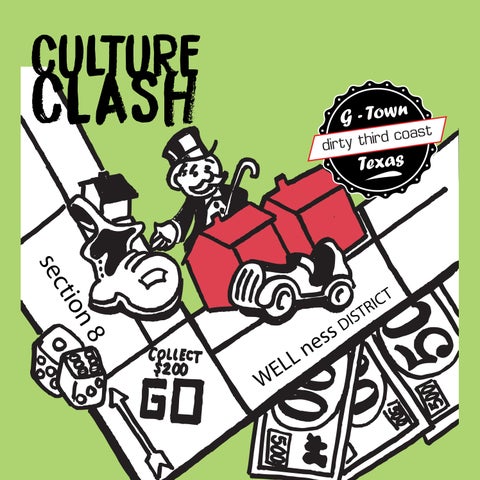
cOVER
This issue’s cover is a political statement on Galveston’s new public housing being built on 25th Street and toward the ‘Wellness District’ of Mechanic. What are your thoughts on the latest development?
BE A PART OF THE CONVERSATION ON OUR FACEBOOK PAGE!


Culture Clash Magazine is a publication put together for the people of Galveston by the people of Galveston and surrounding areas. The views and opinions here represent those that have submitted their work for peer review, consideration and/or appreciation.
The contributors of this publication are not paid or compensated in any other way other that the pure joy of knowing their voice has been heard. Empowering your voice is our purpose. Without your input, culture clash does not exist. Email us! We need you.
The administrative and design team are working tirelessly to create the best possible forum for collaboration and self-expression. We are constantly tweaking and fine-tuning the article and visual artwork submission process. We know there is always room for improvement and we want to hear your input.
Be a part of the conversation. Let us know what you want to see, read and hear. Have a constructive solution? Email, Facebook Messenger, or call us.
Want to be a part of our creative team? We are constantly looking for help. Whatever your talents or interests are, we have a place for that!
Get involved! Submit your articles, artwork, drawings, music, video and more!
CultureClashGalveston.com
CultureClashGalveston@gmail.com

no one should go hungry, especially if you have extra to give. Feeding America estimates that roughly 53,710 Galveston County residents are in need of emergency food assistance in a single year. That is 1 in 5 of our neighbors in Galveston County. Be better, give more. donate at GalvestoncountyFoodbank.org

“If your house was, say, hit by a hurricane and slooowly flooding, and you only had time to save one thing, what would it be?”
When water started coming in through the electrical sockets during hurricane Ike, my sister was faced with that question.
My practical sis went for her laptop. As she waded through the incoming muck to put it in a high and dry spot, her foot snagged on something underwater and she fell forward, laptop sinking into the swirling sludge.
So much for saving one item.
Thankfully, what really mattered, our health and the safety of our family, was intact by the end of the storm. The blessing in disguise for those who survive disasters is reported as realizing what matters most in life—and it’s not all that stuff we’re always busting our butts to buy.
…And then what? The storm clears and it’s back to the rat race. Somehow the focus keeps slipping back to the bank account, where our security and social worth seems to come from the #s of our $$$s.
But, what was your answer to the question?
What one thing would you save?
The baby pictures? Your phone? Are you the type who has a water-proof hurricane box pre-packed with memorabilia and important documents?
And when the next hurricane comes around, who are the people you would trade it all for to keep safe and spend time with? What are the things you would regret not having done in your life if the worst happened?
Well, we don’t need another natural disaster to maximize our time with the people we love, or to do the things that give our life meaning.
There’s a worldwide movement growing that minimizes material ownership to switch focus to the sorts of things we really care most about. Less stuff = less hustle = more time + freedom.
Minimalism is a mind-set that can be expressed and lived out in a range of styles. Some minimalists own less than 100 things, but travel the world non-stop. Others live in tiny houses, but only work 15 hours a week and pursue their passions without waiting for retirement. Other minimalists might appear to live totally normal lives, but have committed to less spending, less impact, or less work in order to maximize their time doing [fill in the blank with what matters most to you.] Lots of minimalists are concerned about their footprint on the environment, considering the statistic that it would take somewhere around 5 planet earth’s resources for everyone to live like a typical U.S. Joe.
All the flavors of minimalism help to turn off the noise of the non-essentials to tune more deeply into a persons’s priorities, be they about personal fulfillment or as activism for global issues. Often minimalism means cutting down on not just stuff, but also commitments that would otherwise mean spreading oneself thinly across too many to-dos. It’s a simple philosophy: Less is More.

By Patricia McGrew
Oh salty water leaking from my eyes … Well almost, when I heard Go Green Galveston, alias G3, was shutting down their recycling service. What! No more putting my plastic and other refuse out front and having someone else assume my social commitment? So, now I have to start loading all this in my car and driving it to the center on 61st Street again like I did a few years ago?
Hey! I’m a dedicated, avid recycler. So, whatever it takes for me to do my part to be sure my greatgrandkids don’t live in the toxic zone seen in the sci-fi flicks of the future.
But … what’s this? Do I sense relief? A new hero has emerged in our midst! There is a new service in Galveston called KEEPIN’ IT GREEN.
They will pick up (no pun intended) almost where G3 left off. Keepin’ It Green will provide weekly curbside pickup of Paper, Plastic, Glass, Recyclable Metal, Styrofoam & Cardboard
A real plus is that Keepin’ It Green will provide pickup for residences and businesses throughout central Galveston and west to at least 8-Mile Road. All homeowners have to do is separate items into the aforementioned categories and put them out front on your designated day. Residential will be $27.50/month; businesses should call for a quote.
Contact their cordial Owner/Manager, our own B.O.I., René Alegria at (512) 296-2008 or email Keepin.It.Green.Recycling@gmail.com. Thanks “KIG” for helping to protect our land, sand and seas!
By Patricia McGrew
LET’s TALk FAshIOn EcOnOmIcs And EcOLOGy.
We refer to well-dressed persons as dressing smart, but the very use of the word “smart” should include looking attractive without exposing yourself and your family to potentially harmful chemical residues from our fabrics, without supporting the industry that is one of the largest polluters on the globe, and without turning a blind eye to sweatshop injustice … and doing so without excess spending. Now, that would be dressing “smart”.
The organic clothing and textile industry is a growing segment, established to provide us with chemical-free materials, manufactured with a social conscience. After all, our skin is our largest organ. Would you layer a toxin over your lungs or heart? Yet you do so over your skin.
The problem is that organic clothing can be pricey. What’s the point of a great organic handbag if it breaks our wallet?
At this time, only about 1% of the worldwide cotton production is organic. It’s a supply and demand issue. So, if we buy more organics, together we will alter the percentages and help the prices to come down. Beyond cotton, we can shop for silk, wool, jute, ramie, bamboo and such. I’m over the edge in love with pineapple fiber. It’s a gorgeous leather alternative. Check out ananas-anam.com.
We don’t have to try for instant perfection or protest in the streets. A starting point to impact change is to buy one or two natural, sustainable-fabric shirts or natural wool jackets. Then, when you get a compliment, state that it is organic and talk about the impact on our world. Fashion is for sheep, no wool pun intended, and we all need to do our part to make it trendy to dress responsibly.
Here’s another slant on economics. Let’s say you spend less to dress in non-organic, polyester or acrylic clothing. And let’s say the toxins ingested from your clothing make you ill … after all, they are under scrutiny regarding everything from obesity

to depression to cancer. That co-pay on your medical bill will impact your fashion budget. I think you would save lots of money by opting for healthier clothing!
It takes some digging to find clothing and accessories made from organic materials. But shopping for what you like always takes some digging. Here are a few of my favorite finds:
shop.mercola.com
there is something so right about wrapping yourself in an organic cotton robe after your shower.
patagonia.com
click on materials and then you can select organic, recycled wool, and other smart choices. wearpact.com
where you can shop for the whole family; try clicking on ‘clearance’ and watch for their coupon offers. synergyclothing.com
click on the $15 sale tab and, seriously, everything is $15. beadandreel.com
where the bargains are borderline, but when you buy a $46 Fashion Activist t-shirt, the proceeds go to the Fair Trade Fashion Show to abolish modern slavery. Strut that!

self expression is FREE! Speak your mind or express yourself through movement. However you decide to do it, DO IT! Start with Ecstatic Dance, find a location near you that offers freedom of expression or start your own.
According to sources like CoinDesk and Global Coin Report, the next big thing on the horizon is the rise of cryptocurrencies and blockchain technology. If you were to look over these specialized news sites, you would probably find an overwhelming amount of information about the many cryptocurrencies that have hit the market since 2016 - over a 1,000.
So you are asking yourself what are cryptocurrencies and why should I care about them. In 2017, the world saw the rise of Bitcoin, the undisputed king of cryptocurrency when it broke the $10,000 valuation threshold. Bitcoin was created by Japanese guru, Satoshi Nakamoto, in 2008 in response to the global banking and financial meltdown. Bitcoin’s early adopters were afforded the opportunity to invest in a currency that wasn’t bound by traditional banking and corporate entities. The lure of this was to put the power of financial markets into the hands of the people and not the oppressive banking sector that caused the meltdown in the first place with questionable lending practices and predatory bank loans. The US dollar along with many government backed currencies slipped to a fraction of their original value in 2008. So during this time of financial ruin, Bitcoin rose into existence. At that time you would have been able to purchase a Bitcoin for under a dollar. It is valued at over $9,000 today and a huge surge

By Chris Hall

in value is predicted for 2018. In the world of investments and stocks, these are huge returns on your initial investment. So much so that now in 2018, giant financial institutions are beginning to invest into the cryptocurrency markets in earnest. TD Ameritrade has filed patents to use blockchain technology and offer cryptocurrencies to their investors. Companies like Walmart, Amazon, Goldman Sachs, Money Gram, Western Union and many more are going all in on cryptocurrency and are using blockchain technology to solve many of their most pressing real world problems. What problems can blockchain, the technology behind Bitcoin and other Altcoins, address in the digital world of today? Firstly, blockchain helps to create an immutable ledger of all transactions that occur there. Investors are afforded anonymity by the use of Public Addresses where only the transaction and the address can be displayed. This ledger allows governments, corporations and financial entities to track all the transactions that occur using a specific type of cryptocurrency. This allows for the policing of fraud, crime and theft to be addressed directly and swiftly on the blockchain. Some other more useful applications revolve around the distribution of funds from international banks in a matter of seconds, versus the slow and antiquated IBAN and Swift systems still used today to transfer currencies across international borders. In addition, sending money from bank to bank usually takes an entire day to complete currently and requires the translation of two different currencies on either end. In the near future, when blockchain is a fully functioning platform from which these transactions can take place, people from different countries can trade cryptocurrency for goods and services directly to each other, going around the traditional banking system.
The icing on the cake is that cryptocurrencies are moved from one account to another for a fraction of the cost of the current system. That’s why San Francisco based cryptocurrency giant, Ripple XRP, has made such enormous impacts in the traditional banking sector. They have provided large multinational companies, banks and investment firms the ability to transfer funds in a matter of seconds rather than an entire day at a whopping savings in time and cost of the transfers. Recently Ripple has made agreements with

hundreds of new partners to handle their money transfers throughout their systems. The CEO of Ripple, Brad Garlinghouse, became one of the wealthiest men in the world in December of 2017. The total market cap for all cryptocurrencies, which is the total amount of traditional currency put into crypto investments topped nearly $9 billion in December 2017 during an unprecedented surge. Currently the market is about half of that but predictions for 2018 look very promising. Some estimate the market could break the $1 trillion plateau this year. Folks, that’s a lot of money and it’s exactly why the traditional stocks and bonds traders have been coming into the space in droves.
There’s money to be made in cryptocurrencies and the traditional investment community wants in on this potential future goldmine. Like most things, getting in early is the best way to realize your own profits in this highly dynamic space. Many of the cryptocurrencies being sold today offer unique solutions to many problems plaguing businesses. Blockchain technology can help the medical industry by creating huge real time databases accessible across the globe for patient informatics. It’s being used in the shipping industry to track packages and reconcile monetary issues across the entire network - currently being used by both Amazon and Walmart for this purpose. Social platforms are being developed, time stamping of intellectual material is happening as well and the future would allow everyday people to exchange, trade, and buy content directly from the creators, ushering in a new era of content availability. They even have cryptocurrencies that address the mobile phone markets and introduce the ability for users to buy and sell data instead of buying it from traditional mobile phone carriers. Coin Market Cap is a popular website that offers real time pricing and access to all the cryptocurrencies being sold currently. It’s worth a look as you can really dig in and research the nuts and bolts of what the companies are offering to the public. Although many of these companies are in their infancy, they will one day offer real world solutions to current problems. The Internet was 1.0, The Internet and Apps was Internet 2.0, Internet with Blockchain represents 3.0, and Blockchain with Apps or Dapps will be 4.0. The future is bright for Cryptocurrencies and Blockchain. Don’t miss out on this amazing opportunity likened to the birth of the Internet in both scope and financial gains.


By Rosa Morgan
Economics have always been in the forefront of my mind. People often say they grew up poor, but they didn’t know they were poor. Well, I’m here to say I grew up poor and knew very well I was poor.
When I was in elementary school I told my mom, “I want to take orchestra and learn to play the violin.”
She said, “Sorry, we don’t have the money for an instrument.”
“Can I play on the softball team?”
“Sorry, we don’t have money for a uniform.”
It got worse when I lived with my brother who was just a few years older than me and I moved to a high school in a wealthy neighborhood. I not only didn’t have the hip clothes, I went to bed hungry at night. This isn’t meant to be a sob story because in fact, all these lessons of going without affected me in a positive way. I realized a certain amount of money does bring freedom to do what you want with your life. I’ve learned to prioritize what I want and need. To do this I’ve become frugal and live beneath my means. However, I splurge on the things that are important to me like going to the symphony and theater or traveling!
FRuGAL TIps:
• Get rid of any services you don’t need and negotiate the ones you keep. Cell phone, electricity, internet, etc. Call the customer loyalty department and say you want a better price. If that doesn’t work, say you’ll switch companies and mean it. They will almost always lower your bill.

• Avoid retails stores. Instead, buy everything you can at resale or garage sales. Clothing, furnishings - almost anything can be had for a greatly reduced price. It’s not only fun like a treasure hunt to find what you need, but you’re also helping organizations that aid the disadvantaged and helping the environment by recycling goods.
• Go vegetarian! Or at least lower your meat consumption. Animals will thank you, the environment will thank you and the bonus is you’ll spend less money on groceries. You’ll be healthier, so you’ll spend less money at the doctor. Make going out to eat a special thing rather than a habit. The price for one restaurant covers several meals at home. Ride your bike whenever you can. Island living makes it convenient, saves on gas, doesn’t pollute our environment and you’re healthier.
Are you sensing a pattern here? Being frugal goes hand in hand with being mindful of the environment and having a healthier lifestyle. There are tons of books out there and websites like Mr. Money Moustache that can get you on your way to becoming economically prudent. Be mindful of your spending, live deliberately as Thoreau implored, and then you’ll be free to use all that extra money you have on whatever you really want!

By Juan Gonzales
I REmEmbER GROWInG up, ThAT IT sEEmEd TO mE, My family was rich, for we lived fabulously.
A life full of fun, for me. Bills never a worry. No appointments or timeclock, no reasons to hurry. Christmas and birthdays always filled with joy. My parents proudly giving to each of us one new toy.
Peanut butter sandwiches sometimes filling my belly, Never knowing or missing any thing called jelly. Beans and rice with tortillas, the foundation of each meal. When lucky, twice a week meat, to us a big deal!
We had three sets of clothes, one for church, school and play. Mom patching and washing them by hand every day. Each season’s harsh temperatures, in my house we had beat. Open windows brought cool air, open oven door heat.
Twice a month into the backseat of our family car, Piled my sister, two brothers, and me holding Daddy’s guitar. To my grandparents’ house, all the families would visit, Mom and aunts making food, Dad and uncles music exquisite.
Money always tight, but joy and laughter abounded. Memories of my childhood, today, keep me grounded.


By Jessica Antonelli
culture clash happens at the edge of different world-views and lifestyles.
Culture being our “behavior and norms” according to Google, and Clash meaning “a confrontation, conflict” or “to appear ugly or discordant when placed close together.”
In this segment, Culture Clash takes a look at the good, the bad and the ugly of consumer culture to break down this taken-for-granted part of our daily life. For better or worse, consumerism IS the “behavior and norms,” of American society. But what is consumerism anyway?


Consumer culture is based on the cycle of desire and achievement, supply and demand. We all must consume food to live, information to learn, entertainment to thrive. The model of meeting people’s needs with new and improved designs that help save time is what fuels our economy. Consuming counts for not just material things, new shoes or cars, but also information/entertainment. Consuming is the opposite of creating, or making things yourself, and that’s what makes it so fast! Life is easier! Consumerism took off in the late 20th century, and the US became a model for the world as life became much more convenient.
The thing the consumer cycle is lacking, however, is SATISFACTION.
At a certain point we crossed a line where most people had everything they needed to be happy and healthy. They had achieved the American dream. But shoot, people still had money to spend, and companies wanted them to spend it with them…sooo we stepped over the line into excessive consumption.
Dollar signs grew for big interests who realized they could increase the demand for stuff when they took away the satisfaction factor. Like your new model of your phone? Sorry, newest version just came out, it’s old news. Add in a dose of comparing yourself and your car to the neighbor’s, and boom. We’ve got a recipe for life-long dissatisfaction, always wanting to buy the next thing to fill that void. That might not be SO bad…except it’s not making us happy.
Despite having all the stuff, the U.S. doesn’t do so hot in happiness ratings worldwide. In fact, a depression/mental health epidemic underlies the “normal” fronts people try to put up. The worse we feel, the more we consume.
Our consumption-machine of a society uses a lot of fuel to keep pumping out all the stuff we buy. Our earth’s resources are limited, and we are pushing them to extremes that are resulting in habitat destruction, pollution, and climate change. Do we really want to find out what happens when we go too far?
To conclude, our very best guess at what would make us happy (shiny cool new treats all the time = consumerism), is not making us happy, and is leading us down a road that would destroy our species ability to thrive on our planet. so, is that cool with you? Or do you clash with that? Follow the conversation online at Facebook.com/cultureclashmag


By Dan Marks
Last weekend at the Tin cup, I was brutalizing a rum and coke on the porch while a birthday party was raging inside. My new acquaintance, Gary, was teaching a young man the proper technique for his drive. I said, “Five bucks says you can’t hit that ball 200 yards!” That was how I brought gambling back to Galveston.
Truth be told, gambling never left the Island. It just went underground, or waited until it was taken over by the state. The old numbers racket is now Texas Lotto. Poker rooms have started opening up. They are legal because the house gets no rake (cut off the top). Unless the house is the man, and the rake is the fees and taxes as the price of doing business. One poker room near the Galleria openly advertises they are “legitimate” because they only cater to more upscale clientele. In other words, “Kiss my ass, little backroom card slingers.” The state long ago passed legislation for pari-mutuel betting, classes of track races for dogs and horses, and social and charitable gaming. If only we had a champion with some clout to roll the dice for regular commercial gaming.
We’ll skip over the Maceo dynasty and the Balinese Room. Go listen to track 6 on ZZ Top’s “Fandango!” if you need schooling on that. But since you mentioned it, Tilman Fertitta might be your man. Mister Fertitta regularly rolls into town with “Golden Nugget” splashed all over his vehicles. His yacht is named “Boardwalk”. (Remember when you
last played Monopoly?) Landry’s website touts itself as the leader in, “Dining, Hospitality, Entertainment, and Gaming.” Fertitta owns many properties already suited to both large and small venue gaming.
Ten years ago we were arguing about this in the Daily News. The likes of Harris Kempner Jr and Dolph Tillotson were on their respective soapboxes and openly sited many examples of the pros and cons. Atlantic City was the poster child for losing, Biloxi for winning. The loose thread thrown out by Kempner and his followers was the hit the local restaurant business would take.
Well, Shrub, I hate to tell ya, Fertitta’s beat you to the punch. Many of my favorite restaurants have already gone by the boards. Like many large chains, Landry’s shoved a bunch of food stores next to each other and called it a choice. Just like Clear Channel Radio doesn’t think we know how many stations they own. But I see the same people eating at those restaurants that bitch and moan about Galveston going over to the Dark Side. They bitch and moan to keep gambling off the Island, but don’t mind a trip to Vegas or Lake Charles. One of the City Council used to go on about Uber being dangerous for us, but openly admitted to using
Uber when in Houston or Austin on business. But Uber’s back! We have found a way to live with ourselves, cab drivers be damned. (Personally, there are still times when I’d call a cab instead of Uber. And not just because the drivers are my neighbors.)
So, here we are. The local joints still draw our attention. Landry’s Group will never give me the local feel of Selena’s Blue Room, Shrimp & Stuff, Sonny’s, or La Estacion. Sonny’s isn’t even open during tourist hours!
Where are they putting the casino? Probably at the end of my street. Sure, local electricians and other rumor mongers will tell you that the San Luis and Galvez are already wired and ready to go. But it wasn’t long ago that Landry’s bought the Seahorse Inn at the end of my street, just to tear it down. The empty lot was up for sale for $9 million dollars. With an appraised value of less than $2.5 mil, it will more than likely stay in the hands of its present owner, Island Entertainment (another Landry’s subsidiary), until it becomes profitable to build on the site.
Yes, I put my chips on the table early. We bought a house in ‘98 just a few blocks from the Jungle, for about the same price a new Honda Odyssey goes for nowadays. The oldest family on my block has been here for almost 100 years. But they are moving or dying out. The neighborhood is becoming gentrified. Recent sales have topped $300k. Newer families are moving in. More retired couples. Fewer kids. No one really cares about family values here. Not according to the last community meeting I attended anyway. The old timers just wanted to know why a large chain grocery store hasn’t moved into our district with our low land prices. The new arrivals wanted to schedule ride-alongs and classes for citizen patrols. Other citizens talk about family values from their homes in Cedar Lawn and Alder Court. It is usually a monologue, hardly ever a conversation.
Back at the Tin Cup, Gary watched the rabbits in the field as the sun went down and the lights came on, and asked, “I’ve been here three years. How long before we see some gambling?” He wanted a peek at my cards. “Inside of ten years,” I assured him. “How do ya figure?” he asked. “Well, Greg Abbott was recently sighted at a Rockets game talking to Fertitta’s wife. Congress just last week passed a measure allowing the states to legalize betting on sporting events. And, after years of pushing them out, we have allowed a $15 gambling boat to take up residence full time without blinking.” Gary leaned back and smiled. “I guess I’ll hold on to my property a little longer. What are you drinking? You’re staying too, right?” I surveyed my empty pirate drink and smiled back, “Wouldn’t miss it for the world. I’m all in.”


ARTIsT samantha Wiley Xochil Oil on wood panel samanthawiley.com on Instagram @samiwiley What’s cool? You decide. We think of coolture as art, music, and literature that really gets your mind moving. Want to feature your work or event in the Coolture section? Shoot us an email at CultureClashGalveston@gmail.com
FIND KEVIN @
2 p -9 p

CC: When did you start your career as a tattoo artist?
kF: I started around September 2015 doing small tattoos as an apprentice.
CC: What is your favorite tattoo on your body?
kF: my favorite is an anchor on my left achilles that says, “Asleep in the deep”.
CC: How many tattoos do you have?
kF: I lost count after 20.
CC: Who or what influences you?
KF: I’m influenced by tattoo artists like Mike Moses, Dan Molloy, and kaitlin Greenwood. I also look to comics and anime for reference.
CC: What has been your favorite moment in your career, so far?
kF: I was able to do a memorial tattoo of a dog portrait for a client who lost their canine friend. being able to give that person some happiness and create a beautiful tattoo would have to be my fav so far.
CC: What is your favorite part of being a tattoo artist?
kF: my favorite part of this line of work is having new objectives with every piece.
CC: If you could describe your art in one word, what would it be?
kF: I would describe my work as illustrative or neo-traditional, although working at a walk-in shop I have tried to keep my skills well-rounded.
CC: Who is your favorite tattoo artist on the island?
kF: mel mo black and Zack boudreaux.
CC: When did you start your career as a tattoo artist?
mmb: I started my apprenticeship in smyrna, Tn in 2011, and went full time tattooing in January 2013 here in Galveston.
CC: What is your favorite tattoo on your body?
mmb: my favorite tattoo on my body for now is a little stick and poke that says, “bORn TO chILL” , but I think it’s my favorite because it’s my most recent one. so until next time time I get tattooed, this is it.
CC: How many tattoos do you have?
mmb: A better question for a tattooer would be, “how many eyes do you have tattooed on you?”
I have a sleeve, a half sleeve, half my head, 9 on my legs, 2 on my back (I’ll be starting my full back this year), 3 on my fingers, one hand, side boob, and half of my chest. I have 34 eyes/eye sockets tattooed on me.
CC: Who or what influences you?
mmb: There’s really no saying who or what will be an influence. What influenced me 5 years ago or even 1 year ago may not work for me today. It could be the smallest of things that influences you to push harder, and create more. Or something really tragic that opens up a part of you to be better than you were the day before. I try to be open to people and things around me; that’s part of being an artist.
CC: What has been your favorite moment in your career, so far?
mmb: meeting Lyle Tuttle randomly in san Francisco. I had taken myself on a solo vacation with no direction or plan and ended up stumbling across his half-built tattoo shop. We became and have stayed friends. I was invited to his 85th birthday a couple of years later which was super inspiring. he’s come to Galveston a couple of times too. Lyle is the most interesting man in the world. meeting him and hearing all of his stories really changed my view on who I could be in this industry, and who I wanted to be as a person. I can honestly say that I wouldn’t be the tattooer I am today or the person I am if I hadn’t been asked by this old man I didn’t know if I had gotten my tattoos in prison or the navy! (side note: Google Lyle Tuttle.)
CC: What is your favorite part of being a tattoo artist? mmb: you work directly with a person, and you know you’re going to change their life for the better or worse. Two things: 1) When you blow someone’s mind - sometimes people will reach out to you days after getting tattooed just to say thank you again; and 2) being a professional artist - I get paid to create, and it’s freaking great.
CC: If you could describe your art in one word, what would it be?
mmb: “mine’”. When you tattoo, you create for others. When I make my own art, it is for me.
CC: Who is your favorite tattoo artist on the island?

FIND MEL @ VoNSTRIgA ART pARLoR SUNDAY-WEDNESDAY 11A-9p

ThURSDAY-MoNDAY 2p-9p
CC: When did you start your career as a tattoo artist? : In my heart, from the first time I held a homemade rotary tattoo machine in 9th grade biology! seriously though, I started my professional tattoo career in 2008.
CC: What is your favorite tattoo on your body? : hard to say. I love them ALL for different reasons. I could give you the 5 that resonate the most with me, but I do not love one more than the other.
CC: How many tattoos do you have?
Es: Well, as tattoos have been combined into larger pieces, I more count by sessions. I’m currently around 35-37 sessions. My mentor, Fidel, would just keep expounding on the pieces he was tattooing on me.
CC: Who or what influences you?
mmb: one of my many favorites is Erica smith.
Es: This is another one that I cannot pinpoint to any one person or thing. Many things and people influence my work- from inspiration to block, and back again. I can say, however, that I absolutely love the influence that comes with working alongside other amazing artists with varying creative brains, and getting to step into their perspective.
CC: What has been your favorite moment in your career, so far?
Es: maan.... where do I start...? There have been so many! From tattooing famous people to meeting and learning from ol’skoolers..... From creating bonds through conventions or just mundane shop silliness with some of my favorite artists..... it’s ALL been just as fun as it has been hard work.
CC: What is your favorite part of being a tattoo artist? Es: plain and simple, I GET TO bE mE!
CC: If you could describe your art in one word, what would it be?
Es: GypsysOuL


By Stephanie Mohan
“The Year of Less: How I Stopped Shopping, Gave Away my Belongings, and Discovered Life Is Worth more Than Anything You can Buy in a Store” by cait Flander
Coming home after weeks of traveling to places like Las Vegas and Miami Beach, where I indulged in food, drinks, and shopping, I found myself exhausted and spent. Not only my energy, but my money was spent too. Which made it the perfect time to reconnect with my priorities, and so I began reading Cait Flander’s “The Year of Less”.
by Jane Switzer
This book is a memoir of Cait’s life during a year in which she began a shopping ban of non-essential items, and only bought the basics: groceries, toiletries, gas for her car, etc. She challenged herself to declutter her home and get rid of 70% of her belongings, waste less, watch less TV, and make more mindful choices. It is not a typical guide on how to declutter your stuff, but instead, a heartfelt recollection of the trials she has experienced in her life, including paying off $30,000 of credit card debt, losing weight, and ending a destructive relationship with alcohol. Her determination to complete these challenges she posed for herself is inspiring, and many of us will be able to identify with the need to make changes in our lives. Whether it’s mindlessly buying more stuff in order to fill a hole in our lives, or bingeing on food or television out of stress or sadness, we can all gain something from taking a step back and asking ourselves, “Do I really need it? Does it serve my greater purpose?”
If you need an extra push of motivation, or a simple reminder that money doesn’t buy happiness, read this book. It may inspire you to start your own ban on shopping, or get more serious about your own savings goals. I’d suggest starting by picking up a copy of this book from our local Rosenberg Library, or better yet, downloading a free audiobook from the Hoopla app by using your library card.
coast 2 soul Open mic / poetry
Tuesday July 3, 2018 (every 1st & 3rd Tue.) 8:30 PM - 11 PM
The Proletariat
2221 Market Street
Admission: FREE
Ray Wylie Live at the Old Quarter
Thursday July 12, & Friday July 13, 2018
8 PM
Old Quarter Cafe
413 20th Street
Admission: $50
nEW bREEd GALORE: FEATuRInG All smiles, Gnar World Order, distance here, Overstayer (An Author A poet/blood between us), Grimlock, dreadhammer, and social static
Friday July 13, 2018
5PM - 11 PM
V.F.W. Post 880 1014 24th Street
Admission: TBA
Acoustic Evening with matisyahu: A Benefit Concert for Congregation
B’nai Israel Celebrating 150 years!
Saturday July 28, 2018
7 PM
The Grand Opera House
2020 Postoffice Street
Admission: $38 and up

pecos hank and Jo bird, with special guest Lindsay clark
Saturday August 4, 2018
8 PM
Old Quarter Cafe
413 20th Street
Admission: $10
music nite on The strand: dem Roots
Saturday, August 11, 2018
6 – 9 PM
Saengerfest Park 2300 Strand
Admission: FREE
ArtWalk
Saturday, August 25, 2018
6 – 9 PM
Galveston Arts Center & Other Galleries
Admission: FREE


(Right) Tiana boddy: If you gave me $1,000 I’d spend it on a car, that’s my next project!
(Left) Felipe Gahola:
Photos and Interviews
By Alexis Labao, Zoe Monacy and Julianna Salinas
FG: Like a business. Like a grocery store, like a market. $ $ $ $ $
CC: When I say money, how does it make you feel? Good or bad?
FG: It’s not bad. It’s good.
CC: If I gave $1000 would you do with it spend it or save it.
FG: I would spend it.
CC: What would you spend it on?


(Above) celia hu: I feel neutral about money, it’s not something I’m worried about at the moment.
Tommy Zhou: Money feels good, like it’s a good thing, like [good is] my first instinct when I hear it.
(Right) John Webber: [If I had $1000, I’d give it.] Probably for a orphanage in Mexico or invest in a missionary; that kinda stuff. Donate it especially with all the border issues right now.


Elevated sandwiches, soups & salads, presented in a cozy, contemporary space.


408 25th St. Mon. - Sat. 11a-4p mention code word CULTURE CLASH for your chance to win a $25 Gift Card! we deliver!

By Culture Clash Staff