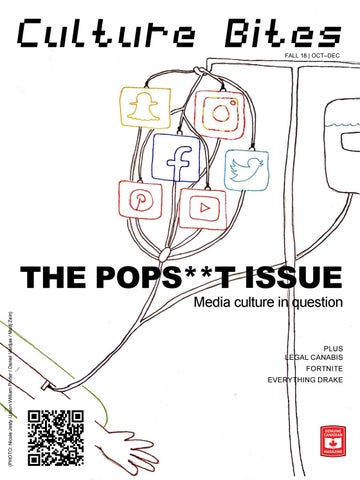
Culture Bites FALL 18 | OCT–DEC
THE POPS**T ISSUE (PHOTO: Nicole Jesty /Jason William Porter / Daniel Vardjas / Madj Zein)
Media culture in question PLUS LEGAL CANABIS FORTNITE EVERYTHING DRAKE
2- HEY,EH! (Opening letter of the editor) 4- VOICE UP! (letter to the editor) 10- Subversion 18- BitterSweet 24- Glocal Fusion 28- TriplEX (EXhumed, EXamined, EXposed) 36- TechTraps 40- Identity-Kit 44- Chill 48- Canadiana 53- StudArt
Producer Dina Salha Graphic Designer Gilles Laberge Editor Teena Laurin
Culture Bites > HEY,EH! Welcome to the first edition of Culture Bites, our new digital magazine created for readers who want to engage critically with popular culture in all its forms. This magazine is an idea that finally came to fruition! Being educators in the university, we always look for ways students can engage critically with their environment. This magazine is a synthesis of fun assignments meant to ignite the sparks of critical thinking with the hopes that as the magazine matures it will become a fertile ground for intellectual exchange. Many pop culture magazines push mainstream discourse and are guided by advertising revenue, ignoring the pervasive impact on our cultures, our societies, our communities, and individually. Our aim is to dialogue with readers and critics to uncover the complexity of popular culture. This will be an entertaining and informative magazine – which is not to say that it will be without controversy – but it will definitely broaden conversations circulating in private and public spaces, online, or wherever we are having coffee, a beaver tail, or something stronger. We hope you enjoy our first issue as much as we enjoyed creating it for you. As always, your comments and opinions are most welcome as we continue to forge our niche in pop culture criticism. Let’s cut through the confusion of corporate driven scripts and bring our unique voices to the fore, EH! Dina and Teena.
In anticipation of the release of our first issue, we put out a call for letters to the editor to hear your voices – and the response was overwhelmingly fantastic! Numerous opinions, ideas, and topics were penned, but there was one theme that stood out across many of them, and that was Canada’s new climate of legalized marijuana. One wonders if popular symbols of Canada – e.g. the beaver, hockey, the toque – will now have an equally identifiable symbol: marijuana. How will this symbol merge with existing Canadian pop culture symbols? Will Canada become forever known as the land of the giggle smoke?
(PHOTO: GOOGLE NON-COMMERCIAL)
Culture Bites > VOICE UP! To the Editor of Culture Bites, In case you were a little too baked and missed it, on October 17th, 2018 Canada became the first G7-country to embrace the legalization of cannabis. Countries around the world are now looking to us, as we “[write the] rules that the rest of the world will copy” (The Economist). We believe Canada can light the way for other countries to re-evaluate their prohibition on cannabis. We feet it is time for marijuana to re-enter society as the legal, medicinal, socially and economically beneficial herb it deserves to be. Recent legalization has fueled public awareness on the medicinal benefits of cannabis. According to MedicalNewsToday, cannabis has been providing medical relief for roughly 3000 years (Railton). Here at home, the Government of Canada supports our veterans through the recognized use of marijuana for medicinal purposes. The Huffington Post reported “Veterans Affairs Canada paid out $5.2 million for marijuana prescriptions for former soldiers in 2014-2015” (Zamon). Moreover, research indicates that usage can provide relief for a long list of medical conditions: chronic pain, depression, post-traumatic stress disorder, social anxiety, and cancer (Railton). Still not convinced? Business Insider explains the science behind medical use as follows: There are at least two active chemicals in marijuana that researchers think have medicinal applications. Those are cannabidiol (CBD) - which seems to impact the brain without a high - and tetrahydrocannabinol (THC) - which has pain relieving properties and is largely responsible for the high. (Loria) The roaring success of weed in Amsterdam is yet another reason to jump on the ganja bandwagon. Figures suggest that 2530% of tourists who visit Amsterdam go to weed cafés to relax for a few hours (Haines). Instead of receiving a menu with coffees and treats, they are given a list of weed-based delicacies. This may be a strange concept to us now, given that legalization is a new part of our culture, but weed cafés may quickly become normalized for Canadians in the near future. The resulting increase in “weed tourism” - from “Vansterdam” to “New Bluntswick” - has potential to improve business revenues and economically benefit the country by upwards of $2 billion annually (George-Cosh). Speaking of economy, the illegal drug market represents about $300 billion, and cannabis consumption constitutes nearly half of this budding business with 250 million illicit users (The Economist). Legalization not only deprives drug traffickers of cashing in on cannabis, it also protects consumers by regulating the production and sale of the plant. Law enforcement will now save time and money previously spent on the war on cannabis, and, of course, let’s not forget the increase in tax revenue generated through cannabis sales (Le Monde). Some reports have already estimated that cannabis sales could create a $6.5 billion profit by 2020 (Subramaniam). These new financial resources can be used to further health and social programming, including drug education in schools and dependency resource centers… What more could you ask for? As weed becomes an increasingly prominent symbol within current pop culture, many high-ranking celebrities have started to join the conversation. Numerous celebrities promote cannabis culture through various mediums, such as song lyrics, music videos, and Instagram clips. Recent articles in The Ottawa Citizen and CTV News highlight how popular icons like Snoop Dogg and Gene Simmons have recently invested in several companies within Canada’s pot industry (Miller; Valiante) — and not all of these companies are in the business of growing bud! One company in particular, Toronto-based Trellis (of which Snoop Dogg is a leading investor), is a cannabis inventory and regulatory compliance software agency (Berke). Clearly, Canadians should be in high favour of celebrities promoting cannabis culture, and that the potential revenue from the success of the cannabis industry has the possibility to generate jobs and market opportunities both across the country and internationally. Do you still think that prohibition tops legalization? No, probably not. We(ed) say that the evidence strongly supports the responsible integration of Mary Jane into medicine, business, and culture. To those countries still debating legalization: be liberal, follow Canada’s lead, and smash that grass ceiling! #YesWeCannabis Sincerely, Marie-Kerguelen Guyard, Morgan Hector, Michelle Hennessey, Lily Kendrick, Helena Larisey, and Tamana Sataar References Berke, Jeremy. “Snoop Dogg’s venture capital firm is leading an investment in a cannabis tech company.” Business Insider. (2017, September 28). Retrieved from https://www.businessinsider.com/snoop-doggs-venture-capital-firm-invests-in-trellis-cannabis-tracking-casa-verde-2017-9 George-Cosh, David. “Canada could eventually get $2B boost from pot tourism: Expert.” BNN Bloomberg. (2018, August 21). Retrieved from https://www. bnnbloomberg.ca/canada-could-eventually-get-2b-boost-from-marijuana-tourism-expert-1.1126567 Haines, Gavin. “Everything you need to know about marijuana smoking in the Netherlands.” The Telegraph. (2017, February 21). Retrieved from https:// www.telegraph.co.uk/travel/destinations/europe/netherlands/amsterdam/articles/everything-you-need-to-know-about-smoking-marijuana-in-the-netherlands/
(PHOTO: https://www.theleafnews.com/news/leaflet-march-9-2018-a-trip-to-the-Ontario-Cannabis-Store-476404783.html)
Culture Bites > VOICE UP!
Dear Editor, We feel the legalization of cannabis in Canada was the right move by the federal government: legalize it, regulate it, and tax it! It sounds like everyone wins in this scenario. Perhaps in the long run, the kinks in the system will be worked out, but in the meantime, the practical side of the process, particularly the plans for distribution of legal marijuana, was not well thought out. By directing the provinces to manage their own sales and distribution, instead of providing a country-wide mandate, resulted in Ontario bungling the official start to legal sales. Providing only one online outlet for sales and distribution – the Ontario Cannabis Store – resulted in a massive imbalance of demand vs. supply. The government simply was not prepared for the number of requests, leaving people to wait weeks for their delivery instead of the 2-5 days originally stated on Ontario Cannabis Store’s website. CBC.ca reported concerns of a possible weed shortage, forcing consumers back into the black market (https://www. cbc.ca/news/business/legal-cannabis-shortage-looms-1.4845816). Payment glitches, website crashes, and a possible postal strike just added to the chaos. It was clear that not enough research had gone into projecting demand; either that or our government is clearly naïve about how much marijuana the population is smoking. Instead, the government should have availed itself of the supply chain already in place: the brick-and-mortar dispensaries that have been operating – albeit illegally – in cities over the past couple of years. Instead of insisting they close up shop after legalization, and making them wait until 2019 for any form of legislation, the government should have purchased them outright or provided contracts and licences to sell cannabis on their behalf. The shops could be regulated, with inspections and rules to ensure the quality and provenance of the product. These shops have an existing customer base, branding, and physical locations that are easily accessible in person. There is no wait time, you can see exactly what you’re getting, and there’s no chance of a parcel getting lost in the mail. Although many shops also sell cannabis-laced edibles, which are still not legal, that would be a small matter to deal with. Some shops have reopened despite the order to close down due to customer requests. The opportunity to pick up where the Ontario Cannabis Store failed is too good a financial incentive to pass up, and who can blame them? It’s a much better option for customers than buying off the street. The government should seriously examine the feasibility of licensing existing pot shops, instead of taking another year to draft legislation on the operation of private establishments. Not only would this ease the burden on the province – by spreading out the process of distribution – but it would encourage entrepreneurs to invest in local economies through legitimate pot shops, creating jobs as well as generating tax revenue. It is in this scenario that everyone wins, not the monopolistic vision currently being mismanaged by the Ontario provincial government. Erika Cao, Erik Watt-Sorensen, Akan Emah, Samuel Daly, James O’Connell
Culture Bites > VOICE UP!
Dear Editor, It has often been argued that Canada does not have a popular culture since most of the elements and celebrities that are popular within our country are American or European in their conception. We disagree with this argument and counter with an undeniable icon of Canadian pop culture, highly recognizable across the world and 100% Canadian: the Canadian Mountie. Seen in numerous major television series and movies, such as, How I Met Your Mother, The Simpsons, South Park, The Late Show with Stephen Colbert, Archer, among countless others, the image of the Mountie is a non-disputable symbol of Canada. The typical portrayal of the Mountie, representing the Royal Canadian Mounted Police, is of a police force mounted on horseback. Today the force has evolved and we are left with the Musical Ride as a display of the main war maneuvers officers used during the First World War. Traveling nationwide, the Musical Ride ensures traditions are maintained, but also serves to produce, promote, and reinforce a clear Canadian image. The Mountie is a staple of Canadian pop culture, due in large part to the various stereotypes and parodies found on TV shows and movies. The Mountie is stereotypically portrayed as a jolly, overly-polite Canadian who proudly dons the red uniform, black boots, and a broad brimmed hat, and is sometimes accompanied by a noble steed. Some Canadians may find this irritating because it falsely identifies what the Mountie truly represents, but in reality, this pop culture icon often strengthens what it means to be Canadian. According to Latterell, “the role or purpose of entertainment is to reflect ourselves back to us” and also that it mirrors popular values, attitudes, and desires (Remix, p. 338). With this in mind, the parodied image of the Mountie finds its foundation on the values and moral codes of Canadians. The stereotype that we are all friendly, courteous, and generally happy, can been seen time and time again through this personified image of the Mountie portrayed on screens. Numerous American television series parody this image, keeping the traditional symbol alive and pertinent in current popular culture. For example, Barney Stinson in How I Met Your Mother dresses up as a Mountie with the hopes of keeping his Canadian love interest happy, or in the over-dramatized representation of the Mountie in South Park. Each program represents the Mountie in different ways, but nonetheless, they are still propagating a powerful Canadian pop culture image, which commodifies the symbol as easily recognizable and associated as Canadian. We hope this letter demonstrates how the Mountie has become a substantial Canadian symbol, one that supports our argument that Canada truly does create and maintain its own version of popular culture. Yours Truly, Lauren Collier, Spencer Crosby, Karen Ho, Janelle Lajeunesse, Patrick Lefebvre and Connor Rollo References “Government of Canada, Royal Canadian Mounted Police.” History of the RCMP Musical Ride, 04 Jul. 2016. Web. Fri. 02 Nov. 2018. “It’s Christmas in Canada.” South Park. Viacom, 2003. DVD Latterell, Catherine. Remix Reading and Composing Culture. Bedford/St. Martin’s, 2017. Print. “The Slutty Pumpkin Returns.” How I Met Your Mother. CBS, 2011. DVD
(PHOTO: GOOGLE NON-COMMERCIAL)
Culture Bites > Subversion
Banksy’s Self-Destructing Artwork and the Meaning of Value Matt Amey, Tyler Gibson, Mathieu Paradis, Adam Samek, Leon Vizkin Katelyn Walker What separates a good painting from a great painting in the eyes of modern pop culture? Good or great, both may have taken hours of painstaking preparation, might possess the same amount of brush strokes, or have similar levels of detail. But a single feature can send one piece into worldwide recognition and sink another into obscurity: meaning. Great paintings (that is, those which explode into popular discussion) send a message, challenging the status quo, rising to public attention by stirring up controversy. Anonymous artist Banksy’s popularity demonstrates how individuals are beginning to question certain pillars of society as we know it: capitalism and its relationship to greed. Shredding one of his most famous and valuable art pieces, Girl with Balloon, after an enormously successful auction which challenged the meaning of monetary value itself and launched a direct attack on the traditional roles of “buyer” and “seller”, therefore on the market logic of supply and demand. At its heart, Banksy’s latest act is an attempt to subvert. Carl Vaslan states that the more symbolic the asset in question, the more apparent it is that economic values are contingent on what we culturally accept as legitimate determinants of value.” (Vaslan, 168) In other words, value exists in the mind of the buyer, especially when something symbolic such as a painting is up for bid. Banksy’s shredding act demonstrates a strong belief that the value of the work comes from the message it sends, not from the
physical piece that was actually sold. Partially destroying the piece after its purchase seems to signify that it was never truly owned by the auctioneer in the first place, but rather the populace as a whole; Banksy effectively declares that the auctioneer has no right to sell the work, and thus destroys it before it changes hands. The act of shredding Girl with Balloon seemed to be a twist on the normal “Self-Destruction” style of artwork that Banksy is known for. However, the main point was almost certainly that shredding an object renders it worthless, such as when one shreds a cheque, leaving it useless and unable to be cashed. Ironically, in the case of “Girl with Balloon”, shredding the piece of art that had just sold for $1.4 million actually increased its value. Alex Branczik, Sotheby’s head of contemporary art in Europe, explained that “You could argue that the work is now more valuable” (Clarke). Banksy’s style of resistance through anonymity grants him an aura of mystique. That aura provides fertile soil for fans to view the shredding itself as part of the art, both subversive and meaningful. He managed to strike a chord with the sensibilities of potential buyers in a way they never expected, yet instantly recognized; Banksy risked losing the $1.4 million bid by ruining the piece just to make his statement. The fact that its value went up rather than diminishing to $0 is a happy accident. When Banksy released the Instagram video of him secretly installing the shredder into the frame years before
(Sewell), it is no doubt that this was a radical self-sacrificial act designed to prove a point. The destruction of the piece represents a form of anti-authoritarianism. The painting itself is of a girl reaching up for a heart-shaped balloon, the only colourful thing in an otherwise black-andwhite picture, with his artistic statement of ‘there is always hope’ (Banksy). Banksy believes that a massive auction was never the way to recapture that ‘heart’, the thing that is lost in the modern world. His act declares that the system and the people in it are corrupt, so why not destroy the vessel from which they attempt to pick the fruit of someone else’s labour? While Banksy as an anonymous figure is everyone and no one, that “someone else” is not meant to be Banksy, that “someone else” is meant to be the everyday public who requires ‘hope’ in a repressive and uncertain world; without whose emotional identification to Girl with Balloon would have remained a lonely painting with no value. References Sewell, A. (2018, 10 08). Banksy releases video of how he installed a shredder in Girl With Balloon. Retrieved from Blasting News: https://uk.blastingnews.com/london/2018/10/banksyreleases-videoof-how-he-installed-a-shredder-in-girl-with-balloon-002739777.html Clarke, H. (2018, October 8). Who was in on Banksy’s “self destruct” art stunt? CNN Style. Valsan, Calin. “Talking Prices: Symbolic Meanings of Prices on the Market for Contemporary Art.” Journal of Cultural Economics 30.2 (2006): 165-8. Web. 11 Nov. 2018.
(PHOTO: Jacob Sweeney / Alexandra Smiley / Mae Cooper / Sophie Arthurton / Nicole Crocker/ Daphne Tse)
Culture Bites > Subversion
Perfect Proposal Jacob Sweeney, Alexandra Smiley, Mae Cooper, Sophie Arthurton, Nicole Crocker, Daphne Tse
Have you recently been to a concert and taken a look at what others around you are doing? Well, we have. And what did we see? Hundreds of fans enjoying the show, however, they weren’t seeing it through their own eyes, but through of camera lens; more specifically, through the lens of their mobile phone and viewing through a screen. It was such an interesting realization, that people are so focused on their phones, on recording, capturing, and sharing the moment, that they were
completely missing out on actually living the moment. Our ‘photographic’ artwork, inspired by Banksy style, attempts to illustrate the shameful reliance that contemporary society has on technology - smartphones specifically. The woman in the photoshopped image does not even recognize she is being proposed to because she is preoccupied with her phone. The hashtag #perfectproposal critiques how people are
often hung up on their preformed online persona, that they miss the actual experience. Hence, what they are capturing is not reality, but rather a made reality that garners audience attraction – the lived moment becomes a commodity.
Subversion - Shocking the Senses and the Sensible An attempt to undermine any hegemonic forms of power and/or authority that serves the few and exploits the many. Grassroots actions are taken to disrupt pre-existing meaning and to create and extend public dialogue. Subversion intervenes by questioning what we no longer question and thus is political and emancipatory. It expands the shrinking space of both public discourse and performed political action. “Critical art is an art that aims to produce a new perception of the world, and therefore to create a commitment to its transformation. This schema, very simple in appearance, is actually the conjunction of three processes: first, the production of a sensory form of ‘strangeness’; second, the development of an awareness of the reason for that strangeness and third, a mobilization of individuals as a result of that awareness.” Jacques Rancière, Dissensus: On Politics and Aesthetics
(PHOTO: Dina Salha)
Culture Bites > Subversion
The Art of Graffiti Maya Famili, Sam Moody, Samantha Palmero, Elsa Ruprecht, Malika Saouab, Cora Upton
Graffiti originates from the Italian term graffio (‘a scratch’), which is a process practiced by artists to leave traces of their self-expression in popular culture. Throughout history, its purpose and interpretations have changed, though the function of its creation in relation to the identity of the artist remains the same. Graffiti is mostly used as an outlet to express views or frustrations with politics, societal norms, and ideologies. This article explores the evolution and transformation of the meaning of graffiti through a cultural psychology lens across different periods. We begin by examining the prehistoric use of graffiti, its relationship to law, and lastly, and its contemporary executions that have redefined the genre within the boundaries of artistic expression. Graffiti is usually seen as a more contemporary artistic style, yet the origins can be traced back thousands of years, before the invention of written language which consisted mostly of scratchings on cave walls to tell stories. A few of the initial known instances of graffiti were noted in the first century BC by Romans and Mayans who had etched messages onto public walls. Graffiti was also regularly seen in Pompeii, where spells, slogans, stories, and even bawdy humour were in-
scribed on various public places. Many of the etchings found also included sentences that translated to “ ‘blank’ was here”. It wasn’t until the French Revolution that graffiti was termed ‘vandalism’ after many artworks were defaced during the war. Later in the 1960’s, New York and Philadelphia saw the start of the counterculture graffiti scene and “tagging” era where artists would tag walls with symbols or “coded labels to trace their movement around the city” (Wall, A Brief History of Graffiti). Prohibited at the time, it is the very same “illegality of graffiti that... added to its intrigue and growing base of followers” (Wall). Hence, graffiti has been cycled from sub-culture to mainstream due to its non-conformity nature. From a modern perspective, graffiti has existed as a way for disenfranchized and oppressed members of society, typically youths, to say “we exist too” (Pani). It has been an effective method of spreading and sowing seeds of discontent through striking visuals that demand attention; the alleged vandalism can be seen as a disrespect for establishments and the status quo. Today it can be seen as an artistic expression, a way to communicate skill, art, and ideas of beauty in public, and increasingly on social media. The motivation behind the act becomes
less angry as the form becomes more accepted (Beck). However, the motivation behind graffiti has shifted across time and cultures. In prehistoric communities, graffiti seems to be rooted in a desire to immortalize and commemorate people, groups, and events by leaving a mark that could outlast not only the artists, but remain for future generations. This could be an effort to keep culture and memory alive, especially in an age before the use of written language (Beck). Similarly, ancient Romans had no concept of the social disruption surrounding graffiti. In fact, it could be seen as the civic duty of politically engaged citizens to list their opinions on recent policy publicly. Advertisements, commentary on current events, and informative texts commonly littered the walls of many great Roman cities. For a quickly growing Empire that prided itself on its superiority amongst the civilizations of the time, being able to inform public opinion through graffiti was a noble pursuit (Milnor). In 2018, the difference between tasteful street art and mindless vandalism is emphasized. Law enforcement apprehends graffiti as a result of the “broken windows” theory. Social scientists James Wilson and George Kelling introduced
this criminological theory to explain how disorder and crime are often inextricably linked. According to their theory, visible signs of disorder in urban communities can actually increase the risk of criminal activities. As such, graffiti becomes understood as the reckless treatment of public space by sending a message to the public that no one seems to care and that there is little to no authority to regulate it (Wilson, Kelling). Moreover, under such reasoning, surveillance and police power become legitimated under the assumption that they will deter crime. This leads police to deter artists from vandalizing public spaces through community policing methods, such as the ‘graffiti management program’ in Ottawa. However, authorized street art is perceived differently. Anyone that takes the time to explore Ottawa will notice how many beautiful and unique outdoor murals enliven the cityscape. The mayor, Jim Watson, has even encouraged murals in residential neighbourhoods, beleving that art can be used as a selling point for Ottawa (Reevely). Permitting murals in community areas promotes the city as valuing creativity and self-expression, as long as it is within the confines of the law. This suggests that the innate feature of creativity operates under the law, which is problematic in a country that advocates for the freedom of expression of its citizens. Though originally deemed undesirable, street art has also made its way into mainstream pop culture. It’s not uncommon to see someone posing for a photo in front of a large, colourful mural. Additionally, street artists like Banksy have shown that graffiti can be used to tell an important story. People from all over the world marvel at Banksy’s paintings because they are political, controversial, and meant to be seen. Steve Lazarides, curator of The Art of Banksy, states that the magic of Banksy is it doesn’t require an art degree to be understood (CBC). In fact, the artwork authored by Banksy, and unconventional artists like him, always infer a meaningful message for its audiences to decipher. The fine line between art and what authorities consider vandalism, is cause for wonder as to why artists still bother with the art form. Though individual motives are relative, The Guardian reports that “the social rewards that ensue from being part of
a subculture” (Turner) fuel the dedication of some artists. According to one of them, graffiti art is driven by “the thrill of the chase” and “the figure of the outlaw” (Turner), which are recurring themes in pop culture. The notorious bandit persona of the artist is mirrored by the street art aesthetic in countercurrent to predominant artistic standards. Some artists use graffiti for political or artistic expression, while others perpetuate the cultural ritual of tagging. Although tagging is an extremely common form of graffiti, “it’s associated with gangs…[and is]...considered mindless vandalism” (Stone) due to its danger related nature. The history of tagging dates back to the 1970s, when the famous artist TAKI 183 stamped his name across Manhattan, New York. The desire of imprinting his name into a physical environment simultaneously embedded TAKI’s identity into pop culture, which continues to be memorable today. With this in mind, it is obvious that graffiti styles have not changed substantially but have adjusted with the times and continue to exhibit freedom of expression. Graffiti has always been used as a way to communicate an expression publicly and weaving it into the urban landscape. Though the content and context have changed, graffiti artists continue to subvert spaces to alter meaning through street aesthetic, in keeping with the ‘outlaw’ connotation that adds to the signification. Be it political, social, or aesthetic, graffiti is a powerful tool used to translate one’s perspective to others. Perhaps what gives graffiti its longevity is its ability to convey the human experience juxtaposed directly onto urban realities. As art enthusiasts, activists, or those on their daily commute appreciate the graffiti that cover the walls of busy streets, so are validated the expressions of those often unheard. References “A Brief History of Graffiti - Kelly Wall.” TED-Ed, TED-Ed, ed.ted.com/lessons/a-brief-history-ofgraffiti-kelly-wall. Beck, Julie. “Behind the Writing on the Stalls.” The Atlantic, 21 Nov. 2014. “Graffiti | Definition of Graffiti in English by Oxford Dictionaries.” Oxford Dictionaries | English, Oxford Dictionaries, en.oxforddictionaries.com/definition/ graffiti. “Graffiti Management Program.” Ottawa Police
Service, www.ottawapolice.ca/en/safety-and-crime-prevention/graffiti-management-program.asp#Graffiti. “History of Graffiti Art.” Graffiti.ee, 7 Nov. 2016, www.graffiti.ee/history-graffiti-art/. Kashgar. “The Bawdy Graffiti of Pompeii and Herculaneum.” Kashgar, kashgar.com.au/blogs/history/the-bawdy-graffiti-of-pompeii-and-herculaneu. Milnor, Kristina. “Landscape and Literature in the Roman City.” Graffiti and the Literary Landscape in Roman Pompeii. : Oxford University Press, April 16, 2014. Pani, Robert; Sagliaschi, Samanta. “Psychopathology of Excitatory and Compulsive Aspects of Vandalistic Graffiti”. Psychological Reports, Vol. 3, 2009. Pyke, Samantha. “History of Graffiti; Street Art Timeline.” Prezi.com, 27 Mar. 2013, prezi.com/ garizsbrprpp/history-of-graffiti-street-art-timeline/. Reevely, David. “Ottawa to Permit Murals in Residential Areas, Watson Promises.” Ottawa Citizen, 10 Oct. 2018, https://ottawacitizen.com/news/local-news/ottawa-to-permit-murals-in-residential-areas-watson-promises Shovava, and Shovova. “10 Key Moments in Street Art History That Made Graffiti a Beloved International Art Form.” My Modern Met, 4 Oct. 2017, mymodernmet.com/graffiti-art-history/. “The History of Graffiti from Ancient Times to Modern Days.” The Vintage News, The Vintage News, 26 July 2017, www.thevintagenews. com/2016/11/17/the-history-of-graffiti-from-ancient-times-to-modern-days/. Turner, Nick. “‘The Train Came Insanely Close’: Graffiti Artists on Why They Risk Their Lives.” The Guardian, Guardian News and Media, 25 June 2018, www.theguardian.com/artanddesign/2018/ jun/25/train-came-insanely-close-why-graffiti-artists-risk-lives-loughborough-junction. Stone, Tim. “Graffiti: Art of the Tag.” ABC News, Australian Broadcasting Corporation, 3 Oct.2016, www.abc.net.au/news/2016-02-04/the-art-of-graffiti-tagging/6959396. Wilson, James Q; Kelling, George L, “Broken Windows: The police and neighborhood safety”. Manhattan Institute, 1982, https://www.manhattan-institute.org/pdf/_atlantic_monthly-broken_windows.pdf “What Would Banksy Think of People Paying to See His Work? We Asked His Former Agent | CBC News.” CBCnews, CBC/Radio Canada, 12 June 2018, www.cbc.ca/news/canada/toronto/whatwould-banksy-think-of-people-paying-to-see-hiswork-we-asked-his-former-agent-1.4701673.
Culture Bites > Subversion
(PHOTO: GOOGLE NON-COMMERCIAL)
Culture Bites > BitterSweet
A Review of APES**T Heera Choi, Lobban Erwin, Madeline Froggatt, Léna Griffoux, Kirsten Mainwood
This article scrutinizes the music video APES**T, performed by The Carters (Jay-Z and Beyonce), in the Louvre Museum. In order to understand how this video relates to pop culture we must first break down and analyze each element. To begin, the lead singers, Jay-Z and Beyonce, are already part of pop culture, they are superstars, known to many as a ‘power couple’. Second, the video and the lyrics are supposed to denounce and defy the supremacy of white and western culture in favor of hip hop and Afro-American pop culture. And third, the Carters take possession of one of the most noteworthy high-culture locations: The Louvre. They made The Louvre their stage and the artworks inside are manipulated to help portray their message. Specifically, they highlight the fact that the paintings mainly depict white subjects, with close-ups on the hands and faces of slaves. With the painting The Wedding at Cana, the beauty of black bodies is celebrated by putting black dancers in front of The Consecration of the Emperor Napoleon (Jean-Louis David). The painting Portrait d’une négresse (1800) appears several times because it is one of the very rare paintings of that era where a black woman
isn’t represented as a slave - but rather as a model and a cannon of beauty. They also use the paintings as references to current events surrounding black communities in the United States. For example, when Jay-Z sings the line ‘The Raft of the Medusa’ (which promoted the abolition of slavery) it is placed in parallel with the National Football Leagues’ players kneeling in order to denounce racism and shine light on police brutality towards black people. They introduce afro/black culture to the space of The Louvre, which historically never gave importance to it. Jay-Z and Beyonce are not afraid of comparing themselves to this culture. They even imply that Afro-American pop culture has become as successful as western culture though artists like themselves. This is seen clearly in the line, ‘I can’t believe we made it’ while turning and facing the Mona Lisa. Thus, comparing their new-found cultural successes as Black Americans to that of one of the most iconic paintings in history. Paradoxically, this video also contributes to making fine art ‘cool’. This phenomenon of repurposing fine art as a pop culture commodity is something we’ve seen before, such as Hokusai’s painting
The Great Wave of Kanagawa. While it can be understood as bringing pieces of fine art into pop culture, it also dissolves the distinction between high culture and low culture. The video reinforces this by using masterpieces of white culture as the ultimate point of comparison. Lastly, throughout the video there is a strong message promoting capitalism. Jay-Z and Beyonce are seen wearing extravagant outfits typically paired with expensive jewelry, and singing lyrics that are encouraging a rich lifestyle such as the line ‘We livin’ lavish, lavish. I got expensive fabrics, I got expensive habits’. The Carters, in turn, are celebrating their success made possible through America’s capitalistic and consumer society.
Culture Bites > BitterSweet Kanye West Support for Trump Dear Editor, Even before Donald Trump’s inauguration, Kanye West voiced his support for Trump through both his actions and his Twitter posts. He used his platform as a celebrity to promote Trump and to publicize their friendship. Over the last two years, Kanye has changed his political stance multiple times. Kanye’s inconsistent support for either political party is an example of the misinformation disseminated to the American public and voters. Celebrities, and social media influencers in particular, should show more responsibility due to the unique relationships with their fans and the influence they have over public opinion. Kanye’s stance on Donald Trump has become the topic of many of Kanye’s recent public interviews. A far cry from his days as an outspoken republican antagonist and hater of George Bush, the rapper has been spotted promoting the “Make America Great Again” brand in public, leaving fans confused, resulting in Kanye being criticized, with a vast majority of people speaking out from the African American community. Although the President of The United States should stand for all citizens, many people of color have expressed disdain for Trump due to the perceived racism in his comments and dividing policies which undermine the interests of minority groups. Kanye, however, views this outcry of hate for the President as support for the status quo and “court of public opinion”, claiming most of society lives in a “simulation”, blindly going along with the narratives that best suit their demographics (Han, Karen, 2018). Although Kanye may seem like an outlier for his support of Trump, many individuals share the rapper’s sentiment. Donald Trump gained steam for being unapologetically outspoken and challenging typical liberal and democratic ideology. Kanye creates an argument around what he calls “trying love” for those who differ in opinions, in an effort to “cure” hate (Han, Karen, 2018). He talks about diffusing the overwhelming amount of hate in American society in exchange for treating everyone as a family. Considering this, current policies enacted by the President go against what Kanye speaks of, with the example of families being torn apart at the U.S. - Mexican border. This begs the question: What truly counts as blind idealization? Is it the decision to support candidates who fight for the equality, dignity, and rights of all citizens, versus one who assigns the terms “rapists and criminals” to one entire ethnic group, as Trump has infamously done? Or is it instead, supporting that same person simply because it is unexpected of you? Entertainers have an increased influence over political public opinion due to the powerful position they hold in the mainstream conscious. Considering this, it is important influences understand their own stance and be held accountable for the support they express, as well as ensuring consistency. During an interview, TV host Jimmy Kimmel pointed to multiple contradictions in the rapper’s stance and the negative repercussions uninformed opinions could bring, and despite these repercussions Kanye West stood by his judgement. Issues such as severe racial division, inequality, economic disparity and the detention of thousands of immigrants continue to plague the US, and there is to much at stake for the diffusion of misinformation and ignorance to hold a seat at the table. Opinion leaders have the power to deceive individuals because of their admirable status. People look to opinion leaders for validation, therefore it’s important that opinion leaders be informed and educated on matters which are public – for their own sake, but more importantly, for those who look up to them. Sincerely, Rochelle Smith, Patricia Gladwish-Maloney, Pascaline Forget, Melissa Noël, Cleo Edouard, Jennifer Maguire
References: Han, Karen. “Watch: Kanye West Defends His Support of Donald Trump to Jimmy Kimmel.” Vox, Vox, 10 Aug. 2018, www.vox.com/2018/8/10/17674902/ kanye-west-donald-trump-jimmy-kimmel. Schwarz, Hunter. “Conservative Media Now Loves Kanye.” CNN, Cable News Network, 26 Apr. 2018, www.cnn.com/2018/04/26/politics/conservative-media-loves-kanye-west/index.html. “Drug Dealers, Criminals, Rapists’: What Trump Thinks of Mexicans.” BBC News, BBC, www.bbc.com/news/video_and_audio/headlines/37230916/drug-dealers-criminals-rapists-what-trump-thinks-of-mexicans.
(PHOTO: GOOGLE NON-COMMERCIAL)
Culture Bites > BitterSweet
Girl, Work those Heels! Fierce! Cleo Edouard, Pascaline Forget, Patricia Gladwish-Maloney, Jennifer Maguire,
Drag Queens have become a prominent aspect of modern pop culture, gaining popularity and exposure through the entertainment industry. Once considered niche and controversial, Drag Queens have become part of mainstream media and a cause for celebration in the LGBTQ+ community. RuPaul’s Drag Race, is an American reality TV show, entering its 11th season. First airing in 2005 on Logo TV, which is a network that focuses on primarily LGBTQ+ viewers (“MTV to launch new channel for gay viewers in 2005”). Centred around several contestants who compete in various challenges to determine who will become “America’s next drag superstar”, it has become Logo TV’s most successful program, winning multiple Emmy Awards (“RuPaul’s Drag Race”). As host, RuPaul has gained influential power in the LGBTQ+ community as well as mainstream pop culture. Today, we can truly disprove the assumption: “Entertainment is just for fun.” (Latterell, 335). RuPaul’s Drag Race not only provides a means of entertainment but also seeks to empower individuals who have otherwise been oppressed. It is a reality show that “Skewers gender expectations and perceived norms, and differs from most reality television in that it celebrates the different, the individual and operates from a place of optimism where contestants are encouraged to be their best selves - on and off the runway” (Bertram). The influence of RuPaul’s Drag Race can be seen worldwide, an example of which is the effect on mainstream slang. The shows slang, brings roots of drag
culture into modern day entertainment e.g. the realness, Kiki, spilling the tea, yas queen and slay. RuPaul’s Drag Race builds on the history of Drag Queen culture, such as the 1990 documentary Paris is Burning, which has credited as the “holy grail of drag films and an essential study in drag language - filmed over the course of seven years in the black and Latin underground queer ball scene in New York City” (Pandell). Canada’s influence comes the pioneering female impressionist, Craig Russell, who in the late 60s/early 70s performed in Toronto cbars and gay clubs. Russell preformed at prestigious venues such as Massey Hall and The Royal York Hotel alongside Tina Turner and Eartha Kitt; which landed him an iconic role in the 1977 film Outrageous, known for having a lasting impact on the drag community and inspiring the likes of shows such as Drag Race (Knegt). In 2018, RuPaul’s Drag Race has become more than just a show. Echoing the work of pioneers such as Russell, it gives a voice to individuals who work hard in their field and allowing them the opportunity to tell their story. Since it first aired, the show has publicized and normalized drag, challenging gender roles in society, and promoting the freedom of individual expression. RuPaul delivered a speech at Pride Toronto 2016, which drew tens of thousands of Canadians, allowing them to connect and find acceptance in their identities (Friend). The popularity of RuPaul’s Drag Race shows the transitions in attitudes – from taboo labels to primetime pop culture.
References Bertram, Colin. “The RuPaul Effect: How He Brought Drag to Mainstream Culture.” Biography.com, A&E Networks Television, 20 June 2018, www.biography.com/news/how-rupaulbrought-drag-to-mainstream-culture. drag queens who remain keep its sparkle alive. Retrieved from https:// www.thestar.com/news/ insight/2017/06/24/craig-russell-brought-fametotorontos-gay-village-the-drag-queens-are-tryingto-keep-the-sparkle-alive.html Friend, D. (2016, July 02). RuPaul Charles reflects on Orlando, weighs Canadians on “Drag Race’. Retrieved from https://globalnews.ca/ news/2800104/rupaul-charlesreflects-on-orlandoweighs-canadians-on-drag-race/ Knegt, P. (2017, December 05). “For 40 years, this classic Canadian film has had an ‘Outrageous!” impact on the LGBTQ community” | CBC Arts. Retrieved from https://www.cbc.ca/ arts/for-40-years-this-classic-canadian-film-hashad-anoutrageous-impact-on-the-lgbtq-community-1.4433502 Latterell, Catherine G. Remix Reading & Composing Culture. Third ed., Bedford/St. Martin’s, 2017 Miller, Jacob. “Fascinating Vintage Photographs Uncover Glamorous History of Drag Queens.” HistoryCollection.co, Spike Media, 23 Nov. 2017, historycollection.co/ fascinating-vintage-photographs-uncover-glamorous-history-drag-queens/. “MTV to Launch New Channel for Gay Viewers in 2005.” CNNMoney, Cable News Network, 25 May 2004, money.cnn. com/2004/05/25/news/fortune 500/ mtv_gay_network/. Pandell, Lexi. “How ‘RuPaul’s Drag Race” Fueled Pop Culture’s Dominant Slang Engine.” Wired, Conde Nast, 22 Mar. 2018, www. wired.com/story/rupauls-dragrace-slang/. “RuPaul’s Drag Race.” Television Academy, Academy of Television Arts & Sciences, www.emmys.com/shows/rupauls-drag-race.
Culture Bites > Global Fusion
Intro to Cairo Submitted by Dina Salha
Visiting Egypt is in fact immersing oneself in a cultural fusion that leaves one in awe beyond the historically rich traditional culture to experience global influences structured through the local cultural and social lenses and agency. Cairo, in particular, is at the crossroads of many changes from a growing young population that is technologically savvy to a massive rebuilding of Cairo’s transportation infrastructure. Hybrid spaces embrace youth culture and the busy modern nightlife, all highlighted by the authenticity of the Egyptian civilization and traditional influences of the culture, from music to famous landmarks. Like many other cities, the global meets the local (glocal) and dynamically produces a vibrant yet unique lifestyle. University of Ottawa Students in Cairo created a video as a gift to Culture Bites that showcases the traditional images of Egypt combined with the culture of a booming and hip youth population.
Have you noticed the various mass media & advertising channels in the video? Here are some outstanding parts: • Billboards on highways • A man reading newspapers in the street • Black Friday promotions and consumer behavior • Local TV Show by Bassem Youssef inspired by The American Sarcastic TV Show (The Daily Show by John Stewart) • A local music clip (called Number One by Mohamed Ramadan). The clip is inspired by the American Rap culture. • A TV ad for a global phone carrier (Vodafone) featuring local Sha’by (popular folklore) artists to speak the same language of the target audience. • A poster of Marilyn Monroe inside a pub in Cairo • A global social media trend that went viral all around the world (Kiki Challenge)
LINK: https://redrocket.ca/uottawa/CAIRO.mp4
Culture Bites > Global Fusion
The Egyptian Center for Culture and Arts (Makan), together with the French Institute in Egypt (Institut francais d’Egypte), is happy to invite you to discover the results of its collaboration with the French duo Ko Shin Moon. Ko Shin Moon has a deep experience in mixing electronic music with instruments, sounds and musical colors from around the globe. You will hear them with Sarah El-Rawy, Rafaat Farrag & Amin Shahin. LINK: https://redrocket.ca/uottawa/VID-20181019-WA0078.mp4
TriplEX – EXhumed, EXamined, EXposed In this section we ask contributors to dive under the surface of pop culture phenomena and put in their two cents. Please - do not take it with a grain of salt!!
(PHOTO: GOOGLE NON-COMMERCIAL)
Culture Bites > TriplEX Dream Crazy - Colin Kaepernick: Nike’s Crazy Bet to Seduce Consumers Through Sensitive Issues Marie-Kerguelen Guyard, Morgan Hector, Michelle Hennessey, Lily Kendrick, Helena Larisey, Tamana Sataar With over 26 million views on YouTube, Nike’s most recent advertising campaign, featuring Colin Kaepernick, has sparked debate amongst everyone from president Trump to rapper Nick Cannon (Lutz; Kenny). Titled “Dream Crazy”, the ad celebrates the 30th anniversary of Nike’s signature slogan “Just Do It!” (Carissimo), as Kaepernick’s voice encourages viewers not to “ask if your dreams are crazy” but to “ask if they’re crazy enough” (Nike). The ad release coincided with the beginning of the National Football League’s (NFL) 2018 season (Gardener), however, this ad is far from your typical sports commercial. Nike’s choice to feature Kaepernick, as ad narrator, is a noticeably political move - Kaepernick was the first NFL player to protest police violence towards African Americans by kneeling during the American National Anthem in 2016 (Taylor). Alluding to the stories of a number of sport celebrities - including Serena Williams, Lebron James, and Shaquem Griffin - Dream Crazy unites these narratives by highlighting the self-realization and hard work individuals achieve in order to defy standards, stereotypes, and prejudices within the sporting industry. While there is recognizable diversity in the athlete profiles showcased, it is interesting that Kaepernick’s narration never directly names any of the featured athletes. Effectively anonymizing their accomplishments so that viewers can more easily project themselves into the athlete’s success stories. The use
of these stories and celebrity endorsements (along with touching piano and violin music) fosters identification and empathy from the audience, and Kaepernick’s achieved celebrity status (Rojek) is co-branded with Nike’s image to sell not only the iconic American Dream ideology (symbolized by the US flag projected on a building), but also the idea that the purchase of a Nike product can make the consumer an integral part of encouraging social progress and producing effective change. On one hand a respectable move, Nike’s strategy of aligning with a social justice cause is, ultimately, a (winning) tactic to sell product. This move distracts viewers from the company’s long history of unethical business practices (ABC News; Spellings), while attracting a young group of new customers (Kaepernick’s celebrity following) to the brand. Nike wants us to believe that if you work hard, you’ll reach your “craziest dreams”, but in reality, many African Americans face adversity through systemic discrimination which prevents them from achieving these dreams (Hanks, Solomon, & Weller). Proof of ingrained racism can be seen in the backlash Nike faced; a number of previously loyal customers resorted to burning their Nike branded sneakers in protest, taking up the hashtag #JustBurnIt on social media (Les Observateurs). Regardless, Dream Crazy has directly contributed to a record 10% increase in sales (Europe1). This financial achievement points to the successfully established Nike brand as a signifier for racial and social justice in the mind of the consumer. An interesting new ‘personality’ for a brand that has struggled with its ethical image and continues to utilize unfair labour practices that exploit people of colour in third world countries (ABC News; Spellings). But go head: Dream Crazy! Wear
your Nikes with pride and show off those swooshes on the tops of your socks, because everyone knows that a pair of socks produced by underpaid workers in an overcrowded, non-unionized garment manufacturing warehouse has the power to change the minds and practices of racist bigots worldwide. #JustBuyIt Reference ABC News. “Labor group: Nike not living up to promises”. (2018, May 21). Retrieved from https://abcnews.go.com/Business/story?id=88176&page=1 Carissimo, Justin. “Colin Kaepernick joins Nike’s 30th anniversary “Just Do It” campaign”. CBS News. (2018, September 3). Retrieved from https://www.cbsnews.com/news/colin-kaepernick-nike-just-do-it-campaign-announcement-today-2018-09-03/ Europe1. “Nike : adhésion “record” des consommateurs après la pub avec Colin Kaepernick, selon le PDG”. (2018, September 26) Retrieved from http://www.europe1.fr/sport/nike-adhesionrecord-des-consommateurs-apres-la-avec-colinkaepernick-selon-le-pdg-3764387 Gardener, Steve. (2018, September 7). Twitter reacts to NBC airing Nike’s Colin Kaepernick commercial. USA Today. Retrieved from https:// www.usatoday.com/story/sports/nfl/2018/09/06/ nike-kaepernick-ad-airs-during-nfl-opener-twitterreacts/1216074002/ Nike. “Nike - Dream Crazy.” YouTube. ( 2018, September 5). Retrieved from www.youtube. com/watch?v=Fq2CvmgoO7I Salha, Dina. “The Celebrity:Brand and Cult of Personality.” University of Ottawa CMN 2180, 13 September 2018, Retrieved from https://uottawa. brightspace.com/d2l/le/content/85115/viewContent/1940994/View Spellings, Sarah. “This could be the next step for the new, socially conscious Nike”. The Cut. (2018, September 6). Retrieved from https://www. thecut.com/2018/09/nikes-colin-kaepernick-adraises-issues-of-workers-rights.html Taylor, Kate. “Nike has released its commercial starring Colin Kaepernick — as well as Serena Williams and LeBron James — after being trashed by Trump”. Business Insider. (2018, September 5). Retrieved from https://www.businessinsider.com/nike-releases-colin-kaepernick-commercial-2018-9
(PHOTO: GOOGLE NON-COMMERCIAL)
Culture Bites > TriplEX
I on Instagram Erika Cao, Samuel Daly, Akaninyene Imoh Emah, Emma Farlinger, James O’Connell, Erik Watt-Sorensen
It’s no secret that the media are complicit in the manipulation of social ideals when it comes to body image; ideal male and female prototypes are all over the place. What makes today’s media promotion of ideals more insidious than before is the introduction of social media into the mix, and the speed and ease with which photographs of everyone and anyone can be manipulated to look “perfect”. On the number one photo sharing site, Instagram, all these supposedly perfect bodies are on display for anyone to access, often with hashtags proudly proclaiming body image ideals, such as #thinspiration. The idea that if one copies all the things that these beautiful, thin people do, then one can also look that good; however, chasing the myth of perfection only engenders negative body image and self-esteem. Instagram recently reported it had reached the 1 billion users mark (Constine), with the majority of users being under 35 years of age. The amount of bikini selfies, gym pictures, and yoga bodies is growing at an exponential rate. “According to new data from the University of New South Wales and Macquarie University, as little as half an hour a day spent trawling Instagram can make women fixate negatively on their weight and appearance” (“Just 30 Minutes”). By allowing users to manipulate their photos with filters, lighting effects and other editing, Instagram makes it easy for the average person to promote a false body image. “The dilemma that arises, as a result, is that those images are often pushed as realistic standards to adopt when in fact it is close to impossible to achieve that body form without subjecting the body itself to unhealthy and unsustainable conditions”
(Aziz, 9). This keeps the culturally-fuelled obsession with being thin going in different ways, one of which is the ability to “heart” or “like” the pictures, driving the need for more idealized content. Although the platform itself was intended as a way of letting regular people share interests and have an outlet for candid photographic moments in their lives, it is now ranked one of the worst social platforms for affecting young people’s mental health (MacMillan). It works on the system of publicly rating the photographic content, and the better one looks, the more approval they receive. “Instagram isn’t the instigator of body image issues, of course, but instead a heavily-filtered reflection of a culture that objectifies, sexualizes and commodifies the human body, while promoting unattainable and unrealistic standards of what beauty is” (Derisz). Many of the photographs posted are hashtagged with fitness-related descriptions, making them easier to search for by users, along with references to thinness or, in more extreme circumstances, body dysmorphia and eating disorders. “...most posts emphasise aesthetics over health. Studies show browsing #fitspo posts on Instagram, for as little as 30 minutes, increases self-objectification. Further, another study discovered women who shared their own “Fitspo” photographs scored higher in charts monitoring a drive for thinness and compulsive exercise,” (Derisz). These photos do not promote healthy bodies, but thin bodies. The majority of selfies and posed photographs are of women who appear happy and candid, in inspiring locations like the gym or yoga studio, on beaches, on yachts, at nightclubs with friends. Their
lives seem idyllic, occasionally lavish, and carefree. These photos insinuate that these lifestyles don’t happen to average or overweight people; that to be happy and successful, you need to look the part. Although Instagram was conceived as a way to share everyday events and spontaneous moments, it has morphed into a platform reflecting the narcissistic cultural standards that we ascribe to others, and strive in different ways to attain ourselves. Although some fitness professional and professional model accounts are beginning to post “real life” comparison photos of what they look like without posing, perfect lighting, and makeup, these posts are getting lost in a sea of midriffs and thigh gaps, beach bodies and gym bunnies. References Constine, Josh. “Instagram hits 1 billion monthly users, up from 800M in September”, Tech Crunch, June 20, 2018, techcrunch.com/2018/06/20/instagram-1-billion-users/. “Just 30 Minutes on Insta Will Make You Hate Your Body”, whimn.com, September 4, 2017, www. whimn.com.au/strength/mind/just-30-minuteson-insta-will-make-you-hate-your-body/news-story/0a64a85b9948787c8d21791e0b888ea4. Aziz, Jwana. “Social Media and Body Issues in Young Adults: An Empirical Study on the influence of Instagram use on Body Image and Fatphobia in Catalan University Students”, Universitat Pompeu Fabra, Barcelona, 2017, p. 9. repositori.upf.edu/ bitstream/handle/10230/33255/Aziz_2017.pdf?sequence=1&isAllowed=y. Derisz, Ricky. “Instagram’s Influence on Negative Body Image”, mindthatego, April 23, 2018. www. mindthatego.com/instagram-influence-body-image-part-1/. MacMillan, Amanda. “Why Instagram is the Worst Social Media for Mental Health”, Time Magazine, May 25, 2017, time.com/4793331/instagram-social-media-mental-health/.
(PHOTO: Marie-Kerguelen Guyard / Morgan Hector / Michelle Hennessey / Lily Kendrick / Helena Larisey / Tamana Sataar)
Culture Bites > TriplEX
How Magazine Covers Fuel a Culture Obsessed with Thinness Today’s media, specifically how women’s magazines target their audiences, has a huge impact on the Western obsession with thinness. Magazine headlines, covers, and their pervasive and deliberate presence, all contribute heavily to this phenomenon. The headlines strewn across the front pages of magazines reinforce our cultures preoccupation with thinness. Each one claims to have all the most desirable secrets on how to lose weight fast, equating looking your best to feeling your best. Women’s Health Magazine knows how to make you “Fitter! Healthier! Richer! Calmer!” , implying that if you can achieve one, the rest will follow, and telling readers their “Hot bod secrets! What to eat to drop a size” , further implying that thinness is equivalent with beauty. These tips often come from celebrities, such as Jillian Micheals2, who are shown to have it all, supposedly as a result of their desirable figures. They reinforce this idea by demonizing women who do not fit this ideal, tagging photos of celebrities with unflattering bodies to headlines that paint them as “Boring, Desperate, Cheap” , as Now magazine has done. These headlines only drive their audience’s obsessions with weight loss, beauty, and thinness even further.
The covers of these magazines also play an important role in the messages received about thinness. They portray thin models smiling, having fun, and living in luxury – using these visuals to correlate thinness with happiness, popularity, and success in the mind of the viewer. They make it seem like these are the keys to your dreams and a requirement to achieve happiness. None of these displays would be even remotely as effective at warping our cultures opinion on thinness if they were not on display in grocery lines, drugstores, airports, bookstores, and waiting rooms. These messages saturate any surface that the media expects their audience to wait or spend time with little to no other stimulation, with unbelievably successful results. No matter the message, if you are confronted with it 5000 times a day by some estimates , after a while you will begin to believe and internalize those ideals. These messages promote the idea that thinness is beauty, beauty is the key to happiness, and in turn will let you achieve health, wealth, and success. Those without this all important precursor will never do so. Their pervasiveness fuels an obsession, reminding us constantly that outward appearance must be at the forefront of our minds at all times. The
obsession created by these messages bleed into the cultural norms and values surrounding beauty in society, further solidifying the grip that thinness has on our understanding of it. These messages harm those who don’t fit Western beauty ideals, as some will never achieve the standard of thinness that rushes to meet us at every turn. It damages the self esteem of children as young as five , and follows them for the rest of their lives. References
Ferguson, C. J., Muñoz, M. E., Garza, A., & Galindo, M. (2014). Concurrent and prospective analyses of peer, television and social media influences on body dissatisfaction, eating disorder symptoms and life satisfaction in adolescent girls. Journal of Youth and Adolescence, 43(1), 1–14. Story, L. (2007, January 15). Anywhere the Eye Can See, It’s Likely to See an Ad. The New York Times. (2018, August 30). Now. (2016, January). Women’s Health Magazine. (2015, March). Women’s Health Magazine.
Culture Bites > TriplEX All-female pay-per-view Dear Editor, We find it disheartening that World Wrestling Entertainment Inc (WWE), a global leader in sports-entertainment, finds itself taking a step forward to significant change only to follow up with taking several steps back. October 28, 2018, was a ‘historic’ night according to WWE, as they mentioned over a dozen times while broadcasting their first ever all-female pay-per-view WWE EVOLUTION. The card featured seven matches, four of which were for championship titles, and the crowd was invested all night. We would even make the argument that it was the best WWE pay-per-view event of the year. All the female superstars put on performances of their lifetime; as they finally had the platform to show the world they can do everything just as well, and even better, than their male counterparts. It was a progressive night that made us optimistic about the future of the wrestling organization. Gone were the days of the oversaturated product focus on men while relegating the women to the role of eye candy. The female competitors were finally the focal point of the broadcast; not just placed on the card as a washroom break between main events (which was common occurrence even a few years ago). This was special. The WWE finally listened to what its fan base had been saying for years. The message was clear: the female competitors are no longer just ‘divas,’ they themselves are ‘superstars’! That message was soon muddied and deemed irrelevant just five days later, November 2nd, when the same wrestling organization broadcasted WWE CROWN JEWEL from Riyadh, Saudi Arabia. This show featured twelve matches - all contestants were male superstars of the WWE brand. In fact, you would not see a single female superstar anywhere close to the show as they were banned from going on the trip (along with the Canadian superstars, but that is a story for another time)! It is evident that when big money comes calling, the WWE is happy to drop their ‘historical’ evolution at a moment’s notice. The CROWN JEWEL was a return to WWE’s male focused status quo. Their attitude of ‘progress’ quickly changed to the old ‘screw you; we do what we want!’ WWE received significant backlash for going on with the show in the wake of the killing of Jamal Khashoggi, but the show pressed on. While the death of Khashoggi is definitely just cause to cancel the show, we beleive the WWE should end their entire relationship with Saudi Arabia because of the country’s position and attitude of suppressing women’s rights. How can a company go from touting a “HISTORIC” night focusing on the future of women’s wrestling to then forcing them to stay at home while their co-workers go to the “NO GIRLS ALLOWED” club? This quick dismissal of female wrestler’s hard work and their struggle for recognition, is heartbreaking. Superstars like Charlotte Flair, Sasha Banks, Bayley, and Becky Lynch have scratched and clawed their way to effect change in WWE, only to have their blood, sweat, and tears (a favourite WWE saying) dismissed at the drop of a dollar. These female superstars should be revered for everything they have done to drop the stigma of WWE women’s wrestling as an embarrassment – instead, they are forced to watch from the sidelines of another continent. These actions do not represent progress. They do not represent change. They represent a company that cares more for a ‘particular’ fan demographic and not equality among WWE competitors. For that reason alone, after nineteen years of being WWE fans, we have cancelled our subscription to the WWE Network service and have decided to stop watching their product all together! We would rather take a step to the side than several steps back!! Truly, Griffin Peltier Jack Dillabough David Lebel Ben Woodhouse
(PHOTO: GOOGLE NON-COMMERCIAL)
Culture Bites > TechTraps A Review of Pop Culture - Fortnite Matthew Amey, Tyler Gibson, Mathieu Paradis, Adam Samek, Leon Vizkin, Kate Walker Fortnite is a widely popular video game that has become a subject of contention. It was released in 2017 and focuses on the ‘Battle Royale’ genre of gaming. Video gamers have to fight to be the last one standing amongst 100 players, either alone or in small teams. What started as just another gaming fad has become a pandemic across North America. To say that people are becoming addicted to this new and popular video game is a grotesque understatement. Recent studies have shown that Fortnite has actually been a cause of divorce in many marriages and the separation of partners. Celebrities have been endorsing this video game through social media and live streams, encouraging the masses to continue their obsessive gaming habits whilst promoting violence filled content. To view the sudden popularity of Fortnite as simply a fad among the youth would be a reckless dismissal on the opportunity to comprehend this ever-changing media environment. Fortnite has grossed an average revenue of $200-300 million dollars per month (Forbes, https://www.forbes.com/sites/ davidthier/2018/05/24/report-fortnite-battle-royale-made-nearly-300-million-lastmonth/#4b05546d113e ); which gives an insight on how many people are playing this game and consistently spending money on it. The game is free on all gaming consoles, which encourages many people to try playing it. Fortnite’s revenue stream comes through game add-ons and social media influencers/gamers who stream the game on social media platforms such as Twitch. The top gamer/streamer of Fortnite, famously known as Tyler ‘Ninja’ Blevins, earns a whopping $500 thousand dollars a month to stream and play (Eurogamer, https:// www.eurogamer.net/articles/2018-03-19fortnite-twitch-streamer-ninja-is-makingusd500-000-a-month This aspect, of being able to make a living off of playing video games, has intrigued and pushed adults and kids alike to leave their jobs/academics in order to pursue playing Fortnite as a career. This potentially supports applying cultivation theory to the video gaming industry - where
consumers eventually believe that a game can portray their life and control their day to day decisions. Originally cultivation theory was used to examine television; as many people were concerned about the violent content that was being broadcasted. More specifically, what were the societal effects of having images of violence circulated towards the mass audience? However, in the current media climate, television is no longer the sole medium delivering images of violence to a susceptible audience. Video games are increasingly growing in popularity and they are no longer only manufactured for kids/youth only. In fact, “U.S. sales of video games have begun to pass Hollywood box office revenues”, meaning the general population have garnered a taste for video games (David Stargel, 2018). This shift in interest, and a new target audience for video games, has created an industry and Fortnite has proven successful within it. This presents a new area correlating entertainment and violence; a dangerous combination which can cause unprecedented societal issues, and therefore must be addressed and analyzed. The cultivation theory deems “heavy exposure to media causes individuals to develop an illusory perception of reality based on the most repetitive and consistent messages of a particular medium” (University of Minnesota Libraries, 2016). The violence in video games, specifically Fortnite, has become a pandemic which entices, not only the youth but full-grown adults, to constantly expose themselves to acts of violence. Although these acts occur in a virtual realm, they still have an impact on audiences as it renders them indifferent to the harshness and brutality of the acts being committed. People begin to normalize violence since they are regularly exposed to it on a repetitive basis. As violence seems to be the only winning solution in Fortnite, players may subconsciously adhere to the concept of resolution through physical acts of brutality and violence. Ultimately, due to this exposure to violence while playing violent games such as Fortnite, may find ways to validate violent behaviour while conceiving it
as a normal response to a negative or an unfortunate event. The principle of the feedback cycle between cognitive dissonance and heuristic reward is a major component of gaming, making Fortnite addictive to video game enthusiasts. Since the game depends on the player finding weapons that give them advantages, it evens the playing field for all different skilled players and makes it compelling for players to continue playing. Within the game itself, every Fortnite match has an audience upwards of 100 players. Players can play or pay for “skins” (virtual outfits or add-ons) that are applied to either their avatar or their weapon, e.g. customizing their character to look like a samurai. In a social context, the skins are the same as a Gucci handbag, it signifies success and thus highly desirable and limited-edition skins require intensive game play and/or real-world money to obtain (Luton, 2018). Overall, Fortnite has proven to be more than just a simple video game that users play for entertainment. We have come to understand that every new trend has several factors that add on to its popularity, addiction, and social meaning. While numerous celebrities promote Fortnite and influence their respective audiences to engage in gameplay, it creates a social symbol of being engaged with this generation’s trends and environment. In addition to its promotion by celebrities, the game has created a reward system that subconsciously pushes gamers to stay up to date with game features and rewards. Fortnite is a video game, which should be analyzed, so as to understand the current generation’s engagement with social trends and even how they interact with one another during game and outside the game. References https://www.nytimes.com/2018/04/30/well/family/ parenting-the-fortnite-addict.html Luton, Will. “Why Can’t People Stop Playing Fortnite?” The Guardian, Guardian News and Media, 29 Aug. 2018, www.theguardian.com/games/2018/aug/29/whycant-people-stop-playing-fortnite.
(PHOTO: GOOGLE NON-COMMERCIAL)
Culture Bites > TechTraps Canada’s Growing Video Game Culture Can’t Be Ignored Dear Editor, We are boggled by how little coverage Canada’s love for gaming receives. Video games are rapidly outpacing film and television as the dominant form of entertainment in Canada, a country which has become one of gaming’s strongest and most prolific champions. The coverage that our video game sector receives is disproportionate to the growing contribution it makes to our nation’s economy and, more importantly, to our very identity. We believe it’s important to take a close look at the growth of video games in Canada, to thoughtfully consider not only the economic implications but how this new medium now shapes what being “Canadian” really means. In its opening weekend, Rockstar’s Red Dead Redemption 2 amassed $725 million dollars, casting a shadow on the film industry’s biggest blockbuster Avengers: Infinity War at $250 million (Crecente, Red Dead Redemption 2’ Earns Record-Breaking $725 Million Opening Weekend). Canadians are on course to spend more on video games than seeing a film, with the 2014-2018 period showing a 17.5% increase (Statista, Canada Consumer Spending on Video Games 2019) compared to film & TV’s 7% increase (Statista, Consumer Spending on entertainment and media in Canada from 2010 to 2019). With Canadian consumers beginning to steadily spend more on video games, we see a clear opportunity for the creative minds in Canada’s video game industry to take advantage of a rapidly expanding market. Canada’s prosperity is fed by an ever-growing video game industry, while Canada’s own are feeding the industry with new, paradigm-shifting titles. Video game-related revenue contribute “$3.7 billion to our country’s GDP annually, an increase of 24 per cent from the $3.0 billion reported in 2015 – significantly more than the 4 per cent growth of the wider economy over the same period reported by Stats Canada” (Sapieha, Canada’s game industry is booming, but not all provinces are made equal). Some of the world’s best video games are produced in Canada. Take Bioware Edmonton’s award-winning Mass Effect series, or Ubisoft Montreal’s Assassin’s Creed series, both industry staples. The sector itself is flourishing - dominating overall economic performance, while Canada’s creative talent reaches consumers across the world through gaming’s platform. What do these statistics mean for Canadians on a cultural level? It means that our new habits will in turn form new traditions for Canada’s youngest generation. New data provided by The ESAC states that ⅔ of Canadians consider themselves gamers, and the average player is now 39 years old. A lot of these older gamers are parents too, with 71% stating they now play games with their children at least once a week (ESAC, Canada – A Nation of Gamers). Video games aren’t a niche; the medium is now a norm, helping families create new ways of bonding together through shared experience. While there may have been a time when parents considered video games a devilish menace due to “media sensationalism and ignorance” as Joseph Olin, president of the Academy of Interactive Arts & Sciences remarked – those perceptions have changed (Steinberg, Why does the media still think video games are bad for kids?). Not only are Canadian parents now gaming with their kids, but they share an “accommodating attitude towards vocations in the video gaming sector” (Jiow et al, 2018). Both these articles, one discussing widespread backlash against video games and the other revealing parents now game with their kids freely, were published only eight years apart. This radical shift is par for the course. Attitudes have changed, and so has the script. Video games are now mainstream. This positively meteoric rise in gaming culture should be reflected in our own Canadian publications and broadcasts. Canadian news outlets are often inundated with American entertainment and news. The sources we have provided only scratch the surface of just how big a phenomenon gaming is. Canada now has an incredible opportunity to tip the scales while sculpting a lasting signature into a culture that is taking over the world. Sincerely, Matt Amey, Tyler Gibson, Mathieu Paradis, Leon Vizkin, Kate Walker
“Originally, identity-kits were used by the police to develop a picture of a suspect. They were a set of transparencies of typical facial characters that could be superimposed on one another to build a picture of a person. Today, the word ‘identity-kit’ more commonly is used to describe the process of creating an identity (like the process of turning a regular person into a pop singer on The Voice) by copying the cultural markers commonly understood as identifying such a person.” Catherine G. Latterell in Remix :Reading and Composing Culture (2017)
(PHOTO: Savannah Schooley / Chantelle Grant / Erika Cuzzocrea / Wenjun Ji / Yulin zhang)
Culture Bites > Identiti-kit
BASIC B*TCH Savannah Schooley, Chantelle Grant, Erika Cuzzocrea, Wenjun Ji, Yulin zhang)
According to Urban Dictionary, the definition of basic is: “ Used to describe someone devoid of defining characteristics that might make a person interesting, extraordinary, or just simply worth devoting time or attention to.” (1). Many things that people do, wear, use, etc. may be considered “basic” but basic things are often things that are currently popular. Basic is not basic as an essential need, it is basic as a media construction serving corporate brands. Lululemon leggings, a shirt with an overused phrase on it (referencing pumpkin spice), a pair of Blundstone boots, a pom pom hat, a Starbucks cup, a Tiffany necklace, and a designer purse. One notable thing about all objects chosen have exchange value All items have an associated cost that is greater than a middle-class person would most likely be able to afford for the item. For example, a pair of Blundstones usually cost between $200-$300. The next notable characteristic about the objects is that almost all come from popular brand names; Tiffany, Starbucks, Louis Vuitton, and Blundstone are all companies that have been successful for a long period of time, and whose items are specifically recognizable by their attached name. These brands seek a middle-class market consuming what would communicate the image of a wealthier class – branded. This misconception, that upper
class differences in society. Moreover, they individualize class as a personal choice. Once worn, the overall image projects a person following specific trends of what a ‘basic’ identity means in popular culture and fashion. The ‘basic’ identity functions simultaneously as belonging, because you are using the same commodities as everyone else, while also standing out, through the appropriation based on your personal taste. These brands provide the consumer with a safety blanket of illusion that allows them to appear like they are deserving of these luxury items. They provide a symbolic meaning derived from communicating identity through branded commodities. The acquisition and remix of these commodities provide a symbolic status to the bearer and the viewer – making identity performative. References “Basic.” Urban Dictionary , www.urbandictionary. com/define.php?term=Basic. Hubby, Kristen. “What Is a Basic Bitch, Really?” The Daily Dot , 9 Dec. 2016, www.dailydot.com/ unclick/basic-bitch-explained/.
social mobility is possible through brand consumption, masks the real issues behind systemic
(PHOTO: Lauren Collier, Spencer Crosby, Karen Ho, Janelle Lajeunesse, Patrick Lefebvre, Connor Rollo)
Culture Bites > Identiti-kit
Who the hell is Karen?? Exposed: A look into the life of the young consumer archetype Lauren Collier, Spencer Crosby, Karen Ho, Janelle Lajeunesse, Patrick Lefebvre, Connor Rollo
Upon first view, it’s noticeable that fashionable brands are a large influence in Karen’s life - from the iPhone in her hand to the Uggs on her feet. As an avid brand consumer, Karen can be viewed as an able spender. Not only does she drink her designer on the go coffee but she also wears it as a Halloween costume. Symbols like these represent the typical middle-class ‘basic white girl’ (UrbanDictionary) persona, although being white is not a requirement. This borrowing of popular markers help construct Karen’s projected image as the stereotypical mediated image of a ‘basic white girl’. Karen’s community consists of numerous close friends, as is evidenced through group photos. To show their group bond, they sport matching outfits and friendship bracelets. This close-knit group of friends represents the importance of communal support in order to find a sense of acceptance and belonging. You can try calling Karen’s name when you see her walking, but she probably won’t hear you because she’ll have her rose gold Beats headphones on which match her rose gold iPhone. These various brands acquire a personal meaning and generate feelings of attachment and communicate a particular social status. This meaningful sign value promotes the understanding that commodities commu-
nicate our identity. While looking at Karen’s Identi-Kit the various filters on her photos come from the very popular Snapchat application. With what was previously mentioned, some of these filters are highly associated with the ‘basic white girl’ persona and perfectly fits in with Karen’s constructed identity. These filters allow the user to personalize their representation in augmented reality; a computer-generated version of self with virtual images. What Karen choses to wear, consume, say, and do during her day determines her self-image and the way people perceive her. This said, Karen has the ability to shape and reshape her identity and contextualize it to her liking. She may seem like the typical ‘basic white girl’, however, if you caught Karen at home on a Sunday morning, she would not be performing the same image as when she is heading to her 8:30 Monday morning class or if you encounter her at the gym. All this to say, Karen’s identity is fluid, hybrid, and adapts easily to specific needs, therefore it changes its function depending on location, instrument, and audience. So, who is Karen? She is the dream of consumerism whose image is flexible and open to incorporate new personalized commodities.
References Basic white girl. https://www.urbandictionary.com/ define.php?term=Basic%20white%20girl
Who is setting the stage? “Like so much of cool hunting, Hilfiger’s marketing journey feeds off the alienation at the heart of America’s race relations: selling white youth on their fetishization of black style, and black youth on their fetishization of white wealth.” ― Naomi Klein, No Logo
(PHOTO: VANESSA DEVOS)
Culture Bites > Chill “Jad: Tomorrow Will Come” Interview by Dustin Garron
Jad Hammoud is a graduate from the University of Ottawa, and is now making his career as an independent artist in Toronto. He speaks to his inspiration from the works of Elliott Smith and discusses the importance of authenticity and making connections through the art of music. He reflects on the mainstream music industry and how popular culture has an impact on those seeking out their careers independently. Jad recently released his new single “Pictures of You (& me) digitally and on vinyl. DG: What drew you to the music industry? I’ve always known that music is what I wanted to do — since I was about 3 years old. That being said, I wouldn’t necessarily say I’m attracted to the music industry, but rather in connecting with other people. In an era where there exists so many digital outlets with which to distribute music, labels — and most of the foundational elements of the industry itself — are not as necessary as they once were. Maybe I’m just being overly naïve, having never worked with a label or institution before, but I can only speak for my current perception of things as they are. Growing up, I often felt emotionally misunderstood and disconnected from other people my age. I was always in my head, usually deeply moved by someone or something, thinking of how to best articulate the things I was feeling in ways that were easy to understand. I still do that. Not all, but many artistic industries are driven by manufacturing a feeling — that is to say, manufacturing a connection. I think that we need to stop manufacturing these feelings and emotions. I think we need to stop seeking them out, and seek out authentic, organic connection. To me, the only way to do this is to be emotionally articulate with ourselves and other people. Be vulnerable, candid, and unafraid to feel.
DG: Who are you inspired by? I’m definitely inspired by Elliott Smith. His music is deeply personal, poetic, and in a way, it is influential. His music has a certain way of grasping everyone midbreath. The way his work encompasses and articulates so many different notions and emotions is not easy to do, but it’s for that reason that it is so special. Though it sounds contradictory, it’s how personal his work is that makes it so deeply relatable to those who listen. We’re made to feel as though certain experiences, and the particular feelings associated with them, are unique — and ultimately, isolating. But what Elliott Smith does so well is articulate a feeling — transmit a moment — with such clarity. The specificity with which he communicates a nuance helps us to understand our own. In many ways, he found words for things we never knew how to say, and gave us (his listeners) a voice. I’m also inspired by other more personal connections; my friend Charlie Kerr is an incredible song writer. Like Elliott, he find really unique and clever ways to communicate. He’s also an accomplished actor and works tirelessly on both arts. He really pays attention to detail and cares deeply about his writing not only and what he is saying — but how he says it; something I feel is increasingly ignored. I’m also inspired by my close friends Esther Esquivel and Kris Basa, both wonderful visual artists. It’s really incredible me, the way they command lines and colours to create something where there once was nothing. My friend Helen is also a great inspiration, she is so inspired by and curious about the arts that she just fearlessly throws herself into them, learning as she goes. Musically, I’m also influenced by Andy Shauf, Phoebe Bridgers, Dan Mangan, and Frank Ocean. Just for an example, Frank Ocean bought his way out the deal he had to pursue being an inde-
pendent artist. He recognized his worth had absolutely nothing to do with a label or institution and everything to do with the connection he has with his fans (in part due to his elusiveness). Audiences care about the artist and the art, whether consciously or not. At the end of the day I’m inspired by those who are authentic. Those who question, challenge, and subvert the rules. It is important to do this. DG: Tell me more about your creative process and experiences with other independent artists. There is no real process. I’m always thinking about how I should be writing more, and so usually the anxiety over not being creative just collects within in me until I have no choice but to sit down and create (I think this is a feeling a lot of artists know). It doesn’t always happen that way, and sometimes I’ll be sitting with my guitar or at the piano and something eventually comes to me. A lot of the time I’ll be walking down the street and a melody or a few lyrics hit me, separately or simultaneously. It can happen to me in the most unconventional of places. It will happen in any environment that allows me to be alone with my thoughts – mostly happening late at night. I think as a solo artist, it also adds a certain element of difficulty — when you have a band, there is a bit of healthy pressure to create, to meet the deadline of the next rehearsal, to put in the work. That’s why it can be good to set regular deadlines for oneself, but I am also of the mind that nothing should be forced or rushed. My creative process is typically a very spontaneous moment. I’ve had very good experiences with other independent artists, and have been fortunate to make friends with so many supportive and selfless people. In July 2017, I was on tour, and at the time I was in Kingston. Somehow there had been a miscommunication and those working at the venue didn’t know a show was happening. Jonas, frontman of The Wilderness, happened to be sitting at the venue having a tea when he overheard what had happened and almost without thinking, offered up his sound equipment for the show, and to mix it as well. Not only that, but he called up the manager of a venue that he plays at regularly, and got me on the bill for a show he was playing
that evening. He so selflessly went out of his way to help me out. Supporting each other as artists is so important. There is already this overarching air of competition and unspoken selfishness within the arts. It takes the focus away from the individual journey of the artist, and instills an anxiety in oneself. It’s really sad to see because if you can’t get over that juvenile mentality, the constant self-made comparisons to other artists, the idea that there is only
enjoy classical voice, it was more that I felt drained all the time. I used to come home and play guitar for hours, practicing and working on songs. I used to actively seek out new music. Once I started university, I stopped doing all of that. I didn’t even like going to shows because I would compare myself to the artists and get upset that I wasn’t working on my own music. I became very depressed and was engaging in a lot of self destructive
DG: How did the university system prepare you for your career in music?
one right way to do things, then it can be soul crushing. It strips you of any individuality and suddenly you’re worse off than you were before. I had to get over that myself when I first started pursuing music again. It’s important to be secure with yourself, and to trust yourself. Your journey is your own, and you don’t need anybody’s permission to do the things you want to do. Take risks — they pay off.
behaviour — just really not taking care of myself physically and emotionally. I was going to drop out after my second year, to return my focus onto my own personal growth, but I was pleaded with to meet with an academic advisor, and was eventually convinced to switch my major to a bachelor of arts with a minor in music. I finished, though I can’t say I liked it any better at all. If anything, I enjoyed my Italian course in my final year. I guess it grew my music career in the way that all the negative energy is eventually what led me to start living for myself again, and so pursue music once more. University’s not for everyone, and it absolutely has its place, but it’s a business — and in a western, capitalist society, I don’t see that changing any time soon. I have… a lot of thoughts on the institution. That’s for another time.
better. Another thing I kept hearing was “You can’t do both.”, any by this they meant I couldn’t pursue my own music and classical voice at the same time. It’s just utter bullshit. It was limiting and elitist to say that. Why couldn’t I? I understood the message, but I felt personally underestimated. Moreover, I was expected to give all myself to a program that would only give me 5% back. It took a lot of attention and energy. It was difficult to feel motivated and happy. On a lighter note, I made some really close friends. I guess you could say it prepared me in the sense that I learned to listen to myself, and make decisions based on my needs. People will always underestimate you, and make you feel as though you have to prove yourself to them. You absolutely do not.
(PHOTO: VANESSA DEVOS)
“You’re so lucky to be here”, they would always say. I heard it everywhere. Don’t get me wrong, education is an absolute privilege, but this wasn’t the context in which it was being said. It was just rhetoric being shoved down students’ throats, over and over until they believed it, so they wouldn’t realize they deserved much
DG: You recently graduated from the University of Ottawa. How did your university career grow your music career? My mom’s not going to like this answer, haha — but I hated university. I spent my first two years pursuing a bachelor of music, with a specialization in performance, and it made me hate everything I once loved about music. It wasn’t that I didn’t
Culture Bites > Chill DG: What have been some of your challenges as an independent artist? It’s always challenging to get people to notice. When you really believe in what you’re doing it can take become stressful, but it’s important to remind yourself that you’re doing it for you. There is no time limit, no deadline, no finish line. Sometimes, people just aren’t ready to receive what you’re making. It can be especially discouraging when institutions (festivals, radio stations, conferences) don’t seem to want anything to do with you, and their decision making seems to make no sense. Nepotism and pretentiousness are a real problem. In any case, I’m not saying one should be ignorant. It’s important to step back and practice self awareness — it’s good to reflect on how you can improve — but don’t become preoccupied with the validation of others. Just keep going at your own pace and work on yourself. It’s your journey. Money in the arts goes a long way, as well. I recently read this article on the privileges of having a wealthy background and how that sets you ahead — the arts are expensive, so having money to spend really does speed things up significantly. This is usually why labels are useful — though, record deals come with their own problems to be aware of. These days, algorithms and social media aren’t working in the favour of the artist, and will subtly apple pressure to spend money to get your work in front of people. It’s not a bad thing to invest in some marketing and PR. That being said, no amount of money can make up for a lack of heart. DG: How would you rate the Canadian music scene? That’s tough, as I haven’t been exposed to the entire Canadian music scene, especially at an industry level. I can speak for what I know of Ottawa and Toronto. There are so many pockets of musical community within both cities. I think on an individual, person to person basis, the music scene can be lovely — there are problematic people, as there are in all communities, but these are people to not associate with. My only qualm is that I feel like the institutions in place sometimes make it harder for artists — and by that I mean I feel as if there is no middle ground for artists. The arts grants within
the country are great, albeit not easy to obtain. I wish there were more vocal support for independent artists from the larger venues, organizations, and institutions. Support for the arts needs to be present in every regard. The power is not with the people, but the people power art. DG: How has popular culture defined your creative process? Pop culture has had both positive and negative impacts on my creative process. Negatively, it puts a lot of pressure on me which can install a lot of self-doubt. When we’re presents with images of people, and not actual people, treating them like gods, our own perception of self is increasingly negative. I mean, we’re treating complete teenagers like gods, and that’s an incredibly dangerous thing to me. There is nothing wrong with talent and more importantly, legitimate skill. But there are a lot of people working together to make one person the centre of attention in the mainstream media. There is so much going on behind the scenes that nobody sees, and this is deliberate, to eliminate the idea that it involves hard work. I spent roughly a year working through this realization and taking it to heart, choosing to refocus my attention onto my own personal artistic progress, and how I felt about what I was making. So on a positive note, it allows me to focus on what I value as an artist. I value doing it myself. I value challenging the institution (I’ve been saying that word a lot…sorry) – Your listeners care about the art/artist and not the powers presiding over them. It’s about the artist and it’s an individual process. DG: What are some of the main themes of your songs? My current catalogue of songs tend to get generalized as sad. I understand why, but to me they are so much more. They are articulations of particular emotions, nuances, and moments. Each of my songs are an expression, be it of hope, solitude, nostalgia, wonder, melancholy, observation, or an intermingling of all these things. I aim to be open and honest with my work. There seems to be a lot of stigma, at least commercially, around work that isn’t overtly happy or hype — it’s harder to sell. Taking a non-commercial route is definitely harder, but it’s so much more rewarding. The longevity of a career
is built on connection, and I think there’s nothing more powerful than a deep, emotional connection. In the same way I feel about Elliott Smith’s work, I want people to connect so strongly with my music that they will still listen to it decades from now. We have such an incredible gamut of emotions, and I think we do ourselves a disservice to stifle it and call it anything but beautiful. I don’t see my music as sad, but rather emotionally lush. I like to think it embraces some of the more difficult things we feel. I don’t feel any more sad than anyone else I know. There’s a balance. I want to make people feel understood. I want it to be comforting in a deeply, personal way to whoever’s listening. I want my music to do for others what it did for me. To me, it’s about respecting the emotional process. It’s about being honest. DG: Tell me about your new single that is being released. “Pictures of You (&me) was released on November 22nd digitally and on vinyl. I put on a release show in Toronto at Grasshopper Records, and one in Ottawa at Bellwethers Vintage in partnership with Hole and Corner, which is run by my dear friend Elizabeth Iverson. The song itself is a reflection on a loss that I suffered a few years ago. It takes a lot of time to fully process a really difficult experience and to reflect on the personal growth made during that time. So this song for me, while it may sound sad upon first listen, is actually a song about where I was then, where I am now, and knowing I have a lot more to experience. I’ve often felt like an imposter around people I perceive to be beautiful — so much so that I’m moved to breathlessness. The second half of the song touches on that imposter syndrome, and questions whether or not I belong with all these works of art. It’s really hard to sum up this song haha, it’s really meaningful to me. To save you from a rant, it’s about the acceptance and embracing of feelings that are hard to receive, in order to open yourself up to becoming someone you may not have thought you would, or could, be. Facebook: https://facebook.com/jadhmusic
Twitter: https://twitter.com/jadhmusic Instagram: https://instagram.com/jadmusic Stream “Still Life”: https://smarturl.it/JADStillLife Stream “Pictures of You (&me)”: https://smarturl.it/ JADPictures
(PHOTO: GOOGLE NON-COMMERCIAL)
Culture Bites > Canadiana
Drake’s Patriotic but Patriarchal “Hotline Bling” Maya Famili, Sam Moody, Samantha Palmero, Elsa Ruprecht, Malika Saouab, Cora Upton
Canadian pop culture has been on the rise and Aubrey “Drake” Graham is one of the most recent figures to become a worldwide phenomenon. Drake includes references to Canadian pop culture within his music and videos. His choice of style and clothing contain references to Canadian fashion trends. For example, in Hotline Bling he sports a red winter coat, construction boots, and sweat pants, mimicking a typical Canadian cottage style. Drake has always been vocal about his Canadian heritage and his support for his hometown of Toronto, emphasized in the lyrics of Hotline Bling as he repeats “the city” multiple times. Hotline Bling’s intended audience is young adults, particularly Drake’s large male fan base. As such, he takes great effort to make his brand relatable to male Canadian youth, such as wearing a sweater with the OVO logo on it. This logo represents Drake’s very own Toronto recording label that has become internationally recognized, allowing Toronto based artists to promote themselves and Canadian content. Promoting local music industry facilitates the competition with American record labels. Although the above is clearly supporting Canadian culture, writers, Kate (2018) and Nadia Henderson (2015) bring forward the disturbing elements of Drake’s embedded patriarchy. It is visible in both the lyrics, about the ex-girlfriend, and the depiction of women in the video. The lyrics describes Drake’s relationship with his previous girlfriend and the changes he’s seen in her while he is out of the picture, with the use of controlling and negative language. For example,
the lyric “Used to always stay home be a good girl” reinforces social gender norms about what constitutes a ‘good girl’. Is this to mean that ‘Good girls’ don’t wear revealing clothing or go out without their boyfriends? Is this meant to imply that women should behave in a way that men approve of, allowing men to dictate their worth? While the video and lyrics do not overtly promote violence and oppression against women, they do reinforce patriarchal attitudes and domination. Drake masquerades as a heartbroken guy, just wanting back the girl he used to know, his lyrics however, expose aspects of internalized misogyny. This is particularly evident in the following lines: “Cause ever since I left the city, you started wearing less and goin’ out more, glasses of champagne out on the dance floor hangin’ with some girls I’ve never seen before.” This verse is an example of the controlling and isolating implications of Drake’s lonely-boy attitude. These lyrics strongly imply that if he had stuck around, he would not be allowing his girlfriend to wear revealing clothes, socializing with people he had not preapproved of, or allowing her go out and have fun as often as she pleases. In the video, visual representation and treatment of women reinforces gender codes that sexualize women. Women are seen in form-fitted clothing, striking poses, all while backlit in such a way that their facial features are not visible; not dancing or contributing to the storytelling. While Drake sings and dances in a slightly comedic and memorable way, the women in the video are evocative of mannequins. This is not an innocent mistake
but a direct result of the objectification of women. Using female bodies as props is dehumanizing and provides an environment that legitimates the mistreatment and objectification of women (Jhally, The Codes of Gender, 2009). Drake is far from the only musician with degrading music and videos that make up a culture of misogyny and there are many examples of more overt and aggressive sexism; but the patriarchal lyrics and imagery of Hotline Bling are not to be ignored. Reference Aswad, J. (2018). Drake Crushes Spotify, Apple Music and Amazon’s One-Day Streaming Records. Retrieved from https://variety. com/2018/biz/news/drake-crushes spotifys-one-day-streaming-record-1202862742/ FADER, T. (2015). Drake - Obey Your Thirst (Episode 1). Retrieved from https://www.youtube.com/watch?v=VqIdFWZyYXQ Stutz, C. (2018). Drake Is Responsible for 5% of Toronto’s Tourism Economy, Expert Finds. Retrieved from https://www.billboard.com/ articles/columns/hip hop/8464298/drake-5-percent-toronto-tourism-economy-expert Todd, D. (2015). Is Canada a blank slate, with no culture? Retrieved from https://vancouversun.com/news/staff-blogs/is-canada-a-blank-slate-with-no-culturemany-beg-to-differ Trust, G. (2018). Drake Claims 7 of Hot 100’s Top 10, Breaking the Beatles’ Record, As ‘Nice For What’ Returns to No. 1 For Eighth Week. Retrieved from https://www.billboard.com/articles/columns/chartbeat/8464454/drake-hot-100-record nice-for-what-scorpion
(PHOTO: GOOGLE NON-COMMERCIAL)
Culture Bites > Canadiana
Drake Casino Dear Editor, Canada’s pop culture is frequented by a wide variety of stories such as social media trends, sporting event disasters and Justin Bieber eating a burrito. However, we believe the most popular and notable stories now are those that involve Drake, the Toronto born rapper who put his city “the 6ix” on the map. His latest story involves a highend Vancouver casino, a public statement released on Drake’s Instagram account, and enraged fans defending Drake. The story has been covered by major news outlets such as Vice, CBC, The Globe and Mail, Toronto Star, and Huffington Post. We believe that this story is the perfect example of how a celebrities’ fans are susceptible to ‘mob mentality’ when it comes to their favourite public figure’s opinions. This incident occurred at the Parq Vancouver casino on a weekend when Drake was performing in the city. Drake had felt that he was unfairly treated during his stay, and he believed it was racially motivated. Clearly upset, Drake took to Instagram and posted a picture with the text: “Parq Casino is the worst run business I have ever witnessed… profiling me and not allowing me to gamble when I had everything they originally asked me for” (Lamoureux) . It was at this point that his fan base took to various reviewing sites (Yelp, Google, Twitter, Facebook) and began to post negative and inflammatory reviews of the casino. In the wake of the flood of negative comments/reviews the casino shut down their Instagram page and Yelp review page, and released a series of statements claiming they would investigate the matter. Included was an apology from the casino president, Joe Brunini, where he stated the organization stands categorically against racism of any kind and “are committed to providing a safe, secure and enjoyable experience for all.” (Lamoureux) This event is a prime example of celebrity influence and the control they have over their fans. This incident created an instant “mob mentality” which often indirectly (or directly) urges fans to negatively react in defense of their favorite celebrity. The issue surrounding this phenomenon is that these “feuds” or events tend to be one-sided, with the celebrity claiming the largest platform to voice their opinion, often overlooking the other side of the story. Rather than waiting for a statement or a rational conclusion, fans often act emotionally or irrationality, intentionally targeting and slandering the “opposition”. In the Drake vs Parq Vancouver incident - one message sent out on his social media platform was all that was needed for fans to directly target the casino and call out their inappropriate behaviour. Within in an instant, the company’s reputation took a big hit and was forced to apologize for an incident that is arguably not offensive. Again, the power of famous figures over their fans is also evident when looking at the timeline of events. Within the span of 24 hours, Drake posted comments, fans took action, and a business’s reputation was tarnished on uncertain grounds. This demonstrates the weight celebrities have on fans, the unconditional support fans attribute to celebrities, and the ability social media use can legitimate those powers. It’s commonplace for companies to advertise and promote their products on social media through celebrity endorsement, where the amount of influence awarded to one individual over the masses is taken for granted. This Parq Vancouver incidents exposes the other side of the coin of fan loyalty. We feel that a celebrities’ influence has the ability to move mountains, for right or wrong. Drake posted on Instagram, fans reacted, and the casino was forced to write an apology. This event is a prime example of celebrity influence and the power that they wield. Kind Regards, Nicole Jesty, Jason William Porter, Daniel Vardjas, Majd Zein
(PHOTO: GOOGLE NON-COMMERCIAL)
?
Culture Bites > Canadiana
Drake as Cdn Pop Culture Dear Editor, It’s no secret why Culture Bites is quickly becoming one of Canada’s top magazines. It’s simple, we Canadians love our country! We have some of the nicest people you’ll ever meet, universal healthcare, multiculturalism, hockey, and maple syrup. What more could a person want? A new Canadian publication is just what we need right now. A few years ago Douglas Todd wrote an article for Vancouver Sun that investigated why so many people believe Canada “has no culture.” He explained that Canada was an amalgamation of cultures, and that’s why we weren’t perceived as having one defined culture. Those that do recognize our culture might assume it’s the same as American culture, but with Tim Hortons. That point of view might be understandable, after all, Canadians tend to watch American movies and TV shows, follow American politics, and buy products from the US. Our neighbours down south have also inspired a lot of the things we’re interested in, for example, the fashion trends we follow, the slang terms we say, the viral videos we watch, and the music we listen to. We know we’re impacted by American pop culture, but we often forget that Canada contributes to it. As music lovers who grew up in Canada, we are excited to see how many Canadian artists are topping international music charts right now. Drake, Justin Bieber, The Weeknd, Alessia Cara and Shawn Mendes – to name a few whose careers are skyrocketing. Drake in particular is a Canadian pop culture icon whose music took over the summer of 2018 with his alblum Scorpion. The star from Toronto had 7 simultaneous hits on Billboard’s top 10 list shortly after the June release. Drake’s Scorpion broke a record set by the Beatles in 1964, by having 7 songs in the top 10 over the Beatles’ 5 songs . The album broke many other streaming records as well, including Spotify’s one-day global record for album streams – receiving a total of 132,450,203 streams! It also became the number one album on Apple Music charts in 92 countries almost upon release. This is just the beginning of Drake’s career, that’s what makes his impact on Canadian pop culture so impressive. Drake popularized the term “the 6” as a nickname for Toronto. It’s a nickname that is known world-wide because of his 2014 album Views (from the 6). “Toronto is the reason I do this,” he says in a video collaboration with Sprite. “All I did was find a way to make people proud of our city.” The singer/rapper even has a few tattoos that reference the city, such as the CN tower, the number six, and the Toronto area code. Drake shed’s a positive light on Toronto, which is great for tourism. According to marketing and branding consultant Gordon Hendren, Drake’s influence is responsible for about 5 per cent of the city’s $8.8 billion annual tourism income. It’s remarkable that a big star like Drake has chosen to stay loyal to his roots, and do what he can to help his community thrive. (Another fun fact, Drake is the Global Ambassador for the Toronto Raptors basketball team). That’s why he’s earned a well-deserved spot in Canada’s pop culture industry. Culture Bites magazine should consider doing an exclusive interview with him soon! Sincerely, Sam Chavez, Maya Famili, Sam Moody, Elsa Ruprecht, Malika Saouab, and Cora Upton
References Aswad, J. (2018). Drake Crushes Spotify, Apple Music and Amazon’s One-Day Streaming Records. Retrieved from https://variety.com/2018/biz/news/drake-crushes spotifys-one-day-streaming-record-1202862742/ FADER, T. (2015). Drake - Obey Your Thirst (Episode 1). Retrieved from https://www.youtube.com/watch?v=VqIdFWZyYXQ Stutz, C. (2018). Drake Is Responsible for 5% of Toronto’s Tourism Economy, Expert Finds. Retrieved from https://www.billboard.com/articles/columns/hip hop/8464298/drake-5-percent-toronto-tourism-economy-expert Todd, D. (2015). Is Canada a blank slate, with no culture? Retrieved from https://vancouversun.com/news/staff-blogs/is-canada-a-blank-slate-with-no-culture many-beg-to-differ Trust, G. (2018). Drake Claims 7 of Hot 100’s Top 10, Breaking the Beatles’ Record, As ‘Nice For What’ Returns to No. 1 For Eighth Week. Retrieved from https://www.billboard.com/articles/columns/chart-beat/8464454/drake-hot-100-record
StudART - Student art expressing opinion, see if you get it…
Title: Untitled Adriana Fernandez, Angelina Chiha, Kayla Castro, Naffy Panesar, Sabrina Bolla, Katarina Canaj Adriana’s life experiences influenced her hand-drawn artwork. As Peru is her native country and having lived there for the majority of her life, she has witnessed the turmoils of the people and how food trending in North America, such as quinoa, have negatively affected her communityThis drawing intends to showcase the cultural appropriation of quinoa in the dieting community of North America. This art piece depicts two stories. One of a young female living in Hollywood and the other is of a farmer who is eating quinoa on her native farmland. This artwork is meant to bring awareness on how eating quinoa in the West is seen as a lucrative dieting substitute for rice. However, in Peru this grain is seen to be an essential part of the people’s diet. The commodification of this protein-rich grain hides the exploitation of land and the farming communities in Latin America. Thus, there are negative repercussions to the North American food trends on the farming communities that supply this grain to developed nations. One of the sources for these arguments is due to the production of quinoa since it can only be produced in farming lands that have frequent frosts. (Keating, 2012). Farming communities have had to move to lands that are susceptible to the growth of quinoa due to the food trend of this grain in North America. It is not that North America is lacking options for food and protein sources; in fact, they overproduce food for consumption! It is the constant creation of fads to maintain consumerism and the American way of life on the expense of the rest of the world. References “Banksy Most Important Art | TheArtStory.” The Art Story, www.theartstory.org/artist-banksy-artworks.htm. Challapata, Jean Friedman-Rudovsky /. “Quinoa: The Dark Side of an Andean Superfood.” Time, Time Inc., 3 Apr. 2012, content.time.com/time/world/article/0,8599,2110890,00.html. Keating, Joshua. “Conflict Quinoa.” Foreign Policy, Foreign Policy, 5 Mar. 2012, foreignpolicy.com/2012/03/05/conflict-quinoa/. Martinique, Elena. “Greatest Protest Art Examples - From Picasso to Banksy.” Widewalls, 18 May 2016, www.widewalls.ch/protest-art/. Mujica, A. “2013 International Year of Quinoa (IYQ2013).” International Rice Commission Vol. 48, FAO of the UN, 2001, www.fao.org/quinoa-2013/what-isquinoa/origin-and-history/en/?no_mobile=1. Relaxnews, AFP. “Is It Ethical for Rich Countries to Eat Quinoa? - NY Daily News.” Nydailynews.com, New York Daily News, 11 Apr. 2018, www.nydailynews.com/life-style/eats/ethical-eat-quinoa-article-1.1245075?fbclid=IwAR000002rpH8W1epChcY-mYfH7Ow-vEGHc7y0zIAQabhoE2sCxGkiLgOHgcGIlrc.
Culture Bites > StudArt
Erika Cao, Samuel Daly, Akaninyene Imoh Emah, Emma Farlinger, James O’Connell, Erik Watt-Sorensen This piece, entitled “Cradle Robbing”, explores the cultivation of today’s children by the new mass media. More pervasive and accessible than television, mobile technology now begins the mainstreaming process at a very early age. Parents use the convenient entertainment qualities of apps and videos to engage, distract, and quiet children as soon as they are old enough to focus on a screen. This behaviour is ubiquitous and now a cultural norm; infants being pushed in strollers, absorbed in watching cartoons or playing with the touchscreen on mommy’s cellphone. Mass media is now able to reach their audience literally in the cradle, and the creation of an entire generation of homogeneity via online content. This is blurring the lines between what is real and what is programmed, scripted, or manipulated in the minds of children, creating a manufactured reality that leaks into real life, eventually resonating to create the perpetuation of the same images, trends, news items, videos, music, etc., in real life. The medium of acrylic paint for this artwork allowed for a bold, pop art style similar to that of Roy Lichtenstein or Keith Haring, with heavy outlining and color blocking. The simplistic technique alludes to a stark reality, with none of the frills or toys normally associated with a baby’s room. The choice of blue and pink in the composition is used to indicate a gender-neutral environment. The implication is that nothing more is needed than the interactions found dangling above the crib; it give the impression of a tabula rasa, a blank slate in anticipation of all the information to be imparted from above. The four most popular social media logos form a baby mobile, suspended over the crib almost like a fishing rod. Light spills in the doorway, indicating the presence of someone at home; perhaps parents, perhaps a sitter, but they are only a suggestion. The real socialization and connection is in front of your face. The title “Cradle Robbing” is a reference to the power of the internet to steal away many things: time, emotional intelligence, self-esteem, critical thinking skills, identity, and individuality. They are replaced, like a changeling, with the standards, beliefs, and ideology of the mass media. The art of Steve Cutts played an inspirational role in the concept of this piece; many of his satirical and critical illustrations reference social and political problems that the current popular culture obsession perpetrates with the use of mobile devices and social media. The purpose of this artwork is to question the acceptability of allowing the internet cultivation of society from such a young age, as well as to bring into discussion the ethics of this type of pseudo-parenting from a socialization and development aspect. From a cultural viewpoint, if children are all consuming the same media, what happens to individual identity, or the ability to think critically about an issue when all the information is the same? The internet has become the medium for shaping our culture and worldview, but we cannot allow the content of the internet to be a substitute for the spirit of childhood inquiry or the accumulated life experiences and knowledge passed down from parents.
Kassandra Engmann, Reilly Everitt-Cunningham, Emma Humeniuk, Maansi Kukreja, Jemimah Lorissaint, Kiara Picart This work entitled Dissension (2018) is inspired by stereotypes about sex and identity. It is composed of two characters: a man and a woman painted in oil of different colors. These colors represent the classic division of the sexes that exists in our society today. The separation of the background shows the stark division and dichotomy between the traditional feminine and masculine. Not only are the man and woman painted in different colors, they are physically two separate paintings, which reinforce the notion of societal gender division. This painting seeks to expose the powerful leader as the media who controls the classic depictions of femininity and masculinity, while we, the public, are passive to its all-consuming power. This is exemplified by pop culture’s use of the colour pink to identify women, informing society’s gender associations. The figure on the left is composed of “feminine” colours such as pink and orange, but contains some green, a masculine colour, to show the fluidity of sex. The figure on the right is blue because this color refers to masculinity; nevertheless, it contains some purple and pink, a feminine colour, to show the fluidity of gender. In this artwork, the female figure is smaller and her gaze downwards while the male figure takes up more of the space on his side and his glance is forward and unwavering. This shows society’s perceptions of gender performance: a man should be stronger and more assertive than a woman should. While the painting exposes the underlying gender norms that are still pervasive, it also seeks to challenge these ideologies by showing that gender exists on a spectrum. Incorporating the green colour on both portraits is an act of resistance to the gender norms that pop culture perpetuates. References Dupont, L. (2018), “École de Francfort”, théorie des médias. From course notes taken November 8, 2018. King, K. (2018), ‘Info’, https://www.kitkingart.com/cv Salha, D. (2018), “Beyond Gender Codes”, Pop Culture and Communication. [CMN2180 [A] course website]. Retrieved from https://uottawa.brightspace. com/d2l/le/content/85115/viewContent/1988181/View Salha, D. (2018), “Identity, Image, and Practice: Subculture, rituals, and symbolic interactionism with fashion” , Pop Culture and Communication. [CMN2180 [A] course website]. Retrieved from https://uottawa.brightspace.com/d2l/le/content/85115/viewContent/1988181/View
Culture Bites > StudArt
Cleopatra Edouard Williams, Pascaline Forget, Patricia Gladwish-Maloney, Jennifer Maguire, Melissa Noël, Rochelle Smith This photograph captures many aspects of popular culture; graffiti, artistic expression, and the white male whose figure occupies the center of society and pop culture. The photo looks down on the idea of ‘White boys’ while casting a shadow on “White” patriarchy. History glorifies the White man from the era of colonialism to the 21st century. In a post-colonial world White men are praised as settlers, discoverers, heroes, presidents, and heads of a nuclear families. Circulated representations bestow them with the image of the rational, ethical, and civilized Caucasians. As the anonymous female figure looks down upon the graffiti, a retrospective glance at the hidden truths from the tales of “brave White men” is cast down on that archetype. Her shadow contrasts the pavement and stands tall to challenge the conventional representations of gender whereby women are treated as inferior to men. Within the current scope of media, White men’s image of “lawful and dignified behavior” continues to hack privilege. Publicized cases of Edouard, Forget, Gladwish-Maloney, Maguire, Noël, Smith 2 murder, sexual assault, and war continue to be dismissed and lightly handled in favor of the status quo. Cases get reported but never followed through unless used as a token to silence criticism and redirect the narrative towards the dominant discourse. As Stuart Hall theorized, “discursive ‘knowledge’ is the product not of the transparent representation of the ‘real’ in language but of the articulation of language on real relations and conditions (Hall, 1993)”. The words “white boys” elicit various meanings based on the continued naturalized portrayals by the media of the white male “entitled” privilege thus legitimating the pre-existing power relations. Due to racism and racialization, the white man is forgiven on countless occasions due to his exploitative and colonizing privilege. As the popular cultural saying goes: “Boys will be boys”…”White Boys” that is.
Title: Clout Chaser Justine Pang, Ahmed Badrawy, Natalie Yiu, Ben Date, Mehdi Tazi Labzour This painting illustrates the artist’s perception of how the majority of humanity will be in the year 2020: Obsessed (mind, heart and soul) with Wealth and Death as legitimate tools of domination and exploitation of the environment and people thus replicating ill-perceived God-like power status based on control and longevity.
Culture Bites > StudArt
Title: Untitled Lauren Collier, Spencer Crosby, Karen Ho, Janelle Lajeunesse, Patrick Lefebvre, Connor Rollo Shiny is always better This piece contains a strong political message regarding the preoccupation with celebrities and appearances as ideal types versus the abandonment of our government towards those who have or are currently serving our country. At a glance, this artwork is most striking to the viewer through the stark contrast created between the forefront and background figures. This piece takes a visual approach towards views of individuality being unified and upheld to one single ideal. The worth and potential success of an individual is placed on outer beauty and popularity while failing to acknowledge the more significant labor of others.
Jack Dillabough, David Lebel, Griffin Peltier, Ben Woodhouse The artwork, an original piece, presents a satirical take on President Donald J. Trump’s infamous slogan “Make America Great Again”. The phrase has evolved into an integral part of many of America’s impressionable voters’ identities. They announce themselves as loyal followers of the Trump administration with the idea of “Making America Great Again” as their number one priority. The issue with “Make America Great Again”, as displayed by the artwork presented, is the originality of the phrase. The uber-popular term was first coined by Ronald Reagan in his 1980 campaign. He relayed the message that a vote for him would mean that America would begin its steady climb back to the “prospering” country that it once was. Excellent word play that led to his election. Reagan was not the only one to use the phrase in the lead-up to an eventual Presidential term. Bill Clinton, who at the time was the Governor of Arkansas, used the phrase in his 1992 run for presidency. The term flipped from being predominantly used by the right-wing to being a big influencer on the “Blue” side of American politics. The slogan no longer had a clear identity when it came to what side it represented. The slogan’s identity flipped once again in Donald Trump’s campaign of 2016. His promise to “Make America Great Again” brought forth a wave of uber-right-wing Conservatives, as stated by The Washington Post. This new political stance, with the influence of the slogan, incited heavy resentment against the Democratic party and its political leaders. “MAGA” presented an ‘us’ vs. ‘them’ scenario that divided the country - a plan put forth by the Republican side in order to demonize the opposition. This was an attack that worked in their favour as a vote for the Tories was a vote for the best identity of the nation. The slogan was so influential, as demonstrated by Bloomberg, because on their ride to the top the campaign spent more on making hats than on polling, consultants, or even television commercials! When consulting tracking websites like RiteTag, the slogan (shortened to #maga for ease of use) generated 1067 unique Tweets per hour, half a million people were exposed to the hashtag every hour, and it got 1250 retweets every hour. Individuals who associate themselves with the slogan continue to be “all in” on the message. “Make America Great Again”, while influential, proposes an identity crisis for all of those interested in supporting President Trump and his office staff. The die-hard “Make America Great Again” followers do not know the history of the phrase. While they praise the uniqueness of the four words, they are agreeing with the same slogan that Bill Clinton once used in his own bid for presidency. Those who support the notion behind the new-age “MAGA” think they are ‘punk’: anti-establishment, and original. They are not. They are what they hate. They are ‘Punk Couture’. References Tumulty, Karen. “How Donald Trump came up with ‘Make America Great Again’.” The Washington Post, 18 Jan. 2017, https://wapo.st/2qOx9mj. Accessed 14 November 2018. RiteTag. “#maga Twitter Hashtag Analytics.” RiteTag by RiteKit, https://bit.ly/2BaqgkU. Accessed 14 November 2018. Whitehouse, Mark. “‘Great Again’ Is Trump’s Magic Twitter Mantra.” Bloomberg, 21 Aug. 2017, https://bloom.bg/2zZXuC6. Accessed 14 November 2018.
Culture Bites > StudArt
Title: Drowning in a Consumerist Lifestyle Matthew Hawthorne, Nicole Simard, Andie Ambroziak, Emma Sheedy, Matthew Cavanaugh, Shaye Ferras
Title: Untitled Mia Daula, Jennica Klassen, Sara Fleet, Leila Pasalic
Culture Bites > StudArt
Title: Bitter Sweet Mackenzie Grant, Shaylee Adams, Devynn Rados, Ruben ter Haar, Jara Zondervan
Title: Untitled Maya Famili, Sam Moody, Samantha Palmero, Elsa Ruprecht, Malika Saouab, Cora Upton
Culture Bites > StudArt
https://drive.google.com/file/d/1Fy_xva2MHyxiXC60xTACJOv3gb0ihFW/view
Title: Welcome to Canada Ignacy Plazewski, Natasha Azad, Alexis Dion, Amy Leigh, Hailey Mckeown
Title: Untitled Heera Choi, Kirsten Mainwood, Lena Griffoux, Lobban Erwin, Maddie Froggatt
Culture Bites > StudArt
Title: Untitled Savannah Schooley, Chantelle Grant, Erika Cuzzocrea, Wenjun Ji, Yulin Zhang
Title: Remembrance Day: A Hollow Gesture? Matt Amey, Tyler Gibson, Mathieu Paradis, Adam Samek, Leon Vizkin, Katelyn Walker
Culture Bites > StudArt
Title: Slang Kyana SauvĂŠ, Yolanda Moyo, Julia Arianna, Clara Gilpin, Sarah Kingsbury, Chloe Dunleavy
Title: Untitled Francesca Cabrol, Erika MacDonald, Grace Moyer, Mehnaz Rahman, Adil Zakhilwal
Culture Bites > StudArt
Title: Untitled Austin Marques, Noah Lin, Vanessa Kelly
Culture Bites > StudArt
Title: Untitled Sabrina Bellissimo, Julia Morbin, Christine Park, Darcie Pentillier, Rachel Powell, Miranda Smith
ANDREINE AMBROZIAK MATTHEW CAVANAUGH SHAYE FERRAS MATTHEW HAWTHORNE EMMA SHEEDY NICOLE SIMARD MIA DAULA SARA FLEET JENNICA KLASSEN LEILA PASALIC CLEOPATRA EDOUARD WILLIAMS PASCALINE FORGET PATRICIA GLADWISH-MALONEY JENNIFER MAGUIRE MELISSA NOËL ROCHELLE SMITH AHMED BADRAWY BEN DATE JUSTINE PANG MEHDI TAZI LABZOUR NATALIE YIU ERIKA CAO SAMUEL DALY AKANINYENE EMAH EMMA FARLINGER JAMES O’CONNELL ERIK WATT-SORENSEN LAUREN COLLIER SPENCER CROSBY KAREN KAR LAM HO JANELLE LAJEUNESSE PATRICK LEFEBVRE CONNOR ROLLO SHAYLEE ADAMS MACKENZIE GRANT DEVYNN RADOS RUBEN TER HAAR JARA ZONDERVAN SOPHIE ARTHURTON MAE COOPER NICOLE CROCKER ALEXANDRA SMILEY JACOB SWEENEY DAPHNE TSE MAYA FAMILI SAM MOODY SAMANTHA PALMERO ELSA RUPRECHT MALIKA SAOUAB CORA UPTON SABRINA BOLLA KATARINA CANAJ KAYLA CASTRO ANGELINA CHIHA ADRIANA FERNANDEZ VILLAR NAFFY PANESAR KASSANDRA ENGMANN REILLY EVERITT-CUNNINGHAM EMMA HUMENIUK MAANSI KUKREJA JEM MAH LORISSAINT KIARA PICART MARIE-KERGUELEN GUYARD MORGAN HECTOR MICHELLE HENNESSEY LILIANNE KENDRICK HELENA LARISEY TAMANA SATAAR NATASHA AZAD ALEXIS DION AMY LEIGH HAILEY MCKEOWN IGNAC PLAZEWSKI HEERA CHOI LOBBAN ERWIN MADELINE FROGGATT LÉNA GRIFFOUX KIRSTEN MAINWOOD ERIKA CU ZOCREA CHANTELLE GRANT WENJUN JI SAVANNAH SCHOOLEY YULIN ZHANG MATTHEW AMEY TYLER GIBSON MATHIEU PARADIS ADAM SAMEK LEON VIZKIN KATE WALKER CHLOE DUNLEAVY JULIA GILPIN SARAH KINGSBURY YOLANDA MOYO KYANA SAUVÉ FRANCESCA CABROL ERIKA MACDONALD GRACE MOYER MEHNAZ RAHMAN ADIL ZAKHILWAL VANESSA KELLY JING WEN LIN AUSTIN MARQUES NICOLE JESTY JASON PORTER DANIEL VARDJAS MAJD ZEIN JACK DILLABOUGH DAVID LEBEL GRIFFIN PELTIER BEN WOODHOUSE DUSTIN GARRON SABRINA BELLISSIMO JULIA DUARTE BENTO MORBIN CHRISTINE PARK DARCIE PENTILLIER RACHEL POWELL MIRANDA SMITH RACHEL GENDRON GILLES LABERGE TEENA LAURIN DINA SALHA RADAMIS ZAKY NANCY VEZINA ALEXANDRE MARTELLE UNIVERSITY OF OTTAWA