Cultural Survival Q
U
A
R
T
E
R
L
Y
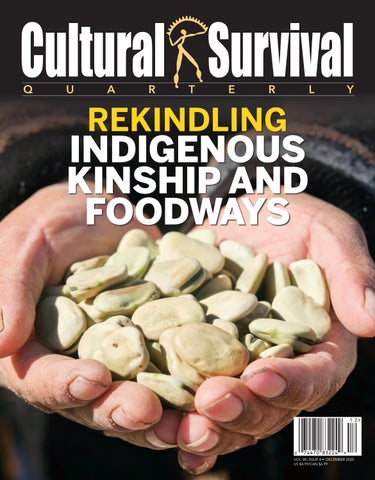
REKINDLING
INDIGENOUS KINSHIP AND FOODWAYS
VOL. 49, ISSUE 4 • DECEMBER 2025 US $4.99/CAN $6.99
D E C EM BER 2025 VO L UME 4 9, ISSUE 4
Page 14
Page 16
Page 20
Page 22
BOARD OF DIRECTORS PRESIDENT
FEATURES
VICE PRESIDENT
14 Reviving Ancestral Kinships Across Turtle Island Grasslands for Sustainable Community Futures The Indigenous Kinship Circle Indigenous Peoples and their knowledge are essential in the conservation and restoration of the Central Grasslands of Turtle Island.
Kaimana Barcarse (Kanaka Hawai’i)
John King
TREASURER
Steven Heim CLERK
Nicole Friederichs Marcus Briggs-Cloud (Maskoke) Keith Doxtater (Oneida) Kate R. Finn (Osage) Laura Graham Richard A. Grounds (Yuchi/Seminole) Lyla June Johnston (Diné/Tsétsêhéstâhese) Stephen Marks Mrinalini Rai (Rai) Jannie Staffansson (Saami) Stella Tamang (Tamang) FOUNDERS David & Pia Maybury-Lewis Cultural Survival Headquarters 2067 Massachusetts Ave. Cambridge, MA 02140 t 617.441.5400 f 617.441.5417 www.cs.org Cultural Survival Quarterly Managing Editor: Agnes Portalewska Contributing Arts Editor: Phoebe Farris (Powhatan-Pamunkey) Copy Editor: Jenn Goodman Designer: NonprofitDesign.com
16 He Ea I Ka ʻAi: Sovereignty Through Food Kaimana Barcarse (Kanaka Hawai’i) A journey of provisioning voyaging canoes with self-sustained, locally grown and preserved foods, a practice rooted in ancestral knowledge. 18 Carrying Her Voice: Kinship and Cassava in Pakuri Sabantho Aderi Corrie-Edghill (Lokono) The cultural significance of cassava farming and preparation by Lokono women in Guyana.
20 Nan Awaya Farm: A Place of Growth Ian Thompson (Choctaw) Choctaw knowledge and the establishment of Nan Awaya Farm in southeastern Oklahoma offer hope and solutions for today’s greatest challenges. 22 Reviving Kinship Routes Through Stewarding Mishoon Culture on Long Island Chenae Bullock (Shinnecock) The revival of the mishoon (dugout canoe) culture brings spiritual and political strengthening for the Indigenous Peoples of Long Island. 24 Agroecology as Resistance Zuhira Musa (Fulani) Mbororo Fulani women are leading food sovereignty efforts in Cameroon.
Copyright 2025 by Cultural Survival, Inc. Cultural Survival Quarterly (ISSN 0740-3291) is published quarterly by Cultural Survival, Inc. at PO Box 381569, Cambridge, MA 02238. Periodical postage paid at Boston, MA 02205 and additional mailing offices. Postmaster: Send address changes to Cultural Survival, PO Box 381569, Cambridge, MA 02238. Printed on recycled paper in the U.S.A. Please note that the views in this magazine are those of the authors and do not necessarily represent the views of Cultural Survival.
DEPARTMENTS 1
Executive Director’s Message
2
In the News
4
Sovereign Style
Writers’ Guidelines
View writers’ guidelines at our website (www.cs.org) or send a self-addressed, stamped envelope to: Cultural Survival, Writer’s Guidelines, PO Box 381569, Cambridge, MA 02238.
On the cover: The seed is a bearer of hope, containing knowledge passed down through generations. It embodies the symbiosis between humans and the Earth (see page 6). Photo by Julien Defourny.
STAY CONNECTED www.cs.org Donors like you make our work around the world possible. Thanks so much for being part of Cultural Survival! ii
| www.cs.org
6
Indigenous Visionaries Show New York—and the Fashion Industry— the (Run) Way Special Report
Indigenous Resistance in Bolivia’s Mining Wasteland
10 Women the World Must Hear
María Candelaria Rodriguez Hernández (Tseltal)
12 Climate Change
A Kalinago Youth’s Climate Story
26 Keepers of the Earth Fund Grant Partner Spotlight
Community Development Shield (Karamojong), Uganda
28 Staff Spotlight
Nadia April (Damara and Nama)
29 Bazaar Artist
Robbie DeGaetano (Wampanoag/Narragansett)
CULTURAL SURVIVAL STAFF
EXECUTIVE DIRECTOR’S MESSAGE
Rekindling Indigenous Kinship and Foodways Halito akana (Hello friends),
I
ndigenous foodways and our kinship with plants, animals, and ecosystems are central to our resilience and regenerative lifeways and informed by our cosmovisions, knowledge systems, and languages. Passed down through generations, traditional practices, foods, and materials are embedded within relational webs of human and more-thanhuman beings, flows, and entities—all fundamental to sustaining our lives, communities, and cultures. We have resisted the harm and disruption of colonialism and extractive capitalism by reinforcing our cultures and core values: relationship, responsibility, reciprocity, and redistribution. We are building strong movements to revitalize our communities and foodways and rekindle kinship, knowledge, and trade routes that contribute to the web of life. The deep wisdom that emerges from continuously honoring our sacred kinship with Mother Earth and each other is key to cultivating balance and addressing some of today’s greatest challenges, including climate change. Throughout this issue, we are inspired by Indigenous communities committed to this important work. The Indigenous Kinship Circle brings together Indigenous people and allies in the conservation and environmental sectors to advance the well being of communities across the Central Grasslands of Turtle Island. Our Board Chair, Kaimana Barcarse (Kanaka Hawai’i), writes about how voyaging traditions and foodways have reconnected Peoples across oceans. Sabantho Aderi CorrieEdghill (Lokono) shares how in Guayana, growing and preparing cassava “links the hands of women across generations.” Ian Thompson (Choctaw) describes how the
2025 Statement of Ownership, Management, and Circulation
Nan Awaya Farm aims to restore biodiversity, revitalize traditional cuisine, reconnect community with the land, and enliven Choctaw culture. Chenae Bullock (Shinnecock) explains how the mishoon (dugout canoe) culture is “a vessel of connection” and bridges “generations, teachings, and the living memory of our ancestors.” Zuhira Musa (Fulani) narrates how the Mobororo Fulani women in Cameroon are rebuilding their foodways “rooted in food sovereignty, collective labor, and ancestral agroecological knowledge.” People and ecosystems are inseparable. Indigenous leaders have been sharing this message for years, and only now are western scientists finally recognizing this. Thank you for being amongst those who have been listening. We are grateful for your ongoing commitment to Cultural Survival and our work. Your support helps Indigenous Peoples safeguard their knowledge, foodways, and kinship systems for future generations, ensuring the health and sustainability of the planet. For example, we are partnering with the Indigenous Resilience Center at the University of Arizona on the Indigenous Regenerative Agriculture Knowledge Exchange, which will bring together Indigenous leaders, Elders, and youth, helping to re-establish kinship and knowledge exchange across the U.S.-Mexico border. Help us build this movement and raise $250,000 by December 31, 2025. Please give generously at www.cs.org/donate. We cannot do it without you! With wishes for an abundant, just, and peaceful holiday season and New Year. Hטchi yakoke li hoke (I thank you all so much),
Aimee Roberson (Choctaw and Chickasaw), Executive Director
1. Publication Title: Cultural Survival Quarterly 2. Publication Number: 0740-3291 3. Filing Date: September 15, 2025 4. Issue Frequency: Quarterly 5. Number of Issues Published Annually: Four 6. Annual Subscription Price: $45.00 7. Mailing Address of Publication: 2067 Massachusetts Ave. Cambridge, MA 02140 8. Mailing Address of Publisher Headquarters: 2067 Massachusetts Ave. Cambridge, MA 02140 9. Full Mailing Address and Complete Names of Publisher, Editor, and Managing Editor-Publisher: Cultural Survival, Inc. 2067 Massachusetts Ave. Cambridge, MA 02140, Editor/Managing Editor: Agnes Portalewska, Cultural Survival, 2067 Massachusetts Ave. Cambridge, MA 02140 10. Owner: Cultural Survival, Inc., 2067 Massachusetts Ave. Cambridge, MA 02140 11. Known Bondholders, Mortgagees, and Other Securities: None 12. Tax Status: The purpose, function, and nonprofit status for federal income tax purposes has not changed during the preceding 12 months 13. Publication Title: Cultural Survival Quarterly 14. Issue Date for Circulation Data Below: September 2025-Issue 49, Volume 3 15. Extent and Nature of Circulation: Subscription to members a. Total Number of Copies: Average No. Copies Each Issue During Preceding 12 Months: 2400; Actual No. Copies of Single Issue Published Nearest to Filing Date: 2600 b. Paid and/or Requested Circulation-1. Paid/Requested Outside-County Mail Subscriptions Stated on Form 3541: 1110; 1145 2. Paid In-County Subscriptions: 270; 310 3. Sales Through Dealers and Carriers, Street Vendors, Counter Sales, and Other Non-USPS Paid Distribution: 250; 270 4. Other Classes Mailed Through the USPS: 180; 190 c. Total Paid and/or Requested Circulation: 1800; 1915 d. Free or Nominal Rate Distribution 1. Free or Nominal Rate Outside-County 80; 90 2. Free or Nominal Rate In-County : 50; 70 3. Free or Nominal Rate Copies Mailed at Other Classes 190; 150 4. Free or Nominal Rate Distribution Outside the Mail 200; 250 e. Total Free or Nominal Rate Distribution: 520; 560 f. Total Distribution: 2320; 2475g. Copies Not Distributed: 80; 125 h. Total: 2400; 2600 i. Percent Paid and/or Requested Circulation: 77.59; 77.37 16. This Statement of Ownership will be printed in the December 2025 issue of this publication 17. I certify that all information furnished on this form is true and complete: Agnes Portalewska, Communications Manager, Cultural Survival, Inc.
Aimee Roberson (Choctaw & Chickasaw), Executive Director Mark Camp, Deputy Executive Director Avexnim Cojtí (Maya K’iche’), Director of Programs Alicia Moncada (Wayúu), Director of Advocacy and Communications Verónica Aguilar (Mixtec), Program Associate, Keepers of the Earth Fund Edison Andrango (Kichwa Otavalo), Indigenous Rights Radio Program Assistant Nadia April (Damara and Nama), Keepers of the Earth Fund Program Coordinator Diana Ariza Monroy, Community Media Program Assistant Carmem Cazaubon, Capacity Building Program Assistant Miguel Cuc Bixcul (Maya Kaqchikel), Accounting Associate Jess Cherofsky, Advocacy Program Manager Geovany Cunampio Salazar (Emberá), Panama Advocacy Coordinator Michelle de León, Grants Coordinator Roberto De La Cruz Martínez (Binnizá), Information Technology Associate Danielle DeLuca, Senior Development Manager Georges Theodore Dougnon (Dogon), Capacity Building Program Assistant David Favreau, Logistics and Operations Assistant Shaldon Ferris (Khoisan), Indigenous Radio Program Coordinator Sofia Flynn, Accounting & Office Manager Nati Garcia (Maya Mam), Capacity Building Manager Cesar Gomez Moscut (Pocomam), Community Media Program Coordinator Byron Tenesaca Guaman (Kañari Kichwa), Fellowships Coordinator Alison Guzman, Donor Relations Coordinator Emma Hahn, Development Associate Belen Iñiguez, Publications Distribution Assistant Natalia Jones, Advocacy Coordinator Mariana Kiimi (Na Ñuu Sàvi/Mixtec), Advocacy Associate Dev Kumar Sunuwar (Koĩts-Sunuwar), Community Media Program Coordinator Rosy Sul González (Kaqchikel), Indigenous Rights Radio Program Manager Marco Lara, Social and Digital Media Coordinator Kevin Alexander Larrea, Information Technology Associate Maya Chipana Lazzaro (Quechua), Bazaar Vendor Coordinator Jamie Malcolm-Brown, Communications & Information Technology Manager Candela Macarena Palacios, Executive Assistant Ñushpi Quilla Mayhuay Alancay (Quechua/Kolla), Advocacy Coordinator Edson Krenak Naknanuk (Krenak), Lead on Brazil Diana Pastor (Maya K’iche’), Media Coordinator Guadalupe Pastrana (Nahua), Indigenous Rights Radio Producer Camila Paz Romero (Quechua), Keepers of the Earth Fund Program Assistant Ilenia Perez (Guna), Panama Advocacy Coordinator Agnes Portalewska, Senior Communications Manager Tia-Alexi Roberts (Narragansett), Editorial & Communications Assistant Elvia Rodriguez (Mixtec), Community Media Program Assistant Mariana Rodriguez Osorio, Executive Assistant Carlos Sopprani, Human Resources Associate Thaís Soares Pellosi, Executive Assistant Abigail Sosa Pimentel, Human Resources Assistant Candyce Testa (Pequot), Bazaar Events Manager Miranda Vitello, Development Coordinator Candy Williams, Human Resources Manager Pablo Xol (Maya Qʼeqchiʼ), Design and Marketing Associate
INTERNS
Sukanto Barman, Cenia Córdova, Prama Dewan, Felix Kagaju, Shimron Kiptoo, Alahir Maha Amaral, Zuhira Musa, Sandra Pelaez, Elisa Ribeiro
Cultural Survival Quarterly December 2025 | 1
IN TH E N E W S Australia | First Treaty with Traditional Owners Passed in Victoria OCTOBER
A treaty passed by the state of Victoria grants Aboriginal communities the authority to shape policies and services. The legislation establishes the First Peoples’ Assembly as a permanent representative body to advise the government under a new statutory corporation called Gellung Warl.
Ecuador | Environmental License Revoked for Gold Project OCTOBER
The Ecuadorian government has revoked the environmental license for the Canadianrun Loma Larga gold mine in Azuay province following strong local opposition over threats to the Quimsacocha water reserve, community health, and ecosystems.
Denmark/Greenland | Denmark Apologizes to Indigenous Women in Greenland SEPTEMBER
Danish Prime Minister Mette Frederiksen publicly apologized in Nuuk to Inuit girls and women in Greenland who were forced to receive contraception without consent during the 1960s-70s.
Peru | Report Finds Indigenous Land Defenders at Risk of Violence SEPTEMBER
A report by Indigenous rights organization AIDESEP found 226 Indigenous land defenders in Peru’s Ucayali, Huánuco, and Loreto regions facing serious threats from illegal gold mining, drug trafficking, logging, and monoculture expansion.
Peru | Court Upholds Sentences for Loggers in Indigenous Murders SEPTEMBER
A Peruvian court upheld 28-year prison terms for the four loggers convicted of 2
| www.cs.org
killing four Ashéninka leaders campaigning against illegal logging.
Global | 146 Land and Environmental Defenders Killed or Disappeared in 2024 SEPTEMBER
A new Global Witness report found that at least 146 people were killed or disappeared in 2024 while defending land, forests, and water. Latin America remains the deadliest region, accounting for 82% of the cases.
Indonesia | Norway Divests from Indonesia Nickel Mine SEPTEMBER
Norway has divested its $6.8 million USD stake in a French-run nickel mine in Halmahera, which threatens displacement of the uncontacted Forest Tobelo Peoples.
U.S. | Shoshone-Paiute Sign Indigenous Profit-Sharing Agreement for Gold Mine SEPTEMBER
The Shoshone-Paiute Tribes of Idaho’s Duck Valley Reservation and Canadian gold miner Integra Resources signed a legally binding agreement granting the Tribes development roles and revenue-sharing benefits.
U.S. | Maine Tribe Recovers 1,700 Acres SEPTEMBER
The Penobscot Nation has successfully reclaimed 1,700 acres of forest land from the Appalachian Mountain Club, a major step in restoring ancestral territory and strengthening Tribal stewardship.
U.S. | Indigenous Nations Sue Social Media Giants, Citing Youth Mental Health Harms SEPTEMBER
The Chickasaw and Choctaw Nations have filed lawsuits against social media parent companies Meta, Snap, ByteDance, and Alphabet, alleging their platforms have fueled a youth mental health crisis in their communities.
Brazil | Anacé Sue TikTok Over Planned Data Center on Their Land SEPTEMBER
The Anacé People have sued TikTok, claiming its planned data center in the Pecém Industrial Port Complex sits on their ancestral land. The facility also raises concerns over water use and lack of consultation with the Indigenous group.
Canada | Landmark Victory for Indigenous Rights AUGUST
The British Columbia Supreme Court ruled to grant the Cowichan First Nation Aboriginal title to land in Richmond, BC, setting legal precedent for non-reserve territory.
South Africa | Indigenous March Demands Recognition and Land Rights SEPTEMBER
Hundreds of Khoi and San protesters marched on Cape Town’s Parliament, demanding formal recognition as South Africa’s First Indigenous People and calling for the repeal of the Traditional and Khoi-San Leadership Act.
Philippines | Philippines Tops List for Land Defender Killings in Asia AUGUST
The Philippines is Asia’s deadliest country for land and environmental defenders, a new PAN Asia Pacific report reveals.
Nicaragua | Indigenous Peoples Face Ethnocide AUGUST
A new report by the Legal Defense Unit and the Legal Assistance Center for Indigenous Peoples documents the systematic persecution of Nicaragua’s Mayangna and Miskito Peoples, detailing how the regime uses arbitrary detentions, torture, and forced disappearances to punish Indigenous communities for defending their ancestral lands.
ADVOCACY UPDATES
Bolivia: Seque Jahuira Community Files Collective Claim against the State Denouncing Destruction by Mining OCTOBER
The Ombudsman’s Office and the Seque Jahuira community from the Aymara Nation in La Paz, Bolivia, filed a collective claim against several Bolivian institutions including the Ministry of the Environment, the Ministry of Mining, and the authority responsible for clean drinking water to denounce the mining activities of 26 companies, which have created an environmental disaster and harmed the health of the local population. The claim was filed after a year of various attempts to enforce the community’s right to a healthy environment. At a hearing on October 8, an injunction was granted to order studies on water and environmental quality, control over mining companies, and actions to protect environmental rights and collective human rights.
Paraguay: Cultural Survival, Paĩ Reta Joaju, and Paĩ Jopytyra Submit Stakeholder Report for Universal Periodic Review OCTOBER
Cultural Survival, along with the Paĩ Reta Joaju and Paĩ Jopytyra associations representing the Paĩ Tavyterã Peoples, submitted a stakeholder report for Paraguay’s Universal Periodic Review. Insecurity regarding land tenure for the Indigenous Peoples of Paraguay has recently worsened due to the ineffectiveness of the institutional mechanisms that should protect this right. The report focuses on the case of the Paĩ Tavyterã communities in the departments of Amambay, Concepción, and Canindeyú, which represent a pattern of systemic rights violations faced by many other Peoples in the country. More than 22 communities continue to wait for the demarcation of their territories, many of which have had cases pending before the Paraguayan Institute for Indigenous Affairs (INDI) for years, the entity responsible for assisting them in the process of demarcating their lands, without receiving an effective resolution. Communities continue to be victimized by illegal invasions with no intervention by INDI.
_____________________ Read more news at www.cs.org/latest.
Cultural Survival’s Advocacy Program launches international campaigns in support of grassroots Indigenous movements as they put pressure on governments and corporations to respect, protect, and fulfill the rights of their communities.
Guatemala: Cultural Survival and Affected Communities submit Alternative Report to the Committee on the Elimination of Racial Discrimination OCTOBER
The Maya Kaqchikel community from Sumpango and the Maya Achí Chicaj and Maya Mam communities from Cajolá and Todos Santos Cuchumatan, with the support of the Human Rights and Indigenous Peoples Clinic at Suffolk University Law School and Cultural Survival, presented an alternative report to the Committee on the Elimination of Racial Discrimination. They requested that the Committee address the State’s lack of implementation of the October 6, 2021 ruling of the Inter-American Court of Human Rights in the case of Maya Kaqchikel Indigenous Peoples of Sumpango and Others v. Guatemala. The Committee was also asked to provide guidance to the State on taking immediate measures to protect Indigenous community radio stations and operators from future criminal prosecution and enacting legislation that recognizes the use of such media by Indigenous Peoples as a means of exercising their freedom of expression, media, and cultural rights.
Ecuador: Hundreds of Indigenous People Assaulted during National Strike SEPTEMBER/OCTOBER
Ecuador’s Indigenous Peoples peacefully protested against the economic and extractive policy reforms enacted by President Daniel Noboa’s government, which have increased the cost of living while furthering the destruction of their territories. On September 18, the Confederation of Indigenous Nationalities of Ecuador (CONAIE) called for a national strike, which lasted 31 days. The government responded with brutal repression tactics, including excessive use of force, arbitrary detentions, criminalization of protesters, persecution of community leaders, and other serious human rights violations. During the protests, 473 people were injured, 206 detained, and 16 people temporarily disappeared. At least three people were killed by Ecuadorian security forces. There were also reports of other State abuses, such as the freezing of bank accounts belonging to Indigenous organizations and leaders, censorship of community media, threats and harassment against journalists and human rights defenders, the use of firearms against peaceful protesters, violations of private homes, and a lack of medical care to Indigenous people.
Cultural Survival Quarterly December 2025 | 3