Cultural Survival R
T
E
R
L
r
Y
arterly l Qu •1 va 97 i v
6 6 202 to
SACRED STRENGTH
g Cultur al Su
A
YEARS
atin br e el
U
C
Q
Indigenous Women Rooted in Mother Earth’s Wisdom
VOL. 50, ISSUE 1 • MARCH 2026 US $4.99/CAN $6.99
M A RC H 2026 VO L UME 5 0, ISSUE 1
Page 16
Page 18
Page 20
Page 24
BOARD OF DIRECTORS PRESIDENT
FEATURES
VICE PRESIDENT
16 We’re Not Feminists. We’re the Law. Interview with Michelle Schenandoah (Oneida) about uplifting Indigenous women’s voices and sharing Haudenosaunee principles.
Kaimana Barcarse (Kanaka Hawai’i)
John King
TREASURER
Steven Heim CLERK
Nicole Friederichs Marcus Briggs-Cloud (Maskoke) Keith Doxtater (Oneida) Kate R. Finn (Osage) Laura Graham Richard A. Grounds (Yuchi/Seminole) Lyla June Johnston (Diné/Tsétsêhéstâhese) Stephen Marks Mrinalini Rai (Rai) Jannie Staffansson (Saami) Stella Tamang (Tamang) FOUNDERS David & Pia Maybury-Lewis Cultural Survival Headquarters 2067 Massachusetts Ave. Cambridge, MA 02140 t 617.441.5400 f 617.441.5417 www.cs.org
18 Imprisoned for Climate Justice and Indigenous Rights Advocacy Daria Egereva (Selkup) was detained by the Russian government after participating at COP30. 20 Uts Ha-e !kho /gara i #gau#gausen: Hold Onto What You Have and Heal Yourselves Irene ǁGaroës (Nama) A celebration of enduring bravery, resilience, and healing of Nama and Damara women in Namibia.
Cultural Survival Quarterly Managing Editor: Agnes Portalewska Contributing Arts Editor: Phoebe Farris (Powhatan-Pamunkey) Copy Editor: Jenn Goodman Designer: NonprofitDesign.com
DEPARTMENTS 1
Executive Director’s Message
Copyright 2026 by Cultural Survival, Inc.
2
In the News
4
Special Report Free Against All Odds: The “Hidden People” of Pakayaku Fight to Keep Extractives Out of Ecuador’s Amazon
8
Climate Change Unmistakable Message at COP30 in Belém: Indigenous Peoples’ Rights Are Non-Negotiable
Cultural Survival Quarterly (ISSN 0740-3291) is published quarterly by Cultural Survival, Inc. at PO Box 381569, Cambridge, MA 02238. Periodical postage paid at Boston, MA 02205 and additional mailing offices. Postmaster: Send address changes to Cultural Survival, PO Box 381569, Cambridge, MA 02238. Printed on recycled paper in the U.S.A. Please note that the views in this magazine are those of the authors and do not necessarily represent the views of Cultural Survival.
Writers’ Guidelines
View writers’ guidelines at our website (www.cs.org) or send a self-addressed, stamped envelope to: Cultural Survival, Writer’s Guidelines, PO Box 381569, Cambridge, MA 02238.
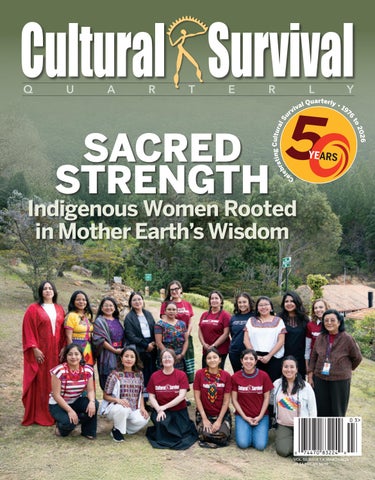
On the cover: Indigenous women from around the globe serve on Cultural Survival's Staff and Board of Directors. Photo by Jamie Malcolm-Brown.
STAY CONNECTED www.cs.org Donors like you make our work around the world possible. Thanks so much for being part of Cultural Survival! ii
| www.cs.org
10 Rights in Action: No Consent, No Legitimacy: Exposing the Systemic Non-Compliance with Indigenous Rights
22 25 Years of Weaving Change International Indigenous Women’s Forum (FIMI): How FIMI became a global force for Indigenous women’s leadership. 24 Protecting the Seal River Watershed: An Indigenous-Led Fight for Conservation Interview with Stephanie Thorassie (Sayisi Dene) about efforts to establish an Indigenous Protected Area in northern Manitoba, Canada. 26 Never Give Up Lyla June Johnston (Diné/ Tsétsêhéstâhese) Interview with Piscataway Elder Gabrielle Tayac on kinship, land, and legacy.
12 Indigenous Arts To the (Heart) Beat of Her Own Drum: A Conversation with Nuka Alice 14 Women the World Must Hear Get to Know Our New Director of Advocacy and Communications: Alicia Moncada (Wayúu) 28 Staff Spotlight Ilenia May Pérez (Guna) 29 Bazaar Artist Brittney Peauwe Wunnepog Walley (Nipmuc)
CULTURAL SURVIVAL STAFF
EXECUTIVE DIRECTOR’S MESSAGE
Sacred Strength: Indigenous Women Rooted in Mother Earth’s Wisdom Halito akana (Hello friends),
P
lease join us in celebrating a major milestone—with humble origins as a quarterly newsletter in 1976, this issue of the Cultural Survival Quarterly marks 50 years since we began publishing! From the beginning, we have documented urgent problems facing Indigenous Peoples worldwide and publicized infringements of individual and collective human rights. While this remains fundamental to our work, so is amplifying the voices, brilliance, and resilience of Indigenous Peoples. At the center of our work are Indigenous women, femmes, and youth. Women are the hearts of our families, backbones of our communities, and bedrock of our movements. Indigenous Peoples honor the sacredness of women who create life, the love of women who nurture our families and traditions, the strength of women who protect and defend our homelands, and the wisdom of women who align our communities with the sacred laws of Mother Earth. Traditionally, many Indigenous Peoples were matriarchal and matrilocal with powerful women in important decision-making roles. Disrupted by colonization, our Peoples were pressured to assimilate into lifeways that no longer center women, youth, and our reciprocal relationships and responsibilities to Mother Earth. This destructive trajectory of humanity is fueled by colonialism, extractivism, hyper-individualism, overconsumption, and misogyny and has led to terrible imbalances as the sacredness of Mother Earth and her daughters has been violated and the importance of women’s roles have been denied. We are currently seeing an extreme manifestation of this come to light as a vast sex trafficking network of powerful people around the world is being exposed. We also know that gender-based violence disproportionately affects Indigenous women, femmes, and girls, as seen in the epidemic of Missing and Murdered Indigenous Women and Girls. In the U.S. and Canada, 4 out of 5 Indigenous Women have experienced violence, 56.1% have experienced sexual
violence, and 40% of sex trafficking victims are American Indian or Alaska Native women. Thankfully, despite this oppression and extreme imbalance, Indigenous women continue to listen to the heartbeat of Mother Earth and are rooted in her wisdom as they lead the change the world needs! In this issue, learn about how women are revitalizing traditions, cultures, and lifeways while nurturing intergenerational knowledge transfer; protecting and defending their territories and homelands despite mounting pressures and ongoing persecution; and supporting each other’s leadership and initiatives. Indigenous women are at the forefront of cultivating balance and sustainable lifeways through rematriation— restoring right relationships with Mother Earth, within our communities, and across genders, while focusing on the well being of the collective and future generations. For many years, Cultural Survival has prioritized projects that center Indigenous women, femmes, and girls and engage their leadership. We continue to be inspired by those who are leading their communities’ healing and renewing collective responsibilities related to caretaking of Mother Earth. While we focus on supporting them and uplifting their voices and work, we are also working to ensure healthy relations within our organization, including through our Gender Balance Policy. Thank you for joining us on this journey to create a more just and equitable world and to support Indigenous women’s leadership in guiding the way. Help us build this movement, and please give generously at www.cs.org/ donate. We cannot do what we do without friends like you! Hטchi yakoke li hoke (I thank you all so much),
Aimee Roberson (Choctaw and Chickasaw), Executive Director P.S. As a CSQ reader, you are among the first to hear that we are launching a new podcast on Earth Day! Stay tuned for “Mother Earth Medicine: Ancestral Intelligence for Healing Our Future.”
Aimee Roberson (Choctaw & Chickasaw), Executive Director Mark Camp, Deputy Executive Director Avexnim Cojtí (Maya K’iche’), Director of Programs Alicia Moncada (Wayúu), Director of Advocacy and Communications Verónica Aguilar (Mixtec), Program Associate, Keepers of the Earth Fund Maha Akamine, Keepers of the Earth Fund Program Assistant Edison Andrango (Kichwa Otavalo), Indigenous Rights Radio Program Assistant Nadia April (Damara and Nama), Keepers of the Earth Fund Program Coordinator Diana Ariza Monroy, Community Media Program Assistant Carmem Cazaubon, Capacity Building Program Assistant Miguel Cuc Bixcul (Maya Kaqchikel), Accounting Associate Jess Cherofsky, Advocacy Program Manager Geovany Cunampio Salazar (Emberá), Panama Advocacy Coordinator Michelle de León, Grants Coordinator Roberto De La Cruz Martínez (Binnizá), Information Technology Associate Danielle DeLuca, Senior Development Manager Nataly Domicó (Embera Eyabida), Keepers of the Earth Fund Program Assistant Georges Theodore Dougnon (Dogon), Capacity Building Program Assistant David Favreau, Logistics and Operations Assistant Shaldon Ferris (Khoisan), Indigenous Radio Program Coordinator Sofia Flynn, Accounting & Office Manager Nati Garcia (Maya Mam), Capacity Building Manager Cesar Gomez Moscut (Pocomam), Community Media Program Coordinator Byron Tenesaca Guaman (Kañari Kichwa), Fellowships Coordinator Alison Guzman, Donor Relations Coordinator Emma Hahn, Development Associate Belen Iñiguez, Publications Distribution Assistant Natalia Jones, Advocacy Coordinator Mariana Kiimi (Na Ñuu Sàvi/Mixtec), Advocacy Associate Dev Kumar Sunuwar (Koĩts-Sunuwar), Community Media Program Coordinator Rosy Sul González (Kaqchikel), Indigenous Rights Radio Program Manager Marco Lara, Social and Digital Media Coordinator Kevin Alexander Larrea, Information Technology Associate Maya Chipana Lazzaro (Quechua), Bazaar Vendor Coordinator Jamie Malcolm-Brown, Communications & Information Technology Manager Candela Macarena Palacios, Executive Assistant Ñushpi Quilla Mayhuay Alancay (Quechua/Kolla), Advocacy Coordinator Edson Krenak Naknanuk (Krenak), Lead on Brazil Diana Pastor (Maya K’iche’), Media Coordinator Guadalupe Pastrana (Nahua), Indigenous Rights Radio Producer Camila Paz Romero (Quechua), Keepers of the Earth Fund Program Assistant Ilenia Perez (Guna), Panama Advocacy Coordinator Agnes Portalewska, Senior Communications Manager Tia-Alexi Roberts (Narragansett), Editorial & Communications Assistant Elvia Rodriguez (Mixtec), Community Media Program Assistant Mariana Rodriguez Osorio, Executive Assistant Carlos Sopprani, Human Resources Associate Thaís Soares Pellosi, Executive Assistant Abigail Sosa Pimentel, Human Resources Assistant Adriana Sunun (Maya Kaqchiquel), Community Media Program Coordinator Candyce Testa (Pequot), Bazaar Events Manager Miranda Vitello, Development Coordinator Candy Williams, Human Resources Manager Pablo Xol (Maya Qʼeqchiʼ), Design and Marketing Coordinator
INTERNS
Kelaia Acevedo, Miranda Gonzalez, Mara
Cultural SurvivalSandra Quarterly March | 1 Moldavan, I. Pelaez, Linda2026 Ravolatsara
IN TH E N E W S U.S. | Colorado River Declared Living Entity NOVEMBER
The Colorado River Indian Tribes Council in Arizona and California has recognized the Colorado River as a living entity that sustains people, animals, and nature.
Nepal | Lawyers’ Group Wins Human Rights Award NOVEMBER
The Lawyers’ Association for Human Rights of Nepalese Indigenous Peoples (LAHURNIP) was honored with the 2025 Human Rights and Business Award in Geneva for its services of providing legal aid, strategic litigation, and advocacy to defend Indigenous rights.
International | UN Establishes International Day for Indigenous Women and Girls NOVEMBER
The UN General Assembly adopted A/RES/80/10, a resolution on the International Day for Indigenous Women and Girls, to be commemorated every September 5.
Canada | Vatican Returns Indigenous Artifacts NOVEMBER
In a significant move toward reconciliation, the Vatican formally returned 62 artifacts connected to Indigenous communities in Canada.
Australia | Victoria Signs Landmark First Treaty with Aboriginal Peoples NOVEMBER
The state of Victoria has formalized Australia’s first-ever treaty into law. Following nearly a decade of negotiations with Indigenous leaders, the accord grants First Nations people greater oversight on decisions affecting their lives, including healthcare, housing, and education.
Sweden | Sámi Community Blocks Per Geijer Project DECEMBER
The Gabna Sámi community in Sweden 2
| www.cs.org
ended its cooperation with the public mining company LKAB, claiming that their land is being exploited without their Free, Prior and Informed Consent. The Per Geijer project threatens reindeer pastures, sacred sites, and Sámi culture.
Kenya | Ogiek People Awarded $1.3 Million DECEMBER
The African Court on Human and Peoples’ Rights ordered the government of Kenya to pay roughly $1.3 million USD in compensation to the Ogiek Peoples and to legally recognize and restore their ancestral lands in the Mau Forest.
Taiwan | Pingpu Peoples Officially Recognized DECEMBER
Taiwan enacted the Pingpu Indigenous People’s Identity Act, granting legal recognition to approximately 980,000 descendants of lowland Tribes. The Siraya, Makatao, and Taivoan are moving from administrative erasure to formal recognition, following a 2022 mandate from the Constitutional Court.
U.S. | Alaska Natives Win Supreme Court Protection for Subsistence Fishing
JANUARY
The Supreme Court again refused to hear the State of Alaska’s challenge in U.S. v. Alaska. This means Alaska Native communities can continue fishing and hunting in traditional ways.
U.S. | Historic First Indigenous State House Representation in Connecticut JANUARY
Larry Pemberton Jr. (Eastern Pequot) became the first Native American elected to the state’s General Assembly.
U.S. | ICE Detains Native Americans JANUARY
Jose Ramirez, a descendant of the Red Lake Nation, was detained during ICE raids in Minneapolis, and others were questioned.
U.S. | Three Ogala Lakota Men Detained JANUARY
The Oglala Sioux Tribe reported that three Lakota men were held by ICE and the Department of Human Services at Fort Snelling, a place of deep historical pain for the community.
U.S. | Gwich’in File Lawsuit Against Oil Exploitation in Arctic Wildlife Refuge JANUARY
The Gwich’in Steering Committee and 12 allied groups reopened legal action against the U.S government to stop oil exploitation in the Arctic National Wildlife Refuge.
U.S. | Native Communities Disproportionately Affected by Gun Violence JANUARY
A recent report from the Violence Policy Center, “American Indian/Alaska Native Victims of Lethal Firearm Violence in the United States,” identifies 553 gun deaths among Native American and Alaska Native individuals, including 246 homicides and 260 suicides in 2023.
Australia | Aboriginal Remains Returned JANUARY
The remains of three Waluwarra ancestors, once traded and stored in institutions in Germany and Australia, have been reunited with their descendants in Sydney and Brisbane, marking a powerful act of reconciliation. More than 1,790 remains have been repatriated.
U.S. | Cherokee Tribe Regains Sacred Mound JANUARY
After nearly 200 years, the Eastern Band of Cherokee Indians will reclaim full ownership of the Noquisiyi Mound in Franklin, North Carolina, a sacred site built by their ancestors around C.E. 1000. The Franklin Town Council unanimously approved transferring the deed to the Tribe, fulfilling a long-held wish for restoration.
ADVOCACY UPDATES
Latin America: Systemic Violence Against Indigenous Defenders Increasing FEBRUARY
Latin America accounts for 82% of cases of murder of land defenders. Indigenous defenders face a double threat: defending rights and being Indigenous. In 2024, 33% of the defenders killed were Indigenous, a disproportionately high figure compared to other groups. Every year, Cultural Survival compiles a list of murdered Indigenous defenders in the name of remembrance and to raise awareness about this systematic persecution. In 2025, at least 46 Indigenous defenders were killed. Each one was a beloved family and community member, and their deaths have caused profound grief.
Venezuela: Indigenous Peoples Face Major Vulnerabilities After U.S. Military Intervention JANUARY
On January 3, the United States launched a military intervention in Caracas, Venezuela, bombing multiple targets and capturing President Nicolás Maduro and his wife, Cilia Flores. Human rights organizations have characterized this attack, which was carried out without congressional authorization, as a violation of the UN Charter and international law. The United States’s stated intent to control Venezuela’s oil resources and “run the country” raises serious concerns about prioritizing extraction over the rights of a population. Indigenous Peoples face particular vulnerability as the U.S. government has signaled interest in accelerating oil and mineral extraction in territories that overlap with Indigenous traditional territories, including the Orinoco Mining Arc, where communities have been suffering illegal mining, environmental degradation, and violence from armed groups for decades.
Russia: Daria Egereva and Other Indigenous Human Rights Defenders Criminalized DECEMBER
Daria Egereva (Selkup) was detained in Russia on December 17, 2025, and accused of participating in a terrorist organization after participating in the UN Framework on Climate Change Convention (UNFCCC COP30) in Belém, Brazil, last November. The Selkup Nation is one of the smallest Indigenous Peoples in Russia, with a total population of 3,500. Egereva serves as co-chair of the International Indigenous Peoples Forum on Climate Change. She is a former member of the Facilitation Working Group of the
Cultural Survival’s Advocacy Program launches international campaigns in support of grassroots Indigenous movements as they put pressure on governments and corporations to respect, protect, and fulfill the rights of their communities.
Local Communities and Indigenous Peoples Platform under the UNFCCC, and a long-standing participant in the international Indigenous Peoples movement. The terrorism charge carries a potential prison sentence of 10 to 20 years. Another Indigenous woman activist whose name has not yet been released was simultaneously arrested in connection with the same accusations, and at least 17 other Indigenous individuals across the country were subjected to searches and interrogations. These actions took place over 10 regions, including Moscow, the Altai Republic, Tomsk, Murmansk, Krasnoyarsk, Taimyr, and Kemerovo Oblast.
Brazil: Cultural Survival participates in COP30 NOVEMBER
From November 10-21, 2025, a delegation from Cultural Survival attended the UNFCCC COP30 in Belém, Brazil, joining the International Indigenous Peoples’ Forum on Climate Change in their advocacy to demand the inclusion of Indigenous Peoples in the multilateral efforts to tackle climate change. Cultural Survival’s priorities included: direct access to climate finance, the end to false “greenwashing” solutions, territorial protection and demarcation, the end of Sacrifice Zones being stripped by extractive industries in the name of the green economy, a transition to low carbon economies that is just to Indigenous Peoples, the protection of Indigenous environmental defenders, the guarantee to Free, Prior and Informed Consent in all projects that affect them, and the protection of Indigenous Peoples in Voluntary Isolation. Despite not reaching consensus on main topics like the transition away from fossil fuels, Indigenous Peoples achieved their largest participation in history with more than 5,000 delegates in attendance.
Paraguay: Government Approves Anti-NGO Law Hindering Nonprofits, including Indigenous Organizations NOVEMBER
In October 2025, the government of Paraguay approved the regulations for Law No. 7363/24, better known as the Anti-NGO Law. Civil society organizations have expressed concern about the law, which restricts the right to association and political participation and hinders the legitimate exercise of nonprofit organizations in Paraguay. It also threatens to impose heavy penalties on NGOs that fail to comply, which would jeopardize their ability to defend Indigenous Peoples’ collective and human rights.
_____________________ Read more news at www.cs.org/latest. Cultural Survival Quarterly March 2026 | 3