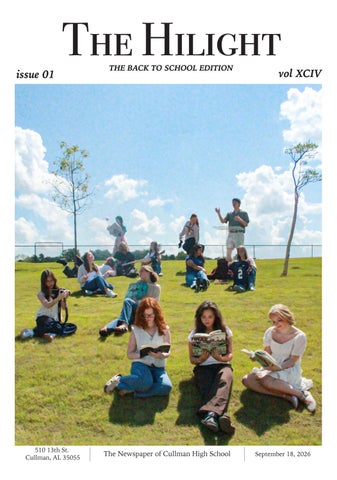
issue 01
The Hilight
510 13th St. Cullman, AL 35055
THE BACK TO SCHOOL EDITION
The Newspaper of Cullman High School
vol XCIV
September 18, 2026
Contents 3. Best Investment 4. AL Race 5. Music VS. AI 6. Myth Misconceptions 7. Animal Conservation 8. Summer Movies 9. Hunger Games 10. Alex Elea 11. World Cup 12. ADS 13. ADS 14. Center Spread 15. Center Spread 16. Summer Reading 17. Alumni Interviews 18. ADS 19. ADS 20. Bot Epidemic 21. “I’m Just a Girl” 22. ADS 23. Picture Collage 24. Cullman Traffic 25. Flock Cameras 26. ADS 27. LEGACY
Table of Contents Editors Note
Staff List Editor
Dear Fellow Reader, By merely reading this sentence, you have proven you have a very powerful ability: the ability to read. Many take this for granted, seeing as in this modern age we still live in a world where 12%-14% of the global population cannot read, whether it be for lack of education or conditions like dyslexia that hinder their abilities. It is a blessing to be able to read. In a similar statistic, around 13% cannot write more than a name that matches the one on one’s birth certificate. It is a blessing to write. The power of literature, media, even one’s own name can hold such an influence on an individual and those around them. However, we live in a world where this power is taken and used to harm others. In today’s age, we see so many use their words and writing to cause pain in many lives. Defamation by verbal and written communication–slander and libel–are some of the world’s cruelest weapons to be used. I have seen in the media how this weapon was used to hurt millions of people. These words turn neighbor against neighbor, friend against friend, humanity against humanity. These words have caused destruction and distrust in the news that was meant to act as a reliable source. A trustworthy source. Coming into this position as Editor for a local newspaper, The Hilight, I know the power I hold. I see the potential words printed in black and white can have–for better or worse. My staff has incredible power as well. They have the minds to write and read; I have seen the intelligence and passion they encapsulate since day one. You as a reader have an incredible power, one I believe is the most crucial: the ability to create an opinion. With the power we hold, being the power of the human mind, we as a society can use it for good. I would be ignorant to think that everyone has the same opinions as me– we are all unique in physical traits due to genetics, so why would our minds be any different? Our beliefs, morals, and core foundation are formed by the experiences we have and the paths we have walked. Going into this first edition, we keep everything as objective as possible, as we follow the guidelines of Alabama Scholastic Press Association. Some pieces are subjective– our editorials– which act as a writer’s ability to express their opinion in an outlet of written word. Even I do not agree with everything my staff writes, same goes for my writings and their views. As readers- as human beings- we must respect the connection readers and writers have. Without writers, what would we have to read? Without readers, who would read our writing? At the end of the day, this balance is what creates the power in literature and media. I ask one thing of our readers: respect our right as humans to express ourselves. We as a staff will respect our audience in every way possible, and we will support our CHS family in any endeavor. We hope that you will support us in trying to use the power we have to help our world and to encourage those around us. I sincerely hope you enjoy the miracle we produce on these pages, and we honor the miracle you possess in your eyes and mind.
With love and thankfulness,
Elizabeth Smith
Elizabeth Smith
Staff Writers
Cyrene Agustin Macey Apel Claire McPhillips Will Davis Simmons Tessa Trucks Jaylon Branch Zarybeth Flores-Contreras Clara Haynes Loralei Hollis Campbell Kent Sophia Nacilla Jett Roberts Lucy Williamson
Advisor
Caroline Lunsford
Contact
256-734-3923
Address
510 13th Street NE Cullman, AL 35055
Member of Alabama Scholastic Press Association
Newspaper printed by Alabama Web Press Editorial Disclaimer: Any views or opinions expressed in the Editorials section belong solely to the writer and do not represent the Hilight Staff or Cullman High School.
The Best Investment: One’s Health
Leanr the benefits of putting one’s best foot forward Elizabeth Smith, Smith Editor
When one thinks of investing for the future, he or she might think of putting finances into stocks or retirement plans. Rarely does anyone think of their own health as something that can be invested and preserved; however, one’s health is the most vital factor in living a happy and healthy life several years in the future. With this, most think that to have a successful, healthy lifestyle, they have to take part in rigorous exercise daily, partake in a limiting diet, and give up the luxuries of life just to be healthy. The reality is that it is so much simpler and easier to start one’s path to living healthier. On June 27th, 2026, Dr. Flores and his son Reed Flores, senior at Cullman High School, organized the first RUN for GOOD 5K and Fun Run, benefiting the Good Samaritan Health Clinic. With almost 200 participants signing up, the event was a huge success. Reed Flores stated: “During the winter break prior to the run, I had a feeling that I needed to do something with my upcoming summer. So, I came to my dad about the idea for the run and he became the biggest supporter. I had never helped any kind of charity like this before, so the encouragement and support from asking those helping meant so much. Even though the run may have begun with me, I absolutely can’t take most of the credit. In the months leading up to the run, the amazing people at the clinic, my dad, and all of our sponsors did so much to make the run possible. Because of all the people who helped build the charity, the Run For Good became exactly what we all imagined.” The race not only allowed others to support the Good Samaritan Health Clinic, but it opened a door to a healthy lifestyle for those who had never participated in a 5K or Fun Run before. One participant of the race, Dr. Stidham, is also the proud Medical Director for the Good Samaritan Health Clinic. While also holding this position, he works as a board-certified internist in the Cullman Regional Medical Center with over 20 years of experience in the field. I had the pleasure of speaking with Dr. Stidham, where he shared that he started running while he was on call during residency at night around the hospital. Dr. Stidham stated: “It started as 1 mile, then led to my first 5K, 10K, and so on.” After sharing his story, it is evident that running has become a part of his life, where it has changed his psychological, physical, and emotional wellbeing. I was also honored to speak with his staff, in which they each shared their own experiences with the race. During the interviews, the majority shared that they had never ran a race before or had any prior experiences in running. “Dr. Stidham is a very motiva-
tional guy…he said ‘Want to do something fun?’ and we went with it” stated Cynthia Lusby. Even though none of the staff had raced, they all had nothing but positive regards when they shared their experiences. In society, most people cannot afford to have a gym membership or go to a healthier grocery store. Most see this standard, become discouraged, and believe they cannot be “healthy,” or in other terms: be very skinny and muscular. Healthy living is defined as: “making daily choices and habits that support your physical, mental, and social well-being.” With this in mind, any action you can take, even small acts, can make a positive impact in one’s life. For example, going on walks outside with a pet or a group of friends. “You don’t need a gym membership…Walking outside in your yard is better for building habits because it is more accessible to daily life.” Finding time in the day to dedicate to bettering ourselves— making time in our 24 hours each day— can make an everlasting impact in our mental wellbeing. When Dr. Stidham was asked what he would recommend to patients who want to start focusing on their health, he shared that he will tell patients to just start the habit of putting on their gym clothes and standing on the treadmill every day. Building habits is the best way to stay disciplined in a routine of healthy choices. Start each day by filling your water bottle and making a goal to drink out of it until you drink the entire bottle of water without forcing yourself into discomfort. In the end, you do not have to have the fanciest treadmill in your house or eat carrots every meal to be investing in your health long term. It all starts with the mentality of putting yourself first and making the effort to improve yourself one step at a time (literally and metaphorically).
WAYS TO IMPROVE YOUR OVERALL HEALTH - Walk 15 minutes - Choose the stairs over the elevator when given the option - Add one vegetable to each meal - Eat whole-grained foods - Put your phone away as well as staying off screens an hour before going to bed - Take time to self reflect through journaling and meditation - Minimize salt intake to less than 1,500 milligrams each day It takes approximately 28 days of doing a task eavh day to form a built-in habit. Start small, but putting these habits in your life will result in a healthier life.
FEATURE 3
4 FEATURE
Alabama, We Have a Problem
Tuberville and Jones Face Off Over What Comes Next Will Davis Simmons, Simmons Staff Writer
In my last article in May regarding this race, the Alabama race for governor was still taking shape. There were crowded lists of candidates, campaign announcements, and one major question hanging over the state of Alabama: who would replace Gov. Kay Ivey? Three months later, the question has changed. The candidates have been narrowed. The campaign trail is heating up. And with the general election now just months away on November 3, Alabama voters are preparing to choose their next governor in one of the state’s most significant elections in years. But for some students at Cullman High School, the 2026 election will mean something more personal. It will be their first time voting. Republican U.S. Sen. Tommy Tuberville and former Democratic U.S. Sen. Doug Jones have emerged as the major contenders in the race to replace Ivey, who is term-limited and cannot seek another term. Alabama’s Secretary of State has certified both candidates for the November 3 general election. After months of campaigning, the race has entered a new phase: the fight for November. And while campaigns often focus on polling numbers, television advertisements, and party politics, the election is also introducing a new group of Alabamians to the political process. By Election Day, some Cullman High School students will be eligible to cast a ballot in their first statewide election. For these students, the governor’s race will not just be another political headline scrolling across their phones. It will be the first election in which they have a direct voice in choosing the person who will lead the state they are preparing to enter as adults. The next governor will face decisions involving public schools, colleges and universities, jobs, infrastructure, health care, and one of Alabama’s newest political battles: data centers. Whether students are politically active or have never paid much attention to an election before, these decisions will eventually affect them directly. That is why 2026 matters. Back in May, this newspaper examined the unusual opportunity created by Alabama’s first open race for governor in years. Without an incumbent automatically seek-
ing another term, both parties saw an opportunity to shape Alabama’s future. Now, that possibility is no longer theoretical. The race is set. And the differences between the two candidates are becoming clearer. Tuberville enters the race with statewide name recognition from two very different careers: college football and the U.S. Senate. He served as head coach at Auburn and was elected to the Senate in 2020. His campaign is centered around what he calls an “Alabama First Agenda,” with priorities that include reducing taxes, attracting manufacturing jobs, expanding school choice, securing the border, supporting Alabama’s agriculture and defense industries, and maintaining conservative policies on issues including abortion and gun rights. Tuberville has also made immigration a major part of his campaign. That focus produced one of the most talked-about moments of the campaign so far. During an August appearance on The Charlie Kirk Show, Tuberville discussed immigration and voting before saying, “we might build a 30-foot wall around our state.” The comment quickly spread beyond Alabama politics. Tuberville’s campaign has continued to emphasize border security and immigration as major issues. His campaign says that, as governor, he will work with federal officials on immigration enforcement and deportation of criminals. However, Jones has taken a different approach to the race. The former U.S. senator has centered his campaign around health care, government transparency, affordability, and economic opportunity. In July, Jones unveiled what his campaign called “A Vision for Alabama,” laying out a broader governing agenda. Among his proposals are expanding Medicaid, strengthening rural hospitals, eliminating Alabama’s remaining grocery tax, expanding child care options, creating a citizen-led ballot initiative process, and allowing voters to decide whether Alabama should have a state lottery. But perhaps the clearest policy contrast between the candidates right now involves something that barely existed in Alabama politics a few years ago: artificial intelligence and data centers. Data centers have become one of the biggest economic and political questions facing Alabama. Supporters argue that the facili-
ties can bring billions of dollars in investment, jobs, and new technology to the state. Critics have raised questions about their effects on electricity, water, infrastructure, and local communities. Tuberville has argued that Alabama should welcome the industry but with conditions. His campaign says he is “not against data centers” but against what he calls “bad deals.” His plan calls for communities to have a say, companies to pay the costs they create, and data centers to avoid taking power and water away from Alabama families. Tuberville has also described data centers as “gold mines,” according to reporting on the race. Yet again, Jones has proposed something much different. He wants a one-year moratorium on new data center projects while Alabama establishes statewide rules regarding taxpayers, utility customers, local communities, and natural resources. The issue has become so central to the campaign that Jones has challenged Tuberville to debate him specifically about data centers. So far, no debate between the two candidates has been scheduled. For a race receiving as much attention as this one, voters have had surprisingly little opportunity to see the two candidates face each other directly. Jones has held a statewide series of town halls, including an August stop in Marshall County where voters were allowed to ask unscreened questions about issues including Medicaid, education, immigration, and data centers. His campaign said the event was his eighth statewide town hall. Tuberville, meanwhile, said in August that he did not expect to debate Jones. “Probably not,” Tuberville said when asked whether he would debate his opponent, arguing that the two candidates have such different political views that there was little reason for a debate. That
leaves Alabama voters including first-time voters at Cullman High School to learn about the candidates largely through their individual campaign events, advertisements, interviews, and social media. For a student voting for the first time, a campaign is more than a yard sign or a video that appears on TikTok or Instagram. It is an introduction to how political decisions are made and how those decisions can shape the state around them. For many teenagers, politics can feel distant. Election coverage can sound like a conversation happening between elders. Candidates debate complicated issues, campaigns spend millions of dollars on advertising, and voters are divided into categories based on age, geography, income, and political party. But eventually, teenagers become voters. For members of the Class of 2027 who will turn 18 before Election Day, that transition is happening now. Their first vote will not decide everything about Alabama’s future. But it will be a first step into a political system that they will participate in for decades. And this election gives them a chance to start paying attention. The choice on November 3 will ultimately belong to Alabama voters. Tuberville and Jones are offering significantly different ideas about the direction of the state, from immigration and education to health care, government reform, and the future of data centers. Now, as the campaign enters its final weeks, Alabama is barreling toward a decision. For some students at Cullman High School, it will simply be another election. For others, it will be the first time they walk into a voting booth, look at a ballot, and realize that their name is no longer just on the class roster. It is on the voter roll.
FEATURE 5 AI and Musical Expression
The Future of Music With AI and Opinions Sophia Nacilla, Nacilla Staff Writer
Music has been around for centuries. It is an ancient art dedicated to human expression, and it is still widely used and appreciated today. Technology, however, advances just as quickly as a listener’s taste, and it is starting to take its seat amongst musicians and singers. The people who once led the march of expression have many things to say about this — so do the listeners, and the very people who lead our country. Some perspectives state that AI generation can progress the music industry. According to an issue published by Musicians Institute, there was a recent release of AI versions of pop artists The Weekend and Drake. This “generated significant buzz” on social media platforms, and the story was picked up by “major news outlets.” Musicians Institute also states that AI may also help musicians with new ideas and different variations of their art. However, AI has also evolved to be quick and efficient at its job, therefore wasting no time when tasked with the production of music or lyrics. This can quickly lead
to the flooding of social or musical media if used irresponsibly. According to The Cornell Daily Sun, Spotify had to give nine billion dollars in royalties because of AI generating excessive music in the year of 2023. There is also feedback on AI music in The Cornell Daily Sun. It states that AI tends to “fall flat on creativity” and makes music “predictable or plain.” The opinions that listeners have on AI music vary vastly, and every person has something to say. According to the issue provided by University of Massachusetts Amherst and written by Joseph Pater, LLMs could generate “English text that is indistinguishable from human-generated writing.” A gentleman named Michael J. Epstein has created “a series of Facebook posts” on experimentation with the AI platform Suno, tracking its performance when submitting to Spotify placements. His first post from November 23, 2024, along with a December 5, 2024 update, as far as January of 2025, has 64,593 views. And according to the same issue: “[a]s any musician who has music on Spotify knows, this is a
Beyond the Spacesuit
lot.” A quote from Michael J. Epstein is provided as well: “[t]he days of extra fingers in AI art…are over.” On the contrary, CNET provides us with an issue written by the reporter Katelyn Chedraoui, who provides us with a very different experience than Pater’s. Katelyn Chedraoui states that “AI music really takes the ‘art’ out of artificial.” She provides us with information that has been stated more than once throughout the years of AI generated music, saying that AIs were built using music that was made by living people, which created the question of morality and paved the way for ethical dramas to unfold. Katelyn Chedraoui states AI generated pop is “shrill and squeaky” and compares the sounds to that of plastic. She also ran into an AI–generated music video, of which she sarcastically calls engrossing with “haunting, AI slop visuals.” In the end, Katelyn Chedraoui concludes her editorial with a final statement: “AI music never held my attention the same way that human music did.” The issue has spread farther than regular media, however. The gov-
ernment of Tennessee also has something to say to the AI music industry. Marsha Blackburn, who is US Senator for Tennessee, writes that country artist Randy Travis released a new track after over a decade of absence using an AI replication of his voice. However, right underneath that statement, she claims the same technology that was used can “threaten the livelihood of artists when bad actors use AI to create ... songs using their voices without ... consent.” It garnered national attention after the release of “Heart on My Sleeve”, the song that featured pop artists The Weekend and Drake, even if neither were reported to have participated in its production. Blackburn now wishes to reintroduce the NO FAKES Act. Needless to say, whether AI generated music is an issue or not is an ongoing ethical dilemma, and a lot of people and artists alike find themselves invested in or involved in this issue. It has grown to be a very popular mode of expression, however, it now is becoming less appreciated, much to the relief of many creators’.
people behind a spaceflight mission including those working on the ground to ensure spacecraft and their materials are ready for launch. Janelle even goes so far as to describe her work as being intimately involved with the Artemis missions, and her office is even located in the same building as the crew quarters. “I fangirl every time I see one,” she remarked. “I actually got to present some results when they were fueling the Orion caps, directly to the crew, which was really, really cool. I didn’t know it was happening until I was in the room, and they were there with me. I was like, wait a minute, this is literally to the crew.” Ultimately, Janelle’s career is proof that if
you love something, it can take you further than you’ve ever imagined. NASA doesn’t just need scientists, though; they need people in finance, graphic design, public affairs, writers, photographers, and more. NASA specifically offers internships in almost all fields with varying lengths and locations to accommodate students’ schedules. You can have a passion for space and NASA without sacrificing your other interests and strengths. Don’t assume you know what careers are available to you because there’s always more available. Janelle also stresses the importance of involvement and adaptability, telling students to “always volunteer for things and always look for opportunities.”For students who don’t yet know exactly where their interests are, Janelle’s career suggests that the first step is to simply be willing to try something unfamiliar and keep moving from there there.
The Scientists making spaceflight possible Clara Haynes, Staff Writer
Imagine it being your early weeks in a new job, being assigned the responsibility of testing rocket fuel almost immediately, then, a couple of weeks later, watching that fuel launch into space to visit a near-Earth asteroid. Janelle Coutts experienced this first hand in her early days at the Chemical Sampling and Analysis lab as she realized, “Oh, my gosh, I tested that fuel and said it was good to go up in the air.” But what exactly led her to that lab? She had always considered chemistry her calling, starting in high school, but working for NASA had never occurred to her. Her expectation of a NASA employee was an astronaut or aerospace engineer, not a chemist.“I didn’t even realize that chemistry was something they needed,” she said. But she was given an unexpected summer internship at NASA during graduate school. This opportunity eventually led her to a successful career as a branch chief
on the Artemis mission. Her experience raises a question: How many career opportunities exist beyond what students typically associate with a field? Janelle now oversees a team as branch chief for Materials and Processes that tests compatibility in launch vehicles and spacecraft. Additionally, they study contaminants on the ground or on the launch vehicle to ensure that they won’t be detrimental to the project. The ingenuity of scientists like Janelle is what fuels a new era of spaceflight and the desire to reach for the stars. Her work highlights the many
6 FEATURE Mythological Evolution Myths and their variations Loralei Hollis, Hollis Staff Writer
Across every culture, there lies a vast, twisting forest of myths and tales that holds significant value to its history and its people. Whether these people mold the creation of these myths through oral, written, visual, or musical storytelling, it holds true that the stories represent the values and beliefs of the time. However, since values and beliefs change throughout time, these myths also mutate with its creators, causing distinct variations of certain fables and creatures. In Neil Gaiman’s words, “We are the media in which they reproduce; we are their Petri dishes.” It is important to note the extreme power of tales, with their ability to connect all cultures, no matter how separated they seem to be, and with their ability to foster new ideals. The evolution of myth can be seen in the Siren, a mysterious creature now assumed to be mermaid-like in form. Conversely, this creature originated in ancient Greek culture as monstrous half-bird, half-woman hybrids that would lure sailors to their demise through irresistible music. This representation can be assumed to stem from folklore about nautical dangers and the archetype of the “soul-bird.” The concept of “soul-bird” symbolizes the human spirit as a bird which takes flight at death. Notably, this archetype can be seen in most folklore due to the connection drawn between birds and death all over the globe. Additionally, to the Greeks, sirens represented hidden knowledge, since their alluring song contained wisdom and prophecies revealing the past and future. Now, modern culture depicts them as alluring, evil counterparts of the much beloved mermaid. So, why the switch up? Highlighting society’s ever-changing relationship with the concept of desire, medieval Christian writers, such as Dante and Isidore of Seville, rewrote what sirens symbolize. From being creatures of hidden knowledge and death, sirens were now being depicted as vessels of sexual seduction and sin. This change acted as a sermon for the medieval church to warn Europe of earthly tempta-
tion and the corruption beneath beauty. However, the two variations both represent the danger of temptation whether it is knowledge or lust being allusive. Moreover, the variations of myths can be analyzed by acknowledging the shared human experience. With the power of oral tradition, themes diffuse across cultures; the power of sharing hardship strengthens this diffusion. Living on the same planet, people are likely to see patterns and note them in broadly similar ways, despite oceans separating them. However, patterns can be more apparent to us than the differences in fables. Experiencing the endless cycle of creation, life, and death in different environments led to distinctions in explanatory stories. Across many cultures, being is pulled out of nothing or chaos. Life is given through a connection to nature; breath or tears; or a shared life force. Death is described as not an end, rather a change into rebirth or an afterlife. Notably, death is often attributed to a broken rule: a box opened too soon, a forbidden fruit bitten, or a fight between divinities. Additionally, the description of a great flood that came forth to wipe humanity clean can be seen in an astounding amount of religions and tales. The Epic of Gilgamesh and the Bible both detail a god-given great flood, a giant boat, and a man commanding it. Similar to Noah in Christianity, a Native American myth details a man named Waynaboozhoo who survives on a log with animals. Greek myth details an angry Zeus ridding the earth of the Bronze Age and Hindu myth shares a man surviving through good karma. Through analyzing the distinction of the tale acting as a fable or explanation, these stories can be separated through the intentions of the culture
spreading them. Appearing worldwide, the symbol of a giant serpent represents chaos, water, creation, or the cosmos. This symbol significantly shaped cultural views of the natural and spiritual worlds. In Norse mythology, Jörmungandr (the Midgard Serpent) is large enough to encircle the Earth, with its movements causing natural disasters, like earthquakes; it also signals the end of the world (Ragnarök). Egyptian mythology’s serpent Apophis is described as a gigantic underworld serpent that represents darkness and evil. In contrast, Indigenous Australian myth contains a rainbow serpent that is the foundational creator, associated with bodies of water and the creation of landscapes. Similarly, Mesoamerican mythology reveres the ‘feathered serpent’ deity who represents wind, rain, creation, and the morning star. Asian and South Asian folklore also holds serpents that either act as guardians or weather controllers. While there are similarities between groups, the differences highlight the way each individual culture viewed the creatures they inhabited the land with and how they explained natural phenomena. Moreover, the numerous maiden, mother, and crone variants found across mythologies emphasize the continuous convergence of cultural ideas. In Greek my- thology, the Fates, or Moirai, are three ancient goddesses who govern the inevitable destinies of mortals and gods alike. Clotho spins the thread of life, Lachesis measures it, and Atropos cuts it, marking the end of an individual’s life. The Romans adopted direct counterparts to the Moirai, known as the Parcae. A similar motif appears in Norse mythology with the Norns, three female beings who reside near the sacred World Tree Yggdrasil. Urd represents the past, Verdandi the present, and Skuld the future. By watering the tree and carving runes, they shape
the destinies of all living beings, echoing the story of the Fates. Comparably, the Rozhanitsy of Slavic folklore are female figures believed to visit newborns to foretell and fix their life paths, while Baltic stories also feature sister goddesses who weave the fabric of human lives. The association between groups of three and fate can also be seen in mythology surrounding death, notably the Greek deity Hekate or Celtic mythology’s the Morrígan. Across these traditions, the recurring image of three female figures constructing life paths suggests a notable shared conception of women as embodiments of fate, creation, and mortality. Ultimately, the evolution of myths reveals more about the people who tell them rather than the creatures and events within the stories themselves. From the transformation of the Siren from a symbol of death and hidden knowledge into one of temptation and seduction, to the shared yet distinct stories of floods, creation, and serpents, myths continuously adapt to reflect the fears, values, and environments of their cultures. Although these tales may differ across time and geography, their similarities demonstrate a shared human desire to understand the unknown and explain the world around us. As cultures change, so do their stories, allowing ancient ideas to take on a more digestible meaning for modern man. Myths, therefore, are not simply remnants of the past; they are living reflections of humanity.
7 FEATURE Animal Conservation
Biodiversity, Bears, and Better conservation
Loralei Hollis and Zarybeth Flores-Contreras, Flores-Contreras Staff Writers While it might come as a shock, Alabama is recognized as fourth in the U.S. for overall species diversity and number one for freshwater biodiversity. Alabama has such a high level of natural diversity because of freshwater abundance and a warm and stable climate. The state contains over 132,000 miles of rivers and streams that are abundant with life. Additionally, Alabama houses more than 130 endemic species—meaning they only live in Alabama—and contains over 4,500 native plant species. When the natural systems of Alabama are healthy, they provide clean drinking water, absorb floodwaters, and support local climates. However, Alabama is also third for the highest number of threatened or endangered species. According to the Encyclopedia of Alabama, the state’s web of life faces extreme risks from habitat loss, water pollution, and dammed rivers. Thankfully, conservationist groups of Alabama ensure its health through research and tracking; habitat protection and restoration; rules and enforcement; and public education. In order to do this, they often prioritize issues with aquatic biodiversity, endemic species, and habitat restoration efforts. It also might be shocking that Alabama has bears. Recently, local social media has had its share of black bears roaming around. These bears have been turned into memes as locals flood Facebook with photoshop or AI pictures of them in different hot spots. At first, this exodus or leaving of bears might appear appalling and scary for those who encounter them, however, they are just young males following their course of nature—finding a new home or mate after leaving their mothers. These summer months — August, July, and June—are when bear sightings are more prominent. Consequently, in order to coexist and ensure safety for all, there must be precautions regarding trash and other items
that attract a bear. It is dangerous for a bear to assume that human items bring rewards because it desensitizes bears to people and makes them more of a threat to both parties. Wild bears relying on people for food end up losing their fear of people and develop food aggression as they expect to be fed— “a fed bear is a dead bear.” Black bears are protected under the Alabama Department of Conservation and Natural Resources and often monitored by organizations or colleges looking for crucial species information. They are detrimental to their environment— serving as keystone species. Here are some tips in case one is in bear territory : • Be loud • Keep the camp clean • Stay in a group • Keep an eye on pets Around the World, there are many creative takes at rewilding or restoring self-sustaining natural processes. Rewilding helps conservation efforts by rebuilding ecosystems rather than just protecting one individual species. The Netherlands are known for their intensive initiatives geared towards the conservation of flora and fauna beyond its own borders to protect and advocate for biodiversity. In 1968, Frans Vera’s efforts produced the Oostvaardersplassen- rich wetlands or sometimes referred to as the Dutch Serengeti—from an inland sea. At first, he wanted to see what would happen to the land without any human intervention. He believed bringing in large grazers like Konik horses, red deer, and Heck cattle would keep the land from turning into a dense forest. The ecosystem was successful until grazer populations boomed leaving a lack of resources for the animals
to survive on. This led to a majority of birds’ disappearance or extinction from that area—including 22 rare species. Human intervention was needed in order to fix the mass boom and death of the herbivores. Since 2019, the Oostvaardersplassen has been regulated by humans who give emergency winter feedings, impose tight restrictions on populations, and cull the herds in which they put down seriously debilitated animals. Even the death in this area promotes growth of ravens and scavenger beetles who were near extinct before the building of this marshland.
Despite having its faults, the Oostvaardersplassen boosted biodiversity without much human help and jumpstarted other rewilding projects. If you are interested in supporting wildlife conservation, consider visiting this placesBirmingham Zoo: supports animal conservation through species management programs (Trails of Africa exhibit), global field projects (Chipangali Wildlife Orphanage in Zimbabwe), local habitat initiatives (Local Pollinator Protection), and staff-driven research grants (PiCA Pro-
gram). Alabama Wild Life Center: supports animal con-
servation by rescuing, medically treating, and rehabilitating injured, sick, and orphaned native wild birds so they can be successfully released back into the wild. They also conduct school and community programs across the state, which educates children and adults on coexisting with and protecting wildlife. Wheeler National Wildlife Refuge Center: supports animal conservation by managing 35,000 acres of diverse habitats —including wetlands, swamps, and bottomland hardwoods— along the Mississippi Flyway to protect waterfowl and endangered species. Additionally, they host the Festival of the Cranes, which is a threeday winter event in Decatur that celebrates the annual migration of Sandhill Cranes and rare, endangered Whooping Cranes. Protected Areas: visiting local and national parks helps to fund protective programs, inspires personal stewardship, and preserves critical wildlife habitats. Of course, the opposite can be true when visitors do not respect the park’s rules and regulations, which are in place to protect and preserve the environment, not to limit fun. When visiting an area, visitors should make sure to observe posted material to ensure their safety and the wildlifes’ safety on the trip. Interview Questions (Coach Goble): Favorite native animal of Alabama? Land Critter = opossums or box turtles; water critter = darter fish, the colorful ones, like the vermillion and Coosa darters… or those black speckled salamanders. What ecosystem do you find most fascinating? The Southwestern Appalachians physiographic province, of course. In your opinion, what is the biggest threat facing wildlife today? Human encroachment, but you don’t have to be insufferable to be a good steward of the environment.
8 ENTERTAINMENT
Dane’s Music
A Brand New Day of Cinematography
Campbell Kent, Kent Staff Writer
Claire McPhillips & Campbell Kent, Kent Staff Writers
This summer was filled to the brim with new artists and ones we haven’t heard from in a while. One of the most notable is Phoebe Bridgers. Phoebe has been MIA from the public eye for around three years. This was following the announcement of Boygenius’ hiatus. However, on May 8, 2026, a flier was posted outside The Liberty Inc., a concert venue in Roswell, New Mexico. This flier was the beginning of a tour at 18 small venues, with shows all over the U.S. She then announced a show at Madison Square Garden in New York City, New York, with one-dollar tickets, at which she announced her tour titled “The Lost Tour.” This was soon followed by the announcement of her album “Lost Weekend” on June 24, 2026. This album is a complete encapsulation of who she is and who she is becoming. It focuses a lot on her relationship with her father and his passing. It discusses the fear of vulnerability with another person and her difficulty falling in love. The recurring themes of love, fear, fighting, loss, and recovery are summed up with the last track on the album, “Lost Weekend (reprise),” where she discusses how her grief has been replaced by acceptance and the choice of forgiveness. This album is not so black and white, though; surface-level interpretations do not always scrape the barrel of the true meaning. It is a discussion of how to deal with grief and how to now exist in a life in which your context has changed, and of how the vulnerability of love can be scary and difficult to navigate when you are in a constant state of learning yourself.
This summer was packed with tons of hit movies from several genres, everything from horror to action to the completion of a project long-waiting a return. Something was in the air, but what specifically? What drew audiences to the theater after such a long period of time of movies without a lasting connection? One could say it was simply the fact that teenagers and young adults want to get out more and are tired of not having that much to do, especially if they live in a small town. There is, as always, more to the story than just wanting entertainment; the quality of the story and production seem to matter more and more to the viewers as time goes on, which is a remarkable positive. Movies seem to be showing more than telling, as shown in The Odyssey, where the viewer does not see the full picture, but a lot of it can be pieced together as it gets deeper into the story: audiences know Odysseus is trying to get home, his home of Ithaca is overrun by suitors trying to marry Penelope, and Telemachus struggles with controlling everything at the same time as he searches for hope that his father is still alive. The knowledge is not dumped onto the viewer in one scene and is instead given in pieces, leaving the viewer learning throughout the movie, an art that is often lost to handing everything on a silver platter instead. Soundtracks, when songs are placed at the right times, also can make or break a movie. Not only does it set the mood for a scene, it also offers a sound that can be played in the backs of videos on the internet, which also function as ways of promotion. Even a badly placed song can add arguments. Take “The Middle” by Kelty Greye in Supergirl, for example. Many audience members disagreed with the cover, claiming that it did not fit with the energy of the scene, then others came out and clapped back that it was from Ruthye’s perspective. Songs from Spider-Man: Brand New Day had a different effect. Audiences praised the placements of the songs like
Lost Weekend
Check out the Importance of the Summer’s Movies
“Loser” by Tame Impala and “EoO” by Bad Bunny. Even the credits song is adored, and all of these are because one: people like the song; and two: it fits the scene it is placed over. This is also evident in movies such as Obsession, and while it is not a soundtrack in the traditional sense, it carried great weight in the experience of the movie. It was filled with twenty-six instrumental tracks that left the audience just as unsettled as the actors did. Not all movies are created with only humans, though. Recent discoveries have shown that Spider-Man: Brand New Day has concept “art” that was created by generative AI. This can take away the importance of the movie to some individuals because some of the beauty comes from the creation process. Taking shortcuts that do not emphasize the humanity of the project can feel lazy to viewers and reduce the overall meaning of the project, which, in Brand New Day’s instance, is understanding ultimate rights from wrongs and finding meaning in the smallest things. There has also been an evident wave of up-and-coming actors and directors. This new and exciting touch of younger generation artists has blown the box office charts. Take Obsession for instance, directed by Curry Barker and starring Inde Navarrette and Michael Johnston. This is only Barker’s second movie, but it is his first hit, and both Navarette and Johnston have never starred in film before. This movie only had a $750,000 budget, but reached box office sales of over 500 million dollars. This is not just in film but also in
newer television; Sterling Point has recently released their first season on Amazon’s Prime Video and it has immediately skyrocketed onto the top 10 list. Sterling Point is directed by Megan Park, who has had two hit indie films that featured both wellknown and up-and-coming actors; however, Sterling Point features an almost entirely unknown cast. These new faces have new interpretations of media and have brought back a raw and natural feeling into the industry, a feeling that has so desperately been missing in film. Overall, there have been multiple phenomenal creative and artistic projects this summer, bringing a new era of meaningful creations. The projects also offer a new meaning to have hope for the arts, which seemingly have lost importance in modern society as people prioritize money over their natural drive: being creative.
ENTERTAINMENT 9
The Hunger Games Returns with Sunrise on the Reaping A glance at the new movie and why The Hunger Games series is a modern classic Lucy Williamson, Williamson Staff Writer This November, the Hunger Games universe will be coming back to the big screens with its fifth movie, from Suzanne Collins’ YA dystopian novel, Sunrise on the Reaping, the prequel to the beloved original trilogy. The new movie is one of the most highly anticipated releases of the year, and will expand the iconic trilogy and the Hunger Games world. For those who are unfamiliar with the series, The Hunger Games takes place in Panem, a dystopian society where each year, children of the districts are selected to fight to the death in an arena to pay for the districts rebelling against the powerful Capitol. In the original series, a teenage girl named Katniss Everdeen volunteers to take her sister’s place in the Games. She is mentored by Haymitch Abernathy, a bitter alcoholic and the person who the new movie is centered around. Sunrise on the Reaping is set 24 years before Katniss’s Hunger Games, and follows Haymitch and his experience in winning the Games. For his Games, in honor of the Quarter Quell tradition, twice as many tributes are reaped.
Throughout the story, Haymitch transforms from a youthful, sarcastic but hopeful person to the constantly drunk shell of a man embodied in the main trilogy. Those who have read the book report it to be absolutely heartwrenching and to have several parallels to the original series. Fans of the books are excited for how the movie adaptation will bring the new novel to life and whether this movie will have the magic of the old ones. Francis Lawrence, who directed two movies in the original trilogy and the Ballad of Songbirds and Snakes, will also be directing Sunrise on the Reaping. The main cast features Joseph Zada as Haymitch, Mckenna Grace as Maysilee, who is one of Haymitch’s district partners, and Whitney Peak as Lenore Dove, Haymitch’s girlfriend. Jennifer Lawrence and Josh Hutcherson will also be returning to their roles as Katniss and Peeta in the epilogue. These books, along with having extremely successful movie adaptations, inspired a wave of other wellknown dystopian novels like the Maze Runner and Divergent series.
Phrases like “may the odds be ever in your favor” and “I volunteer as tribute,” and so much more have found their way into mainstream language and media. Although The Hunger Games series is suitable for younger audiences, the books are widely considered a modern classic and have impacted people of all ages. The Hunger Games explores the abuse of power and absolute control, and critiques state propaganda and ethics surrounding the media society consumes. Many people see the series as a warning for what qualities such as these may look like taken to the extreme, and compare events like the Met Gala or even the recent Patriot Games to the books. The actual similarity of these events to the franchise is up for debate, but regardless, the way people relate several pop culture matters to the series, comparing models at fashion
events to Capitol citizens or calling something “Hunger Games-esque” goes to show how the series is very widely known and recognized. Although the world presented in The Hunger Games is not closely aligned with the world we live in, and most likely will not be with the one we will live in in the future, the series can serve as an ominous reminder of what can come from the abuse of power and an overly desensitized public, but if nothing else, Suzanne Collins has produced a page-turner and highly successful movie franchise.
was mostly a forgotten memory of our childhood until her hit album Brat was released that led her to her three wins at the 2025 Grammy Awards. What makes a pop star a pop star, you may ask? Well, a pop star is exactly what the label states: a star that makes mainstream music. The term mainstream can often be used as an insult, but the sci- ence behind the catchy lyrics that often circulate in your mind goes far deeper than that. They are an encapsulation of these four traits: stage presence, fan connection, incredible stamina, and an understanding of enticing melodies.
is not just being passed but redefined. The industry is a living thing, always changing and adapting to the wants and needs of the people; therefore, the music must adapt with it. The largest demonstration of this would be Chappell Roan. Chappell has become an icon through many routes. Pop girls in the past have been formed for the male eye yet Chappell has curated quite the opposite. She has a rebellious nature which in itself redefines pop because pop by definition is conforming to society. But if you take a close look at these women mentioned, every single one of them is rebellious and tends to go against the grain. So, what do you think? Does the flame burn brighter?
Has the Torch Been Passed? The Return of the Pop Girls Campbell Kent, Staff Writer
Pop girls have long dominated the music industry, whether by setting trends in fashion and dances or simply serving as role models. Their faces and names circulate in households and will always have a firm mark on the music industry. For instance, everyone knows Madonna, Janet Jackson, Britney Spears, Beyoncé, and The Spice Girls. These women used to run the music industry, but pop girls have seemingly been a dying art, with single individuals like Taylor Swift keeping it alive–but has the torch been passed? I asked some students from school–” Who comes to mind when I say ‘Pop Girl ‘?” Many names were circulating throughout the conversation. These names include Tate McRae, Zara Larsson, Charli XCX, Ariana Grande, Billie Eilish, Sabrina Carpenter, Chappell Roan, and Olivia Rodrigo. What was most interesting was that the big names such as Beyoncé and Britney Spears were not men-
tioned once. This is a perfect example of the shift the music industry has been undergoing–but what is it that has led up to this change? Well, if we analyze these artists, they all have something in common–all of these women have actually all been around for years. For example, Zara Larsson. You may believe the first song of hers you have heard is “Lush Life” or “Midnight Sun,” but that is not the case. Can you recall the Dolphin meme to the song “Symphony”? Well then, you have heard of Zara Larsson. This song was created in 2017, yet she is just now gaining recognition. Last year, Sabrina Carpenter won multiple Grammys and was nominated for “Best New Artist,” even though she has had a successful career since childhood. Billie Eilish won “Best New Artist” in 2020; however, she was only known for her hit song “Bad Guy” and now runs the music charts in the top ten most-streamed artists of all time on Spotify. The most surprising is Charli XCX, who has been making music for around eighteen years. She had a few notable hits, such as 2012’s “I Love It” and 2014’s “Boom Clap,” but
However, this torch
10 SPORTS New Chapter For Filipino Tennis Alex Eala: Her Journey And Its Impact Cyrene Agustin, Agustin Staff Writer
Alex Eala is a name that has quickly gained recognition, especially among Filipino tennis fans. Alex Eala is currently ranked No. 20 in the world WTA women’s singles rankings, holding the highest WTA ranking title achieved by a Filipino player. This outstanding performance quickly caught not only the attention of Filipinos but also tennis supporters around the world. With Eala quickly gaining popularity, it also brought Filipino fans together, creating a huge crowd to support her, selling out the stadium games where Eala participates to create a loudly supportive environment. The game that occurred on August 3 is something truly remarkable, as Eala was able to defeat Jessica Pegula, who was ranked No. 3 in the world, in the final of the Mubadala DC Open. The game between the two really showed true determination, but Eala secured the win with a score of 4-6, 6-4, and 6-0. The outstanding performance of Eala in this game officially allowed her to be a part of Filipino’s Tennis history as she became the first-ever Filipino player to win a WTA Tour-level singles title, which then pushed her ranking to No. 20. Though this is a game that showed
hard work and determination, Eala’s journey to the top 20 wasn’t easy. Eala’s dedication and resilience are something the Filipinos continue to praise. Eala began training in tennis at a very young age, starting at the age of 4. Eala initially trained with her grandfather, and as she continued to improve, she dedicated more time to develop her skills and was already competing at a high level. As Eala improves, so does her dedication, which is seen when she moved to Manacor, Spain, with her brother, Michael, to train at the Rafa Nadal Academy. This is the place where she continued to develop and sharpen the skills that allowed her to achieve such a strong performance in games and claim impressive titles. Eala’s training really did show through her accomplishments, which is why others praise her as somebody
who’s well-achieved at her age. Her achievements in games started flowing in during 2020, when Eala won the Australian Open Junior doubles title at the age of 14 years old. This was followed by another Junior Grand Slam doubles title at Roland Garros in 2021. Eala then received the title of being the first Filipino player to win the US Open Junior singles title, back in 2022. Eala’s tennis journey improves with every game she participates in, making these games something to develop and train her physically and mentally. One of the recent experiences Eala had consisted of multiple memorable games. Before she faced Pegula, Eala participated in other games. Eala defeated the former Grand Slam champion, Naomi Osaka, with the score of 5-4, 6-2, in the semifinals of the DC Open.
Eala also defeated tennis player Elina Svitolina with the score of 6-3, 6-4, in the quarterfinals. These games display how Eala has the ability to come headto-head with the most recognizable names in women’s tennis. Eala won the game against Pegula; Filipinos continue to be proud of her as she remains humble, while still not discrediting the hard work and sacrifice she goes through every training session. Filipinos continue to use Eala as someone to be proud of, but also an inspiration for those young Filipino athletes that it is truly possible to reach for that athletic dream. As Eala continues her journey, this is simply the beginning for her. Eala’s life story did impact Filipinos and other inspiring athletes around the world, as her experiences displayed the belief in ones potential. One quote that stood out to her Filipino fans is the Tagalog quote, “Kapag lumago, hindi na hihinto,” which was printed on her tennis visor. This impactful Tagalog phrase translates to: “Once it grows, it cannot be stopped.” which illustrates Eala’s reflections that anything with potential and a goal will always continue to grow with the right dedication and execution.
Crazy Lit Futbol
From texting to scoring
Zarybth Flores-Contreras & Tessa Trucks, Staff Writers There are many student organizations at CHS which are wellknown and appreciated by the student body. Things like chess club, the theatre program, and HOSA have all become extremely popular, and they share one other thing in common: each has a faculty sponsor. Crazy Lit Futbol, however, is different. This soccer league is entirely student-run, started by two players (Loralei Hollis and Zarybeth Flores-Contreras) who just love the game. Crazy Lit sparked from a failed Tuesday league, which, at its largest, had only 8 players in total. Soon, it became a full team in Cullman, all thanks to the community! Upcoming sophomores to graduated seniors came from Cullman and Jasper, turning it into a huge success. The scrimmages’ time and dates were decided through polls on Instagram. Players were happy to share cleats, shinguards, and cooling towels, and
blue powerades and waters were available to all the players. Gummies were also provided for a quick pick me up. This soccer league has brought together many students from many backgrounds, and a few of them wanted to share how Crazy Lit has impacted them.
Interview Questions for JS34: 1. How was the environment on the field and off? I feel like everyone on the field and off the field was just there enjoying whatever they were. Some people sat out, some people played, but everyone was just there to support football and the community. 2. What was your formation and would you choose this again? Formation was 4-5-1. We had one striker, five midfielders, four defenders and I definitely would, because we really got to work as a team. It’s not a striker-heavy formation; it works a lot by using the wings and the mid field, so I feel like everyone got to play on the ball. 3. What player inspires you? A younger player that I admire is Michael Olise because he’s really talented on the wing, but I really like his off the field presence too. He’s really calm and well mannered. 4. Who was the MVP? Who scared you the most? The scariest is Jacob Larker. He’s just really fast and he ran to get every ball. MVP:I would say probably Zary because she organized the whole thing and got all these people together to come play.
Interview Questions for the Referee 1. Are you excited to ref? Yes very absolutely 2. What is your costume going to be? Anything Loralei wants 3. What’s the most golden part about your job? That I don’t actually have to play soccer 4. Cougar or Panthers? Cougars
Argentina v. FIFA
How The World Cup Became One Of Media’s Controversies Tessa Trucks, Trucks Staff Writer
Over the summer, the US had the honor of hosting the 2026 FIFA WorldCup. During the course of the ongoing matches, significant controversy broke out among fans; though this is common throughout the WorldCup’s history, the specific topics that caused the outbreak weren’t. Argentina, one of the tournament’s most established and closely watched teams, quickly became the center of controversy both on and off the pitch. Though there were other focal points, like Erling Haaland and his dominating field presence, or Cristiano Ronaldo being the first male player to score in six different World Cups, it’s easy to say that Lionel Messi and the Argentinian National team swept the media up in controversy. Argentina’s path to the final was the first thing to cause questioning. As one of the highest-ranking teams in the tournament, it was shocking to fans that Argentina avoided many of the other major teams until the later stages of the tournament. This sparked doubt in their credibility, as their route to the championship had been unusually favorable. As for matches, Egypt v. Argentina caught the eyes of the media fairly quickly. What should’ve been a standard knockout-stage match quickly became one of the most controversial games in the tournament. Egypt took the lead with 2-0 over the defending champions, putting Argentina on the verge of being eliminated. However, in the last 15 minutes of the match, Argentina scored 3 times, putting the score at 3-2 and ending in Egypt’s defeat. The main controversy came from the refereeing. Egypt had a goal ruled out following a VAR review, and officials argued another potential penalty against Argentina was not reviewed fairly. After the match, Egypt’s coach accused the referees of treating the team unfairly, consequently folding under the pressure of keeping the well-loved team and their popular player, Messi. The following quarterfinal match with Argentina and Switzerland did little to calm Argentinian protesters. Argentina defeated Switzerland 3-1 in overtime, but the match involved two controversial yellow cards, which reduced Switzerland to ten players. For fans already questioning the referee’s decisions, this added to suspicion. Switzerland, being considered a rather popular team, was a well-watched match. But nothing compared to the numbers
of people invested in the semi-final match Argentina played against England. The history between the two countries guaranteed that this match was expected to be heated. Argentina ultimately defeated England 2–1, with Messi describing the victory as another example of ‘Argentina’s resilience.’ After the match, Argentinian players displayed a banner reading “Las Malvinas son Argentinas.” This referenced the Falkland Islands, which have been the foreground of conflict between the UK and Argentina due to ongoing military disputes and overall sovereignty. Due to the activity of the topic, FIFA opened disciplinary actions over the display, but fans claimed that a hefty fine wasn’t enough to compensate for the backlash the banner caused. Finally, Argentina faced Spain head on in the ending match of the WorldCup. Though Spain won the final match, physical altercations broke out on the field well after the final whistle. Argentina’s Nahuel Molina struck a Spain midfielder, while Spain’s defender Eric Garcia was grabbed by the throat and pushed to the ground by Leandro Paredes, Argentina’s defensive midfielder. For decades, Argentina has been associated with some of the WorldCup’s most memorable moments. Among these, Diego Maradona’s infamous “Hand of God” goal in 1986. This incident is one of the most historically recognized goals in the WorldCups’ history, specifically for its infamous name. Maradona used his left hand to punch the ball past the goalie, allowing Argentina to be tied with England at this point in the match. The referee, completely unaware, permitted the goal, though the handball was illegal. Four minutes later, Maradona scored again after swerving past several English players, which labelled the score as the “Goal of the Century.” Whether it be a hand-ball permitted, leading to the
game-winning score, or skimmed over fouls, Argentina has been the center of media attention for a while, and not necssisarily in the best light.
SPORTS 11
12 ADS
ADS 13
16 CAMPUS NEWS Summer Reading?
how studious are advanced placement students Macey Apel, Apel Staff Writer
As the new school year comes around, we all ask the same question. Did anyone actually summer read? Today we have decided that you will answer the question yourself. Provided are 2 lists of book summaries for each AP class. One summary is from a student who read, the other is from a student who did not read. It is your task to figure out who read and who did not. AP Language and Composition Alas babylonCaes,ar threatens to boom boom America then his brother (marks Brother) tells him he needs to get his wife, but then is wife looks back at the city and turns into salt. Moral of the story obey God. Anxious Generationabout kids on those phones too much. If they keep playing on their phones they will miss out on educational experience. The phones are making them woke and sad To Kill a MockingbirdA black man is accused of trying to kill 2 birds with one stone. People are racist about it.
Alas, BabylonRandy has to run away with his brothers kids, but still gets effected by the bombing. Left on an island of
safe land to live with a group of people, and for some reason Helen moves on from her dead husband way too fast. Anxious GenerationHow different ages and genders react to social media freedom and the dangers of giving your children
access to social media at a young age. To Kill a MockingbirdA black man is unfairly accused of a violent crime. Atticus Finch does his best to defend him and his chil-
dren as they grow up in controversy, but the town’s racist roots cannot be opened minded enough to defend him. Eventually his kids are attacked, but the mysterious Boo Radley saves the day. AP Literature
Brave New Worldis dystopian about everyone being raised in tubes. How to Read Literature Like a Professorthe ramblings of an intelligent madman. Basically just a nerd who loves to recognize patterns. Brave New WorldA guy named Bernard goes on a quest to get with this baddie he works with and he ends up meeting this other savage guy that she wants instead of him. The savage falls in love with her too but hates her way of life and wins up taking his own life because of how much he hates himself. The Poisonwood BibleA white guy and his family go to this jungle place to spread Christianity on some manifest destiny train (shoutout to Gina Nix). A bunch of the guy’s kids wind up dying and I think he dies too and his wife secretly hates all of them. How to Read Literature Like a ProfessorA bunch of random stuff about English. I think they mention Peter Pan like one time.
Tips For Freshmen
a SATIRICAL chart to be the coolest kid in school
Macey Apel and Loralei Hollis, Hollis, Staff Writer As the years go on at Cullman High School, the new class becomes more and more confident despite being fresh out of the big MS. So why let the seniors continue to make the hallways a tyrannical rule among their young, weak, and frail classmates? If you’re a freshman looking to become the alpha wolf of the school, listen to our tips from upperclassmen to not only assert dominance but rule the halls that once convicted them. Tip 1. The rulebreaker. The main focus is to assert dominance. So when you get to the lunchroom, don’t even think about sitting with the plebeians to the right. Park yourself in the senior section and, if asked, just use AI help to absolutely roast any classmates or administrators that try to tell you what to do. Tip 2. The lawnmower. School rules state not to walk in the grass, but cool kids couldn’t care less about “rules” so when leaving lunch SPRINT through the grass. The seniors will basically fall to their knees and you’ll be in class a couple seconds faster. More time
saved to rule CHS Bonus Tip: ignore basic foot traffic to save time Tip 3. The alpha of attendance. When your teacher is calling role, this is just another opportunity to secure your coolness. Not like you need it though. Make sure to say “Ready to learn, Teach!” enthusiastically instead of the basic “here” to ensure the class understands your primary goal is knowledge. Throw a different spin on it each day to keep the them guessing and stay mysterious. Tip 5. The black sheep. We all know how cool you are, but you have to show it. Instead of conversing and sitting with your peers, make it known that YOU are better. Trust me, you will not get kicked out of the senior section at pep rallies. In fact, be in the front row at games with all the upperclassmen. Make it a point to not talk with your fellow freshmen, as they will only hold you back. Tip 6. The hallway apex. When walking with a group, coordinate it so you all stop dead in the absolute
center of the hallway. Meandering to your next class is the true behavior of someone too cool for school, especially. Moreover, let the crowds part around you, never apologizing for blocking others, because alphas do not look back at the chaos they create. Looking ahead, you should always find ways to separate yourself from the crowd. Do not let yourself be held back by people calling you ‘egotistical’ or a ‘nuisance’. They will laugh at you but it’s all a long, treacherous path to the throne. You will know you have succeeded in owning the campus of Cullman High when your peers, upperclassmen, and administrators attempt to belittle you through threats of ‘detention’ or ‘suspension.’ Wear your disciplinary referrals like badges of honor. Walk through the lunchroom as if the floor tiles are paved with
your conquered enemies. After all, true greatness is not measured by your GPA, but by how many students sigh as you strut past them. You have officially owned Cullman High
CAMPUS NEWS 17 Our CHS Alumni where are they now?
1.Where are you now?
Jaylon Branch & Jett Roberts,Staff Roberts, Writers
2.What did graduation feel like? 3.What are your plans for the future? 4.What’s one thing you miss about high school? 5.How many friends do you still talk to?
Avery Hice
1. I’m in Tuscaloosa at the University of Alabama! Roll Tide till’ I die! 2. It was a very surreal experience. Freeing to say the least. It was like saying goodbye to everyone I’ve ever known in one ceremony. 3. I’m planning to be a veterinarian. 4. No doubt my friends. It’s such an odd feeling that I don’t see the people who have had such an impact on my life. Also my teachers, I never got to say one last goodbye to Mrs. Nix and that eats me alive every day. Shoutout Mrs. Burroughs and Mrs. Lunsford too, coolest English teachers I know. 5. Honestly maybe 5 people in my class. They don’t lie when they say you don’t speak to anyone after graduation. I also talk to my boys Jett and Jaylon. solid friends and people all around. 1. I’m currently at the University of Alabama. 2. Graduation made me feel anxious for the future. 3. Do wildfire work and eventually transfer to fire investigation.
Dylan Tisdale
4. One thing I miss is how one-on-one all the classes were. 5. I still talk to almost all my friends that came here with me.
1. I am currently at the University of North Alabama.
Valerie Hill
2. Graduation felt very surreal for me. As soon as my foot hit the stage, I blinked and suddenly I was already back in my seat, diploma in hand. In all honesty, the feeling that I actually graduated didn’t hit until months after. 3. My plans for the future are to finish getting my bachelor’s degree, then hopefully get an internship at a programming company and work there. 4. One main thing I miss about high school was how easy it felt. Being in college you are in a completely brand new environment and you have to force yourself out of your comfort zone multiple times a week. No matter how much you dread doing so the outcome of putting yourself out there usually ends up being worth it.
Roxanne Smith
5. Honestly not as many as you would think. There are some I talk to daily and others I talk to maybe once a week or even less.
1. I’m going to Wallace trying to get my degree in welding. 2. Graduation was a weight off my shoulders. I felt like I was finally able to start my life. 3. I’m going to be a Tig welder. I’m going to have a really nice house and a lot of pets. 4. I miss my teachers and my younger class friends. 5. I talk to almost all of them still.
18 ADS
Jeb Williamson
Investment Advisor Representative
418 1st Avenue SE Cullman, AL 35055
(256) 615-4184
jeb@jwilliamsonwealth.com Investment Advisory Services provided through Wealth Management LLC, A Registered Investment Advisor
ADS 19
LOS CABOS MEXICAN RESTAURANT order online: ILOVECABOS.COM phone: 256-775-1777 Serving Cullman Since 2003
20 EDITORIALS Someone Commented...
The Lack of Originality on Social Media Claire McPhillips, McPhillips Staff Writer It’s kinda weird how we’re all reading this right now, right? Trends can become an excuse for a lot of things, including comments that may say “I’m bored let’s delete our accounts” and “It’s not that deep” that tend to have a sense of fun entwined in them. However, this is leading to a far larger issue than just humor. I am describing this online behavior as the “bot epidemic.” This term comes from everything online being practically copy-and-pasted from other comments to the point where they are all you see. The way in which bots interact online are more-so along the lines of spam messages and comments, like the infamous three-emoji comment. To know the way in which I am categorizing these is important to the understanding of this piece, as I mainly focus on the repetitiveness of online behavior rather than legitimate robots. Popular comments have always been a staple in social media, but they used to all be original and fit the post they were under. Now, it seems that any possible comment can fit any post regardless of topic. According to TikTok comments, you have to check your Flo app under anything that seems different or “weird” to the general public. Online users that get emotional at a wholesome video are now seen as overreacting because others do not take emotions seriously. The Flo comments can also have a greater effect of belittling women’s emotions when they are used to make fun of the creator of a video. Women are still trying to become equals with men, and these push us back rather than contribute to progression. Alongside the struggles of women are the implied insults hidden behind words of encouragement that can affect almost anyone. When someone might comment, “I love whatever’s wrong with you,” they are passive aggressively commenting on someone’s qualities and characteristics being endearing. Backhanded “compliments” further contribute to forcing people into boxes and the regression of society. The constant need to repeat what others say ends up dwindling the humor in the post or comment. For example, if some-
one posts a comment that gets so many likes it is the first one you see, someone is bound to post their own comment that says “Someone commented…” and follow it with the top comment. This act completely diminishes the overall meaning and uniqueness of the original comment. This also happens with posts as well, even on other platforms. Twitter posts are copied, pasted, and uploaded onto TikTok by different creators, and it receives more traction on the latter rather than the former. Even posts on TikTok are stolen and uploaded on--you guessed it--the same platform!
I feel like I should also address the actual bots: the ones that try to scam you or just spam unnecessary comments. Robots are nearly everywhere one may go on the internet, but a lot of the time interacting with bots can be avoidable, even if the endless notifications of them liking a comment of yours from two years ago is annoying. Then, of course, there are the comments that are supposedly bots because they are “rage-baiting” other commenters. Whether it be a controversial topic under a post that directly opposes the bot comment or someone simply disagreeing with another’s basic opinion, rage-baiting is becoming a more common descriptor than ever; some instances blatantly so to the point they are put under the category of bot comments. While this may seem a bit of a harsh categorization, a lot of online users seem to use this because they too are tired of the endless attempts of trying to cause turmoil through disagreements. The internet is supposed to be a way to connect and learn things and is not truly meant to be an environment where everyone argues with each other all the time. Although realizing this will not prevent these interactions, it does give insight to
anyone who realizes it. Like most things, the bot epidemic has an alleged origin that can be supported--that origin is the usage of generative artificial intelligence. Modern generative AI-the AI that a lot of the population uses today--surfaced around 2020; the most popular form, ChatGPT, was released to the public in 2022. It has gained more and more popularity over the years, especially as more branches of generative AI are being created. Now, online users will comment AI stickers, post AI videos, and create AI posters; basically anything a human could do with time and motivation is instead being created by using a generative program. These types of “creations” are leaving users with unoriginal ideas, which directly correspond to the repetitive comments. The common online users are losing their autonomy of coming up with original ideas. It can be further thought out like groupthink, where everyone who comments the same ideas can be seen as sharing a single thought process. The groupthink mentality is extremely damaging to individuality due to the fact that people stop having their own opinions and agree with everything they see without deciding to view the other side. Without individuality, what is the purpose of living and being able to learn? Overall, the bot epidemic is damaging the sense of community more than we originally thought. Comments such as “Nope doesn’t ring a bell” and “Stop stealing my likes” take away from the point that some people are trying to get across, especially if the latter is said by the creator of the video and the video is, in the end, a serious discussion. Contributions from generative AI have furthered this process in that they increase uncreativity and influence other users to utilize such platforms, generally decreasing the originality that a lot of individuals used to hold.
EDITORIALS 21 More than Just a Girl
How jokes and humor mindlessly diminish women Cyrene Agustin, Agustin Staff Writer
Have you ever listened to a part of a song without finishing it entirely, then claim you know it by heart? It’s pretty common to listen to a part of a song nowadays, considering TikToks and Reels often feature 15-second length clips that fit either one’s short or long attention span. With this common occurrence, songs used can be easily misinterpreted and given the wrong meaning. This is the case for the alternative rock song “Just a Girl” by the band No Doubt, specifically written by the frontwoman Gwen Stefani. The lyric line “I’m Just a Girl” circulated social media and started a trend where creators use it to joke about and excuse mistakes, like receiving a parking ticket or accidentally burning the dish they’re cooking. Little does everyone know that this slowly creates a culture where women are diminished.
The small quotes thrown like “I’m Just a Girl” and “Girl Math” mindlessly bring back the outdated sexist stereotypes.
While these quotes may be perceived and used as a joke, it can reinforce a mindset where women are seen as inferior, incompetent, and weak. Though others may say it’s used in posts only to gain recognition from others, the point still stands; it encourages others to belittle their abilities to gain the approval of those who surround them. The quote “I’m Just a Girl” may be another coping joke within the com-
munity, but as the trend passed on, it’s commonly used to showcase helplessness and incompetence whenever performing basic life tasks. This adds up to the infantilization of women, as it frames them as this fragile child rather than adults that are capable of fixing and making a decision for themselves. The concept of “Girl Math” also has a similar approach, but it leans more to the lack of financial understanding by women. What first started as a humorous way to justify a treating-myself purchase later developed into ways that portray women as being unable to understand or make financial decisions independently. This thought plays a part as poor financial literacy has been a huge stereotype that’s associated with women when in reality, gender doesn’t play any part in it. These jokes can subconsciously let people associate femininity with incompetence. This contributes to the regression of social
norms as for generations, women have been perceived with such stereotypes. Women are truly capable of so many things. To know that there’s individuals out there who believe a certain gender belongs solely in a kitchen or is incapable of going out without a man to straighten their decision. Overall, these quotes can simply undermine a woman’s capability. As trends like this go on, women’s voices slowly fade into the background, a voice that generations of women fought to gain. Girls are not just girls, they’re people who are capable of achieving things beyond the standard others have set on them.
But D.C. also showed me a side of itself I hadn’t seen before. Fences and armoured tanks, heightened security, and a heavily guarded atmosphere made parts of the city feel almost dystopian. It felt like you were being watched and intimidated. Seeing the center of American democracy look so different from my previous visits made me think about how quickly the political world can change. Then came the night before our Day of Action. After hearing from guest speakers, we received an unexpected surprise: Bruce Springsteen performed for us. It felt like Christmas Eve as a kid: you know something incredible is coming, but you can’t sleep. Then came the email. I had been selected, alongside a small group of other students, to speak on Capitol Hill during the ACLU’s Day of Action on immigration. I remember thinking: Why me? Why a kid from Alabama? The next morning, nearly a thousand students and I marched toward the Capitol to advocate for the American Dream and Promise Act. I met with both Democrats and Republicans from Alabama
and talked about something I believe transcends politics: community. I reminded them that our immigrant neighbors are part of our communities and deserve the opportunity to build lives in the place they call home. Then I delivered my speech in front of reporters, journalists, and bystanders near the Capitol. That night, after an exhausting day, we danced at an event organized for the students. Eventually, completely exhausted, I ended up buying a sketchy burrito from a street vendor and sat eating it on the sidewalk at midnight with my new friends. A few days later, I flew home. I thought the experience was over however, it had only begun. Several of us from my homeroom are now working toward starting an international nonprofit focused on encouraging civic engagement. What began with strangers in an airport has become something I hope lasts far beyond one summer in Washington. Maybe that’s what I love most about D.C.: you never quite know what’s coming next.
A Burrito, Bruce Springsteen, and Capitol Hill One Unforgettable Summer in Washington, D.C. Will Davis Simmons, Staff Writer
Bruce Springsteen walking onto a stage in front of your very eyes and then, in that same 24-hour period, eating a soggy burrito on the sidewalk at midnight. That’s what Washington, D.C., was like for me. If you are a sane person, this probably sounds a little crazy; and you’d be one-thousand percent right. The chaotic, bustling energy of the nation’s capital is exactly what I’ve fallen in love with. This summer, I was selected to participate in the ACLU National Advocacy Institute for high schoolers. On an early July morning, I flew from Birmingham to Washington, D.C. When I arrived at Reagan National Airport, I spotted the ACLU chaperones and, beneath them, a group of complete strangers. All I knew was that they were my age. Little did I know that these strangers would become lifelong friends and soon-to-be nonprofit partners. At American University, I was placed into a “homeroom” of about 30 students. Our program brought together nearly 900 students from places as far as Puerto Rico, Hawaii, California, and even Hong Kong. Within hours, we
were talking, playing volleyball, and comparing our vastly different hometowns. I met people from Seattle, Los Angeles, Hong Kong, Alabama, and everywhere in between. Somehow, the rivalry between Northern and Southern California (NorCal and SoCal) reminded me a lot of Alabama versus Auburn. Over the next week and a half, we explored Washington and learned from legal scholars and advocates. We visited the National Museum of African American History and Culture, toured Georgetown University (my dream school) and explored the city at night.
22 ADS
COLLAGE 23
24 EDITORIALS Cullman Traffic & New Parking
This is a A & B Parking lot pal, so C Yourself Out! Jett Roberts & Jaylon Branch, Staff Writers
It is a common consensus that the traffic in Cullman is overwhelming. With the relatively recent population surge in Cullman, it is a popular opinion that the Cullman roads are obviously not made for just how much traffic is on them, which can be seen with the plethora of pot holes or basic road damage all over the city. Also, with the recent addition of new traffic lights, construction, and the fire in the Stielmeyer building in the Warehouse district, main roads are being shut down, which results in an increase in traffic on backroads or neighborhood roads which are not made for high population travel. This is causing more damage to small neighborhood roads, which is increasing damage to cars and shutting down the roads many people leave their houses on. Not to mention the amount of drivers who seem like it’s their first time behind the wheel and the newly 15 and 16 year old students who are actually behind the wheel for the first time. These traffic issues are also extremely apparent with the recent events at the Cullman High School parking lot, with there being over 150 illegally parked students, and car crashes in lot A & B, which popped off the year with a literal bang.This also leads
into the new and unknown parking lot at CHS. The clandestine parking lot is located near the CTE building but few know where that is and even fewer park there. Since the parking lot is located on a main road right next to the middle school, it undoubtedly makes it difficult for the scarce amount of students who park there, and everyone else who needs to go that direction, to leave the school grounds and get back home. Morning traffic is a different side of the same bad coin, with some students getting to school late due to congested morning roads, improper train times, and middle school traffic. With the integration of 6th grade into the middle school, a whopping 250 students, the amount of traffic has definitely escalated. Leaving the high school in this traffic takes much more time, which can slow down those who need to get to work, home, or urgent plans. In addition it is also more dangerous. Having more people, a considerable amount of new drivers, and major car congestion is a surefire way for fender benders.
The Bathrooms
By Christopher Nolan
Tessa Trucks and Macey Apel, Staff Writers In the past years of the Cullman High School’s Hilight, we have brought forth the chilling truth of what happens inside the school bathrooms behind closed doors. Are we risking everything to provide the students of CHS with the real truth? Possibly- but there has been a whole string of incidents since the last installment, and it’s our duty to keep the student body informed. The ‘problem’ residing in the bathrooms is worse than any of us could ever imagine. For years the smell, far stronger than anything a human could create, has been ignored. Students missing from class hours on end- the case just last year with the entire plumbing system being dug up in the quad has been overlooked by administrators. Jacob Larker, a prior, dedicated member on our staff, covered these facts and concluded that the issue created became a “living, breathing being.” The first incident of the year occurred before any of us arrived on campus, and though brushed over, proves to be one of the most concerning pieces in this case. The CTE building emerged suspiciously soon after all of these incidents.
Administration claims that this building is for the agriscience, career and technical education classes; what they fail to disclose is that the parking lot attached to this new building used to be a swimming pool. This pool was not owned by the school but by the city, and was, interestingly enough, paved over for the creation of our very own Parking Lot C. This mysterious parking lot was constructed directly after our last installment of the story, which can only raise one question: is the school hiding something? It’s rumored that this new building’s primary objective is not to hold classes, but to hold back the beast that is terrorizing our bathrooms here at Cullman. The thin slab of asphalt dubbed ‘Parking Lot C’ is secretly holding back our worst fears, because just beneath resides the crater that holds the beast. This threat is subconsciously linked to the reason nobody wanted to park in the new lot, which was addressed at the back-to-school assembly. The lack of parking is not a design issue, but natural instinct. How many construction workers started to build the lot, knowing
not of what they would run into? The Hilight doesn’t investigate for our own sake, but for those unaware of what’s going on just below the surface at Cullman High School. On the morning of August 20, far before school had started, reports from students claimed that a mutated rat scampered through Parking Lot B, eventually escaping under an innocent bystanders vehicle. A day after the rat- a potential offspring of this beast- escaped into the lot, the bathrooms in the main building were shut down completley. The school claimed this issue was from a storm, which could be true, but it is just as likely a cover up for dozens of suited men to invade the quad and disappear into the large storm drain. Hopefully, these brave men have conquered the beast; all the evidence we have of their brave conquest is the subsiding smell, and the lights flickering outside the main building bathrooms.
Eyes Everywhere
Flock Cameras and the New Normal of Surveillance Jett Roberts and Will Davis Simmons, Simmons Staff Writers Imagine going on a hike in one of America’s national parks surrounded by trees, mountains, and miles of open roads and paths. But somewhere along the way you are being watched. Not by a person or wildlife but by a camera. Flock Safety cameras, automated license plate readers, are increasingly being used by police departments across Alabama and the country. These cameras are intended to make communities safer. Officials say they can help locate stolen cars, find missing people, solve crimes, and maybe even cold cases. So the question becomes why are these cameras making headlines nationwide and appearing in places where there may be no visible crime or license plates to read. That question should be a pressing concern for all of us. This is because somewhere between the fine lines of public safety and public surveillance, Americans may soon become accustomed to being watched everywhere they go. Think about what a normal school morning looks like. You wake up, get in your car, drive to school and park. You probably aren’t thinking about surveillance. You are thinking about what tests you have that day or what you’re doing after school. But somewhere along that drive, a camera could be recording your vehicle. You might not see it. You might not even know exactly where it is. Yet your license plate can still be captured and connected to a time and location. Then, when you leave school, the process can happen again. This is what makes Flock different from the cameras most students are used to seeing. A security camera in a hallway is obvious. You can see it hanging from the ceiling. A Flock camera can sit quietly beside a road, watching thousands of vehicles pass without a single driver noticing. The unsettling part isn’t necessarily that one camera sees you once. It is the possibility of how many cameras could see your vehicle throughout an ordinary day as if you are being watched and followed. After the recent headline disappearance of Chantel Brooks, a 36 year old woman who mysteriously disappeared after leaving work in the San Francisco bay area, police suspect foul play regarding the disappearance. Users were quick to note online the obvious question: why has a young woman gone missing in one of the biggest metropolitan areas in the country
without being found despite widespread flock technology. If America is building a surveillance network supposedly capable of tracking vehicles across cities and states, why are the family and friends of Chantel Brooks desperately fighting for answers? The case also shows that the technology is not as simple as saying that a camera either “works” or ‘doesn’t work.’ A Flock camera may capture a vehicle, but that does not automatically mean police know where a person is or what happened to them. The technology can provide investigators with pieces of information, but it also raises questions about just how much information should be collected about people who aren’t suspected of a crime. Another case is the story of Christopher Goodson, a Florida State officer who used Flock cameras to spy on his ex-wife more than 700 times to track where she was going, and Elizabeth Anne Snowman, who abused the Flock system to spy on her boyfriend’s ex wife more than 30 times. This, and over 40 more cases of misuse in law enforcement has been found regarding Flock, raising the question, “Why are these cameras still in use?” No one likes the idea of being spied on, especially just for leaving a relationship. These cameras are only useful for those who want mass data on individuals. The thought of being stalked not by a person, but by hundreds of cameras watching you, sounds extremely familiar. If an officer can use a system intended to protect the public to repeatedly track someone in their personal life, the problem becomes bigger than one bad search. It
EDITORIALS 25 becomes a question of how much power these systems give to the people who have access to them. Most people would never agree to have a stranger follow them around town all day. Yet a network of cameras can potentially create a record of where someone’s vehicle has appeared without that person ever knowing they were being tracked. If you think the above cases are foreign, you’d be mistaken. The Flock surveillance system is way more local than you realize. Starting off with the Southeastern United States respectively, Atlanta, Georgia was named the most surveillanced city in the country averaging 124 cameras per 1,000 residents. Even closer to where you are most likely reading this: Cullman Alabama. The road you drove to school on this morning, you may have been watched. When you leave school today, you may be watched and logged into a system. The surveillance across the country is rapidly making its way into even the smallest communities, such as Cullman or a remote national park. According to the Electronic Frontier Foundation’s Atlas of Surveillance, Cullman Police Department had 18 Flock automated license plate readers documented as of September 2025, while the Cullman County Sheriff’s Office had eight. That means there were 26 documented Flock cameras between the two agencies. For a city like Cullman, that number can feel different than it would in a massive city. You can drive across town in minutes. You can take the same roads every day. You can pass the same intersections on your way to school, work, practice, or home. The possibility that a camera
could be sitting along one of those familiar roads makes the issue feel much less like something happening somewhere else in America. Imagine someone being able to reconstruct parts of your day from the places your car was photographed. You leave school at 3:15. You stop somewhere with a friend. You drive to practice. You go home. None of these things are crimes. None of them are suspicious. They are simply normal parts of life. But the very idea that technology could make those movements searchable is exactly why privacy and civil liberty advocates like the ACLU and others are concerned. Ongoing political debates regarding Flock cameras have been a center of discussion in our community, and are sure to stir up more discourse in the future, unless the community bands together to do something about it. Protests, apps, and court cases have been held in order to disband the widespread surveillance system, with a hopeful end coming in the near future. The debate is not necessarily about whether police should have technology that helps solve crimes. Most people would probably support finding a stolen car or locating a missing person. The debate is about where the line should be drawn. How long should information be stored? Who should be allowed to search it? What should happen when someone uses the system for personal reasons? And how much information about innocent people should be collected in the first place? Over 1 billion dollars in government spending has been used to distribute Flock cameras throughout the United States, which brings up the question: “Should this money not be used on something more beneficial for the people?” Yes, it should. This money, specifically in Cullman, could be used to repair the absurd amount of damaged roads in the city, or on a national level, make healthcare cheaper for many Americans who cannot afford health insurance. But perhaps the most concerning part is how quickly surveillance can become normal.
26 ADS
APEL STEEL
LEGACY 27 L is for Leadership
Follow along to see the year unfold for a surprise at the end Elizabeth Smith, Smith Editor
“You don't have to be great to start, but you have to start to be great.” — Zig Ziglar