From vineyard tables overlooking sun-drenched valleys to menus inspired by the seasons, BC wine country is a place where exceptional wine and local cuisine come together. Fresh ingredients, inspired chefs, and unforgettable settings invite you to slow down, share a meal, and savour every moment.
Start planning your BC wine country getaway at WineBC.com
As the Italians say: “At the table, one does not
A Trio of Italian Cookbooks Winter In Tuscany, Lidia’s The Art of Pasta, and Italian
With Matthew Rai of Lina’s
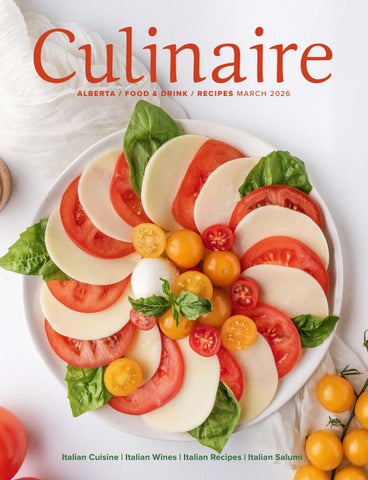
Oh how we loved our cover photographer, Katarzyna Kowalewska’s suggestions for our Italian-themed cover this issue! Playing into the red, green, and white colours of the Italian flag, a Caprese salad is the perfect summation of Italian ingredients – tomatoes, basil, and mozzarella! Thaks so much Kasia, for bringing it to life so dynamically!
9 School’s Out
…The real impact of Olds College ending its craft brewer program. by Tom
Firth
One of the simplest (and tastiest) pasta dishes ever - cacio e pepe. by
Renée Kohlman
20 Simply Italian
Four Italian recipes that rely on a small number of ingredients prepared in a way that highlights one main item! by
Natalie Findlay
22 Mangia, Mangia
UNESCO names Italian cuisine to their prestigious list. But what does that mean to Italian-Canadians? by Shelley Boettcher
26 Tenacious Edmonton entrepreneur doesn’t need an olive tree …in her backyard to make a business dream come true. by Lucy Haines
28 Salami : Salumi!
What’s the difference between salami and salumi? We’ve focused on a bakers’ dozen different Italian meats to explain! by Quinn Curtis
32 The Magic of Port (Part Two)
Port is a very versatile wine, coming in an array of styles and price points. by David Nuttall
36 March Spirits - Off the Rails
We dared each other to share some different things. by Tom Firth and Linda Garson
Here it
is!
Back by popular demand – our fifth Italian-themed issue.
There are so many countries with significant cuisines and beverages to focus on, that after four Italian-themed issues, we thought we’d share the love, and looked to Japanese, Mexican, Filipino, and Spanish cuisines… but there’s a lot more Italian culture and cuisine that we haven’t covered yet!
With the timing of the MilanoCortina Olympics, along with the very many new Italian eateries opening up in Alberta last year, we knew it was time to focus on Italian cuisine again - and here we are, our fifth Italian-themed issue!
It was also perfect timing, as I was invited to the 10th anniversary edition of Grande Langhe and Piedmont Wine, the most important trade show of the region, in Turin a week before the Olympics – to taste wines from more than 500 Piedmont wineries, many of which will be on our shelves in the next few months. And what an amazing
experience that was to be back in northern Italy, enjoying the food and tasting the wines of the region for just two days before zipping back to Canada!
I’m so thrilled to hear from many of you that you loved our photo of Kasia’s Baked Brie and Bread Wreath on our December cover, and requested the recipe as highlighted in our January/February issue –we were overwhelmed with the response to this that we have now included the recipe on our website at culinairemagazine.ca to check it out for yourself!
Cheers
Linda, Editor-in-Chief
Here’s just one of the many absolutely lovely emails we received requesting the Baked Brie and Bread Wreath recipe:
“My mother (European) used to make this bread (bun) ring when I was growing up with my siblings. She eventually stopped when we left home. We never had a recipe as she always made it from memory.
To see this Bread Ring on the cover of your magazine brought back the kitchen smells of my youth with so many warm memories.
I would love to have a copy of Katarzyna Kowalewska’s recipe with thanks to her for making it and producing such a stunning photo for your cover.
With thanks and hoping I can reproduce it somewhat honourably,” Rosemary R
Confederacy (Siksika, Kainai, Piikani), the Tsuut'ina, the Îyâxe Nakoda Nations, the Métis Nation (Region 3), and all people who make their home in the Treaty 7 region of Southern Alberta. We are committed to support Indigenous chefs and amplify their voices to bring awareness of the food and culture of the First Nations.
Congratulations to Alberta Food Tours who are celebrating their 20th anniversary on March 18. They’ve planned to mark the occasion with giveaways, prizes, and a birthday party, all at albertafoodtours.ca
Alforno is celebrating 10 years since opening their Italian-inspired café in Calgary’s Eau Claire – and they’ve not stopped since. Now you can get your bread, pastries, coffee, pastas, pizzas, and grab-and-go food, at two new locations: 707 5th Street SW café and CF Chinook Centre, and their 7th location is opening soon in Calgary’s West District, at 780 78 Street SW! alforno.ca
You’re still in time to snag a reservation at Emerald Lake Lodge’s Sky Dome! Chef Valerie Morrison’s outstanding six-course blind tasting menu with wine, cocktail, and mocktail pairings, is available until the end of the month. Truly memorable mountain dining! crmr.com/resorts/emerald-lake
Happy Lamb is serving up all-youcan-eat hot pot in Edmonton at their newest location. The franchise from China offers six different, authentic, freshly made soup broths, accompanied by over 70 add-in ingredients! Choose your broth, then head over to the selfservice area to pick up your veggies, eggs, and noodles, and order from the wide selection of meats, like England prime lamb brisket, supreme wagyu, or pork.
Spruce Meadows’ Foxtrot is open and ready for you, in a striking, purpose-built building with huge windows overlooking the International Showjumping Ring. With Chef Matthias Fong leading the kitchen, you know you’re in for carefully conceived and beautifully presented plates. They’re dry aging duck, fish, and steak, and cooking with fire (Charcoal Roasted Sablefish and Wood-Grilled Caesar Salad!) with must-try refined comfort food dishes of Burrata “Scotch Egg”, Black Truffle Rolled Lasagna, and plenty more, accompanied by a well-curated wine list (with library wines too!) and cocktails. There are so many reasons to visit Foxtrot; the restaurant is gorgeous, with cleverly designed branding and features (flowery wallpaper on the ceiling and a monocled moose!), led by restaurant director David Singleton. And downstairs is Café Foxtrot for coffee and quick bites. Seven days from 11:30 am, Monday/ Tuesday from 4:30pm, foxtrotyyc.com
DRTY Ice Cream has opened a second location in downtown Edmonton! If you’ve never tried it, don’t worry – the ice cream isn’t actually dirty. Filipino locals called sorbetes “dirty ice cream” as a joke, and the name stuck. Known for regionally inspired flavours like ube, jackfruit, and avocado, everyone’s favourite Filipino ice cream
joint is now open north of the river, and you can get your fix of Filipino sorbetes inside Foosh at 10150 104 Street NW. Saturday 12pm-9pm, Sunday 1pm6pm, and limited hours on Wednesday. drtyicecream.ca
The wait is over Calgary! Highly anticipated Francine’s is now open, and if you enjoyed their 2024 pop-up, you’ll be delighted by Garrett Martin and Nate Wry’s new 48-seat French bar (they’re keen for you to know it’s not a bistro or brasserie). It’s dark, cool, and exciting, with a small menu of familiar pop-up dishes (yes, Ham & Chips, and the insanely good, Steamed Cheeseburgers are here!) and wonderful new additions, some from Chef de Cuisine Laetitia Chrapchynski, like our star dish of Smoky Trout & Crêpes with vermouth sauce. Drinks are important here, with Wry’s creative twists on classic cocktails, as well as an all-French wine list and mostly Alberta beers. Choose a seat at one of the two bars to watch the kitchen or beverage action! 306 Centre Street S, lunch and dinner weekdays, Saturdays from 3pm. francines.ca
Inside Station Park, Edmonton’s first shipping container and microretailer development, is new grilled cheese restaurant Cheese Louise, serving up classics and customized grilled cheese sandwiches including the “Pickle Vick” (with house-made pickle
aioli) and of course, tomato soup. Perfect for those who want to rock and roll and grab a cheesy treat, plus with their ‘Feed It Forward’ board, you can donate $5 toward a free classic grilled cheese for someone in need. 8125 Gateway Boulevard, Wednesday to Sunday 11am-late. @cheeselouiseyeg
Marugame Udon, has opened their second Canadian location in CrossIron Mills. The new 50-seat, fast-casual Japanese noodle joint has a theatre-style kitchen so you can watch the whole udon-making process and your Sanuki-style bowls prepared in front of you - and they are really good! The small menu includes your choice of Kake Udon, BK Sauce and Nikutama Udon, and Chicken Katsu Curry, as well as rice bowls, crispy chicken, and so many choices of tempura! (Don’t miss the egg, pumpkin, and squid tempura). And they want you to know it's all msg-free! Seven days, lunch and dinner. ca.marugame.com
For all the sweet tooths out there, COSW Cookie Shop has opened in the former Rock n Roll Ice Cream space at 10109 108 Avenue NW in Edmonton. Handmade cookies are baked fresh daily and come in mouth-watering flavours like Biscoff Oreo Brownie, Pistachio Knafeh Cookie, and many more. They also sell a variety of drinks, including coffee, mochas, and cappuccinos. This home bakery-turned-storefront is perfect for an after-dinner treat or a mid-day sugary pick-me-up. Monday-Saturday, 10:30am-1:30am. cosw.ca
You can now find Flat Boy Burgers inside Edmonton’s Seachange Brewery. The new location is serving up their iconic smash burgers, fries, milkshakes, and more. Grab a single, double, or triple flatty with classic burger toppings, and be sure to try their signature flat sauce. For those with a sweet tooth, Flat Boy is also serving up decadent milkshakes and even key lime pie. And don’t forget the side shtickle (their novelty-sized pickle on a shtick). Perfect for date night or a fun outing with friends, at 5302 50 Street. 11:30-10pm and until 1:00am Fridays and Saturdays. flatboyburgers.com
sunday - thursday 5-6pm
The Artist's Lounge
Marinated Spanish Olives
BY LINDA GARSON
We love receiving emails from you to let us know of memorable dishes you’ve enjoyed in Alberta restaurants, and you want to try and make them yourself in your own kitchen for your family and friends.
We’re regularly impressed with the calibre of chefs in our restaurants, and the dishes they create – and consider ourselves very lucky to live in a province with so many quality choices, and to suit all pockets, when we want to dine out.
We recently received an email from Lynn I, who had attended a dinner at The Artist Lounge, in Calgary’s northwest Capitol Hill neighbourhood. The restaurant is inside The Ruberto Ostberg Gallery, where you dine and drink surrounded by art. It’s a casual, tapasstyle menu, with small snacks and larger bites for sharing.
“We really enjoyed the Marinated Spanish Olives at The Artist's Lounge. Would we be able to get the recipe?” she asked.
We know ourselves how delicious those olives are from our visits to the gallery, so we had no hesitation asking if chef would disclose how he makes them.
Many thanks to Chef Zack Morine and the team at The Artist's Lounge for generously sharing this recipe for their super tasty olives!
The Artist's Lounge Marinated Spanish Olives
Serves 2 or 4 for snacking
1 cup (250 mL) brined olives of choice, drained (chef recommends a Sicilian blend)
¼ cup raw garlic cloves, peeled and crushed
¾ tsp chili flakes
1 Tbs sundried tomatoes, chopped
If you have had a memorable dish in an Alberta restaurant that you would like to try and recreate at home, please email us at info@culinairemagazine.ca, and we’ll do our very best to try and track it down for you!
1½ tsp fresh rosemary, chopped
1½ tsp fresh thyme, chopped
¾ tsp cracked black pepper
½ lemon, zest and juice
2 Tbs (30 mL) olive oil
1. Add all the ingredients to a large container, and mix well to evenly distribute the flavours.
2. Leave to marinate for 24 hours, and serve at room temperature for best results.
School’s Out
BY TOM FIRTH
The news that Olds College is ending its craft brewer program isn’t that new, but the impact of this is far more than staff members laid off and there not being a world-class, nearly unique program being offered here. We know many of the graduates, and we’ve recently talked to several of them to ask their thoughts on the program.
In 2013, when Olds College started the craft brewing program – the time was right, the production minimums that had held back craft brewing (and distilling) in Alberta had been effectively removed, allowing a craft producer the opportunity to start a brewery or distillery that could make as little (or as much) as they could and still be a successful business. Alberta positively exploded with breweries, distilleries, cideries, mead, and wine producers, riding a craft boom that was pretty damn awesome.
Olds College, with its strong background in agribusiness, was a perfect place to start up a program like this, with high quality water from the Rockies, locally grown wheat and barley, and a pool of educated, experienced brewers. So the news that intake for the program was suspended last year, with its in-house brewery going silent as well, is a blow to the industry.
The real loss is the lessening of the sense of community for
brewers. We are extraordinarily lucky that generally brewers and breweries in Alberta get along – understanding that a high tide floats all boats. As consumption trends for alcohol are changing, and many consumers are drinking less often and in smaller amounts, it’s a tough time for craft producers, and having a community of brewers pushing the envelope and refining the selections we enjoy is a net loss we won’t really miss until it’s long gone.
It doesn’t stop the closure of the Olds College program, but it is as important as ever to visit that local taproom, try those Albertamade beers, or visit that patio, and if it’s not a brewery or producer, ask what’s locally made - there is a very good chance it’s proudly made by someone from Olds College.
SIP,
SAVOUR APRIL 11 , 2026
Elevate your night out at Stampede Cellar Uncorked! An evening of crafted cuisine from Alberta’s top restaurants, featuring locally grown ingredients and perfectly paired with the champion wines from the Stampede Cellar Showdown International Wine Competition.
Tickets on sale now!
A A Tavola
tavola, non si invecchia is an Italian saying that means ‘At the table, one does not grow old.’ Think long lunches with friends, appetizers that turn into meals, and dinners that stretch long into the evening,
full of conversation and laughter.
BY KEANE STRAUB PHOTOS BY DONG KIM
Chefs from some of Alberta’s best Italian establishments have shared their favourite recipes with us, creating a menu built on authentic flavours and traditional techniques. Antipasti, insalata, pasta,
The experience at Edmonton’s Rita Trattoria is simple: pasta, wine, and atmosphere, and this is where chef and co-owner Micha Joffe gets his inspiration. “My cooking is heavily rooted in regional Italian cuisine of the North and South,” he explains. “I’m constantly inspired by the simplicity and passion of traditional Italian home cooking.”
Half antipasti and half pasta, the menu is built for sharing as you’d be hard-pressed to pick just one or two items. For Chef
Micha, it’s a tie between the Linguine Vongole and the Prawns Diavola.
When you’re choosing dishes for antipasto, he says it’s important to choose something that doesn’t take too much effort to prepare, leaving you more time to engage with your guests. “Prawns Diavolo has big flavours, but it’s simple,” he says. “It can be prepped a day in advance and only requires a few high-quality ingredients and five minutes of cooking.”
A last-minute creation by Chef Micha and Chef Daniel Costa, it is now a mainstay on Rita’s menu and perfectly suited for both cold-and-warm-weather entertaining. Preheat your oven or grill as hot as you can get it, give yourself a day to let the prawns marinate, and note that when you’re cooking, things could get a little smoky. “Char is your friend, so don’t be afraid of a little blackening around the edges.”
frutti de mare, and dolce are all here, along with pizza – you didn’t think we’d do an Italian issue without pizza, did you? Gather your loved ones, remember that simplicity is key, and enjoy – buon appetito!
Rosemary, Chili, and Orange Prawn Marinade and
Grill
Serves 2 - 4
454 g shell-on prawns (13-15 count)
4 Tbs (60 mL) extra virgin olive oil
1 tsp crushed red chili flakes
1 clove garlic, grated
1 orange, zested (avoid the white pith)
2 sprigs fresh rosemary leaves, roughly chopped
To taste salt
1. In a large bowl, rinse the shell-on prawns, remove any veins and pat them dry with a paper towel.
2. In the same bowl, combine the olive oil, chili flakes, grated garlic, orange zest, and chopped rosemary leaves.
3. Add the prawns to the marinade and toss to ensure they are fully coated. Cover the bowl and refrigerate.
4. Marinate a minimum of 30 minutes to allow the flavours to infuse. If you can, start a day ahead of time and marinate overnight for the best flavour.
5. Preheat your oven or grill to the highest possible temperature. This is a good time to season your prawns generously with salt.
6. Place the prawns directly on the grill or on a very hot pan. Cook for 2-3 minutes per side. The shells should turn bright red, and the meat should be opaque. Don't be afraid of a little blackening around the edges.
7. Transfer the prawns to a platter and squeeze the juice of the zested orange over them just before serving.
Edmonton’s Nero is a love letter to Italian food and culture, and where Executive Chef Kunal Sawhney executes a menu driven by technique and ingredients. Inspired by the quality of ingredients he sources from local producers, he says, “When you start with great ingredients and apply solid technique, you can let the product speak for itself and create something really beautiful.”
It’s no surprise that his favourite dishes from the menu are focused more on technique, like the octopus, which he calls a “beautiful ingredient, but also temperamental,” and pasta. “I think most chefs have a lifelong love affair with handmade pasta.”
Insalata should be kept simple, but Chef Kunal reminds us that when a dish has only a few ingredients, quality means everything. Here he shares the recipe for Insalata Panzanella, a simple tomato and bread salad with an herbaceous dressing. “This is rooted in classic Italian flavours but still feels fresh and modern.”
“Choose the best produce you can find and let those flavours shine instead of overcomplicating things,” he says. Use ripe Campari tomatoes (the dish depends on them), and don’t rush the croutons –you want crispy on the outside, soft on the inside. “Taste and season at every stage,” he adds. “Small adjustments make a big difference.”
Insalata Panzanella Serves 2
Mint Basil Verde
25 g anchovies
1 clove garlic
2 Tbs + 1 tsp (35 mL) red wine vinegar
¼ cup picked mint
¼ cup picked basil
1 cup (250 mL) extra virgin olive oil
To taste salt
Place anchovies, garlic, and red wine vinegar in a blender and blend until smooth to ensure no large pieces of garlic or anchovy in a single bite. Stop the blender and add mint and basil. Blend on medium speed. Slowly stream in the olive oil until you reach a chunky, salsa-like texture. Season with salt. Store refrigerated for up to 5 days.
Tear the fior di latte into small pieces. Place with goat cheese and buttermilk in a food processor and blend until the mixture doubles in size and becomes light and airy. Season with salt. Store refrigerated for up to 3 days.
Croutons
2 cups stale sourdough bread, torn
½ cup (120 mL) olive oil
5 Tbs (75 mL) sherry vinegar
1 Tbs salt
1 Tbs black pepper
Tear bread into bite-size pieces. Stale bread works best as it absorbs dressing later. Toss with olive oil, sherry vinegar, salt, and pepper and spread on a lined baking sheet. Bake at 375° F until crispy outside with a soft interior. Cool and store in an airtight container at room temperature for up to 2 days.
Salad
2 cups Campari tomatoes, halved 2 cups croutons
½ cup (125 mL) mint basil verde
1 cup (250 mL) whipped fior
6 leaves mint
6 leaves basil
5 Tbs (75 mL) aged balsamic vinegar
7 cracks black pepper
To taste salt
In a mixing bowl, combine tomatoes and croutons. Dress with mint basil verde and season with salt. Spoon whipped fior onto a flat plate and spread into a base using the back of a spoon. Arrange the dressed tomatoes and croutons over the whipped fior. Garnish with mint, basil, a drizzle of aged balsamic, and freshly cracked black pepper.
Osteria Chef’s Table has been a fixture of Calgary Italian cuisine for quite some time. As Executive Chef Michele de Cesare explains, “Our commitment is to create the most traditional Italian recipes using the best quality local ingredients.”
When most people think of Italian cuisine, their first thought goes to pasta: it’s classic, comforting, and approachable. Osteria’s menu has it all, Gnocchi Gorgonzola to Nonna’s Spaghetti and Meatballs. For Chef
Michele, either of these, and everything between, are his favourites. “As a good Italian, pasta is part of my DNA.”
Hailing from the Italian province of Molise, he shares a popular dish from the area which he describes as simple, but tasty and filling. Keep an eye on cooking times: “It’s extremely important when it comes to making pasta. You must keep it al dente.” His final words of wisdom? “Cooking at home should always be fun!”
1. Bring a pot of water to the boil, add a pinch of salt, add in the pasta and cook for 7 minutes.
2. In a frying pan start cooking the guanciale slowly.
3. Sauté until the guanciale becomes golden and crispy.
4. Toss in a cup (250 mL) of water from the pasta pot, lift out the pasta from the remaining water and add to the pan, then add the butter and shredded caciocavallo.
5. Gently mix everything together until the cheese becomes creamy.
6. Add fresh pepper and salt to taste.
Now, your dish is ready to be plated!
While pizza isn’t exactly a ‘course’ in Italian cuisine, we knew we couldn’t exclude it. And when it comes to pizza in Calgary, one of the best places for an authentic Neapolitan pizza experience is Pizza Culture. Founder and pizza maker Jeremy Hube’s cooking is rooted in traditional Italian techniques. “I’m inspired by restraint, repetition, and respect for ingredients – doing fewer things but doing them properly and consistently.”
With two dozen pies to choose from, Hube keeps it simple when choosing a favourite. “It has to be the D.O.P Margherita. It’s the most honest pizza on the menu and the clearest reflection of quality. There's nowhere to hide – the dough, fermentation, balance and bake all have to be right.”
When it comes to making pizza, keep an eye on temperature control and don’t rush the fermentation. Focus on consistency, rather than complexity, and use minimal, authentic ingredients which are widely available at Italian grocery stores in Alberta.
“Great pizza isn’t about excess,” Jeremy adds. “It’s about balance, technique, and the quality of ingredients.”
This recipe is based on the guidelines of the Associazione Verace Pizza Napoletana (AVPN), adapted specifically for home cooks using a high-heat home pizza oven (such as an Ooni oven or equivalent).
Traditional Neapolitan Margherita Pizza
Serves about 4 (makes 4 pizzas)
Dough
4 cups (1 litre) warm water
2-3 g fresh yeast
1.6–1.8 kg Italian "00" flour
50 g fine sea salt
1. Dissolve the yeast in the water in a bowl.
2. Add 10% of the flour, and mix. Add the salt.
3. Gradually incorporate the rest of the flour until a soft, smooth dough forms. Knead until cohesive and elastic (about 12–20 minutes by hand).
4. Leave to ferment at room temperature for 2-4 hours.
5. Divide into 4 x 250 g dough balls, cover, and rest for a further 10 to 20 hours at room temperature.
Alternative: Home cooks can also purchase ready-to-bake dough directly from Pizza Culture if they prefer to skip the dough-making process.
Toppings
350–400 g hand crushed San Marzano tomatoes
350–400 g fior di latte mozzarella, torn and drained
Fresh basil leaves
Extra virgin olive oil
Fine sea salt to taste for the crushed San Marzano tomato sauce
Grated hard cheese such as Grana Padano, Parmigiano Reggiano, or Pecorino Romano
1. Preheat your pizza oven to approximately 450° C.
2. Gently stretch the dough balls by hand into 25 cm rounds – no rolling pin.
3. Spread tomatoes on each dough.
4. Add 5-7 g of grated hard cheese.
5. Add mozzarella, basil, and finish with a drizzle of extra virgin olive oil.
6. Bake for 60–90 seconds, rotating as needed, until the crust is puffed and lightly charred.
Calgary’s Teatro is a long-standing embodiment of Mediterranean cuisine rooted in Italian tradition. Seasonality plays a big role in Chef Camilo Kobek’s cooking both in the restaurant and at home. “I’m inspired by what’s coming up next, and in Calgary that usually means mid-July through August,” he explains. There’s a joyfulness to his craft, too. “I often think the greatest part of being a professional cook is that I get to be a kid all day, playing with the toys I always wanted.”
Chef Camilo, who is originally from Chile, says there’s strong Italian influence when it comes to Latin American cuisine, and is evident in the lamb shank, his favourite menu item. “It’s rustic yet elegant, and built on strong foundational technique.”
His recipe for Branzino with Tomato Fondue and Salt-Crusted Potatoes is a blending of Italian and Chilean culture. “This dish allows me to showcase that cultural overlap. It feels like a true representation of who I am as a cook.”
His only tip for this recipe? Give yourself a day to dry the fish skin-side up in the fridge. “It helps achieve a beautifully crispy skin, and it’s well worth the wait.”
Whole Branzino with Tomato Fondue and SaltCrusted Potatoes
Serves 2
Salt-Crusted Potatoes
500 g new potatoes
Generous handful salt
Add new potatoes to a pot of hot water. Season the water heavily with salt, it should taste like the ocean. Bring to a boil and cook until the water
has completely evaporated. Once dry, the potatoes will be left coated in a crystalline salt crust.
Roasted Garlic
1 whole garlic bulb
Olive oil
Thyme
White wine vinegar
Preheat the oven to 375° F.
Cut the top off the garlic bulb using a paring knife. Place in foil and drizzle with olive oil, add a couple of fresh thyme sprigs, seal tightly, and roast for 1 hour. Once roasted, gently push the cloves out from the bottom of the bulb, trying to keep the cloves whole. Allow the garlic to cool slightly in a small amount of white wine vinegar to cover.
Tomato Fondue
30 g white onion
10 g garlic
2 Tbs (30 mL) sherry vinegar or red wine vinegar
½ cup (125 g) tomato paste
2½ cups (600 g) canned tomatoes
2 Tbs (30 mL) olive oil
1 bay leaf
1–2 sprigs thyme
To taste salt
1 white onion for garnish
Parsley for garnish, chopped
1. Sweat the onion and garlic gently in olive oil. Add the remaining ingredients and cook down until very reduced. Transfer to a food processor and blend, keeping the sauce slightly chunky. Adjust seasoning with vinegar and salt as needed.
2. Once the sauce is to your liking, gently chop the roasted garlic cloves and fold into the sauce, allowing some larger pieces to remain. Finish the sauce with a drizzle of good olive oil.
3. Slice onions into 1 cm thick slices. Run them under cold water while gently crushing them with your hands to mellow their flavour. Toss with chopped parsley and set aside.
Branzino
1 whole branzino, scaled and filleted
To taste salt
1. Place the fish skin side up in the refrigerator overnight to dry.
2. When ready to cook, oil the skin generously and season heavily with salt.
3. Grill over high heat until the skin releases naturally and develops a light char.
4. Finish in a 375° F oven for approximately 3–4 minutes.
5. Serve hot with the tomato fondue, and finish by placing the onion garnish over the fish. enjoy with loved ones.
At Calgary’s La Torino, Chef Binu Simon creates a sense of warmth and togetherness with everything he cooks. “Food has always been a way to connect with people, and seeing guests enjoy my cooking is what continues to motivate me after more than 20 years as a chef.”
Dishes like Seafood Fettuccine and Pistachio Crusted Lamb rank high on his list of favourites, and they’re among the most popular dishes for guests, too, highlighting bold flavours and quality ingredients. “And,” he adds, “they consistently leave the guest satisfied.”
The concepts of balance and simplicity in Italian cuisine carry through to this final course of our Italian feast, showcased in Chef Binu’s Lemon Cheesecake. It’s a fairly straightforward recipe, but one that is refined enough to be restaurantworthy. “This is one of my personal favourites. The tangy brightness of the lemon paired with a cool, crisp crust, and served with a basil ice cream, creates a dessert that’s refreshing, balanced, and memorable.”
Ensure your ingredients are room temperature. Mix things gently, and don’t rush the process. “Cheesecake rewards patience,” he adds. “Let it cool completely, chill it properly, and always taste as you go to achieve the right balance of flavours.”
Lemon Cheesecake Serves 4
A bright, creamy cheesecake with a crisp crust, finished with fresh lemon for balance and freshness. Best served chilled and paired with a basil ice cream.
Graham Cracker Crust
¾ cup plus 1 Tbs graham cracker crumbs
¼ cup unsalted butter, melted
1 Tbs sugar
Preheat oven to 325° F. Combine graham cracker crumbs, melted butter, and sugar. Press firmly into the base of a greased 15 cm springform pan. Bake for 10 minutes and let cool.
Cheesecake Filling
1½ cups (375 g) cream cheese, room temperature
½ cup sugar
1 Tbs plus 1 tsp all-purpose flour
1 lemon, zested
¼ cup (60 mL) fresh lemon juice
½ tsp (2-3 mL) vanilla extract
1 large egg plus 1 egg yolk, room temperature
1. Beat cream cheese on low speed until smooth. Add sugar and flour, mixing gently.
2. Add lemon zest, lemon juice, and vanilla. Mix until just combined.
3. Add the egg and yolk, mixing slowly. 4. Fold in sour cream until smooth. Avoid overmixing.
5. Pour filling over cooled crust. Bake for 40–45 minutes, until the edges are set and the centre has a slight wobble. Turn off oven, crack the door open slightly, and let cheesecake cool gradually for 1 hour.
6. Refrigerate for at least 4 hours before serving.
⅓ cup plus 1 Tbs (100 mL) sour cream
Keane Straub has travelled from Tofino to Charlottetown, sampling the different flavours Canada offers. The passion people have for their craft and culture inspires Keane to tell their stories.
If you grew up in Calgary, you likely remember the original Lina’s as a sort of delicious, chaotic secret. Tucked away on Centre Street in 1993, it was a modest 800-square-foot deli where the air was thick with the scent of aged provolone and freshly pulled espresso. It was the kind of place where you’d elbow past neighbors to grab a sandwich that tasted exactly like a summer in Abruzzo.
Fast forward thir ty years, and that single storefront has blossomed into a local empire. With five diverse locations and two distinct restaurant concepts, Lina’s has managed to do something few brands achieve: grow massive without losing its "Nonna" soul.
Authenticity: From Italy to Your Pantry What keeps the brand grounded is a travel itinerary. Every year, the leadership team takes a trip to Italy for one purpose: Direct Sourcing Scouting missions to find niche products and regional gems that simply don't exist in the "International" section of a big-box grocer. This commitment bridges the gap between heritage roots and modern-day shopping
The brand’s DNA remains unshakable regardless of the setting. You feel the same dedication to quality in the sleek, 25,000-square-foot Market Hall at Deerfoot City, as you do in the cozy, historic corners of the Tuxedo Park original: high-quality European staples selected with the care of a boutique, but the convenience of a supermarket.
More Than a Market: The Restaurant Evolution
While the markets fuel your home cooking, Lina’s has also carved out a permanent seat at Calgary’s dinner table with two specialized restaurants:
Lina’s Trattoria: situated next to the original market, it’s a tribute to traditional Italian dining. Think handmade pastas and the kind of recipes that feel like a warm hug.
L’Olivo Cicchetti and Lounge: located in Inglewood, inside Lina’s Piazza, this spot introduces Calgary to the Venetian ritual of cicchetti (small plates). It’s social, trendy, and sophisticated.
A Legacy Built on Community
Beyond the food, Lina’s has anchored itself in the community through deep-rooted partnerships that fuel the neighborhood. Whether it’s through local pizza fundraisers that support children’s health, or opening their doors to create retail training opportunities for newcomers, the brand treats the city like one big extended family.
Lina’s is the living proof that as Calgary grows up, it doesn't have to grow apart. It’s a bridge between the city we were in 1993 and the international hub we are becoming. A modern success story that still, at its very core, smells like home-cooked sauce and feels like family.
linasmarket.com | @linasmarket
Eat it While it's Hot!
STORY AND PHOTOGRAPHS BY RENÉE KOHLMAN
We’ve all been there. It’s been a long day and you’re starving. You haven’t done the grocery shopping and do not want to order take-out again. Then you
remember you have a box of spaghetti in the pantry and a hunk of Pecorino Romano cheese in the fridge. It’s decided. You’re about to make one of the simplest (and tastiest) pasta dishes
ever - cacio e pepe.
Yes, you’ve read that correctly. Cacio e pepe relies solely on pasta, black pepper, and Pecorino Romano cheese to join forces and create a deceptively simple
yet incredibly satisfying dish. It’s a Roman classic for a reason! The finely grated cheese, coarsely ground black pepper, and starchy cooking liquid combine to form a creamy emulsified sauce (without using any cream) that coats the spaghetti beautifully.
The word cacio is Roman dialect for cheese, while pepe means pepper in Italian. It’s likely that this pasta dish originated with the Roman shepherds who traversed the countryside, nonperishables in tow, as they moved around the hills and valleys with their grazing flocks. By the mid 20th century, cacio e pepe had made its way into the cities, where it was particularly popular in trattoria. The salty cheese and copious amounts of black pepper likely prompted diners to order more wine to wash it down. Such a clever business move!
While there are just a few ingredients to this pasta, the real success of this dish relies on technique. Warming the freshly ground black pepper in olive oil may not be traditional, but it does enhance the pepper’s flavour profile, making it more complex and a tad sweet, which in the end makes for a more aromatic dish.
Cooking the pasta in a small amount of water concentrates the starch, which produces a creamier consistency to the sauce. Speaking of which, be sure to use Pecorino Romano for this pasta, and it must be very finely grated so it melts quickly and smoothly in the sauce. I like to use a microplane for this, but the smallest hole on a box grater should do the trick too.
This is a dish that I make when I’m feeling tired and lazy, and I can’t be bothered to use a colander to drain the pasta. Tongs work just as well! Once the hot pasta is dropped into the skillet of hot olive oil and coarsely ground black pepper, it’s a matter of beating in the cheese with small amounts of pasta water until a smooth, creamy sauce coats the spaghetti. This isn’t a fancy plate of pasta - it’s more of a snack to soothe the soul. And the best bites are those first few eaten out of the skillet as you carry it from the stove to the dinner table. Heck, you just might want to eat the whole thing like that.
Cacio e Pepe
Serves 4
3 Tbs (45 mL) extra virgin olive oil, divided, plus more for drizzling 1½ tsp coarsely ground black pepper, or to taste
350 g spaghetti
To taste salt
2 Tbs salted butter
1. Heat 2 Tbs (30 mL) of olive oil in a large skillet over medium-low heat. Stir in the black pepper and cook until the pepper begins to sizzle, about 1-2 minutes. Set aside.
2. In a large pot, bring 7 ⅔ cups (1.9 L) of water and a generous pinch of salt to a rapid boil. (You’re using less water than usual to boil the pasta so that the water becomes very starchy, which is key to the consistency of the sauce.)
3. Add the spaghetti to the water. You want to intentionally undercook the pasta because it will finish cooking in the sauce, therefore reduce the cooking time by 2 minutes according to package directions. It should be very al dente. Remember to reserve the cooking water.
4. About a minute before the pasta is ready to be removed from the pot, heat the skillet once again over medium-low heat. Add ¼ cup (60 mL) of pasta water to the skillet along with the butter. Bring to a simmer. Using tongs, add the spaghetti to the skillet, stirring with a fork as you go.
5. Add the cheese and remaining tablespoon (15 mL) of olive oil to the spaghetti, as well as another ¼ cup (60 mL) of hot pasta water. Continue stirring until the cheese is completely melted, adding more pasta water as needed to adjust consistency, until the sauce is creamy and coats each strand of spaghetti.
6. Season to taste with salt and more black pepper. Divide into bowls, drizzle with olive oil, and top with more grated cheese. Serve immediately.
Renée Kohlman is a busy food writer and recipe developer living in Saskatoon. Her two cookbooks ‘All the Sweet Things’ and ‘Vegetables: A Love Story’ have won awards and been on best-of lists.
Simply Italian
STORY AND PHOTOGRAPHS BY NATALIE FINDLAY
Italian cuisine is based on simple, local, and readily available ingredients of high quality. This is why seasonal foods are so important to Italian cooking.
While there is no single “Italian cuisine”, each region reflects food that is based on geography, climate and history. Examples of regional specialities: Liguria - pesto Genovese and focaccia. Tuscany - olive oil, beans, bistecca alla Fiorentina. Campania - Pizza Napoletana, Mozzarella di Bufala, tomatoes. Sicilycitrus, seafood, almonds, capers, arancini,
cannoli. Coastlines favour seafood, inland leans more towards meats, vegetables and legumes.
As you can see by the recipes below, they typically rely on a small number of ingredients prepared in a way that highlights one main item. Recipes aren’t heavily seasoned, they rely on the freshest ingredients and techniques to bring out the best in the product, each town laying claim to unique recipes. Families have their own way of making the “same” dish. Not better or worse, just different.
As much as regional and fresh is a
backbone of Italian cuisine, how the food is eaten is also distinctive. Meals are structured, social and unhurried. Food is not only sustenance, it reinforces tradition, family, and connection. Hours pass as you slowly enjoy a series of “piatti” (courses): “antipasto, primo, secondo, contorno, and dolce”, sharing stories, laughing, and being in the company of family and friends. This is truly what Italian cuisine is made of. May your meals be good enough, “Da leccarsi i baffi” - “to lick one’s whiskers”.
Whole Sweet Peppers with Anchovies
Serves 4 as an antipasto
8 small sweet peppers
8 anchovies
½ Tbs (7 mL) olive oil
Pinch sea salt
1. Preheat oven to 425º F.
2. With a pairing knife, cut out the stem and core of each pepper. Insert one anchovy fillet into the cavity of the pepper.
3. Add the olive oil to a small pan and add the peppers in a single layer (they can fit snugly). Roast the peppers until blistered, approximately 15-20 minutes. Remove from oven.
4. Sprinkle with sea salt (only if necessary, anchovies are salty).
Note: these are also great tucked into 2 slices of bread along with Soppressata or another kind of Italian salami.
Mushrooms with Garlic and Tomato
Serves 4 as an antipasto
400 g mushrooms
3 Tbs (45 mL) olive oil
3 cloves garlic, finely chopped
1 tsp sea salt
1 cup cherry tomatoes, halved Parsley and La Bomba or hot peppers for garnish
You can make this dish with any mushroom. If you can get oyster, porcini, and or chanterelles - even better.
1. Use a mushroom brush to clean off any dirt on the mushrooms. Trim any tough parts from the stems or remove stems if desired. You are looking for the mushroom pieces to be roughly the same size. Depending on which mushrooms you choose, roughly cut into 6 mm pieces.
2. Over high heat, in a large sauté pan,
heat the oil. Add the mushrooms and season with salt. Refrain from stirring the mushrooms until steam begins rising from the pan. You want the mushrooms to sear and if you stir too soon, they will release too much liquid. Cook the mushrooms until their liquid starts to evaporate, about 10–12 minutes.
3. Add the garlic and cook 1 minute further. 4. Add the cherry tomatoes and cook for about 5 minutes.
5. Adjust seasoning and serve topped with parsley and a drizzle of “La Bomba” (a spicy Italian pepper mixture).
Note: Great served with grilled sausage or meat. Can also be stirred into pasta or risotto. Or served on toasts.
Eggplant
Serves 4 as antipasto
300 g eggplant
¼ cup (60 mL) olive oil
Sea salt and black pepper
2 Tbs capers
¼ cup parsley, finely chopped
1 clove garlic, finely chopped
1. Preheat oven to 425º F.
2. Season eggplant on a rimmed baking sheet with salt and pepper.
3. Drizzle with olive oil (more if it still looks thirsty).
4. Roast, flipping the eggplant once, until deeply browned on both sides, For about 35-40 minutes.
5. Remove eggplant from the oven, transfer to a serving plate or platter. Scatter with garlic, capers and parsley, and finish with more olive oil if you like.
Potato Pasta
Serves 4
2 Tbs (30 mL) olive oil
4 slices speck
177 g guanciale (or pancetta or bacon)
12 cm leek, white part only, thinly sliced
300 g russet potatoes, peeled and cubed into 10 mm cubes
240 g spaghetti
100 g ricotta (or ricotta salata)
Freshly ground black pepper and sea salt
Pecorino cheese to garnish
1. Heat olive oil over medium heat in a large skillet. Add the speck and let it get crispy. Remove and reserve.
2. Add the guanciale (or its substitute) to the skillet and let it cook for 3 minutes.
3. Add the leeks and cook for 3 minutes. Add the potatoes and cook for a minute to coat with fat.
4. Then add 2 cups (500 mL) water. Bring to a simmer and cook uncovered until the potatoes are soft enough to mash with a fork (about 10 minutes). Mash the potatoes in the skillet and remove from the heat.
5. Meanwhile, in a large pot, bring 3 litres of water to a rolling boil. Add the spaghetti and cook until al dente.
6. Return the skillet to the heat.
7. Reserve 1 cup (250 mL) of the pasta water then lift the pasta out of the pasta pot (and any water that comes with it) and place directly in the skillet with the mashed potatoes. Add a generous amount of black pepper and stir.
8. Add the ricotta and gently combine. The sauce must cling to the pasta but not be soupy.
Adjust texture if needed with the pasta water. Taste and adjust seasoning.
9. Top with the crispy speck and extra pecorino cheese, and serve.
Salute!
Note: this is also delicious roughly chopped and added to pasta with a generous sprinkle of grated Parmesan or pecorino cheese.
Natalie is a freelance writer, photographer, and pastry chef. A graduate of Cordon Bleu’s pastry program, she manages her own business too to create custom-made cakes.
MANGIA, MANGIA
UNESCO names Italian cuisine to their prestigious list.
But what does that mean to Italian-Canadians?
BY SHELLEY BOETTCHER
The best meals in Italy are quite often the simplest, says Barbara Lee. Just get a loaf of Tuscan-style bread, for instance, and some fragrant green olive oil from the new fall harvest. Salt. And the glowing hot embers of a cozy wood fire. “Cut yourself a slice of bread from the loaf, toast it over the embers and then pour the olive oil on it. Pour a lot. Then sprinkle it with a little salt,” says Lee. “It’s just so good.”
Ask the average Italy-loving Canuck about their favourite food and you’ll likely hear the same sort of thing: pizza, pasta, maybe lasagna or cappuccino. But quiz an Italian — or Italian-Canadian — and you’ll likely hear something much more specific: Nonno’s fresh olive oil, Nonna’s Sunday ragu with her freshly rolled pappardelle. Baccala (cod) at Christmas, or lenticchie (lentils) on New Year’s Eve. A lot depends on the season and what
corner of Italy their family is from. Italian cuisine is always in the headlines for one reason or another. But in December last year, UNESCO — the United Nations agency focused on world peace, culture and education — added Italian cuisine to its Lists of Intangible Cultural Heritage of Humanity. The announcement was made in Rome and in New Delhi where UNESCO’s cultural heritage meetings were held.
Family & Food
We asked three Italian-Canadians in the food business for their favourite culinary memories:
Tony Migliarese, Calgary’s Pizza Face, DOPO, Bar Rocca; Penny Crown, The Little Noodle Shop: Migliarese grew up surrounded by Italian culture; his parents met in Canada but are from the same village in Calabria. Every year, his family makes sausage, which cures until Easter. “To determine if it has the right flavour, you take some of that pork before it goes into the casing, fry it up, and eat it with crusty bread and salad. Calabrian bread is hard; when you put it in the pan with the sausage, it gets softer and turns red from the chili and paprika. You only have it once a year with house made wine, after you’ve been working hard to make the sausage. That’s my favourite dish. It reminds me of the best part of my family heritage”
It isn’t the first culinary achievement to be added to the list. Korean kimchi is on it, as are French “gastronomic meals,” Sumanak/Sumalak cooking from Tajikistan, and the making of Maksym, a drink from Kyrgyzstan, to name just a few. But it is the first time a country’s entire cuisine has been added to the list, and response to the announcement was swift.
“Italian cuisine is our most formidable ambassador," said Italy's Prime Minister, Giorgia Meloni, in December.
Politico contributor Andrea Carlo, on the other hand, was a little more critical, writing about the recognition as “gastronationalism… the notion that the country’s culinary traditions must be protected from ‘foreign contamination’, and that its recipes must be enshrined to prevent any ‘tinkering’.” Think of those who are criticized for adding cream to carbonara, he wrote, or pineapple on pizza. “From north to south, not only is Italy’s cuisine remarkably diverse, but most of its iconic dishes today would have been alien to those living hardly a century ago,” he added.
That’s the thing about trying to define
Teresa Spinelli, president, Italian Centre Shops in Edmonton and Calgary:
Teresa’s father moved from Italy’s Campagna to Edmonton in 1951. Teresa started work when she was 13, and took over the business in 2001.
“One of my most cherished memories is waking up on a Sunday morning to the sound of Italian radio. I can still see my mother dancing and singing, stirring the Sunday tomato sauce. I remember the smell, the laughter, and being completely wrapped in love. Our dinner table was where stories were shared, friendships were formed, and lifelong memories were made.”
Giuseppe Di Gennaro, culinary director Lina’s Italian Markets and L'Olivo in Calgary:
Born and raised in Naples, Di Gennaro moved to Canada in his early 20s. One of his favourite memories is his mom’s melanzane a funghetto.
“It’s typical of Napoli cuisine, a pan-fried eggplant with cherry tomato sauce, basil and garlic. It’s very simple; you can eat it warm but it’s even better at room temperature. You have to eat it with a half-kilo of bread, it’s just so delicious. We took it for granted, but every time I eat it, those memories come back.”
Italian cuisine. It’s so vast, so varied, with roots dating back to Roman times and earlier. Every region has its specialities and within that, every cook and every chef has their own take. Writing about it in one little article feels like trying to describe an ocean to a mouse.
Impossible. Yet here we are. And Italian or not, we all love it, in all its myriad forms.
“There’s no such thing as Italian cuisine. For me, it’s about people, history and geographic location. That’s where the cuisine comes from,” says Edmonton
Teresa Spinelli
Giuseppe Di Gennaro
Barbara Lee (R), Lucio Petrini (L-C) and family of Italiano Please!
Read up
There almost 1,500 Italian cookbooks and books about food listed on the Indigo bookstore website alone. Here are three excellent titles to explore Italian cuisine further:
Why Italians Love to Talk About Food, by Elena Kostioukovitch
Not a cookbook, this is a thick, delicious book about what makes Italian cuisine so different from place to place — and so interesting. One little fact: Opera composer Gioacchino Rossini once took several recipes to a Catholic cardinal to get them blessed. There’s also a 10-page list of “pairings of pasta shapes and sauces.” Farrar, Straus and Giroux, $44
The Silver Spoon, Revised Edition
A whopping 1,500 pages, this book (published in 1950) doubles as a doorstopper when not in use. It contains recipes for pretty much every Italian dish you’ve ever considered making — and then some. There are 10 minestrone recipes, at least 49 egg recipes, and more pasta recipes than I will ever make in my lifetime. The Silver Spoon Kitchen, Phaidon, $64
The Talisman of Happiness: The Most Iconic Italian Cookbook Ever Written, by
Ada Boci
This epic cookbook, beloved by Italians, has sold more than a million copies in Italian and has never been out of print. It was released in English last fall, almost 100 years after the original Italian version appeared in 1929. Boni, one of Italy’s first food writers, also ran a cooking school and published a food magazine. Little, Brown and Company/Voracious, $74
chef, Daniel Costa. “It’s strange to consider Italian cuisine as all one thing because it isn’t. You could be in Sicily and have a classic regional dish, couscous with a spicy fish broth. Then you’re in Torino eating tagliolini with truffles and butter. Or you go to Rome when artichokes are in season, and every restaurant is preparing them the exact same way. But if you have to sum it up, Italian food is simple, incredibly ingredient-focused, and highly seasonal.”
That’s why the UNESCO nod is a source of pride for the roughly 1.5 million Canadians who claim Italian roots. It’s global recognition for something they’ve known all along: Italian cuisine, however you define it, is special — and it can’t really be separated from the rest of the culture. “It’s great news really. Italy is a place where they protect food and its origins, methods and ingredients,” Costa says. “The UNESCO announcement for me is something to be proud of — what I represent and try to do to the best of my ability.”
Lee agrees. “The announcement is a great recognition of a culinary heritage and a way of being,’ says Lee, whose mother is Italian. Born in Rome, she now lives in Calgary, where she co-owns Italiano Please!, a catering business, restaurant, and pizzeria, with her husband Lucio Petrini and their family. As we talk, her husband has been making eggplant parmigiana, one of her favourite dishes. And they are preparing for a dinner party with friends on the weekend. On the menu: slow-braised lamb, a little rosemary, a splash of wine, roast potatoes,
and baby onions. “Italian cuisine has so much inherent culture and beauty, and deliciousness. Food isn’t just food in Italy. It’s life.”
Costa grew up in Canada but, as a child, he spent his summers playing with cousins in the Vallo di Diano, located south of the Amalfi coast in Italy’s Campania region. “My family’s very traditional and in a very small town. They did everything the old way,” he says. And his family brought those traditions with them to Canada, growing a big garden“we had tomatoes everywhere” — every summer, and cooking, always cooking. “We’d make our own wine, our own sausages, all that kind of stuff,” he recalls. “And we’d eat together as a family.” Costa has carried that approach into his life as a chef, too. He tries hard to eat with his young family most nights of the week, and he’s bringing them up to cook and appreciate good, simple ingredients.
Lee, too. Her son works at the restaurant alongside her husband. Food isn’t just sustenance. It’s central to who they are as a family, and as ItalianCanadians. “You know that Italian expression, ‘a tavola non si invecchia’ — ‘you don’t grow old at the table’? When you eat together, time just passes,” she says. “Some people go for a hike when they want to spend time in a meaningful way. But Italians, we have a meal.”
Shelley Boettcher is a journalist whose work has appeared in publications around the world. The author of the books, Uncorked: The Definitive Guide to Alberta's Best Wines $25 and Under, she holds her WSET 3 and ISG 2 certification
Produced
Tenacious Edmonton Entrepreneur
doesn’t need an olive tree in her backyard to make a business dream come true
BY LUCY HAINES
Inspirational quotes might have been called for when Isabelle Fontaine Ortiz Martinez started her small business selling handmade, stuffed olives over 25 years ago. But, saying ‘do what you know’, didn’t really apply to the then single mom of a five-year-old, looking for direction after years doing varying jobs (a bank, daycare, and group home among them). And olives weren’t top of mind in the cold climes of Edmonton – about as far away from anything Mediterranean as you’d find.
Still, the success of Olive Me could be testament to the truth of another motivational idea – ‘those who succeed owe their success to perseverance’. Or maybe it’s just down to the ambitious entrepreneur herself, a lifelong Edmontonian who admits she sees what she wants, and goes for it. In its decadeslong history, Olive Me has gone from a home-based, one-woman operation with Fontaine Ortiz Martinez selling buckets of green olives stuffed with cheese, nut, and herb/spice combinations at the Old Strathcona Farmers’ Market (a spot Olive Me still proudly occupies), to an 1,800 square foot facility with six full and part-time employees and retail/wholesale customers in and around Edmonton and Calgary.
“I didn’t know about business back then, but I knew I wanted to do this,” remembers Fontaine Ortiz Martinez, of not even liking olives until she journeyed to Europe and discovered an olive stuffed with an almond in Germany. “That started the love affair, but I couldn’t find anything like it back home.” Olive Me took a few twists and turns to get where it is today, including efforts with a women’s small business initiative program that helped the novice businesswoman learn about product development, packaging and finding customers.
From stuffing and storing the meaty, jumbo, colossal California green olives in five fridges in the family home and garage,
to a walk-in cooler shared with other businesses (a bakery, caterer, etc.) to a Whyte Avenue storefront, the company’s early few years were marked by movement. But Fontaine Ortiz Martinez points to the farmers’ market for what really gave her the boost she needed.
“I’d do a pail of 1,500 olives that I’d stuffed one by one and scoop them into tubs at the market, sometimes selling out within an hour,” she says. The next huge step, thanks to a nudge from her dad who knew Frank Spinelli (founder of the Italian Centre Shop), was getting her product into bulk bins at the landmark store in Little Italy. “They’ve supported me all the way. It was a way to get traction and get ahead.”
The true test for Fontaine Ortiz Martinez came in quitting her other full-time work after a couple of years selling olives. “There was fear of scaling up. I had the safety net of my parents, but my sales were good enough that I ripped off the bandage, bought a house and took on my business day in and day out.” That included focusing on the farmers’ markets in Old Strathcona and St. Albert, enlisting family and friends to stuff olives and work the markets while
she ‘stayed in her lane’. Even though the company has developed about 50 flavours and regularly generates recipes on ways to use the savoury morsels, Olive Me remains ‘old school’, with a buy-it-in-person product: no online sales, no finding it in the cooler at the large grocery stores. Not yet, anyway.
Meeting her husband Yosberti in Cuba and slowly incorporating him into the business (plus the growing role for Fontaine Ortiz Martinez’ son Sascha, now the company’s main chef) marked a turning point for Olive Me, though the mom-preneur insists she’d have been fine with a life just making olives for sale with the contracts she already had. But meeting the ambitious businesswoman belies that claim.
“It’s been nice to not have it all on my shoulders,” she admits, while pointing to additional partnerships with Italian Bakery’s Mercato, Ribeye Butcher Shop, Tesoro in Keswick, Bibo, European Deli (Edmonton and Calgary) and Grapevine Deli, among others. Rotating varieties of what has become a staple of charcuterie boards and appetizer trays, include
bestsellers The Full Monty (stuffed with almonds, feta, dill and garlic), Da Vinci (a sweet and savoury blend of sun-dried tomato, garlic and basil), and Angry Manhattan (a zippy offering with feta, sun-dried tomato and chili lime sauce). Every olive name comes with a story too, such as Cuban Mistake. “My husband grabbed the wrong bucket and created something made with feta, sundried tomato, garlic and basil. A mistake isn’t a mistake; it’s just something different. You have to be able to pivot in business.”
For three years, Carmen Huibers has been the company’s dedicated ‘garlic stuffer’, (there’s also a so-called almond whisperer,’ Khaireddine Mouelhi), cutting and stuffing the pungent cloves at a job she says is the best she’s ever had. “I always smell like garlic; that’s the only hazard,” she laughs, adding whether she’s making a tapenade or loading pails of garlicky-stuffed flavour bombs, she likes the well-oiled machine that is Olive Me. “It does really help to like the people you work with. I feel like I’m part of the family.”
And that’s a relatively new focus for the now 55-year-old business owner: giving back. “I think about how I can make more jobs available. That can happen if I see my olives in way more places. I always have ideas; I do keep pushing,” adds Fontaine Ortiz Martinez, who points to developing other innovative olive recipes like a sweet ‘valentine’ variety using feta, cranberry and raspberry, and a sweet and salty version using pecan, maple, garlic and Dijon. As well, the dynamo routinely takes to her office ‘zen space’ to find suppliers, book appearances at food expos, or even sign on for what she says is the most fun part of the job – collaborations – supplying a couple of Edmonton film premiere/fundraisers, or being part of the annual Feast on the Field charity event, for example.
“When I started, I said, ‘Do I have to wait until I stand under an olive tree to start this business? I don’t wait until things are perfect – I just keep going.” Fontaine Ortiz Martinez also says she wants the business to evolve organically. “We don’t grow beyond our means: we don’t reach
for the apple that isn’t ready to be picked. I guess I’m kind of fatalistic that way.” That ‘stay in your lane’ and ‘don’t worry about what others are doing’ philosophy has served Olive Me well. While there are a couple other spots in the province featuring handmade, stuffed olives, (Angela’s Artisan Olives in Calgary, Evoolution in Edmonton and St. Albert), Fontaine Ortiz Martinez just keeps doing her own thing. Olive Me has recently been approved (after first applying some 20 years ago) to work with the Alberta Food Centre in Leduc, a governmentrun pilot facility which helps agri-food businesses scale up. “It’s a journey. We’re having a growth spurt now with what’s possible in Leduc, and potential new contracts. I have to buy equipment and apply for grants – there’s always more work to be done.”
Lucy Haines is a long-time freelance writer, specializing in travel, food, arts and entertainment. When she isn't writing, Lucy is a busy mom to four fantastic kids, and enjoys singing and performing in the local community theatre scene.
Salami : Salumi!
BY QUINN CURTIS AND LINDA GARSON
e’ve often talked about Italian cheeses, and their flavours, heritage, and the differences between them, but we’ve never focused on the meats of Italy, and there are literally hundreds of varieties!
To remedy that, we asked the Italian Centre Shop to point us in the direction of some popular and easy to find salumi, and we were absolutely blown away with the board they prepared for us to photograph and describe the meats included on it. Thanks so much to Sara Marghella at the Italian Centre Shop, and their board maker extraordinaire, Joy.
So what’s the difference between salami and salumi? It’s like the difference between Cognac and brandy – all cognac is brandy, but not all brandy is Cognac. Salumi is the word for all Italian cured meats, mostly pork and sometimes beef, like bresaola, whereas salami are
specifically air-dried, salted, or smoked, meats and sausages left to age.
Here, we’ve focused on a bakers’ dozen different Italian meats, to explain how they’re made and taste, so you’re armed with a little more knowledge for your next charcuterie platter!
'Nduja on Crostini: This soft, spreadable salami from Calabria in southern Italy is the perfect addition to a salumi board. Made with pork, fat, and spicy local chili peppers, it has a rich, fiery taste. Though originally a farmworkers’ dish, it’s now become elevated and spread on pizzas, melted into pasta sauces, and served on crostini around the world.
Cacciatore Salami: Translating to “hunter’s salami”, this small but flavour-packed salami got its name for being a portable and convenient snack
for hunters in northern Italy. Firm and savoury, cacciatore is mild and moderately spiced with garlic and black pepper, and adds a satisfyingly chewy texture to the board.
Bresaola: A salted, air-dried beef or venison originating from Valtellina in Lombardy that brings a deep red contrast to your board. Beautifully defined by its delicate, lean flavour, some refer to it as “beef prosciutto” because it is best served in paper-thin slices.
Prosciutto Cotto Gran Gusto: This Italian ham is a unique addition to the board. Made using a slow steaming process and seasoned with a variety of delicate spices, this gem is found throughout Italy and is defined by its tender, gently seasoned meat and moist interior.
PHOTO BY DONG KIM
Truffle Porchetta:
A magnificent variation of a classic porchetta from the central regions of Italy, made by slow-roasting pork at low temperatures for several hours. The result is juicy, herbaceous, and rich pork with a crispy exterior and tender interior. With the addition of regional black or white truffles, this is a decadent component of any board.
Genoa Salami: Named for Genoa in Liguria but now popular worldwide, this classic Italian salami is made from pork with wine, peppercorns, and garlic, and is a staple on salumi boards. An unsmoked, cured meat fermented with a starter culture to develop its characteristic flavour, Genoa salami is soft, fatty, and tangy, with a mild peppery warmth.
Ventricina Salami: From central Italy, this intense and spicy salami is famous for its heat and coarse texture, and features fatty pork and peperoncino (spicy chili peppers). Vibrant red in colour, this robust, rich, and fatty salami, adds a smoky kick to spice up your board.
Soppressata Calabrese: A rustic, traditional dry-cured pork salami from Calabria in southern Italy. With bold (and spicy!) flavour and a coarse, chewy texture, this unique salami is often characterized by its flattened rectangular shape, which comes from pressing the salami between wooden planks during aging to ensure a dense texture.
Coppa (or capocollo):
Balanced fat and delicate sweetness define this classic salumi board addition. With herbal and peppery notes and a silky texture, coppa is made from the neck (collo) and shoulder muscles of the pork and dry-cured, resulting in a beautifully marbled appearance.
Mortadella: Originating from Bologna, this large Italian pork sausage is made up of ground or finely hashed cured pork, and incorporates cubes of white pork fat for a smooth, mild, and creamy bite. Gently spiced and slightly sweet, this meat adds a bright pink colour, and its thin slices fold easily, creating soft, layered ribbons on your board.
Prosciutto di Norcia: A fancier dry-cured ham from Norcia, a mountain area in Umbria, Italy. Cured for a minimum of twelve months, the ham is massaged with a mixture of lard and flour (Sugna) to protect the meat during the process. Best known for its distinctive salty flavour and aromatic depth, it is best served sliced - as thinly as possible.
Speck: From northeast Italy, this smoked and lightly cured ham blends Italian and Alpine traditions, creating a smoky, savoury, juniper-spiced ham that is reddish-brown in colour, and slightly more marbled than classic prosciutto. Known for its delicate balance of fat and meat, speck is a delightfully savoury addition to your board.
Fennel Salami: (or Finocchiona) is a sweeter meat with a mild peppery warmth, originating from Tuscany, with variations existing in central and southern Italy. Made from medium-coarse ground pork (shoulder, belly, cheek), garlic, and red wine - and fennel of course, it is a perfect match for bread or red wine and a sweeter counterpart to the saltier meats on your board.
A Trio of Italian Cookbooks
BY QUINN CURTIS, TOM FIRTH AND LINDA GARSON
Winter In Tuscany
Cozy Recipes and the Quanto Basta Way
By Amber Guinness, Thames & Hudson $60
Amber Guinness has done a wonderful job of creating recipes that make you want to pack your bags and fly to Tuscany to indulge in all the decadent fall and winter flavours the region has to offer. But if that’s not an option for you, luckily this cookbook provides all the essentials you need to winter in Tuscany from the comfort of your own home!
In Tuscany, winter is the time for some of those hearty, comforting, Italian dishes to shine and warm the palates of the locals on those brisk, chilly nights, and with recipes like Chestnut Gnocchi with Butter & Sage (p. 20), Florentine Steak (p.166), or William’s Chocolate & Rosemary Olive Oil Mousse (p.230), this book does exactly that.
Guinness uses the “quanto basta” approach, which translates to “just enough,” a popular Italian cooking method that encourages using ingredients like salt, olive oil, or spices to one’s personal taste rather than a fixed measurement.
Featuring many odes to exploring the region's villages and countrysides, and accompanied by stunning photographs; it is truly like taking a culinary tour through Tuscany.
With thousands of Italian cookbooks to choose from, here are two recently published recipe books (‘Winter in Tuscany’ and ‘Lidia’s The Art of Pasta’), and advance notice of ‘Italian Cookies’, to be released early next month!
Lidia’s The Art of Pasta Tutti a tavola a mangiare (Everyone to the table to eat!)
By Lidia Matticchio Bastianich and Tanya Bastianich Manuali, Appetite by Random House $45
With eighteen cookbooks behind her, and the host of public television’s ‘Lidia’s Kitchen’ since 1998, Lidia Bastianich may be familiar to many, and now she’s compiled all her pasta recipes into one definitive guide.
It’s beautifully done, with sharp (and droolworthy) colour photos of the finished dishes and step by step, black and white photos of many processes.
Bastianich’s instructions are simple and clear, and she includes explanations of the origins of many of these recipes, as well as tips and hints for each. And we like that there’s no pasta snobbishness here; in her ‘Pasta Wisdom’ introduction, Bastianich explains fresh vs dry pasta (she loves both), and canned or fresh tomatoes, and when to use them.
There’s a familiarity to the book too. If you dine out in Italian restaurants or even buy supermarket ready-meals, most of the recipe names will be well-known to you: Linguine alle Vongole (p.50), Fettuccine Alfredo (p.76), Spaghetti Carbonara (p.82), and Gnocchi with Gorgonzola Sauce (p.200), all easy to find in chapters arranged by the type of pasta dish: Pasta with Tomato Sauce, Pasta with Vegetables, Baked Pasta, Stuffed Pastas, Pasta Salads, and so on.
This could be your pasta bible – the only Italian pasta cookbook you’ll ever need!
Cookies
Authentic Recipes and Sweet Stories from Every Region
By Domenica Marchetti,
Gibbs Smith $49
Endlessly fascinating, this deep dive into Italian cookies is a worthwhile addition to any cookbook shelf.
The Italians have a slightly different perspective on cookies than the typical North American, most cookies are less sweet, and entirely meant to be enjoyed by adults too, often over a cup of coffee or at the end of a meal. In other words –cookies are serious business in Italy.
Elegantly photographed throughout, recipes are very well explained with clear instructions; the trickiest part will be deciding where to start. Do you want to start with (Ugly but Good) Brutti Ma Buoni representing a few regions (p.47), or (Crunchy Butter Cookies) Krumiri (p.69) from Piedmont, or perhaps a showstopping Cantuccioni (p.101) - a Tuscan oversized soft biscotti for your next coffee or tea visit?
One word of caution though, many of these treats are artfully prepared to look a certain way and some practice may be needed before your Sicilian-style Tiliccas (p.193) look like Tiliccas.
It might be a little trite to say this one is inspiring, but it would be fair to argue that “Italian Cookies” may be as good a resource as any to plan an Italian vacation - centred around cookies of course.
Italian
PART 2
The Magic of Port
BY DAVID NUTTALL
Port wine has been legislated by the Portuguese government since 1756 and has gone through a multitude of regulations, adaptations, and expansion. By the early 20th century, port had become so important to Portugal’s economy that the federal government established a regulatory body in 1933. Now called the Instituto dos Vinhos do Douro e Porto (IVDP), it sets the standards that control the quality and quantity of port (and other Douro wines), defines new styles, protects the designations of origin, and promotes port as a global ambassador. Its office in Porto is well worth a visit; it offers tours, seminars, tastings, and has a lab and a great store featuring rare ports.
Part of its role is classifying the vineyards and grapes for different varieties of port. For this, they created an Assessment of Vineyards Scoring Method, with soil, climate, and agriculture divided into twelve categories. Ranked by a rating scale ranging from –900 to 600 points, it produces six classifications of vineyards from A-F, which reflect the quality of the grapes grown there and their price on the market, where the reserve and vintage ports come from the A vineyards.
This, along with other factors such as aging barrel size and type of wood, location of storage (mountains or the coast), racking and topping up frequency, and time in barrel or bottle, all influence the final product. The varietals used in
the blend of grapes play a crucial role, with each one contributing a different aroma, colour, flavour, acidity, sweetness, spiciness, and structure to the wine, acting much like different instruments in an orchestra. All of this makes port a very versatile wine, coming in an array of styles and price points.
RED PORT
Over one hundred grape varieties are permitted in port, with touriga nacional, touriga franca, tinta barroca, tinto cão tinta roriz (tempranillo), sousão, and trincadeira being the main ones in red port, which is divided into ruby and tawny styles.
Ruby Port is the most produced and accessible of the group. Made with a blend of grapes and vintages, it is known for its bright red/garnet colour and its fresh, red berry flavour. Since it is normally aged around two years in steel or cement tanks, it is meant to be consumed while young and will not improve with aging.
The next step up is the Reserve Ruby Port, which is made with higher quality grapes and aged for two to four years in large tanks or barrels. This provides a slightly more complex flavour than the ruby, while still retaining its fresh fruit qualities, so it is also meant to be consumed young.
In a category created in the 1960s, the Late Bottled Vintage (LBV), is a yearly release, but aged much longer than other
ruby ports, usually between four and six years. This allows for a bit of oxidation to take place, producing a different expression from other reds. Some may be filtered, others not, and they are meant for immediate consumption once released. In years that are declared to be Vintage Ports, each house will submit samples to the IVDP in the January two years after harvest. If they pass the assessment, the grapes are then barrel aged for two to three years before being bottled. This is where bottle conditioning plays its role, with many recommending a minimum of fifteen years of aging, with the ability to go fifty plus years. Typically, Vintage Ports are produced only in two or three years per decade and become very sought after wines. Recent vintages that may still be around for purchase include 1997, 2000, 2003, 2007, 2011, 2016, and 2017. While not in our market yet, the word is the 2022 vintage is outstanding, so look for it in 2026.
A newer style, called the Single Quinta Vintage Port emerged in the 1980s as a single estate product that reflects a terroirfocused concept in non-declared vintage years. Still designated by harvest year, they generally spend between two to three years in barrels and are then released several years later in the bottle.
Tawny ports are a different breed of red, being non-vintage wines, meaning they are blended from multiple years. Each house lets the winemaker use their knowledge of the harvest to combine different grapes from varied vineyards to create their familiar style, as opposed to expressing a single vintage. The years in the barrel cause the fresh fruit flavours to transform into nutty, caramel notes. Most are red in name only since the colour changes to a golden/amber (tawny) hue as they age.
The base level for tawnies starts as two to three-year-old blends, with Reserve versions seeing a minimum of seven years in barrels. The next grade are tawnies with an indication of age, commonly released in decades. These show the average age of the blends in years in wood, stated on the label, customarily 10, 20, 30, and 40 years. New categories are the 50 Years Old and
the Very Very Old (added in 2022) and the 80 Years Old (added in 2025). One other variety of tawny is the Colheita, a single vintage aged at least seven years before release.
WHITE PORT
The main grapes used in white port are malvasia fina, gouveio, viosinho, códega do larinho, moscatel, galego branco, and rabigato. These grapes are macerated with little to no skin contact resulting in a noticeably light, clear wine. Although the style has been around for centuries, it was not formally designated until 1934. Most styles are aged two to three years in large vats and in these younger releases, the flavours reflect citrus and stone fruit notes, with a lighter body than reds, coming in various sweetness levels ranging from extra-dry to extra-sweet (lágrima).
However, for the past couple of decades, the IVDP, in a program it calls Innovation Through “Premiumisation,” has approved white with an indication of age, as mentioned above for the tawnies. Here the colour and flavours start to morph into much the same pattern as the reds. The oxidization from barrel aging causes the colour to change to amber, and the flavours to become more fig and spicy butterscotch. White port also has Reserve and Colheita versions that follow the same rules as the reds.
ROSÉ PORT
Rose port is a very recent variation in the market, first designated, not ironically, on February 14, 2008. Although technically
an unaged ruby port, it is fermented with minimal grape skin contact, thus creating the rosé (pink) colour and producing aroma and flavour notes of cherry, raspberry, and strawberry.
Here are a few examples of assorted styles found in the Alberta market:
Fonseca Tawny
Tawny in name but red in colour, this undated 2–3-year-old oak-aged port has red berry notes but with a bit of the honey sweetness that becomes more apparent in the older tawnies. A great introductory value port.
CSPC 727339, around $22
Croft Pink
The aroma and flavour of sweet red berries dominate. Its light body works best chilled and it can also be used in cocktails.
CSPC 785898 500 mL, around $21
Pocas 10 Year Old White Port
White Port becomes amber in colour at this age, with flavours full of caramel, honey, and a touch of dried fruit and nuts.
CSPC 895378, around $59
Kopke 40 Year Old Tawny
Dark amber in colour, and full of toffee, vanilla, fig, and nutty notes, complete with a spicy finish. Incredibly rich and silky smooth and at the best price in the Alberta market for this age of port.
CSPC 855125, around $220
It is well worth exploring the world of port. Prices start at around $20 a bottle, and its adaptability allows it to be consumed by itself, or it can make a great ingredient in several cocktails. Saúde.
David has worked in liquor since the late 1980s. He is a freelance writer, beer judge, speaker, and since 2014, has run Brew Ed monthly beer education classes in Calgary. Follow @abfbrewed.
Calgary Treasure Hunt
Sunday May 24
Everyone has gone home a winner at our Culinaire Treasure Hunts and Taste Tours; they’ve been so popular that the spots sell out every year, so now we’ve planned a new and exciting World Taste Tour with new treats to enjoy. And it’s all in one location – just park up and walk, no driving across town!
You’ll answer questions to learn and enjoy different foods at each stop, and use your new knowledge and skill to complete the World Taste Tour culinary puzzle to win fabulous prizes! And there are prizes for the best costumes, the
funniest team names, the funniest photos on social media... and lots more!
It’s another very fun and rewarding day, so grab a partner and sign up as a team of two, or sign up solo at culinairemagazine.ca/treasure-hunt
Registration is now open
It’s going to be another day to remember!
MAKING THE CASE Italian Edition!
By TOM FIRTH
Vinchio Vaglio Barolo, Piemonte, Italy
Whew! Once again we are having an Italian themed issue, and my head would roll if I didn’t look for some great Italian wines to recommend. Italy is one of those wine countries always at the pinnacle of their game – proudly respecting tradition, while also proving (somewhat) responsive to the changing interests of consumers around the world. I am happy to recommend all the wines below, and while some are a little off the beaten path or using uncommon grapes – all were stunning! It’s also time to point out some recent changes that happened in Alberta in the past year. The Alberta Gaming and Liquor and Cannabis agency implemented a new “Ad Valorem” or value added tax back in April 2025.
This tax wasn’t the wisest move, and is definitely hurting restaurants, retailers, and yes, the wallets of consumers who enjoy good wine. The least expensive wines went up by about 5 percent (this is the price that restaurants or retailers pay), and up by 25 percent for wines on liquor store shelves north of 30-ish dollars. Feel free to message your MLA to support great bottles and restaurants.
Find these wines by searching the CSPC code at Liquorconnect.com; your local liquor store can also use this code to order it for you. Prices are approximate.
Peri Peri 2022 Viceré Inzolia, Sicily
A breath of fresh air for a tired palate! Fresh and clean with abundant fresh white peaches, apricot, mild vanilla and a delicate nuttiness. Zesty and crisp on the palate with some dialed in acids, this wine is very dry, completely refreshing, and delicious. What better way to invoke the heat of a Sicilian summer during the winter months! Would pair very well with light snacks or cheese boards, delicate seafood dishes, or just on its own.
CSPC 890564 About $30-32
Tom has been waxing on (and on) about wine, beer, and spirits for more than 25 years and freelances, consults, and judges on beverages all year long. He is the Managing Editor for Culinaire Magazine, and the Competition Director for the Alberta Beverage Awards.
Barolo – one of the (many) shining jewels of Italian wine, and a feast for the senses too. Vinchio Vaglio’s 2020 Barolo stopped me in my tracks when I tasted it on a very busy day. Loved the intensity of the fruits, the balance of the acids and tannins, and a lengthy, complex finish that went for miles. The sort of wine that is worth buying a few for the cellar too.
CSPC 126364 on the shelf about
$80-85
Timorosso Derthona, Piedmont, Italy
Have to say, I tried this, and immediately set out to buy some for the cellar at home. Made from the very uncommon timorosso grape, but an absolute stunner with dense citrus characters, abundant floral and tea leaf aromas and a slightly riesling-esque mineral tone. But absolutely bone dry and completely complex with tight acids. Can handle cream based sauces or richer seafood dishes with ease.
CSPC 898744 About $40-42
Scarpa 2021 Bric du Nota Nebbiolo d’Alba, Langhe, Italy
Oh wow, this is a brilliant glass of wine. Coming from the Langhe region of northern Italy and made from 100 percent nebbiolo grapes, but without the high price that comes with Barolo, this checks off a lot of boxes. Deep, brooding red fruits with loads of tannin – well balanced and supported by bracing acids. This wine screams out for a great steak, expertly grilled and with all those classic accompaniments like some good veggies and some potato.
CSPC 113044 About $35-38
La Spinetta Colli Tortonesi 2024
Adige, Italy
Highly enjoyable from start to finish with a bit of a lighter body, well structured around sour cherries and a lifted, vibrant herbaciousness. Some pretty amazing acids are present here, and aside from being simply delicious, it’s easy to match at the table with richer dishes like salmon (with lighter sauces), pork, or even just a selection of salumi or a nice cheese board.
CSPC 853960 about $40-42
La Spinetta Cà di Pian 2023 Barbera d’Asti, Piedmont, Italy
This wine has been around in Alberta for about 20 years, and every vintage is fantastic. Huge fan of this winery year after year. A big, bold barbera with an excellent price too, look for sour, black fruits, plenty of earth and spice, and a long plummy finish accentuated by some impressive tannins and a vibrant close. A wonderful match with big, protein rich meats or firm cheese.
CSPC 719771 About $42-44
Dolcetto manages to fly under the radar of most wine enthusiasts, but for those in the know, it’s a real gem of Italian wine (very few countries other than Italy produce it). Juicy and easy to drink with ripe, expressive red berry fruits on the nose and palate but also a gentle green grass and green herb presence bringing a little complexity too. A beautiful wine for casual, family style meals or good cheese, meats or appies.
CSPC 126365 around $24-26
Viberti 2024 Moscato d’Asti, Italy
Moscato d’Asti, that sweeter, fizzier, Italian gem is often described as “summer in a glass” though while accurately describing it, does it a bit of a disservice. It perfectly evokes summery fruits, with a fair bit of sweetness offset by those bubbles. Floral, grapy, and bursting with fruit –it’s a needed reminder that spring and summer are right around the corner, so maybe you “need” this right about now. Great with fusion cuisine and salty snacks.
CSPC 802398 $25-28
Veneto, Italy
Rispasso wines are made by directing some of the raisined grapes from amarone into the winemaking process for ripasso, akin to extracting just a wee bit of those richer, more intense flavours into a much more value-priced wine. Here, it’s all come together for great effect with tart cherry style fruits, dark earthy notes, and all sorts of savoury goodness. A great, crowd pleasing bottle of wine – that deserves a nice steak, or a big mushroomy dish.
CSPC 566844 About $30-33
Torre Zambra 2023 Pecorino
Abruzzo, Italy
Another wonderful grape that we don’t see much outside Italy. Pecorino is still relatively uncommon in Italy too, though that hopefully will change. Loads of gooseberry and lime on the nose with fresh straw and mild mineral tones but no bell pepper style aromas. Completely consistent on the palate with true and clean flavours and a lingering nuttiness. This would make a fine meal enjoyed with freshwater fish, lighter poultry dishes, or Japanese style cuisine. Yum!
CSPC 864903 $30-33
A merlot and cabernet blend from Italy – why not?! Clean, plump fruits leaning towards plum and cherry with a perfectly ripe presence in the glass. Lightly herbal with good wood tones and some slightly bracing tannins, coming together in a well balanced package – at a heck of a price too. This wine brings to mind a meal centred around a big piece of protein or a nice meaty sauce.
CSPC 127139 $21-23
A consistent, well-priced brand in Italian wine, San Felice makes a number of wines that are all good, and all providing great value. Made with cabernet sauvignon, merlot, and of course some sangiovese, the palate is juicy with scads of cherry and raspberry style fruits, bolstered by some great tannins and acids. Cheese and tomato rich sauces are the best bet here, but this red can also support a fair bit of protein too – homestyle burgers comes to mind!
CSPC 123314 $21-24
Argiano 2022 Solengo, Tuscany, Italy
One of the shining jewels of modern, super-Tuscan wines, Solengo is a consistent star of cabernet and merlot based (with petit verdot and sangiovese of course) reds from Italy. Another heated year in the vineyards brings some plumpness to the fruit (if cabernet is really ever plump), but still bearing incredible structure from smooth tannins, and delightful earthiness and spice notes. Plenty of rewards to come if you can cellar it, but decanting is a smart move if drinking within five years.
This month, we decided to go “off the rails” a little. Maybe it’s just a hectic time of year for us, or possibly we just had such a variety of things to taste and attend to, or we just didn’t want to try to predict what the weather would be like in Alberta this March. So, we sort of dared each other to share some different things that we still wanted to recommend for the bold, the
Compagnia dei Caraibi Salvia & Limone
Liqueur, Italy
This hugely aromatic and delicious liqueur comes from Turin, where sage and lemon were used for digestives after the meal, with a ‘secret’ (of course!) family recipe from 1837, passed down through the generations. There’s no mistaking the flavours, it delivers exactly what it promises – slightly sweet/bitter sage and lemon - just chill it down with an ice cube, or better still - use it wherever you’d use limoncello. We’d marinate our chicken with it too and add it to our sage and onion stuffing!
CSPC 895692 About $55
Olave Reserva Especial Rojo Vermouth, Spain
BY TOM FIRTH AND LINDA GARSON
adventurous, and maybe the bored too!
This month, we’ve scoured the European continent for some different things like armagnac and amaro, a pair of great vodkas, but also vermouth from Spain and an exciting liqueur from Italy too – try something a little different, try a cocktail or two, and happy spring everyone!
Kástra Eliόn Vodka, Greece
Ok, this is a little different, a Greek vodka, made with olives, distilled and blended with some grains to make something truly unique. Quite aromatic on the nose with stronger mineral characters, and some aromas akin to fresh olive, where on the palate the spirit is a bit brighter, and more intense than we often see for vodkas (around 40 percent ABV) with stronger mineral and brine presence. This would, quite obviously, make an excellent (nice and dirty) martini, or something really special in the hands of a good mixologist.
CSPC 109285 $95-100
Vecchio Amaro del Capo Peperoncino, Italy
A Spanish vermouth to refresh a tired palate! Absolutely loaded with intense botanicals, spice and wood notes, but also and perhaps most important, is the level of integration between all the different layers – this evolves well in the glass and even between sips gradually letting bright, sour citrus notes to really dominate. Very well made, and easy to envision in some adventurous cocktails too or on the neater side, chilled, with a splash of soda.
CSPC 114795 $32-35
Saint Vivant VSOP Armagnac, France
Far less well known than its big brother cognac, (only 1.4 percent of the production) and 400 k to the south, yet made from the same varietals of ugni blanc, folle blanche, and baco blanc, this "Very Superior Old Pale" (so we know it’s aged at least four years in oak) is in the easily recognizable original ‘crooked bottle’ of 1559. The single distillation in a special column still produces a complex and silky smooth brandy with aromas of fig and mandarin peel, and fruity, baked pie flavours – a beautiful sipper with (for me) some Roquefort!
CSPC 705407 $68-71
Wow, what a crazily amazing drink! Imagine Vecchio Amaro del Capo, one of Italy’s (and Canada’s) most popular amari, with its 29 botanicals of herbs and spices, and add local chili peppers to it – and what do you get? This liqueur of Calabrian herbs with hot chili peppers, beloved of bartenders! Use it to make a spicy negroni, Calabrian Mule, and eat aged cheese with it (so good!). Keep it in the freezer (or in the snow!) to enjoy at -20° C, and chill your glasses in the freezer too. A must for lovers of spicy food –just don’t spill it on your clothes!
CSPC 832187 About $49
Kavka Estate Vodka, Poland
Leaning into a strong tradition of vodka making, Poland is top of the game when it comes to high quality spirits that balance neutrality and flavour. A blend of rye and wheat in the mash, the nose is very subtle with good spice, a wee bit of fruit, and minerals, but it’s something that sings on the palate with peppery spice, a touch of citrus, and a lengthy, silky finish. An excellent spirit for vodka-based cocktails or easy mixed drinks.
CSPC 899599 $37-40
Oreo Cakesters
Bidding good riddance for your New Year's resolutions or maybe back in the office and need to pack a lunch? Maybe you need something different for the kid's lunch? Yeah - for the "kid's" lunch! Behold the Oreo Cakesters Double Chocolate. Two soft, fluffy Oreo cookies with chocolate filling. Very tasty, and sure to please the Oreo fans too, in a box of five, two-packs for convenience, and so you know, don't eat them all at once. Widely available at around $5 per pack.
Looking to expand your knowledge of the everevolving craft beer world? Braden Neihart covers a unique time in American beer production, specifically around the Rocky Mountains, so there are a number of similarities to Alberta, and implications for understanding some of the difficulties and opportunities for craft beer at home. Likely of interest to the beer nerd in your life, but a fine read to enjoy with a nice cold one in hand.
About $40 Equinox Books
RITZ Drizzled Minis
The iconic snack brand RITZ has released a new line of crackers for those craving that signature buttery, salty taste, with a sweet twist. RITZ Drizzled Minis bring a whole new level of flavour (and come in such cute, tiny crackers!) for an indulgent snack that’s perfect for everything from school lunches to movie nights at home. We loved the fudge flavour, but the caramel cracker took the top spot for us – perfectly sweet and deliciously salty! Widely available at around $7 a box.
Beer Terroir
...with Matthew Rai
BY QUINN CURTIS AND LINDA GARSON
PHOTO BY DONG KIM
Matthew Rai has been a foodie with an eye for business as long as he can remember. Born in Richmond, BC, and raised in a family of farmers, the dinner table was always full, and great meals were a priority “Our family has been here since the 1890s, and we still farm in Abbotsford. Because of our culture, we've been foodies throughout all generations of our families; every day there was literally 20 to 30 people you'd have to feed.”
Born on CanWest Blueberry Farms, Rai moved to Calgary when he was young, but he says that he never lost that tradition of making meaningful time for family around the dinner table While in Calgary, Rai landed a job at Sunterra, which unbeknownst to him would completely shape the path of his future career.
“I was actually doing full-time school and full-time work. I started off when I was fifteen at Sunterra, pushing carts. After school I would go there and then I just worked my way up, doing all the positions, became key holder, then assistant manager And then I decided to do my business administration degree at Mount Royal University Typically, you can get a degree done in four years - I took around seven years just because I had full-time work and full-time school,” he laughs.
Taking his last semester abroad in Brazil, Rai acquired a taste for the food scene and started thinking how he could incorporate their culture-driven style of markets and grocery stores into Canada’s market scene. “It was fun because I was working at Sunterra, so I was able to apply a lot of my studies within the grocery industry,” he says.
After graduating, Rai got the opportunity to run Sunterra in Britannia. “It was one of the oldest locations I got to know the customers and really
grew it too, which was fun. Great people. And then I got headhunted by Creative Restaurants Group, the guys from Cibo,” he says.
Creative Restaurants Group brought Rai on to help turn around Lina’s Italian Market on Centre Street. So Rai, being a savvy entrepreneur, rolled up his sleeves and got to work revitalizing the beloved store. “12- to 16-hour days and a lot of sweat, and a lot of hard work. And we turned it around,” he smiles.
When Covid-19 hit, most business owners affected by the decrease in customers played their cards close to their chests, but Rai had other plans. Despite people saying they were crazy, Rai and his team took this time to grow and expand, opening their second location on 130 Avenue SE, and a third in Britannia.
“Then I contacted our landlord at Bite Grocery in Inglewood and I said, ‘Hey, wouldn’t you love a Lina’s in there?’ So we opened our fourth store in Inglewood, and then another landlord called us and said, ‘We’ve got this small Deerfoot City cafeteria that really needs a boost in traffic.’ And I love to travel and had
recently gone to Time Out Market, and I said, ‘I can introduce this into Calgary,’” says Rai.
And with that being Lina’s fifth location in Calgary, Rai is riding high. What better way to celebrate than with a special bottle he’s been saving? Rai’s bottle is a Magnum of Terrasole 2007 Brunello di Montalcino Riserva, given to him by his business partner, Sonny. The pair plan on opening the bottle when they feel they are finally ready to step back from work.
“Five years of hard work and growth, and then three years of just fine-tuning, introducing more people into our management and our team, and really making sure that we're providing what Calgarians want, which is Italian quality food”, he says. “You get bumps and bruises along the way. But it has been fantastic, and as much as we always try to tinker and improve things, you really have to sit back and say, ‘Will this run without us? Will this business work without the people?’ And I think that's when you can put your hat on the shelf and say, ‘We’ve done a good job.”
So hopefully soon he can hang up his hat and open that bottle!
•2oz Classic Martini (Buckle Vodka or Eau Claire Gin)
•16oz Heineken or Trolley 5 Levels Lager
•5oz Feature Red or White Wine
•Zero-Proof Cocktail
•BTL of Lusso Spring or Sparkling Water
11:30AM
"I only eat Canadian
there better be Hawaiian Pizza, Ginger Beef and Caesars."
there better be Hawaiian Pizza, Ginger Beef and Caesars." "I only eat Canadian
Canadian fare or not, if you’re a pecky eater, we'll have something to satisfy your taste buds.
Are you a Snowbird returning from a winter retreat or are you just looking to escape town? Folks will be flocking to Bragg Creek to satisfy finicky palates and thirsts as Taste of Bragg Creek is back. Taking flight on Friday, April 24th from 5:00pm to 9:00pm, participating Bragg Creek & Area restauranteurs and liquor merchants will be featuring their culinary skills and products. Waddle door to door and sample delectable fare or visit retailers who will be staying open late to showcase their wares. Tasting tickets can be pre-purchased online and will be sold at convenient locations in the shopping areas during the event, so bring the entire gaggle to Bragg Creek.
New this year - participating restaurants will showcase special Taste of Bragg Creek features from April 25th to May 3rd to keep the festivities going so be sure to join us!