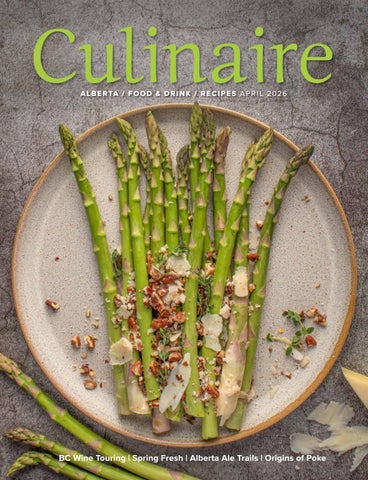
BC Wine Touring | Spring Fresh | Alberta Ale Trails | Origins of Poke
SIP THE SPRING
From vineyard strolls to sunlit tables, spring unfolds one glass at a time.
Fresh flavours, thoughtful pairings and open-air moments invite you to slow down, gather and savour the season.
38 Open That Bottle With Nathan Newman of The Derrick and Untitled Champagne Lounge
12 British Columbia's Wine Country is Calling!
BC has nine distinct wine regions, but we’re focusing on the Okanagan Valley, the province’s primary wine region. by Shelley Boettcher
16 Cozy and Creamy Tres Leches Rice Pudding
A
by
Renée Kohlman
20 Fabulous and Filled with Fibre
A sample day of delicious, fibrefilled meals that keep you full, and keep your gut happy too. by Natalie Findlay
22 Success is Defined by Community … for this small craft brewery/coffee roaster. by Lucy Haines
24 April Spirits, Keeping it Local Bringing things home for April, these local distilleries are absolutely worth a visit. by Tom Firth and Linda Garson
29 Alberta Brewery Tourism
Leads to a Great Time Craft breweries love visitors to their establishments. Take a self-guided or maybe a supervised beer tour in Alberta. by David Nuttall
32 Before the Bowl: The Origins of Poke
What exactly is this bowl that seems to have taken the world by storm? by Quinn Curtis
It’s feeling a lot like Spring!
It’s always such a great feeling in Alberta when we see those first shoots, starting the cycle of renewal and hope. The longer, lighter nights add to it too, making everything seem brighter with a more positive outlook for the months ahead.
2026 is already such a different year to 2025, and it’s really showing for us. Maybe we’ve all just got used to the uncertainty that hung over everyone like a black cloud last year, but we've seen such great shows of support and interest in Culinaire in just the first three months of 2026 - so much so, that we are increasing the circulation and printing more copies. Our distribution outlets tell us that copies go too fast!
In other bright news, the ad valorem tax on wine has been repealed from April 1, so we’ll start to see that working through on shelves and wine lists – a win for us all.
Huge appreciation for everyone who took the time to raise awareness and their voices!
And it’s time to take advantage of the warmer weather and longer nights, and make plans for a little local touring. What better reason than to treat yourself and learn what’s happening in our homegrown beverage world. In this issue, we have articles on visiting BC wine country, and with nine distinct wine regions we couldn’t include them all, so we’ve focused on the Okanagan Valley (I must say, it made me want to go right now). And for beer lovers, we’ve been looking at the options for organized and self-guided tours across our province. So many suggestions!
Finally, our Calgary World Taste Tour is on May 24, and open now to register. We’re excited to let you know of more swag and more variety, so hop on over to culinairemagazine.ca/treasure-hunt and reserve your spots!
Cheers
Linda, Editor-in-Chief
Correction: Thanks very much to the eagle-eyes who wrote to let us know that there was no ‘cacio’ in the Cacio e Pepe recipe on page 18 of our March issue. Many apologies, it was in the original recipe but somehow disappeared off the page. It should include “2 cups very finely grated Pecorino.”
#1203, 804–3rd Avenue SW Calgary, AB T2P 0G9 403.870.9802
info@culinairemagazine.ca
@culinairemag
@culinairemag
@culinairemag facebook.com/CulinaireMagazine
Our contributors
Lucy Haines
A long-time freelance writer, Lucy specializes in travel, food, arts, and entertainment. In a 30-year-plus career writing newspaper and magazine features, Lucy has interviewed celebrities, reviewed theatre productions and restaurants, and sampled foods around the world. Lucy covered news for Metro Newspaper Edmonton for a decade, and was editor at Alberta Prime Times, the province’s senior lifestyle news magazine, for several years.
Tom Firth
Tom has been travelling the world and pulling corks for over 30 years. He is the Managing Editor for Culinaire Magazine and Competition Director for the Alberta Beverage Awards. He has a weakness for old-school nachos and a love of modern wines made from cabernet franc. He has no qualms about tasting first thing in the morning, and his desk is constantly covered in paper and bottles - somewhere under all that, a corkscrew might be found.
Quinn Curtis
For subscriptions, competitions and to read Culinaire online: culinairemagazine.ca
Quinn was born and raised in Calgary and has had a passion for food her whole life. This passion has led her to search for new and exciting culinary experiences in many countries around the globe. A recent graduate from the Journalism program at Mount Royal University, she loves writing about all things food and drink, and spends most of her time cooking up exciting recipes and trying out new restaurants.
Culinaire Magazine acknowledges that we live, work and play on the traditional territories of the Blackfoot Confederacy (Siksika, Kainai, Piikani), the Tsuut'ina, the Îyâxe Nakoda Nations, the Métis Nation (Region 3), and all people who make their home in the Treaty 7 region of Southern Alberta. We are committed to support Indigenous chefs and amplify their voices to bring awareness of the food and culture of the First Nations.
Proudly printed in Alberta by Burke Group.
Applications are open for the 7th S.Pellegrino Young Chef Academy Competition for chefs under 30 to showcase their culinary talent and the chance to compete in the Regional Finals to represent Canada in the Grand Finale. Apply before June 9 at sanpellegrinoyoungchefacademy.com
Congratulations to Silver Dragon, whose Hong Kong-trained chefs have been feeding Calgarians with more than 200 authentic Cantonese and Szechuan dishes for 60 years!
And to Barb and Ernie's Old Country Inn, who have been serving Edmontonians with their bratwurst, schnitzel, hotcakes, and a choice of 200+ breakfast dishes for 50 years! And congrats to Sharon Yeo on 20 years of reporting on the dining scene in Edmonton with her food blog, onlyhereforthefood.ca – oh the changes she’s seen!
The former La Chaumière building on Calgary’s 17th Ave SW has a new lease of life - in the new Bungalow Club! It’s beautifully refurbished in green, gold, and white, with an abundance of flowers. They’ve put so much thought into every detail, and we like everything about it, but it’s the outstanding Franco-Italian dishes that you’re coming for: 36-hour ferment baguette with truffle bone marrow butter, 14-day dry-aged duck with Beluga lentils, ‘The Fry’ - one big super delicious, crispy outside, fluffy inside fry with Comté aioli
and chives. Need we say more? Chef Phil Turner (ex-Eight, Luca, and Winebar Kensington) is using every part of every ingredient. Add to this a strong cocktail game, ‘Expense It’ happy hour 2-6 pm and all day Sunday, great chill playlist, and soon the largest patio in the city - just don’t steal the personal mushroom lights! 139 17 Avenue SW, bungalowclub.ca
Enigma Bar & Kitchen has opened in Edmonton’s Old Strathcona, with a space that evolves through the evening from stylish dining with everything made from scratch, to a vibrant, yet cozy, musicdriven, late-night social lounge. From 5:00 pm at 10308 81 Avenue NW, closed Sunday, enigmabarkitchen.com
There’s no stopping Namo’s chef/ owner Ashish Damle, he’s opened Wok & Co Pacific Rim Kitchen at 808 Edmonton Trail, Calgary – his fun place that he’s been wanting to open for years. It’s a beautiful spot with huge white paper lanterns and animal wallpaper, and you’ll be spoiled for choice when you see what we think is a very exciting menu of mostly SE Asian, with Chinese, Japanese, Korean, Hawaiian, and even Peruvian, creative dishes (Hoisin Duck Pizza, Banh Mi Tacos – he really is having fun!). Fortunately he’s cleverly marked his recommendations with a little chef’s hat to guide us, as we wanted to order everything! Drowning (chicken) Dumplings in Massaman Curry, Unagi and Prawn Fried Rice, Singapore Hawker
Mee Goreng, a mega fortune cookie hiding surprises (!) are just a few musttries, along with really good cocktails and spritzes, lattes, and juices. From 3 pm, closed Mondays, wokncompany.com
Splitsville Bowl is now open in Edmonton in addition to their five locations in Calgary, with 21 10-pin bowling lanes and a large arcade. Choose from the extensive comfort food menu, and eat and drink at the lane or in the bar and lounges before or after your game! 13543 St. Albert Trail NW, seven days 10:00 am-late, splitsvillebowl.ca
It’s a dream come true for industrial engineer and lawyer, Ronan and Isabelle - they’ve opened Choux & Csince a little boy in Brittany, Ronan loved to be in the kitchen. Yes, they specialize in cream puffs, but you’ll find palets Bretons, kouign amann, sweet brioche, chouquettes, and quatre-quart (Breton poundcake) and savouries too (authentic croque monsieur and wonderful gougère sandwiches!). Isabelle worked with Monogram coffee so you can expect perfectly crafted coffee, signature drinks linking to the bakery, wine, cider (of course, from NW France!) and beer. They use flour from France (that’s why it tastes different!) and you can buy it here to take home. With just 10 seats and a patio, catering and summer dessert trolleys on offer, come in and say ‘salut’ to the small French team and practise your French! 2215 33 Avenue SW, from 7 am, closed Mondays, choux-and-c.com
Two Veggie-Forward Cookbooks
Mushroom Gastronomy
By Krista Towns, Gibbs Smith $35
Make Your Own
By Javant Benton, Balance $42
Eating, or at least exploring a healthy lifestyle is certainly popular these days, and this also includes finding ways to have simpler, less processed foods or accommodate guests or family members who may have vegan or meat-free culinary considerations to account for. Author Jevant Benton espouses this healthy approach and has compiled a number of dishes that may sneak their way into your rotation.
Recipes like HV Veggie Ground (p.30) make
Mushrooms are truly one of the most versatile and underrated ingredients when it comes to making standout, delicious meals. And if you are new to the wonders of cooking with mushrooms, we suggest you flip to any one of the 240 pages in this weighty book and you’ll be amazed and impressed at the flexibility and marvel of mushrooms. Whether you’re completely new to cooking with them, looking for an environmentally friendly meat alternative, or just curious about what exactly to do
BY QUINN CURTIS AND TOM FIRTH
for a solid base for a nut and mushroom based alternative to ground beef, promising plenty of flavour and versatility, while Extra Crunchy Wheatfree Breadcrumbs might be a straight-up gluten free approach that is an easy swap. On-the-go Frittatas (p.90) promise plenty of flavour, and both gluten free and vegan, covers a few bases.
This will likely appeal to the veggie-curious and certainly those already vegan, and promises flavour, versatility, and convenience for those starting out, or those tasked with adjusting their old recipes that might not be cutting it anymore.
with the different varieties, author and mushroom expert, Krista Towns, has summed up everything you’ll need to know, and provided creative and thoughtful recipes for each type, including beech (shimeji), black trumpet, cordyceps, and many more, all accompanied by her beautiful photographs. Recreate some meatless versions of classic favourites like Lion’s Mane Bolognese (p.127) or step outside the box with something like the Matsutake Gin Fizz (p.146). No matter what you’re in the mood for, make it mushrooms!
Calgary Treasure Hunt
Sunday May 24
Registration is now open
You’ll answer questions to learn and enjoy different foods at each stop, and use your new knowledge and skill to complete the World Taste Tour culinary puzzle to win fabulous prizes! And there are prizes for the best costumes, the funniest team names, the funniest photos on social media... and lots more!
It’s another very fun and rewarding day, so grab a partner and sign up as a team of two, or sign up solo at culinairemagazine.ca/treasure-hunt
these events have been so popular that the spots sell out every year, so now we’ve planned a new and exciting World Taste Tour with new treats to enjoy. And it’s all in one location – just park up and walk, no driving across town!
It’s going to be another day to remember!
BY KEANE STRAUB PHOTOS BY DONG KIM
S Spring is sprung!
pringtime in Alberta is a wild ride — we never know which way the wind is going to blow, or what it will bring with it. And when it comes to cooking, it’s a bit of the same thing: a few fresh ingredients are cropping up, but
Edmonton’s diverse population, combined with a robust mom-and-pop restaurant scene, were major players in developing Chef Shaun Hicks’ love of cooking. The abundance of fresh produce available in Alberta doesn’t hurt, either.
At Edmonton’s Little Wolf, simple fare like the long-standing hummus and focaccia are his favourite. “I like the fact that it can be a shared appetizer or a delicious meal for someone who might be looking for something more value driven.”
Deciding on what to cook can be tricky at this time of year. “Farmer’s markets are amazing here, but they don’t really ramp up for a few months,” he explains. But he adds that even the humble spring radish can turn into an amazing dish when roasted to bring out their sweetness. “Even cellared carrots, when stored correctly, are still available and sweet.”
Enter his recipe for Roasted Carrots with Pickle Dressing. “It’s a spin on one of our old favourites from the restaurant. It incorporates bright sweetness and spice in a way that people might not necessarily be used to.”
“It’s really such a simple dish,” Chef Shaun adds. “Giving the carrots a hard roast is the key, and make sure the apricots are hydrated.”
sometimes they can throw us for a loop when trying to decide what to do with them. Time to call in the experts! This month our Chef’s Table is abundant with unique dishes that bridge the last blasts of winter and give us a glimpse at things to come.
Roasted
Carrots with Pickle Dressing, Apricots, Sunflower Seeds, and Mint
Serves 4
1.4 kg carrots, scrubbed or peeled
6 Tbs (90 mL) grapeseed oil
1 tsp salt
½ tsp pepper
½ cup dried apricots, halved
3 Tbs (45 mL) Indian pickles (remove any mango pits if there are any)
1 cup sunflower seeds
Drizzle honey, warmed
Fresh mint, for garnish
1. Heat oven to 425° F.
2. Roast whole carrots with 2 Tbs (30 mL) grapeseed oil, the salt and pepper for 25–35 minutes until tender.
3. Meanwhile soak dried apricots in hot water for 10–15 minutes, then drain.
4. Blend Indian pickles with 4 Tbs (60 mL) grapeseed oil and 1–2 Tbs (15-30 mL) water.
5. Toast sunflower seeds in a dry pan until golden.
6. Toss warm carrots and apricots with pickle dressing to taste.
7. Drizzle warm honey on the plate, arrange carrots on top, then finish with sunflower seeds and fresh mint. Keep any extra dressing in the fridge.
Family is at the heart of Chef Erika Costa’s cooking. Memories of growing up in northern Peru, watching her mother and aunts create traditional dishes shaped her connection to food. “I express myself through cooking,” she says. “It’s my language and it carries a lot of sentimental value for me.”
Chef Erika explains that Calgary’s Sumaq is built on trust and family, and the menu is an homage to these pillars. “Two dishes that are my absolute favourites are the Ceviche and Tallarines de la Abuela, both of which were a significant part of my childhood.” One of her favourite ways to bring the warmer weather to a plate in Alberta is by using ingredients found in Peruvian cuisine. “Use fresh herbs like cilantro, mint, or green onions, and pair them with fresh lime or lemon to create dishes that feel alive on the plate.”
Violeta’s Heavenly Shrimp
Serves 4
200 g onion, finely chopped
2 Tbs garlic, minced
1 Tbs cilantro, chopped
1 Tbs ají panca paste
1 Tbs ají amarillo paste
50 g bell pepper, diced
2 Tbs salt
1 Tbs black pepper
Sharing a love of cooking with her mother-in-law, Violeta, made way for Violeta’s Heavenly Shrimp. “She treated me like a daughter and shared her cooking secrets with me. When she passed, we decided to honour her by adding one of her favourite dishes to the menu. Every time someone enjoys it, a part of her lives on.”
½ Tbs cumin
½ Tbs turmeric
1 fresh ají amarillo pepper, blended
100 g diced fried potatoes
1 bag gluten-free crackers or regular crackers
1 can evaporated milk
500 g shrimp, cleaned
Cilantro for garnish
Note: You can find aji panca paste, and amarillo paste and peppers at Latin markets.
1. In a large pan, sauté the onion until lightly golden. Add the garlic, cilantro, ají panca paste, ají amarillo paste, salt, pepper, cumin, and turmeric. Cook until everything is sizzling happily, and the oil begins to separate.
2. Add the blended ají amarillo pepper. Bring the mixture to a boil, then add the diced fried potatoes.
3. Blend the crackers with the evaporated milk until smooth. Add this mixture to the pan, stirring constantly until all ingredients are fully incorporated and the sauce thickens. Let it cook for a few more minutes and add the shrimp. Turn off the heat and finish with freshly chopped cilantro.
Calgary’s Brioche was brought to life by a trio of talent: Yann Chappot and Tristan Chaboche are the creators and curate the wine selection, while Head Chef Yaëlle Vancaster works her magic in the kitchen. “Our cuisine is, above all, a story of shared roots,” explains Chaboche. Mediterranean culture is combined with Chef Yaëlle’s technical expertise, resulting in classics with her signature twist.
“Right now, we are very proud of our Roasted Lamb with Harissa and Hummus, as well as our Veal Daube Stuffed Cabbage,” he says, adding that they’re a true representation of their trifecta — soul warming comfort food reminiscent of family meals on Sundays.
For spring, Chaboche says to focus on raw product, choosing crunchy vegetables and fresh herbs as soon as they appear in the market. “Simplicity, when guided by the season, is the ultimate key to a successful dish.”
Peas, asparagus, leeks, and spring onions are just a few of these springtime favourites that come together to make Soupe au Pistou, an easy dish to recreate at home that brings Southern French warmth to your kitchen. Use your vegetable trimmings to create a deep, flavourful base; for the Pistou, pay attention to the method as it’s crucial to the final dish.
Brioche by Avitus
Signature Soupe au Pistou
Serves 2-4
The Pistou (The Soul): Garlic, salt, fresh basil, extra virgin olive oil, pine nuts, Parmesan cheese.
Using a mortar and pestle (or a blender), work the garlic with the salt, then add the basil. Drizzle in olive oil to emulsify, then finish by folding in the Parmesan. You should achieve a smooth, dense paste.
The Zero-Waste Vegetable Aromatic
Stock: Leek greens, carrot peelings, spring onion whites, celery leaves, asparagus trimmings, garlic, fresh basil, water, salt, and 50 g cooked cannellini beans (crushed for thickening).
1. Submerge all your vegetable trimmings and garlic in cold water. Bring to a gentle simmer for at least 30 minutes. The longer it simmers, the more flavourful it becomes.
2. Remove from heat, add basil and let infuse for 5 minutes, then strain.
3. Add the cannellini beans and blend for a few seconds to create a silky, slightly thickened base.
The Garnish:
300 g carrots, fine dice
150 g celery, fine dice
100 g leeks, sliced
200 g potatoes, diced
100 g green peas
190 g asparagus, cut into pieces, save tips for décor
60 g spring onions, sliced
100 g small pasta
Sequential Cooking
(The Chef’s Secret)
To ensure each vegetable maintains its integrity, cook them in the stock in this specific order:
Carrots, celery, and leeks: approximately 15 minutes.
Potatoes: 7 to 8 minutes.
Peas, asparagus, and spring onion
Greens: less than 5 minutes to keep them bright and crunchy.
Pasta: Add last and stop the cooking while still very firm (al dente).
Gently reheat the broth and its garnish without overcooking. Pour into a warm bowl and place a generous dollop of Pistou on top. Finish with Parmesan shavings, fresh asparagus tips, toasted pine nuts, and a final drizzle of olive oil.
Before working in Montreal restaurants and before culinary school at NAIT, Chef Filliep Lamnet learned to cook in his mother’s kitchen. His cooking is based on his Polish roots, centred on hospitality, hearty meals, and seasonal ingredients.
“I’d describe my style as one honed by French technique but rooted in Polish cooking. It’s a contemporary, deeply personal interpretation of my culinary experiences throughout my career.”
At Edmonton’s JOLA’S – named after his mother, Jolanta, or Jola for short — the menu is built on Filliep’s childhood memories, and he says the goulash has a special spot in his heart. “It’s my own interpretation of the dish that I’ve honed over time,” he explains.
With any season, Chef Filliep says to look to farmers’ markets to become inspired. “Spring in Alberta is tough. It comes along so much later than we want it to.” Try combining the last root vegetables of the winter season with fresh, tangy cheese, and incorporate spring onions, fresh sausage, and lighter soups into your at-home menus. “Think renewal and re-emergence.”
Żurek, a fermented rye soup, is a standard dish in Poland during the spring, typically served at Easter. For his version, he encourages you to try fermenting your own rye starter, but don’t be afraid to pick up a premade żurek base. Pair it with a good sausage
or two from a local butcher. “The experience of eating and now making żurek, is locked in my mind. It represents the transition of seasons, and the arrival of warmer weather, something I’m always happy to celebrate.”
Filliep’s Żurek
Makes 4-6 generous portions
2.4 L water
600 g 1-2 varieties of Polish smoked sausages, cut into half moons
350 g bacon, small diced
500 g yellow flesh potato, peeled and diced into 2 cm cubes
Small handful of dried boletus mushroom (found at European markets)
2 Tbs dried marjoram
10 allspice berries
4 large bay leaves
3 tsp salt, plus more to taste
1 small yellow onion, peeled and sliced
8 cloves garlic, thinly sliced
2 small knobs horseradish, 1 thinly sliced and 1 to grate from whole for serving
500 g fresh polish sausage (Kielbasa Biała)
225-280 mL very active rye starter OR
1 package żurek base (Adamba brand recommended) - see note
90-250 mL half n’ half (10% cream) to finish
4-6 eggs, simmered for 10 minutes, peeled and halved
Good sourdough bread
1. Pour water into a large pot. Add smoked sausages, bacon, potatoes, mushrooms, marjoram, allspice, bay leaves, and 2 tsp salt. Bring to a simmer.
2. Once simmering, add onion, garlic, and horseradish. Add the fresh sausages and keep at a gentle simmer to poach. Remove the sausages once they're fully cooked, about 10-12 minutes, and set aside.
3. At this point the potatoes should be soft and tender (try one or smash on a spoon to test). Season with 1 tsp of salt and turn the heat up to a light boil. Meanwhile, slice the fresh sausage into coins, reserving any juices that run out.
4. Once the soup is at a boil, stream in the rye starter while stirring consistently. Once fully incorporated, bring back to a boil then turn down to low heat. Add the sliced sausage and any juices. Add additional salt to taste if needed. The soup should taste smoky from the sausage and bacon, tangy from the addition of rye starter, and have a good backbone of garlic.
5. To serve, portion into your favourite bowls, adding 1-2 egg halves to each.
Half n’ half can be added at the table (1-3 Tbs (15-45 mL) depending on preference) along with freshly grated horseradish. Serve with a few slices of good sourdough.
Note: To easily make a rye starter, grab sourdough starter from a friend or local bakery (or use your own).
Feed it a 50-50 mixture of unbleached all-purpose flour and rye flour. After two feedings it is ready to use. If using packaged żurek base, reconstitute in cold water, then add to taste.
Keane Straub has travelled from Tofino to Charlottetown, sampling the different flavours Canada offers. The passion people have for their craft and culture inspires Keane to tell their stories.
BRITISH COLUMBIA'S WINE COUNTRY IS CALLING!
BY SHELLEY BOETTCHER
Picture this: You, a bottle of wine, something good to eat, a nice sunset, a beautiful lake. If you’re an adult who loves wine, British Columbia has everything you need for a brilliant vacation: great restaurants, gorgeous patios, lakes, sun, and of course lots of wine and wineries — more than 300 scattered throughout the province. Or maybe you are less about relaxing and more about action: a grape stomp, a winemaker’s dinner, or yoga in a vineyard, or maybe a rockin’ concert at a winery. There’s a wealth of award-winning wines to try, including red, white, rosé, sparkling and sweet. You’ll find major grape varieties including cabernet sauvignon and syrah, but you’ll also find lesser-known varietals
such as tannat and chasselas.
The Okanagan Valley, of course, is the province’s primary wine region; there is something for a range of budgets, timelines and tastes. Your most difficult decision will be choosing where to stay.
BC has nine distinct wine regions, including the Similkameen Valley, Lillooet, the Thompson Valley and Vancouver Island. For the sake of space, I’m focusing on the Okanagan Valley, the province’s primary wine region. But at roughly 200 kilometres long, it’s big, impossible to cover in just one article — or only a day or two on the ground. I suggest picking a home base — perhaps Penticton, Osoyoos, Naramata Bench or Kelowna. Create a plan and find your own favourite places.
SOUTH OKANAGAN Oliver/Osoyoos
This gloriously warm, sunny region is just 33 kilometres long, from McIntyre Bluff north of Oliver to the southernmost point of Osoyoos. It also grows a whopping 60 per cent of the province’s wine grapes.
WHERE TO STAY: Spirit Ridge Lake Resort in Osoyoos is a joint project between The Hyatt and the Osoyoos Indian Band. Get a room with a kitchen so you can prepare your own meals, or take advantage of the resort’s wonderful restaurants. There’s also a spa, myriad walking trails, EV charging stations and a nice pool. I love to enjoy a glass of wine or morning coffee on my patio, watching
the light change on the surrounding hills.
Hester Creek Estate Winery’s villa is really special; I once had a deer pop up to say hi one morning as I had breakfast on my patio. I guess it knew how good the food is, too.
The Watermark Beach Resort also offers lake views and luxurious accommodations with on-site restaurants and a gorgeous outdoor pool area.
And both Watermark and Spirit Ridge offer pet-friendly long stays for snowbirds in winter.
WINERIES TO VISIT: There are so many; it’s hard to choose. District Wine Village, however, is good to start. Located outside of Oliver, this large circular “village” is designed for all-day exploration, with a bakery, bookstore and coffee shop. The space has undergone changes, but don’t miss Winemaker’s Cut, Foolish Wine, Spacedog Wine and Yellow Dog Spirits.
Then there’s Hester Creek Estate Winery on the Golden Mile Bench. Do a tasting and then have lunch or dinner at Terrafina, the award-winning Tuscanstyle restaurant. Further south, just north of the US border, Moon Curser Vineyards has great stories and an incredible array of varieties to try.
Located within Spirit Ridge Lake Resort, Nk’Mip Cellars is North America’s first Indigenous-owned and operated winery. It’s also an important stop for wines, especially the awardwinning reds. Be sure to tuck a bottle of the Talon (a syrah-based red blend) into your luggage.
Enjoy a glass of rosé on the River Stone Estate Winery patio, which overlooks pretty flower-filled rock gardens. Nostalgia Wines is a must for wine lovers and vintage car fans alike; there’s a massive show and shine car show every June, with food trucks and a silent auction.
And head to Domaine Artema for unforgettable gamay and chardonnay; enjoy an Italian-style wood-fired pizza with your wine while you’re there.
WHERE TO EAT: Do a tasting at Kismet Estate Winery and then eat next door at Manzil Indian Restaurant. Order everything. Trust me. (This year,
the Kismet team plans to open rental accommodations too; call for details.)
The Market at Spirit Ridge is casual, with pizza and local beer, or indulge at The Bear, The Fish, The Root & The Berry, which has fine BC wine and Indigenous-inspired regional dishes; get the wild salmon with three sisters veg, the Salish sea clams and the bannock.
Located in Osoyoos, Sugar Quail Bakery’s treats are so good, I filled half my suitcase on my last visit. Get a lemon tart. Croissants. Creme brulée. And bread. OMG. There are gluten-free options on Saturdays, too.
KELOWNA
Located on Okanagan Lake, Kelowna (pop. 254,605) is a bustling city with a lengthy list of cool places to eat, shop and stay. “Kelowna’s distinct food and drink story begins with the land — its beauty, its bounty, and the way it connects us,” says Lisanne Ballantyne, President and CEO of Tourism Kelowna. “Our unique terroir and microclimate inspire chefs, winemakers, brewmasters, cider-makers, and farmers to create experiences deeply rooted in place and community.”
Perhaps it’s not surprising to hear, then, that last fall, it was recognized as Canada’s first UNESCO Creative City of Gastronomy Cool stuff.
WHERE TO STAY: I often land at the Royal Anne Hotel, which has friendly staff and reasonable rates; it’s also within walking distance of downtown Kelowna and the lake. If the budget allows, the Delta Grand Kelowna is posh and lively. And Hotel Eldorado — which celebrates its 100th anniversary in 2026 — is both luxurious and charming.
WINERIES TO VISIT: West Kelowna has myriad; Quails’ Gate Winery and Mission Hill Family Estates are two major players with reliably wonderful wines at a variety of prices. Black Swift Vineyards, Crown & Thieves and the hatch are all owned by the same people but have completely different personalities. And Off the Grid Organic Winery has goats! Goats and wine!
Back in town, walk to Sandhill Wines in downtown Kelowna. Its roots go back to 1932. Go to thewestsidewinetrail.com to plan.
Must-do events for wine lovers
Wine Capital Weekend, September 18 to 20, 2026, Oliver (visitoliver.com). A fun, family-friendly three-day festival featuring live music, more than 40 wineries, beer, cider and cocktails, music, food trucks and the 27th annual Grape Stomp Competition. This year’s headlining act is the legendary Canadian band 54-40.
Okanagan Wine Festivals (thewinefestivals.com)
Myriad events throughout the year.
Mission Hill Family Estate (missionhillwinery.com)
Every summer, the winery features internationally renowned acts in its massive outdoor amphitheatre.
WHERE TO EAT: Both Quails’ Gate and Mission Hill have world-class restaurants while The Market at Quails’ Gate is casual, with charcuterie, cheese and an outdoor picnic area. Chefsommelier Mark Filatow and his team at Waterfront Wines Restaurant have been making people happy for more than 20 years with their regional, farm-to-table dishes. Try the duck with potato gnocchi and redcurrant mostarda, perhaps?
Born in Italy, Andrew Toncini worked all over the world before moving to the Okanagan Valley. Now he’s the chef and owner of Toncini Modern Italian and Toncini Pasta Bar, which is scheduled to open this spring.
Kin and Folk’s Kelowna location features yummy share plates, and I never visit the city without coffee and a breakfast sandwich at Sprout Bread. Sandrine French Pastry & Chocolate is fancy and delicious, with vegan, dairyfree and gluten-free options.
Bringing along a beer drinker?
BC has more than 220 craft breweries and 22 Ale Trails across the province. Wherever you go, you’ll likely find a few. Check out bcaletrail.ca or download the free BC Ale Trail app for tours and information across the province.
Penticton has one of the most robust beer scenes; Lonely Planet named the South Okanagan city Canada’s Craft Beer Capital in 2020. In late-September/early October, the city holds its annual Penticton Beer Week, which includes a popular Weird Beer Crawl.
Penticton Beer Blocks (pentictonbeerblocks.ca)
The annual Okanagan Fest of Ale takes place in April, while the Penticton Beer Run is October 3. Find out more at (visitpenticton.com)
PENTICTON
Seventy-some kilometres south of Kelowna, Penticton (pop. 37,736) is quiet in the winter but comes to life in the summer, with live music, a world-class farmers’ market, an urban winery and more. On a warm summer evening, you can meander along the Okanagan Lake Promenade downtown, surely one of the nicest boardwalk strolls in Canada. It’s worth noting, too, that adults can (responsibly) enjoy grown-up bevvies in select city parks and beaches.
WHERE TO STAY: We had a great stay at Balcomo last summer and the Four Points by Sheraton is also great.
Just 15 kilometres north of Penticton, Naramata has lots of wineries and the lovely Naramata Inn. It’s a gem, with
antique soaker tubs, beautiful views and plenty of vintage glamour. Or pick a bed and breakfast; Lakeview Naramata B&B (lakeviewnaramata.ca) offers outstanding views and warm hospitality.
WINERIES TO VISIT: If you’re staying in Penticton, book an afternoon and lunch or dinner at Chronos Winery and Tasting Room, the city’s urban winery. Township 7 is a must for sparkling wines, which hold their own against the world’s best. A 20-minute drive toward Okanagan Falls will get you to Meyer Family Vineyards for some of the finest pinot noir and chardonnay, while Noble Ridge Winery offers exceptional reds, whites and bubbles.
Also count on a day around Naramata and its 40-some wineries. (You can ride your bike there from Penticton if you’re keen.) You can’t go wrong with any wineries here. A sister property of Chronos, Evolve Sparkling House is at the start of the Naramata Bench and has, as the name suggests, bubbles. The Evolve Brut Rosé and Brut Nature are both made using the traditional method, like Champagne, and are outstanding. Hillside Winery is another gem, as is JoieFarm Winery.
WHERE TO EAT: In Penticton, start with coffee at Wayne & Freda. And don’t miss Elma, Brodo Kitchen, Kin & Folk and Orolo Restaurant and Cocktail Bar. When you’re in Naramata, eat at Naramata Inn’s seasonal restaurant,
Bistro Lapin Perdu or Hillside’s bistro, which offers “terroir to table” cuisine. Make reservations, though. These places are all busy, busy.
Shelley Boettcher is a journalist whose work has appeared in publications around the world. The author of the books, Uncorked: The Definitive Guide to Alberta's Best Wines $25 and Under, she holds her WSET 3 and ISG 2 certification.
Take a tour
If you don’t have a designated driver, sign up for a group tour or book a private guided tour to wineries of your choice.
Okanagan Wine Country Tours (okwinetours.com) for private and group tours across the valley.
Vivid Wine Tours (vivid.tours) for tours around Kelowna. A Grape Experience Wine Tours (agrapeexperience.ca) for tours throughout the valley including bachelorette and bachelor parties.
Quails' Gate Winery
Cozy and Creamy Tres Leches Rice Pudding
STORY AND PHOTOGRAPHS BY RENÉE KOHLMAN
There’s something quite fabulous about a good pudding, isn’t there? Soft, creamy, sweet… I’ve yet to find a pudding I don’t like. Back in the day you knew your mom really loved you when she tucked a Laura Secord pudding into your lunch bag. Remember those? You’d snap off and lick the lid, ever so carefully so as to not shred your tongue to bits. Aww, the good ol’ days! Chocolate, butterscotch,
vanilla, heck even tapioca was devoured before the sandwich and requisite apple. Maybe that’s what I love about pudding - it’s comfort food wrapped up in a blanket of nostalgia. And it just tastes really good.
But of all the puddings, I think rice is my favourite. I’ve made versions using arborio and wild rice, baked low and slow then finished with a burnished brown sugar crust. And when I’ve had
leftover rice from last night’s Chinese take-out, I’ve simmered it on the stovetop with whole milk, honey, and an egg. If it’s just for me, I’ll eat the whole thing straight out of the pot, with only my cat to judge me. Or maybe he just wants a taste?
This version is my new favourite, and I honestly can’t wait to make it again! Tres leches translates as “three milks” and you’re likely familiar with
Tres Leches Cake, a beloved Latin American dessert of sponge cake soaked in evaporated, sweetened condensed, and whole milk, then topped with meringue or whipped cream. That does sound dreamy, doesn’t it?
The three milks I used in this rice pudding are the same except I swapped coconut milk for the whole milk. I quite like this flavour, but if you prefer whole milk then by all means stick with it. I always have a can of evaporated milk in the cupboard, just because you never know when you’ll need it, and sweetened condensed milk really is the nectar of the gods. I’m of the firm belief that everything it touches is going to be delicious. Haven’t been proved wrong yet!
Seeing as this is a recipe for rice pudding we should talk about what rice to use. I prefer a long grain such as basmati, but jasmine would also work. The rice is cooked first in water, then the milks (and an egg) are added to the rice while it’s still hot and the whole thing cooks over medium low heat until the liquid has mostly been absorbed and you’re left with a gorgeous, creamy pudding. I like to include a cinnamon stick in with the milks as it adds a lovely flavour that hangs around in the background.
You’ll need to pay close attention to the pudding as it cooks as you don’t want to scorch the bottom of the pot and end up with burnt bits. No one likes those. Once you’ve licked the spoon and are happy with the result, stir in some vanilla paste
or extract, and spoon into pretty serving dishes. If you prefer to eat the pudding warm then by all means go ahead but if you want it chilled for a bit, pop the dishes into the fridge for an hour or so. While this pudding is perfectly indulgent already, if you really want to show off, add a dollop of whipped cream to each serving and just watch the faces of your favourite people smile with glee.
1. Place the rice, salt, and 2 cups (500 mL) of water into a medium saucepan with a tight-fitting lid. Bring to a boil over high heat, then turn the heat down to low and let the rice cook for 15 minutes, until all the water has been
absorbed. Remove the pot from the heat and give the rice a little fluff with a fork.
2. Whisk the egg in a medium bowl then whisk in the evaporated milk. Stir the coconut milk and sweetened condensed milk into the cooked rice. Slowly pour in the egg mixture and give it a good stir. Add the cinnamon stick, if using. Place the saucepan back on medium/low heat and cook the mixture, stirring frequently, until it looks like it has thickened and absorbed most of the liquid. This process takes about 20-25 minutes. Be sure to stir frequently as you don’t want to scorch the bottom of the pot and end up with flecks of brown bits in your gorgeous pudding. If you find the heat too high, then decrease it. Every pot and stove has their own way of heating/cooking, so do whatever works best for you.
3. Once the rice pudding is thick and creamy, remove the cinnamon stick and stir in the vanilla bean paste. If you are keen to add citrus zest, a pinch of cardamom, or swap almond extract for vanilla, this is the time to do so.
4. Divide the rice pudding into pretty dessert bowls and refrigerate for 1-2 hours. If you are partial to warm rice pudding, then serve it warm.
5. For an extra indulgence, whip the heavy cream into soft peaks and dollop a spoonful on top of each serving. Finish with a sprinkle of ground cinnamon.
Renée Kohlman is a busy food writer and recipe developer living in Saskatoon. Her two cookbooks ‘All the Sweet Things’ and ‘Vegetables: A Love Story’ have won awards and been on best-of lists.
PRIME FOR RIOJA WINE
by Maxwell Campbell
Top-Rated Steakhouses in Calgary
With a nickname like “Cowtown,” Calgary is just as known for its premium beef as Rioja, Spain, is for its premium wines. While these two local specialties are incredible on their own, you won’t believe just how much better they are when you pair them together.
If you’re an Albertan, this is your invitation to enjoy some of the world's finest food-and-wine pairings at ten of Calgary’s top steakhouses. This May, you’ll be able to discover six unique wines from six distinguished Rioja wineries, alongside the brilliance of local chefs.
Throughout the month, these venues will present patrons with specially crafted steak-focused small plates, along with the list of Rioja wines they were meant for. Since these palate-pleasing pairings have already been picked by local chefs and sommeliers, a straightforward yet sophisticated extra-fine dining experience is what lies in store for you.
Why Rioja’s the Prime Match for Calgary’s Best Cuts
Just like these steakhouses, Rioja is renowned for its endless pursuit of quality. After attaining Spanish viticulture’s highest certification, the Qualified Designation of Origin, in 1990, Rioja hasn’t relented. All of the region’s wine producers have continued to rigorously ensure the utmost excellence in every wine bottled under the Rioja label.
What makes Rioja irresistible with steakhouse fare? You can count on Rioja reds’ medium-to-full bodies and tuned acidity to slice through rich, grilled meats—cleansing and pleasing the palate between each bite.
For a juicy, charred, and seasoned ribeye with strong character, a Rioja Reserva is the only contender. With tannins that are both dense and velvety, this wine’s red fruit echoes the meat’s savoriness, while subtle oak enhances smoky nuances. But if balance is what you’re craving, Rioja’s famous Tempranillo has an earthiness that mirrors beef’s umami, creating harmony that elevates them both.
Lastly, the locational advantages of these two places were meant for each other. Whereas Calgary has a prime location for Alberta beef, Rioja has one of the world’s most coveted regions for making wine. Influenced by Atlantic breezes and Mediterranean sunlight, Rioja’s temperate climate yields reds that continue to define Spanish wine philosophy to the rest of the world. From the north to the south, Rioja’s mountain ranges help form the ideal winemaking climate, shielding it from cold coastal rains and central Spain's harsh weather. It’s just a perfect storm for breathtaking wines.
No matter which wines you’ll choose to pair, none of them will be quite the same. Having only three subregions (Alta, Oriental, and Alavesa), Rioja manages to be the land of 1000 wines. At its higher altitudes, Rioja lets grapes take their time to ripen, resulting in wines with a higher degree of acidity, freshness, and greater ageing potential.
This completely contrasts with its wines from lower altitudes, which have riper, softer fruit profiles that are ready to be enjoyed upon release. Pairing its drier and warmer climate with lower altitudes, Rioja yields wide-ranging wines with better structure and higher alcohol content.
To learn all about what makes Rioja one of the best wine regions in the world, visit RiojaWine.com.
Buchanan’s Chophouse 738 3 Avenue SW buchanans.ca
Chairman's Steakhouse 2251 Mahogany Boulevard SE chairmans.ca
Flores & Pine 254028 Bearspaw Road floresandpine.com
Open Range Marda Loop 2018 33 Avenue SW bigfishopenrange.ca
Open Range Renfrew 1112 Edmonton Trail NE bigfishopenrange.ca
Modern Steak Downtown 100 8 Avenue SE modernsteak.ca
Modern Steak Southport 10606 Southport Road SW modernsteak.ca
Ruth’s Chris Calgary Tower 2nd Floor 115 9 Avenue SE ruthschrissteakhouse.ca/calgary
Visit RiojaWine.com for the complete list of participating restaurants.
Fabulous and Filled with Fibre
Start your day with: Smashed Edamame on Sourdough Bread topped with Fried Eggs
Serves 1
1 cup edamame beans, frozen (you can replace with green peas if you prefer) To taste sea salt and pepper
1 tsp (5 mL) oil
2 eggs
1 slice sourdough bread, cut in two ½ avocado ½ cup raspberries
1. Fill a small pot halfway with water and bring to a boil. Add the edamame and cook 2-5 minutes. Strain and mash with a fork or food processor. Season with sea salt as desired.
STORY AND PHOTOGRAPHS BY NATALIE FINDLAY
Traditionally, fibre-filled foods were thought to be boring and lacking taste. But it doesn’t have to be that way - fibre filled foods can be delicious and even worthy of guests. Why do we want to concern ourselves with fibre? It is vital for optimal gut function which in turn helps keep you healthy and vital.
Fibre is the portion of plant foods that feeds and fuels our gut (microbiome). There are two main types of fibre: soluble (dissolves in water) and insoluble (does not dissolve in water), and we need both.
The goal is to eat (for a woman) at least 25 to 30 g per day. And for a man, 38 to 45 g per day. How much are you getting?
Fibre-based meals don’t have to taste bland. Here is a sample day including fibre-filled meals that keep you full, are delicious, and keep your gut happy too.
2. Heat a sauté pan over medium-heat, and add the oil. Add the eggs and cook to desired doneness. Season with salt and pepper.
3. Meanwhile, place 1 or 2 slices of sourdough bread in the toaster to toast.
4. Slice your avocado in half. Reserve half for later. Slice one half to be used or add it to the edamame, and mash.
5. To serve, place the toast on the plate, cover with the edamame mash, avocado, and fried eggs, with the raspberries on the side.
Approximate fibre: 8 g from edamame, 7 g from avocado and 4 g from raspberries, which is about 19 g per serving.
Lunch to fuel your afternoon: Lentil salad with Apple and Pumpkin
Serves 3
1 tsp (5 mL) Dijon mustard
1 tsp (5 mL) apple cider vinegar
1 Tbs (15 mL) honey
2 Tbs (30 mL) olive oil
2/3 cup parsley
1½ cups lentils, cooked
½ cup chopped walnuts
½ cup red onion, roughly chopped
1 cup butternut squash, roasted with skin on and cubed
½ apple, cored and diced
1. Combine mustard, apple cider vinegar, honey, olive oil and parsley and set aside.
2. In a large bowl, add cooked lentils, walnuts, red onion, roasted pumpkin, and apple.
3. Top with dressing and stir gently to combine. Serve warm or at room temperature.
Approximate fibre: 23 g from lentils, 7 g from butternut squash, 2 g from apple, which is about 10 g per serving.
Delicious Dinner: Chickpea Curry with Quinoa and Cauliflower
Serves 3-4
2 tsp (10 mL) olive oil
½ cup red onion, diced
1 stick celery, diced
½ carrot, diced
1 kaffir lime leaf
1 Tbs curry powder
1 tsp turmeric
1 tsp coriander, ground
1 tsp ginger, minced
1 tsp sea salt
½ can coconut milk
¼ cup (60 mL) water or broth
1 can chickpeas (398 g)
1 cup cauliflower florets
1 cup snap peas
½ cup green peas
½ lime, juiced
1½ cup quinoa, cooked
1. In a medium pan, add oil over medium heat. Add red onion, celery, and carrot and cook for 5 minutes.
2. Add the lime leaf, curry powder, turmeric, coriander, ginger and salt. Cook for 2 minutes.
3. Add the coconut milk and water or broth. Stir and add the chickpeas. Bring to a boil and reduce heat to low. Simmer 25 minutes.
4. Add the cauliflower, snap peas and peas and simmer for 10 minutes.
5. Add the lime juice and adjust seasoning. Serve over the quinoa.
Approximate fibre: 7.5 g from quinoa, 2 g from snap peas, 2 g from cauliflower, 68 g from chickpeas, 4.5 g from green peas which is about 21-28 g per serving.
Don’t forget Dessert: Apple and
Pear Crisp
Serves 4
454 g pears (such as Bartlett), cored, cubed with skin on
454 g apples (such as Granny Smith), cored, cubed with skin on
¼ cup (60 mL) maple syrup
1 Tbs (15 mL) lemon juice, freshly squeezed
½ Tbs cinnamon
½ tsp sea salt
1½ Tbs cornstarch
1 cup rolled oats
¼ cup light or dark brown sugar, packed
½ tsp kosher salt
4 Tbs butter, melted
1. Preheat oven to 350º F.
2. In a large bowl, toss together the pears, apples, maple sugar, lemon juice, cinnamon, salt, and cornstarch, until wellcombined. Scrape into a 20x20 cm pan.
3. In another bowl, combine the oats, brown sugar, salt, and butter, to make the topping. Stir to evenly incorporate ingredients. Sprinkle the topping over the filling.
4. Bake until the top is deeply golden and the fruit is bubbling, 35-45 minutes.
5. Cool slightly and serve.
Approximate fibre: 11 g from apple, 14g from pear, 8 g from oats, which is about 8 g per serving.
Natalie is a freelance writer, photographer, and pastry chef. A graduate of Cordon Bleu’s pastry program, she manages her own business too to create custom-made cakes.
SUCCESS IS DEFINED BY COMMUNITY FOR THIS SMALL CRAFT BREWERY/COFFEE ROASTER
BY LUCY HAINES
You don’t often think of a brewery as a community hub; where local stand-up comedians can try out their act; where trivia nights, beer yoga, or weddings, are part of the goings-on, or – how about this – with a cafe on site, complete with pastries and site-roasted java.
But that’s exactly what’s happening at Endeavour Brewing and Coffee Roasters, and founders Matt and Georgia Atkins have put it plainly in their mission statement, describing themselves as ‘cultivators of community, quality, and connection.’ It’s a nearly eight-year experiment of sorts, with the pair following their own interest in craft beer culture and good coffee, and turning that into a thriving business in an industrial park in St. Albert.
The couple (with son Rylan now working alongside them in the tap room), are unlikely entrepreneurs. Lethbridge native, Matt has a masters degree in engineering, while Georgia, who still teaches junior high phys-ed in St. Albert, has made the coffee roasting side of the business her own.
“We felt St. Albert needed a space like this. We live here too, so it's important to us to welcome regulars, which are probably 70 percent of our business, and to be part of events like Rock ‘n August classic car festival, or to sponsor rugby, curling or the triathlon,” says Matt. “Good beer and good coffee bring people together, so we’re big on hosting events with that community focus.”
Don’t just take the word of devoted followers of Endeavour’s line of craft beer (which includes a slate of traditional-style ales, lagers, pilsners and IPAs, plus barrel-aged specialties and seasonal offerings). There’s hardware to show off too for the upstart, a part of the Alberta Small Brewers Association. In 2024, the brewery won gold in the Canada Beer Cup for its 6th anniversary English IPA. The Endeavour team also took two honours at the Alberta Beer Awards; a gold for its double IPA Awning Attack, and bronze for Lost Flip Flop Saison in the farmhouse ale category.
“It’s good to be recognized – to see that others like what we’re doing,” says Matt, who started a journey in the industry after a visit to a craft beer spot in the US. The couple liked the vibe, a
community spot with a personal touch, and wanted to replicate that same concept here. Yes, there’s a story behind each brew here too, whether a Cloudy Peaks Hazy IPA or Sun-smacked Raspberry Gose –it’s that personal touch that has created a devoted following of the Endeavour concept. But turning a hobby into a business has been a whole other matter.
Atkins says Endeavour is finding its niche; trying to get a bit of the market share in the province's growing craft beer industry (There were over 150 breweries in Alberta in 2024, more than doubling the numbers from 2019). Endeavour recently joined 19 Edmonton-area breweries for the annual Wyrd Bier festival, a chance to create themed brews for the occasion and expose more beer lovers to unique offerings. “I’m a traditional brewer, I don’t use a lot of fruit. I like beer to taste like beer, whether it’s Belgian style, an English ale or German lager, and many customers feel the same,” Matt says. “I use local ingredients wherever I can too – that part isn’t hard because Alberta has a great climate, soil and some of the best malted barley in the world.”
THE
PAIR FOLLOWED THEIR OWN INTEREST IN CRAFT BEER CULTURE AND GOOD COFFEE, TURNING THAT INTO A THRIVING BUSINESS IN AN INDUSTRIAL PARK IN ST. ALBERT
Still, challenges are no stranger to Endeavour. From navigating the pandemic and US tariffs on aluminum, which, for now, have been dropped, to finding more markets in Alberta and beyond (Endeavour cans are now available in and around Edmonton and Calgary, at spots like Sherbrooke Liquor, Wine and Beyond and Sobeys), there are hurdles in this competitive market. While there’s hope of changes to inter-provincial trade, Atkins says the current situation means out-ofprovince brewers are allowed to sell here, while Alberta brewers can’t do the same beyond our borders.
But every cloud has a silver lining, so ever-thinning margins have meant diversification for Endeavour Brewing. Adding a snack menu (from a few varieties of pizza, to pretzels, to beer cheese, which supports small Edmonton-area food suppliers) and continued exposure at farmers’ markets, festivals, expos and competitions, are a priority. A just-
expanded kitchen space will allow for more pop-ups and collaborations, Atkins adds, pointing to prior success with special events – Canada Day, Valentine’s etc. And a newly added eighth beer tank means an increase of the 100,000 litres of beer currently brewed each year, with regular weekly cask openings beckoning aficionados and everyday beer fans with experimental, unique flavours – maybe infused with tea, or a margarita-type brew. And then there’s coffee. In 2022, Georgia took the lead with Endeavour Coffee Roasters, placing a refurbished West German Probat roaster alongside beer brewing equipment in the two-bay, 8,000 square foot facility. The cafe claims space alongside the 1,200 square foot tap room, where staffers pour single roast coffees for those in search of a daytime cup of joe and pastry. Endeavour’s coffees are even featured at a handful of restaurants and the local curling club. “The addition of coffee helps break the stigma of a brewpub as a social place for everyone. We asked ourselves, “What else can we add? Coffee was the answer.”
To get her passion project rolling, Georgia took online courses and gleaned wisdom from other area roasters. “I’m into ethically sourced beans from single farms, so customers can experience that region: Guatemala, Brazil, Peru and more. The big cafés are moving away from being a spot where you can hang out with a laptop over a coffee. We work to be that welcoming space where people can sit and work, or socialize over a board game,” she says.
Like the beer side of the business, the
coffee roaster is big on collaborations too, in this case joining with Edmonton radio station CHUCK@92.5 to create ‘Chuck Roast Coffee’. Launched in February, with a tasting event and contests through the radio station, bags of the custom coffee are available directly at Endeavour.
Endeavour’s brewery/taproom and cafe/ roastery is a rare combination, one of only a couple such formulas in the entire province.
Located in Campbell Business Park, Endeavour has taken advantage of its south-facing spot during warm weather months with an outdoor patio, while indoor space can be sectioned off and used for weddings, birthdays, and baby showers, “That’s even been done, all by the same person!” Matt adds.
Fun events, like fly-tying, stand-up comedy nights, even drag bingo, also attract a wide range of community members to Endeavour. As soon as the business posts dates for a trivia night – a real hot ticket, there’s a wait list to get in on the 100-plus seat event.
“I’ve loved craft beer culture for 15 years,” Matt adds. “It’s been an endeavour to get here; our name has that meaning too. We’ve worked hard to be that local spot; the place people go for their local beer.”
Lucy Haines is a long-time freelance writer, specializing in travel, food, arts and entertainment. When she isn't writing, Lucy is a busy mom to four fantastic kids, and enjoys singing and performing in the local community theatre scene.
April Spirits
Last month, we covered an assortment of European spiritsbut wanted to bring things home for April with local spirits (and the weather was telling us that whisky might be the way to go!). And it was hard to narrow it down to only a few.
Wild Life King Of The North Peated Maple Rye Whisky, Alberta
Be quick for this one! Only 300 bottles were made, and a few are available at time of writing, but don’t dally! The first in the WLD Cask Series, it’s an absolute stunner; no surprise it’s been awarded Rye Whisky of the Year at the Canadian Whisky Awards. Distilled from single farm Alberta rye, this whisky was aged for four years in a barrel that had held peated single malt whisky and Canadian maple syrup, resulting in a gloriously smooth, and soft whisky, with a hint of maple syrup and a whisper of peat on the finish. Beautiful!
At the Distillery or online at wildlifedistillery.ca $179
Two Rivers Single Malt Whisky, Alberta
Highly enjoyable from the very first sniff to the final sip. Made with locally sourced barley, and aged in bourbon casks, things come alive with light cereal aromas, citrus, and brown sugar on the nose. Slightly saline on the palate with a mild nuttiness, but intense roasted flavours, leather, and a bit of spice too. Bottled at 40 percent, so best neat, or if desired, just a smidge of water to taste.
$95 at the Distillery and select retailers
Alberta Premium Rare Batch No. 2 21 Year-Old Canadian Whisky, Alberta
Another treat for the senses, this time a 21 year-old Canadian whisky, aged in bourbon barrels, Canadian whisky barrels, along with some new, white oak barrels too. So complex on the palate, and showing off slightly sweet aromas of sugar, vanilla, and almost rum-like scents. The alcohol is 50 percent ABV which really lets more subtle flavours cross the palate. Very, very enjoyable, and best neat or with the bare minimum of water to soften to your preference.
CSPC 135267 Around $75-80
BY TOM FIRTH AND LINDA GARSON
Alberta-made whisky has come a long way over the last few years and it warms our heart (maybe it’s the whisky speaking) that there are so many beautiful examples to share. If you are out and about, these distilleries are absolutely worth a visit.
Bridgeland Distillery Glenbow Canadian Single Malt Whisky, Alberta
It’s a real treat seeing that pride of place emerging in Alberta, especially for things like beer and spirits. Bridgeland, one of the leading lights in Alberta distilling will proudly tell you of the local barley, the local malting, and the incredible water that goes into this wonderful dram. Slightly spicy on the palate with toffee, and rich cereal flavours, this is exceptionally smooth and absolutely worth having.
CSPC 873908 About $80
Eau Claire Distillery Ploughman’s Single Malt Canadian Whisky, Alberta
The pinnacle of Eau Claire’s whisky releases to date, this is their second whisky bearing the Ploughman’s name. Inside the sturdy, open-face box, is an impressive, and super heavy bottle, with an antique copper-finish medallion and feature punt depicting Mount Rae, the whisky’s water source. Ploughman’s is finished in Pedro Ximénez sherry casks, that reveal themselves in sweet aromas of cocoa nibs, raisins, and a little toasty oak. Revel in the long, honeyed finish with touches of cherry and roast walnuts –it’s a hug in a glass.
At the Distillery or online at eauclairedistillery.ca $199
Alberta Premium Ten Year Old Cask Strength Rye Whisky, Alberta
Love a good rye? You should! Rife with spicy aromas evoking pepper and roasted nuts, with a little fire too over brown sugar and toast. It is a bit fiery on the palate at 67 percent ABV, and neat there is plenty to excite the mouth with those spicy rye flavours. With a fair splash of water, those earthy and roasted coffee bean flavours emerge. A fine rye for those shoulder season days.
CSPC 134972 About $160-175
courtesy of
Sun-drenched hills, cool lake breezes, and rows of vines stretching toward the horizon, the Okanagan is where wine touring becomes more than a tasting. It becomes a full-sensory experience. Here, the land shapes every sip: mineral-rich soils, bright Okanagan sunshine, and the steady rhythm of the seasons come together to create wines that speak of place.
Spend a day winding through vineyardlined roads, meeting the people behind the pours, and lingering on patios where the views are as memorable as the vintages. From intimate boutique wineries to lively estate experiences, wine touring through Lake Country, Kelowna, and West Kelowna invites you to slow down, savour deeply, and discover how the valley’s life-giving energy flows from soil to glass.
Photos
Tourism Kelowna
KELOWNA
Azhadi Vineyards
Distinctive wines, vibrant flavours, and warm hospitality define Azhadi, where a global perspective adds a fresh twist to the Kelowna wine scene.
CedarCreek Estate Winery
Overlooking Okanagan Lake, CedarCreek pairs refined estate wines with breathtaking views - and one of the valley’s most celebrated winery dining experiences.
Meadow Vista Honey Wines
A visit to Meadow Vista is something a little different, surrounded by blooming gardens and active bee hives, they offer a unique tasting experience built around beautifully crafted honey wines.
Priest Creek Family Estate Winery
Relax into the laid-back charm of Priest Creek, where estate-grown wines, shaded patios, and easygoing tastings invite you to slow down and savour the moment.
Kelowna’s wine scene begins in the heart of downtown and stretches outward into sunlit vineyards that frame the city. Start with a glass at an urban tasting room or lakeside patio, then follow meandering roads into nearby wine country, from the rolling orchards of Southeast Kelowna to hillside estates along Lakeshore Road. These vineyards benefit from warm days, cool lake-moderated nights, and varied elevations that help produce aromatic whites like Riesling and Gewürztraminer, alongside structured Pinot Noir and Merlot.
In Kelowna, wine touring flows naturally between city and countryside, where lively downtown energy meets vineyard calm and every glass tells a story of the land.
Sandhill Wines
In the heart of downtown Kelowna, Sandhill Wines showcases bold, vineyard-driven reds and innovative small-lot releases in an urban winery setting.
SpearHead Winery
Sip award-winning Pinot Noir at SpearHead, the 2024 Winery of the Year, where passion for the varietal shines in every glass.
Tantalus Vineyards
Historic vineyards and precision winemaking define Tantalus, home to some of the Okanagan’s most celebrated Riesling vines and wines and stunning lakeview tastings.
The View Winery
Rooted in a fifth-generation orchard, The View offers both estate wines and crisp ciders, creating one uniquely Okanagan tasting experience.
Black Swift Vineyards
Perched in the hills of West Kelowna, Black Swift pours bold single-vineyard wines in a welcoming tasting room where the vibe is relaxed and the wines speak for themselves.
Crown & Thieves
Part wine playground, part castle in the vines, Crown & Thieves delivers bold wines and an experience that proudly breaks the rules.
Grizzli Winery
At Grizzli Winery, welcoming hospitality meets expressive Okanagan wines, paired with art exhibits, seasonal events, and globally inspired dishes at the onsite restaurant.
the hatch
More glorious experiment than traditional winery, the hatch serves up bold wines, quirky art, and a tasting experience that never takes itself too seriously..
Mission Hill Family Estate Winery
Known for its extraordinary architecture and award-winning wines, Mission Hill offers one of the Okanagan’s most iconic wine experiences...
WEST KELOWNA
Across Okanagan Lake, the wineries of West Kelowna pair bold wines with some of the most spectacular views in the valley. Vineyards climb the sunlit slopes above the lake, home to iconic estates and passionate family-run wineries alike. Warm sun exposure and well-drained hillside sites make this area particularly suited to full-bodied reds like Cabernet Sauvignon, Syrah, and Merlot, alongside vibrant whites and complex blends. Tasting rooms open onto panoramic patios, lively restaurants, and immersive wine experiences that invite you to stay awhile. From architectural showpieces to welcoming cellar doors, West Kelowna delivers a wine touring experience full of flavour, personality, and unforgettable lake views.
Niche Wine Co.
A small family-run winery in the hills of West Kelowna, Niche pours small-batch wines on a welcoming farm setting with beautiful valley views.
Quails’ Gate Winery
Rooted in a passion for grape growing since 1989, Quails’ Gate crafts world-class wines that express the unique terroir of the Okanagan Valley.
Volcanic Hills Estate Winery
At the base of Mount Boucherie, Volcanic Hills crafts vibrant wines that showcase the rich terroir of the volcanic soil.
LAKE COUNTRY
Just north of Kelowna, Lake Country offers a quieter kind of wine touring, where vineyards stretch across sunlit hills between Okanagan, Wood, and Kalamalka lakes. These surrounding waters moderate temperatures, helping grapes ripen slowly while preserving vibrant acidity. Scenic country roads lead to welcoming estate wineries throughout the valley, where tastings come with sweeping views and an easy, unhurried pace.
The region is especially celebrated for expressive cool-climate varieties such as Pinot Gris, Riesling, and Chardonnay, along with elegant sparkling wines. With mineral-driven soils and refreshing lake breezes shaping every vintage, Lake Country invites you to linger over wines that are bright, balanced, and distinctly Okanagan.
50th Parallel Estate Winery
Perched above Okanagan Lake, 50th Parallel pairs sleek architecture, elegant cool-climate wines, and sweeping vineyard views that make every tasting feel like an occasion.
Arrowleaf Cellars
Relax on Arrowleaf’s hillside patio with a glass of crisp Riesling in hand and take in one of the most peaceful vineyard views in the Okanagan.
Gray Monk Estate Winery
One of the pioneers of Okanagan wine, Gray Monk invites you to sip awardwinning vintages where the region’s modern wine story first took root.
Ex Nihilo Vineyards
Bold art, vibrant wines, and panoramic lake views come together at Ex Nihilo, where creativity flows from the gallery walls to the glass.
From hilltop estates to tucked-away family wineries, the Okanagan’s wine communities invite you to explore at your own pace, one tasting at a time.
The best way to experience it all?
Let someone else take the wheel. Local guided wine tour operators know the roads, the stories, and the hidden gems that make each stop special, turning a day of tastings into a seamless, relaxed adventure. Whether you’re discovering your first Okanagan vintage or returning for another round of favourites, a guided tour lets you savour every moment safely and stress-free. So gather your friends, raise a glass, and set out to explore the flavours, views, and warm hospitality that make wine touring in the Okanagan unforgettable. Learn more at tourismkelowna.com/wineries and plan now!
Craft breweries love visitors to their establishments. Beyond regular drop-ins, a series of organized and self guided tours have been created in Alberta. In early 2023 the Alberta Small Brewers Association developed a series of trails in six regions, with Calgary, Edmonton, The Rockies, and Central, Northern, and Southern Alberta represented. On their website
Alberta TourismBrewery Leads to a Great Time
BY DAVID NUTTALL
(albertaaletrail.ca), you will find over a dozen trails with maps of each trail featuring not only pertinent breweries (with address, phone number, website, descriptors, etc.) but also select restaurants and other places of interest. The Calgary and Edmonton trails are either walkable or a short cab ride between locations, while all others will require vehicles.
Suggested one-to-five-day itineraries are laid out with the maps, but you can feel free to select which places you want to visit on your own.
The other source for the ale trails is from Alberta Beer (abbeer.ca). While they borrow heavily from Alberta Ale Trails (AAT), they stick only to breweries on their maps, although other places of interest are on the website.
Guided Brewery Tours
Brewery tourism formally began in Alberta in 2017 when the first organized tours began. Here are a few you should be able to book:
Bus Tours
Canadian Craft Tours
(canadiancrafttours.ca) has different sized minibuses available in both Edmonton and Calgary that travel to (usually) three breweries for their regular tour and include a distillery, winery, or cidery in their Mashup Tour. They have numerous options, costing $110-$120 per person for a 3-4 hour tour including beer flights.
Both of Alberta’s major cities have unique bus tours. YYC Tours (yyctours.ca) transports patrons to three breweries in Calgary over 3.5 hours with flights of beer at each venue, starting at $89 per person.
Edmonton Brewery Tours
(edmontonbrewerytours.com) shuttles people to three breweries around the capital on a 3-3.5 hour journey, at $110 per person. They also have an Edmonton Brewery and Distillery Tour for $129.
For those visiting Canmore, there is a Mountain City
Brew Bus Liquid Valley Tour (canmorebrewerytours.com) that visits three separate locations in the Bow Valley, $130 per/person.
Walking Tours
Toonie Tours (toonietours.ca) has a 3-hour walk through downtown, Calgary Street Art and Craft Beer Tour, visiting a couple of breweries while your guide points out local art pieces and murals along the way. About $100-$120 and includes beer samples.
They have a greater selection of trails, however there is a certain amount of overlap between routes, with several breweries showing up in multiple trails. It should be noted that not all breweries in Alberta make it onto a trail, so it pays to research brewery locations. Both these websites attempt to be as current as possible, however new breweries and recently shuttered breweries may be missed. The trails are all meant to be self-guiding, or you can take one of the supervised tours mentioned in the sidebar. Either way, you are sure to find interesting establishments, great beer, and a guaranteed fun time.
CALGARY AND AREA
Alberta's largest city has over one third of the province’s breweries, so it has also the most trails. The AAT website lists six trails while Alberta Beer has twelve. With a majority of Calgary's breweries situated within blocks of the Macleod Trail corridor, there are nine trails: the Brewery Flats, Barley/Brewery Belt, Inglewood, Central Calgary, Chinook, South Calgary, and Manchester ale trails are all located here.
The Foothills Ale Trail includes the breweries of south Calgary but also ventures out to towns west, south, and east of the city including Vulcan, High River, Okotoks, Diamond Valley, Cochrane, Strathmore, and others in between. The North Yeast Calgary Ale Trail covers the seven breweries north of the Bow River and east of Centre Street. Those breweries plus the three breweries in Airdrie and one in Drumheller are on the North Calgary Ale Trail.
EDMONTON AND AREA
There are over thirty-five breweries in and around Alberta’s capital city, and four trails to follow here. The first designated city ale trail was Happy Beer Street which includes the area of south Edmonton near Whyte Avenue and south along 99 Street. The Hop Pocket Ale Trail includes downtown and the northwest quadrant. The Southeast Edmonton Ale Trail has a couple of south Edmonton breweries
and then heads out of the city into the towns of Leduc, Nisku, and Beaumont to the south, and Sherwood Park to the east. The West Edmonton Ale Trail takes one through the western edge of the city and continues to Spruce Grove. It also includes those breweries northwest of Edmonton in St. Albert and Morinville.
NORTHERN ALBERTA
The zones outside Alberta's major cities are naturally a great deal larger, so more travelling is involved. For example, this region covers more than half of Alberta’s total area with a dozen breweries situated mostly north of the Yellowhead Highway in eleven different municipalities. There two ale trails here; the Northwest Ale Trail takes you to the five breweries of the Peace Region, from Whitecourt to Grande Prairie, then to Fairview and Peace River, passing through forests and wetlands. The Lakelands Ale Trail goes through Wainwright, Lloydminster, Cold Lake, St. Paul, Lac la Biche, and Slave Lake, and, if you are really ambitious, there is Drum Brewing in Fort McMurray as a final stop in the northern region.
CENTRAL ALBERTA
The Central Prairies Ale Trail covers an area mostly south of Edmonton down to the Trans Canada Highway east of the foothills outside of Calgary and Airdrie. This is home of much of Alberta’s grain production, especially barley and wheat, as well as malt houses. Many of Alberta's hop farms are in this region too, allowing visitors to have a true field to glass experience.
Nearly twenty breweries are in the two ale trials here, with the Central Prairies Ale Trail including the towns of Alhambra, Camrose, Rimbey, Drayton Valley, Lacombe, and Rosalind near the Queen Elizabeth II Highway. The Olds College brewery, home to western Canada's only Craft Beverage and Brewery Operations Program, is also here, but is sadly closing in June after graduating several of Alberta's brewers in the past 13 years. The Red Deer County Ale Trail covers the four breweries of Red Deer and the surrounding towns of Sylvan Lake, Innisfail, and Stettler.
SOUTHERN ALBERTA
The Southern Alberta Region is a triangle-shaped area that starts south of Calgary down Highway 2 to the US border, goes up to Medicine Hat and then follows the Trans Canada Highway northwest back to Calgary. This region has only one trail, The Highway 3 Ale Trail, which runs on its namesake road from the BC border almost to Saskatchewan. There are eight breweries along it, starting in the Crowsnest Pass, then nearing Lundbreck, through Fort MacLeod and Lethbridge, and ending in Medicine Hat. A little bit northwest are two breweries in Brooks. Many of these locations were among the first craft breweries in Alberta, and they established the first ale trail to promote brewery tourism along this route.
Alberta Ale Trails also includes an extra trail called the Ice Cream Ale Trail, which adds ice cream shops along the same route as The Highway 3 Ale Trail plus a bonus detour down Highway 6 to Waterton.
THE ROCKIES
This is certainly the most picturesque region of Alberta, starting at the Canada-US border and following the Rocky Mountains though three of Alberta's national parks up to the northern edge of Jasper National Park. The Canadian Rockies Ale Trail officially begins in the Canmore-Banff corridor (unless you want to start at the Cowboy Trail Brewery in Bragg Creek) and heads north to Jasper along Highway 93. Here you will find eleven breweries with world class views along this route. As home to some of Canada’s most famous tourist attractions, this area certainly gets the most international tourists.
With this information, you should be able to get out there and explore Alberta’s finest breweries in 2026 and beyond.
David has worked in liquor since the late 1980s. He is a freelance writer, beer judge, speaker, and since 2014, has run Brew Ed monthly beer education classes in Calgary. Follow @abfbrewed.
More Tours
Peddle Tours
Pedal Pub (pedalpub.com) has both Calgary and Edmonton bikes with three separate routes in each city. These 15-16 person bikes allow passengers to pedal themselves from brewery to brewery, with a guide who steers, about $60 per person for 1.5-2-hour tour.
Urban Peddle Tours
(urbanpedaltours.com) also has bikes in both cities with slightly different routes from Peddle Pub, about $50 per person for a 2.5-hour tour.
Red Deer recently joined the peddle tour world with its Troubled Trolley, sponsored by Troubled Monk brewery (troubledmonk.com/ troubled-trolley). It takes people around the city for a couple of stops in two hours, with prices starting around $35–$45 per person.
French Flair at The Tasting Room by Avitus, April 7 and 28
Avitus have opened a new wine bar, The Tasting Room, and we have two six-course pairing evenings in April for an authentic French experience!
Vine & Dine at Sumaq on 17th April 9, 15, and 21
Peruvian cuisine has a rich heritage, and we’re learning more about it at Sumaq, over a new six pairing course menu of authentic, traditional dishes!
Corks & Talks with Brian Keating at Safari Grill, April 25
Culinaire | May 2025
Brian Keating has filmed new videos of animal antics to entertain us while we're feasting on six pairing courses
of Safari Grill's satisfying and flavourful food!
Winemaker Dinner at The Bungalow Club, April 29
Michele Chiarlo from Piedmont is with us for one indulgent night at the new Bungalow Club for a six-course dinner paired with their premium range of barolo, barbera, and more!
One-Off Eau Claire Distiller Dinner at One18 Empire, April 30
Eau Claire Master Distiller Daniel Gowrie and owner David Farran are with us to take us through their range over a four-course pairing dinner!
Vine & Dine at Thai Sa-on May 7, 13, and 21
In May we’re coming back to the newly refurbished Thai Sa-On for three evenings with a new six-course pairing menu honouring the traditional and regional cuisine of Central Thailand!
Modern Indigenous Cuisine Fine & Dine at Little Chief, May 30
A new, elevated and premium, six-course, creative and modern, Indigenous Spring Chef’s Table dinner in Little Chief’s private dining room!
Celebrating 20 years of Vine & Dine, June 11 and 12
We’re bringing back one of our most popular and regular Vine & Dine locations, long closed – Escoba Bistro and Wine Bar – for our 20th anniversary celebrations!
These evenings can – and dosell out quickly and new events are added regularly, so check vineanddine.ca for details and menus, and email linda@vineanddine.ca to reserve your places, and to be included in our bi-monthly updates. We try to cater for all allergies.
BEFORE THE BOWL:
The Origins of Poke
BY QUINN CURTIS
You've probably seen it around in food courts, restaurants, and recipe books. And you've probably enjoyed a bowl or two and appreciated the textural variety, fresh flavour, and convenient deliciousness – but what exactly is this bowl that seems to have taken the world by storm?
Poke (poh-KAY) bowls have become a staple on restaurant menus across Alberta, each variation offering its own twist on ingredients and flavours. While some are eating a chef-crafted poke bowl in a restaurant, others are building their own bowl and choosing from a wide array of ingredients to pile together on a bed of rice. While the idea of a poke bowl has morphed and grown into a distinct dish of its own, the original poke bowls were much simpler and more straightforward.
PRE-CONTACT
There is some debate about where poke originated due to the evolution of style and ingredients, but history shows that the original poke is undeniably Hawaiian, literally translating to “to slice or cut crosswise into pieces.” The dish was invented well before Western contact in 1778, by Native Hawaiian fishermen looking for a quick and flavourful snack, and it required only very simple preparation using the limited ingredients they had available during their working days: sea salt, seaweed (limu), reef fish, and sometimes inamona (kukui nut).
Back in those days, reef fish like oio (bonefish), weke (yellowstripe goatfish), or kole (goldring surgeonfish) were used because they were the most accessible and convenient. Offshore fish (like the ahi tuna that we’re used to in our bowls) required different fishing methods and larger canoes. Some highstatus offshore fish were even reserved for Hawaiian chiefs at the time, and the fishermen likely wouldn’t have been authorized to use them.
Nonetheless, they managed to create a fulfilling and fresh dish using these limited ingredients. The reef fish, with its delicate and soft texture, would have added a slightly marine quality, while the sea salt intensified the natural sweetness of the flesh. The seaweed, adding a briny and more mineral flavour, would have been nicely complemented by roasted kukui nut with its toasty and slightly bitter richness. All of this would likely leave this variation tasting more authentically oceanic than modern poke.
POST-CONTACT
The next major development for poke happened in 1778 when British explorer Captain James Cook arrived and anchored off the coast of Kaua'i, bringing with him ingredients like onion seeds, chili peppers, and Western saltpreservation methods. Not only did these new ingredients open doors for Native Hawaiians to begin experimenting more with fish preparation methods, but it
also marked the beginning of Hawaii's integration into the global trade network, which in turn shifted many of their pre-existing fishing methods and increased access to large offshore fish like ahi tuna, swordfish, and ono.
JAPANESE INFLUENCES
The biggest shift for poke happened in the late 1800s when Japanese labourers arrived in Hawaii to work on sugar plantations. At this point, Japan was developing its own unique ways to enjoy raw fish, including the early form of nigiri, at the time called Edo-mae sushi. They were also refining different techniques to preserve raw fish in the absence of refrigeration. Some of these methods included curing, marinating, or soaking in soy-sauce (known as shoyuzuke).
These traditions and ingredients made their way across the Pacific and began to naturally blend and integrate with native Hawaiian techniques. The Japanese labourers lived and worked very closely with Hawaiians, and were able to introduce them to ingredients like soy sauce, sesame oil, green onion, and even different knife techniques used for preparing sashimi. With the help of the Japanese, poke transformed from a traditional quick snack food for
fishermen into a carefully composed and more complex dish enjoyed by Hawaiian locals from all walks of life. But it's important to note that the traditional salt–limu–inamona version never disappeared and is still enjoyed by many Hawaiians even today. The Japanese-inspired version simply became more popular among the Hawaiian people and eventually spread around the globe.
visitors fell in love with this local cuisine and often found themselves disappointed when they couldn’t recreate the same experience at home. This is when chefs in cities like Los Angeles and Seattle decided to capitalize on the growing interest Americans had been showing in sushi and raw fish, by opening their own poke restaurants.
Coinciding with the rise of social media, it’s no surprise that poke gained popularity with its colourful, photogenic appeal and health-focused reputation, it was everything a foodie influencer could ask for. This also marked the shift from traditional Hawaiian poke to the poke bowls we know today. Every social mediaworthy dish requires an eye-catching mix of colours and
POKE VS. POKE BOWL
After all these shifts and influences, we still haven’t fully explained how we arrived at the modern poke bowl we all enjoy today. As poke’s popularity continued to grow in Hawaii, locals could find it anywhere from fish markets to corner stores. It wasn’t fancy – it was an affordable and convenient snack sold by the pound and usually eaten with rice. When tourism became increasingly popular in Hawaii in the early 2000s,
textures, and the Western palate can only restrain itself from adding avocado to a dish for so long, so eventually poke bowls became a base (white rice, brown rice, or lettuce), a protein (tuna and salmon being the most popular), and your choice of ten or more different toppings and sauces.
The evolution of the poke bowl interestingly mirrors sushi’s earlier journey as well, beginning as a local tradition, transforming into an immigrant fusion dish, and eventually becoming an American adaptation and worldwide trend.
While modern poke bowls push the boundaries of the traditional marinated fish and rice much like the salt–limu–inamona, poke never truly disappeared - traditional poke remains culturally central and a culinary staple of Hawaii today.
Quinn is a recent graduate from the Journalism program at Mount Royal University. She loves writing about all things food and drink, and spends most of her time cooking up exciting recipes and trying out new restaurants.
MAKING THE CASE for Argentina!
By TOM FIRTH
Manos Negras 2021 Stone Soil Malbec Uco Valley, Argentina
If one looks hard enough, practically every day of the year is dedicated to “something” from worthy causes – like Parkinson’s Awareness Month, or Rex Manning Day (April 8), and National Grilled Cheese Day (on April 12). April is also Sikh Heritage Month, my birthday, and World Malbec Day on April 17.
In the spirit of World Malbec Day, it’s as good a month as any to talk about this wonderful grape, grown around the world. The epicenter of malbec production is really in Argentina where it reaches the pinnacle of its ability; those cooler, high elevations, and that dry mountain air allow the grape a lengthy, slow ripening, bringing all that power and nuance. Yes, I know that malbec is produced to great effect in many other places, but it occurred to me to focus on Argentina this month, malbec yes, but also a few other grapes and blends too.
In other news, after publication of last month’s recommendations, the Ad Valorum liquor taxes were revoked (ending officially on April 1, 2026) by the province of Alberta. Ultimately, this will mean prices should go down, and some of the pressures on restaurants and retailers are reduced. But prices listed below may have changed. Please forgive me if some are wrong.
Find these wines by searching the CSPC code at Liquorconnect.com; your local liquor store can also use this code to order it for you. Prices are approximate.
Luigi Bosca Cabernet Sauvignon 2022 Mendoza, Argentina
Impressive ripeness of fruit starts off this very serious cabernet followed by intense floral aromas like lilac and violets, but smoothly evolving into darker cherry and cassis fruits, and big, chewy tannins with a peppery finish. This was very much a “drinking” cabernet as my glass didn’t stay full for very long.
CSPC 417998 $24-27
Tom has been waxing on (and on) about wine, beer, and spirits for more than 30 years and freelances, consults, and judges on beverages all year long. He is the Managing Editor for Culinaire Magazine, and the Competition Director for the Alberta Beverage Awards.
Sure to appeal to fans of malbec, it’s easy to find those ripe, black fruits, slightly herbal nuances, and that slightly jammy aroma. On the palate, it’s a malbec lover’s dream, plump black fruits, vibrant acids, and a lengthy finish, accentuated with those lovely, meat-friendly tannins. A beautiful, well priced malbec, for sure. CSPC 630541 $22-25
Luigi Bosca 2023 Malbec Mendoza Argentina
Yet another beautiful vintage from Luigi Bosca. What I love here is the deepness of those tart fruits, a mild, resinous character, and all those chaparral style dried fruits. Proteinfriendly tannins are clearly presented with those beautiful fruits, those tight acids, and a lengthy, rather graceful finish. A solid star to serve with barbecued goodness.
CSPC 418038 $24-27
Escorihuela 2023 “1884” Cabernet Franc, Mendoza, Argentina
One of my favourite grapes is cabernet franc, and some of the bottles we are getting from Argentina stand out from the crowd. Big fan of the approach here with a good mix of slightly liquorice root style aromas, black and red fruits, and a spicy, graphite style of savouriness. Brilliant on the palate too with all the boxes checked off leading into a gentle, spicy finish. A stunner with roasted red meats, but easy to enjoy on its own too.
CSPC 784756 About $24-26
Llama 2023 Cabernet Franc
Lujan de Cuyo, Argentina
Uco Valley, Argentina
A 50-50 blend of both grapes, and used to great effect - especially on the nose where a fine combination of spicy and savoury aromas along with fresh, plummy black fruits, the blend of cedar, herbal notes, and cocoa, work very well. The palate is full, but still balanced with a lengthy, almost peppery finish. A great buy!
CSP C109167 About $22-24
Malbec, Mendoza, Argentina
Big, bold, brassy malbec from start to finish. Bursting with black fruit, but also a deep, earthy profile supported by dried herbal aromas. On the palate, yes, it’s a 2021, but loads of big tannins, which are surprisingly smooth, and excellent acids to tie it all together. A stunning bottle suitable for steak now, or a few years in the cellar - a decanting, and a steak.
CSPC 138453 About $42-45
We might not always think about chardonnay from Argentina, but it might be time to keep an eye out for more of these luscious whites from wineries like Luigi Bosca. Made with minimal oak presence, which allows the fruit to shine through, both the nose and palate are rife with balanced tropical fruits, crisp apple notes, and only a mild creaminess. Easy to enjoy, and a fine accompaniment to grilled poultry, or many seafood dishes.
CSPC 418012 About $24-27
Loads of cherry fruits with graphite, cedar, and dried strawberries lead right into a crisp and polished palate where it all comes together again. A fair bit of bell pepper comes through in the mouth, but offset by some brilliant floral components. Ready to drink now, but would also work very well with hard cheese, cured meats, or a nice brisket.
CSPC 836212 About $22-24
Salta, Argentina
Malbec is such a powerful grape, but in the right hands (and perhaps with a little torrontés) it makes a lovely rosé. Lighter, summery scents of plums, cherry and strawberry, with a clean floral presence show off on the nose, but it’s on the palate where all those fruits and some citrus are bright and subtle too. Bone dry, tasty, and versatile at the table, this is a gem.
CSPC 846535 $20-22
Colomé 2023 Auténtico Malbec, Salta,
Argentina
With a vineyard at 2,300 metres, and no oak influence (at all!), this is a true homage to traditional winemaking in Argentina. Those high altitude vineyards allow for the ripening that malbec rarely achieves in other countries, and when made with care, no oak is needed to adjust the final balance. Aromatic, complex, and complete on the nose with floral and garrigue notes, while on the palate, it’s humongous with deep tannins, earthy fruits, and a lengthy finish. Excellent.
CSPC 474106 $50-55
New to me, I was very happy to experience this chardonnay from the Uco Valley. Bright apple fruits with hints of citrus, tropical fruits and a clean floral presence. On the palate, no distracting oak clouds things allowing a full, creamy style of chardonnay with a tight mineral finish. A good match at the table with poultry, or lighter seafood dishes.
CSPC 802377 $18-20
Another classic in the pantheon of much loved malbecs in our market. In many ways Catena has defined the style we know and love. A blend of fruit from three vineyards – three awesome vineyards! Look for intensity of fruit that evolves in the glass, a remarkably floral aroma, and a plenty of weight on the palate full of those perfect tannins that just call out for something protein rich from the grill.
CSPC 478727 About $25-28
Bodega
Salta, Argentina
Made from fruit at four estate vineyards ranging from 1,700 to 3,100 metres above sea level, along with a superb program of up to fifteen months in barrel ranging from 2-5th fill and a small number of new barrels, this is a bit more of a familiar approach to the grape for most. Slightly smoky, plummy fruits, with a touch of jam and tar on the nose, while all those much-loved flavours of malbec are prominent in the mouth. Drinking exceptionally well right now, it’s perfect for a special occasion – and some barbecue.
CSPC 706168 $110-120
Amalaya 2024 Rosé Malbec-Torrentés
Manos Negras 2023 Chardonnay
Luigi Bosca 2024 Chardonnay Mendoza, Argentina
Colomé 2023 Estate Malbec
Llama 2023 Malbec - Cabernet Franc Lujan de Cuyo, Argentina
Catena 2022 High Mountain Vines
Malbec, Mendoza, Argentina
Escorihuela 2021 Limited Production
Bodega
Bello Home
We’re elevating our hydration routine with the new water filter from Bello Home, and filtered water has never tasted so good. Sleek and modern on the counter, the Bello Home system uses plant-based filtration to remove more than 66 contaminants while still preserving essential minerals. The best part? It infuses your water with nine natural flavours to choose from (we especially loved the lemon ginger). Even better, you can skip the flavoured bottled water and make it fresh at home with the press of a button, no guilt required. $299 for the starter pack. bellowater.com
Let’s be honest, it’s an age where downsizing, or at least right sizing our lives is top of mind. Some are looking for smaller, easier to maintain homes, some might be looking at a vacation property, and yes, some others are looking to start a home too.
Cadbury Caramel Buttons Easter Egg
A new release, just in time for Easter, Mondeléz Canada has released this classic hollow milk chocolate egg, which when cracked open, reveals a handful of Cadbury caramel buttons. They say that kids will love them, but having tried them, we suspect you might want to hide them and keep them for yourself – those buttons are soft, oozy caramel inside buttery, Cadbury milk chocolate, and really very delicious and very more-ish! Walmart, 96 g About $7
Frankie's Organic Puffs
Born in southern Quebec, these organic, family-owned snack puffs pack plenty of flavour into a light and crunchy bite-sized treat. We tried the white cheddar, BBQ, and avocado oil & Himalayan pink salt flavours, each made with sprouted quinoa and sprouted brown rice, and each just as delicious as the last - absolutely melting in your mouth. Perfect as a light snack (literally) when you're on the go, as each bag weighs almost nothing! 113-120 g, $4 per bag. frankiessnacks.ca
Working through the Nesto foundation set in the kitchen, honestly, was a treat. Cook Vision may have taken a page from small-volume camping sets, but here the professionalgrade pots are sturdy, suitable for all types of cook tops and ovens, and best of all, stack into a remarkably small footprint and look cool too.
The Foundation set comes with three pots that double as mixing and serving bowls, and a non-stick ceramic coated pan, clever space saving lids, a trivet,
two pot grabbers (very handy) and a detachable handle that sturdily clips to all – though you may want to practise that a bit before working with a full pot. The non-stick pan is a little lighter in weight (just FYI for those that love a nice heavy one), but the set (minus the non-stick) is dishwasher safe and likely to be the last set you’ll need for a very long time. $800-900 (Larger sets and add-ons are available). cookvision.ca
Grenade Creme Egg–inspired Protein Bar
There’s so much talk about protein these days. We know it’s a good thing for our bodies and we know we could probably all use more – so from the UK, here’s another good thing – Grenade’s LimitedEdition Creme Egg–inspired Protein Bar. Inside the thick milk chocolate coating is a soft and chewy filling that really does taste (and look!) like a Creme Egg. And for those that like stats, each bar has 14 g of protein and less than 250 calories. A very good thing! 45 g around $3-4.
Cook Vision Nesto Foundation Set
...with Nathan Newman
BY QUINN CURTIS AND LINDA GARSON
Nathan Newman wasn’t always the owner of Calgary’s favourite champagne lounge. His path started in a completely unrelated industry. “I was born in Ontario and moved here in 1993 with my grandparents. I was always more into fashion - and maybe the flashier things,” he says.
But after managing a clothing store in Calgary, he knew he could create his own business. “I opened a clothing store, a part of the new development of Hotel Arts, with a good friend of mine, and we had a successful run. We went to expand, and there was a partner collapse during that period. I had already been working in bars at that time but more for fun,” Newman explains.
After closing the store, Newman didn’t know what his next venture would be. That is, until a friend opened a bar and asked Newman to manage it. His answer? “I told them, I don't want responsibility, I don't want to work hard, but if you hire me, I'm going to make you more money than you would by hiring someone else.”
Who could say no to that pitch? So Newman ventured deeper into the hospitality industry. “The main partner came up to me and said, ‘This is the business you should be doing.’ And I was like, ‘this is temporary. I don't want to do this. I'm absolutely not an industry guy.’ He had proposed a location, and I’d said, ‘Absolutely not.’ And then I saw the location, we did a walkthrough of it, and I went back to him and said, ‘Alright, what are you thinking?’ And he replied, ‘What are you thinking?’ And then our first concept was born, which was called UBU Lounge,” says Newman.
Some may remember it in the front lobby of the Grand Theatre downtown. But now, hooked on the bar scene, Newman just couldn’t get enough. “It would’ve been about 2015 when I
opened The Derrick. I really wanted gin specifically at that point because I wanted to create a really smart cocktail bar,” he says. His goal for The Derrick was to educate Calgarians about higherend cocktails – why a cocktail is more expensive than a highball, why sometimes you have to wait more than a minute for a drink, and what truly goes into making a great one. “Fortunately, I can say that the city just happened to be in the right moment of growth and people were interested, they wanted to try it,” says Newman.
Armed with his expertise in the hospitality industry and a passion for great cocktails, Newman came up with the idea for Untitled Champagne Lounge. “We had just done a big cocktail competition in New York and while we were there, I really wanted to test the market in regards to how many bars are pushing champagne cocktails. And there was enough of it that I knew, this is going to be smart, this is going to be on trend,” he says. “And Untitled has been a tremendous success
and one that's still evolving. We're now nine years in, which is coming up right away, and we're excited about it. And really there's no end in sight, it's still doing great, so we're happy about that.”
So what bottle is Newman saving for a special occasion? Well, as he says, “I wouldn’t say I'm saving a bottle. I would more say I'm protecting a moment.”
After securing three bottles of 2007 Salon Cuvée “S” Le Mesnil Blanc de Blancs when he opened Untitled, and now with only two remaining (a house party led to one being accidentally opened), Newman has one of the bottles and a friend has the other.
“The other one has, in a weird way, now become mine again because my friend and I bet quite a bit on football, and he loses every bet to me. And our deal was that if a certain team that I picked won the Super Bowl, and they did, whoever won this deal would open our bottle and we would drink it together. And it's been over a year that he has not come through on this bet. So it's going to be very soon, I'm going to hope.”
THE CALGARY STAMPEDE IS EXCITED TO ANNOUNCE THE CHAMPIONS OF THE 2026 STAMPEDE CELLAR SHOWDOWN INTERNATIONAL WINE COMPETITION.
SHOWCASING THE BEST-OF-THE-BEST IN CANADIAN AND INTERNATIONAL WINE.
Sip, swirl and savour the top wines of the 2026 Stampede Cellar Showdown, paired with crafted bites from Alberta’s top restaurants, at Stampede Cellar Uncorked on April 11, 2026 and at the Stampede Cellar Champion Wine Experience at The Greatest Outdoor Show on Earth, July 3 – 12, 2026!