Momentum | Winter 2026

Page 1


MOMENTUM

The Magazine of CU Anschutz Orthopedics

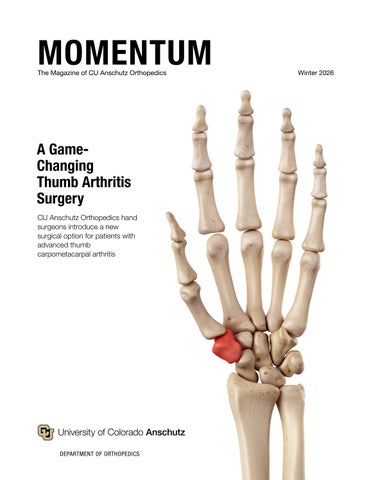
A GameChanging Thumb Arthritis Surgery

CU Anschutz Orthopedics hand surgeons introduce a new surgical option for patients with advanced thumb carpometacarpal arthritis

DEPARTMENT OF ORTHOPEDICS

Winter 2026

Our magazine is named for the forward energy, drive, and sustained commitment that compels us to push toward a better future redefining what’s possible in orthopedics, for our patients and beyond.

In each issue, we highlight the people and ideas shaping orthopedics at CU Anschutz advancing discovery, translating innovation into lifechanging results, and leading collaboration that fuels progress across research, clinical care, and medical education.

MOMENTUM

Winter 2026 | Vol. 1, No. 1

Momentum is a quarterly review publication produced by the University of Colorado Anschutz Department of Orthopedics

CU Anschutz Orthopedics

cuanschutz.edu 12631 East 17 Avenue th Aurora, CO 80045 720-848-1900

Changing the face of medicine. Together.

The University of Colorado Anschutz is a world-class academic medical campus leading transformative advances in science, medicine, education and patient care. The campus includes the University of Colorado’s health professional schools, more than 60 centers and institutes, and two nationally ranked independent hospitalsUCHealth University of Colorado Hospital and Children's Hospital Colorado - which see nearly three million adult and pediatric patient visits each year

Innovative, interconnected and highly collaborative, CU Anschutz delivers life-changing treatments, exceptional patient care and top-tier professional training. The campus conducts world-renowned research supported by $890 million in funding, including $762 million in sponsored awards and $128 million in philanthropic gifts for research.

Across every subspecialty in orthopedics, CU Anschutz Orthopedics is a recognized global leader in the field, and Colorado’s most trusted orthopedic group for adults and children

Our tireless pursuit of transdisciplinary innovation in medical research, education, and patient care uniquely positions us to deliver compassionate whole person care with the most advanced clinical treatments unmatched in Colorado and the Rocky Mountain Region.

We are proud to partner with the premier healthcare providers in our region, boasting an extensive network of clinical sites serving communities across the Front Range

CU Anschutz Orthopedics and the School of Medicine reach a major research milestone, earning national recognition and signaling what’s next for discovery and impact

Celebrating

and

and

and

Graduates of our esteemed residency program share words of wisdom and insights on their experiences here.

The University of Colorado Anschutz School of Medicine has reached a milestone moment—one that reflects years of steady investment, collaboration, and scientific ambition.

In the latest Blue Ridge Institute for Medical Research (BRIMR) rankings, the School of Medicine rose to No. 8 among public medical schools nationwide and No. 21 overall, marking its strongest national ranking in 20 years.

Orthopedics Research Strength with National Impact

The Department of Orthopedics ranked No 5 nationally, receiving $6 7 million in NIH funding a reflection of sustained growth in federally funded research and its expanding role within the School of Medicine’s research portfolio.

The ranking highlights the department’s commitment to translating scientific discovery into clinical innovation with its continued focus on advancing musculoskeletal research across every subspeciality in orthopedics

A Broad Portfolio of Excellence Across Departments

Orthopedics’ strong showing is part of a larger story of collective achievement across the School of Medicine. This year, nine clinical departments ranked in the top 15 nationally, up from six in 2024

Leading the rankings, the Department of Pediatrics earned the No 1 position with more than $63 million in NIH funding, followed by the Department of Pharmacology at No 4 with over $22 5 million The Department of Physical Medicine and Rehabilitation ranked No. 6, receiving more than $3.5 million. Additional departments posting strong national rankings include Otolaryngology, Emergency Medicine, and Anesthesiology (each ranked No 11), Family Medicine and Dermatology (No 12), and Internal Medicine (No 14)

We congratulate all our colleagues across the School of Medicine on their achievements

A DEFINING MOMENT FOR RESEARCH

These rankings represent more than a moment of recognition. They speak to sustained progress, expanding impact, and a clear trajectory forward driven by trusted research excellence institution wide and a shared commitment to discovery that improves lives

In total, the School of Medicine improved its overall ranking from No. 22 in 2024 to No. 21, supported by an additional $9.7 million in NIH funding, bringing the total to nearly $314 million

This is a historical achievement for our departments and school. Our school’s NIH funding growth provides a solid foundation so that we can continue meaningful research and enhance the opportunities that ultimately make a difference in the lives of the patients we treat.”

Annual BRIMR rankings measure total funding awarded by the National Institutes of Health (NIH) to academic medical institutions and their departments Highlighted departments ranking in the Top 10 represent just under one third of total NIH funding to the

Rethinking Sleep After Concussion

Sleep disruption is one of the most common and consequential effects on concussion recovery.

Within the first week after injury, up to 51% of adolescents report sleep disturbances, symptoms closely linked to prolonged recovery and delayed return to school and daily activities.

Most concussion research has focused on total sleep time as a marker of sleep health However, emerging evidence suggests that changes in sleep architecture the distribution and progression of sleep stages may offer more meaningful insight into recovery

Led by Catherine Donahue, PhD, ATC, this research supported by a highly coveted grant from the Brain Injury Association of America (BIAA) uses wearable technology to examine sleep architecture in adolescents following concussion, addressing a critical gap in the field

By identifying how concussion alters sleep at a deeper level, the work aims to inform individualized, sleep-focused interventions that may reduce persistent symptoms and support adolescents’ academic, psychological, and social well-being.

Catherine Donahue, PhD, ATC, graduated with a Ph D from the University of Virginia in 2023 and is now a post-doctoral research fellow with the Colorado Concussion Research Laboratory in the Department of Orthopedics Her research focus is on sports concussions.

Donahue’s grant was one of only seven the Brain Injury Association of America (BIAA) awarded in 2026 through the Brain Injury Research Fund.

As BIAA enters its seventh year of providing grants to highly talented researchers, I continue to be impressed with the quality of submissions we receive. This program has been a launching pad for young researchers as well as established ones who are taking a new direction. We are very pleased to be supporting such a strong group once again this year.

John D. Corrigan, PhD National Research Director | BIAA

Colorado Concussion Research Laboratory

of teens report sleep disturbances following a concussion 51%

Why Sleep Architecture Matters After a Concussion

Sleep is made up of distinct stages, each supporting brain function and recovery

A concussion may alter how the brain moves through these stages, even when total sleep time appears “normal”

Understanding these patterns could unlock targeted, personalized sleep- treatment pathways for recovery

Decoding Sleep in Daily Life

Wearable devices (such as ring, watch, or wrist based sensors) allow researchers to measure sleep patterns using motion and physiological data

These tools make it possible to study how sleep changes after a concussion in real world, at home settings, providing insight beyond patient self reports or single night lab studies.

Photo courtesy of Children’s Hospital Colorado

Scientists and clinicians in the CU Anschutz Interdisciplinary Joint Biology Program—bringing together experts in Orthopedics, Medicine, and Rheumatology helped lead a major research breakthrough published in Nature Immunology

The study tackles a long standing mystery in rheumatoid arthritis (RA): why some patients still struggle with pain and joint problems even after powerful anti‑inflammatory treatments.

Using advanced tools that map how individual cells behave inside joint tissue, the team discovered that treatment resistant RA isn’t driven by inflammation alone

Instead, a specific type of joint cell called a fibrogenic fibroblast can continue to remodel and stiffen the tissue around the joint even after inflammatory cells have been cleared

These fibroblasts cluster around blood vessels and form “fibrosis rich” pockets that can keep symptoms going, creating pain and stiffness that feel very different from classic inflammation

The researchers also uncovered how this harmful process starts. Blood vessel cells send signals that change how nearby fibroblasts respond to TGF β, a key molecule involved in tissue scarring In patients who do not improve with treatment, these fibroblasts become overly sensitive to TGF‑β and grow into larger, more aggressive clusters. Importantly, the study found that changing a related signaling pathway called Notch can actually reverse this harmful behavior in lab grown patient tissue

By analyzing synovial biopsies taken before and after treatment, the team showed that even when inflammation improves, fibrogenic activity can persist or spread This helps explain why some patients continue to experience pain or relapse after an initial response to therapy

This work highlights how crucial it is to understand not just immune cells, but the entire joint environment especially the stromal and structural cells that shape long term outcomes

Redefining the Future of RA Treatment

Did You Know?

Up to 30% of RA patients fail multiple lines of treatment. Persistent pain and stiffness often remain even when inflammation decreases. This new evidence shows fibrosis not inflammation alone drives long term disability

Through a collaborative, trans disciplinary model, the Joint Biology Program is reshaping how researchers understand and treat rheumatoid arthritis pushing the science beyond inflammation alone to uncover how fibrosis and tissue remodeling drive disease That integrated approach is already accelerating progress toward more precise, personalized therapies

The University of Colorado Interdisciplinary joint biology program biobank played a pivotal role in providing synovial tissues from patients with Rheumatoid arthritis. These data just published in Nature Immunology will advance our goal for precision medicine for our patients.”

Leveraging Collaborative Expertise

Established in 2019, the University of Colorado Interdisciplinary Joint Biology Program (IJBP) brings together experts from the CU Anschutz Medical Campus and CU Boulder to study how joints function in both health and disease. Led by Dr. Larry Moreland with a joint appointment in the Departments of Orthopedics and Medicine (Rheumatology), the program fosters close collaboration across disciplines and has earned major federal funding from the NIH, Department of Defense, and ARPA H

A key asset of the program highlighted by the publication in Nature Immunology is the CU IJBP Biorepository, which collects and stores discarded bone, cartilage, and other musculoskeletal tissues from orthopedic surgeries These donated tissues are preserved in several formats so researchers can study their structure, genetics, and molecular makeup.

The collection is openly available to CU researchers and outside collaborators through a simple request process Nature Immunology Volume 27 Issue 3 | March 2026

Inside the Tissue & Molecular Imaging Core (TMIC)

Fueling Discovery Across Orthopedics

TMIC’s work spans a spectrum of histopathological techniques fixation, decalcification, processing, staining, and imaging that enable researchers to examine tissues with extraordinary detail These capabilities help uncover biological patterns essential to understanding joint disease, injury, repair, and regeneration The lab’s mission is built on accessibility, collaboration, and scientific excellence, supporting investigators at every stage of their work

Tools That Bring Tissues to Life

The TMIC houses a suite of advanced instruments that allow researchers to explore tissues in vivid, data rich formats Its technology ranges from automated stainers and microtomes to high resolution digital microscopes Systems such as the ZEISS Axio Scan Z1, Nikon Eclipse 80i, and Olympus BX53 produce crisp digital images that help teams visualize even the subtlest cellular changes.

A Quiet Engine of Innovation

While much of TMIC’s impact happens behind the scenes, its contributions ripple outward strengthening studies, accelerating discoveries, and empowering research teams to push the boundaries of orthopedic science As CPMR continues to grow, the TMIC remains a vital catalyst, translating biological complexity into clarity and opening new doors for musculoskeletal innovation

TMIC is led by Research Services Program Manager, Terrin Geohring, BS, whose expertise has elevated CPMR’s histology capabilities since she joined in 2020. With more than a decade of experience and a summa cum laude biology degree, she brings both scientific precision and thoughtful mentorship to the teams she supports.

In her role, Terrin also directs the Orthopedic Tissue and Molecular Imaging Core, providing guidance to investigators and educating the next generation of researchers and clinicians

Her leadership has strengthened key initiatives such as the Interdisciplinary Joint Biology Program’s human tissue biobank a growing resource that supports innovative studies across Orthopedics

Located in the Research Complex North Tower at CU Anschutz, TMIC supports investigators seeking deeper insight into how tissues heal, regenerate, and change over time.

Aubrey

Rachel Meyers, PT, DPT

CU Anschutz and Children’s Hospital Colorado

Advancing Adolescent Athlete Health

The Colorado Program for Musculoskeletal Research is celebrating the 2026 J T Tai Foundation grant, awarded to a collaborative team at CU Anschutz and Children’s Hospital Colorado

Their funded project “Integrating Movement Quality and Quantity Approaches to Inform Injury Risk, Menstrual Health, and Mental Health Outcomes Among Adolescent Athletes” seeks to better understand the interconnected factors that influence long-term health in young athletes

Supporting work from January 1, 2026, through December 31, 2027, the team will bring together cutting edge methods in movement analysis, rehabilitation, and risk assessment to deepen insights into adolescent athlete well being.

This prestigious grant strengthens ongoing efforts at CU Anschutz and Children’s Hospital Colorado to elevate evidence-based care for youth athletes ensuring that future generations can train, compete, and thrive with greater support than ever before.

This grant enables us to advance rigorous, data‑driven research to identify novel and clinically actionable factors that contribute to poor outcomes in adolescent athletes.

By integrating cutting‑edge approaches across rehabilitation science, movement analysis, energy availability, and injury risk assessment, our multidisciplinary team is poised to generate innovative insights that strengthen clinical care and promote long‑term health in young athletes.

David Howell, PhD Associate Professor

David Howell, PhD

Sports Medicine Spotlight

When CU Football wide receiver, Hykeem Williams steps on the field, he knows he has a team of medical professionals who have his back.

(And his knees, his ankles, and shoulders, too.)

Athletic trainers key members of that team are woven into the fabric of orthopedic patient care, supporting elite athletes like Hykeem and everyday active individuals alike

Every March, National Athletic Training Month shines a light on athletic trainers licensed health care professionals who are often the first to respond, the last to leave, and the steady constant in between.

The 2026 National Athletic Training Month theme, “Care You Can Count On”, captures exactly what athletic trainers provide: trusted expertise, calm in high-pressure moments, and continuity of care that extends far beyond the initial injury From injury prevention and immediate evaluation to rehabilitation and safe return to sport, our athletic trainers play a vital role in keeping people moving safely and confidently. Their work is collaborative and personal, grounded in strong relationships with physicians, physical therapists, coaches, and patients. As Dr. Rachel Frank notes:

“Our athletic trainers are foundational to everything we do. They are the “glue” of the practice. They combine clinical expertise with an intuitive sense for patient needs, creating an environment where care is both efficient and deeply personal. From the first interaction through recovery, they build trust, anticipate challenges, and ensure that every patient feels supported. Their consistency, professionalism, and commitment to excellence elevate not only the patient experience, but the entire standard of care within our practice.”

We are proud to honor all our athletic trainers for the care patients rely on, the trust they earn, and the standard of excellence they uphold every day

I love the people I get to work with at the Colorado Center. We have a great group of providers and support staff. I enjoy getting to educate the general public about care of their orthopedic injuries, and the opportunity to use my skills in casting and brace fitting. No one would be in Athletic Training if they didn't want to help people.

UCHealth CU Sports Medicine-Colorado Center

Eric McCarty, MD, Chief of Sports Medicine (center) and Anthony Pass, CU Head Athletic Trainer (left) with Hykeem Williams at the CU Sports Medicine and Performance Center in Boulder, CO
Chelsea Nugent, ATC

A BIG SHIFT

in a small joint

A very small joint at the base of the thumb has long caused outsized pain. Now, a new joint‑preserving approach is changing what recovery— and function—can look like.

Providing structural support and stability for thumb movement, the trapezium is one of the eight small carpal bones of the wrist.

Degeneration or dysfunction of this bone most commonly due to arthritis can result in severe pain, reduced grip strength, and significantly impaired hand function

On February 16, 2026, CU Anschutz Orthopedics hand surgeons introduced a new surgical option for patients with advanced thumb carpometacarpal (CMC) arthritis performing the first joint preserving thumb prosthesis procedure in Colorado and the western United States

For decades, the standard surgical treatment for advanced thumb arthritis known as CMC arthroplasty or rhizarthrosis surgery has involved removing the trapezium bone at the base of the thumb and stabilizing the joint using a bundle of tendons. While effective at relieving pain, the procedure typically requires prolonged immobilization, with recovery measured in months, and may result in diminished pinch strength and altered thumb mechanics

By contrast based on European experience with a new prosthesis the CU Anschutz team anticipates less post operative pain, faster recovery, and improved functional outcomes In Europe where the implant has been in use since 2018 patients often begin moving the thumb immediately post-surgery, with significantly less post surgical discomfort and a quicker return to daily activities.

“Even the two-week [European] patients were outperforming some of my patients at six months.”

Leveraging collaboration and deep collective expertise during each procedure, the team performs these cases in surgical pairs an approach that supports precision, and consistency as the program expands

Photo by Sonya Doctorian, UCHealth
Drs. Fraser Leversedge (left) and Matthew Belton
It should be a lot less painful. It should make you feel like you have a normal thumb. It’s hopefully going to be a game changer.
Louis Catalano, MD Professor

KeriMedical Touch® CMC 1

Dual Mobility Trapeziometracarpal Prosthesis Courtesy of KeriMedical/Medartis

Better by Design

The new approach replaces the diseased joint with a small, dual mobility ball and socket prosthesis rather than removing the trapezium Instead of reconstructing the joint space with tendon, surgeons implant the device directly into bone preserving anatomy and maintaining the thumb’s natural biomechanics

By embedding the implant into the trapezium and first metacarpal, surgeons aim to reduce surgical trauma, maintain joint stability, and accelerate functional recovery while helping patients retain a more normal sense of thumb strength and motion. Following surgery, the first Colorado patient a 58 year old woman with osteoarthritis was able to go home the same day with only a soft dressing, avoiding the cast or prolonged splinting typically required after traditional CMC arthroplasty Early recovery mirrored outcomes reported by European surgeons, reinforcing expectations for a faster, less restrictive rehabilitation process.

Post operative X rays show the implant after final placement during the new thumb arthritis procedure.
Photo

Drs. Louis Catalano, Matthew Belton, Fraser Leversedge, and Mark Greyson (center, teal-green scrubs) with KeriMedical/Medartis representatives following Colorado’s first joint preserving thumb prosthesis procedure.

Dedication at the Forefront

Bringing the procedure to Colorado was the result of months of focused preparation and international collaboration Since August 2025, Drs Louis Catalano, Fraser Leversedge, Matthew Belton, and Mark Greyson have worked deliberately to introduce the Touch® CMC 1 to the region, training in France, Belgium, and Switzerland alongside European surgeons with years of experience implanting the device

Now, that investment is reshaping what’s possible. As of this publication, 25 additional patients have undergone the procedure with excellent clinical outcomes early evidence that this approach represents more than a new technique. Together, these results point toward a shift in how thumb arthritis may be treated, redefining recovery expectations and moving the field closer to a future where restoring natural motion, function, and quality of life is the norm rather than the exception.

It is imperative upon us as academic surgeons to push the envelope and look for additional interventions that may benefit our patients.

CU Anschutz Orthopedics faculty don’t just provide exceptional care they lead it, continuously pushing boundaries to redefine what’s possible for their patients This is what makes us different.

Awards & Recognitions

A Legacy of Care

Awards and recognitions honor the people and values that move our department forward. Through dedication and leadership, our people shape a shared mission. Together, these moments of recognition highlight a culture grounded in respect, collaboration, and care where progress is built through everyday commitments to excellence

Leading by Example

Dr Sayan De was named the first ever Children’s Hospital Colorado Provider of the Month, an honor driven by staff recognition of his dedication to the unit and the hospital Colleagues highlighted his cheerful and collaborative spirit, consistent willingness to step in and support the team in the OR, and the skill and care he brings to every patient

As the inaugural recipient of this recognition, Dr. De exemplifies the professionalism, positivity, and teamwork that define our culture.

As Teresa Alpert Green prepares for retirement, the department reflects on her many years of dedicated service to the Orthotics program, her foundational role in building it, and the lasting contributions she has made to patient care and the department

In a meaningful coincidence, Teresa was honored with the Seymour Lefton Lifetime Achievement Award at the 2026 American Orthopaedic Foot & Ankle Society Meeting recognition that stands on its own as a testament to her impact, expertise, and commitment to the field.

Seymour Lefton was one of the founders of the Pedorthic Footcare Association (PFA) and a driving force in the early development of the pedorthic profession This award is presented to an individual demonstrating dedication and commitment to the pedorthic industry at large

Teresa Alpert-Green, CO, C.Ped. PMAC
Sayan De, MD

Building Momentum

Ashley’s contributions have reshaped the residency program in both pace and performance In a role that typically requires years to master, she has demonstrated remarkable command and clarity within a single year bringing structure, foresight, and meaningful improvements to complex processes

Her work reflects a winning combination of precision and proactivity, consistently identifying opportunities to refine workflows and improve outcomes. Equally impactful is the culture she helps foster: one defined by kindness, collaboration, and a shared commitment to excellence

The Staff Innovation Award honors individuals whose creativity, initiative, and forward thinking approach elevate the mission of the department

Recent recipients Ashley Escobar and Joel Lewis exemplify innovation not as an abstract idea, but as a daily practice strengthening operations, supporting colleagues, of patient care and education through work all the difference

Steady Through Change

Joel’s impact has been felt across the department during a critical period of transition. By stepping beyond the scope of his formal responsibilities, he played a pivotal role in stabilizing and safeguarding essential authorization workflows ensuring continuity of care and operational integrity

His efforts helped prevent delays, denials, and downstream disruptions, while providing vital support to providers and clinic teams navigating uncertainty Through steady leadership and a patient centered focus, Joel has served as a trusted operational anchor across multiple clinics and service lines

Nicolas Alfonso, MD | Residency Director Jenna Hoyland | Education Program Manager
Joel Lewis | DME Insurance Supervisor
Ashley Escobar | Residency Coordinator
Joel was nominated by Carolyn Jones, MBA, M.Ed. | Regional Manager, Central/North
Ashley was nominated by

The Faculty Professionalism Award is presented twice annually and is intended to honor and recognize clinical faculty members and residents who have demonstrated exceptional patient care, satisfaction, and trust

Matthew Belton, MD

Compassion and Trust

Dr Belton’s Faculty Professionalism Award reflects the exceptional care patients experience at every visit Patients consistently describe his outstanding bedside manner kind, compassionate, and attentive sharing that they feel truly heard and confident in their care Known for clear communication and a collaborative approach, Dr Belton combines surgical expertise with genuine concern for each patient’s goals, delivering results that often exceed expectations and exemplifying the very best of patient-centered professionalism.

A Reassuring Presence

Allan Schmelzel, PA-C, embodies the professionalism at the heart of the Faculty Professionalism Award Patients describe feeling immediately welcomed and cared for, noting his thoughtful, attentive, and empathetic approach Known for truly listening and explaining care in a reassuring way, Allan combines clinical skill with genuine kindness often putting patients at ease before they even realize a procedure is complete. His supportive, respectful demeanor not only elevates each visit but plays a meaningful role in his patients’ healing and overall well-being.

Allan Schmelzel PA-C, MA

Integrity in the Trenches

Jack Hop’s Resident Professionalism Award reflects the unwavering integrity, resilience, and work ethic his coresidents see every day Known for choosing the harder path, Jack consistently puts patients and his team first quietly, without seeking recognition or credit He is the resident others look to when the work gets tough, someone trusted to stay in the trenches long after others step away His commitment to doing what’s right, even when unseen, exemplifies professionalism at its highest level.

Jack Hop, MD

The Road to Residency

Match Day is an annual rite of passage for fourth‑year medical students—celebrating years of hard work, perseverance, and achievement. From coast to coast, at the same time on the third Friday of March, students nationwide learn where they will continue their training and take the next step toward becoming practicing physicians.

The journey to a medical career is marked by defining milestones, and few are as consequential as residency Match Day More than simply the next phase of training, it is the bridge to specialization shaping the professional path students will follow over the next several years

Today’s Match process reflects decades of refinement What was once a fragmented and high pressure system evolved in 1952 with the creation of the National Residency Matching Program (NRMP), establishing a standardized approach grounded in fairness and mutual choice

In the fall of their final year, students apply to residency programs and interview throughout the season And on Match Day, those results are revealed a moment marking the beginning of the next chapter in medical training

This year out of 619 applicants and 72 inperson interviews that moment led 8 exceptional interns to our program.

How Matching Works

The NRMP uses a computerized mathematical algorithm, the “matching algorithm,” to place applicants into their most preferred residency and fellowship positions at programs that also prefer them.

Applicant First

The Match uses an applicant proposing algorithm, meaning each applicant is first considered for their top ranked program

Mutual Preference Required

A tentative match occurs only if the program has also ranked the applicant and either has an open position or prefers that applicant over another already tentatively matched

Bumping and Re‑Matching

If a more preferred applicant is placed, the displaced applicant re enters the process and is considered for their next choice

Final Results

Once all rank lists have been reviewed, tentative matches become final and binding, officially determining where residency training will begin

619 applicants interviews 72 8

Mikaela Bankston UTSouthwestern

University of Buffalo

Muhlenhaupt New Mexico State

University

Osher East Tennessee State

most viewed orthopedic residency program #3

EDUCATION

CU Anschutz Orthopedics’ Legacy of Excellence

Committed to education and the advancement of orthopedic knowledge, the University of Colorado Anschutz Department of Orthopedics stands as a cornerstone of excellence in academic medicine.

At the center of this mission is our ACGME accredited Orthopedic Surgery Residency Program, long recognized as a gold standard in training future orthopedic surgeons Supported by a robust portfolio of fellowships and advanced subspecialty training opportunities, the program emphasizes rigorous clinical experience, strong mentorship, and meaningful scholarly engagement preparing residents for careers in practice, fellowship training, and academic leadership.

That commitment continues to resonate nationally In 2025, among 210 accredited orthopedic residency programs, the University of Colorado Anschutz ranked as the 3rd most‑viewed program in the FREIDA™ database reflecting sustained interest from medical students across the country and a reputation built on excellence in training and mentorship.

Individually, our interns will forge their own paths Together, they will become part of a legacy of excellence defining the future of orthopedic care, discovery, and education

DEPARTMENT OF ORTHOPEDICS

Emily
Samantha Olson Pennsylvania State
Anna Schildmeyer Ohio State University
Jacob Mogerman
Kaitlyn Novotny UNLV
Jennifer
John Wong Rush University
Orthopedic

Residency at the University of Colorado Anschutz

is formative—shaping approaches to patient care, problem‑solving, and lifelong learning. The lessons extend well beyond the operating room, leaving a lasting influence on careers and contributions to the field of orthopedics today.

We asked graduates of our residency program to reflect on their experiences and offer words of wisdom and their responses echoed a common theme Again and again, alumni pointed to the strength of the training environment: rigorous clinical exposure paired with mentorship that was both demanding and deeply supportive They described a culture that values collaboration, encourages curiosity, and challenges residents to grow not only as surgeons, but as leaders, educators, and colleagues.

Take advantage of the time you have now to put in the extra effort to excel whether that is in reading up on every case, pouring over preoperative plans the night before the OR, or double checking on that one patient that you worried about before you go home for the night. These are the habits of diligence, accountability, and responsibility that will allow you to excel in fellowship and in practice in the future. Start them now. You’ll be glad you did.”

Robin Dunn, MD

Colorado Permanente Medical Group Lone Tree, CO

CLASS OF 2020

front row | Drs Robin Dunn, Becky Griffith, Stephanie Logterman, Byron Ellis back row | Drs Trevor Jackson, Matthew Belton

ALUMNI SPOTLIGHT

As I progress in practice, I continue to be so grateful for the expansive training that I got at CU. I have found that even as a young attending I have seen more and done more complex cases than many others who have been in practice longer than I have. I cannot stress enough how the training at CU truly prepared me to be the orthopedic surgeon I am today. Every single experience is valuable.

CLASS OF 2020

Take care of each other. The comradery of the CU Ortho residency is part of what makes it great and pushes you to be the best you can be. Your classmates will challenge you in every way possible but mostly when you are beyond exhaustion, it is being in the trenches together and being a team player that will keep you going.

Amy Harlow, MD

Pediatric Orthopedics of SWFL

CLASS OF 2018

t h e h o u r s o f d i l i g e n t p r a c t i c e y o u g e t i n r e s i d e n c y a n d f e l l o w s h i p . I t w i l l p a y d i v i d e n d s .

Be mindful of your North Star. Always do the right thing. Keep your indications and your intentions pure. Never settle. I am proud to be a CU Ortho graduate I am truly fortnate that I was chosen to train at CU

Murray Spruiell, MD

The Orthopaedic Center | Huntsville, AL

CLASS OF 2017

Keep perspective, embrace the difficulty and growth, and lean on those next to you. Remember that you are at one of the top orthopedic training programs in the country.

Ryan Fader, MD

Allina Health Orthopedics | MN

CLASS OF 2016

Adult Reconstruction

Foot & Ankle

Hand & Upper Extremity

Orthopedic Oncology

Pediatric Orthopedics

Spine

Sports Medicine

Trauma & Limb Restoration

Find a provider near you.

From routine procedures to the most complex cases, we partner with the region’s premier healthcare providers to deliver leadingedge surgical and nonsurgical care across all subspecialties in orthopedics.

Turn static files into dynamic content formats.

Create a flipbook
Momentum | Winter 2026 by CU Anschutz | Department of Orthopedics - Issuu