Visit our website
August 2026 Newsletter vol. 5, issue 4
INTRUSIVETHOUGHTS A NEWSLETTER FROM THE DEPARTMENT OF PSYCHIATRY'S OCD CARE TEAM
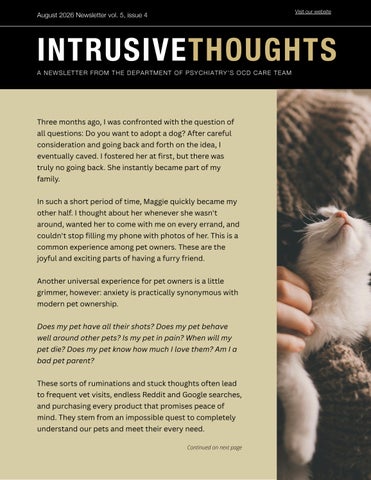
Three months ago, I was confronted with the question of all questions: Do you want to adopt a dog? After careful consideration and going back and forth on the idea, I eventually caved. I fostered her at first, but there was truly no going back. She instantly became part of my family. In such a short period of time, Maggie quickly became my other half. I thought about her whenever she wasn't around, wanted her to come with me on every errand, and couldn't stop filling my phone with photos of her. This is a common experience among pet owners. These are the joyful and exciting parts of having a furry friend. Another universal experience for pet owners is a little grimmer, however: anxiety is practically synonymous with modern pet ownership. Does my pet have all their shots? Does my pet behave well around other pets? Is my pet in pain? When will my pet die? Does my pet know how much I love them? Am I a bad pet parent? These sorts of ruminations and stuck thoughts often lead to frequent vet visits, endless Reddit and Google searches, and purchasing every product that promises peace of mind. They stem from an impossible quest to completely understand our pets and meet their every need. Continued on next page
INTRUSIVE THOUGHTS August 2026, vol. 5(4)
About 50–60% of pet owners in the United States report anxiety and worries related to their pets. The top four concerns include health, happiness and mood, nutrition, and their pet's stress. Not all anxious pet owners have OCD—worry is a common thread among people who deeply love their animals. Pet-related OCD, however, is characterized by persistent fears of directly or indirectly harming or neglecting a pet, accompanied by compulsions intended to relieve guilt, anxiety, or fear. Having fears or doubts while caring for a pet is completely normal. Worrying does not make you unfit or a bad pet parent. In fact, the amount of care and love swimming alongside that stress highlights just how important the relationship is to you. OCD tends to target what we care about most and what is inherently uncertain. Anxiety and OCD can thrive in the human-animal relationship because we speak different languages. We can't simply ask our pets how they're feeling. That uncertainty makes us doubt our instincts, chips away at our confidence, and fuels shame. Without realizing it, we feed that doubt by scrolling endlessly online for answers, often finding contradictory information and walking away feeling like we're still not doing enough.
Normalizing this experience is vital not only for owners' mental well-being but also for the animals themselves. Our pets are remarkably attuned to our emotions and often mirror our energy. The more we practice facing uncertainty head-on, the more confidence we build in ourselves. In turn, our pets often feel safer, allowing the relationship to flourish. The biggest thing that has helped me as a new dog owner has been commiserating with other pet owners and reaching out for support when I need it. Building a trusted support network helps answer questions about the "right" thing to do without relying solely on strangers on the internet who know nothing about my dog. I feel infinitely more capable of handling difficult diagnoses, behavioral challenges, and changes in nutrition when they arise. Maggie is a happy dog, but pet parenting is not without its challenges. I've realized that being a good pet owner isn't about eliminating uncertainty—it's about learning to love my dog despite it and leaning on others for support. I hope you find comfort in this month’s edition of Intrusive Thoughts and leave feeling a little less alone.
Sincerely,
Erin LeBeau
INTRUSIVE THOUGHTS August 2026, vol. 5(4)
OUR TEAM Dr. Rachel Davis MD - Medical Director and Psychiatrist Emily Hemendinger-Hirst LCSW, MPH, CPH, ACS – Clinical Director/Licensed Clinical Social Worker and DBS Coordinator Dr. Stephanie Lehto PsyD – OCD Therapist/Licensed Psychologist Katie Sinsko LCSW -- OCD Therapist/IOP Therapist Orah Fireman, LCSW, MEd -- IOP Behavioral Health Specialist/Licensed Clinical Social Worker Erin LeBeau MSW, LCSW --IOP Therapist/OP Therapist Cate Rush MSW --OCD Therapist/IOP Intake Therapist Jennifer Quigley PA-C --Prescriber, Physician Assistant
GROUP OFFERINGS Mondays at 4pm (monthly) Intro to ERP - for new group members Mondays at 6:30pm For adults ages 18+ with OCD and related disorders Tuesdays at 5pm For adults ages 18+ with OCD and related disorders
Jake Winchester LPC --OCD Therapist
Wednesdays at 6pm Jennifer Fishman BS --IOP Care Coordinator/Behavioral Health Specialist For adults ages 18+ with OCD and related disorders
Abby Ostunerlund, MSW - Social Work Felllow/OCD Therapist Dr. Petr Vitkovsky. MD - Psychiatrist Otis Rush – Therapy dog extraordinaire Jeremy Lawrence – MSc/Psychology Extern Sam Craver - MA/Psychology Extern Shelby Shogan – MSW trainee/intern Interested in contributing to the newsletter? Email the editor at Emily.Hemendinger@CUAnschutz.edu
Thursdays at 4pm For adults ages 18+ with OCD and related disorders We do have a waitlist for individual and group therapy, please reach out to be added to our waitlist and/or send you other referrals. Are you a clinician who wants to know more about OCD and ERP? We offer trainings, consultations, and supervisions!
CLICK HERE FOR MORE RESOURCES ON OCD AND ERP FOR CLINICIANS AND PATIENTS
STAFF SPOTLIGHT: ABBY OSTERLUND Abby Osterlund, MSW, LSW. Abby completed her MSW at the University of Denver’s Graduate School of Social Work. She also holds a bachelor's degree in psychology from Northwestern University. Prior to beginning graduate school,Abby is passionate about increasing accessibility to mental health care and has done years of early intervention research on children and adolescents with anxiety and OCD. She utilizes a therapeutic approach that centers Exposure and Response Prevention tools, while drawing from other therapeutic modalities including CBT, ACT, and IFS. In her free time, Abby enjoys running, baking, reading, and doing anything outdoors.
By Jen Fishman
INTRUSIVE THOUGHTS 2026, vol. 5(4)
Where Everybody Knows Your Name: Frequent Vet Visits, Excessive Checks, Researching, and Managing OCD Symptoms Related to Your Pet’s Health By Emily Hemendinger Those of us with furry, feathered, or scaled family members know how wonderful they can be for our wellbeing. However, those of us who also have OCD or health anxiety, may also experience symptoms that involve those very family members. And while OCD and pets can interact in a number of ways, for this article, we will just be focusing on health OCD/anxiety themes and related ERP. Similar to fears and compulsions when OCD targets our own health, OCD related to the health of our pets is based in intolerance of uncertainty, hyperresponsibility, and fears of “what ifs” and catastrophic thinking if we do not act on our compulsions.
The biggest compulsions with these fears often revolve around reassurance seeking, researching, and checking. Some specific pet health-related symptoms may include:
Excessive vet visits or visits to animal urgent care Reassurance seeking (e.g. from vet, partner, friends, family) Excessive questions/messaging to care team Compulsive researching
Checking pet’s vital signs (e.g. pulse, gums) or repeated physical examinations (e.g. checking for bumps, lumps, or insects) Excessive monitoring eating/drinking Hyperawareness around any perceived (or real) change in energy level, mood, physical health, etc. Rigidity around pet’s routine (e.g. who is allowed to watch them, food that they are allowed vs. not allowed to eat) Never wanting to leave pet alone due to fears of health crisis happening while you are not there While it might be nice that the people at the vet all know you and your pets name, all of the above ultimately reinforce the OCD, can lead to worsening symptoms and impairment, and have negative impacts in a variety of life areas. Beyond the financial impact of compulsive vet visits and time suck of compulsive research spirals, compulsions such as checking our pets, negatively impact our relationship with them. Vet visits can be extremely stressful to our pets on a regular basis. If we are taking them out of our own anxiety,1. We are putting them through unnecessary stress and 2. They will pick up on our anxiety and feel even more stressed. Additionally, pets need space and alone time. They also, just like humans, don’t enjoy being poked, prodded, or examined. This can lead to irritation, stress, and anxiety.
continued on next page
INTRUSIVE THOUGHTS 2026, vol. 5(4)
When we compulsively check them, that chips away at how safe they feel with us and negatively impacts our relationship with them. This is where ERP comes in! Just as we would with human health, ERP focuses on leaning into the discomfort, accepting the presence of distress and relative certainty, and moving towards our values. Overall, you want to interrupt, reduce,replace, or postpone any reassurance seeking, checking, researching, etc. Some examples might include: Feeding pet without washing your hands (before or after) Letting someone else watch your pet; leaving concise instructions instead of paragraphs of notes of instructions; only ask for photos 1x/day Leave the room briefly or allow normal pet autonomy (e.g. let them roam the house freely) Give your pet alone time and create a nice space for them to decompress Put flea/tick medication on your pet without checking for reaction Reduce the number of times you are checking your pet’s gums Research something unrelated to the fear or postpone the research by 10 minutes Put limits on the amount of emails you send to the vet One very important ERP goal around these symptoms is to work towards normalized vet visits.
Find a veterinarian who has experience working with people who have anxiety around their pets and health. Not someone who will accommodate this, but you are looking for someone who won’t dismiss you or treat you like “the boy who cried wolf.” It is important for you to feel validated and listened to, which is different than getting reassurance. Seek information, especially because some of the checking and cleaning compulsions might actually be doing harm to our pets. Work with the vet on a checklist for triage (e.g. certain things to look for, breaths per minute, emergency situations), that you can rely on instead of immediately seeking reassurance. This will help interrupt some of the OCD and start to build your self-trust in your ability as a pet parent. Most of us feel a deep and meaningful connection to our pets, so engaging in ERP can feel scary or too risky. However, by not engaging in ERP, we risk that very connection. Big picture, it serves us and our pets to lean into the discomfort and uncertainty. So, the next time you go to check your pet’s gums or bring them to the vet because you swear that mark on their belly is a tick, remember the value of your relationship with your pet, as well as your pet’s mental well-being and give them some scritches instead. They (and your brain) will be very grateful.
INTRUSIVE THOUGHTS 2026 vol. 5(4)
Enjoying the Time We Have By Cate Rush As a lifelong dog lover, something I often think about is the fact that when we get a pet, we know their lifespan will never be as long as we want it to be. We know, almost from the beginning, that they will likely die before we do. I often find myself fixating on my dog, Otis' age and having a particularly difficult time when his birthday comes around each year. I obsess over whether he has developed any gray hair, whether his joints are starting to crack, or whether there is anything else that might indicate he is getting older. It’s difficult to love a pet so deeply while knowing that our time with them is limited. The more I obsess over his age, though, the less I can enjoy the time I have with him. I want to cherish every moment we have together, rather than spending that time worrying about how much of it we have left.
So, I’ve compiled a list of a few response prevention tools that have been helpful for me. Limiting age-checking: When you notice yourself scanning your pet for signs of age, work to interrupt the behavior by focusing on something you love about your pet. Affirmation of difficulty: When you have a scary thought about your pet, acknowledge its presence and say something like “that’s a really scary thought to have”. Naming: You might find yourself naming the thought by saying “I’m having the aging thought again”. Don’t argue with the thought, but instead, notice the emotions that come up around it. Values: Focus on the value of spending time with your pet. Obsessing over their age takes away from your ability to be present with your pet and to enjoy the time you do have with them. When you’re feeling anxious about your pet aging, do something with them that’s fun for both of you. Some ideas I have are: take a walk, teach your pet a new trick, play in the park, lay on the couch together, take a selfie, or go get a pup cup!
INTRUSIVE THOUGHTS 2026, vol. 5(4)
Not Just Color Coding Pens: What I Actually Learned About OCD By Daisy Canales - PURPLE program summer intern
This summer I had the opportunity to intern with the OCD and Anxiety outpatient and intensive outpatient programs at CU Anschutz Medical Campus. I came into this experience with minimal knowledge about OCD and how it presents and is treated, so I thought I'd share some of my main takeaways from the summer. OCD comorbidity Throughout all of the psychology classes I've taken, comorbidity is something that is always talked about. The likelihood of experiencing more than one disorder, whether physical or mental, exponentially increases once you’ve got one under your belt. In the past I’ve heard numbers like 30%, 40%, or even 50% when discussing the likelihood of experiencing a comorbidity in regards to other mental health disorders. Individuals with OCD experience comorbidity with another mental disorder up to almost 80%, making that the norm rather than the exception, which adds to the complexity of being diagnosed in the first place. The potential for intense overlap between disorders can make treatment very difficult, especially long term. Infinite (not really) themes There are so many themes that can be present in just one individual, let alone overall. Certain subtypes of OCD can play off each other, like how perfectionism can be a part of moral/religious scrupulosity, hyper-responsibility, contamination themes, or all of the above. I also learned that over someone’s lifetime, the main themes they experience can change.
For instance, as a teenager someone might be experiencing more contamination OCD or “just right” themes, but as they get older, the OCD might morph into relationship OCD or specific harm themes. people nearby.
What reassurance seeking actually means Initially I struggled adjusting to not giving in to reassurance seeking while shadowing because WHAT DO YOU MEAN I’m not supposed to tell a person “You’re not going to get sick from petting Otis” or “You’re not a bad person for not going back to your car to check that you didn’t hit someone.” Once I learned that reassurance seeking was more detrimental long term, for individuals than helpful short term, it helped shift my perspective. It still took some time to adjust. I realized, I was also unable to sit with the discomfort because as a society we like certain responses and like to minimize stress, especially that of someone in distress, when we can. This shift in dialogue really helped put me into the shoes of loved ones of individuals with OCD. OCD is super sticky and loves to cling onto its host but also penetrate the lives of Overall my experience involved so much growth and learning on my end, especially in regards to all the different “flavors” of OCD. All the clinicians within the Anxiety and OCD clinic made my summer jam packed with laughs, educational opportunities, and immeasurable clinical knowledge I couldn’t have received anywhere else. Special shoutout to my mentor Emily for reminding me to always have some fun and be silly with OCD since it usually doesn’t respond well to “rational thinking” anyway.
INTRUSIVE THOUGHTS 2026 vol. 5(4)
Be Kind – A Primer on Self-Kindness and Self-Compassion By Jake WInchester “There are three ways to ultimate success: The first way is to be kind. The second way is to be kind. The third way is to be kind.” - Mr. Rogers
When considering a topic to write for this newsletter, I took a page from my dog Archie’s handbook and life philosophy. Archie is a 12year-old miniature Schnauzer with a lot of personality, some anxiety, and ultimately a lot of love for others. He always acts excited to see you, but as soon as the excitement calms, he just wants pets, or to sit next to you during whatever activity you choose. This made me think of my favorite quote above by Mr. Rogers who I think embodies a lot around selfkindness and self-compassion. Self-compassion is the practice of responding to ourselves with the same patience, understanding, and kindness that we might offer to someone we care about. It does not mean ignoring mistakes, avoiding responsibility, or convincing ourselves that everything is going to be okay. Instead, self-compassion allows us to recognize challenges while choosing not to add unnecessary self-criticism to an already painful experience. Psychologist Kristin Neff describes self-compassion as having three main components: self-kindness, common humanity, and mindfulness. Self-kindness means responding gently rather than harshly when we struggle. Common humanity reminds us that mistakes, disappointment, insecurity, and suffering are normal parts of being human rather than evidence that something is uniquely wrong with us. Mindfulness involves noticing painful thoughts and emotions without becoming completely consumed by them.
Many people worry that being kind to themselves somehow will make them lazy, complacent, or less motivated. However, self-compassion is different from simply “letting yourself off the hook.” Imagine two ways of responding to a mistake: “I’m terrible at this. I always mess things up,” versus “I made a mistake, and I’m disappointed. What can I learn from this?” Both responses recognize the mistake, but the second creates more room for learning, problem-solving, and growth. Self-compassion can also be helpful when we experience strong emotions such as anxiety, guilt, embarrassment, or shame. Instead of immediately trying to eliminate the emotion, we can practice acknowledging it: “This is difficult right now.” We can then remind ourselves: “Other people struggle with this too,” and ask, “What would be a kind and helpful way to respond to myself in this moment?” Importantly, kindness does not always mean comfort. Sometimes the compassionate response is resting, forgiving ourselves, or reducing unrealistic expectations. Other times, kindness might mean setting a boundary, tolerating discomfort, admitting a mistake, asking for help, or doing something difficult because it matters to us. A simple way to practice self-compassion is to notice how you speak to yourself during difficult moments. Ask yourself: Would I speak this way to someone I care about? If not, try replacing judgment with a response that is both honest and supportive. I believe self-compassion and self-kindness lends itself well to Exposure and Response Prevention (ERP) for OCD as well. ERP gets a bad wrap sometimes that it’s all about facing your fears and tolerating extreme distress. Without going into too much detail about ERP here, know that ERP can be done in a self-compassionate way and scaled to a level that is within the range of discomfort that you can learn to tolerate, and gain freedom from that anxiety cycle. All while being compassionate towards yourself and your experience of OCD. Self-compassion is not about feeling good about ourselves all the time. It is about learning to remain on our own side even when things are difficult. With practice, we can learn to approach our imperfections not as evidence of failure, but as opportunities to respond with patience, courage, and kindness.
INTRUSIVE THOUGHTS 2026, vol. 5(4)
Paws Before Panicking: Thoughts are just Thoughts By Stephanie Lehto Hi friends, it’s me, Stephanie, and I’m still on my cognitive distortion kick so let’s get to it. As a gentle reminder, cognitive distortions are thinking errors and we all have them, even nonsufferers. Some distortions seem to be more revalent in OCD, like the one we’re reviewing today.
It can be helpful to notice these thought patterns to help name what is occurring for you which may help to reduce the strength of the emotion that comes with this thought. This newsletter, we’re going to talk about thought-action fusion. Thought-action fusion can show up in two ways. One way is to have a thought and believe that having that thought is as bad as acting on the thought. To keep our examples today in line with the pet theme of this newsletter, let’s imagine someone has the thought that they may have hurt their dog (I will not be getting into specifics for this, but, I’m sure your imagination can go many places with this—OCD really is good at that imagined world). Where some individuals may have this thought and think “I hope I didn’t” and move onto their next thought, someone with OCD who has thought-action fusion will believe this thought is the same as hurting their dog and do many compulsions to try to alleviate the distress that accompanies this thought. Another example could be “what if I called someone a slur?” which thought-action fusion, this thought becomes just as bad as actually calling someone a slur.
The second way thought-action may show up is the belief that thoughts can make something happen. This may show up with the thought “if I think about my dog being attacked, they will be” or “if I step on a crack, I’ll break my mother’s back.” With thought-action fusion, this can feel very true, and someone may have to complete rituals to neutralize the thoughts or will try to not say or think anything that may be like these thoughts to prevent that awful thing from happening. When someone says this to me in real life, my response is usually “wow, you’re really powerful! Can you teach me to be that powerful?” OCD is so tricky in how it shows up. Even when we logically know thoughts don’t make something happen, the feeling that comes with the thought is so very convincing! With this knowledge, I hope you can start to notice your own thought-action fusion. Maybe you can gently push back on the thought, practice cognitive defusion, or even say the thought out loud or write it down for exposure. Remember: thoughts are just thoughts. We have to actually do a behavior to make them come true. And, as always, a Supernatural quote: “You don’t have to be ruled by fate. You can choose freedom.” — Castiel Also, seriously, if someone can teach me how to be that powerful can you send me an email?
INTRUSIVE THOUGHTS 2026, vol. 5(4)
OCD Program Happenings Shoutout to our amazing PURPLE intern, Daisy Canales. Not only was she an absolute joy to have on board for the summer, she brought strong clinical instincts, willingness to learn, a great sense of humor, and lots of compassion for our patients. Her research project on improving access to OCD care was an important topic, in line with our program’s mission AND she crushed her presentation and poster so well that she was awarded the Best Poster Presentation award at the PURPLE symposium on August 6th.
Welcome back to Abby Osterlund, who after completing her 2025-2026 internship with us and completing her MSW graduate program, is returning as a part-time social work fellow. Yay!
Welcome to Sam Craver! Sam is joining us as a fourthyear PsyD from DU for his externship. Sam has his MA in Sport Psychology and has previous experience providing therapy to those with OCD and related disorders, as well as grief related therapy services. Welcome Shelby Shogan! Shelby is joining us for her second year MSW internship. She has her BA in Psychology and has previous experience providing therapeutic support for children with autism, as well as client and office management with clients who have OCD and related disorders.
The IOCDF Conference in Seattle, Washington
The OCD team SHOWED UP at the IOCDF Conference this year, with a total of 10 team members attending and presenting! Other than presenting in 5 different sessions, the team enjoyed some tasty treats at Maggie Moon’s Ice Cream and the team members who LOVE the color purple got to visit The Purple Store! Otis was there, naturally, and was as cute as ever!
JOIN ME AT THE
OCTOBER 11, 2026 BELLEVIEW PARK ENGLEWOOD, CO IOCDF.ORG/WALK
HOSTED BY
MARQUEE SPONSOR: