Connecticut Woodlands – Winter 2026 | Reflecting on place and history
Land Acknowledgment Statement
CFPA acknowledges we are on the traditional lands of the Mashantucket Pequot Tribal Nation, the Mohegans, the Eastern Pequot, Schaghticoke, Golden Hill Paugussett, Nipmuc, and Niantic peoples. We pay our respect to the Indigenous people who are no longer here due to colonization, forced relocation, disease, and warfare. We thank them for stewarding this land throughout generations. We recognize the continued presence of Indigenous people on this territory who have survived attempted genocide, and who still hold ties to the land spiritually and culturally. We shall be good stewards of the land we all call Quinnentucket, Connecticut.
CONTRIBUTOR
Spotlight
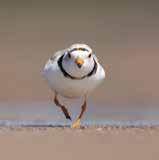
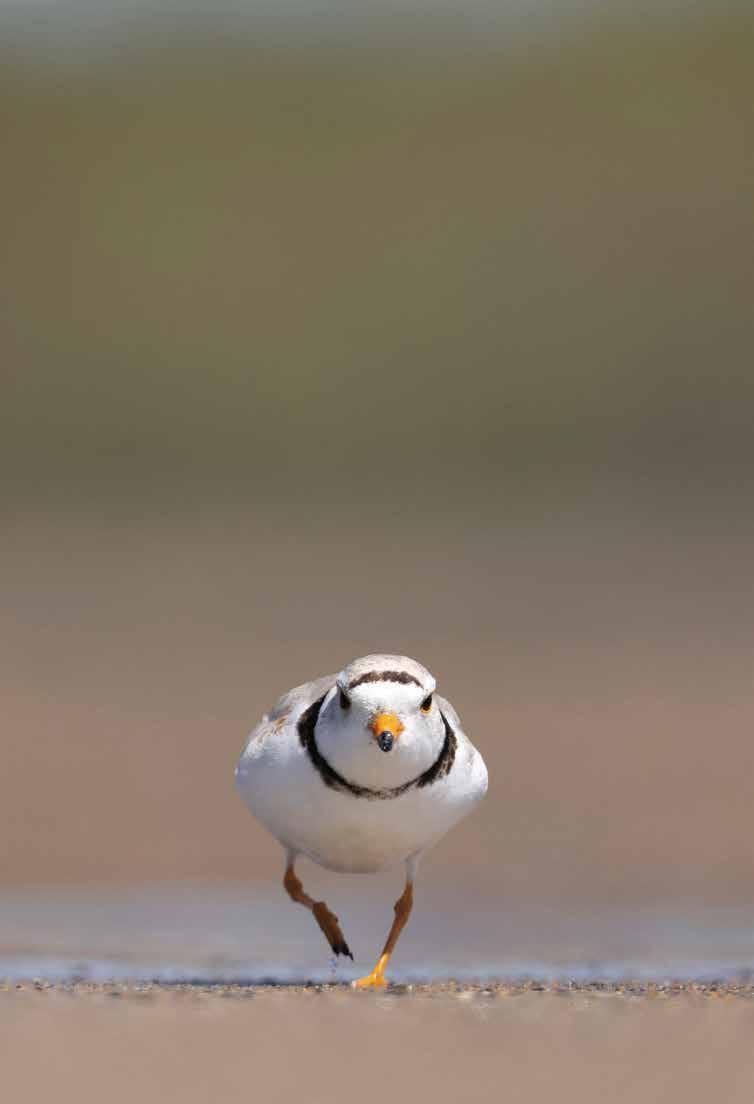
Todd DeWald was studying fisheries and wildlife science at Oregon State University when he first got into wildlife photography. He was quickly hooked on learning how to capture images of the wildlife he was learning about in class. Now based north of Hartford, he runs a business offering guided photography tours and educational videos, all with a focus on furthering conservation efforts through photography. Todd took the photo of a piping plover in this issue’s article on changes being made to the Endangered Species Act.
What kind of photography work do you get the most excited about?
I’ve really enjoyed working with different land trusts. This started with Granby Land Trust where I created some virtual tours of the preserves they manage and has since spread to other nature organizations. I really enjoy the video aspect of these projects and the ability to tie in the history of the preserves with the conservation goals of the organizations.
How does your background in fisheries and wildlife science inform your photography work?
I was fortunate to be able to take a variety of courses related to ecology and wildlife behavior. I have used this information to both increase the chances of finding wildlife, but also photographing the animals in an ethical manner, so as not to disturb them.
What has been one of the most challenging animals to photograph?
One species that has been a challenge for me to find and photograph is the bobcat. This is a species that I have only seen by chance three times, and I am currently working to find and understand them better with the use of trail cameras.
What did you learn about piping plovers while photographing them?
For the piping plovers, I wanted to be sure I kept my distance from them, since I knew they are an endangered species. One thing I have found with many shore bird species, is that if you lay down flat on your belly, many of the birds will
ignore you and they will approach you on their own terms. This allows for some great opportunities to observe and photograph the species.
What is something that would surprise people about the work you do?
I don’t come home with a photo after every outing. There is this misconception with social media that every outing creates these amazing images, but wildlife is unpredictable. This is one principle that I try to teach early to my clients for guided sessions: even an outing where you don’t come home with a photo can be successful if you had a nice time.
For my first editor’s note, I have a confession: I did not know about the Blue-Blazed Hiking Trail System until last year. I grew up in Connecticut. But 20 years ago, I moved away, and I spent the last decade in Portland, Ore. In 2024, I moved back to CT with my husband and three-year-old daughter. We now live one mile from the southern terminus of the New England National Scenic Trail, which I discovered after noticing blue blazes around my neighborhood. A 235-mile trail that starts in Guilford? Who knew?! I’ve done a lot of exploring since moving back, but again and again, I’m discovering how much I don’t know about this great state.
As the new editor of CT Woodlands Magazine, it’s my responsibility to know some things about the topics we cover. But my greater responsibility is to ask questions. In my work, I strive to approach every story with the expectation that other people know more than me, and to be open to the possibility that what I think I know is wrong. (I thought all bears slept soundly through the winter. In this issue, we’ll learn otherwise.) I feel fortunate to have stepped into a position where I get to connect with so many people—from the staff at CFPA to readers like you—with extensive knowledge to share.
These days, people are often racing to be right. Scary things are happening in our world, and there can be a false sense of security in reaching for easy answers. But we shortchange ourselves when we claim to know something we’re just beginning to understand. Curiosity, on the other hand, can be comforting—it just takes a little more work.
My hope is that we all keep asking more questions. Whatever you think you know about the place you call home, let’s venture a little further down the trail. To that end, I’d love to know what you’re curious to read about in future issues. And ask me your questions! I’ll have some for you, too. Brobinson@ctwoodlands.org.
See you out there,
Britany Robinson Editor
The Connecticut Forest & Park Association, Inc.
The Connecticut Forest & Park Association (CFPA) is a 501c3 nonprofit organization that protects forests, parks and the Blue-Blazed Hiking Trails for future generations by connecting people to the land. Since 1895, CFPA has enhanced and defended Connecticut's rich natural heritage through advocacy, conservation, recreation, and education, including maintaining the 825-mile Blue-Blazed Hiking Trail System. CFPA depends on the generous support of members to fulfill its mission. For more information and to donate, go to ctwoodlands.org
Board of Directors
President
Laurie Giannotti, Deep River
Vice-President
David Terry, East Hampton
Treasurer
William Cordner, West Simsbury
Secretary
Seth Huttner, Hartford
Forester
Michael Ferrucci, North Branford
Jeff Bolton, Granby
Della Corcoran, Farmington
Beth Critton, West Hartford
David Ellis, Wallingford
Alan Hurst, East Hampton
Michael Proctor, New Haven
Tom Tella, Wolcott
Marcus Ware, Ellington
Staff
Alex Bradley
Trails Stewardship Coordinator
Clare Cain
Trails Director and Interim Executive Director
Cal Creeden
Development Assistant
Teralyn LaChance Office and Volunteer Manager
Beth Merow
Education Director
Linda Pierce
Development Director
Kate Preston
Trails Conservation Coordinator
Julia Sonen
Education Assistant
Meaghan Strange
Communications Coordinator
Chuck Toal
Trails Day Coordinator
Connecticut Woodlands
Britany Robinson Editor
Margaret Gibson Poetry Editor
Kolk Design
Graphic Design
Thanks to photo contributions from Denise Abercrombie, Robert Andrews, Eric Bengtson, Todd DeWald, Mosi Moses.
Sustainably printed on FSC certified paper using solar power and LED-UV curable inks, which don’t release harmful VOCs into the atmosphere and can reduce energy consumption by 30% compared to conventional inks.
Connecticut Woodlands is a quarterly magazine published since 1936 by CFPA. The magazine is distributed to members and donors, as well as public libraries and other state and local offices. Advertising local goods or services is welcome. For specifications and rates, visit ctwoodlands.org/rates. To advertise, contact info@ctwoodlands.org or call 860-346-TREE.
Canopy
BY CLARE CAIN
CFPA’s 2026 Conservation Agenda: Investing in Connecticut’s Outdoors
Connecticut’s forests, parks, and trails are essential to our quality of life and the state’s long-term resilience. These lands protect water quality, support public health, provide recreation, and contribute significantly to our local economy. Sustained investment in conservation is key to preserving this legacy and ensuring our state remains an outstanding place to live, work, and play.
Since 1897, CFPA has championed the protection of the state’s natural resources. Our 2026 Conservation Agenda builds on this powerful history, looking ahead to preserve public lands, strengthen environmental stewardship, and expand equitable access to outdoor recreation.
A cornerstone of the agenda is our stalwart support for the Passport to the Parks program. In 2024, the General Assembly made a historic investment by updating the program’s revenue structure, allowing all Connecticut residents to access state parks and forests without entrance fees. CFPA urges lawmakers to maintain the integrity of the program and avoid fund diversions or new exemptions that would weaken its statewide benefit.
With federal funding being eliminated, forestry programs in CT are at risk. CFPA’s acclaimed Master Woodland Manager (MWM) program has trained more than 200 landowners and forest managers in sustainable practices. We are seeking critical state support to sustain the MWM program, along with critical urban forestry program initiatives, that expand our tree canopy and strengthen our climate resilience.
Adequate agency staffing is another key priority. CFPA supports targeted investments at the Department of Energy and Environmental Protection (DEEP) and the Department of Agriculture to ensure these agencies can fulfill their
missions. Key needs include installing a full-time environmental educator at Goodwin Conservation Center in Hampton, as well as fully staffed survey crews to protect state lands from egregious encroachments.
CFPA also calls for the development of a comprehensive State Parks and Forests Master Plan. With evolving recreational interests and uncertain long-term funding, a strategic plan is essential to guide investments in our state lands over the next decade. We believe that, at a minimum, planning should include consideration for capital improvements, sustainable funding strategies, management and operations guidance, and measurable action steps to enhance visitor experience while also protecting our sensitive natural and cultural resources.
In the 1960's, CFPA helped spearhead Public Act 63-490 (commonly referred to as “PA 490”), an act concerning the taxation and preservation of farm, forest or open space lands. CFPA will continue to closely monitor any discussions around implementation and potential changes to this important tool for agriculture and forest lands in our state.
Finally, CFPA encourages continued bonding for trails and open space. Investments in the Blue-Blazed Hiking Trail System and connected greenways leverage extensive volunteer labor and ensure public access to protected lands. CFPA will also continue to carefully monitor state land conveyances to safeguard the long-term protection of our public lands.
You can stay connected to our legislative work by signing up for action alerts on our website and adding your voice to a proud community of advocates working to protect Connecticut’s natural heritage for generations to come.
Clare Cain is CFPA’s Trails Director and Interim Executive Director.
The Pequot Trail
By Bob Andrews
Bashert is a Yiddish word meaning “destiny.” It is most commonly used in reference to a romantic partner or soulmate, but it can also point one toward a predestined purpose or path.
Early in the 1990s, I was a scoutmaster on a three-day hike with a group of Boy Scouts on the Connecticut portion of the Appalachian Trail. We were going up a very steep section, feeling proud of our ability to carry our backpacks and gear. Coming the other way was a group doing trail maintenance. They had just gone up and over the same hill carrying backpacks and bulky tools, working as they passed us. We were humbled and impressed. They said they were with the local Appalachian Mountain Club chapter. When I got home, I made contact and joined the AMC. After a few hikes and volunteer events, I found there was another organization, the Connecticut Forest and Park Association, that maintains
another 800+ miles of trails, and I joined that organization as well. I found out that CFPA had an upcoming vacancy among their trail managers. They asked if I would take over the Pequot Trail.
Pequot? What were the chances? Bashert. I was born in a lakeside cottage in Ellington, Connecticut called “Pequot Lodge.” In 1985, when my aunt passed away, she left me a house on Pequot Avenue in New London. My children grew up there, and my son Greg joined Boy Scouts and became a member of the Pequot District of the Indian Trails Council. When redevelopment came to New London and bought our home, we moved to Ledyard where our next-door
neighbor was a member of the Pequot tribe. His and much of the neighborhood property was owned by the tribe or tribal members. I bought a membership to the Mashantucket Pequot Museum.
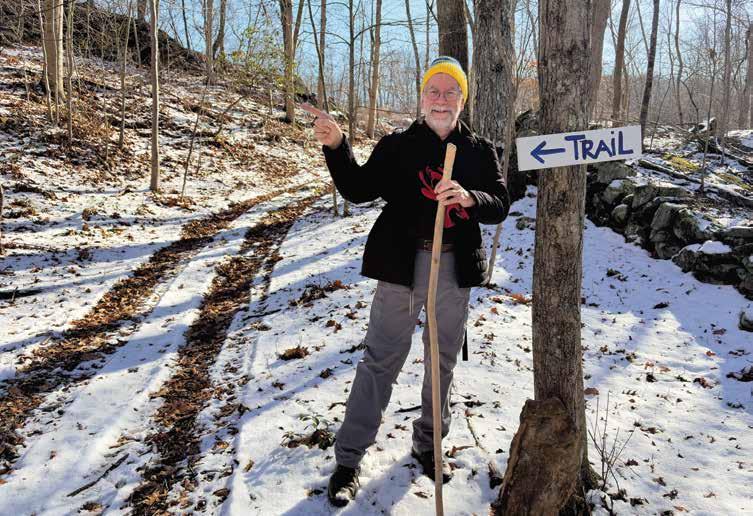
One other thing: I’m a direct descendent of the colonists who perpetrated the massacre of Pequot tribal members at Mystic Fort in 1637. I have now been managing the Pequot Trail for over 25 years, and my family history is often on my mind as I work. There is a marker near a high point of the trail where Indigenous artifacts were found by a previous landowner. I have paused there a few times to consider the questions of my connection to this place and its history. Am I here just to keep the trail clear, or am I making some reparation for the guilt of my ancestors? Either way, it feels right to do everything I can to respect and protect the land.
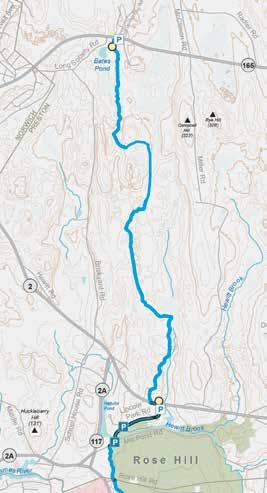
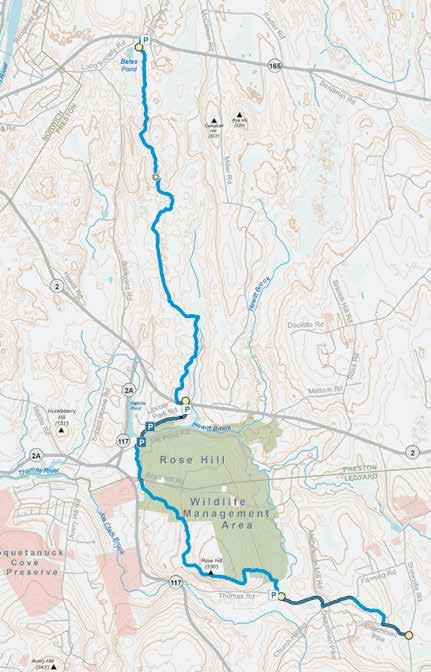
On a more cheerful note, there has been a continuing effort by CFPA to improve the Pequot Trail and uphold its Indigenous history. The original route of the trail included a connection to the Narragansett Trail on Lantern Hill. In 1979, construction of Mashantucket Pequot tribal homes, roads, and a museum required the shutdown of that section. A long-term effort by CFPA and the tribal Natural Resource Protection staff has identified a possible reroute. In 2015, another reroute was made in response to a request by the tribe to move a short section away from the sacred burial ground to protect it from accidental intrusions. The trail now steers clear of that part of the reservation property.
A 30-year effort by local groups to create the Tri-Town Trail from the Long Island Sound to the Pequot is now in a construction phase. The biggest overhaul of the trail was made necessary by the power company upgrading a high voltage line and replacing its wooden towers with larger steel towers. The power company constructed a new road and bulldozed two miles of the Pequot Trail, which closed half of the trail for two years. Some of that section has now been rerouted, re-blazed, and will be under rehabilitation for a few years. South of that reroute, part of a road walk has been eliminated by moving the trail into a wooded area that follows a stream often used by fishermen and wildlife photographers.
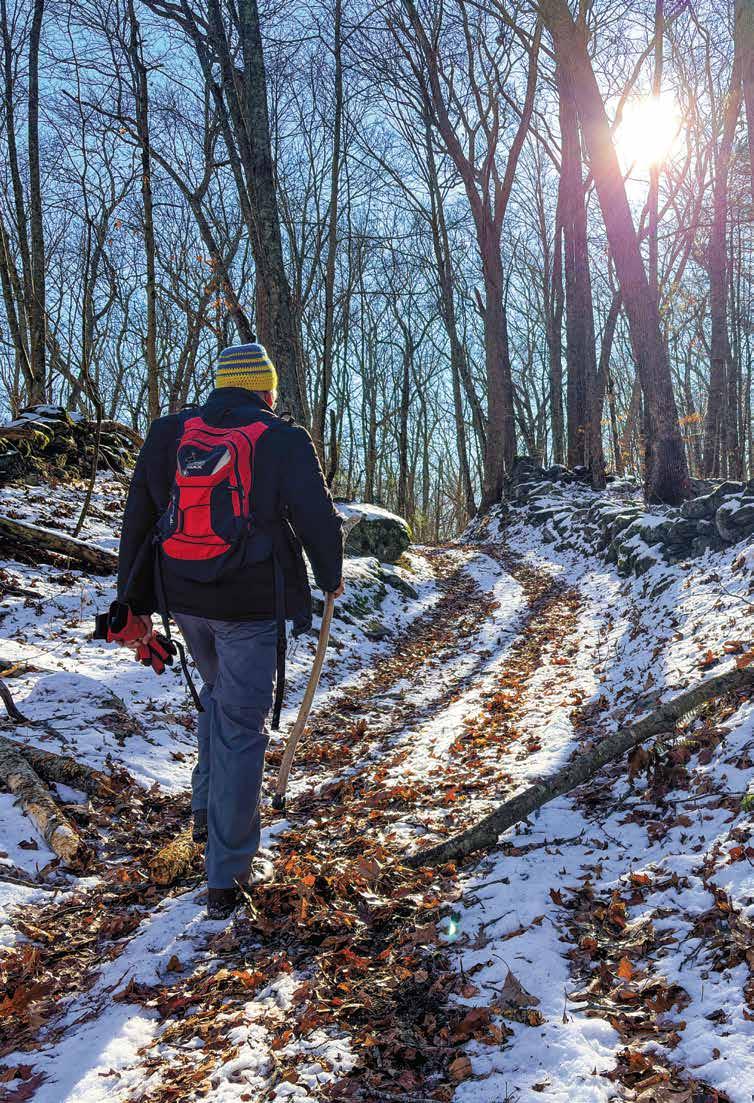
Hiking any of Connecticut’s trails, it is worthwhile to take your time and consider how the land came to be as it is now. On an early fall morning, walk quietly on the Pequot Trail, and you will have more than birds and squirrels for company. History is imprinted on the land. Imagine thousands of feet of ice crushing giant boulders across the surface, creating stream beds and carving the hills. Listen for prehistoric animals passing by, long before the ice came and went. Hear the footfalls of thousands of Native Americans living here a few
centuries ago. Or the colonial farmers raising sheep on land cleared by the construction of endless stone walls.
History is alive on this trail. Sometimes, I must remind myself that today, I am here to work. There is a blaze missing or a tree limb is down. I am meant to be here, to take care of this place. So, I tell myself: Get back to it.
The Pequot Trail is not the most scenic trail in the CFPA inventory. There are few sweeping vistas or majestic stands of old growth timber. It is rarely hiked by organized hiking groups. Even some of its neighbors are unaware of its existence. But I still recommend taking
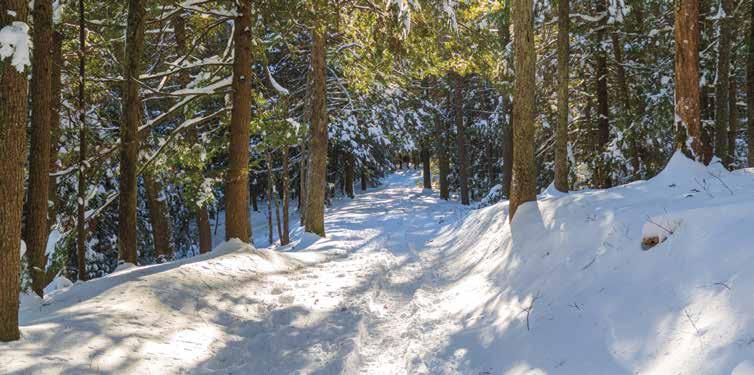
a winter’s day walk through snow-covered pines, across wetlands still alive with that one beaver and two Canada Geese. Perhaps you will get the feeling you were meant to be here, too.
Bob Andrews is an accomplished sailor, computer geek, retired civilian Navy IT director for bases in the US and Iceland, and a Harley rider who enlisted in the Navy as a Russian Translator. He writes bad poetry and dabbles in political activism and alternative energy systems. After 77 years in eastern CT, he now lives with his college sweetheart in Hartford. In his spare time, he hikes with his children and two grandsons in the Pachaug State Forest.
For the latest trail location info, visit CFPA's online trails map.
Updates
Little River Bridge Re-Built
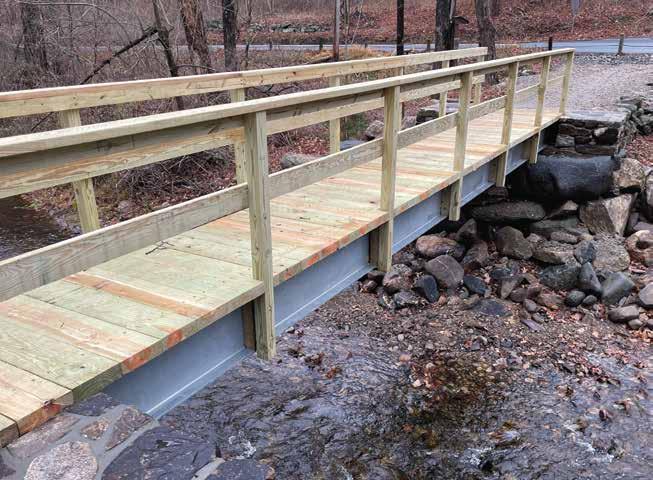
Flooding in 2024 destroyed several trail bridges across southeastern Connecticut, including the 40-foot bridge spanning the Little River on the Saugatuck Trail in Redding. With support and coordination from Aquarion Water Company, the bridge was rebuilt by local contractor Nazzaro, Inc. The new bridge is a marvel and well worth a visit this hiking season. The project was funded by the CT Women’s Business Development Council, the Redding Land Trust, CFPA donors, and Aquarion Water Company.
CFPA Headquarters to Re-Open
CFPA staff worked remotely in late 2025 and early 2026 while contractors completed upgrades to the association’s office space. Kencore Construction—an experienced partner on previous CFPA building and trail projects—led the redesign and renovation. The updates include new flooring and office furniture, freshly painted walls, and an improved meeting space, bringing new life to an office that had not been updated in more than twenty years. We look forward to welcoming you into the renovated office this Spring.
Rock Walkway Repaired
A long-standing problem area has been repaired on the South Pattaconk Trail in the Cockaponset State Forest. Our CFPA “RockStars” outdid themselves, building their longest and most handsome rock causeway to date. The new structure, which offers dry passage over a rambling brook, is a beautiful testament to the power of teamwork and volunteer ingenuity!
Hartford Students Are Getting Outside
CFPA’s “Trees for Hartford” initiative has begun at Keney Park where we’re thrilled to be immersing Hartford students in interactive, outdoor learning experiences. This collaborative project is coordinated by the City of Hartford’s Office of Sustainability and funded by the USDA Forest Service’s Urban and Community Forestry Grant program. During each visit, students explore the forest, meadows, and streams, observing nature up close to learn how trees, plants, and wildlife work together to create a thriving ecosystem. Our first school partners are Milner Middle School and Community First School; we hope to expand to more schools this spring. By recording observations and engaging directly with wildlife and plants, students are not just learning—they are becoming part of the ecosystem. Through this partnership, CFPA hopes to inspire the next generation of forest stewards.
Photo by Eric Bengtson
Den Calls
The Hidden Lives of Winter Bears
By Laurie D. Morrissey
by CT DEEP
In late November, Connecticut’s resident bears begin looking for a protected spot to spend the winter. They settle down in brush piles, beneath rocky outcrops, against uprooted trees, inside hollow trunks—even under convenient porches or decks.
Out of sight, out of mind? Not for folks who happen to notice a mother-andcub bear ball under their shed. And not for the wildlife biologists keeping tabs on Connecticut’s largest land mammal. They’re making weekly house calls—or den calls—gathering data on physical condition, first-year survival rate, and other factors.
The black bear (Ursus americanus) is an impressive creature, glossy black or dark brown and weighing up to 500 pounds. An adult male is 2-3 feet tall at
the shoulder, and 5-7 feet tall when standing. In Connecticut, where black bears were abundant in pre-colonial times, their population has fluctuated. European settlement reduced forest habitat, and hunting and trapping took their toll. By the mid-1800s, black bears were nearly extirpated from the state.
In the late 1800s, many farms were abandoned, and forests began to regenerate. Today, about 60% of Connecticut’s land is forested. The Connecticut Department of Energy and Environmental Protection (DEEP) estimates that there are about 1,200 black bears, and the population is growing by 5% to 7% a year. The concentration is highest in the northwest, but sightings are reported in every town.
They wake up if disturbed, and mother bears wake to care for their cubs.
Photos
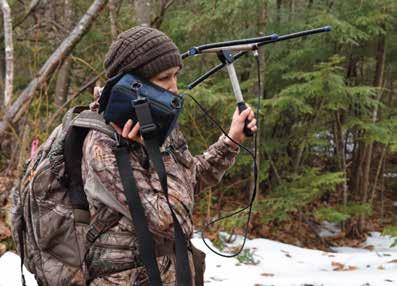
Above left: Melissa conducting telemetry using an antenna and receiver to pick up the radio collar’s frequency. This is how biologists track an animal with a transmitter.
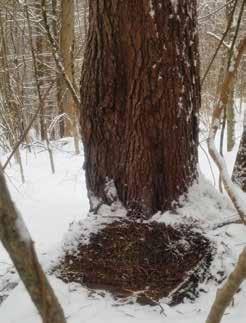
Above right: Example of a nest at the base of a large conifer. This is a common den-type of a sow with yearlings. This sow who denned here had 3 yearlings with her. They were treed at the time this photo was taken.
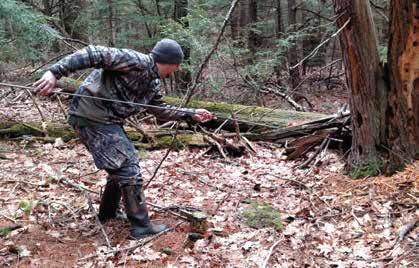
Right: A biologist using a syringe pole to inject a bear with drugs. The bear is denned under the fallen tree.
One fascinating aspect of black bears is their winter behavior. Contrary to popular belief, they are not true hibernators. In true hibernators (such as groundhogs and bats), there is a drastic reduction in body temperature, heart rate, and metabolism. Bears, on the other hand, spend the winter in a type of hibernation referred to as torpor or deep sleep. During this time, they do not drink, eat, urinate, or defecate. Heart rate and respiratory rate slow down, but body temperature drops only slightly. They wake up if disturbed, and mother bears wake to care for their cubs. Some males remain active, especially if the temperatures are mild and food is available.
Melissa Ruszczyk, with the DEEP Wildlife Division’s Furbearer/Black Bear Program, is one of the wildlife biologists conducting winter den surveys, which began in 2002.
“Our winter surveys allow us to obtain reproductive and survival estimates by visiting dens of collared bears,” she says. “Over time, we can see if there are changes in the litter sizes, weights, and the number of bears that survive their first year. We can document den-type selection, which can identify habitat types that are important for denning.” The information informs management decisions that help conserve bears, allow for continued range expansion, and provide the public with information and methods to mitigate human-bear conflicts and keep bears wild.
Some dens are not very den-like. “A female with a yearling may make a nest of twigs and pine needles at the base of a tree surrounded by thick
shrubs,” Ruszcyk says. Their thick fur is water-repellent and insulating, so a snowfall doesn’t disturb them. Bears in ground nests are often found wearing a layer of white.
Well before they settle down, bears have an insatiable appetite. They eat almost constantly and can smell food up to two miles away. While the bulk of their diet consists of plants, they eat almost anything they can find, especially during this period of extreme hunger (called hyperphagia). They consume about 20,000 calories a day—instead of the usual 3,000-5,000—to accumulate fat.
Typically, females expecting cubs are the earliest denners. Inside her cozy winter home, a pregnant female
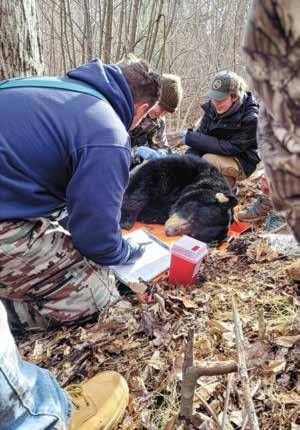
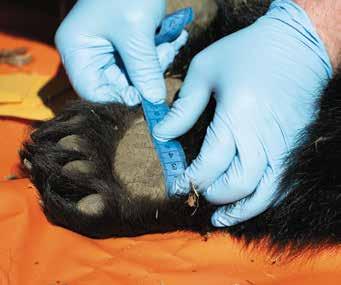
Left: Biologists processing an anesthetized female bear. Measurements, biological samples, radio collar change, weights.
Below: Taking a measurement of bear paw
Some males remain active, especially if the temperatures are mild and food is available.
breathes about once per minute and her heart beats 8-12 times per minute. Even in dormancy, she burns up to 4,000 calories a day.
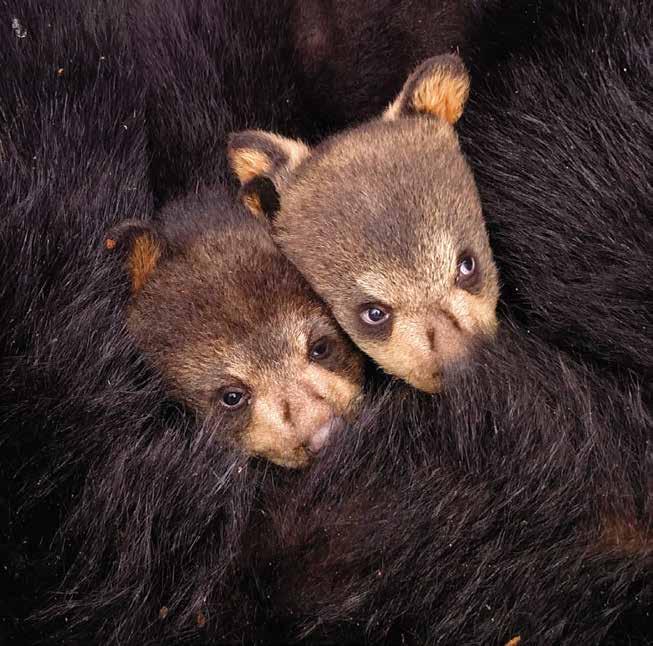
In January or February, Ruszczyk says, the female gives birth to a litter of one to four cubs. Two or three cubs are most common, but litter sizes appear to be increasing. Wildlife biologists attribute the increase at least in part to easily available food (such as garbage and bird seed), which improves maternal health.
Although impregnation took place in early summer, fetal development only took place in the previous two months, when she had stored enough fat and nutrients. At birth, the cubs are blind and practically hairless, weighing less than a pound.
“Newborn cubs aren’t in a state of torpor; they’re required to eat, drink, urinate, and defecate so their bodies
can grow,” Reszcyk explains. “They’re tended to regularly by the mother when they cry, and they nurse frequently to quickly gain weight on their mother’s high-fat milk.” By the end of winter, the nursing mother has lost a third or more of her body weight, and the cubs weigh about 4-6 pounds each.
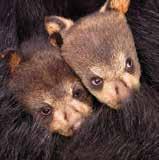
To locate denning bears, biologists use GPS radio collars. Thirty females are collared this winter, according to Ruszczyk. She and her colleagues approach the den with their tools of the trade, including headlamp, dart guns, and a syringe on an 8-foot pole. Once the mother is anesthetized, they gently bring out the cubs and place them in a backpack to keep warm. Each cub gets a microchip tag on its ear and receives an ID number.
The biologists weigh and measure the mother, assess her overall condition, take blood and other samples, then
give her a new collar with fresh batteries before sliding her back into the den.
The more data, the better, Ruszczyk says. They may even be able to track the effects of warmer winters on length of hibernation. With the bear population on the rise and humanbear encounters increasing, state biologists appreciate help from observant citizens. To report a bear sighting, email deep.wildlife@ct.gov.
Laurie D. Morrissey is a New Hampshire-based writer whose work has appeared in Connecticut Woodlands since 2016. She has also been published in Northern Woodlands, Art New England, New Hampshire Home, Appalachia, and numerous poetry journals.
Photo by Dan Lawrence
The Changing Landscape of Endangered Species Protections
Words by Britany Robinson Photo by Todd DeWald
Piping plovers arrive in Connecticut each spring to nest on sandy beaches. Their options are limited here; Connecticut’s shoreline is a narrow strip, hemmed in by one of the most congested interstates in the country. And much of that narrow coastline is made up of rocky bluffs and wetlands. Piping plovers prefer the sandy strips of beach that also attract people, making it even harder for them to carve out safe spaces to lay their gray, speckled eggs. Climate change is squeezing out their options further, as sea levels rise and storms intensify.
Federally Listed and Living in CT
These species are protected under the federal Endangered Species Act and live in Connecticut. Some of them are also included on Connecticut's state-level ESA.
Indiana Bat - Endangered Population decline due to white nose syndrome and loss of forest habitat.
Despite all of these challenges, the plight of the piping plover has been a comeback story in Connecticut, thanks in large part to federal and state protections. The little sand-colored shorebirds are federally listed as “threatened” and therefore protected under the Endangered Species Act. In Connecticut, state and volunteer groups dedicate significant time and resources each year to setting up fencing and string enclosures, warning people to steer clear of the birds and their eggs. Volunteers patrol protected areas, ensuring the birds and their nests are not disturbed. In 2025, 166 piping plovers were monitored across 15 sites by Connecticut's Department of Energy and Environmental Protection (DEEP)—the highest number of mating pairs since they began tracking in 1984.
“Our population is growing,” says Corrie Folsom-O’Keefe, Director of Bird Conservation for Audubon’s Connecticut and New York regional office. But she also warns that setbacks can unfold quickly when it comes to vulnerable species, and these numbers are still small. Protecting and monitoring their habitat and up and down the Atlantic seaboard will be critical work to the survival of piping plovers for generations to come.
In April of last year, while piping plovers were preparing to lay eggs in the sand, the Trump administration proposed a significant change to the Endangered Species Act, which would rescind the current definition of the word “harm” to exclude habitat protection. The administration claims that only intentionally killing or injuring a species should be considered “harm,” and that habitat destruction does not qualify.
“Woodpeckers are dependent on long leaf pine. Monarch butterflies can’t survive without milkweed,” says Mike Leahy, Senior Director of Wildlife Hunting and Fishing Policy at the National Wildlife Federation. “Everybody knows that wildlife needs habitat. This would be a huge setback to the recovery of a lot of species.”
Many strategies for recovering endangered and threatened species are based on incentivizing landowners to maintain the habitat these species need to survive. “Those programs are based on the fact that the habitat is protected by law,” says Leahy. “Once you remove the protections for habitat, you remove a big part of the incentives.”
Roseate tern - Endangered Hunted for hats in the 1800s. The third largest colony in North America breeds on Faulkner Island.
Nationwide, 99% of federally listed species have been saved from extinction since the establishment of the Endangered Species Act in 1973. Success stories of the ESA, in which habitat protection played a significant role, include the bald eagle, gray wolf, peregrine falcon, Florida panther, and hundreds more. In a 2023 study conducted by The Society for Conservation Biology, five major threats to species and biodiversity were examined to determine the most significant. Of 30,000 species considered, 88% were impacted by habitat destruction—more than the other four threats combined.
In October, Leahy’s team was already collaborating with partner organizations, preparing to sue the administration for the exclusion of habitat protections in the ESA’s definition of “harm,” should this proposal become law. The following month, the U.S. Department of the Interior announced four more proposed rule changes to the ESA. These include removing a blanket rule that immediately protects threatened species upon listing, prior to the establishment of species-specific regulations; allowing economic considerations to be factored into the designation of critical habitat; limiting the scope of “foreseeable future” in considering the risk for a species to become threatened; and changing how interagency consultation is conducted.
These changes, “advance President Donald J. Trump’s directives to strengthen American energy independence, improve regulatory predictability and ensure federal actions align with the best reading of the law,” states the announcement from the U.S. Department of the Interior.
Backlash to these proposed changes from environmental groups and scientists has been swift and explicit. Over 600 scientists signed a letter, urging congress to protect the ESA, calling it “one of the most vital and effective tools we have to halt the accelerating loss of life on Earth.” They emphasize that failure to protect individual species will impact whole ecosystems and humans who rely on them, too.
They write: “These species and their connections to each other and the world around us underpin ecosystem services essential to human well-being: clean water, pollination, disease regulation, carbon storage, and climate resilience, to name a few. The ESA does not just protect wildlife; it protects the systems that support agriculture, economies, and communities.”
Bog Turtle - Threatened
The rarest turtle in Connecticut with isolated populations documented in just five towns.
Dwarf wedgemussel - Endangered
Population limited to a few Connecticut River tributaries. Threatened by water pollution and dams.
Over 10,000 faith leaders sent a similar letter to congress, calling the ESA a “modern-day Noah’s ark,” and rejecting the Trump agenda for rolling back protections. During the open comment period, according to EarthJustice.org, nearly 400,000 Americans submitted in opposition to the proposed changes.
This all comes at a time when biodiversity loss is an urgent concern to life on Earth. In the last 50 years, wildlife populations have declined by 69%, and about one million species are currently at risk of extinction. Biodiversity loss not only means the loss of individual species but also increased risk of infectious diseases. (Consider the increase of Lyme Disease in recent decades; with fewer mammals in our forests, ticks are feasting on humans.)
The salt marsh sparrow is another seasonal resident facing habitat loss, and it's been considered for federal protections in recent years. Folsom-O’Keefe says it’s important for them to be listed soon, as the population is currently declining by about 5% each year. But changes to the ESA could delay such listings.
The salt marsh sparrow is considered a key indicator species, meaning the health of its population is a reflection of the health of its ecosystem. Their declining numbers are a sign of struggling salt marshes, due to sea level rise and development. Efforts to protect them can protect other species, too, making the salt marsh ecosystem more resilient to climate change.
In an article for the U.S. Fish & Wildlife Service, MaryKelly Hilton writes, “Healthy coastal marshes not only provide wildlife habitat, but they protect the coast from flooding, provide clean water, and support multi-billion dollar fishery and tourism industries.”
Folsom-O’Keefe says if we can’t figure out how to make salt marshes more resilient to climate change in the next five years, “the salt marsh sparrow will go extinct by 2050.”
As environmentalists and conservationists prepare for these rollbacks to become law, Brian Hess, Wildlife Diversity Program Biologist at DEEP, says the changes will be “meaningful, but they’re not going to have dramatic impacts on how we do things as a state.” He explains that, due to Connecticut’s relatively recent glacial history and limited geographic range, we don’t have the biodiversity
Puritan tiger beetle - Threatened Found on sandy beaches and cliffs in just two states: Maryland and Connecticut.
range of other parts of the country. We also have extensive state and local programs, like the The Audubon Alliance for Coastal Waterbirds, which partners with DEEP in monitoring and protecting piping plovers and other shorebirds.
Connecticut also has its own Endangered Species Act, signed into law in 1989. This includes DEEP-determined lists of endangered and threatened species and species of special concern. The piping plover is listed as endangered in Connecticut. Every CT state agency is required to “conserve endangered and threatened species and their essential habitats.”
In late July, piping plovers, including fledglings who have just learned to fly, begin their southward migration to winter on the coast of Florida, Louisiana, and Texas, and down into Mexico and Central America.
Folsom O’Keefe notes that borders mean nothing to a bird.
“A bird doesn’t know if it’s in Connecticut or New York or Rhode Island or Florida,” says Folsom-O’Keefe. “When you’re trying to recover a species that’s endangered at a federal level, acting as one state and another state—it’s not the most efficient way to try to protect that species.”
While smaller in scale than federal protections, local programs will continue their important work in protecting Connecticut’s wildlife.
“There is a big network of folks working on problems like this,” says Hess.
Hess encourages those who are concerned about the weakening of the federal ESA to get involved in local programs that protect wildlife and support biodiversity.
“Is there a pollinator pathway program your town is participating in? A land trust you can get involved with? While some of our tools may change over time, it’s important to remember that there is a big group of people working on biodiversity conservation into the future.”
Britany Robinson is the editor of Connecticut Woodlands.
On the Winter Trail
Not an island, but it feels like an island, this opening along the Nipmuck we named for you.
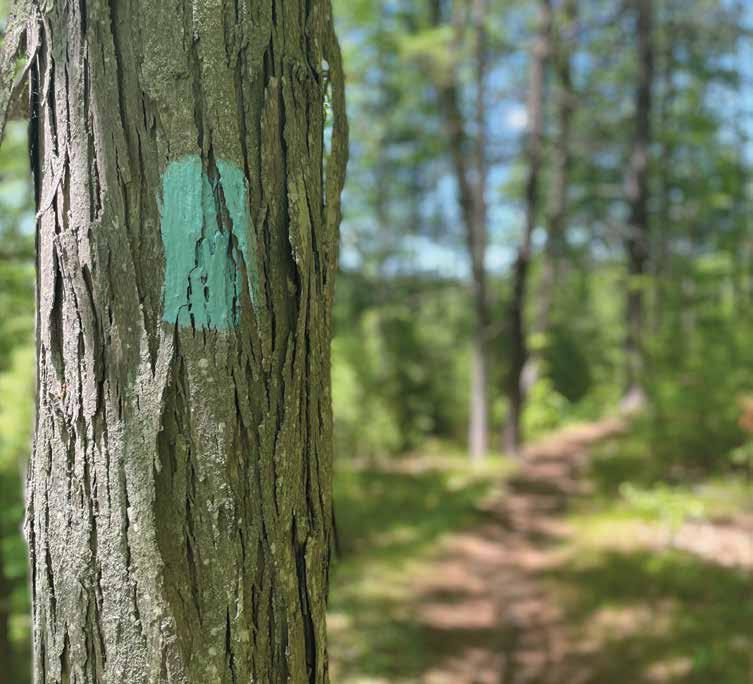
Following the blue blazes, you ran ahead, to serve as lookout, to call to us from beyond the bend.
Here, even in snow, there’s evidence of a fire–a ring of stones–a break from the trail. Maybe I’ll find you at this crook along the Fenton where hikers and anglers like to camp. Far enough from the university, the bridge on Old Turnpike–a protected spot, where water trickles beneath ice and wends its way to the meadow. Not far from erratics and eskers dusted with snow–not far from an edge upstream that points with its frozen sandbar to your place. I sit on a fallen oak that looks like driftwood, not yet driftwood. Stare into black water that flows to the Hollow and Mt. Hope. Listen to the burble, the call of a red-tailed hawk. What wouldn’t I give to hear you speak—to follow you again.
Denise Abercrombie’s work has appeared in Minnesota Review, Fireweed, Connecticut Review, Phoebe, Yale Global Health Review, Earth’s Daughters, English Journal, Blue Collar Review, Waking Up to the Earth: Connecticut Poets in a Time of Global Climate Crisis, Writing on the Edge, and elsewhere. She teaches theater at E.O. Smith High School and lives in Storrs, Connecticut.
Denise Abercrombie
Winterin g Without Forever Chemicals
By Erica Cirino
As winter approached this year, my partner and I inventoried our family’s cold-weather gear. We spend a lot of time outside—even in the wintertime—so we need high-quality gear that keeps us warm and dry. Boots: check. Gloves, hats, toddler snowsuit: check. Winter jackets? My partner’s would work for him, but mine—a secondhand cotton duck and nylon jacket—was worn thin over the past decade.
As a writer and researcher specializing in plastic and other forms of pollution, I try to understand the materials and lifecycles of the items I buy and use. As I searched for a replacement, I noticed several regulations regarding winter jackets and other rough-weather gear were rolling out soon.
As of January 1, 2026, Connecticut will require that new outdoor clothing—one of a dozen categories of common household products—display a clear disclosure when “made with PFAS chemicals.” By 2028, the state will officially prohibit Per- and polyfluoroalkyl substances (PFAS) in these items.
PFAS are a class of man-made chemicals, often referred to as “forever chemicals” because they are extremely resistant to breaking down, transferring from products
to the environment and our bodies, and persisting for hundreds (maybe even thousands) of years. Since their development in the 1950s, PFAS have been widely used in a range of products from nonstick cookware to cosmetics, for their durability and resistance to heat, oil, stains, and water. They’re also commonly used in outdoor apparel, like winter jackets and boots. PFAS are very effective in waterproofing materials, which has made them near-ubiquitous in New Englanders’ wardrobes. But tides are changing.
Living in a region where freezing temps and snow demand resilient outerwear, I wondered how our options for staying warm and dry might change as these regulations roll out—and how I can protect my family from PFAS in the meantime.
PFAS are very effective in waterproofing materials, which has made them near-ubiquitous in New Englanders’ wardrobes. But tides are changing.
The health risks associated with PFAS have been known for decades. But in the absence of regulations, products containing PFAS proliferated. These harmful chemicals can now be found at alarming levels in our air, waters, and soil. They’ve been detected in human blood, breastmilk, and urine, and according to the CDC, nearly every American has PFAS in their body due to exposure.
PFAS exposure has been linked to a wide range of human health issues, including birth defects, cancers, diabetes, hormone disruption, infertility, neurological impairment, and more. These chemicals also harm wildlife and ecosystems. They’ve been linked to reduced fertility in birds, increased rates of tumors in many species, degradation of microbial communities in soil, and the list goes on.
While PFAS chemicals primarily pollute air, soils, and water during their production—through manufacturing emissions, accidents and spills, and wastewater disposal—forever chemicals also shed into our surrounding environment from the products in which they’re used. Many products containing PFAS are synthetic, made of plastics that also shed microplastic and nanoplastic particles, which further help deliver PFAS chemicals into our bodies and environment and make them even more toxic.
Ingestion of PFAS through contaminated food and water is the primary way these chemicals enter our bodies. We are also exposed through inhalation of indoor air and dust—which picks up PFAS shed from furniture and textiles, especially carpeting. Kids and pets, who spend the most time on the ground, are especially vulnerable to the chemicals in elevated quantities. While our skin can absorb PFAS from clothing, it appears to occur at a lower level of exposure relative to these other sources. But evidence shows that older apparel that has lost some of its waterproofing, or is shedding material due to wear and tear, is more likely to increase PFAS exposure.
As scientific understanding of the harmful environmental and health effects of PFAS grows, so do efforts to reign in its use and pollution, particularly in Europe and the U.S.
Connecticut is one of 20 states, including California, New York, and Maine that have recently passed or are considering legislation regulating PFAS in consumer products, many of which specifically call out PFAS in outdoor gear. “I think manufacturers have gotten the message,” says Tom Metzner, Environmental Analyst at Connecticut Department of Energy and Environmental Protection (DEEP). “PFAS is bad and you need alternatives. But you need state laws to put the last nail in the coffin so to speak.”
Legislation targeting outdoor apparel can make a big impact: About 50% of PFAS produced globally are used in textiles, especially in waterproofed outdoor gear. Phasing them out of production (and out of our closets) will be an important step in protecting the environment and each other from further exposure.
But what do we wear in the cold and wet weather now? For PFAS-free outdoor gear, look to natural alternatives like leather, waxed canvas (beeswax, not paraffin derived from fossil fuels), oilcloth (made from canvas or linen cured in linseed oil), real rubber, and tight-woven wool. Some of these options have unfortunately become pricier as synthetic materials have flooded the outdoor gear market. They also come with their own environmental impacts and tradeoffs.
The next time you go shopping, look for PFAS-free outdoor gear; in Connecticut, this will be much easier now that disclosures are required.
Fortunately, some companies have been working for years to eliminate PFAS from their products, developing safer alternatives that will keep us warm and dry. For example, Patagonia began developing and testing PFAS-free textiles in 2006, and declared its products free of intentionally added PFAS in January 2025. “We use about a dozen different chemistries that are typically based on hydrocarbons (think polymers and waxes) or silicones,” Patagonia spokesperson Nathan Yamaguchi told me. “Each of these chemistries have been vetted based on all the different environmental impacts, toxicological impacts, and of course, quality and performance.”
As new regulations roll out, experts warn against companies making “regrettable substitutions”— the practice of slightly altering chemical formulations of a banned substance to bypass regulations. PFAS can be easily altered by chemists, hypothetically opening the door to an unlimited number of formulations. In the past, some manufacturers have replaced one harmful PFAS chemical with another equally harmful alternative. For example, a PFAS chemical called GenX was introduced as a “safer” alternative to nonstick PFAS chemicals PFOA and PFOS in 2008. But a decade later, the U.S. Environmental Protection Agency (EPA) determined GenX was just as toxic to human health, with even low levels of exposure linked to serious health risks, including harm to developing fetuses, the immune system, liver, kidney, and thyroid. New regulations can prevent regrettable substitutions by regulating them as a class of chemicals rather than substance by substance, and also supporting safer alternatives.
A recently proposed federal law, the bipartisan Protect Our Clothes from PFAS Act, around which some major business interests—including trade groups American Apparel and
Footwear Association, Outdoor Industry Association, and L.L. Bean—have rallied, could help further push for positive change. The bill, if passed into law, would not ban PFAS outright, but it does complement state PFAS bans by removing trade barriers to enable PFAS alternatives to compete on a more level playing field.
As regulations shift and materials change, knowing what to buy can be tricky. The Environmental Working Group has compiled a guide using third-party verification to identify apparel brands (and other consumer goods) that are legitimately swapping PFAS for safer chemicals. Search “Many companies market alternatives for products that contain PFAS” on their website, ewg.org.
If you already own outdoor gear containing PFAS, you might be wondering if it’s safe to keep using. If you’re breastfeeding, pregnant, considering becoming pregnant, or are dressing children, it’s best to buy alternatives, as these body types are the most vulnerable to PFAS. Otherwise, it might make sense to get maximum use out of your existing gear, especially when it’s going over layers and doesn’t come in direct contact with your skin for long periods of time. It’s best to spot clean these items, rather than tossing them in the washing machine, to prevent PFAS from leaching into the water.
The next time you go shopping, look for PFAS-free outdoor gear; in Connecticut, this will be much easier now that disclosures are required.
By the first of November, a few inches of snow had accumulated outside our windows, and my little one was excited to get outside. I was feeling desperate as I hadn’t yet found a new winter coat. Through researching this article, I finally located an American-made cotton oilskin jacket—naturally water- and wind- repellent—available for around the same price as middle-of-the-road synthetic options. It arrived just before single-digits and more snow. When layered with insulating materials, such as flannel, tight-woven cotton, and wool, it keeps me very comfortable while enjoying the winter weather. I was delighted to zip on my new PFAS-free jacket and head outside, knowing a positive wave of change will help all of us weather many long winters ahead.
Erica Cirino is a writer and artist who explores the intersection of the human and more-than-human worlds. She serves as communications manager at the nonprofit Plastic Pollution Coalition and is best known for her widely published photojournalistic works, including her award-winning book, Thicker Than Water: The Quest for Solutions to the Plastic Crisis.
Hiking Home
From Dominica to Connecticut, Mosi Moses shares her passion for hiking
By Britany Robinson
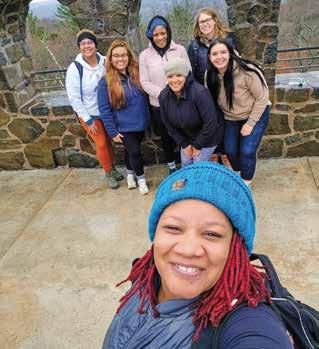
If you look at Connecticut hiking content on Instagram, there’s a good chance you’re familiar with Mosi Moses. Through her popular account, @ConnecticutTrails, Mosi has been posting photos of hiking all over the state and beyond since 2018. In addition to sharing inspiring content and beautiful places online, she hosts group hikes that are open to the public. It’s all part of her mission to advocate for better access and a more inclusive outdoor community in CT.
Mosi moved to New Haven in 2005, and today she lives in East Haven with her husband and two children. Connecticut is vastly different from her place of birth, where perennially lush mountains drop into tropical beaches. (The kind of place many people dream of in the middle of a cold New England winter.) But Mosi has learned to embrace all seasons of Connecticut, becoming an expert on exploring this state by foot, via parks and trails.
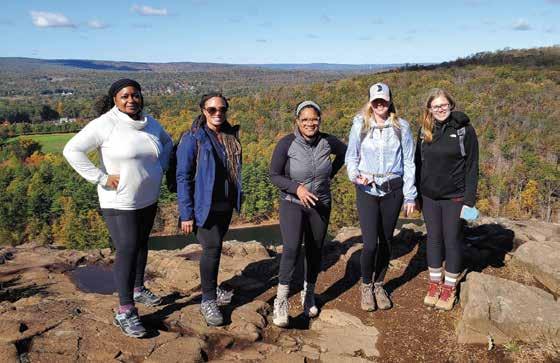
I joined Mosi for a hike in West Rock State Park, when the leaves were at their peak fall brilliance, to chat about what makes Connecticut hiking so
special, how we can encourage more people to enjoy the abundance of trails here, and what keeps her excited about exploring this home and beyond.
BR: What first brought you to Connecticut?
MM: I came to Connecticut after my father and his wife migrated here. He’s from the island of Dominica, which is where I was born, too. Initially we were supposed to move to California, but then my stepmom took a job at Yale, as a professor in their environmental science department. So rather than moving to sunny California, I came to Connecticut at twenty!
I moved here in August when it was really, really hot. That was good, coming from a tropical climate. It helped ease me into the whole Connecticut thing. At first, I had a lot of apprehension about the cold and the changing seasons. It was exciting but nerve-racking.
Then came fall, and I watched in awe as the leaves started to change, and this tree in front of my house started turning yellow and orange. I was so taken aback, I mailed a leaf to a friend in Florida, like, “Look at this!”
After my stepmom was done at Yale, she and my dad moved to California. I had already been laying down roots here; I was going to school, working on my bachelor’s degree, working a couple jobs. I decided I was going to stay in Connecticut. By then I had developed a love for New Haven. I’ve been here now for twenty years.
Fall is beautiful, but how’d you feel about your first winter?
Oh, it was horrendous. Shout out to my stepmom for teaching me how to buy a winter jacket. People who grew up in New England take these things for granted, but when you come from a tropical island, the sun sets at the same time every day and the temperature is pretty stable the entire year. So, it was a rough transition.
I remember my first snowfall vividly. I was coming from the hairdresser; I had just gotten my hair straightened, and it started snowing. I tried covering my hair with my hood. Then this couple strolled past me, holding hands, and they were really excited about the snow. I felt like such a Scrooge. What are they so happy about? It’s cold!
How’d you get into hiking?
When you live on an island, I feel like you’re a hiker by nature. Dominica specifically is referred to as the “Nature Island of the Caribbean.” It has 365 rivers, and it is LUSH. There is one of the only boiling lakes in the world. Exploring is the thing to do. You go to the beach or just enjoy nature because it’s beautiful and free. So, I think I’ve always been a hiker. I grew up in a Rastafarian commune. I don’t particularly remember this, but many years after we moved away from that community, I went back there with my dad, and I saw the plank where we would walk across the river to reach the commune. It was in a very remote area. My dad told me we used to walk over this big log, and sometimes my mom would carry me if the water was too high. I’ve always been exploring nature.
I just adopted it as my mission, encouraging people to get outside—especially minority groups and immigrants who might feel the same way I did at first about getting outdoors in the cold, in a strange place.
How was your first winter hike?
I don’t think I was properly equipped for my first winter hike. I have fond memories, though. It was a challenging but exhilarating hike up Bear Mountain.
Now I have two boys, twelve and six. They’re very resilient, and they absolutely love exploring in the snow. I open the door and say, “Go ahead!”
What do you like most about hiking in Connecticut?
When I moved [to Connecticut], I felt like, when it was cold and dark, we shouldn’t go outside. For many years, I would spend my winters not going outside, not hiking, not walking—just avoiding it. I eventually came to realize I can’t live like that!
It took me a while to realize there are so many trails and state parks here. I’m very routine-based, so when I first started hiking, I would always go to the closest option. When I lived in the East Rock area, the closest trail was East Rock Park. I didn’t drive, so I needed something that was quick and accessible. Now, I cannot get lost in East Rock Park. Drop me anywhere, and I can find my way.
Then one year, I got the book 50 Hikes in Connecticut by Mary Anne Hardy. I decided I would visit every single one of these trails that year. It was a cool way to encourage myself to explore new places. Did you do them all in a year?!
Oh yeah!
Which trail surprised you the most out of those 50?
Day Pond State Park. There was an image in the book of this waterfall— but the picture didn’t even scratch the surface of how amazing and vast it was. Just: WHOA.
You’ve been posting about hiking in Connecticut on Instagram since 2018. When did you start hosting hikes through CT Trails?
I don’t think I can pinpoint exactly when. I would just drag my friends into the woods. Let’s go hiking, let’s go hiking! I made it my mission, encouraging people to get outside—especially minority groups and immigrants who might feel the same way I did at first about getting outdoors in the cold, in a strange place.
And now you’re the face of Connecticut hiking with this big Instagram account, sharing all these trails!
I didn’t set out to be that—but it just kind of happened.
How does it feel to get those groups, especially minorities and immigrants, on the trail for the first time?
It’s exciting! The best part is when people say, “I didn’t think I was going to enjoy this, but it was awesome. When can we do it again?”
A big part of this is education, spreading awareness, letting people know that you don’t need a lot to take on hiking as a hobby. If you can put one foot in front of the other, you can hike. You don’t need a lot of fancy gear. And you can evolve within the sport. Start with some trail runners and then maybe you get hiking boots and then you get to the point where you want hiking poles.
You might start in the summer, and you keep hiking in the fall, and eventually you understand what you need to hike in the wintertime and be comfortable and really enjoy it.
Now, I like getting out in the snow.
How did you go about finding community when you first moved to Connecticut?
I think in any aspect of life, if you are genuine in the things you do, your people will find you. During the pandemic, I met a group of women, and we were all interested in getting outside and hiking with other women. That was my foundation for finding my people. But also, that created an awareness that even in a group of five to ten women, I was the only woman of color. It gave me an awareness that in Connecticut, there weren’t many other women of color exploring the outdoors.
That motivated me. We have to get our people out here. There is no cost to exploring nature, and it’s so good for your mental and physical health.
What’s your advice on finding community and getting out there if you don’t feel comfortable?
Start off with a small trail close to your house, or join a group hike—there are so many hiking groups in Connecticut. Go with other people who can expose you to the trails, teach you how to follow the blazes, give you advice on what to wear. Those things make a difference. If you’re out here and you’re not comfortable, you’re not going to want to go again.
How can we all make the trails more welcoming and inclusive in Connecticut?
Share them! No gatekeeping. Go outside of your comfort zone and invite someone who you maybe think wouldn’t be interested. Make it an inviting experience.
In addition to hosting hikes around Connecticut, you lead people on international trips. Where have you been lately?
We just got back from a trip to Egypt. The year before we did Bali. In October of 2026, we’re going to Japan. I host the trip through CT Trails, but it’s open to anyone who is interested in exploring internationally with like-minded people—anyone who is curious and respects other people’s cultures and has wanderlust. Hiking is a big part of these trips.
You’ve hiked all over the world. When you come back to Connecticut, what excites you about home?
World travel has helped me appreciate hiking in Connecticut more. I appreciate that I can explore well-maintained trails in four different seasons here, and I appreciate them in different
ways with every visit. It reminds me of the metaphor from Heraclitus that no man can step into the same river twice because it is not the same river and he is not the same man.
Days after our hike, I followed up with Mosi. As a relative newbie to Connecticut, I was eager for more recommendations and tips for exploring the state. Here’s what Mosi shared!
Best place to hike with a family or a group of friends with different abilities?
The bottom of East Rock Park, near Eli Whitney. There is a covered bridge, amazing bird watching, and you can walk along the Mill River with little elevation gain.
Favorite trail for a challenging hike? Bear Mountain.
Best hike to a lookout tower? Heublein Tower [in Simsbury]—accessible, with 360-degree views.
Favorite spot for an after-hike meal? Arethusa is a good one near Mount Tom. While you’re there, you can pick up some fresh cheese and dairy. Since East Rock is my go-to, I spend a lot of time at The Pantry [in New Haven] as well!
Most underrated town for hiking? Canaan, specifically the Falls Village area.
Bucket-list hike you haven’t gotten to yet in CT or elsewhere?
I’ll give you both. There are stretches of the Appalachian Trail in CT that I haven’t done and would like to complete. Internationally I’d like to summit Kilimanjaro.
The best part is when people say, “I didn’t think I was going to enjoy this, but it was awesome. When can we do it again?”
Ferrucci & Walicki, LLC Land Management Consultants
Environmental Stewardship and Land Management since 1982
• Forest & Open Space Management Services
• Property Tax Reduction (PA 490 & Chapter 61)
• GIS Mapping
• Forest & Wildlife Habitat Improvement
• Timber Inventories & Appraisals
• Professionally Managed Timber Harvests
• Environmental Oversight
• Watershed & Utility Land Management
• Recreation Plans & Implementation
• Forest Stewardship Plans
6 WAY ROAD MIDDLEFIELD, CT 06455 860-349-7007 FAX: 860-349-7032
Pathways
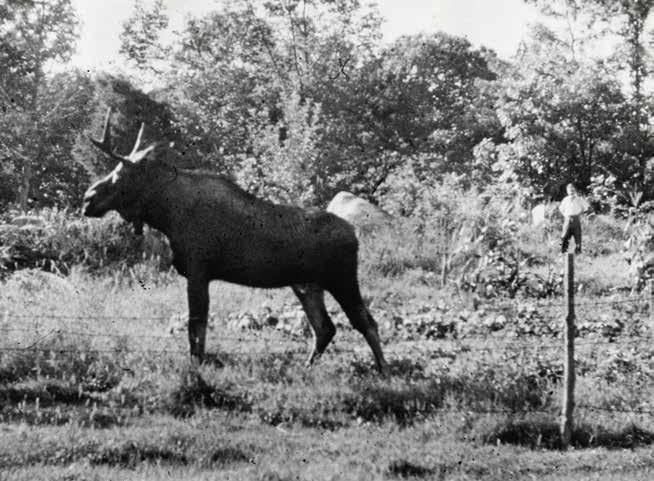
The majority of New England’s moose population resides in Maine, New Hampshire, and Vermont, where they enjoy a mix of young and old forest, ideally near wetlands, rivers, and lakes. In recent decades, however, the population has spread into Massachusetts and even Connecticut, where they’ve found suitable habitat.
Victor Piecyk took this photo in 1956, on his farm in Warrenville (Ashford). It is the first official record of a moose in Connecticut, but a resident population wouldn’t be established until nearly five decades later. As moose sightingings in Connecticut slowly increased, they were assumed to have wandered beyond their usual territory. But when a cow and calf were seen together in 2000 in Hartland, a resident population was confirmed. Today, 100-150 moose call Connecticut home. They’re most common in the northwest corner of the state, but moose sightings have occurred as far south as Guilford and East Lyme, according to Connecticut’s Department of Energy and Environmental Protection.
Moose are the second largest land mammal in the lower 48 states, overshadowed only by the American bison. Adult moose can grow up to six feet at shoulder height, weighing up to 1,600 pounds. While a rare moose sighting in Connecticut is a thrill, the size of these mammals paired with their shy but unpredictable temperament makes them potentially dangerous, and it’s important to keep your distance. Moose have a tendency to charge when they feel provoked. Moose and drivers can be hazardous to each other, especially at night when a moose’s dark brown coloring is difficult to spot in the road. Each year in the United States, more people are injured by moose than bears. But going the speed limit, avoiding cell phone usage while driving, and keeping your distance when you see them will keep moose and people safe.
The moose population in Connecticut, for now, appears steady. As climate change leads to gradually warmer winters across the region, Connecticut will likely become a less desirable location for the cold-weather-loving ungulates.