CFPA acknowledges we are on the traditional lands of the Mashantucket Pequot Tribal Nation, the Mohegans, the Eastern Pequot, Schaghticoke, Golden Hill Paugussett, Nipmuc, and Niantic peoples. We pay our respect to the Indigenous people who are no longer here due to colonization, forced relocation, disease, and warfare. We thank them for stewarding this land throughout generations. We recognize the continued presence of Indigenous people on this territory who have survived attempted genocide, and who still hold ties to the land spiritually and culturally. We shall be good stewards of the land we all call Quinnentucket, Connecticut.
CONTRIBUTOR
Spotlight
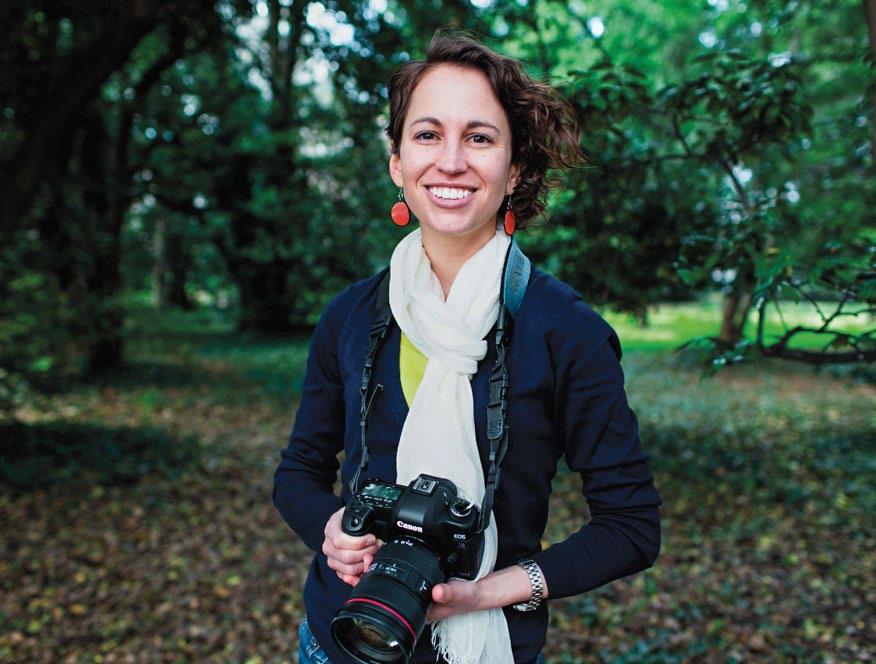
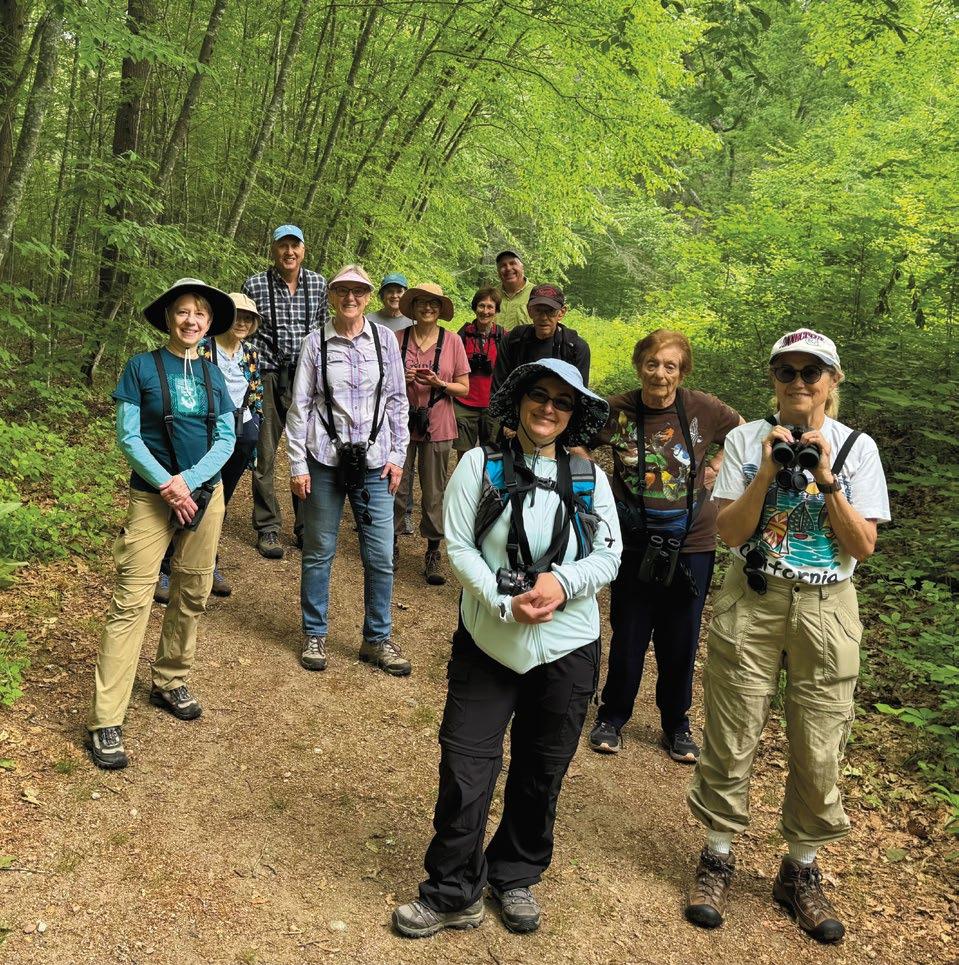
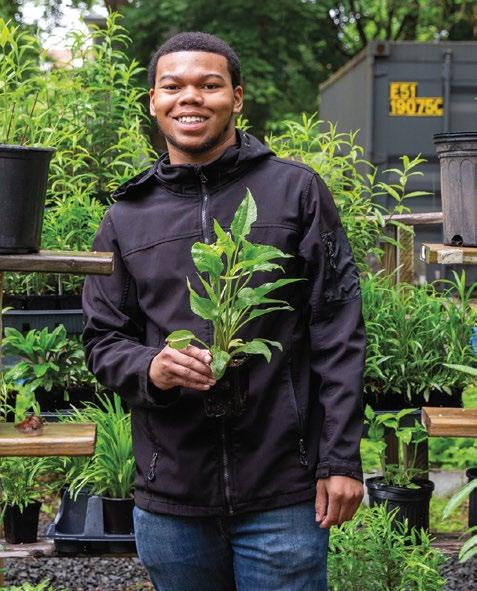
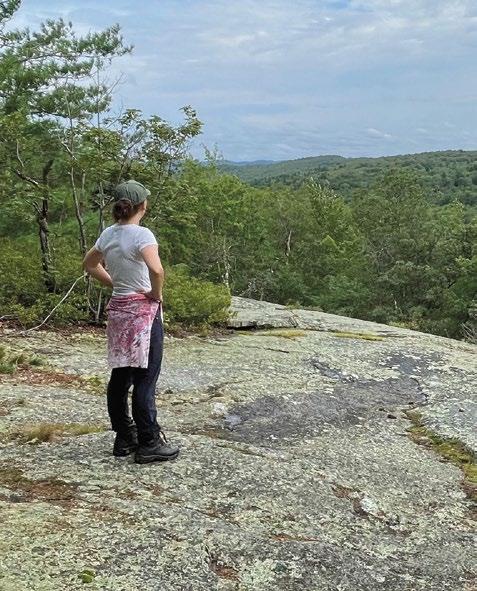
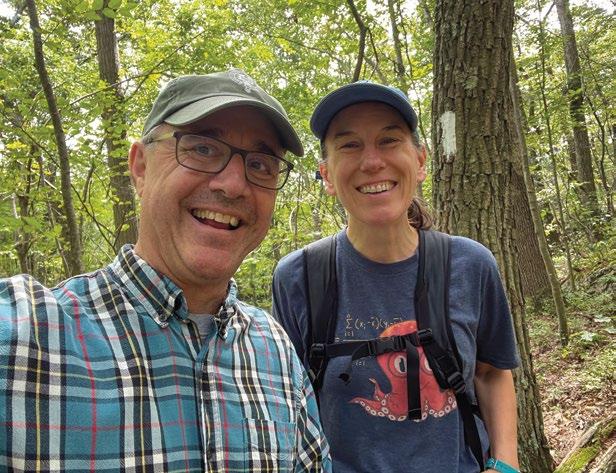
In this issue, Briget Ganske, a multimedia storyteller, wrote and photographed an article on Urbanscapes Native Plant Nursery in New Haven and the young people who work there. We caught up with Briget on what she learned about plants and people growing together.
CW: You spent time with the students at Urbanscapes for this story. You also used to work with young students, teaching them about journalism, media production, and podcasting at PBS. What do you like most about working with teens?
BG: I like how teenagers want to have fun but they also want to learn practical, hands-on skills and make something meaningful. Many teens are tech-savvy but have a lot to learn about reporting, interviewing, and storytelling. Most media outlets report on issues related to teens (like education and mental health) from an adult perspective.
Issue
The stories are different when the youth are doing the reporting, which is what I helped students do at PBS News Student Reporting Labs. Youth journalism encourages civic engagement and builds media literacy, which is so important these days.
What did you learn from the young people in this story?
Tyshaun Lester (or Ty, as everyone calls him) loves to work with his hands, whether that’s with plants or plumbing—his future career. I love that he knows that about himself, that he likes growing and building things. He reminded me of the joy that comes from making something tangible. Ty also taught me that his favorite flower, the purple coneflower, could be yellow.
Was there anything that surprised you in learning more about native plants?
I hardly knew anything about native plants before reporting on this story, which is why, in addition to the youth angle, I wanted to learn more. I knew about invasive plants being
Mark S. Weiner
Briget Ganske
Margaret Gibson
Steve Straight
Pathways
harmful, but I don’t think I’d heard the terms “cultivars” or “nativars” before. Growing native plants makes so much sense for helping the local ecosystem thrive. Yet when I went to a local garden store, I had the experience Dennis Riordan talks about—I couldn’t easily figure out which plants were native. Now I want to build a pollinator habitat, and I know just where to get native plants for that.
What makes you feel connected to a place and the natural world?
I love being outside, whether that’s jogging or biking or hiking with my kids. Although this past winter was long and I was ready for it to be over, I really do love the seasons and watching the trees change color, go bare, and then leaf again. I feel like the seasons teach us that it’s OK, inevitable really, to change, and to be present to whatever season we are in.
Editor’s Note
I am writing to you the week of July 4th, with holiday plans bouncing around my brain. What food will I make? What time should our friends come over? Do I have enough sedative for the dog who is terrified of fireworks? None of these are complicated questions. But to celebrate America does feel complicated. How do we throw parties when the violence our country was built on echoes so loudly today, in the dismantling of the Voting Rights Act, the brutal treatment of immigrants, and the current administration’s disregard for the devastating impacts of climate change?
On the other hand, this deeply flawed country is one we call home. In this issue, I am reminded of how many people are loving and caring for an imperfect place. It is not hard to feel proud of that work—and these stories echo, too.
Here you’ll meet young people who are growing and selling native plants in New Haven, helping to build more resilient ecosystems. And tree climbing arborists who thrill in a physical connection with nature. And a poet who considers how one patch of habitat connects to the next and the next, and how the right words can bring that connection to life. And a couple who has hiked for years, in search of knowing a place and themselves a little better.
Pride is a complicated emotion to attach to this 250th year of a country founded on stolen land. But I think it’s safe to say that everyone who contributes to the mission of CFPA cares deeply about our home. And it feels good to celebrate the America that loves and cares for the land on which a complicated project plays out. This season and always, we should celebrate those who are willing to face the hard truths tangled up in our country’s stories—and the ones writing new ones, in which every person who lives here can feel at home.
As you read our summer issue, long after the sparkling fireworks have faded, I’m proud to be on this page with you.
Britany Robinson Editor
The Connecticut Forest & Park Association, Inc.
The Connecticut Forest & Park Association (CFPA) is a 501c3 nonprofit organization that protects forests, parks and the Blue-Blazed Hiking Trails for future generations by connecting people to the land. Since 1895, CFPA has enhanced and defended Connecticut's rich natural heritage through advocacy, conservation, recreation, and education, including maintaining the 825-mile Blue-Blazed Hiking Trail System. CFPA depends on the generous support of members to fulfill its mission. For more information and to donate, go to ctwoodlands.org
Board of Directors
President
Laurie Giannotti, Deep River
Vice-President
David Terry, East Hampton
Treasurer
William Cordner, West Simsbury
Secretary
Seth Huttner, Hartford
Forester
Michael Ferrucci, North Branford
Jeff Bolton, Granby
Della Corcoran, Farmington
Beth Critton, West Hartford
David Ellis, Wallingford
Alan Hurst, East Hampton
Michael Proctor, New Haven
Tom Tella, Wolcott
Marcus Ware, Ellington
Staff
Alex Bradley
Trails Stewardship Coordinator
Clare Cain
Deputy Director
Cal Creeden
Development Assistant
Teralyn LaChance
Office and Volunteer Manager
Joey Listro
Executive Director
Beth Merow
Education Director
Linda Pierce
Development Director
Kate Preston
Trails Conservation Coordinator
Julia Sonen
Education Assistant
Meaghan Strange
Communications Coordinator
Chuck Toal
Trails Day Coordinator
Connecticut Woodlands
Britany Robinson Editor
Margaret Gibson Poetry Editor
Kolk Design
Graphic Design
Thanks to photo contributions from Joey Listro, Michelle Poudrette, Mark S. Weiner.
Sustainably printed on FSC certified paper using solar power and LED-UV curable inks, which don’t release harmful VOCs into the atmosphere and can reduce energy consumption by 30% compared to conventional inks.
Connecticut Woodlands is a quarterly magazine published since 1936 by CFPA. Advertising local goods or services is welcome. For specifications and rates, visit ctwoodlands.org/rates.
Contact us at info@ctwoodlands.org or call 860-346-TREE.
Connecticut Forest & Park Association
Canopy
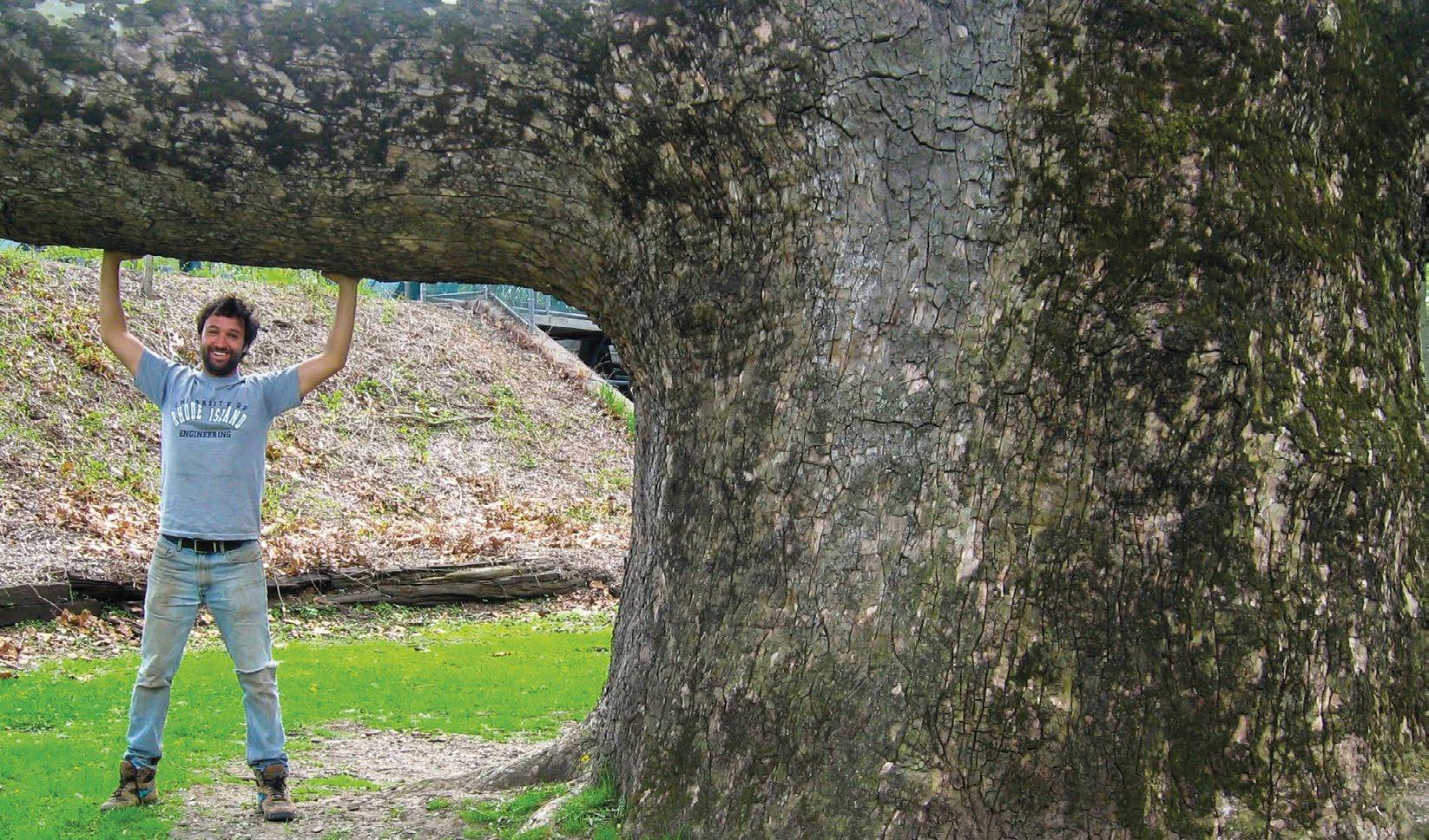
Back in 2011, I spent most of my days growing vegetables on farmland I leased in Simsbury. I would make the drive back and forth from my home in New Britain, passing a remarkable landmark along the way: the Pinchot Sycamore.
I admired the tree long before I understood its story. I knew it was impressive, with a massive trunk and a presence that was impossible to ignore. What I did not fully appreciate was the history it represented or how closely that history would one day connect to my own journey.
The sycamore is named for Gifford Pinchot, a Simsbury native who helped shape the early conservation movement in the United States and influenced generations of foresters through what would become the Yale School of the Environment. Like many historical figures, Pinchot’s legacy is complex. Yet the era he helped define was marked by a growing recognition that forests, parks, and other natural resources require thoughtful stewardship if they are to endure for future generations.
That idea has been at the heart of conservation in Connecticut for more than a century.
When CFPA was founded in 1895, forest loss, wildfire, and land degradation were pressing concerns. Early conservationists understood that cultivating healthy forests and public access to nature wouldn’t happen overnight. They were dedicated to a future they would never see. As I begin my tenure as CFPA’s Executive Director, I find myself reflecting often on those who came before us.
Over the past several months, I’ve had the privilege of meeting members, volunteers, donors, trail managers, conservation partners, and community leaders across Connecticut. During my “listening tour,” I have heard stories of trails maintained for decades, forests protected across generations, and countless volunteer hours invested in places that matter deeply to the people who care for them.
These conversations have reinforced an important truth: none of us begin this work at the starting line. We inherit trails we did not blaze, forests we did not plant, and institutions we did not build. Our responsibility is to steward them wisely and strengthen them for those who will come after us.
Looking back, I can see how that idea has shaped my own path. Agriculture first taught me the importance of caring for the land and sparked my interest in helping new farmers gain access to it. That work led me into community development, where I spent more than a decade helping connect people in urban neighborhoods to food, gardens, and environmental education. Along the way, I pursued graduate studies in public policy to better understand how organizations can advance both social and environmental outcomes.
At first glance, these experiences may seem distinct. But they are chapters of the same story. Whether growing food, strengthening communities, conserving forests, or maintaining trails, the work is about leaving something better than we found it.
That belief continues to guide CFPA. While the challenges facing Connecticut have evolved, our mission remains as relevant as ever—to care for forests and trails, advocate for conservation, and ensure that future generations experience the sense of wonder, belonging, and connection that inspire us today.
The Pinchot Sycamore has stood for generations and continues to grow. Today, it is a reminder that every generation inherits the work of those who came before it and bears responsibility to those who will follow. I am grateful for the opportunity to help lead CFPA in that spirit, and I look forward to the work ahead.
Joey Listro is CFPA’s Executive Director.
Always a Trailblazer — Remembering Volunteer Paul Mei
By Clare Cain
I don’t know many of my Trail Managers’ phone numbers by heart. But I still know Paul Mei’s.
During the years we worked together to develop and improve the New England National Scenic Trail (NET) in Guilford, there were times I called him multiple times a week. Times he would call me multiple times a day. Often, I would wait for my commute to call him back knowing it would be at least a forty-minute conversation. When Paul had a project, he was dogged in seeing it through. Between planning and building the trailhead kiosk (with locally sourced wood), the elevated boardwalk and overlook platform at Chittenden Park, and preparing for the dedication of the NET Gateway in 2014, I came to know Paul well—and his deep passion for his hometown and the trail.
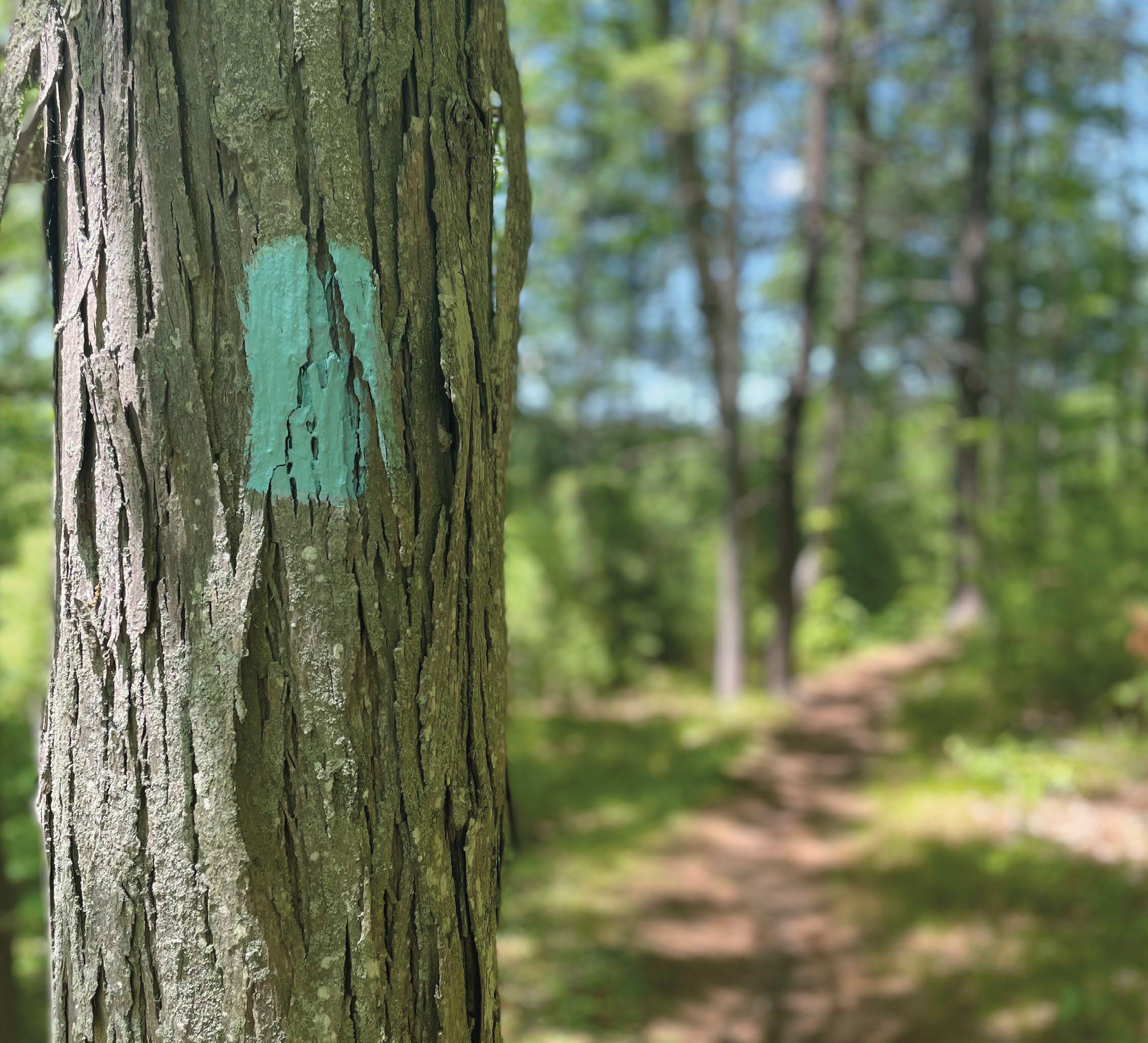
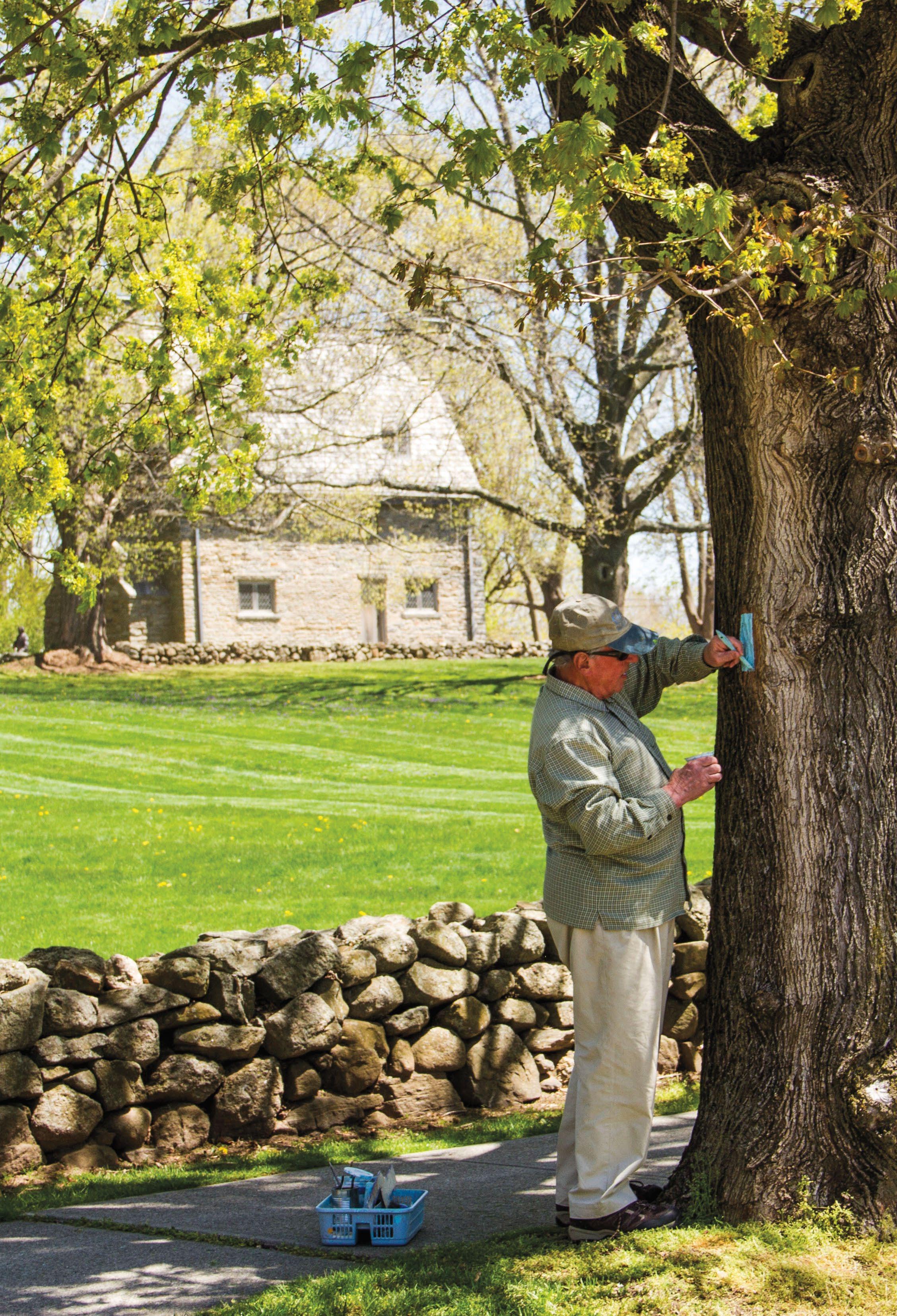
I miss Paul for so many reasons: his good humor, his persistence, his big heart, and his impeccably painted blue blazes. But his greatest legacy, in my opinion, is the trail itself. Through his vision, local activism, and unwavering determination, the Menunkatuck section of the NET came to life, connecting the trail’s southern end through Guilford to the shores of Long Island Sound.
There are only eleven National Scenic Trails in the United States. Few trail builders can say they created nearly thirteen miles of one—or established one of its termini. Paul did.
Paul passed away earlier this year, but his footsteps will continue to echo through the woods of North Guilford, south along the East River, across the marshes to Chittenden Park, and onward through time. Every hiker who follows those blue blazes will, in some small way, be following in his footsteps.
Paul served on CFPA’s Trails Committee from 2014 to 2022. As a CFPA volunteer, he built bridges and kiosks, mentored Scouts, led work crews and group hikes, trained fellow trail maintainers, and brought joy and laughter into the woods. His work shaped not only the trail, but also the community of volunteers who continue to care for it.
The trail he built will endure for generations—a lasting reminder that one determined volunteer truly can leave a permanent mark on the landscape and the lives of everyone who follows.
Trail Crew Season Underway
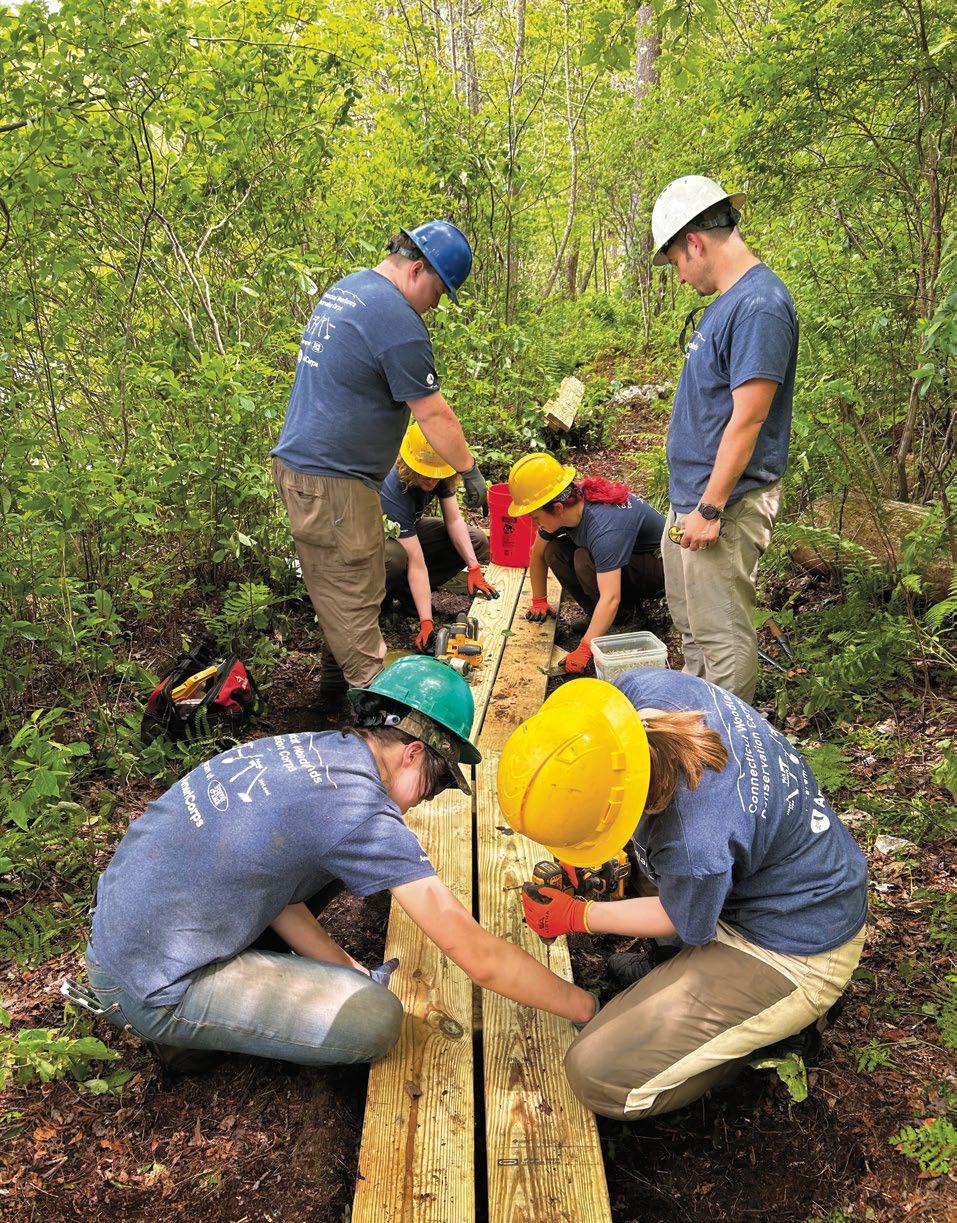
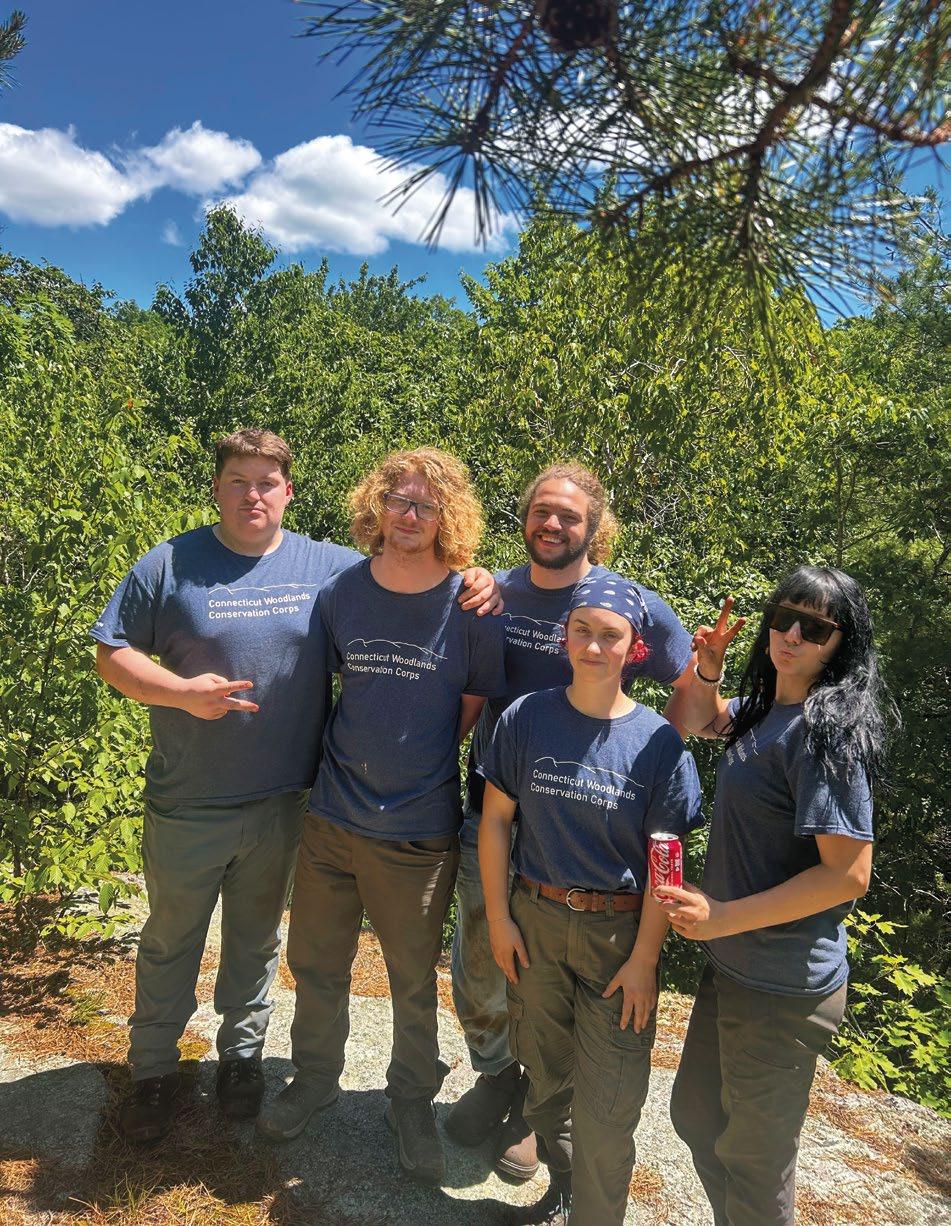
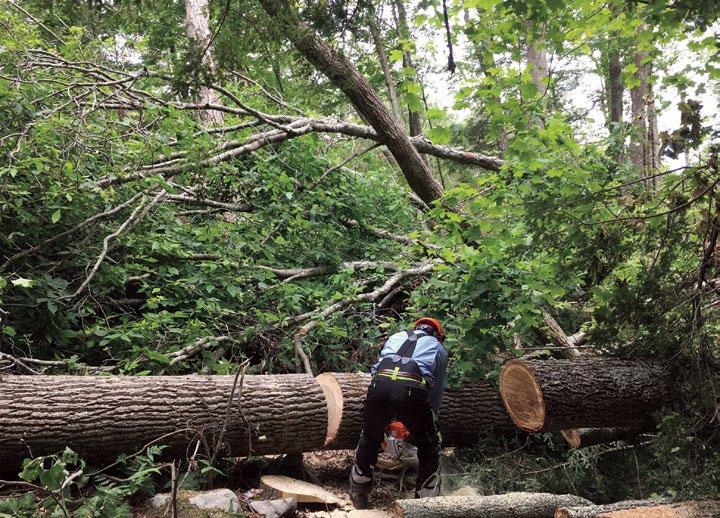
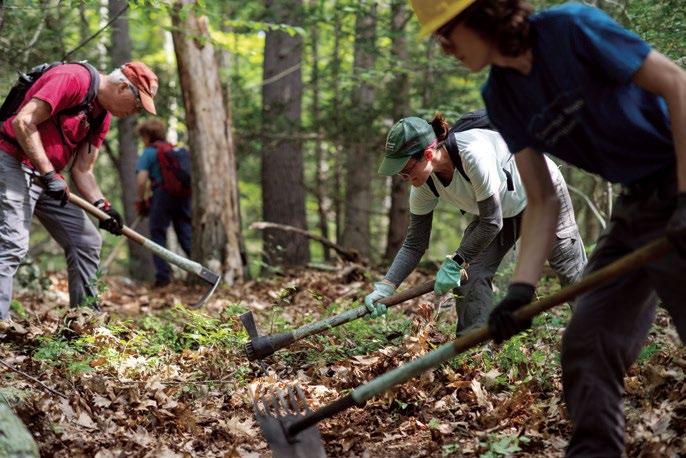
The Connecticut Woodlands Conservation Corps (CWCC) summer trail crew is already hard at work across the Blue-Blazed Hiking Trail System. So far, the crew has been placing stepping stones, installing bog bridging, and clearing fallen trees. They’ve dubbed themselves the “Bog Brigadiers.” Since 2017, the CWCC has provided hands-on training in trail building, maintenance, leadership, and teamwork to young adults passionate about conservation. This year’s crew, including the newest staff member, Assistant Trails Coordinator Brooke Bridges, is continuing that tradition. Follow CFPA on social media for photos and updates from the field (@ctforestandparkassociation).
Master Woodland Manager Graduates
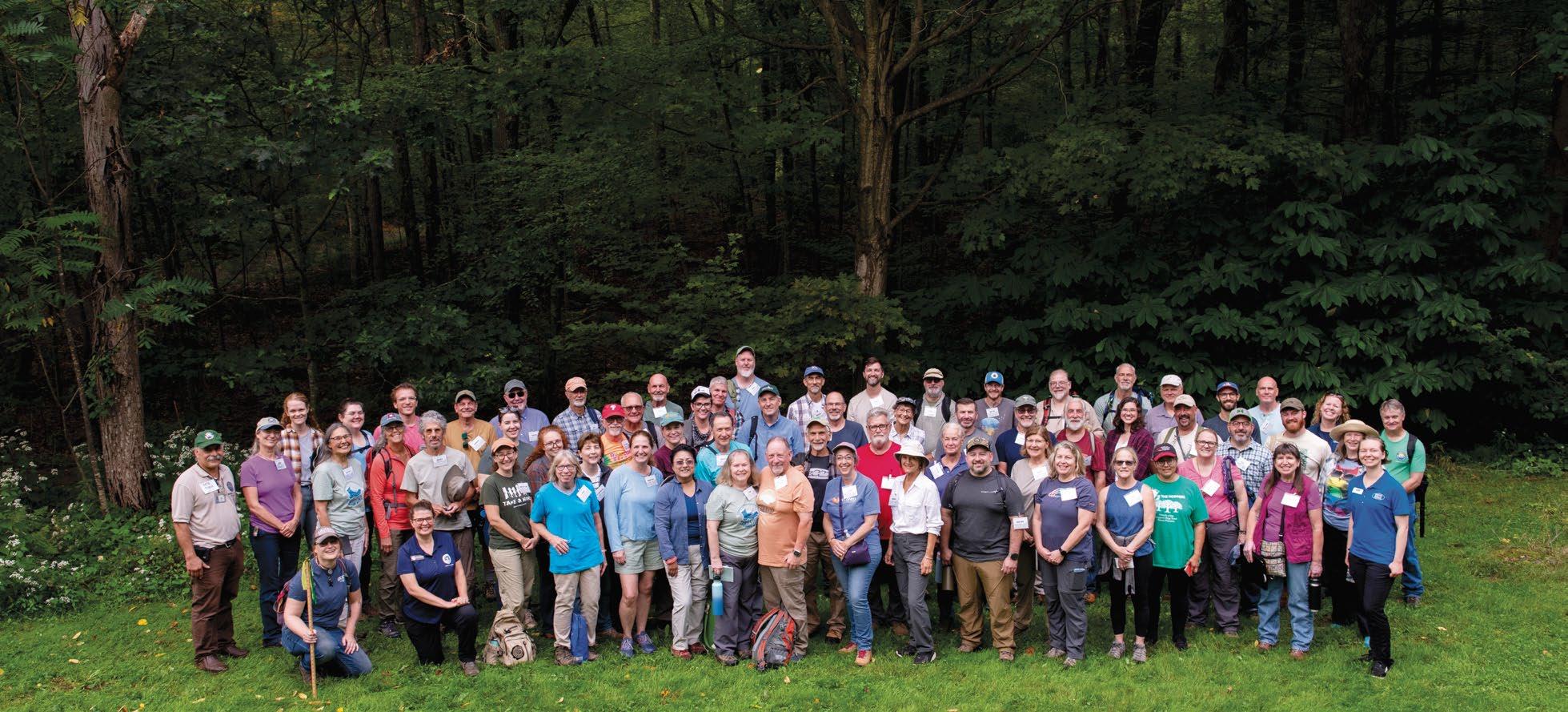
Congratulations to the 60 students who will graduate from the Master Woodland Manager program this July! Following presentations on how they plan to continue caring for their woodlands, these new graduates will join our growing network of trained woodland stewards across the state. This wraps up the MWM program’s 5th year and biggest cohort yet.
School’s Out for the Summer School programming wrapped up a great year this spring. We expanded our partnerships to include Charles H. Barrows STEM Academy in Windham, alongside Milner Middle School and Community First School in Hartford. Overall, 450 students participated across all three schools. Community First School was especially active, with 19 visits between January and June. Students explored the forest, meadows, and streams, observing nature up close to learn how trees, plants, and wildlife work together. A great way to end the spring and inspire the next generation of stewards.
by
Photo
Jake Koteen
Slower Miles on the Nipmuck Trail
Words and Photos by Michelle Poudrette
In her poem Sometimes, Mary Oliver wrote, “Instructions for living a life: Pay attention. Be astonished. Tell about it.” These are not only words I live by; they are words I walk by. Slow, deliberate, intentional – I do not get anywhere quickly when I am outside.
My love of nature took root in my youth, on the Old Furnace Trail in Killingly, where I grew up. I am neither a forester nor an ecologist. My background is in elementary education and literacy development. But in 2013, my life was forever changed when I was accepted into and completed the Texas Master Naturalist course in Austin. Since returning to CT in 2016, I’ve worked for and volunteered with numerous conservation organizations. In 2017, I had the great privilege of attending the
James L. Goodwin Master Naturalist program. Through these programs, I’ve learned to view my time on trails as an opportunity to connect, learn and grow as both a naturalist and an advocate.
I have hiked along various sections of the Nipmuck Trail more times than I can count. But to be honest, I’d be hard pressed to call what I do “hiking.” It’s a slow saunter more focused on savoring every moment than getting
anywhere in a timely manner. I stop often to crouch down low, to inspect a plant closely, to photograph its delicate details. Perhaps that’s why I love the hilly, northernmost sections of the Nipmuck Trail the most. The undulation lends itself well to a slow pace with frequents stops. The flora helps, too.
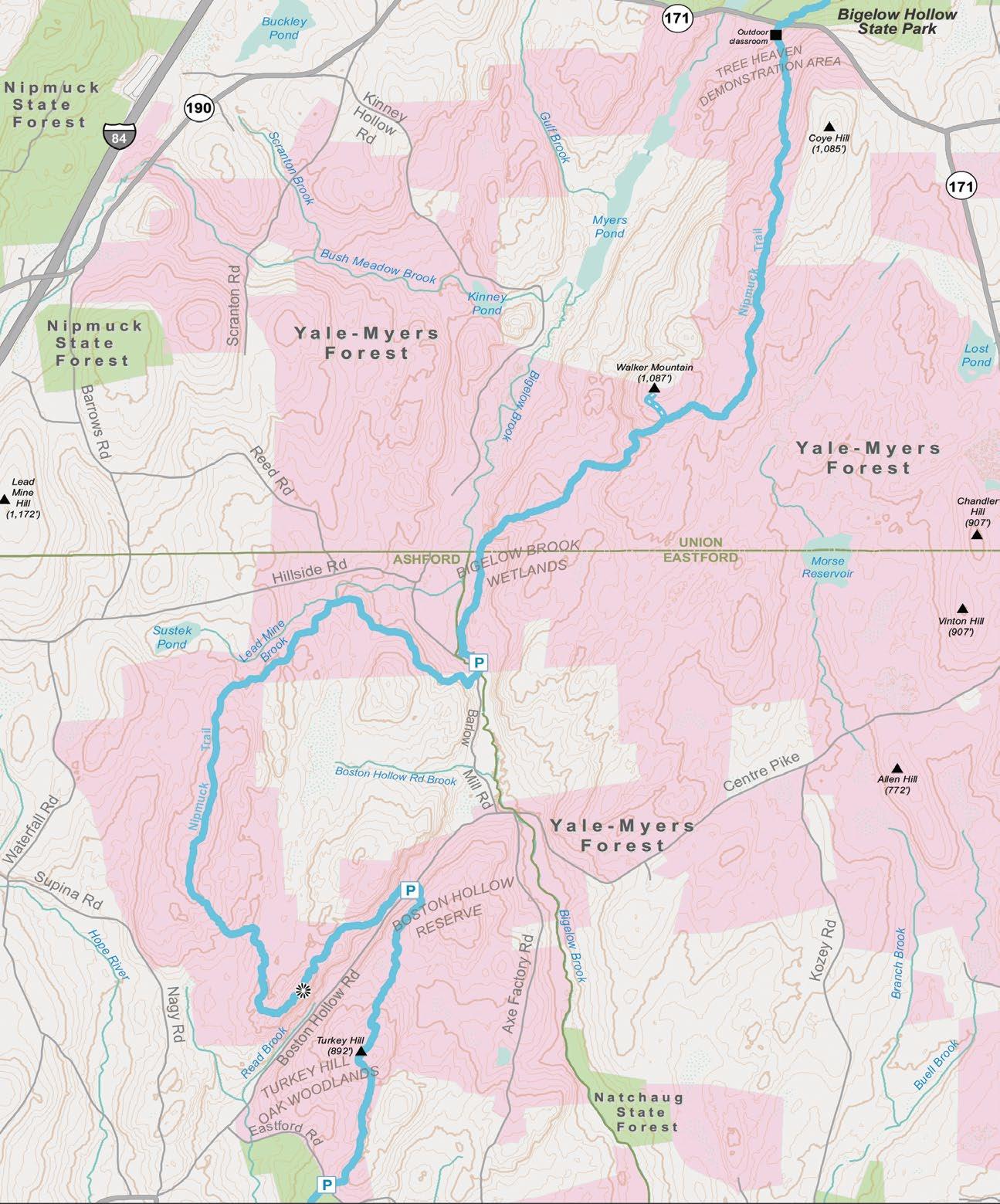
The stretch of trail from Yale-Myers Forest to Bigelow Hollow State Park and Nipmuck State Forest is unlike any
stretch of trail that I know of in eastern Connecticut. With deeply shaded hemlock groves, moss-covered boulders, and remote beaver ponds, it feels ancient and wild. Of course, these forests, like most in our region, aren’t particularly old. There may be pockets of “old growth” stands but I’m not aware of them. It’s not the age of these forests but rather their expanse that makes them so unique and extraordinary. Over 40,000 acres of protected land in this area have created a vast wildlife corridor in which plants and animals can live, grow and flourish. You can feel it in the air. This is a special place, worthy of lingering.
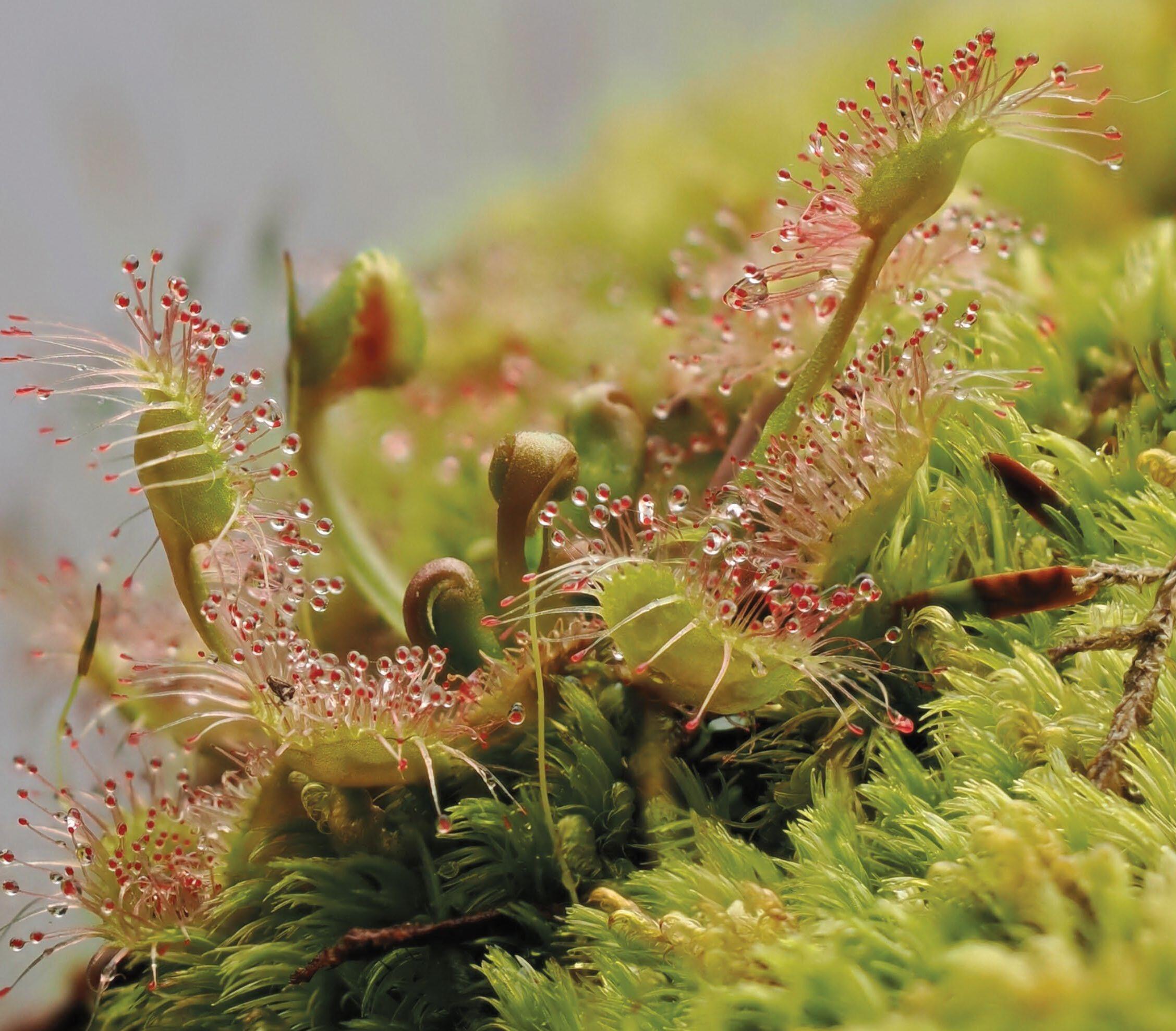
For someone like me who loves native plants, this 12-mile stretch of trail is a goldmine. In a single day on the trail, I may encounter my favorite carnivorous bog plants like purple pitcher plants (Sarracenia purpurea) and sundews (Drosera spp.); the not-socommon bristly clubmoss (Spinulum annotinum); numerous orchid species; and my favorite understory shrubs and trees, such as hobblebush (Viburnum lantanoides) and striped maple (Acer pensylvanicum). From blunt-lobed hepatica (Anemone americana) to witch-hazel (Hamamelis virginiana), there are native plants blooming here from March to October. In the winter months, the mosses, fungi, lichens, and evergreen ferns take the spotlight.
Once you start paying attention, a whole new world awaits. Since plant life supports all life, slowing down to inspect a bud or bloom gives you time to also spot the caterpillar feeding on a leaf or newts searching for food on the forest floor below.
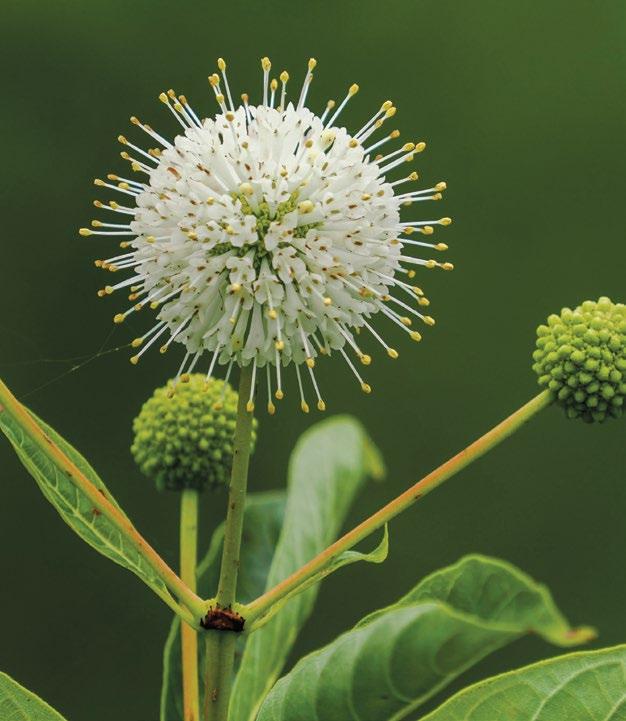
For some native plant enthusiasts, it’s all about finding rare or endangered species, the “lifers” that complete a bucket list of plants to see. While I certainly enjoy finding rare plants from a conservation perspective, and I have found many along the Nipmuck Trail, I also cherish the common and familiar plants, those that
I recall from my youth like jewelweed (Impatiens Capensis) and buttonbush (Cephalanthus occidentalis). Rather than measuring my time on the trail by miles, I measure it by moments of wonder and gratitude for these plants and habitats and for the people who work tirelessly to protect them. I’m not getting anywhere quickly on trails, and I wouldn’t have it any other way.
For the latest
Michelle Poudrette is an educator, naturalist, and conservation professional who hails from northeast Connecticut. When she is not directly supporting organizations that help protect and connect people to nature, she is out botanizing the blue-blazed trails and beyond.
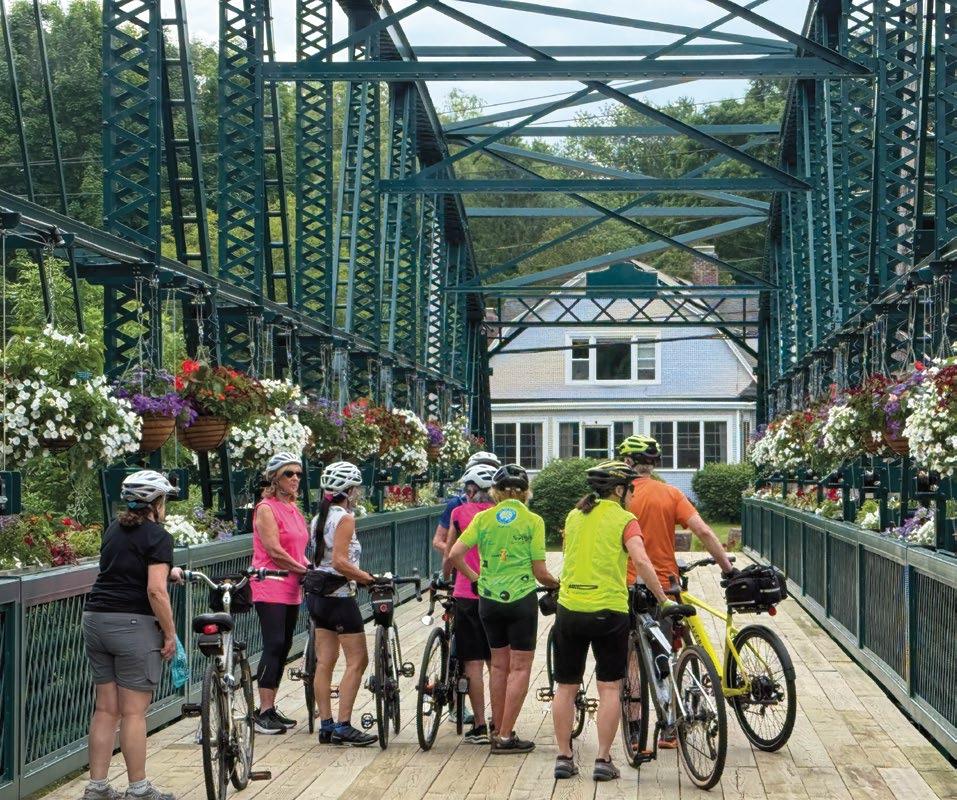
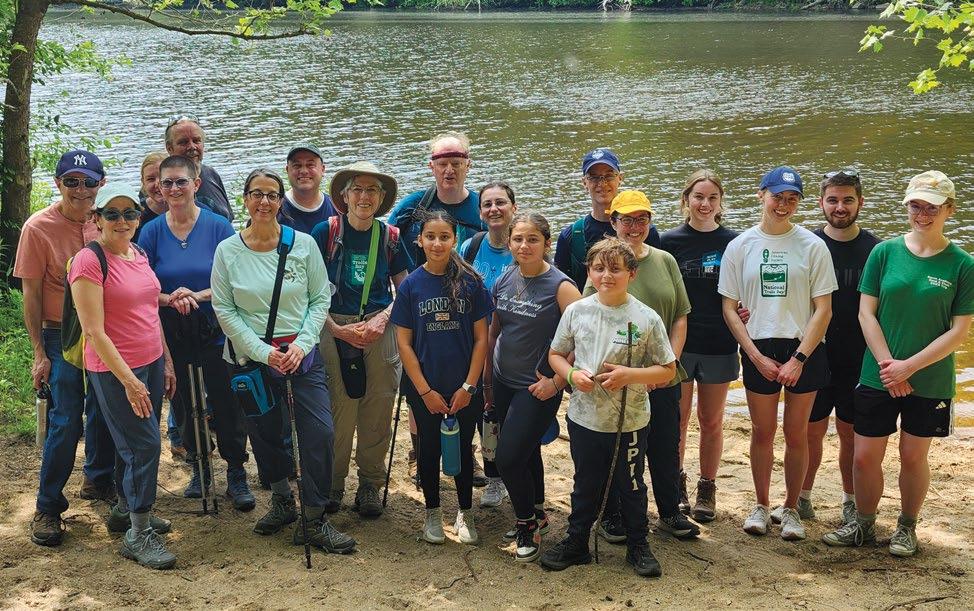
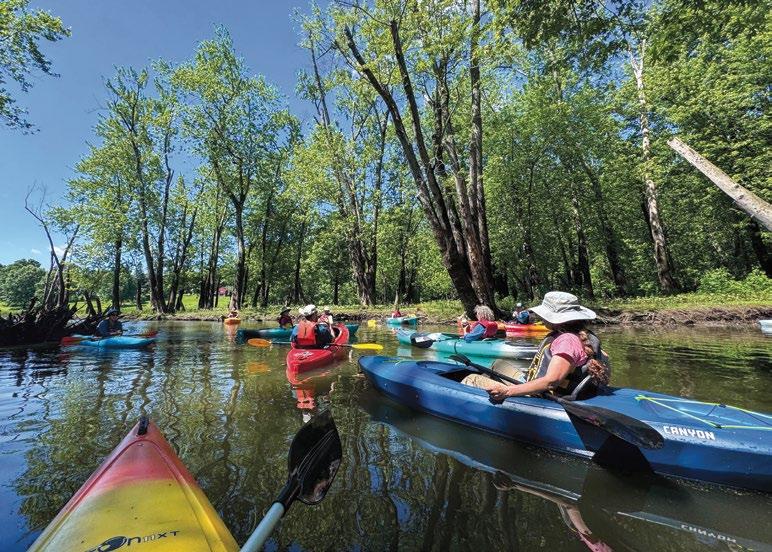
CFPA’s 2026 Trails Day was one for the books, with 213 events across 112 towns. For the 33rd year, Connecticut residents showed up and proved how much we love hiking, biking, boating and just being outside. Not only did people get on the trails, they also learned about their environment, met fellow trail enthusiasts, and talked about different ways to support and maintain outdoor access for future generations. At the grand opening of Warren Land Trust’s Mountain Lake Preserve, over 100 people showed up to celebrate a new conservation success story. Thank you to all who organized and participated in this year’s Trails Day! We will see you outside again soon.
CT Trails Day is made possible by the generous support of our sponsors. Thank you to our Connecticut and Forest Level Sponsors for helping thousands of Connecticut residents get outside to hike, play, ride, explore, and paddle across the state.
Connecticut Level
Connecticut Department of Energy and Environmental Protection, Eversource
Forest Level
CT Trailmixers, Lynch Toyota, Talcott Financial Group
Weathering Heights
Arborists embrace community and competition among the trees
By Timothy Brown Photography by Jake Koteen
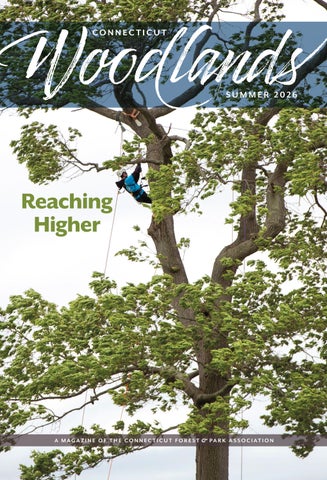
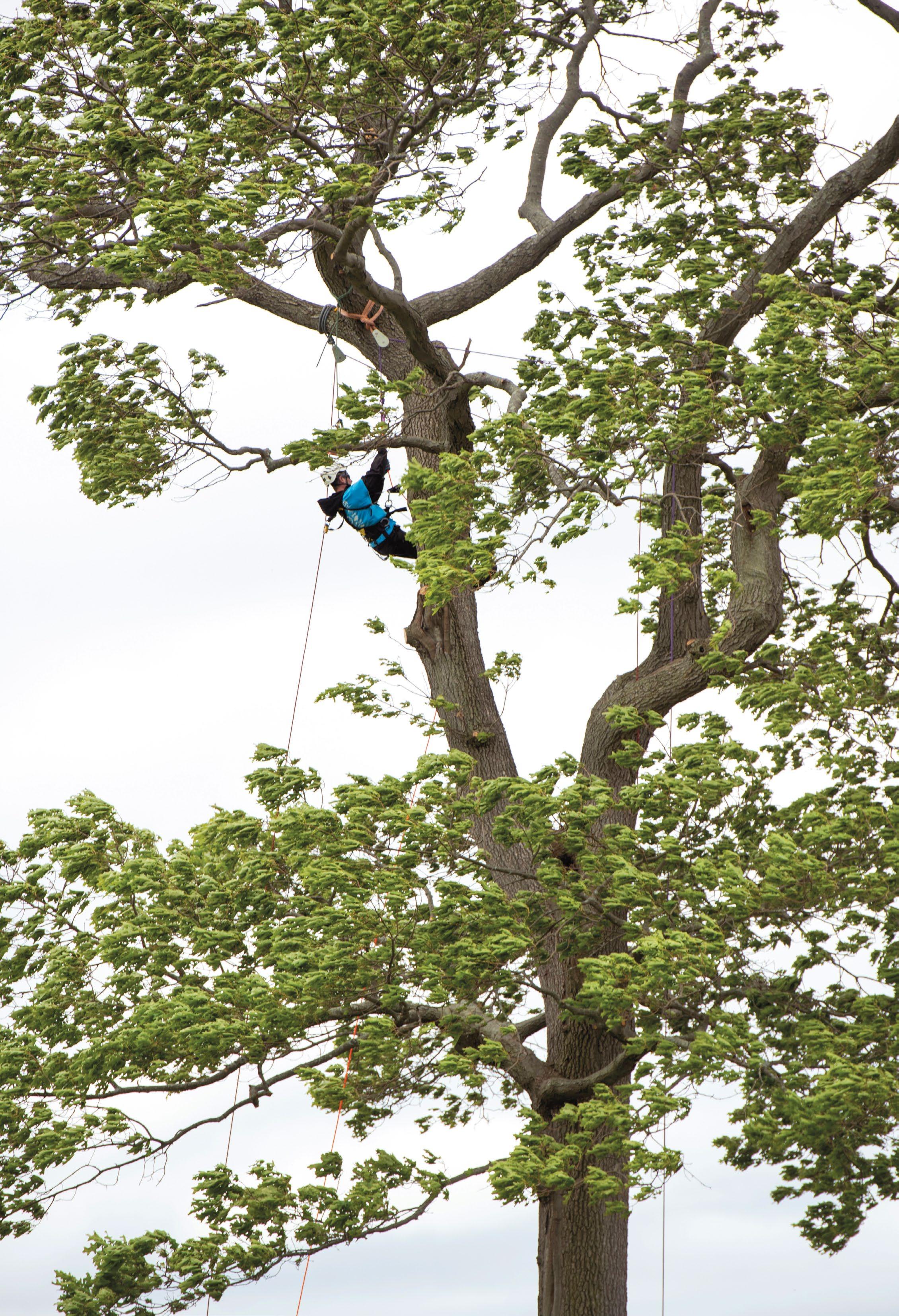
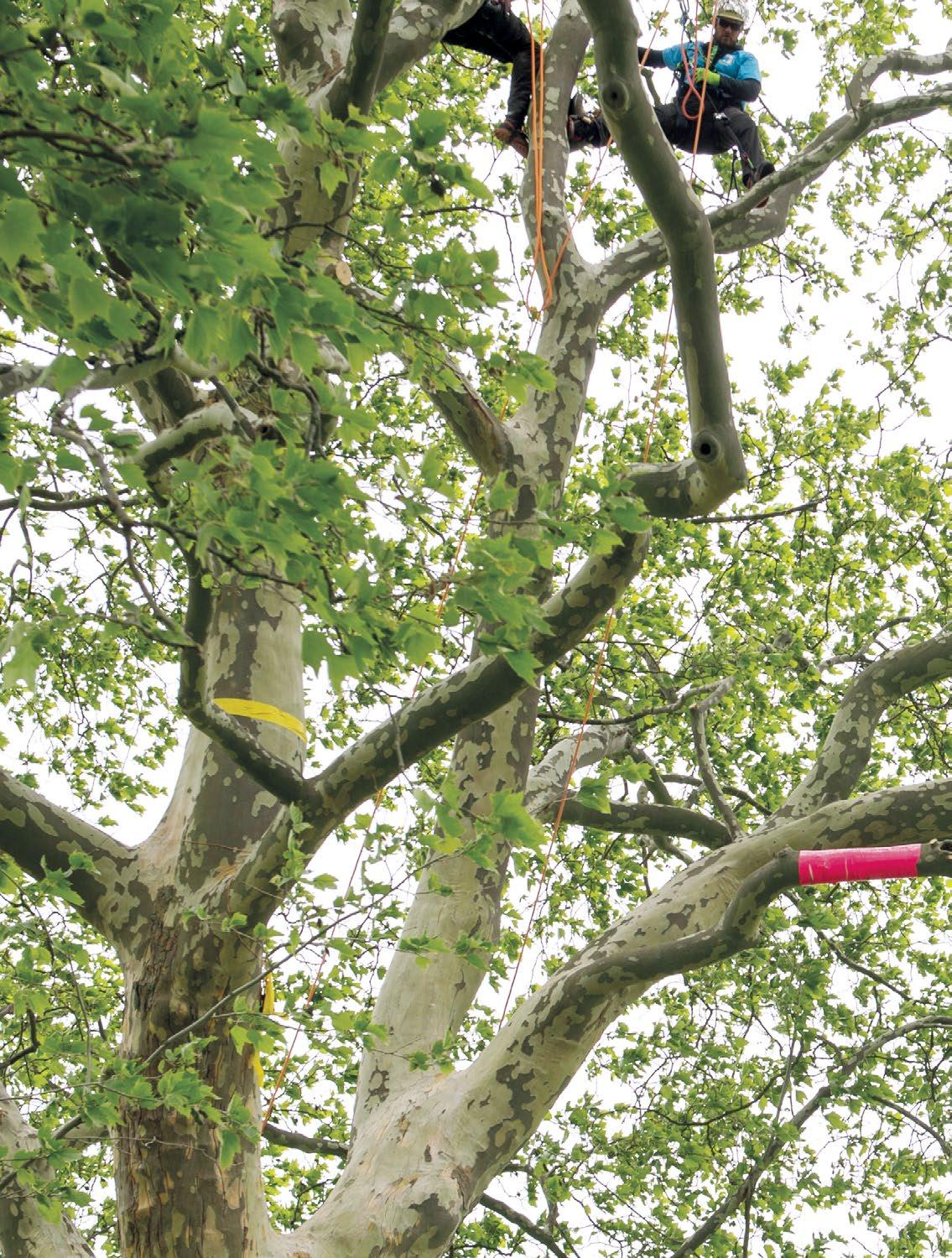
It’s a bitter and blustery Saturday morning when we arrive at New Haven’s Lighthouse Point Park. Though it’s nearly June, it feels more like March, and the Sound is frosted with whitecaps. Several spectators are huddled around a huge sycamore tree, their heads tilted toward the canopy. Fifty feet up, an arborist is racing against the clock to complete a series of assigned tasks in the face of a relentless wind.
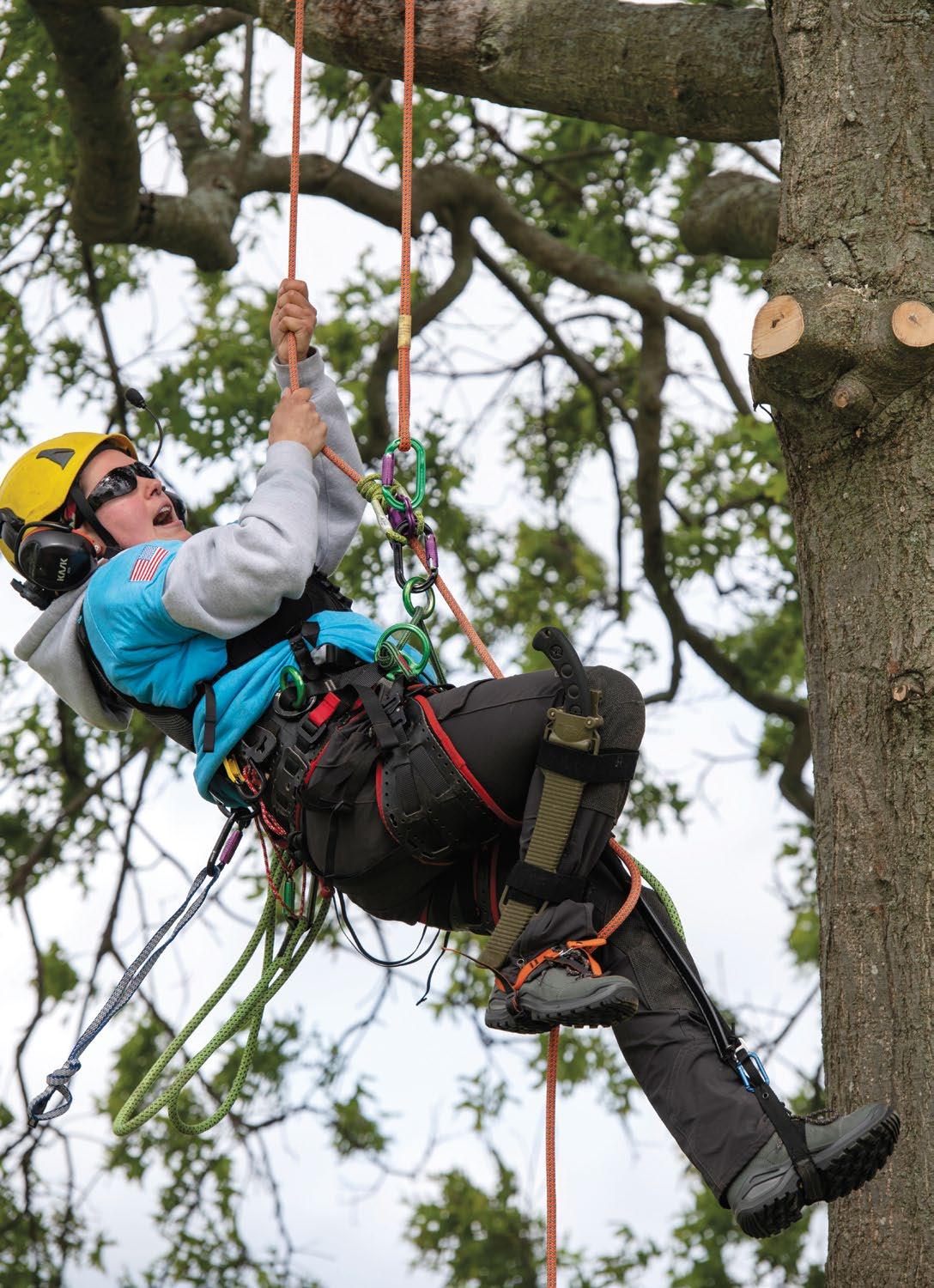
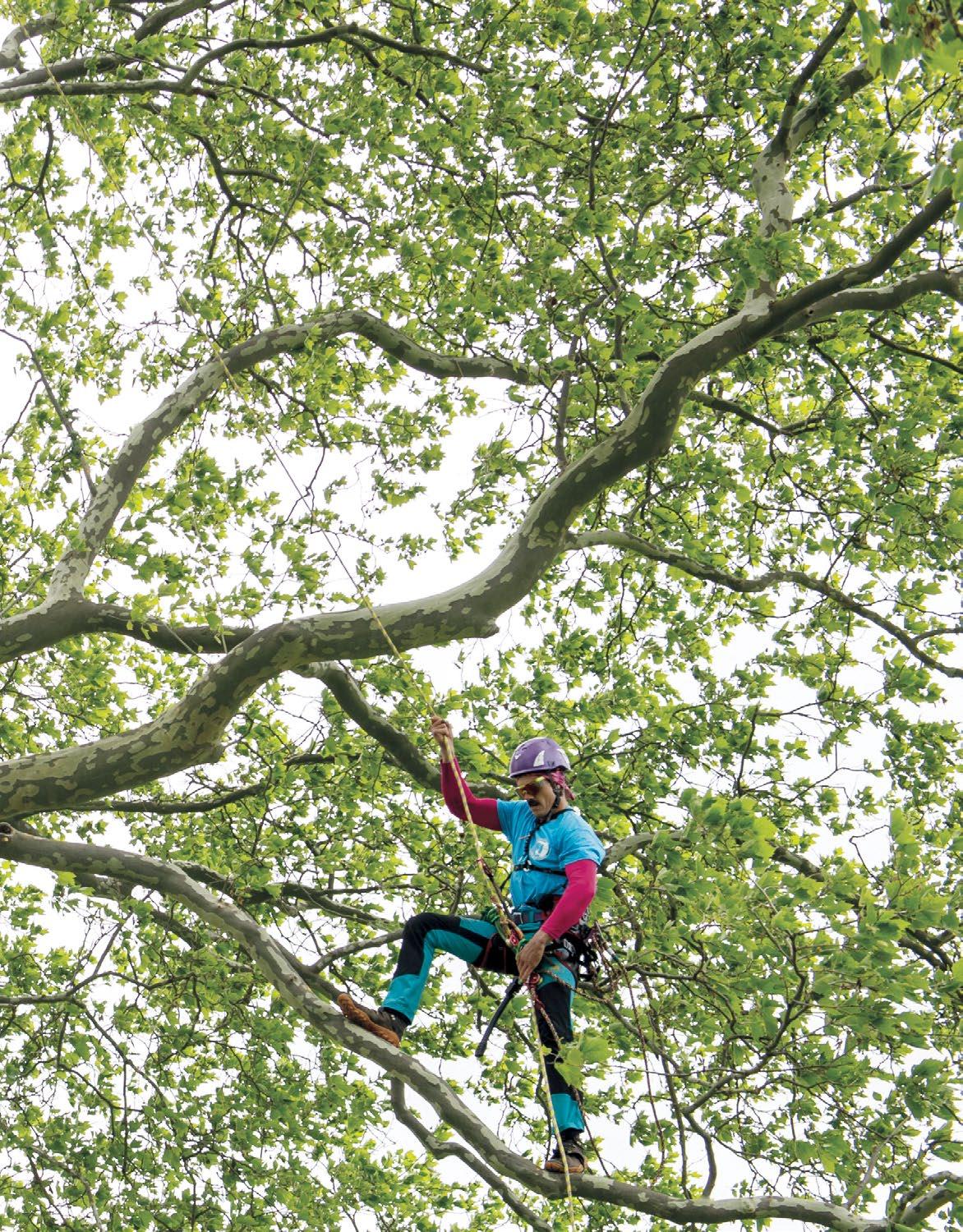
We’re at the Connecticut Tree Climbing Competition, an annual event organized and hosted by the Connecticut Tree Protective Association, an educational nonprofit founded in 1922 to promote the protection and care of the state’s trees. Twenty-five contestants—all certified arborists—are competing in five events that simulate real-world challenges (minus any actual cutting): the ascent event, throwline accuracy, belayed speed climb, work climb, and aerial rescue. The top three climbers advance to the Master’s Challenge in the old sycamore. To the uninitiated, it looks like the nature version of American Ninja Warrior, with fans and arborists cheering on each other. While it’s certainly a contest, the atmosphere feels more congenial than competitive.
“The spirit of this industry and the spirit of this competition is learning and progressing at the trade, and everybody at these competitions is super supportive of each
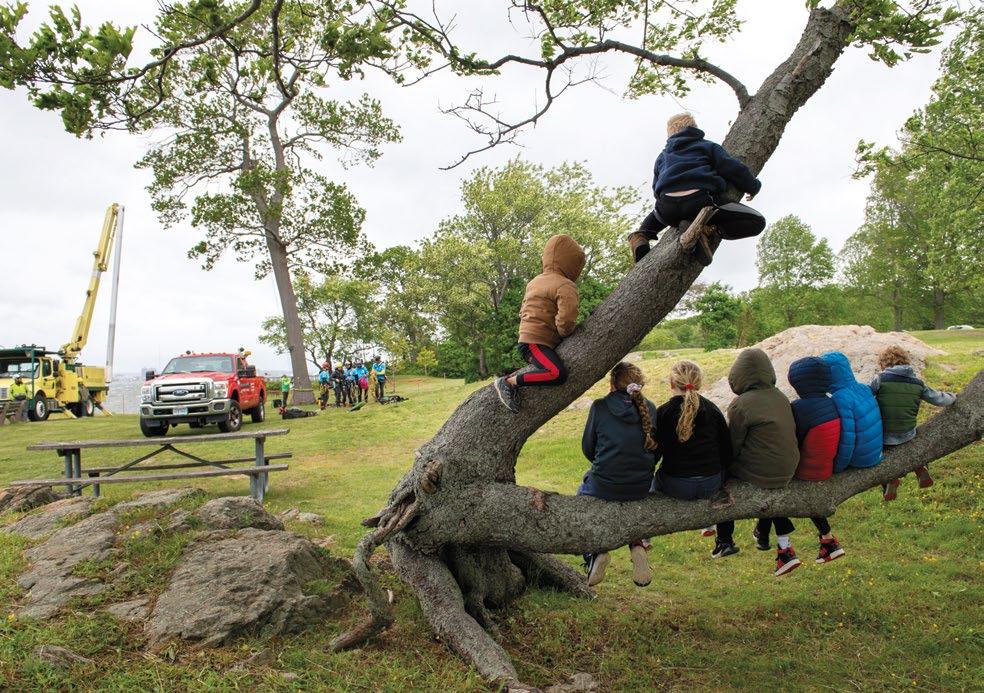
Kids watch the Ascent Event where climbers race up a tree, testing their skill and speed in setup (attaching themselves to the ascent line), ascending between 40 and 60 feet into the tree, and switching to descent gear.
There’s something primal, almost instinctive, about climbing trees.
other,” says Jamie Chambrelli, National Safety Director for Canopy Service Partners, who serves as head tech for the competition. “When we get new climbers, more seasoned competitors will take them under their wing.”
There’s something primal, almost instinctive, about climbing trees. Our evolutionary ancestors spent their lives swinging from limb to limb like modern day orangutans. And for many children, tree climbing is a beloved pastime. On this day, several children have braved the weather to support Dave Meszaros of Blue Collar Tree Service, who has performed tree work at their home and is competing for the fourth time. When asked why they like climbing trees, most of the kids respond with some variation of “to be up high.” But JL, age 8, also likes jumping out of trees (“not too high” he clarifies) and Jordan, 9, likes to find bird nests (blue jays are her favorite), while Gideon, 10, prefers napping in trees.
The competition is held at a different park each year and is supported by a team of dedicated volunteers. “We scout out the trees that we think are going to be the best setup for each event,” says Chambrelli. “We clean out the dead wood and then show up the day before the competition and set up the trees.”
Most of the contestants are from Connecticut but the event attracts climbers from throughout New England. Alyssa Cleland, who grew up in Connecticut but now lives and works on Cape Cod, came to test her skills in the heavily male-dominated field.
“You’re constantly questioned, ‘Why do you want to be in this industry?’” she says. “I enjoy being outside; I enjoy working with my hands; I love the career. But there’s also so many good people.”
Valentin Brito, 28, of Norwalk, a former competitive swimmer and lacrosse player agrees it’s all about the people.
“Competing was what got me into it, but what kept me here is the community,” he says.
Brito, who earlier this spring won the North American Open Masters Tree Climbing Competition, ended up winning this year’s Connecticut Tree Climbing Competition, the first Mexican American to hold that title, and advanced to the New England Chapter International Society of Arboriculture Tree Climbing Championship in Rhode Island. But for Brito, winning isn’t what’s most important.
“It’s all about learning and growing together. Someone gets crowned victor, but at the end of the day, if you show up, you already won,” he says. “The stuff that I really enjoy are the memories that I get to build with all my other climbers and people that I meet throughout this journey.”
Timothy Brown is a writer and editor based in New Haven.
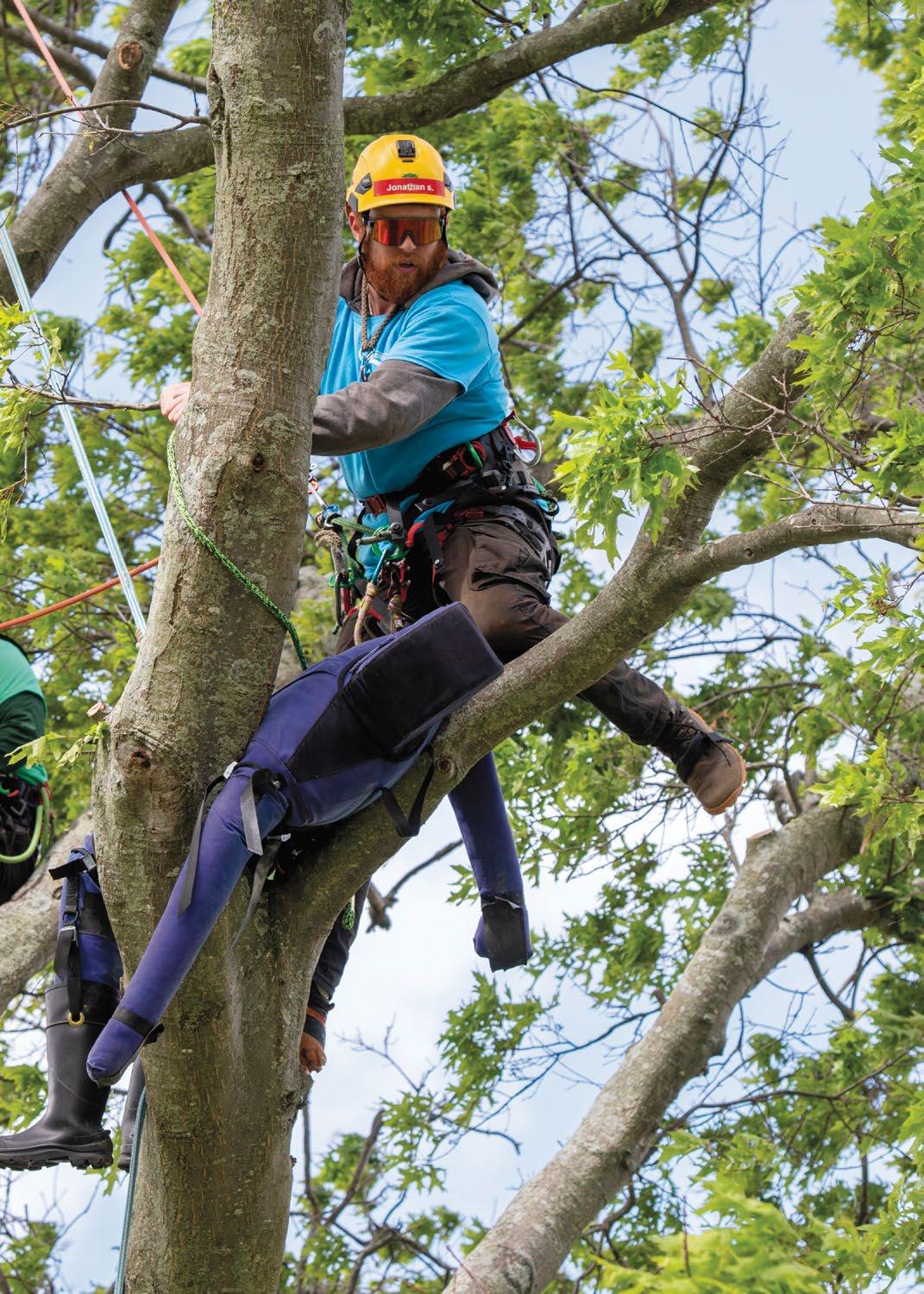
Above left: Alyssa Cleland calls out to a "dummy victim" during the timed Aerial Rescue, which replicated an actual rescue of an unconscious climber. Center: The Work Climb is the most challenging preliminary event. Contestants must complete assigned tasks at five work stations throughout the tree and ring a bell when each task is complete. Right: During the Aerial Rescue, climbers must "rescue" an unconscious climber, including lowering the dummy safely to the ground.
The Challenge of Trails and Time
Recording the details of 800 miles
By Mark S. Weiner
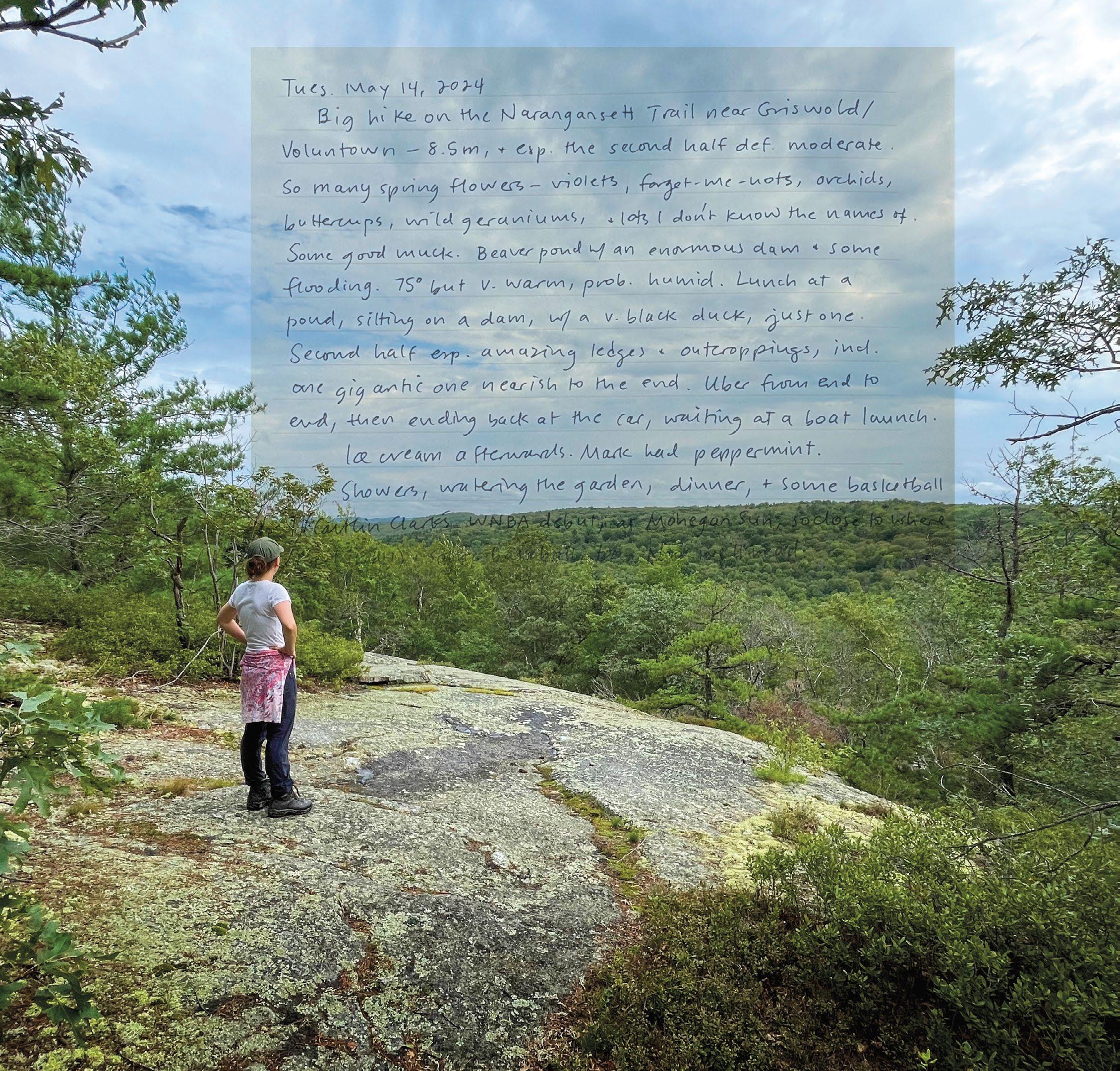
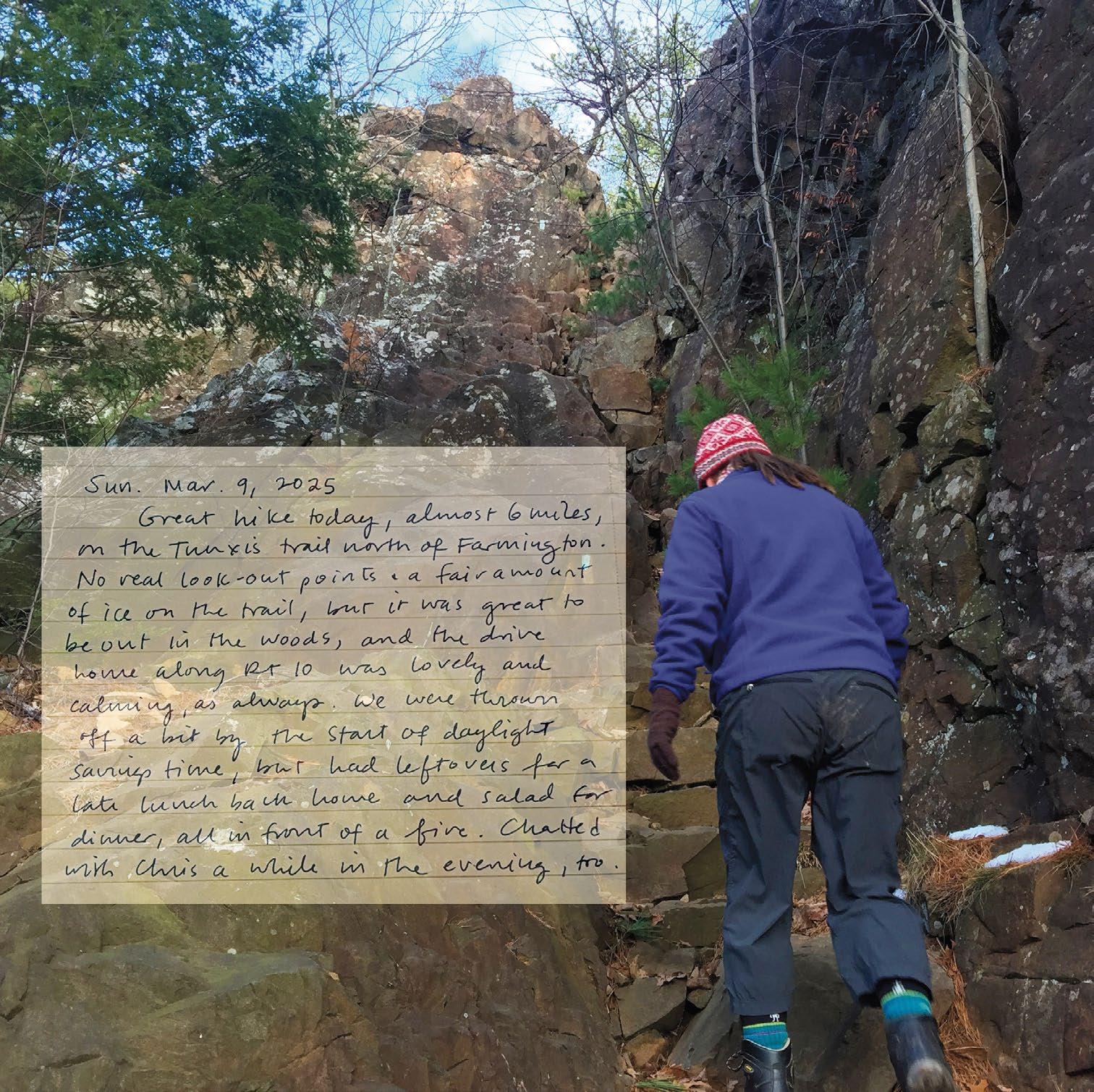
For the past twenty-some years, my wife and I have been taking notes about the trails we have walked. Stephanie writes them by hand into lap-sized spiral notebooks as part of our evening routine. A slightly bowed wooden shelf in our den shelters these treasured “fun logs,” from which we read aloud whenever we feel moved to recollect our adventures.
One of these notes marks the moment when the two of us, both transplants to Connecticut, began to appreciate that the handful of trails with pretty blue blazes that we had recently hiked were, in fact, parts of an entire trail system—a network of paths that we now recognize as one of the jewels of our adopted state. 11/27/08. We hiked the 2.2 miles into the Indian Council Caves, Thanksgiving Day. A bit steep at first, but not difficult. The caves are amazing. Very impressively huge and gravity-defying. The Tunxis is a “blue-blazed trail” so this is a very well-marked and easy to follow trail. Lots of Mountain Laurel.
When we first began CFPA’s Blue-Blazed Hiking Trails Challenge, we just wanted the 50-miler patch—we thought it would probably end there. How wrong we were! The challenge involves four levels: 50, 200, 400, and 800 miles of hikes completed on blue-blazed trails, with prizes for each one. Once we got the 50-mile patch, we were hooked on the fun. Could we do 200? 400? We kept going, and gradually, the challenge became something much more meaningful.
In March of this year, we stood at the trailhead of the newest path of the blue-blazed network, the Wabbaquasset, and I wrote the following:
Our final hike. We are done. It was perfect. A chilly, sunny morning. The trees sang to us during our final steps.
Eight hundred miles! We were elated. Yet something also put us in a sober mood. We were no longer young people settling into our first home in suburban Hamden. We were now in our fifties—me, almost sixty. Together on the trails of Connecticut, we had grown a good deal older. Time had passed.
Stephanie and I began hiking in this forested state partly to deepen our appreciation for our adopted home. We also wanted to find refuge from the demands of our busy lives. Stephanie hails from Minnesota, and I was born and raised in Los Angeles, so we often find ourselves on a plane to visit family. Our careers are demanding. Our emails never stop pinging. To walk the trails was a way to steal back lost time. We wanted to “live life deliberately,” as Thoreau wrote in Walden. We also wanted to get to know our adopted home. The CFPA challenge, which we began to pursue in earnest in 2020, spurred us on.
At first, we simply hiked whenever the spirit moved us, and to whatever part of the state we thought might be interesting. Our lives don’t lend themselves much to monthly hiking goals—we just stuck with it, sometimes more, sometimes less, and we tried to find new routes to explore whenever that seemed like fun. But over time, managing the challenge required spreadsheets and careful planning to make sure we were being moderately efficient. After all, now we weren’t simply after a patch: we wanted the prized vest!
Toward the end, a bit of psychological obsession helped, too, driving us well beyond a rational calculus for fun: “Miles! I want more miles!” I would exclaim as we loaded our gear into the car.
On the trails, we saw so many wonderful things, both majestic and mundane, and we’re grateful now to have our notebooks to be reminded of them. The gorgeous panorama at the top of Mohawk Mountain. Trees swaying in Nipmuck Forest after a summer storm. A path lined with blue and pink wildflowers. Countless good dogs (shout-out to Canyon, Margo, Prudence, Juno, Mia, and Lucy—where are you now?). Unusual formations of traprock. The bear that ambled in front of our car in the northwest corner.
It’s been important to us to recall the hard parts, too, the accidents, mistakes, and unwelcome surprises, all likewise carefully recorded. The bugs that swarmed us near the Rhode Island border on the Pachaug. The time we fell into a stream on the Mattabesset, in a sudden, total loss of dignity (which eventually left us laughing). An ill-advised hike, knee-deep in snow, two miles along Hancock
Brook—couldn’t we have waited another couple of weeks for spring? The time that a stumble over some sharp rocks made us wonder if we could safely make it home.
The magic of recollecting all these moments now stems not only from their significance on the trails, but how those miles wove themselves into our lives. Triumphs and disappointments. Jobs that came and went. Family and friends lost. Thanks to the blue-blazed challenge, our memories of these events have become entwined with the memories of our hikes, and so our past, as much as our present, has become inextricable from the Connecticut landscape.
The granular knowledge of the state that we gained while seeing it on foot, at a human pace, over many years, is linked with all the other great turning points, and all the common events, that we experienced together as a couple.
Today as we drive toward Litchfield, then, we might pass the crossing for the Mattatuck—there it is!—and think: “We hiked this trail the day we heard about your award—I was so proud.” We roll past Finch Brook: “You and I were here the weekend the storm blew down the great tree in
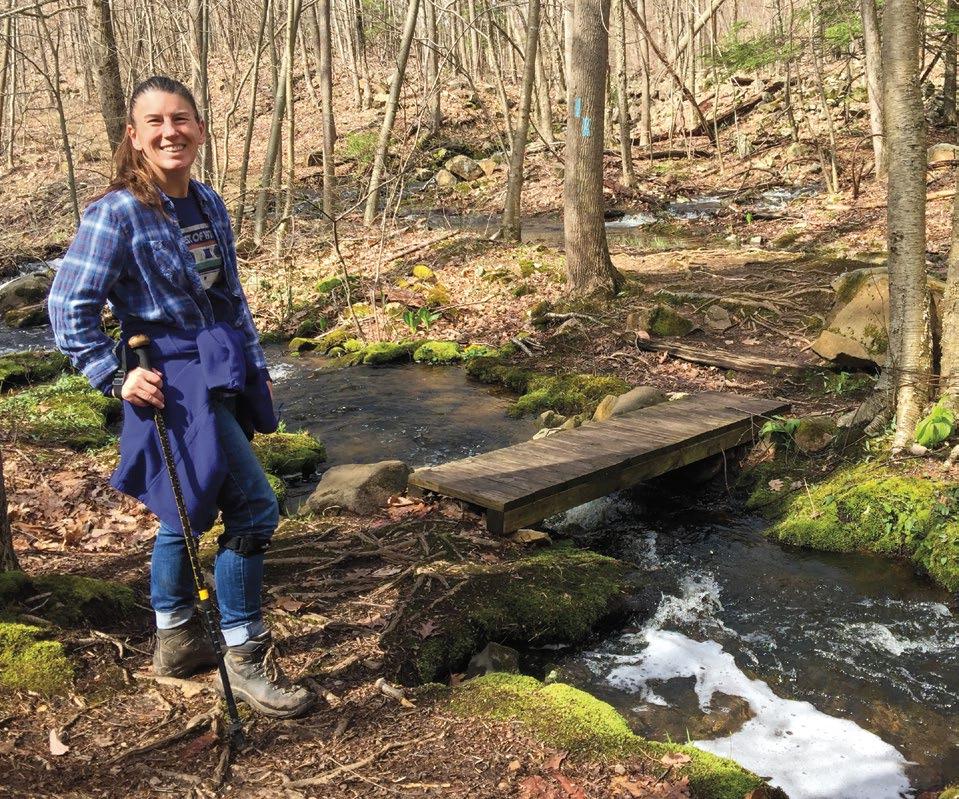
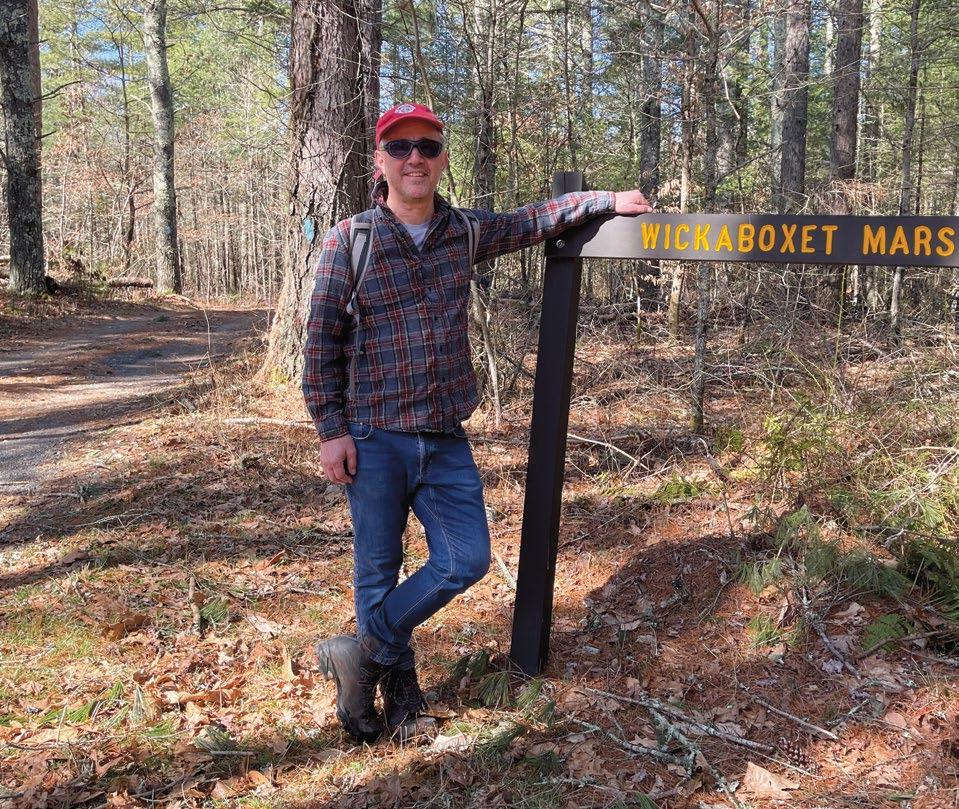
Top: Stepahnie on the Quinnipiac Trail. Above: Mark on the Pachaug Trail.
our yard.” Naugatuck: “We were walking here when you decided to leave your job.” Metacomet: “When we hiked that trail, we talked about your film.” Narragansett: “Our dear friend was having surgery when we walked this path.” Cockaponset: “This is where we were when things were getting better.”
These days our lives and our memories are so often tied to a placeless world that is at once everywhere and nowhere. The digital age seems to be prying apart our connections to time and place. And it is prying it apart fast.
To reconnect these aspects of experience seems to me to be among the most important spiritual tasks of our time.
It also seems to be a task to which a trail challenge is well suited. A trail challenge requires us to be deeply in the physical world, to experience a place in person. What’s more, an extended challenge—one that seems almost impossibly long—strikes me as especially tailored for the job, because it can only be completed over a period of years.
As transplants to Connecticut, the 800-mile challenge also helped us with a less spiritually grand yet personally important task. Through it, we came to identify ourselves with Connecticut, to know the state. Through every step, we’ve made it our own.
ATHE MAGIC OF RECOLLECTING THESE MOMENTS NOW STEMS NOT ONLY FROM THEIR SIGNIFICANCE ON THE TRAILS, BUT HOW THOSE MILES WOVE THEMSELVES INTO OUR LIVES.
few weeks after we completed the 800-mile challenge—after I had returned from another trip to the other side of the country—Stephanie and I sat next to each other at home in our vests, and we wondered whether we should take up another challenge. Our first thought was to visit every state park in Connecticut, or every local historical museum. Then we considered hiking the New England Trail through Massachusetts. Maybe we should read every Shakespeare play in chronological order? We had so many ideas!
“Those all sound great,” I said. “Let’s talk about them more on a neighborhood walk.”
Mark S. Weiner is a documentary filmmaker and former law professor who lives in Hamden. His most recent film, “The Volunteers: Mountain Rescue Brings Us Home” is available for streaming on PBS Passport and, in longer form, on Prime Video. He and his wife, a professor of English at Wesleyan, are Giant Masters for All Seasons.
Mark and Stephanie on the Appalachian Trail.
New Haven Youth are Planting Resiliency
At UrbanScapes Native Plant Nursery, young people are learning to nurture and grow.
Words and photos by Briget Ganske
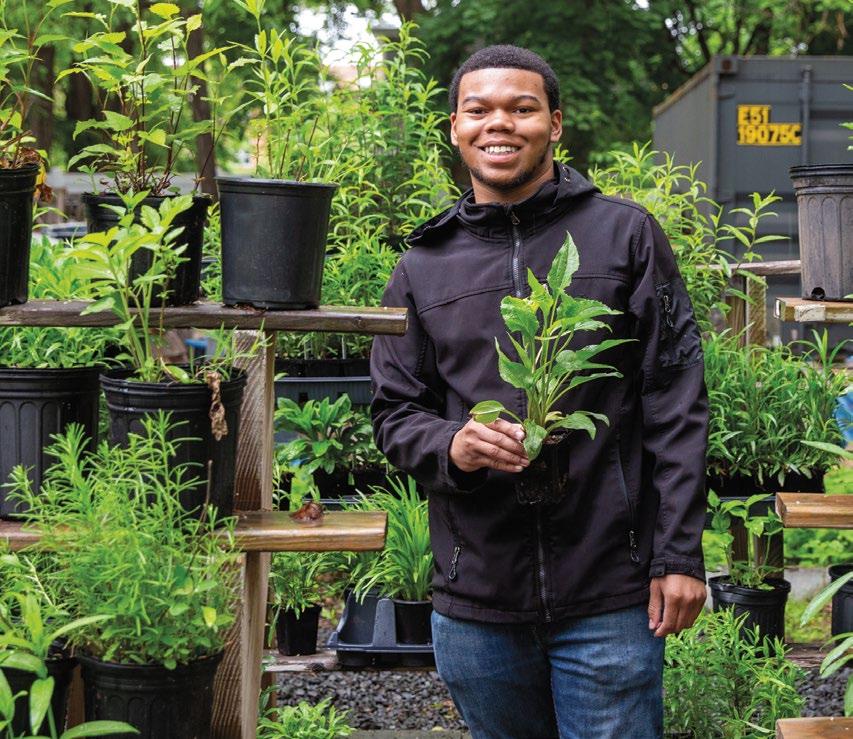
On a rainy Saturday morning in May, eighteen-year-old Tyshaun Lester was helping a customer find a purple coneflower. It was his favorite plant at Urbanscapes Native Plant Nursery—once a vacant lot in the Newhallville neighborhood of New Haven, now filled with a greenhouse, pavilions, and hundreds of potted plants for sale. “I love the coneflower because of the color,” Lester said. “It can be either yellow or purple. I like it because it’s also a tall plant.”
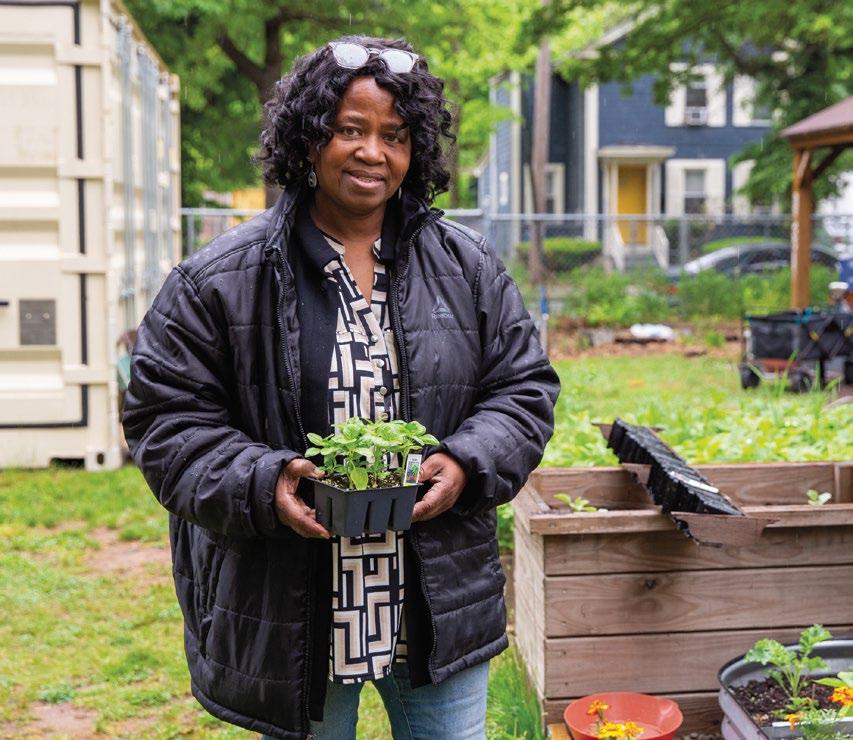
Lester has grown taller himself in the last six years working at the nursery. He was in middle school when his mother introduced him to Doreen Abubakar, the founder and executive director of Community Placemaking Engagement Network (CPEN). CPEN has been transforming Lester’s neighborhood, Newhallville, which sits only a few blocks but a world away from Yale University. Thanks to CPEN, the former crime hotspot nicknamed “The Mudhole” is now The Learning Corridor, a park with benches, water fountains, a butterfly garden, and bike repair stations.
Dennis Riordan, president of the Menunkatuck Audubon Society, has worked with Abubakar since 2011
“We
when he first started helping with her West River Water Festival. After years of programming and building native pollinator habitats around the city, in 2019 Riordan suggested to Abubakar that they start growing native plants. “What do you think of starting a nursery?” Abubakar remembered Riordan asking her. She had her eye on a vacant lot in Newhallville, on the corner of Hazel St and Shelton Ave, right near the Learning Corridor. Many places build community gardens in vacant lots, Abubakar explained, “but I wanted to do something that would be more of an engagement piece in the Newhallville neighborhood because they don’t have a library or a medical institution. They don’t have
stores, only bodegas. And so I wanted to do activities in the vacant lot.”
CPEN leased the lot from the city, and in 2020—shortly before the pandemic began—partnered with Menunkatuck Audubon Society to start Urbanscapes, a native plant nursery and youth training program. Now the lot also holds a greenhouse, beehives, pavilions, a makerspace, and a Trailside Cafe in-the-making—all opportunities for locals, especially local youth, to participate.
Abubakar grew up in New Haven, in the Dixwell and The Hill neighborhoods. Her journey to become an urban environmentalist began when she was a teenager, on a camping
use the plants to build self-esteem, confidence, and the ability to communicate. The goal wasn’t that they would go to school for this stuff. The goal was that nature conservation would not be foreign to them, personally.”
Doreen Abubakar
trip where she canoed down the Connecticut River. “It was there that I had the opportunity to really see nature in a different way,” she said. “When you’re on the water, you’re seeing nature from a different view than the concrete that we constantly see in the city. And I felt like, wow, look at this. And so that’s what really started my venture to focus on how do we connect minorities and our underserved neighborhoods to the nature that’s right here in the urban city?”
At Urbanscapes Native Plant Nursery, New Haven youth work with Abubakar and Riordan to learn about and take care of native plants. Why native? “The native plants and the native wildlife have evolved together,” Riordan explained. “Cultivars are often grown
so that they’re more beautiful than functional for wildlife. So in order to support bees, butterflies, birds, and other wildlife, you need native plants that they can make use of.”
A native plant is one that has occurred naturally for thousands of years in a region. Only plants found in this country before European settlement are considered to be native to the United States.
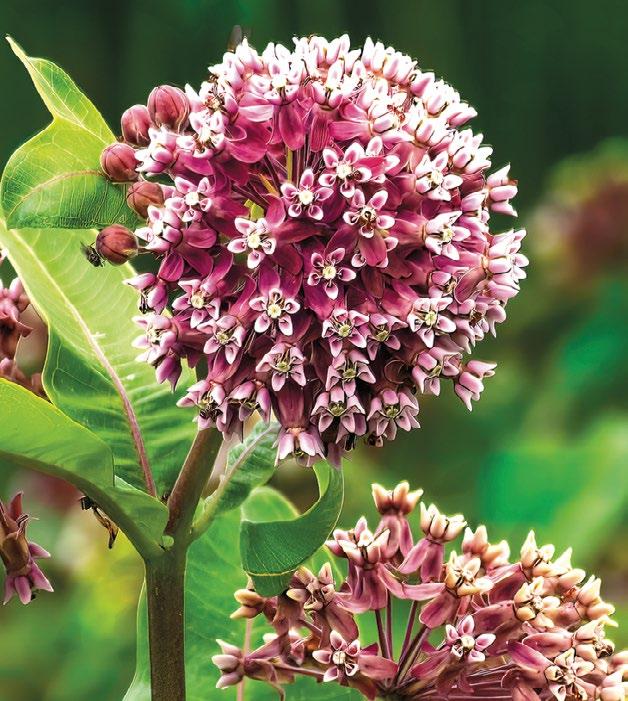
Examples of plants native to New England are the red maples, blackeyed susans, and common milkweed. Non-native plants, by contrast, are species that have been introduced from other regions of the country or from around the world. Invasive plants are non-native and cause environmental harm by rapidly outcompeting
native species for essential resources, reducing biodiversity, and depleting vital water supplies. In New England, it is estimated that non-native plant species make up about a third of the flora, and 10 percent of these qualify as invasive.
Cultivars, as Riordan mentioned, are plants that people have selectively bred for specific characteristics. Cultivars can be derived from non-native or native plants (native cultivars are called nativars). Breeding plants for aesthetics alters the gene pool, flower shape, bloom time, and fragrances, causing susceptibility to disease and preventing birds and insects from accessing nectar and pollen.
For example, the butterfly bush was introduced to the United States from
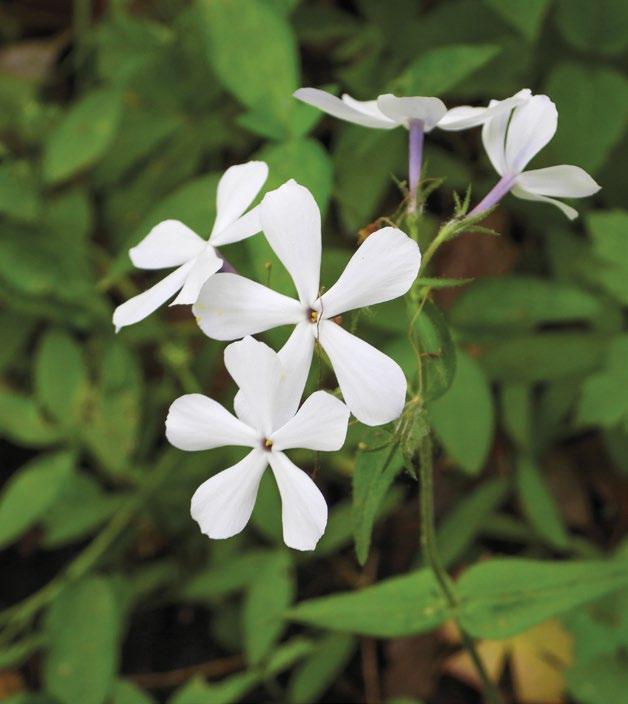
Woodland phlox (Phlox divaricata)
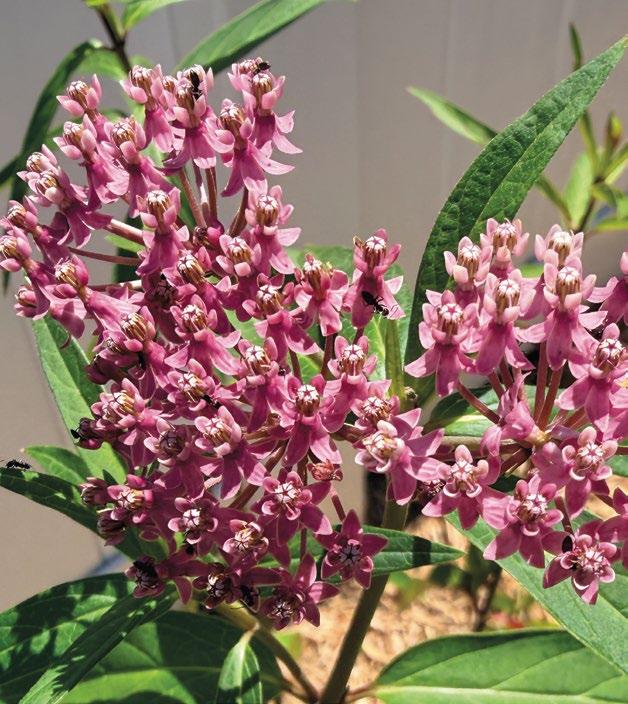
Swamp milkweed ( Asclepias incarnata)
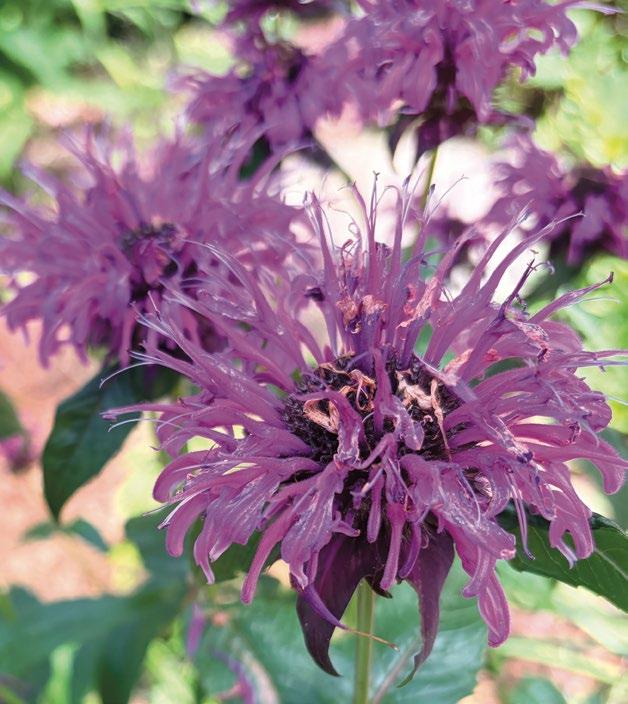
Bee balm (Monarda fistulosa)
Tyshaun Lester (above left) has spent six years working at Urbanscapes Native Plant Nursery. Doreen Abubakar (above right) is the founder and executive director of Community Placemaking Engagement Network (CPEN).
The nursery grows between 4000-5000 native plants a year, from shrubs and trees to perennials and vines.
China in the early 1900s. A non-native cultivar, butterfly bush is highly invasive in New England. “It’s a plant that is sold in a lot of nurseries and it’s a beautiful plant,” Riordan explained. “In summer, it’ll be covered with butterflies getting nectar, but that’s all they can do. Other insects can’t make use of it.” By monopolizing pollinators with massive amounts of nectar, butterfly bushes distract insects away from flowering native plants. This makes it harder for the native plants to reproduce, drastically reducing the food supply, like caterpillars, needed for nesting birds. A better option? “Butterfly weed, which is a type of milkweed, is very important for monarch butterflies,” Riordan said. In fact, monarch butterfly caterpillars eat only milkweed. “No milkweed, no monarch butterflies.”
Urbanscapes’ outdoor wooden shelves hold pots of milkweed, goldenrod, beebalm, and golden alexanders. The nursery grows between 4000-5000 native plants a year, from shrubs and trees to perennials and vines. “You can get native plants in other nurseries,” Riordan said, “but you got to sort through the cultivars and nativars
and ornamental plants and all that. We’ve got straight native—everything is straight native.”
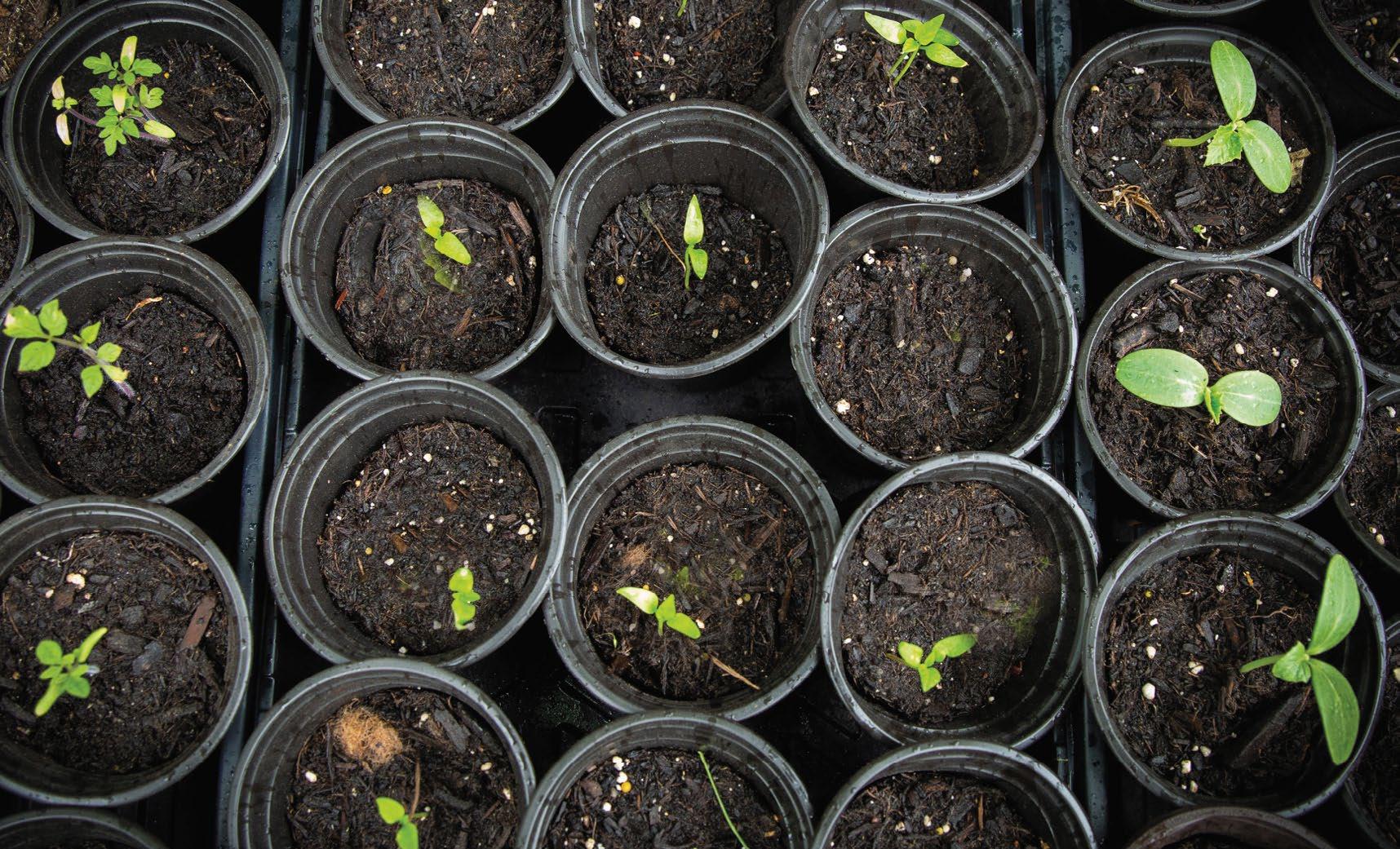
Young people begin working in the early spring to pot starter plants in plugs then tend the plants through the growing and selling season. Besides helping with a community clean up once, Lester hadn’t worked with plants before beginning the training program at Urbanscapes. Abubakar first taught him how to repot plants. Now Lester and the plants have a special relationship. “I like how they have their own self,” he said. “Meaning, it feels like you’re talking to a person. Because I feel like plants do have feelings as well.”
Lester and a fellow worker, Randall Flemming—who also lives in Newhallville and has been with Urbanscapes since its first year—helped two women carry plants to their car. Despite the rain picking up, everyone seemed in good spirits. The table under the pop-up tent was full of snacks. Other youth worked in the greenhouse repotting and watering plants.
“We use the plants to build self-esteem, confidence, and the ability to
communicate,” Abubakar said. “The goal wasn’t that they would go to school for this stuff. The goal was that nature conservation would not be foreign to them, personally.”
Each spring, the nursery provides work stipends for four to six young people, many of whom come back year after year. “The most rewarding part of my job is coming together as a community,” Lester said. “We have formed, like, a brotherhood.” Lester graduated last spring from Eli Whitney Technical High School. For a while, he planned to start a plumbing business straight out of high school. “We encouraged him to go to college,” Abubakar said, “so he’s getting a degree in business, and hopefully then he’ll know all the ins and outs of running a very successful plumbing business.” Lester finished his first year at Central Connecticut State University (CCSU) and he credits CPEN and Urbanscapes for who he has become. “It’s helping me by growing into a young man,” he said. “Miss Doreen was giving me lessons throughout time. I felt like that really helped me. And I really see my growth building with the nursery.”
Black-eyed susan (Rudbeckia hirta)
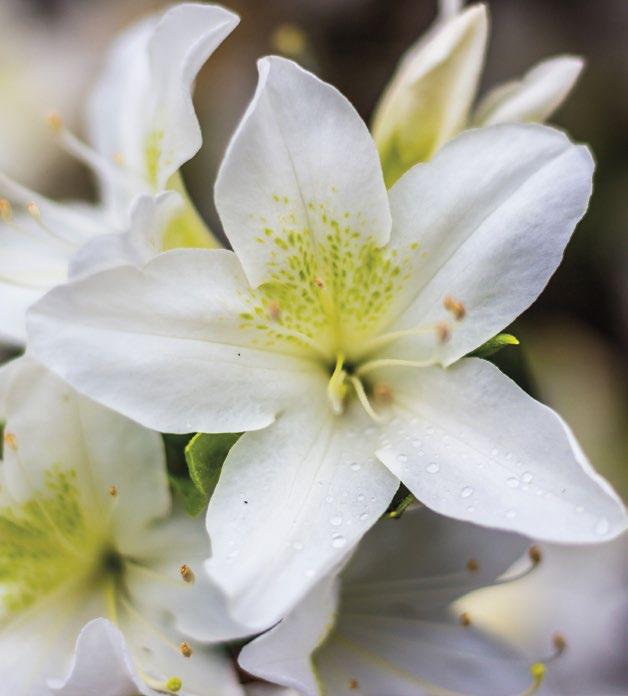
Swamp Azalea (Rhododendron viscosum)
Common milkweed ( Asclepias syriaca L.)
Poetry as a Green Necklace
By: Margaret Gibson
Ilive in a house in the woods. I live on seven acres, and these include the dirt and gravel lane which the town of Preston sold to the previous owner for one dollar. The physical boundary of the land extends to the surrounding woods owned by Avalonia Land Conservancy, about 200 adjoining acres in all—even more, if one includes the other nearby Avalonia land preserves arranged in a “green necklace” which I helped the Conservancy acquire and protect some years ago. A green necklace is a collection of connected small parcels of land.
It may not be surprising to learn that the Poetry Editor of Connecticut Woodlands lives in the woods herself. It has been my honor and my delight to ask other Connecticut poets to send me their poems about being in, being with, being of the natural world, in particular woodland habitat. The poems I’ve accepted in my six years as Poetry Editor also include other micro-environments—a garden, a door yard, a leaf-blown sidewalk—and for these, I’ve called on poets who may inhabit a more urban environment, but whom I know value our connection and our interdependence with other inhabitants of the natural world. I’m on the lookout for poems that diminish the sense of separation we humans foolishly impose between ourselves and the Earth itself.
I am lucky to live where I do, a guest of the woods and of the others who live here with me—the usual suspects: deer, coyote, owls, hawks (red tail and red shouldered), resident birds and seasonal migrants, an occasional bobcat, an infrequent mink at play in the watery margins of the pond, perhaps after tadpoles or frogs. The list is, of course, far more extensive, and it includes the black snake who winters in the old cellar of this small 17th century central chimney cape. I have a garden, a yard, a small meadow. Stone walls thread through woods that used to be farm fields. In this inhabited solitude, there’s enough room for us all.
Here, for over fifty years now, I have learned the names of trees, wildflowers, and birds, as well as to recognize an unseen bird by its song. “If you stay in a place long enough,” Annie Dillard wrote, “you’re bound to learn something.” I trust that counsel. I wait for the spring burst of pollen from the pines which border the far side of the pond, watch the black snake glistening in the corner of the patio after shedding its skin, wait to hear the barred owl’s call come through the night window along with the moon.
Knowing where I am, I know who I am. By paying attention, the boundaries of my “self” keep moving. What I see and hear allows my narrow sense of self-boundary to increase and to include others. This is the work of mindfulness. Each singular and particular “other” becomes, very gradually, no other than myself.
To say it another way, all of us, humans and non-humans, inhabit this one body, this one life. We are, in ways often beyond our knowing, interwoven, interdependent, necessary to each other. The dragonfly that landed on the page of a poem I’d just begun quickly became the focus of the poem. The mourning cloak on the summer flower also does its own work. As a poet, my work is to “say it another way,” poem by poem, and each poem is a work of cross-pollination.
It has become clear to many of us that the failure to see the interdependence of all living things puts us all at risk. Climate crisis, climate emergency, extinctions, tipping points—scientists talk about these in one-way, environmental activists in another, spiritual practitioners another. How do poets “talk?” Poets speak and think in images, they get words and rhythm under the reader’s skin, they speak to the heart as well as to the mind of human beings, one by one. A poem is intimate, and intimacy can be very persuasive.
Language itself is intimate with the Earth. If you investigate the roots of words, you’ll find that many roots go deep into the Earth itself. Climate is rooted in the Greek word klima, meaning “the sloping surface of the earth.” Aubade, a poem to greet the new day, is traced back to the Spanish alba, or dawn. The verb investigate descends from the Latin vestigium, which contains in it the image of footprints imprinted on the earth. Words may be thought of as human “habitat,” but poets, whether writing about the natural, living world or not, write their poems by way of the Earth itself.
Poetry bridges the distance between language and Earth, language and breath, language and body, language and heart. Seeing oneself and the “other” by way of poetry helps us to see how closely connected we are with each other and with the living world. We ARE nature. Poetry is a record of that identity.”
Knowing where I am, I know who I am. By paying attention, the boundaries of my “self” keep moving.
An ordinary necklace is an ornament, but an earthy green necklace is far from ordinary. In the world of land preservation, a green necklace may thread through human settlements, creating corridors for wildlife, offering them a way to connect to habitats they depend on—woods, fields, watersheds. Poetry is, likewise, not an ornament. Its value is aesthetic, but as the most intense and intimate form of human speech, poetry is also a form of connection. As a green necklace, poetry reminds me of a Hindu metaphor for the cosmos—the jeweled net of Indra, whose single threads meet and join at junctures, and where they do, at that point of connection, there is a jewel. The net shimmers with jewels. I like to think of the words in a poem that way—as points of connectivity and light that say who we are and where and how we live on this Earth.
Venn Diagram
By Steve Straight
People who believe the Earth is round.
People who believe in science.
People who are skeptical of fame.
People who trust the planet.
People who believe curiosity is a divine force.
People who believe each human is a religion and the natural world a sacrament.
People who believe there is more to life than science.
People who pray for others.
People who wait for a mourning dove to finish its bath in a driveway puddle before walking to the car.
People who coax spiders and bees onto scraps of napkin to return them to the outside world.
Steve Straight’s books include Affirmation (Grayson Books, 2022), which won the 2023 William Meredith Award for Poetry, The Almanac (Curbstone/Northwestern University Press, 2012) and The Water Carrier (Curbstone, 2002). He was professor of English and director of the poetry program at Manchester Community College, in Connecticut.
Connwood Foresters, Inc.
39 Cherry Hill Road | PO Box 150 Rockfall CT, 06481 (860) 349-9910 | www.Connwood.com
Stewarding Connecticut’s Forests Since 1945
Forestry Across the Urban–Rural Landscape
From city edges to working woodlands, Connecticut’s forests exist along a spectrum of development, public use, and ecological pressure – all shaped by a changing climate.
Connwood Foresters, Inc. works across the urban–rural landscape, partnering with municipalities, land trusts, utilities, and private landowners to maintain, improve, and protect their forests – now and into the future.
Environmental Stewardship and Land Management since 1982
• Forest & Open Space Management Services
• Property Tax Reduction (PA 490 & Chapter 61)
• GIS Mapping
• Forest & Wildlife Habitat Improvement
• Timber Inventories & Appraisals
• Professionally Managed Timber Harvests
• Environmental Oversight
• Watershed & Utility Land Management
• Recreation Plans & Implementation
• Forest Stewardship Plans
6 WAY ROAD MIDDLEFIELD, CT 06455
860-349-7007 FAX: 860-349-7032
EMAIL: FW@FWFORESTERS COM
WWW FWFORESTERS COM
Satellite Offices in Connecticut: HAMDEN, NEW BRITAIN
Forestry Staff: ERIC HANSEN, CT CERTIFIED FORESTER F-720 TOM MCGRADE, CT CERTIFIED FORESTER F-1314
Pathways
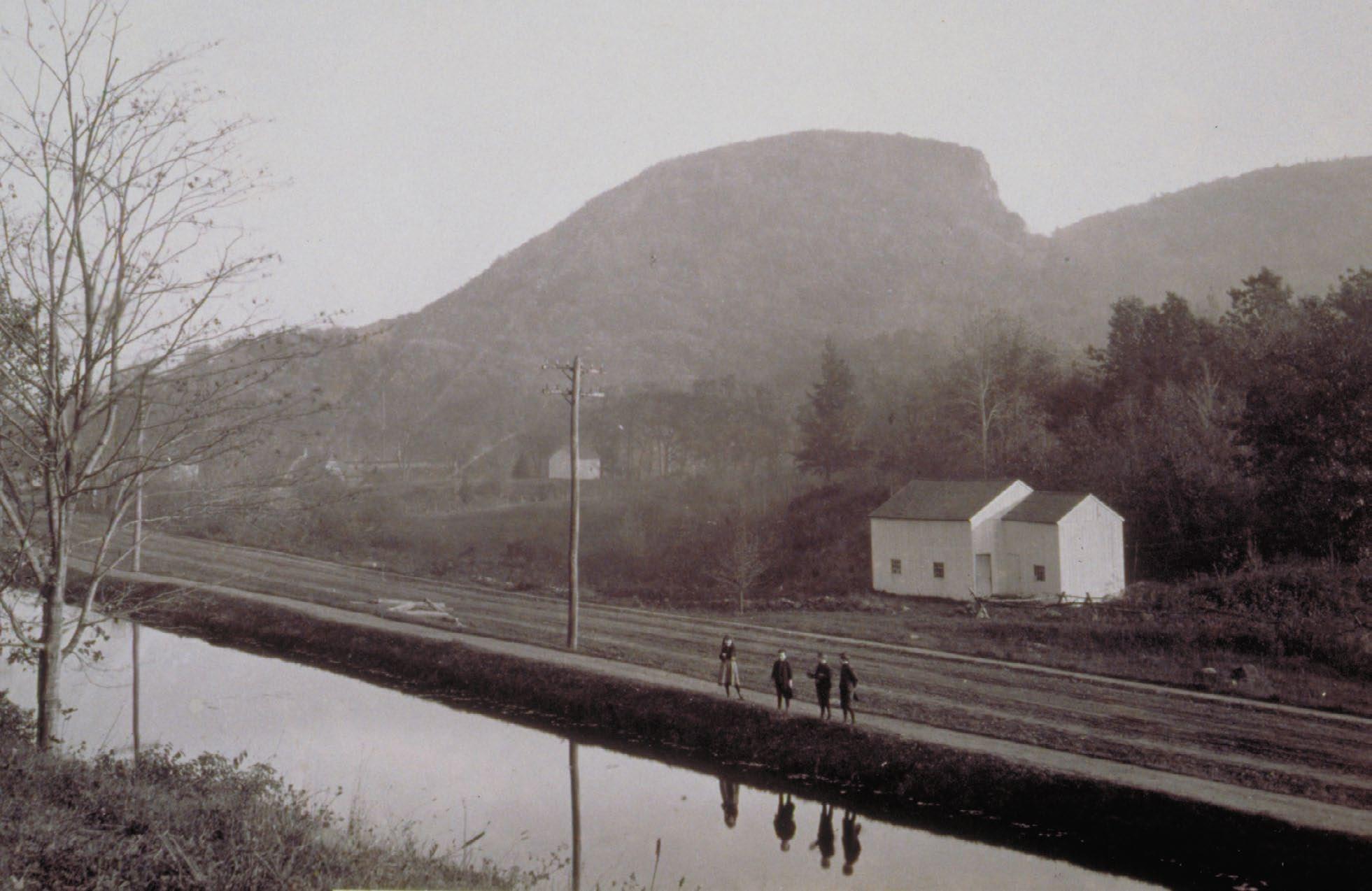
In the early 19th century, when less than 1% of roads in the U.S. were paved, Connecticut went all in on canals. These artificial waterways would open up new shipping routes, delivering goods on engineless boats pulled by horses and mules on parallel towpaths. The Farmington River Canal was the most ambitious canal project undertaken in New England, cutting 80 miles inland, from New Haven to Northampton, Massachusetts. Four million cubic yards of earth had to be dug and removed by hand. From the start, the project was plagued by funding shortfalls, and it took a decade to complete. While many Connecticut towns were transformed by canal access, shareholders consistently lost money. Then came the steam engine, and train tracks made the often-crumbling canal obsolete. By 1847, the Farmington River Canal had been phased out completely.
In the 1980s, trail advocates saw an opportunity to turn abandoned towpaths and train tracks into recreational corridors. The Farmington Canal Rail-to-Trail Association was formed to preserve those abandoned routes for people to enjoy the natural beauty of our state. Today, the canal’s reach still connects small towns along that same route, but instead of boats or trains, people walk and ride bikes.
The Farmington Canal Heritage Trail (FCHT) is now about 67 miles of multi-use greenway, connecting bikers and hikers from New Haven to the Massachusetts border. Committed trail workers and volunteers continue to develop new sections while others work towards more equitable access.
The FCHT runs through Newhallville, not far from Urbanscapes Native Plant Nursery, where Doreen Abubakar (who we met in this issue) helped get more local kids on the FCHT with a free bike repair shop and classes.
The above photo of the canal was taken near Mt. Carmel, in Hamden, sometime between 1890 and 1909. It shows a man-made landscape in transition, between one type of progress and another. To hike or bike along the path today is to ride alongside a history of innovation and conservation, connecting time and place as the landscape and the views keep changing into the future.
You can access maps of the Farmington Canal Heritage Trail at fchtrail.org.