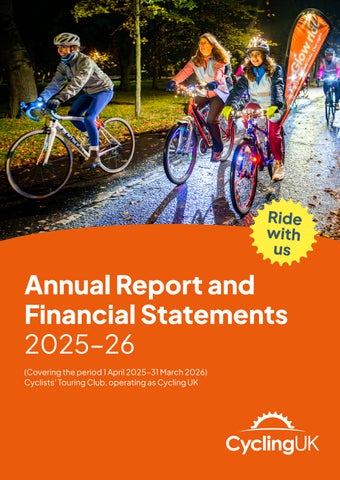
Ride with us
Annual Report and Financial Statements 2025–26 (Covering the period 1 April 2025–31 March 2026) Cyclists’ Touring Club, operating as Cycling UK
Annual Report and Financial Statements 2025–26
Contents Trustees Annual Report Introduction 4 Our values
6
Our strategic objectives
7
Improve perceptions of cycling so that everyone sees the benefits
8
Boost the number and diversity of people who cycle
11
Make cycling an even more positive experience 14 Increase transport choice by enabling and encouraging more people to cycle local journeys 18 Achieve greater impact by becoming the best possible charity we can be 21 Operations update
24
Financial summary
25
Governance summary
29
Independent auditor’s report
33
Consolidated financial statements and notes to the accounts
36
Legal and administrative information
63
3
Annual Report and Financial Statements 2025-26
Introduction During my first year as Chair, I have been hugely impressed by the wonderful work undertaken by Cycling UK. I saw first hand, during a visit to Bolton in August, the amazing impact which programmes like The Big Bike Revival (BBR) are having in helping people to gain access to cycling’s many benefits by removing the barriers.
Ashley Wheaton Chair
I was able to gain further insights during the board away day held in Newcastle in mid-October through direct engagement with our network, and I have also taken time to engage with our partner organisations, such as Cambridge Cycling Campaign and London Cycling Campaign to understand how we can best work together. I have been fortunate to attend flagship events at Westminster and House of Sport, and met with our supporters, as well as representatives from British Cycling, Scottish Cycling and Walk Wheel Cycle Trust – all with a view to finding ways to collaborate on our shared aims and ambitions. It has been important to me to understand the strategic ambitions of the organisation as well as our overall governance framework. As a result, some useful work has already begun on developing the board’s effectiveness in helping the organisation to succeed in delivering our greatest impact.
Finally, I enjoyed cycling a section of the new Royal Chilterns Way route (part of the Adventure Series) with my trustee colleague Robin Tucker in October, where we were fortunate to enjoy some glorious autumn sunshine. I would like to extend my heartfelt thanks to the Senior Leadership Team and all of the staff at Cycling UK who are so committed to delivering our great work, and to maximising our impact as a charity. I would also like to thank the board of trustees for their support and for making me feel so welcome during my first year.
This has been a year of near-constant change, bringing with it opportunities as well as challenges, as Cycling UK has navigated shifts in politics and the economy, as well as a shift in people’s motivations for cycling. We pride ourselves at Cycling UK on our ability to adapt and I’m proud of the determination of our teams, members and supporters to keep making real progress on our strategy against a background of change.
Sarah Mitchell CEO
There has been much to celebrate. In May we welcomed our community-based cycling clubs, partners and development officers to Parliament, to recognise an incredible 10 years of The Big Bike Revival – over its lifetime the programme, now in its 11th year, has reached over 628,000 people. As part of our new strategy, we invested in our Campaigns and Policy and Public Affairs teams and we saw this pay off this year with our powerful ‘My ride. Our right’ campaign, which tackles women’s safety in cycling – one of the major concerns which puts women off cycling. We are calling for more investment in the cycling infrastructure that helps everyone feel safer, but which particularly benefits women, who remain so underrepresented in cycling. As part of this campaign, we secured a Westminster Hall debate in February, attended by Minister Lillian Greenwood. We launched our ‘glow rides’ in October, highlighting the importance of women’s safety with 69 incredible noisy, bright and fun mass rides across all four corners of the UK – despite the classic autumn weather! We are delighted with the success of the campaign so far, but we want to achieve so much more and will be continuing with this important work for the coming years, aiming to work with many more partners to highlight this critical issue.
We are approaching the coming year with clearer priorities and focus; to help us ensure we have the resources we need, and to enable us to evaluate some different ways of working in an ever-more devolved political arena
4
For those who love a longer ride we launched Royal Chilterns Way this year – partly funded by supporters and generously supported by the Gill Foundation. This stunning route can be split into day-long sections and, responding to requests from our members, is reachable on public transport. We saw record levels of downloads and book purchases for this route! Royal Chilterns Way is the latest in our Adventure Series and we look forward to sharing the next route this coming summer. This year we welcomed Ashley Wheaton as our new Chair of trustees and he has brought lots of energy, a new perspective and experience to the board. In the autumn we combined a board meeting with a visit to organisations we partner with in Newcastle. Cycling UK trustees loved the bike ride along the Tyne, the visit to Recyke and lunch at The Cycle Hub café. It was a rare and valuable opportunity to showcase our work in action. Finally, in response to the significant external changes, we spent time this autumn learning from the first 18 months of the strategy and thinking hard about how and where Cycling UK can direct its resources to ensure that our strategy has the most impact possible. As a result, we are approaching the coming year with clearer priorities and focus; to help us ensure we have the resources we need, and to enable us to evaluate some different ways of working in an ever-more devolved political arena. We are excited about the year ahead and hugely grateful to our committed board of trustees, our loyal members and our volunteers and supporters, who all help to keep our community of cyclists doing what they love.
5
Annual Report and Financial Statements 2025-26
Our values
Our strategic objectives 2024-29
Continuous learning
We have five ambitious and complementary strategic objectives that will ensure our efforts are focused on the areas that will have the biggest positive impact over the five-year period.
We reflect and learn from our experiences to improve our work and increase our impact
Collaboration
We empower our colleagues by providing them with the support and resources needed to make informed decisions, t ake initiative and fully utilise their knowledge and expertise
Impact-driven
We have a shared purpose to improve people’s lives through cycling
Objective 4
While we know that cycling is a force for good, there are still many who view cycling less positively. Convincing more people of the many multi-faceted benefits of cycling is a crucial factor in persuading policymakers across the UK to support and invest in cycling.
Cycling can play a vital role in combatting climate change, reducing air pollution and creating more pleasant places to live and spend time – especially if we can enable and inspire more people to cycle for local journeys.
Improve perceptions of cycling so that everyone sees the benefits
Empowerment
We consistently work together to achieve the best possible outcomes
Objective 1
Objective 2
Boost the number and diversity of people who cycle To fully realise cycling’s potential to improve people’s lives, we must increase the number and diversity of people who cycle. This means reducing the barriers that people face, both physical and psychological.
Increase transport choice by enabling and encouraging more people to cycle local journeys
Objective 5
Achieve greater impact by becoming the best possible charity we can be We can’t deliver our strategy or ambitions unless we continue to strengthen Cycling UK so we can be the best charity possible. The stronger our foundations, the greater the impact we will have.
Objective 3
Make cycling an even more positive experience We are determined for cycling to be a safe, convenient and enjoyable option for all. Whether it’s a parent doing the school run, someone enjoying long road rides with friends or cycling clubs, or people seeking off-road adventures in wild places, we want to make the UK an even better place for everyone to cycle.
Whether it’s a parent doing the school run, someone enjoying long road rides with friends or cycling clubs, or people seeking off-road adventures in wild places, we want to make the UK an even better place for everyone to cycle
6
7
Annual Report and Financial Statements 2025-26
Improve perceptions of cycling so that everyone sees the benefits
69
locally organised glow rides across the UK
Women’s safety campaign
Glow rides
This year, we have focused much of our energy on one major campaign: ‘My ride. Our right’. We chose this campaign because we know that women make half as many trips by bike as men and are more likely to be put off cycling by fears of busy traffic or harassment. More investment in cycling, better and connected routes that feel safe and are safe, and better promotion of Highway Code rules are all key campaign asks. And, of course, if we make cycling safer for women, we’ll make it safer for everyone. The focus on women’s safety has enabled us to present a positive narrative around cycling, securing massive media coverage. That has helped us secure wide political support and government attention across the UK. Coverage of the campaign has exceeded levels for any previous campaign, including: • More than 500 national and regional media articles • More than 1.4 million people reached on social media • More than 11,000 supporters taking action The campaign has also received superb feedback from member and affiliate groups, and has been a catalyst for engaging new groups in our campaigning, with 68 groups organising 69 local glow rides last October to promote the campaign. Talking about the need for more and better cycling infrastructure can feel a bit dry, but by focusing on people’s stories, identifying solutions and engaging a wider range of people we are seeing more politicians take notice and support what we’re asking for. 8
Half as many women cycle regularly compared to men
There are cycle paths I won’t use at night. There’s one right behind my house, but I won’t go through it alone in the dark… I don’t think the people that design cycleways think too deeply about these issues
As part of the campaign, we invited people and groups to run their own glow ride in October 2025. These were suggested as short, fun, accessible rides that would use the clocks changing as a way to start local conversations about how women feel more vulnerable when riding in the dark – especially where there’s a lack of cycling infrastructure or what’s available doesn’t feel safe. Cycling UK provided a pack of resources, webinars and support to help organisers feel confident and have the knowledge and confidence to organise a mass ride.
Political debate Thanks to our coordinated lobbying and campaigning, we succeeded in having more than 25 parliamentary questions asked relating to the campaign in the past year. We encouraged Jess Asato MP to go further and organise a Westminster Hall debate that brought politicians of all stripes together to recognise the importance of extending and improving cycling infrastructure. This level of political visibility is an important win for the campaign – we were especially pleased that when responding to the debate, the Local Transport Minister Lilian Greenwood MP referred to Cycling UK’s campaigns and behaviour change work, and the impact we are having. 9
Annual Report and Financial Statements 2025-26
100 Women in Cycling Cycling UK’s latest list of inspiring women cyclists was launched in December 2025. It’s still the case that far fewer women cycle than men. This means that women are missing out on the many benefits of cycling. With women underrepresented at all levels of cycling, Cycling UK’s 100 Women in Cycling awards highlight some of the women who are doing amazing things to promote cycling to all kinds of audiences. Robina Ijaz is one of the winners of the 2025 awards.
Boost the number and diversity of people who cycle
Robina first came to London’s Bike Project – a charity which collects secondhand bikes, refurbishes them and donates them to refugees and people seeking asylum in the UK – when she was in need of her own bike. At the time, she was seeking asylum and so was unable to work; she was living on just £35 per week. She had never learned to ride a bike, so she joined Cycling UK’s Pedal Power Programme to discover how. She quickly learned to ride and was then able to access the many benefits that cycling brings. Robina says the project gave her “Happiness, confidence and freedom”. She adds that she was suffering from depression and anxiety before learning to ride: “Then I started cycling. I feel better when I ride. I feel happier.” Robina has become an advocate for cycling and volunteers for the Bike Project. She has volunteered as a mechanic, fixing bikes for other refugees. She has also supported Cycling UK by sharing her story at events, in videos and in the media to help raise awareness of the issues refugees face in accessing cycling and more generally. To her, cycling means “Happiness, good health conditions and saving money with confidence”. Robina’s advice to other women and girls is: “If you want your life to be healthy and to be more confident, go cycling. Go riding with your friends and family or alone. But you must go riding just for you!”
Play Together on Pedals “I got my pedals on today!”
If you want your life to be healthy and to be more confident, go cycling. Go riding with your friends and family or alone. But you must go riding just for you!
Framing How we choose to talk about cycling and its benefits impacts everything from public perception to policy making, so we’ve been looking closely at how we ‘frame’ cycling. We need to have a compelling narrative, remembering that you can’t win the argument with just facts and data, because emotions are powerful guides to people’s actions and beliefs. This should enable us to move on from polarised debates and views around cycling. As part of our wider framing work, over the past year we’ve engaged with think tanks and academics to understand how current social shifts and populism might affect cycling 10
Case study
Not every child has the same access to cycling. The enthusiasm in the nursery when our Play Together on Pedals training takes place is palpable. We’ve used funding this year to work with around 50 schools, community centres and early years providers in Glasgow and Lanarkshire to get more children confident and happy on bikes. Play Together on Pedals works by providing balance and pedal bikes, but crucially also training staff to feel confident teaching skills, playing games and feeling safe. This means the impact lasts much longer than a one-off session; the centres can continue to use their equipment on a daily basis. Teachers such as Freya notice “a massive increase in skill” among the children, but also confidence in the staff to build cycling into the lives of the next generation.
– whether undertaken for transport or leisure. This is helping to ensure that we can tell a positive and persuasive story about the benefits of cycling and avoid perpetuating cycling as a ‘culture war’ issue. Political uncertainties across the UK at national and local levels mean that we and grassroots campaigners must be ready to engage with and talk to politicians from multiple parties. Those politicians will have very different views on many things, so words and how we frame cycling matter. We will be sharing our learnings across the active travel sector and our networks to maximise impact. 11
Annual Report and Financial Statements 2025-26
Behaviour change summary In 2025–26 our projects worked for the whole community, building confidence, skills and opportunities for the widest possible range of people to cycle.
1,965
bike and cycle loans
57%
female participants
• The award-winning Inclusive Cycling Experience in Greater Manchester and Inverness provided support to thousands of disabled people to access non-standard cycles and electric bikes at local sessions and through cycle loans. This important work means more people can integrate cycling into their lives.
While many locations provide incredible experiences for people to come and use non-standard cycles or standard bikes in off-road settings, we saw a gap in the evidence and guidance on how organisations might support disabled people to feel confident getting around by cycle.
• The Big Bike Revival hosted another 96,000 participants in activities to get riding, get simple repairs completed and learn how to maintain bikes. • Our Connecting Communities team worked with adults and families of all backgrounds and abilities in Aberdeen, Aberdeenshire, East Lothian, Glasgow, Midlothian, Moray and Shetland. • The Cycle Access Fund distributed over £2.5 million in grants across Scotland to allow organisations to buy cycles, get repairs, build cycle storage and recycle bikes for use. This gets a whole range of standard and non-standard cycles into communities that would otherwise be excluded from the joy and freedom of cycling.
• We gave more than 3,000 people the chance to try electric bikes in Luton and Greater Manchester, continuing the legacy of the national Making cycling e-asier programme.
Giving disabled people more access to cycling
We believe that cycling should be for everyone, and our new research shows how we make that a reality. We published research to identify how inclusive cycling centres – organisations that work with disabled people – can increase the opportunities for disabled people to cycle for transport or leisure outside their settings.
This gap is unfair – cycling is healthy, sustainable and fun, why should disabled people be excluded? Our research, embedded in our practical experience on the Inclusive Cycling Experience, identifies how to overcome key barriers such as access to cycles, confidence and skills. This work is part of improving engagement across the cycling sector to give more people the opportunity to cycle in ways that work for them.
90% felt happier thanks to cycling
• We continued to support Community Cycle Clubs to run regular led rides for people who have more challenges getting into cycling – whether economic, cultural or physical.
• Play Together on Pedals is our programme for pre-school-aged children. We taught more than 9,000 children to cycle in Glasgow, North and South Lanarkshire this year.
Over
140,000 participants at events and activities
12
• More locations are seeing shared bike schemes on their streets. We worked alongside operators in Manchester, London and Milton Keynes to run training sessions so that disabled people and less confident riders could build their skills and feel able to use the extra travel options available in their area. Our behaviour change project work is made possible by national and local government, trusts, foundations, the NHS, volunteers, donors and members. 13
Annual Report and Financial Statements 2025-26
Make cycling an even more positive experience
89% retention rate
Royal Chilterns Way Royal Chilterns Way, launched in August 2025, strengthens our commitment to making cycling an even more positive experience, building on the success of our recent addition to our long-distance routes, Marcher Castles Way, as well as established routes such as King Alfred’s Way, Rebellion Way and Traws Eryri. The Adventure Series brings together high-quality, multi-day bikepacking routes designed for long weekend escapes.
Starting in Reading and covering 275km through the Chilterns National Landscape, Royal Chilterns Way offers a challenging yet accessible introduction to bikepacking. With three intersecting loops, excellent public transport connections and proximity to major towns, it lowers practical barriers to multi-day cycling while retaining a true sense of adventure. The route generated the highest number of downloads, guidebook sales, website traffic and social media engagement of any recent release, demonstrating that well-designed routes are a powerful mechanism for attracting and retaining supporters. Beyond participation, it contributes to our wider economic and environmental objectives. By connecting riders with cafés, pubs, accommodation and shops across the Chilterns, the route supports domestic tourism and channels spending into local communities. Its accessibility by public transport reinforces cycling as a low-carbon leisure travel option. Most importantly, the route advances our objective of making cycling safe, convenient and enjoyable. Carefully curated quieter roads and off-road sections, clear navigation and safety guidance, and achievable long-weekend distances reduce uncertainty and build rider confidence. The three-loop structure allows riders to scale the challenge to their ability, broadening appeal without compromising quality.
Membership For almost 150 years, our members have been the driving force behind Cycling UK. Their long‑standing loyalty, combined with a growing and diverse community of new members joining us from across the UK, continues to shape who we are. Many have been with us for more than a decade, with some reaching remarkable 50‑year milestones, while newer members bring fresh perspectives and a wide range of cycling interests from commuting and leisure riding to touring, mountain biking and adventure cycling. This mix of experience and variety ensures our membership reflects the full breadth of cycling today. Building on this strong foundation, in 2025-26 we focused on enriching the overall membership Three experience. To deepen wheels good engagement and reinforce the sense of community across our membership, we expanded our programme of exclusive member events. Among these was a behind‑the‑scenes preview of the Royal Chilterns Way long‑distance route, offering members an early and unique perspective on its development. We also refreshed our much‑loved member magazine, Cycle, introducing a new design and updated content shaped by member feedback. Together, these initiatives created more opportunities for members to connect with our work and with one another. £6 | APRIL/MAY 2026
T H E
M A G A Z I N E
O F
C Y C L I N G
U K
CARGO TRAILERS Six load haulers on test
CHANNEL HOPPING France & Belgium by ferry and tunnel
British tourers
Spa Cycles D’Tour Oxford Bike Works 1
Wider horizons for all cyclists
On test • Restrap hip pack • Challenge Strada Pro tyres • Spirgrips
As part of our commitment to constantly strengthening the benefits we offer, we continued to grow and enhance our membership package through partnerships with organisations that share our values of sustainability, community and promoting cycling for all. Evans Cycles, Kalas, Saddle Skedaddle and Bikmo are just a few of the partners who bring high‑quality, relevant benefits that support members whether they ride for 14
wellbeing, exploration or everyday travel. Their alignment with our purpose ensures our benefits remain meaningful, trusted and tailored to the needs of our community. Our members also played a vital role in driving our impact and guiding our direction throughout the year. They supported campaigns, engaged local politicians, volunteered in their communities and contributed to fundraising appeals, with many also choosing to pledge legacy gifts to help sustain Cycling UK’s work for future generations. At the same time, members helped shape our future through roundtables, surveys and feedback sessions that informed our planning and strengthened our programmes. Their generosity, involvement and insight continue to guide our work, enabling us to grow with purpose while honouring our heritage and values.
1,800
members have been with us for 50 years or more
69,000 members
15
Annual Report and Financial Statements 2025-26
Groups Cycling UK’s network of around 1,000 groups continues to play a vital role in bringing people together in communities across the UK. From long‑established member groups rooted in Cycling UK’s shared history, through to newer affiliated groups and Community Cycling Clubs, this diverse network creates welcoming spaces for riders of all abilities – offering connection, confidence and the joy of exploring new places by cycle. With each group delivering an average of 160 rides this year, from midweek outings to full‑day adventures, they contributed more than 730,000 hours of organised cycling activity in 2025-26. Many also prioritised welcoming newcomers, with 35% offering introductory rides and a third focusing on recruitment, though we know there remains more to do to support continued growth. As group activities evolved, in 2025–26 we focused on strengthening the tools, resources and support available. We refreshed and expanded our online resources, launched a dedicated newsletter for group leaders, and ensured our friendly membership team remained on hand throughout the year to offer practical guidance and tailored support. These improvements help groups run safe, inclusive and well‑organised rides. Developing the support that we offer groups will continue to be a focus in the coming years. Thanks to the passion and commitment of volunteers and ride leaders, Cycling UK groups and clubs continue to thrive. Together, they are building vibrant communities and inspiring more people to enjoy the social, wellbeing and confidence‑boosting benefits of cycling within their communities.
35%
of groups offered introductory rides 16
Case study
Lobbying and policy work “A real win for everyone” – our campaign got British Transport Police to stand up to bike theft. In October 2025, members alerted us to a new policy British Transport Police (BTP) had introduced. The policy stated that they would no longer investigate bike thefts at train stations if the cycle had been left for more than two hours, or if the bike was valued at less than £200. We – and many of our members and supporters – were incredulous. Thousands of people lock up their bike at train stations for more than two hours every day.
more bike thieves to justice in 2026 than ever before”. This was in direct response to Cycling UK’s campaign. Our ability to react quickly, secure media coverage and cross-party political support was highly effective, achieving a result that, in the words of our Associate Director of Campaigns, “is a real win for everyone”.
BTP saying it wouldn’t investigate sent a message that it didn’t think bike theft is important. We know, however, that many people simply stop cycling after their bike is stolen, some don’t have the resources to replace it, and the lack of secure cycle parking is another barrier to more people cycling. So, we were determined to challenge this policy.
730,000 hours of organised cycling activity were organised in 2025-26
Thanks to our campaign, British Transport Police U-turned on investigating bike thefts from train stations
After highlighting the absurdity of the policy through various media channels, including an appearance on BBC Breakfast, we raised this issue with numerous MPs and wrote an open letter to BTP’s Chief Constable. With MPs supporting our calls for a review of the policy, and asking numerous questions in Parliament, we secured a meeting with BTP and a reversal of the policy. In January 2026, BTP’s Assistant Chief Constable confirmed the rethink, confirming that “rail passengers whose bikes are stolen rightly expect a thorough police investigation to trace offenders and reunite them with their property, and we are committed to bringing 17
Annual Report and Financial Statements 2025-26
Political lobbying work This year, Cycling UK – like all other advocacy organisations – has been working in a wider political context that is both unpredictable and complex. This requires us to stay responsive and alert as political conditions shift, but it can also bring unforeseen opportunities to influence and effect change. As always, our approach this year has been to engage with people across political divides. We attended all the major party conferences, and have built strong relationships with transport spokespeople across all main political parties. We have seen our influence on policy and politics in all four nations of the UK:
Increase transport choice by enabling and encouraging more people to cycle local journeys Cycle Advocacy Network There are many ways in which we support our network of local campaigners across the UK. Throughout the past year, we’ve created tools and resources, run training events and webinars, and offered support and advice to campaigners to help them maximise their impact. Enabling others to campaign locally supports and aligns with our national influencing work, ensuring that local decision-makers hear the voices of local people. Since launching the Cycle Advocacy Network (CAN) five years ago, we have quadrupled the number of CAN representatives and have continued to grow and diversify that network over the past year. This year has been a transitional period for local campaigners, with many changes around how funding for active travel is allocated. Ongoing devolution of funding and decision making around active travel in different parts of the UK means that local campaigners will have a crucial role in securing political commitment to, and investment in, cycling. Supporting more people 18
• The UK government’s new Road Safety Strategy acknowledges our critique of the Highway Code rollout and promises better policies for safer roads. We were particularly pleased to see the safe systems approach at the heart of the strategy, along with targets to reduce the number of people killed or seriously injured on our roads. Following our lobbying efforts as part of ‘My ride. Our right’, the strategy also specifically mentions women’s safety. • We contributed to getting 20mph speed limits on the political agenda in Northern Ireland for the first time and gave evidence to the Infrastructure Committee on the poor performance of the Department of Infrastructure in delivering active travel projects well.
• The picture in Wales has been challenging, with political changes and the move away from ring-fenced, centrally distributed funding making engagement harder and commitment to active travel spend less certain. Despite this, we continued to strengthen our relationships across parties and brought decision-makers together around our ‘My ride. Our right’ campaign, including hosting our first event at the National Eisteddfod.
As one local CAN representative explained:
• Scottish ministers have continued to publicly recognise the value of cycling for leisure and transport thanks to our lobbying, with a doubling of the active travel budget since 2019–20.
“CAN is definitely helping. Just last week, we spoke to a Cycling UK member in a nearby town who is keen to get involved. He’s now working on a Cycling UK response to a consultation on a major town centre regeneration scheme. Talking to him about CAN really helped and he appreciated that this work would be worthwhile because it was backed up by us locally and as part of a wider CAN network”
At the end of the year our focus shifted to the Welsh and Scottish elections. We drafted manifestos to share with political parties and met with key political stakeholders in each nation, organised online hustings and provided resources for campaigners to challenge candidates about their support for cycling.
and groups to become involved in local campaigning will be a core theme of our work next year.
• We lobbied directly and as part of the E-Bike Positive Alliance to ensure changes to UK government regulations remove unsafe and illegal electric motorbikes and e-bikes from our streets, without limiting the market for safe, reputable e-bikes.
19
Annual Report and Financial Statements 2025-26
Case study
Achieve greater impact by becoming the best possible charity we can be Volunteering at Cycling UK
Changing lives through our projects Across the country, we hear countless stories of how our support to get more people cycling makes a huge difference to their lives and opportunities. “I wasn’t aware of the cycle paths around me, and I’ve learned I can pretty much travel most places by bike. It’s been good for my mental health”
70%
feel safer when cycling
Glenda, Connecting Communities cycle training participant
“The e-bike just gave me a boost and took away barriers like hills, long distances or worrying about being out of puff or lagging behind. I now see cycling as a genuine alternative to driving. I never knew I could talk so much about cycling and its benefits – not just for me but for the environment. People were genuinely interested. It was fun too – sparking a zest for adventure I thought I’d lost” Laura, semi-retiree and Connecting Communities e-bike loan recipient, now an e-bike owner
“I’ve gradually built my confidence up. We started to venture a bit further and have started using the cycleway a bit to do some shopping, not all the way into town just yet, but locally and also the park” Amy , parent and Big Bike Revival learn-to-ride participant *
56%
have started cycling for journeys they used to drive
“[I feel] happy... cycling normalises my life. It went haywire when the brain blew a fuse. It brings everything back to normal and I can be a normal person” Jenny*, stroke survivor and Big Bike Revival participant
“My teenage son’s bike is working again and he’s out on it almost every day with his friends. So much better than sitting in front of a screen” Lee*, parent of Cycle Access Fund repair recipient
not their real name
*
20
Volunteers play a vital role in supporting our mission to enable more people to cycle. Our 400-plus Cycle Advocacy Network (CAN) representatives use their experience and local knowledge to influence decision-makers, champion safer cycling infrastructure and advocate for positive change. Alongside them, our behaviour change volunteers support initiatives designed to make cycling a more positive and inclusive experience, helping to increase both participation and diversity in cycling. This year, 57 new volunteers joined our national programmes, further strengthening our growing and committed volunteer community and complementing the incredible contribution made by volunteers
57
volunteers joined our national programmes
across our 1,000 groups. Our volunteering approach remains strategically aligned to our programmes, focusing on building capacity to enhance our reach and effectiveness. Across the UK, volunteers contribute their time, skills and passion to activities that make a tangible difference to their local communities. Together, they are driving meaningful impact in communities nationwide.
CCC case study: Brandon, Sean’s Place, Liverpool Brandon first attended Sean’s Place in Liverpool for support with ongoing mental health challenges and had no previous experience of cycling. At the time, he was not active and lacked confidence. This changed when Sean’s Place
ride leader, Tony, introduced him to their Community Cycle Club and encouraged him to take part. Joining the club has had a clear impact on Brandon’s mental and physical wellbeing. Learning to ride and gradually increasing distance helped build his confidence, fitness and sense of achievement. What began as short, supported rides progressed to longer distances, including taking part in local sportives such as Liverpool– Chester–Liverpool, something he had never imagined doing before. Beyond the physical benefits, the sessions provide routine and structure, helping Brandon manage his busy university life. Being part of the club has also helped him maintain connections with others
from Sean’s Place, with rides creating shared experiences and something to look forward to each week. Volunteering is now a key part of Brandon’s journey. As a trained ride leader, he now supports others at Sean’s Place to learn to ride and build confidence, through helping to lead rides and create a welcoming environment. He credits Tony for the encouragement and support that has helped him reach this stage.
“Sean’s Place and the cycling club changed my life – cycling gave me confidence, purpose and something to keep working towards” Brandon, Sean’s Place Community Cycle Club, Liverpool
21
Annual Report and Financial Statements 2025-26
One of the standout moments of the year was the launch of Royal Chilterns Way, part of our growing collection of routes. When we invited supporters to help bring the route to life, you responded with enthusiasm and generosity. Our public appeal raised £39,000, including match-funded by The Gill Foundation
Fundraising £337,000 This year, more people than ever chose to stand with Cycling UK, and we are deeply grateful for every act of generosity that made our work possible. In 2025-26, together they helped raise £337,000 through fundraising activity, alongside a further £440,000 in legacy gifts. Behind those figures are thousands of individual decisions to give, to boost, to fundraise, to remember someone special or to take part in something new, all because you believe in safer cycling and stronger communities.
Support came from across our entire member and supporter community. They boosted their subscriptions, donated to appeals, hosted events, took on challenges, entered our raffles and lotteries, and brought their friends and colleagues with them. Groups, community organisations and businesses raised funds locally, strengthening the Cycling UK network nationwide. We are especially grateful to our 1878 Club members and other major donors and supporters whose significant gifts provided support during the year, helping us to achieve even more impact. One of the standout moments of the year was the launch of Royal Chilterns Way, part of our growing collection of routes. When we invited supporters to help bring the route to life, they responded with enthusiasm and generosity. Our public appeal raised £39,000, including match-funded by The Gill Foundation, turning ambition into reality. Together, we helped create a new longdistance route that will inspire riders for years to come. At the same time, hundreds of supporters rallied behind our British Transport Police appeal, raising more than £6,000 to strengthen action against bike theft. It was a powerful reminder that when cyclists face urgent challenges, this community steps forward – standing up for one another and helping drive real change. We also introduced new ways for people to get involved. Big Bike Brunch events brought friends, families and local groups together across the UK, celebrating cycling while raising vital funds. Pedal for your Medal, our new virtual
22
challenge, welcomed supporters of all abilities and ages, and showed that fundraising can be flexible, inclusive and fun. This year marked an important step forward for legacy giving, too. With the launch of a new legacy partnership, we made it easier than ever for supporters to leave a gift in their will. During Free Wills Month in October alone, supporters pledged an estimated £275,000 in future legacy gifts – an extraordinary commitment to Cycling UK’s long-term future. We also received over £3,000 in memory of loved ones, a moving reflection of the deep and lasting connection many people feel with our mission.
raised through fundraising activity in 2025-26
£440,000 was raised in legacy gifts in 2025-26
Across raffles and lottery players (£70,000) and appeals (£45,000), growth was seen in every income stream. But what matters most is what that generosity enables: campaigning for safer streets, developing inspiring routes, supporting inclusive cycling programmes and ensuring that more people can experience the freedom of cycling. As we look ahead, our focus is on continuing to build relationships, with members, supporters, major donors and future legacy pledgers, and growing every income stream responsibly and sustainably. By investing in people and partnerships, we are creating strong foundations for the future and ensuring Cycling UK can be ambitious in its goals and resilient in the years to come. To everyone who gave, fundraised, pledged, boosted or stood with us: thank you. Together, we are creating healthier, happier and greener lives through cycling. 23
Annual Report and Financial Statements 2025-26
Operations update Two years into our five-year strategy, and following major achievements including organisational transformation, refreshed values and brand, expanded audience insight, the women’s safety campaign and The Big Bike Revival’s 10-year anniversary, we recognised the need to prioritise more effectively in response to increasing workload pressures, financial constraints and a shifting external landscape. As part of this review, directors, heads of department and trustees agreed a clearer organisational focus for the next three years. This will involve strengthening long-term relationships with the many people who engage with us each year, particularly focusing on income generation, while also building stronger local and regional capacity by better connecting our network of members, volunteers, campaigners and programme participants. These priorities will help streamline activity, support better decision making and ensure our efforts are concentrated where they can have the greatest impact. Over the coming year, we will lay the foundations for this shift, including improving core digital systems and testing new ways of working through existing projects.
People and Culture We continued to strengthen our organisational culture to empower our workforce, ensuring we are a great charity to work for and that our people are motivated, supported and equipped to succeed. During the year, this included: • Strengthening our employee representative groups by creating space for colleagues to share feedback, raise concerns, and offer ideas and insight that inform organisational decisions, future planning and the rationale behind key strategic and operational choices, helping staff feel informed, heard and involved in shaping our direction. • Deepening employee engagement by improving our internal communications channels so important information is shared across departments; for example, updates on the successes of behaviour change projects and our current policy positions. • Strengthening our learning and development offer by putting in place solutions such as preparing to launch a mentoring programme and delivering line manager training.
24
Organisational governance During the year, we continued our work to strengthen and modernise our governance, while maintaining the highest standards of compliance, reporting and transparency. We began working with our incoming Chair, Ashley Wheaton, who brings significant charity governance experience, to lay the foundations for a future governance vision that meets the evolving needs of the charity. During the year, the board carried out a full review of the organisational strategy, approved an estates strategy, and agreed changes to the 100 Women in Cycling awards following legal advice. The board also held an away day, which included a visit to a local project in Newcastle, providing valuable insight into Cycling UK’s work in practice. Following a successful election process, we welcomed Liz Dobson as a newly elected trustee, and existing trustee Nadia Kerr was re-elected by members for a further term. Their experience and insight continue to be invaluable to the charity. We would also like to extend our sincere thanks to John Jackson for his dedicated service as a trustee of Cycling UK. John stepped down from the board in June 2025, having made a valued contribution during his tenure.
Financial summary Financial review We entered the year to March 2026 with a planned deficit as we progressed into the second year of our strategy, continuing to build on the transformation and organisational foundations established in the previous year while advancing our core objectives. We are pleased to report a year-end surplus of £0.553 million (2024-25 deficit: (£0.153 million)), reflecting higher-than-expected legacy income and cost-management actions taken during the year. Legacy income is inherently difficult to predict and can vary significantly from one year to the next. While such gifts are highly valued and make an important contribution to our work, we do not rely on them to fund our core activities, as in some years no legacies may be received.
Continued support for Cycling UK’s purpose and objectives resulted in income of £12.302 million for 2025-26 (2024-25: £11.861 million), an increase of £0.441 million. Against a backdrop of higherthan-anticipated inflation and ongoing economic uncertainty, we took action to control costs, resulting in total expenditure of £11.840 million (2024-25: £11.900 million). Overall, the year’s financial outcome reflects both the resilience of our income base and the importance of disciplined cost management in a challenging operating environment. Total consolidated reserves at year end were £7.349 million (2024-25: £6.796 million), an increase of 8% (£0.553 million). Of this, £0.160 million (2024-25: £0.208 million) is restricted to specific projects. Total funds also include £5.746 million of general reserves (2024-25: £5.521 million). This reserves position provides important resilience as the charity continues to invest in delivery of its strategy, while maintaining the capacity to manage volatility in income and costs. Following the review of Gift Aid in 2024-25 and a £1.050 million historic claim, the trustees have designated £1.0 million for strategic investment in three key areas: organisational infrastructure and efficiency; financial sustainability and income growth; and strategic development, research and innovation. These funds will be drawn down over the next six years to strengthen organisational capability, support future income generation, and enable innovation to increase impact over the longer term. Further information on reserves is provided on pages 52 and 53. 25
Annual Report and Financial Statements 2025-26
2025-26
£000s
2024-25 % of income
£000s
2025-26 % of income
Donations and legacies
435
4
712
6
Membership
3,943
33
3,548
29
Grants
6,478
55
7,185
58
Sales and services
463
4
191
2
Other income
167
1
261
2
Trading
234
2
264
2
Investment income and interest
141
1
141
1
Total income
11,861
100
12,302
100
Income
Donations and legacies increased by 63%, principally due to four generous gifts left in wills, totalling £0.440 million. We are deeply grateful for this support. As noted above, however, legacy income is inherently variable, and this year’s increase should be regarded as a welcome contribution to financial performance rather than a recurring source of income. Membership income accounted for 29% of total income. As a source of unrestricted income, it remains vital in enabling us to strengthen our voice with government, campaign for improved rights, and inspire more people to cycle. Income from membership was lower than in the prior year, reflecting the impact of the historic Gift Aid claim recognised in 2024-25. Strengthening this income stream remains a key priority, as it provides flexibility to support both our charitable activities and long-term sustainability.
26
2024-25
Grants accounted for 58% of income during the year and were restricted to a range of behaviour change programmes. These included the well-established Big Bike Revival programme in England, for which we secured a further three years of funding; our place-based initiatives in Scotland; and bespoke programmes delivered in partnership with local authorities to encourage more people to cycle and engage communities that are typically underrepresented. This income remains central to programme delivery, while reinforcing the importance of maintaining a balanced mix of income sources over time. Income from sales and services was lower than in the previous year, while trading and other income made smaller contributions to the overall total. Taken together, these income streams continue to play a useful supporting role in diversifying our income base, although grants and membership remain the most significant components.
Expenditure
2024-25 £000s
2025-26 £000s
Improve perceptions of cycling so that everyone sees the benefits includes public campaigns and communications particularly for safer cycling, media and public affairs activity, research and insight development, supporter engagement and events
722
774
Boost the number and diversity of people who cycle includes behaviour change programmes and community delivery, grants and cycle access support, bikes and equipment, training and skills development, partnership working with local organisations and shared mobility operators
4,082
4,123
Make cycling an even more positive experience includes the creation of our long-distance routes, strengthening our membership benefits, bringing people together in our member groups and campaigning to strengthen the laws regarding cycling
1,005
1,108
Increase transport choice by enabling and encouraging more people to cycle local journeys includes events and opportunities for people to experience the benefits of cycling, ensure their cycle is in tip-top condition and campaign at a local level for more cycle paths and access to safer cycling
3,826
3,911
Achieve greater impact by becoming the best possible charity we can be
1,853
1,541
Generating funds
412
383
Total costs
11,900
11,840
A total of £1.541 million (2024-25: £1.853 million) was spent during 2025-26 on activities that support Cycling UK in becoming the best charity it can be. This includes the contribution of teams such as Finance, Information Technology and Human Resources, which provide the essential support, controls and governance required for the charity to operate effectively. These functions also ensure that appropriate systems and safeguards are maintained and strengthened for our employees, volunteers and member groups. Generating funds include the cost of recruiting new donors and administering supporters’ generous donations and membership subscriptions. Net income for the period was £0.553 million (2024-25: deficit of £0.153 million). As we look ahead, our focus remains on delivering the strategy, growing resilient sources of income and managing costs carefully so that we can continue to invest in long-term impact.
Future plans Following two years of investment in strengthening our organisation, launching our refreshed brand and developing our fundraising and income-generating activities, 2026-27 marks a point where we are firmly into delivery of our five-year strategy. Our ambition remains to increase both our impact and our income. This will, however, be delivered against a backdrop of an increasingly uncertain and challenging external environment. Charities continue to face significant pressures arising from global instability, economic volatility, rising costs and constrained household finances, all of which affect income, costs and long-term planning. In this context, we must balance our growth ambitions with the resources available and our long-term sustainability. Despite these challenges, we have clear plans in place to deliver our strategic objectives and public benefit. The early years of our strategy, and the financial plan supporting it, were always expected to include a budgeted deficit, and we remain aligned with this approach. While the current year has benefited from one-off income from legacies, our budget for 2026-27 forecasts a deficit of £0.218 million. This reflects the prevailing economic climate and the challenging fundraising and income-generation environment, with income currently tracking below our longer-term ambitions. Our focus in the year ahead will be on strengthening fundraising and income-generating activity, while continuing to embed the systems and processes needed to support delivery of the strategy and ensure we operate as effectively as possible. These improvements will be supported through the use of designated funds. 27
Annual Report and Financial Statements 2025-26
The year ahead is therefore forecast to include: • Significantly lower levels of restricted funding and expenditure for behaviour change programmes that have now ended, including the Inclusive Cycling Experience. • Confirmed ongoing funding for The Big Bike Revival in England, following Active Travel England’s award of a further three years of funding totalling £8 million. • Continued support from Strathclyde Partnership for Transport, for an extensive range of projects in Scotland designed to empower people who are less likely to cycle. The programme aims to give people the support and encouragement they need to start riding a bike regularly through high-quality interventions such as Play Together on Pedals and the Cycle Access Fund. • Growth in fundraised and commercial income, supported by an expanded range of fundraising initiatives and corporate partnerships. • Increased income from membership, reflecting continued investment in and development of our membership offer. • Operating costs broadly maintained, as we balance rising external cost pressures with targeted and strategic cost control measures.
Reserves policy Reserves are defined as income funds of the group that are freely available to spend. Cycling UK requires these reserves to: • Ensure funds are available to provide working capital. • Cover short–term fluctuations in income (such as grant income payable in arrears). • Allow the organisation to continue to operate and recover in the event of a sudden and material or forecast drop in income. • Cover capital expenditure and provide funds available to support delivery of our strategic objectives. The required reserves are calculated and assessed according to an overall risk profile, and in doing so all major sources of income and known long–term expenditure requirements are reviewed. The total value of these risks is then compared to the total value of reserves held. The reserves held are calculated based on the ‘general funds’ amount available to the charity, less the ‘fixed assets’ figure, since these fixed assets are required for the functional operation of the charity. During the year, the trustees completed their annual review of the charity’s key income risks. As the organisation continues to implement its strategy, and in the context of slower growth in some income streams, the Board agreed to reduce slightly the level of reserves required, based on its assessment of risk and taking account of committed income. 28
The free reserves target for 2026-27 has been set at £2.300 million (2025-26: £2.500 million). At the balance sheet date, the charity held total free reserves of £4.519 million (2024-25: £4.151 million). Given the forecast deficit for the year, the board expects to utilise a portion of these reserves while continuing to focus on strengthening and growing income in the year ahead. Unrestricted reserves are held as long–term reserves in a combination of short–term cash deposits and through our managed investments, with the approach to managing these reserves set out in Cycling UK’s ethical investment policy.
Governance summary Cycling UK is governed by its board of trustees operating under the terms of the Articles of Association. Trustees must be members of the charity, and the majority are appointed by election from the membership. Cycling UK is committed to widening participation and inclusion in its governance and its nominations process is intended to ensure all members of the board have the essential skills, knowledge and experience to contribute effectively to the governance of the charity.
The level of reserves and their make–up is monitored by the Finance and Performance Committee on a quarterly basis and the board reviews the reserves policy annually in line with the annual budgeting process.
Following election by members, trustees are appointed for an initial term of three years. At the end of this term trustees may stand for re–election and can be re–elected at the end of every three–year term for a period not exceeding nine years.
Investment policy
Co-opted trustees can be appointed on the same basis as elected trustees. A list of trustees who held office during the period can be found in the Legal and administrative information section of this report listed on page 63.
Cycling UK’s policy is to invest in assets and companies that demonstrate a positive commitment to the ethical principles agreed by the board, and to exclude those whose activities conflict with the charity’s objects or ethical criteria. Based on this policy and following a review of cash balances and liquidity requirements, the board’s objective is to invest long-term reserves to support long-term capital growth. These reserves are held across a range of asset classes within an ethically managed investment portfolio overseen by Rathbones Green Bank. During the year investments grew to £1.693 million (2024-25: £1.539 million) with an unrealised gain on these investments of £0.091 million to 31 March 2026 (2024-25: unrealised loss (£0.114 million)). This movement reflects the economic volatility experienced in financial markets during the year, driven by wider global and macroeconomic factors, and does not represent a realised gain. Investments are held for the long term and are subject to year-to-year market fluctuations. The board reviews investment performance annually as part of its governance and risk management processes and will take appropriate action where performance is not meeting expectations or where investments no longer align with the charity’s objectives.
Grant making policy Cycling UK engages in grant-making activity where it clearly contributes to the achievement of our objects and strategic aims. These grants typically relate to projects involving the development of community cycle projects and delivery of cycle development activity. Further details are provided in the relevant accounting policy note.
A comprehensive induction is provided to all new trustees and the board meets four times a year as a minimum, to review strategy and performance, approve annual budgets and agree strategic plans, advised by the CEO and Senior Leadership Team. Sub–committees of the board comprise the Finance and Performance, Audit and Governance, People and Culture, Nominations and Remuneration Committee. These committees enable trustees to have more detailed engagement and oversight of the principal activities of the organisation. Each of these is chaired by a board member but involve a mix of staff and trustees. Cycling UK retains five subsidiary companies, the accounts of which are consolidated into the group accounts of Cycling UK.
Code of Governance During the year, trustees continued to review and monitor, via its Audit and Governance Committee, our compliance with the Charity Governance Code and the extent to which its policies and processes demonstrated our application of the code’s principles. A revised Code was published in November, setting out clearer expectations of the behaviours, values and processes that underpin good governance in charities of all sizes.
The board continues to regularly review its governance framework to ensure that as a growing organisation with an ambitious five–year strategy we build on our effective systems of governance in order to help the organisation thrive and to deliver its mission and strategic objectives.
Management Trustees are legally responsible for the strategic direction of the charity including approving the annual plan and budget. The board monitors risk and progress against these plans and budgets and it makes decisions about the appointment of senior staff. Lead trustees are appointed to oversee key areas of work as needed. Day–to–day operation of the organisation is delegated to the Chief Executive, Sarah Mitchell, and the Senior Leadership Team.
Remuneration Cycling UK aims to ensure that all members of staff are paid appropriately according to the nature of their work and experience, the function and skills requirements of their role and in line with our organisational pay strategy and pay band structure. Our aim is to pay at the median level for roles when benchmarked against the market rate for the sector. Responsibility for setting the organisational pay strategy and pay of senior managers is delegated to the People and Culture Committee. The Remuneration Committee oversees the Chief Executive’s remuneration package in line with this strategy. This is reviewed annually and seeks to offer a total benefits package which is intended to attract and retain management of the quality required to run the charity successfully and sustainably and to support the long-term strategy and purpose of the charity. No senior manager is involved in decisions relating to their own remuneration.
The trustees consider that Cycling UK’s compliance with the Code is high. Following further improvements during the year, the board considers that there is strong evidence of compliance with approximately 86% of the recommended practices across the eight principles, with the remaining areas under review and not presenting any significant concerns. 29
Annual Report and Financial Statements 2025-26
Gender pay gap
Principal risks and uncertainties
Although Cycling UK employs fewer than 250 staff and is therefore not required by law to disclose gender pay gap information, we consider it good practice to be transparent and to do so. At March 2026, a review of our gender pay gap reporting reflects our continued commitment to equity, diversity and inclusion at Cycling UK. For the 2025-26 financial year, female employees earned, on average, 1.0% more than their male colleagues, resulting in a mean gender pay gap of -1%. The median hourly pay for male and female employees was identical, resulting in a median gender pay gap of 0.0%.
The charity considers its principal risks at this time to be:
We continue to monitor and review pay levels and the application of our pay strategy to ensure there is no gender bias and will continue to consider further ways to embed our wider equity, diversity and inclusion policies and activities to make sure our policies and practices are fair
This presents a risk to income sustainability and delivery of our strategic plans. In response, we continue to strengthen our financial resilience through diversified income streams, multi-year financial planning and scenario modelling, alongside the identification of key levers and contingency measures to manage financial risk effectively.
Risk management The Audit and Governance Committee has responsibility for oversight and review of the risk management policy and process and reviews the strategic risk register on a quarterly basis along with progress to mitigate key risks. The board reviews the risk register on an annual basis following reports by the committee. The Senior Leadership Team is responsible for the strategic risk register, reviewing the significant operational and organisational risks on a regular basis, and ensuring that appropriate internal controls and actions are in place and aimed at mitigating risks. The strategic risk register considers the impact and likelihood of the risks, alongside the organisation’s risk appetite and the speed at which the risk could escalate, which supports an overall ranking of risks. Ownership of the risks is assigned to a member of the Senior Leadership Team who is accountable for ensuring controls, policies and procedures are implemented and improved. These policies and procedures include the effectiveness of internal control measures and policies relating to safeguarding, whistleblowing, health and safety and complaints.
Macro economic risk The UK macro economic environment, alongside ongoing geopolitical uncertainty, continues to create a challenging and volatile financial context for the charity. Cycling UK faces increasing competition for statutory and restricted funding, particularly as public sector budgets remain constrained at both national and local levels. At the same time, inflationary pressures and the wider cost-of-living environment may limit our ability to grow unrestricted income.
Cyber threat and data security As the organisation grows, we face an increasing risk from cyber threats and data security breaches, compounded by evolving geopolitical factors and more sophisticated attack methods, including those enabled by artificial intelligence. Failure to manage data, systems, and processes effectively could result in service disruption, data loss, regulatory non-compliance, financial penalties, and reputational damage. To mitigate this risk, we regularly review and strengthen our IT security framework, policies, and controls. We continue to invest in system resilience and staff awareness, including mandatory data protection and cybersecurity training, to embed a strong, organisationwide culture of data responsibility and security.
Mission focus and external pressures As Cycling UK operates in an increasingly complex social, environmental, and political landscape, there are growing external and internal expectations for the charity to engage across a broader range of issues. This creates a risk of diluting focus from our core mission and charitable objectives, potentially diverting resources and creating inconsistency or division among stakeholders, including members, supporters, and staff. To mitigate this risk, we maintain a clear and consistent focus on our vision and charitable purpose, ensuring that priorities remain aligned to delivering public benefit through cycling. We continue to set clear expectations, promote inclusive behaviours, and provide guidance to support consistent decision-making across the organisation.
30
Fundraising
Public benefit statement
Cycling UK is registered with the Fundraising Regulator and is committed to adhering to the highest standards of fundraising practice. Our fundraising activity is led by our Commercial Director who is responsible for ensuring that all fundraising aligns with the standards in the Code of Fundraising Practice. All our policies and procedures are regularly reviewed for compliance with the Code. At least one member of staff will be a member of the Institute of Fundraising and all staff regularly update their fundraising knowledge to ensure continuous professional development and up-to-date knowledge of fundraising practice.
The board regularly reviews the activities of Cycling UK to ensure they remain aligned to our charitable objectives and strategic vision and is satisfied that all activities undertaken during the year support these aims. No issues have been identified that adversely impact the delivery of our charitable objectives.
Our Head of Fundraising retains responsibility for individual giving activity across legacy fundraising, appeals, raffles, regular giving and donations, including major donors, drawing on the support and experience of the wider commercial team. Our fundraising is managed in–house, on occasion we may use the services of a professional fundraising consultant to support with specific trusts and foundation research. For all external suppliers, we have rigorous checks in place to ensure they reach high enough standards for us to work with them. The majority of our fundraising activity and unrestricted income comes from our own membership and supporter base with minimal promotion outside of Cycling UK contacts. We have been a membership organisation since 1878 so are highly experienced and understanding of our members’ needs and interests. We have an in–house membership and supporter care team which communicates with members and supporters daily. We ensure that our staff protect vulnerable people and others from unreasonable intrusion on a person’s privacy, unreasonably persistent approaches or undue pressure to give. Our direct communication channels used for fundraising are email and mail. We also raise funds through payroll giving and various certified third–party platforms such as Just Giving, Gatherwell, Give As You Live, Much Loved, Easy Fundraising, CAF and Give a car. Across all our fundraising–specific activity where each individual communication was sent to up to 100,000 members and supporters, we received a total of 1 (2024-25: 16) complaint directly to Cycling UK.
In fulfilling their duties, the trustees have had regard to the guidance issued by the Charity Commission for England and Wales and the Office of the Scottish Charity Regulator on public benefit. This includes ensuring a clear link between our charitable aims and the benefits delivered to the public. Cycling UK promotes cycling for individuals, groups and communities, contributing to environmental protection, public health and safety, community participation in healthy recreation and amateur sport, and wider social welfare. This is supported by a programme of education, advocacy and engagement activities. The benefits of our work are widely accessible. Most cyclists in the UK are not members of Cycling UK, yet benefit from our campaigning, advocacy and work to improve road safety and conditions for cycling. Membership is open to all who support our aims, with a range of discounted options available to ensure affordability. Many of our services are delivered free at the point of use. Membership plays a key role in delivering our charitable objectives. Our members provide a significant voluntary resource, supporting local activity, advocacy and engagement. Through organised rides, community initiatives and national representation, they help extend our reach and impact, enabling us to promote cycling effectively to decision-makers and the wider public. Research shows that members support Cycling UK’s work because it protects cyclists through campaigning and support services, encourages greater participation in cycling, and promotes the wider benefits of cycling to individuals, communities and public bodies.
31
Annual Report and Financial Statements 2025-26
Statement of trustees’ responsibilities The trustees (who are also directors of Cyclists’ Touring Club for the purposes of company law) are responsible for preparing the trustees’ report (incorporating the Strategic Report) and financial statements in accordance with applicable law and United Kingdom Accounting Standards (United Kingdom Generally Accepted Accounting Practice). The report has been prepared in accordance with Part 8 of the Charities Act 2011 and constitutes the directors’ report and strategic report for the purposes of the Companies Act 2006. The financial statements have been prepared in accordance with the accounting policies set out below and comply with the Articles of Association, applicable laws and Accounting and Reporting by Charities: Statement of Recommended Practice applicable to charities preparing their accounts in accordance with the Financial Reporting Standard applicable in the United Kingdom and Republic of Ireland (FRS 102). Company law requires the trustees to prepare financial statements for each financial year which give a true and fair view of the state of affairs of the charitable company and the group and of the incoming resources and application of resources, including the income and expenditure, of the group for that period. In preparing these financial statements, the trustees are required to: • Select suitable accounting policies and then apply them consistently. • Observe the methods and principles in Accounting and Reporting by Charities: Statement of Recommended Practice applicable to charities preparing their financial statements in accordance with the Financial Reporting Standard applicable in the UK and Republic of Ireland (FRS 102).
The trustees are responsible for keeping proper accounting records that disclose with reasonable accuracy at any time the financial position of the charitable company and enable them to ensure that the financial statements comply with the Companies Act 2006, the Charities and Trustee Investment (Scotland) Act 2005 and the Charities Accounts (Scotland) Regulations 2006. They are also responsible for safeguarding the assets of the charitable company and the group and hence for taking reasonable steps for the prevention and detection of fraud and other irregularities. Each of the trustees confirm that: • So far as the trustee is aware, there is no relevant audit information of which the charitable company’s auditor is unaware. • They have taken all the steps that they ought to have taken as a trustee in order to make themselves aware of any relevant audit information and to establish that the charitable company’s auditor is aware of that information. This confirmation is given and should be interpreted in accordance with the provisions of S418 of the Companies Act 2006. The trustees are responsible for the maintenance and integrity of the corporate and financial information included on the charitable company’s website. Legislation in the United Kingdom governing the preparation and dissemination of financial statements may differ from legislation in other jurisdictions. The Trustees’ Report, which includes the Directors’ Report and Strategic Report, was approved by the Board of Trustees on 30 July 2026 and is signed on its behalf by:
• Prepare the financial statements on the going concern basis unless it is inappropriate to presume that the charitable company will continue in operation.
32
Opinion
Conclusions relating to going concern
We have audited the financial statements of Cyclists’ Touring Club (the ‘parent charitable company’) and its subsidiaries (the ‘group’) for the year ended 31 March 2026 which comprise the consolidated and charitable parent company statement of financial activities, the consolidated and charitable parent company balance sheets, the consolidated statement of cash flows and notes to the financial statements, including significant accounting policies. The financial reporting framework that has been applied in their preparation is applicable law and United Kingdom Accounting Standards, including Financial Reporting Standard 102, the Financial Reporting Standard applicable in the UK and Republic of Ireland (United Kingdom Generally Accepted Accounting Practice).
In auditing the financial statements, we have concluded that the trustees’ use of the going concern basis of accounting in the preparation of the financial statements is appropriate.
In our opinion the financial statements: • give a true and fair view of the state of the affairs of the group and the parent charitable company as at 31 March 2026 and of the group’s incoming resources and application of resources, including its income and expenditure, for the year then ended; • have been properly prepared in accordance with United Kingdom Generally Accepted Accounting Practice; and • have been prepared in accordance with the requirements of the Companies Act 2006, the Charities and Trustee Investment (Scotland) Act 2005 and regulations 6 and 8 of the Charities Accounts (Scotland) Regulations 2006 (as amended).
Basis for opinion
• Make judgements and estimates that are reasonable and prudent. • State whether applicable United Kingdom Accounting Standards have been followed, subject to any material departures disclosed and explained in the financial statements.
Independent auditor’s report to the trustees and members of Cyclists’ Touring Club
Ashley Wheaton, Chair Date of signing accounts: 30 July 2026
We conducted our audit in accordance with International Standards on Auditing (UK) (ISAs (UK)) and applicable law. Our responsibilities under those standards are further described in the Auditor’s responsibilities for the audit of the financial statements section of our report. We are independent of the group and parent charitable company in accordance with the ethical requirements that are relevant to our audit of the financial statements in the UK, including the FRC’s Ethical Standard, and we have fulfilled our other ethical responsibilities in accordance with these requirements. We believe that the audit evidence we have obtained is sufficient and appropriate to provide a basis for our opinion.
Based on the work we have performed, we have not identified any material uncertainties relating to events or conditions that, individually or collectively, may cast significant doubt on the group or the parent charitable company’s ability to continue as a going concern for a period of at least twelve months from when the financial statements are authorised for issue. Our responsibilities and the responsibilities of the trustees with respect to going concern are described in the relevant sections of this report.
Other information The other information comprises the information included in the annual report, other than the financial statements and our auditor’s report thereon. The trustees are responsible for the other information. Our opinion on the financial statements does not cover the other information and, except to the extent otherwise explicitly stated in our report, we do not express any form of assurance conclusion thereon. Our responsibility is to read the other information and, in doing so, consider whether the other information is materially inconsistent with the financial statements or our knowledge obtained in the course of the audit or otherwise appears to be materially misstated. If we identify such material inconsistencies or apparent material misstatements, we are required to determine whether this gives rise to a material misstatement in the financial statements themselves. If, based on the work we have performed, we conclude that there is a material misstatement of this other information; we are required to report that fact. We have nothing to report in this regard.
33
Annual Report and Financial Statements 2025-26
Other matters prescribed by the Companies Act 2006 In our opinion, based on the work undertaken in the course of the audit: • the information given in the Trustees’ Annual Report which includes the Directors’ Report and the Strategic Report for the financial year for which the financial statements are prepared is consistent with the financial statements; and • the Trustees’ Annual Report which includes the Directors’ Report and the Strategic Report has been prepared in accordance with applicable legal requirements.
Matters on which we are required to report by exception In the light of the knowledge and understanding of the group and parent charitable company and their environment obtained in the course of the audit, we have not identified material misstatements in the Trustees’ Annual Report and Strategic Report. We have nothing to report in respect of the following matters where the Companies Act 2006 and the Charities Accounts (Scotland) Regulations 2006 (as amended) require us to report to you if, in our opinion: • adequate accounting records have not been kept by the parent charitable company, or returns adequate for our audit have not been received from branches not visited by us; or • the parent charitable company’s financial statements are not in agreement with the accounting records and returns; or • certain disclosures of trustees’ remuneration specified by law are not made; or • we have not received all the information and explanations we require for our audit.
Responsibilities of trustees As explained more fully in the Statement of Trustees’ Responsibilities set out on page 32, the trustees (who are also the directors of the parent charitable company for the purposes of company law) are responsible for the preparation of the financial statements and for being satisfied that they give a true and fair view, and for such internal control as the trustees determine is necessary to enable the preparation of the financial statements that are free from material misstatement, whether due to fraud or error. In preparing the financial statements, the trustees are responsible for assessing the group and the parent charitable company’s ability to continue as a going concern, disclosing, as applicable, matters related to going concern and using the going concern basis of accounting unless the trustees either intend to liquidate the group or the parent charitable company or to cease operations, or have no realistic alternative but to do so.
Auditor’s responsibilities for the audit of the financial statements We have been appointed as auditors under the Companies Act 2006 and under the Charities and Trustee Investment (Scotland) Act 2005 and report in accordance with regulations made under those Acts. Our objectives are to obtain reasonable assurance about whether the group and parent financial statements as a whole are free from material misstatement, whether due to fraud or error, and to issue an auditor’s report that includes our opinion. Reasonable assurance is a high level of assurance, but is not a guarantee that an audit conducted in accordance with ISAs (UK) will always detect a material misstatement when it exists. Misstatements can arise from fraud or error and are considered material if, individually or in the aggregate, they could reasonably be expected to influence the economic decisions of users taken on the basis of these financial statements. Irregularities, including fraud, are instances of noncompliance with laws and regulations. We design procedures in line with our responsibilities, outlined above, to detect material misstatements in respect of irregularities, including fraud. The specific procedures for this engagement and the extent to which these are capable of detecting irregularities, including fraud are detailed below. Identifying and assessing risks related to irregularities: We assessed the susceptibility of the group and parent charitable company’s financial statements to material misstatement and how fraud might occur, including through discussions with informed management, discussions within our audit team planning meeting, updating our record of internal controls and ensuring these controls operated as intended. We evaluated possible incentives and opportunities for fraudulent
34
manipulation of the financial statements. We identified laws and regulations that are of significance in the context of the group and parent charitable company by discussions with informed management and updating our understanding of the sector in which the group and parent charitable company operate. Laws and regulations of direct significance in the context of the group and parent charitable company include The Companies Act 2006, the Charities and Trustee Investment (Scotland) Act 2005, the Charities Accounts (Scotland) Regulations 2006 (as amended) and guidance issued by the Charity Commission for England and Wales and the Office of the Scottish Charity Regulator. Audit response to risks identified: We considered the extent of compliance with these laws and regulations as part of our audit procedures on the related financial statement items including a review of financial statement disclosures. We reviewed the parent charitable company’s records of breaches of laws and regulations, minutes of meetings and correspondence with relevant authorities to identify potential material misstatements arising. We discussed the parent charitable company’s policies and procedures for compliance with laws and regulations with members of management responsible for compliance. During the planning meeting with the audit team, the engagement partner drew attention to the key areas which might involve non-compliance with laws and regulations or fraud. We enquired of management whether they were aware of any instances of noncompliance with laws and regulations or knowledge of any actual, suspected or alleged fraud. We addressed the risk of fraud through management override of controls by testing the appropriateness of journal entries and identifying any significant transactions that were unusual or outside the normal course of business. We assessed whether judgements made in making accounting estimates gave rise to a possible indication of management bias. At the completion stage of the audit, the engagement partner’s review included ensuring that the team had approached their work with appropriate professional scepticism and thus the capacity to identify non-compliance with laws and regulations and fraud.
Use of our report This report is made solely to the parent charitable company’s members, as a body, in accordance with Chapter 3 of Part 16 of the Companies Act 2006, and to the parent charitable company’s trustees, as a body, in accordance with Regulation 10 of the Charities Accounts (Scotland) Regulations 2006. Our audit work has been undertaken so that we might state to the parent charitable company’s members and trustees those matters we are required to state to them in an auditor’s report and for no other purpose. To the fullest extent permitted by law, we do not accept or assume responsibility to anyone other than the parent charitable company, the parent charitable company’s members and trustees as a body, for our audit work, for this report, or for the opinions we have formed.
Helen Wilkie (Senior Statutory Auditor) for and on behalf of Saffery LLP 71 Queen Street Victoria Street, London, EC4V 4BE Statutory Auditors Date: 11 August 2026 Saffery LLP is eligible to act as an auditor in terms of section 1212 of the Companies Act 2006
There are inherent limitations in the audit procedures described above and the further removed noncompliance with laws and regulations is from the events and transactions reflected in the financial statements, the less likely we would become aware of it. Also, the risk of not detecting a material misstatement due to fraud is higher than the risk of not detecting one resulting from error, as fraud may involve deliberate concealment by, for example, forgery or intentional misrepresentations, or through collusion. A further description of our responsibilities is available on the Financial Reporting Council’s website at: www.frc.org.uk/auditorsresponsibilities. This description forms part of our auditor’s report. 35
Annual Report and Financial Statements 2025-26
Consolidated statement of financial activities
Charitable parent company statement of financial activities
Year ended 31 March 2026 (including income and expenditure account)
Year ended 31 March 2026 (including income and expenditure account)
Unrestricted funds Notes £
Restricted funds £
Year ended 31 March 2026 Total funds £
Unrestricted funds £
Restricted funds £
Year ended 31 March 2025 Total funds £
1
662,707
49,496
712,203
412,240
22,846
435,086
Restricted funds £
662,707
49,496
712,203
412,240
22,846
435,086
3,367,647
–
3,367,647
3,924,120
–
3,924,120
Unrestricted funds Notes £ Donations and legacies
1
Income from charitable activities:
Income from charitable activities: • Membership • G rants
Unrestricted funds £
Year ended 31 March 2025 Total funds £
Income from:
Income from: Donations and legacies
Restricted funds £
Year ended 31 March 2026 Total funds £
3,547,358 2
–
– 7,184,615
3,547,358 7,184,615
3,943,182 –
– 6,478,253
3,943,182
• Membership
6,478,253
• G rants
–
7,184,615
7,184,615
–
6,478,253
6,478,253
78,441
112,739
191,180
34,425
428,546
462,971
260,993
–
260,993
166,480
–
166,480
3,707,081
7,297,354
11,004,435
4,125,025
6,906,799
11,031,824
• Sales and services provided
78,441
112,739
191,180
34,424
428,546
462,970
• Sales and services provided
• Other income
261,254
–
261,254
166,596
–
166,596
• Other income
3,887,053
7,297,354
11,184,407
4,144,202
6,906,799
11,051,001
2
Other trading activities:
Other trading activities: • Trading income
264,052
–
264,052
234,015
–
234,015
• Trading income
264,052
–
264,052
234,016
–
234,016
• Investment income and interest
141,331
–
141,331
141,156
–
141,156
• Investment income and interest
137,668
–
137,668
141,156
–
141,156
Total income
4,955,143
7,346,850
12,301,993
4,931,613
6,929,645
11,861,258
Total income
4,771,508
7,346,850
12,118,358
4,912,437
6,929,645
11,842,082
382,693
–
382,693
411,404
–
411,404
774,507
–
774,507
721,406
–
721,406
Expenditure on:
Expenditure on: • Raising funds
• Raising funds
382,693
–
382,693
411,404
–
411,404
774,507
–
774,507
721,406
–
721,406
• Improve perceptions of cycling so that everyone sees the benefits
• Boost the number and diversity of people who cycle
568,028
3,554,672
4,122,700
725,627
3,356,871
4,082,498
• Boost the number and diversity of people who cycle
568,028
3,554,672
4,122,700
725,627
3,356,871
4,082,498
• Make cycling an even more positive experience
854,103
253,467
1,107,570
746,969
258,445
1,005,414
• Make cycling an even more positive experience
671,375
253,467
924,842
746,969
258,445
1,005,414
• I ncrease transport choice by enabling and encouraging more people to cycle local journeys
356,441
3,554,673
3,911,114
469,334
3,356,871
3,826,205
• I ncrease transport choice by enabling and encouraging more people to cycle local journeys
356,441
3,554,673
3,911,114
469,334
3,356,871
3,826,205
• Achieve greater impact by becoming the best possible charity we can be
1,541,333
–
1,541,333
1,852,977
–
1,852,977
• Achieve greater impact by becoming the best possible charity we can be
1,540,307
–
1,540,307
1,848,417
–
1,848,417
4,094,412
7,362,812
11,457,224
4,516,313
6,972,187
11,488,500
3,910,658
7,362,812
11,273,470
4,511,753
6,972,187
11,483,940
Total expenditure
4,477,105
7,362,812
11,839,917
4,927,717
6,972,187
11,899,904
Total expenditure
4,293,351
7,362,812
11,656,163
4,923,157
6,972,187
11,895,344
Net income (expenditure) before gains on investments
478,038
(15,962)
462,076
3,896
(42,542)
(38,646)
Net income (expenditure) before gains on investments
478,157
(15,962)
462,195
(10,720)
(42,542)
(53,262)
Unrealised gain on investments
91,187
–
91,187
(114,199)
–
(114,199)
Unrealised gain on investments
91,187
–
91,187
(114,199)
–
(114,199)
Net income/(expenditure)
569,225
(15,962)
553,263
(110,303)
(42,542)
(152,845)
Net income/(expenditure)
569,344
(15,962)
553,382
(124,919)
(42,542)
(167,461)
Transfers between funds
31,228
(31,228)
–
(13,146)
13,146
–
Transfers between funds
31,228
(31,228)
–
(13,146)
13,146
–
Net movement in funds
600,453
(47,190)
553,263
(123,449)
(29,396)
(152,845)
Net movement in funds
600,572
(47,190)
553,382
(138,065)
(29,396)
(167,461)
6,588,379
207,595
6,795,974
6,711,828
236,991
6,948,819
Total funds brought forward
6,172,852
207,595
6,380,447
6,310,917
236,991
6,547,908
7,188,832
160,405
7,349,237
6,588,379
207,595
6,795,974
Total funds carried forward
6,773,424
160,405
6,933,829
6,172,852
207,595
6,380,447
Expenditure on charitable activities:
Expenditure on charitable activities: • Improve perceptions of cycling so that everyone sees the benefits
4
Reconciliation of funds:
Reconciliation of funds: Total funds brought forward Total funds carried forward
36
4
13
13
37
Annual Report and Financial Statements 2025-26
Consolidated balance sheet
Charitable parent company balance sheet
Year ended 31 March 2026
Year ended 31 March 2026 Notes
2026 £
2026 £
2025 £
2025 £
Fixed assets: Tangible assets
8
9
1,153,444
1,222,673
Tangible assets
74,423
147,612
Intangible assets
1,693,389
1,539,171
Investments
Total fixed assets
2,921,256
2,909,456
Current assets:
10
Cash at bank and in hand
11,036
Stocks – goods for resale
2,086,649
3,196,973
Debtors
4,545,212
3,641,365 6,849,374
Total current assets
(2,184,867)
(2,938,261)
Creditors: amounts falling due within one year
Net current assets
4,460,671
3,911,113
Total net assets less current liabilities
7,381,927
6,820,569
(32,690)
(24,595)
7,349,237
6,795,974
11
12
Net assets The funds of the charity:
• CDF – Legal fund
262,805
241,795
• CDF – Advocacy fund
75,000
75,000
• Strategy investment fund
1,000,000
356,323
• Life membership fund
–
289,336
• Legal advice scheme fund
104,578
104,578
1,217,905
74,423
147,612
1,693,404
1,539,186 2,916,082
2,904,703
10
8,913
6,478
2,080,983
3,198,031
4,139,605
3,223,058 6,229,501
6,427,567
(2,179,064)
(2,927,228)
Net current assets
4,050,437
3,500,339
Total net assets less current liabilities
6,966,519
6,405,042
(32,690)
(24,595)
6,933,829
6,380,447
Creditors: amounts falling due after more than one year
11
12
Net assets
262,805
241,795
• CDF – Advocacy fund
75,000
75,000
• Strategy investment fund
1,000,000
356,323
• Life membership fund
–
289,336
• Legal advice scheme fund
104,578
104,578
General funds
5,331,041
5,105,820
Total unrestricted funds
6,773,424
6,172,852
207,595
Restricted funds
160,405
207,595
6,795,974
Total charity funds
6,933,829
6,380,447
General funds
5,746,449
5,521,347
Total unrestricted funds
7,188,832
6,588,379
Restricted funds
160,405 7,349,237
13
• CDF – Legal fund
1,067,032
1,067,032
38
1,148,255
1,442,383
1,442,383
Ashley Wheaton, Chair Date of signing accounts: 30 July 2026
2025 £
Unrestricted funds:
Designated funds:
The financial statements were approved by the board of trustees on 30 July 2026 and are signed on its behalf by:
2025 £
The funds of the charity:
Unrestricted funds:
Total charity funds
9
Cash at bank and in hand
6,645,538
Creditors: amounts falling due after more than one year
8
Total fixed assets
13,677
Total current assets Creditors: amounts falling due within one year
2026 £
Current assets:
Stocks – goods for resale Debtors
2026 £
Fixed assets:
Intangible assets Investments
Notes
The notes on pages 45 to 62 form part of these financial statements.
The financial statements were approved by the board of trustees on 30 July 2026 and are signed on its behalf by:
13
The notes on pages 45 to 62 form part of these financial statements.
Ashley Wheaton, Chair Date of signing accounts: 30 July 2026 39
Annual Report and Financial Statements 2025-26
Consolidated statement of cash flows
Principal accounting policies
Year ended 31 March 2026
The principal accounting policies adopted, judgements and key sources of estimation uncertainty in the preparation of the financial statements are laid out below.
Notes
Year ended 31 March 2026 £
Year ended 31 March 2025 £
A
1,016,806
(1,784,025)
Cash flows from operating activities: Net cash (used in) Cash flows from investing activities: Dividends and interest from investments
38,385
80,393
Purchase of tangible fixed assets
(88,313)
(48,414)
Proceeds from the disposal of investments
430,235
197,256
Purchase of investments
(493,266)
(307,070)
Net cash used in investing activities
(112,959)
(77,835)
Change in cash and cash equivalents in the year
903,847
(1,861,860)
Cash and cash equivalents at 1 April 2025
B
3,641,365
5,503,225
Cash and cash equivalents at 31 March 2026
B
4,545,212
3,641,365
Assessment of going concern
These financial statements have been prepared for the year ended 31 March 2026 with comparatives for the year ended 31 March 2025.
The trustees have assessed whether the use of the going concern assumption is appropriate in preparing these financial statements. The trustees have made this assessment in respect to a period of one year from the date of approval of these financial statements.
The financial statements have been prepared under the historical cost convention with items recognised at cost or transaction value unless otherwise stated in the relevant accounting policies below or the notes to these financial statements. The financial statements have been prepared in accordance with Accounting and Reporting by Charities: Statement of Recommended Practice applicable to charities preparing their financial statements in accordance with the Financial Reporting Standard applicable in the United Kingdom and Republic of Ireland (FRS 102) (Charities SORP FRS 102), the Financial Reporting Standard applicable in the UK and Republic of Ireland (FRS 102), the Companies Act 2006 and the Charities Act 2011. The charity constitutes a public benefit entity as defined by FRS 102. The financial statements are presented in sterling and are rounded to the nearest pound.
Notes to the statement of cashflows for the period to 31 March 2026 A. Reconciliation of net movement in funds to net cash flow from operating activities Net movement in funds (as per the statement of financial activities)
Basis of preparation
553,263
(152,845)
Depreciation charges
195,968
294,415
(Gains)/losses on investments
(91,187)
114,300
Dividends and interest from investments
(38,385)
(80,393)
Deficit on disposal of fixed assets
34,763
–
(Increase) in stocks
(2,641)
(2,968)
(Increase)/decrease in debtors
1,110,324
(1,413,858)
Increase/(decrease) in creditors
(745,299)
(542,676)
Net cash provided by operating activities
1,016,806
(1,784,025)
Adjustments for:
B. Analysis of cash and cash equivalents 2026 £
2025 £
Cash at bank and in hand
3,545,212
2,641,365
Notice deposit (less than 3 months)
1,000,000
1,000,000
Total cash and cash equivalents
4,545,212
3,641,365
Legal status of the charity The charity is a company limited by guarantee and therefore has no share capital. Members of the charitable company guarantee to contribute an amount not exceeding £1 to the assets of the charitable company in the event of winding up. The members during the year were those directors listed on page 65 of this report and those who under the terms of the Articles of Association, are granted voting rights on payment of their membership fee pursuant to Articles 10 and 11.
Critical accounting estimates and areas of judgement Preparation of the financial statements requires the trustees and management to make significant judgements and estimates.
The trustees of the charity have concluded that there are no material uncertainties related to events or conditions that may cast significant doubt on the ability of the charity to continue as a going concern. The trustees are of the opinion that the charity will have sufficient resources to meet its liabilities as they fall due. The most significant areas of judgement that affect items in the financial statements are detailed above. With regard to the next accounting period, the year ending 31 March 2027, the other significant areas that affect the carrying value of the assets held by the charity are the level of investment return and the performance of the investment markets.
Basis of consolidation The group financial statements consolidate on a line–by-line basis the financial statements of Cyclists’ Touring Club (“the Club”), Cyclists’ Touring Club (Central) Limited and The Cyclists’ Defence Fund together with the four other subsidiaries (listed in note 9) which control the activities of the member groups.
Income recognition Income is recognised in the period in which the charity has entitlement to the income, the amount of income can be measured reliably, and it is probable that the income will be received. Income comprises membership subscriptions, grant funding, services provided to organisations, donations, legacies, investment income, cycling holidays, trading income and other income. Subscriptions received for periods of membership after 31 March 2026 are deferred and will be credited to income in future periods up to 2027.
The items in the financial statements where these judgements and estimates have been made include: • Estimating the useful economic life of tangible fixed assets. • Ensuring that there are sufficient designated funds to protect members as shown in the balance sheet. • Estimating the value of Gift Aid recoverable from membership sales.
40
41
Annual Report and Financial Statements 2025-26
Where grant and contract income is received in advance of performance or entitlement to spend funds, the amount is deferred and released to the Statement of Financial Activities monthly, based on when the charity is entitled to the income. Donations received under Gift Aid are recognised when the charity has confirmation of both the amount and settlement date. In the event that a donation is subject to conditions that require a level of performance before the charity is entitled to the funds, the income is deferred and not recognised until either those conditions are fully met, or the fulfilment of those conditions is wholly within the control of the charity, and it is probable that those conditions will be fulfilled in the reporting period. Legacies are included in the statement of financial activities when the charity is entitled to the legacy, the executors have established that there are sufficient surplus assets in the estate to pay the legacy, and any conditions attached to the legacy are within the control of the charity. Entitlement is taken when: the charity is aware that probate has been granted, the charity has sufficient evidence of entitlement to the legacy and the value of the legacy can be reliably measured. Where legacies have been notified to the charity, or the charity is aware of the granting of probate, but the criteria for income recognition have not been met, then management may deem the legacy to be treated as a contingent asset and disclosed if material. In the event that the gift is in the form of an asset other than cash or a financial asset traded on a recognised stock exchange, recognition is subject to the value of the gift being reliably measurable with a degree of reasonable accuracy and the title of the asset having been transferred to the charity. Dividends are recognised once the dividend has been declared and notification has been received of the dividend due. Interest on funds held on deposit is included when receivable and the amount can be measured reliably by the charity; this is normally on notification of the interest paid or payable by the bank. Gift Aid is recognised at the point the Charity is eligible to claim the Gift Aid. For the historic claims, these amounts have been recognised both within the period that management made the decision to submit the claim, and when the claim fulfils the eligibility criteria. In accordance with the Charities SORP FRS 102 volunteer time is not recognised.
Expenditure recognition Liabilities are recognised as expenditure as soon as there is a legal or constructive obligation committing the charity to make a payment to a third party, it is probable that a transfer of economic benefits will be required in settlement and the amount of the obligation can be measured reliably. All expenditure is accounted for on an accruals basis. Expenditure comprises direct costs and support costs. All expenses, including support costs, are allocated or apportioned to the applicable expenditure headings. The classification between activities is as follows: 1. Expenditure on charitable activities includes all costs associated with furthering the charitable purposes of the charity through the provision of its charitable activities. Such costs include staff costs, an allocation of support costs, capital and non–capital costs for delivering programmes. 2. Charitable grants and donations are made where the trustees consider there is real need following a review of the details of each particular case and comprise single year payments rather than multi–year grants. Grants and donations are included in the statement of financial activities when approved for payment. Provision is made for grants and donations approved but unpaid at the period end. All expenditure is stated inclusive of irrecoverable VAT.
Grant-making Cycling UK engages in grant-making activity where it clearly contributes to the achievement of our objects and strategic aims. These grants typically relate to projects involving the development of community cycle projects and delivery of cycle development activity. Grants are largely paid to local community organisations and small cycle businesses and enterprises (sole traders) for the provision of Dr Bike repairs in England under The Big Bike Revival programme, and in Scotland for the Cycle Access fund. Any grant award is subject to a satisfactory due diligence process and payment is linked to grant agreement terms and conditions and subject to regular monitoring and reporting. Details of grant recipients are made available through the Cycling UK website. Grants awarded in the period all relate to restricted expenditure to further our ‘enable cycling for all’ objective as it appears on our consolidated statement of financial activities. Note 5 to the financial statements details the value of grants awarded under our restricted programmes during the period.
Allocation of support and governance costs Support costs represent indirect charitable expenditure. In order to carry out the primary purposes of the charity it is necessary to provide support in the form of personnel development, financial procedures, provision of office services and equipment and a suitable working environment. Governance costs comprise the costs involving the public accountability of the charity (including audit costs) and costs in respect to its compliance with regulation and good practice. Support costs and governance costs are apportioned on a percentage basis of total expenditure and the charitable activities. Staff-related costs are allocated in the same proportion as directly attributable staff costs.
Fixed-assets All assets costing more than £500 and with an expected useful life exceeding one year are capitalised. • Fixed-asset freehold land and buildings Freehold properties used for the direct charitable work of the charity are included in these financial statements at cost at the date of acquisition together with the cost of additions and improvements to date. Functional freehold properties are depreciated at a rate of 4% per annum in order to write the buildings off over their estimated useful economic life to the charity. • Intangible fixed assets Intangible fixed assets are capitalised at cost and depreciated at the following annual rates in order to write them off over their estimated useful lives: Furniture and fittings 10% per annum based on cost Computer equipment 33.3% per annum based on cost Website 33.3% per annum based on cost Fully depreciated assets are eliminated from the balance sheet.
Fixed-asset investments Listed investments are a form of basic financial instrument and are initially recognised at their transaction value and subsequently measured at their fair value as at the balance sheet date using the closing quoted market price. The charity does not acquire put options, derivatives or other complex financial instruments. As noted above the main form of financial risk faced by the charity is that of volatility in equity markets and investment markets due to wider economic conditions, the attitude of investors to investment risk, and changes in sentiment concerning equities and within particular sectors or sub-sectors. Realised gains (or losses) on investment assets are calculated as the difference between disposal proceeds and their opening carrying value or their purchase value is acquired subsequent to the first day of the financial year. Unrealised gains and losses are calculated as the difference between the fair value at the year end and their carrying value at that date. Realised and unrealised investment gains (or losses) are combined in the statement of financial activities and are credited (or debited) in the year in which they arise.
Stocks Stocks comprise goods held for resale and are valued at the lower of cost and net realisable value.
Debtors Debtors are recognised at their settlement amount, less any provision for non–recoverability. Prepayments are valued at the amount prepaid. They have been discounted to the present value of the future cash receipt where such discounting is material.
Fixed assets purchased under grants are not capitalised by the charity in agreement with our funding arrangements. 42
43
Annual Report and Financial Statements 2025-26
Cash at bank and in hand
Foreign currencies
Cash at bank and in hand represents such accounts and instruments that are available on demand or have a maturity of less than three months from the date of acquisition. Deposits for more than three months but less than one year have been disclosed as short-term deposits. Cash placed on deposit for more than one year is disclosed as a fixed-asset investment.
Assets and liabilities in foreign currencies are translated into sterling at the rates of exchange ruling at the balance sheet date. Transactions in foreign currencies are translated into sterling at the rate of exchange ruling at the date of the transaction. Exchange differences are taken into account in arriving at the net movement in funds.
Creditors and provisions
Corporation tax
Creditors and provisions are recognised when there is an obligation at the balance sheet date as a result of a past event, it is probable that a transfer of economic benefit will be required in settlement, and the amount of the settlement can be estimated reliably. Creditors and provisions are recognised at the amount the charity anticipates it will pay to settle the debt. They have been discounted to the present value of the future cash payment where such discounting is material.
Fund structure
Cycling UK is a registered charity and, therefore, is not liable to income tax or corporation tax on income or gains derived from its charitable activities, as they fall within the various exemptions for registered charities. The trading subsidiaries of Cycling UK are liable to corporation tax on taxable profits. Current tax, including UK corporation tax and foreign tax, is provided at amounts expected to be paid (or recovered) using the tax rates and laws that have been enacted or substantively enacted by the balance sheet date.
Notes to the financial statements Year ended 31 March 2026 1 Donations and legacies Group
Unrestricted funds £
Restricted funds £
Total funds 2026 £
Total funds 2025 £
Donations
222,519
49,496
272,015
209,456
Legacies
440,188
–
440,188
225,630
662,707
49,496
712,203
435,086
Charity
Unrestricted funds £
Restricted funds £
Total funds 2026 £
Total funds 2025 £
Donations
222,519
49,496
272,015
209,456
Legacies
440,188
–
440,188
225,630
662,707
49,496
712,203
435,086
General funds represent those monies which are freely available for application towards achieving any charitable purpose that falls within the charity’s charitable objects. Designated funds comprise monies set aside out of unrestricted general funds for specific future purposes or projects and are described as follows:
Corporation tax is payable in respect of income arising on investments and short–term deposits and capital gains arising on disposals of certain tangible fixed assets and investments.
• Legal advice scheme fund – Provisions are held in the fund and used to meet defendants’ legal costs for cases lost or costs which cannot be met from defendants.
Subscriptions are partly exempt and partly zero rated for value added tax purposes. Non–recoverable input tax is included within the relevant expenditure headings.
Group and charity
2025-26 £
2024-25 £
In the financial statements of non–VAT registered subsidiary companies, value added tax suffered is included with the relevant expenditure.
Active Travel England
2,548,827
1,994,372
Sport England
152,498
–
Local Authorities
3,644,689
3,774,599
Other
838,601
709,282
7,184,615
6,478,253
• CDF – Legal Fund – This is one of two funds established by the transfer of assets from The Cyclists’ Defence Fund. Funds are held for potential legal actions, particularly where the charity may need to challenge highway authorities to take note of any proposals on cycle-friendly infrastructure design. Where the fund is spent, it is the intention to maintain the size of the funding through future fundraising activity. • CDF – Advocacy Fund – Funding is released and used in line with the charitable objects of the Cyclists’ Defence Fund after a request from Cycling UK’s Campaigns and Advocacy team. • Strategy investment fund – Funds set aside by the Board to support development and implementation of the new organisational strategy. Restricted funds comprise monies raised for, or their use restricted to, a specific purpose, or contributions subject to donor–imposed conditions.
Services provided by volunteers For the purposes of these financial statements, no value has been placed on administrative and other services provided by our volunteers. 44
Value added tax
Pension contributions Contributions in respect of the charity’s defined contribution pension scheme are charged to the statement of financial activities when they are payable to the scheme. The charity’s contributions are restricted to the contributions disclosed in note 15. There were no outstanding contributions at the year end. The charity has no liability beyond making its contributions and paying across the deductions for the employees’ contributions.
Post balance sheet events From the balance sheet date to the date that the financial statements were approved, there were no events requiring disclosure or adjustment to the financial statements.
2 Grants received
3 Net income (expenditure) for the year This is stated after charging:
Group
Charity
2026 £
2025 £
2026 £
2025 £
Saffery audit fee
32,955
29,905
25,896
25,455
Saffery non-audit services
9,800
7,000
7,500
7,000
Bank charges and interest
24,341
23,355
24,341
23,355
Depreciation
195,968
294,415
195,968
294,415
Non-recoverable VAT
21,426
33,081
21,426
33,081
45
Annual Report and Financial Statements 2025-26
4 Expenditure on charitable activities
6 Support costs
Group
Staff costs £
Other direct costs £
Support costs £
Governance costs £
Year ended 31 March Total funds 2026 £
Improve perceptions of cycling so that everyone sees the benefits
571,127
134,527
49,529
19,324
774,507
721,406
Improve perceptions of cycling so that everyone sees the benefits
4,344
29,584
9,721
5,880
49,529
69,752
Boost the number and diversity of people who cycle
1,642,403
2,001,332
364,052
114,913
4,122,700
4,082,498
Boost the number and diversity of people who cycle
23,798
170,834
53,862
115,558
364,052
358,170
Make cycling an even more positive experience
425,923
589,299
67,648
24,700
1,107,570
1,005,414
Make cycling an even more positive experience
5,442
37,530
12,802
11,874
67,648
98,730
Increase transport choice by enabling and encouraging more people to cycle local journeys
1,672,088
1,777,758
351,451
109,817
3,911,114
3,826,205
22,652
163,493
51,299
114,007
351,451
337,322
Achieve greater impact by becoming the best possible charity we can be
622,288
637,462
195,459
86,124
1,541,333
1,852,977
Increase transport choice by enabling and encouraging more people to cycle local journeys Achieve greater impact by becoming the best possible charity we can be
47,619
90,213
38,587
19,040
195,459
353,715
Total
4,933,829
5,140,378
1,028,139
354,878
11,457,224
11,488,500
103,855
491,654
166,271
266,359
1,028,139
1,217,689
Total funds 2025 £
Financial costs £
Year ended 31 March Total funds 2026 £
Total 2025 £
Total funds 2025 £
Group
Premises costs £
Charity
Staff costs £
Other direct costs £
Support costs £
Governance costs £
Year ended 31 March Total funds 2026 £
Improve perceptions of cycling so that everyone sees the benefits
571,127
134,527
49,529
19,324
774,507
721,406
Boost the number and diversity of people who cycle
1,642,403
2,001,332
364,052
114,913
4,122,700
4,082,498
Make cycling an even more positive experience
425,923
406,571
67,648
24,700
924,842
1,005,414
Increase transport choice by enabling and encouraging more people to cycle local journeys
1,672,088
1,777,758
351,451
109,817
3,911,114
3,826,205
Achieve greater impact by becoming the best possible charity we can be
622,288
636,436
195,459
86,124
1,540,307
1,848,417
Total
4,933,829
4,956,624
1,028,139
354,878
11,273,470
11,483,940
General office £
Other staff–related costs £
Financial costs £
Year ended 31 March Total funds 2026 £
Total 2025 £
Charity
Premises costs £
General office £
Other staff–related costs £
Improve perceptions of cycling so that everyone sees the benefits
4,344
29,584
9,721
5,880
49,529
69,752
Boost the number and diversity of people who cycle
23,798
170,834
53,862
115,558
364,052
358,170
Make cycling an even more positive experience
5,442
37,530
12,802
11,874
67,648
98,730
Increase transport choice by enabling and encouraging more people to cycle local journeys
22,652
163,493
51,299
114,007
351,451
337,322
Achieve greater impact by becoming the best possible charity we can be
47,619
90,213
38,587
19,040
195,459
353,715
103,855
491,654
166,271
266,359
1,028,139
1,217,689
5 Grant Expenditure Group and charity
2026 £
2025 £
The Big Bike Revival
995,180
980,482
Connecting Communities
–
105,027
Cycle Access Fund
1,552,451
1,304,841
2,547,631
2,390,350
Included within charitable expenditure is expenditure from Grants as set out above. Big Bike Revival paid out 364 grants of an average of £2,734 each. Cycle Access Fund paid out 388 grants of an average of £4,001 each.
46
47
Annual Report and Financial Statements 2025-26
8 Fixed assets
7 Governance costs
General costs £
Year ended 31 March Total funds 2026 £
Total 2025 £
1,807
1,262
19,324
23,442
7,354
9,899
6,913
114,913
146,875
91
398
2,264
1,581
24,700
35,277
84,772
1,688
7,354
9,423
6,580
109,817
138,796
52,633
5,266
18,289
5,851
4,085
86,124
118,299
Staff salaries & related costs £
Audit & accountancy £
Legal & other professional £
Trustees meetings £
Improve perceptions of cycling so that everyone sees the benefits
16,255
–
–
Boost the number and diversity of people who cycle
89,059
1,688
Make cycling an even more positive experience
20,366
Increase transport choice by enabling and encouraging more people to cycle local journeys Achieve greater impact by becoming the best possible charity we can be
Group
263,085
8,733
33,395
29,244
20,421
354,878
462,689
Staff salaries & related costs £
Trustees meetings £
Audit & accountancy £
Legal & other professional £
General costs £
Improve perceptions of cycling so that everyone sees the benefits
16,255
–
–
1,807
1,262
19,324
Boost the number and diversity of people who cycle
89,059
1,688
7,354
9,899
6,913
114,913
146,875
Make cycling an even more positive experience
20,366
91
398
2,264
1,581
24,700
35,277
Increase transport choice by enabling and encouraging more people to cycle local journeys
84,772
1,688
7,354
9,423
6,580
109,817
138,796
Achieve greater impact by becoming the best possible charity we can be
52,633
263,085
5,266
8,733
18,289
33,395
5,851
29,244
4,085
20,421
86,124
354,878
Refurbishments, furniture & equipment £
Website & digital strategy £
Total 2026 £
At 1 April 2025
1,564,710
293,429
504,118
2,362,257
Additions during the year
–
34,367
54,450
88,817
Disposals during the year
–
(36,627)
–
(36,627)
Fully depreciated assets written off
–
(40,272)
(363,790)
(404,062)
At 31 March 2026
1,564,710
250,897
194,778
2,010,385
At 1 April 2025
506,345
129,121
356,506
991,972
Charge for year
26,588
42,245
127,639
196,472
Disposals during the year
–
(1,864)
–
(1,864)
Fully depreciated assets written off
–
(40,272)
(363,790)
(404,062)
At 31 March 2026
532,933
129,230
120,355
782,518
At 31 March 2026
1,031,777
121,667
74,423
1,227,867
At 31 March 2025
1,058,365
164,308
147,612
1,370,285
Charity
Freehold land & buildings £
Refurbishments, furniture & equipment £
Website & digital strategy £
Total 2026 £
At 1 April 2025
1,564,710
288,661
504,118
2,357,489
Additions during the year
–
33,442
54,450
87,892
Disposals during the year
–
(36,627)
–
(36,627)
Fully depreciated assets written off
–
(40,272)
(363,790)
(404,062)
At 31 March 2026
1,564,710
245,204
194,778
2,004,692
At 1 April 2025
506,345
129,121
356,506
991,972
Charge for year
26,588
41,741
127,639
195,968
Disposals during the year
–
(1,864)
–
(1,864)
Fully depreciated assets written off
–
(40,272)
(363,790)
(404,062)
At 31 March 2026
532,933
128,726
120,355
782,014
At 31 March 2026
1,031,777
116,478
74,423
1,222,678
At 31 March 2025
1,058,365
159,540
147,612
1,365,517
Group Cost:
Depreciation:
Net book value:
Year ended 31 March 2026 Total funds £
Charity
Freehold land & buildings £
Total 2025 £ 23,442
113,739
458,129
Cost:
Depreciation:
Net book value:
Subsequent to the year end, the charity’s freehold land and buildings has been put on the market. The property is expected to achieve a sale price of at least its carrying value.
48
49
Annual Report and Financial Statements 2025-26
9 Investments
The Club holds the whole of the allotted share capital of each of the following companies, all of which are registered in England:
Group
2026 £
2025 £
Listed investments
1,693,389
1,539,171
Charity
2026 £
2025 £
Unquoted investments
15
15
Listed investments
1,693,389
1,539,171
1,693,404
1,539,186
Listed investments:
2026 £
2025 £
Market value at 1 April 2025
1,539,171
1,543,657
Additions at cost
493,266
307,070
Disposal proceeds
430,235
197,256
Net investment gain/(loss)
91,187
(114,300)
Market value at 31 March 2026
1,693,389
1,539,171
Listed investments held at 31 March 2026 comprised the following: 2026 £
2025 £
Fixed interest
175,420
180,998
UK equities
459,385
407,393
Overseas equities
911,243
799,079
Alternatives
147,341 1,693,389
Unquoted investments
Organises and promotes national cycling events
Cyclists’ Touring Club (Eastern) Limited Cyclists’ Touring Club (Northern) Limited
These subsidiaries comprise member groups whose aims are to promote cycling activities to their members in their areas
Cyclists’ Touring Club (Southern) Limited Cyclists’ Touring Club (Western) Limited The Cyclists' Defence Fund Limited
Dormant company
10 Debtors Group
Charity
2026 £
2025 £
2026 £
2025 £
Trade debtors
832,899
1,109,521
827,233
1,106,132
Amounts due from group companies
–
–
–
4,447
Other debtors
35,915
35,082
35,915
35,082
Prepayments and accrued income
1,217,835
2,052,370
1,217,835
2,052,370
2,086,649
3,196,973
2,080,983
3,198,031
11 Creditors: amounts falling due within one year Group
Charity
2026 £
2025 £
2026 £
2025 £
Trade creditors
278,350
322,763
270,916
312,634
151,701
Accruals
68,507
45,875
68,507
41,390
1,539,171
Amounts due to group companies
–
–
1,631
3,581
Taxes and social security
92,608
83,909
92,608
83,909
Deferred income
676,640
1,400,196
676,640
1,400,196
Other creditors
62,778
21,785
62,778
21,785
Subscriptions in advance
1,005,984
1,060,079
1,005,984
1,060,079
Commuted subscriptions in advance
–
3,654
–
3,654
2,184,867
2,938,261
2,179,064
2,927,228
2026 £
2025 £
15
15
Unquoted investments comprise: 2026 £
2025 £
Cyclists’ Touring Club (Central) Limited
3
3
Cyclists’ Touring Club (Eastern) Limited
3
3
Cyclists’ Touring Club (Northern) Limited
3
3
Cyclists’ Touring Club (Southern) Limited
3
Cyclists’ Touring Club (Western) Limited £1 ordinary shares at cost
50
Cyclists’ Touring Club (Central) Limited
Group
Charity
2026 £
2025 £
2026 £
2025 £
Deferred income at 1 April 2025
1,424,792
1,853,849
1,424,792
1,853,849
3
Released during the year
(4,010,947)
(4,142,177)
(4,010,947)
(4,142,177)
3
3
Resources deferred in the year
3,295,485
3,713,120
3,295,485
3,713,120
15
15
Deferred income at 31 March 2026
709,330
1,424,792
709,330
1,424,792
51
Annual Report and Financial Statements 2025-26
12 Creditors amounts due after more than one year
13 Movement in funds (continued) Group and charity
Charity
At 1 April 2025 £
Income £
Expenditure £
Net gains on investments & transfers £
At 31 March 2026 £
2026 £
2025 £
Lifetime subscriptions in advance
15,238
6,118
Unrestricted funds:
Cycle Friendly Employer
17,452
18,477
Designated funds:
32,690
24,595
• Life membership fund
289,336
–
–
(289,336)
–
• Legal advice scheme fund
104,578
–
–
–
104,578
• CDF – Legal fund
241,795
23,410
(2,400)
–
262,805
• CDF – Advocacy fund
75,000
–
–
–
75,000
• Strategy investment fund
356,323
–
(356,323)
1,000,000
1,000,000
1,067,032
23,410
(358,723)
710,664
1,442,383
General funds
5,105,820
4,748,098
(3,934,628)
(588,249)
5,331,041
Total unrestricted funds
6,172,852
4,771,508
(4,293,351)
122,415
6,773,424
13 Movement in funds Group
At 1 April 2025 £
Income £
Expenditure £
Net gains on investments & transfers £
At 31 March 2026 £
Unrestricted funds: Designated funds: • Life membership fund
289,336
–
–
(289,336)
–
Restricted funds:
• Legal advice scheme fund
104,578
–
–
–
104,578
102,618
3,542,112
(3,554,673)
(14,099)
75,958
• CDF – Legal fund
241,795
23,410
(2,400)
–
262,805
Boost the number and diversity of people who cycle
• CDF – Advocacy fund
75,000
–
–
–
75,000
Make cycling an even more positive experience
2,359
262,626
(253,467)
(3,029)
8,489
• Strategy investment fund
356,323
–
(356,323)
1,000,000
1,000,000
102,618
3,542,112
(3,554,672)
(14,100)
75,958
1,067,032
23,410
(358,723)
710,664
1,442,383
Increase transport choice by enabling and encouraging more people to cycle local journeys
General funds
5,521,347
4,931,733
(4,118,382)
(588,249)
5,746,449
Total restricted funds
207,595
7,346,850
(7,362,812)
(31,228)
160,405
Total unrestricted funds
6,588,379
4,955,143
(4,477,105)
122,415
7,188,832
Total funds
6,380,447
12,118,358
(11,656,163)
91,187
6,933,829
Boost the number and diversity of people who cycle
102,618
3,542,112
(3,554,673)
(14,099)
75,958
Make cycling an even more positive experience
2,359
262,626
(253,467)
(3,029)
8,489
Increase transport choice by enabling and encouraging more people to cycle local journeys
102,618
3,542,112
(3,554,672)
(14,100)
75,958
Total restricted funds
207,595
7,346,850
(7,362,812)
(31,228)
160,405
Total funds
6,795,974
12,301,993
(11,839,917)
91,187
7,349,237
Restricted funds:
52
On 19 March 2026 the board agreed to undesignate the Life membership fund.
53
Annual Report and Financial Statements 2025-26
14 Analysis of net assets between funds
15 Staff costs
Group
Unrestricted funds £
Restricted funds £
2026 Total funds £
2025 Total funds £
Cash at bank and in hand
4,886,680
(341,468)
4,545,212
3,641,365
Fixed assets
2,921,256
–
2,921,256
Stocks
13,677
–
Debtors
966,267
Creditors
Project staff £
Non–project staff £
2026 Total £
2025 Total £
Salaries payable
1,951,441
2,734,595
4,686,036
4,940,785
2,909,456
Social security costs
235,137
344,263
579,400
483,811
13,677
11,036
Pension costs
91,504
125,026
216,530
210,694
1,120,382
2,086,649
3,196,973
2,278,082
3,203,884
5,481,966
5,635,290
(1,599,048)
(618,509)
(2,217,557)
(2,962,856)
7,188,832
160,405
7,349,237
6,795,974
The average number of employees analysed by function was: Actual numbers
Charity
Unrestricted funds £
Restricted funds £
2026 Total funds £
2025 Total funds £
Cash at bank and in hand
4,481,073
(341,468)
4,139,605
3,223,058
Fixed assets
2,916,082
–
2,916,082
2,904,703
Stocks
8,913
–
8,913
6,478
Debtors
960,601
1,120,382
2,080,983
3,198,031
Creditors
(1,593,245)
(618,509)
(2,211,754)
(2,951,823)
6,773,424
160,405
6,933,829
6,380,447
Full-time equivalent
2026
2025
2026
2025
Improve perceptions of cycling so that everyone sees the benefits
13
13
12
12
Boost the number and diversity of people who cycle
31
35
30
33
Make cycling an even more positive experience
10
11
10
11
Increase transport choice by enabling and encouraging more people to cycle local journeys
32
35
31
34
Achieve greater impact by becoming the best possible charity we can be
35
34
34
33
121
128
117
123
2026 No.
2025 No.
£60,000 – £69,999
–
1
£70,000 – £79,999
1
1
£80,000 – £89,999
1
2
£90.000 – £99,999
–
1
£100,000 – £109,999
1
1
Key management personnel comprise of the trustees and the charity’s Senior Leadership Team. The total remuneration (including taxable benefits, employer’s pension contributions and employer’s National Insurance contributions) paid to key management personnel during the year was as set out in the table as follows: 2026 £
2025 £
453,324
526,394
During the year there were changes to key management personnel due to staff changes and periods of parental and maternity leave. During the financial period the total amount paid for staff redundancies was £20,312 (2025 – £29,623)
54
55
Annual Report and Financial Statements 2025-26
16 Trustees’ remuneration
18 Prior year comparative information
None of the trustees received any remuneration in respect of their services during the year (2025 – £nil)
Expenditure on charitable activities
During the year out of pocket expenses relating to travel and accommodation amounting to £4,417 (2025 – £5,353) were reimbursed to eight (2025 – 10 ) trustees. During the year ended 31 March 2026, there were no further related party transactions other then those disclosed in notes 14 and 15 above.
17 Summary of subsidiaries accounts Company number
Income £
Expenditure £
Surplus/(deficit) 2026 for the year Total funds £ £
CTC (Central) Limited
1644669
261
1,026
(765)
28,680
Cyclists’ Touring Club (Eastern) Limited
1101956
52,756
47,102
5,654
82,115
Cyclists’ Touring Club (Northern) Limited
1101957
44,004
47,499
(3,495)
149,820
Cyclists’ Touring Club (Southern) Limited
1101958
37,554
40,006
(2,452)
72,990
Cyclists’ Touring Club (Western) Limited
1101959
48,157
48,121
36
81,818
Staff costs £
Other direct costs £
Support costs £
Governance costs £
Year ended 31 March 2025 Total funds £
2024 Total £
Improve perceptions of cycling so that everyone sees the benefits
530,019
98,193
69,752
23,442
721,406
1,011,281
Boost the number and diversity of people who cycle
1,638,467
1,938,986
358,170
146,875
4,082,498
5,095,608
Make cycling an even more positive experience
456,249
415,158
98,730
35,277
1,005,414
547,335
Increase transport choice by enabling and encouraging more 1,653,982 people to cycle local journeys
1,696,105
337,322
138,796
3,826,205
4,819,514
Achieve greater impact by becoming the best possible charity we can be
750,475
630,488
353,715
118,299
1,852,977
1,058,555
Total
5,029,192
4,778,930
1,217,689
462,689
11,488,500
12,532,293
Charity
Staff costs £
Other direct costs £
Support costs £
Governance costs £
Year ended 31 March 2025 Total funds £
2024 Total £
Improve perceptions of cycling so that everyone sees the benefits
530,019
98,193
69,752
23,442
721,406
1,011,281
Boost the number and diversity of people who cycle
1,638,467
1,938,986
358,170
146,875
4,082,498
5,095,608
Make cycling an even more positive experience
456,249
415,158
98,730
35,277
1,005,414
547,335
Increase transport choice by enabling and encouraging more 1,653,982 people to cycle local journeys
1,696,105
337,322
138,796
3,826,205
4,819,514
Achieve greater impact by becoming the best possible charity we can be
750,475
630,488
353,715
113,739
1,848,417
1,053,602
Total
5,029,192
4,778,930
1,217,689
458,129
11,483,940
12,527,340
Group
The Cyclists’ Defence Fund is a non- trading subsidiary CTC (Central) Limited, Cyclists’ Touring Club (Eastern) Limited, Cyclists’ Touring Club (Northern) Limited, Cyclists’ Touring Club (Southern) Limited and Cyclists’ Touring Club (Western) Limited are exempt from the requirements of the Companies Act 2006 relating to the audit of the individual accounts by virtue of section 479A. To enable the exemption from audit under s479A to be claimed, the Parent charity has guaranteed to meet all outstanding liabilities of these companies.
56
57
Annual Report and Financial Statements 2025-26
18 Prior year comparative information (continued)
18 Prior year comparative information (continued)
Support costs
Governance costs Premises costs £
General office £
Other staff-related Financial costs costs £ £
Year ended 31 March 2025 Total funds £
2024 Total £
Improve perceptions of cycling so that everyone sees the benefits
3,839
30,681
16,378
18,854
69,752
49,225
Boost the number and diversity of people who cycle
22,733
181,663
42,138
111,636
358,170
411,214
Make cycling an even more positive experience
5,696
45,516
19,547
27,971
98,730
43,702
Increase transport choice by enabling and encouraging more 21,410 people to cycle local journeys
171,089
39,686
105,137
337,322
386,015
Achieve greater impact by becoming the best possible charity we can be
55,443
132,891
83,717
81,664
353,715
181,930
Total
109,121
561,840
201,466
345,262
1,217,689
1,072,086
Group
Group
Staff salaries & related costs £
General costs £
Year ended 31 March Total funds 2025 £
Total funds 2024
Improve perceptions of cycling so that everyone sees the benefits
1,040
1,508
23,442
34,961
6,569
6,156
8,925
146,875
199,850
93
407
1,543
2,236
35,277
21,011
116,516
1,508
6,569
5,798
8,405
138,796
190,293
Achieve greater impact by becoming the best possible charity we can be
90,501
4,365
12,400
4,504
6,529
118,299
75,042
Total
382,626
7,474
25,945
19,041
27,603
462,689
521,157
Charity
Staff salaries & related costs £
Trustees meetings £
Legal & Audit & other accountancy professional £ £
General costs £
Year ended 31 March Total funds 2025 £
Total funds 2024
Trustees meetings £
Legal & Audit & other accountancy professional £ £
20,894
–
–
Boost the number and diversity of people who cycle
123,717
1,508
Make cycling an even more positive experience
30,998
Increase transport choice by enabling and encouraging more people to cycle local journeys
Staff costs £
Other direct costs £
Support costs £
Governance costs £
Year ended 31 March 2025 Total funds £
2024 Total £
Improve perceptions of cycling so that everyone sees the benefits
3,839
30,681
16,378
18,854
69,752
49,225
Boost the number and diversity of people who cycle
22,733
181,663
42,138
111,636
358,170
411,214
Improve perceptions of cycling so that everyone sees the benefits
20,894
–
–
1,040
1,508
23,442
34,961
Make cycling an even more positive experience
5,696
45,516
19,547
27,971
98,730
43,702
Boost the number and diversity of people who cycle
123,717
1,508
6,569
6,156
8,925
146,875
199,850
Increase transport choice by enabling and encouraging more 21,410 people to cycle local journeys
171,089
39,686
105,137
337,322
386,015
Make cycling an even more positive experience
30,998
93
407
1,543
2,236
35,277
21,011
Achieve greater impact by becoming the best possible charity we can be
55,443
132,891
83,717
81,664
353,715
181,930
Increase transport choice by enabling and encouraging more people to cycle local journeys
116,516
1,508
6,569
5,798
8,405
138,796
190,293
Total
109,121
561,840
201,466
345,262
1,217,689
1,072,086
Achieve greater impact by becoming the best possible charity we can be
90,501
4,365
7,840
4,504
6,529
113,739
70,592
Total
382,626
7,474
21,385
19,041
27,603
458,129
516,707
Charity
58
59
Annual Report and Financial Statements 2025-26
18 Prior year comparative information (continued)
18 Prior year comparative information (continued)
Movement in funds
Movement in funds
Group
At 1 April 2024 £
Income £
Expenditure £
Net gains on investments & transfers £
At 31 March 2025 £
Charity
Unrestricted funds
Unrestricted funds
Designated funds
Designated funds
At 1 April 2024 £
Income £
Expenditure £
Net gains on investments & transfers £
At 31 March 2025 £
• Life membership fund
345,296
266
(56,226)
–
289,336
• Life membership fund
345,296
266
(56,226)
–
289,336
• Legal advice scheme fund
104,578
–
–
–
104,578
• Legal advice scheme fund
104,578
–
–
–
104,578
• CDF – Legal fund
141,788
100,307
(300)
–
241,795
• CDF – Legal fund
141,788
100,307
(300)
–
241,795
• CDF – Advocacy fund
75,000
–
–
–
75,000
• CDF – Advocacy fund
75,000
–
–
–
75,000
• Strategy investment fund
837,268
–
(480,945)
–
356,323
• Strategy investment fund
837,268
–
(480,945)
1,503,930
100,573
(537,471)
–
1,067,032
1,503,930
100,573
(537,471)
–
1,067,032
General funds
5,207,898
4,831,040
(4,390,246)
(127,345)
5,521,347
General funds
4,806,987
4,811,864
(4,385,686)
(127,345)
5,105,820
Total unrestricted funds
6,711,828
4,931,613
(4,927,717)
(127,345)
6,588,379
Total unrestricted funds
6,310,917
4,912,437
(4,923,157)
(127,345)
6,172,852
Restricted funds
356,323
Restricted funds
Improve perceptions of cycling so that everyone sees the benefits
(3,559)
(3,014)
–
6,573
–
Improve perceptions of cycling so that everyone sees the benefits
(3,559)
(3,014)
–
6,573
–
Boost the number and diversity of people who cycle
117,139
3,342,350
(3,356,871)
–
102,618
Boost the number and diversity of people who cycle
117,139
3,342,350
(3,356,871)
–
102,618
Make cycling an even more positive experience
9,831
250,973
(258,445)
–
2,359
Make cycling an even more positive experience
9,831
250,973
(258,445)
–
2,359
Increase transport choice by enabling and encouraging more people to cycle local journeys
113,580
3,339,336
(3,356,871)
6,573
102,618
Increase transport choice by enabling and encouraging more people to cycle local journeys
113,580
3,339,336
(3,356,871)
6,573
102,618
Total restricted funds
236,991
6,929,645
(6,972,187)
13,146
207,595
Total restricted funds
236,991
6,929,645
(6,972,187)
13,146
207,595
Total funds
6,948,819
11,861,258
(11,899,904)
(114,199)
6,795,974
Total funds
6,547,908
11,842,082
(11,895,344)
(114,199)
6,380,447
60
61
Annual Report and Financial Statements 2025-26
Legal and administrative information
18 Prior year comparative information (continued) Analysis of net assets between funds
Group
Unrestricted funds £
Restricted funds £
2025 Total funds £
2024 Total funds £
Cash at bank and in hand
3,371,920
269,445
3,641,365
Fixed assets
2,909,456
–
Stocks
11,036
Debtors Creditors
Trustees
Ashley Wheaton (Chair) (appointed as Chair 1 June 2025)
Committee membership (current officers):
5,503,225
Fiona Abbott (Vice Chair)
2,909,456
3,159,944
Paul Baker
–
11,036
8,068
Melanie Carroll
1,890,075
1,306,898
3,196,973
1,783,115
Roxanne De Beaux
Audit and Governance Committee Nadia Kerr (Chair) Richard May Ben Still Roxanne De Beaux
(1,594,108)
(1,368,748)
(2,962,856)
(3,505,533)
Robin Grant
6,588,379
207,595
6,795,974
6,948,819
Nadia Kerr Richard May Mark Smith
Charity
Unrestricted funds £
Restricted funds £
2025 Total funds £
2024 Total funds £
Cash at bank and in hand
2,953,613
269,445
3,223,058
5,103,787
Robin Tucker
Fixed assets
2,904,703
–
2,904,703
3,159,959
Liz Dobson (appointed 1 January 2026
Stocks
6,478
–
6,478
8,068
Debtors
1,891,133
1,306,898
3,198,031
1,783,115
Creditors
(1,583,075)
(1,368,748)
(2,951,823)
(3,507,021)
6,172,853
207,595
6,380,447
6,547,908
62
Ben Still
John Jackson (resigned 25 June 2025)
Finance and Performance Committee Mark Smith (Chair) Melanie Carroll Robin Tucker Ben Still Nominations Committee Ashley Wheaton (Chair) Richard May Fiona Abbott Roxanne De Beaux People and Culture Committee Paul Baker (Chair) Robin Grant Fiona Abbott Liz Dobson Remuneration Committee Ashley Wheaton (Chair) Nadia Kerr (A&G) Paul Baker (P&C) Mark Smith (F&P)
CEO
Sarah Mitchell
Company secretary
Joanne Woolley
Registered address
Parklands, Railton Road, Guildford, Surrey GU2 9JX
Company registration number
00025185 (England and Wales)
Charity registration numbers
1147607 (England and Wales) SC042541 (Scotland) ‘Cycling UK’ is the trading brand and identity for ‘Cyclists’ Touring Club’ (‘CTC’)
Auditor
Saffery LLP, 71 Queen Victoria Street, London EC4V 4BE
Bankers
Royal Bank of Scotland, 10 North Street, Guildford, Surrey GU1 4AQ
Solicitors
Farrer & Co LLP, 66 Lincoln’s Inn Fields, London WC2A 3LH
Investment managers
Rathbone Greenbank Investments. 8 Finsbury Circus, London EC2M 7AZ
63
01483 238301 cyclinguk.org Cycling UK, Parklands, Railton Road, Guildford, Surrey GU2 9JX
Cyclists’ Touring Club (CTC) a company limited by guarantee, registered in England no: 25185 Registered as a charity in England and Wales charity no: 1147607 and in Scotland charity no: sco42541