Cycle promotes the work of Cycling UK. Cycle’s circulation is approx. 51,000. Cycling UK is one of the UK’s largest cycling membership organisations, with approx. 70,500 members and affiliates.
Chief Executive: Sarah Mitchell. Cyclists’ Touring Club, a Company Limited by Guarantee, registered in England No 25185, registered as a charity in England and Wales Charity No 1147607 and in Scotland No SC042541.
Publisher: James Houston. Cycle is published six times per year on behalf of Cycling UK by James Pembroke Media: Ground Floor, Riverside North, Walcot Yard, Bath, BA1 5BG. T: 01225 337 777
Cycle is copyright Cycling UK, James Pembroke Media, and individual contributors. Reproduction in whole or in part without permission from Cycling UK and James Pembroke Media is forbidden. Views expressed in the magazine are those of the individual contributors and do not necessarily reflect those of the editor or the policies of Cycling UK. Advertising bookings are subject to availability, the terms and conditions of James Pembroke Media, and final approval by Cycling UK.
From the editor
All cycles are mobility aids. They enable us to travel faster and further than we would on foot, and to have more fun while doing it. All cycles are tailored to meet individual needs, whether that’s as simple as saddle height or as complex as a hand-cranked e-trike.
But while almost everyone can enjoy cycling, would-be disabled cyclists face a unique barrier: not knowing that the cycle or adaptation that they need even exists. People won’t be what they don’t see.
That’s why projects like Cycling UK’s Inclusive Cycling Experience are so important. Likewise the work done by organisations such as Wheels for Wellbeing. Don’t take my word it: read the accounts in the ‘Three wheels good’ article (p26), and watch the video flagged on p4. This is life-changing stuff.
Years ago, I interviewed the late George Longstaff, who did a lot of adaptive cycle building. He told me he was once selling a bespoke tandem to a fussy, able-bodied couple while also showing a disabled boy his first tricycle. “Have a look around the tandem and let me know if it’s not perfect,” he had said to the couple. “I’m just sorting out this lad’s trike.”
The boy began pedalling independently for the first time in his life. He was overjoyed. His parents had tears in their eyes. George was smiling.
QUICK RELEASES
04 Freewheeling
Bits and pieces from the bike world
07 This is Cycling UK
Bike theft from railway stations update; go group cycling this spring; better cycle insurance for members; and more
TOUR & EXPLORE
14 Channel hopping
A short and stormy break by ferry and tunnel
20 Weekender
Hell of the Ashdown sportive route
22 Atlas to Sahara
46 Shop window Previews of new products
48 Books
Cycling inspiration when you’re stuck inside
50 British tourers
Two steel tourers designed in Britain: an Oxford Bike Works Model 1 and a Spa Cycles D’Tour
56 Cargo trailers
Six ways to transport cargo-bike-sized loads with any bike
“Excuse me, Mr Longstaff,” came a voice. “This cable-end cap has two indentations. The others all have three.”
George grabbed his cable cutters, crimped the end cap, and said “There you go.” Then he went back to dealing with the lad whose life had changed forever.
DAN JOYCE Editor
Off-road touring with Saddle Skedaddle
FEATURES
26 Three wheels good
How trikes have broadened the horizons of these four cyclists
36 Elect to cycle
What Cycling UK wants from the 2026 elections
IN THE FRAME
41 Gear Components and accessories tested
Your feedback on Cycle and cycling
66 Profile
Josie Dew’s enterprising son, Jack
68 Q&A
Your technical, health and legal questions answered
70 Bike finder
A lightweight electric roadster
73 Travellers’ tales
Cycling UK members’ ride reports
Top: Huw Poraj-Wilczynski
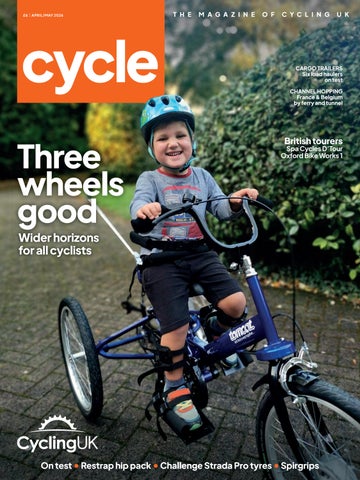
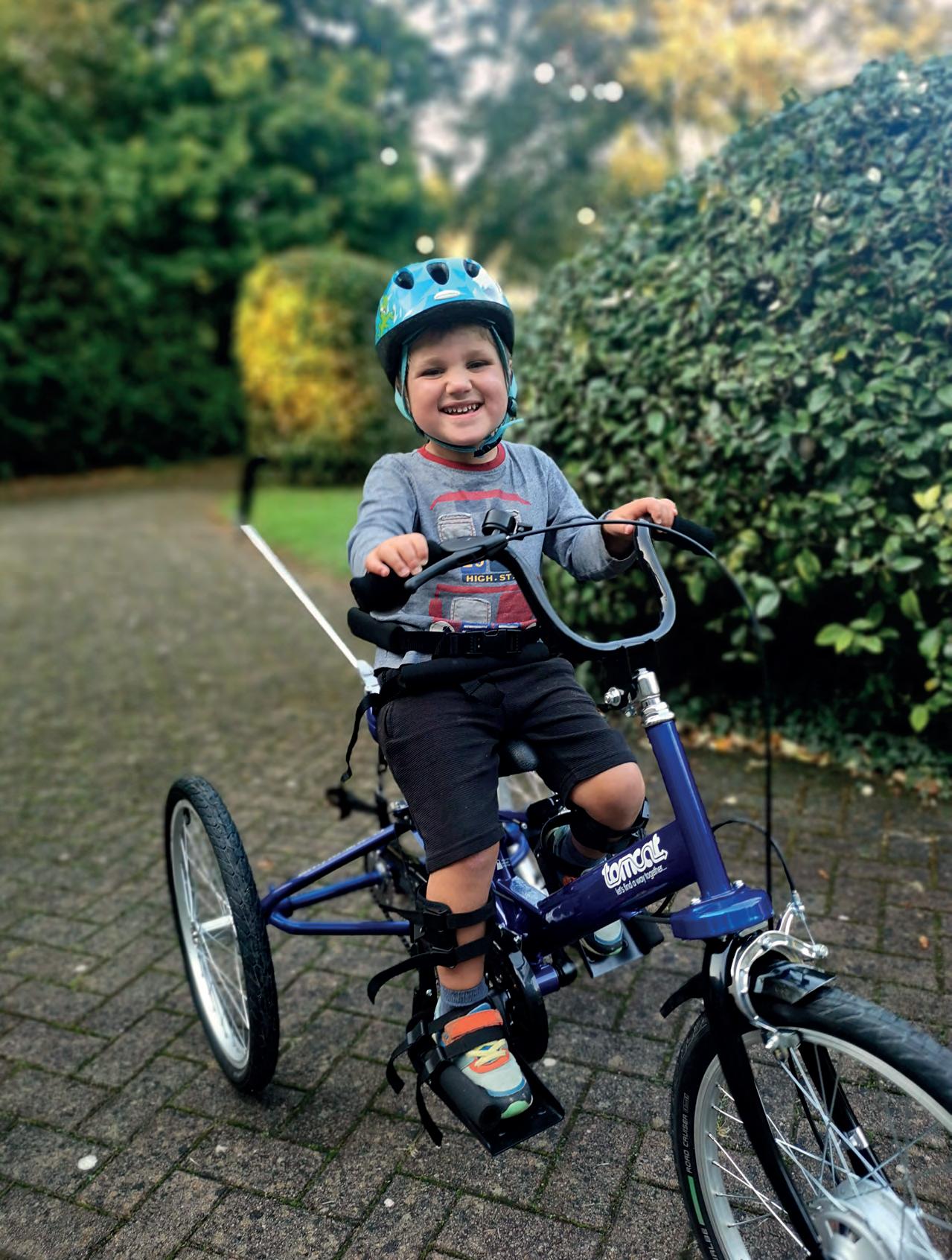
Cover photo: Ivor Washbrook on his Tomcat Fizz trike (see p26). By Sarah Washbrook
Great rides
Channel hopping
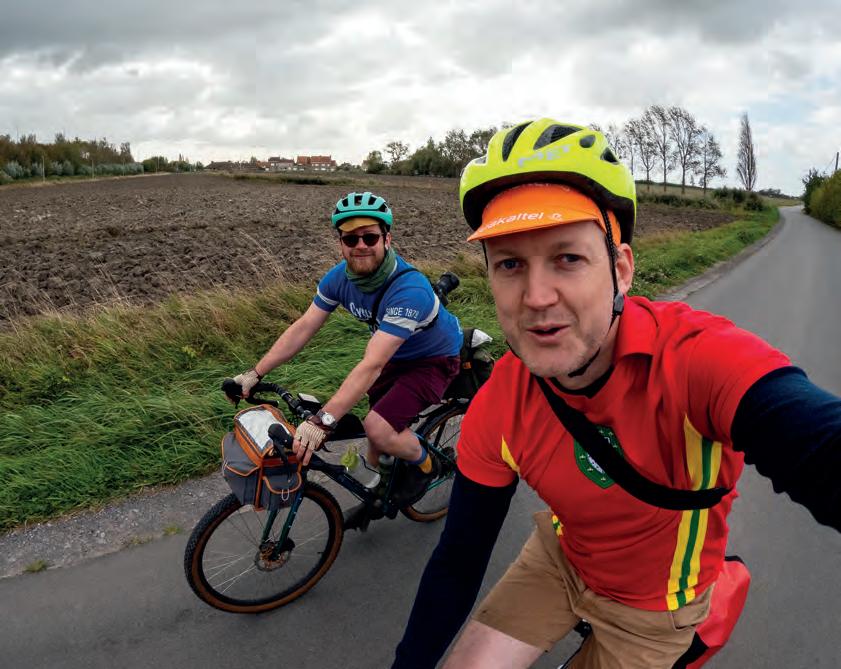
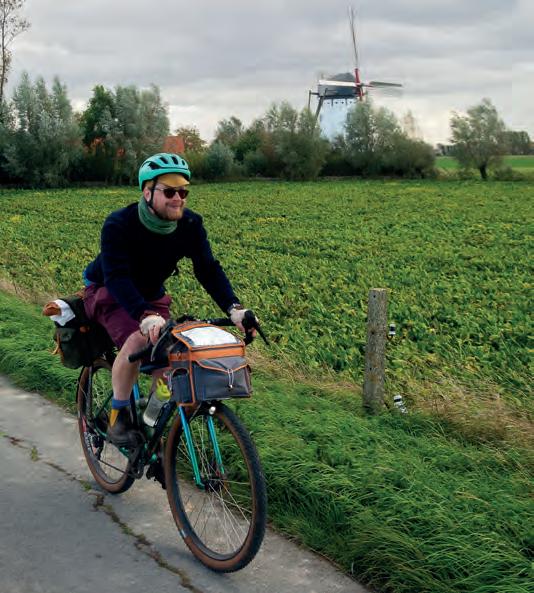
A named storm wasn’t going to stop the short cycling break
Sam Jones and his friend Huw had planned. But it did make it more complex and much wetter
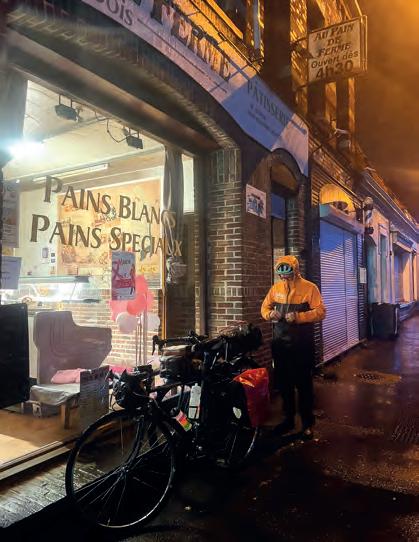
Touring cyclists find solace in the strangest of places: bus shelters, drainage pipes, essentially anywhere that provides a shelter from the elements. For Huw and I, one dark and stormy evening as British shores were lashed by the furies of our first named storm of the year, the bins at the Port of Dover were our happy place.
Peering out between the giant vestibules of rubbish, we watched the horizontal rain batter idling cars in relentless waves of water. Wipers were on full tilt, as someone in hi-vis oilskins directed the vehicles and their nice, warm and dry inhabitants onto a ferry that glimmered through the storm’s haze.
“We’re soaked and freezing. Let us on!” I yelled at the traffic manager guiding vehicles off the grid and onto the ferry, but was ignored. Or perhaps not heard? After half an hour of these conditions, cold had set in and we couldn’t stand it anymore. Together we barged our way onto the concourse, forcing them to notice us. Finally, chased by juggernauts carrying their wares into the EU, we boarded.
Riders on the storm
We weren’t even meant to be on this ferry, leaving from this port or heading to Calais. It didn’t matter. We were glad just to be inside and heading to France. Four hours earlier, we’d met at Lewes train station, ready to take the next train to Newhaven for our intended ferry to Dieppe. Ferry company DFDS called just before we boarded the train with the unwelcome news that our ferry was cancelled due to Storm Amy.
As 40−somethings with family commitments who live in different countries within the UK, finding a weekend away is a rare and special
“Through the ferry window, the harbour walls of Calais rose sickeningly up and down, drizzled in orange lamplight”
thing. We weren’t going to let a storm stop our French trip.
“Are ferries running from Dover?” I asked.
DFDS confirmed they were and that our tickets were valid for the 00:30 crossing. Which is why, three train changes and some bin sheltering later, our holiday began.
We had about half an hour’s worth of sleep, before a ferryman insisted we wake and pack up our still drying clobber. Through the ferry window, the harbour walls of Calais rose sickeningly up and down, drizzled in orange lamplight. It was half three in the morning and we needed more rest. Perhaps in the ferry terminal? We stumbled bleary eyed down to the hold and our securely fastened bikes.
We were in no hurry to leave the safety of the ship, but as the last lorry left it was ‘once more unto the breach’. As we inched off onto the tarmac, a van with amber flashing lights pulled up. A man shouted something at us, which we assumed by his gesture was something along the lines of: “Come with me if you want to live!”
He set off at 10mph. Battered by rain and wind, we struggled to keep up. Terminal plans were
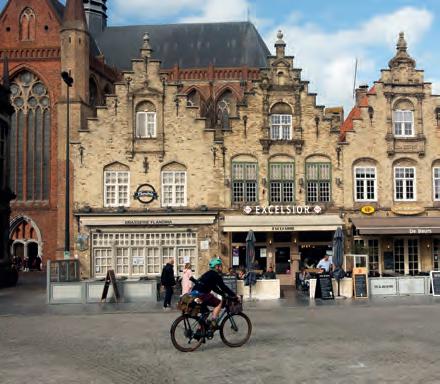
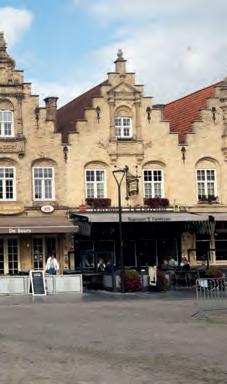
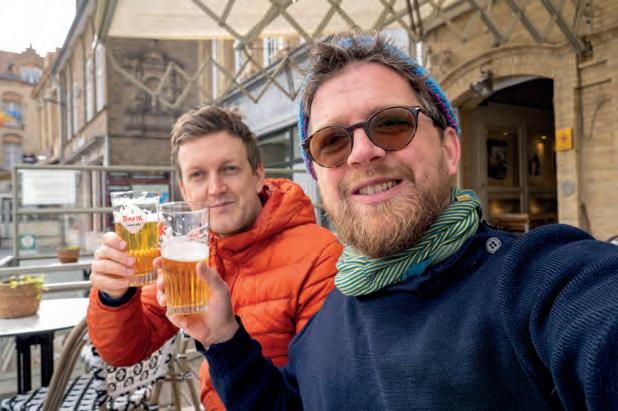
Below: Celebratory Belgian bieres in Veurne’s Gothic market square – only halves, mind you
Photos: Sam Jones and Huw Poraj-Wilczynski
THREE WHEELS GOOD
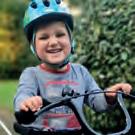
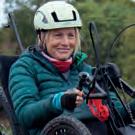
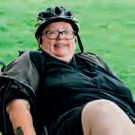
Trikes make cycling accessible to all. Sarah Washbrook and Karen Darke tell their stories, while Jordan Scott and Amanda Brobyn spoke to Martin Hofschroer
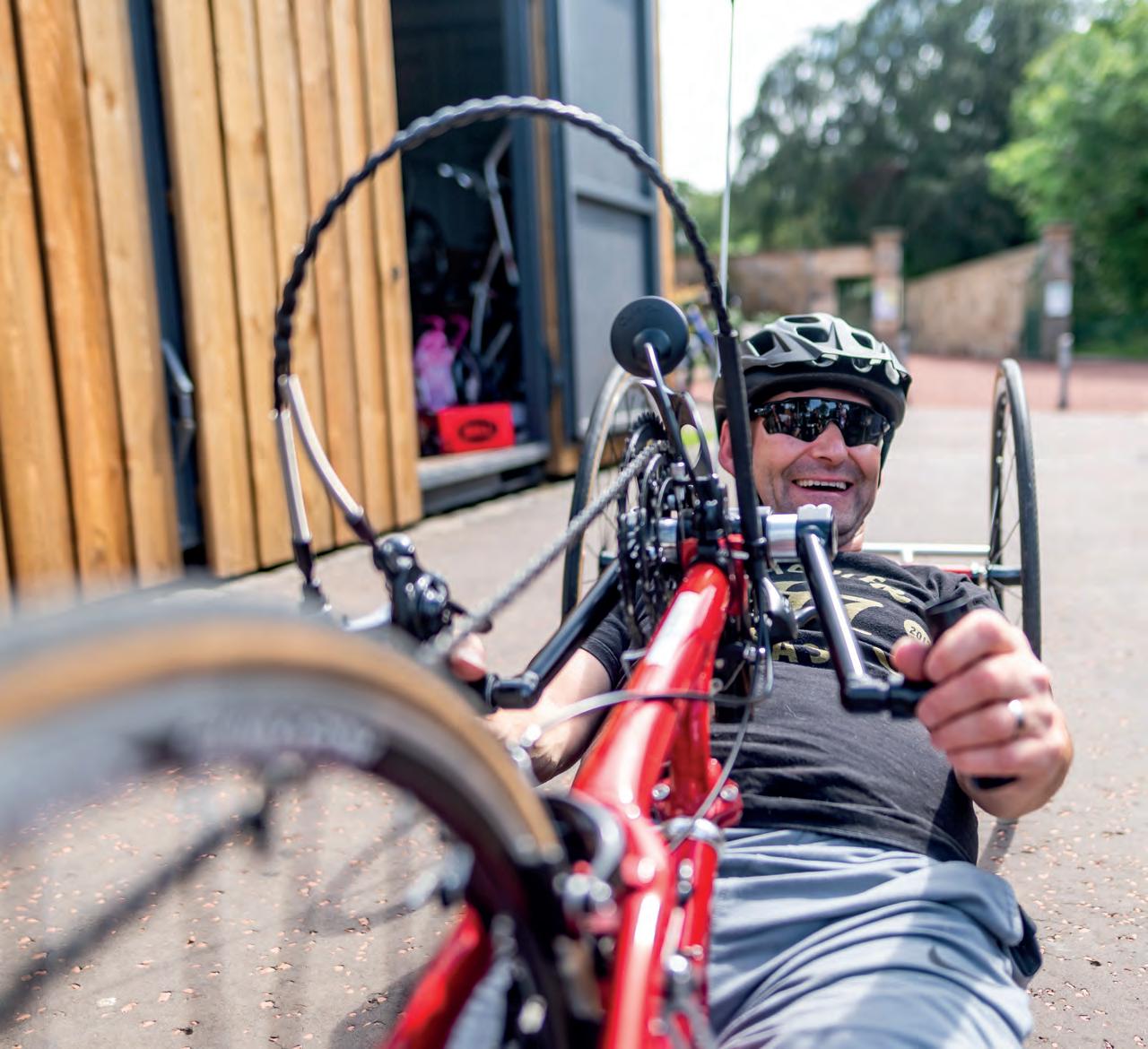
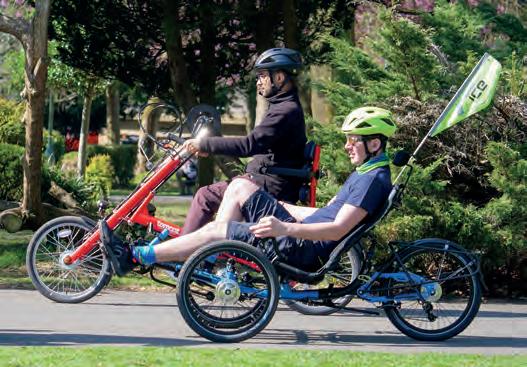
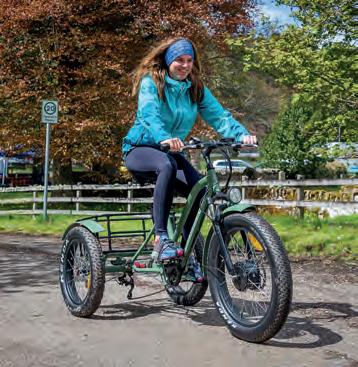
WHEN CYCLING ON TWO WHEELS is impractical, a tricycle is usually the best solution. Trikes cater for a much wider range of riders than standard upright bicycles. They come in a host of different designs: uprights, recumbents, semi-recumbents, tandems, delta (one wheel at the front), tadpole (two wheels at the front), electric assist, hand-cranked, wheelchair carrying, wheelchair clip-ons… With a trike, anyone and everyone can enjoy cycling.
The uptake of trikes for adaptive cycling is limited by their low public profile and relatively high cost. Speciality cycles like trikes are expensive and disabled cyclists may have additional financial pressures. That’s where projects like Cycling UK’s Inclusive Cycling Experience can help, by enabling would-be cyclists to discover and try out solutions that best suit them.
The best ambassadors for adaptive cycling, of course, are the riders themselves.
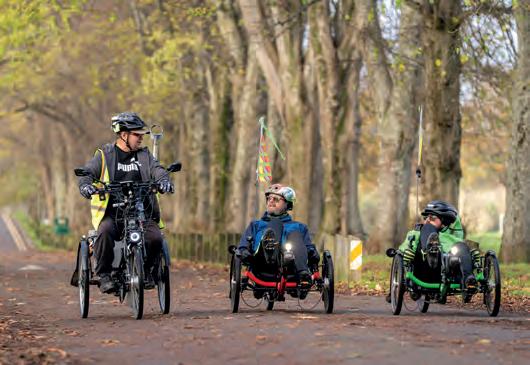
Trikes come a wide range of different designs. While many are also suitable for able-bodied riders, they work particularly well for cyclists with disabilities
CW from top: Andy Catlin, Paul Campbell, Robyn Furtado, Morever
Elect to cycle
With elections imminent for the Scottish and Welsh parliaments, as well as some English councils, Sophie Gordon explains what Cycling UK is pressing for – and what you can do
This spring’s elections look likely to transform large parts of the UK’s political landscape. Wales may see the biggest shake-up since devolution began. Polls predict a move away from a longstanding Welsh Labour government. Plus, there’s a new electoral system. Competition for seats in the Senedd will be fierce.
In Scotland, the polls suggest that the SNP looks set to secure the most seats but not necessarily a majority, and at least 39 current MSPs are standing down. With many seats predicted to go to the Scottish Greens, Liberal Democrats or Reform, there will be lots of new faces in Holyrood.
Then there’s the turmoil around English local elections. Some councils were told to delay until 2027, only to be thrust back into election mode this year.
The youth vote
All this change makes it crucial to engage with incoming politicians from all parties to find allies who will champion cycle-friendly policies. Election candidates hear a lot about issues like security, immigration and the cost of living. Active travel is unlikely to be top of their list of voter concerns. We need to prove that it’s important to their constituents, and show how more cycling can solve other problems.
Young people especially care about this. In Scotland, 74% of under-25s support redesigning streets to improve safety for
walking and cycling (source: YouGov polls for Cycling UK). Feelings are equally strong in Wales. Three quarters of 16₋ to 30₋year₋olds support street improvements, and 6 in 10 favour allocating 10% of the transport budget to walking and cycling.
Millie, a 16₋year₋old student from Penarth, told us: “The issue is, we really need more separated cycle lanes, like the ones around Newport Road. More dedicated cycle lanes would be a game changer for how people like me get around.”
Gwenda Owen, Cycling UK’s Wales Advocacy and Development Lead, said: “This should send a clear message to candidates standing in May’s Senedd elections. Young people across Wales strongly support investment in cycling and walking, and want to see practical changes that make active travel safer and easier.”
Cycling UK’s demands
Our manifestos for Scotland and Wales carry a simple message for future governments: make cycling the easy choice.
Here’s how they can do that:
1 Invest in active travel
2 Create safer roads for everyone
3 Improve access to green spaces
4 Increase transport choice and connectivity for all
5 Enable more children to cycle, especially in Scotland
Clockwise from top left: Morever, Andy Catlin, Morever, Cycling UK
Your voice matters
First of all, visit cyclinguk. org/elections2026. Then:
• Join a hustings event On 14 and 15 April, we’re hosting online hustings events for the Welsh and Scottish elections, along with other walking and cycling organisations. It’s an opportunity to quiz party representatives about what they’ll do to create places that are better for cycling and walking, to help you make up your mind how to vote. The events are open to everyone to attend – all you need to do is register online.
• Question your candidates Candidates are keen to hear what you care about, so make sure you tell them. We’ve set up an online tool to help you quickly find out who your candidates are and ask them what they will do to make cycling easier where you live.
• Get involved locally
Whether it’s Scottish and Welsh national elections, or local elections in England, our elections toolkit is packed with practical ideas for engaging candidates, organising events and sharing positive stories.
1
Invest in active travel
When budgets are tight, creating cycling and walking routes is one of the most costeffective things councils can do. Getting more people cycling saves health services money and boosts footfall in local shops. But competing for funding pots makes it difficult for councils to plan. Long-term investment from governments would enable councils to create good-quality networks.
2
Create safer roads for everyone
It was controversial, but reducing most 30mph streets in Wales to 20mph has had a huge, life-saving impact.
“Picture a two-carriage train heading to Wrexham,” said Cycling UK’s Public Affairs Officer Tomos Owens. “Now imagine that the entire train, almost every person in both carriages, was saved from a trip to hospital or worse this past summer. That’s roughly how many people – 100 lives – were saved from being killed or seriously injured on Welsh roads during the first year of 20mph.”
In that context, it seems incredible that we have so many narrow, winding rural lanes with 60mph limits. We’re pressing future Welsh and Scottish governments to ask councils to make sure rural speed limits are appropriate for the type of road. We’re also asking
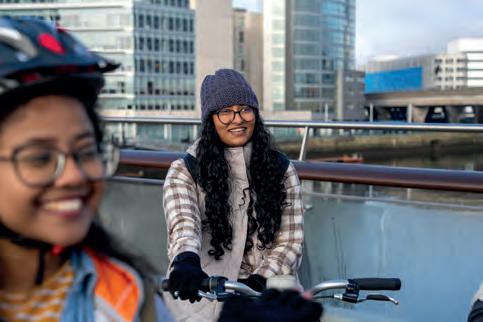
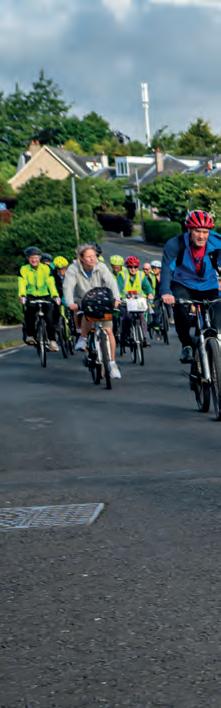
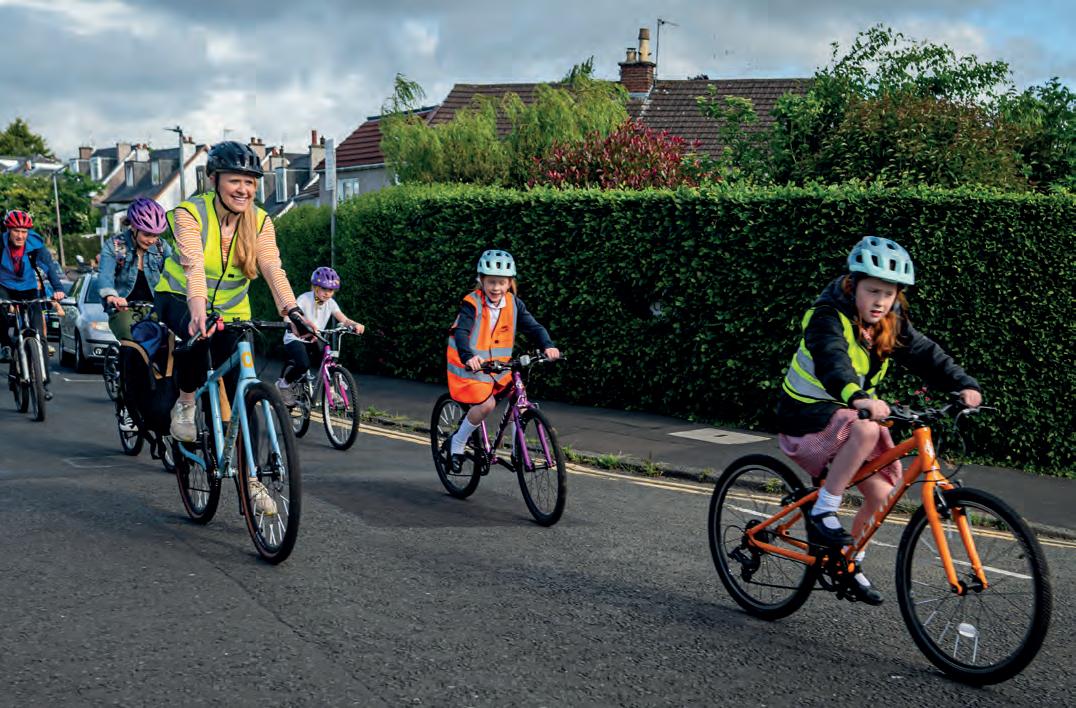
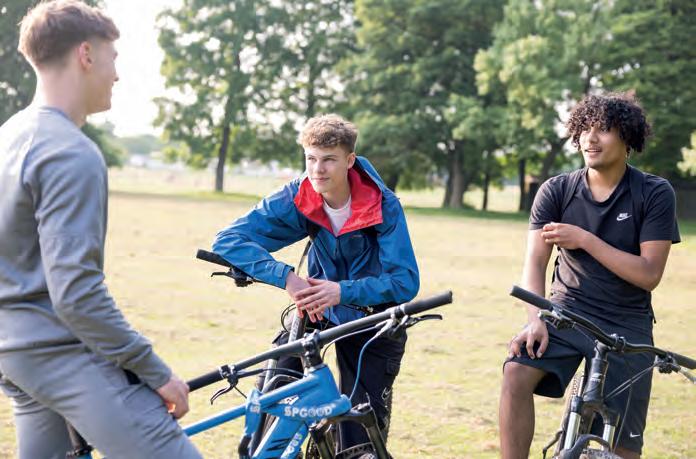
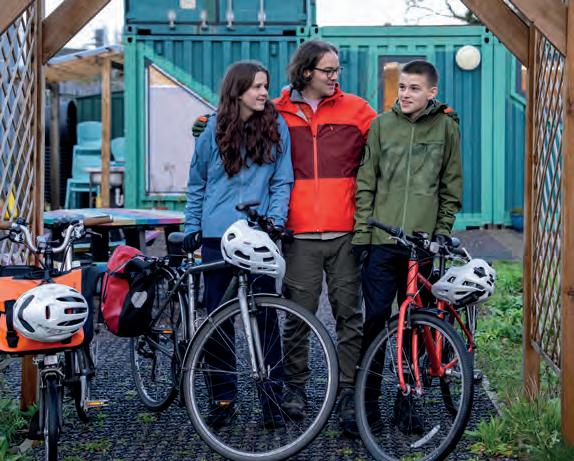
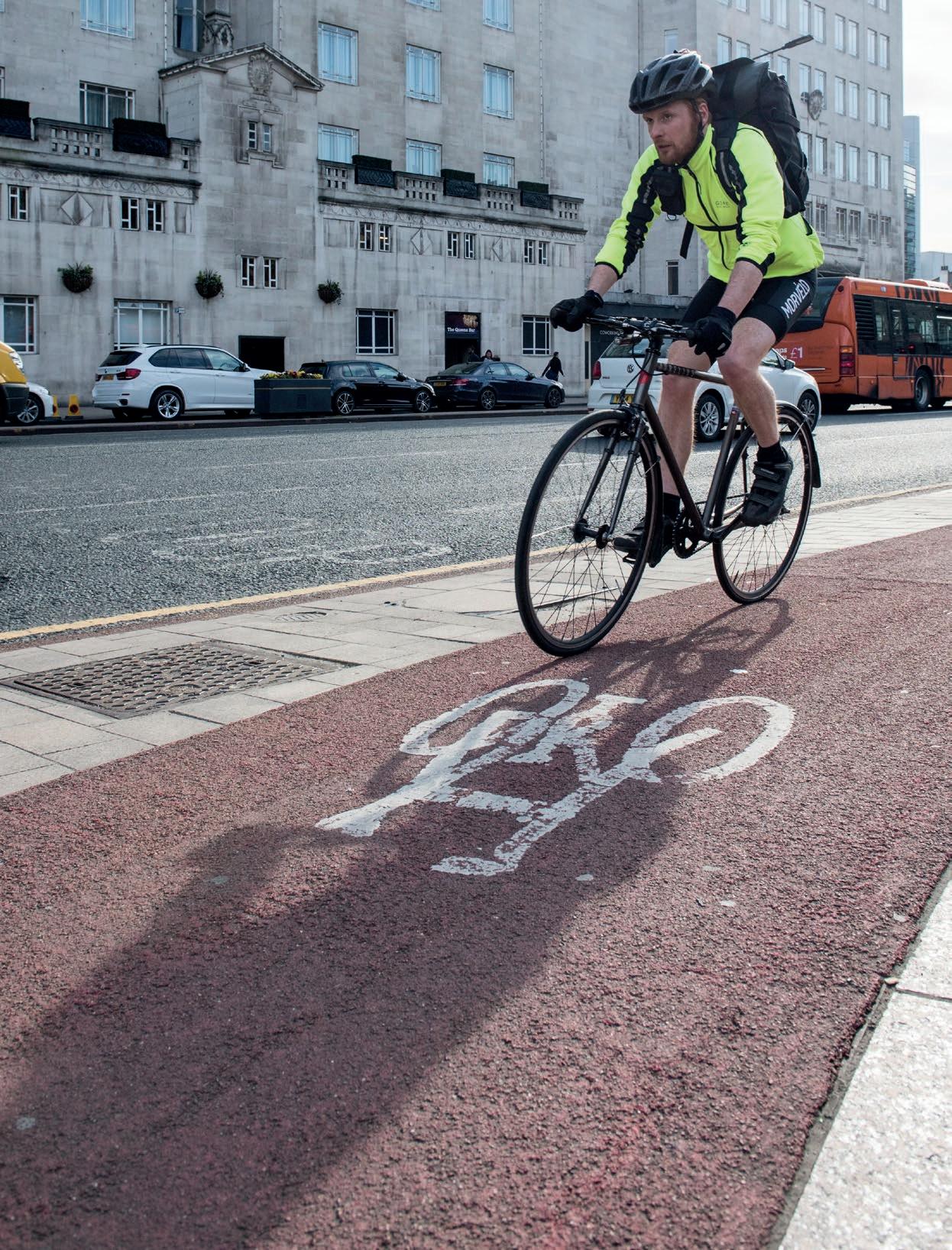
(Clockwise from top left) Young people overwhelmingly support measures to improve cycling and walking safety. Bike buses, like this one in Edinburgh, enable children to cycle to school. Cycling provides teenagers with affordable, independent travel (both pictures)
A
In the frame
clincher tyre with vintage looks for those using innertubes
Other options
GOODYEAR EAGLE F1
SUPERSPORT R
TUBE TYPE £59.95
Super-light tubetype clincher with vulcanised construction in 700×25 and 700×28 sizes. goodyearbike. com/uk
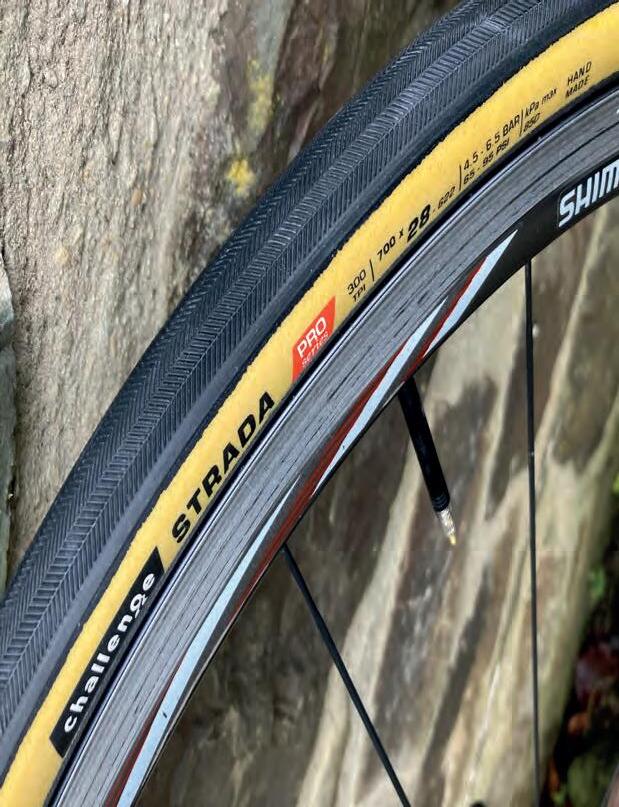
Strada Pro Handmade Clincher Road Tyre
VITTORIA CORSA
PRO TUBE-TYPE £79.99
Handmade cotton casing ‘open tubular’ clincher with 320TPI cotton casing and Graphene + Silica tread compound in 700×26, 700×28 and 700×30 sizes. int.vittoria.com
As road tyres get ever wider, it’s worth noting that the Challenge Strada Pro in 700×28 format is 1mm wider than the firm’s decade-old Paris-Roubaix model. The Strada Pro also comes in 30, 32 and 35mm, as well as 25mm for traditionalists. The 28mm example tested here tips the scales at around 270g; Challenge says weight can vary by plus or minus 10% for any given size. This potential variation is doubtless due to the tyre’s construction, which differs from that used for most cycle tyres and provides a distinctive look and ride sensation.
Instead of using (usually) nylon fibres compressed with rubber that’s vulcanised in a mould to form the tyre carcass, Strada Pros use softer, more flexible polyester fibres with a super-fine 320tpi thread count, glued together using ‘natural adhesives’. Polyester won’t absorb water, unlike the cotton often used in similar handmade tyres, making it less vulnerable to wet weather conditions. But although the sidewalls are coated with latex to keep out grit and moisture, these
tyres aren’t quite ‘fit and forget’ and should be kept clean and dry when not in use. The tread, which uses Challenge’s Smartprime compound, is in turn glued to the carcass, while under the tread lies a layer of PPS Ganzo puncture-resistant fabric. Once inflated, the Strada Pros ride as sweet as they look. They are quiet and exceedingly comfortable, rendering minor road vibration near-imperceptible at the 65psi front/85rear pressures of the test. Nor are they fragile, surviving muddy, thorn-strewn Welsh back lanes without cut or complaint, the fine tread providing grip where a slick would not. Just don’t expect the same tread life of the vulcanised competition.
Richard Hallett
Sublime ride quality and excellent all-weather grip combine with impressive toughness to make a delightfully usable and surprisingly affordable tyre that benefits from careful handling.
In the frame Bike test
Raising the bar
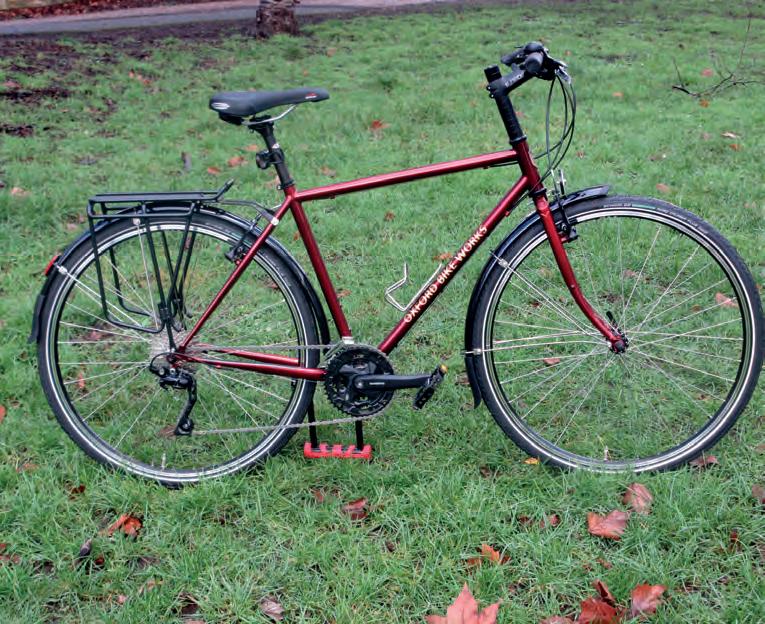
The Oxford Bike Works Model 1 and Spa Cycles D’Tour are both steel tourers designed and assembled in Britain, but they’re far from peas in a pod.
Review by Simon Withers
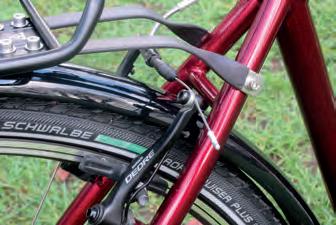
These mid-priced tourers have much in common: steel framesets, very wide-range gearing, mudguards and a rear rack. But there are notable differences. One is defiantly old school, with V-brakes and quickrelease axles. The other has cable disc brakes and thru-axles.
The most striking difference is the choice of handlebar: the Spa Cycles D’Tour has a drop bar, the Oxford Bike Works Model 1 a flat bar. Curiously, while this is the default for each bike, they’re both available with either handlebar option.
Frame, fork & handlebar
Both frames are made from Reynolds steel and are very neatly finished.
The Spa has 725 tubing, the Oxford 525. They’re essentially the same chrome-molybdenum alloy but 725 is heat treated, which boosts its strength by about 50%. It’s not something you’re aware of when riding, and either frameset should last you a lifetime if looked after.
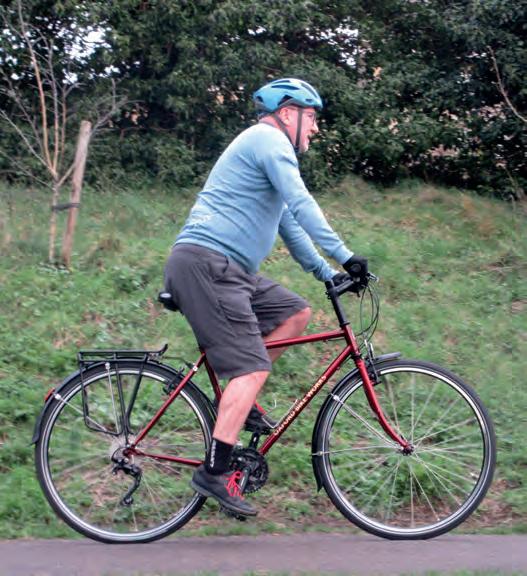
The Oxford Bike Works Model 1 is about as retro as it gets: a frameset that would have been familiar decades ago, decked out with kit not dissimilar to that which I toured on in the 1990s. That’s not a bad thing. It’s tried-and-trusted
technology, put together with care and attention – and it all works well. If you were buying one, you’d probably have fewer spacers on the steerer; Richard at Oxford Bike Works put this together at short notice in a size smaller than I’d normally ride.
Every one of the bikes I’ve owned since my flat-bar kids’ bike has had a drop bar, and I’ve ridden all my extended tours on drops. I’ve nevertheless put in thousands of miles on flat bars. There are obvious benefits to both setups.
While the flat bar helps with stability, as your hands are further apart, the extra width makes it harder to squeeze through gaps in stationary traffic. It generally puts you in a more upright position, which means less strain on your lower back. Yet it’s harder to ride into a headwind as it’s less aerodynamic.
Apart from better aerodynamics, the big advantage of a drop bar is the number of handholds it offers. Your hands, wrists and shoulders aren’t stuck in the same position, so you can reduce the likelihood of
Middle: V-brakes are a blast from the past but still work well for touring and commuting
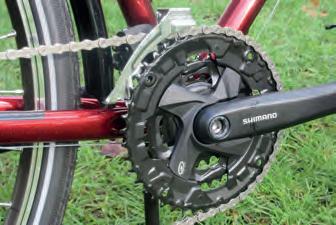
Bottom: A 44−33−22 triple gives cadencefriendly front shifts
discomfort and numbness setting in.
There are ‘in-between’ handlebar options: the butterfly bars used by many European cycle tourists, and the alternative flat bars we featured in the June/July 24 issue (cyclinguk. org/alt-bars). These increase the number of handholds while retaining a more upright riding position and enabling the use of more costeffective flat-bar controls. Although the Oxford has a simple flat bar, it can be specified with grips with integral bar ends, giving a useful extra hand position. I’d choose these if I were buying the bike.
Components
In the frame
The Oxford Bike Works Model 1 has a triple chainset. While rare these days, it’s still the go-to for many of us, offering both a wide gear range – including a bottom gear of just 18in – and small jumps between gears. It’s arguably the best of both worlds when it comes to range and cadence.
The drivetrain is 3×10₋speed Shimano Deore. Deore has been doing sterling work for generations of mountain bikers, day-to-day cyclists and cycle tourists since the 1980s. Shimano flags it as only mid-range kit, but in my experience Deore is durable and well designed.
Left: The tall stack of spacers is because Simon’s on a bike one size smaller than usual Below: Like the Spa, it’s a Far East frame designed and equipped in the UK
“ A TRIPLE CHAINSET IS ARGUABLY THE BEST OF BOTH WORLDS WHEN IT COMES TO RANGE AND CADENCE”
The trigger shifters work impeccably and the braking is very good. It’s been quite a while since I’ve used V-brakes. I’d forgotten just how effective they are. They offer plenty of power and control, and a pretty light action. They don’t need bedding in either. Compared to the cantilevers that preceded them, they’re a noticeable step up. With flat-bar levers they don’t require a Travel Agent or similar gizmo to achieve the correct cable pull. And V-brake spares remain readily available.
The Spa D’Tour has a more modern road- and gravel-based setup: 11₋speed Shimano 105 with a GRX rear mech. You can choose from a number of chainsets. I picked a subsub-compact 40₋24 double. Paired with an 11₋40 cassette, that gives an ultra-low bottom gear of just 16in. This was a godsend for my 63₋year₋ old knees.
The Spa’s brakes are TRP Spyre cable discs, which are a decent choice for touring. They may
Tech spec
Oxford Bike Works Model 1
Price: £1,699.
Sizes: 51 (tested), 54, 57cm.
Weight: 14kg (as shown).
Frame & fork: Reynolds 525 steel frame with three pairs of bottle bosses, mudguard and rear rack fittings. Steel fork with low-rider bosses and mudguard mounts.
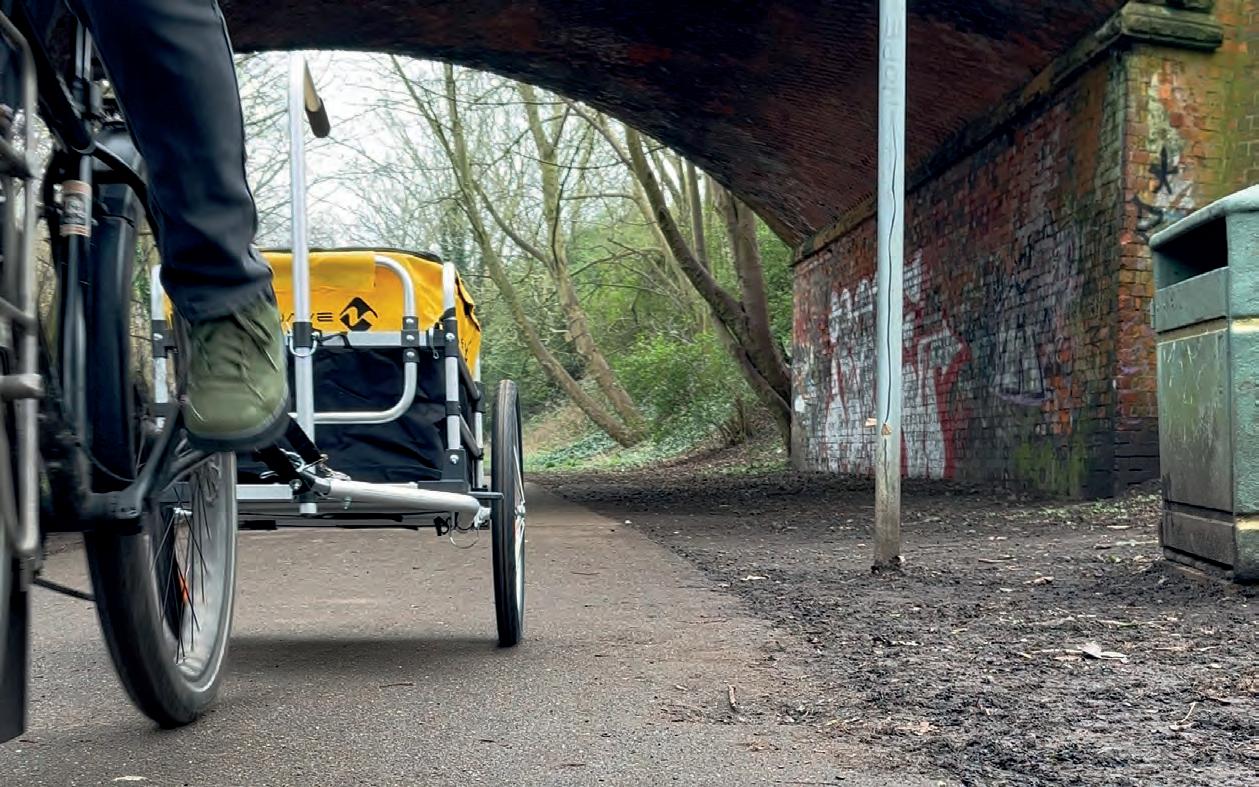
Trailers enable any bike to carry cargo-bikesized loads for a fraction of the cost. Editor Dan Joyce, who has been using cycle trailers for 35 years, tests six
Cargo trailers turn any bike into a load hauler. They’re indispensable for cycling with items that are too big or too heavy for panniers. And they provide car-boot-style convenience for large collections of smaller things, such as bags of groceries.
Whatever bike you use for towing, its brakes must be good enough to stop you safely with the added weight of a loaded trailer. Its gears must go low enough – or its electric assistance be powerful enough – to get you up the usual hills you’ll encounter.
If you use a trailer between sunset and sunrise, it must have a red rear light and a triangular red rear reflector. Yes, triangular. I’m not aware of any trailer that comes with a triangular reflector
or where you might get one suitable for cycle use. On the other hand, it doesn’t seem to be policed.
There are no specific restrictions on what you can carry in a trailer. Cargo models aren’t suitable for carrying children, of course, and some have warnings to that effect. Conversely, child trailers will carry soft loads like shopping – along with one or two children, if everyone is comfortable.
To test these trailers under load, I mostly used logs – in bags or boxes where none was provided. My towing bike was a Jones Plus LWB with: a 20in bottom gear; Avid BB7 disc brakes; an M12×1.75 thru-axle for 148mm dropouts; and 29×2.6in tyres. It worked really well.
What to look for
One wheel or two?
Two-wheelers carry larger, heavier loads as they balance independently, and they’re easier to manoeuvre on foot. Single-wheelers track the towing bike better, without cutting corners or clipping kerbs.
Load limit
All trailers have a maximum load limit, typically around 40-50kg. While they might carry more without breaking, handling could get dicey.
Attachment points
Flatbed trailers need attachment points for bungees or ratchet straps. Box trailers primarily need a decent volume, but attachment points are still helpful.
Overall width
Is the trailer narrow enough to wheel through gaps en route such as gateways or cycle-track bollards? This is vital when the trailer is loaded and helpful when it’s unloaded.
Hitch
Most trailers attach to the rear axle, which minimises the tailwagging-dog effect. With a seatpost hitch, a heavy trailer is more likely to lift the bike’s rear wheel under hard breaking. However, high-hitch trailers are easier to wheel around on foot. Any hitch needs a safety strap.
Ease of storage
If storage space is tight or you want to take it on a train, get a trailer that will pack down easily. Anything up to 90×70×30cm and in a bag is luggage on a train. Flat trailers, particularly those with QR wheels, can be hung on a wall hook at home.
Don’t over-inflate trailer tyres. Softer isolates the load better from bumps
Travellers’ tales
Boudicca’s backyard
Where: Norfolk
Who: Neil Scarse & Andy Foulds
When: Summer 2025
Sails, rails & 16in wheels
Where: English Channel to Switzerland
Who: Richard Bowers
When: August/ September 2025
Share your story
We’d love to hear your Travellers’ tales! Email: editor@ cyclinguk.org
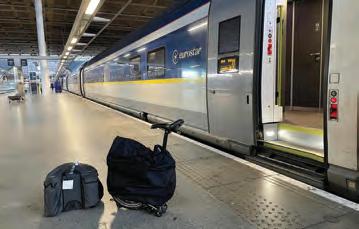
Last year I had a conference to attend in Konstanz and some spare time, so I decided to cycle there. I wanted to try out the SailLink ferry from Dover to Boulogne described in Chris Read’s article in the June/July 25 issue of Cycle. This is a sailing catamaran that takes up to 12 cyclists and foot passengers across the Channel. It’s a wonderful experience; you can even have a go at helming!
I planned the journey using the Komoot app, simply putting Boulogne as the starting point and the Swiss border by Konstanz as the destination. I then divided the route into 11 sections of 60-100 km per day. Finally, I searched for hotels and hostels near each section and adjusted the route accordingly. This was much easier than
my old method of buying loads of maps and meticulously planning each day. The downside was that, at times, I was so focused on the satnav that I didn’t really appreciate where I was. Not getting lost is convenient but takes away from the experience of travelling.
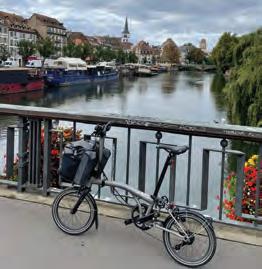
Generally, the app found quiet roads and reasonablequality cycle paths. But there were some stretches of stony unsurfaced tracks that were hard work on the 16-inch wheels of my Brompton T-Line 12-speed.
The highlights of the trip were cycling for long distances along excellent cycle paths, often beside canals and sometimes by disused railway tracks. Luxembourg had superb cycleways but mysteriously almost no cyclists. On the last day, there were wonderful views of the Alps.
It surprised me how easy the 880km journey was. It is perfectly feasible to cycle long distances and avoid flying to destinations. But then I was lucky having the time to cycle. The weather was kind – not too hot and only a couple of days of rain.
Andy and I are cycling buddies who do occasional trips away. Autumn 2024 was Mallorca, and last summer we tackled the Cantii Way. Having enjoyed it immensely, we were planning where to go next within days. Andy suggested Rebellion Way.
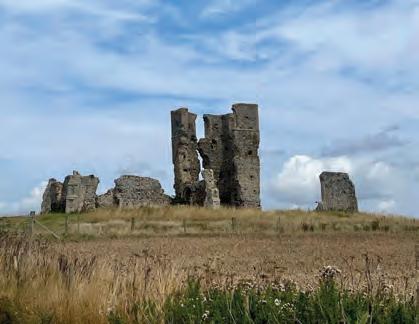
We started in Thetford, that being the closest point to London where we both live. By mid-morning we were on our bikes, aiming to do the route in five days – three full days and two shorter ones. We took a detour on day three to visit Andy’s ‘ancestral seat’ and to take a ride on the North Norfolk (heritage) Railway. Other than that we stuck to the route. And what a route!
Parts of it were a bit tricky on fully loaded road bikes with 28mm tyres, and it took a 5-litre bottle of water to clean the sand out of the drivetrains after one section. But it was fascinating and beautiful in equal measure.
As well as the sights, it’s often the chance encounters that make a tour memorable. Cycling right through the middle of an illegal rave in the woods en route from Diss to Thetford certainly wasn’t in the guidebook!
A big shout out to Cycling UK for another great route. We’re already thinking about Royal Chilterns Way.