Cycle promotes the work of Cycling UK. Cycle’s circulation is approx. 51,000. Cycling UK is one of the UK’s largest cycling membership organisations, with approx. 70,500 members and affiliates.
Chief Executive: Sarah Mitchell. Cyclists’ Touring Club, a Company Limited by Guarantee, registered in England No 25185, registered as a charity in England and Wales Charity No 1147607 and in Scotland No SC042541.
Publisher: James Houston. Cycle is published six times per year on behalf of Cycling UK by James Pembroke Media: Ground Floor, Riverside North, Walcot Yard, Bath, BA1 5BG. T: 01225 337 777
Cycle is copyright Cycling UK, James Pembroke Media, and individual contributors. Reproduction in whole or in part without permission from Cycling UK and James Pembroke Media is forbidden. Views expressed in the magazine are those of the individual contributors and do not necessarily reflect those of the editor or the policies of Cycling UK. Advertising bookings are subject to availability, the terms and conditions of James Pembroke Media, and final approval by Cycling UK.
From the editor
All cycles are mobility aids. They enable us to travel faster and further than we would on foot, and to have more fun while doing it. All cycles are tailored to meet individual needs, whether that’s as simple as saddle height or as complex as a hand-cranked e-trike.
But while almost everyone can enjoy cycling, would-be disabled cyclists face a unique barrier: not knowing that the cycle or adaptation that they need even exists. People won’t be what they don’t see.
That’s why projects like Cycling UK’s Inclusive Cycling Experience are so important. Likewise the work done by organisations such as Wheels for Wellbeing. Don’t take my word it: read the accounts in the ‘Three wheels good’ article (p26), and watch the video flagged on p4. This is life-changing stuff.
Years ago, I interviewed the late George Longstaff, who did a lot of adaptive cycle building. He told me he was once selling a bespoke tandem to a fussy, able-bodied couple while also showing a disabled boy his first tricycle. “Have a look around the tandem and let me know if it’s not perfect,” he had said to the couple. “I’m just sorting out this lad’s trike.”
The boy began pedalling independently for the first time in his life. He was overjoyed. His parents had tears in their eyes. George was smiling.
QUICK RELEASES
04 Freewheeling
Bits and pieces from the bike world
07 This is Cycling UK
Bike theft from railway stations update; go group cycling this spring; better cycle insurance for members; and more
TOUR & EXPLORE
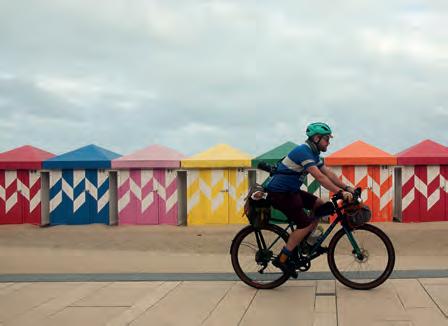
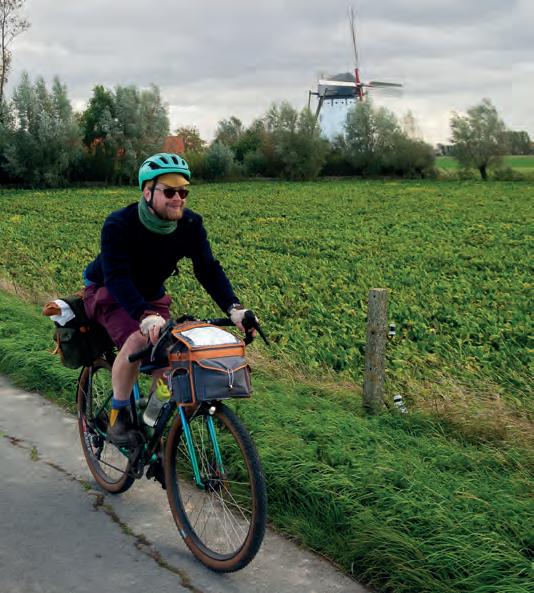
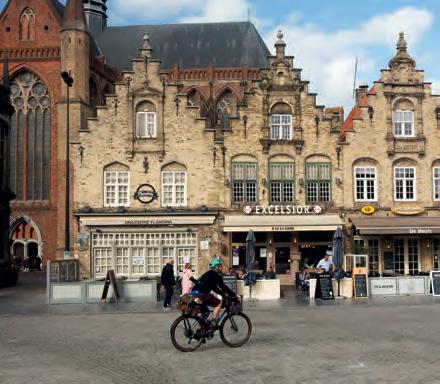
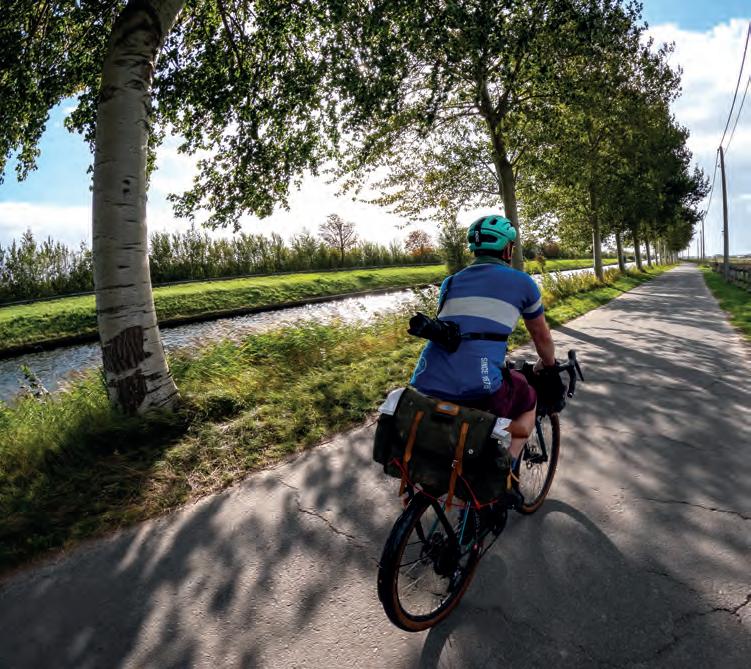
14 Channel hopping
A short and stormy break by ferry and tunnel
20 Weekender
Hell of the Ashdown sportive route
22 Atlas to Sahara
46 Shop window Previews of new products
48 Books
Cycling inspiration when you’re stuck inside
50 British tourers
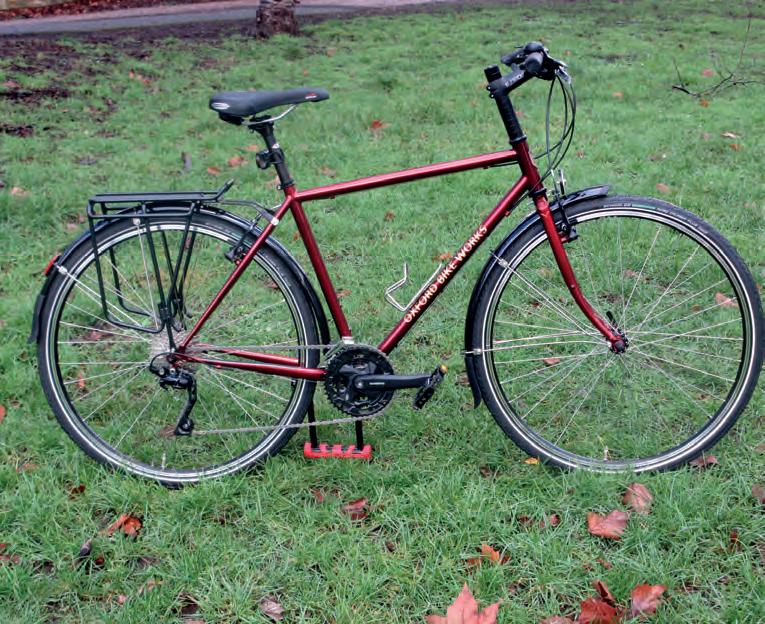
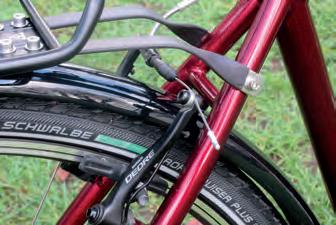
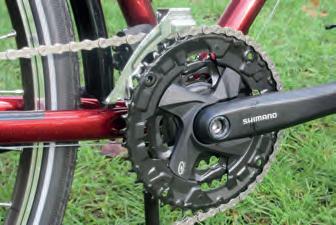
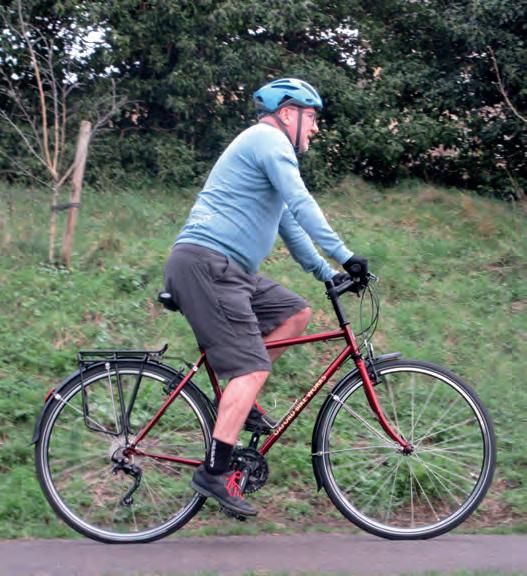
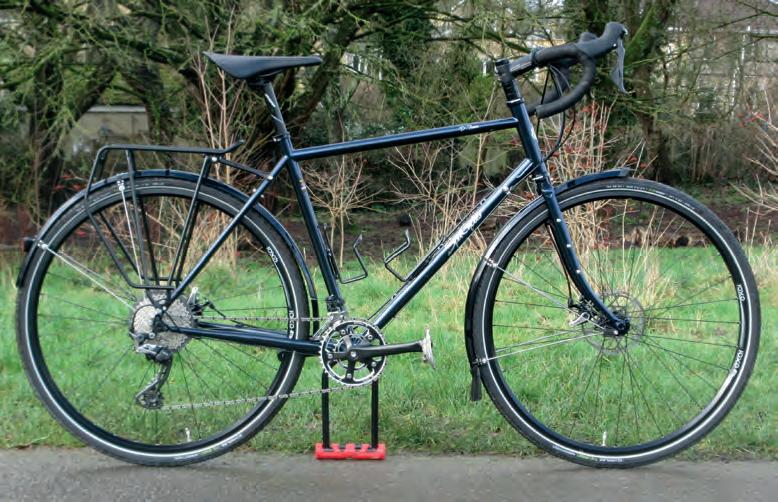
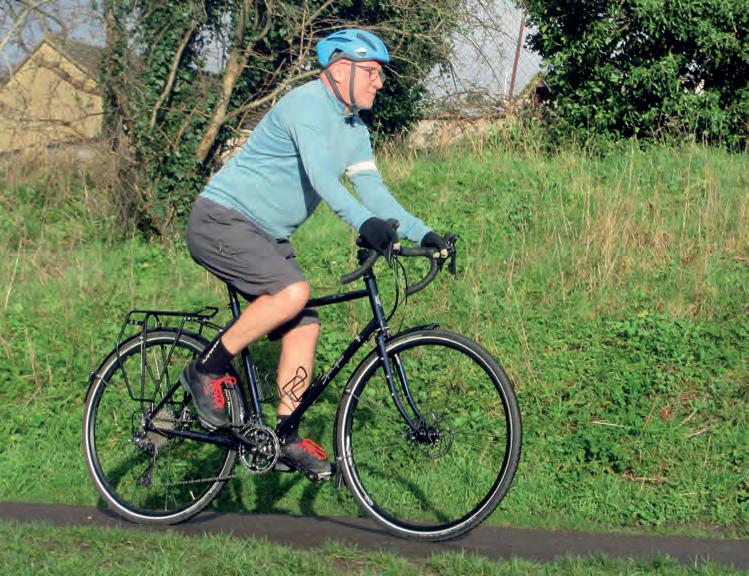
Two steel tourers designed in Britain: an Oxford Bike Works Model 1 and a Spa Cycles D’Tour
56 Cargo trailers
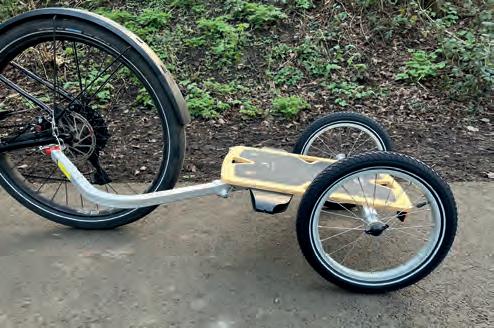
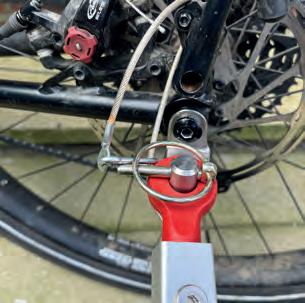
Six ways to transport cargo-bike-sized loads with any bike
“Excuse me, Mr Longstaff,” came a voice. “This cable-end cap has two indentations. The others all have three.”
George grabbed his cable cutters, crimped the end cap, and said “There you go.” Then he went back to dealing with the lad whose life had changed forever.
DAN JOYCE Editor
Off-road touring with Saddle Skedaddle
FEATURES
26 Three wheels good
How trikes have broadened the horizons of these four cyclists
36 Elect to cycle
What Cycling UK wants from the 2026 elections
IN THE FRAME
41 Gear Components and accessories tested
Your feedback on Cycle and cycling
66 Profile
Josie Dew’s enterprising son, Jack
68 Q&A
Your technical, health and legal questions answered
70 Bike finder
A lightweight electric roadster
73 Travellers’ tales
Cycling UK members’ ride reports
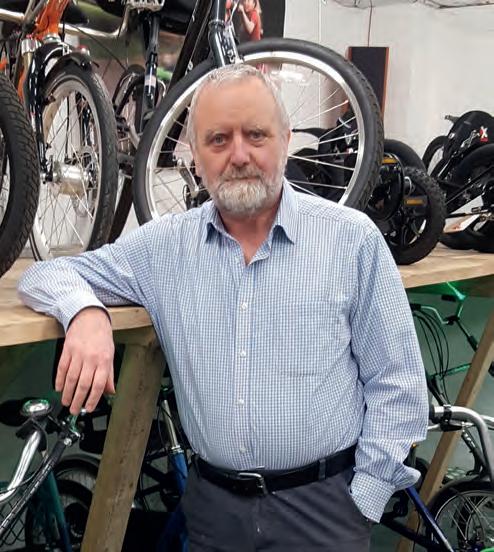
Top: Huw Poraj-Wilczynski
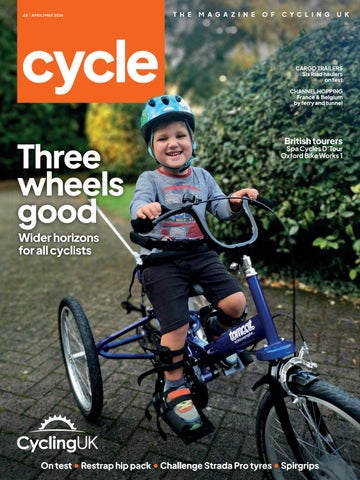
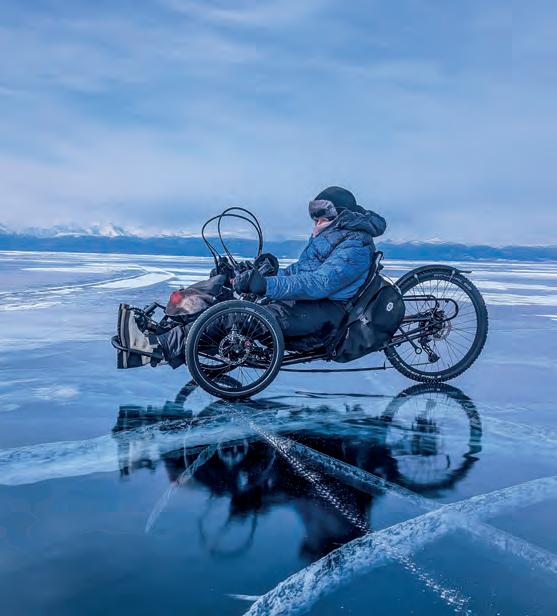
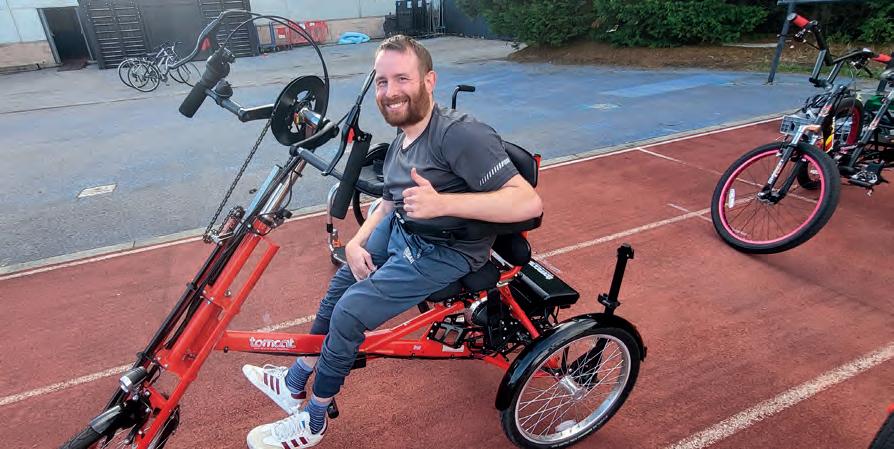
Cover photo: Ivor Washbrook on his Tomcat Fizz trike (see p26). By Sarah Washbrook
Watch this
BASTILLE E
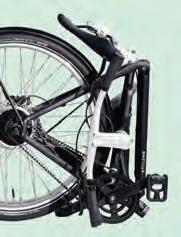
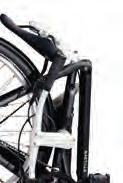
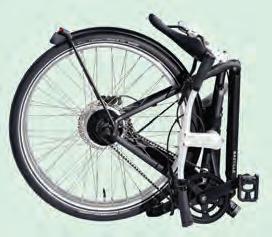
The French fullsize folding bike we mentioned a couple of years ago is now available as an electric version. It too has a belt drive and 650B (ISO 584) wheels and also folds to 82×80×30cm, but it’s equipped with a rear hub motor and a 210Wh battery. It weights 16.7kg and can be rolled along on its wheels when folded. It’s £2,790. bastillecycles.com
Cycling UK’s Inclusive Cycling Experience provides tryouts and loans of cycles that are tailored to an individual’s needs. Sometimes that’s trikes (see p26). For Neil and Andria Wright from Wigan, who have Parkinson’s and complex regional pain syndrome respectively, it was e-bikes. Find out how, in their own words, their e-bikes have changed their lives for the better. Read the article and watch the video here: cyclinguk.org/neil-andria.
years
Find a local group near you and enjoy a ride this weekend: cyclinguk.org/ group-listing
Freewheeling
A short tour around the wonderful world of cycling
Onmy bike
Jim McGurn
Jim is an activist and writer on cycling. He’s also the founder and executive chair of Get Cycling CIC
Why do you cycle? Getting into town for work and shopping, trips round our village, evening rides around the local lanes, tandem outings with our disabled son. Living in a village on the edge of York with good public transport and bike paths, we have no need for a car.
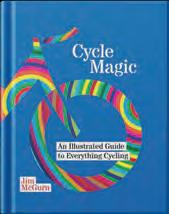
Jim’s most recent book, Cycle Magic (£26.95, ISBN 9781068233609) was reviewed in the Dec 25/ Jan 26 issue of Cycle
How far do you ride each week? Around 50 miles, although I recently did that in one day with York’s Wednesday Wheelers. Which of your bikes is your favourite? I love ’em all. My Dutch bike is perfect for getting around our village and into York. My old Dawes Super Galaxy makes me feel young again. My Berndts folder covers business trips. Our tandem trike, which I steer from the rear, is for family outings with our son, who has Downs and autism.
What do you always take with you when cycling? Just the usual stuff. For the rare group rides, I take an innertube and levers. Who mends your punctures? I do. Unless it’s the Dutch bike with hub brakes. I pass that
Jim at Get Cycling CIC, a not-forprofit supporting people with physical and other barriers to cycling
Sheila Southgate
“I wish I’d moved and rediscovered the joy of cycling sooner!” says Sheila Southgate, who moved from Ipswich to Trimley, near Felixstowe. She was downsizing because of mobility issues after battling endometrial cancer.
Your ride
“Chemo and radiotherapy definitely takes everything out of you during treatment and continues long after it’s finished,” she says. She wasn’t working but wanted to explore her new neighbourhood, as well as rebuild her strength and fitness. Luckily, she found the Facebook page for Pedal Felixstowe Community Cycling Club, which is affiliated with Cycling UK.
“It’s taken a lot longer than expected to get back to my original fitness and I feel that cycling is definitely helping, albeit on an electric bike,” Sheila says. “I have the option of using electric assist if I’m getting tired or my hips are aching.”
Joining the Community Cycle Club has transformed the way Sheila feels about cycling now, and riding in a group has given her spirit a boost: “It’s made it so much more enjoyable. I’m now going to places I wouldn’t have gone on my own. It’s so nice going in a group and talking to different people while on our bikes. I also feel safer in a group and there’s a greater sense of security.” cyclinguk.org/sheila
Freewheeling
pleasure to the mechanics at work. It’s raining: bike, public transport or car? Bike. I quite like cycling in rain with the right bike and clothing. Lycra or normal clothes? Rarely Lycra, and then just padded shorts. If you had £100 to spend on cycling, what would you get? A better cover for our tandem trike, which lives in the front garden. What’s your favourite cycle journey? From Pickering there’s a lane which lifts you up and onto the North York Moors. Then it’s a magical, timeless ride, sometimes in mist, until you’re descending on the delightful roller-coaster road that drops you into the Esk Valley. What single thing would most improve matters for UK cyclists? 20mph as the default speed limit on restricted roads, like Wales.
New Mechanical Tiagra
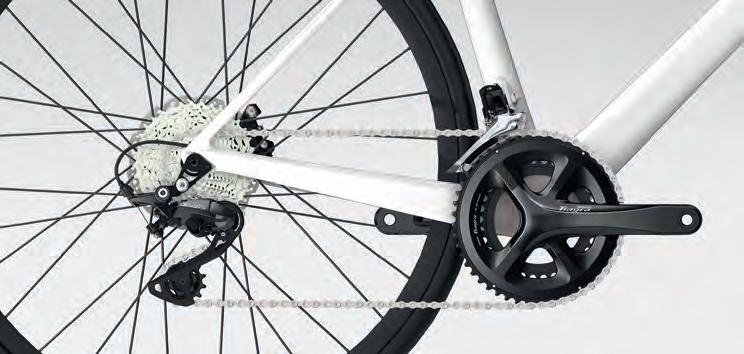
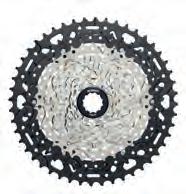
Shimano’s mid-range mechanical road groupsets are being squeezed at one end by Di2 and at the other by CUES. So it’s a welcome surprise to see a new version of 2×11 Tiagra with an 11-36 cassette, more ergonomic levers (Shimano says) and a modest weight saving. The chainset comes with 165, 170, 172.5 and 175mm crank lengths. shimano.com/en/
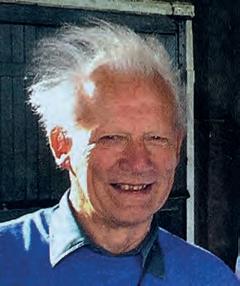
Former CTC President and later Vice-President Ted King has passed away at the age of 97. His children Bob, Heather and Val King write:
“It is with great sadness that we report the death of our father, Ted King. Together with our late mother, Sheila, he gave a lifetime of service
to the CTC, first with Beds DA and then with Bristol DA. He served for many years as Chair of CTC Council, and then as President from 1990 until 1996. He was awarded a CTC Certificate of Merit and in 2002, and he was proud to be awarded an MBE for his services to cycling.”
Quick releases
Cycling news and views from around the UK
CAMPAIGNS
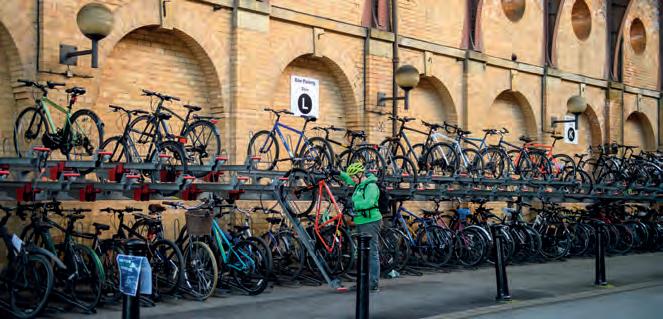
A blind eye to bike theft
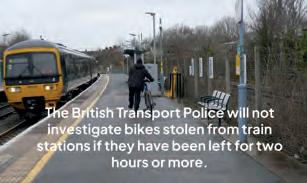
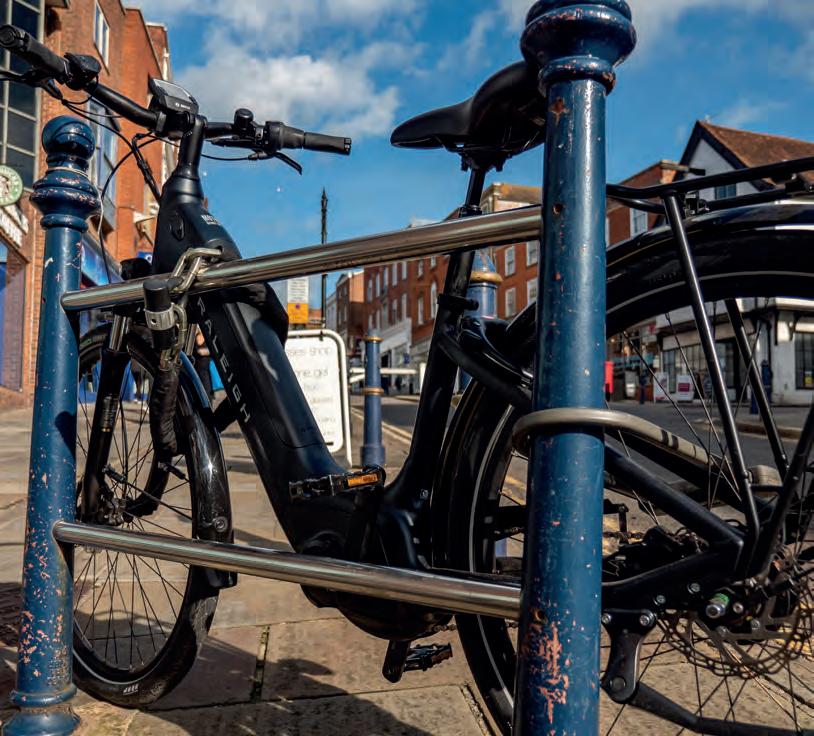
When I found out about British Transport Police’s (BTP) bike theft policy last year, I kept hearing Tony Robinson’s Baldrick voice in my head, telling Black Adder he had a cunning plan, writes Duncan Dollimore. Almost everyone locking up their bike at a train station leaves it for more than two hours, so the cunning plan was a policy to only investigate if the bike was left for less time than that.
It felt like BTP’s line on bike theft was: ‘see it, say it, sort it yourself’. After including that line in media quotes, we secured a slot on BBC Breakfast and wide coverage of our call for a policy change. Many of you were outraged by BTP’s policy and were quick to support us.
Now the first law of holes is: when
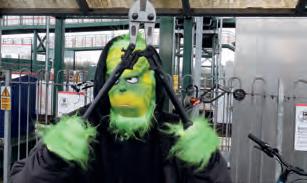
you’re in one, stop digging. Instead, BTP opted for a bigger shovel and carried on defending this absurdity. Doubling down, a BTP reply to our letter claimed that what we’d said about its policy was incorrect, even though we’d directly quoted from it. Lobbying, logic and media coverage didn’t change the policy, so we tried parody in the form of the Grinch.
Keen for a break from stealing Christmas in Whoville, the Grinch came to Cardiff train station to star in our campaign video (screenshots below left). The Grinch watches a clock count down from two hours, then takes out the bolt cutters at the station bike rack. Humour and satire are often the sharpest foils, and BTP agreed to meet with us. A Grinch story needs a happy ending and the good news is that BTP has now reversed its policy, dropping the two-hour rule and a linked policy not to investigate thefts of bikes under £200.
Being able to react quickly to policy changes, events and opportunities is critical to our campaigning, and often involves a combination of lobbying, media engagement, mobilising supporters and some creative delivery. It’s your support that enables us to carry on doing this. If you’d like us to continue campaigning, please consider giving a donation today. Visit cyclinguk.org/donate
Code unread
There was much to welcome in the UK government’s Road Safety Strategy, published in January, such as ambitious targets to cut deaths and injuries on Britain’s roads. Missing was any plan for promotion of the Highway Code, despite the government’s admission that changes introduced four years ago have not yet been embedded.
So thanks to all of you who’ve taken our campaign action (cyclinguk.org/safer-streets) and emailed your MP, asking them to press the government on the Highway Code. Already 20 MPs have raised this issue.
➜
My ride. Our right
Cycling UK’s ‘My ride. Our right’ campaign was in the spotlight recently when MPs from across political parties spoke about women’s cycling safety in a Westminster debate. Transport Minister Lillian Greenwod mentioned the campaign, glow rides and the importance of our Big Bike Revival Programme. With multiple MPs referencing information from Cycling UK, it was clear that the emails members sent asking their MPs to attend really worked.
Left: Joolze Dymond
Right: Robert Spanring
Quick releases
01 Pedal on parliament
Pedal on Parliament returns this year in Edinburgh at 11.30am on 30 May. Campaigners from across Scotland will gather in the capital to ride together on closed roads before descending on Holyrood to demand better, safer and more inclusive cycling conditions from the new parliament. Cycling UK will be out in force — and hopefully you’ll be able to join us. The month before that, on 25 April, we’ll be helping support Go Bike with election hustings at Renfield Centre, Glasgow, from 7-9pm. You can book a spot and submit a question on our website. cyclinguk.org/ scotland
Northern Ireland: inactive on travel
Cycling UK has criticised the Department for Infrastructure (DfI) over active travel delivery in Northern Ireland. Speaking at Stormont’s Infrastructure Committee, we warned that decades of strategies have produced minimal change. We also raised concerns about creative accounting being used to give the impression of investment, while spending remains among the lowest in the UK and Ireland. cyclinguk.org/stormont-2026
03
Road safety in North Wales
PORTSMOUTH CTC is running a Centenary Ride to Stonehenge on 9 May to celebrate the group’s 100th anniversary. The ride goes out via Winchester and home via Salisbury, paying homage to the group’s first ever club ride in 1926, which was also to Stonehenge. More details at: bit.ly/portsmouth-centenary-ride 04 05
Those of us who cycle, walk or wheel are disproportionately affected by close passes, drivers’ lack of understanding of the Highway Code, and worries about personal safety outdoors. On Saturday 23 May, Cycling UK will be at the North Wales Police Headquarters in Colwyn Bay to talk about road safety, our women’s safety campaign, ‘My Ride. Our Right’, and what needs to be done to enable more people to do their everyday journeys by bike. Come and say hello and find out what you can do to help us campaign for solutions. cyclinguk.org/wales
Memorial services for cyclists
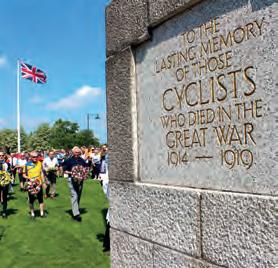
There are two longstanding memorial services in May to honour cyclists who have lost their lives in conflict. The 100th Coxwold Cyclists’ Service (04 on the map) takes place on at 1.30pm on 10 May at St Michael’s Church in the North Yorkshire village, with Archbishop of York Stephen Cottrell giving the address. Refreshments are available beforehand. For details, visit cyclinguk.org/annualcyclists-service
Then on 17 May, it’s the 105th Cyclists’ Memorial Service in Meriden (05), near Coventry. At 11am attendees will gather on Meriden village green for a service led by Reverend Kevin Flanagan, with music from the Bulkington Silver Band. Refreshments are available afterwards at the village hall (please bring cash). cyclinguk. org/annual-memorial
Go group riding this spring
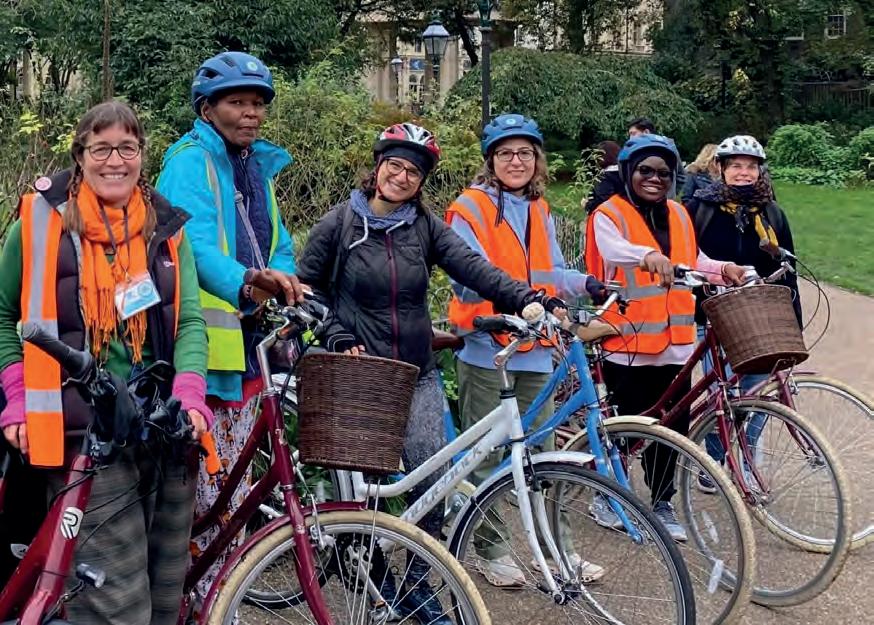
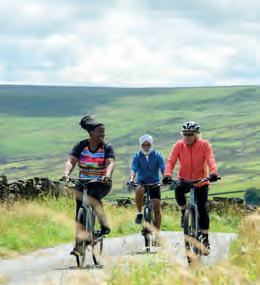
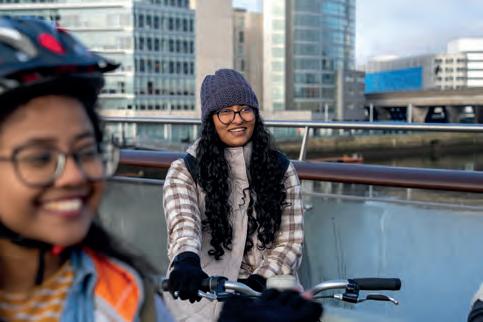
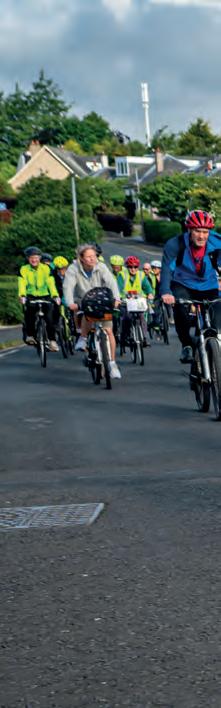
Longer days, lighter evenings and the first glimmers of sun make spring the perfect time to try group cycling. Whether you’re returning to riding after a break or getting on a bike for the first time, joining a friendly local group can boost your confidence, build fitness and connect you with people in your community. Across the country, Cycling UK groups bring people together through regular rides, skills sessions and social events. One inspiring example, pictured above, is the Brighton Multicultural Women’s (BMW) Cycle Club, a Community Cycle Club (cyclinguk.org/cycleclub-bmw). Founded in 2021 by refugee support specialist Cicely Lloyd, the club began as an outdoor ESOL (English for Speakers of
“Joining a friendly local group can boost your confidence, build fitness and connect you with new people in your community”
Other Languages) and fitness opportunity during the Covid pandemic, when many women were experiencing isolation and limited access to exercise.
What started with 22 sessions in its first year has grown into a thriving, women-only inclusive safe space that offers learn-toride training, gentle group rides and peer support. In 2025, the BMWs delivered 89 rides and events, with more than 100 women taking part. Bikes, helmets and subsidised bus tickets are provided, helping remove financial and practical barriers. With trained ride leaders, volunteer instructors and strong local partnerships, the group empowers women from diverse ethnic backgrounds to gain independence, confidence and a sense of belonging. As one member said, cycling made her feel free.
You can find your own local group through the Cycling UK website (cyclinguk.org/ groups) where clubs list regular rides for different abilities, from relaxed social spins to longer weekend adventures. Spring is a great time to join, as many groups launch beginnerfriendly programmes and welcome new faces at the start of the season.
Celebrate Bike Week
Save the date: this year’s Bike Week will take place from 9-15 June. This celebration of all things cycling is a great time to put on a beginner-friendly event, or to do something a little different with your usual group ride.
This year, why not host a Bike Week Brunch? It could be as simple as a social ride ending with coffee and pastries, or a bigger get-together with cake, quizzes and fundraising. It’s an easy way to bring people together, welcome new riders and celebrate Bike Week in a relaxed and friendly way.
For updates on what’s happening during Bike Week, visit cyclinguk.org/bikeweek
AGM motions sought
The 2026 Cycling UK AGM will take place on Friday 18 September. We are now launching the call for motions. For details on the process for proposing motions, as well as the criteria against which motions will be reviewed, visit cyclinguk.org/agm-2026. The deadline for motions is 9am, 15 April 2026. Voting papers will be included with the August/ September issue of Cycle.
Left:
Joolze Dymond
Insurance you can count on
Almost one in five of you – 18% – recently told us that you had no cycle insurance, while more than half believed that your bike was already covered by your home insurance. But is that cover enough? Home and specialist cycle insurance can be very different.
Adding a bike to a home policy may seem like the easiest option, yet the small print can leave you vulnerable. Standard home policies often have a lower cap on bike values – sometimes as little as £500 – and may exclude accidental damage, something that accounts for 42% of all Bikmo’s claims. Expensive riding kit and accessories aren’t included in many home policies, and some won’t cover your bike if it’s away from home and not in your possession for more than a few hours –even if it’s locked.
To help you navigate these pitfalls, Cycling UK’s partner, Bikmo, has put
together a comprehensive home-versus -cycle insurance guide, explaining exactly what to look out for.
As a Cycling UK member, you’re already one step ahead with free third-party liability cover from Bikmo. You can further bolster your protection with an exclusive 10% discount (terms and conditions apply) on Bikmo’s comprehensive specialist cover. This provides 24/7 worldwide protection, coverage for your clothing, and a zero excess option when replacing through retail partners.
To read the full guide and get a quote, visit: bikmo.com/uk/cyclinguk/ homevscycle/
Financial advice from M&G
As a Cycling UK member, you can book a free, no‑obligation call with a qualified financial adviser from M&G Advice. They will give you a personal recommendation. A charge will only be payable if you proceed with this recommendation. It’s a straightforward way to talk through your goals, explore your choices and get a clearer picture of your pensions, savings or retirement plans. M&G Advice offers a restricted advice service. Book your free consultation today. cyclinguk.org/mg-advice
Get kitted out with Kalas
Spring is the perfect time to refresh your cycling wardrobe. Cycling UK’s kit partner, Kalas, combines premium fabrics, technical performance and clean design for comfort on every ride. This season, explore the Passion Z6 collection, which is made with lightweight, breathable materials and an aerodynamic fit – ideal for everything from faster road rides to relaxed spins. Cycling UK members get 15% off Kalas apparel and accessories, and a portion of every purchase helps support Cycling UK’s work. cyclinguk.org/kalas-kit
Cycling to the edge of the world
If you’re a cyclist looking for a truly unforgettable holiday experience that combines the thrill of cycling with the opportunity to cycle with others, and to relax and immerse yourself in the breathtaking natural beauty of your surroundings, then look no further than Halcyon Cycling Holidays.
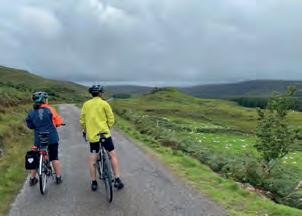
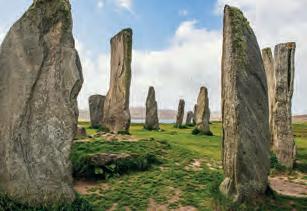
Our trips offer a variety of different cycling experiences and great value for money, fantastic quality, the very best customer service excellence and, now launched, a couple of brand new Scottish cycling adventures for 2027 including Cycling The Outer Hebrides and St Kilda, known as the island at the edge of the world, and Cycling Mull, Iona and Ardnamurchan Peninsula, as well as a brand new
series of guided and supported European road cycling holidays to the Costa Blanca, Andalucia and Costa del Azahar in Spain.
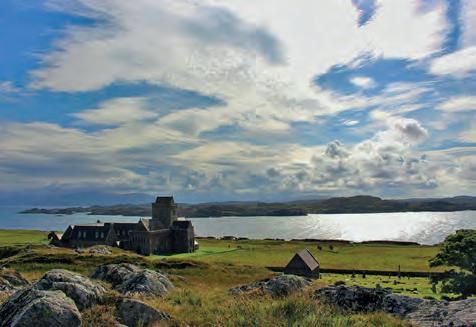
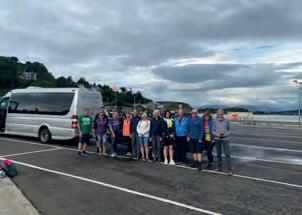
Cycling The Outer Hebrides and St Kilda is the ultimate cycling adventure. It’s a ten-day fully guided and supported tour, departing 16 May 2027, following the popular Hebridean Way cycle route, with extra nights on the stunning islands of Barra and Harris. You will also have the opportunity to experience the remote island of St Kilda, a UNESCO World Heritage Site. It’s a once-in-a-lifetime opportunity combining superb cycling, unique local culture and world-class sites to explore. The other brand new trip to Scotland, departing 12 June 2027, is cycling the isles of Mull, Iona and the Ardnamurchan Peninsula. The fully guided and supported programme of rides offers the opportunity to visit the Isle of Iona, often called the cradle of Christianity and world-renowned for its spiritual significance, ancient history and striking natural beauty. Both trips include return transport for bikes, cyclists and bags.
Other Halcyon cycling trips include Cycling Southwest France, The Cotswolds, The Rebellion Way, North Yorkshire, Islay & Jura, and North Norfolk.
To celebrate the launch of next summer’s programme, Halcyon Cycling Holidays is offering Cycling UK members an exclusive membership discount of £125 off per person on any 2026 or 2027 cycling holidays featured on their website. To claim the discount, use code CTC125 at checkout. Visit halcyoncycling.co.uk and click on cycling holidays. Alternatively, scan the QR code or call 01226 700428 to speak to one of the team.
The discount cannot be used in combination with any other code. Holidays are subject to availability and normal booking conditions apply. Offer valid until 31 July 2026. New bookings only.
The new cycling adventure includes the opportunity to visit the Isle of Iona, renowned for its natural beauty
Great rides
Channel hopping
A named storm wasn’t going to stop the short cycling break
Sam Jones and his friend Huw had planned. But it did make it more complex and much wetter
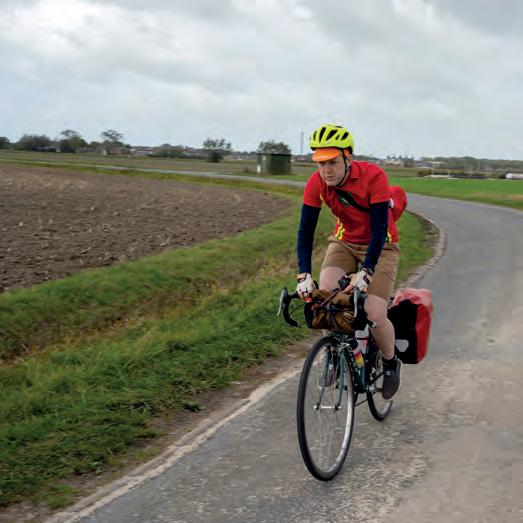
Touring cyclists find solace in the strangest of places: bus shelters, drainage pipes, essentially anywhere that provides a shelter from the elements. For Huw and I, one dark and stormy evening as British shores were lashed by the furies of our first named storm of the year, the bins at the Port of Dover were our happy place.
Peering out between the giant vestibules of rubbish, we watched the horizontal rain batter idling cars in relentless waves of water. Wipers were on full tilt, as someone in hi-vis oilskins directed the vehicles and their nice, warm and dry inhabitants onto a ferry that glimmered through the storm’s haze.
“We’re soaked and freezing. Let us on!” I yelled at the traffic manager guiding vehicles off the grid and onto the ferry, but was ignored. Or perhaps not heard? After half an hour of these conditions, cold had set in and we couldn’t stand it anymore. Together we barged our way onto the concourse, forcing them to notice us. Finally, chased by juggernauts carrying their wares into the EU, we boarded.
Riders on the storm
We weren’t even meant to be on this ferry, leaving from this port or heading to Calais. It didn’t matter. We were glad just to be inside and heading to France. Four hours earlier, we’d met at Lewes train station, ready to take the next train to Newhaven for our intended ferry to Dieppe. Ferry company DFDS called just before we boarded the train with the unwelcome news that our ferry was cancelled due to Storm Amy.
As 40−somethings with family commitments who live in different countries within the UK, finding a weekend away is a rare and special
“Through the ferry window, the harbour walls of Calais rose sickeningly up and down, drizzled in orange lamplight”
thing. We weren’t going to let a storm stop our French trip.
“Are ferries running from Dover?” I asked.
DFDS confirmed they were and that our tickets were valid for the 00:30 crossing. Which is why, three train changes and some bin sheltering later, our holiday began.
We had about half an hour’s worth of sleep, before a ferryman insisted we wake and pack up our still drying clobber. Through the ferry window, the harbour walls of Calais rose sickeningly up and down, drizzled in orange lamplight. It was half three in the morning and we needed more rest. Perhaps in the ferry terminal? We stumbled bleary eyed down to the hold and our securely fastened bikes.
We were in no hurry to leave the safety of the ship, but as the last lorry left it was ‘once more unto the breach’. As we inched off onto the tarmac, a van with amber flashing lights pulled up. A man shouted something at us, which we assumed by his gesture was something along the lines of: “Come with me if you want to live!”
He set off at 10mph. Battered by rain and wind, we struggled to keep up. Terminal plans were
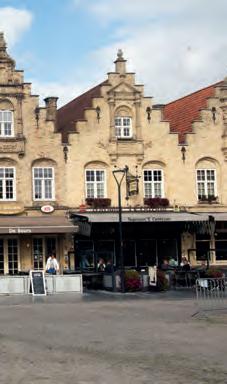
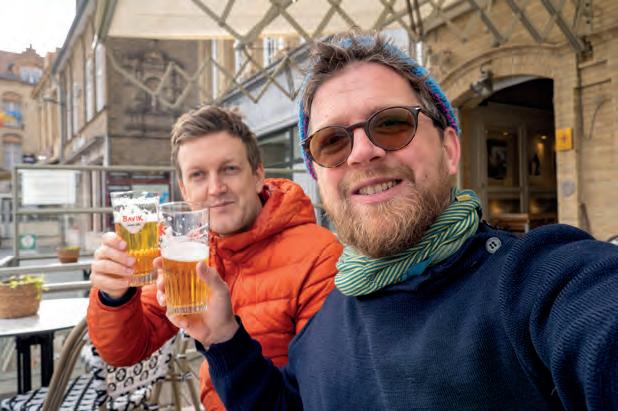
Below: Celebratory Belgian bieres in Veurne’s Gothic market square – only halves, mind you
Photos: Sam Jones and Huw Poraj-Wilczynski
scuppered as we were led from the port and deposited into the black unknown of Calais.
Darkest before dawn At this hour there was no traffic and no light. We had no idea where we were and no real plan of where to go, given that six hours previously we’d planned on riding from Dieppe to Calais. On the ferry, consulting weather apps, we’d decided that heading into the wind to Dieppe wasn’t worth it but, with the wind behind us, a 123km ride to Bruges was achievable.
“We gave up on Bruges. Riding until daylight and finding an open café became our mission”
shelter and an oven’s warmth but also hot, black coffee. Two cups, four chocolateinfused pastries and a large puddle beneath our plastic chairs later, we began to feel human.
Fact File Channel hopping
Distance: 151km (day 1, 48km; day 2, 103km).
Route: Planned to ride from Dieppe to Calais. Cancelled ferries saw us starting in Calais instead and following Eurovelo 4 to Veurne in Flanders, Belgium via Dunkerque,then back again.
Conditions: Storm Amy was unkind, with biblical rain and fierce winds battled in coal-black night. On the second day we had headwinds. Largely traffic-free, open lanes meant no shelter.
Bikes used: Isen All Season Plus (Sam), 1980 Team Miyata tourer (Huw).
After 50 minutes and 15km, following flooded gravel paths and stung by incessant rain, we sheltered from the storm at a bus stop. A frog had a similar idea and was busy eating a worm. That’s when we gave up on Bruges. Riding until daylight and finding an open café became our mission.
Ducks quacked at us from the darkness. We passed through woods, along quiet lanes and who knows what else in the darkness, riding hard and scoffing sweets to stay warm in the wet. Hypothermia began to set in and our battery lights gradual faded. Directions were messed up. With my dynamo light out front and Huw’s fading rear light, we rode on until we spotted the blessed sight of a boulangerie with lights on and an ‘ouvert’ sign on the door.
There weren’t just baked goods,
Dawn was trying to break through the clouds outside. The boulangerie’s respite from the rain allowed us to check our phones. It turned out we were on the outskirts of Dunkerque – and there was a bikefriendly Ibis hotel with a room. Back in our 20s and 30s, Huw and I would have camped. Older and wiser now, we decided to hotel it.
It was the best decision we made. All the campsites we’d checked beforehand were closed. And the hotel staff took pity on us and let us check into our room at 9am rather than after midday. (Perhaps soaking, slumbering men in the lobby as residents eat their breakfast is bad for business?) Half an hour later, warm and dry at last, our snores rattled the windows.
Belgian detour
Waking in the afternoon, we spent our time in launderettes drying sodden clobber, eating galettes by the seaside and acting as tourists rather than tourers. It was a strange feeling for a weekend tour, where so often the focus is on the riding, rather than taking time to soak in the places you pass through.
Maps/guides: Original maps were scrapped. Komoot and Google maps saved the day. I’m glad I had… Wahoo ELMNT Roam 2 to guide us on the go. Sinewave beacon dynamo light for the ride from the ferry to Dunkerque.
Next time I would… Reproof my waterproofs.
Further info: en.eurovelo.com/ ev4; discoverferries.com; dfds.com; leshuttle.com/ uk-en. For general info on ferry travel, see cyclinguk.org/ bike-ferry
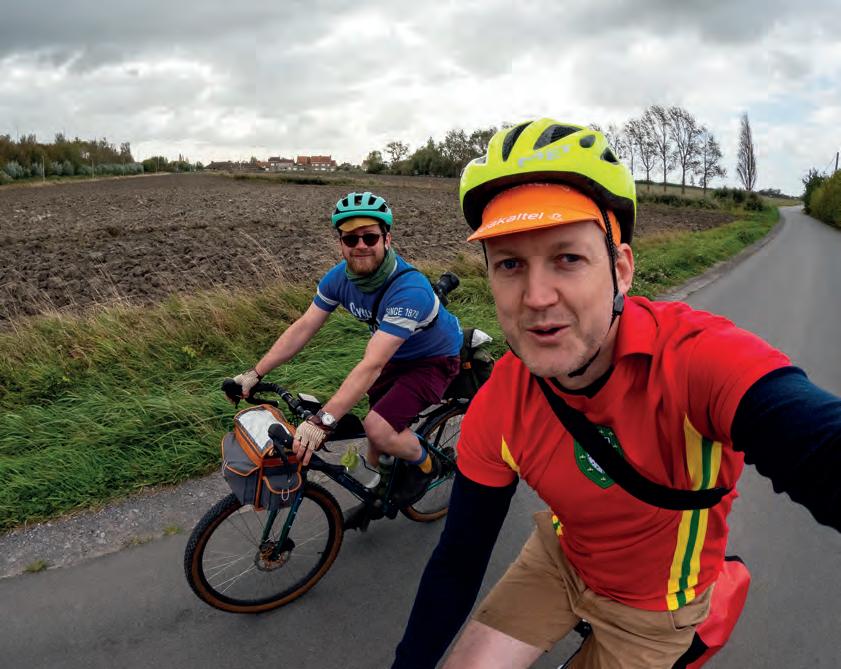
Top left: Huw pushes on through Flandrian headwinds, regretting his lengthy lunch
Top right: Sam returning to Dunkerque, happily and mistakenly thinking that he’s about to board a train
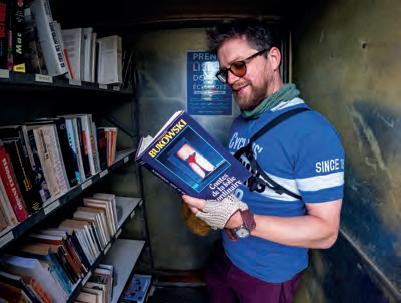
Bottom right: Sam at the book exchange near the French border, on the return leg
Tour&explore
The next day, we embraced this more casual style of riding. Stopping became de rigueur; it was Sunday after all. The forecast promised a tailwind into Flanders. We hoped to spot windmills and find a nice lunch spot, at which point the wind was meant to drop. We’d then return to Dunkerque for the afternoon train to Calais.
“Sand sheeted along Dunkerque’s beach and kite surfers leap to terrifying heights”
Leaving Dunkerque along its seafront, sand sheeted along the beach and kite surfers leapt to terrifying heights. With smug grins, we rode with the wind at our backs in dry clothing. Today was going to be a good day. I could just feel it.
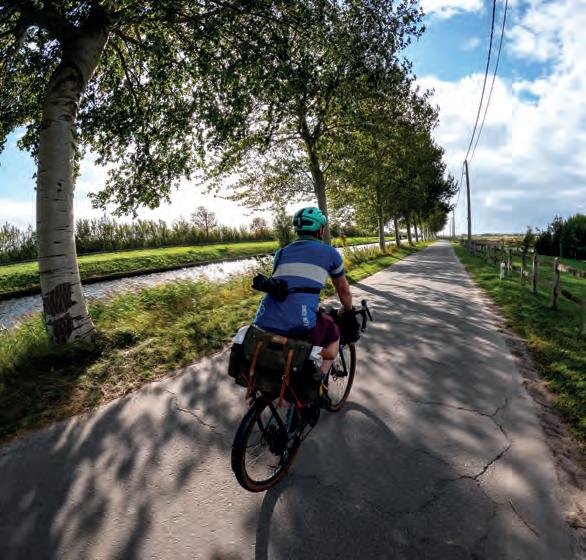
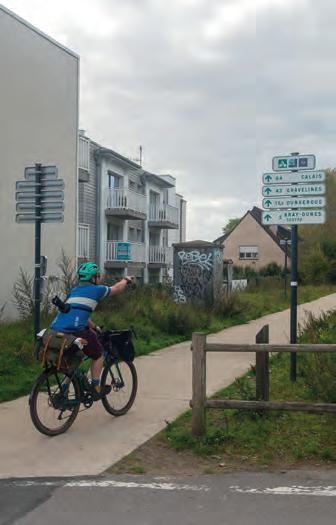
Every time I ride on the Continent, I’m overwhelmed by the thoughtfulness of the cycling infrastructure. Being able to ride and chat without concern of motor traffic is a joy. In Département du Nord, there are wide open lanes that enable you to see and be seen for miles by other traffic.
Crossing a border you hope for a dramatic change, but the differences were more subtle. French roadsigns became Flemish. The cycling infrastructure became a bit more inclusive. By the time we arrived in Veurne’s Gothic market square for lunch, weekend roadies were just as common as families out on laden
e-cargo bikes.
The wind failed to drop while we ate, and our detour to St Charles’ Windmill on De Moeren (the Moors) began to feel foolhardy on full bellies. Chain-ganging back to Dunkerque, heads down and legs tired, we eagerly anticipated our train ride back to Calais. Fate conspired against us. There were no bike spaces.
Racing home
Our LeShuttle pickup was midmorning the next day and we had a hotel booked and paid for in Calais. There was only one choice: we stocked up on Haribo and headed back into the wind. As dusk settled, the wind dropped to a stiff breeze and we could finally witness what we’d missed on our initial journey. Along one stretch we waved at and were greeted by small groups returning to a tent village hidden within a forest. It looked like the aftermath of Glastonbury: battered tents and mud, mud, mud everywhere. Yet it was far sadder. These were the homes of people hoping for a better life that were under siege from the elements. Then we found fascist graffiti nearby. It put into perspective our grumbling about a single night in the damp.
Tunnel vs ferry
Ferries are the simplest, most regular and often cheapest way to reach France. Newhaven to Dieppe (around 4hrs) runs twice a day, and for a passenger and bike costs from £28.80/£57.60 (DFDS one way/return). Dover to Calais (~1.5hrs) has a minimum of 10 and maximum of 30 sailings each day, with prices from £30/£55 (DFDS). All services are easily bookable online, with good telephone assistance if plans change.
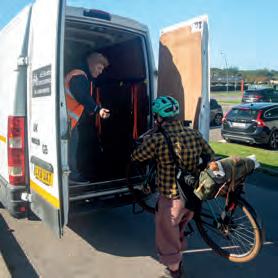
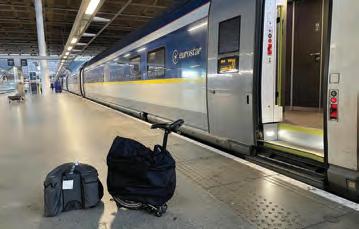
There are two ways for cyclists to use the Channel Tunnel: Eurostar and LeShuttle. At the time of writing, Eurostar is still not accepting oversized luggage, which includes bikes (folders excepted). LeShuttle’s cycle service uses a customised van run by an external contractor. Running from Folkestone to Calais twice a day, this £50 each-way service is the swiftest (35 minutes, excluding passport checks). Pick up in the UK is outside a Holiday Inn, while in Calais it’s behind the CIFFCO Siege D’Exploitation via some busy roads. Booking is not intuitive, requiring a hard-to-find form on the LeShuttle website, email correspondence and a bank transfer. Last-minute bookings are not accepted. It’s a shame it’s so difficult to book as the service itself is convenient (it even takes tandems!), and the drivers are knowledgeable, friendly and helpful.
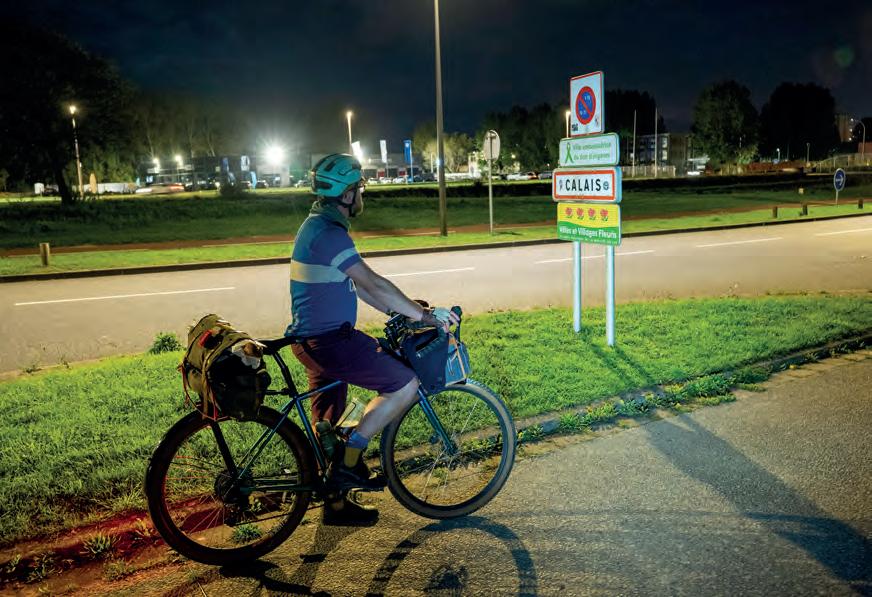
As tiredness kicked in, we were left alone with such thoughts, pedalling squares as we strove to reach Calais. Brief episodes jolted us out of our reveries. A strange archery competition at Loon-Plage where contestants shot arrows at a pylon. A book exchange where there was no Dan Brown like in England, but Umberto Eco and Bukowski instead. We finally arrived in Calais as we had left it: in darkness and tired. We were happy for the ride we’d had –and hungry, oh so hungry!
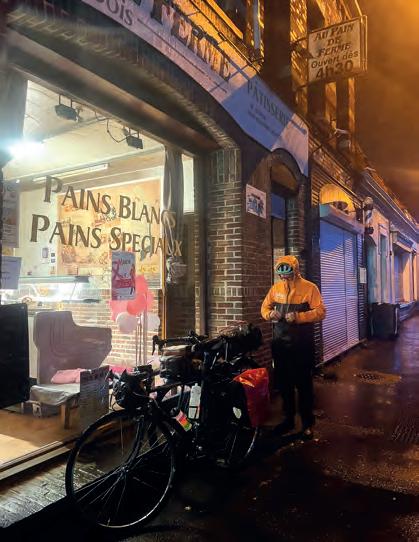
Left: Sam reaching Calais much as he left it: in the dark – albeit without the storm force winds and biblical rain
Below: Sam loading his bike onto the LeShuttle van for the return home
Hell of the Ashdown
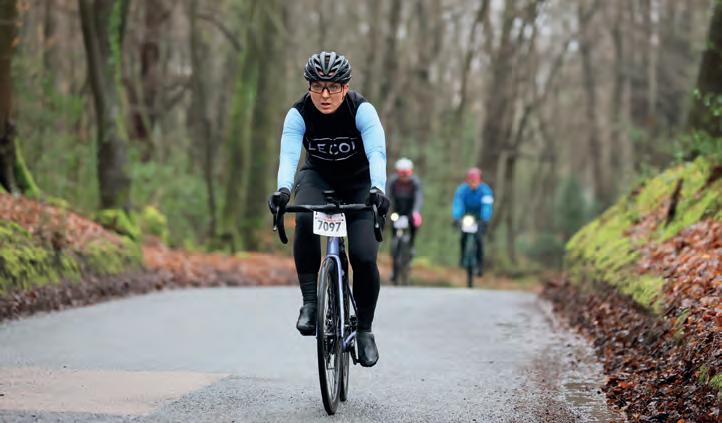
This early-season sportive through Surrey and Kent demands winter base miles in the bank and low gears on your bike. Stephanie Rukin rode it
The Hell of the Ashdown is a ride that quietly earns its name. At just over 93km it doesn’t appear intimidating, yet the amount of climbing (1,674 metres) packed into that distance tells a different story. There are no mountain passes here, just a steady succession of short, sharp Weald gradients. Moreover, the annual sportive (helloftheashdown.cc) that I rode is in February. Spring or summer would be a less gruelling day out if you’re riding the route independently.
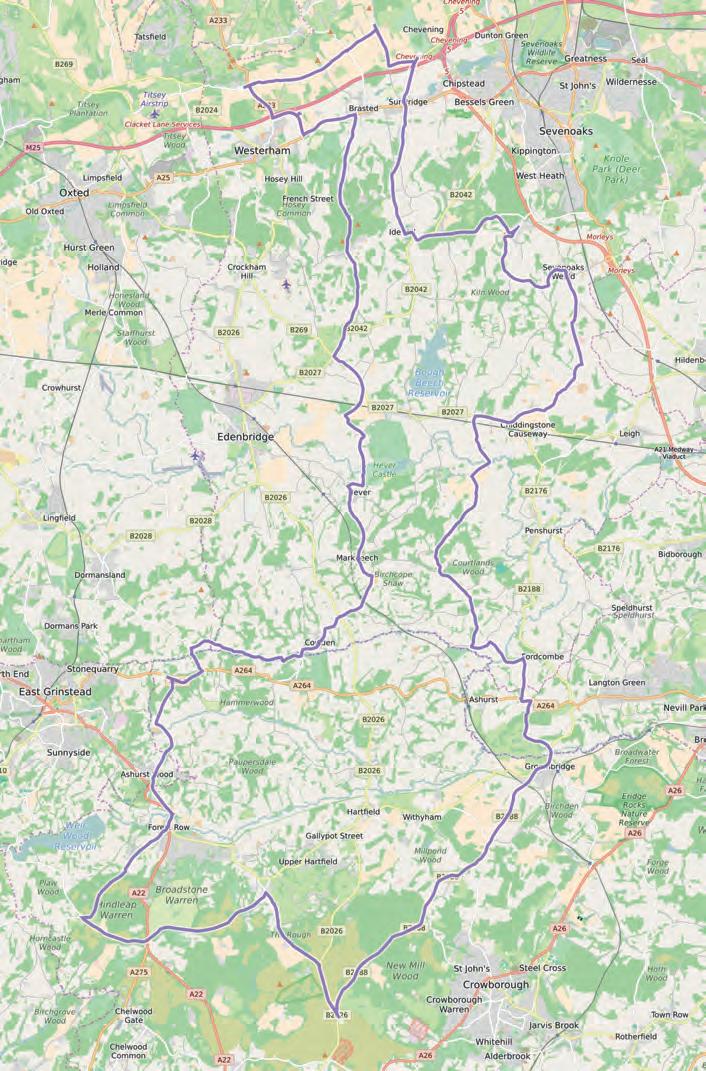
Starting from Westerham Brewery, the loop runs anticlockwise into the rolling folds of the High Weald. The opening kilometres offer little time to warm up before Toys Hill sets the tone: a 2.9km climb averaging 6%, with some steeper sections. From there, narrow lanes thread south through hedge-lined countryside and wooded hollows, rising and dipping with enough frequency to prevent any prolonged stretch of ease. Just as the rhythm settles, it changes.
The route passes near Hever Castle, childhood home of Anne Boleyn, its Tudor brickwork providing a brief visual pause before the climbing resumes. Priory Road and Twyford Lane sharpen the legs, each ramp arriving without ceremony. Then comes Kidd’s Hill – known locally
as The Wall – a climb that builds in stages and resists any attempt at comfortable pacing. It isn’t especially long, but it commands attention. As the loop begins to arc back north-west, Bayley’s Hill offers another stern test. By now, effort management earlier in the ride starts to feel significant. Beyond, the landscape opens towards the higher ground near Ashdown Forest. A short, optional detour into Hartfield adds extra elevation but rewards with sweeping views towards the South Downs, the pale chalk ridge standing clear on bright days. A pause at
the village’s Winnie-the-Pooh café provides welcome encouragement before the final miles back towards Westerham.
The sportive route is adjusted slightly from year to year to reflect road surface conditions, so exact figures can vary. The character, however, remains constant: quiet rural lanes, persistent gradients and scenery that more than justifies the effort. As you finish back at the brewery, there is a real sense of achievement – not from conquering one monumental climb but from having met them all.
Stephanie on the climb of Toys Hill, near the start
Hell of the Ashdown
STEPHANIE RUKIN
Cycling UK’s Partnerships
Manger and a keen road cyclist
Route name: Hell of the Ashdown Start/finish: Westerham Brewery, Westerham, Kent
Maps: OS Landrangers
198 (Tunbridge Wells & East Grinstead) and 188 (Maidstone & The Weald) Ride length: 93.29km (58 miles) Climbing: 1,674 metres
A steady opening test up the densely wooded Greensand Ridge, Toys Hill encourages restraint rather than bravado. Long enough to sting at 1.8 miles, it is consistent enough to ride at tempo, with an average gradient of 6%. Toys Hill sets the pattern for the day, so pace it sensibly. There is plenty more to come.
02 Hever Castle
The route passes close to Hever Castle, childhood home of Anne Boleyn – Henry VIII’s second wife. Tudor brickwork and manicured grounds contrast with the steep, narrow lanes nearby. It’s a brief historical interlude before the gradients reassert themselves. If you’re riding the route casually, you could pay a visit. There are bike racks at the entrance.
03 Priory Road
Leaving Forest Row, a village ranked as Britain’s third poshest by Country Living magazine, Priory Road is a short climb that’s enclosed by woodland. It ramps up quickly, with a gradient that feels steeper than the route profile suggests. Smooth, seated climbing pays dividends.
04 Hartfield detour
If you’re riding the route independently and want a short diversion before tackling Kidd’s Hill, head to Hartfield. While it means more climbing,
you’re rewarded with expansive views towards the South Downs. Pooh Corner, a tearoom, gift shop and museum celebrating AA Milne’s fictional bear, is a good place to refuel. Honey optional.
05 Kidd’s Hill
Known locally as The Wall, Kidd’s Hill starts from Coleman’s Hatch and heads straight uphill, with no hairpins to hide what’s ahead. It builds in stages, which makes rhythm difficult to find. It isn’t excessively
long, but has a maximum gradient of 16%. It demands steady pacing and sensible gearing.
06 Bayley’s Hill
Arriving later in the loop, just after Sevenoaks Weald, Bayley’s Hill tests whatever reserves you have left. It twists between hedgerows that mask its summit, so it feels longer than the official length of 1.3km. If you have the energy to look up, the views over your shoulder are well worth it.
Great rides
Atlas to Sahara
To celebrate her 50th birthday, Cycling UK’s Rebecca Armstrong decided to cycle through Morocco’s Atlas Mountains to the Sahara Desert
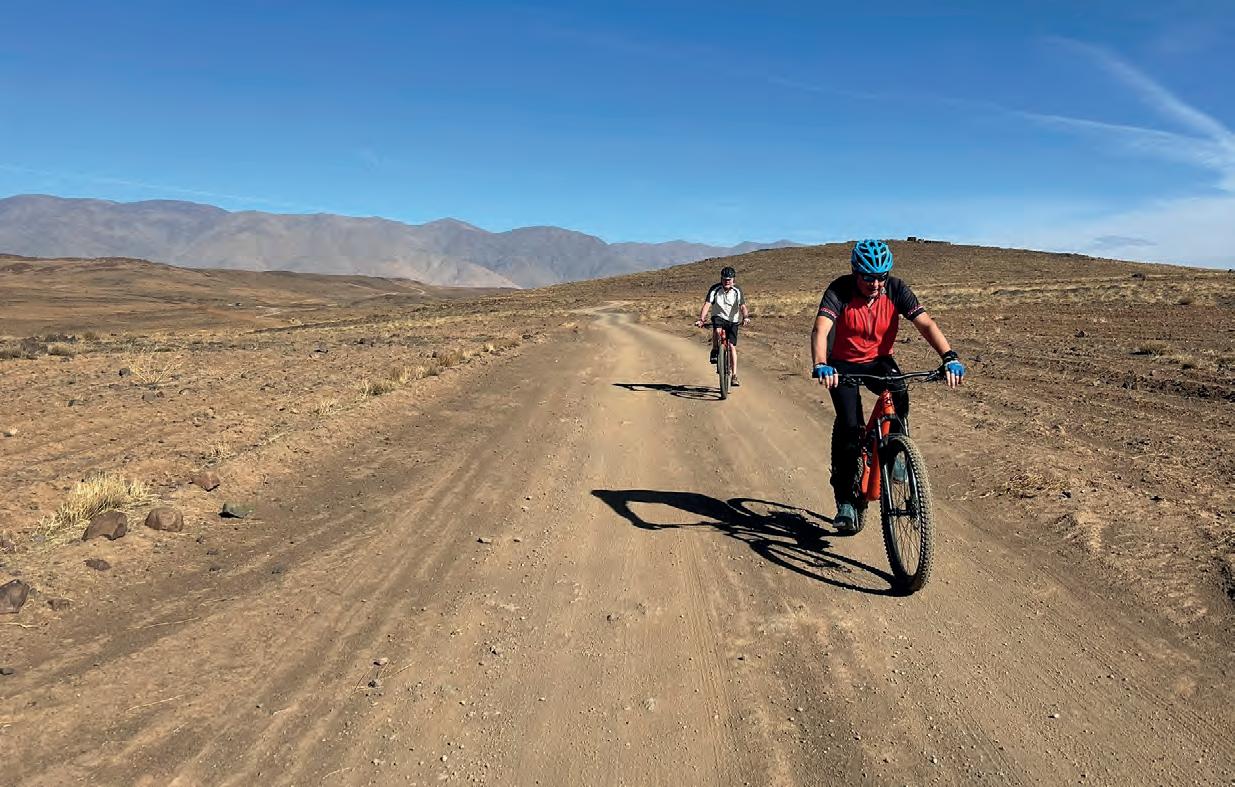
Just one more like this?” My companions asked as we crested the top of another kilometre-long climb. “I’m not so sure,” I replied. We were nearing the end of our third day of cycling on a tour through the Atlas Mountains to the Sahara Desert. “Just four short, sharp climbs to the end!” Abdel, our guide, had reassured us earlier.
After setting off that day, my Garmin had led me almost immediately into the first climb: 650m and not too steep. We got to the top with little effort. “If it’s all like this, it’ll be a breeze,” I thought to myself as I went swooping down.
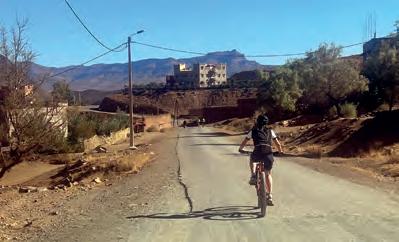
We were cycling on welltarmacked, largely deserted roads through stunning mountain scenery, and it wasn’t long before the next climb was in sight. At 1,100m this was going to be tougher. It was about this time that I started to suspect that the first climb wasn’t one of the four. As Abdel joined us at the top of that third – or was it second? – a few voices called out: “Just one more?”
“No, two more!” came the response. At least it wasn’t a shock to me. With all four climbs done, there was massive sense of achievement – and just a short descent to the rural village where we would be spending the night in the most basic
accommodation you can imagine. The toilet was a hole in the ground, the shower a hosepipe.
Riverbeds and rough stuff
The trip had started in the Moroccan capital of Marrakech. We were riding from Telouet, a village in the High Atlas Mountains, outside Marrakech, across the Atlas Mountains to the Sahara Desert for a night in a Bedouin camp. Day one was arrival in Marrakech – a non-cycling day. I met the other seven members of the group and our guide for the first time: five Canadians, a fellow Brit, and the only other woman on the trip, from the Netherlands.
The next day brought our first day of cycling. Following a three-hour transfer to Telouet, we were united with our bikes. This was one of the least challenging days to ease us in: just 46km with about 500m of climbing, with the first few kilometres on tarmac before heading onto gravel.
However, part of the track had been washed away and what should have been hard-packed gravel was loose stone and sand with several craters that we had to dismount and climb over. After quite a rough descent we found ourselves on a well-surfaced lane through rural villages.
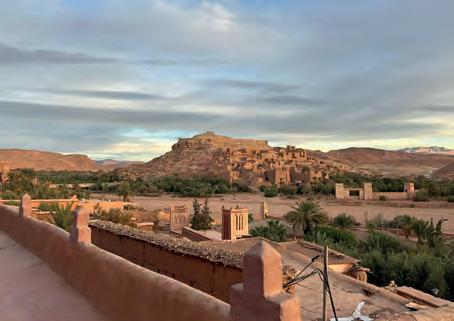
We arrived at our hotel with just enough time for a shower and change of clothes before heading off for a walk across a very dusty dry riverbed to Ait Benhaddou, a ksar (fortified village) that sat on a former caravan route between Marrakech and the Sahara. Today it’s a UNESCO World Heritage Site and considered a great example of Moroccan earthen clay architecture. It’s also a location for several films, including Jewel in the Nile and Prince of Persia.
Across the Atlas
camping for the night. At times the gradient was up to 12%, although the average was 7%. The surface was loose gravel and sand. Most of the group decided to take the support cars up to the top.
Three of us, plus Abdel, opted to cycle. There was a lot of walking, pushing our bikes through soft sand. It was hard, but riding into camp that evening to the cheers of the rest of the group felt triumphant.
After breakfast and breaking down camp the next morning, we set out across the plateau. Abdel described the grassy terrain as “undulating”. My legs and lungs disagreed. But I was starting to get used to the elevation.
“Abdel described the terrain as ‘undulating’. My legs and lungs disagreed”
A steep descent took us to a village where the main drag was a rocky dry riverbed populated by chickens and small children wanting highfives. We stopped here for tea, served with bread and honey. Then it was another climb. This one was 6km. While it wasn’t as steep as the previous day’s, the start looked practically perpendicular.
Fact file Atlas to Sahara
Distance: 252km in total; daily average 42km.
Route: Starting in Telouet, a village just outside Marrakech, we cycled through the High and Anti Atlas Mountains and the Draa Valley to the Sahara Desert.
Conditions: Mostly warm and bright, with daytime temperatures of around 30°C; mornings and evenings 5−10°C. One day was cooler and overcast. A mix of loose gravel and sand and quiet, tarmac mountain roads.
Bike used: Cannondale Lefty, hired from Saddle Skedaddle. Maps/guides: We were following a guide, but Saddle Skedaddle also provided GPX files of each day’s riding, which I had on my Garmin.
I’m glad I had… Padded shorts and chamois cream – the hire bike’s saddle wasn’t as comfortable as my own. Next time I would… Tackle that 6km climb! And partake in the hammam.
Further information: skedaddle.com/uk
After breakfast on the terrace the next day, we climbed into 4×4s for a transfer to the start of three days of cycling through the remote Jebel Sirwa region of the Atlas Mountains. The terrain was a mix of winding tarmac roads and loose gravel and sandy trails.
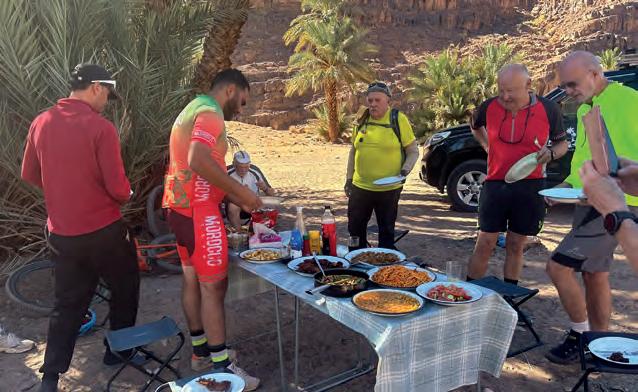
We really were in the middle of nowhere. Lunch was eaten in a windswept field, sheltering behind boulders and our support vehicles. The food – here and at all lunchtimes – was impressive. Salads, roasted vegetables, pasta, plus skewers of chicken and lamb for the meat eaters, all prepared by our personal chef from the back of his 4×4.
The route ended with a 5km climb up to the plateau where we would be
I took one look and lost my confidence. I took the car to the top. Once there, I was reunited with my bike and set off again. With hindsight I wish I’d tackled that climb. The day’s cycling ended with those four ‘short, sharp climbs’ of Abdel’s.
Photos: Rebecca Armstrong
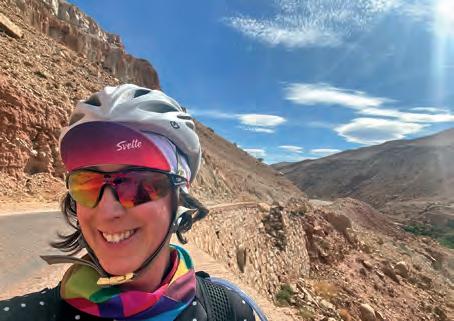
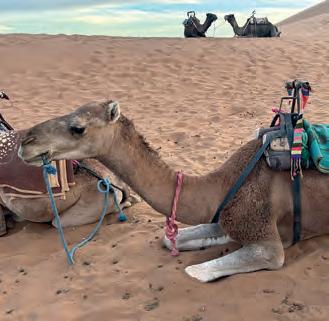
Opposite, clockwise from top: Fellow Brit Ritchie and Canadian Allan ride across the High Atlas plateau. Getting ready for a camel ride. The author taking a short break on the first day’s riding. Ait Benhaddou, a former fortified village
Below: Lunch at an oasis in the Draa Valley. They kept us well fed!
Dates at the casbah
The next day was the second-longest ride of the trip but with significantly less climbing than the previous two. We covered just under 50km, but 16km of that was an epic and steep descent to the Draa Valley.
For a mountain-biking newbie with a fear of heights, this was challenging: a fast, twisty downhill on soft sand, gravel chips and rocks, often with a sheer drop to one side. I had my brakes covered at all times and was concentrating hard on avoiding the biggest rocks and finding the smoothest path down.
After about 8km off road, we got onto tarmac, with switchbacks and blind corners. “Keep to the right, there might be cars coming,” Abdel warned us. With a sheer drop on the right, I found this advice hard to follow. There were times when the road straightened up enough to let
go: 40km/h with a sheer drop to one side was certainly exhilarating. The final kilometres were cycling through a vast oasis that’s home to millions of date palms. This offered up some stunning riding to the hotel. That night we enjoyed a stay in a luxury former casbah, complete with hammam, a Moroccan steam bath, where some of our party treated their tired muscles. We had a late start the next day to make the most of the hotel. I sipped Moroccan tea on the balcony while watching the sun rise over the date palms.
Sundown in the dunes
We were nearing the Sahara Desert now, with just two days left of riding through the Draa Valley’s extensive date palm groves. The palms were heavy with fruit and Abdel informed us that each one could produce up to 10,000 dates. They’re a key source of income for the area.
“I sipped Moroccan tea on the balcony, watching the sun rise over the date palms”
The last day on bikes had just 27km of riding on the clock, then we transferred to the 4×4s for the final leg to the Sahara. The journey was delayed somewhat when we stopped and piled out of the cars for encounters with a Common Ostrich
Get away for less
The remote nature of this ride would have made it difficult – and potentially dangerous – to undertake self-guided. I booked the ‘Atlas to Desert’ tour with Saddle Skedaddle, Cycling UK’s official tour partner, to take advantage of a 5% discount. The company offers Cycling UK members a variety of regularly changing discounts and special deals. Check the website to see what’s currently available: cyclinguk. org/saddle-skedaddle I was impressed with the organisation. Everything went without a hitch, and the staff at Skedaddle handled all my questions with aplomb. I booked my travel insurance through Bikmo (cyclinguk.org/bikmo-travel), as a member saving 10%.
and an Addax. We also saw our first camels.
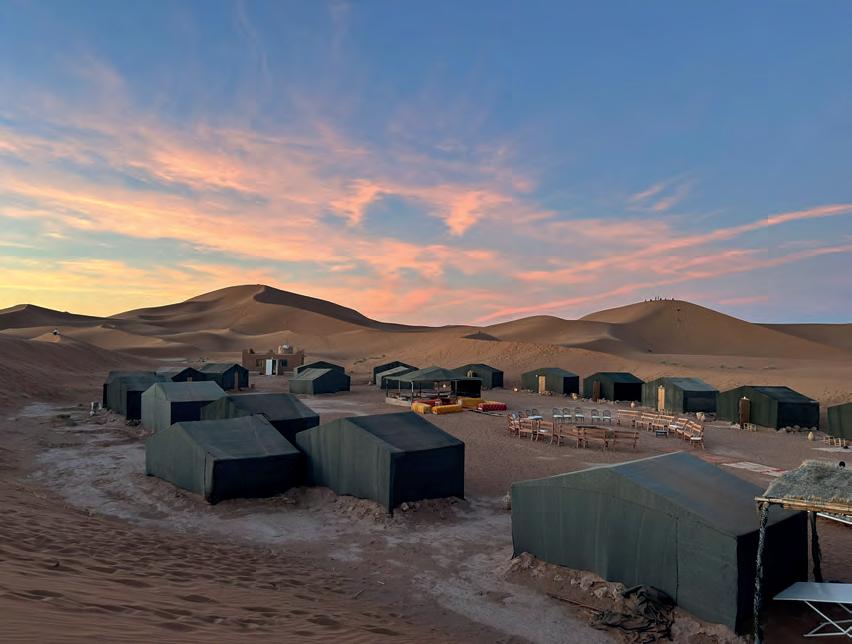
The camp, when we arrived, was amazing. Huge tents with proper beds, electric lights and even charging points for our phones; a shower block with hot running water; a comfortable seating area; and a restaurant. We had an hour or two to relax with glasses of Moroccan tea before being introduced to our camels for a ride up the sand dunes to watch the sun set over the desert.
The next day we drove back to Marrakech for a final dinner together before going our separate ways the following morning.
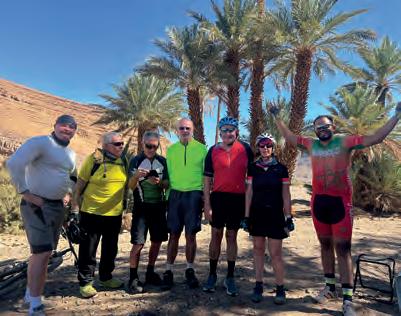
Clockwise from the top: Simona on the road to Agdz from Ouarzazate, our fifth day of riding. The Saharan camp at sunrise. At the oasis in the Draa Valley are (from left to right) Ian, Murray, Ritchie, Allan, Jim, me and Abdel
THREE WHEELS GOOD
Trikes make cycling accessible to all. Sarah Washbrook and Karen Darke tell their stories, while Jordan Scott and Amanda Brobyn spoke to Martin Hofschroer
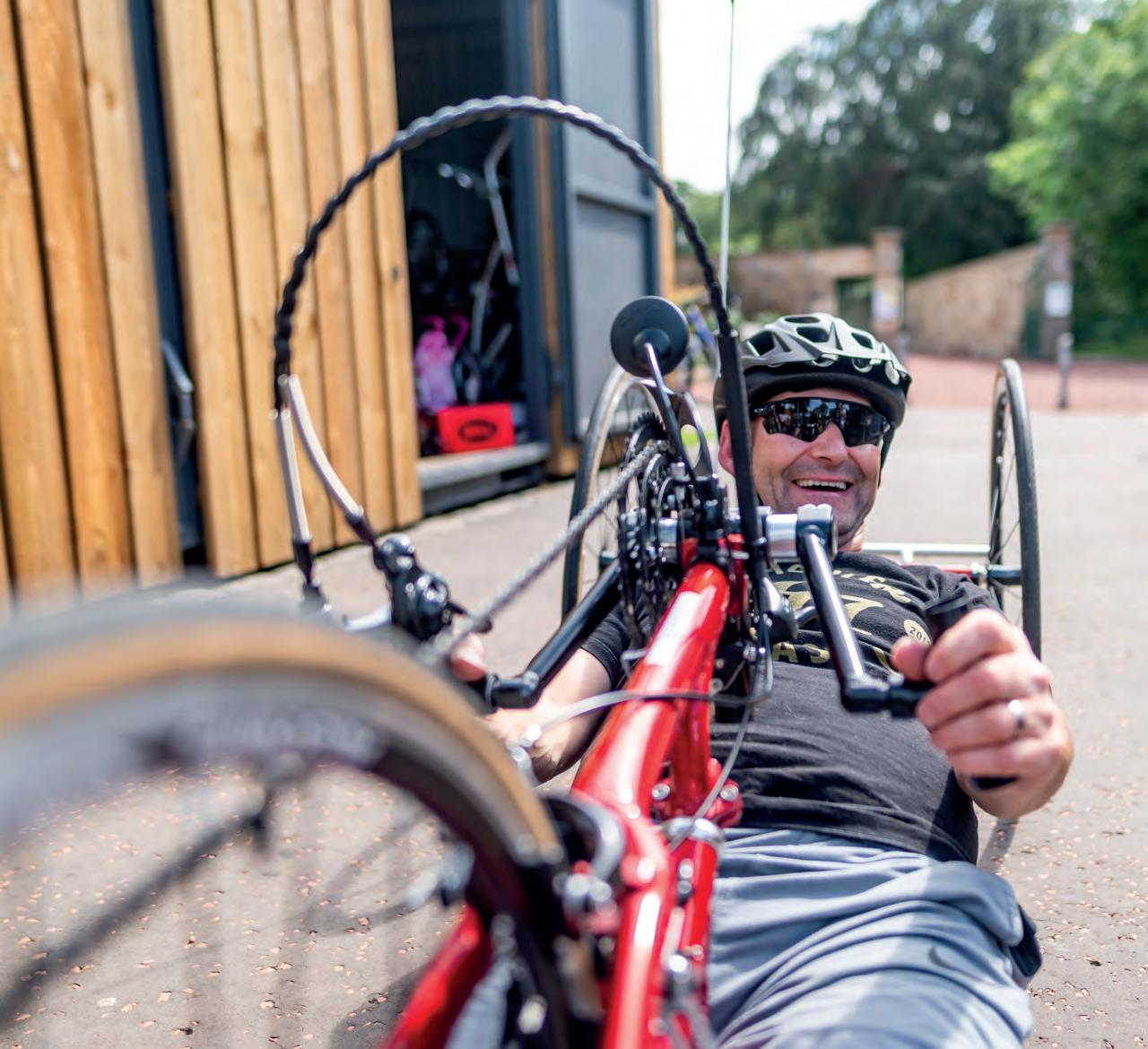
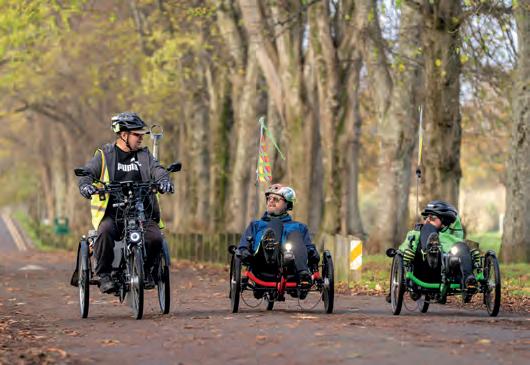
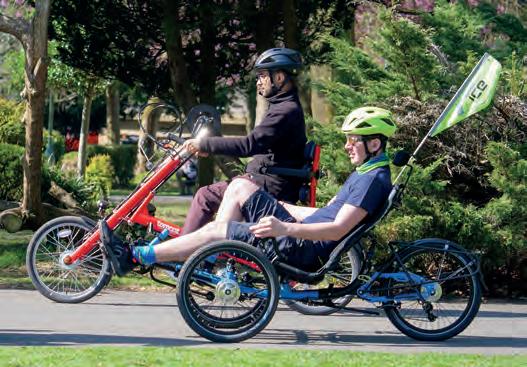
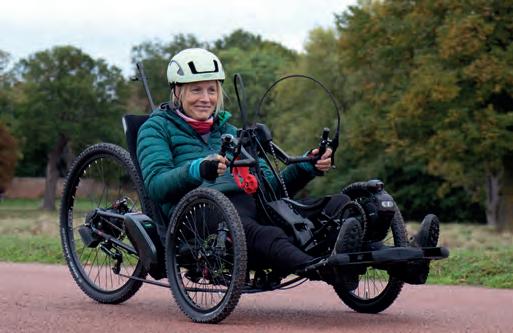
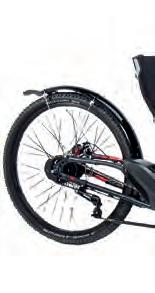
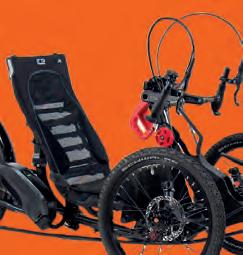
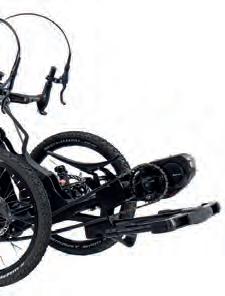
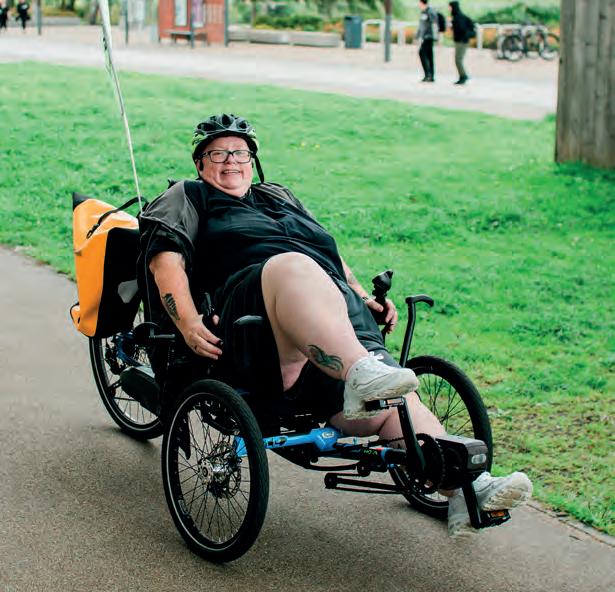
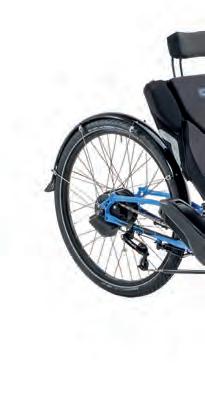
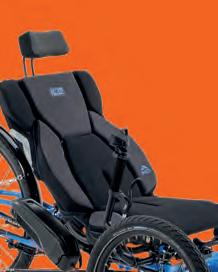
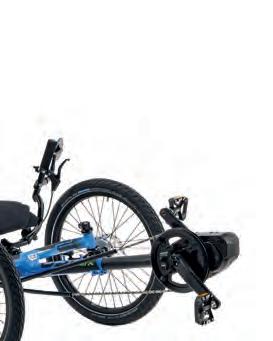
WHEN CYCLING ON TWO WHEELS is impractical, a tricycle is usually the best solution. Trikes cater for a much wider range of riders than standard upright bicycles. They come in a host of different designs: uprights, recumbents, semi-recumbents, tandems, delta (one wheel at the front), tadpole (two wheels at the front), electric assist, hand-cranked, wheelchair carrying, wheelchair clip-ons… With a trike, anyone and everyone can enjoy cycling.
The uptake of trikes for adaptive cycling is limited by their low public profile and relatively high cost. Speciality cycles like trikes are expensive and disabled cyclists may have additional financial pressures. That’s where projects like Cycling UK’s Inclusive Cycling Experience can help, by enabling would-be cyclists to discover and try out solutions that best suit them.
The best ambassadors for adaptive cycling, of course, are the riders themselves.
Trikes come a wide range of different designs. While many are also suitable for able-bodied riders, they work particularly well for cyclists with disabilities
CW from top: Andy Catlin, Paul Campbell, Robyn Furtado, Morever
Ivor Washbrook
Ivor’s mum Sarah describes her son’s game-changing
trike
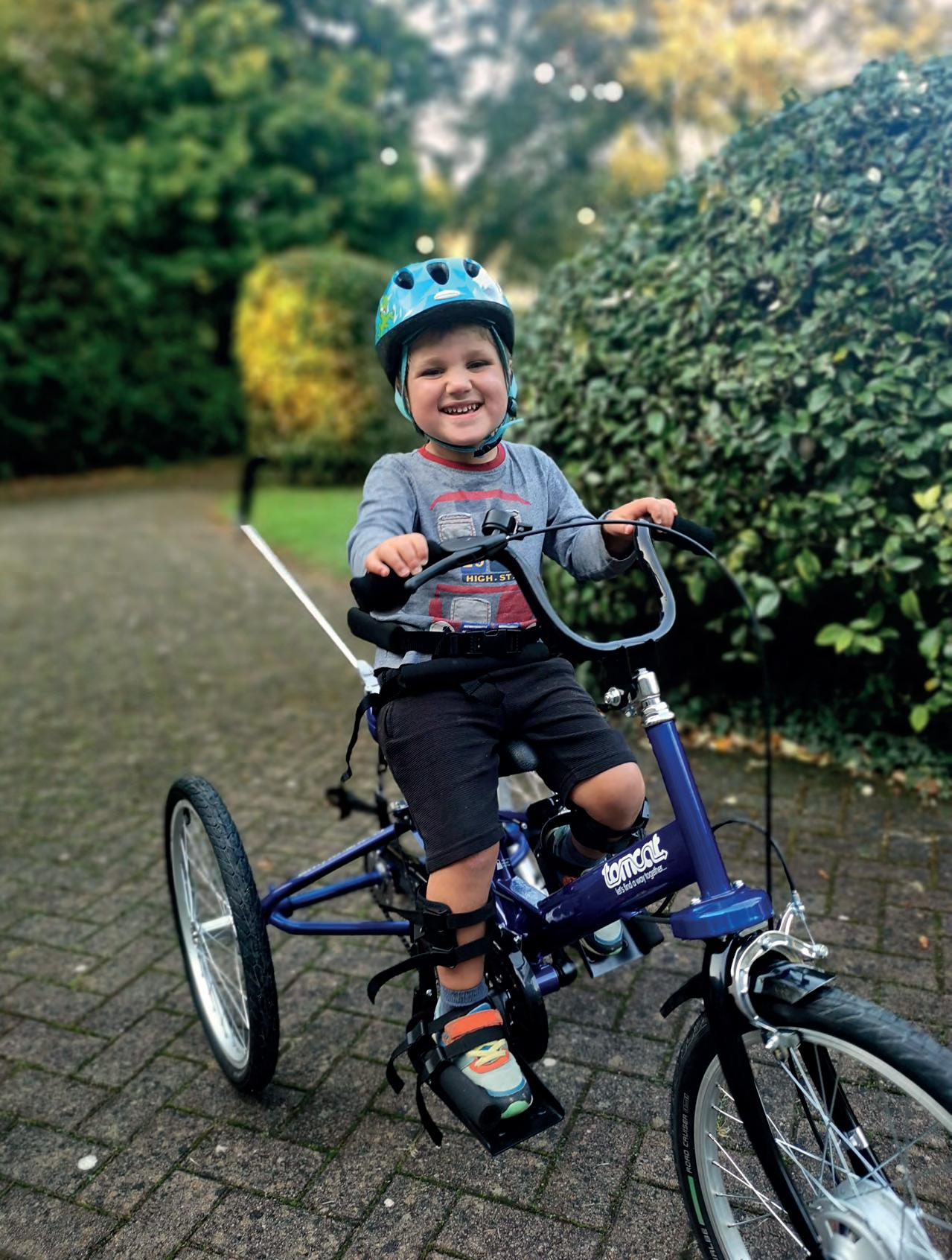
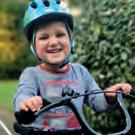
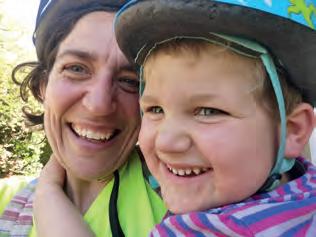
WHEN MY SON IVOR, aged six, was diagnosed with Angelman syndrome, life as we knew it came to a crashing halt. Having Angelman syndrome means that he has severe developmental delays.
Although he can walk, it’s not far or fast, and he struggles with balance and coordination.
You might think that cycling would be out of the question. But as a family of bike lovers, I was determined for him to be able to enjoy cycling just like the rest of us – with all the benefits that brings.
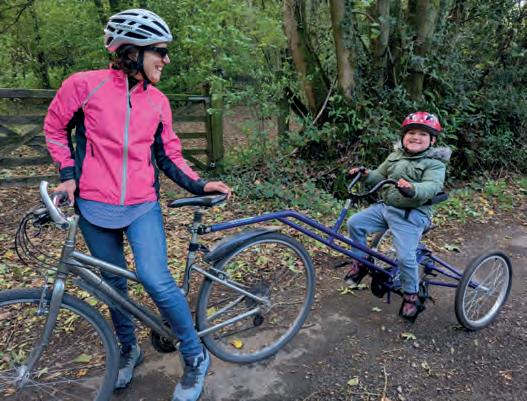
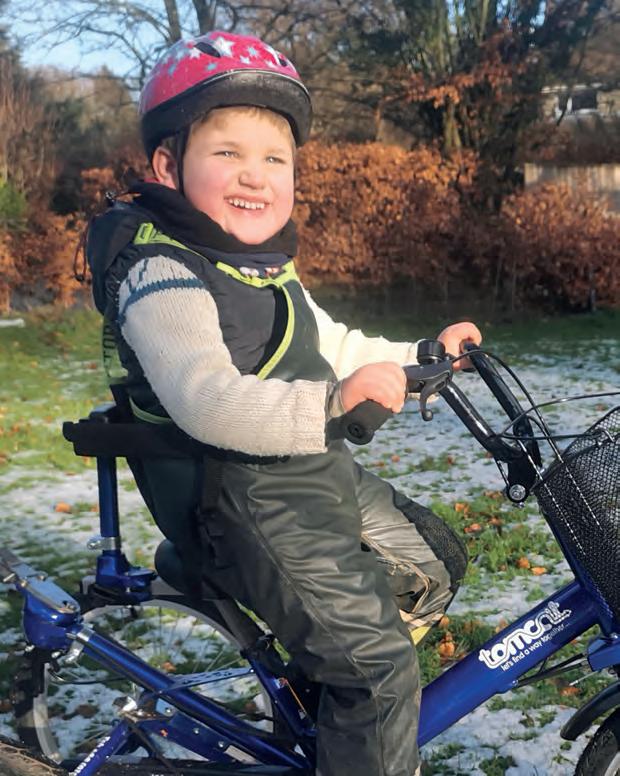
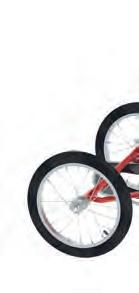
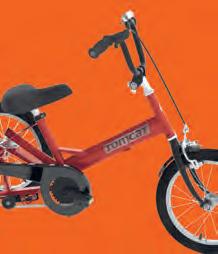
After a huge amount of research into adaptive cycles, we bought a Tomcat Fizz trike. This was based on their reputation, innovation awards, customer service and the trike itself, which can also be converted into a trailer trike that I can hitch to my bike for longer rides with the family.
As a relatively new cyclist, Ivor mostly uses his trike for short local rides from the house with parental control, but as he’s getting older we’re venturing further afield.
The trike is really stable, so it’s great off road on bumpy tracks. He can ride while we walk at a healthy pace next to him – a win for everybody.
There are so many benefits to an adapted cycle, too. High up there is safety. It’s not safe or possible for Ivor to ride a conventional bike. He is unable to balance and steer, sometimes will not hold on and he will not respond to safety instructions. Straps and controls make this possible.
Ivor also benefits greatly from being able to do regular exercise. It keeps him moving, controls his weight, uses pentup energy and helps him to sleep, as well as developing his balance, coordination, motor skills and strength. Not to mention the focus, calmness and positive mental health that comes from cycling – as any cyclist can testify. More than anything, cycling for Ivor is a social event. He can now join in, helping our whole family to get out and about cycling together.
There were a few teething
problems with this adapted trike. It takes practice to put it together after it’s been in the car or after using the towing attachment, and time to change the drivetrain for faster rides. The hand brake is somewhat fiddly, as are the calliper attachments and buckles over the feet as Ivor’s legs don’t stay still.
Ivor’s trike
Bike: Tomcat Fizz (tomcatuk.org).
Price: from £914.
Key features
• Custom built to each rider’s clinical and lifestyle requirements.
• Child’s carer can control steering and braking.
• Converts into a trailer trike.
More information: To find out more about Angelman syndrome and the research and treatment efforts being made for it, visit: cureangelman.org.uk
Life can throw some really doesn’t mean you can’t carry
Yet it’s a brilliant trike with really thoughtful technology. It also looks fabulous; on first glance it’s little different from conventional bike or trike. Almost everybody we pass admires it and wants to talk about it. I would wholeheartedly recommend it to parents of disabled children. Life can throw some really difficult things at us, but that doesn’t mean you can’t carry on doing the things you love.
To see Ivor smile when he’s on his trike is worth its weight in gold, as is knowing that it’s helping him with his development at the same time. He loves it and we love it!
To see Ivor smile when he’s in gold, as is knowing with his development loves it and we love it!
Karen Darke Paralympian and adventure handcyclist
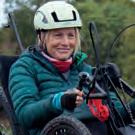
ADAPTIVE CYCLING HAS always felt like a way to reclaim freedom. After a climbing accident in 1993 left me paralysed from the chest down, I knew I wanted to find a way back into cycling. At the time, handcycles were almost unheard of; I’d never seen one. I asked Greenspeed, a trike manufacturer in Australia, to build me a tandem recumbent trike, pedalled by the arms at the front. A frame builder in Scotland built me a solo handcycle. From there I moved on to one of the early commercially available machines from Varna, then to increasingly low, recumbent racing designs originally developed by wheelchair manufacturers. I raced on a machine from Carbonbike at Paralympic level.
The evolution of handcycling since those early days has been extraordinary. What was once improvised and rare is now a popular sport and thriving industry. After a 13−year focus on racing and Paralympic handcycling, I felt somewhat starved of my real passion: cycle touring and adventure, exploring wilder places. I missed big landscapes, the feeling of being out in nature, remote, with friends or a small team.
That’s what drew me to off-road handcycles and eventually to the
Karen’s trike
Bike: Sprint X Tour Handcycle (icetrikes.co).
Price: from £9,520 for the standard e-assist version. (Karen’s bespoke Mongolian one was human powered.) Key equipment for Mongolia:
• Two Nalgene bottles. (Fill with boiling water and drop into a sock for life-saving hot water bottles that you can drink from in the morning.
• Locally sourced Mongolian horse hair boots, wool-lined, to keep feet toasty at -40ºC.
• Plastic, 3D-printed hand pedals and parts to prevent cold metal contact with the body.
More information: Karen’s own website is karendarke.com
ICE Full Fat. Built as a one-off by Inspired Cycle Engineering, who had been collaborating with another manufacturer on off-road designs, the fat trike opened up terrain I’d only ever imagined reaching. I’d read about one being used on an expedition to the centre of Antarctica – and I had Antarctic ambitions of my own.
More recently, ICE has developed its own dedicated off-road handcycle with electrical assistance and some beautifully considered engineering. It’s designed for accessibility, comfort, packability and serious terrain capability. It feels like a machine built not just to function but to broaden horizons. I rode it across Scottish beaches and beside lapping waves, shedding tears for the connection with nature and adventure I had missed.
(cyclinguk.org/handcyclekilimanjaro) and to Everest Base Camp (with help from an incredible porter team). Destinations that once lived purely in my imagination became reachable.
Like any form of cycling, one machine rarely does everything. Adaptive cycling mirrors conventional cycling in that different journeys call for different machines - road touring, technical off-road riding, steep climbing. Cost and storage make owning multiple handcycles difficult, so a cycle that matches your biggest ambitions is the best starting point.
My ICE trikes have taken
As I write this, I am about to use ICE’s recently released handcycle to cross a frozen lake in Mongolia: 160km across Lake Khuvsgul. I only had the chance to take it for a quick spin around Richmond Park before this.
The Full Fat travelled with me deeper snow and ice I had to
My ICE trikes have taken me to extraordinary places. The Full Fat travelled with me to Antarctica – although on deeper snow and ice I had to switch to a sit-ski. But it has carried me to the summit slopes of Mount Kilimanjaro
For anyone considering adaptive cycling, the single most important piece of advice is to try before you buy. Fortunately, there are growing opportunities to experiment and find what suits you (see overleaf). Whatever you choose, I’m sure it will open up a world of possibility.
In February, Karen rode her ICE Sprint X Tour handcycle 160km across the ice of Lake Khuvsgul in Mongolia
Near left: John Baikie. Other by icetrikes.co
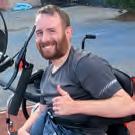
Jordan Burns Wheels for Wellbeing participant and handcyclist, Wigan
FOR A LONG TIME, Jordan says, cycling felt like something he had left behind. The last time he remembers being outside on a cycle, he was “about 10 years old”. Now 30, he wanted to try something different. He wanted to get out, build fitness, and find a form of exercise that felt achievable. That chance came through an organisational session with Be Well Wigan through Wheels for All. There, Jordan was able to try a power-assisted handcycle made available through Cycling UK’s Inclusive Cycling Experience.
“I just wanted to try something different,” he says. “When I came on the bikes, it was a different experience. It got me outside doing physical activity, which was really good.”
Jordan’s trike
Bike: Tomcat Electric Flare (tomcatuk.org), loaned.
Price: from £5,984
Key features
• The electric assistance has helped him train more consistently, build stamina steadily, and extend what feels possible session by session.
was training for a 40−mile charity challenge to raise money for motor neurone disease. He completed the challenge on a stationary hand bike, covering 40 miles in 4 hours 5 minutes. The outdoor sessions on the assisted handcycle were a vital part of building endurance and confidence.
is great,” he says. “It’s helped my mental health, and coming into the sessions is helping [me get into] the community and [with building] another set of friendships as well.”
What keeps him motivated is the sense of liberty the e-trike provides. “It gives me freedom,” he says. “It makes me want to push myself and see what else I can do.”
• The handcycle setup suits track riding, giving him a stable, predictable place to practise and grow in confidence.
“I used the power-assisted trike as part of my training,” he says. “If I didn’t have it, I think I’d have struggled to push through the training.”
• The availability of the trike has been a practical stepping
At first, the change was simply in showing up and having a go. Then it became about progress. Before the sessions, Jordan could manage two laps of the 400− metre track at Robin Park on a standard handcycle. With the power-assisted handcycle, “I’m doing at least 10 laps in the Wheels for All session,” he says.
That steady routine became part of a bigger goal. Jordan
stone between first try-outs and setting bigger goals.
Adaptive cycle try-outs
Trying an adaptive cycle is often the quickest way to find out what will work for you.
Cycling UK’s award-winning Inclusive Cycling Experience (ICE – not to be confused with the trike manufacturer, Inspired Cycle Engineering) supports people to try a range of adapted cycles in a welcoming setting,
Jordan is already thinking about what comes next. He is keen to try new equipment, including an ICE handcycle, and has set his sights on an ambitious challenge. He wants to complete seven marathons in seven days at Robin Park to raise funds for MND.
On the day of the challenge, Jordan had plenty of support around him. Teammates from Wigan Warriors wheelchair rugby came down, along with his family. But he completed the miles alone, proving to himself that he could set tough goals and meet them.
“I want to inspire people,” he says. “I want it to be like a family fun day sort of atmosphere.”
solely physical. Jordan talks
The benefits have not been solely physical. Jordan talks about the effect on his mental wellbeing, and about feeling part of something again. “Being back on the bike
wellbeing, and about feeling part
with guidance to help match the right cycle to the rider and the trips they want to make. Options can include recumbent trikes, handcycles and other adapted cycles, plus practical adaptations.
If ICE sessions are not available in your area, there are other organisations that can help you explore adapted cycling. These include Wheels for Wellbeing in London,
Jordan’s advice to anyone in a similar position is simple: try it; start small; then keep showing up. The right cycle and the right support, he says, can open doors you did not know were there.
Edinburgh ABC in Edinburgh and Get Cycling CIC in York, as well as local inclusive cycling hubs and Cycling UK groups across the UK. The ICE project team is awaiting longer-term funding decisions, so details may change. But Cycling UK also shares guidance and signposting to help you find opportunities to try adapted cycles near you. cyclinguk.org/inclusive-cycling-experience
Jordan had used stationary handcycles but hadn’t actually cycled for about 20 years
Amanda Brobyn Recumbent tricyclist and ICE participant, Inverness
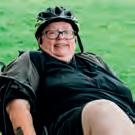
AMANDA INITIALLY WANTED a trike to support weight loss ahead of knee surgery. What she found after trying some was freedom, reduced pain during rides, and a new way to get around locally.
Amanda first came to Inclusive Cycling Experience with a clear goal. She hoped cycling could support weight loss so she could reach a weight considered suitable for surgery on both knees. Walking with crutches is slow and painful, so she needed an option that would let her be active without worsening her joint pain.
At her first session she tried several trikes. A semi-recumbent trike felt practical but she also found it uncomfortable. A fully recumbent trike seemed too difficult to get on and off. Over time, and after seeing other people using different cycles, she decided to try the fully recumbent ICE trike again.
A key part of that decision was making access easier.
Amanda used Helping Hands supports (icletta.com/en/ products/ice-helping-hands) for help with getting on and off the trike. She was keen to do the work of pedalling herself and wanted to avoid power assistance. The team talked through how assistance would still involve plenty of effort, while helping on hills and reducing stress through painful joints. She was convinced.
Amanda took the trike out on short loans as often as her work and family life allowed. She started with loops of the local campus, then built up to longer rides as her confidence
and route knowledge grew. Sometimes her mum came along and enjoyed the café while Amanda rode. When Amanda’s adult daughter visited, she came too.
“Ohh, she loves it. Absolutely loves it,” Amanda says. “Just getting out on a bike with me. Whenever she’s home, she’s like, ‘Can we go on the bikes?’”
To take the trike home on loan, Amanda needed somewhere secure to store it. She bought and built storage specifically for the trike. Once that was in place, she could take the cycle on two-week loans and ride as and when it suited her.
“Just being able to get out and about whenever I want, it’s been great,” she says. Having the trike at home changed what was possible. Amanda could ride from her front door on circular routes, including to a local nature reserve and trips to visit friends. She says she has used her car less and spent less on fuel.
Cycling has also changed outings with her dog. Walking is difficult, but riding means they can go further and faster.
“Especially with the dog. I mean, I’m going 7mph on the bike and he’s still in front of me,” she says. “He likes to run, so he gets his chance now.”
Amanda has been surprised by the effect cycling has had on her knee pain. She expected it to be worse but often finds the opposite by the end of a ride.
“My knee pain was a lot worse,” she says. “Cycling, when you start off, my knees are really painful, but by the end they’re nowhere near as bad. Without cycling the pain was a lot worse, and there was no break from it.”
After one ride delivering the trike
Bike: ICE Adventure HD Electric (icetrikes.co), leased.
Price: from around £6,000 with electric assist (subject to spec choices).
Key features
• A fully recumbent position helps take pressure off her painful knees, making riding feel more manageable than walking with crutches.
• Helping Hands supports (not shown below) enable her to get on and off the trike independently, which has been key to riding regularly.
• The stable threewheel design gives her confidence on local routes.
back, she noticed a moment of complete relief. “At this moment in time, I have no pain at all in my knees,” she says. “It will come back, but when I’m cycling I’m not really in pain with my knees.”
There have been mental health benefits, too. “It’s probably improved my mental health because I’m not stuck indoors all the time,” she says. “I don’t snap at my mum as much.”
Amanda has also been introduced to the HiTrans Inclusive Cycling Scheme, which can organise a specific adapted cycle for longer-term loan at a low monthly cost. Working with the scheme and the cycle supplier, she has moved to an e-trike setup that is even more user friendly, including integrated lights.
For Amanda, adaptive cycling has been about independence. It has given her a way to be active, spend time with family, and make everyday journeys that she couldn’t do on foot.
Amanda’s trike
Amanda walks with crutches but is pain free on her ICE Adventure HD with electric assistance
Elect to cycle
With elections imminent for the Scottish and Welsh parliaments, as well as some English councils, Sophie Gordon explains what Cycling UK is pressing for – and what you can do
This spring’s elections look likely to transform large parts of the UK’s political landscape. Wales may see the biggest shake-up since devolution began. Polls predict a move away from a longstanding Welsh Labour government. Plus, there’s a new electoral system. Competition for seats in the Senedd will be fierce.
In Scotland, the polls suggest that the SNP looks set to secure the most seats but not necessarily a majority, and at least 39 current MSPs are standing down. With many seats predicted to go to the Scottish Greens, Liberal Democrats or Reform, there will be lots of new faces in Holyrood.
Then there’s the turmoil around English local elections. Some councils were told to delay until 2027, only to be thrust back into election mode this year.
The youth vote
All this change makes it crucial to engage with incoming politicians from all parties to find allies who will champion cycle-friendly policies. Election candidates hear a lot about issues like security, immigration and the cost of living. Active travel is unlikely to be top of their list of voter concerns. We need to prove that it’s important to their constituents, and show how more cycling can solve other problems.
Young people especially care about this. In Scotland, 74% of under-25s support redesigning streets to improve safety for
walking and cycling (source: YouGov polls for Cycling UK). Feelings are equally strong in Wales. Three quarters of 16₋ to 30₋year₋olds support street improvements, and 6 in 10 favour allocating 10% of the transport budget to walking and cycling.
Millie, a 16₋year₋old student from Penarth, told us: “The issue is, we really need more separated cycle lanes, like the ones around Newport Road. More dedicated cycle lanes would be a game changer for how people like me get around.”
Gwenda Owen, Cycling UK’s Wales Advocacy and Development Lead, said: “This should send a clear message to candidates standing in May’s Senedd elections. Young people across Wales strongly support investment in cycling and walking, and want to see practical changes that make active travel safer and easier.”
Cycling UK’s demands
Our manifestos for Scotland and Wales carry a simple message for future governments: make cycling the easy choice.
Here’s how they can do that:
1 Invest in active travel
2 Create safer roads for everyone
3 Improve access to green spaces
4 Increase transport choice and connectivity for all
5 Enable more children to cycle, especially in Scotland
Clockwise from top left: Morever, Andy Catlin, Morever, Cycling UK
Your voice matters
First of all, visit cyclinguk. org/elections2026. Then:
• Join a hustings event On 14 and 15 April, we’re hosting online hustings events for the Welsh and Scottish elections, along with other walking and cycling organisations. It’s an opportunity to quiz party representatives about what they’ll do to create places that are better for cycling and walking, to help you make up your mind how to vote. The events are open to everyone to attend – all you need to do is register online.
• Question your candidates Candidates are keen to hear what you care about, so make sure you tell them. We’ve set up an online tool to help you quickly find out who your candidates are and ask them what they will do to make cycling easier where you live.
• Get involved locally
Whether it’s Scottish and Welsh national elections, or local elections in England, our elections toolkit is packed with practical ideas for engaging candidates, organising events and sharing positive stories.
1
Invest in active travel
When budgets are tight, creating cycling and walking routes is one of the most costeffective things councils can do. Getting more people cycling saves health services money and boosts footfall in local shops. But competing for funding pots makes it difficult for councils to plan. Long-term investment from governments would enable councils to create good-quality networks.
2
Create safer roads for everyone
It was controversial, but reducing most 30mph streets in Wales to 20mph has had a huge, life-saving impact.
“Picture a two-carriage train heading to Wrexham,” said Cycling UK’s Public Affairs Officer Tomos Owens. “Now imagine that the entire train, almost every person in both carriages, was saved from a trip to hospital or worse this past summer. That’s roughly how many people – 100 lives – were saved from being killed or seriously injured on Welsh roads during the first year of 20mph.”
In that context, it seems incredible that we have so many narrow, winding rural lanes with 60mph limits. We’re pressing future Welsh and Scottish governments to ask councils to make sure rural speed limits are appropriate for the type of road. We’re also asking
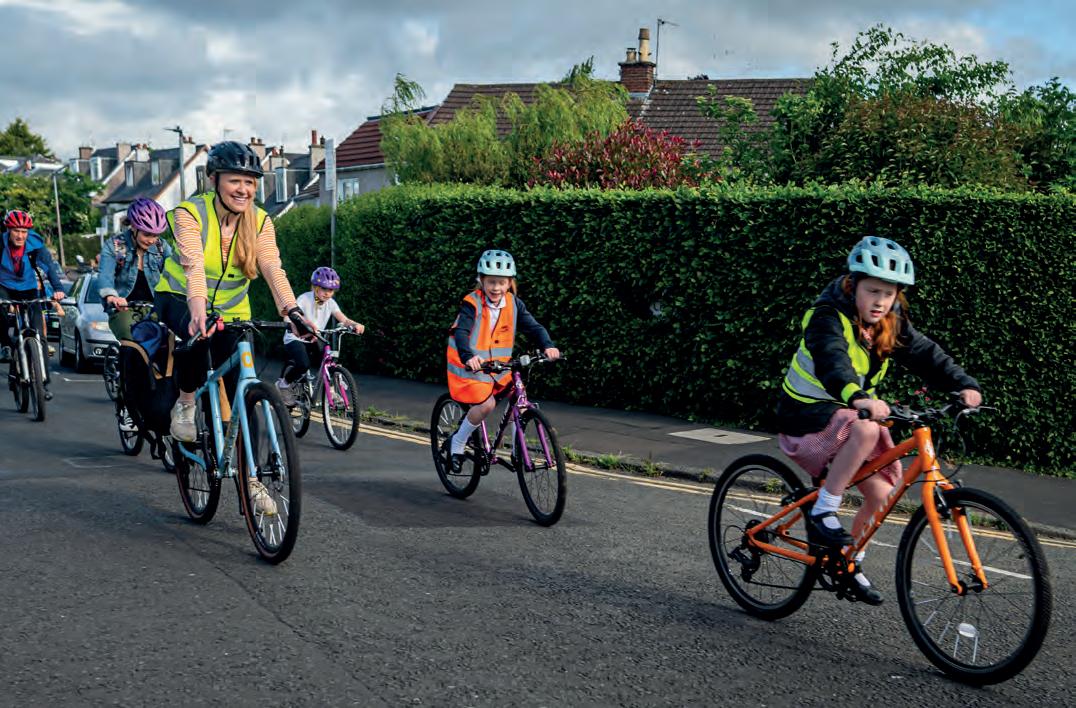
(Clockwise from top left) Young people overwhelmingly support measures to improve cycling and walking safety. Bike buses, like this one in Edinburgh, enable children to cycle to school. Cycling provides teenagers with affordable, independent travel (both pictures)
for greater publicity of the Highway Code, as surveys show that many people still aren’t aware of the changes from 2022.
3
Improve access to green spaces
This one is a vote winner. Recent research has found that people are united by love for local nature, regardless of how we vote. But reaching green spaces by bike isn’t always easy.
Wales has a confusing rights of way network, which limits the paths you can use. Scotland’s underfunded core path network can be neglected and unreliable. To make it easier for us all to be active outdoors, we need paths that are easy to access from home.
4
Increase transport choice and connectivity for all
A fair transport system doesn’t force people into cars or exclude those who can’t afford one. It provides real, attractive alternatives. That means giving everyone the choice to make shorter local trips safely by bike or on foot, and to combine those with a bus or train for longer journeys.
Good things are already happening. New carriages on the Heart of Wales line have space for up to 12 bikes. More bus companies are carrying bikes in places like Aberdeenshire and the Borders. We want to see more joinedup route planning, and targets for increasing the proportion of journeys made by walking, cycling and public transport.
5 Enable more children to cycle
Children want to be able to cycle – to school, for local journeys and for fun. We see this from the growth of families riding to school together as part of organised Bike Buses.
“Bike buses are incredibly powerful tools for drawing people together,” said Emily Farquhar, a bike-bus leader in Edinburgh. “When you start cycling, it’s clear for everyone in your local area to see the benefits of making cycling safer: quieter streets, less pollution, healthier people and, ultimately, the school run is suddenly a fun activity.”
To give children confidence and independence, we’re calling for every child in Scotland to have access to Bikeability training. This would build on the 62% of Scottish schools that currently offer it.
“A fair transport system doesn’t force people into cars or exclude those who can’t afford one. It provides real, attractive alternatives”
Winning hearts and minds
“Cycling in Scotland has come a long way since the last election,” said Cycling UK’s Scotland Advocacy Lead Scott Runciman.
“Much of this is thanks to our members and supporters, who have helped campaign for funding and better policies over the past five years. But if we want cycling to be an everyday option for more people, the next Scottish Government must do even more to make cycling the easy choice.”
To make that happen in Scotland and Wales, politicians need to know that improving streets for cycling and walking has widespread support. The best person to convince them of that is you, as a voter. By using our simple online tool to contact your candidates, you can make sure they know this is a popular move. Visit cyclinguk.org/elections2026
Easy access to green spaces is popular across the political spectrum
Cycleway celebration ride in Cardiff Top: Paul Campbell. Right: Cycling UK
In the frame
Bikes, components, kit and media reviewed by journalists and staff
£105.99, restrap.com
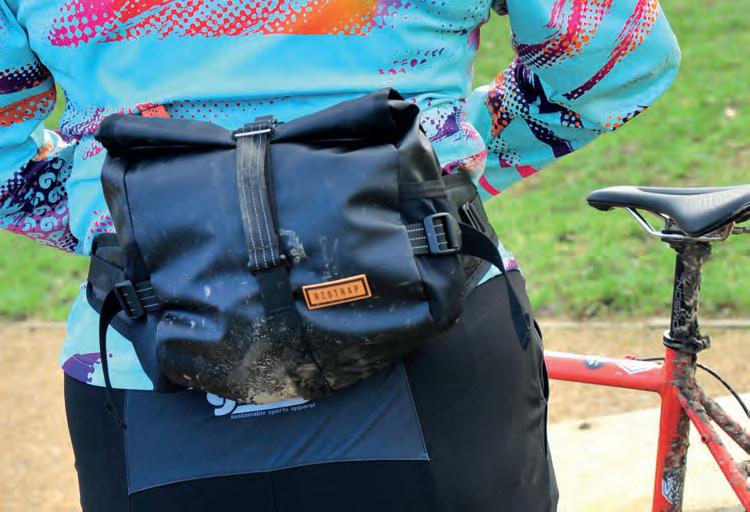
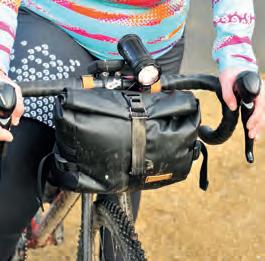
This pack from Restrap is designed to be used both as a hip pack and a bar bag. As ever with multipurpose products, I wondered whether it would do either or both things well. It’s a 6−litre bag made from waterproof material, with taped seams and a liner. A strap with a Fidlock buckle cinches down the roll-top closure. Mesh pockets either side of the main pack will fit bottles or snacks. When used as a hip pack, an extra strapping system ensures
Verdict
A versatile solution for carrying a reasonable amount of kit on shorter rides and day trips. The design is thoughtful, and the pack is weatherproof, well constructed and covered by a decent guarantee and repair service. If you need one bag for bike and body, this will do it.
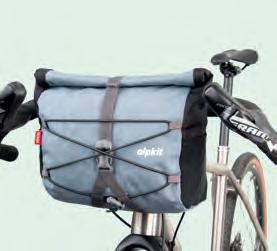
GRAVEL BAG £69.99
A 5−litre roll-top bag with side mesh pockets, similar in style to the Restrap but designed solely for bar use. Not totally waterproof. alpkit.com
stuff in the pockets stays there.
Swapping between bar bag and hip pack functions is pretty simple. The padded waistband folds away back on itself, leaving you with two straps for the handlebar and a bungee cord for the head tube.
The material is genuinely waterproof, as well as easy to clean if it gets dirty. Fit is good too, both as a bar bag and a hip pack. I’ve had no issues with movement of the pack.
While it’s a decent size for ride spares, the main compartment doesn’t have any internal pockets. Everything is stuffed in together, which may or may not suit you. The strapping allows partly full loads to be cinched tight, helping stability.
In terms of price, you are paying not only for the quality of the material and for manufacture in Leeds but also Restrap’s guarantee and repair
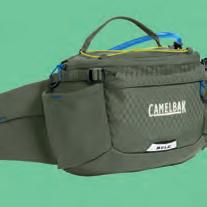
M.U.L.E. 5L WAIST PACK WITH CRUX 1.5L LUMBAR RESERVOIR £89.99
A 5−litre hip pack with mesh pockets, this can be used with a hydration bladder or bottles. Not waterproof but does have plenty of pockets for organising kit. uk.camelbak.com
service. When you think in terms of years of usage, the price isn’t bad. And don’t forget Cycling UK members can claim a 10% discount (cyclinguk.org/restrap).
Other bar bags or hip packs may have more features specific to one usage, but the Utility Hip Pack makes a decent fist of doing two different jobs. If the dual-use idea grabs you – perhaps because you want to keep valuables on your body when you’re off the bike – it’s worth a look.
Hannah Collingridge
In the frame Gear
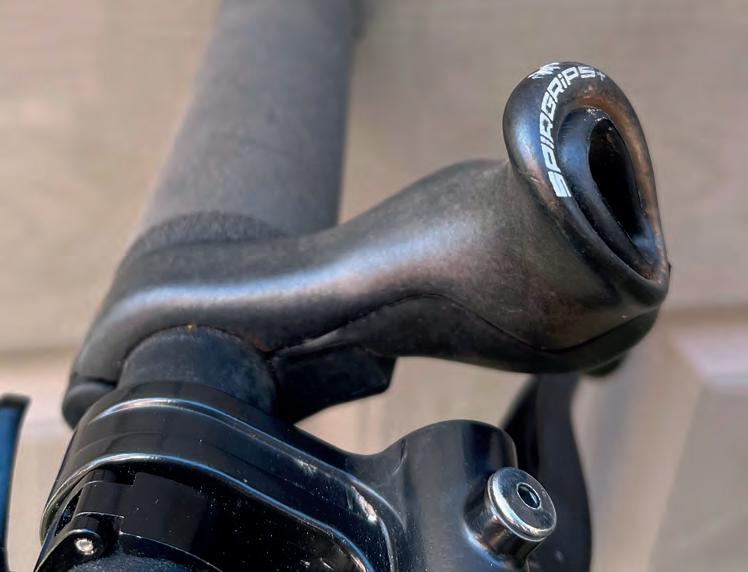
These are a bit scuffed from a crash. They survived it well
SPIRGRIPS
SPIRGRIPS+ Composite MTB
£63.75, spirgrips.com
Wide, flat handlebars are good for bike control but lock you into a fixed riding position that can make your hands, wrists, back and neck ache. Hence alternative bars (cyclinguk. org/alt-bars) and the original mountain biking solution: bar ends. Bar ends don’t work well with a wide bar, however. They spread your arms too wide, clip trees and hook foliage.
Unless you fit them inboard! Inner bar ends is an oxymoron but you know what I mean. I’ve used bar ends like this on a few bikes, including the Stooge I reviewed (cyclinguk.org/ stooge-dirt-tracker). Spirgrips are the same concept, refined.
The unusual ‘Shrek’s ears’ shape helps stop your hands sliding off as the flare keeps them in place, while the bulbous grip section aims for better ergonomics. A Comfort Pad – silicone rubber, I think – fits to the bar-end body for grip and, as the name says, comfort. Various colours are available.
+ COMFORTABLE + LIGHTWEIGHT – FINGER SPACE CAN BE
The Spirgrips are stubby, extending just 55mm from the handlebar. They’re intended to be fitted between grip and brake lever. (Fitting is easy as they have a hinged clamp.) With your hands on the Spirgrips, you can still operate the brakes, albeit not as well. But that proximity leads to the only real downside: depending on how horizontal you like your brake levers and Spirgrips, how prominent your bike’s brake reservoirs are and how big your hands are, there’s not a lot of finger room. I have thin, typist’s hands and didn’t have a problem. The extra hand position does improve overall comfort. It makes out-of-the-saddle climbing easier. And it improves your aerodynamics when slogging along a road or fireroad, because your frontal area is reduced. All that’s worth a 111g weight penalty and arguably justifies the price.
Other options
SQLAB INNERBARENDS
410/402 £29.99
Same idea but half the price. The clamp isn’t hinged, so fitting isn’t as straightforward. Claimed weight is 110g for the pair. sq-lab.com
BBB LIGHTSTRAIGHT BAR ENDS £23.99
Want to experiment with inner bar ends before spending £60 and don’t have any spares in a box? These 95mm BBB ones will do the job. bbbcycling.com
Verdict
Spirgrips are a better and more expensive alternative to fitting your old bar ends inboard. They’re more comfortable and your grip is more secure. Different sizes to suit smaller or larger hands better would be nice.
There is a cheaper option, the Spirgrips One (from £42.42), said to suit larger hands better, and a dearer, lighter carbon-fibre version (from £84.15). All three models are available in versions to fit the tops of drop bars as well.
Dan Joyce
A
In the frame
clincher tyre with vintage looks for those using innertubes
Other options
GOODYEAR EAGLE F1
SUPERSPORT R
TUBE TYPE £59.95
Super-light tubetype clincher with vulcanised construction in 700×25 and 700×28 sizes. goodyearbike. com/uk
Strada Pro Handmade Clincher Road Tyre
VITTORIA CORSA
PRO TUBE-TYPE £79.99
Handmade cotton casing ‘open tubular’ clincher with 320TPI cotton casing and Graphene + Silica tread compound in 700×26, 700×28 and 700×30 sizes. int.vittoria.com
As road tyres get ever wider, it’s worth noting that the Challenge Strada Pro in 700×28 format is 1mm wider than the firm’s decade-old Paris-Roubaix model. The Strada Pro also comes in 30, 32 and 35mm, as well as 25mm for traditionalists. The 28mm example tested here tips the scales at around 270g; Challenge says weight can vary by plus or minus 10% for any given size. This potential variation is doubtless due to the tyre’s construction, which differs from that used for most cycle tyres and provides a distinctive look and ride sensation.
Instead of using (usually) nylon fibres compressed with rubber that’s vulcanised in a mould to form the tyre carcass, Strada Pros use softer, more flexible polyester fibres with a super-fine 320tpi thread count, glued together using ‘natural adhesives’. Polyester won’t absorb water, unlike the cotton often used in similar handmade tyres, making it less vulnerable to wet weather conditions. But although the sidewalls are coated with latex to keep out grit and moisture, these
tyres aren’t quite ‘fit and forget’ and should be kept clean and dry when not in use. The tread, which uses Challenge’s Smartprime compound, is in turn glued to the carcass, while under the tread lies a layer of PPS Ganzo puncture-resistant fabric. Once inflated, the Strada Pros ride as sweet as they look. They are quiet and exceedingly comfortable, rendering minor road vibration near-imperceptible at the 65psi front/85rear pressures of the test. Nor are they fragile, surviving muddy, thorn-strewn Welsh back lanes without cut or complaint, the fine tread providing grip where a slick would not. Just don’t expect the same tread life of the vulcanised competition.
Richard Hallett
Sublime ride quality and excellent all-weather grip combine with impressive toughness to make a delightfully usable and surprisingly affordable tyre that benefits from careful handling.
Save money
01
Singular Albatross £3,450
This rigid, big-wheel MTB/gravel bike comes as a rolling chassis: Ti frame, carbon fork, Hope headset, and hand-built wheels with 32×2.4in Maxxis Aspen tyres. Sizes L, XL and XXL only. singularcycles.com
04
Microshift Advent MX
£199+
Microshift’s new 1×10 or 1×11 groupset has hardened small cogs, a stronger clutch, slicker shifting and a replaceable derailleur cage. 10−speed MX works with Advent X and Sword. microshift.com
02
Jorvik Tricycles
RIDA+ £2,599
05
Don’t forget your exclusive member savings, with up to 50% off cycling products and services. Visit cyclinguk.org/ member-benefits
At £2,166 with VAT relief, Jorvik’s new e-trike is a relatively affordable entry point into assisted tricycling. Frame and stem fold for transportation by car or for storage. jorviktricycles.com
Topeak Handlebar Rack £49.99
Reminiscent of the Jack the Bike Rack, Topeak’s bar rack is a 26×25× 21cm luggage platform that will carry loads up to 4.5kg.
The bungee comes with it. topeak.com
03
Redshift Mousetrap
Pedal Adapters £54.99
Convert your SPD pedals tool free to flats with a pair of 80×105mm nylon platforms that don’t change pedal stack height and that can fit in a pocket. redshiftsports.com
06
Teravail Moonstone Carbon
Handlebar £219.99
OK, you don’t really need a moto-inspired carbon handlebar. But if you want a lightweight, high-rise (85mm) bar for your MTB or bikepacking bike, this one should be on the shortlist. teravail.com
07
Restrap Switch Rack
£124.99
panniers, a top deck and
Restrap’s minimalist rack fits to a supplied thru-axle and either seatpost or seat tube. It accommodates cargo cages, Switch panniers, a top deck and more. restrap.com
In
Bicycle Biomechanics
Details
By: Anthony Crimin & Anthony McGarry
Publisher: Springer
Price: £119.99
ISBN: 9783031857119
If you’ve ever stopped mid-ride to lower your saddle by two millimetres, convinced this tiny tweak will unlock cycling heaven (only to reverse it minutes later!), or pondered the ‘roundness’ of your pedal stroke, then Bicycle Biomechanics may be the deep dive you need.
This isn’t a book for the casual reader. It’s for those who want to know not just what to do but why - and who have a decent technical grounding. It takes you on a journey from early bicycle design through to the biomechanics underpinning how we ride today.
“The RRP is steeper than Winnats Pass… but still far cheaper than a professional bike fit these days”
The authors are clear: this is not a step-by-step bike-fit manual. Instead, it provides the basis to understand why certain fits work, and what really matters when setting up a bike for comfort, efficiency or speed. Their explanation of how small geometric changes affect posture –and how rider physiology influences power on the bike – feels particularly empowering for anyone wanting to take bike fitting into their own hands. However, you need to be willing to tackle some challenging material. Some sections are undeniably academic. But stick with it and you’ll gain a sharper intuition for your own riding and perhaps a more sceptical eye for the marketing jargon of the big brands. The RRP for this hardback version is steeper than Winnats Pass at £119.99 (and even the e-book version is £95.50). That’s still far cheaper than a professional bike fit these days – or the university course that teaches this stuff! For those serious about deepening their technical understanding, this book is a worthwhile, informative and surprisingly engaging companion. Tomos Owens
Print queue Cycle doesn’t feature all books received. Reviewers pick the ones they think you need to know about from the editor’s shortlist. Send books to: Cycle, Cycling UK, Parklands, Railton Rd, Guildford, GU2 9JX
You can read excerpts from some of the books that Cycle has reviewed at: cyclinguk.org/cyclebook-excerpts
From Ibiza to the Norfolk Broads
Details
By: James Briggs
Publisher: Icon books
Price: £20
ISBN: 9781837733118
The mad idea behind this mid-life-crisis odyssey is to cycle a lyric from a David Bowie song, trying to figure out the meaning to ‘Life on Mars’. The author follows his ‘Star Map’, a list of places of significant Bowie events: concert venues, recording studios and former residences. Nearly 3,000 miles of cycling adventure later, he is not much the wiser but finds peace and a new direction. If you love bikes and Bowie, as I do, you’ll love this book.
Ian Small
Thirty Three Cyclists
Details
By: David Houghton
Publisher: Independently published
Price: £11.35
ISBN: 9798287574406
Thirty Three Cyclists charts the overlooked achievements of a breadth of riders across a 208−year period. It starts where it all began, with Karl von Drais and his Laufmaschine in 1817, and ends in 2025 with Vedangi Kulkarni, the only women to have cycled around the world twice. It documents incredible feats of bravery, stubbornness, endurance and a simple love of cycling. Recommended.
Ross Adams
Boys on Bicycles
Details
By: Bob Hurling
Publisher: Self-published Price: £14.99
ISBN: 9798262554843
This is an amiable, slightly blokey recollection of happy, underprepared touring with friends as a young adult, full of ridiculous scrapes, dumb assumptions and good times. Their tour is in a newly liberated Hungary in 1991, and you feel your own anxiety as their bikes get sent ahead on a train with an arrival time of ‘later’.
Sean Fishpool
In the frame Bike test
Raising the bar
The Oxford Bike Works Model 1 and Spa Cycles D’Tour are both steel tourers designed and assembled in Britain, but they’re far from peas in a pod.
Review by Simon Withers
These mid-priced tourers have much in common: steel framesets, very wide-range gearing, mudguards and a rear rack. But there are notable differences. One is defiantly old school, with V-brakes and quickrelease axles. The other has cable disc brakes and thru-axles.
The most striking difference is the choice of handlebar: the Spa Cycles D’Tour has a drop bar, the Oxford Bike Works Model 1 a flat bar. Curiously, while this is the default for each bike, they’re both available with either handlebar option.
Frame, fork & handlebar
Both frames are made from Reynolds steel and are very neatly finished.
The Spa has 725 tubing, the Oxford 525. They’re essentially the same chrome-molybdenum alloy but 725 is heat treated, which boosts its strength by about 50%. It’s not something you’re aware of when riding, and either frameset should last you a lifetime if looked after.
The Oxford Bike Works Model 1 is about as retro as it gets: a frameset that would have been familiar decades ago, decked out with kit not dissimilar to that which I toured on in the 1990s. That’s not a bad thing. It’s tried-and-trusted
technology, put together with care and attention – and it all works well. If you were buying one, you’d probably have fewer spacers on the steerer; Richard at Oxford Bike Works put this together at short notice in a size smaller than I’d normally ride.
Every one of the bikes I’ve owned since my flat-bar kids’ bike has had a drop bar, and I’ve ridden all my extended tours on drops. I’ve nevertheless put in thousands of miles on flat bars. There are obvious benefits to both setups.
While the flat bar helps with stability, as your hands are further apart, the extra width makes it harder to squeeze through gaps in stationary traffic. It generally puts you in a more upright position, which means less strain on your lower back. Yet it’s harder to ride into a headwind as it’s less aerodynamic.
Apart from better aerodynamics, the big advantage of a drop bar is the number of handholds it offers. Your hands, wrists and shoulders aren’t stuck in the same position, so you can reduce the likelihood of
Middle: V-brakes are a blast from the past but still work well for touring and commuting
Bottom: A 44−33−22 triple gives cadencefriendly front shifts
discomfort and numbness setting in.
There are ‘in-between’ handlebar options: the butterfly bars used by many European cycle tourists, and the alternative flat bars we featured in the June/July 24 issue (cyclinguk. org/alt-bars). These increase the number of handholds while retaining a more upright riding position and enabling the use of more costeffective flat-bar controls. Although the Oxford has a simple flat bar, it can be specified with grips with integral bar ends, giving a useful extra hand position. I’d choose these if I were buying the bike.
Components
In the frame
The Oxford Bike Works Model 1 has a triple chainset. While rare these days, it’s still the go-to for many of us, offering both a wide gear range – including a bottom gear of just 18in – and small jumps between gears. It’s arguably the best of both worlds when it comes to range and cadence.
The drivetrain is 3×10₋speed Shimano Deore. Deore has been doing sterling work for generations of mountain bikers, day-to-day cyclists and cycle tourists since the 1980s. Shimano flags it as only mid-range kit, but in my experience Deore is durable and well designed.
Left: The tall stack of spacers is because Simon’s on a bike one size smaller than usual Below: Like the Spa, it’s a Far East frame designed and equipped in the UK
“ A TRIPLE CHAINSET IS ARGUABLY THE BEST OF BOTH WORLDS WHEN IT COMES TO RANGE AND CADENCE”
The trigger shifters work impeccably and the braking is very good. It’s been quite a while since I’ve used V-brakes. I’d forgotten just how effective they are. They offer plenty of power and control, and a pretty light action. They don’t need bedding in either. Compared to the cantilevers that preceded them, they’re a noticeable step up. With flat-bar levers they don’t require a Travel Agent or similar gizmo to achieve the correct cable pull. And V-brake spares remain readily available.
The Spa D’Tour has a more modern road- and gravel-based setup: 11₋speed Shimano 105 with a GRX rear mech. You can choose from a number of chainsets. I picked a subsub-compact 40₋24 double. Paired with an 11₋40 cassette, that gives an ultra-low bottom gear of just 16in. This was a godsend for my 63₋year₋ old knees.
The Spa’s brakes are TRP Spyre cable discs, which are a decent choice for touring. They may
Tech spec
Oxford Bike Works Model 1
Price: £1,699.
Sizes: 51 (tested), 54, 57cm.
Weight: 14kg (as shown).
Frame & fork: Reynolds 525 steel frame with three pairs of bottle bosses, mudguard and rear rack fittings. Steel fork with low-rider bosses and mudguard mounts.
lack the power and light action of hydraulic discs but would be easier to fettle in the back of beyond, and they too will work with buckled rims.
The test bikes have similar wheels, in that they’re built for strength and are paired with reflective-sidewall 35mm Schwalbe tyres with enough tread for towpaths and light gravel. The Spa wheels are hand built by Bobby Stevens, who did a great job on my own Spa Audax wheels. Hand built wheels are an optional extra from Oxford Bike Works.
Out of the box, both bikes come well specced for touring or yearround commuting and day-to-day riding. The Oxford is equipped with full-length mudguards, although the front one doesn’t have a quickrelease in the event of something being trapped between guard and tyre. Its aluminium Topeak Supertourist rear rack is solid and is compatible with the Topeak’s MTX bags and baskets, which slide into rails on the top than click in place.
The Spa D’Tour’s SKS guards have the familiar Secu-Clip quickrelease feature. The rack is German, too: a chrome-moly Tubus Cargo Classic that has the same hefty 26kg capacity as the Topeak.
Tech spec
Spa Cycles D’Tour 725 Mk2 11spd Cable Disc
Price: £1,795.
Sizes: 48, 51, 54 (tested), 57, 60cm.
Weight: 14.1kg (no pedals).
Frame & fork: Reynolds 725 butted and ovalised steel frame, thru-axle, three sets of bottle bosses, rack and mudguard mounts. Chrome-moly fork, three bosses each leg, mudguard mounts, thru-axle.
Right: 40−24 chainset: not so much a subcompact as an Alpine double Below right: Disc brakes and thru-axles are arguably today’s touring standards
Ride
With steel framesets and 35mm tyres, both bikes are unsurprisingly comfortable. The Oxford’s upright riding position is regal and puts no pressure on your back. It’s great for both seeing and being seen. You won’t be steaming up hills, but the 18in bottom gear means you won’t be pushing either, even when carrying all your gubbins.
The Spa’s drop bar puts you
Transmission: 170mm Spa TD-4 chainset with 40−24 chainrings, First Components DX-30 119mm bottom bracket, KMC X11−93 chain, Shimano XT CS-M8000 11−40 cassette. Shimano 105 ST-R7000 levers, Shimano 105 front derailleur, Shimano GRX RD-RX810 rear derailleur. 22 ratios, 16−99in. Braking: Shimano ST-R7000 levers, TRP Spyre cable discs. Steering & seating: Spa Cork EVA Gel tape, 42cm FSA Wing Compact bar, FSA OS-167 90mm stem, FSA Orbit Equipe headset. Brooks Cambium C17, SA SL-281 27.2mm seatpost.
Equipment: SKS CAB 45mm mudguards, Tubus Cargo rear rack, two bottle cages.
spacycles.co.uk
In the frame Bike test
Other options
RIDGEBACK
EXPEDITION
£1,349
Well-priced, flat-bar offering with a steel frameset, cable disc brakes and a 3×9−speed Shimano setup with a low bottom gear. ridgeback.co.uk
TEMPLE ADVENTURE
DISC 3
£1,695
Drop-bar steel tourer with TRP Spyre brakes, Shimano Sora and 40mm WTB Vulpine tyres. The price doesn’t include a rack or mudguards. templecycles.com
in a lower riding position, but the long wheelbase keeps the ride stable and – like me these days – it’s built more for comfort than speed. The Spa also has the only Brooks saddle I like: the non-leather Cambium C17. The Oxford has a larger, more padded Bioflex OnGel option. I don’t usually like so much padding but it proved friendly to my backside. Both bikes climb well thanks to their low bottom gears. My ride home from town has some short stretches at 11%, and I’m usually in the largest sprocket for these. On the Spa, I found myself in second or third. That doesn’t mean that the 16in bottom
gear is superfluous. We also have nearby hills with pretty long – by UK standards – steepish sections. If you’re carrying bulging panniers on a ride of a few hours or more and you reach the foot of one, trust me, you’ll welcome it. The older I’ve got the more convinced I’ve become that you can never have a bottom gear that’s too low
Verdict
Both these British brands have delivered high-quality tourers with the sort of care and attention that smallerscale companies do so well. Wellfinished, Far-East-manufactured framesets are decked with carefully chosen components – the Spa’s contemporary, the Oxford’s more retro. Crucially, both bikes have gearing, wheels and tyres that are spot on for touring.
As for the handlebars: the Oxford’s flat bar helps with a super-stable, upright and regal ride, while the Spa’s drop bar gives you more handholds and a lower, more aerodynamic position for a slightly swifter ride. Neither bar nor bike will let you down.
Left: 35−622 Schwalbe Marathons are good allrounders
Photos: Simon and Shirley Withers
Cargo trailers
Trailers enable any bike to carry cargo-bikesized loads for a fraction of the cost. Editor Dan Joyce, who has been using cycle trailers for 35 years, tests six
Cargo trailers turn any bike into a load hauler. They’re indispensable for cycling with items that are too big or too heavy for panniers. And they provide car-boot-style convenience for large collections of smaller things, such as bags of groceries.
Whatever bike you use for towing, its brakes must be good enough to stop you safely with the added weight of a loaded trailer. Its gears must go low enough – or its electric assistance be powerful enough – to get you up the usual hills you’ll encounter.
If you use a trailer between sunset and sunrise, it must have a red rear light and a triangular red rear reflector. Yes, triangular. I’m not aware of any trailer that comes with a triangular reflector
or where you might get one suitable for cycle use. On the other hand, it doesn’t seem to be policed.
There are no specific restrictions on what you can carry in a trailer. Cargo models aren’t suitable for carrying children, of course, and some have warnings to that effect. Conversely, child trailers will carry soft loads like shopping – along with one or two children, if everyone is comfortable.
To test these trailers under load, I mostly used logs – in bags or boxes where none was provided. My towing bike was a Jones Plus LWB with: a 20in bottom gear; Avid BB7 disc brakes; an M12×1.75 thru-axle for 148mm dropouts; and 29×2.6in tyres. It worked really well.
What to look for
One wheel or two?
Two-wheelers carry larger, heavier loads as they balance independently, and they’re easier to manoeuvre on foot. Single-wheelers track the towing bike better, without cutting corners or clipping kerbs.
Load limit
All trailers have a maximum load limit, typically around 40-50kg. While they might carry more without breaking, handling could get dicey.
Attachment points
Flatbed trailers need attachment points for bungees or ratchet straps. Box trailers primarily need a decent volume, but attachment points are still helpful.
Overall width
Is the trailer narrow enough to wheel through gaps en route such as gateways or cycle-track bollards? This is vital when the trailer is loaded and helpful when it’s unloaded.
Hitch
Most trailers attach to the rear axle, which minimises the tailwagging-dog effect. With a seatpost hitch, a heavy trailer is more likely to lift the bike’s rear wheel under hard breaking. However, high-hitch trailers are easier to wheel around on foot. Any hitch needs a safety strap.
Ease of storage
If storage space is tight or you want to take it on a train, get a trailer that will pack down easily. Anything up to 90×70×30cm and in a bag is luggage on a train. Flat trailers, particularly those with QR wheels, can be hung on a wall hook at home.
Don’t over-inflate trailer tyres. Softer isolates the load better from bumps
Burley Flatbed £314.99, burley.com
Burley has been making cycle trailers since 1978, and the range includes everything from dog trailers to trailer cycles for junior pedallers. I’d planned to review the upright Travoy shopping trailer but it was temporarily unavailable. The Flatbed is more of an all-rounder, accommodating longer loads as well as things like groceries – for which you’ll need a large bag, such as a Burley Drybag (£98) or a blue Ikea Frakta (75p), or maybe just a Burley Cargo Bungee Net (£22).
The Flatbed is lightweight for its size as the base and sides are tarpaulin and the tubing aluminium. It goes together and come apart without tools: it’s secured with (slightly rattly) retaining pins. I could pack it down to 80×62×22cm, including the 16in wheels, in a couple of minutes, using two bungees to strap it all together
The minimalist hitch is simple and effective. It’s designed for solid axles and – with a spacer that’s easily lost if you’re careless – quick releases. Dedicated Burley Thru Axles (£65.99) are available. While the Flatbed arrived without one, the hitch hole is wide enough to admit a 12mm thru-axle. If you tow the trailer like this, make sure the axle engages plenty of threads. Otherwise buy a Burley Thru Axle.
You can easily hang the Flatbed on a wall for storage. The reflectors are its only real weakness: they protrude and will eventually get snapped off, as my old, battle-scarred Burley Nomad attests. They also stop you standing the trailer on its end when not in use.
A lightweight, versatile and easily stored trailer that needs a big bag for loose loads
Carry Freedom Y Trailer Small £360, carryfreedom.com
This is the smallest of Carry Freedom’s Y Trailers. There’s also a Large (£420), which I tested in the June/July 2016 issue, and an XL (£500). All three have just had a cost reduction which, given the spartan design, they needed.
The build quality is excellent. With its hard wooden base, the Y Trailer works well with a box strapped or bolted in place. Alternatively, you could strap on a large bag – or anything else that fits the load bed. For wider loads, Carry Freedom has an Extra Wide Axle Beam (£95). For long loads, there are various tow-bar extensions (from £122). Other extras include a Hand Cart Handle (£158), flags, straps and more. These options make the Y Trailer very versatile – and potentially quite dear.
Like the Burley Flatbed, the Y Trailer has a simple, sturdy hitch designed for solid and QR axles. Again, the spacer for the latter is easily lost. There’s no provision for thru-axles. Carry Freedom’s 14mm e-bike hitch (£34, pictured below) does work if there’s enough axle thread engagement. A better solution, I found, is an M-Wave 12mm Converter Thru Axle (see overleaf), with its threaded cam lever replaced by a 40mm M6 bolt and a washer. This makes room for the ‘lollipop’ hitch.
The Y Trailer is usefully narrow, so I could wheel it into my workshop. It’s flat and easy to store once its 16in wheels are removed. You can pack it small enough for a train if you have a 5mm Allen key for the tow bar. The reflectors are inset, so they’re less likely to be snapped off.
A sturdy and versatile flatbed trailer with accessories for everything – but no dedicated thru-axle at the moment
FollowMe Cargo
£199, followmetandem.co.uk
The RRP for the FollowMe Cargo is £279.95 but it’s been on offer for £199 for a while. It’s a single-wheel, pannier-rack trailer like the Extrawheel (extrawheel.com). You could use it for touring or shopping on a bike without a rack, or to fit even more panniers to a bike that already has a rack or two.
Apart from a trunk bag, panniers are essentially all the FollowMe Cargo will carry. I’d like optional side frames, like a cargo bike’s foot plates, for strapping on boxes or crates, or a top deck for bulky, lightweight items. Unlike the Extrawheel, the FollowMe’s 20in-wheel sits entirely beneath the rack.
Large rear panniers fit fine, however, and the FollowMe still handles well with them heavily loaded. There’s minimal wag from the trailer at normal cycling speeds. Only at walking pace – on or off the bike – is it more cumbersome than the twowheelers here. With bags removed, the FollowMe is narrow and lightweight, making it easy to store. The articulated towbar doesn’t come apart quickly but has to do so if you want to smuggle it onto a train as luggage; it’s too long otherwise.
By default, it attaches to a replacement quick-release axle, which also fits the FollowMe Tandem. I tested it with a Thru Axle Adaptor M12 (£60); solid-axle adaptors are £16. To fit the trailer to my wide-axle, big-tyre towing bike, I had to splay the towing arms, remove the trailer’s mini front mudguard and remove a Topeak Babysitter Disc rear rack, which fouled the FollowMe’s dog-leg attachment.
Weight: 4.7kg. Max load: 28kg. Load bed: 35L×10W (rack top).
Overall width: 13cm plus panniers.
Affordable and easy to tow, the FollowMe Cargo enables any bike to carry two large panniers
M-Wave makes a range of good-value cycle trailers, principally for the German market. The Stalwart Carry Fold 1 is the brand’s premium cargo trailer. There’s also a Stalwart Carry Fold 2 with a steel frame and no bag or handcart bar (£225), and a BOB-Yak-style Singletrack Luggage Trailer (£169.99).
The Stalwart Carry Fold 1 is the most fully featured trailer in this test. It comes with a removable, 90-litre nylon luggage bag strapped to the base and Velcro-fastened to the folddown sides. (One side had a slightly misaligned retaining pin hole, which required light tapping with a hammer.) You can thus do the weekly grocery shop without an extra bag or box.
The reversible handcart bar makes it easy to wheel the trailer on foot, and it can be repositioned to function as a parking stand. Plastic bumpers on the trailer’s front corners stop the wheels ramming into walls or gateposts when manoeuvring. It’s narrow enough to go through pinch points most twowheelers won’t, and it folds easily to 79×59×30cm for storage.
The standard hitch fits QR and solid axles. A special QR, the Racky Axle (£9.99), enables the hitch to fit bikes that have a rear dropout obscured by a pannier rack, cowled dropouts and so on. For thru-axle bikes, an M-Wave 12mm Converter Thru Axle (£39.99) is required.
My only complaint concerns the sheet steel base, which reverberates and rattles on all but the smoothest tarmac, especially when empty or lightly loaded. This drove me nuts.
Noisy but goodvalue and fully featured trailer that fits through doorways and is well suited to shopping
Pashley EuroLoad Trailer
£540, pashley.co.uk
The EuroLoad is designed to hold 80×60cm Euroboxes –hence the name – and is rated to carry up to 60kg. While it’s primarily aimed at businesses, it would be useful to everyday cyclists hauling serious loads at least some of the time.
The weight limit is likely a reflection of what the rider can control rather than what the trailer will withstand. It’s made of steel and held together with hefty bolts, so it’s strong, heavy and durable. Sidebars and a lip on the base should keep boxes or white goods in place, but there are lots of attachment points as well. The EuroLoad doesn’t fold so you’ll need garage space or similar to store it.
The 80kg-rated Weber trailer hitch is suitably beefy, too. It’s designed for QR and solid axles but a 12mm thru-axle can work if it engages enough threads. Weber’s advice to ensure that a solid axle is turned at least eight times when screwing home makes sense for thru-axles. The hitch has a lock to secure the trailer to the bike. Nice!
Overkill for supermarket trips alone but ideal for the big and heavy cargo other trailer’s can’t handle
Verdict
If you only need the cargo capacity of two panniers, get the FollowMe Cargo. It’s the lightest, cheapest trailer here, and it tracks so well you sometimes forget it’s there.
The Pashley EuroLoad is the polar opposite. It’s a heavy-duty trailer that will haul anything you can tow – DIY materials, bulk-buy shopping, white goods and more.
Thule Reacha City
£529.99, thule.com
The City is the cheapest of Thule’s Reacha trailers, which share the same modular, click-together aluminium frame and accessory range. The Reacha is large for its load rating: wide because the frame extends around the wheels, which have conventional QRs rather than stub axles; and long because the tow-bar has to reach the seatpost. You can click it apart to make it almost flat for home storage but it’s too big for a train.
Gaping holes at the corners of the Reacha City’s ‘basket’ threatened to, but thankfully didn’t, jettison logs or shopping. Nevertheless, I think the Reacha City Platform (£629.99), fitted with the Reacha platform side panels (£129.99), would be more useful for most cyclists – at least, those happy to spend £760.
The tow-bar attaches to the seatpost with a double Velcro strap. This works better than I thought it would and allows for easy swapping between bikes. The Reacha City handled well and was silent in use. Lovely.
Weight: 8.9kg. Max load: 35kg (60kg walking). Load bed: 54L×42W (base) to 75L×45W (frame). Overall width: 79cm.
A bulky but lightweight trailer I’d prefer with the optional hard base and a significantly lower price
The Burley Flatbed and Thule Reacha City are similar in scope. They’re both good for bulky but lighter cargo that can be strapped down without tearing a tarp base, and they’ll work fine for shopping with the addition of a big bag. The Burley is more compact and much (£200!) cheaper.
My favourite general-purpose trailers are
the Carry Freedom Y Trailer Small and the M-Wave Stalwart Carry Fold 1. Significantly, both are narrow enough to wheel into my back yard and workshop. The M-Wave is better value and meets all entry-leveltrailer needs, especially shopping. The Carry Freedom is bare bones but is more robust and adaptable – as well as quieter.
Bass pedals
I read the recent letter of the month that mentioned carrying a trombone. The author states their concern for using the AirPannier. I just wanted to get in touch to say how much faith I have in mine. It’s the ideal solution for carrying bulky items and still being able to get on ferries and so on, as it’s so compact.
I’ve cycled more than 11,000km carrying a bass viol in mine, and I’ve only just had to repair one loop of its net. It’s stood up to >60mph side winds and hailstorms on the Outer Hebrides, storms in France last September, and the recent January storms in south-west England. And it’s held my precious instrument securely over the roughest roads.
Paul Martin, the inventor, is an incredible person – so generous and supportive. When I was on a concert tour of the UK by bike (sarahsmallviol.crd.co/#goodagaintour), I updated my route to reach him in Bangor. He came to cycle with me that day before my concert. He also tours with his guitar, composing as he goes.
Anyway, I just wanted to show my support for the AirPannier. I’ll continue using mine and recommending it to fellow musicians to get more of us pedalling to performances and beyond.
Sarah Small
WIN AN ORTLIEB SEATPACK WORTH £115
THE LETTER OF THE MONTH wins a 7.5−litre Ortlieb Seat-Pack QR, courtesy of Lyon Cycle. We tested the 13L size (A/M 24), saying it was: “Very well designed and made, and typically Ortlieb tough and waterproof.” It’s stable in use and is compatible with a dropper post. For more about Ortlieb products, visit uk.ortlieb.com. And don’t forget that, as a Cycling UK member, you get a 10% discount on Ortlieb products bought online. See cyclinguk.org/ortlieb for details.
Hole in argument ↑
I’d like to take exception to the advice in the first paragraph on page 41 of the Feb/Mar issue of Cycle, specifically that ‘deep’, ‘hazardous’, and ‘dangerous’ are clear words.
They are actually subjective terms, and my experience of watching local reports on FixMyStreet is that when people use such terms, the defect will, more often than not, end up as a low priority. I think the correct advice is always to include quantitative information, including the distance from the kerb (or, for right turns, the centre line).
The other important thing when reporting is to include at least two photographs. One to give a clear indication of the size, and the other to show the location in relation to easily identifiable, permanent, features. If someone is going to sue the council, they need to prove that the one that was previously reported is the same one that harmed them.
David Woolley
Short cranks
Just reading Dr Kate Brodie’s article on cycling after a knee replacement. I’m a nurse practitioner in ED and had a hip replacement three years ago. To rehabilitate myself, I used a basic Bafang mid-drive kit to convert my best bike into an e-bike. As
there is no spider in the righthand crank, both are effectively left-hand cranks with opposite pedal threats. This means you can order shorter unicycle cranks from someone like unicycle.co.uk at little cost. Static cycling was so boring! I started with 150mm cranks and worked my way back to 170mm.
Peter James
Trailer, articulated
After reading the letter about carrying a trombone on a bike, I thought I would share my experiences. I also tried the Mundo AirPannier for carrying my viola but found it tricky to use. On my road bike, it made it impossible to get my leg over the saddle. So I bought a Burley Travoy trailer, and it is fantastic. I can hardly tell it is attached. It is the perfect size for my instrument, and I can take a stand as well. I also use it for heavy shopping.
Kate Wishart
LETTER OF THE MONTH
Over to you
Spin cycle ↑
You asked for interesting cargo carried by bike. Here I am bringing home a travel twin-tub washing machine. I even left the bike’s battery at home and carried it under my own steam.
Mary Lodge
Plastic footprints
I read the softshell jacket review and thought: what a shame that our best options for outdoor cycling clothing are made from oil and won’t rot. Our family has plenty of old plastic waterproofs, but when it comes to replacing them, I’ve been looking for clothes made from wool and cotton.
I used a secondhand tweed jacket when it was dry over the winter. A waxed cotton cape from Carradice keeps me dry in the rain. Before the invention of polyester, nylon and the rest, airmen during the Second World War wore cotton clothes made with a very close weave (Ventile).
To any cycle clothing designers out there: can you re-work tweed to make a windproof and warm mid-season jacket? I’m happy with my cape but would like Ventile waterproof trousers. Silk linings might be nice as well!
Richard Scrase
Get in touch Letters are edited for space and clarity. The editor reads and automatically acknowledges all letters but publishes only a selection. Please include your membership number. Write to: Cycle Letters, Cycling UK, Parklands, Railton Rd, Guildford, GU2 9JX or email editor@cyclinguk.org.
You can still buy Ventile jackets, such as the Hilltrek Greenspot DV Jacket we reviewed in the Dec 16/ Jan 17 issue. Hilltrek also makes Ventile trousers and breeches. None of this is cheap: that Greenspot jacket is now £350. See ventile-clothing.co.uk.
Pedalling not drugs
In late February, the government announced an incentive scheme to encourage GPs to hand out more weight-loss medication. GPs will be given £3,000 a year bonus to meet certain criteria. With something like 30,000 GPs in the UK, that could be nearly £100 million to promote more drugs being taken. It’s a shame that similar funding and incentives are not used to promote schemes that can help people to get more active and make healthy lifestyle choices. Promoting regular cycling has huge benefits to society, including lowering obesity rates, reducing health problems like diabetes, improving mental health, cutting traffic congestion and pollution, and increasing productivity at work.
Peter Browne
Snow biking
I enjoyed the latest edition of Cycle, particularly how to ‘Beat the cold’. It is currently -23ºC here in Levi in Lapland, northern Finland. It’s a fantastic place to go for a bike ride. Riding through the beautiful forest trails on electric fat bikes is highly recommended – so long as you are wearing lots of layers!
Peter Law
Cycling UK forum
Get immediate feedback from other members at forum.cyclinguk.org. Here’s an abridged extract from a recent thread: cyclinguk.org/pressure-gauge-tour
TYRE PRESSURE GAUGE ON TOUR
mdskids: How many of you like to have a tyre pressure gauge (or a pump with a pressure gauge) on tour?
Thehairs1970: I have a Topeak Morph. Does the job and, while I am sure not incredibly accurate, gives a good indication of pressure.
Jdsk: I carry a Lezyne Micro Drive pump with a built-in gauge. When touring, tyres are checked and inflated once a week. st599_uk: I have an AliExpress electric pump. About the size of a box of matches, an LCD screen showing bar or PSI. Set the required pressure, press the
button. Can also be used as a gauge. mdskids: Ah, but can you fend off an angry dog with it? :)
531colin: Why don’t you try a range of different pressures at home using the gauge? When you know how much (little) difference it makes you will be in a position to decide if you actually need a gauge on tour.
simonhill: I pumped up my tyres with gauge when I left UK. Didn’t pump up for just over a month of touring when, to be honest, they were feeling really good. I’m sure we over pump.
axel_knutt: It’s a lot more comfortable on the soft side. At one time, I rode with the front tyre soft enough to ground the rim when I bounced my weight on the bars: no snakes, no rim damage, but it was a bit lively on corners.
PHOTO OF THE MONTH
Profile
Wombling free
Cycling UK Vice President Josie Dew’s son Jack is a chip off the old block, cycling, recycling and making good use of things folks leave behind
I WAS 10 when I first started taking bikes apart – the same age I decided I wanted to cycle around the world.
My 12−year-old son Jack was 11 when, without any prompting from me, he started taking bikes apart. It was during last year’s long school summer holidays when, bored of me on a repetitive mantra of “No screens! Use your imagination! Think of something to do!”, Jack did just that.
He found an old Trek bike in a skip and set about doing it up with gusto. He got the brakes and gears going, resprayed it, and replaced the saddle and tyres with better ones he found in my bike shed. He added mudguards, rear rack and a bike computer, all of which I’d taken off an older bike years ago. Then he began riding it: on road, off road, uphill, down dale. He went on a bike tour with me to the sea.
Bike recycling
Jack then thought maybe he could save more bikes from ending up in skips or the local dump, so he made a ‘wanted’ poster for unwanted bikes, hoping to give them a new recycled lease of life. He cycled miles pinning up his posters.
The response was huge. Bikes flooded in, forming an impressive mountain of frames and wheels in our back garden. Jack then set to, mending, adjusting, cleaning, oiling, spraying and renewing until the bikes were good enough for him to try to sell. Much to Jack’s amazement, people rang up from all over.
And on it’s gone this way for months. Jack has loved saving bikes from being thrown out or left disused and rusting, while putting a useful bit
Litter picking & recycling
If you’re disappointed with the amount of litter you see in the countryside, why not get involved with Trash Free Trails? Since 2019, volunteers have removed over half a million items of litter from the countryside. To find out more, visit trashfreetrails.org
Meanwhile, if you know someone who has an old bike that needs refurbishing so they can use it again, and you don’t have the skills or resources to fix it, point them to Cycling UK’s Big Bike Revival: cyclinguk.org/ bigbikerevival.
of cash in his pocket to boot. More recently he was asked to provide a small fleet of bikes to a local business with B&B cabins, so that they could rent them out to their guests. He was also asked to maintain them on a regular basis for a regular sum.
Litter collecting Jack and I have always liked to recycle and reuse. I’ve always found an entertaining way to spend halfterms or weekends with Jack is to go foraging in roadside ditches for litter. When he was little, he used to do this on his John Deere ‘tractor bike’ that his primary school teacher was throwing out. It was a trike with two wheels on the front and one at the rear, onto which Jack attached an old crate (found in a ditch) to collect rubbish. More recently he adorned an old Pashley trike with useful litter he’s found (old car licence plates, tubs,
window boxes and the like) to carry more litter. While others at school seem to fly off to exotic destinations at half-term, I tell him that scrabbling around at the side of the road in muddy ditches or clawing our way through a thicket of brambles and nettles to satisfyingly reach a discarded beer can or wine bottle or coffee cup or burger wrapper has surely got to be more fun than lying on a beach in Thailand or Croatia.
I’m not sure he always agrees with me but we often come home with some very useful rubbish we can recycle, upcycle or even just cycle; Jack once found the remains of a bike which he renovated for messing around on.
So, all in all, I can highly recommend turfed-out bike-mending and cycling litter-picking as very cheap holiday activities to do with children. Keeps them entertained for hours!
(Both photos) Jack collecting roadside rubbish on an old Pashley trike that he equipped for the task
Q&A
Your technical, health and legal queries answered by Cycle’s experts
QI live in Cambridge near the longest guided busway in the world. It has a tarmac, traffic-free path beside it for cyclists, walkers, horse riders and others. Since it opened, there have been three fatal accidents from people being hit by buses. As well as fencing off the busway, the council has put up new signs for users, including a 15mph limit for cyclists (even though cycling speed has not been noted as a factor). What is the legality of enforcing this speed limit?
D Mitchell
QIs this chainring dead or worthy of an another chain or two? I put a new chain on and there seems to be a notchiness about how it runs. It doesn’t pick up from little to big in the smooth manner I’m used to.
Nearholmer, Cycling UK Forum
While speed limits set under the Road Traffic Regulation Act 1984 only apply to motor vehicles, those riding bikes can still be charged with careless or dangerous cycling offences, depending on the circumstances. There are no current plans to extend the speed limit legislation to cyclists on the public highway.
Legal e-bikes (electrically assisted pedal cycles or EAPCs) are restricted to 15.5mph while under motor assistance. At faster assisted speeds, an e-bike is not an EAPC and would be treated as a motor vehicle. The usual traffic speed limits would then apply.
People who cycle have a general duty, like all road uses, to behave in a safe and responsible manner (as per the Highway Code). Those who do not adopt a responsible attitude become liable for prosecution.
The Crime and Policing Bill is introducing new definitions of offences committed by cyclists, with much higher penalties than were available to the courts previously. Evidence of speed will often be relevant in any prosecutions.
One example of speeding cyclists being issued with Fixed Penalty Notices relates to cyclists using London parks and commons, which are subject to bylaw speed limits. There remains doubt about the testing and accuracy of cycling speeds when punishment is on the cards. Many bikes have no means of displaying speeds. Unlike cars, pedal cycles are not required to have speedometers.
Commentators have questioned the enforceability of the Cambridgeshire speed limits for cyclists. But they were introduced –alongside the reduction of the speed limit for buses along the guided route – in response to a £6 million fine for health and safety breaches, and they were intended to improve safety.
Nadia Kerr
A correctly fitted new chain won’t cause ‘notchiness’ unless fitted to worn sprockets, such as your front chainring. The teeth are showing clear signs of wear – a flat ramp leading into a hook. As wear progresses, the transmission will feel progressively ‘softer’ under power as each chain roller rides up its tooth ramp on engagement.
Deciding when to replace the chainring is subjective. A competition cyclist looking for peak efficiency would fit a new chainring long before this, while a utility rider wanting to maximise lifespan might use it for double the current mileage. It is, after all, ‘useable’ in the sense that it will transmit power until the chain skips teeth under load.
Richard Hallett
QCould I use a lever that operates a dropper seatpost by pulling a cable as a gear friction lever?
cycle tramp, Cycling UK Forum
Dropper post levers work by pulling a cable to disengage the lock on the post, which enables it to be lowered by the rider’s weight on the saddle. The cable is then released to lock the post in position. While you may get a dropper lever to move a rear mech, it won’t keep it in position when you let go.
Richard Hallett
QAt 78, my fingers are badly affected by the cold weather. I struggle to use my Di2 shifters. I have tried waterproof gloves with a merino wool inner, and chemical pads which warm up in the gloves. However, the warmth from the pads doesn’t reach my fingers. Could you please advise on the best solution?
Kevin Daniels
The wintry weather should be behind us now, but it is worth going over tactics for staying warm on your bike. Dress for warmth overall, with several thin layers, including baselayer thermals under cycle gear, thick socks, and a neck scarf or skull cap under a helmet. As you have found, a thin inner glove will help beneath warm outer mittens. There are lobster-type mittens that split the fingers into two groups. If access to the Di2 makes thick gloves impractical, consider fitting bar mitts – also known as pogies – to your bike. These are the sort that delivery bike riders use. They cover the handlebar, shifters and brakes; your whole hand is inserted. Start the ride warm and have regular stops for hot drinks and fuel, where you can warm up again. Circling your arms to boost circulation may also help. It may be a good idea to keep rides shorter in cold weather. It is meant to be enjoyable and not an endurance test!
Dr Kate Brodie
QThe elastomer in the wishbone seatstay of my Klein Reve (bought in 2005) has perished. I’ve been told the frame is scrap due to scarcity of parts. I believe the part number for the ‘bumper’ is 243681, 243682 or 243833. I have been unable to source one. Do you know of a workaround? Or where I can get replacement parts?
W G Harris
Meet the experts
The Reve’s elastomer suspension bumper is a structurally important part of the composite frame’s seatstay arrangement. In its absence the chainstays will be subjected to excessive flex, with the possibility of failure.
If you wish to continue riding it, one option is to have a carbon-fibre frame repairer such as Carbon Cycle Solutions or Carbon Concepts infill the gap. It would then be a rigid frame.
If you wish to preserve the suspension, it may be possible to have a replacement machined in a suitable durometer grade of polyurethane, using the dimensions of the original. Note that softer grades can be tricky to machine. A search online should turn up a machine shop willing to advise on the feasibility of this.
Richard Hallett
Get in touch Email your technical, health or legal questions to editor@cyclinguk.org or write to Cycle Q&A, Cycling UK, Parklands, Railton Road, Guildford, GU2 9JX. Please include your membership number. Cycle cannot answer unpublished queries. Note: Cycling UK has an advice line for members’ personal injury claims, t: 0330 107 1789.
Dr Kate Brodie Retired GP HEALTH
Richard Hallett Cycle’s technical editor TECHNICAL
For: Cathy Parker, aged 72, from Cambridge. Bike needs: I’m a utilitarian city cyclist. I rode a 3−speed Dutch bike for years, then replaced it with an e-Gazelle Bloom C380 HMS, which is perfect apart from being very heavy. I can no longer manoeuvre it safely. Is there a lightweight e-bike with a similar spec? Musts: E-bike. Sit-up-and-beg, step-through frame. Hub gears and brakes. Mudguards. Chainguard. Kickstand. Wheel lock. Ideally, room for a front basket and rear panniers. Must nots: Be so heavy. Budget: Anything considered.
RICHARD PEACE
Lightweight Dutch bikes are rare because this kind of design prioritises utility and longevity over low weight. The Gazelle model you have weighs over 27kg, which is heavy even for an e-bike. To go lighter, it depends on what areas you are willing to compromise in terms of the Dutch-style spec.
One bike that looks to tick most of your boxes is the Kalkhoff Image L Advance (£3,199, kalkhoff-bikes.com). This features Bosch’s lightest motor, the Performance Line SX, and has an adjustable handlebar stem for an upright riding position. The SX motor has a little less power than many other Bosch motors but it should be more than enough for Cambridge. Weight is given as 23kg, which is still not that light. Canyon’s Citylite:ON (£2,799, canyon.com) also weighs in at around 23kg, including a front basket, but has a heavier, more powerful motor and also comes with a wheel lock.
Bikefinder
Ask us at cyclinguk.org/bikefinder
DAN JOYCE
This is difficult. To get exactly what you want, you’ll need a custom-built bike equipped with a lightweight e-bike kit from the likes of ARCC (arccbikes.com) or Cytronex (cytronex.com). These kits add about 4kg, so a sub-20kg custom e-bike should be feasible, even with equipment like a rack, guards and a wheel lock.
For the bike itself, I would have recommended Liz Colebrook at Beaumont Bicycle as she specialised in step-throughs. She’s no longer making bikes but I found a video online (bikecad.org/beaumont) that shows the design. Another frame builder could make something similar. If you’re interested, pay a visit to Bespoked (bespoked.cc/uk-2026) and speak to some builders. They’re generally very friendly. This year Bespoked is in London from 24₋26 April.
SLT 400X (£4,999, cube.eu), which
Going lighter means more compromises. One possibility is a physically smaller e-bike. New-to-the-UK German brand I:SY (isy.de/gb-en) produces a Skyfly carbon-framed compact e-bike with a claimed weight of 18.8kg for the hubgeared E5 ZR F version – likely nearer 20kg once its front rack is added. A test ride is highly recommended to make sure you are happy with the riding characteristics of smaller wheels. If you can live with derailleur gears, the 10−speed derailleur version of the Skyfly has a claimed weight of 16.9kg – as does Cube’s Kathmandu Hybrid C:62 SLT 400X (£4,999, cube.eu), which is full sized.
I:SY Skyfly E5 ZR F
€5,599
If a custom bike feels too daunting, I have two suggestions. Left-field idea first: a Brompton Electric G Line with SuperRoll (£3,699, brompton.com). It has a low step-over, weighs around 20kg, rides much like a normal bike and takes a front bag. If you don’t want 4₋speed derailleur gearing and an oily chain, Ben Cooper at Kinetics in Glasgow (kinetics-online.co.uk) could likely convert it to singlespeed belt drive for around £400. With a motor, one gear may be enough.
A simpler option would be the belt-drive ARCC Rosemont Electric (£3,199, plus the cost of the extra equipment and any upgrades). ARCC is local to you and offers test rides. In terms of weight, the similar, unpowered ARCC Abington I tested (cyclinguk.org/ urban-bikes-belt-drives) was 15.76kg, including a rear rack and mudguards. The Rosemont will be similar, so with battery and motor that’s about 20kg. To reduce that weight, you could ask ARCC to build it with a 3₋speed or singlespeed hub rather than the heavy 8₋speed Alfine, and to swap the Marathon Plus tyres for something lighter.
ARCC Rosemont Electric £3,199
Three days
in Spain
Where: Spain
Who: Colin Farnworth
When: September 2025
Want more routes?
cyclinguk.org/ routes Travellers’ tales
When I read an account in Travellers’ tales about riding C2C from Valencia to Santander on Spain’s vías verdes, I thought: “I could do that!” I persuaded my friend Nigel to join me and booked the plane and ferry tickets. But then life threw me a curve ball: aged 69, I became a carer. The retiree’s freedom to disappear on the bike was gone.
Nigel understood. He didn’t fuss about the new trekking bike he’d bought for the trip, nor that our flights to Valencia were non-refundable. But it nagged at us both. So we decided to book return flights and to plan an adventure that I had time for: we would still ride C2C but both coasts would be the Med. By flying in and out of Valencia, we could cycle the Vía Verde Ojos Negros, a greenway that once carried iron ore from
the hills to the coast by rail.
Our ride would start in Teruel, which has a train station but, at that time, no train. The bus replacement wouldn’t take bikes. The local bus company would if we paid the driver cash. Our bagged bikes went in the luggage hold. Three uphill hours later we were on our way.
In three days of cycling, we almost had the path to ourselves. It was downhill most of the way and easy riding. The surface varies between smooth tarmac and rough gravel, so we were glad of our wide tyres. On many occasions we found our way blocked and signs telling us to go no further. We ignored all of these and always found a way through. We were glad of the time to divert to hostelries along the way, and to be able to return to the Hotel Olympia where our bike boxes were waiting.
Back in Bristol we could reflect on all the things that could have gone wrong but didn’t. We had grabbed an adventure!
On home ground
Where: Aberdeenshire & Moray
Who: Vivienne Hutchings
When: May 2025
With a forecast of settled weather, a two-day window of opportunity and a bike space available on the train, I set off for a 60−mile ride around Aberdeenshire and Moray. I’d visit some family and places with childhood memories.
I left Huntly at midday and pootled along quiet roads through forest and moorland, by rivers renowned for fishing, and past established estates known for their wildlife and outdoor pursuits. I camped just outside Dufftown at a peaceful campsite.
The next day I followed country roads through the Moray villages of Newmill, Knock and Rothiemay. I enjoyed the undulating agricultural landscape around the high point of Knock Hill, before crossing back into Aberdeenshire for the last leg of my journey.
Now that I’m older, I realise I can no longer cover as much ground. But I was pleased to be out exploring, thankful for what I can still achieve.
Vía Verde Ojos Negros once carried iron ore to the coast by rail
Travellers’ tales
Boudicca’s backyard
Where: Norfolk
Who: Neil Scarse & Andy Foulds
When: Summer 2025
Sails, rails & 16in wheels
Where: English Channel to Switzerland
Who: Richard Bowers
When: August/ September 2025
Share your story
We’d love to hear your Travellers’ tales! Email: editor@ cyclinguk.org
Last year I had a conference to attend in Konstanz and some spare time, so I decided to cycle there. I wanted to try out the SailLink ferry from Dover to Boulogne described in Chris Read’s article in the June/July 25 issue of Cycle. This is a sailing catamaran that takes up to 12 cyclists and foot passengers across the Channel. It’s a wonderful experience; you can even have a go at helming!
I planned the journey using the Komoot app, simply putting Boulogne as the starting point and the Swiss border by Konstanz as the destination. I then divided the route into 11 sections of 60-100 km per day. Finally, I searched for hotels and hostels near each section and adjusted the route accordingly. This was much easier than
my old method of buying loads of maps and meticulously planning each day. The downside was that, at times, I was so focused on the satnav that I didn’t really appreciate where I was. Not getting lost is convenient but takes away from the experience of travelling.
Generally, the app found quiet roads and reasonablequality cycle paths. But there were some stretches of stony unsurfaced tracks that were hard work on the 16-inch wheels of my Brompton T-Line 12-speed.
The highlights of the trip were cycling for long distances along excellent cycle paths, often beside canals and sometimes by disused railway tracks. Luxembourg had superb cycleways but mysteriously almost no cyclists. On the last day, there were wonderful views of the Alps.
It surprised me how easy the 880km journey was. It is perfectly feasible to cycle long distances and avoid flying to destinations. But then I was lucky having the time to cycle. The weather was kind – not too hot and only a couple of days of rain.
Andy and I are cycling buddies who do occasional trips away. Autumn 2024 was Mallorca, and last summer we tackled the Cantii Way. Having enjoyed it immensely, we were planning where to go next within days. Andy suggested Rebellion Way.
We started in Thetford, that being the closest point to London where we both live. By mid-morning we were on our bikes, aiming to do the route in five days – three full days and two shorter ones. We took a detour on day three to visit Andy’s ‘ancestral seat’ and to take a ride on the North Norfolk (heritage) Railway. Other than that we stuck to the route. And what a route!
Parts of it were a bit tricky on fully loaded road bikes with 28mm tyres, and it took a 5-litre bottle of water to clean the sand out of the drivetrains after one section. But it was fascinating and beautiful in equal measure.
As well as the sights, it’s often the chance encounters that make a tour memorable. Cycling right through the middle of an illegal rave in the woods en route from Diss to Thetford certainly wasn’t in the guidebook!
A big shout out to Cycling UK for another great route. We’re already thinking about Royal Chilterns Way.