‘It is difficult, but I’m very grateful for your prayers.’
An interview with displaced Christians from Mexico. Can you bring a Bible into Nicaragua? How we verified a story and sent it global.
Eyes on Sudan
‘This is just the beginning.’
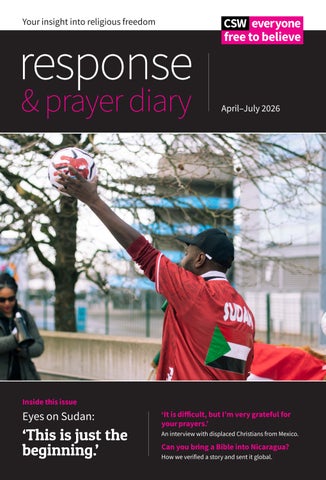
‘This is just the beginning.’ These words were shouted as we stood in the shadow of Manchester City’s football stadium in January, launching our new campaign.
We invited members of the Sudanese diaspora to join us in peaceful protest, as well as press and media contacts so we could spread the message as widely as possible: Keep eyes on Sudan. Stop the war. Democracy, peace, and justice. Footballs were held aloft in the winter air, covered with large red handprints symbolising the suffering of a nation that has endured nearly three years of war. Just a few weeks before, these footballs had been in a refugee camp in Uganda. There our advocates met with Sudanese refugees – a handful of the 13 million people who have been displaced –and asked if they would write their messages on them.
If you’re wondering what football has to do with the conflict in Sudan, here are three points you need to know:
1) There is credible evidence that the United Arab Emirates (UAE) is fuelling the war through its support of the Rapid Support Forces (RSF).
‘Shortly after the conflict broke out, the UAE set up a base at Am Djarass airport in Chad,’ explained Mohaned Elnour, CSW’s Sudan Specialist. ‘They claim to be running a humanitarian effort there, but in reality it has served as a front to supply RSF fighters with sophisticated weaponry – including anti-tank missiles, armoured personnel carriers and guided bombs and howitzers – all either manufactured in or re-exported by the UAE.’
The devastation inflicted on civilians during this conflict is unconscionable. Over 150,000 people have been killed and an estimated 30 million are in urgent need of assistance. Yet the UAE is willing to supply weaponry that will be used on innocent people. Something has to change.
2) The deputy prime minister of the UAE is Sheikh Mansour.
As vice-president, deputy prime minister, and the president’s brother, Sheikh Mansour is well-placed to intervene in the UAE’s role in this conflict. Concerningly, he has well-documented ties with the leader of the RSF, Mohamed Hamdan ‘Hemedti’ Dagalo. He has even been described as Hemedti’s closest ally in the Emirates.
3) Sheikh Mansour is the owner of Manchester City Football Club. Why hasn’t he been held to account?
In March 2023, the Premier League unanimously approved new rules that should disqualify individuals involved in ‘human rights abuses’ from club ownership. And yet Sheikh Mansour has not been held accountable. We want to highlight to the Premier League that this isn’t right.
Our goal: justice
Standing outside the stadium that day, it felt like a domino starting to fall. Adding your name to our petition will help push the next one – getting the attention of the Premier League and calling for these issues to be raised with Sheikh Mansour as a matter of urgency. It’s ambitious, but we believe this could be a step towards the goal of seeing freedom, peace and justice in Sudan. This is just the beginning.
Sunday 12 April
This week marks three years since conflict broke out between the Rapid Support Forces (RSF) and the Sudanese Armed Forces (SAF). 150,000 people have been killed and over 13 million have been displaced in this war. Pray for a comprehensive ceasefire today.
Monday 13 April
Over the course of the war, both the RSF and the SAF have deliberately attacked churches from a wide range of denominations, and several mosques. Pray for the communities affected by these attacks, that they would be able to rebuild and worship freely.
Tuesday 14 April
In October the RSF captured the city of El Fasher in Darfur after a gruelling 18-month siege. Reports of atrocities emerged quickly, with some observers warning of a renewed genocide in the region. Ask God to comfort and provide for all who are grieving or displaced.
Wednesday 15 April
Today, on the third anniversary of the conflict, ask the Lord to miraculously cause weapons to fail and fall silent. He ‘makes wars cease to the ends of the earth’, ‘breaks the bow and shatters the spear ...’ (Psalm 46:9).
Thursday 16 April
There is credible evidence that the United Arab Emirates (UAE) and its vice-president and deputy prime minister, Manchester City owner Sheikh Mansour, are actively supporting the RSF. Pray that both the government of the UAE and Sheikh Mansour himself would be held to account for this.
Friday 17 April
Pray for CSW’s Sudan Specialist Mohaned Elnour, who was assaulted during a demonstration in Newcastle in December, for speaking out against the violations perpetrated by the SAF and RSF. Give thanks for Mohaned’s bravery; pray for justice to be served; and ask God to protect him and all Sudanese activists who are speaking out against injustice.
Saturday 18 April
Lord God, thank you that no war or crisis is too big for you. We pray for deliverance for Sudan – for a lasting peace, a return to democratic transition, and ultimately for justice for violations committed before and throughout the conflict. Amen.
Find out more at csw.org.uk/sudan
Eyes on Sudan
Your stories
FAQs:
Eyes on Sudan is an ambitious campaign with a creative approach. It has caught the attention – and questions – of many people who are new to our work or even to the crisis itself. CSW’s Press & Public Affairs Officer Ellis Heasley talks us through three frequently asked questions.
Why now?
This is a valid question. CSW has been working on Sudan for several decades.
We were working on the country in 2019, when Sudanese people from all walks of life came together calling for justice, peace and freedom, and ousted the al Bashir dictatorship. We were working in 2021, when the RSF and the Sudanese Armed Forces (SAF) seized power in a coup, derailing Sudan’s democratic transition. We joined countless others to condemn their actions.
And during this current conflict, we have raised the urgent need for a comprehensive ceasefire with various governments, the European Union, and at the United Nations. Many policy makers echoed these calls, but this had little effect on the ground. Sadly, external actors are now fuelling the conflict by supporting either the RSF or the SAF militarily and financially. Our latest campaign is essentially a more innovative approach to our advocacy which we hope will raise greater awareness about the war and the UAE’s connection to it, and ultimately assist in moving the country closer to a just peace.
When we launched it in January, this war had passed the 1,000 days mark. It’s a war that most, especially in Sudan, thought would end in a matter of weeks. Action is long overdue and there is no time to waste.
Why don’t you speak up for [INSERT COUNTRY HERE] instead?
This one comes up a lot. Often people mention some of the world’s most well-known crises, like Gaza or Ukraine. As a small organisation with limited staff and resources, we can’t work on every country, and we don’t work directly on either of these.
‘I regularly go to the library to go online. When I looked at CSW’s website in January, I saw the Sudan campaign. I thought, I must give this a go. Once I entered my email address and clicked ‘send’, I quickly realise that I’d done it!
I would encourage others to take part in the campaign – it’s a way of making ourselves heard and showing authorities that we are aware of what’s going on and that we want something done about it.’
Chris Waters, CSW supporter
That doesn’t mean we don’t see them as important. We are grateful for the work of many other human rights organisations in drawing attention to situations that we are unable to focus on ourselves, and support joint action whenever practicable. These questions are particularly frustrating when we actually do work on the country they mention! For some reason, it’s often Nigeria, where we have worked for more than two decades and have a dedicated team. To us, this suggests an element of bad faith, an effort to undermine our work without any familiarity with it, possibly coming from a place of defensiveness.
What about other countries involved in the conflict?
It’s true, the UAE is not the only external actor involved in the war in Sudan. Both warring parties are backed by various international actors, however the evidence linking the UAE to the Rapid Support Forces (RSF) is definitely the strongest.
Action is long overdue and there is no time to waste.
Again, due to capacity, we try to focus our advocacy on what we think will be most effective. Given the strength of the evidence and the fact that Sheikh Mansour is the owner of one of the most valuable and decorated clubs, competing in the most watched sports league in the world, we thought we would make the most noise by starting here.
But this is just the beginning. We won’t stop until we see a comprehensive ceasefire in Sudan, followed by a return to a democratic transition, and ultimately justice for crimes committed both before and during this conflict.
If that means we need to draw attention to others with connections to the conflict, we will.
Act
now: Join the campaign: csw.org.uk/EyesOnSudan
Sunday 19 April
The Iranian government launched a lethal response to widespread peaceful protests which began on 28 December 2025. Over 6,000 were killed and tens of thousands arrested, in what has been described as possibly the deadliest crackdown since the 1979 revolution. Cry out to God for peace, accountability and freedom.
Monday 20 April
Ask the Lord to comfort all who have lost loved ones in the violence. Among those killed in January was 42-year-old Christian convert Moshen Rashidi, a husband and father of three girls, who was shot while trying to recover the body of a friend. The authorities did not allow Moshen’s family to hold a funeral for him, nor mark his burial site with a gravestone.
Tuesday 21 April
Praise God that the UN Human Rights Council passed a resolution in January, renewing a Fact-Finding Mission and Special Rapporteur on Iran. Please pray for these UN experts as they continue to uncover and report on violations.
Wednesday 22 April
CSW, Article 18, Middle East Concern and Open Doors recently published a report on the scapegoating of Christians following the October 2024 Israeli attack. The report was launched at the EU during an event on the situation of religious and belief communities in Iran. Pray that policy makers will act on its recommendations.
Thursday
23 April
‘Awake, and rise to my defense! Contend for me, my God and Lord.’ (Psalm 35:23) Ask God to powerfully intervene for Christians in Iran – especially those who convert from Islam –who continue to be arrested, imprisoned and even tortured because of their faith.
Friday 24 April
Pray for the Baha’i community, Iran’s largest non-Muslim religious minority. Since the Iranian revolution, Baha’is have been targeted with hate speech, arbitrary detention and a raft of discriminatory and repressive policies, including restrictions on education and destruction of burial sites.
Saturday 25 April
As Response goes to print, war has broken out, with reports of the killing of Iran’s Supreme Leader and ongoing airstrikes across the Middle East. Please keep praying and check online for updates. Almighty God, nothing is impossible for you! Bring peace, freedom and justice, and protect the most vulnerable. Amen.
Iran protests
Our manifesto #5
We believe everyone deserves to have their story heard.
A reflection from Grace, CSW’s Latin America Deputy Team Leader
I’ve never considered myself much of a storyteller. I have always been amazed by friends who can tell stories with such humour and relatability – their audience hooked on their every word! Yet I’ve come to realise that we are all storytellers, and we all have a story to tell.
When I began working for CSW nearly nine years ago, I found myself captivated by the stories of individuals in Chile and in Cuba, and in remote communities in Mexico and Colombia that took hours to get to by car –often through winding treacherous mountain roads, with no telephone signal and little in the way of civilisation. Some of my colleagues who live in those countries have been to places so remote that they can only be reached by motorbike, donkey or on foot.
People greeted me with such warmth and hospitality. They shared their food and welcomed me into their homes, even if those homes were little more than wooden huts with dirt floors. We were different from each other, but connected as people made in the image of our Creator, the greatest storyteller of all.
We’ve really seen how the power of storytelling has begun to change the narrative.
Sometimes they spoke in Spanish, other times they were translated into Spanish from their native indigenous tongue. And as I listened, I felt the weightiness of responsibility to really hear and understand what they were saying –to digest it and document it so that it could be recorded, translated, published and heard.
Changing the narrative
We’ve really seen how the power of storytelling has begun to change the narrative that religious freedom violations don’t happen in Latin America, a predominantly Christian continent.
Nobody has visited me… I feel rejected, like I am worth nothing.
In 2019, we brought 17-year-old Alma to share her story with the UK embassy in Mexico City. She’d been unable to go to school since her family were thrown out of their village in Jalisco State – alongside around 60 others – because they were Protestant Christians. I believe this meeting led in part to the UK government finally beginning to raise issues of freedom of religion or belief with the Mexican government.
Following on from this, the 2022 ‘Let her be heard’ report told the stories of 25 indigenous and two mestiza women from religious minority communities in Mexico. It was a first, in response to a dearth of information and analysis by monitoring bodies and experts regarding the unique experiences of women from those communities. The women from a very remote part of Jalisco said that they had been praying for an organisation to visit them and hear their stories. What a privilege to be the answer to their prayers!
I believe this report has been instrumental in opening up training opportunities with Mexican state officials, helping them to understand what is happening and encourage them to uphold rule of the law and freedom of religion or belief in these communities.
Watch
Our ‘Stories from the Wilderness’ series interviews Christians from China, Cuba, Eritrea, Iran, and Nigeria.
Watch it on YouTube or at csw.org.uk/wilderness
Angelina’s story
One of the women who took part in the report was Angelina from Hidalgo. At the beginning of 2019, the local authorities removed her and other Protestant Christian families’ access to water, sewerage services, government benefit programmes and the community mill for over a year. They were forced to walk one kilometre uphill to bathe in the river and bring drinking water home.
As a result, Angelina suffered a uterine prolapse when she tried to carry a 20-litre jar of water from the river on her own. Due to the risk of a repeat occurrence, she underwent a hysterectomy in July 2019. Her daughter-inlaw, who was pregnant at the time, lived with her for a short time after the operation, acting as her carer. But she had to return to her own home because she couldn’t manage without access to water and sewerage services.
When I met Angelina in December that year, she expressed her isolation: ‘Nobody has visited me…I feel rejected, like I am worth nothing.’ I felt privileged to listen to her and remind her she is not alone. Her face was visibly softened; there was both relief and comfort in being heard.
People like Angelina deserve to have their story heard, and the fact that you are reading this today shows that they can be. Thank you.
Angelina
Alma
Can you bring a Bible into Nicaragua?
In December, our team came across a shocking story relating to freedom of religion or belief in Nicaragua. This is how we verified the news and sent it global.
Signs photographed in bus stations in Costa Rica revealed that the international transport company Tica Bus had added Bibles to a list of items that tourists were not permitted to bring into Nicaragua.
We drafted a press release without delay, but something about the photograph looked a little off: the word ‘Biblias’ (Bibles) did not appear to be in the same font, or aligned in the same way, as the other prohibited items. We also questioned why we could only find one news outlet that had reported on such an outrageous story so far. Our internal alarm bell began to ring.
In an age of rampant misinformation, we had to be sure.
In an age of rampant misinformation and misleading AI-generated imagery, we had to be sure that what we were about to report was genuine – as indeed we always do.
Our team swiftly messaged Tica Bus branches across Central America. Representatives from El Salvador, Costa Rica, Panama and Honduras all confirmed the policy’s existence, with one stating: ‘Nicaragua does not permit the entry of Bibles, newspapers, magazines, books of any kind, drones and cameras.’
Confident that the information and photo we had were reliable, we hit ‘send’ – breaking the news to our list of press contacts and on our website. The coverage that followed was staggering. At least 105 different outlets in at least 28 different countries have reported on it – in some cases more than once. If we hadn’t taken the time to verify, investigate and spread the news, would so many people now know about it? We don’t doubt that it was the extra information and quotes from the Tica Bus representatives that made the story so credible, highlighting why it is so important to go the extra mile in our fact-checking.
At least 105 different outlets in at least 28 different countries have reported on it.
Sunday 3 May
Much uncertainty continues to surround Venezuela’s future following the United States’ capture of the country’s authoritarian ruler Nicolás Maduro and his wife in a military operation in January. Affirm God’s authority over the nation and his plans for its future today.
Monday 4 May
Pray for religious leaders as their communities look to them for reassurance and guidance. Ask God to grant wisdom and protection at a time when the authorities will be watching them closely for anything that could be perceived as disloyalty.
Tuesday 5 May
Stay connected
Join our email community for more news like this, updates on our work, and prayer needs from around the world: csw.org.uk/connect
For over a decade, Venezuela has provided safe haven to members of the Colombian guerilla group known as the National Liberation Army (ELN). Pray for religious leaders living in areas under ELN control, who have been intimidated and coerced – under explicit threats of violence – into complying with the ELN rules.
Wednesday 6 May
At the time of writing, we are working to confirm with primary sources whether the Nicaraguan authorities appear to have changed the policy. We will continue monitoring the situation.
Your support enables our team to uncover, verify and amplify small but shocking stories like these. This is just one part of our advocacy strategy, but it is a vital one. Because if we want to change the story for those facing injustice, we must do all we can to make their stories heard.
Under ELN rules, pastors are restricted on what they can preach publicly. Certain topics are completely off limits, including extortion, kidnapping, human rights and women’s empowerment. Some have even been barred from using social media and speaking to the press or human rights groups. Pray for creative ways to stir hope in their community and report human rights abuses safely.
Thursday 7 May
Pray that those in power in Venezuela, as well as in the United States, would be guided and humbled by the truth of Psalm 22:28 – ‘For dominion belongs to the Lord and he rules over the nations.’
Friday 8 May
Pray today for the release of Protestant pastor Gricelia Josefina Solórzano Malpica. She is currently serving a prison sentence on unfounded, politically-motivated charges of terrorism, embezzlement and conspiracy.
Saturday 9 May
Lord, thank you that you are a God who cannot be surprised or confused. At a complicated time for the people of Venezuela, we ask that your truth and justice would prevail. May neighbours support one another, and leaders rule with integrity. Amen. Find out more at csw.org.uk/Venezuela
Venezuelans in Buenos Aires
‘God is thinking of them’
Irene Cowper has been running the Prisoners of Conscience group at St Barnabas Church, Dulwich, since January 2022. For over 30 years, the group has been using Connect & Encourage to write to people who are targeted for their beliefs. Irene told us how they mobilise the whole church to get involved.
How did the Prisoners of Conscience group start?
It started in 1992 as a prayer group, but we soon got into sending cards – initially just at Christmas. Connect & Encourage has always been the principal source of addresses. We completely trust CSW because of their work in the field.
I saw a notice asking for someone to lead the group and sensed a calling to respond. I took over from Vivienne Gilliard who has been part of the group since the early years and the leader for 12 years. She deserves a special mention as the longest-standing member of the group!
What does the group do?
Around eight of us meet each quarter. I share news on different countries using summaries and videos from CSW and other charities, as well as updates on people we’ve been praying for. These are very impactful, and the group discusses what we’ve seen and heard. We also have a time of prayer, and I use the prayer diary to generate the points.
How do you get the rest of the church involved?
Before Christmas and Easter, we hold a card signing day and invite the whole congregation to get involved. I buy cards that have Bible quotes in
them, but we also add messages and Bible references so that those receiving them can look up the verses in their own language. I lay out the cards on tables and display small posters to give them a flavour of who they are writing to. This is in addition to our display board which highlights a different country where there is persecution each quarter.
After the service, over tea and coffee, the congregation stops by the cards and signs as many as they can. The children also sign the cards – they know they have to do their best handwriting! Last Christmas, the congregation signed 95 cards and campaigns – we sent a card to everyone listed in C&E!
We rely on the generosity of the congregation as they make donations during the card signing – it’s usually enough to cover the postage. The congregation have been signing the cards for over 15 years!
And of course we let the church know when there is a breakthrough. When Pastor Lorenzo was freed in Cuba, we put up posters explaining his case and bought boxes of chocolates for the church to mark the occasion!
What advice would you give to someone who wants to inspire their church to help those who are suffering for their beliefs?
Have a go – what is there to lose! And start small; don’t think about sending 95 cards. If you can send just five cards, that is five people whose spirits would be lifted.
Five people who are given the reassurance that God is thinking of them and that other people in the world are thinking of them too.
Prayer Diary Week 4
Sunday 10 May
In Matthew 11:28, the Lord invites all who are weary and burdened to come to him for rest. Pray especially that he will heal those who have been traumatised by insecurity and abductions for ransom in Nigeria.
Monday 11 May
Praise God that 166 Christians regained their freedom after being abducted from Kurmin Wali (Kaduna State) on 18 January. The state governor said he would help with their rehabilitation and build internal road networks, a hospital, and a skills acquisition centre for the village. Pray that he fulfils his word, and that Kurmin Wali and vulnerable communities across Nigeria will be protected.
Tuesday 12 May
Pray today for 35-year-old Lovina Ezekiel. Her husband and five of her children were among those abducted from Kurmin Wali in January. They returned home safely, but tragically her sixth child, a nine-day-old baby, fell ill and died two days after the abductions. Prior to this, Lovina’s father was abducted in 2025 and eventually killed by his captors. Pray for healing and protection for Lovina, and others like her who are experiencing multiple traumatic events.
Nigeria
Thursday 14 May
Today is the 23rd birthday of Leah Sharibu, the sole Christian among 110 girls abducted from their school in northeast Nigeria in 2018. She was the only one not released because she refused to convert. Thank you for continuing to remember Leah and her family in your prayers.
Friday 15 May
Write
Could you and your church to write to people who are targeted for their beliefs? You will be an encouragement to someone at a time of great need. csw.org.uk/connectencourage
Wednesday 13 May
The CSW Nigeria team met Lovina when they visited Kurmin Wali on 25 January. Pray for them and CSW Nigeria’s volunteer state coordinators today. May God guard them from all danger as they conduct research and advocacy in challenging contexts.
Hold a moment of silence today for David Solomon Tarfa (13), who died in a Kano State orphanage on 28 January after his illness was neglected. David was one of 27 children unjustly taken from the Du Merci centres in 2019, which were founded by Professor Solomon and Mrs Mercy Tarfa. Pray urgently for justice for David, and that the seven youngest children will be returned to the care of the Tarfas without further delay.
Saturday 16 May
Over 200 people were killed in terrorist attacks on remote villages in Kwara, Katsina and Benue states on 3 February. 170 died in Woro (Kwara State), and days later terrorists released a video of 176 people they had abducted, including women and children. Pray urgently that the Nigerian authorities will move swiftly to address gaps in security that terrorist factions are exploiting, causing trauma and devastation.
Case in focus: Woro, Kwara State
A month before the devastating 3 February attack, the terrorist faction Mahmuda sent a letter to the Woro community – warning it was coming to indoctrinate the people with their extreme version of Islam. There is speculation that the attack was punishment for reporting the letter to local authorities.
According to the village head, around 90% of the victims were Muslims, while 5% were Christians. He said that an initial distress call to the authorities was made shortly after the attack began, but help only arrived some 10 hours later.
Reflection: Eritrea
‘Every time I go in there I think of Eritrea.’
Ellis Heasley, CSW’s Press and Public Affairs Officer
My church meets in the sports hall of a local school. We have a large congregation, with multiple teams serving every Sunday – kids, youth, worship, prayer… There’s even a ‘roadies’ team that gets there early to put up a stage and speakers and helps people find parking before the service.
Because we share the space with the school, everything we use has to be packed away at the end of every service. We store most of it in a shipping container out the back. In the winter it gets so cold that you can see the condensation on the gear that’s stored inside. In the summer it’s so hot and stuffy that it feels like the air hasn’t moved for days. Every time I go in there I think of Eritrea. I think of the fact that shipping containers exactly like this one are often used as detention facilities in the country. I think of Helen Berhane, who spent over two-anda-half years imprisoned in one after she was
arrested in a raid on a house where she was teaching young Christians.
And I think of the fact that, for countless Christians across Eritrea, the way I have just spent my morning – worshipping and praying and listening to teaching –remains completely forbidden.
Since May 2002, Eritrea has outlawed religious practices not affiliated with the Catholic, Evangelical Lutheran or Orthodox Christian denominations, or Sunni Islam. In practice, it is completely impossible for any other religious community to obtain legal status, with the government detaining thousands of adherents of groups it refuses to recognise.
None of those detained have been formally charged or brought to trial, and many will only be released if they deny their religion or belief, or once years of severe mistreatment have rendered them close to death.
Sunday 17 May
Give thanks that, late last year, the government of Eritrea released 177 Christians who had been arbitrarily detained for between three and five years. However, most were only freed after signing documents confessing to the ‘crime’ of belonging to an unregistered denomination, and agreeing to be punished if they returned to it.
Monday 18 May
For the past 24 years, Eritrea has outlawed all religious practices not affiliated with the Catholic, Evangelical Lutheran or Orthodox Christian denominations, or Sunni Islam. Those who belong to unregistered groups outside of these denominations are extremely vulnerable to mistreatment. Pray for protection today.
Tuesday 19 May
Ahead of the 62nd Session of the UN Human Rights Council in June, pray that the Council would renew and resource the mandate of the UN Special Rapporteur on Eritrea, to ensure continued international scrutiny of the situation of human rights in the country.
Wednesday 20 May
‘The eyes of the Lord are on the righteous, and his ears are attentive to their cry’ (Psalm 34:15). Pray that Christians in Eritrea – especially those in lengthy arbitrary detention – would feel seen, heard and helped by the Lord today.
Thursday 21 May
Every year since 2003, CSW has marked the anniversary of the government’s crackdown by protesting outside the Eritrean Embassy in London. This year will be no different. We would love for you to join us.
Stand in solidarity
Visit csw.org.uk/FreeEritrea for details of our prayer vigil in May. If you can’t join us in person, could you pray in your church or small group?
Next month marks a decade since a UN Commission of Inquiry presented its significant final report to the Human Rights Council. The Commission found reasonable grounds to believe that Eritrean officials had committed crimes against humanity in a ‘widespread and systematic manner’ since 1991. Pray for accountability today.
Friday 22 May
Most crimes against humanity are committed largely within the context of Eritrea’s indefinite military service regime. Lift up in prayer those who have been forcibly conscripted, who receive minimal wages and are regularly mistreated or subjected to forced labour.
Saturday
23 May
Today marks 22 years since the Eritrean authorities arrested two prominent religious leaders: Reverend Haile Naizge and Dr Kuflu Gebremeskel. They have been detained incommunicado ever since. Pray freedom for every prisoner of conscience in Eritrea.
Dr Kuflu Gebremeskel Reverend Haile Naizge
Around the world
Facts and stats
Myanmar
Myanmar recently held its first general elections since its military junta seized power in a coup in February 2021. The final phase of voting concluded on 25 January 2026.
The Union Solidarity and Development Party, a proxy for the military junta, claimed a landslide victory following the removal of its primary opposition. The National League for Democracy (the former government) was dissolved in 2023, along with 39 other major political parties.
The election was only held in 263 of 330 townships. It was largely confined to urban centres under military control, where many ethnic and religious groups (including Rohingyas) were systematically excluded. Escalating airstrikes and at least 170 civilian deaths were reported during the voting period.
Far from being free and fair, the election was a tool of exclusion – reinforcing a nationalist ideology that treats non-Buddhists as ‘foreign’.
Dr Nguyen Dinh Thang is a friend of mine. He is no terrorist. He is a champion of human rights, in particular the right to freedom of religion or belief. The fact that he has been targeted like this is a sign that his voice is reaching the ears of the Vietnamese authorities, who are now attempting to silence and intimidate him. This will not work.
Mervyn Thomas (CSW’s Founder President)
Facts and stats
Central African Republic
The Central African Republic went to the polls on 28 December 2025. The main opposition party boycotted the elections, in part because of a controversial amendment which removed presidential term limits. This allowed President Faustin Archange Touadéra to run for a third term, and he was re-elected with over 77% of the vote. Other candidates reported that their movements were restricted, preventing them from campaigning in all parts of the country.
While the elections were largely peaceful, the Azande Militia launched a series of attacks on security stations, police stations, soldiers and police in Bambouti (Haut Mbomou Prefecture).
The violence spread to Zemio, where at least 2,000 people were displaced. A significant number of displaced persons sought shelter in Zemio’s Catholic Church, while others fled to the Democratic Republic of Congo (DRC) and South Sudan.
Sunday 24 May
Y Quynh Bdap is a Montagnard Christian and human rights defender whose exact whereabouts are currently unknown. Despite being a UN-recognised refugee, he was forcibly returned to Vietnam on 28 November 2025 in violation of international law – even though UN experts had raised fears of torture. Pray urgently for his safety and freedom.
Monday 25 May
The Montagnards are a predominantly Christian ethnic group who have long been targeted by the government. Pray today for those who are unjustly imprisoned, such as Nay y Blang. He is serving a four-and-ahalf-year sentence for holding prayer meetings in his home.
Tuesday 26 May
On 30 January, Vietnamese authorities issued an arrest warrant for US-based human rights activist Dr Nguyen Dinh Thang, citing false terrorism charges that are clearly designed to silence him. Pray that this will not succeed and the charges would be dropped.
Wednesday 27 May
Vietnamese authorities are escalating attacks on human rights advocates outside of the country. This is known as transnational oppression, and the targeting of Y Quynh Bdap and Dr Nguyen Dinh Thang are just two examples. Pray that the international community would hold Vietnam to account for intimidating human rights defenders and legitimate organisations in other countries.
Thursday 28 May
Transnational repression not only puts pressure on members of the Vietnamese diaspora who advocate for human rights. It also intimidates those inside the country who face injustice or persecution. Pray that anyone facing violations because of their beliefs would be able to safely seek help and justice.
Friday 29 May
Mr Bdap is the co-founder of Montagnards Stand for Justice, while Dr Thang is president of Boat People SOS. Both human rights organisations were falsely declared to be terrorist organisations by the Vietnamese government. Pray that Vietnam would stop using spurious terrorism accusations to target those who peacefully defend the rights of others.
Saturday 30 May
Father God, we ask you to draw near to comfort Mr Bdap’s wife and five children today. Bring them good news of his wellbeing, and ultimately that he will be released without condition or harm. Amen.
Find out more at csw.org.uk/vietnam
Dr Nguyen Dinh Thang
Remember their names
Mauricio Alonso Petri, Nicaragua
Mauricio was a Protestant Christian from Jinotepe in southwestern Nicaragua, just south of the country’s capital, Managua. From 2001, he was a member of La Roca Church where he served as a counsellor and as an usher.
When ‘Operation Clean-Up’ began in July 2018, Mauricio opened his home to students seeking safety from violent paramilitary groups. Although he didn’t participate in the street blockades known as ‘tranques’, he supported nationwide efforts to protect young people from being murdered in the streets. This act of compassion left a lasting mark on many.
Mauricio’s arrest was sudden, illegal and rushed. He was one of several people detained in raids that began on 17 July 2025, with the primary target thought to be Pastor Rudy Palacios Vargas, the founder of La Roca Church.
Six of them were held incommunicado for over five months, including Mauricio’s adult son. Mauricio tragically died in detention, just 38 days after his arrest.
From the day of his arrest to his death, his family had no news of his health or whereabouts. Mauricio’s imprisoned son was released on 10 January, and it was only then that he learnt of his father’s death.
Mauricio Alonso Petri was a good Nicaraguan –not a criminal. He died in a Nicaraguan prison as a hero who gave his life for his country and the principles he held dear. We remember him.
What was ‘Operation Clean-Up?’
‘Operation Clean-Up’ took place between June and July 2018, in different areas of Nicaragua. It was a violent attack planned by the government of Daniel Ortega and Rosario Murillo to regain control of the country, especially its roads.
Through excessive force, they set about suppressing the protests of students and civil society. The violence of the army, the police and paramilitary groups claimed more than 200 lives and caused hundreds of university students to flee the country.
Sunday 31 May
Pray
• Give thanks for Mauricio’s life and all the ways he pursued justice and compassion for others.
• Ask God to draw near to his family, who are now forbidden from attending church. He leaves behind a wife, a daughter and son, a young granddaughter, and a church family.
• Pray for the immediate, unconditional release of everyone held unjustly in Nicaragua – including those held because of their beliefs. Pray for their protection amid the inhumane prison conditions.
Give thanks that Pastor Rudy Palacios Vargas and five of his family and friends are no longer in prison! They were held incommunicado for over five months, which amounted to enforced disappearance. Three of the group were released to house arrest, while the others must report to the police station under ‘precautionary measures’.
Monday 1 June
As you read on p.16, Mauricio Alonso Petri was arrested at the same time as Pastor Rudy and later died in custody. Ask God to comfort his family, especially his son who was also arrested. He only learnt of his father’s death after he was released.
Tuesday 2 June
Continue to remember Carmen and Lesbia, who were released from maximum-security prison to house arrest in November 2025. The two women are Roman Catholic lay leaders, targeted as part of a wider crackdown on fundamental freedoms in Nicaragua.
Wednesday 3 June
The Nicaraguan government closely monitors religious activities, putting pressure on religious leaders to practise self-censorship. Those who defend human rights or criticise unjust government policies risk being harassed, threatened or detained. Pray for freedom and protection.
Thursday 4 June
Fear levels are so high that it is challenging to gather and verify information. Some people are too scared to speak out about the injustice their loved ones are facing. Ask the Lord to bring relief from oppression, surveillance and fear. May he make a way for important documentation to continue so that the truth can be exposed.
Friday 5 June
As you’ll read on p.8, our advocates were able to verify a significant story about a list of prohibited items for tourists. Pray that no one would be banned from bringing a Bible into Nicaragua.
Saturday 6 June
our petition before 15 May: csw.org.uk/FreePastorEfren
Pastor Efrén Antonio Vílchez López is serving a 23-year sentence on false charges. The Protestant pastor was targeted because of his history of criticising the government. He is in a maximum-security prison, where he is not allowed any books, receives limited water and has been denied essential medicines for potentially lifethreatening conditions.
In focus: Anti-conversion laws
‘Conscience is not the business of the state.’ India’s anti-conversion legislation has turned suspicion into the default posture of the law
In today’s India, the term ‘conversion’ carries a weight far heavier than its dictionary definition. It is invoked with suspicion, folded into political rhetoric, and increasingly framed as a threat to social stability. Yet conversion, at its core, is simply a change of belief – an act that is rooted in conscience. In any democracy, this should not be controversial. It should be protected without hesitation.
The framers of the Indian Constitution understood that individual right to freedom of religion or belief, and the right to exercise one’s choice, was central to the dignity of an individual and the democratic fabric of a pluralistic society. Yet today, a dozen states have enacted laws regulating religious conversion.
Generally known as anti-conversion laws, they effectively dismantle the very ethos that the founding generation sought to protect. They treat conversion not as a personal decision, but as a suspicious act requiring state surveillance and control.
From legitimate regulation to intrusion
These laws are often justified as necessary safeguards against coercion, but their operational logic tells a more troubling story. They assume that conversion is likely to involve force, fraud or inducement.
Many require individuals to notify the state before converting and to submit declarations afterwards, subjecting their personal decision to official scrutiny.
Religious leaders may be criminally liable if someone converts after interacting with them. In several jurisdictions, the burden of proof lies on the accused to demonstrate that a conversion was free of improper influence. Equally concerning is the vague language embedded in these laws. Terms such as ‘allurement’ and ‘inducement’ are defined broadly enough to include activities that, in most democracies, would fall squarely within protected religious expressions. For example, charitable acts such as offering food, education, running schools or medical care –ordinary acts of service – could be framed as criminal persuasion.
Pray
For the protection of religious minorities in India, especially Christians and Muslims, who may be disproportionately targeted by anti-conversion laws.
Unevenly applied
Anti-conversion laws appear to fall disproportionately on minority communities. In particular, they are overwhelmingly invoked against Christians and Muslims.
For instance, a small Christian prayer meeting held in a private home could easily be disrupted and investigated due to accusations of conversion. Or if a Muslim man marries a Hindu bride, her statements of consent could be scrutinised by the authorities.
On the other hand, organised campaigns by far-right religious groups are rarely investigated, even if they involve physical force or pressure. For example, a ‘ghar wapsi’ is a ‘homecoming’ ceremony in which non-Hindus are forcibly converted to Hinduism. When a law is applied unevenly, it risks eroding confidence in the rule of law.
Interfaith marriages have become another premise for heightened scrutiny. Marriages between consenting adults are sometimes investigated through the lens of anticonversion statutes, which reinforces the assumption that individuals – particularly women – are incapable of choosing either their partner or their religion. Their consent is questioned, their judgement doubted. What has emerged is a paternalism that sits uneasily with constitutional commitments to dignity and autonomy.
The damage is done
Usually, the legal outcome matters less than the process itself. The assumption of guilt and the subsequent police investigations become forms of punishment in themselves – where reputational harm arrives before any judicial clarity.
Over time, these laws have shaped and legitimised public distrust of religious minorities. Mere allegations trigger pressure from entire communities, often followed by social ostracism and mob attacks. Long before a court can evaluate the facts, the damage is done.
They treat conversion not as a personal decision, but as a suspicious act requiring state surveillance and control.
This article is based on a blog by CSW’s India Researcher, published on 4 February 2026. Read in full at csw.org.uk/blog
A ‘ghar wapsi’ or ‘homecoming’ ceremony, in which non-Hindus are forcibly converted to Hinduism.
People forced to
Sunday 7 June
‘When grieving families must fight mobs and officials to lay their loved ones to rest, it reveals a deeper collapse of justice and humanity.’ Pray that measures would be taken to ensure that no one in India is denied the basic dignity of burying their loved ones, because of their beliefs.
Monday 8 June
In July 2025, the burial of Christian convert Somlal Rathore ignited a riot in which over 1,000 villagers exhumed his remains in a public desecration. They vandalised churches and homes while officials looked on. Pray that the perpetrators of such appalling acts would be held to account, and that this would act as a deterrent for others.
Tuesday 9 June
After Gajendra* passed away in November, his family was denied the right to bury him in his ancestral village in Chhattisgarh State. Eventually, they were forced to travel almost 200km to give him a dignified funeral in a Christian cemetery, and had to be escorted by police for their safety. Ask God to comfort this family and others like them today.
Wednesday 10 June
Pray for peace and understanding in the village of Midapalli, in India’s Maharashtra State. The Christian community has been targeted with a campaign of threats and violence from other villagers, which grew particularly tense in January.
Thursday 11 June
On 12 January, four families in Midapalli had their homes demolished by a village mob. This came after they refused to renounce their Christian faith – even in the face of death threats. Ask God to meet all their needs today, providing permanent shelter, safety and compensation.
Friday 12 June
After their homes were demolished, the targeted Christians in Midapalli went to the police for help. But the officers failed to support the victims and sided instead with the perpetrators, who were emboldened even more. Police also banned the pastor from visiting families in the village. Pray that India’s law enforcement would work to help the vulnerable and fight injustice, rather than contributing to it.
Saturday 13 June
Lord, we cry out to you as rock, fortress and deliverer. Please provide a safe way forward for the Christian community in Midapalli, and for all in India who are in vulnerable situations because of their beliefs. Amen.
Find out more at csw.org.uk/india
Read
‘Even in death, Christians in India’s tribal communities are denied their rights and dignity’
A disturbing pattern of religious discrimination has emerged in the tribal belt of India, as Christians in some tribal communities have been denied burial rights. Grieving families have been confronted by violent mobs and pressured to reconvert or be cast out, and some bodies have even been exhumed.
Police inaction adds to the turmoil. In some cases, the authorities allow exhumations to happen without intervention. First Information Reports (which are required for the police to open an investigation) are often registered against families over supposed ‘illegal burials’.
CSW’s India Researcher explains more in our blog, published 8 December 2025: csw.org.uk/blog
Key date – 20 June: World Refugee Day
Very few safe routes exist for refugees or those seeking asylum, and IDPs generally fare little better. Use these scriptures to pray for those who have been forced to flee, including because of their religion or belief. You could say a simple prayer like this:
“Lord Jesus, your word says [say the scripture out loud]. Would you provide [insert need] for those who are asylum seekers, refugees or IDPs today. Amen.”
Hope
‘But God will never forget the needy; the hope of the afflicted will never perish.’ (Psalm 9:18)
Rest and guidance
‘He refreshes my soul. He guides me along the right paths for his name’s sake.’ (Psalm 23:3)
Hospitality and provision
“Look at the birds of the air; they do not sow or reap or store away in barns, and yet your heavenly Father feeds them. Are you not much more valuable than they?” (Matthew 6:26)
Justice
‘Behold my servant, whom I uphold, my chosen, in whom my soul delights; I have put my Spirit upon him; he will bring forth justice to the nations.’ (Isaiah 42:1 ESV)
Facts and stats
Internally Displaced People (IDPs):
People who have been forced to flee their homes by conflict, violence, persecution or disasters. Unlike refugees, they remain within their own country.
Asylum Seekers: People who have been forced to flee dangers in their home country. They are seeking refuge in a different country, but their claim for refugee status is yet to be determined. Not all asylum claims are accepted.
Refugees: People who have fled danger in their home country and are unable to return safely. This could be due to war or a wellfounded fear of facing persecution because of their race, religion, nationality, political opinion, or membership of a particular social group. Refugee status is granted once an asylum seeker’s claim is deemed genuine.
Healing and strength
‘I will seek the lost, and I will bring back the strayed, and I will bind up the injured, and I will strengthen the weak…’ (Ezekiel 34:16a ESV)
Love and protection
‘Who shall separate us from the love of Christ? Shall trouble or hardship or persecution or famine or nakedness or danger or sword?’ (Romans 8:35)
Peace
‘I have told you these things, so that in me you may have peace. In this world you will have trouble. But take heart! I have overcome the world.’ (John 16:33)
Refoulement: Forcibly returning refugees or asylum seekers to countries where they have a well-founded fear of persecution. Refoulement is illegal under international law, but some countries still send people back to certain danger.
Those currently at risk of being refouled include Iranian refugees and asylum seekers in Türkiye; Vietnamese refugees and asylum seekers in Thailand; Eritrean refugees and asylum seekers in Egypt; and North Koreans in China.
67% of the world’s refugees originate from just five countries: Venezuela, Syria, Ukraine, Afghanistan and Sudan.
Source: UNHCR (February 2026)
A Christian resident of Midapalli village in one of the demolished homes
Chibuzor Tina Amadi
‘Advocacy is often slow, but silence is far more dangerous.’ Chibuzor opens up about her role as CSW’s Parliamentary Liaison, and what drives her to keep speaking out for all.
Can you give us a brief insight into your work?
My role sits at the intersection of policy, advocacy and faith. I work closely with Members of Parliament (MPs), Members of the House of Lords (known as Peers), parliamentary offices, the Foreign, Commonwealth & Development Office (FCDO) and civil society partners. My aim is to ensure that issues concerning freedom of religion or belief and wider human rights are meaningfully raised within Parliament and UK foreign policy.
This involves briefing parliamentarians, organising events, tracking debates and legislation, and translating complex human rights concerns into clear policy asks.
My favourite part is seeing ideas move from advocacy into action – when a conversation, briefing or meeting results in a parliamentary question, debate or policy shift. I enjoy facilitating dialogue with parliamentarians and helping them connect global human rights realities with their responsibilities and influence in Westminster.
Can you give us an example?
We’ve briefed MPs on a range of issues, including violence against religious communities in Nigeria, the situation of religious and belief minorities in the Middle East, and restrictions on religious freedom in parts of Asia.
In relation to Nigeria, we supported MPs to raise concerns about attacks on Christian communities and broader patterns of insecurity. These questions prompted ministerial responses that acknowledged the seriousness of the situation and outlined the UK government’s engagement with Nigerian authorities. Moments like these matter because they bring international attention, create accountability and keep freedom of religion or belief firmly on the parliamentary agenda.
As a Christian, why do you speak out for everyone facing injustice because of their beliefs?
I believe deeply that freedom of religion or belief is not a ‘Christian issue’; it is a human dignity issue. The right to believe, not believe, change belief, or express belief freely is foundational to any just society. When one group’s freedoms are eroded, everyone’s freedoms become fragile.
Speaking out for Muslims, Jews, Yazidis, Humanists, minority faith communities and others facing persecution is not a departure from my faith; it is an expression of it. Justice cannot be selective. If we only defend those who look like us or believe like us, we undermine the very principle of justice we claim to uphold.
How do you keep going?
I am motivated by people: the individuals and communities whose stories often never reach the corridors of power. I am also motivated by the belief that policy is a powerful tool that shapes lives, opportunities and survival.
My faith also sustains me. I believe that speaking truth into systems of power is both a spiritual calling and a civic responsibility. Even small shifts in policy or language can open doors for justice.
If we only defend those who look like us or believe like us, we undermine the very principle of justice we claim to uphold.
Sunday 21 June
In December 2025, Myanmar/Burma began its first general elections since its military junta seized power in February 2021. Of course, these elections were neither free nor fair and instead consolidated military control. Pray for change that brings true democratic governance.
Monday
22 June
The military continues to intentionally target religious leaders, religious communities, and sacred sites with airstrikes and scorched-earth tactics. Use Psalm 46 to guide your prayers today. We trust in a God who can end wars, and is our ever-present help in times of trouble.
How can we pray for you?
A key challenge in this role is securing responses and meaningful engagement from MPs and parliamentarians. So prayer for favour, responsiveness and constructive dialogue would be much appreciated! Please also pray for wisdom and discernment for me and my fellow advocates – to know how and when to speak – as well as courage to speak truth clearly and faithfully in complex political spaces. What one thing can someone do today?
You don’t need perfect language or policy expertise to write to your elected representative – just clarity, sincerity and accurate information. Why not start with a link to a CSW report, blog or country briefing? You never know when one email will spark a conversation or a question in Parliament, leading to real change.
Act now
Invite your MP to join our Sudan campaign: csw.org.uk/EyesOnSudan
Tuesday
23 June
The Chin and Kachin people have endured a campaign of violence by Myanmar’s ruling military junta for the past six decades. The Chin Human Rights Organization described it as ‘deliberate, systematic, and widespread’. Stand in solidarity with them today, praying for success in their quest for accountability.
Wednesday
24 June
Around the world, cases are being brought to courts against the military junta for grave human rights violations. Pray for justice to prevail – rolling through Myanmar like a river, and righteousness like an ever-flowing stream (Amos 5:24).
Thursday
25 June
Read Psalm 34 and ask the Lord to be ‘close to the brokenhearted’ –especially those who have been displaced due to violence, and those whose loved ones have been killed or imprisoned since the coup. May the authorities ‘turn from evil and do good; seek peace and pursue it’.
Friday
26 June
Please uphold in prayer CSW’s Myanmar Research and Advocacy officer, who cannot be named publicly. May they not grow weary, but ask God to guide and protect them and renew their strength (Isaiah 40:31).
Saturday 27 June
As 1 Chronicles 29:11 reminds us: ‘Yours, Lord, is the greatness and the power and the glory and the majesty and the splendor, for everything in heaven and earth is yours. Yours, Lord, is the kingdom; you are exalted as head over all.’ Now may your kingdom come in Myanmar, bringing deliverance and justice to the oppressed. Amen.
Facts and stats
Approximately 1,000 documented airstrikes in Chin State alone since July 2022, damaging or destroying 127 religious buildings (including 78 churches).
Source: Chin Human Rights Organization (CHRO), January 2026
‘It is difficult, but I’m very grateful for your prayers.’
An interview with two displaced Christians
Though from different parts of Mexico, Luis and Juan Nicolás both understand what it means to live as a religious minority. We invited them to London to tell their stories and advocate for their communities in Parliament.
Hello, my name is Luis. I’m from a state called Jalisco, and am of the Wixárika, Huiichol ethnic group. I have a wife, Amelia, and two children: a 12-year-old boy and a 3-year-old girl. We are pastors.
My name is Juan Nicolás. I am from Hidalgo State. My wife’s name is Angélica. We have two children: a 12-year-old girl and a 6-year-old boy. I am from the Nahuatl ethnic group and I work as a pastor’s assistant.
Could you tell us a little about religious freedom issues in Mexico, particularly in your regions?
Luis:
According to the law, we are supposed to be free in Mexico. But in practice – especially in communities like mine – that is not respected. Those rights are violated and we are not free to practise another religion, and that is why we were expelled [from our community].
Case in focus
Prayer Diary Week 11
Sunday 28 June
Continue to pray for the unconditional release of Saeid Mansour Abdulraziq, a convert to Christianity who is being held in prison unlawfully. Saeid was arrested in July 2025.
Monday 29 June
Saeid’s request to attend a Coptic Orthodox Christmas mass on 7 January was denied by prison authorities. His lawyer said that he would like to be able to worship in prison, have a Bible and receive communion. Ask God to make a way.
Tuesday 30 June
Juan Nicolás:
In my state, unfortunately, there is religious intolerance, and we have had struggles to the extent of being expelled. Now we have left the state because of religious intolerance.
When were your families displaced?
Luis:
My family left in 2002 – we were children at the time – and 13 families were expelled. So now we are in another community, because the original community does not accept any belief other than its own.
Juan Nicolás:
In my case, it was 25 April 2024. We had to leave our community and move to another state because of religious intolerance and uses and customs*. My family and I have been relocated along with 46 other families – a total of 176 people.
Why are you visiting the UK today?
Juan Nicolás:
Honestly, I am very grateful for the warm welcome we received here in the UK. We have come from so far away, to be the spokespeople for our country, Mexico. There is a lot of religious intolerance and we want to make the relevant authorities aware of this so that they can also make these cases known.
Juan Nicolás was one of a large group of Protestant Christians displaced from the villages of Coamila and Rancho Nuevo in April 2024. This was after a dangerous escalation in threats of violence after a decade of discrimination. For over 150 days, they stayed in a sports complex with scarce food and limited access to clean drinking water.
After months of prayer and advocacy, an agreement was reached which should have allowed them to return home. However, the local authorities (who were the majority religion, Roman Catholic) did not fulfil their promises. The group eventually relocated to a different state, where they named their new community ‘Peace’.
Saeid Fayaz (a Christian lawyer, representing Saeid Mansour Abdulraziq) told us: ‘Thousands of Christian converts in Egypt have no rights and they receive little support. They live in isolation and constant fear.’ Ask God to encourage them that they are part of a global Church family, and to help Mr Fayaz in his work.
Wednesday 1 July
After outbreaks of sectarian violence, the authorities regularly resort to convening ‘reconciliation’ sessions. These sessions are unsatisfactory, as they do not provide true justice; they often punish and shortchange victims while failing to address the true causes of tensions. Pray that the authorities would end the culture of impunity by adequately holding perpetrators to account.
Thursday 2 July
On 23 October, sectarian violence erupted in the village of Nazlat Jalf (Minya Province). It was prompted by rumours of a relationship between a Christian boy and a Muslim girl. Two days later, a reconciliation session ruled that the Christian’s family should be fined and exiled from the village. Pray for all who have been affected, and for an end to sectarian tensions in Upper Egypt.
Friday 3 July
Ask the Lord to grant wisdom, strategy and determination to those in power in Egypt, so that they would continue to crack down on hate speech and combat extremism. May they tackle religious discrimination, ending the policies and practices that underpin inequality.
Saturday 4 July
God of all comfort, please bring justice for those who experience violations of freedom of religion or belief in Egypt. Show them that you care, and that many around the world are praying for them. Amen.
Saeid Mansour Abdulraziq
Luis (L) and Juan Nicolás (R)
Feature: Mexico
Juan Nicolás, we know that your wife, Angélica, was part of our ‘Let her be heard’ report in 2022. How else has CSW helped or supported you?
I am very grateful to CSW, which has been on hand, keeping an eye on cases, situations, religious intolerance, and the persecution we have endured. We have always seen that it has worked, and that is why we have come here, to make it known that there really is religious intolerance in Mexico.
How can we be praying?
Luis:
I would like to ask my brothers and sisters to pray for Mexico first of all, and for our Wixárika ethnic group. Please pray that we can truly be free – that we can believe in what we want and be free from persecution, more than anything else.
Juan Nicolás:
I invite you to pray for our country, Mexico, especially my state of Hidalgo, where I belonged. People suffer a lot of persecution; there are expulsions. So please pray – pray a lot.
I would also like you to pray for my family and my community, as we are starting over again. I ask for spiritual strength so that we can move forward. It is difficult, but I am very grateful for your prayers.
Explainer:
*Uses and Customs is a policy that allows indigenous communities to govern themselves according to their traditional norms and practices. Although it should operate in line with Mexico’s constitution and international human rights standards, this is not always the reality.
Our research, including testimonies of people like Luis and Juan Nicolás, has shown
What would you like to see in the future for your community?
Luis:
For me, I really wish there was no persecution, no racism. Because now that we have moved to another community, to another municipality, our children are bullied a lot because we are Christians. I wish all that would end and that there could really be a result. It’s been over 20 years since we were expelled, and people who become Christians are still being expelled.
Juan Nicolás:
I would simply like to have a future where I, my children, my family, the group I belong to, and the community can enjoy freedom of religion or belief; where we are not oppressed or discriminated against simply for being different from others.
And finally, do you have a message for those who are standing with you?
Luis:
I am very grateful for everything God has done; that despite persecution and pain, there are organisations like CSW. Thank you very much for bringing us here and for taking an interest in our cases. May God bless you and continue to use you in this area.
that, in many indigenous communities, members of the majority religion impose their beliefs and practices onto religious minorities. For example, they may be forced to participate in religious activities, illegally fined, denied basic services like water or electricity supply, and even forcibly displaced. As long as the culture of impunity continues, so will these abuses.
Juan Nicolás:
I would like to reiterate my gratitude to everyone who has been part of CSW. Even though we are so far away, from Mexico, we have had the opportunity to come here to the United Kingdom. Thank you for your collaboration, your support, and your prayers. I would like to thank everyone who has been part of supporting those of us who have suffered persecution. Many thanks to everyone, and may the Lord bless you.
Connect & Encourage
Write to encourage someone in Mexico facing injustice for their beliefs. Since new cases occur regularly, please address your cards generally and let our contacts distribute them.
Pablo Vargas Jiménez
Elisa 351 Nativitas
Benito Juarez CP 03500
Ciudad de México México
5-11 July
Last year we released a groundbreaking report on Cuba’s prisons. It found that freedom of religion or belief is systematically violated throughout the country’s prison system – from the denial of access to religious literature (including Bibles), to the prohibition of congregating with other prisoners to practise one’s religion or belief.
It also exposed how the Cuban government views freedom of religion or belief not as an inherent right, but as a ‘benefit’ which can be extended or withdrawn arbitrarily. It is therefore often weaponised to coerce prisoners into cooperating with the authorities.
The report is based on testimonies from 181 prisoners serving sentences in five different provinces. Many of them shared specific prayer requests with us, which we invite you to pray this week.
• ‘May all those unjustly imprisoned be released and may our rights be respected.’ Pray for the release of all political prisoners, including those held because of their religious beliefs.
• ‘May he protect my family because I know that God’s timing is perfect.’ Ask God to comfort and provide for families as they wait for their loved ones to come home.
• ‘Thank you for giving me the patience and strength to move forward.’ Give thanks that God is with all Christians in Cuba, in or out of prison.
• ‘May he grant me much knowledge so I can continue serving him.’ Pray for churches as they meet vital needs in their communities, particularly around the anniversary of the 11 July 2021 protests, when the government often increases restrictions on religious groups.
• ‘If I could ask God for anything, it would be freedom; that he change those who govern.’ Ask God to bring about miraculous regime change in Cuba – in heart, personnel, or both.
Key date: 11 July 2026
This marks five years since unprecedented, peaceful protests swept Cuba, to which the authorities responded with force. Pray for those who are still unjustly imprisoned, and for all who may feel vulnerable around this anniversary.
CSW’s Pablo Vargas with Luis and Juan Nicolás in UK Parliament