
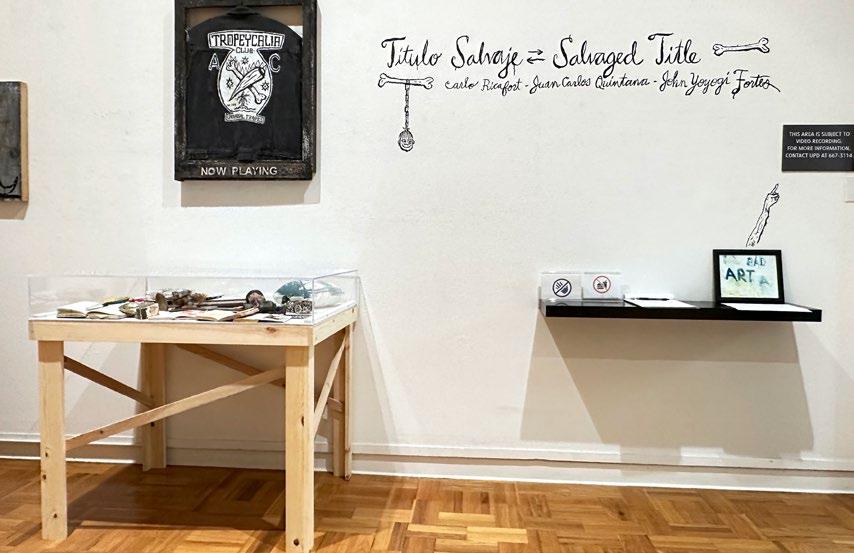
Título Salvaje ⇄ Salvaged Title
University Art Gallery
Department of Art
School of the Arts
California State University, Stanislaus
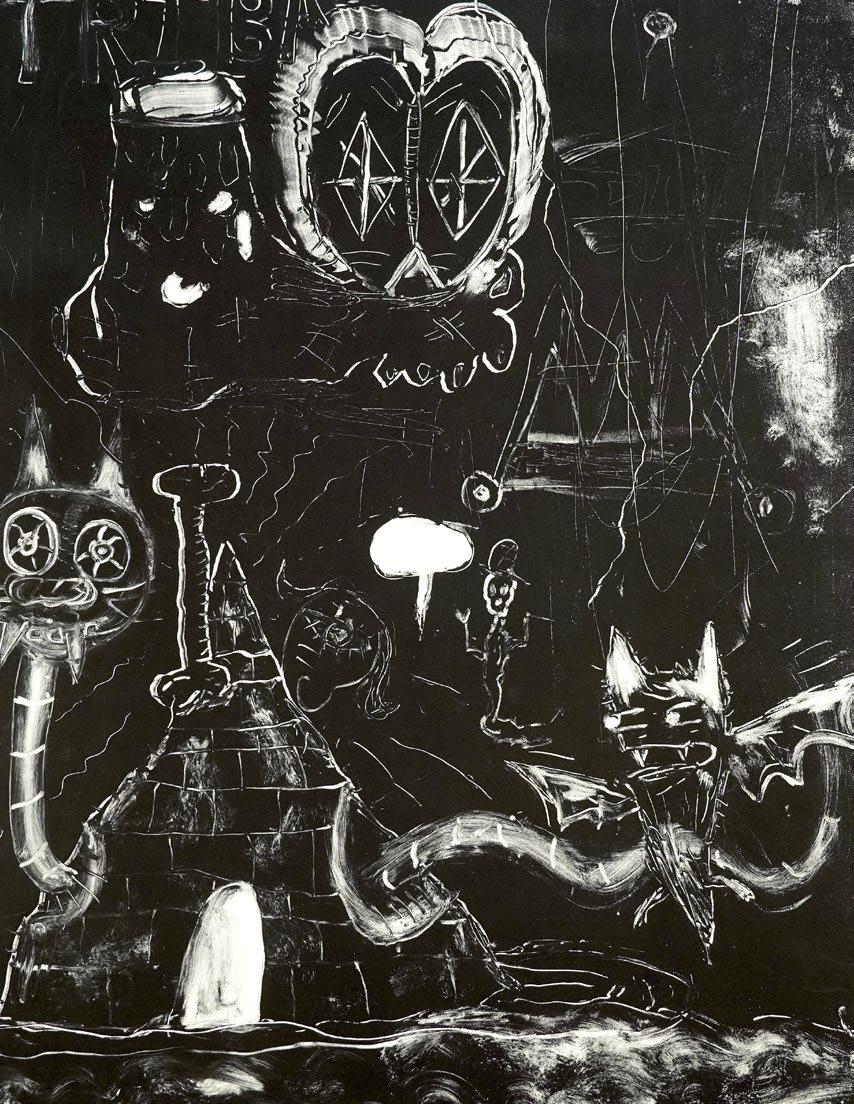
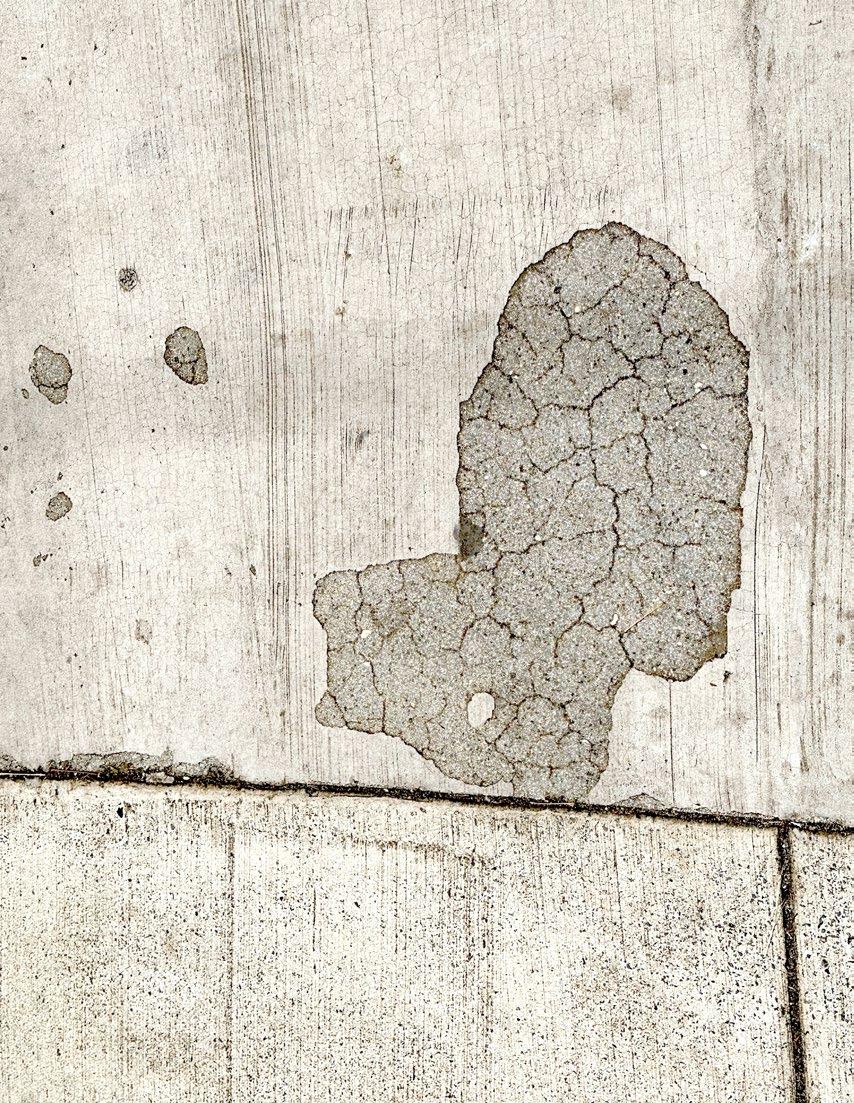
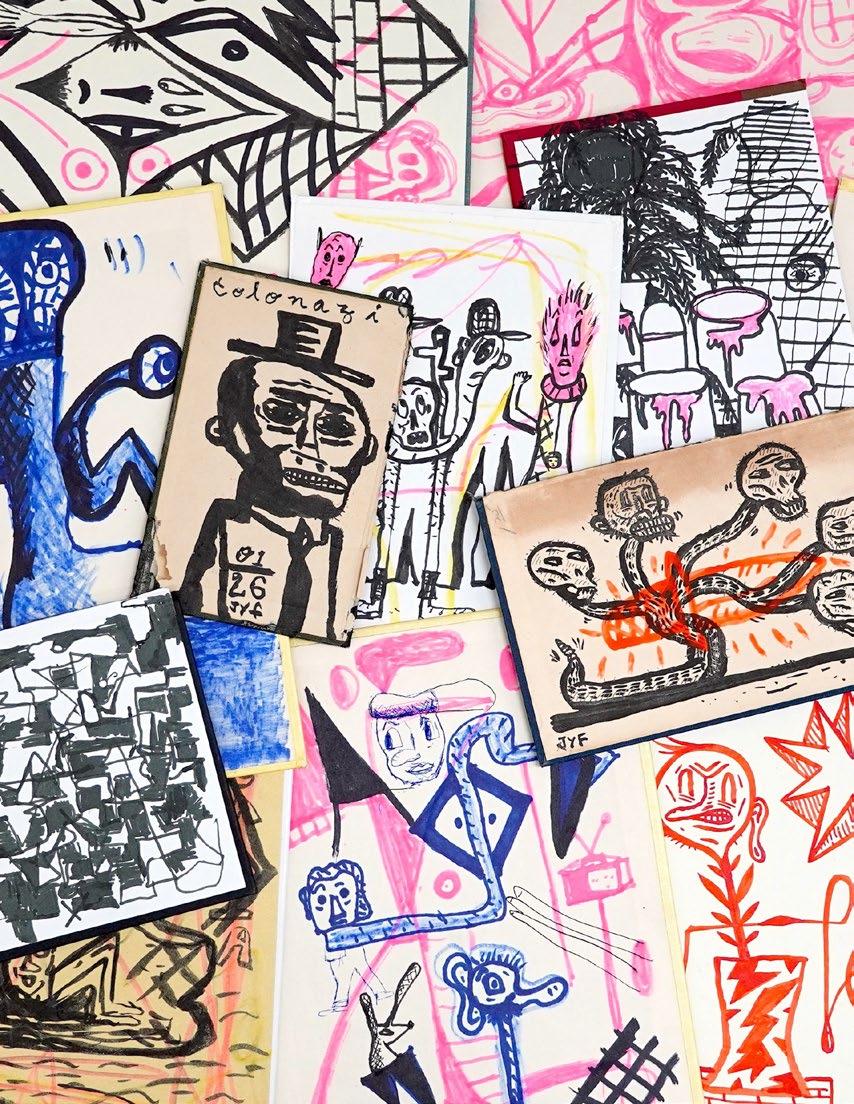
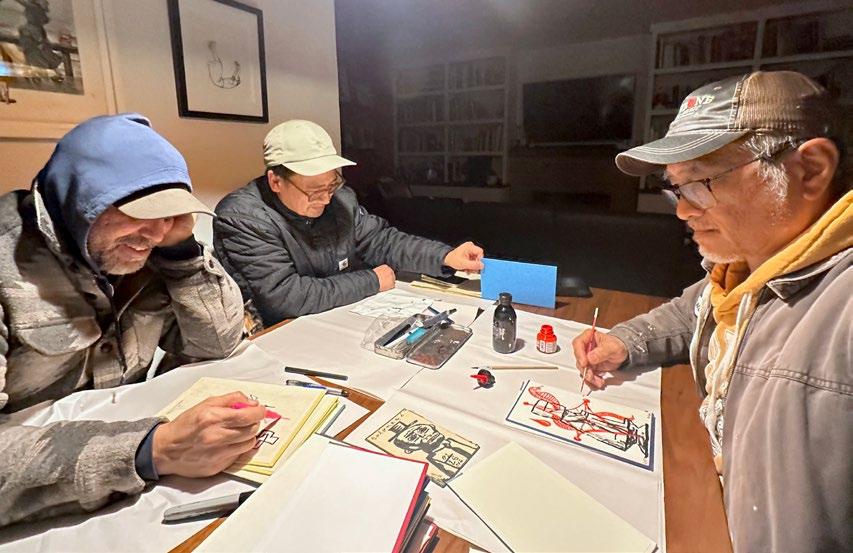
John Yoyogi Fortes, Juan Carlos Quintana and Carlo Ricafort - Tropeycalia Club, Título Salvaje ⇄ Salvaged Title, represents a chance to view their incredible work. Working as a group that is reminiscent of 1960’s Brazilian Tropicalia movement, John Yoyogi Fortes , Juan Carlos Quintana and Carlos Ricafort use painting and installation to create works that push the boundaries of political resistant and cultural identity, that in the end help to further the dialogue of social justice and self-determination.
My first exposure to the group was during one of my frequent trips to the Sacramento area of California. Prior to my appointment as the University Gallery Director at Stan State, I had observed John’s work at a few different exhibitions. In 2003, when I became the Gallery Director, to my surprise, John was the first scheduled solo exhibition. When the possibility of working with John again was suggested, I was more than happy to embrace the exhibition. Getting to know the work of John’s colleagues, Juan Carlos Quintana and Carlos Ricafort has been an exceptional experience and to see the three of them work together has been a once in a lifetime event for me. Their almost seamless working interactions create truly amazing work. We are very fortunate to have this exhibition in our gallery.
Painting/Installations in all forms are fundamental area of educating artists in the Art Department. Having exceptional exhibitions of painting/installations in our galleries helps to generate meaningful discussions and lifelong learning about these mediums. The University Art Gallery’s programing helps to support our faculty’s teaching. It is usually through faculty recommendations that many exhibitions come to our galleries, this exhibition was recommended by Assistant Professor Mirabel Wigon.
I would like to thank the many colleagues that have been instrumental in presenting this exhibition. John Yoyogi Fortes, Juan Carlos Quintana and Carlos Ricafort for the chance of exhibiting their important work, Matthew Villar Miranda for his wonderful essay, Noely Ortiz, our Administrative Support Coordinator for her tireless work in organizing and arranging the show details, I would also like to thank, Brad Peatross of the School of the Arts and California State University, Stanislaus for the catalog design and Stan State Print Shop for printing this catalog, Marty Azevedo, Art Department Chair and Alex Quinones, Art Department instructional support tech, for helping the artists create the silkscreen artwork for the catalog. I would also like to thank the Instructionally Related Activates Program of California State University, Stanislaus, as well as anonymous donors for the funding of the exhibition and catalogue. The support is greatly appreciated.

Dean De Cocker, Director
University Art Gallery
California State University, Stanislaus
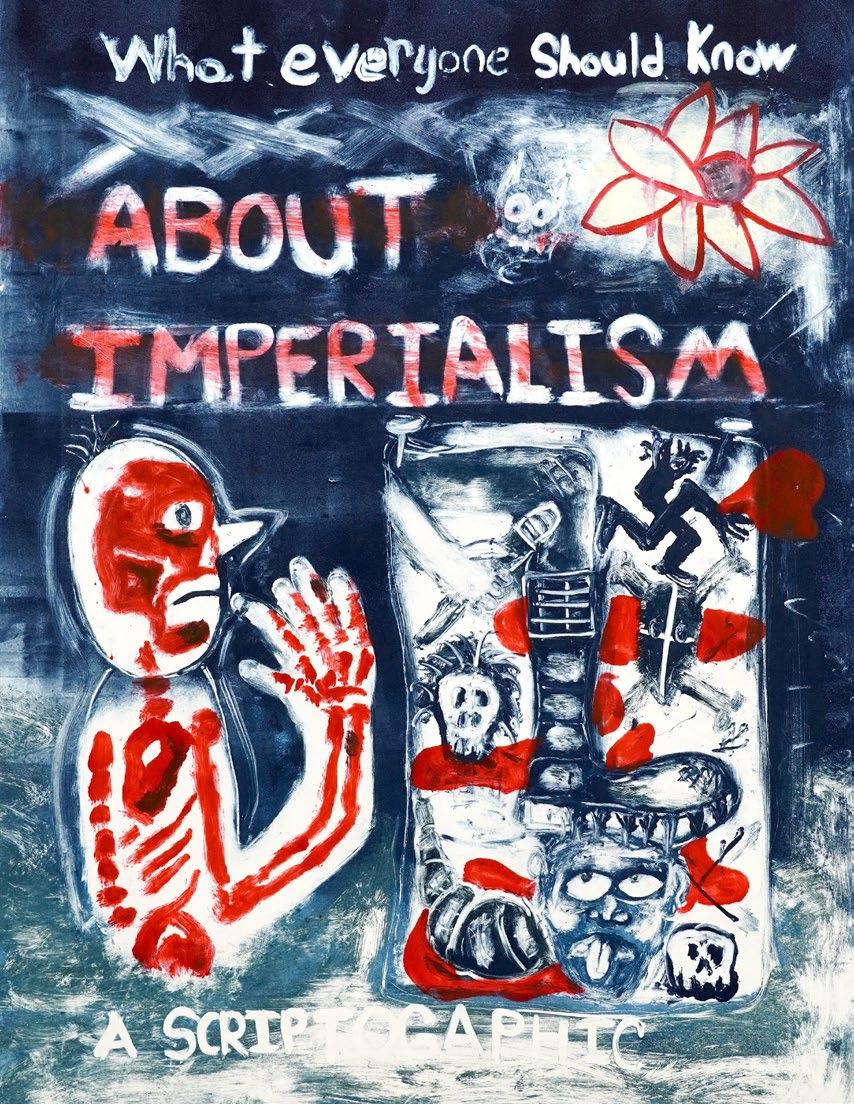
The eclectic process of Carlo Ricafort involves excavating history, music, philosophy, and current events. As a Filipino-American artist, Ricafort borrows from multiple sources to create freeassociative and open-ended commentaries. By rejecting notions of cultural purity, he champions a complex hybrid reality that reflects the layered experiences of the global diaspora. carloricafort.com
Juan Carlos Quintana creates what he describes as a “pre-post-anti-pro revolutionary gumbo/ajiaco potpourri” of images. A Cuban-American artist whose work embodies irony and ambiguity, Quintana utilizes a whimsical, satirical style to speak to ideological conundrums and lost idealism. Much like the original Tropicalists, his work challenges dominant narratives by using art as a tool to critique authority. juancarlosquintana.org
John Yoyogi Fortes navigates the physical and psychological landscapes of the self through a visual language of “dark humor and wordplay.” Bridging his cultural past with his present, he creates multi-layered works appropriating images from both American pop culture and the indigenous Philippines. Fortes’ process echoes the “cultural cannibalism” of the Tropicália era— consuming and transforming diverse cultural tropes to explore the nuances of assimilation and identity. johnyoyogifortes.com
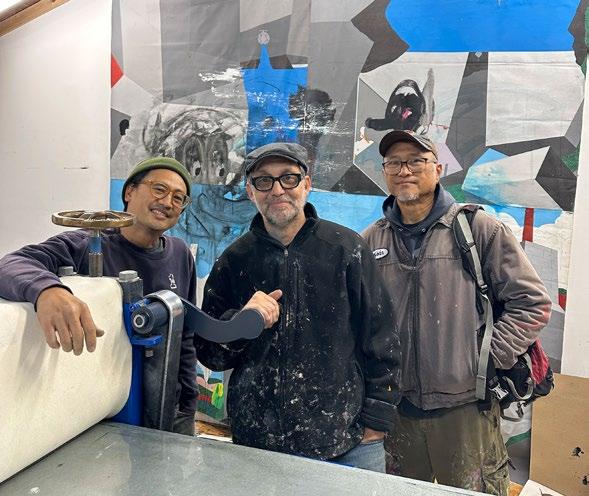
Three artists walk into a bar in Manila pondering on how to navigate the jungle traps laid in the art world with the dream of authenticity, autarky, and aesthetic anarchy on hand.
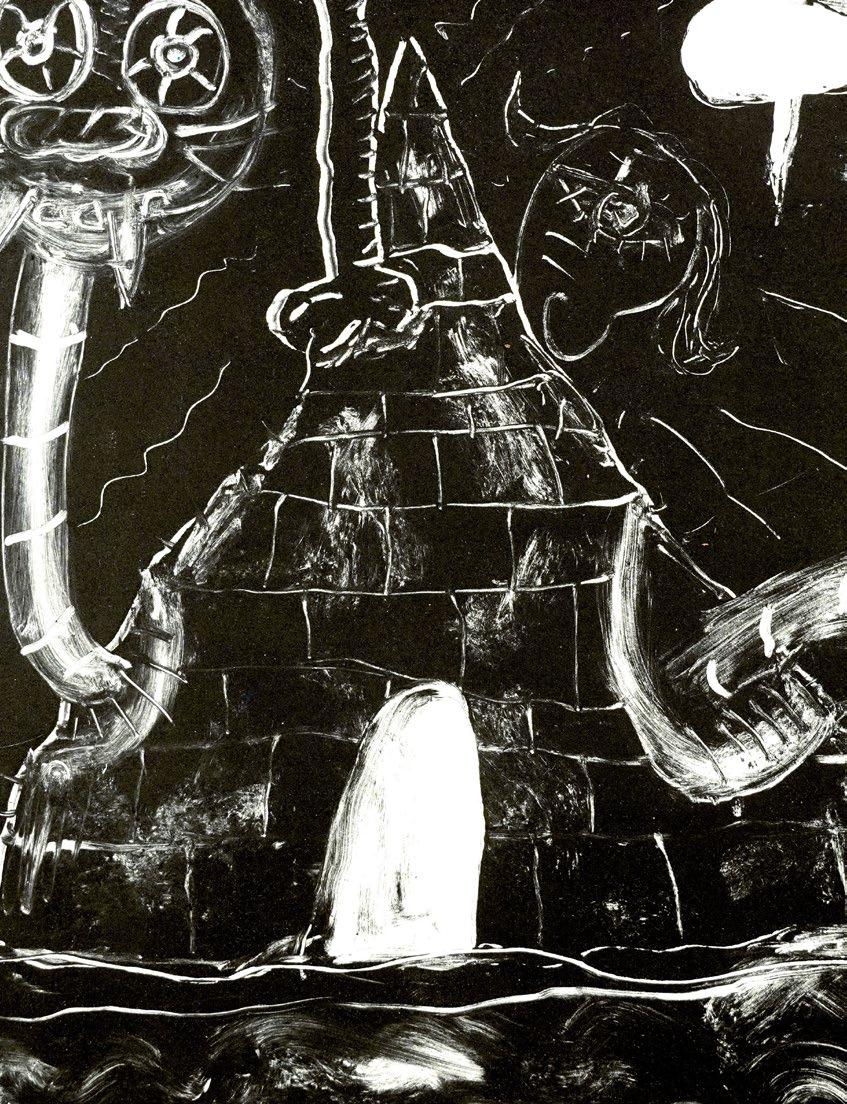
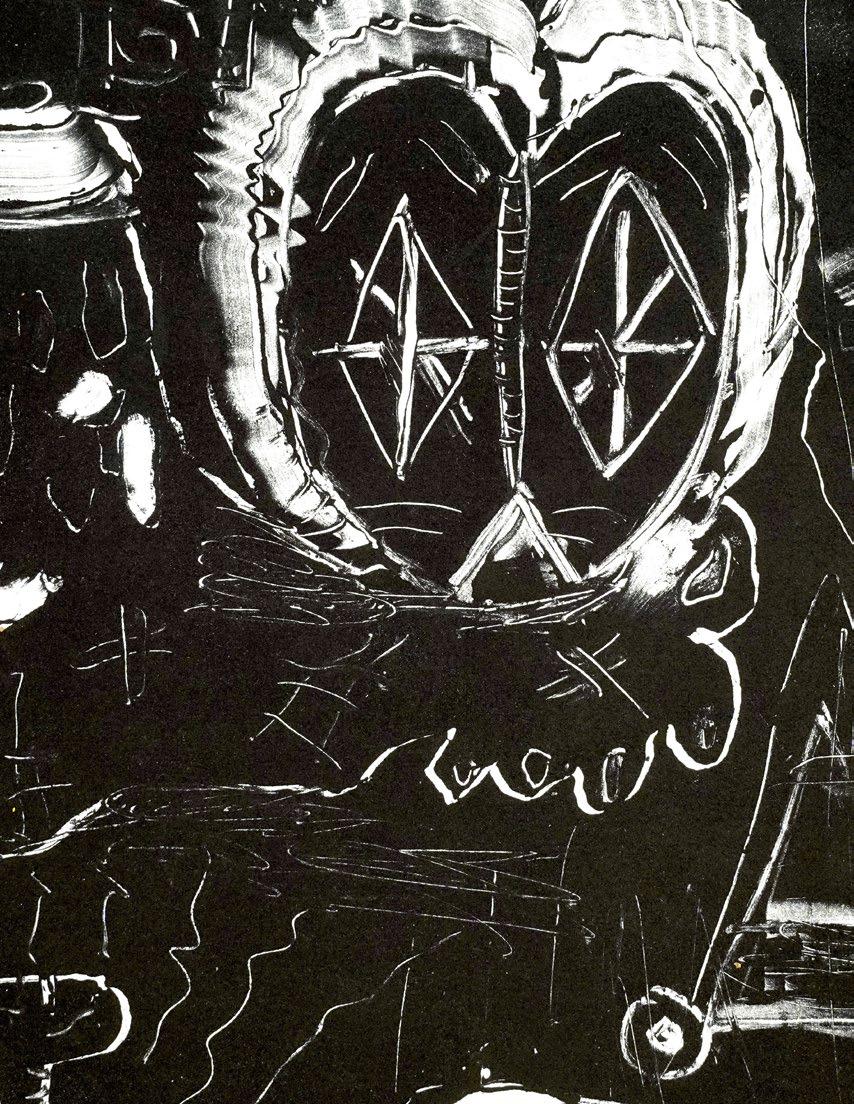
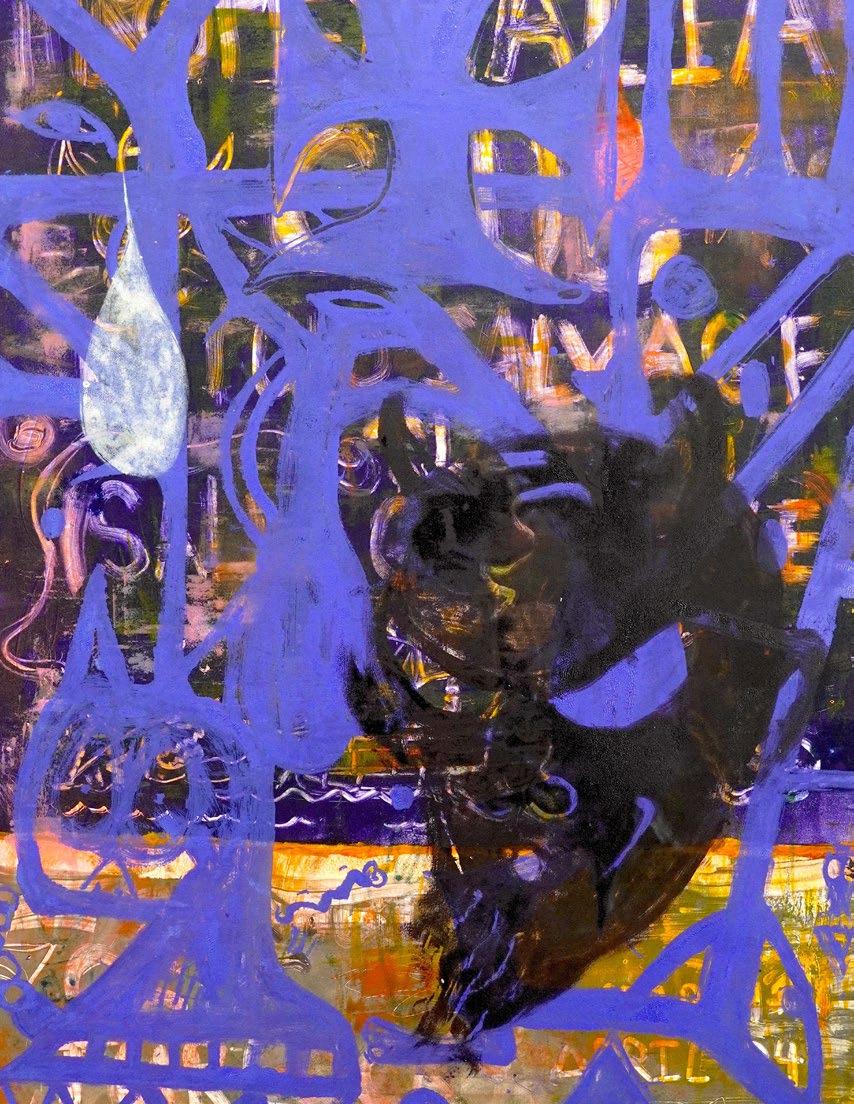
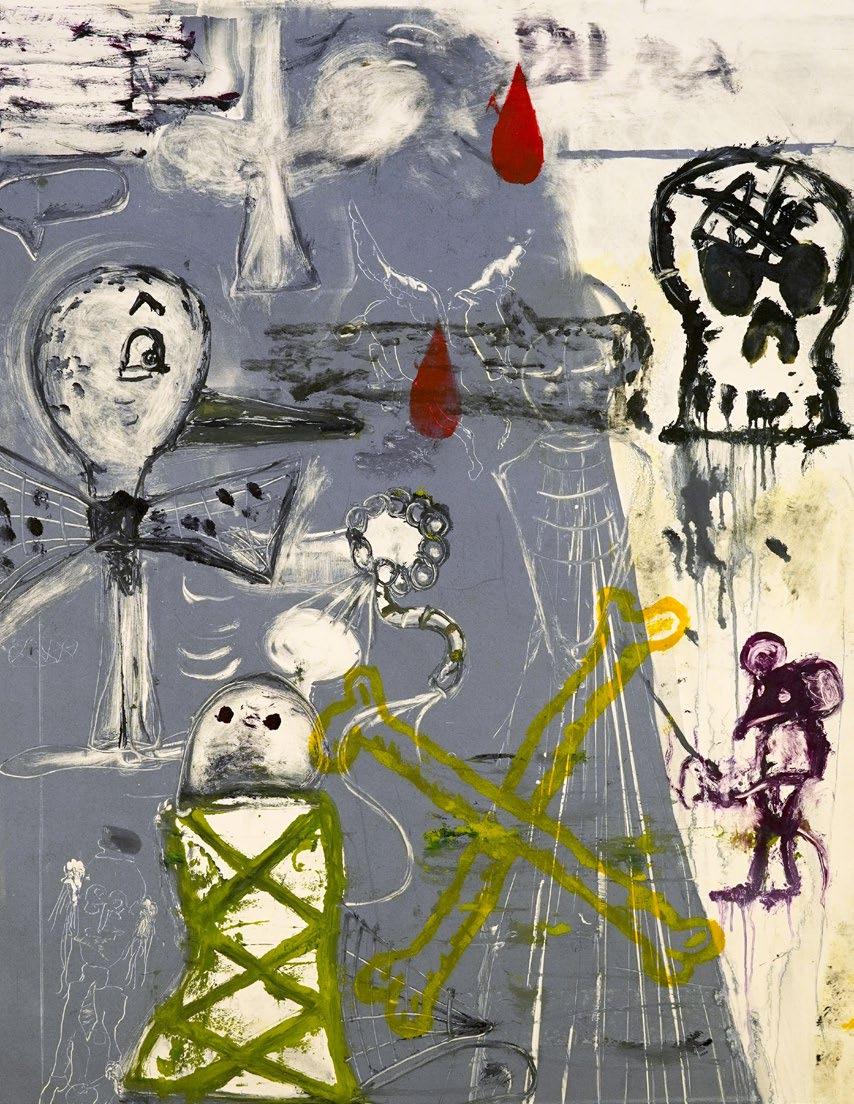
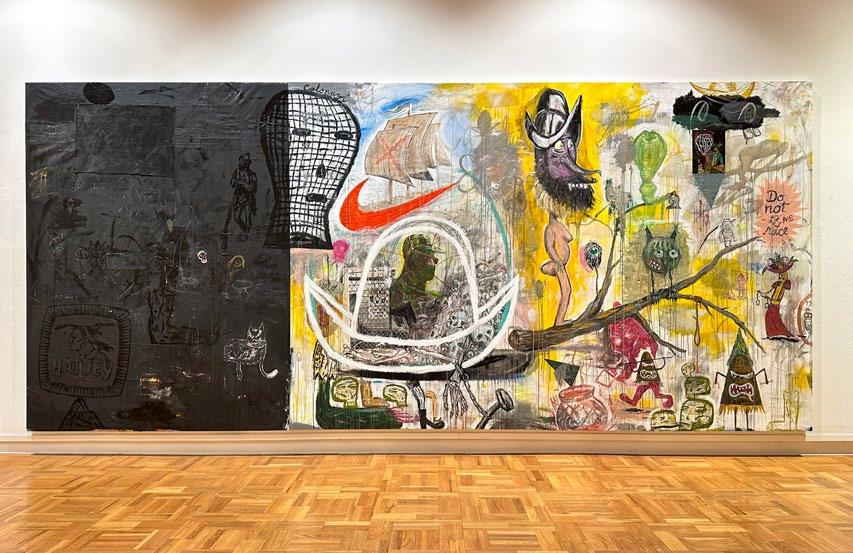
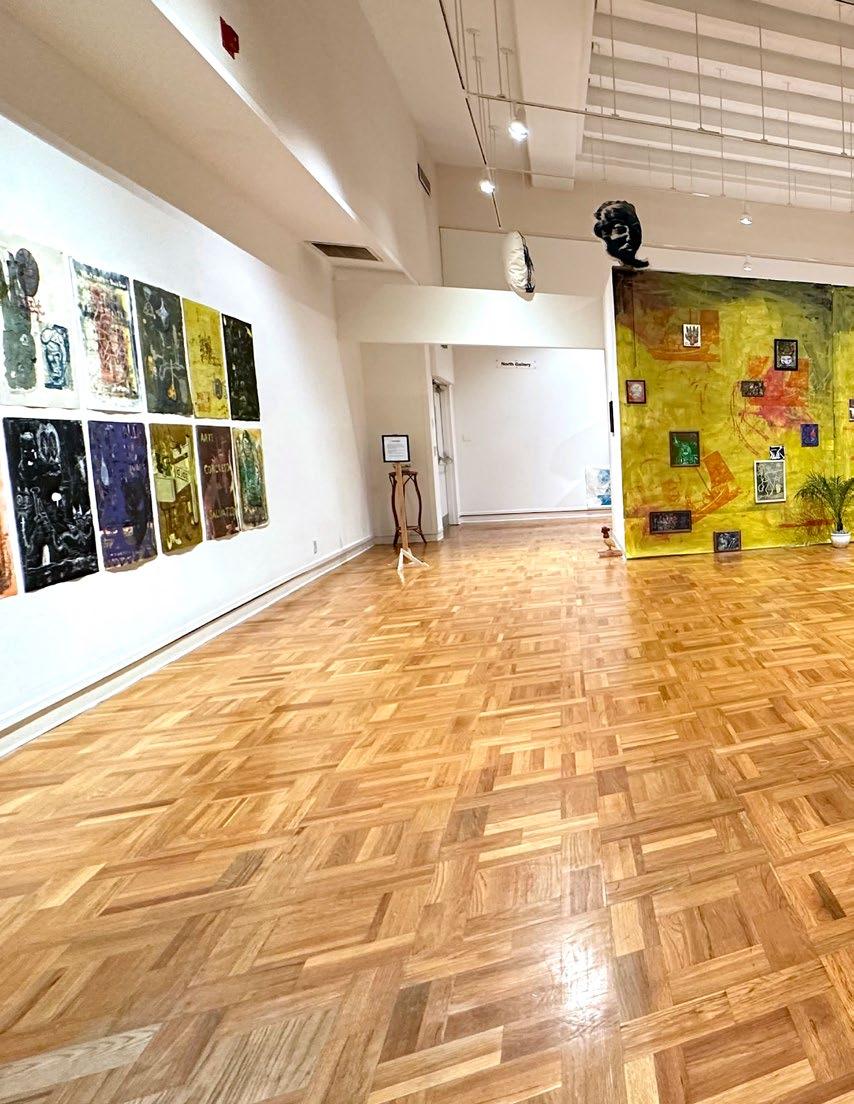
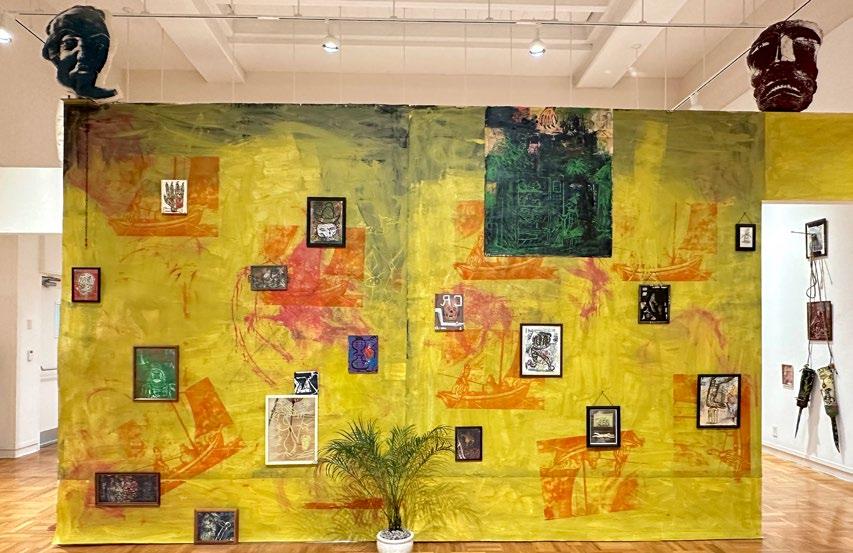
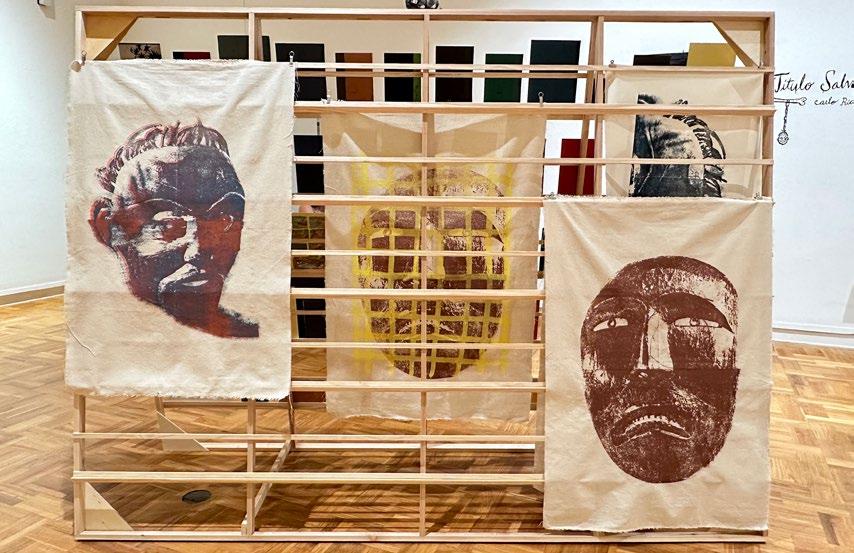
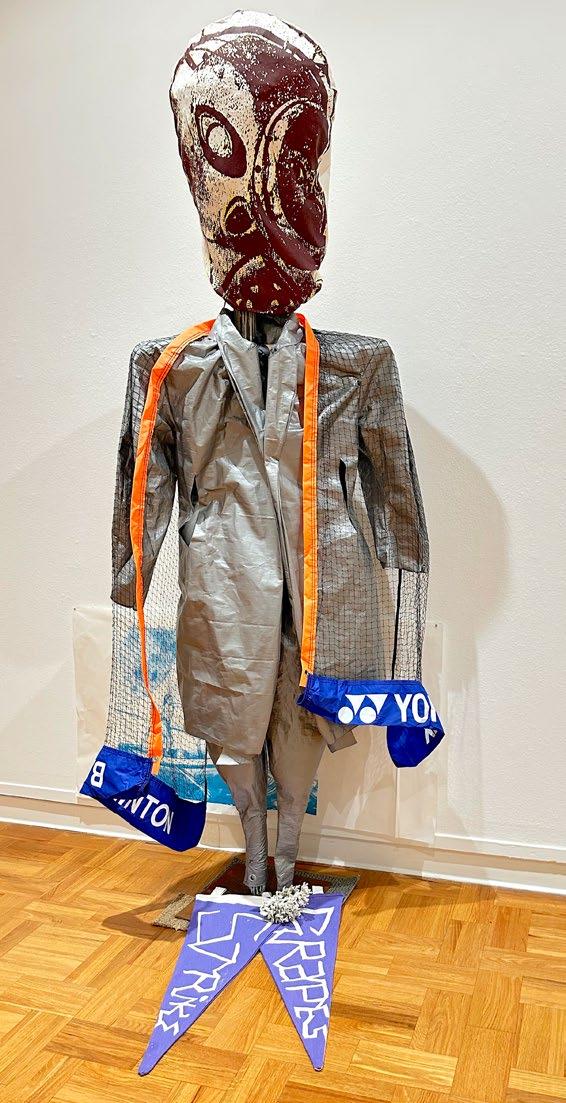
A mask hovers above us as the perfect interface of this perplexing moment. It is an abstraction of the face hidden to conceal the truth on the duality of nature: monster or god. To don a mask enters the realm of fantasy. Featuring the hooded vigilante as an ambivalent “hero” with questionable morality is common in comics but consequentially confusing in life. On the other hand, the masked entity can also mean the effacement of an identity, as in becoming persona non grata, as admonished on the painting to “do not e-race me.” Thus, the signs are afloat as they say, unchained from their purported meanings, the masked message causing chaos to the system of reality.
Carlo: How does one convey such a liberating message when we can’t even get along to understand each other? Can language be just another means of subjugation?
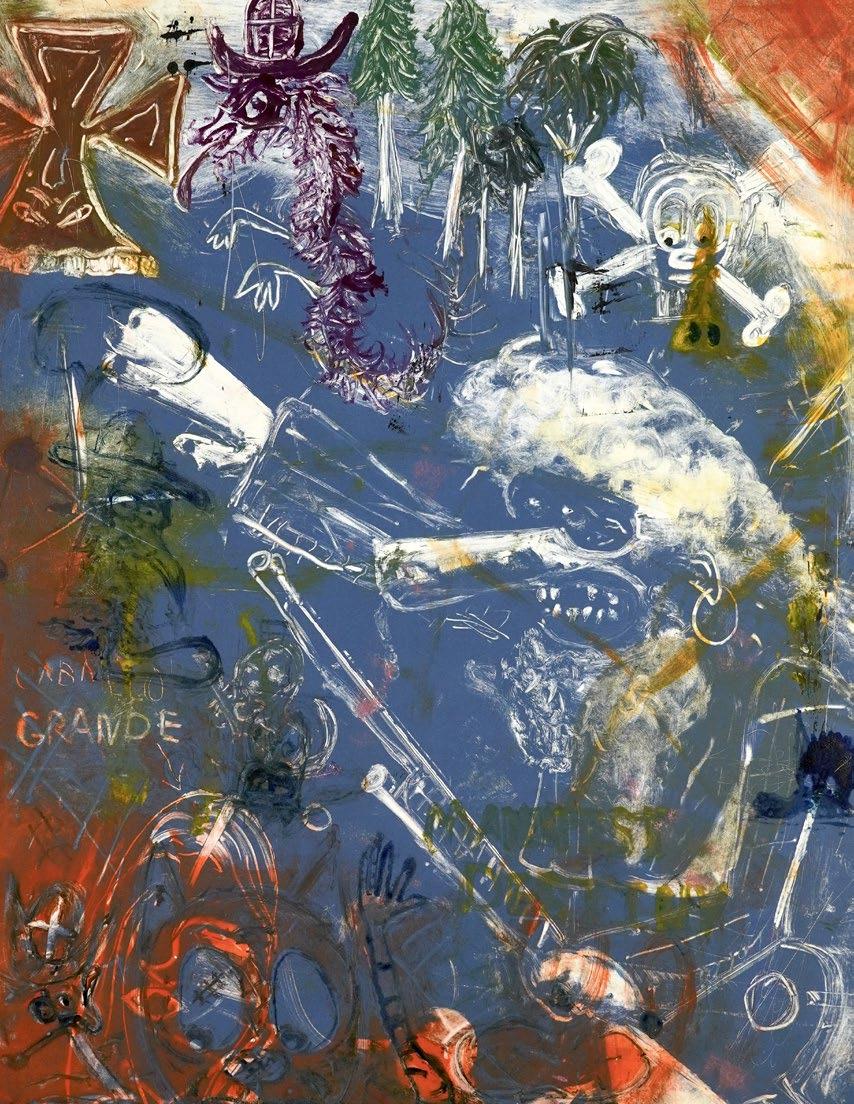
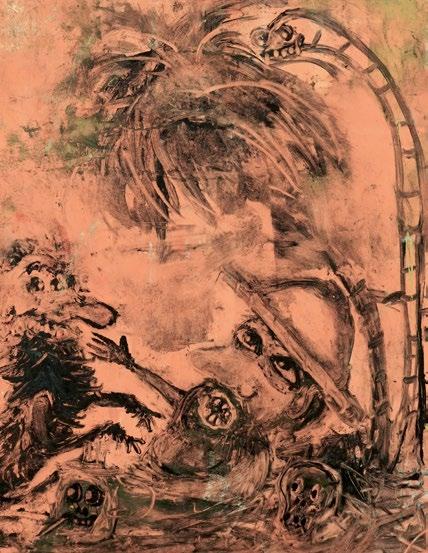
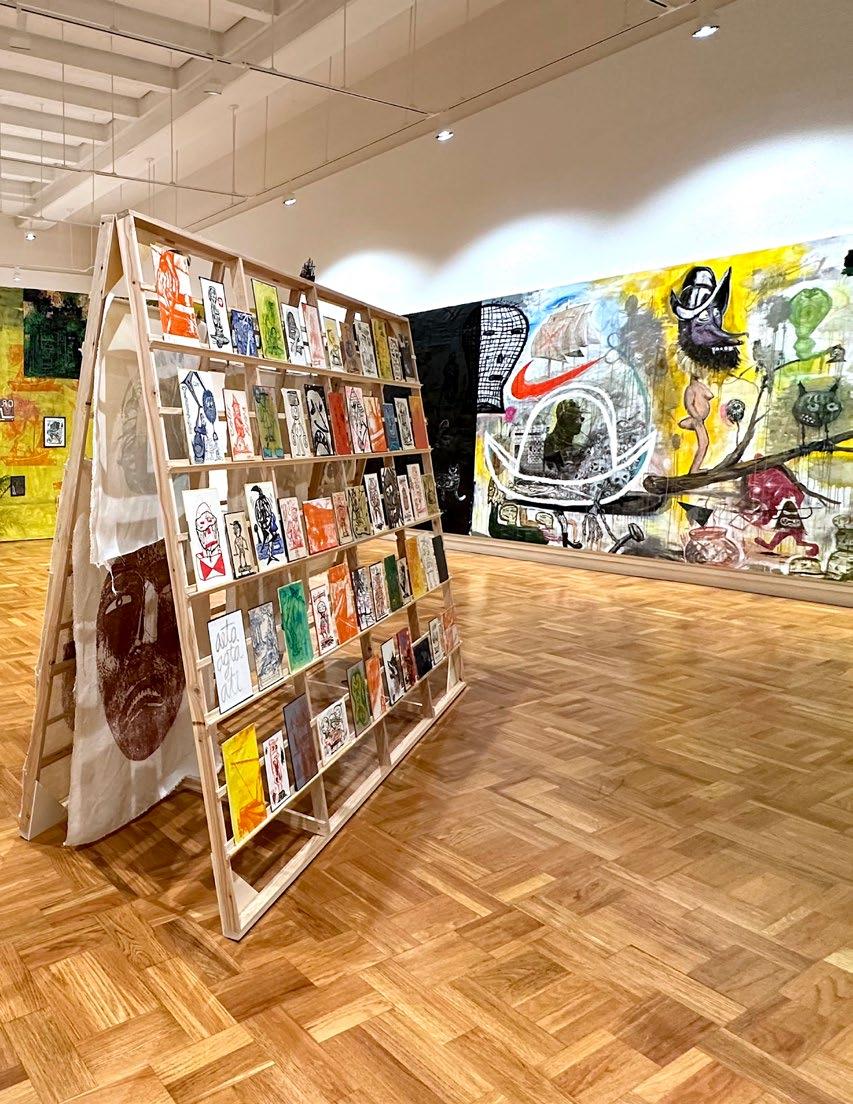
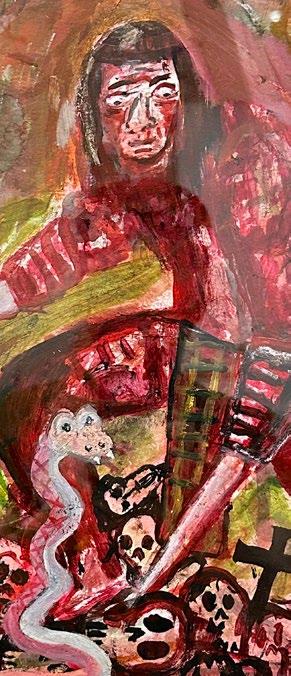
Similarly, the divine mission of manifest destiny lends itself to a masking of colonial benevolence which history has already proven otherwise. What initially appears in the painting of Título Salvaje was a monumental skull portrait with a branching network across that has now turned into a graveyard of bones signaling the accumulation of pain and suffering through time as continuous victims amount. The critical question being raised here in the work is: Identity as the true and constant composition of our collective struggle against cultural obfuscation and eventual erasure, of having to continuously hammer-in Identity’s essential meaning to those who would care enough to look and listen outside of the value signaling of the moral majority, as we put in efforts for justification of authenticity with the investment of all our ignoble acts of otherworldly artistry in order to make something meaningful to share beyond apparent tantalizing lucrative rewards and practical common sense, which eclipses existence with more than the price of just being born.
John: The struggle has always been there as we all bear the mask of race. Can we escape such stereotypical labels?
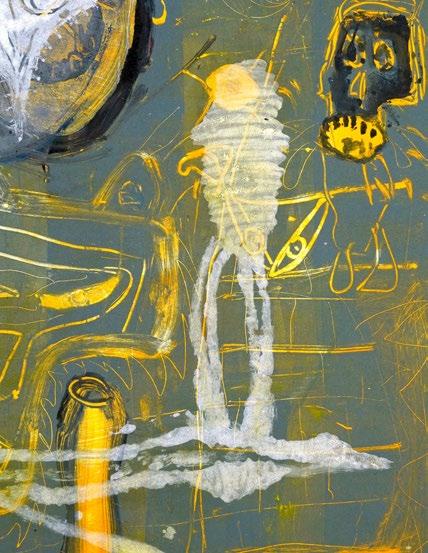
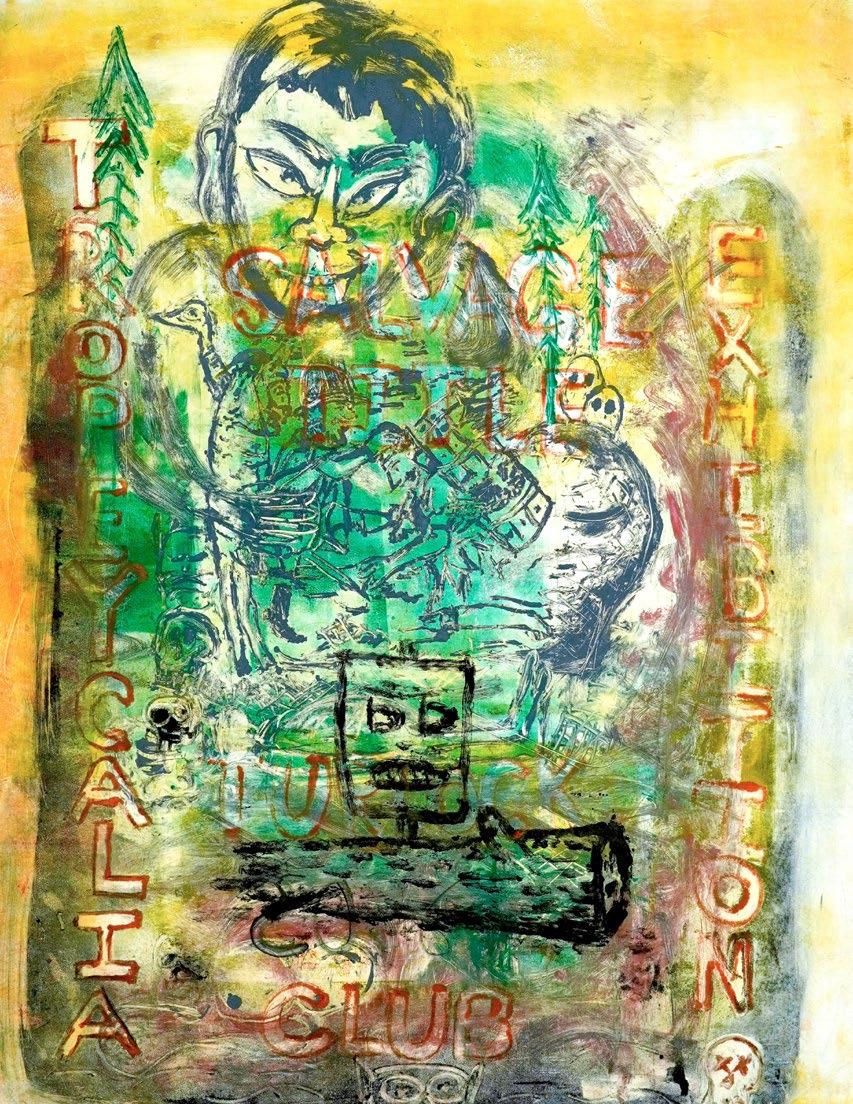
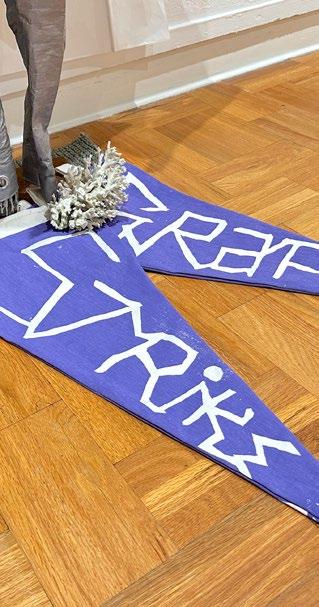
Título Salvaje thus flirts with a self-deprecating sarcasm on the post-apocalyptic contemporary condition of the postcolonial. The painting stutters with a rage repressed long and deep in the bowels, ambling towards anxious incoherence to release everything all at once. What explodes is a certain air that fills the room, unsuspectingly entering through the nostrils and directly to the brain. A spectacular visceral experience is made. Using eccentric figuration in the guise of caricature and cartoon expressionism, the characters here are basically fugitive in identity with the tendency to be obscured and painted over a la street style tagging. Like graffiti, they leave a trace. The painted surface is thus layered, like the many complex veils of history.
Juan Carlos: Making art in today’s culture of cooptation, in the triumph of capitalism, is there still a thing as revolution?
Arvin Flores, Artery Art Space, Manila, Philippines
by Matthew Villar Miranda
When a damaged car is resold, it carries a salvaged title — a bureaucratic mark of prior loss and ongoing recovery. Título Salvaje ⇄ Salvaged Title pivots on this unstable topography. In Spanish, salvaje means wild, untamed, savage, a term historically weaponized to mark the colonized as primitive and pre-modern. In English, salvage names the labor of extraction, of pulling value from the wrecked and discarded. These meanings do not sit neatly beside each other. They abrade, overlap, and implicate one another, much like the histories this exhibition puts into tension.
For Tropeycália Club — John Yoyogi Fortes, Juan Carlos Quintana, and Carlo Ricafort — that double bind articulates a condition familiar to diasporic life: to inherit histories of imperial violence, to be shaped by caricatures one did not author, and to rework those residues into new forms of agency. The artists on view have created these works from what they salvaged from colonial archives, mass media, and the wreckage of representation. The resulting pieces are constructed here in careful collaboration, in acts of generative recovery.
Tropeycália Club embeds its method in its name. “Trope” — the figure of speech, the repeated image, the colonial cliché — meets Tropicália, the Brazilian cultural movement that emerged in defiance of military dictatorship, fusing popular and avant-garde forms and instrumentalizing irreverence as dissent, until the regime forced its key figures into exile.1 The name itself is a provocation: tropes can be seized and subverted. Satire, collage, and appropriation follow from that premise in practices of reclamation beyond shallow ornamentation.
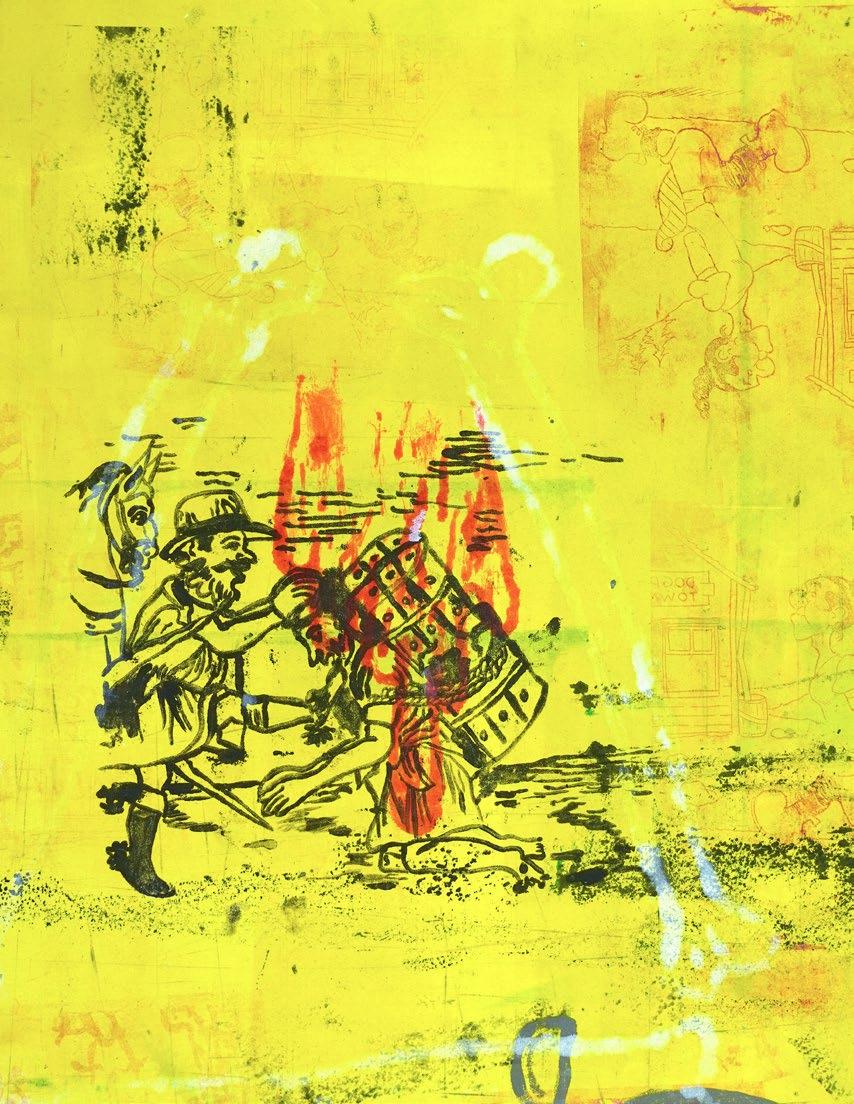
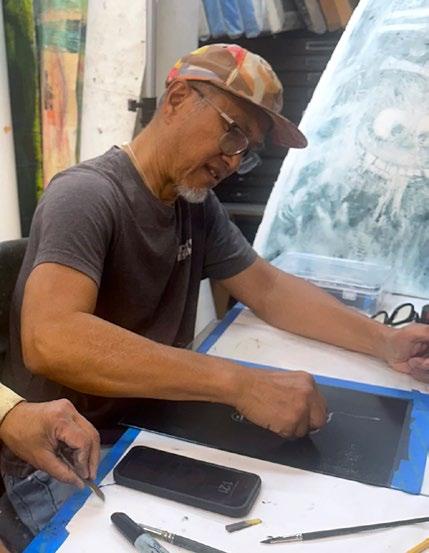
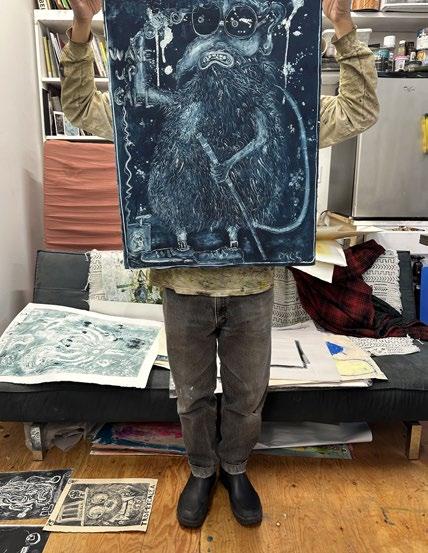
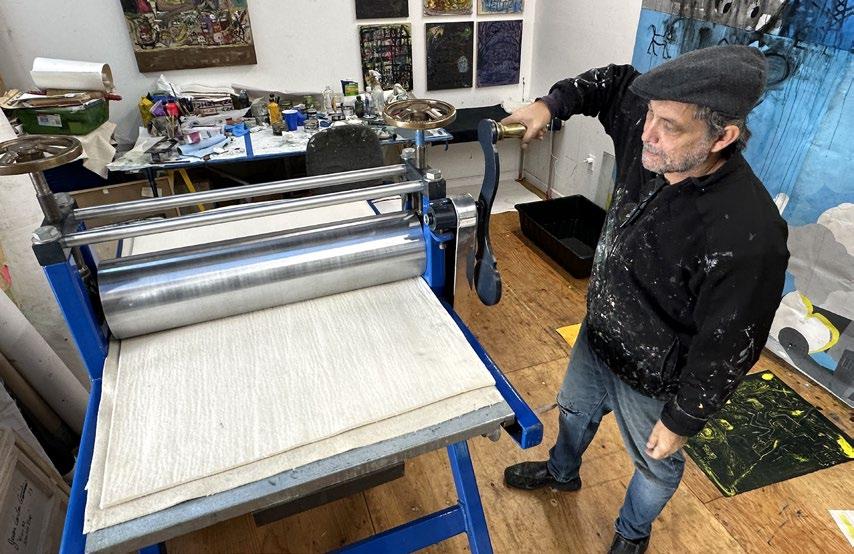
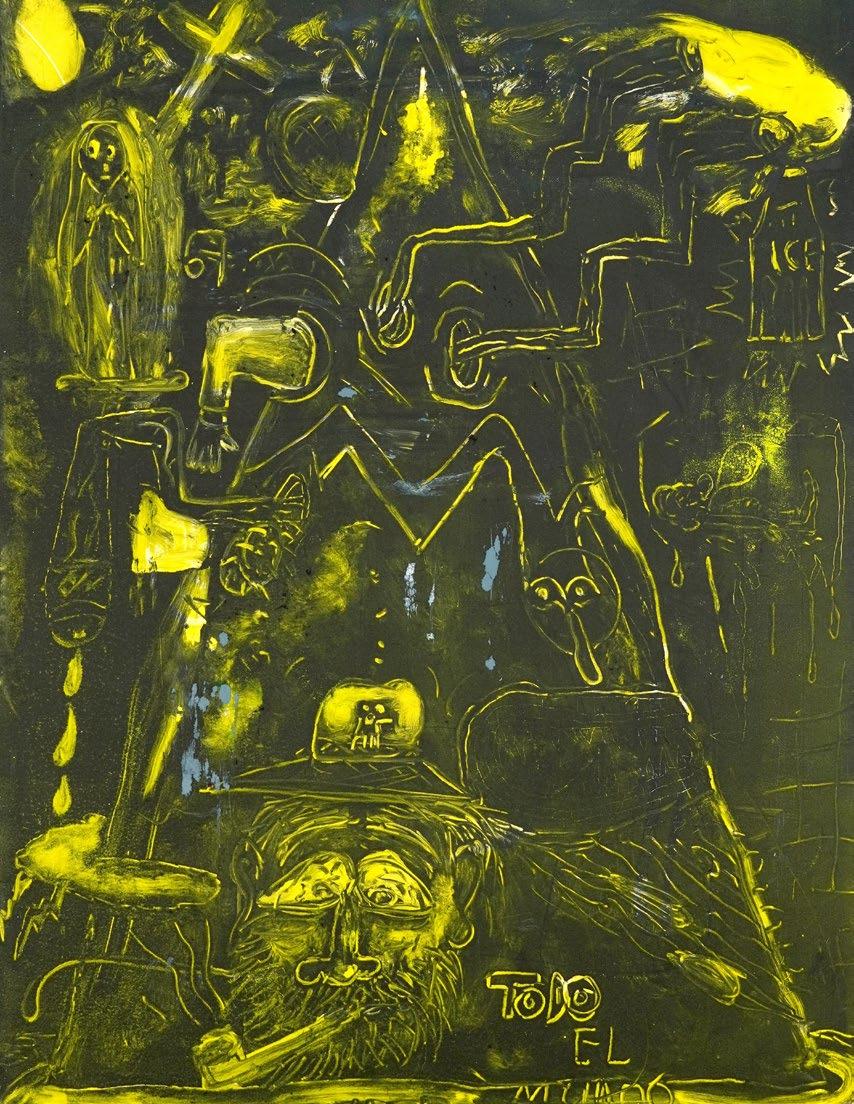
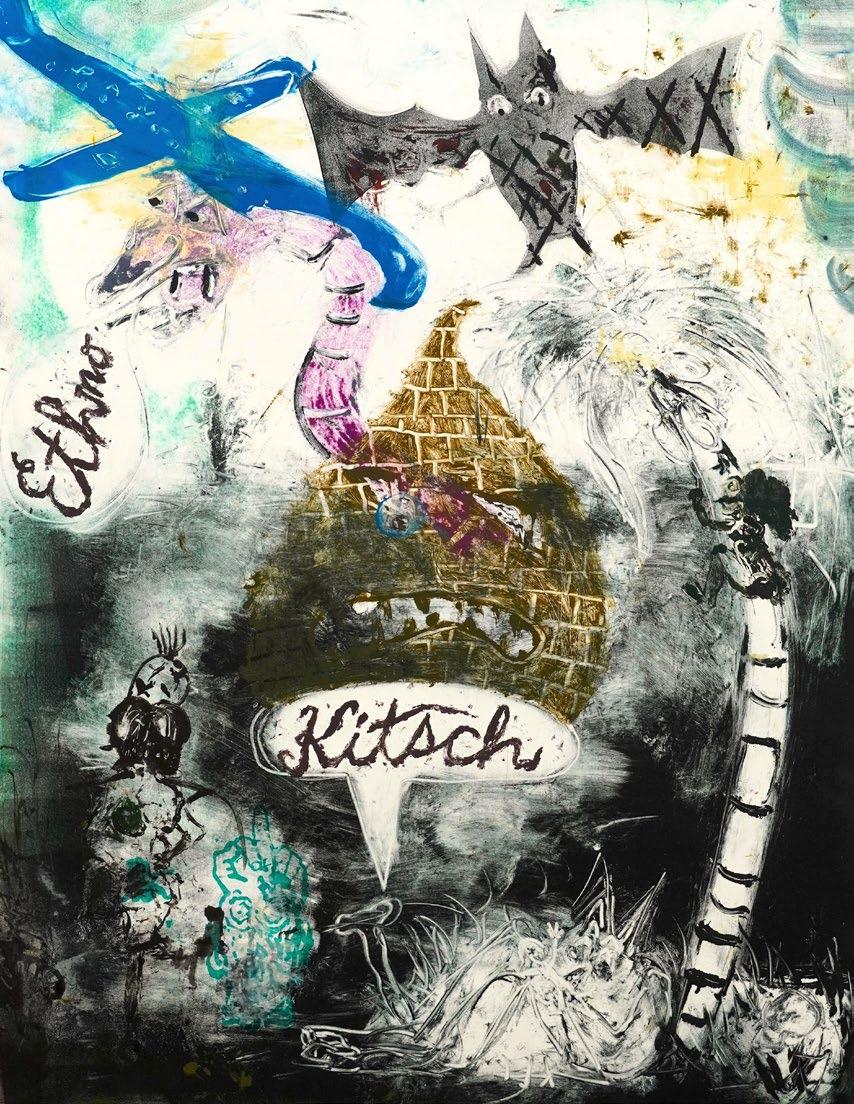
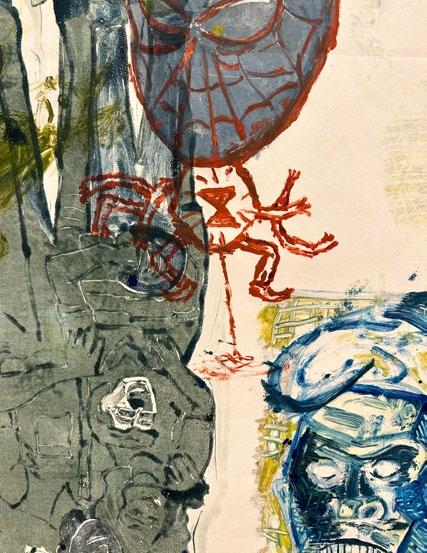
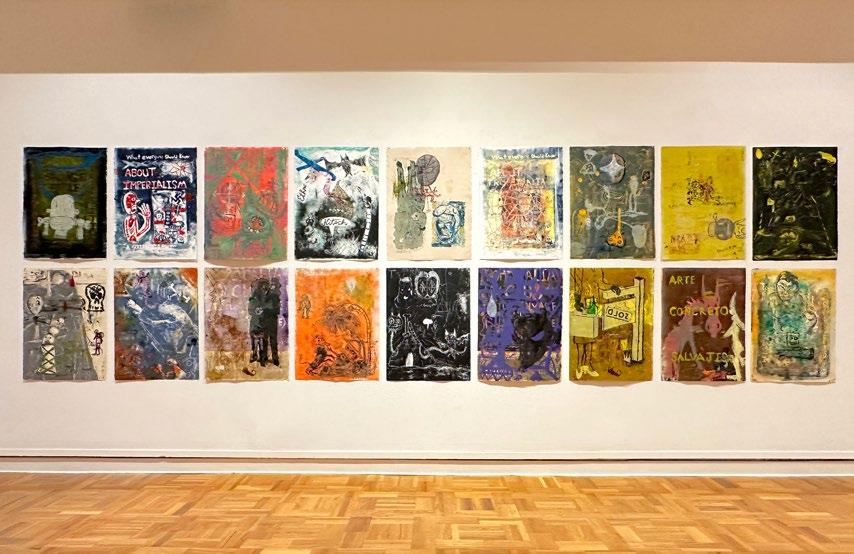
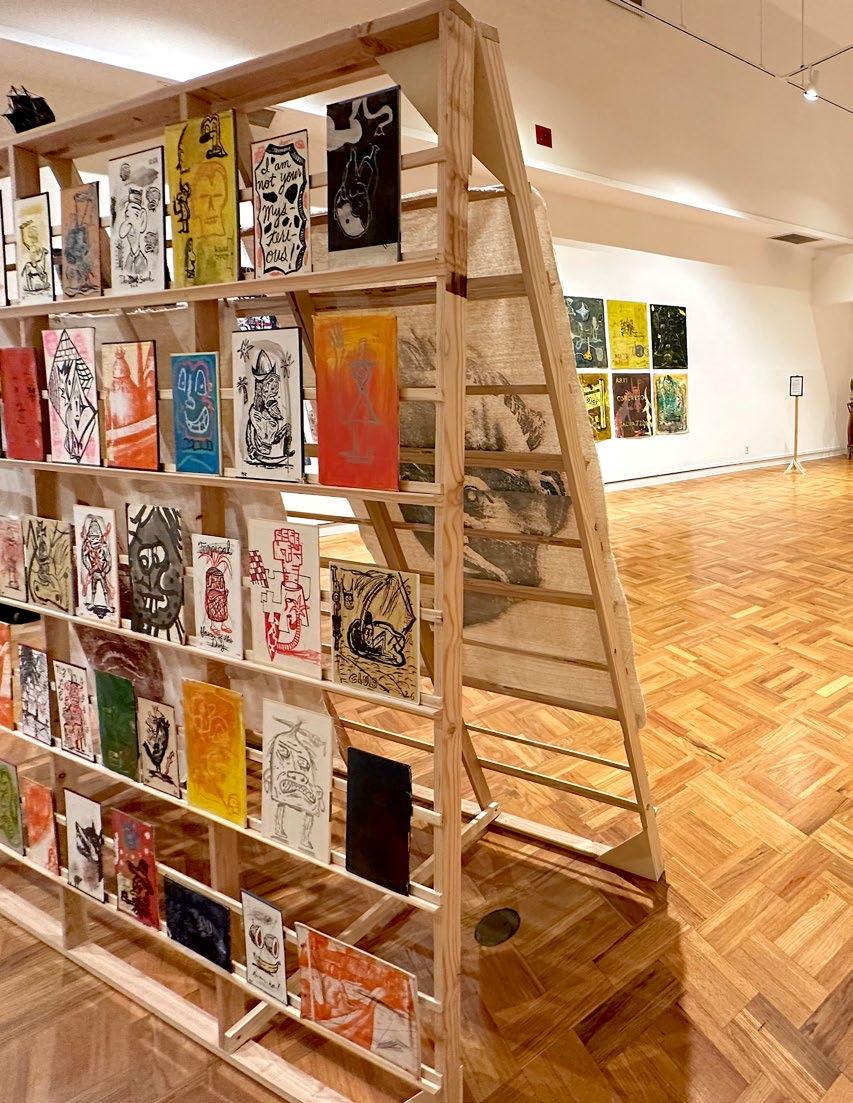
This collaborative sensibility materially compounds in the group’s grid of monotypes, one of the exhibition’s formal cores (p. 27, bottom). Built through layered transfers — pigment pressed from plexiglas, then repainted, erased, and reworked across multiple sessions and hands — the prints accumulate the way sedimented histories do: through overlap, obfuscation, rewriting, and superimposition. No single authorial voice resolves on its multifaceted surface.
The imagery is deliberately heterogeneous. In one panel, a grimacing face with almond eyes and sharpened fangs looms among treetops against acidic washes of green and yellow— ghoul and racial type at once, something easily ripped from Sunday-paper caricature (p. 20). Images drawn from Felipe Guaman Poma de Ayala’s Nueva Corónica y Buen Gobierno (c. 1615)
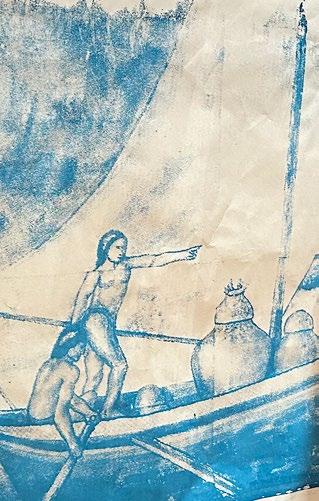
— the Indigenous Andean nobleman’s illustrated indictment of Spanish colonial rule in Peru — surface as spectral presences, absorbed rather than quoted. Cartoonish skulls and blocky figures printed alongside a trunk drawn in thick strokes, literally a “travel log,” and symbolically, an ancestral vessel, the Philippine bangka 2 Migration, violence, and recollection collapse into a single temporality, held together by improvised process rather than tidy resolution.
Colonial representation worked by flattening — reducing complex peoples to fixed, legible types. These prints refuse that simplicity, embracing accumulation and non-reduction.
ANTHROPOPHAGY AND ITS SPIRITS
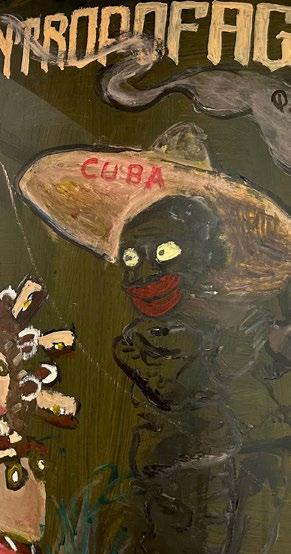
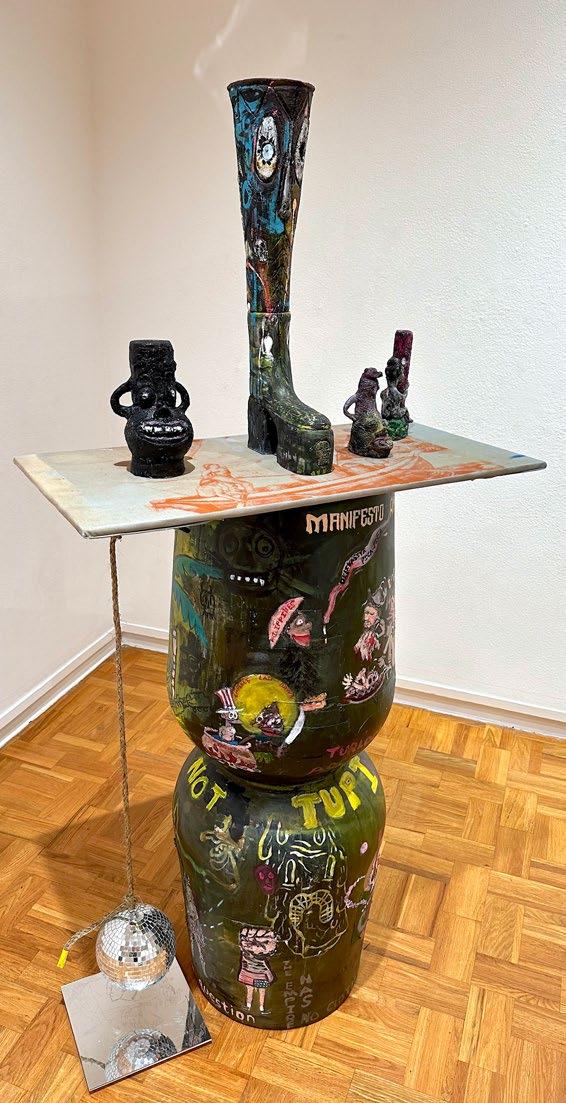
The exhibition’s conceptual framework resonates with Oswald de Andrade’s 1928 Manifesto Antropófago. Andrade’s central move — condensed in his reworking of Hamlet’s soliloquy as “Tupi or not Tupi” — reframed cultural influence as strategic ingestion rather than contamination or mimicry.3 “Cannibalism,” in his formulation, proposed that colonized peoples could absorb the colonizer’s forms, metabolize them, and redirect them toward local empowerment, against passive assimilation, a transformation through consumption.
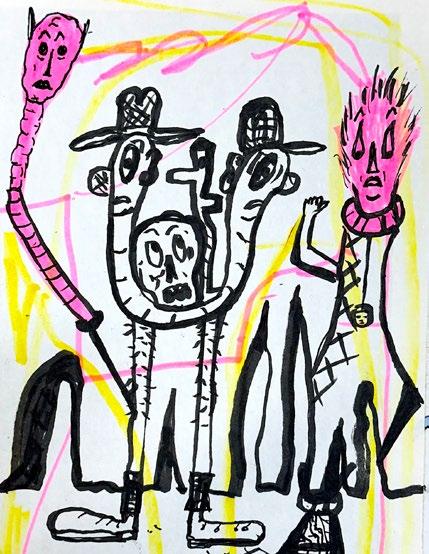
Tropeycália Club summons this anthropophagic spirit across three prominent archetypes that populate the exhibition — cannibals, tricksters, and ghosts. They embody operational modes rather than fixed identities, locating different relations to an archive warped by imperial violence. The cannibal devours and repurposes; the trickster outwits and inverts; the ghost returns and unsettles. Together, they constitute counter-caricatures, figures who reinhabit images that were historically deployed against the very people they depicted.
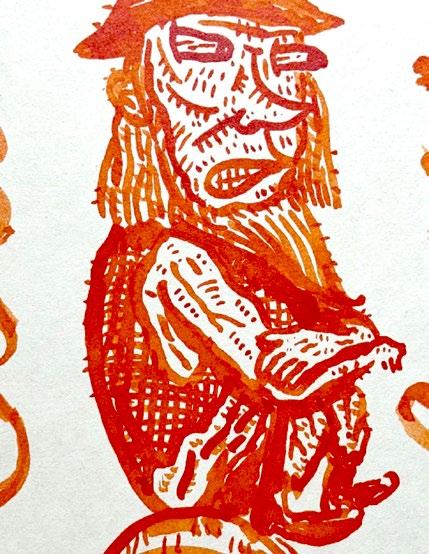
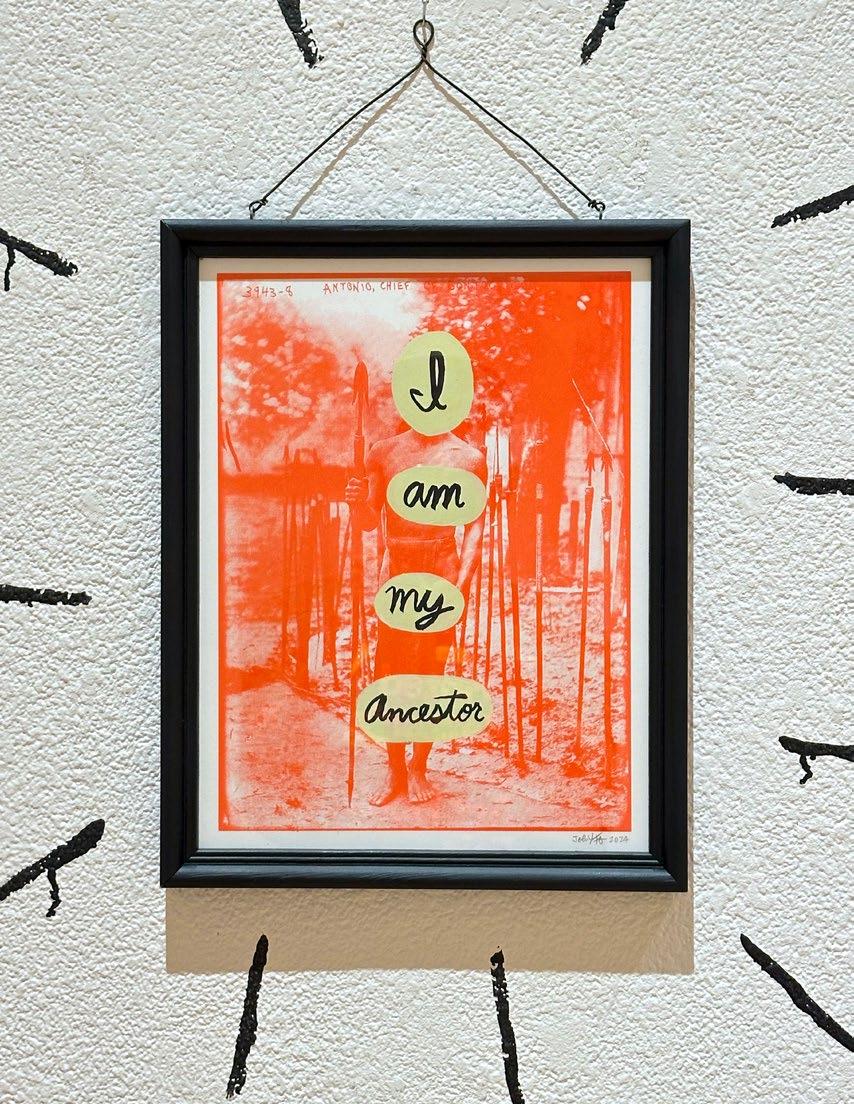
Born in Tokyo, Japan and raised in the Bay Area from age five, John Yoyogi Fortes navigates migration and identity formation through humor and illustrative expressionism. The cannibal, in Andrade’s framework, is the one who consumes what once consumed him, who turns spectacle into resource, and it is this dynamic that animates Fortes’s practice. He returns to the racialized tropes of his childhood Sunday funnies: headhunter fantasies, hula dancers, Pacific fantasias rendered as comic parody and light-hearted menace to an often Euro-American-coded Looney Tunes protagonist. Such images did not so much represent Oceanic peoples as exaggerate them, propagating savage distortions within an innocuous, ridiculous frame.
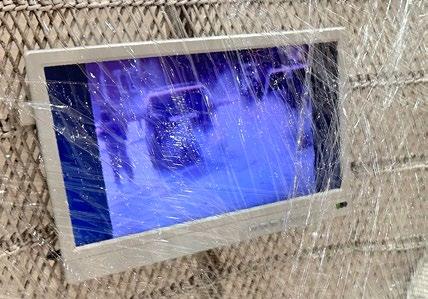
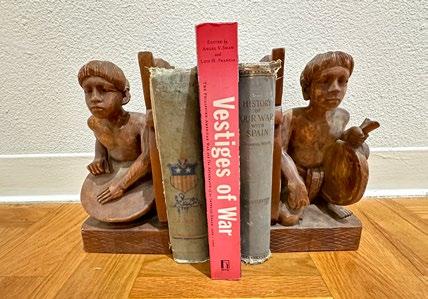
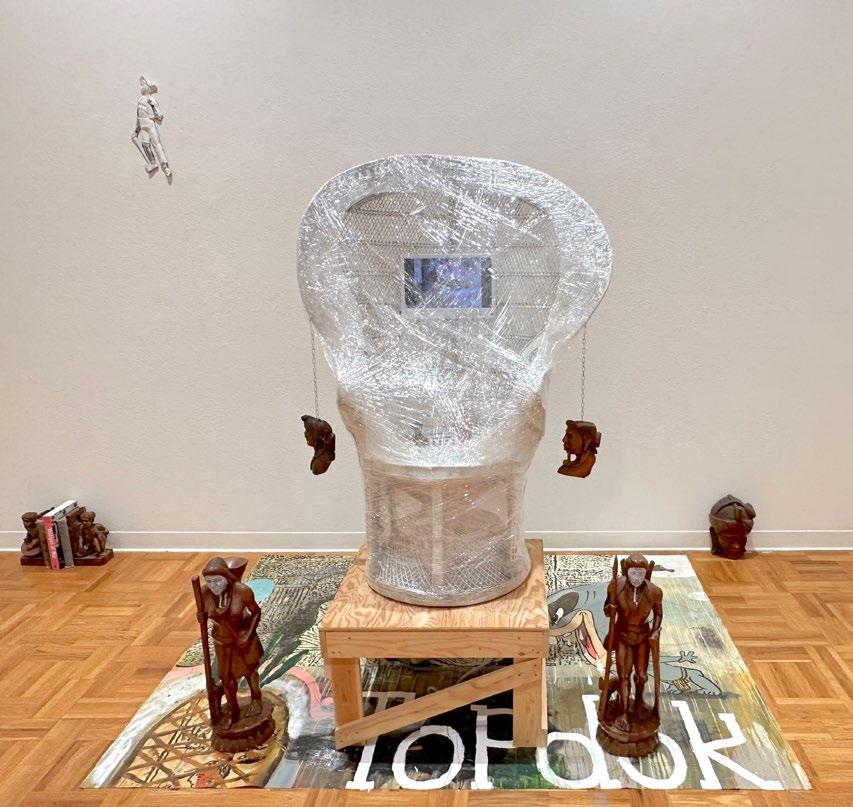
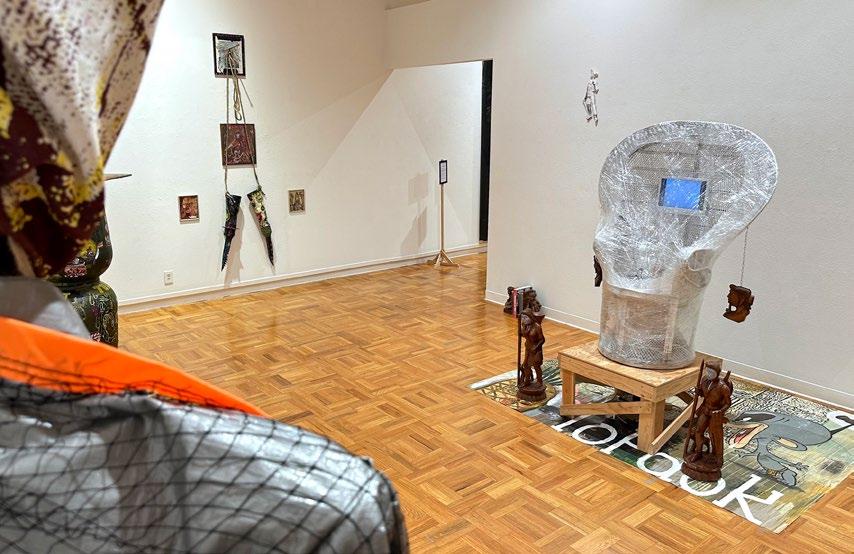
Fortes’s recent installations return to this material not to resuscitate it but to catabolize it. At the center of one work stands the peacock chair — an object whose historiography is tangled with carcerality and capital. Woven at Manila’s Bilibid Prison under American colonial rule, the chair was sold to tourists as an “exotic” symbol for American homes. It was later claimed by Huey P. Newton as a throne of power for the Black Panthers in 1967.4 Fortes seals it in plastic and places a monitor inside, cycling through snippets of fetishizing Sunday cartoons and footage of Black Lives Matter uprisings. (p. 33) The loop insists: these histories are inextricably linked. The image of the childlike colonial subject and the image of state violence against Black Americans remain precariously bound to the same circulatory system.
Juan Carlos Quintana grew up in a fully Cuban household in New Orleans, saturated with daily arguments about regime change, exile, and revolution — debate that, as he puts it, “all somehow finds its way onto the canvas.”5 Like the gumbo and ajiaco of his Louisiana-Cuban childhood — hybrid dishes improvised from whatever is in the kitchen — his paintings draw and synthesize a “potpourri” of on-hand references: legends of anti-colonial resistance, the iconography of failed revolutions, the visual grammar of American imperial caricature.6
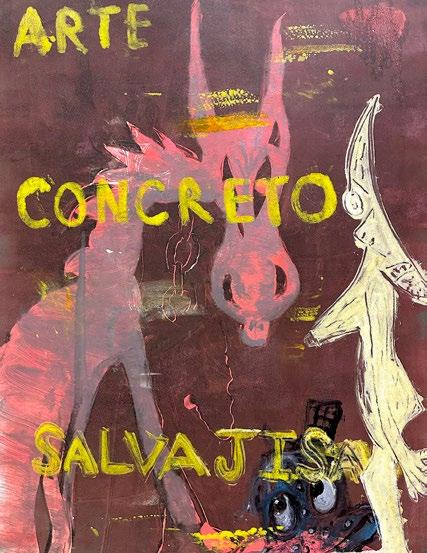
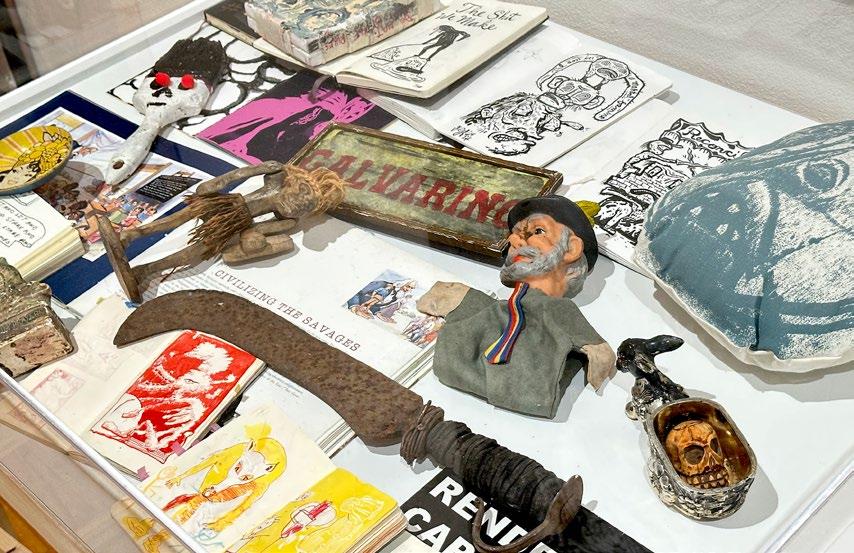
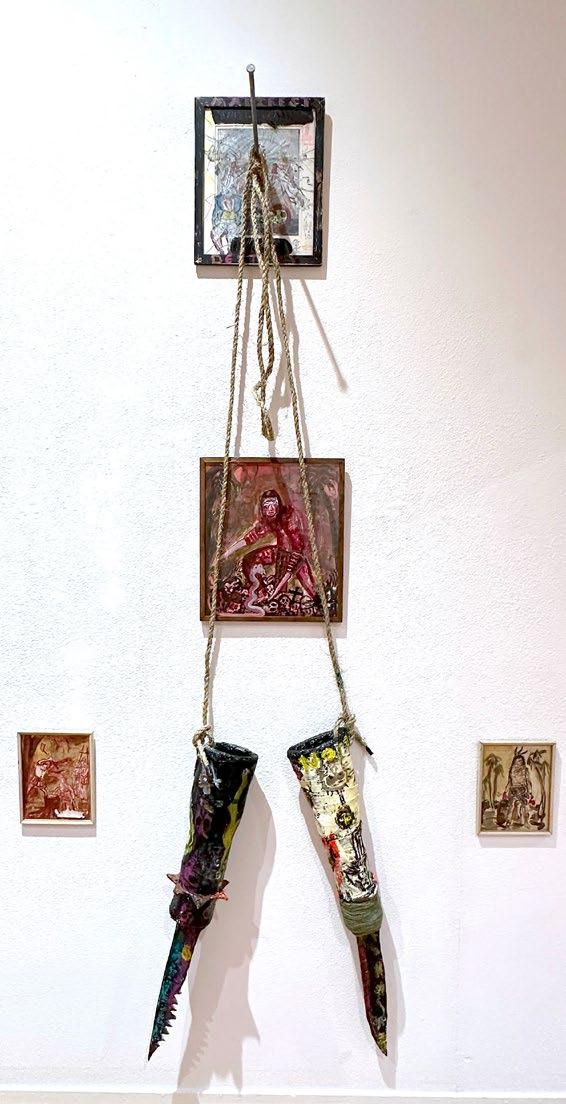
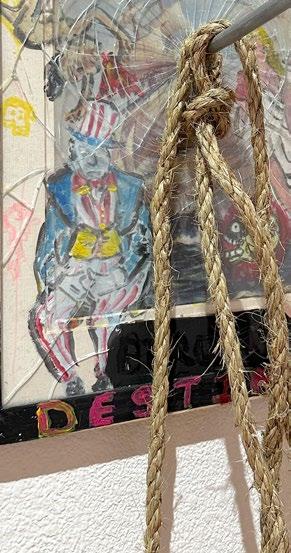
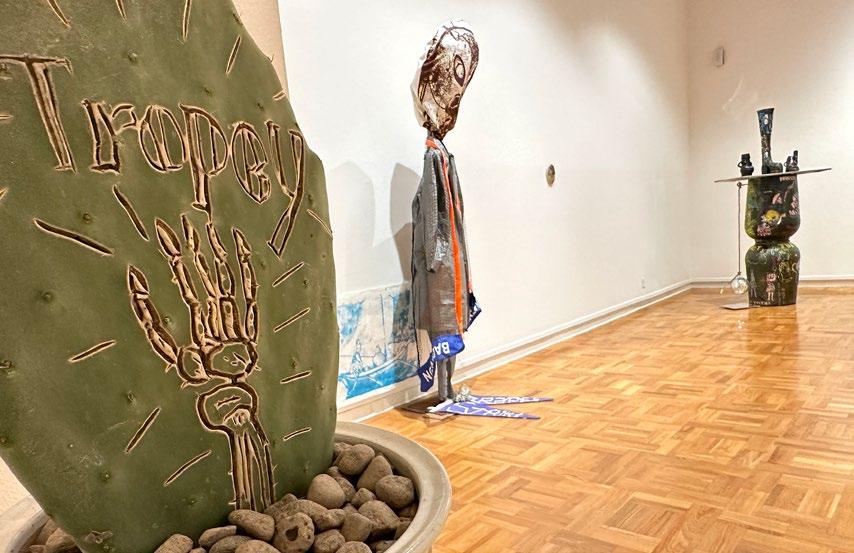
Illustrated humor magazines like Puck and Judge, circulating during the Spanish-American and Philippine-American Wars, depicted Cubans, Puerto Ricans, and Philippine peoples as infantile dependents awaiting Uncle Sam’s civilizing discipline; of these racial types, an uncanny appearance appears in Quintana’s work (p. 31, left, bottom).7 He inhabits this archive as a trickster, recasting its figures not as victims but as disruptants. Prosthetic arms fitted with blades invoke Galvarino, the Mapuche leader who, after Spanish forces severed both his hands at the Battle of Lagunillas in 1557, returned to combat with blades strapped to his stumps — a refusal, as defiant as it was literal, to be disarmed (p. 30, left). Nearby is the logo of Hatuey, the Taíno cacique burned in 1512. His final refusal of Christian baptism, an early act of anti-colonial defiance, was later commercially absorbed into a beer brand, repackaging Indigenous opposition as consumption (p. 27, top).8 Quintana’s cast of mischievous monsters, rebels, and historical fragments defy easy coherence. Instead, they clash and revel in its tricky incongruities.
Raised in the Bay Area, Manila-born Carlo Ricafort developed an understanding of how imagery is remixed and recontextualized, pulled from its source and assigned new significance, through deep engagement with hip-hop and R&B. Working with a DJ’s intuition— sampling, looping, recontextualizing — his practice produces free-associative commentaries inflected by history, music, and philosophy. The effect is one of careful synthesis, rather than an empty pursuit of cultural purity.
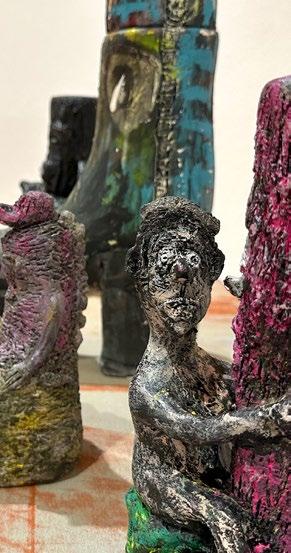
In Título Salvaje ⇄ Salvaged Title, Ricafort occupies the position of the ghost — and here Derrida’s hauntology is instructive. The ghost, in that formulation, is not a remnant that simply lingers but a structural feature of the present: the way the
past persists, incomplete, and as a recurring disturbance.9 In one installation, printed masks drawn from Northwest Coast Indigenous formal traditions hang on wooden racks (p. 28) — open, accumulative, resistant to a single reading.10 The pressing, the repeating, the transferring of form across surfaces turns printmaking into a channel of rapport, a way of making contact across time past simple reference. These are not ethnographic artifacts displayed to mark cultural distance. Instead, they act as reminders of the intersection of ancestral presence and contemporary subjectivity. Just as a DJ lifts a breakbeat to carry new meaning in a different sonic realm, the masks enter new relational fields, their significance contingent on the surrounding noise and on what they are played against. Iteration after iteration, the histories pressed into these surfaces, double back, and repossess the present.
One of the stubbornly enduring images of American imperial expansion shows Uncle Sam lumbering along, carrying his newly acquired territories — Hawaii, the Philippines, Cuba, Puerto Rico — as small, passive children awaiting civilizing instruction. A mechanism for ideology as much as a reflection of it, the cartoon operated through a brazen logic: colonization rendered as parenthood, childhood as the pretext for dispossession. The figures in that basket sit naively in silence.
Tropeycália Club works in and against the long aftermath of that image. In Título Salvaje ⇄ Salvaged Title, the colonial archive is no longer a fixed historical record but rather contested raw material; the figures once rendered passive within it now actively reject their prescribed roles. They have clambered out of the basket. The cannibal bites the hand that patronizingly feeds. The trickster grins back, sharpened and ungovernable. The ghost phases through matrices, again and again, refusing its mortal finality. None docile nor waiting.
Título Salvaje ⇄ Salvaged Title does not propose a clean mythology, anathema to the one it dismantles. Instead, it presents a field of gestures—humor, abrasion, abjection, citation, haunting—through which histories of empire are digested and revived. It piles in a restless, generative instability, a practice of salvage that does not paper over the damage. As spirit to a body, or a title to a vehicle, it insists, fiercely and collectively, on what can be repossessed from it.
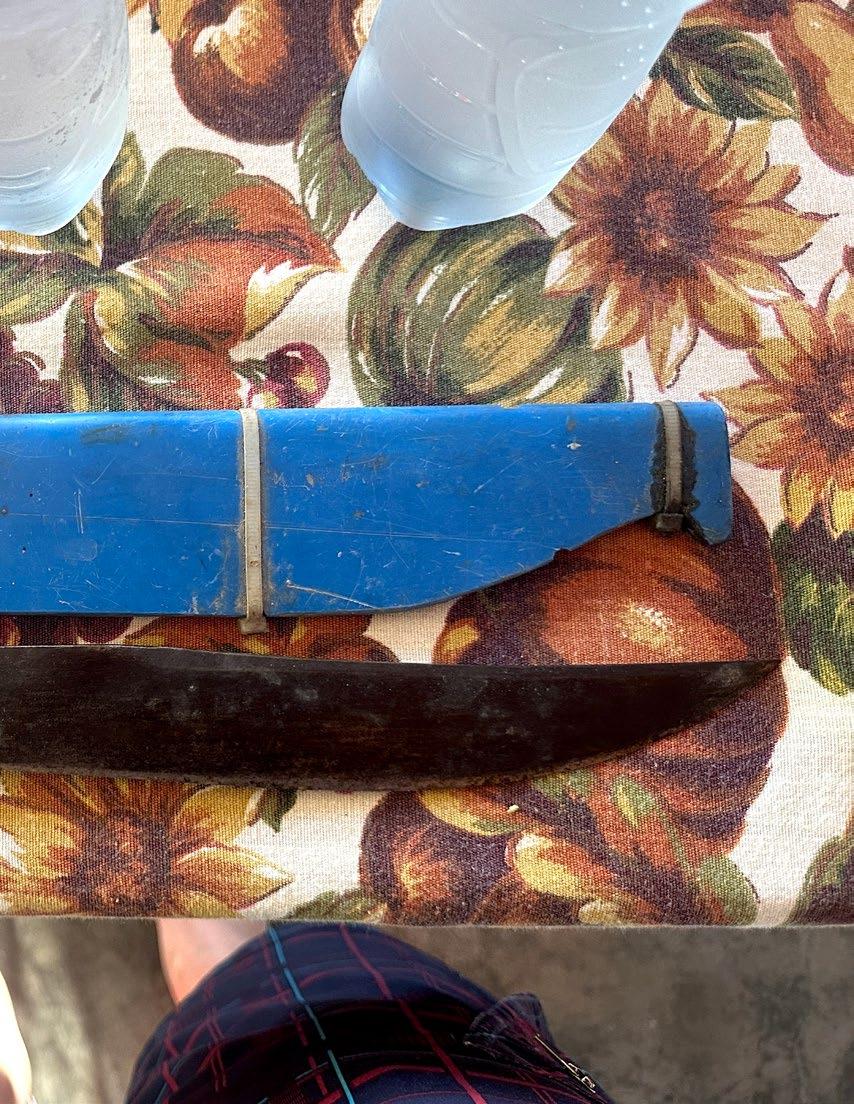
1 On the relationship between Tropicália and Oswald de Andrade’s anthropophagy, see Sérgio B. Martins, Constructing an Avant-Garde: Art in Brazil, 1949–1979 (Cambridge, MA: MIT Press, 2013), 51–78. Martins notes that Hélio Oiticica, one of the movement’s central figures, described Tropicália as the most anthropophagic work in Brazilian art, and traces how Andrade’s concept — whereby foreign cultural forms were to be absorbed and redeployed toward local ends — shaped the broader constructive ambitions of the Brazilian avant-garde in the 1960s.
2 Author’s notes from conversation with John Yoyogi Fortes, 2/28/2026.
3 Oswald de Andrade, “Manifesto Antropófago,” Revista de Antropofagia 1, no. 1 (May 1928).
4 On the peacock chair’s history as a product of colonial prison labor at Bilibid, see Alejandro T. Acierto, “Tracing the Peacock Chair’s History From Manila to Nashville,” Hyperallergic, February 5, 2025, https://hyperallergic.com/987595/tracing-the-peacock-chair-history-from-manila-to-nashville/. Acierto, an arts professor at Wayne State University, conducted archival research on Bilibid’s industrial workshops as part of a larger project on incarceration and colonial craft production. For the chair’s subsequent history as a Black Power symbol, see also “The Peacock Chair and the Black Experience,” New York Times, June 18, 2025.
5 Juan Carlos Quintana, interview by Painters Painters, Painters Painters (blog), August 2015, https://painterspainters.tumblr.com/post/127185004915/ painters-interview-painters-an-interview-with-juan.
6 Ibid.
7 On the racialized depictions of colonized peoples in American illustrated press during the Spanish-American and Philippine-American Wars, see Abe Ignacio et al., The Forbidden Book: The Philippine-American War in Political Cartoons (San Francisco: T’Boli, 2004).
8 The earliest account of Hatuey’s capture and execution is Bartolomé de las Casas, A Short Account of the Destruction of the Indies, trans. Nigel Griffin (London: Penguin Books, 1992; orig. 1542).
9 Jacques Derrida, Spectres of Marx: The State of the Debt, the Work of Mourning, and the New International, trans. Peggy Kamuf (New York: Routledge, 1994; orig. 1993).
10 Author’s notes from conversation with Carlo Ricafort, 2/28/2026.
Dr. Britt Rios-Ellis, President
Dr. Richard Ogle, Provost/Vice President of Academic Affairs
Dr. James A. Tuedio, Dean, College of the Arts, Humanities and Social Sciences
Martin Azevedo, Professor, Chair
Artur Da Silva, Assistant Professor
Dean De Cocker, Professor
Daniel Edwards, Professor
Jessica Gomula-Kruzic, Professor
Dr. Carmen Robbin, Professor
Ellen Roehne, Lecturer
Dr. Staci Scheiwiller, Professor
Susan Stephenson, Professor
Jake Weigel, Professor
Mirabel Wigon, Assistant Professor
Noely Ortiz, Administrative Support Coordinator
Alex Quinones, Instructional Tech II
Matt Hayes, Equipment Technician II
Dean De Cocker, Director
Noely Ortiz, Administrative Support Coordinator
Brad Peatross, Graphic Specialist II
A huge shout-out to this amazing group for all the help and support with this exhibition:
Martin Azevedo, Dean De Cocker, Kathleen Finney, Arvin Flores, Heather Fortes, Jazmine Fortes, Jamie Mancini, Matthew Villar Miranda, Michael Nguyen, Noely Ortiz, Bradley Peatross, Pinche Print Shop, Sriba Kwadjovie Quintana, Alex Quinones, Mirabel Wigon, Ron Sandoval, Nic Webber, and Adam & Diana Vermeire.
Tropeycalia Club, Título Salvaje ⇄ Salvaged Title March 19 – April 24 2026 | University Art Gallery, California State University, Stanislaus
200 copies printed. Copyright © 2026 California State University, Stanislaus • ISBN 978-1-940753-98-0
All rights reserved. No part of this publication may be reproduced or transmitted in any form without the written permission of the publisher. This exhibition and catalog have been funded by Associated Students Instructionally Related Activities, California State University, Stanislaus.