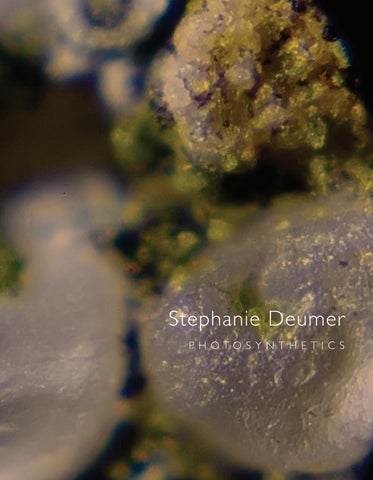
Stephanie Deumer P H OTO SY NT H E T ICS
Stephanie Deumer P H OTO S Y N T H E TI CS
California State University, Stanislaus University Ar t Galler y August 24 - October 9, 2026
2
3
4
Stephanie Deumer - Photosynthetics Stephanie Deumer - Photosynthetics, represents a chance to view Deumer’s amazing work. We are very fortunate to have Deumer’s unique exhibit in the University Art Gallery. The mixture and intersection of art and science in Deumer’s practice provide a fascinating body of work. She begins with humble garden statues and lightboxes that also double as terrariums. Creating unimaginable objects of beauty that lead the viewer to consider culture, power, gender and what is real and what is imagined. Sculpture, photography and video works in all forms are fundamental areas of educating artists. Having exceptional exhibitions in all the galleries helps to generate meaningful discussions and lifelong learning about these mediums. The University Art Gallery’s programming helps to support our faculty’s teaching. It is usually through faculty recommendations that many exhibitions come to our galleries. Stephanie Deumer’s exhibition was recommended by Professor Artur Da Silva. Professor Silva had the following to say about Deumer’s work, “Introduced by biologist Richard Dawkins, meme theory proposes that evolution is not limited to biological genes, which replicate physical traits from generation to generation. Instead, it hypothesizes a parallel cultural evolution driven by “memes” which are units of information, ideas, behaviors, that mutate and replicate through imitation from mind to mind. Stephanie Deumer’s practice investigates visual culture by analyzing the ideas that are transmitted with their reproduction. These bits of information that Dawkins coined memes are present in Deumer’s work through the compilation of fragments of movies, television shows, and commercials. Utilizing found footage, as well as her own, Deumer’s research aids us in analyzing and ultimately rethinking cultural narratives. That is the case in A Diamond is Forever which is made as a compilation of scenes from mass media showing different aspects of the diamond industry’s visual dialects: using the images of women as bait for the commodification of the natural world. The potpourri of narratives we inherit from visual culture leads us to the commodification of identity and ultimately of the body: Deumer uses her own hair to engineer a yellow lab diamond. Many of Deumer’s projects center technology not as an appendage, or solely as the means to create, but rather as a centerpiece of the critique. In Under the Same Sun (commissioned by Desert X) Deumer creates a multimedia installation in which a greenhouse is buried in an underground room built for it, and the only lights that bathe the plants come in the form of projections of the landscape above ground. These are the complications that are brought for us to grapple: In this instance the reproduction of life is only possible through the reproduction of mediated imagery. It is one thing to discuss broad shifts in the cultural DNA; it is quite another to witness the captivating evolution of Deumer’s own work and her index of concerns. I’m looking forward to seeing how the language she has created will dialogue with future inquiries.” UAG would like to thank the many colleagues that have been instrumental in presenting this exhibition. Stephanie Deumer for the chance of exhibiting her work, Professor Artur Da Silva for recommending Deumer to exhibit in the University Art Gallery, Jasmine Woodall, our Administrative Support, for the tireless work in organizing and arranging the show details. I would also like to thank, Brad Peatross of the College of the Arts and California State University, Stanislaus for the catalog design and Stan State Print Shop for the printing this catalog. I would also like to thank the Instructionally Related Activates Program of California State University, Stanislaus, as well as anonymous donors for the funding of the exhibition and catalogue.
Dean De Cocker, Director University Art Gallery California State University, Stanislaus
5
Photosynthetics: vibrant assemblages and nur turing tech For centuries gardens have been places of both metamorphosis and continuity, where trees, plants, and flowers continue to bloom through generations of caretakers. The presence of statues, often replicas of gods and goddesses, in gardens throughout the West has contributed to the sense of a garden’s longevity. Witnesses to changing seasons, these figures are often symbols of hope, their stone or concrete surfaces aging at a far slower pace than the humans they resemble. Since 2021, LA-based artist Stephanie Deumer has been developing a body of work under the title Photosynthetics. This evolving collection, often featuring images of female statues, explores the ways that plants, technology, visual culture, and lived experiences (both human and non-human) intersect. For Deumer, gardens epitomise a kind of sustained dialogue between humans and nature, but at the same time her work dismantles the idea of humans and nature as separate or opposed. The cultivation of plants, the curation of gardens and ornamentation, and our responses to them, point to practices of multi-generational care and interaction that celebrate and foster flourishing and connection. Artist, filmmaker and gardener Derek Jarman, writing in Modern Nature about the Borghese Gardens in Rome, explains how its monuments mark the passage of time. He was also interested in how statues sometimes became surfaces for graffiti, used by others to share expressions of their dissent and humour. Here the statues become signs within broader cultural discussions. These shared acts of expression and listening are at the heart of the notion of a garden. In Photosynthetics, Deumer examines concepts of care, technology and gender, using images of statues as signs within contemporary environmental discourses, to test how care might be mediated through digital culture. Importantly, her collection of works asks us to decentre humans and to look more closely at the nonhuman forces that shape the world. Emerging from this exploration is a critique of modernity that refrains from nostalgic idealisation of a predigital time and instead suggests possibilities for regenerative relationships in which digital technology is a vital tool. The 2026 iteration of Photosynthetics includes eight lightboxes that also act as terrariums - each lightbox contains plants that grow in the digital glow of an image of a statue. Traditionally, terrariums were used to transport plants across the seas and to protect them from the fumes of the industrial revolution. Discovered by accident in 1829, when a fern unfurled in a glass case containing an insect, terrariums soon became desirable symbols of wealth, allowing individuals to care for plants in polluted urban environments, or to own an unusual plant from overseas and display it within their home. They became objects that allowed for the preservation and cultivation of otherwise unlikely natural assemblages. In Deumer’s ‘photosynthetic’ terrariums the fragility of each plant contrasts with the image of the stoic female statues, in whose light they slowly grow. The artificiality of this kind of ‘modern nature’ nevertheless allows for healthy
6
blooming. Considering Photosynthetics as a whole, many works use light generated by solar power, reaching the eukaryotic cells of the plants through digital images, its intensity filtered through the shadowy images of the natureeroded concrete surfaces of each statue. The Latin word ‘artificial’ originally carried a sense of ‘belonging to art’ or ‘made by skill’. Here the ‘artificiality’ of these miniature gardens indicates the skilled management of the conditions for plant growth, an artistry that often begins with using solar power as a material and ends with new green shoots. In this exchange, human presence, of the artist, or of the human-like statues, becomes that of a mediator who is active in a process at once technological and natural. One example of this is a 2022 Photosynthetics work in Saudi Arabia: ‘Under the Same Sun’. This large-scale, site-specific work consisted of a greenhouse, submerged in a cavern in the desert, containing native plants growing in solarpowered, live-stream footage of the landscape above the ground. The solar cells on the surface were shaped as a puddle, hinting at the concealed verdant space below. The intricate configurations of the human and the nonhuman is at the heart of Jane Bennett’s seminal book Vibrant Matter: a political ecology of things. Bennett asks us to consider the ways in which the matter that composes a human, and indeed everything, is ‘lively and self-organising’ rather than passive. She proposes that acknowledging the vibrancy of matter, what she also calls ‘vital materialism’, opens new ways of thinking about relationships and politics because it understands how living and non-living entities are made up of ‘agentic assemblages’ – collections of cells and energy that are active and vibrant, impacting each other. Deumer’s work makes this idea of ‘vital materialism’ tangible. At first glance the work may seem dystopian in its almost-sci-fi blend of technology and plant-matter. But closer attention to the materiality of the work allows us to realise its complex engagement with the entanglement of technology and nature. Rather than perceiving digital technology as a unified power unleashed from Pandora’s box, the work invites us to identify different areas of agency and potential. The artistic labour behind these works mirrors the labour that sustains tech systems – there is active care within these systems. Each require energy that is ultimately reliant on the sun, plants, and water. Continued
7
Photosynthetics 2026 features a video work made specifically for the plants. Projected on the wall of the gallery, this video-collage spotlights ways in which caring for nature has been gendered. The concept of ‘Mother Nature’ and the assumption that femininity is synonymous with nurturance, is epitomised in the beatific expressions of the female statues. Images throughout visual culture, from fairies and nymphs to current AI depictions of female beauty, often conflate femininity with nature. Conversely, technology has frequently been associated with masculinity, from science fiction narratives with male-voiced machines, through to ‘tech-bro’ culture and AI agents such as Claude (who is often perceived as male). Watching a plant growing in the light of these moving images is a reminder of how we develop our thinking, and the directions in which we grow, in response to the cultural contexts we are within. There is freedom, but the characteristics of these contexts have tangible impacts, just as the depth and stretch of the plant is shaped by its surroundings. A sense of simultaneous weight and lightness characterises many of the works in Photosynthetics; they are both grounded and ephemeral. And whilst the digital images of the statues can be switched off, we are reminded of their heavy materiality in a new series of sculptural forms: a series of large concrete rock-shaped forms that evoke the surface of the statues. These forms are reminiscent of the images in the video-lightbox in the exhibition.This lightbox shows the surface of a statue under the microscope; its concrete bulk transformed into an intricate crystalline surface of tiny rocks. Again, we are reminded of how even the most solid of forms is comprised of an ‘assemblage’ of smaller forms, rendering it subject to change. The curiosity and critical voice of Deumer’s work ultimately draws attention to the extractive infrastructures that so much technology relies upon but indicates that there are more regenerative models of exchange and energy transferral to be explored. She wants us to question the energy required to create and sustain her work. Botanist Robin Wall Kimmerer, in her book The Serviceberry: An Economy of Gifts and Abundance, reminds us that ‘[e]xtraction and consumption outstrip the capacity of the Earth to replenish what we have taken’, but later she writes that regenerative economies that are centred around reciprocity offer a ‘path forward’. Photosynthetics offers examples of these kinds of sustainable exchanges, positioning digital culture as an agent within them.
Jessica Holtaway, Ph.D Writer, Curator, and Academic
References: Bennett, J. (2010) Vibrant Matter: A Political Ecology of Things. Durham, NC: Duke University Press. Deumer, S. (2022). Under the Same Sun [Solar panels, CCTV camera, live stream digital video projection, sandstone, adobe, acrylic greenhouse, soil, and plants]. Desert X AlUla. Deumer, S. (2021). Photosynthetics (Episode 1) [Digital video]. Jarman, D. (2018) Modern Nature. London: Vintage. (Original work published 1991). Kimmerer, R.W. (2024) The Serviceberry: An Economy of Gifts and Abundance. London: Alan Lane.
8
9
10
11
12
13
14
15
16
17
18
19
20
21
22
23
24
25
26
27
28
List of Works Pages 2-3. (Left to right) Hebe II and Aphrodite II, 2026, duratrans lightboxes, soil, and plants, 11 ½ x 16 ½ x 7 ¼ in (each) Aphrodite IV, 2026, concrete, polystyrene, and metal lath, 23 x 18 x 10 ½ in Aphrodite I, 2026, duratrans lightbox, soil, and plants, 31 ¾ x 46 ¾ x 14 ½ in Page 4. Detail of Aphrodite I, 2026 Page 9. Grass Breathing (after Ana Mendieta), 2026, kinetic sculpture with motor, artificial grass, and wood, 8 x 8 x 5 ½ in Photosynthetics (Episode 1), 2021, digital video, 30 min. Page 10-11. (Left to right) Venus I, 2026, duratrans lightbox, soil, and plants, 46 ¾ x 31 ¾ x 14 ½ in Hebe I, 2026, duratrans lightbox, soil, and plants,11 ½ x 13 ½ x 7 ¼ in Venus III, 2026, duratrans lightbox, soil, and plants, 13 ½ x 11 ½ x 7 ¼ in Venus II, 2026, duratrans lightbox, soil, and plants, 11 ½ x 13 ½ x 7 ¼ in Page 12. Detail of Venus I, 2026 Page 13. Detail of Aphrodite I, 2026 Page 14. Detail of Hydrophoros III, 2026 Page 15. Venus IV, 2026, concrete, polystyrene, and metal lath, 24 x 12 x 14 in Page 16. Hebe I, 2026, duratrans lightbox, soil, and plants,11 ½ x 13 ½ x 7 ¼ in. Page 17. Venus III, 2026, duratrans lightbox, soil, and plants, 13 ½ x 11 ½ x 7 ¼ in. Page 18. Venus II, 2026, duratrans lightbox, soil, and plants, 11 ½ x 13 ½ x 7 ¼ in Page 19. Garden Figures, 2026, LED screen, digital video, soil, and plants, 11 ¾ x 15 x 7 ¼ in Page 20. (Left to right) Hebe II and Aphrodite II, 2026, duratrans lightboxes, soil, and plants, 11 ½ x 16 ½ x 7 ¼ in (each). Page 21. (Left to right) Aphrodite IV, 2026, concrete, polystyrene, and metal lath, 23 x 18 x 10 ½ in Aphrodite I, 2026, duratrans lightbox, soil, and plants, 31 ¾ x 46 ¾ x 14 ½ in Page 22-27. Installation images of Photosynthetics exhibition, University Art Gallery, California State University, Stanislaus, 2026 Page 28. Hydrophoros I, 2026, duratrans lightbox, soil, and plants, 31 ¾ x 46 ¾ x 14 ½ in Hydrophoros II, 2026, concrete, polystyrene, and metal lath, 26 x 20 x 10 in Hydrophoros III, 2026, concrete, polystyrene, and metal lath, 28 x 24 x 9 1/2 in
29
Stephanie Deumer Bio and CV Stephanie Deumer is a Canadian visual artist currently living and working in Los Angeles, California. Connecting seemingly dissimilar content into a web of insight, her installations uncover the ways subjects are constituted through and by language, media, and technology. Deumer holds an MFA from California Institute of the Arts and was a fellow at the Whitney Independent Study Program in New York. She currently teaches at the University of Washington, Seattle, and California State University, San Marcos.
EDUCATION 2019
Whitney Independent Study Studio Program, New York, NY
2015
MFA, California Institute of the Arts, Valencia, CA
2011
BA Honors Degree, Studio Art, University of Guelph, ON, Canada
SELECTED SOLO & TWO-PERSON EXHIBITIONS 2026
Photosynthetics, California State University, Stanislaus, CA A Diamond Is Forever, DXARTS Gallery, University of Washington, Seattle, WA
2023
A Diamond Is Forever, TSA LA, Los Angeles, CA
2022
Spooky Action at a Distance, TRUCK Contemporary Art, Calgary, AB, Canada
2018
Far from Fixed, Modern Fuel, Kingston, ON, Canada (with artist, Nahed Mansour)
2017
Real Shadows for Mere Bodies, College of the Canyons, Valencia, CA (with artist, Arden Surdam) The Body of Language and The Motion of Words, PAVED Arts, Saskatoon, SK, Canada Features of The Same Face, Cerritos College, Cerritos, CA
2015
In and of Itself, A402, California Institute of the Arts, Valencia, CA
SELECTED GROUP EXHIBITIONS 2024
SPAM New Media Festival, Georgetown Steam Plant, Seattle, WA Uncanny Garden, University of Washington Biology Greenhouse, Seattle, WA
2020
Insurgencies: Women’s Art on the Border in the Era of Cold War, The Front, San Ysidro, CA
2019
the call is coming from inside the house, The Elizabeth Foundation for the Arts, New York, NY
2018
CO/LAB III, Torrance Art Museum, Torrance, CA
2016
De la tierra a la tierra, Centro Cultural Metropolitano Quito, Ecuador Celeste Prize 2016 Finalists’ Exhibition, Bargehouse, London, UK
2015
The 2015 CalArts MFA Show, Cooper Design Space, Los Angeles, CA
2014
Understanding Media: The Extensions of Human Being, 319 Scholes, Brooklyn, NY Immoderation, Living Arts Centre, Mississauga, ON, Canada
30
COMMISSIONS & PUBLIC ART PROJECTS 2022
Under the Same Sun, AlUla, Saudi Arabia, commissioned by Desert X and The Royal Commission For AlUla,
2020
Imitation Game, On Immersion, Sensate: A Journal for Experiments in Critical Media Practice,
produced by UAP (curated by Neville Wakefield, Reem Fadda, and Raneem Farsi) Harvard University, Cambridge, MA SELECTED FILM SCREENINGS Spooky Action at a Distance 2022
A Body as a Fault in the System, in a System of Faults, Vector Festival 2022, Toronto, ON, Canada
What is an Object? 2019
Lost and Found in Late Capitalism, Pleasure Dome, Toronto, ON, Canada
2017
Photophobia, Art Gallery of Hamilton, Hamilton, ON, Canada
2016
Filmideo, Index Art Center, Newark, NJ
RESIDENCIES 2027
Leighton Studio Artist Residency, Banff Centre for Arts and Creativity, Banff, AB, Canada (forthcoming)
2021
Artist in Residence, Factory Media Centre, Hamilton, ON, Canada
2018
The Dark Arts Residency, Banff Centre for Arts and Creativity, Banff, AB, Canada
2016
Art+Tech Artist in Residence, Cerritos College, Cerritos, CA
2015
Artist in Residence, CalArts REEF Residency, Los Angeles, CA
AWARDS & RECOGNITIONS 2026
Research, Scholarship and Creative Activity Grant, Cal State University, San Marcos, CA
2023
Individual Artist Fellowship, Emerging Tier, California Arts Council, Los Angeles, CA Foundation for Contemporary Arts Emergency Grant, New York, NY Arch Daily Building of The Year Award Nominee, Santiago, Chile Prospect Art New Work Grant Finalist, Los Angeles, CA
2021
Rauschenberg Emergency Grant, New York, NY Artists’ Fellowship Emergency Aid Grant, New York, NY
2019
Research and Creation Grant, Canada Arts Council, Ottawa, ON, Canada
2018
Bar-Fund Artist Grant, Los Angeles, CA
2016
Celeste Prize Nominee, London, UK
ACADEMIC APPOINTMENTS 2024 -
Lecturer, California State University, San Marcos, CA
2024 -
Lecturer, University of Washington, Seattle, WA
2023-24 Visiting Faculty, University of Washington, Seattle, WA
31
Acknowledgements California State University, Stanislaus Dr. Britt Rios-Ellis, President Dr. Richard Ogle, Provost/Vice President of Academic Affairs Dr. James A. Tuedio, Dean, College of the Arts, Humanities and Social Sciences
Department of Art Martin Azevedo, Professor Artur Da Silva, Assistant Professor Dean De Cocker, Professor Daniel Edwards, Professor Jessica Gomula-Kruzic, Professor Ellen Roehne, Lecturer Dr. Staci Scheiwiller, Professor, Chair Susan Stephenson, Professor Jake Weigel, Professor Mirabel Wigon, Assistant Professor Alex Quinones, Instructional Tech II Matt Hayes, Equipment Technician II
University Art Galleries Dean De Cocker, Director Noely Ortiz, Administrative Support Coordinator Jasmine Ramos and Jordan Blankenship, Installation Support
School of the Arts Brad Peatross, Graphic Specialist II Jasmine Woodall, School of the Arts Financial Coordinator
Other
Gegham Sargsyan, Fabrication and Installation Support
Stephanie Deumer - Photosynthetics August 24 – October 9, 2026 | University Art Gallery, California State University, Stanislaus 200 copies printed. Copyright © 2026 California State University, Stanislaus • ISBN 979-8-9979423-1-1 All rights reserved. No part of this publication may be reproduced or transmitted in any form without the written permission of the publisher. This exhibition and catalog have been funded by Associated Students Instructionally Related Activities, California State University, Stanislaus.
32
33
34