Director’s Foreword
This is the third year the Queer Art Club and the Queer Art Collective have exhibited in the galleries. These last two years have been in virtual form because of the Covid-19 pandemic. The works that have been exhibited are invigorating and empowering for all. The works have provided a wide range of ideas and medias that grapple with complex issues and create pathways for deeper learning and understanding.
These exhibitions continue to prove how resilient our students have become in the face of such a great dilemma. Despite the pandemic, the students continue to create, inspire and communicate through their complex and meaningful work.
Many colleagues have been instrumental in this exhibition. I would like to thank the Queer Art Club and the Queer Art Collective, students of the Department of Art for their work and participation in the exhibition, the artists in the exhibition for exhibiting their truly powerful and inspirational work. Many thanks to Jessica Curtis, Stephanie Jacinto and Amanda Trask for their wonderful writings, the School of the Arts, California State University, Stanislaus for the catalog design and Parks Printing for the printing of this catalog. A special thank you to Dr. Staci Gem Scheiwiller, Adviser to the Queer Art Club for her continuing support of our students.
Much gratitude is extended to the Instructionally Related Activates Program of California State University, Stanislaus, as well as anonymous donors for the funding of the exhibition and catalogue. Their support is greatly appreciated.

Dean De Cocker, Director, University Art Galleries
California State University, Stanislaus
Timothy Brown, Jr.
Artist Statement
I made my artistic beginning in Santa Rosa, California, drawing the typical adolescent subject matter, such as dinosaurs and comic book characters. I was brought up by a supportive mother who worked two full-time jobs to provide food on the table and to keep a roof over our heads. My non-existent father was just that--out of the picture. My mother and I would draw together on the weekends, whether it was to pass the time or just to keep me out of trouble as the area we lived in was not the safest. Drawing soon became my calling, which I made my way from copying what was in books to creating things out of my imagination.
Biography
My work explores the connection between color and emotion. Feelings, such as rage, sadness, passion, envy, and fear, typically have colors associated with their names already, and I am hoping to explore this further. The impact that color has on the minds of people is well known, but for myself I want to focus on how it effects me as a gay man who deals with sessions of depression and anxiety. I want to capture the moments when these negative sensations have built themselves into a mind-numbing frenzy that confuses better judgment.
As I made my way to junior high and high school I discovered that art was a release not only from my past, but also from the stress of coming to terms with my identity. Life became a little more interesting when I discovered that I was gay. At the time I did not think about making art that dealt with the subject of being homosexual, but now having been out of the closet for almost 15 years, this brings me to where my art is currently centered. Creating work that utilizes gay imagery is one thing, but how do I find my own voice became the question. I am still not sure whether I have answered it.
I view my environment as a hidden adventure, through which I can unveil each image. Creating has become the cure for the ailments that come my way, including depression, anxiety, and self-loathing. These are some of the topics I want to tackle because they are difficult to express and even harder to accept. My desire is to reach those in the gay community who may feel lost, alone, or left behind. We must remain supportive of one another and remind each other that we are not something broken that needs to be fixed. We can transcend and transform--we are enough.
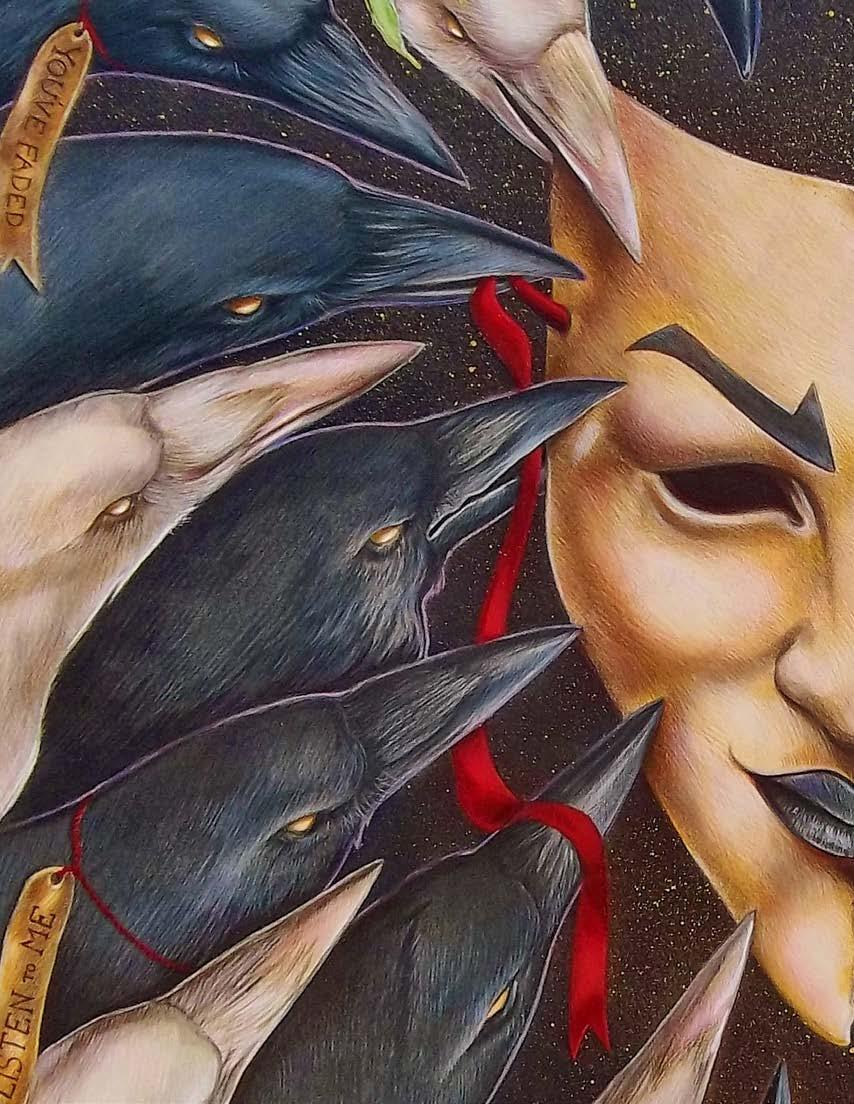
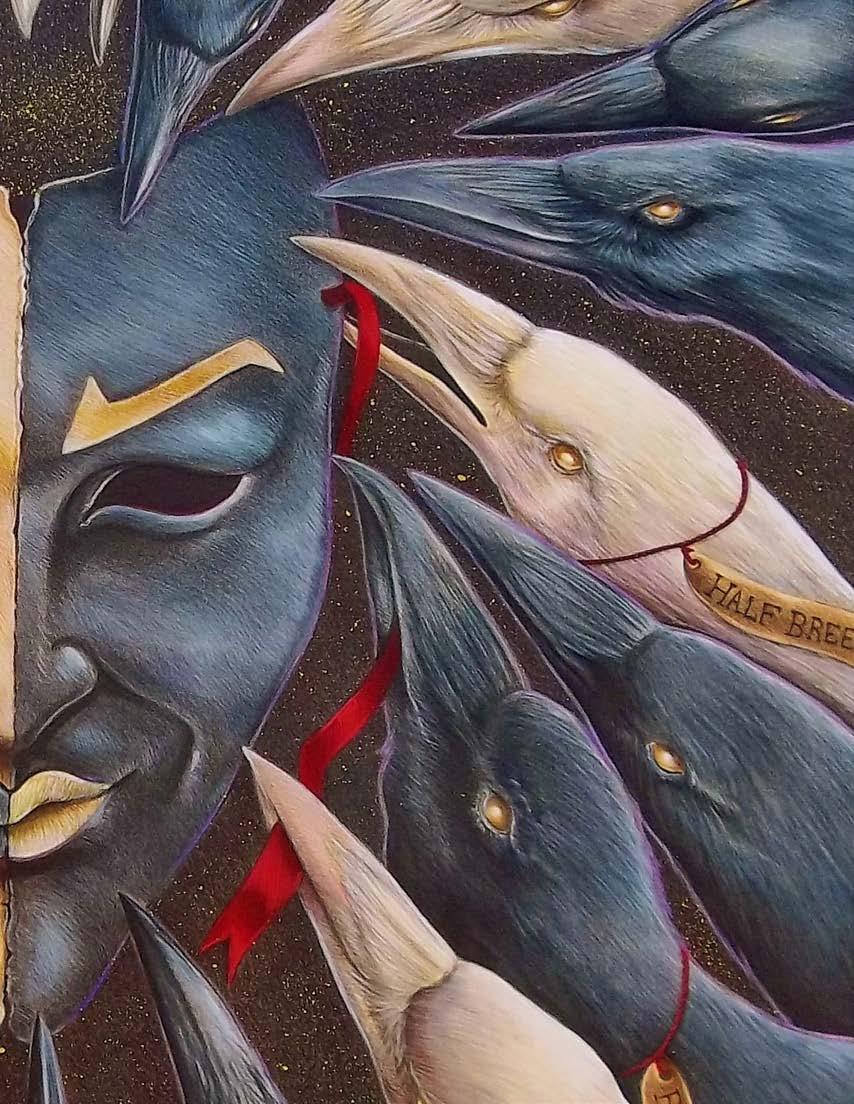
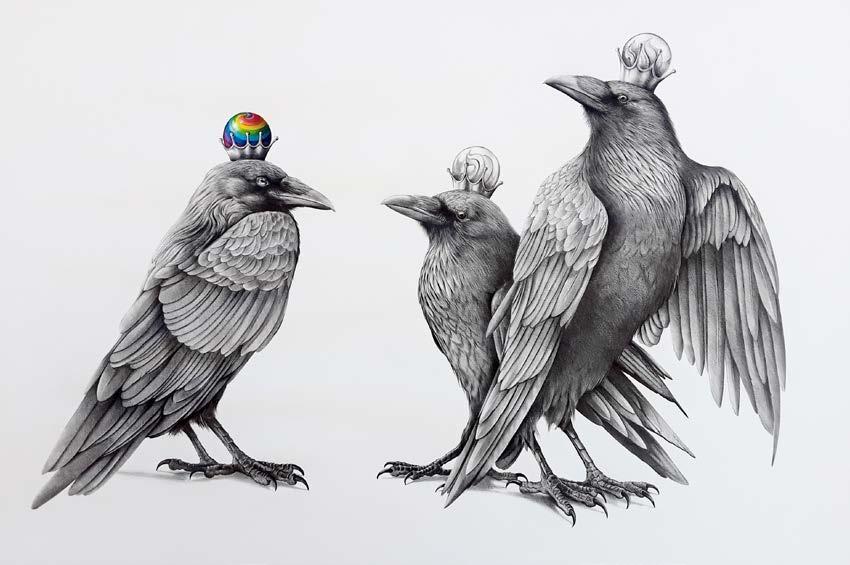
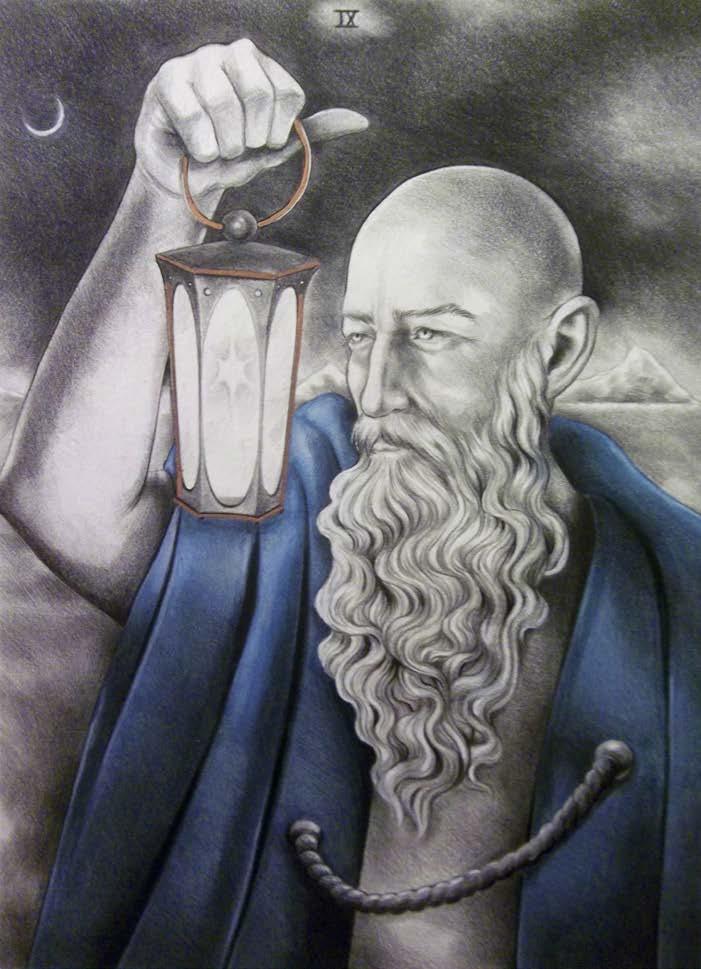
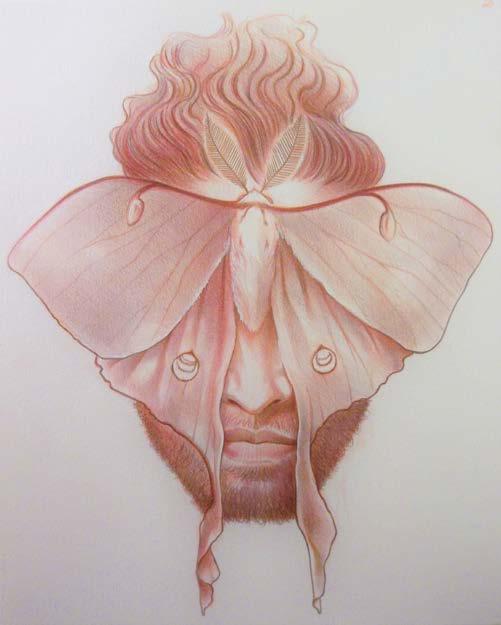
I use a blend of materials, gold paint, pigments markers, colored pencils, and spray paint to represent the mixture of feelings and thoughts flowing through the mind simultaneously to where it almost seems distracting. An additional element to each piece is the semblance of hope. My representation of that silver lining is the use of creatures, such as the moth and raven, which tend to have a more sinister connotation. I flip this and try to paint them in a more constructive and helpful light. Their participation is also a reminder to the viewer that no matter how suffocating or lonely a situation may be, they are never truly alone. A repurposed frame is the final touch added to each piece; something that once served one purpose now finds itself faded and falling apart and is given a breath of new life along with a new coat of paint.
My goal is to initiate a conversation about embracing these sometimes painful emotions and learning to live with them, that they are not something to hide under a rug or dull away with liquor. These feelings, like all people, are meant to be treated with honesty and respect.
grasping the future for ourselves
This series by Timothy Brown Jr. is teeming with hidden messages and repurposed symbols that are very crucial for Queer communities. Some examples include taking negatively charged words or symbols and flipping them to uplift people. Despite the work and dedication to bring Queer voices out into the open, there is still a lot to be done. Within the past year of reexamining the extensive racial injustice in America, shows, such as We Have Risen, are needed to help the public heal and grow. The future is even more uncertain now than ever before due to the rampant vocal display of hate and prejudice, and guidance is a necessity. The public outcry against racial brutality through demonstration and marching has shown the world that enough is enough. Yet, media showcases racial and homophobic acts daily, and to have a show that focuses on embracing oneself as Queer is important.
The Tarot-themed pieces are a fascinating aspect of this show. Tarot card readings can be used as a way to discover one’s future or to find out if one is on the correct path. Coming out as Queer, regardless of the progress shown in recent years, is still a life-transforming event. Brown’s use of the Tarot concepts and repurposing them become multilayered experiences that many can relate to.
The Hierophant is especially important. The mixing of religious and profane signs, such as the hand raised in blessing and the whips, is powerful. In general, the Hierophant card can be associated with religion or following a traditional route. To be Queer is to go against heteronormative American society. However, what is normalized is not always correct, and the figure’s unwavering gaze and stoic expression take that message and challenge the viewer. To challenge a common belief is to elicit a change, something that is much needed in our world.
The Chariot holds that same layered message that is supported by the bold stance of the chariot rider. This card can mean perseverance, something that is so intertwined with Queer communities. Many face hardships and vulnerability that come with being true to themselves while dealing
with family and societal rejection, contempt, or far worse. This piece reinforces that need to prevail despite these hardships, shown in the direct stare of the chariot rider. It communicates to the audience that this individual is not ashamed and is willing to look others in the eye with confidence.
Browns’ statement, “From the shadows of the forgotten we are emerging no longer ashamed of who we are ... adapting and evolving with time, creating, and influencing,” strengthens the use of the tarot meanings and their relationship with change or the future. The cards and their meanings are used to guide us through the toughest of choices, with both positive and negative results. During these times of division, having art exhibitions such as Brown’s We Have Risen: Honoring Black Queer Artists, is a pivotal message for all to experience.
–Jessica Curtis, Stan State Alumni BA, Art History, 2016 MA, Interdisciplinary Studies, 2020
Jessica Curtis is a Stan State Alumni with her master’s degree in Interdisciplinary Studies, her main disciplines being Art History, European History, and English with a concentration in Literary Theory. Aspiring to teach at the college level, her main interest is in Early Modern Women Artists of Italy
deconstructing the work of timothy brown, jr.
Timothy Brown Jr.’s work seen in the We Have Risen show uses mythology and religious iconography to give representation to his experiences in finding identification of being both Queer and Black. The gray-scale artwork brings the viewer in with small pops of color to convey the layering symbolism. The details that Brown puts into his work, from the tarot appropriations to the multitude of various cultural representations and religious confrontations when establishing the self, help the viewer question the lines American society creates when deconstructing the morality projected when it comes to queerness. The deconstruction of the imagery brings a unique dialogue seen through the creative mind of Timothy Brown Jr.
–Amanda Trask
BFA and minor in Art History, Stan State, 2017
MA candidate at CSU Northridge
Amanda Trask received her BFA in Art and minor in Art History from California State University, Stanislaus, in 2017. She is currently attending California State University, Northridge, working toward her masters in Humanities. She is a local artist, art instructor through the Grand Theatre Center of the Arts, and Marketing Specialist. Amanda’s personal work centers around human experience, confronting misconceptions of the flesh while questioning societal stigmas.
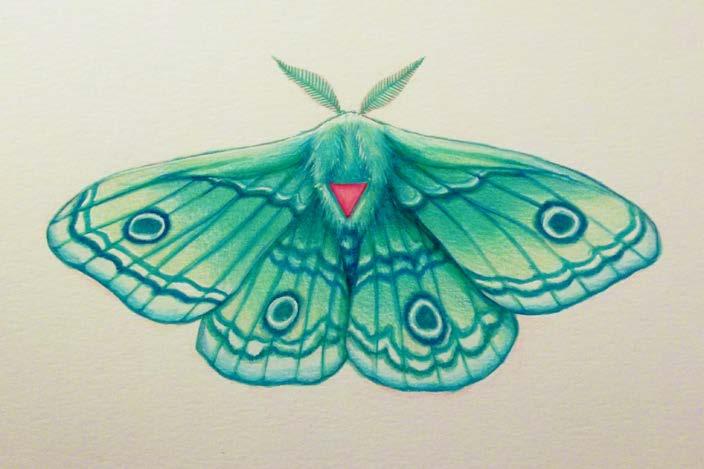
Mark Me, Verithin colored pencil, 7” x 5”, 2019
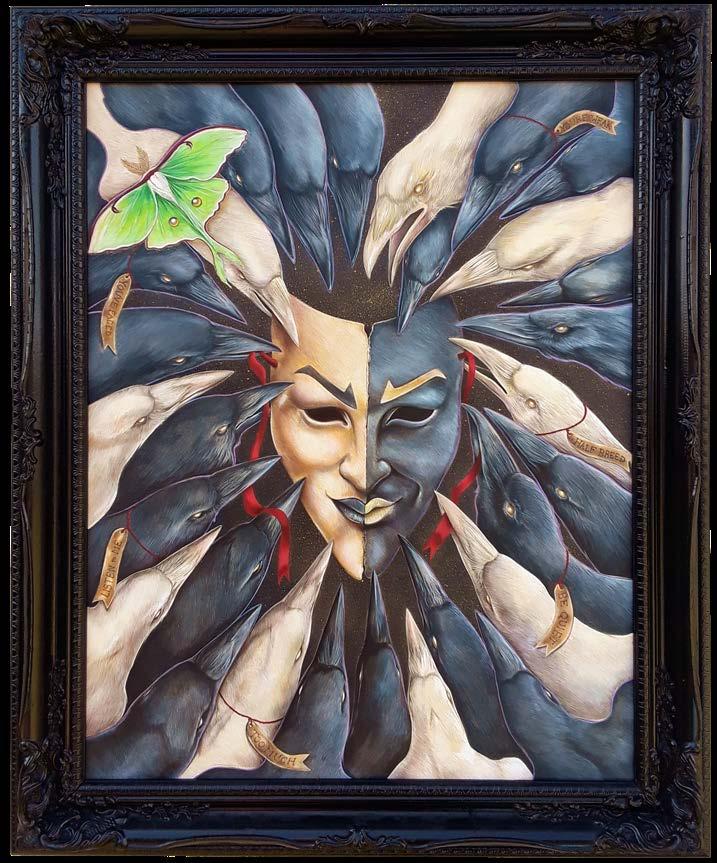
Too Much & Not Enough, mixed media, 27” x 33”, 2021
Thank You For Not Throwing Me Away, mixed media, 30” x 24”, 2019
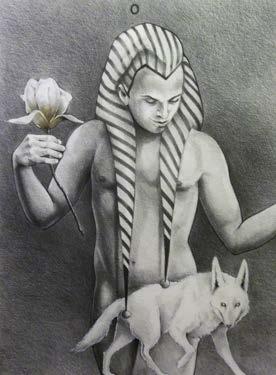
From the left:
The Fool, mixed media, 9” x 12”, 2018
The Magician, mixed media, 9” x 12”, 2018
The High Priestess, mixed media, 9” x 12”, 2018
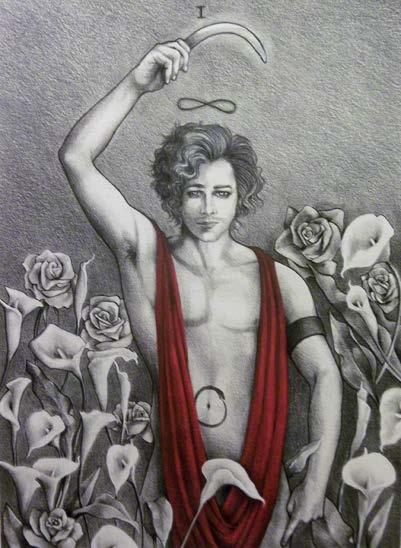
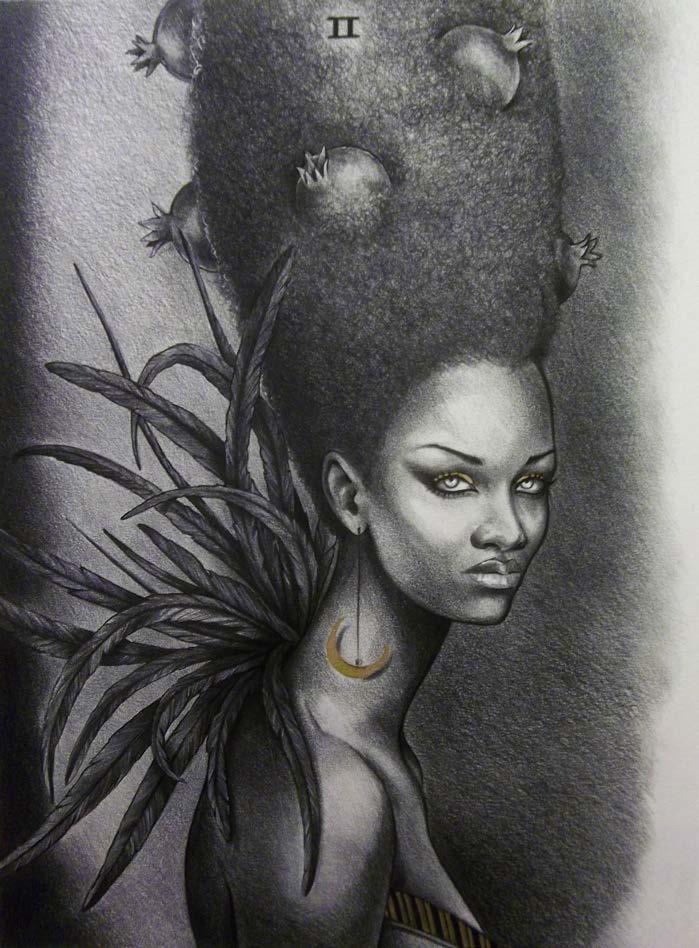
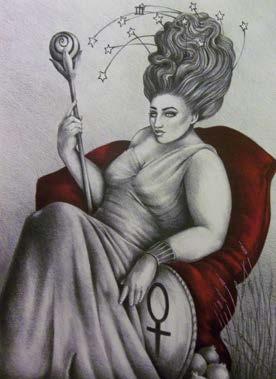
From the left:
The Empress, mixed media, 9” x 12”, 2018
The Emperor, mixed media, 9” x 12”, 2018
The Hierophant, mixed media, 9” x 12”, 2019
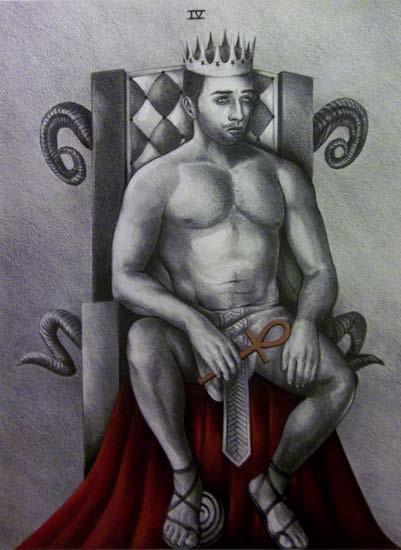
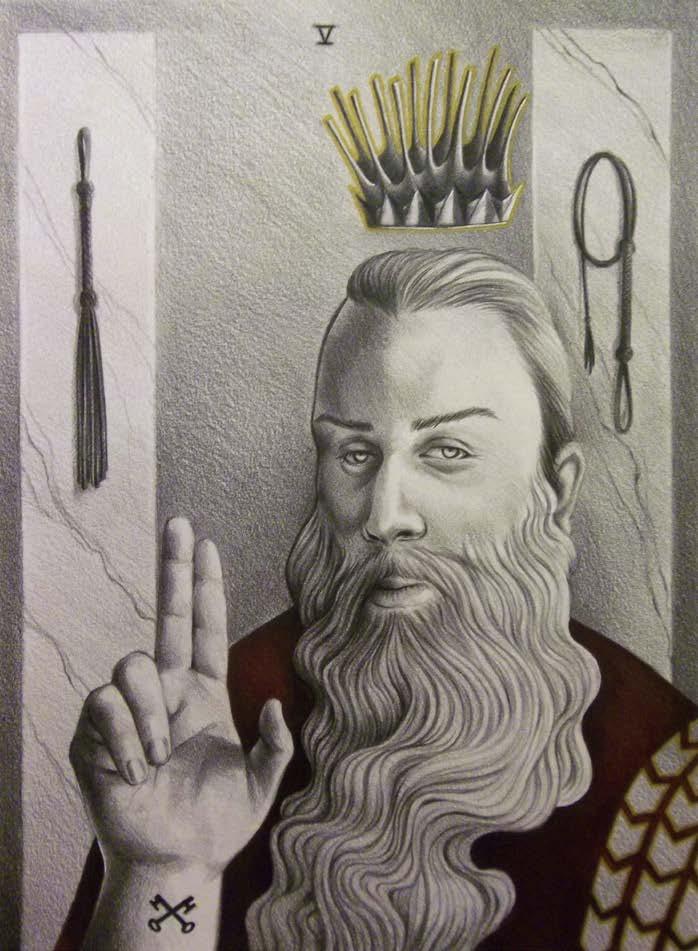
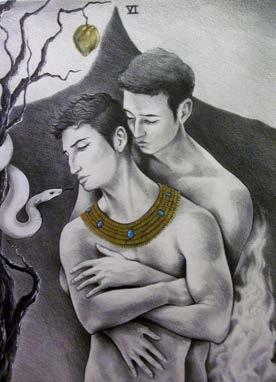
From the left:
The Lovers, mixed media, 9” x 12”, 2019
The Chariot, mixed media, 9” x 12”, 2020
Strength, Verithin colored pencil, 9” x 12”, 2020
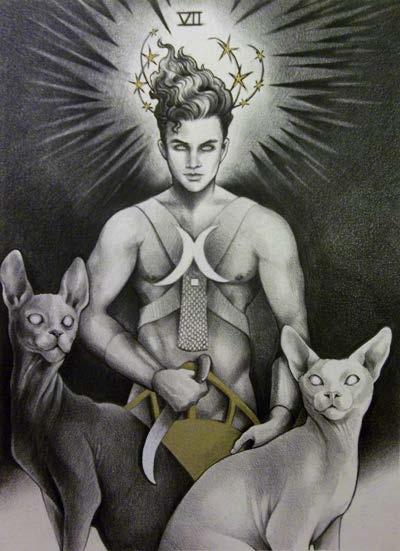
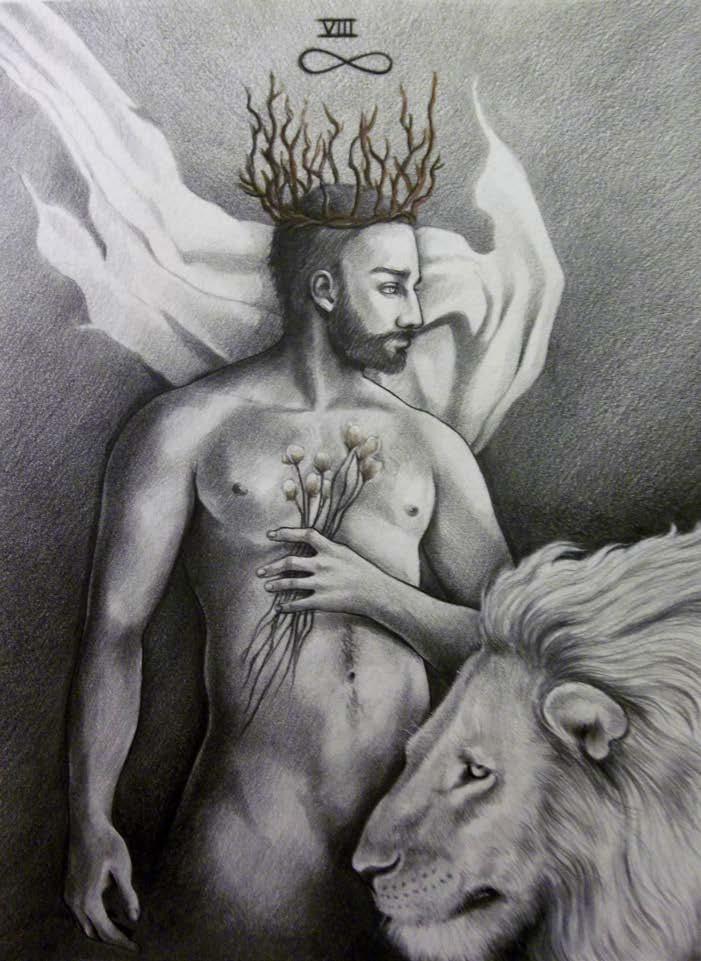
This page:
Mothman, Verithin colored pencil, 9” x 12”, 2020
Opposite: The Hermit, mixed media, 9” x 12”, 2021
featuring:
Timothy Brown, Jr. | Andreana J. Estrada
Jendayi Larios | Juan Arango Palacios
Christopher Rodriguez | Elias Rosas
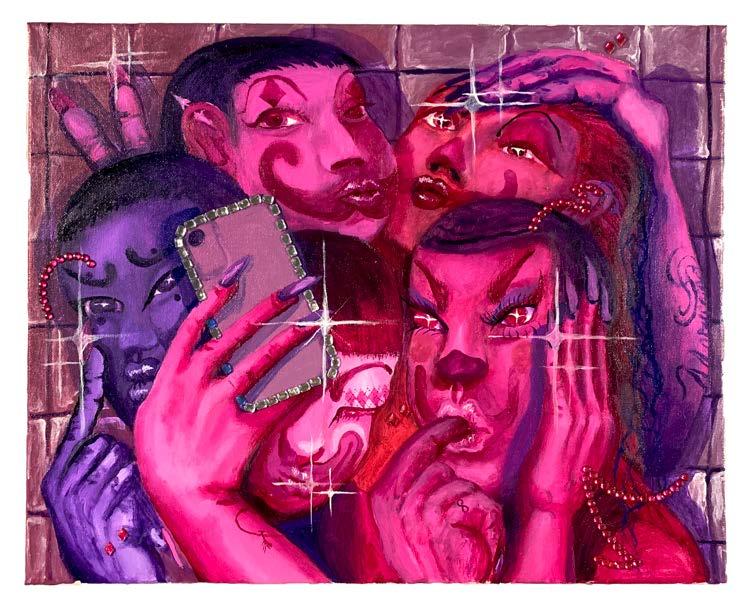
Juan Arango Palacios, Bathroom Selfie, acrylic and rhinestones on canvas, 20” x 16”, 2020
Identity Politics and the Trajectory of Queer Art in the United States
Historically, minority groups have been marginalized, misrepresented, and excluded from political discourse in the United States. During the development of social movements such as the Women’s and Gay Liberation Movements in the 1960’s, identity politics took center stage. As groups organized and advocated for equal rights and visibility, it quickly became evident that there was a standard trajectory for how these groups navigated their visibility and identity.
During the Women’s Liberation Movement, second-wave feminists banned together as they advocated for greater personal and professional freedom. As the development of the Women’s Liberation Movement progressed, a community of like-minded women was created. This community was centered on what they believed to be a “shared women’s experience.” This shared experience was based on the essential qualities that had been associated to women throughout history. Such essential qualities include women as nature, women as nurturer, and women as biologically opposite to men.
This essentialism was challenged by third-wave feminists who were interested in post-modern and post-structuralist theories, such as Jacques Lacan’s idea of the decentered subject. Women of color and queer women also challenged the essentialism of the earlier generation, because their issues and concerns did not necessarily line up with experiences of the middle-class white women of the earlier generation. In fact, it should be noted that charges of racism were aimed at second-wave feminists by Black artists, such as Betye Saar (b. 1926) and Emma Amos (1937-2020). Saar is quoted saying, “It was as if we were invisible again. The white women did not support [us].” Emma Amos stated, “From what I heard of feminist discussion … the experience of black women of any class were left out.”2 While it is true that there are systemic prejudices against all women, women are not a monolithic group with a monolithic experience. Intersectionality needed to be considered.
One only needs to turn their attention to the Gay Liberation Movement in the sixties to see a similar type of essen-
tialism within the LGBTQIA+ community. As those within the community banned to fight back against the discriminatory laws and legislature placed before them, it should be acknowledged that discrimination within the community has existed and still exists to this day. Groups, such as the Mattachine Society, were so conservative that they excluded trans persons, as well as required male members to wear suits and ties. They also warned men to not act too “flamboyantly” in public.3
As queer persons navigated the representation of their identities, they defended themselves with an essentialist argument that being gay was a natural condition they were born into, not one they chose. While some people believe they are simply born gay, others believe there are a spectrum of determinants that shaped their identity. Others find themselves orienting between the two male and female binaries, while some question the binaries altogether.
Throughout American art history, LGBTQIA+ artists have found various ways to represent the cultural landscapes they lived in. As time has progressed, a new generation of queer artists have taken on similar challenges concerned with identity politics, but found new ways in which to express and represent themselves. Still there is no dismissing how previous LGBTQIA+ artists have recorded and responded to their respective time period and the events they experienced.
1918 - 1940
The Harlem Renaissance was an artistic movement in New York in which the growing production of work by Black artists and writers was celebrated. Many of the movement’s leaders were gay or gender non-conforming, such as Angelina Grimké (1880-1958), Claude McKay (18891948), Wallace Thurman (1902-1934), Langston Hughes (1902-1967), and Alain Locke (1885-1954). Drag ballrooms in Harlem could be traced back to the late 1800’s with performers, such as Gertrude “Ma” Rainey (1886-1939), Bessie Smith (1894-1937), and Gladys Bentley (1907-1960). African-American painter Beauford Delany (1901-1979) was established both in Harlem and Greenwich Village. He
1 Lisa E. Farrington, Creating Their Own Image: The History of African-American Women Artists (Oxford: Oxford University Press, 2011), 155.
2 Ibid.
3 P. Lindsay, ‘“Coming Out’: From Assimilation to Visibility,” LA LGBT Center, 2018, 2, accessed April 29, 2021, https://lalgbtcenter.org/images/OutForSafeSchools/ Los-Angeles-LGBT-Center-October-Coming-Out-Handouts.pdf).
painted portraits of prominent figures, such as James Baldwin (1924-1987), Louis Armstrong (1901-1971), Countee Cullen (1903-1946), and W.E.B. Du Bois (1868-1963).
1950 - 1960
Robert Rauschenberg (1925-2008), John Cage (19121992), Merce Cunningham (1919-2009), and Jasper Johns (b. 1930) were some of the key gay artistic figures from the 1950’s. During Jasper John’s first one-person show at the Leo Castelli Gallery in New York, MOMA director Alfred Barr (1902-1981) wanted to purchase Target with Plaster Casts (1955). The work showcases Johns’ signature target with nine shadow boxes above it. The open shadow boxes contain various body parts, including a plaster green penis. Barr was interested in purchasing the piece for the Museum of Modern Art, but requested that Johns close the lid to the shadow box that contained the penis. Johns refused, and Barr purchased Target with Four Faces (1955) for the Museum of Modern Art instead.4
1960 - 1970
The U.S. saw different radical social movements during the sixties, such as the Women’s Liberation, Black Power, and Chicano Movements. The LGBTQIA+ community also became more politically engaged after the 1969 Stonewall Riots in New York. The Stonewall in Greenwich Village was as much as a bar as a community meeting space for the LGBTQIA+ community. Bars, such as this one, however, were frequently raided and shut down by police officers for being “morally perverse.” Fed up by the raids and treatment they were receiving, the patrons protested for six days alongside thousands of others who arrived to show support. It has been argued that either Marsha P. Johnson (1945-1992) or Sylvia Rivera (1951-2002), both of whom were pioneer transgender activists, threw the first brick that started the uprising.
While this moment marked the beginning of the Gay Liberation Movement, there was a similar uprising three years earlier in California. Compton’s Cafeteria in San Francisco’s Tenderloin district was a common meeting place for drag queens and trans women at the time. The owner Gene Compton, however, would routinely call the police and accuse them of loitering and costing him business. Tired of being harassed and arrested for “female impersonation,” the drag queens and trans women revolted. This moment
4 Lord and Meyer, Art & Queer Culture, 102.
marked the beginning of transgender political activism. One of the most celebrated gay artists of the sixties was Andy Warhol (1928-1987). In 1964 he produced a silkscreen mural for the World’s Fair in Flushing New York. Warhol’s Thirteen Most Wanted Men (1964) depicted thirteen criminal mugshots. While the men pictured were wanted by the government, Warhol’s mural can be read as an erotic innuendo of sexually attractive “wanted men.” The viewer gets a full frontal and profile view of the desirable men. The men appear look at the viewer and each other with a voyeuristic male gaze. This sexual innuendo was not lost on his viewers. New York governor Nelson Rockefeller (elected 1959-73) would eventually ask for the mural to be destroyed to avoid a community outcry, because a number of the men shown were Italian.5
Photographer Tee A. Corrine’s (1943-2006) work challenges the self-appointed authority men had over the representation of women’s bodies and sexuality. In Untitled (1977), Corrine captures an embrace between two nude women as one kisses the other on her neck. Although pleasure is sensed, the artist denies the male gaze through her use of the solarization photographic technique.6 The process inverts lights and darks to create a negative. This abstracts any detail of the nude women’s intimate moment.
1980 - 1990
In 1982 the Centers for Disease Control and Prevention (CDC) published its first report of a “gay disease,” which was otherwise referred to as “gay-related immune deficiency” (GRID). Later that same year, the term used for the condition changed to “acquired immunodeficiency syndrome” (AIDS), but because AIDS was thought of as mostly a “gay disease” the government failed to effectively address it. In fact, although scientists identified the causes of AIDS/HIV, it was not until late 1985 that President Ronald Reagan (elected 1981-9) first publicly addressed the AIDS pandemic.7 The government’s inaction sparked an outcry from the gay community. ACT UP AIDS Coalition to Unleash Power (ACT UP) was established in 1987 in New York in response to government inactivity and the social neglect of such a serious issue.
With their motto SILENCE = DEATH, ACT UP wanted to express the urgency needed to address the AIDS epidemic. They believed there was a moral obligation to confront this
5 “Warhol’s Most Wanted,” Christie’s, May 16, 2018, accessed April 29, 2021, https://www.christies.com/features/Warhols-Most-Wanted-9057-3.aspx).
6 Catherine Lord and Richard Meyer, Art & Queer Culture (London: Phaidon, 2019), 135.
7 Joseph Bennington-Castro, “How AIDS Remained an Unspoken-But Deadly-Epidemic for Years,” History.com, June 01, 2020, accessed April 29, 2021, https://www.history.com/news/aids-epidemic-ronald-reagan).
issue straight on, even if it meant coming out of the closet to do so, which was very difficult for people to do at the time. ACT UP’s Let the Record Show (1987) consisted of a series of images exhibited in various locations from storefronts to contemporary galleries. The subjects of the piece were conservative public officials who were antagonistic towards proposed policies intended to address HIV/AIDS. For instance, writer William F. Buckley (1925-2008) was quoted saying, “Everyone detected with AIDS should be tattooed in the upper forearm, to protect common needle users, and on the buttocks to prevent the victimization of other homosexuals.”8 This work by the ACT UP group was a way to challenge conservative officials and start a dialogue about government inaction regarding the AIDS epidemic.
Other key figures of the eighties and nineties included artists such as Robert Mapplethorpe (1948-1989), Keith Haring (1958-1990), David Wojnarowicz (1954-1992), and Félix González-Torres (1957-1996). While artists, such as Mapplethorpe, were more overt in expressing their sexuality and experience in their imagery, an artist, such as González-Torres, was more ambiguous within his work.
In June 1989, the Corcoran Gallery of Art in Washington D.C. planned on exhibiting a retrospective of about 175 photographs by queer photographer Robert Mapplethorpe. Mapplethorpe passed away a few months prior due to complications with HIV/AIDS. This exhibition, however, came with its own complications. The retrospective, Robert Mapplethorpe: The Perfect Moment, consisted of various black and white photographs, some of which depicted homoerotic poses between black and white bodies, classical nudes, sensual flowers, two portraits of nude children, and explicit images of gay S&M culture. 9The problem, however, arose when conservative Congress members realized that the retrospective was partially funded by a $30,000 grant from the National Endowment for the Arts (NEA). Because the NEA is a federally funded program, conservative Congress members pressured the gallery director, Christina Orr-Cahall (b. 1947), to cancel the event. After the cancellation of the exhibit, the gallery was met with protests in which several oversized photographs of Mapplethorpe’s work were projected onto the building.
The retrospective would instead travel to the Contemporary Arts Center in Cincinnati. Soon after its opening, Dennis Barrie (b. 1947) would become the first art director ever to be indicted for “pandering obscenity and illegal use of minor nudity-oriented materials.”10 Although Barrie would later be acquitted, Congress would pass the NEA’s 1990 Appropriations Bill. The bill makes it possible for the NEA to refuse grant funding for any artwork that includes depictions of homoeroticism, sadomasochism, individuals engaged in sex, and the sexual exploitation of children.11
Félix González-Torres’ work was not as easy of a target for conservative politicians to attack. For instance, his bed billboard campaign was more ambiguous than any one of Mapplethorpe’s S&M photographs. Untitled (Billboard) (1992) consists of a white linen bed with two body imprints of people who are no longer present. Because González-Torres lost his lover, Ross Laycock (1959-1991), to AIDS in 1991, this piece can therefore be understood as a tribute to his lost lover.12 Although those unfamiliar with the artist may not know about the artist’s loss, the ambiguity of the work allows viewers to relate as they reflect on the loved ones they have lost to the epidemic.
1995 - 2010
Between 1995-2010 artists such as Laura Aguilar (19592018), Alma Lopez (b.1966), Catherine Opie (b.1961), and Kehinde Wiley (b.1977) were essential to the queer artistic scene. The Chicano and Los Angeles gay communities were central to Laura Aguilar’s work. In Nature Self-Portrait #7 (1996) Aguilar challenges the male gaze while also disrupting the repressive ways in which the female body has been repeatedly represented in the art historical canon. Digital artist Alma Lopez describes her work as empowering to women. Her work, however, has been met with its share of controversy. Our Lady (1999) depicts a young Latina woman as the Virgin of Guadalupe. In the work, however, the woman is staring directly back at the viewer while wearing a bikini made of roses with her hands confidently placed on her hips. Below the main figure is a bare-breasted Latina woman with her arms outstretched. After the opening of the show, Lopez was denounced by the Catholic Church, and lawmakers threatened to pull funding from the
8 Richard Meyer, Outlaw Representation: Censorship & Homosexuality in Twentieth-Century American Art (Oxford: Oxford Univ. Press, 2002), 225.
9 Travis Andrews, “Behind the Right’s Loathing of the NEA: Two ‘Despicable’ Exhibits Almost 30 Years Ago,” The Washington Post, April 29, 2019, accessed April 29, 2021, https://www.washingtonpost.com/news/morning-mix/wp/2017/03/20/behind-the-loathing-of-the-national-endowment-for-the-arts-a-pair-of-despicable-exhibits-almost-30years-ago/).
10 Alex Palmer, “When Art Fought the Law and the Art Won,” Smithsonian.com, October 02, 2015, accessed April 29, 2021, https://www.smithsonianmag.com/history/ when-art-fought-law-and-art-won-180956810/).
11 “National Endowment for the Arts: Controversies in Free Speech,” National Coalition Against Censorship, March 06, 2019.
12 Lord and Meyer, Art & Queer Culture, 170.
13 Lord and Meyer, Art & Queer Culture, 201.
museum if the work was not removed from the view of the public.13
2010 - Present
Within the last decade transgender and non-conforming members of the LGBTQIA+ community have become more visible. While trans persons have always had an important role within the LGBTQIA+ community, there has been increased discourse of transgender rights and issues in the United States. Every day we hear about laws and legislature proposed to exclude trans people from healthcare, military, sports, and even from having gender neutral bathrooms. As trans rights issues become more apparent, so do trans and non-conforming artists.
Artists, such as Cassils (b.1975), Fabian Guerrero (b. 1988), and Vaginal Davis (b. 1969), have helped develop the trans and non-conforming art scene we see today. Gender nonconforming performance artist, Cassils, physically beats/ sculpts a 1,500-pound block of clay for 24 minutes in their piece Becoming an Image (2013). The performance becomes a critique of accepted gender norms, as well as a way to call attention to the senseless acts of violence
against trans and queer bodies. Queer artist Fabian Guerrero is a first-generation Mexican-American based in Los Angeles where he photographs queer men in a traditional ranchero clothing style. In Portrait of Jaime (2018), Guerrero depicts his subject in a traditional floral jacket and Tejana hat with a Mexican flag beside him. He appears confident in himself as he looks directly at the viewer. Through this depiction of a queer man in traditional masculine clothing, Guerrero challenges the misconception that queer man cannot be masculine.
While a foundation of queer art has been put into place, there is no mistaking that there is much work to do. As racial tensions and transphobia in the U.S. rise, artists and activists are tasked with challenging the inequities that we face. Queer artists will continue to find different ways to better represent themselves, their communities, and their experiences.
-Stephanie Jacinto BA in Art History, Stan State, 2019 MA candidate at the University of New Mexico.
Bibliography
Andrews, Travis. “Behind the Right’s Loathing of the NEA: Two ‘Despicable’ Exhibits Almost 30 Years Ago.” The Washington Post. April 29, 2019. Accessed April 29, 2021. https://www.washingtonpost.com/news/morning-mix/wp/2017/03/20/behind-the-loathing-of-the-national-endowment-for-the-arts-a-pair-of-despicableexhibits-almost-30-years-ago/
Bennington-Castro, Joseph. “How AIDS Remained an Unspoken-But Deadly-Epidemic for Years.” History.com. June 01, 2020. Accessed April 29, 2021. https://www.history.com/news/aids-epidemic-ronald-reagan
D’Alleva, Annie. “Sexualities, LGBTI Studies, and Queer Theory.” Look Again: Art History and Critical Theory, 2005: 70-74
Farrington, Lisa E. Creating Their Own Image: The History of African-American Women Artists. Oxford: Oxford University Press, 2011
Foster, Hall, Rosalind Krauss, and Yve-Alain Bois. Art Since 1900. London: Thames & Hudson, 2004: 607-611
Lindsay, P. “Coming Out: From Assimilation to Visibility.” LA LGBT Center. 2018. Accessed April 29, 2021. https://lalgbtcenter.org/images/OutForSafeSchools/Los-Angeles-LGBT-Center-October-Coming-Out-Handouts.pdf
Lord, Catherine, and Richard Meyer. Art & Queer Culture. London: Phaidon, 2019
Mesch, Claudia. “Gay Identity/Queer Art.” Art and Politics, 2013: 125-47
Meyer, Richard. Outlaw Representation: Censorship & Homosexuality in Twentieth-Century American Art. Oxford: Oxford Univ. Press, 2002: 225-275
“National Endowment for the Arts: Controversies in Free Speech,” National Coalition Against Censorship, March 06, 2019
Palmer, Alex. “When Art Fought the Law and the Art Won.” Smithsonian.com. October 02, 2015. Accessed April 29, 2021. https://www.smithsonianmag.com/history/ when-art-fought-law-and-art-won-180956810/
“Warhol’s Most Wanted.” Christie’s. May 16, 2018. Accessed April 29, 2021. https://www.christies.com/features/Warhols-Most-Wanted-9057-3.aspx
voice and self in “queerness in color”
Observing the Queerness in Color show, there is a theme of fragmentation being presented in representing the self that is seen throughout all the pieces. The sense of struggle in their identifying queerness is elegantly portrayed. The artists seem to be taking the parts of their self, and though the undertones of the imagery are implicit of pain, it is clear that the artists are using their work as a platform to celebrate their experiences within their LGBTQ+ and BILAM communities. Queerness in Color is pushing against the otherwise stereotyped vision of what queerness is or
represented as. The show is exhibiting artists in the BILAM communities and giving voice. The artists are representing their heritages while visually discussing their experiences with oppression and finding strength to overcome those circumstances.
–Amanda Trask BFA and minor in Art History, Stan State, 2017 MA candidate at CSU Northridge
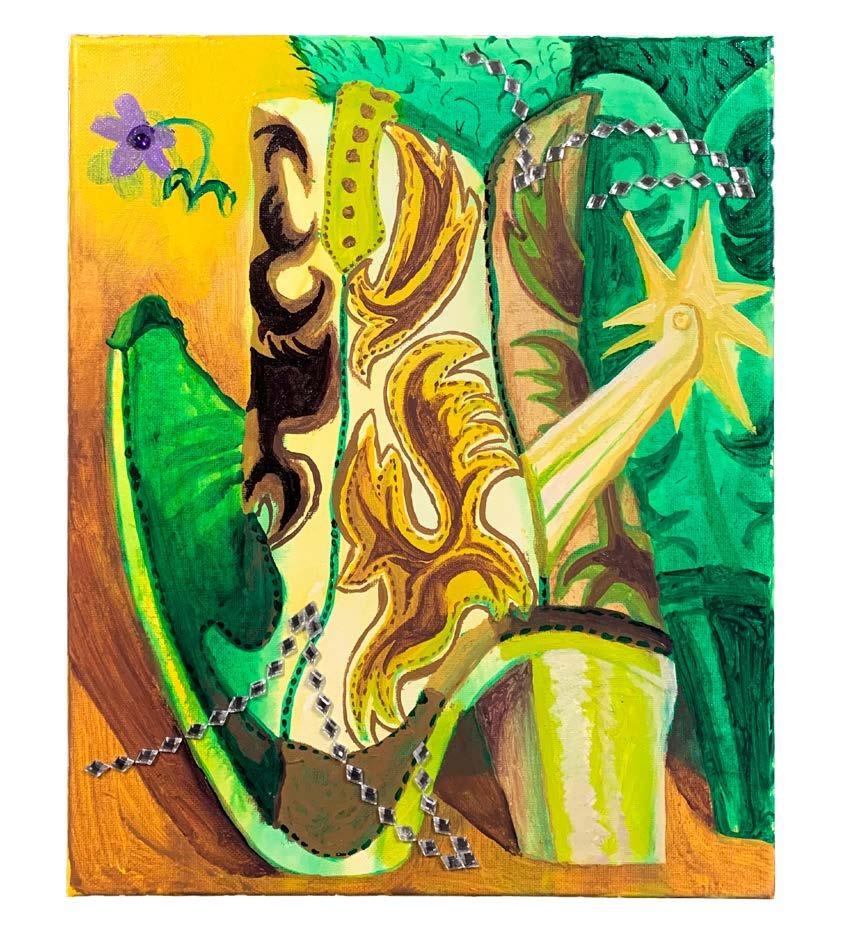
Juan Arango Palacios, Botas, acrylic and rhinestones on canvas, 11” x 14”, 2021
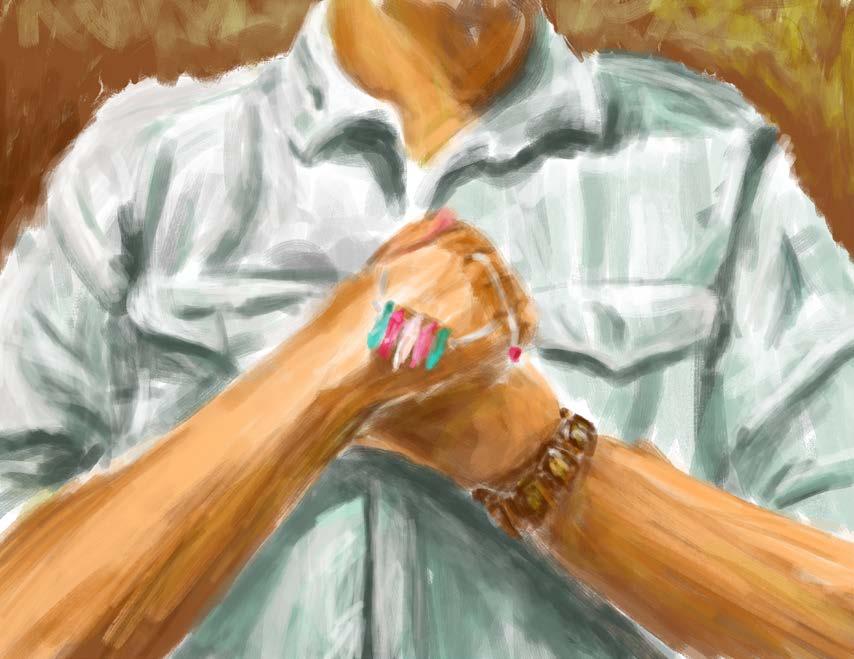
Jendayi Larios, Both, digital painting, 20” x 16”, 2021
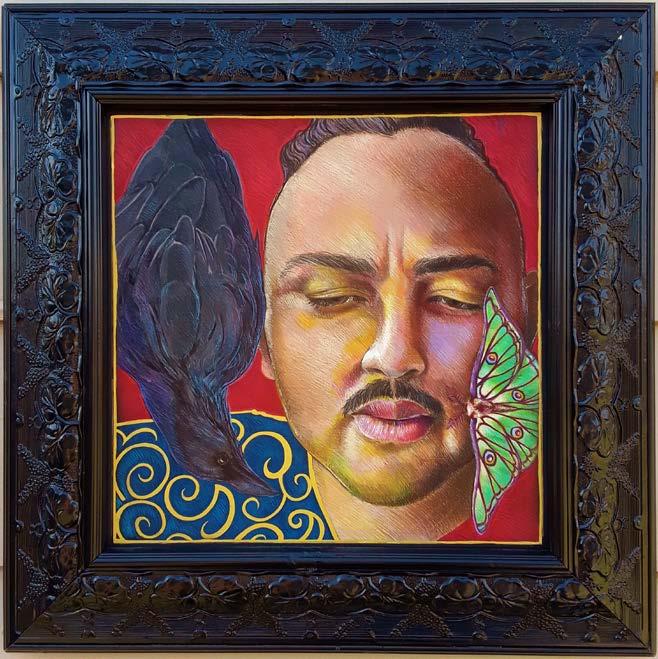
Timothy Brown Jr., I Want to Break Free, mixed media, 17” x 17”, 2020,
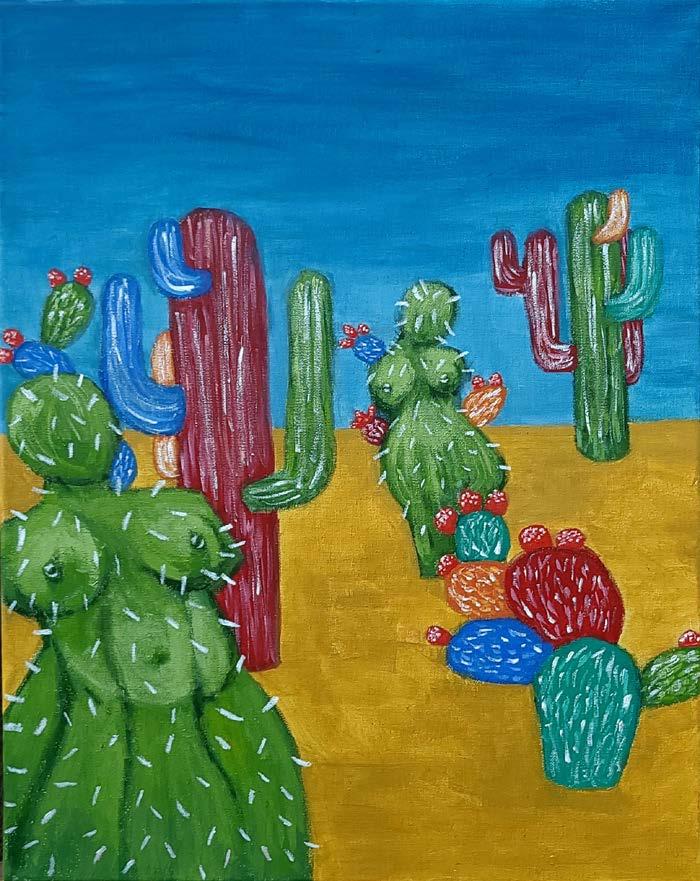
Andreana J. Estrada, Dulce, acrylic paint on canvas, 16” x 20”, 2021
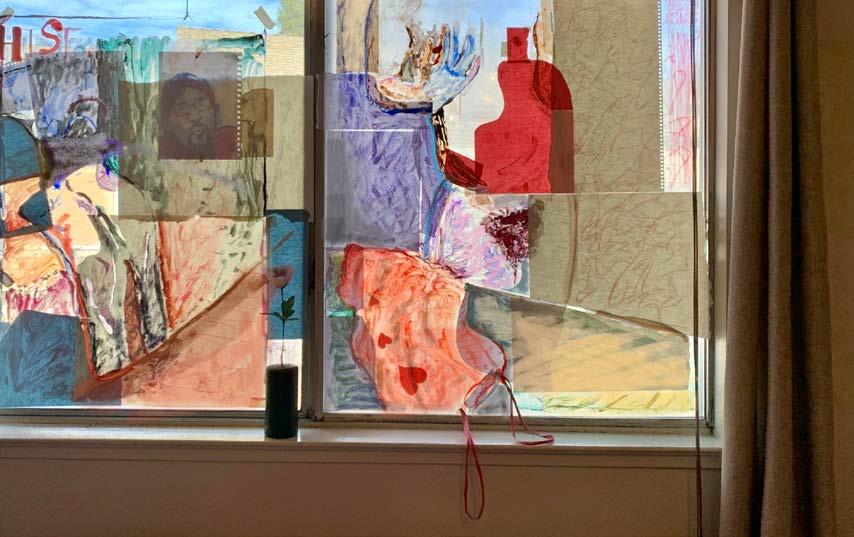
Christopher Rodriguez, In My Safe Space, watercolor, gouache, acrylic, candle, flower, shoelace, and collage on a window, 65”x 43”, 2020
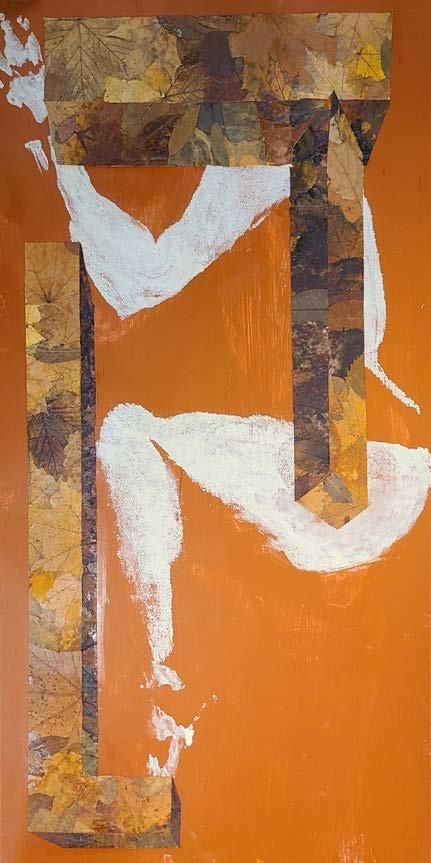
Elias Rosas, We are Held, acrylic paint and leaves on canvas, 24” x 48”, 2020
queerness in color: the artists
Timothy D. Brown Jr.
Artist Statement
My work explores the connection between color and emotion. Feelings, such as rage, sadness, passion, envy, and fear, typically have colors associated with their names already, and I am hoping to explore this further.
The impact that color has on the minds of people is well known, but for myself I want to focus on how it effects me as a gay man who deals with sessions of depression and anxiety. I want to capture the moments when these negative sensations have built themselves into a mind-numbing frenzy that confuses better judgment.
I use a blend of materials, gold paint, pigments markers, colored pencils, and spray paint to represent the mixture of feelings and thoughts flowing through the mind simultaneously to where it almost seems distracting. An additional element to each piece is the semblance of hope. My representation of that silver lining is the use of creatures, such as the moth and raven, which tend to have a more sinister connotation. I flip this and try to paint them in a more constructive and helpful light. Their participation is also a reminder to the viewer that no matter how suffocating or lonely a situation may be, they are never truly alone. A repurposed frame is the final touch added to each piece; something that once served one purpose now finds itself faded and falling apart and is given a breath of new life along with a new coat of paint. My goal is to initiate a conversation about embracing these sometimes painful emotions and learning to live with them, that they are not something to hide under a rug or dull away with liquor. These feelings, like all people, are meant to be treated with honesty and respect.
Biography
I made my artistic beginning in Santa Rosa, California, drawing the typical adolescent subject matter, such as dinosaurs and comic book characters. I was brought up by a supportive mother who worked two full-time jobs to provide food on the table and to keep a roof over our heads. My nonexistent father was just that--out of the picture. My mother and I would draw together on the weekends, whether it was to pass the time or just to keep me out of trouble as the area we lived in was not the safest. Drawing soon became my calling, which I made my way from copying what was in books to creating things out of my imagination.
As I made my way to junior high and high school I discovered that art was a release not only from my past, but also from the stress of coming to terms with my identity. Life became a little more interesting when I discovered that I was gay. At the time I did not think about making art that dealt with the subject of being homosexual, but now having been out of the closet for almost 15 years, this brings me to where my art is currently centered. Creating work that utilizes gay imagery is one thing, but how do I find my own voice became the question. I am still not sure whether I have answered it.
I view my environment as a hidden adventure, through which I can unveil each image. Creating has become the cure for the ailments that come my way, including depression, anxiety, and self-loathing. These are some of the topics I want to tackle because they are difficult to express and even harder to accept. My desire is to reach those in the gay community who may feel lost, alone, or left behind. We must remain supportive of one another and remind each other that we are not something broken that needs to be fixed. We can transcend and transform--we are enough.

Andreana J. Estrada
Artist Statement
My artwork comes from subjects that inspire or resonate with me. The subject and concept are personal. Making artworks from various media is important for showing how complex art, subject matter and concept can be. The completion of an artwork is important, but the process of how the artwork was made and of how it felt mentally is essential to me. The importance of my art is for therapy. Art influences include Frida Kahlo (1907-54) and Botticelli’s Birth of Venus (c.1480s). Non-art influences include pain, Identity, sexuality, heritage, nature and family. All artwork is made due to priority for practice, expression and experimentation.
Biography
Andreana J. Estrada is a Modesto, California Based Artist. Her mother received a degree in Art which inspired her to major in Art herself. She received Art Degrees from Modesto Junior College and CSU Stanislaus. Frida Kahlo has influenced her through use of imagery to express pain and emotion in her paintings. Estrada likes to explore the importance of positive feminine and queer sexuality in her Artwork.

Jendayi Larios
Artist Statement
As I began discovering that I was a transgender man, I treated my faith and my queer identity as two separate things. Coming from a semi-traditional Mexican family, religion was a key part of our being, while the latter was a current exploration of myself. My limited formal experiences with Catholicism were joyous occasions that I did not fully understand. It was not until I returned to prepare for my Primera Comunión and Confirmación as an adult that I had to reconcile these separate pieces of myself.
Through these experiences, I witnessed different takes on Catholicism and also saw tensions between those who grew up with the religion and those who converted. At times, the experience started taking something I loved, after adding to it a community I enjoyed participating in, and turning it into a source of inner turmoil. Never outright confronted with anything about gender, I told myself that I could continue keeping everything inside. To tell yourself you are never going to be able to come out, while feeling euphoria as the community priest unknowingly genders you correctly is also an interesting experience.
I later found out that a religious education class I had missed was actually an anti- transgender lesson. I had been mere feet from entering the door that day and was reluctant to go home instead. An accidental water spill and the instructor being concerned about my recently twisted ankle had saved me, because had I stayed there, I know I would have broken down. I had only seen antiLGBTQ+ content in their sexual education rally when their speakers pointed to non-heterosexual relations as a sin, but as I began feeling sadness about the direction of the situation, I was able to smile when a boy gave a quick boo from the back before being shushed.
In retrospect, I was only ever given as much negativity as I could handle, and when I finally gained the confidence to come out to my family (who gave few ambiguous clues to predict their reactions), I was wholeheartedly accepted. I now hold both my religious faith from growing up in a Hispanic household and my developing LGBTQ+ identity close to my heart because I have grown to interpret my experiences as powerful tools of empathy. For one reason or another, and now due to COVID-19, I have not attended a mass service since I came out, and I live with the knowledge that no matter how much I may want to return, I may not be welcome there. Planning on becoming an art teacher, however, I feel I have experienced what I
was meant to so I can make a difference in the lives of the youth I will teach, and for that, I am thankful.
Biography
Jendayi Larios is a transgender, Hispanic artist from Hughson, California, currently attending California State University, Stanislaus in the Studio Concentration - Art BA program. Focusing on the creation process, he enjoys the possibilities of exploring different mediums and the research and idea organization behind planning projects. Inspired by pop art and nature, Larios often weaves bright colors into his works. More recently, his work has begun to move from personally aesthetic objects to explore personal experiences.
While he has been interested in art throughout his life, he did not think to pursue it as a career until college. Finding the perfect way to spread his love for art while using his background to help others grow, Larios plans on returning to CSU Stanislaus after graduating to obtain a teaching credential for secondary education.

Juan Arango Palacios Artist Statement
As a queer body that was raised in a postcolonial context in Colombia, my identity was shaped in the shadows of North American normativity. My sense of self was further confounded by a series of migrations that my family experience in search of work and of a more prosperous future. Moving through varying homophobic and misogynistic cultures in Louisiana and Texas, I have formed a disembodied identity that is not attached to any specific homeland and has always been challenged by the general norm.
My practice works toward addressing the lived experiences of ambulant queer identities that have been marginalized within a diasporic or migratory context. Through the fluid and boundless medium of paint, I have been able to represent memories, places, people, and archetypes that I associate with the safety, survival, and endurance of queer bodies in spaces that challenge their existence. Also, through the process of weaving I am producing narrative objects that aim at expressing the stories of individuals within a similar context. Placing emphasis on color and composition, my work aims at creating images that glorify and fantasize the idea of safety in a queer experience.
Biography
Juan Arango Palacios was born in Pereira, Colombia, and was raised in a traditional Catholic home. His traditional upbringing was cut short by a series of migrations that his family took seeking a better future. The family moved from
Colombia to southern Louisiana where Juan’s sense of identity and belonging began to be skewed by his lack of knowledge of the English language, his unfamiliarity with American culture, and his internal struggle with a queer identity. Living in other parts of Louisiana and Texas and being further subdued by the conservative culture in which he lived, Juan continued to live with a constant fear of his own identity throughout his youth. Juan graduated from the School of the Art Institute of Chicago and has found a safe-haven within the queer community in Chicago.

Christopher Rodriguez
Artist Statement
My work explores gender identity, gender expression, and sexuality. I identify as bisexual and queer; and use art to describe my journey with sexuality and gender identity. I explore the liminal space of not being fully out of the closet with certain people in my life, having grown up in a town where I rarely found another out, queer person. I express memories of social conditioning in reflection to a common cisgender heteronormative frame of thinking. It is in my artwork that I find my individual experiences of identity and queerness displayed in images that I can understand in a way not available when left in my memories. I use images of everyday objects like pants, doors, doorknobs, and windows that appear nonconsequential, but have acted as barriers and veils for my identity. Parts of myself that I did not find reflected in my Mexican family and extended family are demonstrated in my artwork. I have found my queerness to be encouraged and welcomed in safe spaces; in contrast I have found my identity to be invalidated or unwelcomed in spaces dominated by conservative norms about gender, clothing, mannerisms, and vocal expressions. In My Safe Space is a site-specific work made in my bedroom in my family’s house.
Biography
Christopher Rodriguez is an undergraduate at CSU Stanislaus in Turlock, CA, earning a BFA degree in the Fine Arts and a Minor in Gender Studies. Being interested in the possibilities of learning about himself and the world he lives in through artistic expression he aims to continue exploring his understanding of sexuality, gender identity, and the complexities of human relationships. A goal of his is to attend a MFA program with an emphasis in printmaking. He plans to use his learned skills to teach other artists printmaking at a university.
Elias Rosas Artist Statement
The relationship between humans and the natural world has always been an interesting concept to me. We rely on nature; we cannot survive without nature.
Despite this, we have developed a strange relationship with nature, which we try to control. For example, we build structures in cities to keep us away from the wilderness, but these structures would not exist without utilizing nature.
I started to construct these geometric shapes from the leaves of plants I grow. These geometric shapes took the form of architectural elements. The architectural elements are a commentary on the ways humans bend nature to fit their needs. We often take materials from their natural place of origin and put them in foreign areas that better fit our needs. These shapes instead maintain their natural origins while still representing our control to mold them to our wants and needs.
Nature will exist after we do. Even under our control, there are things we can not stop, prevent or hide, and that is part of what makes nature beautiful. I want my work to be a mechanism of reflection for the viewer’s relationship with nature and what their impact is. Because I make these pieces out of dead leaves as a form of recycling I want the audience to consider how they can reuse things, as well as how important sustainability to protecting the environment.
Biography
Elias graduated from Waterford High School in 2016 in a small town. He went on to attend CSU Stanislaus studying fine art and art history. With a lot of experience working with plants and flowers from his multiple floral design classes and involvement with his local FFA chapter plant life took center stage in his work as he studied multiple mediums from painting to sculpture. Printmaking was a medium that he really latched on to and has had prints included in a group exhibition the Queer Art Collective in 2019 and 2020. His work in printmaking focuses on the form of the human body and its relation to nature to encourage the viewer to consider their own relationship with nature. He also explores the way humans have cultivated nature to fit their own needs. This relationship can be seen in the way we name plants and the way we try to control nature. Exploring more mixed media work Elias started to use real leaves in a college where he constructs architectural elements out of the leaves as a manifestation of controlled nature. As he recycles and reuses the castaway leaves he hopes to promote an idea of sustainability and harmony between man and nature.
ACKNOWLEDGEMENTS
California State University, Stanislaus
Dr. Ellen Junn, President
Dr. Kimberly Greer, Provost/Vice President of Academic Affairs
Dr. James A. Tuedio, Dean, College of the Arts, Humanities and Social Sciences
Department of Art
Martin Azevedo, Associate Professor, Chair
Patrick Brien, Lecturer
Tricia Cooper, Lecturer
Dean De Cocker, Professor
James Deitz, Lecturer
Daniel Edwards, Associate Professor
Patrica Eshagh, Lecturer
Jessica Gomula-Kruzic, Professor
Daniel Heskamp, Lecturer
Chad Hunter, Lecturer
Dr. Carmen Robbin, Professor
Ellen Roehne, Lecturer
Dr. Staci Scheiwiller, Associate Professor
Susan Stephenson, Associate Professor
Jake Weigel, Associate Professor
Meg Broderick, Administrative Support Assistant II
Alexander Quinones, Equipment Technician II
University Art Galleries
Dean De Cocker, Director
School of the Arts
Brad Peatross, Graphic Specialist II
Stan State Queer Art Collective 2021
June 7–July 7, 2021 | Stan State Art Space, California State University, Stanislaus | 226 N. First St., Turlock, CA 95380
300 copies printed. Copyright © 2021 California State University, Stanislaus • ISBN 978-1-940753-60-7
All rights reserved. No part of this publication may be reproduced or transmitted in any form without the written permission of the publisher. This exhibition and catalog have been funded by Associated Students Instructionally Related Activities, California State University, Stanislaus.