All Rights reserved. No part of this publication may be reproduced or transmitted in any form without the written permission of the publisher.
University Art Gallery College of the Arts
California State University, Stanislaus
One University Circle Turlock, CA 95382
University Art Galley Director Dean De Cocker
Catalog Design: Kristina Stamper, College of the Arts, California State University, Stanislaus
Catalog Printing: Claremont Print and Copy, Claremont, CA
Catalog Photography: Rhead Lown Photography
ISBN: 0-9802410-1-4
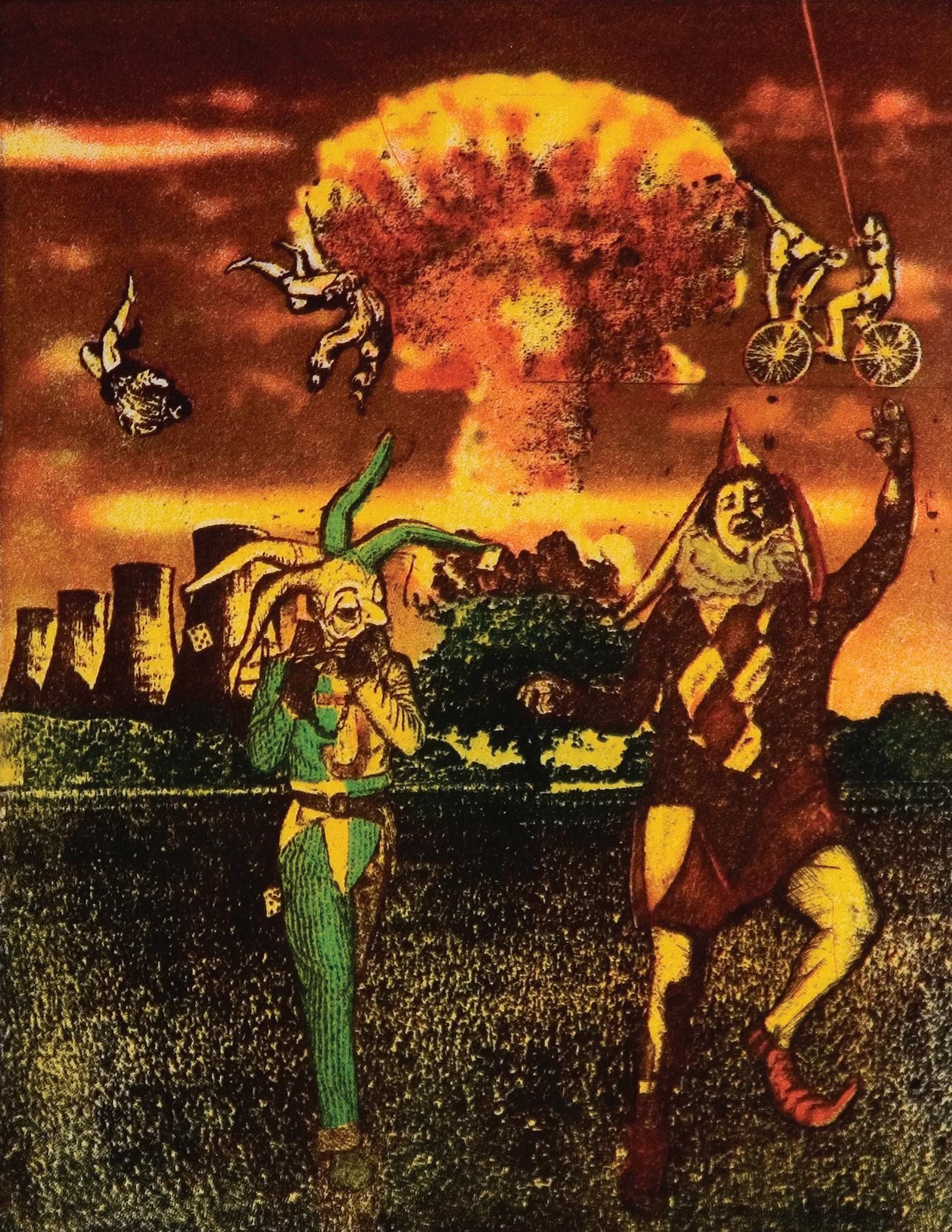
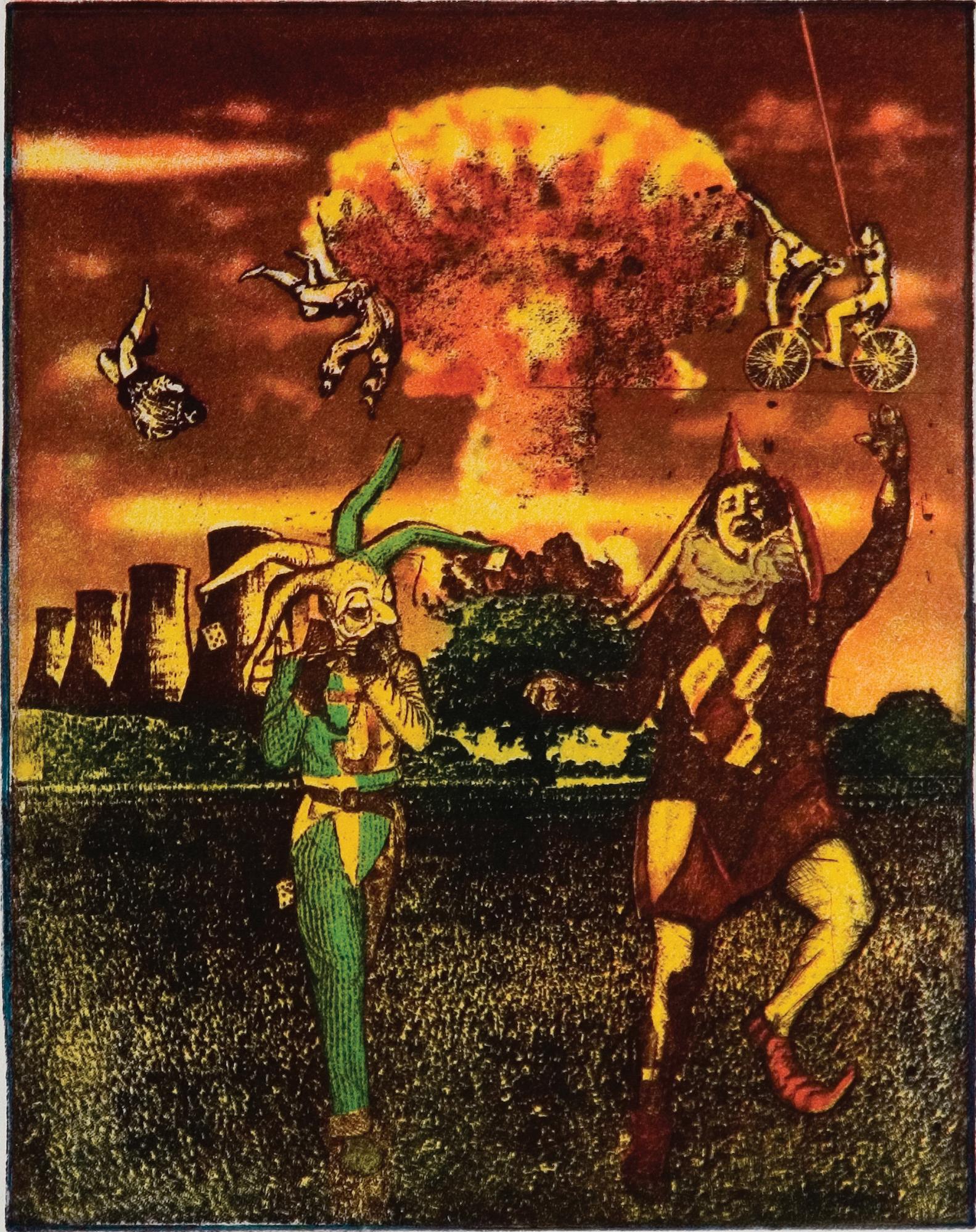
Cover Image: Kiss your flesh goodbye #1, 2003, etching, 7.5” x 5.75”
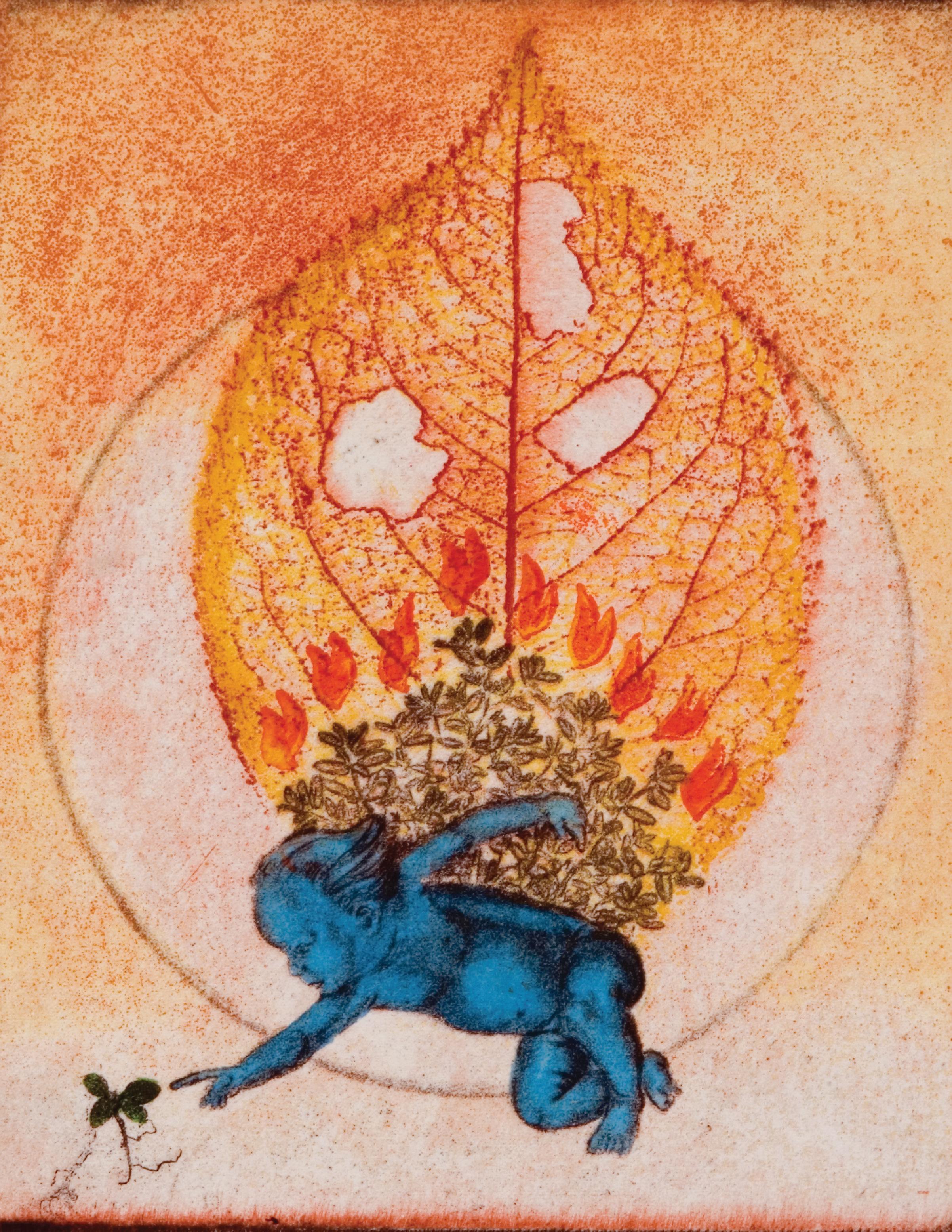
Back Cover: Hope, 2001, etching, 7” x 5”
Director’s Foreword
Patrick Merrill – Meditations on the Apocalyptic, represents a body of work by one of Southern California’s leading printmakers. The work that Patrick Merrill creates comes from a very personal view of a post-war world, his first hand experiences generate images that few should ever experience but that everyone should know and remember.
Many colleagues have been involved in presenting this exhibition. I would like to thank Patrick Merrill for the opportunity to exhibit his astounding work. Joanna Roche, PhD for her brilliant essay, Rhead Lown Photography for the excellent photography, College of the Arts, California State University, Stanislaus for the wonderful catalog design and Claremont Print and Copy for their expertise in printing this catalog.
A great amount of thanks is extended to the Instructionally Related Activities Program of California State University, Stanislaus as well as anonymous donors for the funding of the exhibition and catalogue. Their support is greatly appreciated.
Dean De Cocker, Director
University Art Gallery
California State University, Stanislaus
Joanna Roche: Angels, Demons and the Bomb
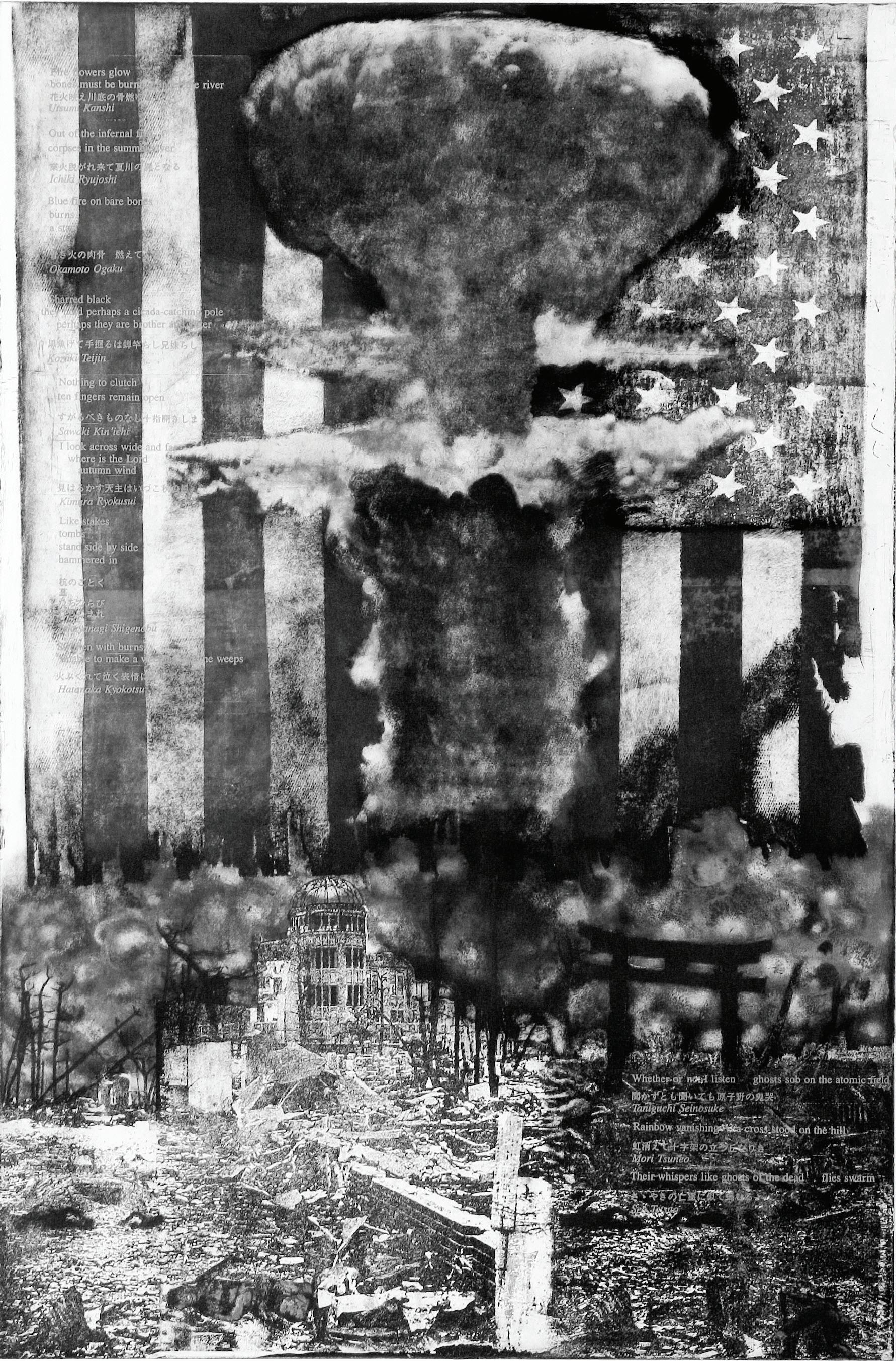
I am trying to think back to my first reckoning with the bomb. Hiroshima, Mon Amour. It was college. It was not the specificity of death: there were no images of the charred and twisted human forms that have come to haunt our collective “postwar” memories. Instead, I recall the black-and-white softness of the lovers’ embrace. My recollection of this film—occasioned by the contemplation of Patrick Merrill’s 2006 monoprint, Bomb, is the termination of the possibility of love, because of war. At the silent, melting core of Merrill’s visions of fire and mayhem is an enormous sadness. It lies hidden from immediate view, behind (or beneath) the bomb and those indelible incisions of his. Predestined grief. Perhaps that is what faces us as we contemplate his work—an end to the tenderness of flesh.
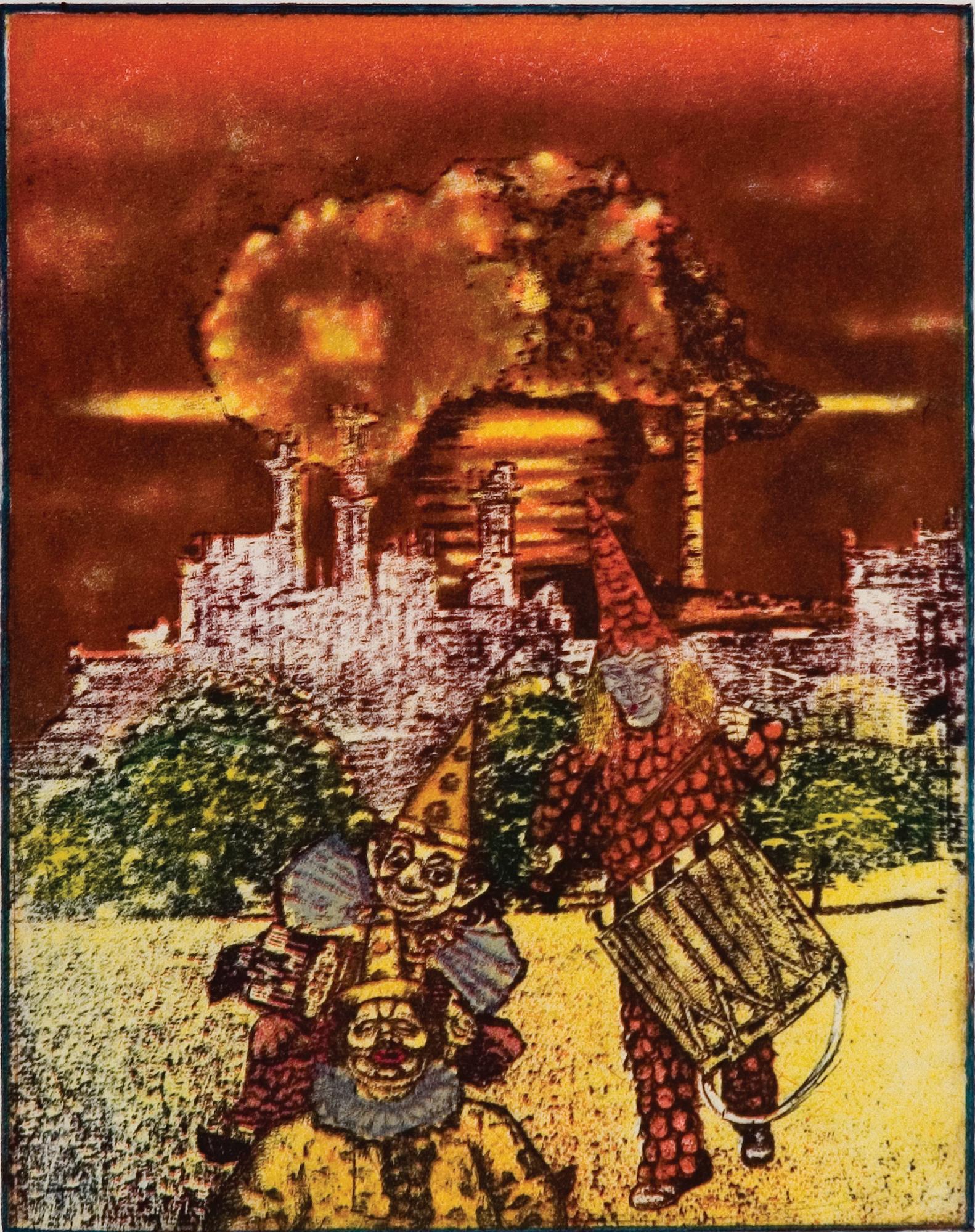
The ominous form of the “mushroom cloud” is everywhere in Merrill’s work. In his 2003 tragicomic etching series, Kiss Your Flesh Goodbye, the billowing form is the rosy backdrop to the (initially) confounding antics of jesters in the foreground. I questioned him on his breezy choice of titles. He informed me that its derivation is from the etymology of the word “carnival,” the season immediately prior to Lent when many Christians gave up (vale = farewell) the eating of flesh (carne). Merrill’s use of jesters, harlequins, masks and circus imagery reference Carnivale, that “religious” super- holiday celebrated from Rome to Rio on Fat Tuesday (Mardi Gras), the day before Ash Wednesday, which marks the beginning of Lent. In Kiss Your Flesh Goodbye #1 and #2, Merrill’s erudite appropriation of festival imagery is juxtaposed with the 20th-century’s icon of apocalypse: the nuclear explosion. Clowns and cloud co-exist for a brief moment of grim hilarity. Do they know that a power plant has just exploded behind them and is the cause of that lovely, red sunset? Merrill’s revelers embody culture’s “escape mechanism to hide in denial of the literal vaporization of the flesh in the flash of the nuclear explosion.” Ironically it is human flesh that will be “given up” this season….
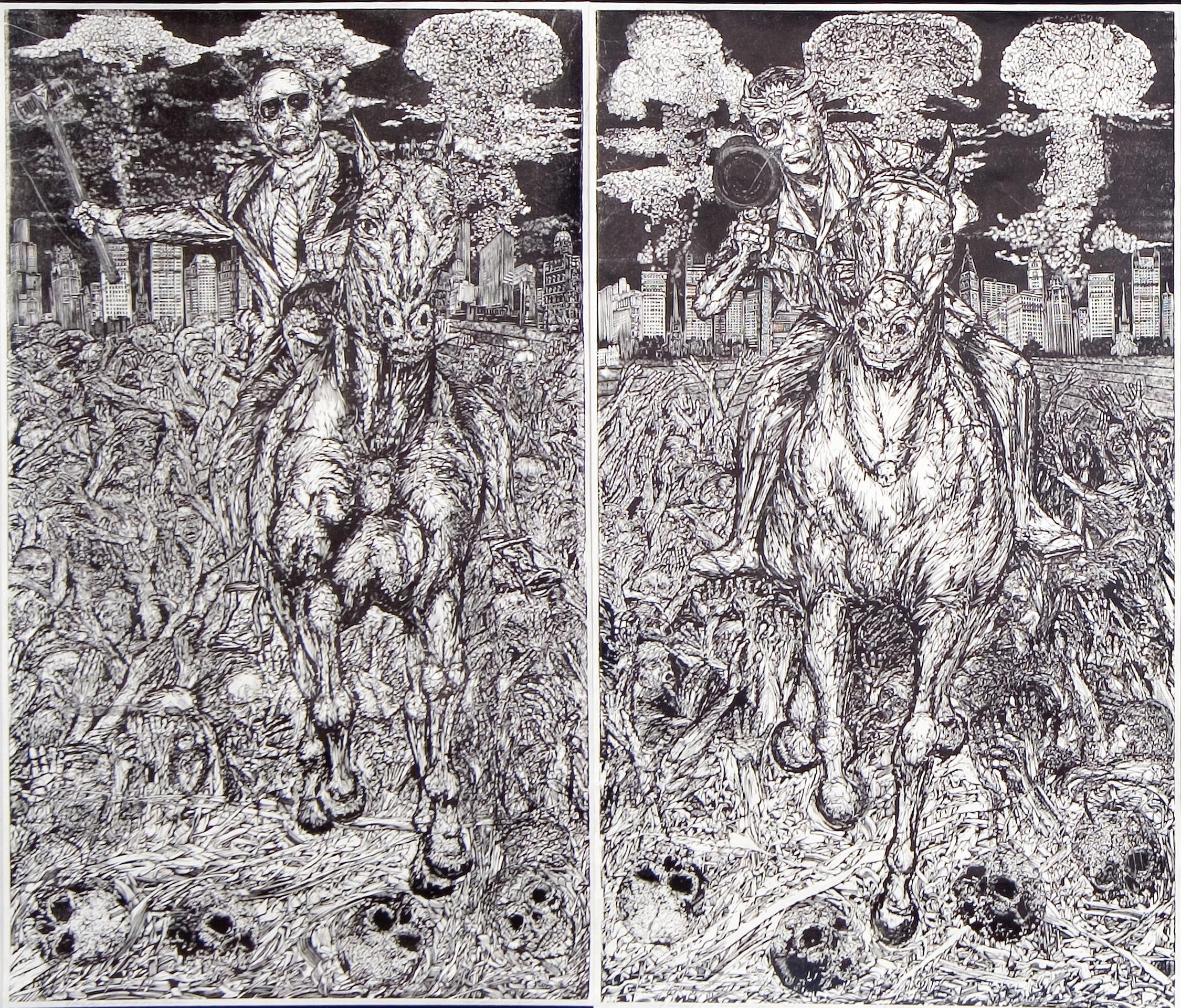
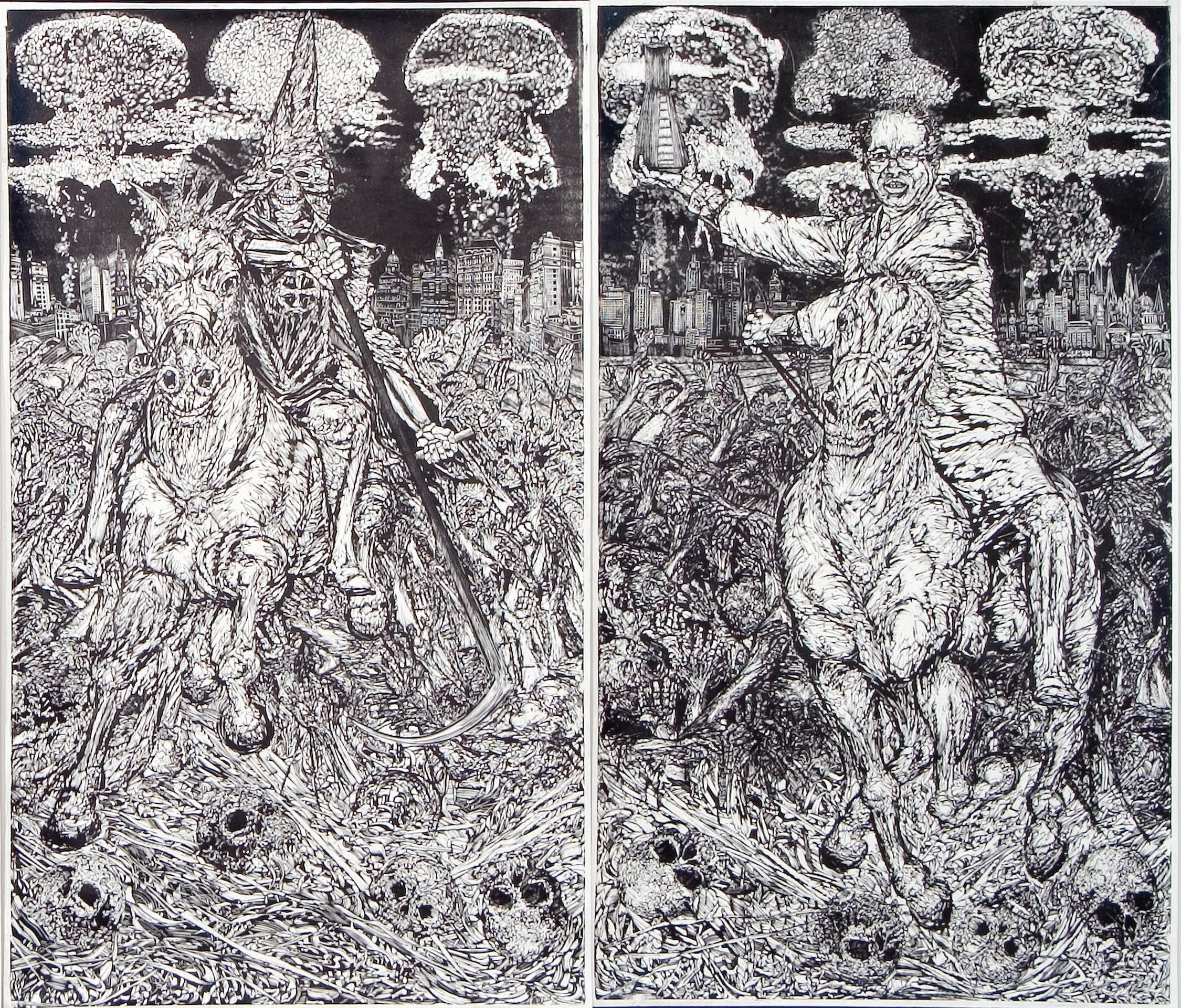
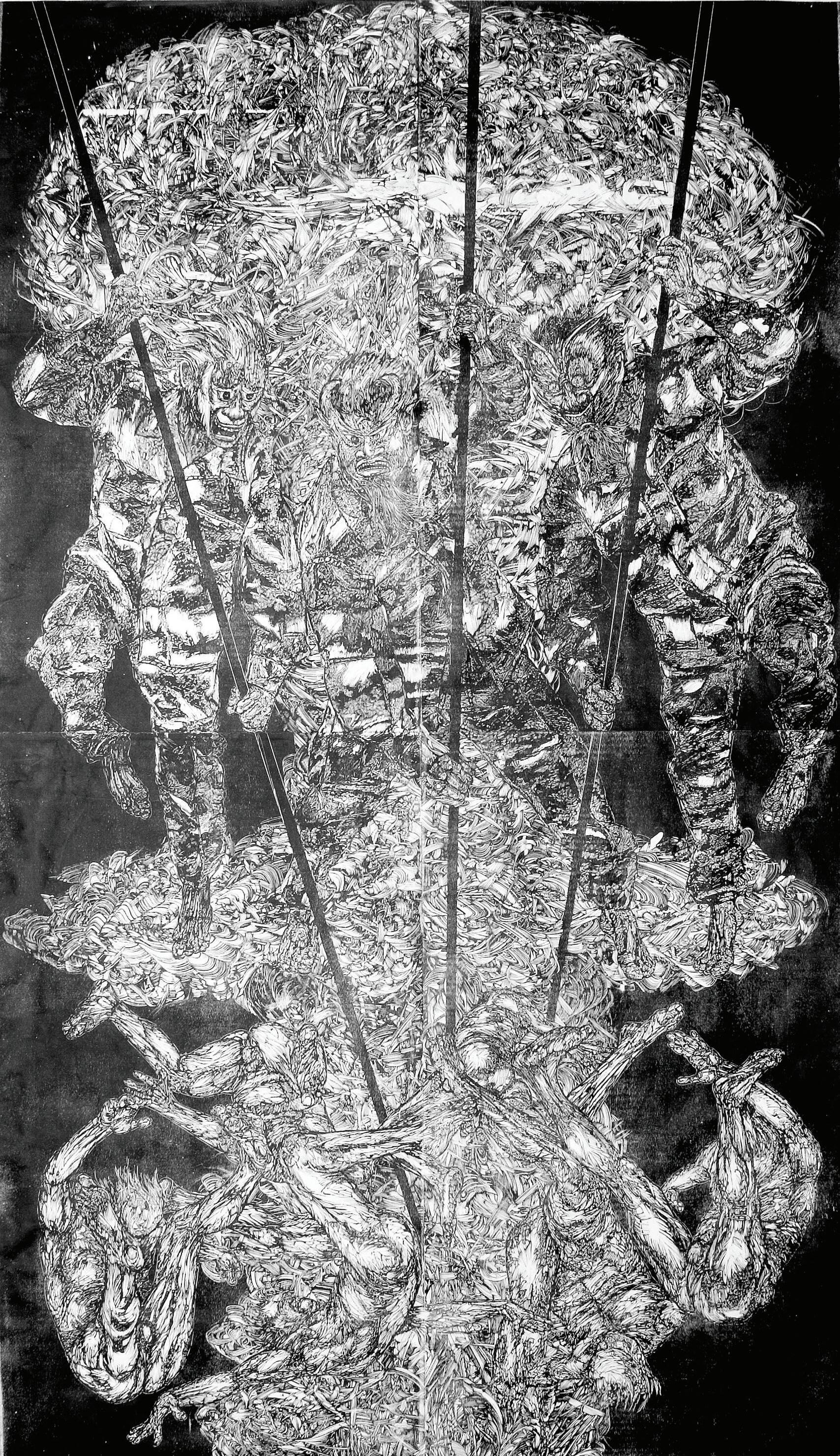
Masters of War (2006) is a continuation of Merrill’s engagement with The Book of Revelations, which began with his 2004 print, 4 Horsemen of the Apocalypse: Famine, War, Death and Pestilence The Four Horsemen is the most recognizable and reinvented apocalyptic trope. Merrill’s contemporized version has Famine personified as a ‘corporate suit’; War is depicted with the face of George W. Bush; Death is a hooded Klu Klux Clan member; and Famine is a ‘mad scientist’. The composition is similar to Kiss Your Flesh Goodbye in that the figures are placed in the foreground poised to leap into the viewers’ space against a background of nuclear destruction I think of Masters as the Horsemen gone “supernova”—the apocalypse of the four horsemen has come about—resulting in an eternity of damnation, where three masters of war have taken charge. We’ve got hell to pay, in other words.
Both of these are extremely large prints: Horsemen is 6 x 12 feet and Masters is 10 x 6 feet. These works confront the viewer in a fashion akin to a Renaissance altarpiece (think Last Judgment, not a saccharine Assumption). Per Merrill, these large-scale woodcuts “masquerade as small engravings.” Indeed, his mark making here is intimate—and astounding. These prints each bear tens of thousands of incisions, a cosmology of marks and meanings: from sumptuous crescents to expanses of solid black, from feathers to sinews to skulls. In these monumental prints, Merrill has summoned all his skills as master printer to declare war on war.
I am fascinated by Merrill’s vast repertoire of marks—in both Horsemen and Masters. I think of them as the “vocabulary” of the master printer. He modestly states: my “actual cuts are small, replicating the feel of sharp, precise lines of early engravings.” My art historian’s archive of references and culture kicks into gear as I study these woodcuts: Dürer, Kollwitz, Ukiyo-e prints, Goya, and Masereel. These are all Merrill’s artistic mentors, in fact. But what impresses me is how he folds in these earlier
traditions into an oeuvre that is always unrelentingly about our present human condition, “in this—our only time,” as poet WS Merwin writes (From The Spanish Morning, 1985).
Looking specifically at Masters of War, which is actually four woodcuts printed separately and sewn together, there is one particularly “abstract” passage that draws me in mid print. It is that sizeable, swirling cloudlike mass of marks on which the three warriors “stand” wielding their spears, as they force the angels—the victims of war—down to Hell in “a reversal of the traditional good versus evil drama of Michael and Lucifer.” The three warriors wear Kabuki demon masks and are clothed in US Army camouflage (again, Merrill surprises us with his re-contextualization of earlier artistic traditions: Ukiyo-e prints and 15th century European archangels). This “mass” intrigues me because it is both ground and gas, connected formally and conceptually to the nuclear explosion above the warriors’ heads, but changed—and charged
I believe that this passage is linked (this is my interpretation here) to Merrill’s notion of redemption, something he has written about in his artist statements. The marks here are at once chaotic and supremely orderly. Perhaps this passage has become the site of redemption (and resistance) for me because it is here that the demons are doing their damage—where their spears form an inverted “vanishing point” into the confusion of twisted bodies. It is an area of the print which reads like an accumulation of all the feathers (read tears, grief, sorrow) of the fallen. It is also an ironic site of redemption: the precise place where the demon-warriors stand as they dig in their mean feet to get a better purchase. Here are the “sumptuous crescents” I mentioned above—the curves that contrast so to the tough lines of tendons and to those solid, unrelenting three black spears.
As we have seen in Kiss Your Flesh Goodbye, the nuclear explosion in Horsemen and Masters is the ultimate backdrop—and signifier—of apocalypse. Like the jesters, the riders and warriors in these prints seem indifferent to the bombs behind them, they are too intent on their destructive “duties. “ As in the engravings of Albrecht Dürer, Merrill’s art is allegorical, and like Dürer, Merrill is steeped in the anguish of his time. Dürer depicts subjects from Revelations for reasons of faith and artistic conventions within European Christian tradition. Merrill uses Revelations for its deep historical iconographic richness (an iconography internalized by Western culture) and because it allows him to speak in a familiar language to the fundamentalist Right-Wing leadership who have appropriated the language of religion for its own purposes. Merrill writes: “They wanted Biblical revenge.” Merrill fights fire with fire and puts a face on these horsemen: Bush, Cheney…. Clearly, in Horsemen, redemption can’t occur until we get rid of the riders presently in charge.
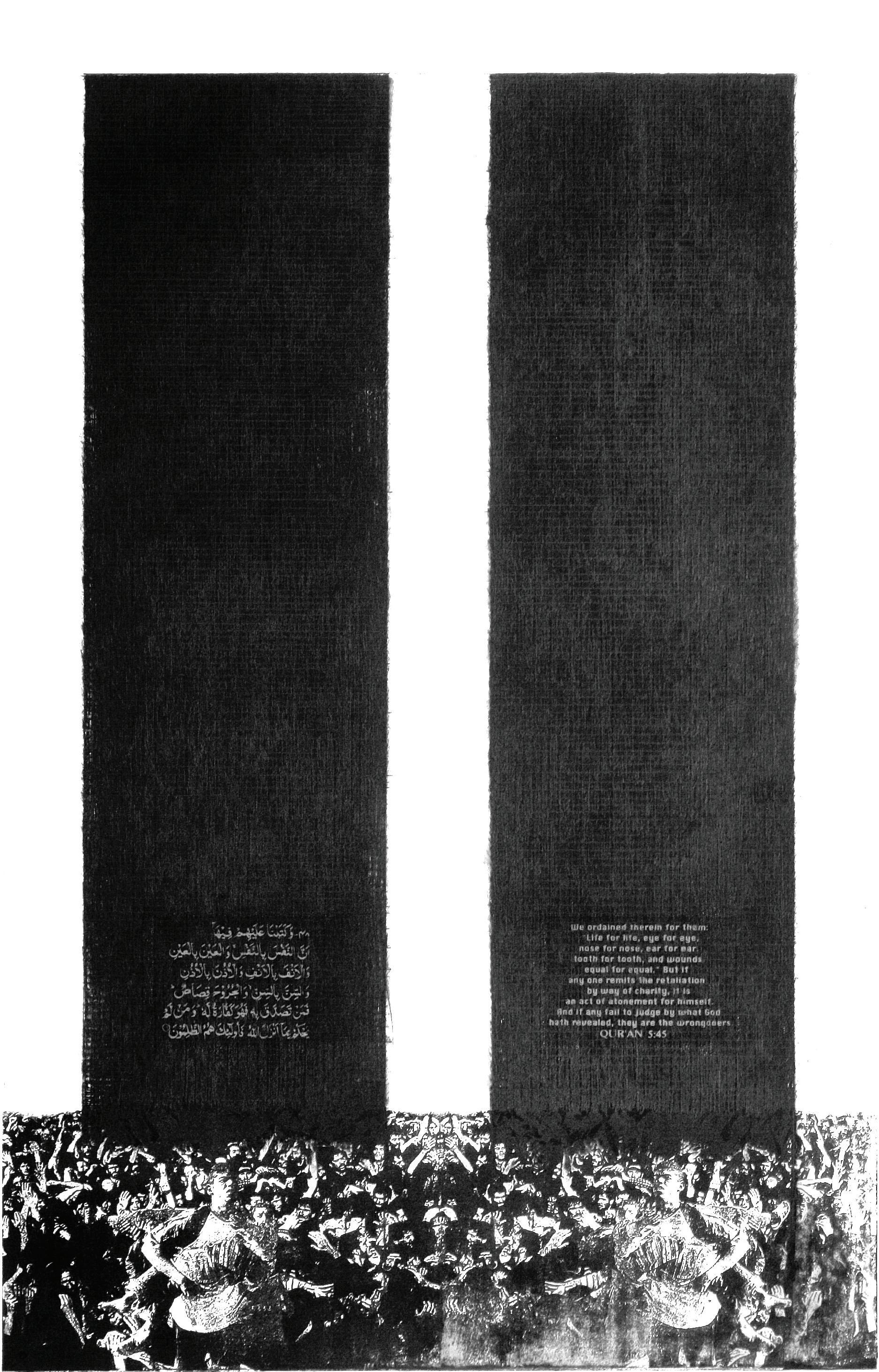
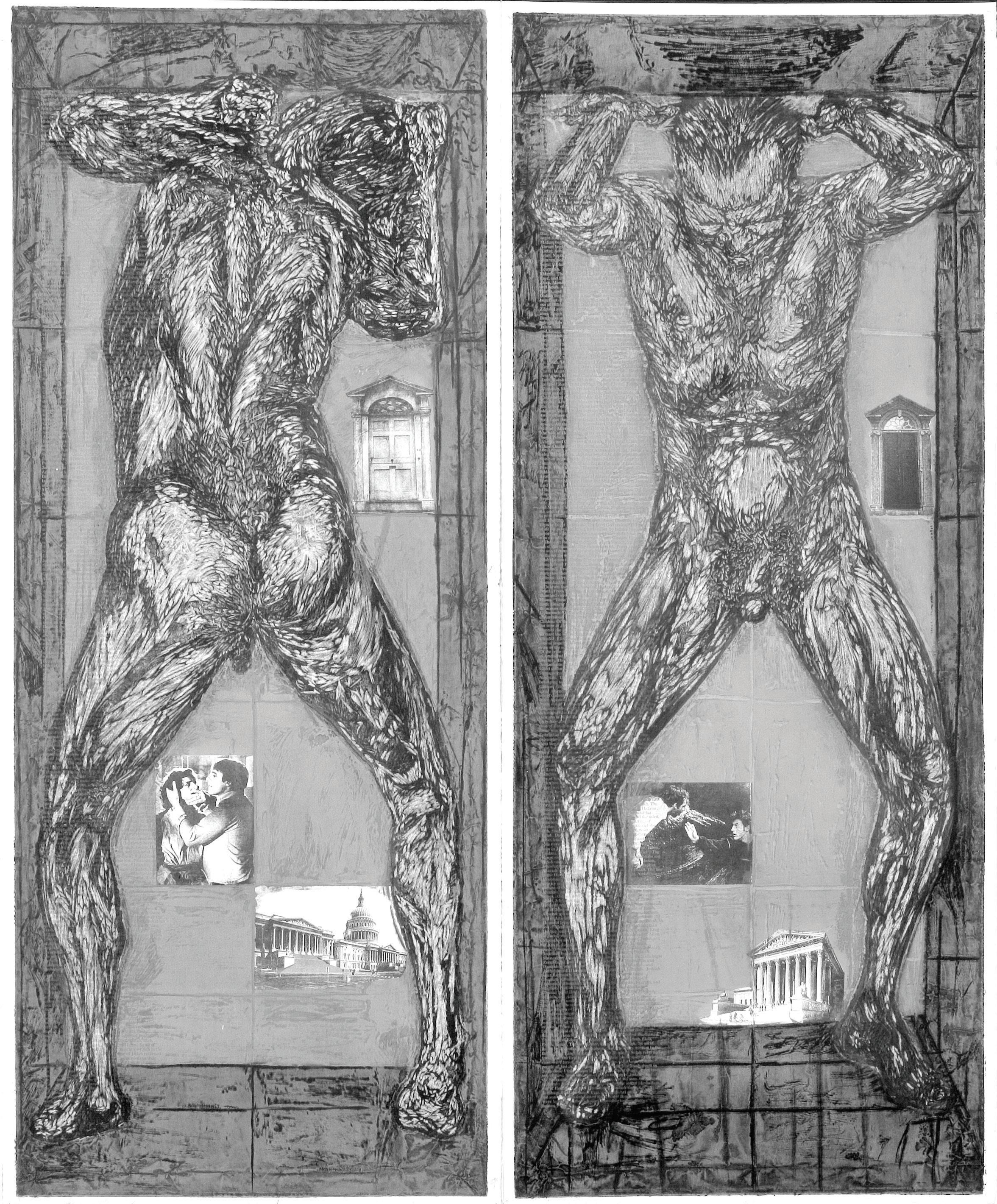
In some ways I think of Patrick Merrill as doubly anachronistic, in a good sense. He is both an exceptional craftsman —in the tradition of northern European master printers—and political activist/ resistor in the tradition of 20th-century avant-gardism. A dedicated artist and humanist, Merrill is committed to making art that scrutinizes the machinery of power in our present political moment. We need the outrage and anger this artist brings to his treatment of US foreign policy under recent administrations. Merrill takes his role as cultural critic seriously: “artists need to create a vocabulary of dissent, of resistance to dominance.” Art as a place to stimulate dialogue in the public sphere is something Merrill lives. His practice (like his character) is never passive—pushing us to challenge what we see and what we think we know. Moreover, this particular show at CSU Stanislaus and its catalogue are significant: to us as viewers/readers and to Merrill himself. In reference to the work included in this exhibition—and specifically for his inclusion of the small etching, Hope (2001), Merrill wrote me: “these prints are about resistance to domination and resistance without hope is a futile gesture—the door was my symbol of hope. [See the doors in the prints Question Authority and Demand Your Voice (1998)]. This exhibit is also a resistance, thus I needed a sign of hope.” Within
this sign of hope, I suspect, lies a chunk of that “redemption” which Merrill and this essay have addressed. Redemption (and hope) are not easy or overly accessible, clearly. It’s not even certain from studying his work who’s the toughest: angels, demons or the bomb. What I do know is that in these marks of resistance, Patrick Merrill offers us a visual trial by fire: if we can look steadily into the mayhem and find some patterns of meaning (and hope) in both our personal and collective struggles, then maybe we’re on something as solid as archangel’s wings.
Joanna Roche, PhD Department of Art California State
University Fullerton
All quotes by the artist are from personal correspondence and artist statements.
Meditations on the Apocalyptic: Images
August 5, 1945: Beginning of Empire, 2000 etching
36” x 24”
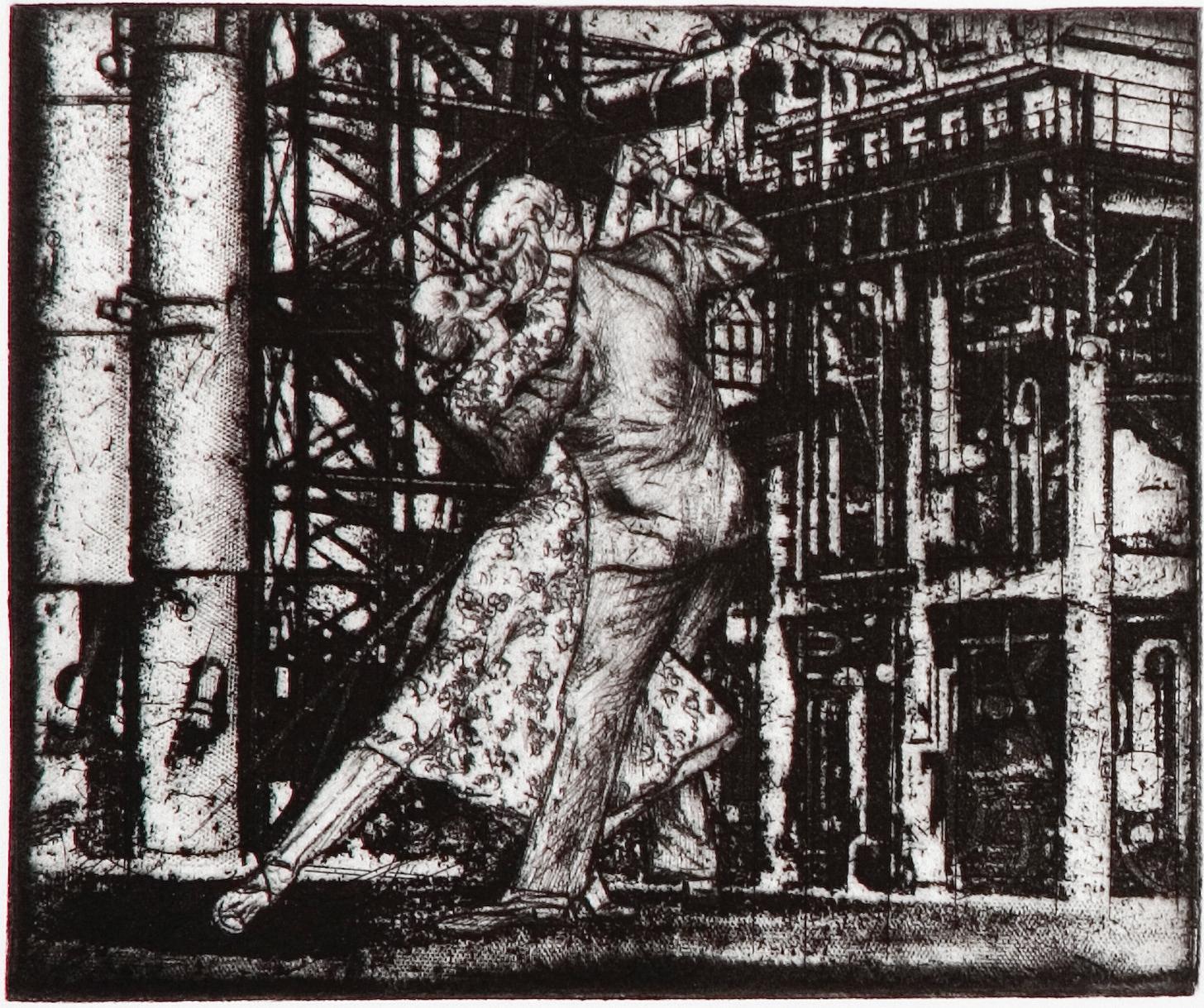
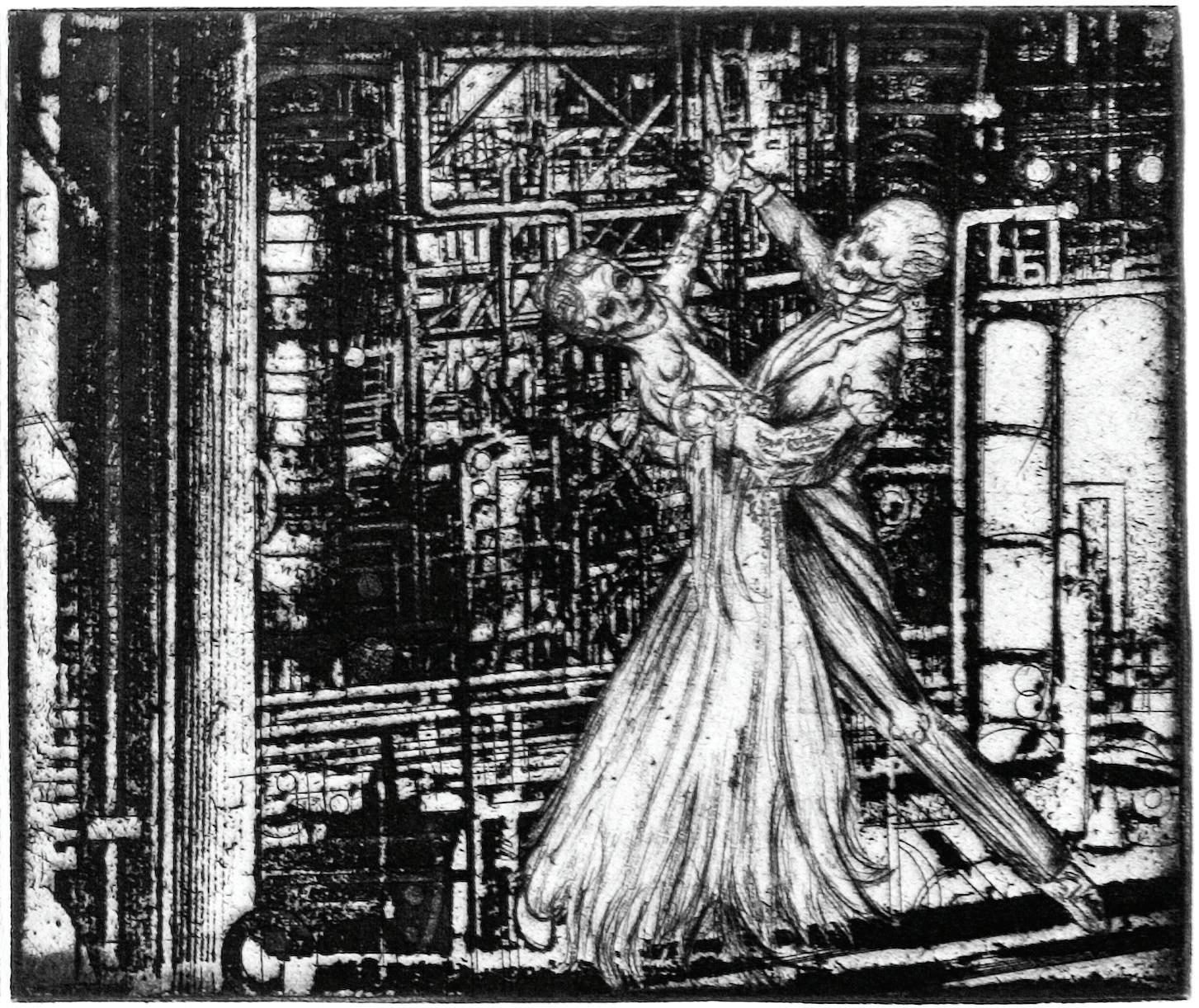
Danse Macabre (with details), 2003 etching 9” x 48”
Revenge is mine sayeth..., 2002
etching, drypoint
36” x 24”
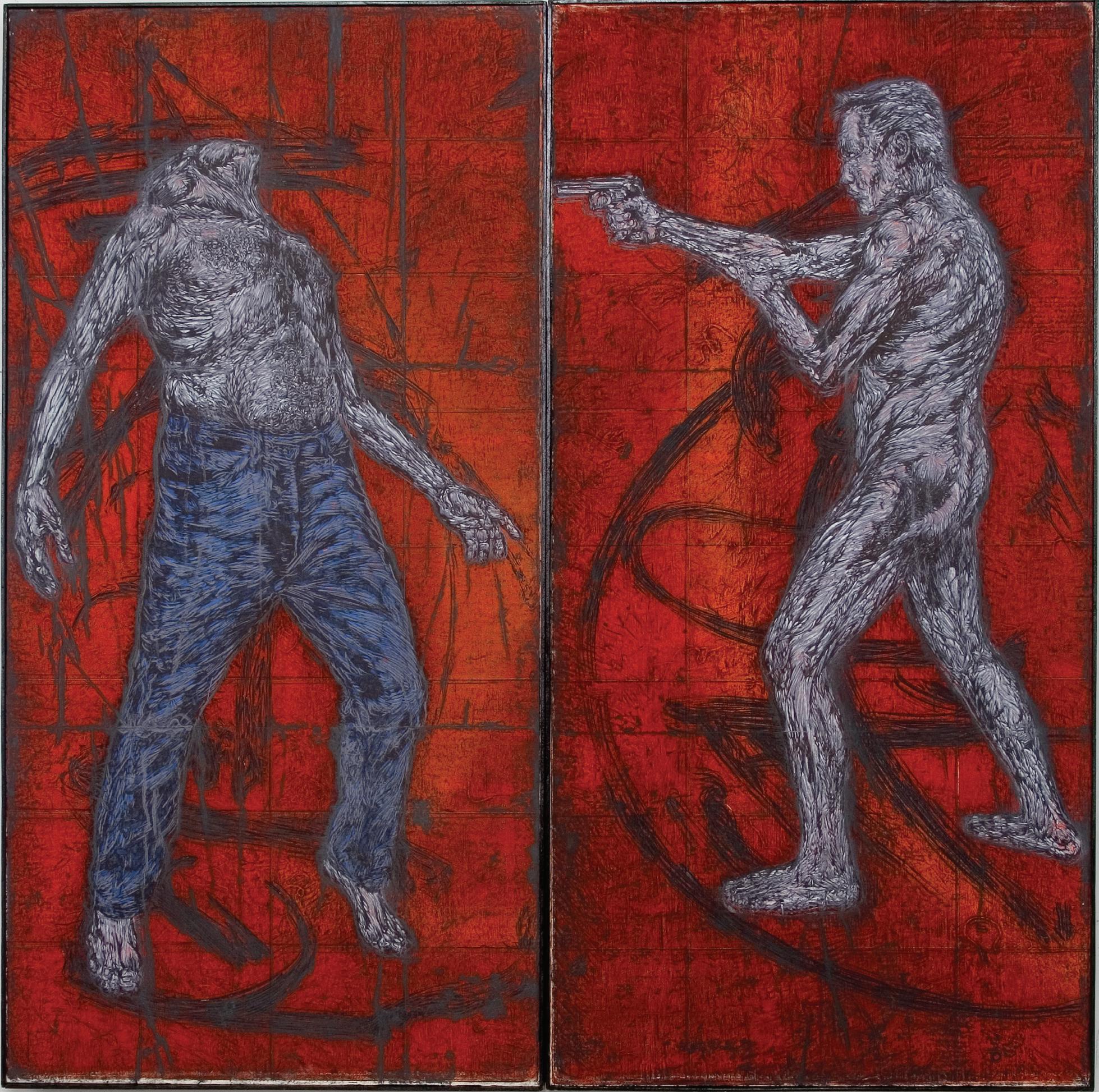
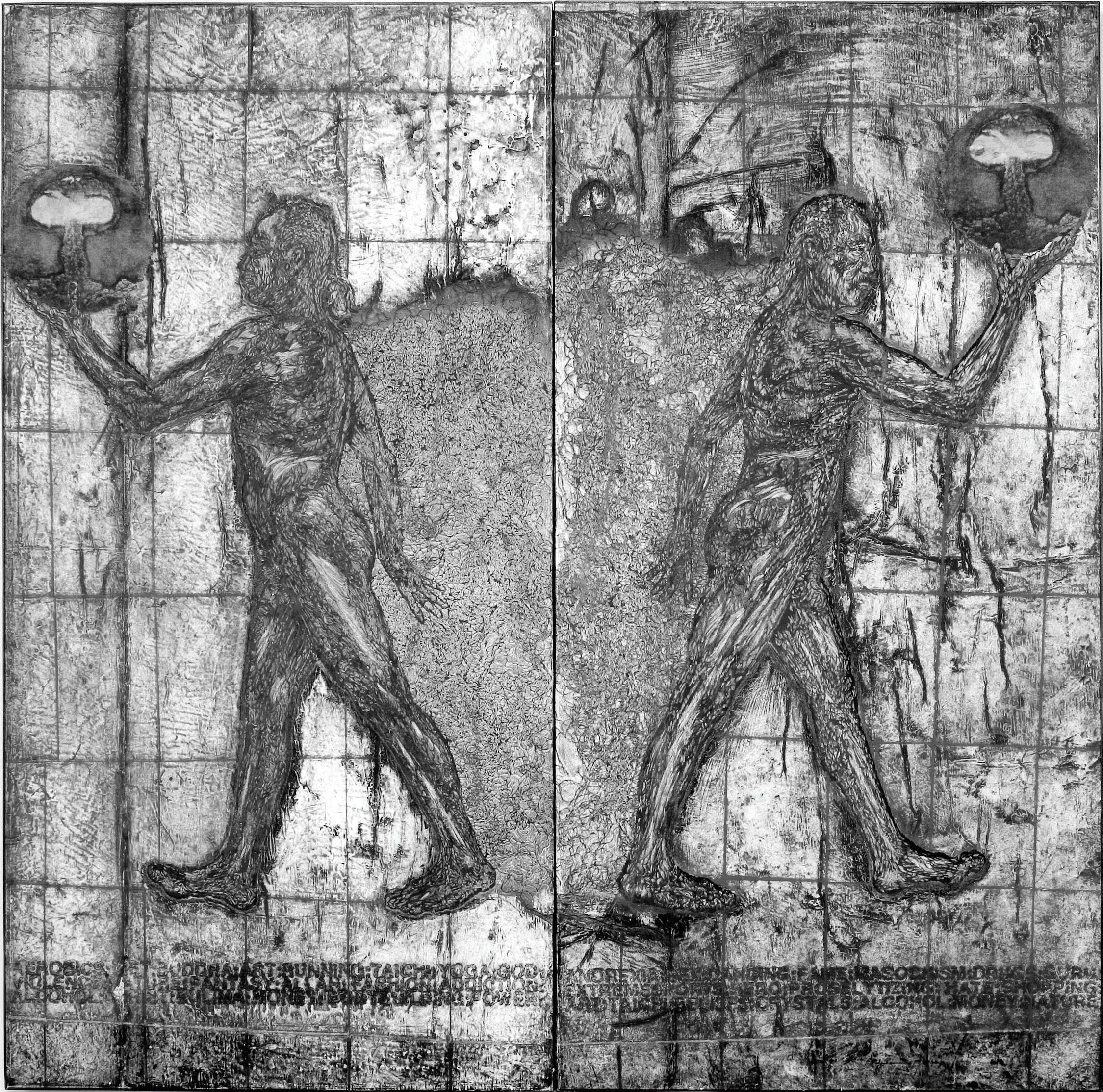
Oedipus and Laius, 2001 woodcut, etching, collograph 60” x 60”
Four Horsemen of the Apocalypse (Famine, War, Death, Pestilence), 2004 woodcut
68” x 144” (4 panels)
Masters of War, 2006 woodcut
120” x 72”
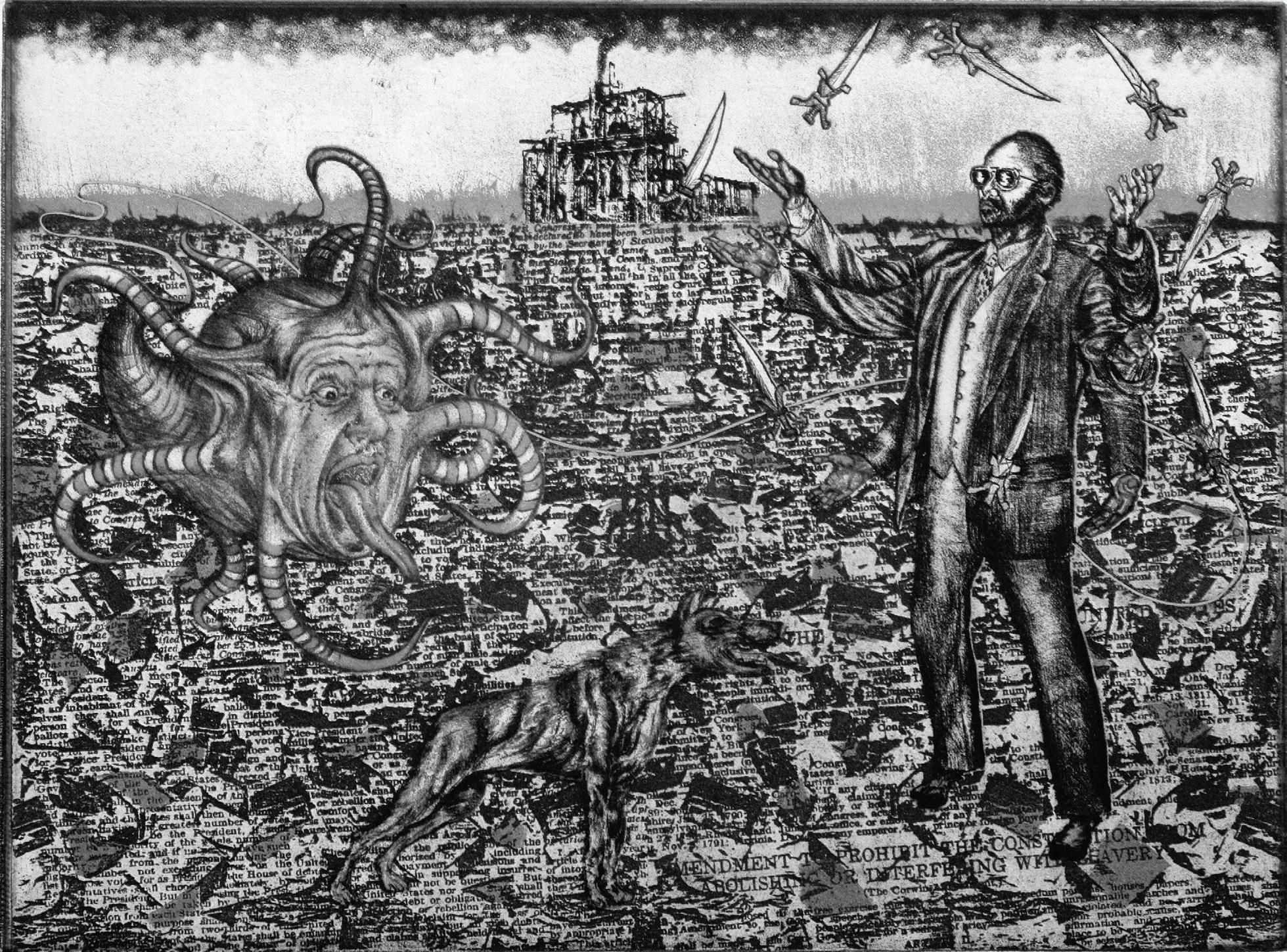
Mr. “S” Goes to Washington, 2004 etching 9” x 12”
Seeking the Messiah woodcut, etching, lithography, collograph 60” x 60”
Questioning Authority/Demand Your Voice(Resist series), 1998 woodcut , etching. lithography 60” x 24” (each panel)
Kiss Your Flesh Goodbye #1, 2003 etching
7.5” x 5.75”
Artist Statement
The source of my images/ideas is the compelling need to know myself; my place in the world; the nature of my relationships with others. We often encounter the phrase “discovering one’s identity.” This doesn’t sit right with me. We don’t discover identity; we construct it. As an addict I would add “destruct” and then a re-constructing through self-determination. I mean think about it, we aren’t born with some essential “me” and that life is all about unfolding that “me.” No, right from the beginning we are being constructed by our parents, by the culture and by the behavior patterns imposed by tradition and institutions of power (church, government, economic, judicial etc.).
While I‘ve been an artist most of my life and even took formal training through the 70’s, it wasn’t until I started my recovery from drug addiction in 1981 that my art could take a determined direction. In the early years of recovery my art was wholly emotional and entirely gestural, the figure distorted and monstrous. The source and subject of my art was internal. I was seeking through my art and my studies in psychology a synthesis. As an addict my initial work, all self-portraits, was an effort in self-analysis in order to understand why I am an addict. Integrated synthesis was my goal but after a few years of studying and accepting this Jungian notion, its homogenizing blend of opposing elements struck me as wrong. My studies in philosophy were directing me to ideas about simultaneity. Suspending polar concepts, attempting to comprehend both/and rather than either/or. I still sought synthesis. In 1990 I developed the idea of a conjunctive synthesis that continues to govern my aesthetic and conceptual decisions. In my more recent work, the larger narratives I embrace require my image to function as a model for others. However since I intend my body, my image to be seen as a mark of complicity in the more open political works, the figures still retain some self-reference.
The title Meditations on the Apocalyptic is meant to both invoke the spiritual connotation of “meditation” as well as the 17th century term for philosophical investigations. Both connotations work in extreme contrast to the foreboding imminent disaster evoked by the “apocalyptic.” Many of my first works after my investigation of the “Self” dealt with war, famine, disease – man-made catastrophic deaths. The ultimate deathblow to the species is the nuclear bomb. If the full effect of that terror was ever to be released Death would weep because his job would be finished. Many of the earlier works in this exhibit investigate humanity’s inhumanity to itself. From subjugating imperialism to the Oedipal inheritance of “power” which I see as the psychological foundation of hierarchical domination. My current investigation is a re-evaluation of themes from The Book of Revelations first presented in the Medieval and Early Renaissance periods.
The first work in this project was the 4 Horsemen of the Apocalypse: Famine, War, Death, Pestilence
From the beginning this project has been my Guernica, my reaction to the war mania, revenge mind set, rising Nationalism – the fear, the anger in the air. At the moment of “911” I got very angry – not at the then unknown assailants – but at my government. It wasn’t just that I felt they had brought this on us through decades of imperialism, economic domination and exploitation but that I knew they were going to use this attack to further their own ends. They would not take the moral high ground, using the international good will to organize the world in a joint campaign to fight the criminals and terrorists. No! They wanted Biblical revenge. In their self-righteous outrage they would drive us to war. Citing the same biblical language used by the religious Right, the Four Horsemen are iconic symbols from the old text of the Judeo/Christian Bible. The images of the Four Horsemen have been used for centuries – as prophesy, as warning. They represent the beginning of the “end game” - Armageddon. They speak of an exceedingly vengeful God.
The Masters of War continues my meditations on The Book of Revelations and its deliberate use in the political maelstrom of American imperialism. I believe there was an overt alignment between American Cold War cultural politics and Revelation’s demonology of the Antichrist and its various beasts. (e.g. Ronald Regan’s notorious identification of the USSR in 1983 as the “evil empire” and the current demonizing by Bush of North Korea, Iran and Iraq as the “axis of evil.”) This choice of language was developed by Bush’s speechwriters in order to match the theological language used by Bush since the September 11, 2001 attacks. The warriors in Masters of War are modeled after medieval depictions of Archangels. The innocents are naked, vulnerable and are modeled after the classic images of the fallen angels. The warriors wear U.S. camouflage uniforms; demon masks conceal their faces. They wield spears driving the vulnerable victims of war down to Hell in a reversal of the traditional presentation of “good vs. evil” drama of “Michael and Lucifer.” The nuclear explosion filling the background represents the ultimate apocalyptic image and my greatest fear. The anxiety of that potential is the constant background thrum of my life.
As cultural critics artists need to create a vocabulary of dissent, of resistance to dominance. My choice of Revelations as a metaphoric structure for my project was intended to engage both the Right and the Left in a dialogue. We have so little discussion about difference and precious little compromise on those differences. The visual structuring of the iconic images described in The Book of Revelations, while beginning in the Middle Ages, were formalized by the 16th century. Western culture has internalized them and can readily identify them. They are ideal for appropriating and recontextualizing.
One could also use Revelations as a metaphor to meditate on one’s own life. As Frances Carey in his book The Apocalypse postulates, the life history of an individual whose personal fall (an addict’s crash), while not redeemed according to the promises of Revelations, can never the less be redeemed. Apocalypse thus becomes a psychomachia: each person struggling with his/her own Beast and Whore (of Babylon) to find redemption within. What needs to be determined is not only the nature of each personal beast but also what defines “redemption?”
Patrick Merrill
Patrick Merrill
1981 – present Pat Merrill Fine Art Prints, Masterprinter and Owner
1997 – present Director and Curator of the W. Keith and Janet Kellogg University Art Gallery, California State Polytechnic University, Pomona, CA
Education
1994 MFA Printmaking, California State University, Fullerton
1976 BFA Printmaking, California State University, Long Beach, Magna Cum Laude
Associations
AAM – American Association of Museums
ASA – American Society for Aesthetics
LAPS – Los Angeles Printmaking Society
SCG – Southern Graphics Council
Solo Exhibitions
2007 “Meditations on the Apocalyptic,” Director, Dean De Cocker, University Art Gallery, California State University, Stanislaus
2006 “Pat Merrill Prints: A 15 Year Review,” Director, Fatemeh Burnes, Mount San Antonio College, Walnut, CA
2005 “Pat Merrill Prints,” Curator, Richard Peterson, College of the Sequoias, Three Rivers, CA
2004 “Pat Merrill Prints” Curator, Karen Brown, Bad Dog Gallery, DeKalb, Illinois
2002 “Pat Merrill Printmaker” Curator, Cathy Day, Ventura Community College, Ventura, CA
2001 “Patrick Merrill,” Curator, Susan French, Merced College Art Gallery, Merced, CA
1998 “Power, Impotence, Resistance”, Orange County Center for Contemporary Art, Santa Ana, CA
1994 “Patrick Merrill” MFA Exhibit, West Gallery, California State University Fullerton, Fullerton, CA
1980 “Pat Merrill Printmaker”, Seal Beach Library, Seal Beach, CA
1973 “Pat Merrill” Curator, Tom Rose, Artisan’s Guild, Garden Grove.
Selected Exhibitions
2006 “Master Printers”, Jean Clad, Curator, Barnsdale Municipal Art Gallery, Los Angeles, CA “In Plain Sight”, Curator, Lloyd Rodgers, Orange County for Contemporary Art, Santa Ana, CA “Lessedra Fifth World Art Print Annual,” The National Palace of Culture in Sofia, Sofia, Bulgaria
“The New Normalcy: Works Focused on Social Justice, Human Rights, American Imperialism & Domestic Neglect”, Curator, Robert Squires, Carlotta’s Passion, Los Angeles, CA
2005 “Border Crossings” The Ink Shop Printmaking Center, Ithaca, New York “Brand 35, Brand Library, Glendale, CA (Purchase Award) (catalog)
2004 4th Minnesota National Print Biennial, Curators, Siri Engberg, Walker Art Center and Marjorie Devon, Director, Tamarind Institute; University of Minnesota, Minneapolis, Minnesota (catalog) 17th Parkside National Small Print Exhibition, Juror, Kenneth Kerslake, University of WisconsinParkside, Kenosha, Wisconsin (catalog)
“100 Artists See Satan” CSUF Grand Central Art Center, Santa Ana, CA Curator Mike Mc Gee (catalog)
2003 “Cultural Comment,” Lisa Thrall, Patrick Merrill; Curator, Tommi Drake; Wiseman Gallery, Rogue Community College, Grants Pass, Oregon
“Lessedra World Art Print Annual,” Sofia City Art Gallery, Sofia, Bulgaria (catalog)
“International Small Engraving Salon Carbunari, Florean Museum, Maramures, Romania, “ENTER in live city EXIT” Tetovo Biennale, Museum of Tetovo, Tetovo, Macedonija
2002 “International Miniatures” Curator Claude Aimee, Montreal, Canada
“Biennale Internationale d’art Miniature,” Salle Augustin-Chenier,Quebec, Canada “Show: The Flag,” Curators: Nancy Buchanan, Carol Wells, Armory Center for the Arts, Pasadena, CA
2001 “Graphic Art,” Tetevo Museum of Macedonia, Tetevo, Macedonia
2000 “World Etching,” Chongqing Prints Festival, Chongqing, China
(Traveling throughout China) catalog.
“International Triennial of Graphic Art,” Bitola, Macedonia (Catalog)
“Y2G: Gender Perceptions in the New Millennium,” Adell McMillan Gallery, University of Oregon, Eugene, Oregon
1999 “Installed II” – Patrick Merrill, Marianne Magne, Kathi Martin Flood, Castillo; Gallery 825, Los Angeles, CA
“27th Bradley National Print & Drawing Exhibition,” Juror Warrington Colescott, Heuser Art Center Gallery, Bradley University, Peoria, IL
“Innovations in Printmaking National Juried Show,” Juror Helen Frederick, Arnold, Maryland
1998 “OnSite: Three Garden Grove Artists” Coastline College, Garden Grove, CA
“Printmakers ‘98” Juror Clare Romano, Pittsburgh Center for the Arts Pittsburgh, PA
“22nd National Print Biennial” Juror Jane Glaubinger, Silvermine Guild Arts Center, New Canaan, CT
Acknowledgements
California State University, Stanislaus
Dr. Hamid Shirvani, President
Dr. William Covino, Provost/Vice President of Academic Affairs
Mr. Daryl Joseph Moore frsa, Founding Dean, College of the Arts
Ms. Rebecca Phillips Abbott, Interim Vice President for University Advancement
Department of Art
Gordon Senior, Chair, Associate Professor
John Barnett, Professor Emeritus
Dean De Cocker, Associate Professor
Jessica Gomula, Assistant Professor
David Olivant, Professor
Dr. Roxanne Robbin, Professor
Richard Savini, Professor
Dr. Hope Werness, Professor Emeritus
Lauris Conrad, Administrative Support Assistant
Christian Hali, Instructional Support Technician II