
stanley C. wilson
a ltars, iC ons and d rawings
Stanley C. Wil S on a ltar S , iC on S , and dra W ing S
University art gallery department of art
School of the arts
California State University Stanislaus
500 copies printed
Stanley C. Wilson: Altars, Icons and Drawings
January 30 - March 5, 2014
University art gallery
School of the arts
California State University Stanislaus one University Circle turlock, C a 95382
this exhibition and catalog have been funded by: associated Students instructionally related activities, California State University Stanislaus
Copyright © 2014 California State University Stanislaus all rights reserved. no part of this publication may be reproduced or transmitted in any form without the written permission of the publisher.
Catalog design: nic Webber, School of the arts, California State University Stanislaus
Catalog Printing: Claremont Print, Claremont, C a
Catalog Photography: Courtesy of the artist.
iSBn: 978-1-940753-02-7
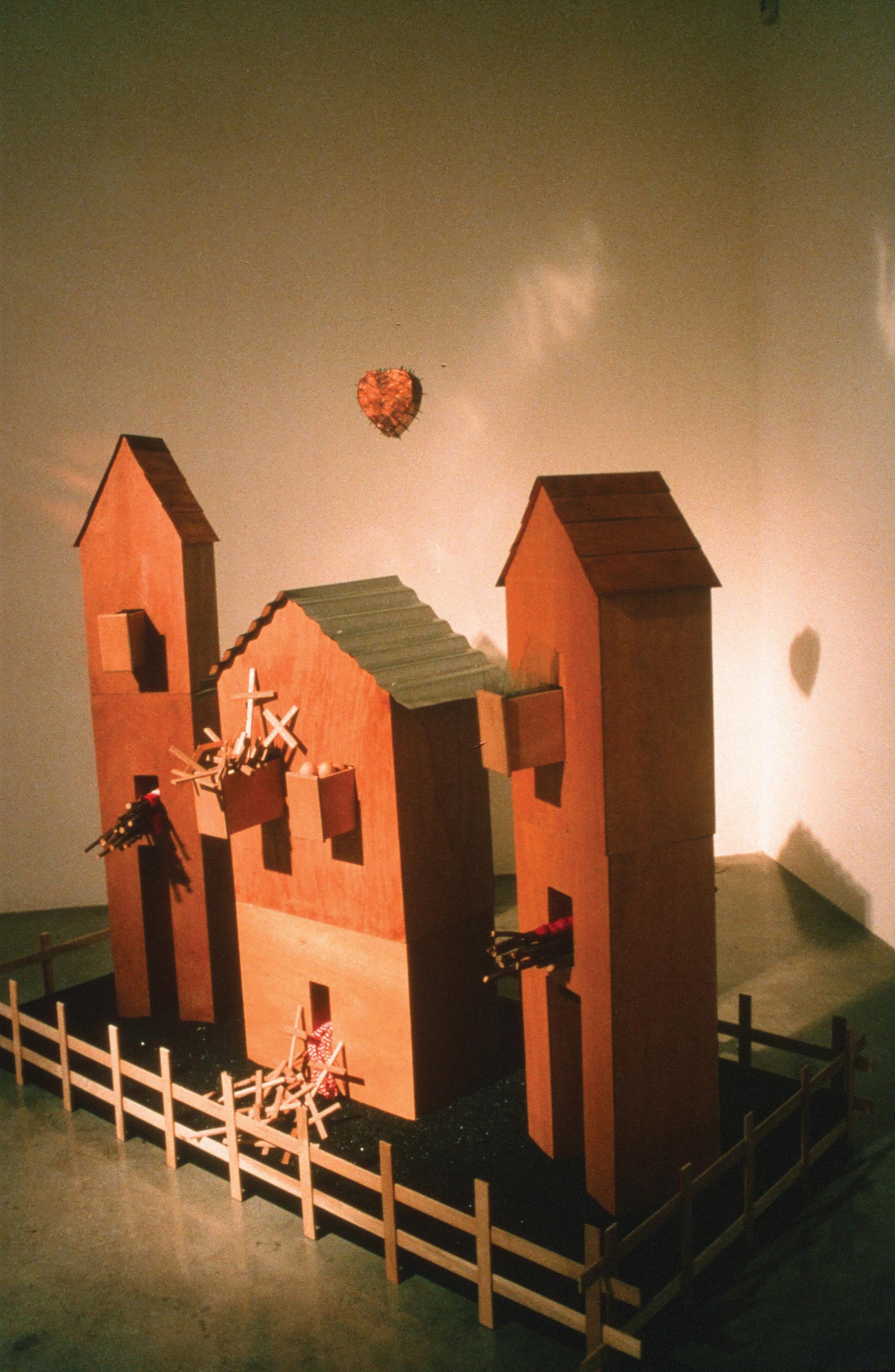
Cover image: Shango’s Altar: None of the Orishas could control me, 1998
d ire C tor’ S Fore W ord
Stanley C. Wilson – Altars, Icons and Drawings, represents a chance to experience the work of Stanley C. Wilson. For me, this exhibition has been over thirty years in the making. i became an art major at Cal Poly Pomona in 1983. one of my first classes was Professor Wilson’s Gallery Exhibition and Design. I did not realize then that this class would change and shape my life forever. Wilson taught me valuable information, which i now pass on each time i teach a class in gallery Exhibition and Design. He is an amazing instructor with an incredible knowledge of all forms of art. My practice as an artist, especially in sculpture, was shaped and molded by classes that i had with him. i am very grateful to have had this wonderful opportunity.
As an artist Stanley C. Wilson has made an amazing body of diverse work. His work is timeless and always transports the viewer to some place special that makes you feel that you are part of something more important. the mastery of all mediums that he uses in his work makes visible his incredible skills as an artist. in the art community he has been a constant leader and supporter of other artists’ and their endeavors.
i would like to thank the many colleagues have been instrumental in presenting this exhibition. Stanley C. Wilson for the opportunity of exhibiting his outstanding work, donna Mungen for the wonderful essay, the College of the arts, Humanities and Social Sciences, California State University, Stanislaus for the catalog design and Claremont Print and Copy for the printing this catalog.
a great thanks is also extended to the instructionally related activities Program of California State University, Stanislaus as well as anonymous donors for the funding of the exhibition and catalogue. their support is greatly appreciated.
dean de Cocker, director
University art gallery
California State University, Stanislaus
donna MUngen: Arch AND AltAr
The creative apex of an artist’s life can only be measured after the individual has produced a significant body of work. Such is the case with Stanley Wilson, a world renowned ceramicist, sculptor, and educator. over the last four decades Wilson has developed a profoundly, haunting yet engaging artistic vision of the world that reflects commonality between both the internal and external struggles of humankind. at the beginning of his career, drawing upon the wisdom and insight of another artist, Wilson recalls david Hammonds telling him, “there’s no reason why an individual artist shouldn’t be allowed to travel the world through his art.” accordingly, Wilson took the idea to heart. “My art has taken me to many different places,” Wilson notes, “and, hopefully, it will continue to do that.”
an angeleno by birth, Wilson was born in the years immediately after World War ii in the multicultural neighborhood of Silver Lake, located not more than five miles from the heart of Hollywood. The impression from these maturing years would result in such works as Wilson’s 1993, Altar for Nuestra Senora de los Angeles Pio Pico Mestizo reality which is a mixed media work of wood, live ammo, copper, and l a. ash, covered with cartridge shell casings, steel chain and chicken wire. The impetus for this piece was triggered by the disturbing and conflicting visual images that stemmed from the 1992 L.A. Riots. While deeply disturbed to see his cherished city erupt in flames, Wilson felt compelled to address the multicultural reality of Los Angeles. This prompted him to examine the historical figure Pio Pico, who had significant African ancestry and rose to become the first Governor of Los Angeles. Because of Wilson’s broad knowledge of Los Angeles’ origins and his deep love for the city, he developed the installation as a tribute to the many races and cultures that played a significant role in the beginning years of the city; the work was also a protest against the violence of the riots. The work is comprised of a house built around the clay altar that is then wrapped with wire mesh. There is a female figure who is placed on a bed of ashes and surrounded by spent shell casings with both housing structures residing on a bed of soil. there is a smaller house that is covered with polished copper sheets and chained to the front of the larger structure. This smaller structure has five bullet holes in it and is also placed on a bed of ashes which is surrounded by rows of neatly arranged shell casings. Wilson contends that if the work, “…is about despair, destruction, separateness, rage and fear, it also is about rebirth, hope, and coming together.”
the son of a skilled artisan, Wilson watched closely at his father’s knees as he meticulously crafted excellent dentures that were in high demand because of the fine artistic talents that flowed from his father’s hands. This early experience helped Wilson clearly understand the possibilities of fusing various materials, metals, and chemicals together for creating beautiful glazes and unique constructions. This introduction would also play an important role in Wilson’s future compositions as he learned to integrate and bond steel, wood, concrete, and glazes to create his unique method.
this was particularly evident and useful for his 1996 public art commission from the Metropolitan transportation authority’s (Mta) transit Project on the Metrorail green line that runs along the 105 Freeway. For the avalon Station Project near 116th Street, Wilson chose to use syndecrete, a special blend of cement, fiberglass and polymer to make 16 beautiful
benches. He chose this material was because he could “shape, sand, and form it once it (was casted), so i was able to cut out the areas for the tiles to be laid into the benches.” As a final compliment to the Avalon Station benches, Wilson crafted eight murals of glazed ceramic circles set into the concrete deck of the station’s platform. Nearly two decades later, the benches have endured the test of time and he remains pleased with his selection of these unique materials and how the tiles have successfully weathered over the years and have taken on a special character of their own. according to Wilson, “the tiles (were) low fired under 2,000 degrees Fahrenheit, so they’re softer. Someone with a pocketknife or a very sharp object can literally carve into those tiles, not too deep, but enough to scratch the surface. that, to me, is the way that it gathers age. that’s why i like the term ‘patina’ rather than ‘defacing.’ i don’t really see that as defacing the bench, it just adds character.”
the kernel for the benches was sparked when Wilson was an artist-in-residence at new york’s Harlem Studio. Because of the nature of new york City, Wilson mostly used public transportation. on his sojourns around the city, Wilson closely examined many of the subway benches. Further investigation revealed that most of the benches had been crafted years earlier by italian, Puerto ricans and Black new york immigrants, who left their particular artistry on these structures. “But the real quality of those benches, to me,” Wilson noted, “was the fact that, over a period of time, they had this patina of carvings and graffiti on the actual structure.”
From his educator mother, Wilson gained a gentle but intellectual curiosity that he has incorporated into many of his works. a perfect example is his 1985 altar entitled Mi casa, tu casa, built as an homage to his mother after her death. the monolithic clay blocks gradually evolve into wooden houses that serve as shrines. integrated into this piece is an embryonic figure hovering over the altar that reflects an inner transcendence.
Most notably recognized for his long-term and continuing interest in creating altars, Wilson confesses, “I’ve been working on altars for a very long time in one form or another in drawings, basically, in constructions, and installations.” Wilson points to one source of this attraction being the visual representations from his early childhood years. “My paternal grandmother,” Wilson recalled, “maintained an on-going altar above her piano with flowers (and) an arrangement of family photos.” Similarly, his maternal grandparents had an altar construction “on the mantle above (their) fireplace (with) photographs of family members displayed alongside the Holy Bible.” there would also be small dishes of candy or nuts placed symmetrically side by side.
All of these images and ideas began to crystallize on his 1977 trip to Lagos, Nigeria to attend the FESTAC International Exhibition, where artists from the African Diaspora works were displayed. It was there that Wilson finally had the time and motivation to explore yoruba structures of spiritual belief and their manifestation in the construction of altars. He made an immediate connection to the sculptural and spiritual quality of the various African altars and the importance
of the placement of objects. He began to dive deeper as he became intrigued by the reverence the dahomey people placed in their altar art. He learned that there were six salient styles of wood carving named in honor of the region of origination. These carvings were further divided into four categories: (1) the Gods or Orisha; (2) cult members; (3) masks; and finally (4) implements such as staffs, doorposts, doors, drums and bowls.
Wilson would begin to incorporate these concepts into his own art work; however, he would modify the styles and concepts to mirror the African American reality. Reflecting back on this initial introduction, Wilson commented on the impact this and other trips would have on his greater understanding of his link to the world. “once you leave this society, that is the United States of america,” Wilson explained, “you begin to see how you are connected to the diasporas throughout the world.” Wilson could see the diversity, yet dichotomy of the altars of indigenous cultures that are central to religious practices, but still retain a very strong sculptural presence.
Additionally the gentle influences of his teacher mother, and the musical abilities of his maternal grandparents imbued the maturing Wilson with a sense of the possibilities to create a dialogue between the world and himself through his artistic skills as he explained in a discussion with another noted artist. Wilson admits, “i’ve always been in a search for who i am as an artist, who i am as a creator, and who i am as a human being.” this resulted in such works as the dynamic altar looking Back Over My Shoulder with African Eyes, endangered species which encompasses wooden lizards, male and female figures dancing on a mound of earth around two smaller altars and the horizon dotted with crosses that evoke fragments of universal knowledge and despair. Kathy Zimmerer, Art Gallery Director at CSU Dominguez Hills, states this particular work presents several “highly charged poetic visions.”
Wilson was fortunate during his budding academic years at the now defunct Chouinard art institute and the otis art Institute to come under the tutelage and influence of several seminal African American artists such as the noted artist and educator Dr. Samella Lewis who, even today, he identifies as a ‘spiritual artistic touchstone’ influence in his life. Additionally, according to Wilson, the world renowned artist, draftsman and printmaker Charles White “tucked him under his wing” as an instructor at Otis and taught him as a young budding artist more than just art, but the art of fine living. But it was also the vibrant milieu and cross pollination of other artists of the late 60s and mid 70s such as David Hammonds, Alonzo and dale davis, noah Purifoy, John outterbridge, Houston Conwill, ‘Magu,’ aka gilbert lujan, lamont Westmoreland and Betye Saar, (to name a just few) that allowed Wilson’s art and concepts to mature and expand.
Within a few years of receiving his M.F.a. from otis institute, Wilson was recruited to join the academic family of CSU Pomona. He would remain nestled there for the next 34 years giving generously to generations of developing artists, in addition serving more than seven years as the director of the University art gallery. in a creative exchange between Wilson and the highly regarded l a. scupturor, John outterbridge, they discussed the symbiotic relationship between
teaching and creating art. “The studio nurtures teaching; the teaching nurtures the studio,” Wilson maintains. “I wouldn’t be, i feel, as positive an instructor or as valid a professor unless i really understand that i have to do the things i do.” However being a role model for up and coming young artists was a double-edge sword, as he recalled, “there (were) days when i was walking from one side of the campus to the other, and i (would) hear, ‘Professor Wilson, how are you doing?’” Wilson admits that on more than one occasion he yearned for a measure of invisibility and solitude; however, he understood that his “presence encourage(d) people to interplay their ideas on an open basis. i (became) public. So (i had) a different responsibility.” now retired as Professor emeritus, Wilson relishes the privacy that he has to pursue his work in complete abandonment.
another area of interest and work is Wilson’s prodigious production of thought provoking ceramic masks. inspired by other cultural factors, such as literature, Wilson explained from his youth the impact of one such poem, “We Wear the Mask,” by the famous African-American writer, Paul Lawrence Dunbar. So many years later, Wilson can quickly recite from memory the lines:
We wear the mask that grins and lies, it hides our cheeks and shades our eyes, This debt we pay to human guile; With torn and bleeding hearts we smile, and mouth with myriad subtleties.
Wilson has produced many intriguing and beautiful masks that shine and sparkle from the deeply embedded colors that show the sparkling patina glaze of his works. Reaching back into the early influences of his father, other artistic mentors, and the knowledge he acquired from his extensive international travels to Africa, Brazil and the Americas, Wilson would finely weave complex patterns while also incorporating human hair, hemp, feathers, linen, jute, wood and alpaca onto his masks. This integration of these diverse cultures and elements would result in a mystical quality in his works.
to his credit, Wilson has had nearly 20 solo shows including such diverse locations as the San antonio art institute, the University of redlands and several greater metropolitan l a. galleries including: los angeles Southwest College, Sol del rio gallery, tanner gallery, Venice’s Sparc gallery, and the tanega-Maher gallery.
Wilson’s work has been included in many group shows including los angeles City College, los angeles County art Museum, Otis Art Institute, Fisher Gallery, University of Southern California, Brand Art Center, Harlem Museum, Pacific design Center, Bishop College, the laguna Beach School of art, the los angeles Municipal art gallery, atlanta life 3rd, the los angeles Jewish Federation, the California afro-american Museum, and many more.
over the years, Wilson’s has received countless awards, honors, fellowships and purchase awards in recognition of his outstanding body of work. He was selected as an Artist-in-Residence for the Studio Museum in Harlem, New York; Northern State College in Aberdeen, South Dakota; Spokane College and the Memphis College of Art. He has received fellowships from the national endowment for the arts, the California Community Foundation, Pasadena arts Council, and several permanent Purchase awards from the atlanta life insurance Company, golden State life insurance, los angeles, Prairie View College -texas a&M, University Union, California State Polytechnic University, Pomona and the Kedren Community Mental Health Center, los angeles.
there is no doubting that Stanley Wilson is at the apex of his career.
donna Mungen Professor of english Pasadena
City College
i M age S
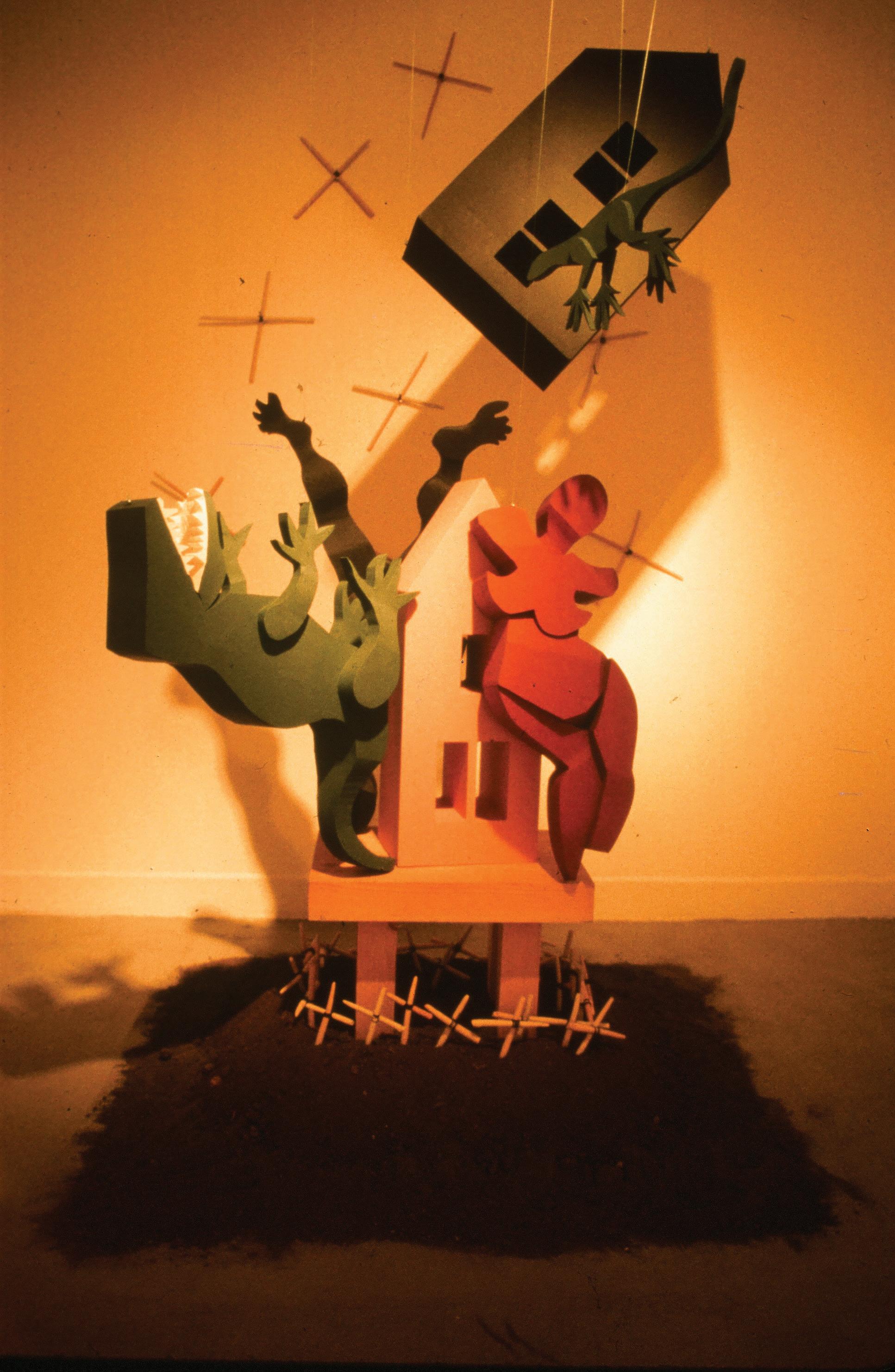
1989, Altar for New York: looking back over my shoulder with African eyes, wood, clay, earth, fiber
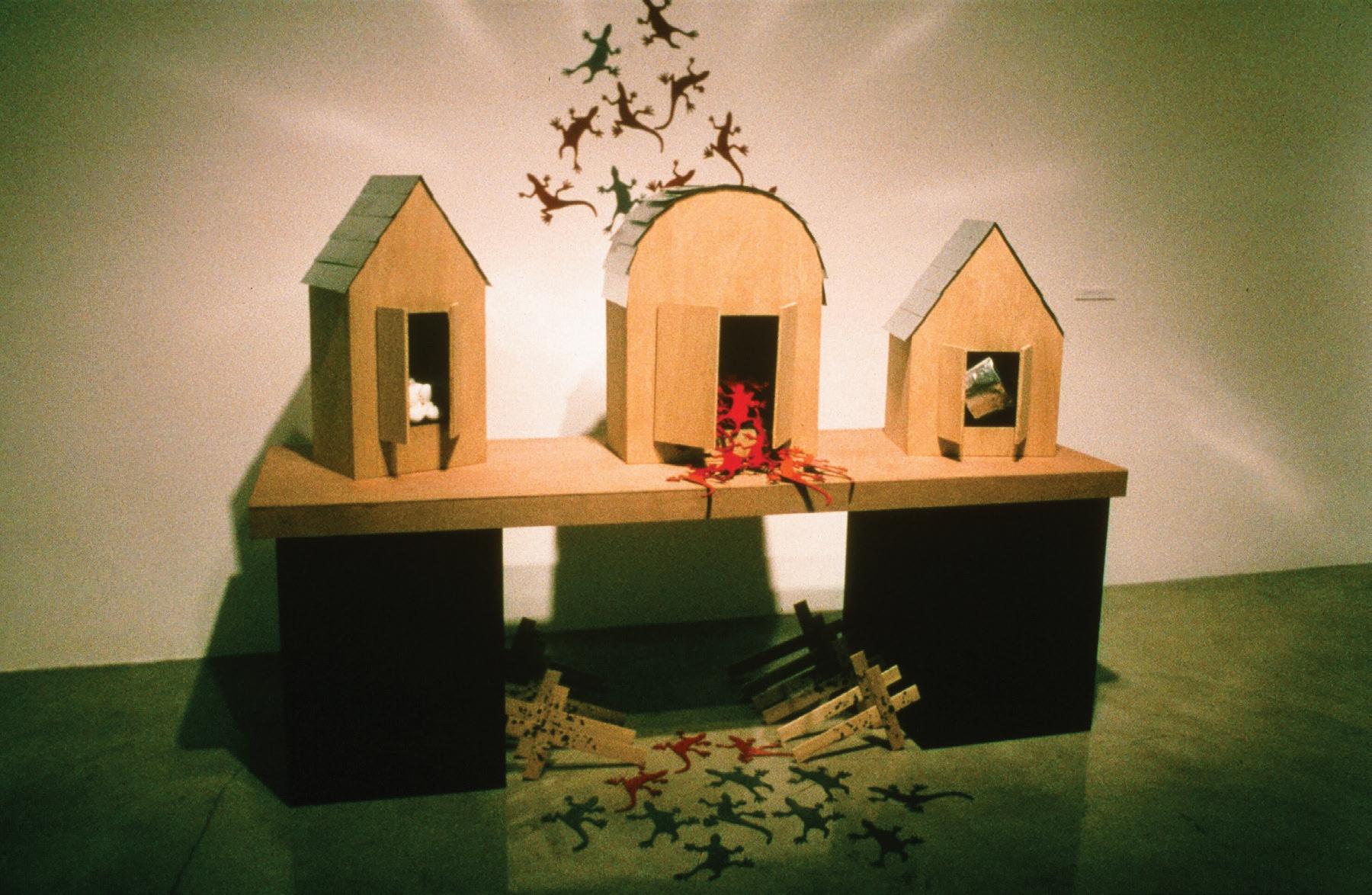
2002, Altar for the Orishas, crossroads, wood, steel, eggs, flame cut lizards
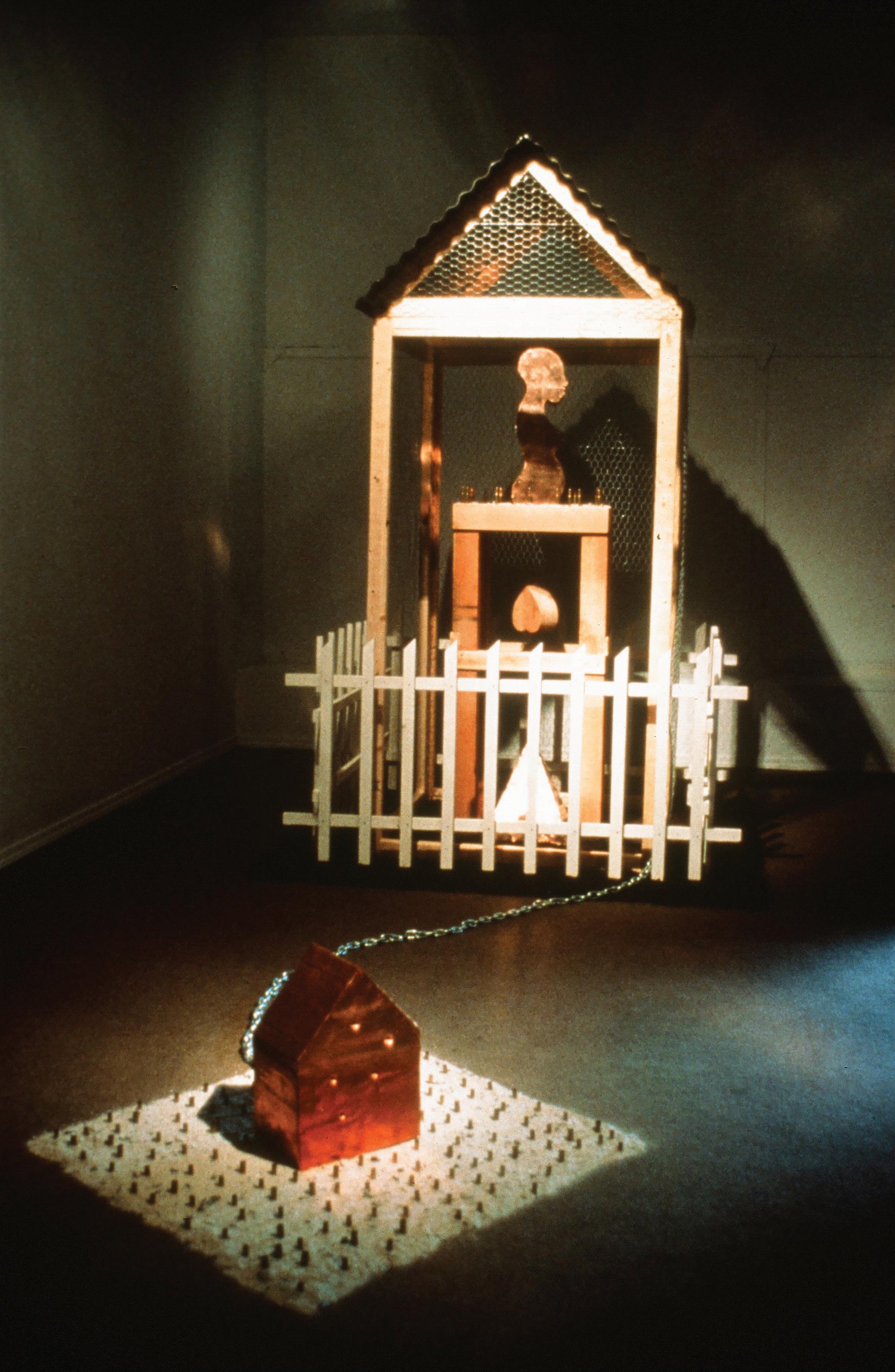
1993, Altar for Nuestra Senora de los Angeles Pio Picos Mestizo reality, wood, copper, ash from l a., cartridge shell casings, steel chain, chicken wire
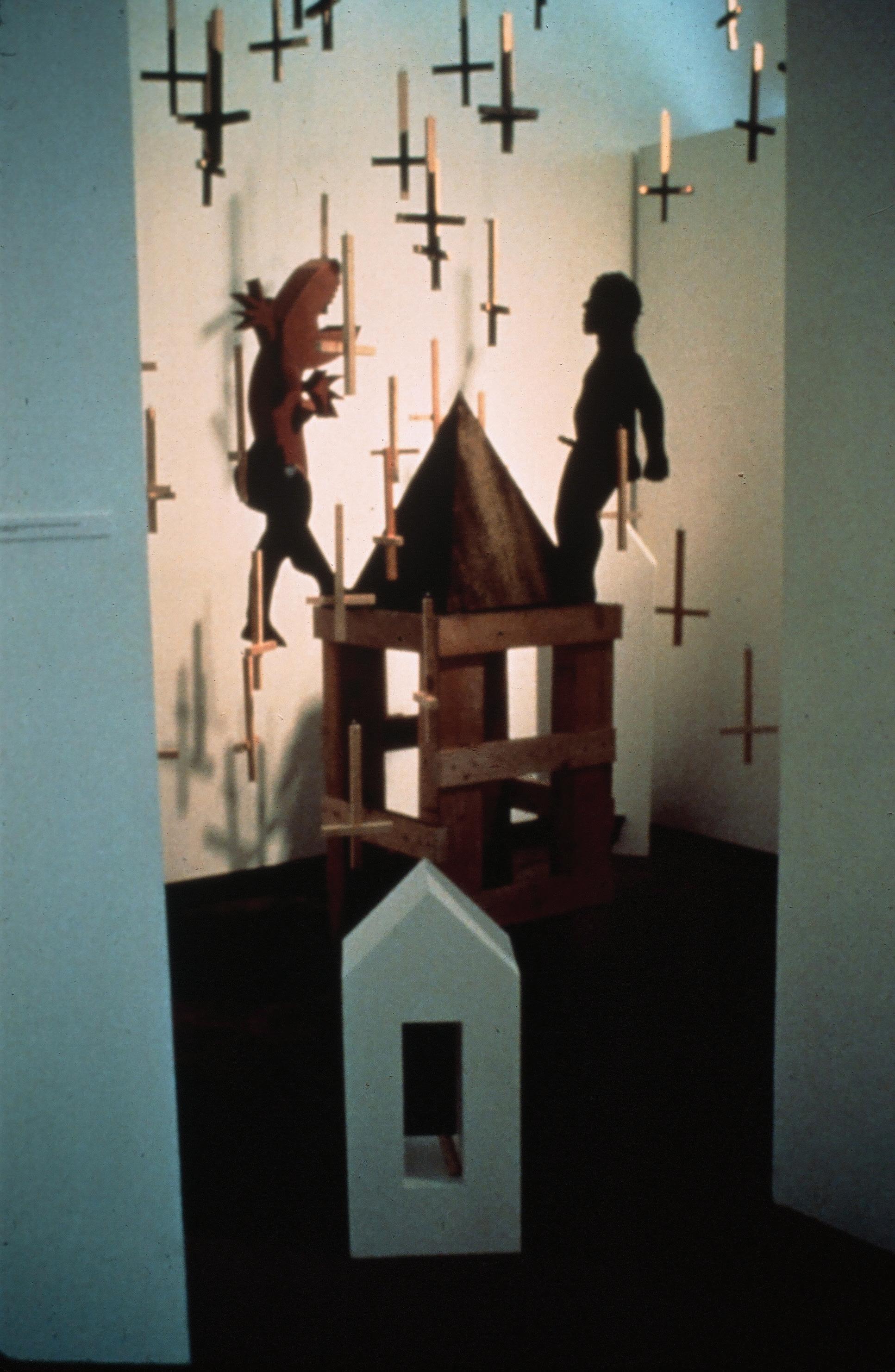
1992, tar Baby and Maria Elena explore Aztlan and common origins, wood, bronze, tarred crosses, earth
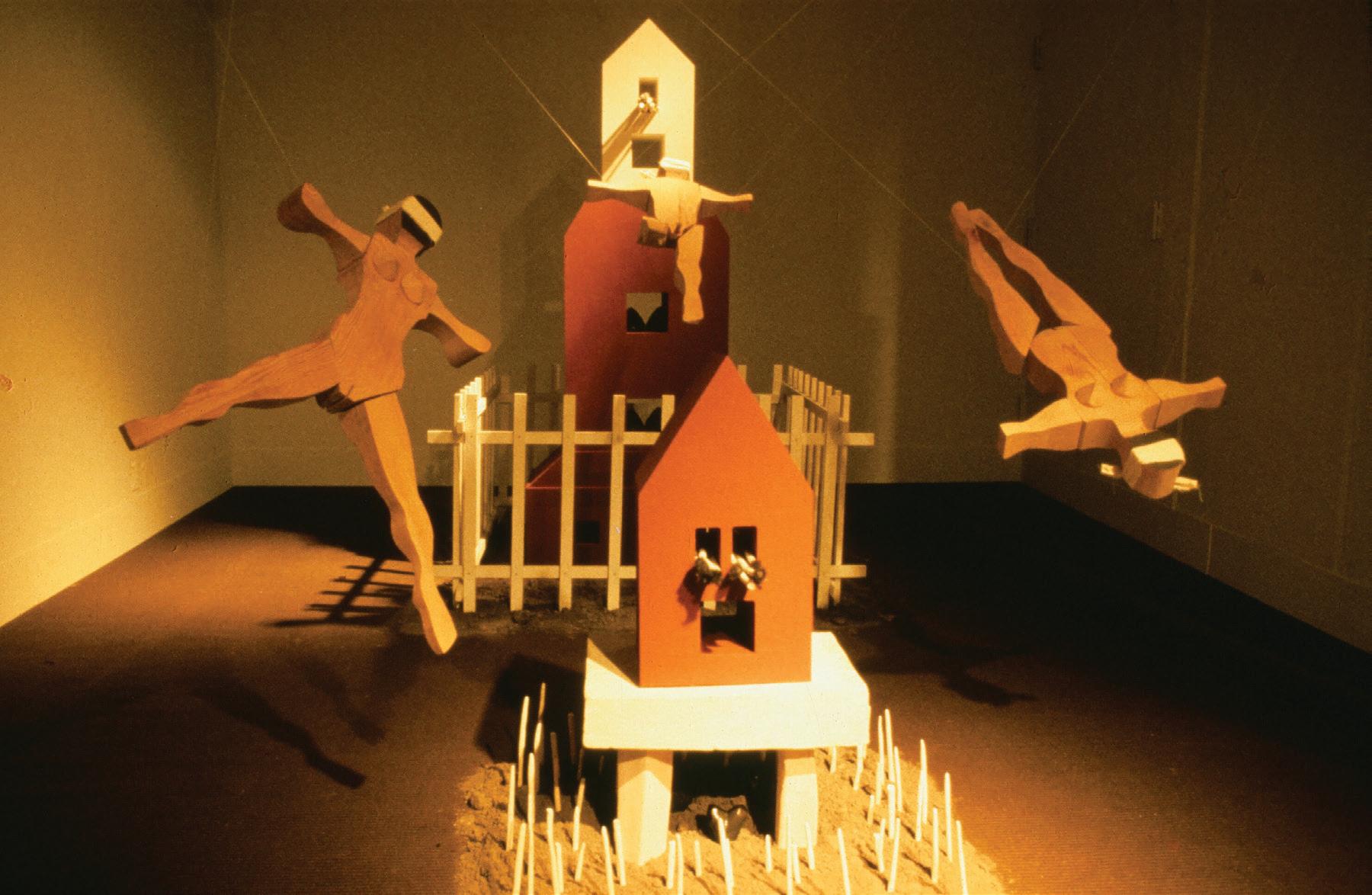
1986, Altar for South Africa, altered reality, traditional power confined by sadistic and morally disturbed concerns, wood, clay, african earth, american earth, negro hair, and cloth
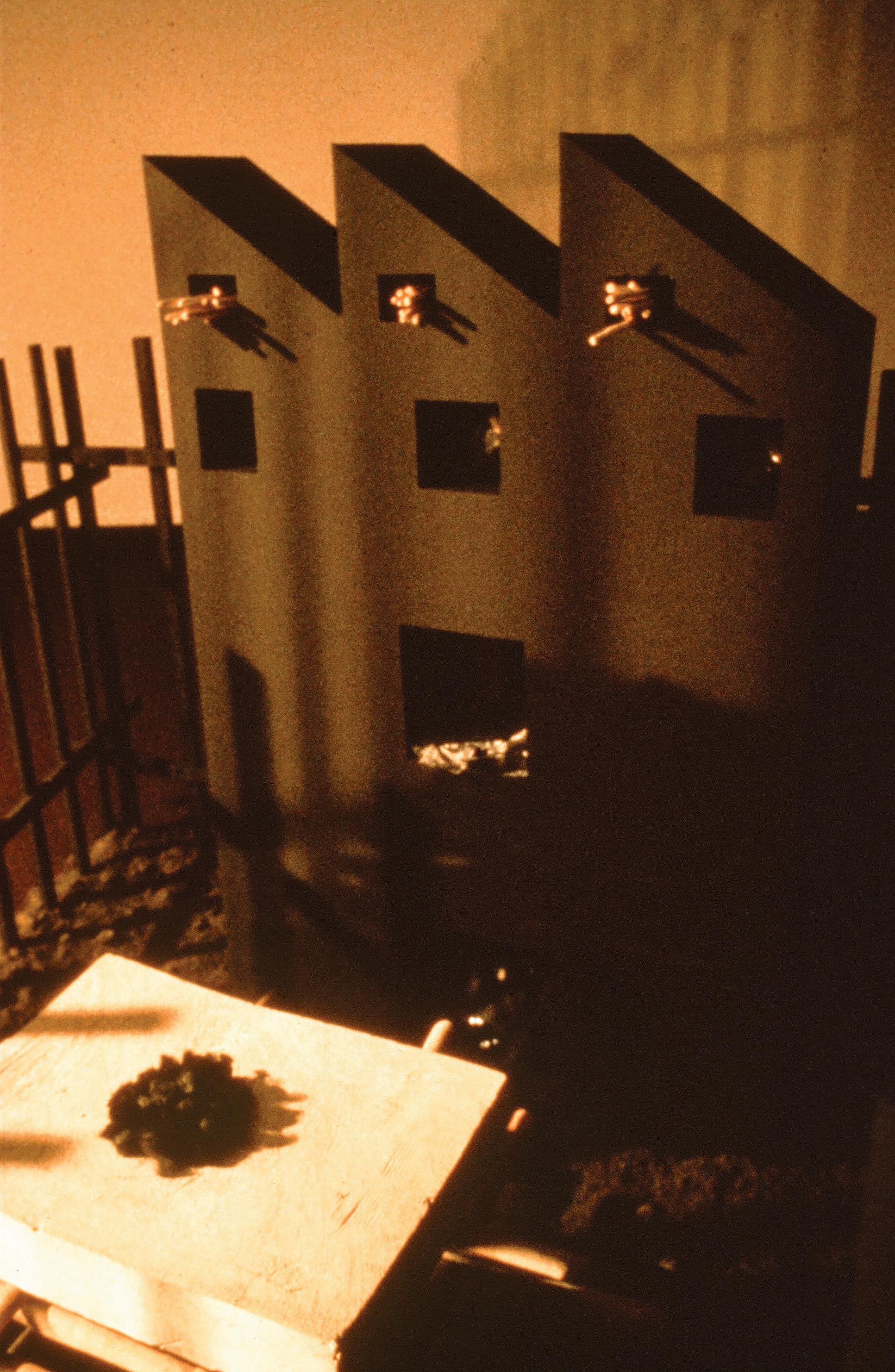
1985, Altar for the Americas, detail, wood, clay, earth, negro hair, photo copied money
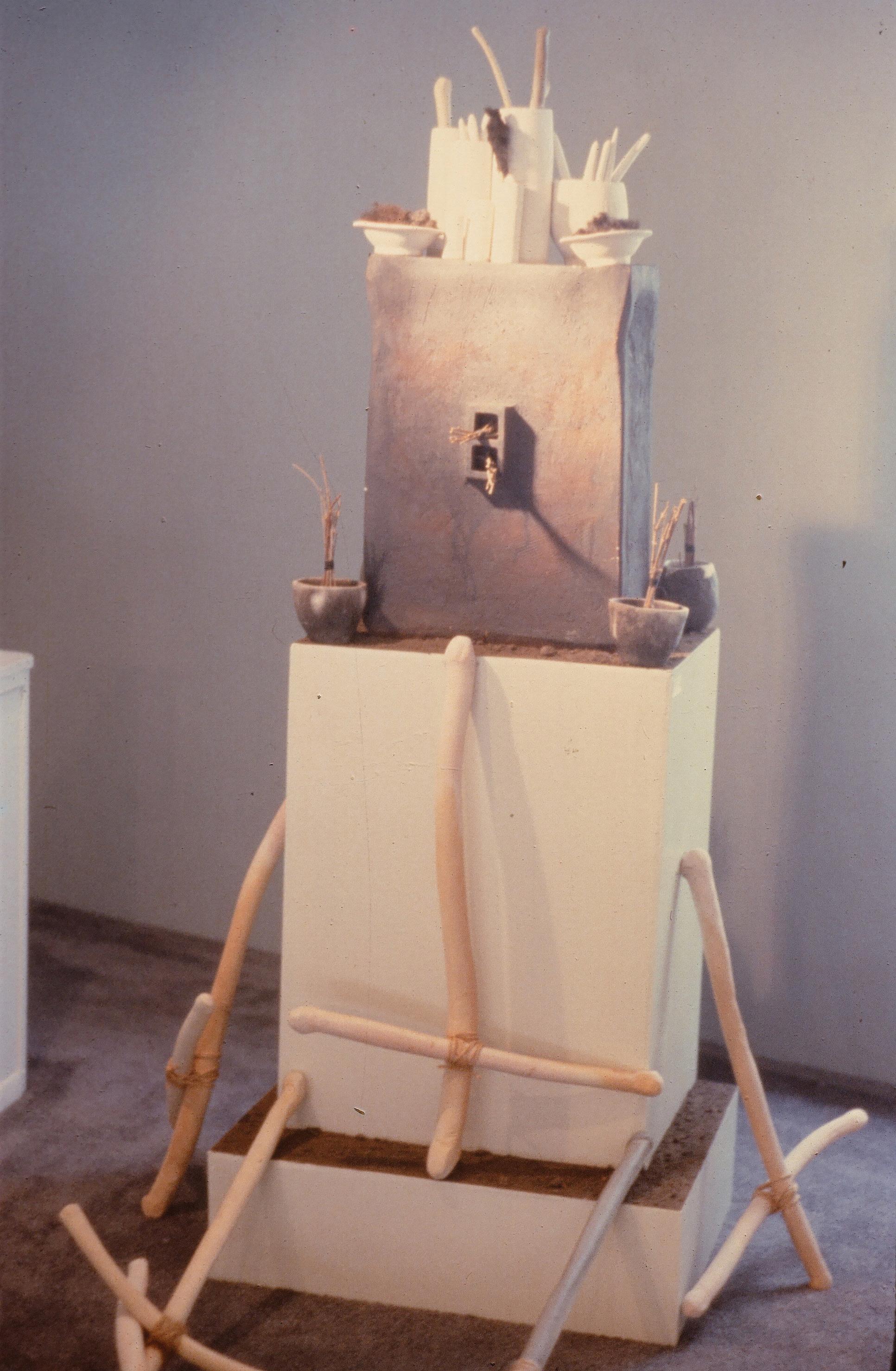
1978, Juju Man’s Altar, clay, bone, ash, fiber, wood, earth
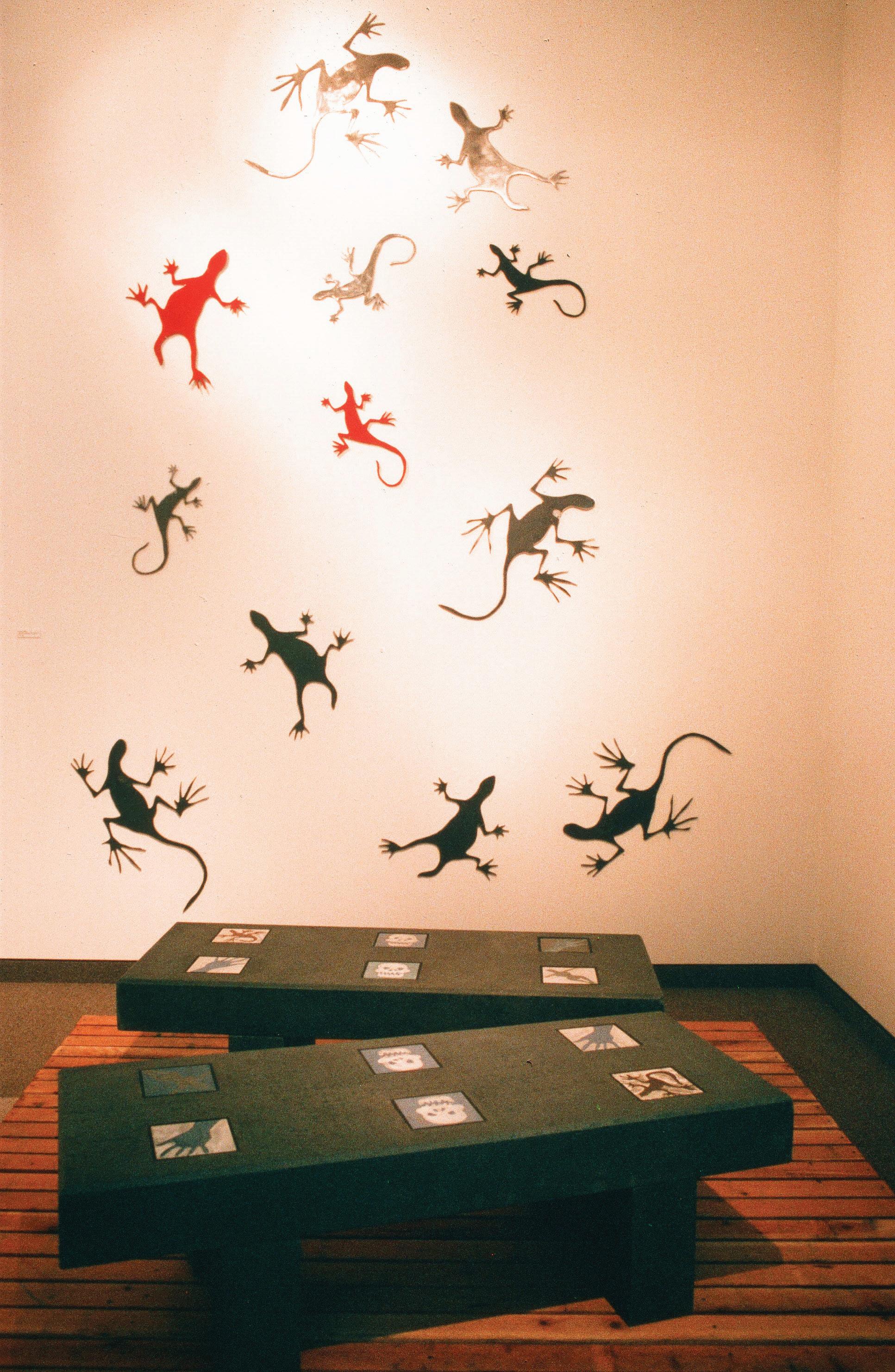
1996, Waiting at the Avalon Station for a herd of lizards to pass me by, installation, flame cut 1/4” steel lizards, syndecrete benches with tile inlay, redwood deck
1998, Shango’s Altar: None of the Orishas could control me, detail, wood, copper, chicken eggs, earth, coal, beads, cowrie shells, glass
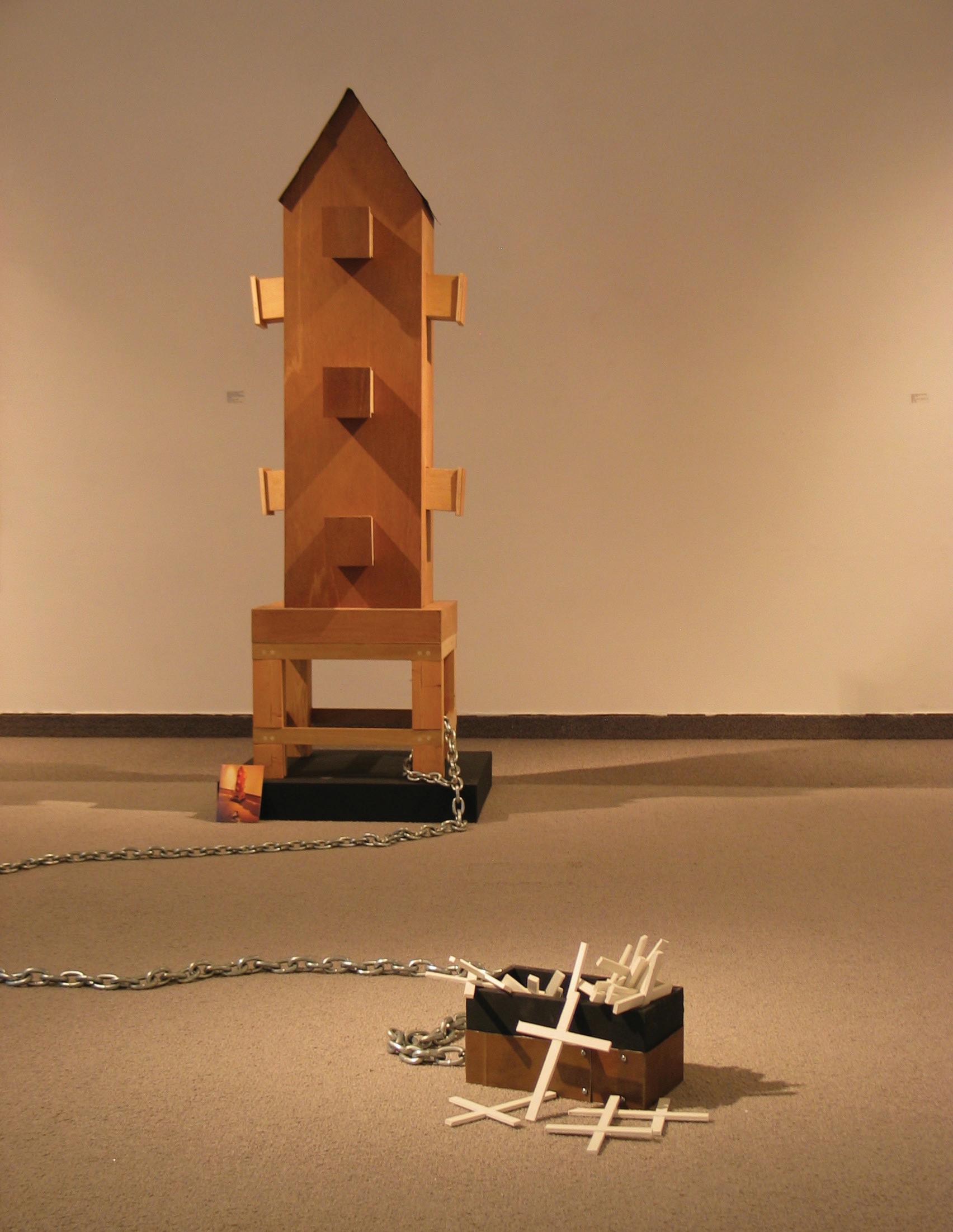
2006, Altar for Iraq - New World Order, wood, chicken eggs, steel chain
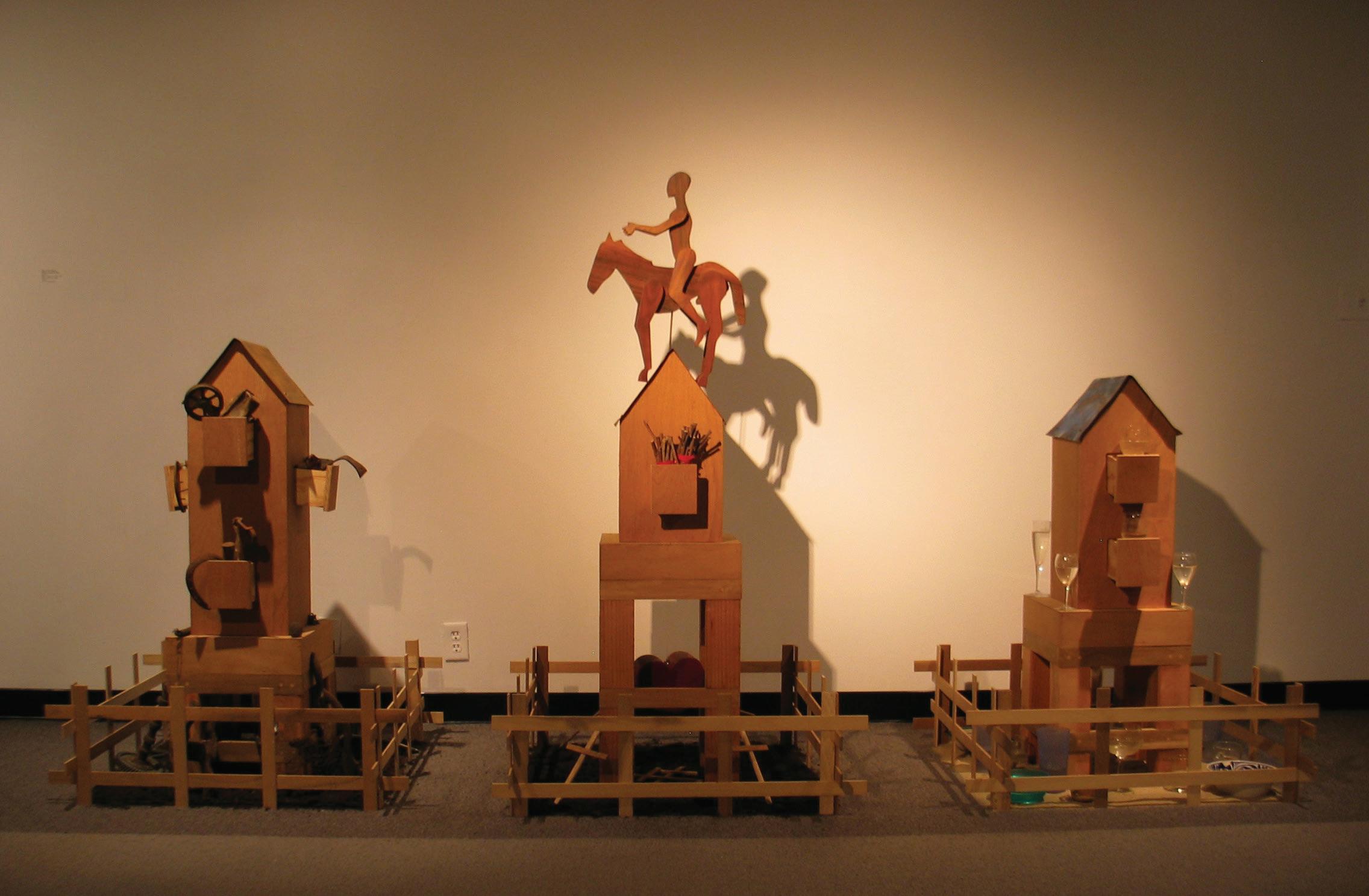
2003, Altar for three Orishas: Ogun, Shango, Yemaya, glass, water, steel, wood, earth and copper
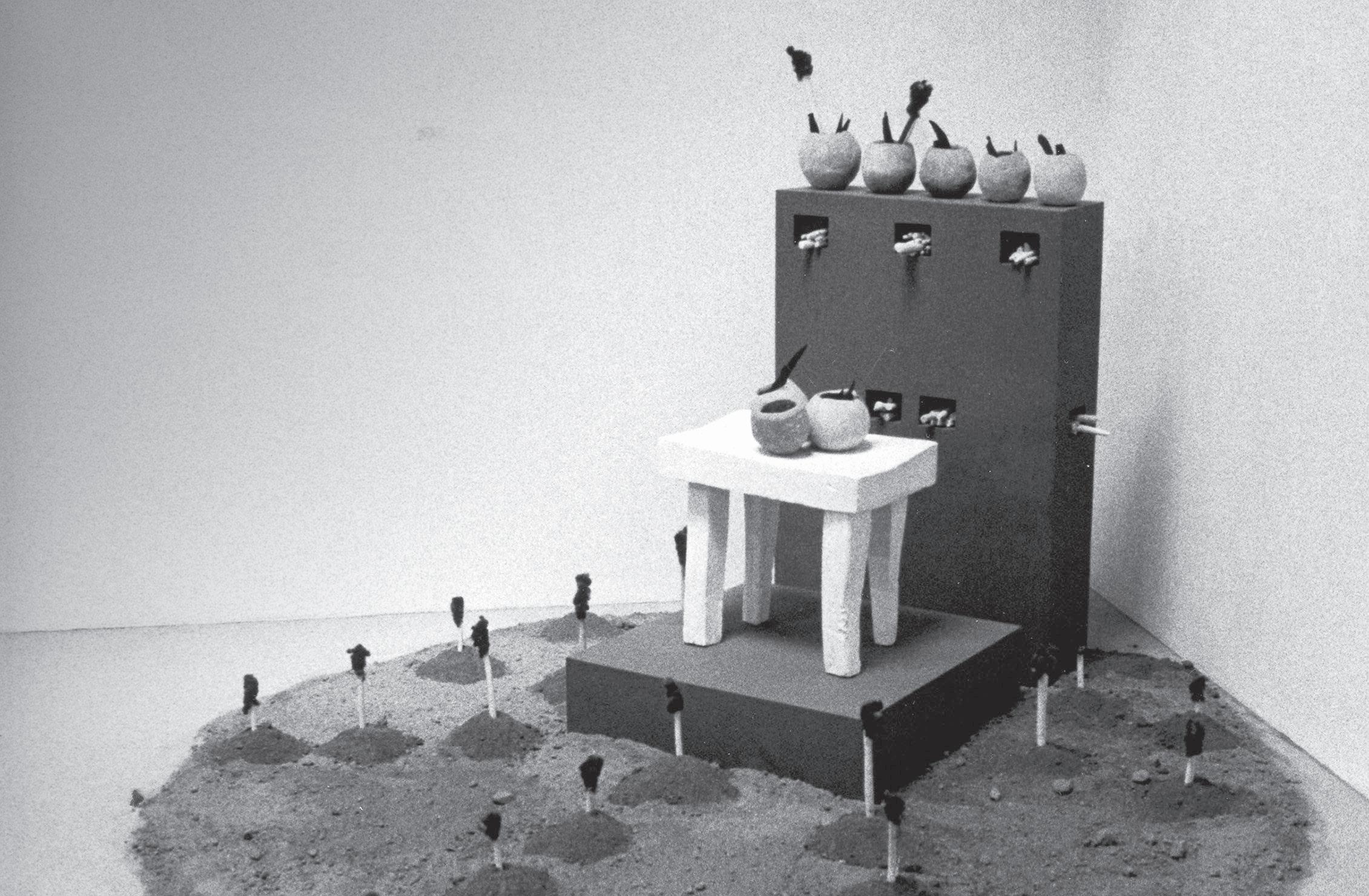
1984, Mi Madre, tu Madre, clay, negro hair, glass, earth and fiber
Stanley C . W il S on
ed UC ation
1967-71 B.F. a ., M.F. a ., o tis a rt i nstitute, los a ngeles
1966-67 California State University, los a ngeles
1965–66 California State Polytechnic University, Pomona
1964-65 Chouinard a rt School, Special Classes, l ife, People, their words and actions
eMPloy M ent (Partial l ist)
1973 -present Professor of a rt College of environmental d esign
California State Polytechnic University, Pomona
1991 -1992 Visiting Professor- Sculpture o tis a rt i nstitute
1988- 1994 d irector University a rt g allery (appointed March 1988)
California State Polytechnic University, Pomona 3801 West temple avenue Pomona, California 19768
1981 i nstructor o tis Parsons at the Watts towers ai1 Center
Special classes
1972- 1973 a ssistant Professor Southwestern College 900 o tay l akes road Chula Vista, California
aWardS and H onor S
2002
Selected to co-curate for ‘ t he Story is in the telling’ a rmory Center for the a rts, Pasadena, C a
Served on Public a rt awards panel, Santa Monica Cultural affairs department, Santa Monica, C a
Served on grants award panel, design, City of los a ngeles
Presented weeklong workshop on advanced Placement Studio a rt, Bellevue, Wa
2001 Visiting Artist, Memphis College of Art, Memphis, Tennessee/graduate review
Selected to co-curate t he Story is in the telling, a rmory Center for the a rts, Pasadena, C a
Selected for Who’s Who in africa a merica 2001
Slide lecture for distinguished artist series, Cal State University n orthridge, dept. of a rt
1999 Selected to serve on a panel and present a lecture on my sculpture at the California State Museum of african a merican a rt, los a ngeles
1999 Served on awards panel for the los a ngeles Cultural affairs
Department Organizational Support
1999 Co-Chair, Sculpture Panel, College a rt a ssociation Conference, los a ngeles, C a
1998 Brody Visual a rt Fellowship, California Community Foundation, los a ngeles, C a
1998 g old Crown award- Visual a rts, Pasadena a rts Council
1997 Selected as Chair, Pasadena a rts Commission, Pasadena, California
Selected for Who’s Who in the West publication
Selected for the n ational educational and Curricular Committee, advanced Placement, Princeton, n .J.
Selected for a rtist- i n- residence, Spokane College, r iver Falls College, Spokane, Wa , March
Selected Sculptures, published a catalog and installed a major exhibition on contemporary sculpture from Zimbabwe in the Kellogg University a rt g allery, Cal Poly Pomona
1996 Selected to serve on the educational advisory Committee for the Herbert ryman, l iving Masters Program of Walt d isney i magineering
Selected to jury an exhibition at the City of Brea, Municipal a rt g allery, June
1995 a ppointed as a rts Commissioner for the City of Pasadena Cultural affairs department
Selected bios to appear in the following text: Who’s Who in California, Who’s Who in Black a merica, Who’s Who in the West and Who’s Who in the World
Selected as Commissioner to Pasadena a rts d ivision
1994 Selected to serve as a panelist on a visual arts award panel for n ational endowment for the a rts, Washington d.C.
Selected as a member of the Board of d irectors, a rmory Center of the a rts, Pasadena, C a Selected to appear in Who’s Who in California, Who’s Who in Black a merica
Selected for faculty consultant a P Program
Selected to serve on n ational endowment Panel, Washington d.C.
Selected as a member of the Board of d irectors, a rmory Center, Pasadena, C a
1993 Selected for guest curator, Bakersfield College, Bakersfield, CA
Selected to serve on a fellowship award panel, California a rts Council, Sacramento, C a
Selected to serve on an awards panel for laC tC-Metro r ail, los a ngeles, C a awarded Visual a rts Fellowship, Pasadena a rts Commission, City of Pasadena, June awarded o utstanding Professor award, College of a rts, Cal Poly University, Pomona, C a Panel member Organizational Support, California Arts Council, Sacramento, CA, May Fellowship award Panel member, Colorado Council of a rts and Humanities, denver, Co
1992 Awarded Commission for Avalon Station Greenline/LACTC-Metro Rail, Los Angeles, CA
1990 Served on the California a rts Council, Sculpture award Panel, Sacramento, C a Visiting a rtist, University of n evada, l as Vegas
1989 Selected by The California Arts Council to serve on organizational support program, Sacramento, C a
Served on the January Window Visual a rts g rant, City of l a
1988 Selected by the California a rts Council- artist in residence program to lead a workshop on artist residency, l . a ., C a
Selected by t he California a rts Council - to serve on the n ew g enre Fellowship award Panel, Sacramento, C a
1987 Selected for artist in residence, Studio Museum, Harlem, n ew york, ny
1986 awarded Visual a rtist Fellowship in Sculpture. n ational endowment for the a rts awarded Meritorious and Professional Promise award by California State Polytechnic University, Pomona, C a
1985 Published in Who’s Who a mong Black a mericans
1984 n ominated for a Fulbright Fellowship, n igeria, West africa
2nd Place Purchase award (Sculpture)- atlanta l ife i nsurance, atlanta, ga
1983 i ncluded in the d ictionary of i nternational Biography. Cambridge, england
1981 Nominated for International Resister of Profiles, Cambridge, England two sculptures purchased by California State Polytechnic University Permanent Collection, University Union
1980 a ppointed to Brockman g allery Production, Board of a rtists n ominated for Who’s Who in Black a merica
1979 awarded o utstanding young Men of a merican award
1977 a ppointed to advisory commission, Watts towers a rt Center. two sculptures purchased for the permanent collection, Prairie View College, texas a & M
Selected as exhibiting artist representing the United States in n igeria Festival
1975 Visiting a rtists in residence, n orthern State College, a berdeen, S d
traV el
traveled extensively for research in africa
Zimbabwe, 1997
egypt, Summer 1993
Morocco, Summer 1987
Senegal, Winter 1988 l iberia, Senegal, i vory Coast, n igeria, 1984 a lso traveled extensively in l atin a merica
Brazil, 1998
Return to Salvador, Brazil, Summer 1995 Brazil, Winter 1988
Mexico, Summer 1 987 yucatan and So. Mexico, 1985 oaxaca, Mexico City, 1983 Jamaica, 1978
5 n igerian cities ( l agos, Kaduna, ife, Benin, i badan), 1977
France, england and Spain, 1984
e XH i B ition S (Partial l ist)
2009 a ltars, i cons and d rawings, Joyce g ordon g allery, oakland, California
May - July
2007 retrospective 1973 - 2007, W. Keith & Janet Kellogg a rt g allery, California State Polytechnic University, Pomona o ff the Wall, a rmory Center for the a rts, Pasadena, California 2006 o ne of eleven selected public artworks, n orthwest Portraits, n ewtown a rt Faculty Show, California State Polytechnic University, Pomona
2005 January Pathways Survey e xhibition, California afro- a merican Museum, los a ngeles
2004 n ovember a rt o ut of the Box gala - a rmory Center for the a rts, Pasadena, California
2003 october a rt Faculty Show - W. Keith & Janet Kellogg a rt g allery California State Polytechnic University, Pomona
2002 October Method and Meaning, 2 man show, California State University, Bakersfield, CA
2001 g roup e xhibition, Krueger g allery, Pasadena, C a
2000 September a ltars and d rawings- one man show, Claremont g raduate University, Claremont, C a
1998 September d ynamite, Faculty Show, Cal Poly University, Pomona, California
1998 March a ltar i nstallations and d rawings, o ne Man Show, d illard University a rt g allery, n ew o rleans, la , March 7- March 31
1997 March a ltar i nstallation, l ibrary g allery, Spokane College, Spokane, Wa
May African Influences, Group show, Los Angeles Printmaking Society g allery. n orth Hollywood, C a
1996 March African Influences/Contemporary Artist, National Civil Rights. Museum, Memphis, tn , March 9- May 30, Spirit l andscape, Wiegard g allery, College of n otre dame, Belmont, C a March 17 - a pril 27
1995 California Connections, g roup Show, 1078 g allery, Chico, C a (Juried and exhibited) a ltars, g roup show, a rmory Center for the a rts, Pasadena, C a (co-juried and exhibited)
1993 a pril i nstallations and d rawings, o ne man show, 1078 g allery, Chico, C a
March l a . Currents i n Clay, g roup show, Cal State los a ngeles, University a rt g allery
1992 September After 1492/Another View, Group show, Rancho Santiago College, Santa Ana, CA Breaking down Barriers, Group show/auction, Santa Monica Museum of Art, Santa Monica, C a May a ltars, i cons and Sacred Places, o ne man show, San a ntonio a rt i nstitute, San a ntonio, t X
1991 September death & d ying - Chapman College, o range, C a
1990 November Multiple Solutions, Faculty show, Cal Poly Univ./Art Gallery october a ltar i nstallation, two man show, Spare g allery, Venice, C a
September los a ngeles Festival, a ltars and Shrines, g roup show, a ngels g ate, los a ngeles, C a
1990 January g roup e xhibition, occidental College Themes, Social to Political/Mt. St. Mary’s College
1989 october a ltar d rawings and i nstallation - 1 Man e xhibition, University of redlands, Peppers g allery, redlands, C a
January Six Afro-American Artists Cal State University, Dominquez Hills, CA
1988 n ovember n ew Work- 3 Man Show, Cal Poly University, Pomona, C a October Clay Works On The Wall, Off The Wall, Euphrat Gallery/De Anza College, Cupertino, C a
September 5 los a ngeles a rtists, Brockman g allery, l a ., C a
March Group- Exhibition/L. A. Artists, Dallas Art Center, Dallas, TX
February a ncestors and african a merican a rt, Palos Verdes a rt Center, Palos Verdes, C a
1987 october los a ngeles Collects, Museum of african a merican a rt, l a ., C a
1986 September Continuity and Change: emerging afro- a merican a rtists, February California afro- a merican Museum, l a ., California
1987 June Only L.A., Contemporary Variations; Municipal Art Gallery, Los Angeles, CA
January Formal Mysteries, occidental College, los a ngeles, C a 2 artist exhibition
1985 November Monologue/Dialogue, group show of Hispanic and Black Sculptors, Spare g allery, Venice, C a
october Spaces looking i n, looking o ut, g roup show. Museum of african a merican a rt, los a ngeles, C a
September Fusion ‘85, group show, Jewish Federation Building, los a ngeles, C a
February a ltered i llusions, faculty show. California State Polytechnic University, Pomona, C a January atlanta l ife 5th n ational, atlanta, ga
1984 July L.A. Weave, a group exhibition. Oranges/Sardines Gallery, Los Angeles, CA May a ltars and d rawings, one man show. l a . Southwest College, los a ngeles, California January atlanta l ife 4th n ational, atlanta l ife i nsurance Company, atlanta, ga
1983 a pril Freeway Fringe elements, faculty show. University Union g allery, California State Polytechnic University, Pomona, C a March a ltars & Shrine one man show. daniel Maher g allery, los a ngeles, C a January g roup Show. l aguna Beach School of a rt, l aguna Beach, C a
PUB li C ation S
Catalogs: California Art Review- by Les Krantz a ltars, i cons and Sacred Places - Stanley Wilson
Inland Specific- Claremont Graduate University, Claremont CA and a rmory Center for the a rts, Pasadena, C a
Inland Specific- Claremont Graduate University, Claremont, CA
Altars - Armory Center for the Azts, Pasadena, CA a ltars, i cons and Sacred Places - San a ntonio a rt i nstitute
6
Afro-American Artists- Cal State University Dominquez Hills, CA
los a ngeles Collects- Works by 30 artists from 15 private collections. t he Museum of african a merican a rt, l a ., C a
a rt Quest- Parson g allery n ew york, Brand l ibrary a rt g allery, l . a . Continuity and Change: emerging afro- a merican a rtist, California afro- a merican Museum, los a ngeles 1986 o nly l a ., Contemporary Variations, Municipal a rt g allery, l a ., 1986 Spaces, Looking In/Looking Out, Museum of Afro-American Azt, 1985
t he 5th a nnual atlanta l ife n ational, atlanta, ga , 1985
t he 4th a nnual atlanta l ife n ational, atlanta, ga , 1984
Sculpture g arden, WSSU n ational, Winston Salem State University, n orth Carolina, 1982
t he Magic of Clay- n ational e xhibition, California Museum of afro- a merican History and Culture, 1982
California Black a rtists - Harlem Museum, n ew york City, n ew york, 1977
Four los a ngeles a rtists- U.S.C. Fisher g allery, l a ., C a , 1976
Varing d irections of Contemporary Black a rtists- o tis a rt i nstitute, los a ngeles, C a , 1975
California’s Black Artist- Governor’s Office, Sacramento, CA, 1975
Art Week Magazine, “Seeking Ancestral Memories”, April16, 1983, Vol. 14, n o. 15
Who’s Who in Afro-American/Caribbean Art, 1983
t he a merican a rtist today in Black, by Hobie l . Williams, ed. d., 1980
Published article in Studio Potter- Fall edition, n ew Hampshire, “Five los a ngeles a rea a rtists”, 1981
Who’s Who in Black a merica, Call, 1980
Printed articles in the San a ntonio Calendar, San a ntonio, texas, 1980
a rticle on my works in Black a rt Quarterly, Spring edition, 1978
Filmed segment for Handel Films on my studio and my art, 1977
Articles in Art Week Magazine, Los Angeles Times, Calendar Section, los a ngeles Sentinel newspaper, 1976
Video-tape dialogue for Public Broadcasting System in a berdeen, S d, 1975 afro- a merican a rtist, Boston Public l ibrary, Boston, Massachusetts, 1972
Creating a rt with Fibers and Fabrics, donna Z. Meliach, ny recorded dialogue on Black a merican a rtist for Knoxville College, Knoxville, tn, 1972
Black a rtist on a rt. lewis and Waddy, Vol. 11, 1971
Wor KS rePre S ented in t H e F olloW ing ColleC tion S:
Broadway Federal Savings and loan a ssociation, los a ngeles, C ao ne drawing, 1986
g olden State l ife i nsurance Company, los a ngeles, C a - o ne wall sculpture, 1985 atlanta l ife i nsurance Company, atlanta, g eorgia, 1984
o tis a rt i nstitute, los a ngeles, C a - o ne wall sculpture, 1971
Prairie View College, texas a & M, Prairie View, texas- two sculptures, 1977 University Union Permanent Collection, California State Polytechnic University, Pomona, California two wall reliefs, 1981
Kedren Community Mental Health Center, los a ngeles, California
My works are also represented in the following gallery collections: The Orlando Gal1cry, Sherman Oaks, CA; Sol Del Rio Gallery, San Antonio, Texas; Brockman Gallery, Los Angeles, CA; Gallery Tanner, Los Angeles, CA; and numerous other works are in private collections in Southern California, west texas, Washington, d.C. and n ew york.
My interest in altars seems to have developed during my first trip to Nigeria in 1977. It was during this experience that I had the time and the motivation to explore Yoruba structures of belief... or, altars. My first reaction was astonishment at the visual richness of these structural forms. The clay, the shells, the ash, etc. acted in harmony to produce a unified, powerful and visually stunning object. Next, was an immediate focus on the sculptural quality and the spiritual environment of the altar. I noticed the placement at the objects and their relationship to the whole; it was pure power yet quiet pervaded.
Upon my return home, i recalled many similar experiences that i had encountered as a youth. My early years in los a ngeles were visually rich as many of my friends encouraged me to exchange ideas and concepts about their cultural belief systems.
i n my own family for example, the mantel above the hearth became an altar. i n my maternal grandparent’s home, often photographs of family members alive and departed, were displayed along side the Holy Bible, small dishes of candy or nuts were also placed symmetrically side-by-side. a s a young man, i often visited my paternal grandmother’s house. She was an exceptional pianist. She maintained an on-going altar above her piano with flowers, an arrangement of family photos, ancestors to new arrivals, as well as elements of food. Both of these personal altars left lasting images in my heart and mind.
i n contrast, as a youth, i observed the altar within the Christian Catholic church, the elevated altar for the torah in the Synagogue and the central altarpiece in my grandparent’s Baptist church. a ll these observations and experiences relate to my current works. Sacred works have a deep and shared connection to visual power. My work is interconnected with the sacred and the secular search for personal image making.
i am most interested in investigating the dynamics of sculptural forms as altars. i am impressed by the fact that some forms create tension while others serenity, and still others relate to a traditional sense of mysticism, magic, or religion. a ltars of indigenous cultures, in africa, a sia, the a mericas, oceania, etc., present a dichotomy as they were used in ritual or religious practices, yet they reflect a strong sculptural presence. They exist as pure form.
My works are concerned with these past practices, but they exist in the present and reflect contemporary concerns. My drawings have been an essential part of my communication. t hey also serve as my main source or problem solving. i think through my drawings as i arrange and rearrange my ideas. d rawing is by far my most basic and immediate way to connect with my emotional and intellectual self.
i decided to look beyond my home, beyond my neighborhood, and beyond my country to touch the world with my gift for art. i am a visualist who has explored my world through art making and mentoring for many years. a s an educator and visual artist. i deeply value my 34 years of experiences at the California State Polytechnic University, Pomona. i have been deeply touched as a human being by interchanges with my colleagues and my students during this journey. t he hours were long, the commitment was great, and the rewards were many.
aCK no W ledge M ent S
California State University Stanislaus
dr. Joseph F. Sheley, President
Dr. James T. Strong, Provost/Vice President of Academic Affairs
dr. James a tuedio, dean, College of the arts, Humanities and Social Sciences
department of art
dr. roxanne robbin, Chair, Professor
dean de Cocker, Professor
Jessica gomula, associate Professor
david olivant, Professor
gordon Senior, Professor
richard Savini, Professor
dr. Staci Scheiwiller, assistant Professor
Meg Broderick, administrative Support assistant ii andrew Cain, instructional technician i
Jon Kithcart, Equipment Technician II
University art gallery
dean de Cocker, director