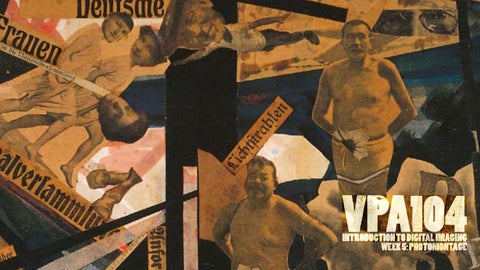
INTRODUCTION TO DIGITAL IMAGING WEEK 5: PHOTOMONTAGE
VPA104 | TOPIC 2 PHOTOMONTAGE | WEEK 1 | 1
VPA104
ABOUT WEEK 4: Photomontage 1
This week’s lecture will be separated into three parts: we’ll begin with an overview of Assessment 2, before looking at some of the key photographers listed in the assessment outline. Look for hyperlinks to some great documentaries on or TED Talks by some of these photographers in the pages that follow. Lastly, we will briefly look at what Photomontage is, and introduce you to some of the key players in the Dada movement. We’ll discuss this important movement and its artists in the weeks that follow. In the workshop, we will look at the pen tool in PS as a selction tool for deep etching. Following on from this, you will need to practice the pen tool using an image you source yourself.
VPA104 | TOPIC 2 PHOTOMONTAGE | WEEK 1 | 2
This week marks out section on Topic 2: Photomontage.
ASSESSMENT 2 Photomontage The aim of this assignment is to produce two images in the style of Photomontage while demonstrating further technical skills you have acquired. The assignment requires a totally different approach to assignment one. In this instance, you need to create images that are not visually possible, but are instead clearly made from bits of different images. Photomontage plays with scale, so exaggerate the scale of the added images to emphasise your point. For example, if you think the ecology of a river is under threat because of a dam upstream, then make the dam image huge and the river tiny or drying up. No reader of the image will think it is a true photographic record (they will assume a level of fictitiousness), but the aim is for the viewer to be able to read, analyse and understand your message. If you wish to
include text within your image please ensure that you keep it to an absolute minimum. The image should not contain your entire message in text (e.g. “This river is threatened by man’s impact on the environment”). The imagery alone should convey your message clearly. (Giving your image an imaginative title should suffice). The images you are going to produce must have a message addressing a political, OR environmental OR cultural OR social point of view. You should select two different themes – e.g. one of your final images might address a political issue and your second image might address a cultural issue. The message can be serious or light-hearted. You will enjoy this assignment if you create messages that matter to you.
ASSESSMENT 2 IS DUE TO BE PRESENTED IN CLASS ON TUESDAY 1 MAY 2018.
VPA104 | TOPIC 2 PHOTOMONTAGE | WEEK 1 | 3
AIM
All final images must be sharp. For some inspiration, you can choose images from the list of prominent photographers below, and/or source alternative photographers’ images them from the internet (remember downloaded images need an acceptable resolution to avoid pixelating in your composite), and/or scan photographs from books or other publications. If you are competent with a camera and able to take sharp, in focus images of adequate resolution, you can incorporate elements from your own photos. You can produce your images using any combination you wish, however you must not simply plagiarize, you must re-appropriate to make entirely new works.
VPA104 | TOPIC 2 PHOTOMONTAGE | WEEK 1 | 4
Only photographs are to be used.
Some late 20th - 21st Century (International / Australian) photographers:
Diane Arbus
Ansel Adams
Jeff Carter
Shizuka Yokomizu
Bill Henson
Irvin Penn
Walker Evans
Nan Goldin
Mario Testino
Tracey Moffat
Henri Cartier Bresson
Max Dupain
Carol Jerrems
Annie Leibovitz
Cindy Sherman
Bill Brandt
David Moore
Roger Scott
Peter Lik
Jeff Wall
Minor White
Peter Dombrovkis
Trent Parke
Rosemary Laing
Philip Lorca di Corcia
Narelle Autio
David Burnett
Andreas Gursky
Richard Avedon
Ron Haviv
Karen Knorr
Dean Sewell
Sebastio Salgado
Joan Fontcuberta
Spencer Tunik
Tom Stoddart
Wolfgang Tillmans
Paul Strand
VPA104 | TOPIC 2 PHOTOMONTAGE | WEEK 1 | 5
Some early to mid 20th Century (International / Australian) photographers:
• Make use of a minimum of 5 different photographic elements. • Demonstrate an application of at least 10 different Photoshop techniques you have employed. • Demonstrate that you have selected elements that are sharp and cleanly selected. • Measure 1600 pixels x 1200 pixels (landscape or portrait format). • Are 96 ppi resolution. • Are saved in RGB mode, regardless of being colour or B&W. • Are SAVED AS and submitted as Photoshop (.psd) files - i.e. uncompressed files with all layers intact.
Your submission must include a written PDF document that outlines your methodology for each separate composite image. You must include thumbnails of all original source images and how they were acquired (eg downloaded, scanned photographed etc) and where relevant, the associated website’s name and URL if images have been sourced from the net. Thumbnail (sourced) images are to be included in this PDF document only. This documentation should also include all references relating to the photographers you have researched and whose work has helped inspire your own images.
VPA104 | TOPIC 2 PHOTOMONTAGE | WEEK 1 | 6
Produce a total of 2 images in colour or black & white that:
Learning Outcomes:
• All images to be used in this subject are to be photographs.
This assignment addresses the subject’s learning outcomes that involve the soft/hardware related to the acquisition of digital images (which may include download, scan, digital camera), use of image processing/manipulation software, and familiarity with digital imaging terminology and practice.
• Your constructed image must be significantly different from any of the original source images. Avoid recomposing an existing image with similar elements, or simply adding two or three smaller images to the background e.g. like adding a bird, a tree and a cloud to the sky. The elements you choose should make a substantial contribution to your overall composite in order to create a new and original composition. • All final images must be appropriately sharp/focused. • Do not use any filters (in Photoshop or other image manipulation software) that create an overall “instant” special effect.
VPA104 | TOPIC 2 PHOTOMONTAGE | WEEK 1 | 7
Additional Requirements:
• The photos you source will be set to different sizes. Before you start - analyse and sort your source material.
• Study the images you want to use first, paying attention to the light source, tonal qualities and camera angle.
• Always check that all selected elements are of adequate resolution.
• Ensure you always work on, and save your images in RGB mode (if the image is to be in black and white, convert it via adjustment layers, DO NOT SIMPLY CONVERT IT TO GREYSCALE MODE.
• You can use an image as a base to which you add elements, or you may wish to create a new “blank” canvas/image from the dropdown menu with the desired dimensions and build your new image from there. • Before attempting to download image files from the Internet, ensure that the resolution is sufficient for your purposes. Often the image will be available in different sizes so it is best to choose the largest, highest resolution available. If not, then it may be best to avoid using it. When you have downloaded images, try a rough draft photomontage. If the image starts to pixelate (the image starts to break up into small image squares), then search for a better quality source image.
• Try to give each of your images a name rather than simply calling them Image 1 and Image 2 etc. • Please complete a spell check before submitting images and documents.
VPA104 | TOPIC 2 PHOTOMONTAGE | WEEK 1 | 8
TIPS
JUST A REMINDER When you have downloaded images, try a rough draft photo-montage. If the image starts to pixelate (the image starts to break up into small image squares), then search for a better quality source image.
VPA104 | TOPIC 2 PHOTOMONTAGE | WEEK 1 | 9
Before attempting to download image files from the Internet, ensure that the resolution is sufficient for your purposes. Often the image will be available in different sizes so it is best to choose the largest, highest resolution available. If not, then it may be best to avoid using it.
EARLY-MID 20th CENTURY PHOTOGRAPHERS Irving Penn was one of the world’s best known and revered fashion photographers. He began shooting for Vogue in the 1940s, with over 150 covers of the publisher being his. Penn didn’t only shoot fashion: check out this site to see more of his projects: http://www.hamiltonsgallery.com/ artists/27-irving-penn/overview/ Also see the most extensive archive of his work here: http://www.artic.edu/ aic/collections/exhibitions/IrvingPennArchives/overview/ The images below have been sourced from Vogue: http://www.vogue.com/tag/ photographer/irving-penn/ For some background information, see: http://chicagotonight.wttw. com/2013/01/29/irving-penn-retrospective-american-photographer
VPA104 | TOPIC 2 PHOTOMONTAGE | WEEK 1 | 10
Irving Penn
VPA104 | TOPIC 2 PHOTOMONTAGE | WEEK 1 | 11
VPA104 | TOPIC 2 PHOTOMONTAGE | WEEK 1 | 12
VPA104 | TOPIC 2 PHOTOMONTAGE | WEEK 1 | 13
VPA104 | TOPIC 2 PHOTOMONTAGE | WEEK 1 | 14
VPA104 | TOPIC 2 PHOTOMONTAGE | WEEK 1 | 15
VPA104 | TOPIC 2 PHOTOMONTAGE | WEEK 1 | 16
ANNIE LEIBOVITZ Annie Leibovitz is one of the world’s most celebrated portrait photographers. From the iconic image of a naked John Lennon with a clothed Yoko Ono to Leonardo Di Caprio-with-Swan, she has pushed the limits of photographic portraiture, producing dramatic, highly stylised and diverse images. She has photographed extensively for Vanity Fair & Rolling Stone.
VPA104 | TOPIC 2 PHOTOMONTAGE | WEEK 1 | 18
MAX DUPAIN Without a doubt, Max Dupain produced some of the most memorable photography of the 20th Century in Australia. In 1937, he took a photo of his friend lying on Culburra Beach, and this image, title “Sunbaker�, has become an iconic image. His work in architechtural and still life photography is also widely revered. Watch this video for more information on Dupain: http://www.abc.net.au/arts/stories/s2850540.htm
SEBASTIÃO SALGADO Sebastião Salgado gives a TED Talk on his work: http://www.ted.com/talks/sebastiao_salgado_the_ silent_drama_of_photography?language=en Also check out this feature length documentary on Salgado by Wim Wenders: https://www.youtube. com/watch?v=1qlYJy4qf0g On the following pages are some of Sebastião Salgado’s amazing work.
WHAT IS PHOTMONTAGE? VPA104 | TOPIC 2 PHOTOMONTAGE | WEEK 1 | 44
In her book, Photomontage, Dawn Ades writes that the manipulation of the photograph is as old as photography itself. Victorians had begun to delight in photographic manipulations that saw a head put on a different body, or double-negative prints creating ghostly images.
It was the Dadaists art group, which was born in Zurich and raised in Berlin, that originally named the process that saw the breaking up of photographic images–the stuff of yesterday’s news–juxtaposing their fragments against others to create overtly political messages in their time. By reappropriating mass media, the Dadaists had endless material for their visual critiques of a time when modernity was revealing its own cracks. It was a new, bold approach that up until that time had not been done before. The Dadaists were anti-art and anti-bourgeois, calling themselves ‘monteurs’ (mechanics) rather than artists.
“Subversive and irreverant, Dada, more than any other movement, has shaken society’s notions of art and cultural production. Fiercely anti-authoritarian and anti-hierarchical, Dada questioned the myth of originality, of the artist as genius, suggesting instead that everybody should be an artist and that almost anything could be art.” – Rudolf Kuenzli, Dada
VPA104 | TOPIC 2 PHOTOMONTAGE | WEEK 1 | 49
ENTER DADAISM
SURREALISM CONSTRUCTIVISM PUNK POP ART CONCEPTUAL ART MINIMALISM
VPA104 | TOPIC 2 PHOTOMONTAGE | WEEK 1 | 50
Most 20th Century art movements that came after 1923 can trace their roots to Dada.
CAFE VOLTAIRE Dadaism emerged during the chaos of WWI, in neutral Switzerland. Zurich became a haven for pacifists, revolutionaries and anti-war protesters, and saw the likes of Lenin, James Joyce, Romain Rolland, and the Austrian anarchist Walter Serner take up residence. The German artist, Hugo Ball, left Germany in 1915, and with his girlfriend, the professional cabaret singer and poet Emmy Hennings, founded their own cabaret that became the now famous Cabaret Voltaire. Others soon joined the group, including Tristan Tzara, Marcel, Janco, Hans Arp and Sophie Taeuber. http://www.bbc.co.uk/programmes/articles/ g8WYZb6jHWPwXtrFG6JW6G/anarchyabsurdity-dada-the-cabaret-voltaire-at-100 Image: “Cafe Voltaire� by Marcel Janco (1916, oil on canvas)(Kuenzli (2006).
HUGO BALL Hugo Ball reciting the poem ‘Karawane’ at the Cabaret Voltaire 1916 The performances of Hugo Ball and the Zurich Dadas became famous for their unexpected and fantastic qualities. Ball’s sound poem (or ‘poem without words’), composed of seemingly primitive expressions was performed by the artist in a ‘cubist’ costume consisting of a tall, blue and white striped hat, a wing-like gold cape, and blue leggings. He later described his appearance as that of a ‘magical bishop’. Ball could not walk in the outfit and had to be carried onto the stage where he chanted the phonetic poem’s phrases in the serious style of a requiem. ‘We must return to the innermost alchemy of the word, we must even give up the word, too ...”, he later wrote of this new form of poetry. - Hugo Ball. Flight Out of Time. 1927 (Kuenzli (2006)
HANS ARP Untitled [Squares Arranged According to the Laws of Chance 1916-17
“Arp’s chance imagery, like the chance poems of Tristan Tzara, represented a fundamental break from traditional forms of art and concepts of individual creativity. In these collages, Arp’s intentions harmonise with the uncontrollable forces of nature to form a unified whole. Hans Richter has recounted that they were made through a completely random process whereby pieces of paper were torn, allowed to fall and pasted exactly as they landed. Rather, it is likely that the compositions began with this process but were then refined by Arp, as seen in this gridlike composition. As in his automatic drawings, the collage balances volition and chance, the random and the ordered.” (Kuenzli (2006)
Sophie Taeuber Wearing a Marcel Janco Mask, dancing at the opening of the Galerie Dada, 29 Marh 1917. Photograph: Collection, Arp Foundation, Clamart. “Janco’s masks and costumes inspired music, dance and various performances of the Zurich group.” (Dada, 2006. Kuenzli (Ed.), London & New York: Phaidon Press, pp. 60).
MARCEL JANCO “Mask” 1919. Despite the Dadasist’s interest in African poetry and visual art, Janco’s costumes were not direct quotations of specific African masking traditions. His masks’ abstracted, hard-edged features, constructed of such everyday materials as twine and cardboard, communicated ‘characters and passions that are larger than life’, even from the distance of the stage. When first presented with Janco’s masks, the group noticed at once that the objects inspired movements, dances and music. ‘Not only did the mask immediately call for a costume: it also demanded a quite definitive, passionate gesture, bordering on madness,” wrote Ball. On the spot, the group devised sounds and movements which they later performed at the Cabaret. - Hugo Ball. Flight Out of Time. 1927 (Kuenzli (2006)