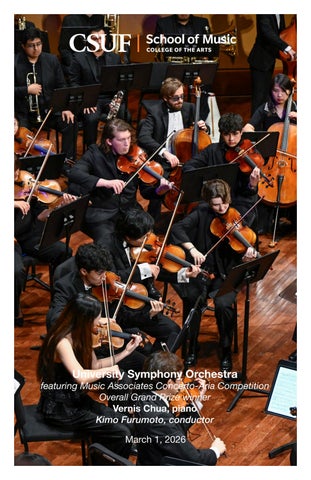
University Symphony Orchestra with Music Associates Winner
University Symphony Orchestra
featuring Music Associates Concerto-Aria Competition
Overall Grand Prize winner
Vernis Chua, piano
Kimo Furumoto, conductor
March 1, 2026
RONALD S. ROCHON
President, California State University, Fullerton
AMIR H. DABIRIAN
Provost and VP for Academic Affairs
ARNOLD HOLLAND, EDD
Dean, College of the Arts
DR. RANDALL GOLDBERG Director, School of Music
KIMO FURUMOTO
Assistant Director, School of Music
BONGSHIN KO
Assistant Director, School of Music
SCHOOL OF MUSIC FULL-TIME FACULTY AND STAFF
FACULTY
CONDUCTING
Kimo Furumoto instrumental
Dr. Robert Istad choral
Dr. Christopher Peterson choral
Dr. Dustin Barr instrumental
JAZZ AND COMMERCIAL MUSIC
Bill Cunliffe jazz piano; arranging; Fullerton Jazz Orchestra, Fullerton Big Band and combo director
Rodolfo Zuñiga* jazz studies, jazz percussion, and music techology; Fullerton Chamber Jazz Ensemble director
PIANO, ORGAN, PIANO PEDAGOGY
Bill Cunliffe jazz piano
Alison Edwards* piano, piano pedagogy, class piano
Dr. Robert Watson piano
MUSIC EDUCATION, TEACHER TRAINING, AND TEACHING CREDENTIAL
Dr. Christopher Peterson choral
Dr. Gregory X. Whitmore* instrumental
MUSIC IN GENERAL EDUCATION
Dr. John Koegel*
Dr. Katherine Reed
MUSIC HISTORY AND LITERATURE
Dr. Vivianne Asturizaga musicology
Dr. John Koegel* musicology
Dr. Katherine Reed musicology
STRINGS
Kimo Furumoto Director of Orchestra Studies and University Symphony Orchestra conductor
Bongshin Ko cello
Dr. Ernest Salem* violin
THEORY AND COMPOSITION
Dr. Hesam Abedini composition, theory
Dr. Pamela Madsen composition, theory
Dr. Ken Walicki* composition, theory
VOCAL, CHORAL, AND OPERA
Dr. Robert Istad* Director of Choral Studies and University Singers conductor
Dr. Kerry Jennings* Director of Opera
Dr. Christopher Peterson CSUF Concert Choir and Singing Titans conductor
Dr. Joni Y. Prado* voice, academic voice courses
Dr. Bri’Ann Wright general education
WOODWINDS, BRASS, AND PERCUSSION
Dr. Dustin Barr Director of Wind Band Studies, University Wind Symphony, University Band
Jean Ferrandis* flute
Sycil Mathai* trumpet
Ken McGrath* percussion
Dr. Gregory X. Whitmore
University Symphonic Winds conductor
Michael Yoshimi* clarinet
STAFF
Michael August Production Manager
Eric Dries Music Librarian
Gretchen Estes-Parker Office Coordinator
Will Lemley Audio Technician
Jeff Lewis Audio Engineer
Chris Searight Musical Instrument Services
Paul Shirts Administrative Assistant
Elizabeth Williams Business Manager
* Denotes area coordinator
Welcome to the spring 2026 events season at Cal State Fullerton’s College of the Arts. We have been hard at work in every classroom, practice room, and studio across campus preparing to share new sounds and bold creativity with all of you. We are thrilled you are here.
Our students and their success form the core of our purpose in the College of the Arts but unlike their counterparts in other colleges, their paths are not solely formed through classroom learning; they are revealed in the moments when talent meets opportunity. Like when a dancer attends an intensive, or when a musician travels abroad on tour, or an actor or artist is mentored – this is where promise is transformed into possibility. The Dean’s Fund for Excellence gives students access to meaningful experiences like these and many more, including masterclasses, research opportunities, materials, and professional conferences. You can help ensure creativity isn’t limited by circumstance. Consider a gift of any amount to the Dean’s Fund for Excellence today.
This spring semester is brimming with performances and exhibitions for all to enjoy –some that will make you laugh and others that will make you think. In the School of Music, Sibarg Ensemble, featuring our own Hessam Abedini, explores the musical intersections of Iranian music and jazz on February 20. In April, Benjamin Britten’s comic opera “Albert Herring” follows the shy, virtuous title character as he rebels against his prudish upbringing. Join us in the Little Theatre beginning March 5 for the musical “Once Upon a Mattress” – an uproarious sendup of Hans Christian Anderson’s fairytale, “The Princess and the Pea.” If you’re craving something completely different, Eugène Ionesco’s “Rhinoceros” opens March 19 to hold a mirror to the absurdity of mob mentality and the struggle to maintain individuality in the face of mass hysteria. And in late spring, our dancers and choreographers return to demonstrate their inimitable power and grace in “Spring Dance Theatre.”
Across the walkway from where you’re seated are the College of the Arts Galleries. You can still catch exhibitions from Soo Kim and Carol Caroompas until May, or stop by the galleries on Wednesdays for our bi-weekly Student Galleries opening receptions. They are always full of energy, and you might even find student artwork to purchase and take home!
Whether you’re returning to our venues or here for the first time, we are so excited to present another season to you. Thank you for joining us.
Sincerely,
Arnold Holland, EdD Dean, College of the Arts
SCAN THIS QR DONATE TODAY TO THE DEAN’S FUND FOR EXCELLENCE
PROGRAM
Lohengrin, Prelude to Act 3 .................................................... Richard Wagner (1813-1883)
Jieming Tang, graduate student conductor
English Folk Song Suite Ralph Vaughan-Williams
March: “Seventeen come Sunday” (1872-1958)
Intermezzo: “My Bonny Boy” arr. Gordon Jacob
March: “Folk Songs from Somerset”
Concerto in F ........................................................................ George Gershwin Allegro (1898-1937)
Vernis Chua, piano ***** Intermission *****
Variations on an Original Theme, “Enigma,” op. 36 ................... Edward Elgar Theme – “Enigma” [Andante] (1857-1934)
Variation 1 - C.A.E. {Carol “Alice” Elgar}
Variation 2 – H.D. S-P. {Hew David Steuart-Paul} [Allegro]
Lohengrin was first performed in 1850 and is certainly a Romantic opera in the strictest sense. It is based upon the legendary romance of the 13th century of Lohengrin, a knight of the Holy Grail, who is sent in a boat pulled by swans to rescue the maiden, Elsa, who must never ask his name. The young King Ludwig II of Bavaria was so moved by Wagner’s opera that he more or less bankrupted his country in order to build the famous castle, “Neuschwanstein”, that is so beloved by today’s tourists to Southern Germany. The “Mad” King later bankrolled Wagner for all the latter’s big ambitions, before his own mysterious death in 1886. The most famous orchestral excerpt from the opera is undoubtedly the “Bridal Chorus” from the opening of Act III, where Elsa and the “unnamed” knight, Lohengrin, settle down in the bridal chamber after their marriage—we universally recognize this chorus as “Here Comes the Bride.” The exciting prelude to this scene is almost equally well known, and its brilliance has kept it fresh despite innumerable performances.
This ever-popular set of quintessentially English tunes first appeared in 1923, written at the request of the Royal Military School of Music at Kneller Hall. The suite as you will hear it today is a transcription from military band to orchestral score made the following year by Vaughan Williams’ pupil Gordon Jacob, but not published until 1942.
In the few years after 1903, Vaughan Williams seems to have spent every free moment out ‘on the road,’ collecting folk songs from their usually elderly rustic singers—to put it bluntly, it was a race against time to preserve the songs, most of which had never been written down, before the singers passed away. He covered more or less the whole country by bicycle and train, amassing over 800 songs. Perhaps not surprisingly, the words of the songs were of secondary importance to Vaughan Williams: it was the beautiful and plaintive tunes with their unusual modal scales and cadences which fired his imagination, and which were the mechanism that released his true musical personality and ultimately, in concert with other influences such as Tudor polyphony and continental modernism, his creative genius.
When therefore we approach a Vaughan Williams piece, even a relatively light work, explicitly based on folk
PROGRAM NOTES
melodies as this Suite is, we can be sure that it is “the genuine article”, the genre completely understood and respected, and the arrangements unerringly “right”.
There are three movements, with these general titles:
1. March – “Seventeen Come Sunday”
2. Intermezzo – “My Bonny Boy”
3. March – “Folk Songs from Somerset”
It is not only the third movement that contains more than one song-tune: the first two also have several tunes strung together. It is worth noticing that they are strung together, rather than interwoven except towards the very end, one tune simply ends, and the next follows.
The opening movement actually features three songs: I’m Seventeen Come Sunday, Pretty Caroline, and Dives and Lazarus, the last a lifelong favorite of Vaughan Williams, and the subject of his 1939 Five Variants. Moments to notice include the brief two-bar bridge changing the key and connecting the first tune to the second, the gentle Pretty Caroline, and the very last chord, which is what is called a Picardy Third, where a piece of music in a minor key ends in a surprisingly positive major.
A chilling minor chord introduces the slow Intermezzo, which uses the tunes from two tragic songs dealing with the betrayal of love, My Bonny Boy and Green Bushes, though the second sounds to me more like a variant of The Cutty Wren. The writing, particularly in the lower instruments, as the movement builds to a close, has the dark majesty of some of Vaughan Williams’ greatest works, and there is an even more striking Picardy Third to finish.
The final march movement contains four songs collected in Somerset: Blow Away the Morning Dew, High Germany, The Trees They Do Grow High, and John Barleycorn. The mood is brisk and cheerful and very military band-ish, though the subject matter of a couple of the songs could not be more melancholy. There is a masterly handling of colors, register, and dynamic contrast, before a repeat of the first tune brings
proceedings to an abrupt and good-humored end.
-Barry Fogden
Concerto in F GEORGE GERSHWIN
George Gershwin was arguably the most successful and talented of America’s composers of popular music. His songs constitute the core of the “American Songbook,” whether composed as part of his immensely successful Broadway shows, or as stand-alone popular tunes. Born of Russian Jewish immigrants, he didn’t evince his formidable musical talents until about the age of ten, when a piano was purchased for his older brother and later collaborator, Ira. Much to the latter’s relief, George soon commandeered the piano, and the rest is, as they say, history. His audiences rewarded him substantially—he is estimated to have become the wealthiest composer in modern times.
After the rousing success of Rhapsody in Blue, Gershwin’s financial security was assured; he moved his family to a spacious apartment in a fashionable section of the Upper West Side, and began to not only collect art, but began to paint, himself. He established his place in the smart set of New York society—no party was complete without George at the piano surrounded by his admirers, as well as the usual social butterflies. Oh, to have been a “fly on the wall” for those affairs! He continued his work in musical theatre, but began in earnest serious composition lessons, as well—and with some distinguished composers, including Wallingford Riegger and Henry Cowell. In this regard, it is important to observe that Gershwin had long cultivated an interest in “serious” composition—notwithstanding his gigantic success in popular music. He had begun the study of music theory, orchestration and musical form with a teacher at the age of seventeen, and youthful compositions from that time include a string quartet and a modest opera. Before the Rhapsody in Blue première, he accompanied a
classical singer at a major recital of standard concert vocal repertoire. So, all in all, the old myth of Gershwin as a remarkable genius of popular music, who, after great commercial success, sought to “legitimize” himself by belatedly taking up composition in classical music must be laid to rest. In point of fact, he had always had a deep and committed interest in the serious study of socalled concert music.
PROGRAM NOTES
The success of Rhapsody in Blue led Walter Damrosch, leader of the New York Symphony Orchestra, to commission the Concerto in F, and it was ready by the fall of 1925. The work was given its first performance in December that year, with Gershwin as the soloist. Its success was immediate—notwithstanding the usual bickering among the stodgy critics of the time about how to classify a concerto with “jazzy” elements–and it soon entered into the repertoire of “art music” along with Rhapsody in Blue, An American in Paris, and Porgy and Bess But it must be said, that compared with the two other instrumental works, the concerto comes far closer to the sophistication and nuance of idealized concert works to which Gershwin evidently aspired. Rhapsody in Blue was written in about three weeks; Gershwin labored over the Concerto in F for months.
It has long been the received wisdom of musicians, music commentators, and Gershwin devotees to refer to “jazz” influences and characteristics in the concerto. Not so fast, I would suggest. Yes, it does employ the inflections of the third, fifth, and seventh scale steps basic to the jazz idiom; yes, one hears skillful and natural use of syncopation; and yes, the second movement is based on the familiar twelve-measure framework of the blues. However, most of those who speak so knowingly of jazz influences on this great work evidently have not heard much “real” jazz from New York prevalent around 1924. Simply put, it
was a world apart. Louis Armstrong had left New Orleans only two years previous, making his reputation largely in Chicago. Fletcher Henderson’s band was the toast of black audiences in New York, and “jass” style was a boisterous, vital, marvelous affair of small groups of talented soloists. There’s little of Potato Head Blues in Gershwin. If anything, the concerto was an outgrowth of Gershwin’s long experience and immersion in the music of Tin Pan Alley and New York musical theatre, but peppered here and there with some of the technical bits of jazz harmony and melody inflection, bolstered by the “blues” framework and atmosphere of the second movement. Perhaps a more unusual angle would be simply to say, rather than being influenced by jazz, the concerto really pointed to where some important aspects of jazz would end up by the 1950s.
Cast in the familiar three movements of a piano concerto, the work is a major step in sophistication beyond Rhapsody in Blue, as well as An American in Paris—which was soon to follow. The latter works sail along on the composer’s melodic genius, with one charming tune following another, carried alone by Gershwin’s inimitable rhythmic élan. Structurally, compared with the rigors and nuances of the concert repertoire, the two earlier works are weak—one happy episode after another, until the
PROGRAM NOTES
composer has had his say. Obviously, audiences didn’t care then, and largely don’t now. But, Gershwin was not a naïf, and the concerto is every bit as structurally sound and urbane as legions of symphonies and concertos for symphony orchestra. Not only that, he utilized such heavy-duty means of symphonic unification as that of thematic transformation and cyclicism—shades of the masters! The first movement opens with thumping timpani, accompanied by rips from the woodwinds, repeated and interspersed with a variety of familiar Gershwin-like syncopated ideas. The pianist finally enters, playing a rather melancholy theme, which you’ll hear alternating with typically Gershwin energetic “vamping” passages. A virtue of Gershwin’s style is that his foursquare ideas are easy to follow, and return frequently in ever-new guises, climaxed by the “big tune,” as in Rhapsody in Blue.
Elgar’s first significant, acclaimed work, the Variations, was given its première in 1899, conducted by the great Hans Richter. It was an immediate success, and garnered performances and praise in Europe—including from Richard Strauss. Not bad for a composer of modest reputation who had chiefly labored far from the bustle of London. Although he had been steadily building his reputation in provincial English cities as a well-respected composer of cantatas and the like, an orchestral work on the scale of the so-called “Enigma” Variations seemed to be without precedent. What is clear, however, is that, at the age of forty-two, he had served his apprenticeship well, and years of experience laid a solid foundation for his most famous work—especially his vaunted mastery of orchestration.
The importance of the composition and its delightful “enigma” generated an enormous interest and specula-
tion, which has continued unabated to the present. The genesis of it is well known, for Elgar left ample record of his thoughts. Apparently, after a long day of teaching, he trudged into the house, and his wife said something to the effect that he looked like he could use a good cigar. He indulged himself, sat down at the piano and was improvising rather desultorily, when his wife, Alice, said that she liked one of the tunes, and he continued improvising little variations on the tune that reflected some aspect of the personalities of his close friends. The rest is history. On the score, over each variation, Elgar wrote either the initials of each friend, or in a few cases, a name or nickname. Who these folks are and some of their “characteristics” limned by the composer is known, now, but that was not the enigma. The tune, itself is clear; we hear it straightway, at the beginning. It’s a simple little affair: a short motive of four notes, preceded by a rest, heard six times, half of them in reverse rhythm—a wonder of musical concision. And then follow thirteen variations, one each for thirteen friends, and a last variation about the composer, himself. So what is the “enigma?”
Elgar spoke several times of a “larger theme” that runs throughout the work, but is “not played.” Furthermore, he referred to its “dark saying,” declaring that it would remain a mystery. And why even call the work “Enigma,” in the first place? Generations have tried to solve the mystery, to no avail. All manner of tunes have been adduced as the mystery tune—including “Pop Goes the Weasel.” Elgar created a mystery and it remains a mystery, for the composer took it with him to the grave.
The short theme is heard first, with a brief contrasting section before the theme returns. The first variation (C.A.E.) follows immediately, dedicated to his beloved wife, Caroline Alice Elgar. The second variation (H.D.S.-P.) is a tribute to Hew David Steuart-Powell, an amateur musician at whose chromatic warm-ups Elgar gently poked fun. (R.B.T.) Richard Baxter Townshend follows, a send up the amateur thespian’s breaking voice, rather like an adolescent boy. After
PROGRAM NOTES
two more variations we arrive at No. 7 (“Ysolbel”), a viola student of Elgar, depicted by a solo viola playing a passage that sounds a bit like an etude for that instrument. Variations 8 and 9 refer to Troyte Griffiths, an architect who was a rather poor pianist—you can hear it—and Winifred Norbury, whose calm personality is there in the variation. A held note in a sole violin unmistakably leads into the next variation—the most beloved of them all.
“Nimrod” holds a special place in the hearts of Britons, for its magnificent grandiloquence and poignancy, and one hears it played publicly in times of great tragedy or circumstance—rather like Barber’s Adagio for Strings in the U.S. It is dedicated to Elgar’s best friend, Augustus Jaeger. Jaeger, of course, is German for “hunter,” and Nimrod was the great hunter in the Old Testament.
“Dorabella” was a good friend, whose stutter is famously depicted in the little flutter in the woodwinds. Variation 11 hilariously tells the incident wherein Dan, the bulldog of friend, George Sinclair, falls down the bank of a steam, paddles along, and barks happily upon his exit from the water. “B.G.N.” was a cellist (he inspired the cello concerto), and so he gets a little cello solo, here. The mysterious “* * *” left on a sea voyage before Elgar could get permission for the dedications, so she is anonymous, here. A quotation from Mendelssohn’s “Calm Sea and Prosperous Voyage,” is heard in the solo clarinet, with the timpani contributing some nautical engine noises. Finally, the fourteenth and last variation is of Elgar, himself (“E.D.U” from his wife’s pet name for him—the German, Eduard. It is telling that in this music ostensibly about himself, he uses the material from the two variations dedicated to the persons most important in his life, his wife, “C.A.E,” and his great friend, “Nimrod.” Elgar was a complex man, but it is a certainty that his enjoyment of friendship and the love of others was central to his being, and the work perfectly illustrates that.
Vernis Chua is a 25-year-old Singaporean pianist currently based in Fullerton. She is currently pursuing a Master of Music in Cal State Fullerton under. Myong-Joo Lee. She is a recipient of the Performance Award in Piano in Cal State Fullerton. Prior to this, she was awarded a full scholarship by the Yong Siew Toh Conservatoryw of Music and graduated with an Honours with Distinction. Her past principal teachers include Thomas Hecht and Ning An. Vernis has won several awards including the overall grand prize in the 2025 Cal State Fullerton concerto competition and the silver award in the Singapore Asia music competition. She had won a special mention in the 2022 concerto competition in the Yong Siew Toh Conservatory of music in Singapore. She is a passionate pianist who is on an artistic mission to share her music with diverse audiences. She is on an important journey to explore her creativity. She has played in concerts held in Italy, Singapore and Malaysia. She is also passionate about accompaniment and chamber music, having performed in the Asian Civilization Museum chamber series in Singapore.
ABOUT THE CONDUCTOR
Kimo Furumoto
Kimo Furumoto is the Orchestra Director at California State University, Fullerton. He is also Music Director and Conductor of the Huntington Symphony Orchestra (West Virginia) as well as the Whittier Regional Symphony. His guest conducting appearances have taken him throughout the United States and Europe with many stellar orchestras. Previous positions include music director of the Concert Orchestra at the University of Cincinnati, College Conservatory of Music, conducting assistant with the Cincinnati Symphony Orchestra, and assistant conductor of the Cincinnati Chamber Orchestra. He has worked with noted conductors such as Leonard Bernstein and Robert Shaw.
Furumoto holds degrees in conducting from Chapman University and the University of Cincinnati, College Conservatory of Music. His ballet “The Mandarin Ducks” has been enthusiastically received by audiences.
$500,000 +
Mrs. Junko Klaus
$100,000-$499,999
Johnny Carson Foundation
$50,000-$99,999
CSU Northridge Foundation
Leo Freedman Foundation
Ms. Susan Hallman in Memory of Ernie Sweet ‘77
Mr. Matthew Scarpino & Ms. Karyn Hayter
Mr. Steve & Mrs. Robin Kalota
Dr. Sallie Mitchell*
Dr. Tedrow & Mrs. Susan Perkins
Mrs. Louise Shamblen
$25,000 - $49,999
Mr. Darryl Curran
Mrs. Lee C. Begovich
Mrs. Marilyn Carlson
Ms. Mary A. and Mr. Phil Lyons
Mr. Bob & Mrs. Terri Niccum
Mr. Ernest & Mrs. Donna Schroeder
Dr. Ed & Mrs. Sue Sullivan
$10,000-$24,999
Dr. Joseph & Dr. Voiza Arnold
Mr. John Aimé & Ms. Robin de la Llata Aimé
Dr. Marc Dickey
Mrs. Evelyn Francuz
Mr. Edward & Mrs. MaryLouise Hlavac
Ms. Kathleen Hougesen
Ms. Kathy Mangum
Mr. James & Mrs. Eleanore Monroe
Mrs. Norma Morris
Mr. John Brennan & Ms. Lucina Moses
$5,000-$9,999
Mr. Nick & Mrs. Dottie Batinich
Continuing Life LLC
Ms. Harriet Cornyn
Mr. William S. Cornyn
Dedicated 2 Learning
Mr. Richard & Mrs. Susan Dolnick
Ebell Club of Fullerton
Friends of Jazz, Inc.
Dr. Margaret Gordon
DONOR APPLAUSE
Mr. Norm & Mrs. Sandy Johnson
Ms. Teri Kennady
Mrs. Jill Kurti Norman
Morningside of Fullerton
Mrs. Bettina Murphy
Mr. David Navarro
Dwight Richard Odle Foundation
Dr. Stephen Rochford, DMA
Southern California Arts Council
Swinerton Builders
Mr. Framroze & Mrs. Julie Virjee
$1,000-$4,999
Mr. John A. Alexander & Mr. Jason Francisco
Mrs. Judy Atwell
Mrs. Lois Austin
Mr. Tod Beckett-Frank
Ms. Karen Bell
Mr. John &
Ms. Shanon M. Fitzpatrick
Dr. Keith & Mrs. Renae Boyum
Mr. Allan & Mrs. Janet Bridgford
Mrs. Marion Brockett
Mr. James & Mrs. Diane Case
Mr. Stephen Collier & Ms. Joann Driggers
Mr. William H. Cunliffe, Jr.
D Barry Schmitt Trust
Ms. Jeannie Denholm
Mr. Gordon & Mrs. Lorra Dickinson
Mr. Kenneth & Mrs. Stacey Duran
Mr. Greg & Mrs. Shawna Ellis
Ms. Judi Elterman
Dr. Anne Fingal
Fullerton Families & Friends Foundation
The Jane Deming Fund
Mrs. Marsha Gallavan
Mrs. Terie Garrabrant
Dr. Leon & Mrs. Annette Gilbert
Mrs. Janet M. Green
Mr. James Henriques
Mr. David &
Mrs. Margret Hoonsbeen
Mr. Mike Ibanez
Mr. Darren & Mrs. Tatyana Jones
Ms. Michelle H. Jordan
Ms. Gladys Kares
Ronald L. Katz Family Foundation
Mr. Raymond & Mrs. Masako Kawase
Mr. Jeffrey & Mrs. Gayle Kenan
Dr. Kristin Kleinjans & Mr. Anthony Dukes
Mrs. Shirley Laroff
Mr. Lynn & Mrs. Susan Lasswell
Mrs. Marilyn Little
Mr. Juan Lopez
Mr. Paul Coluzzi & Mr. John Martelli
Dr. George& Mrs. Karen Mast
Mrs. Thelma Mellott
Mr. Michael & Mrs. Mary Miguel
Mr. Carl Mrs. Patricia Miller
Stifel Nicolaus
Mr. Ujinobu & Mrs. Yoshino Niwa
Mr. Colin Connor & Ms. Debra Noble
Dr. Arie & Mrs. Deanna Passchier
Mr. Jarrold Petraborg
Mr. John Phelps & Mrs. Kerry Laver-Phelps
Mr. Jim Plamondon
Mr. E. B. & Mrs. Linda Powell
Mr. Robert Rennie & Mrs. Nancy Rennie
Ms. Christine Rhoades
Ms. Mary Rupp
Mr. Thaddeus & Mrs. Eleanor Sandford
Mrs. Rita Sardou
Mr. D. Schmitt
Mrs. Martha Shaver
Mrs. Ingrid R. Shutkin
Ms. Barbara Kerth & Ms. Lorena Sikorski
Ms. Janet Smith
South Coast Repertory
Ms. Ann Sparks
Mr. Robert & Mrs. Roberta Sperry
Mr. Douglas Stewart
Mr. Tom & Mrs. Carolyn Toby
Liqi Tong
Viet Tide
Ms. Verne Wagner
Dr. Sean & Dr. Tina L. Walker
Dr. Robert & Mrs. Teri Watson
Dr. Wayne & Dr. Ruth Zemke
special care has been given to the prepartion of this donor list. Questions or concerns, please contact: Dominic Mumolo | 657-278-7695 Gifts received from July 1, 2023 to December 31, 2024 |
ONTIVEROS SOCIETY
The Ontiveros Society includes individuals who have provided a gift for Cal State Fullerton through their estate plan. We extend our deep appreciation to the following Ontiveros Society members, whose gifts will benefit the students and mission of the College of the Arts.
ANONYMOUS
JOHN ALEXANDER
LEE & DR. NICHOLAS A.* BEGOVICH
MARC R. DICKEY
JOANN DRIGGERS
BETTY EVERETT
CAROL J. GEISBAUER & JOHN* GEISBAUER
SOPHIA & CHARLES GRAY
MARYLOUISE & ED* HLAVAC
GRETCHEN KANNE
DR. BURTON L. KARSON
ANNE L. KRUZIC*
LOREEN & JOHN LOFTUS
ALAN A. MANNASON*
WILLIAM J. MCGARVEY*
VERONICA MICHALOWSKI
DR. SALLIE MITCHELL*
ELEANORE P. & JAMES L. MONROE
LYNN & ROBERT MYERS
BOB & TERRI NICCUM
DWIGHT RICHARD ODLE*
SHERRY & DR. GORDON PAINE
DR. JUNE POLLAK & MR. GEORGE POLLAK*
DR. STEPHEN M. ROCHFORD
STAN MARK RYAN ‘75
MARY K. & WILLIAM SAMPSON
LORENA SIKORSKI
DOUGLAS G. STEWART
ANDREA J. & JEFFREY E. SWARD
RICHARD J. TAYLOR
VERNE WAGNER
RICHARD WULFF
DR. JAMES D. & DOTTIE YOUNG*
We Proudly Recognize Our VOLUNTEER
SUPPORT GROUPS
ART ALLIANCE promotes excellence and enjoyment in the visual arts, and their fundraising efforts contribute to student scholarship, gallery exhibitions, opening receptions and sculpture acquisition on campus.
Website arts.fullerton.edu/aa
MUSIC ASSOCIATES maintains a tradition of active involvement and community support and raises scholarship funds for School of Music students through annual fundraising events and membership dues.
MORE INFORMATION Dominic Mumolo, Senior Director | dmumolo@fullerton.edu
shape the future of the arts
The College of the Arts at Cal State Fullerton is one of the largest comprehensive arts campuses in the CSU system. We proudly serve as an academic institution of regional focus with national impact that combines rigorous arts training with cross-disciplinary exploration to encourage the artistic expression and individual achievement of thousands of students throughout the arts every day.
Our students’ success increasingly depends on the support of our community. More of our students are facing significant challenges to their ability to continue their education. Be part of the solution! We invite you to support the Dean’s Fund for Excellence. Help provide students with the education, the tools, and the opportunities to succeed both on campus and off.
Empower our students to become the successful creative professionals our economy so desperately needs! Consider making a gift of any amount to the Dean’s Fund for Excellence today.
COLLEGE OF THE ARTS • SELECT EVENTS | SPRING
ModernMedieval Voices
February 14, 2026, at 8 PM
Meng Concert Hall
Sibarg Ensemble*
February 20, 2026, at 8 PM
Meng Concert Hall
Inna Faliks, piano*
February 25, 2026, at 8 PM
Meng Concert Hall
Joel Balzun, baritone
February 25, 2026, at 8 PM
Recital Hall
Haochen Zhang, piano
February 28, 2026, at 3 PM
Recital Hall
Brightwork newmusic: Ring of Fire
March 4, 2026
Meng Concert Hall
Once Upon a Mattress
March 5–14, 2026
Little Theatre
19th Annual Collage Concert & Benefit
March 14, 2026, at 3 PM
Meng Concert Hall
Sarah Cahill, piano*
March 18, 2026, at 8 PM
Meng Concert Hall
Rhinoceros
March 19–28, 2026
Young Theatre
Paul Galbraith, guitar
March 22, 2026, at 8 PM
Meng Concert Hall
Fullerton Jazz Chamber Ensemble feat. Ralph Alessi Quartet
March 24, 2026, at 8 PM
Meng Concert Hall
Talich Quartet
March 27, 2026, at 8 PM
Meng Concert Hall
University Symphony Orchestra with Talich Quartet
March 29, 2026, at 3 PM
Meng Concert Hall
Nicholas Isherwood, bass/baritone*
April 7, 2026, at 8 PM
Meng Concert Hall
X-out
April 9–18, 2026
Hallberg Theatre
High School Honor Band & CSUF Wind Chamber Ensembles
April 11, 2026, at 8 PM
Meng Concert Hall
Albert Herring
April 10–12, 2026
Recital Hall
Fullerton Jazz Chamber Ensemble & Fullerton Latin Ensemble
April 21, 2026, at 8 PM
Meng Concert Hall
Cello Choir
April 22, 2026, at 6 PM
Recital Hall
Woodwind Chamber Orchestra
April 24, 2026, at 8 PM
Meng Concert Hall
University Symphonic Winds & University Wind Symphony