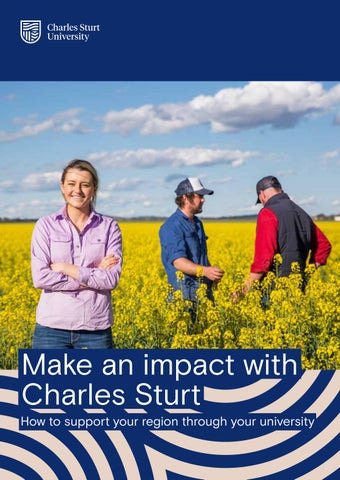
Make an impact with Charles Sturt
How to support your region through your university

Yindyamarra Winhanganha
The wisdom of respectfully knowing how to live well in a world worth living in.
The Wiradjuri phrase yindyamarra winhanganha means the wisdom of respectfully knowing how to live well in a world worth living in.
This phrase represents who we are at Charles Sturt University – our ethos. It comes from traditional Indigenous Australian knowledge, but it also speaks to the mission of a university – to develop and spread wisdom to make the world a better place.
Our university narrative expands on this by confirming “we are a university of the land and people of our regions, and we aim to develop holistic, far-sighted people who help their communities grow and flourish”.

We’re committed to regional Australia
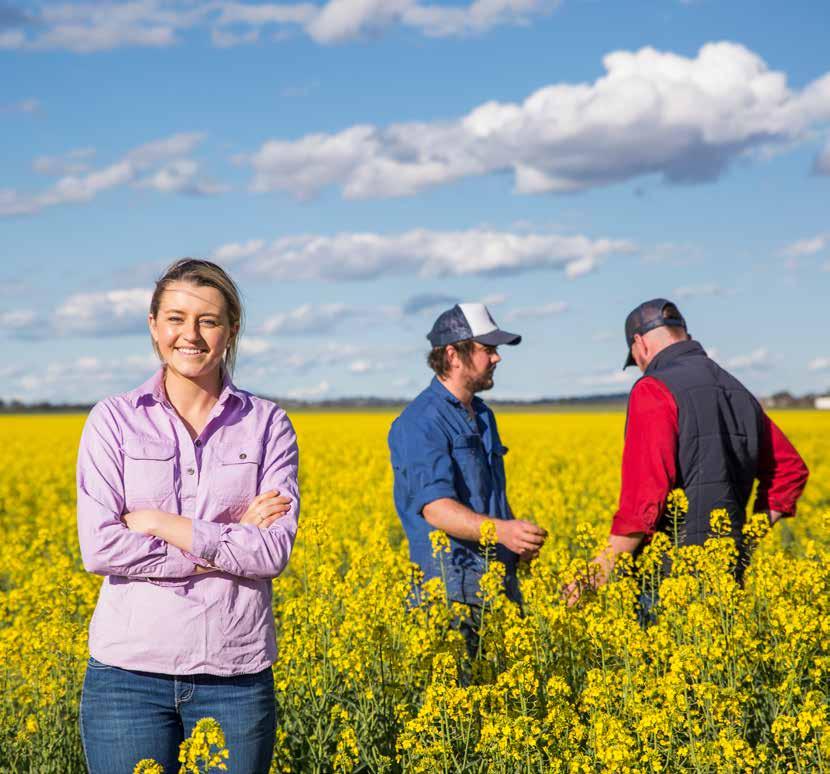
The sunburnt country, the sweeping plains. Regional Australia captures the essence of our country for many. But beyond beauty and poetry, the success of regional areas is essential to Australia’s future wellbeing.
Be it agriculture, exports or education, our national economy depends on a prosperous regional Australia.
The following are just some examples of how Charles Sturt University’s contributions help grow and sustain industry, local businesses and our communities.
• We provide significant economic benefits to our communities, annually contributing more than $490 million in income and $800 million in gross regional product. ‡
• We are a major employer in the regions we inhabit, providing more than 5000 full-time jobs across the country. ‡
• Our operations bring qualified professionals and services to our regions, providing businesses with staff, expanding cultural activity and enriching the overall social fabric through diversity and multiculturalism.
• Our courses are providing the professional workforce required to meet regional Australia’s needs.
- Charles Sturt University is the largest provider of teaching graduates in New South Wales.
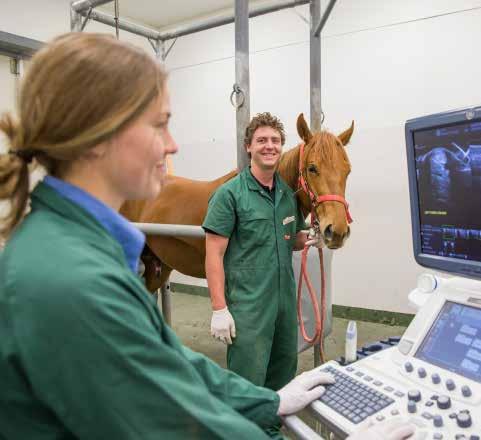
- We introduced courses such as pharmacy, dentistry and veterinary science to meet regional skills shortages.
• Through our practical agricultural and environmental courses, we play a vital role in reducing the risks of natural resource degradation and supporting a sustainable economic future for agriculture on regional, national and international levels.
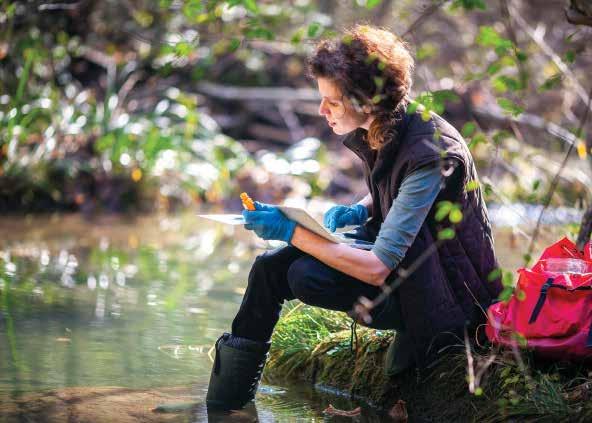
• Our research generates insights to address regional issues such as the health of complex water systems or the impact of bushfires.
Charles Sturt University is recognised for our internationally competitive research strengths in areas of regional relevance: agricultural science, horticultural production, food and wine sciences, crop and pasture production, veterinary science, animal production, education, curriculum and pedagogy, environmental science and nursing.
Through your help with scholarships, research, environmental stewardship or the provision of professionals and services to the regions, we can ensure regional Australia remains the prosperous and thriving heart of the nation.
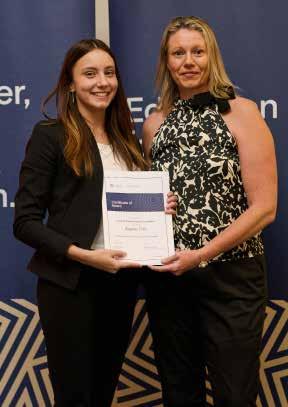
It has been very difficult in recent times to be a full-time Universitystudent with fires, drought, and COVID-19. Coming from rural/remote NSW I was involved very heavily in the fires of 2019-2020 and the ongoing drought in the west of NSW. The scholarship will go towards my first placement for my second year and covering the costs of the equipment needed. Placement is a very expensive but invaluable.”
‡ Charles Sturt University Economic Impact Report 2015
Charlie Smith, Charles Sturt University Foundation Rural Relief Scholarship
Charles Sturt University Foundation
The Charles Sturt University Foundation was established as a non-profit company in 1982. Since its inception, the foundation has awarded more than 5000 scholarships to Charles Sturt University students totalling over $18 million. In 2021 alone the foundation awarded more than $1.8 million in scholarships and prizes – funds that help make a very real difference in the lives of our students.
The Charles Sturt University Foundation Trust is a non-profit entity endorsed as an Income Tax Exempt Charity, so carries Deductible Gift Recipient status. All donations above $2.00 to the trust are tax deductible.
Regional Impact Fund
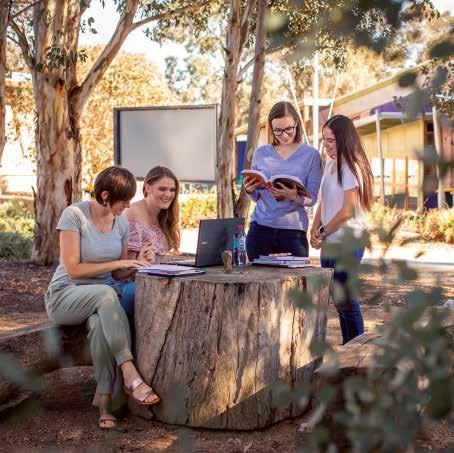
Charles Sturt University Foundation has launched the Regional Impact Fund aimed specifically at helping students from our regions achieve their dreams of a higher education degree and in turn, help address vital skills shortages in local communities.
The Regional Impact Fund is set up to adapt and respond to uniquely regional challenges that we know have an impact on student’s ability to study – effects of bushfire and drought, limited financial support and being first in family to study.
With less financial support one in five regional students regularly go without food and are juggling a full time study load of 40 hours per week* with an average of 30 hours of work. This can compromise their ability to meet their potential as they attempt to study for in excess of 48 hours a week.
Our goal is to award 10 scholarships worth $5,000 each and every year to help regional students with tuition, accommodation and other identified needs and make a very real impact on their ability to focus on and complete their study.
To achieve this, our target is to raise $1,050,000. Use QR code to learn more:

Micro-credential scholarship program
Our micro-credentials are designed to help you make a difference – to your career, to your organisation and your community.
Designed in collaboration with employers, these online micro-credentials give you the opportunity to apply new knowledge and skills directly to your workplace.
From project management, community development and finance, to media, communication and networking, choose one or two micro-credentials that will let you gain the required skill set for the job at hand – then add more to your learning journey as needed.
You can choose to study in several micro-sessions throughout the year. You’ll learn along like-minded students across eight-week sessions (some subjects even have an optional on-campus or online workshop for collaborative, face-to-face learning). It means you can gain new skills in just two months. A two-point micro-credential only takes around four hours of study a week, while a four-point micro-credential just eight.
• 8 weeks per subject
• Approximately 40 hours per subject.
• This includes a two-day face-to-face workshop and online learning.
• Though these subjects are at a tertiary level, no prior study is required.
• $900 per subject
• 1st session - 7 March
• 2nd session - 2 May
• 3rd session - 27 June
• 4th session - 22nd August
• 5th session - 17 October
Complement your online learning with the twoday face-to-face workshop. This is a valuable opportunity to create a support network and connect with like-minded peers. You’ll also engage with your subject coordinator to dive deep into the topics, get all your questions answered and see how to apply your learning in the real world.
Scholarships
As the world changes, so do the needs of society.
As Australia’s most experienced provider of online education and a regionally based university, we understand, better than most, the barriers students face and that we must adapt to meet student needs.
Everyone should be able to access an education, regardless of personal circumstances. The educational level of parents and family should not be an indicator of a person’s ability or likely success. People also need the flexibility to study at different times and in different ways.
Charles Sturt University is leading educational practices to cater for an increasingly diverse range of student needs, in a world constantly adapting to political, social and economic forces.
Here are some of the ways we are making education accessible.
• We have awarded more than $21 million in scholarships since 1982.
• We currently award more than $1.8 million in scholarships each year through our foundation, but demand still outweighs supply.
Nearly 70 per cent of Charles Sturt University’s domestic undergraduate students are the first in their family to attend university.
• Our teaching expertise, combined with high levels of practical experience, means we have Australia’s highest graduate employment rate.*
• We are Australia’s most experienced provider of online education and harness technology to break down educational barriers.
• We were the first university to offer professional courses such as clinical psychology and exercise science online.
Our innovative curriculum design combined with the latest technology has resulted in world-leading degrees such as our engineering program, which breaks the mould in terms of its non-traditional delivery.
We provide the confidence and support required to return to study and offer an inclusive and welcoming environment.
We understand our students and their different needs, but we need your support to ensure we can offer the opportunity they deserve.
Your support through investment in scholarships, work placements or cutting-edge technology, will ensure we remain at the forefront of education delivery in Australia and that every Australian, regardless of circumstances, has access to a university education.
Did you know?
As an example for the current costs of studying at university. A typical first year education student who is living away from home to earn an education degree in 2021 faces the following costs.
It costs $400/week for the average student to study in 2021.
It costs at least $200/week in housing to live away from home to study
It costs at least $5000 for textbooks and HECS per year of studying
Whilst completing prac teaching placement, it costs $80/day for up to two weeks at a time.
Up to 40 hours allocated study time leaves little time for casual employment.
One-third of domestic undergraduate students have estimated expenses exceeding their estimated income.
The Charles Sturt Foundation facilitates scholarships from community supporters, both individuals and business. The annual scholarships start at $3000. Scholarships worth $100,000 tend to cover all the costs of university for the duration.
Scholarships can be established for long term giving through a one off corpus donation. A corpus donation uses the interest gained annually on the initial gift to distribute scholarship monies to students. Alternatively, scholarships can be annually invoiced for the predetermined amount directly awarded to the student.
“To say this scholarship will help is such an understatement, I feel so overwhelmed with the generosity that is being afforded to us. This will allow us to feel more in control and the financial stress that comes with being a single parent will be abated and allow more focus on my daughter and studies.”
Tracey Padwick, Student
Research Institutes
As a regional university, we take pride in our hands-on, practical approach to solving problems unique to our communities. We lead the world in applied research into education, food and water security, resource economics and law enforcement.
Gulbali Institute
Agriculture Water Environment
We acknowledge and pay respect to our Wiradjuri First Nations people by using their native language in the naming of this research institute.
“Gulbali ngurambang” is Wiradjuri which translates to “to understand country". After consultation with First Nations people, we use this phrase respectfully as the name of our research institute.
The Gulbali Institute creates impactful integrated agriculture, water and environment research, grounded in Charles Sturt’s footprint across the Murray-Darling Basin, but with impact across Australia and globally.
We emphasise return on investment to increase productivity for farmers, improve natural environments, and reduce risk in agricultural and environmental management.
The Gulbali Institute will maintain Charles Sturt’s existing program of research and its strong relationships, in particular with Research Development Corporations, key State and Commonwealth departments and agencies, and private industry to achieve outstanding outcomes.
Use QR code to learn more:

We champion research that helps communities flourish and shapes the world we live in.
We operate in a paradigm of research excellence and partnership, and provide meaningful outcomes for industry, government, business and communities. We seek to make an impact on our worlds - regional, national and global - and contribute to their economic, social and environmental sustainability and well-being.
Regional Health Research
As Charles Sturt builds capacity of our regions health workforce through our new Medicine program. We are also dedicated to researching the unique problems of delivering positive health outcomes in rural areas.
Eavesdropping on Wetland Birds
This project led by Charles Sturt University’s Dr Elizabeth Znidersic, and Professor David Watson is a part of a new era in environmental monitoring.
Technology is increasingly informing conservation management via automated data collection and algorithms to streamline classification and decision-supporting tools that can balance the needs of different stakeholders.
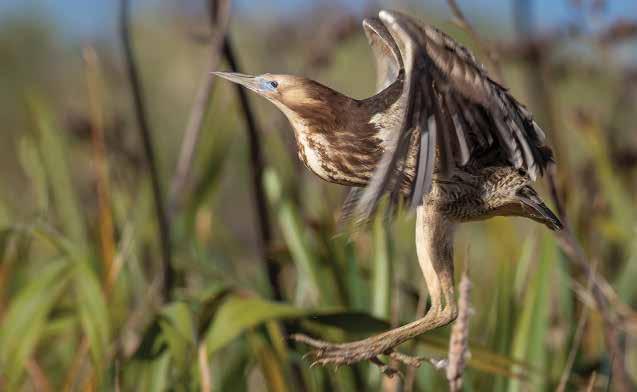
This project is non-invasive, efficient and cost-effective therefore minimising disturbance to habitat and species. Acoustic monitoring technology and remote motion-sensor cameras are being used to extend time and location data collection in order to detect wetland bird species – such as birds like rails, crakes, snipes and bitterns - and monitor their diversity. The timing and frequency of the noises the birds make vary seasonally and can also be used to detect breeding events.
To protect our valuable wetlands, we need to better understand them. Luckily, wetland birds are sensitive indicators of the area’s health, though there’s a small catch – they’re also notoriously secretive in their behaviour!
Your contribution to our Eavesdropping on wetland birds research project means you’ll play a part in saving our wetlands.
Use QR code to learn more:

Dr Elizabeth (Liz) Znidersic is an early career, post-doctoral researcher with ILWS. Her major research interests include survey methodologies and the application of technological tools to monitor individual species and ecosystems, wetland species and their management and island biodiversity and species reintroductions/ translocations. Her research has been conducted in the USA and Australia. Liz has worked extensively in Tasmania with the Parks and Wildlife Service, non-government environmental agencies.
Professor David M Watson’s research falls into three principal areas: managing biodiversity in agricultural landscapes; measuring and predicting the biological effects of habitat fragmentation; and the ecology of parasitic plants. His research has been conducted through detailed community-level field studies in Australia and Latin America; species-specific studies of distribution and abundance; theoretical advances; empirical studies based on previously published data; & synthetic reviews consolidating existing information.


Australasian Bittern (Botaurus poiciloptilus)
First Nations Agricultural Initiative
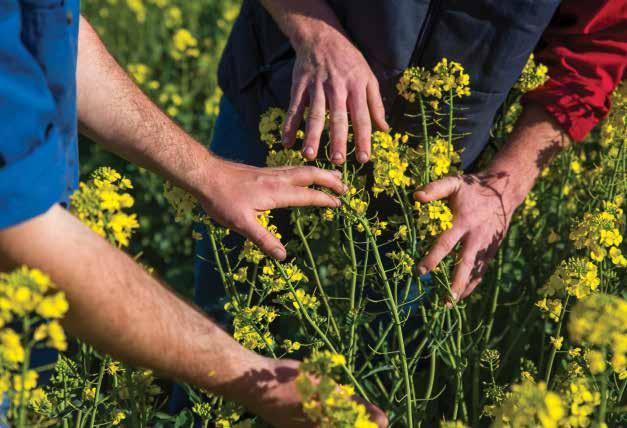
The things that divide us and the things that bring us together The overlap of land management practices of Indigenous and non- Indigenous cultures in Australia provides opportunities and synergies for both cultures.
The communities of Charles Sturt University have in recent times endured unprecedented drought and bushfire events.
Australian agriculture cannot afford to ignore the learning of the Indigenous people who have been managing the landscape for over 120,000 years.
At Charles Sturt University, we believe the preservation and integration of Indigenous land management into contemporary agriculture study and research has the potential to create better outcomes for all.
It also has the capacity to facilitate greater participation of Indigenous people in the agricultural sector where they have been under-represented for generations.
Working with Professor Jim Pratley, the First Nations Agriculture initiative has seen great success in getting funds for scholarships to encourage a higher participation rate of First Nations Students in Agriculture.
Already the initiative has attracted over $200,000 woth of funding and has awarded scholarships to encourage First Nations students into agriculture.
The next phase of building the project is to seek funding for positions which will enhance research and community liaison capacity.

Professor Pratley graduated with BSc (Hons) from the University of NSW (UNSW) before undertaking PhD studies at UNSW, investigating plant and soil factors affecting the selenium nutrition of grazing livestock.
Professor Pratley took up an academic position at Wagga Wagga Agricultural College (now Charles Sturt University) in 1972 and since then has taught courses in agronomy and related areas and has published widely in conservation farming, weed management, herbicide resistance and allelopathy. He was Foundation Dean of Science and Agriculture at Charles Sturt University from 1990 until 2006.
You can help impact the future of health in the rural and regional communities of Australia
“Thank you, doctor.” Those three words are being spoken right now, right across Australia. They tell a story of expert medical care, reassurance and support.
Regional Australia needs more doctors to hear them and help address the healthcare crisis in the bush.
That’s why Charles Sturt University and Western Sydney University have partnered to create a new Joint Program in Medicine.
It’s a five-year undergraduate entry Doctor of Medicine based in Orange, New South Wales, starting in 2021.
This comes at a time, which finds many rural areas without permanent doctors, an unacceptable state and an issue that requires urgent attention.
The course will aim to train students from these regions in best practice medicine specifically for operation in isolated circumstances.
Pairing them in placement opportunities in rurally isolated regions will assist in building meaningful long-term relationships with rural communities.
The university is seeking meaningful ways to help the next generation of rural doctors by supporting them with scholarships, placement accommodation and equipment equivalent to metropolitan programs.
Councillor John Medcalf OAM, Chair of CNSWJO and Mayor of Lachlan Shire Council, said Central NSW councils are staunch supporters of growing their health workforce and they will continue to support the university’s program –because the data backs it up.
“By supporting our young people to study and become the health workforce of tomorrow, we hope they will stay working in the regions.”
Use QR code to learn more:

“Coming into medicine, I was working full-time, and I’ve got two kids at home, so the financial responsibilities have been a lot. With this scholarship, I don’t have to think about finances, and I don’t have to work as much. I can split my time between my kids and my study. I am just so grateful.”
– Ms Sarudzai (Saru) Mukonowatsauka

It is your generosity that enables our students to transform their lives, and helps our University to help unleash the potential of our regions. Together, we have the power to define what is possible for our communities.
GIFTS IN WILLS AND BEQUESTS
Your legacy can provide enduring support for the work of Charles Sturt University beyond your lifetime. Please email us if you are considering including Charles Sturt in your will at: advancement@csu.edu.au
FOCUSED PHILANTHROPY
If you have a specific philanthropic focus and would like a tailored gift to make a significant difference, please contact our team: +61 2 6933 2067
GIVING ONLINE
Support the university by giving online:

Charles Sturt University
Locked Bag 588 Wagga Wagga NSW 2678
+61 2 6933 2067 advancement@csu.edu.au
Find out more or donate here: