
California Special Districts Alliance
The California Special Districts Alliance is a collaborative partnership between the California Special Districts Association (CSDA), the CSDA Finance Corporation (CSDAFC), and the Special District Risk Management Authority (SDRMA). These three highly respected statewide organizations join forces to help special districts in California better serve their communities.
CSDA Board and Staff
OFFICERS
LORENZO RIOS, CSDM, PRESIDENT, Clovis Veterans Memorial District
PETER KAMPA, CSDM, VICE PRESIDENT, Groveland Community Services District
DON BARTZ, CSDM, SECRETARY, Phelan Pinon Hills Community Services District
ANTONIO MARTINEZ, TREASURER, Contra Costa Water District
ELAINE MAGNER, PAST PRESIDENT, Pleasant Valley Recreation and Park District
MEMBERS OF THE BOARD
RYAN CLAUSNITZER, CSDM, Alameda County Mosquito Abatement District
SCOTT DUFFIELD, CSDM, Heritage Ranch Community Services District
VINCENT FERRANTE, Moss Landing Harbor District
CURTIS JORRITSMA, Hilmar County Water District
JO MACKENZIE, Vista Irrigation District
NOELLE MATTOCK, El Dorado Hills Community Services District
GREG P. ORSINI, McKinleyville Community Services District
PATRICK OSTLY, North of River Sanitary District #1
STEVE PALMER, Donner Summit Public Utilities District
KEVIN PHILLIPS, Paradise Irrigation District
FRED RYNESS, Burney Water District
KATHRYN SLATER-CARTER, San Mateo County Harbor District
NIKKI WINSLOW, Altadena Library District
STAFF
NEIL MCCORMICK, Chief Executive Officer
MEGAN HEMMING, Chief Professional Development Officer
MUSTAFA HESSABI, Chief Counsel
KYLE PACKHAM, Chief Advocacy & External Affairs Officer
CASSANDRA STRAWN, Chief Member Services & Communications Officer
RICK WOOD, Chief Finance & Operations Officer
TOMICKO ABELLA, Member Services Representative
AARON AVERY, Director of State Legislative Affairs
BRITTNEY BARSOTTI, Legislative Representative
ANNA C. STAGG, Legislative Assistant
EMILY CHA, Database & Online Communities Specialist
MARCUS DETWILER, Legislative Representative
BRENT FARRAR, Design & Websites Manager
AUBREY GOHL, Member Services Representative
JOSE GUERRERO, Graphic Design/Video Specialist
COLLEEN HALEY, Public Affairs Field Coordinator
CASSIE HASKINS, Member Services Representative
LILIA M. HERNANDEZ, Associate Legislative Analyst
MORGAN LESKODY, Communications Specialist
MICHAEL MEYER, Member Services Manager
CHRIS NORDEN, Public Affairs Field Coordinator
RICHELLE NOROYAN, Public Affairs Field Coordinator
CHRIS PALMER, Senior Public Affairs Field Coordinator
AMBER PHELEN, Management Analyst
RACHAEL POPPINO, Professional Development Coordinator
OLIVIA ROBERTSON, Member Services Specialist
JENNIFER SMITH, Professional Development Coordinator
OPHELIA SZIGETI, Legislative Analyst
ANTHONY TANNEHILL, Legislative Representative
ERASMO VIVEROS, Public Affairs Field Coordinator
DANE WADLÉ, Director of State Field Operations
KRISTIN WITHROW, Senior Communications Specialist
SDRMA Board and Staff
OFFICERS
ROBERT SWAN, PRESIDENT, Groveland Community Services District
JESSE CLAYPOOL, VICE PRESIDENT,
Honey Lake Valley Resource Conservation District
THOMAS WRIGHT, SECRETARY, Clovis Veterans Memorial District
MEMBERS OF THE BOARD
ROBERT HOUSLEY, CSDM, Midway City Sanitary District
VIRGINIA CHANG KIRALY, San Mateo County Harbor District
SANDY SEIFERT-RAFFELSON, Herlong Public Utility District
MIKE SCHEAFER, Costa Mesa Sanitary District
STAFF
DEBBIE YOKOTA, CPCU, Chief Executive Officer
MATT CLUTTERBUCK, CPA, MBA, Chief Financial Officer
ENRIQUETA CASTRO, CSP, Chief Risk Officer
WENDY TUCKER, AU, Chief Underwriting Officer
ALANA LITTLE, Health Benefits Manager
DANNY PEÑA, SIP, WCCP, Workers’ Compensation Claims Manager
ROBERTO LOZANO, Liability Claims Manager
PETR KOVALCHUK, CPA, Finance Manager
JASON THORN, Data Architect
MARGARITO CRUZ, Senior Accountant
ERIC LUCERO, ARM, Senior Risk Control Specialist
GUILLERMO DE LA TORRE, Senior Risk Control Specialist
TAMARA BAKKIE, SIP, WCCA, Senior Workers’ Compensation
Claims Examiner
JOHN PESHKOFF, SIP, WCCA, Senior Workers’ Compensation
Claims Examiner
MARTHA WARREN, SIP, WCCA, Senior Workers’ Compensation
Claims Examiner
MICHELLE BROWN, Health Benefits Specialist II
TERESA GUILLEN, Underwriting Specialist II
KEITH IKAMI, Liability Claims Examiner II
LISA SANDOVAL, Underwriting Specialist II
CANDICE RICHARDSON, Management Analyst
MARIETTA HARRISON, SIP, WCCA, Future Medical Claims Examiner
CHER DARLING, Workers’ Compensation Claims Assistant
LILLI VINN, Accounting Technician
KOJI LO, Liability Claims Examiner I
AMY SUTHERLIN, Underwriting and Program Manager
CAMREN BUTLER, Program Specialist II
Special District Risk Management Authority
1112 I Street, Suite 300 Sacramento, CA 95814 tel: 800.537.7790 www.sdrma.org
CSDAFC Board and Staff
OFFICERS
JO MACKENZIE, PRESIDENT, Vista Irrigation District
VINCE FERRANTE, VICE PRESIDENT, Moss Landing Harbor District
ELAINE MAGNER, CSDM, SECRETARY, Pleasant Valley Recreation and Park District
GREG P. ORSINI, TREASURER, McKinleyville Community Services District
MEMBERS OF THE BOARD
RONALD COATS, DIRECTOR, East Valley Water District
PAULA HANSEN, CSDM, Southgate Recreation & Park District
GLENN LAZOF, Regional Government Services Authority
CONSULTANTS
RICK BRANDIS, Brandis Tallman, a Division of Oppenheimer & Co. Inc.
JEFF LAND Brandis Tallman, a Division of Oppenheimer & Co. Inc.
STEFAN MORTON, Municipal Finance Corporation
WILLIAM MORTON, Municipal Finance Corporation
ALBERT REYES, Kutak Rock LLP
DMITRY SEMENOV, Ridgeline Municipal Strategies, Consultant to the Working Capital Financing Program
NICOLE TALLMAN, Brandis Tallman, a Division of Oppenheimer & Co. Inc.
STAFF
NEIL MCCORMICK, Chief Executive Officer
DAVID MCMURCHIE, Legal Counsel
MICHAEL MEYER, Member Services Manager
AMBER PHELEN, Management Analyst
RICK WOOD, Chief Finance & Operations Officer
CSDA Finance Corporation 1112 I Street, Suite 200, Sacramento, CA 95814 tel: 877.924.2732 www.csdafinance.net
For editorial or advertising inquiries: Phone - 877.924.2732 Email - membership@csda.net
California Special Districts Association 1112 I Street, Suite 200 Sacramento, CA 95814 toll-free: 877.924.2732 www.csda.net
Purchasing, Travel, and Fleet in One Card.


Anastasia Efstathiu
VP, Relationship Manager 916-774-3923
AnastasiaEfstathiu @ColumbiaBank.com

Baldeep Atwal
VP, Commercial Card Sales Consultant Global Payments & Deposits 916-742-0942
BaldeepAtwal@ColumbiaBank.com


Legacy Forward
As we step into 2026, I am reminded of the extraordinary legacy built by generations of public servants who devoted their talent and energy to California’s special districts. Their work shaped the safe neighborhoods, reliable services, and vibrant community spaces we depend on today. They handed us something strong, something worth protecting—and something worth passing forward.
Our theme for this year, Legacy Forward, calls on each of us to honor that heritage by preparing for a future that is stronger than the past. True stewardship is not about holding on to what was—it is about investing in what will be. My years in military service taught me that lasting success comes from planning ahead, building teams, and preparing the next leaders long before the moment of transition arrives. Succession planning is not a reaction—it is a deliberate act of care.
One of the most powerful ways we carry our legacy forward is through lifelong learning. CSDA offers world-class professional development that is accessible to every member, no matter their size or resources. Our online courses, leadership academies, and in-person conferences bring together the brightest minds in public service. The General Managers Leadership Summit, Annual Conference, and Board Secretary/Clerk Conference offer opportunities to build skills, explore new ideas, and learn from leading experts, while the Special District Leadership Academy, offered three times in 2026, provides statewide governance training for new and experienced board members.
These programs are more than training—they are bridges. They connect us, strengthen us, and prepare us for the future. I encourage every district to embrace lifelong learning as a core part of its culture.
Another essential part of Legacy Forward is building pathways for the next generation. Many students do not yet understand the vast world of public service that exists all around them. By building relationships with local schools, community colleges, and youth organizations, districts help young people discover meaningful careers and see themselves as future leaders. A single facility tour, classroom visit, or student project can spark a lifetime of service. Our local CSDA chapters play a central role in this effort. Chapters create spaces for collaboration, support, and shared problem-solving. They help districts learn from one another and remind us that none of us serve alone. When chapters are active, new leaders find mentors, professionals gain confidence, and communities benefit from stronger, more unified service.
CSDA’s priorities for 2026—advocacy, innovation, and leadership development— reflect our commitment to this vision. But the heart of our work is simple: participation. Engage, learn, connect, and support one another.
Because at the end of the day, one truth guides us: We are stronger together. Thank you for your service, your dedication, and your commitment to leading our Legacy Forward.
Lorenzo Rios, CSDM, CSDA President
CSDA News
Award Nominations Open February 3-May 1
Submit Online: csda.net/awards
Deadline: May 1, 2026
It’s time to submit your district’s achievements and superstars for a chance to be recognized at this year’s CSDA Annual Conference & Exhibitor Showcase in Palm Desert. The CSDA Annual Awards showcase our members’ most impactful projects and contributions to their communities. Award categories honor outstanding board members, staff, general managers, chapters, innovative programs, public outreach, and excellence in technology.
Don’t miss your chance to celebrate your district’s achievements. Deadline: May 1.
2026 Board of Directors and Executive Committee
We are proud to introduce the dedicated leaders who will guide our organization in the year ahead. Their collective experience, vision, and commitment to advancing special districts will strengthen our work across California.
Executive Committee
• President - Lorenzo Rios CSDM, CEO, Clovis Veterans Memorial District
• Vice President - Peter J. Kampa CSDM, GM, Groveland Community Services District
• Secretary - Don Bartz CSDM, GM, Phelan Pinon Hills Community Services District
• Treasurer - Antonio Martinez, VP, Contra Costa Water District
• Past President - Elaine Magner, Director, Pleasant Valley Recreation and Park District
Please help us welcome two new additions to the board whose term began January 1, 2026.
• Steve Palmer, GM, Donner Summit Public Utilities District
• Kevin Phillips, GM, Paradise Irrigation District
• Nikki Winslow, GM, Altadena Library District
CSDA’s New Laws of 2026 Guide Available Now!
CSDA’s annual guide to significant laws and legislation impacting special districts is now available. Over a 10-week period from October to December 2025, CSDA released a series of articles detailing the new laws affecting special districts beginning in 2026.
The full range of topics covered by CSDA in the 2026 New Laws Series includes:
1. CA Supreme Court Denies Elected Officials Right to Sue as “Employees” Under Whistleblower Statute
2. Additional CEQA Exemptions and Reforms
3. Certified Payroll Records Requests on Prevailing Wage Public Works Projects (AB 538)
4. Clarifying Timing for Collection of Development Related Fees (SB 499)
5. Biggest Brown Act Revamp in Decades (SB 707)
6. Positioning Special Districts for Success Under New Permitting and Planning Laws
7. 45-Day Notification Prior to Contracting for Services (AB 339)
8. New Mandatory Trainings for Local Government Board Members and Staff (SB 827)
9. New Workers’ Comp Laws Coming into Effect in 2026 and Beyond
10. New Employment Laws Special Districts Should Know


www.csda.net/viewdocument/ new-laws-of-2026
ProDev
Professional Development Catalog Out Now
Explore professional development opportunities for special district elected and appointed officials and staff in the 2026 Professional Development Catalog. Discover new webinars, pre-conference workshops, on-demand training, conferences, Essential Leadership Skills Certificate courses, and more—all designed to help you grow your skills and better serve your community.

www.csda.net/viewdocument/ professional-development-catalog
New Training Requirements
SB 827 introduces new statewide mandates requiring local agency officials, including special district staff, to complete fiscal and financial training. Beginning January 1, 2026, all newly appointed or elected officials must receive this training within six months of starting service and every two years thereafter. Current officials serving before January 1, 2026, must complete the training by January 1, 2028. View all available SB 827 training workshops at www.csda.net/learn/all-events.
The bill also expands who qualifies as a “local agency official.” In addition to elected and appointed leaders, individuals who make decisions or recommendations on budgeting, financial administration, or the use of public resources, as well as executives, department heads, and any employees designated by the governing body, must now complete fiscal and financial training. Department heads and similar officers are also newly subject to ethics training under Government Code § 53235.
Who Must Take Statutorily Required Trainings for Local Officials?
Ethics Training
A member of a local agency legislative body or an elected officer of a local agency who receives any type of compensation, salary, or stipend or reimbursement for actual and necessary expenses incurred in the performance of official duties
Any department head or other similar administrative officer
Any additional employees designated by the board
Fiscal and Financial Training
Any member of a local agency legislative body or any elected officer of a local agency
Any official who is appointed by the governing body who, as part of their official duties, makes decisions or recommendations regarding financial administration, budgeting, or the use of public resources
A local agency executive, as defined in subdivision (d) of Section 3511.1, or other similar administrative officer of a local agency*
Any additional employees designated by the board
*Subdivision (d) of Government Code Section 3511.1 defines “Local agency executive” to mean any person employed by a local agency who is not subject to the Meyers-Milias-Brown Act (Chapter 10 (commencing with Section 3500)), Chapter 5 (commencing with Section 45100) of Part 25 of Division 3 of Title 2 of the Education Code, or Chapter 4 (commencing with Section 88000) of Part 51 of Division 7 of Title 3 of the Education Code, and who meets any of the following requirements:
1. The person is the chief executive officer, a deputy chief executive officer, or an assistant chief executive officer of the local agency.
2. The person is the head of a department of a local agency.
3. The person’s position within the local agency is held by an employment contract between the local agency and that person.
In Review
Record Attendance at 2025 Board Secretary/ Clerk Conference!
The CSDA Board Secretary/Clerk Conference brought together board secretaries and clerks from across California for a dynamic, skill-building experience designed to support the evolving needs of special districts. Attendees connected with peers from around the state, explored timely topics, and gained practical tools and insights they can immediately apply to strengthen board operations and better serve their communities.


1 Attendees enjoyed networking, engaging in educational sessions, and showing off their Halloween spirit in festive costumes.
2 The CSDA team kept the energy high with a variety of fun, engaging activities.
3 Keynote speaker Brenda Viola inspired attendees with her talk, “Settle Your Worth to Live the Life of Your Dreams.”


Tech Tips

Your CSDA Experience—Now Personalized
CSDA members will notice something new the next time they log in at csda.net—a redesigned Home page built just for you. Once signed in, your Home page becomes a personalized dashboard that brings together the information you use most, all in one place. From upcoming webinar, workshop, and conference registrations to the Communities you follow and resources matched to your interests, your customized Home page is designed to save time and keep you connected. No more searching across multiple pages to find what matters most—your activity and preferences now guide what you see first.
If you haven’t logged in recently, take a moment to explore your new Home page. It’s a simple upgrade that makes staying engaged with CSDA programs, learning opportunities, and peer connections easier than ever. Need help logging in? Give us a call at 916-442-7887 or email membership@csda.net

Dates & Deadlines
2026 CSDA Webinars
Virtual: California Public Records Act Update
2026
March 3
Virtual: SB 827 Fiscal & Financial Training
March 4
Virtual: Blue Ribbon Leadership
March 10
Virtual: Contracting for Public Works, Services, Equipment, and Supplies
March 17
Virtual: Tips and Tricks of CSDA Awards
March 24
Virtual: The Future Is Here! AI’s Opportunities and Risks for Special Districts
March 31
2026 CSDA Workshops (Virtual & In-Person)
Virtual: SDLA Module 1 — Governance Foundations
February 11 and 12
Virtual: Budget Preparations for Special Districts
February 18 - 19
In-Person: Navigating Governance & Finance in Special Districts
February 24
Virtual: SDLA Module 2 — Setting Direction / Community Outreach
March 4 - 5
In-Person: SDLA Module 1 — Governance Foundations
March 18
In-Person: Navigating Governance & Finance in Special Districts
March 26
2026 CSDA Conferences
SDRMA Spring Education Day
March 18, Sacramento
Special Districts Legislative Days
April 7 - 8, Sacramento
Special District Leadership Academy
May 11 - 14, San Diego
General Manager Leadership Summit
June 28 - 30, Newport Beach
Pre-GM Summit: So, You Want to Be a General Manager?
June 28, Newport Beach
Special District Leadership Academy
July 19 - 22, San Rafael
Annual Conference & Exhibitor Showcase
August 24 - 27, Palm Desert
Special District Leadership Academy
September 13 - 16, San Luis Obispo
Board Secretary/Clerk Conference
November 3 - 5, Santa Barbara
CSDA Annual Awards
Award Nomination Deadline
May 1

To view more details and to register for conferences, events, workshops or webinars go to the CSDA Events
Page https://qrco.de/bddc8t
Ask the Experts
Banking Insights & Guidance that Benefit Special Districts
By Reagan Ballo, SVP / Managing Director of Government Banking, Five Star Bank
Strong banking relationships play a critical role in helping special districts operate efficiently, safeguard public funds, and adapt to evolving financial and regulatory demands. Yet many districts continue working with the same financial institution for years without pausing to assess whether that relationship is still delivering the best value, service, and protection. The following banking insights— developed by community banking experts at Five Star Bank—offer practical checkpoints to help special districts evaluate their current banking arrangements and identify opportunities to strengthen oversight, improve efficiency, and ensure their financial partner is truly aligned with their mission and operational needs.
Work with a TOP-RATED Community Bank!
Review your bank’s ratings and rankings as they are indicators of the institution’s financial strength.
Your banker should know your organization: You should have direct access to your banker and a partnership with someone who will provide product advisory expertise.
Your banker should be proficient in your special districts’ needs, goals, and objectives.
Monthly statement review: Confirm you’re billed only for products and services you utilize. Verify there are no unauthorized checks, ACH debits, or wires clearing your account.
ASK THE EXPERTS
Look at new products and services to improve efficiency: Technology has come a long way. You can efficiently and cost-effectively pay employees and vendors via ACH or a purchasing credit card program.
Are signers on your bank accounts current? Has there been turnover in your district? Keep the list of authorized signers current.
Test the waters: Receive the best value for your banking expenses by obtaining quotes and pricing every few years.
Eliminate accepting cash as much as possible: Cash creates liability. Cash needs to be counted, secured properly, and transported. There are also safety concerns for employees who carry cash, as well as time wasted with lines and wait times. Most banks charge fees for accepting cash. Limit cash payments by accepting checks, bill pay, and credit cards whenever possible.
Know you are more than “just a number.” Expect your bank to partner with your district as a community advocate
and champion. Banks should sponsor events and promote your district through marketing outreach efforts.
Prevent Fraud: Always work with a bank that puts the safety of your information first. Tools that prevent fraud include Positive Pay for checks and ACH Positive Pay. Limit the authority of those who can send outgoing wire transfers and ensure protocols are in place for wire transfer verification.
ONE MORE! Work with a Bank that Supports CSDA!
Banks that support the California Special Districts Association are in-tune with the needs, challenges, and goals of special districts. Five Star Bank is a CSDA Platinum Member and listed among the Top 3 Best Performing Community Banks in the Nation by S&P Global Market Intelligence (for banks with assets between $3 billion and $10 billion.)
Jim Markman
Roxanne Diaz
Ginetta Giovinco
Craig Steele
Dave Fleishman


Following a nationwide search, the Monterey Peninsula Airport District (MPAD) Board of Directors proudly announced the appointment of Chris Morello as Executive Director for Monterey Regional Airport in November. Ms. Morello has 18 years of aviation experience, having served MRY in the Planning Department since 2007; as the Deputy Executive Director since spring 2022; and most recently as Interim Executive Director since June 2025.

Mission Springs Water District announced that Board Member Russ Martin has been selected to serve as Chair of the Riverside Countywide Oversight Board. Martin has served on the MSWD Board of Directors since 2010 and was elected to the Countywide Oversight Board in 2023 as the Independent Special District Representative, following several years as an alternate beginning in 2018.
With a long history of public service, Martin spent more than 30 years with the Santa Monica Police Department before retiring in 2000. He has also served on numerous boards and advisory committees and currently holds leadership roles with several regional and statewide water and civic organizations.

Palmdale Water District announced the appointment of Viridiana Iguaran as its new Finance Manager/ CFO. Iguaran began the role in late July, bringing years of municipal finance experience, including her most recent position as Assistant Director of Finance for the City of Lancaster. In her role, she oversees key finance functions and works closely on district investments, supporting PWD’s ongoing commitment to sound fiscal management.

The Cayucos Sanitary District has selected David Athey as its new General Manager, and he was scheduled to begin in January. A graduate of Cuesta College with degrees in engineering from Cal Poly San Luis Obispo and the University of Colorado, Boulder, Athey currently serves as Water Division Manager for the City of Paso Robles and brings a diverse background in public sector engineering and infrastructure leadership.

The Grossmont Healthcare District Board of Directors approved the appointment of James Sly as the district’s new Chief Executive Officer. Sly brings extensive experience in healthcare leadership and public service and will lead the District’s efforts to support healthcare access, strengthen community partnerships, and advance regional health initiatives.

The Kern County Water Agency Board of Directors approved the appointment of Eric Averett as the Agency’s new General Manager at its meeting on October 23, 2025. Averett brings decades of experience with the Agency and its member units, having begun his career with KCWA in 1991, later serving in multiple management roles, and most recently as General Manager of the Rosedale-Rio Bravo Water Storage District. His return to the Agency follows additional experience in the private sector and service on the Agency’s Board of Directors.
Viridiana Iguaran
James Sly
Eric Averett
David Athey
Chris Morello
Russ Martin

Santa Margarita Water District Board
President Dr. Betty H. Olson was recently reappointed to the San Diego Regional Water Quality Control Board, where she will serve as Vice Chair. First appointed to the Regional Board in 2014, Dr. Olson brings decades of leadership in water quality, environmental engineering, and public policy, and currently serves as President of the SMWD Board of Directors.

Dr. Ida Lopez Chan has been appointed Chair of the Association of California Healthcare Districts (ACHD) Board of Directors and will also serve on the Advocacy Committee. In this role, Dr. Lopez Chan will help represent healthcare districts across California and advocate for equitable access to care, with a focus on rural and underserved communities. She brings her leadership experience from the Soledad Community Health Care District and will work alongside ACHD leadership and district partners statewide to advance community health initiatives.

The Metropolitan Water District of Southern California has appointed Shivaji Deshmukh as its next general manager, following a unanimous vote by the board of directors.
Deshmukh, a seasoned Southern California water leader with over 25 years of experience, currently serves as general manager of the Inland Empire Utilities Agency.
He assumed his new role on January 1, 2026, succeeding retiring general manager Deven Upadhyay. Deshmukh previously held leadership positions at West Basin and Orange County Water District, where he helped develop the landmark Groundwater Replenishment System.
Board Chair Adán Ortega, Jr. praised Deshmukh’s extensive expertise in water management, partnerships, and infrastructure, noting his leadership will be key to advancing Metropolitan’s climate adaptation strategy and long-term reliability initiatives.


Betty H. Olson
Dr. Ida Lopez Chan
Shivaji Deshmukh
Got Governance?

From Patronage to Professionalism: How Public Agencies Became Professionally Led
This is the first article in a CSDA Governance Foundations Series exclusively by the California Special Districts Association
By Hilary Straus, General Manager, Citrus Heights Water District

If you’ve tuned into the recent Netflix miniseries Death by Lightning, you may have found yourself newly fascinated by the story of President James Garfield and the shockwaves his assassination sent through the nation. That real-life drama did more than captivate headlines—it reshaped the public sector forever. Out of one president’s tragic death came a movement that would transform how government institutions—including California’s special districts—hire, lead, and serve the public.
This article kicks off a series inspired by the CSDA’s “Governance Foundations” class, offered multiple times each year. Whether you participate via Zoom in February, attend Spring Education Day in Sacramento in March, join the Special District Leadership Academy (SDLA) in the spring or fall, take it as a pre-conference workshop at the CSDA Annual Conference, or bring Governance on the Go directly to your district, you’ll engage with core governance principles that shape how special districts operate today.
The Spoils System: Patronage Gone Too Far
For the first century of our nation’s history, public-sector employment was based on a simple but corrosive idea: “To the victor go the spoils.” Elections did not just change policy—they changed entire workforces. Presidents, governors, and mayors routinely purged existing employees and filled government jobs with friends, supporters, and campaign loyalists. Competence wasn’t always the priority—loyalty was.
But the assassination of President James Garfield in 1881, by a disgruntled office seeker who felt he was owed a government job, became a turning point. The American public demanded reform.
The Pendleton Act and the Birth of Civil Service
In response, Congress passed the Pendleton Act of 1883, creating a merit-based civil service system. For the first time, public employees were required to qualify based

on competence, not connections. Professionalism in government—now so fundamental we take it for granted— was born out of this tragedy.
Over the decades, the reform spread across all levels of government: state, county, city, and eventually special districts. As society grew more complex, so did the need for professional management, technical expertise, financial stewardship, and long-term planning.
From City Manager to General Manager
A milestone came in Staunton, Virginia in 1908, with the appointment of America’s first professional city manager—a trained administrator hired to run local government day-to-day, while elected officials set policy. This model spread quickly, giving rise to the Council/ Manager form of government, now common in California cities.
Many special districts have followed by adopting a modified version: the Board/General Manager model, where elected or appointed board members govern, and a General Manager (GM) or Executive Director leads operations. This structure intentionally separates policy leadership from administrative expertise, reinforcing both accountability and professionalism.
Roles and the Upside-Down Triangle
The Governance Foundations course uses a simple yet powerful visual.
• Board Members (at the top) set policy, adopt budgets, and represent the public.
• The General Manager/Executive Director (middle) implements those board priorities and oversees staff.
• Department Heads and Managers direct programs and projects.
• Technical Staff carry out tasks and services.
The one role in policy formation a General Manager or Executive Director and their team plays is researching policy options and making policy recommendations to support board members making informed decisions. This model keeps governance strategic, operations professional, and services reliable.
A Legacy of Professionalism
From Garfield’s assassination to today’s special districts, the public sector shifted from political patronage to professional administration. As this series unfolds, we will continue exploring how these governance principles support transparency, efficiency, and public trust.
After all, good governance doesn’t happen by accident—it happens by design.
Garfield Assassination, 1881
Help Students Spotlight How Districts Make a Difference
By Kristin Withrow, Senior Communications Specialist, CSDA
Across the nation, thousands of special districts quietly deliver the essential services that make daily life possible — keeping water clean and flowing, protecting homes from fire and floods, maintaining parks and recreation programs, managing mosquito control, ensuring wastewater systems run smoothly, and so much more. These are services people value yet often don’t realize come from special districts rather than cities or counties.
The National Special Districts Association (NSDA) is once again shining a light on that vital work through its annual Districts Make the Difference High School Student Video Contest. The competition invites high school students to produce short, 60-second videos showing how special districts make a difference in their communities — and in the process, discover more about how local government works.
A Contest That Builds Awareness
For students, the contest offers an exciting creative outlet — and a chance to win scholarships: $2,000 for first place, $1,000 for second, and $500 for third. The teacher of the top-scoring students also receives a $500 award for inspiring civic learning in the classroom. But the benefits go far beyond the prizes. Each video submission helps raise awareness about the essential role of special districts, spreading that knowledge from students to parents, teachers, and friends. Every story told connects positive feelings — clean water, safe neighborhoods, open spaces, and reliable public services — directly to the districts that provide them.
How Districts Can Help Spread the Word
Special districts play a critical role in amplifying this outreach. Promoting the contest locally through district newsletters, websites, and social-media channels helps
reach students and teachers who might not otherwise hear about it.
Social Media: Post about the contest and tag @ LocalDistricts on Facebook, Instagram, or X (formerly Twitter) to extend the campaign’s reach.
Newsletters or Bill Inserts: Add a short feature inviting high school students to enter. Emphasize that it’s a quick, fun project — just 60 seconds — that could earn scholarships.
Community Outreach: If your work brings you in contact with local high schools, especially teachers in government, civics, economics, or media classes, share the opportunity. Many educators welcome creative projects that inspire civic engagement.
Why It Matters
When young people learn that their neighborhood park, fire protection, or flood-prevention system exists because of a special district, it reshapes how they see local government. Every video helps strengthen public understanding, trust, and pride in the work districts do every day.
Encouraging even one student to participate helps spread awareness that special districts truly do make the difference — for communities now, and for generations to come.
Learn more at www.DistrictsMakeTheDifference.org
Submissions for the Districts Make the Difference 2026 Student Video Scholarship Contest is open to U.S. high school students. Students may showcase how special districts impact communities for a chance to earn scholarships. Submissions are due March 31.
You Ask We Answer
Q&A
Questions Appear in CSDA Online Communities

Q: Cindy Van Meter, Office Manager/Human Resource Coordinator, Olivehurst Public Utility District
In some organizations, there has been an unwritten policy that if an employee exhausts all available leave and remains off work, it would be considered a constructive quit. Like most public agencies we have vacation leave, sick leave, floating holidays, comp time, and admin leave (managers only). We also have a policy for employees to donate their time to another employee due to a catastrophic leave. However, what happens when employees abuse this leave and use it as quickly as it accrues, and continue to take time off regularly? Guidance often points to FMLA or requesting medical documentation for extended absences, but those measures don’t always apply.
Are any of you experiencing this trend and/or do you have policies that help prevent this issue that has been vetted by your attorney?


Engage with your peers and ask questions on CSDA’s Open Forum community!
https://www.csda.net/communities-home
A: Kyle Harvey, Board Member, Calaveras Consolidated Fire Protection District
Hello- Abuse of sick leave should be addressed in your written OPUD personnel policy as just cause for termination. If you have a contract with a bargaining unit, your policy should reflect what you negotiated with the unit.
A: Cynthia Allen, PhD, CSDM, General Manager, Vandenberg Village Community Services District
We have a catastrophic leave policy where an employee can borrow sick leave equal to what they have available at the time of the illness. We were seeing abuse of that policy (e.g., an employee would have four hours and borrow four hours to take the day off). We changed the policy so that the employee needed a minimum of 40 hours in order to borrow under this policy. This provided an incentive for employees to keep 40 hours in their bank.
We also implemented a buy-back program where, at the end of the year, the employee can cash out unused accumulated sick leave in excess of 240 hours. This has also helped to encourage employees to keep a balance because they get a bonus right before the holiday.
CSDA Disclaimer: This section is not intended to be legal advice. Members should always seek legal counsel. The information contained here is for general reference purposes only.
Take Action
Assembly Member Rhodesia Ransom Named CSDA Legislator of the Year
By Kristin Withrow, Senior Communications Specialist, CSDA

The California Special Districts Association (CSDA) has named Assembly Member Rhodesia Ransom as its Legislator of the Year in recognition of her ongoing collaboration with special districts and her thoughtful approach to policies affecting local service delivery and governance.
Assembly Member Ransom represents California’s 13th Assembly District, which includes Stockton, Tracy, and Mountain House—communities served by dozens of special districts providing essential services such as water, fire protection, flood control, mosquito abatement, ports, cemeteries, and electricity. A former Tracy City Councilmember and nonprofit leader, she brings practical experience in local governance and a strong appreciation for how special districts operate on the ground. She holds a Master of Public Administration and has lived in Tracy with her family for more than 20 years.
Her relationship with CSDA began well before her election to the State Assembly. While serving as District Director for Congressman Josh Harder, Assembly Member Ransom met with CSDA field staff beginning in 2021 and continued those conversations in the years that followed. During her Assembly campaign, she participated in a regional roundtable hosted by the San Joaquin County Mosquito and Vector Control District, where she spent time touring facilities and listening to presentations from the Tracy Rural County Fire District and the Stockton East Water District. Those early discussions helped establish a strong foundation of trust and engagement.
Since taking office, Assembly Member Ransom and her staff have remained accessible and responsive to special district leaders. Her District Director attended the Stanislaus–San Joaquin Bi-County Chapter of CSDA meeting in March 2025 to share legislative priorities and discuss issues of interest to CSDA members, including SB 496 and concerns related to California Air Resources Board mandates on mediumand heavy-duty vehicle fleets and the impact of the legislation on special districts. Her office also participated in multiple CSDA field events throughout 2025, continuing an open dialogue with districts across the region.
Assembly Member Ransom has demonstrated a willingness to listen carefully to special district perspectives on legislation. During consideration of SB 707, she cited concerns raised by local districts about the proposed changes to the Brown Act and withheld her vote in the Assembly Local Government Committee. She has also shown leadership on low-income water rate assistance and authored AB 918, which sought to provide tax relief for first responders and local government staff providing mutual aid during declared emergencies.
CSDA’s Legislator of the Year award recognizes lawmakers who actively support policies that strengthen special districts and the services they provide. Assembly Member Ransom’s consistent engagement, responsiveness, and collaborative approach make her a valued partner to special districts in the 13th Assembly District and across California.
Special Districts Legislative Days Brings Focused Priorities to the Capitol
Each spring, Special Districts Legislative Days brings local district leaders together in Sacramento to learn, engage, and speak with a unified voice on the issues that matter most. The 2026 conference will take place April 7–8 and offers a focused, fast-paced opportunity to better understand the legislative landscape while actively participating in the advocacy process.
Over the course of one and a half days, attendees will explore key policy areas affecting special districts—from the Brown Act and property taxes to public contracting, employment law, infrastructure funding, state mandates, and more. Just as importantly, participants have the opportunity to take action together. CSDA will coordinate
pre-arranged Capitol office visits, organizing attendees by region and scheduling meetings with legislative offices. Registrants will be able to opt in to meetings with appropriate legislative offices for their service area, ensuring conversations are timely, relevant, and well organized.
Advocacy priorities are guided by the CSDA Legislative Committee, allowing attendees to focus on meaningful dialogue rather than logistics. Space is limited; attendee groups and meetings are based on legislative offices’ constraints. Early registration is strongly encouraged to ensure participation in Capitol visits and conference activities.


Camarillo Health Care District’s Dementia Specialty, Adult Day Center and Caregiver Center Offer a Lifeline to Families
By Michelle Rogers, Community Services Manager, Camarillo Health Care District
More than 6 million Americans are living with Alzheimer’s disease and nearly 12 million Americans provide unpaid care for a family member or friend living with dementia.
As specialists in Alzheimer’s disease and other related dementias, Camarillo Health Care District understands the challenges and adjustments families experience while living with this diagnosis. In the role of family caregiver, making decisions about such things as daily care, home safety and wandering, difficult behaviors, or the timing of other hard decisions, can be overwhelming. So, that’s why the district has positioned itself as a specialist in supporting family caregivers and their loved ones living with dementia. In 2017, the district won the Rosalynn Carter Leadership in Caregiving Award for its efforts.
Working through innovative partnerships with the Arthur N. Rupe Foundation, the Rosalynn Carter Institute for
Caregiving and the Administration for Community Living, district staff are trained and certified in the Dealing with Dementia program. This program provides practical strategies and best practices for caregivers, which assists them in providing care for their loved ones and themselves.
The goal is for Alzheimer’s and dementia family caregivers to gain a better understanding of dementia, utilize strategies to effectively manage problem behaviors, and handle caregiver stress and burnout.
The district offers this program as a four-hour workshop, highlighting topics such as the caregiving experience with an easily understandable explanation of dementia, best practices in caregiving, and problem solving with dementia behaviors. Family caregivers are encouraged to find time for self-care and stress management and are given a manual specifically for dementia caregivers. continued >
SOLUTIONS AND INNOVATIONS
Additionally, the district provides a broad range of other programs and services that offer professional and practical help for family caregivers, including Care Consultations to connect families with community resources, a Caregiver Support Group, and Depression and Caregiver Well-Being Screening, all based in the district’s Caregiver Center.
“Caring for a loved one can feel like you’re floating in the middle of the ocean all alone,” said district CEO Blair Barker. “Our Caregiver Center is like a flotation device. We’re here to help keep caregivers afloat. We are here to help them care for their loved ones — and themselves.”
A high-impact, dementia simulation experience called Dementia Live immerses participants into life with dementia, resulting in a deeper understanding of what it’s like to live with cognitive impairment and sensory change. Participants are outfitted in specialized gear and given a series of tasks to perform. The challenges and struggles one faces become very real to the participant, triggering heightened empathy and understanding, creating a catalyst for meaningful communication and improving quality of care.
The district also offers SHARE, a program for people experiencing early- to mid-stage dementia, and their caregivers. The acronym stands for support, health, activities, resources and education. A trained health coach engages in discussions about symptoms, communication and healthy activities, while helping clients plan for the future, keeping the client’s own values and preferences in mind for their life as the disease progresses.
The program, based on research by the Benjamin Rose Institute on Aging and initially funded through a grant from the Arthur N. Rupe Foundation, consists of five sessions with a trained health coach, with an optional sixth session for family to be included. They work on specific goals, topics and exercises, and build a care plan that reflects the person’s personal preferences.
For family caregivers needing respite or looking for socialization and stimulation for their loved ones with dementia, the district offers an Adult Day Program (named Innovative Program of the Year by CSDA in 2015). Activities are designed for socialization, mental and physical enrichment and recreation for all abilities. Activities

include games and puzzles, pet therapy, music and singing, stimulation to improve mental and physical health, and Magic Table games created for a range of cognitive abilities with varying levels of complexity. The center is designed to provide a safe, respectful and compassionate option for adults who benefit from additional care during the day due to health conditions such as Alzheimer’s and Parkinson’s disease, stroke, brain injury, decreasing mobility, isolation and loneliness.
As part of the district’s public outreach, presentations to community groups include information on the Adult Day Program, Home-Delivered Meals Program, CARE-A-VAN Transportation Services, Caregiver Center and classes, as well as information on Dementia Friendly Ventura County and how to become a “Dementia Friend,” designed to help educate the public about having understanding, tolerance and patience, and to advocate for the growing number of adults with the disease.
To learn more about offering a dementia specialty at your healthcare district or becoming a “Dementia Friendly” organization, which is as simple as watching a series of short videos, call the district at 805-388-1952.

Community


Valley Sanitary District Celebrates 100 Years of Service
By Melanie Perry, Communications Specialist, written for Valley Sanitary District
In November, Valley Sanitary District (VSD) in Indio celebrated 100 years of dedicated service to the community. Established in 1925, VSD has evolved from a small district serving fewer than 1,000 residents into a forward-thinking special district serving more than 90,000 residents and businesses across Indio and the eastern Coachella Valley. For a century, the district has upheld its mission to protect public health and the environment through reliable wastewater collection and treatment. Its history reflects a commitment to long-term planning, infrastructure reinvestment and community partnerships. All qualities that continue to define California’s special districts today.
To commemorate this milestone, VSD hosted its 100-Year Celebration on November 20, 2025, at the Coachella Valley History Museum in Indio. Community members, local leaders and partner agencies gathered to reflect on the district’s legacy and future. The event featured historic exhibits, informational booths and a special presentation highlighting VSD’s century of progress and innovation.
“Reaching 100 years is a significant milestone not only for Valley Sanitary District but for the entire community we serve,” said General Manager Jason Dafforn. “We’re proud to celebrate our history while continuing to invest in the infrastructure and people that will guide us into the next century.”
COMMUNITY CONNECTIONS


Far left photo: Local and state representatives who presented proclamations to Valley Sanitary District gathered for a photo with the VSD Board of Directors. Back row, from left: Glenn Miller, Mayor of Indio; Bruce C. Underwood, Special District Member, Riverside LAFCO; Jason Dafforn, General Manager, Valley Sanitary District; Kimberly Barraza, President, Desert Recreation Foundation; Assemblymember Jeff Gonzalez; Joselyn Ramirez, District Representative for California State Senator Stephen Padilla; Felipe Ortiz, Field Representative for Assemblymember Greg Wallis; Silvia Ruelas, Field Representative for U.S. Senator Alex Padilla; and Frank Ruiz, with the Office of Congressman Raul Ruiz, M.D.

Above: Valley Sanitary District’s Board of Directors and General Manager pose next to the District’s “100” display, created to commemorate its anniversary. From left to right: Gerardo Jimenez, Director; Debra A. Canero, President; Jason Dafforn, General Manager; Ruben Vasquez, Director; Mike L. Duran, Vice President; and Edgar Santana, Secretary/Treasurer.
VSD’s commitment to innovation is evident in its ongoing projects and planning efforts. The district is designing a tertiary treatment system that will enable the future production of recycled water for landscape irrigation, reducing dependence on groundwater when conditions make it feasible. It is also advancing a biosolids conversion project that will transform wastewater byproducts into nutrient-rich fertilizer for local agriculture, an investment that promotes sustainability while reducing disposal costs.
As part of its centennial year, the district continues to strengthen community engagement, professional development and interagency collaboration. With transparent leadership and proactive planning, Valley Sanitary District remains focused on delivering safe, efficient and sustainable wastewater services to the residents and businesses of the Coachella Valley.
Above right & left: Valley Sanitary District now and back when.
Feature


A Lifesaving Leap Forward: Ventura County Fire’s Whole Blood Program Sets a New Standard for Emergency Care
By Kristin Withrow, Senior Communications Specialist, CSDA
When someone suffers a major traumatic injury, every minute counts. For the Ventura County Fire Protection District (VCFD), those first minutes on scene now have a powerful new way to save lives. The district’s new Whole Blood Program allows firefighter-paramedics to start blood transfusions before a patient reaches the hospital. This is a relatively new program for first responders, and VCFD is one of the pioneers bringing this lifesaving service to the state.
A Simple Idea That Changed Everything
The idea started in 2023, when Firefighter-Paramedic Ed Campana attended a conference where a physician from San Antonio shared the latest research on giving whole blood in the field. The data is clear: early transfusion can mean the difference between life and death in trauma patients.
Campana brought the idea home. “Having this in our toolbox is an absolute game changer,” he said.
VCFD leadership was immediately interested. “We’ve got a history of working together and looking for innovative ways to serve better,” said Fire Chief Dustin Gardner. With support from leadership and medical partners, the concept quickly grew into a countywide effort, encompassing support from the Capitol and partnerships along the supply chain from blood bank to hospital to district to bring the necessary components together.
How the Program Works
Through a partnership with Vitalant, Ventura County Medical Center, and the Ventura County EMS Agency, VCFD rescue ambulances now carry units of temperaturecontrolled whole blood. Paramedics can administer transfusions on scene if a patient meets the medical criteria.
Vitalant collects and processes donated blood, Ventura County Medical Center stores and supplies it, and whole
blood units are placed in temperature-controlled units on VCFD ambulances with remote monitoring to ensure the whole blood is carefully monitored. Each unit rotates back to the hospital if unused, ensuring nothing is wasted.
Only a week after the program launched, VCFD became the first fire agency in California to give a wholeblood transfusion in the field. A second happened just days later. Both patients benefited immediately from getting blood sooner rather than later.
““Whole blood in the field really improves the care we can provide for victims of traumatic injuries or medical injuries,” explained VCFD Medical Director Dr. Neil Canby. He also noted how it helps the hospitals when trauma patients arrive. “Patients arrive in better care and not so critical, so it gives a little more time to arrange for definitive care — get them to the operating room while they still have good vital signs and good blood pressure.”
Teamwork Across the County
Why Whole Blood Is So Effective
For decades, paramedics rarely had anything beyond saline to give patients who were losing blood. While saline replaces fluid volume, it cannot carry oxygen or help the body form clots. Whole blood does all three at once.
This collaborative effort demonstrates our commitment to providing our patients with exceptional, cutting-edge care. Whole blood narrows the gap between what we can do in the hospital and in the field.”
Dr. Daniel Shepherd, Medical Director Ventura County EMS Agency
Its success in military medicine helped bring attention to its value in civilian emergency care. Even so, only a small number of EMS agencies currently administer whole blood. As consultant and retired Army nurse Dr. Randall Schaefer explained, “Less than 2 percent of EMS agencies have implemented prehospital blood programs. Ventura County Fire Department and their partners have developed a high-quality program that other agencies can follow.”
A Model Other Districts Can Use
This program required close coordination among agencies that already share a strong working relationship.
“Ventura County Medical Center is proud to be part of this multidisciplinary effort,” said Trauma Medical Director Dr. Thomas Duncan. “Improving prehospital blood administration aligns with national goals to increase survival rates in trauma patients.”
Dr. Daniel Shepherd, Medical Director of the Ventura County EMS Agency, said the program reinforces the county’s reputation for innovation. “This collaborative effort demonstrates our commitment to providing our patients with exceptional, cutting-edge care,” he said. “Whole blood narrows the gap between what we can do in the hospital and in the field.”
The blood supply itself is made possible by volunteers. “This program is possible thanks to the generosity of volunteer blood donors, whose contributions are saving lives every day,” said Dr. Jonathan Hughes of Vitalant.
What makes Ventura County’s effort especially important is that it can be adapted by other districts. Agencies of all sizes can start by building partnerships with trauma centers, local EMS authorities, and blood-collection organizations.
Key components include medical oversight, staff training, reliable blood storage, and coordination around supply. The program does require planning and commitment, but the results show what is possible when those pieces come together.
Leading the Way Forward
Ventura County Fire’s Whole Blood Program is a major step forward in prehospital care and a strong example of what California’s special districts can achieve. By turning one firefighter-paramedic’s idea into a fully functioning and effective program, the district has opened the door for other communities to offer this same level of lifesaving care.
As more districts learn about the program and consider implementing their own, one takeaway from Ventura County stands out: innovation doesn’t always start with a major initiative. Sometimes it begins when someone in the field sees a better way and asks, “Why not us?”


Interview
The Great Boss Factor
By Kristin Withrow, Senior Communications Specialist, CSDA
Employee commitment is not a buzzword for Joe Mullit’s his life’s work. As an Employee Commitment Expert, author, and sought-after keynote speaker, Mull has spent years studying what draws people to an organization, the factors that convince them to stay, and what inspires them to stay tapped in with their best effort in the long term. As the CSDA General Manager Leadership Summit keynote speaker in 2026, we are excited to bring his researchbacked insights, relatable storytelling style and practical tips to conference attendees this year.
The Great Boss Factor is keenly relevant for special district leaders navigating workforce retention, succession planning and evolving employee expectations.
“Commitment appears when employees are in their ideal job doing meaningful work for a great boss,” said Mull. While that sounds like a tall order to reach, Mull breaks it down into three prime elements strong leaders should consider to hit their ultimate goal: being a great boss.
What Makes a Boss Great Anyway?
While there is no single trait or personality type that defines great leadership, research consistently points to
three experiences that employees associate with great bosses: trust, coaching, and advocacy.
Trust, Mull says, is a two-way street. Leaders must trust employees once they are trained and equipped, delegating work in ways that show confidence in their integrity and ability. At the same time, leaders must earn trust by being present, competent, and reliable. When trust flows in both directions, the boss-employee relationship becomes the foundation for performance.
Coaching, the second pillar, is often misunderstood. “Coaching is not giving advice, it’s not giving feedback, and it’s not telling people what to do,” said Mull. Coaching is about asking open-ended questions that help employees think through options, clarify their judgment, and determine next steps for themselves. These interactions have a big impact. “There’s a lot of research that suggests it’s kind of a secret sauce to employee engagement because it makes people feel capable and supported,” he noted.
Lastly, advocacy shifts the focus off positions and toward people. Great bosses act in the best interest of the humans
they lead. That focus is much deeper than the tasks they perform in a role. Advocacy means ensuring employees have the tools, training, information and support they need to succeed, while also recognizing that work impacts quality of life, career trajectories, and family life. “We have to view every person in our charge as a human being first, not just a set of tasks and duties to be executed,” Mull emphasized.
Leadership in a Changing Workplace
For special districts, Mull’s message is particularly timely. Many agencies face long leadership tenures, limited succession pipelines, and teams spanning multiple generations with differing expectations about work culture. Mull sees this less as a tenure problem and more as a learning and development challenge.
“If you have somebody in a leadership role for years, or even decades, we’d like to think they’re being given the ongoing support and training they need,” he said. When leaders don’t have support, or don’t take advantage of growth opportunities presented, the agency risks stagnation.
Remote and hybrid work environments add another layer of complexity. Mull encourages leaders to focus less on monitoring tasks and more on clearly defining desired outcomes. In environments where leaders can’t see work
happening, trust and clarity become essential. Leaders must define what success looks like, then coach and advocate to help employees achieve it.
Across all environments (office, hybrid, remote), Mull believes the most effective leaders share one common trait: humanity. “The answer to the question, ‘What kind of boss do people want most?’ is human,” he said. Employees want to feel seen, believed in, and treated as capable contributors to something that matters.
Reaching Beyond the Summit

While attendees of the 2026 General Manager Leadership Summit will enjoy hearing Mull bring ideas to life through stories, humor, and audience interaction, his lessons are also available for our readers to apply to their day-to-day. For those interested in exploring his message further, Mull regularly shares practical leadership guidance on his YouTube channel, @Better Boss, which features a range of short, educational videos on leadership, teams and other work themes. His book, Employalty, expands on these themes and is available to purchase on Amazon. Summit attendees will have an opportunity to have their copy signed following his address if they bring it with them.

What's So Special

Davis Cemetery District
Cultivates Community
Through Its Level II Arboretum Accreditation
By Morgan Leskody, Communications Specialist, CSDA
The Davis Cemetery District has long been known for its peaceful setting and historic roots, but over the past decade, it has also become recognized for something else: a thriving arboretum that spans all 27 acres of cemetery grounds. The district first earned Level II ArbNet Arboretum Accreditation in 2012—an achievement sparked by a partnership with a UC Davis graduate student whose dissertation project involved mapping trees on the property. The accreditation has been renewed every five years since.


“We really looked at the Arboretum as a way to draw interest to the cemetery and have people come out,” Smithers shared. “A cemetery is for the community as a whole, not just for the loved ones that are interred.”
District Manager Jessica Smithers oversees the Arboretum work, from species identification and plant selection to documentation, mapping, and community outreach.
A Living Landscape Open to All
The Davis Cemetery Arboretum includes hundreds of trees, a rose garden with 30 rose varieties, and a wide range of plants that support migratory birds, pollinators, and local wildlife. Unlike traditional arboreta that rely on defined walking paths, the District’s arboretum encompasses the entire cemetery, allowing visitors to experience it simply by exploring the grounds.
To help visitors navigate the landscape, the district created an online, GPS-enabled tree map. Every species is tagged on a Google map accessible by QR code, allowing the public to search for specific species or locate the oldest trees on the property.
What It Takes to Maintain Level II Status
Level II accreditation requires over 100 tree or woody plant species, paid staff involvement, and public education tools. Identifying and verifying species has been the most challenging aspect. “The most difficult thing for us was being able to properly identify all of the trees,” said Smithers. She uses plant identification software, online training, and ongoing support from contracted arborists.
The maintenance workload also influences which species the district introduces. While half the acreage is undeveloped and supports drought-tolerant trees, the irrigated burial grounds present a unique complication: dwarfing. “Our trees... tend to be smaller because of the amount of irrigation that they’re receiving,” she explained.
Built on Partnerships
Partnerships have played a crucial role in the Arboretum’s development. A UC Davis graduate student led the original mapping and identification. Tree Davis, a local nonprofit, has provided free trees and planting support, Yolo County Master Gardeners have helped select, plant, and maintain
the rose garden, and Valley Falls of Sacramento supports long-term arborist services.
These collaborations help keep costs manageable. The rose garden installation cost about $8,000, and the district spends roughly $2,000–$3,000 annually on new trees, but access to free trees through Tree Davis significantly reduces expenses. “The biggest savings really has been creating those partnerships, and I don’t think that partnership would have been created if we weren’t designated an Arboretum,” said Smithers.
Looking Forward: Education and Community Connection
The district plans to explore grant opportunities to enhance outreach, especially given its proximity to three local schools. Smithers envisions field trips, youth programs, and seasonal guided tours expanding in the coming years.
“As a California special district, we want our cemetery to be more than a resting place. We want it to be a space that celebrates life, nature, and our community. Achieving and maintaining arboretum accreditation affirms our dedication to preserving our land’s beauty, fostering biodiversity, and creating a welcoming environment for all who visit. Our long-range plan is to make the arboretum a place where the community can learn, reflect, and grow. By expanding outreach and offering more opportunities for engagement, we aim to help people see the cemetery not only as a place of remembrance, but also as a living classroom and a wildlife sanctuary.”
A Model for Other Districts
As more special districts pursue green initiatives, the Davis Cemetery District stands out as a model for honoring tradition while serving modern community needs. By transforming underused spaces into habitats for native species, and leveraging partnerships, student projects, and creative outreach, the district built a Level II arboretum that benefits the entire region.


Managing Risk

Housekeeping for a Safer Workplace
By Enriqueta Castro, Chief Risk Officer, SDRMA
January is the perfect time of year to take a fresh look at your workplace and make organization a priority. A clean, orderly workplace doesn’t just look better, it directly supports a safer, more efficient operation. Cleaning and organizing is a major step in reducing potential hazards, and good housekeeping remains one of the simplest, most effective controls for preventing workplace injuries. Poor housekeeping is a leading and preventable cause of incidents such as slips, trips and falls, blocked exits, improperly stored materials, and even workplace fires.
Beyond reducing risk, housekeeping also influences how your agency looks, feels, and functions daily. An orderly workspace can boost morale and create a sense of pride and professionalism. When employees see that their environment is cared for, they are more likely to take care of it themselves.
Just as important is the message sent by leadership. Management’s attitude toward safety and housekeeping sets the tone for the entire agency. When supervisors and managers model good practices, whether it’s keeping walkways clear, maintaining equipment, or encouraging regular cleanup routines, it reinforces the idea that safety is a shared responsibility and a core value, not an afterthought.
Ensuring a safe and efficient workplace involves much more than simply complying with regulatory requirements. It requires establishing consistent routines that protect employees from injury, safeguard property, and keep operations running smoothly. By making housekeeping a year-round priority, agencies can build safer, more resilient workplaces where everyone can perform their best.
Office Environments
Housekeeping is essential for maintaining a safe workplace, and every employee plays a role in keeping the space clean and hazard-free. Key factors include:
• Keeping walkways clear by removing boxes and other trip hazards
• Route cables away from walking areas while ensuring emergency exits remain unobstructed.
• Store office supplies in designated areas and avoid stacking materials too high.
• Keep break areas clean, addressing spills promptly to prevent slips.
If your agency allows space heaters, use them safely by keeping them away from combustibles and ensuring they are equipped with an automatic shutoff.

Industrial & Maintenance Areas
Maintaining good housekeeping in industrial and maintenance environments is essential for preventing injuries and minimizing fire and slip/trip hazards.
1. Keep walkways, ramps, stairways, and areas around ladders free of tools, trash, debris, materials, and equipment.
2. Place used oily or flammable rags in fire-resistant containers with self-closing lids to reduce fire risks.
3. Establish regular cleanup times for each area to maintain consistent cleanliness, and schedule monthly or quarterly inventory checks to identify unnecessary items that take up valuable space, especially those that are flammable, hazardous, or combustible.
4. Encourage a “return and replace” culture where employees consistently put items back in their proper places to avoid clutter buildup.
5. After identifying surplus or outdated items, create a plan for prompt removal through donation, recycling, or proper disposal according to applicable regulations.
Hazardous materials are a necessity for most districts. Ensure they are not creating additional hazards by:
• Storing hazardous materials only in their designated areas when not in use. These storage areas should be away from high-traffic zones, stairs, and emergency exit routes, and far from incompatible substances (refer to the Safety Data Sheets for guidance)
• Keeping chemical products in appropriate, well-labeled containers with secure lids, and routinely checking for leaks, rust, bulging, crystal formation, or other deterioration.
• Avoiding the accumulation of expired or unused hazardous materials.
• Ensuring spill kits are fully stocked and readily accessible to trained employees.
Housekeeping is an ongoing commitment, not a one-time task. By following these best practices continuously, your agency’s leadership helps create a safer environment where hazards are reduced and accidents can be prevented. Good housekeeping practices set the foundation for a culture of safety.


Second Annual National Webinar Series Announced
By Chantal Unfug, Public Affairs, National Special Districts Association
The National Special Districts Association (NSDA) is pleased to announce its second annual National Webinar Series, returning in 2026 with an expanded, timely, and practical lineup designed specifically for special district leaders, board members, and professional staff across the country.
Building on the success of last year’s series, the 2026 webinars will once again deliver trusted insights on federal policy and funding—while introducing new professional development offerings tailored especially for small and mid-sized districts.
Participants will receive timely federal advocacy updates from Paragon Government Relations, offering a behind-the-scenes look at congressional activity, policy developments, and NSDA’s ongoing efforts to ensure special districts have a strong and unified voice in Washington, D.C. Paragon Government Relations specializes in protecting the federal policy interests of local government.
In addition, The Ferguson Group will provide expert guidance on federal funding opportunities, helping
districts better understand how to navigate grants, programs, and emerging resources. Since 2015, The Ferguson Group has helped secure over $6 billion in competitive funding for their clientele.
New in 2026, NSDA is expanding the series to include hands-on training and professional development to complement the critical training provided by CSDA. These sessions will focus on core operational needs for all types of special districts across the country, including effective governance, parliamentary procedures, and human resources best practices—critical tools for districts with limited staff and growing responsibilities.
Each webinar is designed to be accessible, relevant, and immediately useful, whether attendees are seasoned leaders or newly elected officials.
NSDA invites California special districts to join colleagues nationwide for this informative and practical webinar series—strengthening local leadership while advancing a strong national impact.
For more information please visit www.nationalspecialdistricts.org/training-webinars-on-demand


Legal Brief

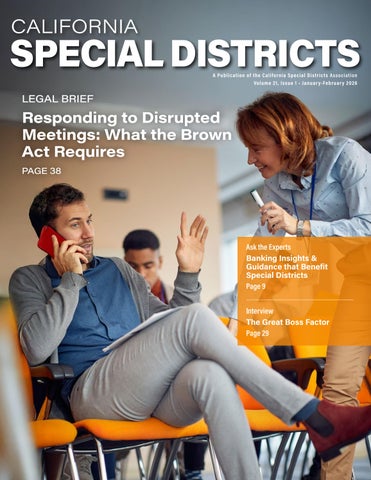
Responding to Disrupted Meetings: What the Brown Act Requires
By Chelsea Downes, Associate, Richards, Watson & Gershon
Public meetings do not always go as planned. Sometimes members of the public are passionate, loud, or downright disruptive. When disruption makes it impossible to continue a meeting, the Brown Act specifies how a legislative body may respond.
A recent California Court of Appeal decision in Berkeley People’s Alliance v. City of Berkeley (2025) underscores the strict requirements of Government Code Section 54957.9 when a public meeting is willfully disrupted.
At a series of Berkeley city council meetings, the mayor determined that business could not continue because of ongoing disruption from audience members. In response, the city council recessed and reconvened the meetings in a smaller room. Press representatives were permitted to attend the reconvened sessions in person, but the public was allowed to attend only by video. The Berkeley People’s Alliance alleged that the city violated the Brown Act by relocating the meetings rather than clearing the room and
continuing in the original space, and by failing to attempt to remove the individuals causing the disruption before taking broader action.
The Statutory Framework
The Brown Act guarantees public access to meetings of local legislative bodies, including city councils and special district boards. The statute’s open meeting provisions ensure transparency in government decision-making and facilitate public participation.
However, the promise of open and accessible meetings is not absolute. Government Code Section 54957.9 recognizes that public meetings can sometimes be disrupted. Section 54957.9 provides that if a meeting “is willfully interrupted by… group(s) of persons” so that orderly conduct is rendered “unfeasible” and if order cannot be restored by removing the disruptive individuals, a legislative body may “order the meeting room cleared and continue in session.” The statute further declares that press representatives
may remain in the room unless they were part of the disturbance. Finally, the statute allows a legislative body to adopt a procedure for readmitting individuals who did not participate in the disruption.
Before the Berkeley decision, some local agencies had interpreted Section 54957.9 as allowing a meeting to be recessed and reconvened in a different location if disruption made continuing in the original space impractical. The Berkeley city council took precisely that approach.
What the Court Decided
The court of appeal strictly interpreted Section 54957.9 and ruled against the city. Examining the plain text, the court emphasized that the statute requires that the “meeting room” be “cleared” and that the meeting continue “in session” in the same room. The court interpreted the phrase “order the meeting room cleared” to mean that a legislative body can empty the same room of its occupants, but cannot move the meeting elsewhere.
The court reasoned that, instead of authorizing relocation, the Legislature prioritized clear, consistent notice of a meeting’s physical location to ensure the people’s access to public business. In the court’s view, relocating the meeting effectively denies non-disruptive members of the public their right to attend in-person, a right that the Brown Act was designed to protect. Therefore, recessing the meeting and reconvening elsewhere does not satisfy the statutory obligation.
What the Court Did Not Decide
The court of appeal did not address the claim that the city violated the Section 54957.9 by failing to attempt to remove disruptive individuals before relocating to a different room. The statutory text implies a sequence in which a legislative body first tries to remove the disruptive individuals before turning to the broader remedy of clearing the room entirely. However, the court did not resolve whether such action is a prerequisite for a
legislative body to clear the room of a disrupted meeting. Nor did the court address what efforts, if any, a legislative body must make to identify and remove disruptive individuals before ordering a full clearing of the room. These omissions leave local agencies without appellate guidance on how rigorous their initial steps must be before clearing the room.
What This Means for Districts
The Berkeley decision carries important implications for special districts and other local agencies.
• When a meeting becomes unmanageable due to willful disruption, recessing and reconvening in a different room is not an option.
• The proper procedure is to clear the original room and continue the meeting in the same space. Clearing the room requires removing all attendees except nondisruptive press representatives. Agencies may adopt a procedure for readmission of non-disruptive individuals after order is restored.
• Agencies should review their meeting rules and procedures to ensure compliance with the court’s interpretation of Section 54957.9. This includes training presiding officers and staff on the correct steps to take when facing disruptive behavior.
Bottom Line
The Berkeley decision reinforces the fundamental purpose of the Brown Act to guarantee public access, transparency, and accountability in local government decision-making. By strictly interpreting the statutory options available to local agencies responding to willful disruptions, the court underscored that exceptions to access and openness must be narrowly construed.
Chelsea Downes is an associate in the Public Law Department at Richards, Watson & Gershon. She advises local governments and other public agencies on a wide range of municipal law issues, including governance, regulatory compliance, and public policy.


Industry Insights

Future-Proofing Your District: Technology Planning for Board Members and Trustees
By Ammon Becar, Senior Strategic Advisor, VC3
As a board member or trustee of a special district, you play a pivotal role in ensuring that appropriate IT resources are allocated to prevent cybersecurity threats or operational disruptions from affecting critical services. With technology and cybersecurity evolving so fast, it’s difficult to sift through the noise—what matters, and what doesn’t. Limited budgets mean you need to maximize funds and not waste dollars on unnecessary technology.
This article shares some ways that you can futureproof your district by understanding technology trends, strengthening your strategic IT planning, ensuring your special district invests in cybersecurity essentials, and engages stakeholders appropriately.
Understanding Technology Trends
Effective technology planning begins with the understanding that a spectrum of technology needs exist:
• Baseline: These are must-haves for secure, efficient operations. Lacking solutions such as multifactor authentication (MFA) and endpoint detection and response (EDR) can be considered negligence.
• Foundational: These are emerging essentials such as cloud services and outsourced 24/7 cybersecurity teams that will soon become baseline.
• Evolving: Technologies such as AI or mobile device management (MDM) that are not yet critical but can boost productivity, efficiency, and security.
• Innovative: Cutting-edge technologies to keep on your radar such as blockchain or 5G.
While it may not be your job to stay on top of cutting-edge technology, it’s good to have this framework in mind when professionals evaluate your IT plan. Regularly assess which technologies are moving from “nice-to-have” to “musthave” so that you don’t fall behind.
Why Strategic IT Planning Matters
A proper IT strategy is the process of planning for information technology in a way that aligns with and enables your organizational objectives. Without a strategic IT plan, special districts risk:
• Outdated systems and poor performance
• Security vulnerabilities and data breaches
• Expensive, complex upgrades
• Inefficient resource allocation
• Cybersecurity gaps and regulatory non-compliance
The root cause of most IT problems? Lack of planning. A technology roadmap should include:
• Budget and priorities
• Known risks and remediation plans for those risks
• Timelines for implementation
• Alignment with organizational objectives
In this sense, you’re treating IT like any other department—with objectives, metrics, and targets.
Here’s how to get your plan in order.
1. START WITH A THOROUGH ASSESSMENT.
This involves evaluating your current infrastructure, systems, and processes while engaging with any relevant stakeholders to understand your special district’s goals and requirements. It’s also important to review your current technology solutions for effectiveness, scalability, and the ability to comply with regulatory requirements.
2. SET GOALS AND PRIORITIES.
Once you identify risks, prioritize them based on impact and likelihood. When you have a handle on your current lay of the land, some priorities will emerge. If your IT situation is chaotic and unpredictable, you’re likely going to have some catch-up to do in order to build a stable IT foundation upon which to grow.
3. ALIGN IT WITH SPECIAL DISTRICT OBJECTIVES. IT goals should support your overall organizational goals and objectives. For example, you might want to transition legacy systems and data storage to cloud-based solutions to increase scalability, reduce costs, and improve disaster recovery capabilities.
Cybersecurity: A Growing Threat
As part of your future-proofing, it’s essential to stay on top of cybersecurity threats. A few trends should make you sit up:
• Access to user credentials by cybercriminals continues to increase.
• Hackers continue to exploit software vulnerabilities and outdated operating systems through zero-day
vulnerabilities, support of sophisticated nation states, and going after soft targets (like your special district!).
• Cyber threat detection has become a bigger issue. Once inside your systems, hackers often remain undetected for many, many months.
So where do you begin? Key baseline investments include:
• Software patching
• MFA
• EDR
• Data backup and disaster recovery
• Employee policies and training
• Email and web filtering
• Dark web credential monitoring
• Cyber insurance
• 24/7 Monitoring
Implementation, Monitoring, and Reporting
All the planning in the world is useless unless you are able to effectively implement, monitor, and report upon your IT plan. The success of your planning depends on:
• Your project management and change management frameworks
• Clear communication plans
• Performance monitoring, stakeholder feedback, and periodic reviews to aid continuous improvement
• Documentation and reporting mechanisms to keep stakeholders informed and ensure accountability
Let Technology Spur Your Vision
In the end, your future-proof strategic IT plan should connect your district’s vision with your technology investments. To think as broadly as possible, it helps to build a project list, consider your operational goals, and ask yourself what would make residents happier through the aid of technology.
When presenting any IT plan, link technical investments to tangible benefits such as security, productivity, and service quality. For example, the use of a managed service provider may connect to existing risks related to cybersecurity, data loss, and compliance.
Ready to future-proof your district? Start with a strategic plan, prioritize risks (including cybersecurity), and let technology drive your vision forward.

Money Matters
Smart Cash Flow and Management Practices for California Special Districts
By California CLASS Relationship Team
For California special districts, a sound cash flow and cash management practices are the foundation for delivering services, planning capital projects and navigating economic uncertainty. Regardless of your special district size, having a clear grip on your cash flow is critical to making smart financial decisions and maintaining long-term stability.
Understanding Cash Flow
Cash flow refers to the timing and movement of money in and out of special districts. A good cash flow forecast brings peace of mind that you have sufficient liquidity to support daily operations. Property tax receipts, grant payments and other types of revenues make up the inflows, while payroll, vendor payments and debt obligations are your typical outflows.
In California, many public agencies and special districts face seasonal cash flow swings, with property taxes being collected in lump sums twice a year. That means managing the timing mismatch between cash inflows and outflows is a top priority.
Build a Cash Flow Forecast (and Keep It Updated)
A cash flow forecast should be your first line of defense. It doesn’t have to be overly complex, but it should show expected revenues for the next 12 months.
Make sure to:
• Include timing of property tax receipts and shared revenue distributions.
• Account for big expenses like debt service or capital expenditures.
• Update the forecast regularly, at least quarterly, to reflect actual cash position.
This forecast helps identify potential shortfalls ahead of time so you can act before a problem arises.
Segment Your Cash
Think of your cash in three buckets:
1. Short-Term/Operating: Needed for day-to-day expenses. Funds should be accessible in low-risk, liquid accounts such as a local government investment pool like California CLASS, a money market fund, or a checking account.
2. Intermediate Term: Set aside for emergencies or budget shortfalls. These funds can be invested but may be needed within 3-12 months. An investment tool like California CLASS Enhanced Cash can help your entity diversify its cash for its intermediate investment needs.
3. Long-Term Reserve: Funds not needed for 12 months or more. Special districts optimize returns through careful investing in approved vehicles like California CLASS, California CLASS Enhanced Cash, CDs, or a customized portfolio of high-quality fixed income securities (Treasuries, municipal bonds, etc.).
By investing according to each segment’s investment horizon (the length of time funds are expected to remain invested before they are needed for their intended purpose), you reduce the risk of having to tap long-term investments early and ensure each dollar is working appropriately based on its purpose.
Optimize Your Investment Strategy
Optimized cash flow management will confirm a special district’s ability to meet its liabilities and identify opportunities to invest idle cash. Cash flow models can provide tailored investment strategies alongside cash flow insights to take advantage of higher rates by investing out on the yield curve, locking in returns (fixed rates), and structuring investment maturities to meet your entity’s needs. California CLASS can be a great tool for managing shortterm cash, offering daily liquidity and competitive rates. A comprehensive cash flow analysis will help to ensure your investment strategy aligns with your cash flow needs.
A thorough cash flow analysis enables special districts to maintain essential liquidity, and helps prevent premature investment liquidation when cash demands arise.
Are You Prepared?
Cash flow management may not be glamorous, but it’s an important responsibility in local government finance. With thoughtful forecasting, disciplined cash segmentation, and proactive investment strategies, special districts can stay agile, resilient, and ready to meet today’s demands and tomorrow’s opportunities.
Now is the time to revisit cash management systems. With interest rates decreasing and economic uncertainty, every dollar matters. California CLASS can help make every dollar count. Connect with us today at www.californiaclass.com/learn-more.
PTMA Financial Solutions, Public Trust Advisors, LLC, PMA Financial Network, LLC, PMA Securities, LLC and PMA Asset Management, LLC (collectively “PTMA”) are under common ownership. Public Trust Advisors, LLC and PMA Asset Management, LLC, are two separate SEC registered investment advisers, both doing business as PTMA Investment Advisors. PMA Securities is a brokerdealer and municipal advisor registered with the SEC and MSRB and is a member of FINRA and SIPC. Registration with the SEC does not imply a certain level of skill or training. Marketing, securities, institutional brokerage services and municipal advisory services are offered through PMA Securities, LLC. PTMA Investment Advisors provides investment advisory services to the Fund. Any other products are provided by PMA Financial Network, LLC. For more information visit https://ptma.com/.
©2025 PTMA Financial Solutions
CSDA Finance Corporation Achieves Record-Breaking Year with $167 Million in Financings
The CSDA Finance Corporation (CSDAFC) celebrated a milestone year, setting a record with over $167 million in financing facilitated. While our team of consultants is proud of the accomplishment, they’re even more proud of what those funds are doing in communities statewide.
This year covered a wide-ranging portfolio of projects including critical water system improvements that ensure safe, reliable service for residents; building renovations to modernize aging facilities; timely, strategic land purchases to prepare for future development; vehicle acquisitions for daily operations; and local park enhancements that bring communities together. Most of all, these financing options allow districts to address immediate needs while maintaining short-term fiscal flexibility and ensuring cost equity across generations. Visit csdafinance.net or call 877.924.2732 for more information or to submit a quote request.


AllPaid www.AllPaid.com


DIAMOND LEVEL
Amazon Business www.csda.net/amazon-business
California CAD Solutions (CALCAD) www.calcad.com
California CLASS www.californiaclass.com
Columbia Bank www.columbiabank.com
CPS HR Consulting www.cpshr.us


VC3 www.vc3.com
PLATINUM LEVEL
Atkinson, Andelson, Loya, Ruud & Romo www.aalrr.com
Best Best & Krieger www.bbklaw.com
Five Star Bank www.fivestarbank.com


CSDA Finance Corporation www.csdafinance.net
Enterprise Mobility www.enterprisemobility.com
GovDeals www.govdeals.com
Special District Risk Management Authority www.sdrma.org
Streamline www.getstreamline.com
Utility Cost Management, LLC www.utilitycostmanagement.com

Tri Counties Bank www.tcbk.com
Liebert Cassidy Whitmore www.lcwlegal.com
Platinum Strategies Inc www.platinumstrategiesinc.com
Richards Watson Gershon www.rwglaw.com
Keeping Service and Information Flowing at Ironhouse Sanitary District
By Kristin Withrow, Senior Communications Specialist, CSDA
For the Ironhouse Sanitary District in Oakley, accurate information is central to their responsibility to ensure fairness, transparency, and reliable service for the 47,000 residents they serve. That commitment led the district to expand its use of GIS technology in partnership with CALCAD, an endorsed CSDA Business Affiliate.
Ironhouse Sanitary District initially engaged CALCAD to modernize its approach to auditing tax records tied to their billing system. Properties may be connected to the sewer system without being properly reflected in tax records—resulting in services being used without equitable cost sharing.
Seeing the value of GIS for data integrity, the district expanded its use to support new subdivision development. Historically, subdivision maps were often filed with the county after neighborhoods were established. CALCAD streamlined this process by accessing county records and creating tracked subdivision maps with hotlinks to new service locations.

According to District Engineer Danea Gemmel, GIS mapping enabled the district to clearly visualize authorized and unauthorized connections. As a result of the new information, “we conducted outreach with different unauthorized connections to establish proper billing, connection fees, and past-due service fees,” Gemmel explained. Using simple red and green indicators on a GIS map, the district can now quickly identify billing accuracy across residential and non-residential properties.
The new maps allow the district to respond quicker to new service requests while ensuring safety to infrastructure and residents. When a request came in for a pool permit near an easement, Gemmell was able to identify a risk to a main line that was mere feet from the proposed site. The accurate information allowed the district to require the plan be redesigned to honor a 15foot setback off the easement to protect the main line. A construction error or future break from a pool next to a water main would have had severe consequences for everyone along that main line.
“Smaller districts need partnerships for GIS due to staff size,” Gemmel said. “CALCAD has provided such excellent service that we haven’t needed anything more.”
GOLD LEVEL
Brown Armstrong Accountancy Corporation www.bacpas.com
California Bank of Commerce www.californiabankofcommerce.com
Centric Business Solutions www.centricabusinesssolutions.com
Cole Huber LLP www.colehuber.com
Complete Paperless Solutions www.cps247.com
Easeworks www.easeworks.com
Energy Systems Group www.energysystemsgroup.com
Harshwal & Company LLP www.harshwal.com
Kosmont Financial Services www.KosmontFinancial.com
National Demographics Corporation (NDC) www.ndcresearch.com
www.nbsgov.com
Nossaman, LLP www.nossaman.com
Redwood Public Law, LLP www.redwoodpubliclaw.com
River City Bank www.rivercitybank.com
SiteLogiq www.sitelogiq.com
Townsend Public Affairs www.townsendpa.com
Tyler Technologies, Inc. www.tylertech.com


