
California Special Districts Alliance
The California Special Districts Alliance is a collaborative partnership between the California Special Districts Association (CSDA), the CSDA Finance Corporation (CSDAFC), and the Special District Risk Management Authority (SDRMA). These three highly respected statewide organizations join forces to help special districts in California better serve their communities.
CSDA Board and Staff
OFFICERS
LORENZO RIOS, CSDM, PRESIDENT, Clovis Veterans Memorial District
PETER KAMPA, CSDM, VICE PRESIDENT, Groveland Community Services District
DON BARTZ, CSDM, SECRETARY, Phelan Pinon Hills Community Services District
ANTONIO MARTINEZ, TREASURER, Contra Costa Water District
ELAINE MAGNER, PAST PRESIDENT, Pleasant Valley Recreation and Park District
MEMBERS OF THE BOARD
RYAN CLAUSNITZER, CSDM, Alameda County Mosquito Abatement District
SCOTT DUFFIELD, CSDM, Heritage Ranch Community Services District
VINCENT FERRANTE, Moss Landing Harbor District
CURTIS JORRITSMA, Hilmar County Water District
JO MACKENZIE, Vista Irrigation District
NOELLE MATTOCK, El Dorado Hills Community Services District
GREG P. ORSINI, McKinleyville Community Services District
PATRICK OSTLY, North of River Sanitary District #1
STEVE PALMER, Donner Summit Public Utilities District
KEVIN PHILLIPS, Paradise Irrigation District
FRED RYNESS, Burney Water District
KATHRYN SLATER-CARTER, San Mateo County Harbor District
NIKKI WINSLOW, Altadena Library District
STAFF
NEIL MCCORMICK, Chief Executive Officer
MEGAN HEMMING, Chief Professional Development Officer
MUSTAFA HESSABI, Chief Counsel
KYLE PACKHAM, Chief Advocacy & External Affairs Officer
CASSANDRA STRAWN, Chief Member Services & Communications Officer
RICK WOOD, Chief Finance & Operations Officer
TOMICKO ABELLA, Member Services Representative
AARON AVERY, Director of State Legislative Affairs
BRITTNEY BARSOTTI, Legislative Representative
ANNA C. STAGG, Legislative Assistant
EMILY CHA, Database & Online Communities Specialist
MARCUS DETWILER, Legislative Representative
BRENT FARRAR, Design & Websites Manager
AUBREY GOHL, Member Services Representative
JOSE GUERRERO, Graphic Design/Video Specialist
COLLEEN HALEY, Public Affairs Field Coordinator
CASSIE HASKINS, Member Services Representative
LILIA M. HERNANDEZ, Associate Legislative Analyst
MORGAN LESKODY, Communications Specialist
MICHAEL MEYER, Member Services Manager
CHRIS NORDEN, Public Affairs Field Coordinator
RICHELLE NOROYAN, Public Affairs Field Coordinator
CHRIS PALMER, Senior Public Affairs Field Coordinator
AMBER PHELEN, Management Analyst
RACHAEL POPPINO, Professional Development Coordinator
OLIVIA ROBERTSON, Member Services Specialist
JENNIFER SMITH, Professional Development Coordinator
OPHELIA SZIGETI, Legislative Analyst
ANTHONY TANNEHILL, Legislative Representative
ERASMO VIVEROS, Public Affairs Field Coordinator
DANE WADLÉ, Director of State Field Operations
KRISTIN WITHROW, Senior Communications Specialist
SDRMA Board and Staff
OFFICERS
ROBERT SWAN, PRESIDENT, Groveland Community Services District
JESSE CLAYPOOL, VICE PRESIDENT,
Honey Lake Valley Resource Conservation District
THOMAS WRIGHT, SECRETARY, Clovis Veterans Memorial District
MEMBERS OF THE BOARD
ROBERT HOUSLEY, CSDM, Midway City Sanitary District
VIRGINIA CHANG KIRALY, San Mateo County Harbor District
SANDY SEIFERT-RAFFELSON, Herlong Public Utility District
MIKE SCHEAFER, Costa Mesa Sanitary District
STAFF
DEBBIE YOKOTA, CPCU, Chief Executive Officer
MATT CLUTTERBUCK, CPA, MBA, Chief Financial Officer
ENRIQUETA CASTRO, CSP, Chief Risk Officer
WENDY TUCKER, AU, Chief Underwriting Officer
ALANA LITTLE, Health Benefits Manager
DANNY PEÑA, SIP, WCCP, Workers’ Compensation Claims Manager
ROBERTO LOZANO, Liability Claims Manager
PETR KOVALCHUK, CPA, Finance Manager
JASON THORN, Data Architect
MARGARITO CRUZ, Senior Accountant
JUSTIN GUTIERREZ, Accountant Il
SOPHANRA CASTANAR, CSP, CHMM, Risk Control Manager
ERIC LUCERO, ARM, Senior Risk Control Specialist
GUILLERMO DE LA TORRE, Senior Risk Control Specialist
TAMARA BAKKIE, SIP, WCCA, Senior Workers’ Compensation
Claims Examiner
JOHN PESHKOFF, SIP, WCCA, Senior Workers’ Compensation
Claims Examiner
MARTHA WARREN, SIP, WCCA, Senior Workers’ Compensation
Claims Examiner
MICHELLE BROWN, Health Benefits Specialist II
TERESA GUILLEN, Underwriting Specialist II
KEITH IKAMI, Liability Claims Examiner II
LISA SANDOVAL, Underwriting Specialist II
CANDICE RICHARDSON, Management Analyst
MARIETTA HARRISON, SIP, WCCA, Future Medical Claims Examiner
CHER DARLING, Workers’ Compensation Claims Assistant
KOJI LO, Liability Claims Examiner I
AMY SUTHERLIN, Underwriting and Program Manager
CAMREN BUTLER, Program Specialist II
Special District Risk Management Authority
1112 I Street, Suite 300 Sacramento, CA 95814
tel: 800.537.7790 www.sdrma.org
CSDAFC Board and Staff
OFFICERS
JO MACKENZIE, PRESIDENT, Vista Irrigation District
VINCE FERRANTE, VICE PRESIDENT, Moss Landing Harbor District
ELAINE MAGNER, CSDM, SECRETARY, Pleasant Valley Recreation and Park District
GREG P. ORSINI, TREASURER, McKinleyville Community Services District
MEMBERS OF THE BOARD
RONALD COATS, DIRECTOR, East Valley Water District
PAULA HANSEN, CSDM, Southgate Recreation & Park District
GLENN LAZOF, Regional Government Services Authority
CONSULTANTS
RICK BRANDIS, Brandis Tallman, a Division of Oppenheimer & Co. Inc.
JEFF LAND Brandis Tallman, a Division of Oppenheimer & Co. Inc.
STEFAN MORTON, Municipal Finance Corporation
WILLIAM MORTON, Municipal Finance Corporation
ALBERT REYES, Kutak Rock LLP
DMITRY SEMENOV, Ridgeline Municipal Strategies, Consultant to the Working Capital Financing Program
NICOLE TALLMAN, Brandis Tallman, a Division of Oppenheimer & Co. Inc.
STAFF
NEIL MCCORMICK, Chief Executive Officer
DAVID MCMURCHIE, Legal Counsel
MICHAEL MEYER, Member Services Manager
AMBER PHELEN, Management Analyst
RICK WOOD, Chief Finance & Operations Officer
CSDA Finance Corporation 1112 I Street, Suite 200, Sacramento, CA 95814 tel: 877.924.2732 www.csdafinance.net
For editorial or advertising inquiries: Phone - 877.924.2732 Email - membership@csda.net
California Special Districts Association 1112 I Street, Suite 200 Sacramento, CA 95814
toll-free: 877.924.2732 www.csda.net


Leading Locally: A Moment for Special Districts to Engage and Inspire

“
Special districts reflect the best of America— local leaders, working together, delivering for their communities. When we engage, we don’t just serve—we strengthen the future.”
Lorenzo Rios President, CSDA
As America approaches its 250th anniversary, special districts have a unique opportunity to strengthen community connection, elevate service, and lead at the local level.
As our nation approaches the 250th anniversary of American independence, we are reminded of a simple truth: America is strongest when leadership begins at the local level. This milestone is more than a moment to reflect, it is an opportunity to lead, to connect, and to renew the spirit of service in our communities. From the beginning, our country has been built by neighbors stepping forward to solve problems, serve others, and build something greater than themselves. Special districts carry that tradition forward every day. As the most local and specialized form of governance, we deliver the essential services that families rely on, and businesses depend on to grow and succeed.
This anniversary invites us to do more. It calls on us to open our doors, share our story, and strengthen the bond between the services we provide and the people we serve. Through community engagement, education, and partnership, we can remind our communities that government works best when it is closest to the people.
Just as important is how we support one another. Special districts are stronger together. Across California, our local chapters bring that principle to life offering not only education, but connection. They create space to exchange ideas, share local insights, and learn from one another’s experiences. In those rooms, relationships are built, challenges are met, and solutions take shape.
I also want to recognize the work you do each day. Your service matters. And you are not alone in that mission.
The California Special Districts Association is here to support you, but it only works if it is used. Engage. Participate. Attend programs like the General Managers Leadership Summit or the Annual Conference. Use the Knowledge Base resources. Ask questions. Learn from peers who stand ready to help.
There is no reason to suffer alone.
As we look to America’s 250th, let us lead with purpose, stand together in service, and build communities that reflect the very best of who we are, and who we are called to be.
Lorenzo Rios, CSDM, President
CSDA News
SB 827 Implementation is Taking Center Stage
Upcoming sessions and workshops will help districts understand new fiscal training requirements, timelines, and compliance expectations.
SB 827 establishes a new statewide requirement for fiscal and financial training designed to strengthen transparency, accountability, and public trust in local agency governance. The law directly impacts special districts, requiring board members, general managers, and key staff to complete the training.
The training itself covers core topics such as municipal budgeting, financial reporting, capital financing, debt management, and the ethical stewardship of public resources, along with broader legislative updates and CSDA resources to support ongoing compliance.
UPCOMING IN-PERSON TRAININGS (JUNE–OCTOBER):
• June 3 (Truckee)
• June 9 (Fresno)
• June 24 (Fountain Valley)
• September 9 (San Bernardino)
• October 14 (Ashland)
• October 27 (Redding)


Just Released! 2026 Buyers Guide
This issue features the newly released CSDA Buyers Guide, a go-to resource designed to support your district’s evolving needs. Inside, you’ll find a curated directory of CSDA Business Affiliates offering essential products and services, making it easier to connect with trusted partners year-round.

The online Buyers Guide at csda.net expands these options even further, including additional Bronze-level affiliates for greater flexibility and convenience. Whether you prefer print or digital, the CSDA Buyers Guide is built to simplify purchasing decisions and help move your district forward with confidence.
New! California CLASS Term Series II
Learn about the new California CLASS Term Series II, a new fixed-rate investment option designed to provide an additional tool for managing liquidity and yield. Term Series II is a pooled investment vehicle designed to deliver a fixed rate of return while prioritizing capital preservation, planned-date liquidity, and competitive yields, built on the same high-quality credit exposures as the California CLASS Prime Fund. Watch the webinar to learn more at https://californiaclass.com/term-series-ii/
Modern Websites for Modern Districts


ProDev
Saddle Up, Partners: The 2026 CSDA Annual Conference & Exhibitor Showcase is Ready to Ride
Saddle up and get ready for the 2026 CSDA Annual Conference & Exhibitor Showcase, riding into Palm Desert August 24–27, 2026, at the beautiful JW Marriott Desert Springs Resort & Spa. This Western-themed conference brings together special district leaders from across California for learning, connection, and a little desert-style fun.
Kick off the week with one of three optional pre-conference workshops, a Chapter Leaders Meeting, or other optional activities including pre-conference golf, a tour and a friendly pickleball event with the Desert Recreation and Park District—proof that networking is better under wideopen skies.
The heart of the conference features 45+ breakout sessions covering essential topics such as governance, new laws, finance, and succession planning. Attendees will hear directly from fellow districts, gaining practical insights and


real-world examples of programs and strategies that have worked in communities across the state.
The conference will also shine a spotlight on excellence with recognition of this year’s CSDA Annual Award winners. The conference opens with keynote Ben Nemtin, sponsored by California CLASS, presenting “Powered by Purpose.” On Wednesday, keynote Kyle Scheele, sponsored by SDRMA, will deliver “Thinking Inside the Box: How Tough Times Fuel Creativity and Innovation.”
A highlight of the week is the Special District Leadership Foundation event, Boots and Bites, featuring line dancing lessons, a country DJ, and great food.

From sunrise sessions to sunset socials, the 2026 CSDA Annual Conference promises inspiration, education, and unbeatable Western hospitality.
SHARE YOUR SHARE YOUR
DISTRICT
STORIES STORIES & PHOTOS & PHOTOS

CSDA launched a portal for members to submit your success stories, press releases, news, and more for consideration in our digital and print publications. Have some eye-catching photos you’d like to share? We’d love those, too!
Dates & Deadlines
2026 CSDA Webinars
Maximize Your Membership:
CSDA Career Center
June 8
From Policy to Practice: Implementing
Effective Reserve Strategies
June 9
Grant Writing in Today’s Funding Landscape
June 16
SB 827 Fiscal & Financial Training
June 17
Copyright, Trademark & Brands: Legal and Practical Perspectives for Public Agencies
June 18
How Years of Federal Policy Shifts Have Impacted Your Agency’s Ability to Borrow Money
July 21
Securing Your Greatness in the Eyes of the Public
September 8
Mastering Difficult Conversations at Work
September 22
2026 CSDA Workshops (Virtual & In-Person)
In-Person Workshop: SB 827 Required Training -Navigating Governance and Finance in Special Districts (Truckee)
June 3
In-Person Workshop: Navigating Governance and Finance in Special Districts (Fresno)
June 9
Virtual Workshop: Overview of Special District Laws
June 10–11
In-Person Workshop: Navigating Governance and Finance in Special Districts (Orange County)
June 24
Pre-GM Summit Workshop: So, You Want to Be a General Manager?
June 28
Pre-GM Summit Workshop: Crisis-Ready Leadership
June 28
Pre-Annual Conference Workshop: SDLA Module 1 – Governance Foundations
August 24
Pre-Annual Conference Workshop: So, You Want to Be a General Manager?
August 24
Virtual Workshop: SDLA Module 3 –The Board’s Role in Finance & Fiscal Accountability
September 2–3
2026 CSDA Conferences
General Manager Leadership Summit
June 28–30; Newport Beach
Special District Leadership Academy
July 19–22; Early Bird ends June 19 – San Rafael
Annual Conference & Exhibitor Showcase
August 24–27; Early Bird ends July 22 – Palm Desert
Special District Leadership Academy
September 13–16; San Luis Obispo
Board Secretary/Clerk Conference
November 3–5; Santa Barbara

To view more details and to register for conferences, events, workshops or webinars go to the CSDA Events
Page https://qrco.de/bddc8t


2026 Student Video Contest: That’s a Wrap
By Kristin Withrow, Senior Communications Specialist, CSDA
The 2026 Annual Student Video Scholarship Contest has officially wrapped up! We received video entries from students in 27 states, each offering a unique take on how special districts serve their communities. This contest is sponsored by the National Special Districts Association, of which the California Special Districts Association is a founding member. Each year, students learn a lesson in local government that many of their parents don’t understand, and that is entirely the point!
We’ll be announcing this year’s winners in the next issue, and we’re excited to share the standout work that rose to the top. This contest is about raising awareness. Special districts are a vital part of local government, but they are often mistaken for city or county services. Most people interact with them regularly—through water service, parks, fire protection, and more—without ever knowing what a special district is. That’s what makes this program so valuable. It introduces students to the idea that these agencies exist because communities saw a need and chose to fill it in a focused, local way.
As students dig into their projects, something clicks. They consider how services they rely on are delivered every day, and why that local focus matters. What’s more, teachers, parents, and classmates all become part of the conversation, helping spread awareness in a very organic way.

Each year, videos highlight how special districts are closely aligned with the communities they serve—something that can be harder to achieve at broader levels of government. It’s a simple idea, but an important one, and students bring it to life in ways that feel genuine and relatable.
As we close out this year’s contest, we hope you’ll continue following along throughout the year. There are great stories being told about special districts every day, and we love sharing them. You can find us on social media at @ localdistricts—we’d appreciate the follow and the chance to connect. Better yet, tag us in your district’s posts and we will help boost your visibility!
You can also visit the Districts Make the Difference website, www.districtsmakethedifference.org, where we regularly post articles highlighting the work districts are doing across the U.S. It’s a steady reminder of just how much these agencies contribute to the quality of life in our communities.
A big thank you to every student who participated, and to the teachers and families who supported them along the way. This program is doing exactly what it set out to do—helping more people understand the role of special districts—and it’s exciting to see that awareness grow year after year.

SINGLE SOURCE COMMUNICATIONS
From strategy to execution, Tripepi Smith helps special districts communicate with clarity and purpose. We partner with your team to elevate your message, engage your community and build trust when it matters most. We offer:
• Communications support and outreach
• Recruitment and organizational development
• Graphic design and branding

• Photography and videography
• Web design and support
• Media intelligence
Finding the right hire takes more than a job posting. Tripepi Smith Talent Solutions is a multifaceted recruitment consultancy service that combines local government access with communications to advance talent quests.
We help special districts recruit, attract and hire candidates who align with your agency’s goals, culture and community.

Ask the Experts
Scroll-Stopping Strategy: Building a Digital Bridge to Your Constituents
By Jennifer Nentwig (APR-M), Principal, Tripepi Smith
For many public agencies, social media began as a straightforward tool for transparency and a reliable place to share office closures, holiday hours or press releases. However, as constituents increasingly turn to platforms like Instagram, Facebook or Nextdoor for real-time interaction, there is a growing expectation for agencies to evolve their digital presence into a dynamic, twoway conversation.
At Tripepi Smith, we have found that the secret to social media success isn’t just “being online.” It’s about having a plan that intentionally cultivates community. Whether you are building a comprehensive social media strategic plan or launching a highimpact campaign, such as our work for the Costa Mesa Sanitary District (CMSD), the foundation remains the same: High-impact creativity must be rooted in strategic planning.
Start with “Why”: The Comms Assessment
Before drafting a post or filming a Reel, you must develop a solid strategy. When we partnered with CMSD, we didn’t jump straight into content creation. Instead, we began with a comprehensive communications assessment.
An assessment identifies the current strengths of your digital presence and uncovers new opportunities. It asks: Who is actually following us? What information is the community looking for? How can we make our technical expertise more accessible? For CMSD, this meant evaluating their existing reach and identifying that the community needed clearer information regarding core services like organics recycling and proper waste disposal. By auditing the “current state” and implementing a strategic roadmap over a five-year partnership, we helped drive customer satisfaction from 72% to over 91%.
The Kickoff: Questions to Ask
To build a proactive strategy, gather your team and answer these critical questions to align your goals:
What is the primary objective? Is the goal to inform, engage, celebrate or educate?
Who is the audience? A retiree on Facebook has different information needs than a contractor on LinkedIn. Defining age, geography and digital literacy is essential to ensure your message is valued.
Identify the Motivators: What does your audience already care about? Instead of a dry “compost your food scraps,” try a value-based approach: “fight climate change from your kitchen.”
Define the Barriers: Are you facing public misconceptions, a low following or resistance to new regulations? Identifying these early allows you to pivot your messaging to address them head-on.
Tools and SMART Goals
Effective strategy requires a functional toolkit. Tripepi Smith recommends using a content calendar to plan weeks in advance, as well as leveraging brand and style guides to keep your agency’s visual brand professional and consistent. Most importantly, define success using SMART goals (Specific, Measurable, Achievable, Relevant and Time-bound). Rather than aiming for “more followers,” set a target to “increase Instagram engagement by 15% by the end of Q4 through three educational Reels per month.”
Case Study: Costa Mesa Sanitary District
Our work with CMSD demonstrates how targeted campaigns — informed by an initial assessment — can advance your organizational goals. By developing a comprehensive communications assessment and implementing strategic campaigns across social media, we helped CMSD increase awareness of their programs and services while increasing customer approval.

See the Strategy in Action: Scan the QR code to the left to read the CMSD case study and see how strategic planning leads to measurable community impact.
The Bottom Line
A social media strategy is not a static document. It is a living map that evolves with your community’s needs. By starting with an assessment, asking the right questions and consistently measuring against SMART goals, your agency can move beyond simple broadcasting and start building an engaged, digital community.


The Mojave Water Agency Board of Directors has selected Marina West, PG, as its 2026 President following its annual reorganization. West, who represents Division 2 and was first elected in 2022, brings more than 38 years of experience in the water industry.
A licensed professional geologist, West has focused her career on sustainable water management, regulatory compliance, and system reliability, particularly for small and disadvantaged communities. She also serves as Vice Chair of the Community Water Systems Alliance and as Director/Treasurer for the CalMutuals Joint Powers Risk and Insurance Authority.

The Reclamation District 1000 Board of Trustees has appointed Howard Chan to serve as Trustee, filling the remaining term of former Trustee Ed Perez. Chan brings extensive public sector leadership experience, including his recent role with the City of Sacramento, where he served as city manager and now holds a senior advisory position.

San Gorgonio Pass Water Agency has appointed Jennifer Ustation as Chief Financial Officer. A longtime local finance leader, Ustation joins the agency from the City of Beaumont, where she served as Finance Director.
Ustation brings more than a decade of municipal finance experience, with expertise in budgeting, audits, compliance, capital planning, and investment management. She is actively involved with the Government Finance Officers Association and holds the Certified Public Finance Officer designation.

The Bighorn-Desert View Water Agency Board of Directors has selected Jennifer Cusack as General Manager. Cusack brings more than 20 years of experience in public agency leadership, utility operations, government affairs, and community engagement. She currently serves as Director of Public & Government Affairs at Hi-Desert Water District, where she has led legislative strategy, community engagement, and grant development, helping secure significant funding for infrastructure and water resiliency projects. The Board also recognized retiring General Manager Marina West for her decades of leadership and service.

Cordova Recreation & Park District
Director Rick Sloan was honored with the Cordova Community Council’s Distinguished Community Service
Individual Award at the Annual Community Volunteer Awards on March 13. Sloan has served on the district’s Board of Directors since 2008, bringing more than 17 years of dedicated public service focused on community needs.
During his tenure, the district has earned regional and statewide recognition for excellence in parks, programming, and financial stewardship. Sloan was recognized for his leadership and ongoing contributions to the Rancho Cordova community.
Jennifer Ustation
Jennifer Cusack
Marina West
Rick Sloan
Howard Chan

Oxnard Harbor District Commissioner Celina Zacarias received Women’s Economic Venture’s 2026 Trailblazer award.
“I’m so fortunate to work alongside amazing and inspiring women such as our Port CEO Kristin Decas and CSUCI President Susan Andrzejewski, who are trailblazers in their respective careers,” Zacarias said.
In 2020, Zacarias became the first Latina elected as Oxnard Harbor District Commissioner, where she helps set policy and guide activities at the Port of Hueneme.
“We’re grateful to have Commissioner Zacarias’ tireless leadership and have seen first-hand the many ways her efforts have brought tangible benefits to those living in and around the Oxnard Harbor District,” said CEO and Port Director Kristin Decas.

The San Diego County Water Authority Board of Directors unanimously elected Carlsbad City Councilmember Teresa Acosta as board
secretary. She succeeds Joy Lyndes, who announced she will not seek reelection to the Encinitas City Council. Acosta, who has represented Carlsbad’s District 4 since 2020, currently serves as vice chair of the Authority’s Legislation and Public
Outreach Committee and sits on the Administrative and Finance Committee. She also serves as First Vice President of the League of California Cities and is set to become president in September 2026.

The Valley-Wide Recreation and Park District Board of Directors has selected Gustavo Bermeo as General Manager, effective May 1, 2026, following the retirement of Dean Wetter.
Bermeo brings 25 years of experience with the district, having started in 2000 and most recently serving as Assistant General Manager since 2018. His career spans roles in recreation services, special projects, and administrative leadership, supporting programs, personnel development, and district operations.
MOVERS & SHAKERS

Mark Hornstra has been announced as the new General Manager at Cameron Park Community Services District. Formerly the district’s Parks and Facilities Supervisor, Hornstra brings a strong commitment to public service and community-focused leadership to his new role. He has held various leadership positions in parks and recreation, including serving as General Manager of the El Dorado Hills Community Services District. With experience in both the private sector and local government, Mark has developed a well-rounded background in capital planning, budgeting, parks and facilities management, and public agency operations. He is known for his collaborative leadership style, emphasizing transparency, accountability, and responsive service to residents.
He shared “We have so many great opportunities. The key is prioritizing them. There’s a lot of work to be done.” He’s grateful for the opportunity to serve as General Manager, noting, “We have an amazing staff.
Celina Zacarias
Gustavo Bermeo
Mark Hornstra
Teresa Acosta
Got Governance?

Supercharging Community Support with Customer Advisory Committees (CACs): Why Public Education & Engagement Matter!
By Hilary Straus, General Manager, Citrus Heights Water District
Over the past 30 years, public education and engagement in local government have undergone a quiet but profound transformation. For special districts, these shifts are not just communications trends—they are governance imperatives. From a board perspective, investing in thoughtful, proactive engagement is no longer optional; it is essential to informed decision-making, community trust, and long-term success.
From Reactive to Proactive
One of the most significant changes has been the evolution from reactive to proactive engagement. Historically, agencies often communicated most actively when customers were upset—during rate increases, service disruptions, or controversial projects. Today, leading districts recognize the value of engaging early and often. Proactive outreach builds understanding before decisions are made, not after they are challenged. For Boards, this means fewer surprises, more informed public input, and ultimately, better policy outcomes.
Expanded Engagement
A second trend is the expansion of engagement beyond single issues. Public education is no longer confined to one-off campaigns tied to a specific project or rate adjustment. Instead, it increasingly spans the full range of services, programs, and policy areas that districts oversee. This broader approach helps constituents understand not just what a district does, but why it matters—creating a more informed and supportive customer base.
If You Don’t Tell Your Story Someone Else Will
At the same time, the communications landscape itself has fundamentally changed. Traditional and corporate-owned media outlets continue to shrink in reach and influence. In their place, a decentralized ecosystem has emerged— locally driven digital outlets, social media platforms like Facebook, X, and Nextdoor, and the rise of the “citizen journalist.” In this environment, the reality is clear: if your district does not tell its story, someone else will—and they may not have the full picture or the best intentions.

As a result, more special districts are making deliberate investments in multi-channel communication strategies. Effective programs blend digital tools—such as userfriendly websites, e-newsletters, and bill-pay pop-ups— with traditional methods like mailed newsletters, bill inserts, and door hangers. Many districts are also getting out into the community, presenting at homeowners’ associations and civic groups or conducting statistically valid surveys to better understand public priorities.
Customer Advisory Committees Diversify Perspectives and Build Rapport
Among the most impactful—and often underutilized— tools available to Boards is the Community or Customer Advisory Committee (CAC). While counties and cities have long relied on advisory bodies as part of a “farm system” for civic engagement, many special districts are just beginning to tap into this approach.
CACs provide a structured, transparent way to involve constituents in shaping policies, programs, and major projects before decisions are finalized. For Boards, this can be invaluable. A well-designed CAC brings diverse perspectives into the conversation, tests assumptions, and helps refine proposals in ways that reflect real community values. The result is not only stronger decisions, but also broader public understanding and support.
Importantly, CACs also serve as a pipeline for future leadership. While much attention has been paid to workforce succession planning in the face of the “silver tsunami,” far less focus has been placed on cultivating the next generation of community leaders. CACs help fill that gap by giving engaged residents a meaningful entry point into public service—often preparing them for future roles on Boards, commissions, or other civic bodies.
For special district Boards and executive teams, the takeaway is straightforward: proactive public education and engagement—and especially the strategic use of CACs—are powerful tools for both governance and community-building. They strengthen decision-making, enhance transparency, and build the durable public support needed to advance critical infrastructure and service investments.
To see how this approach works in practice, consider the Citrus Heights Water District’s use of a Customer Advisory Committee to help phase, cost, and fund a more than $500 million, 60-year water main replacement program. To learn more, join us for “Supercharging Community Support” at CSDA’s 2026 Annual Conference & Exhibitor Showcase in Palm Desert on Tuesday, August 25, 2026, or visit chwd.org/project-2030.
Tech Tips

Tracking AI in Water: New Online Resource
By Kristin Withrow, Senior Communication Specialist, CSDA
Water professionals can now explore the AI Water Tech Tracker at aiwater.tech. Developed by Amber Boone, M.S., M.P.A., General Manager of the South Orange County Wastewater Authority, the platform serves as a comprehensive, up-to-date database and tracking tool focused on AI-powered companies in the water and wastewater sector.
The tracker highlights innovative firms using AI to tackle challenges in utilities, treatment, distribution, and related operations. As of March 2026, it includes 53 companies, with an average business age of 9.2 years (48 of which maintain active websites).
Key Features
• Real-time monitoring, predictive analytics, and operational optimization tools
• Searchable, filterable listings across technologies and company stages
• Data export capabilities for analysis and research
• Community input through the ability to submit new companies
The platform offers a useful resource for utilities, researchers, investors, policymakers, and industry professionals looking to better understand how AI is shaping water intelligence—from leak detection and water quality monitoring to efficiency gains and predictive maintenance.
With its clean design and regularly updated directory (most recently refreshed in March 2026), the tracker provides a practical, go-to reference for navigating the rapidly evolving intersection of artificial intelligence and sustainable water management.
Don’t miss the General Manager Leadership Summit session titled AI for General Managers: From Insight to Impact with Amber Boone and Corey Kaufman from VC3. The session is designed to equip general managers with AI skills to boost operations, cut costs, and enhance decision-making. Interactive 45-min session with real examples and strategies.

In Review
Special Districts Legislative Days
Over 200 special district officials from throughout California came together April 7-8 to unite the voice of all types of special districts in furtherance of effective public policy for the communities they serve. CSDA scheduled 92 legislative meetings, giving attendees the opportunity to directly engage with policymakers on issues affecting their communities and districts.
Dynamic sessions provided timely policy updates and equipped participants with the tools and confidence to effectively advocate during their meetings with legislators and staff. Networking events created meaningful opportunities to build connections, collaborate, and learn from peers across the state and across our diverse local service sectors.
Special Districts Legislative Days 2026 reinforced a shared commitment to public service and good governance, as well as core principles of local control. When special districts come together, they truly are stronger.
Legislator of the Year
At the 2026 Special Districts Legislative Days, Assemblymember Rhodesia Ransom was recognized as CSDA’s Legislator of the Year and served as an honored speaker. Attendees heard directly from Assemblymember Ransom on the critical role special district leaders play in building and maintaining relationships with their elected representatives.
She emphasized the importance of providing context on complex, often highly technical issues, helping legislators better understand the real-world impacts of the policies and decisions coming out of their offices. By sharing local expertise and on-the-ground insights, special district leaders serve as essential partners in shaping informed, effective public policy that reflects the needs of their communities.
1 Attendees hear from speakers and confer with CSDA staff as they prepare for meetings with legislators.
2 CSDA Legislator of the Year, Assemblymember Rhodesia Ransom, addressed attendees and met with CSDA and special district leaders.
3 Senator Seyarto (center) participated in the Legislative Reception and connected with special district leaders from Elsinore Valley Water District (left & right) and other special districts in attendance.
4 Assemblymember Mike Fong met with leaders from Altadena Library at the Legislative Reception.
5 Senator Steven Choi (right) joined attendees at the Legislative Reception including representatives from Municipal Water District of Orange County (center) and CSDA Southern Network Public Affairs Field Coordinator Chris Palmer (right).
6 Assemblymembers Tri Ta, 7 David Tangipa, 8 Jose Solache, 9 Leticia Castillo, and 10 Laurie Davies are pictured with special district leaders during pre-scheduled office visits.
11 Assemblymember Greg Wallis (center) is pictured with Legislative Reception attendees from the Coachella Valley Cemetery District, Desert Recreation District, and other special districts.


IncludingAllNewContentKeynotes &BreakoutSession Options!
Tailored Education for General Managers and Emerging Leaders June 28-30, 2026 | Newport Beach

You Ask We Answer
Q&A
Questions Appear in CSDA Online Communities
Q: Margaret Caldwell, Klamath Community Services District
After some research, we cannot come up with the amount of time (years) we are required to keep the following information:
• Payroll
• Accounts Payable
Thank you in advance for your assistance.

• Accounts Receivable
• Client Files
A: Laura Durban, Los Osos Community Services District
We have a Document Records Retention Policy. If you do not have one, I recommend adopting one. We take it to the board annually, and wait to destroy any of these documents until it is approved.
Here is what our current policy says for retention:
• Payroll – 5 Years
• Accounts Payable – 5 Years
• Accounts Receivable – 5 Years
Client Files - This depends on if they are active or inactive. If Active they are retained, but most of these items are scanned in and stored on our server/ billing software, so we do not have paper copies that we store. Depending on what the client files are about it would be anywhere between 2-5 years. I hope that helps!

Engage with your peers and ask questions on CSDA’s Open Forum community!
https://www.csda.net/communities-home
A: Sonia Rivas, MBA, Crockett Community Services District
I was just reviewing our Records Retention for updating. Here is what we have for your specific items.
• Payroll / Timesheets – 7 years (GC §34090; 29 CFR 516.2)
• Accounts Payable – 7 years (GC §34090)
• Accounts Receivable – 7 years (GC §34090)
I am not sure what you mean by client files. Most record retention periods are standard plus any dDistrict specific policies. Check with your legal counsel. CSDA has webinars on Records Retention. I don’t see one coming up very soon so you may want to consider an on-demand option.
Good luck!
CSDA Disclaimer: Special districts should consult California Government Code Section 60201 when developing or updating records retention policies.
From the Capitol

Q&A with Assemblymember Jeff Gonzalez
Assemblymember Jeff Gonzalez represents California’s 36th Assembly District, which encompasses Imperial County and portions of Riverside and San Bernardino counties. A proud Marine Corps combat veteran, he served our nation for 21 years with multiple deployments to Iraq and Afghanistan. He is husband to his wife Christine and father to four children.
How would you advise special districts who want to build on relationships with legislators and staff to best advocate for their district and community?
I encourage special districts to be proactive and intentional about building relationships. Reach out to legislative offices early, schedule meet and greets, and make sure both the member and their staff understand your mission, your impact, and your needs. Do not wait until there is a problem. Build the relationship before you need something. Consistent communication matters. Share your successes, invite us to events, and show us firsthand the work you are doing in the community. Those experiences make a real difference when we are advocating at the state level. I personally maintain an open line of communication with my special districts. They have my cell number because that is how I believe these partnerships should function.
When we understand each other’s goals and challenges, we can work together more effectively to deliver for our communities.
How has your role as Vice-Chair of the Assembly Water, Parks and Wildlife Committee helped you advocate for your constituents?
Serving as Vice-Chair of the Assembly Water, Parks and Wildlife Committee has given me a meaningful platform to advocate for issues that directly impact my district. Water policy, park access, and natural resource management are critical to our communities, and this role allows me to be actively involved in shaping legislation in those areas. It also gives me the opportunity to elevate local priorities, work closely with stakeholders and special districts, and ensure our region’s needs are represented in committee discussions. Being in leadership allows me to engage early in the process and help advance practical solutions that benefit my constituents.
What are your current and long-term policy priorities, particularly as they relate to the governance and operations of special districts and other local governments?
My current priority is ensuring that special districts and local governments have the tools, flexibility, and resources they need to effectively serve their communities. That includes advocating for responsible water policy, infrastructure investment, and streamlined regulations that allow local agencies to operate efficiently and transparently.
Long term, I am focused on strengthening local control while maintaining accountability to taxpayers. Special districts are closest to the communities they serve, and I believe state policy should support their ability to innovate, plan for growth, and respond to local challenges without unnecessary mandates.
What specific challenges exist for communities in the AD-36 that may not exist in other parts of the state?
Our desert climate creates unique water management and infrastructure demands, especially as we balance agricultural needs, residential growth, and long-term sustainability.
In Imperial County, agriculture is a cornerstone of the economy, so water reliability, energy costs, and crossborder commerce all have an outsized impact on local jobs and families. In the Coachella Valley, rapid growth and tourism create infrastructure pressures, from transportation and housing to public safety and public works services.
We also face extreme heat conditions that affect public health, energy demand, and the operational costs for
local governments and special districts. Rural and unincorporated communities in both regions often have fewer resources and less access to services, which requires targeted investment and flexibility at the state level. Because of these factors, policies that may work well in coastal or urban regions do not always reflect the realities of desert and border communities. Our region requires tailored solutions that recognize our economic drivers, climate conditions, and geographic challenges.
Can you please share your highlights and biggest accomplishments during your Assembly terms?
I’m especially proud of my advocacy for families who have loved ones with special needs. Last year, when the Governor proposed cuts to IHSS providers, I stood shoulder to shoulder with families, caregivers, and fellow advocates to push back. We made our voices heard and fought to protect critical services that so many depend on every day.
As the only veteran currently serving in the State Assembly, I’ve also worked to ensure that veterans and active-duty service members have a strong, consistent voice in the Legislature. Whether it’s expanding access to benefits, improving mental health resources, or supporting military families, I take that responsibility personally.
My team and I are just getting started. I’m proud of what we’ve accomplished so far, and I remain committed to continuing the fight for the residents of AD 36—making sure their voices are heard and their needs are prioritized in Sacramento.
Interview

Small Steps, Big Impact
By Kristin Withrow, Senior Communications Specialist, CSDA
In advance of his keynote address at the CSDA Annual Conference & Exhibitor Showcase in Palm Desert this August, keynote speaker Ben Nemtin explained what he’s learned about tackling big goals - and how it can have big impact on public sector agencies. At its core, Nemtin’s philosophy is simple: big goals aren’t achieved in giant leaps. They’re achieved through consistent, incremental action.
When Nemtin and his friends created a list of “impossible” dreams—everything from playing basketball with the President to delivering a baby—they weren’t just chasing adventure. They made a commitment that for every item they crossed off their own bucket list, they would help a stranger achieve a dream of their own. What followed became The Buried Life movement, a journey fueled by purpose, persistence, and human connection. Along the way, Nemtin discovered something powerful: Making the impossible possible isn’t about bold leaps or perfect plans—it’s about small, consistent actions that build momentum over time.
“I’m a big believer that action compounds like compounding interest,” he explained. “When you put small deposits into a compounding interest account, over time it grows.”
For public agencies facing large infrastructure projects, community expectations, or operational constraints, that idea can be a game changer. Instead of focusing on the enormity of the outcome, the focus shifts to what can be done today to move forward.
Nemtin recommends starting with clarity and immediacy. Take action to move forward without worrying about the result yet. Write down the goal. Identify three simple actions you can take within the next 48 hours. Those steps don’t need to be bold or dramatic—they just need to break inertia. Momentum, once started, has a way of carrying forward.
Equally important is what happens next: sharing the goal. Too often, people hesitate to talk openly about what they’re trying to achieve. There’s a natural instinct to avoid
INTERVIEW
burdening others or risking judgment. But according to Nemtin, that hesitation can be a barrier to progress.
“We don’t ask for help because we’re afraid of being a burden or we’re afraid of what other people might think— but people can’t help if they don’t know,” he advised. Sharing goals creates accountability. It also opens the door to collaboration, ideas, and support that might not otherwise surface. In the public sector, this can take the form of building internal alignment among staff or engaging external stakeholders—like community advisory groups or action committees—to help shape and support initiatives.
When people understand the “why” behind a goal, they’re far more likely to contribute to it.
That sense of shared purpose also ties into another key principle Nemtin emphasized: Surround yourself with the right people. Energy matters. The people you work with— and the environment you create—can either reinforce momentum or quietly erode it.
Leaders who intentionally build teams and community networks grounded in positivity, collaboration, and shared values create a ripple effect. Small acts—recognizing a colleague, expressing gratitude, offering help—build goodwill that often returns when it’s needed most. Of course, even with momentum and support, there’s one factor that shows up every time someone pursues something meaningful: fear. Nemtin doesn’t suggest avoiding fear. Instead, reframe it.
“Fear is a marker that this thing you’re about to do is important,” he said.
Rather than seeing fear as a stop sign, he encourages leaders to recognize it as a signal. The physical sensations of fear and excitement are remarkably similar. The difference lies in interpretation. By shifting that internal narrative—from “I’m afraid” to “I’m excited”—it becomes easier to move forward instead of stalling out.
There’s also a practical reality to consider: Inaction is its own form of failure. Trying, even imperfectly, creates learning, growth, and forward movement. That becomes fuel for future success.
For special district leaders, this mindset can be especially powerful. Their work often carries high stakes, public visibility, and long timelines. It’s easy to get caught in dayto-day pressures and lose sight of the bigger picture. That’s why Nemtin’s final point may be the most important: Stay connected to your “why.”
“You’re seven times more resilient when you come back to that why,” he noted.
In public service, that “why” is rooted in impact—clean water flowing to homes, emergency services ready when needed, parks providing outside spaces, infrastructure supporting daily life. Much of that impact happens quietly, often unseen by the special district staff that enables it.
“Impact happens even if you don’t see it,” Nemtin said.
Remembering the larger purpose provides the resilience needed to navigate challenges, setbacks, and competing demands. It also reinforces the importance of the work itself. Making the impossible possible isn’t about having all the answers from the start. It’s about taking the first step, inviting others along, leaning into the right energy, and continuing forward—even when it feels uncertain. Over time, those small steps add up. And what once felt out of reach begins to move within it.


Who: Ben Nemtin, Keynote Speaker
Where: The 2026 CSDA Annual Conference & Exhibitor Showcase
What: Powered by Purpose
When: Tuesday, August 25
Ben Nemtin is the #1 New York Times bestselling author of What Do You Want to Do Before You Die? and The Bucket List Journal. He is the star of the hit TV series The Buried Life and Co-Founder of The Buried Life Movement. Ranked the #2 Motivational Speaker in the World by Global Gurus

Come see Ben and network with your peers and the CSDA Annual Conference & Exhibitor Showcase this August in Palm Desert, www.conference.csda.net.


Solutions & Innovations

We’re Buzzing About Shasta Mosquito District’s 3D Printing Innovation
By Kristin Withrow, Senior Communications Specialist, CSDA
Necessity and innovation at special districts go hand-inhand. Limited budgets, specialized equipment needs and unpredictable supply chains push creative solutions to even the smallest of challenges. At the Shasta Mosquito and Vector Control District, one unexpected tool has become a quiet workhorse across the organization: the 3D printer.
What began as a small experiment has evolved into a district-wide solution for creating custom parts, improving operations and saving money.
The district explored 3D printing several years ago, but a recent upgrade dramatically expanded its capabilities. Today the district operates a Bambu X1 Carbon 3D printer with AMS (Automatic Material System), which allows multiple filament types to be loaded and automatically selected during printing.
“We onboarded our first 3D printer back in 2018–2019,” said Public Education Officer Jenna Misener. “But the upgraded printer allows us to print things at four times the speed of the last one that we were using.”
That speed increase alone has made a significant difference. Projects that once took more than a day can now be completed in hours, allowing the district to respond quickly when staff need a specialized tool or replacement component.
Without 3D printing capabilities, even tiny items like tick-sized vials could take hours of staff time searching the internet to find. After the pandemic, the district noted a steep increase in costs from outside suppliers, with some going out of business entirely, leaving some products unavailable. The printer’s flexibility allows the district to stop relying on outside vendors for specialized parts.
SOLUTIONS AND INNOVATIONS
“We use it for every department pretty much,” Misener said, noting applications ranging from vehicle shop equipment to office hardware, laboratory tools and aquaculture systems.
Field operations staff use 3D-printed mosquito sampling tools known as dippers—small measuring cups attached to a stick that allow technicians to collect water samples and count mosquito larvae.
Purchasing those tools can add up quickly but printing them dramatically reduces the cost.
“Our dippers alone normally cost $20 to $30 each, whereas it costs pennies to print one and we can print several in a day,” Misener explained. “If we had to purchase them at market prices, that could become a budget line item by itself.”
The printer has also helped the district adapt equipment to its specific needs. In the laboratory, staff printed custom inserts so smaller vials used for mosquito and tick testing would fit correctly into a centrifuge. The part took just 30 minutes to produce.
In the aquaculture facility, the district prints components used in mosquito fish tanks, including structures that protect young fish while allowing water circulation. Community outreach programs even have 3D printer applications, including popular mosquito antenna headbands for public education events.
A key part of successful 3D printing is selecting the right material for the job. The printer’s AMS system can hold four types of filaments at once and keeps them dry, which helps prevent printing failures.
Different materials serve different purposes. PETG filament reinforced with carbon fiber is used for durable outdoor components or drone parts. Polycarbonate and heat-resistant materials are used for field equipment. For outreach items or temporary displays, lower-cost PLA filament works well.
Each application requires experimentation.
Like many technology adoptions, the district’s learning curve involved a mix of trial and error.

Misener recalled a summertime public outreach event when a 3D-printed mosquito repellant wipe dispenser melted in the Redding heat.
“It was maybe a two-and-a-half-hour event, and I went out to check on it an hour into it, and it already warped and melted,” laughed Misener.
Experiences like that helped staff refine which materials work best in different environments.
Equally important has been collaboration with other mosquito and vector control districts. Through informal working groups and professional networks, districts share design files, troubleshooting tips and recommended materials.
“Because so many people already came up with their dippers and their vial holders for the lab and all these things, we put those designs into this big working group and we’ll give them to any district,” Misener said.
The financial case for the printer was clear almost immediately. The district’s original machine cost about $1,500, while the upgraded model came in at under $1,000.
“We surpassed [the cost] within the first year,” said District Manager Darcy Little, noting the district quickly recouped the investment through avoided purchases and faster turnaround for equipment needs.
At Shasta Mosquito and Vector Control District, 3D printing has become a routine problem-solving solution. Their modest investment has paid off in cost savings, time savings, customization and efficiency — showing how small innovations can deliver big benefits.
https://www.csda.net/advocacy-blog


The Pinecone Principle - A Simple Way to Generate Great Ideas
By Kyle Scheele,
“The patron saint of crazy ideas,” and 2026 CSDA Annual Conference & Exhibitor Showcase Keynote Speaker
I’ve noticed something interesting about people who seem to effortlessly generate great ideas time and time again. It’s not that they’re more creative thinkers. They’re just better collectors.
I call it the Pinecone Principle.
Stay with me here.
Imagine I asked you to bring me a pinecone. Like, right this second.
You’d probably be a little confused at first, then you’d scan the room, check your pockets, and tell me, “Sorry friend, I don’t have a pinecone on me.”
If you really wanted to be helpful, you’d try to think of the last place you saw a pinecone, and maybe you’d point me in the right direction. But still, I’d be pinecone-less.
Now imagine a week ago I said, “Hey, I need some pinecones for my kid’s art project. If you see any this week, could you grab them for me?”
In that case, I think two things would happen immediately. First, your brain would start noticing pinecones everywhere. On walks. By the mailbox. In shady corners of parking lots.
Second, you might even go out of your way to visit places where pinecones might be. In other words, you’d gravitate towards pinecone-rich environments. You’d use my request as an excuse to take a walk over your lunch break, or to take your kids to the park after school.
Well, I think ideas work the same way.
When we ask people, “Give me your best idea right now,” we’re essentially asking them to produce a pinecone on demand. Most people freeze.
This is why brainstorming meetings are often so painfully unproductive. You’re putting people on the spot and asking them to pull an idea from thin air.
But when you say, “Between now and our next meeting, I want you to keep your eyes peeled for ___________.”, something different happens.
People come back shocked by how many good ideas they had.
Not because they suddenly became more creative, but because their brain was given a target, and it was given the time it needed to hit that target.
Over the course of that week, people pay closer attention to their ideas. They write them down instead of throwing them out. And they also gravitate towards environments where good ideas might be hiding.
The best part is, you get to choose the pinecone.
You could say:
“I want you to notice moments of friction in our workflow.”
“I want you to notice team members going above and beyond.”
“I want you to notice opportunities for us to improve the way we serve our customers.”
Whichever target you pick, your brain starts scanning for that pattern.v
The funny thing is, the pinecones were there all along.
You didn’t manifest them. You just started paying attention.
Try this with your team this week:
At the end of a meeting, give them this challenge:
“Between now and next week, I want you to keep your eyes out for _________ and write down whatever comes to mind. Then bring those ideas to next week’s meeting and we’ll discuss them.”
You’ll get better input in seven days than you would in seven hours of forced brainstorming.


Who: Kyle Scheele, Keynote Speaker
Where: The 2026 CSDA Annual Conference & Exhibitor Showcase
What: Thinking Inside the Box: How Tough Times Fuel True Creativity and Innovation
When: Wednesday, August 26
Kyle Scheele is an author, speaker, and artist who helps organizations find breakthrough ideas and bring them to life. Find out more at www.KyleScheele.com
Manager’s Corner
From Ambiguity to Action: Framing Decisions in Public Agency Leadership
By Joshua Bonner, General Manager, Coachella Valley Public Cemetery District
Every General Manager knows the feeling.
A project lands on your desk with urgency. A board member has an idea. A grant opportunity appears with a deadline. A community concern begins gaining momentum. The pressure is immediate. The expectation is clear: move forward.
But before moving forward, there is a quieter and more consequential question:
How is the problem being defined?
In public agencies, attention often centers on execution. Budgets must balance. Timelines must be met. Public input must be considered. Yet before any of those steps occur, there is an earlier and equally important phase: clearly
defining the issue itself. How a matter is framed at the outset shapes everything that follows.
Framing is not about advocacy or persuasion. It is about clarity. It involves identifying what problem is being addressed, what objectives are intended, and what constraints or risks should be considered. A narrow definition can unintentionally limit options. A rushed definition may overlook important perspectives. A definition driven primarily by urgency or funding availability can distract from long term priorities. Having worked in both the private and public sectors, I have observed an important distinction in how issues are framed. In private organizations, framing often centers on market opportunity, competitive advantage,
or financial return. Decision making authority is typically concentrated, and success is measured against relatively clear performance metrics.
Public agencies operate within a broader and more visible framework. Authority is shared through governance. Success is measured not only in fiscal responsibility, but also in transparency, community trust, service equity, and long-term public value. Decisions occur in open meetings and are shaped by diverse stakeholder expectations. The result is a more complex environment, where the way an issue is initially defined carries significant weight.
Framing in this context occurs within a partnership structure. Boards establish policy direction and make final decisions. Staff provide professional analysis, operational insight, and recommendations. The public contributes perspective, priorities, and accountability. Each role is distinct and essential.
For General Managers, a central responsibility is ensuring that matters brought forward for board consideration include sufficient context to support informed deliberation. This may involve identifying relevant background, outlining tradeoffs, and acknowledging stakeholder interests. The breadth of the issue definition and the factors emphasized can influence whether discussion centers on immediate cost, long term value, community impact, compliance requirements, or broader strategic alignment.
When framing is thoughtful and comprehensive, decision making tends to feel coherent. Board deliberations are clearer. Public communication is more transparent. Implementation aligns more closely with the intended outcome.
When framing is incomplete, even well-intentioned initiatives can encounter avoidable challenges. Stakeholder concerns may surface later in the process. Operational constraints may become more visible after commitments are made. Public confidence can be strained if relevant considerations were not fully explored at the outset. The
MANAGERS CORNER
difference is rarely about dedication or competence. More often, it reflects whether adequate time was invested in defining the issue before momentum began to build.
In a sector characterized by limited resources, increasing complexity, and heightened public scrutiny, disciplined framing can strengthen decision quality across all types of districts. While subject matter varies, the responsibility to support sound governance remains consistent.
At the upcoming General Manager Leadership Summit in Newport Beach, the session “From Ambiguity to Action: Framing Decisions as a GM” will examine practical approaches to strengthening this discipline. The focus is not on slowing progress, but on ensuring that when action is taken, it reflects a well-examined understanding of the issue at hand. Participants will explore common framing challenges in public agencies and consider ways to broaden perspective before critical decisions are made.
Strong public agencies depend on informed boards, capable staff, and engaged communities. Clear framing helps ensure those elements work together effectively. By investing attention at the front end of decision making, districts can move from ambiguity to action with greater confidence and cohesion.
Joshua Bonner is an executive leader with more than 20 years of experience across the private, nonprofit, and public sectors. As General Manager of the Coachella Valley Public Cemetery District, he has helped strengthen transparency, modernized operations, and earned statewide recognition as 2024 General Manager of the Year from the California Special Districts Association. Previously, he served as President and CEO of the Greater Coachella Valley Chamber of Commerce, where he led a regional consolidation of city chambers and tribal governments and was named Chamber Executive of the Year in 2020 by the Western Association of Chamber Executives. He continues to invest in executive development through the UT Austin McCombs Executive Leadership Program and regularly advises associations and governing boards on leadership and governance.


What's So Special

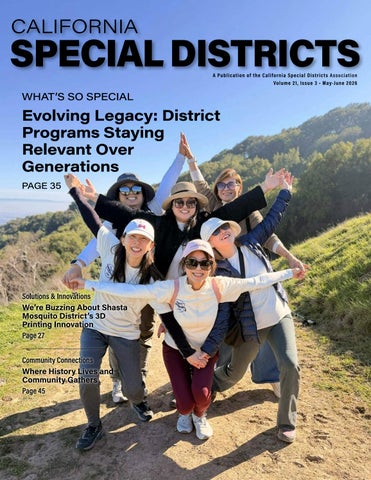
Evolving Legacy: District Programs Staying Relevant Over Generations
By Morgan Leskody, Communications Specialist, CSDA
For many special districts, long standing programs are a point of pride. They reflect decades of service, community connection, and institutional knowledge. But longevity alone does not guarantee continued relevance. As communities shift, technologies advance, and expectations around access and inclusion grow, even the most beloved programs must evolve to meet the moment.
Across California, districts are reimagining what it means to sustain a successful program over time. Rather than starting from scratch, they are building on strong foundations, layering in new approaches that expand reach, improve accessibility, and invite broader participation.
One example comes from the East Bay Regional Park District, where the long-running Trails Challenge program offers a case study in thoughtful evolution. Now in its 33rd
year, the program was originally designed to encourage residents to spend more time outdoors, tapping into a broader national movement around health, recreation, and connection to nature.
At its core, the concept remains simple. Participants are invited to explore a selection of trails across the district’s expansive park system, completing hikes at their own pace throughout the year. But what has allowed the program to endure, and grow, is not the concept itself. It is the district’s commitment to continuously refining how that experience is delivered.
Over time, the Trails Challenge has evolved from a static, print-based program into a multi-channel, user-driven experience. While a traditional guidebook is still available and remains a cherished touchpoint for many participants,
continued

it is now complemented by digital tools that reflect how people engage with outdoor recreation today. Participants can access trail routes through mobile platforms such as AllTrails, track their progress online, and interact with the program in ways that were not possible when it first launched.
This shift is not just about convenience. It is about meeting people where they are.
Equally important has been the district’s intentional focus on accessibility and inclusion. Trails are categorized by difficulty, ensuring that participants of varying skill levels can engage with the program. Options exist for individuals using mobility devices, and alternative pathways allow participants to participate in the challenge in ways that best suit their abilities and preferences.
Recent program enhancements have introduced new participation incentives to broaden appeal across age groups. From youth-focused to senior-specific patches, these additions recognize that outdoor engagement varies across life stages and that programs must reflect that diversity to remain impactful.
The result is a program that feels both familiar and new. Longtime participants return year after year, drawn by tradition and community, while new audiences discover an entry point that feels accessible and relevant to their needs.
Legacy programs are not just about maintaining participation. They are an opportunity to deepen engagement, expand awareness of services, and strengthen the connection between residents and the resources available to them.
Another key to the program’s continued success lies in its ability to guide exploration beyond familiar routines. In a district that spans multiple counties and encompasses tens of thousands of acres, many residents tend to frequent the same local parks. By intentionally curating trails across the system, the program encourages participants to step outside their usual habits and experience the full breadth of what their district has to offer.
This approach highlights an important lesson for districts of all types. Legacy programs are not just about maintaining participation. They are an opportunity to deepen engagement, expand awareness of services, and strengthen the connection between residents and the resources available to them.
Modernization does not require abandoning what works. Instead, it calls for a willingness to iterate. To listen. To test new ideas while honoring the elements that built trust in the first place.
For districts looking to reinvigorate long-standing programs, the path forward may be less about reinvention and more about evolution. By integrating new tools, prioritizing inclusive design, and aligning programs with the behaviors and expectations of today’s communities, districts can ensure their legacy efforts continue to deliver value for decades to come.


Risk

Protecting Your Employees From Wildfire Smoke Exposures & Other Workplace Emergency Controls
By Enriqueta Castro, Chief Risk Officer, SDRMA
California agencies have traditionally prepared for wildfire season from June through October; however, year-round wildfire risk is becoming increasingly common. Now is an appropriate time to assess outdoor work schedules and projects, and to review or implement wildfire smoke protection and emergency response protocols in preparation for the season.
Protection from Wildfire SmokeCCR Title 8, 5141.1
During a wildfire incident your agency may require employees to work outdoors, which may expose them to unhealthy air. Cal/OSHA has adopted the Protection from Wildfire Smoke Standard to help protect employees under these conditions. The standard applies to worksites where the current Air Quality Index (AQI) for airborne particulate matter (PM2.5) is 151 or greater and where it is reasonably
anticipated employees could be exposed to wildfire smoke. When the standard applies, employers are required to do conduct the following:
Check the AQI - In the event of a wildfire, employers must check the current AQI for PM 2.5 periodically throughout each shift. An Airnow.gov app is available. If the trigger of 151 is ever exceeded employers must conduct training outlined in Cal/OSHA’s Section 5141.1 Appendix B.
Reduce the exposure - Employers must identify ways to lower employee exposure to wildfire smoke, where feasible. Such as:
• Locate work indoors or in vehicles where the air is filtered
• Change procedures to allow work to be moved to a location where the AQI is lower
• Reduce work time in areas without filtered air
• Increase time and frequency of breaks in filtered air
• Lower the physical intensity of work to lower breathing and heart rates
Provide respiratory protection - Employers must provide or require respirators (N95 respirators) for employees working outdoors depending on the PM 2.5 airborne levels.
• Voluntary Use - If the employee exposure cannot be reduced to an AQI of 151 or less of PM 2.5, then employees must be provided with respirators, such a N95 masks for voluntary use.
• Required Use - Respirator use is mandatory or required when the AQI exceeds 500 for PM 2.5. Employees must receive a medical clearance, respirator fit testing and training prior to wearing a respirator under these conditions.
THE FOLLOWING WORKPLACES AND OPERATIONS ARE EXEMPT FROM THIS STANDARD:
• Enclosed buildings or structures where the air is filtered by a mechanical ventilation system
• Enclosed vehicles where the air is filtered by a cabin air filter
• The AQI for PM2.5 is below 151
• Employees who are exposed to a current AQI for PM2.5 of 151 or greater for a total of one hour or less during a shift
• Firefighters engaged in wildland firefighting
Emergency Action Plan – CCR Title 8, 3220
Cal/OSHA requires California employers to have an Emergency Action Plan (EAP) in place. The purpose of the EAP is to establish emergency response procedures to safeguard employees and on-site visitors in the event of an emergency. It outlines evacuation procedures, shelterin-place procedures, emergency kits, emergency shelter
in place supplies, and other relevant procedures based on potential emergencies that may occur.
In addition to general procedures, the EAP should include procedures for specific types of emergencies, such as building fires, earthquakes, floods, utility outage, etc. In addition to your building fire procedures, it is recommended that you add procedures on wildfire response, for example:
• Ensuring a system is in place to monitor wildfire incidents near your agency. You can sign up to receive current information about active wildfires near you through the readyforwildfire.org site.
• Identifying your local emergency response contacts and evacuation centers. As well as information on evacuation routes and other pertinent information.
• Ensuring enough water and non-perishable supplies are available to last up to three days.
• Determining early employee evacuation conditions designed to allow employees to return home and manage their personal wildfire planning. We encourage you to share the CAL FIRE resources with your employees so they can have a wildfire plan in place.
Fire Prevention Plan – CCR 3221
Cal/OSHA also requires California employers to have a Fire Prevention Plan. The Plan is different than an EAP because it focuses on the fire control equipment and systems in place. Procedures must be developed to identify potential fire hazards, ignitions sources, and control measures.
Proactive planning is essential to protecting employee health and maintaining safe operations. By preparing in advance and reinforcing wildfire smoke protocols, agencies can better respond to changing conditions and reduce risk throughout the year.

National Special Districts Association Accelerates Growth, Expands National Reach
By Chantal Unfug, Public Affairs, National Special Districts Association
Since its formal establishment in January 2025, the National Special Districts Association (NSDA) has rapidly emerged as the unified voice for special districts across the United States. Built on a foundation of collaboration, advocacy, and shared resources, NSDA was created to elevate the essential role special districts play in delivering critical local services—and to ensure those voices are represented at the federal level.
From the outset, NSDA set an ambitious goal: to achieve representation in all 50 states by the end of 2027. Just one year later, that vision is on the road to becoming reality. Through strategic outreach, strong partnerships, and a clear value proposition for districts and state associations alike, NSDA continues to build momentum and expand its national footprint.
Over the past year alone, NSDA has welcomed 12 new members, including 9 individual special districts and 3 statewide associations, while expanding representation into six new states. This growth reflects both the increasing demand for a coordinated national voice and the strength of NSDA’s member-driven approach.
Welcoming New Members (2025–2026)
NSDA is proud to recognize the following new members who joined in the past year. Each brings unique expertise, services, and leadership that strengthen the national special district community. In addition to public agency members, NSDA continues to strengthen its Business Affiliate program, welcoming CPSHR Consulting and GovDeals as new partners. These organizations join Streamline - powered by CivicPlus, PTMA, and GridBase in delivering high-quality services and solutions that support the operational excellence of special districts nationwide.
Our Coalition has expanded, including these members:
• Texas Special Districts Coalition (Texas)
• Nebraska Association of Resource Districts (Nebraska)
• North Dakota Recreation and Park Association (North Dakota)
• Tennessee Association of Utility Districts (Tennessee)
• Gardnerville Ranchos General Improvement District (Nevada)
• Beaver Dam–Littlefield Fire District (Arizona)
• York Sewer District (Maine)
• St. Tammany Parish Mosquito Abatement District (Louisiana)
• Gravois Special Road District No. 8 (Missouri)
• Lakeshore Villages Master Community Development District (Louisiana)
• City of New Orleans Mosquito, Termite and Rodent Control Board (Louisiana)
• Carter Plantation Community Development District (Louisiana)
Looking Ahead
NSDA’s continued growth reflects a broader movement: special districts across the country are recognizing the value of a unified national voice. As the Association expands into new states and strengthens its membership base, it remains focused on delivering meaningful value— through federal advocacy, professional development, partnerships, and shared resources.
With a clear path toward nationwide representation by 2027, NSDA is not only growing—it is shaping the future of our service delivery in America. Visit the NSDA website at www.nationalspecialdistricts.org
Purchasing, Travel, and Fleet in One Card.


Anastasia Efstathiu
VP, Relationship Manager 916-774-3923
AnastasiaEfstathiu @ColumbiaBank.com

Baldeep Atwal
VP, Commercial Card Sales Consultant Global Payments & Deposits 916-742-0942
BaldeepAtwal@ColumbiaBank.com
Legal Brief

Public Contracting Made Simple
By Jeff Frey, Of Counsel, Atkinson, Andelson, Loya, Ruud & Romo
Do public contracting issues freak you out? Well, my friend, I feel you. Despite the Legislature’s goal to make the law “clearer and easier to find” (Pub. Contract Code § 100), the topic involves numerous statutes buried across the Civil Code, Labor Code, Public Contract Code, Government Code, and more. The following is a summary of important issues to consider when preparing and reviewing your next bid or contract.
Bidding
Many, but not all, special districts have competitive bidding requirements. Knowing your bidding rules is half the battle!
If competitive bidding is required by law, the contract is usually awarded to the lowest responsible and responsive bidder, or all bids must be rejected.
1. Responsive bids are those that substantially conform to the bid specifications. Does the bid comply with all the requirements of bidding documents? Does the bid respond accurately and completely to bid rules and
instructions? This analysis reviews the face of the bid without outside investigation/information.
2. Responsibility involves the determination of the bidder’s trustworthiness and quality of performance (Pub. Contract Code §1103). This involves outside investigation/information and requires the special district’s exercise of reasonable discretion. A determination of non-responsibility may trigger bidder due process rights involving an opportunity to be heard and produce evidence.
» Your bidding documents should include a bid protest process, which is developed by each special district. The law does not include a statutory deadline regarding protests. Make sure you allow enough time for protests to be reviewed and determined between bid opening and contract award!
» Consider a prequalification packet/questionnaire to eliminate unqualified contractors. This requires public works contractors to answer questions about their experience and finances. They must obtain a passing score before they can bid your projects.
3. Understand alternative procurement rules and processes:
» The California Uniform Public Construction Cost Accounting Act (“CUPCCAA”) allows special districts who opt in to use an alternative bidding process for construction projects. CUPCCAA requires no competitive bidding for projects under $60,000. Informal bidding is required for projects between $60,000 and $200,000. Finally, formal bidding is required for projects over $200,000.
» Architectural, landscape architectural, environmental, engineering, land surveying, and construction project management services must be selected based on demonstrated competence/ professional qualifications necessary for the services. This requires a fair, competitive selection process – typically a Request for Proposals.
» Services for financial, economic, accounting, legal, or administrative matters typically do not require competitive bidding. However, we recommend issuing a Request for Proposals.
» California Multiple Award Schedules (CMAS) and similar programs. The State offers equipment (who doesn’t want a helicopter?), materials, services, and more at prices deemed fair, reasonable, and competitive. The products/services were already bid, so a special district may be able to contract directly with the vendors via the State programs.
Contract Clauses
Every special district should have its own contracts for construction, services, and more. Realistically, that is not always the case. Understanding the following clauses or rules will strengthen your position and protect your special district.
• Indemnity. Indemnity is essentially a promise to reimburse another for a loss or liability. Special districts must read these clauses carefully because courts will analyze the plain language to determine the contracting parties’ intent. For third party contracts, are they asking for single-party indemnification? Always object! If a vendor/contractor wants indemnification, demand reciprocal language for your special district. Are they asking for reimbursement even when the vendor/
contractor was negligent? Always object! Parties should be responsible for the harm they cause.
• Limitation of Liability. Vendors/contractors typically want to limit their liability to the amount to be paid for the goods/services. Always object! Harms often exceed the contract amount.
• Attorney’s fees. While ultimately a business decision, some lawyers recommend striking these clauses. First, these clauses encourage litigation, not compromise. Second, special districts pay lower hourly rates than private vendors/contractors. Upon a loss, you may receive a massive bill from the other side. Finally, please note that single-sided attorney’s fees clauses are prohibited and will be made applicable to both parties (Civ. Code § 1717).
• Insurance. Make sure you can comply with their insurance requirements. For the vendor’s/contractor’s policies, require that the special district, its governing body, and its employees are added as additional insureds. You should also seek a waiver of subrogation! This will transfer rights of recovery and prevent the insurance company from seeking to recover against your special district for contributory negligence.
• Bonds. Payment bonds for public construction contracts are required if contract amount exceeds $25,000! (Civ. Code § 9550.) Failure to obtain the bond exposes your special district to liability! Performance bonds are not required but are strongly recommended.
• Disputes/Claims. Every contract should include a dispute resolution process to streamline problems. For construction contracts, you must include certain rules (Pub. Contract Code § 9204). Ensure that you understand the process to prevent potential waiver of claims.
• Venue. Does the contract require you to litigate in New York, Montana, or Delaware? Always object! Ask for a local venue to save yourself time and money.
The foregoing is just a sample of issues and topics to consider. Special districts should work with legal counsel to either prepare form contracts or a comprehensive checklist to make the process easier for you and your special district. Join me on June 29, 2026, at CSDA’s General Manager Leadership Summit for a deeper discussion on public contracting.


Where History Lives and Community Gathers
By Morgan Leskody, Communications Specialist, CSDA
In the high desert north of Los Angeles, the Antelope Valley Cemetery District serves a purpose that extends far beyond its original mandate. While its core mission remains providing dignified and affordable burial services, the district has quietly evolved into something more: a place where community identity is preserved, shared, and continually renewed.
“In many ways, the cemetery is the history book of the community,” says District Manager Linda “Lin” Blanco. And like any good history book, it does more than document the past. It helps people understand their place in the present.
That role is increasingly important in today’s world, where communities are more transient than ever. In regions like Lancaster, where residents often arrive for opportunity and leave for the next chapter, permanence can be elusive. People come for work, for affordability, or for a fresh start. They build lives, then move on. What remains are
fragments of stories, lived experiences that risk being disconnected from the next generation.
Special districts like the Antelope Valley Cemetery District act as an anchor in that constant movement.
Blanco sees this pattern regularly. Families who once purchased plots decades ago return years later, often from out of state, to sell them back as their ties to the region shift. The ebb and flow of residents is not new. It reflects the area’s origins as a place where pioneers came to work in mines or along the railroad, not necessarily to stay. But even for those who leave, a part of their story remains.
“The Antelope Valley has always been a place people pass through, drawn by opportunity, work, or a fresh start. Our cemetery reflects that history. It holds the stories of people who came here for a chapter of their lives, and for some, it became their final chapter,” Blanco explains.
continued >
COMMUNITY CONNECTIONS

That permanence is what transforms the cemetery from a place of loss into a place of connection.
Throughout the year, the district hosts events that bring the community together in meaningful and often unexpected ways. Memorial Day, Veterans Day, and Wreaths Across America ceremonies draw large crowds, with community members placing flags and wreaths on more than 1,100 veterans’ graves. These moments create a powerful visual reminder that history is not abstract. It is personal.
“It becomes very real,” Blanco says. “They’re not just names… they’re families.”
Beyond these solemn traditions, the district also embraces creative ways to engage the community. Events like the “History in the Dark” tour invite residents to walk the grounds by flashlight while hearing stories of local pioneers. Staff dress in period clothing, transforming the cemetery into an immersive storytelling experience that resonates with modern audiences.
These events do not necessarily increase service utilization in the traditional sense. Instead, they build awareness, connection, and trust. They reframe the cemetery as a place people return to, not only in times of grief, but as part of their community life.
That shift is significant. As many public spaces continue to disappear or become commercialized, communities are searching for “third places,” spaces where people can gather, reflect, and connect without expectation. The Antelope Valley Cemetery District is stepping into that role, intentionally designing spaces like the proposed “Garden of Stars” that are intended to support gatherings, education, and cultural events for the community.
The district is looking forward and considering exploring partnerships with local schools and expanding programming to reflect the area’s evolving demographics. Proposed plans include collaborations with agricultural programs to grow native plants and potential cultural events that celebrate the diversity of the community.
This blend of history and innovation reflects a broader truth about special districts. While they are created to provide essential services, their impact often reaches much further. They become stewards of place, institutions that hold memory, foster belonging, and create continuity in an ever-changing world.
At the Antelope Valley Cemetery District, the work goes beyond burial services. It is about keeping the community’s history alive and relevant, not as something distant, but as something people can see, walk through, and take part in.
Because in a place where people come and go, the stories do not. They stay rooted here, waiting to be remembered, shared, and connected to the lives still being built around them.
Veterans honoring a fellow veteran during a memorial ceremony.

Money Matters
When the Service Supply Chain BreaksLook for Upstream Solutions
By Kristin Withrow, Senior Communications Specialist, CSDA

When the Sacramento Suburban Water District found itself confronting a shrinking pool of specialized contractors and a growing backlog of maintenance work threatening water operations, the district found a solution by moving upstream into the well servicing supply chain.
As of this writing, the district is in the process of purchasing the assets of a local well-maintenance company and bringing its employees on staff — a move expected to pay for itself within three years while strengthening the district’s ability to provide reliable water service.
Sacramento Suburban Water District serves roughly 200,000 people across about 37 square miles in the Sacramento region. The district has a robust conjunctive use program utilizing surface water entitlements, when available. However, groundwater is the district’s main water supply. The district operates 82 wells, some producing up to 3,500 gallons per minute. That scale creates a constant need for specialized experience to keep pumps online and maintain pressure in the system
As with many things, the challenge was amplified by the pandemic. In late 2021, the district had 25 wells offline
at the same time. A side effect of the pandemic was the tightening of contractor availability as companies closed or became overrun with demand
“There were only three well pump maintenance companies in the region with more than 20 water districts in the Sacramento region,” York explained. “The soonest we could even get one of our wells looked at was about six months.”
For a district heading into peak summer demand, that delay carried real risk. In the service area’s history, there is a fearful memory from 1999 when a widespread power outage across the west coast resulted in water availability coming offline. That nightmare scenario is something the board of directors is keenly attuned to preventing from ever happening again.
The critical situation prompted staff to explore ways to find more reliable well service alternatives. A district superintendent suggested approaching Kirby Pump & Mechanical, a small regional well-maintenance company, with a five-year exclusive service agreement that included an option to purchase the company’s assets after the first year. It turned out the company owner, J Hannum, was also
ready to transform his post-pandemic demanding travel schedule for a stable space to utilize his experience and land his staff in a new ‘home.’
The results were immediate. Hannum and his team, now contracting exclusively for the district, began prioritizing the backlog of well maintenance, tackling the most urgent repairs first. Within the first year, ten wells had been brought back online, allowing the district to meet peak summer demand
The arrangement revealed more welcome efficiencies
Originally hired for specialized “down-hole” pump work, the company’s team proved capable of handling nearly every aspect of well site maintenance — from valves to control systems. That eliminated the need for multiple outside contractors such as electricians and welders
“They do everything related to a well site — the valves, SCADA system, electrical, everything,” York said. “And now we’ve been able to move into proactive maintenance rather than solely reactive maintenance.”
After evaluating labor costs, employee benefits and equipment valuation, the district determined the investment in the well company’s assets, including converting their entire team into district staff, would reach a break-even point in just three years compared with continued contracting
Under the plan now moving forward, the district will purchase the company’s equipment and assets while hiring Hannum and his original employees as district staff. Hannum will add his experience to the district as a superintendent overseeing well maintenance operations
“Historically KPM has provided specialized maintenance services on many of SSWD’s 80 wells. As competing demand for their services increased, staff suggested purchasing KPM to ensure their availability,” said SSWD Board President Craig Locke. “Bringing KPM in house brings certainty that the district’s wells will be well maintained and consistency for KPM’s employees. It is a true win – win situation.”
Sacramento Suburban Water District’s approach appears to be unique among California water agencies. While some cities or counties operate general maintenance crews, the district had not encountered another public agency that had acquired a private groundwater well-maintenance operation
In some ways, the idea emerged from necessity. But it also reflects a broader lesson for public agencies managing critical infrastructure: when traditional procurement models stop working, innovation sometimes means rethinking the structure entirely
For Sacramento Suburban Water District, that shift may not only stabilize operations — it also creates a new model for maintaining the infrastructure to keep water flowing, 24/7.
Expert Insight, On Demand
CSDA’s 2026 on-demand webinar library features multiple sessions to help you learn about public financing, including three expert-led entries from the consultants at the CSDA Finance Corporation:
• Building Tomorrow: Mastering Capital Project Financing for Special Districts
• Fundamentals of Tax-Exempt Financing
• Going Green: How Special Districts Can Implement Budget-Neutral Energy Efficiency Projects with Low-Cost Financing
More sessions are coming later this year, be sure to check back for:
• Bridge the Gap: Interim Financing Solutions for Your Agency’s Needs
• How Years of Federal Policy Shifts Have Impacted Your Agency’s Ability to Borrow Money
Access all on-demand sessions at www.csda.net/learn/all-events.


AllPaid www.AllPaid.com


DIAMOND LEVEL
Amazon Business www.csda.net/amazon-business
California CAD Solutions (CALCAD) www.calcad.com
California CLASS www.californiaclass.com
Columbia Bank www.columbiabank.com
CPS HR Consulting www.cpshr.us


VC3 www.vc3.com
PLATINUM LEVEL
Atkinson, Andelson, Loya, Ruud & Romo www.aalrr.com
Best Best & Krieger www.bbklaw.com
Five Star Bank www.fivestarbank.com


CSDA Finance Corporation www.csdafinance.net
Enterprise Mobility www.enterprisemobility.com
GovDeals www.govdeals.com
Special District Risk Management Authority www.sdrma.org
Streamline www.getstreamline.com
Utility Cost Management, LLC www.utilitycostmanagement.com

Tri Counties Bank www.tcbk.com
Liebert Cassidy Whitmore www.lcwlegal.com
Platinum Strategies Inc www.platinumstrategiesinc.com
Richards Watson Gershon www.rwglaw.com
Supporting Stronger District Workforces
As an endorsed Business Affiliate of the California Special Districts Association, CPS HR Consulting continues to be a trusted partner to special districts navigating complex workforce challenges. From day-to-day HR guidance to long-term organizational strategy, CPS HR delivers both membership-based support and customized services tailored to each district’s needs.
Their recent work with Phelan Piñon Hills Community Services District highlights the depth of their approach. Initially engaged to assist with leave management and a personnel manual review, CPS HR quickly adapted as the district experienced significant staffing changes and employee concerns. Their role expanded into full-scale HR support, including conducting one-on-one staff interviews to assess workplace culture, guiding leadership through sensitive personnel matters, and recommending key initiatives such as a total compensation study and updated benefits resources.
“CPS HR has changed the way our district manages our Human Resources Department. Over the past several years,
GOLD LEVEL
Brown Armstrong Accountancy Corporation www.bacpas.com
California Bank of Commerce www.californiabankofcommerce.com
CalTrust
www.caltrust.org
Centric Business Solutions www.centricabusinesssolutions.com
Cole Huber LLP www.colehuber.com
Complete Paperless Solutions www.cps247.com
Easeworks www.easeworks.com
Energy Systems Group www.energysystemsgroup.com
Harshwal & Company LLP www.harshwal.com
Kosmont Financial Services
www.KosmontFinancial.com
National Demographics Corporation (NDC) www.ndcresearch.com
NBS www.nbsgov.com
Nossaman, LLP www.nossaman.com
Redwood Public Law, LLP www.redwoodpubliclaw.com
River City Bank www.rivercitybank.com
SiteLogiq www.sitelogiq.com
Slovak Baron Empey Murphy & Pinkney LLP www.sbemp.com
Townsend Public Affairs www.townsendpa.com
Tyler Technologies, Inc. www.tylertech.com
Witt O’Brien’s www.wittobriens.com
it has allowed our staff to concentrate on other duties and let CPS HR keep us up to date on constantly changing personnel laws and regulations,” said General Manager Don Bartz. “The investment in their ability is worth the price.”
Beyond project work, CPS HR provides ongoing support to district leadership—offering expert guidance to general managers, assisting with investigations, and helping build stronger communication and trust across teams.
CPS HR also brings this expertise directly to CSDA members through education. At the General Manager Leadership Summit, they are leading sessions on navigating workplace conflict and managing generational shifts. At the Annual Conference, their presentations will focus on building respectful workplaces and strengthening the essential human skills in an AI-driven era. Through hands-on support and practical training, CPS HR helps special districts build resilient, effective teams—no matter the challenge.


