2026 California Special Districts Association Magazine: March/April

Page 1


California Special Districts Alliance

The California Special Districts Alliance is a collaborative partnership between the California Special Districts Association (CSDA), the CSDA Finance Corporation (CSDAFC), and the Special District Risk Management Authority (SDRMA). These three highly respected statewide organizations join forces to help special districts in California better serve their communities.

CSDA Board and Staff

OFFICERS

LORENZO RIOS, CSDM, PRESIDENT, Clovis Veterans Memorial District

PETER KAMPA, CSDM, VICE PRESIDENT, Groveland Community Services District

DON BARTZ, CSDM, SECRETARY, Phelan Pinon Hills Community Services District

ANTONIO MARTINEZ, TREASURER, Contra Costa Water District

ELAINE MAGNER, PAST PRESIDENT, Pleasant Valley Recreation and Park District

MEMBERS OF THE BOARD

RYAN CLAUSNITZER, CSDM, Alameda County Mosquito Abatement District

SCOTT DUFFIELD, CSDM, Heritage Ranch Community Services District

VINCENT FERRANTE, Moss Landing Harbor District

CURTIS JORRITSMA, Hilmar County Water District

JO MACKENZIE, Vista Irrigation District

NOELLE MATTOCK, El Dorado Hills Community Services District

GREG P. ORSINI, McKinleyville Community Services District

PATRICK OSTLY, North of River Sanitary District #1

STEVE PALMER, Donner Summit Public Utilities District

KEVIN PHILLIPS, Paradise Irrigation District

FRED RYNESS, Burney Water District

KATHRYN SLATER-CARTER, San Mateo County Harbor District

NIKKI WINSLOW, Altadena Library District

STAFF

NEIL MCCORMICK, Chief Executive Officer

MEGAN HEMMING, Chief Professional Development Officer

MUSTAFA HESSABI, Chief Counsel

KYLE PACKHAM, Chief Advocacy & External Affairs Officer

CASSANDRA STRAWN, Chief Member Services & Communications Officer

RICK WOOD, Chief Finance & Operations Officer

TOMICKO ABELLA, Member Services Representative

AARON AVERY, Director of State Legislative Affairs

BRITTNEY BARSOTTI, Legislative Representative

ANNA C. STAGG, Legislative Assistant

EMILY CHA, Database & Online Communities Specialist

MARCUS DETWILER, Legislative Representative

BRENT FARRAR, Design & Websites Manager

AUBREY GOHL, Member Services Representative

JOSE GUERRERO, Graphic Design/Video Specialist

COLLEEN HALEY, Public Affairs Field Coordinator

CASSIE HASKINS, Member Services Representative

LILIA M. HERNANDEZ, Associate Legislative Analyst

MORGAN LESKODY, Communications Specialist

MICHAEL MEYER, Member Services Manager

CHRIS NORDEN, Public Affairs Field Coordinator

RICHELLE NOROYAN, Public Affairs Field Coordinator

CHRIS PALMER, Senior Public Affairs Field Coordinator

AMBER PHELEN, Management Analyst

RACHAEL POPPINO, Professional Development Coordinator

OLIVIA ROBERTSON, Member Services Specialist

JENNIFER SMITH, Professional Development Coordinator

OPHELIA SZIGETI, Legislative Analyst

ANTHONY TANNEHILL, Legislative Representative

ERASMO VIVEROS, Public Affairs Field Coordinator

DANE WADLÉ, Director of State Field Operations

KRISTIN WITHROW, Senior Communications Specialist

SDRMA Board and Staff

OFFICERS

ROBERT SWAN, PRESIDENT, Groveland Community Services District

JESSE CLAYPOOL, VICE PRESIDENT,

Honey Lake Valley Resource Conservation District

THOMAS WRIGHT, SECRETARY, Clovis Veterans Memorial District

MEMBERS OF THE BOARD

ROBERT HOUSLEY, CSDM, Midway City Sanitary District

VIRGINIA CHANG KIRALY, San Mateo County Harbor District

SANDY SEIFERT-RAFFELSON, Herlong Public Utility District

MIKE SCHEAFER, Costa Mesa Sanitary District

STAFF

DEBBIE YOKOTA, CPCU, Chief Executive Officer

MATT CLUTTERBUCK, CPA, MBA, Chief Financial Officer

ENRIQUETA CASTRO, CSP, Chief Risk Officer

WENDY TUCKER, AU, Chief Underwriting Officer

ALANA LITTLE, Health Benefits Manager

DANNY PEÑA, SIP, WCCP, Workers’ Compensation Claims Manager

ROBERTO LOZANO, Liability Claims Manager

PETR KOVALCHUK, CPA, Finance Manager

JASON THORN, Data Architect

MARGARITO CRUZ, Senior Accountant

ERIC LUCERO, ARM, Senior Risk Control Specialist

GUILLERMO DE LA TORRE, Senior Risk Control Specialist

TAMARA BAKKIE, SIP, WCCA, Senior Workers’ Compensation

Claims Examiner

JOHN PESHKOFF, SIP, WCCA, Senior Workers’ Compensation

Claims Examiner

MARTHA WARREN, SIP, WCCA, Senior Workers’ Compensation

Claims Examiner

MICHELLE BROWN, Health Benefits Specialist II

TERESA GUILLEN, Underwriting Specialist II

KEITH IKAMI, Liability Claims Examiner II

LISA SANDOVAL, Underwriting Specialist II

CANDICE RICHARDSON, Management Analyst

MARIETTA HARRISON, SIP, WCCA, Future Medical Claims Examiner

CHER DARLING, Workers’ Compensation Claims Assistant

KOJI LO, Liability Claims Examiner I

AMY SUTHERLIN, Underwriting and Program Manager

CAMREN BUTLER, Program Specialist II

Special District Risk Management Authority

1112 I Street, Suite 300 Sacramento, CA 95814 tel: 800.537.7790 www.sdrma.org

CSDAFC Board and Staff

OFFICERS

JO MACKENZIE, PRESIDENT, Vista Irrigation District

VINCE FERRANTE, VICE PRESIDENT, Moss Landing Harbor District

ELAINE MAGNER, CSDM, SECRETARY, Pleasant Valley Recreation and Park District

GREG P. ORSINI, TREASURER, McKinleyville Community Services District

MEMBERS OF THE BOARD

RONALD COATS, DIRECTOR, East Valley Water District

PAULA HANSEN, CSDM, Southgate Recreation & Park District

GLENN LAZOF, Regional Government Services Authority

CONSULTANTS

RICK BRANDIS, Brandis Tallman, a Division of Oppenheimer & Co. Inc.

JEFF LAND Brandis Tallman, a Division of Oppenheimer & Co. Inc.

STEFAN MORTON, Municipal Finance Corporation

WILLIAM MORTON, Municipal Finance Corporation

ALBERT REYES, Kutak Rock LLP

DMITRY SEMENOV, Ridgeline Municipal Strategies, Consultant to the Working Capital Financing Program

NICOLE TALLMAN, Brandis Tallman, a Division of Oppenheimer & Co. Inc.

STAFF

NEIL MCCORMICK, Chief Executive Officer

DAVID MCMURCHIE, Legal Counsel

MICHAEL MEYER, Member Services Manager

AMBER PHELEN, Management Analyst

RICK WOOD, Chief Finance & Operations Officer

CSDA Finance Corporation 1112 I Street, Suite 200, Sacramento, CA 95814 tel: 877.924.2732 www.csdafinance.net

For editorial or advertising inquiries: Phone - 877.924.2732 Email - membership@csda.net

California Special Districts Association 1112 I Street, Suite 200 Sacramento, CA 95814 toll-free: 877.924.2732 www.csda.net

Purchasing, Travel, and Fleet in One Card.

Anastasia Efstathiu

VP, Relationship Manager 916-774-3923

AnastasiaEfstathiu @ColumbiaBank.com

Baldeep Atwal

VP, Commercial Card Sales Consultant Global Payments & Deposits 916-742-0942

BaldeepAtwal@ColumbiaBank.com

CSDA Leads: Empowering District Board Members and Staff Through Education

Special districts are built on public trust, sound decision-making, and a deep commitment to the communities they serve. At the California Special Districts Association (CSDA), we are proud to be the central hub where district board members and staff come together to gain the knowledge and training required to lead effectively and remain compliant in a complex environment.

California law establishes important training requirements to support ethical governance, safe workplaces, and strong financial oversight. These include AB 1234 ethics training, harassment prevention training, and the newly enacted SB 827 finance training requirement for district officials.

CSDA is uniquely positioned to help districts meet all of these mandates through accessible, relevant, and practical education opportunities designed specifically for special districts. Through live webinars, in-person workshops, and on-demand courses, CSDA offers consistent opportunities for board members and staff to satisfy required training requirements—often at no cost to CSDA member agencies. Our training calendar is intentionally built to be flexible, allowing busy public officials and staff to complete requirements on their schedules while gaining real-world insight they can apply immediately.

Beyond required training, CSDA provides professional development programs that strengthen governance, leadership, and operational excellence. From finance and human resources to board roles and responsibilities, our education offerings support districts at every stage.

As laws evolve and expectations continue to increase, CSDA remains committed to being THE trusted provider in education and compliance.

Visit www.csda.net/learn/all-events to explore upcoming trainings, resources, and opportunities to build confident, informed leadership at your district.

Neil McCormick, CEO

CSDA News

Now Accepting Award Nominations

Submit Online: csda.net/awards

Deadline: May 1, 2026

It’s time to showcase your district’s achievements and standout leaders for recognition at this year’s CSDA Annual Conference & Exhibitor Showcase in Palm Desert. The CSDA Annual Awards highlight the most impactful projects and meaningful contributions our independent special district members make in their communities. Categories recognize exceptional board members, staff, and general managers, as well as chapters, innovative programs, public outreach efforts, and excellence in technology.

Don’t miss your chance to celebrate your district’s achievements.

2026 Committee Leadership

Brown Act Resource Page

On October 3, 2025, Governor Newsom signed SB 707 (Durazo) into law, making significant updates to the Ralph M. Brown Act. All special districts and other Brown Act–covered agencies were required to familiarize themselves with the new requirements before January 1, 2026, with additional obligations for certain “eligible legislative bodies” beginning July 1, 2026. To help districts navigate these changes, CSDA has created a dedicated resource page to streamline updates and provide timely guidance. Visit the resource page for more information https://www.csda.net/brown-act-resources

We are pleased to introduce CSDA’s committee leadership for the year! We thank these members for their expertise and dedication that will guide the work of our committees and support CSDA’s strategic priorities.

LEGISLATIVE COMMITTEE

Chair - Noelle Mattock, El Dorado Hills Community

Vice-Chair - Ryan Clausnitzer, CSDM, Alameda County Mosquito Abatement District

PROFESSIONAL DEVELOPMENT COMMITTEE

Chair - Scott Duffield, CSDM, Heritage Ranch Community Services District

Vice-Chair - Steve Palmer, CSDM, Donner Summit Public Utility District

MEMBER SERVICES COMMITTEE

Chair - Curtis Jorritsma, Hilmar County Water District

Vice-Chair - Ronald L. Coats, East Valley Water District

AUDIT COMMITTEE

Chair - Greg P. Orsini, McKinleyville Community Services District

Vice-Chair - Paula Hansen, CSDM, Southgate Recreation & Park District

ELECTIONS & BYLAWS COMMITTEE

Chair - Kathryn Slater-Carter, San Mateo County Harbor District

Vice-Chair - Danielle Coats, Rancho California Water District

FISCAL COMMITTEE

Chair - Antonio Martinez, Contra Costa Water District

Vice-Chair - Kevin Phillips, Paradise Irrigation District

ProDev

General Manager Leadership SummitJune 28-30, Newport Beach

The General Manager Leadership Summit brings together general managers and emerging leaders from special districts across California to connect with peers, gain fresh insights, and strengthen their leadership skills. The event features inspiring keynote speakers, expert-led sessions on governance, legal updates, budgeting, human resources, and operations, and meaningful networking throughout. Attendees return to their districts energized and equipped with practical strategies to strengthen board relationships, engage staff, and increase organizational impact. Register at gmsummit.csda.net/home

Special District Leadership Academy

Local boards are the foundation of local control and the primary voice of their communities. In special districts, effective governance is essential to turning public priorities into sound policy and well-managed operations. The longterm success of a district depends on strong governance, making it a critical responsibility for every public official.

CSDA’s Special District Leadership Academy strengthens this foundation through curriculum-based training that

builds effective partnerships between board members and general managers. Designed for both new and experienced board members, the Academy equips participants with the tools to lead collaboratively, fulfill their governance responsibilities, and advance shared district goals. Visit sdla.csda.net to register for the conference that best fits your schedule.

THREE LOCATIONS: FIRST TIME AND RETURNING ATTENDEE TRACKS AT ALL LOCATIONS

• San Diego, May 11 - 14

• San Rafael, July 19 - 22

• San Luis Obispo, September 13 - 16

New Training Requirement - SB 827 Finance & Fiscal Training

In addition to expanding who must receive Ethics AB 1234 training, SB 827 also requires two hours of finance and fiscal training. CSDA offers a wide range of workshops as well as a live and recorded webinar designed to help special district officials meet the requirements of SB 827, which fulfills the new statutory training mandate for local agency officials effective January 1, 2026.

Tailored Education for General Managers and Emerging Leaders.

June 28-30, 2026 | Newport Beach

Dates & Deadlines

2026 CSDA Webinars

Fraud Prevention Tools That Keep District Funds Secure

April 14

Rate-Setting under Proposition 218: Legal Updates and Strategies for Success

April 28

Disaster Recovery Checklist and Best Practices for Special Districts

April 30

Closing Time: Leading Your District to a Clean Close

May 4

From Vision to Action: Special District Planning for Impact

May 19

Bridge the Gap: Interim Financing Solutions for your Agency’s Needs

May 21

2026 CSDA Workshops (Virtual & In-Person)

Virtual Workshop: Prevailing Wage: Basics and Beyond

April 15-16

In-Person Workshop: Supervisory Skills for the Public Sector (Sacramento)

April 20

In-Person Workshop: Human Resources Boot Camp for Special Districts (Sacramento)

April 22

In-Person Workshop: Financial Management for Special Districts (Sacramento)

April 23

In-Person Workshop: Navigating Governance and Finance in Special Districts (Santa Cruz)

May 18

Virtual Workshop: Organizational Development

May 27-28

In-Person Workshop: Navigating Governance and Finance in Special Districts (Fresno)

June 9

2026 CSDA Conferences

Special Districts Legislative Days

April 7 - 8 Sacramento

Special District Leadership Academy

May 11 - 14 San Diego

General Manager Leadership Summit

June 28 - 30 Newport Beach

Special District Leadership Academy

July 19 - 22 San Rafael

Annual Conference & Exhibitor Showcase

August 24 - 27 Palm Desert

Special District Leadership Academy

September 13 - 16 San Luis Obispo

Board Secretary/Clerk Conference

November 3 - 5 Santa Barbara

CSDA Annual Awards

Award Nomination Deadline

May 1

To view more details and to register for conferences, events, workshops or webinars go to the CSDA Events Page https://qrco.de/bddc8t

Accessible Websites Built for Special Districts

Modern, compliant, and easy to manage

Streamline, powered by CivicPlus®️, delivers a purpose-built digital platform designed specifically for special districts.

Create and manage an ADA-accessible website while streamlining communication, payments, and public engagement — all in one place.

ADA-accessible website design

Built-in accessibility monitoring tools

Website + email + online payments in one platform

Designed specifically for special districts

Trusted by districts across California

Roxanne Diaz

Ginetta Giovinco

Craig Steele

Dave Fleishman

Jim Markman

Tech Tips

Asset Management Software

Special districts in California provide a wide range of services, which means you have a lot to keep track of. If your district is considering implementing or updating asset management software to monitor assets, valuations, and depreciations, here are recommendations from fellow district operators shared in CSDA Online Communities:

• Sacramento Metropolitan Fire District uses OperativeIQ to manage warehouse inventory, fleet parts, firefighter turnouts, and other equipment. Designed for public safety and fleet operations, it helps agencies track equipment use, maintenance schedules, and supply levels in one system.

• Joshua Basin Water District uses Asset Panda for items not stored in its ERP system as capital assets. Asset Panda is a flexible, cloud-based platform that allows teams to customize categories, assign barcodes, and manage assets from any device—ideal for districts

seeking an affordable, scalable solution with minimal IT demands.

• Vacaville Fire Protection District recommends Brightly Asset Essentials as a user-friendly option. It provides a visual interface for managing assets, work orders, and preventive maintenance, helping staff plan effectively, reduce downtime, and extend equipment life.

For small or mid-size districts exploring asset tracking, Asset Panda is often the most economical starting point. OperativeIQ is popular with fire and emergency services needing specialized tracking, while Brightly Asset Essentials suits larger or multi-department districts seeking an all-in-one platform. Pricing varies by users, modules, and district size; request a demo or quote before deciding.

Ask the Experts

Rebranding with Restraint: Why Timing Matters

Through more than a decade of partnership with the San Bernardino Valley Water Conservation District (SBVWCD), CV Strategies has watched the organization evolve while its core mission remained steadfast. The district’s commitment to groundwater recharge and regional water reliability has remained constant since its founding over a century ago. What has changed was the recognition that their story, and the tools to tell it, needed refreshing. The board recognized that stewardship depends on more than infrastructure and data. It also depends on communication systems that clearly convey how technical decisions are made, why they matter, and how they serve the region. That understanding guided a deliberate and well-timed transformation.

In January, SBVWCD launched a redesigned website alongside a refreshed visual identity. The effort reflects institutional readiness, board alignment, and staff capacity working in concert. Timing shaped every decision.

For public agencies, modernization succeeds when readiness and execution are aligned. And getting the timing wrong can be as damaging as never making the change at all.

The Website That Changed Everything

The website project actually drove the logo redesign and broader brand refresh. SBVWCD’s Board recognized their digital presence needed to serve as a true public engagement platform, clearly communicating the science,

data, and decision-making framework behind their stewardship work.

As website development progressed quarterbacked by the talented professionals at web design studio Griddl, it became clear the existing visual identity failed to support the sophisticated storytelling the district needed. The old logo felt disconnected from the fresh, data-driven narrative taking shape online. Rather than force a tired brand into a modern digital framework, the Board aligned the visual identity with the communication goals the website was designed to achieve.

“Our Science of Stewardship approach comes to life when stakeholders can access data and understand how decisions are made,” said SBVWCD General Manager Betsy Miller Vixie. “This platform strengthens that connection and reflects the way the district operates.”

Always Consider, Carefully Execute

It is always the right time to consider rebranding. Strategic assessment should be ongoing. But consideration and execution are worlds apart. Pulling the trigger requires three critical elements: a board with the appetite for healthy change, staff capacity to implement it well, and stakeholder readiness to embrace it.

SBVWCD’s timing worked because all three aligned. The board recognized that while the district’s look had grown tired, fundamental elements were worth preserving: history, mission, and commitment to science-based stewardship. Equally important, staff had the bandwidth to execute without compromising daily operations. Your brand makes a promise to stakeholders. If implementing a

rebrand means compromising daily operations, wait until you have the capacity to do both well.

“The Board gave us clear guidance about honoring the district’s legacy while modernizing how we communicate their science-driven work,” said Heather Anderson, CV Strategies Senior Graphic Designer who led the visual identity development. “They understood that good design focuses on creating tools that serve the mission, not trends. When leadership listens and hears that distinction, you can create something that will serve the organization for decades.”

The Unanimous Vote Test

A new logo also requires a unanimous board vote. Without unanimous support, it is clear you have the wrong logo. A divided board signals the organization lacks consensus on its identity or readiness for change. That misalignment will undermine every external message. SBVWCD’s board unanimously approved their new identity because the process honored their collective vision.

The Invitation

Districts should take risks with their storytelling tools. Communities deserve clear information. Partners need meaningful engagement platforms. But rebrand only when institutional readiness, strategic alignment, and staff capacity align. The districts that get this right understand that timing matters as much as the rebrand itself.

That’s worth waiting for.

CV Strategies is strategic communications and community engagement firm blending media, messaging, and audiences to solve complex public challenges and build lasting community support. Learn more at www.cvstrat.com.

The Rowland Water District (RWD) Board of Directors is pleased to announce Mr. Anthony J. Lima has been selected to serve as Board President. President Lima has been a dedicated member of the Rowland Water District Board of Directors since 1995, bringing nearly three decades of experience and community service to this leadership role. He actively participates in various district committees and water-related organizations, and has extensive experience in local business ownership, having previously operated a trucking company in Fontana.

Longtime Eastern Municipal Water District (EMWD) Board Member Phil Paule has been selected as the organization’s new delegate to serve on The Metropolitan Water District of Southern California (Metropolitan) Board of Directors.

Paule has served on the EMWD Board of Directors since 2007 as a tireless advocate for ratepayer interests and sustainable infrastructure planning. The district is grateful to have his leadership in this expanded capacity.

Utica Water and Power Authority (UWPA) Board of Directors hired Erik J. Holt as General Manager for the agency effective January 12, 2026. Holt brings with him over twenty years of experience in the fire service field and managing emergency response operations. He has worked extensively with local government agencies and private industry.

Holt’s depth of experience, knowledge, and management capabilities will complement the Board’s desire to improve the efficiency of our water delivery infrastructure in a costeffective manner and to see them through the application process for small conduit exemptions for their hydroelectric power plants with the Federal Energy Regulatory Commission

The Costa Mesa Sanitary District (CMSD) Board of Directors unanimously appointed Shayanne Wright to represent Division 5 following the retirement of long-serving Board Member Arlene Schafer on August 1, 2025. Wright, a Costa Mesa business owner, currently serves on CMSD’s Citizens Advisory Committee and on the City of Costa Mesa Parks and Community Services Commission.

The Desert Recreation District Board of Directors voted to appoint Giovanna Healy as Board President for 2026.

“I am honored to serve as President and grateful for the confidence of my fellow Directors,” said President Giovanna Healy. “I would also like to sincerely thank Natalia Gonzalez for her leadership and dedication as President last year. Her commitment and steady guidance made a meaningful impact on our district, and I look forward to continuing our work together.”

The El Dorado Hills Community Services District recently announced that Cara Layne has been selected to assume the role of director of Administration & Finance. Layne brings a wealth of knowledge and experience to this position. Starting with the CSD in March 2019, she has served in administration in various roles including resident services, CC&R & DRC/compliance, finance and strategic planning across the organization. Prior to joining the district, Layne spent over a decade with the California Apartment Association, where she held leadership roles in Human Resources and IT management.

Erik Holt
Giovanna Healy
Cara Layne
Shayanee Wright
Anthony Lima
Phil Paule

The Central Coast Water Authority (CCWA) Board of Directors announced Peter Thompson has been appointed as the new executive director, beginning in May. The agency’s current executive director, Ray Stokes, is retiring after nearly 30 years with the district.

“I am deeply honored to step into this role and serve the Central Coast communities. CCWA’s leadership, staff and board have built a strong foundation of success in overcoming the complexities of water management in our state, and I am committed to continuing that legacy,” said Thompson.

Santa Margarita Water District is pleased to welcome Jorianne Jernberg as our new Deputy General Manager, who will join the executive team.

Jorianne has recently been focused on legislative and public affairs, where she is helping advance proposed legislation to help SMWD operate more efficiently.

Jorianne brings more than a decade of leadership in water and infrastructure finance, most recently from Washington, D.C., where she helped build the U.S. Environmental Protection Agency’s (EPA) WIFIA Program from the ground up.

The Board of Directors of the Upper San Gabriel Valley Municipal Water District have unanimously elected Dr. Katarina “Katie” Garcia as Board President. Garcia has served on the Board since 2020 representing Division 4 and becomes the first Latina and Asian-Pacific Islander to hold the presidency in the district’s history. A longtime science educator and community leader, Garcia brings a strong focus on water education and public engagement to her new role and looks forward to expanding awareness of the benefits and safety of the region’s drinking water.

Peter Thompson
Jorianne Jernberg
Dr. Katarina Garcia

How Board Leadership Transformed Governance in Coachella Valley

When Trustees Marcos Coronel and Bruce Underwood talk about earning the District of Distinction recognition through the Special District Leadership Foundation (SDLF), they don’t talk about awards first. They talk about accountability.

For the Coachella Valley Public Cemetery District, pursuing the District of Distinction was a deliberate decision by the board to rebuild trust, clarify roles, and operate like the government agency they are.

The SDLF program begins with the District Transparency Certificate of Excellence — a rigorous review of open meeting compliance, ethics training, financial transparency, public access to records, and website standards. From there, districts work through an extensive checklist covering board training, policy adoption, governance practices, and operational benchmarks before earning full District of Distinction accreditation.

For Coronel, who joined the board in 2016 during a period of upheaval, that structure mattered.

“I’m a process-driven person. The process is what I believe is important in government. So, we use these certificates and the benchmarks of them as a way to guide change in the district,” he said.

Back then, the district lacked several foundational policies. Brown Act compliance was unrecognized. Meeting minutes were not standardized, if they were taken at all. Required filings and ethics procedures were incomplete. They also had only three appointed Board Members, which was problematic when stacked against Brown Act regulations. Things needed to change, and Coronel took the lead to drive reform. First, they took the required steps to expand to a five-person Board of Directors.

Rather than debate reforms individually, Coronel and Underwood anchored their efforts to an outside standard.

The board adopted a formal Resolution to pursue the District of Distinction accreditation. That step, in their opinion, was critical. It signaled that governance reform was not a passing idea — it was a board-level commitment.

Taking Politics Out of Process

With five trustees, consensus can be complicated. But using SDLF’s checklist helped separate personal opinions from policy discussions. “This gave us something that’s non-political. It’s a professional association that gave us guidelines - this is not Trustee Coronel thinking we need to do this: This is the professional association — the industry standard — that is really the minimum that we should have,” he said.

Instead of one trustee advocating for change, the board could point to recognized best practices in local government. That shift reduced tension and reframed discussions around standards rather than personalities.

Underwood believes that structure promotes better behavior overall. “If you have a process and you don’t follow it,” he said, “then you shouldn’t have a process.”

Respecting Roles — and the Work Behind Them

Both trustees emphasize a core governance principle often discussed in CSDA trainings through their Special District Leadership Academy: The board handles governance; the staff handles administration.

“CSDA talks about this often… the board does one thing, staff does another thing,” Coronel recalled.

In practice, that division can blur. The accreditation process reinforced boundaries while strengthening mutual respect. By the time an item reaches a board checklist for approval, staff have already drafted policies, researched requirements, and implemented internal changes.

“By the time it gets to the board member checkoff list, the staff member has already done a ton of work in the background. If you’re the one saying, ‘I don’t want to pursue this,’ you may be undermining their hard work unintentionally,” said Coronel.

At the same time, trustees must allow staff the time and resources to complete the work. The district’s journey from initial transparency certification to full District of Distinction took a little over a year.

“There were a lot of growing pains,” Underwood acknowledged. “But we stayed with it!”

A Shift in Mindset

Perhaps the most significant change has been philosophical. “We’re a government agency that happens to

do cemetery services — not a cemetery that happens to be a government agency,” said Coronel.

That distinction guides everything from budgeting to public engagement. As he put it, trustees are not simply volunteers overseeing operations. “We are government,” he said. “We are part of the California governance system.”

The district now highlights its certifications publicly and remains active in regional government and the Riverside County Special District Association - a CSDA chapter, as well as regularly attending training and conference opportunities at CSDA. The framework has also strengthened its credibility in broader policy discussions and funding opportunities.

For both trustees, the value of the program lies less in the certificate and more in the discipline it requires to maintain it.

“We can’t lower the standard,” Coronel said. “It’s an expectation of the public.”

Their experience offers a clear lesson: when boards lead from the top, commit formally, and anchor their decisions to recognize best practices, governance becomes less about personalities and more about principle.

Marcos Coronel is a Trustee at the Coachella Valley Public Cemetery District and serves on the Desert Recreation Foundation Board of Directors. He began his special district service in 2016 and earned the Special District Leadership Foundation Certificate in Special District Governance in 2018. He holds a master’s degree in public administration and is a doctoral candidate at California Baptist University. His dissertation focuses on independent special districts and evaluates transparency and public-facing accountability practices using a structured index derived from publicly available organizational records. His broader interests include organizational and administrative legitimacy, separation of duties, and the governance tensions between legislative bodies and professional administrators—particularly how administrative burdens embedded in governance processes shape constituent experience, public trust, and local institutional performance.

Bruce Underwood is a Trustee at CVPCD and was elected as a representative to the Riverside County LAFCO by a majority of the special district voting members in Riverside County. He holds a Doctorate in Public Health and received the SDLF Certificate in Special District Governance in 2020.

Salmon Success on the Mokelumne River

More than 10,500 Chinook salmon made their way home to the Mokelumne River during the 2025 fall run — a strong return that signals healthy habitat and careful river stewardship at work.

Their journey from the Pacific Ocean back to the river where they were born is nothing short of remarkable! After spending two to five years at sea, these salmon return to spawn, completing a life cycle that supports California’s coastal fisheries, ecosystems, and local communities.

Thanks to this year’s strong run, the East Bay Municipal Utility District (EBMUD), working in partnership with the California Department of Fish and Wildlife, issued a press release stating it has successfully met its goal of collecting and fertilizing 7.5 million salmon eggs at the Mokelumne River Hatchery below Camanche Dam.

The Mokelumne provides drinking water for 1.4 million people in Alameda and Contra Costa counties — and it

also supports one of California’s most productive salmon populations. Through thoughtful river flow management, habitat improvements, and science-based hatchery operations, EBMUD works year-round to balance water supply reliability with environmental protection.

Strategic “pulse flows” help guide salmon home in the fall, while cold-water management and habitat restoration improve spawning success. Hatchery upgrades — including investments to protect eggs and young fish — further strengthen survival rates.

This year also saw more than 730 steelhead return to the hatchery, supporting recovery of this federally threatened species.

It’s another example of how local water agencies quietly make a big difference — for people and for the environment.

SDLF: Level Up

Districts of Distinction: Two Districts Building Public Trust Through Excellence

In 1990, CSDA leaders formed the Special District Leadership Foundation (SDLF), a 501(c)(3) organization, to provide recognition and certification opportunities to special district officials and employees. To date, SDLF has designed and implemented the following programs: Certificate in Special District Governance, Essential Leadership Skills Certificate, Certified Special District Manager (CSDM), District Transparency Certificate of Excellence, and the District of Distinction Accreditation.

The Level Up Challenge that ran in 2025 was created to encourage districts to earn the District of Distinction Accreditation, either for the first time or to achieve a higher level. This accreditation is designed as a way for districts to highlight their prudent fiscal practices along

with other areas important to effectively operate and govern a special district.

To become a District of Distinction, special districts are required to submit financial audits; policies and procedures; and proof of various training levels achieved by directors and executive staff, as well as have a current District Transparency Certificate of Excellence.

The different levels of accreditation are as follows:

• District of Distinction

• District of Distinction SILVER - requires special district governance training for most of the district’s board of directors

• District of Distinction GOLD - requires special district governance training for the entire board of directors and general manager

• District of Distinction PLATINUM - requires special district governance training for the entire board of directors and general manager, as well as the general manager earning their Certified Special District Manager designation.

Mission Springs Water District (MSWD) ascended to the highest level of achievement at Platinum. General Manager Brian Macy earned the Certified Special District Manager (CSDM) designation, and the entire board of directors completed special district governance training.

“Our district already had a strong foundation,” said Macy, “we simply needed alignment, structure and training to elevate our practices. This process helped us formalize and adopt a more disciplined, organization-wide commitment to excellence.”

The district’s commitment to achieving Platinum distinction was driven from Board Vice President Robert Griffith who encouraged a cultural shift toward openness and accountability by uniting the district to achieve this level. “Through this process, our board and management team aligned around shared goals, priorities and expectations. The robust Strategic Plan we developed guides our daily work to maintain alignment,” stated Macy.

Tuolumne Utilities District (TUD) completed the Level Up Challenge and earned their first District of Distinction accreditation in 2025. The district noted that the process highlighted areas of existing strength and shined a light on opportunities for continued investment - particularly in training and documentation alignment.

The process “validated that we maintain clean financial audits, robust policies, and transparent public engagement - all foundational to public trust,” the district stated in its response.

Each of these districts will leverage their accreditation to showcase their commitment to the community and will ensure the public is aware of the accomplishment.

“We highlight our District of Distinction recognition in our annual Consumer Confident Report which is mailed to all customers,” stated Macy. “We’ve also added the District of Distinction logo to the bottom of our website with a link explaining the award and what it represents.”

Perhaps most importantly, the process includes a robust overview and a framework for success that is central across operations to galvanize efforts by all employees to achieve excellence, showcase their commitment to fiscal responsibility, governance and transparency to build public trust.

Why CSDA?

As Vice President of the South San Joaquin Irrigation District Board of Directors and our designated CSDA representative, I am often asked about the value of our membership in the California Special Districts Association. The answer is simple: CSDA makes us better at serving our customers. My fellow board members share this view, and together we have made this partnership a priority for our district.

Special districts face unique challenges that require specialized knowledge and coordinated advocacy. Through CSDA, we access critical training programs that keep our board members and staff current on best practices, regulatory changes, and emerging trends in water management and district operations. CSDA’s continuing education results in more informed governance and decision-making for our constituents. Certifications such as the District Transparency Certificate of Excellence allow our District to demonstrate our commitment to accountability and open communication with our ratepayers.

Our active participation in CSDA’s legislative committee ensures that policies affecting irrigation districts reflect the realworld needs of agricultural communities like ours. By helping shape CSDA’s priorities, we amplify our voice in Sacramento and protect our district’s interests.

CSDA also connects us with fellow special districts through our Stanislaus-San Joaquin Chapter, which we helped form and where our Public and Government Relations Manager, Katie Patterson, currently serves as chair. We share solutions to common challenges and advocate locally for special district issues. Resources like SDRMA further our involvement providing cost-effective risk management that ultimately protects our ratepayers’ investments.

As an almond farmer myself, I understand the importance of reliable, well-managed water infrastructure. CSDA membership helps us build the expertise and connections that allow us to deliver excellence to the families and farms we serve.

To find out more about SSJID and our commitment to our customers, visit www.ssjid.gov.

CSDA’s 2026

Special District Leadership Academy Conference

MIKE WESTSTEYN
SSJID Division 4 Vice President

You Ask We Answer

Q&A

Questions Appear in CSDA Online Communities

Q: Stephanie James, Carpinteria Sanitary District

We are looking to update our education/certificate incentive program and I am curious what other agencies are doing! I am looking for any formal incentive programs that reward employees for attaining certifications or credentials above minimum job requirement.

A: Lisa Young, San Lorenzo Valley Water District

We offer an educational incentive of 2.5%, up to 4 incentives (10%) but limited to adding one per year. The incentive has to be preapproved and the certification or whatnot must be job-related/help the employee do their job.

A: Michelle Mackey, Tahoe-Truckee Sanitation Agency

We offer this for certifications: Employees who obtain certifications within their area of expertise, but not their current job classification, may be eligible to request an overcertification award of $250

A: Jimmy Dang, PE, CSDM, Oro Loma Sanitary District

You can look at our MOUs. They will show their additional monthly compensation for certifications attained that are above their requirement. Thanks.

https://oroloma.org/employment/

Engage with your peers and ask questions on CSDA’s Open Forum community!

https://www.csda.net/communities-home

CSDA Disclaimer: This section is not intended to be legal advice. Members should always seek legal counsel. The information contained here is for general reference purposes only.

From the Capitol

Q & A with California State Senate President Pro Tempore

Monique Limón (D-Santa Barbara)

Congratulations on your new position as Senate Pro Tempore. Why did you seek this position and what are your immediate goals as Senate Pro Tempore?

I did not come into the Senate, or even the legislature, with the goal of becoming the California State Senate Leader. I was grateful to be chosen by the Senate Democratic Caucus to lead our house.

Over the last decade, a significant portion of my focus has been on supporting working mothers and families, primarily in areas such as access to good-paying jobs, equal pay, childcare, education, and health care. As the first mother to ever serve in this role, my goal is to continue that work. It is an issue that I care about very deeply and working families need us to continuously address. Whether that is by working with women and mothers on key committees or ensuring that safety net programs are protected, that work will continue.

Also, I have created two new committees to address natural disasters and wildfire response, as well as advance consumer protections. As California continues to face new challenges, the Senate must formally prioritize the policies that are needed to make our communities safer. These committees will provide the Senate with the opportunity to draft policies that address the worsening and more frequent natural disasters and safeguard the privacy of Californians.

How would you advise special districts who want to build relationships with legislators and staff to best advocate for their district and community?

We always want to hear from members of our special districts on how we can help strengthen the services they provide for residents. You can always reach out directly to our offices to discuss any positions or concerns you may have. Those moments of connection help build relationships with Senators and Assemblymembers that

can help move those initiatives forward. Working with local and statewide organizations is key to building community support. It also allows individuals to be involved and empowers them to become advocates for their communities.

What are your current long-term policy priorities, particularly as they relate to the governance and operations of special districts and other local governments?

One goal of the Democratic Caucus this year is to address the long-term fiscal impacts on our state budget. We must ensure California builds a sufficient rainy-day fund to address emergencies across the state. In past years, many of those emergencies were caused by climate driven natural disasters. Wildfires continue to wreak havoc on communities from Los Angeles to Napa Valley. Having the funds to cover those unexpected costs will help keep our budget intact while ensuring our communities receive the help they need to recover. These funds will also help local governments invest not only in recovery efforts but also in preventing these tragedies from happening again.

What specific challenges exist for communities you represent that might not exist in other parts of the state?

I am a proud representative of Senate District 21, which includes both urban and rural areas spanning Santa Barbara, Ventura, and San Luis Obispo Counties. The main concerns in those areas include resource challenges, in part due to the high-fire zone areas. We also face unique obstacles with the Santa Ynez Mountains on one side and the ocean on the other. But the challenges we face are no different from those seen in other parts of the state. Access

to housing, education, and healthcare remain top concerns for our community. And, as in many rural areas of the state, people in Senate District 21 depend on special districts to provide infrastructure services that keep our communities running.

What do you see as the value of local agencies (such as special districts) and are there any specific public policy opportunities or threats they should keep in mind?

Local agencies represent the diverse communities that make up our districts. I have both rural and oceanside cities with very different needs. Our local agencies help make sure those communities have their voices heard. Local agencies also allow for the community to have a hand in the infrastructure and services each unique region faces – they play a critical role in our state and in serving Californians.

Based on your years as a public servant at the local and state level, what do you believe are the major issues facing California special districts?

Like many communities in our state, funding will be one of the largest challenges special districts face. With unprecedented and unpredictable changes at the federal level, our state budget and our economy will continue to see fiscal challenges. During these times of uncertainty, we must craft a responsible budget that prioritizes the safety and fiscal stability of California families. The Senate appreciates the Governor’s budget proposal, which he unveiled on January 9th, and looks forward to working with him and our Assembly partners in the months ahead to craft a more resilient fiscal foundation for a stronger future.

Solutions & Innovations

Planning for the Pipes You Can’t See: An Update on Project 2030—Water Main Replacements

For most water customers, reliability is measured in moments when nothing happens—no breaks, no “boil water” notices, no unexpected outages. Behind that everyday dependability lies decades of planning and investment. At Citrus Heights Water District, a CSDA member agency, one of the most important efforts to protect that reliability is Project 2030—Water Main Replacements, a long-term initiative designed to address the realities of aging infrastructure while balancing cost, equity, and transparency.

Like many California water agencies, Citrus Heights Water District faces a system built largely in the post-World War II boom. Some pipes are now well beyond their original design life. Rather than waiting for failures to dictate action, the district chose a proactive approach: develop a comprehensive, data-driven plan to replace more than half of its water mains over a 50-year horizon.

What makes Project 2030 stand out is not just the scale of the work, but how the plan was developed. From the outset, the district committed to engaging its customers directly.

A Customer Advisory Committee (CAC)—representing a cross-section of residential and business customers—was formed and supported by a facilitated process. Working alongside engineering and financial planning experts, the CAC explored the condition of the system, replacement strategies, cost projections, and funding options.

Over many months, the committee wrestled with difficult but essential questions: How fast should mains be replaced? How do you balance affordability with the risk of deferring investment? What is fair to today’s customers versus future generations who will also rely on the system? The outcome of that collaborative effort was a clear, wellreasoned policy recommendation to the Board of Directors on how to phase, cost, and fund the replacement program over five decades.

SOLUTIONS AND INNOVATIONS

Equally important has been how Project 2030 moved from planning to implementation. The district embedded the Water Main Replacement Program directly into its Strategic Plan, where it has been identified—and continues to be reaffirmed—as a board priority. Citrus Heights Water District has also integrated its strategic planning process into its annual budgeting, ensuring that long-term goals are matched with real financial resources. This alignment keeps board and staff focused on execution, not just vision. On the operational side, Project 2030 is organized into multiple concurrent workflows, ranging from engineering design and construction to financial modeling, customer communication, and performance tracking. Each workflow has a designated lead who is accountable to the Program Manager—the District Engineer—creating clear lines of responsibility while allowing work to proceed in parallel. This structure helps the district manage complexity and maintain momentum

on a program that will span generations of leadership and staff.

Funding such a long-term investment requires an equally thoughtful approach. The district is using a combination of measured rate adjustments, a dedicated charge on customer bills that is transparent and purpose-specific, and— when appropriate—debt financing. Spreading costs this way helps ensure equity between current customers who benefit from improved reliability today and future customers who will rely on the renewed system tomorrow.

Project 2030 is ultimately about stewardship: taking responsibility now for infrastructure that cannot be postponed without consequence. By combining customer engagement, disciplined planning, strategic alignment, and sustainable financing, Citrus Heights Water District is demonstrating how public water agencies can tackle invisible but essential work—so the water keeps flowing, quietly and reliably, for decades to come.

https://www.csda.net/advocacy-blog

Community Connections

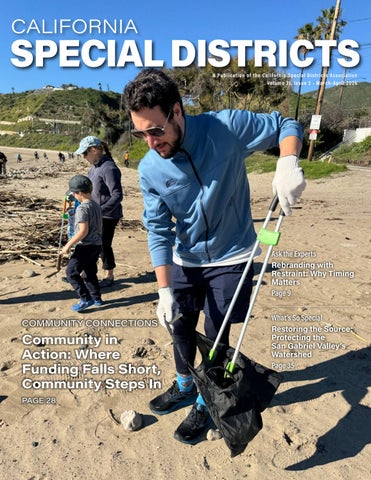
Community in Action: Where Funding Falls Short, Community Steps In

In the face of increasingly frequent and severe natural disasters, special districts across California are being asked to do more than ever, often without a corresponding increase in funding. For the Resource Conservation District of the Santa Monica Mountains (RCDSMM), meeting those growing demands has relied not only on technical expertise, but on something far more enduring: deep, longterm relationships with the community they serve.

When wildfires tore through the Palisades area, the impacts rippled far beyond the burn zone. Debris from destroyed homes and vehicles washed downstream into Topanga Creek and along the coast, threatening sensitive habitats and federally endangered species. The scope of

work required to respond, including monitoring water quality, restoring habitat, and removing hazardous debris, far exceeded what any single district budget could absorb.

Community Partnerships at Work

RCDSMM partnered with Surfrider Foundation to coordinate a beach cleanup recently at Topanga Beach, drawing more than 50 volunteers on the fire’s anniversary. Volunteers removed over 800 pounds of burned debris, including rusted metal, charred boards, and other hazardous remnants that had traveled miles from their source. While the cleanup itself was impactful, it was also

COMMUNITY CONNECTIONS

emblematic of something larger: a community stepping in where traditional funding mechanisms fall short. Natural disasters bring immediate damage, but they also create long-term environmental challenges that are rarely accompanied by increased emergency funding. Post-fire water quality testing, sediment analysis, and species monitoring are critical to protecting public health and ecological systems, yet districts are often left to piece together resources on their own. In this case, RCDSMM turned to the relationships it had spent decades building. A simple call for help, shared through trusted community channels, raised nearly $30,000 in just two weeks, covering essential monitoring costs that would have otherwise gone unfunded.

These partnerships are cultivated over years of consistent engagement, education, and trust-building. The beach cleanup and fundraising for water quality testing are just two examples among many. RCDSMM regularly leads oak woodland restoration projects in local state parks, coordinates invasive species removal, and supports monarch butterfly habitat restoration, often with the help of hundreds of volunteers from local schools, colleges, service organizations, and community groups.

Growing the Next Generation of Conservation Leaders

One of the environmental scientists now working in the region first began volunteering with RCDSMM at just 13 years old. Years of hands-on experience, planting oaks, restoring creeks, and learning the realities of conservation work, shaped a career path that eventually led them back

to serve the same community they once volunteered to support. It is a testament to what happens when people are invited not just to help, but to belong and invest in the cocreation of a community.

Community involvement also plays a critical role in addressing the consequences of individual actions. Years ago, RCDSMM led a massive creek cleanup after one person’s illegal dumping resulted in more than 22 wrecked cars and thousands of pounds of debris in a local creek. Rectifying that damage required hundreds of volunteers, significant grant funding, specialized equipment, and countless hours of labor. The effort underscored a stark reality: it often takes an entire community to undo the harm caused by a single act of neglect.

Community Stewardship

As environmental challenges intensify, the work of conservation increasingly depends on community involvement. Volunteer stewardship fills critical gaps in capacity, but it also does something equally important: it connects people to their environment in a tangible way. When individuals take part in restoring beaches, creeks, and habitats, they become more thoughtful, engaged stewards of the resources that sustain their communities. For districts, the lesson is clear. Investing time in building relationships, engaging residents early, and creating consistent opportunities for participation strengthens both the work itself and the community supporting it. Over time, those connections become an essential part of meeting today’s challenges and those to come.

The Valley Clean Infrastructure Plan: From Fallowed Land to an Energy Powerhouse

One of the nation’s largest agricultural water districts, Westlands Water District spans roughly 1,000 square miles — about 614,000 acres — primarily in western Fresno County with a small portion in Kings County. Formed in 1952, its core mission is to deliver reliable and affordable agricultural water to farmers who grow nearly 70 varieties of food and fiber commodities to communities across the country and the world.

That mission has grown more complicated as the state addresses the limitations of an unpredictable water supply.

Allocations from the federal Central Valley Project fluctuate sharply from year to year. At the same time, implementation of the Sustainable Groundwater Management Act (SGMA) that requires groundwater basins to reach long-term balance, partly through reducing pumping in areas historically dependent on it. SGMA’s goal — preventing subsidence and protecting infrastructure from damage caused by overdraft — is critical. But for growers within Westlands’ boundaries, the result has been significant land fallowing.

On average, roughly 190,000 acres within the district’s service area are fallowed each year, and 200,000 acres or more have been fallowed each of the last five years. Fallowed ground still carries costs: bank loan payments, weed management, tilling, taxes and general upkeep. What it does not generate is revenue.

District leaders recognized that reality early. Westlands is governed by a nine-member board of directors, each of whom is a farmer within the district. They have lived the volatility of water supply insecurity firsthand. As allocations tightened and groundwater pumping was curtailed under SGMA, the board began exploring alternatives for land that could no longer be farmed consistently.

The answer taking shape is the Valley Clean Infrastructure Plan (VCIP), a large-scale renewable energy initiative that could ultimately encompass up to 136,000 acres of solar development and battery energy storage across the district. Rather than viewing fallowed land as stranded, the board saw a potential to offset fallowed land while helping the state achieve its clean energy ambitions.

“The whole purpose of this project is to make Westlands Water District more durable and able to provide affordable water for our customers over the long-term,” Assistant General Manager Jose Gutierrez explained. Revenue generated through solar development and energy transmission would not divert the district from its water mission. Instead, it would strengthen it — funding improvements to canals, conveyance systems, storage and other infrastructure that supports agricultural deliveries. The strategy operates on multiple levels. Farmers who choose to host solar arrays on their fallowed acreage can create a new revenue stream. The district, which also owns some unused property, may sell or lease land to support development. And the state will benefit from additional clean energy generation aligned with California’s ambitious climate goals.

To make the plan viable, legislative adjustments were required. Assembly Bill 2661, carried with the support of Assemblymember Esmeralda Soria, authorized Westlands to own and operate electrical transmission lines — an unusual role for a water district. The bill created a framework that allows the district to build out the backbone infrastructure needed to move power from project sites to the grid.

opportunity. Aligning the district’s needs with the state’s clean energy targets offered a win-win solution.

To begin, a Program Environmental Impact Report (PEIR) was prepared to evaluate potential impacts and establish mitigation measures. According to district officials, the PEIR process helped address environmental considerations at a broad level, allowing individual projects within the program to move forward more efficiently while remaining compliant.

Now, after years of planning, stakeholder engagement and regulatory work, the district is approaching the point of breaking ground on initial phases. Gutierrez described a phased timeline that builds infrastructure in stages, coordinating power generation with transmission capacity and market demand.

“The whole purpose of this project is to make Westlands Water District more durable and able to provide affordable water for our customers over the long-term.”
Jose Gutierrez Assistant General Manager Westlands Water District

For Westlands, the Valley Clean Infrastructure Plan is not a pivot away from water. It is a strategy born of water scarcity. By turning underutilized land into an asset, the district aims to stabilize revenues, support growers navigating SGMA’s constraints and reinvest in the infrastructure that delivers water when it is available. In a region impacted by cycles of drought, the board’s approach reflects a broader shift: resilience through diversification.

The VCIP is far more than panels in a field. It includes generation facilities, substations, transmission lines extending to other parts of the state, and battery storage designed to increase grid reliability.

The Westlands Board was deliberate and methodical in its guidance. Directors evaluated the risks of inaction against the long-term sustainability of the district. They weighed how continued fallowing would impact local economies, farmworkers and land values. They also considered how participating in the state’s transition to renewable energy could position Westlands as a proactive partner rather than a bystander.

“We knew we needed alternatives and repurposing for that fallowed land,” Gutierrez said. At the same time, he noted, California’s energy policy direction created a clear

Looking ahead, Westlands’ leaders see the Valley Clean Infrastructure Plan as a long-term investment in stability — for their growers, their water system and the communities that depend on them. By transforming underutilized land into a source of clean energy and reinvesting proceeds into modernized water infrastructure, the district is positioning itself to operate more efficiently in an era of limited supplies. At the same time, the scale of the project stands to make a meaningful contribution to California’s renewable energy portfolio, helping the state move closer to its climate and reliability goals. For a district founded to deliver water, the vision now extends toward a future where energy and water work together to sustain agriculture in the San Joaquin Valley.

CLAIMS Interview

Three Cost Drivers Every Special District Employer Should Understand About Workers’ Compensation

As workers’ compensation costs continue to climb across California, special districts must be increasingly aware of the risk of high value claims. To better understand what is driving those costs—and what employers should be paying close attention to—we spoke with Gideon Baum, president of the California Workers’ Compensation Institute, on his presentation at the SDRMA Spring Education Day in March.

Baum, who assumed leadership of CWCI in late 2025, has spent much of his career working at the intersection of public policy, data, and workers’ compensation reform. In our interview, he pointed to three major cost drivers that are reshaping the system for employers: the Subsequent Injury Benefit Trust Fund (SIBTF), cumulative trauma claims, and the increasing use of Functional Restoration Programs (FRPs).

“These are not abstract issues,” Baum emphasized. “They are already affecting what employers are paying and how claims evolve.”

The Subsequent Injury Benefit Trust Fund: A Program Out of Balance

Baum began by discussing the Subsequent Injury Benefit Trust Fund, a program created after World War II to support workers who became totally disabled due to a combination of a prior, non-industrial injury and a later work-related injury.

“The original intent was very narrow and very humane,” Baum explained. “It was about making sure people with pre-existing disabilities weren’t left behind.”

For decades, the program remained relatively small. According to Baum, that changed after broad workers’ compensation reforms were enacted in 2012 without corresponding updates to the SIBTF statute. As the rest of the system evolved, SIBTF remained largely frozen in time.

“The result was an inadvertent loophole,” he said. “And once that loophole was identified, claims and award sizes grew very quickly.”

Baum described the fund’s unfunded liabilities as “enormous,” noting that they now total billions of dollars. More concerning, he said, is the way employer assessments used to fund SIBTF are crowding out other priorities.

“It is getting to the point where folks are paying more in assessments for the Subsequent Injury Benefit Trust Fund than they are for just about any other activity those assessments were meant to support,” Baum said.

For special districts, those rising assessments translate directly into higher costs that are difficult to anticipate or control.

Cumulative Trauma Claims: A Growing Source of Friction

The second major cost driver Baum highlighted was cumulative trauma. Unlike a specific injury that occurs at a single point in time, cumulative trauma develops gradually from repetitive motion or long-term physical stress.

“Cumulative trauma has always existed in the system,” Baum said. “What’s changed is how common it’s becoming and how expensive it is to deal with.”

CWCI research shows a significant increase in cumulative trauma claims since the pandemic, along with shifts in who is filing those claims and how often attorneys are involved. Baum noted that cumulative trauma claims are especially challenging because they are highly fact-intensive.

“They’re complex, they’re almost always litigated, and just figuring out whether the claim exists can be arduous and expensive,” he said.

Because these claims often require multiple medical evaluations, legal opinions, and depositions, costs can escalate quickly—even before benefits are awarded. For special districts with long-tenured employees in physically demanding roles, Baum cautioned that cumulative trauma represents a growing exposure.

“What used to be a nuisance is becoming something that actually threatens the stability of the system,” he said.

Functional Restoration Programs Under Review

Baum also discussed Functional Restoration Programs, which were originally developed to help injured workers

recover from chronic pain and reduce reliance on opioids through a holistic approach to care.

“These programs have been around for over 20 years,” Baum said. “And their intent is good.”

However, CWCI research has shown increased use of FRPs and rising associated costs. Baum explained that while proponents argue the programs deliver long-term benefits that justify the expense, the data does not always clearly support that claim.

“Our research asked a simple question,” he said. “If these programs are increasing in use and cost, are we actually seeing the offsetting benefits that are promised?”

When FRPs are layered onto already complex claims— particularly those involving cumulative trauma or potential SIBTF exposure—Baum said they can significantly increase total claim costs.

Why Risk Mitigation Matters

Throughout the interview, Baum repeatedly returned to one theme: prevention.

“If you are not mitigating the risk of an injury occurring,” he said, “and if you’re not making sure injured workers receive the support they’re entitled to early on, that is going to wind up being a very expensive claim.”

Strong safety practices, Cal/OSHA compliance, prompt reporting, and effective return-to-work strategies all reduce the likelihood that a claim will escalate into one of these high-cost scenarios.

Baum emphasized the importance of experienced guidance in navigating these challenges, pointing to the role of Special District Risk Management Authority in helping special districts apply best practices and manage risk proactively.

“Special districts don’t have the option to just raise prices or absorb unlimited costs,” Baum said. “Every dollar that didn’t need to be spent on a claim is a dollar that can be used to serve the community.”

For Baum, understanding these three cost drivers is not about assigning blame—it’s about giving employers the information they need to protect their employees, their budgets, and the public services they provide.

What's So Special

Restoring the Source: Protecting the San Gabriel Valley’s Watershed

On a bright Saturday morning, volunteers gather in the Angeles National Forest with a shared purpose: restoring and protecting the watershed that supports the San Gabriel Valley. Traveling from across the region, participants range from Girl Scout troops and college students to seniors, all ready to spend the day planting trees, collecting trash, and making a tangible difference through the Upper San Gabriel Valley Municipal Water District’s (Upper Water) Watershed Restoration Program.

Safeguarding the Source of Local Water

The Watershed Restoration Program is a cooperative partnership between Upper Water and the U.S. Forest Service. Together, they work to preserve critical watershed areas within the Angeles National Forest—land that plays a

vital role in capturing, storing, and replenishing local water supplies.

Much of this work takes place in Azusa Canyon along Highway 39, an essential part of Upper Water’s watershed. Here, rain and snowmelt naturally percolate into the ground, where water is stored in local canyon reservoirs and later released into spreading grounds. This process helps recharge the region’s groundwater basin.

Restoration in the Face of Ongoing Challenges

Over time, fires, mudslides, invasive vegetation, and heavy recreational use have accelerated erosion throughout the canyon. The loss of riparian vegetation and destabilized riverbanks increase soil runoff into streams and reservoirs, leading to siltation. This buildup reduces reservoir storage

capacity and limits the ability of water to seep into the ground—directly impacting groundwater replenishment.

Upper Water’s Watershed Restoration Program addresses these challenges through hands-on community involvement. Several times a year, volunteers help replant germinated seedlings and remove trash from watershed areas. These efforts stabilize soil, reduce erosion, and lessen the effects of human activity on sensitive natural environments.

Even during periods of uncertainty, such as recent government shutdowns, Upper Water and its partners have continued restoration efforts whenever possible, reinforcing a strong commitment to the watershed and the communities that depend on it.

Sustaining this level of volunteer engagement requires more than one-time events; it depends on building longterm relationships rooted in trust, communication, and shared purpose. Upper Water has cultivated a consistent volunteer base by maintaining regular communication with partner organizations about upcoming opportunities, creating welcoming and well-organized events where volunteers can clearly see the impact of their work, and fostering long-standing partnerships with the U.S. Forest Service. By treating volunteers and partners as long-term collaborators rather than occasional participants—and by making stewardship visible, accessible, and meaningful— districts can support ongoing community involvement that strengthens watershed protection year after year.

Upper Water encourages the public to join upcoming spring restoration events. To learn more about the Watershed Restoration Program, visit upperwater.org.

Upper Water’s mission is to provide a reliable, sustainable, diversified, and affordable portfolio of high-quality water supplies to the San Gabriel Valley, including water conservation, recycled water, stormwater capture, storage, water transfers, and imported water. Upper Water serves nearly one million people in its 144-square-mile service territory. Governed by a five-member elected board of directors, Upper Water is a member agency of the Metropolitan Water District of Southern California. Annually, more than 78 billion gallons of water are used in Upper Water’s service area.

Managing Risk Managing Automated External Defibrillator Risks

Having an Automated External Defibrillator (AED) on-site can save lives by providing fast treatment during a sudden cardiac arrest. They can also become a risk to agencies if regulatory requirements are not met.

In California, the rules governing AEDs are complicated, with a network of statutes and regulations, pertaining to the use of AEDs and a web of emergency response regulations that address the use of AEDs. If your Agency has an AED or is considering purchasing one, it’s important to understand which regulatory requirements apply to your operation.

This article is intended to assist with AED risk management considerations. It provides condensed versions of several regulations but does not claim to identify all applicable regulations for every type of operation. Compliance requirements may vary based on location and circumstances. Agencies are encouraged to consult with legal counsel and their local EMS Agency to determine the specific requirements applicable to their operations.

The Health & Safety Code (HSC) 1797.196 is a good place to start. Whether AEDs are required or used voluntarily, this central statute for the purchase, use, and maintenance of AEDs requires all who acquire an AED to do the following:

• Comply with all relevant regulations governing the placement of an AED.

• Notify your local EMS Agency of the existence, location, and type of AEDs at the Agency.

• Maintain and test the AED per manufacturers’ operation and maintenance guidelines.

• Inspect at least every 90 days for obvious defects or signs of tampering, operability issues (i.e.: blinking light).

• Test at least biannually and after each use.

• Document inspections, maintenance, and testing records.

• Establish the required procedures when the building owner has tenants (subsection (b)(2)), including clearly labeling AED location(s)

To help distinguish operations where AEDs are typically voluntary vs. required, the following regulations include AED requirements that may apply to some agencies:

• HSC 116045 - Public swimming pools that require a lifeguard and charge a direct fee.

• HSC 19300 - Large occupancy structures. This requirement does not typically apply to structures owned or operated by local government agencies, however there are exceptions.

• Public Utility Code 99175 – Public entity commuter rail systems.

• Ed Code 35179.6. Public and private K–12 schools.

Emergency Response Plans

Depending on the operation, there are several regulations that mandate AED emergency response procedures. All California employers are required to have emergency response procedures per Cal/OSHA CCR 3220. This is the applicable requirement for members who voluntarily provide AEDS.

In addition, requirements may also include, but are not limited to:

• Public Swimming Pools - CCR Title 22 65540, HCS 116028

• Large Occupancy Structures - HSC 10413

• Private or Public K-12 Schools - HSC 1797.196

Liability Protection/Good-Samaritan Coverage

CA Civil Code 1714.21 outlines the following provisions:

• Users: Any person who uses an AED, in good faith and not for compensation, during an emergency is not liable for civil damages resulting from their actions or omissions.

• Trainers: Individuals or organizations providing CPR/ AED training are not liable for the actions of those they trained.

• Owners/Acquirers: Entities or individuals who acquire an AED for emergency use are immune from civil damages, provided they comply with maintenance, placement, and training regulations outlined in Health and Safety Code § 1797.196.

• Exceptions: Immunity does not apply in cases of gross negligence or willful/wanton misconduct by the person who renders emergency care.

While AEDs can be life-saving tools, they also carry critical regulatory and risk management responsibilities. Agencies that acquire AEDs must ensure they understand and comply with applicable California statutes, maintenance and documentation requirements, emergency response planning, and notification requirements. Intentional compliance not only supports effective emergency response but also helps preserve liability protections under state law. By understanding the regulations, coordinating with local EMS agencies, and seeking legal guidance, agencies can integrate AEDs into their operations while minimizing risk.

NSDA’s 2026 Federal Advocacy Program and California’s Leadership Moment

Special districts are the quiet backbone of American communities. From delivering clean drinking water and protecting communities from wildfire, to operating hospitals, ports, parks, transit systems, and conservation programs, special districts provide essential services that touch nearly every American—often without fanfare and too often without full federal recognition.

In 2026, the National Special Districts Association (NSDA) is doubling down on its mission to change that.

Our 2026 Federal Advocacy Program reflects years of coordinated effort and member engagement, with the NSDA Board of Directors and Federal Advocacy Committee members and bipartisan relationship-building in Washington, D.C. Its goals are ambitious but clear: secure federal recognition for special districts, expand access to public finance and grant opportunities, ensure fair representation in federal data, and strengthen the resilience of the districts that serve communities every day. For California’s special districts—longstanding leaders in innovation, scale, and advocacy—this moment is particularly significant.

NSDA’s Federal Advocacy Priorities for 2026

At its core, NSDA’s advocacy agenda is about equity, clarity, and access. Special districts are units of local government, yet federal law often treats them inconsistently or excludes them altogether. NSDA’s priorities are designed to fix that disconnect.

DEFINING SPECIAL DISTRICTS IN FEDERAL LAW: A HISTORIC MILESTONE

The centerpiece of NSDA’s 2026 advocacy agenda is the Special District Fairness and Accessibility Act, introduced in the 119th Congress as H.R. 2766 in the House and S. 2014 in the Senate.

This landmark legislation would, for the first time, establish a formal definition of “special district” in federal law by amending Title 13 of the U.S. Code. It would also require the White House Office of Management and Budget (OMB) to issue guidance directing federal agencies to recognize special districts as units of local government for purposes of federal financial assistance.

Since 2020, NSDA has led the effort to correct this gap. The introduction of H.R. 2766 and S. 2014 represents a breakthrough moment.

“This bipartisan legislation would establish a formal definition of ‘special district’ in federal law and ensure that the nearly 40,000 special districts nationwide are eligible to receive all appropriate forms of federal financial assistance,” said Neil McCormick, Founding Member and Treasurer of NSDA and CEO of the California Special Districts Association.

“This new law will set the stage for an array of federal opportunities that will have a huge impact on our ability to provide vital services and meet community needs in every corner of our country.”

CALIFORNIA’S LEADERSHIP DESERVES THE SPOTLIGHT

California special districts have played an outsized role in advancing this legislation—and NSDA extends its sincere congratulations and gratitude with special thanks to Kyle Packham, Chief Advocacy & Public Affairs Officer at CSDA for his direct efforts to secure support.

California Representatives stepping forward as early bipartisan cosponsors of H.R. 2766 include:

• Rep. Vince Fong (R-CA)

• Rep. Julia Brownley (D-CA)

• Rep. Ken Calvert (R-CA)

• Rep. John Garamendi (D-CA)

• Rep. Josh Harder (D-CA)

• Rep. Young Kim (R-CA)

• Rep. Doug LaMalfa (R-CA)

• Rep. Jay Obernolte (R-CA)

• Rep. Raul Ruiz (D-CA)

• Rep. David Valadao (R-CA)

• Rep. George Whitesides (D-CA)

With nearly 28,000 supporters nationwide, momentum is building—and California is helping lead the charge.

What else are we working on?

STRENGTHENING PUBLIC FINANCE TOOLS FOR LOCAL SOLUTIONS

Beyond recognition, NSDA is focused on protecting and expanding the financial tools special districts rely on to build and maintain critical infrastructure.

In 2026, NSDA will advocate for:

• Reauthorization of Build America Bonds

• Expansion of Private Activity Bonds

• Restoration of advance refunding bonds

• Protection of the tax-exempt status of municipal bonds

NSDA is also actively engaged in the Public Finance Network, pushing back against costly or unworkable mandates—such as those tied to the Federal Debt Transparency Act—that could impose administrative burdens without delivering public value.

ACCURATE DATA MEANS FAIR ACCESS

Even when funding exists, special districts can be left behind if they are not accurately counted.

Following enactment of the Special District Fairness and Accessibility Act, NSDA will work with Congress to ensure the U.S. Census Bureau has the resources needed to properly count and classify special districts in federal datasets. These datasets often determine eligibility for grants, formulas for funding distribution, and how policymakers understand local government capacity.

EXPANDING FEDERAL FUNDING OPPORTUNITIES

NSDA’s advocacy also focuses on improving access to federal grants and technical assistance. Many special districts—particularly small or rural ones—lack the staff capacity to navigate complex federal applications.

NSDA will continue advocating for:

• Explicit eligibility language for special districts in grant programs

• Dedicated technical assistance funding

• Streamlined application and reporting processes

A Call to Action

Special districts are the purest expression of local control— created by communities, governed locally, and focused on delivering specific services efficiently and effectively.

Now is the moment to ensure federal policy reflects that reality.

NSDA urges continued support for H.R. 2766 and S. 2014 and thanks California’s special districts and congressional leaders for setting the pace. Together, we can clarify the role of special districts, improve access to federal resources, reinforce local accountability, and strengthen the infrastructure and services that communities depend on every day.

Legal Brief

A Supreme Court CPRA Decision with Practical Consequences for Public Agencies

A dispute that began with routine California Public Records Act (“CPRA”) requests more than five years ago has now resulted in a Supreme Court decision with meaningful implications.

City of Gilroy v. Superior Court (2026) 19 Cal.5th 38 arose from requests by the Law Foundation of Silicon Valley (“Law Foundation”) for police body-worn camera footage. In resolving the dispute, the Court focused on two specific CPRA issues. First, whether the CPRA imposes an obligation to retain records beyond an agency’s adopted retention schedule. Second, whether courts may issue declaratory relief against an agency even when no additional nonexempt records can be produced.

How the Dispute Developed

In 2018, Law Foundation submitted multiple CPRA requests to the City of Gilroy (“City”). Several of the requests sought records related to police enforcement activity at homeless encampments. The City produced some records and withheld others, asserting exemptions. Notably, this 2018 request was submitted to the City before

the Legislature amended the CPRA and the Penal Code to provide increased access to certain law enforcement records.

In May 2019, Law Foundation submitted a new request for police body-worn camera recordings. The City produced some records but again denied access to the footage. After Law Foundation indicated that it intended to challenge the denial, the City voluntarily placed the footage on a litigation hold and preserved the footage beyond the City’s standard one-year destruction policy.1 Then, the City responded to Law Foundation by releasing only videos that did not relate to citations or arrests. The City further advised Law Foundation that no other nonexempt records existed and that footage recorded before early 2018 had been destroyed in accordance with the City’s retention schedule.2

Litigation and Trial Court Findings

In late 2020, Law Foundation filed a writ petition alleging that the City violated the CPRA in its handling of both the 2018 and 2019 requests. The petition alleged that the City

failed to conduct an adequate search, delayed responding, improperly withheld records, and destroyed responsive records while requests were pending.3

The Trial Court found that the City violated the CPRA only regarding the 2018 requests; there were no violations related to the City’s handling of the 2019 request. Specifically, the Court concluded that the City conducted an inadequate search and improperly asserted a blanket investigatory exemption without reviewing the footage. Both parties appealed.

The Court of Appeal reversed the Trial Court’s decision, holding that declaratory relief was not available to the Law Foundation because all the responsive, nonexempt records had already been disclosed. The Court of Appeal also rejected Law Foundation’s argument that the City had violated the CPRA when it destroyed the pre-2018 records, finding that the CPRA does not impose a records retention requirement.

The dispute ultimately proceeded to the Supreme Court, where the Court addressed two key legal questions.

What the Supreme Court Decided

First, the Court confirmed that the CPRA does not, in itself, require agencies to retain records beyond their adopted retention schedules. The CPRA governs disclosure, not retention. Agencies are not required to preserve records solely because they could be responsive to a future or pending CPRA request, so long as destruction occurs pursuant to a lawful retention policy.

It is important to note that this decision directly impacts cities and counties, but special districts are subject to a different statutory framework when it comes to the retention of public records. Government Code section 60201 (d)(5) requires special districts to retain a copy of any record that is denied in response to a CPRA request for a minimum of two years. This statutory requirement does not apply to cities nor counties.

Notably, Law Foundation’s argument applied to a completed CPRA request stating that the retention period commenced from the time an agency asserted an exemption to withhold records. Although the Court did not expressly address whether the CPRA imposes a retention obligation to a pending request, Government Code section 7922.500 does not “permit an agency to delay or obstruct the inspection or copying of public records.” Hence, it would be reasonable to conclude that an agency

is not permitted to destroy records that are the subject of a pending CPRA request.

Second, the Court held that declaratory relief may be available in certain CPRA cases even when everyone agrees that there are no additional responsive, nonexempt records to be disclosed. Declaratory relief does not compel the production of records; rather, it allows a court to clarify legal duties and guide future conduct.

The City argued that allowing declaratory relief for procedural CPRA violations, even when agencies had complied with its disclosure obligations, would encourage litigation primarily for the purpose of recovering attorneys’ fees. Instead of barring declaratory relief, the Court explained that such relief may be appropriate when an agency is reasonably likely to repeat the improper conduct in response to future requests and remanded the matter to the Court of Appeal for further consideration of that issue.

Practical Implications for Public Agencies

The decision provides clarity on record retention: the CPRA does not require cities to retain records for closed requests beyond their adopted retention schedules.

Additionally, the ruling signals that CPRA litigation may commence even when no further production is possible. Allegations related to search adequacy, response timing, and exemption practices may still expose agencies to litigation through claims for declaratory relief.

Why This Matters

This decision reinforces the importance of defensible CPRA practices. Well documented searches, timely responses, careful exemption determinations, and consistent procedures remain essential. While retention schedules continue to control how long records must be kept, procedural compliance with the CPRA can still carry legal consequences even after records are produced or lawfully destroyed.

Public agencies should review their CPRA practices in consultation with legal counsel to assess how this decision may affect local procedures and litigation exposure, consistent with established compliance principles.

Endnotes

1 Id. 826-828

2 Id. 828-830; Gov. Code § 34090.6

3 Id. 830-832; Gov. Code § 7922.535

Help Your Message Land with Micro-Storytelling

In the public sector, leaders are often tasked with explaining complex information to diverse audiences in a way that builds understanding, trust, and connection. During a recent CSDA webinar, Micro-Storytelling for Public Sector Impact, trainer and coach Lisa Kjellstrom of CPS HR delivered an engaging, highly participatory session that invited attendees to reflect, interact, and practice storytelling in real time.

Kjellstrom opened with a simple but effective engagement exercise, asking participants to tell the story of their week using only emojis. As the chat window filled, the activity immediately built connection among participants and

reinforced a core theme of the session — storytelling doesn’t have to be long or elaborate to be powerful.

Why Story Works When Data Falls Short

“A good story can make complex information simpleand make the message stick,” Kjellstrom shared. Stories motivate action in a way that data alone cannot. In the public sector, storytelling helps agencies build legitimacy, shape organizational culture, earn public trust, and remind both employees and communities why the work matters. Data is essential, but it often doesn’t resonate. Consider two ways to alert the public to a power outage. Your goal continued >

in communicating the message is to state the problem but also build the public’s support for the urgency of the situation and the need to spend public money on the solution. Which resonates best?

• “Power is out to 10,000 homes.”

• “Maria, a mother, had to drive 20 miles in inclement weather to replace her son’s insulin after it expired when their power went out.”

Both statements are true. Only one creates understanding, urgency, and empathy. Storytelling translates information into lived experience, helping audiences grasp the realworld impact of public services.

Humans are hardwired to receive, remember, and respond to stories. In the public sector, where the stakes are high and trust is essential, storytelling allows leaders to communicate with clarity and heart, which is critically important for foundational services such as clean water, working utilities, use of public spaces, and public safety.

The Building Blocks of Effective Stories

Kjellstrom outlined the core ingredients of storytelling through a simple framework: problem, complication, resolution, and lesson. Avoid overwhelming your audience with background. Grab attention by introducing tension early and putting a human face to the problem. Show the audience the complication being experienced, provide the resolution and then drive the point home with the lesson of the story.

Avoid acronyms and buzzwords, use plain language, and anchor stories to people so audiences can see themselves in the message.

• Speaking to the public: “Infrastructure upgrades” become “aging pipelines prone to breakage.”

• Pitching the board on an increase to the staffing budget: Burnout statistics like “25% staff turnover” become “field crews unsustainably working 60-hour weeks.”

“At the end of the day, your goal is to have your message land,” Kjellstrom said.

Delivery Matters as Much as Content

Storytelling is built on two pillars: content and delivery. Even the strongest message can fall flat if delivery creates barriers to listening.

Kjellstrom stressed the importance of understanding your audience’s cognitive load: every listener is “spending” mental energy to pay attention. Poor delivery — excessive filler words, fidgeting, flat tone, or unclear pacing — raises the cost of listening. When that cost becomes too high, audiences tune out.

Research suggests that only a small portion of audience impact comes from content. Body language and vocal delivery carry far more weight. Effective delivery lowers the cognitive cost of listening and helps messages travel beyond the room.

Key delivery tools include varied vocal pace and cadence, intentional pauses, eye contact (or looking directly at the camera in virtual settings), hand gestures, and posture that signals presence and confidence. Silence, Kjellstrom noted, is not a mistake — it is a gift that allows ideas to land.

“You are the emotional governor in the room,” she said.

Making Messages Memorable

Clear delivery becomes crystallized delivery when messages are not only heard, but remembered and shared. When storytelling is done well, messages travel without leaders having to repeat them. They’re carried forward by the people who share them.

For public sector leaders, micro-storytelling is a powerful way to earn attention, build trust, and communicate impact — one meaningful story at a time.

Micro-storytelling for the Public Sector is available in our On-Demand Webinar library free to CSDA Members. Visit csda.net/learn to watch.

Money Matters

The One Big Beautiful Bill Act: What

Was Promised, What Changed, and What Special Districts Need to Know

When Congress passed the One Big Beautiful Bill Act (OBBBA), the message many Americans heard was simple and appealing: overtime would be tax-exempt. Widely advertised as a benefit for workers, OBBBA suggested that employees who put in extra hours would keep more of their pay. However, once the legislation was analyzed and implemented, it became clear that the overtime exemption was far narrower than originally understood.

What the Bill Was Advertised to Do

The early messaging around the One Big Beautiful Bill Act focused on the idea that overtime wages would not be subject to federal income tax. Under this interpretation, if an employee earned $1,000 in regular wages and $200 in overtime during a week, the $200 in overtime would be exempt from federal taxation when filing their tax return.

What the Bill Actually Says About Overtime

Under federal wage law, overtime is paid at one and onehalf times an employee’s regular rate for hours worked over 40 in a workweek. The key clarification in OBBBA is that

the tax exemption applies only to the “half-rate” portion of overtime, not the full overtime wage.

In practical terms, if an employee earns $10 per hour and receives $15 per hour for overtime, only the additional $5, the half-rate premium, is eligible for the exemption. The base hourly wage portion remains taxable.

Even more significantly, the exemption applies only to overtime that meets the federal definition of “hours worked.” This distinction is where many special districts encounter challenges.

Hours Worked vs. Leave Time: A Key Distinction

Federal law defines “hours worked” as time an employee is physically working. Paid leave, such as sick leave, vacation, or holiday pay, is not considered hours worked for federal overtime purposes.

Many special districts, however, have gone beyond federal minimums. To ensure adequate staffing and encourage employees to respond to emergencies or weekend call-ins, districts often count paid leave as hours worked under

their MOUs. This means an employee who takes sick leave during the week may still qualify for overtime pay if they work additional hours later in the week.

The One Big Beautiful Bill Act does not override these agreements. Employees are still paid overtime according to their MOU or handbook. What changes is whether any portion of that overtime qualifies for the federal tax exemption.

For example, if an employee uses sick leave on Monday, works their remaining scheduled hours, and is called in on Saturday, the district may still pay overtime. However, because sick leave is not “hours worked” under federal law, that overtime does not qualify for the federal tax exemption.

How This Impacts Special Districts

For special districts, the impact is not on payroll amounts but on tracking and reporting. Payroll systems must now distinguish between:

• Overtime that qualifies for the federal exemption, and

• Overtime that does not, due to the inclusion of leave time in the work week.

For 2025, employers will not be penalized for not separating out qualifying overtime for transitional relief. Beginning in 2026, employers WILL be required to report in Box 14 of the W2 the qualifying overtime. This functions like a tax credit and is applied to employees’ personal tax returns, like other credits. Tax benefits are realized when employees file their personal tax returns.

Districts with “safety employees,” such as firefighters and police officers, that often operate on an extended work period, such as 24-day cycles, face additional complexity.

Next Steps for Special Districts

Districts can take several proactive steps:

• Review MOUs and Handbooks and update as needed.

• Confirm how overtime, leave time, and hours worked are defined and ensure leadership understands how federal law differs from local agreements.

• Coordinate with Payroll and Finance Teams and stay informed about automation tools as they become available.

• Prepare for manual or supplemental tracking until payroll systems evolve.

• Communicate clearly with employees as they may expect all overtime to be exempt.

Payroll processes remain the same for employee pay, but districts must now track exempt versus non-exempt overtime for reporting purposes.

Moving Forward The One Big Beautiful Bill Act illustrates the gap that can exist between policy messaging and operational reality. For special districts, understanding the nuances and planning accordingly is essential for navigating the changes smoothly.

This article is based on an interview with Samantha Prall, Partner at Platinum Strategies Inc.

MONEY MATTERS by CSDA Finance Corporation

CSDA Finance Corporation Achieves Record-Breaking Year with $167 Million in Financings

FINANCING SUCCESS STORIES FROM THE CSDA FINANCE CORPORATION

CSDAFC has released four new case studies now available on their website, showcasing successful financing initiatives from 2025. These recaps highlight how member districts leveraged CSDAFC’s network of expert consultants to deliver valuable and timely funding solutions to their communities.

These studies show how CSDAFC enabled districts to

• Sustain cashflow while awaiting grant disbursement

• Upgrade critical infrastructure to serve their communities

• Solicit competitive bids and minimize borrowing costs

• Secure flexible terms tailored to district needs

Visit csdafinance.net or call 877.924.2732 for more information or to submit a quote request.

AllPaid www.AllPaid.com

DIAMOND LEVEL

Amazon Business www.csda.net/amazon-business

California CAD Solutions (CALCAD) www.calcad.com

California CLASS www.californiaclass.com

Columbia Bank www.columbiabank.com

CPS HR Consulting www.cpshr.us

VC3 www.vc3.com

PLATINUM LEVEL

Atkinson, Andelson, Loya, Ruud & Romo www.aalrr.com

Best Best & Krieger www.bbklaw.com

Five Star Bank www.fivestarbank.com

CSDA Finance Corporation www.csdafinance.net

Enterprise Mobility www.enterprisemobility.com

GovDeals www.govdeals.com

Special District Risk Management Authority www.sdrma.org

Streamline www.getstreamline.com

Utility Cost Management, LLC www.utilitycostmanagement.com

Tri Counties Bank www.tcbk.com

Liebert Cassidy Whitmore www.lcwlegal.com

Platinum Strategies Inc www.platinumstrategiesinc.com

Richards Watson Gershon www.rwglaw.com

Why This ‘Bean Counter’ Backs the CSDA Commercial Card

For most chief finance officers, a credit card is just a payment tool. For CSDA Chief Finance and Operations Officer Rick Wood, the real value of the CSDA Commercial Card by Columbia Bank is what happens after the swipe. Wood points to the Spend Clarity expense reporting system as the game changer. Instead of sorting through “shoeboxes full of receipts,” cardholders snap photos on the mobile app, store them in a personal digital library, code the proper general ledger line item, and submit electronically. With 30 cardholders at CSDA, Wood estimates the system saves him two to three full days each month.

More importantly, it strengthens accountability. Each report is reviewed by a supervisor and then by the CFO, creating a documented, double-check process with electronic receipt images auditors can easily access. Comparable systems can cost tens of thousands annually; Spend Clarity is included at no additional fee. Add in a tiered rebate— currently 1.05% back based on aggregate spend—and the value multiplies.

For special districts, where time and accuracy directly impact public trust, a streamlined, paper-free system isn’t a perk. It’s smart financial governance.

GOLD LEVEL

Brown Armstrong Accountancy Corporation www.bacpas.com

California Bank of Commerce www.californiabankofcommerce.com

CalTrust www.caltrust.org

Centric Business Solutions www.centricabusinesssolutions.com

Cole Huber LLP www.colehuber.com

Complete Paperless Solutions www.cps247.com

Easeworks www.easeworks.com

Energy Systems Group

www.energysystemsgroup.com

Harshwal & Company LLP www.harshwal.com

Kosmont Financial Services www.KosmontFinancial.com

National Demographics Corporation (NDC) www.ndcresearch.com

NBS www.nbsgov.com

Nossaman, LLP www.nossaman.com

Redwood Public Law, LLP www.redwoodpubliclaw.com

River City Bank www.rivercitybank.com

SiteLogiq www.sitelogiq.com

Slovak Baron Empey Murphy & Pinkney LLP www.sbemp.com

Townsend Public Affairs www.townsendpa.com

Tyler Technologies, Inc. www.tylertech.com

Witt O’Brien’s www.wittobriens.com

Cybersecurity / IT Services

Merchant Services

Online Surplus Action

Risk Management

Turn static files into dynamic content formats.

Create a flipbook