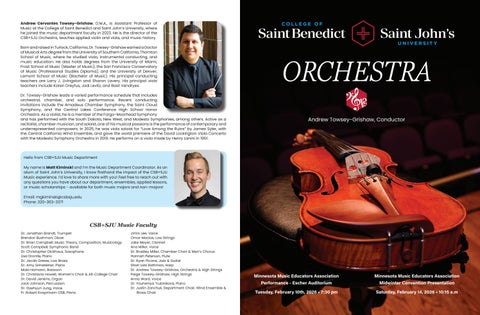
Andrew Cervantes Towsey-Grishaw, D.M.A., is Assistant Professor of Music at the College of Saint Benedict and Saint John’s University, where he joined the music department faculty in 2023. He is the director of the CSB+SJU Orchestra, teaches applied violin and viola, and music history.
Born and raised in Turlock, California, Dr. Towsey-Grishaw earned a Doctor of Musical Arts degree from the University of Southern California, Thornton School of Music, where he studied viola, instrumental conducting, and music education. He also holds degrees from the University of Miami, Frost School of Music (Master of Music), the San Francisco Conservatory of Music (Professional Studies Diploma), and the University of Denver, Lamont School of Music (Bachelor of Music). His principal conducting teachers are Larry J. Livingston and Sharon Lavery. His principal viola teachers include Karen Dreyfus, Jodi Levitz, and Basil Vendryes.
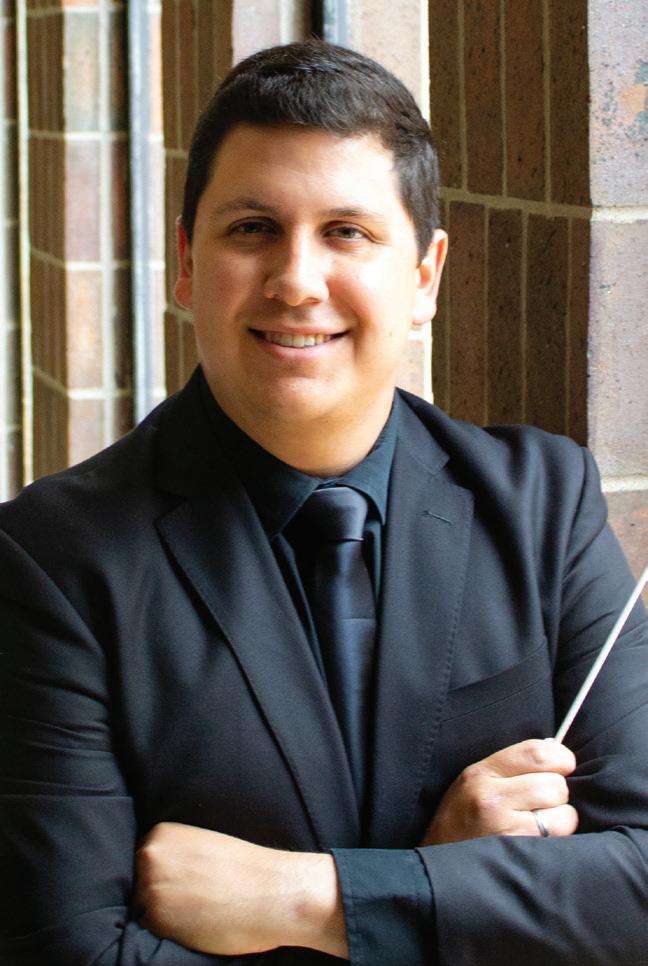
Dr. Towsey-Grishaw leads a varied performance schedule that includes orchestral, chamber, and solo performance. Recent conducting invitations include the Amadeus Chamber Symphony, the Saint Cloud Symphony, and the Central Lakes Conference High School Honor Orchestra. As a violist, he is a member of the Fargo-Moorhead Symphony and has performed with the South Dakota, New West, and Modesto Symphonies, among others. Active as a recitalist, chamber musician, and soloist, one of his musical passions is the performance of contemporary and underrepresented composers. In 2025, he was viola soloist for “Love Among the Ruins” by James Syler, with the Central California Wind Ensemble, and gave the world premiere of the David Lockington Viola Concerto with the Modesto Symphony Orchestra in 2019. He performs on a viola made by Henry Lanini in 1951.
Hello from CSB+SJU Music Department
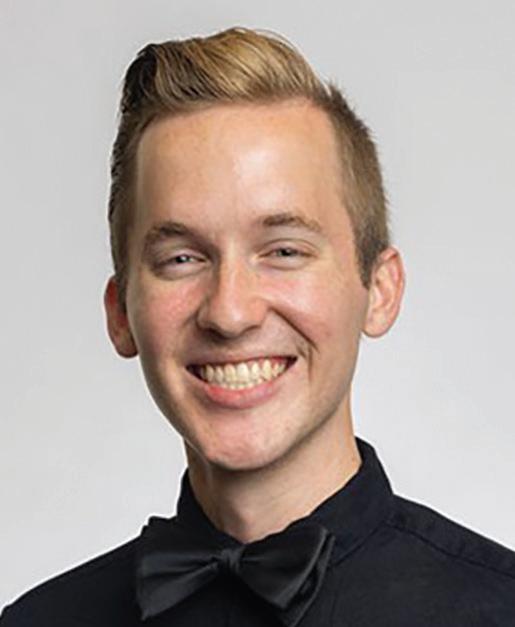
My name is Matt Kiminski and I’m the Music Department Coordinator. As an alum of Saint John’s University, I know firsthand the impact of the CSB+SJU Music experience. I’d love to share more with you! Feel free to reach out with any questions you have about our department, ensembles, applied lessons, or music scholarships - available for both music majors and non-majors!
Email: mgkiminski@csbsju.edu Phone: 320-363-3371
Dr. Jonathan Brandt, Trumpet
Brendon Bushman, Oboe
CSB+SJU Music Faculty
Jimin Lee, Voice
Omar Macias, Low Strings
ORCHESTRA
Dr. Brian Campbell, Music Theory, Composition, Musicology
Scott Campbell, Symphonic Band
Dr. Christopher Dickhaus, Saxophone
Lisa Drontle, Piano
Dr. Jacob Grewe, Low Brass
Dr. Amy Grinsteiner, Piano
Maia Hamann, Bassoon
Dr. Christiana Howell, Women’s Choir & All-College Choir
Dr. David Jenkins, Organ
Jack Johnson, Percussion
Dr. Gyehyun Jung, Voice
Fr. Robert Koopmann OSB, Piano
Jake Meyer, Clarinet
Ana Miller, Voice
Dr. Bradley Miller, Chamber Choir & Men’s Chorus
Hannah Peterson, Flute
Dr. Ryan Picone, Jazz & Guitar
Shari Latz Rothman, Harp
Dr. Andrew Towsey-Grishaw, Orchestra & High Strings
Paige Towsey-Grishaw, High Strings
Anna Ward, Voice
Dr. Yauheniya Trubnikava, Piano
Dr. Justin Zanchuk, Department Chair, Wind Ensemble & Brass Choir
Minnesota Music Educators Association Performance - Escher Auditorium
Tuesday, February 10th, 2026 • 7:30 pm
Minnesota Music Educators Association
Midwinter Convention Presentation Saturday, February 14, 2026 • 10:15 a.m
Andrew Towsey-Grishaw, Conductor
The College of Saint Benedict and Saint John’s University
The College of Saint Benedict (CSB) and Saint John’s University (SJU) are two highly rated liberal arts colleges located four miles apart in central Minnesota. CSB designs programs to meet aspirations of young women, emphasizing women’s leadership. SJU serves the needs of young men, emphasizing a development profile that includes intellectual, spiritual, emotional, and physical development.
The two institutions share a one-of-a-kind partnership that began over 60 years ago and is stronger and more connected today than ever. When you enroll at CSB or SJU, you become part of a close-knit community that fosters friendships and contacts for a lifetime. Together, we offer the opportunities, course selection, and extensive curriculum of a large university while retaining the small classes and personal attention expected at a top liberal arts college.
The students of these two colleges share a common curriculum, identical degree requirements, and a single academic calendar. All academic departments are joint, and classes are offered through the day on both campuses.
The liberal arts education provided at CSB and SJU is rooted in the Catholic intellectual tradition and guided by the Benedictine principles of the colleges’ founders and sponsoring religious communities. These principles stress community living through hospitality, listening, appreciation for the dignity of work, and an abiding respect for all persons. The liberal arts are the center of a disciplined inquiry and a rich preparation for professions, public life, and service to others. Graduates of the two colleges have a distinguished record in each of the areas.
CSB+SJU Music Department
The CSB+SJU Music Department offers opportunities to student musicians across all disciplines taught by exceptional faculty, and world-class facilities. Together, we prepare dynamic leaders for the modern musical community. CSB+SJU offers a comprehensive music major and minor, as well as professional programs in vocal and instrumental music education. The Music Department educates all students, including music majors, music minors, and the general student of any major, both individually and collaboratively, through appropriate courses in musicology, music theory, music appreciation, applied instrumental and vocal instruction, and through performing in choral and instrumental ensembles. We provide an integrative learning environment which stresses intellectual challenge, open inquiry, collaborative scholarship, and artistic creativity.
Scan the QR code to learn more, or visit us at https://www.csbsju.edu/music
The College of Saint Benedict and Saint John’s University Orchestra
Dr. Andrew Towsey-Grishaw, Conductor
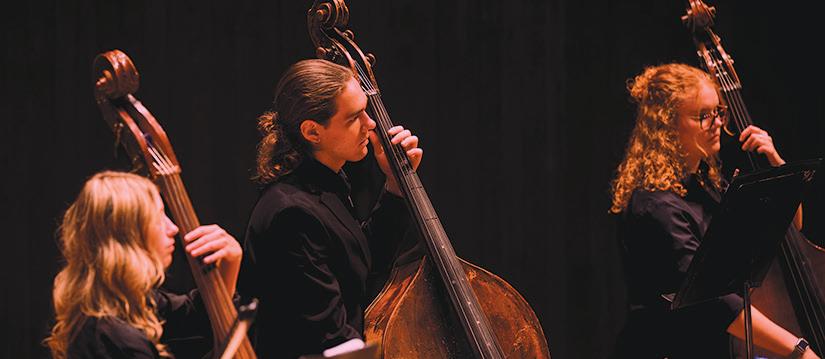
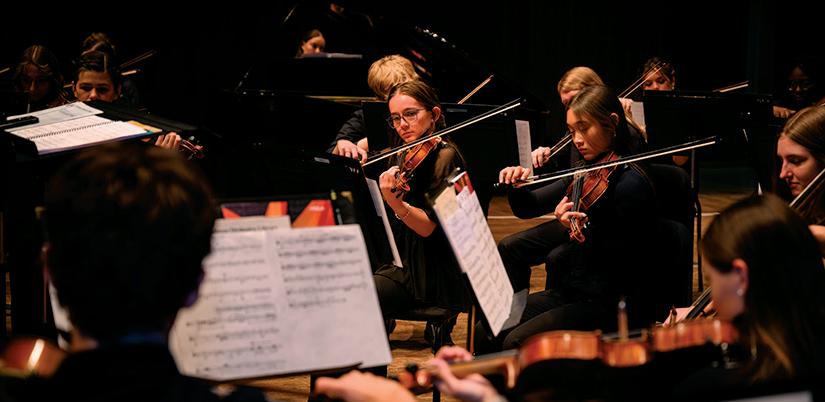
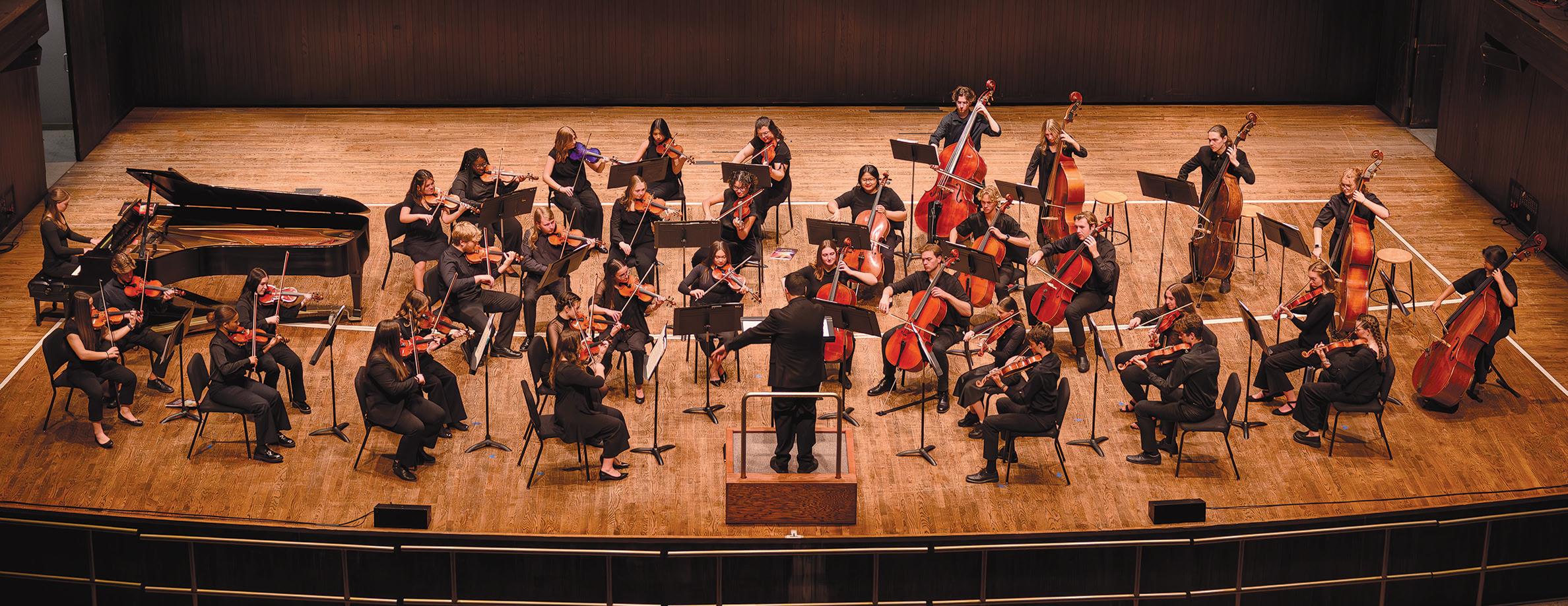
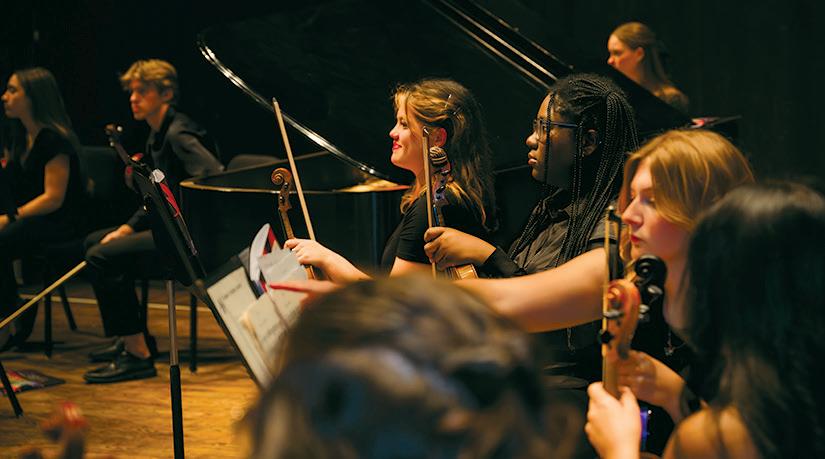
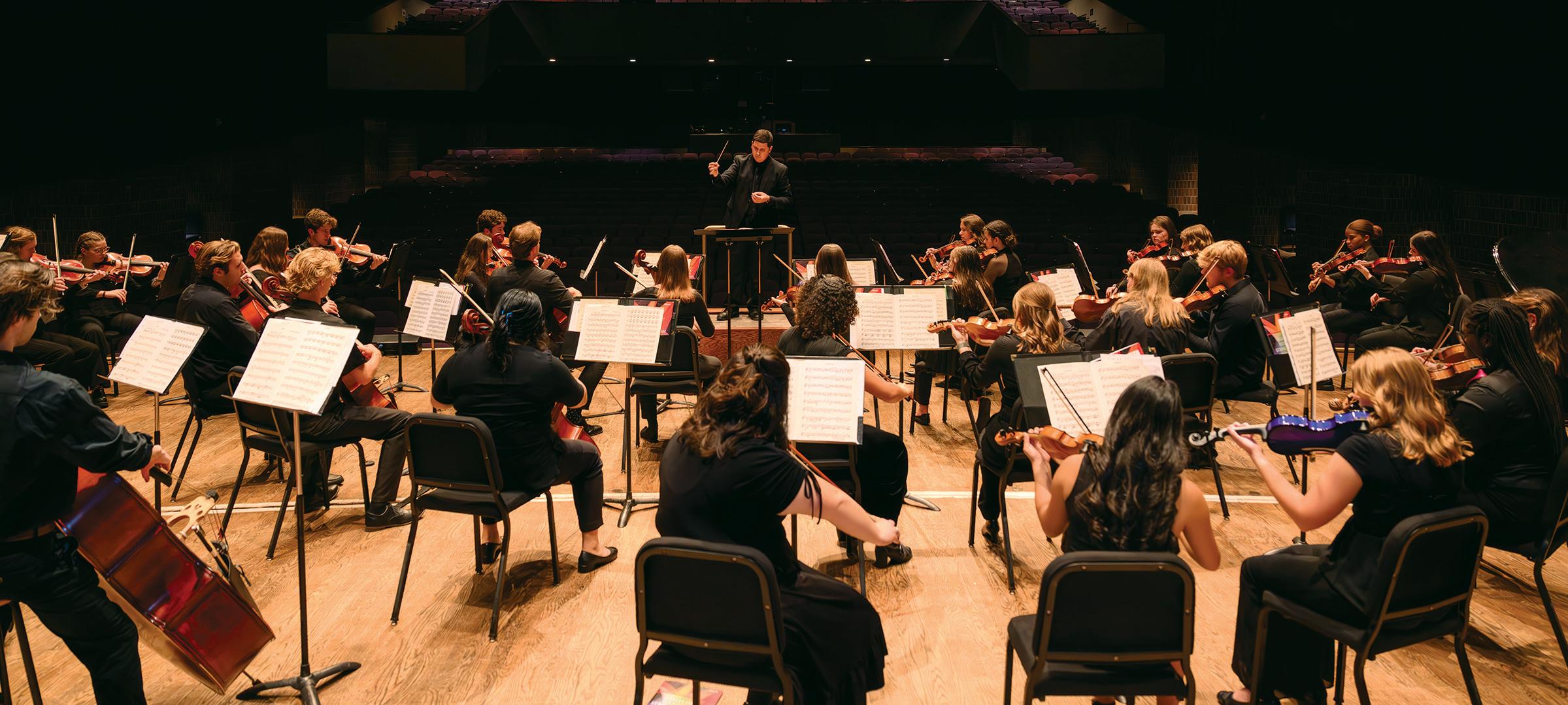
The CSB and SJU Orchestra is one of CSB and SJU’s largest and most recognized performing ensembles. Membership is on an auditioned basis, and includes music majors, music minors, as well as many students from a wide variety of other disciplines, who continue to passionately pursue string playing at the collegiate level. This ensemble performs four to five concerts each year in the beautiful 1,000 seat Escher Auditorium in the Benedicta Arts Center on the CSB campus, and tours regularly.
Violin 1
*Maren Williams – Biology, Pre-PA – Buffalo, MN
+Jayda Francis – Nursing – Shoreview, MN
Michaela Clark – Data Science – Blaine, MN
Kristin Arola – Biology – Forest Lake, MN
Destiny Moss – Biology – Nassau, The Bahamas
Gabriella Bosl – Psychology – Sartell, MN
Sophia Hoha – Chemistry – Woodbury, MN
Ellie Stonecipher – Physics – Buffalo, MN
Violin 2
*Kaline Merges – Nursing – Rogers, MN
+Molly Quello – Accounting – Grand Marais, MN
Zach Stang – Biology – Avon, MN
Adam Novak – Environmental Studies – St. Joseph, MN
Emma Pithan – Biochemistry – East Bethel, MN
Jailen Mallak – Social Science – Ramsey, MN
Karli Miguel – Physics – Plymouth, MN
Marlah Joseph – Music – Naples, FL
Ella Chiroux – Math – Haddon Township, NJ
Jennifer Chaclan – Global Business Leadership – Houston, TX
Emma Krey – Psychology, Philosophy – St. Joseph, MN
Nin Tran – Math, Economics – Danang, Vietnam
*Principal / +Assistant Principal
Viola
*Jack Johnston – Biochemistry – Maple Grove, MN
+Lily Weitzel – Art – St. Cloud, MN
Evan Raske – Theology – Monticello, MN
Ella Carlson – Nursing – Hugo, MN
Veronica Baker – Biochemistry – Woodstock, IL
Sam Brown – Music Education – Monticello, MN
Bernie Noria-Castillo – Music Education – Buffalo, MN
Cello
*Andrew Roggeman – Communications – St. Cloud, MN
+Brenna Kaufman – English – Minneapolis, MN
Collin Berg – Engineering Physics – Buffalo, MN
John Kocher – History, English – Chanhassen, MN
Melannie Amaia Ubaldo – Engineering Physics – Houston, TX
Ethan Eltgroth – Economics – St. Augusta, MN
Emmitt Lommel – Finance – Buffalo, MN
Double Bass
*Gratia Kay Ruark – Nursing – Wayzata, MN
+Meghan Weiss - Political Science - Willmar, MN
Colin Middlekauff – Art, Biology – Minnetonka, MN
Isabella Anlauf – Psychology – Maple Grove, MN
Leo Warling – Economics, Data Science – Maplewood, MN
Piano
*Ella Johnson – Biochemistry, Pre-PA – Orono, MN
The CSB and SJU String Program strives to uphold musical integrity through the implementation of the Benedictine Values that uniquely guide our academic institution. Every member of the CSB and SJU Orchestra Program is charged with the responsibility of selflessly adhering to these values for the greater good of the organization.
Awareness of God
To recognize that as musicians, our most intimate spiritual experiences can coincide with our most resonating musical experiences.
Community Living
To become who we are as an ensemble by our relationships with others.
Dignity of Work
To appreciate and respect the process of preparation and performance.
Hospitality
To offer a welcoming environment for all members and guests of the ensemble.
Justice
To work toward a just order in our rehearsal environment.
Listening
To hear keenly and sensitively to the musical voices of the ensemble.
Moderation
To find balance in practicing, rehearsing, performing, and socializing.
Peace
To strive for peace on all levels with all members of the ensemble.
Respect for Persons
To respect each member regardless of background, year in school, instrument, or ability.
Stability
To cultivate rootedness and a shared sense of mission.
Stewardship
To appreciate and to care for all the equipment of the rehearsal and performance spaces.
Program
Chorale for Strings from Partita for Orchestra ........ Stella Sung (b. 1959)
Burlesque de Quixotte TWV 55:G10 .............. G.P. Telemann (1681-1767)
i. Ouverture
ii. Awakening of Don Quixote
iii. His Attack on the Windmills
iv. Sighs of Love for Princess Aline
v. Sancho Pansa Swindled
I Like To Listen To Music ..................................
Salsa ...............................................
Salazar (b. 1999)
Elegie in G Major ............................ Peter Ilyich Tchaikovksy (1840-1893)
from Sonata da Chiesa .................. Adolphus Hailstork (b. 1941)
Skye Soto Steele (b. 1980)
Swallowtail
Angelica
Exultate
Stella Sung – Chorale for Strings from Partita for Orchestra (1997)
As a national and international award-winning composer, the music of Stella Sung has been performed throughout the United States and abroad. She served as the first Composer-inResidence for the Orlando Philharmonic Orchestra (2008-2011). Premieres, performances, and commissions of Dr. Sung’s work have included compositions for world-renowned cellist Yo-Yo Ma, the German Ministry of Culture (Rhineland-Pfalz), the National Symphony Orchestra, the Houston Symphony Orchestra, the Hong Kong Philharmonic, the Cincinnati Pops, the Orlando Philharmonic Orchestra, the Dayton Performing Arts Alliance, the Boston Landmarks Orchestra, the Monterey (CA) Symphony, the Virginia Symphony Orchestra, the Wichita Symphony Orchestra, the North Carolina Symphony Orchestra, the Akron Symphony Orchestra, the Sarasota Symphony Orchestra, the Jacksonville (FL) Symphony Orchestra, and other university and regional orchestras, chamber music ensembles, and soloists.
This original work for strings, a movement from her 1997 composition Partita for Orchestra , is in the style of a chorale. This lovely setting allows each section to enjoy its melodic charm. With divisi cello lines through the piece, sonorous harmonies are given depth and a particular richness.
George Philip Telemann – Burlesque de Quixotte (1720, approximately)
Telemann was arguably the most prolific composer ever, creating at least 3,000 works during his long career. He spent his student years and early professional life in Leipzig, and his legacy there, including the founding of the amateur Collegium Musicum, had a profound impact on Bach’s future tenure in the city. Twice Telemann wrote music inspired by Don Quixote the seminal novel by Miguel de Cervantes about a hapless knight-errant from La Mancha. Telemann’s one-act opera version can be traced to 1761, when he was 80; his orchestral Don Quixote Suite appears to have been composed much earlier, perhaps around 1720.
Telemann’s original manuscript gives the title, “Ouverture. Burlesque de Quixotte.” For this work in the style of a French dance suite, the “Ouverture” (as per the French spelling) sets the stage for the “burlesque” to come—a term for music of an exaggerated, comical character—beginning with the docile, droning strains of Don Quixote’s Awakening. The music becomes more vigorous
for His Attack on the Windmills, and it turns quite literal with the downward, sighing motives in The Sighs of Love for Princess Aline In Sancho Panza Swindled, a rising gesture imparts a sense of upward thrust.
Program Notes by Aaron Grad
Skye Soto Steele – I Like to Listen to Music (2024)
In describing this newly composed piece of music, Skye wrote the following:
“When I was invited to compose this piece for The New Canon Project, I knew that I wanted to work collaboratively with young people, and that I wanted to explore something about the lens of Latinx culture in New York City, my home for the past 25 years. Ever since the first wave of Puerto Rican migrants (which included my grandfather as a young boy) established the enclave of Spanish Harlem in the 1920s, NYC has been a crucible of Latin Music and culture. I’m greatly indebted to my friend Anna Brathwaite for allowing me to collaborate with her students at BWCCS2 in Bushwick, Brooklyn, another vibrant Latinx community in our city. In my work with her young musicians, we had a conversation about our layered identities, our families, and our relationships to music. I then asked them to turn their reflections into musical motifs using their voices and body percussion. The idea was to work intuitively, using oral transmission to facilitate the free expression of musical ideas.”
Puerto Rican-American violinist, songwriter, and educator, Skye Soto Steele, has gone from busking in the NYC subways as a teenager, to playing concert stages around the world. He has released four albums of original music and toured as a solo artist throughout the US and Europe, as well as working as musical director and multi-instrumentalist for platinum-selling singer songwriter Vanessa Carlton for over a decade. Teaching has been a passion throughout Skye’s career, informed by his mother’s work as a bilingual public school and Suzuki violin teacher. Whether introducing children to strings in NYC public schools, working with adult musicians living in incarceration, or fellow music teachers, Skye centers musical adventure, joy, and connection to inner life in his teaching.
Angelica Salazar – Swallowtail Salsa (2025)
Angelica Salazar is a multi-genre violin and viola performer, teacher, composer, and recording studio artist. With a passion for pedagogy, she runs a large private studio with students of all ages and levels. She strives to empower her students to both develop solid technique and meaningful artistry. Angelica has served as a faculty member for various established chamber music festivals, and she has years of experience assisting with community youth symphony programs. Her involvement in community arts educational programs is integral to her personal mission as a musician and as a composer.
In addition to performing and teaching, Angelica has a passion for writing music. This orchestral work, Swallowtail Salsa, was published through her fellowship with the New Canon Project. She is building an expansive library of pedagogical orchestra and chamber music compositions targeting a variety of levels. She hopes her original work will inspire more women to write music.
Note from the composer:
“The experience of growing up mixed-race is common among students in classrooms across the United States. I am sure many students understand the experience of being seen as simultaneously “too much” and “not enough” of their racial-ethnic heritage. With both Irish and Mexican heritage, my cultural identity often felt difficult to reconcile and label growing up. In preparing to write this piece, I reflected upon my love for music and dance from both Irish and Latin culture and decided to create an orchestral work that not only celebrates both genres but merges them. This piece is a celebration of my mixedrace heritage, a statement that there is beauty in claiming one’s whole identity and all its unique pieces. The Swallowtail Jig is a classic Celtic fiddle tune that brings back fond memories of my childhood. Transitioning from the traditional jig in 6/8 into my own interpretation of the theme in 4/4, this piece turns into a feisty Latin style dance.”
Peter
Ilyich Tchaikovsky – Elegie in G Major (1884)
Peter Ilyitch Tchaikovsky (1840-1893) received a commission in 1884 from the Moscow Society of Artists to “write some sort of musical entr’acte” for Russian actor Ivan Samarin’s jubilee to celebrate
fifty years as a performing artist. Accepting the commission despite his preoccupation with composing his opera Eugene Onegin, Tchaikovsky quickly wrote the piece for string orchestra during a stop in Berlin, titling the work A Grateful Greeting The work premiered under that title at the jubilee held on December 28th, 1884, at the Bolshoi Theatre, Ippolit Altani conducting. Despite the composer’s own reservations in 1884, his publisher convinced Tchaikovsky that the work was worthy of publication in 1890, five years after Samarin’s death. At the suggestion of the composer, it was given the new title of Elegie at that time, with A Grateful Greeting retained as a subtitle.
Program Notes provided by the publisher
Adolphus
Hailstork – Exultate from Sonata da Chiesa (1992)
Adolphus Hailstork was born in Rochester, New York, and grew up in Albany, singing in his youth in the choir of the Episcopalian cathedral, which became a formative experience. He was one of the many American students of the legendary Nadia Boulanger at the American Conservatory in Fontainebleau, in 1963, and would eventually get his doctorate from Michigan State University. He also studied composition with David Diamond and Vittorio Giannini. Hailstork’s first big break came while he was teaching at Youngstown State University in Ohio: his Celebration! commissioned in anticipation of the American Bicentennial, was conducted by Paul Freeman in 1975 at the Black Music Symposium in Minneapolis. The piece was a success and led to further performances and commissions. Hailstork went on to teach at Norfolk State University, and, beginning in 2000, at Old Dominion University in the Tidewater, Virginia, area, where he was also choral director at the Unitarian Church of Norfolk.
As a composer Hailstork is postmodern, pluralistic, and above all pragmatic. His style is fluid, ranging from a boisterous modernism to a delicate atonality, to devoutly reverent tonal counterpoint. Sonata da Chiesa illustrates mostly the last mode. The 17th-century term “sonata da chiesa” denoted instrumental chamber music suitable for religious meditation; Hailstork has expanded on the concept to give us an orchestral analogue to a choral Mass.
Program Notes by Kyle Gann