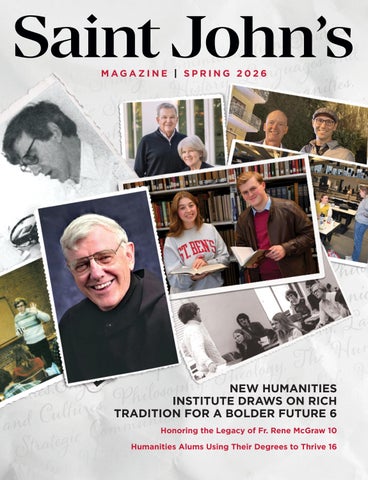
Saint John's Magazine Spring 2026

Page 1


Share a story with a friend electronically at sjualum.com/saint-johns-magazine

Features

Humanities Institute Amplifies Rich Tradition

While Charting Modern Course P. 6

Drawing on the strong work already being done and making the humanities more accessible to all is the idea behind this strategic academic initiative, that will launch this spring after a multi-year planning process.

Fr. Rene McGraw’s Humanities Legacy Lives On P. 10

The priest and mentor to many, who died in 2022 at age 87, was an ardent voice for the humanities at SJU and CSB, and the lessons he taught made a big difference in the lives and work of the many with whom he formed close bonds.

Alums Say Humanities Degrees Laid Foundation for Professional Success

P. 16

Hear from a number of SJU and CSB graduates who have drawn on the skills and background their humanities education provided as they’ve made huge impacts in their postgraduate careers.

SAINT JOHN’S MAGAZINE

is the alumni magazine of Saint John’s University. It is published twice a year, in the spring and fall, by the SJU Office of Institutional Advancement.

PROJECT MANAGER

Sarah Forystek

EDITOR

Frank Rajkowski frajkowsk001@csbsju.edu

CREATIVE DIRECTION AND DESIGN

Gearbox Creative

CONTRIBUTORS

Ruth Athmann

Rob Culligan ’82

Dave DeLand

Dana Drazenovich

Michael Hemmesch ’97

Eric Hollas, OSB

Ryan Klinkner ’04

Jim Kuhn ’02

Jordan Modjeski

Hannah O’Brien

Frank Rajkowski

Rick Speckmann ’72

PHOTOGRAPHY

Tom Morris ’89

Tommi O’Laughlin ’13

UNIVERSITY ARCHIVIST

Br. Eric Pohlman

EDITOR EMERITUS

†Lee A. Hanley ’58

ADDRESS CHANGES

Ruth Athmann

Saint John’s University P.O. Box 7222 Collegeville, MN 56321 rathmann@csbsju.edu

For the Good Life and the Common Good

At Saint John’s University and the College of Saint Benedict, we are stewards of a tradition that asks enduring questions and insists we keep asking them in every generation.

What does it mean to live a good life? How do we live it not only for ourselves, but for the common good? And how do we form men and women of character who are prepared to lead with imagination, judgment and purpose in a changing world?

This spring, I am especially grateful to share that we have received a significant philanthropic commitment that will strengthen our ability to do just that. This gift reaffirms a cornerstone of our mission: a deep investment in the humanities and liberal arts that has shaped these campuses for nearly 170 years.

The launch of the Humanities Institute – made possible through the generous support of Steve Halverson ’76 and his wife, Diane – represents a bold and timely affirmation of liberal arts education at Saint John’s and Saint Ben’s.

Named in honor of the late Fr. Rene McGraw – a beloved monk, professor and leader – the institute reflects both continuity and renewal, honoring a cherished legacy while building something new for the students of today and tomorrow.

Guided by the vision “A Good Life for the Common Good,” the Humanities Institute will help students engage deeply with the human experience – through stories, ideas, art, history, language and ethical inquiry – and translate that engagement into lives of meaning and contribution.

Its signature initiatives, including Interdisciplinary Seminars for Life and a Humanities Lab for faculty and staff, are designed to ensure that the humanities are not confined to one corner of the curriculum, but accessible and relevant to every student, including those pursuing professional and scientific pathways.

This investment insists on breadth, integration and imagination. It reflects our conviction that the

The launch of the Humanities Institute – made possible through the generous support of Steve Halverson ’76 and his wife, Diane – represents a bold and timely affirmation of liberal arts education at Saint John’s and Saint Ben’s.

humanities are essential to success – forming graduates who can think critically, communicate clearly, discern wisely and lead humanely, grounded in the Benedictine practices that shape how we live and learn together.

This gift demonstrates the power of philanthropy aligned with mission. As a steward of these places, it gives me great confidence that our best days of teaching, learning and formation are still ahead.

I am deeply grateful to the generations of faculty and monastics who have dedicated their teaching careers to the love and pursuit of the

humanities. I also appreciate the leadership and devotion of more recent faculty – particularly Scott Richardson, Tony Cunningham, Bill Pelfrey and Jason Schlude –who have helped sustain and advance this work. And I applaud our alumni/ae who are stepping forward to champion the humanities, including Steve Halverson and Bill Pelfrey, along with Jesse Doers, Kevin Healy and Kerem Durdag, all featured in this magazine.

Because of them, we are better equipped to educate principled leaders – and to continue shaping lives dedicated to the good life, lived for the common good.

President Brian Bruess

Stability and Strength

If you follow national media stories, you may be inclined to think that the sky is falling in higher education.

Regularly there are stories about the financial challenges facing colleges and universities – escalating costs, changing demographics, the enrollment cliff, reduced federal and state funding, the list goes on and on. And while there is an element of truth to this narrative, there is also a heavy dose of overstatement, with every institution being painted with the same brush.

“It all comes down to the balance sheet,” observed Anne Oberman, interim CFO for Saint John’s

University and CFO for the College of Saint Benedict. “More than anything else, the balance sheet tells the story – it is the foundation of the university’s financial health and long-term vitality.”

The strength and vitality of Saint John’s is underscored by various financial sources:

• The U.S. Department of Education utilizes an important financial metric to determine health of an institution. SJU’s score is 3.0 – the highest rating.

“More than anything else, the balance sheet tells the story – it is the foundation of the university’s financial health and long-term vitality.”

Anne Oberman Interim CFO for Saint John’s University and CFO for the College of Saint Benedict

• Moody’s is the leading financial services company that provides credit ranging for colleges and universities assessing their financial health. The 2025 Moody’s credit rating for Saint John’s is A2 Stable, a strong and solid rating.

The Moody’s report also noted the importance of the strategic partnership with CSB as a key factor in the rating.

• Forbes publishes an annual College Financial Report Card based on various factors. According to the 2025 report, of the 868 private colleges in the country that they evaluated, only 10% earned an A grade. Saint John’s was one of them, alongside other notables including Stanford, Yale, Swarthmore, Johns Hopkins and Grinnell College.

Historically, endowment size has been the key measure for financial stability.

The former president of the University of Notre Dame, Fr. Ted Hessburgh, once said: “Show me the colleges and universities with the top 10 largest endowments and I’ll show you the nation’s top 10 colleges and universities.”

This statement still rings true. The top list includes Harvard, Yale, Stanford, Princeton MIT, Penn, Texas A&M, Notre Dame, Michigan and Duke, all with endowments well north of $10 billion.

For most of its history, Saint John’s relied on a “living” endowment –the passion, dedication, knowledge and toil of monks who taught and led the university. Their service was donated by the Abbey.

With fewer monks working for the university, this remarkable living endowment has been gradually replaced with an actual financial endowment.

It wasn’t until 1980 that Saint John’s began a concerted effort to raise funds for endowment. In 1990, the SJU endowment was roughly $33 million; by 1999 it reached $100 million. In 2019, it crossed $200 million, and last year it eclipsed $300 million.

On the Rise!

Saint John’s University Endowment Per Student

Fiscal Year Endowment/ Student

2013

2014

$80,235

$88,418

2015 $92,892

2016 $89,250

2017 $100,297

2018 $111,712

2019 $122,087

2020 $122,690

2021 $171,418

2022

$161,581

2023 $174,554

2024 $193,241

2025 $206,455

Needless to say, this is great progress. The endowment is considerable and making a huge impact, but it is still lags behind similar funds of competitor and peer institutions and needs to be even larger in order to support our current programs and aspirations.

“Where Saint John’s truly shines is endowment per student,” remarked Rob Culligan, vice president for advancement.

“This is what helped us earn high marks in the Forbes Financial Health Report Card. In that report, the mean endowment per student for all colleges that received an A Grade is $172,063.

“For SJU it has risen to $206,455. Saint John’s has a higher endowment per student than all of the Minnesota Private Colleges except for Carleton, Macalester and St. Olaf.”

So, if this is the financial health report, what is the Treatment Plan?

• Increase overall philanthropic support.

• Increase endowment giving in particular.

What is the best way for YOU to help?

• Support the Student Fund which provides scholarships to current students.

• Establish an endowed scholarship fund.

• Place Saint John’s in your estate plans.

$100

$50

NEW HUMANITIES INSTITUTE

AMPLIFIES A RICH TRADITION WHILE CHARTING A

MODERN COURSE

Growing up, Charlotte Whiting ’27 had a frontrow seat to the rich tradition in the humanities that has always been a foundational pillar at Saint John’s University and the College of Saint Benedict. Her mother, Heidi Westendorp Whiting, is a 1990 CSB graduate who returned in 2016 to pursue her master’s degree at the Saint John's School of Theology and Seminary.

“We’d come down to campus a lot and I got a real introduction to the tradition and culture of these places,” said Whiting, a graduate of Sacred Heart High School in East Grand Forks and a current CSB junior majoring in political science with a minor in ancient Mediterranean studies.

“I saw how beautiful the campuses looked in the summer. I followed everything that was happening with The Saint John’s Bible . I learned about the role the humanities play in the liberal arts experience. All of those things were instrumental in my own decision to come here.”

That longtime grounding is a big part of why Whiting is so excited about the framework that’s been laid for establishing the Humanities Institute at the two schools – a multiyear process that will finally bear its first fruit with the expected opening of a Humanities Lab this spring.

It’s only the first step in a project that will grow to include a new group of seminar courses pairing professors from different academic departments, a physical space housing staff and student employees working to plan on-campus programs and events, as well as helping connect students with internships and professional opportunities in humanitiesrelated fields.

The humanities are generally considered to include academic disciplines related to the study of human society and culture. SJU and CSB’s humanities division consists of strategic communication studies, English, Hispanic studies, history, languages and cultures, philosophy and theology.

“But the humanities are applicable to every student on these campuses,” Whiting said. “They provide the background for learning how to be a moral and ethical person, as well as developing critical-thinking skills. That’s a foundation everyone needs, whether you are majoring in the humanities or not.”

Professor Jason Schlude, who teaches classics and history at SJU and CSB, has led the efforts to establish the Humanities Institute.

He said strengthening the foundation Whiting spoke of will be one of its primary missions.

That, he added, dovetails with the idea behind the True North Journey, the recently rolled out, all-encompassing four-year path for SJU and CSB students.

“The True North Journey looks to take some of the amazing programming we’re already doing, which already reaches a good number of students, and make it more intentional in a way that is going to reach all students,” Schlude said. “What we’re trying to do with

the Humanities Institute is to also take the good work we’re doing in our departments and amplify it.

“To make it better and increase access.”

Making It Happen

The Humanities Institute was preceded by a couple of academic programs designed to bolster the humanities at SJU and CSB, including a course called Innovation and the Liberal Arts and a presentation series called Grand Illuminations, designed and led by Bill Pelfrey ’88 and Professor Tony Cunningham.

The institute moved closer to reality after discussions Schlude had with SJU and CSB President Brian Bruess early in 2023.

“I’ve taught at Cal-Berkeley, I’ve taught at Santa Clara and I’ve taught at Duquesne,” Schlude said. “But one of the things I like best about being at Saint John’s and Saint Ben’s is that it’s a place where if you want to launch a project, you have the ability to get people in a room and work together. That doesn’t happen everywhere else. There are schools where it’s frowned upon if you even email the president. But this is a place where Brian wants to talk with you.

“So we were discussing CSB and SJU, and some of the critical decisions we were making at the time. I told him I wasn’t there to talk about academic program prioritization. I knew he already had all the information he needed for whatever decisions he was going to make. But I wanted to talk about what came next – five, 10, 15, even 20 years beyond. And so, it was in the context of that conversation that he asked if I had any good ideas. It was one of those questions where I was embarrassed not to have a good answer in that moment.”

Instead, Schlude asked for time to think. The more he deliberated on the role of humanities in the everchanging landscape of modern higher education, the more the concept of an on-campus institute made sense.

“When we think about the direction of education in the future, we see a lot of attention – and rightly so – is being paid to the STEM (science, technology, engineering and math) fields,” he said. “Those are such valuable areas, and areas our students are pursuing with excellence. That’s awesome, and I love my colleagues in these different areas who are doing such valuable work.

“But we want humanities to be part of that process as well. That’s part of what’s always made these places so special. We want students to come here and pursue careers in science, business and technology.

“A well-rounded liberal arts education is one of the best ways to develop the imagination and creativity all our students are going to need to be leaders in the future.”

Professor Jason Schlude

Classics and History

“But we don’t want them to receive a narrow education because they aren’t only going to be called upon to engage with specific problems in these fields. It’s a bigger world than that. And they need to be equipped with imagination and creativity.

“A well-rounded liberal arts education is one of the best ways to develop the imagination and creativity all our students are going to need to be leaders in the future.”

With encouragement from the president and SJU and CSB Provost Richard Ice, Schlude drew up a concept paper and shared it with both. That led to the establishment of a development team made up of Schlude, English professor Rachel Marston, Hispanic studies department chair Bruce Campbell and theology professor Kristin Colberg, which began its work in the spring of 2024.

“But

the humanities are applicable to every student on these campuses. They provide the background for learning how to be a moral and ethical person, as well as developing criticalthinking skills. That’s a foundation everyone needs, whether you are majoring in the humanities or not.”

Charlotte Whiting ’27

The group spent that spring and summer collecting ideas on potential programming, resources and process, as well as meeting with administrative leadership, including the vice presidents for institutional advancement on both campuses, in an effort to assess feasibility.

The members also toured the renowned Center for the Humanities at the University of Wisconsin in Madison to gain more insight into how such an endeavor could look.

The group then began the formal development process – surveying departments and academic programs and meeting with department chairs, program directors and other members of the faculty and staff community. That led to the establishment of five program initiatives:

• Interdisciplinary team-taught seminars

• A public humanities fellows program for students

• A Humanities Lab for faculty and staff

• A Big Ideas from Small Spaces event series

• A Great World Literature series

“When Jason first approached me, I was both excited and skeptical,” Marston said.

“I was excited about the idea of creating something that would draw more attention to the humanities and the great work being done in all of these departments on campus, as well as adding new ways to better serve our students.

“But I also knew for something like this to go forward, it needs to meet certain levels of commitment. It’s easy enough to have big ideas. But I’ve been part of enough processes that got started, then didn’t have enough support to continue. It takes time for something like this to unfold and you need to have buy-in from the administration and donors.”

That buy-in was demonstrated during conversations and consultations with interested alumni, which led to a significant lead gift from Steve Halverson ’76 and his wife, Diane, who made their commitment in honor of their friend and Steve’s mentor, Fr. Rene McGraw, OSB, ’58, SOT ’62, a longtime philosophy professor and a great champion of the humanities and the liberal arts.

Pelfrey also is planning to cofund the Humanities Institute with Halverson. In addition, he will also continue working with Schlude as an advisor and strategist for the Seminars for Life

“A big part of all these conversations we were having were things we all value in terms of the humanities,” Schlude said. “Approaches that we see as being critical for students to have access to.

“We all want these schools to do big things. And I believe we can rival any of the best liberal arts colleges in this state, and I’d even say in this country. We already have a lot of the pieces in place to do that. But it doesn’t happen overnight. You have to have a long-term vision in place to build toward. And to do that, you need the administrative and financial support we’ve received.”

Steve ’76 and Diane Halverson, lead donors to the Humanities Institute
Susan Michal Photography

From Vision to Reality

Now the time has come to start making things happen, starting with the pilot launch of the Humanities Lab this spring.

Schlude and Campbell will serve as coordinators while professors Marston, Matt Lindstrom (political science), Louis Johnston (economics), Rachel Melis (art), Erica Stonestreet (philosophy), Kara Scheck (health sciences and data literacy librarian) and Trisa Schaeffer (Office of Undergraduate Research and Scholars) will also be involved.

The spring of 2027 will see the launch of a pair of seminar classes: The Price of Liberty , co-taught by Schlude and Lindstrom, and The Good Life , co-taught by Johnston and Stonestreet.

Meanwhile, Campbell and Melis will continue work on developing a Public Humanities seminar. Marston is working on the Great Books seminar while Scheck and Schaeffer will work with faculty in the initial lab cohort to establish the public humanities fellows program for students.

Future Humanities Lab cohorts will develop additional interdisciplinary seminars and projects, including a Grand Strategy seminar.

“Higher education tends to be organized administratively in a way that tends toward compartmentalization and separation of different departments,” Campbell said. “But part of the liberal arts tradition is finding ways to break out of that and encourage collaborations across disciplines, especially because the questions and issues our students will have to face in the future aren’t going to be able to be compartmentalized.

“This is about finding different ways to organize and support work our faculty and students are already doing and finding ways to improve and enhance it in a changing educational landscape.”

Down the line, plans are expected to include the establishment of a physical home for the institute, perhaps inside the Dietrich Reinhart Learning Commons on the SJU campus, as well as the hiring of a

faculty director and staff to plan oncampus programming and provide resources for students looking for internships and jobs in fields that connect to the humanities.

“We want to be thinking about the full pipeline,” Schlude said. “We want to find ways to reach prospective students and show them the special opportunities they will have here at Saint John’s and Saint Ben’s. Then we want to support them while they’re here by providing them access to resources – including internships and different career opportunities.

“But we also want to make sure we’re supporting them in their first steps beyond these schools. That they have a deep and meaningful and versatile humanities education, as well as experience that already demonstrates how it can translate into future careers to prospective employers. Because the kinds of skills we’re developing are the kinds of skills employers want. They want creative thinkers, they want people who can effectively communicate with others, they want problem solvers, individuals who are openminded and empathetic to the other human beings they work with.

“The humanities are critical for all of that,” Schlude continued. “They are central to what we do and this institute will reflect that.”

Filling a Need

That’s all music to the ears of students like Whiting and Brady McElroy ’27. McElroy is a junior history major minoring in ancient Mediterranean studies. He’s part of the Fighting Saints ROTC program on campus and is involved in Outdoor U and various theater productions.

The aspiring future history professor and Maryland native said the institutions’ commitment to the humanities played a big role in his decision to come halfway across the country to attend college at SJU.

“They don’t want students who just check boxes here,” he said. “This is a place that is looking to turn out people who experience a wide array of opportunities during their time on campus and come out the other side a more complete person.”

He said establishing a Humanities Institute will only enhance that mission.

“Hopefully, it makes the humanities even more accessible to everyone and shows them all the opportunities that exist in these areas,” he said. “I think it’s going to provide a lot more experiences for students who are driven by their desire to learn.”

Whiting, who hopes to pursue a master’s degree after graduation and eventually work in Washington, D.C., said the Humanities Institute will also shine a needed spotlight on all the great work in the humanities that has and continues to be done at the two schools.

“There are so many alums who have taken the background they received in the humanities here and gone on to do great things,” she said. “All you have to do is look at the list of Truman and Rhodes Scholars that have come through these schools and have taken humanities courses. Then there are all the humanities majors who have gone on to amazing careers and done big things.

“Hopefully, this institute will help connect all that history to the students on campus today.”

“Hopefully, it makes the humanities even more accessible to everyone and shows them all the opportunities that exist in these areas.”
Brady McElroy ’27

VOICE OF THE HUMANITIES:

APPLYING THE LESSONS OF FR. RENE MCGRAW

Steve Halverson arrived on Tommy Hall 3 in fall 1972, a 17-year-old brimming with potential but unsure how to harness it.

“I didn’t really know much about college at all, wasn’t sure why I was even there let alone what I was going to do with it,” recalled Halverson ’76, who grew up in public housing in St. Paul and became the first in his family to get a degree.

His faculty resident, Fr. Rene McGraw, OSB, ’58, SOT ’62, would change that, would change him

“He was a lifelong influence.”

Halverson had never met anyone who thought like Fr. Rene.

“Rene gave me the skills to think broadly and deeply, and at the same time to apply the lessons of humanities to contemporary life,” said Halverson, whom Fr. Rene impacted so profoundly that he and his wife, Diane, have now stepped forward to fund the new Humanities Institute at SJU and CSB in his memory.

“The reason I’m engaged is partly because it is intrinsically important, partly because I love Saint John’s and Saint Ben’s.

“But mostly it is because of Rene, because the way he exposed me to the humanities shaped my life and shaped how I think about everything, and then shaped our marriage, and shaped my work. It was everything.”

Fr. Rene was so important to Halverson and Diane that they asked him to officiate their wedding in 1976 and their renewal of vows in 2017.

“I just have to get involved in this to honor my friend who changed my life, who saved my life … so that students in the future can enjoy the same transformational experience that I was presented with.”

Halverson plans to fly in for this year’s Saint John’s Day, which takes place April 17 and is themed Celebrating the Humanities and Recognizing Fr. Rene McGraw

“I wouldn’t miss it.”

Fr. Rene, who died in 2022 at age 87, gave Johnnies much to celebrate.

“There are a lot of people who had experiences very similar to mine,” Halverson said.

Jesse Doers ’81 was one of them. Doers landed on Mary Hall 3 in fall 1977, a 17-year-old from rural Wisconsin eager to embark on his Saint John’s education.

Fr. Rene, then Mary 3’s faculty resident, would expose Doers to new ways of thinking, new ways of being.

“Fr. Rene was one of the most pivotal individuals that I have had in my life,” said Doers, also the first in his family to attend college.

“He taught me another way of seeing the world and thinking about the world. He did it through just being available and being a friend. That was what was so powerful

about Rene is that he didn’t teach you through preaching about something, or in a lecturing way. It was how he lived his life and how he thought about life, and then he would challenge you on how you thought about it.”

Fr. Rene couldn’t officiate Doers’ 1984 wedding to his wife, Lise Christensen, because it was a Lutheran service, but they gave him a special role.

“Because, if it wasn’t for Rene, I probably wouldn’t have been the person I was when I met her.”

Doers and Christensen established a scholarship fund at Saint John’s in honor of Fr. Rene in 2017.

His teaching legacy also lives on through the McGraw Scholars, which Kevin Healy ’76 and Roseanne (Hufford) Healy, CSB ’77, established. It was previously known as the Healy-Conlin Family Scholarship, but they changed the name in 2023 to honor Fr. Rene.

Another alumnus, philosophy major Bruce Leier ’79, and his wife, Judy, have made plans in their estate to establish a scholarship fund in honor of Fr. Rene.

‘Always Exploring Questions’

Students found Fr. Rene’s courses in philosophy and, later, peace studies famously tough but worth it.

Halverson, a political science major, took every class Fr. Rene offered, so many that he ended up with a second major in philosophy.

“Great educators don’t give you answers. They lead you to great questions and they equip you to find the answers on your own,”

Halverson said.

Fr. Rene’s course on German philosopher Martin Heidegger was legendary.

“If you got a passing grade, it was a success,” said Kerem Durdag ’91, a Muslim from Turkey and Pakistan majoring in physics who found a beloved mentor in the Benedictine monk.

“If you got anything above a passing grade, you deserved a loaf of Johnnie Bread. And if you got an A, well, you went into the history books.”

“Rene gave me the skills to think broadly and deeply, and at the same time to apply the lessons of humanities to contemporary life.”
Steve Halverson ’76

The real reward came in the multidimensional thinking Fr. Rene cultivated. Durdag, a business executive who has led several companies, can attest to the value of learning how to draw connections from human, historical, ethical and other points of view.

“How do you connect them? How do you make sure that those bonds are not something you understand, but you internalize?” Durdag said.

“And that helped me through to physics, to writing poetry and plays, to all of it. And so the contributive element from him to me, in terms of thinking, is the idea that thinking is not just thinking. Thinking is actually being – and being present.”

Durdag, too, contributed to the scholarship fund named for Fr. Rene. In their last conversation before he died, Fr. Rene called him an honorary Benedictine.

It still brings tears to Durdag’s eyes.

Simply by opening his door, Fr. Rene invited Johnnies into a learning environment that differed vastly from the education many were used to –and it permanently changed them.

Halverson and his floormates spent many an evening in Fr. Rene’s room grappling with the provocative questions the philosophy professor liked to fire at them, evenings that ignited Halverson’s academic curiosity and kindled a half century of friendship.

“It was always exploring questions and giving you the intellectual tools to think on them, and that is how I remember Rene all the 50 years I knew him.”

Doers, a chemistry major, absorbed plenty about philosophy and friendship even though he avoided taking a class with Fr. Rene because he was afraid it would change their relationship.

“My room was right across the hallway from his, and Rene had a way of opening up his room to so many of us, and he literally took this 17-yearold kid … and taught me another way of seeing the world and thinking about the world,” Doers said.

“With the help of him many of us became lifetime friends, and those late-night conversations – I think each of us would attest that he had a profound influence on us.”

‘His Influence Was Monumental’

Those evenings in Fr. Rene’s room still linger for Doers, a physician specializing in pulmonary and critical care medicine.

“I think there is no question his influence carried on with me through medicine with how I interacted with patients, how I connected with patients and how I interacted with my colleagues, the nursing staff and so on.

“There’s still part of me that, as I get into challenging circumstances, I think, ‘How would Rene have approached this?’ So his influence was monumental.”

Halverson, a retired CEO and now a corporate director, drew from Fr. Rene’s lessons as he earned his juris doctor from American University in Washington, D.C., and went on to forge a standout career in business. He has taught the occasional business law course, too, and once slipped Immanuel Kant onto the reading list.

One student argued against Kant’s relevance in a business law class but then came back to extoll his value after Halverson had accurately predicted he would get asked about ethics in a job interview and would be glad he could reference Kant.

Halverson couldn’t wait to tell Fr. Rene. “He was delighted. He said, ‘Well, something’s sunk into your big head – not everything, but something.’ ”

A little sadness seeped into Halverson’s laughter as he retold the story.

“I miss him every day.”

The fate of the humanities, nationally and at SJU and CSB, weighed on Fr. Rene in his final days, and though the Humanities Institute was still in its ideation phase, Halverson encouraged him to have faith that the people he had inspired would carry on his legacy at Saint John’s.

“I would just hold his hand and say, ‘Rene, I have learned so much from you, and one of those things was great ideas don’t die.’ ”

“I would just hold his hand and say, ‘Rene, I have learned so much from you, and one of those things was great ideas don’t die.’ ”
Steve Halverson ’76

BILL PELFREY: CHAMPION OF THE HUMANITIES AT SJU AND CSB

Science might have gotten Apollo 13 into space, but the humanities helped bring it back to Earth intact.

Only Bill Pelfrey ’88 could find the value of the humanities illustrated in a scene from the 1995 movie Apollo 13, but there it is:

An oxygen tank explosion forces the crew to abandon their moon landing, and rising carbon dioxide levels threaten their lives. Ed Harris’ character orders ground control to come up with a solution using a box of random items based on what the astronauts have on board.

Bill Pelfrey ’88

“It’s got what looks like a dryer vent, some plastic bags, some duct tape and a few other assorted items,” Pelfrey explained.

“And that box full of what looks like junk? That’s the humanities. What looks useless when you’re on the launch pad turns out to be the thing that gets you back to Earth safely.”

Championing Humanities

Pelfrey has been doing his part to fuel the humanities at Saint John’s University and the College of Saint Benedict since long before the Humanities Institute was a flicker of an idea.

“Bill Pelfrey is one of the only alumni I know who thinks more about academics, the humanities and the liberal arts than football,” jests Bill Kling ’64, founder of Minnesota Public Radio and a former SJU trustee.

He studies obsessively, finds inspiration everywhere and evangelizes the humanities with the conviction that all students benefit from the complex thinking that disciplines like philosophy, history, English, theology, languages and communication encourage: wrestling with ambiguity, addressing complex questions with imperfect information, recounting stories to reveal pathways to elusive solutions.

“Later in life I realized that each time I had to make a hard decision, I drew from literature and history. It’s the amazing power of story.”
Bill Pelfrey ’88

“Back to Apollo 13 , you’re going to have to improvise. You’re going to have to rely on other people,” Pelfrey said. “You’re going to have to rely on stories to help guide you in terms of what you’re going to do.”

Illuminating Ideas

Growing up in Illinois, Ohio, North Dakota and Nebraska, Pelfrey became comfortable with change, and the world of ideas. Big ones.

He graduated from Saint John’s with an economics major but wasn’t sure what to do and in March of his senior year still didn’t have any job offers.

“My roommate said I’d probably end up in the business world, and I replied, ‘There’s zero chance of that.’”

Soon thereafter, he accepted a job with Touche Ross Consulting. A few years later, he received an MBA from Stanford, which launched a diverse and successful business career working with Deloitte Consulting, Piper Jaffray, Optum at UnitedHealth Group and then, what he calls his magnum opus , Consumer Medical, where he spent the past 15 years guiding that company “back to Earth.”

Pelfrey began volunteering at SJU and CSB in 2008 as a mentor for students in the McNeely Center for Entrepreneurship, where he became the first executive-inresidence in 2012.

“I proposed to the director, Terry Barreiro, that I was interested in designing and teaching a course that would be like a cross between a J-Term course and a seminar, something that would allow students to put a toe in the water without a huge commitment. It was called Innovation and the Liberal Arts , but students called

it This Is Water from the famous commencement address by author David Foster Wallace,” Pelfrey said.

His own life provided the inspiration for his unconventional approach.

“When I was a student, I didn’t fully appreciate the importance of plays by Henrik Ibsen or Russian history,” he said. “But later in life I realized that each time I had to make a hard decision, I drew from literature and history. It’s the amazing power of story.”

Innovation and the Liberal Arts was popular, but Pelfrey realized he was only teaching a few dozen students each year.

“Over time, I started to ask: ‘How can we reach more students, and especially students who were business majors? How can we make the humanities relevant to them?’”

Pelfrey reached out to his former professor and good friend Scott Richardson in the classics program, who suggested he talk with Tony Cunningham in philosophy. Together, they came up with a lecture series called Grand Illuminations.

“The goal was that the talks would hopefully inspire young minds to ponder and discuss ‘big life’ questions. The beauty of it was that students didn’t have to sign up for a course, they could just come to the lectures. It was ad hoc.

“And it didn’t really work, but I honestly didn’t think it would –not on the first go around. But it did convince me that the idea that students weren’t interested in the humanities was baloney. They were. It’s just that we needed to make the connection more explicit and conversational.”

Professor Jason Schlude poses with his humanities students

Pelfrey underwrote the cost of the Grand Illuminations lecture series, along with support from a fellow alumnus and kindred spirit, Steve Halverson ’76.

Initiating an Institute

In due course, Pelfrey met Professor Jason Schlude from the classics program. Together, they led the fall 2022 study abroad trip to Rome with an additional agenda in mind: to co-design a class called Grand Strategy , based on Yale’s wildly popular class of the same name.

Not long after, Schlude talked with Pelfrey about a new endeavor, the Humanities Institute.

“My first reaction to it was ‘I hate this idea,’ ” Pelfrey said.

“I thought it was the dumbest idea I had ever heard because I was concerned about fragmentation. It makes me cringe. The liberal arts and the humanities are about latitude. All disciplines need to be part of the exploration.

“But I’ve come around,” Pelfrey said, “and I plan to join Steve Halverson and co-fund the Humanities Institute. And I’m looking forward to working with Jason to inspire and illuminate – to be an innovator for great courses.”

Integrating Innovation

Though he, like many others, worries about the national trend of the humanities getting sidetracked for more career-oriented curricula, Pelfrey doesn’t necessarily advocate humanities education instead of majors like biology, nursing and business but rather as an integral part of them.

“You know, the technical part of education is absolutely critical. It’s what gets the rocket into space,” he said. “You need internships. You need good analytical skills. You need basic kinds of skills to get off the launch pad,” he said.

“I don’t care what people major in. I just want to make sure that if they get stuck on the other side of the moon, and they will – when theory is not as useful as it once was, when it’s not clear what you need to get back – I want them to have something to figure out how to get back. That’s what literature and history did for me. They are, as

Ursula Le Guin once wrote, ‘the operating instructions.’”

Pelfrey hopes Humanities Institute initiatives like the interdisciplinary team-taught courses can give students their own Ibsen and Tolstoy revelations.

“Thirty years from now, when some group of students gets together for their reunion and they look back and say, ‘What were the most important classes that you ever took at Saint John’s and Saint Ben’s?’ I want a bunch of them to say it was one of these classes – and to say it with some surprise.”

“Thirty years from now, when some group of students gets together for their reunion and they look back and say, ‘What were the most important classes that you ever took at Saint John’s and Saint Ben’s?’ I want a bunch of them to say it was one of these classes –and to say it with some surprise.”
Bill Pelfrey ’88
Bill Pelfrey (left) and Professor Jason Schlude

THRIVING IN THEIR CAREERS

HUMANITIES ALUMS

Major: Philosophy

Present position: Director of Princeton University School of Public and International Affairs in Washington, D.C. (Former Senior Policy Advisor, United States Mission to United Nations)

What drew you to the humanities as a student?

It provided the opportunity and space to wrestle with big questions. I was hungry for intellectual development. And for myself, I found more chances to exercise those muscles in the philosophy department than I did anywhere else. Questions of meaning, purpose, ultimacy and religion … the topics we discussed in those classes really lit me up.

Then there was the faculty, many of whom I developed close relationships with. (Fr.) Rene McGraw, in particular, was a huge influence, and we maintained a close friendship until he passed away almost 20 years later. He was instrumental, but so were Steve Wagner and Tony Cunningham. The faculty there gave me an opportunity to grow and really challenged me.

When I switched (from a business major freshman year), I was terrified. I wondered if it was a wise decision. What do philosophy majors go on to do in terms of a career? When you’re 18 or 19, you don’t know all the paths and opportunities that can come from it. But like a lot of other people, I had the chance to be educated in critical thinking and that’s served me well as I’ve gone on in my life and career.

How did your background in the humanities help prepare you for your current career?

Whether it’s how to respond to a civil war in Ethiopia or Sudan, or how to think about the resolution

of conflicts in Ukraine or Myanmar, the skills I’ve been able to draw on were formed by wrestling with the ideas and thinkers I was exposed to at Saint John’s.

Sometimes it’s hard for a younger person to draw a direct line between those things. But in every job I’ve had, questions of not only logic and reasoning, but also values, have informed all those challenges and pursuits.

Why do you think the humanities remain important in today’s world?

It’s critically important that we develop hard science skills, and that we have people that can do deep research and lead technological advancement. But there are so many disciplines, and so many walks of life, in which you have to deal with people. You have to deal with challenging situations and circumstances that require hard choices.

We need people who are wellrounded, who can move across different kinds of disciplines and speak to others with different skillsets than their own. Those are hugely valuable assets for a whole range of professional environments.

Liz Hamak ’24

Major: Strategic Communication Studies and Theology

Present position: Volunteer Coordinator for Emergency Services, Catholic Charities of the Diocese of St. Cloud

What drew you to the humanities as a student?

I was looking for ways I could make a difference and impact people’s lives. That led to my taking an interest in nonprofits and the different mission-driven organizations that existed. I met a professor, Karyl Daughters, who was so helpful in showing me all the ways communications could

be helpful on the path I wanted to go down in the future.

I’d always enjoyed theology. I went to St. Cloud Cathedral (High School) and took a lot of theology classes there. It was a subject I wanted to learn more about, and you couldn’t ask for a better place to do that than Saint John’s and Saint Ben’s with the Benedictine tradition that exists on both campuses.

How did your background in the humanities help prepare you for your current career?

What I do every day is manage people more than anything. And so much of what I learned in communication classes directly relates to that work.

But more than that, the liberal arts education at CSB and SJU – which I got on steroids – makes you so much more well-rounded. That’s really important in whatever field you end up working.

Why do the humanities remain important in today’s world?

Anyone can learn how to use spreadsheets. But learning how to think critically and be a valuesbased problem solver is what the liberal arts, and especially the humanities, provides you with. The ability to work well with other people is something even AI can’t erase. That’s always going to be so important.

Andy Morris ’10

Major: History, individualized Asian studies

Present position: Legislative and Public Affairs Director, Council of Asian Pacific Minnesotans; volunteer Executive Committee of the Japan America Society of Minnesota, Secretary of the Board.

What drew you to the humanities as a student?

I started studying Japanese in high school and I had college credits from that and other areas, such as history and English, before I came to Saint John’s, so it has always been a strong area of interest to me. I was originally a theology major, but I loved my experience studying abroad in Japan so much I decided to change during my junior year. I ended up with an individualized major in Asian studies and a minor in theology.

I was lucky enough to get to know people at Bunkyo Gakuin University (the longtime SJU and CSB study abroad partner, located in Tokyo) and I was hired there as a tutor in 2011 after spending a year studying Japanese intensively and passing the highest level of the Japanese Language Proficiency Test. After returning to America, I worked for eight months as a youth minister before I went to graduate school at Georgetown (where he had internships with the Council on Foreign Relations and the Foreign Service Institute) to pursue a master’s in Asian studies. So I ended up putting my theology background to work as well.

How did your background in the humanities help prepare you for your current career?

Studying abroad gave me the opportunity to engage with the Japanese language and culture directly in a way I was not able to in the U.S., and that really lit a fire under me that I have carried with me ever since. I have found the most fulfilling work has come from working directly with and serving other people. That has been so much of what I do, especially now in my role in state government. I really feel strongly that humans need to interact with other humans to truly understand each other.

Why do you think the humanities remain important in today’s world?

Ultimately, our society needs to be built around respect and dignity for all. Numbers and data are, of course, important tools and my job is informed by surveys and statistical information. But you have to be able to communicate directly with

actual people to understand their needs and what is happening in their communities. A humanities background is at the core of that, and has been something I have been able to apply in many different settings.

Major: Philosophy

Present position:

CEO and Co-Founder, Portica AI; Second Generation Toboggan Maker and Artisan Manufacturer

What drew you to the humanities as a student?

I detected three things about myself: 1. I was born to sell value to people, to become a professional salesperson.

2. I was an entrepreneur by virtue of growing up in the household I did and my DNA. As soon as I heard the definition of entrepreneur in a college course, I realized that’s what I am.

3. I detected I was a philosopher when I read a couple pieces of moral philosophy in a symposium course. I showed up early to talk to my symposium professor. I asked ‘What is this? Is this a domain of study?’ She said it was moral philosophy. So I went home and signed up for the major that day.

It’s how my brain works. It always has been.

I played junior hockey. I lived in Boston, Montana and Huntsville, Alabama, between high school and coming to Saint John’s. So I had the gift of three more years of life and experience. When people told me you need to embrace the liberal arts, identify what you’re pulled to study and trust that path, I took it seriously.

How did your background in the humanities help prepare you for your current career?

It’s my differentiator. My brain has never fired the same way (after his studies) and I’ve continued to grow those muscles ever since.

Philosophy is a lifelong pursuit. You’re trained to study the most brilliant writings in history by the most brilliant minds, which is hard. I learned very early in my career that when sat around a board table with 10 people, there might be one other person that is really tracking the complexity of the conversation and that comes from having those skills.

What is business, what is building anything? You go into a domain you don’t know. You understand the language that is used. You map the context of the situation and you start to organize it strategically. You go in, isolate problems and solve them.

My wife, Katie Kalkman ’06 (the 2024 CSB+SJU Social Entrepreneur of the Year Award winner), was a philosophy major as well. We were both E-Scholars and she’s gone on to become an incredible entrepreneur using those skills we each learned.

Why do you think the humanities remain important in today’s world?

It’s a secret weapon, especially in the world where business and people constantly intersect. Society is changing faster than ever. There’s nothing stagnant. You need a map to navigate it.

There was a period of time that parents found comfort and solace in the vocational track of education. If my kid studied to be a nurse, they became a nurse. If they studied to become a lawyer, they became a lawyer. If they studied to become a computer programmer, they became a computer programmer.

But I believe that 70 percent or more of the jobs that current high schoolers are going to go into don’t even exist yet. How do you vocationally prepare for that? The liberal arts and the humanities are actually now the vocational track to the future. The only thing we can be sure of is constant change. So we need to craft minds that can problem solve and critically think.

Sydney E. Robinson ’19

Major:

English (with a concentration in creative writing)

Present position:

Associate Director of Multicultural Services at CSB and SJU

What drew you to the humanities as a student?

I initially did not want to major in English because I felt my passion for writing and reading could be explored beyond the classroom. But once I got here, I took my first class with (English professor) Rachel Marston – Monstrosity and Metamorphosis – and it was one of the best classes I ever took. She was a professor from my hometown who had me read what turned out to be some of my favorite books. It all clicked from there. I loved writing poetry and reading. So this seemed like the perfect direction in which to go.

I really started to see the value that an English degree and a liberal arts degree could offer.

How did your background in the humanities prepare you for your present career?

In my roles, I draw on my ability to understand and honor diverse experiences, shaped by the different stories, cultural contexts and perspectives we discussed in seminars. The humanities have sharpened my capacity to interpret and respond thoughtfully to these narratives. My background has helped me see different perspectives and understand how to engage with them thoughtfully. Going beyond that, having my work reviewed by my peers really helped me prepare to share my ideas with larger groups. In our writing workshops, you can expect to receive feedback regularly, and in my current setting, I feel feedback and critique are more welcome than something to fear.

Why do the humanities remain important in today’s world?

No matter what you do, it always helps to be a strong thinker and understand the context one needs to jump in and advocate for things you see as important.

I picked up so many transferable skills as an English major. Sometimes people call them soft skills. But there’s nothing soft about being able to problem-solve or think outside the box. Those are attributes that will help you succeed in many different types of work.

Olivia Solano ’22

Major: French and Nutrition

Present position:

Research Professional at The Hormel Institute (University of Minnesota Medical Research Center)

What drew you to the humanities as a student?

I started as a nursing major and I did fine in the program, but a piece of passion was missing for me. I’d done theater most of my life, and I felt like I had no space to do the creative things I’ve always enjoyed. So I spent a semester just taking random classes to fill out my liberal arts requirements.

I took a French course and realized how much I truly enjoyed communicating in another language. I also took a food and culture course that made me realize how much languages and the humanities go hand in hand with science.

Food is so much more than nutrition. It’s also about experience, connections, emotions, tradition and custom.

How did your background in the humanities help prepare you for your current career?

I participated in the Teaching Assistant Program in France (TAPIF), which assigns you to

a middle school, high school or college in France to teach for seven months. I did that right after graduation.

While I was there, I had many conversations about what food means to people and I got to observe all the different ways diet manifests itself in another culture.

I realized that’s what I wanted to research because we have high rates of chronic disease in this country. I wanted to play a role in helping alleviate that, but I didn’t know how. As my contract was ending, I came across a listing for my current position and it’s been an incredible fit.

Why do you think the humanities remain important in today’s world?

The humanities connect everything else. Even in science, the majority of the things you do involve writing. So you need to be a good writer and a good communicator to actually make your work matter.

You need to be able to mesh well with people of different backgrounds and different work styles in whatever profession you get into. The training for that comes in the humanities.

Jessica Davis ’18

Major: History

Present position: Visitor Services National Archives in Washington, D.C.

What drew you to the humanities as a student?

I came into (CSB) knowing I wanted to major in history. A big part of that was the faculty. I spoke with most of them before I became a student here, and the different courses they offered and their approach sounded like a great fit for me.

I like the fact that history is a lot more than names and dates. It’s far more of a human story than people first think. It’s not just about battles and different events. There is so much humanity within archives and the records they hold. One of the reasons I wanted to work in museums was to have the chance to bring those stories to a wider audience.

How did your background in the humanities help prepare you for your current career?

A quote commonly attributed to Mark Twain goes, “History doesn’t repeat itself, but it often rhymes.” I’ve always found that quote to be quite relatable to the importance of knowing history. Having a knowledge of history provides so much context when it comes to current events.

Why do you think the humanities remain important in today’s world?

Empathy is something that is as important as ever today. And the best way to understand other people is to study cultures different from your own. To read primary sources from people who grew up in a different way and different time than you did.

The other thing about the humanities is that they teach you critical thinking. And being able to do that is a skill that is more critical now than it’s ever been.

Present position: Assistant City Attorney, City of St. Cloud

What drew you to the humanities as a student?

I always enjoyed learning about history. You can gain a lot of insight into current events from looking at the past. Once I began to think about my future career goals, and what would best set me up longterm, I realized the history major would be a great fit.

Sometimes, when you tell someone you’re a history major, they think you’re like Indiana Jones – digging up old artifacts and stuff like that. But studying history is really about understanding different people and cultures and how they relate and connect to one another.

How did your background in the humanities help prepare you for your current career?

There’s a lot of writing in the humanities, and you develop a lot of analytical skills along with that. A big part of my work in criminal jury trials has to do with looking at the stories of different individuals and pairing that with evidence-based reasoning to provide a coherent analysis of the facts of a case.

I also learned a lot about how to state your point. We discussed a lot of different topics in my classes, and we didn’t always agree with one another. But we developed the ability to get our points across and respectfully discuss things. That’s a central skill in the job I have now.

Why do you think the humanities remain important in today’s world?

I think there’s more of a place for the humanities now than there’s ever been. We live in a world that’s so fluid. People change their careers or where they live or different aspects of their lives multiple times.

A humanities degree provides you with the background you need to think critically and analytically in many different situations. Those are essential skills.

Ashley Bukowski ’15

Alumni Achievement Awards

Kevin Healy 1976

Dr. Kevin Healy’s service knows no boundaries.

Healy has traveled the globe contributing his medical expertise to 120-plus volunteer missions since 1997.

He became an anesthesiologist in the Navy and started volunteering for international medical missions while in private practice in Ames, Iowa. He led a multi-disciplinary team on missions to Guatemala. He provided anesthesia support to surgical teams in Africa, Asia and the Middle East.

Healy left his practice in 2010 to focus on volunteer medical service. In 2013, he served on 15 international missions in Southeast Asia, India, Africa, South America, Palestine and Gaza. His wife and both his sons have participated in missions with him.

SJU and CSB students benefit from his expertise, too. He and his wife Rosanne, CSB ’77, fund the Fr. Rene McGraw Community Engagement Scholarship, which promotes the Benedictine values of service and peace.

Bob Walsh 1981

Bob Walsh brings his Benedictine influence to the bench as an Associate Judge for the 18th Judicial Circuit in Illinois’ DuPage County, where he is highly regarded as a fair and impartial jurist who exhibits humility and compassion. Walsh was installed as a judge in March 2025 after a 40-year legal career with Clifford Law Offices, one of the National Law Journal’s 50 Elite Law Firms. His advocacy for the rights of the injured and underrepresented have earned

him recognition by Illinois Super Lawyers, as a Best Lawyer in America and as the 2024 recipient of the Accipiter Award from Fenwick High School, his alma mater.

Walsh has long volunteered at Visitation Catholic Church in Elmhurst, Illinois, and as a coach for Little League and other sports.

A dedicated Johnnie with a talent for connecting people, Walsh has organized a variety of trips over several decades to unite Johnnies from different classes, including the Baseball Road Trip, which has convened to travel to ballparks across the country every year since 1987.

John Gag

1986

John Gag has led New Ulm-based Gag Sheet Metal to tremendous success and poured himself into community volunteer roles. But with true Benedictine humility, he passes the credit to others.

Gag Sheet Metal now brings in more revenue weekly than the $350,000 it made annually when Gag started working there in 1986, growing from a 4,000-square-foot building on 1-and-1/2 city lots to 60,000 square feet of building on three city blocks.

His explanation for that success: “Aggressively engaged and motivated team members.”

Gag’s long list of volunteer work includes serving as a SERTOMA member and past president, on the NUMAS Haus women’s shelter and New Ulm Chamber of Commerce boards, the CTE Center advisory board, the Martin Luther CollegeNew Ulm Annual Golf Classic fundraising committee and the New Ulm Club. He’s also a City of New Ulm reserve police officer and member of the police commission.

How does he find the time? “The folks on our team have allowed me to be very active with various nonprofits,” he humbly explains.

Russ Jundt 1991

The SJU and CSB crew team instilled Russ Jundt’s deep respect for water, and a J-Term class sparked his interest in entrepreneurship.

Jundt channels that stewardship and innovative spirit into Conserva Irrigation, the company he founded in 2010 that builds and retrofits residential, commercial and municipal irrigation systems, reducing water usage from 40 to 60 percent over traditional systems.

Conserva Irrigation has grown to 85 locations and $55 million in annual revenue, and earns honors that include top ranking in Irrigation and Water Management and the 2025 Irrigation Association Innovator Award for Jundt.

A serial entrepreneur, Jundt started a painting venture in college and owns and operates two other businesses, Mosquito Squad of Twin Cities and Outdoor Lighting Perspectives, and hopes to inspire current SJU and CSB entrepreneur students to launch their own social enterprises.

Service has been another constant for Jundt, who volunteers in his Minnesota and Florida parishes and throughout the communities where he lives.

He has held various positions on committees and boards, including the Minnesota Nursery and Landscape Association GAC, various Fresh Water Societies, and has guided legislators and municipal water managers to better understand water conservation as it relates to irrigation systems.

Jundt enjoys working with domestic and global philanthropic organizations – most recently the Wyland Foundation and Charity Water.

Col. Steve Knapp 1996

The Rule of Saint Benedict provides the cornerstone for Colonel Steve Knapp’s 30-year career as a U.S. Army nurse, battalion commander and chief for the Army’s Medical Readiness and Strength Branch.

“My assignments have taken me across the globe, and in each place, I was guided by the Benedictine principle to welcome the stranger, to serve the sick and to see Christ in every person I met.”

Knapp heeded Saint Benedict’s call to listen while working in medical-surgical wards in South Korea and developing public health initiatives in Germany, Japan and Afghanistan, hearing soldiers’ needs, community concerns and the guidance of his peers.

Just as Saint Benedict balanced prayer and work, Knapp sees his work as an active expression of his Catholic faith as he carries out assignments from leading a 1,200-member healthcare team and overseeing a complex hospital system with 13 departments across four continents to orchestrating regional operations for medical facilities in six European nations.

He applies these same principles to his service to the church, which is grounded in humility and valuing others.

Michael

Murray 2001

His passion for photography and dedication to community have created a unique brand of success for entrepreneur Michael Murray, founder and owner of St. Paul-based Michael Murray Photography.

Murray cultivated his technical talent and interpersonal approach at Saint John’s University, and his company has developed into a community cornerstone thanks to his relentless pursuit of excellence and dedication to building relationships with the clients for whom he’s crafting permanent, priceless images. People trust Murray to capture their intimate moments.

He has contributed hundreds of hours as a volunteer youth coach, teaching kids skills while giving them a mentor and role model, and also donates time and photography to the Nativity of Our Lord Parish’s Men’s Club.

While his powerful photos compose the public face of St. Paul-based Serving Our Troops, Murray volunteers behind the scenes and has traveled to Kuwait for the organization, which provides steak dinners to service members deployed overseas.

Jeff Kaminski 2006

Jeff Kaminski takes hospitality to new levels.

Kaminski, the owner/president of Chula Vista Resort in Wisconsin Dells, has led a team of more than 600 employees for 20-plus years. He took over as president in 2018 and is spearheading an expansion that includes 200 more rooms and a new convention center and recreational lake.

Kaminski’s leadership extends to the state level through his role as incoming chairman of the Wisconsin Restaurant Association and his work on its finance committee and board of directors, where his advocacy and testimony have helped pass and implement bills and laws for the industry.

Hospitality also plays an important role in Kaminski’s personal life. A lifelong member of St. Cecilia Catholic Church in Wisconsin Dells, he and his family regularly assist with fundraisers and help cook at parish dinners. Kaminski is a committed hockey dad who coaches his oldest son’s team and serves as the association’s coaching education coordinator.

MOURNING THE LOSS

OF A JOHNNIE

The Saint John’s University and College of Saint Benedict community lost one of its biggest boosters when Warren ‘Boz’ Bostrom died at the age of just 52 on Oct. 9.

The Saint John’s University and College of Saint Benedict community lost one of its biggest boosters when Warren ‘Boz’ Bostrom died at the age of just 52 on Oct. 9.

Bostrom – a professor of accounting and finance – had been battling health issues after discovering in August he was facing end-stage liver failure.

The 1995 SJU graduate was a lineman on the Johnnie football team who earned Academic AllAmerican honors during his senior season in 1994. He then spent nine years in Big 4 accounting, specializing in international tax and finance, before returning to his alma matter to join the faculty in 2004.

He earned tenure in 2011 and was promoted to full professor status in 2020.

During his 21 years as a faculty member, he became a campus icon and one of the most passionate promoters SJU and CSB had. He developed strong bonds with the students he taught, serving not just as a professor – but as a mentor and friend. And he used his wide social media audience to tirelessly advocate for the two schools.

“Boz loved this community,” SJU and CSB President Brian Bruess told the large crowd gathered at a memorial service held on Oct. 19 at a sunny Clemens Stadium, where in the background the fall colors on the surrounding trees were finally beginning to show.

“He loved this stadium. And he loved each and every one of you. That was the thing about Boz. Even if you’d never met him, or had him in class, or were an advisee. Even if you didn’t know him well, he loved you all the same. Boz embodied a brand of enthusiastic love for students. A love for the Saint John’s and Saint Ben’s community. A love of life and of being everyone’s champion.”

Bruess spoke of how Boz has become a verb on campus – a way of trying to emulate the passion he had for teaching and the joy he took in being there for his students. That continued right until the end of his life as he continued to teach during the fall semester even as his condition worsened.

“To ‘Boz it’ is to bring your best energy,” Bruess said. “To encourage with an unapologetic brand of love. When you Boz it, you show up with a smile. Bozzing life is coming to teach your last class on a Monday morning in the very week that our loving God called Professor Boz home.”

Bostrom was long a fixture at campus events throughout the school year and an especially avid follower of Johnnie and Bennie athletics.

At his memorial service, Aaron Syverson, an All-American quarterback during his time at SJU, spoke of Boz’s love for Johnnie and Bennie sports and how that was indicative of the love he had for students at the schools as a whole.

“When people would say Boz loves Johnnie football, he’d correct them,” Syverson said. “He’d say ‘Boz likes Johnnie football, but Boz loves Johnnie football players.’ I think the same thing can be said today. Boz liked CSB and SJU, but Boz loved Bennies and Johnnies.”

Beyond his work in the classroom, Bostrom was an in-demand speaker and the author of three books: A Legacy Unrivaled , chronicling the life of his legendary former head coach and close friend John Gagliardi; I Believe , a memoir co-written by SJU icon Bill Sexton; and The New Start, a novel about a young auditor navigating an insider trading scandal.

“One of his strengths was being a maximizer,” his wife, Kacey, said at his memorial service. “When he saw a spark in you, he would do all he could to fan that into a bonfire to benefit the community.”

Kacey asked that her husband be a continuing inspiration to the many he touched.

“So I hope that when you Boz it out in the world, that you hold your own worth and value in Christ’s eyes,” she said. “That you serve your neighbors, whomever or wherever they may be, to the best of your abilities.

“Boz it by elevating those around you to be their best selves.”

“One of his strengths was being a maximizer. When he saw a spark in you, he would do all he could to fan that into a bonfire to benefit the community.”

Kacey Bostrom

Experiencing the Beauty of Winter at SJU

Unlike the past two years, the winter of 2025–26 brought plenty of snow and ice to the SJU campus.

Among the ways members of the campus community celebrated the beauty winter in Collegeville has to offer included the annual Mass in February on Lake Sagatagan and the first True North Winter Festival (featuring sledding, snowshoeing, ice fishing and other activities), which was held throughout the month of February.

SJU Great Elliott Takes His Place in College Football Hall of Fame

It was Blake Elliott ’03 on stage taking his place alongside the greats in college football history on Dec. 9.

But the record-setting former Saint John’s University All-American wide receiver made it clear he didn’t get there alone.

Elliott – who helped lead the Johnnies to the 2003 NCAA Division III national title – was officially inducted as a member of the 2025 National Football Foundation (NFF) College Football Hall of Fame Class during the NFF’s 67th Annual Awards Dinner at the Bellagio Hotel and Casino in Las Vegas.

“What really hits me in the moment is how fortunate I was to be part of a program that had such a rich history of success,” said Elliott, who ended his career with three NCAA playoff records, two MIAC records and 29 SJU receiving records.

“One of the things I’m most proud of is that my freshman year, we got

to the national championship game. My sophomore and junior year we got to the (national) semifinals. Then my senior year, we won a national title. We won (50) games in four years, and that wasn’t just me. It had to do with the environment the players and coaches that were there created.

“This doesn’t happen without that success.”

Elliott became the second Saint John’s inductee into college football’s ultimate shrine, joining his legendary head coach John Gagliardi who spent 60 seasons at SJU, winning four national titles and finishing his career as the all-time leader at any level of college coaching with 489 victories.

Gagliardi, who died at age 91 in 2018, was inducted in 2006. And while he wasn’t there in person, he was certainly in Elliott’s thoughts.

“There’s a million things that made the culture with John as head coach special,” said Elliott, the winner of the 2003 Gagliardi Trophy, named

for his head coach and honoring the most outstanding player each season at the Division III level. “He was the all-time winningest coach in the history of college football. To be part of that, and the ecosystem he created, was amazing.

“There’s no doubt I wouldn’t be sitting here if not for his involvement in the program for (60) years.”

The generational community Gagliardi created at Saint John’s was certainly on display at the induction ceremony when 85 Johnnies showed up to celebrate Elliott’s honor. The previous record for a single inductee in the 66 prior ceremonies was 56.

“Blake’s induction is a proud moment for Saint John’s University, but it’s also a celebration of the community and culture that shaped him,” Saint John’s University and College of Saint Benedict President Brian Bruess said. “From his teammates and coaches to the generations of Johnnies who supported him, Blake’s success reflects the very best of what it means to be part of Saint John’s – a commitment to excellence, humility and lifting others up along the way.

“We couldn’t be more thrilled to see him take his place among the legends of the game.”

Mark Flynn ’78, a former standout linebacker for the Johnnies who serves as Campbell Trophy Summit Chairman for the NFF – which oversees support, administration and operation for the Hall of Fame – said Elliott’s induction was a much-deserved honor for him and an important milestone for Saint John’s.

“This recognition is meaningful because Blake embodied the ideals that Saint John’s cherishes – servant leadership, competitive fire and genuine humility,” Flynn said. “The Hall of Fame welcomed a player whose character matched his ability.

Photo courtesy of National Football Foundation/Lucas Peltier

“Blake’s induction matters because he didn’t just excel – he elevated everyone around him. That’s the Saint John’s tradition, and the Hall of Fame recognized the kind of leader the game needs more of.”

Rob Culligan ’82, vice president of institutional advancement at Saint John’s, said being present in the room when Elliott was inducted was indeed a powerful moment.

“Goosebumps,” he said. “That’s the sensation that we all experienced each time the record crowd of Johnnie faithful roared when Blake’s name was mentioned.

“It was a collective emotion of joy and pride – for Blake, for his family, for his teammates and for Saint John’s. It was a ‘pinch me’ moment – a quintessential moment – a Johnnie moment.”

Elliott said the members of the Johnnie community who made the trip to Las Vegas weren’t just fans. They are individuals who have become important and lasting parts of his life.

“Selfishly, it’s a great opportunity to connect again with all these people who have meant so much to me for so many years now,” he said. “And it’s not like ‘We’re connecting and

reminiscing about 2003, but I haven’t seen you in 22 years.’ Rather, it’s another opportunity to connect with you, but you’re already a big part of my life.’ That’s what makes Saint John’s so special.

“One of my neighbors and a good buddy of mine went to Indiana University,” Elliott continued. “He said he can’t believe we have Saint John’s people here who are 26 that I’m friends and close with, and Saint John’s people here who are over 70 that I’m friends and close with as well. I think that’s truly unique, and a large part of it goes back to John and the legacy he left.”

(Left to right) Adam Herbst ’99, Todd Fultz ’90, Mark Flynn ’78, Blake Elliott ’03, President Brian Bruess, Rob Culligan ’82, Jim Gagliardi ’89

Energy-Making Capacity at SJU to Get Giant Boost From New Steam Turbine Generator

The energy-making capacity at Saint John’s University is about to get a giant boost thanks to the new steam turbine generator (STG) that was installed inside the power house on campus last December.

The skid containing the STG – which weighed in at 37,500 pounds – was lowered by crane then wheeled into place in its new home atop a gigantic concrete slab, marking a huge milestone in a project that has been underway since the older (and much smaller) turbine was decommissioned four years ago.

The project is a joint partnership between the university and the Saint John’s Abbey. The STG being replaced dated back to the 1950s.

“It was at the end of life, so we decommissioned it in 2021,” SJU and CSB Chief Facilities and Resilience Officer Russ Klein said. “After a year of discernment, we determined that even after all these years, our approach still made sense. We moved into design in 2023 with the intent to preserve that foundation, but to add a contemporary twist

and benefit from advances in technology.”

The new STG is expected to be operational in April. Once that happens, it will allow Saint John’s to generate nearly 35 percent of its electricity through the steam produced as a byproduct of heating and cooling.

“The benefit is that it allows us to reduce expense and it does so in a way that’s both sustainable and operationally efficient,” Klein said.

“Then there’s the part that people don’t see, which is the resiliency benefit. When we lose power from Xcel Energy, we not only have our diesel backups, but we have the STG that doesn’t shut off. We produce steam reliably in all conditions. Even during the hardest weather, the system continues to operate as

designed, which means that when all components are functioning properly, we should not experience electrical outages.”

The STG project also qualifies for the Investment Tax Credit. This is part of the Inflation Reduction Act of 2022, which allows nonprofits to rebate up to 30 percent of a project’s cost.

“Overall, we’re going to be reducing our expenses while improving our resiliency to factors mostly out of our control,” Klein said. “This project is an exemplar of financial and operational excellence.”

Just preparing for the STG’s arrival was a six-month process. It was manufactured in India, then shipped first to Pennsylvania and on to Michigan for packaging. It was then transported to Saint John’s where it was lowered to be rolled into place by a 350-ton crane.

In addition to the turbine, a new 15,000-pound transformer has been set in place as well.

A new steam turbine generator was installed at SJU last December.

SJU Graduate Trent Kirchner Wins Another Super Bowl Title

For the second time in his long career in the Seattle Seahawks front office, 2000 SJU graduate Trent Kirchner has helped guide the team to a Super Bowl championship.

Kirchner, the team’s vice president of player personnel who first joined the organization as assistant director of pro personnel in 2010, was right there when quarterback Sam Darnold and his teammates defeated the New England Patriots 29-13 in Super Bowl LX on Feb. 8 at Levi’s Stadium in Santa Clara, California.

He was also there when the Seahawks beat the Denver Broncos 43-8 in Super Bowl XLVIII in February 2014 and fell 28-24 to the Patriots in heartbreaking fashion in Super Bowl XLIX the following year.

This time, though, his sons Carter (14) and Landon (12) were able to fully appreciate the experience as well.

“That’s the biggest difference this time,” Kirchner said in the lead-up to the big game. “You don’t always realize it, but time is finite. We only have four years left before Carter leaves the house (for college). So getting the chance to have them

here and part of this is going to be really special. I don’t want to lose sight of that.”

The team’s success this past season was especially sweet for Kirchner and longtime general manager

John Schneider, a 1994 St. Thomas alum. Kirchner came up in the NFL through the scouting ranks, spending time in Washington and Carolina. He first worked with Schneider in Washington, and it was Schneider who brought him to Seattle (where Kirchner had previously been an intern) when he was hired as GM in 2010.

That means the Tommie and Johnnie have worked in tandem in the team’s front office for 16 years now – a remarkable span of longevity in today’s NFL.

“It is pretty awesome when you think about it,” Kirchner said. “Eighteen of my 26 years in the NFL have been spent working with him. I can remember when his kids were born. He was there to see mine. He was at my wedding.

“In a lot of ways, we’ve seen each other grow up so much. We’ve shared a lot of special moments –in work and in life.”

Kirchner still keeps in touch with many in the SJU community, despite his own busy schedule. And he said he heard from a number of Johnnies over the course of this last season.

“(SJU and CSB Director of Public Relations and former SJU Sports Information Director) Michael Hemmesch texted to say congratulations,” Kirchner said. “It was great to hear from him. (Former SJU All-American quarterback) Tom Linnemann called to let me know he was going to be out here for the (Super Bowl). (Current SJU football assistant coach) Mike Magnuson came out to watch a game this season when we played (former Johnnie All-American offensive lineman) Ben Bartch and the 49ers.

“I try and stay in contact with as many people as I can. I don’t do as well as I used to. But Saint John’s will always be a really important place to me.”

Meanwhile, another SJU graduate –Pat McKenzie ’79 – is about to wind down his long NFL career.

McKenzie, who took over as the Green Bay Packer’s team doctor in 1991, has been helping to break in his successor, Dr. Michael Ryan, for over two years now. Beginning this past season, Ryan took over as the Packers’ head team physician with McKenzie remaining on board as a senior medical advisor. He will remain in that role through the playoffs and the NFL Draft, scheduled for April 23–25.

Then he will head off into retirement.

“About three or four years ago, I started thinking about how long I was going to keep doing this,” McKenzie said. “I was still feeling great and I thought I’d be here for a while. But it also seemed like it was a good time to start recruiting someone to eventually take my place.

“And that’s where we’re at now.”

Trent Kirchner ’00 (far right) and his family after Seattle’s Super Bowl win.
Longtime Green Bay Packers team physician Pat McKenzie ’79 with his son Pat Jr. ’04, the current head basketball coach at SJU.

Dick Howard ’72 Named Winner of 2026 Fr. Walter Reger Award

The honor is the highest bestowed by the SJU Alumni Association for service to alma mater.

Dick Howard has long subscribed to a simple philosophy, one that’s kept him energized through decades of tirelessly giving of his time, talents and resources to make an impact on the community around him.

“If you have a passion for something, or you take a strong interest in it, then it doesn’t feel like work,” said Howard, a 1972 Saint John’s University graduate.

“As the Buddhists say, all work is prayer. Our Benedictine roots call us to Ora et Labora . Work and prayer.

We channel our personal purpose into the work we feel called to do, and we try to do it to the best of our abilities. That doesn’t mean I don’t get tired or frustrated at times. There’s so much out there that needs to be done and we each can only do so much.

“But as Arthur Ashe used to say, ‘Start where you are, use what you have and do what you can,’” he continued. “I’ve always loved that approach and it’s kind of become my philosophy as well.”

One of Howard’s primary passions, of course, has been his alma mater. Though he went on to a successful 34-year career with Fairview Health Services, serving as a vice president in a variety of roles and as president of the Fairview Foundation from 2008 to 2014, he’s always found time to give back to SJU and the wider Johnnie community.

Those efforts have included serving on the Alumni Association Board (where he’s been a member since 2008), the Benedictine Way Committee (where he helped revitalize the annual Benedictine Day of Service event), the Outdoor U and Abbey Arboretum Advisory Council, and on the board of the Episcopal House of Prayer in Collegeville. He was also honored with the Class Achievement Award at his 50th SJU reunion in 2022.

In addition, he’s played an active role in recruiting students to both SJU and the College of Saint Benedict and has been a mentor and resource once they arrive on campus. He has chaired alum events, served as a class volunteer and started the Red Ride alumni bicycle event.

“Saint John’s totally transformed my life,” said Howard, a Benilde High School graduate who majored in biology and minored in philosophy during his time in Collegeville.

“I was young, only 17, when I first came to college and I had no idea what I wanted to do. My time at Saint John’s really helped me discover my passions and purpose.”

Howard’s devotion and service to SJU make him an ideal recipient of this year’s Fr. Walter Reger Distinguished Alumnus Award –the highest honor bestowed by the SJU Alumni Association for service to alma mater.

The award is named in honor of Fr. Walter Reger, OSB. A priest, professor, prefect, dean and friend, he was the driving force behind the SJU Alumni Association for years.

“Lots of superlatives come to mind for Dick Howard – high integrity, spiritual gravitas, loving husband, loyal friend, great listener, ever present, humble, Benedictine, passionate for Saint John’s and Saint Ben’s,” said SJU Vice President for Advancement Rob Culligan ’82.

“And now we can add one more thing to the litany: Mr. Saint John’s. Dick is a great man and a great alumnus. Like the Walter Reger Award recipients before him, he is a quintessential Johnnie.”

Howard will receive the award as part of Saint John’s Day ceremonies on the SJU campus on April 17.

“I cried when they called to tell me this was happening,” Howard said. “I couldn’t believe it. It’s so humbling. I don’t think of myself as having done anything special. I’m just doing what Johnnies and Bennies are supposed to do.”

But Howard’s contributions extend far beyond SJU. He and his wife, Christine, a ’74 CSB graduate (and a lawyer) who was diagnosed with Parkinson’s disease in 2012, are a big part of the Minnesota and Dakotas Chapter of the Parkinson’s Foundation and lead the Team Howard Moving Forward fundraising team in the Twin Cities.

“It’s such a tough disease, but she’s doing relatively well for as long as she’s had it,” Howard said of his wife, as her care partner. “The folks at Mayo have been amazing for the care and research we need.”

“It hasn’t always been easy. But sometimes we’re put in situations because we have the skills to deal with them. I love fundraising and planning. Those are places where I can be of service. But it’s not just me. We have so many friends, a lot of whom are Johnnies and Bennies, who have made great contributions to the battle against Parkinson’s. I feel deeply indebted to everyone who continues to support us and works for the betterment of others.

After retiring from Fairview in 2014, Howard opened R.J. Howard and Associates, a consulting firm that works with non-profit organizations on business planning, philanthropy, organizational development and leadership coaching.

In that role, he worked with many organizations, including the Minneapolis-based Loppet Foundation, which brings together outdoor enthusiasts to provide opportunities for underserved youth and families.

“I mostly retired from all that a year ago, but I still have a couple of clients I come back to do pro bono

work for,” he said. “That’s something that’s been really important to me – helping with strategic fundraising planning for smaller organizations that allows them to be more nimble.”

His love of the outdoors was kindled at Saint John’s, and he remains an avid skier, biker, BWCA lover, lake and woodlands manager. He has been president of the Matthew Lake Association, an organization working to protect that lake in northwest Wisconsin, and has been a steward of over 53 acres of a managed forest near his cabin in that region.

“I was so captured with the Arboretum at Saint John’s that I needed to create a smaller version of that on our woodland property,” he said. “It keeps me in touch with the Benedictine value of the sacredness of all life and reverence for all of God’s creations.”

Howard’s sister Diane is a 1974 CSB graduate and his sons Nick ’04 and Jon ’07 both graduated from SJU as well. Howard’s own next adventure will be as an oblate candidate with the Saint John’s Abbey.

“I’m incredibly grateful to Saint John’s and for all it’s meant to my life and career,” he said.

“It will always be a special place to me.”

Class of 2025 Takes Place in SJU J-Club Hall of Honor

The newest group of inductees into the SJU J-Club Hall of Honor took its place among other Johnnie greats of the past when this year’s induction ceremony and dinner was held Sept. 27 in Guild Hall as part of Homecoming weekend.

A crowd of around 270 was on hand to celebrate this year’s class of 10 individuals – a group that included:

• Bob Alpers ’82 (basketball, head golf coach, athletic director, various assistant coaching roles)

• Jerry Haugen ’76 (baseball, football, head baseball coach, assistant football coach, head hockey coach, other assistant coaching roles)

• Bernie Kukar ’62 (football, basketball)

• Patrick Lilly ’79 (soccer)

• Craig Muyres ’64 (football, basketball, who died late last year)

• Jim Platten ’74 (J-Club Distinguished Service Award)

• Ken Roering ’64 (football)

• Todd Schlorf ’90 (tennis)

• Josh Sherlin ’05 (golf)

• Brian Smith ’83 (cross country, track and field)

This marked the sixth full class of inductees to the Hall of Honor, which started in 2018 with separate ceremonies honoring charter members John Gagliardi and Jim Smith – the legendary former head football and basketball coaches at SJU, respectively.

Members of this year’s class were introduced, then interviewed onstage by master-of-ceremonies Mark Lewandowski, the longtime radio voice of Johnnie athletics.

“This is a fraternity,” J-Club President Dan Murphy ’05 said. “This group we’re recognizing tonight represents the best of the best of Saint John’s athletics.”

Both Murphy and SJU’s associate vice president of university relations Adam Herbst ’99 said the induction ceremony, which since 2019 has been held annually on Homecoming weekend (except during the COVID-19 pandemic in 2020), has taken on a life of its own.

“It does seem like it’s become a tradition now,” Murphy said. “The alumni community is quite aware of it. In a way it’s a reunion of sorts, and it fits right into the spirit of Homecoming weekend.”

“It’s really special to see so many past inductees coming back to be part of it each year, and it’s always nice to see the way each inductee is supported by their community,” Herbst added. “Their family, friends, fellow alumni and teammates.

“This is a feel-good event. It’s so fun to hear the stories of days gone by and see how those memories still connect to Saint John’s today.”

The Class of 2025 takes its place in the SJU J-Club Hall of Honor as part of Homecoming Weekend last September.

Boosting Alum Connections for Career Development

Today, the strength of that network gets supercharged, with career services management tools from our partners at 12Twenty – all at no charge to you.

There’s custom-tailored insights and analytics as well as rewarding opportunities for powerful mentor/mentee relationships.

“This is an opportunity for (SJU and CSB alums) to connect on a digital basis, to log into a trusted source, to find that hope when they are looking for a new position.”

Tom Hentges ’82

Sr. Vice President, Entegee 12Twenty Ambassador

SJU All-American Zach Frank Makes Impact On and Off the Field

Zach Frank turned a lot of heads this past fall.

The 6-foot-3, 270-pound Saint John’s University defensive lineman finished the 2025 football season with 46 tackles, including a team-best 17 for a loss. He also led the MIAC with 13 sacks and earned All-American honors for the second straight year.

But as impressive as his impact has been on the field, the impact he’s made off it has been considerable as well.

Frank has long been a key part of the football team’s annual fundraising efforts for St. Jude Children’s Research Hospital, and while studying abroad in London during the spring semester in 2024, he took part in a service internship with Boxing Futures, an outreach program for at-risk youth.

Among his duties were setting up and running boxing sessions each week, as well as helping identify potential sites to expand.

But Frank’s biggest effort has come close to home in Central Minnesota.

A year ago, he led efforts to start the Johnnies and Bennies in Community organization on campus. In the first

Scan

year, 15 student-athletes created a mentorship program for kids in need of a positive influence at Madison Elementary School in St. Cloud.

That program has now expanded to almost 40 student-athletes this school year and continues to grow.

“I think a lot of the desire to give back to the community comes from being part of the amazing community here at Saint John’s and Saint Ben’s,” said Frank, who returned for a fifth and final football season on a medical redshirt last fall. “It’s really one of the core values here, and when you’re around it that long, it inspires you – especially when you see other people doing the same thing.”

Meredith Boucher, the principal at Madison, praised Frank’s role in getting the program started.

“I knew some of the other players at Saint John’s, so I reached out because we have kids here who look up to athletes and could use a big brother,” she said. “Somehow word got to Zach and he took the idea and ran with it. He did all the footwork, connected me with the athletes and made sure they completed all the necessary background information. Then he spearheaded efforts to make sure everyone was here weekly.”

Boucher said that the results of that weekly presence have been clearly noticeable.

“We saw an increase in student engagement because those students knew they had athletes supporting them,” she said. “Attendance improved. Behavior improved. It was so impressive the way Zach and the rest of the athletes showed up every week, no matter what was going on in their lives or their college schedule. They were consistent and reliable and Zach had a lot to do with that.

“Our school year goes longer than the school year at CSB and SJU. Zach had already gone home for the summer, but he made sure

he returned to attend fifth-grade graduation with the student he mentored. He met the family. He made such a difference in that student’s life. The difference in engagement at school was like night and day after Zach started working with him.”

But Frank said those relationships go both ways. He’s gained a lot from working with the students too.

“(Getting invited to graduation), then going to a cookout with the family in the park and meeting his parents and a lot of relatives was really fun for me,” he said. “It’s a great feeling to know what I’m doing matters to them.

“I guess I didn’t realize how big an impact my teammates and I could make just by giving a little bit of our time,” he added. “It’s a big lesson to learn. Giving even just a little bit of your time to someone can help them a lot, and in more ways than you think.”

Frank said he has experienced that from both sides during his time at SJU.

“There have been a lot of people who mentored me here,” he said.

“Coaching wise, guys like (defensive line coach) Damien Dumonceaux and (head strength and conditioning coach) Justin Rost have been huge role models. When I was younger, older (defensive linemen) like Colin Franz and Michael Wozniak were great mentors to me as well.

“The culture in this place is a big part of why a program like this exists,” Frank continued. “It’s why a lot of people at Saint John’s and Saint Ben’s give their time. That’s something that’s been built up over the years.

“The upperclassmen guide the younger students. Then when those younger students get in those shoes, they guide the students younger than them. It’s a continuous process of mentoring and leading that benefits everyone who’s a part of it.”

to watch the video.

Cross Country

Saint John’s cross country finished fourth out of 11 teams at the MIAC Championship and 13th out of 31 teams at the NCAA Regional this fall. Cole Stencel ’27 led SJU in all six varsity races in 2025, including a fourth-place finish with a personalbest time of 25:26 to earn All-MIAC recognition (top 15) at the conference meet in November.

Stencel achieved his first All-Region honor (top 35 individually) with a 23rd-place finish (25:31). He received an at-large selection to the NCAA Division III Championships where he finished 148th out of 291 runners.

Football

Saint John’s football (10-2, 8-1 MIAC) recorded its 27th 10-win season, made its 34th postseason appearance (30th in Division III) this fall and ended the season ranked as high as No. 8 in the final American Football Coaches Association (AFCA) poll. Five Johnnies earned All-America honors, led by defensive lineman Zach Frank ’25 and tight end Joey Gendreau ’26 , who received the distinction from three different organizations. Frank was named to the AFCA and Associated Press (AP) first team and D3football.com second team, while Gendreau was selected to the AFCA and D3football.com second teams and AP third team. Wide

receiver Dylan Wheeler ’26 , defensive lineman Landon Gallagher ’25 and linebacker Aiden McMahon ’27 also earned AllAmerica honors. Frank, Gendreau and Wheeler were all selected to the College Sports Communicators (CSC) Academic All-America first team in January. Wheeler, who was a 2024 consensus All-American, was honored Jan. 1 at the Allstate Sugar Bowl as a member of the 22-man Allstate AFCA Good Works Team, the ninth Johnnie to make the team and the eighth in the last nine seasons. Nine Johnnies were 2025 D3football.com All-Region Selections: Frank, Gallagher, Gendreau, McMahon, Wheeler, cornerback Westin Hoyt ’28 , left tackle Michael Bougie ’27 , right guard Ian DeGross ’25 and quarterback Trey Feeney ’27 . Frank was named the MIAC’s Mike Stam Award recipient as the conference’s outstanding lineman and 16 other Johnnies earned All-MIAC honors and eight were CSC Academic All-District: Feeney, Frank, Gendreau, McMahon, Wheeler, kicker/punter Matt Hansen ’27 , safety Will Peroutka ’28 and center Barrett Van Deun ’27

Golf

The Johnnie golf team finished sixth out of nine teams at the 2025 MIAC Championships in late September. SJU won its first tournament of the

season – the Augsburg Invitational – with an all-freshmen lineup. Austin Roloff ’29 collected his first medalist honor and tournament victory. Gavin Grahek ’28 took first at the Wisconsin-Eau Claire Invitational among a field of 120 golfers and finished seventh among 11 nationally ranked teams at Carnegie Mellon’s Tartan Invitational in October.

Soccer

Under the direction of first-year head coach Tudor Flintham ’06 , SJU tied for fifth in the conference with a 5-4-1 record (13-5-3 overall) and made its 14th appearance in the MIAC Playoffs (established in 2003) and 11th in the last 13 seasons. The 13 wins were the program’s most since 2014 (13-7-0). The Johnnies set program records for most goals (57), assists (73) and points (187) in a season. Forward Ronan O’Connor ’28 broke the program’s single-season scoring record with 20 total goals. He and defender Foster Conlin ’26 were named to the United Soccer Coaches All-Region IX third team after earning All-MIAC honors. A pair of freshmen, midfielder Eli Ryan ’29 and defender James Torguson ’29 were named to the MIAC All-Playoff team. Forward Alex Bowman ’26 joined Conlin with CSC Academic All-District distinction.

Members of the SJU soccer team celebrate after upsetting Augsburg in the MIAC playoffs this past fall.

Heroux Preparing SJU and CSB Students for Success in Computer Science Field

Mike Heroux’s first research project as a student at Saint John’s University during the summer of 1982 involved connecting a bulky Apple IIe computer – complete with floppy disks – in the chemistry lab.

“I was working with (longtime chemistry professor) Mike Ross and we connected the computer to a collection of lab devices to run a gravimetric titration experiment,” he recalled. “We were able to use the computer to add titrate to a solution. You’d measure the mass change. You’d measure the pH. And all of that was done by the algorithm that was implemented in the software on the computer.

“It was the start of getting into computing for me. I was hooked and I’ve never let go. It’s been a tremendous ride.”

It certainly has. Heroux ’83 went on to become a leading researcher in the computer science field, spending over 25 years as a senior scientist at Sandia National Laboratories and staying on the cutting edge of changes from the dawn of the internet explosion through the development and growth of AI.

Since 1998, he has also been sharing his wealth of knowledge with students at Saint John’s University and the College of Saint Benedict, where he serves as an assistant professor of computer science and as the department’s scientistin-residence.

“I love being part of the community here at Saint John’s and Saint Ben’s,” said Heroux, who lives on Kreigle Lake near Avon, just minutes from the SJU campus. “I believe in the mission of the colleges, and

Mike Heroux (left) and Connor Brynteson.
“He’s constantly pushing you in the right direction. He’s someone who sees your potential and knows how to bring it out. He works with a lot of different students from a lot of different backgrounds. But he always remains focused on what the next problem in computer science is going to be. Not what the problems are now, but what they’ll be a year from now.

I want to give the students with whom I work the best opportunity to excel in their lives.

“The class I teach each semester is the capstone class in computer science,” he continued. “So I work with my students to build the skills and experience they need to bridge the gap between academic and professional life. Because I lived that life myself, I’m essentially codifying in a pedagogical way my own life experience, which is a lot of fun.”

But that work isn’t only confined to the classroom. As scientist-inresidence, Heroux is continuously working with teams of two to four students on research projects that provide them with realworld experience with issues and challenges they will continue to encounter as they go on to their professional careers.

Many of those careers come with top-tier companies like NVIDIA, AMD, Intel, Amazon and Facebook, among others.

“To me, the main thing is that they have a chance to contribute to something that’s real, and real in a way that if they do good work, it will be noticed because it’s part of a higher-profile project,” said Heroux, who at Sandia led the software technologies portfolio for the seven-year Exascale Computing Project, which involved 250 scientists across the 14 Department of Energy national laboratories and its industry and university partners, all working to establish the software stack for the world’s first sustainable exascale ecosystem.

Last August, he and other members of the leadership team received the Secretary’s Honor Award for

their work. That came on the heels of earning the 2023 Outstanding Service and Contribution Award from the IEEE Computer Society Technical Committee on Parallel Processing. Heroux has also been recognized as a Fellow for the Society for Industrial and Applied Mathematics, a Distinguished Scientist for the Association for Computing Machinery and as a Senior Member of IEEE.

He is also the winner of two R&D100 awards, and most recently, he was part of the 2025 Class of HPC Legends.

“I want to make sure (the research work is) something that’s accessible to (students) with where they’re at when it comes to skills and knowledge,” he continued. “But that it is still impactful, so they know that what they’re working on matters.”

That approach has paid dividends for students like SJU junior computer science major Connor Brynteson, who worked with Heroux for a year-and-a-half on a project that led to gaining a summer internship at Sandia working on AI-assisted software tools for scientific computing.

That work, in turn, led to a yearround research internship position with the labs. Now Brynteson has his pick of graduate schools to choose from after he graduates early from SJU this May.

“As a mentor, he’s one of the best,” Brynteson said. “Of course, I’m a little biased because he was the one who helped me learn how to do research. He pushed me to apply at Sandia and helped me land my position here.

“He’s constantly pushing you in the right direction. He’s someone who sees your potential and knows how to bring it out. He works with a lot of different students from a lot of different backgrounds. But he always remains focused on what the next problem in computer science is going to be. Not what the problems are now, but what they’ll be a year from now. He was stressing the importance of AI long before ChatGPT took over the world.

“I think a lot of that comes from his own background,” Brynteson continued. “But it’s also because of all the work he does to maintain his knowledge. He’s consistently reading literature and blogs, or watching lectures, to further educate himself on what the next step is. Or what the next big thing to come along will be.”

Indeed, Heroux said it’s important to never stop learning, especially in an ever-changing field like computer science.

“This is the best time in history –without exception – to be a learner,” he said. “Not just because of AI. But now with YouTube and other platforms, you have world-class lecturers providing a steady stream of content right at your fingertips. You can hear from the very best people on the planet in almost any field explaining – with incredible graphics – the best way to approach things.

“There is so much at our disposal now, and I think we have to constantly be reimagining what higher education means in the face of these tools.”

“I love being part of the community here at Saint John’s and Saint Ben’s. I believe in the mission of the colleges, and I want to give the students with whom I work the best opportunity to excel in their lives.”

Mike Heroux ’83

Milestones

1963 Franco Pagnucci, a poet/writer and educator, recently published his fourth book Intracoastal, a collection of poetry following the “journey of two people from the Midwest heading to the Coastal South in search of a new place.” Pagnucci is an emeritus professor of English at the University of Wisconsin-Platteville.

1984 Bernie Sinner, the president and senior lending officer at BankNorth, was recently elected to the Federal Reserve Bank of Minneapolis Board of Directors by the Ninth District Member Banks. He joins his classmate, Paul Williams, who is already on the board.

1994 Mike Brennan was recently appointed president and chief executive operator of The Compliance and Ethics Forum for Life Insurers (CEFLI).

1997

Brian Manternach published his first book Voices of Influence: Exploring the Journey of a Teacher and Student in the Voice Studio, through Bloomsbury Publishing. The work examines “dynamic relationship of influence between teacher and student in the voice studio as told through the author’s relationship with Professor Robert J. Harrison while he was a graduate student at the Indiana University Jacobs School of Music.” Manternach is currently an associate professor at the University of Utah Department of Theatre and research associate at the Utah Center for Vocology.

1998 Dan Stangler was recently named president of Primal Kitchen, a producer of sauces, condiments, and pantry staples.

1999 Kyhl Lyndgaard, a faculty member at CSB and SJU, recently completed the Arrowhead 135, an endurance race that stretches from International Falls to Tower in Northern Minnesota each January. Lyndgaard competed by bicycle, but entrants can also compete by foot and ski.

2004 Matt Bergmann was just recognized by the Minneapolis/St. Paul Business Journal as a “Most Admired CEO.” The chief executive officer of Laketown Electric Corp. was scheduled to be honored at a ceremony in February.

2005 Damien Dumonceaux, a former All-American and longtime assistant coach for the SJU football team, has been promoted to assistant head coach. He will continue to serve as defensive line coach and the program’s recruiting coordinator. The move came after Brandon Novak ’01, who had been the team’s defensive coordinator, was named the head coach at Loras (Iowa) this past December. James Herberg will take over as defensive coordinator.

2007 Bryan Fleegel is the author of the children’s book Jack and the Caterpillar, which explores themes of friendship, adventure and helping one another. The Bird Island native is an entrepreneur who makes his home in Sartell and has previously been an assistant coach with the College of Saint Benedict golf team.

Marriages

1982 Serena Matthews to Steve Fling, Dec. ’25

1984 Jeff Jacobberger to John Lundberg, June ’25

1996 Alyssa Otten to Chris Englund, Nov. ’25

2002 Shaun Browne to Michael Weaver, May ’25

2007 Ashely to Patrick Conway, July ’25

Kara DeDecker to Rob Szerencse III, Dec. ’25

2012 Erin Schlichting to Eric Dirkes, Oct. ’25

Shandi Grimsley to Bryan Wachter, Dec. ’25

2015 Amanda (Urbanski ’15) to Frank Zellner, Sept. ’25

2016 Casi (Quillin ’17) to Nate Larsen, Jan. ’25

2017 Lydia (Vetsch ’20) to Zach Dehler, Sept. ’25

Emma (Johnson ’16) to Alan Hergott, June ’25

2017 Peyton (Meade ’17) to Michael Manthey, June ’25

2018 Elizabeth Goetz to Mason DeMorett, Aug. ’25

Hattie Van Metre to Brennan Lafeber, Nov. ’25

Lucy Zeihen to Tyler Wilson, Aug. ’25

2019 Abby (Rottjakob ’19) to Will Gillach, July ’25

Katie Anderson to Nick Lane, Nov. ’25

2020 Molly (Mahowald ’21) to Gaven Gillman, Aug. ’25

Elizabeth (Ames ’19) to Mason Miller, Nov. ’25

Emily (Forbrook ’20) to Nathan Stone, Sept. ’25

2021 Payton (Wik ’21) to Ethan DeKam, Oct. ’25

Olivia (Olson ’20) to Troy Dobbs, June ’25

Isabella (Lovinger ’21) to Peter Goldsmith, Sept. ’25

Rachel (Swisher ’20) to Vincent Kahlhamer, Aug. ’25

Allie (Dolan ’21) to Andrew Wingerd, June ’25

2022 Claudia (Schuler ’22) to Abe Havelka, Sept. ’25

Anna (Hughes ’22) to Will Lee, July ’25

Megan (Schuler ’22) to Ethan Roe, Aug. ’25

2023 Emily (Kieke ’23) to Kasey Brinker, Sept. ’25

Kendell (O’Leary ’23) to Brock Hildenbrand, Aug. ’25

Mary (Ridgeway ’23) to Ethan Huber, July ’25

2024 Leah (Fraher ’24) to Carl Balfanz, July ’25

Bailey (Eakins ’24) to Ethan Stark, July ’25

2025 Emma (Schulzetenberg ’25) to Caleb Leintz, Aug. ’25

Emily (Hed ’25) to Graham Miller, Aug. ’25

Kierra (Hellermann ’24) to Tyler Polmann, Sept. ’25

Births

2000 Sara & Andrew Landkammer, boy, Logan, Sept. ’25

2004 Ciara & Tony Hirte, boy, Blake, Jan. ’26

2005 Danielle & Mike Anderson, boy, Everett, April ’25

2006 Katie (Mueller ’05) & Eric Stinson, boy, Jacob, Jan. ’25

2007 Susan (Jacoby ’07) & Zach Ziegler, boy, Josh, April ’25

2010 Rita (White ’10) & Oumar Cherif, boy, Kylian, Sept. ’25

2011 Natalie (Keane ’13) & John Dwyer, girl, Willa, Oct. ’25

Mollie & Jim Renier, girl, Evelyn, Jan. ’26

Emily & Alec Shern, boy, Nolan, Aug. ’25

2012 Catherine Luckemeyer-Holmers ’12 & Jon Holmers, boy, Matthew, Sept. ’25

El Langland & Christian Knox, girl, Louisa, Aug. ’25

Kaitlyn & David McCalib, boy, Theodore, Oct. ’25

Tessa & Paul Vanase, girl, Willa, Jan. ’26

Melissa (McMillan ’15) & Matthew Wildenborg, twin boys, Peter & Keith, Oct. ’25

2014 Maggie (Morris ’14) & Dylan Graves, boy, Finnegan, Nov. ’25

2015 Annie (Luke ’15) & Bill McCue, boy, Sullivan, Dec. ’25

2016 Emily (Hille ’16) & Joe Hawkins, girl, Cecilia, April ’25

2017 Elizabeth (Erickson ’17) & Thomas Budd, boy, Gavin, Sept. ’25

Kendra (Butkowski ’17) & Joe McGraw, boy, Thomas, July ’25

Laura (Schmitt ’17) & Ross Stecklein, boy, Roy, Nov. ’25

2018 Miranda (Kremers ’18) & Jake Brand, boy, Leo, Dec. ’25

Megan & John Cummings, girl, Molly, April ’25

Allison (Eikmeier ’18) & Trevor Dittberner, girl, Scarlett, Aug. ’25

Meredith (Jarchow ’18) & Sam Olson, boy, Elwood, Sept. ’25

Morgan (Kessler ’18) & Andy Russek, girl, Marley, April ’25

Andrea (Loftus ’18) & Tom Stanton, twin boys, Charles & Elliot, April ’25

2019 Megan (Barta ’19) & Joe Chitwood, boy, Levi, Oct. ’25

Mackenzie (Kuhl ’19) & James Gathje, girl, Rosie, Aug. ’25

Gabi (Miner ’20) & Charlie Nicklay, boy, Charles, Oct. ’25

2019 SOT/SEM

Cole & Anna (Vacha) Fancher, boy, Paul, Nov. ’25

Deaths

1942 Margaret Lawless, spouse of deceased Jean, Sept. ’25

1944 Jane Sinner, spouse of deceased Bill, mother of Bernie ’84, Stephen Wheat ’73, Sept. ’25

1948 Donna Jaeger spouse of deceased, Robert, Oct. ’25

1949 Lucille Foehrenbacher, spouse of deceased Miles, mother of Henry ’76, Tom ’79, Dec. ’25

1949 & SOT/SEM ’51

Rev. Killian McDonnell, OSB, Sept. ’25

1950 John Conlin, Aug. ’25

1951 William Wimmer, father of Willie ’85, Aug. ’25

Donna Zitur spouse of deceased Robert, mother of Tim ’86, John ’87, Aug. ’25

1952 Richard “Dick” Hall brother of Don ’59, Bob ’60, Aug. ’25

Thomas Lawrenz, Aug. ’25

1953 Richard Schaefer, Jan. ’26

Leo Wolf, father of Mark ’77, brother of deceased Hugo ’55, Aug. ’25

1954 Janice Graham, spouse of deceased Tom, Aug. ’25

Shirley Kirsch, spouse of deceased Glenn, Nov. ’25

1954 & SOT/SEM ’58

Rev. Gordon Tavis, OSB, brother of deceased Richard ’44, Nov. ’25

1955 & SOT/SEM ’59

Rev. James Reichert, OSB, Dec. ’25

1956 James Foley, Aug. ’25

Robert King, Oct. ’25

Mary Ann McKenna, mother of Tim ’79, spouse of deceased Terry, Nov. ’25

1957 Gordon Bailey, father of Pat ’86, Mike ’87, Mark ’87, John ’83, Joe ’91, brother of Rodney ’59, Joe ’70, Jan. ’26

Barbara Shea, spouse of deceased John, July ’25

James White, brother of Tom ’57, deceased brother Robert ’57, Jan. ’26

1957 & SOT/SEM ’63

Tom Matchie, Dec. ’25

1957 & SOT/SEM ’61

Rev. Daniel Muyres, July ’25

1958 Darien DeRoscher, Dec. ’25

Marilyn Lohmann, spouse of deceased Mark, Jan. ’26

Dick Pope, Oct. ’25

1958 & SOT/SEM ’60

Robert Schreiner, Nov. ’25

Roger Schwieters, father of Mike ’85, brother of deceased Guy ’56, Jan. ’26

1959 Thomas Bechtold, July ’25

Thomas Hart, Dec. ’25.

Renee Hoenig, spouse of Charles, sibling of Rev. Roger Klassen, OSB ’62 & SOT/SEM ’66, Sept. ’25

David Huebsch, Nov. ’25

Craig Muyres ’64

1959 George Martin, Jan. 26

John Mullally, brother of deceased Geroge ’60, Dec. ’25

Julie Ramola, spouse of deceased Ambrose, July ’25

Leo Skudlarek, brother of Rev. William ’59 & SOT/SEM ’64, Tom ’77, Mark ’82, Oct. ’25

1959 & SOT/SEM ’63

Rev. Greg Lieser, brother of Rev. Vincent ’63 & SOT/Sem ’67, Aug. ’25

1960 Dr. Charles Ehlen, father of Steve ’93, Fred ’85, brother of deceased Donald ’59, Jerome ’64, Thomas ’64, Jan. ’26

Donald Heurung, Nov. ’25

1961 Marianna Ley, spouse of deceased Robert, Dec. ’25

Stephen Tell, son of deceased Stephen of 1926, Aug. ’25

Stanley Vodraska, Oct. ’25

Nyla Zender, spouse of Michael, Oct. ’25

1962 Col. James R. Jagielski (US Army Ret.) Aug. ’25.

Roger Schwinghammer, July ’25

Wayne Thein, July ’25

Dr. Thomas Wagner, brother of William ’63, son of deceased

Lee ’36, Nov. ’25

1963 Gayle Arbes, spouse of Richard, Oct. ’25

Paul Bridgeford, April. ’25

Catherine Mamer, spouse of deceased John, Dec. ’25

Daniel Schyma, brother of LuAnn Trutwin SOT/SEM ’10, Jan. ’26

1964 Dr. David Bruzek, father of Matthew ’02, Dec. ’25

David Kuebelbeck, father of Jason ’96, brother of Chuck ’68, deceased brother Bob ’56, Oct. ’25

James Mahoney, father of Patrick ’95, Oct. ’25

Janet Manthey, spouse of Tom, Oct. ’25

Craig Muyres, father of Curt ’87, Nov. ’25

1964 Rev. Joachim Pastirik, OSB, Oct. ’25

Mary “Cathy” Ross, spouse of David, sister of Paul Folsom ’60 & SOT Sem ’61, Robert Folsom ’67, Oct. ’25

Kathleen Sovell, spouse of Jerry, Jan. ’26

John Wolkerstorfer, father of John ’92, July ’25

1965 Daniel Eller, Oct. ’25

James R. Foley, brother of Bill ’68, Pat ’70, Dan ’81, Dec. ’25

Eileen Gottwalt, spouse of Louie, mother of Tom ’82, Dec. ’25

1966 Lucille Geraets, spouse of Jerome ’66, June ’25

Sheila Hughes-Tembrock, spouse of James ’66, brother of Kevin Hughes ’58, Keith Hughes ’58, deceased father Fred Hughes ’31, Dec. ’25

Molly Maxwell, spouse of Pat, Aug. ’25

John Sauer, brother of Mark ’83, Dec. ’25

Mary Ann Sullivan, spouse of deceased Tom, mother of John ’00, Aug. ’25

1967 Linda Bohrer, spouse of Greg, Dec. ’25

Charles Krekelberg, Sept. ’25

John Thomas, Dec. ’25

James Wehri, July ’25

1968 Jeanne Haehn, spouse of John, July ’25

Christal Peters, spouse of Gilbert, Sept. ’25

1969 Helen Franta, spouse of Bill, aunt to Fr. Lew Grobe ’06 & SOT/SEM ’15, Nov. ’25

Sam Quade Jr. , Sept. ’25

Roselyn Schmitz, spouse of Terrance, Dec. ’25

Gary Wehrwei, Dec. ’25

1970 James Agee, brother of John, Nov. ’25

1970 & SOT/SEM ’88

George Anderberg, Dec. ’25

1971 Patrick Burns, Sept. ’25

Wayne Jastremski, brother of deceased Bruce ’68, Sept. ’25

Richard Shannon, brother to Dan ’66, twin brother to Bob ’71, July ’25

1972 Joseph Modec, Dec. ’25

Martin Puetz, Aug.’25

Rev. Robert Rolfes, Aug. ’25

Stephen Seidl, Nov. ’25

Mark Stangler, brother of Bill ’68, Kevin ’70, Nov. ’25

1972 SOT/SEM

Rev. Richard Oliver, OSB, Oct. ’25

1973 SOT/SEM

LeMay Bechtold, mother of Stephen ’77, Mark ’80; deceased sons Gregory ’79, Roger ’83; deceased siblings Roger Wagner ’64, Phillip Wagner ’58, Sept. ’25

1973 Tony Crea Jr., father of Matt ’05, Sept. ’25

Thomas Miller, son of deceased, Francis ’48, Jan. ’26

James Paciotti, Aug. ’25

Cheri Spoo, spouse of Kevin ’73, July ’25

1974 SOT/SEM

S. Jamie Phelps, OP, Nov. ’25

1975 Betsy Mahowald, spouse of Martin, July ’25

Dianne Redman, spouse of David, Jan. ’26

1975 Donalynn Schroetke, spouse of Mike, Nov. ’25

1976 Patrick Beromelkamp, brother of Michael ’75, Daniel ’79, David ’82, Timothy ’91, Jan. ’26

Steve Gartland, brother of Howard ’80, Oct. ’25

Richard Harren, son of deceased Joseph ’49; father of Wendell ’15, William ’17, Russel ’22; brother of deceased Bill ’77, Jan. ’26

Kerry Kolosky, brother of Nathan ’77, Jan. ’26

Patricia Lee, spouse of Greg, mother of Eric ’11, Jan. ’26

Thomas Murn, Jr., Oct. ’25

Daniel Murphy, Oct. ’25

Joseph Quetsch, Jan. ’26

1977 Pam Stovern, spouse of Tom, July ’25

1977 SOT/SEM

Fr. Phillip Smith, CPPS, Aug. ’25

1978 Joan Peterson, spouse of Paul, July ’25

1978 SOT/SEM

S. Jonathan Herda, OSB, July ’25

1980 Betsy Brittan, spouse of John, June ’25

John Moore, brother of Barbara Dooley ’76, brother-in-law, Greg Dooley ’76, Mar. ’25

1980 SOT/SEM

Carmen Gugin, Nov. ’25

1981 Mary Shimota, mother of Mark, Jan. ’26

1981 SOT/SEM

S. Margaret Michaud, OSB, Nov. ’25

1982 Sandy Klein, spouse of Bob, Sept. ’25

Tim Norberg, Oct. ’25

1982 John Scholz, brother of Mike ’84, Aug. ’25

1983 Michael Schroepfer, Oct. ’25

1983 SOT/SEM

Rev. Gerald Foley, Oct. ’25

1984 Mary Lange-Klisch, sister of Fr. Bill Lies ’84, Aug. ’25

Grant Tentis, father of Calvin ’17, Dec. ’25

1986 Mary Nakasone, mother of Paul, Oct. ’25

1987 Frank Munshower, son of deceased, Frank ’55, July ’25

Matthew Nutting, Dec. ’25

Robert Reiling, Oct. ’25

1989 John Reardon, father of Brendan ’89, Brian ’91, Oct. ’25

1990 Mark Menge, son of Paul ’59, Jan. ’26

1993 Melvin Evers, Jr., Sept. ’25

Joy Schooler, mother of Kevin, Aug. ’25

Delphie Sorenson, mother of Mike ’93, Tom ’95, brother of John Lindstrom ’63, Dec. ’25

1993 SOT/SEM

Rev. Albert Holmes, Apr. ’25

1995 Warren “Boz” Bostrom, father of Wyatt ’24, Oct. ’25

Jennifer Engel, spouse of Jason, Oct. ’25

1996 Mike Reber, brother of Robert ’92, Jan. ’26

1998 Patrick Lynch, father of Brian, Dec. ’25.

2003 Shane Taylor, Aug. ’25

2008 Paula Lemke, mother of Steve, Aug. ’25

2010 SOT/SEM

Mike Janku, spouse of Kathy, father of Alex ’13, Feb. ’26

2011 Kirby Schwarzkopf, father of John, Apr. ’25

2012 Peter Moynihan, father of Ruairi, July ’25

2013 John Gans, brother of Paul ’05, July ’25

Taylor Holthaus, brother of Aaron Kleinschmidt ’07, Ben

Buttweiler ’23, Sept. ’25

2018 Paul Flanagan, Sept. ’25

2024 SOT/SEM

Dr. Charlotte Wells, Dec. ’25

2026 SOT/SEM

Carol Bishop, Aug. ’25

Zimmerman Finds Big Way to Give Back to SJU

Steve Zimmerman ’72 has spent much of his professional career helping people save and grow their money.

In 1988, he and his wife, Susan, founded Mindful Asset Planning, a comprehensive financial planning firm based in Apple Valley.

The firm has grown steadily over the years, expanding in size and scope of service. The couple gradually sold ownership internally to a younger generation of partners from 2018 to 2024.

But each remain involved in key supporting roles today.

“We’ve been blessed in a lot of ways,” said Zimmerman, who majored in natural science and math at SJU and spent 10 years teaching and coaching before starting Automated Accounting with his old Johnnie roommate Larry Mullen in 1982.

He also went on to obtain three finance degrees after earning a master’s in counseling.

“I have a deep understanding and extensive education as a certified financial planner and chartered financial consultant,” he continued. “Susan (a noted author of several books including The Money Rascals and The Power in Your Money Personality ) has extensive education in psychology and therapeutic communication as a licensed marriage and family therapist and ChFC.

“Together, we were able to get this company going and thriving, and it’s continued to grow.”

The Zimmermans have also applied their talents to benefit Saint John’s. In addition to supporting the school with annual gifts, beginning in 1991 with Fr. Don LeMay, they began to name Saint John’s as the beneficiary of what became multiple life insurance policies.

In 2010, those policies were consolidated into one that will provide SJU and Saint John’s Prep with over $3.6 million in support upon their passing.

“Originally, we were looking for a way to leverage a smaller amount of money into something that could pay off in a really big way,” he said. “This is something that provided a way for us to do that.”

Zimmerman said the tools his Saint John’s education provided him with helped set up his future success. And both he and Susan want to make sure future generations of students receive the same kind of learning opportunities.

“It’s really been a lifelong learning process for me,” said Zimmerman, who still resides in Apple Valley. “But the base I got at Saint John’s was imperative to my life’s work. Between Saint John’s, and at the Prep School before that, I developed critical-thinking skills and appreciation for conversation and stewardship as modeled by the Benedictines. That was formative to everything I’ve gone on to do since.

“So Saint John’s is a special place to me.”

For more information on ways to Leave Your Legacy through charitable gift annuities, or other similar giving tools, please contact the Planned Giving team at 320-363-2116 or visit sjulegacy.org

Turn static files into dynamic content formats.

Create a flipbook