T h e C rys ta l Va l l e y E c h o Vol. 23 Issue No. 7
Fiercely Independent and Local Since 2003
September 2026
Indigenous Art Exhibition Featured at Redstone’s Wildhorse Gallery Northern Cheyenne Artist Holds First Solo Show in Redstone
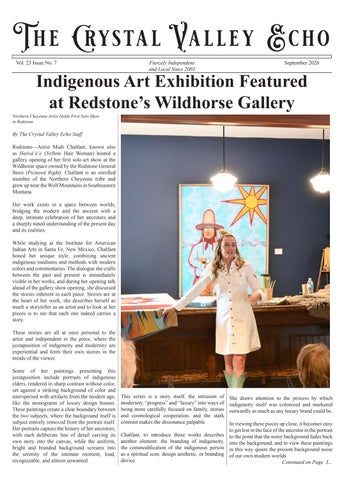
By The Crystal Valley Echo Staff Redstone—Artist Miah Chalfant, known also as Heóvá’é’e (Yellow Hair Woman) hosted a gallery opening of her first solo art show at the Wildhorse space owned by the Redstone General Store (Pictured Right). Chalfant is an enrolled member of the Northern Cheyenne tribe and grew up near the Wolf Mountains in Southeastern Montana. Her work exists in a space between worlds, bridging the modern and the ancient with a deep, intimate celebration of her ancestors and a sharply tuned understanding of the present day and its realities. While studying at the Institute for American Indian Arts in Santa Fe, New Mexico, Chalfant honed her unique style, combining ancient indigenous mediums and methods with modern colors and commentaries. The dialogue she crafts between the past and present is immediately visible in her works, and during her opening talk ahead of the gallery show opening, she discussed the stories inherent in each piece. Stories are at the heart of her work, she describes herself as much a storyteller as an artist and to look at her pieces is to see that each one indeed carries a story. These stories are all at once personal to the artist and independent in the piece, where the juxtaposition of indigeneity and modernity are experiential and form their own stories in the minds of the viewer. Some of her paintings presenting this juxtaposition include portraits of indigenous elders, rendered in sharp contrast without color, set against a striking background of color and interspersed with artifacts from the modern age, like the monograms of luxury design houses. These paintings create a clear boundary between the two subjects, where the background itself is subject entirely removed from the portrait itself. Her portraits capture the history of her ancestors, with each deliberate line of detail carving its own story into the canvas, while the uniform, bright and branded background screams into the serenity of the intimate moment, loud, recognizable, and almost unwanted.
This series is a story itself, the intrusion of modernity, “progress” and “luxury” into ways of being more carefully focused on family, stories and cosmological cooperation, and the stark contrast makes the dissonance palpable.
She draws attention to the process by which indigeneity itself was colonized and marketed outwardly as much as any luxury brand could be.
In viewing these pieces up close, it becomes easy to get lost in the face of the ancestor in the portrait Chalfant, to introduce these works describes to the point that the noisy background fades back another element: the branding of indigeneity, into the background, and to view these paintings the commodification of the indigenous person in this way quiets the present background noise as a spiritual icon, design aesthetic, or branding of our own modern worlds. device. Continued on Page 5...
Page 2 • The Crystal Valley Echo • Vol. 23, Issue No. 7 September 2026
2026 Community Happenings Saturday September 12th 8:00am Hiking Club: History Underfoot @Talbott’s Burning Mountain Trail
Sunday September 13th Carbondale Music in the park 5:00pm8:00pm @ Sopris Park featuring Aggie Flores, Tommy the Animal
Thursday September 17th 7:30pm Changemaker Speaker Series Albert Lin: Exploring Human Frontiers @Wheeler Opera House
Saturday September 12th 4:00pm ‘Ghost VOICES’ ARTery Tiny Mobile Stage @ Aspen Historical Society
Monday September 14th, 6:00pm-9:00pm @Crown Mountain Park in El Jebel Roaring Fork Valley Ultimate Frisbee Summer League
Saturday September 19th 8:00am Sunlight Showdown Half-Marathon @ Sunlight
Saturday September 12th 8:00pm Demetri Martin: The Quick Draw Tour @ Wheeler Opera House
Wed September 16th 7:00 pm Our Ranches, Climate & Our Local Food System @ Crystal Theatre Carbondale tickets: https://tinyurl.com/53a986fj
Saturday September 19th 7:30pm An Evening with Dead Floyd @Belly Up Aspen
The Crystal Valley Echo & Marble Times Mission Statement: To provide a voice for the residents of the Crystal River Valley; to bring attention to the individuals and local businesses that are the fabric of the Crystal Valley region; to contribute to the vitality of our small town life. Editor-in-Chief: Tucker D. Farris Editor@crystalvalleyecho.com For advertising sales contact: Advertising@crystalvalleyecho.com Or call our advertising manager at +1(970)618-6812 The Crystal Valley Echo is published monthly, And is distributed throughout the Crystal Valley. The Crystal Valley Echo is 100% Human-Created And does not condone, elicit, perform, or implement creative, Journalistic, or logistical usages of generative artificial intelligence. No part of this newspaper may be used in the training Of artificial intelligence, doing so will result in legal action. All rights of works by contributing authors and photographers Remain the sole property of their creators in perpetuity.
www.CrystalValleyEcho.com
From the Editor's Desk...
Vol. 23, Issue No. 7 September 2026 • The Crystal Valley Echo Page 3
Building Community in Newsprint A Dispatch from the Colorado Press Association Annual Conference Dear Readers, I am pleased to report that The Crystal Valley Echo made its debut at the Colorado Press Association’s (CPA) Annual Conference the last weekend in August. I wanted to share with you all what that entailed, and what it means for this newspaper. This year’s CPA conference theme was the idea of community journalism, and how print media and newspapers in particular help to build robust communities. My last editorial touched on this idea, and it seemed a perfect fit for The Echo as well, considering we are very much a community newspaper, meaning we cover specific community related issues rather than regional or national issues. The Echo has always been a community paper, and this is evidenced in our mission statement that you may find on Page 2. We have been, are, and always will be focused first and foremost on our communities. A sentiment I have repeated often over the past weekend is that during the early days of Colorado’s settling, when mining and logging camps were springing up around the Western Slope, and when homesteads were coming together to grow into towns, the factor that really “made” a town was not the arrival of a train station, a post office or a general store. It was the arrival of a printing press, and the creation of a newspaper. Once you had a community paper, you were a community. They kept the record of the goings on in your town, and told the stories of the triumphs and tribulations of the early West. Today, when we turn back to those pages we not only see the big stories of the day, but the little moments that together make a community a home. For instance, the Crystal River Current, Crystal City’s newspaper during the late 1880s had a segment called “Local Splinters” that would chart the wagon movements of various residents, advertise upcoming snowshoe (what we now call Nordic or cross-country skis) races from Schofield to Placita, and announce the newest stocks in the town’s store. For the residents of these communities today,
these records and stories are a direct connection to a time out of time and show the true power of the community newspaper as an anchor to our history. The conference theme, on paper called to me as the editor of a community paper, and an editor that is deeply proud of his communities and their support for local journalism. What I found in the broader conversations was something…different. I cannot speak for the entirety of the Front Range, but a takeaway that I came home with that I say partially tongue-in-cheek is that it seems that journalism is not only doing better this side of the Continental Divide, but we are thriving in many ways. I have to add a disclaimer here that this experience that I will share here is my own, and I cannot speak for others who attended, but I want to share my honest reactions to each of you because being open to my readers is also a part of running a community newspaper. Friends, I expected to enter into a series of collaborative, constructive and exciting sessions and talks on how to be a better editor, journalist and newspaper publisher. What I seemingly stumbled into at each turn was a room of people reporting from the frontlines of what sounded like the total collapse of society itself. Reports of rampant illiteracy, little-to-no care about newspapers, demands for shortform content, talks on the benefits of a TikTok account for the paper, or lessons on how to find and hire social media influencers to pretend to be journalists were just some of the flavors of talks I happened to find myself intertwined in both formally and informally. One session, which sounded so promising about collaborations between newsrooms, colleges, and industries became a collective condemnation of the reading public, and a resignation to the idea that we had to adapt to a world without attention spans or reading comprehension skills. The inescapable nightmare in the room was a collective sense of total admiration for the all-powerful AI. At seemingly every corner, you could not escape some voice talking up the benefits of Artificial Intelligence in some way.
Sometimes it was subtle, other times so loud it rattled my brain in my skull (more on that in a moment). To my knowledge, The Echo is one of the very few newspapers currently operating that takes a 100% anti-AI stance and says so explicitly in each print copy. We are proudly human-created, and I will confess to you that I did not think this was a controversial idea until last weekend. In the same session discussing college collaborations, someone said that it was unfortunate that “we can’t watermark our work to protect it” at which I could no longer contain myself and I blurted out that The Echo does indeed have a way of watermarking our work: we print it. The rebuttal was that “print is a luxury” which, in our communities where internet is a luxury and on a rainy day a fragile one, print is a necessity. He said too that no photo today was “not stolen” somehow with AI, and friends I will share another rebuttal there: when I take photos on real 35mm film for this paper, they exist physically and without alteration as impressions of light bent through polished glass onto strips of silver nitrate. AI can’t take away our Ektachrome. To further compound this, the AI talk raged all around me the entire weekend. An informal, in-passing talk brought up the idea of using AI to “fact check” news articles in the context of a paper being sued for having incorrect information in them. My reply to this was that at The Crystal Valley Echo, we use our brains for fact-checking, we like to use the original AI (Actual Intelligence). The crown jewel of AI madness occurred during the final night’s awards dinner. In a banquet hall around a table with a catered dinner, I and my compatriots from the valley waited to celebrate the awardwinning journalists featured in our hometown papers (congratulations are in order to all winners from the Sopris Sun, The Aspen Daily News and The Aspen Times). Just as the ceremony was to being, a voice announced that we would be treated to “looped AI-generated songs” and that one of their staff had “produced them.” I must confess that at this in a moment of relative silence in the hall, I could not help myself in saying that no, that staffer had not “produced” anything.
What occurred next, dear readers was something that can only be described as a fever dream. Out of the speakers blared a generic three-chord country rhythm and an uncanny valley voice in the flavor of the typical country twang started its march to absurdity. Clearly, the “producer” had pasted a list of all the newspapers that won awards into an AI and asked it to write a song about Colorado community newspapers. We heard the voice warble out lines such as “The Sopris Sun (pronounced sopp-riss) brings you the news you care about” or “And the Aspen Daily News up in the slopes so high reports the news you need.” It made me infinitely grateful in that moment that The Echo did not nominate ourselves for any awards, as I would shudder to think at what nonsense the computer would have slopped out at that title. I could not handle to stay and be subjected to this on repeat and so I left the room entirely and instead found solace in a conversation about printing presses outside the ballroom for a good hour.
This concert of absurdity was preceded by someone loudly proclaiming that we journalists were “painfully behind” the curve on AI and that we needed to “catch up.” Next year, I’ll take along a portable speaker to blast some Creedence Clearwater Revival or Warren Zevon to bring the human touch back to the world. Readers, I want to promise you that under my watch, The Echo will never “catch up” if it means outsourcing stupidity to a computer who has never seen Hayes Creek Falls, had a cinnamon roll at the Redstone General Store, stood inside a Marble quarry or watched the fog rise off the river in Placita. When you pick up this paper, you are picking up real ideas, photos, words and stories by real humans, and you always will. We will never outsource our community for the sake of convenience. Building Community Continued on Page 5...
Page 4 • The Crystal Valley Echo • Vol. 23, Issue No. 7 September 2026
Local Splinters History Ghost Walk fundraiser returns for 26 th year Glenwood Springs, Colo. – Tickets for the 26th annual History Ghost Walk, a fundraiser for Glenwood Springs Historical Society, are now available for purchase. The event takes place Friday and Saturday evenings over the last weekend of September and the first two weekends of October at historic Linwood Cemetery in Glenwood Springs. There is also a special indoor performance at Glenwood Vaudeville Revue. Tickets for all performances are $25 and a ticketing link is available at GlenwoodHistory.org. The cemetery tours and stage production both usually sell out, so early purchase of tickets is encouraged. All proceeds from the event benefit the Glenwood Springs Historical Society, a 501(c)(3) nonprofit organization. During the walking experience at Linwood Cemetery, guides escort participants from gravesite to gravesite along a lantern-lit path, encountering “ghosts” along the way. Portrayed by volunteer actors, each ghost shares the story of their life in a short performance. The experience concludes back at the trailhead with free hot apple cider and cookies. The History Ghost Walk in Linwood Cemetery is scheduled for September 25-26, October 2-3, and October 9-10. Start times are available on the half hour each evening, with the first at 6:30pm and the last at 8:30pm. The walks last about two hours, including a 1/3-mile uphill hike to the cemetery and back. Participants should wear footwear and clothing appropriate for an evening October hike, and should also bring an electric flashlight, headlamp, or lantern. Children younger than twelve years of age are not permitted. In addition to the cemetery tours, a one-night-only indoor event will take place on October 8 at Glenwood Vaudeville Revue. The actors portray their ghosts onstage, with food and drink available for separate purchase. The doors open at 6:00pm for food, beverage, and seating, with a 7:00pm curtain. Figures from Glenwood Springs history that will be portrayed include John “Doc” Holliday, Kate Bender, Caroline Clark Barlow, Ella Sellar, Ed Hughes, and Ida Lee Alburn, among others. The roster of characters will vary from night to night. Event organizers gratefully acknowledge the generous sponsor support of Alpine Bank, Glenwood Hot Springs Resort, Keylink Vacation Rentals, and City of Glenwood Springs. Opportunities for volunteer guides are still available. Write to: director@glenwoodhistory.org or call 970945-4448 for more information. Glenwood Springs Historical Society, founded 1963, has a mission to preserve and share artifacts and materials related to the unique history of Glenwood Springs and Garfield County.
The society operates Frontier Historical Museum at 1001 Colorado Avenue and a satellite exhibit at Bullocks Western Wear store in downtown Glenwood Spring that is focused on John “Doc” Holliday and the lore of the American West. The organization also publishes history tour booklets and conducts educational programs. Town of Carbondale Downgrades to Stage 1 Fire Restrictions Carbondale, CO – After consulting with the Carbondale & Rural Fire Protection District and following Garfield County’s lead, the Town of Carbondale will move from Stage 2 Fire Restrictions to Stage 1 Fire Restrictions effective Wednesday, September 9, 2026. This change reflects improved conditions but continued caution during fire season. Stage 1 Fire Restrictions include: No smoking, except inside an enclosed vehicle or building, in a developed recreation site, or in a barren area at least 3 feet in diameter clear of vegetation. No use of explosive materials, including fireworks, exploding targets, tracer rounds, or bullets. No welding or operation of torches with open flame, except in areas cleared of vegetation within at least 30 feet and with proper safety measures in place. No internal combustion engines (e.g. chainsaws, generators) may be operated without a properly installed and functioning spark arresting device. Campfires are only allowed in permanent, in-ground fire grates or store-bought fire pits in developed areas. Temporary fire pans and rock campfire rings are not allowed. The Carbondale & Rural Fire Protection District Fire Chief may authorize specific fires deemed necessary and safe under current conditions. Always use extreme caution and follow safety protocols when welding or operating flame tools. The Town reminds residents and visitors that while conditions have improved, wildfire risk is still present. Everyone is urged to remain vigilant and use caution when outdoors. For more information on fire restrictions, contact the Carbondale & Rural Fire Protection District at 970-963-2491. Structure Fire at 1184 Heritage Drive, Carbondale Carbondale, Colo. (September 6, 2026) Carbondale & Rural Fire Protection District responded to a structure fire at 1184 Heritage Drive at 4:21 a.m. today. Firefighters arrived to find a barbecue grill in an outdoor kitchen area on fire. Crews had water on the fire in less than three minutes of arriving on scene and quickly extinguished the fire, then completed overhaul operations to confirm the fire had not extended into the residence. The occupants and a cat evacuated safely. “Firefighters had water on the fire in less than three minutes after arriving on scene,” said Incident Commander Ashley Buss Greene. “Crews did an excellent job quickly containing the fire and preventing it from extending into the home. Their fast, coordinated work, combined with the composite decking material, kept this from becoming a much more serious fire.” The outdoor kitchen was located on a deck constructed with composite decking material.
Unlike traditional wood decking, composite materials can be more resistant to ignition and fire spread. In this incident, the decking helped slow the fire’s spread and, combined with firefighters rapid application of water, helped keep the fire from extending into the structure. The occupants were able to return to the home and were not displaced. No injuries were reported. Carbondale Fire responded with two fire engines and eight personnel. Carbondale Police Department and Garfield County Communications Center also supported the incident. Update on the November 2024 Sex Assault in the Town of Carbondale Carbondale, CO – On Wednesday, August 26, 2026, the Carbondale Police Department (CPD) was notified by the Colorado Bureau of Investigation (CBI) of a lead relating to the 2024 November sex assault which has been under investigation (original press release below). The lead identified Numan Enoc Santos-Amaya (DOB 11/12/1996) as a potential suspect to the case. The CBI Special Agent (who assisted CPD since 2024) informed a Carbondale Sergeant that Santos-Amaya was currently being held in a Louisiana Immigration & Customs Enforcement (ICE) Detention Center for unrelated federal crimes. The Carbondale Sergeant and the CBI Special Agent flew to Louisiana to follow up on the lead. Based on the follow up investigation, probable cause was developed. As a result, the 9th Judicial District Attorney’s Office filed charges on Numan Enoc Santos-Amaya for the following charges: First Degree Burglary (Felony, Class 3) Sexual Assault - Submit, Force, Threat or Other (Felony, Class 2) Robbery (Felony, Class 4) First Degree Kidnapping (Felony, Class 1) Crimes Against at Risk Person - Sexual Assault (Felony Class 3) Note: Every person is presumed innocent until proven guilty in a court of law. Santos-Amaya was processed and removed from the United States to El Salvador. The Carbondale Police Department has met with the survivor and her family. At their request, we ask that their privacy be respected. “This as a significant step forward in a case that has deeply affected a survivor and our community. I am proud of the persistence and dedication of our officers and grateful to the CBI and our law enforcement partners for their continued support. Most importantly, we have not forgotten the survivor at the center of this case, and we remain committed to supporting her.”, said Chief Kirk Wilson. The Carbondale Police Department expresses gratitude to the Colorado Bureau of Investigation, 9th Judicial District Attorney’s Office, Aspen Hope Center, and Garfield County Sherriff’s Office Victim Response Advocates for their continued support in this case. No further information will be released.
Letters to the Editor: Dear Editor, Pitkin County’s proposed $34 million transfer of the 650-acre Snowmass Falls Ranch to the U.S. Forest Service is a grave mistake. Our local government— not the federal bureaucracy—is the only reliable steward for this legacy ranch at the threshold of the Maroon Bells-Snowmass Wilderness. This property is deeply bound to our valley’s heritage. Homesteaded in 1906 by Kate Lindvig and stewarded across eight decades by the Bob Perry family, it represents the living history of our working landscape. Decades ago, my husband Doug and I operated Moon Run Outfitters, sometimes with permission, we rode through Bob’s corrals to access Haystack Mountain. I know this dirt, I know these trails, and I know exactly what is at stake. Surrendering local title to federal control places this wilderness in immediate jeopardy. Federal protections remain perpetually vulnerable to regulatory rollbacks, administrative rule changes, and shifting political mandates. Weakening safeguards like the Roadless Area Conservation Rule risks opening pristine lands to commercial exploitation and extraction without local oversight. Given the ranch’s extreme proximity to Aspen and Snowmass Village, losing local ownership creates a dangerous vulnerability: under shifting federal policies, wildlands could eventually be privatized into luxury compounds for the highest bidder. The Wilderness Act of 1964 was intended to protect wild places in perpetuity, but federal administrations can no longer be relied upon to honor that mandate. I urge the Pitkin County Commissioners and Pitkin OST to pause this transfer immediately. Retain county ownership, preserve local control, and safeguard Snowmass Falls Ranch for our community before it is too late. Sincerely, Holly McLain – Roaring Fork Valley resident for over 52 years. Corrections: In the August issue of the Crystal Valley Echo in an article titled: Voices From the Past: Novel by Mrs. Irène Osgood, Wife of Redstone Founder J.C. Osgood to be Published in Print for the First Time Since 1911 The Echo was informed that we incorrectly used the abbreviated form of the title "Miss" instead using "Ms." which we were informed was not regularly adopted into the zeitgeist until the mid-20th century which was beyond the time that Miss Osgood lived. We appreciate the history lesson and the sharp eyes of our readers to ensure we do not fall victim to unnescessary anachronisms.
Vol. 23, Issue No. 7 September 2026 • The Crystal Valley Echo Page 5
Building Community in Newsprint Continued from Page 3 We will never put words in your hands or ideas out into the world that come from the same technology that will tell you that you can safely gargle with gasoline, or show you a photo that was made by stealing hours of time and expertise from real artists. It seems that the unintended consequences of the conferences obsession with AI was to inspire at least one newspaper to redouble its commitment to real, human community journalism. If I could sum up the madness in one word, it would be embarrassing. It is embarrassing to see supposed ‘industry leaders’ admit in a room of working professionals that the very things that make this field of work engaging, impactful, fulfilling and important are beneath them, and belong in the digital hands of some artificial illusion of intelligence. This theme was present throughout the conference, with so many people talking about how the things that are hallmarks of journalism are now too inconvenient. Taking notes during interviews, building community calendars, fact-checking, photo editing, transcribing recordings, researching other sources, interpreting data, all of this now, if we believe the experts is just too tedious for the working journalist. Instead, we need to outsource all of that and focus on making sure our Instagram stories are frequent, short and standardized. The question I would pose to the many people complaining about how hard it is to be a journalist because of these tasks is simple: why are you even a journalist? We do this work because it is important, and we do it ourselves because, since the first print newspaper in 1605 until about two years ago, we have always done it ourselves. Reading this, you might imagine I did not have a good time, but rest assured readers, I did indeed enjoy myself, and I think that it was a wonderfully positive experience overall despite the computer fetishism from the top down. It was positive for several reasons, some practical, others more abstract. During the three-day conference, I was able to make some very positive connections both close to home and across the state that I think will lead to long-term benefits for The Echo. For instance, I am working now to try to create a way to collaborate with college journalism students to create a parallel program to The Sopris Sun’s Sopris Stars. If that works out, our valley could theoretically have a high school and college program in tandem and become a powerhouse community for the study of journalism. I met someone who knows more about printing presses than I ever thought possible and I shared an idea I dreamt up to print The Echo locally ourselves for a fraction of the cost and he not only assured me it was viable, but offered to help however he could.
I met educators, writers, publishers and scholars who have become friends so that now I have the support network I need to do even more in this role. I met worldclass journalists who have and continue to do work that inspires me, and that makes real differences. I learned from people who create ballot guides, report state budget issues, and data scientists at the forefront of some really incredible journalism.
The Crystal Valley Echo has the most engaged, dedicated and supportive audience that I have ever seen, and folks, nothing in these pages would be possible if not for you picking up a copy, reading it, and talking about. Community makes a community newspaper, and I cannot imagine a better community to be a part of, and I am so beyond thankful to each of you for making home what it is.
In addition to these networking moments, something truly special emerged that, upon reflection, inspires me more than anything else. Readers, I am proud to share with you that, perhaps uniquely to our region, there is a very deep professional and friendly bond between your local newspapers. At the conference I was joined by colleagues from The Sopris Sun, The Aspen Daily News, The Aspen Times, Aspen Public Radio and over the airwaves by KDNK’s Cody Lee in the studio. All of us share a mutual respect for one another, and this past weekend we developed closer friendships with professional relationships in tow.
I said that The Echo did not win any Colorado Press Association awards this past weekend, but the fun part of being the editor of the newspaper is that I can both create, and issue awards at will.
It is rare for a region as small as ours to have so many local news outlets. It is rarer still for all of them to get along, and for their employees to be so warmly dedicated to collaboratively elevating the quality of all of our publications and outlets. From the first moments until the very end, the Roaring Fork/Crystal journalist’s coalition operated as one of the best teams I have ever been a part of. This has created so many avenues for improving our work in the valley and our communities in the coming months, and I am excited to share more as we develop these ideas further. I think that a strong community newspaper also comes from a strong community of press people, and I am very grateful to be a part of one.
TF P.S. We’ll be back next year, ever-ready to be the voice of humanity in the face of AI-generated songs about newspapers and whatever else comes our way.
The takeaway from this conference that has settled in my mind more clearly than these other great moments is that The Crystal Valley Echo was not only welcomed to the conference, but it was done so as a “real” newspaper. When I spoke about what it is we do behind the scenes of these pages, so many people from all avenues of the industry offered nothing but praise. That we print words written by writers who are content experts, sharing their intimate knowledges with our readers, or that we uphold classical formatting and layouts for our paper, or our growth from 16-32 pages in four months, or the fact that when I looked for some copies to bring with me to Denver, I could not find a single one that had not already been taken by one of you. Each point was not just praised, but validated. I cannot help but feel a tear in my eye thinking about this now, that our little hometown paper from The Crystal Valley was so beloved by so many people who know more about newspapers than I ever will. Finally, I will say that of all of this praise the one thing that shone through everything else was each of you. According to so many people, declining readership, a decline in people who care about newspapers, and an overall rejection of print media was the norm in Colorado journalism. Not in our valley.
As such, I bestow upon each and every member of our community of readers the inaugural Crystal Valley Echo Excellence in Audience Award for 2026. Check page 22 for a miniature certificate you can cut out, and if you’d like, reach out to me and I’ll meet you in Redstone sometime with a typewriter to personalize it for you. Forever (humanly) yours,
The Crystal Valley Echo also extends its thanks to James Steindler, Editor of the Sopris Sun for the carpool to Denver, and to Megan Tackett, Skyler Stark-Ragsdale, Arthur Cherith, Larry Day, Miriam Busch, and Todd Chamberlin for the community of professionalism and friendship that they have so warmly welcomed us into, and for making the madness sane in the most endearing ways.
Indigenous Art Continued from the Cover... Perhaps the most stunning piece, titled Grandmother’s Wisdom is a stunning portrait painted directly on a buffalo hide and sprawling nearly six feet across and even taller. Chalfant’s story of inspiration for this piece comes from witnessing a ceremony wherein a traditionally painted buffalo hide was returned to her tribe by the US Government after having been in its possession for many years. She describes the intense power of the moment, of the moving emotions of hearing the collective emotions of the grandmothers and other elders upon seeing the skin for the first time, the overwhelming feeling of seeing her history come home. She carried that history, tradition and raw emotion into this masterpiece which now hangs on display in the Wildhorse Gallery. Chalfant’s opening preceded a gallery run that has lasted through Labor Day and will continue in semi-perpetual residence according to gallery staff. Visitors and locals alike are encouraged to visit Wildhorse Gallery, located just north of the General Store to view Chalfant’s exhibition and experience the awe of her unique blend of the old and new in carefully curated pieces showcasing a wide variety of skills and mediums. Pictured Below: Artist Miah Chalfant and her partner Shawnee Real Bird in front of Chalfant's buffalo hide painting "Grandmother's Wisdom" at Redstone's Wildhorse Gallery. Photo by the Crystal Valley Echo
Page 6 • The Crystal Valley Echo • Vol. 23, Issue No. 7 September 2026
In Print...
Carbondale's Top-10 Books in July: Theo of Golden by Allen Levi
By Izzy Stringham
Calamity Club by Kathryn Stockett
This has been a summer of great fiction! From new work by favorites like Elizabeth Strout and Colson Whitehead, to an adult fiction debut by Elizabeth Lim, here is a rundown of several new fiction titles hot off the press to enjoy: Cool Machine, by Colson Whitehead This is the third installment in an excellent trilogy about New York City, and furniture salesman Ray Carney’s not-so-legal escapades. This one takes the action into the 1980s, when Carney decides to run one last heist. Whitehead is a brilliant wordsmith, and his characters stick in your brain long after the story resolves. The Things We Never Say by Elizabeth Strout Leave it to Elizabeth Strout to pull your heartstrings every time. Her latest novel takes on the secrets we keep, the lies we live, and what to do when we may not know the ones we love most. Inside ordinary lives there is always love and loss. Artie is a long time highschool teacher struggling with a changing world and his deep feelings of loneliness when he learns a shocking truth in this satisfying story.
Yesteryear by Caro Claire Burke Author Rachel Eliza Griffiths stopped at the Basalt Library in late July to discuss her book “The Flower Bearers.” Griffiths’ memoir is an engrossing tale of loss and heartbreak involving the death of her best friend and then a severe knife attack on her husband that left him blind in one eye. Griffiths spoke for an hour with local literary podcaster Mitzi Rapkin on the themes of surviving trauma, writing and moving through grief. She was so eloquent and thoughtful in her presentation, and vulnerable about the events she was writing about.Griffiths was living proof that a person could go through unimaginable loss, but still survive and grow. The interview will be broadcast on Mitzi’s podcast “First Draft.” Copies of her book are available at White River Books.
Whistler by Ann Patchett Land by Maggie O’Farrell Fierce Country by Heather Hansman Go Gentle by Maria Semple Cool Machine by Colson Whitehead Country People by Daniel Mason
Go Gentle by Maria Semple Aspen native Maria Semple hit it out of the ball park in this zany and entertaining comedy about a woman figuring it all out…again. Full of witty dialog and hilarious characters, this story takes on all the world will throw at us, and answers with love and humor, and maybe a dose of stoic philosophy. Laugh out loud, and join protagonist Adora on an adventure that will leave you smiling at the end.
Dungeon Crawler Carl by Matt Dinniman
A Far-Flung Life by M. L. Steadman On a remote sheep station in Western Australia, the MacBride family has raised sheep for generations. But when a tragic truck accident happens, the trajectory of the entire family is altered. This book is a beautiful and haunting story with fully realized characters and real Australian atmosphere, following a family trying to do what’s right and realizing maybe some things are best left unsaid. Fishbone Cinderella, by Elizabeth Lim Set in Hong Kong after WWII, and in Berkeley CA in the 1960s, this magical historical fiction is an engaging and satisfying read. Marigold’s mother can make herself disappear. And as they embark upon a trip back to her childhood home in Hong Kong, the secrets of her mother’s life start to trickle out. A tale of survival, magic, love and yes, a wicked stepmother, this take on Cinderella is fresh, entertaining and superbly written. Someone Else’s Husband, by Kimberly McCreight Who killed Frankie Callahan? From Mount Kilimanjaro to Manhattan, this twisty crime thriller investigates what exactly happened when police arrived at Frankie’s apartment and found it soaked in blood.Two weeks prior, Frankie had been hiking in Africa with Richard Falk and a group of his friends. She and Richard had an instant connection, but when they came home, did they keep the romance going? So many questions fill this taut and entertaining story, and I was kept guessing until the very end!
A PITKIN COUNTY LIBRARY
Redstone Program
Sewing
with Jennifer Redstone Inn Conference Room e
ne
e
i e
e
ne
Tuesday, September 29 | 4:30pm-6:30pm e
ing
e
ge in i e e wi
ei
e
ewing e e
n
ing ne
n i e g i enni e
n e
n n
Contact: jennifer.hanson@pitkincounty.com
120 N. MILL ST., ASPEN, COLORADO 81611 | 970-429-1900 | PITCOLIB.ORG
Vol. 23, Issue No. 7 September 2026 • The Crystal Valley Echo Page 7
Bears, guilt and blame haunt the streets A Guest Opinion by Mick Ireland Cue the fog, the misty vapors, the spooky organ music, the black and white imagery. You’re not in Transylvania though this place is becoming stranger by the moment. You’re on the set of Desperate Bear Wives of Aspen or Bram Stoker’s 1897 version of the Silver Age come to life to haunt us. I am reminded of the strange and scenic structures in the middle of the fields in Bavaria near our sister city Garmisch-Partenkirchen. The locals explained the dispersed sheds (Heuschober) in the fields and meadows as a holdover from the Bram Stoker era when bears and wolves roamed the pastures at night feasting on livestock. Aouooooo! Things are going thump in the night here and not the slam of car doors after bar closing or the soon to be perpetual party/concert season. The low frequency booms penetrate better than mid-range noise. Reports are circulating of gun fire in the wee hours but I am not sure that isn’t just a gloss on the usual bangs of dawn. Jane and I not only lock the doors at night (must do) and literally bar the sliding glass door (also must do), but we have taken to lugging bear spray on our hips when going about here on the banks of Hunter Creek. In the past, bears used the Hunter Creek trail as commuter route marked by their berry formation scat but incidents with humans were rare. Presumably, desperate times make for desperate bears. I have observed several ursa that, to my untrained eye, looked incredible lean. The bear at the restaurant table story was cute. The proliferation of bears, the break ins and the bites on humans, not so much. Nobody has a census of the bears virtually swarming this place but then the 2020 Census didn’t count the humans here accurately. And the stories of tiny, abandoned cubs crying in the night for Mama bear are heart rending. One can’t stop to talk to a local without getting a bear update. Just walking the quarter mile from Clark’s Market to home gave me more bear updates than the local news can or cares to cover. An unhoused local was bitten on the head napping in Rio Grande Park, surviving with three puncture head wounds after a bear happened on some of his food near his sleeping bag. Names of the assailant and victim are withheld. Three units (out of 36 total) at hunter Longhouse were broken into this week, another baby bear tried to force its way into my neighbor’s house through a partially open sliding door on the ground level deck.
One night after a bear break in (or the three) at Hunter Long Hose there was a large clang of metal sometime between 1p.m. and two p.m. This was later attributed to someone or ones, sabotaging the bear cage trap set out in the shared parking lot between our complex (Common Ground) and Hunter Longhouse. The empty trap was removed the next day.
carbon intensive jumbo private jets, firing up the barbecue grill with starving bears all around, running the bright lights in the shop window 24/7, heating the driveway and the tub at the fifth home all winter in case somebody might drop in.
Perhaps the saboteur thought he/she/they were sparing the life of the offending bear. Repeated home break ins are deemed a capital offense as are attacks on humans including the Rio Grander Park napper and a restaurant employee. The next day armed law officers literally wielding guns and a rifle came through to drive off a bear, presumably the larcenous bear of the three Hunter Longhouse break ins who had become a regular visitor hanging around in apparent hopes of finding an open door or, perhaps, another bag of trash on a deck.
Just yesterday (Friday) former ambassador/ Senator/Interior Secretary Ken Salazar was here promoting his book, “Borderlands.” I am reminded that it was not long ago that he cast the filibuster ending 60th vote to pass fuel efficiency standards. We’ve come a long way in the wrong direction since that vote in June of 2007, chasing a handful of trans people running track and protecting kitty cats from Haitians. We don’t need a Biden or Trump sticker on the trash dumpsters assigning blame for the desperate bears, we need a sticker that points back at all of us and says, “We did this.”
My impression is that many of us are sharing an ethical dilemma in seeing the destruction of intelligent creatures and the cruelty suffered by abandoned cubs. The bears are in town for neither fun nor profit, responding to the failure of the service berry crops and fruits as the drought has literally dried up their food supply. The ursine immigrants LIMITED WEEKENDS LEFT FOR SUMMER & FALL EVENTS from the high country are here out of desperation not in hopes of bearing “anchor” cubs or taking jobs from the native coyote packs. Where are the ICE tough guys when a crackdown is actually protective rather than political?
You Are Welcome Here
If it’s not the bears’ “fault” in a society where fixing the blame is preferred to fixing a problem, who or what is to blame? Some opprobrium must fall on those unwilling to secure their trash and claw licking good recyclables. And a lesser degree or responsibility adheres to those who just won’t lock up their trash.
A Gathering Place for All Family Reunions | Weddings | Conventions Retreats | Community Events
Call to Book Your Event
Balme can’t be foisted on the voters for abolishing the spring bear hunt. Hearing or hearing about a crying baby bear asking for Mama decides that issue, at least for me. The real culprit is us, our inability to turn off the carbon machine even in a parking lot waiting for a partner to exit a grocery store. Really, running the A/C in Aspen just because its 80 degrees? Buying the big work truck that never carries a work load, destroying the forest to make way for acre number 6,000 of ski terrain, refusing to even consider public transportation, giving thumbs up to
178 Co Rd 3, Marble, CO 81623 | (970) 963-9522 chairmountainranch@gmail.com | chairmountainranch.com
Page 8 • The Crystal Valley Echo • Vol. 23, Issue No. 7 September 2026
Cattle Drive A Column by Ted Benge The cattle flowed around cars and along the ditches in a river of dusty hides and bobbing heads. Mother cows called to babies. They swatted their tails, and from the saddle I looked down onto bumpy spines and wide hips. Flies buzzed around the herd, dogs darted amid hooves, and I felt proud. Glad to be part of it, one of the cowboys driving 300 head down Main Street in the early morning haze, trying to beat the heat. We had rendezvoused in the dark at 5:30 am. I had arisen before that, at 3:30, to catch, trailer and saddle my horse. We mobilized the herd in the soft early light, rounding them up from the field and into a cohesive whole. Cows milled and bawled. Then Tai Jacober gave the word and we began to whoop and push; cows spilled from the Coffman Ranch onto Catherine Store Road, and horseshoes clomped on asphalt. Every year, ranchers from various local cattle operations move cows from winter pasture in the lowlands outside of Carbondale onto high country summer grazing permits in the Thompson Divide. It is a tradition that roots our community in both agriculture and land stewardship. Even as shiny new hotels and condominium buildings sprout from the earth, cows tread the streets en route to mountain pastures. The cows shuffled around commuter vehicles and fertilized the road as we advanced through the familiar landmarks of town. Children waved and people took pictures. The herd trundled down Colorado Ave, parallel to Main Street, across Highway 82 (where horses were positioned strategically at the roundabout), and along County Road 108 past CRMS. I have been invited to help on several occasions over the years, another presence to help strengthen the invisible boundary of pressure that shapes the herd and guides its direction. Though I am an outfitter and not a rancher or cowboy, it is an honor to play some small role in this Western tradition, even largely as an observer. I enjoy watching the expert horsemanship and teamwork on display by the Jacober and Nieslanik families, who have generations of family riding together through the streets. Over the years, I have admired their skill cutting pairs (mother cow and calf) from thick herds, roping in the rodeos, and husbanding their animals through the long winter nights of calving. It was plain fun, too. I had a jolt of excitement when a mother cow made a break for it behind 7-Eleven, and my buckskin steed shot into a graceful lope to head her off. We avoided a hole in the ground, which could have broken my horse’s leg and sent us into a tumble, and urged her back into the melee. Last year, I dismounted and handed my reins to another rider so I could gingerly encourage some opportunistic cows out of a zen garden. In that moment, the herd ahead fractured and some of the mother cows charged headlong back to where the drive had begun. I attempted to turn them back around, but they paid no heed to me, one skinny guy, arms waving, afoot in the streets. In the chaos, I became separated from my horse when the rider holding his reins worked to turn the tide. I had to hitchhike in several directions before being reunited. Carbondale is a small town, and I was fortunate to be transported by a friend, Ron Speaker. Now, as the herd trudged past Crystal River Ranch and the heat grew, the pace eased. Riders chatted and swung ropes, catching fence posts and sage brush. I had the chance to ride along with an old friend and high school football teammate, Nate Nieslanik, who manages a ranch outside of Carbondale. “I’m working 15 or 16 hour days to make it all work,” he said.
Amid a rapid transformation in Carbondale’s demographics and economy, ranching still plays a critical role in our community. Ranchlands create open space and buffer zones in a valley increasingly homogenized by subdivisions and housing complexes. Agricultural land also creates important habitat for wildlife. According to the Roaring Fork Watershed Biodiversity Initiative study, approximately half of all winter range for deer and elk in the Roaring Fork watershed is private. Much of that is irrigated and carefully managed ranch land. In my work, and in conversations about conservation, I have encountered opposition to the public lands grazing model and the presence of cattle in the backcountry. Undeniably, cows impact the ecosystems in which they reside, but through careful management, grazing can improve soil health and biodiversity in rangeland. Ranchers and public land managers jointly monitor vegetation, water, and other indicators to avoid overgrazing. The system is, of course, imperfect, but grazing permits are essential to the production of healthy, grass fed beef. If we lose ranches, we will lose valuable open space and severely limit wildlife habitat. We would also surrender a slice of our community that ties us to the land. Though most of us will never own or work for a ranch, we participate in the local food chain every time we buy Cap K or Nieslanik beef, and with every Fat Belly burger we buy after a day in the mountains
The author aboard his buckskin horse, with a bag of trail mix protruding from saddlebags as the herd rolls through town. Photo by Ted Benge
.
Ted Benge was born and raised in the Roaring Fork Valley and is a lifelong hunter, skier, and hiker. He owns Capitol Peak Outfitters and works as an AVSC ski coach. He lives in Carbondale with his fiancée, Aisha Weinhold.
Vol. 23, Issue No. 7 September 2026 • The Crystal Valley Echo Page 9
Mental Health Matters By Saffron Branson How’d you sleep last night? Personally, there weren’t enough hours between closing my eyes and my alarm going off. To add insult to injury, what I did get did not feel particularly restful. If you have to deal with me today, I’m terribly sorry. Sure, I’ve tried to compensate with a likely irresponsible amount of caffeine, but the yawns keep coming anyway. It’s estimated that we spend about a third of our lives sleeping, or at least trying to. When we don’t get enough of it for a night or two, we get cranky, see drops in our reaction time and cognitive processing, and spend the day aching for a nap. When that stretches to a chronic lack of time spent face to pillow, the consequences begin to pile up to wreck havok on our health. Why is that, and why is it so darn hard to get to sleep some nights? Despite the fact that we’re just lying there seemingly doing nothing, sleep is a surprisingly complicated process. There are four stages with different biological and mental processes happening in each of them. The most important for the brain specifically, as far as current science can measure, is Rapid Eye Movement. You might have heard the term REM sleep at some point on a commercial trying to sell you a pill or from your doctor. This is the last stage in the sleep cycle and is the closest to being awake. It is also when we are dreaming. Yes, even you that insists you don’t dream. You just don’t remember them. Have someone wake you up in the middle of REM sleep sometime and record what you say when they ask you what you were dreaming about. Our muscles are paralyzed during this time because the danger of hurting ourselves while we’re unconsciously halluciating is fairly high. To prevent us from waking up on the floor covered in bruises every morning, our body helpfully sends our motor neurons on break. Though there is not concrete evidence as to exactly what is happening mentally during REM Sleep (brains are notoriously difficult to get straight answers from) we do know that it’s necessary for us to function properly. While you’re dreaming about realizing you’re naked halfway through giving a presentation at work or being chased by a bear that has your 5th grade English teacher’s voice, your brain is busily packing up your day’s memories and transferring them to long term storage. Memory consolidation and encoding is vital for being able to actually remember the things that you might need later. Additionally, have you ever gotten into an argument with a friend or made questionable decisions after a crappy night’s sleep? That’s because in addition to filing memories away your brain is tidying up emotional regulation resources. That’s the bits of your brain that keep you from telling your boss that you’d rather cover yourself in barbeque sauce and go hiking during the height of bear season than attend another meeting. There are also a plethora of physical health benefits to getting a good night’s sleep as often as possible, but this is a mental health column so you’ll have to google those yourself.
But, what happens when those processes don’t happen? Have you ever tried to make a phone call right at the edge of where cell phone service drops out between Redstone and Carbondale? That’s your brain when you don’t get enough REM sleep. Sleep deprivation studies, which are probably exactly as miserable as they sound, reveal that individuals who don’t get sufficient REM for as short a time as two consecutive days experience significantly lower brain connectivity. This makes it more difficult to form new memories or recall existing ones, disrupts mood regulation and slows down the production and distribution of neurotransmitters, among a host of other nasty side-effects. People that routinely don’t get enough sleep are ten times more likely to be diagnosed with depression or other mental disorders. So, now that we’ve established why you probably should be going to bed instead of watching another episode of your favorite show, how do we get there? Sleep hygiene doesn’t just mean brushing your teeth before you lay down for the night. Sleep experts, such as the fine folks at the research labs at the University of North Carolina School of Medicine, suggest laying down a few ground rules about rest.
It’s also important to think about a chat with a medical professional if you do usually get a solid 7-8 hours of sleep but wake up feeling like you pulled an all-nighter anyway. Sleep apnea, or not breathing properly during sleep, starts becoming more common at about Denver altitude and only gets worse the higher you climb. I hope I don’t have to tell you that breathing is kind of important. If you’re like me and are hitting the snooze several times before dragging yourself reluctantly out of bed, give some of these a try. I will if you will. Keep dreaming, Crystal River Valley, and thanks for reading! Mental Health Matters is written by Saffron Branson. Saffron is a senior at Colorado Mountain College pursuing a degree in Human Services and will soon be headed to graduate school for a Master's in Clinical Counseling. No information found in Mental Health Matters should be considered clinical or medical advice from a licensed professional. These are just musings from your friendly local psychology enthusiast.
Try to go to bed and get up around the same time every day. Ideally choose a time and stay within a half hour of that. If this sounds incredibly difficult for you, you’re not alone. The American Academy of Sleep Medicine estimates that only about 36% of the population adhere to a consistent bedtime schedule and routine. They’re probably much better rested than the rest of us wandering around with dark circles under our eyes. Try as much as possible to only use your bed for sleeping and intimate time. This helps keep your brain trained that this is where sleep happens. Keep your bedroom dark and cool. It turns out the same conditions that are ideal for storing potatoes are also good for sleeping. Having the room temperature above 70°F can make it difficult to remain in deep sleep for long restful periods of time. Do some gentle stretches before trying to sleep, but don’t engage in any strenuous physical or mental activities. Except THAT one. A study ran by C.F Oesterling found significant evidence that enjoying some bedroom activities can actually help you fall asleep faster. Other than that: no working out, wrestling with the kids, watching scary movies or playing on your phone before trying to catch your Zs. Try 4-7-8 breathing. To help lull yourself into sleep try a simple breathing exercise. Inhaling for four seconds, holding it for seven seconds, and then exhaling for eight seconds activates your parasympathetic nervous system to help soothe the body and relax the mind. Consider talking to your doctor if you have consistent problems falling or staying asleep. They might even tell you to try some of these tips for good sleep hygiene.
Redstone Senior Days At the Redstone Inn | RSVP: (970)920-5432
SEPTEMBER 8 & 22 11:00 a.m. – Yoga ($5)
With Anna Raphael. Open to all ages and abilities.
12:00 p.m. – Lunch ($10)
RSVP by noon the Friday prior – space is limited. Plated lunch served. Gluten-free option available.
12:45 p.m. – Program • Tuesday, September 8: Warning Signs of Alzheimer’s & Other Dementias Join Dr. Chad Federwitz, PhD to learn about 10 common warning signs and to watch for in yourself and others.
• Tuesday, September 22: AI Workshop
Discover how AI can help you brainstorm, create, learn, solve problems, and explore new ideas. No experience required, just curiosity!
WANT TO BE KEPT IN THE LOOP? Send us your email address: (970) 920-5432 • seniors@pitkincounty.com
Page 10 • The Crystal Valley Echo • Vol. 23, Issue No. 7 September 2026
Local Hawaiian Fried Rice
By Jesse K. La’a Crystal Valley Echo Culinary Correspondent ALOHA GANG!!! It's your friendly local Native HAWAIIAN here to share a little bit about RICE. Buuuut, not just ANY Rice… We’re talking Local Hawaiian Style Fried Rice!!! WHY FRIED RICE, YOU MAY ASK??? Well, I find it a GREAT way to empty out the fridge!!! ESPECIALLY veggies!!! Fried Rice is SO SO versatile aaaaand forgiving (as long as you talk to it just right) that it allows you to add just about ANYTHING your fridge begs you to get RID of. You know... that partial piece of sweet onion hiding in the back of that drawer. Or that half of a bell pepper that was leftover from making Spaghetti... Yeah THOSE guy's... Buuuut, let's discuss the STAR of the SHOW!!!! RICE.... There are SO many different types of rice dishes that require different types of RICE… Long grain or medium grain for the Mexican Rice, Medium Grain for the Spanish or Paella, Indian Curry uses Long grain Basmati and TYPICALLY, Chinese FRIED Rice uses Jasmine Rice which is a long-grain aromatic rice... Here's the thing though... In HAWAII, it's almost an absolute that 90% of the households have Calrose rice which is a medium-grain Japonica rice variety that was developed in California in 1948. It has a very unique short and plump grain shape that holds its shape when cooked but becomes soft, tender and noticeably sticky. The BEST direct alternative that I'VE found here in the valley is Botan Calrose Rice... Nearly EXACTLY the same as Hinode Calrose back in Hawaii. NOW that we've got THAT established... let's get into the COOKING portion... AGAIN... let's start off with the rice. What I've found since moving here is, cooking RICE is a whole different animal all together, in comparison to Hawaii. I would have never in a million YEARS thought that I would ever SAY THIS let alone DO IT but,,, Hold on to your HATS folks.... I DO NOT WASH MY RICE... I don't wash my RICE because... well, I don't HAVE to... there's actual "science" behind it that has to do with the altitude and the extra water AND the longer cooking period that by NOT washing the extra starch off actually TRAPS the extra water resulting in a "sticky" scoopable consistency. Here is exactly what I do. I have an actual 30 cup rice cooker that I use for my food trailer but for HOME use, I cook my rice on the stove. I use a 2:3 ratio of RICE to WATER. I put my pot of rice on the stove and turn my burner to its highest setting and allow it to come to a rolling boil. Once this occurs, I then cover it, turn the heat to the lowest flame and start my timer for 32 minutes. At the end of the 32 minutes, the water will no longer be visible to the naked eye. I then turn the flame completely off and start my timer for 10 minutes.
Then I'll remove the cover and fluff my rice with a fork. OKAY... the rice is pau (finished) COOK... Here is a HUGE tip in making fried rice... MOISTURE IS NOT YOUR FRIEND. Allowing your rice to cool is ESSENTIAL to help remove most of that moisture. How I like to do that is, I'll spread my rice out, once it's somewhat cooled down a bit, onto a rimmed baking sheet and put it into my fridge, uncovered, for several hours. This will help speed up the process of removing moisture. If you're impatient like ME sometimes, you could immediately spread your rice out into a thin layer on a flat baking sheet and put a fan to it for at least 15 minutes, occasionally flipping the rice. NOW... the FUN part!!! Remember how I said your fridge might be begging you for some relief? Well, now's the time to give your fridge some help. Go get those veggies that are close to turning and let's put them to use!!! This is where YOU get to decide your OWN creativity and direction you want to take your fried rice in. Whenever I go foraging through my fridge, I'm usually able to come across some leftover sweet onions, garlic and ginger. Maybe I'll get lucky and find some green bell peppers or mushrooms. Either way, THESE are all GEMS when it comes to making fried rice. I do TONS of Smoking in my smoker and 9 out of 10 times, I'll have some Hawaiian Smoked meat in my fridge AAAAAAND or some Spam but, you can use ANY type of protein your little heart desires, OR none at ALL... Either way, all your ingredients need to be "bite" friendly. I like to take my meats and slice them thin, maybe about an 1/8" thickness and 1 1/2" in length. My veggies, I'll usually cut them into little 1/4" cubes... NOW... let's get to COOKING... Remember I said moisture is NOT your friend? Well, these items need to be cooked in a specific order to help eliminate as much moisture as possible... and HERE is the order I like to follow... I use a Wok but you can use a deep dish skillet if that's all you have. Get that Wok PIPPING HOT to where it's slightly smoking and then pour in 2-3 tbs of neutral oil... In THIS order you put in FIRST,
Create a well, in the center of your wok and place your 2 beaten eggs in there. After a few seconds, you'll see your eggs start to firm up around the edges. At this time, you'll want to start mixing the eggs to allow all the egg to get fully cooked. THEN, you can start mixing everything together. 4) Next up is the cooled rice. Throw your rice in and start breaking up any clumps that may have formed and incorporate the rest of the ingredients while doing so, making sure it's well blended. If you choose to not use any proteins, you MAY have to help it along by adding another TBS of neutral oil.
1) Aromatics- Minced Garlic, Grated Ginger, Sweet Onions.. the AMOUNTS are really up to you but, I usually use 3-4 cloves of garlic, 2 tsp of ginger, 1/2 a sweet onion... Cook them until the onions are translucent.
5) Seasoning- i.e. Oyster Sauce, Shoyu or whatever you choose. I typically add 3 tbs of oyster sauce and 2-3 tbs of my Homemade Smoked Shoyu. When adding your shoyu (soy sauce) it's important to add that along the edge of your rice at the very top and toss immediately making sure that the shoyu and oyster sauce get evenly distributed.
2) Proteins and “Hard Veggies”- Turn down your heat to medium high and throw in your proteins and "hard" veggies... i.e. julienned carrots, celery, bell peppers, etc. cook them until they have a nice sheen to them and begin to soften but still have a nice snap to them. Usually about 2 – 3 minutes.
6) Garnish and finishing touch- Chopped Green Onions and Sesame Oil. At this point, you want to cut the heat and add in about 1/2 a cup of chopped green onions and 1 tbs of sesame oil. Toss this well and give it a taste. This is when you can add freshly ground black pepper and salt to your liking.
3) Beaten Eggs- Once that occurs you are ready to add your eggs, if you so desire.
7) PLATING- Take you a GOOD HEALTHY scoop of your AMAZING fried rice, place it in the center of your plate
and scatter some of those freshly chopped green onions and you are DONE!!!
I hope you folks enjoyed this little FRIED RICE JOURNEY and hope that you will give it a TRY!!! As ALWAYS, Stay BLESSED and CONTINUE to be a Blessing to others!!! Photo by the Author
Vol. 23, Issue No. 7 September 2026 • The Crystal Valley Echo Page 11
Water Issues at the Forefront of CVEPA Annual Meeting By Suzy Meredith-Orr Crystal Valley Echo Contributor 60 folks thirsty for rain were blessed by a brief cloudburst and a flood of important environmental updates at the Crystal Valley Environmental Protection Association's Annual Meeting on Sunday, August 23. The historic Thompson barn welcomed CVEPA members and friends who were there to learn and to celebrate the 54 year history of a group whose mission is to protect the natural environment of the Crystal Valley. Guests included early board members Bill Jochems and Mike Mechau, son of founder Paula Mechau, Jefferson Gray, grandson of founder Esther Fogle Neal, current supporters, and future environmentalists as young as the age of two. The Thompson barn, constructed in 1879, was dismantled and rebuilt on its current site at River Valley Ranch in 1998 after part of the Thompson ranch was sold. CVEPA Board President John Armstrong, a valley resident since 1972, said "I'm sure it is a fabulous golf course, but I know it was a fabulous ranch." Armstrong regaled the crowd with the behind-the-scenes work CVEPA has performed for over half a century. From CVEPA’s founding issue battling the ill-conceived Marble Ski Area, through to the most recent concern, a 190-foot communications tower atop Chair Mountain, CVEPA’s history is a microcosm of the challenges faced throughout the west. CVEPA has fought these battles as the only grassroots watchdog organization devoted to the environmental health of the Crystal valley. They have done so without paid staff or corporate support. Armstrong recalled other clashes, including the abrupt departure of Mid-Continent from Coal Basin and the mess they left behind. CVEPA fought for the bond money to ensure restoration took place. CVEPA initiated protection of the Marble Wetlands by getting it into conservation. They fought to restore public access to a 135 year old historic public route along the Crystal. The Dam Affair back in the 80s had CVEPA fighting The West Divide Project to keep Crystal River water in the Crystal Valley. Once thought resolved, the issue keeps raising its head and is echoed today in debate about Wild and Scenic designation for the Crystal. So it was fitting that the recipient of CVEPA’s annual Founders Award went to Paul Andersen, the celebrated journalist who’s called the Roaring Fork watershed home for 40 years and created some of the best environmental writing including the books “Elk Mountain Odyssey” and “The Town That Said ‘Hell, No!’”
Andersen shared stories of his wilderness experiences as a kid in the Chicago suburbs, exploring a wild spot in his backyard and hiking deer trails near a family cabin on a Wisconsin lake. A camping trip out west made him wonder if it would be possible to actually live out here. A move to Gunnison proved he could, and a journey by bike from Crested Butte to a job interview at the Aspen Times cemented his relationship with this part of Colorado. His association with the Aspen Institute led to an interest in Albert Schweitzer and the Aspen Idea, particularly the philosopher’s concept of modern ethics or as he put it, reverence for life. Andersen’s remarks concluded with a recitation of the Wordsworth poem Lines Written in Early Spring which included the stanza “to her fair works did Nature link, The human soul that through me ran; And much it grieved my heart to think, What man has made of man.” The event continued with the keynote from another well-known journalist, Luke Runyon, co-director of the Water Desk, a journalism initiative at the University of Colorado’s Center for Environmental Journalism. He hosted the NPR show “Thirst Gap: Learning to Live with Less on the Colorado River” which earned an Edward R. Murrow award in 2024. Runyon worked for Aspen Public Radio from 2011 to 2013. Runyon began by saying this is a “crazy year we’ve experienced,” referring to our record high temperatures and major precipitation changes with more rain than snow.
Snowmelt has been earlier, the soil thirstier and evaporation faster. He explained how those signs of climate change have exacerbated some long standing issues with the Colorado Compact of 1922. The agreement regulates water distribution amongst its seven states, but it overallocated the river since the beginning, according to Runyon. Since then, development of cities and an increase in agriculture and industry have added stress to the system. Now with climate change, there is even more conflict between the size of the current Colorado and the systems that were created so long ago that were based on a larger river. The imbalance is visible everywhere and impossible to ignore. Runyon says we’ve been in crisis mode since 2002. Snowpack is essential for our region and slow-release snowmelt is critical for those downstream. Runyon displayed a photo of part of the San Juan range in March. There was almost no snow in the photo showing that snowpack in the high country can be almost non-existent when it should be its highest. These conditions, present during the last few decades, indicate the water cycle itself is being altered. According to Runyon, “because there's less snow, that relationship between snow and river flow is changing. And when that happens year after year, the reservoirs become increasingly important and increasingly vulnerable.” He said that we speak about reservoir elevations as if that’s the crisis, when really they are the symptom that shows the underlying problem. The river is not producing enough water to sustain the demands we’ve placed on it. We withdraw water faster than it can be replenished.
For Runyon, the term drought implies a temporary state. He prefers aridification to describe the long-term change of a region that is becoming increasingly dry. Runyon’s remarks were packed with information that one would not consider optimistic. But he cautioned all not to play the blame game by pitting water users against one another. He reminded those gathered that we are operating within a system designed by humans. The problem is, 5,000,000 years in, the river is changing. Wet years aren’t as wet, and dry years are more consequential. Since we can’t make the river produce more, Runyon asked, what does it mean to live with less? We have control over consumption and large-scale conservation is key. Are we willing to meet the moment? To learn more about CVEPA, visit www.cvepa.org The Crystal Valley Echo would like to offer a special word of thanks to Suzy Meredith-Orr for covering this event at a moment's notice when the editor of this paper was under the weather. Pictured above from left to right: CVEPA President John Armstrong, Journalist Luke Runyon, and Local Rancher Bill Fales at the 54th annual CVEPA Meeting. Photo by Suzy Meredith-Orr.
Page 12 • The Crystal Valley Echo • Vol. 23, Issue No. 7 September 2026
Paw & Pen A Day in an Alfalfa Field
By Oneal Bogan When I started veterinary school, it was with the intention to be a mixed animal veterinarian. Funny terminology - mixed animal means you work on large and small animals, so your patients range from cattle to kittens. This had been my goal for a long time, partly due to my fascination with the stories of James Herriot, but mostly due to my love of all animals… except snakes. At Colorado State, we were able to choose our focus; students could study primarily large, small, or mixed animal medicine tracks. And so my journey began. What I did not anticipate was how much more I would have to remember, since I was covering several more species than my single-track cohorts. It was when I ended up in the middle of an alfalfa field in the throes of a chilly October day, preparing to perform field surgery on a llama, that I realized how much simpler being a vet who focused on only a few species would be.
and the job at hand. My nurse and I clipped the hair around the ugly mass, making sure not to wake our patient. We scrubbed around the area with antiseptic, aiming to keep things as clean as anyone can while working in the middle of a pasture. Slowly but surely we made progress, numbing the area, removing the mass, and closing the incision. The llama stayed asleep and we finished the task, making sure everything was closed properly and securely. I often hyper-focus when doing surgery. Whether it’s in the surgical suite or outdoors, the world falls away and the animal in front of me is all that I can see. I know it’s this way for most vets. All that matters is getting the surgery done and keeping the patient safe.
Now that I only work on small animals, surgery is a little less exotic. We have a dedicated surgery room and close out the world while we are in there. My staff knows to leave the door closed for sterility's sake and no one is able to watch unless they have permission and proper surgery Llamas are very unusual. Their bodies are a collection of ramdom parts attire. I often forget how much more controlled the world of small animal that don’t seem to fit. They have very deliberate behavioral patterns and medicine is. One clinic, indoors, everything we need around us. are probably the most stubborn animals to work on (ponies and mini pigs give them a run for their money). In vet school, I had learned very little It wasn’t until I finished working on the llama’s ear that day that I realized about camelids - the species that includes llamas, alpacas, and camels. I we had gathered an audience. As I took off my surgical gloves, I looked think we had a few lectures about camelid veterinary care and had possibly around for the first time in a while and almost fell over. Over sixty two llama patients during my fourth year of vet school, when the students intelligent, curious sets of eyes were fixated on us, quietly watching what are put in charge of real animals. But I had never sedated a llama, much we were doing. The llama herd had quietly formed a circle around our less had to amputate a cancerous mass off the ear tip of such a beast. The surgical spot, and they had all silently craned their long necks to within best part was that this was all done in front of the llama parents. a few feet of their sleeping friend to watch what was happening. Their beautiful eyelashes framed chocolate globes, all of them fascinated with My veterinary nurse and I showed up prepared. I had spent hours reviewing what we were doing. My shock at not noticing them approaching quickly best practices on how to sedate a llama and how to encourage them down wore off and I was laughing. into a “cush” position. The mass removal part was the simplest part of the procedure, as most external masses are removed in a similar fashion, no People often ask if I miss working with large animals. In many ways I matter the species. We had all of our gear ready: sedative, extra sedatives, don’t; I don’t miss being on the road all day or having to fight the weather lidocaine, sterile towels and surgical tools, and antiseptic scrub. We were to help a sick animal, and I find it more peaceful to work primarily in a dressed for the day in coveralls and muck boots. It was a crisp day, the clinic setting. That being said, I do miss a handful of things, and curious autumn clouds making a nice cover for our outdoor surgery. llamas sneaking up on me is high on the list. Things went fairly well, which is always a nice surprise for someone like me who is a constant worrier. The llama only got mildly agitated while we had her in the stocks for her sedation. I was able to find a vein through the woolen hair and give the sedative with the expert restraint of generational llama owners. The most shocking thing for me was that the sedation worked beautifully; the llama gently took to her cush position without any problems. When working with animals, we are usually surprised when our sedation works so well, since many days we have to re-dose, especially with farm animals. Not this llama lady - she was snoozing peacefully so we got to work, quickly losing focus on anything other than our patient
BUYING OR SELLING? GIVE ME A CALL! Mike Kennedy, Broker/Owner 970-379-3907 mikekennedy@sopris.net ColoradoHomesRanches.com
• Residential • Commercial • Ranch Properties
0985 Hwy 133 970-963-1940 Each office independently owned and operated.
35 YEARS OF LOCAL REAL ESTATE EXPERIENCE
The Redstone Historical Society
WANTS YOU to join us!
www.historyredstone.org historyredstone@gmail.com
Vol. 23, Issue No. 7 September 2026 • The Crystal Valley Echo Page 13
‘Good’ Medicine;
Life Lessons from the Coast Salish Musings by Melissa Forsyth On Indigenous healing and medicine.
I lost my dear Grandmother earlier this year who was also like a Mother. The Indigenous people have endured multiple losses, often of many family members in short periods; I witness their resilience. The paradox of life and loving is also enduring suffering, pain and loss. I allow my sadness. I choose my reaction, which is to share with you all, the readers. Join me in this choice to love while allowing our pain to move through us, for this is where the healing lies. Thank-you for being with me here.
Circle
I had a rejuvenating vacation time, where I indulged in sleep, forest walks, and ocean swimming. It was simple and delightful. I also reconnected with family and friends. I have returned to work at the Healing House, and I am preparing to train staff in trauma informed care; building a Culture of Strength. So, I thought I would bring forward writing about what it truly means to create and build a culture of care and strength.
“So this is healing, then, the opposite of the ambiguous dread: fullness. I am full of anger, pain, peace, love, of horrible shards and exquisite beauty, and the lifelong challenge will be to balance all of those things, while keeping them in the circle. Healing is never final. It is never perfection. But along with the losses are the triumphs.” -Stephanie Foo; What My Bones Know
First, I want to talk about rest. So many of us live in a constant state of fight/flight and nervous system dysregulation that we do not have time to sink into our beingness; the colonial capitalist system relies on human ‘doing’-rather than human-‘being’, and yet it’s the ability to be rooted in Being that allows creativity, healing and depth of human experience.
Melissa Forsyth is a Trauma Counsellor and Community Wellness Coordinator at a Coast Salish Indigenous Healing Centre on Vancouver Island BC, and a Sociologist trained in social theory, midwifery and Indigenous health. Her ancestry is Metis, Scottish and English.)
Before I left on vacation, I felt tiredness in my bones, and this kind of deep fatigue is more than a physical weight, it’s emotional and spiritual tiredness. For the first week, I slept so much, and I allowed myself to slow down. I feel that therapeutic rest is undervalued in our culture. I tell my students that rest is resistance, meaning that to allow oneself to truly rest is a gift to the soul and to strength actually. So any discussion on building a culture of strength must include allowing deep rest and pleasure in slowing down to attune to one's spiritual wellbeing. Often when I am working with clients, they have been managing trauma symptoms for so long, that living in fight/flight has become ‘normal’ to them, and they have lost connection with themselves and what they truly need to thrive, breathe deeply, and restfully. We teach breathing workshops in trauma recovery because often the ability to breathe deeply and balance the nervous system as normal physiology intends has been replaced by rapid, chest breathing that causes anxiety and nervous system imbalance. It’s incredible what taking one deep breath, in slowly thru the nose and out through the nose can do for nervous system regulation. Deep belly breathing as nature intended balances us internally. Rest and breath are key elements of building nervous system capacity and strength. It is important to acknowledge that all of us have an ‘invisible backpack’ of embodied life experiences that can cause various trauma responses affecting mental, emotional, spiritual and physiological balance. Trauma awareness is recognizing the presence of people's life stories.
Traditional Coast Salish Totem Poles located on the campus of The University of Victoria in Victoria, BC. Crystal Valley Echo File Photo.
Life experiences that can trigger a trauma response can be a traumatic event or natural disaster, war or crisis (stimuli), or a series of events that compound over time (chronic/complex). Trauma is also systemic; simply living in a racist, sexist, colonial system that is inherently inequitable and stratified causes trauma to many. Experiences of trauma change neural pathways and our schema, and the way one reacts to stimuli is unique to each person. Each person processes trauma differently. Trauma can reside deep in the body and bones manifesting in chronic illness or trauma symptoms, like not being able to focus or debilitating emotions, and yet the mind may be unaware that the body is responding ‘normally’ to stored trauma. It is so important to validate our stories and process our feelings. This can only be done with self compassion, allowance of deep rest, breath, and slowing down enough to connect to self and others. From this place then, we can choose our reactions. Between stimulus and response is a space. In that space is our power to choose our response. In our response lies our growth and freedom.
I have been very sad this week as I learned that my dear friend and Doctoral supervisor, Martha is dealing with a serious illness. I can’t imagine not having her present in my life, so I am moving through my feelings of worry. At the same time I found out that I will be teaching a university course again, in the Indigenous Studies department at Vancouver Island University. This feels like a great honor. I also want to be back in the field of teaching and writing to honour my mentors, like my dear supervisor Martha. She has been there for me and understood me more than my own Mother. I have missed teaching a lot. I am also missing Tucker, as we used to work so closely together and align on so many levels as colleagues and friends. I am reflecting on the power of deep friendships on our paths. I am aware that deep love is synonymous with loss. I don’t want to lose my friend and yet, the fear is real. I have lost love in the form of divorce, breakups and death. I have had dear friends move far away, and now I am facing possible loss of someone my heart holds so dear, that I don’t know how I can possibly lose her, so I pray and hope for her imminent recovery, pushing that possible loss out of my mind. She is strong enough to recover. I hang onto this.
Page 14 • The Crystal Valley Echo • Vol. 23, Issue No. 7 September 2026
New Crystal River report lays foundation for community-led Wild & Scenic River proposal
From Wilderness Workshop
Wilderness Workshop applauds collaborative report and calls on residents, governments, agricultural producers, recreationalists, and businesses to work together to secure lasting protection for treasured river CARBONDALE, Colo— On September 8th, Wilderness Workshop welcomed the release of a new report summarizing months of work by a local stakeholder group examining whether a congressional Wild and Scenic River designation could be tailored to protect the Crystal River while respecting local values and existing uses. The information presented in the report makes clear that Wild and Scenic River designation – which is accomplished through federal legislation – is the best way to permanently protect the Crystal River. The Crystal River is one of Colorado’s last free-flowing mountain rivers, supporting world-class recreation, family farms and ranches, fish and wildlife habitat, clean drinking water, and scenic landscapes that sustain the region’s economy and quality of life. Yet growing pressures underscore the importance of taking steps to secure the river’s outstanding values for future generations. The Crystal River Wild and Scenic subcommittee, with Wilderness Workshop as a member, spent the past two years examining Wild and Scenic River designation and its potential to permanently protect the outstanding values of the river. The subcommittee was chartered by the Crystal Steering Committee, which is chaired by Pitkin and Gunnison Counties and Town of Marble to explore various approaches to protecting the Crystal River. The group learned about ways that Wild and Scenic River designation can be tailored to address the Crystal Valley's specific needs while providing the strongest, most durable protection against dams, out-of-basin diversions, and other harmful impacts to the river. “The Crystal River is the lifeblood of our communities,” said Michael Gorman of Wilderness Workshop and Crystal River Wild and Scenic subcommittee member. “This report shows that Wild and Scenic designation is the strongest action we can take to make sure that the river continues to sustain us, through a plan shaped by the people who know the river best. It’s time to bring our whole community together to shape legislation that fits our local landscape and gives the Crystal the protection it deserves.” Many waters in Colorado, and across the West, are facing increasing pressure from climate change and proposed impoundments and water diversion projects that would impact natural flow regimes and harm the ecological and recreational values they provide. These increasing threats on water resources make securing the long-term protection of the Crystal River, and the interests and values it currently supports, imperative. All members of the stakeholder group agreed that protections for the Crystal should uphold a set of shared values:
• A free-flowing river with durable protections from new dams and out-of-basin diversions • Clean water, healthy riparian areas, wetlands, wildlife habitat, and natural river function • Scenery, history, sustainable recreation and tourism, and limited future development to protect the character of communities along the river • Agriculture, ranching, irrigation, senior water rights, private property rights, state water administration, and meaningful local control Among its key findings, the report notes that: • Wild and Scenic River designation is the strongest, most durable protection that can be afforded to the Crystal River. • Wild and Scenic designation can be structured to address local priorities and concerns, and protect existing uses, by incorporating state-held instream flow rights, listing working landscapes as an official value, establishing a community advisory body, and other customized approaches. • Wild and Scenic rivers across the country provide examples of how custom legislative language can be used to protect existing water rights and irrigation infrastructure, agriculture and private property, and local land-use authority. • A Comprehensive River Management Plan developed after designation would provide extensive opportunities for continued public participation and locally informed management. The report does not advocate for or against designation. Instead, it demonstrates that many of the questions, concerns, and interests raised by community members — including water rights, private property, local control, agriculture, recreation, and river management— can be addressed through carefully crafted legislation and a locally informed planning process. These findings are an opportunity to move forward on the next step in protecting and preserving the Crystal River: a community-driven effort to develop a proposal that reflects the Crystal Valley’s shared priorities. Stakeholder Statements
"Using the power of the Wild and Scenic Rivers Act to protect the Crystal River is vital to assure that the beauty of this river will be fully preserved in its current state and passed on for future generations to enjoy. Other methods of protection lack permanence and have too many known workarounds." – Chuck Downey, Redstone resident and Crystal River Wild and Scenic subcommittee member “The free flowing Crystal River and the community that calls the valley home have agreed from early on that protecting this special place is needed. Figuring out how durable solutions can reflect diverse perspectives has been our focus for the past few years. We have taken on dense legal and policy topics while learning so much from our neighbors about their specific needs. The strongest proposal will be one built through collaboration—
bringing together landowners, irrigators, local governments, recreation users, businesses, conservation organizations, and everyone who cares about the future of the river. This is why I deeply hope we will continue to work together to find a path forward for the most durable solutions for an unknown future.” – Hattie Johnson, American Whitewater staff and Crystal River Wild and Scenic subcommittee member “This report represents the culmination of years of meetings between diverse community stakeholders. While there have been disagreements, at the heart of the dialogue, there has always been a shared respect for the river and for the valley that it flows through. CVEPA remains a strong supporter of Wild and Scenic and no matter what designations the Crystal garners in the future, the bedrock of its protection will always be our diverse local community, the respect we have for each other and the respect we all share for the river that sustains us.” – Tait Andersen, Crystal Valley Environmental Protection Association and Crystal River Wild and Scenic subcommittee member
“After over two years of hard work, these committees have expended tremendous effort to accommodate the opinions and needs of every type of stakeholder, including a few in the minority who had concerns. We reviewed real-world examples, learned from experts and assembled a menu of tools for directly addressing those concerns. The next responsible step is to apply that knowledge to an actual proposal specifically tailored for the Crystal that we would like to see enacted.” – Bill Argeros, Redstone resident and Crystal River Wild and Scenic subcommittee member Background
Since 2022, Wilderness Workshop has served as a member of the Crystal River Wild and Scenic and Other Alternatives Feasibility Steering Committee alongside individuals and organizations representing diverse perspectives across the watershed. The Steering Committee was convened by the Town of Marble, Gunnison County, Pitkin County, and the Colorado River Water Conservation District to consider how best to protect a 39mile segment of the river into the future. The Steering Committee’s efforts to evaluate Wild and Scenic designation are connected to two other complementary efforts to protect the Crystal River. In June 2026, an intergovernmental agreement among local governments and water authorities committed to opposing dams and out-of-basin diversions on the river. An Instream Flow Steering Committee is also working to study the river’s ecological values and develop an instream flow proposal with the state of Colorado. Contact: Richard Mylott, richard@wildernessworkshop.org
eep your distance rom storm drains and new bodies o water while cleaning all e uipment. Our rivers have zebra mussels and New Zealand mudsnails. Only you can prevent their spread. Don’t take them home with you and don’t bring any other invasive species here, either!
emove all visible plant material, animals, and mud rom the board, in, and associated plugs. Clean all e uipment used including paddles, personal lotation devices, and leashes.
Protect our rivers. Clean, drain, and dry all water-related gear.
nsure all water is drained rom your watercra t.
ponge or towel dry areas where water is unable to drain.
Photo: Colorado Parks & Wildlife
ind a place where the watercra t can continue to dry completely.
Vol. 23, Issue No. 7 September 2026 • The Crystal Valley Echo Page 15
Pitkin County Library Hosts Book Launch of Former U.S. Senator Ken Salazar Former Ambassador’s book titled Borderlands chronicles his political journey from the San Luis Valley to Washington D.C. By The Crystal Valley Echo Staff Aspen— August 21: Former U.S. Ambassador to Mexico and Senator from Colorado Ken Salazar spoke to a full house at the Pitkin County Library in an event sponsored by Explore Booksellers to promote his new memoir Borderlands. The event was originally slated to take place at Explore’s Victorian location, but due to overwhelming public interest, it was instead hosted at the library. Speaking to the full room, Salazar reflected both on his journey from being a multi-generational rancher in Southern Colorado through his rise to Colorado Attorney General, Senator, Secretary of the Interior, and his final posting as U.S. Ambassador to Mexico, as well as his personal connection to Pitkin County and Western Colorado. He highlighted the major key moments in each step of his career, from “standing for the rule of law” as Colorado’s AG, to casting the deciding 60th vote on a 2007 bill codifying Corporate Average Fuel Economy (CAFE) standards, standards that stipulate that the average miles per gallon of cars and trucks should reach 35mpg by 2020. Former Aspen Mayor and Pitkin County Commissioner Mick Ireland and Salazar reminisced during the question and answer portion of the talk about the vote, recalling that it was an eleventh hour move and a surprise visit from Ireland to Salazar’s office helped to seal the Senator’s vote of support for the new standards. Salazar also spoke of his time as the Secretary of the Interior, noting the unique responsabilities of the job and the parallels it brought through his career. In 1999 as Attorney General of Colorado, Salazar worked closely with Senator Ben Nighthorse Campbell and other political leaders in Colorado to preserve underground water reserves at the Great Sand Dunes, eventually helping to pave the way for the formation of The Great Sand Dunes National Park and Preserve, which aided in shielding precious water supplies for the San Luis Valley and many communities in Southwest Colorado. Water was a common theme throughout Salazar’s talk and the subsequent question and answer session, with Colorado facing one of the worst drought years on record, conservation of water and other natural resources was at the forefront of discussions. Salazar is no stranger to local questions of conservation and preservation, having served as Interior Secretary during the height of the effort by the Thompson Divide Coalition to oppose natural gas drilling leases in the area, and reflections on that effort were also included in his talk. As his survey of his memoir drew closer to the present, Salazar reflected on the struggles and triumphs of his tenure as U.S. Ambassador to Mexico, and shared insights into the processes of statecraft, the work of the state department, and the difficulties of establishing diplomatic ties with the Mexican Government. Through this portion of the conversation, he emphasized the reality of a shared border, shared trade and shared history that tied the two nations together, reflecting on the historical contexts of his own upbringing in Southern Colorado. His final notes, as he ended his talk called for attendees to remember that the issues we face often impact us irrespective of political identity, and, when those ideological differences are set aside, real work can be done for the benefit of all stakeholders. As the event shifted towards an open question and answer session, Salazar fielded questions that ranged from notes of gratitude for his time in office and for the work he had done for Colorado, to questions of the future of public lands amidst rising reports of
federal plans to strip away protections and entertain private ownership of historically preserved lands. Further questions recalled Salazar’s consistent presence on the Western Slope during his various terms in office, or sought advice or thoughts from the Ambassador on various current political issues. Salazar also took the time to honor many local political leaders, some in attendance, others not for their storied dedication to preserving the Western Slope and working for their constituents.
Above: Former U.S. Senator Ken Salazar (Center) with attendees of the launch of his book Borderlands at the Pitkin County Library in an event hosted by Explore Booksellers of Aspen. Photo by The Crystal Valley Echo
A noteworthy move came at the end of the discussion when, pressed for time, Salazar instituted a “lightning round” of answering questions, taking a handful of them from guests and writing them down, before quickly getting to each individual question before beginning his book signing. While signing books, he took extra time with each guest and reminisced, offered his gratitude and kind words of encouragement where appropriate. Borderlands by Ken Salazar is available now wherever books are sold and is a memoir in three overall movements that chart his life to the present, with personal, political and predictive reflections throughout. A detailed interview aired on Aspen Public Radio and may be listened to via their website. The Crystal Valley Echo would like to thank Pitkin County Library and Explore Booksellers for granting us press access to this event, and to Mr. Salazar for his closing remarks about the pressing need for journalism in today’s political climate, and his praises for our paper as the only one in attendance.
Meetings and Legal Notices: Town of Marble: The Marble Town Council meets the first Thursday of each month at 7:00 PM at the Marble Community Church Fellowship Hall. This Month's Meeting will take place Thursday, September 3rd. Crystal River Caucus: Meetings are held on the second Thursday of odd-numbered months at 7:00 p.m. at the Church of Redstone, 213 Redstone Blvd, Redstone, CO 81623. Virtual attendance is available, and meeting links will be sent to everyone on the Caucus email list. To join the email list, send a message to crcaucus@gmail.com. Redstone Community Association: Meets the first Tuesday of Each month at 5:30 pm in the Redstone Inn Library
Page 16 • The Crystal Valley Echo • Vol. 23, Issue No. 7 September 2026
Echoes of a Life... Oliver Farris (2008-2026)
Often, while in the typical sleep-deprived mania of putting together this publication, he would either be nestled in the cot in my office, between my feet under the desk, or seated with great intensity in his eyes on the pull-out side table of our vintage desk from the Pitkin County Courthouse. There has yet to be an issue of the Crystal Valley Echo under my editorship that has not born his stamp of approval, and it is then our solemn promise to continue this dedication to excellence through his example as we move forward without his companionship (his pawprints above will now serve as this stamp of quality).
By Tucker D. Farris We've been through some things together With trunks of memories still to come We found things to do in stormy weather Long may you run Long may you run, long may you run Although these changes have come With your chrome heart shining in the sun Long may you run
Just past midnight on September 4th, 2026, The Crystal Valley Echo lost a dearly loved member of our family. Oliver peacefully slipped into the pages of history in the house he was born in, overlooking the valley surrounded by his family. His life was one of the most storied and befitting of an intrepid orange cat that grew up among the junipers, piñons and sagebrush around the bend of Prince Creek Road. From an early age, he learned to both appreciate the adventurous pioneer spirit of the wilderness of his world, while also learning to enjoy the finer points of a cat’s life with a loving family. His early days were spent with a wanderlust from the first rays of sun to the depth of nights past midnight, where over his nearly two decades of life he joined an underground feline fight club in the untamed wilds, emerging victorious, if not scarred. Between bouts, he freelanced as an amateur tree climber, scaling fiftyfoot cottonwood trees and then promptly engaging in at least one known impromptu swim in the East Mesa Ditch. He tried his hand at wildlife rehabilitation one summer, gently rehoming garter snakes from the back garden to inside the house, much to the dismay of the editor of this paper, who is not a big fan of slithery garden dwellers. His favorite game of his youth was a prolonged and deeply challenging version of hide and seek that would begin as the sun faded and could last into the early hours of the morning. Invariably, each game would end with his cheerful swagger back into the warmth of home amidst happy chirps signaling his victory over the weary-eyed human kids searching the darkened woods for him. From birth, he stepped into the lives of these four human kids that he nearly immediately adopted as his own, and would go on to provide an unconditional love and companionship as they grew up. In his time, he comforted those kids through broken arms, broken legs, and broken hearts, never failing to situate himself as a source of soft warm comfort whether he was invited or not. He supervised homework from middle school through graduate school, attended graduation parties for diplomas, bachelors, masters and doctoral degrees, and never missed a birthday or the annual traditions of Christmas Eve ranging from a reading of The Night Before Christmas to a rousing rendition of Fairytale of New York by the Pogues. He entertained many a guest in his home over his years, becoming a staple friend of the many rotating human friends of his adopted kids from sleepovers to allnight Xbox sessions.
He lived a life that for any human would have been nothing short of noteworthy, but for a cat, he transcended the life of a pet to worlds beyond what words can convey. He was a staple in the lives of many, an everconstant companion who could warm the cold of a deep winter’s morning by nesting under your blanket, or who could wander the soft soils of the sagebrush steppe with you barefoot on some woodland adventure. His passing has left a void in the hearts of those that have loved him and have been lucky to know him. Through each and every milestone of life in the lives of his four human kids, their parents, partners and grandparents, he has been a continual font of unconditional love, and the ringing of his legacy of companionship echoes outward in the actions of all who knew him.
He enjoyed startling guests by wailing in the middle of the house past midnight to the point that some had asked if a baby was crying somewhere, to which, I am sure, he took as a compliment on his vocal power. During the COVID pandemic, he became a fixture in Zoom-based higher education, both as student and instructor. He attended anthropology courses at The University of Colorado in Boulder, while moonlighting (quite literally) as an instructor of sociology and psychology at The University of Victoria in British Columbia. In the latter position, he aided in the grading of over 300 psychology methods term papers and did so with the subtle impatience befitting the overworked grad student. His presence was routinely requested in the classroom, either from his fellow students, or from those he helped to teach in the winter of 2020. He received the honor of having been thanked by several sociology students in their final papers that term. Oliver was also one of the few Pitkin County residents to own an ADU within an established dwelling (a cat pole with a perch situated overlooking the living room of our home). He enjoyed a tenuous détente with the several dogs with whom he shared a home, with that cold war warming in his later years to a dedicated fraternity of interspecies solidarity.
He took great pride in his ability to make his canine friends queue behind him at their shared water bowl, and would often stretch his time at the bowl for minutes on end to simply watch them wait. To their credit, they did so with unwavering manners. In the last five years of his life, he took to retirement with great enthusiasm. In the mornings with no snow on the ground he would take a morning constitutional stroll through the fir needles and cottonwood leaves before finding a sunny patch of soil to roll around in. He would then take up various positions throughout his home and engage in the very critically important tasks of elderly cats: sleeping in rays of sunshine, sleeping in crocheted blankets, or taking up a prominent position on the sofa to critically view a film or a television program. As the evening approached he would announce to all company with regal authority that he was ready for his evening meal and, expecting nothing but gourmetadjacent service would enjoy a premium pâté and a dog water digestif. Beginning in February of 2026, Oliver came out of retirement to take on the role of Midnight Managing Editor of this newspaper, foregoing his nineteenth sleep of the days before the print deadline to take up position astride the editor’s desk to ensure each copy was finished and met the highest standards one could expect from an elder educator such as himself.
His life was reflective of an ideal we all might aspire to. One that finds joy and wonder in the smallest moments. One that feels a deep love of the feeling of the moss and soil between our toes, the sun on our face and the wind in our hair. One that inspires us to love unconditionally, to stand close by in moments of triumph and tragedy, and one that ultimately teaches us that the true pleasures of life come from sharing moments of joy with those you love. Oliver was laid to rest under a rising halfmoon underneath a twisting juniper tree with a natural bench in its trunk on a sunny south-facing hill with an unobstructed view of Mount Sopris beside his canine friends he had once mourned himself. Following a silent vigil from his family, a final kiss on the head from each of them, including his dogs, who then stood silent guard over him, the procession took him out into the night for the final time. He received an editor’s burial. Tears were shed, and his absence has been felt ever since, in all steps of life, but especially now as five in the morning crests the hill and the sun is beginning to rise, and I am still frantically willing this month’s newspaper into existence. In a final parting word, I offer the same words of gratitude I whispered into his ear the day before his passing as I held him in a blanket facing Sopris after a rain storm: “Thank you for every moment, the love, and for always being here for all of us, we love you, and we will never forget you.” Someday you will find me Caught beneath the landslide In a champagne supernova in the sky...
Vol. 23, Issue No. 7 September 2026 • The Crystal Valley Echo Page 17
A Change of Perspective other place: it has streets, houses, a grocery store, a spattering of tennis and pickle ball courts, and various little neighborhoods pocketed in trees and up the sides of the valley, and I think less about real estate prices, “the entrance” or the seat of my home county and instead flash back to family dinners up valley many years ago.
By Tucker Farris On Tuesday August 25th, The Echo was invited to join local nonprofit EcoFlight along with other local journalists, government officials and experts for a “State of the Crystal” flight over the entire Crystal Valley from the confluence of the Crystal and Roaring Fork Rivers to the expansive wilderness beyond Crystal towards the headwaters. Departing from Aspen Airport, we were treated to a stunning panoramic tour of our valley and watershed.
From the air, the perspectives shift.
Beginning by flying down the Roaring Fork towards Carbondale, we are treated with views of East Sopris Creek, the Pitkin County Landfill, the Frying Pan River, Basalt, Willits and El Jebel. We fly over the burn scar left by the Lake Christine Fire in 2019 that glowed over Basalt Mountain, and observed the concerning lack of snow across the saddle of Sopris. Turning South over Red Hill, the full expanse of Carbondale and Satank spread beneath us and with it a complete look at the growing sprawl of town outwards from its historic center. The expansive greens of River Valley Ranch’s golf course, now under new ownership and slated to become a luxury golf, dining and music venue stand out in sharp contrast to patches of brown, dry grass that signal the strain the valley has felt during a record drought season this summer. The Crystal River snakes through the center of the valley and a glance South out the window of the plane allows one to see all the way to Chair Mountain, watching the snaking river disappear up around the bend. As we begin our flight South, the developed town of Carbondale fades to a more rural and agricultural landscape, where Sustainable Settings, Sunfire Ranch, Prince creek and the White River National Forest begin to change the perspective again from paved streets, businesses and traffic lights to what may be more representative of the image in people’s minds when they imagine Western Colorado. Expansive ranchlands, bordered by a seemingly infinite wilderness of fir, spruce and aspen trees. From a distance, the hills around the valley simply appear a blueish-green mist, like mixed oil paints, but from the air, up close and personal, these wilderness regions fold out in endless geometric complexity as each tree becomes a definable shape independent of its neighbors.
The distinct roof of the Redstone Inn flashes past and, in another mile, we are crossing over the former estate of John Osgood, and his palatial home. As the canyon widens, we are over Placita and see firsthand the contrasting green areas in the wetlands along the valley floor. Marble flashes underneath us the next moment, where the steeple of the church is visible only for a few seconds as the windscreen is engulfed in the majesty of the summit of Chair Mountain. From a distance of only a few hundred feet out the passenger side windows of the airplane, the individual stones and boulders that make up the mountain’s peak seem almost close enough to reach out and grab. The striking definition of the summit’s unique shape is even more unbelievable up close. The photo that graces the 13th page of some US Passports that features Chair Mountain on the skyline does no justice to this view.
We fly over Filoha Meadows and see the tranquility of the preserved riparian wetland in all its early morning glory, with the sun slowly warming the green grass and playing off the reflective waters of The Crystal. We see the cars already parked above Penny Hot Springs, some are locals taking a dip before work, others have come from elsewhere to bathe in the geothermal waters.
The plane begins to bank to the North and suddenly the greens, greys and browns of ground level are broken by a column of white stretching up the valley. On closer inspection it is not one column, but hundreds of blocks of Colorado Yule Marble, shining in the morning sun at the quarry. Crystal City is in the window next, the remaining buildings of the former mining town still standing in the layout of a traditional old west town. I reflect for a moment on life in Crystal City at the turn of the century, and on the idea of sitting in the same morning sun with a copy of The Echo’s spiritual ancestor The Crystal River Current open across my lap. In a flash, and with the bank complete, Crystal is behind us.
Moments later and a familiar boulevard stretches beneath us. A new asphalt bridge almost shines up from the South end, and I feel a deep sense of pride and love seeing “my little town” unfold in a blur under our wings.
In front of us, nothing but unending wilderness as far as the eye can see. From the backside of Sopris, Maroon Bells and Snowmass, all one can see is endless rivers of trees, broken here and there by an occasional stream or part of a mountain.
There is a feeling here that one does not need to be an experienced backcountry explorer to feel. It is pure awe. Breathtaking amazement at the absolute expanse of free, wild and untouched nature before us. Despite the roar of the plane’s engine and our shared conversations over our radio headsets, there is a silence to this vista that is impenetrable. I realize in this moment that for these trees, the birds, and whatever other creatures inhabit these lands below us, I am now the disruption, the noise, the shadow overhead for the moments we pass over their homes. I also reflect on the reality that were I to be standing there in the dense forest on the side of a mountain miles away from roads or easy access, the silence would be nearly unbreakable. The moment passes and we are now again flying along the river, but this time matching the direction of the water flowing down it. Before I can fully react, I am drawn out of the reverie to point my film camera at the façade of The Castle and fire off a few shots through the 200mm lens as it has been sometime since I have seen that view unobstructed. Look in a future issue for these photos, they have yet to be developed as of writing. As suddenly as Cleveholm appeared we are now circling the face of Mount Sopris, again, close enough to almost reach out and grab a stone or toss a water bottle to a hiker on the summit. As with Chair Mountain, the scale of a mountain cannot really be understood until you are face to face with it out your window. We bank again, over East Sopris Creek, Nettle Creek and Emma to begin our approach. We buzz past Snowmass Mountain, seeing the ski runs dry and waiting for snow. We are told by the tower to circle Aspen, and I am treated to an unexpected ten-minute aerial tour of the town of my birth. Aspen feels far away and inaccessible sometimes, especially when you are waiting to arrive through a line of cars at the entrance, but from above? From above Aspen is like any
Aspen is not the glamourous town of movie stars from that height. Its home somehow. Basalt, Willits and El Jebel stop being “The Midvalley” and become their own version of home, and memories of movies at Movieland, slices at Timbo’s, and intense high school basketball games flood into focus. As we fly past Catherine store and on into Carbondale, I am not just seeing the town my ancestors have called home since 1870, but home out of time where the old town blends into the new one and I think of all the friends and memories in both the historic and modern houses across town. Redstone is not just the boulevard I have walked my whole life, nor solely the General Store where I used to by taffy for a dollar. It is not just The Inn where we would spend summers poolside or winters tucked in the lounge with hot cocoa. No, Redstone from above in this instant is a home that has welcomed me into its history with the warmest and most encouraging arms I could ever ask for. Marble is no longer a faraway escape into rugged wilderness from this vantage point, but it is home too, one that calls back memories of hiking to Marble Falls or summer afternoons spent playing in the Fire Station as kids. Somewhere beneath us lies the land my parents owned in Marble that almost became my childhood home had it not been for several failed attempts to drill a well and the suspiciously ‘flood plain’ looking lay of the land that would eventually be too close to riverfront for comfort in the spring runoff. We flash for a moment over my house up Prince Creek and for a moment I lay eyes on my grandparent’s log cabin where so many conversations about home have occurred. From the intimate fireside chats over coffee about which logging machine needed to be repaired, how school was going, or the goings on of the world, to the official conversations that would lay the groundwork for the Rio Grande trail, the Scenic Byway, Coal Basin’s reclamation, the restoration of Redstone’s coke ovens, The Castle’s preservation, the Thompson Divide Coalition, and many more of the projects my grandmother would be involved in. In other words, the birthplace of my passionate love for this valley and for protecting its wildlife and wild spaces, as well as a generational dedication to community service. For a moment, I believe I see my dogs walking in their yard too, but I can’t trust my nearsighted eyes enough to make a definitive report. The further from the ground you get, the more any spot on the ground starts to resemble home. We forget county lines, zip codes and traffic jams, zoning laws, development proposals and the other complexities of modern life. Perspectives Continued on Page 17...
Page 18 • The Crystal Valley Echo • Vol. 23, Issue No. 7 September 2026
Redstone South Bridge Reopens after Full Replacement
Ribbon cutting ceremony draws a large crowd of locals, and visitors Redstone—August 11th, 2026, The Redstone Community Association hosted a community gathering under the banquet tent behind the Redstone Inn ahead of the formal ribbon cutting and opening ceremony for the newly completed South Bridge that connects Redstone Boulevard with Highway 133 at the Redstone Inn. The potluck and subsequent ceremony were well-attended with various locals reporting numbers between 70 and 200 attendees sharing food, drinks, community and celebratory remarks with one another ahead of the ribbon cutting. In attendance as well were members of the press, representatives of the RCA including President Josh Wamboldt, board members of The Redstone Historical Society who provided a pair of goldplated scissors owned by Redstone founder John C. Osgood for the ribbon cutting, Andrew Knapp, Pitkin County Engineer, representatives of Meyers and Sons who completed the construction work on the bridge nearly a full month ahead of schedule, recently-appointed Pitkin County Commissioner Ted Mahon, and many familiar faces from Redstone, Marble, Carbondale and beyond. Pitkin County Commissioner Francie Jacober, who serves as commissioner for District Five which includes Redstone did not attend the event.
Following the shared meal, the crowd congregated along the new bridge where, as the sun set over Coal Basin, brief speeches were given as a parade of local kids on bicycles assembled in anticipation behind the ribbon ready to christen the new bridge. As Wamboldt and Knapp cut the ribbon, the flow of bikes erupted over the new surface to cheers and applause, a bubble machine showered attendees and an artist’s chalk message on the asphalt proudly declared “The Bridge is Back!” Longtime Redstone local Jeff Bier claimed the title as first driver to cross the bridge, ZG plates and all. The bridge replacement project has been a major talking point in Redstone since it closed last spring, with Redstone’s peak season for visitors being in the summer months, concerns were voiced about the potential economic impacts of the reduction of Redstone to a one-way road for the busiest time of the year. Local business owners experienced a reduction in foot traffic along the boulevard during the project, which has led to what some have reported as a significant reduction in income that otherwise would have served to help them weather the slower winter months. Conversations are ongoing among locals about the recovery from the loss of business, as well as the gratitude to Meyers and Sons for their speed and diligent work in reopening the community faster than planned. Despite these concerns and the lack of the bridge, Redstone’s Fourth of July Parade saw a sizeable crowd on the Boulevard.
Additionally, the 30th Annual Labor Day Art Show put on by the Redstone Art Foundation and the Redstone Inn was as busy as in recent years, no doubt due to the reopening of the bridge. Another concern had been the increased traffic on Redstone Boulevard from the North entrance near the Redstone Campground, and the speed of vehicles as they traversed town. Pitkin County provided sheriff’s deputies to patrol for speed as well as several radar speed signs to reduce speeding along the mile-long stretch of road. Collectively, the residents and business owners of Redstone demonstrated the strong resolve that the village has come to be known for, weathering the changes of the bridge project and “keeping Redstone, Redstone” The new bridge features an expanded pedestrian sidewalk on the north side, making it easier for people to walk safely across the bridge to access the Coal Basin area, the coke ovens and Elk Park. The bridge also features a design different than the previous bridge, with no structural components directly in the river. The original bridge, completed in 1947 had been, until its replacement, the oldest bridge in Pitkin County. Other features include a new trail under the bridge completed in partnership with Pitkin County Open Space and Trails.
Below: RCA President Josh Wamboldt prepares to cut the ribbon to open the newly replaced bridge with John Osgood's original gold-plated scissors while the bike parade awaits anxiously. Behind Wamboldt is Pitkin County Engineer Andrew Knapp with the larger scissors.
Perspectives Continued from Page 17... Suddenly you see that from Independence Pass to Crystal City, the vitality and vibrancy of the places we call home are all interconnected from the steep slopes and peaks to the tranquility of the wetlands along the bed of the river. It is impossible to not understand why people have always been drawn here. In the endless stream of terrestrial responsibilities, for an hour they melted away into the sprawling and indescribable beauty of this place we call home together. There has always been a passion here to protect what we love, to cherish where we are, and above all to do whatever we can to stay here and leave it better than we found it.
Vol. 23, Issue No. 7 September 2026 • The Crystal Valley Echo Page 19
Osgood and the Ludlow Massacre The Redstone Historical Society's Vintage Valley By Darrell Munsell On September 23rd, 1913 strikers and their families who had been evicted from the nearby Victor-American and Colorado Fuel and Iron Company (CF&I) coal camps made their way to a a freezing rain to the tent colony that had been set up the United Mine Workers of America (UMWA) near the Ludlow depot 18 miles noth of Trinidad, Colorado. This trek through the mud and cold marked the beginning of one of the greatest industrial struggles in the history of the United States. The Ludlow Tent Colony wad the largest of eight established by the UMWA at the beginning of the strike. Notwithstanding the difficult beginnings, the colony soon became an elaborately organized village of twelve hundred inhabitants speaking 24 languages. With the union providing the necessities of life, including strike pay, even preferable for many to like in the coal camps. The colony became a closeknit multi-ethnic community, and the hardships of the server winter brought the nationalities together even more closely. When visiting the Colony the following spring, State Senator Helen Ring Robinson stated that she "saw the true melting pot at Ludlow." At the outset of the strike, consisting of John C Osgood of Victor-American, Jesse Welborn of CF&I and David Brown of Rocky Mountain Fuel, launched a publicity campaign to explain the owners' position and to put the blame the mine operators' position for the strike on the UMWA. They argued that less than 10% of their workers were union members and that the union had used intimidation and threats of terror to achieve the massive walk-out. The leaders of the union were "disreputable agitators, socialists, and anarchists," who, Osgood stated, were engaged in "nothing less than rebellion against the government." During the early weeks of the strike, Welborn and Brown met almost daily with Osgood in his Denver office to discuss strike matters and decide courses of action. They vowed to spend as much money as needed and do everything necessary to break the strike and destroy the union, which they considered to be the most imminent danger to their property rights. They hired Baldwin-Felts security agents and brought in hired gunmen from Texas, New Mexico and West Virginia to guard the miners who continued to work them. Many of these armed guards were deputized by the sheriffs of Las Animas and Huerfano Counties. In response to the news that the strikers were arming themselves the operators purchased over $30,000 worth of arms and ammunitions, including eight machine guns purchased from the Baldwin-Felts firm. The arms race frustrated federal mediators, one of whom declared that "The only language common to all, and which all understand in Colorado, is the voice of the gun."
With both sides armed and anticipating an attack by their adversary, violence was quick to come. The operators immediately pressured Governor Elias Ammons to send the National Guard into the strike zone. Ammons demurred, but final relented in late October after a steady stream of Denver bankers, real estate and other business people, and 14 newspaper editors visited him on behalf of Osgood and Welborn to request that he "drive the vicious agitators from the state." Ammons, however contrary to the wishes of the instructed the Guard to remain neutral and disarm both sides, a task that proved impossible. After more pressure from Osgood and the other members of the operators' policy committee, Ammons in late November rescinded his order banning the guars from escorting strikebreakers into the coal camps. Now that they had achieved all that they had demanded from the Governor, the operators were confident that the strike would soon be over. They remained steadfast in their refusal to meet with union leaders or agree to any settlement that included the right of arbitration of future disputed. With Governor Ammons and the National Guard on their side, the operators clearly were winning as the new year of 1914 began. More and more strikebreakers entered the mines to increase production for the companies. The strikers facing one of the most severe winters in recorded history, remained huddled in their tents with only the hope that the investigation of the subcommittee of the House Committee on Mines that opened in Denver early in February would turn public opinion in their favor and force the operators to compromise. Their hopes were dashed, however, as Osgood and Welborn successfully defended the operators' policies and put all the blame for the strike and violence on the UMWA. Violence spread throughout the southern coalfields with the departure of the congressmen from Colorado. An agreement between the mine owners and General John Chase, National Guard Commander, allowed the officers of the National Guard to fill their depleted ranks with mine guards in the pay of the principal mine operators. At the suggestion of either the operators or General Chase a new troop of cavalry consisting of mine guards, pit bosses, clerks and superintendents was organized in April to protect the largest CF&I and Victor-American mines near Ludlow. a detachment of 35 men under the command of the notorious Lieutenant Karl Linderfelt, a former soldier of fortune and mine guard, was deployed near the Ludlow tent camp. General Chase was now free to execute his cherished plan of breaking up the tent colonies as a means of restoring peace. With the deployment of guardsmen around them, Ludlow strikers anxiously awaited the anticipated attack.
Their anxious wait came to an end on the morning of April 20th when shooting began between the armed strikers of the camp and guard troops under Linderfelt's command. To this day it is not certain who fired the first shot, but the events of the day clearly indicate that the militia intended to arrest the strike leaders and destroy the tent colony. At the end of the day-long battle, Linderfelt and his troops stormed the colony and set fire to the tents. The battle resulted in the deaths of seven strikers, one militiaman (a mine guard from Victor-American mine at Hastings), and 11 children and two mothers who were burned or suffocated to death in a pit dug beneath a tent. The incident became known nationally as the "Ludlow Massacre." The striking miners were so outraged by the "massacre" that they formed an army and fought for a ten-day war against the militia and mine guards known in history as "The Great Coalfield War." Thousands of trade unionists from across the nation threaten to join the battle. "This rebellion," wrote George West, a federal investigator, "constituted perhaps one of the nearest approaches to civil war and revolution ever known in this country in connection with an industrial conflict." President Woodrow Wilson's dispatch of federal troops finally brought peace to the southern Colorado coalfield and eventually an end to the strike. The national outrage over the Ludlow Massacre finally turned public opinion against the coal mine operators. Most of the blame for the events in Colorado fell on John D Rockefeller, Jr and his CF&I officials, who eventually accepted President Wilson's plan for the establishment of a commission to arbitrate future labor disputes.
With this acceptance, of the "Big Three" was shattered, for Osgood and Brown rejected this plan and refused to accept any concept of arbitration. Although the dissolution of the industrial coalition against the UMWA came too late to save the union and their cause in 1914, it marked the end of employer solidarity against unionism in Colorado. Even Osgood was forced to sign a contract with the UMWA in 1917 to avoid another strike. Osgood's role in the events of 1913 and 1914 has been obscured by the prominence of John D Rockefeller, Jr. and his CR&I officials. It has long been known that Osgood played a major role in these event, however, a closer study of the historical materials clearly indicates that his was the dominant voice on the committee that directed the operators' strategy. Those in Colorado who knew Osgood best had no doubts that he had been a central figure in the strike. he was described as "a complete reactionary, unrelenting and unmovable." Rockefeller admitted that he came to the realization too late that it was Osgood's "fossilized ideas" that largely caused the troubles in Colorado. Osgood's trip from Redstone to Ludlow was traveled on the road of individualism. Unionism was not welcome in either place. He alone determined what was best for his business and his workers. Darrell Munsell is Professor Emeritus, West Texas A&M University. He retired to the Crystal River Valley in 1997, with his wife, Jane. They were both very active in the Redstone Historical Society as well as members of several regional historical groups. Rumor is that he has a new book coming out in October. Photo Caption: Ludlow Strikers armed by the UMWA to protect themselves from militia groups hired to attack them - public domain photo
Page 20 • The Crystal Valley Echo • Vol. 23, Issue No. 7 September 2026
Wilderness Workshop Hosts First “Lunch & Learn” Series
A guided hike through Placita with experts focused on the health of the Crystal River, the benefits of beavers and updates on Wild & Scenic designation
Much like any large-scale issue involving land protections in Colorado, the process of working with these stakeholders is often one that takes time to ensure all needs are addressed and all concerns are heard.
By The Crystal Valley Echo Staff Placita, CO—August 21st: Wilderness Workshop Outdoor Programs Manager Sheehan Meagher, along with Heather Lewin, Science and Policy Director for the Roaring Fork Conservancy and Micheal Gorman, Campaign Director for Wilderness Workshop led a guided “Lunch and Learn” session along the banks of the Crystal River near Placita to discuss various elements of river ecosystems, river health and river policy with guests. Meagher began the series with a guided hike from the Placita Scenic Overlook along Highway 133 to the valley floor and the banks of one of the larger offshoots of the Crystal River between Marble and Redstone. He guided attendees to an intact beaver dam and discussed the roles beavers play in the maintenance of river and wetland ecosystems, highlighting their especially important role in low flow years like this one where water temperatures rise to dangerous levels for aquatic wildlife. He explained how a beaver’s dam stores water at a greater depth than low flow riverbeds which reduces the overall temperature in the deeper water, providing a haven for wildlife like fish who need dissolved oxygen in cooler water to live. He also highlighted the benefits of beaver dams in low flow years by discussing how, by storing water, the dams retain a reserve of water that releases slowly over the summer, rather than all at once, allowing for a steadier maintenance of flow levels in droughts. From there, the group trekked over several small streams and onto the banks of the Crystal itself. The area is one of the most pristine riparian wetland ecosystems that are easily accessible along the Crystal and highlights the unique factors of such ecosystems: a mixture of willow and other short plant life for herbivores to eat, tall fir trees that provide habitat for birds, slow moving water for wildlife to drink, and a place for the river’s health to be naturally maintained through sedimentary filtering and small natural diversions. Lewin, standing in the gentle waters of the river addressed the group over lunch, describing how rivers like the Crystal contribute to healthy watersheds, and how the natural processes of the Crystal River in such places like Placita are crucial not only to claimed water rights for municipal or agricultural usage, but for the overall health of the ecosystem itself. Placita is one of the few places, according to Lewin where the Crystal River can “be a real river” while in places where it flows through narrow canyons with railroad grades and highways on either side, it cannot twist and turn and create wetlands quite like it does between Marble and Redstone. Right: Sheehan Meagher discusses beaver's habitats and their positive impacts on river health. CVE Photo
To actually invoke the process, a representative or senator would need to introduce legislation to congress to begin the debate and adoption processes, and Gorman stated that a key part of getting to that stage is showing as much local consensus as possible, which necessitates working with stakeholders both for and against the protections.
Above: Placita Wetlands and the Crystal River. Echo File Photo
This type of behavior ensures that downstream flows are more regulated than they would be if the river only flowed through narrow canyons, allowing it to spread out, nurture wildlife and plants along the banks, and provide spaces for beavers to perform natural river maintenance. Following Lewin’s talk, Michael Gorman offered a summary of the Wild & Scenic designation, and Wilderness Workshop’s involvement in the process that has been an ongoing conversation in the Crystal Valley since 1986. Wild & Scenic in short, is a federal designation that requires an act of congress that introduces protections and standards of preservation for a river system. The Crystal is unique in Colorado as one of only three free-flowing rivers (the others being the Yampa and Eagle rivers), meaning that it does not feature any reservoirs, dams or major diversions from its headwaters above Crystal,
to its eventual confluence with the Roaring Fork River North of Carbondale. Proponents of the Wild & Scenic designation cite this as one of the key reasons to advocate for the protections, citing past plans as part of water storage strategies to build two dams along the Crystal. One such dam was proposed to be near Penny Hot Springs and would have left most of Redstone underwater and another was proposed in the Placita area and would have flooded most of Marble. Gorman reflected on the process of pursuing these designations, explaining that it was a complex issue that dealt with many different stakeholders from local, county, and state governments to private homeowners, ranchers and other agricultural property owners, and residents along the Crystal.
A major issue discussed was a component of the Wild & Scenic designation that would set aside a portion of water rights for the federal government that would claim overflow water for other uses (meaning surplus water that existed in the river in excess of water rights that were already claimed or owned). A solution offered for this concern is the potential of crafting the designation to instead grant those inflow rights to the State of Colorado, rather than the federal government, keeping control of excess waters within the state. Additionally, Gorman discussed the recent inter-governmental agreement between Pitkin, Garfield and Gunnison counties that promised to uphold protections for the Crystal River as a step in the right direction towards Wild & Scenic designations. He clarified however, that as of now, there are no current legislative proposals, and the drafting process of such a document has not begun as the groundwork for the project is still being discussed and worked on. To learn more about future Lunch & Learn opportunities, visit Wilderness Workshop's website at www.wildernessworkshop.org
Vol. 23, Issue No. 7 September 2026 • The Crystal Valley Echo Page 21
"An Old French Artist" Artist Valérie Chaussonnet exhibits watercolors, sculptures and stories at Redstone’s Wildhorse Gallery By The Crystal Valley Echo Staff Redstone—French artist Valérie Chaussonnet is another of the new artists featured at the Wildhorse gallery on Redstone Boulevard, sharing the space with Cheyenne artist Miah Chalfant, Chaussonnet is currently exhibiting a wide collection of watercolor paintings in the newly opened gallery space. Born in Paris in 1960 and growing up in Provence, Chaussonnet developed an early love of art at the age of 13 after viewing a Picasso exhibition in Avignon, shortly following the artist’s death. She grew up in a time, place and family where the appreciation of art was abundant, and not solely for the well-to-do, but could be accomplished in modest ways. Her grandmother would often take her to the Louvre where she developed a lasting memory of being near art, and a life-long appreciation for the process of sharing human experience through creativity.
At the age of fifteen she began studying Russian in school and would eventually travel to the Soviet Union including time spent in Moscow and Leningrad (now renamed St. Petersburg following the collapse of the Soviet Union). Eventually, she enrolled in and completed a master’s program in Russian at The Sorbonne, where she took courses in the Grand Palais along the ChampsElysées, and experienced many artist’s dreams of wandering Paris across small art shows with her fellow students. In 1982 she took residence in Kiev (now spelled Kyiv in the traditional Ukrainian) and was able to experience the wonder and artistically rich history of the city as a language student. Eventually, Chaussonnet would go on to enter into a doctoral program at the University of California in Berkeley in a dual program studying anthropology and political science. She focused primarily on American and Soviet Arctic Indigenous culture. She transferred the following year to University Laval in Quebec and from there would embark on Arctic field expeditions across Canada’s Northwest Territories and Northern Greenland,
living with Inuit peoples and studying gender, adoption and shamanism. One of her professors also specifizled in Inuit art and so again, she was surrounded by art. Chaussonnet describes this period of her life as being around art but not “in art”. The next year, at the age of 25 and just about to embark for a year’s study in Leningrad she received a letter that would lead her down a path that would alter the trajectory of her life in a major way. The Smithsonian Institute had invited her to serve as a researcher and Russian translator for a massive Soviet-American exhibition of Siberian and Arctic culture. For the next eleven years she would devote her time to this project, aiding in cataloging, exhibitions, translations and the eventual publication of a full catalog of the project. Right: Chaussonnet at work following a watercolor class at Redstone's Wildhorse Gallery Note: The artist agreed on the title of this article. "An Old French Artist" Continued on Page 26...
NEW PRICE
LIVE & WORK, RIVERFRONT REDSTONE
CUSTOM TIMBER FRAME ON THE CRYSTAL
LOVELY HOME, FABULOUS SETTING
Residential, commercial, and mixed use possibilities await at this unique riverfront property on Redstone Boulevard. An exceptional opportunity for a buyer with creative vision. Features include spacious commercial space, 3 bedroom residence, a two-car garage, ample parking, and a spacious deck overlooking the Crystal River.
Riverfront elegance and elevated craftsmanship are paired with an enchanting setting at this “one of a kind” timber frame home located within walking distance of Redstone. 350 Feet of pristine Crystal River frontage, 3 plus acres of tranquility, and a spacious home designed with luxury in mind.
This newer build log home is an exceptional value! Set on nearly 4 acres high above where Hawk Creek meets the Crystal River, this expansive 5,000 plus square feet residence offers rustic elegance amidst the serene and untamed beauty of Redstone. Amazing views, very private and no HOA.
4 BD | 4 BA | 3,720 Sq Ft | Redstone, CO $3,900,000 | MLS#: 192090
4 BD | 4.5 BA | 5,165 Sq Ft | Redstone, CO $2,500,000 | MLS#: 192918
3 BD | 3 BA | 3,888 Sq Ft | Redstone, CO $1,750,000 | MLS#: 192065
PENDING
MOUNTAIN RETREAT ON 32 ACRES
CREEKSIDE CHARM
This retreat less than a mile from Redstone has everything you need to make the mountains your own. Includes a main “lodge style” log home, guest cabin, remote camp cabin, 1,000 sq ft garage, separate workshop, commercial greenhouse and large Weatherport shop. Co-Listed with Teri Christiansen.
This lovely 2 bedroom, 2 bath home sits on nearly an acre along the tranquil banks of Hawk Creek, just south of the historic village of Redstone. Basically new construction, meticulously redesigned and rebuilt in 2023. Includes a detached and heated 2 car garage and workspace, large dog run, and covered deck/porch space. No HOA.
4 BD | 4 BA | 3,492 Sq Ft | Redstone, CO $3,100,000 | MLS#: 194211
2 BD | 2 BA | 1,188 Sq Ft | Redstone, CO $1,200,000 | MLS#: 194061
LET ME HELP YOU FIND OR SELL YOUR HOME IN REDSTONE, COLORADO
Edie Engstrom 970.404.1123 | edieengstrom@gmail.com
Page 22 • The Crystal Valley Echo • Vol. 23, Issue No. 7 September 2026
Memorial Scholarship Honoring Sue McEvoy Receives Full Funding
Scholarship that aims to provide graduating high school students with technology for college resonates with the community By The Crystal Valley Echo Staff Redstone—Only sixteen days after its official announcement, the Sue McEvoy Memorial Scholarship exceeded its original funding goal, nearly doubling its capacity to support local students seeking to study journalism, history, social science or the humanities. The scholarship, created in partnership between the Redstone Historical Society and The Crystal Valley Echo had originally set a goal of raising $2500.00 and has, as of printing raised nearly $5000.00. The following is a reprinting of the official note of gratitude from the editor: Dear Readers: I write this as I prepare to travel to Denver for the annual Colorado Press Association Conference (the Echo’s first time!), and I do so with an overwhelming sense of gratitude and pride in our community. Earlier this month, we announced that in partnership with the Redstone Historical Society, we were launching a memorial scholarship to honor longtime Redstone legend Sue McEvoy Strong. She was an integral part of our community up and down The Crystal, as well as being a major figure in both the Historical Society and The Echo. We are humbled and beyond grateful to announce that, only a little over two weeks after the announcement, the scholarship was not just fully funded, but significantly more than funded. A full-length thank-you letter will appear in September’s Echo along with the donor list, but at this stage words cannot describe the feelings of seeing our community come together in real time, united for the common purpose of supporting and investing in the futures of our local students. This is community at its truest and most wonderful core: a dedication to standing together and supporting the next generations. To those that have donated, thank you from the bottom of my heart, and to all those who have supported The Echo by reading, sharing and contributing, thank you as well. We are also deeply grateful to the Redstone Historical Society for their work in partnering with us on this project and their continued mission of preserving, protecting and presenting our shared local histories. More information on the application and selection process will be available soon. We extend immense gratitude to our community donors, who are listed on the following page.
Vol. 23, Issue No. 7 September 2026 • The Crystal Valley Echo Page 23
The Crystal Valley Echo Extends its deepest and most sincere Gratitude to the following donors of the Sue mcevoy memorial scholarship for helping to facilitate community t hrough supporting youth journalism, and for honoring the legacy and memory of one of the most dedicated historians of the crystal river valley
-Doris Downey-Carolyn Cipperly-Light of the Moon inc.-Alicia Benesh-Eileen Caryl-Patti Sundermann-marty hartman-Matt Hanley-Alpine Bank-John Mcevoy-elliott ross-teresa jennings-molly garland-phyllis parkhurst-judi garman-Colleen & peter carvelli-karen m. draper-julie kennedy-kala kluender-Dana StrongThank you all for your generous donations and for supporting the memory of Sue McEvoy. Your donations will ensure we are able to help support local high school students as they begin their college journeys in journalism, history, social sciences or humanities
.
with the right technology they need to be successful
To find out more about the scholarship or to donate, scan the R code on this page.
Page 24 • The Crystal Valley Echo • Vol. 23, Issue No. 7 September 2026
Parting Shots from a Busy Month...
Clockwise from top left: A view of Carbondale from the air during The Echo's EcoFlight. The Late Oliver assisting in the composition of an earlier issue of The Echo. An error screen on the Colorado Press Association's projector during what was supposed to be a presentation on AI in journalism (even the computers are fighting back). The editor with his former midnight managing editor. A double rainbow over the parking lot of the hotel the CPA conference took place as the Cyrstal/Roaring Fork journalists sought dinner.
50 Years! !"#"$%&'()*
+,-.".(!&'".-/"%0(!"
Darlene Livsey AVP, Secretary/Treasurer
Member FDIC
Congratulations to Darlene on 50 years of service with Alpine Bank. Thank you for your dedication, guidance and commitment over the past five decades. Your contributions have made a lasting difference, and we're proud to celebrate this incredible milestone with you.
Vol. 23, Issue No. 7 September 2026 • The Crystal Valley Echo Page 25
Top: Chalk art on the surface of Redstone's newest bridge. Right center: crowds test out the new bridge following the ribbon cutting. Right: Deb Strom poses with an original Jack Roberts painting displayed by the Redstone Historical Society during their Labor Day Open House at their new museum. Bottom: Redstone Historical Society President Jeff Bier catches some rays on the museum's porch during the Labor Day Weekend open house.
Page 26 • The Crystal Valley Echo • Vol. 23, Issue No. 7 September 2026
"An Old French Artist" Continued From Page 21... While working for the Smithsonian, she says that after 26 years of ‘simmering’ in the art world, she decided it was time to take the plunge, enrolling in night classes at the Corcoran School of the Arts & Design near The White House in Washington D.C. She took an immediate liking to the field of welding-sculpting, creating intricate pieces of sculpture by welding raw steel together, and began her working relationship with the world of art. Chaussonnet describes herself not as an artist, but as a storyteller, someone who channels the stories of the world into the creative pieces she constructs, be those her metal sculptures or her paintings. She traded the welding torch for the watercolor brush when her children were born and has since honed the craft of painting from her studio in Austin, Texas where she also teaches French and art to students of all ages. Left: "Rain Dance"; Watercolor by Valérie Chaussonnet currently on display.
Her exhibition at Wildhorse in Redstone opened Labor Day weekend, coinciding with the 30th Annual Redstone Art Fair, where she showcased much of her work from prints of watercolors to unique crocheted French pastries. The paintings on display at Wildhorse, like all of her art comes with more than a simple title and artist’s statement. They carry with them intricate stories about their creation, their inspiration and what they depict. Two such paintings titled Rain Dance and Two Brothers After A Photograph (both pictured) are accompanied by the following stories: Two Brothers I painted this after a black and white photograph of New Mexico aspens by Ansel Adams. I see these two trees as two small children growing up, living and seeing at a different level, below the world of adults. The leaves on the mature trees don't even start at that level, it's like children seeing under tables, and seeing a lot of grown-up legs. Rain Dance This watercolor was made as an exploration of a new set of eight natural earth pigments, created at the Ochre Conservatory (Conservatoire des Ochres) in Roussillon, Provence, a set I purchased at Paul Cézanne's childhood home, "Le Jas de Bouffant", recently renovated and newly opened to visitors in my home town of Aix-en-Provence. Every color of the set was used. Painting with these new colors made me want to dance. Watercolors work a lot like a dance to me anyways, and the Lubéron, where Roussillon is (it is nicknamed "Le Colorado Provençal", and "Red" is in its name), is one of the most beautiful, mysterious, rugged places I know. Between the Mediterranean sea and the Southern Alps, when not overrun by tourists, it gives a sense of an isolated mountain where anything could happen, and is the setting of many books by Jean Giono, one of my favorite authors. Maybe this is a painting of attachment and storm. P.S. If you know my home, you might have noticed the ochre-colored walls and ceiling in my kitchen and entrance… I painted them with Roussillon pigments. Nothing like bringing some Provence earth into my "Petite Provence Austin" to enchant the home Spirit. Her work is on display now at Wildhorse (located just next door to the General Store) and more information and more of her work can be found by visiting her website: www. valeriechaussonnet.com
Right: "Two Brothers" by Valérie Chaussonnet. Currently on Display
Vol. 23, Issue No. 7 September 2026 • The Crystal Valley Echo Page 27
Funnies, Features, Puzzles and Oddities The Inky Ledger...
The Fog & Folly Crossword Vol. 7 Across 4. A basic book used to teach children reading. 7. A beginner’s book for learning the alphabet. 9. A badly behaved or morally disapproved-of person. 10. A small board once commonly used by pupils for writing exercises. 11. A pupil who is absent from school without permission. 13. A consequence given to a pupil for misbehaviour. 15. A lesson in which a student repeats material learned by heart.
Down 1. A woman employed to educate children in a private household. 2. A teacher or private instructor. 3. A student, particularly one attending a school. 5. A woman who taught young children, especially in a small private school. 6. The art or skill of writing neatly by hand. 8. A counting device that could be used for teaching arithmetic. 12. A pupil considered slow or foolish in his studies. 14. A small container used to hold writing ink.
The Inky Ledger is a monthly feature of historic comics and comic strips from the early 20th century. Each month, a new artist or series is featured as a way to reflect on the timeless movements of satire, comedy, critique and caricature.
This panel comes from a strip titled "Out Our Way". Out Our Way first saw the light of day as a single-panel cartoon March 20, 1922. Created by J.R. Williams it depicted American rural and small town life. The strip acted as an umbrella for several series, which included 'The Bull Of The Woods', 'Why Mothers Get Gray' and 'Heroes Are Made, Not Born'. Another recurring title was 'Worry Wart' that starred a young boy. Other regular characters included a cowboy named Curly and Wes a ranch bookkeeper. When a Sunday page was launched some of the characters were grouped together as the Willet family. At its height Out Our Way appeared in more than 700 newspapers, with a readership in the millions. J. R. Williams died in 1957, but Out Our Way continued to be produced by among others: Neg Cochran, Paul Gringle and Ed Sullivan. The last strip was produced in 1977, twenty years after Williams' death and fifty-five years since it launched.
Fog & Folly August 2026 Crossword Answers: Across 6. Summit 7. Leadville 9. Providence 12. Aspen 13. Roaring Fork 15. Tenth Mountain
Down 1. Fourteener 2. Bighorn 3. Marble 4. Mesa 5. Stegosaurus 8. Denver 10. Centennial 11. Rockies 14. Redstone
To submit art, features, or other oddities to adorn this page, Kindly send word to The Echo at: Editor@CrystalValleyEcho.com
Madame Wyndrose’s Patented Mystical Monthly Mono-Lexical Meanderings A monthly one-word horoscope to guide your hand... Aries Mar 21-Apr 19 CHTHONIC
Cancer Jun 21- Jul 22 SYZYGY
Libra Sep 23- Oct 22 THAUMATURGY
Capricorn Dec 22- Jan 19 HIEROPHANT
Taurus Apr 20-May 20 ONEIRIC
Leo Jul 23-Aug 22 PALLINGENESIS
Scorpio Oct 23- Nov 21 ECDYSIS
Aquarius Jan 20-Feb 18 CHRYSALIS
Gemini May 21- Jun 20 NUMINOUS
Virgo Aug 23- Sep 22 ATAVISM
Sagittarius Nov 22-Dec 21 PSYCHOPOMP
Pisces Feb 19-Mar 20 SEMPITERNAL
All submissions considered. Few accepted. A Tasting of Prose: "They let you dream just to watch 'em shatter, you're just a step on the bossman's ladder, but you've got dreams he'll never take away. In the same boat with a lot of your friends, waitin' for the day your ship'll come in, and the tide's gonna turn and its all gonna roll your way."
-Dolly Parton "9 to 5" (1980)
Page 28 • The Crystal Valley Echo • Vol. 23, Issue No. 7 September 2026
Autumn
ADVENTURES begin at Redstone Inn!
by The Ru es! i k c o R of The
Your Front-Row Seat to Colorado's Fall Colors Book your stay today! This fall, discover why there's no better place than the Redstone Inn to experience Colorado's most colorful season. Enjoy golden aspens, crisp mountain air, and scenic landscapes at every turn. Spend your days exploring the charming town of Redstone, horseback riding or fly fishing by the river before returning to the warmth and timeless hospitality of our historic inn.
82 Redstone Blvd Redstone, CO 81623 www.redstoneinn.com
@redstoneinnco