T h e C rys ta l Va l l e y E c h o Vol. 23 Issue No. 6
Bridge or No Bridge...
Fiercely Independent and Local Since 2003
August 2026
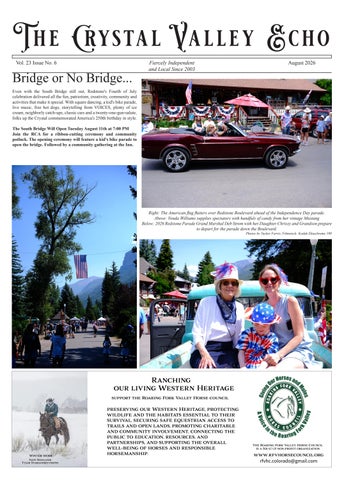
Even with the South Bridge still out, Redstone's Fourth of July celebration delivered all the fun, patriotism, creativity, community and activities that make it special. With square dancing, a kid's bike parade, live music, free hot dogs, storytelling from VOICES, plenty of ice cream, neighborly catch-ups, classic cars and a twenty-one-gun-salute, folks up the Crystal commemorated America's 250th birthday in style. The South Bridge Will Open Tuesday August 11th at 7:00 PM Join the RCA for a ribbon-cutting ceremony and community potluck. The opening ceremony will feature a kid's bike parade to open the bridge. Followed by a community gathering at the Inn.
Right: The American flag flutters over Redstone Boulevard ahead of the Independence Day parade. Above: Vonda Williams supplies spectators with handfuls of candy from her vintage Mustang Below: 2026 Redstone Parade Grand Marshal Deb Strom with her Daughter Chrissy and Grandson prepare to depart for the parade down the Boulevard. Photos by Tucker Farris, Filmstock: Kodak Ektachrome 100
Page 2 • The Crystal Valley Echo • Vol. 23, Issue No. 6 August 2026
2026 Community Happenings Up in the Sky – Belly Up – 08/07-08/08 – tickets: 1day ~ 270 GA, 2day ~400 GA, VIP 1100, Alzheimer’s and Dementia Caregiver Support Group – 295 Grand Ave, Carbondale – 08/11 – 03:00pm - 04:00pm Roaring Fork Ultimate Frisbee Summer League – Crown Mountain Park, El Jebel – Mondays at 6pm – https://forms.gle/ vUUf12NDrKKCKQRG7 for registration Comedian Sammy Anzer – TACAW – 08/14 – 08:00 PM - SHOW @ 8:00 pm / DOORS @ 7:30 pm - $25 MEMBER / $30 ADVANCE / $40 DAY OF - SEATED SHOW / 18+ VALID PHOTO ID REQUIRED - https://app.arts-people.com/index.php?performance=905216 The Heart Collectors Live – Steve’s Guitars, Carbondale – 08/15 - 8:00 pm - 9:30 pm -Tickets $35 “Redstone Magical Moments” Concert Series – Redstone Park and Coal Basin Ranch – 08/15 - 6PM–8PM
Music on the Mountain (The Burroughs) – Glenwood Caverns (51000 Two Rivers Plaza Rd) – 08/15 - 05:00 PM – 09:00 PM -
Sunlight Showdown 10k Trail Race – Sunlight – 08/22 – 09:00 AM – 12:00 PM - https://runsignup.com/.../GlenwoodSprings/SunlightShowdown
From Grief and Growth: Healing After Loss (4-Part Series) – Carbondale Library – 03:30pm – 05:30pm – 08/18 - www. soprislodge.com/events for RSVP
Music on the Mountain (The Petty Nicks Experience) – Glenwood Caverns (51000 Two Rivers Plaza Rd) – 08/22 - 05:00 PM – 09:00 PM -
First Draft: A Dialogue on Writing w/ Eric Jay Dolan – TACAW – 08/18 – 05:30 PM
Music in the Park – Sopris Park – 05:00pm - 08:00pm – 08/23 – FREE
Ray Wiley Hubbard Concert – TACAW– 08/20 - 8:00 pm - SHOW @ 8:00 PM / DOORS @ 7:00 PM - $60 MEMBER / $65 ADVANCE / $75 DAY OF - SEATED SHOW / 16+ (UNDER 18 MUST BE ACCOMPANIED BY A LEGAL GUARDIAN) -
Madeline Hawthorne – TACAW – 08/28 – 08:00 PM - $20 MEMBER / $25 ADVANCE / $30 DAY OF - DOORS @ 7:30 PM / SHOW @ 8:00 PM - STANDING ROOM SHOW / 18+ VALID PHOTO ID REQUIRED - https://app.arts-people. com/index.php?performance=890467
Rainbow Girls with LVDY - TACAW– 08/22 – 8:00 pm - SHOW @ 8:00 PM / DOORS @ 7:00 PM - $35 MEMBER / $40 ADVANCE / $45 DAY OF - SEATED SHOW / 18+ VALID PHOTO ID REQUIRED,
Bluegrass Jam Session with Mac Bennings and Friends - 358 Main St., Carbondale – 08/29 – 07:00 PM – 09:00 PM
The Crystal Valley Echo & Marble Times Mission Statement: To provide a voice for the residents of the Crystal River Valley; to bring attention to the individuals and local businesses that are the fabric of the Crystal Valley region; to contribute to the vitality of our small town life. Editor-in-Chief: Tucker D. Farris Editor@crystalvalleyecho.com For advertising sales contact: Advertising@crystalvalleyecho.com Or call our advertising manager at +1(970)618-6812 The Crystal Valley Echo is published monthly, And is distributed throughout the Crystal Valley. The Crystal Valley Echo is 100% Human-Created And does not condone, elicit, perform, or implement creative, Journalistic, or logistical usages of generative artificial intelligence. No part of this newspaper may be used in the training Of artificial intelligence, doing so will result in legal action. All rights of works by contributing authors and photographers Remain the sole property of their creators in perpetuity.
www.CrystalValleyEcho.com
Vol. 23, Issue No. 6 August 2026 • The Crystal Valley Echo Page 3
From the Editor's Desk... "Words You Can Hold" Dear Readers: I will begin this letter to you by saying up front that it will not be a frighteningly long essay mirroring the piece on America I authored in July’s paper. Believe it or not (and my friends and colleagues can attest to this), that essay at a little over five thousand words, was one of the shorter pieces of writing in my catalog (one of the side effects of a career in academia). Instead, this will be brief and heartfelt here. It has now been six months since I took on the role of editor of The Echo. I wanted to share a few short reflections with you all now that I have settled into this job more formally. First, I cannot continue without offering my deepest and most profound praises and gratitude to our staff writers. This paper would not be what it is without the voices of our regular contributors, correspondents and photojournalists. My work in running this paper is minimal compared to our writers who each month sit down at the blank page and share their voices with all of us. I have said many times in the past few months that being an editor does not mean I “create” the newspaper, it means that I take the words of deeply talented writers and share them. All I may say to each of them is that without your words, The Echo would be at best a publication full of articles by me as some sort of monument to my ego, and at worst it would be a simple publication spout for republishing other outlet’s media. The Echo has always been special because of the voices within it, and the ones that have been beside me in this journey over the past six months have truly embodied the spirit this paper was founded upon. You all have my warmest thanks beyond words. Aside from recognizing our writers, I wanted to share a reflection with our readers. This summer I have heard two sentences that have been rattling around in my brain for quite some time: “Print media is dead” And, “Newspaper ads are a bad investment; there’s no real returns” To the first point, I want to reflect on a point in recent history. As a child of the 1990s with a good collection of AC/DC cd’s, I remember the exact moment that physical media experienced a big shock to its system. On September 7th, 2005 Steve jobs unveiled the iPod nano. A device the same width of a pencil with the capacity to carry 2000 songs on it. Two thousand songs in the palm of your hand. At the time, people said that cd’s were dead. Vinyl had long faded into collector’s corners, radio stations and Wick Mose’s supersonic sanctum. 8-tracks were dead on arrival and the tapes rattling around in boxes in our cars ended up on the shelves at thrift stores for pennies. A year later, Spotify hit the scene and over the course of the late 2000s, and the 2010s, streaming slowly came to dominate the music scene. Slowly people stopped buying cd’s in favor of iTunes, then people stopped buying songs there in favor of a monthly subscription where any song ever written was at your fingertips instantly. And yet, in 2026 when steraming is supposed to be dominating the market, vinyl is back. Not just secondhand copies of Abbey Road or Wish You Were Here, but new modern artists are pressing albums on vinyl. The CD deluxe edition is making a comeback and some artists (Richard Ashcroft of The Verve and LeftAtLondon to name two) have even released new records on cassette tapes. Once upon a time people demanded we “Bring Back Mono”. Today we can say that analog is back.
Right now, in your hands is a collated stack of newsprint, fresh from a press carrying inside it photos, stories, events and information. You do not pay a subscription for it, it does not require the internet, you need not sign up with your email address and it will never ask you to verify yourself as human. The words pressed into the newsprint are carefully chosen words put there by real human beings. Your friends, neighbors, colleagues, and as you flip through each page and smell the unique odor of newsprint, you can do so knowing that nothing in the world controls that paper or the words on it once it flies off the press and into the world. And decades from now, it will survive as a record of our times shared here in this valley, together. Physical media is media we can hold. It is something that we can cherish, or save, or in the case of a newspaper, it might very well be what we start our stoves with this winter. But even if this copy of The Echo becomes the crumpled base of your first fire this autumn, it will have done something that digital media can never do. It has impacted the world in some way. Either it has informed, entertained or inspired you, or at the very least it has helped to warm your living room. Regardless, this bundle of newsprint matters. Irrespective of how it matters, what strikes me as truly incredible is that in this digital age, when computers pretend to think for us, and when news has to be condensed to a 90-second read on social media, is that in spite of all that ‘progress’ there is still a love, a desire and a resounding Echo of support for words you can hold in your hands, and that inspires me beyond what I am able to communicate in writing. To the second point “Newspaper ads are a bad investment; there’s no real returns,” I will confess to you, dear readers that the minutia of business has never been a reality I have cared too much to meditate on. Does this mean I neglect the necessities of running a newspaper? No. What it means is that not every action I take is veiled in a cost/benefit analysis in triplicate. For instance, this year The Echo chose to run an ad in Roaring Fork High School’s yearbook. Did we do this to increase readership numbers? To bring in new “foot traffic” or website views? We did not. The decision there was that the cost of running an ad, when compared to the potential positive output was smaller. For a handful of dollars, we helped to ensure high school graduates could have a funded yearbook, to keep their memories of high school in the valley with them in a physical book. We did it to show that in a small community like ours, we are proud of our students and their achievements and we want to encourage them to never stop striving for excellence in whatever path they take. The “investment strategy” in this move was not to increase our cashflow, or readership, or anything else that ‘good businesspeople’ do. Instead, it was an investment in our community. In our school, our students, our teachers, and in the spirit of community that can only be found in small towns. So when I heard the comment about newspaper ads being bad investments said out loud, my mind immediately produced the following idea that I have now repeated regularly:
When you place an ad in your community newspaper, you are not solely advertising your business to potential customers, you are investing in your community, investing in a community with its own independent newspapers that share important news, commentary and coverage, and who chronicle the living history of life in the Crystal and Roaring Fork Valleys. By placing an ad you broadcast to the community and to visitors alike that you want to live in a place with its own newspaper, with its own analog, physical, real form of cultural record. In my role as editor I cannot fall into the trap of thinking that print advertisements carry the same weight now as they did in the 1960s, and I cannot say that buying an ad will be the deciding factor that inspires a thousand new customers to visit your business. What I can say is that in an era where we are bombarded by ads from every angle, in our social media, streaming services, news apps, and everything else we use, that there is a subtle magic to the print ad that cannot be replicated anywhere else. It is now a deliberate choice, a stamp of dedication to community to step outside the easy world of badly-generated AI posters on social media and into the world of human-created print advertising, and one that also reflects a deep respect for your community. In closing, I will offer that I feel both statements outlined here are fundamentally wrong. Print is not dead, and when you invest in a newspaper you get a community newspaper in return. The Echo relies solely on advertiser funding, and we would not be in your hands right now if not for those advertisers who have seen our work, read our words and decided that they want to continue to have a real, independent newspaper in their communities. With the rise in operating costs of the paper due to our expansion of content, writing staff and distribution, we need that support now more than ever. And so I conclude this letter by saying to you, our readers that if you don’t believe that print is dead, and if you want to invest in your community, and if you are able, The Echo would warmly and gratefully welcome your supporting business so that we may continue to elevate the voices of the Crystal Valley for many years to come. Most Sincerely, Tucker D. Farris Editor To place an ad to support The Crystal Valley Echo and our continued mission to inform, inspire and chronicle the lives and voices of the Crystal River Valley, please email editor@crystalvalleyecho.com for more information.
Page 4 • The Crystal Valley Echo • Vol. 23, Issue No. 6 August 2026
News Briefs Marble Mini-Mercantile Opens for Business After years of requests, the Marble Mini-Mercantile inside the Raspberry Ridge Cafe is now open, offering grocery staples, food items, household goods and other general offerings. "The One-Stop Shop for All the Stuff You Forgot" Open the same hours as the cafe, 8:00am-2:00pm every day. Back to School Means Sharing the Road! Before we know it, school buses will be rolling, backpacks will be packed, and students will be walking and riding their bikes to school again! The Carbondale Police Department asks everyone to help make the start of the school year a safe one. Whether you're driving to work, running errands, or heading home, please keep an eye out for children, families, crossing guards, and school buses—especially during the busy morning and afternoon hours. Here are a few easy ways to help keep our students safe: Slow down in school zones. Speed limits are reduced to protect students, and traffic fines are doubled in designated school zones. Watch for kids walking and biking. Children can be unpredictable, so stay alert at crosswalks, intersections, and near schools. Stop for school buses. When a school bus has its red lights flashing and stop arm extended, stop and wait. Students may be crossing the street to get on or off the bus, and every stop helps keep them safe. Put distractions away. A text message or quick glance at your phone isn't worth risking a child's safety. Let's all do our part to make the trip to and from school safe for every student. A few extra seconds of patience can make all the difference. The Carbondale Police Department wishes all students, parents, teachers, and school staff a fun, safe, and successful school year. Carbondale's Staircase Park Reopens The “staircase” at staircase park has been repaired allowing public access to this riverfront park. The Town of Carbondale thanks our inhouse team from the building department, Japeth Hoffman, and Jesus Ortiz and the Parks Department for completing the project. Our Town One Table Returns On Sunday, August 16, from 5:00–8:00 p.m. Join us for an evening of great food, conversation, and community as we gather around tables in downtown Carbondale.
Our Town One Table was created to bring neighbors together. This event offers an opportunity to slow down, share a meal, meet someone new, and celebrate the relationships that make Carbondale such a special place. We believe that some of the strongest communities are built one conversation—and one shared meal—at a time.This year, we're especially excited to announce that Carbondale has partnered with 150 Tables Across Colorado, a statewide initiative celebrating Colorado's 150th anniversary by encouraging communities to gather around shared tables. The partnership recognizes the work Carbondale has already been doing to foster connection and belonging through events like Our Town One Table, while joining a larger movement to inspire meaningful conversations and stronger communities across the state. If you have any interest in organizing a table for your school, church group, or neighborhood, explore 150 Tables Across Colorado. We look forward to seeing you there! Email rjacober@carbondaleco.net to reserve your table(s). Lead King Loop Volunteer Signup The Marble Charter School is looking for community-minded volunteers to help make the Lead King Loop Charity Race a success on Sunday, September 13, 2026. Your time and support directly help Marble Charter School provide exceptional academics, outdoor education, and unforgettable learning experiences for our students. Here's how to sign up in 3 easy steps: 1) Visit This Link: https://signup.com/go/LiZwiQi 2) Review the options listed and choose the spot(s) you like. 3) Sign up! It's Easy - you will NOT need to register an account or keep a password on SignUp. Thank you for your support! Please help us spread the word by sharing this race and volunteer opportunity with your family, friends, and neighbors. Best, Marble Charter School Pitkin County Adds Safety Improvements to Prince Creek Road Residents of Prince Creek and visitors to the trail system will notice changes to the road near the Flying Dog Ranch barn as it makes a sharp curve just below the Bull-Pen parking lot. A new double-yellow line has been painted and a speed limit sign reducing the speed from 35mph to 25mph has been added. The changes come after Pitkin County Commissioner Francie Jacober and the Crystal River Caucus raised concerns about road safety in an effort to reduce speed along a narrow section of the road frequented by cyclists, motorists and ranchers between
Flying Dog Ranch and Stark Mesa (Jacober lives within this stretch of Prince Creek Road). Commissioner Patti Clapper also voiced support for reduced speed limits but noted that this will open the doors for the BOCC to hear from other neighborhoods in the county about their roads. County Engineer Andrew Knapp added that these solutions are temporary and do not address the root issue: the narrow roadway. Knapp noted too that modifications to Prince Creek Road were not a priority to the county prior to Jacober's introduction of the topic. Local communities awarded $4 million to advance climate and energy goals City of Aspen to lead cohort of 10 Pitkin and Eagle County jurisdictions in regional climate initiative Aspen, CO—The city of Aspen, in partnership with nine other jurisdictions across Pitkin and Eagle counties, has been awarded just over $4 million through the Colorado Energy Office's Local IMPACT Accelerator program to advance building electrification, energy efficiency and regional climate action. The award is part of a statewide initiative from the Colorado Energy Office and Gov. Jared Polis, who awarded $30.1 million to local and Tribal governments across Colorado to help communities achieve their climate goals. The city of Aspen served as the lead applicant for the regional cohort, which includes the towns of Avon, Basalt, Eagle, Minturn, Red Cliff, Snowmass Village, Vail, and Eagle and Pitkin counties. The cohort will allocate awarded funding across their jurisdictions to support advanced building energy codes, promote all-electric new construction, and expand incentives for energy efficiency and electrification projects. Each jurisdiction developed projects that maximize the impact of their allocated funding, tailoring projects to meet the needs of their community. This regional cohort previously worked together to advance building energy codes. By applying together, the communities strengthened their competitive grant application. "This award reflects what can be accomplished when communities work together toward a common goal," said Tessa Schreiner, the city of Aspen’s environmental health and sustainability manager. "By partnering across our local communities, we're able to accelerate energy efficiency and electrification projects that will benefit residents throughout the region." For more information about the IMPACT Accelerator Grant program, visit https://energyoffice.colorado.gov/.
Town of Carbondale Launches Traffic Calming Test Project to Improve Safety and Mobility CARBONDALE, Colo.—The Town of Carbondale is launching the Traffic Calming Test Project, a series of temporary street improvements designed to evaluate ways to make traveling through town safer and more comfortable for everyone—whether walking, biking, or driving. The project is one of the implementation actions identified through MAP Carbondale, the Town's community-driven transportation planning process. Community members identified concerns related to speeding, pedestrian safety, bicycle connectivity, and neighborhood traffic. These temporary installations allow the Town to test potential solutions before investing in permanent infrastructure. Temporary traffic calming features are installed in the area of Sopris Avenue and Snowmass Drive. Installations may include elements such as curb extensions, flexible delineators, pedestrian crossing enhancements, and other traffic calming measures intended to improve visibility, slow vehicle speeds, and enhance safety. Share your feedback by taking the quick online survey by October 1, 2026. The Town will collect survey data, observe how the installation functions, and gather feedback from the community. The information collected will help determine whether an installation should be modified, removed, made permanent, or considered for other locations throughout Carbondale. To learn more about the project, view current test locations, and provide feedback, visit https://carbondaleconnect.org/trafficcalming-test
Letter to the Editor: Fire Safe Grants Dear Editor: Roaring Fork Valley Wildfire Collaborative is offering grants for fire mitigation purposes. I was able to obtain a grant for extensive tree cutting for cuttings around the perimeter of my home. Without this grant I would have not been able to complete the necessary steps to safe fire the home. I thank the collaborative program and the Carbondale & Rural Fire Protection District. The fire district inspection pointed out the necessary steps to take for wildfire protecting your home. It is extremely important to be aware this dry, dangerous summer fire season. Kathleen Enman Redstone
Vol. 23, Issue No. 6 August 2026 • The Crystal Valley Echo Page 5
In Print...
Carbondale's Top-10 Books in July: Dances With Donkeys by Jim Duke
A Monthly Literature Column by Izzy Stringham With wildland fires raging and the temperature pushing above 85, it’s starting to feel like summer in the mountains is less of an escape and more like living inside an oven. If the smoke and heat are keeping you indoors, there are always great books to help pass the time. These three novels below are all excellent reads I enjoyed during the heat of summer. And if listening to audio books is more your speed, these books are also available on libro.fm. Download a title, and enjoy it laying in a hammock or dipping your toes in the river. Five by Ilona Bannister If you love a tense, detailed thriller, with crisp prose and colorful characters, then Five, by Ilona Bannister is one to take note of. The story takes place in five minutes on a train platform in England, where it is clear from the beginning that someone is going to die. As Bannister expands the tale and works in her character back-stories, the mystery of who will die is not clear. Everyone is so complex, and their histories so woven and complicated that anyone could be the unlucky character. The tension builds toward the end of the book as you know the train is approaching the station, but have no idea how the action is going to play out. A literary thriller that does not give up its secrets easily, this one will keep you guessing right until the end. The Trouble With Heroes by Kate Messner Everyone once in a while, a book written for middle schoolers is so entertaining and hits all the right notes, that I recommend it for any age to read. The Trouble With Heroes is a heartwarming and sweet book about Finn Connelly, a seventh grader who got in trouble for vandalizing a grave. But instead of fines or community service as a punishment, Finn is required to hike all 46 of the Adirondack High Peaks for the summer. What follows are Finn’s struggles and triumphs as he doggedly completes the task. Finn’s father, a 9/11 hero in the New York Fire Department whom had died two years prior during the Covid Pandemic, looms large in his story. Finn is still processing his grief and missing his father. As he hikes, he is able to come to terms with all his loss a little better and understand more fully that heroes come in all different shapes and sizes. Tears might fall at the end of this inspirational story.
Whistler by Ann Patchett Land by Maggie O’Farrell
Land by Maggie O’Farrell
Go Gentle by Maria Semple
There is a saying that more Irish live outside of Ireland than in it. The Irish have emigrated all across the world seeking work and security, but none more than at the time of the Great Hunger in 1846. O’Farrell’s latest work is a family saga set at the end of the Famine in the West of Ireland. Tomas, a surveyor and his son Liam, are mapping the West coast for the British when they happen upon a magical spring. Tomas insists that the family relocate from Dublin to the West to live near the spring, setting in motion various futures for his children that no one could see coming. Tackling the Potato Famine, the Irish Diaspora, poverty, old magic, and immigration all in one ambitious novel, O’Farrell paints a picture of a family trying and ultimately failing to stay together. Her lush descriptions of the land and family scraping out a living are beautiful and worth savoring, as well as her meditations on connection and resilience.
The Consequences by Virginia Evans Calamity Club by Kathryn Stockett Things We Never Say by Elizabeth Strout Alan Opts Out by Courtney Maum Theo of Golden by Allen Levi Nightswimmers by Roisin Maguire
WHAT’S NEW@ THE PITKIN COUNTY LIBRARY
REDSTONE OPEN MIC FRIDAY, AUGUST 28 6:00PM-8:00PM ALL AGES JOY & WYLDE 173 REDSTONE BLVD, REDSTONE, COLORADO 81623
FOOD AND DRINK AVAILABLE
PRESENTED BY
120 N. MILL STREET, ASPEN, CO 81611 | 970-429-1900 | PITCOLIB.ORG
Page 6 • The Crystal Valley Echo • Vol. 23, Issue No. 6 August 2026
Local Graduate Student Hosts Workshops Imagining Social Futures
By The Crystal Valley Echo Staff CARBONDALE— July 29th, Roaring Fork Valley local Carl Wright, a graduate of Yampah High School and Colorado Mountain College, now pursuing a master’s degree at The University of Geneva in Switzerland has returned to his home mountains to host a series of workshops in support of his thesis that explores how local communities imagine their social futures with respect to climate change and other elements of environmental reality. The aim of his research is to explore how various communities “see” their own ideal futures for their towns, and to explore the methods of how to achieve those goals. Having already hosted one event in Rifle, Wright greeted participants from Carbondale at CMC’s campus with a well-presented summation of the underlying theoretical frameworks of his work, and up-to-date measures of various elements of climate change data, but personalized to the Roaring Fork Valley. In the vein of making these discussions real and personal, Wright did not focus on the classic examples of climate change, but focused the discussion on immediate local impacts. The workshops sought to see how each community approaches these problems with their unique context. The discussion with Carbondale residents focused on many of the large issues on the minds of many in the valley: growth, housing access, traffic and transportation issues, water scarcity, and food security. These topics were explored in a thought exercise where participants were asked to imagine the ‘perfect’ Carbondale in the year 2056, and were tasked with imagining ways that we might have achieved that perfection. Ideas included a stronger support network for local farmers and ranchers and a local food system that was self-sustaining, local clothing and consumer goods production, and improvements to public transportation. At the core of his work is the interplay between overconsumption and underconsumption. The “sweet spot” between the two being the ideal balance between using what is needed to have a good life, while not causing overt damage to resource streams by over-consuming. Many threads of discussion emerged in the workshop section, and during a wonderfully well-prepared taco dinner to pinpoint issues facing the valley and the town of Carbondale,
At the core of his work is the interplay between overconsumption and underconsumption. The “sweet spot” between the two being the ideal balance between using what is needed to have a good life, while not causing overt damage to resource streams by over-consuming. Many threads of discussion emerged in the workshop section, and during a wonderfully well-prepared taco dinner* to pinpoint issues facing the valley and the town of Carbondale, and to discuss potential solutions to these problems. Attendees explored many points of local action, and carefully reflected on the progress made to date. A general consensus was pride in some of the forward-thinking moves by previous leadership in the town, with the Rio Grande Trail and RFTA praised for easing the strain on commuting up valley, while simultaneous discussions reflected on the limitations of these resources. Growth and development were key themes as well, with topics focusing on the diverse living situations affecting Carbondale’s workforce, which is a mix of residents of Carbondale and also many workers who live past Glenwood Springs in communities like Silt, Newcastle, Rifle or Parachute. The Echo, in archival newspaper research unrelated to this story,
would like to add the reflection that many of the conversations held in the workshop mirrored many conversations had over the years in Carbondale and up the Crystal in town council, RCA, and Pitkin County meetings. Even as far back as 1998, the questions of low flow in The Crystal, housing affordability, traffic increases, commute times, and access to resources were among many local leader’s priorities. Wright will host his third and final workshop in Aspen at CMC’s campus on August 5th, with a goal to use the three workshops to explore, compare and contrast the various needs, issues and perceptions of valley residents from Aspen to Rifle. His thesis work will then synthesize the data and discussions from his workshops and shed light on the commonalities and disparities between these distinct social contexts. He hopes to better understand the complexities of these three communities up and down the Roaring Fork Valley and to see how common ground in these discussions can look. Ultimately, Wright is investigating the idea that we all call this place home, and while the immediate issues facing our communities may differ, at their core they are human, relatable, and that the work of imagining future solutions is a valuable step in collective work towards 'the good life'.
Graduate Student Carl Wright hosts a workshop in Carbondale to understand how people imagine social futures. Crystal Valley Echo Photo
Redstone Senior Days
At the Redstone Inn | RSVP: (970)920-5432
AUGUST 11 & 25
11:00 a.m. – Yoga ($5)
With Anna Raphael. Open to all ages and abilities.
12:00 p.m. – Lunch ($10)
RSVP by noon the Friday prior – space is limited. Plated lunch served. Gluten-free option available.
12:45 p.m. – Program • Tuesday, August 11: Redstone Historical Society
Tucker Farris will guide us back to the Gilded Age to discover the fascinating story of Redstone, America’s experimental company town.
• Tuesday, August 25: Pollinator Garden
Join Sheehan Meagher to discover why native plants are important, and learn how adding them to your garden can support pollinators & conserve water.
WANT TO BE KEPT IN THE LOOP?
Send us your email address: (970) 920-5432 • seniors@pitkincounty.com
Vol. 23, Issue No. 6 August 2026 • The Crystal Valley Echo Page 7
Honoring One of Our Own
The Crystal Valley Echo and Redstone Historical Society Introduce Scholarship to Memorialize Longtime Redstone Legend Sue McEvoy Strong By Tucker Farris REDSTONE¬The Crystal Valley Echo in partnership with the Redstone Historical Society is proud to announce the founding of the Susan McEvoy Strong Memorial Scholarship, dedicated to the memory of Susan “Sue” McEvoy Strong (1958-2019) who left an indelible mark on the communities of the upper Crystal Valley. In her work as tour guide, caretaker and docent of the Redstone Castle, Sue welcomed many visitors to the historic halls of Cleveholm Manor, inspiring local school groups and visitors from far beyond the valley alike with tales of the gilded age lord of the manor John Osgood, and his generous wife Lady Bountiful. Sue was heavily involved with the boards of the Redstone Historical Society and the Redstone Community Association where, during her tenure, her work continued to preserve, protect, and present Redstone’s history and help to shape its future. Sue also served as an editor and staff writer for this paper for much of its early history, authoring many articles from historical Vintage Valley essays as part of her role in the Historical Society, to features in the bi-annual guidebooks, and many articles highlighting and chronicling the meaningful moments of life on The Crystal River. Sue’s Vintage Valley columns are archived on the Redstone Historical Society’s website for all to read (www. historyredstone.org). Sue’s knowledge of the valley’s history was encyclopedic, to the point that she knew every inch of the Redstone Castle, and could teach several book’s worth of history in one engaging story centered on even the simplest artifact. She possessed the rare quality of being able to educate others of all ages and backgrounds, be they first graders or octogenarians. As a volunteer with the Historical Society, Sue collected and maintained much of the Society’s collections of artifacts, photos and documents, and many that exist in the digital archive today come directly from her hands. Her approach to local community journalism was unique in that it kept readers informed both of present stories in our communities, but always through a carefully applied lens of historical
knowledge. This approach to local journalism carries through in The Echo to this day, and it is because of the many articles and features written by Sue that we are inspired to continue the thread of keeping the current events grounded in the history we share collectively. Sue’s work with The Echo helped to cement it as a pillar of community journalism in the Crystal Valley; through her editorial and assignment prowess she helped to facilitate a robust community publication that has stood completely independent for nearly a quarter of a century, while also teaching and inspiring many local writers and contributors. Curiously, through a fateful turn of history, my editorship of the paper is directly tied to Sue’s work as both matron of Cleveholm and staff of The Echo. As I wrote in my first letter from the editor before fully taking over The Echo (February, 2026 issue), this newspaper was the first publication that ever carried anything I had created. By chance, on a weekend trip to Redstone to take photos for a high school photography class with my grandparents, my grandmother Dorothea, who knew Sue for many years and had worked at the castle for Ken Johnson phoned up to the castle from the front desk of the Inn to see if her and I could come take a walk through the halls. Sue answered the phone and before I fully understood the gravity of what I was about to see, my grandmother and I were knocking on the main door in the courtyard to be greeted by Sue’s warm smile. What followed was a two hour walk through history that has stayed with me to this very moment, a private tour with my own grandmother, and a lovely catch up chat with Sue in the grand room of Osgood’s castle. As we said goodbye she handed me a Crystal Valley Echo business card and asked for me to send her some of my photos for the paper, creating my first-ever published photography. It is because of this history, of my own personal experience of her warmth, knowledge and kindness, that I am proud beyond words to introduce a memorial scholarship in her name in partnership with the Redstone Historical Society. The Sue McEvoy Memorial Scholarship will be awarded to local high school students planning to major in fields in journalism, social science (Sue held a degree in psychology), or the humanities and will be fully funded by community donations.
Sue McEvoy (1958-2019) in her signature Lady Bountiful costume giving a tour at the Redstone Castle Photo Courtesy of the Redstone Historical Society
The scholarship fund is aiming to raise $2500.00, which, if successful, would allow us to award the scholarship to five local graduating seniors. All donations are tax-deductible and come with a nonprofit donation receipt. All donations are applied in full to the scholarship fund and will be directly used to facilitate student awards. The scholarship is designed to provide local students entering these fields of study with equipment necessary for the work they will be doing (an Apple laptop, accessories, and software) with the goal of elevating the voices of the next generation of Crystal Valley residents through helping them arrive at their college life ready to spread their wings much in the way Sue did through her tours and articles.
The scholarship will be open to all graduating high school seniors in the Crystal Valley region and will feature an essaybased competition for deciding the winners. Applications will open September 1st and will be due December 15th, with winners announced in February. Scholarship essays will be reviewed by staff of The Crystal Valley Echo and volunteers from the Redstone Historical Society. Winning students will be notified by email and then presented with their scholarship winnings either at their school’s scholarship awards events, or by other arrangement depending on their preference. The Crystal Valley Echo is proud to support local students working hard to preserve, protect and present their histories through compelling stories told in journalism, the humanities or social sciences,
and appreciates the partnership with the Redstone Historical Society in establishing this scholarship in memory of one of the most dedicated local historians, journalists and friends of the Redstone community. Scan Here to Donate:
Donations may also be made by cash or check. Please send donations to: Redstone Historical Society c/o Scholarship Fund 295 Redstone Blvd. Redstone, CO 81623
Page 8 • The Crystal Valley Echo • Vol. 23, Issue No. 6 August 2026
Mental Health Matters LIMITED WEEKENDS LEFT FOR SUMMER & FALL EVENTS
A Column By Saffron Branson Do you want to know one easy trick to being happier, healthier and more attractive? It's something that can be done for free (yes, even with inflation) with no experience or skill. You've even heard it before. Count your blessings! Focus on the good! Look on the bright side! Be thankful for what you've got. That's right, folks, the answer to most of your woes is gratitude. Researchers at Harvard and UC Berkeley found that individuals who scored higher on a gratitude assessment reported lower levels of depression and anxiety, were rated as more likable and attractive by others and had lower chances of developing cardiovascular disease. One study published from the University of North Carolina at Chapel Hill boasted that participants perceived as being more grateful overall were deemed more lovable by their romantic partners. Another investigation published in the Journal of Social Psychology even concluded that being thankful can make certain bedroom activities more frequent and enjoyable. Sold yet? It seems like there are endless benefits to learning to be more grateful, but how does that actually work? When we feel gratitude our brain's reward system lights up like the Grand Illumination bonfire at the Redstone Inn. The brain then floods us with a tasty mix of happy hormones and neurotransmitters (the chemical messenger service that lets our nerve cells talk to each other) to let us know we're doing something it likes. This cocktail of chemicals gives us warm fuzzy feelings, decreases our stress, and reinforces our desire to so something again. The more we do actions that give us these biological rewards, the easier and faster our brains get at recognizing how we got there. Just like your dog might sit every time you crinkle a bag that sounds even remotely like it might have treats in it. The term for this is neuroplasticity, which is just a fancy word for our ability to learn new things and strengthen connections in our brain. When you learn something new or practice a skill your brain literally physically builds new neurological connections. Repetition builds stronger connections. This means the next time you want to do that thing it comes more easily to you. It's part of why you could probably tie your shoes in your sleep or can remember how to do the scales on the instrument you haven't touched since middle school band. What this means for gratitude is that the more you practice, the faster your brain gets at recognizing things to be grateful for and the more it doles out treats. As you get better at spotting things to be thankful for you're more likely to feel fulfilled and satisfied with your current status in life and less likely to sweat the small stuff. And as Richard Carlson said, “it's all small stuff.” One thing it's important to note is that gratitude is not simply mindlessly saying thank you or trying to force yourself to feel good about craptastic situations. It's also not a reason to guilt yourself into feeling bad when you're struggling because you have so much and others probably have it way worse. This isn't the Struggliympics and there is no gold medal for denying your feelings. Gratitude is the art of looking at life as a whole and deliberately choosing to highlight the things you're glad are happening. However, I feel it's vital to say that this only works when it comes from within. No one was ever made to feel better when they share something they're going through and your response is “yeah but at least you have __ going for you.” Let them come to those conclusions on their own.
Now that we know the benefits, how do we actually start a gratitude practice? One of the most common ways is a gratitude journal. It doesn't have to be a formal diary. This can be sticky notes on your bathroom mirror or little voice recordings you do on your phone. It can even be expressed through artistic endeavors such as sculpture, drawing, poetry or dance. You can even just do this in your own brain. The point is to do so daily so the repetition helps build those bridges in your brain. I do mine right before I lay down for bed, but I know some other people that do theirs when they wake up in the morning. Simply think about your current circumstances and come up with 1-3 things that make life easier, make you happy or you're otherwise grateful for. This could be anything. It can be big things like having a roof over your head or the smallest, most mundane things like frozen pizza being on sale. Moments with loved ones, fresh peaches, access to the public library and recent rain have all made appearances in my journal. The only requirement is that it mattered to you. No self-judgements for being grateful for “silly” things either. All blessings count! Once you've identified something to be grateful for, take an extra second to think about why it mattered. Then just bask in the positive feelings. Congratulations, you're one step closer to living a happier, healthier and more attractive life. Do it again tomorrow and the next day and the one after that until you find yourself noticing these things without having to actively think about them. I'm so proud of you! Thank you for taking the time to read this. I for one am incredibly grateful that we have a local independent newspaper where I get to share my thoughts with awesome people like you.
You Are Welcome Here A Gathering Place for All Family Reunions | Weddings | Conventions Retreats | Community Events
Call to Book Your Event
178 Co Rd 3, Marble, CO 81623 | (970) 963-9522 chairmountainranch@gmail.com | chairmountainranch.com
Mental Health Matters is written by Saffron Branson. Saffron is a senior at Colorado Mountain College pursuing a degree in Human Services and will soon be headed to graduate school for a Master's in Clinical Counseling. No information found in Mental Health Matters should be considered clinical or medical advice from a licensed professional. These are just musings from your friendly local psychology enthusiast.
No!ing brings us toge!er like community!
We believe in supporting the people and places that make our local communities special.
alpinebank.com Member FDIC
Poke Basics
Vol. 23, Issue No. 6 August 2026 • The Crystal Valley Echo Page 9
2) Moisten my rice paper rounds with warm water for no longer than 2 seconds and then immediately placed my nori sheet on top, firmly pressing the entire sheet down 3) I used a 4" stainless steel wire skimmer/ Spider Strainer to my lay cups in and then use a 2 oz ladle on top of them to help form the cups...It's also referred to as a "two ladle-frying" or double-mold frying" method. It is crucial to not put too much pressure on the ladle because it will NOT allow the rice paper to puff up so, gently hold it down for no more than 3-5 seconds and then remove, flip over and allow to drain on a cooling rack.
By Jesse K. La’a Crystal Valley Echo Culinary Correspondent Aloha!!! My name is Jesse K. La'a and I am a NEWLY adopted resident of the Roaring Fork Valley (RFV)... I moved out here in August of 2025 for LOVE and actually had LOVE find ME... In December of 2023, my significant other, Amy Renee, had moved back to Carbondale to care for her parents. Her family has a long history in the valley and has lived here for nearly 50 years, so... my move wasn't a question of IF but WHEN...
LETS TALK POKE A little bit about me... I am a die-hard foodie, through and through and FOOD is actually one of my LOVE languages. BUT, it wasn't ALWAYS that way.... In my mid 20's, I was a carefree, happy go lucky father living in my home state of Hawaii... I was raising my 2 beautiful children at the time and was surrounded by friends, family and culture that, quite frankly, I had taken for granted. In 1998, I received news that ANY parent would absolutely be FLOORED with... My beautiful daughter Alexandria Nohealani La'a had been diagnosed with Medulloblastoma. Without hesitation, she was taken to St. Jude Hospital in Memphis, TN and began her 9 month treatment. After 4 successful resection surgeries that were able to remove the tumors wrapped around her brainstem, it was determined that the original diagnosis of Medulloblastoma was incorrect and found to be Atypical teratoid rhabdoid tumor. These are known to be "bloody" tumors and no matter the amount of successful surgeries, they would continue to spread. She ended up losing her battle at the tender age of 18 months... I was often asked, "How do you cope with everything so WELL?"... You see, back in Hawaii, one of the ways that I would decompress was spearfishing... It was a form of "therapy" for me and allowed me to enter into a whole different world. When I was in Memphis, I didn't HAVE that any more and I had to look for another outlet... I TURNED to cooking... Food has a way of bringing folks together to SHARE, ESCAPE and ENJOY and THAT is how my food journey began... While I was in Memphis, I didn't have the luxury of having family and friends or even RESTAURANTS at my beck and call SO... I had to turn to the internet... Now, Hawaiian culture revolves A LOT around food and gatherings so, I had actually grown up AROUND "food" but, like I said, I didn't have that readily available. I dove in and dove in HARD because not only did I ENJOY it but I NEEDED it... I'd pull up just about anything and everything that piqued my interest and I'd MAKE it... This went on for at LEAST 12 years and DURING that time, I would see the joy and appreciation on the faces of those that I fed... I would often get asked to cook for gatherings... weddings, birthdays, funerals or just friendly gatherings.
There are ONE MILLION ways to make POKE (pronounced Poh-KEH NOT POHKEEEY) and it's literally up to YOU to find one's that suit YOU... I'm just gonna provide the "basics" and YOU can take it from THERE...
Back in 2010, I moved back to Hawaii and fell upon hard times. I found myself a single father with 3 kids in a homeless shelter. After several months, I was able to get back on my feet but wanted to show my gratitude and appreciation and would often volunteer to cook meals for the 75100 residents living there. THIS is where the idea started to grow that I might actually enjoy doing this as a CAREER. But, time, situation and MAINLY money prevented me from moving forward with that but, I CONTINUED with my passion for LEARNING. I would CONSTANTLY be experimenting, trying new to me recipes and actually creating my OWN... I even have a FB group that I started over 16 years ago called Cooking From The Hip where I share both my successful stories and my "learning" stories. Prior to me moving out here, Amy had added me to a Facebook group called Carbondale Colorado. I introduced myself and asked what types of Local Hawaiian Foods folks were familiar with and what they were interested in. The response was KIND of overwhelming, to be honest. I had no IDEA the interest was so STRONG. After taking the given information and handing out numerous samples, I came to the conclusion that RFV was in NEED of some Local Hawaiian ALOHA LET'S TALK FOOD, GANG!!! I'm not sure about YOU folks but, I absolutely LOVE to experiment with food.
I'll cruise the internet and find something that intrigues me and next thing you KNOW... I'm in the kitchen making a MESS, lol HERE is a prime example... I'm not even sure what to CALL these... Let's try Crispy Nori Poke "Tuiles"... Kinda fitting in a sense... As I had said before, I cruise the internet looking for ideas to come up with to create sort of my OWN versions of things and I came across these deep fried rice paper cups that I thought were pretty freaking COOL. I tried it a couple times and true to my NATURE... a mess was made and many failed attempts... (it looked a HECK of a lot easier in those VIDEOS) I did a bit of research and several different attempts to get to my desired goal but I WAS FINALLY able to get the results I was looking for...Below is what I found to be helpful in getting a consistent crispy crunch all throughout the "Tuiles"... TEMPERATURE IS YOUR FRIEND One of the issues I kept running across was the cups either being saturated with oil or certain areas not being crispy at all and having a "flat" bite in them. To AVOID that, there are 3 things that I made sure to do to avoid that. 1) I used a probe thermometer to make SURE my neutral oil temp was between 350 degrees F to 365 degrees F.
I won't get into the debate of "fresh" ahi because, unless you're on the boat, which I have been, and eaten that ahi as SOON as you land it, which I ALSO have done, there is no real "fresh" ahi... SO, let's start with "fresh frozen" ahi... There are NUMEROUS places you can get this from and for those in the RFV, your local grocery chain has a pretty decent choice. SAFETY tip.... You need to remove the frozen ahi filet from the cryovac bags and defrost it in an airtight container in your fridge until defrosted, (this method typically takes 24 hours) to avoid possible contaminants from forming in the bags themselves. There is also the running cold water defrosting method but, because this is raw fish, it's much riskier and we live in a valley that NEEDS that water so, plan ahead and don't waste water!!! Now that we got THAT out of the way... Besides the Ahi, in almost EVERY poke that I make, there are typically 6 constant ingredients... I'll use 1 lb of ahi as a base for the amounts I use... 1) Chopped Sweet onion 1/4 medium 2) Chopped Green 1/4 c 3) Shoyu (Soy Sauce) 3 tbs... I make my own Smoked Shoyu and that's what I use 4) Sesame Oil 2 tbs 5) Grated Ginger 1 tsp 6) Coarse sea salt 1-2 tsp (I make my own Smoked Hawaiian Salt and that's what I use) ALL of these ingredients are subject to personal preference as far as amounts go but, THESE are in every single Poke that I make. NOW.... the ONE MILLION ways... LIke I said, there are SO many different variations, I can't even count them... You can use Kewpie Mayo and Sriracha, Unagi sauce, Oyster Sauce, Kim Chee base... you NAME it... You can DO it... Just one word of advice, make your "sauce" in a small bowl first, remember the ratios and taste test BEFORE adding in your ahi... That's my 'BASICS', Gang... Now go make it YOURS!!! Stay BLESSED and CONTINUE to be a Blessing to others!!!
Page 10 • The Crystal Valley Echo • Vol. 23, Issue No. 6 August 2026
26th President Theodore Roosevelt Entertains and Inspires Guests at the Hotel Colorado By The Crystal Valley Echo Staff Glenwood Springs Historical Society Hosts Roosevelt Commemorative Dinner on Colorado’s 150th Birthday GLENWOOD SPRINGS—The Roaring Fork and Crystal Valleys are no strangers to the often-smiling portrait of 26th US President Theodore “Teddy” Roosevelt. Stories told between locals and to visitors alike often remark on the expedition Roosevelt participated in through Colorado’s Western Slope in 1905, with each town along the river holding close their own slice of the legend. In Redstone, a bedroom in John Osgood’s manor house Cleveholm (The Castle) is known as “The Roosevelt Bedroom” after its most famous occupant. Interestingly, according to a 1912 copy of the Aspen Democrat-Times (formerly the Aspen Democrat, later absorbed by the Aspen Times), Osgood was named as a presidential elector for Western Colorado in the 1912 presidential election for the Republican Party supporting William Howard Taft for president against Roosevelt’s Progressive Party. Many stories follow the Bull Moose president up and down the Crystal, often tied to his hunting triumphs, or his fervent dedication to the preservation of wilderness lands. He is as much a part of the history of our region as any other local figures of our history. On August 1st, Roosevelt once again captured the minds and hearts of residents of the valley in a sold out banquet dinner hosted by the Glenwood Springs Historical Society at his “Western White House” (The Hotel Colorado). Featuring Chautauqua actor Doug Mishler as Teddy Roosevelt, guests were treated to a multi-course dinner and signature cocktails to commemorate a similar banquet held by the President in 1905. According to speakers from the Historical Society the plan to hold such an event had been discussed for nearly 15 years before coming to fruition after their discovery of one of the original menus given to guests at the 1905 event. Mishler, in period-accurate attire and sporting a turn-of-the-century mustache captivated the full ballroom with reflections on his hunting expeditions up Divide Creek and across Colorado, punctuated with humorous anecdotes of Roosevelt’s time in the White House including the many games he would play with his children rather than turning his attention to the everyday responsibilities of the presidency. Jokes were made at the expense of President McKinley (Roosevelt’s predecessor who was assassinated in Buffalo, NY leading then Vice President Roosevelt to assume the office of president), and to the sturdy nature of Edith Roosevelt’s careful management of her husband’s wilder impulses.
At one point in his speech Roosevelt declared the West to be “the great experience of America,” while evoking the rugged nature of 19th and 20th century settlers of the region. Guests around the room in period attire caught the eye of the president, with the many cowboys, Rough Riders and ladies receiving warm remarks under the chandeliers. As the president closed his remarks, he spoke on the sacred importance of the preservation and conservation of wilderness spaces and public lands, and reflected on the uninhibited industrial use of natural resources by his contemporaries (J.P. Morgan was mentioned, but as the real Roosevelt held similar views it is no surprise that Osgood turned towards Taft in 1912). With his address to the citizens of Glenwood Springs over, the hall turned towards their dinner in continual reflection of the history of the room itself and the century and a half of Colorado’s statehood. The event was a fundraising benefit for the Glenwood Springs Historical Society, with ticket prices and auction proceeds benefitting the 501(c)3 nonprofit’s continuing work in bringing history to life across Glenwood Springs and in the valley. For more information on the Glenwood Springs Historical Society and their work and upcoming events, readers are encouraged to visit their website at: www.glenwoodhistory.org The Crystal Valley Echo extends its gratitude to the Historical Society for allowing us press access to the event for this coverage.
President Theodore Roosevelt (Doug Mishler) addresses guests in a ballroom at the Hotel Colorado as part of a commemorative banquet on August 1st Cystal Valley Echo Photo
Paw & Pen
Vol. 23, Issue No. 6 August 2026 • The Crystal Valley Echo Page 11
Charlie’s Room By Oneal Bogan Starting a vet clinic with little money and only skeptical lenders is an uphill battle. I knew this when I leapt off the proverbial cliff, deciding to build my own practice after 10 years of working for other people. I had a lovely, stable job offer the same week as a potential lease signing and despite all of my anxiety about making it work, I signed the papers and declined the job offer. Looking back I am surprised by my apparent bravery. Normally the unknown causes me to pause, but somehow my inner entrepreneur prevailed and Mountain Paws Vet was born. Working for myself was always the goal, but the path to that goal was long and winding. Like any new business, the groundwork was the easy part. The challenge was building the client base to a point where employees could be paid, and eventually, so could I. I spent the first year and a half as a clinic owner supporting my income by working relief shifts around the valley, the majority of those at the local emergency clinic. It was during one of the shifts that I reconnected with a family I had known years before when I had a mobile practice. It was a Sunday morning, an unpredictable time for a mountain ER. We were slammed, moving from case to case in order of urgency. When Charlie arrived, my veterinary nurse told me I needed to get into the room with him. He was not doing well. Immediately I recognized the couple in the room, and just like their 14 year old labrador, they were strained and exhausted. Charlie didn’t get up, but he gave me a feeble tail wag and behaved perfectly for his exam. He had a high fever and ragged lung sounds. After some confirmatory x-rays, we diagnosed him with pneumonia. Pneumonia can be due to many causes, but in Charlie’s case water and food entered his lungs due to an upper airway condition called laryngeal paralysis. Common in retrievers, this condition prevents the protective function of the larynx to protect the airway from swallowed matter, allowing it to travel down the airway instead of into the stomach. Once the material sets up in the lungs, infection dominates the fragile pulmonary tissue and dogs with this condition become very ill. When I give clients diagnostic information, I never know how they will respond. Most often I am surprised and generally the response is that they want to try to get their pet feeling better, and they are willing to do whatever it takes. When I told Charlie’s family his diagnosis and the treatment plan we could try, I was hesitant due to Charlie’s senior age and his current state, but the small chance that he could recover was enough for them. They would do whatever it took to try and get Charlie back to health. This statement was proven repeatedly in the following days.
Patients need to be rotated and constantly kept in a good position to aid in their lung recovery. In short, this is not an easy feat. Charlie stayed the day with us at the ER. The next day, he needed somewhere to be hospitalized. Charlie’s family expressed that they’d like to stick with the team we had assembled to continue his care. I explained to him that our clinic was at early stages and he’d have to have the oxygen held up to his nose by someone the entire day. The rest we could set up for him, but we didn’t have the staff for someone to sit with Charlie and deliver the much needed oxygen. Charlie’s dad didn’t hesitate. He would stay with him. The next day, we set up our newly finished exam room for Charlie and Dad. They laid on the floor together day after day, Charlie slowly recovering and his Dad faithfully by his side, holding his oxygen mask. Bit by bit, Charlie got stronger. He began to eat. His lungs began to clear. I came in each day, often after working an overnight shift, and saw Charlie’s strength returning. My exhaustion from working double shifts was quickly forgotten each time Charlie made progress. Devotion comes in many forms. I learned a lot about devotion during my time with Charlie. I learned that my devotion to having my own clinic where I could set up a successful situation for an animal was worth the work I was putting into it. I learned that Charlie’s dad’s devotion was what saved him. I learned that Charlie’s devotion to his family saved them. And I learned once again that these cases are what I always come back to to ground me in why being a vet is important and meaningful. Charlie just celebrated his 16th birthday. His joyful personality is back, his energy infectious. We have two exam rooms at the little clinic that has become so much more than I thought it could be. The first room proudly displays the nameplate “Charlie’s Room” - a forever honor to their devotion and never giving up.
Bacterial pneumonia is difficult to recover from. It requires oxygen therapy to help the dog breathe while the sludge in their lungs clears. Antibiotics are given, usually intravenously because these dogs don’t have an appetite.
BUYING OR SELLING? GIVE ME A CALL! Mike Kennedy, Broker/Owner 970-379-3907 mikekennedy@sopris.net ColoradoHomesRanches.com
• Residential • Commercial • Ranch Properties
0985 Hwy 133 970-963-1940 Each office independently owned and operated.
35 YEARS OF LOCAL REAL ESTATE EXPERIENCE
The Redstone Historical Society
WANTS YOU to join us!
www.historyredstone.org historyredstone@gmail.com
Page 12 • The Crystal Valley Echo • Vol. 23, Issue No. 6 August 2026
‘Good’ Medicine; Caring for the Carer
Musings by Melissa Forsyth on Indigenous healing and Circle medicine Summer Greetings from Coast Salish Territories! I am beginning two weeks of vacation, after almost a year of working as a frontline recovery worker. I can feel the need for a break in my spirit and in my bones. Lately, I have been exploring the concept of burnout and vicarious trauma. For those of us who work in the helping field, helpers are at risk of burnout and vicarious trauma and as many as 85% of us in the field will experience vicarious trauma in our role as helpers. Burnout is a state of physical, emotional, and mental exhaustion caused by prolonged stress, often linked to work or other demanding responsibilities.Burnout is recognized by the World Health Organization (WHO) as an “occupational phenomenon,” meaning it arises from chronic workplace stress that has not been successfully managed, though it is not classified as a medical condition It is characterized by three main dimensions: feelings of energy depletion or exhaustion, increased mental distance or cynicism toward one’s job, and reduced professional efficacy . While most commonly associated with work, burnout can also occur in other areas of life, such as caregiving, parenting, or managing chronic illness. Additionally, vicarious trauma refers to the negative emotional, cognitive, and physical effects that arise from empathetic engagement with someone who has experienced trauma. It is commonly seen among professionals and caregivers who work closely with trauma survivors, such as therapists, healthcare providers, first responders, and even family members. I feel that both burnout and vicarious trauma is misunderstood and neglected within a culture of individualism, and in the context of healing/recovery work. It seems we are obsessed with the idea of ‘self-care’, which puts the onus of care on the individual, rather than looking at the collective experience and social context of colonial capitalist institutional structures inherently designed to exploit and oppress individuals who work within it, so that the concept of ‘caring for self’ has become elusive. What does it mean to care for the most vulnerable within a system designed to harm? What does it mean to act as a helper, with an internal compass to ‘do no harm’, knowing our powerlessness to change many social factors causing harm? I continue to be challenged by this tension as a carer, and as someone committed to systemic change, a decentering of colonial ideologies and a centering of care ethics. Too many times to count, I have been told to go home and take care of myself after a long day of caring. I find this in itself to be exhausting. Why is this only my responsibility? What about overwork and the unsustainable work context? Thankfully, over the last few months, my academic worlds and recovery counsellor worlds collided. Quite surprisingly, a previous student of mine, I will call Hazel, a very bright and revolutionary minded Indigenous Metis young woman, arrived at the healing house where I work, no longer my student, but a client in recovery. Seeing her brightened my day and my workplace. As she immersed herself in the recovery work over the next six weeks, I witnessed her growing into herself again, finding her voice and her courage to once again resume her life and studies, in a balanced and more authentic way, after being under the weight of addiction and risk of harm to herself..She had been ‘broken’ and ‘burnt out’ from the educational system that lacks care for both her and for larger collective issues that she cares about, such as authentic decolonization, centering marginalized voices and destabilizing oppressive systems of power in the aftermath of Epstein files and a world where gendered violence impacts racialized women and queers folks most.
Her emotional depletion is a burnout both myself and Tucker have also felt deeply. It’s a visceral pain, deep in our bones, that erodes our spirit, caused by a lack of collective care. Such unwitnessed and unprocessed pain can result in post traumatic stress and disillusionment not for the faint of heart. When Hazel had been in my class, she had helped me bring circle medicine to my Gender studies classroom. My teaching methods were known by students to be healing and cultivated a space for safe, inspired, creative learning, a space where new ideas could form from our collective, shared resonance. Yet, my teaching methods were not so well received by those in positions of power; my fight for equitable and decolonized, circle pedagogy wasn’t mainstream. I am humbled and honoured however, that my approaches are now more ‘downstream’ in the context of recovery healing, meaning more apt to be received and accessible for those I care for. My student finding her way to the healing house reminded me that the circle work is needed everywhere. All of us need and deserve to feel seen, witnessed, heard, understood and supported in collective connection. Individualism on the other hand, serves only those in power who rely on worker burnout. Resistance is hard to do when we are burnt out. Power remains concentrated in the hands of a few, those who prefer the status quo and hierarchical control. Whether those who hold position, influence and power are conscious or unconscious, the capitalist colonial system relies on abuse of power upheld. There is caring work still to be done in the non profit sector, and in all sectors, education included. While circle work is upheld for the clients in the healing house, I am pushing for the carers to also be held in a circle, as a protective factor for vicarious trauma and burnout. I call it the circle economy work model for carers; a new, sustainable circular approach for ‘caring for the carer’, or ‘helping the helper'. It includes cycles of rest and regeneration with a rotation schedule and a 4 day work week along with equitable pay for all workers. I was quite surprised my employer agreed to listen to my proposal, but I think she must also be tired and needing new ideas, as so many of the staff have left recently on med leave for burnout. The reality is hard to face and yet, we must; carers are not disposable. This work requires care and a heart for change, a vision for work that centers the human over profit. I also met a client, I will call Ryan, that came into the house as a burnt out PhD candidate, yearning for safe expression of their two spirit Indigenous identity and recovery from generational trauma. Traditional Indigenous culture does not impose or have any understanding of a gender binary; rather Two spirit peoples were revered, esteemed and highly valued in Indigenous families and communities. In contrast now, Two spirits live in marginalization and with threat of violence in a colonial context bound by binaries and exclusions. They shared with me they had recently identified and found comfort in the sociological term of double consciousness; Double consciousness is the dual self-perception experienced by subordinated or colonized groups in an oppressive society. The term and the idea were first popularized by W. E. B. Du Bois's autoethnographic work, The Souls of Black Folk in 1903, in which he described the African American experience of double consciousness, including his own. Originally, double consciousness was specifically the psychological challenge African Americans experienced of "always looking at oneself through the eyes" of a racist white society and "measuring oneself by the means of a nation that looked back in contempt". The term also referred to Du Bois's experiences of reconciling his African heritage with an upbringing in a Europeandominated society.
The term later expanded with intersectional feminist theory which accounts for triple consciousness; embodied experiences of class, race and gender within a stratified colonial capitalist social context. We proceeded to have an animated discussion of Dorothy Smith, my own inspiration for my sociological work, and Smith’s concept of bifurcated consciousness, a central theme in her feminist theory. It refers to the split between embodied experience and the conceptual mode of consciousness, which is often associated with the ruling relations of industrial capitalism. Smith argues that this bifurcation is a result of women's household caring labor and the tasks assigned to them, which historically have been part of the occupational division of labor. This bifurcation creates a distinctive subjectivity for women or in the context of healing work, the carer, as they engage with people's bodily existence while performing essential but invisible work within organizations. Smith's work highlights the importance of recognizing our standpoint and utilizing it as the entry point to our investigation, emphasizing the need to understand the social world through both practical and conceptual lenses. We must seek to understand the social world from our own embodied experience of social context, as a woman, as a mother, as a two spirit Indigenous person, as an Indigenous student, as a recovery care worker for addicts, as an addict… All this to emphasise the importance of caring for the carer, as caring work can indeed feel invisible, invalidated, underpaid, undervalued and unseen in capitalist modelled institutions; Indigenous led healing houses are no exception as without vision, they also fall prey to capitalist modes of operation and actions fueled by deep seated internalized colonial thinking. This is why carers are the most vulnerable workers in society; those that care for the most marginalized groups and those who love without ceasing are vulnerable themselves to vicarious trauma and burnout. I insist there is a better way forward and I am so grateful that my two embodied worlds of academia and healing work collided, so my own embodied consciousness expands, and I know I am on the right path. I am encouraged to never give up in my hope for a better way forward and heart centered care practices are the norm not the exception, and all marginalized voices are at the center of inquiry, heard by those of us who take the time to listen and care. In the embodied act of caring we boldly resist with gentle day to day acts of love and care. Melissa Forsyth is a Trauma Counsellor and Community Wellness Coordinator at a Coast Salish Indigenous Healing Centre on Vancouver Island BC, and a Sociologist trained in social theory, midwifery and Indigenous health. Her ancestry is Metis, Scottish and English.) . FOR PRIVACY REASONS, CERTAIN NAMES AND DETAILS HAVE BEEN MODIFIED.
Vol. 23, Issue No. 6 August 2026 • The Crystal Valley Echo Page 13
THE MARBLE TIMES A LOOK AT LIFE AT THE MARBLE CHARTER SCHOOL
All content is provided by the Marble Charter School staff with original essays written by students and is not edited by The Crystal Valley Echo staff.
Page 14 • The Crystal Valley Echo • Vol. 23, Issue No. 6 August 2026
Voices From the Past:
Novel by Mrs. Irène Osgood, Wife of Redstone Founder J.C. Osgood to be Published in Print for the First Time Since 1911 when they have servents.” And reflects on what it felt like for her to be a woman of the world and still tasked with picking up her husbands dirty socks, ensuring he was fed, and maintaining a smiling face while hosting his parties. Her work is not solely romance fiction, but at its heart is a capturing of the voices and sentiments that would evolve to form the women’s suffrage movement and kick off the 20th century’s reconciliation with women’s rights in the west.
By The Crystal Valley Echo Staff REDSTONE—Irène Osgood (1869-1922), born Ms. Nannie Irene Belote, was the first wife of Redstone founder and Colorado Fuel and Iron CEO John Cleveland Osgood. At the age of 18 she ran away to New York City from her home in Richmond Virginia with Osgood and the two were married in 1887. Irene had travelled Europe extensively in her youth and developed a strong cosmopolitan sense of aristocratic worldliness by the time she married Osgood, by then on track to becoming the sixth wealthiest man in the world and one of the most influential industrialists in the United States, she had stepped fully into the world of intrigue, curiosity and artistic exploration that punctuated the lives of the wealthy and powerful at the end of the 19th century. Her first artistic passion was writing, and as a gift to his new bride, Osgood founded the Cleveland Publishing Company in New York to publish her works. Her first novel The Shadow of Desire would be published in 1893. The novel explored the complex intimacies of human relationships and romance. She would go on to author at least sixteen known novels, and at least three known plays that were shown in Europe and the United States. As Osgood planned to relocate permanently to Redstone to live in the then-under-construction manor house, Irene instead preferred to stay in England where they had taken up residence for their marriage. In 1899, Osgood quietly filed for a divorce and it was granted. The reason he cited for the divorce was “desertion”. Upon returning to Colorado, Osgood, wanting to save face in his social circles, instead told friends and colleagues that Irene had tragically been killed in a carriage accident in Central Park. John Osgood’s story is well-documented following his divorce from Irene, with
In her time she dissected the realities of human relationships, all while seeing the world, writing books, and, according to contemporary sources, out riding and out shooting the men who would accompany her on mounted foxhunts in the English countryside.
and the manor house Cleveholm nearing completion, he went on to tread the paths that are mainstays in discussions of Redstone and Marble’s history. Irene’s story however, did not end in 1899. She was able to separate Osgood from a sizeable amount of his fortune and with that, she went on to embody the very quintessential identity of a turn-ofthe-century cosmopolitan woman of independence.
She travelled extensively, owning a home in London and a sprawling country estate in the North of England, frequenting the hotels and theatres of Paris and New York, and even taking residence in Algiers and Egypt, while embarking on tours of Eastern Asia as well. All the while, she continued to explore her passion of writing, and between his second marriage to Alma “Lady the social engagements of a woman Bountiful” only a few months later, of substance, and his estate Crystal Park
she continued to author works that have since faded from the literary canon.
She would remarry twice in her life, first in 1903 to a Capt. Charles Pigott Harvey, who moved into her estate and was appointed to be the High Sheriff of Northamptonshire, he died suddenly in September of that year. Her second husband, Robert Harborough Sherard was a close friend of Oscar Wilde and the first biographer of the Irish writer. The two would be married until 1915 after a prolonged public divorce that began with Irene physically throwing Sherard out of her home while he was intoxicated. During those proceedings, he publicly claimed that he had written all of her novels and that she had never once published a book authored in her own hand. To prove her authorship and repair her reputation, Irene formed her own boutique publishing house anonymously, titling it “John Richmond Ltd., London” and through careful work, cleared her name and retained ownership of her work.
Her novels exist primarily in the romance genre, with some straying into very scandalous and occasionally explicit thematic territories for the time. Some are sharp investigations into the intricacies of human relationships, and in their pages you meet a woman grappling with the changing nature of the times she lives in, the elusive nature of true love in a world of prescribed social status, and also pointed reflections on the She never had any children and absurdities of marriage and the in a very obscure and rare book lingering pains of divorce. lamented on this fact with extreme vulnerability. The book titled A Beyond the narrative arcs of her Mother in Dreams is the size of a fiction, the themes that emerge in playing card, contains 31 pages her writing are some of the earliest and is a poem written by a loving reflections on the life of women mother (herself) to a child that only in these aristocratic circles. In her visits her in her dreams. works she explores the unpaid, Osgood Continued on the thankless labor that women must Following Page... perform in their married lives “even
Vol. 23, Issue No. 6 August 2026 • The Crystal Valley Echo Page 15
She writes of how the love and happiness she feels for her ‘dream child’ are some of the deepest emotions of her reality, and how she dreads waking up because that is when her Dream Child leaves her. During the First World War, Irene placed her estate under the disposal of the Red Cross and it became a military hospital for wounded soldiers. She returned to London and managed three military hospitals, eventually earning her the Order of Mercy, presented by King George V for “personal service in the relief of suffering, poverty or distress”. By the war’s end in 1918, Irene faced ill health and in 1922 died in her home in Northamptonshire where she would “ride all day and dance all night.” While Irene’s time in Colorado was short, and her marriage to Osgood only slightly longer, her story is one that begins somewhere along The Crystal, like many of us today. She came with Osgood to view Coalbasin and the site where Redstone would soon be established, and Osgood had originally intended the manor house to be for her. The Redstone Historical Society is in possession of original copies of some of her novels. Some were acquired by past members Stephanie Askew and Sue McEvoy, and one, curiously in the collection donated by former Castle owner Ken Johnson bearing an inscription from Irene “with her best regards” to a Mrs. S.A. Dinkel of Carbondale, Colorado. This book being the exceedingly rare and hard-to-
find “A Mother in Dreams.”
The book will be released in either September or October As a result of access to these of this year, with more details books, one has been digitally about special events and where transcribed and is now nearto purchase them coming soon. ly ready to be released for the Portions of the proceeds of the first time since 1911 in print. sale will be donated to the Redstone Historical Society whose A Blood-Moon and Other Tales of work in preserving history has Divorce (Or in Europe titled “A made this publication possible. Blood-Moon, The Buhl Cabinet, and Stories from Algiers”) Photo Captions: Left Page, Cenby Irène Osgood is a three-part ter: Irene Osgood, Redstone Cascollection of short stories that tle Collection. Below: Promotionexplore human relationships, al postcard featuring a portrait of love, marriage and the supernatu- Irene Osgood in her Algiers villa ral. The first story A Blood-Moon where she wrote several novels. represents an early (and until now unknown) example of post-Victorian gothic horror by a female author. The second part of the book The Buhl Cabinet follows the author as she uncovers a collection of fictional letters in an antique French cabinet, all written by women to their ex-husbands following their divorces. These short “letters” all almost certainly are about her marriage to Osgood, as is A Blood-Moon, where readers with a strong knowledge of Redstone history will see many parallels to the man who built the town. The third and final part of the book Stories From Algiers presents three short stories exploring women’s lives in Algiers, inspired by the time Irene spent living in a villa there. Some involve supernatural ghostly encounters, others reflections on arranged marriages and female liberation. Each story of the entire book carries themes both of reflections of her own marriage, and her own thoughts on living as a woman in the early 1900s, and sharp critiques of the repressive and restrictive nature of women’s lives at the turn of the century.
Meetings and Legal Notices: Town of Marble: The Marble Town Council meets the first Thursday of each month at 7:00 PM at the Marble Community Church Fellowship Hall. This Month's Meeting will take place Thursday, August 6th. Crystal River Caucus: Meetings are held on the second Thursday of odd-numbered months at 7:00 p.m. at the Church of Redstone, 213 Redstone Blvd, Redstone, CO 81623. Virtual attendance is available, and meeting links will be sent to everyone on the Caucus email list. To join the email list, send a message to crcaucus@gmail.com. Redstone Community Association: Meets the first Tuesday of Each month at 5:30 pm in the Redstone Inn Library
Page 16 • The Crystal Valley Echo • Vol. 23, Issue No. 6 August 2026
Osgood's Struggle Against the UMWA The Redstone Historical Society's Vintage Valley committee even though it was known that the operators could avoid the pending strike by merely granting a conference to the union officials. Even after the union dropped the demand for recognition. Osgood and the policy committee refused all offers of mediation by either private, state or federal entities throughout the course of the strike. This position was supported by John D Rockefeller, Jr. until the following September when the CF&I officials decided to break with Osgood and settle the strike on the basis of President Wilson's plan that included the establishment of grievance committees at each mine.
by Darrell Munsell John C Osgood's grand experiment in industrial paternalism came to an end in 1909 when the Colorado Fuel and Iron Company (CF&I) closed the mining and coking operations at Coalbasin and Redstone. The village of Redstone quickly became deserted and Osgood infrequently returned until 1925, when he and his third wife moved back to Clevehohm (Redstone Castle). Suffering from cancer, Osgood devoted the last few months of his life to the restoration of his beloved village to the state that it had been in 1909. Although he still had the resources to accomplish this goal, he had not the time. Thus, Redstone, like the industrial policy which it had been erected as a symbol, languished in the pages of history. Although Osgood lost control of CF&I to John D Rockefeller and George Gould in 1903, he retained possession of several important firms, including Victor and American Fuel Companies. In 1909 Osgood, the principal stock owner of both companies, combined them to form the Victor-American Fuel Company. The company owned several coal mines and coke ovens in southern Colorado and New Mexico. From this base of operations, Osgood soon became the chief competitor to CF&I in the supply of fuel in the western region. Lamont M Bowers, vice president of CF&I in the supply of fuel in the western region. Lamont M Bowers, vice president of CF&I, complained to John D Rockefeller, Jr. that Osgood used unethical methods such as short-weighing his miners' coal production in order to gain a larger share of the fuel market. Even though he despised Osgood, Bowers found commonality with him in the hatred of unionism. Throughout his career in the coal industry, from Iowa to Colorado, Osgood fought the United Mine Workers of America (UMWA). Labor militancy and unionism become a major threat to both the hard rock and coal mine operators by the late nineteenth century. Strikes became ever more frequent and the list of union demands more extensive. The 1901 strike prompted Osgood to undertake his ambitious program of industrial paternalism throughout the CF&I camps and mills as the best way to counter unionism. Although Osgood made several concessions to the workers to end the strike, his refusal to recognize or deal with the UMWA and his withdrawal of the concessions previously made were major issues in the 1903-04 strike. This strike occurred at the time that Osgood lost control of CF&I to Rockefeller-Gould combination and is best remembered as Colorado's war on the militant Western Federation of Miners (WFM) with the major battles in the metalliferous camps of Cripple Creek and Idaho Springs. Governor James Peabody's deployment of the National Guard troops enabled the mine owners to bring in strikebreakers, dealing
a fatal blow to the WFM and causing a devastating setback for the UMWA. Many of the strikebreakers of 1903 became the strikers in 1913. Over the years since 1904 the UMWA gradually recovered, and, notwithstanding the major assault by Osgood and many of the other mine owners upon union organizations, gained substantial support in the coal camps of southern Colorado. Such longstanding grievances as short weights and the absence of check-weighmen, use of scrip (company money redeemable only at company stores), restrictions on trade with independent merchants, failure to increase wages to keep up with the cost of living, and blacklisting of union members induced increasing number of miners to join the union. In 1913 the UMWA supplemented this list of grievances in their strike notice with specific demands for the recognition of the UMWA as the legitimate bargaining agent for the mine workers, an eighthour day pay for dead work (timbering, laying of rails, removing rock). abolition of mine guards and the enforcement of Colorado mining laws. In late August the union officials appealed to the United States Department of Labor and Governor Elias Ammons to arrange a conference with them and the leading coal operators to mediate the labor dispute. When the operators refused all offers of mediation, the union called the works out on strike on September 23, 1913. At the first hint of a strike, the Mine Owner's Association appointed a policy committee consisting of the chief officials of the three largest coal companies: Osgood of VictorAmerican, Jesse Welborn of CF&I, and David Brown of Rocky Mountain Fuel Company. Although Welborn as president of CF&I received more publicity than the other two, it was Osgood who dominated the committee. Rabidly antiunion, inflexible, and oblivious to the consequences of his actions for others, Osgood had been the principal spokesman for the coal operators since his days with CF&I. Osgood's cardinal rule of never meeting with union officials was endorsed by the policy
Osgood vowed never to submit to arbitration of labor disputes, and he remained steadfast in his determination to destroy the UMWA once and for all. His strategy was to follow the past procedure for breaking strikes and combating unions. This procedure included the following: to concede those union demands that were already legislated by law or strongly demanded by the public (the eight-hour day, mine safety regulations and the abolition of scrip); to evict strikers from their company homes and drive them from the camps as soon as a strike began; to recruit European immigrants as strikebreakers; to hire and arm mine guards to protect the mines and keep them open by escorting strikebreakers into the camps to work the mines; to convince the governor to send the state militia into the strike zone at the first sign of violence; to use the militia and mine guards to keep the mines open and to round up and deport all strikers remaining in the area; and to obtain indictments through the courts of the union leaders for violations of conspiracy laws or murder. With public opinion generally behind them and overwhelming resources at their disposal, the operators believed that they could quickly break the strike if Governor Ammons committed state militia troops to the strike zone to help the armed mine guards keep the mines operating with strikebreakers. The operators, however, greatly underestimated the determination of the strikers. They had persuaded themselves that only a small percentage of the miners would go out on strike, although Lamont Bowers conceded that it was not always possible to know what the miners were thinking. "So far as we can learn," he told Rockefeller, "they are satisfied and contented, but the constant dogging of their heels by agitators, together with the muckraking magazines and trust-busting political shysters, has a mighty influence over the ignorant foreigners who make up the great mass of our ten thousand miners." To the surprise of the operators and the public at large, thousands of strikers constituting 90 to 95 percent of the entire Colorado coal mine work force left the camps in a pouring rain on the day of the strike, either to leave the state or to occupy tents that the union had set up in eight locations on land rented just outside of company property. There the strikers were
prepared to stay until the operators met the demands of the UMWA to whom they had entrusted their welfare. Darrell Munsell is Professor Emeritus, West Texas A&M University,. He retired to the Crystal River Valley in 1997, with his wife, Jane. They were both very active in the Redstone Historical society as well as historic preservation work and members of several regional historical societies. He is the author of five books, including: From Redstone to Ludlow: John Cleveland Osgood’s Struggle against the United Mine Workers of America, Colorado Artist Jack Roberts: Painting the West, Protecting a Valley and Saving a River: The Crystal Valley Environmental Protection Association. They moved back to Canyon, Texas in 2021 to be near the West Texas A&M University library. Rumor is that he has a new book coming out in October. Photos: Left: Jesse F Welborn, president of CF&I 1907-1928, received most of the blame for the strike - Caricature by BS White of American Cartoonist Magazine Below: JC Osgood, Denver Public Library Bottom: Jesse F Welborn, president of CF&I 1907-1928, received most of the blame for the strike - Photo: Pueblo Steelworks Archives.
Vol. 23, Issue No. 6 August 2026 • The Crystal Valley Echo Page 17
Front Range Report: The Colorado Renaissance Festival at a Glance By Quentin Farris, Crystal Valley Echo Front Range Corrrespondent Opening in 1976, the Colorado Renaissance Festival in Larkspur, CO, colloquially known as Larkspurshire, has held many events, performers and stage acts. Today, they feature daily jousts, a myriad of vendors, the classic turkey leg, wandering characters and a crew comprised of many wonderful people. Running from Mid-June to early August, the festival is host to many shops selling all manner of wares, from clothing to swords; they sell what any Renaissance fan could need for their garb. They have multiple kitchens, a bakery and wandering snack salesmen. What is not often shown on their festival programs are the hidden gems, the shows and events that happen across the park. There is a daily Children's Knighting ceremony to attend, where royalty of Larkspurshire knight brave children (and children at heart) to protect the realm from bullying and harm. There is a game of vegetable bocci that usually ends with a trial and a rousing speech about injustice. There are also events like Princess Tea Time and an Improv show. Most of those events are hosted by the wandering characters, built to highlight audience interaction. Depending on the themed weekend, there are events such as costume contests, grape stomping competitions, and vow renewals. The kitchens have many options for afternoon cravings, ranging from a simple order of French fries to steaks on stakes. There are delicious baked treats at the bakery and even coffee at the bakery and a dedicated shop. Whether you seek a light snack or a hearty meal, they have many options. They also have some good choices for drinks, with some select meads available, as well as sodas, beer, and wonderfully chilled water. If you seek new garb, accessories and items, they have over a hundred vendor shops to look through. There are vendors for mugs, swords and bows, leathercraft, chainmail, and even didgeridoos. Each vendor has their own unique stock, with beautiful choices to pick from. Looking for a pet dragon? You’ll find plenty to adopt from at the festival.
One of the most magical parts of Larkspurshire itself is the people that work there. They have an extensive group of entertainers, musicians, stage acts, games crew, food vendors and Shops. Everyone from the National acts to the loveliest office attendants work as a team to ensure the festival runs smoothly, and that their patrons feel the magic of the park. Often going above and beyond to make someone’s day just a little bit more incredible. The wandering characters spend time in the streets of the park, delighting guests with tales and jokes. The stage acts pull in large crowds, beguiling and entrancing the audience with music, acts of bravery, and incredible showcases of talent. The musicians create a whimsical atmosphere for patrons to dance within. The gate crew works tirelessly to Larkspurshire, Photo by Quentin Farris ensure park safety by directing the crowds, welcoming patrons in, helping with directions and explaining park rules to those un- Quentin Farris was born and raised in the Crystal Valley and now resides in Denver. aware of them. The Games crew He writes accounts of Front Range happenings for the Crystal Valley Echo. challenge passersby with tests of strength and bravery. They bring immense joy to their patrons, brightening the day of any who step up to test their mettle. Kitchen workers toil in the heat to deliver a steady stream of turkey legs and amazing treats. Putting a smile on patrons' faces while they wait for their turn to order. Echoes of “Huzzah to the Tipper” can be heard across the festival grounds. LIVE & WORK IN REDSTONE CUSTOM TIMBER FRAME ON THE CRYSTAL The Magic of the festival is, in part, built upon the village, with shop fronts painted beautifully and vendors selling incredible wares. The most beautiful part of the festival is the people themselves. The wandering cast, the entertainers and the sellers- everyone who works there. They make the park an enchanting place to be. Spending hours in direct sunlight, high heat, and long hours. There is an instant camaraderie, a kinship built on the shared love of the festival. The dedication and hard work these people put towards the faire is the reason people come to see it. They love the people; they love the results of their hard work. Without every person who works there, the park would just be an empty husk. They make the magic. The Colorado Renaissance Festival is truly a sight to see, and one that is not forgotten easily during the off-season.
Residential, commercial, and mixed use possibilities await at this unique riverfront property on Redstone Boulevard. Creative uses for a buyer with vision combines with a 3 bedroom residence, a two-car garage, and ample parking. Priced at under $500 per square foot.
Riverfront elegance and elevated craftsmanship are paired with an enchanting setting at this “one of a kind” timber frame home located within walking distance of Redstone. 350 Feet of pristine Crystal River frontage, 3 plus acres of tranquility, and a spacious 4 bedroom, 4 bath home designed with luxury in mind.
3 BD | 3 BA | 3,888 Sq Ft | Redstone, CO $1,795,000 | MLS#: 192065
4 BD | 4 BA | 3,720 Sq Ft | Redstone, CO $3,900,000 | MLS#: 192090
LOVELY HOME, FABULOUS SETTING
MOUNTAIN RETREAT ON 32 ACRES
This newer build log home is an exceptional value! Set on nearly 4 acres high above where Hawk Creek meets the Crystal River, this expansive 5,000 plus square feet residence offers Aspen elegance amidst the serene and untamed beauty of Redstone.
This retreat less than a mile from Redstone has everything you need to make the mountains your own. Includes a main “lodge style” log home, guest cabin, and remote camp cabin. 1,000 sq ft garage, separate workshop, commercial greenhouse and large Weatherport shop.
4 BD | 4.5 BA | 5,165 Sq Ft | Redstone, CO $2,500,000 | MLS#: 192918
4 BD | 4 BA | 3,492 Sq Ft | Redstone, CO $3,500,000 | MLS#: 193143
EDIE ENGSTROM 970.404.1123 | edieengstrom@gmail.com
Page 18 • The Crystal Valley Echo • Vol. 23, Issue No. 6 August 2026
Amped Magazine an entirely independent local youth music publication Volume 10 Amped Magazine Takes its Bow The Crystal Valley Echo Staff After a meteoric ten-month run, Amped Magazine, the local youth journalism publication that has covered music performances by teen bands from Aspen to Grand Junction, is taking its final bow in the valley. Started by editor Ash Bohmfalk in their senior year in high school, Amped has faithfully covered the teen music scene in the Roaring Fork Valley with the highest degree of journalistic professionalism befitting music publications. Bohmfalk will depart the valley for college this August, but will keep writing, attending shows and playing music. Since the beginning of summer, The Echo has been proud to feature Amped as an insert in our pages, helping the wider Crystal Valley to peer into the youth music scene. While Amped is coming to an end, it is not gone forever. The Echo will work with Bohmfalk to produce a bound hardcover copy of Amped featuring all ten issues and over 120 pages of photos, album reviews, gig coverage, comics and interviews. More information about the release date of the bound copy will be coming soon, but it will be sometime in the winter of 2026. Discussions are taking place to secure a venue for a youth concert launch party hosted by The Echo. Readers will be notified as soon as these plans come to fruition. Until then, The Echo thanks Bohmfalk and all of the contributors, sponsors, artists and readers of Amped for enriching the youth music scene with punk rock journalism, and thanks our readers for their warm acceptance and support of youth journalism. We are proud to present Volume 10 of Amped in this month’s paper with nothing but the best wishes for Ash and the paths out ahead of them.
Amped in the echo is generously sponsored by:
Vol. 23, Issue No. 6 August 2026 • The Crystal Valley Echo Page 19
Page 20 • The Crystal Valley Echo • Vol. 23, Issue No. 6 August 2026
Vol. 23, Issue No. 6 August 2026 • The Crystal Valley Echo Page 21
Page 22 • The Crystal Valley Echo • Vol. 23, Issue No. 6 August 2026
Vol. 23, Issue No. 6 August 2026 • The Crystal Valley Echo Page 23
Funnies, Features, Puzzles and Oddities The Inky Ledger...
The Fog & Folly Crossword Vol. 6 Across 6. The highest point, or the top of a mountain pass 7. The US city with the highest altitude at 10,152 feet 9. “Nothing Without _____” State motto. 12. Quivering, gold-leafed trees that grow in large stands 13. A 70-mile-long tributary of the Colorado River with headwaters up Independence Pass (two words) 15. Elite alpine military division trained to ski at Camp Hale (two words) Down 1. Nickname given to mountains with summits above a certain altitude. Colorado has 58 of them. 2. Woolly mountaineering ovine (Colorado’s state animal)
3. Smooth Colorado stone used in the construction of many US monuments and government buildings 4. Flat-topped mountains common in Western Colorado 5. Armored herbivore dinosaur known for its tail spikes (state fossil) 8. Colorado’s capital and largest city (also the stage name of a country boy originally born in Roswell, New Mexico) 10. Colorado’s nickname from joining the union in America’s 100th year 11. Mountain range that dominates Colorado’s Western skyline 14. A coal mining town that was founding in 1902 as a utopian experiment
The Inky Ledger is a monthly feature of historic comics and comic strips from the early 20th century. Each month, a new artist or series is featured as a way to reflect on the timeless movements of satire, comedy, critique and caricature.
This summer's features are from a comic strip titled "Private Lives by Edwin Cox. Candid Cartoons of the World's Celebrities. The Unconventional News of the News-names". It was syndicated to American newspapers by Edwin Cox and Jack Bliss from November 1938 to May 1943. Jack Bliss was the artist for the complete series. Usually appearing in the Sunday Comics section, it consists of a single large cartoon panel surrounded by smaller cartoon boxes. It features famous people of the the day, including politicians and media celebrities.
Fog & Folly July 2026 Crossword Answers: Across 2. Eagle 3. Patriot 4. Hancock 7. Philadelphia 8. Washington 9. Franklin 12. Liberty 13. Semiquincentennial 15. Fireworks
To submit art, features, or other oddities to adorn this page, Kindly send word to The Echo at: Editor@CrystalValleyEcho.com
Madame Wyndrose’s Patented Mystical Monthly Mono-Lexical Meanderings A monthly one-word horoscope to guide your hand... Aries Mar 21-Apr 19 LUMMING
Cancer Jun 21- Jul 22 ESTIVAL
Libra Sep 23- Oct 22 PLUVIAL
Taurus Apr 20-May 20 MATINAL
Leo Jul 23-Aug 22 TORRID
Scorpio Oct 23- Nov 21 CURGLAFF
Gemini May 21- Jun 20 ZEPHYREAN
Virgo Aug 23- Sep 22 NEBULOUS
Sagittarius Nov 22-Dec 21 LUNTING
Down 1. Madison 5. Adams 6. Jefferson 10. Independence 11. Bell 14. Congress
Capricorn Dec 22- Jan 19 CREPUSCULAR Aquarius Jan 20-Feb 18 VESPERTINE Pisces Feb 19-Mar 20 POTAMOPHILE
All submissions considered. Few accepted. A Tasting of Prose: “What we call the present is usually nothing more than a combination of a fragment of the past with a fragment of the future.” -Georg Simmel La Moda (1910)
Page 24 • The Crystal Valley Echo • Vol. 23, Issue No. 6 August 2026
Weekend GETAWAY Start planning your escape
Breakfast Saturdays & Sundays
8am-11am
All August long, weekends start here. Join us every Saturday and Sunday for a special Breakfast Menu and $7 cocktail features including mimosas, bloody marys, and screwdrivers.
Every Wednesday 2pm-6pm Summer fun at Redstone Inn! Join us every Wednesday night for a family-friendly locals night and enjoy free swimming, music, pickleball, tennis, fitness center access, and specials on food and drinks in the Bar & Grill!
Swimming Pool & Hot Tub Food & Drink Specials Tennis & Pickleball Courts Fitness Center
82 Redstone Blvd Redstone, CO 81623 www.redstoneinn.com
@redstoneinnco