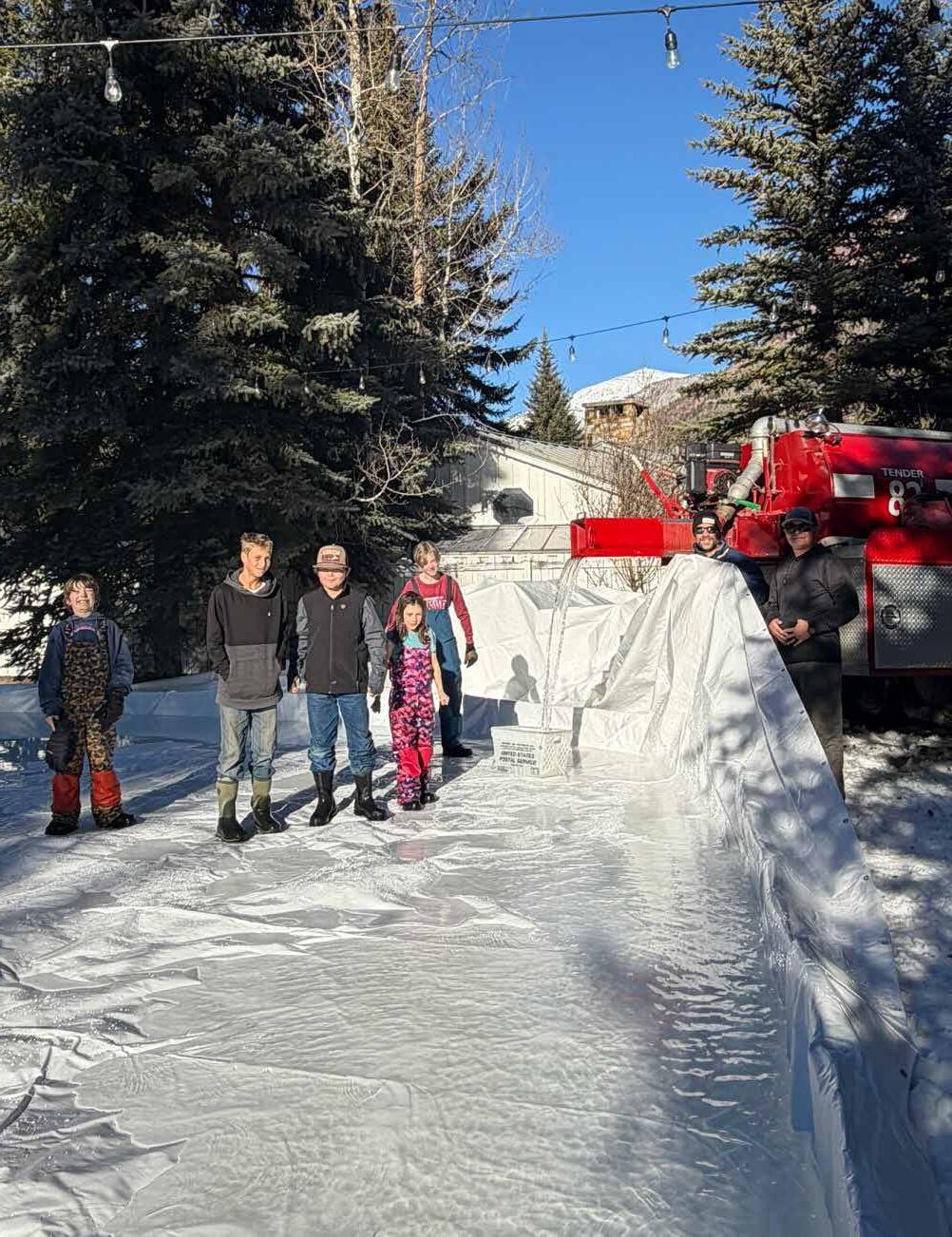
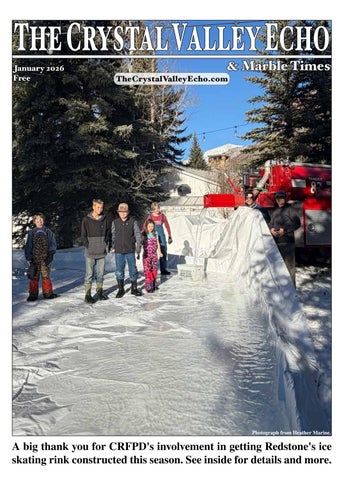
Photograph from Heather Marine.
By Gentrye Houghton
“The idea for the rink was originated by Stephanie Askew and Janette Bier in November 2013,” Phaneuf told The Crystal Valley Echo, “They obtained skates, and obtained permission from Open Space and Trails to use the site for that purpose.”
Phaneuf continued, “Ivo Bensch was enlisted to design the rink structure and purchase needed supplies, and a group of us local volunteers was organized to build the support structure. Gary Nelson, who was remodeling the Franke house at the time, helped us to level the site. That winter, I helped Bensch to set up and maintain the rink and gradually assumed more responsibility for it in subsequent years since I was retired and had more free time.”
Jake Marine took over the responsibilities a few years ago as the progression of a terminal illness began to render Phaneuf less and less physically fit to handle the demands of the rink’s construction and maintenance.
Marine approached Pitkin County regarding financial aid for the rink’s necessary supplies. With the County’s backing, he was able to purchase a new, larger liner for the rink as well as a little bit of lumber and some new snow shovels. While the County contributed two years ago,
the rink is primarily funded by donations from those who enjoy the use of the skating rink.
Unfortunately, it was again necessary to purchase another new liner this season, to the tune of $1500, due to damage that left the liner unable to retain water; the cause of the damage came from human and canine use of the rink before the ice had frozen solid. The Carbondale and Rural Fire Protection District and Redstone Boulevard resident Chris DeMeyer stepped in this season to help fill the rink with an estimated 120,000 gallons of water. Maintenance, partially clearing snow from the ice once the rink opens, is performed by community volunteers.
The rink itself is typically open for three full months, December through February, but sometimes longer or shorter as the weather allows. Skating usually subsides by early March due to warm daytime temperatures; this is caused by an increase in the strength of the sun that softens and melts the ice and creates poor skating conditions, which render maintenance nearly impossible.
If you enjoy this winter activity, consider giving a little of your time to the community for shoveling or dropping a donation into the box located on the warming shed, just under the rink dedication sign. To be added to the tiny pool of volunteers, reach out to Jake Marine at (563) 299-3268.



An editorial from Tucker D. Farris
Against the rising tide of more unprecedented, yet wholly precedented collective shared chaos, there is less and less I experience in life as it is now that offers a true escape. That uniquely human suspension of reality that facilitates the imaginative indulgences in creativity, fantasy and fiction has become so elusive that I fear I am falling into a spiral of objective realism, which to my regular readers, will come as a worrying signpost on the progression of existence.
We crave, somewhere in our misty lives, that suspension. The fading away of the grittier parts of reality into the warmth and whimsy of the world beyond our worlds of comprehension. To the places where storybooks once took us, where fairytales nestled us safely between the brambles of discontent, where we may have made our own adventures in the twinkling hours before twilight. The forests, skies, and seas of our daily escapes are crucially precious to us, and it seems that with the gathering storms on all horizons and the frenetic calls for aid from all stations East to West, there is a need now more than ever for these escapes.
Once upon a time, these could be found in the folded pages of an adventure novel, over the soundwaves in an epic audiobook, or in the flickering, moving pictures of a well-composed film. Now it feels grey, distant, and disingenuous, artificial, soulless, and somewhere in all of it desperate. I do not actively seek fictional escapism, but I crave it, as I think we all do in some re-
“I
gard. I have researched the means by which we do this socially, psychologically, and politically, but I have yet to truly meditate on the place that the fantasylands of our wildest imaginations take us. They may be rickety abandoned manor houses on the fringes of terror, wide open battlefields where heroism is won and lost by the sword, or the more mundane worlds of my beloved espionage fiction. But for whatever faraway place we find ourselves drawn to, the luminance of that breath that carries us there feels thinner now, somehow.
As I write this short dispatch from the fringes of coming back to reality, winter has set in. The grey skies opened up, and the world’s been transformed into a cold, wet, frozen landscape.
— Maggie Smith
The leaves are gone, the cows are screaming, and the subtle notes of cinnamon and clove can be felt wafting across the warmth from the fireplace. It is idyllic and dreary all at once, where the pendulum takes us from cozy winter’s alcove to the perpetual wet misery of learning our shoes have finally developed new holes in their soles.
What has always struck me on the day winter arrives is not the cold, nor the beauty of the snow or the desolation of all the trees aside from the spruce, but it is the quiet. The changing acoustics of the wildwoods of my home, from somewhere alive with the echoes across


the valley, the calls of birds, the wailing of coyotes in the dusk and the hoots of owls late into the early morning hours, to a deadened bubble, isolated away from the sounds of life. My feet no longer make any noise on the ground, the trees do not rustle, and there are no birds.
Winter is both my favourite time of year and the most institutional of all the seasons. It corrals us into imposed silence and monochromatic visuals. It hides the world away until spring, and we are left then to nothing but our own devices. I think this is what compounds the oddities of the real world, and what makes the longing for the fantastical all the more pressing on my psyche.
I am thankful to have experienced that suspension of reality sometime recently in a place I would not have normally expected to have found it: The institutional halls of my alma mater, Roaring Fork High School, on a weekend evening. By chance, I saw that some former students of mine were putting on a production of “The 39 Steps” by Patrick Barlow, a whimsical excursion through murder, mystery, intrigue, comedy, and espionage that even by that description drew me to attend.

To some degree, I have a history with theatre. Growing up, once a year, the school I attended would put on an allschool production, one where each student, sorted into scene groups, would contribute to the writing, direction, and arrangement of an original story. Two of the titles of these productions adorn this [Substack] publication: “Journeys Around the Compass” and “A Patchwork of Stories.” These experiences shaped me, but I have yet to feel any call to the dramatic aside from those productions that occur in official meetings.
Drama is good, even outside of creativity. I have attended the theatre a handful of times since those days of primary school productions, once to experience “King Lear” in Denver, Colo., a city I would not recommend visiting, but a production I smile back on fondly. I have also had the pleasure of attending an outdoor theatrical experience in Victoria, British Columbia, one that took place on the deck of a 17th-century sailboat by a troupe of actors who lived aboard and sailed abroad to perform. The play was an avant-garde collective of moments of madness, inspiration, colour, and sound that transcended the genres of science fiction, fantasy, and whatever Pirates of Penzance counts as. It was
the final night of the troupe’s career, where the couple who owned the ship and headed the production would shutter it forevermore. This was less escapism and more a chaotic experience of pure art, but I digress.
[Back in the Roaring Fork and] seated in the neutral cold of the auditorium of my old high school, after chatting with colleagues and fellow journalists during the prelude to the curtain, I felt again the swell of anticipation for the curtain to rise and the whimsy and drama to unfold. The director, a former student whose time in my classes reflected some of the best moments of my teaching career to date, emerged on stage to offer congratulations to the cast and crew, to discuss the magic of the theatre, and to thank the audience for their support. There is something quite fulfilling to the soul about watching your students be able to express their artistic passions, and fulfillment was present from this moment onwards.
When you see a play, you are not solely there to watch actors deliver memorized lines. You are there for the production, the atmosphere, and the collective magic of the space you occupy. The set pieces, their direction, the transitions between scenes, the action moments, the tender emotional experiences, and the way all of it collides to create an immersive state of artistic



solidarity. We do not simply watch a play; we are part of it, not as participant actors, but as the membrane that responds to the fine-tuned actions of the cast and crew as they share their creations with us.
We are also not privy to the weeks behind the scenes that wove this tapestry for us to view. We do not see the late, late nights after school of painting or framing set pieces, we do not see the rough rehearsals or the magic of trying on costumes for the first time, or the notes that come from a walk-through. We do not get to be a part of the memories created before the curtains are drawn, and yet, we see their fruits play out across the boards. We see a cast working together, making their marks, delivering their lines, and commanding full control of the very imaginations of their audiences. Somewhere between the late-night pizza parties and striking the set, there is a camaraderie that builds that is wholly secret to us, but magical in its manifestation out across the rows of seats.
This production of “The 39 Steps” carried such a magic to it that it broke the spell of the grey melancholia of real life for me. The dialogue delivery, the creatively composed sets, the pristine Scottish accents, the humour, the whimsy, and the madness all collided perfectly to form an experience entirely beyond the typical consumptive re-
Mission Statement: To provide a voice for the residents of the Crystal River Valley; to bring attention to the individuals and local businesses that are the fabric of the Crystal Valley region; to contribute to the vitality of our small town life.
EDITOR AND ADVERTISING SALES
Gentrye Houghton gentryeh@hotmail.com
CONTRIBUTORS
DJ Sugar Monkey
Amber McMahill
DISTRIBUTION AND LAYOUT DESIGN
Ryan Kenney
The Crystal Valley Echo is published monthly, and is distributed throughout the Crystal Valley.
NEWSPAPER BOX LOCATIONS:
Third Street Center • Village Smithy Carbondale Post Office • Carbondale Park & Ride The Marble Hub • Redstone General Store
alities we share when we normally view entertainment content. Not only did I get to watch my students proudly display their triumph for us all to watch, but for the 90 or so minutes in the theatre, I got to live again free of the madness beyond the walls of that theatre, and in that living I felt human again, which is more than one can ask for between receiving the playbill and standing for the ovation.
If ever there were a better reason to unconditionally support the study of the arts and drama in schools than the chance to live life to its fullest, I cannot consider it. To think that aside from this 90-minute reprieve into the fantasies of our minds, that what also grew from this performance was the weeks of friendship, artistic creativity and professional whimsy for some truly very exceptional students is all the reason in the world to look at the proving grounds of the high school theatre and fund it as though it were an atmospheric nuclear defense system.
I am thankful to have gone, grateful for the artistry of my students, and above all else, fiercely opposed to those who think that STEM ought to steamroll the arts in the pursuit of career options. STEM may be where the money is, but art is where our souls live, and without those, the wealth of a career is empty.
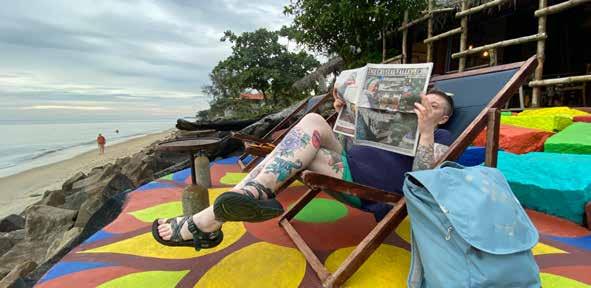
I traveled halfway around the world to escape the noise of my own country, only to find it standing in a park garden in Aurangabad, painted in garish acrylics.
Tucker D. Farris is a fifth-generation local of the Crystal Valley, serves on the board of the Redstone Historical Society, teaches sociology at Colorado Mountain College and Colorado State University and moonlights as a journalist where needed. This original piece was published by Farris in the “Calling All Stations” newsletter. To find more of his writings, please visit satinstrides.substack.com.

At the Redstone Inn | RSVP: (970)920-5432
JANUARY 13 & 27
11:00 a.m. – Yoga ($5)
With Anna Raphael. Open to all ages and abilities. 12:00 p.m. – Lunch ($10)
RSVP by noon the Friday prior – space is limited. Plated lunch served. Gluten-free option available. 12:45 p.m. – Program
• January 13: Art Class with Megan
Local artist Megan George will lead a session in basic drawing. This is an easygoing class for beginners, rusty sketchers and anyone who wants to give it a try.
• January 27: Estate Planning Basics
Join attorney Sue O’Bryan from Alpine Legal Services to learn how to prepare or update important documents such as powers of attorney and medical directives. These tools help make sure your wishes are known and respected if you’re ever unable to speak for yourself.
WANT TO BE KEPT IN THE LOOP?
Send us your email address: (970) 920-5432 • seniors@pitkincounty.com
It was early morning, the air still holding a tenuous coolness before the sun could begin its daily punishment of the asphalt. We had walked past a closed park the night before, confused by the bureaucracy of entry fees and shut
gates, but the dawn offered a loophole. Inside the manicured hedges, past the men practicing their flexibility in silence and the women clapping and laughing in a synchronized rhythm that felt like a secret language, I stopped dead.
There, standing proudly among the flora, stood the Avengers crew, and particularly a statue of


Captain America.
He looked ridiculous. He looked inevitable. The shield was bright, the blue of his uniform clashing violently with the earthy tones of the Indian soil beneath his molded boots. It was a jarring injection of Western mythology into a space that felt deeply, intrinsically local. I stared at him, this silent sentinel of American hegemony, and felt a strange, curdled mixture of embarrassment and fascination. Politics and culture are weird, contradictory beasts, but seeing this fictional super-soldier standing guard over a Tai Chi class in the heart of Maharashtra felt like a glitch in the simulation. It was a crack in the mirror, one of several moments I've experienced, leading me to a realization that I'm not just looking at India; I'm looking at a distorted reflection of my own country, bounced back across oceans and time zones.
We often believe that travel is a method of subtraction, stripping away our context to find something pure and un familiar. Yet, in this modern era, travel

is truly an addition to character. We carry our context with us, and we find it waiting for us in the strangest places.
This sensation of looking into a warped mirror continued, followed us south into the state of Kerala, to the quiet coastal enclave of Cherai Beach, and specifically to Majo House. Here, we stayed with Micky, a British expat who has lived here for over thirteen years,
ary walls lining the beach road. It is a detail that initially felt quaint, almost aesthetic, to my American eyes, a relic of a different geopolitical era. However, here, the ideology is not a relic; it is a governing force. Micky explained that the party is popular. They distribute food rations so effectively that beggars are a rarity. The streets are cleaner here than in the north. There is a palpable sense of social safety that stands in stark contrast to the desperate hustle I witnessed in Delhi years ago.
is being sold to the locals as salvation. The communist party promises dense, multi-family dwelling units and modernization. The contractor stands to make a fortune, likely banking the money regardless of whether the asphalt is ever poured.
"It sounds fishy from the get," Micky told us, his accented voice carrying the weary pragmatism of a man who knows he is fighting a tide he cannot control. He noted that the churches could likely stop the project, but they, too, have been promised their share of the spoils.
ever since the loss of his wife. He is a man who has carved out a sanctuary, combining two houses into a home stay with a bed-and-breakfast flair, that sits just behind the sea wall. To sit on his porch is to be lulled by the rhythm of the Lakshadweep Sea, watching dolphins break the surface and kites, small eagles with rusted orange feathers, circle overhead. It is a place that feels removed from the frantic pulse of the world.
But the world is coming for Micky’s garden.
Kerala is a communist state, a fact that announces itself in the red hammer and sickle symbols painted on the bound-
Yet, this system of communal good is currently manifesting as a concrete threat to private sanctuary. The government plans to widen the narrow beach road into a major highway. Micky showed us the markers — short, rounded pillars of poured concrete that have appeared like tombstones in the earth. They outline a widening that would swallow half his garden.
There is violence in progress. It is not the violence of guns, but the administrative violence of eminent domain. The officials have offered a fraction of the market price for property acquisitions. There are no plans for offramps or access to driveways. The project threatens to kill the very charm that brings tourism to the area, yet it
This is the friction of development, not just here but in our little hamlet in Colorado as well. We want to believe in the nobility of infrastructure, in the lifting of the poor. However, standing in Micky’s threatened garden, looking at the concrete markers, I saw the same story I know from home. It is the story of the small being crushed by the large, of the sanctuary being paved over for the sake of throughput. The locals, many of whom struggle greatly and lack education, want to believe the surface of these promises. When you are hungry, a highway looks like a dinner plate. When you are desperate, corruption is disguised as opportunity.
It forced me to confront the comfortable distance from which I usually view these issues. Back in the States,








we debate infrastructure in abstract terms of tax dollars and environmental impact reports. Here, the impact is measured in feet of property lost, in the destruction of livelihoods. The Captain America ideal of justice and protection feels laughably hollow when pitted against the steamroller of state-sponsored development.
The dissonance deepened as Thanksgiving approached back in the States.
I have a complicated relationship with this holiday. Over the years, I have wavered, drawn in by the secular allure of a day centered on food and family, yet repelled by its foundational myth. It is an observance rooted in the celebration of false promises. It is the joyous commemoration of a century-long successful genocide. To celebrate it while sitting in a garden in India, listening to a British man explain how his land is being seized by a government promising prosperity, felt particularly grotesque.
The parallel was impossible to ignore. The highway project in Kerala is just another version of the treaties signed and broken repeatedly in America. It is the same mechanism, the promise of mutual benefit masking the reality of extraction. The capital gains that
supposedly justify the destruction are the same profiteering that justifies the eradication of indigenous nations in my own country. We call it "manifest destiny" or "urban development" or "modernization," but the result is always the same: Something ancient and personal is erased to make way for something efficient and profitable.
I spent the day feeling a profound disconnect. My phone buzzed with messages from home, well-wishes, and photos of turkeys, and I was relieved to be absent. It felt refreshing to be in a place where no one even knew the holiday existed, where I wasn't expected to participate in the collective amnesia of my nation. And yet, the guilt of my heritage felt heavier here. I was a wealthy Westerner in a developing nation, judging the local development politics while benefiting from the very global economic system that drives them. I hate Thanksgiving because it is a celebration of a lie, but am I any better, seeking authentic experiences in a place I could leave whenever I wanted?
This question of authenticity and economics became a recurring theme, particularly when looking at the numbers.
My partner has constantly been brooding over statistics he found on Reddit, which is not my favorite place to cite research; however, in a country where

the government gate-keeps Google results, the dialog offers a more realistic community snapshot. He read that poverty in India had dropped from 45% in 1995 to a mere 5% today. The number sat in the air between us, heavy and opaque. Five percent? It seemed statistically impossible. It seemed to contradict everything our eyes have been registering.
The air in Cherai Beach, while cleaner than Aurangabad's, still carried the thick, inescapable scent of burning trash. There is no infrastructure to deal with the waste generated by what is seen on paper as an emerging middle class, so it is piled and torched. The smoke is a constant physical presence, a thickness in the throat that you cannot swallow away. If poverty is down to 5%, why is the landscape still on fire? Why does the infrastructure lag so violently behind the consumption?
It is comfortable to look at a spreadsheet and see progress. It satisfies our Western desire for order and linear improvement. We want to believe that the world is getting better, that the liberal world order is working. But the burning plastic in the roadside ditches and along sand beaches tells a different story. It tells a story of a system straining under its own weight, of a population explosion that has outpaced the capacity of the land to sustain it. The 5% statistic almost feels like another
false promise; a number cooked up to satisfy the World Bank or the UN, while the reality on the ground remains choked in my throat.
We sought refuge in the familiar, which only led to more disorientation. Sitting in the Chill Out Café, a spot that felt dangerously close to becoming our local hangout, we watched the waiters unveil their new menus. The prices jumping 25% overnight. Spending nearly a week in this place meant that we were starting to feel like locals, but the price hike was a reminder that we were merely a resource. We were the wallets that justified the new menu change.
In the airport in Aurangabad, before we arrived in Kerala, we met an Australian man in his late fifties or sixties. He was talkative, the kind of traveler who uses conversation to pass the time as well as connect. We talked about India, about the differences between our countries, but then he pivoted to Trump. He opined that Trump had "calmed down quite a lot" in his second term compared to his first.
We exchanged a glance, the secret, silent communication of partners who
Continued on page 8.
“Grassroots TV is a community strengthening organization. The community members themselves determine, create and share all of the programming with their neighbors, using media to build a deeper sense of belonging.”


- John Masters, Executive Director of Grassroots TV

False promises Continued. . .
know exactly what the other is thinking. We didn't agree, but we also didn't argue and offered an explanation for our protest to his statement. What struck me was not his political analysis, but that I assumed the American political circus to be global entertainment. Our domestic dysfunction is a spectator sport for the rest of the world, which in some circles is quite true. It was a humbling realization that our leader is being discussed in Indian airports by Australians as if he were a character in a television show that's become so absurd that other countries have stopped airing the program.
This cultural bleed is everywhere. I see it only when my eyes are open; the influence of the West was undeniable and aesthetic. I’ve seen young Indian men sporting mullets, a specific, ironic haircut of the American South and hipster Brooklyn, paired with baggy jeans and crop tops. The 1990s called the American youth just a few years ago, and now they've dialed India. I’ve also seen a slew of Nirvana t-shirts.
Yes, Nirvana. The band that defined the apathy and rage of my generation's
adolescence. To see the smiley face logo, with X's in place of the eyes, printed on the chests of young Indian men is surreal. Does he know the music? Does he understand the specific, heroin-soaked despair of Kurt Cobain? Or is it just a logo?
Perhaps it is fitting, though. Nirvana was the sound of dissatisfaction with the status quo, the scream of a generation that felt promised everything
West but repurposed for local survival.
And yet, for all this blending, the differences remain stark and unyielding. There's a good chance the highway is coming to Cherai Beach.** It is the great, flattening force of the world. It brings Amazon packages and connectivity, but it takes away the solitude of community. It replaces the local with the global. It replaces the specific with the generic.
asphalt, claiming the road for food before the cars claim it for speed. That is the tension of the world right now. We are all standing in the garden, watching the steamroller approach, wearing t-shirts from a band that ceased to exist thirty years ago, waiting for a hero who is nothing more than painted concrete.
and given nothing. In a country with a rapidly rising middle class, where the pressure to succeed is crushing, and the infrastructure is simply burning around you, maybe Grunge is not a fashion statement. Maybe it’s a mood. The angst of the American 90s has also found a home in the growing pains of modern India.
In the wealthier spaces, I saw boundaries blurring in ways that felt more profound than fashion. I saw young women in ball caps and baggy clothing, embracing what I identify as a non-binary aesthetic that would have been invisible here a decade ago. It was a sign of liberation, a visual lan-
As we sat in another airport, I realized then that I wasn't just observing India; I was observing the collision of my world with theirs. I was seeing the export of my culture — the Captain America statues, the Nirvana lyrics, the political polarization — landing on this soil and mutating.
We export our symbols, but we cannot export our context. Captain America stands in the garden, but he offers no protection. Nirvana is worn on chests, but the angst is fueled by a different fire. We are all connected now, wired into the same global nervous system, but the signals are getting crossed.
I think back on the concrete pillars waiting to be connected and the road waiting to be paved, about the corn farmers drying their harvest on the


**The Hindu reported last month, after we’d left Kerala, that the “BJP-led National Democratic Alliance (NDA) made a historic win in the Thiruvananthapuram Corporation, where it secured its first-ever win.” BJP is Prime Minister Narendra Modi’s party; the report means that the communist party lost the election in the state of Kerala, but I do not know what this means for Cherai Beach's highway project.
Gentrye Houghton has been an independent journalist for over 18 years and is the owner and editor of The Crystal Valley Echo. In her new weekly email column, "Reflections from the Trail Within," she goes deeper into the stories and observations that shape our inner and outer worlds. You can read more of her work and follow more of her adventures in India with a newsletter free subscription by visiting thetrailwithin.substack.com; however, please consider upgrading to a paid subscription to directly support her ongoing work.
Executive Director
by Devin Flores for History Colorado
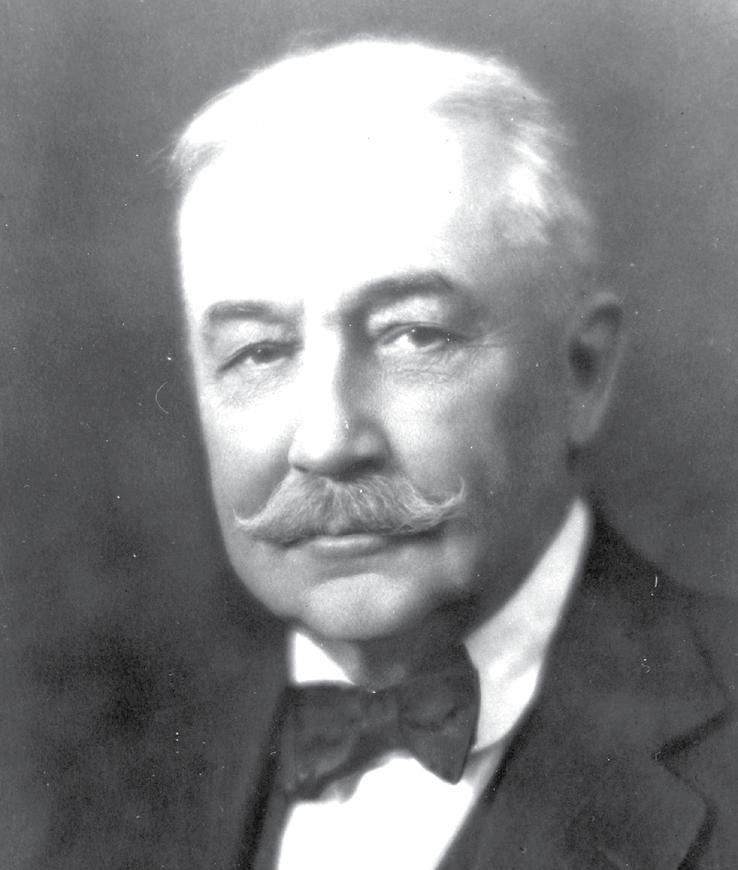
In the early months of 1905, the whole state of Colorado was in an uproar. An election clerk had just jumped out of a moving train while fleeing the law, and nobody knew who the governor really was. It was all caused by one of the most corrupt elections in American history. The election of 1904 came on the tail end of the Gilded Age, a time of rampant corruption nationwide. Political machines were hard at work in every major American city, churning out votes for their party no matter the cost, and things had grown especially bad in Colorado, where over a decade of troubles were reaching a boiling point.
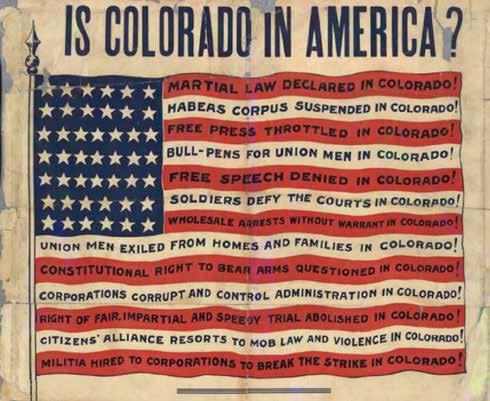
The incumbent governor was Republican James H. Peabody, and while his political career was thus far short, it was also very controversial. During his tenure, the state was wracked by continuous strikes by miners fighting for rights and representation. Previous governors had sided with the working class in strikes like this, but Peabody instead responded with brute force. He sent out the state militia to crack down on striking workers, starting the brutal Colorado Labor Wars. Peabody gave command of the militia to an officer who notoriously scoffed: “They want habeas corpus? We’ll give them post mortems!”
He was beloved by big business but hated by working-class citizens. So when the election of 1904 came around, it quickly became one of the most fiery in state history.
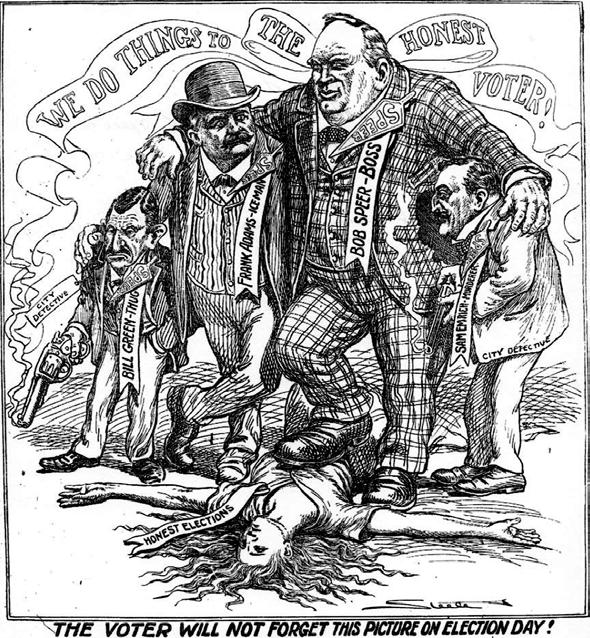
Peabody’s opponent for governorship was Democrat Alva Adams, who had already served two terms as governor. He was more popular, but didn’t have a spotless reputation. Leading up to the election, both parties threw accusations of corruption at each other freely, and when election day finally came, it was a wild affair, with rampant reports of voter fraud and stuffed ballot boxes coming in from all over the state.
Once the dust had settled and the votes were counted, Adams had won the governorship by a narrow margin, and the Democrats had won the state senate. But the fight was far from over.
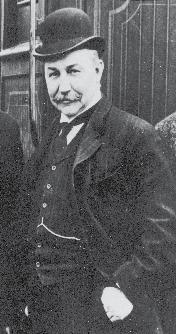
Immediately, the accusations of corruption broke out again, and the state government ground to a halt. Peabody contested the results, demanding an investigation before Adams could be sworn into office. At first, the two parties struck a deal, allowing Peabody to appoint members of the state Supreme Court if he conceded, but he refused to cooperate even after Adams took his Governor’s oath for the
An investigation was called, which quickly devolved into chaos. The probe was headed by the state legislature, but as more and more corruption was uncovered, seats were suddenly changing hands.

According to The Denver Post, “Never has there been such wild disorder in any legislature.”
The investigation quickly found evidence of blatant and egregious corruption on behalf of both parties. In Denver, the Democrats had stuffed ballot boxes to ridiculous extremes. Democrat-controlled police had promised criminals acquittal if they committed voter fraud by voting multiple times using disguises or simply by traveling from ballot box to ballot box. One individual was found to have personally voted 169 times, and 717 Democrat ballots were cast in one precinct with only 100 legal voters. All over, the police were not only turning a blind eye to the obvious crimes, but they were even assisting them.
Meanwhile, in the mining towns, Republican voter coercion was everywhere and just as blatant. Mining and railroad companies were banking on Peabody’s victory, so they told their workers — who had suffered the worst of Peabody’s anti-union crackdowns — that they had to vote Republican or lose their jobs.
“If the Democrats should win, we may have to close the mine down,”
said John C. Osgood, the owner of the Victor Fuel Company, to his assembled workers. “And if the Republicans should win and find out that one of the working men voted the Democratic ticket, they would fire him.”
The mine workers were furious at being bullied like this, and they were all too happy to report these threats to the investigators, along with other tales of physical coercion, voter fraud, and ballot stuffing. The mining towns of southern Colorado, especially Cripple Creek, Walsenburg, and Trinidad, came under close scrutiny as a result.
The furor of investigation and scandal reached its climax when Juan Montez, the election clerk of Huerfano County, jumped out of a moving train. He was en route from Denver to Walsenburg with orders from the court to bring back a ballot box used in the most recent election — and a Denver County sheriff’s deputy rode along to ensure there was no funny business. He had already failed to produce the ballot box once, and the legislature wanted to be sure he brought it back this time. But not long after the train left the station, the clerk jumped off and tried to flee. He was captured and was eventually charged with election fraud, but he was far from the last.
The Huerfano County ballot box was eventually recovered — completely

empty. It didn’t even have a poll book inside. Apparently, the official box hadn’t even been used during the election, and as a result, all the ballots cast in the precinct were not official and had to be discounted.
Many other ballots were thrown out, and not all of them justly. It’s hard to say where the investigation turned into even more corruption, but Coloradans

were quickly losing faith in their government.
Thousands of voters across the state were furious when their own (legal) votes were discounted, leaving them voiceless in one of the most energetic elections in state history. The investigation swelled to a truly ludicrous level, eventually amounting to almost 200,000 pages of evidence and the

For years, you’ve read my work and the stories I’ve edited in these pages. Now, I’m sharing my more personal reflections in a new weekly email column. It’s a space for the stories behind the stories, on nature, adventure, and finding clarity in a noisy world.

“If the Democrats should win, we may have to close the mine down, and if the Republicans should win and find out that one of the working men voted the Democratic ticket, they would fire him.”
testimony of over 2,000 witnesses. The entire governance of the state had ground to a halt, with Adams in office but unable to exercise any power without being called “usurper,” and the legislature dedicated weeks to flinging corruption charges against one another.
In the end, the “most flagrantly corrupt incident that has ever happened in Colorado,” according to the Rocky Mountain News, ended not with justice but with backroom deals.
Adams, his once robust political career now in tatters, willingly resigned late in the day on March __16th__, 1905. He had been in office for barely more than two months. Peabody was immediately sworn in as his replacement, but his victory was extremely shortlived.
He had also agreed to concede the election, so early the very next morning, he too resigned, and Lieutenant Governor
Jesse MacDonald was sworn into office. The question of the governorship was finally resolved, a full five months after the election, and Colorado won the dubious distinction of being the only state in American history to have three different governors within a single 24-hour period.
In addition to writing articles for History Colorado, author Devin Flores is the assistant editor for The Colorado Magazine and the managing editor for the Colorado Encyclopedia. This 2020 article was reproduced with permission by History Colorado.
“We help each individual understand their wants, needs, and goals, then provide them with a road map and the resources to get there. We don’t prescribe solutions—we help families create their own pathway to success.”
-
Katherine Sand, Aspen Family Connections Director Aspen Family Connections is a family resource center, created to connect all Pitkin County children, youth and families with a wide range of community resources and is a grant recipient of the Pitkin County Healthy Community Fund.
The voter supported Healthy Community Fund assists the Pitkin County community by providing grants to nonprofit organizations that provide critical health and human services and community resources.
Learn more at: pitkincounty.com/hcf

From Lani Houseman
In our third and fourth grade class, we researched the pros and cons of autonomous vehicles. Despite all the benefits we learned about self-driving vehicles, particularly their safety records, the class unanimously were opposed to them as the future of transportation. Here are some of their essays:
By Jade Schachter, 3rd Grade
Imagine going somewhere with no driver. Would going in a self-driving car be scary? Self-driving cars started in 2020 in Phoenix. In fact some people drive self driving cars every day! Autonomous Vehicles could be the car of the future. In the past five years autonomous cars have been increasingly used in the first five cities across the U.S. from Phoenix to L.A. to Austin. I do not think that we should keep producing self-driving cars.
and less cars on the road which would reduce greenhouse gases which is safer for climate change. Some impaired drivers, elderly drivers, and distracted drivers would not have to worry about driving. Likewise, there would be reliable transportation for blind people or people with disabilities. Furthermore, there would be more time for the driver to catch up on work. It would be more convenient if you have his car to park itself. If self-driving cars would be a future car there would be less accidents which means there would be less backups which means there would be less traffic.
Self-driving cars have many advantages to be future cars. Autonomous vehicles use LIDAR- light detection and ranging special sensors that create a map for the vehicle to measure its distance from objects. There can be faster reaction time than human driven cars. You can work on projects instead of driving or you can take a nap. In addition, there would be less idling
There are also many disadvantages of self-driving cars. For example, In 2018 a self-driving car hit and killed a woman in Phoenix. How does a self-driving car make a bad decision between killing someone or swerving off the road? 2.1 million people such as Uber and taxi drivers could lose their jobs. As self-driving vehicles become more popular factories such as Ford, GMC, Jeep etc. would shut down. Many other people would lose their job even if they did not work in a car business. How could self-driving cars see the lane markings in the winter time? Road markings, Lane signs, stop lights would need to be cleared off of snow and visible. How much would self-driving cars cost? Buying new cars
could be very expensive. They would have to provide electric charging stations. Hackers may hack and steal all the data. Hackers may also hack into the system and control the car.
After examining all my pros and cons, I am certain that self-driving cars should not be produced anymore. Many people argue that self-driving cars are better for the environment and shall be the car of the future. However there are many reasons for a self-driving car to not be the car of the future. For example, if you lost your job, what would you do? In conclusion, after all your hard work to get a job the system of self-driving cars may take your work away. Furthermore there would not be many jobs left. Self-driving cars will cost a lot of money. You will have to find a way to afford an autonomous vehicle. Hackers may hack in and someone might be in the car. They could control it or they could steal the data. After all the research I have done there are too many risks of autonomous vehicles to be the future of transportation.
a.i. VehiCle’s
By Elijah HawksMayne, 4th Grade
Hey, did you ever think robots would take over the world? Well I think self-driving vehicles will take over the world. From 2020 to 2025 self-driving vehicles have come to 5 different cities across the U.S. In 2026 they plan to put self-driving vehicles in 10 more cities! I think that they are evil! Even though lots and lots of people think they are helpful and good. They are interesting but dangerous because around December 5, 2025, there were three autonomous cars, a delivery truck, and other vehicles that were involved in a crash.
They are very expensive. The vehicles are very expensive to make. They would make it so that there would have to be more electric charging stations which are also very expensive. Roads would have to be plowed more. Another reason they should not be the vehicles of the future is people who maintain the road would have to be paid more and more $money$ would make taxes higher and we all know nobody likes higher taxes.
There are many dangerous threats from self-driving vehicles. In 2018 a self driving truck hit and killed a woman in Phoenix. In addition to that, hackers may be able to break into the secu-

rity system with poor intentions. Furthermore, they have to decide whether or not to hit a pedestrian or swerve around them and possibly hurt or even kill the people inside the car. Finally in 2024, there were 462 crashes with self-driving vehicles.
One more reason that self-driving vehicles should not be the future of transportation is that people could lose their jobs. Now that’s just sad. Another reason they are bad is because bus drivers, taxi drivers, uber drivers, etc, they could all lose their jobs. In fact not only drivers could lose their jobs, manufacturing companies could shut down because they are not getting enough customers.
I firmly believe that they are bad. You might be wondering if there are good things about self-driving vehicles. Well there are good things about them but not that many. The only one I have is that there would be less cars on the roads which would reduce greenhouse gases, which is safer for climate change. I believe that they are bad and that they should not be the future of transportation!
From Jaime Fiske

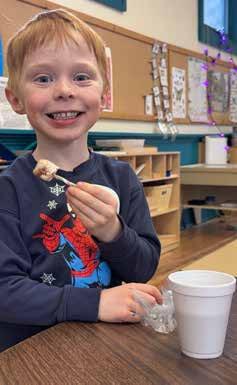




“When


- Rita Mary Hennigan, Executive Director of Uproot




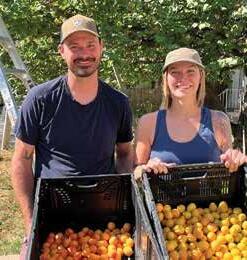
From Nicole Ludlow
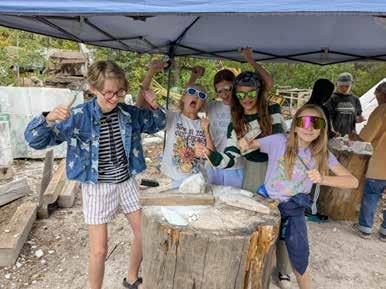
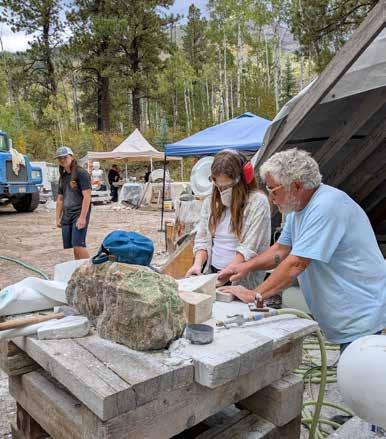
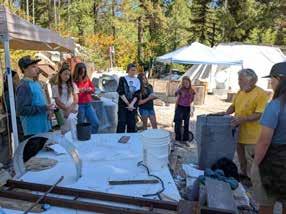
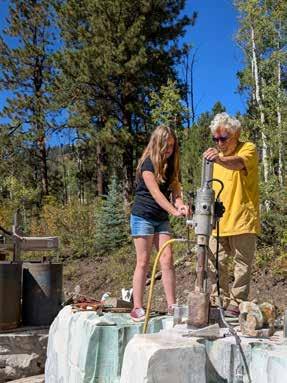
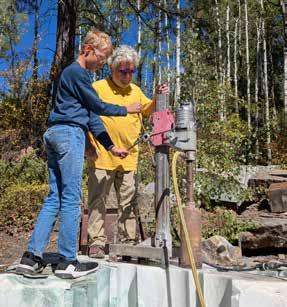
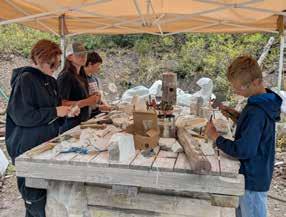
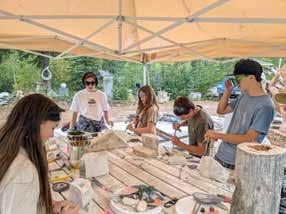
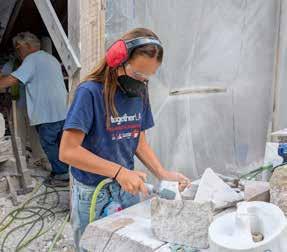
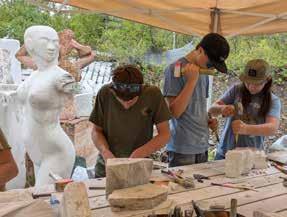
Last fall, sixth through eighth graders participated in an immersive marble carving art block with Greg Tonozzi and Sarah Rosenthal. Students had the opportunity to work with various tools such as sanding paper, chisels, die grinders, and an air hammer to create their final pieces. Both Tonozzi and Rosenthal taught students about the nature of marble and how to best work with this resident stone including examining the bedding plane, utilizing the stone's natural qualities, craftsmanship, and proper use of tools in carving their creations.

The Marble Town Council meets on the rst Thursday of each month starting at 6 p.m. in the Marble Community Church’s Fellowship Hall.
Town of Marble meetings are open to the public.
2026 Meeting Schedule
Starting at 6 p.m. January 15TH February 5TH March 5TH