Mission Statement: To provide a voice for the residents of the Crystal River Valley; to bring attention to the individuals and local businesses that are the fabric of the Crystal Valley region; to contribute to the vitality of our small town life.
The Crystal Valley Echo is published monthly, and is distributed throughout the Crystal Valley. NEWSPAPER
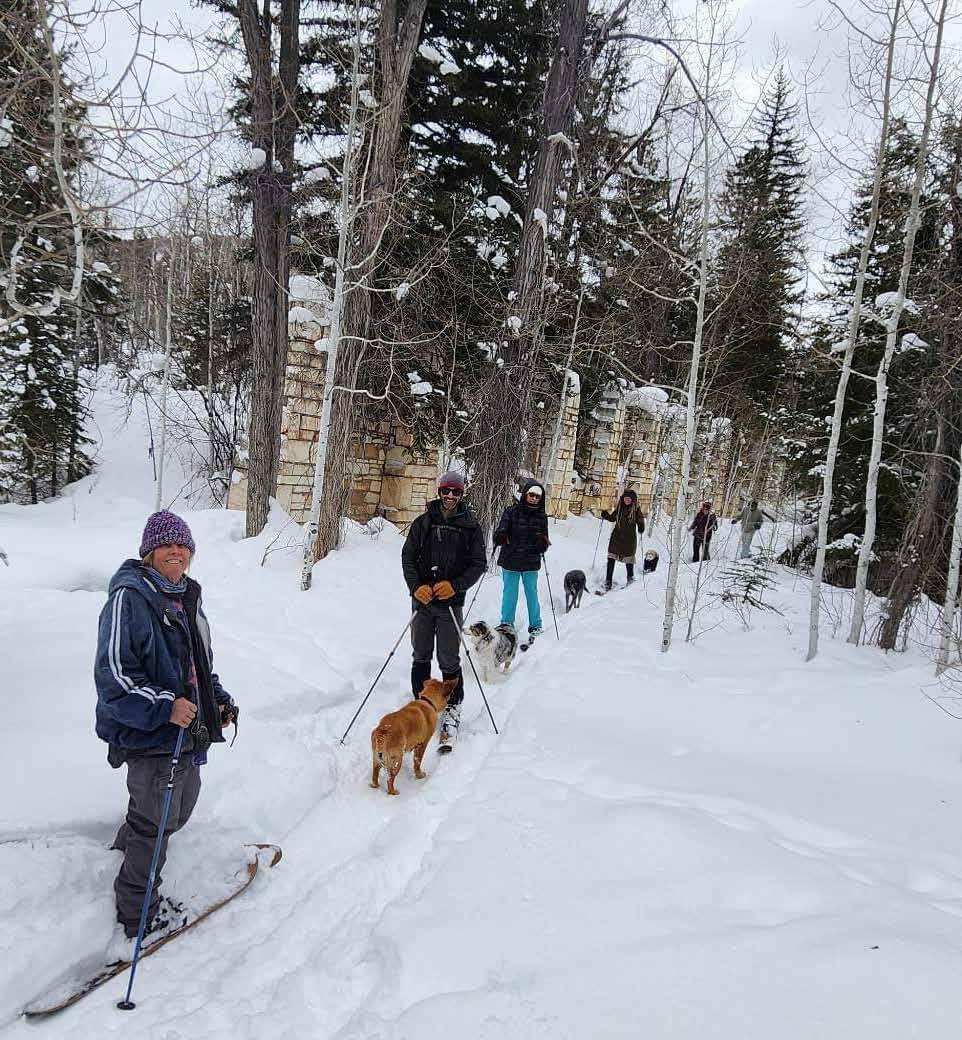
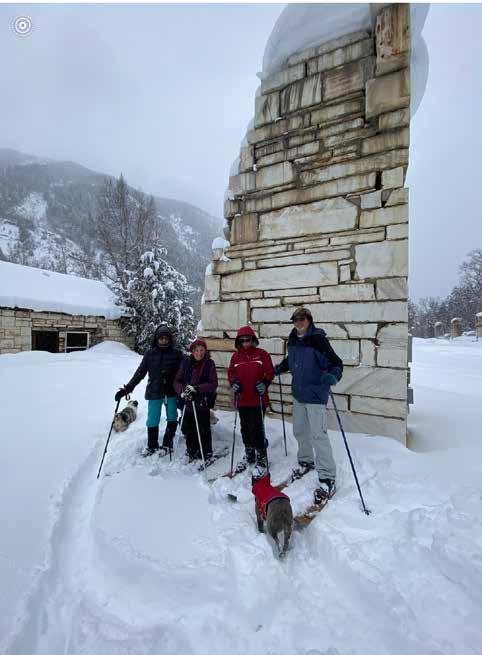
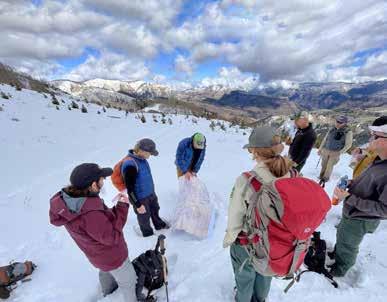
Above: The SUP Ski Club lead by Cyndi Fowler with SUP Marble, meets every Saturday at The Marble Hub, friendly, well-behaved dogs are welcome to join the fun. Photograph courtesy of Jaime Fowler.
Below: After meeting at The Marble Hub, Fowler leads the two and four-legged group through the regularly groomed cross country trail at Marble's Historic Mill Site Park. Photograph courtesy of Cyndi Fowler.
Letter to the Editor
re: bill JoCheMS STorieS
The redSTone ConneCTion for I am heavy-hearted and I cannot milk tonight.
To our friends in Redstone,
While Gentrye Houghton, editor, and Ryan Kenney visited us in Florida in February, we saw Ghost Town Blues Band at Englewood’s on Dearborn, a funky little restaurant with a beautiful outdoor patio that often hosts great blues shows. To our surprise, we crossed several people who had a connection to Redstone. Billy estimated around 20 people who had lived or at least visited the area, including members of the band and a childhood friend of Sue McEvoy’s. Here’s a picture of Billy and me with Houghton and Kenney, and Leslie Boyce.
We’re enjoying Florida but sure do miss Redstone!
Kim Amicon Englewood, Florida
Dear Editor,
We’ve enjoyed the Bill Jochems stories along with the Redstone photos that Helen Kuhnhausen gave Bill when she sold him the house.
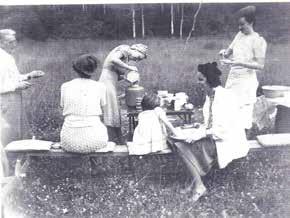
Harry and Helen Kuhnhausen came to live in Redstone in the '40s and together enjoyed its beauty and near isolation. For in those years, aside from the caretakers (the Kenneys and the Claytons) and a couple of families, nobody lived in Redstone year-round. Harry was an excellent fisherman and hunter and Helen had a lot of verve and was a lot fun and sang songs when we got together, such as The Little Brown Jug and one which goes:
Father Put the Cow Away and get her out of sight
It isn't fair to this here cow for me to try and milk her now.
The weddin bells are ringing; they're ringing out for Mary.
I used to think it would be me, but now she'll marry Harry.
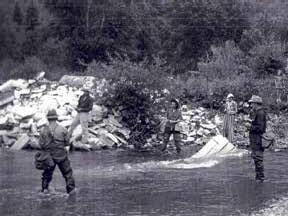
As more people bought the cottages, during the summer more and more people would show up and gather for fish fries and scenes occurred such as some of the photos show.
The Echo is covering important issues in the valley. Thanks to you.
Warm regards, Mike Mechau Palisades
cancer.
The Marble Hub Redstone Mountain Mercantile www.marblecandle.com marblecandle@hotmail.com
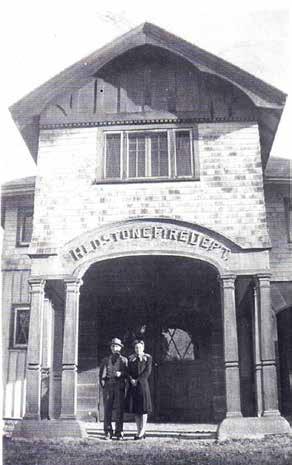
Harry and Helen Kuhnhausen standing in front of Redstone's Historic Fire House, 1945. Photographs provided by Bill Jochems.
Above: Harry Kuhnhausen, far left, during a gathering Mechau suggested.
Below: Playing in the Crystal River, the photograph is believed to have been taken near today's pedestrian bridge in Redstone Park.
Coal Basin Methane Capture Project Update
The Coal Basin Methane Capture Project crossed the desk of the Pitkin County Board of County Commissioners (BOCC) late in January, just narrowly missing The Crystal Valley Echo’s February publication deadline. During the work session, Dallas Blaney, CEO of the Community Office for Resource Efficiency (CORE), Chris Caskey, founder at Delta Brick and Climate Company who is contracting with CORE on the project, and Mona Newton, with Energy Smart Solutions who is contracting with Caskey, provided Commissioners with an update on the project.
Caskey began by stating that the project is going well and that they are in the permitting process with the National Forest Service for the flow testing phase. He stated that they will use the knowledge gained from the flow testing to provide a fresh proposal to the Forest Service for the permanent project, which he suspects won't get off the ground until 2025.
By Gentrye
The road improvements being proposed, at this point, are to get machinery into the basin to perform the flow test. The test will determine the quantity and quality of the methane leaking from the existing mining portals that were closed during the early 90s. Three options are being proposed depending on the results from testing; doing nothing is one option, but if results come back with a lower concentration of methane, the leaks may be mitigated by enclosed flaring or thermal oxidization. Should the methane be determined of medium quality, electric generation is also an option.
Caskey explained that there are many leaks over the eightsquare-mile area, but they are currently unsure of the total sum of those leaks. He said the Environmental Protection Agency suspects nearly 10,000 tonnes are leaking annually, and according to the International Energy Agency, it is suggested that the comprehensive annual global methane emissions in 2020 were around 570 million tonnes.
At some point, many of these portals were connected underground. “As they were mining, they built walls to block off areas, but those were wooden walls and the ceilings have collapsed, which in some cases is blocking methane flow and in some cases is making it easier,” said Caskey.
“Our objective,” he continued, “would be to plug a few of the leaks that are together, put a pipe into one of them, and suck on that pipe in hopes that the negative pressure will turn off other leaks that are far enough away we don't want to cut a road to them, and then gather [the methane] at that one point.”
Francie Jacober, Chair, commented that during early meetings last year in Redstone and Carbondale, there seemed to be momentum for enough methane to create electricity; however, that seems to be different from what is being spoken of today.
Caskey assured that there may be enough in quantity and sufficiently high quality for electricity generation in Coal Basin; however, he’s learned from the power plant located in Somerset, Colo., that air can get into the mine, diluting the leaks from the surface, and make a significant impact on the ability to operate.
“I would love to do electricity, personally,” he said. “It’s a much heavier lift both financially and from an impact and stakeholders standpoint, but the question is, is air going to get in?"
Caskey explained that the way to prevent surface leaks is to cut a road to the portal, and fill it with foam by drilling down into it. However, cutting roads is the biggest concern.
"So, certainly, electricity is still a possibility," he said. "Unless the flow test shows enormous quality and quantity, the prudent thing to do would be to put in a flare, which would be relatively inexpensive, and run it for a year. If the quality stays high, then you can feel confident in spending another $10 million to put in an electrical generation plant.”
Jacober replied, “I think it's a much sexier sell if you’re generating electricity than if you have a big fire.”
Last month, The Crystal Valley Echo spoke
with Jennifer Schuller, the National Environmental Policy Act Specialist on detail and Ecosystem Management Coordination staff for the US Forest Service, regarding an update to the permitting process. She explained that the Forest Service received an updated application from Delta Brick and Climate Company in December.
“Based on the Forest Service process,” she explained, “we are not in the permitting process yet and are still working to get more information before the application is complete. We have other specialists taking a look at the application, and will likely have more feedback for the proponent than what we have already provided.”
Schuller said it is up to the Forest Service to determine what level of NEPA will be required, which is dependent upon the project proposal. Caskey has stated in previous meetings that they are hopeful the flow test qualifies for a categorical exclusion, the lowest level of NEPA. “For Scoping,” she said, “the decision maker is not required to put a categorical exclusion out for public comment, in this case, the district ranger has said we would share this with the public.”
Caskey’s told the BOCC he is expecting the flow test to kick off this summer, but Schuller was unable to predict a timeframe. She was also unsure about the public access impact testing may have and stated that it was not something that had yet come up.
There are several engagement opportunities to discuss this project in Redstone during March. The Church at Redstone hosts two meetings on March 2nd starting at 7 p.m. and March 3rd at 9 a.m. The project is also on the agenda during the Crystal River Caucus’s regular zoom meeting on March 9th starting at 7 p.m. If you are not already on the Caucus’s email list and would like to be sent a link for the meeting, send an email request to crcaucus@gmail.com
Houghton
Redstone Senior Days
• 12:00 p.m. – Lunch ($10)
RSVP by noon the Friday prior – space is limited. Plated lunch will be served. There will be a gluten-free option.
• 12:45 p.m. – Program
March 14:
Kindred Spirits – St. Patrick’s Day
Celebrate St. Patrick’s Day with music from Kindred Spirits a capella group.
March 28: History’s Mysteries Colorado Trivia & Slideshow with Christi Couch.
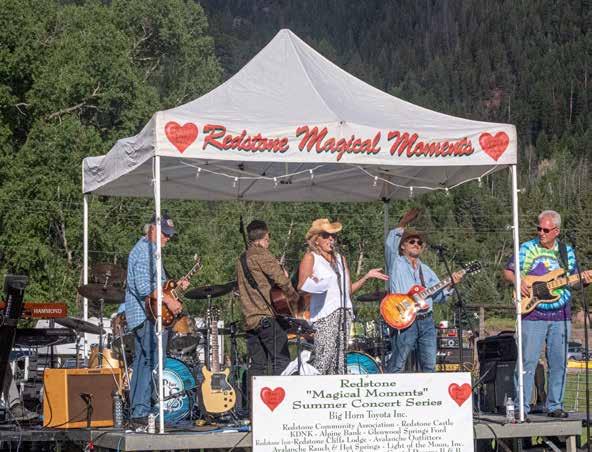
2023 Redstone Magical Moments Summer Concerts
Dear Friends of Magical Moments
This year’s summer concert series will begin in late June and goes through to Labor Day Weekend.
The concerts will be held at Avalanche Outfitters (behind the Coke Ovens) on Saturdays, 6-8pm.
This is our 25th year of offering free concerts to the Redstone community, visitors and our neighbors down valley in Carbondale, Glenwood Springs, Basalt and Aspen.
These concerts have become a family event and a great way to spend the summer evenings in Redstone. We hope you have enjoyed the concerts and the venue. And if you have not attended one of the concerts; be sure to this year.
As a Friend of Magical Moments, you have the opportunity to not only be a part of this Community tradition, but to encourage and support artistic musical talent.
We hope you will consider supporting music in our community and become a Friend of Magical Moments by your financial donation to help continue these free concerts or volunteer on the stage crew.
Please make your check donation to the Redstone Community Association (RCA) and mail to Lisa Wagner, 475 Redstone Blvd. Redstone CO 81623 or drop it off at Crystal Dreams Bed & Breakfast.
The Redstone Community Association is a non-profit and we are an unincorporated volunteer community. WE look for support from within our community and businesses as well as outside our area. Our down Valley businesses have been great supporters.
Lisa Wagner kicks off the 24th Annual Magical Moments series and introduces My Blue Sky during the first concert last summer.
Photograph by Gentrye Houghton.
The True Story of Kate Manning's Gilded Mountain
Author Kate Manning released Gilded Mountain, a historical fiction novel, last year in November. With its national success and popularity locally, The Crystal Valley Echo is reprinting an article about the real-life story of the novel’s fictional newspaper editor, K.T. Redmond.
By the time Sylvia T. Smith arrived in Marble, Colo., in 1908, she was already a well-seasoned newspaper editor and political activist. At 42 years old, she was an outspoken supporter of both the suffragette movement and labor rights, two hot topics of the era. She served as one of the first female delegates for the 1894 Republican Convention only a year after Colorado women won equal suffrage by referendum.
She spent the previous decade in Crested Butte, in part, as the publisher of the Crested Butte Weekly Citizen and came to Marble with her printing equipment and supplies in hand. By May of 1909, she had taken over as proprietor and editor of The Marble City Times, a weekly paper that was circulated locally and mailed back East to stockholders of the Yule Marble Company.
Marble was a booming mountain town in 1909. Three years prior, Colonel Channing Meek had arrived and taken control of the Colorado Yule Marble Company (CYMC). By the time Smith appeared, he had completed the 709-foot-long Marble Finishing Mill, invested in a power plant to bring electricity to the town, and donated the stone for a Catholic Church. Marble had grown from a population of less than 200 to around 800, according to the 1910 census, that same year the payroll for the CYMC had between 500 and 600 employees on average. Marble was very deeply a company town and Col. Meek was its much-loved benefactor.
Few existed in Marble who were either not on the company payroll itself or dependent on someone who was on the payroll. This included the sheriff, deputies, rival newspaper editor Frost, and the preacher. The Crystal River San Juan Railroad also held close ties with the CYMC as Meek had been instrumental in bringing the line into Marble.
Smith used her editorial pen to poke at CYMC from the start, and she’d arrived at a lucky time for criticizing the company. Shortly after landing, a labor strike broke out in July 1909. While this one was quickly resolved, the second strike in August lasted three months and resulted in 500 laborers striking. In addition to labor conditions, Smith criticized the company on many different fronts, including the safety of the tram, lack of a hospital (despite monies collected for one), and, most damaging of all, the accusation that Col. Meek was running a stock selling scam rather than a legitimate
Mike Kennedy, Broker/Owner 970-379-3907
mikekennedy@sopris.net ColoradoHomesRanches.com
Residential • Commercial • Ranch Properties
company.
In 1910, Col. Meek began to fight back by calling a gathering of businessmen to meet and voice their opinions on Smith, encouraging each man to relate his opinion. This meeting grew into the Marble Businessman's Association and soon backed the creation of a rival newspaper, The Marble Booster
By Amber McMahill
From the beginning, The Booster professed to be pro-CYMC and pro-business. In fact, that is where the name “booster” came from, to boost the company and town. In short, it was a company paper. The editor, Frank Frost, wrote articles touting the company's generosity and progress while making jabs at Smith. Marble City Times jabbed right back, and nearly every edition contained at least one derogatory article about the CYMC.
One point of contention Smith liked to hammer on was the location of the finishing mill. Old-timers had warned from the beginning that it was built right in the path of an avalanche, and in March 1912, Smith sounded the warning about a large sheet of snow just waiting to come down. On March 20th, it did just that, smashing into the finishing mill and doing considerable damage to both the mill and the company that fed so many of Marble's mouths.
Kate Manning released Gilded Mountain in early November. The historical novel tells a fictional account of Sylvia Smith, Editor of The Marble City Times during the early 1900s. Book cover courtesy of Kate Manning.
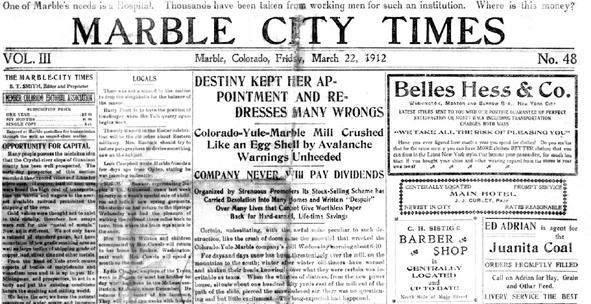
Smith's reaction was nothing short of gloating: Destiny kept her appointment and redresses many wrongs; Colorado Yule Marble Mill crushed like an eggshell by an avalanche; warnings unheeded; the company never will pay dividends; organized by strenuous promoters its stock selling scheme has carried desolation into many homes and written despair over many lives that cannot give worthless paperback for hard-earned, lifetime savings.
— Marble City Times, No. 48, March 22, 1912.
The article went on to mention that the company was short on funds and reiterated her accusations that the Eastern stockholders were about to lose all their investments. For Col. Meek, this was the last straw. The next day the company controlled The Marble Booster ran an inflammatory article in retaliation, stating:
This pseudo newspaper has upon many other occasions attacked the Colorado Yule company, but it was thought that the present situation would call for a square deal from even the bitterest enemy of the company. As a matter of fact, the party who prints this sheet has no reason to attack the company at any time, except for the money there is in it, but to print a spiteful, goody-goody article when misfortune came like it did Wednesday morning is just about the last straw.
— The Marble Booster, March 23, 1912.
There was no rebuttal from Smith this time, as the March 22nd edition of the Marble City Times proved to be the last. On Monday, March 25th, a handbill was circulated around Marble, calling all residents to a meeting at the Masonic Hall. They didn't state the purpose, only that it was vital to the town.
ney's delight. Dr. Haxby, one of the two town doctors, spoke to the heart of matters at the meeting, saying, “My position, briefly, is that this woman is hurting every one of us. Every dollar that her articles divert from the support of this great industry here means a loss of part of that dollar to me and to every other person within the sound of my voice.”
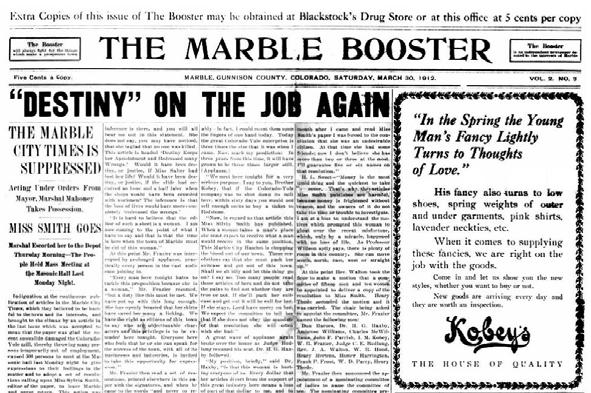
The other town doctor, Dr. Swift, according to The Marble Booster, Vol. 2 No. 3, March 30, 1912, was more direct, “I have served on several boards of health where my duty was to abate nuisances such as a bad smell, dead horses, dead dogs, etc. — things that made people sick. I say to you, though, that never in all my experience have I met with anything so offensive and so badly needing abatement as this newspaper, so-called.”
One recurring accusation that persisted for years was the belief that Smith was a paid agitator, insinuating that unions or rival companies had sent to bring down the CYMC. The preacher spoke against her, the school principal spoke against her, and one after one, her former townspeople and neighbors got up to call for her removal from town. In all, 232 residents signed a resolution demanding her re-
moval from Marble.
The next day, a committee of 15 men and two women, including Frost and the CYMC Chief Clerk W. R. Frazier, delivered the resolution to Smith, or rather, they tried to. Smith would have none of it and refused to listen or accept the printed resolution, turning on her heel and going to a neighbor's house.
They enlisted the help of Town Marshal Richard Mahoney, who happened to be paid monthly by CYMC, and Special Officer John Fisher, who was a guard at the mill. The following day, as Smith began working on the next edition, they arrived at the newspaper office. Mahoney and Fisher presented Smith with an order for her arrest signed by the mayor, who was employed as a machinist at the mill. Refusing to allow her to gather any of her possessions save for a travel bag and a check, they took her to the town jail. Smith never saw her printing press, personal possessions, copies of her newspaper, or subscription lists again.
It was Frost, Smith's biggest detractor, who was tasked with dismantling her life's work and locking her possessions, including her printing press — with the typeset for that day's paper
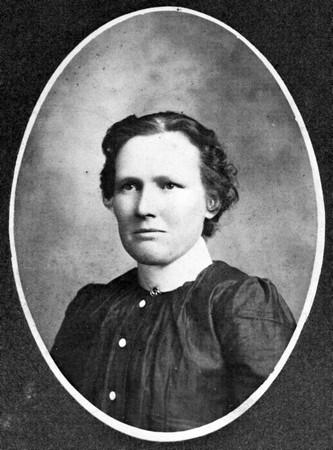
Portrait of Sylvia Smith provided by the Marble Historical Society.
Frost, of The Marble Booster, kindly took notes and printed a complete account of the meeting, much to Smith's future attor-
Image of the March 30, 1912, edition of The Marble Booster provided by the Marble Historical Society.
already set — and copies of her newspapers, in the basement of the Kobey's Store.
Kobey's was located on the corner of Main and Center Street, an area that became Carbonate Creek after the mudslides of the 1940s took out that section of town. The last mention of the press was in a July 3, 1915 article appearing in The Marble Booster and written by Frost himself, stating they were still locked up there. It might never be known what happened to them.
Smith spent the night in the Marble City Jail, a building that still stands today. In the courtroom accounting of her night, she mentions sleeping between the cell and the wall on a pile of clean laundry. Those familiar with the jail know what a tiny sliver of space that is.
In the jail, she met another infamous Marble woman, Mrs. J.J. Curley, a hotel proprietor and bootlegger. Mrs. Curley preferred jail time to fines and had taken up residence in the jail for several months. She shared her food and blanket with Smith, and it was her clean laundry Smith used as a bed.
The following morning at 4:35, she was put on a train to Glenwood, and it was the conductor who ended up buying her ticket out of town. After a 26-hour train ride, the delay due to a snow slide near Leadville, Smith arrived in Denver and immediately hired an attorney and filed suit in Gunnison County District Court against 37 individuals, the Town of Marble, The CYMC, and The Crystal River and San Juan Railway Company.
The suit came to trial a year later, and by then, Meek had met his demise in an accident on the very tram Smith had warned was unsafe. Her attorneys used the whole article in The Marble Booster as their primary source of evidence.
In addition, three townspeople spoke up for her: Tom Boughton, George Stogshell, and Mrs. Marshy Woods. Mrs. Woods was the wife of W.W. Woods, one of the Town’s founders who owned the other half of town that the CYMC didn't own. They had, apparently, been close friends in the short time Smith resided in Marble, despite pressure from Col. Meek to have Mrs. Woods withdraw her friendship.
them for $10,345 plus court costs of around $600 (about half a million dollars by today's standards).
This amount was divided among all 14 defendants, including Frost, the Town judge, doctor, Mayor Frazier, and Ida B. Carey, widow, and owner of two ice cream parlors. They appealed the decision, and it went to the Colorado Supreme Court, where the decision was upheld.
The following year brought near bankruptcies, garnishing of bank accounts, and forced sale of property, but by April 1916, the judgment had been paid.
Carey nearly lost the empire she worked so hard to build, managing to save her home from the public auction at the last minute with a $100 loan. Fundraising amongst the town’s folk was typical to help defendants keep their homes and assets. It wasn't until the sheriff took possession of The Marble Booster, now the only news source in town, that Frost spoke to the company's injustice allowing the townspeople to take the fall for them.
He went on to lay the blame entirely on Col. Meek, accusing him of dictating the order for her arrest and even using threats to get residents to sign the petition. He continued with details on how some who had refused to sign had lost their jobs and that Meek had promised the defendants the company would pay all costs.
Whether he would have kept this promise, we will never know; following Col. Meek's death, the company was now in the hands of J. Forrest Manning.
Little factual accounts exist of Smith's life after Marble and the lawsuit. There are rumors that she worked for The Denver Post, but they have no such records. She is said to have never returned to Marble; although, there is a claim that she did return wearing a pink dress and had a military escort.
The Marble Booster claimed she moved to a ranch in Paonia, but there is no record of her there either. The only other written post-Marble account of her that could be found was from the United Labor Bulletin, speaking of her work organizing labor unions.
There are still many questions about Sylvia Smith and her time in Marble, to which we might never find answers.
She was a woman either loved or hated. Some always believed her to be a paid agitator intent on destroying the town they worked hard to build. To others, she was censored and run out for speaking the truth against the most powerful entity in town.
The defense had little evidence to work with; the judge had ruled that all evidence of her attitude against the company did not stand as a reason for their actions. It was based on if those actions had taken place.
From the beginning, the CYMC kept itself out of the resolution and actions against Smith. The company was not named in the final judgment, and in the end, the jury found 14 of the defendants guilty of malice and awarded body judgments against
According to The Marble Booster issue that hit the stands on July 3, 1915, Frost wrote, “To begin at the beginning then, in a statement of the facts — the inside facts, that did not come out at the trial, for reasons that will be stated hereinafter — the defendants in this case who have had to pay this judgment or the most of it, had no more to do with driving Sylvia Smith out of Marble than they had to do with driving Adam and Eve out of the Garden of Eden.”
Regardless, Smith and her story tell of the human element of Marble's history, where the actors are not painted in black and white but in mottled shades of errors and intentions.
If you don't already have your copy of Manning's Gilded Mountain, you can pick one up at The Marble Hub, open Saturdays 8 a.m. - 3 p.m., starting in mid-March.
Image of the March 22, 1912, Marble City Times provided by the Marble Historical Society.
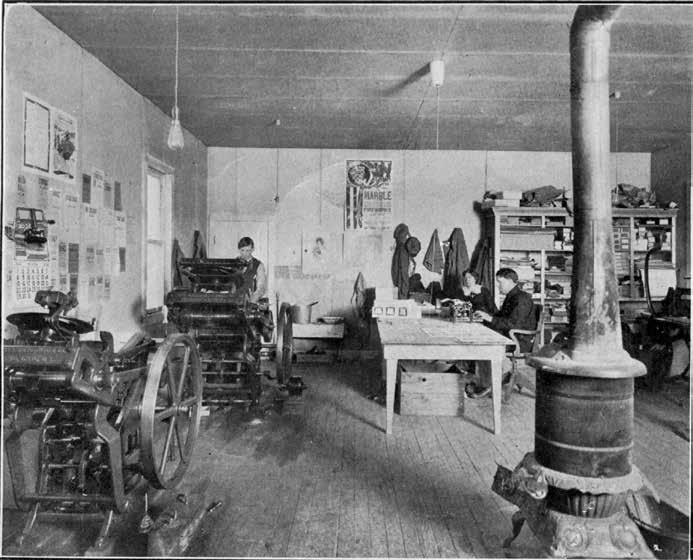
Showing the press room and paper stock department of The Booster -- and the working force. Photograph provided by the Marble Historical Society.
THE MARBLE TIMES
A LOOK AT LIFE AT THE MARBLE CHARTER SCHOOL
Tid Bits and Gratitude
From the MCS Staff
MCS AwArded ACF Gr Ant
The Marble Charter School was fortunate to receive a grant from the Aspen Community Foundation, an entity promoting youth mental health. ACF’s Cradle to Career Giving Network distributed $420,000 to local non-profits supporting mental health in the Aspen-to-Parachute region. The Giving Network brings together local philanthropists to explore issues affecting the outcomes of youth and families.
Since its inception in 2016, more than $1.9 million has been donated to advance youth outcomes in various programs. To learn more about Aspen Community Foundation, visit www.aspencommunityfoundation.org .
Sunlight Ski Trip
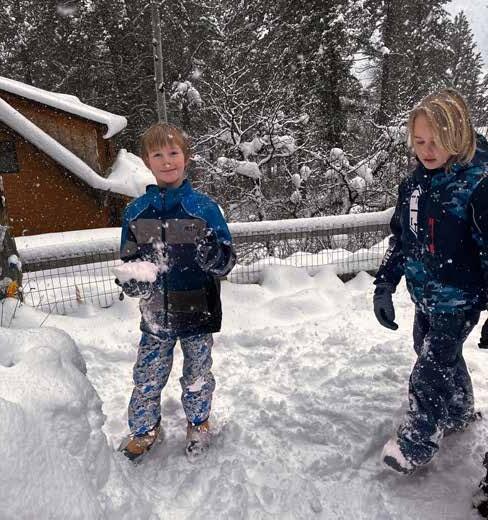
Wednesday, February 8th, the entire school skied at Sunlight! Many thanks to Sunlight staff, MCS staff, and parent chaperones for making the day safe and fun!
Below and right: MCS students enjoy the snow.
Town of Marble Board of Trustees: February 2nd Meeting Recap
The temperature was hovering just above zero as I cautiously followed Tony Petrocco’s rather fetching 1999 red Toyota Tacoma through East Marble (also known as Clarence), and halfway up the hill to the Marble Community Church Fellowship Hall on West Main Street. Negotiating the perilous ice rink that had formed outside the entrance, I grabbed my usual beverage from the fridge and sat down at the back of the hall, pleasantly surprised by a large number of attendees.
I counted 11 Marble residents, excluding the Town’s administrative staff — Ron Leach, Alie Wettstein, and Terry Langley, bedecked in a mesmerizing silk cardigan. At least I think it was silk. El Tel, I suspect, does not do polyester. To everyone’s delight and much cooing, Mike Yellico turned up with his and Emma Bielski’s cute-as-a-button baby daughter, Evelyn, who turns 4 months old later in March.
While the Town Council prepared themselves, Petrocco, looking sporty in a Grand Canyon cap and grey sweatshirt with a turquoise polo shirt peeking out of the neckline, regaled a handful of us at the back with the history of his beloved truck. On one occasion it was rammed twice (evasive action was
needed to avoid a third collision) when he was driving in Carbondale several years ago. According to Petrocco, his assailants, both of whom worked for the Town of Carbondale, had mistaken him for a meth dealer from Basalt. Fortunately, the truck (and Petrocco) survived and he proudly announced that the vehicle now has more than 600,000 miles under its belt.
The meeting got underway at 7:06 p.m., with the usual cast of characters present: Mayor Ryan Vinceguerra, Emma Bielski, Larry Good, Amber McMahill, and Petrocco. Minutes from January 3rd and January 19th were speedily approved, and in a change of running order, Marja O’Connor presented the Parks Committee report.
The Parks Committee has been in operation for two years now and acts in an advisory capacity to the Town Council. Brent Compton, Lise Leach, and Amy Rusby, all part of that Committee were present.
O’Connor announced that there would be a “Camp Out” clean-up weekend on the weekend of June 24th — 25th at the Mill Site Park. By the time May rolls around, the committee will have figured out the projects that will need to be worked on. It is anticipated that between 30 and 50 volunteers will be needed. O’Connor added that she was considering ideas for a Town kickball league to encourage people to use the parks, and floated the idea of a Town clean-up day, in addition to the Mill Site weekend.
Next up for discussion was the plan for a New Year’s Eve bonfire at the Mill Site park. The 2022 fire proved to be something of a fiasco. Built too late in the season, it created an enormous mess of soggy unburned debris which cost the Town $5,000 to clean up.
Yellico, keen to distance himself from that “rogue incident,” requested permission to construct this year’s fire in September, well before the snow flies. He was told by Ron Leach that he will need a special event
Town of Marble meetings are open to the public. 2023
permit, and Emma Bielski summed up the feelings of those present.
"The bonfire, she said, “brings around 75 people together in mid-winter. It is a cherished, unique event.”
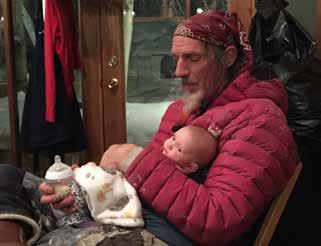
There was some discussion, however, over moving the venue from the Mill Site Park, which was resisted by Yellico who insisted, despite the Parks Committee agreeing unanimously at its last meeting to move the venue, that the location of the Bonfire should stay put. Who would dare argue with a proud new father bottle-feeding his baby daughter on his lap? Cue more cooing.
Brent Compton then took to the stage to inform the Council of a possible opportunity to increase public park space for the Town. The 30-acre property replete with two ponds on the East Side of Beaver Lake known as “Snowbound” may well be coming on the market with a price tag of $3.4 million.
The Great Outdoors Colorado has indicated that should the Town be interested in purchasing the property, a grant in the region of $1.5 million might be available. Mayor Vinceguerra said that the Town should pursue fundraising options. He added that Colorado Parks and Wildlife will also need to be approached.
Moving on to other business, when asked about the status of the Town’s intention to assume control of the Marble Water Company, Leach announced that the composition of the initial letter to the incumbent “utility” was still being discussed with the Town’s attorney and that its contents were currently not for public consumption. More information should be available during the March meeting, if you miss it, pick up your April edition of The Crystal Valley Echo for more information.
Leach then secured a 5% pay rise for the five parttime and one full-time Town employees. He indicat-
An account from DJ Sugar Monkey
The Marble Town Council meets on the 1st Thursday of each month starting at 7 p.m. in the Marble Community Church’s Fellowship Hall.
Marble's newest resident, Evelyn, joins the Town of Marble meeting with her Dad, Mike Yellico. Photograph from DJ Sugar Monkey.
ed that his biggest concern was that as the town grows, Marble will need an extra headcount to address enforcement issues.
Readers may remember that during the Special Meeting held on January 19th, Mark Chain of Mark Chain Consulting, LLC., was approved to facilitate the Town’s Master Plan. Well, this proved a little premature. After discussing the matter with the Department of Local Affairs, Amber McMahill announced that in order to receive a State grant for the Plan, the Town of Marble would not be able to contract with a third-party facilitator until 60 days after the grant letter has been received and that the Master Plan process has to be put out for competitive bids.
That kicks the whole process into April. Chain, joining on speakerphone, took the news on the chin, quietly confident that he is the right man for the job and that his services are priced competitively. The Master Plan Committee will be announced at April’s meeting.
Last but by no means least, Mayor Vinceguerra recused himself from the panel for a short interval to present his plans for the Inn at Raspberry Ridge, which he has just purchased with longterm friends and business partners, Nial O’Connor and Stephen Horner. Vinceguerra plans to rename the business the Raspberry Ridge Café and anticipates establishing a “grab and go” style café, open seven days a week from 8 a.m. — 2 p.m., operating 10.5 months of the year.
There will be a staff of two, with employee housing in the existing chalet. Vinceguerra insisted that he would be taking a “minimalist approach to parking and water,” but I’m pretty sure that no one understood what he was talking about. The website for his new venture is up and running and it was generally agreed that Marble needs a breakfast option.
His application for a business and liquor license was approved by the Town Council pending the necessary State approvals. When asked if the venue was going to be dine-in, Vinceguerra joked that after the purchase of the business he had no money left for furniture.
See you at the next meeting!
FREE FOOD BAGS AVAILABLE
IN MARBLE
If you’re needing assistance stretching your food budget, Gunnison County Officials currently have bags of food available through the Marble Community Church.
There is no charge and no reservation needed; boxes are available for an individual or a family up to of four, and contain enough meals for approximately three days.
To arrange a pickup, please call the Marble Community Church at (970) 963-1464.
Forest Service Issues Draft Decision for Redstone - McClure Bike Trail
Press Release from the U.S. Forest Service
At the end of January, the White River National Forest issued a final environmental assessment and draft decision authorizing Pitkin County to construct and maintain the proposed Redstone to McClure Pass Trail.
The seven mile trail would be a natural surface, non-motorized, multi-use recreation trail from Redstone to the summit of McClure Pass. It would be constructed within the State Highway 133 right-of-way and along the historic Rock Creek Wagon and Old McClure Pass roads.
The Forest Service’s draft decision covers the approximately five miles of trail that would cross National Forest System land.
“The trail would improve public access and provide a safer alternative to hiking and biking along Highway 133,” said White River National Forest Supervisor Scott Fitzwilliams. “We worked with Pitkin County to mitigate poten-
tial impacts from the trail.”
The proposed trail incorporates proper trail design to reduce physical impacts and a seasonal closure to all visitor use from December 1st through April 30th to mitigate potential impacts to wintering elk.
Pitkin County proposed the trail to help meet the growing demand for trail connectivity within the upper Crystal River, to address the existing unmanaged recreational use along the historic roads in the area, and to improve safety for pedestrians and cyclists along Highway 133.
The release of the final EA and draft decision initiates a 45-day objection period that ends March 12th. The final EA, draft decision, and information about the objection period are available at:
www.fs.usda.gov/project/?project=56913
Crystal River Caucus Regular Zoom Meeting
Thursday, March 9 at 7 p.m.
The agenda will include an update on the Coal Basin Methane Project, a discussion of the US Forest Service proposed finding of no significant impact on the Redstone to McClure bike trail, and a presentation on the prescribed burn plans this spring by the US Forest Service.
Meeting links are sent to those on the Crystal River Caucus e-mail list. If you are not on the list but would like to be, please send a request to crcaucus@gmail.com
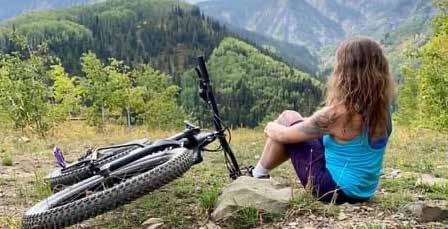
Mellie Test with her mountain bike in Coal Basin. Photograph courtesy of Mellie Test.
Redstone Historical Society's Vintage Valley: Original Inhabitants of the Crystal Valley and the Early Explorers
By Mary Boland
The following is reprinted from Boland's The History of the Crystal Valley with permission.
The Crystal Valley was part of the vast territory, including all of the mountainous parts of Colorado, that the Ute Indians considered to have been theirs since time immemorial. Certainly, the Utes were in possession in the 17th century when the first Spanish explorers penetrated the mountains [which are] now part of this state.
They were nomadic people, whose lives had just begun to achieve some ease as a result of their fairly recent acquisition of horses, sometime after the introduction of these animals to the New World by the Spanish. The Crystal Valley was one of their favorite summer haunts, abounding in fish and game, lush grasses for their ponies, timber, and even natural hot springs for bathing.
All content sponsored and provided by the Redstone Historical Society.
As the Eastern Slope was prospected and developed, the Utes were pushed back to the western side of the Continental Divide. In 1863, Colorado Governor John Evans managed to get formal acquiescence in this state of affairs from the Utes. The 1863 Treaty guaranteed the Western Slope to the Utes “as long as rivers run and grasses grow.” The vast lands thus guaranteed to the Utes were still little known by white men.
The first white man known to enter the Crystal Valley was a prospector and trapper named William Gant, who traveled down the Crystal in 1859 and then much later settled in New Castle. Gant told of finding an old rusted pan during his trip and thought this indicated that other whites had been there before him. If so, they could have been trappers working from Antoine Robidoux’s Fort Uncompahgre (near the present city of Delta) during the heyday of beaver trapping “mountain men,” circa 1840, or possibly 49ers on their way to California.
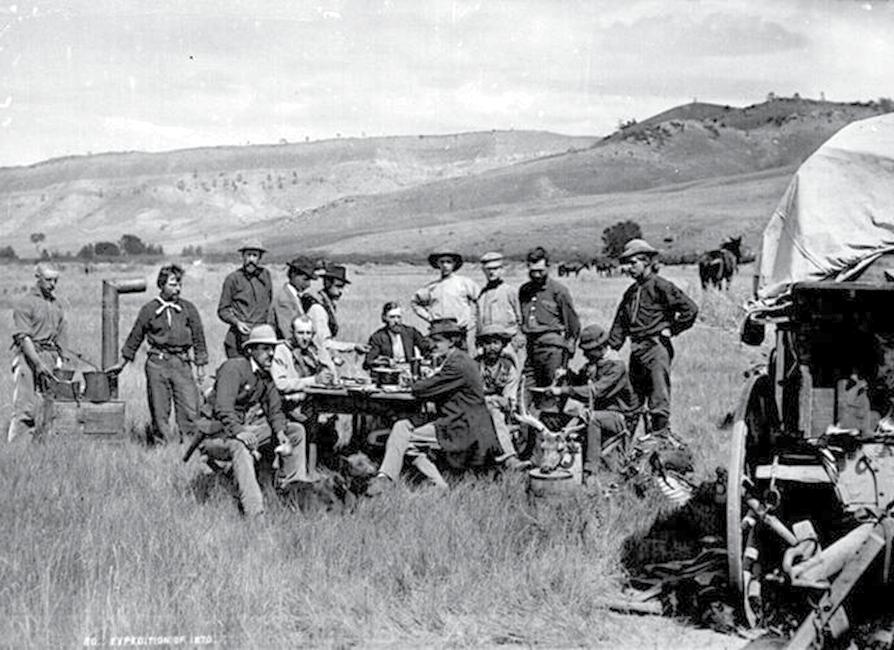
Apparently, the first exploring party of consequence reached the valley in 1860 and was led by Richard Sopris, later a mayor of Denver. Sopris and 14 companions left Denver in early July, traveled through South Park, then down the Blue River, then over to the Eagle, then to the Roaring Fork, and on up the Crystal. They named Mount Sopris for their leader before leaving the valley to take a more northerly route home.
When gold was discovered in the San Juan mountains to the south in 1870-1871, the Immigrants to that area, who were of course trespassing on Ute lands, managed to get the Government to renegotiate with the Utes. As a result, the Utes ceded their first Western Slope territory, including all the mining regions of the San Juan mountains, in the 1873 Brunot Treaty. The resulting development of that mining region brought a considerable number of prospectors that much closer to the Utes’ treasured Crystal Valley. And, indeed a party of seven, led by one Benjamin Graham, had already established a cabin at the head of the Crystal before the Utes discovered their camp in 1874 and drove them out.
The Utes did not, however, molest the official surveying parties led by U.S. geologist Dr. F.V. Hayden in 1873 and 1874. Dr. Hayden’s teams did quite a thorough job of mapping the area and naming the mountains and streams. Dr. Hayden reported that the Elk Mountains presented the most complex geological problem he had encountered anywhere on the continent as the mountains had been lifted and tossed in several directions by some great force.
At the same time, Dr. John Parsons of Denver led a separate expedition to explore the agricultural and mineral resources of the Elk Mountains, and with the aid of prospectors enlisted along the way, even constructed a "road" over Schofield Pass to the Crystal. Taking advantage of this improvement, a geologist named
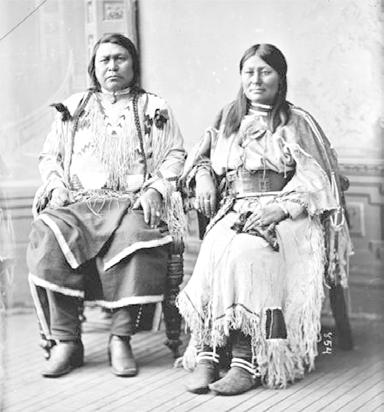
Chief Ouray, pictured here with his wife Chipeta, was one of the most influential leaders of the Ute people in the late nineteenth century. Ouray negotiated treaties and attempted to avoid conflict with whites wherever possible. Photo from the Colorado Historical Society Collection.
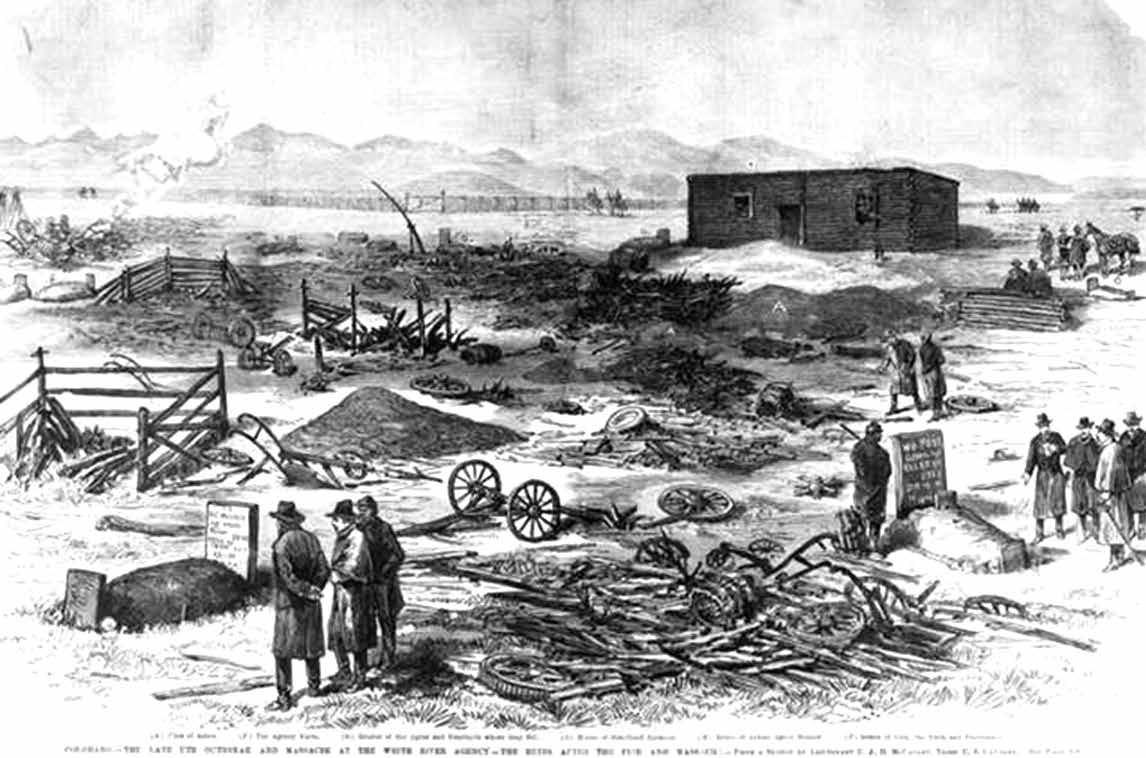
Meeker Tragedy at the White River Ute Indian Agency, September 29th 1879, shows soldiers surveying the destruction from the fire and battle between Native American Utes and Nathan Meeker's employees. Photo is a reproduction of a sketch by Lieutenant C. A. H. McCauley, Third U. S. Cavalry
Sylvester Richardson explored the upper valley and discovered the marble outcroppings. Shortly thereafter the marble was rediscovered by George Yule, a prospector who later became sheriff of Gunnison County and a Gunnison County Commissioner. Yule Creek, which runs through the marble area, still bears his name.
The unfortunate Utes gave all those coveting their lands a fine excuse to call for their removal from the state entirely when they killed Indian agent Nathan Meeker and 11 other men at the White River Agency situated north of the Colorado River. This ”Meeker Massacre” of 1879 came about after the rather rigid, righteous, and determined agent had made an all-out assault on the Ute way of life, trying to turn his nomadic charges into hard-working farmers and classroom-bound students virtually overnight. The Utes' patience with Meeker finally broke completely after he ordered plows to tear up their racetrack on which they loved to run their ponies and bet on the results.
Immediately after the “massacre,” the cry resounded through the entire state that “The Utes must go!” The federal government conducted various investigations and other formalities designed to put some face on the matter and then gave in. Colorado Congressman James Belford answered Eastern critics noting that in traveling to Washington, D.C., he had crossed five states made up wholly of land stolen from the Indians. Why should Colorado be held to a different standard?
After being forced to sign another treaty, the Utes were moved to their present reservations on dry land in southern Colorado, northern New Mexico, and Utah. The removal of the Utes opened the Crystal Valley to the growing number of prospectors waiting in the already settled San Juan and Gunnison country to the south.
Author Mary Boland, 1936-2017, moved to Carbondale in 1973. She was the Glenwood Bureau Chief for the Grand Junction Sentinel, a Professor at Colorado Mountain College, and a prolific writer for many national and local publications. This is one article from her publication The History of the Crystal Valley.
Independent, Local Journalism Needs Your Support!
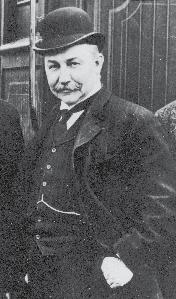
Hayden Expedition, 1873-1876, Ferdinand V. Hayden's crew of topographers, geologists, botanists mapped out western Colorado.
Photo from US Geological Survey.
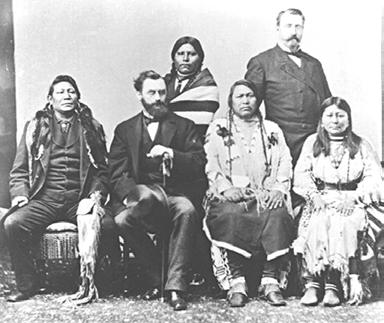
Chief Ouray and other Utes traveled to Washington. D.C. to negotiate a treaty that resulted in the removal of the White River and Tabeguache Utes from Colorado to the Uintah Basin in present day Utah. Chief Ouray died at age 47 shortly after this trip.
Seated from left to right: Chief Ignacio of the Southern Utes, Carl Shurz, Secretary of the Interior, Chief Ouray and his wife, Chipeta. Standing are Woretsiz and General Charles Adams. Photo by Matthew Benjamin Brady, 1880, National Archives.
Bear Awareness
Press Release from Colorado Parks and Wildlife
In mid-February, a bear cub was reported to be roaming around two Redstone subdivisions, Crystal River Park and Redstone Ranch Acres, looking for food. The cub was reported to Colorado Parks and Wildlife (CPW), which was captured and taken to a rehabilitation facility in Silt, Colo, until it is safe to release later this spring.
According to CPW, the department received 4,282 reports of sightings and conflicts with bears in 2022, which was a 16% increase from 2021, but a 1.3% decrease from the previous two years.
In 2019, CPW launched a new bear reporting system to help wildlife managers track and quantify bear activity and conflicts across the state. The data collected is used to see overall trends and identify sources of conflict on a localized, regional, and statewide level. Since its implementation in April 2019, CPW has recorded 18,351 reports of sightings and conflicts with bears, of which nearly one-third are traced back to bears getting into the trash.
The data from the annual bear cycle informs CPW’s wildlife managers where bears are at and what they are up to, helping CPW identify sources of conflict and make educated management decisions. If you see a bear causing trouble in an urban area, call CPW to report it.
In 2022, Gov. Jared Polis signed HB 21-1326 to reduce human-bear conflicts. This bill provides funding for the Colorado Department of Natural Resources and CPW, including $1
million for native species conservation, to be distributed to local communities.
“We need help from local communities to develop strategies to secure garbage and other attractants across bear habitat,” said Kristin Cannon, deputy regional manager for CPW's Northeast Region. “Ultimately, it will also require individuals to take some responsibility and follow proper guidelines on living appropriately with bears to protect them.”
beCoMe bear aware
Colorado Parks and Wildlife offers a reminder that by taking some simple precautions, you can avoid human/wildlife conflicts and help to keep bears wild.
bear-Proofing yoUr hoMe
• Keep garbage in a well-secured location. Only put out garbage on the morning of pickup.
• Clean garbage cans regularly to keep them free of food odors: ammonia is effective.
• Keep garage doors closed, and do not leave pet food or stock feed outside.
• Use a bear-resistant trash can or dump-
ster.
• Bird feeders are a major source of human-bear conflicts. Attract birds naturally with flowers and water baths. Do not hang bird feeders from April 15th to November 15th
• Secure compost piles. Bears are attracted to the scent of rotting food.
• Talk to your neighbors and kids about being Bear Aware.
• Lock your doors when you’re away from home and at night.
• Don’t allow bears to become comfortable around your house. If you see one, haze it by yelling at it, throwing things at it, and making loud noises to scare it off.
Terry Langley captured this photograph of a sow gorging on berries in Marble's Hermits Hideaway last September.